Robert R. Brooks, Michael F. Chambers, Larry J. Nicks and Brett H. Robinson
- A minimum of selective breeding produced plants with 1% nickel in dry mass.经过最低限度的选择育种,获得了干重镍含量达1%的植株。
- The world price of nickel was $7.65 kg�1.当时镍的世界价格为$7.65 kg−1。
- The biomass yield after moderate fertilization was 10 t ha�1.适度施肥后生物量产量为10 t ha−1。
- A quarter of the energy of combustion of the biomass could be turned into electricity for a yield of $131 ha�1.生物质燃烧能量的四分之一可转化为电能,收益为$131 ha−1。
- The return to the grower would be half of the gross yield of $765 for the metal plus the energy yield of $131.种植者的收益为金属总产值$765的一半加上能源收益$131。
This compares well with the average returns from other crops, and is well in excess of the average profit made by wheat farmers in the USA.
Following earlier proposals3,4, intensive field trials were designed specifically to study
| Element元素 | Species物种 | Concentration浓度 | Biomass生物量 | Refs文献 |
|---|---|---|---|---|
| Cadmium | Thlaspi caerulescens | 3000 (1) | 4 | 17 |
| Cobalt | Haumaniastrum robertii | 10 200 (1) | 4 | 18 |
| Copper | Haumaniastrum katangense | 8356 (1) | 5 | 18 |
| Lead | _Thlaspi rotundifolium_subsp. | 8200 (5) | 4 | 19 |
| Manganese | Macadamia neurophylla | 55 000 (400) | 30 | 20 |
| Nickel | Alyssum bertolonii | 13 400 (2) | 9 | 21 |
| Berkheya coddii | 17 000 (2) | 18 | 22 | |
| Selenium | Astragalus pattersoni | 6000 (1) | 5 | 23 |
| Thallium | Iberis intermedia | 3070 (1) | 8 | 24 |
| Uranium | Atriplex confertifolia | 100 (0.5) | 10 | 23 |
| Zinc | Thlaspi calaminare | 10 000 (100) | 4 | 25 |
aConcentrations are mean highest elemental values (�g g–1 dry matter); values in parentheses are equivalents for non-accumulator plants. Biomass is t ha–1 yr–1.
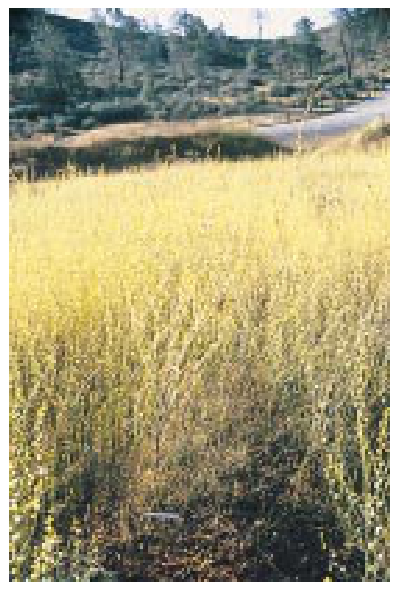
The hyperaccumulator Alyssum bertolonii
The South African hyperaccumulator Berkheya coddii
The nickel content of the plant was directly related to its extractable fraction in ammonium acetate in a wide range of natural and artificial substrates. Excision of shoots induced a dramatic increase in the nickel content in the new growth of the whole plant (5500 �g g�1 compared with 1800 �g g�1). When plants were grown in pots with 0–1% nickel added to the substrate, the metal content of the plants rose to a maximum value of about 1% dry mass.
在多种天然和人工基质中,该植物的镍含量与基质中乙酸铵可提取态镍组分直接相关。剪除地上部后,整株植物新生组织中的镍含量显著增加(5500 μg g−1,对照为1800 μg g−1)。在基质中添加0–1%镍的盆栽试验中,植物的金属含量升高,最高可达约1%(干重)。
field trials to large-scale metal farming. It has not been possible so far to achieve experimentally the 7880 �g g�1 nickel found in B. coddii wild plants; 5000 �g g�1 nickel seems a more realistic concentration and could provide a nickel yield of 110 kg ha�1. Adding the energy profit and assuming a 50% return to the grower, the value of the crop is still well above that of a wheat crop, although worth only about the same as wheat if the energy bonus is discounted. The earlier work on phytomining was based on the then world price of $7.65 kg�1 of nickel.
田间试验结果外推至大规模金属种植。迄今为止,试验中尚未能达到B. coddii野生植株中7880 μg g−1的镍含量;5000 μg g−1的镍含量似乎更为现实,可提供110 kg ha−1的镍产量。计入能源收益并假定种植者获得50%的回报,该作物的价值仍远高于小麦;但若不计能源收益,其价值仅与小麦大致相当。早期的植物采矿研究是基于当时镍的世界价格$7.65 kg−1。
At the highest recorded concentration of 7880 �g g�1 nickel in whole wild plants in South Africa, a 1 ha crop of B. coddii would remove 168 kg of nickel, a yield equivalent to $1285 assuming the value of nickel to be $7.65 kg�1. This, combined with the energy derived from the combustion of the plant material ($288), translates to $1311 ha�1. If half of the value of the metal crop could be returned to the producer, this would represent about twice the value of a wheat crop.
按南非野生整株植物中记录的最高镍浓度7880 μg g−1计算,1 ha的B. coddii作物可移除168 kg镍,假定镍价为$7.65 kg−1,其产值相当于$1285。加上植物材料燃烧所获能源收益($288),合计为$1311 ha−1。若金属作物价值的一半可返还给生产者,则约相当于小麦作物价值的两倍。
B. coddii has several advantages over other candidates for phytomining in the USA:
与美国其他植物采矿候选物种相比,B. coddii具有以下优势:
- Its biomass production is superior to that reported for any other hyperaccumulator except Alyssum lesbiacum12 and is not at the expense of nickel content.其生物量高于除Alyssum lesbiacum12以外已报道的任何其他超富集植物,且高生物量并不以降低镍含量为代价。
- The plant is easy to grow from seed.该植物易于通过种子繁殖。
- It is a perennial that can be harvested and regrown the following year without the need for resowing.它是多年生植物,收获后次年可再生,无需重新播种。
Extreme caution must be applied in extrapolating the results of pot trials and limited
将盆栽试验和有限的
- Preliminary observations indicate that the nickel content of regrowth tissue is significantly higher than that of first-year growth.初步观察表明,再生组织的镍含量显著高于第一年生长组织。
- It is tolerant of cool climatic conditions including frost.它能耐受包括霜冻在内的冷凉气候条件。
- Although probably tolerant only of mild winters, the plant could be grown as an annual crop in areas where winters are severe.尽管该植物可能仅能耐受温和的冬季,但在冬季严寒地区可作为一年生作物种植。
- It produces seed readily for future crops, and the flowers are easily fertilized by local bees; in South Africa they appear to be fertilized by a local species of flying beetle.它易于结籽以供后续种植,其花易由当地蜜蜂授粉;在南非,其花似乎由当地一种飞行甲虫授粉。
- It appears to be resistant to insect attack and soil pathogens.它似乎对虫害和土传病原菌具有抗性。
Phytomining for metals other than nickel镍以外金属的植物采矿
There are practical limits to phytomining13. The main variables that control its economic feasibility are: the metal price, the plant biomass, and the highest achievable metal content of the plant (Table 2). Metal values range from about $15 000 000 t�1 for platinum to about $600 t�1 for lead. At these extremes, a plant with a biomass of 20 t ha�1, such as B. coddii, would need to contain about 1.7 �g g�1 platinum or >4% lead. To achieve either target would require some type of substrate modification because natural concentrations of these two metals in dry plant material do not usually exceed 0.1 �g g�1 for platinum and 5 �g g�1 for lead. The lead content of maize with a biomass of 30 t ha�1 can be raised to close to the economic limit of 3.0% by adding EDTA to the substrate14; however, the cost of the EDTA alone would exceed the value of the lead extracted from the soil.
植物采矿存在实际限制13。控制其经济可行性的主要变量为:金属价格、植物生物量以及植物可达到的最高金属含量(表2)。金属价值从铂的约$15 000 000 t−1到铅的约$600 t−1不等。在这两个极端情况下,生物量为20 t ha−1的植物(如B. coddii)需含铂约1.7 μg g−1或含铅>4%。要达到任一目标都需要对基质进行某种改良,因为这两种金属在干植物材料中的天然浓度通常不超过铂0.1 μg g−1和铅5 μg g−1。通过向基质中添加EDTA,生物量为30 t ha−1的玉米的铅含量可提高到接近3.0%的经济限值14;然而,仅EDTA的成本就会超过从土壤中提取的铅的价值。
The work on lead highlights the two main approaches to phytomining14. The first of these is the less expensive and involves selection of plants of high biomass that are natural hyperaccumulators of the target metal. The use of B. coddii is a good example of this approach. Hyperaccumulator plants might realistically also be expected to be used for the elements thallium, cobalt, uranium and nickel (Tables 1 and 2), whose world prices lie in the range $6000–300 000 t�1. For the less valuable metals (tin to lead in Table 2) phytomining will never be a viable proposition.
铅的研究凸显了植物采矿的两种主要途径14。第一种成本较低,即选择对目标金属具有天然超富集能力的高生物量植物。B. coddii的应用即为此途径的典型例子。可以合理预期,超富集植物也可用于铊、钴、铀和镍等元素(表1和表2),其世界价格在$6000–300 000 t−1之间。对于价值较低的金属(表2中从锡到铅),植物采矿永远不会是可行的方案。
The second approach to phytomining relies on the concept of induced hyperaccumulation, in which a chemical complexing agent must be added to the substrate (as described for lead)14. This is economic only for the most valuable metals, such as gold, silver and the platinum-group metals platinum and palladium, where the cost of the additive should be more than offset by the value of the product.
植物采矿的第二种途径依赖于诱导超富集的概念,即必须向基质中添加化学络合剂(如上文铅的例子所述)14。这仅对最有价值的金属具有经济性,如金、银以及铂族金属铂和钯,其产品价值应足以抵消添加剂的成本。
In a third scenario, the use of hyperaccumulator plants to decontaminate polluted soils15 (phytoremediation) might result in production of a ‘bio-ore’ of some commercial value to recoup some of the costs of soil remediation.
第三种情景是利用超富集植物净化污染土壤15(植物修复),这可能产生具有一定商业价值的“生物矿石”,以收回部分土壤修复成本。
1References参考文献
| Biom生物 | ass produ量产 | ction (t ha量(t ha | �1) | ||||
|---|---|---|---|---|---|---|---|
| Metal | ($ t–1) | 1 | 10 | 15 | 20 | 25 | 30 |
| Platinuma | 14 720 752 | 34.0 | 3.4 | 2.3 | 1.7 | 1.4 | 1.1 |
| Golda | 11 040 564 | 45.3 | 4.6 | 3.1 | 2.2 | 1.8 | 1.5 |
| Palladiuma | 4 464 000 | 112.0 | 11.2 | 7.5 | 5.6 | 4.5 | 3.7 |
| Thallium | 300 000 | 1667 | 167 | 111 | 83 | 67 | 56 |
| Silvera | 152 113 | 3278 | 327 | 218 | 164 | 131 | 109 |
| Cobalt | 48 000 | 10 417 | 1042 | 694 | 521 | 417 | 347 |
| Uranium | 22 000 | 22 728 | 2273 | 1515 | 1137 | 910 | 758 |
| Nickel | 6090 | 82 164 | 8216 | 5477 | 4108 | 3286 | 2739 |
| Tina | 5580 | 88 715 | 8871 | 5914 | 4435 | 3548 | 2957 |
| Cadmium | 3750 | 133 333 | 13 333 | 8889 | 6667 | 5333 | 4444 |
| Copper | 1964 | 254 970 | 25 497 | 16 998 | 12 749 | 10 199 | 8499 |
| Manganese | 1700 | 294 120 | 29 412 | 19 608 | 14 706 | 11 765 | 9804 |
| Zinc | 1192 | 417 076 | 41 707 | 27 805 | 20 853 | 16 683 | 13 902 |
| Leada | 577 | 869 040 | 86 904 | 57 936 | 43 452 | 34 761 | 29 968 |
aInduced hyperaccumulation probably required.
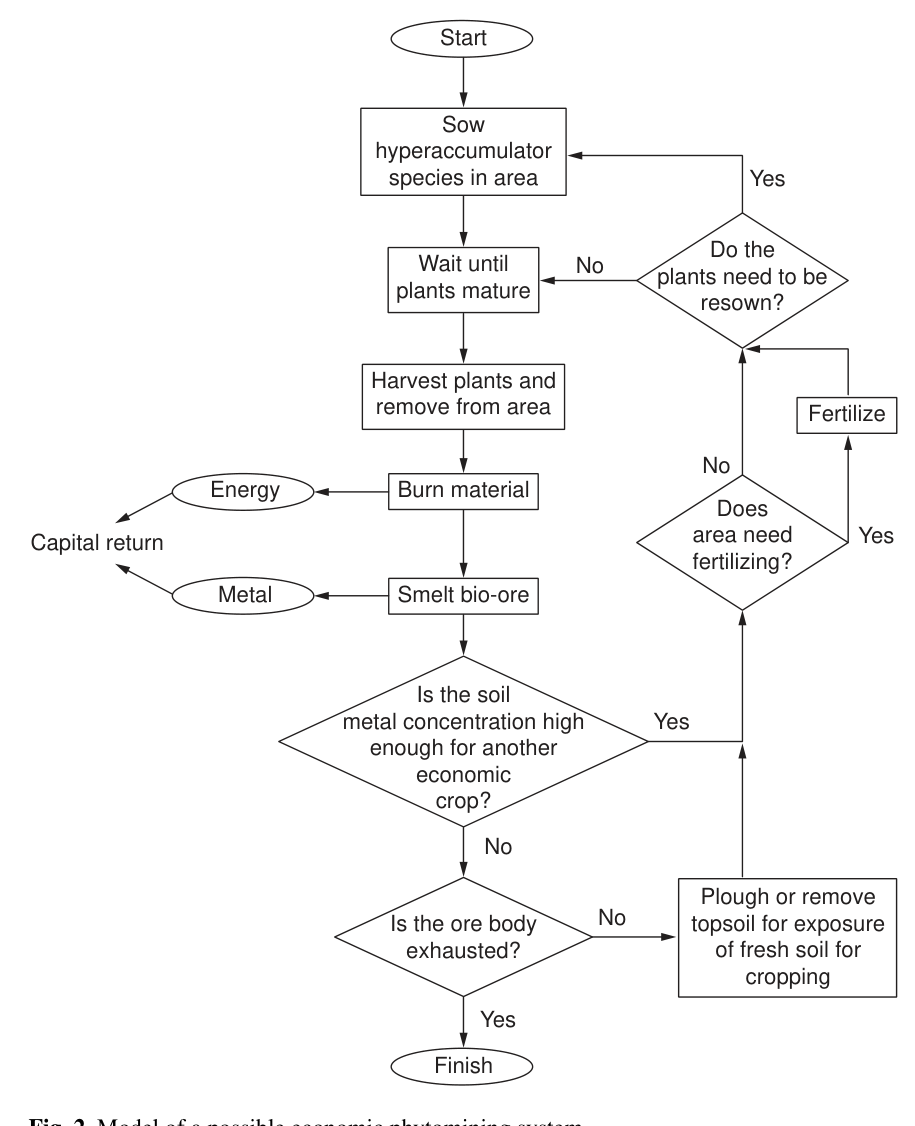
Model of a possible economic phytomining system
are large areas of nickel mineralization and ultramafic soils from which it is uneconomic to extract metal conventionally. Farmers in Brazil are reported to have attempted and failed to grow crops such as soya bean over nickel-rich ultramafic soils16. The surrounding natural vegetation included several nickel hyperaccumulators that would have grown quite well as an alternative to failed soya bean crops.
A model economic phytomining system is shown in Fig. 2. The system differentiates between annual and perennial crops and takes into account fertilization and soil exhaustion. Whether a project succeeds will probably depend on whether some of the energy of combustion of raw material can be recovered. In tropical regions it should be possible to have crops maturing in each month, and thus keep the incineration plant busy throughout the year. It has also been suggested (R.L. Chaney, pers. commun.) that biomass could be stored in the field or near the incineration plant for burning according to the energy-requirement schedule.
2Conclusions结论
Phytomining has several advantages over conventional mining. It offers the possibility of exploiting ore bodies or mineralized soils that are otherwise uneconomic to work, and its effect on the environment is minimal when compared with the erosion caused by opencast mining; the area to be mined may be ‘readyvegetated’; a ‘bio-ore’ has a higher metal content than a conventional ore and therefore needs far less space for storage; and because of its low sulphur content, smelting of a ‘bio-ore’ does not contribute significantly to acid rain.
与传统采矿相比,植物采矿具有若干优势。它为开发在其他情况下开采不经济的矿体或矿化土壤提供了可能;与露天开采造成的侵蚀相比,其对环境的影响极小;待开采区域可能“已有植被覆盖”;“生物矿石”的金属含量高于传统矿石,因此所需储存空间小得多;而且由于其硫含量低,“生物矿石”的冶炼不会显著加剧酸雨。
Beyond the theoretical and pilot-plant stages of phytomining, two scenarios can be envisaged. The first is development of a large-scale commercial project involving square kilometres of metal-rich soils, such as those derived from ultramafic rocks or low-grade mineralization.
在植物采矿的理论和中试阶段之后,可以设想两种情景。第一种是开发涉及数平方千米富金属土壤(如源自超基性岩或低品位矿化的土壤)的大规模商业项目。
Extensive field trials are required to determine whether phytomining can become a reality. Its viability, like that of other mining methods, depends on the world price of the target metal. Such prices are subject to cyclical variation, and a low current value for a given metal should not preclude consideration of its extraction by phytomining. The biomass could be combusted immediately for its economic value and the plant ash stored until the world price improved.
需要开展大量田间试验以确定植物采矿能否成为现实。与其他采矿方法一样,其可行性取决于目标金属的世界价格。此类价格存在周期性波动,某种金属当前价值较低不应成为排除以植物采矿方式提取该金属的理由。生物质可立即燃烧以获取其经济价值,而植物灰分则可储存至世界价格回升。
The second, and perhaps more likely, scenario is phytomining by smallholders throughout a region, in which a farmer might grow a few hectares of plant material and have it collected for processing at a nearby facility. This should be preferably close to a large city, where industrial waste could be used as feedstock for the incineration plant, which in turn could supply steam for producing local supplies of electricity. An obvious site for such small-scale phytomining is Brazil, where there
第二种情景(或许可能性更大)是在整个地区由小农户开展植物采矿,农户可种植几公顷植物材料,并将其收集运至附近设施进行加工。该设施最好靠近大城市,以便利用工业废弃物作为焚烧厂的原料,焚烧厂进而可提供蒸汽用于本地发电。此类小规模植物采矿的一个理想地点是巴西,那里
1 Brooks, R.R. et al. (1977) Detection of nickeliferous rocks by analysis of herbarium specimens of indicator plants, J. Geochem. Explor. 7, 49–57
1 Brooks, R.R. et al. (1977) Detection of nickeliferous rocks by analysis of herbarium specimens of indicator plants, J. Geochem. Explor. 7, 49–57
2 Brooks, R.R., ed. (1998) Plants that Hyperaccumulate Heavy Metals, CAB International
2 Brooks, R.R., ed. (1998) Plants that Hyperaccumulate Heavy Metals, CAB International
3 Chaney, R.L. (1983) Plant uptake of inorganic waste constituents, in Land Treatment of Hazardous Wastes (Parr, J.F. et al., eds), pp. 50–76, Noyes Data Corp.
3 Chaney, R.L. (1983) Plant uptake of inorganic waste constituents, in Land Treatment of Hazardous Wastes (Parr, J.F. et al., eds), pp. 50–76, Noyes Data Corp.
4 Baker, A.J.M. and Brooks, R.R. (1989) Terrestrial higher plants which hyperaccumulate chemical elements – a review of their distribution, ecology and phytochemistry, Biorecovery 1, 81–126
4 Baker, A.J.M. and Brooks, R.R. (1989) Terrestrial higher plants which hyperaccumulate chemical elements – a review of their distribution, ecology and phytochemistry, Biorecovery 1, 81–126
5 Chaney, R.L. et al. (1998) Method for phytomining of nickel, cobalt and other metals from soil, US Patent 5711784
5 Chaney, R.L. et al. (1998) Method for phytomining of nickel, cobalt and other metals from soil, US Patent 5711784
6 Nicks, L.J. and Chambers, M.F. (1994) Nickel farming, Discover Mag. 19 September
6 Nicks, L.J. and Chambers, M.F. (1994) Nickel farming, Discover Mag. 19 September
7 Nicks, L.J. and Chambers, M.F. (1995) Farming for metals, Mining Environ. Mgt 15–18 September
7 Nicks, L.J. and Chambers, M.F. (1995) Farming for metals, Mining Environ. Mgt 15–18 September
8 Nicks, L.J. and Chambers, M.F. (1998) A pioneering study of the potential of phytomining for nickel, in Plants that Hyperaccumulate Heavy Metals (Brooks, R.R., ed.), pp. 313–326, CAB International
8 Nicks, L.J. and Chambers, M.F. (1998) A pioneering study of the potential of phytomining for nickel, in Plants that Hyperaccumulate Heavy Metals (Brooks, R.R., ed.), pp. 313–326, CAB International
9 Reeves, R.D. et al. (1981) Nickel uptake by Californian Streptanthus and Caulanthus with particular reference to the hyperaccumulator S. polygaloides Gray (Brassicaceae), Am. J. Bot. 68, 708–712
9 Reeves, R.D. et al. (1981) Nickel uptake by Californian Streptanthus and Caulanthus with particular reference to the hyperaccumulator S. polygaloides Gray (Brassicaceae), Am. J. Bot. 68, 708–712
10 Robinson, B.H. et al. (1997) The nickel hyperaccumulator plant Alyssum bertolonii as a potential agent for phytoremediation and phytomining of nickel, J. Geochem. Explor. 59, 75–86
10 Robinson, B.H. et al. (1997) The nickel hyperaccumulator plant Alyssum bertolonii as a potential agent for phytoremediation and phytomining of nickel, J. Geochem. Explor. 59, 75–86
11 Robinson, B.H. et al. (1997) The potential of the high-biomass Berkheya coddii for phytoremediation and phytomining, J. Geochem. Explor. 60, 115–126
11 Robinson, B.H. et al. (1997) The potential of the high-biomass Berkheya coddii for phytoremediation and phytomining, J. Geochem. Explor. 60, 115–126
12 McGrath, S.P. et al. (1993) The potential for the use of metal-accumulating plants for the in situ decontamination of metal-polluted soils, in Integrated Soil and Sediment Research: a Basis for Proper Protection (Eijsackers, H.J.P. and Hamers, T., eds), pp. 673–676, Kluwer
12 McGrath, S.P. et al. (1993) The potential for the use of metal-accumulating plants for the in situ decontamination of metal-polluted soils, in Integrated Soil and Sediment Research: a Basis for Proper Protection (Eijsackers, H.J.P. and Hamers, T., eds), pp. 673–676, Kluwer
13 Brooks, R.R. and Robinson, B.H. (1998) The potential use of hyperaccumulators and other plants for phytomining, in Plants that Hyperaccumulate Heavy Metals (Brooks, R.R., ed.), pp. 327–356, CAB International
13 Brooks, R.R. and Robinson, B.H. (1998) The potential use of hyperaccumulators and other plants for phytomining, in Plants that Hyperaccumulate Heavy Metals (Brooks, R.R., ed.), pp. 327–356, CAB International
14 Blaylock, M.J. et al. (1997) Enhanced accumulation of lead in Indian mustard by soilapplied chelating agents, Environ. Sci. Technol. 31, 860–865
14 Blaylock, M.J. et al. (1997) Enhanced accumulation of lead in Indian mustard by soilapplied chelating agents, Environ. Sci. Technol. 31, 860–865
15 Salt, D.E. et al. (1995) Phytoremediation: a novel strategy for the removal of toxic metals from the environment using plants, Biotechnology 13, 468–474
15 Salt, D.E. et al. (1995) Phytoremediation: a novel strategy for the removal of toxic metals from the environment using plants, Biotechnology 13, 468–474
3update最新进展
16 Brooks, R.R. et al. (1992) The serpentine vegetation of Goiás State, Brazil, in The Vegetation of Serpentine Soils (Baker, A.J.M. et al., eds), pp. 67–81, Intercept
16 Brooks, R.R. et al. (1992) The serpentine vegetation of Goiás State, Brazil, in The Vegetation of Serpentine Soils (Baker, A.J.M. et al., eds), pp. 67–81, Intercept
17 Reeves, R.D. et al. (1995) Abnormal accumulation of trace metals by plants, Mining Environ. Mgt 4–8 September
17 Reeves, R.D. et al. (1995) Abnormal accumulation of trace metals by plants, Mining Environ. Mgt 4–8 September
18 Brooks, R.R. (1977) Copper and cobalt uptake by Haumaniastrum species, Plant Soil 48, 541–545 19 Reeves, R.D. and Brooks, R.R. (1983) Hyperaccumulation of lead and zinc by two metallophytes from a mining area of Central Europe, Environ. Pollut. Ser. A 31, 277–287
18 Brooks, R.R. (1977) Copper and cobalt uptake by Haumaniastrum species, Plant Soil 48, 541–545 19 Reeves, R.D. and Brooks, R.R. (1983) Hyperaccumulation of lead and zinc by two metallophytes from a mining area of Central Europe, Environ. Pollut. Ser. A 31, 277–287
20 Jaffré, T. (1980) Etude Ecologique du Peuplement Végétal des Sols Dérivés de Roches Untrabasiques en Nouvelle Calédonie, ORSTOM (New Caledonia)
20 Jaffré, T. (1980) Etude Ecologique du Peuplement Végétal des Sols Dérivés de Roches Untrabasiques en Nouvelle Calédonie, ORSTOM (New Caledonia)
4Chemical ecology in the molecular era分子时代的化学生态学
Chemical ecology is the study of chemical interactions between organisms and their environment. By analyzing the chemical traits that mediate interactions among organisms (such as the attraction of mates, dispersal of offspring, defense against enemies and competition for resources), researchers have implicated an ever-growing catalog of compounds. However, enormous challenges remain in elucidating the roles of individual chemicals and determining their evolutionary origins. For example, many plants produce complex mixtures of organic compounds that are thought to be important in defense against herbivores, but few experiments have demonstrated the function of the individual components. Genetic and molecular methods have great potential for addressing these questions.
化学生态学是研究生物与其环境之间化学相互作用的学科。通过分析介导生物间相互作用(如吸引配偶、后代扩散、防御天敌和资源竞争)的化学性状,研究人员已确认了一份不断扩充的化合物目录。然而,在阐明单个化学物质的作用及确定其进化起源方面仍面临巨大挑战。例如,许多植物产生被认为在防御植食动物方面具有重要作用的复杂有机化合物混合物,但很少有实验证实其中单个组分的功能。遗传学和分子生物学方法在解决这些问题方面具有巨大潜力。
Institute for chemical ecology化学生态学研究所
Research into the basis of the evolutionary forces that shape chemically mediated ecological interactions requires an interdisciplinary approach. This was the rationale for the new Max Planck Institute for Chemical Ecology in Jena, Germany. At a molecular level, researchers are seeking to characterize and elucidate the function of individual genes involved in the synthesis, storage, detection and metabolism of the compounds that mediate plant–pest interactions. Because plants play a central role in most ecosystems, and because they have developed a rich set of chemically mediated interactions with the community of heterotrophs that attack them, the chemical ecology of plants is the primary focus for research into the molecular and population genetics determining chemical traits. By bringing together researchers in ecology, population genetics, biochemistry, entomology, organic synthesis and analytical chemistry, the institute will be able to study the functional basis of chemically mediated ecological interactions in an interdisciplinary environment.
研究塑造化学介导生态相互作用的进化动力的基础需要跨学科方法。这正是德国耶拿新成立的马克斯·普朗克化学生态学研究所的初衷。在分子水平上,研究人员致力于鉴定和阐明参与介导植物–害虫相互作用的化合物的合成、储存、感知和代谢的单个基因的功能。由于植物在大多数生态系统中发挥核心作用,并且与攻击它们的异养生物群落形成了丰富的化学介导相互作用,植物化学生态学成为研究决定化学性状的分子遗传学和群体遗传学的首要焦点。通过汇集生态学、群体遗传学、生物化学、昆虫学、有机合成和分析化学领域的研究人员,该研究所将能够在跨学科环境中研究化学介导生态相互作用的功能基础。
21 Minguzzi, C. and Vergnano, O. (1948) Il contenuto di nichel nelle ceneri di Alyssum bertolonii, Atti Soc. Tosc. Sci. Nat. 55,
21 Minguzzi, C. and Vergnano, O. (1948) Il contenuto di nichel nelle ceneri di Alyssum bertolonii, Atti Soc. Tosc. Sci. Nat. 55,
49–74
22 Morrey, D.R. et al. (1992) A review of some studies of the serpentine flora of South Africa, in The Vegetation of Serpentine Soils (Baker, A.J.M. et al., eds), pp. 147–157, Intercept
22 Morrey, D.R. et al. (1992) A review of some studies of the serpentine flora of South Africa, in The Vegetation of Serpentine Soils (Baker, A.J.M. et al., eds), pp. 147–157, Intercept
23 Cannon, H.L. (1964) Geochemistry of rocks and related soils and vegetation in the Yellow Cat area, US Geol. Surv. Bull. 1176, 1–127
23 Cannon, H.L. (1964) Geochemistry of rocks and related soils and vegetation in the Yellow Cat area, US Geol. Surv. Bull. 1176, 1–127
24 Leblanc, M. et al. The phytomining and environmental significance of hyperaccumulation of thallium by two plant species, Econ. Geol. (in press)
24 Leblanc, M. et al. The phytomining and environmental significance of hyperaccumulation of thallium by two plant species, Econ. Geol. (in press)
Evolutionary history进化历史
In 1888, Ernst Stahl, a professor in Jena, noted a pattern of reciprocal adaptation between plants and their insect herbivores1. The discipline of chemical ecology expanded throughout this century2, and a landmark paper by Ehrlich and Raven3 has shaped the research agenda in recent decades. They suggested a model of stepwise chemical coevolution between plants and insects, and proposed that antagonistic chemical interactions between plants and their natural enemies are primary factors responsible for the adaptive radiation of both plants and herbivorous insects. These historical interactions may be responsible for current patterns, where related plant species have similar secondary chemistry, and closely related insect taxa choose similar host plant species.
1888年,耶拿的Ernst Stahl教授注意到植物与其植食性昆虫之间存在相互适应的模式1。化学生态学在本世纪不断发展2,Ehrlich和Raven3的一篇里程碑式论文塑造了近几十年的研究议程。他们提出了植物与昆虫逐步化学协同进化的模型,并认为植物与其天敌之间的拮抗性化学相互作用是导致植物和植食性昆虫适应辐射的主要因素。这些历史上的相互作用可能导致了当前的格局,即亲缘相近的植物物种具有相似的次生化学成分,而亲缘关系密切的昆虫类群选择相似的寄主植物物种。
Subsequently, the concept of coevolution has been refined to distinguish between pairwise and diffuse coevolution4. Pairwise coevolution refers to a reciprocal, stepwise ‘arms race’ between an insect species and its host plant. Diffuse coevolution is more common, whereby several related insect species attack a range of plant species with similar chemical profiles. Although several herbivore and host species can have important impacts on each others’ evolution, tightly coevolving species pairs are probably rare5.
此后,协同进化的概念得到细化,区分为成对协同进化和扩散协同进化4。成对协同进化是指某种昆虫与其寄主植物之间相互的、逐步的“军备竞赛”。扩散协同进化更为常见,即若干亲缘相近的昆虫物种攻击一系列具有相似化学特征的植物物种。尽管若干植食者和寄主物种可对彼此的进化产生重要影响,但紧密协同进化的物种对可能很少见5。
25 Baumann, A. (1885) Das Verhalten von Zinksalzen gegen Pflanzen und in Böden, Verh. Landwirtsch. Vers. Stn 31, 1–53
25 Baumann, A. (1885) Das Verhalten von Zinksalzen gegen Pflanzen und in Böden, Verh. Landwirtsch. Vers. Stn 31, 1–53
Robert Brooks* and Brett Robinson are in Soil Science, College of Sciences, Massey University, Palmerston North, New Zealand; Michael Chambers is at Box 13511, Reno, NV 89507, USA; Larry Nicks is at Box 650, Fernley, NV 89408, USA.
Robert Brooks*和Brett Robinson任职于新西兰Palmerston North梅西大学理学院土壤科学系;Michael Chambers的地址为Box 13511, Reno, NV 89507, USA;Larry Nicks的地址为Box 650, Fernley, NV 89408, USA。
*Author for correspondence (tel +64 6 3569099; fax +64 6 3505632; e-mail r.brooks@massey.ac.nz).
In contrast to theories of chemical coevolution, the role that plant chemistry plays in determining insect host choice has recently been questioned6 on the grounds that natural enemies of herbivorous insects might play a predominant part in determining insect host association. According to this view, plant secondary chemistry functions in other physiological roles, such as defense against UV-B radiation, drought, or other abiotic stresses. Alternatively, secondary metabolites might function in overflow storage or disposal of waste products from primary metabolism.
与化学协同进化理论相反,植物化学在决定昆虫寄主选择中的作用近来受到质疑6,理由是植食性昆虫的天敌可能在决定昆虫寄主关联中起主导作用。根据这一观点,植物次生化学成分承担其他生理功能,如防御UV-B辐射、干旱或其他非生物胁迫。或者,次生代谢产物可能起溢流储存作用,或用于处置初级代谢的废物。
Molecular approaches分子方法
Questions about the adaptive origin and current function of plant secondary chemistry can be addressed using methods from molecular biology and evolutionary genetics, particularly via the isolation, characterization and manipulation of genes7. Here we illustrate several approaches that use physiological information, natural genetic variation, or molecular manipulations to understand the role and consequences of plant secondary chemistry.
关于植物次生化学的适应起源和当前功能的问题,可以利用分子生物学和进化遗传学方法加以解决,特别是通过基因的分离、鉴定和操纵7。本文阐述了利用生理学信息、自然遗传变异或分子操纵来认识植物次生化学作用及其后果的几种方法。
Induction experiments诱导试验
Inducible defenses may provide effective defense against attack by insect herbivores, while avoiding physiological costs of defense8 when herbivory is absent. However, such presumed cost-savings and fitness benefits have not been demonstrated in nature. Ecological consequences of induced plant defenses can be studied using the wound-induced plant hormone jasmonic acid, which causes upregulation of secondary chemicals in many plant species9. In the native, post-fire annual, Nicotiana attenuata (Fig. 1), the level of toxic nicotine increases after herbivore attack and is internally activated by jasmonic acid. In 745 matched pairs of N. attenuata plants growing in native populations, one member of each pair was treated with jasmonate methyl ester
诱导防御可以有效抵御植食性昆虫的攻击,同时在无植食作用时避免防御的生理成本8。然而,这种推定的成本节约和适合度收益尚未在自然界中得到证实。诱导植物防御的生态后果可利用伤害诱导的植物激素茉莉酸进行研究,茉莉酸可使许多植物物种的次生化学物质上调9。在本土火后一年生植物Nicotiana attenuata(图1)中,有毒尼古丁的水平在植食者攻击后升高,并由茉莉酸在体内激活。在自然种群中生长的745对配对N. attenuata植株中,每对中的一株用茉莉酸甲酯处理