Michael W.H. Evangelou,1,* Hector M. Conesa,2 Brett H. Robinson,3 and Rainer Schulin1
1Institute of Terrestrial Ecosystems, ETH Zu¨ rich, Zu¨ rich, Switzerland.
2Polytechnic University of Cartagena, Murcia, Spain.
3Department of Agriculture and Life Sciences, Lincoln University, Canterbury, New Zealand.
Received: September 6, 2011 Accepted in revised form: April 5, 2012
1Abstract摘要
Biomass production, with its primary goal of producing energy or biochar on fertile agricultural land, is of questionable economic and environmental benefit if it has to compete with agricultural crops and thereby raise the price of food. We investigate the possibility of biomass production on contaminated land (BCL). BCL could improve both the economic and environmental outlook of bioenergy, as it would bring a positive economic return from contaminated land without replacing food crops. Large areas of contaminated land, such as former mining areas, would be more economical than small, fragmented, or high-value contaminated sites, such as those in former industrial belts of cities. High-biomass, high-value, and deep-rooted energy crops are particularly desirable for the dual benefits of economic return and pollution control through phytostabilization. To avoid contaminant entry into the food chain, plant uptake could be minimized by plant selection and by application of soil conditioners. The latter, however, would involve additional costs, which may reduce the economic feasibility of BCL. Moreover, with respect to the environmental effects of BCL, investigations must address effects of root exudates and decaying leaf litter on contaminant solubility, and effects of deep roots on the creation of macropores that could facilitate contaminant leaching. Detailed assessment of the value of contemporaneous phytostabilization, which occurs during BCL, is necessary to determine whether this technology is the best management option of a given site.
以在肥沃农田上生产能源或生物炭为主要目标的生物质生产,若须与农作物争地并由此推高粮食价格,其经济效益和环境效益均值得商榷。本文探讨了在污染土地上生产生物质(biomass production on contaminated land,BCL)的可能性。BCL可改善生物能源的经济前景与环境前景,因为它能在不替代粮食作物的前提下使污染土地产生正的经济回报。大面积的污染土地(如废弃矿区)比面积小、分散或价值高的污染场地(如城市旧工业带中的场地)更具经济性。生物量高、价值高且根系深的能源作物尤为理想,可同时实现经济回报和通过植物稳定控制污染的双重效益。为避免污染物进入食物链,可通过植物筛选和施用土壤调理剂来尽量减少植物吸收。然而,后者会带来额外成本,可能降低BCL的经济可行性。此外,就BCL的环境效应而言,研究必须关注根系分泌物和腐解凋落叶对污染物溶解度的影响,以及深根系形成大孔隙从而可能促进污染物淋溶的影响。有必要对BCL过程中同步发生的植物稳定作用的价值进行详细评估,以确定该技术是否为特定场地的最佳管理方案。
Key words: biomass; contaminated land; food crops; trace elements; trees
关键词:生物质;污染土地;粮食作物;微量元素;树木
2Introduction引言
In the production of bioenergyit may be an interesting management option to use contam- or other nonfood biomass, inated land, including former industrial or mining areas that are no longer suitable for growing food crops. Production of biofuels, biochar, nonconsumable agricultural products, or wood may be the best alternative means of gaining some economic return on such lands. This could make phytostabilization schemes to control the pollutants also economically attractive.
在生物能源或其他非食用生物质的生产中,利用污染土地(包括已不再适于种植粮食作物的旧工业区或矿区)可能是一种值得关注的管理方案。生产生物燃料、生物炭、非消费性农产品或木材,或许是在此类土地上获得一定经济回报的最佳替代途径。这也可使控制污染物的植物稳定方案在经济上具有吸引力。
Currently, biofuels have a high public profile, because they have the potential to partially replace fossil fuels. However, they displace agricultural crops and result in the clearing of indigenous forests. By heavily subsidizing crops for energy, some countries, such as the United States, have promoted the conversion of vast swathes of land from food to energy crops (Economist, 2007). The first effects were visible in 2006 when the corn price increased in Mexico owing to falling corn imports from the United States (Boddiger, 2007). In Germany, the price of beer rose after farmers switched from growing barley crops to rapeseed and corn for biofuels (CBC, 2007). Oxfam warns that the biofuel rush could harm the world’s poorest people by raising food prices. The OECD/FAO (2011) estimated that by 2020, 12% of the global coarse grain production as well as 33% of the sugar production will be used to produce ethanol. Additionally, 16% of the global production of vegetable oil will be used to produce biodiesel. In 2007, the BBC reported that the rush by big companies and governments in Indonesia, Colombia, Brazil, Tanzania, and Malaysia to win a slice of the EU biofuel pie threatens to force poor people from their land (BBC, 2007). Much attention is given to renewable energies, which include biofuels. They are promoted under the label of sustainability. Sustainability is based on the principle that the requirements of the present must be satisfied without compromising the ability of future generations to meet their own needs (WCED, 1987). In his investigation, Friedemann (2007) argues that new technologies are required, because biomass production for biofuels is currently unsustainable. Not all countries are converting agricultural croplands to biofuel production. For example, South Africa has prohibited using staple crops, such as corn, for biofuels (Valentine et al., 2012).
目前,生物燃料备受公众关注,因为它有潜力部分替代化石燃料。然而,生物燃料会挤占农作物用地,并导致原生林被砍伐。一些国家(如美国)通过大量补贴能源作物,促使大片土地由粮食作物改种能源作物(Economist, 2007)。其最初影响于2006年显现:由于从美国进口的玉米减少,墨西哥玉米价格上涨(Boddiger, 2007)。在德国,农民由种植大麦改种用于生物燃料的油菜和玉米后,啤酒价格随之上涨(CBC, 2007)。乐施会(Oxfam)警告称,生物燃料热潮可能推高粮价,从而损害世界最贫困人口的利益。OECD/FAO(2011)估计,到2020年,全球12%的粗粮产量和33%的食糖产量将用于生产乙醇;此外,全球16%的植物油产量将用于生产生物柴油。2007年,BBC报道称,印度尼西亚、哥伦比亚、巴西、坦桑尼亚和马来西亚的大公司和政府竞相争夺欧盟生物燃料市场份额,这可能迫使贫困人口失去土地(BBC, 2007)。包括生物燃料在内的可再生能源受到广泛关注,并以可持续性之名加以推广。可持续性的基本原则是:在满足当代人需求的同时,不损害后代人满足其自身需求的能力(WCED, 1987)。Friedemann(2007)在其研究中指出,由于目前用于生物燃料的生物质生产不可持续,因此需要新的技术。并非所有国家都在将农田转为生物燃料生产。例如,南非已禁止将玉米等主粮作物用于生产生物燃料(Valentine et al., 2012)。
*Corresponding author: Institute of Terrestrial Ecosystems, Swiss Federal Institute of Technology (ETH), Universita¨tstrasse 16, Zu¨rich CH-8092, Switzerland. Phone: + 41-44-632 74 02; Fax: + 41-44- 6331123; E-mail: michael.evangelou@env.ethz.ch
The European Commission estimated that the European cereal production in 2020 will not only be able to meet EU internal food and bioethanol demands but also have a surplus for export (European Commission, 2007). The U.S. Agricultural Department had reported that only 19% of the corn production in 2007 was destined for human food and 22% for bioethanol production. It also stated that only 4% of the cereal production was destined for bioethanol production. The increase in cereal prices, in the year 2007, could also have been caused by other significant factors such as low cereal harvests, speculative practices on raw material global markets, increases in energy prices, and the dollar’s devaluation against the euro.
欧盟委员会估计,2020年欧洲谷物产量不仅能满足欧盟内部的粮食和生物乙醇需求,而且还有剩余可供出口(European Commission, 2007)。美国农业部曾报告,2007年仅19%的玉米产量用作人类食物,22%用于生产生物乙醇;该部门还指出,谷物总产量中仅有4%用于生产生物乙醇。2007年谷物价格的上涨也可能由其他重要因素造成,如谷物歉收、全球原材料市场的投机行为、能源价格上涨以及美元对欧元贬值。
Biochar, a form of charcoal that is added to soil, is attracting scientific attention because of its purported potential to offset global climate change (Lehmann, 2007). Biochar may also improve soil fertility by increasing the capacity of a soil to store water and nutrients and to immobilize pollutants (Novak et al., 2009). Cao et al. (2009), for example, showed that biochar strongly sorbs Pb and atrazine in soil. Although biochar, unlike bioenergy, is not currently under consideration for government subsidies, converting agricultural land to biochar production entails threats to food security similar to those encountered in converting the land to bioenergy production. However, biochar that is produced from agricultural wastes such as corn stover will not have such undesirable effects.
生物炭是一种施入土壤的木炭,因其被认为具有缓解全球气候变化的潜力而受到科学界关注(Lehmann, 2007)。生物炭还可提高土壤的保水保肥能力和对污染物的固定能力,从而改善土壤肥力(Novak et al., 2009)。例如,Cao et al.(2009)表明,生物炭对土壤中的Pb和阿特拉津具有强烈的吸附作用。尽管与生物能源不同,生物炭目前尚未被纳入政府补贴考虑范围,但将农田转为生物炭生产同样会对粮食安全构成威胁,与将土地转为生物能源生产的情形类似。然而,以玉米秸秆等农业废弃物为原料生产的生物炭则不会产生此类不利影响。
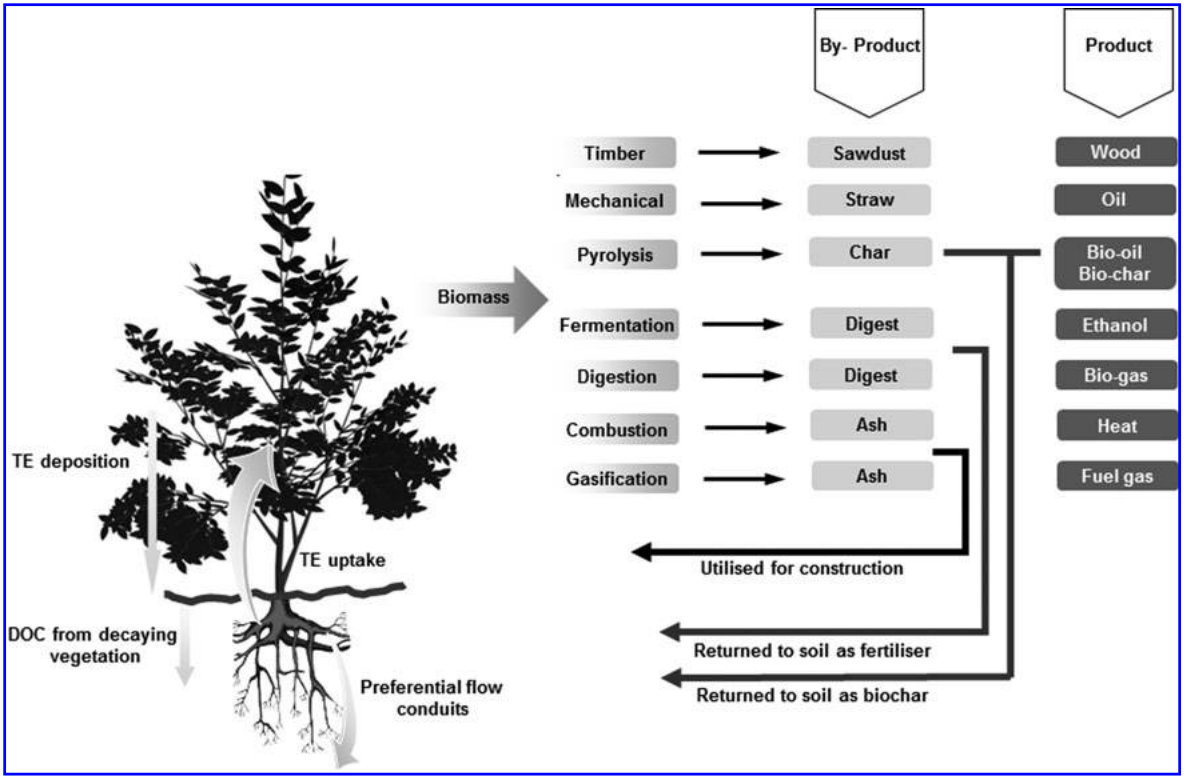
The task of balancing land requirements for food, biofuel, fiber, timber, soil organic carbon, biodiversity, and ecological services will become increasingly challenging because of Earth’s increasing population. Consequently, it is important to investigate the possibility of biomass production on contaminated land (BCL) which is not suited for growing healthy food. Using such biomass for nonfood products would not only make profitable use of such land, but also improve soil quality. The strategy of BCL includes many processes (Fig. 1), which require optimization, so that BCL can return a profit while minimizing the environmental risks posed by the contaminants.
由于地球人口不断增长,在粮食、生物燃料、纤维、木材、土壤有机碳、生物多样性和生态服务之间平衡土地需求将变得愈发困难。因此,研究在不适于种植健康食品的污染土地上生产生物质(BCL)的可能性十分重要。将此类生物质用于非食用产品,不仅可以使这些土地得到有利可图的利用,还能改善土壤质量。BCL策略涉及诸多过程(图1),这些过程需要优化,以使BCL在获得收益的同时,将污染物带来的环境风险降至最低。
3Contaminated Land: An Extensive But Underutilized Resource污染土地:一种广泛存在却未被充分利用的资源
Worldwide, some 22 million ha of land have been degraded by contamination (GACGC, 1995). In the European Union, potentially soil-contaminating activities have occurred on nearly 3 million sites (EEA, 2007b). Trace elements (TEs) are the most important contaminants at 37% of these sites (EEA, 2007a). In the United States, there are 1200 contaminated sites cited in the National Priority List for treatment. Approximately 63% of these sites include TE contamination (HWC, 1996). Although the extent of contaminated land in poor countries is difficult to assess because of the lack of published data, it is well documented that there are problems arising from increasing industrialization and lax environmental regulations. Table 1 lists areas worldwide that are contaminated with TEs. Poor countries also lack the wherewithal to remediate or secure contaminated land. Even rich countries can only afford to clean up the most contaminated sites. Germany is cleansing just 30% of the soils removed from contaminated sites in soil remediation facilities (SRU, 2004). The rest is stored, without further treatment, in waste-disposal facilities. The limited funds available for remediation have spawned interest in low-cost in situ treatment techniques, such as electrokinetic soil remediation and phytotechnologies (SRU, 2004). With the exception of phytostabilization, the
全球约有2200万ha土地因污染而退化(GACGC, 1995)。在欧盟,近300万个场地曾发生可能污染土壤的活动(EEA, 2007b),其中37%的场地以微量元素(TEs)为最主要的污染物(EEA, 2007a)。在美国,有1200个污染场地被列入国家优先治理名录,其中约63%涉及微量元素污染(HWC, 1996)。尽管由于缺乏公开数据,贫穷国家污染土地的范围难以评估,但工业化加速和环境监管宽松所带来的问题已有充分记载。表1列出了全球受微量元素污染的区域。贫穷国家还缺乏修复或管控污染土地的财力。即便是富裕国家,也只能负担得起对污染最严重场地的治理。德国仅对从污染场地移除的土壤中的30%在土壤修复设施中进行清洁处理(SRU, 2004),其余部分未经进一步处理即储存于废物处置设施中。有限的修复资金激发了人们对低成本原位处理技术的兴趣,如电动力学土壤修复和植物技术(SRU, 2004)。除植物稳定外,
| Country国家 | Area (ha)面积(ha) | Reference参考文献 |
|---|---|---|
| Australia | 60,000 | Hamblin (2001) |
| Austriaa | 1100–59,200 | EEA (2000) |
| Belgium (Flanderns)a | 5900–10,300 | EEA (2000) |
| Bulgaria | 43,660 | European Communities (2003) |
| Denmarka | 10,300–29,600 | EEA (2000) |
| Finlanda | 900–18,500 | EEA (2000) |
| Francea | 660–590,000 | EEA (2000) |
| Germanya | £177,600 | EEA (2000) |
| Icelanda | £300 | EEA (2000) |
| Irelanda | £1500 | EEA (2000) |
| Italya | 900–6500 | EEA (2000) |
| Lithuania | 3,000,000 | EEA (2003) |
| Netherlandsa | £88,000 | EEA (2000) |
| Norwaya | £1500 | EEA (2000) |
| Poland | 647,000 (moderate) | Banski (2001) |
| 60,000 (severe) | UBA (1997) | |
| Slovakia | 30,000 | European |
| Communities (2003) | ||
| Spaina | £3700 | EEA (2000) |
| Swedena | 1500–5200 | EEA (2000) |
| Switzerlanda | 2600–37,000 | EEA (2000) |
| Ukraine | 5,000,000 | EEA (2003) |
| United Kingdom | 25,000 | Ashworth et al. (2005) |
| China | 8,100,000 | Wu et al. (2010) |
| United Statesc | 2,600,000 | Wernstedt and Hersch (2006) |
| Africab | 12,000,000 | Koning et al. (2001) |
aWith the estimation of an area of 2 ha per site (Ashworth et al., 2005), 37.3% (EEA, 2009) of the total contamination is caused by TEs. bIncludes also general chemical soil degradation. cWith the estimation of an area of 2.6 ha per brownfield (Palmer et al., 2008). TE, trace element.
a按每个场地面积2 ha估算(Ashworth et al., 2005),其中37.3%(EEA, 2009)的污染由微量元素造成。b亦包括一般性化学土壤退化。c按每块棕地面积2.6 ha估算(Palmer et al., 2008)。TE,微量元素。
4effectiveness of these technologies has yet to be demonstrated on a large number of sites.这些技术的有效性尚有待在大量场地上得到验证。
Some contaminated land may be left untreated and be covered by concrete or buildings. On average, in the EU member states, the sealed area, the part of the soil surface covered with an impermeable material, is *9% of the total area. Soil sealing as a consequence of urbanization results in the loss of productive soil and creates a horizontal barrier between soil, air, and water, thus affecting aspects of the ecosystem such as groundwater recharge, mitigation of flood risks, and the maintenance of biodiversity (EEA, 1999).
部分污染土地可能未经处理而被混凝土或建筑物覆盖。欧盟成员国的封闭面积(即被不透水材料覆盖的土壤表面部分)平均约占总面积的9%。城市化导致的土壤封闭造成生产性土壤的丧失,并在土壤、空气和水之间形成水平屏障,进而影响地下水补给、洪水风险缓解和生物多样性维持等生态系统功能(EEA, 1999)。
5Biomass Production on Contaminated Land: General Considerations污染土地生物质生产:总体考虑
Lal and Pimentel (2007) proposed that bioenergy plantations could be established on agriculturally marginal or surplus lands, including degraded or drastically disturbed soils. Restoring degraded soils through biofuel plantations could be a win-win-win strategy. Uncontaminated fertile land would not be taken out of food production or cleared of indigenous vegetation. Moreover, using contaminated land for food biomass production could reduce the risks posed by the contaminants, fix carbon, increase soil fertility, and provide a biofuel feedstock for producing carbon-neutral energy. Furthermore, the increasing use of degraded soils for energy crops would reduce the need of using crop residues for biofuel production, which would find better use being reincorporated into the soil, thereby preventing soil degradation and increasing soil carbon.
Lal and Pimentel(2007)提出,生物能源种植园可建立在农业边际土地或剩余土地上,包括退化或严重扰动的土壤。通过生物燃料种植园修复退化土壤可能是一种“三赢”策略:未受污染的肥沃土地无需退出粮食生产,也无需清除原生植被;此外,利用污染土地生产生物质可降低污染物带来的风险、固定碳、提高土壤肥力,并为生产碳中性能源提供生物燃料原料。再者,越来越多地利用退化土壤种植能源作物,将减少对利用作物残茬生产生物燃料的需求,而作物残茬若重新归还土壤则能得到更好的利用,从而防止土壤退化并增加土壤碳。
The goal of BCL is to produce biomass for economic output and, simultaneously, to minimize environmental risks posed by the contaminants. This limits the selection of suitable bioenergy crops. Crops used for BCL should minimize contaminant propagation with erosion, leaching, and plant harvest. Traditional annual crops such as corn and soy, which have been used for biofuel production recently, are less suitable at mitigating negative environmental effects than deep-rooted plants, such as various tree species. They cause 50 times more soil erosion than sod crops such as hay (Sullivan, 2004), because the soil between the rows can wash or blow away. Furthermore, frequent soil tillage can become a source of contaminated-dust dispersion, which would result in a risk for the people working on-site and those living nearby.
BCL的目标是生产具有经济产出的生物质,同时将污染物带来的环境风险降至最低。这限制了适宜生物能源作物的选择。用于BCL的作物应尽量减少污染物随侵蚀、淋溶和植物收获而扩散。近年来用于生产生物燃料的玉米和大豆等传统一年生作物,在减轻负面环境影响方面不如各种树种等深根植物。由于行间土壤易被冲刷或吹蚀,这些作物造成的土壤侵蚀是干草等草皮作物的50倍(Sullivan, 2004)。此外,频繁耕作可能成为污染扬尘扩散的来源,从而给现场作业人员和周边居民带来风险。
The choice of crops should be based on the fate of the TEs, their potential biomass production, and ecological aspects such as providing a habitat for native animal species and avoiding the introduction of potentially invasive species. The uncontrolled spread of weeds, such as Miscanthus, that have been introduced for biomass production has already cost e10 billion in Europe (Hulme et al., 2009). Ideally, nonfood or fodder crops would be used so as to reduce the potential of TEs entering the food chain.
作物的选择应基于微量元素的归趋、作物的潜在生物量以及生态方面的考虑,如为本地动物物种提供栖息地、避免引入潜在入侵物种等。为生产生物质而引入的芒草(Miscanthus)等杂草的无序扩散已在欧洲造成100亿欧元的损失(Hulme et al., 2009)。理想情况下,应选用非食用作物或非饲料作物,以降低微量元素进入食物链的可能性。
While large areas of contaminated land present human health risks from contaminants entering crops and groundwater, they are seldom contaminated to the point that plant growth is reduced. Dickinson (2000) pointed out that on many contaminated sites, weed competition and other soil factors may be more significant in plant growth than the presence of soil contaminants. Whether negative effects are expected depends largely on the TEs present and their total and available concentrations. Plant growth may be improved by fertilization. For this purpose, biowastes such as sewage sludge may be used on contaminated land that cannot be applied to uncontaminated agricultural land because they contain contaminants. Contaminant accumulation in the soil may be offset by removing the contaminants during harvest (Dickinson, 2000). Before BCL is applied on a large scale, a contaminant mass balance is required. Most contaminated lands do not produce any revenue, and thus even if the output only equals the input, the increased value of the soil is a positive benefit.
尽管大面积污染土地会因污染物进入作物和地下水而对人体健康构成风险,但其污染程度很少达到使植物生长受抑制的程度。Dickinson(2000)指出,在许多污染场地上,杂草竞争和其他土壤因素对植物生长的影响可能比土壤污染物的存在更为显著。是否会产生负面效应,在很大程度上取决于所存在的微量元素种类及其全量和有效态浓度。施肥可以促进植物生长。为此,可将污水污泥等因含有污染物而不能施用于未污染农田的生物废弃物施用于污染土地。污染物在土壤中的累积可通过收获时移除污染物而得到抵消(Dickinson, 2000)。在大规模应用BCL之前,需进行污染物质量平衡核算。大多数污染土地不产生任何收益,因此即使产出仅与投入相当,土壤价值的提升本身也是一种积极效益。
6TEs in BCLBCL中的微量元素
7TE uptake thresholds in bioenergy crops生物能源作物的微量元素吸收阈值
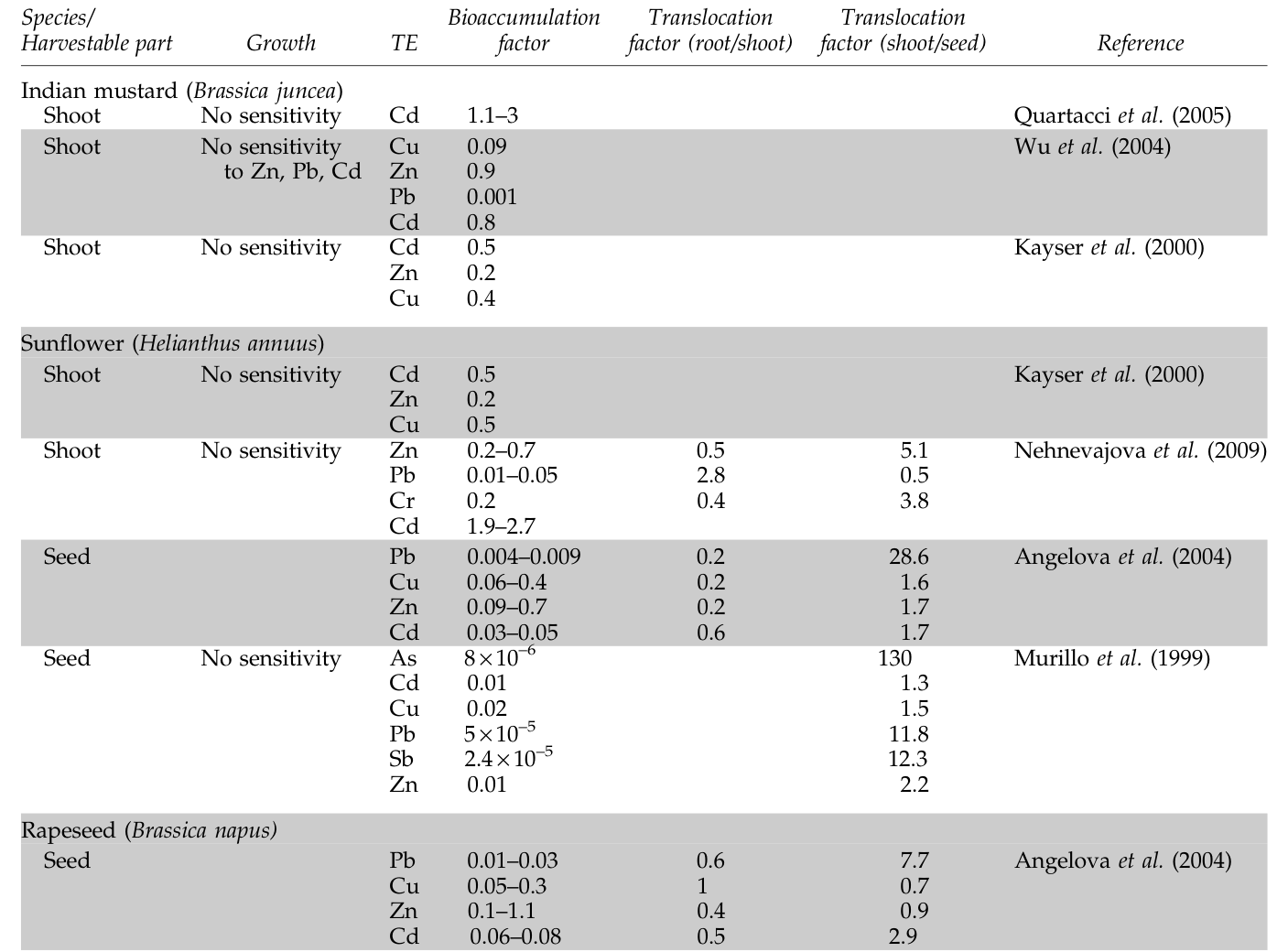
TE concentrations in food crops. The use of TE-contaminated soils for growing food crops or crops intended for human consumption is restricted, as it involves considerable health risks for the consumers because of the plants’ TE accumulation. However, due to the lack of arable land or due to lack of controlling mechanisms, such soils are often cultivated. Table 2 gives the accumulation rates and translocation factors (TFs) for various plant species as a function of soil contaminant concentration. Although uptake and allocation of TEs in plants differ widely among genotypes (Florijn and Vanbeusichem, 1993; Dunbar et al., 2003), because of the lack of data, no distinction between cultivars in this compilation has been made. Tobacco (Nicotiana tabacum) accumulates Cd to relatively high levels compared to other species (Kayser et al., 2000; Wenger et al., 2002; Keller et al., 2003). Concentrations of Cd in field-grown tobacco leaves range from < 0.5 to 5 mg Cd/kg and higher (Lugon-Moulin et al., 2004). Corn (Zea mays) can accumulate Zn in the shoots (Keller et al., 2003; Luo et al., 2005). Zinc concentrations of more than 1000 mg/kg have been found on highly contaminated soils without significant decrease in biomass (Wenger et al., 2002). Copper concentrations of *25 mg/kg were found in sunflower (Helianthus annuus) (Madejon et al., 2003; Fa¨ssler et al., 2010) and Pb concentrations of 12–79 mg/kg in pea (Pisum sativum) shoots (Cooper et al., 1999; Castaldi et al., 2009). The concentrations of Cd in potato (Solanum tuberosum) plants decreased in the order of roots > shoots > > tubers (Dunbar et al., 2003). In the tubers, TEs are mostly present in the skin and can thus be removed to a large extent by peeling (Dudka et al., 1996; Piotrowska and Kabata Pendias, 1997).
粮食作物中的微量元素浓度。在受微量元素污染的土壤上种植粮食作物或供人类消费的作物受到限制,因为植物对微量元素的累积会给消费者带来相当大的健康风险。然而,由于缺乏耕地或缺乏管控机制,此类土壤往往仍被耕种。表2给出了多种植物的累积率和转运系数(TFs)随土壤污染物浓度的变化。尽管植物对微量元素的吸收和分配在不同基因型间差异很大(Florijn and Vanbeusichem, 1993; Dunbar et al., 2003),但由于数据缺乏,本汇编未对品种加以区分。与其他物种相比,烟草(Nicotiana tabacum)对Cd的累积水平相对较高(Kayser et al., 2000; Wenger et al., 2002; Keller et al., 2003)。田间种植的烟叶中Cd浓度范围为< 0.5至5 mg Cd/kg,甚至更高(Lugon-Moulin et al., 2004)。玉米(Zea mays)可在地上部累积Zn(Keller et al., 2003; Luo et al., 2005)。在重度污染土壤上已发现Zn浓度超过1000 mg/kg,而生物量并未显著降低(Wenger et al., 2002)。向日葵(Helianthus annuus)中Cu浓度约为25 mg/kg(Madejon et al., 2003; Fa¨ssler et al., 2010),豌豆(Pisum sativum)地上部Pb浓度为12–79 mg/kg(Cooper et al., 1999; Castaldi et al., 2009)。马铃薯(Solanum tuberosum)植株中Cd浓度按根 > 地上部 > > 块茎的顺序递减(Dunbar et al., 2003)。块茎中的微量元素主要存在于表皮中,因此可通过削皮在很大程度上去除(Dudka et al., 1996; Piotrowska and Kabata Pendias, 1997)。
| Species/ Harvestable part物种/ 可收获部位 | Growth生长 | TE | Bioaccumulation factor生物累积 系数 | Translocation factor (root/shoot)转运 系数(根/地上部) | Reference参考文献 |
|---|---|---|---|---|---|
| Vetiver grass (Vetiv | eria zizanioides L.) | ||||
| Shoot | Normal | Pb | 13.5–14.5 | Andra et al. (2009) | |
| Shoot | Reduced growth >1500 mg/kg | Cu | 0.014 | 6.9 | Liu et al. (2009) |
| Shoot | Not sensitive | Pb | 0.004–0.016 | 3–14.6 | Rotkittikhun et al. (2007) |
| Shoot | Normal | Pb | 0.07 | 2.24 | Chiu et al. (2005) |
| Cu Zn | 0.01–0.04 0.03–0.2 | 13.7–33 4–15.4 | |||
| Shoot | Normal | Pb Cd | n.d. 1.25 | - | Lai and Chen (2004) |
| Zn | 0.8 | ||||
| Shoot | Reduced growth >100 mg/kg As | Cu | 0.08 | 10.5 | Chiu et al. (2005) |
| Zn As | 0.08 0.04 | 30 3.4 | |||
| Elephant grass (Pe Shoot Wheat (Triticum ae | nnisetum purpureum Schumach) Reduced growth >1500 mg/kg stivum L.) | Cu | 0.07 | 2.5 | Liu et al. (2009) |
| Grain | Cd | 0.241–0.417 | Jamali et al. (2009) | ||
| Cu Ni Pb Zn | 0.355–0.526 0.097–0.165 0.493–0.677 0.462–0.600 | ||||
| Potato (Solanum tu Tuber | berosum) Normal | Cd | 20.4 | 6 | Dunbar et al. (2003) |
| Tuber | sig. reduced growth >54 Cd, 2202 Pb, 5900 Zn mg/kg | Cd Pb Zn | 0.07–0.4 0.003 0.02–1 | Dudka et al. (1996) | |
| Tuber | reduced growth >54 mg/kg Cd | Cd | 0.04–0.4 | Piotrowska and Kabata Pendias (1997) | |
| Corn (Zea mays) | |||||
| Shoot | Normal | Pb | 1.13 | 33.3 | Luo et al. (2005) |
| Cu Zn Cd | 0.35 3.7 18.8 | 20 2 2.5 | |||
| Shoot | No sensitivity | Cd Zn Cu | 0.5 0.2 0.2 | Kayser et al. (2000) | |
| Leaves | Reduced growth >100 mg/kg As and 600 mg/kg Zn | Cu Zn As | 0.06 1.2 0.03 | 40 4.72 15 | Chiu et al. (2005) |
| Fruit | Reduced growth >100 mg/kg As and 600 mg/kg Zn | Cu Zn As | 0.02 0.3 0.045 | 80 21 10 | Chiu et al. (2005) |
n.d., not determinable.
Besides the TE uptake through plant roots, the deposition of dust particles on leaves and stems plays a significant role in the transfer of TEs from soil to plants (Robinson et al., 2008). If a site is entirely vegetated, the stabilizing effect of plant roots will mitigate the generation of wind-borne dust and raininduced redistribution of contaminated solid material from soil (Robinson et al., 2008). However, when a land is used for agricultural purposes, it may not be entirely vegetated; thus, a surface deposit of TEs on aerial portions of the plants is possible.
除经植物根系吸收微量元素外,尘粒在叶片和茎上的沉降在微量元素由土壤向植物的迁移中也起着重要作用(Robinson et al., 2008)。若场地被植被完全覆盖,植物根系的稳定作用将减少风蚀扬尘的产生以及降雨引起的土壤污染固体物质的再分布(Robinson et al., 2008)。然而,当土地用于农业用途时,可能无法被植被完全覆盖,因此微量元素有可能沉积于植物地上部表面。
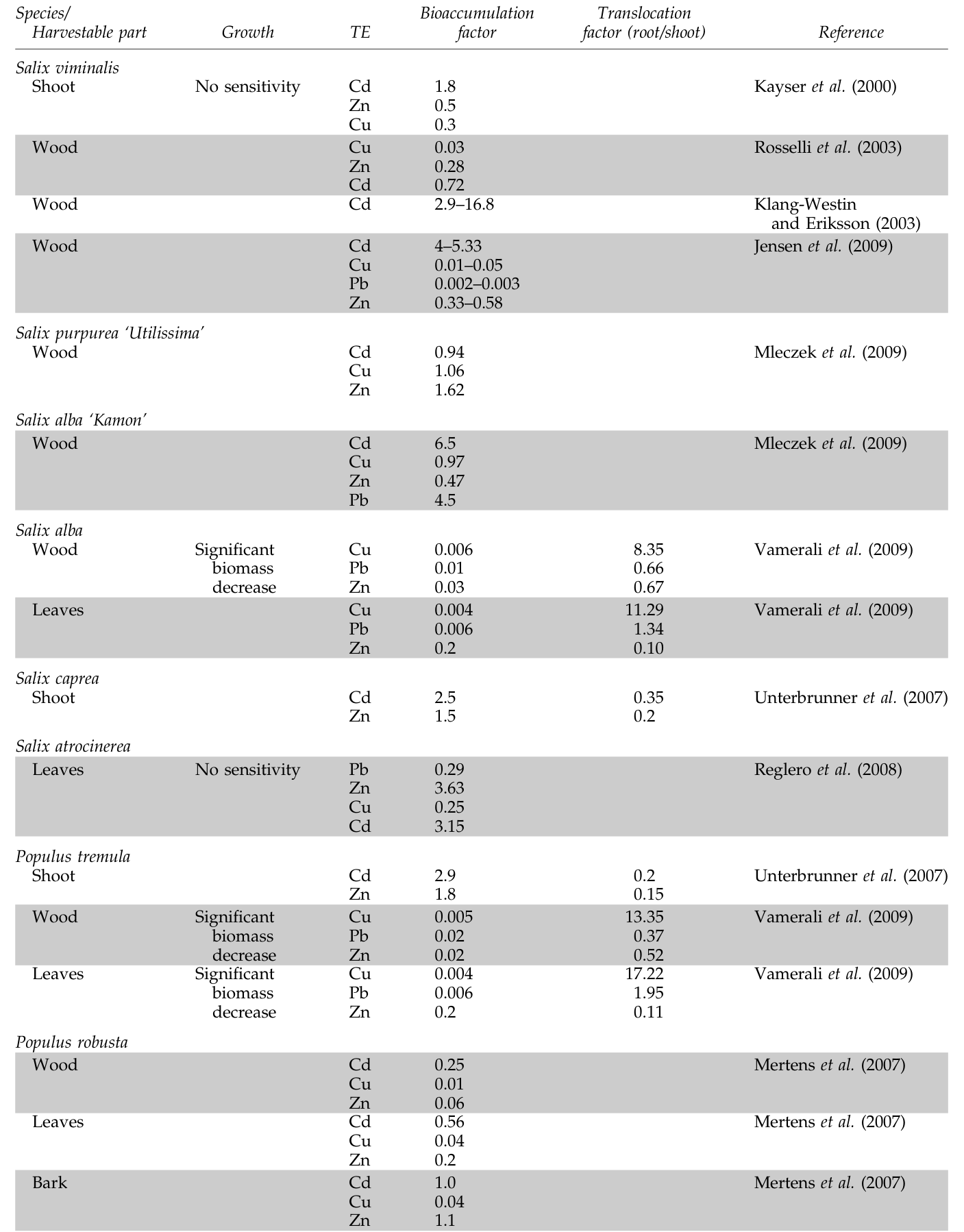
TE concentrations and allocation in various tree species. In contrast to the growth of food crops on contaminated soils for energy production, the use of nonfood plant species such as willow, poplar, and birch bear insignificant health risks to humans. Table 4 shows the TE accumulation, bioconcentration factors (BCFs), and TFs of tree species mainly used for biofuel/biomass production. Salix sp. and Populus sp. have been known for their rapid growth, and Betula pendula is a pioneer plant, grows quickly, and has a low demand on the soil nutrients. Hermle et al. (2006) investigated the interactions of young trees with metal-contaminated soil containing Cu/Zn/Cd/Pb at concentrations of 640, 3000, 10, and 90 mg/kg, respectively. Populus tremula, Salix viminalis, and Betula pendula exceeded metal concentrations of 5–10 mg/ kg Cd, 15–20 mg/kg Cu, 150–200 mg/kg Zn. Concentrations of 0.6–4 mg/kg are considered toxic by Kabata-Pendias and Pendias (2001). Cadmium accumulation in the three above species decreased in the following order: P. tremula > S. viminalis > B. pendula. In contrast, there was little variation in Cu concentrations in aboveground parts of plants. They usually ranged between 2 and 20 mg/kg, regardless of both soil Cu concentrations (Wallno¨fer and Engelhardt, 1984) and the type of soil (Baker and Brooks, 1989).
不同树种中微量元素的浓度与分配。与在污染土壤上种植粮食作物用于能源生产不同,使用柳树、杨树和桦树等非食用植物对人体健康的风险微乎其微。表4列出了主要用于生物燃料/生物质生产的树种的微量元素累积量、生物富集系数(BCFs)和转运系数。Salix sp.和Populus sp.以生长迅速著称,而Betula pendula是一种先锋植物,生长快且对土壤养分需求低。Hermle et al.(2006)研究了幼树与Cu/Zn/Cd/Pb浓度分别为640、3000、10和90 mg/kg的金属污染土壤之间的相互作用。Populus tremula、Salix viminalis和Betula pendula的金属浓度超过了5–10 mg/kg Cd、15–20 mg/kg Cu和150–200 mg/kg Zn。Kabata-Pendias and Pendias(2001)认为0.6–4 mg/kg的浓度即具有毒性。上述三种植物的Cd累积量按以下顺序递减:P. tremula > S. viminalis > B. pendula。相比之下,植物地上部的Cu浓度变化不大,通常在2~20 mg/kg之间,与土壤Cu浓度(Wallno¨fer and Engelhardt, 1984)和土壤类型(Baker and Brooks, 1989)均无关。
Various clones of Salix sp. and Populus sp. have been used for biofuel/biomass production and are known to accumulate, preferably, Cd and Zn. Mertens et al. (2007) investigated the uptake of Cd and Zn by Populus robusta, Quercus robur, Fraxinus excelsior, and Acer pseudoplatanus. The litter-fall Cd and Zn concentrations for poplar, in contrast to the other investigated species, were higher than the Cd and Zn concentrations in the sediment, which were *10 and 1200 mg/kg, respectively. For Salix, BCFs have been reported on a wide range of soils, including those with marginally elevated Cd concentration. In field studies, BCF reached values of up to 16.8 for woody stems and 27.9 for foliage (Table 2). Tissue concentrations of Cd tend to be higher in highly contaminated soils, but BCFs are lower, indicating that Cd transfer from soil to plant is less efficient in highly contaminated soils. BCFs are generally higher for foliage than for stems. However, as the tree ages, the proportion of the leaf biomass decreases, for example, in the 2nd year, the foliage accounts for *25% of the aboveground plant biomass; thus, the overall amount of Cd is usually higher in the stems (Dickinson and Pulford, 2005).
Salix sp.和Populus sp.的多个无性系已被用于生物燃料/生物质生产,并以优先累积Cd和Zn而著称。Mertens et al.(2007)研究了Populus robusta、Quercus robur、Fraxinus excelsior和Acer pseudoplatanus对Cd和Zn的吸收。与其他受试物种不同,杨树凋落物中的Cd和Zn浓度高于沉积物中的Cd和Zn浓度(分别约为10和1200 mg/kg)。对于Salix,已有在多种土壤(包括Cd浓度仅略有升高的土壤)上的BCF报道。在田间研究中,木质茎的BCF最高可达16.8,叶片可达27.9(表2)。在重度污染土壤中,组织Cd浓度往往较高,但BCF较低,表明在重度污染土壤中Cd由土壤向植物的迁移效率较低。叶片的BCF通常高于茎。然而,随着树龄增长,叶片生物量所占比例下降,例如在第2年,叶片约占地上部植物生物量的25%;因此,茎中的Cd总量通常更高(Dickinson and Pulford, 2005)。
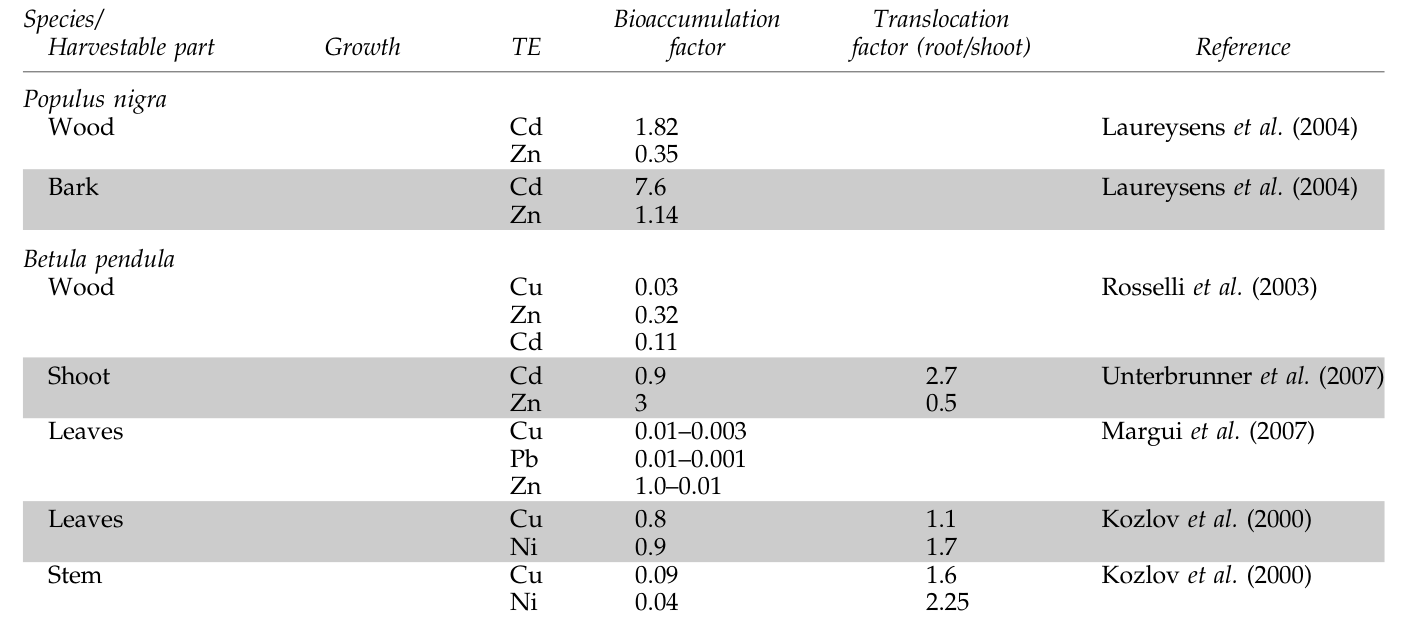
Pulford and Watson (2003) examined sycamore, birch, and willow trees, which had established sporadically on sites contaminated by waste from an explosives’ factory and a chromium-processing works. They reported that Cr, Pb, and Cu accumulated mainly in the roots. This is in agreement with Castiglione et al. (2009) who observed that the Cu concentrations in various clones of Populus nigra and Populus alba were mainly in the roots. In the aboveground biomass, Hasselgren (1999) observed that Salix growing on sludge-amended plots had highest levels of Cu, Pb, and Cr in the stems, whereas Zn, Cd, and Ni occurred at the highest concentrations in the leaves. Mertens et al. (2007) found that the Cd and Zn concentrations in Populus sp. were lowest in the wood, followed by the bark, and highest in foliage. This had been indicated by previous research (Greger and Landberg, 1999; Klang-Westin and Eriksson, 2003; Pulford and Watson, 2003). This is also in agreement with the study of Unterbrunner et al. (2007). In their study, the lowest concentrations of Cd and Zn were generally found in the wood of the investigated tree species (Salix caprea, Salix purpurea, Salix fragilis, Salix sp., Populus tremula, Populus nigra, and Betula pendula). With few exceptions, the authors observed a general trend of Cd and Zn concentrations increasing from wood toward leaves (wood < bark < leaves). These findings indicate that a special attention has to be paid to the fate of TEs in the litter fall.
Pulford and Watson(2003)研究了在受炸药厂和铬加工厂废弃物污染的场地上零星定植的梧桐、桦树和柳树,报道Cr、Pb和Cu主要累积于根部。这与Castiglione et al.(2009)的结果一致,他们观察到Populus nigra和Populus alba各无性系中的Cu主要分布在根部。在地上部生物量中,Hasselgren(1999)观察到,生长于施用污泥小区的Salix茎中Cu、Pb和Cr含量最高,而Zn、Cd和Ni则在叶片中浓度最高。Mertens et al.(2007)发现,Populus sp.中Cd和Zn浓度以木材最低,树皮次之,叶片最高。此前的研究已有类似提示(Greger and Landberg, 1999; Klang-Westin and Eriksson, 2003; Pulford and Watson, 2003),这也与Unterbrunner et al.(2007)的研究一致。在其研究中,受试树种(Salix caprea、Salix purpurea、Salix fragilis、Salix sp.、Populus tremula、Populus nigra和Betula pendula)的Cd和Zn浓度一般以木材最低。除少数例外,作者观察到Cd和Zn浓度总体呈由木材向叶片递增的趋势(木材 < 树皮 < 叶片)。这些结果表明,必须特别关注凋落物中微量元素的归趋。
8Implications of TE uptake and allocation in the management of BCL微量元素吸收与分配对BCL管理的启示
Depending on the plants species used, bioenergy production can take different forms. Z. mays and sugarcane (Saccharum sp.), for instance, are sugar-rich plants, which can be anaerobically digested (fermented) to produce methane or ethanol. Woody energy species, such as Salix sp. and Populus sp., are cellulose- and lignin-rich species, and may be converted to energy through incineration (combustion) or gasification. Fermentation of cellulose would also be possible. However, the total energy input is higher than for corn ethanol (IEA, 2007), thus making it less feasible than combustion or gasification. In the case of oil-rich species such as the H. annuus, raps (Brassica napus), and white mustard (Sinapis alba), the energetically valuable oil is extracted directly from the seeds.
根据所用植物种类的不同,生物能源生产可采取不同形式。例如,Z. mays和甘蔗(Saccharum sp.)是富含糖分的植物,可经厌氧消化(发酵)生产甲烷或乙醇。Salix sp.和Populus sp.等木本能源物种富含纤维素和木质素,可通过焚烧(燃烧)或气化转化为能源。纤维素发酵亦属可行,但其总能量投入高于玉米乙醇(IEA, 2007),因此可行性不及燃烧或气化。对于H. annuus、油菜(Brassica napus)和白芥(Sinapis alba)等富油物种,则直接从种子中提取具有能量价值的油脂。
In the context of BCL, there are several environmental issues that have to be considered when converting the biomass to energy. During the anaerobic digestion of sugar-rich species, the organic matter of the plants is converted into methane, and thus the contaminant concentration in the residual digestion mix will rise. There are conflicting reports as to the severity of this effect. At high concentrations, TEs negatively affect the enzymes responsible for the breakdown of biomass. However, studies on water hyacinth (Eichhornia crassipes), channel grass (Vallisneria spiralis), and water chestnut (Trapa bispinnosa), grown or employed for phytoremediation of metal-rich acidic industry effluents, depicted that the biogas production was significantly higher from the slurry of these plants than from the control plants (Singhal and Rai, 2003; Verma et al., 2007). In contrast, Wong and Cheung (1995) showed that TEs decrease the production of biogas according to the degree of toxicity of the four metals tested. This was in the order of Cr > Ni > Cu > Zn. However, Cr uptake by plants is low ( < 0.5 mg/kg dry matter). Irrespective of the biogas yield, the fate of the digestate must be considered. After anaerobic digestion, the digestate could be applied as a fertilizer on the land where the plants were grown. This would return any TE to the soil, possibly in a different chemical form. The toxicity and environmental fate of these reapplied metals, therefore, needs to be carefully investigated.
在BCL背景下,将生物质转化为能源时须考虑若干环境问题。在富糖物种的厌氧消化过程中,植物有机质转化为甲烷,因此残余消化混合物中的污染物浓度会升高。关于这一效应的严重程度,已有报道结论不一。高浓度微量元素会对负责分解生物质的酶产生负面影响。然而,对用于修复富含金属的酸性工业废水而种植或使用的凤眼莲(Eichhornia crassipes)、苦草(Vallisneria spiralis)和菱角(Trapa bispinnosa)的研究表明,这些植物浆料的沼气产量显著高于对照植物(Singhal and Rai, 2003; Verma et al., 2007)。相反,Wong and Cheung(1995)表明,微量元素会按所测四种金属的毒性程度降低沼气产量,其顺序为Cr > Ni > Cu > Zn。然而,植物对Cr的吸收很低( < 0.5 mg/kg干物质)。无论沼气产量如何,都必须考虑沼渣的归趋。厌氧消化后,沼渣可作为肥料施用于种植这些植物的土地上,这会使所有微量元素重新归还土壤,且其化学形态可能已发生改变。因此,需要仔细研究这些重新施用的金属的毒性及其环境归趋。
In the case of woody species, TEs play a lesser role in the bioenergy yield, as the wood TE concentration is seldom so high as to influence the energy released by burning. The wood can be burned directly pressed into high-density wood pellets for home and business heating or into high-density wood logs for use in wood stoves and campfires (Neary and Zieroth, 2007). Particles are released during incineration. In wood produced on a contaminated land, these particles may have elevated concentrations of TEs and may pollute surrounding areas. Power stations that use a combination of fossil fuels or municipal wastes and wood pellets or only wood pellets would not be confronted by such problems, as they have installed filters to remove TEs from their fossil fuel or municipal waste emissions. Their use in decentralized heating, however, would be almost impossible, as it would require an installation of filters in houses and smaller businesses. This would create a great logistical and technological challenge that would subsequently increase the price of heating, and thereby makes it unattractive.
对于木本物种,微量元素对生物能源产量的影响较小,因为木材中的微量元素浓度很少高到足以影响燃烧释放的能量。木材可直接燃烧,也可压制成高密度木质颗粒用于家庭和商业供暖,或压制成高密度木柴用于木柴炉和篝火(Neary and Zieroth, 2007)。焚烧过程中会释放颗粒物。在污染土地上生产的木材中,这些颗粒物的微量元素浓度可能较高,并可能污染周边地区。以化石燃料或城市垃圾与木质颗粒混合燃烧,或仅以木质颗粒为燃料的发电厂不会面临此类问题,因为它们已安装过滤装置以去除化石燃料或城市垃圾排放物中的微量元素。然而,将其用于分散式供暖几乎不可能,因为这需要在住宅和小型企业中安装过滤装置。这将带来巨大的后勤和技术挑战,进而提高供暖价格,从而使其缺乏吸引力。
Alternatively, wood may be gasified. Fuel gas can be produced from biomass and related materials by partial oxidation to give a mixture of carbon monoxide, carbon dioxide, hydrogen, and methane with nitrogen if air is used as the oxidant. Alternatively, it can be produced by steam or pyrolytic gasification (Bridgwater, 2006). In this case, high concentrations of elements decrease the quality of the wood fuel. The inorganic ions are known to influence the thermal degradation of polysaccharides and lignin. It has been found that a number of ions (Na, K, Ca, Mg, Zn, Pb, and Cu) act as catalysts, resulting in a lowering of decomposition temperature and an increase in the char yield (von Scala, 1998; Adler et al., 2008). While this would be disadvantageous to the production of biofuels, it would also be advantageous for the production of biochar.
另外,木材也可以气化。生物质及相关材料经部分氧化可产生燃气,其为一氧化碳、二氧化碳、氢气和甲烷的混合物,若以空气作为氧化剂则还含有氮气。燃气也可通过蒸汽气化或热解气化产生(Bridgwater, 2006)。在这种情况下,高浓度元素会降低木质燃料的品质。已知无机离子会影响多糖和木质素的热降解。研究发现,多种离子(Na、K、Ca、Mg、Zn、Pb和Cu)可起催化作用,导致分解温度降低和炭产率提高(von Scala, 1998; Adler et al., 2008)。这虽然不利于生物燃料的生产,但却有利于生物炭的生产。
The concentrations of most inorganic ions are significantly higher in bark than in wood (Pulford and Watson, 2003; Unterbrunner et al., 2007). These tissues are slow to enter the decomposition cycle. Accumulated metals can, therefore, be immobilized in a metabolically inactive compartment for a considerable period of time, if the contaminated trees are not reused for other purposes, such as combustion, which accelerates the return of the TEs to the environment (Pulford and Watson, 2003). The bark of small-diameter stems can form a large proportion of the harvestable shoot biomass produced in short-rotation crops. Adler et al. (2008) suggested that the increasing length of the rotation period would improve the wood-fuel quality, because the proportion of element-rich bark would decrease with the increasing age of the shoot population. Old-growth forests have not only lower TE concentrations but also dense wood with high energy content, compared to wood from fast-growing plantations. In the latter cases, the wood is of low density and low calorie and is not even good enough to burn in a fireplace (Odum, 1996). Additionally, fast-growing plantations require much energy to plant, fertilize, weed, thin, cut, and deliver. In the case of old-growth forests or long-rotation plantations, the trees would be finally available for use after 20–90 years—a period that, according to Odum (1996), is too long for the industry and the consumers to be considered as a renewable fuel. However, the immense tree plantations for wood (industrial and for combustion) and paper with a yearly worldwide production of 3274 Mm3 and 323 Mt (von Barata and Fochler-Hauke, 2003), respectively, have harvesting cycles of *50 years, and nobody claims that this wood is not renewable. Moreover, longer rotation periods are less economically important in
大多数无机离子在树皮中的浓度显著高于木材(Pulford and Watson, 2003; Unterbrunner et al., 2007)。这些组织进入分解循环的速度较慢。因此,如果受污染的树木不被再用于其他用途(如会加速微量元素返回环境的燃烧),累积的金属可在相当长时间内被固定在代谢不活跃的组分中(Pulford and Watson, 2003)。在短轮伐期作物中,小径级茎的树皮可占可收获地上部生物量的很大比例。Adler et al.(2008)认为,延长轮伐期可改善木质燃料品质,因为随着枝条群体年龄增长,富含元素的树皮所占比例会下降。与速生人工林的木材相比,原始林木材不仅微量元素浓度较低,而且木材致密、能量含量高。速生人工林的木材密度低、热值低,甚至不适合在壁炉中燃烧(Odum, 1996)。此外,速生人工林的种植、施肥、除草、间伐、采伐和运输都需要消耗大量能量。对于原始林或长轮伐期人工林,树木需经20–90年才能最终投入利用——按照Odum(1996)的观点,这一周期对于工业界和消费者而言过长,难以被视为可再生燃料。然而,全球用于木材(工业用材和燃料用材)和造纸的大规模人工林年产量分别为3274 Mm3和323 Mt(von Barata and Fochler-Hauke, 2003),其采伐周期约为50年,却无人声称这些木材不可再生。此外,较长的轮伐期对
BCL, since the land is not producing revenue, and the trees have a phytostabilizing potential.
BCL的经济影响较小,因为该土地本不产生收益,而且树木具有植物稳定潜力。
The use of vegetable oils, such as soya bean, palm, sunflower, peanut, and olive oil, as an alternative fuel has been around for 100 years, since the inventor of the diesel engine, Rudolph Diesel, first tested peanut oil, in his compression ignition engine (Shay, 1993). The accumulation of TEs in plants can affect the fatty acid composition of the plant (Bidar et al., 2008). Of even greater importance is the free fatty acid and moisture content, which are key parameters for determining the viability of the vegetable oil transesterification process (Shay, 1993). The uptake of TEs in the seeds of plants is usually low compared to the other plant portions (Fa¨ssler et al., 2010). In some cases, seed crops grown on contaminated land may be safely used as animal fodder or used for oil production (Murillo et al., 1999). However, measurements of sunflower oil have shown that it can contain significant amounts of Fe, Cu, Pb, Cd, and Ni, which pose reduced oil quality and endanger human health (Ansari et al., 2008; Ansari et al., 2009). Angelova et al. (2004) found that the oil obtained from rapeseed and sunflower growing near nonferous-metal works exceeded the maximum permissible concentrations for Pb, Cd, and Cu (Table 3). From rapeseed, 5% of the Zn, 25% of the Pb, 18% of the Cu, and 47% of the Cd were transferred into the oil during the oil extraction. In the case of sunflower seeds, the levels were 7%, 30%, 3%, and 2%, respectively. However, the production of sunflower oil methyl esters (SOME/biodiesel) is performed via alkaline-catalyzed transesterification of crude sunflower oil (Rashid et al., 2008). Due to the alkaline medium, the transport of metals into SOME/biodiesel is unlikely. Nevertheless, the oil quality and its TE content are subjects that have to be investigated before using oil-rich plants for BCL.
将大豆油、棕榈油、葵花籽油、花生油和橄榄油等植物油用作替代燃料已有100年历史,始于柴油机发明者Rudolph Diesel首次在其压燃式发动机中试用花生油(Shay, 1993)。植物中微量元素的累积会影响植物的脂肪酸组成(Bidar et al., 2008)。更为重要的是游离脂肪酸和水分含量,它们是决定植物油酯交换工艺可行性的关键参数(Shay, 1993)。与植物其他部位相比,植物种子对微量元素的吸收通常较低(Fa¨ssler et al., 2010)。在某些情况下,在污染土地上种植的籽实作物可安全地用作动物饲料或用于产油(Murillo et al., 1999)。然而,对葵花籽油的测定表明,其可能含有大量Fe、Cu、Pb、Cd和Ni,从而降低油品质量并危害人体健康(Ansari et al., 2008; Ansari et al., 2009)。Angelova et al.(2004)发现,从生长在有色金属冶炼厂附近的油菜和向日葵中获得的油脂,其Pb、Cd和Cu含量超过了最大允许浓度(表3)。在油脂提取过程中,油菜籽中5%的Zn、25%的Pb、18%的Cu和47%的Cd转移到油中;向日葵籽的相应比例分别为7%、30%、3%和2%。然而,葵花籽油甲酯(SOME/生物柴油)是通过对粗葵花籽油进行碱催化酯交换而生产的(Rashid et al., 2008)。由于处于碱性介质中,金属不太可能迁移进入SOME/生物柴油。尽管如此,在将富油植物用于BCL之前,仍须对油品质量及其微量元素含量进行研究。
9Environmental risks of BCL related to TEsBCL中与微量元素相关的环境风险
Risk of TE leaching. If water filtrates homogenously through the soil, the leaching of soluble cations is unlikely because of the high cation-exchange capacity of the soil. However, the presence of elevated TE concentrations at greater soil depths indicates the preferential transport of metals, either chelated by root exudates or humic substances (Robinson et al., 2009) or bound to mobile soil colloids. High soil pH can result in the solubilization of humic substances and can facilitate the downward mobility of metals via preferential flow pathways. Preferential water flow has significantly enhanced the transport of contaminants such as pesticides (Flury et al., 1995) and radionuclides (Bundt et al., 2000). In a study by Knechtenhofer et al. (2003), two main causes of preferential flow are described: (1) the fast flow through macropores such as earthworm burrows, root channels, and other biopores, or through cracks and fissures arising from aggregate formation or swelling–shrinking of expandable clay minerals; (2) the fingered flow through a homogenous soil matrix due to wetting-front instabilities initiated by differences in water content, wettability of solid surfaces, trapped air, textural boundaries, or by heterogeneous infiltration at the soil surface caused, for instance, by microtopography or by inhomogeneous distribution of hydrophobic plant litter. In the investigation of metal distribution in a shooting-range soil by Knechtenhofer et al. (2003), only the preferential flow paths below 20 cm played a significant role in the spatial distribution of Pb. The preferential flow paths below 20 cm are associated with roots surrounded by relatively wide root channels, which represent large macropores for water flow, in which the Pb may be transported as aqueous ions or bound by colloidal particles (Kretzschmar et al., 1999).
微量元素淋溶风险。若水在土壤中均匀渗滤,由于土壤具有较高的阳离子交换量,可溶性阳离子不太可能发生淋溶。然而,较深土层中微量元素浓度升高,表明金属存在优先迁移,这些金属或被根系分泌物或腐殖质螯合(Robinson et al., 2009),或与移动性土壤胶体结合。土壤pH较高可导致腐殖质溶解,并可促进金属经优先流路径向下迁移。优先水流已显著增强了农药(Flury et al., 1995)和放射性核素(Bundt et al., 2000)等污染物的迁移。Knechtenhofer et al.(2003)的研究描述了优先流的两个主要成因:(1)通过大孔隙(如蚯蚓洞穴、根孔和其他生物孔隙)的快速流动,或通过团聚体形成或膨胀性黏土矿物胀缩所产生的裂隙和裂缝的快速流动;(2)在均质土壤基质中的指状流,这是由含水量差异、固体表面润湿性、封闭空气、质地界面引起的湿润锋不稳定所致,或由地表非均匀入渗(例如由微地形或疏水性植物凋落物分布不均所致)引起。在Knechtenhofer et al.(2003)对某射击场土壤中金属分布的研究中,仅20 cm以下的优先流路径对Pb的空间分布起显著作用。20 cm以下的优先流路径与周围具有较宽根孔的根系相关,这些根孔构成了水流的大孔隙,Pb可在其中以水合离子形式或与胶体颗粒结合的形式迁移(Kretzschmar et al., 1999)。
In dry climates, deep-rooted tree species would be more suitable, as they can continue to transpire after grasses have browned off, thus minimizing drainage. They would also help to control erosion, create an aerobic environment in the root zone, and add organic matter to the substrate, which would bind the contaminant. However, the roots of such trees might also create preferential flow pathways that actually exacerbate contaminant leaching. Knechtenhofer et al. (2003) showed which preferential flow was the main mechanism for the downward mobility of otherwise immobile elements. Vegetation with a high biomass production may also enhance TE mobility through the generation of organic compounds. Wang and Benoit (1996) demonstrated the importance of these factors in the Pb flux in a contaminated forest, showing that washout of mobile Pb-organocomplexes from soil could increase with increasing soil pH.
在干旱气候下,深根树种更为适宜,因为在草本植物枯黄后它们仍能继续蒸腾,从而使排水量降至最低。它们还有助于控制侵蚀、在根区营造好氧环境,并向基质中添加可结合污染物的有机质。然而,这些树木的根系也可能形成优先流路径,反而加剧污染物淋溶。Knechtenhofer et al.(2003)表明,优先流是原本不移动元素向下迁移的主要机制。高生物量植被也可能通过产生有机化合物而增强微量元素的移动性。Wang and Benoit(1996)证明了这些因素对某污染森林中Pb通量的重要性,表明土壤中移动性Pb-有机络合物的淋失会随土壤pH的升高而增加。
Re-entering of TEs through foliage and litter decomposition. During the growth and harvesting processes in BCL, the plant material might be dispersed via wind or water erosion. This possibility has raised a concern for the contamination of adjacent environments (Perronnet et al., 2000). In addition, the nonprofitable parts from crops would remain on site. In cases where such plant material contains high metal concentrations, a redistribution of the TEs may occur. The effect of the remaining plant biomass re-entering the soil can concentrate even more metals in the upper soil profile. Control measures should be taken, especially in cases where dispersion from wind and water is to be expected (Van Nevel et al., 2007).
微量元素经叶片和凋落物分解重新进入土壤。在BCL的生长和收获过程中,植物材料可能经风蚀或水蚀而扩散。这种可能性引发了对邻近环境污染的担忧(Perronnet et al., 2000)。此外,作物中无经济价值的部分将留在原地。若此类植物材料含有高浓度金属,则可能发生微量元素的再分布。残留植物生物量重新进入土壤,可使更多金属富集于土壤剖面上层。应采取控制措施,尤其是在预计会发生风力和水力扩散的情况下(Van Nevel et al., 2007)。
Besides TE-contaminated foliage and litter dispersion, also the decomposition of this foliage and litter is of concern, as the speciation of the TEs released is not thoroughly researched. Biodegradation of plant residues in soil is part of the major process of the taking up of elements by plants during their life cycle. Biodegradation of organic residues rich in TEs is therefore hypothesized to play a key role in the cycling of potential pollutants in soil. Consequently, the study of the dynamics of metals and of organic matter in soils needs to be linked to each other (Boucher et al., 2005). Depending on the nature of the organic ligand, immobilization of metals, for example, in the case of humic substances, is possible, whereas in the case of fulvic-like substances, a mobilization could take place (Schnitzer, 1978; Stevenson, 1994).
除受微量元素污染的叶片和凋落物扩散外,这些叶片和凋落物的分解同样值得关注,因为所释放微量元素的形态尚未得到深入研究。土壤中植物残体的生物降解是植物在其生命周期中吸收元素这一主要过程的组成部分。因此,据推测,富含微量元素的有机残体的生物降解在土壤潜在污染物的循环中起关键作用。故对土壤中金属动态和有机质动态的研究需要相互关联(Boucher et al., 2005)。根据有机配体性质的不同,金属可能被固定(如腐殖质的情形),也可能被活化(如类富里酸物质的情形)(Schnitzer, 1978; Stevenson, 1994)。
Accumulation of litter on the forest floor is often evident near smelters (or other TE pollution sources), primarily as a result of suppressed litter decomposition (Strojan, 1978; Freedman and Hutchinson, 1980; Berg et al., 1991). The way in which the TEs entered the system influences their effect on the organic substrate decomposition. Cotrufo et al. (1995) and Khan and Joergensen (2006) showed that the influence of the TEs on the decomposition of organic substrates was lower when the metals were in an aged, contaminated soil. Spiking soil with 10 mmol/kg CdCl2 decreased the biodegradation of cellulose by *60% and that of rice straw by 65% after 8 weeks of in vitro incubation (Hattori, 1991, 1996). Most inhibition occurred in the first two weeks. This initial lag phase was ascribed to the time for the microflora to adapt to TEs present in the medium. It may also be due to the kinetically-limited specific adsorption of metals into the soil matrix, thereby reducing their bioavailability after 2 weeks.
冶炼厂(或其他微量元素污染源)附近的林地常可见凋落物累积,这主要是凋落物分解受到抑制的结果(Strojan, 1978; Freedman and Hutchinson, 1980; Berg et al., 1991)。微量元素进入系统的方式影响其对有机底物分解的作用。Cotrufo et al.(1995)以及Khan and Joergensen(2006)表明,当金属存在于老化的污染土壤中时,微量元素对有机底物分解的影响较小。在离体培养8周后,向土壤中添加10 mmol/kg CdCl2使纤维素的生物降解降低约60%,使稻草的生物降解降低65%(Hattori, 1991, 1996)。抑制作用大多发生在最初两周。这一初始滞后期被归因于微生物区系适应培养基中微量元素所需的时间。其原因也可能在于金属在土壤基质中的专性吸附受动力学限制,从而在2周后降低了其生物有效性。
Cotrufo et al. (1995) studied the decomposition of organic matter from two Quercus ilex stands with different metal loadings in soil and litter. They showed that contaminated litter decomposed *1.5-fold slower than noncontaminated litter, irrespective of soil pollution. Berg et al. (1991) stated that the presence of TEs caused a stronger reduction in decomposition of Scots pine needles during later stages of decay. Over a 2-year period, in vitro degradation of Cu- and Zncontaminated and noncontaminated Scots pine needles was studied. The authors observed a 20% reduced weight loss for the contaminated needles, which mainly occurred after the first 6 months. In contrast, Boucher et al. (2005) observed that with respect to C mineralization, there was no significant difference between metal-rich and metal-free leaves of Arabidopsis halleri. It was observed that the in vitro decomposition time of the A. halleri leaf pieces (6–10 mm) amounted to only 60 days, and no weight loss could be detected. Earlier findings by Hattori (1996) were verified by Boucher et al. (2005). They noted that the first step of C mineralization corresponds to the biodegradation of easily biodegradable C. Hattori (1996) had also observed that the types of organic materials with maximum inhibition by Cd were not single substances, but complex substances. During this step, it is suggested that only low concentrations of TEs were in a free ionic form in the soil solution, with the result that there were no toxic effects toward the soil microflora. In the second stage of biodegradation, more resistant plant C, such as hemicellulose, cellulose, and lignin, was biodegraded. An inhibition of the decomposition of metal-rich litter suggests that TEs still associated with residual metal-rich leaf material associated with the cell wall render it more resistant to biodegradation (Boucher et al., 2005). Another explanation could be the need for various microorganisms to decompose complex substances. However, the low biodiversity, which is a characteristic of a heavy metal-contaminated soil, reduces the decomposition of complex substances. This aspect is discussed in the following section.
Cotrufo et al.(1995)研究了土壤和凋落物中金属负荷不同的两个Quercus ilex林分的有机质分解。结果表明,无论土壤是否受污染,受污染凋落物的分解速度均比未受污染凋落物慢约1.5倍。Berg et al.(1991)指出,微量元素的存在对欧洲赤松针叶在腐解后期的分解抑制更强。该研究在2年内考察了受Cu和Zn污染及未受污染的欧洲赤松针叶的离体降解,观察到受污染针叶的失重减少20%,且主要发生在最初6个月之后。相反,Boucher et al.(2005)观察到,就C矿化而言,Arabidopsis halleri富金属叶片与无金属叶片之间无显著差异。该研究中A. halleri叶片碎块(6–10 mm)的离体分解时间仅为60天,且未检测到失重。Boucher et al.(2005)验证了Hattori(1996)的早期发现,指出C矿化的第一阶段对应于易降解C的生物降解。Hattori(1996)还观察到,受Cd抑制最强的有机物料类型并非单一物质,而是复杂物质。据推测,在这一阶段,土壤溶液中仅有低浓度的微量元素以游离离子形态存在,因而未对土壤微生物区系产生毒性效应。在生物降解的第二阶段,半纤维素、纤维素和木质素等较难降解的植物C被生物降解。富金属凋落物分解受抑制表明,仍与细胞壁相关的残余富金属叶片物质中的微量元素使其更难被生物降解(Boucher et al., 2005)。另一种解释可能是,复杂物质的分解需要多种微生物参与;而重金属污染土壤的特征之一是生物多样性低,这会降低复杂物质的分解。下一节将对此进行讨论。
In all cases, noncontaminated litter had higher N concentrations, which could lead to higher rates of mass loss during the early stages of decomposition as shown by Berg et al. (1987) in the case of Scots pine needle litter. However, the N concentrations were not the limiting factor in neither the control nor in the contaminated litter. It can be assumed that the difference in N concentration for control and contaminated litter did not override the effect of TEs on the decomposition process. In the study by Berg et al. (1991), the lower lignin concentration in the control litter may be another factor causing a higher mass-loss rate. However, the mass-loss rate also tended to increase with time and decreasing distance from the smelter. The metal pollution thus affected and lowered the quality of the local litter, resulting in a lower decomposition rate in the late stages of decay. With respect to the study of Boucher et al. (2005), the influence of lignin could not be observed, as the decomposition time of 60 days was too short.
在所有情况下,未受污染凋落物的N浓度均较高,这可能导致分解初期的质量损失速率较高,如Berg et al.(1987)对欧洲赤松针叶凋落物的研究所示。然而,无论对照凋落物还是受污染凋落物,N浓度均非限制因子。可以认为,对照与受污染凋落物之间N浓度的差异并未掩盖微量元素对分解过程的影响。在Berg et al.(1991)的研究中,对照凋落物中较低的木质素浓度可能是导致质量损失速率较高的另一因素。然而,质量损失速率也有随时间推移和距冶炼厂距离减小而增加的趋势。因此,金属污染影响并降低了当地凋落物的质量,导致腐解后期分解速率降低。就Boucher et al.(2005)的研究而言,由于60天的分解时间过短,未能观察到木质素的影响。
The results indicate that both the litter quality, including TE concentration, and the pollution level in the soil contribute to the reduced decomposition rates observed in metal-contaminated forest areas (Berg et al., 1991). Thus, an accumulation of litter as in the area of North France near the Auby Zn-smelter where Populus sp., Salix sp., and Betula sp. as well as some metalliferous plants are growing is to be expected. The high amount of biomass could be collected to avoid wind dispersal and used for the production of biogas. The digest could then be applied back on the area of origin. However, it is important to undertake an analysis of the bioavailability and the speciation of the TEs.
结果表明,凋落物质量(包括微量元素浓度)和土壤污染水平共同导致了金属污染林区所观察到的分解速率降低(Berg et al., 1991)。因此,可以预期,在法国北部Auby锌冶炼厂附近生长有Populus sp.、Salix sp.和Betula sp.以及一些金属植物的区域,将会出现凋落物累积。可收集这些大量的生物质以避免风力扩散,并将其用于生产沼气,再将沼渣施回原产地。然而,重要的是对微量元素的生物有效性和形态进行分析。
Availability of metals after litter decomposition. During the decomposition process, metals from the litter may be released through leaching and mineralization, or they may be enriched. Most short- and long-term studies have shown an enrichment of metals during the decomposition process. Nilsson (1972) found an increase of Cu and Zn concentrations during the degradation of spruce needle litter. Lead and Cu concentrations were found to increase more than Cd and Zn (Laskowski and Berg, 1993; Lomander and Johansson, 2001). This indicates that Cu and Pb are less mobile than Cd and Zn in the leaf litter. By contrast, Van Nevel et al. (2007) state that metals associated with organic matter are expected to be more mobile and bioavailable compared to metals adsorbed on mineral particles, because the organic matter decomposes in the soil, and thus releases the metals. Perronnet et al. (2000) reported that Cd and Zn associated with organic matter of Thlaspi caerulescens were highly available in soil. In their experiment, the leaves of T. caerulescens were incorporated into noncontaminated soil, where after Cd and Zn from these leaves exhibited a high mobility; Cd and Zn were transferred in large amounts to subsequent crops of rye grass (Lolium perenne) and T. caerulescens. Scheid et al. (2009), however, observed that the sorbed metals (Cu, Cd, Pb, and Zn) were strongly bound in the litter even after 2 years of decomposition.
凋落物分解后金属的有效性。在分解过程中,凋落物中的金属可能通过淋溶和矿化而释放,也可能发生富集。大多数短期和长期研究均显示分解过程中存在金属富集。Nilsson(1972)发现云杉针叶凋落物降解过程中Cu和Zn浓度增加。Pb和Cu浓度的增幅大于Cd和Zn(Laskowski and Berg, 1993; Lomander and Johansson, 2001)。这表明在叶片凋落物中,Cu和Pb的移动性低于Cd和Zn。与此相反,Van Nevel et al.(2007)指出,与吸附于矿物颗粒上的金属相比,与有机质结合的金属预计具有更高的移动性和生物有效性,因为有机质在土壤中分解会释放金属。Perronnet et al.(2000)报道,与Thlaspi caerulescens有机质结合的Cd和Zn在土壤中具有很高的有效性。在其试验中,将T. caerulescens叶片混入未污染土壤后,来自这些叶片的Cd和Zn表现出很高的移动性,并大量转移至后茬作物黑麦草(Lolium perenne)和T. caerulescens中。然而,Scheid et al.(2009)观察到,即使经过2年分解,被吸附的金属(Cu、Cd、Pb和Zn)仍与凋落物紧密结合。
Decreasing risks through soil conditioners. As this subject has been discussed in detail by Robinson et al. (2009), only a brief introduction into the matter will be given. BCL could employ naturally occurring or artificial soil amendments, such as liming material, phosphate, zeolite, bentonite, clay, Fe metal, Fe and Mn oxides, and organic matter, which reduce the solubility of some inorganic contaminants (Cheng and Hseu, 2002). These amendments reduce contaminant solubility by promoting the formation of insoluble precipitates or by enhancing the soil’s capacity to bind them. The latter can be achieved directly through the addition of adsorbent material or indirectly by adjusting the soil’s pH–Eh conditions to promote contaminant absorption onto the soil’s matrix.
利用土壤调理剂降低风险。由于Robinson et al.(2009)已对该主题进行了详细论述,此处仅作简要介绍。BCL可采用天然或人工土壤改良剂,如石灰物料、磷酸盐、沸石、膨润土、黏土、金属铁、铁锰氧化物以及有机质,这些改良剂可降低某些无机污染物的溶解度(Cheng and Hseu, 2002)。这些改良剂通过促进不溶性沉淀的形成或增强土壤对污染物的结合能力来降低其溶解度。后者既可通过添加吸附材料直接实现,也可通过调节土壤的pH–Eh条件、促进污染物在土壤基质上的吸附而间接实现。
Chemical immobilization using phosphate amendments, such as mineral apatite, synthetic hydroxyapatite, and phosphate salts, reduces the solubility of cationic contaminants by the formation of TE–phosphate complexes (McGowen et al., 2001) and by increasing the number of negatively charged exchange sites (Bolan et al., 1999). Phosphate amendments such as hydroxyapatite are effective in reducing the solubility of Pb, Cd, Zn, Al, Ba, Co, Mn, Ni, and U. However, phosphate has been shown to promote the solubility of As and Cr (Seaman et al., 2001), possibly through reduced sorption of the oxyanions due to an increase in pH and competition from PO43 -. A variety of inorganic and organic amendments have been used to reduce TEs to the less-soluble, less-toxic TE species. Bolan and Duraisamy (Bolan and Duraisamy, 2003) showed that organic amendments, such as animal and poultry manures rich in dissolved organic carbon, are effective in reducing Cr(VI) to Cr(III). Also, the addition of the bauxite residue, red mud, as demonstrated by Lombi et al. (2002), reduced the solubility of Cd, Pb, Ni, and Zn, but not Cu. The remedial action of this material was attributed to a rise in the soil pH and adsorption of the metals onto oxides of Fe and Mn. Liming has been demonstrated to be effective in reducing the solubility of TE cations in variable-charge soils. The effectiveness of raising the pH on metal immobilization also depends on the liming agent. Bolan and Duraisamy (Bolan and Duraisamy, 2003) found that Ca(OH)2 was less effective than KOH in immobilizing Cd2 + due to competition between Ca2 + and Cd2 + for adsorption sites.
采用磷酸盐改良剂(如矿物磷灰石、合成羟基磷灰石和磷酸盐类)进行化学固定,可通过形成微量元素–磷酸盐络合物(McGowen et al., 2001)以及增加带负电荷的交换位点数量(Bolan et al., 1999)来降低阳离子型污染物的溶解度。羟基磷灰石等磷酸盐改良剂可有效降低Pb、Cd、Zn、Al、Ba、Co、Mn、Ni和U的溶解度。然而,已有研究表明磷酸盐会提高As和Cr的溶解度(Seaman et al., 2001),其原因可能是pH升高以及PO43 -的竞争作用导致含氧阴离子的吸附减少。多种无机和有机改良剂已被用于将微量元素转化为溶解度更低、毒性更小的形态。Bolan and Duraisamy(Bolan and Duraisamy, 2003)的研究表明,富含溶解性有机碳的有机改良剂(如畜禽粪便)能够有效地将Cr(VI)还原为Cr(III)。此外,Lombi et al.(2002)证明,添加铝土矿残渣赤泥可降低Cd、Pb、Ni和Zn的溶解度,但对Cu无效。该材料的修复作用归因于土壤pH的升高以及金属在铁锰氧化物上的吸附。已有研究证明,施用石灰可有效降低可变电荷土壤中微量元素阳离子的溶解度。提高pH对金属固定的效果还取决于所用的石灰物料。Bolan and Duraisamy(Bolan and Duraisamy, 2003)发现,由于Ca2 +与Cd2 +竞争吸附位点,Ca(OH)2固定Cd2 +的效果不及KOH。
Soil organic matter is an important parameter for TE retention in soil, and studies such as those conducted by Yuan and Lavkulich (1997), where the adsorption capacity of a soil for Zn was reduced by 72%, when 11% of the organic C content was lost, underline this fact. Therefore, organic soil amendments, such as compost, poultry litter, natural/ commercial humic substances, or industrial sewage sludge, have often been applied on TE-contaminated soils to redistribute solved TEs to less-available fractions, thus reducing TE mobility and ameliorating TE toxicity to plants (Shuman, 1999). However, the application of organic amendments does not always have the desirable effect, as depending on their composition (humic acids, fulvic acids, humin, and nonhumic substances), they can either increase or decrease TE mobility. This apparent contradiction lies in the fact that metals interact with organic components in both the solid and solution phases of soil. Insoluble or solid organic matter can immobilize TEs through physical and chemical adsorption (Cheng and Hseu, 2002), whereas soluble organic matter can solubilize TEs and promote TE leaching, but render them unavailable for plant uptake (Robinson et al., 2009). Furthermore, the pH of the soil has to be adjusted in a pH range between 5.5 and 7 to carefully control the mobility of TEs. If the soil pH is lower than 5.5, then TEs become solubilized, whereas if it is above 7.0, humic substances could dissolve and subsequently increase metal leaching.
土壤有机质是影响土壤中微量元素滞留的重要参数,Yuan and Lavkulich(1997)等研究印证了这一点:当土壤有机碳含量损失11%时,其对Zn的吸附容量降低了72%。因此,堆肥、禽畜垫料、天然/商品腐殖质或工业污水污泥等有机土壤改良剂常被施用于微量元素污染土壤,以使溶解态微量元素重新分配至有效性较低的组分中,从而降低微量元素的迁移性并减轻其对植物的毒性(Shuman, 1999)。然而,施用有机改良剂并不总能达到预期效果,因为取决于其组成(胡敏酸、富里酸、胡敏素和非腐殖质物质),它们既可能提高也可能降低微量元素的迁移性。这一表面上的矛盾源于金属在土壤固相和液相中均与有机组分发生相互作用。不溶性或固态有机质可通过物理和化学吸附固定微量元素(Cheng and Hseu, 2002),而可溶性有机质则可溶解微量元素并促进其淋溶,但使其无法被植物吸收(Robinson et al., 2009)。此外,须将土壤pH调节至5.5~7之间,以严格控制微量元素的迁移性。若土壤pH低于5.5,微量元素将被溶出;若高于7.0,腐殖质可能溶解,进而增加金属的淋溶。
The addition of biochar to reduce the mobility and availability of TEs is also an option. Biochar properties vary greatly, depending on the production conditions (such as pyrolysis temperature). For instance, biochar produced below 400�C has a low pH, low CEC, and small surface area (Lehmann, 2007). The biomass used to produce biochar has also a significant influence. Mohan et al. (2007) observed that oak bark char had significantly adsorbed higher amounts of metal per unit surface area (0.5157 mg/m2 for Pb2 + and 0.213 mg/m2 for Cd2 + ) compared to pine bark char, oak wood char, and pine wood char. Under any production scenario, the CEC of freshly produced biochar is relatively low. Only aged biochar shows high cation retention, as in Amazonian Dark Earths (Lehmann, 2007). The pH value of biochar can vary, and this affects the mobility of various TEs once applied to the soil. The biochar used by Hartley et al. (2009) had a higher pH (9.94) than the ones used by Mohan et al. (2007), and as a consequence the mobility of As increased. Arsenic is known to be less mobile in acidic soils. Owing to the adsorption effect on iron-oxide surfaces, the role of pH in relation to As adsorption is important, especially on iron-oxide surfaces, where an alkaline pH causes desorption of As(V) and sometimes arsenite [As(III)] (Hartley et al., 2009). Consequently, before biochar is applied on a contaminated soil, the TE species and the biochar properties have to be known to avoid any possible risks.
添加生物炭以降低微量元素的迁移性和有效性也是一种可选方案。生物炭的性质因制备条件(如热解温度)不同而差异很大。例如,在400 °C以下制备的生物炭pH低、CEC低且比表面积小(Lehmann, 2007)。用于制备生物炭的生物质原料也有显著影响。Mohan et al.(2007)观察到,与松树皮炭、橡木炭和松木炭相比,橡树皮炭单位表面积吸附的金属量显著更高(Pb2 +为0.5157 mg/m2,Cd2 +为0.213 mg/m2)。无论采用何种制备方式,新制备生物炭的CEC均相对较低。只有老化的生物炭才表现出较高的阳离子保持能力,如亚马孙黑土(Amazonian Dark Earths)中的生物炭(Lehmann, 2007)。生物炭的pH值各不相同,这会影响其施入土壤后多种微量元素的迁移性。Hartley et al.(2009)所用生物炭的pH(9.94)高于Mohan et al.(2007)所用的生物炭,因而导致As的迁移性增加。已知砷在酸性土壤中迁移性较低。由于铁氧化物表面的吸附作用,pH对As吸附的影响十分重要,尤其是在铁氧化物表面,碱性pH会导致As(V)乃至亚砷酸盐[As(III)]的解吸(Hartley et al., 2009)。因此,在将生物炭施用于污染土壤之前,必须明确微量元素的形态和生物炭的性质,以避免任何潜在风险。
10Ecological Aspects生态学方面
In the context of BCL, various ecological aspects have to be taken into account concerning the choice of farming system, plant species, and biodiversity of used areas. The farming system could be either monocultures or polycultures. Monocultures in bioenergy crops are especially vulnerable when inadequate soils or stress conditions, such as drought and pathogens, are present. These issues are important in any sustainable system to guarantee its economic and ecological stability (Schro¨der et al., 2008). For this purpose, a rotation-cropping schedule or a multispecies community is desirable. According to Hooper and Vitousek (1997), not only the species diversity but also functional characteristics should be taken into account in the management of an ecosystem.
在BCL的背景下,在选择耕作制度、植物种类以及利用区域的生物多样性时,必须考虑多方面的生态学因素。耕作制度可以是单作,也可以是混作。当存在土壤条件不适宜或干旱、病原菌等胁迫条件时,生物能源作物单作尤其脆弱。这些问题对于任何可持续系统保障其经济和生态稳定性都至关重要(Schro¨der et al., 2008)。为此,宜采用轮作制度或多物种群落。根据Hooper and Vitousek(1997)的观点,在生态系统管理中不仅应考虑物种多样性,还应考虑功能特征。
The plant species selection should be site specific. They must be tolerant to metal pollution, combined with a low ability for metal uptake in and adapted to local climate, thus lowering amendments and water consumption. The use of local ecotypes would diminish these concerns and, moreover, would solve the problem of the introduction of invasive species, or the use of genetically modified plants and the effects on public opinion (Wolfe and Bjornstad, 2002). Many proposed biomass plants, such as the Eucalyptus or the Miscanhtus, are invasive species in some parts of the earth. Bioinvasion costs the United States (Bright, 1998) as well as other countries (Hulme et al., 2009) billions of dollars per year. For instance, Johnson grass, introduced as a forage grass, is now an invasive weed in many states. Another fast-growing grass, Miscanthus, is currently being proposed as a biofuel. It has been described as ‘‘Johnson grass on steroids’’ (Raghu et al., 2006).
植物种类的选择应因地制宜。所选植物必须耐受金属污染,同时金属吸收能力低,并适应当地气候,从而减少改良剂的投入和水的消耗。使用本地生态型可减少上述顾虑,此外还可解决引入入侵物种或使用转基因植物的问题及其对公众舆论的影响(Wolfe and Bjornstad, 2002)。许多拟用的生物质植物,如桉树(Eucalyptus)或芒草(Miscanhtus),在世界某些地区属于入侵物种。生物入侵每年给美国(Bright, 1998)及其他国家(Hulme et al., 2009)造成数十亿美元的损失。例如,作为牧草引入的约翰逊草(石茅),如今已成为许多州的入侵杂草。另一种速生禾草芒草(Miscanthus)目前正被提议用作生物燃料原料,它曾被形容为“服用了类固醇的约翰逊草”(Raghu et al., 2006)。
Former mining areas or areas that have been the object of an environmental contamination through an accident are considered as potential areas for BCL. However, each area has to be evaluated differently such as in the case of the Guadiamar Valley. Following a breach in the dam of the Aznalcollar mine-tailing ponds in April 1998, the Guadiamar Valley was heavily contaminated by 2 hm3 of slurry and 4 hm3 of acid waters. A strip of some 62-km long and with a mean width of 500 m was contaminated by the spill waters, which had a high concentration of metals and metalloids in solution, in particular, Zn, Fe, Mn, Cu, Pb, Ni, Cd, and As. Approximately 4500 ha of agricultural land devoted to dry-land agriculture and fruit and olive tree orchards were affected by the pollution (Cabrera et al., 1999; Olias et al., 2005). Studies by (Madejon et al., 2004, 2006) found high TE accumulation in surviving trees, such as P. alba, Q. ilex, and Olea europaea, shortly after the mine spill. However, 7 years after the mine spill, there was only limited transfer of these elements to the aboveground parts of woody plants (Dominguez et al., 2008). Biofuel production would thus present a low risk of contaminants entering the food chain through plant uptake. However, parts of the land provide an ecological connection between the Sierra Morena in the north and the Don˜ ana world heritage wetland area in the south, thus restricting its suitability.
以往的矿区或因事故而遭受环境污染的区域被视为BCL的潜在区域。然而,每个区域都须进行单独评估,Guadiamar河谷即为一例。1998年4月,Aznalcollar矿尾矿库坝体决口,Guadiamar河谷受到2 hm3矿浆和4 hm3酸性废水的严重污染。一条长约62 km、平均宽度500 m的地带受到泄漏废水的污染,废水中溶解态金属和类金属浓度很高,尤其是Zn、Fe、Mn、Cu、Pb、Ni、Cd和As。约4500 ha用于旱作农业以及果树和橄榄园的农业用地受到污染影响(Cabrera et al., 1999; Olias et al., 2005)。(Madejon et al., 2004, 2006)的研究发现,尾矿泄漏后不久,存活树木(如P. alba、Q. ilex和Olea europaea)中微量元素积累量较高。然而,泄漏7年后,这些元素向木本植物地上部的转移已十分有限(Dominguez et al., 2008)。因此,生物燃料生产通过植物吸收使污染物进入食物链的风险较低。然而,该区域的部分土地构成了北部Sierra Morena与南部Don˜ ana世界遗产湿地之间的生态廊道,从而限制了其适用性。
Additionally, the production of BCL has to be balanced with the ecological benefits of leaving the vegetation in perpetuity. This becomes clear in some TE-contaminated areas, where a specific flora has developed (e.g., Galmei-Vegetation in Germany), and the ecological aspects of this development should be taken into account (Engelen and Holtz, 2000). According to some authors, the richness of flora growing in metalliferous soils is invaluable as a source of genetic base for research (Whiting et al., 2004; Brady et al., 2005). There is a trend to protect biodiversity that can meet the agricultural/ industrial development in these kinds of soils (Dickinson et al., 2009). Vidic et al. (2009) showed that the genome size is related to the survival of species in TE-contaminated soils. The work showed that the tolerant species had small genomes in comparison with the nontolerant.
此外,BCL生产必须与永久保留植被所带来的生态效益相权衡。这在某些已形成特有植物区系的微量元素污染区域中尤为明显(如德国的Galmei植被),应考虑这一演替过程的生态意义(Engelen and Holtz, 2000)。一些学者认为,生长于含金属土壤上的丰富植物区系作为研究的遗传资源具有不可估量的价值(Whiting et al., 2004; Brady et al., 2005)。目前存在一种保护此类土壤上生物多样性、使之与农业/工业开发相协调的趋势(Dickinson et al., 2009)。Vidic et al.(2009)表明,基因组大小与物种在微量元素污染土壤中的存活相关。该研究显示,与非耐性物种相比,耐性物种的基因组较小。
The species richness and plant composition affect the conservation and management of the land (Hooper and Vitousek, 1997). However, this at first appearing restriction can be used as an advantage in the case of BCL. It has been shown that a mixed planting of certain plant species may enhance or reduce metal uptake (Koelbener et al., 2008), and therefore have an influence in their adaptation to certain contaminated soils. As an example, Frerot et al. (2006) found that mixtures of one or two species of grasses with the Fabaceae Anthyllis vulneraria had positive effects on survival, growth, and regeneration of the plant communities in TE-contaminated soils in the Mediterranean region. In such cases, multifunctional plant communities within the BCL systems would facilitate not only the maintenance of essential ecological functions, but also the improvement of the final biomass yield.
物种丰富度和植物组成影响土地的保护与管理(Hooper and Vitousek, 1997)。然而,这一初看似乎是限制的因素在BCL中可转化为优势。研究表明,某些植物种类混合种植可能增强或降低金属吸收(Koelbener et al., 2008),从而影响其对特定污染土壤的适应性。例如,Frerot et al.(2006)发现,在地中海地区的微量元素污染土壤中,一种或两种禾草与豆科植物Anthyllis vulneraria混种,对植物群落的存活、生长和更新具有积极作用。在此类情况下,BCL系统中的多功能植物群落不仅有助于维持基本生态功能,还能提高最终生物质产量。
The use of local ecotypes poses a logistic challenge, as the plants used for BCL should be available in large numbers (seeds, seedlings, or cuttings) and produce an easily accessible biomass. Therefore, a plant selection and multiplication program should be undertaken before BCL. The selection, especially for herbaceous species, which are important to stabilize the soil and reduce dust production, would occur through natural selection on site. The selection of plant species with large biomass, such as trees, could occur with pot trials with trees from the surrounding areas. After the selection, a multiplication could be undertaken in nurseries.
使用本地生态型带来了后勤方面的挑战,因为用于BCL的植物需要大量供应(种子、幼苗或插条),并能产生易于获取的生物质。因此,在实施BCL之前应开展植物筛选与繁育计划。筛选工作,尤其是对于稳定土壤和减少扬尘具有重要作用的草本植物,可通过现场自然选择进行。对于树木等生物量大的植物种类,可利用周边地区的树木开展盆栽试验进行筛选。筛选完成后,可在苗圃中进行扩繁。
11Biomass Production on Contaminated Land: Economic Considerations污染土地上的生物质生产:经济学考量
A thorough economic evaluation of BCL would entail a detailed discussion of many intricate issues, and are beyond the scope of this article. The health costs, export risks (nontariff trade barriers), costs deriving from retiring the land, costs of rehabilitating the land, and costs of ecologic restoration are important to consider. There are, too, considerations of BCL profits derived from primary products, such as wood and biofuels. Moreover, there are secondary benefits such as carbon credits, environmental risk mitigation as well as site ecology, and cultural value. This article has considered such aspects only briefly.
对BCL进行全面的经济评估需要详细讨论许多复杂问题,这超出了本文的范围。健康成本、出口风险(非关税贸易壁垒)、土地退耕成本、土地复垦成本以及生态恢复成本都是需要考虑的重要因素。此外,还需考虑BCL从木材和生物燃料等初级产品中获得的收益。再者,还有碳信用、环境风险缓解、场地生态以及文化价值等次生效益。本文仅对这些方面作了简要讨论。
Additionally, even an economic analysis of just the BCL revenues is difficult because of the many parameters that have to be taken into account: Of great importance are biological parameters (plant species, TE concentrations and species, and plant growth), infrastructure (area size, accessibility, and distance from processing plant), climate (irrigation and seasonal length), as well as economic conditions (oil price and market). A detailed analysis on one specific region has been made by Lewandowski et al. (2006). In their study, different economic estimation techniques were applied.
此外,即使仅对BCL的收益进行经济分析也十分困难,因为须考虑众多参数:其中至关重要的是生物学参数(植物种类、微量元素浓度和形态以及植物生长)、基础设施(面积大小、可达性以及与加工厂的距离)、气候(灌溉和生长季长度)以及经济条件(石油价格和市场)。Lewandowski et al.(2006)对某一特定区域进行了详细分析,在其研究中采用了不同的经济估算方法。
12Location and size of BCL areasBCL区域的位置与面积
The greatest drawback of producing BCL is the land’s noncontiguous nature. Many contaminated sites are small and remote, thus making a large-scale production with a processing plant nearby economically difficult. However, some areas such as former mining areas and extensive agricultural lands can be considered as suitable sites to for BCL because of the large areas that normally imply the need of remediation. Phytotechnologies such as phytostabilization have been proposed to carry out the remediation of these areas (Mendez and Maier, 2008a, 2008b), but their primary objective is risk mitigation, rather than profitability. In this sense, BCL could contribute with economic returns.
BCL生产的最大缺陷在于土地的非连片性。许多污染场地面积小且位置偏远,因此难以在附近建立加工厂进行具有经济效益的大规模生产。然而,某些区域(如以往的矿区和大面积农业用地)可视为适宜开展BCL的场地,因为这些区域通常需要修复的面积较大。已有研究提出采用植物稳定等植物技术对这些区域进行修复(Mendez and Maier, 2008a, 2008b),但其主要目标是降低风险而非获取利润。从这个意义上讲,BCL可带来经济回报。
13Biofuel viability生物燃料的经济可行性
Biomass is currently the only renewable source of fixed carbon, and thus is the only source in the long term for the production of transport fuels. Approximately 57.7% of the worldwide oil consumption is used for transportation activities (IEA, 2006). The market for biofuels is a wide and expanding field, particularly as China’s expansion increases. Demand is also characterized by seasonal peaks: rising heating oil consummation during winter and greater gasoline demands in the summer. Although biofuels have a huge potential, their economic viability is highly dependent on both the oil price and on governmental subsidies, the price of oil in the world market being of crucial importance. The starting point, from which the production of biofuels becomes profitable, is known as the break-even point (balance point). In the European Union, the break-even point for different biofuels can be reached from US$ 75 to 80 per barrel of oil in relation to colza oil, US$ 90 per barrel in relation to bioethanol, US$ 100 per barrel to biodiesel, and US$ 155–160 per barrel to fuels attained by second-generation technologies. In the USA, the break-even point for bioethanol corresponds to oil prices ranging from US$ 40 to 50 per barrel. This means that its production is not economically favorable if oil prices are below US$ 40 per barrel. In the case of producing ethanol in Brazil, the break-even point oscillates between US$ 30 and 35 per barrel. For biofuels derived from vegetal oils, a technology in its incipient stage, the indicator is estimated to be about US$ 60 per barrel. The need to reduce the production cost of biofuels is urgent, as current prices rely heavily on government subsidies (Escobar et al., 2009). According to Yang et al. (2009), the subsidy rates in the USA, EU, and Brazil are 54%, 72.8%, and 23.3%, respectively. In the long term, these very substantial amounts may not be able to compete with sectors requiring a financial aid.
生物质是目前唯一可再生的固定碳来源,因而从长远来看是生产运输燃料的唯一来源。全球约57.7%的石油消费用于交通运输(IEA, 2006)。生物燃料市场是一个广阔且不断扩张的领域,尤其是随着中国经济的持续扩张。需求还具有季节性高峰的特征:冬季取暖油消费增加,夏季汽油需求增大。尽管生物燃料潜力巨大,但其经济可行性在很大程度上取决于石油价格和政府补贴,其中国际市场石油价格至关重要。生物燃料生产开始盈利的起点称为盈亏平衡点(平衡点)。在欧盟,不同生物燃料的盈亏平衡点分别为:菜籽油对应每桶石油75~80美元,生物乙醇对应每桶90美元,生物柴油对应每桶100美元,第二代技术生产的燃料对应每桶155~160美元。在美国,生物乙醇的盈亏平衡点对应的油价为每桶40~50美元,这意味着当油价低于每桶40美元时,其生产在经济上不具优势。在巴西生产乙醇的盈亏平衡点在每桶30~35美元之间波动。对于尚处于起步阶段的植物油基生物燃料技术,该指标估计约为每桶60美元。由于目前的价格严重依赖政府补贴,降低生物燃料生产成本的需求十分迫切(Escobar et al., 2009)。据Yang et al.(2009)报道,美国、欧盟和巴西的补贴率分别为54%、72.8%和23.3%。从长远来看,如此巨额的补贴可能无法与其他需要财政援助的部门相竞争。
14Carbon credits碳信用
Carbon credits or other incentives in mitigating greenhouse gas could be the key to unlocking biochar economic potential. The global carbon credit economy will eventually (and sooner rather than later) come to mirror the economy of physical transformations. Each carbon credit will represent 1 ton of carbon either removed from the atmosphere (through sequestration) or saved in the sense that it is not released, that is, a ton of carbon avoided. Since around 8G t of carbon are currently being added to the atmosphere each year through the burning of fossil fuels, this represents a possible annual 8 billion carbon credits, rising under business as usual to as much as 10 billion/year. At a price of US$ 10 per carbon credit, this represents a total pool of US$ 100 billion. If the price rises to US$ 100 per carbon credit (predicted by many), then the total would represent a pool of US$ 1000 billion or US$ 1 trillion—a very large pool of funds. At this point, the carbon credit economy would be comparable in size to the current fossil fuel economy (Mathews, 2008).
碳信用或其他温室气体减排激励措施可能是释放生物炭经济潜力的关键。全球碳信用经济终将(而且会较早地)反映实物转化经济。每一单位碳信用代表1吨碳被从大气中移除(通过封存),或在未被排放的意义上被节省,即避免排放1吨碳。由于目前每年通过燃烧化石燃料向大气中增加约8G t碳,这意味着每年可能产生80亿单位碳信用,在照常情景下将增至每年100亿单位。按每单位碳信用10美元计,总规模为1000亿美元。若价格升至每单位碳信用100美元(许多人如此预测),则总规模将达到10000亿美元,即1万亿美元——这是一笔非常庞大的资金。届时,碳信用经济的规模将可与当前的化石燃料经济相媲美(Mathews, 2008)。
To use biochar for carbon credits, it must be certified as carbon negative. There is evidence that biochar may persist in soils over thousands of years. However, there are also reports about both the decomposition of biochar in the field and the biotic and abiotic degradation of biochar in laboratory settings, with rates varying according to the production procedure. As to the effects on other types of soil carbon, there is evidence of the beneficial effects of biochar on crop productivity, which in turn have positive impact on soil carbon sequestration. On the other hand, there is also evidence that, owing to stimulation of soil biological processes, biochar may actually lead to a loss of native soil carbon in boreal forests. As yet, the lack of sufficient experimental data makes it difficult to determine the application of whether biochar to soils is an adequate offset to CO2 emissions from burning fossil fuels (Reijnders, 2009).
要将生物炭用于碳信用,必须经认证为碳负排放。有证据表明,生物炭可在土壤中存留数千年。然而,也有报道指出生物炭在田间会发生分解,在实验室条件下也会发生生物和非生物降解,其降解速率因制备工艺而异。至于对其他类型土壤碳的影响,有证据表明生物炭对作物生产力具有有益作用,进而对土壤碳固存产生积极影响。另一方面,也有证据表明,由于刺激了土壤生物学过程,生物炭实际上可能导致北方森林原有土壤碳的损失。迄今为止,由于缺乏足够的试验数据,尚难以确定向土壤中施用生物炭是否足以抵消燃烧化石燃料所产生的CO2排放(Reijnders, 2009)。
15Forestry林业
Forestry is unsuitable for the carbon-credit economy due to its duration. The maximum time that forestation projects are guaranteed by the organizations offering carbon offsets by forestation studied by Go¨ssling et al. (2007) is 100 years (i.e., the assumed lifetime of a tree). This is a much shorter period than the time necessary to remove all fossil-fuel-derived CO2 from the atmosphere. Additionally, the wood and paper industry is an industry, which in contrast to biofuels and biochar, would give a positive economic return in *50 years from plantation. Thus, it is unsuitable for short-term financial outputs. Nevertheless, during the lifetime of the long-term plantations, the use of wood residues and complementary fellings that are available after applying environmental guidelines can be considered in terms of bioenergy production. This may avoid the fire risk in forest areas (European Environment Agency, 2010). After harvest, the wood intended for the market should not exceed regulatory values, such as the one proposed by Swiss legislation and EPF industry standards. They state that the wood intended for the market should not exceed concentrations of 50 mg/kg Cd, 90 mg/kg Pb, and 40 mg/kg Cu (ChemRRV, 2005; EPF). However, these values were seldom exceeded in the cited studies of this article (Table 2), thus making wood derived from BCL safe for the market.
由于周期较长,林业不适合碳信用经济。据Go¨ssling et al.(2007)的研究,提供造林碳抵消的机构对造林项目的最长保证期为100年(即假定的树木寿命)。这一期限远短于从大气中移除全部化石燃料来源CO2所需的时间。此外,与生物燃料和生物炭不同,木材和造纸业需在种植后约50年才能获得正的经济回报,因此不适合追求短期财务产出。尽管如此,在长期人工林的生长期内,可考虑将按照环境准则可获得的木材剩余物和补充性采伐用于生物能源生产,这还可降低林区的火灾风险(European Environment Agency, 2010)。采伐后,拟上市的木材不应超过相关限值,如瑞士法规和EPF行业标准所提出的限值。这些标准规定,拟上市的木材中Cd、Pb和Cu的浓度分别不应超过50 mg/kg、90 mg/kg和40 mg/kg(ChemRRV, 2005; EPF)。然而,本文所引用的研究中很少超过这些限值(表2),因此来自BCL的木材可安全上市。
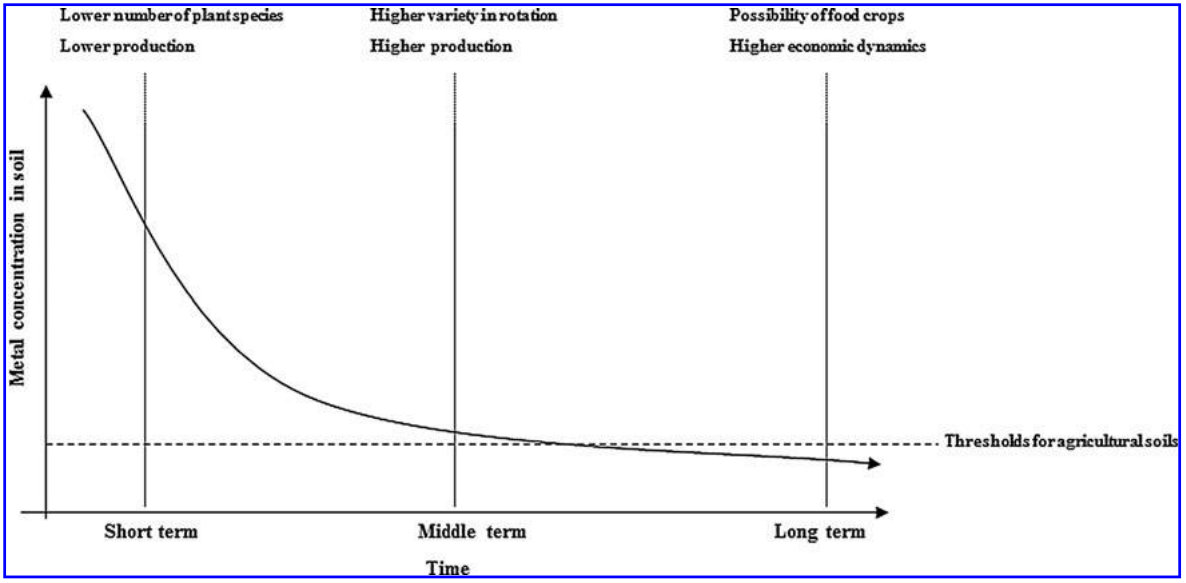
16Long-term development of BCL sitesBCL场地的长期发展
BCL’s main goal is to gain economic profit from nonsuitable agricultural soils while contemporaneously decreasing environmental risks or decrease the contamination levels in metal-contaminated soils. The number of plant species used in the rotations within a BCL system is site specific and depends on the initial TE concentration. These plant species should be metal tolerant, and at the beginning of the process, it should be assumed lower economics returns (Fig. 2). As the system develops, available and total metal concentration is decreasing in soil due to the uptaking in crops or the elimination of foliage and residual parts of the plants. As a result of successive harvests, the metal concentration in soil decreases, and this fact will allow the introduction of plant species with lower tolerance to metals, increasing the biodiversity of the rotations. Depending on the initial soil TE concentration, at a long term, the whole process may allow the introduction of food crops without any risk for population. Independent of the initial soil TE concentration and the possible long-term development of TE-contaminated sites, BCL will have provided a sustainable use of soil resources and alleviated the pressure put on the fertile land, which has to produce not only food but bioenergy as well.
BCL的主要目标是从不适宜农业的土壤中获取经济利润,同时降低环境风险或降低金属污染土壤中的污染水平。BCL系统轮作中使用的植物种类数量因地而异,并取决于初始微量元素浓度。这些植物种类应具有金属耐性,且在该过程初期应预期经济回报较低(图2)。随着系统的发展,由于作物吸收或清除叶片及植物残余部分,土壤中有效态和全量金属浓度逐渐降低。经过连续收获,土壤中金属浓度下降,从而可引入金属耐性较低的植物种类,增加轮作的生物多样性。取决于土壤初始微量元素浓度,从长远来看,整个过程最终可能允许引入粮食作物而不对人群构成任何风险。无论土壤初始微量元素浓度如何,也无论微量元素污染场地可能的长期发展如何,BCL都将实现土壤资源的可持续利用,并缓解肥沃土地所承受的压力,因为这些土地不仅要生产粮食,还要生产生物能源。
17Conclusions结论
The increasing demand for energy will make it necessary to explore the use of biomass. This, however, should not come at the cost of food production. There are many contaminated sites worldwide that are unsuitable for food production, thus making the production of BCL a worth-while option. The use of nonfood plant species would reduce the risk of contaminants entering the food chain. Long rotation periods, similar to the ones for wood and paper production, would reduce the concentrations of TEs in wood. A constant monitoring of these sites is, however, necessary to avoid the risk of TE distribution through TE leaching and soil erosion. Additionally, the fate of byproducts such as digestate (biogas production) and ash (combustion) has to be discussed. They could be applied on the areas of origin as fertilizer. However, a previous risk assessment has to be made to determine the possible toxicity and the bioavailability as to avoid any unnecessary risks. Although there are still many open subjects to be discussed and assessed, BCL gives the option to transform cost-intensive contaminated sites into sites that produce a positive economic return and would give the people living near these areas a new income.
日益增长的能源需求将使探索生物质利用成为必要。然而,这不应以牺牲粮食生产为代价。全球有许多污染场地不适合粮食生产,因此BCL生产是一种值得考虑的选择。使用非食用植物种类可降低污染物进入食物链的风险。与木材和造纸生产类似的长轮伐期可降低木材中微量元素的浓度。然而,须对这些场地进行持续监测,以避免微量元素通过淋溶和土壤侵蚀而扩散的风险。此外,还须探讨沼渣(沼气生产)和灰分(燃烧)等副产物的去向。这些副产物可作为肥料施用于其来源区域。然而,须事先进行风险评估,以确定其可能的毒性和生物有效性,从而避免不必要的风险。尽管仍有许多问题有待讨论和评估,BCL提供了一种将高成本污染场地转变为能够产生正经济回报的场地的途径,并可为这些区域附近的居民带来新的收入来源。
18Acknowledgment致谢
We would like to thank the DFG (German Research Foundation) for financing Michael Evangelou and the Spanish Ministerio de Economia y Competitividad and UPCT (Ref. RYC-2010-05665) for funding Hector Conesa.
感谢德国研究基金会(DFG)对Michael Evangelou的资助,以及西班牙经济与竞争力部(Ministerio de Economia y Competitividad)和UPCT(Ref. RYC-2010-05665)对Hector Conesa的资助。
19Author Disclosure Statement作者声明
No competing financial interests exist.
不存在任何竞争性经济利益。
20References参考文献
Adler, A., Dimitriou, I., Aronsson, P., Verwijst, T., and Weiha, M. (2008). Wood fuel quality of two Salix viminalis stands fertilised with sludge, ash and sludge-ash mixtures. Biomass Bioenerg. 32, 914.
Andra, S.S., Datta, R., Sarkar, D., Saminathan, S.K.M., Mullens, C.P., and Bach, S.B.H. (2009). Analysis of phytochelatin complexes in the lead tolerant vetiver grass [Vetiveria zizanioides (L.)] using liquid chromatography and mass spectrometry. Environ. Pollut. 157, 2173.
Angelova, V., Ivanova, R., and Ivanov, K. (2004). Heavy metal accumulation and distribution in oil crops. Commun. Soil Sci. Plant Anal. 35, 2551.
Ansari, R., Kazi, T.G., Jamali, M.K., Arain, M.B., Sherazi, S.T., Jalbani, N., and Afridi, H.I. (2008). Improved extraction method for the determination of iron, copper, and nickel in new varieties of sunflower oil by atomic absorption spectroscopy. J. AOAC Int. 91, 400.
Ansari, R., Kazi, T.G., Jamali, M.K., Arain, M.B., Wagan, M.D., Jalbani, N., Afridi, H.I., and Shah, A.Q. (2009). Variation in accumulation of heavy metals in different verities of sunflower seed oil with the aid of multivariate technique. Food Chem. 115, 318.
Ashworth, A.J., Barnes, B.C., Oates, W.P., and Slade, N.J. (2005). Indicators for land contamination. Science Report SC030039/SR. Bristol: Environment Agency.
Baker, A.J.M., and Brooks, R.R. (1989). Terrestrial higher plants which hyperaccumulate metallic elements e a review of their distribution, ecology and phytochemistry. Biorecovery 1, 81.
Ban´ski, J. (2001). Problem areas in Polish agriculture. Geographia Polonica 74, 1.
BBC. (2007). BBC News—Biofuels rush harmful, Oxfarm warns. http://news.bbc.co.uk/2/hi/uk_news/7072386.stm
Berg, B., Ekbohm, G., Soderstrom, B., and Staaf, H. (1991). Reduction of decomposition rates in scots pine needle litter due to heavy-metal pollution. Water Air Soil Pollut. 59, 165.
Berg, B., Staaf, H., and Wessen, B. (1987). Decomposition and nutrient release in needle litter from nitrogen-fertilized scots pine Pinus-sylvestris stands. Scand. J. Forest Res. 2, 399.
Bidar, G., Verdin, A., Garcon, G., Pruvot, C., Laruelle, F., Grandmougin-Ferjani, A., Douay, F., and Shirali, P. (2008). Changes in fatty acid composition and content of two plants (Lolium perenne and Trifolium repens) grown during 6 and 18 months in a metal (Pb, Cd, Zn) contaminated field. Water Air Soil Pollut. 192, 281.
Boddiger, D. (2007). Boosting biofuel crops next term could threaten food security. Lancet 370, 923.
Bolan, N.S., and Duraisamy, V.P. (2003). Role of inorganic and organic soil amendments on immobilisation and phytoavailability of heavy metals: a review involving specific case studies. Aust. J. Soil Res. 41, 533.
Bolan, N.S., Naidu, R., Syers, J.K., and Tillman, R.W. (1999). Sur-
face charge and solute interactions in soils. Adv. Agron. 67, 87.
Boucher, U., Lamy, I., Cambier, P., and Balabane, M. (2005). Decomposition of leaves of the metallophyte Arabidopsis halleri in soil microcosms: fate of Zn and Cd from plant residues. Environ. Pollut. 135, 323.
Brady, K.U., Kruckeberg, A.R., and Bradshaw, H.D. (2005). Evolutionary ecology of plant adaptation to serpentine soils. Annu. Rev. Ecol. Evol. Syst. 36, 243.
Bridgwater, T. (2006). Biomass for energy. J. Sci. Food Agric. 86, 1755. Bright, C. (1998). Life Out of Bounds: Bioinvasion in a Borderless World. New York: W.W. Norton and Company.
Bundt, M., Albrecht, A., Froidevaux, P., Blaser, P., and Fluhler, H. (2000). Impact of preferential flow on radionuclide distribution in soil. Environ. Sci. Technol. 34, 3895.
Cabrera, F., Clemente, L., Barrientos, E.D., Lopez, R., and Murillo, J.M. (1999). Heavy metal pollution of soils affected by the Guadiamar toxic flood. Sci. Total Environ. 242, 117.
Cao, X.D., Ma, L.N., Gao, B., and Harris, W. (2009). Dairymanure derived biochar effectively sorbs lead and atrazine. Environ. Sci. Technol. 43, 3285.
Castaldi, P., Melis, P., Silvetti, M., Deiana, P., and Garau, G. (2009). Influence of pea and wheat growth on Pb, Cd, and Zn mobility and soil biological status in a polluted amended soil. Geoderma 151, 241.
Castiglione, S., Todeschini, V., Franchin, C., Torrigiani, P., Gastaldi, D., Cicatelli, A., Rinaudo, C., Berta, G., Biondi, S., and Lingua, G. (2009). Clonal differences in survival capacity, copper and zinc accumulation, and correlation with leaf polyamine levels in poplar: a large-scale field trial on heavily polluted soil. Environ. Pollut. 157, 2108.
CBC. (2007). Comm-oddities. German Biofuel Boom Leaves Beer Drinkers Grumbling. Toronto, Canada: The Associated Press. ChemRRV. (2005). Verordnung zur Reduktion von Risiken beim Umgang mit bestimmten besonders gefa¨hrlichen Stoffen, Zubereitungen und Gegensta¨nden. Chemikalien-Risikoreduktions- Verordnung, ChemRRV SR 814.81. Zurich, Switzerland: The Federal Authorities of the Swiss Confederation.
Cheng, S.F., and Hseu, Z.Y. (2002). In-situ immobilization of cadmium and lead by different amendments in two contaminated soils. Water Air Soil Pollut. 140, 73.
Chiu, K.K., Ye, Z.H., and Wong, M.H. (2005). Enhanced uptake of As, Zn, and Cu by Vetiveria zizanioides and Zea mays using chelating agents. Chemosphere 60, 1365.
Cooper, E.M., Sims, J.T., Cunningham, S.D., Huang, J.W., and Berti, W.R. (1999). Chelate-assisted phytoextraction of lead from contaminated soils. J. Environ. Qual. 28, 1709.
Cotrufo, M.F., Desanto, A.V., Alfani, A., Bartoli, G., and Decristofaro, A. (1995). Effects of urban heavy-metal pollution on organic-matter decomposition in Quercus-ilex L woods. Environ. Pollut. 89, 81.
Dickinson, N., Baker, A., Doronila, A., Laidlaw, S., and Reeves, R. (2009). Phytodemediation of inorganics: realism and synergies. Int. J. Phytoremediat. 11, 97.
Dickinson, N.M. (2000). Strategies for sustainable woodland on contaminated soils. Chemosphere 41, 259.
Dickinson, N.M., and Pulford, I.D. (2005). Cadmium phytoextraction using short-rotation coppice Salix: the evidence trail. Environ. Int. 31, 609.
Dominguez, M.T., Maranon, T., Murillo, J.M., Schulin, R., and Robinson, B.H. (2008). Trace element accumulation in woody plants of the Guadiamar Valley, SW Spain: a large-scale phytomanagement case study. Environ. Pollut. 152, 50.
Dudka, S., Piotrowska, M., and Terelak, H. (1996). Transfer of cadmium, lead, and zinc from industrially contaminated soil to crop plants: a field study. Environ. Pollut. 94, 181.
Dunbar, K.R., McLaughlin, M.J., and Reid, R.J. (2003). The uptake and partitioning of cadmium in two cultivars of potato (Solanum tuberosum L.). J. Exp. Bot. 54, 349.
European Communities. (2003). The JRC enlargement action: land degradation. In: R.J.A. Jones and L. Montanarella, Eds., European Soil Bureau Research Report No. 10, EUR 20688 EN. Luxemburg: European Communities.
European Commission. (2007). The Impact of a Minimum 10% Obligation for Biofuel Use in the EU-27 in 2020 on Agricultural Markets. Impact assessment of the Renewable Energy Roadmap. Brussels: European Commission.
Economist. (2007). Castro was right: As a green fuel, ethanol is a good idea, but the sort that America produces is bad. The Economist 2007 April 4. Available online at www.economist .com/node/8960412
EEA. (1999). Soil Degradation: Environment in the European Union at the Turn of the Century. Environmental Assessment Report no. 2. Copenhagen, Denmark: European Environmental Agency.
EEA. (2000). Management of Contaminated Sites in Western Europe. Topic Report no. 13/1999. Copenhagen, Denmark: European Environment Agency.
EEA. (2003). Europe’s Environment: The Third Assessment. Environmental Assessment Report no. 10. Copenhagen, Denmark: European Environment Agency.
EEA. (2007a). Progress in Management of Contaminated Sites (CSI 015). Copenhagen, Denmark: European Environmental Agency.
EEA. (2007b). Europe’s Environment—The Fourth Assessment. State of the Environment Report no. 1/2007. Copenhagen, Denmark: European Environmental Agency.
EEA. (2009). Contamination from Local Sources. Copenhagen, Denmark: European Environmental Agency.
EEA (2010). Mapping the impacts of natural hazards and technological accidents in Europe—An overview of the last decade. Copenhagen, Denmark: European Environment Agency.
Engelen, B., and Holtz, F. (2000). Galmeiveilchen Ein Stu¨ckchen Heimat. Zart und angepasst, 1st ed. [In German]. Aachen, Germany: Meyer & Meyer Regionalia.
EPF. (2000). The use of recycled wood for wood-based panels. Brussels: European Panel Federation. Available online at www.europanels.org/pdf/Environment_WoodRecycling_ Standard1.pdf
Escobar, J.C., Lora, E.S., Venturini, O.J., Yanez, E.E., Castillo, E.F., and Almazan, O. (2009). Biofuels: Environment, technology and food security. Renew. Sust. Energ. Rev. 13, 1275.
Fa¨ssler, E., Robinson, B.H., Stauffer, W., Gupta, S.K., Papritz, A., and Schulin, R. (2010). Phytomanagement of metal-contaminated agricultural land using sunflower, maize and tobacco. Agric. Ecosyst. Environ. 136, 49.
Florijn, P.J., and Vanbeusichem, M.L. (1993). Cadmium distribution in maize inbred lines—Effects of pH and level of Cd supply. Plant Soil 153, 79.
Flury, M., Leuenberger, J., Studer, B., and Fluhler, H. (1995). Transport of anion and herbicides in a loamy and a sandy soil. Water Resour. Res. 31, 823.
Freedman, B., and Hutchinson, T.C. (1980). Effects of a smelter pollutants on forest leaf litter decomposition near a nickelcopper smelter at Sudbury, Ontario. Can. J. Bot. 58, 1722.
Frerot, H., Lefebvre, C., Gruber, W., Collin, C., Dos Santos, A., and Escarre, J. (2006). Specific interactions between local metallicolous plants improve the phytostabilization of mine soils. Plant Soil 282, 53.
Friedemann, A. (2007). Peak Soil: Why cellulosic ethanol, biofuels are unsustainable and a threat to America. Cultural change, www.culturechange.org/cms/index.php?option=com_content &task=view&id=107&Itemid=1
GACGC. (1995). World in Transition: The Threat to Soils. Annual Report–1994. Bonn: German Advisory Council on Global Change.
Go¨ssling, S., Broderick, J., Upham, P., Peeters, P., Strasdas, W., Ceron, J.-P., and Dubois, G. (2007). Voluntary carbon offsetting schemes for aviation: Efficiency and credibility. J. Sustain. Tourism 15, 223.
Greger, M., and Landberg, T. (1999). Use of willow in phytoextraction. Int. J. Phytoremediat. 1, 115.
Hamblin, A. (2001). Land. In Australia State of the Environment Committee (Eds.), Australia State of the Environment 2001: Independent Report to the Commonwealth Minister for the Environment and Heritage. Collingwood, Australia: CSIRO Publishing.
Hartley, W., Dickinson, N.M., Riby, P., and Lepp, N.W. (2009). Arsenic mobility in brownfield soils amended with green waste compost or biochar and planted with Miscanthus. Environ. Pollut. 157, 2654.
Hasselgren, K. (1999). Utilization of sewage sludge in short-rotation energy forestry: A pilot study. Waste Manage. Res. 17, 251.
Hattori, H. (1991). Influende of cadmium on decomposition of glucose and cellulose in soil. Soil Sci. Plant Nutr. 37, 39.
Hattori, H. (1996). Differences in the influence of cadmium on the decomposition of various types of organic materials in soil. Soil Sci. Plant Nutr. 42, 737.
Hermle, S., Gunthardt-Goerg, M.S., and Schulin, R. (2006). Effects of metal-contaminated soil on the performance of young trees growing in model ecosystems under field conditions. Environ. Pollut. 144, 703.
Hooper, D.U., and Vitousek, P.M. (1997). The effects of plant composition and diversity on ecosystem processes. Science 277, 1302.
Hulme, P.E., Pysek, P., Nentwig, W., and Vila, M. (2009). Will threat of biological invasions unite the European Union? Science 324, 40.
HWC. (1996). Remediating soil and sediment contaminated with heavy metals. Hazardous Waste Cons. Nov/Dec 1996, 4.10.
IEA. (2006). Key World Energy Statisitcs 2006. Paris, France: International Energy Agency.
IEA. (2007). Biofuel production. IEA Energy Technol. Essent. Jan 2007. Available online at www.iea.org/techno/essentials2 .pdf
Jamali, M.K., Kazi, T.G., Arain, M.B., Afridi, H.I., Jalbani, N., Kandhro, G.A., Shah, A.Q., and Baig, J.A. (2009). Heavy metal accumulation in different varieties of wheat (Triticum aestivum L.) grown in soil amended with domestic sewage sludge. J. Hazard. Mater. 164, 1386.
Jensen, J.K., Holm, P.E., Nejrup, J., Larsen, M.B., and Borggaard, O.K. (2009). The potential of willow for remediation of heavy metal polluted calcareous urban soils. Environ. Pollut. 157, 931.
Kabata-Pendias, A., and Pendias, H. (2001). Trace Elements in Soils and Plants, 3rd ed. New York,: CRC Press.
Kayser, A., Wenger, K., Keller, A., Attinger, W., Felix, H.R., Gupta, S.K., and Schulin, R. (2000). Enhancement of phytoextraction of Zn, Cd, and Cu from calcareous soil: The use of NTA and sulfur amendments. Environ. Sci. Technol. 34, 1778.
Keller, C., Hammer, D., Kayser, A., Richner, W., Brodbeck, M., and Sennhauser, M. (2003). Root development and heavy metal phytoextraction efficiency: comparison of different plant species in the field. Plant Soil 249, 67.
Khan, K.S., and Joergensen, R.G. (2006). Decomposition of heavy metal contaminated nettles (Urtica dioica L.) in soils subjected to heavy metal pollution by river sediments. Chemosphere 65, 981.
Klang-Westin, E., and Eriksson, J. (2003). Potential of Salix as phytoextractor for Cd on moderately contaminated soils. Plant Soil 249, 127.
Knechtenhofer, L.A., Xifra, I.O., Scheinost, A.C., Fluhler, H., and Kretzschmar, R. (2003). Fate of heavy metals in a strongly acidic shooting-range soil: Small-scale metal distribution and its relation to preferential water flow. J. Plant Nutr. Soil Sci.-Z. Pflanzenernahr. Bodenkd. 166, 84.
Koelbener, A., Ramseier, D., and Suter, M. (2008). Competition alters plant species response to nickel and zinc. Plant Soil 303, 241.
Koning, N., Heerink, N., and Kauffman, S. (2001). Food insecurity, soil degradation and agricultural markets in west africa: Why current policy approaches fail Oxford Dev. Stud. 29, 187.
Kozlov, M.V., Haukioja, E., Bakhtiarov, A.V., Stroganov, D.N., and Zimina, S.N. (2000). Root versus canopy uptake of heavy metals by birch in an industrially polluted area: contrasting behaviour of nickel and copper. Environ. Pollut. 107, 413.
Kretzschmar, R., Borkovec, M., Grolimund, D., and Elimelech, M. (1999). Mobile subsurface colloids and their role in contaminant transport. Adv. Agron. 66, 121.
Lai, H.Y., and Chen, Z.S. (2004). Effects of EDTA on solubility of cadmium, zinc, and lead and their uptake by rainbow pink and vetiver grass. Chemosphere 55, 421.
Lal, R., and Pimentel, D. (2007). Biofuels from crop residues. Soil Tillage Res. 93, 237.
Laskowski, R., and Berg, B. (1993). Dynamics of some mineral nutrients and heavy-metals in decomposing forest litter. Scand. J. Forest Res. 8, 446.
Laureysens, I., Blust, R., De Temmerman, L., Lemmens, C., and Ceulemans, R. (2004). Clonal variation in heavy metal
accumulation and biomass production in a poplar coppice culture: I. Seasonal variation in leaf, wood and bark concentrations. Environ. Pollut. 131, 485.
Lehmann, J. (2007). Bio-energy in the black. Front. Ecol. Environ. 5, 381.
Lewandowski, I., Schmidt, U., Londo, M., and Faaij, A. (2006). The economic value of the phytoremediation function - Accessed by the example of cadmium remediation by willow (Salix ssp). Agric. Syst. 89, 68.
Liu, X.H., Shen, Y.X., Lou, L.Q., Ding, C.L., and Cai, Q.S. (2009). Copper tolerance of the biomass crops Elephant grass (Pennisetum purpureum Schumach), Vetiver grass (Vetiveria zizanioides) and the upland reed (Phragmites australis) in soil culture. Biotechnol. Adv. 27, 633.
Lomander, A., and Johansson, M.B. (2001). Changes in concentrations of Cd, Zn, Mn, Cu and Pb in spruce (Picea abies) needle litter during decomposition. Water Air Soil Pollut. 132, 165.
Lombi, E., Zhao, F.J., Zhang, G.Y., Sun, B., Fitz, W., Zhang, H., and McGrath, S.P. (2002). In situ fixation of metals in soils using bauxite residue: Chemical assessment. Environ. Pollut. 118, 435.
Lugon-Moulin, N., Zhang, M., Gadani, F., Rossi, L., Koller, D., Krauss, M., and Wagner, G.J. (2004). Critical review of the science and options for reducing cadmium in tobacco (Nicotiana tabacum L.) and other plants. Adv. Agron. 83, 111.
Luo, C.L., Shen, Z.G., and Li, X.D. (2005). Enhanced phytoextraction of Cu, Pb, Zn and Cd with EDTA and EDDS. Chemosphere 59, 1.
Madejon, P., Maranon, T., and Murillo, J.M. (2006). Biomonitoring of trace elements in the leaves and fruits of wild olive and holm oak trees. Sci. Total Environ. 355, 187.
Madejon, P., Maranon, T., Murillo, J.M., and Robinson, B. (2004). White poplar (Populus alba) as a biomonitor of trace elements in contaminated riparian forests. Environ. Pollut. 132, 145.
Madejon, P., Murillo, J.M., Maranon, T., Cabrera, F., and Soriano, M.A. (2003). Trace element and nutrient accumulation in sunflower plants two years after the Aznalcollar mine spill. Sci. Total Environ. 307, 239.
Margui, E., Queralt, I., Carvalho, M.L., and Hidalgo, M. (2007). Assessment of metal availability to vegetation (Betula pendula) in Pb-Zn ore concentrate residues with different features. Environ. Pollut. 145, 179.
Mathews, J.A. (2008). Carbon-negative biofuels. Energ. Policy 36, 940.
McGowen, S.L., Basta, N.T., and Brown, G.O. (2001). Use of diammonium phosphate to reduce heavy metal solubility and transport in smelter-contaminated soil. J. Environ. Qual. 30, 493.
Mendez, M.O., and Maier, R.M. (2008a). Phytoremediation of mine tailings in temperate and arid environments. Rev. Environ. Sci. Bio/Technol. 7, 47.
Mendez, M.O., and Maier, R.M. (2008b). Phytostabilization of mine tailings in arid and semiarid environments—An emerging remediation technology. Environ. Health Persp. 116, 278.
Mertens, J., Van Nevel, L., De Schrijver, A., Piesschaert, F., Oosterbaan, A., Tack, F.M.G., and Verheyen, K. (2007). Tree species effect on the redistribution of soil metals. Environ. Pollut. 149, 173.
Mleczek, M., Rissmann, I., Rutkowski, P., Kaczmarek, Z., and Golinski, P. (2009). Accumulation of selected heavy metals by different genotypes of Salix. Environ. Exp. Bot. 66, 289.
Mohan, D., Pittman Jr, C.U., Bricka, M., Smith, F., Yancey, B., Mohammad, J., Steele, P.H., Alexandre-Franco, M.F., Go´mez- Serrano, V., and Gong, H. (2007). Sorption of arsenic, cad-
mium, and lead by chars produced from fast pyrolysis of wood and bark during bio-oil production. J. Colloid Interf. Sci. 310, 57.
Murillo, J.M., Maranon, T., Cabrera, F., and Lopez, R. (1999). Accumulation of heavy metals in sunflower and sorghum plants affected by the Guadiamar spill. Sci. Total Environ. 242, 281.
Neary, D.G., and Zieroth, E.J. (2007). Forest bioenergy system to reduce the hazard of wildfires: White Mountains, Arizona. Biomass Bioenerg. 31, 638.
Nehnevajova, E., Herzig, R., Bourigault, C., Bangerter, S., and Schwitzguebel, J.P. (2009). Stability of enhanced yield and metal uptake by sunflower mutants for improved phytoremediation. Int. J. Phytoremediat. 11, 329.
Nilsson, I. (1972). Accumulation of metals in spruce needles and needle litter. Oikos 23, 132.
Novak, J.M., Busscher, W.J., Laird, D.L., Ahmedna, M., Watts, D.W., and Niandou, M.A.S. (2009). Impact of biochar amendment on fertility of a southeastern coastal plain soil. Soil Sci. 174, 105.
Odum, H.T. (1996). Environmental Accounting: Energy and Environmental Decision Making. New York: John Wiley & Sons.
OECD/FAO. (2011). OECD-FAO Agricultural Outlook 2011–2020. Paris, France: OECD Publishing and FAO. http://dx.doi.org/ 10.1787/agr_outlook-2011-en
Olias, M., Ceron, J.C., Fernandez, I., Moral, F., and Rodriguez- Ramirez, A. (2005). State of contamination of the waters in the Guadiamar Valley five years after the Aznalcollar spill. Water Air Soil Pollut. 166, 103.
Palmer, D.H., Diaz, M.A., Nickels, G., McCrory, P., Bollwage, J.C., and Cochran, T. (2008). Recycling America’s land—A national report on brownfields redevelopment. U.S. Conference of Mayors, Washington D.C.
Perronnet, K., Schwartz, C., Gerard, E., and Morel, J.L. (2000). Availability of cadmium and zinc accumulated in the leaves of Thlaspi caerulescens incorporated into soil. Plant Soil 227, 257.
Peters, R.W. (1999). Chelant extraction of heavy metals from contaminated soils. J. Hazard. Mater. 66, 151.
Piotrowska, M., and KabataPendias, A. (1997). Impact of soils amended with Zn and Pb smelter dust on Cd concentrations in potatoes. J. Geochem. Explor. 58, 319.
Pulford, I.D., and Watson, C. (2003). Phytoremediation of heavy metal-contaminated land by trees—A review. Environ. Int. 29, 529. Quartacci, M.F., Baker, A.J.M., and Navari-Izzo, F. (2005). Nitrilotriacetate- and citric acid-assisted phytoextraction of cadmium by Indian mustard (Brassica juncea (L.) Czernj, Brassicaceae). Chemosphere 59, 1249.
Raghu, S., Wiedenmann, R.N., and Blouin, M.L. (2006). Biofuels as Invasive Species? Fayetteville: University of Arkansas Newswire. Rashid, U., Anwar, F., Moser, B.R., and Ashraf, S. (2008). Production of sunflower oil methyl esters by optimized alkalicatalyzed methanolysis. Biomass Bioenerg. 32, 1202.
Reglero, M.M., Monsalve-Gonza´lez, L., Taggart, M.A., and Mateo, R. (2008). Transfer of metals to plants and red deer in an old lead mining area in Spain. Sci. Total Environ. 406, 287.
Reijnders, L. (2009). Are forestation, bio-char and landfilled biomass adequate offsets for the climate effects of burning fossil fuels? Energ. Policy 37, 2839.
Robinson, B.H., Banuelos, G., Conesa, H.M., Evangelou, M.W.H., and Schulin, R. (2009). The phytomanagement of trace elements in soil. Cr. Rev. Plant Sci. 28, 240.
Robinson, B.H., Bischofberger, S., Stoll, A., Schroer, D., Furrer, G., Roulier, S., Gruenwald, A., Attinger, W., and Schulin, R. (2008). Plant uptake of trace elements on a Swiss military
shooting range: Uptake pathways and land management implications. Environ. Pollut. 153, 668.
Rosselli, W., Keller, C., and Boschi, K. (2003). Phytoextraction capacity of trees growing on a metal contaminated soil. Plant Soil 256, 265.
Rotkittikhun, P., Chaiyarat, R., Kruatrachue, M., Pokethitiyook, P., and Baker, A.J.M. (2007). Growth and lead accumulation by the grasses Vetiveria zizanioides and Thysanolaena maxima in lead-contaminated soil amended with pig manure and fertilizer: a glasshouse study. Chemosphere 66, 45.
Scheid, S., Gunthardt-Goerg, M.S., Schulin, R., and Nowack, B. (2009). Accumulation and solubility of metals during leaf litter decomposition in non-polluted and polluted soil. Eur. J. Soil Sci. 60, 613.
Schnitzer, M. (1978). Humic Substances: Chemistry and Reactions. Amsterdam, Oxford, New York: Elsevier Scientific Publishing Company.
Schro¨der, P., Herzig, R., Bojinov, B., Ruttens, A., Nehnevajova, E., Stamatiadis, S., Memon, A., VassileV, A., Caviezel, M., and Vangronsveld, J. (2008). Bioenergy to save the world -Producing novel energy plants for growth on abandoned land. Environ. Sci. Pollut. Res. 15, 196.
Seaman, J.C., Arey, J.S., and Bertsch, P.M. (2001). Immobilization of nickel and other metals in contaminated sediments by hydroxyapatite addition. J. Environ. Qual. 30, 460.
Shay, E.G. (1993). Diesel fuel from vegetable-oils-status opportunities. Biomass Bioenerg. 4, 227.
Shuman, L.M. (1999). Organic waste amendments effect on zinc fractions of two soils. J. Environ. Qual. 28, 1442.
Singhal, V., and Rai, J.P.N. (2003). Biogas production from water hyacinth and channel grass used for phytoremediation of industrial effluents. Bioresour. Technol. 86, 221.
SRU. (2004). Sachversta¨ndigenrat fu¨r Umweltfragen: Umweltgutachten 2004. Umweltpolitische Handlungsfa¨higkeit sichern [In German]. Baden-Baden, Germany: Nomos Verlagsgesellschaft.
Stevenson, F.J. (1994). Humus Chemistry: Genesis, Composition, Reaction, 2nd ed. New York: John Wiley & Sons, Inc.
Strojan, C.L. (1978). Forest leaf litter decomposition in vicinity of a zinc smelter. Oecologia 32, 203.
Sullivan, P. (2004). Sustainable Soil Management: Soil Systems Guide. Fayetteville, AR: ATTRA National Sustainable Agriculture Information Service.
UBA. (1997). Poland. In: K.W. Scha¨fer, Ed., International Experience and Expertise in Registration, Investigation, Assessment, and Clean-Up of Contaminated Military Sites. Berlin, Germany: Umweltbundesamt.
Unterbrunner, R., Puschenreiter, M., Sommer, P., Wieshammer, G., Tlustos, P., Zupan, M., and Wenzel, W.W. (2007). Heavy metal accumulation in trees growing on contaminated sites in Central Europe. Environ. Pollut. 148, 107.
Valentine, J., Clifton-Brown, J., Hastings, A., Robson, P., Allison, G., and Smith, P. (2012). Food vs. fuel: the use of land for lignocellulosic next generation’ energy crops that minimize competition with primary food production. GCB Bioenerg. 4, 1.
Vamerali, T., Bandiera, M., Coletto, L., Zanetti, F., Dickinson, N.M., and Mosca, G. (2009). Phytoremediation trials on metaland arsenic-contaminated pyrite wastes (Torviscosa, Italy). Environ. Pollut. 157, 887.
Van Nevel, L., Mertens, J., Oorts, K., and Verheyen, K. (2007). Phytoextraction of metals from soils: How far from practice? Environ. Pollut. 150, 34.
Verma, V.K., Singh, Y.P., and Rai, J.P.N. (2007). Biogas production from plant biomass used for phytoremediation of industrial wastes. Bioresour. Technol. 98, 1664.
Vidic, T., Greilhuber, J., Vilhar, B., and Dermastia, M. (2009). Selective significance of genome size in a plant community with heavy metal pollution. Ecol. Appl. 19, 1515.
von Barata, M., and Fochler-Hauke, G. (2003). Der Fischer Wel-
talmanach 2004: Zahlen Daten Fakten [In German]. Frankfurt am Main: S. Fischer Verlag GmbH
von Scala, C. (1998). The Influence of Contaminants on the Gasification of Waste Wood. Zurich, Switzerland: ETH Zu¨rich.
Wallno¨fer and Engelhardt. (1984). Schadstoffe, die aus dem Boden aufgenommen werden. in: E. Elstner Ed., Pflanzentoxikologie. Mannheim, Germany, Wissenschaftsverlag, p. 95.
Wang, E.X., and Benoit, G. (1996). Mechanisms controlling the mobility of lead in the spodosols of a northern hardwood forest ecosystem. Environ. Sci. Technol. 30, 2211.
Wenger, K., Gupta, S.K., Furrer, G., and Schulin, R. (2002). Zinc extraction potential of two common crop plants, Nicotiana tabacum and Zea mays. Plant Soil 242, 217.
Wernstedt, K., and Hersh, R. (2006). Brownfields regulatory reform and policy innovation in practice. Progress in Planning 65, 7.
Whiting, S.N., Reeves, R.D., Richards, D., Johnson, M.S., Cooke, J.A., Malaisse, F., Paton, A., Smith, J.A.C., Angle, J.S., Chaney, R.L., Ginocchio, R., Jaffre´, T., Johns, R., McIntyre, T., Purvis, O.W., Salt, D.E., Schat, H., Zhao, F.J., and Baker, A.J.M. (2004). Research priorities for conservation of metallophyte biodiversity and their potential for restoration and site remediation. Restor. Ecol. 12, 106.
Wolfe, A.K., and Bjornstad, D.J. (2002). Why would anyone object? An exploration of social aspects of phytoremediation acceptability. Cr. Rev. Plant Sci. 21, 429.
Wong, M.H., and Cheung, Y.H. (1995). Gas production and digestion efficiency of sewage sludge containing elevated toxic metals. Bioresour. Technol. 54, 261.
World Commission on Environment and Development (WCED). (1987). Our Common Future. Oxford, United Kingdom: Oxford University Press.
Wu, G., Kang, H., Zhang, X., Shao, H., Chu, L., and Ruan, C. (2010). A critical review on the bio-removal of hazardous heavy metals from contaminated soils: Issues, progress, ecoenvironmental concerns and opportunities. J. Hazard. Mater. 174, 1.
Wu, L.H., Luo, Y.M., Xing, X.R., and Christie, P. (2004). EDTAenhanced phytoremediation of heavy metal contaminated soil with Indian mustard and associated potential leaching risk. Agric. Ecosyst. Environ. 102, 307.
Yang, J., Huang, J., Qiu, H., Rozelle, S., and Sombilla, M.A. (2009). Biofuels and the greater Mekong subregion: assessing the impact on prices, production and trade. Appl. Energ. 86, S37.
Yuan, G., and Lavkulich, L.M. (1997). Sorption behavior of copper, zinc, and cadmium in response to simulated changes in soil properties. Commun. Soil Sci. Plant Anal. 28, 571.