International Journal of Phytoremediation, 15:77-90, 2013 Copyright © Taylor & Francis Group, LLC ISSN: 1522-6514 print / 1549-7879 online DOI: 10.1080/15226514.2012.670317 t Taylord Francitaylor & FrancIs Grou
Michael W.H. Evangelou,' Brett H. Robinson, Madeleine S. Günthardt-Goerg, and Rainer Schulin'
'Institute of Terrestrial Ecosystems, ETH Zürich, Zürich, Switzerland Z Agriculture and Life Sciences, Lincoln University, Lincoln, Canterbury,
3 Swiss Federal Research Institute for Forest, Snow and Landscape (WSL), Birmensdorf, Switzerland
Phytostabilization aims to reduce environmental and health risks arising from contaminated soil. To be economically attractive, plants used for phytostabilization should produce valuable biomass. This study investigated the biomass production and metal allocation to foliage and wood of willow (Salix viminalis L.), poplar (Populus monviso), birch (Betula pendula), and oak (Quercus robur) on five different soils contaminated with trace elements (TE), with varying high concentrations of Cu, Zn, Cd, and Pb as well as an uncontaminated control soil. In the treatment soils, the biomass was reduced in all species except oak. There was a significant negative correlation between biomass and foliar Cd and Zn concentrations, reaching up to 15 mg Cd kg-' and 2000 mg Zn kg-' in willow leaves. Lead was the only TE with higher wood than foliage concentrations. The highest Pb accumulation occurred in birch with up to 135 mg kg-' in wood and 78 mg kg-' in foliage. Birch could he suitable for phytostabilization of soils with high Cd and Zn but low Pb concentrations, while poplars and willows could be used to stabilise soils with high Cu and Pb and low Zn and Cd
植物稳定旨在降低污染土壤带来的环境与健康风险。为了具有经济吸引力,用于植物稳定的植物应能生产有价值的生物量。本研究考察了柳树(Salix viminalis L.)、杨树(Populus monviso)、桦树(Betula pendula)和栎树(Quercus robur)在5种受微量元素(TE)污染、Cu、Zn、Cd和Pb浓度不同程度偏高的土壤以及1种未污染对照土壤上的生物量生产及金属在叶片和木材中的分配。在处理土壤中,除栎树外,其余树种的生物量均有所下降。生物量与叶片Cd和Zn浓度呈显著负相关,柳树叶片中Cd和Zn浓度分别高达15 mg Cd kg⁻¹和2000 mg Zn kg⁻¹。Pb是唯一在木材中浓度高于叶片的微量元素。Pb累积量最高的是桦树,其木材中Pb浓度高达135 mg kg⁻¹,叶片中达78 mg kg⁻¹。桦树可能适用于Cd和Zn浓度高而Pb浓度低的土壤的植物稳定,而杨树和柳树可用于稳定Cu和Pb浓度高而Zn和Cd浓度低的土壤。
KEY WORDS: bioenergy, heavy metals, birch, phytostabilization, poplar, willow
关键词:生物能源,重金属,桦树,植物稳定,杨树,柳树
1INTRODUCTION引言
Trace elements (TE) occur naturally in the Earth's crust, but human activities have altered their geochemical cycles. Soil contamination with TE results from land application of biosolids, waste incineration, agricultural use of low quality fertilisers and application of TE-based pesticides, mining, and processing of TE ores, industrial and traffic emissions, weathering of buildings, military activities and others (Kozlov, Haukioja, Bakhtiarov et al. 2000; Sterckeman, Douay, Proix et al. 2002; Sebastiani, Scebba and Tognetti 2004; Walter, Martinez and Cala 2006). Soil pollution by TE is responsible for losses in soil fertility, food contamination, ecotoxic effects and risks to human health.
微量元素(TE)天然存在于地壳中,但人类活动改变了其地球化学循环。土壤微量元素污染来源于生物固体(污泥)的土地施用、废物焚烧、农业上使用劣质肥料和含微量元素的农药、微量元素矿石的开采与加工、工业和交通排放、建筑物风化、军事活动等(Kozlov, Haukioja, Bakhtiarov et al. 2000; Sterckeman, Douay, Proix et al. 2002; Sebastiani, Scebba and Tognetti 2004; Walter, Martinez and Cala 2006)。土壤微量元素污染会导致土壤肥力丧失、食物污染、生态毒性效应以及人体健康风险。
Address correspondence to Michael W.H. Evangelou, Institute of Terrestrial Ecosystems, ETH Zürich, Universitätstrasse 16, CH-8092, Zürich, Switzerland. E-mail: michael.evangelou@env.ethz.ch
Landfilling of TE-contaminated soil not only results in the loss of otherwise fertile soil, but also is expensive. Clean-up is often not possible for economic and/or ecological reasons. Thus, keeping the contamination in place under control, from being dispersed into the environment and preventing it from reaching food chains are the only treatment options. This is the goal of phytostabilization. In this approach a vegetation cover is used to reduce leaching by extracting soil water via transpiration and reducing soil erosion (Robinson et al. 2006). The effectiveness of vegetation in controlling leaching depends on the soil properties as well as on the climate. Deep rooted plant species are generally more suitable for phytostabilization than shallow rooted species, especially in dryer climates or dry periods, because shallow rooted species have less access to water and are, therefore, more likely to suffer from droughts (Vogeler et al. 2001). Thus, a permanent cover would not be guaranteed and a dispersion of contaminated soil via wind or water erosion would become possible. Besides acting as umbrellas and preventing some 15% of rainfall from reaching the ground by evaporating intercepted precipitation, tree canopies also reduce evaporation from the ground and thus keep the forest floor moist (Robinson et al. 2009). Additionally, by extracting soil moisture, roots help maintain aerobic conditions in the vadose zone, preventing reduction of redox-sensitive TE, which are often more toxic and more mobile than oxidized species of the same TE. Plants add organic matter to the soil in the form of litter and root exudates which bind TE (Pulford and Watson 2003; Robinson et al. 2009).
将受微量元素污染的土壤填埋不仅会造成原本肥沃土壤的损失,而且费用高昂。出于经济和/或生态原因,清除污染往往不可行。因此,就地控制污染、防止其扩散到环境中并阻止其进入食物链是仅有的处理选择,这正是植物稳定的目标。该方法利用植被覆盖,通过蒸腾作用吸收土壤水分以减少淋溶,并减轻土壤侵蚀(Robinson et al. 2006)。植被控制淋溶的效果取决于土壤性质和气候条件。深根植物通常比浅根植物更适合用于植物稳定,尤其是在较干旱的气候或干旱时期,因为浅根植物获取水分的能力较弱,因而更易遭受干旱胁迫(Vogeler et al. 2001)。在此情况下,永久性植被覆盖将无法保证,受污染土壤可能通过风蚀或水蚀而扩散。树冠除了起到伞的作用、通过截留降水的蒸发使约15%的降雨无法到达地面之外,还能减少地面蒸发,从而保持林地湿润(Robinson et al. 2009)。此外,根系通过吸收土壤水分,有助于维持包气带的好氧条件,防止氧化还原敏感型微量元素被还原,而其还原态往往比同一元素的氧化态毒性更强、迁移性更高。植物还以凋落物和根系分泌物的形式向土壤输入有机质,这些有机质能够结合微量元素(Pulford and Watson 2003; Robinson et al. 2009)。
However, phytostabilization is only economically attractive if it also enhances the value of the land through ecological benefits or the production of nonedible biomass for commercial products such as bioenergy or timber. For commercial biomass production on contaminated soil, tree species are needed which have, 1) a high biomass production, 2) a high root biomass to stabilize the soil and the contaminants, 3) a high tolerance combined with low TE uptake, especially in the foliage, as leaves can enter the food chain, and 4) easy handling (e.g., short rotation coppice) (Perronnet et al. 2000). Although, there are many studies that have investigated phytostabilization and phytoextraction of TE contaminated soils with willow and poplar (Pulford and Watson 2003; Mertens et al. 2004; Sebastiani, Scebba and Tognetti 2004; Dickinson and Pulford 2005; Brunner et al. 2008) there are still several issues that have remained unanswered. It is not clear how naturally contaminated soil and soil properties affect TE uptake for specific tree species. Furthermore, the implications of TE uptake for fuel production from biomass of TE contaminated are unknown. Finally, the role of elements such as Sb which have been neglected but which are important due to their toxicity and their mobility (Johnson et al. 2005; Sorvari, Antikainen, and Pyy 2006) has to be addressed.
然而,只有当植物稳定同时通过生态效益或生产用于生物能源、木材等商业产品的非食用生物量来提升土地价值时,它才具有经济吸引力。要在污染土壤上进行商业化生物量生产,所需树种应具备:1)生物量产量高;2)根系生物量大,以稳定土壤和污染物;3)耐受性强且微量元素吸收量低,尤其是叶片,因为叶片可能进入食物链;4)易于管理(如短轮伐期矮林作业)(Perronnet et al. 2000)。尽管已有许多研究考察了利用柳树和杨树对微量元素污染土壤进行植物稳定和植物提取(Pulford and Watson 2003; Mertens et al. 2004; Sebastiani, Scebba and Tognetti 2004; Dickinson and Pulford 2005; Brunner et al. 2008),但仍有若干问题尚未得到解答。目前尚不清楚天然污染土壤及土壤性质如何影响特定树种对微量元素的吸收。此外,微量元素吸收对利用污染土壤生物量生产燃料的影响也尚不明确。最后,Sb等元素虽一直被忽视,但因其毒性和迁移性而十分重要(Johnson et al. 2005; Sorvari, Antikainen, and Pyy 2006),其作用有待研究。
In the present study, we investigated the possibility of combining phytostabilization and bioenergy production by growing trees on TE contaminated soils. For this purpose we compared the TE accumulation and biomass production of four tree species, willow (Salix viminalis), poplar (Populus monviso), birch (Betula pendula), and oak (Quercus robur) grown on four TE-contaminated soils, a TE-spiked soil and an uncontaminated control soil. The aim of this study was to investigate the effect of trace elements on the growth and uptake of the aforementioned candidate species in a range of contaminated soils.
本研究探讨了通过在微量元素污染土壤上种植树木,将植物稳定与生物能源生产相结合的可能性。为此,我们比较了柳树(Salix viminalis)、杨树(Populus monviso)、桦树(Betula pendula)和栎树(Quercus robur)4个树种在4种微量元素污染土壤、1种人工添加微量元素的土壤和1种未污染对照土壤上的微量元素累积和生物量生产。本研究旨在考察微量元素对上述候选树种在一系列污染土壤中的生长和吸收的影响。
2MATERIALS AND METHODS材料与方法
Soils土壤
The soils used in this study were taken from four polluted sites in Switzerland: Allmend, Losone, Dornach and Witzwil. Shooting ranges at Allmend, Luzern (Robinson et al.
本研究所用土壤采自瑞士的4个污染场地:Allmend、Losone、Dornach和Witzwil。位于卢塞恩Allmend的射击场(Robinson et al.
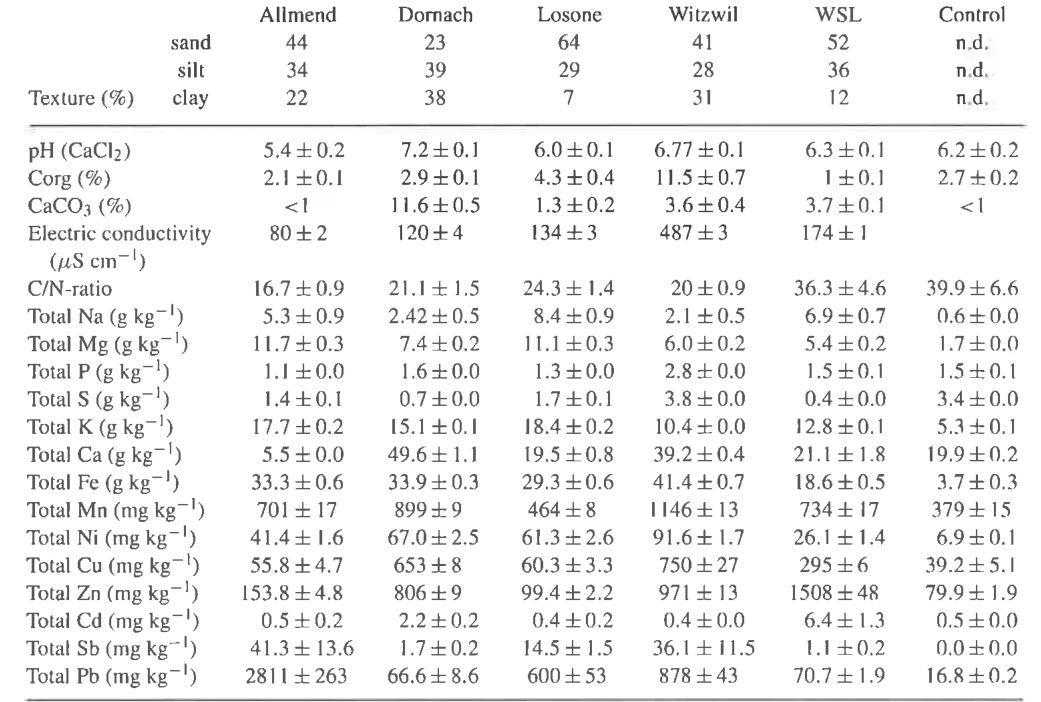
2008) and Losone (Knechtenhofer, Xifra, Scheinost et al. 2003) were heavily contaminated with Pb and Sb. The Allmend soil is a silty loam soil and with pH 5.4 the most acidic among the six soils and the highest Pb and Sb concentrations (Table 1). The Losone soil was a sandy loam soil with an organic carbon content of 4.3%. The Dornach soil was a clay loam, which had been heavily contaminated with Cu and Zn for about a century by particulate emissions from an adjacent brass smelter (Kayser et al. 2000). Besides Cu and Zn concentrations of approximately 650 mg kg-' and 800 mg kg-', respectively, the Dornach soil had high carbonate content (11.6%). The Witzwil soil was a clay loam from an agricultural field in Western Switzerland. It had been contaminated with Zn, Pb, and Cu by disposal of municipal wastes during the first half of the 20th century (Fässler et al. 2010), which also explains its high organic carbon content (11.5%). The WSL soil, a loam soil, had been artificially contaminated with dust from the brass smelter of Dornach, in a previous lysimeter experiment at WSL Birmensdorf (Switzerland) (Menon et al. 2005). The control soil was an uncontaminated soil substrate (technosol) consisting of peat bark humus and clay pot mixture, as it is regularly used for growing seedlings in the tree nursery of WSL (47,21,40 N; 8°,27,19 S).
2008)和Losone的射击场(Knechtenhofer, Xifra, Scheinost et al. 2003)受到Pb和Sb的严重污染。Allmend土壤为粉砂壤土,pH为5.4,是6种土壤中酸性最强的,且Pb和Sb浓度最高(表1)。Losone土壤为砂壤土,有机碳含量为4.3%。Dornach土壤为黏壤土,由于邻近黄铜冶炼厂的颗粒物排放,约一个世纪以来一直受到Cu和Zn的严重污染(Kayser et al. 2000)。除Cu和Zn浓度分别约为650 mg kg⁻¹和800 mg kg⁻¹外,Dornach土壤的碳酸盐含量也较高(11.6%)。Witzwil土壤为采自瑞士西部一处农田的黏壤土,20世纪上半叶因城市垃圾处置而受到Zn、Pb和Cu污染(Fässler et al. 2010),这也解释了其较高的有机碳含量(11.5%)。WSL土壤为壤土,在瑞士WSL Birmensdorf此前开展的一项渗漏计试验中被人为添加了来自Dornach黄铜冶炼厂的粉尘(Menon et al. 2005)。对照土壤为未污染的土壤基质(技术土),由泥炭、树皮腐殖质和黏土盆栽混合物组成,常规用于WSL苗圃育苗(47°21′40″ N;8°27′19″ E)。
Soil Analysis土壤分析
Soil samples were taken from the top 20 cm of the soil profiles at the respective sites of origin, dried at 40°C sieved to <2 mm and was then thoroughly mixed. Soil texture was determined using the hydrometer method after wet oxidation of the organic matter by means of hydrogen peroxide (FAL, RAC, and FAW 1996a). Organic matter content was determined using the dichromate method (FAL, RAC, and FAW 1996b). The carbonate content was measured by volumetric analysis of the CO2 that evolved after addition of 4 M HCI to the soil. Total carbon (Cot) and total nitrogen (Nut) contents were determined by means of a CN-analyser (CNS-2000, Leco, USA). Electrical conductivity was determined according to DIN ISO 11265, and soil pH was measured in 0.01 M CaC12 (FAL, RAC, and FAW, 1996d). Total soil TE concentrations were determined by means of X-ray fluorescence spectroscopy (Spectro X-lab 2000, Germany). Soluble soil TE were extracted with 0.1 M NaNO, (FAL, RAC, and FAW, 1996·). Filtrated extracts were analysed for TE by means of ICP-OES (Varian, Vista-MPX CCS simultaneous). For quality assurance, we analysed the two Wageningen soil standards, 989 and 951. Recoveries were 90% for Pb, Cd, Cu, and
土壤样品采自各原产地土壤剖面的表层20 cm,于40°C下烘干,过2 mm筛(<2 mm),然后充分混匀。采用过氧化氢湿法氧化去除有机质后,用比重计法测定土壤质地(FAL, RAC, and FAW 1996a)。有机质含量采用重铬酸盐法测定(FAL, RAC, and FAW 1996b)。碳酸盐含量通过向土壤中加入4 M HCl后对释放的CO2进行体积分析测定。全碳(Ctot)和全氮(Ntot)含量采用CN分析仪(CNS-2000, Leco, USA)测定。电导率按DIN ISO 11265测定,土壤pH在0.01 M CaCl2中测定(FAL, RAC, and FAW, 1996d)。土壤微量元素全量采用X射线荧光光谱法(Spectro X-lab 2000, Germany)测定。土壤可溶态微量元素用0.1 M NaNO3提取(FAL, RAC, and FAW, 1996c)。过滤后的提取液采用ICP-OES(Varian, Vista-MPX CCS simultaneous)测定微量元素。为保证质量,我们分析了Wageningen的两个土壤标准样品989和951。Pb、Cd、Cu和……的回收率为90%
Experimental Setup试验设计
Pot experiments were conducted in 2008 in the WSL tree nursery under ambient climate conditions at Birmensdorf between May and September. Ten L plastic pots with six small holes at the bottom, were filled with approximately 9 kg air-dried and 1 cm sieved soil. A tray was placed under each pot. The soil was fertilized using Osmocote 6 M at rates recommended by the manufacturer, resulting in the addition of 500 mg N, 100 mg P, and 200 mg K kg-' of soil. Pots were irrigated 3-4 times per week.
盆栽试验于2008年5月至9月在Birmensdorf的WSL苗圃自然气候条件下进行。将约9 kg风干并过1 cm筛的土壤装入底部有6个小孔的10 L塑料盆中,每盆下方放置一个托盘。按生产商推荐用量施用Osmocote 6 M肥料,相当于每kg土壤添加500 mg N、100 mg P和200 mg K。每周灌溉3~4次。
Each soil and tree species, was replicated six times for a total of 144 pots. The willows and poplars were planted as approximately 30 cm long unrooted cuttings weighing of 9.5 · 1.5 g and 20.1 · 2.5 g, respectively. The birches were planted as approximately 20 cm tall 1.5-year-old seedlings grown from seeds, and the oaks were planted as approximately 35 cm tall 3-year-old seedlings grown from acorns. The shoot and root dry weights were 0.32 + 0.1 g and 0.43 + 0.1 g, respectively, for the birches and 3.0 + 1.0 g and 2.26 + 1.0 g., respectively, for the oaks at planting. The 144 pots were set up on a grid in a completely randomised design.
每种土壤与树种组合设6个重复,共144盆。柳树和杨树以长约30 cm的无根插条种植,重量分别为9.5 ± 1.5 g和20.1 ± 2.5 g。桦树以由种子培育、高约20 cm的1.5年生幼苗种植,栎树以由橡子培育、高约35 cm的3年生幼苗种植。种植时,桦树的地上部和根系干重分别为0.32 ± 0.1 g和0.43 ± 0.1 g,栎树分别为3.0 ± 1.0 g和2.26 ± 1.0 g。144个盆钵按完全随机设计排列于网格上。
Plant Harvest, Biomass, and Analysis植物收获、生物量与分析
All trees were harvested after 4 months of growth. The aboveground biomass was sampled by cutting stems at 5 cm above ground and then divided into leaves and stems (including branches). Roots were cleared from the substrate by washing. Poplar and willow roots were separated from the cutting. All plant samples were subsequently washed with tap and deionised water and then dried at 60°C, until constant weight was obtained. After weighing, the dry samples were ground using a Retsch ZM-200 centrifugal titanium mill. Foliage, stem and roots samples were analysed for TE by means of X-ray fluorescence spectroscopy (Spectro X-lab 2000, Germany). For quality assurance, we analyzed certified plant reference material (Virginia tobacco leaves CTA-VTL-2, Polish Reference Material). Recoveries were > 90% for Pb, Cu, Cd, Fe, and Zn; and 90-110% for Ca, Mg, Mn, K, and P. For Sb, approximately 0.2 g subsample of each ground plant sample was digested with 2 mL HNO3 (65%) and 4 mL H202 (30%) using a microwave digester (lavis ETHOS MLS GmbH, Leutkirch, Germany) to prevent Sb volatilization. The digests were diluted to 25 mL with nanopur water. The extracts were analysed for Sb by ICP-MS (Variam, 810-MS) with a detection limit of 0.0002 mg L-. For quality assurance, we analysed certified plant reference material (Virginia tobacco leaves CTA-VTL-2, Polish Reference 147 Material). Recoveries Sb were > 90%.
所有树木在生长4个月后收获。在距地面5 cm处剪断茎干采集地上部生物量,然后分为叶片和茎(含枝条)。根系通过冲洗与基质分离。杨树和柳树的根系与插条分开。所有植物样品随后用自来水和去离子水洗净,于60°C下烘干至恒重。称重后,干样用Retsch ZM-200离心式钛研磨机粉碎。叶片、茎和根系样品采用X射线荧光光谱法(Spectro X-lab 2000, Germany)测定微量元素。为保证质量,我们分析了有证植物标准物质(弗吉尼亚烟叶CTA-VTL-2,波兰标准物质)。Pb、Cu、Cd、Fe和Zn的回收率 > 90%;Ca、Mg、Mn、K和P的回收率为90%~110%。测定Sb时,为防止Sb挥发,取每份研磨植物样品约0.2 g,加入2 mL HNO3(65%)和4 mL H2O2(30%),用微波消解仪(Milestone ETHOS, MLS GmbH, Leutkirch, Germany)消解。消解液用纳米纯水定容至25 mL。提取液采用ICP-MS(Varian, 810-MS)测定Sb,检出限为0.0002 mg L⁻¹。为保证质量,我们分析了有证植物标准物质(弗吉尼亚烟叶CTA-VTL-2,波兰标准物质)。Sb的回收率 > 90%。
Statistical Analysis统计分析
All statistical analyses were carried out by means of SPSS. Treatment effects were determined by analysis of variance (ANOVA). Differences were considered significant if p < 0.05.
所有统计分析均采用SPSS完成。处理效应通过方差分析(ANOVA)确定。以p < 0.05为差异显著。
3RESULTS结果
Trace Elements Availability微量元素有效性
The five contaminated soils varied considerably in total metal concentrations, which ranged for Cu between 55.8 and 750 mg kg-', for Zn between 99.4 and 1508 mg kg-', for Pb between 66.9 and 2811 mg kg-' and for Cd between 0.5 and 6.4 mg kg-' as well as in their physical and chemical properties (Table 1). The physical and chemical properties of the soil also had an effect on the NaNO-available TE concentration in these soils (Table 2). Of all the soils, Allmend was had the lowest pH of 5.4 and highest NaNO3-available fraction (percentage of available metal concentration/total metal concentration) of Mn (0.024%), Ca (40%) and Pb (1.5%). Dornach's high pH of 7.2 caused by its high CaCO,-content of 11.6% and high clay content of 38% resulted in low Cu (0.12%), Zn (0.014%), Pb (below detection, b.d.) and Mn (0.003 %) available fractions. With an organic carbon content of 11.5%, the Witzwil soil contained 2.6 to 11.5-fold higher organic carbon than the other soils and also had the lowest NaNO,-available fraction of Cu (0.07%), Zn (0.014%), and Pb (b.d.). Losone had the highest Sb available fraction (0.46%), followed by Witzwil and Allmend with 0.15% and 0.14%, respectively.
5种污染土壤的金属全量差异很大,Cu为55.8~750 mg kg⁻¹,Zn为99.4~1508 mg kg⁻¹,Pb为66.9~2811 mg kg⁻¹,Cd为0.5~6.4 mg kg⁻¹,其理化性质也存在较大差异(表1)。土壤理化性质还影响了这些土壤中NaNO3有效态微量元素浓度(表2)。在所有土壤中,Allmend的pH最低(5.4),Mn(0.024%)、Ca(40%)和Pb(1.5%)的NaNO3有效态比例(有效态金属浓度/金属全量的百分比)最高。Dornach的CaCO3含量高达11.6%,导致其pH较高(7.2),加之黏粒含量高达38%,因而Cu(0.12%)、Zn(0.014%)、Pb(低于检出限,b.d.)和Mn(0.003%)的有效态比例较低。Witzwil土壤有机碳含量为11.5%,是其他土壤的2.6~11.5倍,其Cu(0.07%)、Zn(0.014%)和Pb(b.d.)的NaNO3有效态比例也最低。Losone的Sb有效态比例最高(0.46%),其次为Witzwil和Allmend,分别为0.15%和0.14%。
Plant Dry Weight植物干重
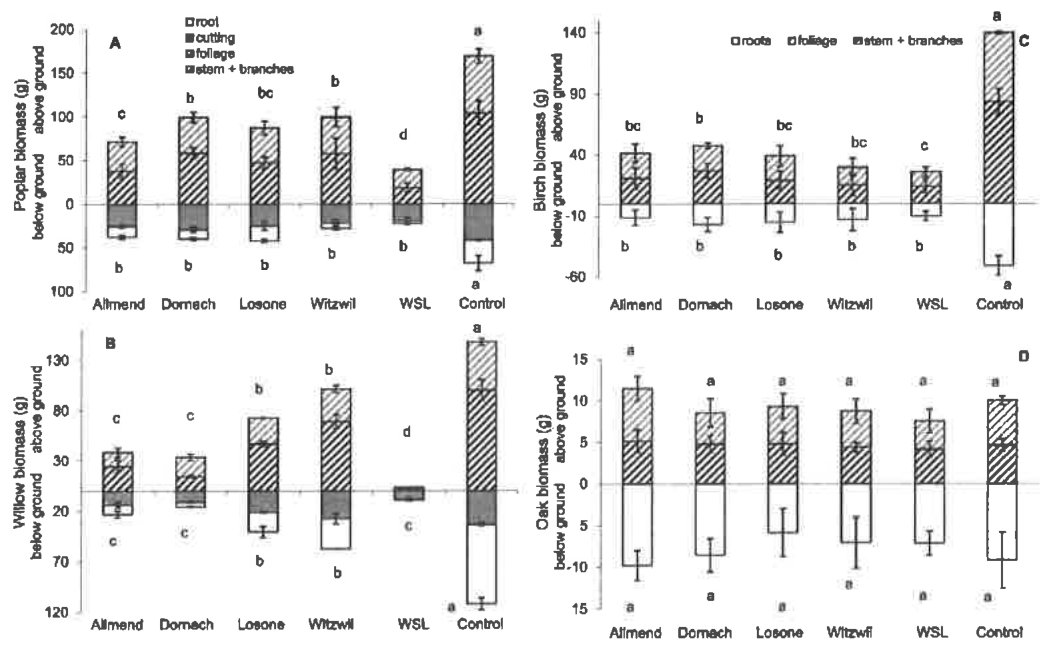
On the contaminated soils willow, poplar and birch growth was much reduced (Figure 1) with respect to the control. In addition we found foliar necrosis and chlorosis on the Dornach and WSL soils in all three species, however the extent of the reactions varied among the tree species. In contrast, neither a growth effect nor toxicity symptoms was observed in oak. For the other species, the strongest growth inhibition was on the WSL soil, with average biomass of 39.1 g, 3.2 g, and 25.7 g per tree in poplar, willow and birch, respectively. Dry weight of poplar, willow and birch growing on Dornach soil was significantly reduced by 1.7-, 6.3-, and 3-fold, respectively.
与对照相比,柳树、杨树和桦树在污染土壤上的生长明显受抑(图1)。此外,3个树种在Dornach和WSL土壤上均出现叶片坏死和失绿,但反应程度因树种而异。相比之下,栎树既未表现出生长效应,也未出现毒害症状。对于其他树种,生长抑制在WSL土壤上最为强烈,杨树、柳树和桦树的平均单株生物量分别为39.1 g、3.2 g和25.7 g。在Dornach土壤上生长的杨树、柳树和桦树干重分别显著降低了1.7倍、6.3倍和3倍。
The roots were similarly adversely affected by the contaminated soils. Contrary to shoot biomass, root biomass on the control soil varied significantly among the three trec species, with 78.5, 25.9 and 51.1 g for willow, poplar and birch, respectively. In willow, poplar, and birch, shoot, and root growth was more severely inhibited on the WSL soil. Also, the biomass of willow and poplar cuttings was affected by all treatment soils. Compared to the initial weight of the planted cuttings, only the willow cuttings grown on the control (33.7 g), Losone (21.4 g), and Witzwil (27.7 g) soil and the poplar cuttings grown on the control (42.2 g) and Dornach (29.5 g) soil significantly increased their dry weight (Figure 1).
根系同样受到污染土壤的不利影响。与地上部生物量不同,对照土壤上3个树种的根系生物量差异显著,柳树、杨树和桦树分别为78.5、25.9和51.1 g。柳树、杨树和桦树的地上部和根系生长在WSL土壤上受到的抑制更为严重。此外,柳树和杨树插条的生物量也受到所有处理土壤的影响。与种植时插条的初始重量相比,仅在对照(33.7 g)、Losone(21.4 g)和Witzwil(27.7 g)土壤上生长的柳树插条,以及在对照(42.2 g)和Dornach(29.5 g)土壤上生长的杨树插条干重显著增加(图1)。
Metal Accumulation and Allocation金属累积与分配
Tree species patterns. Cadmium, Zn, Pb, Cu, Sb, Mn, Ca, Fe, Mg. Na, and K accumulations in foliage and wood varied considerably between tree species (Table 3). With the exception of Pb, TE accumulation in foliage was higher than in wood, especially at high TE soil concentrations. Although the total and available soil element concentrations were significantly different in the five contaminated soils (Tables 1 and 2), distinctive patterns could be observed concerning the element accumulation by the four investigated tree species.
树种间规律。叶片和木材中Cd、Zn、Pb、Cu、Sb、Mn、Ca、Fe、Mg、Na和K的累积量在树种间差异很大(表3)。除Pb外,叶片中微量元素累积量均高于木材,在土壤微量元素浓度较高时尤为明显。尽管5种污染土壤中元素的全量和有效态浓度差异显著(表1和表2),但所研究的4个树种在元素累积方面仍呈现出明显的规律。

Cadmium accumulation decreased in the following order: willow > poplar > birch > oak, which agrees with Hermle et al. (2006) where willow accumulated more Cd than birch. Willow had the highest Cd and Zn concentrations in foliage and wood on all contaminated soils, with ranges of 3.4-40.9 mg kg-' Cd and 286-2088 mg kg-' Zn in foliage and ranges of 3.4 to 40.9 mg kg-' for Cd and 88.5 to 414 mg kg-' for Zn in wood (Table 3). Cadmium concentrations in wood and foliage of willow agreed with those of Ledin (1998), Eriksson and Ledin (1999), and Hermle et al. (2006). Foliage and wood Sb concentrations were very low, ranging from 0.07 to 0.38 and 0.02 to 0.10 mg kg-', respectively, agreeing with the concentrations found by Robinson et al. (2008). Willow and poplar foliage had significantly higher Ca and K foliage concentrations than birch and oak, with concentrations ranging between 12511-44431 mg kg- and 12625-37325 mg kg-', respectively. However in wood, poplar had even higher K concentrations than willow, with concentrations ranging from 6721 to 10770 mg kg-' (Table 3). These values are comparable with the bark and wood Ca and K concentrations stated by Tharakan et al. (2003).
Cd累积量依次为:柳树 > 杨树 > 桦树 > 栎树,这与Hermle et al.(2006)的结果一致,即柳树累积的Cd多于桦树。在所有污染土壤上,柳树叶片和木材中的Cd和Zn浓度均最高,叶片中Cd为3.4~40.9 mg kg⁻¹、Zn为286~2088 mg kg⁻¹,木材中Cd为3.4~40.9 mg kg⁻¹、Zn为88.5~414 mg kg⁻¹(表3)。柳树木材和叶片中的Cd浓度与Ledin(1998)、Eriksson and Ledin(1999)以及Hermle et al.(2006)的结果一致。叶片和木材中Sb浓度很低,分别为0.07~0.38和0.02~0.10 mg kg⁻¹,与Robinson et al.(2008)测得的浓度一致。柳树和杨树叶片的Ca和K浓度显著高于桦树和栎树,分别为12511~44431 mg kg⁻¹和12625~37325 mg kg⁻¹。然而在木材中,杨树的K浓度甚至高于柳树,为6721~10770 mg kg⁻¹(表3)。这些数值与Tharakan et al.(2003)报道的树皮和木材Ca、K浓度相当。
On the two shooting range soils contaminated with high Pb concentrations, birch had the highest wood (135 mg kg-') and foliar (78 mg kg-') Pb concentrations, and birch also had the highest Fe concentrations in foliage on all contaminated soils. Oak had the highest Mn, Fe, Ca and Mg wood concentrations on all soils but WSL. On the other hand, oak had the lowest Cd and Zn concentrations, which for Cd were below or close to the detection limit (<0.7 mg kg-'), in foliage and wood.
在两种Pb浓度较高的射击场土壤上,桦树木材(135 mg kg⁻¹)和叶片(78 mg kg⁻¹)中的Pb浓度最高,且在所有污染土壤上桦树叶片的Fe浓度也最高。除WSL土壤外,栎树在所有土壤上木材中的Mn、Fe、Ca和Mg浓度均最高。另一方面,栎树叶片和木材中的Cd和Zn浓度最低,其中Cd浓度低于或接近检出限(<0.7 mg kg⁻¹)。
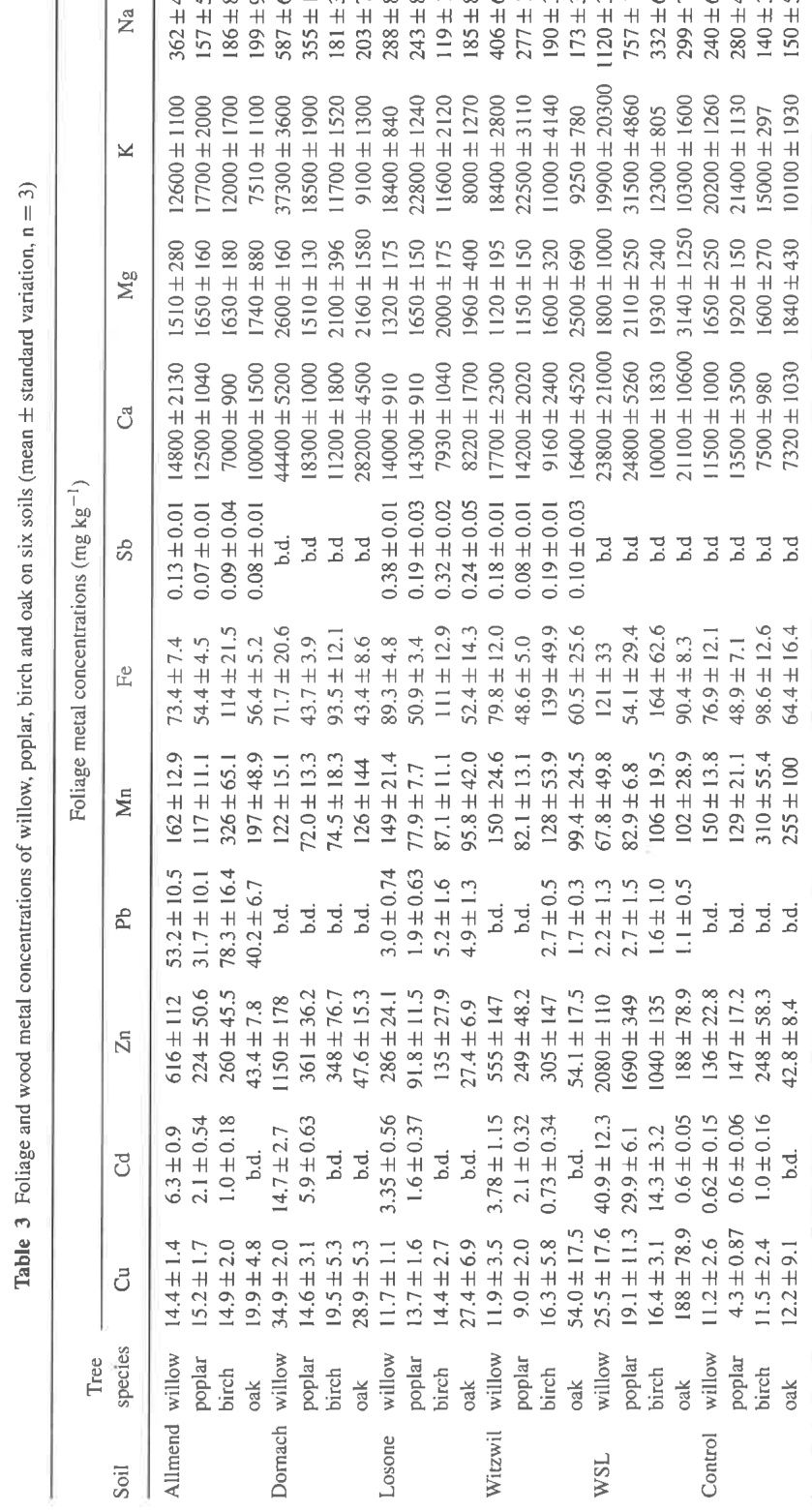
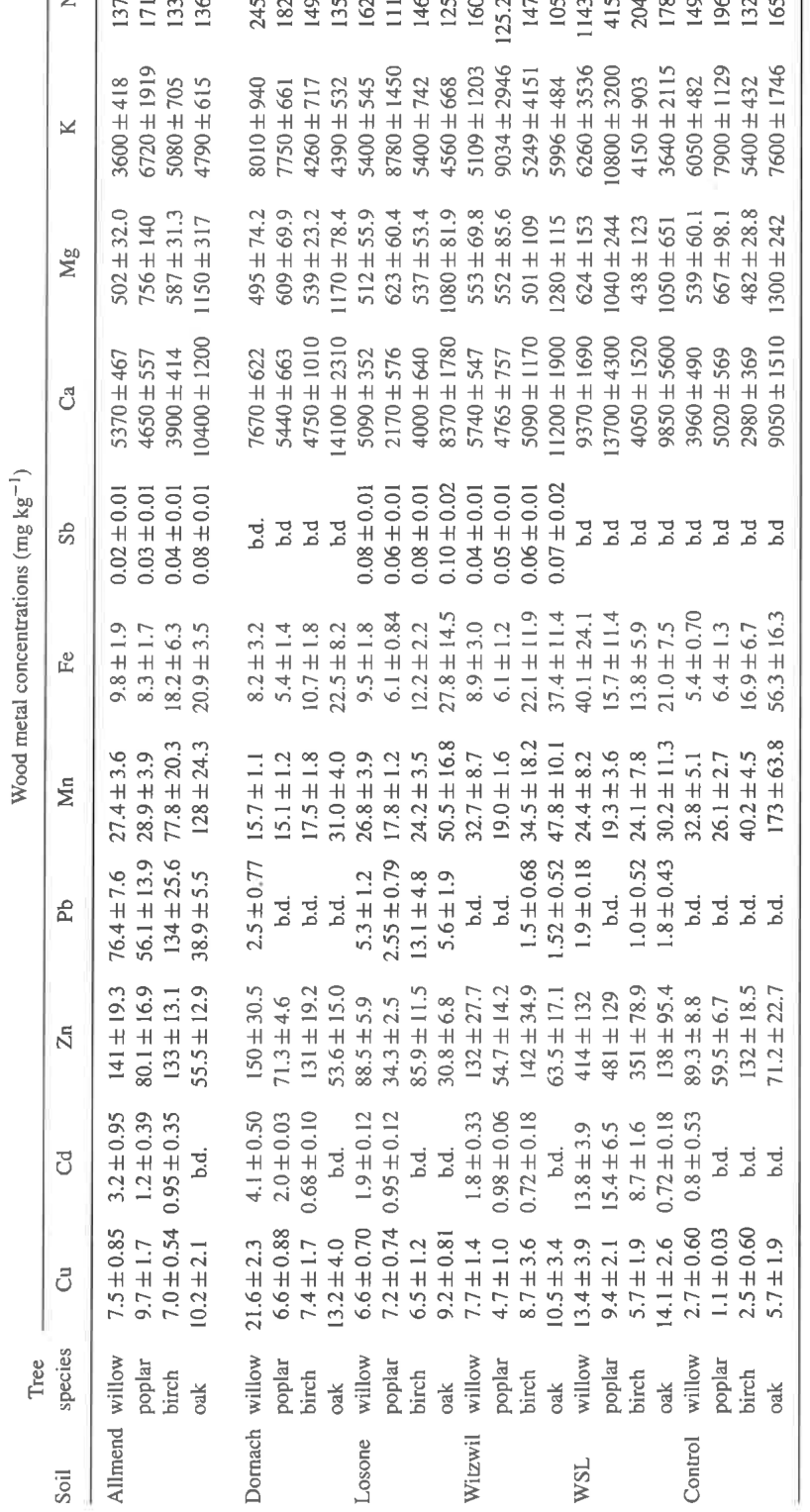
Metal allocation. For stem and foliage with Cd concentrations exceeding 1 mg kg-' Cd concentrations in foliage were 2-3 times higher than in the stems, which agrees with Hermle et al. (2006) and Riddell-Black (1994) who found foliage/stem Cd concentration quotients of 3-5. Potassium showed similar allocation patterns as Zn and Cd. Potassium concentrations in willow, poplar and birch foliage were 2-4 fold higher than in stems. This is in agreement with Giachetti and Sebastiani (2006) who, although found lower concentrations than here, showed the same concentrations ratio between leaves and stem. In contrast to the other investigated TE, Pb accumulation was higher in the stem than in the foliage (Table 3), as noted by Hasselgren (1999), and in contradiction to Jensen et al. (2009) who found higher Pb concentrations in willow leaves than in the stems and twigs.
金属分配。对于Cd浓度超过1 mg kg⁻¹的茎和叶片,叶片中的Cd浓度是茎中的2~3倍,这与Hermle et al.(2006)和Riddell-Black(1994)的结果一致,他们发现叶片/茎Cd浓度比为3~5。K的分配模式与Zn和Cd相似,柳树、杨树和桦树叶片中的K浓度是茎中的2~4倍。这与Giachetti and Sebastiani(2006)的结果一致,他们测得的浓度虽低于本研究,但叶片与茎之间的浓度比相同。与所研究的其他微量元素不同,Pb在茎中的累积量高于叶片(表3),这与Hasselgren(1999)的报道一致,而与Jensen et al.(2009)的结果相反,后者发现柳树叶片中的Pb浓度高于茎和细枝。
4DISCUSSION讨论
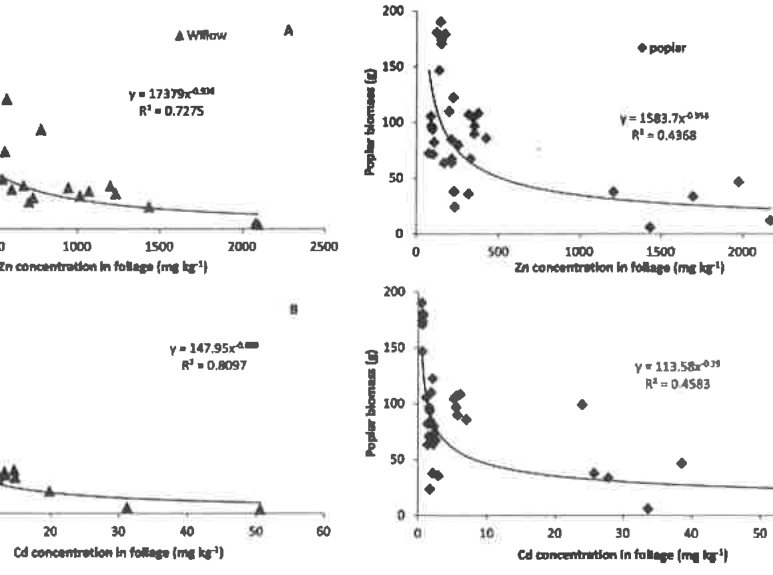
Under non-metal stress conditions willow and poplar would be favoured for phytostabilization/phytomanagement due to their high aboveground biomass production. However, a general statement for various sites is difficult to make, as the biomass production depends on the site characteristics. Besides nutrient supply, biomass production of various tree species responds differently to the TE concentrations in the soil and their uptake into the plant (Figure 1). In this study willow and poplar biomass reduction for was correlated with Cd (R2 = 0.81 and 0.46) and Zn (R2 = 0.72 and 0.44) leaf concentrations (Figure 2). Of these two TE, Cd had the highest impact. According to Kabata-Pendias and Pendias (2001) Cd is approximately 17-fold more toxic than Zn. Although Pb, Cu, and Ni are 3 to 10-fold more toxic to plant organisms than Zn, their concentrations in willow and poplar leaves were too low (Table 3) to affect growth. For oak and birch, biomass was not correlated with any TE.
在无金属胁迫条件下,柳树和杨树因地上部生物量产量高而宜优先用于植物稳定/植物管理。然而,由于生物量生产取决于场地特征,很难对不同场地作出普遍性的结论。除养分供应外,不同树种的生物量生产对土壤中微量元素浓度及其向植物体内吸收的响应各不相同(图1)。本研究中,柳树和杨树生物量的降低与叶片Cd浓度(R2 = 0.81和0.46)和Zn浓度(R2 = 0.72和0.44)相关(图2)。在这两种微量元素中,Cd的影响最大。根据Kabata-Pendias and Pendias(2001),Cd的毒性约为Zn的17倍。尽管Pb、Cu和Ni对植物的毒性是Zn的3~10倍,但它们在柳树和杨树叶片中的浓度过低(表3),不足以影响生长。对于栎树和桦树,生物量与任何微量元素均无相关性。
Although oak was the most tolerant species and could thus be planted on soils with very high TE soil concentrations, it had a very low root biomass production (Figure 1). An extended root system is favourable for preventing soil erosion and subsequent contaminant dispersion. The net growth of root mass of willow, poplar and birch was between 2- and 15-fold higher than that of oak during the experiment. Thus, oak would be less suitable than willow, poplar, and birch for reducing soil erosion.
尽管栎树是耐受性最强的树种,因而可种植于微量元素浓度极高的土壤上,但其根系生物量产量很低(图1)。发达的根系有利于防止土壤侵蚀及随之而来的污染物扩散。试验期间,柳树、杨树和桦树根系质量的净增长是栎树的2~15倍。因此,在减少土壤侵蚀方面,栎树不如柳树、杨树和桦树适宜。
Trace element accumulation in foliage and wood is crucial in the choice of tree species for combined phytostabilization/phytomanagement. Besides wind and water erosion and dispersion of foliage (Perronnet et al. 2000), risks could arise from the consumption of plant parts by animals, as TE could thus enter the food chain. According to Swiss regulations (FOEN 2005), the maximum allowed TE concentration in fodder (dry weight) are: 150 mg kg-' Zn, 40 mg kg-' Pb, 15-35 mg kg-' Cu, and 1 mg kg-' Cd. Copper concentrations in the foliage and stem of the four tree species never exceeded these values. Foliage Zn concentrations surpassed the Zn tolerance value on all contaminated soils for willow, poplar and birch. even on the control soil. The birch foliage surpassed the guideline concentrations only for Zn, thus posing a lower risk for herbivores due to its low Cd concentrations. Oak leaves remained, with the exception of the WSL soil, below the Zn tolerance values, and because of the unpalatable tannins present in high concentrations, are not eaten by deer and other animals. Tannins affect the availability of nutrients and even produce toxic effects when animals consume high amounts of oak leaves (Makkar, Singh, and Dawra 1988). To protect the plantation itself from herbivores and in order to protect the herbivores from the TE in the foliage, in the first year of the plantation a protective fence would be an option. Lead foliage and stem concentrations surpassed the guideline levels only for the trees growing on the Allmend shooting range soil. Thus, when the criteria shoot and root biomass as well as TE accumulation are taken into consideration, willows and poplars would be the first choice on soils with low and moderate Zn and Cd soil concentrations. On soils with elevated Zn and Cd concentration, birch would be the most suitable tree species, but it would be unsuitable for soils with high soil concentrations of Po because of its high accumulation of Pb.
叶片和木材中的微量元素累积对于选择用于植物稳定/植物管理相结合的树种至关重要。除风蚀、水蚀和叶片扩散外(Perronnet et al. 2000),动物取食植物部位也可能带来风险,因为微量元素可能由此进入食物链。根据瑞士法规(FOEN 2005),饲料中微量元素的最高允许浓度(干重)为:Zn 150 mg kg⁻¹、Pb 40 mg kg⁻¹、Cu 15~35 mg kg⁻¹、Cd 1 mg kg⁻¹。4个树种叶片和茎中的Cu浓度均未超过上述限值。在所有污染土壤上,甚至在对照土壤上,柳树、杨树和桦树叶片的Zn浓度均超过了Zn耐受值。桦树叶片仅Zn超过指导浓度,由于其Cd浓度低,对食草动物的风险较小。除WSL土壤外,栎树叶片的Zn浓度均低于耐受值,而且由于含有高浓度的难以下咽的单宁,鹿和其他动物不会取食。单宁会影响养分的有效性,动物大量采食栎树叶片时甚至会产生毒性效应(Makkar, Singh, and Dawra 1988)。为保护林地免受食草动物危害,同时保护食草动物免受叶片中微量元素的影响,可在种植第一年设置防护围栏。仅在Allmend射击场土壤上生长的树木,其叶片和茎中的Pb浓度超过了指导限值。因此,综合考虑地上部和根系生物量以及微量元素累积等标准,在土壤Zn和Cd浓度为低至中等的土壤上,柳树和杨树应为首选;在Zn和Cd浓度较高的土壤上,桦树是最适宜的树种,但由于其Pb累积量高,不适用于Pb浓度高的土壤。
Entry of foliage and woody parts into the food chain would be of concern only in the first years of growth. Once the foliage is out of reach to herbivores risks of food chain transfer would be minimized. In that case the intake of metals will probably increase due to the intake of soil thus resulting in a probably higher risk than that posed by the tree foliage (Smith, Abrahams, Dagleish et al. 2009). Entry of TE into the food chain can also occur through invertebrates, which were reported to bioaccumulate Pb on shooting ranges (Migliorini et al. 2004). Only in winter when foliage falls from the trees could a risk occur. However, willow, poplar and birch foliage which surpassed only the Zn tolerance values could be collected and used as fodder additives, to alleviate animal Zn deficiency.
叶片和木质部分进入食物链的问题仅在生长的最初几年值得关注。一旦叶片超出食草动物的取食范围,食物链传递的风险将降至最低。在这种情况下,金属摄入量可能因动物摄入土壤而增加,由此带来的风险可能高于树木叶片(Smith, Abrahams, Dagleish et al. 2009)。微量元素还可通过无脊椎动物进入食物链,已有报道指出射击场的无脊椎动物会生物累积Pb(Migliorini et al. 2004)。仅在冬季树叶凋落时才可能产生风险。不过,仅Zn超过耐受值的柳树、杨树和桦树叶片可以收集起来用作饲料添加剂,以缓解动物缺Zn。
Metal concentrations in wood are important when the wood is used commercially. If the wood is gasified for energy production, high concentrations of inorganic elements, such as Ca, K, Mg and Na can promote the formation of gaseous species and char at the expense of bio-oil yield (Patwardhan et al. 2010). According to Obernberger et al. (2006), typical wood fuels from short rotation coppice willow (from uncontaminated areas) contain 3000 mg kg-' K and 5000 mg kg-' Ca. In this experiment, some trees species were occasionally below 5000 mg kg- Ca, but none of the tree species were below 3000 mg kg-' K. However, our results are uptakes by four months old trees, which have a high bark to wood ratio. Metal concentrations are significantly higher in bark than in wood (Obernberger et al. 2006; Evangelou, et al. 2012), thus a favourable reduction of the bark to wood ratio is likely in older trees. Therefore, Adler, Dimitriou, Aronsson et al. (2008), proposed an increase in the age of coppiced trees from 1-2 y to 3 y. For example harvestable shoot biomass of willows grown as a few large stems would have a better wood fuel quality, compared to harvestable shoot biomass of many small stems. Thus when biomass is intended for biofuel/bioenergy production, an increased length of cutting cycle would improve the wood fuel quality. The wood could also be used for furniture, construction or industrial purposes. According to Swiss legislation and EPF industry standard wood, intended for the market should not exceed concentrations of 50 mg kg-' Cd, 90 mg kg- Pb and 40 mg kg-' Cu (EPF; Chem RRV 2005). Since birch grown on Allmend soil exceeded one of these values, the biomass deriving from these contaminated soils could also be used for industrial or furniture products.
当木材用于商业用途时,木材中的金属浓度十分重要。若木材经气化用于能源生产,Ca、K、Mg和Na等无机元素浓度过高会促进气态产物和焦炭的形成,从而降低生物油产率(Patwardhan et al. 2010)。根据Obernberger et al.(2006),(来自未污染地区的)短轮伐期矮林柳树的典型木质燃料含K 3000 mg kg⁻¹、Ca 5000 mg kg⁻¹。在本试验中,部分树种的Ca浓度偶尔低于5000 mg kg⁻¹,但没有任何树种的K浓度低于3000 mg kg⁻¹。然而,本研究结果为4月龄树木的吸收量,其树皮与木材之比较高。树皮中的金属浓度显著高于木材(Obernberger et al. 2006; Evangelou, et al. 2012),因此较老树木的树皮与木材之比可能会有利地降低。为此,Adler, Dimitriou, Aronsson et al.(2008)建议将矮林树木的轮伐年龄从1~2年延长至3年。例如,以少数粗大茎干形式生长的柳树,其可收获地上部生物量的木质燃料品质优于大量细小茎干的可收获地上部生物量。因此,当生物量用于生物燃料/生物能源生产时,延长轮伐周期可改善木质燃料品质。木材还可用于家具、建筑或工业用途。根据瑞士法规和EPF行业标准,拟上市木材的浓度不得超过Cd 50 mg kg⁻¹、Pb 90 mg kg⁻¹和Cu 40 mg kg⁻¹(EPF; Chem RRV 2005)。由于在Allmend土壤上生长的桦树超过了其中一项限值,来自这些污染土壤的生物量也可用于工业或家具产品。
5CONCLUSION结论
The four tree species showed distinctly different biomass yield responses to the contaminated soil. However, they had specific TE uptakes independent of the soils. Willow had the highest Zn and Cd uptakes and birch had the highest Pb uptake, on sites with high soil concentrations of these elements. Our results indicate that tree selection should be site specific. Birch is most suitable for biomass production combined with phytostabilization for soils with high Cd and Zn but low Pb concentrations, while poplars and willows could stabilise soils with high Cu and Pb but not very high Zn and Cd concentrations. Birch, however, cannot be coppiced and is not feasible for short rotations. Oak was most tolerant to the TE contamination, but due to its low root and shoot biomass production, is unsuitable for phytomanagement purposes. However, if connected with an economic output, other than biofuels, oak could be preferable as its wood is valuable. Independent of the tree species used to combine phytostabilization and production of biomass for bioenergy safe, a constant monitoring will be necessary to control the risk of TE distribution though soil erosion and entrance of TE to the food chain.
4个树种对污染土壤的生物量产量响应明显不同,但它们对微量元素的吸收具有树种特异性,且与土壤无关。在相应元素土壤浓度较高的场地上,柳树的Zn和Cd吸收量最高,桦树的Pb吸收量最高。研究结果表明,树种选择应因地制宜。对于Cd和Zn浓度高而Pb浓度低的土壤,桦树最适合用于结合植物稳定的生物量生产;而杨树和柳树可稳定Cu和Pb浓度高但Zn和Cd浓度不太高的土壤。然而,桦树不能进行矮林作业,不适于短轮伐。栎树对微量元素污染的耐受性最强,但由于其根系和地上部生物量产量低,不适用于植物管理。不过,若能与生物燃料以外的经济产出相结合,栎树可能更可取,因为其木材价值较高。无论采用何种树种来安全地结合植物稳定与生物能源生物量生产,都需要持续监测,以控制微量元素通过土壤侵蚀扩散及进入食物链的风险。
6ACKNOWLEDGMENTS致谢
We would like to thank the gardeners of the WSL for their assistance during this experiment and Annina Bürgi, Denise König, and Björn Studer for their help during harvest and metal analysis and Thomas Kuster for providing the weather data. Michael Evangelou would also like to thank the DFG (German Research Foundation) for financing his research
感谢WSL的园艺人员在本试验中给予的协助,感谢Annina Bürgi、Denise König和Björn Studer在收获和金属分析中提供的帮助,感谢Thomas Kuster提供气象数据。Michael Evangelou还感谢DFG(德国研究基金会)对其研究的资助。
7REFERENCES参考文献
Adler A, Dimitriou I, Aronsson P, Verwijst T, Weiha M. 2008. Wood fuel quality of two Salix viminalis stands fertilised with sludge, ash and sludge-ash mixtures. Biomass Bioenerg. 32:914-925. FOEN. 2005. Manual on risk assessments and measures for polluted soils. Bern: Federal Office for the Environment.
Brunner I, Luster J, Gunthardt-Goerg MS, Frey B. 2008. Heavy metal accumulation and phytostabilisation potential of tree fine roots in a contaminated soil. Environ Pollut. 152:559-568.
ChemRRY. 2005. Regulation of 18 May 2005 on the reduction of risks associated with the use of certain particularly dangerous substances, preparations and articles (Chemical Risk Reduction Ordinance, ChemRRV). In: Eidgenossenschaft DBdS ed.
Dickinson NM, Pulford ID. Cadmium phytoextraction using short-rotation coppice Salix: the evidence trail. Environ Int. 31:609-613.
EPF. 2000: EPF Industry standard-The use of recycle wood for wood-based panels. In: Federation EP. Brussels: European Panel Federation. p. 3
Eriksson J, Ledin S. 1999. Changes in phytoavailability and concentration of cadmium in soil following long term Salix cropping. Water Air Soil Pollut. 114:171-184.
Evangelou MWH, Deram A, Gogos A, Studer B, Schulin R. 2012. Assessment of suitability of trec species for the production of biomass on trace element contaminated soils. J Hazard Mater. 209-210:233-239. FAL, RAC, FAW. 1996·. Determination of grain size in the mineral content of fine soil. Swiss reference methods of the federal agricultural research stations. Swiss Federal Rescarch Station FAL, RAC, FAW, Zurich, Switzerland.
FAL, RAC, FAW. 1996b. Determination of organic carbon (Corg). Swiss reference methods of the federal agricultural research stations. Swiss Federal Research Station FAL, RAC, FAW, Zurich, FAL, RAC, FAW. 1996c. Extraction of heavy metals with sodium nitrate (1:2.5). Swiss reference methods of federal agricultural research stations. Swiss Federal Research Station FAL, RAC, FAW, Zurich, Switzerland.
FAL, RAC, FAW. 1996d. pH in water suspension (1:2.5) and pH in CaCI suspension (1:2.5). Swiss reference methods of federal agricultural research stations. Swiss Federal Rescarch Station FAL, RAC, FAW, Zurich, Switzerland.
Fässler E, Robinson BH, Stauffer W, Gupta SK, Papritz A, Schulin R. 2010. Phytomanagement of metal-contaminated agricultural land using sunflower, maize and tobacco. Agric Ecosyst Giachetti G, Sebastiani L. 2006. Metal accumulation in poplar plant grown with industrial wastes. Chemosphere. 64:446-454.
Hasselgren K. 1999. Utilization of sewage sludge in short-rotation energy forestry: a pilot study. Waste Manage Res. 17:251-262.
Hermle S, Gunthardt-Goerg MS, Schulin R. 2006. Effects of metal-contaminated soil on the performance of young trees growing in model ecosystems under field conditions. Environ Pollut. Jensen JK, Holm PE, Nejrup J, Larsen MB, Borggaard OK. 2009. The potential of willow for remediation of heavy metal polluted calcareous urban soils. Environ Pollut. 157:931-937. Johnson CA, Moench H, Wersin P, Kugler P, Wenger C. 2005. Solubility of antimony and other elements in samples taken from shooting ranges. J Environ Qual. 34:248-254.
Kabata-Pendias A, Pendias H. 2001. Trace Elements in Soils and Plants. Boca Raton (FL): CRC
Kayser A, Wenger K, Keller A, Attinger W, Felix HR, Gupta SK, Schulin R. 2000. Enhancement of phytoextraction of Zn, Cd, and Cu from calcareous soil: The use of NTA and sulfur amendments. Environ Sci Technol. 34:1778-1783.
Knechtenhofer LA, Xifra IO, Scheinost AC, Fluhler H, Kretzschmar R. 2003. Fate of heavy metals in a strongly acidic shooting-range soil: small-scale metal distribution and its relation to preferential water flow. J. Plant Nutr. Soil Sci-Z Pfanzenerahr Bodenkd. 166:84-92.
Kozlov MV, Haukioja E, Bakhtiarov AV, Stroganov DN, Zimina SN. 2000. Root versus canopy uptake of heavy metals by birch in an industrially polluted area: contrasting behaviour of nickel and copper. Environ Pollut. 107:413-420.
Ledin S. 1998. Environmental consequences when growing short rotation forests in Sweden. Biomass
Makkar HPS, Singh B, Dawra RK. 1988. Effect of tannin-rich leaves of oak (Quercus-incana) on various microbial enzyme activities of the bovine rumen. Br J Nutr. 60:287-296.
Menon M, Hermle S, Abbaspour KC, Gunthardt-Georg MS, Oswald SE, Schulin R. 2005. Water regime of metal-contaminated soil under juvenile forest vegetation. Plant Soil. 271:227-241.
Mertens J, Vervaeke P, De Schrijver A, Luyssaert S. 2004. Metal uptake by young trees from dredged brackish sediment: limitations and possibilities for phytoextraction and phytostabilisation. Sci Total Environ. 326:209-215.
Migliorini M, Pigino G, Bianchi N, Bernini F, Leonzio C. 2004. The effects of heavy metal contamination on the soil arthropod community of a shooting range. Environ Pollut. 129:331-340. Obemberger I, Brunner T, Barnthaler G. 2006. Chemical properties of solid biofuels - significance and impact. Biomass Bioenerg. 30:973-982.
Patwardhan PR, Satrio JA, Brown RC, Shanks BH. 2010. Influence of inorganic salts on the primary pyrolysis products of cellulose. Bioresour Technol. 101:4646-4655.
Perronnet K, Schwartz C, Gerard E, Morel JL. 2000. Availability of cadmium and zinc accumulated in the leaves of Thlaspi caerulescens incorporated into soil. Plant Soil. 227:257-263.
Pulford ID, Watson C. 2003. Phytoremediation of heavy metal-contaminated land by trees - a review. Environ Int. 29:529-540.
Riddell-Black D (ed.). 1994. Willow as vegetation filter for municipal wastewaters and sludges. A biological purification system. Uppsala (Sweden): Department of Ecology and Environmental Research, Swedish University of Agricultural Sciences.
Robinson B, Schulin R, Nowack B, Roulier S, Menon M, Clothier B, Green S, Mills T. 2006. Phytoremediation for the management of metal flux in contaminated sites. Forest Snow and Landscape Research. 80:221-234.
Robinson BH, Banuelos G, Conesa HM, Evangelou MWH, Schulin R. 2009. The phytomanagement of trace elements in soil. Cr Rev Plant Sci. 28:240-266.
Robinson BH, Bischofberger S, Stoll A, Schroer D, Furrer G, Roulier S, Gruenwald A, Attinger W, Schulin R. 2008. Plant uptake of trace elements on a Swiss military shooting range: Uptake pathways and land management implications. Environ Pollut. 153:668-676.
Sebastiani L, Scebba F., Tognetti R. 2004. Heavy metal accumulation and growth responses in poplar clones Eridano (Populus deltoides x maximowiczii) and I-214 (P. x euramericana) exposed to industrial waste. Environ Exp Bot. 52:79-88.
Smith KM, Abrahams PW, Dagleish MP, Steigmajer J. 2009. The intake of lead and associated metals by sheep grazing mining-contaminated floodplain pastures in mid-Wales, UK: I. Soil ingestion, soil-metal partitioning and potential availability to pasture herbage and livestock. Sci Total Environ. 407:3731-3739.
Sorvari J, Antikainen R, Pyy O. 2006. Environmental contamination at Finnish shooting ranges-the scope of the problem and management options. Sci Total Environ. 366:21-31.
Sterckeman T, Douay F, Proix N, Fourrier H, Perdrix E. 2002. Assessment of the contamination of
cultivated soils by eighteen trace elements around smelters in the North of France. Water Air Soil Pollut. 135:173-194.
Tharakan PJ, Volk TA, Abrahamson LP, White EH. 2003. Energy feedstock characteristics of willow and hybrid poplar clones at harvest age. Biomass Bioenerg. 25:571-580.
Vogeler 1, Green SR, Clothier BE, Kirkham MB, Robinson BH. 2001. Contaminant transport in the root zone In: Iskander IK, Kirkham MB, eds. Trace Elements in the Soil, Bioavailability, Flux and Transfer. Boca Raton (FL): Lewis Publishers. p. 175-198.
Walter I, Martinez F, Cala V. 2006. Heavy metal speciation and phytotoxic effects of three representative sewage sludges for agricultural uses. Environ Pollut. 139:507-514.