Available online at www.sciencedirect.com
http://www.elsevier.com/locate/biombioe
Marion Delplanque a, Serge Collet b, Florence Del Gratta b, Benoit Schnuriger a, Rodolphe Gaucher a, Brett Robinson c, Vale´rie Bert a,*
a INERIS, Clean and Sustainable Technologies and Processes Unit, DRC/RISK, Parc Technologique Alata, BP2, 60550 Verneuil en Halatte, France b INERIS, Sources and Emissions Unit, DRC/CARA, Parc Technologique Alata, 60550 Verneuil en Halatte, France c Soil and Physical Sciences, Burns 222, P O Box 84, Lincoln University, Lincoln 7647, Christchurch, New Zealand
a INERIS,清洁与可持续技术及工艺部,DRC/RISK,Parc Technologique Alata,BP2,60550 Verneuil en Halatte,法国 b INERIS,污染源与排放部,DRC/CARA,Parc Technologique Alata,60550 Verneuil en Halatte,法国 c 土壤与物理科学系,Burns 222,P O Box 84,林肯大学,Lincoln 7647,基督城,新西兰
a r t i c l e i n f o
a b s t r a c t
Article history: Received 13 June 2012 Received in revised form 13 November 2012 Accepted 10 December 2012 Available online 16 January 2013 Keywords: Phytoextraction Willow Bioenergy Metal contaminated dredged sediment landfill site Bottom ash Flue gas
文章历史:2012年6月13日收稿;2012年11月13日收到修改稿;2012年12月10日接受;2013年1月16日在线发表。关键词:植物提取;柳树;生物能源;金属污染疏浚底泥填埋场;底灰;烟气
Phytoextraction may reduce the environmental risk posed by contaminated sediments while simultaneously providing an economic return via bioenergy production. There is a lack of information on the combustion of metal enriched willows used for phytoextraction. This work aimed to determine the Cd phytoextraction efficiency of Salix on a case study in France and elucidate the distribution of metals in the end products of the combustion process. Three willow clones were cultivated in short rotation coppice (SRC) on a metal contaminated dredged sediment landfill site. Combustion assays were performed in a biomass boiler of 40 kW with a Zn and Cd enriched Salix wood ‘Tora’ harvested from a part of the SRC and a commercial ‘Tora’, for comparison. In a best-case scenario, phytoextraction could reduce total Cd burden of the sediment from 2.39 mg kg�1 DW to 2 mg kg�1 DW in 19 years. Combustion experiments showed that Cd and Zn occurred at the highest concentrations in the particulate fraction of the flue gas (flyash), rather than in the bottom ash. Combustion of ‘Tora’ from phytoextraction resulted in Cd and Zn concentrations in flue gas emissions that exceeded French regulation. This was also observed for Cd in the flue gas of the commercial ‘Tora’. Irrespective of the wood provenance, the use of industrial or collective boilers, equipped with efficient filters, is required to minimize air pollution. Given this constraint, wood produced during phytoextraction should be usable for bioenergy production. The possible uses of bottom ash are discussed. ª 2012 Elsevier Ltd. All rights reserved.
植物提取可降低污染底泥带来的环境风险,同时通过生产生物能源获得经济收益。目前有关用于植物提取的富集金属柳树燃烧的资料十分缺乏。本研究以法国某案例为对象,旨在确定 Salix 对 Cd 的植物提取效率,并阐明金属在燃烧过程终产物中的分布。在一处金属污染疏浚底泥填埋场上以短轮伐期矮林(SRC)方式栽培了3个柳树无性系。燃烧试验在一台40 kW生物质锅炉中进行,所用燃料为采自部分SRC的富集 Zn 和 Cd 的 Salix ‘Tora’木材,并以商品‘Tora’作为对照。在最佳情景下,植物提取可在19年内将底泥总 Cd 含量从2.39 mg kg−1 DW降至2 mg kg−1 DW。燃烧试验表明,Cd 和 Zn 在烟气颗粒态组分(飞灰)中的浓度最高,而非在底灰中。燃烧来自植物提取的‘Tora’导致烟气排放中 Cd 和 Zn 浓度超过法国法规限值。商品‘Tora’的烟气中 Cd 也出现同样情况。无论木材来源如何,均需使用配备高效过滤器的工业或集体锅炉以最大限度减少大气污染。在此约束条件下,植物提取过程中产出的木材应可用于生物能源生产。文中还讨论了底灰的可能用途。© 2012 Elsevier Ltd. 版权所有。
1Introduction引言
Human activities during the last decades have contaminated canal sediments with various organic and inorganic pollutants. Those of most concern are metal(loid)s, polyaromatic hydrocarbons (PAHs), polychlorinated biphenyls (PCBs), and mineral oils. The dredging of canal sediments is necessary to facilitate navigation, to prevent flooding and to maintain a minimum water flow during dry periods. In Northern France, mining and metal smelting have deposited trace elements (Cd, Zn, Pb, Cu, As) in the canal sediments. European Community policy encourages sediment recovery [1]. Nevertheless, due to the high concentration of pollutants and their potential toxicity, contaminated dredged sediments cannot be
近几十年来的人类活动已使运河底泥受到多种有机和无机污染物的污染,其中最受关注的是金属(类金属)、多环芳烃(PAHs)、多氯联苯(PCBs)和矿物油。为便于航运、防止洪涝并在干旱期维持最低水流量,必须对运河底泥进行疏浚。在法国北部,采矿和金属冶炼使微量元素(Cd、Zn、Pb、Cu、As)沉积于运河底泥中。欧洲共同体政策鼓励底泥的回收利用[1]。然而,由于污染物浓度高且具有潜在毒性,受污染的疏浚底泥不能
* Corresponding author. Tel.: +33 3 44 55 63 82; fax: +33 3 44 55 65 56. E-mail address: valerie.bert@ineris.fr (V. Bert). 0961-9534/$ e see front matter ª 2012 Elsevier Ltd. All rights reserved. http://dx.doi.org/10.1016/j.biombioe.2012.12.026 used in civil engineering as raw material or the deposit cannot be used to produce biomass for human and animal feeding. Many treatments are available for contaminated sediments, but relatively few are applicable to metal(loid) pollution. Currently, treatment and reuse of metal contaminated dredged materials are not a cost-effective alternative to disposal at landfill sites [2]. In Northern France, disposal onto land is the current management practice for these polluted sediments. The regional division of Voies Navigables de France (VNF) developed a management strategy for its disposal sites. This strategy includes the implementation of an environmental management system which aims to meet best practices and comply with regulation in the fields of human health and the environment. Metal immobilization in metal contaminated sediments at some landfill sites may contribute to this environmental management strategy [3]. Phytoextraction combined with bioenergy production may be another way to contribute to such a strategy.
* 通讯作者。电话:+33 3 44 55 63 82;传真:+33 3 44 55 65 56。电子邮箱:valerie.bert@ineris.fr(V. Bert)。0961-9534/$ – 见前言 © 2012 Elsevier Ltd. 版权所有。http://dx.doi.org/10.1016/j.biombioe.2012.12.026 作为原材料用于土木工程,其堆放场地也不能用于生产人类食用和动物饲用的生物质。污染底泥的处理方法很多,但适用于金属(类金属)污染的相对较少。目前,与填埋场处置相比,金属污染疏浚物的处理与再利用并不是一种具有成本效益的替代方案[2]。在法国北部,陆地处置是这类污染底泥目前的管理方式。法国航道管理局(Voies Navigables de France,VNF)地区分部为其处置场制定了管理策略。该策略包括实施一套环境管理体系,旨在达到最佳实践并符合人体健康与环境领域的法规。在部分填埋场对金属污染底泥中的金属进行固定可有助于实现这一环境管理策略[3]。植物提取与生物能源生产相结合可能是助力该策略的另一途径。
Phytoextraction may reduce the environmental risk posed by these sediments and allow the economic valorization of the contaminated sediments via the sale of the produced biomass. Phytoextraction may becombinedwithbioenergyproductionto provide a benefit to the land owner while ensuring that environmental parameters do not breach current regulation [4e8]. One phytoextraction strategy is based on cultivation of rapidly growing trees, such as willow, with high trace element (TE) accumulation ability in short rotation coppice (SRC). After the cultivation ofappropriate tree species onthe contaminated site, enriched TE harvestable plant parts are removed from the site.
植物提取可降低这些底泥带来的环境风险,并通过出售所产生物质实现污染底泥的经济增值。植物提取可与生物能源生产相结合,在确保环境参数不违反现行法规的同时为土地所有者带来收益[4–8]。一种植物提取策略是以短轮伐期矮林(SRC)方式栽培具有较高微量元素(TE)累积能力的速生树种,如柳树。在污染场地栽培合适的树种后,将富集 TE 的可收获植物部分移出场地。
Various energy-recovery techniques such as combustion, gasification and pyrolysis may be suitable for high-biomass trees such as Salix [9e15]. Combustion, the most important energy conversion route for biomass produced on uncontaminated soils, results in bottom ash and stack emissions. There is a lack of information on the combustion of metal enriched willows used for phytoextraction. To our knowledge, few combustion experiments have been performed on willows planted on contaminated sites [9,15] and none in an industrial boiler. Nevertheless, the theoretical fate of metals during combustion is rather well documented [16]. Keller et al. [9] simulated a combustion assay in a glass tube reactor with Zn and Cd enriched Salix leaves. Zinc was found in the bottom ash whereas Cd was volatized during the combustion process. Syc et al. [15] performed a fluidized bed combustion test in a reactor on Salix caprea enriched with Cd and Zn and studied metal distribution between bed ash, cyclone ash and flyash. Most Zn and Cu were retained on ashes (bottom ash and bed material) whereas Cd was partly retained on cyclone and flyash and partly volatilized. After comparison with legal thresholds, Keller et al. [9] and Syc et al. [15] concluded that ash could not be applied as fertilizers.
燃烧、气化和热解等多种能源回收技术可能适用于 Salix 等高生物量树种[9–15]。燃烧是未污染土壤上所产生物质最重要的能源转化途径,其产物为底灰和烟囱排放物。目前有关用于植物提取的富集金属柳树燃烧的资料十分缺乏。据我们所知,针对种植在污染场地上的柳树所开展的燃烧试验很少[9,15],且尚无在工业锅炉中进行的试验。不过,燃烧过程中金属的理论归趋已有较充分的文献记载[16]。Keller et al.[9]在玻璃管反应器中以富集 Zn 和 Cd 的 Salix 叶片模拟了燃烧试验,发现 Zn 存在于底灰中,而 Cd 在燃烧过程中挥发。Syc et al.[15]在反应器中对富集 Cd 和 Zn 的 Salix caprea 进行了流化床燃烧试验,研究了金属在床灰、旋风灰和飞灰之间的分布。大部分 Zn 和 Cu 滞留在灰分(底灰和床料)中,而 Cd 部分滞留于旋风灰和飞灰中,部分挥发。在与法定阈值比较后,Keller et al.[9]和 Syc et al.[15]得出结论:这些灰分不能作为肥料施用。
The aims of this study were to assess the Cd phytoextraction efficiency of Salix ‘Tora’ cultivated in SRC on a metal contaminated dredged sediment landfill site in France. We also sought to perform a combustion experiment with a Salix ‘Tora’ sample harvested from this phytoextraction site to determine the fate of the metals in the products of the combustion process. The viability of the processes, i.e. phytoextraction with Salix ‘Tora’ combined with combustion for bioenergy production, was envisaged according to French regulation.
本研究旨在评估在法国某金属污染疏浚底泥填埋场上以 SRC 方式栽培的 Salix ‘Tora’对 Cd 的植物提取效率。我们还利用采自该植物提取场地的 Salix ‘Tora’样品开展燃烧试验,以确定金属在燃烧过程产物中的归趋。并依据法国法规考察了该工艺(即 Salix ‘Tora’植物提取与燃烧产能相结合)的可行性。
This is the first time that a combustion experiment performed at industrial scale with Salix ‘Tora’ used for phytoextraction on a metal contaminated dredged sediment disposal site is reported.
本文首次报道了以用于金属污染疏浚底泥处置场植物提取的 Salix ‘Tora’为燃料、在工业规模下开展的燃烧试验。
2Materials and methods材料与方法
2.1. Historical and site description2.1. 场地历史与概况
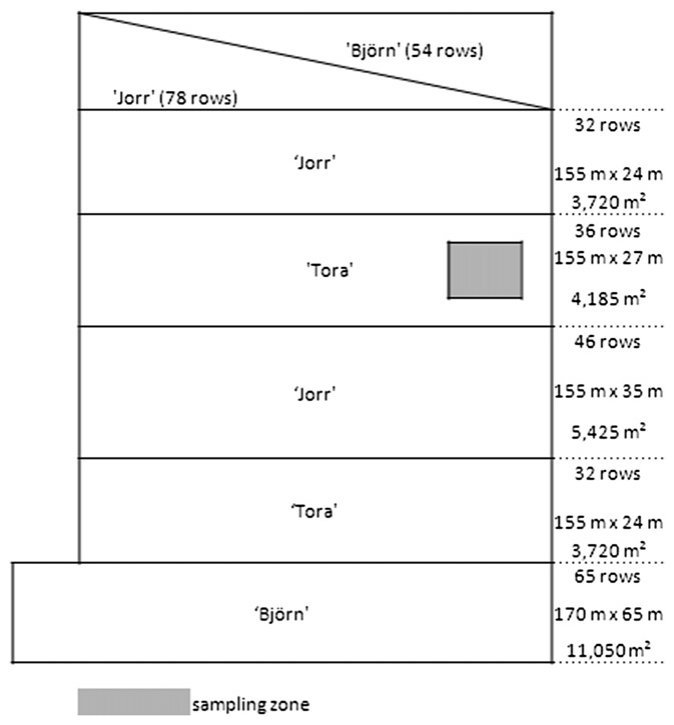
In 1993, as a result of a Deuˆ le river maintenance operation, a 15 ha dredged sediment disposal site was created in Deuˆ le´- mont (Northern France, 50�430 N, 2�570 E). In 1998, the regional division of Voies Navigables de France (VNF) in cooperation with the Association pour le De´veloppement des Cultures Energe´tiques en Nord-Pas de Calais (ADCE) decided to test, on this disposal site, a management strategy based on phytoextraction and bioenergy production. A short rotation coppice (SRC) of three willow clones (Salix viminalis ‘Tora’, S. viminalis ‘Jorr’ and Salix schwerinii � S. viminalis ‘Bjo¨rn’) was set up on 4.5 ha of this disposal site. Clones were selected for high biomass production and disease resistance, in particular against rust (Melampsora sp.). The planting density on 4.5 ha was 17,800 cuttings per hectare of which 14,000 ‘Tora’, 31,320 ‘Jorr’ and 34,710 ‘Bjo¨rn’. Fig. 1 shows the planting design of SRC. It consisted of twin rows (0.75 m inter row distance) with a distance of 1.50 m between twin rows. Each clone was separated from 16 m. Biomass production was estimated four years after the plantation at 16.8 Mg ha�1 y�1 for wood and 1.7 Mg ha�1 y�1 for leaves [17]. After the plantation was ground in autumn 2006, the crushed wood was incorporated into the top sediment and willows regrew from spring 2007. In this work, the field study was performed on a part of the SRC (see “sampling zone” in Fig. 1) where the only clone present was ‘Tora’.
1993年,因 Deûle 河维护作业,在 Deûlémont(法国北部,50°43′ N,2°57′ E)建成了一处15 ha的疏浚底泥处置场。1998年,法国航道管理局(VNF)地区分部与北部-加来海峡能源作物发展协会(Association pour le Développement des Cultures Energétiques en Nord-Pas de Calais,ADCE)合作,决定在该处置场试验一种基于植物提取与生物能源生产的管理策略。在该处置场4.5 ha的土地上建立了由3个柳树无性系(Salix viminalis ‘Tora’、S. viminalis ‘Jorr’和 Salix schwerinii × S. viminalis ‘Björn’)组成的短轮伐期矮林(SRC)。所选无性系具有生物量高和抗病性强的特点,特别是对锈病(Melampsora sp.)具有抗性。4.5 ha上的种植密度为每公顷17,800根插条,其中‘Tora’14,000根、‘Jorr’31,320根、‘Björn’34,710根。图1为SRC的种植设计,采用双行种植(行间距0.75 m),双行之间距离为1.50 m,各无性系之间间隔16 m。种植4年后估算的生物量产量为木材16.8 Mg ha−1 y−1、叶片1.7 Mg ha−1 y−1[17]。2006年秋季将种植园粉碎后,碎木被翻入表层底泥,柳树于2007年春季重新萌发。本研究的野外调查在SRC中仅有‘Tora’一个无性系的区域进行(见图1中的“采样区”)。
The sediment was composed by sand (5.8%), clay (32.2%) and silt (62%). The pHwater was 7.89. Concentrations of organic carbon and nitrogen were 22.8 g kg�1 and 1.99 g kg�1, respectively (C/N ¼ 11.46).
底泥由砂粒(5.8%)、黏粒(32.2%)和粉粒(62%)组成,pH(水)为7.89,有机碳和氮浓度分别为22.8 g kg−1和1.99 g kg−1(C/N = 11.46)。
2.2. Plant and sediment sampling2.2. 植物与底泥采样
In April 2010, five samples of four years old above ground parts of ‘Tora’ (wood and foliage) and five samples of top sediments (0e20 cm depth), taken up at the foot of the sampled willows, were collected (Fig. 1, sampling zone, 50�43046.20900 N, 2�5702.26500 E). ‘Tora’ samples were collected above sediment samples to allow TE bioconcentration factor calculation. Top sediments were collected with a hand auger whereas wood samples were harvested with clippers. Sediments and ‘Tora’ samples were transported to the laboratory where they were stored at 4 �C until preparation and analysis. In addition, on 225 m2 of the same SRC area (Fig. 1, sampling zone), above ground parts of ‘Tora’ (wood and foliage), were harvested with clippers, made up in bundles and transported to INERIS facilities where they were stored in an open shed until preparation for combustion experiment.
2010年4月,采集了5份4年生‘Tora’地上部分(木材和叶片)样品,以及在所采柳树根部采集的5份表层底泥(0–20 cm深度)样品(图1,采样区,50°43′46.209″ N,2°57′2.265″ E)。‘Tora’样品采自底泥样品的上方,以便计算 TE 生物富集系数。表层底泥用手动土钻采集,木材样品用枝剪采收。底泥和‘Tora’样品运回实验室后于4 °C保存,直至制样和分析。此外,在同一SRC区域(图1,采样区)的225 m2范围内,用枝剪采收‘Tora’地上部分(木材和叶片),打捆后运至 INERIS 设施,存放于开放式棚屋中,直至为燃烧试验制备。
2.3. Sediment analysis2.3. 底泥分析
Pseudototal metal(loid) and extractable concentrations in sediment samples were determined. The five top sediment samples were dried at 40 �C in a forced air oven to a constant weight, ground with a grinder (agate mortar, Retsch RM100) and sieved to <200 mm (Retsch AS 200 digit). Pseudototal trace element concentrations (As, Cd, Pb, Zn, Cu) were measured using ICP-OES (Ultima 2, Jobin Yvon Horiba) following an aqua regia digestion according to the EN 13346 standard. To assess the analytical quality, a standard reference sediment material (Buffalo River Sediment, Standard Reference Material 2704) was subject to the same protocol. Recoveries were: 1 for Cd, 1.01 for Zn, 1.04 for Pb, 0.9 for Cu and 0.94 for As. Mercury concentrations in sediment samples were also measured using a mercury analyzer (AMA 254, LECO).
测定了底泥样品中金属(类金属)的准全量浓度和可提取态浓度。5份表层底泥样品于40 °C强制通风烘箱中烘干至恒重,用研磨机(玛瑙研钵,Retsch RM100)研磨后过<200 μm筛(Retsch AS 200 digit)。按照 EN 13346 标准经王水消解后,用 ICP-OES(Ultima 2,Jobin Yvon Horiba)测定准全量微量元素浓度(As、Cd、Pb、Zn、Cu)。为评估分析质量,对标准参考底泥物质(Buffalo River Sediment,Standard Reference Material 2704)采用相同流程处理。回收率分别为:Cd 1、Zn 1.01、Pb 1.04、Cu 0.9、As 0.94。底泥样品中的汞浓度用测汞仪(AMA 254,LECO)测定。
Extractable fraction of trace elements (As, Cd, Pb, Zn, Cu) was assessed with a Ca(NO3)2 (0.01 kg mol�1) extraction procedure. Calcium nitrate extraction procedure was often suggested as the best predictor of trace element concentrations that is available for plant uptake [18,19]. Sixty grams of dried sediment were shaken (Heidolph Reax 2) with 120 mL of Ca(NO3)2 (0.01 kg mol�1) for 48 h. Resulting sediment pastes were filtered on filtration units at 0.45 mm (MILLIPORE). Eluates were acidified to a pH of 2 for preservation and were analyzed by ICP-OES.
采用 Ca(NO3)2(0.01 kg mol−1)提取法评估微量元素(As、Cd、Pb、Zn、Cu)的可提取态组分。硝酸钙提取法常被认为是预测可供植物吸收的微量元素浓度的最佳方法[18,19]。将60 g干燥底泥与120 mL Ca(NO3)2(0.01 kg mol−1)振荡(Heidolph Reax 2)48 h,所得底泥浆经0.45 μm过滤装置(MILLIPORE)过滤。洗脱液酸化至 pH 2 保存,并用 ICP-OES 分析。
2.4. Plant analysis2.4. 植物分析
TE concentrations in ‘Tora’ leaves and wood harvested on the sampling zone (Fig. 1) were determined. The five samples of above ground parts of willows were dried at 40 �C in a forced air oven to a constant weight. Leaves were separated from the stems. Stems with barks were ground and digested (microwave Mars Xpress, CEM) using aqua regia. Leaves were ground and digested in an HNO3 solution (65%). Extracts were filtered using 0.45 mm Whatman filter paper and analyzed using ICP- OES for trace elements. Two ‘BCR-679’ standard references of plant material (white cabbage; community bureau of reference) were included for analytical quality control. Recoveries were, for example, 1.2 for Cd and 1.1 for Zn. Mercury concentrations in above ground parts of plants were measured using a mercury analyzer (AMA 254, LECO).
测定了在采样区(图1)采收的‘Tora’叶片和木材中的 TE 浓度。5份柳树地上部分样品于40 °C强制通风烘箱中烘干至恒重,将叶片与茎分离。带皮茎经研磨后用王水消解(微波消解仪 Mars Xpress,CEM);叶片经研磨后用 HNO3 溶液(65%)消解。提取液经0.45 μm Whatman 滤纸过滤后,用 ICP-OES 分析微量元素。分析质量控制采用两份‘BCR-679’植物标准参考物质(白菜;欧共体标准物质局)。回收率例如 Cd 为1.2,Zn 为1.1。植物地上部分的汞浓度用测汞仪(AMA 254,LECO)测定。
2.5. Combustion experiments2.5. 燃烧试验
Combustion assays were performed with two different ‘Tora’ samples. One was harvested on Deuˆ le´mont’s sediment disposal (named “phytoextraction”) whereas the second was bought at a wood producer (Salix society, Thugny-Trugny, France) (S. viminalis ‘Tora’ named “control”). S. viminalis ‘Tora’ was cultivated on an uncontaminated agricultural soil for commercial purpose and chosen as a “control” because it was the clone harvested in the SRC for the combustion experiment. It was 4 years old at harvest. Wood samples were dried at 40 �C in a forced air oven until a moisture content of 15%, ground and riddled (35 mm). In June 2010, combustion assays were carried out with a biomass boiler of 40 kW (HKRST/V-FSK type, REKA), built to the EN 303-5, which allowed the extrapolation of the results to industrial and collective boilers. The boiler used for these experiments had an efficiency of 88% and belongs to class 3, the most efficient class. The boiler was cleaned before combustion. Sixty-three kilograms of “control” and 54 kg of “phytoextraction” were burnt using the same boiler program.
燃烧试验采用两种不同的‘Tora’样品。一种采自 Deûlémont 底泥处置场(称为“植物提取”),另一种购自木材生产商(Salix society,Thugny-Trugny,法国)(S. viminalis ‘Tora’,称为“对照”)。S. viminalis ‘Tora’以商业目的栽培于未污染的农业土壤上,之所以选作“对照”,是因为它与SRC中采收用于燃烧试验的无性系相同。其采收时树龄为4年。木材样品于40 °C强制通风烘箱中烘干至含水率15%,经粉碎后过筛(35 mm)。2010年6月,在一台按 EN 303-5 标准制造的40 kW生物质锅炉(HKRST/V-FSK型,REKA)中进行燃烧试验,其结果可外推至工业和集体锅炉。试验所用锅炉效率为88%,属于效率最高的3级。燃烧前对锅炉进行了清洁。采用相同的锅炉程序分别燃烧了63 kg“对照”和54 kg“植物提取”木材。
Woody stems were sampled before combustion to assess moisture content (EN 14346 standard), lower and higher heating value (LHV and HHV, respectively; ISO 1928 standard) and elemental analysis (C, H, O, N, S, Cl) and analyzed for trace element concentrations as described for stems (see Section 2.4). After each test, the bottom ash was collected, weighed and representative samples were ground (agate mortar, RM100, Retsch) and sieved at 200 mm (AS 200 digit, Retsch) for analysis by ICP-OES. Elemental (C, H, O, N, S, Cl) and moisture content (EN 14346 standard) analyses were performed on these samples.
燃烧前采集木质茎样品,测定含水率(EN 14346 标准)、低位和高位热值(分别为 LHV 和 HHV;ISO 1928 标准)及元素组成(C、H、O、N、S、Cl),并按茎的分析方法(见2.4节)测定微量元素浓度。每次试验后收集底灰并称重,取代表性样品研磨(玛瑙研钵,RM100,Retsch)并过200 μm筛(AS 200 digit,Retsch),用 ICP-OES 分析。同时对这些样品进行了元素(C、H、O、N、S、Cl)和含水率(EN 14346 标准)分析。
In the absence of Emission Limit Values (ELVs) for metals in the French regulations for small combustion plants, such as the one used in this study, we referred to the French regulation concerning large combustion plants (thermal power > 20 MW) [20]. The following trace elements were analyzed in flue gas: As, Ba, Cd, Cr, Cu, Mn, Mo, Pb, Se, Sn, Te, Tl, Zn, Co, Ni, Hg, Sb and V. Flue gas comprises particulate (flyash) and gaseous fractions. Particulate matter and trace elements were measured according to EN 13284 and EN 14385 standards. Trace elements in the gaseous fraction (2 L min�1 flow rate) were trapped into adsorption solutions (HNO3/H2O2) and analyzed by inductively coupled plasma mass spectrometry (ICP-MS) (Elan 6 100, Perkin Elmer Sciex). To assess the analytical quality, a standard reference water material (Standard Reference Material 1643e) was subject to the same protocol. Recoveries were between 0.8 and 1.08. On the gaseous fraction, common pollutants (SO2, NOx, CO) were continuously analyzed using Fourier transfer infrared spectrometry (FTIR) (DX4000, GASMET). In addition, analyses for dioxins, furans, PCBs and PAHs were performed on the gaseous and particulate fraction of the “control” to complete the set of pollutants which could affect air quality. Mercury and HCl were compared to the EN 13211 and EN 1911 standards. Flue gas was passed through a K2Cr2O7 (5%)/HNO3 (20%) solution for Hg analysis and H2O without chloride solution for HCl analysis. Adsorption solutions for Hg were analyzed by the Flow Injection Mercury System (FIMs 100, Perkin Elmer). Adsorption solutions for HCl were analyzed by ionic chromatography (DX600, DIONEX).
由于法国法规中尚无针对小型燃烧装置(如本研究所用装置)的金属排放限值(ELVs),我们参照了法国关于大型燃烧装置(热功率 > 20 MW)的法规[20]。烟气中分析的微量元素包括:As、Ba、Cd、Cr、Cu、Mn、Mo、Pb、Se、Sn、Te、Tl、Zn、Co、Ni、Hg、Sb 和 V。烟气由颗粒态(飞灰)和气态组分构成。颗粒物和微量元素按照 EN 13284 和 EN 14385 标准测定。气态组分中的微量元素(流量2 L min−1)用吸收液(HNO3/H2O2)捕集,并用电感耦合等离子体质谱(ICP-MS)(Elan 6 100,Perkin Elmer Sciex)分析。为评估分析质量,对标准参考水样(Standard Reference Material 1643e)采用相同流程处理,回收率为0.8~1.08。对气态组分中的常规污染物(SO2、NOx、CO)采用傅里叶变换红外光谱(FTIR)(DX4000,GASMET)进行连续分析。此外,为完善可能影响空气质量的污染物清单,对“对照”的气态和颗粒态组分还进行了二噁英、呋喃、PCBs 和 PAHs 分析。汞和 HCl 依据 EN 13211 和 EN 1911 标准测定。烟气通过 K2Cr2O7(5%)/HNO3(20%)溶液用于 Hg 分析,通过不含氯化物的 H2O 用于 HCl 分析。Hg 吸收液用流动注射汞系统(FIMs 100,Perkin Elmer)分析,HCl 吸收液用离子色谱(DX600,DIONEX)分析。
3Results and discussion结果与讨论
3.1. Trace elements in sediments3.1. 底泥中的微量元素
Table 1 shows the pseudototal concentrations in sediments. Only Cd exceeded the French guideline value for dredged sediments management (>2 mg kg�1 DW; [21]). Mercury was below the quantification limit (Hg � 20 ng kg�1). Based on coefficients of variation, there were large variations in the pseudototal concentrations (60% for As, Cu, Pb and Zn; 25% for Cd) showing the heterogeneity of the trace element pollution.表1给出了底泥中的准全量浓度。仅 Cd 超过了法国疏浚底泥管理指导值(>2 mg kg−1 DW;[21])。汞低于定量限(Hg ≤ 20 ng kg−1)。根据变异系数,准全量浓度变异很大(As、Cu、Pb 和 Zn 为60%;Cd 为25%),表明微量元素污染具有异质性。
Table 1 also presents the 0.01 kg mol�1 Ca(NO3)2 extractable trace element concentration in sediments. The Ca(NO3)2 extractable fraction represented just 0.02% for Pb and 0.03% for Zn of pseudototal Pb and Zn concentrations in the sediment, respectively. For As, Cu and Cd, the extractable fraction represented 0.18%, 0.15% and 0.83% respectively. These results indicate that a greater fraction of the total Cd was available than other metals for plant uptake.表1还给出了底泥中0.01 kg mol−1 Ca(NO3)2 可提取态微量元素浓度。Ca(NO3)2 可提取态 Pb 和 Zn 分别仅占底泥中准全量 Pb 和 Zn 浓度的0.02%和0.03%;As、Cu 和 Cd 的可提取态比例分别为0.18%、0.15%和0.83%。这些结果表明,与其他金属相比,总 Cd 中可供植物吸收的比例更大。
3.2. Trace element concentrations in Salix ‘Tora’ and phytoextraction efficiency3.2. Salix ‘Tora’中的微量元素浓度及植物提取效率
Table 1 presents trace element (As, Cd, Cu, Pb, Zn) concentrations in leaves and stems of Salix ‘Tora’ harvested in the sampling zone (Fig. 1) of the sediment landfill site. As expected [22,23], the higher Zn and Cd concentrations were found in leaves than in stems of Salix. Zinc and Cd concentrations in above ground parts of willows were highly variable.表1给出了在底泥填埋场采样区(图1)采收的 Salix ‘Tora’叶片和茎中的微量元素(As、Cd、Cu、Pb、Zn)浓度。与预期一致[22,23],Salix 叶片中的 Zn 和 Cd 浓度高于茎。柳树地上部分的 Zn 和 Cd 浓度变异很大。
Coefficients of variation for stems were 57% for Cd and 33% for Zn and for leaves they were 40% for Cd and 27% for Zn. Arsenic and Pb contents were below quantification limits of ICP-OES (2 mg kg�1), indicating that these two elements are not transferred to the above ground parts of willows. The same result was obtained for Hg. To assess phytoextraction efficiency, the bioconcentration factors (BCFs), defined here as the plant/soil metal concentration quotient, were calculated (Table 1). BCFs for Cd and Zn were greater than 1. For Cd, BCFs were 3 and 5 in stems and leaves, respectively. These results indicate that Salix ‘Tora’ is an efficient phytoextractor tree for Cd, and to a lesser extent for Zn, on the metal contaminated sediment landfill site of Deuˆ le´mont. For comparison, Alnus glutinosa, which is able to grow on this polluted site, has a low BCF (0.01) and is therefore unsuitable for Cd phytoextraction [24]. These results confirm the choice for Salix ‘Tora’ to reduce the pseudototal concentration of Cd, Cd being the only TE that may pose environmental problem as shown by the French guideline value for dredged sediment management [21]. Vervaeke et al. [22] reported BCF values for S. viminalis L. ‘Orm’ planted on a metal contaminated dredged sediment landfill site. Cadmium was the only metal that showed BCFs >1 in leaves (1.4) and wood (1.2). These values would have been higher if the willow clone had been selected for metal uptake, which was not the purpose of their study [22]. In another study on Salix triandra, Vervaeke et al. [25] found comparable BCFs as ours (3.5 and 4.8 for wood and leaves, respectively). The results obtained for Cu confirmed that Salix ‘Tora’ is not efficient for the extraction of this element.
茎中 Cd 和 Zn 的变异系数分别为57%和33%,叶片中分别为40%和27%。砷和 Pb 含量低于 ICP-OES 定量限(2 mg kg−1),表明这两种元素未向柳树地上部分转移。Hg 也得到相同结果。为评估植物提取效率,计算了生物富集系数(BCFs,此处定义为植物与土壤金属浓度之比)(表1)。Cd 和 Zn 的 BCFs 均大于1。茎和叶片中 Cd 的 BCFs 分别为3和5。这些结果表明,在 Deûlémont 金属污染底泥填埋场上,Salix ‘Tora’是一种高效的 Cd 植物提取树种,对 Zn 的提取效果次之。相比之下,能在该污染场地生长的 Alnus glutinosa 的 BCF 很低(0.01),因而不适用于 Cd 的植物提取[24]。这些结果证实了选用 Salix ‘Tora’降低 Cd 准全量浓度的合理性,因为根据法国疏浚底泥管理指导值[21],Cd 是唯一可能造成环境问题的 TE。Vervaeke et al.[22]报道了种植在金属污染疏浚底泥填埋场上的 S. viminalis L. ‘Orm’的 BCF 值,Cd 是唯一在叶片(1.4)和木材(1.2)中 BCFs >1 的金属。若该柳树无性系是针对金属吸收而筛选的,这些数值会更高,但这并非其研究目的[22]。在另一项关于 Salix triandra 的研究中,Vervaeke et al.[25]得到了与本研究相当的 BCFs(木材和叶片分别为3.5和4.8)。Cu 的结果证实 Salix ‘Tora’对该元素的提取效率不高。
Like any remediation technique, the effectiveness of phytoextraction is assessed by comparing the residual trace element concentration in the soil to the environmental requirements [26]. Extraction calculations were based on the yield obtained at the end of the first rotation cycle (3 years). The result was then expressed per year according to Robinson et al. [27] from Cd concentrations in stems, in leaves, and in stems and leaves, and according to various scenarios (Table 2). Yield values used for calculations were 5.6 Mg ha�1 y�1 and 1.7 Mg ha�1 y�1 for stems and leaves, respectively [17]. In these calculations, we considered that willow stems and leaves are harvested every year, even if it is not realistic. These calculations permitted to compare with literature [6,23]. Supposing a linear decrease of trace element contents should be possible, time needed to reduce Cd concentration in the upper 50 cm from 2.39 mg kg�1 DW to 2 mg kg�1 DW sediment with a density of 1.3 (French regulation that fixed guideline values for sediments management, [21]) will be at least 41 years if stems and leaves are removed from the site. The duration of phytoextraction increases to 62 years when just stems are removed (scenario 1). Due to high variability found for sediment and biomass, Cd concentrations and extraction calculations were also performed with maximum concentrations both for sediment and biomass (scenarios 2 and 3). When maximum Cd concentrations of stems and leaves were used for the calculation, the time needed to reduce the Cd concentration in the upper 50 cm soil from 2.39 mg kg�1 DW to 2 mg kg�1 DW will be 19 years if both stems and leaves are removed or 33 years if just the stems are removed. When the calculation was carried out with maximal concentration values in the sediment (3.16 mg kg�1 DW instead of 2.39 mg kg�1 DW) and the biomass, duration increased to 56 years for leaf and stem removal and 97 years for stem removal (scenario 3). These results confirm that the best phytoextraction efficiency is obtained when stems and leaves are harvested together. This result was in accordance with those reported in the literature [23,28]. Mertens et al. [28] reported that willows (S. triandra and Salix fragilis) would reach the Cd Flemish threshold for reuse of the sediments as soil in nearly 50 years. In the study of Vangronsveld et al. [23], Cd concentrations were higher in leaves (60 mg kg�1 DW) than in twigs (24 mg kg�1 DW). The time needed to reduce Cd in the upper 50 cm soil from 5 mg kg�1 DW to 2 mg kg�1 DW ranged from 67 years when both stems and leaves were removed and 117 years when just stems were removed. However, the Cd phytoextraction reported in that study was more efficient due to higher biomass production (8 Mg ha�1 y�1 for wood and 2.4 Mg ha�1 y�1 for leaves) and highest Cd concentrations in leaves and stems [23]. Mertens et al. [28] pointed out the seasonal changes of trace element accumulation in willows and the decrease with the age stand of willow. In their study, Cd and Zn concentrations in stems and leaves increased toward the end of the growing season which indicates that the harvest should be performed at the end of the growing season and before leaves fall to remove the highest amount of trace elements [28]. This option would have the advantage of minimizing the metal impact on food chain and ecosystem. As the harvest of willows before leaves fall is not a usual practice in SRC, it should be investigated whether this option is feasible.
与任何修复技术一样,植物提取的有效性通过比较土壤中残留微量元素浓度与环境要求来评估[26]。提取量计算基于第一个轮伐周期(3年)结束时的产量,然后按照 Robinson et al.[27]的方法,分别根据茎、叶片以及茎和叶片中的 Cd 浓度,并在不同情景下,将结果折算为每年的数值(表2)。计算所用茎和叶片的产量分别为5.6 Mg ha−1 y−1和1.7 Mg ha−1 y−1[17]。在这些计算中,我们假定每年收获柳树茎和叶片,尽管这并不现实。这些计算便于与文献进行比较[6,23]。假设微量元素含量呈线性下降,则将密度为1.3的底泥上层50 cm中的 Cd 浓度从2.39 mg kg−1 DW降至2 mg kg−1 DW(法国法规规定的底泥管理指导值,[21])所需时间,在茎和叶片均移出场地的情况下至少为41年;若仅移出茎,植物提取所需时间增至62年(情景1)。由于底泥和生物质的变异很大,还以底泥和生物质的最大浓度进行了 Cd 浓度和提取量计算(情景2和3)。以茎和叶片的最大 Cd 浓度计算时,将上层50 cm土壤中 Cd 浓度从2.39 mg kg−1 DW降至2 mg kg−1 DW所需时间,在茎和叶片均移出时为19年,仅移出茎时为33年。以底泥(3.16 mg kg−1 DW而非2.39 mg kg−1 DW)和生物质的最大浓度计算时,所需时间在移出叶片和茎时增至56年,仅移出茎时增至97年(情景3)。这些结果证实,茎和叶片一并收获时植物提取效率最佳,这与文献报道一致[23,28]。Mertens et al.[28]报道,柳树(S. triandra 和 Salix fragilis)需要近50年才能使底泥达到佛兰德斯地区底泥作为土壤再利用的 Cd 阈值。在 Vangronsveld et al.[23]的研究中,叶片中的 Cd 浓度(60 mg kg−1 DW)高于嫩枝(24 mg kg−1 DW),将上层50 cm土壤中的 Cd 从5 mg kg−1 DW降至2 mg kg−1 DW所需时间从茎和叶片均移出时的67年到仅移出茎时的117年不等。不过,由于生物量产量更高(木材8 Mg ha−1 y−1,叶片2.4 Mg ha−1 y−1)且叶片和茎中 Cd 浓度更高,该研究报道的 Cd 植物提取效率更高[23]。Mertens et al.[28]指出了柳树微量元素累积的季节性变化,以及累积量随林分年龄增加而下降的现象。在其研究中,茎和叶片中的 Cd 和 Zn 浓度在生长季末期升高,这表明应在生长季结束时、落叶之前进行收获,以移除最多的微量元素[28]。该方案的优点是可将金属对食物链和生态系统的影响降至最低。由于在落叶前收获柳树并非SRC的常规做法,该方案是否可行尚需研究。
| Element元素 | Sediment con底泥浓 | centrations度 | Willow stems柳树茎 | BCF stems茎 BCF | Willow leaves柳树叶片 | BCF leaves叶片 BCF |
|---|---|---|---|---|---|---|
| (mg kg� | 1 DW) | concentrations k�1 | concentrations k�1 | |||
| (Pseudo) total fraction | Ca (NO3)2 extractable fraction | (mg g DW) | (mg g DW) | |||
| As | 22 �14 | 0.04�0.01 | <QL | <QL | ||
| Cd | 2.4 �0.6 | 0.02�0.00 | 7.3 �4.2 | 3.0 | 11.8 �4.7 | 5.0 |
| Cu | 33 �19 | 0.05�0.02 | 3.0 �0.1 | 0.1 | 10.1 �1.4 | 0.3 |
| Pb | 88 �59 | 0.02�0.00 | <QL | <QL | ||
| Zn | 228 �140 | 0.07�0.04 | 285 �95 | 1.3 | 412 �113 | 1.8 |
<QL: below quantification limit. All data were presented as mean of five replicates (n = 5) � standard deviation. BCF were calculated with average value.
<QL:低于定量限。所有数据均为5次重复的平均值(n = 5)± 标准差。BCF 以平均值计算。
| Cd (mg kg�1 D | W) BCF Bi | omass yield (Mg ha�1)生物量产量 (Mg ha−1) | Cd removal (kg ha�1 year�1Cd 去除量 (kg ha−1 year−1 | ) Cleanup time (year)) 修复时间 (年) | Cd removal per harvest (kg ha�1)每次收获 Cd 去除量 (kg ha−1) | Number of harvest收获 次数 | Number of SRCSRC 周期数 | |
|---|---|---|---|---|---|---|---|---|
| Scenario 1 (2.39 mg kgL | 1 DW to 2 m | g kgL1 DW) | ||||||
| Willow stems | 7.3 | 3.1 | 16.8 | 0.04 | 62 | 0.12 | 21 | 3 |
| Willow leaves | 11.8 | 4.9 | 1.7 | 0.02 | 0.02 | |||
| Willow stemsþ leaves Scenario 2 (2.39 mg kgL | 1 DW to 2 m | g kgL1 DW) | 0.06 | 41 | 0.14 | 18 | 2 | |
| Willow stems | 13.9 | 4.4 | 16.8 | 0.07 | 33 | 0.23 | 11 | 2 |
| Willow leaves | 33.1 | 10.5 | 1.7 | 0.05 | 0.05 | |||
| Willow stemsþ leaves | 0.13 | 19 | 0.29 | 9 | 2 | |||
| Scenario 3 (3.16 mg kgL | 1 DW to 2 m | g kgL1 DW) | ||||||
| Willow stems | 13.9 | 4.4 | 16.8 | 0.07 | 97 | 0.23 | 32 | 4 |
| Willow leaves | 33.1 | 10.5 | 1.7 | 0.05 | 0.06 | |||
| Willow stemsþ leaves | 0.13 | 56 | 0.29 | 26 | 4 |
Data are Cd concentrations in aerial parts (mg kg�1 DW), bioconcentration factor (BCF; calculated as wood metal concentration over sediment metal concentration), biomass production (Mg ha�1), Cd removal per year (kg ha�1 year�1) and per harvest (kg ha�1) and predicted cleanup time supposing a linear extraction expressed as years, harvest number and SRC cycles needed to reduce the sediment Cd concentration to the guideline value (2 mg kg�1 DW). This calculation is based on 50 cm soil depth with a sediment density of 1.3. One short rotation coppice cycle represents 8 harvests on 24 years duration. Scenario 1: average Cd concentrations for sediment and aerial parts of plants (stems, leaves, stems and leaves). Scenario 2: average Cd concentrations for sediment and maximum Cd concentrations in aerial parts of plants (stems, leaves, stems and leaves). Scenario 3: maximum Cd concentrations for both sediment and aerial parts of plants (stems, leaves, stems and leaves).
数据包括地上部分 Cd 浓度(mg kg−1 DW)、生物富集系数(BCF;以木材金属浓度除以底泥金属浓度计算)、生物量产量(Mg ha−1)、每年 Cd 去除量(kg ha−1 year−1)和每次收获 Cd 去除量(kg ha−1),以及假设线性提取条件下将底泥 Cd 浓度降至指导值(2 mg kg−1 DW)所需的预测修复时间(以年、收获次数和SRC周期数表示)。计算基于50 cm土层深度及1.3的底泥密度。一个短轮伐期矮林周期为24年内收获8次。情景1:底泥和植物地上部分(茎、叶片、茎和叶片)均采用平均 Cd 浓度。情景2:底泥采用平均 Cd 浓度,植物地上部分(茎、叶片、茎和叶片)采用最大 Cd 浓度。情景3:底泥和植物地上部分(茎、叶片、茎和叶片)均采用最大 Cd 浓度。
Because the sediment landfill site was only slightly contaminated with Cd, the time required to decontaminate sediment to standard was not excessive (19 years) and might not be a constraint for applying phytoextraction. The decontamination efficiency was also calculated from extractable Cd in sediment as discussed in Ref. [23]. In this case, time needed to extract the total Cd extractable fraction ranged from 1 to 2 years depending on the above ground part of harvested willow. This calculation does not assume that there is a replenishment of soil solution Cd from the bulk Cd. This result shows that it may be relevant to focus on the “bioavailable metal” contamination in soil rather than total metal contamination that is plant available [23,29]. However, this is not possible yet, as current regulation in Europe is based on total metal concentrations, rather than the bioavailable fraction.
由于该底泥填埋场仅受到轻度 Cd 污染,将底泥修复至标准所需时间并不过长(19年),可能不会成为应用植物提取的制约因素。此外还参照文献[23]的方法,根据底泥中可提取态 Cd 计算了修复效率。在此情况下,提取全部可提取态 Cd 所需时间为1~2年,具体取决于所收获的柳树地上部位。该计算未假定土壤溶液 Cd 会由土体 Cd 得到补充。这一结果表明,关注土壤中的“生物有效态金属”污染,而非总金属污染,可能更为合理[23,29]。然而,由于欧洲现行法规基于总金属浓度而非生物有效态组分,目前尚无法做到这一点。
To provide a more realistic scenario of SRC, we recalculated the potential of Cd phytoextraction of Salix ‘Tora’ by taking into account the number of possible harvests in a rotation and considered that stems and leaves are harvested only every three years. The results are presented in Table 2. To decrease the Cd concentration in the sediment from 2.39 mg kg�1 to 2 mg kg�1, 9 harvests of stems and leaves are necessary, which represents 1 SRC if 9 cycles of 3 years are possible. The number of harvests increased to 11 if only stems are collected. To decrease the Cd concentration in the sediment from 3.16 mg kg�1 to 2 mg kg�1, 32 harvests of stems are necessary, which represents 4 SRCs (8 cycles of 3 years). These results indicate that the time scale for Cd phytoextraction will be acceptable only if biomass production becomes an objective of the plantation. As suggested by Voets et al. [7], Wenzel [29], Thewys et al. [30] and Witters et al. [31], one option for the wood produced on the contaminated sediment landfill site is its sale to an energy producer. The sustainability of this approach was assessed in Belgium [30,31]. Based on a multicriteria decision analysis, they concluded that although SRC of willow has a high potential as an energy and remediating crop, SRC plantations are unlikely to be implemented without subsidies for the SRC growers. The economics of phytoextraction combined with bioenergy production (gasification and pyrolysis) based on SRC plantation is under investigation [7,30].
为给出更符合实际的SRC情景,我们考虑一个轮伐期内可能的收获次数,并假定茎和叶片每3年才收获一次,重新计算了 Salix ‘Tora’的 Cd 植物提取潜力,结果见表2。要将底泥 Cd 浓度从2.39 mg kg−1降至2 mg kg−1,需收获茎和叶片9次;若可进行9个3年周期,则相当于1个SRC。若仅收集茎,收获次数增至11次。要将底泥 Cd 浓度从3.16 mg kg−1降至2 mg kg−1,需收获茎32次,相当于4个SRC(每个为8个3年周期)。这些结果表明,只有当生物质生产成为种植目标之一时,Cd 植物提取的时间尺度才是可接受的。正如 Voets et al.[7]、Wenzel[29]、Thewys et al.[30]和 Witters et al.[31]所建议的,污染底泥填埋场上所产木材的一种出路是出售给能源生产商。比利时已对这一途径的可持续性进行了评估[30,31]。基于多准则决策分析,他们得出结论:尽管柳树SRC作为能源作物和修复作物具有很大潜力,但若无针对SRC种植者的补贴,SRC种植园不太可能得到实施。基于SRC种植园的植物提取与生物能源生产(气化和热解)相结合的经济性正在研究之中[7,30]。
3.3. Combustion experiments3.3. 燃烧试验
In this work, combustion was tested as a possible conversion route for Salix ‘Tora’ harvested biomass, which was used to extract Cd from the contaminated sediment landfill site of Deuˆ lemont. The combustion experiments had two objectives. The first was to understand the behavior of the trace elements during the combustion of metal enriched biomass. This knowledge is necessary to assess potential environmental impacts of end products on combustion process. The second objective was to compare results of combustion tests performed with a metal enriched Salix wood ‘Tora’ (“phytoextraction”) and a ‘Tora’ (“control”) cultivated on an uncontaminated soil usable as a commercial fuel (in our case: natural biomass chemically untreated, according to the French regulation definition), according to the French regulation on combustion plants which may consider biomass produced during phytoextraction comparable if similar characteristics were obtained during combustion. No regulatory threshold was used to make this comparison. Only departments of the French Ministry of the environment can judge whether the results of combustion experiments are similar.
本研究将燃烧作为 Salix ‘Tora’收获生物质的一种可能转化途径进行了测试,这些生物质曾用于从 Deûlémont 污染底泥填埋场提取 Cd。燃烧试验有两个目的:一是了解富集金属生物质燃烧过程中微量元素的行为,这是评估燃烧过程终产物潜在环境影响所必需的;二是比较富集金属的 Salix ‘Tora’木材(“植物提取”)与栽培于未污染土壤、可作为商品燃料的‘Tora’(“对照”)(在本研究中即按照法国法规定义的未经化学处理的天然生物质)的燃烧试验结果。根据法国燃烧装置法规,若燃烧过程中获得相似的特性,植物提取产出的生物质可被视为与之相当。此项比较未采用任何法规阈值,只有法国环境部相关部门才能判定燃烧试验结果是否相似。
3.3.1. Operational parameters during combustion
3.3.1. 燃烧过程中的运行参数
All results are expressed in standardized conditions, i.e. 273.15 K and 1013 hPa. The CO emissions of “control” (1050mgm�3) werehigherthan thosefor the“phytoextraction” (800 mg m�3), which may indicate that the “phytoextraction” woodchips were burnt in better conditions than the “control”. The NOx emissions were 345 mg m�3 for “control” and 480 mg m�3 for “phytoextraction” which corroborates CO emission results. The SO2 emissions were low for both experiments (“control”: 5 mg m�3; “phytoextraction”:13 mg m�3). Particulate emissions for “phytoextraction” (300 mg m�3) were higher than for “control” (200 mg m�3) due to excessiveprimary air supply in the boiler.
所有结果均以标准状态(即273.15 K和1013 hPa)表示。“对照”的 CO 排放(1050 mg m−3)高于“植物提取”(800 mg m−3),这可能表明“植物提取”木屑的燃烧条件优于“对照”。“对照”和“植物提取”的 NOx 排放分别为345 mg m−3和480 mg m−3,与 CO 排放结果相互印证。两次试验的 SO2 排放均较低(“对照”:5 mg m−3;“植物提取”:13 mg m−3)。由于锅炉一次风供给过量,“植物提取”的颗粒物排放(300 mg m−3)高于“对照”(200 mg m−3)。
3.3.2. Trace element concentrations and properties of processed “phytoextraction” and “control” woods3.3.2. 所处理“植物提取”和“对照”木材的微量元素浓度及性质
As expected, the Cd and Zn concentrations in the “phytoextraction” stems were higher than those in the “control” stems (Table 3). Copper, Co, Se and Mn concentrations were also higher in “phytoextraction” stems than in “control” stems (Table 3). For the others trace elements (As, Cr, Ni, Pb, Sn, Tl, V and Mo), concentrations were below quantification limits of ICP-OES (2 mg kg�1 for As, Ni, Pb and V; 1 mg kg�1 for Cr; 4 mg kg�1 for Sn, Tl and Mo). Concentrations of trace elements in shoot tissues of S. viminalis grown on uncontaminated soil have been reported [32e35]. According to these studies, Cd and Zn concentrations in stems of S. viminalis clones ranged from 0.2 mg kg�1 DW to 1.4 mg kg�1 DW and 96.7 mg kg�1 DW to 200 mg kg�1 DW, respectively. Compared to these data, the Cd and Zn concentrations in the “control” (S. viminalis ‘Tora’) were similar to willows grown on uncontaminated soil.
与预期一致,“植物提取”茎中的 Cd 和 Zn 浓度高于“对照”茎(表3)。“植物提取”茎中的 Cu、Co、Se 和 Mn 浓度也高于“对照”茎(表3)。其他微量元素(As、Cr、Ni、Pb、Sn、Tl、V 和 Mo)浓度均低于 ICP-OES 定量限(As、Ni、Pb 和 V 为2 mg kg−1;Cr 为1 mg kg−1;Sn、Tl 和 Mo 为4 mg kg−1)。已有研究报道了生长在未污染土壤上的 S. viminalis 地上部组织中的微量元素浓度[32–35]。根据这些研究,S. viminalis 无性系茎中 Cd 和 Zn 浓度分别为0.2 mg kg−1 DW~1.4 mg kg−1 DW和96.7 mg kg−1 DW~200 mg kg−1 DW。与这些数据相比,“对照”(S. viminalis ‘Tora’)中的 Cd 和 Zn 浓度与生长在未污染土壤上的柳树相近。
Lower heating values (LHV) were similar for both types of wood (17 MJ kg�1 and 17.1 MJ kg�1, for “control” and “phytoextraction”, respectively). Results of elemental analysis were similar for both types of wood (data not shown) and to those of several studies on willow [11,13]. The chloride concentration was below detection limits in both woods (<0.1 mg kg�1).
两种木材的低位热值(LHV)相近(“对照”和“植物提取”分别为17 MJ kg−1和17.1 MJ kg−1)。两种木材的元素分析结果相近(数据未列出),且与多项柳树研究结果一致[11,13]。两种木材中的氯化物浓度均低于检出限(<0.1 mg kg−1)。
3.3.3. Trace elements in bottom ash and flue gas 3.3.3.1. Cadmium and zinc. Cd concentrations in the gaseous fractions of the flue gas were below quantification limits of ICP-MS or low in the case of Zn (Table 4). In the flue gas, most Zn and Cd were found in the particulate fraction (flyash) (Table 4). For both combustion experiments, the temperature inside the boiler was around 900 �Ce1000 �C. Consequently, the boiling points of Zn (907 �C) and Cd (767 �C) were reached, leading to the volatilization of Zn and Cd. Volatilized Cd and Zn may condense mainly on small particles which may explain that the major part of Cd and Zn were found in the particulate fraction of flue gas.
3.3.3. 底灰和烟气中的微量元素 3.3.3.1. 镉和锌。烟气气态组分中的 Cd 浓度低于 ICP-MS 定量限,Zn 浓度则较低(表4)。烟气中大部分 Zn 和 Cd 存在于颗粒态组分(飞灰)中(表4)。两次燃烧试验中锅炉内部温度均约为900 °C~1000 °C,因此达到了 Zn(907 °C)和 Cd(767 °C)的沸点,导致 Zn 和 Cd 挥发。挥发的 Cd 和 Zn 可能主要凝结在细小颗粒上,这可以解释为何大部分 Cd 和 Zn 存在于烟气颗粒态组分中。
Zinc and Cd concentrations were 8 times greater in the “phytoextraction” particulate fraction than in “control” particulate fraction (Table 4). French regulation does not state metal input values in fuels. Rather, metal emissions of the fuel to be tested must be comparable to those of a commercial fuel.
“植物提取”颗粒态组分中的 Zn 和 Cd 浓度是“对照”颗粒态组分的8倍(表4)。法国法规并未规定燃料中的金属输入值,而是要求待测燃料的金属排放必须与商品燃料相当。
| mg kg�1 DW | ||||||
|---|---|---|---|---|---|---|
| Cd | Zn | Cu | Co | Se | Mn | |
| “Control” | 1.4 | 38.0 | 1.1 | 0.4 | 0.6 | 2.2 |
| “Phytoextraction” | 7.3 �4.2 | 285 �94 | 3.0�1.3 | 0.7�0.1 | 1.2�0.2 | 7.6�2.6 |
| All data were presented | as mean of five repl | icates (n¼ 5)�stand | ard deviation except | for control stem con | centrations where | n¼ 1. |
| Cd | Zn | |||||
|---|---|---|---|---|---|---|
| Bottom ash �1 | Flue gas ( | mg m�3) | Bottom ash �1 | Flue gas | (mg m�3) | |
| (mg kg DW) | Gaseous fraction | Particle fraction | (mg kg DW) | Gaseous fraction | Particle fraction | |
| “Control” | 1.7�0.1 | <0.0004* | 0.1164 | 164 �16 | 0.0679 | 6.1 |
| “Phytoextraction” | 4.4�0.1 | <0.0005* | 0.9541 | 1160 �22 | 0.0583 | 53.9 |
| All data were presente correspond to QL. Results in the flue gas | d as mean of five replic are expressed in mg m� | ates (n ¼ 5) �stand 3 in standardized c | ard deviation exc onditions, i.e. 273. | ept for control stem conc 15 K and 1013 hPa. | entrations where | n ¼ 1. * values |
These results showed that the two types of wood were not comparable. According to the French regulation on combustion plants, Salix biomass produced during phytoextraction could not legally be used as a commercial fuel.
这些结果表明两种木材不具可比性。根据法国燃烧装置法规,植物提取过程中产出的 Salix 生物质不能合法地用作商品燃料。
In contrast to Cd, Zn concentrations were higher in bottom ash than in stems (Tables 4 and 3, respectively). These results can be explained by the boiling points of Cd and Zn. Zinc and Cd concentrations in the “phytoextraction” bottom ash were higher than those in “control” bottom ash (Table 4) which can be explained by the initial Zn and Cd concentrations, highest in “phytoextraction” willow stems (Table 3).
与 Cd 不同,底灰中的 Zn 浓度高于茎(分别见表4和表3),这可以用 Cd 和 Zn 的沸点来解释。“植物提取”底灰中的 Zn 和 Cd 浓度高于“对照”底灰(表4),这可以用初始 Zn 和 Cd 浓度来解释,即“植物提取”柳树茎中的浓度最高(表3)。
Cadmium and Zn mass balance for the combustion process confirms that most Cd and Zn were found in flue gas (Table 5). For “control”, 1.4% of Cd and 3.9% of Zn of the initial willow stems content were concentrated in bottom ash (Table 5). For “phytoextraction”, bottom ash concentrated 0.8% of Cd and 5.3% of Zn of the initial willow stems content (Table 5). Seventy-one percent for “control” and 86% for “phytoextraction” of the initial Cd willow stems content were found in the flue gas. Zinc concentration in gases exceeded 100% for “phytoextraction” and “control”. An overestimation of this element in the particulate fraction may partially explain this result. The error on the mass balance must be attributed to uncertainties during the recoveries of the ash from the installation and the measurement of the different fractions. Depending on the process chosen for metal enriched wood (combustion, pyrolysis, gasification) and the conditions associated to these processes (reducing or oxidizing environment, temperature), a different distribution of metals in the different fractions resulted in differences in the process products. For example, after pyrolysis of poplar and willow stems at low temperature (450 �C) a char/ash residue enriched with Cd and Zn was produced [13] whereas after gasification of willow wood, flyash was enriched in Cd and Zn [10]. Bert et al. [36] performed an incineration test with Arabidopsis halleri, a Cd and Zn hyperaccumulator, and found that Cd occurred in the flue gas whereas Zn was concentrated in the residue. This result was explained by the temperature used for the incineration test (800 �C) and the different boiling points of trace elements. After a combustion experiment performed in a glass tube reactor at about 850 �C on Salix leaves, an enrichment of Zn in bottom ashes compared to initial Salix leaves concentration was observed whereas Cd was volatilized [9]. Syc et al. [15] performed a fluidized bed combustion test in a reactor on S. caprea enriched with Cd and Zn and studied metal distribution between bed ash, cyclone ash and flyash. After a test at 850 �C, more than 90% of Zn was retained on ashes (bottom ash and bed material) whereas less than 50% of Cd was retained on cyclone ash and flyash. The rest of Cd left the system volatilized. Similar results were obtained for forest residues (mostly pines) processed in a full-scale circulating fluidized bed boiler [37]. At 830 �C, Cd was nearly absent in the bottom ash (<1%) whereas Zn was enriched in the bottom ash (65 %e68 %). In flue gas, Cd was found in the gaseous fraction in small amounts (1 %e8 %) whereas Zn was nearly nonexistent. Cd and Zn were found predominantly in particles, and particularly in coarse flyash particles (>0.5 mm).
燃烧过程的镉和 Zn 质量平衡证实,大部分 Cd 和 Zn 存在于烟气中(表5)。对于“对照”,柳树茎初始含量中1.4%的 Cd 和3.9%的 Zn 富集在底灰中(表5);对于“植物提取”,底灰富集了柳树茎初始含量中0.8%的 Cd 和5.3%的 Zn(表5)。“对照”和“植物提取”柳树茎初始 Cd 含量中分别有71%和86%存在于烟气中。“植物提取”和“对照”气体中的 Zn 均超过了100%,颗粒态组分中该元素的高估可部分解释这一结果。质量平衡的误差应归因于从装置中回收灰分以及测定不同组分时的不确定性。根据富集金属木材所选用的处理工艺(燃烧、热解、气化)及相关工艺条件(还原或氧化环境、温度),金属在不同组分中的分布不同,从而导致工艺产物的差异。例如,杨树和柳树茎在低温(450 °C)热解后产生富集 Cd 和 Zn 的炭/灰残渣[13],而柳木气化后飞灰中富集 Cd 和 Zn[10]。Bert et al.[36]对 Cd 和 Zn 超富集植物 Arabidopsis halleri 进行了焚烧试验,发现 Cd 存在于烟气中,而 Zn 富集于残渣中,这一结果可由焚烧试验所用温度(800 °C)以及微量元素沸点的差异来解释。在玻璃管反应器中于约850 °C对 Salix 叶片进行燃烧试验后,观察到底灰中 Zn 相对于 Salix 叶片初始浓度发生富集,而 Cd 挥发[9]。Syc et al.[15]在反应器中对富集 Cd 和 Zn 的 S. caprea 进行了流化床燃烧试验,研究了金属在床灰、旋风灰和飞灰之间的分布。在850 °C试验后,超过90%的 Zn 滞留在灰分(底灰和床料)中,而滞留于旋风灰和飞灰中的 Cd 不足50%,其余 Cd 以挥发态离开系统。在全尺寸循环流化床锅炉中处理的森林残余物(主要为松树)也得到了类似结果[37]:在830 °C下,底灰中几乎不含 Cd(<1%),而 Zn 在底灰中富集(65%~68%);烟气中,气态组分含少量 Cd(1%~8%),而 Zn 几乎不存在。Cd 和 Zn 主要存在于颗粒中,尤其是粗飞灰颗粒(>0.5 μm)中。
In absence of metal Emission Limit Values (ELVs) for boiler <2 MW, trace elements in flue gas (gaseous and particle fractions) trapped at the chimney of the combustion plant were compared with French ELV for more than 20 MW combustion plants [20]. Cadmium concentrations in the flue gas of the “control” and the “phytoextraction” exceeded Cd ELV (0.05 mg m�3 in standardized conditions). The result for the “control” was unexpected. The Cd concentration exceeded Cd ELV in the commercial wood even though the Cd concentrations in the stems were similar to those measured in Salix wood grown on uncontaminated soil (i.e. normal Cd concentration as reported in Refs. [32e35] of Section 3.3.2). This result highlights the need to burn commercial Salix wood in combustion plant equipped with efficient filters to trap Cd. Zinc concentration in “phytoextraction” flue gas was higher than the Zn ELV (20 mg m�3 in standardized conditions, expressed as (Sb þ Cr þ Co þ Cu þ Sn þ Mn þ Ni þ V þ Zn)). To respect ELV policy, large combustion plants are equipped with efficient filtration systems. If these plants should burn metal enriched biomass such as the one studied in this work, Cd and Zn in the particle fraction of the flue gas will be intercepted by these filters.
由于缺少针对 <2 MW 锅炉的金属排放限值(ELVs),将燃烧装置烟囱处捕集的烟气(气态和颗粒态组分)中的微量元素与法国针对20 MW以上燃烧装置的 ELV 进行了比较[20]。“对照”和“植物提取”烟气中的镉浓度均超过了 Cd 的 ELV(标准状态下0.05 mg m−3)。“对照”的结果出乎意料:尽管商品木材茎中的 Cd 浓度与生长在未污染土壤上的 Salix 木材相近(即文献[32–35](见3.3.2节)所报道的正常 Cd 浓度),其 Cd 浓度仍超过了 Cd 的 ELV。这一结果凸显了在配备高效过滤器以捕集 Cd 的燃烧装置中燃烧商品 Salix 木材的必要性。“植物提取”烟气中的 Zn 浓度高于 Zn 的 ELV(标准状态下20 mg m−3,以(Sb + Cr + Co + Cu + Sn + Mn + Ni + V + Zn)计)。为遵守 ELV 政策,大型燃烧装置均配备高效过滤系统。若这些装置燃烧本研究所述的富集金属生物质,烟气颗粒态组分中的 Cd 和 Zn 将被这些过滤器截留。
| “Control”“对照” | “Phytoextracti“植物提取 | on” | |||
|---|---|---|---|---|---|
| Concentration (mg kg�1 DW) | % | Concentration (mg kg�1 DW) | % | ||
| Cd | Stems | 1.4 | 100 | 7.3 �4.2 | 100 |
| Bottom ash | 0.02 | 1.4 | 0.06 | 0.8 | |
| Flue gas | 1 | 71 | 6.3 | 86 | |
| Zn | Stems | 38 | 100 | 285 �94 | 100 |
| Bottom ash | 1.5 | 3.9 | 15 | 5.3 | |
| Flue gas | 50 | 131 | 358 | 126 |
Results for bottom ash and flue gas were expressed in emission factor (mg kg�1 of stems burnt). Percentages are estimated recovered amounts relative to metal input through wood.
底灰和烟气的结果以排放因子(mg kg−1 燃烧茎)表示。百分比为相对于木材金属输入量估算的回收量。
3.3.3.2. Other combustion products. “Control” and “phytoextraction” bottom ashes were enriched in Cu, Cr, Co, Ni and Mn which indicate low volatilization for these elements, consistent with their high boiling points (Table 6).
3.3.3.2. 其他燃烧产物。“对照”和“植物提取”底灰中均富集了 Cu、Cr、Co、Ni 和 Mn,表明这些元素挥发性低,这与其沸点较高相符(表6)。
Compared to “phytoextraction” bottom ash, “control” bottom ash shows elevated Mn, Ni, Cr and Co concentrations whereas initial concentrations are lowest in “control” willow stems (Mn, Co) or below quantification limits in both willow stems (0.2 mg kg�1 for Ni; 0.5 mg kg�1 for Cr). Selenium, Mo, Sn, Te and Tl were below QL in the bottom ash of both willows (0.4 mg kg�1 for Se and Te; 4 mg kg�1 for Mo and Tl; 2.5 mg kg�1 for Sn).
与“植物提取”底灰相比,“对照”底灰中 Mn、Ni、Cr 和 Co 浓度较高,而其初始浓度在“对照”柳树茎中较低(Mn、Co),或在两种柳树茎中均低于定量限(Ni 为0.2 mg kg−1;Cr 为0.5 mg kg−1)。两种柳树底灰中的硒、Mo、Sn、Te 和 Tl 均低于 QL(Se 和 Te 为0.4 mg kg−1;Mo 和 Tl 为4 mg kg−1;Sn 为2.5 mg kg−1)。
In the gaseous fractions of the flue gas, trace elements were below QL (0.5 mg L�1 for As, Se, Sn, Te and V, 0.8 mg L�1 for Co, Mo and Tl) or low (Cr, Mn, Cu, Ba, Ni, Pb) (data not shown). Mercury concentrations were also below the quantification limit (0.5 mg L�1). Arsenic, Cr, Cu, Mn, Pb and Se were mostly found in the particulate fraction (data not shown).
烟气气态组分中的微量元素低于 QL(As、Se、Sn、Te 和 V 为0.5 mg L−1,Co、Mo 和 Tl 为0.8 mg L−1)或含量较低(Cr、Mn、Cu、Ba、Ni、Pb)(数据未列出)。汞浓度也低于定量限(0.5 mg L−1)。砷、Cr、Cu、Mn、Pb 和 Se 主要存在于颗粒态组分中(数据未列出)。
Mercury, Tl, As, Se and Pb concentrations in flue gas of both types of processed woods were below ELV (0.05 mg m�3 for Hg and Tl, 1 mg m�3 for As þ Se, 1 mg m�3 for Pb in standardized conditions).
两种所处理木材烟气中的汞、Tl、As、Se 和 Pb 浓度均低于 ELV(标准状态下 Hg 和 Tl 为0.05 mg m−3,As + Se 为1 mg m−3,Pb 为1 mg m−3)。
The PAH emissions in the gases of the “control” combustion were 660 mg kg�1 of stems burnt (DW) whereas PCB content was 25.9 pg TEQOMS kg�1 (TEQ: Toxic Equivalent Quantity, [38]). In an industrial boiler, the average dioxin/ furan emission factor for natural wood combustion is approximately 0.8 ng TEQOMS kg�1. Dioxin/furan emission factor for the “control” combustion was below this value (0.49 ng TEQOMS kg�1) and confirmed that “control” can be used as a reference. Small quantities of hydrocarbons (ethane, propane, formaldehyde, hexane.) were emitted during both combustion experiments (data not shown).
“对照”燃烧气体中的 PAH 排放为660 mg kg−1 燃烧茎(DW),PCB 含量为25.9 pg TEQOMS kg−1(TEQ:毒性当量,[38])。在工业锅炉中,天然木材燃烧的二噁英/呋喃平均排放因子约为0.8 ng TEQOMS kg−1。“对照”燃烧的二噁英/呋喃排放因子低于该值(0.49 ng TEQOMS kg−1),证实“对照”可作为参照。两次燃烧试验中均排放了少量烃类(乙烷、丙烷、甲醛、己烷等)(数据未列出)。
3.3.4. Ash disposal3.3.4. 灰分处置
The combustion of 63 kg and 54 kg of willow stems resulted in the production of 0.6 kg and 0.7 kg bottom ash, respectively (Table 5). Thus, 0.95% (“control”) and 1.29% (“phytoextraction”) of the weight of the processed wood was recovered as bottom ash. These values are in accordance with those reported in Obernberger et al. [39]. In the study of Keller et al. [9], combustion reduced Salix leaves to 10% of its original weight. For comparison, gasification reduced willow wood to 6% of its original weight [10]. In these studies, the material processed, the process temperature, operational conditions and equipment were different and may have affected the percentage of ash produced.
分别燃烧63 kg和54 kg柳树茎干,产生底灰0.6 kg和0.7 kg(表5)。因此,“对照”和“植物提取”处理中分别有0.95%和1.29%的加工木材质量以底灰形式回收。这些数值与Obernberger et al. [39]报道的结果一致。在Keller et al. [9]的研究中,燃烧使Salix叶片减至其原始质量的10%。相比之下,气化使柳木减至其原始质量的6%[10]。上述研究所处理的材料、工艺温度、运行条件及设备各不相同,这些因素可能影响了灰分的产生比例。
Currently, most bottom ash is reused in civil engineering, disposed in landfills or applied to soils. However, the use of ash should not result in environmental degradation, such the accumulation or leaching of metals [40,41]. Studies on utilization routes for bottom ash from biomass are limited. As wood bottom ash contains nutrients such as Ca, P, Mg and K, it could be recycled as fertilizers on agricultural soils and forests. In France, there is no policy that regulates the use of wood ash. Its use may be regulated on threshold values for trace elements in basic mineral amendments (NF U 44-001 standard) or inorganic fertilizers (NF U 42-001-1).
目前,大部分底灰被再利用于土木工程、填埋处置或施用于土壤。然而,灰分的利用不应导致环境退化,如金属的累积或淋溶[40,41]。有关生物质底灰利用途径的研究十分有限。由于木材底灰含有Ca、P、Mg和K等养分,可作为肥料回用于农田土壤和林地。在法国,目前尚无规范木灰利用的政策。其利用可参照基础矿物改良剂(NF U 44-001标准)或无机肥料(NF U 42-001-1)中微量元素的限值进行管理。
Thus far, there is no category in the French standard (NF U 44-001) for wood ash. Standards require that wood ash must be recognized officially as a mineral basic amendment by proving, for instance, the stability of its composition. Depending on the liming material category considered (e.g. calcic lime, manganese oxides, slag, etc.), Cd and Zn range from 1.5 mg kg�1 to 41 mg kg�1 and 18 mg kg�1 to 530 mg kg�1, respectively. In our study, the Cd concentrations in the bottom ash of the “control” and the “phytoextraction” (Table 4) might not exceed most of these threshold values. Similarly, the Zn concentration in the bottom ash of the “control” might be also suitable (Table 4). Contrary to “control”, the Zn concentration in the bottom ash of “phytoextraction” (Table 4) exceeded the highest Zn threshold value. For other metals (As, Cr, Cu, Pb, Ni), threshold values are not exceeded (Table 6). The bottom ash from “phytoextraction” may thus not be applied as basic mineral amendment to soils due to Zn.
迄今为止,法国标准(NF U 44-001)中尚无木灰这一类别。标准要求木灰须通过例如证明其成分稳定性等方式,被官方认定为基础矿物改良剂。根据所考虑的石灰材料类别(如钙质石灰、锰氧化物、矿渣等),Cd和Zn的限值范围分别为1.5 mg kg−1至41 mg kg−1和18 mg kg−1至530 mg kg−1。在本研究中,“对照”和“植物提取”底灰中的Cd浓度(表4)可能不会超过上述大部分限值。同样,“对照”底灰中的Zn浓度也可能符合要求(表4)。与“对照”相反,“植物提取”底灰中的Zn浓度(表4)超过了Zn的最高限值。其他金属(As、Cr、Cu、Pb、Ni)均未超过限值(表6)。因此,由于Zn的原因,“植物提取”产生的底灰可能不能作为基础矿物改良剂施用于土壤。
| As | Cr | Cu | Co | Pb | Ni | Mn | |
|---|---|---|---|---|---|---|---|
| “Control” (mg kg�1 DW) | <QL | 19.3 �0.6 | 176 �17 | 7.1 �0.3 | 2.4 �0.3 | 19.5 �1.2 | 1930 �55 |
| “Phytoextraction” (mg kg�1 DW) | 3.1 �0.4 | 7.3 �0.2 | 143 �21 | 4.4 �0.2 | <QL | 9.7 �0.5 | 590 �11 |
| Boiling points (�C) | 613 | 2672 | 2562 | 2870 | 1740 | 2732 | 1962 |
| Range of threshold values (NFU 44-001: liming materials)a | 2e83 | 12e1200 | 8e63 | e | 4e33 | 16e686 | e |
| Threshold values (NFU 42-001-1: inorganic fertilizers) | 60 | 120 | e | e | 150 | 120 | e |
All data were presented as mean of five replicates (n ¼ 5) � standard deviation. a NFU 44-001: liming materials: range of values for different liming materials (calcic lime, manganese oxides, slag, etc.).
所有数据均以5次重复的平均值(n = 5)± 标准差表示。a NFU 44-001:石灰材料:不同石灰材料(钙质石灰、锰氧化物、矿渣等)的数值范围。
For inorganic fertilizers standard, wood ash may come under the category of ash from combustion of vegetation. Zinc threshold values do not exist while Cd is set at 90 mg kg�1. However, this Cd concentration is not directly comparable with Cd concentration in wood ash as in the standard Cd is expressed as Cd P2O5. For other metals (As, Cr, Pb, Ni), threshold values are not exceeded (Table 6).
就无机肥料标准而言,木灰可归入植物燃烧灰这一类别。该标准中不存在Zn的限值,而Cd的限值设定为90 mg kg−1。然而,该Cd浓度无法与木灰中的Cd浓度直接比较,因为标准中Cd是以Cd P2O5表示的。其他金属(As、Cr、Pb、Ni)均未超过限值(表6)。
Vervaeke et al. [10] compared the trace element concentrations in the bottom ash of S. viminalis after gasification to the threshold values of the Flemish legislation and found Cd and Zn above these threshold values. They concluded that theses ashes could not be used as a fertilizer. In the study of Keller et al. [9] who compared Zn, Cd and P concentrations of Salix leaves bottom ash to the limits set by the Swiss Ordinance on environmentally dangerous substances, it was concluded that Salix bottom ash could not be used as mineral fertilizer due to the high Zn concentration that limits the recycling of ash in agriculture. Similarly, bottom ash from a fluidized bed combustion test performed on Cd and Zn enriched S. caprea could not be applied as fertilizers due to its high metal content [15].
Vervaeke et al. [10]将S. viminalis气化后底灰中的微量元素浓度与佛兰德法规的限值进行比较,发现Cd和Zn超过了这些限值,并得出这些灰分不能用作肥料的结论。Keller et al. [9]将Salix叶片底灰中Zn、Cd和P的浓度与瑞士《环境危险物质条例》规定的限值进行比较,得出Salix底灰因Zn浓度过高而不能用作矿物肥料的结论,高Zn浓度限制了灰分在农业中的回用。同样,对富集Cd和Zn的S. caprea进行流化床燃烧试验所得的底灰,也因金属含量过高而不能用作肥料[15]。
Even if there is more bottom ash than flyash, the possible reuse of flyash was investigated by several authors [42e44]. As they may contain trace elements, they should be carefully assessed for their risks to the environment and human health.
尽管底灰的产量多于飞灰,但已有多位学者研究了飞灰的可能再利用途径[42–44]。由于飞灰可能含有微量元素,应对其环境和人体健康风险进行审慎评估。
The goal of phytoextraction is to remove metals such as Cd from soils by transferring them to the harvestable parts of the plants. By combusting metal enriched wood, Cd and other metals may be dissipated to the environment through ash recycling. This would contradict the phytoextraction goal of removing harmful pollutants from soils. Depending on the energetic process used (e.g. combustion, pyrolysis, gasification), volatilization temperatures of metals and equipment used for filtration, a significant fraction of a metal-free ash may be obtained, either the bottom ash, the cyclone ash or the filter ash [16,38]. Ash management may have to consider just the small volume of metal rich ash, with the remainder of lowmetal ash recycled as raw material for agricultural and forestry with respect to regulation [38].
植物提取的目标是通过将Cd等金属转移至植物的可收获部分,从而将其从土壤中去除。燃烧富含金属的木材时,Cd及其他金属可能通过灰分回用而扩散到环境中,这将与植物提取去除土壤有害污染物的目标相悖。根据所采用的能源转化工艺(如燃烧、热解、气化)、金属的挥发温度以及所用的过滤设备,可获得相当比例的无金属灰分,可能是底灰、旋风灰或滤灰[16,38]。灰分管理或许只需处置少量富含金属的灰分,其余低金属灰分则可在符合法规的前提下作为原料回用于农业和林业[38]。
4Conclusions结论
The most optimistic scenario led to a reduction of the total Cd content of the sediment from 2.39 mg kg�1 DW to 2 mg kg�1 DW in 19 years. When the calculation was based on extractable Cd rather than pseudototal Cd, time needed to decontaminate the extractable Cd decreased to less than 2 years, assuming that there is no replenishment of soil solution Cd from the bulk Cd. Because the sediment landfill site was only slightly contaminated with Cd, the time required to decontaminate sediment to regulatory thresholds was not excessive and may not be a constraint in this case, especially if phytoextraction could be combined with the production of valuable biomass. In this case, 9 harvests of stems and leaves are necessary, which represents 1 SRC if 9 cycles of 3 years are possible.
最乐观的情景是在19年内将沉积物中Cd的总含量由2.39 mg kg−1 DW降至2 mg kg−1 DW。若基于可提取态Cd而非准全量Cd进行计算,并假设土壤溶液中的Cd不会由总Cd库得到补充,则去除可提取态Cd所需时间缩短至不足2年。由于该沉积物填埋场仅受到轻度Cd污染,将沉积物修复至法规限值所需时间并不过长,在本案例中可能不构成限制,尤其是当植物提取能够与有价值生物质的生产相结合时。在本案例中,需收获茎干和叶片9次,若能实现9个3年周期,则相当于1个SRC。
In this study, we have tested combustion as a possible conversion route for the harvested S. viminalis ‘Tora’ while accumulating Cd. Combustion experiments performed on this metal enriched Salix and a commercial Salix ‘Tora’ used as a “control” showed that, for both types of wood, Cd and Zn occurred at a higher concentration in the particulate fraction of the flue gas (flyash) than in the bottom ash.
在本研究中,我们测试了燃烧作为已收获且富集Cd的S. viminalis ‘Tora’的一种可能转化途径。对该富含金属的Salix以及作为“对照”的商品Salix ‘Tora’开展的燃烧试验表明,对于两类木材,Cd和Zn在烟气颗粒态组分(飞灰)中的浓度均高于底灰。
The Cd and Zn concentrations in flue gas of Salix ‘Tora’ from phytoextraction were higher than those of the commercial Salix ‘Tora’. Consequently, with the combustion test mentioned in the French regulation which only consists to compare the wood tested with a commercial wood, Salix produced during phytoextraction could not be considered as a fuel but as a waste. The classification of the biomass from phytoextraction is important because it can affect the viability of the overall process, i.e. phytoextraction combined with bioenergy production. In any case, biomass derived from phytoextraction is insufficient as a sole source of fuel for a combustion plant. Co-combustion with coal or other fuel products could be envisaged if regulation is respected.
植物提取所得Salix ‘Tora’烟气中的Cd和Zn浓度高于商品Salix ‘Tora’。因此,按照法国法规中所规定的燃烧试验(仅将受试木材与商品木材进行比较),植物提取过程中生产的Salix不能被视为燃料,而应被视为废弃物。植物提取生物质的分类十分重要,因为它会影响整个过程(即植物提取与生物能源生产相结合)的可行性。无论如何,植物提取所得生物质不足以作为燃烧电厂的唯一燃料来源。在遵守法规的前提下,可考虑将其与煤或其他燃料产品混合燃烧。
According to French policy concerning metal Emission Limit Values (ELV) for 20 MW combustion plants, Cd concentration in the flue gases of “phytoextraction” and “control” woods exceeded the Cd ELV, which was unexpected for the “control” wood. To avoid air pollution, combustion of Salix wood, irrespective of its provenance, should only occur in industrial or collective boilers equipped with efficient filters.
根据法国有关20 MW燃烧电厂金属排放限值(ELV)的政策,“植物提取”和“对照”木材烟气中的Cd浓度均超过了Cd的ELV,这对于“对照”木材而言出乎意料。为避免空气污染,无论Salix木材来源如何,其燃烧均应仅在配备高效过滤器的工业或集体锅炉中进行。
Our study showed that options to recycle bottom ash would be to use it as basic mineral amendments or inorganic fertilizers. The legality of the first option depends on the insertion of wood ash into French standard as a new category of basic mineral amendment.
本研究表明,底灰的回用途径可以是作为基础矿物改良剂或无机肥料。第一种途径的合法性取决于能否将木灰作为基础矿物改良剂的新类别纳入法国标准。
The viability of phytoextraction based on SRC plantation combined with bioenergy production raised questions of cleanup duration, biomass yield and valorization route, pollutant impact and dispersion in the environment, sustainability, policy and economics. Most of these questions are investigated in the ongoing FP7 GREENLAND project.
基于SRC种植并结合生物能源生产的植物提取的可行性,引出了关于修复周期、生物质产量及利用途径、污染物对环境的影响与扩散、可持续性、政策及经济等方面的问题。其中大部分问题正在进行中的FP7 GREENLAND项目中开展研究。
Acknowledgments致谢
The authors would like to thank Voies Navigables de France for providing Salix biomass and access to the sediment deposit site. We also thank the reviewers who greatly improved our manuscript. This work was financially supported by European founds through GREENLAND (FP7, KBBE-2010-4, 26124).
作者感谢Voies Navigables de France提供Salix生物质及沉积物堆放场地的使用权限。同时感谢审稿人对本文的大力改进。本研究由欧盟基金通过GREENLAND项目(FP7, KBBE-2010-4, 26124)资助。
r e f e r e n c e s
[1] Directive 2008/98/EC of the European parliament and of the council of 19 November 2008 on waste and repealing certain directives. Off J Eur Union 2008:3e29.
[1] Directive 2008/98/EC of the European parliament and of the council of 19 November 2008 on waste and repealing certain directives. Off J Eur Union 2008:3e29.
[2] Bert V, Seuntjens P, Dejonghe W, Lacherez S, Thuy HTT, Vandecasteele B. Phytoremediation as a management option for contaminated sediments in tidal marshes, flood “control” areas and dredged sediment landfill sites. Environ Sci Pollut Res 2009;16(7):745e64.
[2] Bert V, Seuntjens P, Dejonghe W, Lacherez S, Thuy HTT, Vandecasteele B. Phytoremediation as a management option for contaminated sediments in tidal marshes, flood “control” areas and dredged sediment landfill sites. Environ Sci Pollut Res 2009;16(7):745e64.
[3] Bert V, Ch Lors, Ponge JF, Caron L, Biaz A, Dazy M, et al. Metal immobilization and soil amendment efficiency at a contaminated sediment landfill site: a field study focusing on plants, springtails, and bacteria. Environ Pollut 2012;169:1e11.
[3] Bert V, Ch Lors, Ponge JF, Caron L, Biaz A, Dazy M, et al. Metal immobilization and soil amendment efficiency at a contaminated sediment landfill site: a field study focusing on plants, springtails, and bacteria. Environ Pollut 2012;169:1e11.
[4] Schro¨der P, Herzig R, Bojinov B, Ruttens A, Nehnevajova E, Samatiadis S, et al. Bioenergy to save the world: producing novel energy plants for growth on abandoned land. Environ Sci Pollut Res 2008;15(3):196e204.
[4] Schro¨der P, Herzig R, Bojinov B, Ruttens A, Nehnevajova E, Samatiadis S, et al. Bioenergy to save the world: producing novel energy plants for growth on abandoned land. Environ Sci Pollut Res 2008;15(3):196e204.
[5] Schreurs E, Voets T, Thewys T. GIS-based assessment of the biomass potential from phytoremediation of contaminated agricultural land in the Campine region in Belgium. Biomass Bioenerg 2011;35(10):4469e80.
[5] Schreurs E, Voets T, Thewys T. GIS-based assessment of the biomass potential from phytoremediation of contaminated agricultural land in the Campine region in Belgium. Biomass Bioenerg 2011;35(10):4469e80.
[6] Ruttens A, Boulet J, Weyens N, Smeets K, Adriaensen K, Meers E, et al. Short rotation coppice culture of willows and poplars as energy crops on metal contaminated agricultural soils. Int J Phytoremediation 2011;13(Suppl. 1):194e207.
[6] Ruttens A, Boulet J, Weyens N, Smeets K, Adriaensen K, Meers E, et al. Short rotation coppice culture of willows and poplars as energy crops on metal contaminated agricultural soils. Int J Phytoremediation 2011;13(Suppl. 1):194e207.
[7] Voets T, Kuppens T, Cornelissen T, Thewys T. Economics of electricity and heat production by gasification or flash pyrolysis of short rotation coppice in Flanders (Belgium). Biomass Bioenerg 2011;35(5):1912e24.
[7] Voets T, Kuppens T, Cornelissen T, Thewys T. Economics of electricity and heat production by gasification or flash pyrolysis of short rotation coppice in Flanders (Belgium). Biomass Bioenerg 2011;35(5):1912e24.
[8] Witters N, Mendelsohn RO, Van Slycken S, Weyens N, Schreurs E, Meers E, et al. Phytoremediation, a sustainable remediation technology? Conclusions from a case study. I: energy production and carbon dioxide abatement. Biomass Bioenerg 2012;39:454e69.
[8] Witters N, Mendelsohn RO, Van Slycken S, Weyens N, Schreurs E, Meers E, et al. Phytoremediation, a sustainable remediation technology? Conclusions from a case study. I: energy production and carbon dioxide abatement. Biomass Bioenerg 2012;39:454e69.
[9] Keller C, Ludwig C, Davoli F, Wochele J. Thermal treatment of metal-enriched biomass produced from heavy metal phytoextraction. Environ Sci Technol 2005;39(9):3359e67.
[9] Keller C, Ludwig C, Davoli F, Wochele J. Thermal treatment of metal-enriched biomass produced from heavy metal phytoextraction. Environ Sci Technol 2005;39(9):3359e67.
[10] Vervaeke P, Tack FMG, Navez F, Martin J, Verloo MG, Lust N. Fate of heavy metals during fixed bed downdraft gasification of willow wood harvested from contaminated sites. Biomass Bioenerg 2006;30(1):58e65.
[10] Vervaeke P, Tack FMG, Navez F, Martin J, Verloo MG, Lust N. Fate of heavy metals during fixed bed downdraft gasification of willow wood harvested from contaminated sites. Biomass Bioenerg 2006;30(1):58e65.
[11] Lievens C, Carleer R, Cornelissen T, Yperman J. Fast pyrolysis of heavy metal contaminated willow: influence of the plant part. Fuel 2009;88(8):1417e25.
[11] Lievens C, Carleer R, Cornelissen T, Yperman J. Fast pyrolysis of heavy metal contaminated willow: influence of the plant part. Fuel 2009;88(8):1417e25.
[12] Lievens C, Yperman J, Vangronsveld J, Carleer R. Study of the potential valorisation of heavy metal contaminated biomass via phytoremediation by fast pyrolysis: part I. Influence of temperature, biomass species and solid heat carrier on the behaviour of heavy metals. Fuel 2008;87(10e11):1894e905.
[12] Lievens C, Yperman J, Vangronsveld J, Carleer R. Study of the potential valorisation of heavy metal contaminated biomass via phytoremediation by fast pyrolysis: part I. Influence of temperature, biomass species and solid heat carrier on the behaviour of heavy metals. Fuel 2008;87(10e11):1894e905.
[13] Stals M, Carleer R, Reggers G, Schreurs S, Yperman J. Flash pyrolysis of heavy metal contaminated hardwoods from phytoremediation: characterisation of biomass, pyrolysis oil and char/ash fraction. J Anal Appl Pyrolysis 2010;89(1): 22e9.
[13] Stals M, Carleer R, Reggers G, Schreurs S, Yperman J. Flash pyrolysis of heavy metal contaminated hardwoods from phytoremediation: characterisation of biomass, pyrolysis oil and char/ash fraction. J Anal Appl Pyrolysis 2010;89(1): 22e9.
[14] Stals M, Thijssen E, Vangronsveld J, Carleer R, Schreurs S, Yperman J. Flash pyrolysis of heavy metal contaminated biomass from phytoremediation: influence of temperature, entrained flow and wood/leaves blended pyrolysis on the behaviour of heavy metals. J Anal Appl Pyrolysis 2010;87(1): 1e7.
[14] Stals M, Thijssen E, Vangronsveld J, Carleer R, Schreurs S, Yperman J. Flash pyrolysis of heavy metal contaminated biomass from phytoremediation: influence of temperature, entrained flow and wood/leaves blended pyrolysis on the behaviour of heavy metals. J Anal Appl Pyrolysis 2010;87(1): 1e7.
[15] Syc M, Pohorely M, Kamenikova P, Habart J, Svoboda K, Puncochar M. Willow trees from heavy metals phytoextraction as energy crops. Biomass Bioenerg 2012;37: 106e13.
[15] Syc M, Pohorely M, Kamenikova P, Habart J, Svoboda K, Puncochar M. Willow trees from heavy metals phytoextraction as energy crops. Biomass Bioenerg 2012;37: 106e13.
[16] Ljung A, Nordin A. Theoretical feasibility for ecological biomass ash recirculation: chemical equilibrium behaviour of nutrient elements and heavy metals during combustion. Environ Sci Technol 1997;31(9):2499e503.
[16] Ljung A, Nordin A. Theoretical feasibility for ecological biomass ash recirculation: chemical equilibrium behaviour of nutrient elements and heavy metals during combustion. Environ Sci Technol 1997;31(9):2499e503.
[17] Association pour le de´veloppement des cultures e´nerge´tiques en Nord-Pas de Calais (ADCE). Etude de de´pollution des sols plante´s de taillis a` tre`s courte rotation de saule, terrain de de´poˆt de Deuˆ le´mont, phytoreme´diation et valorisation de l’espace. Final report. 2001. p. 1e14.
[17] Association pour le de´veloppement des cultures e´nerge´tiques en Nord-Pas de Calais (ADCE). Etude de de´pollution des sols plante´s de taillis a` tre`s courte rotation de saule, terrain de de´poˆt de Deuˆ le´mont, phytoreme´diation et valorisation de l’espace. Final report. 2001. p. 1e14.
[18] Houba VJG, Lexmond ThM, Novozamsky I, Van Der Lee JJ. State of the art and future developments in soil analysis for bioavailability assessment. Sci Total Environ 1996;178(1e3): 21e8.
[18] Houba VJG, Lexmond ThM, Novozamsky I, Van Der Lee JJ. State of the art and future developments in soil analysis for bioavailability assessment. Sci Total Environ 1996;178(1e3): 21e8.
[19] Koster M, Reijnders L, Van Oost NR, Peijnenburg WJ. Comparison of the method of diffusive gels in thin films with conventional extraction techniques for evaluating zinc accumulation in plants and isopods. Environ Pollut 2005; 133(1):103e16.
[19] Koster M, Reijnders L, Van Oost NR, Peijnenburg WJ. Comparison of the method of diffusive gels in thin films with conventional extraction techniques for evaluating zinc accumulation in plants and isopods. Environ Pollut 2005; 133(1):103e16.
[20] Arreˆte´ du 23 juillet 2010 relatif aux chaudie`res pre´sentes dans les installations de combustion d’une puissance thermique supe´rieure ou e´gale a` 20 MW autorise´es ou modifie´es a` compter du 1er novembre 2010. Fr Off J 2010;214: 16641e63.
[20] Arreˆte´ du 23 juillet 2010 relatif aux chaudie`res pre´sentes dans les installations de combustion d’une puissance thermique supe´rieure ou e´gale a` 20 MW autorise´es ou modifie´es a` compter du 1er novembre 2010. Fr Off J 2010;214: 16641e63.
[21] Arreˆte´ du 9 aouˆ t 2006, relatif aux niveaux a` prendre en compte lors d’une analyse de rejets dans les eaux de surface ou de se´diments marins, estuariens ou extraits de cours d’eau ou canaux relevant respectivement des rubriques 2.2.3.0, 4.1.3.0 et 3.2.1.0 de la nomenclature annexe´e au de´cret n� 93-743 du 29 mars 1993. Fr Off J 2006;222:14082e5.
[21] Arreˆte´ du 9 aouˆ t 2006, relatif aux niveaux a` prendre en compte lors d’une analyse de rejets dans les eaux de surface ou de se´diments marins, estuariens ou extraits de cours d’eau ou canaux relevant respectivement des rubriques 2.2.3.0, 4.1.3.0 et 3.2.1.0 de la nomenclature annexe´e au de´cret n� 93-743 du 29 mars 1993. Fr Off J 2006;222:14082e5.
[22] Vervaeke P, Luyssaert S, Mertens J, Meers E, Tack FM, Lust N. Phytoremediation prospects of willow stands on contaminated sediment: a field trial. Environ Pollut 2003; 126(2):275e82.
[22] Vervaeke P, Luyssaert S, Mertens J, Meers E, Tack FM, Lust N. Phytoremediation prospects of willow stands on contaminated sediment: a field trial. Environ Pollut 2003; 126(2):275e82.
[23] Vangronsveld J, Herzig R, Weyens N, Boulet J, Adriaensen K, Ruttens A, et al. Phytoremediation of contaminated soils and groundwater: lessons from the field. Environ Sci Pollut Res 2009;16(7):765e94.
[23] Vangronsveld J, Herzig R, Weyens N, Boulet J, Adriaensen K, Ruttens A, et al. Phytoremediation of contaminated soils and groundwater: lessons from the field. Environ Sci Pollut Res 2009;16(7):765e94.
[24] Migeon A, Richaud P, Guinet F, Chalot M, Blaudez D. Metal accumulation by woody species on contaminated sites in the North of France. Water Air Pollut 2009;204(1e4):89e101.
[24] Migeon A, Richaud P, Guinet F, Chalot M, Blaudez D. Metal accumulation by woody species on contaminated sites in the North of France. Water Air Pollut 2009;204(1e4):89e101.
[25] Vervaeke P, Tack FM, Lust N, Verloo M. Short- and longerterm effects of the willow root system on metal extractability in contaminated dredged sediment. J Environ Qual 2004; 33(3):976e83.
[25] Vervaeke P, Tack FM, Lust N, Verloo M. Short- and longerterm effects of the willow root system on metal extractability in contaminated dredged sediment. J Environ Qual 2004; 33(3):976e83.
[26] Robinson B, Green SR, Mills TM, Clothier BE, Van Der Velde M, Laplane R, et al. Phytoremediation: using plants as biopumps to improve degraded environments. Aust J Soil Res 2003;41(3):599e611.
[26] Robinson B, Green SR, Mills TM, Clothier BE, Van Der Velde M, Laplane R, et al. Phytoremediation: using plants as biopumps to improve degraded environments. Aust J Soil Res 2003;41(3):599e611.
[27] Robinson B, Schulin R, Nowack B, Roulier S, Menon M, Clothier B, et al. Phytoremediation for the management of metal flux in contaminated sites. For Snow Landsc Res 2006; 80(2):221e34.
[27] Robinson B, Schulin R, Nowack B, Roulier S, Menon M, Clothier B, et al. Phytoremediation for the management of metal flux in contaminated sites. For Snow Landsc Res 2006; 80(2):221e34.
[28] Mertens J, Vervaeke P, Meers E, Tack FM. Seasonal changes of metals in willow (Salix sp.) stands for phytoremediation on dredged sediment. Environ Sci Technol 2006;40(6):1962e8.
[28] Mertens J, Vervaeke P, Meers E, Tack FM. Seasonal changes of metals in willow (Salix sp.) stands for phytoremediation on dredged sediment. Environ Sci Technol 2006;40(6):1962e8.
[29] Wenzel WW. Rhizosphere processes and management in plant-assisted bioremediation (phytoremediation) of soils. Plant Soil 2009;321(1e2):385e408.
[29] Wenzel WW. Rhizosphere processes and management in plant-assisted bioremediation (phytoremediation) of soils. Plant Soil 2009;321(1e2):385e408.
[30] Thewys T, Kuppens T. Economics of willow pyrolysis after phytoextraction. Int J Phytoremediation 2008;10(6):561e83.
[30] Thewys T, Kuppens T. Economics of willow pyrolysis after phytoextraction. Int J Phytoremediation 2008;10(6):561e83.
[31] Witters N, Van Slycken S, Ruttens A, Adriaensen K, Meers E, Meiresonne L, et al. Short-rotation coppice of willow for phytoremediation of a metal-contaminated agricultural area: a sustainability assessment. Bioenerg Res 2009;2(3):144e52.
[31] Witters N, Van Slycken S, Ruttens A, Adriaensen K, Meers E, Meiresonne L, et al. Short-rotation coppice of willow for phytoremediation of a metal-contaminated agricultural area: a sustainability assessment. Bioenerg Res 2009;2(3):144e52.
[32] Landberg T, Greger M. Differences in uptake and tolerance to heavy metals in Salix from unpolluted and polluted areas. Appl Geochem 1996;11(1e2):175e80.
[32] Landberg T, Greger M. Differences in uptake and tolerance to heavy metals in Salix from unpolluted and polluted areas. Appl Geochem 1996;11(1e2):175e80.
[33] Nissen LR, Lepp NW. Baseline concentrations of copper and zinc in shoot tissues of a range of Salix species. Biomass Bioenerg 1997;12(2):115e20.
[33] Nissen LR, Lepp NW. Baseline concentrations of copper and zinc in shoot tissues of a range of Salix species. Biomass Bioenerg 1997;12(2):115e20.
[34] Sander ML, Ericsson T. Vertical distributions of plant nutrients and heavy metals in Salix viminalis stems and their implications for sampling. Biomass Bioenerg 1998;14(1): 57e66.
[34] Sander ML, Ericsson T. Vertical distributions of plant nutrients and heavy metals in Salix viminalis stems and their implications for sampling. Biomass Bioenerg 1998;14(1): 57e66.
[35] Adler A, Verwijst T, Aronsson P. Estimation and relevance of bark proportion in a willow stand. Biomass Bioenerg 2005; 29(2):102e13.
[35] Adler A, Verwijst T, Aronsson P. Estimation and relevance of bark proportion in a willow stand. Biomass Bioenerg 2005; 29(2):102e13.
[36] Bert V, Tack K, Vialletelle F, Magnie´ MCL, Berquet A, Cochet N, et al. Prospects in biomass valorization from phytoextraction of Cd, Pb and Zn with hyperaccumulators. Re´cents Progre`s en Ge´nie des Proce´de´s 2009;98(297):1e6.
[36] Bert V, Tack K, Vialletelle F, Magnie´ MCL, Berquet A, Cochet N, et al. Prospects in biomass valorization from phytoextraction of Cd, Pb and Zn with hyperaccumulators. Re´cents Progre`s en Ge´nie des Proce´de´s 2009;98(297):1e6.
[37] Lind T, Valmari T, Kauppinen EI, Sfiris G, Nilsson K, Maenhaut W. Volatilization of the heavy metals during circulating fluidized bed combustion of forest residue. Environ Sci Technol 1999;33(3):496e502.
[37] Lind T, Valmari T, Kauppinen EI, Sfiris G, Nilsson K, Maenhaut W. Volatilization of the heavy metals during circulating fluidized bed combustion of forest residue. Environ Sci Technol 1999;33(3):496e502.
[38] Van den Berg M, Birnbaum LS, Denison M, De Vito M, Farland W, Feeley M, et al. The 2005 World Health Organization reevaluation of human and mammalian toxic equivalency factors for dioxins and dioxin-like compounds. Toxicol Sci 2006;93(2):223e41.
[38] Van den Berg M, Birnbaum LS, Denison M, De Vito M, Farland W, Feeley M, et al. The 2005 World Health Organization reevaluation of human and mammalian toxic equivalency factors for dioxins and dioxin-like compounds. Toxicol Sci 2006;93(2):223e41.
[39] Obernberger I, Biedermann F, Widmann W, Riedl R. Concentrations in inorganic elements in biomass fuels and recovery in the different ash fractions. Biomass Bioenerg 1997;12(3):211e24.
[39] Obernberger I, Biedermann F, Widmann W, Riedl R. Concentrations in inorganic elements in biomass fuels and recovery in the different ash fractions. Biomass Bioenerg 1997;12(3):211e24.
[40] Gori M, Bergfeldt B, Pfrang-Stotz G, Reichelt J, Sirini P. Effect of short-term natural weathering on MSWI and wood waste bottom ash leaching behavior. J Hazard Mater 2011;189(1e2): 435e43.
[40] Gori M, Bergfeldt B, Pfrang-Stotz G, Reichelt J, Sirini P. Effect of short-term natural weathering on MSWI and wood waste bottom ash leaching behavior. J Hazard Mater 2011;189(1e2): 435e43.
[41] Po¨ykio¨ R, Manskinen K, Nurmesniemi H, Dahl O. Comparison of trace elements in bottom ash and fly ash from a large-sized (77 MW) multi-fuel boiler at the power plant of a fluting board mill, Finland. Energ Explor Exploit 2011;29(3):217e34.
[41] Po¨ykio¨ R, Manskinen K, Nurmesniemi H, Dahl O. Comparison of trace elements in bottom ash and fly ash from a large-sized (77 MW) multi-fuel boiler at the power plant of a fluting board mill, Finland. Energ Explor Exploit 2011;29(3):217e34.
[42] Jala S, Goyal D. Fly ash as a soil ameliorant for improving crop production e a review. Bioresour Technol 2006;97(9): 1136e47.
[42] Jala S, Goyal D. Fly ash as a soil ameliorant for improving crop production e a review. Bioresour Technol 2006;97(9): 1136e47.
[43] Pandey VC, Abhilash PC, Singh N. The Indian perspective of utilizing fly ash in phytoremediation, phytomanagement and biomass production. J Environ Manag 2009;90(10): 2943e58.
[43] Pandey VC, Abhilash PC, Singh N. The Indian perspective of utilizing fly ash in phytoremediation, phytomanagement and biomass production. J Environ Manag 2009;90(10): 2943e58.
[44] Pourrut B, Lopareva-Pohu A, Pruvot C, Garc¸on G, Verdin A, Waterlot C, et al. Assessment of fly ash-aided phytostabilization of highly contaminated soils after a 8-year field trial. Part 2. Influence of plants. Sci Total Environ 2011; 409(21):4504e10.
[44] Pourrut B, Lopareva-Pohu A, Pruvot C, Garc¸on G, Verdin A, Waterlot C, et al. Assessment of fly ash-aided phytostabilization of highly contaminated soils after a 8-year field trial. Part 2. Influence of plants. Sci Total Environ 2011; 409(21):4504e10.