View Article Online
View Journal | View Issue
Cite this: Environ. Sci.: Processes Impacts, 2013, 15, 1866
S. M. Bhatti,*ab C. W. N. Anderson,a R. B. Stewarta and B. H. Robinsonc
Arsenic (As) contaminated water is used in South Asian countries to irrigate food crops, but the subsequent uptake of As by vegetables and associated human health risk is poorly understood. We used a pot trial to determine the As uptake of four vegetable species (carrot, radish, spinach and tomato) with As irrigation levels ranging from 50 to 1000 mg L�1 and two irrigation techniques, non-flooded (70% field capacity for all studied vegetables), and flooded (110% field capacity initially followed by aerobic till next irrigation) for carrot and spinach only. Only the 1000 mg As L�1 treatment showed a significant increase of As concentration in the vegetables over all other treatments (P < 0.05). The distribution of As in vegetable tissues was species dependent; As was mainly found in the roots of tomato and spinach, but accumulated in the leaves and skin of root crops. There was a higher concentration of As in the vegetables grown under flood irrigation relative to non-flood irrigation. The trend of As bioaccumulation was spinach > tomato > radish > carrot. The As concentration in spinach leaves exceeded the Chinese maximum permissible concentration for inorganic As (0.05 mg g�1 fresh weight) by a factor of 1.6 to 6.4 times. No other vegetables recorded an As concentration that exceeded this threshold. The USEPA parameters hazard quotient and cancer risk were calculated for adults and Received 26th April 2013 adolescents. A hazard quotient value greater than 1 and a cancer risk value above the highest target Accepted 5th August 2013 value of 10�4 confirms potential risk to humans from ingestion of spinach leaves. In our study, spinach DOI: 10.1039/c3em00218g presents a direct risk to human health where flood irrigated with water containing an arsenic rsc.li/process-impacts concentration greater than 50 mg As L�1.
在南亚国家,受砷(As)污染的水被用于灌溉粮食作物,但蔬菜随后对As的吸收及其相关的人体健康风险尚不清楚。本研究通过盆栽试验,测定了四种蔬菜(胡萝卜、萝卜、菠菜和番茄)在As灌溉水平为50~1000 mg L−1条件下的As吸收情况,并比较了两种灌溉方式:非淹水灌溉(所有供试蔬菜均保持70%田间持水量)和淹水灌溉(初始为110%田间持水量,随后保持好氧状态直至下次灌溉),后者仅用于胡萝卜和菠菜。仅1000 mg As L−1处理使蔬菜中As浓度较其他所有处理显著升高(P < 0.05)。As在蔬菜组织中的分布因物种而异:番茄和菠菜中的As主要分布于根部,而根菜类作物中的As则累积于叶片和表皮。与非淹水灌溉相比,淹水灌溉下生长的蔬菜As浓度更高。As生物累积的趋势为菠菜 > 番茄 > 萝卜 > 胡萝卜。菠菜叶片中的As浓度超过中国无机As最大允许浓度(0.05 mg g−1鲜重)1.6~6.4倍,其他蔬菜的As浓度均未超过该阈值。本研究计算了成人和青少年的USEPA危害商和致癌风险参数。危害商大于1且致癌风险高于最高目标值10−4,证实了食用菠菜叶片对人体存在潜在风险。本研究中,当使用As浓度高于50 mg As L−1的水进行淹水灌溉时,菠菜对人体健康构成直接风险。(收稿日期:2013年4月26日;接受日期:2013年8月5日;DOI: 10.1039/c3em00218g;rsc.li/process-impacts)
Environmental impact
The use of As contaminated irrigation water to cultivate food crops is a potential threat to humans. We investigated the uptake response of four common vegetable crops to As contaminated irrigation water using two irrigation techniques. Our research highlights that spinach leaves present a potential carcinogenic and non-carcinogenic risk to humans when grown under As-contaminated ood irrigation. Crop selection and irrigation strategies to mitigate As exposure to humans are discussed in this work.
使用受As污染的灌溉水种植粮食作物对人类构成潜在威胁。本研究采用两种灌溉方式,考察了四种常见蔬菜作物对受As污染灌溉水的吸收响应。研究结果表明,在受As污染的淹水灌溉条件下种植的菠菜叶片对人类存在潜在的致癌和非致癌风险。本文还讨论了减少人体As暴露的作物选择与灌溉策略。
1Introduction引言
Arsenic (As) is toxic to all forms of life. Although As contamination is a global concern, some parts of the world are more severely affected. For example, in Asia, serious As toxicity symptoms in humans have been linked to the consumption of As-contaminated drinking water and food.1–3 The situation is worst in South and Southeast Asian countries, where around 110 million people are under the threat of As poisoning.4 Arsenic exposure can cause several carcinogenic (tumors of the skin, lung, urinary bladder and other organs) and non-carcinogenic (gastrointestinal disturbances, skin lesions, peripheral vascular diseases, reproductive toxicity and neurological disorders) effects in humans.5 Arsenic contamination also has economic consequences through increased healthcare costs, loss of agricultural productivity, a deterioration of natural resources (water and soil) leading to increased cost for their rehabilitation, and trade barriers that may prevent the export of food products.6
砷(As)对所有生命形式均具有毒性。尽管As污染是全球性问题,但世界某些地区受影响更为严重。例如,在亚洲,人类严重的As中毒症状与饮用受As污染的饮用水和食物有关。1–3南亚和东南亚国家情况最为严峻,约1.1亿人面临As中毒的威胁。4As暴露可对人体产生多种致癌效应(皮肤、肺、膀胱及其他器官肿瘤)和非致癌效应(胃肠道紊乱、皮肤病变、外周血管疾病、生殖毒性和神经系统疾病)。5As污染还会带来经济后果,包括医疗费用增加、农业生产力下降、自然资源(水和土壤)退化导致修复成本上升,以及可能阻碍食品出口的贸易壁垒。6
aSoil and Earth Sciences Group, Institute of Agriculture and Environment, Massey University, Manawatu Private Bag 11 222, Palmerston North 4442, New Zealand. E-mail: s.m.bhatti@massey.ac.nz
bDepartment of Soil Science, Sindh Agriculture University, Tando Jam, Pakistan
bDepartment of Soil Science, Sindh Agriculture University, Tando Jam, Pakistan(巴基斯坦信德农业大学土壤科学系)
cFaculty of Agriculture and Life Sciences, Lincoln University, PO Box 84, Lincoln 7647, Canterbury, New Zealand
c 林肯大学农业与生命科学学院,PO Box 84, Lincoln 7647, 坎特伯雷,新西兰
† Electronic supplementary information (ESI) available. See DOI: 10.1039/c3em00218g
† 电子补充材料(ESI)可在线获取,见DOI: 10.1039/c3em00218g
There has been an increased concern in recent years over the presence of As in food crops. Rice and vegetables contribute a substantial share to overall As ingestion.1,7,8 Vegetables may accumulate this element through growing in contaminated soils and/or in soils that are irrigated with contaminated water.9–12 Under conditions of high As exposure, vegetables can continue to grow and accumulate arsenic to a concentration that can exceed critical levels.13–15
近年来,粮食作物中As的存在日益受到关注。稻米和蔬菜在人体As总摄入量中占相当大的比例。1,7,8蔬菜可能因生长于污染土壤和/或使用污染水灌溉的土壤而累积该元素。9–12在高As暴露条件下,蔬菜仍可继续生长并累积砷,其浓度可能超过临界水平。13–15
Despite the apparent risk, As uptake by vegetables irrigated with contaminated water is poorly understood. Most reports on As in vegetables are monitoring surveys where various crops, soil and water samples are collected from affected areas, analyzed and the As concentration and estimated daily intake is reported.7,9,16–18 Some studies have been conducted using hydroponic or soil media with various levels of As to determine uptake potential and associated risk.19–21
尽管存在明显风险,但对于污染水灌溉下蔬菜对As的吸收仍知之甚少。大多数关于蔬菜中As的报道属于监测调查,即从受影响地区采集各种作物、土壤和水样进行分析,报告As浓度和估计日摄入量。7,9,16–18也有部分研究采用添加不同水平As的水培或土壤介质来确定吸收潜力及相关风险。19–21
We propose that As-irrigated soil studies are different to hydroponic studies and to those where As-contaminated soil is used as a medium for plant growth. This is because (i) As in irrigation water is initially available to plants before it is adsorbed onto soil particles, (ii) As can be directly absorbed by plant leaves during the event of irrigation, and (iii) an excessive use of irrigation water (ood irrigation) will develop an anaerobic condition in soil which will result in increased solubility and release of As from As-binding minerals.22,23 Differences in As uptake between irrigation studies and the more widely reported contaminated soil or hydroponic studies highlight a need for research on contamination of vegetables and soil when As-contaminated water is used for irrigation.
我们认为,As灌溉土壤研究不同于水培研究,也不同于以As污染土壤作为植物生长介质的研究。原因在于:(i)灌溉水中的As在被土壤颗粒吸附之前即可被植物利用;(ii)在灌溉过程中,As可被植物叶片直接吸收;(iii)过量使用灌溉水(淹水灌溉)会使土壤形成厌氧条件,从而提高As的溶解度并促使其从含As矿物中释放。22,23灌溉研究与更为广泛报道的污染土壤或水培研究在As吸收方面的差异表明,有必要针对使用受As污染的水灌溉时蔬菜和土壤的污染问题开展研究。
Understanding the As uptake response of vegetable crops to irrigation with As-contaminated water has practical signicance for South and Southeast Asian countries where As-contaminated water is used to irrigate food crops. A common irrigation technique used in South Asia is ood irrigation (also known as surface irrigation) where a eld is divided into small plots surrounded by earth banks. Water is applied to plots by an adjacent channel and ows over the soil surface by gravity. When the plot is saturated/ooded (dened as about 2–3 cm water head), the water inow is diverted to irrigate an adjacent plot. The surface water moves downward slowly in the eld over a period of 2– 3 days, during which time the soil remains in a ooded state. Aerobic conditions are re-instated once the surface water has drained. The effect of ood irrigation on As chemistry in soil where irrigation water is contaminated with this metalloid has not been previously considered and may affect both As solubility and uptake by plants. Research is required to investigate the potential for As accumulation in different vegetables irrigated with water containing variable levels of As under variable water management practices, and the risk to humans that is associated with the ingestion of these vegetables.
了解蔬菜作物对受As污染水灌溉的As吸收响应,对于使用受As污染的水灌溉粮食作物的南亚和东南亚国家具有实际意义。南亚常用的一种灌溉方式是淹水灌溉(又称地面灌溉),即将田块划分为由土埂围成的小区。水由相邻渠道引入小区,并在重力作用下漫流于土壤表面。当小区达到饱和/淹水状态(定义为约2–3 cm水头)时,即将进水改道灌溉相邻小区。地表水在2–3天内缓慢向下渗入田间,在此期间土壤保持淹水状态;地表水排干后,好氧条件得以恢复。在灌溉水受该类金属元素污染的情况下,淹水灌溉对土壤中As化学行为的影响此前尚未被考虑,而其可能同时影响As的溶解度和植物吸收。因此,有必要研究在不同水分管理措施下,用含不同水平As的水灌溉时不同蔬菜累积As的潜力,以及食用这些蔬菜对人体的相关风险。
Only one study appears to have been conducted where As-contaminated water (as a treatment) was used for radish cultivation under soil conditions.24 In this work an increase in the As concentration of irrigation water corresponded to an increase in the As concentration of radish tuber and caused several changes to the tubers' internal structure (black spots over the hypocotyl, and changes in the thickness and structure of the outermost cell layer). Marconi's study24 on radish was limited to low levels of As in irrigation water (maximum 104 mg L�1) and did not calculate the potential risk to humans through ingestion. The arsenic concentration in irrigation water used around the world for crop cultivation ranges from <0.001 to 1.014 mg L�1 for groundwater7,25,26 and from 5.92 to nearly 100 mg L�1 for industrial effluent.16,27 Therefore, the potential for As uptake in some scenarios may be many orders of magnitude higher.
目前似乎仅有一项研究在土壤条件下以受As污染的水(作为处理)种植萝卜。24该研究发现,灌溉水As浓度升高导致萝卜块根As浓度相应升高,并引起块根内部结构的多种变化(下胚轴出现黑斑,最外层细胞层的厚度和结构发生改变)。Marconi关于萝卜的研究24仅限于灌溉水中较低的As水平(最高104 mg L−1),且未计算经食用途径对人体的潜在风险。世界各地用于作物种植的灌溉水中,地下水As浓度范围为<0.001~1.014 mg L−1,7,25,26工业废水为5.92~近100 mg L−1。16,27因此,在某些情况下As吸收的潜力可能高出多个数量级。
Our research was designed to directly address the identied lack of information on As uptake by vegetables as a function of the As concentration of irrigation water and water management technique used, and the risk to humans that would be associated with the ingestion of potentially contaminated vegetables. The specic objectives of the current study were to determine: (i) the extent of arsenic accumulation and distribution in tissues of four vegetable species cultivated using a range of As concentration levels in irrigation water; (ii) the critical As concentration in water that may be acceptable for irrigation; (iii) the effect of irrigation techniques (ood versus non-ood irrigation) on As accumulation by vegetables; and (iv) the human risk associated with the ingestion of the vegetable specie(s) which accumulate the most arsenic.
本研究旨在直接弥补以下方面的信息缺失:蔬菜对As的吸收与灌溉水As浓度及所用水分管理方式之间的关系,以及食用可能受污染的蔬菜对人体造成的风险。本研究的具体目标是确定:(i)在一系列灌溉水As浓度水平下种植的四种蔬菜中砷的累积程度及其在组织中的分布;(ii)可接受用于灌溉的水中As临界浓度;(iii)灌溉方式(淹水与非淹水灌溉)对蔬菜As累积的影响;以及(iv)食用累积砷最多的蔬菜种类对人体的风险。
2Materials and methods材料与方法
Four commonly grown vegetables, four concentrations of As in irrigation water, and two irrigation management techniques were used in the current study. The two irrigation techniques were (i) non-ooded water management where soil moisture was maintained at 70% eld capacity (Fc) of the soil throughout the plant growth period and (ii) ooded water management where an alternating regime of saturation to 110% Fc of soil for three days followed by draining to attain aerobic condition until the next irrigation event was used.
本研究采用四种常见蔬菜、四个灌溉水As浓度和两种灌溉管理方式。两种灌溉方式为:(i)非淹水水分管理,即在整个植物生长期内将土壤水分保持在70%田间持水量(Fc);(ii)淹水水分管理,即采用交替方式,先使土壤饱和至110% Fc并维持三天,随后排水以恢复好氧状态,直至下一次灌溉。
2.1 Crops2.1 作物
Four commonly grown vegetable species, carrot (Daucus carota cv. All Year Round), radish (Raphanus sativus cv. Champion), spinach (Spinacia oleracea cv. Perpetual), and tomato (Solanum esculentum cv. Italian Dwarf Romandore F1 hybrid) were selected for the current research. These crops are commonly grown around the world and show a high potential for As uptake when grown under hydroponic and soil conditions.12,13,28,29 Carrot and spinach were grown under both non-ooded and ooded water management, while radish and tomato were only cultivated under non-ooded water management. The experiment was conducted in a glasshouse at the Plant Growth Unit of Massey University Palmerston North, New Zealand with one healthy plant per pot. The experiment was laid down in a complete randomized design with three replications per treatment. The glasshouse temperature was maintained at 12 � 2 �C minimum (night) and 22 � 2 �C maximum (day).
本研究选用四种常见蔬菜:胡萝卜(Daucus carota cv. All Year Round)、萝卜(Raphanus sativus cv. Champion)、菠菜(Spinacia oleracea cv. Perpetual)和番茄(Solanum esculentum cv. Italian Dwarf Romandore F1杂交种)。这些作物在世界各地普遍种植,且在水培和土壤条件下均表现出较高的As吸收潜力。12,13,28,29胡萝卜和菠菜在非淹水和淹水两种水分管理下种植,而萝卜和番茄仅在非淹水水分管理下种植。试验在新西兰北帕默斯顿梅西大学植物生长中心的温室中进行,每盆种植一株健康植株。试验采用完全随机设计,每个处理三次重复。温室温度最低(夜间)保持在12 ± 2 °C,最高(白天)保持在22 ± 2 °C。
2.2 Pot preparation and soil2.2 盆钵准备与土壤
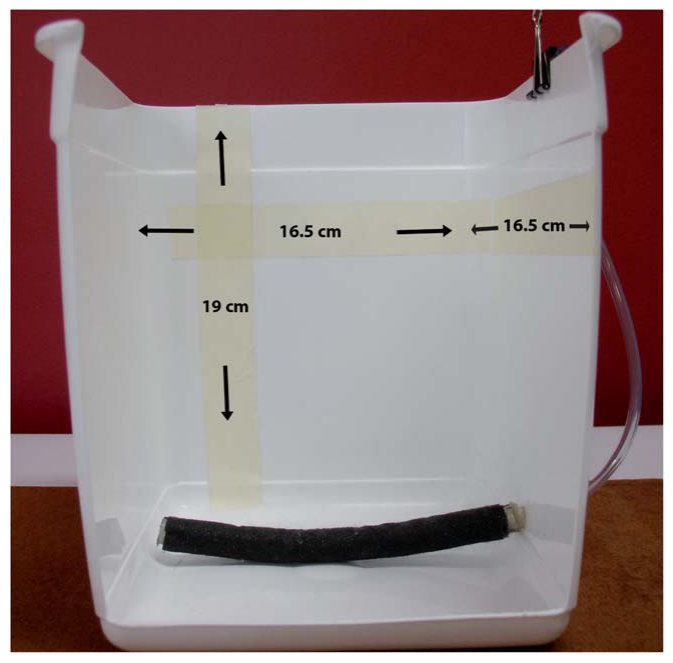
Plastic pots (16.5 � 16.5 � 19 cm) were prepared to allow for both irrigation techniques. For the non-ood irrigation, the pots were drilled at the bottom (5 holes per pot) to provide aeration to plants. For the ood irrigation, a hole was drilled at one side of the pot (2 cm from the base) and a silicone rubber pipe (0.5 cm � 4 cm) was inserted. The portion of the silicone rubber which was inside the pot was attached to a PVC pipe (0.8 cm � 14 cm). This internal PVC pipe was cut through the upper side and wrapped with Coolaroo non-woven mulch mat (made of polypropylene material) to drain water. The portion of the silicone rubber which was outside the pot was attached to a PVC pipe (0.3 cm � 28 cm), and clamped to the top edge of the pot (Fig. 1). Both types of pots were lled with a basal layer (500 grams) of gravel (>2 mm) to facilitate water drainage and aeration. Each pot was lled with 4 kg of Rangitikei silt loam soil collected from a quarry adjacent to the Manawatu River near Palmerston North, New Zealand. The soil was irrigated with distilled water (to 50% eld capacity) and fertilized with P and K prior to seeding. Nitrogen was applied to plants in two splits, prior to seeding and with the second irrigation. The rate of NPK used for the experiment was 50 mg N kg�1 (equivalent to 100 kg N ha�1 applied as DAP and urea), 22.5 mg P kg�1 (equivalent to 45 kg P ha�1 applied as DAP), and 67.5 mg K kg�1 (equivalent to 135 kg K ha�1 applied as K2SO4) according to the fertilizer guidelines of Wallace.30
塑料盆(16.5 × 16.5 × 19 cm)经过改装以适用于两种灌溉方式。对于非淹水灌溉,在盆底钻孔(每盆5个孔)以为植物提供通气。对于淹水灌溉,在盆的一侧(距底部2 cm处)钻孔并插入一根硅橡胶管(0.5 cm × 4 cm)。硅橡胶管位于盆内的部分连接一根PVC管(0.8 cm × 14 cm),该内部PVC管上侧切开,并用Coolaroo无纺布覆盖垫(聚丙烯材料)包裹以便排水。硅橡胶管位于盆外的部分连接一根PVC管(0.3 cm × 28 cm),并夹持于盆的上缘(图1)。两种盆钵底部均铺设一层砾石(>2 mm,500克)作为基层,以利于排水和通气。每盆装入4 kg Rangitikei粉砂壤土,该土壤采自新西兰北帕默斯顿附近Manawatu河旁的采石场。播种前,土壤用蒸馏水灌溉(至50%田间持水量),并施用P肥和K肥。氮肥分两次施用,分别在播种前和第二次灌溉时。依据Wallace的施肥指南,30试验所用NPK用量为50 mg N kg−1(相当于100 kg N ha−1,以DAP和尿素形式施用)、22.5 mg P kg−1(相当于45 kg P ha−1,以DAP形式施用)和67.5 mg K kg−1(相当于135 kg K ha−1,以K2SO4形式施用)。
2.3 Irrigation2.3 灌溉
Four arsenic concentrations in water (50, 100, 200, and 1000 mg L�1) and a control (distilled water) were used as treatments. Arsenic irrigation waters were prepared from a stock solution of 1000 mg L�1 of sodium arsenate heptahydrate (Na2HAsO4$7H2O). The irrigation was initiated once all the plants were germinated (10 days aer sowing). At the day of irrigation, each pot was weighed and adjusted to 70% and/or 110% Fc with treatment water for non-ooded and ooded water management respectively. Flooded conditions were maintained for three days by clamping the external/exhaust pipe. On day four, the clamp was removed and the pots were drained. The irrigation frequency was every ten days for the non-ooded plants and fortnightly for the ooded plants. Immersion of the basal leaves was observed in the ooded plants, and we assume that some surface absorption of As would have been apparent for these plants while water remained standing on the soil surface (�2–3 cm head).
以四个水中砷浓度(50、100、200和1000 mg L−1)和一个对照(蒸馏水)作为处理。As灌溉水由1000 mg L−1的七水合砷酸钠(Na2HAsO4·7H2O)储备液配制。待所有植株发芽后(播种后10天)开始灌溉。灌溉当天,对每盆称重,并分别用处理水将非淹水和淹水水分管理的盆钵调节至70%和/或110% Fc。通过夹紧外部排水管使淹水状态维持三天;第四天取下夹子,排干盆中积水。非淹水植株每十天灌溉一次,淹水植株每两周灌溉一次。在淹水植株中观察到基部叶片被浸没,我们推测在地表积水期间(约2–3 cm水头),这些植株会发生一定程度的As表面吸收。
2.4 Plant harvest and analysis2.4 植物收获与分析
Plants were harvested at maturity (dened as the point of human consumption) and divided into various parts; spinach (leaves and roots), carrot and radish (leaves and taproot), and tomato (shoot, fruit and roots). Carrot and radish taproots were further divided into peel (skin) and the edible root. The removal of radish and carrot skin before eating or cooking is a usual practice in South Asia. These plant parts were washed with distilled water; surface dried using paper towels, and weighed to determine the fresh biomass yield. Plants were then oven dried at 70 �C for four days and re-weighed for dry biomass. The dried plant parts were homogenized to a powder using a Cyclotec herbage mill (Model 1093, Salmond Smith Biolab Ltd.).
植物在成熟时(定义为可供人类食用时)收获,并分为不同部位:菠菜(叶和根)、胡萝卜和萝卜(叶和肉质直根)以及番茄(茎叶、果实和根)。胡萝卜和萝卜的肉质直根进一步分为表皮和可食用根部。在南亚,食用或烹饪前去除萝卜和胡萝卜表皮是常见做法。上述植物部位用蒸馏水洗净,用纸巾吸干表面水分后称重,以确定鲜生物量。随后将植物在70 °C下烘干四天并再次称重,以获得干生物量。干燥后的植物部位用Cyclotec牧草粉碎机(Model 1093, Salmond Smith Biolab Ltd.)粉碎均质。
Subsamples (0.5 g) were digested in 5 mL of concentrated nitric acid (HNO3). The samples were kept overnight under a fume hood to provide sufficient time for the acid to pre-digest the biomass. The following day the samples were heated to 120 �C on a digestion block for 2 to 3 hours until fumes were no longer emitted and the digest volume was reduced to 1–2 mL. The samples were subsequently cooled to room temperature and diluted with 10 mL deionized water, ltered with Whatman lter paper (42), and then further diluted to a nal volume of 25 mL with deionized water. An aliquot of each digest solution was analyzed for its total As concentration using Hydride Generation Atomic Absorption Spectrometer (HGAAS, Perkin Elmer, FIAS 400). As a pre-requisite for As analysis on HGAAS, the samples were reduced to AsIII by taking 1 mL of sample and adding 1 mL of concentrated HCl, and 1 mL of 5% (w/v) potassium iodide plus 5% (w/v) ascorbic acid. The treated samples were allowed to stand for 1 hour at room temperature and nally diluted to 10 mL with 10% HCl.
称取子样品(0.5 g),用5 mL浓硝酸(HNO3)消解。样品在通风橱中放置过夜,使酸有充足时间对生物质进行预消解。次日,将样品置于消解块上加热至120 °C,持续2~3小时,直至不再冒烟且消解液体积减少至1–2 mL。随后将样品冷却至室温,用10 mL去离子水稀释,经Whatman滤纸(42号)过滤,再用去离子水定容至25 mL。取各消解液的等分试样,采用氢化物发生原子吸收光谱仪(HGAAS, Perkin Elmer, FIAS 400)测定总As浓度。作为HGAAS测定As的前处理步骤,取1 mL样品,加入1 mL浓HCl以及1 mL 5%(w/v)碘化钾与5%(w/v)抗坏血酸混合液,将样品还原为AsIII。处理后的样品在室温下静置1小时,最后用10% HCl稀释至10 mL。
A standard reference material (1573a, Tomato leaves, NIST) and sample blanks were included in the procedure to evaluate the reliability of analytical method. The limit of detection (LOD) for As in HGASS was 0.145 mg L�1 and the sample blanks were below this LOD value. The analyzed As concentration of the standard reference material (0.112 � 0.007 mg g�1, n = 13) was in good agreement with certied reference value (0.112 � 0.004 mg g�1). The precision was maintained at 10% relative standard deviation (RSD) and any sample value higher than described value was repeated.
测定过程中加入标准参考物质(1573a,番茄叶,NIST)和样品空白,以评价分析方法的可靠性。HGAAS测定As的检出限(LOD)为0.145 mg L−1,样品空白均低于该检出限。标准参考物质的As测定值(0.112 ± 0.007 mg g−1,n = 13)与认证参考值(0.112 ± 0.004 mg g−1)吻合良好。精密度控制在10%相对标准偏差(RSD)以内,超出该值的样品均重新测定。
2.5 Soil analysis2.5 土壤分析
The experimental soil was analyzed for the fertility parameters pH, P, SO4, and CEC according to the methods of Blakemore et al.,31 total C and N using a Leco furnace, and soil texture according to pipette method.32 Total Fe and Al were analyzed as described by Gartler et al.33 using inductively coupled plasma optical emission spectrometry (ICP-OES Varian 720 ES-USA). These analytical determinations were performed by commercial laboratories of the Fertilizer and Lime Research Centre Massey University, Lincoln University, and Landcare Research in New Zealand (Table S1, ESI†).
按照Blakemore et al.的方法31测定供试土壤的肥力参数pH、P、SO4和CEC,采用Leco燃烧炉测定全C和全N,采用吸管法测定土壤质地。32按照Gartler et al.所述方法,33采用电感耦合等离子体发射光谱仪(ICP-OES Varian 720 ES-USA)测定全Fe和全Al。上述分析由新西兰梅西大学肥料与石灰研究中心、林肯大学和Landcare Research的商业实验室完成(表S1,ESI†)。
The soil was an acidic silt loam with low levels of available P and CEC (Table 1). For total As, accurately weighed subsamples (1 g) of soil were predigested overnight in 10 mL aqua regia (HCl : HNO3, 3 : 1). The next day the samples were placed on a digestion block at 120 �C for 2 to 3 hours. The samples were then cooled to room temperature and diluted with 20 mL of deionized water, ltered with Whatman lter paper (42) and made to 50 mL with deionized water. The samples were prereduced to AsIII as described for plant samples, prior to analysis by HGASS. A reference soil material (CRM-GBW 07403, National Research Center for CRMs of China, Beijing), was used to check the accuracy of analytical technique. Replicate sample blanks were analyzed in parallel with the soil samples and were found below the instrument detection limit. The analyzed As concentration of the reference soil material (4.2 � 0.05 mg g�1, n ¼ 7) was within the range of reported values (4.4 � 0.6 mg g�1). The As concentration in the experimental soil was below the New Zealand environmental quality standard for total As (20 mg kg�1, ANZECC/NHMRC, Table 1).34
供试土壤为酸性粉砂壤土,有效P含量和CEC均较低(表1)。测定土壤总As时,准确称取子样品(1 g),用10 mL王水(HCl : HNO3, 3 : 1)预消解过夜。次日将样品置于消解块上,在120 °C下加热2~3小时,然后冷却至室温,用20 mL去离子水稀释,经Whatman滤纸(42号)过滤,再用去离子水定容至50 mL。在HGAAS测定前,按植物样品所述方法将样品预还原为AsIII。采用土壤参考物质(CRM-GBW 07403,中国国家标准物质研究中心,北京)检验分析方法的准确度。重复样品空白与土壤样品同步分析,结果均低于仪器检出限。土壤参考物质的As测定值(4.2 ± 0.05 mg g−1,n = 7)在报告值范围(4.4 ± 0.6 mg g−1)之内。供试土壤中的As浓度低于新西兰总As环境质量标准(20 mg kg−1,ANZECC/NHMRC,表1)。34
| pH (H2O) | 6.1 |
|---|---|
| Olsen P (mg P g�1) | 7.1 |
| SO4(mg S g�1) | 4.8 |
| Total C (%) | 0.8 |
| Total N (%) | <0.005 |
| Total Fe (%) | 2.3 |
| Total Al (%) | 2.8 |
| CEC (meq. per 100 g) | 12 |
| Texture | Silt loam (sand 14%, |
| silt 65%, and clay 21%) | |
| Total As (mg g�1) | 4.9�0.02 (n¼ 3)a |
a The As concentration in soil was determined by the lead author during the experimental work. All other soil determinations were performed by commercial laboratories.
a 土壤As浓度由第一作者在试验期间测定,其他所有土壤指标均由商业实验室测定。
2.6 Statistical analysis2.6 统计分析
The data for As concentration in plant tissues was tested for normality and then analyzed by ANOVA using SAS 9.2 (SAS Institute Inc., USA). The Tukey's test was used to determine signicant differences among treatment means using a probability value of 0.05.
对植物组织As浓度数据进行正态性检验后,采用SAS 9.2(SAS Institute Inc., USA)进行ANOVA分析。采用Tukey检验确定各处理均值间的显著性差异,显著性水平为0.05。
2.7 Human health risk assessment2.7 人体健康风险评价
To evaluate the risk presented to humans through ingestion of edible parts of the vegetables in the current study, the As concentration in each vegetable was re-expressed on fresh weight, and assumed to be present in an inorganic form. The fresh weight concentrations were then compared to the Chinese food safety standard for inorganic As in food (0.05 mg kg�1 fresh weight, Heikens35). Vegetables with an As concentration below this guideline value present an acceptable risk to humans while vegetables with an As concentration above the guideline value represent a potentially unacceptable risk to consumers.
为评价本研究中食用蔬菜可食部分对人体造成的风险,将各蔬菜中的As浓度换算为鲜重浓度,并假定其均以无机形态存在。随后将鲜重浓度与中国食品中无机As的食品安全标准(0.05 mg kg−1鲜重,Heikens35)进行比较。As浓度低于该限值的蔬菜对人体的风险可以接受,而As浓度高于该限值的蔬菜则对消费者构成潜在的不可接受风险。
To further quantify this potential risk, the USEPA dened hazard quotient (HQ) and cancer risk (CR) was derived.36,37 The HQ was calculated according to eqn (1), where EDI is estimated daily intake (mg kg�1 day�1) and RfD is reference dose for As (0.0003 mg As kg�1 body weight day�1). An HQ value greater than 1 denes a non-carcinogenic toxic risk to human health.
为进一步量化该潜在风险,计算了USEPA定义的危害商(HQ)和致癌风险(CR)。36,37HQ按式(1)计算,其中EDI为估计日摄入量(mg kg−1 day−1),RfD为As的参考剂量(0.0003 mg As kg−1体重 day−1)。HQ值大于1表示对人体健康存在非致癌毒性风险。

The parameter EDI was calculated according to eqn (2), where C is concentration of arsenic in edible part of the plant (mg kg�1 fresh weight); Fi is food intake (kg per person per day); Ef is exposure frequency (days per year); Ed is exposure duration (70 years); W is average body weight (60 kg for adults 18 years and older,38 and 50 kg for adolescents between 12 and 18 years age); Te is average exposure time (¼Ed � 365 days)
参数EDI按式(2)计算,其中C为植物可食部分中的砷浓度(mg kg−1鲜重);Fi为食物摄入量(kg per person per day);Ef为暴露频率(天/年);Ed为暴露持续时间(70年);W为平均体重(18岁及以上成人为60 kg,3812~18岁青少年为50 kg);Te为平均暴露时间(= Ed × 365天)

The CR was calculated according to eqn (3), where the parameter CSF is a cancer slope factor for As (1.5 mg kg�1 day�1). The USEPA has proposed a range of 1 in 10 000 (10�4) to 1 in 1 000 000 (10�6) as acceptable As cancer risk in humans.37
CR按式(3)计算,其中参数CSF为As的致癌斜率因子(1.5 mg kg−1 day−1)。USEPA提出以万分之一(10−4)至百万分之一(10−6)作为人体可接受的As致癌风险范围。37

3Results and discussion结果与讨论
3.1 Arsenic concentration in vegetables3.1 蔬菜中的砷浓度
Arsenic accumulation and distribution within plant tissues and among plant species varied as a function of the As treatment and the irrigation technique used. The results for each species are reported separately, followed by comparison of As bioaccumulation among the studied vegetables and possible factors affecting the accumulation of As by the plants.
植物组织内及不同植物物种间As的累积与分布随As处理和所用灌溉方式的不同而变化。以下分别报告各物种的结果,然后比较供试蔬菜间As生物累积的差异,并探讨影响植物As累积的可能因素。
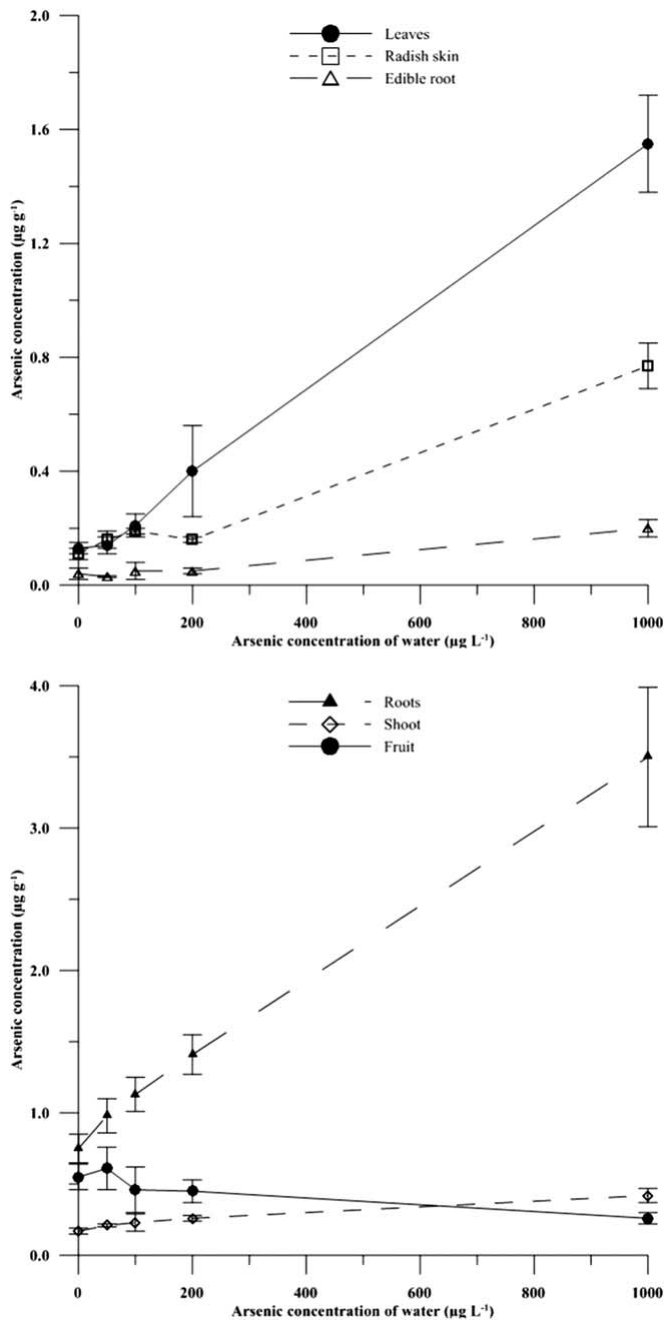
3.1.1 Radish. The As concentration in radish tissues (leaves, radish skin and edible root) was signicantly higher in the plants irrigated with 1000 mg L�1 when compared to all other treatments (P < 0.05, Fig. 2). An increase in As concentration in radish as a function of As exposure has been reported by other researchers.24,39 Among the various plant tissues, leaves accumulated the highest concentration of As, followed by radish skin and the edible root. A relatively higher concentration of As in leaves in current study is in agreement with previous hydroponic and soil studies where a higher concentration of As has been observed in leaves.39–41 However, our nding of a higher concentration of As in leaves also contradicts previous hydroponic and soil studies where As was mostly retained in the roots.13,19,20 Among the components of the taproot, skin accumulated a higher concentration of As by a factor of 2.7 to 5.3 relative to the edible root. A higher concentration of As in radish skin observed in this study is consistent with previous hydroponic and soil studies.13,42 3.1.2 Tomato. The As concentration in shoots and roots of tomato was signicantly higher at an irrigation water concentration of 1000 mg As L�1 relative to the other treatments (P < 0.05, Fig. 2). In contrast, there was no signicant difference of As concentration in tomato fruit among the various treatments. An increase in the As concentration of tomato roots and shoots as a function of As concentration in various growth media (soil, mixtures of soil and As-contaminated mine tailings and nutrient solution) has been reported.21,29,39 Among the various plant tissues, the As concentration of roots was higher than in fruit and shoots under all treatments. Roots accumulated an As concentration that was 1.4 to 5.1 times higher than that recorded for the fruit and shoot. This higher concentration in roots relative to other tissues of tomato is consistent with previous studies that have investigated the response of tomato to arsenic.21,39,43 Burlo et al.29 reported that As in tomato plants was mainly accumulated in roots (85% of total As), followed by shoots (14%) and fruit (1%) when grown in nutrient solution. Carbonell-Barrachina et al.43 suggested that tomato plants tolerate As by exclusion, limiting its transport to shoots by increasing the As concentration in the roots. Among the upper plant parts, the As concentration in tomato fruit was signicantly higher than in shoots for all the treatments, with the exception of the 1000 mg L�1 treatment (P < 0.05). This indicates that shoots may transport a large quantity of As to fruit at low As levels (<1000 mg As L�1), but transfer is inhibited or restricted above this level. Carbonell-Barrachina et al.43 suggested that when As is above a threshold level, the growth and transport function of a plant is affected, resulting in limited As translocation.
3.1.1 萝卜。用1000 mg L−1灌溉的植株,其萝卜组织(叶、表皮和可食用根部)中的As浓度显著高于其他所有处理(P < 0.05,图2)。其他研究者也报道了萝卜As浓度随As暴露增加而升高的现象。24,39在各植物组织中,叶片累积的As浓度最高,其次为萝卜表皮和可食用根部。本研究中叶片As浓度相对较高,与以往在叶片中观察到较高As浓度的水培和土壤研究结果一致。39–41然而,叶片中As浓度较高这一发现也与以往As主要滞留于根部的水培和土壤研究结果相矛盾。13,19,20在肉质直根各组分中,表皮累积的As浓度是可食用根部的2.7~5.3倍。本研究观察到的萝卜表皮As浓度较高,与以往水培和土壤研究结果一致。13,42 3.1.2 番茄。灌溉水浓度为1000 mg As L−1时,番茄茎叶和根中的As浓度显著高于其他处理(P < 0.05,图2)。相比之下,各处理间番茄果实的As浓度无显著差异。已有研究报道,番茄根和茎叶中的As浓度随各种生长介质(土壤、土壤与受As污染尾矿的混合物以及营养液)中As浓度的升高而增加。21,29,39在各植物组织中,所有处理下根部As浓度均高于果实和茎叶,根部累积的As浓度为果实和茎叶的1.4~5.1倍。番茄根部As浓度高于其他组织,这与以往研究番茄对砷响应的结果一致。21,39,43Burlo et al.29报道,在营养液中生长时,番茄植株中的As主要累积于根部(占总As的85%),其次为茎叶(14%)和果实(1%)。Carbonell-Barrachina et al.43认为,番茄植株通过排斥机制耐受As,即通过提高根部As浓度来限制其向茎叶的转运。在地上部各部位中,除1000 mg L−1处理外,所有处理下番茄果实的As浓度均显著高于茎叶(P < 0.05)。这表明在低As水平(<1000 mg As L−1)下,茎叶可能将大量As转运至果实,但超过该水平后转运受到抑制或限制。Carbonell-Barrachina et al.43认为,当As超过某一阈值水平时,植物的生长和转运功能受到影响,导致As转运受限。
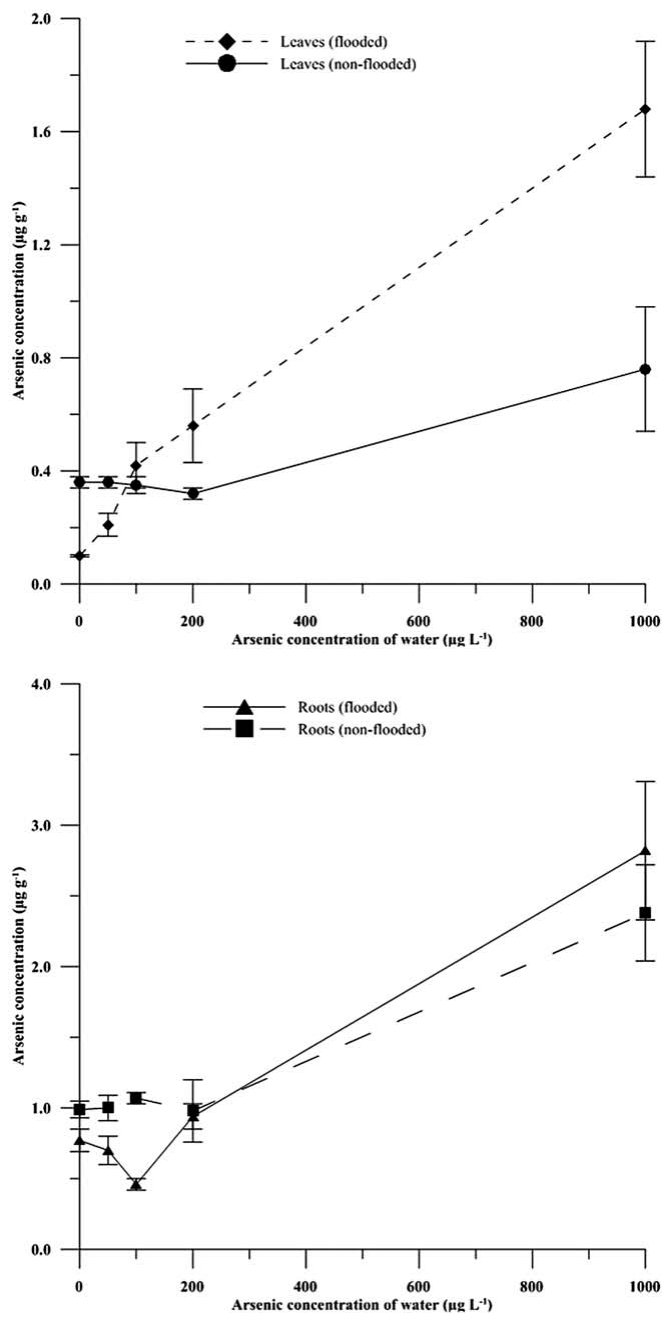
3.1.3 Spinach. Spinach was grown under both non-ooded and ooded irrigation. The response of spinach to As in water under both irrigation techniques is presented in Fig. 3. The
3.1.3 菠菜。菠菜在非淹水和淹水两种灌溉方式下种植。两种灌溉方式下菠菜对水中As的响应见图3。
Paper论文
effect of the 1000 mg As L�1 irrigation treatment was signicant under both irrigation techniques and resulted in a higher concentration of As in the leaves and roots of plants relative to the other treatments (P < 0.05). An increased As concentration in leaves of spinach with increasing As concentration in soil has been documented previously.44 Among the plant tissues, roots had a higher As concentration than in leaves under both irrigation techniques. The As concentration in roots was 2.7 to 3.1 times higher than in leaves for plants under non-ooded water management, and 1.1 to 7.7 times higher under ooded water management. Tlustos et al.45 also demonstrated a higher concentration of As in spinach roots relative to the aerial biomass. Nonetheless, a comparison of the As concentration in roots shows no signicant difference for the same concentration of irrigation water under the two irrigation techniques. For leaves, a relatively higher As concentration was observed in ood irrigated plants for the 100, 200 and 1000 mg As L�1 treatments relative to plants subject to non-ood irrigation. There could be three possible explanations for such an increase, (i) a higher amount of As was introduced in the ooded pots due to an increase in the total volume of irrigation water (110% Fc vs. 70% Fc), (ii) direct absorption of As by spinach leaves from standing water during the initial phase of the ood irrigation event, and (iii) more translocation of As to aerial parts. An increased translocation of As in the current study is in agreement with the ndings of Talukder et al.,46 who reported that As is more easily translocated to the above-ground biomass of rice plants under anaerobic conditions than aerobic conditions.
在两种灌溉方式下,1000 mg As L−1灌溉处理的效应均显著,其植株叶片和根部的As浓度均高于其他处理(P < 0.05)。此前已有文献记载菠菜叶片As浓度随土壤As浓度升高而增加。44在各植物组织中,两种灌溉方式下根部As浓度均高于叶片。非淹水水分管理下,根部As浓度为叶片的2.7~3.1倍;淹水水分管理下则为1.1~7.7倍。Tlustos et al.45也证实菠菜根部As浓度高于地上部生物量。然而,比较根部As浓度可见,在相同灌溉水浓度下两种灌溉方式之间无显著差异。对于叶片,在100、200和1000 mg As L−1处理下,淹水灌溉植株的As浓度相对高于非淹水灌溉植株。这种升高可能有三种解释:(i)由于灌溉水总量增加(110% Fc vs. 70% Fc),淹水盆钵中引入的As量更多;(ii)在淹水灌溉初期,菠菜叶片从地表积水中直接吸收As;(iii)As向地上部的转运增加。本研究中As转运增加的结果与Talukder et al.46的发现一致,他们报道在厌氧条件下As比在好氧条件下更易转运至水稻地上部生物量中。
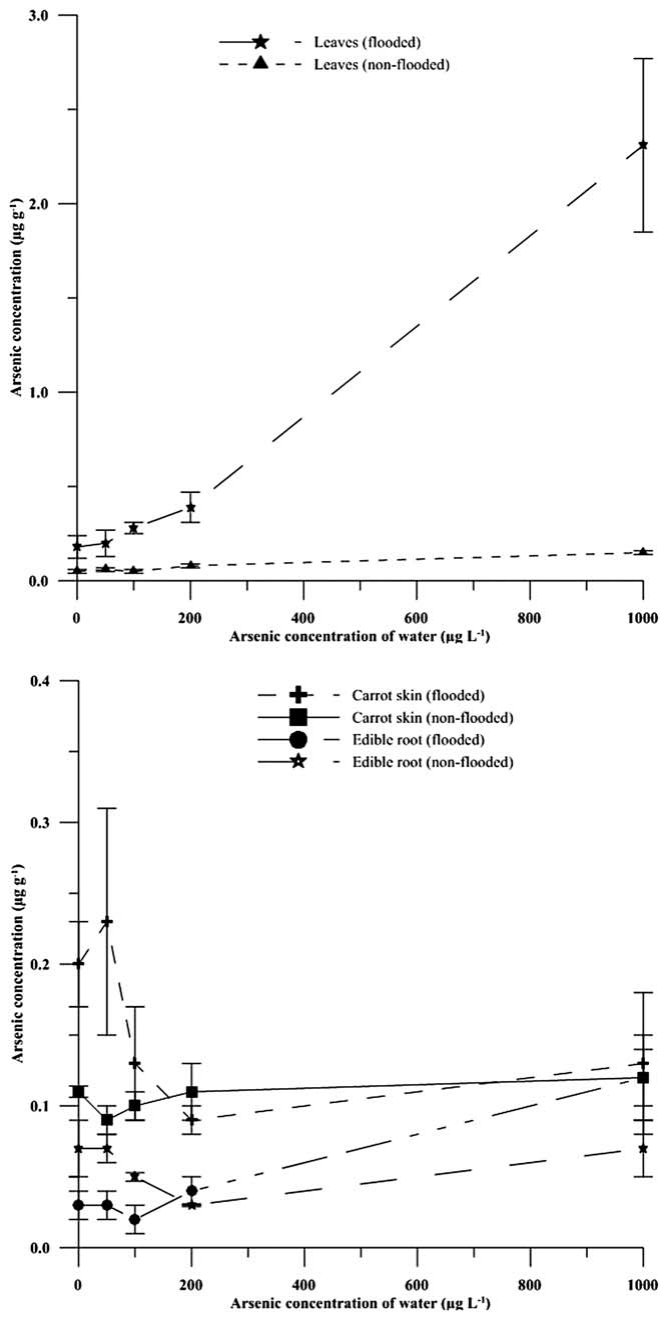
3.1.4 Carrot. Carrot was also grown under both non-ooded and ooded irrigation. Among the various As treatments, plants irrigated with 1000 mg As L�1 had a signicantly (P < 0.05) higher As concentration in their leaves than for other treatments under both irrigation techniques (Fig. 4). A similar effect at this treatment level was also observed for edible roots subject to ood irrigation. Among the plant tissues, the trend of As concentration as a function of As in irrigation water differed between the two irrigation techniques. Under non-ood irrigation, carrot skin accumulated more As than leaves, while under ood irrigation, leaves accumulated more As than carrot skin. The reported higher concentration of As in leaves subject to ood irrigation may be attributed to enhanced translocation from roots under this water management, and surface absorption by leaves. Liu et al.40 found a higher concentration of As in carrot leaves than in edible parts and suggested that carrot leaves are efficient bio-accumulators of heavy metals/metalloids. Considering the components of the taproot, the skin accumulated more As than the edible root under both irrigation techniques. This is consistent with other studies where a higher concentration of As in carrot peel (approximately 3 times) than the edible root has been reported.28,47 Zandstra & De Kryger48 reported a higher concentration of As in the root shoulder and peel than the peeled root and attributed this to direct contact with soil particles. Overall, the As concentration in plant tissues (leaves, carrot skin and edible root) was higher in plants grown under ood irrigation relative to those grown under non-ood irrigation.
3.1.4 胡萝卜。胡萝卜同样在非淹水和淹水两种灌溉方式下种植。在各As处理中,两种灌溉方式下用1000 mg As L−1灌溉的植株叶片As浓度均显著(P < 0.05)高于其他处理(图4)。在淹水灌溉下,可食用根部在该处理水平下也表现出类似效应。在各植物组织中,As浓度随灌溉水As浓度变化的趋势在两种灌溉方式之间存在差异:非淹水灌溉下,胡萝卜表皮累积的As多于叶片;而淹水灌溉下,叶片累积的As多于胡萝卜表皮。淹水灌溉下叶片As浓度较高,可能归因于该水分管理下As从根部向上转运增强以及叶片的表面吸收。Liu et al.40发现胡萝卜叶片中的As浓度高于可食部分,并认为胡萝卜叶片是重金属/类金属的高效生物累积器官。就肉质直根各组分而言,两种灌溉方式下表皮累积的As均多于可食用根部。这与其他研究报道的胡萝卜皮中As浓度高于可食用根部(约3倍)的结果一致。28,47Zandstra & De Kryger48报道,根肩和表皮中的As浓度高于去皮根部,并将其归因于与土壤颗粒的直接接触。总体而言,淹水灌溉下植株组织(叶、胡萝卜表皮和可食用根部)中的As浓度高于非淹水灌溉下的植株。
3.1.5 Arsenic content in vegetables and possible factors affecting accumulation in plants. Arsenic is a non-essential element for plants. The uptake of As by plants is a complex phenomenon and depends on various As–plant–soil factors, including As concentration and species, crop species, and soil redox conditions.19,49–52 Our results show that As accumulation by plants was dependent on the As concentration of irrigation water, the irrigation technique used, and the vegetable species tested. Fig. 5 depicts the As content of the studied vegetables, where content is dened as the As concentration (mg g�1) � dry matter yield (g). The As content in plants varied among species, and can be ranked from high to low as spinach (ooded) > tomato > spinach (non-ooded) > radish > carrot (ooded) >
3.1.5 蔬菜中的砷含量及影响植物累积的可能因素。砷是植物的非必需元素。植物对As的吸收是一个复杂的过程,取决于多种As–植物–土壤因素,包括As浓度和形态、作物种类以及土壤氧化还原条件。19,49–52本研究结果表明,植物对As的累积取决于灌溉水As浓度、所用灌溉方式和供试蔬菜种类。图5显示了供试蔬菜的As含量,此处含量定义为As浓度(mg g−1)× 干物质产量(g)。植物As含量因物种而异,由高到低依次为:菠菜(淹水)> 番茄 > 菠菜(非淹水)> 萝卜 > 胡萝卜(淹水)>
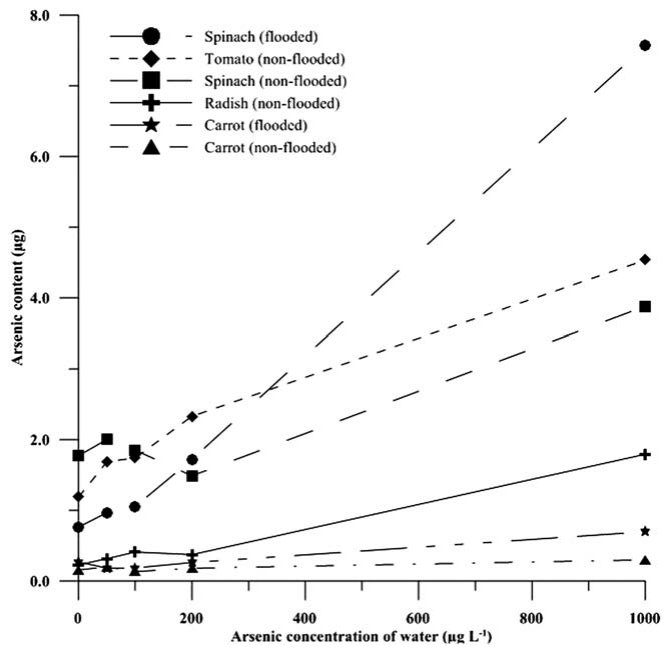
carrot (non-ooded). This variation in As uptake among the vegetables may be attributed to genetic differences among these plants together with the irrigation technique used. Husaini et al.17 reported As accumulation in the order spinach > tomato > carrot > radish when these plants were irrigated with untreated industrial effluent. Similarly, Arain et al.18 reported higher As levels in leafy vegetables compared to root vegetables and grain crops collected from an agricultural eld irrigated with As-contaminated lake water.
胡萝卜(非淹水)。蔬菜间As吸收的这种差异可能归因于植物间的遗传差异以及所用的灌溉方式。Husaini et al.17报道,用未经处理的工业废水灌溉时,这些植物的As累积顺序为菠菜 > 番茄 > 胡萝卜 > 萝卜。同样,Arain et al.18报道,在用受As污染的湖水灌溉的农田中采集的样品中,叶菜类蔬菜的As含量高于根菜类蔬菜和谷类作物。
A second factor controlling As accumulation in plant species is the concentration of As present in irrigation water. In general, each species showed an increase in As content as a function of the As concentration in irrigation water (Fig. 5). Such an increase in plant tissues with As concentration in growth media is well documented in literature (for example ref. 14, 29 and 44).
控制植物As累积的第二个因素是灌溉水中的As浓度。总体而言,各物种的As含量均随灌溉水As浓度的升高而增加(图5)。植物组织中As随生长介质As浓度升高而增加的现象在文献中已有充分记载(例如文献14、29和44)。
Among the various As irrigation water levels, the 1000 mg As L�1 treatment promoted the highest As concentration in these plant species. This is consistent with the ndings of Dahal et al.,26 who found a positive correlation between the As concentration in plants and the As concentration of irrigation water. These researchers also reported the highest As concentration in all parts of the studied vegetables in samples collected from plots irrigated with the highest As concentration of this study (1.014 mg As L�1 in groundwater).
在各灌溉水As水平中,1000 mg As L−1处理使这些植物物种的As浓度最高。这与Dahal et al.26的发现一致,他们发现植物As浓度与灌溉水As浓度呈正相关。这些研究者还报道,在其研究中用As浓度最高的水(地下水中1.014 mg As L−1)灌溉的小区所采集的样品中,供试蔬菜所有部位的As浓度均为最高。
A third possible factor affecting the As concentration in plants of the current study is the irrigation technique used. The ooded and non-ooded irrigation techniques could differentially affect soil redox potential which subsequently affect As solubility, speciation and uptake by plants.46,49,53 The soil redox potential was not measured in the current work because the system was in a state of ux and measuring redox would have disturbed the system. However, we assume that the soil subject to ood irrigation will have had a periodically lower redox potential than the soil subject to non-ood irrigation. Li et al.53 reported that ooded water management signicantly reduced soil redox potential compared with aerobic treatment for an acidic silty clay loam soil. Similarly, Talukder et al.46 reported a highly reduced redox potential (�41 to �76 mV) under ooded water management relative to aerobic water management (+135 to +138 mV) for an acidic sandy loam soil.
影响本研究植物As浓度的第三个可能因素是所用的灌溉方式。淹水与非淹水灌溉方式对土壤氧化还原电位的影响可能不同,进而影响As的溶解度、形态及植物吸收。46,49,53由于系统处于变动状态,测定氧化还原电位会对系统造成扰动,因此本研究未测定土壤氧化还原电位。然而,我们推测淹水灌溉土壤的氧化还原电位会周期性地低于非淹水灌溉土壤。Li et al.53报道,对于一种酸性粉砂质黏壤土,淹水水分管理较好氧处理显著降低了土壤氧化还原电位。同样,Talukder et al.46报道,对于一种酸性砂壤土,淹水水分管理下的氧化还原电位(−41至−76 mV)远低于好氧水分管理(+135至+138 mV)。
In our study there was a lower As content in the vegetables grown under non-ood irrigation than the plants under ood irrigation. A similar nding for rice was reported by Xu et al.49 who found a 10–15 fold higher concentration of As in the grain of paddy rice relative to dry land rice. Lower As content under non-ooded conditions may be due to sorption of As with hydrous oxides minerals effecting a reduction in As solubility and uptake by plants.4,23,49 In contrast, for soils subject to ood irrigation management, As solubility may have been higher due to (i) reduction of arsenate (AsV) to arsenite (AsIII), and (ii) dissolution of Fe hydrous oxides which releases the adsorbed As, leading to increased uptake by plants.23,49,54
本研究中,非淹水灌溉下生长的蔬菜As含量低于淹水灌溉下的植株。Xu et al.49在水稻上也报道了类似发现,他们发现水田稻谷中的As浓度比旱地稻谷高10–15倍。非淹水条件下As含量较低,可能是由于As被水合氧化物矿物吸附,从而降低了As的溶解度和植物吸收。4,23,49相反,对于淹水灌溉管理下的土壤,As溶解度可能因以下原因而升高:(i)砷酸盐(AsV)还原为亚砷酸盐(AsIII);(ii)Fe水合氧化物溶解,释放出所吸附的As,从而导致植物吸收增加。23,49,54
3.2 Risk assessment3.2 风险评价
The arsenic concentration in both the edible portion and taproot of carrot (mg g�1 fresh weight, Table 2) was less than the Chinese maximum permissible concentration (MPC) for all irrigation treatments. Ingestion of carrot cultivated under the conditions of our study therefore poses a minimal and acceptable risk to human health. The edible portion of radish was also safe for consumption; however for the 1000 mg As L�1 irrigation treatment, the As concentration in taproot was above the MPC. In tomato fruit, the As concentration was equivalent to the MPC level for As concentrations in irrigation water less than 1000 mg L�1. In contrast, for spinach leaves, the As concentration was above the MPC level for most treatments under both irrigation techniques. The As concentration in spinach leaves for the 100, 200, and 1000 mg L�1 treatments under ood irrigation and for the 1000 mg L�1 treatment under non-ood irrigation was of concern. For these treatments, As was 1.6 to 6.4 times higher than the MPC level. These values were further explored to determine potential risk to humans using the USEPA hazard quotient (HQ) and cancer risk (CR) calculations.
在所有灌溉处理下,胡萝卜可食部分和肉质直根中的砷浓度(mg g−1鲜重,表2)均低于中国最大允许浓度(MPC)。因此,食用在本研究条件下种植的胡萝卜对人体健康的风险极小且可以接受。萝卜可食部分同样可安全食用;但在1000 mg As L−1灌溉处理下,其肉质直根中的As浓度高于MPC。对于番茄果实,当灌溉水As浓度低于1000 mg L−1时,其As浓度与MPC水平相当。相比之下,两种灌溉方式下大多数处理的菠菜叶片As浓度均高于MPC水平。淹水灌溉下100、200和1000 mg L−1处理以及非淹水灌溉下1000 mg L−1处理的菠菜叶片As浓度值得关注,这些处理的As浓度为MPC水平的1.6~6.4倍。进一步采用USEPA危害商(HQ)和致癌风险(CR)计算对这些数值进行分析,以确定其对人体的潜在风险。
| Radish萝卜 | Tomato番茄 | Spinach菠菜 | Carrot胡萝卜 | ||||||
|---|---|---|---|---|---|---|---|---|---|
| Non-ooded | Non-ooded | Non-ooded | Flooded | Non-oo | ded | Flooded | |||
| As in water (mg L�1) | Edible root | Taproot | Fruit | Leaves | Leaves | Edible root | Taproot | Edible root | Taproot |
| 0 | 0.003 | 0.011 | 0.055 | 0.058 | 0.019 | 0.008 | 0.022 | 0.004 | 0.032 |
| 50 | 0.002 | 0.014 | 0.061 | 0.058 | 0.040 | 0.008 | 0.019 | 0.004 | 0.036 |
| 100 | 0.004 | 0.018 | 0.046 | 0.056 | 0.080 | 0.006 | 0.019 | 0.003 | 0.021 |
| 200 | 0.004 | 0.015 | 0.045 | 0.051 | 0.106 | 0.004 | 0.018 | 0.006 | 0.017 |
| 1000 | 0.014 | 0.068 | 0.026 | 0.122 | 0.319 | 0.008 | 0.022 | 0.017 | 0.034 |
a Mean fresh weight was calculated as a product of mean As concentration (mg g�1 dry weight) and mean water content of each vegetable species according to the formula: fresh weight mg g�1 = (dry weight mg g�1) � (1 � % moisture/100).
a 平均鲜重浓度由各蔬菜平均As浓度(mg g−1干重)与平均含水量按下式计算:鲜重 mg g−1 =(干重 mg g−1)×(1 − %含水量/100)。
Use of the HQ and CR risk assessment model requires quantication of the average daily vegetable consumption for the target population. The average daily consumption of vegetables per person varies among countries (Table 3). Considering the eating habit of people of South Asian countries, where vegetables are eaten with each of three meals a day,1,55 the intake of 500 grams per day was used for further calculation. Only adults (>18 years old) and adolescents (12–18 years old) are considered in this discussion to provide a conservative picture of exposure. The vegetable intake data for children (<12 years) is insufficient for South Asian countries and therefore not considered in this discussion.
应用HQ和CR风险评价模型需要对目标人群的日均蔬菜消费量进行量化。各国人均日蔬菜消费量不尽相同(表3)。考虑到南亚国家居民的饮食习惯,即一日三餐均食用蔬菜,1,55后续计算采用每日摄入500克。为保守反映暴露情况,本文仅考虑成人(>18岁)和青少年(12–18岁)。由于南亚国家儿童(<12岁)的蔬菜摄入数据不足,本文未予考虑。
Assuming a scenario where 500 grams of spinach (Fi) is consumed on 52 days in a year (Ef), the HQ value ranged from 0.32 to 1.26 for adults and 0.38 to 1.51 for adolescents (Tables 4 and S2, ESI†). A higher HQ value for adolescents compared to adults infers greater risk for this demographic. The hazard quotient exceeded 1 and denes potential risk for both adults and adolescents consuming spinach cultivated under ood irrigation with water containing an As concentration of 1000 mg L�1. Calculation of the parameter CR shows that there is an increased probability of cancer through ingestion of spinach leaves cultivated under ood irrigation with water containing more than 50 mg As L�1 (probability in excess of 1 in 10 000). The cancer risk also exceeded 1 in 10 000 for spinach cultivated using non-ood irrigation with water containing 1000 mg As L�1. This risk from spinach consumption may be higher in areas where vegetables consumption is higher, and where As contaminated water is also used for drinking and cooking.
假设每年有52天(Ef)食用500克菠菜(Fi),成人的HQ值为0.32~1.26,青少年为0.38~1.51(表4和表S2,ESI†)。青少年的HQ值高于成人,表明该人群面临更大风险。对于食用以As浓度为1000 mg L−1的水进行淹水灌溉种植的菠菜的成人和青少年,危害商均超过1,表明存在潜在风险。CR参数计算结果表明,食用以As浓度高于50 mg As L−1的水进行淹水灌溉种植的菠菜叶片会增加患癌概率(概率超过万分之一)。以1000 mg As L−1的水进行非淹水灌溉种植的菠菜,其致癌风险也超过万分之一。在蔬菜消费量更高以及受As污染的水同时用于饮用和烹饪的地区,食用菠菜的风险可能更高。
| Region/country地区/国家 | Vegetables consumption (g fresh weight day�1)蔬菜消费量 (g鲜重 day−1) |
|---|---|
| Bangladesh | 130–205 (ref. 8, 56 and 57) |
| USA | 161.5 (ref. 58) |
| Republic of Croatia | 275 (ref. 59) |
| Santiago, Chile | 327.3 (ref. 60) |
| Denmark | 376 (ref. 47) |
| West Bengal, India | 450 (ref. 1) to 500 (ref. 55) |
3.3 Management strategies for irrigation with As contaminated water3.3 使用受As污染的水进行灌溉的管理策略
Our results suggest that the choice of crop and irrigation management technique should be made with caution in scenarios where vegetable crops are irrigated with As-contaminated water. Where practicable, the practice of ood irrigation with As-contaminated water should be avoided as it increases As solubility and uptake in plants. Instead, non- ood irrigation should be practiced as this will minimize As transformation, solubility and uptake by plants. At locations where ood irrigation is practiced, crop species which actively accumulate As in their edible parts (e.g. spinach) should be replaced by species that show less propensity to accumulate As (e.g. carrot). Our data suggest that the skin of root vegetables (e.g. carrot, radish) should be removed before ingestion as a signicant portion of the As burden of vegetables is found in the skin. Our research allows us to propose an acceptable level of As in irrigation water dened by the corresponding As concentration in the edible parts of vegetables which do not pose carcinogenic risk to humans upon their consumption. We propose that irrigation water with an As concentration higher than 50 mg L�1 should not be used for spinach cultivation where ood irrigation is practiced. However, for carrot, radish and tomato cultivation, an As concentration in irrigation water up to 1000 mg L�1 is acceptable.
本研究结果表明,在用受As污染的水灌溉蔬菜作物的情况下,应谨慎选择作物和灌溉管理方式。在可行的情况下,应避免使用受As污染的水进行淹水灌溉,因为这会增加As的溶解度和植物吸收;而应采用非淹水灌溉,以最大限度地减少As的转化、溶解及植物吸收。在采用淹水灌溉的地区,应以不易累积As的作物(如胡萝卜)替代在可食部分主动累积As的作物(如菠菜)。本研究数据表明,根菜类蔬菜(如胡萝卜、萝卜)的表皮应在食用前去除,因为蔬菜As负荷的相当大部分存在于表皮中。基于本研究,可根据蔬菜可食部分中不会对消费者构成致癌风险的相应As浓度,提出灌溉水中As的可接受水平。我们建议,在采用淹水灌溉种植菠菜时,不应使用As浓度高于50 mg L−1的灌溉水;而对于胡萝卜、萝卜和番茄的种植,灌溉水As浓度可接受上限为1000 mg L−1。
| Hazard quotien危害商 | t (HQ) | Cancer risk (CR致癌风险(CR) | ) | |||
|---|---|---|---|---|---|---|
| As in water (mg L�1) | Irrigation technique | Ca (mg g�1 fresh weight) | Adults (>18 years) | Adolescent (12–18 years) | Adults (>18 years) | Adolescent (12–18 years) |
| 100 | Flooded | 0.080 | 0.32 | 0.38 | 1.4�10�4 | 1.7�10�4 |
| 200 | Flooded | 0.106 | 0.42 | 0.50 | 1.9�10�4 | 2.3�10�4 |
| 1000 | Non-ooded | 0.122 | 0.48 | 0.58 | 2.2�10�4 | 2.6�10�4 |
| Flooded | 0.319 | 1.26 | 1.51 | 5.7�10�4 | 6.8�10�4 |
a Concentration of arsenic in spinach leaves; parameters have been calculated where the As concentration in spinach exceeds the MPL of 0.05 mg g�1 fresh weight.
a 菠菜叶片中的砷浓度;仅在菠菜As浓度超过最大允许限值(MPL)0.05 mg g−1鲜重时计算各参数。
4Conclusions结论
The arsenic concentration in carrot, radish, spinach and tomato increased as a function of the As concentration in irrigation water. The effect of irrigation with 1000 mg As L�1 was signi- cant in all vegetable species relative to the other treatments and enhanced the As concentration of each plant. The distribution of As among vegetables tissues varied for the species used. Tomato and spinach accumulated a higher As concentration in roots relative to aerial biomass, while radish and carrot accumulated a higher As concentration in leaves and skin relative to edible root. Among the studied vegetables, As uptake increased in the order carrot < radish < tomato < spinach. The effect of irrigation technique was signicant on the As concentration in the studied vegetables. Spinach and carrot grown under ood irrigation had a higher As concentration in aerial biomass relative to non-ood irrigation, possibly due to an increased solubility and bioavailability of As. In terms of risk to human health from consuming the edible parts of these vegetables, our ndings indicate that spinach leaves accumulate a signicant level of As under the treatments used, ranging from 1.6 to 6.4 times higher than the Chinese maximum permissible level of As in food (0.05 mg g�1 fresh weight). Spinach leaves also pose a carcinogenic and non-carcinogenic risk to humans upon their consumption. This is quantied by calculated HQ and CR values (USEPA), where an HQ value greater than 1 represents an unacceptable non-carcinogenic risk and a CR value greater than 10�4 represents an unacceptable carcinogenic risk. The HQ value for spinach ranged from 0.32 to 1.26 for adults and 0.38 to 1.51 for adolescents while the CR value ranged from 1.4 � 10�4 to 5.7 � 10�4 for adults and 1.7 � 10�4 to 6.8 � 10�4 for adolescents. Irrigation water with an As concentration greater than 50 mg L�1 should be avoided for spinach cultivation where ood irrigation is practiced.
胡萝卜、萝卜、菠菜和番茄中的砷浓度随灌溉水中As浓度的升高而增加。与其他处理相比,1000 mg As L−1灌溉处理对所有蔬菜种类的影响均显著,并提高了各植株的As浓度。As在蔬菜组织中的分布因所用物种而异。番茄和菠菜根部的As浓度高于地上生物量,而萝卜和胡萝卜叶片和表皮中的As浓度高于可食用根部。在所研究的蔬菜中,As吸收量按胡萝卜 < 萝卜 < 番茄 < 菠菜的顺序递增。灌溉方式对所研究蔬菜的As浓度具有显著影响。与非漫灌相比,漫灌条件下生长的菠菜和胡萝卜地上生物量中的As浓度更高,这可能是由于As的溶解度和生物有效性增加所致。就食用这些蔬菜可食部分对人体健康的风险而言,本研究结果表明,在所采用的处理下,菠菜叶片积累了显著水平的As,为中国食品中As最大允许限量(0.05 mg g−1鲜重)的1.6~6.4倍。食用菠菜叶片还会对人体产生致癌和非致癌风险。这一风险通过计算得到的HQ和CR值(USEPA)加以量化,其中HQ值大于1表示不可接受的非致癌风险,CR值大于10−4表示不可接受的致癌风险。菠菜的HQ值在成人中为0.32~1.26,在青少年中为0.38~1.51;CR值在成人中为1.4 × 10⁻⁴~5.7 × 10⁻⁴,在青少年中为1.7 × 10⁻⁴~6.8 × 10⁻⁴。在采用漫灌的菠菜种植中,应避免使用As浓度高于50 mg L−1的灌溉水。
Acknowledgements致谢
The rst author (Mr S. M. Bhatti) greatly acknowledges the Higher Education Commission of Pakistan for the award of PhD scholarship at Massey University New Zealand. We gratefully acknowledge the support of Hoult Contractors Ltd. Palmerston North, who provided the soil used in the study. The authors greatly acknowledge three anonymous reviewers for their insightful comments and suggestions.
第一作者(S. M. Bhatti先生)衷心感谢巴基斯坦高等教育委员会资助其在新西兰梅西大学(Massey University)攻读博士学位。感谢Palmerston North的Hoult Contractors Ltd.为本研究提供试验土壤。作者衷心感谢三位匿名审稿人提出的富有见地的意见和建议。
References参考文献
1 A. C. Samal, S. Kar, P. Bhattacharya and S. C. Santra, J. Environ. Sci. Health, Part A: Toxic/Hazard. Subst. Environ. Eng., 2011, 46, 1259–1265.
2 P. N. Williams, M. R. Islam, E. E. Adomako, A. Raab, S. A. Hossain, Y. G. Zhu, J. Feldmann and A. A. Meharg, Environ. Sci. Technol., 2006, 40, 4903–4908.
3 M. Tondel, M. Rahman, A. Magnuson, I. A. Chowdhury, M. H. Faruquee and S. A. Ahmad, Environ. Health Perspect., 1999, 107, 727–729.
4 H. Brammer and P. Ravenscro, Environ. Int., 2009, 35, 647– 654.
5 U. Schuhmacher-Wolz, H. H. Dieter, D. Klein and K. Schneider, Crit. Rev. Toxicol., 2009, 39, 271–298. 6 S. Mahimairaja, N. S. Bolan, D. C. Adriano and B. Robinson, in Advances in Agronomy, 2005, vol. 86, pp. 1–82.
7 G. C. Saha and M. A. Ali, Int. J. Environ. Eng., 2010, 2, 383– 400.
8 M. G. M. Alam, E. T. Snow and A. Tanaka, Sci. Total Environ., 2003, 308, 83–96.
9 J. A. Baig and T. G. Kazi, Ecotoxicol. Environ. Saf., 2012, 75, 27–32.
10 A. Moyano, A. Garcia-Sanchez, P. Mayorga, H. M. Anawar and E. Alvarez-Ayuso, J. Environ. Monit., 2009, 11, 498–502.
11 X. D. Cao and L. Q. Ma, Environ. Pollut., 2004, 132, 435–442.
12 F. A. Rahman, D. L. Allan, C. J. Rosen and M. J. Sadowsky, J. Environ. Qual., 2004, 33, 173–180.
13 A. A. Carbonell-Barrachina, F. Burlo, E. Lopez and F. Martinez-Sanchez, J. Environ. Sci. Health, Part B, 1999, 34, 661–679.
14 A. A. Carbonell-Barrachina, F. Burlo, D. Valero, E. Lopez, D. Martinez-Romero and F. Martinez-Sanchez, J. Agric. Food Chem., 1999, 47, 2288–2294.
15 F. Rahman and R. Naidu, Environ. Geochem. Health, 2009, 31, 115–124.
16 S. N. Husaini, J. H. Zaidi, Matiullah and M. Arif, J. Radioanal. Nucl. Chem., 2011, 290, 655–665.
17 S. N. Husaini, J. H. Zaidi, Matiullah, M. Arif and M. Akram, J. Radioanal. Nucl. Chem., 2011, 290, 459–468.
18 M. B. Arain, T. G. Kazi, J. A. Baig, M. K. Jamali, H. I. Afridi, A. Q. Shah, N. Jalbani and R. A. Sarfraz, Food Chem. Toxicol., 2009, 47, 242–248.
19 E. Smith, A. L. Juhasz and J. Weber, Environ. Geochem. Health, 2009, 31, 125–132.
20 P. Tlustos, W. Goessler, J. Szakova and J. Balik, Appl. Organomet. Chem., 2002, 16, 216–220.
21 E. Miteva, Commun. Soil Sci. Plant Anal., 2002, 33, 1917–1926.
22 A. R. Marin, P. H. Masscheleyn and W. H. Patrick, Plant Soil, 1993, 152, 245–253.
23 P. H. Masscheleyn, R. D. Delaune and W. H. Patrick, Environ. Sci. Technol., 1991, 25, 1414–1419.
24 S. Marconi, C. Beni, A. Ciampa, G. Diana, U. Neri, R. Aromolo, P. Sequi and M. Valentini, J. Food Qual., 2010, 33, 529–543.
25 P. Bhattacharya, A. C. Samal, J. Majumdar and S. C. Santra, Water, Air, Soil Pollut., 2010, 213, 3–13.
26 B. M. Dahal, M. Fuerhacker, A. Mentler, K. B. Karki, R. R. Shrestha and W. E. H. Blum, Environ. Pollut., 2008, 155, 157–163.
27 K. K. Tiwari, N. K. Singh, M. P. Patel, M. R. Tiwari and U. N. Rai, Ecotoxicol. Environ. Saf., 2011, 74, 1670–1677.
28 O. Munoz, O. P. Diaz, I. Leyton, N. Nunez, V. Devesa, M. A. Suner, D. Velez and R. Montoro, J. Agric. Food Chem., 2002, 50, 642–647.
29 F. Burlo, I. Guijarro, A. A. Carbonell-Barrachina, D. Valero and F. Martinez-Sanchez, J. Agric. Food Chem., 1999, 47, 1247–1253.
30 E. Wallace, VGH 2000-Vegeable growers' handbook, A basic guide for the commercial production of vegetable crops in New Zealand, Agro-Research Enterprises, Havelock North, New Zealand, 3rd edn, 2000.
31 L. C. Blakemore, P. L. Searle and B. K. Daly, Methods for chemical analysis of soils, NZ Soil Bureau Scientic Report 80, NZ Soil Bureau, Department of Scientic and Industrial Research, Lower Hutt, New Zealand, 1987.
32 J. J. Claydon, Determination of particle size in ne grained soils- Pipette method, DSIR Div. Land & Soil Sciences Technical Record LH5, 1989.
33 J. Gartler, B. Robinson, K. Burton and L. Clucas, Sci. Total Environ., 2012, DOI: 10.1016/j.scitotenv.2012.10.027.
34 ANZECC/NHMRC, Australian and New Zealand guidelines for the assessment and management of contaminated sites, Australian and New Zealand Environmental and Conservation Council/National Health and Medical Research Council, Canberra, 1992.
35 A. Heikens, Arsenic contamination of irrigation water, soil and crops in Bangladesh: Risk implications for sustainable agriculture and food safety in Asia, FAO of the United Nations, regional office for Asia and the Pacic, Bangkok, 2006.
36 USEPA, Exposure Factors Handbook, National Center for Environmental Assessment (NCEA), Office of Research and Development (ORD), 1997.
37 USEPA, Integrated Risk Information System (IRIS), Arsenic, inorganic (CASRN 7440-38-2), 1998.
38 WHO, Evaluation of certain food additives and contaminants, Thirty-third Report of the Joint FAO/WHO Expert Committee on Food Additives, WHO Technical Report Series 776, World Health Organization, Geneva, 1989.
39 G. P. Cobb, K. Sands, M. Waters, B. G. Wixson and E. Dorward-King, Environ. Toxicol. Chem., 2000, 19, 600–607.
40 W. X. Liu, H. H. Li, S. R. Li and Y. W. Wang, Bull. Environ. Contam. Toxicol., 2006, 76, 163–170.
41 P. G. Smith, I. Koch and K. J. Reimer, Sci. Total Environ., 2008, 390, 188–197.
42 G. P. Warren, B. J. Alloway, N. W. Lepp, B. Singh, F. J. M. Bochereau and C. Penny, Sci. Total Environ., 2003, 311, 19–33.
43 A. A. Carbonell-Barrachina, F. Burlo, A. Burgos-Hernandez, E. Lopez and J. Mataix, Sci. Hortic., 1997, 71, 167–176.
44 M. Pavlik, D. Pavlikova, L. Staszkova, M. Neuberg, R. Kaliszova, J. Szakova and P. Tlustos, Ecotoxicol. Environ. Saf., 2010, 73, 1309–1313.
45 P. Tlustos, J. Szakova, D. Pavlikova, J. Balik and A. Hanc, in Proceedings of the Ishs Workshop Towards an EcologicallySound Fertilisation in Field Vegetable Production, ed. R. N. J. Booij, 2002, pp. 217–224.
46 A. S. M. H. M. Talukder, C. A. Meisner, M. A. R. Sarkar, M. S. Islam, K. D. Sayre, J. M. Duxbury and J. G. Lauren, Ecotoxicol. Environ. Saf., 2012, 80, 145–151.
47 H. Helgesen and E. H. Larsen, Analyst, 1998, 123, 791–796.
48 B. H. Zandstra and T. A. De Kryger, Food Addit. Contam., 2007, 24, 34–42.
49 X. Y. Xu, S. P. McGrath, A. A. Meharg and F. J. Zhao, Environ. Sci. Technol., 2008, 42, 5574–5579.
50 J. R. Wang, F. J. Zhao, A. A. Meharg, A. Raab, J. Feldmann and S. P. McGrath, Plant Physiol., 2002, 130, 1552–1561.
51 B. M. Onken and L. R. Hossner, J. Environ. Qual., 1995, 24, 373–381.
52 A. R. Marin, P. H. Masscheleyn and W. H. Patrick, Plant Soil, 1992, 139, 175–183.
53 R. Y. Li, J. L. Stroud, J. F. Ma, S. P. McGrath and F. J. Zhao, Environ. Sci. Technol., 2009, 43, 3778–3783.
54 M. J. Abedin, J. Feldmann and A. A. Meharg, Plant Physiol., 2002, 128, 1120–1128.
55 T. Roychowdhury, H. Tokunaga and M. Ando, Sci. Total Environ., 2003, 308, 15–35.
56 N. I. Khan, D. Bruce, R. Naidu and G. Owens, Environ. Geochem. Health, 2009, 31, 221–238.
57 M. M. Rahman, M. Asaduzzaman and R. Naidu, J. Hazard. Mater., 2012, DOI: 10.1016/j.jhazmat.2012.06.045, article in press.
58 S. S. H. Tao and P. M. Bolger, Food Addit. Contam., 1999, 16, 465–472.
59 J. SapunarPostruznik, D. Bazulic and H. Kubala, Sci. Total Environ., 1996, 191, 119–123.
60 O. Munoz, J. M. Bastias, M. Araya, A. Morales, C. Orellana, R. Rebolledo and D. Velez, Food Chem. Toxicol., 2005, 43, 1647–1655.