Contents lists available at ScienceDirect journal homepage: www.elsevier.com/locate/jenvman
Lisa Ciadamidaro a,*, Engracia Madejón a, Brett Robinson b, Paula Madejón a
a Instituto de Recursos Naturales y Agrobiología de Sevilla (IRNAS), CSIC, Protection of the Soil-Water-Plant System, Av. Reina Mercedes, 10, 41012 Seville, Spain
b Department of Soil and Physical Sciences, PO Box 84, Lincoln University, Lincoln 7647, Canterbury, New Zealand
a r t i c l e i n f o
a b s t r a c t
Article history: The effects of the Populus alba tree on different biochemical soil properties, growing in a contaminated Received 25 June 2013 area, were studied for two years under field conditions. Two types of trace element contaminated soils Received in revised form were studied: a neutral contaminated soil (NC) and an acid contaminated soil (AC). One neutral non- 24 October 2013 contaminated area was studied as control. Soil samples were collected at depths of 0e20 cm and 20 Accepted 4 November 2013 Available online 14 December 2013 e40 cm. Leaves and litter samples were analysed. The addition of organic matter, through root exudates and litter, contributed to an increase in soil pH, especially in acid soil. Microbial Biomass Carbon (MBC) was significantly increased by the presence of the trees in all studied areas, especially in the upper soil Keywords: layer. Similar results were also observed for protease activity. Both MBC and Protease activity were more Phytomanagement Cadmium sensitive to contamination than b-glucosidase activity. These changes resulted in a decrease of available Zinc trace element concentrations in soil and in an improvement of soil quality after a 2-year study. The total Poplars concentration of Cd and Zn in soil did not increase over time due to litter deposition. Analysis of P. alba Enzymatic activities leaves did not show a significant nutritional imbalance and trace element concentrations were normal for plants, except for Cd and Zn. These results indicate that P. alba is suitable for the improvement of soil quality in riparian contaminated areas. However, due to the high Cd and Zn concentrations in leaves, further monitoring of this area is required.
文章历史:收稿日期 2013年6月25日;修回日期 2013年10月24日;接受日期 2013年11月4日;在线发表 2013年12月14日。关键词:植物管理;镉;锌;杨树;酶活性。在田间条件下,对生长于污染区的银白杨(Populus alba)对多种土壤生物化学性质的影响进行了为期两年的研究。研究涉及两类微量元素污染土壤:中性污染土壤(NC)和酸性污染土壤(AC),并以一处中性未污染区域作为对照。分别采集0–20 cm和20–40 cm深度的土壤样品,并对叶片和凋落物样品进行了分析。通过根系分泌物和凋落物输入的有机质促进了土壤pH的升高,在酸性土壤中尤为明显。在所有研究区域,树木的存在均显著提高了微生物生物量碳(MBC),在表层土壤中尤为明显。蛋白酶活性也表现出类似结果。与β-葡萄糖苷酶活性相比,MBC和蛋白酶活性对污染更为敏感。经过2年的研究,上述变化使土壤中有效态微量元素浓度降低,土壤质量得到改善。土壤中Cd和Zn的总浓度并未因凋落物沉积而随时间增加。对P. alba叶片的分析表明,其营养未出现明显失衡,除Cd和Zn外,微量元素浓度均处于植物正常范围。结果表明,P. alba适用于改善河岸带污染区的土壤质量。然而,鉴于叶片中Cd和Zn浓度较高,仍需对该区域进行进一步监测。
� 2013 Elsevier Ltd. All rights reserved.
1Introduction引言
Afforesting polluted sites is part of a low-cost, ecologically and sustainable reclamation strategy to gain value from otherwise derelict land (Dickinson, 2000). Planting trees on these sites promotes soil development and nutrient cycling. The success of phytoremediation trials cannot only be evaluated in terms of reduction bioavailable trace elements in soils but also soil biological quality improvements that can restore multifuntionality of the soil (Hartley et al., 2011). A successfully phytomanaged area should have limited leaching and limited plant uptake of contaminants. The soil surface must be stabilised so that wind and water erosion are minimised and there is a reduced risk of direct soil consumption by humans and animals (Robinson et al., 2003).
在污染场地造林是一种低成本、生态可持续的修复策略,可使原本废弃的土地产生价值(Dickinson, 2000)。在此类场地种植树木可促进土壤发育和养分循环。植物修复试验的成效不仅应以土壤中生物有效态微量元素的降低来评价,还应考虑能够恢复土壤多功能性的土壤生物质量的改善(Hartley et al., 2011)。一个成功实施植物管理的区域应具有有限的污染物淋溶和植物吸收。土壤表面必须得到稳定,以尽量减少风蚀和水蚀,并降低人类和动物直接摄入土壤的风险(Robinson et al., 2003)。
A large-scale phytomanagement programme was implemented after a toxic sludge spill in the Guadiamar River Valley (Southwestern Spain). This programme was one of the largest soil remediation operations in Europe. It included the use of soil amendments and the revegetation of the affected area (about 55 km2)
瓜迪亚马尔河谷(西班牙西南部)发生有毒尾矿泥泄漏事故后,当地实施了一项大规模植物管理计划。该计划是欧洲规模最大的土壤修复工程之一,内容包括施用土壤改良剂以及对受影响区域(约55 km2)
* Corresponding author. Tel.: +34 95 462 4711.
* 通讯作者。电话:+34 95 462 4711。
E-mail addresses: lisac@irnase.csic.es, lisa.ciad@gmail.com (L. Ciadamidaro).
with native woody plants (Domínguez et al., 2008). This vegetation acts as a sink for contaminants by uptake or assimilation, reducing the amount of available contaminant for transport to groundwater. Poplar occurs in the riparian forest in the area of the phytomanagement programme of Guadiamar River Valley. Its response as biomonitor was analysed in surviving trees shortly after the minespill (Madejón et al., 2004). Poplars are deciduous trees that can accumulate inordinate concentrations of B, Cd and Zn in their leaves (Lepp and Madejón, 2007; Robinson et al., 2005) with little or no visual toxicity (Punshon and Dickinson, 1997). Their plantation in trace element contaminated areas may cause, after the autumnal fall, the presence of an extensive ‘carpet’ of litter loaded with heavy metals. Some studies have investigated the possible long-term effects on soil quality of establishment of these trees in soils, focussing mostly on changes in soil organic carbon and soil microbial colonization and activity (Baum et al., 2009). However, there is little information regarding the influence of this heavy metal-rich litter on the properties of the afforested soils using these trees (Scheid et al., 2009), especially the biochemical properties involved in the dynamics of nutrients and organic matter under semi-arid conditions.
用本地木本植物进行植被重建(Domínguez et al., 2008)。这些植被通过吸收或同化作用成为污染物的汇,减少了可向地下水迁移的有效态污染物数量。杨树分布于瓜迪亚马尔河谷植物管理计划区域内的河岸林中。矿山泄漏事故发生后不久,研究者即对幸存树木作为生物监测植物的响应进行了分析(Madejón et al., 2004)。杨树为落叶乔木,其叶片可积累异常高浓度的B、Cd和Zn(Lepp and Madejón, 2007; Robinson et al., 2005),而几乎不表现出可见的毒害症状(Punshon and Dickinson, 1997)。在微量元素污染区种植杨树,秋季落叶后可能形成大面积富含重金属的凋落物“地毯”。已有一些研究探讨了在土壤中栽植这些树木对土壤质量可能产生的长期影响,主要关注土壤有机碳以及土壤微生物定殖和活性的变化(Baum et al., 2009)。然而,关于这类富含重金属的凋落物对以这些树木造林的土壤性质的影响,相关信息仍很有限(Scheid et al., 2009),尤其是半干旱条件下参与养分和有机质动态的生物化学性质。
We aimed to determine whether the elevated concentrations of metals in the leaves of deciduous trees used in the Guadiamar phytomanagement programme would detrimentally affect soil quality. Specifically, we sought to (1) determine the effects of P. alba on contaminated soil investigating the chemical (pH, TOC, WSC, nutrients, pseudo-total trace elements and CaCl2 extractable trace elements) and biochemical properties (MBC, b-glucosidase and protease) of the soils; (2) study the nutrients and pseudo-total trace elements in leaves and litter of the studied trees and (3) evaluate the quality of these soils after 2 years study.
本研究旨在确定瓜迪亚马尔植物管理计划所用落叶树木叶片中升高的金属浓度是否会对土壤质量产生不利影响。具体目标为:(1)通过研究土壤的化学性质(pH、TOC、WSC、养分、准全量微量元素及CaCl2可提取态微量元素)和生物化学性质(MBC、β-葡萄糖苷酶和蛋白酶),确定P. alba对污染土壤的影响;(2)研究所调查树木叶片和凋落物中的养分及准全量微量元素;(3)评价经过2年研究后这些土壤的质量。
0301-4797/$ e see front matter � 2013 Elsevier Ltd. All rights reserved. http://dx.doi.org/10.1016/j.jenvman.2013.11.010
0301-4797/$ – 见版权页 © 2013 Elsevier Ltd. 保留所有权利。http://dx.doi.org/10.1016/j.jenvman.2013.11.010
2Materials and methods材料与方法
2.1. Sampling sites2.1. 采样地点
Soil and P. alba leaves were collected at two riparian contaminated areas of the Guadiamar river valley affected by the Aznalcóllar mine spill. A neutral contaminated area (NC, 37� 180 1200 N, 6� 150 3800 W) and an acid contaminated area (AC, 37� 230 4500 N, 6� 130 3500 W) where P. alba was growing. For comparison, soil and P. alba leaves from a non-contaminated area (Control, 37� 170 0800 N, 6� 040 1.500 W) were also collected. Control and AC soils are sandy loams whereas NC could be classified as loam. Figure S1 shows the precipitations and temperatures in the areas of study during the two years of monitoring.
在受Aznalcóllar矿山泄漏影响的瓜迪亚马尔河谷两处河岸污染区采集土壤和P. alba叶片,即生长有P. alba的中性污染区(NC,37° 18′ 12″ N,6° 15′ 38″ W)和酸性污染区(AC,37° 23′ 45″ N,6° 13′ 35″ W)。为作比较,还在一处未污染区域(对照,37° 17′ 08″ N,6° 04′ 1.5″ W)采集了土壤和P. alba叶片。对照和AC土壤为砂壤土,而NC土壤可归为壤土。图S1显示了两年监测期间各研究区域的降水量和气温。
Soil samples were collected at each sampling site in October 2009 (sampling 1), April 2010 (sampling 2), October 2010 (sampling 3), April 2011 (sampling 4) and October 2011 (sampling 5). Three soil samples were taken around the six selected trees at two depths (0e20 cm and 20e40 cm) to make a composite sample per tree. The field-moist soil was passed through a 2 mm sieve, homogenized and then divided in two subsamples: one oven-dried at 40 �C, for at least 48 h for various chemical analyses; a second subsample was stored at 4 �C in plastic bags for analysis of microbial biomass and enzymatic activities. Dry samples were ground to <60 mm for trace element analysis.
分别于2009年10月(第1次采样)、2010年4月(第2次采样)、2010年10月(第3次采样)、2011年4月(第4次采样)和2011年10月(第5次采样)在各采样点采集土壤样品。在选定的6棵树周围分两个深度(0–20 cm和20–40 cm)各采集3个土壤样品,混合为每棵树的一个混合样。田间湿润土壤过2 mm筛,混匀后分为两份亚样:一份于40 °C烘干至少48 h,用于各项化学分析;另一份装入塑料袋于4 °C保存,用于微生物生物量和酶活性分析。干样研磨至<60 μm,用于微量元素分析。
At each sampling site, leaves of the six selected trees at about 5 m height, from the outer canopy were collected in autumn 2010 and 2011, just before abscission. Leaf samples were washed for 15 s with a 0.1 N HCl solution, and finally with distilled water. Next, they were dried at 70 �C for at least 48 h, and ground using a stainless-steel mill. In autumn 2010 and 2011, three samples per site of litter were collected and the amount of litter (kg (dw) m-2) at each site was calculated by weighing the litter cover in an area of 30 cm � 30 cm. Litter was washed for 15 s with a 0.1 N HCl solution then for 10 s with distilled water. Washed samples were oven dried at 70 �C. Dried plant material was ground and passed through a 500 mm stainless-steel sieve prior to preparation for analysis.
2010年和2011年秋季落叶前,在各采样点从选定的6棵树外层树冠约5 m高处采集叶片。叶片样品先用0.1 N HCl溶液洗涤15 s,最后用蒸馏水冲洗,随后于70 °C烘干至少48 h,并用不锈钢磨粉碎。2010年和2011年秋季,每个样点采集3个凋落物样品,通过称量30 cm × 30 cm面积内的凋落物覆盖量,计算各样点凋落物量(kg (dw) m-2)。凋落物先用0.1 N HCl溶液洗涤15 s,再用蒸馏水洗涤10 s。洗净的样品于70 °C烘干。干燥植物材料经粉碎并过500 μm不锈钢筛后备用于分析。
2.2. Soil and plant analysis2.2. 土壤与植物分析
Soil and litter pH were measured using a pH meter (CRISON micro pH 2002) in a 1/2.5 sample/1M KCl extract after shaking for 1 h. Pseudo-total trace element concentrations in soil (<60 mm) were determined by ICP-OES (Inductively Coupled Plasma Optical Emission Spectroscopy) following aqua regia digestion in a microwave oven (ISO, 1995). Available trace element concentrations from the soil were estimated using a 0.01M CaCl2-extraction using a sample extraction ratio of 1:10 (Houba et al.,1996). Analysis of trace elements was performed by ICP-OES. Total organic carbon (TOC) in soil was analysed by dichromate oxidation and titration with ferrous ammonium sulphate (Walkley and Black, 1934). The water-soluble carbon (WSC) content was determined on using a TOC-VE Shimadzu analyser after extraction with water using a sample-toextractant ratio of 1:10.
土壤和凋落物pH采用pH计(CRISON micro pH 2002)测定,样品与1M KCl按1/2.5比例振荡1 h后测定浸提液。土壤(<60 μm)准全量微量元素浓度经微波炉王水消解后(ISO, 1995)采用ICP-OES(电感耦合等离子体发射光谱法)测定。土壤有效态微量元素浓度采用0.01M CaCl2提取法估算,样品与提取剂比例为1:10(Houba et al.,1996),微量元素采用ICP-OES测定。土壤总有机碳(TOC)采用重铬酸盐氧化、硫酸亚铁铵滴定法测定(Walkley and Black, 1934)。水溶性碳(WSC)含量以1:10的样品与提取剂比例用水提取后,采用TOC-VE Shimadzu分析仪测定。
Microbial biomass carbon (MBC) content was determined by the chloroform fumigationeextraction method modified by Gregorich et al. (1990). The C concentration in the extract was measured by a TOC-VE Shimadzu analyser. An extraction efficiency coefficient of 0.38 was used to convert the difference in soluble C between the fumigated and the unfumigated soil to MBC (Vance et al., 1987).
微生物生物量碳(MBC)含量采用经Gregorich et al. (1990)改进的氯仿熏蒸–提取法测定。提取液中C浓度采用TOC-VE Shimadzu分析仪测定。以0.38的提取效率系数将熏蒸与未熏蒸土壤之间可溶性C的差值换算为MBC(Vance et al., 1987)。
b-glucosidase activity in soil was measured as described by the method of Tabatabai (1982) after soil incubation of soil with pnitrophenyl-b-D-glucopyranoside and measurement of PNP absorbance at 400 nm.
土壤β-葡萄糖苷酶活性按Tabatabai (1982)所述方法测定:将土壤与对硝基苯基-β-D-吡喃葡萄糖苷共同培养后,于400 nm处测定PNP吸光度。
Protease activity in soil was measured after incubation of soil with casein and measurement of the absorbance of the extracted tyrosine at 700 nm (Ladd and Butler, 1972). Protease activity is expressed as mg of tyrosine kg�1 2 h�1.
土壤蛋白酶活性通过将土壤与酪蛋白共同培养后,于700 nm处测定提取出的酪氨酸吸光度进行测定(Ladd and Butler, 1972)。蛋白酶活性以mg酪氨酸 kg−1 2 h−1表示。
Total N in leaves was determined by Kjeldahl digestion (Hesse, 1971). Nutrients (Ca, K, Mg, P y S) and trace elements (As, Cd, Cu, Fe, Mn, Pb and Zn) in leaves and litter were determined by wet oxidation with concentrated HNO3 under pressure in a microwave digester. The analysis of these elements in the extracts was performed by ICP-OES. The accuracy of the analytical method was determined using the plant reference materials. The recovery rates were: Cd 105%, Cu 105%, Pb 82%, Mn 101% and Zn 96% in INCT-TL-1 (Tea leaves), and As 103% in NCSDC 73348 (Bush branches and leaves).
叶片全N采用凯氏消解法测定(Hesse, 1971)。叶片和凋落物中的养分(Ca、K、Mg、P和S)及微量元素(As、Cd、Cu、Fe、Mn、Pb和Zn)在微波消解仪中用浓HNO3加压湿法氧化消解后测定,提取液中各元素采用ICP-OES分析。分析方法的准确度采用植物标准参考物质进行检验。回收率分别为:INCT-TL-1(茶叶)中Cd 105%、Cu 105%、Pb 82%、Mn 101%、Zn 96%,NCSDC 73348(灌木枝叶)中As 103%。
2.3. Statistical analysis2.3. 统计分析
Statistical analyses were carried out using SPSS 15.0 for Windows and the results are expressed as mean values with standard errors. The results of nutrients and trace elements in leaves were analysed by ANOVA considering the site as the independent variable. Significant statistical differences of soil variables between depths were established by the Tukey test at p < 0.05.
统计分析采用SPSS 15.0 for Windows进行,结果以平均值±标准误表示。叶片中养分和微量元素结果以样点为自变量进行ANOVA分析。不同深度间土壤变量的显著性差异采用Tukey检验确定(p < 0.05)。
3Results结果
The amount of litter found in the different soils were 0.66 kg (dw) m�2 in Control soil, 1.71 kg (dw) m�2 in the Neutral Contaminated soil (NC) and 1.10 kg (dw) m�2 in the Acid Contaminated soil (AC). These results show that contamination did not affect plant growth and, indirectly, plant biomass.
不同土壤中的凋落物量分别为:对照土壤0.66 kg (dw) m−2,中性污染土壤(NC)1.71 kg (dw) m−2,酸性污染土壤(AC)1.10 kg (dw) m−2。结果表明,污染并未影响植物生长,因而间接地也未影响植物生物量。
3.1. Changes on pH, TOC and pseudototal trace elements3.1. pH、TOC和准全量微量元素的变化
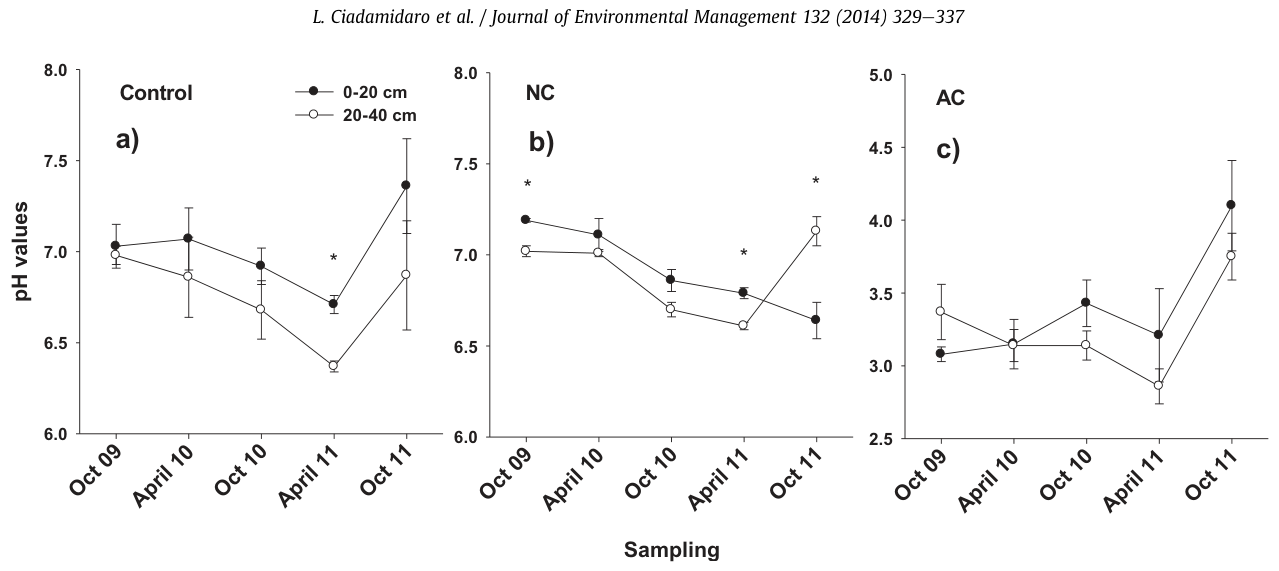
Fig. 1 shows the change in soil pH during the study. In neutral soils (Control and NC) pH values decreased in time although in Control soil an increase was recorded in the last sampling (October 2011). In the AC, a continuous increase in values of soil pH was observed in the superficial layer (0e20 cm).图1显示了研究期间土壤pH的变化。在中性土壤(对照和NC)中,pH值随时间下降,但对照土壤在最后一次采样(2011年10月)时有所升高。在AC土壤中,表层(0–20 cm)土壤pH值持续升高。
The TOC contents in all soils were below 2% (Table 1). In the first sampling, values were higher in neutral (Control and NC) than in acid soil (AC). However, in the final sampling a noticeable decrease in TOC was observed in Control soil whereas in contaminated soils (NC and AC) TOC was maintained or even increased slightly. The values in the superficial layer were higher than those of deepest layer, presumably due to litter fall. Significant differences in time were found only for TOC in Control soil at the deepest layer, may be due to the minor provision of litter for this soil that produced a strong decrease in time for this parameter.
所有土壤的TOC含量均低于2%(表1)。第一次采样时,中性土壤(对照和NC)的TOC值高于酸性土壤(AC)。然而,在最后一次采样时,对照土壤TOC明显下降,而污染土壤(NC和AC)的TOC保持不变甚至略有增加。表层TOC值高于深层,推测是凋落物输入所致。仅对照土壤深层的TOC随时间存在显著差异,这可能是由于该土壤凋落物输入较少,导致该参数随时间大幅下降。
Concentrations of the pseudototal trace elements in NC and AC were significantly higher than in Control soil (except for Mn) (Table 1). In general, values were lower at depth 20e40 cm compared to the upper layer. Values in 2011 were similar to those of 2009, especially for Cd and Zn.
NC和AC土壤中准全量微量元素浓度均显著高于对照土壤(Mn除外)(表1)。总体而言,20–40 cm深度的值低于上层。2011年的值与2009年相近,Cd和Zn尤为如此。
3.2. Available trace elements in soil3.2. 土壤有效态微量元素
Availability was evaluated for several trace elements (As, Cd, Cu, Mn, Pb and Zn), however in this work only Cd and Zn values are presented (Fig. 2).
本研究评价了多种微量元素(As、Cd、Cu、Mn、Pb和Zn)的有效性,但本文仅给出Cd和Zn的结果(图2)。
In neutral soils (Control and NC), no significant differences were found between Control and NC soils of Cd and Zn for both depths and general lower values of these elements were obtained compared to acid soil (AC) (Fig. 2). However, in the AC soil, the concentration of these two elements decreased over time. Extractable concentrations in the final samplings were just 23.5% for Cd and 17.5% for Zn of the initial concentrations. Moreover, concentrations of Cd and Zn in the deepest layer (20e40 cm) were higher than in the superficial layer (0e20 cm). This result highlights the important role that pH plays in trace element bioavailability. The most significant and negative correlations were found between pH and Cd and Zn availability (r ¼ �0.733 for Cd and r ¼ �0.677 for Zn at 0e20 cm depth and r ¼ �0.751 for Cd and r ¼ �0.696 for Zn at 20e40 cm depth; p < 0.01).
在中性土壤(对照和NC)中,两个深度的Cd和Zn在对照与NC土壤之间均无显著差异,且这些元素的值总体低于酸性土壤(AC)(图2)。然而,在AC土壤中,这两种元素的浓度随时间下降。最后一次采样时的可提取浓度仅为初始浓度的23.5%(Cd)和17.5%(Zn)。此外,深层(20–40 cm)Cd和Zn浓度高于表层(0–20 cm)。这一结果凸显了pH在微量元素生物有效性中的重要作用。pH与Cd和Zn有效性之间呈最显著的负相关(0–20 cm深度Cd的r = −0.733,Zn的r = −0.677;20–40 cm深度Cd的r = −0.751,Zn的r = −0.696;p < 0.01)。
For neutral soils (Control and NC), values of As and Pb were below the detection limit (As 0.1 mg kg�1 and Pb 0.3 mg kg�1) at both depths (data no shown). However, values above these limits were obtained for AC soil in the first samplings (Figure S2). Values of Cu (Figure S3) at both depths ranged between 0.01 and 0.06 mg kg�1 for Control, between 0.06 and 0.12 mg kg�1 for NC and between 3.50 and 26.1 mg kg�1 for AC. Values of Mn (Figure S3) at both depths ranged between 0.08 and 1.03 mg kg�1 for Control, between 0.08 and 0.72 mg kg�1 for NC and between 0 and 90 mg kg�1 for AC. In general, for these elements, available concentration tended to decrease during the experimental period.
对于中性土壤(对照和NC),两个深度的As和Pb值均低于检出限(As 0.1 mg kg−1,Pb 0.3 mg kg−1)(数据未列出)。然而,AC土壤在前几次采样中的值高于上述限值(图S2)。两个深度的Cu值(图S3)在对照中为0.01–0.06 mg kg−1,在NC中为0.06–0.12 mg kg−1,在AC中为3.50–26.1 mg kg−1。两个深度的Mn值(图S3)在对照中为0.08–1.03 mg kg−1,在NC中为0.08–0.72 mg kg−1,在AC中为0–90 mg kg−1。总体而言,这些元素的有效态浓度在试验期间呈下降趋势。
3.3. Water soluble carbon (WSC) and microbial biomass carbon (MBC)
3.3. 水溶性碳(WSC)和微生物生物量碳(MBC)
As with the TOC, the concentrations of WSC were higher in the upper than in deeper layer (Fig. 3).
与TOC一样,WSC浓度在上层高于深层(图3)。
Maximum values were found in Control and NC soils in the sampling of April 2011, especially comparing these values to those obtained in the same sampling in the previous year (April 2010). In the AC soils, the concentrations of WSC were similar at depth and stable over time. These values were lower than those found in neutral soils (Fig. 3).
对照和NC土壤的最大值出现在2011年4月的采样中,与上一年同期(2010年4月)采样所得值相比尤为明显。在AC土壤中,WSC浓度在不同深度间相近,且随时间保持稳定,其值低于中性土壤(图3)。
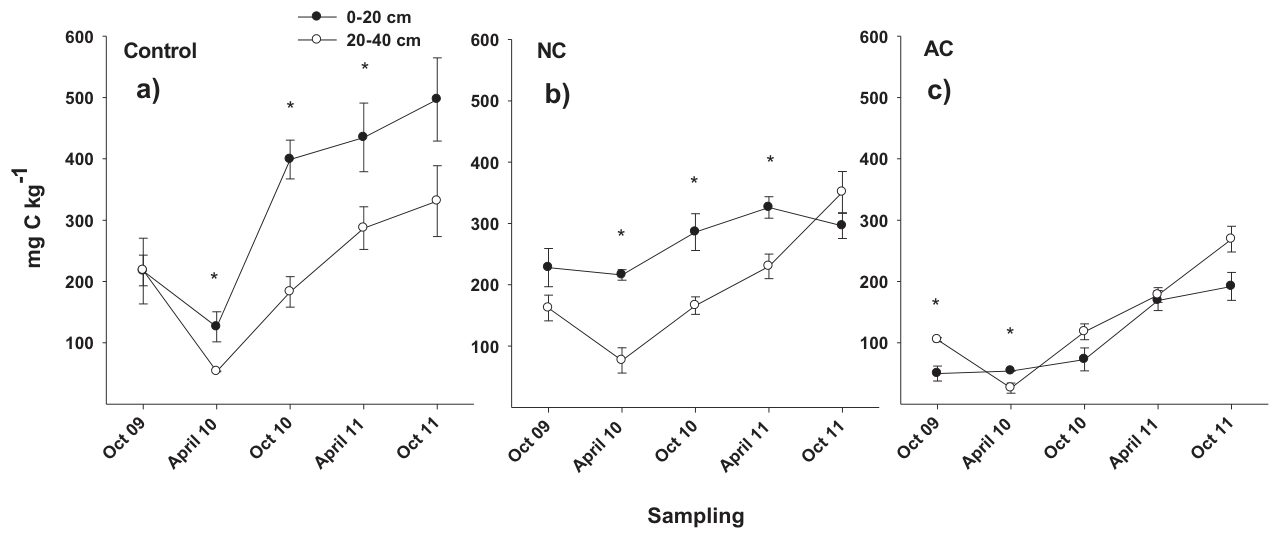
A similar increase was observed for MBC values in the three analysed soil during the study period, however, values obtained in the non-contaminated (Control) soil were higher than those found in contaminated soils (NC and AC) (Fig. 4). The largest increases occurred in the Control soil (up to 500 mg kg�1, Fig. 4), while in NC and AC soils values were not above 200 mg kg�1. In all the soils values tended to be higher in the 0e20 cm layer, especially in the control soil. The MBC was significantly and negatively correlated p < 0.01); at depth 20e40 cm only were found correlations with pH < 0.01); at depth 20e40 cm only were found correlations with pH 0.01); at depth 20e40 cm only were found correlations with pHe40 cm only were found correlations with pH40 cm only were found correlations with pH and WSC (rr = 0.562 for pH and r = 0.235 for WSC; p < 0.01 and p < 0.05, respectively).
研究期间三种土壤的MBC值均出现类似的增加,但未污染(对照)土壤的值高于污染土壤(NC和AC)(图4)。增幅最大的是对照土壤(最高达500 mg kg−1,图4),而NC和AC土壤的值不超过200 mg kg−1。在所有土壤中,0–20 cm土层的值往往较高,对照土壤尤为明显。MBC与……呈显著负相关(p < 0.01);在20–40 cm深度,仅发现其与pH和WSC存在相关性(pH的r = 0.562,WSC的r = 0.235;分别为p < 0.01和p < 0.05)。
Pseudo-total trace elements concentrations (mg kg�1) and total organic carbon (TOC %) at the beginning (October 2009) and at the end of the study (October 2011) at the three studied sites at two depths.
研究开始时(2009年10月)和结束时(2011年10月)三个研究样点两个深度的准全量微量元素浓度(mg kg−1)和总有机碳(TOC %)。
| Year年份 | Site样点 | Depth深度 | TOC | As | Ca | Cd | Cu | Fe | Mn | Pb | Zn |
|---|---|---|---|---|---|---|---|---|---|---|---|
| 2009 | Control | 0e20 | 1.5 �0.3 | 9.2 �0.5 | 27636 �3498 | 0.1 �0.02 | 26 �1.6 | 30032 �1203 | 550 �18a | 18 �0.5 | 69 �4 |
| 20e40 | 0.7 �0.1a | 9 �0.4 | 15589 �2873 | 0.2 �0.01a | 26 �2.2 | 29461 �1220 | 532 �20a | 18 �1.8 | 63 �4 | ||
| NC | 0e20 | 1.3 �0.2 | 80 �36 | 43013 �57.0 | 1.6 �0.6 | 132 �41 | 31609 �2136 | 602 �20a | 167 �72 | 476 �140 | |
| 20e40 | 0.8 �0.1 | 42 �17 | 37235 �3836 | 1.1 �0.7 | 112 �53 | 29658 �1870 | 625 �40a | 108 �49 | 327 �162 | ||
| AC | 0e20 | 1.1 �0.02 | 165 �19 | 6921 �364 | 1.2 �0.04 | 246 �12 | 44247 �978 | 557 �16 | 264 �37 | 315 �32 | |
| 20e40 | 0.8 �0.1 | 118 �14 | 6856 �733 | 1.2 �0.4 | 270 �17 | 36829 �1269 | 640 �88 | 135 �19 | 326 �54 | ||
| 2011 | Control | 0e20 | 1 �0.1 | 8.2 �0.5 | 17173 �3339 | 0.1 �0.1 | 67 �39 | 26242 �878 | 455 �20 | 49.2 �33 | 136 �77 |
| 20e40 | 0.5 �0.1 | 7.5 �0.5 | 8090 �454 | 0.02 �0.01 | 21 �2 | 25897 �809 | 411 �27 | 16.7 �6 | 52.9 �3 | ||
| NC | 0e20 | 1.5 �0.1 | 75 �4 | 44041 �317 | 1.9 �0.1 | 131 �4 | 26930 �721 | 454 �11 | 149 �6 | 501 �29 | |
| 20e40 | 1 �0.03 | 60 �5 | 38187 �1551 | 1.9 �0.2 | 152 �10 | 27347 �287 | 493 �12 | 69.5 �12 | 483 �42 | ||
| AC | 0e20 | 1.1 �0.2 | 157 �22 | 6510 �298 | 0.9 �0.2 | 226 �12 | 40242 �1937 | 465 �106 | 243 �35 | 248 �10 | |
| 20e40 | 1 �0.1 | 106 �8 | 7181 �313 | 1.4 �0.5 | 248 �31 | 36071 �1530 | 668 �85 | 101 �18 | 308 �71 |
Mean values � standard error (n = 3). a Significant differences (p < 0.05) between the same soil and depth in time.
平均值 ± 标准误(n = 3)。a 同一土壤同一深度不同时间之间存在显著差异(p < 0.05)。
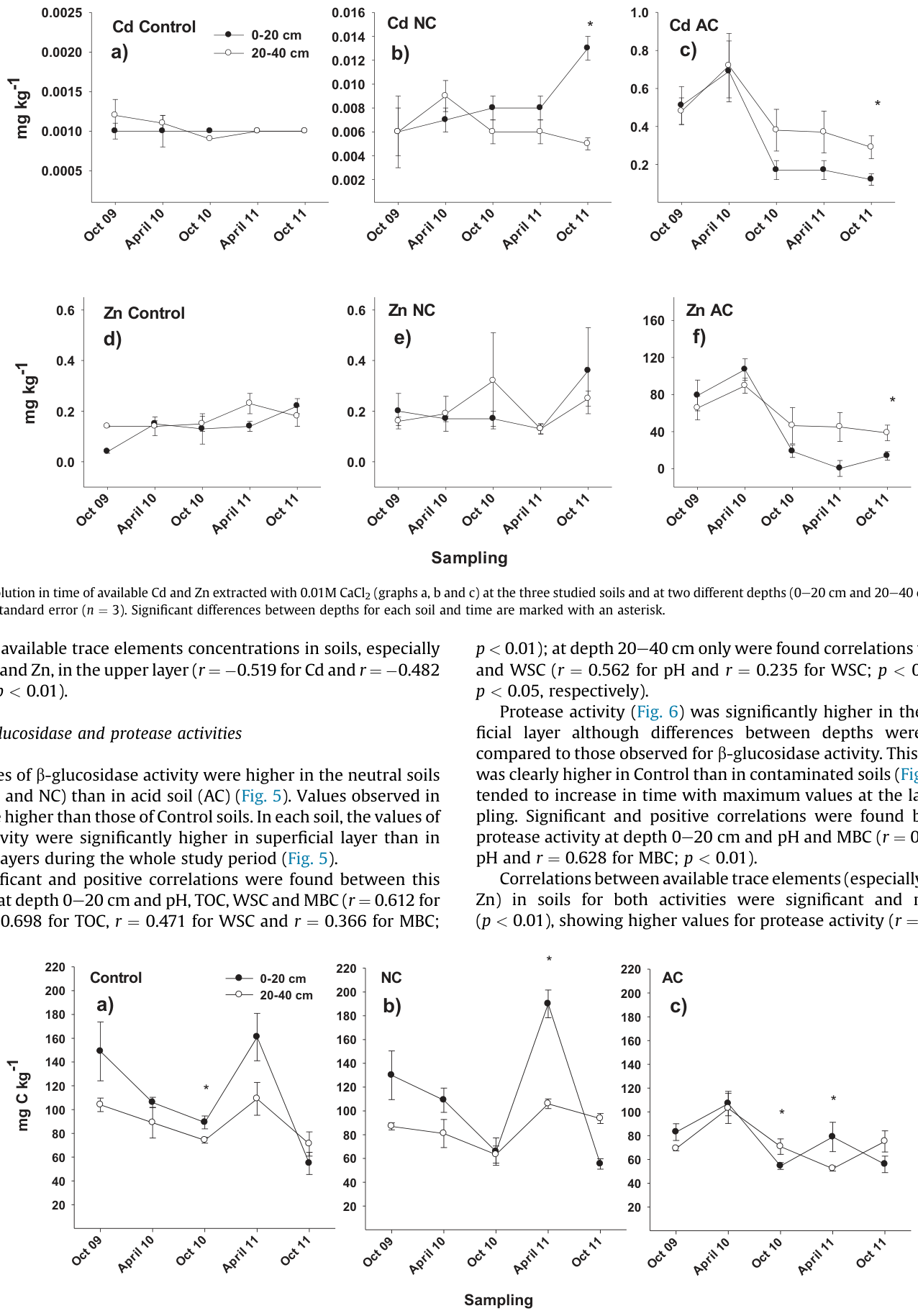
Fig. 2. Evolution in time of available Cd and Zn extracted with 0.01M CaCl2 (graphs a, b and c) at the three studied soils and at two different depths (0e20 cm and 20e2 (graphs a, b and c) at the three studied soils and at two different depths (0e20 cm and 20e (graphs a, b and c) at the three studied soils and at two different depths (0e20 cm and 20ee20 cm and 20e20 cm and 20ee40 cm). Mean values � standard error (nn = 3). Significantficantcant differences between depths for each soil and time are marked with an asterisk.图2. 三种研究土壤在两个不同深度(0–20 cm和20–40 cm)经0.01M CaCl2提取的有效态Cd和Zn随时间的变化(图a、b和c)。平均值 ± 标准误(n = 3)。星号表示各土壤在同一时间不同深度间存在显著差异。
with all available trace elements concentrations in soils, especially with Cd and Zn, in the upper layer (r ¼ �0.519 for Cd and r ¼ �0.482r ¼ �0.519 for Cd and r ¼ �0.482 ¼ �0.519 for Cd and r ¼ �0.4820.519 for Cd and r ¼ �0.482 r ¼ �0.482 ¼ �0.4820.482 for Zn; p < 0.01).
土壤中所有有效态微量元素浓度,尤其是上层的Cd和Zn(Cd的r = −0.519,Zn的r = −0.482;p < 0.01)。
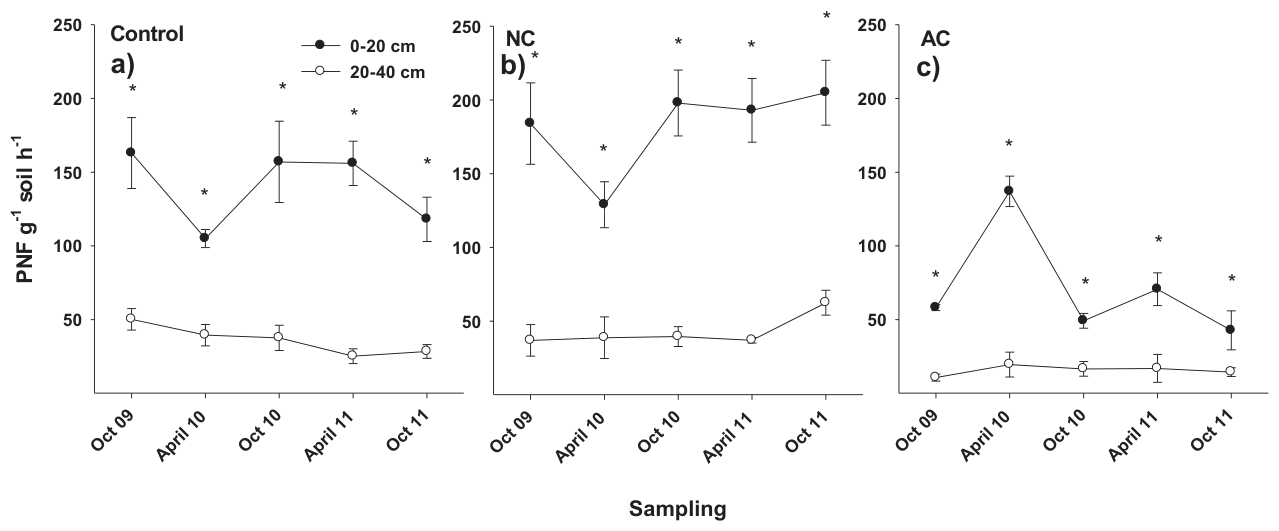
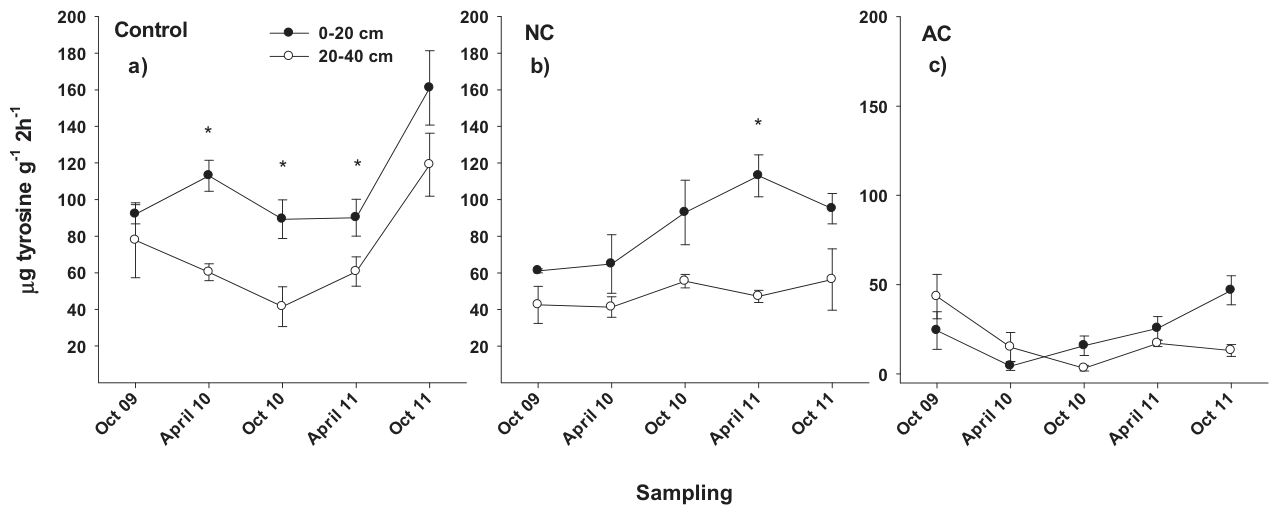
Protease activity (Fig.Fig. 6)) was significantlyficantlycantly higher in the superficialcial layer although differences between depths were lower compared to those observed for b-glucosidase activity. This activity b-glucosidase activity. This activity-glucosidase activity. This activity was clearly higher in Control than in contaminated soils (Fig. 6) and tended to increase in time with maximum values at the last sampling. Significantficantcant and positive correlations were found between protease activity at depth 0e20 cm and pH and MBC (r ¼e20 cm and pH and MBC (r ¼20 cm and pH and MBC (r ¼r ¼ ¼ 0.729 for pH and r = 0.628 for MBC; p < 0.01).
蛋白酶活性(图6)在表层显著较高,但与β-葡萄糖苷酶活性相比,不同深度间的差异较小。该活性在对照土壤中明显高于污染土壤(图6),并随时间呈增加趋势,最大值出现在最后一次采样。0–20 cm深度的蛋白酶活性与pH和MBC呈显著正相关(pH的r = 0.729,MBC的r = 0.628;p < 0.01)。
3.4. b-glucosidase and protease activities3.4. β-葡萄糖苷酶和蛋白酶活性
Values of b-glucosidase activity were higher in the neutral soils-glucosidase activity were higher in the neutral soils (Control and NC) than in acid soil (AC) (Fig.Fig. 5).). Values observed in NC were higher than those of Control soils. In each soil, the values of this activity were significantlyficantlycantly higher in superficialficialcial layer than in deeper layers during the whole study period (Fig.Fig. 5).).
中性土壤(对照和NC)的β-葡萄糖苷酶活性值高于酸性土壤(AC)(图5),且NC中的值高于对照土壤。在各土壤中,整个研究期间表层的该活性值均显著高于深层(图5)。
Correlations between available trace elements (especially Cd and Zn) in soils for both activities were significantficantcant and negative (p < 0.01), showing higher values for protease activity (rp < 0.01), showing higher values for protease activity (r < 0.01), showing higher values for protease activity (r 0.01), showing higher values for protease activity (rr ¼ �0.367
土壤中有效态微量元素(尤其是Cd和Zn)与两种酶活性之间均呈显著负相关(p < 0.01),其中蛋白酶活性的相关性更高(r = −0.367
Significant and positive correlations were found between this activity at depth 0e20 cm and pH, TOC, WSC and MBC (r ¼ 0.612 for20 cm and pH, TOC, WSC and MBC (r ¼ 0.612 forr ¼ 0.612 for ¼ 0.612 for 0.612 for pH, r = 0.698 for TOC, r = 0.471 for WSC and r = 0.366 for MBC;
0–20 cm深度的该活性与pH、TOC、WSC和MBC呈显著正相关(pH的r = 0.612,TOC的r = 0.698,WSC的r = 0.471,MBC的r = 0.366;
for Cd and r ¼ �0.326 for Zn with b-glucosidase and r ¼ �0.572 for Cd and r ¼ �0.527 for Zn with protease, at 0e20 cm depth respectively; r = �0.377 for Cd and r ¼ �0.317 for Zn with b-glucosidase and r ¼ �0.448 for Cd and r ¼ �0.422 for Zn with protease, at 20e 40 cm depth respectively; p < 0.01). The sampling season had no influence on either b-glucosidase or protease activity.
(Cd),与β-葡萄糖苷酶Zn的r = −0.326,与蛋白酶Cd的r = −0.572、Zn的r = −0.527,均为0–20 cm深度;20–40 cm深度与β-葡萄糖苷酶Cd的r = −0.377、Zn的r = −0.317,与蛋白酶Cd的r = −0.448、Zn的r = −0.422;p < 0.01)。采样季节对β-葡萄糖苷酶和蛋白酶活性均无影响。
3.5. Nutrient and trace elements in P. alba leaves3.5. P. alba叶片中的养分和微量元素
Concentrations of nutrients in leaves are shown in Table 2. In general, in the trees of the Control soil the concentrations of N, K and P in leaves were significantly higher than in leaves of contaminated soils. Values of these three elements in Control leaves were slightly lower than the proposed by Reuter and Robinson (1997) for young leaves of P. deltoides (2.2% N, 1.4% K and 0.3% P) and lower than leaves of contaminated soils used in this experiment. In contrast, the concentration of Ca, Mg and S tended to be significantly higher in contaminated soils compared to Control soils in both years. Djingova et al. (1995) reported concentrations of 1.82% of Ca and 0.42% of Mg, similar to our control leaves, and lower than in both contaminated soils (NC and AC).
叶片中的养分浓度见表2。总体而言,对照土壤中树木叶片的N、K和P浓度显著高于污染土壤中的叶片。对照叶片中这三种元素的值略低于Reuter and Robinson (1997)对P. deltoides幼叶提出的值(2.2% N、1.4% K和0.3% P),且低于本试验所用污染土壤中的叶片。相反,在两年中,污染土壤中Ca、Mg和S的浓度往往显著高于对照土壤。Djingova et al. (1995)报道的Ca和Mg浓度分别为1.82%和0.42%,与本研究对照叶片相近,低于两种污染土壤(NC和AC)。
Trace element concentrations in leaves either did not change or decreased with respect to time, except for Cd and Zn (Table 3). In general, concentrations of As, Cu, Fe Mn and Pb were similar or even greater in the Control soil than in the NC soil. For all these elements, concentrations were always within the normal range considered in plants (Table 3).
除Cd和Zn外,叶片中微量元素浓度随时间保持不变或有所下降(表3)。总体而言,对照土壤中As、Cu、Fe、Mn和Pb的浓度与NC土壤相近甚至更高。所有这些元素的浓度均始终处于植物正常范围内(表3)。
In case of Cd and Zn, concentrations were significantly higher in both contaminated soils. Concentrations of these elements in the leaves were above normal levels in plants, except for Control soil (Table 3).
Cd和Zn的浓度在两种污染土壤中均显著较高。除对照土壤外,叶片中这些元素的浓度均高于植物正常水平(表3)。
4Discussion讨论
4.1. pH and trace elements in soils4.1. 土壤pH和微量元素
The effect of plants on soil pH depends on the soil and the plant species (Pulford and Watson, 2003). Tree species influence soil acidity and exchangeable cations by several mechanisms. There are interspecific differences in the uptake of exchangeable cations and anions (Alban, 1982), nitrogen fixation and nitrification (Van Miegroet and Cole, 1984), the production of litter high in organic acid content (Ovington, 1953) and the stimulation of mineral weathering (Tice et al., 1996). Zinke (1962) found significant variation in soil pH around tree bases of Pinus contorta and Crozier and Boerner (1986) demonstrated that stem-flow influenced soil pH and ex-changeable calcium around trees.
植物对土壤pH的影响取决于土壤和植物种类(Pulford and Watson, 2003)。树种通过多种机制影响土壤酸度和交换性阳离子,包括对交换性阳离子和阴离子吸收的种间差异(Alban, 1982)、固氮和硝化作用(Van Miegroet and Cole, 1984)、产生富含有机酸的凋落物(Ovington, 1953)以及促进矿物风化(Tice et al., 1996)。Zinke (1962)发现Pinus contorta树干基部周围土壤pH存在显著变异,Crozier and Boerner (1986)则证明树干茎流影响了树木周围土壤的pH和交换性钙。
In this study, we only found a pH decrease in case of neutral contaminated soils in the superficial layer (Fig. 1). This result may be related to the acidification process due to the litter “carpet” with a pH more acid than the soil (Table S1). Moreover, the high concentrations of Cd and Zn in the litter (Table S1) may retard its decomposition which could result in a decreased pH (Mertens et al., 2007). In a previous study (Madejón et al., 2012), similar results were obtained in a microcosm experiment using the same soils. In this case, the moderately acidic nature of the litter minimized the alkalinizing effect in soils.
本研究仅在中性污染土壤表层发现pH下降(图1)。这一结果可能与pH比土壤更酸的凋落物“地毯”所引起的酸化过程有关(表S1)。此外,凋落物中高浓度的Cd和Zn(表S1)可能延缓其分解,从而导致pH下降(Mertens et al., 2007)。在先前的研究中(Madejón et al., 2012),采用相同土壤进行的微宇宙试验获得了类似结果。在该研究中,凋落物的中等酸性抵消了其对土壤的碱化效应。
However, in the acid contaminated soil, values tended to increase. The same result was obtained in semi-field experiment by Ciadamidaro et al. (2013), in which poplar growth increased soil pH values of the same acid soil. This may be due to the action of the root exudates that can form soluble complexes, for e.g. with Al3þ, reducing the acidity of the medium (Shi et al., 2011) or the adjacent rhizosphere soil may become more alkaline (Nye, 1981), mainly because of H+ consumption and/or OH� exudation (Jones et al., 2004; Nye,1981). In this case, the value of the litter was higher than that of the soil there may raise soil pH (Table S1).
然而,在酸性污染土壤中,pH值呈上升趋势。Ciadamidaro et al. (2013)在半田间试验中获得了相同结果,杨树的生长提高了同一酸性土壤的pH值。这可能是由于根系分泌物能够形成可溶性络合物(例如与Al3+),从而降低介质酸度(Shi et al., 2011),或者邻近的根际土壤可能变得更偏碱性(Nye, 1981),这主要源于H+的消耗和/或OH−的分泌(Jones et al., 2004; Nye,1981)。在此情况下,凋落物的pH值高于土壤,可能使土壤pH升高(表S1)。
Despite the presence of this litter rich in trace elements in the contaminated soils, the pseudototal trace element concentrations of the soil at depths <40 cm did not increase during the experimental period (Table 1). Furthermore, a stabilization or general reduction of extractable Cd and Zn was observed in contaminated soils (Fig. 3). Likewise, a significant decrease occurred in the AC soil, related with the increase on soil pH.
尽管污染土壤中存在这种富含微量元素的凋落物,但试验期间<40 cm深度土壤的准全量微量元素浓度并未增加(表1)。此外,污染土壤中可提取态Cd和Zn趋于稳定或总体下降(图3)。同样,AC土壤中出现了显著下降,这与土壤pH的升高有关。
The concentrations of Cd and Zn in NC soil during the study were affected by the pH. Although in this soil values of Cd and Zn in the litter were higher than in Control soil, values of these two elements extracted with CaCl2 were not significant higher than those obtained in Control soil. Madejón et al. (2012) demonstrated that, although the time-related decomposition of litter could lead to an increase of trace element bioavailability, after 40 weeks of incubation, no increase in trace element concentration with time were found in any of the contaminated soils. It is well known that an increase in soil pH reduces metal availability through precipitation reactions and by increasing adsorption by variable charge colloids (Selin and Amacher, 1997).
研究期间NC土壤中Cd和Zn的浓度受pH影响。尽管该土壤凋落物中Cd和Zn的值高于对照土壤,但CaCl2提取的这两种元素值并未显著高于对照土壤。Madejón et al. (2012)证明,尽管凋落物随时间的分解可能导致微量元素生物有效性增加,但经过40周培养后,在所有污染土壤中均未发现微量元素浓度随时间增加。众所周知,土壤pH升高可通过沉淀反应以及增强可变电荷胶体的吸附作用降低金属有效性(Selin and Amacher, 1997)。
In general, differences in trace element concentrations between the two depths were not observed; therefore it seems that there were negligible lixiviation process during the experimentation period, except in the last sampling of the AC soil. Here, the values of these elements at 20e40 cm were lower than in previous samplings but still significantly higher than at the superficial layer (Fig. 2). Nevertheless, continual monitoring is advisable to ensure that the enrichment of the deepest layer does not pose a risk to groundwater, which is crucial for the sustainability of both natural and agricultural systems in the Mediterranean area (Burgos et al., 2013).
总体而言,未观察到两个深度间微量元素浓度的差异,因此除AC土壤最后一次采样外,试验期间的淋溶过程似乎可以忽略。在该次采样中,20–40 cm处这些元素的值低于以往各次采样,但仍显著高于表层(图2)。尽管如此,仍建议持续监测,以确保深层土壤的富集不会对地下水构成风险,而地下水对地中海地区自然和农业系统的可持续性至关重要(Burgos et al., 2013)。
4.2. Soil quality4.2. 土壤质量
In forest ecosystems, litter fall is the main source of organic matter and nutrients for the humus layer (Kuzyakov and Domanski, 2000). Low decomposition, resulting from acidic conditions, limited supply of essential nutrients and the presence of organic or inorganic pollutants, can lead to an accumulation of organic matter in soil and to immobilization of essential nutrients (Swift et al., 1979).
在森林生态系统中,凋落物是腐殖质层有机质和养分的主要来源(Kuzyakov and Domanski, 2000)。由酸性条件、必需养分供应有限以及有机或无机污染物的存在所导致的分解缓慢,可引起土壤有机质积累和必需养分的固定(Swift et al., 1979)。
Nutrients concentrations (g 100 g�1) in leaves at two consecutive years (October 2010e2011) at the three studied sites.
三个研究样点连续两年(2010–2011年10月)叶片中的养分浓度(g 100 g−1)。
| Leaves叶片 | Year年份 | N | Ca | K | Mg | P | S |
|---|---|---|---|---|---|---|---|
| Control | 2010 | 2 �0.1 b | 1.7 �0.3 a | 1 �0.1 b | 0.3 �0.04 a | 0.2 �0.01 b | 0.2 �0.01 a |
| NC | 1.3 �0.03 a | 3.7 �0.4 b | 0.8 �0.1 b | 0.5 �0.1 b | 0.2 �0.03 b | 0.3 �0.02 a | |
| AC | 1.5 �0.1 a | 3.2 �0.2 b | 0.5 �0.04 a | 0.7 �0.02 c | 0.1 �0.01 a | 0.6 �0.1 b | |
| Control | 2011 | 1.8 �0.02 a | 2 �0.2 a | 0.7 �0.1 a | 0.3 �0.02 a | 0.2 �0.02 b | 0.2 �0.01 a |
| NC | 1.3 �0.1 b | 2.7 �0.2 a | 0.7 �0.1 a | 0.4 �0.02 b | 0.2 �0.01 ab | 0.3 �0.01 a | |
| AC | 1.4 �0.2 ab | 2.7 �0.2 a | 0.6 �0.1 a | 0.5 �0.04 c | 0.1 �0.01 a | 0.5 �0.1 b |
Mean values � standard error (n = 3). In each column, values with the same letter do not differ significantly by one way ANOVA (p < 0.05).
平均值 ± 标准误(n = 3)。同列中标有相同字母的值经单因素ANOVA检验无显著差异(p < 0.05)。
Trace elements concentrations (mg kg�1) in leaves at two consecutive years (October 2010e2011) at the three studied sites.
三个研究样点连续两年(2010–2011年10月)叶片中的微量元素浓度(mg kg−1)。
| Leaves叶片 | Year年份 | As | Cd | Cu | Fe | Mn | Pb | Zn |
|---|---|---|---|---|---|---|---|---|
| Control | 2010 | 0.7 �0.1 a | 0.2 �0.02 a | 8.3 �0.3 a | 203 �50 a | 48 �14 a | 0.7 �0.2 a | 78.6 �5 a |
| NC | 0.7 �0.2 a | 3.1 �0.3 b | 7.5 �0.3 a | 170 �25 a | 56 �12 a | 0.3 �0.1 a | 283�39 a | |
| AC | 1 �0.1 a | 5.5 �0.5 c | 8.8 �1.2 a | 218 �15 a | 204 �35 b | 1.2 �0.1 b | 860�111 b | |
| Control | 2011 | 0.3 �0.04 a | 0.5 �0.2 a | 11 �0.7 b | 205 �14 b | 43 �3 a | 0.9 �0.1 b | 97 �16 a |
| NC | 0.1 �0.03 a | 3.7 �0.6 b | 8.4 �0.5 a | 119 �9 a | 48 �5 a | 0.5 �0.1 a | 301�48 a | |
| AC | 0.5 �0.1 b | 3.8 �0.6 b | 9.2 �0.6 ab | 195 �16 b | 138 �23 b | 1.1 �0.1 b | 603�106 b | |
| Normal | 1.0e1.7 | 0.05e0.2 | 5e30 | 2e250 | 30e300 | 5e10 | 27e150 |
Mean values � standard error (n = 3). Normal values (range) for trace elements in plants, according to Kabata-Pendias and Pendias (1992), and for Fe according to Bowen (1979). In each column, values with the same letter do not differ significantly by one way ANOVA (p < 0.05).
平均值 ± 标准误(n = 3)。植物中微量元素的正常值(范围)依据Kabata-Pendias and Pendias (1992),Fe依据Bowen (1979)。同列中标有相同字母的值经单因素ANOVA检验无显著差异(p < 0.05)。
In the contaminated soils (NC and AC) the addition of organic matter through the litter fall resulted in the maintenance or increase of organic matter in these soils during the 2 years of the study. It is well known that maintenance of OM levels in Mediterranean soils is important for adequate water holding capacity. Madejón et al. (2012) obtained similar results in microcosm experiments. Several authors (Tyler et al., 1989; Gadd, 1993) demonstrated that organic matter sustains microbial growth and immobilizes trace elements.
在污染土壤(NC和AC)中,通过凋落物输入的有机质使这些土壤在2年研究期间的有机质得以维持或增加。众所周知,维持地中海土壤的有机质水平对于保持适当的持水能力十分重要。Madejón et al. (2012)在微宇宙试验中获得了类似结果。多位作者(Tyler et al., 1989; Gadd, 1993)证明,有机质可维持微生物生长并固定微量元素。
Water-soluble organic carbon (WSC) is the most mobile and reactive soil carbon source which modulates a number of physical, chemical and biological processes (Marschner and Kalbitz, 2003; Halvorson and Gonzalez, 2008). The decrease of WSC in the soils during the first year may be due to the consumption of labile C by the microorganisms and the mineralization process, especially in April 2010 due to the lixiviation process after an intense period of precipitation (Figure S1). The increase in April 2011 could be related with the lower precipitation occurred in the previous autumnewinter period that probably tended to maintain the WSC coming from the decomposition of organic matter. Alternatively, the lower WSC content in AC soil might be related to the low pH and with the retard of litter decomposition. Several authors state that many environmental factors affect WSC in soils, including ecosystem acidification (Shamrikova et al., 2006; Karavanova et al., 2007), litter quality as influenced by forest composition (Shamrikova et al., 2006; Ohno et al., 2007) and soil temperature (Tao and Lin, 2000).
水溶性有机碳(WSC)是土壤中最具移动性和反应性的碳源,调控着多种物理、化学和生物过程(Marschner and Kalbitz, 2003; Halvorson and Gonzalez, 2008)。第一年土壤中WSC的下降可能源于微生物对活性C的消耗和矿化过程,尤其是2010年4月,这是由于经历强降水期后发生了淋溶过程(图S1)。2011年4月的增加可能与此前秋冬季降水较少有关,这可能有利于保持来自有机质分解的WSC。此外,AC土壤中较低的WSC含量可能与低pH及凋落物分解延缓有关。多位作者指出,许多环境因素会影响土壤WSC,包括生态系统酸化(Shamrikova et al., 2006; Karavanova et al., 2007)、受森林组成影响的凋落物质量(Shamrikova et al., 2006; Ohno et al., 2007)以及土壤温度(Tao and Lin, 2000)。
Microbial biomass is one of the most sensitive indicators of soil changes (Perucci, 1993). The effect of contamination was more evident for this parameter than for the others (Fig. 4). The general increase in time of this value in all soils may be linked with the organic matter through the presence of extra C from plant root exudates and from litter decomposition, especially in the superficial soil layer. The plants may have contributed to the activation of the biochemical and microbial functionality of the Control and the polluted soils (Hernández-Allica et al., 2006).
微生物生物量是土壤变化最敏感的指标之一(Perucci, 1993)。污染对该参数的影响比其他参数更为明显(图4)。所有土壤中该值随时间的普遍增加,可能与植物根系分泌物和凋落物分解提供的额外C所带来的有机质有关,在表层土壤中尤为如此。植物可能促进了对照土壤和污染土壤生物化学及微生物功能的激活(Hernández-Allica et al., 2006)。
In a microcosm experiment using the same soils, Madejón et al. (2012) observed that litter addition promoted the growth of microorganism and increased WSC and MBC content in soils. Otherwise, Madejón et al. (2012)demonstrated that WSC and MBC were affected by soil conditions and positively correlated with soil pH.
在采用相同土壤进行的微宇宙试验中,Madejón et al. (2012)观察到添加凋落物促进了微生物生长,并提高了土壤WSC和MBC含量。另外,Madejón et al. (2012)证明WSC和MBC受土壤条件影响,并与土壤pH呈正相关。
b-glucosidase activity was less sensitive to trace element contamination (Fig. 5) than MBC. This activity, involved in the C cycle, is more likely to be influenced by the amount of WSC and TOC rather than the degree of contamination. This hypothesis is supported by the strong positive correlations between b-glucosidase activity and WSC and TOC and by the higher b-glucosidase activity found in the upper layer soils. This would explain why the NC soil had a higher b-glucosidase activity compared to the Control. The behaviour of b-glucosidase activity is consistent with the results obtained by Madejón et al. (2012). In this study, in fact, the nature of organic input was the major cause of increase of b-glucosidase activity lesser affected by soil contamination. This hypothesis does not account for AC soil because of its acidity, since soil pH is crucial for enzymatic survival and functioning (Acosta-Martínez and Tabatabai, 2000). In the AC soil, b-glucosidase activity was significantly lower than in the other soils, demonstrating the effects of soil pH on this parameter: there was a significant positive correlation between pH and b-glucosidase activity. Furthermore, differences in microbial activity between the two depths may due to the litter that was in contact with the upper soil layer and the differences in the composition of microbiota.
β-葡萄糖苷酶活性对微量元素污染的敏感性低于MBC(图5)。该活性参与C循环,更可能受WSC和TOC含量而非污染程度的影响。β-葡萄糖苷酶活性与WSC和TOC之间的强正相关以及上层土壤中较高的β-葡萄糖苷酶活性支持了这一假设,这也解释了NC土壤的β-葡萄糖苷酶活性为何高于对照。β-葡萄糖苷酶活性的变化与Madejón et al. (2012)的结果一致。事实上,在该研究中,有机输入的性质是β-葡萄糖苷酶活性增加的主要原因,而土壤污染的影响较小。由于AC土壤呈酸性,这一假设并不适用于该土壤,因为土壤pH对酶的存活和功能至关重要(Acosta-Martínez and Tabatabai, 2000)。AC土壤中β-葡萄糖苷酶活性显著低于其他土壤,表明了土壤pH对该参数的影响:pH与β-葡萄糖苷酶活性之间存在显著正相关。此外,两个深度间微生物活性的差异可能源于与上层土壤接触的凋落物以及微生物群落组成的差异。
In general, for all soils and different depths the values of protease increased with time (Fig. 6). This demonstrates the positive effect of P. alba on soil quality. The protease activity may be stimulated in soil by the plant presence via litter fall and root exudates (Madejón et al., 2009). As with b-glucosidase, trees would be expected to introduce organic C and microorganisms into the soil by litter, resulting in a large difference in enzymatic activity between the upper and the deepest soil layers. Moreover, the organic matter added through litter addition increased pH that might be responsible for the final increase of protease activity, especially in acid contaminated soil (AC). The provision of organic matter in form of litter caused an important increase in MBC and consequently an increase in this activity. The significant and positive correlation coefficient between protease activity and MBC supports this hypothesis. Likewise, the highest values of protease activity was found for uncontaminated soil (Control), proving that soil pH was not the only interacting parameter but also trace element concentrations could influence this enzymatic activity. Therefore, in this study, protease activity was sensitive to the trace element toxicity and high negative correlations with Cd and Zn confirm the adverse effects provoked on this parameter.
总体而言,所有土壤不同深度的蛋白酶值均随时间增加(图6),这表明P. alba对土壤质量具有积极作用。植物的存在可通过凋落物和根系分泌物刺激土壤蛋白酶活性(Madejón et al., 2009)。与β-葡萄糖苷酶一样,树木预计会通过凋落物向土壤中引入有机C和微生物,从而导致上层与最深层土壤之间酶活性存在较大差异。此外,凋落物输入的有机质提高了pH,这可能是最终蛋白酶活性增加的原因,在酸性污染土壤(AC)中尤为明显。以凋落物形式提供的有机质使MBC大幅增加,进而提高了该酶活性。蛋白酶活性与MBC之间显著的正相关系数支持了这一假设。同样,蛋白酶活性的最高值出现在未污染土壤(对照)中,证明土壤pH并非唯一的相互作用参数,微量元素浓度也可能影响该酶活性。因此,在本研究中,蛋白酶活性对微量元素毒性敏感,其与Cd和Zn之间较高的负相关证实了污染对该参数的不利影响。
4.3. Nutrients and trace elements in P. alba leaves4.3. P. alba叶片中的养分和微量元素
When plants are used to stabilize contaminants and improve soil quality, it is important to monitor the nutritional levels in these plants to determine their health status. The nutrients in leaves affected by the soil contamination were N, P and K only in 2010, showing lower values than in Control soil. These results indicate that trace elements interfere with the uptake processes, possibly because of the competitive interaction that may be taking place at the root level (Madejón et al., 2004; Domínguez et al., 2009) or the interference with the mechanisms of absorption of the essential nutrients for the plant, altering its nutritional balance (Kabata- Pendias and Pendias, 1992).
当利用植物稳定污染物并改善土壤质量时,监测这些植物的营养水平以确定其健康状况十分重要。受土壤污染影响的叶片养分为N、P和K,且仅见于2010年,其值低于对照土壤。这些结果表明,微量元素干扰了吸收过程,这可能是由于根部可能发生的竞争性相互作用(Madejón et al., 2004; Domínguez et al., 2009),或者干扰了植物对必需养分的吸收机制,从而改变了其营养平衡(Kabata- Pendias and Pendias, 1992)。
In contrast, higher concentrations of Ca, Mg and S in contaminated soils were found (Table 2). Higher foliar Ca concentrations could be related to the protective role of this element against trace elements toxicity (Carbonell et al., 1998). The higher Mg concentrations in AC soils were directly correlated with soil pH. Moreover S values were also correlated to the higher concentration of this nutrient in the contaminated soil, due to the sludge that contaminated the soils was from the pyrite extraction.
相反,污染土壤中Ca、Mg和S的浓度较高(表2)。叶片Ca浓度较高可能与该元素对微量元素毒性的保护作用有关(Carbonell et al., 1998)。AC土壤中较高的Mg浓度与土壤pH直接相关。此外,S值也与污染土壤中该养分浓度较高有关,因为污染土壤的尾矿泥来自黄铁矿开采。
For all the trace elements studied, the concentrations were at or under the normal values established reported for plants, except for Cd and Zn. The highest concentrations of trace elements were found in contaminated soils (NC and AC) compared to the Control soil, especially for Zn and in the AC trees. These data confirm that soil pH is one of the most important parameters explaining nutrient variability in the leaves of trees. Basta et al. (2005) showed that even small changes in soil pH could result in large changes in trace element phytoavailability. The highest differences due pH were found in case of Mn and Zn, being both elements known for their highly dependence to pH and to be easily taken up by plants when they occurs in soil (Kabata-Pendias, 2001). Moreover Domínguez et al. (2009) proved with their study that the bioavailability of the cationic trace elements in the Guadiamar area (same study area) is primary determined by soil pH.
除Cd和Zn外,所研究的所有微量元素浓度均处于或低于已报道的植物正常值。与对照土壤相比,污染土壤(NC和AC)中微量元素浓度最高,Zn以及AC土壤中的树木尤为明显。这些数据证实,土壤pH是解释树木叶片养分变异最重要的参数之一。Basta et al. (2005)表明,即使土壤pH的微小变化也可能导致微量元素植物有效性的大幅变化。pH引起的差异最大的是Mn和Zn,已知这两种元素对pH高度依赖,且当其存在于土壤中时易被植物吸收(Kabata-Pendias, 2001)。此外,Domínguez et al. (2009)的研究证明,瓜迪亚马尔地区(同一研究区)阳离子型微量元素的生物有效性主要由土壤pH决定。
The acidity of the AC soil could be attenuated by litter presence and this factor influenced the bioavailability of trace elements for plant uptake in the last sampling (Table 3). The rhizosphere enriched with biomolecules of plant and microbial origins that include organic acids, sugars, amino acids, proteins, carbohydrates and other substances could also influence trace element availability (Chang et al., 2002).
AC土壤的酸度可因凋落物的存在而得到缓解,这一因素影响了最后一次采样中微量元素对植物吸收的生物有效性(表3)。富含植物和微生物来源生物分子(包括有机酸、糖类、氨基酸、蛋白质、碳水化合物及其他物质)的根际也可能影响微量元素的有效性(Chang et al., 2002)。
5Conclusions结论
Despite some researches stating that P. alba is not advisable for phytostabilization, due to the accumulation of high concentrations of Cd and Zn in its leaves that might cause a risk of soil contamination because of autumn litter, our study showed that pseudototal concentrations remained similar over time and the bioavailavility of Cd and Zn decreased.
尽管一些研究认为,由于P. alba叶片中积累高浓度的Cd和Zn,秋季落叶可能带来土壤污染风险,因而不宜用于植物稳定,但本研究表明,准全量浓度随时间保持相近,且Cd和Zn的生物有效性有所下降。
The chemical and biochemical properties of soil were not negatively affected by litter contamination in NC soils and were improved in AC soil. Natural processes appear to be enhanced by the addition of organic matter content coming from the litter that influence soil pH. Soil pH was the most important factor affecting the soil contamination and quality. All these factors may make white poplar suitable in biomonitoring and in maintaining the stability of riparian zones.
在NC土壤中,土壤化学和生物化学性质未受到凋落物污染的负面影响,而在AC土壤中则有所改善。来自凋落物的有机质输入影响了土壤pH,似乎增强了自然过程。土壤pH是影响土壤污染和土壤质量的最重要因素。所有这些因素可能使银白杨适用于生物监测和维持河岸带的稳定。
The use of P. alba for phytomanagement in the study area may increase the risk of Cd and Zn entering the food chain. For this reason, even if our results confirm that P. alba is recognized to improve soil quality, further long-term analysis are required in this area to establish potential risk due to the accumulation of trace element concentrations in the topsoil due to litter fall.
在研究区利用P. alba进行植物管理可能增加Cd和Zn进入食物链的风险。因此,即使本研究结果证实P. alba可改善土壤质量,仍需在该区域开展进一步的长期分析,以确定因凋落物导致表土中微量元素积累所带来的潜在风险。
Acknowledgements致谢
AGL2008-00985 supported by the CICYT of the Ministerio de Ciencia e Innovación of Spain and FEDER (EU). L. Ciadamidaro thanks to CSIC for funding her grant (JAE-PreDoc).
本研究由西班牙科学与创新部(Ministerio de Ciencia e Innovación)CICYT和FEDER(欧盟)资助的AGL2008-00985项目支持。L. Ciadamidaro感谢CSIC为其提供奖学金资助(JAE-PreDoc)。
Appendix A. Supplementary data附录A. 补充数据
Supplementary data related to this article can be found at http:// dx.doi.org/10.1016/j.jenvman.2013.11.010.
本文的补充数据可在http:// dx.doi.org/10.1016/j.jenvman.2013.11.010获取。
References参考文献
Acosta-Martínez, V., Tabatabai, M.A., 2000. Enzyme activities in a limed agricultural soil. Biol. Fert. Soils 31, 85e91.
Alban, D.H., 1982. Effects of nutrient accumulation by aspen, spruce, and pine on soil properties. Soil Sci. Soc. Am. J 46, 853e861.
Basta, N.T., Ryan, J.A., Chaney, R.L., 2005. Trace element chemistry in residual treated soil: key concepts and metal bioavailability. Environ. Qual. 34, 49e63. Baum, C., Leinweber, P., Lamersdorf, N., Dimitriou, I., 2009. Effects of short rotation coppice with willows and poplar on soil ecology. LBF 3, 183e196. Bowen, H.J.M., 1979. Environmental Chemistry of the Elements. Academic Press, London.
Burgos, P., Madejón, P., Madejón, E., Girón, I., Cabrera, F., Murillo, J.M., 2013. Natural remediation of an unremediated soil twelve years after a mine accident: trace element mobility and plant composition. J. Environ. Manage. 114, 36e45. Carbonell, A.A., Aarabi, M.A., DeLaune, R.P., Grambell, R.P., Patrick, W.H., 1998. Arsenic in wetland vegetation: availability, phytotoxicity, uptake and effects on plant growth and nutrition. Sci. Total Environ. 217, 189e199.
Chang, A.C., Page, A.L., Koo, B.J., 2002. Biogeochemistry of phosphorus, iron, and trace elements in soils as influenced by soil-plant-microbial interactions. Dev. Soil Sci. 28, 43e57. Ciadamidaro, L., Madejón, P., Puschenreiter, M., Madejón, E., 2013. Growth of Populus alba and its influence on soil trace element availability. Sci. Total Environ. 454e455, 337e347. Crozier, C.R., Boerner, R.E.J., 1986. Stemflow induced soil heterogeneity in a mixed mesophytic forest. Bartonia 52, 1e8. Dickinson, N.M., 2000. Strategies for sustainable woodland on contaminated soils. Chemosphere 41, 259e263. Djingova, R., Wagner, G., Peshev, D., 1995. Heavy metal distribution in Bulgaria using Populus nigra “Italica” as a biomonitor. Sci. Total Environ. 172, 151e158.
Domínguez, M.T., Marañon, T., Murillo, J.M., Schulin, R., Robinson, B.H., 2008. Trace element accumulation in woody plants of the Guadiamar valley, SW Spain: a large scale phytomanagement case study. Environ. Pollut. 152, 50e59.
Domínguez, M.T., Madrid, F., Marañon, T., Murillo, J.M., 2009. Cadmium availability in soil and retention in oak roots: potential for phytostabilization. Chemosphere 76, 480e486. Gadd, G.M., 1993. Interactions of fungi with toxic metals. New Phytol. 124, 25e60. Transley, Review 47. pp. 25e60. Gregorich, E.G., Wen, G., Voroney, R.P., Kachanoski, R.G., 1990. Calibration of rapid direct chloroform extraction method for measuring soil microbial biomass C. Soil Biol. Biochem. 22, 1009e1011. Halvorson, J.J., Gonzalez, J.M., 2008. Tannic acid reduces recovery of water-soluble carbon and nitrogen from soil and affects the composition of Bradfordreactive soil protein. Soil Biol. Biochem. 40, 186e197.
Hartley, W., Riby, P., Dickinson, N.M., Shutes, B., Sparke, S., Scholz, M., 2011. Planting woody crops on dredged contaminated sediment provides both positive and negative effects in terms of remediation. Environ. Pollut. 159, 3416e3424. Hernández-Allica, J., Becerril, J.M., Zárate, O., Garbisu, C., 2006. Assessment of the efficiency of a metal phytoextraction process with biological indicators of soil health. Plant Soil 281, 147e158.
Hesse, P.R., 1971. A Textbook of Soil Chemical Analysis. John Murray, London.
Houba, V.J., Lexmond, Th.M., Novozamsky, I., Van der Lee, J.J., 1996. The state of the art and future developments in soil analysis for bioavailability assessment. Sci. Total Environ. 178, 21e28.
ISO, 1995. Soil Quality. Extraction of Trace Elements Soluble in Aqua Regia. International Organization for Standardization. ISO 11466:1995. Kabata-Pendias, A., 2001. Trace Elements in Soils and Plants, third ed. CRC Press, Boca Raton, p. 315.
Kabata-Pendias, A., Pendias, H., 1992. Trace Elements in Soils and Plants. CRC Press, Boca Raton, Florida, USA, p. 365.
Karavanova, E.I., Belyanina, L.A., Stepanov, A.A., 2007. Water-soluble organic matter and soil solution acidity in the mainsoil types of the central forest state biosphere reserve. Eurasian Soil Sci. 40, 493e504.
Kuzyakov, Y., Domanski, G., 2000. Carbon input by plants into the soil. Review. J. Plant Nutrit. Soil Sci. 163, 421e431.
Ladd, J.N., Butler, J.H.A., 1972. Short-term assays of soil proteolytic enzyme activities using proteins and dipeptide derivates as substrates. Soil Biol. Biochem. 4, 19e30.
Lepp, N.W., Madejón, P., 2007. Cadmium and Zinc in vegetation and litter of a voluntary woodland that has developed on contaminated sediment-derived soil. J. Environ. Qual. 36, 1123e1131.
Madejón, P., Marañon, T., Murillo, J.M., Robinson, B., 2004. White poplar (Populus alba) as a biomonitor of trace elements in contaminated riparian forests. Environ. Pollut. 132, 145e155.
Madejón, P., Burgos, P., Cabrera, F., Madejón, E., 2009. Phytostabilization on amended soils polluted with trace elements using the mediterranean shrub: Rosmarinus officinalis. Intern. J. Phytor. 11, 542e557.
Madejón, P., Soler-Rovira, P., Ciadamidaro, L., Cabrera, F., Madejón, E., 2012. Trace element-rich litter in soils: influence on biochemical properties related to the carbon cycle. J. Soils Sedim 12, 663e673.
Marschner, B., Kalbitz, K., 2003. Controls of bioavailability and biodegradability of dissolved organic matters in soils. Geoderma 113, 211e235.
Mertens, J., Van Nevel, L., De Schrijver, A., Piesschaert, F., Osterbaan, A., Tack, F.M.G., Verheyen, K., 2007. Tree species effect on the redistibution of soil metals. Environ. Pollut. 149, 173e181.
Nye, P.H., 1981. Changes of pH across the rhizosphere induced by roots. Plant Soil 61, 7e26.
Ohno, T., Fernandez, I.J., Hiradate, S., Shermann, J.F., 2007. Effects of soil acidification and forest typeonwatersolublesoilorganic matterproperties. Geoderma140,176e187.
Ovington, J.D., 1953. Studies of the development of wood- land conditions under different trees. I. Soil pH. J. Ecol. 41, 13e52.
Perucci, P., 1993. Enzyme activity and microbial biomass in a field soil amended with municipal refuse. Biol. Fertil. Soils 14, 125e137.
Pulford, I.D., Watson, C., 2003. Phytoremediation of heavy metal-contaminated land by trees e a review. Environ. Int. 29, 529e540.
Punshon, T., Dickinson, N.M., 1997. Acclimation of Salix to metal stress. New Phytol. 137, 303e314.
Reuter, D.J., Robinson, J.B., 1997. Plant Analysis. An Interpretation Manual. CSIRO Publishing, Colling-wood, Australia, p. 572.
Robinson, B., Fernández, J.-E., Madejón, P., Marañón, T., Murillo, J.M., Green, S., Clothier, B., 2003. Phytoextraction: an assessment of biogeochemical and economic viability. Plant Soil 249, 117e125.
Robinson, B., Mills, T., Green, S., Chancerel, B., Clothier, B., Fung, L., Hurst, S., McIvor, I., 2005. Trace element accumulation by poplars and willows used for stock fodder. New Zeal. J. Agr. Res. 48, 489e497.
Scheid, S., Günthardt-Goerg, M.S., Schulin, R., Nowack, B., 2009. Accumulation and solubility of metals during leaf litter decomposition in non-polluted and polluted soil. Eur. J. Soil Sci. 60, 613e621.
Selin, H.M., Amacher, M.C., 1997. Reactivity and Transport of Heavy Metals in Soils. CRC, Lewis, Boca Raton, Flo, p. 201.
Shamrikova, E.V., Ryazanov, M.A., Vanchikova, E.V., 2006. Acidebase properties of water-soluble organic matter of forest soils, studied by the pK-spectroscopy method. Chemosphere 65, 1426e1431.
Shi, S., Richardson, A.E., O’Callaghan, M., Deangelis, K.M., Jones, E.E., Stewart, A., Firestone, M.K., Condron, L.M., 2011. Effects of selected root
exudate components on soil bacterial communities. FEMS Microbiol. Ecol. 77, 600e610.
Swift, M.J., Heal, O.W., Anderson, J.M., 1979. Decomposition in Terrestrial Ecosystems. Blackwell, Oxford, pp. 130e140.
Tabatabai, M.A., 1982. Soil enzymes. In: Page, A.L., Miller, E.M., Keeney, D.R. (Eds.), Methods of Soil Analyses, Part 2, Chemical and Microbiological Properties. American Society of Agronomy, Madison, pp. 903e947.
Tao, S., Lin, B., 2000. Water soluble organic carbon and its measurement in soil and sediment. Water Res. 34, 1751e1755.
Tice, K.R., Graham, R.C., Wood, H.B., 1996. Transformations of 2:1 phyllosilicates in 41-year-old soils under oak and pine. Geoderma 70, 49e62.
Tyler, G., Pahlsson, A., Bengtsson, G., Bååth, E., Tranvik, L., 1989. Heavy metal ecology of terrestrial plants, microorganism and invertebrates. Water Air Soil Pollut. 47, 189e215.
Van Miegroet, H., Cole, D.W., 1984. The impact of nitrification on soil acidification and cation leaching in a red alder ecosystem. J. Environ. Qual. 13, 586e590.
Vance, E.D., Brookes, P.C., Jenkinson, D.S., 1987. Microbial biomass measurements in forests soils: determination of Kc values and test of hypothesis to explain the failure of the chloroform fumigation-incubation method in acid soils. Soil Biol. Biochem. 19, 381e387.
Walkley, A., Black, J.A., 1934. An examination of the Degtjareff method for determining soil organic matter and proposed modification of the chromic acid titration method. Soil Sci. 37, 29e38.
Zinke, P.J., 1962. The pattern of influence of individual forest trees on soil properties. Ecology 43, 130e133.