International Journal of Phytoremediation, 16:719-734, 2014 Copyright © Taylor & Francis Group, LLC ISSN: 1522-6514 print / 1549-7879 online DOI: 10.1080/15226514.2013.856845
Tryker & Franch Croi
Jason L. Hahner, ' Brett H. Robinson, Zhong Hong-Tao,' and Nicholas M. Dickinson!
'Department of Ecology, Lincoln University, Lincoln, Christchurch, New Zealand ¿Department of Soil and Physical Sciences, Lincoln University, Lincoln, Christchurch, New Zealand
Ecological restoration of marginal land and riparian zones in agricultural landscapes in New Zealand enhances the provision of above-ground ecosystem services. We investigated whether native endemic plant assemblages have remediation potential, through modifying soil nutrient and trace element mobility. Analysis of native plant foliage in situ indicated that selective uptake of a range of commonly deficient trace elements including Zn, B, Cu, Mn and Co could provide a browse crop to avoid deficiencies of these elements in livestock, although some native plants may enhance the risk of Mo and Ca toxicity. Native plant rhizospheres were found to modify soil physico-chemistry and are likely to influence lateral and vertical fluxes of chemical elements in drainage waters. Native plants on marginal land in agricultural landscapes could add value to dairy production systems whilst helping to resolve topical environmental issues.
在新西兰农业景观中,对边际土地和河岸带进行生态恢复可增强地上生态系统服务的供给。本研究考察了新西兰特有本土植物群落是否能够通过改变土壤养分和微量元素的迁移性而具有修复潜力。对原位本土植物叶片的分析表明,其对多种常见缺乏微量元素(包括Zn、B、Cu、Mn和Co)的选择性吸收可提供一种放牧饲料作物,以避免牲畜缺乏这些元素,但部分本土植物可能会增加Mo和Ca中毒的风险。研究发现,本土植物根际可改变土壤理化性质,并可能影响排水中化学元素的侧向和垂直通量。农业景观边际土地上的本土植物可为奶业生产系统增加价值,同时有助于解决当前备受关注的环境问题。
KEY WORDS: trace elements, endemic plants, phytoremediation, restoration
关键词:微量元素,特有植物,植物修复,生态恢复
1INTRODUCTION引言
As a result of some 80 million years and at least 2,000 km of evolutionary and geographic isolation, more than 80% of the native flora and fauna of New Zealand is endemica and found nowhere else. In a global context, human colonisation of these remote lands by both Polynesians (from about 700 years ago) and Europeans (about 200 years ago) was relatively recent and had profound ecological impacts, as is particularly evident in modern production landscapes. Dairy products are New Zealand's biggest export commodity and conversion of agricultural land to intensive dairy farming is currently prevalent on the Canterbury Plain of South Island. This region has been described as the most modified and biologically depauperate lowland environment in the country (Winterbourne et al. 2008). All of the plants used in agricultural and forestry, and most plants in shelterbelts, hedgerows, parks and gardens are introduced species (Meurk 2008).
由于约8000万年的演化隔离以及至少2000 km的地理隔离,新西兰80%以上的本土动植物为特有种,在世界其他地方均无分布。从全球范围来看,波利尼西亚人(约700年前起)和欧洲人(约200年前)对这片偏远土地的殖民相对较晚,却产生了深远的生态影响,这一点在现代生产性景观中尤为明显。乳制品是新西兰最大的出口商品,目前南岛坎特伯雷平原上将农业用地转为集约化奶牛养殖的现象十分普遍。该地区被描述为全国受改造程度最高、生物多样性最为贫乏的低地环境(Winterbourne et al. 2008)。农业和林业中使用的所有植物,以及防护林带、树篱、公园和花园中的大多数植物均为引入物种(Meurk 2008)。
Address correspondence to Nicholas M. Dickinson, Department of Ecology, Lincoln University, Lincoln 7647, Christchurch, New Zealand. E-mail: nicholas.dickinson@lincoln.ac.nz. Color versions of one or more of the figures in the article can be found online at www.tandfonline. com/bijp.
There is increasing interest in planting a diverse array of native trees and shrubs particularly in urban areas and on the margins of paddocks, farms and water bodies (Meurk and Swaffield 2000; Meurk and Hall 2006). European gorse, willows, poplars, and macrocarpa in hedgerows are being substantially replaced with native New Zealand plants. Besides the aesthetic and conservation benefits of restoring indigenous plant species to this landscape, increased provision of a range of ecosystems services is becoming clear; for example, hedgerows containing native plant species may provide improved conditions for crop pollination and disease and pest control (Sandhu et al. 2008). The potential role of riparian zones in removing nitrogen from vertical and lateral fluxes of water is well documented (Verhoeven et al. 2006; Hefting et al. 2006) although there appears to be limited supportive factual evidence (Correll 2005; Hill 1996). In particular, there is a paucity of information on the efficacy of different plant species. This paper investigates whether planting native species alongside the edges of dairy paddocks and water races is an opportunity to improve nutrient and trace element management in farming systems in New Zealand.
人们越来越有兴趣种植多样化的本土乔木和灌木,特别是在城市地区以及围场、农场和水体的边缘(Meurk and Swaffield 2000; Meurk and Hall 2006)。树篱中的欧洲荆豆、柳树、杨树和大果柏木正大量被新西兰本土植物所取代。除了在这一景观中恢复本土植物物种所带来的美学和保护效益外,其对多种生态系统服务供给的提升也日益明确;例如,含有本土植物物种的树篱可为作物授粉以及病虫害防治提供更好的条件(Sandhu et al. 2008)。河岸带在去除垂直和侧向水通量中氮素方面的潜在作用已有大量文献记载(Verhoeven et al. 2006; Hefting et al. 2006),但支持性的实证证据似乎有限(Correll 2005; Hill 1996)。尤其是关于不同植物物种效能的信息十分匮乏。本文探讨了在奶牛围场边缘和输水渠沿岸种植本土物种是否能为改善新西兰农业系统中的养分和微量元素管理提供契机。
In dairy pastures there is a complex but well studied relationship between nutrient cycling, grazing effects and plant and soil properties (McDowell and Smith 2012; Mikola et al. 2009). Widespread geographical deficiencies of a number of trace elements (Cu, Co, Zn, Mg, Se, I) in plants and animals in New Zealand are well defined; 20-30% of farms are deficient and fertilisers and supplements are routinely provided for both crops and stock. Contamination with non-essential trace elements, especially Cd from phosphate fertilisers (Rothbaum et al. 1986) and As from historical sheep-dipping sites (Sarkar et al. 2007) may be innocuous but are also frequently contaminative and harmful in an environmental
在奶牛牧场中,养分循环、放牧效应与植物及土壤性质之间存在复杂但已被充分研究的关系(McDowell and Smith 2012; Mikola et al. 2009)。新西兰植物和动物中多种微量元素(Cu、Co、Zn、Mg、Se、I)在地理上的广泛缺乏已得到明确界定;20–30%的农场存在缺乏问题,因而通常需要为作物和牲畜提供肥料和补充剂。非必需微量元素的污染,特别是来自磷肥的Cd(Rothbaum et al. 1986)和来自历史羊只药浴场地的As(Sarkar et al. 2007),可能无害,但在环境中也常常具有污染性和危害性
Uptake of nutrients and trace elements from the soil is species dependent (Magesan et al. 2012), but there is little knowledge of how this varies in New Zealand's native plants. Palatability of native species has received some attention in the context of cellulose and phenolic content (Bee et al. 2011) and it has been found that the most palatable native species of trees have the potential to grow fast and may be in a relatively strong position to recover after grazing (Bee et al. 2007). The palatability of New Zealand's native grasses has shown notable differences in the grass species preferred by sheep and red deer (Lloyd et al. 2010). There is known to be a wide variation in foliar chemical element concentrations among native species (Lambert et al. 1989), and that those with low foliar nutrient concentrations produce more phenolics (including tannins) (Wright et al. 2010). However, there has been little exploitation of knowledge from traditional Mãori native fodder and food crops, even though some exotic species including willows have been studied in this context (Marmiroli
植物对土壤中养分和微量元素的吸收具有物种依赖性(Magesan et al. 2012),但关于新西兰本土植物中这种差异的认识甚少。本土物种的适口性已在纤维素和酚类含量方面受到一定关注(Bee et al. 2011),研究发现,适口性最好的本土乔木物种具有快速生长的潜力,并可能在放牧后处于相对有利的恢复地位(Bee et al. 2007)。新西兰本土禾草的适口性研究表明,绵羊与马鹿所偏好的禾草物种存在显著差异(Lloyd et al. 2010)。已知本土物种之间叶片化学元素浓度差异很大(Lambert et al. 1989),且叶片养分浓度低的物种会产生更多的酚类物质(包括单宁)(Wright et al. 2010)。然而,尽管包括柳树在内的一些外来物种已在此方面得到研究(Marmiroli
Any excessive build-up of chemical elements in soils and leakage to water courses may have severe environmental implications (Beare et al. 2010; Wilcock et al. 2009). With intensification of dairy production, it is now realised that elevated soil macronutrient concentrations in shallow-rooted ryegrass/clover dairy pastures require careful management (Wilcock et al. 2009). Modern spray irrigation systems are providing much improved water use efficiency whilst improved fencing of stock is now compulsory; the latter typically consisting of wire fencing and bordering woody vegetation. Nevertheless, intensification of farming and conversion to dairy farms continues to contribute a significant incrcase in the nutrient loadings of New Zealand's lakes and rivers (Monaghan et al. 2007a; Wilcock
土壤中化学元素的任何过度积累以及向水道的渗漏都可能造成严重的环境影响(Beare et al. 2010; Wilcock et al. 2009)。随着奶业生产的集约化,人们现已认识到,浅根系黑麦草/三叶草奶牛牧场中升高的土壤大量养分浓度需要审慎管理(Wilcock et al. 2009)。现代喷灌系统显著提高了水分利用效率,同时改进牲畜围栏现已成为强制性要求;后者通常由铁丝围栏及相邻的木本植被构成。尽管如此,农业集约化以及向奶牛场的转变仍持续导致新西兰湖泊和河流养分负荷的显著增加(Monaghan et al. 2007a; Wilcock
The aim of this work was to determine whether there is significant variability associated with native plants foliage and rhizospheres that may be of benefit to agricultural production systems in Canterbury. We have targeted the early spring period that is typified by high soil moisture, substantially raised soil temperatures and early seasonal plant growth.
本研究旨在确定本土植物叶片及根际是否存在可能有益于坎特伯雷农业生产系统的显著差异。研究选定早春时期,该时期的特征是土壤湿度高、土壤温度大幅升高以及植物季节性生长初期。
SITE AND METHODS研究地点与方法
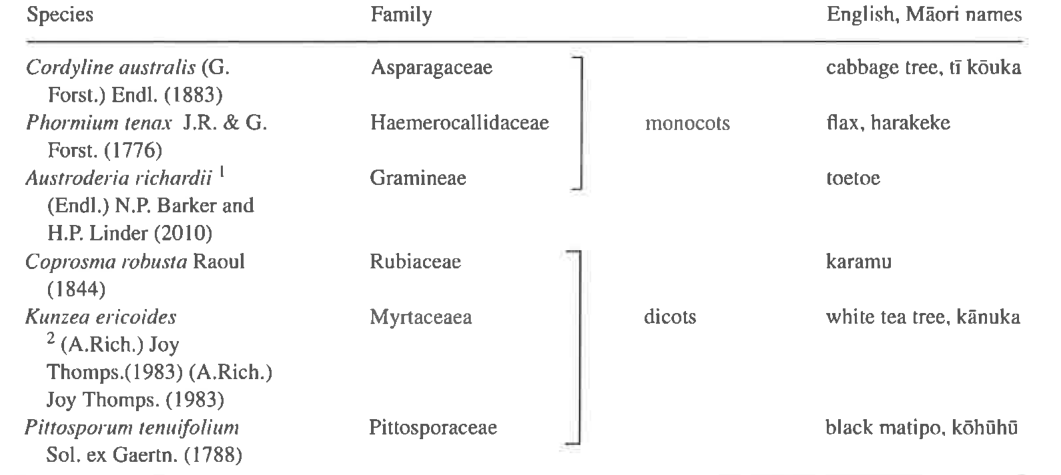
The study site is on a Templeton silt loam which is one of the most fertile, agriculturally-important soils covering 10% of the intermediate terraces of the Canterbury lowlands (Molloy 1998). An area planted with native species, five years before the present study, was located at the south-wester corner of a dairy paddock (Figure 1). Five replicate even-aged plants were selected of six of these species at separate locations, semi-randomly distributed within the plot (Table 1); reference plots were selected within the same sampling area at locations with no plants within at least 2 m. Glyphosate weed control had maintained a largely bare ground surface between plantings. Drainage ditches run along two of the three sides of the sampling area, although these remain largely dry during the extended summer period (approximately November-April).
研究地点位于Templeton粉砂壤土上,该土壤是最肥沃、在农业上最重要的土壤之一,覆盖坎特伯雷低地中间阶地面积的10%(Molloy 1998)。在本研究开展前五年种植本土物种的一块区域位于某奶牛围场的西南角(图1)。从其中六个物种中各选取5株树龄相同的重复植株,位于不同地点,在样地内半随机分布(表1);对照样地选在同一采样区域内、周围至少2 m范围内无植物的位置。通过草甘膦除草,种植株之间的地表基本保持裸露。采样区三条边中的两条边沿线有排水沟,但在漫长的夏季(约11月至次年4月)基本保持干涸。
Foliar samples were collected from multiple parts of the canopy of each of the six plant species at the 5 locations. Soil and vegetation samples were taken from the opposite side of each plant from the frames (described below) using a 2 cm diameter corer to a depth of 10 cm. Pasture grass and soils were sampled from patches growing within the plot and from 5 randomized locations in the adjacent dairy paddock.
在5个地点,从六种植物中每种植物冠层的多个部位采集叶片样品。使用直径2 cm的土钻在每株植物与木框(见下文)相对的一侧采集土壤和植被样品,深度为10 cm。牧草和土壤样品采自样地内生长的草丛以及相邻奶牛围场中的5个随机地点。
Figure 1 The study site at the Lincoln University Dairy Farm. The sampling plot is located in the comer of the dairy paddock, beyond the reach of the centre-pivot circular irrigator. Native plants were established in 2008. The dairy farm was converted from former dry sheep pasture in 2001, with the irrigation system installed soon after. The sampling plot is bordered by a drainage ditch (west) and a paved road (south). Image from GoogleEarth (2/15/2011, 43-38'38.1"S 172°26'02.19"E).图1 林肯大学奶牛场研究地点。采样样地位于奶牛围场一角,处于中心支轴式圆形喷灌机的覆盖范围之外。本土植物于2008年种植。该奶牛场于2001年由原旱地绵羊牧场转变而来,此后不久安装了灌溉系统。采样样地西邻排水沟,南邻铺装道路。图像来自GoogleEarth(2/15/2011, 43-38'38.1"S 172°26'02.19"E)。
J. L. HAHNER ET AL.J. L. HAHNER ET AL.
I Synonym = Cortaderia richardii.
I 异名 = Cortaderia richardii。
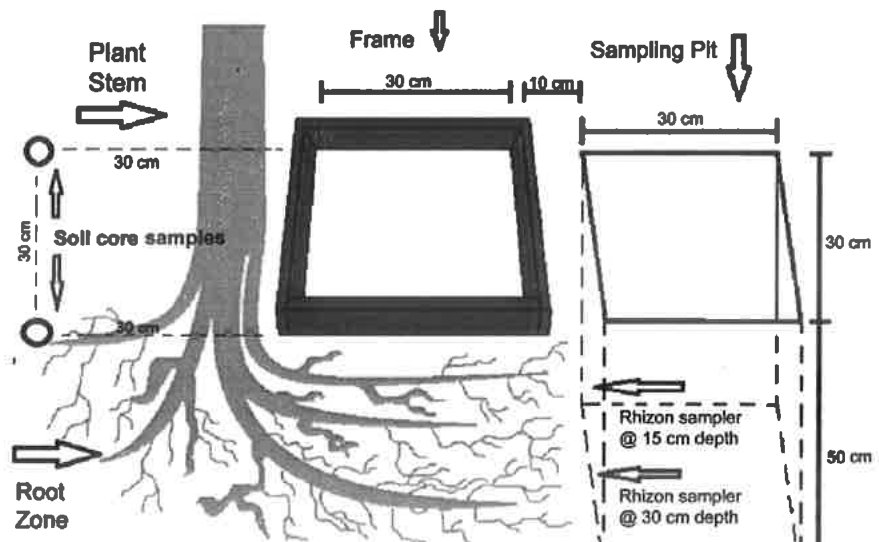
Wooden frames (30 cm × 30 cm) were placed as close as practicable against the stems of each of selected plants, and inserted into the soil to a depth of 2.5 cm (Figure 2). Adjacent to each wooden frame, and opposite of the selected plant, a 30 cm × 30 cm pit (50 cm depth) was dug, 10 cm from the inner edge of the frame. Rhizon soil moisture samplers (en.eijkelkamp.com/) 10 cm × 0.25 cm (0.1 micron pore size) were inserted at 15 cm and 30 cm depth. After an equilibration period of 6 days, pore water was sampled. Dairy effluent was collected from the storage pond that services the milking platform, and applied
将木框(30 cm × 30 cm)尽可能紧贴所选植株的茎干放置,并插入土壤2.5 cm深(图2)。在每个木框旁、所选植株的对侧,距木框内缘10 cm处挖一个30 cm × 30 cm的土坑(深50 cm)。在15 cm和30 cm深度插入Rhizon土壤水分采样器(en.eijkelkamp.com/),规格为10 cm × 0.25 cm(孔径0.1 μm)。经6天平衡期后采集孔隙水。奶牛场废水采自服务于挤奶平台的储存池,并施用
PHYTOREMEDIATION POTENTIAL OF NATIVE PLANTS本土植物的植物修复潜力
within each of wooden frame (total 35 locations). Slurry application rates were based on the nitrogen concentration of effluent to reflect recommended realistic slurry application rates of 50 kg N ha - for grazed pasture systems in Canterbury (Di and Cameron 2000; Monaghan et al. 2007b). The slurry contained 450 mg N 1-', thus requiring 1 L of slurry per 30 cm × 30 cm quadrat. The five sampling sites without plants, acting as references to measure natural seasonal variations within the soil were also fitted with wooden frames, but received an equal volume of water in place of effluent. Soil pore water samples were then taken from the rhizon samplers after an equilibration period of 6 days and on 5 subsequent occasions over 11 weeks. Soil moisture and soil temperature data corresponding to the duration of the study was obtained from the NIWA Broadfield Climate Station located approximately 3.5 km NW of the research plot. Soil moisture was recorded (15 cm and 30 cm depth) using a moisture probe at each of the 80 soil pore water sampling sites.
于每个木框内(共35个位置)。粪浆施用量根据废水的氮浓度确定,以反映坎特伯雷放牧草地系统推荐的实际粪浆施用量50 kg N ha⁻¹(Di and Cameron 2000; Monaghan et al. 2007b)。粪浆含氮450 mg N L⁻¹,因此每个30 cm × 30 cm样方需施用1 L粪浆。五个无植物的采样点作为测定土壤自然季节变化的对照,同样安装了木框,但施用等体积的水代替废水。随后在6天平衡期后以及之后11周内的5次时间点从Rhizon采样器中采集土壤孔隙水样品。研究期间对应的土壤湿度和土壤温度数据取自位于研究样地西北约3.5 km处的NIWA Broadfield气候站。在80个土壤孔隙水采样点的每个点上,使用水分探头记录土壤湿度(15 cm和30 cm深度)。
Foliage samples were rinsed with deionized water, separated from stems, then dried (105°C), ground and sieved to 2 mm. Vegetation and soil samples were microwave digested in 5M HNO (+H202 for soil samples) then analysed using ICP-OES following standard methods. Total C and N were analysed using a LECO CNS-2000 Elemental Analyser. After 4x dilution, ion analysis of soil pore water samples was carried out using a Dionex DX-120 Ion Exchange Chromatograph, suppressed with an Anion Self-Regenerating Suppressor, with detection by conductivity. Ammonia concentrations within the soil pore water samples were analysed using a FS 3000 flow injection analyser. Reference soil and plant material (ISE-921 and IPE-100) was analysed for QA, achieving 91-108% of certified values. Statistical analysis involved performing one-way Anova with the Fishers individual error rate and a principal components analysis.
叶片样品用去离子水冲洗,与茎分离,然后烘干(105°C)、研磨并过2 mm筛。植被和土壤样品在5M HNO₃(土壤样品加H₂O₂)中进行微波消解,然后按照标准方法用ICP-OES分析。总C和总N采用LECO CNS-2000元素分析仪测定。土壤孔隙水样品稀释4倍后,采用Dionex DX-120离子交换色谱仪进行离子分析,使用阴离子自再生抑制器进行抑制,电导检测。土壤孔隙水样品中的氨浓度采用FS 3000流动注射分析仪测定。分析参考土壤和植物材料(ISE-921和IPE-100)以进行质量保证,测定值为认证值的91–108%。统计分析包括采用Fisher个体误差率的单因素ANOVA以及主成分分析。
2RESULTS AND DISCUSSION结果与讨论
Macronutrient and Trace Element Concentration in Plants植物中大量养分与微量元素浓度
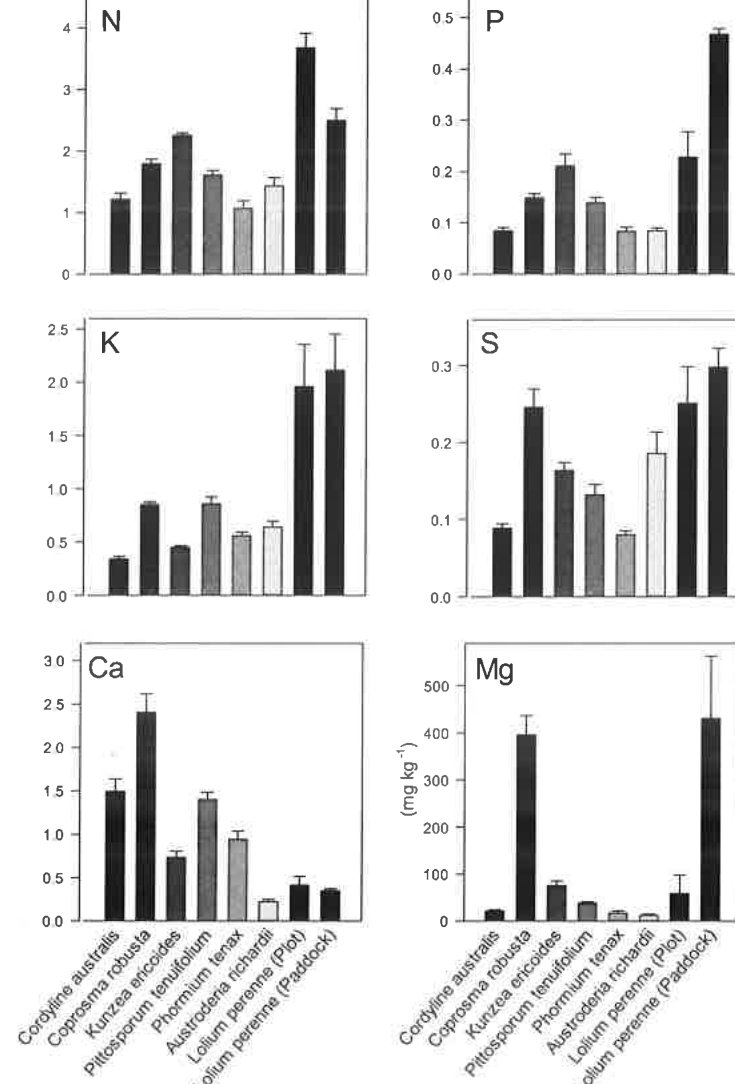
Foliar concentrations of N, P, K, S were higher in ryegrass than native plants (Figure 3) and, with the exception of N, ryegrass generally had higher concentrations in the paddock than when it was growing in the native species plot. Significant differences also existed between the native species, with at least two-fold differences in N, P, K and S and a 10-fold difference in Ca. Biomass production is far higher in ryegrass, at about 10-11 t ha-' in this region, and overall uptake would be much higher than by native plants, which are generally slow growing and obviously have less value as stock fodder. With less grazing pressure, however, a large proportion of nutrients in native plant foliage does become incorporated into biomass or returned to soil through leaf fall. Carbon concentrations in foliage ranged from 41.5% to 49.0%, but there were no significant differences between species.
黑麦草叶片中N、P、K、S的浓度高于本土植物(图3),且除N外,围场中黑麦草的浓度通常高于生长在本土物种样地中的黑麦草。本土物种之间也存在显著差异,N、P、K和S至少相差两倍,Ca相差10倍。黑麦草的生物量产量远高于本土植物,在该地区约为10–11 t ha⁻¹,其总吸收量也远高于本土植物;本土植物通常生长缓慢,作为牲畜饲料的价值显然较低。然而,由于放牧压力较小,本土植物叶片中的大部分养分确实会被纳入生物量或通过落叶归还土壤。叶片碳浓度为41.5%至49.0%,但物种间无显著差异。
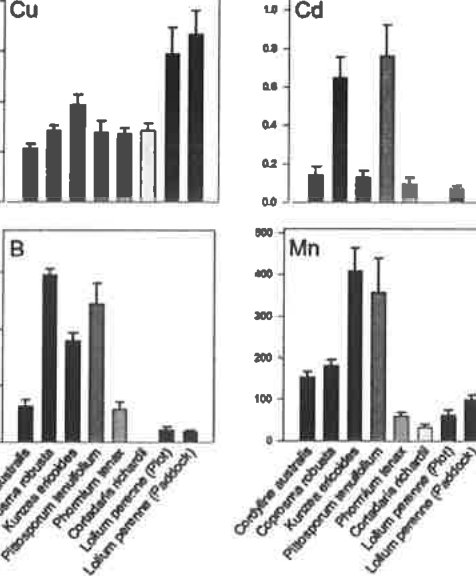
Foliar trace element concentrations (Figure 4) were substantially more variable between species and, in contrast to macronutrients, were often higher in native species than in ryegrass. Pittosporum tenuifolium and Coprosma robusta often had highest concentrations of both macronutrients and trace elements; these two species took up tenfold more B than did ryegrass. Boron is known to improve fecundity in sheep and cattle (Suttle 2010), and these could be useful supplementary food plants for stock to graze on paddock edges. Manganese and Mo concentrations were high in Pittosporum, both are essential elements, involved in N metabolism and cycling. Whilst there was double the concentration of Zn in Pittosporum than in pasture grass, this species also accumulated seven-fold more potentially toxic Cd. However, elevated soil Cd is result of its residual co-occurrence in phosphate
叶片微量元素浓度(图4)在物种间的变异性要大得多,与大量养分相反,本土物种的微量元素浓度常高于黑麦草。Pittosporum tenuifolium和Coprosma robusta的大量养分和微量元素浓度往往均为最高;这两个物种对B的吸收量是黑麦草的十倍。已知硼可提高绵羊和牛的繁殖力(Suttle 2010),这些植物可作为有用的补充饲料植物,供牲畜在围场边缘采食。Pittosporum中Mn和Mo浓度较高,二者均为参与N代谢和循环的必需元素。虽然Pittosporum中Zn浓度为牧草的两倍,但该物种也积累了七倍于牧草的潜在有毒元素Cd。然而,土壤Cd升高是由于其在磷肥中的残留共存所致
J. L. HAHNER ET AL.
J. L. HAHNER ET AL.
fertilisers and there would normally be less outside the farm paddocks. Zinc deficiency in many New Zealand soils is associated with facial eczema in sheep and cattle, and with cystitis in horses, and is commonly provided a trace element delivered to stock through water trough supplements. Potentially, selective planting of Pittosporum around paddock margins and occasional nibbling of its foliage may negate this requirement. High molybdenum was recorded in flax (Phormium); although this element catalyses certain enzymatic reactions and plays an important role in the nitrogen cycle herbage contents approaching toxicity for domestic ruminants (which are particularly sensitive to this element) are not unknown. In the diet of cattle, Cu: Mo ratios of <2:1 are toxic and dietary Mo of > 10 mg kg- can cause toxicity regardless of copper intake (Picco et al. 2012); as little as 1 mg kg-' may be hazardous if copper content is <5 mg kg -' (dry-weight basis). Integrating New Zealand Flax into Land Management Systems has received some attention and flax leaves can be used to wean cattle through winter (McGruddy 2006) but this may not be wise on NZ soils, many of which are Cu deficient. On the other hand, the occasional browsing of NZ flax may possibly result in Mo-rich faeces which may be a source of bioavailable Mo to leguminous species in the pasture.
,在农场围场之外通常含量较低。新西兰许多土壤中的锌缺乏与绵羊和牛的面部湿疹以及马的膀胱炎有关,锌通常作为微量元素通过饮水槽补充剂提供给牲畜。在围场边缘有选择地种植Pittosporum,并让牲畜偶尔啃食其叶片,有可能免除这一需求。亚麻(Phormium)中记录到较高的钼含量;尽管该元素催化某些酶促反应并在氮循环中发挥重要作用,但牧草含量接近家养反刍动物(对该元素特别敏感)中毒水平的情况并不罕见。在牛的日粮中,Cu:Mo比值 <2:1 具有毒性,日粮Mo >10 mg kg⁻¹无论铜摄入量如何均可引起中毒(Picco et al. 2012);若铜含量 <5 mg kg⁻¹(干重基础),低至1 mg kg⁻¹的Mo即可能有害。将新西兰麻纳入土地管理系统已受到一定关注,亚麻叶片可用于冬季给牛断奶(McGruddy 2006),但在许多缺Cu的新西兰土壤上这样做可能并不明智。另一方面,牲畜偶尔采食新西兰麻可能产生富含Mo的粪便,从而成为牧场中豆科植物生物有效性Mo的来源。
EDIATION POTENTIAL OF NATIVE PLANTS本土植物的植物修复潜力
There is much current interest in establishing kanuka (Kunzea ericoides), a very similar species to manuka (Leptospermum scoparium), both of which are valuable crops for high-quality honey production. Although kanuka is better suited to lowland Canterbury environments, they are both dominant early-successional woody shrubs over much of the New Zealand lowlands. The present study shows these species appear to be effectively managing N, P, Zn, Cu and Mn acquisition from the soil. Foliar Mn concentrations, another essential minor nutrient for plants and animals, were extremely variable between plant species, and highest in Kunzea, Pittosporum and Coprosma. There is a strong relationship between Mn and Co in soil; in well-developed New Zealand soils, Mn influences cobalt availability and subsequent uptake by plants (Zheng 2000). Cobalt concentrations in native plant foliar were always below 0.22 ppm (data not shown). Cobalt deficiency is frequent New Zealand soils and vitamin B12 is absorbed from cobalt when it is consumed. There are varying degrees of cobalt deficiency throughout New Zealand and these generally require some additional supplementation in cattle and sheep
目前人们对种植卡努卡(Kunzea ericoides)很感兴趣,该物种与麦卢卡(Leptospermum scoparium)非常相似,二者均为生产优质蜂蜜的重要作物。尽管卡努卡更适应坎特伯雷低地环境,但二者都是新西兰大部分低地演替早期的优势木本灌木。本研究表明,这些物种似乎能够有效地调控从土壤中获取N、P、Zn、Cu和Mn。叶片Mn浓度(Mn是动植物的另一种必需微量养分)在植物物种之间差异极大,以Kunzea、Pittosporum和Coprosma中最高。土壤中Mn与Co之间存在密切关系;在发育良好的新西兰土壤中,Mn影响钴的有效性及其随后被植物吸收(Zheng 2000)。本土植物叶片中的钴浓度均低于0.22 ppm(数据未列出)。新西兰土壤常见钴缺乏,而维生素B12是由摄入的钴合成吸收的。新西兰各地存在不同程度的钴缺乏,通常需要对牛和绵羊进行额外补充
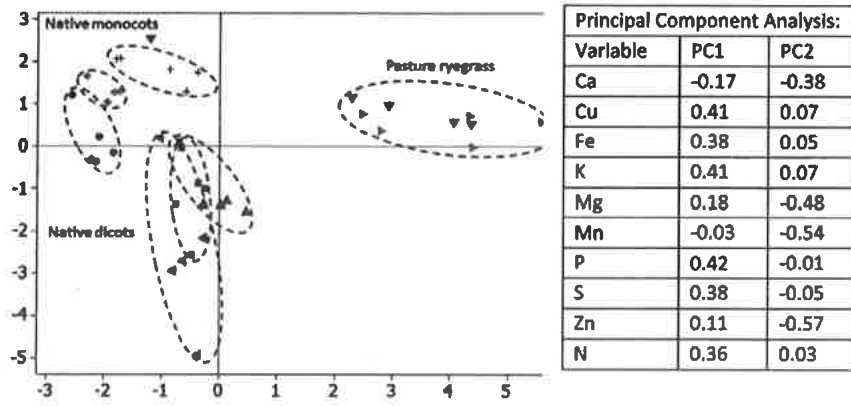
In terms of overall patterns of elemental uptake, multivariate analysis of these data (Figure 5) revealed clear distinctions between pasture grass (both plot and paddock) and native species. PC1 explained 48% of variation, weighted heavily on N, P, K, S and Cu. These elements, with the exception of S, are all phloem mobile in plants. Native species divided clearly into monocots and dicots along PC2 (26% of variation), these also being separated from the ryegrass. PC2 was heavily weighted on phloem-immobile elements (Zn,
就元素吸收的总体模式而言,对这些数据的多变量分析(图5)揭示了牧草(包括样地和围场)与本土物种之间的明显区别。PC1解释了48%的变异,主要由N、P、K、S和Cu加权。除S外,这些元素在植物体内均为韧皮部可移动元素。本土物种沿PC2(占变异的26%)清晰地分为单子叶植物和双子叶植物,且二者均与黑麦草分开。PC2主要由韧皮部不可移动元素(Zn、
J. L. HAHNER ET AL.J. L. HAHNER ET AL.
Paddock L. perenne.
Soil Chemistry and Native Plant Rhizospheres土壤化学与本土植物根际
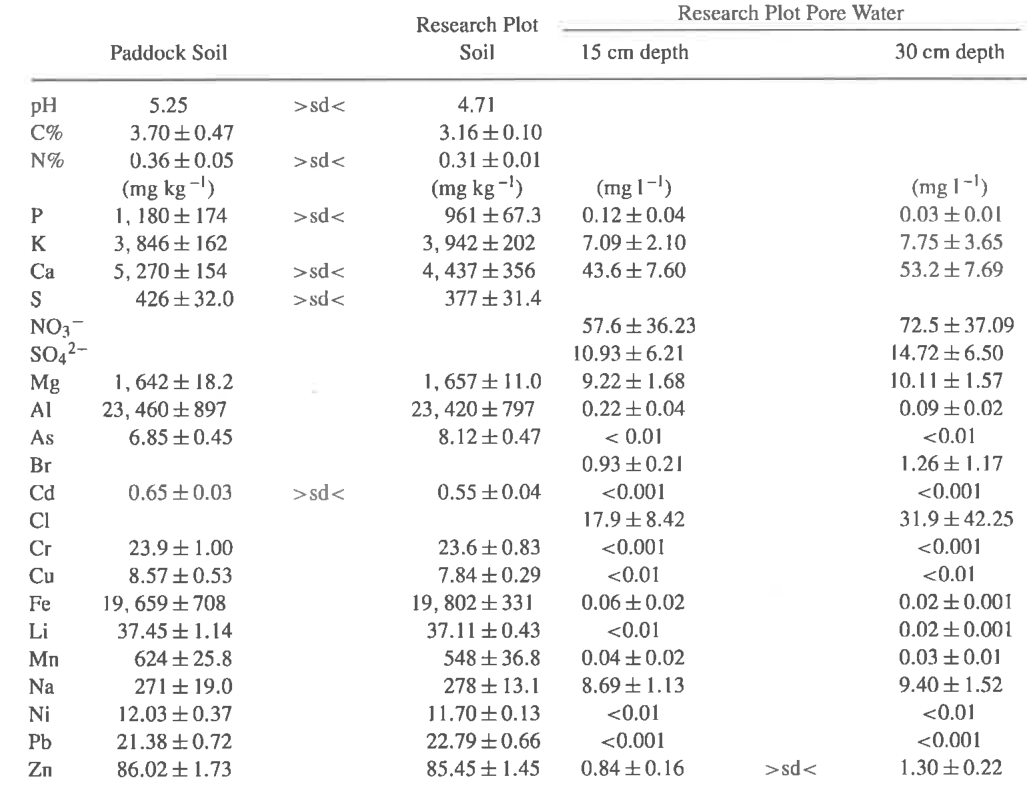
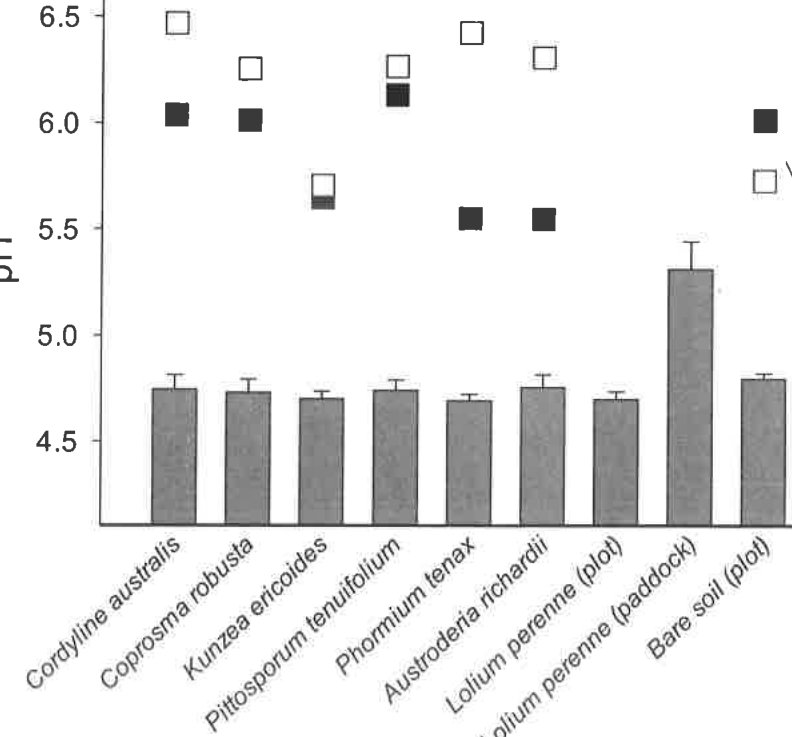
There was a clear distinction in soil fertility between the sampling site in the fencedoff corner of the paddock and the dairy paddock (Table 2). Dairy pasture management for several years at this site has significantly elevated soil pH, N, P, Ca, S and Cd, although there were no other obvious trace element deficiencies or excesses of metal (oids). Upper nitrate values of about 20 mg 1-' are normally expected from soil extractions (Allen 1989), although peak winter concentrations >40 mg 1-' are recorded on winter-grazed forage crops on free-draining New Zealand soils (Smith et al. 2012). This indicates that background soluble nitrogen as NO3 in the plots of the present study was relatively high, representing 1.9-2.4% of total soil N. Both mobile N and Zn were recorded at highest concentrations at 30 cm depth in the research plot. Clearly, liming and fertilisation in the paddock were most likely to be responsible, although native plants themselves may be a small contributory factor to lower pH (Figure 6). Some pore water acidification was evident in the lower layer of the rhizospheres of native plants.
位于围场围栏隔离角落的采样地点与奶牛围场之间的土壤肥力存在明显差异(表2)。该地点数年的奶牛牧场管理显著提高了土壤pH以及N、P、Ca、S和Cd含量,但未发现其他明显的微量元素缺乏或金属(类金属)过量。土壤浸提液中硝酸盐上限值通常约为20 mg L⁻¹(Allen 1989),但在新西兰排水良好土壤上的冬季放牧饲料作物中记录到的冬季峰值浓度 >40 mg L⁻¹(Smith et al. 2012)。这表明本研究样地中以NO₃⁻形式存在的背景可溶性氮相对较高,占土壤全氮的1.9–2.4%。可移动N和Zn均在研究样地30 cm深处记录到最高浓度。显然,围场中的石灰施用和施肥最可能是其原因,但本土植物本身可能是导致pH降低的一个次要因素(图6)。本土植物根际下层可见一定程度的孔隙水酸化。
Root systems of native plants suited to riparian zones have distinctly differing morphologies, in terms of rooting depth and root structure, ranging from the fibrous root system of Austroderia tussock, through more substantial root systems of Pittosporum and Coprosma to deep, stout roots of flax and the substantial descending underground stems and long cord-like roots of cabbage trees. This introduces considerable variability into soil profiles through which water percolates, both laterally and vertically. In terms of influencing soil processes, organic exudates from plant root systems introduce substantial soluble carbon to the soil which modifies soil physico-chemistry and directly determines the abundance and functionality of both soil fauna and microbes (Esperschuetz et al. 2009; Bardgett and Wardle 2010; Wall et al. 2012). It would seem likely that the singular process of lowered soil pH in native plant rhizospheres, as found in the present study, may influence the solubility and mobility of key chemical elements.
适合河岸带的本土植物根系具有明显不同的形态,表现在根深和根系结构上:从Austroderia丛生草的须根系,到Pittosporum和Coprosma较为发达的根系,再到亚麻深而粗壮的根,以及朱蕉(cabbage tree)发达的下伸地下茎和长绳状根。这使水分在侧向和垂直方向上渗透所经过的土壤剖面产生相当大的变异性。在影响土壤过程方面,植物根系的有机分泌物向土壤输入大量可溶性碳,从而改变土壤理化性质,并直接决定土壤动物和微生物的丰度与功能(Esperschuetz et al. 2009; Bardgett and Wardle 2010; Wall et al. 2012)。如本研究所发现,本土植物根际土壤pH降低这一独特过程很可能影响关键化学元素的溶解度和迁移性。
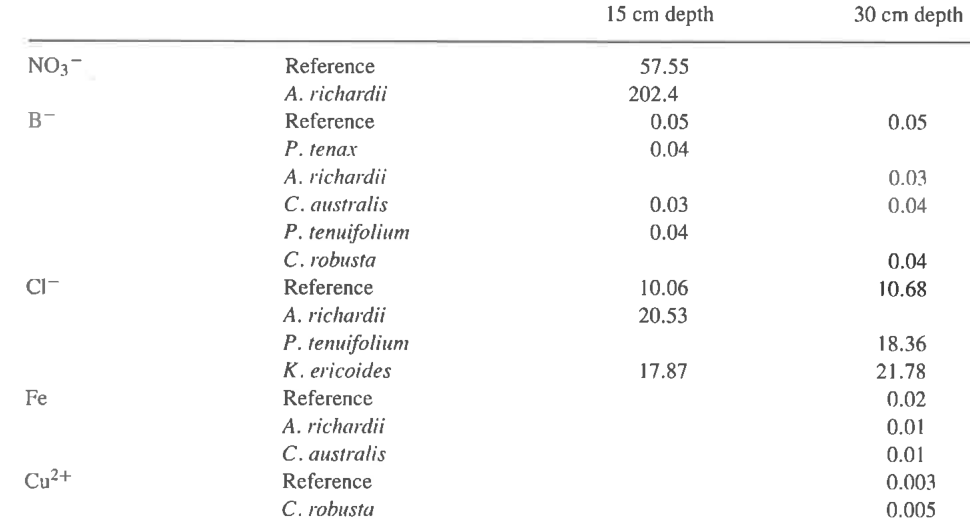
There were few differences in soluble leachates in the soil, either between plant species or with reference unplanted plots (Table 3). Exceptions were nitrate and chloride which were significantly higher under Austroderia than in reference soil without plant cover or beneath other plant species. This corresponded to drier soil beneath this large tussock grass (Figure 7), and is therefore likely to simply be a resultant concentration effect (rather than due to increased nitrification, for example). Higher CI- in the rhizosphere of Pittosporum (lemonwood) and Kunzea (Kanuka) may have a similar explanation. No account was made of seasonal differences.
土壤中可溶性淋溶物在植物物种之间或与未种植的对照样地之间几乎没有差异(表3)。例外的是硝酸盐和氯化物,其在Austroderia下显著高于无植被覆盖的对照土壤或其他植物物种下的土壤。这与该大型丛生草下土壤较为干燥相对应(图7),因此很可能只是由此产生的浓缩效应(而非例如硝化作用增强所致)。Pittosporum(lemonwood)和Kunzea(卡努卡)根际中较高的Cl⁻可能也有类似的解释。本研究未考虑季节差异。
Slurry Application粪浆施用
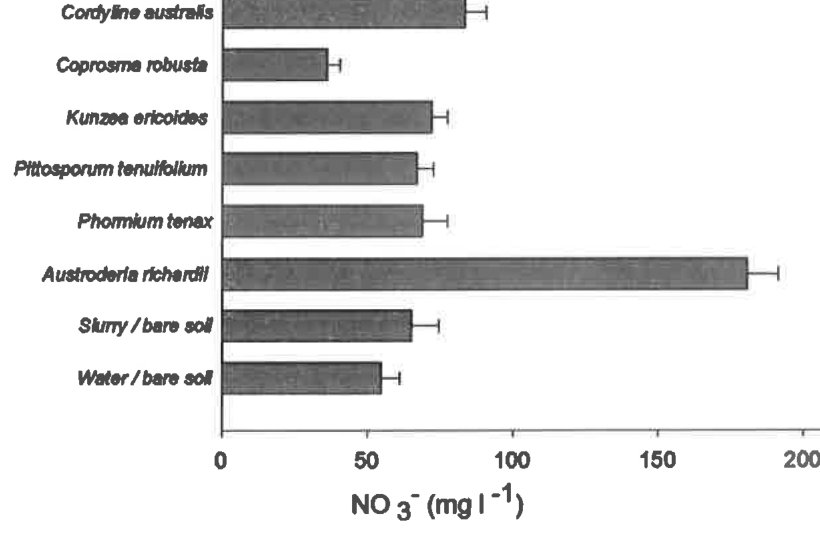
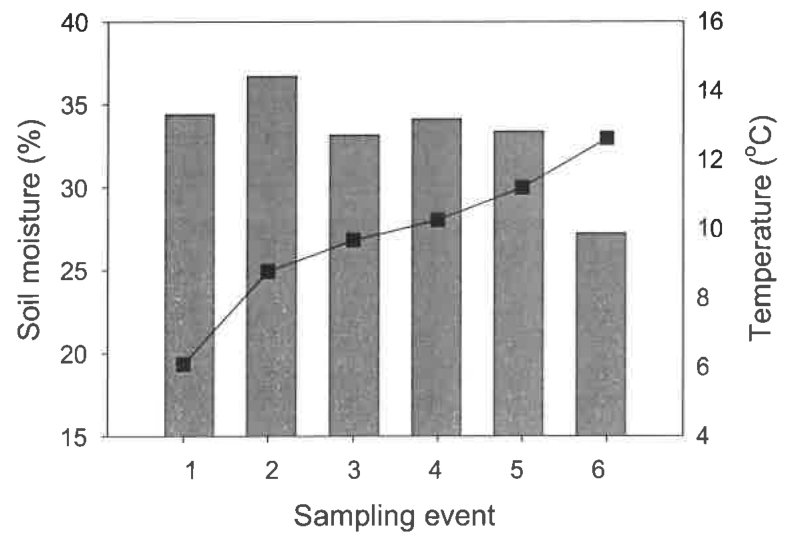
Soil pore water NO3- and NH4+ at 15 and 30 cm were not significantly elevated above baseline concentrations following slurry application to the soil surface, beneath any plants or even in the case of where slurry was applied to the bare soil surface. There were no differences in NH4 +, NO3, C1 -, Br - or S04 2-, and PO43 - was below detection limits [data are not shown for non-significant variables]. Soil beneath Austroderia presented the only situation where NO3- was significantly elevated in soil pore water samples (Figure 8), whilst NO3- beneath Coprosma was significantly lower than other treatments. This was apparently unrelated to slurry application however. Soil temperature at 20cm depth increased from 6-12.5°C over the 11 week sampling period during which time soil moisture was relatively high (Figure 9). Clearly this had no significant effect on soil pore water concentrations of these elements.
向土壤表面施用粪浆后,无论是在任何植物下还是在裸露土壤表面施用粪浆的情况下,15 cm和30 cm深处土壤孔隙水中的NO₃⁻和NH₄⁺均未显著高于基线浓度。NH₄⁺、NO₃⁻、Cl⁻、Br⁻或SO₄²⁻均无差异,PO₄³⁻低于检出限[不显著变量的数据未列出]。Austroderia下的土壤是唯一一种土壤孔隙水样品中NO₃⁻显著升高的情形(图8),而Coprosma下的NO₃⁻显著低于其他处理。然而,这显然与粪浆施用无关。在11周采样期内,20 cm深处土壤温度从6°C升至12.5°C,其间土壤湿度相对较高(图9)。显然,这对这些元素的土壤孔隙水浓度没有显著影响。
J. L. HAHNER ET AL.J. L. HAHNER ET AL.
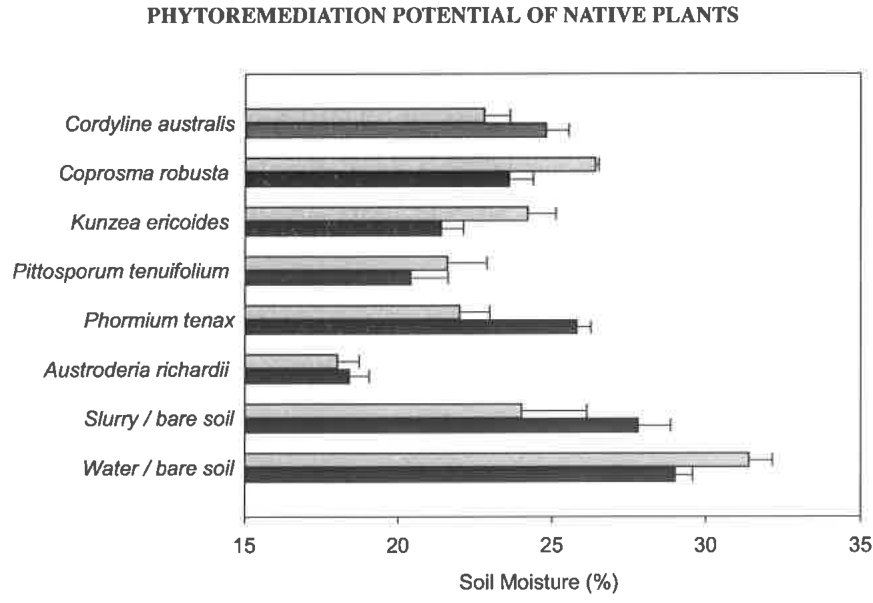
Little difference in soluble elements in pore water may have been due to high spring rainfall raising soil moisture, or of course may reflect a limitation of our study. Despite the targeting of sampling over the early summer period of high soil moisture and increasing soil temperatures, this may not have been optimal. Higher nitrate recorded under the tussock grass Austroderia was unlikely to be due to increased nitrification since CI- was similarly high, but more likely due to less water flow beneath this species. Thus, an important difference between varying plant morphologies may be related to above-ground canopy interception of rainfall or its effect on infiltration of rainfall into the soil. Preliminary work applying dairy slurry to soil did not raise soluble N concentration in pore water over the subsequent 11 week sampling period, with no evidence of nitrification producing NO?. It is possible that acidification in the surface layers of native plant rhizosphere may be related to the release of Ht from nitrification processes. Work is continuing to establish the fate of this applied N but, at this stage we are unable to comment on whether the explanation for low pore-water mobility is rapid binding and immobilization of organic N in soil, volatilization of NH3 or denitrification through N2O release. It is known that NH3 emissions from land-spread slurries can account for more than 40% of Total Ammoniacal N (Nyord et al. 2012). Lesser amounts of N2O production have been found previously to progressively increase over a 10 week period following slurry application, accounting for 2 to 10% of applied N (Oenema et al. 2007; Sherlock et al. 2002). Our own data suggest that time of year of is a critical factor in terms of its influence of soil moisture and rhizosphere dynamics, and subsequent impacts on chemical speciation and mobility. This requires further attention.
孔隙水中可溶性元素差异不大,可能是由于春季降雨量大导致土壤湿度升高,当然也可能反映了本研究的局限性。尽管采样有针对性地选在土壤湿度高、土壤温度升高的初夏时期,但这一时期可能并非最佳。丛生草Austroderia下记录到的较高硝酸盐不太可能是由硝化作用增强所致,因为Cl⁻同样较高,更可能是由于该物种下水流较少。因此,不同植物形态之间的一个重要差异可能与地上冠层对降雨的截留或其对降雨入渗土壤的影响有关。向土壤施用奶牛粪浆的初步研究表明,在随后11周的采样期内,孔隙水中可溶性N浓度并未升高,也没有证据表明硝化作用产生了NO₃⁻。本土植物根际表层的酸化可能与硝化过程中H⁺的释放有关。确定所施N归宿的研究仍在进行,但现阶段我们尚无法判断孔隙水迁移性低的原因是有机N在土壤中的快速结合与固定、NH₃挥发,还是通过释放N₂O的反硝化作用。已知撒施粪浆的NH₃排放可占总铵态氮的40%以上(Nyord et al. 2012)。以往研究发现,施用粪浆后N₂O的产生量较少,并在10周内逐渐增加,占施氮量的2%至10%(Oenema et al. 2007; Sherlock et al. 2002)。我们自己的数据表明,一年中的时间是一个关键因素,因为它影响土壤湿度和根际动态,进而影响化学形态和迁移性。这需要进一步关注。
Highly variable rooting profiles of New Zealand native plants have been previously described (Marden et al. 2005) [also see www.landcareresearch.co.nz.]. Most of the species in the present study are recognised as riverbank protection plants and have extensive root systems that have considerable potential to modify soil physico-chemistry. For example 38% of the biomass of Cordyline australis (cabbage tree) is below-ground, with a root spread of 3 m to depths of 1.75-2.00 m after 25 years (Czernin and Phillips 2005). Phormium tenax has a similarly extensive adventitious root system with particularly stout fleshy roots (Wehi and Clarkson 2007) that are likely to alter patterns of vertical water flow through soil. Both rooting systems differ substantially from the rhizomes and fibrous rooting mass of the tussock grass Cortedaria richardii which has an overall substantially longer total root length (Phillips et al. 2008). Clearly the rhizospheres of native species will have differential effects on the ingress, flow and discharge of water, and also on the speciation and mobility of chemical constituents of the soil.
新西兰本土植物高度多变的根系剖面此前已有描述(Marden et al. 2005)[另见www.landcareresearch.co.nz]。本研究中的大多数物种被公认为河岸保护植物,具有庞大的根系,有很大潜力改变土壤理化性质。例如,Cordyline australis(朱蕉)38%的生物量位于地下,25年后根系扩展范围达3 m,深度达1.75–2.00 m(Czernin and Phillips 2005)。Phormium tenax具有同样发达的不定根系统,根特别粗壮肉质(Wehi and Clarkson 2007),可能改变水分在土壤中的垂直流动模式。这两种根系均与丛生草Cortedaria richardii的根茎和须根团有很大不同,后者的总根长整体上要长得多(Phillips et al. 2008)。显然,本土物种的根际将对水分的进入、流动和排出,以及土壤化学组分的形态和迁移性产生不同的影响。
3CONCLUSION结论
The foliage of native plants contained highly variable concentrations of nutrients and trace elements and there is an opportunity to provide species for occasional grazing on paddock margins that may address trace element deficiencies in stock and remove the need for supplements. Coprosma robusta contained high foliar concentration of B and Kunzea ericoides contained high Zn, Cu and Mn. Pittosporum tenuifolium contained high B, Mn, Mo and Zn, although its high uptake of Cd where this is elevated in soils may make this an unwise choice due to potentially toxicity. High concentration of Mo in Phormium tenax is potentially useful, but may create toxicity issues if flax is planted on Cu-deficient soils. Differences in uptake of chemical elements between species were clearly related to the mode of transport within the plant, in terms of whether there is significant phloem mobility. The potential of these plant species as supplementary sources for contending against dietary deficiencies in stock requires further investigation.
本土植物叶片中养分和微量元素的浓度差异很大,因此有机会在围场边缘提供可供偶尔放牧的物种,以解决牲畜微量元素缺乏问题并免除补充剂的需求。Coprosma robusta叶片B浓度较高,Kunzea ericoides含有较高的Zn、Cu和Mn。Pittosporum tenuifolium含有较高的B、Mn、Mo和Zn,但在土壤Cd升高的情况下其对Cd的高吸收可能导致潜在毒性,因而可能不是明智的选择。Phormium tenax中高浓度的Mo具有潜在用途,但如果在缺Cu土壤上种植亚麻,则可能引发中毒问题。物种间化学元素吸收的差异显然与元素在植物体内的运输方式有关,即是否具有显著的韧皮部移动性。这些植物物种作为应对牲畜日粮缺乏的补充来源的潜力有待进一步研究。
Without agricultural inputs and with the influence of deeper and more extensive rhizospheres of native plants, soil physico-chemistry on the margins of paddocks and adjacent to water courses differs substantially to managed pasture. Differences, for example in terms of soil pH, NO3- and mobile Zn, were also evident in deeper layers of the rooting profiles of native plants. However, the most significant influence on nutrient and trace element profiles appeared to be associated with the morphology of different species of plants, their interception or deflection of rainfall and the resultant wetness of underlying soil. Selective planting of the large native tussock grass, Austroderia richardii, may be particularly useful for intercepting lateral flow of nutrient-enriched drainage waters. A tussock-forming sedge, Carex secta, that thrives alongside waterways in Canterbury deserved further attention in
在没有农业投入且受本土植物更深、更广根际影响的情况下,围场边缘和毗邻水道处的土壤理化性质与管理牧场存在显著差异。例如在土壤pH、NO₃⁻和可移动Zn方面的差异,在本土植物根系剖面的较深层中同样明显。然而,对养分和微量元素剖面影响最显著的似乎是不同植物物种的形态、其对降雨的截留或偏转以及由此导致的下层土壤湿度。有选择地种植大型本土丛生草Austroderia richardii,可能对截留富含养分的排水侧向流特别有用。在坎特伯雷水道沿岸生长茂盛的丛生莎草Carex secta值得在
Plant roots modify soil physico-chemistry, in turn regulating aboveground productivity, biodiversity and other essential life processes including storage and filtration of water (Bezemer et al. 2010; McNeill and Winwiarter 2004). Dependent on widely different morphologies of plant root systems (Marden et al. 2005; Dickinson et al. 2009; Robinson et al. 2009), the rhizosphere is likely to substantially modify the ingress and discharge of water and dissolved substances. There is a generally held belief that riparian planting helps to protect water bodies from polluted run-off and drainage effluents. However, in the present study, slurry application beneath the canopy of native plants did not lead to increased fluxes of nutrient or trace elements through the soil profile; in the case of nitrogen, this was probably due to some combination of immobilization, volatilization, denitrification or lack of nitrification. Further investigation, perhaps with higher application rates, may be worthwhile; an equivalent amount of 1200 kg N ha-' is typical of dairy farm urine patches (Di and Cameron 2000; Moir et al. 2012) to understand the mobility of chemical elements in native plant rhizospheres; potential benefits have not been proven in the present study. Streamside riparian vegetation is known to influence the health of waterways and how they function, but influences and explanations are complex involving a range of factors from the benefits of shading, livestock exclusion and upstream landscape management. Over the last 10 to 15 years, there has been a surge in stream-restoration projects in Canterbury by a range of agencies, community groups, and rural landowners (www.niwa.co.nz.).
植物根系改变土壤理化性质,进而调节地上生产力、生物多样性以及包括水分储存和过滤在内的其他重要生命过程(Bezemer et al. 2010; McNeill and Winwiarter 2004)。由于植物根系形态差异很大(Marden et al. 2005; Dickinson et al. 2009; Robinson et al. 2009),根际很可能显著改变水分和溶解物质的进入与排出。人们普遍认为,河岸种植有助于保护水体免受污染径流和排水废水的影响。然而,在本研究中,在本土植物冠层下施用粪浆并未导致养分或微量元素通过土壤剖面的通量增加;就氮而言,这可能是固定、挥发、反硝化或缺乏硝化作用等因素共同作用的结果。为了解本土植物根际中化学元素的迁移性,进一步的研究(或许采用更高的施用量)可能是值得的;奶牛场尿斑的施氮量通常相当于1200 kg N ha⁻¹(Di and Cameron 2000; Moir et al. 2012);本研究尚未证实其潜在效益。已知溪流沿岸的河岸植被会影响水道的健康及其功能,但其影响和解释很复杂,涉及遮荫效益、牲畜隔离以及上游景观管理等一系列因素。在过去10至15年间,坎特伯雷的各类机构、社区团体和农村土地所有者发起的溪流恢复项目激增(www.niwa.co.nz)。
Overall, the results of this study indicate that planting native species on productive agricultural land in New Zealand offers potential advantages in terms of nutrient and trace element management. This could be of benefit to both agriculture and environment. There is sufficient evidence to show that soil conditions differ beneath native species of plants and with soil planted with shallow-rooted pasture grass. It is a reasonable assumption that this is likely to modify lateral and vertical fluxes of nutrient-enriched drainage water in riparian zones. Trace element uptake differs significantly between native plant species to the extent that selective planting on paddock borders may also add value through avoidance of deficiency diseases in stock. These potentially useful findings justify further
总体而言,本研究结果表明,在新西兰生产性农业用地上种植本土物种在养分和微量元素管理方面具有潜在优势。这可能对农业和环境均有益处。有充分证据表明,本土植物物种下的土壤条件与种植浅根系牧草的土壤不同。可以合理地推测,这很可能改变河岸带中富含养分排水的侧向和垂直通量。本土植物物种之间微量元素吸收差异显著,以至于在围场边缘进行选择性种植还可通过避免牲畜缺乏症而增加价值。这些潜在有用的发现值得进一步
4REFERENCES参考文献
Allen SE. 1989. Chemical Analysis of Ecological Materials. New York: Wiley. Bardgett RD, Wardle DA. 2010. Aboveground-Belowground Linkages: Biotic Interactions, Ecosystem Processes, and Global Change. Oxford (UK): Oxford University Press. Beare MH, Tabley F, Gillespie R, Maley S, Harrison-Kirk T, Ruiter, JD. 2010. Nitrate leaching from high production forage crop sequences. Proceedings of the New Zealand Grassland Association
Bee JN, Kunstler G, Coomes DA. 2007. Resistance and resilience of New Zealand tree species to browsing. Journal of Ecology 95(5): 1014-1026.
Bee JN, Tanentzap AJ, Lee WG, Lavers RB, Mark AF, Mills JA. 2011. Influence of foliar traits on forage selection by introduced red deer in New Zealand. Basic Appl Ecol 12(1): 56-63. Bezemer TM, Fountain MT, Barea JM, Christensen S. Dekker SC, van Hal R. 2010. Divergent composition but similar function of soil food webs beneath individual plants: plant species and community effects. Ecology 91: 3027-3036.
Correll DL. 2005. Principles of planning and establishment of buffer zones. Ecological Engineering 24(5): 433-439.
Czernin A, Phillips C. 2005. Below-ground morphology of of Cordyline australis (New Zealand cabbage tree) and its suitability for river bank stabilisation. New Zealand Journal of Botany
Di HJ, Cameron KC. 2000. Calculating nitrogen leaching losses and critical nitrogen application rates in dairy pasture systems using a semi-empirical model. N Z J Agric Res 43(1): 139-147. Dickinson NM, Baker AJM, Doronila A, Laidlwa S, Reeves RD. 2009. Phytoremediation of inorganics: reaslim and synergies. Int. J. Phytoremediation 11 (2):97-114.
Esperschuetz J, Buegger F, Winkler JB, Munch JC, Schloter M, Gattinger A. 2009. Microbial response to exudates in the rhizosphere of young beech trees (Fagus sylvatica L.) after dormancy. Soil Biology & Biochemistry 41(9): 1976-1985.
Hefting M, Bobbink R, Janssens M. 2006. Spatial Variation in Denitrification and N2O Emission in Relation to Nitrate Removal Efficiency in a N-stressed Riparian Buffer Zonc. Ecosystems 9(4): 550-563.
Hill AR. 1996. Nitrate removal in stream riparian zones. J Environ Qual 25(4): 743-755.
Lambert MG, Jung GA, Harpster HW, Lee J. 1989. Forage shrubs in north island hill country 4. chemical-composition and conclusions. N ZJ Agric Res 32(4): 499-506.
Lloyd KM, Pollock ML, Mason NWH, Lee WG. 2010 Leaf trait-palatability relationships differ
between ungulate species: evidence from cafeteria experiments using native tussock grasses. New Zealand Journal of Ecology 34(2): 219-226.
Magesan GN, Wang HL, Clinton PW. 2012. Nitrogen cycling in gorse-dominated ecosystems in New Zealand. New Zealand Journal of Ecology 36(1): 21-28.
Marden M, Rowan D, Phillips CJ. 2005. Stabilising chracteristics of New Zealand indigenous riparian colonising plants. Plant and Soil 278: 95-105.
PHYTOREMEDIATION POTENTIAL OF NATIVE PLANTS
Marmiroli M, Robinson BH, Clothier BE, Bolan NS, Marmiroli N, Schulin R. 2012. Effect of dairy effluent on the biomass, transpiration, and elemental composition of Salix kinuyanagi Kimura. Biomass and Bioenergy 37(0): 282-288. McDowell R, Smith C. 2012. The Winchmore Trials. N Z. J Agric Res 55(2): 89-91. McGruddy E. 2006. Integrating New Zealand Flax into Land Management Systems 03/153. McNeill JR, Winwiarter V. 2004. Breaking the sod: humankind, history and soil. Science 304:
Meurk CD, Swaffield SR. 2000. A landscape ecological framework for indigenous regeneration in rural New Zealand-Aotearoa. Landscape and Urban Planning 50:129-144. Meurk CD, Hall GMJ. 2006. Options for enhancing forest biodiversity across New Zealand's managed landscapes based on ecosystem modelling and spatial design. New Zealand Journal of Ecology Meurk CD. 2008. Vegetation of the Canterbury plains and downlands. In: Winterbour N, Knox G, Burrows C, Marsden I, editors. The Natural History of Canterbury (Winterbourn N, Knox G, Burrows C, Marsden 1, eds). Christchurch (New Zealand): Canterbury Univesrity Press., p. Mikola J, Setälä H, Virka-Järvi P, Saarijärvi K, Ilmarinen K, Woigt W. 2009. Defoliation and patchy nutrient return drive grazing effects on plant and soil properties in a dairy cow pasturc. Ecological Monographs 79: 221-244. Moir JL, Malcolm BJ, Cameron KC, Di HJ. 2012. The effect of dicyandiamide on pasture nitrate concentration, yield and N offtake under high N loading in winter and spring. Grass and Forage Science 67(3): 391-402. Molloy L. 1998. Soils in the New Zealand Landsape - the Living Mantle. 2nd ed: New Zealand Society of Soil Science.
Monaghan RM, Hedley MJ, Di HJ, McDowelli RW, Cameron KC, Ledgard SF. 2007b. Nutrient management in New Zealand pasturesrecent developments and future issues. N ZJ Agric Res
Monaghan RM, Wilcock RJ, Smith LC, Tikkisetty B, Thorrold BS, Costall D. 2007a. Linkages between land management activities and water quality in an intensively farmed catchment in southern New Zealand. Agriculture Ecosystems & Environment 118(1--4): 211-222.
Nyord T, Hansen MN, Birkmose TS. 2012. Ammonia volatilisation and crop yield following land application of solid-liquid separated, anaerobically digested, and soil injected animal slurry to winter wheat. Agriculture Ecosystems & Environment 160: 75-81. Oenema O, Velthof GL, Yamulki S, Jarvis SC. 2007. Nitrous oxide emissions from grazed grassland. Soil Use and Management 13: 288-295.
Phillips C, Marden M, Ekanayake J, Watson A. 2008. A peek down under: structural root architecture of some New Zealand native plants. Accessed 11/01/11: http://icm. landcareresearch.co.nz/knowledgebase/publications/public/Roots_October08.pdfa
Picco S, Ponzzinibio MV, Mattioli G, Rosa D, Minatel L, Fazzio L. 2012. Physiological and genotoxic effects of molybdenum-induced copper deficiency in cattle. Agrociencia 46(2): 107-
Robinson BH, Bañuelos GS, Conesa HM, Evangelou MWH, Schulin R. 2009. The phytomanagement of trace elements in soil. Critical Reviews in Plant Sciences 28: 240-266.
Rothbaum HP, Goguel RL, Johnston AE, Mattingly GEG. 1986. Cadmium accumulation in soils
from long-continued applications of superphosphate. Journal of Soil Science 37(1): 99-107.
Sandhu HS, Wratten SD, Cullen R, Case B. 2008. The future of farming: the value of ecosys-
tem services in conventional and organic arable land. An experimental approach. Ecological
Sarkar D, Makris KC, Parra-Noonan MT, Datta R. 2007. Effect of soil properties on arsenic fractionation and bioaccessibility in cattle and sheep dipping vat sites. Environment International 33(2): 164-169.
Sherlock RR, Sommer SG, Khan RZ, Wood CW, Guertal EA, Freney JR, Dawson CO, Cameron KC 2002. Ammonia, methane, and nitrous oxide emission from pig slurry applied to a pasture in New Zealand. J Environ Qual 31: 1491-1501.
Smith LC, Orchison T, Monaghan RM. 2012. The effectiveness of the nitrification inhibitor dicyandiamide (DCD) for mitigating nitrogen leaching losses from a winter grazed forage crop on a free-draining soil in northern Southland. Proc NZ Grassland Association 74: 39-44. Suttle NF. 2010. Mineral nutrition of livestock. CABI Publishing, Wallingford (, Oxon, UK): CABI Publishing., p. 608.p
Verhoeven JTA, Arheimer B, Yin C, Hefting MM. 2006. Regional and global concerns over wetlands and water quality. Trends in Ecology & Evolution 21(2): 96-103
Wall DH, Bardgett RD, Behan-Pelletier V, Herrick JE, Hefin Jones T, Ritz K. 2012. Soil Ecology and Ecosystem Services: Oxford (UK): Oxford University Press. Wehi PM, Clarkson, 2007. Biological flora of New Zealand 10. Phormium tenax, harakeke, New Zealand flax. New Zealand Journal of Botany 45: 521-544.
Wilcock RJ, Betteridge K, Shearman D, Fowles CR, Scarsbrook MR, Thorrold BS. 2009. Riparian protection and on-farm best management practices for restoration of a lowland stream in an intensive dairy farming catchment: a case study. N Z J Mar Freshw Res 43(3): 803-818. Wilcock RJ, Monaghan RM, Thorrold BS, Meredith AS, Betteridge K, Duncan MJ. 2007. Land-water interactions in five contrasting dairying catchments: issues and solutions. Land Use and Water Research 7(2): 1-10. Winterboure M, Know G, Burrows C, Marsden I, eds. 2008. The Natural History of Canterbury. Christchurch (New Zealand): Canterbury University Press.
Wright DM, Jordan GJ, Lee WG, Duncan RP, Forsyth DM, Coomes DA. 2010. Do leaves of plants on phosphorus-impoverished soils contain high concentrations of phenolic defence compounds? Functional Ecology 24(1): 52-61.
Zheng L. 2000. The effects of soil manganese on the availability of soil cobalt for pasture uptake in New Zealand soils. Canterbury (New Zealand): Lincoln University.