Phytomanagement: Phytoremediation and the Production of Biomass for Economic Revenue on Contaminated Land
Michael W.H. Evangelou , Eleni G. Papazoglou , Brett Harvey Robinson , and Rainer Schulin
9.1 Introduction: From Remediation to Management of Trace Element- Contaminated Land
The term phytoremediation refers to the use of plants and associated microorganisms to eliminate environmental damage or threats posed by environmental pollution. While this includes the use of plants in soil conservation such as protection against erosion or regeneration of compacted soils, the term phytoremediation is primarily used in conjunction with the decontamination/redevelopment of soils, which are contaminated by pollutants. Raskin et al. ( 1997 ) defi ned phytoremediation as the use of green plants to remove pollutants from the environment or to render them harmless. Phytoremediation may be applied to soils that are contaminated with toxic trace elements (TE) or organic pollutants. Depending on the targeted pollutants and the mechanisms, phytoremediation can be divided into: (a) phytoextraction, (b) phytotransformation, and (c) phytostabilization. This chapter will focus on TE as they are the most widespread and intractable soil contaminants.
植物修复是指利用植物及其相关微生物消除环境污染所造成的环境损害或威胁。尽管这一概念也涵盖植物在土壤保持中的应用,如防止侵蚀或使压实土壤恢复,但植物修复一词主要用于受污染物污染土壤的净化/再开发。Raskin et al.(1997)将植物修复定义为利用绿色植物从环境中去除污染物或使其无害化。植物修复可用于受有毒微量元素(TE)或有机污染物污染的土壤。根据目标污染物及作用机制的不同,植物修复可分为:(a)植物提取,(b)植物转化,以及(c)植物稳定。由于微量元素是分布最广、最难处理的土壤污染物,本章将重点讨论微量元素。
M. W.H. Evangelou , Ph.D. (*) Institute of Terrestrial Ecosystems , ETH Zürich , Universitätstrasse 16 , 8092 Zürich , Switzerland
Department of Environmental Systems Science , ETH Zurich , Zürich , Switzerland e-mail: michael.evangelou@env.ethz.ch
E. G. Papazoglou , Ph.D.
Department of Crop Science , Agricultural University of Athens , Iera Odos 75 , Athens 11855 , Greece
B. H. Robinson , Ph.D.
Agriculture and Life Sciences , Lincoln University , Lincoln 7647 , Canterbury , New Zealand
Department of Soil and Physical Sciences , Lincoln University , Lincoln , Canterbury , New Zealand
R. Schulin , Ph.D.
Institute of Terrestrial Ecosystems , ETH Zürich , Universitätstrasse 16 , 8092 Zürich , Switzerland
Phytoextraction describes the use of plants to remove/ extract pollutants from soil. In 1583 the botanist Cesalpino, the author of the renowned book De plantis Libri, which contains descriptions of about 1,500 plant species, described an “alyson” that appeared to be confi ned to serpentine soils, which are rich in nickel (Ni), in the vicinity of Florence, Italy. In 1885, Baumann, a German botanist working near the border of Germany and Belgium, discovered that certain plant species growing on soils naturally enriched in Zn were capable of accumulating uncommonly high Zn levels. Brooks et al. ( 1977 ) coined the term hyperaccumulator for plants that accumulate >1,000 mg kg −1 Ni on a dry matter basis. Currently, a plant is defi ned as a hyperaccumulator if it reaches concentrations of at least 100 mg kg −1 (0.01 % dry wt.) Cd and As; 1,000 mg kg −1 (0.1 % dry wt.) Co, Cu, Cr, Ni, and Pb; and 10,000 mg kg −1 (1 % dry wt.) Mn and Zn in their aboveground tissues (Reeves and Baker 2000 ; Watanabe 1997 ). To date more than 500 plant species have been identifi ed as natural metal hyperaccumulators, representing <0.2 % of all angiosperms most of which are Ni hyperaccumulators (450 species) (Ent et al. 2013 ).
植物提取是指利用植物从土壤中去除/提取污染物。1583年,植物学家Cesalpino(其名著《De plantis Libri》记载了约1,500种植物)描述了一种“alyson”,该植物似乎仅分布于意大利佛罗伦萨附近富含镍(Ni)的蛇纹岩土壤上。1885年,在德国与比利时边境附近工作的德国植物学家Baumann发现,生长在天然富Zn土壤上的某些植物物种能够积累异常高含量的Zn。Brooks et al.(1977)创造了“超富集植物”一词,用以指称干物质中Ni含量>1,000 mg kg−1的植物。目前,若植物地上部组织中Cd和As浓度至少达到100 mg kg−1(0.01 %干重),Co、Cu、Cr、Ni和Pb达到1,000 mg kg−1(0.1 %干重),Mn和Zn达到10,000 mg kg−1(1 %干重),即被定义为超富集植物(Reeves and Baker 2000; Watanabe 1997)。迄今已鉴定出500余种天然金属超富集植物,占全部被子植物的<0.2 %,其中大多数为Ni超富集植物(450种)(Ent et al. 2013)。
In 1993 , McGrath et al. proposed that hyperaccumulators could be used for the removal of TE pollutants from soil. Unfortunately, most hyperaccumulator species are slow growing and have limited biomass production. As total metal extraction is the product of biomass and tissue concentration, the speed of metal removal is accordingly limited. Field experiments by Robinson et al. ( 1998 ), Lombi et al. ( 2000 ), and McGrath et al. ( 2000 ) highlight this problem, showing that metal removal effi ciency is in general not high enough to remediate contaminated soils. Subsequently, research focused more on high biomass plants, such as tobacco ( Nicotiana tabacum ) (Evangelou et al. 2004 ; Fässler et al. 2010 ; Kayser et al. 2000 ), maize ( Zea mays ) (Fässler et al. 2010 ; Keller et al. 2003 ), Indian mustard ( Brassica juncea ) (Keller et al. 2003 ; Quartacci et al. 2006 ), poplar ( Populus spp.) (Mertens et al. 2004 ; Robinson et al. 2003b , 2006 ), willow ( Salix spp.) (Cosio et al. 2006 ; Dickinson and Pulford 2005 ; Jensen et al. 2009 ; Klang-Westin and Eriksson 2003 ;
1993年,McGrath et al.提出可利用超富集植物去除土壤中的微量元素污染物。遗憾的是,大多数超富集植物生长缓慢且生物量有限。由于金属总提取量为生物量与组织浓度的乘积,金属去除速度也相应受到限制。Robinson et al.(1998)、Lombi et al.(2000)和McGrath et al.(2000)的田间试验突出反映了这一问题,表明金属去除效率总体上不足以修复污染土壤。随后,研究更多地转向高生物量植物,如烟草(Nicotiana tabacum)(Evangelou et al. 2004; Fässler et al. 2010; Kayser et al. 2000)、玉米(Zea mays)(Fässler et al. 2010; Keller et al. 2003)、印度芥菜(Brassica juncea)(Keller et al. 2003; Quartacci et al. 2006)、杨树(Populus spp.)(Mertens et al. 2004; Robinson et al. 2003b, 2006)、柳树(Salix spp.)(Cosio et al. 2006; Dickinson and Pulford 2005; Jensen et al. 2009; Klang-Westin and Eriksson 2003;
Mleczek et al. 2009 ), and sunfl ower ( Helianthus annuus ) (Fässler et al. 2010 ; Madejon et al. 2003 ), which are fast growing, deep rooted, and easily propagated and cultivated and have a high biomass production and a relatively high metal uptake capacity. It was soon realized though that regardless of the plants used, the rate of contaminant accumulation was insuffi cient and thus would have to be considerably increased without diminishing their yield.
Mleczek et al. 2009)以及向日葵(Helianthus annuus)(Fässler et al. 2010; Madejon et al. 2003),这些植物生长快、根系深、易于繁殖和栽培,生物量高,且金属吸收能力相对较强。然而人们很快认识到,无论使用何种植物,污染物积累速率均不足,因此必须在不降低产量的前提下大幅提高积累速率。
One approach to achieve this was increasing the availability of contaminating TE in soil for plant uptake, e.g., by artifi cial soil acidifi cation or solubilization by means of chelating agents. Various synthetic aminopolycarboxylic acid (APCA) such as ethylene diamine tetraacetic acid (EDTA), diethylene triamino pentaacetic acid (DTPA), trans-1,2- cyclohexylene dinitrilo tetraacetic acid (CDTA), ethylenediamine- N , N ´-bis (2-hydroxyphenyl) acetic acid (EDDHA), and others displayed potential to signifi cantly increase TE uptake by plants (Evangelou et al. 2007 ; Lai and Chen 2004 ; Wu et al. 2004 ). However, as more and more research was put into chelant-assisted phytoextraction , various drawbacks arose such as their toxicity to soil microorganisms (Grcman et al. 2001 ) and to plants (Chen and Cutright 2001 ; Epstein et al. 1999 ), and in particular the risk that mobilized TE could leach into groundwater or surface water (Evangelou et al. 2007 ; Lai and Chen 2005 ; Luo et al. 2005 ; Meers et al. 2005 ). To reduce this risk the use of biodegradable chelating agents such as ethylene diamine disuccinate (EDDS) or nitrilotriacetic acid (NTA) was suggested. However, the degradation rates of biodegradable chelating agents such as EDDS and NTA were still too low to signifi - cantly reduce the risk of leaching (Evangelou et al. 2007 ; Meers et al. 2005 ). The risk of TE leaching was caused by the fact that in order to achieve plant shoot concentration of >1,000 mg kg −1 , chelants have to be applied (a) in a single large dose, to break down the endodermis in order to increase the uptake via the limited apoplastic pathway, and (b) to large excess, as most chelants are nonspecifi c; hence, soil components such as Ca and Fe compete with targeted TE, thus reducing the effi ciency of the applied chelants (Nowack et al. 2006 ).
实现这一目标的途径之一是提高土壤中污染性微量元素对植物吸收的有效性,例如通过人工土壤酸化或借助螯合剂增溶。多种合成氨基多羧酸(APCA),如乙二胺四乙酸(EDTA)、二乙烯三胺五乙酸(DTPA)、反式-1,2-环己二胺四乙酸(CDTA)、乙二胺-N,N´-双(2-羟基苯基)乙酸(EDDHA)等,均显示出显著提高植物微量元素吸收的潜力(Evangelou et al. 2007; Lai and Chen 2004; Wu et al. 2004)。然而,随着对螯合剂辅助植物提取研究的不断深入,其各种弊端逐渐显现,如对土壤微生物(Grcman et al. 2001)和植物(Chen and Cutright 2001; Epstein et al. 1999)的毒性,尤其是被活化的微量元素可能淋溶进入地下水或地表水的风险(Evangelou et al. 2007; Lai and Chen 2005; Luo et al. 2005; Meers et al. 2005)。为降低这一风险,有研究建议使用可生物降解的螯合剂,如乙二胺二琥珀酸(EDDS)或氮川三乙酸(NTA)。然而,EDDS和NTA等可生物降解螯合剂的降解速率仍然过低,不足以显著降低淋溶风险(Evangelou et al. 2007; Meers et al. 2005)。微量元素淋溶风险源于以下事实:为使植物地上部浓度达到>1,000 mg kg−1,螯合剂必须(a)以单次大剂量施用,以破坏内皮层,从而增加经有限的质外体途径的吸收;并且(b)大量过量施用,因为大多数螯合剂不具有专一性,土壤中Ca和Fe等组分会与目标微量元素竞争,从而降低所施螯合剂的效率(Nowack et al. 2006)。
The numerous setbacks in the development of phytoremediation led to a change in focus from phytoextraction, i.e., the removal of pollutants to phytostabilization . The aim of phytostabilization (a) is to prevent the dispersal of particlebound pollutants by wind and water erosion and to reduce the export of dissolved contaminants by reducing surface runoff and water fl ow into the subsurface and (b) to minimize the transfer of contaminants into the food chain by using plants with minimal uptake of contaminants (Collins et al. 2006 ). This change of concept means that quite different plant characteristics are desired compared to phytoextraction. In phytoextraction, high accumulation of contaminants was desirable, whereas in phytostabilization plants should preferably exclude contaminants from their aerial parts. In recent years, the perception of contaminated soils has changed. For decades, such soils were regarded only as a source of hazard, which required remediation. Nowadays, contaminated soils are increasingly considered as a valuable resource that can sustain plant growth, biodiversity, and other ecosystem functions. Contaminated land is an extensive underutilized resource, which could and should be used in a sustainable way to grow plants for a large variety of profi table purposes. From this new perspective, the idea of phytomanagement emerged. Phytomanagement describes the engineering or manipulation of soil–plant systems to control the fl uxes of TEs in the environment, maximizing economic and/or ecological benefi ts while minimizing risks. Thus, the goal of phytomanagement may be to alleviate defi ciencies of crops in essential TEs or to reduce the environmental risk posed by contaminating TEs. A key component of phytomanagement is that it should either cost less than other remediation or fortifi cation technologies or be a profi table operation, by producing valuable plant biomass products (Robinson et al. 2009 ).Thus, the aim of phytomanagement is to produce economic revenue on a contaminated land without causing detrimental effects on human health and nature.
植物修复发展过程中的诸多挫折促使研究重点从植物提取(即去除污染物)转向植物稳定。植物稳定的目的在于:(a)防止颗粒结合态污染物通过风蚀和水蚀扩散,并通过减少地表径流和向下层土壤的水分流动来减少溶解态污染物的输出;(b)利用对污染物吸收极少的植物,尽量减少污染物向食物链的迁移(Collins et al. 2006)。这一理念的转变意味着所需的植物特性与植物提取截然不同。在植物提取中,污染物的高积累是所期望的;而在植物稳定中,植物最好能将污染物排除在其地上部之外。近年来,人们对污染土壤的认识发生了变化。几十年来,此类土壤仅被视为需要修复的危害源。如今,污染土壤越来越被视为能够维持植物生长、生物多样性及其他生态系统功能的宝贵资源。污染土地是一种大量未被充分利用的资源,可以而且应该以可持续方式用于种植各类有利可图的植物。在这一新视角下,植物管理的理念应运而生。植物管理是指对土壤–植物系统进行工程设计或调控,以控制微量元素在环境中的通量,在最大化经济和/或生态效益的同时将风险降至最低。因此,植物管理的目标可以是缓解作物必需微量元素的缺乏,也可以是降低污染性微量元素带来的环境风险。植物管理的一个关键要素是,其成本应低于其他修复或强化技术,或通过生产有价值的植物生物质产品而成为盈利性经营(Robinson et al. 2009)。因此,植物管理的目的是在不对人类健康和自然造成不利影响的前提下,从污染土地上获得经济收益。
9.2 Contaminated Land: An Extensive but Underutilized Resource9.2 污染土地:一种广泛存在但未被充分利用的资源
Growth in global population, high—and growing— consumption levels in industrialized countries, rapidly increasing middle classes, related increased consumption levels, expanding urban areas, and changing diets in emerging countries combined with the increasing energy consumption are some of the key drivers behind the increasing demand for land. Demographers project that the world population will rise to 9 bn by 2050 and level off somewhere between 9 and 12 bn people by the end of the century. Accompanying the population growth is an increase in personal income. Globally, the size of the middle class could increase from 1.8 bn people to 3.2 bn by 2020 and to 4.9 bn by 2030. This results in changes in lifestyle, diets, and demographics, with meat consumption playing an important role (OECD 2010 ). As a consequence, the global crop demand will increase by 100–110 % from 2005 to 2050 (Tilman et al. 2011 ); thus, according to the OECD and UN-FAO, agricultural production has to increase by about 60 % globally and nearly 77 % in developing countries by 2050 (OECD-FAO 2012 ). The potential to expand the arable land areas is not great. According to the FAO, out of the world’s 13.5 bn ha of total land surface, the area of land that is potentially available for expanded rain-fed crop production is ca. 2 bn ha. Of this, 1.4 bn ha are currently used for agriculture and at least 500 M ha should remain protected from agriculture for environmental reasons (Haralambous et al. 2009 ). Additionally, built-up areas (currently 150 M ha) will further expand at the expense of arable or potentially arable land (FOE 2013 ).
全球人口增长、工业化国家高且持续增长的消费水平、迅速壮大的中产阶级及其相应提高的消费水平、城市区域扩张、新兴国家饮食结构的变化,以及不断增加的能源消耗,是土地需求增长的主要驱动因素。人口学家预测,至2050年世界人口将增至90亿,并在本世纪末稳定在90亿至120亿之间。伴随人口增长的是个人收入的增加。全球中产阶级规模可能从18亿人增至2020年的32亿人和2030年的49亿人。这将导致生活方式、饮食结构和人口结构的变化,其中肉类消费起着重要作用(OECD 2010)。因此,2005年至2050年全球作物需求将增长100–110 %(Tilman et al. 2011);据OECD和联合国粮农组织(UN-FAO)估计,至2050年全球农业产量需增加约60 %,发展中国家需增加近77 %(OECD-FAO 2012)。扩大耕地面积的潜力并不大。据FAO统计,在全球135亿ha的陆地总面积中,可用于扩大雨养作物生产的土地约为20亿ha。其中14亿ha目前已用于农业,且出于环境原因至少应有5亿ha免于农业开发(Haralambous et al. 2009)。此外,建成区(目前为1.5亿ha)将以牺牲耕地或潜在耕地为代价进一步扩张(FOE 2013)。
Land demand for the production of food, fodder, and its use for housing will increasingly compete with the energy supply demands, in the form of bioenergy/biofuels. Biofuel growth is driven by policies and targets from over 50 countries, among them China, the EU, the United States, Brazil, the Philippines, India, and Uruguay who strive to become less reliant on foreign oil. In order to reach their biofuel demand of approximately 65 bn US gallons vast swathes of land would have to be converted from food to energy crop production (Evangelou and Schulin 2013 ). The OECD/FAO ( 2011 ) estimated that by 2020, 12 % of the global coarse grain production as well as 33 % of the sugar production will be used to produce ethanol. Additionally, 16 % of the global production of vegetable oil will be used to produce biodiesel. According to the International Energy Agency (IEA), in 2006 about 14 M ha of land—ca. 1 % of the world’s currently available arable land—were used for the production of biofuels (IEA 2006 ). The FAO projects that these fi gures will increase up to 3.5 % by 2030 (Haralambous et al. 2009 ).
用于粮食、饲料生产及住房的土地需求将日益与以生物能源/生物燃料形式存在的能源供应需求相竞争。生物燃料的增长受到50多个国家政策和目标的推动,其中包括中国、欧盟、美国、巴西、菲律宾、印度和乌拉圭,这些国家力图减少对外国石油的依赖。为满足约650亿美制加仑的生物燃料需求,需将大片土地从粮食作物生产转为能源作物生产(Evangelou and Schulin 2013)。OECD/FAO(2011)估计,至2020年,全球12 %的粗粮产量和33 %的糖产量将用于生产乙醇。此外,全球16 %的植物油产量将用于生产生物柴油。据国际能源署(IEA)统计,2006年约有1,400万ha土地(约占世界现有耕地的1 %)用于生物燃料生产(IEA 2006)。FAO预测,至2030年这一比例将增至3.5 %(Haralambous et al. 2009)。
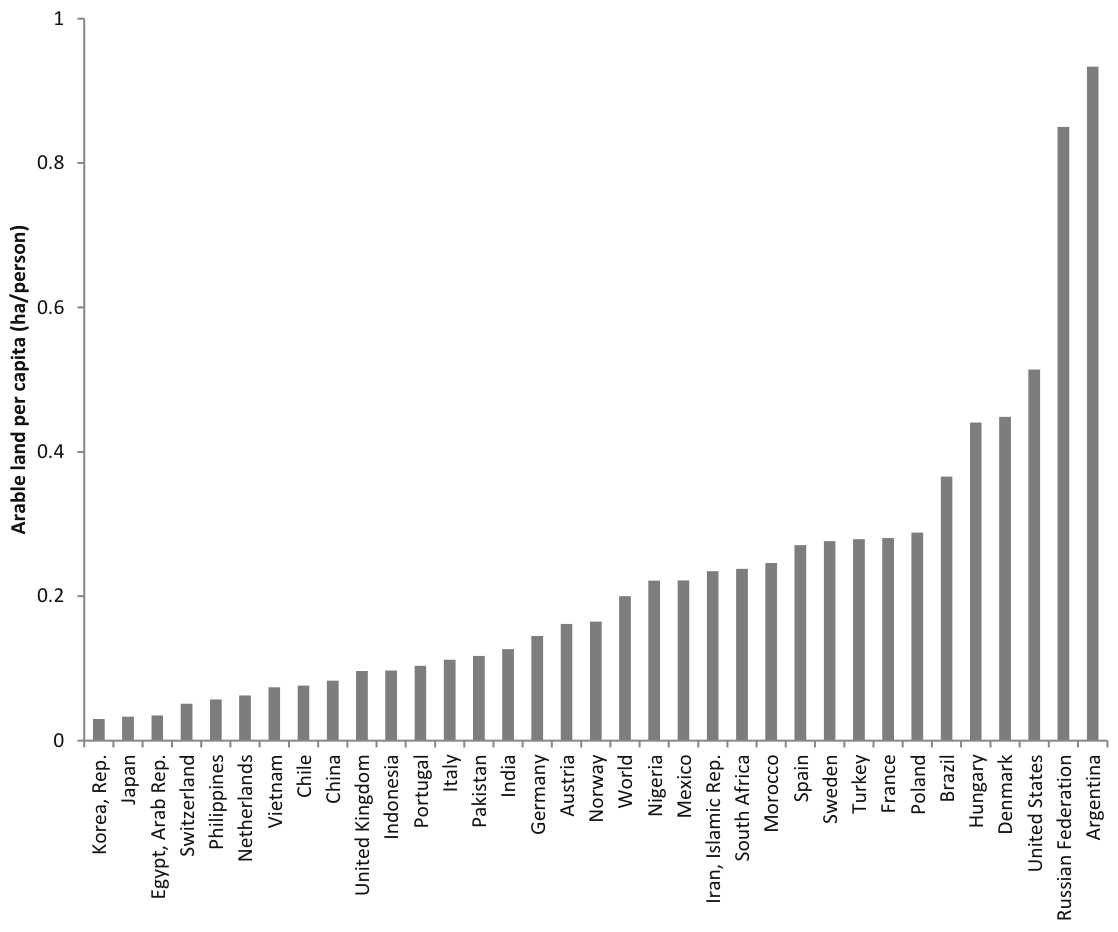
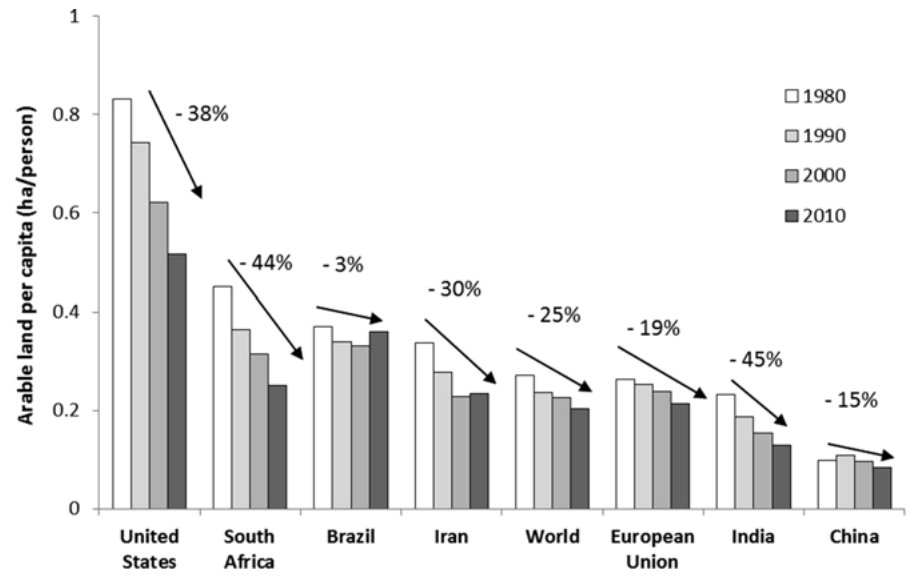
These estimations have brought up concerns about food security and affordable food prices. Increasing population and soil loss is resulting in reduced arable land per person (Figs. 9.1 and 9.2 ).
这些估算引发了人们对粮食安全和粮食价格可负担性的担忧。人口增长和土壤流失导致人均耕地面积减少(图9.1和图9.2)。
Pointing to threatened food security, it has been argued that biomass production for biofuels is unsustainable (Friedemann 2007 ). As a result it has been suggested to use lands that are marginal, “underutilized,” or “unused.” However, such land, especially in developing countries, is often important for the livelihoods of poor rural communities, as it is used for grazing; as livestock transit routes; for collection of fuel wood, wild fruits and nuts, medicinal plants, and other plant products; and for access to water sources (Haralambous et al. 2009 ).
鉴于粮食安全受到威胁,有观点认为为生物燃料生产生物质是不可持续的(Friedemann 2007)。因此,有人建议利用边际的、“未充分利用的”或“闲置的”土地。然而,此类土地(尤其是在发展中国家)往往对贫困农村社区的生计至关重要,因为这些土地被用于放牧、作为牲畜迁徙通道、采集薪柴、野生水果和坚果、药用植物及其他植物产品,以及获取水源(Haralambous et al. 2009)。
Contaminated land, which is not suitable for food production, is in contrast to “marginal” land often not used economically at all; thus, it could also be considered as a suitable alternative, not only for biofuels but timber and fodder as well, which would otherwise be grown on fertile non- contaminated soil that could be used to produce food. The global area of TE-contaminated soils is approximately 33 M ha (Evangelou et al. 2012 ). This estimation is conservative, as the extent of contaminated land in poor countries is diffi cult to assess due to a lack of published data. Nevertheless, it is well documented the area of contaminated land is increasing due to industrialization and lax environmental regulations in poor countries. The use of these lands would open to the affected countries new economic possibilities as most countries lack the wherewithal to remediate or secure contaminated land.
与“边际”土地不同,不适于粮食生产的污染土地往往根本未被经济利用;因此,它也可被视为一种合适的替代选择,不仅可用于生产生物燃料,还可用于生产木材和饲料,否则这些产品将种植在本可用于生产粮食的肥沃未污染土壤上。全球受微量元素污染的土壤面积约为3,300万ha(Evangelou et al. 2012)。这一估算较为保守,因为贫困国家缺乏公开数据,其污染土地范围难以评估。尽管如此,已有充分记录表明,由于贫困国家的工业化和宽松的环境法规,污染土地面积正在不断增加。由于大多数国家缺乏修复或管控污染土地的资金,利用这些土地将为相关国家开辟新的经济机会。
9.3 Potential Plant Species for Phytomanagement9.3 可用于植物管理的潜在植物物种
Plants used for phytomanagement should be fast growing, deep rooted, and easily propagated and have a high biomass production as well. Their TE accumulation characteristics depend on the goal of phytomanagement. Plants that accumulate high concentrations of Se or Zn may be usefully employed on soil contaminated with these elements to provide supplementary fodder for stock in defi cient areas (Banuelos and Dhillon 2011 ; Fässler et al. 2010 ). In some other cases, where accumulation of TEs may present a risk to the food chain, excluder species are desirable. In all cases the biomass should have economic or ecological value. The plants should additionally mitigate the risk originating from that soil, by, e.g., stabilizing the soil, reducing leaching, etc. Furthermore, their cultivation must be practically feasible and economically attractive under the given site and land use conditions (Robinson et al. 2009 ).
用于植物管理的植物应生长快、根系深、易于繁殖且生物量高。其微量元素积累特性取决于植物管理的目标。在受Se或Zn污染的土壤上,可利用高积累这些元素的植物,为缺乏地区的牲畜提供补充饲料(Banuelos and Dhillon 2011; Fässler et al. 2010)。在另一些情况下,若微量元素积累可能对食物链构成风险,则宜选用排斥型物种。在所有情况下,生物质都应具有经济或生态价值。此外,这些植物还应降低源自该土壤的风险,例如稳定土壤、减少淋溶等。再者,在特定场地和土地利用条件下,其栽培必须切实可行且具有经济吸引力(Robinson et al. 2009)。
9.3.1 Trees9.3.1 树木
Various tree species can be used to produce biomass on contaminated land. Willow ( Salix spp.) and poplar ( Populus spp.) are used worldwide for bioenergy production, due to their fast growth and their capability to be coppiced (e.g., short-rotation coppice). Hardwood species such as eucalyptus ( Eucalyptus spp.), beech ( Fagus spp.), maple ( Acer spp.), and birch ( Betula spp.) as well as softwood species such as spruce, pine, fi r, larch, and hemlock are used for the production of pulp, timber, and fi rewood. The trees should not accumulate high TE concentrations (a) in the wood, as risks could arise from the release of these TE during processing (e.g., bioenergy, pulp, burning) as well as during its use (e.g., wooden furniture, use of paper), and (b) in the leaves as TE could be spread through the dispersion of foliage into the surrounding ecosystems. Leaves usually accumulate the highest TE concentrations followed by bark and wood, as shown by Unterbrunner et al. ( 2007 ) for Salix caprea , Salix purpurea , Salix fragilis , Salix sp., Populus tremula , Populus nigra , and Betula pendula . Lead is an exception, as it often accumulates more in stems than in leaves (Migeon et al. 2009 ; Evangelou et al. 2013 ).
多种树种可用于在污染土地上生产生物质。柳树(Salix spp.)和杨树(Populus spp.)因生长迅速且可平茬(如短轮伐期矮林),在世界范围内被用于生物能源生产。桉树(Eucalyptus spp.)、山毛榉(Fagus spp.)、槭树(Acer spp.)和桦树(Betula spp.)等硬木树种,以及云杉、松树、冷杉、落叶松和铁杉等软木树种,被用于生产纸浆、木材和薪柴。这些树木不应在以下部位积累高浓度微量元素:(a)木材中,因为这些微量元素在加工过程(如生物能源、制浆、燃烧)及使用过程(如木制家具、纸张使用)中释放可能带来风险;(b)叶片中,因为微量元素可能随落叶扩散至周围生态系统。叶片通常积累最高浓度的微量元素,其次为树皮和木材,Unterbrunner et al.(2007)对Salix caprea、Salix purpurea、Salix fragilis、Salix sp.、Populus tremula、Populus nigra和Betula pendula的研究即表明了这一点。Pb是一个例外,它在茎中的积累往往多于叶片(Migeon et al. 2009; Evangelou et al. 2013)。
Willow ( Salix spp.) and poplar ( Populus spp.) are known to accumulate high concentrations of Cd and Zn (Dickinson and Pulford 2005 ; Migeon et al. 2009 ; Vamerali et al. 2009 ; Evangelou et al. 2012 , 2013 ) (Table 9.1 ). Birch is a pioneer tree characterized by fast growth and low demand for soil nutrients. Thus, it can be a suitable candidate for the phytomanagement of contaminated soils with low nutrient contents. It does, however, take up more Pb than other tree genera such as willow ( Salix spp.), poplar ( Populus spp.), oak ( Quercus spp.), beech ( Fagus spp.), and maple ( Acer spp.) (Migeon et al. 2009 ; Evangelou et al. 2012 , 2013 ). Compared to willow ( Salix spp.) and poplar ( Populus spp.), birch ( Betula spp.) usually accumulates less Cd (French et al. 2006 ; Hermle et al. 2006 ; Unterbrunner et al. 2007 ). Van Nevel et al. ( 2011 ) found that leaf Cd and Zn accumulation decreased in the order aspen ( Populus tremula ) > silver birch ( Betula pendula ) >> Scots pine ( Pinus sylvestris ) ≈ oak ( Quercus robur and
已知柳树(Salix spp.)和杨树(Populus spp.)能积累高浓度的Cd和Zn(Dickinson and Pulford 2005; Migeon et al. 2009; Vamerali et al. 2009; Evangelou et al. 2012, 2013)(表9.1)。桦树是一种先锋树种,其特点是生长迅速、对土壤养分需求低。因此,它可能是低养分污染土壤植物管理的合适候选树种。然而,与柳树(Salix spp.)、杨树(Populus spp.)、栎树(Quercus spp.)、山毛榉(Fagus spp.)和槭树(Acer spp.)等其他树属相比,桦树吸收更多的Pb(Migeon et al. 2009; Evangelou et al. 2012, 2013)。与柳树(Salix spp.)和杨树(Populus spp.)相比,桦树(Betula spp.)通常积累较少的Cd(French et al. 2006; Hermle et al. 2006; Unterbrunner et al. 2007)。Van Nevel et al.(2011)发现,叶片Cd和Zn积累量依次为:欧洲山杨(Populus tremula)> 垂枝桦(Betula pendula)>> 欧洲赤松(Pinus sylvestris)≈ 栎树(Quercus robur和
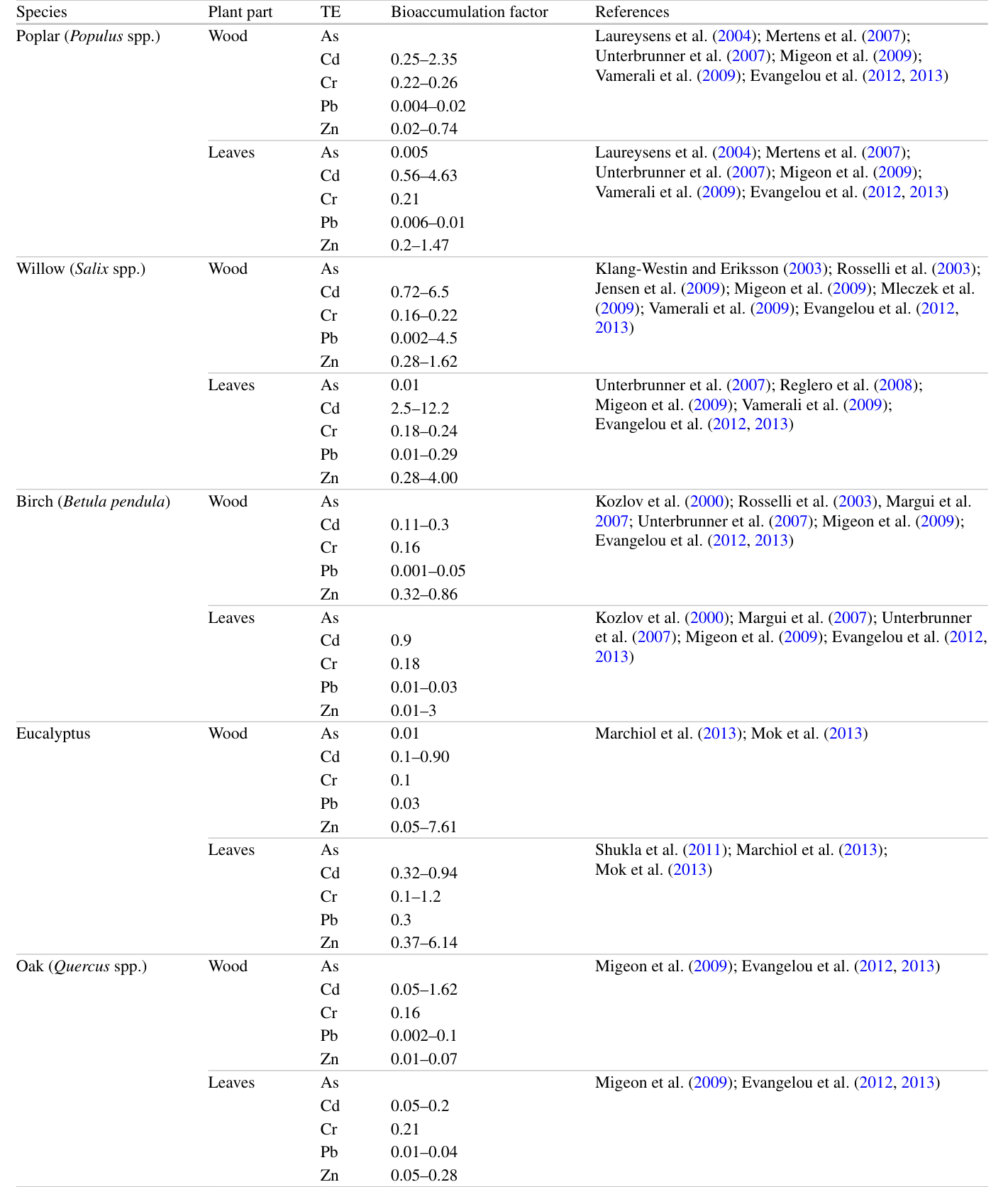
Quercus petraea ), while for the stem the order was aspen ( Populus tremula ) ≈ silver birch ( Betula pendula ) > Scots pine ( Pinus sylvestris ) > oak ( Quercus robur and Quercus petraea ). Scots pine ( Pinus sylvestris ) is a good bioindicator because it is sensitive to industrial pollution (Kosinska and Baaga 2007 ). Meeinkuirt et al. ( 2012 ) found a low ability of eucalypt ( Eucalyptus camaldulensis ) to accumulate Pb, while Mok et al. ( 2013 ) showed that the eucalyptus species Eucalyptus polybractea and Eucalyptus cladocalyx accumulated various TE such as Cd or Zn to high levels. Oaks ( Quercus spp.) are defi ned by a high tolerance to TE but low uptake of TE (Migeon et al. 2009 ; Evangelou et al. 2012 , 2013 ) (Table 9.4 ). But due to this slow growth, they are not very attractive for phytomanagement purposes, although their wood is valuable. Maple ( Acer spp.) shows a low propensity to take up Zn and Cd, while it does not differ from willow ( Salix spp.), poplar ( Populus spp.), or birch ( Betula spp.) in the accumulation of Pb and Cr (Migeon et al. 2009 ).
Quercus petraea),而茎中的顺序为欧洲山杨(Populus tremula)≈ 垂枝桦(Betula pendula)> 欧洲赤松(Pinus sylvestris)> 栎树(Quercus robur和Quercus petraea)。欧洲赤松(Pinus sylvestris)对工业污染敏感,因而是良好的生物指示植物(Kosinska and Baaga 2007)。Meeinkuirt et al.(2012)发现赤桉(Eucalyptus camaldulensis)积累Pb的能力较低,而Mok et al.(2013)表明,桉树物种Eucalyptus polybractea和Eucalyptus cladocalyx能将Cd或Zn等多种微量元素积累至较高水平。栎树(Quercus spp.)的特点是对微量元素耐受性高但吸收量低(Migeon et al. 2009; Evangelou et al. 2012, 2013)(表9.4)。但由于生长缓慢,尽管其木材价值较高,栎树对于植物管理而言吸引力并不大。槭树(Acer spp.)吸收Zn和Cd的倾向较低,而在Pb和Cr积累方面与柳树(Salix spp.)、杨树(Populus spp.)或桦树(Betula spp.)无差异(Migeon et al. 2009)。
9.3.2 Agricultural Crop Plants9.3.2 农作物
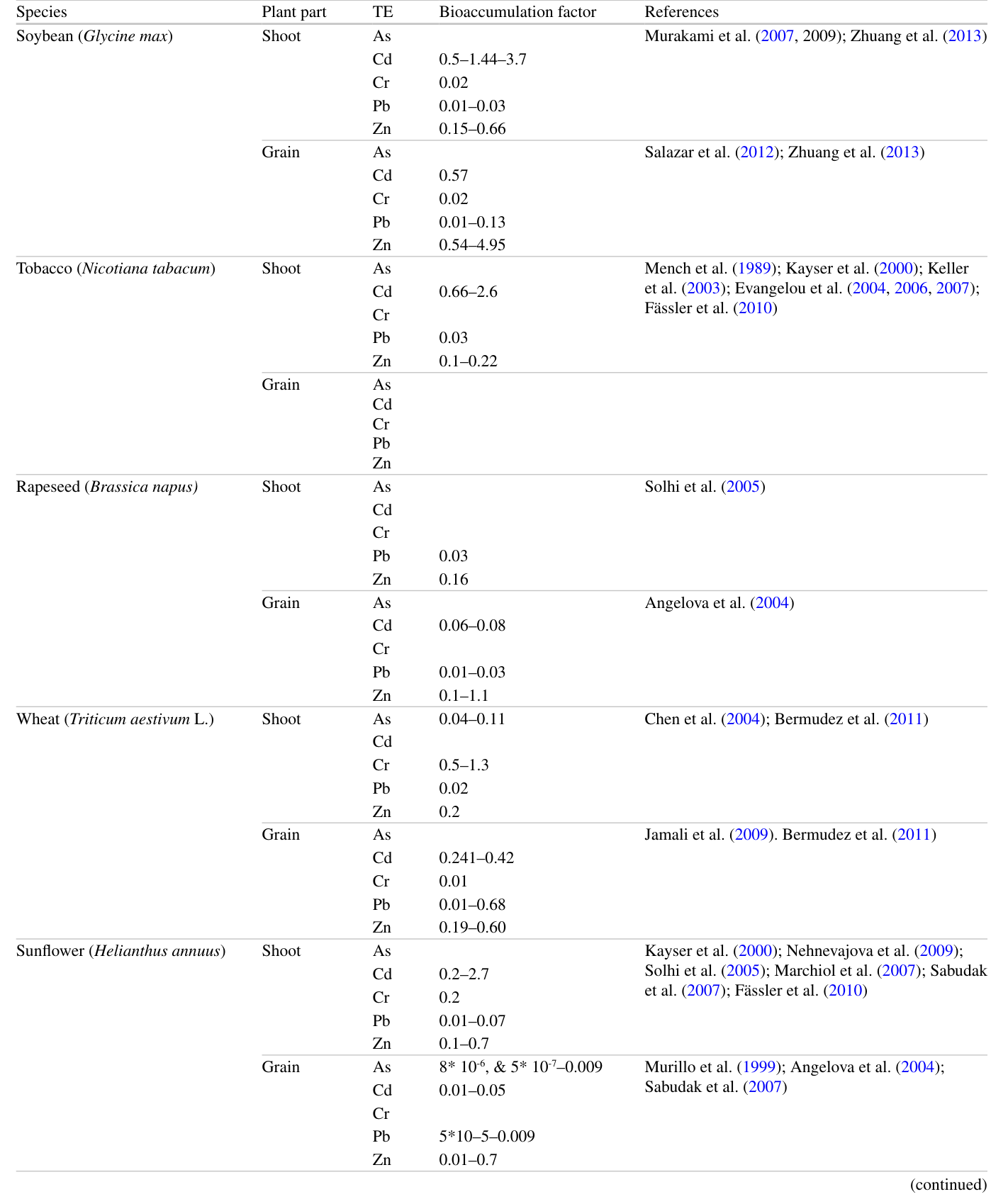
Crops used for the production of bioethanol are wheat ( Triticum spp.), corn ( Zea mays L.), sweet and grain sorghum ( Sorghum bicolor (L.) Moench), and sugar beet ( Beta vulgaris L.), as these plants accumulate large amounts of starch or sugars in plant storage organs, which can be fermented. For biodiesel, annual plants with high seed oil content are used, such as sunfl ower ( Helianthus annuus L.), rapeseed ( Brassica napus L. var. oleifera D.C.), soybean ( Glicine max L.), and tobacco ( Nicotiana tabacum ). Besides plant parts rich in starch and sugar and oils, also stover and straw can be used to produce bioenergy. In contrast to the use of tree species or perennial herbaceous crops, annual plants require efforts for the management of harvest transport and processing. Using crops for the phytomanagement of contaminated soils that are also utilized for food or feed production, if grown on uncontaminated soil, requires particular attention, as there is an increased risk that the products of such crops could by mistake (or deliberate action) contaminate human food (Table 9.2 and 9.3 ).
用于生产生物乙醇的作物包括小麦(Triticum spp.)、玉米(Zea mays L.)、甜高粱和粒用高粱(Sorghum bicolor (L.) Moench)以及甜菜(Beta vulgaris L.),因为这些植物在贮藏器官中积累大量可发酵的淀粉或糖类。生物柴油则采用种子含油量高的一年生植物,如向日葵(Helianthus annuus L.)、油菜(Brassica napus L. var. oleifera D.C.)、大豆(Glicine max L.)和烟草(Nicotiana tabacum)。除富含淀粉、糖类和油脂的植物部位外,秸秆和茎叶也可用于生产生物能源。与利用树种或多年生草本作物相比,一年生植物在收获、运输和加工管理方面需要投入更多。利用在未污染土壤上种植时也用于食品或饲料生产的作物进行污染土壤植物管理,需要特别注意,因为此类作物的产品有较高风险因失误(或蓄意行为)而污染人类食品(表9.2和表9.3)。
A low TE concentration in the seeds of plants grown for the production of biodiesel is desirable as it would reduce the costs of removing TEs from the oil, which could be hazardous for human health. Soybean ( Glycine max ), wheat ( Triticum aestivum L.), and corn ( Zea mays ) seeds accumulate signifi cantly more Zn (up to six times more in soybean) than stems, while there are no signifi cant differences for Cd and Pb (Lavado et al. 2001 ; Salazar et al. 2012 ). The production of methane or ethanol through anaerobic digestion (fermentation) requires low TE concentration, as they can negatively affect the enzymes responsible for the breakdown of biomass, as well as face issues concerning the fate of the digestate, such as its application on soils. Baig et al. (2011) reported the As accumulation in crop plants decreased in the order wheat ( Triticum aestivum L.) > corn ( Zea mays L.) ≈ sorghum ( Sorghum bicolor L.). Sugarcane ( Saccharum spp.) accumulates approximately 50 % less TE in the stalks than in the leaves, with the exception of Cd where the opposite occurs (Noguiera et al. 2013). Also Xia et al. ( 2009 ) found that sugarcane ( Saccharum offi cinarum ) has a high ability to tolerate and accumulate Cd.
用于生产生物柴油的植物,其种子中微量元素浓度低是可取的,因为这将降低从油中去除可能危害人体健康的微量元素的成本。大豆(Glycine max)、小麦(Triticum aestivum L.)和玉米(Zea mays)种子积累的Zn显著多于茎(大豆中高达6倍),而Cd和Pb则无显著差异(Lavado et al. 2001; Salazar et al. 2012)。通过厌氧消化(发酵)生产甲烷或乙醇要求微量元素浓度较低,因为微量元素会对负责分解生物质的酶产生不利影响,同时还会带来消化残余物去向的问题,如其在土壤中的施用。Baig et al.(2011)报道,作物中As积累量依次为小麦(Triticum aestivum L.)> 玉米(Zea mays L.)≈ 高粱(Sorghum bicolor L.)。甘蔗(Saccharum spp.)茎秆中积累的微量元素比叶片少约50 %,但Cd例外,情况恰好相反(Noguiera et al. 2013)。Xia et al.(2009)也发现甘蔗(Saccharum officinarum)具有较强的Cd耐受和积累能力。
The uptake of metals into the shoots may also entail potential ecological risks. Tobacco ( Nicotiana tabacum ) accumulates Cd to relatively high levels compared to other species (Kayser et al. 2000 ; Keller et al. 2003 ; Wenger et al. 2002 ). Concentrations of Cd in fi eld-grown tobacco leaves were found to range from <0.5 to 5 mg Cd kg −1 (Lugon- Moulin et al. 2004 ). Corn ( Zea mays ) can accumulate Zn in the shoots (Keller et al. 2003 ; Luo et al. 2005 ), with Zn concentrations reaching >1,000 mg kg −1 without signifi cant decrease in biomass (Wenger et al. 2002 ). In comparison soybean ( Glycine max ) reaches even higher Zn shoot concentrations (Murakami and Ae 2009 ). Rapeseed ( Brassica napus ) was found to accumulate more Pb than wheat ( Triticum spp.), corn ( Zea mays L.), and sorghum { Sorghum bicolor (L.)} (Tangahu et al. 2011 ).
金属向地上部的吸收也可能带来潜在的生态风险。与其他物种相比,烟草(Nicotiana tabacum)积累Cd的水平相对较高(Kayser et al. 2000; Keller et al. 2003; Wenger et al. 2002)。田间种植的烟草叶片中Cd浓度为<0.5至5 mg Cd kg−1(Lugon-Moulin et al. 2004)。玉米(Zea mays)可在地上部积累Zn(Keller et al. 2003; Luo et al. 2005),Zn浓度可达>1,000 mg kg−1而生物量无显著降低(Wenger et al. 2002)。相比之下,大豆(Glycine max)地上部Zn浓度甚至更高(Murakami and Ae 2009)。研究发现,油菜(Brassica napus)积累的Pb多于小麦(Triticum spp.)、玉米(Zea mays L.)和高粱{Sorghum bicolor (L.)}(Tangahu et al. 2011)。
Concerning potential risks deriving from biomass produced on contaminated soils, we can conclude from the available literature that tobacco ( Nicotiana tabacum ) and sugarcane ( Saccharum spp.) would be unsuitable for Cd-contaminated soils, soybean ( Glycine max ) for Zn-contaminated soils, and wheat ( Triticum spp.) for As-contaminated soil. Rapeseed ( Brassica napus ) is in general unsuitable for TE-contaminated sites, as it belongs to the family of the Brassicaceae (e.g., Brassica species : B. nigra ( L. ) Koch; B. carinata A. Braun; B. oleracea L . ; B. campestris L . ; B. juncea (L.) Czern . ; B. napus L . ), which includes many hyperaccumulators (Vamerali et al. 2010 ) (Table 9.4 ).
关于污染土壤上所产生物质的潜在风险,根据现有文献可以得出结论:烟草(Nicotiana tabacum)和甘蔗(Saccharum spp.)不适用于Cd污染土壤,大豆(Glycine max)不适用于Zn污染土壤,小麦(Triticum spp.)不适用于As污染土壤。油菜(Brassica napus)总体上不适用于微量元素污染场地,因为它属于Brassicaceae(十字花科),该科(如Brassica属物种:B. nigra(L.)Koch;B. carinata A. Braun;B. oleracea L.;B. campestris L.;B. juncea (L.) Czern.;B. napus L.)包含许多超富集植物(Vamerali et al. 2010)(表9.4)。
9.3.3 Herbaceous Perennial Crops9.3.3 多年生草本作物
Perennial grasses have been widely used for centuries as fodder crops, often contributing signifi cantly to energy supply on farms being used to feed draft animals. For example, as late as 1920 in the United States, 27 M animals fuelled by some 35–40 M hectares of grasslands provided traction power on farms and in cities, (Lewandowski et al. 2003 ). In the twentyfi rst century, perennial grasses may be set for a comeback, as they have a great potential to contribute to the production of bioenergy. Candidates are in particular switchgrass ( Panicum virgatum ), miscanthus ( Miscanthus spp.), reed canary grass ( Phalaris arundinacea ), vetiver grass ( Vetiveria zizanioides L.), elephant grass ( Pennisetum purpureum Schumach), and giant reed ( Arundo donax ).
几个世纪以来,多年生禾草作为饲料作物被广泛使用,常用于饲喂役畜,从而为农场能源供应作出重要贡献。例如,直至1920年,美国仍有2,700万头役畜依靠约3,500万–4,000万公顷草地提供的饲料,在农场和城市中提供牵引动力(Lewandowski et al. 2003)。在21世纪,多年生禾草可能卷土重来,因为它们在生物能源生产方面具有巨大潜力。候选物种主要包括柳枝稷(Panicum virgatum)、芒草(Miscanthus spp.)、虉草(Phalaris arundinacea)、香根草(Vetiveria zizanioides L.)、象草(Pennisetum purpureum Schumach)和芦竹(Arundo donax)。
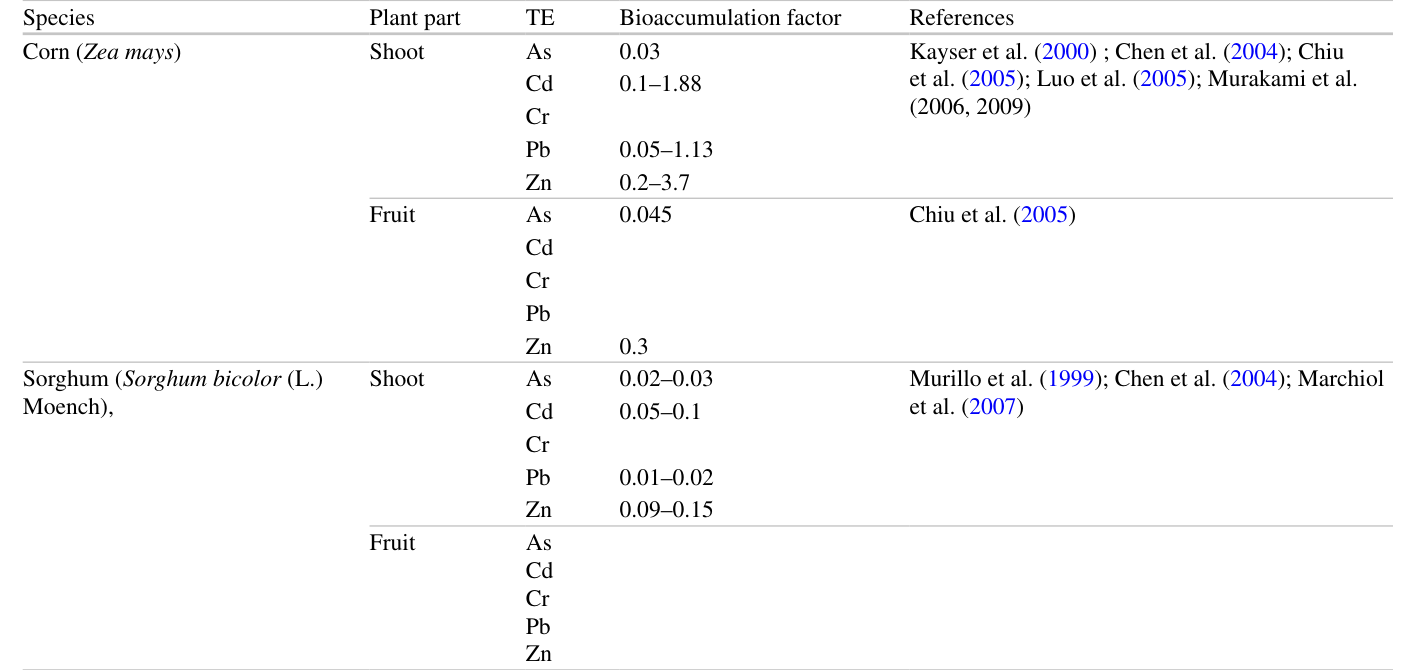
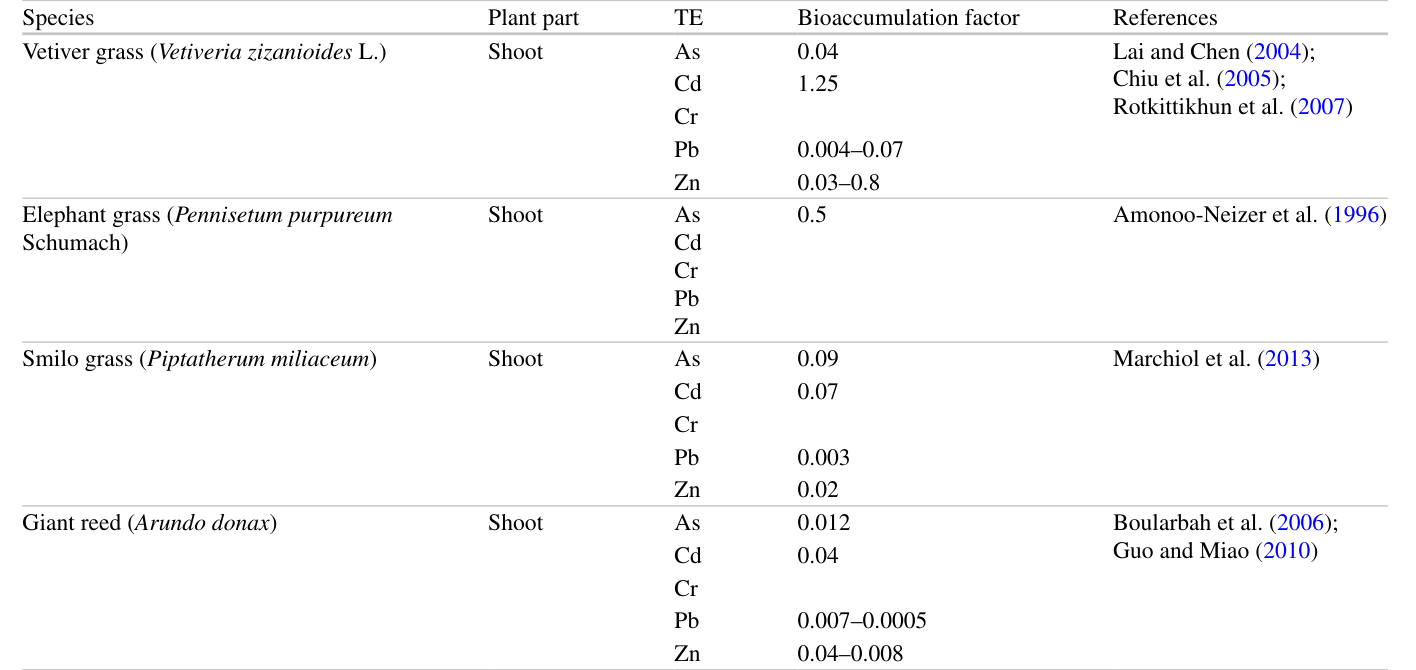
Unlike trees or agricultural crops, research on the potential of perennial grasses to accumulate TE has not been so extensive (Table 9.3 ). Thus, a conclusion, about which perennial grasses are to be preferred for phytomanagement of TE-contaminated sites, cannot be drawn. Nevertheless, Hou et al. ( 2012 ) preferred hybrid Pennisetum followed by giant reed ( Arundo donax ), silver reed ( Thamnochortus cinereus ), and switchgrass ( Panicum virgatum ) for the phytoextraction of an As-, Hg-, Cu-, Cr-, Pb-, and Cd-contaminated soil. The ability of Pennisetum to accumulate Cd is supported by a study of Xia ( 2004 ), where Pennisetum reached higher Cd concentrations than vetiver grass ( Vetiveria zizanioides L.).
与树木或农作物不同,关于多年生禾草积累微量元素潜力的研究尚不够广泛(表9.3)。因此,目前尚无法得出哪些多年生禾草更适合用于微量元素污染场地植物管理的结论。尽管如此,Hou et al.(2012)在As、Hg、Cu、Cr、Pb和Cd复合污染土壤的植物提取中,首选杂交Pennisetum,其次为芦竹(Arundo donax)、银芦(Thamnochortus cinereus)和柳枝稷(Panicum virgatum)。Xia(2004)的研究也支持了Pennisetum积累Cd的能力,该研究中Pennisetum的Cd浓度高于香根草(Vetiveria zizanioides L.)。
| Trace微量 | elements元素 | ||
|---|---|---|---|
| Cd | Zn | Pb | |
| Trees | |||
| Birch( Betulapendula ) | + | + | − − |
| Eucalyptus( _Eucalyptus_spp .) | − | − | + |
| Oak( _Quercus_spp.) | ++ | ++ | + |
| Poplar( _Populus_spp.) | − − | − − | + |
| Maple( _Acer_spp.) | + | + | + |
| Scotspine( Pinus sylvestris) | ++ | ++ | + |
| Willow( _Salix_spp.) | −− | −− | + |
| Agricultural crops | |||
| Corn( Zea mays ) | + | − | + |
| Rapeseed( Brassica napus) | − | − | − |
| Sorghum( Sorghum bicolor (L.)Moench) | + | ||
| Soybean( Glycine max ) | −− | ||
| Sugarcane( _Saccharum_spp . ) | −− | ||
| Sunfl ower( Helianthus annuus ) | − | −− | |
| Tobacco( Nicotiana tabaum ) | −− | ||
| Wheat( _Triticum aestivum_L.) | + | ||
| Perennial grasses | |||
| Elephantgrass( Pennisetumpurpureum ) | − | − | − |
| Giant reed( Arundo donax ) | +/− | +/− | +/− |
| Switchgrass( Panicum virgatum) | + | + | + |
| Vetivergrass( _Vetiveria zizanioides_L.) | + | + | + |
Giant reed ( Arundo donax ) is a tolerant plant species for Cd and Ni, which can accumulate high levels of these TE (Papazoglou 2007 , 2009 ) (Table 9.4 ).
芦竹(Arundo donax)是一种耐Cd和Ni的植物物种,能够积累高水平的这些微量元素(Papazoglou 2007, 2009)(表9.4)。
Owing to years of experience in the production of agricultural crops and timber, the optimal climatic and soil conditions for numerous species and varieties are well known. Perennial grasses are fairly new energy crops, and some, like miscanthus ( Miscanthus spp.) and giant reed ( Arundo donax ), still retain wild-type characteristics such as high seed dormancy levels and insuffi cient winter rest ability. Breeding work for the development of varieties adapted to the different ecological/climatic zones, such as in the case of willow ( Salix spp.) and poplar ( Populus spp.), is still just beginning and has great potential to develop promising bioenergy varieties (Lewandowski et al. 2003 ).
得益于多年的农作物和木材生产经验,众多物种和品种的最适气候和土壤条件已为人熟知。多年生禾草是较新的能源作物,其中一些如芒草(Miscanthus spp.)和芦竹(Arundo donax)仍保留着野生型特征,如种子休眠程度高和越冬休眠能力不足。与柳树(Salix spp.)和杨树(Populus spp.)的情况类似,培育适应不同生态/气候区品种的育种工作仍处于起步阶段,在开发有前景的生物能源品种方面具有巨大潜力(Lewandowski et al. 2003)。
9.4 Potential Products: Economic Revenue9.4 潜在产品:经济收益
9.4.1 Bioenergy9.4.1 生物能源
Bioenergy refers to renewable energy from biological sources, such as biomass that can be used for heat, electricity, and fuel, and their coproducts. The biomass may be used directly as heat (plants, wood, straw, and other plants) or processed into gases (from organic waste, landfi ll waste) or liquids, such as ethanol and biodiesel (derived from crops such as maize ( Zea mays ), sugarcane ( Saccharum offi cinarum ), wheat ( Triticum spp.), rapeseed ( Brassica napus ), and soy ( Glycine max ) or from lignocellulosic material). Biomass has the great advantage over other renewable energy forms; it is currently the only renewable source of fi xed carbon and thus is the only source in the long term for the production of transport fuels. Approximately 57.7 % of the worldwide oil consumption is used for transportation activities (IEA 2006 ), and the global primary demand for oil (excluding biofuels) will rise by 1 % per year on average, from 85 million barrels per day in 2007 to 106 mb day −1 in 2030 (IEA 2008 ). Thus, the market for biofuels will become very big, particularly owing to China’s rapid expansion.
生物能源是指来自生物来源的可再生能源,如可用于供热、发电和燃料的生物质及其副产品。生物质可直接用于供热(植物、木材、秸秆及其他植物),或加工成气体(来自有机废物、填埋垃圾)或液体,如乙醇和生物柴油(来源于玉米(Zea mays)、甘蔗(Saccharum officinarum)、小麦(Triticum spp.)、油菜(Brassica napus)和大豆(Glycine max)等作物或木质纤维素材料)。与其他可再生能源形式相比,生物质具有巨大优势:它是目前唯一的可再生固定碳来源,因而从长远看是生产运输燃料的唯一来源。全球约57.7 %的石油消费用于交通运输(IEA 2006),全球石油初级需求(不包括生物燃料)将年均增长1 %,从2007年的每日8,500万桶增至2030年的106 mb day−1(IEA 2008)。因此,生物燃料市场将变得非常庞大,尤其是由于中国的快速扩张。
Biofuels have a potential but their economic viability is highly dependent on both the oil price and on governmental subsidies, the price of oil in the world market being of crucial importance. The starting point, from which the production of biofuels becomes profi table, is known as break-even point (balance point). In the European Union the break-even point for different biofuels can be reached from US$75–80 barrel −1 of oil in relation to colza oil, US$90 barrel −1 in relation to bioethanol, US$100 barrel −1 to biodiesel, and US$155–160 barrel −1 to fuels attained by second-generation technologies. In the United States the break-even point for bioethanol is currently reached when the oil price exceeds US$40–50 barrel −1 . This means that bioethanol production is not economic at oil prices below US$40 barrel −1 . In the case of producing ethanol in Brazil, the break-even point oscillates between US$30 and 35 barrel −1 . For biofuels derived from vegetal oils, a technology in its incipient stage, the indicator is estimated to be about US$60 barrel −1 (Evangelou et al. 2012 , 2013 ). The break-even point for bioenergy produced, through combustion or fermentation from TE-enriched biomass, would probably be higher. Because fi lters would have to be installed to retain the volatile TE and the risk originating from the TE contained in the digestate after biogas or ethanol production would have to be mitigated.
生物燃料具有潜力,但其经济可行性高度依赖于油价和政府补贴,其中世界市场油价至关重要。生物燃料生产开始盈利的起点称为盈亏平衡点(平衡点)。在欧盟,不同生物燃料的盈亏平衡点分别为:菜籽油对应油价US$75–80 barrel−1,生物乙醇对应US$90 barrel−1,生物柴油对应US$100 barrel−1,第二代技术所得燃料对应US$155–160 barrel−1。在美国,目前生物乙醇的盈亏平衡点为油价超过US$40–50 barrel−1。这意味着油价低于US$40 barrel−1时生物乙醇生产不经济。在巴西生产乙醇时,盈亏平衡点在US$30至35 barrel−1之间波动。对于由植物油制取的生物燃料(一种尚处于起步阶段的技术),该指标估计约为US$60 barrel−1(Evangelou et al. 2012, 2013)。通过燃烧或发酵富含微量元素的生物质所生产生物能源的盈亏平衡点可能更高,因为必须安装过滤器以截留挥发性微量元素,并且必须降低沼气或乙醇生产后消化残余物中所含微量元素带来的风险。
9.4.2 Wood9.4.2 木材
Production and consumption of key wood products (roundwood, sawn-softwood, sawn-hardwood, panels, pulp, paper, and secondary products) are expected to continue past trends of 1–2 % annual increase until 2030. The global demand for wood products is driven by population increase and economic growth in particular in Asia (FAO 2009 ). Contemporaneously, more forests will be excluded from wood production due to new environmental policies and regulations. Additionally, there is less and less old-growth forest left for logging due to our exploitation and forest destruction. Worldwide there are >89 M ha of plantation forests (FAO 2001 ) with their area increasing rapidly. But also the land available for forest plantation is limited and under pressure by the demand for agricultural land. Again, areas with elevated TE concentrations (>33 M ha) could offer a viable alternative. They could be used for wood production, thus reducing the necessity to use natural forests.
主要木材产品(原木、针叶锯材、阔叶锯材、人造板、纸浆、纸张及二次产品)的生产和消费预计将延续过去每年增长1–2 %的趋势,直至2030年。全球木材产品需求受人口增长和经济增长驱动,尤其是在亚洲(FAO 2009)。与此同时,由于新的环境政策和法规,更多森林将被排除在木材生产之外。此外,由于人类的开发利用和森林破坏,可供采伐的原始森林越来越少。全球人工林面积>8,900万ha(FAO 2001),且面积正在迅速增加。但可用于人工造林的土地同样有限,并受到农业用地需求的压力。微量元素浓度升高的区域(>3,300万ha)同样可以提供一种可行的替代选择。这些区域可用于木材生产,从而减少对天然林的利用需求。
Unlike biofuels, growing trees for timber does not produce rapid economic revenue. Plantation forests, depending on the tree species used and the intended product, will need 10–50 years before they become harvestable. Eucalyptus plantations, for example, intended for pulp production can be harvested after approximately 6 years (Clay 2004 ), while pine saw timber may need 30–50 years before it reaches economic maturity (Roth 1989 ). The long-term harvesting cycles are an advantage for phytomanagement, because the less the costs are for management (e.g., for harvesting, fertilizers etc.), the larger the revenue is for a given return. Furthermore, with longer duration between harvests (>25 years), the proportion of the TE rich bark can be reduced, thus reducing the overall TE concentration of the tree trunk (Evangelou et al. 2012 , 2013 ).
与生物燃料不同,种植用材林不能迅速带来经济收益。人工林视所用树种和目标产品而定,需要10–50年才能采伐。例如,用于纸浆生产的桉树人工林约6年后即可采伐(Clay 2004),而松树锯材可能需要30–50年才能达到经济成熟(Roth 1989)。长采伐周期对植物管理是有利的,因为管理成本(如采伐、施肥等)越低,给定回报下的收益就越大。此外,采伐间隔越长(>25年),富含微量元素的树皮所占比例越小,从而降低树干的整体微量元素浓度(Evangelou et al. 2012, 2013)。
The TE concentrations of wood produced on contaminated land should not exceed regulatory values. Swiss legislation and EPF industry standards require that wood panels intended for the market must not exceed concentrations of 50 mg kg −1 Cd, 90 mg kg −1 Pb, 25 mg kg −1 As, and 40 mg kg −1 Cu (ChemRRV 2005 ; EPF 2000 ). Packaging materials must not exceed the cumulative concentration limit of 100 mg kg −1 for Pb, Cd, Hg, and Cr as described in the EU Packaging and Packaging Waste Directive (94/62/EG) (European Parliament 1994 ). Thus, every product derived from phytomanagement should be monitored to ensure that it complies with the aforementioned as well as with other product related thresholds.
在污染土地上生产的木材,其微量元素浓度不应超过法规限值。瑞士法规和EPF行业标准要求,投放市场的木质人造板浓度不得超过Cd 50 mg kg−1、Pb 90 mg kg−1、As 25 mg kg−1和Cu 40 mg kg−1(ChemRRV 2005; EPF 2000)。根据欧盟《包装和包装废弃物指令》(94/62/EG)(European Parliament 1994),包装材料中Pb、Cd、Hg和Cr的累积浓度不得超过100 mg kg−1的限值。因此,对植物管理所得的每一种产品都应进行监测,以确保其符合上述及其他与产品相关的阈值。
challenges and problems as bioenergy production. As with bioenergy production, competition with food production should be avoided, thus feedstock sources should not reduce the availability and quality of cropland. Biomass originating from contaminated land could be such a source. A concern in the application of biochar originating from TE-contaminated soil could be the elevated concentrations of potentially toxic TE in the biochar. An important factor in this respect is the production temperature. Van Zwieten et al. ( 2010 ) found that the concentrations of Cu, Pb, Zn, Mg, Mn, Ni, and Ca were higher in biochar produced at 350 °C than in the feedstock but lower than biochar produced at 550 °C. Mercury and Cd are volatile when heated, even at 400 °C; thus, a low risk originates from these two particularly toxic TE when higher production temperatures are used. While the volatilization of toxic elements is positive for the subsequent use of biochar as soil amendment, it must be made sure that after volatilization, these contaminants are not released into the environment, but retained in the production facilities as in the case of burning biomass for energy. Trace element-enriched biomass should be converted into biochar only in production facilities, equipped with appropriate fi lter technology, which means that it will in general not be possible to produce biochar in small-scale biochar production facilities unless they are equally equipped, which will increase their production costs.
与生物能源生产相同的挑战和问题。与生物能源生产一样,应避免与粮食生产竞争,因此原料来源不应降低耕地的可利用性和质量。来自污染土地的生物质可以成为这样的来源。应用源自微量元素污染土壤的生物炭时,一个值得关注的问题是生物炭中潜在有毒微量元素浓度的升高。在这方面,一个重要因素是生产温度。Van Zwieten et al.(2010)发现,350 °C下生产的生物炭中Cu、Pb、Zn、Mg、Mn、Ni和Ca的浓度高于原料,但低于550 °C下生产的生物炭。Hg和Cd受热易挥发,即使在400 °C下亦是如此;因此,采用较高生产温度时,这两种毒性特别强的微量元素带来的风险较低。尽管有毒元素的挥发对生物炭随后作为土壤改良剂的使用是有利的,但必须确保这些污染物挥发后不会释放到环境中,而是像燃烧生物质发电的情形一样截留在生产设施内。富含微量元素的生物质只应在配备适当过滤技术的生产设施中转化为生物炭,这意味着一般不可能在小规模生物炭生产设施中生产,除非这些设施配备同等装置,而这将增加其生产成本。
Even when the concentrations of toxic TE in biochar produced from plant biomass can be kept low with a suitable choice of the feedstock plants and biochar production temperature, the application is still not without risk. It is not yet suffi ciently well known how the mobility and bioavailability of biochar bound TE will change with time, due to microbial activity, pH changes, organic matter interaction with biochar, etc. Trace element plant uptake and toxicological and mobility studies have to be performed to minimize the risk originating from TE-enriched biochar.
即使通过合理选择原料植物和生物炭生产温度,可将植物生物质所产生物炭中有毒微量元素的浓度保持在较低水平,其应用仍非毫无风险。由于微生物活动、pH变化、有机质与生物炭的相互作用等因素,生物炭结合态微量元素的迁移性和生物有效性将如何随时间变化,目前尚不够清楚。必须开展微量元素植物吸收、毒理学及迁移性研究,以尽量降低富含微量元素生物炭带来的风险。
9.4.3 Biochar9.4.3 生物炭
9.4.4 Biofortifi ed Products9.4.4 生物强化产品
Biochar is produced by pyrolysis (heat-induced carbonization in oxygen-poor atmosphere) of organic material. It is distinguished from charcoal by its main purposes, which are (1) to amend agricultural soils and thereby (2) to sequester carbon from organic matter and avoid its mineralization and release as carbon dioxide into the atmosphere (Lehmann and Joseph 2009 ). As the pyrolysis process can be used in the same time (3) to produce energy, biochar production has more than in one way the potential to make valuable use of organic residues and thus (4) offers an attractive alternative to other ways of organic wastes disposal.
生物炭是由有机材料热解(在缺氧环境中热致炭化)制得的。它与木炭的区别在于其主要用途:(1)改良农业土壤,从而(2)固存有机质中的碳,避免其矿化并以二氧化碳形式释放到大气中(Lehmann and Joseph 2009)。由于热解过程同时可用于(3)生产能源,生物炭生产在多个方面具有有效利用有机残余物的潜力,因而(4)为有机废物处置提供了一种有吸引力的替代途径。
Compared to biomass production for bioenergy, biochar production is still small. However, if biochar production were subsidized to a greater extent, it may result in similar
与用于生物能源的生物质生产相比,生物炭生产规模仍然较小。然而,如果生物炭生产获得更大力度的补贴,可能会面临类似的
Defi ciencies of the mineral micronutrients Fe, Zn, Se, and I affect more than half of humanity (Graham 2008 ). Other mineral elements, such as Ca, Mg, and Cu, can also be defi - cient in the diets of some populations (Zhao and McGrath 2009 ). One strategy for combating micronutrient malnutrition is to “biofortify” plant-based food through increased accumulation of critical elements in the edible parts of crop plants (Bouis 1996 ; Frossard et al. 2000 ; Welch 2002 ; Welch and Graham 1999 ). For this to be the case, the soil must be suffi ciently rich in the elements targeted for biofortifi cation such as Fe, Zn, Se, I, Ca, Mg, or Cu and suffi ciently poor in undesired TE such as Cd, Pb, Hg, Sb, or As, depending on the capability of the plants used for selective uptake and exclusion of these elements. Hyperaccumulating plants are of particular interest in this respect, as most of them hyperaccumulate only one particular element (Assunção et al. 2003 ). To date >500 plant species have been classifi ed as hyperaccumulators, with the majority (approximately 90 %) being Ni hyperaccumulators. There are also 32 Cu, 20 Se, 12 Zn, and 12 Mn hyperaccumulators that could be potentially used for the production of biofortifi ed products (Ent et al. 2013 ).
矿质微量营养元素Fe、Zn、Se和I的缺乏影响着全球一半以上的人口(Graham 2008)。Ca、Mg和Cu等其他矿质元素在某些人群的膳食中也可能缺乏(Zhao and McGrath 2009)。应对微量营养素营养不良的一种策略是通过增加作物可食部分中关键元素的积累,对植物性食物进行“生物强化”(Bouis 1996; Frossard et al. 2000; Welch 2002; Welch and Graham 1999)。为此,土壤必须充分富含生物强化目标元素,如Fe、Zn、Se、I、Ca、Mg或Cu,并且充分贫乏Cd、Pb、Hg、Sb或As等不需要的微量元素,具体取决于所用植物选择性吸收和排斥这些元素的能力。在这方面,超富集植物尤其值得关注,因为它们大多只超富集某一种特定元素(Assunção et al. 2003)。迄今已有>500种植物被归类为超富集植物,其中大多数(约90 %)为Ni超富集植物。此外还有32种Cu、20种Se、12种Zn和12种Mn超富集植物,可能用于生产生物强化产品(Ent et al. 2013)。
It is rather rare that a soil is enriched in only one TE or metalloid. Nevertheless, these soils may require remediation or risk control, if that metal or metalloid is posing a threat to human health such as in the case of Se enrichment in seleniferous soils. Despite many anthropogenic Se sources, such as fossil fuel combustion, metal processing, applications of fertilizers, lime and manure, and disposal of sewage sludge, the Se content of most soils is primarily of geogenic origin. While most soils contain only 0.01–2.0 mg Se kg −1 , mean 0.4 mg Se kg −1 , the Se concentration of seleniferous soils can reach up to 1,200 mg Se kg −1 . Seleniferous soils are widespread in the Great Plains of the United States, Canada, South America, China, and Russia (White et al. 2007 ). Phytoremediation, i.e., cleansing of these soils using Se hyperaccumulators or Brassica sp. and barley ( Hordeum vulgare ), was found to be not feasible (Banuelos et al. 1997 ; Banuelos and Mayland 2000 ). However, if the aim is not cleansing but only control, then combining phytomanagement with the production of biofortifi ed products can create a win-win situation. In the western part of the Central Valley, where soil are rich in Se concentrations, Banuelos and Mayland ( 2000 ) produced Se-enriched canola ( Brassica napus ) and utilized it as Se-biofortifi ed forage to feed marginally Se-defi cient lambs and cows. Similarly, plants such as rapeseed ( Brassica napus ), raya ( Brassica juncea ), sunfl ower ( Helianthus annuus ), cowpea ( Vigna sinensis ), guar ( Cyamopsis tetragonoloba ), wheat ( Triticum aestivum ), spearmint ( Mentha viridis ), sugarcane ( Saccharum offi cinarum ), barley ( Hordeum vulgare ), and bajra ( Pennisetum typhoides ) were used on various seleniferous soils to produce Se-enriched food, fodder, or fertilizer in India (Banuelos and Dhillon 2011 ). In Enshi, China, the so-called World Capital of Selenium, Yuan et al. ( 2012 ) used plants such as clover ( Trifolium repens ) and alfalfa ( Medicago sativa ) to produce Se-biofortifi ed fodder.
土壤仅富集单一微量元素或类金属的情况相当罕见。尽管如此,如果该金属或类金属对人类健康构成威胁,例如富硒土壤中Se富集的情况,这类土壤可能需要修复或风险管控。尽管存在化石燃料燃烧、金属加工、施用化肥、石灰和粪肥以及污水污泥处置等许多人为Se来源,大多数土壤中的Se含量主要来源于地质成因。大多数土壤仅含0.01–2.0 mg Se kg−1,平均为0.4 mg Se kg−1,而富硒土壤的Se浓度可高达1,200 mg Se kg−1。富硒土壤广泛分布于美国大平原、加拿大、南美洲、中国和俄罗斯(White et al. 2007)。研究发现,利用Se超富集植物或Brassica sp.及大麦(Hordeum vulgare)进行植物修复(即净化这些土壤)并不可行(Banuelos et al. 1997; Banuelos and Mayland 2000)。然而,如果目标不是净化而仅是管控,那么将植物管理与生物强化产品生产相结合可实现双赢。在土壤Se浓度较高的中央谷地西部,Banuelos and Mayland(2000)生产了富Se卡诺拉油菜(Brassica napus),并将其作为Se生物强化饲草饲喂轻度缺Se的羔羊和奶牛。同样,在印度,油菜(Brassica napus)、raya(Brassica juncea)、向日葵(Helianthus annuus)、豇豆(Vigna sinensis)、瓜尔豆(Cyamopsis tetragonoloba)、小麦(Triticum aestivum)、留兰香(Mentha viridis)、甘蔗(Saccharum officinarum)、大麦(Hordeum vulgare)和珍珠粟(Pennisetum typhoides)等植物被种植于各种富硒土壤上,以生产富Se食品、饲料或肥料(Banuelos and Dhillon 2011)。在号称“世界硒都”的中国恩施,Yuan et al.(2012)利用三叶草(Trifolium repens)和紫花苜蓿(Medicago sativa)等植物生产Se生物强化饲料。
The consumption of Se-enriched food or fodder is not without risks as Se readily becomes toxic at elevated concentration. Selenium concentrations of food and feed products have to be determined and controlled and Se-enriched biomass should be used only with great care. Some plants can easily accumulate Se to concentrations that are above the safety threshold for human or animal consumption. In search for alternative uses, Dhillon et al. ( 2007 ) incorporated Se-rich plant materials (up to 20 t ha −1 ) into a non- seleniferous agricultural soil and produced wheat ( Triticum aestivum L.) grains and straw with increased but safe levels of Se supplement in the diets of animals and humans living in Se-defi cient areas. Using Se-rich plant material as an organic Se fertilizer for growing other crops could thus be a safe alternative for utilizing plant material that otherwise is too dangerous as direct Se source in animals and humans nutrition.
食用富Se食品或饲料并非没有风险,因为Se在浓度升高时极易产生毒性。必须测定和控制食品及饲料产品中的Se浓度,富Se生物质应极为谨慎地使用。一些植物很容易将Se积累至超过人类或动物食用安全阈值的浓度。为寻找替代用途,Dhillon et al.(2007)将富Se植物材料(最高20 t ha−1)施入非富硒农业土壤,生产出Se含量提高但安全的小麦(Triticum aestivum L.)籽粒和秸秆,可作为缺Se地区动物和人类膳食中的Se补充。因此,将富Se植物材料用作种植其他作物的有机Se肥料,可能是利用那些直接作为动物和人类营养Se源过于危险的植物材料的一种安全替代途径。
9.5 The Effect of Plants on the Mobility of Contaminants: Potential and Risks9.5 植物对污染物迁移性的影响:潜力与风险
9.5.1 Potential for Risk Mitigation9.5.1 风险缓解潜力
Plants can mitigate environmental and health risks arising from TE-contaminated soils by (a) preventing erosion through vegetation cover, (b) reducing leaching, and (c) immobilizing the contaminants. Protection against wind and water erosion is particularly important in cases where mineral and organic particles at the soil surface are loaded with high amounts of pollutants. Dense vegetation protects soil against wind and water erosion. The vegetation cover shields the soil surface against the impact of rainfall and wind. The root systems form a net that holds the soil together. Their exudates help to clog soil particles into larger aggregates and promote the activity of soil organisms which in turn promote the development of an aggregated soil structure and thus its mechanical stability. The extraction of soil water for transpiration promotes the formation of pores that are easily drained and facilitates soil aeration. As a result, the capacity of the soil to store and drain infi ltrating water increases reducing the occurrence of surface runoff and thus water erosion. During dry periods vegetation also protects the soil surface against desiccation, so that the soil surface is stabilized by capillary cohesion of the soil particles against wind erosion.
植物可通过以下途径减轻微量元素(TE)污染土壤所带来的环境与健康风险:(a)以植被覆盖防止侵蚀;(b)减少淋溶;(c)固定污染物。当土壤表层的矿物颗粒和有机颗粒负载大量污染物时,防止风蚀和水蚀尤为重要。茂密的植被可保护土壤免受风蚀和水蚀。植被覆盖可使土壤表面免受降雨和风的冲击。根系形成网络,将土壤固结在一起。根系分泌物有助于将土壤颗粒黏结成较大的团聚体,并促进土壤生物的活动,而后者又进一步促进团粒结构的形成,从而提高土壤的机械稳定性。植物为蒸腾作用吸取土壤水分,促进了易排水孔隙的形成,并有利于土壤通气。由此,土壤储存和排泄入渗水的能力增强,地表径流的发生减少,水蚀随之减轻。在干旱时期,植被还可防止土壤表面干燥,使土壤表面依靠土壤颗粒间的毛细黏聚力保持稳定,从而抵御风蚀。
Soil water consumption for transpiration also reduces contaminant leaching (Pilon-Smits 2005 ; Robinson et al. 2003b ; Vose et al. 2003 ). How effective vegetation is in controlling leaching also depends on climate. The capacity of the atmosphere to take up water vapor sets upper limit on evapotranspiration. Actual evapotranspiration is due to limitations in water transfer from soil into plants often much lower than this limit. In dryer climates, evapotranspiration is usually greater from deep-rooted species because shallowrooted species have less access to water during periods of drought and are, therefore, more likely to suffer from dieback or reduced transpiration and growth (Robinson et al. 2009 ). Robinson et al. ( 2003b , 2007 ) found that hybrid poplars ( Populus deltoides × nigra (“Argyle” and “Selwin”), Populus deltoides × yunnanensis (“Kawa”), Populus euramericana × yunnanensis (“Toa”), Populus alba × glandulosa (“Yeogi”), Populus nigra × manimowic (“Shinsei”)) reduced B leaching from a wood-waste landfi ll due to enhanced evapotranspiration but did not completely prevent substantial leaching driven by heavy rainfall events. Thus, collection and treatment of the discharge from the landfi ll would still be necessary.
蒸腾作用对土壤水分的消耗同样可减少污染物的淋溶(Pilon-Smits 2005; Robinson et al. 2003b; Vose et al. 2003)。植被控制淋溶的效果还取决于气候。大气吸收水汽的能力决定了蒸散的上限。由于水分从土壤向植物传输受到限制,实际蒸散往往远低于该上限。在较干旱的气候条件下,深根性物种的蒸散量通常更大,因为浅根性物种在干旱期间获取水分的能力较弱,因而更易出现枯梢或蒸腾及生长减弱的现象(Robinson et al. 2009)。Robinson et al.(2003b, 2007)发现,杂交杨树(Populus deltoides × nigra(“Argyle”和“Selwin”)、Populus deltoides × yunnanensis(“Kawa”)、Populus euramericana × yunnanensis(“Toa”)、Populus alba × glandulosa(“Yeogi”)、Populus nigra × manimowic(“Shinsei”))通过增强蒸散减少了木材废弃物填埋场的B淋溶,但未能完全阻止强降雨事件引发的大量淋溶。因此,仍有必要对填埋场的排出液进行收集和处理。
Another way in which plants can immobilize pollutants in soil is binding them through their roots. Unlike in phytoextraction, not cellular uptake is necessary for this. It is suffi - cient that the contaminant is bound to the root cell walls. In the apoplast, the intercellular space including the cell walls separated by the intracellular space by the cell membranes, signifi cant amounts of various substances can be bound owing to the high sorption capacity of the cell walls. Plant roots can immobilize contaminants also by modifying the chemical environment in the rhizosphere. For example, an increase in pH can reduce the solubility of metal cations. Root exudates promote the formation of soil organic matter and thus increase the sorption capacity of the soil. Also the transition from anaerobic to aerobic conditions in a soil can increase the TE sorption capacity in soils by inducing the oxidation of dissolved Fe(II) and Mn(II) to Fe(III) and Mn(IV), which then precipitate as oxides and hydroxides.
植物固定土壤污染物的另一种方式是通过根系对其进行结合。与植物提取不同,这一过程无需细胞吸收,只要污染物结合于根细胞壁即可。质外体是指包括细胞壁在内、由细胞膜与胞内空间相隔的细胞间隙;由于细胞壁具有很高的吸附能力,质外体中可结合大量的各类物质。植物根系还可通过改变根际化学环境来固定污染物。例如,pH升高可降低金属阳离子的溶解度。根系分泌物可促进土壤有机质的形成,从而提高土壤的吸附能力。此外,土壤由厌氧条件向好氧条件的转变可诱导溶解态Fe(II)和Mn(II)氧化为Fe(III)和Mn(IV),后者以氧化物和氢氧化物形式沉淀,从而提高土壤对微量元素的吸附能力。
9.5.2 Possible Emerging Risks9.5.2 可能出现的新风险
Although deep roots seem generally more favorable than shallow roots, one must not forget that deep roots may create macropores which facilitate the preferential transport of contaminants to groundwater (Roulier et al. 2008 ). In a study by Knechtenhofer et al. ( 2003 ), it was shown that soil preferential fl ow paths below 20 cm, which are associated with roots surrounded by relatively wide root channels (Kretzschmar et al. 1999 ), played a signifi cant role in the spatial distribution of Pb. In this large macropores, Pb may be transported as aqueous ions or bound by colloidal particles (Kretzschmar et al. 1999 ). A pH increase can decrease the mobility of metals, but it can also result in the solubilization of humic substances and facilitate the downward mobility of metals via preferential fl ow pathways.
尽管深根通常似乎比浅根更为有利,但不应忽视深根可能形成大孔隙,从而促进污染物向地下水的优先迁移(Roulier et al. 2008)。Knechtenhofer et al.(2003)的研究表明,20 cm以下的土壤优先流路径(与被较宽根道包围的根系相关(Kretzschmar et al. 1999))对Pb的空间分布具有重要作用。在此类大孔隙中,Pb可能以水合离子形式或与胶体颗粒结合的形式迁移(Kretzschmar et al. 1999)。pH升高可降低金属的迁移性,但也可能导致腐殖物质溶解,进而促进金属经优先流路径向下迁移。
Trace element-contaminated litter or harvest residues might be dispersed via wind or water erosion, thus potentially contaminating adjacent environments (Perronnet et al. 2000 ). Such litter and harvest residues decompose slower than non-contaminated plant material (Boucher et al. 2005 ; Cotrufo et al. 1995 ), as can be observed by the accumulation of litter on the forest fl oor near smelters (Berg et al. 1991 ; Freedman and Hutchinson 1980 ; Strojan 1978 ), resulting in the long-term availability of plant material in a form that can be dispersed. Thus, prevention measures should be taken to control plant material (e.g., leaves) dispersion, especially in situations where wind and water can be expected (Van Nevel et al. 2007 ). With the decomposition of contaminated litter, the contaminants may be released into the soil. Scheid et al. ( 2009 ) observed that the sorbed TE (Cu, Cd, Pb, Zn) were strongly bound in the litter even after 2 years of decomposition. However, if the contaminants become associated with dissolved organic matter, they will in fact be more mobile than contaminants adsorbed on mineral particles (Van Nevel et al. 2007 ).
受微量元素污染的凋落物或收获残体可能经风蚀或水蚀扩散,从而可能污染周边环境(Perronnet et al. 2000)。此类凋落物和收获残体的分解速度慢于未受污染的植物材料(Boucher et al. 2005; Cotrufo et al. 1995),这可从冶炼厂附近林地地表凋落物的积累中观察到(Berg et al. 1991; Freedman and Hutchinson 1980; Strojan 1978),其结果是植物材料长期以可扩散的形式存在。因此,应采取预防措施控制植物材料(如叶片)的扩散,尤其是在预计会受到风和水作用的情况下(Van Nevel et al. 2007)。随着受污染凋落物的分解,污染物可能释放到土壤中。Scheid et al.(2009)观察到,即使经过2年的分解,吸附的微量元素(Cu、Cd、Pb、Zn)仍牢固地结合在凋落物中。然而,若污染物与溶解性有机质结合,其迁移性实际上将高于吸附在矿物颗粒上的污染物(Van Nevel et al. 2007)。
9.6 Sustainability Aspects9.6 可持续性问题
9.6.1 Ecological Sustainability9.6.1 生态可持续性
The management of contaminated soils has to consider not only the established ecosystems on the site but also surrounding ecosystems. Trace element-contaminated land may be valuable as sites of specifi c fl oras and faunas such as Galmei-Vegetation in Germany (Engelen and Holtz 2000 ). The fl ora growing in metalliferous soils is a source of genetic material for research (Brady et al. 2005 ; Whiting et al. 2004 ). There is a trend to protect biodiversity that can accompany the agricultural/industrial development in these kinds of soils (Dickinson et al. 2009 ). Vidic et al. ( 2009 ) showed that the genome size of the species was related to their survival in TE-contaminated soils. Tolerant species had small genomes in comparison with non-tolerant ones. Such surrounding ecosystems can be affected by over extensive use or the use of not suitable plant species on phytomanaged sites. Cormish ( 1989 ) showed that when radiata pine ( Pinus radiata ) was planted in Australia to reduce soil erosion and increase slope stability, it reduced stream fl ow so effectively that naturally perennial streams were turned into ephemeral streams. There was thus a possibility that habitats of several fauna and fl ora species of surrounding ecosystems requiring perennial stream fl ow would be endangered.
污染土壤的管理不仅要考虑场地内已建立的生态系统,还需考虑周边生态系统。受微量元素污染的土地可能作为特定动植物区系的栖息地而具有价值,如德国的Galmei植被(Engelen and Holtz 2000)。生长于富金属土壤上的植物区系是科研遗传材料的来源(Brady et al. 2005; Whiting et al. 2004)。目前存在一种保护此类土壤上伴随农业/工业开发而存在的生物多样性的趋势(Dickinson et al. 2009)。Vidic et al.(2009)表明,物种的基因组大小与其在微量元素污染土壤中的存活有关:耐性物种的基因组小于非耐性物种。此类周边生态系统可能因植物管理场地的过度利用或使用不适宜的植物物种而受到影响。Cormish(1989)表明,在澳大利亚为减少土壤侵蚀、提高边坡稳定性而种植辐射松(Pinus radiata)后,河川径流显著减少,以致天然常年性溪流变为间歇性溪流。因此,周边生态系统中需要常年性溪流的多种动植物物种的栖息地可能受到威胁。
An important debate relates to the use of non-endemic species for the production of biomass on contaminated land. Although most food, fi ber, and landscape plants are nonnative, relatively few have proven invasive. However, some of those that are invasive have caused substantial socioeconomic and environmental impacts. Economic losses caused by invasive plants and costs for their control are estimated to be $34 bn annually in the United States (Ditomaso et al. 2010 ) and $10 bn annually in Europe (Hulme et al. 2009 ). The introduction and planting of invasive species/neophytes in various regions of the world, such as eucalyptus in Southern Europe or the giant reed in the Unites States, are caused by government actions. Johnson grass ( Sorghum halepense ) was originally grown as a forage grass but since has become a weed that greatly depresses yields of corn ( Zea mays ), soybeans ( Glycine max ), and other crops. It has invaded now in 16 states of the United States and incurs annual losses of more than $30 M in just three of them (Simberloff 2008 ). Another fast-growing perennial grass that has become invasive is miscanthus ( Miscanthus spp.). It is primarily used for biofuel production and has been described as “Johnson grass on steroids” (Raghu et al. 2006 ). Therefore, the plant species used for phytomanagement should ideally be endemic. Growing noninvasive species might initially be economically less attractive. However, in the long term they would be more advantageous as no clearing costs would be involved, and public opinion would be less hostile.
一个重要的争论涉及在污染土地上利用非本土物种生产生物质的问题。尽管大多数粮食、纤维和景观植物均为非本土物种,但被证实具有入侵性的相对较少。然而,其中部分入侵物种已造成严重的社会经济和环境影响。据估计,入侵植物造成的经济损失及其防治成本在美国每年达340亿美元(Ditomaso et al. 2010),在欧洲每年达100亿美元(Hulme et al. 2009)。入侵物种/新植物在世界各地的引入和种植,如南欧的桉树或美国的芦竹,是由政府行为所致。约翰逊草(Sorghum halepense)最初作为饲草种植,但此后已成为一种杂草,大幅降低玉米(Zea mays)、大豆(Glycine max)及其他作物的产量。目前它已入侵美国16个州,仅其中3个州每年造成的损失即超过3000万美元(Simberloff 2008)。另一种已具入侵性的速生多年生草本植物是芒草(Miscanthus spp.),主要用于生物燃料生产,被形容为“服用了类固醇的约翰逊草”(Raghu et al. 2006)。因此,用于植物管理的植物物种最好为本土物种。种植非入侵性物种在初期经济吸引力可能较低,但从长远来看更为有利,因为无需承担清除费用,公众舆论的抵触也会较小。
9.6.2 Soil Sustainability9.6.2 土壤可持续性
The production of biomass for biofuels, food, timber, etc., has often caused soil degradation/soil loss due to inadequate soil management practices. The main forms of soil degradation are water (56 %) and wind erosion (28 %). Other forms including chemical degradation and physical degradation sum up to 16 %. In total soil degradation affects about 2,000 M ha of land, which is equivalent to 15 % of the Earth’s land surface (an area larger than the United States and Mexico combined). The causes of soil degradation include overgrazing (35 %), deforestation (30 %), agricultural activities (27 %), overexploitation of vegetation (7 %), and industrial activities (1 %) (UNEP 2002 ). Increased biofuel production has shown that soil degradation could become more severe in the near future. In Indonesia, for instance, two-thirds of oil palm expansion has occurred by converting large rainforest areas. In the United States, 1.3 M ha of lands in the Conservation Reserve Program designed to help check surpluses, maintain price levels, and promote an ecological balance were called back into production (UNEP 2012 ). Soil degradation can be infl uenced greatly by the user with an appropriate choice of plants, as well as management, which have to be adjusted accordingly to the soil type, the climate, and the geomorphology.
由于土壤管理措施不当,为生产生物燃料、粮食、木材等而进行的生物质生产常导致土壤退化/土壤流失。土壤退化的主要形式为水蚀(56 %)和风蚀(28 %),包括化学退化和物理退化在内的其他形式合计占16 %。土壤退化总计影响约2,000 M ha土地,相当于地球陆地面积的15 %(比美国和墨西哥面积之和还大)。土壤退化的原因包括过度放牧(35 %)、森林砍伐(30 %)、农业活动(27 %)、植被过度开发(7 %)和工业活动(1 %)(UNEP 2002)。生物燃料产量的增加表明,土壤退化在不久的将来可能更加严重。例如,在印度尼西亚,三分之二的油棕扩张是通过转化大面积热带雨林实现的。在美国,旨在抑制过剩、维持价格水平并促进生态平衡的“保护储备计划”中的1.3 M ha土地被重新投入生产(UNEP 2012)。使用者可通过适当选择植物及管理方式在很大程度上影响土壤退化,而植物和管理方式须根据土壤类型、气候和地貌作相应调整。
The choice of plant species is very important as they can either increase or decrease soil erosion as well as soil organic carbon (SOC) content. Sullivan ( 2004 ) found that traditional annual crops such as corn ( Zea mays ) and soybean ( Glycine max ) caused 50 times more soil erosion than sod crops. In general, soil is more exposed to the impacts of weather in row crops than in the latter. Also trees such as willow ( Salix spp.) or poplar ( Populus spp.) usually provide better protection against erosion than row crops. Pimentel and Krummel ( 1987 ) showed that under short-rotation woody crops (SRWC), the average erosion rate was 2 Mg ha −1 year −1 on a 5 % slope, whereas corn ( Zea mays ) grown on a 4 % slope resulted in a soil loss of 21.8 Mg ha −1 year −1 . Nevertheless, erosion can still be high under SRWC, if there is no herbaceous cover beneath the trees, especially when there is a high throughfall of rain (Kort et al. 1998 ). Perennial grasses are also effective in reducing erosion (Kemper et al. 1992 ) due to their dense network of fi brous roots close to the soil surface. The choice of the plant species for phytomanagement infl uences the SOC content. McLaughlin and Walsh ( 1998 ) reported that carbon sequestration rates under switchgrass ( Panicum virgatum ) may exceed those of annual crops by as much as 20–30 times, owing to carbon storage in the soil. Cultivation of temperate-zone perennial grasses such as miscanthus ( Miscanthus × giganteus ), switchgrass ( Panicum virgatum ), and others can increase SOC by 0.1–1 Mg ha −1 year −1 (Anderson-Teixeira et al. 2009 ). Short-rotation wood coppice, with willows ( Salix spp.), may be even more effective in storing SOC than switchgrass (Panicum virgatum ). Zan et al. ( 2001 ) found that relatively fertile soils in Canada beneath willows ( Salix spp.) stored more SOC than under corn ( Zea mays ) or switchgrass (Panicum virgatum ) 4 years after establishment.
植物物种的选择非常重要,因为植物既可能加剧也可能减轻土壤侵蚀,并可能提高或降低土壤有机碳(SOC)含量。Sullivan(2004)发现,玉米(Zea mays)和大豆(Glycine max)等传统一年生作物造成的土壤侵蚀是草皮作物的50倍。一般而言,与后者相比,行栽作物下的土壤更多地暴露于天气影响之下。柳树(Salix spp.)或杨树(Populus spp.)等树木通常也比行栽作物具有更好的防侵蚀作用。Pimentel and Krummel(1987)表明,在短轮伐期木本作物(SRWC)下,5 %坡度上的平均侵蚀速率为2 Mg ha−1 year−1,而在4 %坡度上种植玉米(Zea mays)导致的土壤流失为21.8 Mg ha−1 year−1。然而,若树下无草本覆盖,尤其是在穿透雨量较大时,SRWC下的侵蚀仍可能较高(Kort et al. 1998)。多年生禾草因其在近地表处具有密集的须根网络,同样能有效减少侵蚀(Kemper et al. 1992)。用于植物管理的植物物种的选择会影响SOC含量。McLaughlin and Walsh(1998)报道,由于碳储存于土壤中,柳枝稷(Panicum virgatum)下的固碳速率可比一年生作物高出20–30倍。种植芒草(Miscanthus × giganteus)、柳枝稷(Panicum virgatum)等温带多年生禾草可使SOC增加0.1–1 Mg ha−1 year−1(Anderson-Teixeira et al. 2009)。以柳树(Salix spp.)为主的短轮伐期矮林在储存SOC方面可能比柳枝稷(Panicum virgatum)更为有效。Zan et al.(2001)发现,在加拿大相对肥沃的土壤上,柳树(Salix spp.)种植4年后储存的SOC多于玉米(Zea mays)或柳枝稷(Panicum virgatum)。
Other agricultural management factors that have a major infl uence on soil erosion and soil carbon sequestration are whether crop residues are left on the fi eld and incorporated into the soil as well as tillage practices. While there can be important differences between different tillage techniques, tillage in general increases the risk of soil erosion and SOC loss (Anderson-Teixeira et al. 2009 ; Williams et al. 2009 ), whereas crop residues that are left on the land protect the soil against erosion and SOC loss. If residues are completely removed, no-tillage soils can be as even more vulnerable to wind erosion than plowed soils during drought periods (Blanco-Canqui 2010 ). Blanco-Canqui and Lal ( 2009 ) considered a partial removal of 25 % of stover as the maximum rate that can be tolerated in no-tillage soils. This might be enough to control wind erosion, but it might still be too much to maintain optimal levels of SOC. Wilhelm et al. ( 2007 ) found that the amounts of corn ( Zea mays ) stover needed to maintain SOC at such a level by far exceed the amounts needed to control water and wind erosion.
对土壤侵蚀和土壤固碳有重大影响的其他农业管理因素包括:作物残体是否留在田间并翻入土壤,以及耕作方式。尽管不同耕作技术之间可能存在重要差异,但总体而言,耕作会增加土壤侵蚀和SOC损失的风险(Anderson-Teixeira et al. 2009; Williams et al. 2009),而留在土地上的作物残体则可保护土壤免受侵蚀和SOC损失。若残体被完全移除,免耕土壤在干旱期间甚至可能比翻耕土壤更易受风蚀(Blanco-Canqui 2010)。Blanco-Canqui and Lal(2009)认为,部分移除25 %的秸秆是免耕土壤可承受的最大移除率。这或许足以控制风蚀,但对于维持最佳SOC水平而言可能仍然过多。Wilhelm et al.(2007)发现,将SOC维持在该水平所需的玉米(Zea mays)秸秆量远超控制水蚀和风蚀所需的量。
9.7 Decision Support Systems9.7 决策支持系统
The success of phytomanagement crucially depends on the choice of the right plants and cultivation methods. The cultivation of candidate plants must be practical, economically attractive, and safe under the conditions of the given site and land use conditions. In practice, it is not possible to perform experimental trials in each specifi c case. However, the results of many pot and fi eld studies in which plants have been grown on polluted soils have been integrated into model- based decision support systems (DSS), such as REC-Phyto- DSS (Onwubuya et al. 2009 ), Phyto-DSS (Robinson et al. 2003a ), and Phyto-3 (Bardos et al. 2011 ).These can be of great help in the evaluation, design, and operation of site- adapted phytoremediation schemes. All the mentioned DSS either use a multi-criteria analysis or life cycle analysis or both. Phyto-3 is designed for US conditions. It provides guidance for regulators and practitioners, evaluating options of remedial phytotechnology available for the treatment of contaminated sites, with a strong focus on groundwater protection against organic contaminants. REC-Phyto-DSS is a European DSS specifi cally focusing on “gentle” site remediation techniques and in particular on phytoextraction and phytostabilization. It is implemented in the Dutch REC (Risk reduction, Environmental merits, and Cost) framework. Phyto-DSS is a generic tool designed to predict the effi ciency of metal phytoextraction and evaluate its economic feasibility. It is based on a mechanistic model taking account of plant water use, soil metal solubility, and root distribution but used a lumped parameter to determine the ratio between metal concentrations in the xylem of the remediation plants and the soil solution. While the existing DSSs provide a good basis for the assessment of contaminated sites, as shown in Cano- Reséndiz et al. ( 2011 ), none of them however have yet a suffi cient focus on the economic revenue. Thus, to encourage effi ciency and increase the monetary output and keep possible risks derived from phytomanagement sites at a minimum, a DSS developed for phytomanagement is needed.
植物管理的成功在很大程度上取决于能否选择合适的植物和栽培方法。候选植物的栽培必须在特定场地和土地利用条件下切实可行、具有经济吸引力且安全。实践中不可能针对每一具体情况开展试验。然而,许多在污染土壤上种植植物的盆栽研究和田间研究的结果已被整合到基于模型的决策支持系统(DSS)中,如REC-Phyto-DSS(Onwubuya et al. 2009)、Phyto-DSS(Robinson et al. 2003a)和Phyto-3(Bardos et al. 2011)。这些系统对于评估、设计和运行适应场地条件的植物修复方案大有帮助。上述DSS均采用多准则分析或生命周期分析,或二者兼用。Phyto-3针对美国条件设计,为监管者和从业者评估可用于污染场地治理的植物修复技术方案提供指导,并着重于保护地下水免受有机污染物污染。REC-Phyto-DSS是一个欧洲DSS,专门关注“温和”的场地修复技术,尤其是植物提取和植物稳定,它在荷兰REC(风险降低、环境效益与成本)框架中实施。Phyto-DSS是一个通用工具,旨在预测金属植物提取的效率并评估其经济可行性。它基于一个考虑植物用水、土壤金属溶解度和根系分布的机理模型,但采用集总参数来确定修复植物木质部中金属浓度与土壤溶液中金属浓度之比。尽管现有DSS为污染场地评估提供了良好基础(如Cano-Reséndiz et al.(2011)所示),但它们均未对经济收益给予足够关注。因此,为提高效率、增加货币产出并将植物管理场地可能产生的风险降至最低,有必要开发一个面向植物管理的DSS。
9.8 Conclusions9.8 结论
Starting with phytoextraction as a novel, low-tech, promising tool for soil cleaning around two decades ago, phytoremediation of contaminated soils will forever just remain a promising tool if it is not linked to profi table production of biomass, in the form of phytomanagement. Successful phytomanagement requires a multidisciplinary approach combining the design of appropriate crop management schemes, control of contaminant fl uxes, assessment of associated risk, and optimization of economic revenues. Once accepted by regulators and decision makers in charge, phytomanagement could become a viable solution to use and even restore polluted soils. The phytomanagement of contaminated sites could offer an alternative income to people living nearby such areas and who lost their livelihood because of the contamination.
大约二十年前,植物提取作为一种新颖、低技术且前景广阔的土壤净化工具出现;然而,若不以植物管理的形式将其与有利可图的生物质生产相结合,污染土壤的植物修复将永远只是一种“有前景”的工具。成功的植物管理需要多学科方法,将适当的作物管理方案设计、污染物通量控制、相关风险评估以及经济收益优化结合起来。一旦为监管者和主管决策者所接受,植物管理有望成为利用乃至修复污染土壤的可行方案。污染场地的植物管理可为居住在此类地区附近、因污染而失去生计的人们提供另一种收入来源。
1References参考文献
Amonoo-Neizer EH, Nyamah D, Bakiamoh SB (1996) Mercury and arsenic pollution in soil and biological samples around the mining town of Obuasi. Ghana Water Air Soil Pollut 91:363–373
Anderson-Teixeira KJ, Davis SC, Masters MD, Delucia EH (2009) Changes in soil organic carbon under biofuel crops. GCB Bioenergy 1:75–96
Angelova V, Ivanova R, Ivanov K (2004) Heavy metal accumulation and distribution in oil crops. Commun Soil Sci Plant Anal 35:2551–2566 Assunção AGL, Bookum WM, Nelissen HJM, Vooijs R, Schat H, Ernst WHO (2003) Differential metal-specifi c tolerance and accumulation patterns among Thlaspi caerulescens populations originating from different soil types. New Phytol 159:411–419
Banuelos GS, Dhillon KS (2011) Developing a sustainable phytomanagement strategy for excessive selenium in western United States and India. Int J Phytoremediation 13:208–228
Banuelos GS, Mayland HF (2000) Absorption and distribution of sele-
nium in animals consuming canola grown for selenium phytoremediation. Ecotoxicol Environ Saf 46:322–328
Banuelos GS, Ajwa HA, Terry N, Zayed A (1997) Phytoremediation of selenium laden soils: a new technology. J Soil Water Conserv 52:426–430
Bardos RP, Bone B, Andersson-Skold Y, Suer P, Track T, Wagelmans M (2011) Crop-based systems for sustainable risk-based land management for economically marginal damaged land. Remediation 21: 11–33
Baumann A (1885) Das Verhalten von Zinksatzen gegen Pfl anzen und im Boden. Die Landwirtschaftliche Versuchstation 31:1–53
Berg B, Ekbohm G, Soderstrom B, Staaf H (1991) Reduction of decomposition rates in scots pine needle litter due to heavy-metal pollution. Water Air Soil Pollut 59:165–177
Bermudez GMA, Jasan R, Plá R, Pignata ML (2011) Heavy metal and trace element concentrations in wheat grains: assessment of potential non-carcinogenic health hazard through their consumption. J Hazard Mater 193:264–271
Blanco-Canqui H (2010) Energy crops and their implications on soil and environment. Agron J 102:403–419
Blanco-Canqui H, Lal R (2009) Crop residue removal impacts on soil productivity and environmental quality. Crit Rev Plant Sci 28:139–163
Boucher U, Lamy I, Cambier P, Balabane M (2005) Decomposition of leaves of the metallophyte Arabidopsis halleri in soil microcosms: fate of Zn and Cd from plant residues. Environ Pollut 135: 323–332
Bouis H (1996) Enrichment of food staples through plant breeding: a new strategy for fi ghting micronutrient malnutrition. Nutr Rev 54:131–137
Boularbah A, Schwartz C, Bitton G, Aboudrar W, Ouhammou A, Morel JL (2006) Heavy metal contamination from mining sites in South Morocco: 2. Assessment of metal accumulation and toxicity in plants. Chemosphere 63:811–817
Brady KU, Kruckeberg AR, Bradshaw HD (2005) Evolutionary ecology of plant adaptation to serpentine soils. Annu Rev Ecol Evol Syst 36:243–266
Brooks RR, Lee J, Reeves RD, Jaffre T (1977) Detection of nickeliferous rocks by analysis of herbarium specimens of indicator plants. J Geochem Explor 7:49–57
Cano-Reséndiz O, de la Rosa G, Cruz-Jiménez G, Gardea-Torresdey JL, Robinson BH (2011) Evaluating the role of vegetation on the transport of contaminants associated with a mine tailing using the Phyto-DSS. J Hazard Mater 189:472–478
ChemRRV (2005) Verordnung vom 18. Mai 2005 zur Reduktion von Risiken beim Umgang mit bestimmten besonders gefährlichen Stoffen, Zubereitungen und Gegenständen (Chemikalien- Risikoreduktions- Verordnung, ChemRRV). In: Eidgenossenschaft DBdS (ed)
Chen H, Cutright T (2001) EDTA and HEDTA effects on Cd, Cr, and Ni uptake by Helianthus annuus. Chemosphere 45:21–28
Chen YH, Li XD, Shen ZG (2004) Leaching and uptake of heavy metals by ten different species of plants during an EDTA-assisted phytoextraction process. Chemosphere 57:187–196
Chiu KK, Ye ZH, Wong MH (2005) Enhanced uptake of As, Zn, and Cu by Vetiveria zizanioides and Zea mays using chelating agents. Chemosphere 60:1365–1375
Clay J (2004) World agriculture and the environment: a commodityby- commodity guide to impacts and practices. Island Press, Washington, DC
Collins C, Fryer M, Grosso A (2006) Plant uptake of non-ionic organic chemicals. Environ Sci Technol 40:45–52
Cormish PM (1989) The effects of radiata pine plantation establishment and management on water yields and water quality - a review. Forestry Commission of New South Wales, Beecroft
Cosio C, Vollenweider P, Keller C (2006) Localization and effects of cadmium in leaves of a cadmium-tolerant willow (Salix viminalis L.) I. Macrolocalization and phytotoxic effects of cadmium. Environ Exp Bot 58:64–74
Cotrufo MF, Desanto AV, Alfani A, Bartoli G, Decristofaro A (1995) Effects of urban heavy-metal pollution on organic-matter decomposition in Quercus ilex L woods. Environ Pollut 89:81–87
Dhillon SK, Hundal BK, Dhillon KS (2007) Bioavailability of selenium to forage crops in a sandy loam soil amended with Se-rich plant materials. Chemosphere 66:1734–1743
Dickinson NM, Pulford ID (2005) Cadmium phytoextraction using short-rotation coppice Salix : the evidence trail. Environ Int 31:609–613
Dickinson N, Baker A, Doronila A, Laidlaw S, Reeves R (2009) Phytoremediation of inorganics: realism and synergies. Int J Phytoremediation 11:97–114
Ditomaso JM, Reaser JK, Dionigi CP, Doering OC, Chilton E, Schardt JD, Barney JN (2010) Biofuel vs bioinvasion: seeding policy priorities. Environ Sci Technol 44:6906–6910
Engelen B, Holtz F (2000) Galmeiveilchen Ein Stückchen Heimat. Zart und angepasst. Meyer & Meyer Regionalia, Aachen
Ent A, Baker AM, Reeves R, Pollard AJ, Schat H (2013) Hyperaccumulators of metal and metalloid trace elements: facts and fi ction. Plant Soil 362:319–334
EPF (2000) EPF Industry standard – the use of recycled wood for wood-based panels. In: European Panel Federation (ed) European Panel Federation, Brussels
Epstein AL, Gussman CD, Blaylock MJ, Yermiyahu U, Huang JW, Kapulnik Y, Orser CS (1999) EDTA and Pb-EDTA accumulation in Brassica juncea grown in Pb-amended soil. Plant Soil 208:87–94
European Parliament (1994) European Parliament and Council Directive 94/62/EC of 20 December 1994 on packaging and packaging waste. In: European Parliament (ed)
Evangelou MWH, Schulin R (2013) Soil loss: a forgotten aspect of biofuel production. In: Allard MC (ed) Bioenergy systems, biological sources and environmental impact. Nova, Hauppauge, NY
Evangelou MWH, Daghan H, Schaeffer A (2004) The infl uence of humic acids on the phytoextraction of cadmium from soil. Chemosphere 57:207–213
Evangelou MWH, Ebel M, Schaeffer A (2006) Evaluation of the effect of small organic acids on phytoextraction of Cu and Pb from soil with tobacco Nicotiana tabacum. Chemosphere 63:996–1004
Evangelou MWH, Bauer U, Ebel M, Schaeffer A (2007) The infl uence of EDDS and EDTA on the uptake of heavy metals of Cd and Cu from soil with tobacco Nicotiana tabacum. Chemosphere 68:345–353
Evangelou MWH, Conesa HM, Robinson BH, Schulin R (2012) Biomass production on trace element-contaminated land: a review. Environ Eng Sci 29:823–839
Evangelou MWH, Robinson BH, Gunthardt-Goerg MS, Schulin R (2013) Metal uptake and allocation in trees grown on contaminated land: implications for biomass production. Int J Phytoremediation 15:77–90
FAO (2001) Global forest resources assessment 2000
FAO (2009) State of the world’s forests 2009
Fässler E, Robinson BH, Stauffer W, Gupta SK, Papritz A, Schulin R (2010) Phytomanagement of metal-contaminated agricultural land using sunfl ower, maize and tobacco. Agric Ecosyst Environ 136:49–58
FOE (2013) Hidden impacts: how Europe’s resource overconsumption promotes global land confl icts. Friends of the Earth Europe, Vienna, Austria
French CJ, Dickinson NM, Putwain PD (2006) Woody biomass phytoremediation of contaminated brownfi eld land. Environ Pollut 141:387–395
Freedman B, Hutchinson TC (1980) Effects of a smelter pollutants on forest leaf litter decomposition near a nickel-copper smelter at Subduy, Ontario. Can J Bot Rev Can Bot 58:1722–1736
Friedemann A (2007) Peak soil: why cellulosic ethanol, biofuels are unsustainable and a threat to America. Cultural Change
Frossard E, Bucher M, Machler F, Mozafar A, Hurrell R (2000) Potential for increasing the content and bioavailability of Fe, Zn and Ca in plants for human nutrition. J Sci Food Agric 80:861–879
Graham R (2008) Micronutrient defi ciencies in crops and their global signifi cance. In: Alloway B (ed) Micronutrient Defi ciencies in Global Crop Production. Springer, Dordrecht, pp 41–61
Grcman H, Velikonja-Bolta S, Vodnik D, Kos B, Lestan D (2001) EDTA enhanced heavy metal phytoextraction: metal accumulation, leaching and toxicity. Plant Soil 235:105–114
Guo ZH, Miao XF (2010) Growth changes and tissues anatomical characteristics of giant reed (Arundo donax L.) in soil contaminated with arsenic, cadmium and lead. J Cent South Univ Technol 17:770–777
Haralambous S, Liversage H, Romano M (2009) The growing demand for land risks and opportunities for smallholder farmers
Hermle S, Gunthardt-Goerg MS, Schulin R (2006) Effects of metal-contaminated soil on the performance of young trees growing in model ecosystems under fi eld conditions. Environ Pollut 144:703–714
Hou X, Fan X, Wu J, Zhu Y, Zhang Y (2012) Potentiality of herbaceous bioenergy plants in remediation of soil contaminated by heavy metals. Chin J Grassl 34(59–64):76
Hulme PE, Pysek P, Nentwig W, Vila M (2009) Will threat of biological invasions unite the European Union? Science 324:40–41
IEA (2006) Key world energy statisitcs. International Energy Agency, Paris
IEA (2008) World energy outlook 2008. International Energy Agency, Paris
Jamali MK (2011) Evaluation of arsenic levels in grain crops samples, irrigated by tube well and canal water. Food Chem Toxicol 49:265–270
Jamali MK, Kazi TG, Arain MB, Afridi HI, Jalbani N, Kandhro GA, Shah AQ, Baig JA (2009) Heavy metal accumulation in different varieties of wheat ( Triticum aestivum L.) grown in soil amended with domestic sewage sludge. J Hazard Mater 164:1386–1391
Jensen JK, Holm PE, Nejrup J, Larsen MB, Borggaard OK (2009) The potential of willow for remediation of heavy metal polluted calcareous urban soils. Environ Pollut 157:931–937
Kayser A, Wenger K, Keller A, Attinger W, Felix HR, Gupta SK, Schulin R (2000) Enhancement of phytoextraction of Zn, Cd, and Cu from calcareous soil: the use of NTA and sulfur amendments. Environ Sci Technol 34:1778–1783
Keller C, Hammer D, Kayser A, Richner W, Brodbeck M, Sennhauser M (2003) Root development and heavy metal phytoextraction effi - ciency: comparison of different plant species in the fi eld. Plant Soil 249:67–81
Kemper D, Dabney S, Kramer L, Dominick D, Keep T (1992) Hedging against erosion. J Soil Water Conserv 47:284–288
Klang-Westin E, Eriksson J (2003) Potential of Salix as phytoextractor for Cd on moderately contaminated soils. Plant Soil 249:127–137
Knechtenhofer LA, Xifra IO, Scheinost AC, Fluhler H, Kretzschmar R (2003) Fate of heavy metals in a strongly acidic shooting-range soil: small-scale metal distribution and its relation to preferential water fl ow. J Plant Nutr Soil Sci Z Pfl anzenernahr Bodenkd 166:84–92
Kort J, Collins M, Ditsch D (1998) A review of soil erosion potential associated with biomass crops. Biomass Bioenerg 14:351–359
Kosinska T, Baaga M (2007) Evaluation of pine’s (Pinus sylvestris) usability in bioindication of the industrial pollution and in phytoremediation. Ann WULS-SGGW For Wood Technol 61:328–332
Kozlov MV, Haukioja E, Bakhtiarov AV, Stroganov DN, Zimina SN (2000) Root versus canopy uptake of heavy metals by birch in an industrially polluted area: contrasting behaviour of nickel and copper. Environ Pollut 107:413–420
Kretzschmar R, Borkovec M, Grolimund D, Elimelech M (1999) Mobile subsurface colloids and their role in contaminant transport. Adv Agron 66:121–193
Lai HY, Chen ZS (2004) Effects of EDTA on solubility of cadmium, zinc, and lead and their uptake by rainbow pink and vetiver grass. Chemosphere 55:421–430
Lai HY, Chen ZS (2005) The EDTA effect on phytoextraction of single and combined metals-contaminated soils using rainbow pink (Dianthus chinensis). Chemosphere 60:1062–1071
Laureysens I, Blust R, De Temmerman L, Lemmens C, Ceulemans R (2004) Clonal variation in heavy metal accumulation and biomass production in a poplar coppice culture: I. Seasonal variation in leaf, wood and bark concentrations. Environ Pollut 131:485–494
Lavado RS, Porcelli CA, Alvarez R (2001) Nutrient and heavy metal concentration and distribution in corn, soybean and wheat as affected by different tillage systems in the Argentine Pampas. Soil Till Res 62:55–60
Lehmann J, Joseph S (eds) (2009) Biochar for environmental management: science and technology. Earthscan, London
Lewandowski I, Scurlock JMO, Lindvall E, Christou M (2003) The development and current status of perennial rhizomatous grasses as energy crops in the US and Europe. Biomass Bioenergy 25:335–361
Lombi E, Zhao FJ, Dunham SJ, McGrath SP (2000) Cadmium accumulation in populations of Thlaspi caerulescens and Thlaspi goesingense. New Phytol 145:11–20
Lugon-Moulin N, Zhang M, Gadani F, Rossi L, Koller D, Krauss M, Wagner GJ (2004) Critical review of the science and options for reducing cadmium in tobacco ( Nicotiana tabacum L.) and other plants. Adv Agron 83:111–180
Luo CL, Shen ZG, Li XD (2005) Enhanced phytoextraction of Cu, Pb, Zn and Cd with EDTA and EDDS. Chemosphere 59:1–11
Madejon P, Murillo JM, Maranon T, Cabrera F, Soriano MA (2003) Trace element and nutrient accumulation in sunfl ower plants two years after the Aznalcollar mine spill. Sci Total Environ 307: 239–257
Marchiol L, Fellet G, Perosa D, Zerbi G (2007) Removal of trace metals by Sorghum bicolor and Helianthus annuus in a site polluted by industrial wastes: a fi eld experience. Plant Physiol Biochem 45:379–387
Marchiol L, Fellet G, Boscutti F, Montella C, Mozzi R, Guarino C (2013) Gentle remediation at the former “Pertusola Sud” zinc smelter: evaluation of native species for phytoremediation purposes. Ecol Eng 53:343–353
Margui E, Queralt I, Carvalho ML, Hidalgo M (2007) Assessment of metal availability to vegetation (Betula pendula) in Pb-Zn ore concentrate residues with different features. Environ Pollut 145:179–184
McGrath SP, Sidoli CMD, Baker AJM, Reeves RD (1993) The potential for the use of metal-accumulating plants for the in-situ decontamination of metal-polluted soils. Kluwer, Dordrecht
McGrath SP, Dunham SJ, Correll RL (2000) Potential for phytoextraction of zinc and cadmium from soils using hyperaccumulator plants. In: Terry N, Bañuelos G (eds) Phytoremediation of contaminated soil and water. Lewis, Boca Raton, FL, pp 109–128
McLaughlin SB, Walsh ME (1998) Evaluating environmental consequences of producing herbaceous crops for bioenergy. Biomass Bioenerg 14:317–324
Meers E, Ruttens A, Hopgood MJ, Samson D, Tack FMG (2005) Comparison of EDTA and EDDS as potential soil amendments for enhanced phytoextraction of heavy metals. Chemosphere 58:1011–1022
Meeinkuirt W, Pokethitiyook P, Kruatrachue M, Tanhan P, Chaiyarat R (2012) Phytostabilization of a Pb-contaminated mine tailing by various tree species in pot and fi eld experiments. Int J Phytoremediation 14:925–938
Mench M, Tancogne J, Gomez A, Juste C (1989) Cadmium bioavailability to Nicotiana tabacum L., Nicotiana rustica L., and Zea mays L. grown in soil amended or not amended with cadmium nitrate. Biol Fertil Soils 8:48–53
Mertens J, Vervaeke P, De Schrijver A, Luyssaert S (2004) Metal uptake by young trees from dredged brackish sediment: limitations and possibilities for phytoextraction and phytostabilisation. Sci Total Environ 326:209–215
Mertens J, Van Nevel L, De Schrijver A, Piesschaert F, Oosterbaan A, Tack FMG, Verheyen K (2007) Tree species effect on the redistribution of soil metals. Environ Pollut 149:173–181
Migeon A, Richaud P, Guinet F, Chalot M, Blaudez D (2009) Metal accumulation by woody species on contaminated sites in the north of France. Water Air Soil Pollut 204:89–101
Mleczek M, Rissmann I, Rutkowski P, Kaczmarek Z, Golinski P (2009) Accumulation of selected heavy metals by different genotypes of Salix . Environ Exp Bot 66:289–296
Mok HF, Majumder R, Laidlaw WS, Gregory D, Baker AJM, Arndt SK (2013) Native Australian species are effective in extracting multiple heavy metals from biosolids. Int J Phytoremediation 15:615–632
Murakami M, Ae N (2009) Potential for phytoextraction of copper, lead, and zinc by rice (Oryza sativa L.), soybean (Glycine max [L.] Merr.), and maize (Zea mays L.). J Hazard Mater 162:1185–1192
Murakami M, Ae N, Ishikawa S (2007) Phytoextraction of cadmium by rice (Oryza sativa L.), soybean (Glycine max (L.) Merr.), and maize (Zea mays L.). Environ Pollut 145:96–103
Murillo JM, Maranon T, Cabrera F, Lopez R (1999) Accumulation of heavy metals in sunfl ower and sorghum plants affected by the Guadiamar spill. Sci Total Environ 242:281–292
Nehnevajova E, Herzig R, Bourigault C, Bangerter S, Schwitzguebel JP (2009) Stability of enhanced yield and metal uptake by sunfl ower mutants for improved phytoremediation. Int J Phytoremediation 11:329–346
Nogueira TAR, Franco A, He ZL, Braga VS, Firme LP, Abreu-Junior CH (2013) Short-term usage of sewage sludge as organic fertilizer to sugarcane in a tropical soil bears little threat of heavy metal contamination. J Environ Manage 114:168–177
Nowack B, Schulin R, Robinson BH (2006) Critical assessment of chelant-enhanced metal phytoextraction. Environ Sci Technol 40: 5225–5232
OECD (2010) The emerging middle class in developing countries
OECD/FAO (2011) OECD-FAO agricultural outlook 2011-2020
OECD-FAO (2012) OECD-FAO agricultural outlook 2012. OECD
Onwubuya K, Cundy A, Puschenreiter M, Kumpiene J, Bone B, Greaves J, Teasdale P, Mench M, Tlustos P, Mikhalovsky S, Waite S, Friesl-Hanl W, Marschner B, Muller I (2009) Developing decision support tools for the selection of “gentle” remediation approaches. Sci Total Environ 407:6132–6142
Papazoglou EG (2007) Arundo donax L. stress tolerance under irrigation with heavy metal aqueous solutions. Desalination 211:304–313 Papazoglou EG (2009) Heavy metal allocation in giant reed plants irrigated with metalliferous water. Fresenius Environ Bull 18:166–174
Perronnet K, Schwartz C, Gerard E, Morel JL (2000) Availability of cadmium and zinc accumulated in the leaves of Thlaspi caerulescens incorporated into soil. Plant Soil 227:257–263
Pilon-Smits E (2005) Phytoremediation. Annu Rev Plant Biol 56:15–39
Pimentel D, Krummel J (1987) Biomass energy and soil erosion: assessment of resource costs. Biomass 14:15–38
Quartacci MF, Argilla A, Baker AJM, Navari-Izzo F (2006) Phytoextraction of metals from a multiply contaminated soil by Indian mustard. Chemosphere 63:918–925
Raghu S, Wiedenmann RN, Blouin ML (2006) Biofuels as invasive species? University of Arkansas Newswire. http://newswire.uark. edu/article.aspx?id=916105.09
Raskin I, Smith RD, Salt DE (1997) Phytoremediation of metals: using plants to remove pollutants from the environment. Curr Opin Biotechnol 8:221–226
Reeves RD, Baker AJM (2000) Phytoextraction of mine wastes – options and impossibilities. In: Raskin I, Ensley BD (eds) Phytoremediation of toxic metals. Using plants to clean up the environment. Wiley, New York, pp 193–230
Reglero MM, Monsalve-González L, Taggart MA, Mateo R (2008) Transfer of metals to plants and red deer in an old lead mining area in Spain. Sci Total Environ 406:287–297
Robinson BH, Leblanc M, Petit D, Brooks RR, Kirkman JH, Gregg PEH (1998) The potential of Thlaspi caerulescens for phytoremediation of contaminated soils. Plant Soil 203:47–56
Robinson B, Fernandez JE, Madejon P, Maranon T, Murillo JM, Green S, Clothier B (2003a) Phytoextraction: an assessment of biogeochemical and economic viability. Plant Soil 249:117–125
Robinson B, Green S, Mills T, Clothier B, van der Velde M, Laplane R, Fung L, Deurer M, Hurst S, Thayalakumaran T, van den Dijssel C (2003b) Phytoremediation: using plants as biopumps to improve degraded environments. Aust J Soil Res 41:599–611
Robinson B, Schulin R, Nowack B, Roulier S, Menon M, Clothier B, Green S, Mills T (2006) Phytoremediation for the management of metal fl ux in contaminated sites. Forest Snow Landsc Res 80:221–234
Robinson BH, Green SR, Chancerel B, Mills TM, Clothier BE (2007) Poplar for the phytomanagement of boron contaminated sites. Environ Pollut 150:225–233 Robinson BH, Banuelos G, Conesa HM, Evangelou MWH, Schulin R (2009) The phytomanagement of trace elements in soil. Crit Rev Plant Sci 28:240–266
Rosselli W, Keller C, Boschi K (2003) Phytoextraction capacity of trees growing on a metal contaminated soil. Plant Soil 256:265–272
Roth FAI (1989) Thinning to improve pine timber. Cooperative extension service – Fact sheet 5001. University of Arkansas, United States Department of Agriculture, and County Governments Cooperating Rotkittikhun P, Chaiyarat R, Kruatrachue M, Pokethitiyook P, Baker AJM (2007) Growth and lead accumulation by the grasses Vetiveria zizanioides and Thysanolaena maxima in lead-contaminated soil amended with pig manure and fertilizer: a glasshouse study. Chemosphere 66:45–53
Roulier S, Robinson B, Kuster E, Schulin R (2008) Analysing the preferential transport of lead in a vegetated roadside soil using lysimeter experiments and a dual-porosity model. Eur J Soil Sci 59:61–70
Sabudak T, Seren G, Kaykioglu G, Dincer AR (2007) Determination of copper, zinc and lead contents in sunfl ower plants. J Environ Prot Ecol 8:101–106 Salazar MJ, Rodriguez JH, Nieto GL, Pignata ML (2012) Effects of heavy metal concentrations (Cd, Zn and Pb) in agricultural soils near different emission sources on quality, accumulation and food safety in soybean [Glycine max (L.) Merrill]. J Hazard Mater 233–234:244–253
Scheid S, Gunthardt-Goerg MS, Schulin R, Nowack B (2009) Accumulation and solubility of metals during leaf litter decomposition in non-polluted and polluted soil. Eur J Soil Sci 60:613–621
Shukla OP, Juwarkar AA, Singh SK, Khan S, Rai UN (2011) Growth responses and metal accumulation capabilities of woody plants during the phytoremediation of tannery sludge. Waste Manage 31:115–123
Simberloff D (2008) Invasion biologists and the biofuels boom: cassandras or colleagues. Weed Sci 56:867–872
Solhi M, Shareatmadari H, Hajabbasi M (2005) Lead and zinc extraction potential of two common crop plants, Helianthus annuus and Brassica napus. Water Air Soil Pollut 167:59–71
Strojan CL (1978) Forest leaf litter decomposition in vicinity of a zinc smelter. Oecologia 32:203–212
Sullivan P (2004) Sustainable soil management: soil systems guide. ATTRA National Sustainable Agriculture Information Service, Fayetteville, AR
Tangahu BV, Abullah SRS, Basri H, Idris M, Anuar N, Mukhlish M (2011) A review on heavy metals (As, Pb, and Hg) uptake by plants through phytoremediation. Int J Chem Eng 2011:1–31
Tilman D, Balzer C, Hill J, Befort BL (2011) Global food demand and the sustainable intensifi cation of agriculture. Proc Natl Acad Sci USA 108:20260–20264
TWB (2012) Arable land (hectares per person). The World Bank Group. http://data.worldbank.org/indicator/AG.LND.ARBL.HA.PC . Accessed 8 June 2012
UNEP (2002) State of the environment and policy retrospective: 1972– 2002 - land. In: Clarke R, Lamb R, Ward DR (eds) GEO - global environmental outlook 3 - past, present and future perspectives. Earthscan, London, pp 62–89
UNEP (2012) Part 1: State and trends of the environment – land. In: Ullstein B, de Mattos H, Hawkins C, McMullen CP, Jabbour J, Scharlemann J (eds) GEO – global environmental outlook 5 – environment for the future we want, pp 65–96
Unterbrunner R, Puschenreiter M, Sommer P, Wieshammer G, Tlustos P, Zupan M, Wenzel WW (2007) Heavy metal accumulation in trees growing on contaminated sites in Central Europe. Environ Pollut 148:107–114
Vamerali T, Bandiera M, Coletto L, Zanetti F, Dickinson NM, Mosca G (2009) Phytoremediation trials on metal- and arsenic-contaminated pyrite wastes (Torviscosa, Italy). Environ Pollut 157:887–894
Vamerali T, Bandiera M, Mosca G (2010) Field crops for phytoremediation of metal-contaminated land. A review. Environ Chem Lett 8:1–17
Van Nevel L, Mertens J, Oorts K, Verheyen K (2007) Phytoextraction of metals from soils: how far from practice? Environ Pollut 150:34–40
Van Nevel L, Mertens J, Staelens J, De Schrijver A, Tack FMG, De Neve S, Meers E, Verheyen K (2011) Elevated Cd and Zn uptake by aspen limits the phytostabilization potential compared to fi ve other tree species. Ecol Eng 37:1072–1080
van Zwieten L, Kimber S, Morris S, Downie A, Berger E, Rust J, Scheer C (2010) Infl uence of biochars on fl ux of N2O and CO2 from Ferrosol. Aust J Soil Res 48:555–568
Vidic T, Greilhuber J, Vilhar B, Dermastia M (2009) Selective signifi - cance of genome size in a plant community with heavy metal pollution. Ecol Appl 19:1515–1521
Vose JM, Harvey GJ, Elliott KJ, Clinton BD (2003) Measuring and modeling tree and stand level transpiration. In: McCutcheon SC, Schnoor JL (eds) Phytoremediation: transformation and control of contaminants. Wiley, New York, pp 263–282
Watanabe ME (1997) Phytoremediation on the brink of commercialization. Environ Sci Technol 31:182–186
Welch RM (2002) The impact of mineral nutrients in food crops on global human health. Plant Soil 247:83–90
Welch RM, Graham RD (1999) A new paradigm for world agriculture: meeting human needs - Productive, sustainable, nutritious. Field Crop Res 60:1–10
Wenger K, Gupta SK, Furrer G, Schulin R (2002) Zinc extraction potential of two common crop plants, Nicotiana tabacum and Zea mays . Plant Soil 242:217–225
White P, Broadley MR, Bowen HC, Johnson SE (2007) Selenium and its relationship with sulfur. In: Hawkesford MJ, De Kok LJ (eds) Sulfur in plants. Springer, Dordrecht, pp 225–252
Whiting SN, Reeves RD, Richards D, Johnson MS, Cooke JA, Malaisse F, Paton A, Smith JAC, Angle JS, Chaney RL, Ginocchio R, Jaffré T, Johns R, McIntyre T, Purvis OW, Salt DE, Schat H, Zhao FJ,
Baker AJM (2004) Research priorities for conservation of metallophyte biodiversity and their potential for restoration and site remediation. Restor Ecol 12:106–116
Wilhelm WW, Johnson JME, Karlen DL, Lightle DT (2007) Corn stover to sustain soil organic carbon further constrains Biomass supply. Agron J 99:1665–1667
Williams JD, Gollany HT, Siemens MC, Wuest SB, Long DS (2009) Comparison of runoff, soil erosion, and winter wheat yields from no-till and inversion tillage production systems in northeastern Oregon. J Soil Water Conserv 64:43–52
Wu LH, Luo YM, Xing XR, Christie P (2004) EDTA-enhanced phytoremediation of heavy metal contaminated soil with Indian mustard and associated potential leaching risk. Agric Ecosyst Environ 102:307–318
Xia HP (2004) Ecological rehabilitation and phytoremediation with four grasses in oil shale mined land. Chemosphere 54:345–353
Xia HL, Yan ZJ, Chi XY, Cheng WW (2009) Evaluation of the phytoremediation potential of Saccharum offi cinarum for Cd-contaminated soil. IEEE Computer Society, Los Alamitos, CA
Yuan L, Yin X, Zhu Y, Li F, Huang Y, Liu Y, Lin Z (2012) Selenium in plants and soils, and selenosis in Enshi, China: implications for selenium biofortifi cation. In: Yin X, Yuan L (eds) Phytoremediation and biofortifi cation. Springer, Dordrecht, pp 7–31
Zan CS, Fyles JW, Girouard P, Samson RA (2001) Carbon sequestration in perennial bioenergy, annual corn and uncultivated systems in southern Quebec. Agric Ecosyst Environ 86:135–144
Zhao F-J, McGrath SP (2009) Biofortifi cation and phytoremediation. Curr Opin Plant Biol 12:373–380
Zhuang P, Li Z-A, Zou B, Xia H-P, Wang G (2013) Heavy metal contamination in soil and soybean near the Dabaoshan Mine, South China. Pedosphere 23:298–304