Contents lists available at ScienceDirect journal homepage: www.elsevier.com/locate/envexpbot
Fabio Valentinuzzia,*, Tanja Mimmoa, Stefano Cescoa, Shamim Al Mamunb, Jakob Santnerc,d, Christoph Hoeferc, Eva Oburgerc, Brett Robinsonb, Niklas Lehtob
a Faculty of Science and Technology, Free University of Bolzano, Piazza Università 5, 39100 Bolzano, Italy
b Agriculture and Life Sciences, Lincoln University, PO Box 84, Lincoln, Canterbury 7647, New Zealand
c Department of Forest and Soil Sciences, Institute of Soil Research, University of Natural Resources and Life Sciences, Vienna (BOKU), Konrad-Lorenz-Strasse 24, Tulln A-3430, Austria
d Department of Crop Sciences, Division of Agronomy, University of Natural Resources and Life Sciences, Vienna (BOKU), Konrad-Lorenz-Strasse 24, Tulln A- 3430, Austria
1Introduction引言
Soil pH is one of the most important chemical parameters influencing element sorption and dissolution processes in soil (Comerford, 2005) and thus the bioavailable fraction to plants. Many authors reported that plant element uptake is highly correlated with pH (Dakora and Phillips, 2002; Hinsinger et al., 2003; Marschner, 1991). The bioavailability of trace element cations such as copper (Cu), zinc (Zn), nickel (Ni), cadmium (Cd) and lead (Pb) and their concentration in plants is significantly reduced at pH > 7.0. Acidic pH can enhance the bioavailability of these elements, as well as essential plant micronutrients, such as iron (Fe), manganese (Mn) and boron (B). However, these benefits can be offset by increased bioavailability of potentially phytotoxic elements such as aluminum (Al3+). Acid soils, covering 30–40% of the world’s arable land, represent one of the major constraints in agricultural production due to plant growth inhibition and yield reduction (Marschner, 1991). Several factors could further increase soil acidification, such as large inputs of inorganic fertilizers, high rainfall, acid deposition and greenhouse gases. In addition to toxic concentrations of Al3+ and protons (H+), acid soils can provoke deficiencies in anionic plant nutrients such as molybdate (MoO42�) and phosphate (PO43�). The ongoing application of PO43� containing fertilizers to overcome phosphorus (P) deficiency in acid soils, can lead to the accumulation of Cd (Williams and David, 1976), that exists naturally as an impurity in phosphate rocks, from which phosphate fertilizers are obtained. The entry of toxic metals, such as Cd, from soils into the food chain through plant uptake is of primary concern in agricultural production systems because of the potential threats to food quality, crop growth, and environmental health (McLaughlin et al., 2000).
土壤pH是影响土壤中元素吸附与溶解过程的最重要化学参数之一(Comerford, 2005),从而决定了植物可利用的生物有效部分。许多研究者报道,植物对元素的吸收与pH高度相关(Dakora and Phillips, 2002; Hinsinger et al., 2003; Marschner, 1991)。当pH > 7.0时,铜(Cu)、锌(Zn)、镍(Ni)、镉(Cd)和铅(Pb)等微量元素阳离子的生物有效性及其在植物体内的浓度显著降低。酸性pH可提高上述元素以及铁(Fe)、锰(Mn)和硼(B)等植物必需微量营养元素的生物有效性。然而,这些益处可能被铝(Al3+)等潜在植物毒性元素生物有效性的升高所抵消。酸性土壤约占全球耕地的30%–40%,由于其抑制植物生长并导致减产,是农业生产的主要限制因素之一(Marschner, 1991)。大量施用无机肥料、高降雨量、酸沉降和温室气体等多种因素可能进一步加剧土壤酸化。除Al3+和质子(H+)达到毒害浓度外,酸性土壤还可能引起钼酸根(MoO₄²⁻)和磷酸根(PO₄³⁻)等阴离子型植物养分的缺乏。为克服酸性土壤缺磷(P)而持续施用含PO₄³⁻的肥料,可能导致Cd的累积(Williams and David, 1976);Cd作为杂质天然存在于用于生产磷肥的磷矿石中。Cd等有毒金属经植物吸收由土壤进入食物链,对食品质量、作物生长和环境健康构成潜在威胁,因而是农业生产系统中首要关注的问题(McLaughlin et al., 2000)。
* Corresponding author. Fax.: +39 0471 017009.
* 通讯作者。传真:+39 0471 017009。
E-mail address: fabio.valentinuzzi@unibz.it (F. Valentinuzzi).
http://dx.doi.org/10.1016/j.envexpbot.2015.06.010 0098-8472/ã 2015 Elsevier B.V. All rights reserved.
http://dx.doi.org/10.1016/j.envexpbot.2015.06.010 0098-8472/© 2015 Elsevier B.V. 版权所有。
Liming (CaCO3) is routinely used as long-term agricultural practice to improve soil quality by increasing nutrient bioavailability, as well as improving soil structure and increasing rates of infiltration. In addition, liming has been demonstrated to be effective in reducing the solubility of cationic trace elements in soils by increasing the negative charge on oxides, clays, and organic matter (Kirkham, 2006) and/or leading to the pH driven precipitation of mineral phases (Fe, Mn oxides, Ca-phosphates). However, excessive carbonate concentrations may lead to toxic effects besides reducing the plant-available fraction of essential macro- and micronutrients, such as P, Fe, Mn and Zn.
施用石灰(CaCO3)是一项常规的长期农业措施,可通过提高养分生物有效性、改善土壤结构和提高入渗速率来改善土壤质量。此外,已有研究表明,施用石灰可通过增加氧化物、黏土矿物和有机质表面的负电荷(Kirkham, 2006)和/或促使矿物相(Fe、Mn氧化物,Ca-磷酸盐)在pH驱动下沉淀,有效降低土壤中阳离子型微量元素的溶解度。然而,碳酸盐浓度过高除了会降低P、Fe、Mn和Zn等必需大量及微量营养元素的植物有效部分外,还可能产生毒害效应。
White lupin (Lupinus albus L.) is adapted to well drained, light to medium textured soil, can tolerate moderately alkaline soils (up to pH 8.0), provided that the free lime or Ca content of the soil is low (the accepted maximum soil level of CaCO3 is 30–50 g kg�1) (Jansen, 2006), since lupin species are unable to regulate Ca uptake (De Silva et al., 1994). Such typical calcifuge behavior may be related to an insufficient capacity for compartmentation and/or physiological inactivation of Ca (Hawkesford et al., 2011). In addition, an immobilization of P in the tissues of calcifuge plants may occur, since the excessive uptake of Ca may cause precipitation of Ca phosphate in plant tissues (Zohlen and Tyler, 2004). The concentration of carbonate (Brand et al., 2000) and especially the so-called free lime concentration as previously shown in L. angustifolius L. (Jessop et al., 1990) is the limiting factor for the plant growth. White lupin is known to cope with abiotic stresses by releasing organic compounds (organic acids and flavonoids) into the rhizosphere (Neumann et al., 1999). However, whether these substances can have beneficial effects increasing the availability of nutrients or might even counteract the liming effect by mobilizing toxic elements needs to be elucidated.
白羽扇豆(Lupinus albus L.)适应排水良好的轻质至中等质地土壤,只要土壤中游离石灰或Ca含量较低(公认的土壤CaCO3最高水平为30–50 g kg−1),也能耐受中度碱性土壤(pH可达8.0)(Jansen, 2006),这是因为羽扇豆属植物无法调节Ca的吸收(De Silva et al., 1994)。这种典型的嫌钙特性可能与植物对Ca的区隔化能力和/或生理钝化能力不足有关(Hawkesford et al., 2011)。此外,由于过量吸收Ca可能导致磷酸钙在植物组织中沉淀,嫌钙植物组织中还可能发生P的固定(Zohlen and Tyler, 2004)。碳酸盐浓度(Brand et al., 2000),尤其是所谓的游离石灰浓度,是植物生长的限制因子,这一点此前已在L. angustifolius L.中得到证实(Jessop et al., 1990)。已知白羽扇豆可通过向根际释放有机化合物(有机酸和类黄酮)来应对非生物胁迫(Neumann et al., 1999)。然而,这些物质究竟能否通过提高养分有效性产生有益作用,抑或会通过活化有毒元素而抵消石灰的效果,尚有待阐明。
We aimed to determine the effect of lime concentration on the rhizosphere processes of white lupin in two high-fertility soils. Specifically, we sought to measure the bioavailability of nutrients as well as trace elements in selected root zones of the plants, where the release of root exudates is more pronounced. The final objective was to define a so-called “ideal [Ca]/pH zone” where lupin is still able to mobilize nutrients without suffering from Ca toxicity and trace elements such as Cd.
本研究旨在确定石灰浓度对两种高肥力土壤中白羽扇豆根际过程的影响。具体而言,我们测定了植物特定根区(根系分泌物释放较为明显的区域)中养分及微量元素的生物有效性。最终目标是界定一个所谓的“理想[Ca]/pH区间”,在该区间内羽扇豆仍能活化养分,同时不受Ca毒害及Cd等微量元素的危害。
2Materials and methods材料与方法
2.1. Soils2.1. 供试土壤
We selected two high-fertility soils with contrasting chemical– physical characteristics (Table 1), referred to as “Pukekohe” and “Levin” soils. Both soils were slightly acidic (Pukekohe pH 5.45; Levin pH 6.46), rich in macro- and micronutrients meeting plant requirements for an optimal growth. Seven different lime (CaCO3, Thermo Fischer Scientific NZ Ltd.) treatments (T1–T7) were applied to both soils, as follows T1: 0 wt%, T2: 0.31 wt%, T3: 0.61 wt%, T4: 1.25 wt%, T5: 2.50 wt%, T6: 5.00 wt%, T7: 10.00 wt%. The CaCO3 amended soils were well mixed in buckets and then transferred into pots. For each treatment five replicates consisting of 250 g of soil were used. After filling, pots were moved to a greenhouse, watered to field capacity and left there for a week in order to allow the lime to react with soil.
选取两种理化性质差异明显的高肥力土壤(表1),分别称为“Pukekohe”土壤和“Levin”土壤。两种土壤均呈弱酸性(Pukekohe pH 5.45;Levin pH 6.46),富含大量及微量营养元素,可满足植物最佳生长的需求。对两种土壤分别设置7个石灰(CaCO3,Thermo Fischer Scientific NZ Ltd.)处理(T1–T7),具体为T1:0 wt%,T2:0.31 wt%,T3:0.61 wt%,T4:1.25 wt%,T5:2.50 wt%,T6:5.00 wt%,T7:10.00 wt%。添加CaCO3的土壤在桶中充分混匀后装入盆中。每个处理设5个重复,每盆装土250 g。装盆后将盆移入温室,浇水至田间持水量,放置一周以使石灰与土壤充分反应。
2.2. Pot experiment2.2. 盆栽试验
White lupin seeds (L. albus L.), were soaked for 24 h in ASTM Type I ultrapure water and then transferred to the pots containing the different soil treatments. Subsequently, plants were grown in a greenhouse for 6 weeks, watered every two days with tap water and weeds were carefully removed every week. After 6 weeks, plants were harvested and the above ground biomass was assessed. The above-ground biomass of the plants was thereby cut 3 cm above the soil level and it was carefully washed with deionised water. Plants were dried at 60 �C for one week until constant weight was reached and then ground for subsequent elemental analyses. Rhizosphere samples were obtained from each pot by gently uprooting the plants and by removing the soil adhering to the roots by shaking and brushing. These samples were oven dried, ground and sieved using a 2 mm sieve. All sample processing was carried out ensuring that there was minimal metal contamination.
将白羽扇豆(L. albus L.)种子在ASTM I型超纯水中浸泡24 h后,播入装有不同处理土壤的盆中。随后在温室中培养6周,每两天用自来水浇水一次,每周仔细清除杂草。6周后收获植物并测定地上部生物量。地上部在距土面3 cm处剪下,用去离子水仔细洗净。植物样品于60 °C下烘干一周至恒重,然后粉碎用于后续元素分析。轻轻拔出植物,通过抖动和刷取的方式收集附着在根系上的土壤,作为各盆的根际土壤样品。这些样品经烘干、研磨后过2 mm筛。所有样品处理过程均确保金属污染降至最低。
Chemical–physical characteristics of Pukekohe and Levin soils; LOD = limit of detection.
Pukekohe和Levin土壤的理化性质;LOD = 检出限。
| PukekohePukekohe | LevinLevin | |
|---|---|---|
| Parameter | ||
| pH (H2O)a | 5.95�0.04 | 6.46�0.06 |
| CEC (me/100g)b | 22.00 | 15 |
| Base saturation [%]c | 70.00 | 88 |
| C [%]d | 2.10 | 1 |
| N [%]e | 0.23 | 0.13 |
| Olsen P [me/100g]f | 290.00 | 229 |
| N available [kg/ha]g | 50.00 | 53 |
| Total P [mg/kg]h | 3414�26 | 2247�20 |
| Total S [mg/kg]h | 491�6 | 296.46�1.32 |
| Total Ca [mg/kg]h | 4147�117 | 7008�99 |
| Total Mg [mg/kg]h | 2400�95 | 2873�43 |
| Total K [mg/kg]h | 1951�59 | 2242�54 |
| Total B [mg/kg]h | <LOD | 8.89�0.15 |
| Total Cd [mg/kg]h | 1.45�0.03 | 0.47�0.01 |
| Total Cu [mg/kg]h | 65�0.46 | 20�0.20 |
| Total Mo [mg/kg]h | <LOD | <LOD |
| Total Mn [mg/kg]h | 1266�12 | 387�6 |
| Total Zn [mg/kg]h | 173.21�1.06 | 66.52�0.72 |
| Total Fe [mg/kg]h | 44606�96 | 22729�1527 |
| Total Pb [mg/kg]h | 61.02�0.76 | 13.08�0.18 |
| Cd Ca(NO3)2-extractable [mg/kg] | 0.015�0.002 | 0.008�0.002 |
| Cu Ca(NO3)2-extractable [mg/kg] | 0.13�0.015 | 0.123�0.006 |
| Mn Ca(NO3)2-extractable [mg/kg] | 39.75�4.17 | 8.58�0.25 |
| Zn Ca(NO3)2-extractable [mg/kg] | 0.37�0.06 | 0.177�0.017 |
| Fe Ca(NO3)2-extractable [mg/kg] | 0.654�0.195 | 0.511�0.036 |
a 1:2 (v/v) Soil:water slurry followed by potentiometric determination of pH. b Summation of extractable cations (K, Ca, Mg, Na) and extractable acidity. c Calculated from extractable cations and cation exchange capacity. d Determined by NIR, calibration based on total carbon by Dumas combustion. e Determined by NIR, calibration based on Total Nitrogen by Dumas combustion. f Olsen extraction followed by molybdenum blue colorimetry. g Anaerobic incubation followed by extraction using 2 M KCl followed by Berthelot colorimetry. h Pseudo total elemental concentration in the soil, determined by microwave digestion of 0.5 g sieved (2 mm) soil sample with 5 mL conc. HNO3 and 1 mL H2O2.
a 土水比1:2(v/v)悬浊液,电位法测定pH。b 可交换阳离子(K、Ca、Mg、Na)与可交换酸度之和。c 由可交换阳离子和阳离子交换量计算得出。d 近红外光谱(NIR)测定,以Dumas燃烧法测定的总碳进行校准。e 近红外光谱(NIR)测定,以Dumas燃烧法测定的全氮进行校准。f Olsen法浸提,钼蓝比色法测定。g 厌氧培养后用2 M KCl浸提,Berthelot比色法测定。h 土壤中元素准全量浓度,取0.5 g过筛(2 mm)土样,加5 mL浓HNO3和1 mL H2O2微波消解后测定。
2.3. Soil and plant analysis2.3. 土壤与植物分析
Following microwave-assisted digestion (CEM MARS Xpress, CEM Corporation, NC, USA) of samples (0.3 g each) in concentrated 65% HNO3 and 30% H2O2, the total elemental concentrations in plants were determined by inductively coupled plasma–optical emission spectroscopy (ICP-OES) (Varian 720-ES; Varian, Mulgrave, Australia). Wageningen Evaluating Programs for Analytical Labs (WEPAL) plant was used as reference material. The recoveries for Cd, Fe and Zn were 94%, 94.5% and 91.7% respectively. Soil pH was determined by adding 25 mL of deionised water to 10 g of oven dried soil. Samples were stirred and left to equilibrate overnight. Subsequently the pH was measured in the supernatant.
样品(每份0.3 g)用65%浓HNO3和30% H2O2进行微波辅助消解(CEM MARS Xpress, CEM Corporation, NC, USA)后,采用电感耦合等离子体发射光谱仪(ICP-OES)(Varian 720-ES; Varian, Mulgrave, Australia)测定植物中元素全量。以瓦赫宁根分析实验室评估计划(WEPAL)植物样品作为标准参考物质。Cd、Fe和Zn的回收率分别为94%、94.5%和91.7%。土壤pH的测定方法为:向10 g烘干土中加入25 mL去离子水,搅拌后静置过夜平衡,随后测定上清液的pH。
The plant available element fraction was obtained by extracting soils with 0.05 M Ca(NO3)2 in a ratio of 1:6 (w/v) for 2 h on an end-over-end shaker. Samples were then centrifuged at 3000 rpm for 10 min (Hettich Universal 30 RF) after which the supernatant from each extract was filtered with Whatman paper No. 52 and stored at 6 �C until further analysis of elemental concentrations by ICP-OES. Blank extracts representing 5% of the total number of extracts were prepared using the same batch of reagents with the same apparatus, and analysed at the same time and in the same way as soil extracts.
植物有效态元素采用0.05 M Ca(NO3)2按1:6(w/v)的比例在翻转振荡器上浸提2 h获得。随后将样品以3000 rpm离心10 min(Hettich Universal 30 RF),各浸提液的上清液经Whatman 52号滤纸过滤,于6 °C下保存,待用ICP-OES分析元素浓度。空白浸提液数量为浸提液总数的5%,使用同一批试剂和相同仪器制备,并与土壤浸提液同时、以相同方式进行分析。
2.4. Rhizotron experiments2.4. 根箱试验
Rhizotrons were constructed from clear cast acrylic polymer according to a modified design to that described by Göttlein et al. (1999). The internal dimensions of each rhizotron were 15 � 30 � 2.5 cm (w � h � d) and featured a removable front plate and a fixed back plate fitted with ten ports (in a 2 � 5 configuration at 5 cm intervals) to ensure uniform watering of the soil inside the container. Rhizotron experiments were carried out only with Pukekohe soil due to its crumb structure that was more amenable to plant growth, water infiltration and aeration compared to the Levin soil. The results of the pot trial were used to select two lime treatments (T4 and T7) and a control (T1). The experimental soils were packed in layers into the rhizotrons to ensure a constant bulk density of 1.08 g cm�3 across the depth of the rhizotron. White lupin seedlings were transplanted four days after germination on moist tissue paper. The soils were moistened to 30% Maximum Water Holding Capacity (MWHC) before planting the lupin seedlings, after which the rhizotrons were evenly irrigated through the watering ports on the back of the rhizotrons. Moisture content was kept constant for the duration of the growth cycle. The rhizotrons were carefully covered with black plastic film below the level of the soil to limit photo-chemical reduction phenomena in the rhizosphere and biofilm formation on the front plate and were kept in a controlled environment growth chamber with a day/night cycle of 16/8 h and a day/night temperature of 24/16 �C, 70% relative humidity.
根箱采用透明浇铸丙烯酸聚合物制作,其设计在Göttlein et al. (1999)所述设计的基础上进行了改进。每个根箱的内部尺寸为15 × 30 × 2.5 cm(宽 × 高 × 深),前板可拆卸,后板固定并设有10个注水孔(按2 × 5排列,间距5 cm),以确保箱内土壤均匀湿润。根箱试验仅采用Pukekohe土壤,因为与Levin土壤相比,其团粒结构更有利于植物生长、水分入渗和通气。根据盆栽试验结果,选取两个石灰处理(T4和T7)及一个对照(T1)。试验土壤分层装入根箱,以确保整个根箱深度范围内容重恒定为1.08 g cm−3。白羽扇豆幼苗在湿润纸巾上萌发4 d后移栽。移栽羽扇豆幼苗前,将土壤湿润至最大持水量(MWHC)的30%,之后通过根箱背面的注水孔均匀灌溉。整个生长周期内保持含水量恒定。根箱在土面以下部分用黑色塑料薄膜仔细覆盖,以减少根际中的光化学还原现象以及前板上生物膜的形成,并置于可控环境生长室中培养,昼/夜周期为16/8 h,昼/夜温度为24/16 °C,相对湿度70%。
2.5. High-resolution diffusive gradients in thin-films measurements2.5. 高分辨率薄膜扩散梯度测定
0.05 M NaNO3 solution. Before deployment, the resin gel sheet was cut down to suitably sized sections using PTFE-coated razor blades and then mounted between a 10 mm-thick polycarbonate filter membrane (Nucleopore, Whatman, 0.4 mm pore size) on one side and a sheet of cellulose acetate (OfficeMax New Zealand Ltd.) on the other to exclude solid particles from the soil and to help manipulate the gels. To minimize contamination, all preparation and processing of gels was carried out using ultraclean trace metal techniques ensuring that all equipment were acid-washed and rinsed in ASTM Type 1 ultrapure water (18.2 MV cm).
0.05 M NaNO3溶液中。布设前,使用PTFE涂层刀片将树脂凝胶片切割成适当大小,然后将其夹装在一侧为10 μm厚聚碳酸酯滤膜(Nucleopore, Whatman, 孔径0.4 μm)、另一侧为醋酸纤维素片(OfficeMax New Zealand Ltd.)之间,以隔绝土壤固体颗粒并便于操作凝胶。为尽量减少污染,凝胶的所有制备和处理均采用超净痕量金属技术,确保所有器具均经酸洗并用ASTM 1型超纯水(18.2 MΩ cm)冲洗。
DGT sampling was performed after 6 weeks of plant growth, when the plants had fully developed cluster roots. For applying the DGT gels, the rhizotrons were laid horizontally with the removable front plate facing upwards. The soil in the rhizotrons was progressively saturated with water over 24 h by allowing water to gently infiltrate. Three hours after the beginning of the light cycle, the front plate was carefully removed and a small amount of water was added until an even thin film of water was visible at the soil surface. The DGT-filter assembly was taped on four sides onto template sheet of transparent cellulose acetate leaving a welldefined window of 10 mm polycarbonate filter to allow diffusion of solute into the DGT. The DGT was then carefully applied on to exposed rhizosphere soil ensuring good and consistent contact between the soil and the DGT gel assembly. The front plate was then placed on top of the gel assembly to provide gentle and even pressure. The DGT gels were deployed for 24 h. After the deployment, the DGT gel assembly was gently peeled off the rhizosphere interface and any soil particles attached to the assembly were removed using a combination of clean laboratory tissues and a steady stream of ultrapure water. The exposed areas of the deployed DGT gels were then cut away from the assembly using PTFE-coated razor blades, separated from the filter paper and stored horizontally in acid washed zip-lock polyethylene bags at 6 �C for no longer than one week. The gels were then dried using the protocol described by Stockdale et al. (2008) and mounted flat onto glass slides using double-sided tape.
DGT采样在植物生长6周、排根完全发育后进行。布设DGT凝胶时,将根箱水平放置,可拆卸前板朝上。通过让水缓慢渗入,使根箱内土壤在24 h内逐渐达到饱和。在光照周期开始3 h后,小心移除前板,并加入少量水,直至土壤表面可见均匀的薄水膜。将DGT-滤膜组件四边用胶带固定在透明醋酸纤维素模板片上,留出一个界限清晰的10 μm聚碳酸酯滤膜窗口,使溶质能够扩散进入DGT。随后将DGT小心贴附于暴露的根际土壤上,确保土壤与DGT凝胶组件之间接触良好且一致。然后将前板放置于凝胶组件之上,以提供轻柔而均匀的压力。DGT凝胶布设24 h。布设结束后,将DGT凝胶组件从根际界面轻轻剥离,并用洁净的实验室擦拭纸配合稳定的超纯水流清除附着在组件上的土壤颗粒。随后用PTFE涂层刀片将已布设DGT凝胶的暴露区域从组件上切下,与滤纸分离,水平存放于经酸洗的聚乙烯自封袋中,于6 °C下保存不超过一周。然后按照Stockdale et al. (2008)所述方法干燥凝胶,并用双面胶带平贴于载玻片上。
2.6. Laser ablation ICP-MS2.6. 激光剥蚀ICP-MS
(HR-DGT)
The diffusive gradients in thin-films (DGT) technique was used to measure the two-dimensional distribution of metal flux in the lupin rhizosphere in the three rhizotrons. The principles of this method are described in detail by Santner et al. (2012), Kreuzeder et al. (2013), and Williams et al. (2014). The chelating resin used in the DGT gel here is a suspended particulate reagent–iminodiacetate (SPR-IDA; CETAC Technologies Inc., USA) which has been previously identified as a suitable resin for high resolution two dimensional (2D) visualisation of metal supply owing to its capacity to bind trace metals and small resin bead size (Warnken et al., 2004). The SPR-IDA resin was supplied pre-cleaned as 10 mL of a 10% (w/v) suspension. 1.5 mL of the SPR-IDA resin suspension was mixed with 1.5 mL of a solution containing acrylamide (40%, Fisher Scientific, USA) and DGT cross-linker (DGT Research, Ltd., UK) in a ratio of 4:1. To this 3 mL mixture, 21 mL of ammonium persulfate (Merck, Germany) and 6 mL of N,N,N0,N0-tetramethylethylenediamine (TEMED, �99%, Sigma–Aldrich, USA) were added. The gel mixture was then immediately pipetted between two glass plates, where a 0.25 mm spacer was used to ensure that the solution polymerized into a gel sheet with a uniform thickness. The glass plate assembly was then placed in an oven at 45 �C for 1 h, after which the glass plates were separated and the resin gel was placed into 0.5 L of ultrapure water (filtered by Millipore, 18.2 MV cm) and allowed to fully hydrate for a minimum of 24 h. The hydrating solution was changed four times in the subsequent 72 h after which the resin gel was stored in 0.5 L of
采用薄膜扩散梯度(DGT)技术测定三个根箱中羽扇豆根际金属通量的二维分布。该方法的原理详见Santner et al. (2012)、Kreuzeder et al. (2013)和Williams et al. (2014)。本研究DGT凝胶中使用的螯合树脂为悬浮颗粒试剂–亚氨基二乙酸(SPR-IDA; CETAC Technologies Inc., USA),由于其对痕量金属的结合能力以及较小的树脂颗粒粒径,此前已被认为适用于金属供给的高分辨率二维(2D)可视化(Warnken et al., 2004)。SPR-IDA树脂以预清洗的10%(w/v)悬浮液(10 mL)形式供应。将1.5 mL SPR-IDA树脂悬浮液与1.5 mL含丙烯酰胺(40%, Fisher Scientific, USA)和DGT交联剂(DGT Research, Ltd., UK)(比例为4:1)的溶液混合。向该3 mL混合液中加入21 μL过硫酸铵(Merck, Germany)和6 μL N,N,N′,N′-四甲基乙二胺(TEMED, ≥99%, Sigma–Aldrich, USA)。随后立即将凝胶混合液用移液器注入两块玻璃板之间,并使用0.25 mm垫片以确保溶液聚合成厚度均匀的凝胶片。将玻璃板组件置于45 °C烘箱中1 h,之后分开玻璃板,将树脂凝胶放入0.5 L超纯水(经Millipore过滤,18.2 MΩ cm)中充分水化至少24 h。在随后的72 h内更换水化溶液4次,之后将树脂凝胶保存于0.5 L
In this study, the same DGT calibration standards were used for LA-ICP-MS as in Hoefer et al. (2015). Standard preparation and analysis is described briefly here, for details we refer the reader to Hoefer et al. (2015). Resin gel discs (2.5 cm diameter) were cut out of the SPR-IDA resin gel sheets and assembled with a 0.08 cm diffusion layers and a 0.45 mm pore size membrane filters (Supor 450, Pall Corporation, New York USA) within standard DGT housings (DGT Research Ltd., UK). These DGT units were immersed in triplicate into well-stirred solutions containing Mn, Cu, Zn, Cd and Pb at concentrations of 0.01–17.1 mg L�1 for 4, 8 and 20 h. The immersion solutions were prepared by dissolving p.a. grade nitrate and chloride salts of these elements in 3 L of ultrapure water containing 1 mmol L�1 NaNO3. The pH of the immersion solutions was �5.6. After the probe specific deployment times, the samplers were retrieved, disassembled and the central resin gel area was cut out using a 20-mm diameter polypropylene stencil. The cut-away resin was cut into two even halves and each half was weighed to confirm the volume of the gel being eluted. One half of each gel replicate was eluted for 24 h in 2 mL 1 mol L�1 HNO3 (p.a. grade, Sigma Aldrich, Vienna, Austria) and then analyzed the target analytes using ICP-MS. The eluent concentration was used to calculate the mass of metal bound by per unit area of resin gel based on the metal-specific elution efficiencies reported in Warnken et al. (2004). The other half of each replicate was dried onto a 0.45 mm membrane filter for LA-ICP-MS analysis.
本研究LA-ICP-MS所用DGT校准标准与Hoefer et al. (2015)相同。此处仅简要介绍标准的制备与分析,详情请参阅Hoefer et al. (2015)。从SPR-IDA树脂凝胶片上切取树脂凝胶圆片(直径2.5 cm),与0.08 cm扩散层及孔径0.45 μm的滤膜(Supor 450, Pall Corporation, New York USA)一起组装于标准DGT装置(DGT Research Ltd., UK)中。将这些DGT装置一式三份浸入充分搅拌的含Mn、Cu、Zn、Cd和Pb(浓度为0.01–17.1 mg L−1)的溶液中,分别浸泡4、8和20 h。浸泡溶液通过将上述元素的分析纯硝酸盐和氯化物溶解于3 L含1 mmol L−1 NaNO3的超纯水中配制而成。浸泡溶液的pH为~5.6。达到各探头设定的布设时间后,取回采样器并拆解,用直径20 mm的聚丙烯模板切下中央树脂凝胶区域。将切下的树脂均分为两半,分别称重以确认被洗脱凝胶的体积。每个凝胶重复的一半在2 mL 1 mol L−1 HNO3(分析纯, Sigma Aldrich, Vienna, Austria)中洗脱24 h,然后用ICP-MS分析目标分析物。根据Warnken et al. (2004)报道的各金属洗脱效率,由洗脱液浓度计算单位面积树脂凝胶结合的金属质量。每个重复的另一半则干燥于0.45 μm滤膜上,用于LA-ICP-MS分析。
The mass of trace metals bound by the standard and the sample DGT gels was analyzed using laser ablation inductively-coupled plasma mass spectrometry (LA-ICP-MS) using a UP 193-FX (ESI, NWR Division, CA, US) laser ablation system coupled to a NexION 350D ICP-MS (Perkin-Elmer, MA, USA). Prior to analysis, the performance of the ICP-MS was checked by carrying out a standard performance test in solution mode confirming optimum sensitivity for 115In and minimal formation of oxides and doubly charged ions in the plasma.
标准及样品DGT凝胶所结合的痕量金属质量采用激光剥蚀电感耦合等离子体质谱(LA-ICP-MS)进行分析,所用仪器为UP 193-FX(ESI, NWR Division, CA, US)激光剥蚀系统联用NexION 350D ICP-MS(Perkin-Elmer, MA, USA)。分析前,以溶液模式进行标准性能测试以检查ICP-MS的性能,确认115In的灵敏度达到最佳,且等离子体中氧化物和双电荷离子的生成量最低。
The LA-ICP-MS analysis was carried out in line scan mode with a laser beam diameter of 150 mm, scanning speed of 200 mm s�1, laser pulse frequency of 20 Hz and a laser energy output of 40% (resulting in an approximate fluence of 4.35 J cm�2). The ICP-MS was set to detect the following analytes: 13C, 58Fe, 55Mn, 63Cu, 66Zn, 111Cd and 208Pb. The dwell times of the analytes were adjusted to provide sufficient precision for a representative signal for each analyte. This resulted in an ICP-MS analysis time of 0.383 s per reading, giving an along-the-line resolution of 76.6 mm. 13C occurs naturally in the gel matrix and was used as the internal standard for the analysis (Gao and Lehto, 2012; Lehto et al., 2012).
LA-ICP-MS分析以线扫描模式进行,激光束直径150 μm,扫描速度200 μm s−1,激光脉冲频率20 Hz,激光能量输出40%(对应能量密度约4.35 J cm−2)。ICP-MS设定检测以下分析物:13C、58Fe、55Mn、63Cu、66Zn、111Cd和208Pb。通过调整各分析物的驻留时间,使每种分析物的代表性信号具有足够的精密度。由此,ICP-MS每个读数的分析时间为0.383 s,沿线分辨率为76.6 μm。13C天然存在于凝胶基质中,用作分析的内标(Gao and Lehto, 2012; Lehto et al., 2012)。
The standards were analyzed in line scan mode by ablating a single 1 mm line (total of 132 readings) on each of the seven standards. For every reading, the metal (M) signal was normalized to the internal standard (IS) signal. The mean normalized signals (M/IS), combined with the analyte mass determined in the eluted standard disc halves, were used to quantify the metal loading on the sample gels.
标准以线扫描模式进行分析,在7个标准上各剥蚀一条1 mm的线(共132个读数)。对每个读数,将金属(M)信号用内标(IS)信号进行归一化。将平均归一化信号(M/IS)与洗脱的标准圆片半片中测得的分析物质量相结合,用于定量样品凝胶上的金属负载量。
Following the calibration, specific areas of each sample gel were analyzed using the same instrument settings as for the standards used in the calibration. The line scan was run using a 500 mm interval between the centers of adjacent lines (inter-line spacing of 350 mm). All signals were corrected with corresponding gas blank values. The mean normalized M/IS signals allow the analysis of relative differences in supply of metal to the DGT across the area of analysis (Williams et al., 2014). Where calibrated, the M/IS signals could be related to metal fluxes. Due to the difficulty in preparing Fe standards, we were unable to calibrate the signal to obtain a mass; however the M/IS relationship is directly proportional to the mass bound by the DGT resin (Williams et al., 2014). Data processing was done in MS Excel and the visualization was performed using an open source imaging software (ImageJ, National Institute of Health, Maryland, US. Available to download at http://rsbweb.nih.gov/ij).
校准完成后,采用与校准所用标准相同的仪器参数,对每个样品凝胶的特定区域进行分析。线扫描时相邻线中心间距为500 μm(线间间隔350 μm)。所有信号均以相应的气体空白值进行校正。平均归一化M/IS信号可用于分析整个分析区域内金属向DGT供给的相对差异(Williams et al., 2014)。经校准后,M/IS信号可与金属通量相关联。由于Fe标准制备困难,我们未能对其信号进行校准以获得质量;但M/IS关系与DGT树脂结合的质量成正比(Williams et al., 2014)。数据处理在MS Excel中完成,可视化采用开源图像软件(ImageJ, National Institute of Health, Maryland, US,可从http://rsbweb.nih.gov/ij下载)。
2.7. Statistical analysis2.7. 统计分析
The results are presented as means of at least three replicates � standard deviation (SD). Statistical analysis was performed using Statgraphics (Statpoint technologies, INC., Warrenton, VA, USA). Data were analysed by analysis of variance (ANOVA), and means were compared using the Student–Newman–Keuls (SNK) test at P <0.05 to determine the significance of differences found.
结果以至少三个重复的平均值 ± 标准差(SD)表示。统计分析采用Statgraphics(Statpoint technologies, INC., Warrenton, VA, USA)进行。数据采用方差分析(ANOVA),并以Student–Newman–Keuls(SNK)检验在P <0.05水平下比较平均值,以确定差异的显著性。
Multivariate analyses were carried out by using STAT Graphic Centurion XV, version 15.1.02. The validity of the Principal Component Analysis (PCA) models were assessed by the cross-validation approach described by Bro et al. (2008).
多元分析采用STAT Graphic Centurion XV(版本15.1.02)进行。主成分分析(PCA)模型的有效性采用Bro et al. (2008)所述的交叉验证方法进行评估。
3Results结果
3.1. Pot experiment—Ca(NO3)2-extractions3.1. 盆栽试验——Ca(NO3)2浸提
Soil pH was measured at harvest after 6 weeks of plant growth (Table 2). Lime treatments significantly increased soil pH, from 5.98 in T1 to 7.50 in T7 in Pukekohe soil and from 6.62 to 7.18 in Levin soil. Unexpectedly, shoot biomass was not affected by lime treatments (Table 2). Plants grown on Pukekohe soil had almost 30% higher dry shoot biomass than plants grown on Levin soil, most likely due to the different texture of the two soils. Here we
在植物生长6周收获时测定土壤pH(表2)。石灰处理显著提高了土壤pH,Pukekohe土壤由T1的5.98升至T7的7.50,Levin土壤由6.62升至7.18。出乎意料的是,地上部生物量未受石灰处理的影响(表2)。生长于Pukekohe土壤的植物地上部干生物量比生长于Levin土壤的植物高近30%,这很可能是由于两种土壤质地不同所致。在此我们
pH of the Pukekohe and Levin soils treated with increasing lime concentrations (T1– T7) measured at harvest and shoot dry biomass (DW) of lupin plants expressed in g; mean � SD (n = 3).
收获时施用不同浓度石灰(T1–T7)的Pukekohe和Levin土壤pH以及羽扇豆地上部干生物量(DW,以g表示);平均值 ± SD(n = 3)。
| PukekohePukekohe | LevinLevin | |
|---|---|---|
| Treatment pH* | Shoot DWns | pH* Shoot DWns |
| T1 5.98�0.05d | 0.88�0.07 | 6.62�0.06c 0.56�0.06 |
| T2 6.37�0.12c | 0.71�0.17 | 6.96�0.01b 0.67�0.20 |
| T3 6.93�0.17b | 0.73�0.14 | 7.01�0.04ab 0.58�0.05 |
| T4 7.15�0.03b | 0.78�0.09 | 7.07�0.04ab 0.35�0.26 |
| T5 7.42�0.01a | 0.82�0.08 | 7.07�0.07ab 0.59�0.32 |
| T6 7.47�0.03a | 0.73�0.06 | 7.15�0.04ab 0.46�0.18 |
| T7 7.50�0.04a ns = not significant. * p<0.001. | 0.80�0.05 | 7.18�0.14a 0.59�0.06 |
| consider the Ca(NO3)2-e | xtractable tra | ce element fraction to be |
| representative of the pla | nt-available f | raction (Black et al., 2011). |
| Table 3 shows the Ca(NO | 3)2-extractab | le trace element fraction of |
| Pukekohe and Levin rhizo | spheric soils | treated with different lime |
| concentrations. Consideri were found only for Mn, N | ng the Levin i and Mg conc | soil, significant differences entration, which decreased |
| with increasing lime co | ncentrations. | The Ca(NO3)2-extractable |
| concentration of element | s was more aff | ected by lime treatments in |
| Pukekohe soil. For instan | ce, P, K and C | u, increased by 16, 20 and |
| 30%, respectively, compa | ring the con | trol with the highest lime |
| concentration. In contra | st, Mn, Zn | and Ni were significantly |
| reduced by 98, 70 and 90 | %, respectivel | y. Iron represented the only |
| exception since its extrac the lime treatment in eit | table concen her soil. | tration was not affected by |
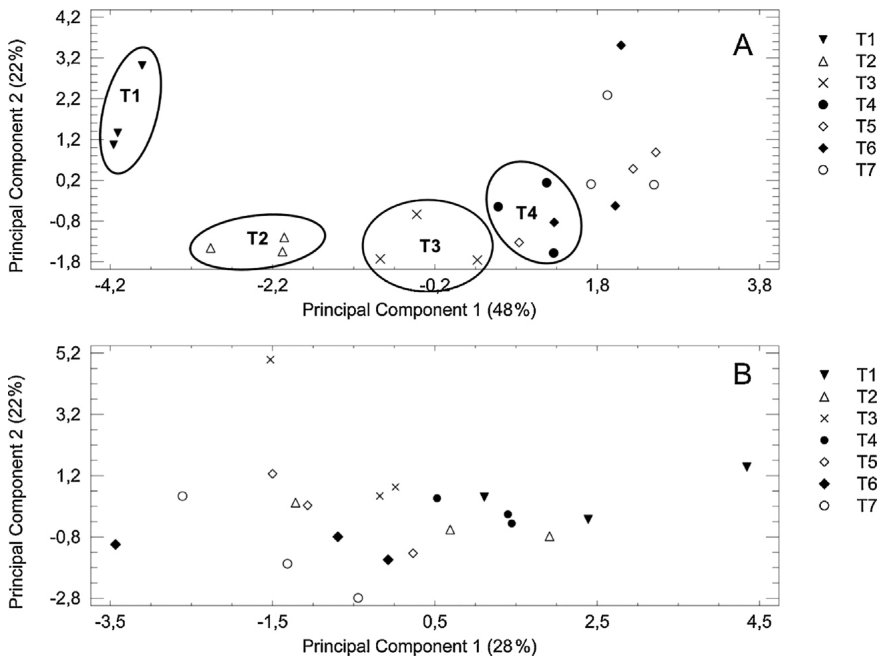
The contrasting elemental behaviors induced by the lime treatments were also delineated in the pattern recognition techniques, such as PCA (Fig. 1). The micronutrients Mn, Zn, Fe and Cu together with Ni are the main drivers in separating the different lime treatments along the first component (58% of total variance), whereas Na, Mg and P accounted for the different clusters according to the soil type, i.e. Pukekohe and Levin. Within the Pukekohe soil (Fig. 1A), T1 and T2 could be distinguished from the treatments T3–T7. The concentrations of Mn, Zn and Ni decreased by 50%, 60%, 65%, respectively, between the unamended soil (T1) and 0.3 wt% lime application (T2) (Table 3). In the Levin soil, only Mn, Ni and Mg showed significant differences (Table 3) and did not allow a separation between the different lime treatments (Fig. 1B).
石灰处理引起的不同元素行为在PCA等模式识别技术中也得到了体现(图1)。微量营养元素Mn、Zn、Fe和Cu以及Ni是沿第一主成分(占总方差的58%)区分不同石灰处理的主要驱动因子,而Na、Mg和P则决定了按土壤类型(即Pukekohe和Levin)形成的不同聚类。在Pukekohe土壤中(图1A),T1和T2可与T3–T7处理区分开。与未改良土壤(T1)相比,施用0.3 wt%石灰(T2)后Mn、Zn和Ni的浓度分别降低了50%、60%和65%(表3)。在Levin土壤中,仅Mn、Ni和Mg表现出显著差异(表3),无法区分不同的石灰处理(图1B)。
3.2. Pot experiment–Plant elemental composition3.2. 盆栽试验——植物元素组成
The measured elemental concentrations in lupin shoots indicate that the lime treatments strongly affected the plant uptake of micronutrients in both soils (Fig. 2A and B), but to a different extent depending on the soil type. There were significant differences in all elements with increasing lime treatments in the Pukekohe soil, while only Fe, Mn, Zn and Ca were significantly changed by lime addition in the Levin soil. Lime addition reduced the plant element uptake by almost 50–60 % in both soils with the only exception of Mn and Mo in the Pukekohe soil grown lupin plants, which were reduced by 75% and increased by 80%, respectively.
羽扇豆地上部元素浓度的测定结果表明,石灰处理强烈影响了两种土壤中植物对微量营养元素的吸收(图2A和B),但影响程度因土壤类型而异。在Pukekohe土壤中,随石灰用量增加,所有元素均存在显著差异;而在Levin土壤中,仅Fe、Mn、Zn和Ca因石灰添加而发生显著变化。在两种土壤中,添加石灰使植物元素吸收量降低了近50%–60%,唯一的例外是生长于Pukekohe土壤的羽扇豆中的Mn和Mo,分别降低了75%和升高了80%。
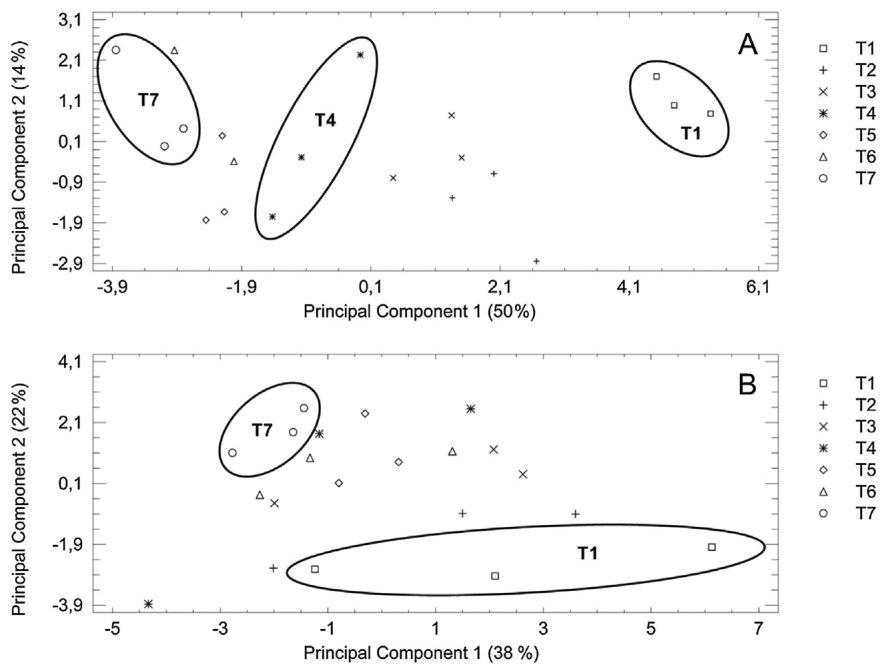
The elemental composition of white lupin shoots grown in Pukekohe and Levin soils were further analyzed by PCA (Fig. 3A and B). As shown in Fig. 3A, the different treatments are separated along the first principal component which explains 50% of total the variance. The samples of shoots grown in Pukekohe soil can be clearly clustered in seven groups which correspond at the different treatments. In particular clusters of T1, T4 and T7 are well separated from the other samples. This separation reflects the significant differences of the concentration of the elements in white lupin shoots. Regarding shoots grown in Levin soil, the PCA (Fig. 3B), grouped the samples of the different treatments in separated clusters. However, the different clusters are not as well separated when compared to plants in the Pukekohe soil. While there was a clear separation between the control and the highest lime treatment, samples from the other treatments are not well distinguished, indicating that the increasing lime levels are not significantly affecting all the components or the plants are compensating for lime addition by mobilizing elements in the rhizosphere.
进一步采用PCA分析了生长于Pukekohe和Levin土壤的白羽扇豆地上部元素组成(图3A和B)。如图3A所示,不同处理沿解释总方差50%的第一主成分分开。生长于Pukekohe土壤的地上部样品可清晰地聚为与不同处理相对应的七组,其中T1、T4和T7的聚类与其他样品分离尤为明显。这种分离反映了白羽扇豆地上部元素浓度的显著差异。对于生长于Levin土壤的地上部,PCA(图3B)将不同处理的样品划分为不同的聚类。然而,与Pukekohe土壤中的植物相比,各聚类之间的分离不够明显。尽管对照与最高石灰处理之间分离清晰,但其他处理的样品区分不佳,这表明石灰水平的增加并未显著影响所有组分,或者植物通过活化根际中的元素来补偿石灰添加的影响。
Ca(NO3)2-extractable element fraction in rhizosphere soils treated with different lime concentrations (T1: 0 wt%, T2: 0.3 wt%, T3: 0.6 wt%, T4: 1.3 wt%, T5: 2.5 wt%, T6: 5 wt%, T7: 10 wt%) expressed as mg kg�1 DW; mean � SD (n = 3).
施用不同浓度石灰(T1:0 wt%,T2:0.3 wt%,T3:0.6 wt%,T4:1.3 wt%,T5:2.5 wt%,T6:5 wt%,T7:10 wt%)的根际土壤中Ca(NO3)2可浸提态元素含量,以mg kg−1 DW表示;平均值 ± SD(n = 3)。
| PukekohePukekohe | FensFens | P* | Cu* | Mn* | Zn* | Ni* | Mg* | K* |
|---|---|---|---|---|---|---|---|---|
| T1 | 0.16�0.03 | 3.11�0.04b | 0.15�0.03ab | 21.75�1.63a | 0.28�0.02a | 0.088�0.010a | 155.97�1.35a | 160.63�5.85b |
| T2 | 0.12�0.03 | 2.77�0.02c | 0.13�0.01b | 10.19�1.88b | 0.11�0.03b | 0.034�0.010b | 153.57�1.33a | 185.35�23.88ab |
| T3 | 0.16�0.05 | 2.97�0.14bc | 0.11�0.01b | 2.40�0.85c | 0.03�0.01c | 0.009�0.003c | 143.34�5.31b | 210.53�20.76a |
| T4 | 0.15�0.05 | 3.18�0.19b | 0.16�0.04ab | 1.52�0.35c | 0.03�0.01c | 0.008�0.003c | 137.97�1.47b | 219.25�31.96a |
| T5 | 0.17�0.03 | 3.56�0.24a | 0.16�0.03ab | 0.61�0.03c | 0.02�0.01c | 0.005�0.003c | 127.16�0.42c | 217.09�6.58a |
| T6 | 0.22�0.15 | 3.60�0.14a | 0.15�0.02ab | 0.54�0.05c | 0.03�0.02c | 0.004�0.006c | 121.27�3.69c | 207.92�10.77a |
| T7 | 0.14�0.05 | 3.70�0.15a | 0.21�0.04a | 0.61�0.11c | 0.08�0.05bc | 0.010�0.002c | 115.13�5.69d | 182.55�12.95ab |
| Levin | Fens | Pns | Cuns | Mn | Znns | Ni* | Mg* | Kns |
| T1 | 0.17�0.03 | 5.71�0.35 | 0.18�0.04 | 6.42�1.38a | 0.03�0.01 | 0.001�0.005ab | 123.29�1.32a | 97.85�19.96 |
| T2 | 0.21�0.07 | 5.37�0.12 | 0.19�0.04 | 2.99�0.89b | 0.02�0.01 | 0.002�0.000b | 109.55�2.28b | 91.42�14.63 |
| T3 | 0.35�0.15 | 5.40�0.21 | 0.25�0.08 | 2.75�1.77b | 0.02�0.01 | 0.008�0.001ab | 109.26�1.16b | 95.86�6.53 |
| T4 | 0.23�0.03 | 5.49�0.03 | 0.15�0.01 | 4.34�1.54b | 0.01�0.00 | 0.000�0.004ab | 105.99�0.79b | 98.13�4.23 |
| T5 | 0.22�0.10 | 5.51�0.11 | 0.25�0.07 | 2.17�0.55b | 0.02�0.01 | 0.004�0.007ab | 102.23�0.37c | 85.65�8.59 |
| T6 | 0.17�0.03 | 5.28�0.05 | 0.21�0.07 | 1.54�0.73b | 0.05�0.05 | 0.012�0.008a | 98.70�0.29d | 82.71�8.34 |
| T7 | 0.16�0.07 | 5.45�0.16 | 0.24�0.14 | 2.42�0.31b | 0.01�0.01 | 0.004�0.002ab | 93.06�3.60e | 71.21�18.42 |
ns = not significant. * p < 0.05. ** p < 0.01. *** p < 0.001.
ns = 不显著。* p < 0.05。** p < 0.01。*** p < 0.001。
3.3. HR-DGT and LA ICP-MS analysis3.3. HR-DGT与LA ICP-MS分析
Due to the chemical physical characteristics and to the significant differences of the Ca(NO3)2-extractable fraction of rhizosphere soil and plant element concentration (Table 2, Table 3, Fig. 1, Fig. 3) caused by lime addition, the Pukekohe soil (T1, T4 and T7) was chosen for the rhizotrons experiment to investigate element bioavailability in response to different lime concentration on some selected root zones of white lupin. However, the high-resolution LA-ICP-MS analysis of the DGT gels (forthwith referred to as “HR-DGT analysis”) from the three treatments showed element mobilization only in the rhizosphere of the plant grown in the un-amended (T1) treatment (Fig. 4), where a 21.67 �23.50 mm area was analyzed at the location of a lupin cluster root. In particular, three distinct areas of elevated Fe supply indicated as HS1–HS3 in Fig. 4 of element mobilization could be observed. These ‘hotspots’ were defined by measurement points showing Fe mobilization that was greater than two standard deviations of the measurements across the entire area of ablation (Fig. 4). They are defined by 137, 59 and 62 unique measurements respectively (Table 4) and correspond to the location of the observed cluster root (Fig. 4).
鉴于Pukekohe土壤的理化性质,以及石灰添加引起的根际土壤Ca(NO3)2可浸提态和植物元素浓度的显著差异(表2、表3、图1、图3),选择Pukekohe土壤(T1、T4和T7)进行根箱试验,以研究白羽扇豆特定根区元素生物有效性对不同石灰浓度的响应。然而,对三个处理DGT凝胶的高分辨率LA-ICP-MS分析(以下简称“HR-DGT分析”)显示,仅在未改良(T1)处理中生长的植物根际观察到元素活化(图4),该处在羽扇豆排根位置分析了21.67 × 23.50 mm的区域。特别是,可观察到三个明显的Fe供给升高区域,即图4中标示为HS1–HS3的元素活化区域。这些“热点”定义为Fe活化量大于整个剥蚀区域测量值两倍标准差的测量点(图4)。它们分别由137、59和62个独立测量点构成(表4),与所观察到的排根位置相对应(图4)。
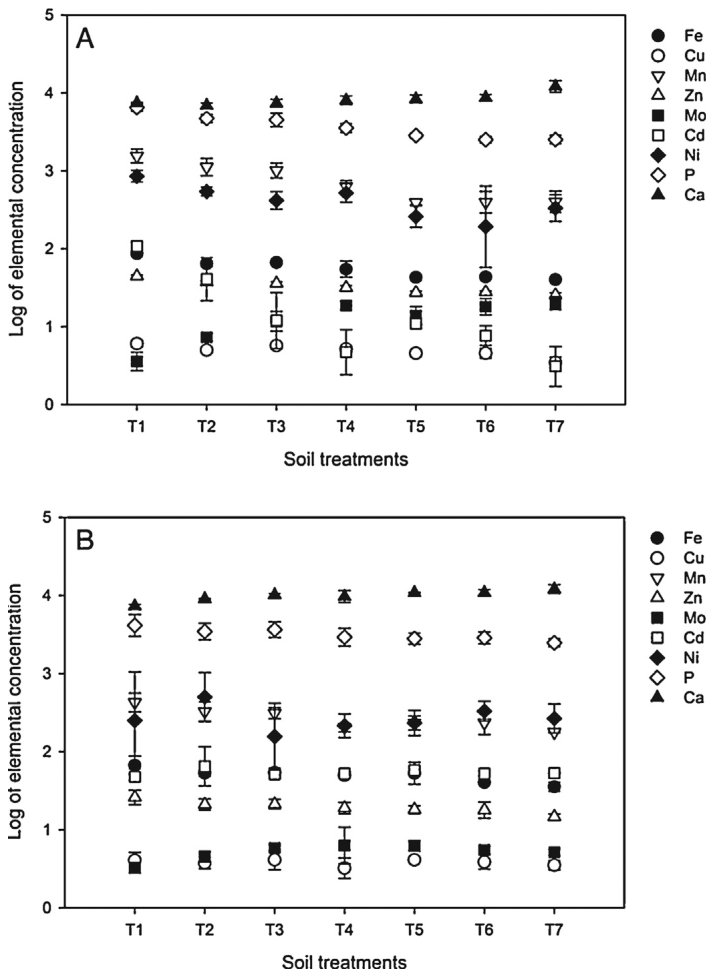
Table 4 shows the distribution of Fe, Cu, Zn and Pb in the entire ablation area and in the three hotspots. The total area of these three hotspots is 1.95% of the entire area of analysis. The relative average fluxes of Fe from the three hotspots was 3.9 (HS1), 3.5 (HS2) and 3.2 (HS3) times higher than the average Fe flux across the entire area of analysis. The areas of high Fe flux to the DGT can also be seen to broadly correspond to localized areas of high Cu, Zn and Pb fluxes. Cu and Zn were also detected in Ca(NO3)2-extractable fraction of rhizosphere soil whereas Pb was below the limit of detection (LOD). Considered together, the average fluxes of Cu (5.71 pg cm�2 s�1), Zn (1.08 pg cm�2 s�1) and Pb (4.70 pg cm�2 s�1) measured by the HR-DGT within these three areas are 1.29, 1.74 and 3.40 times higher than the respective average fluxes of these metals across the entire area of measurement. Table 4 shows the Mn fluxes in a selected hotspot defined as before by the measurement points showing Mn fluxes greater than those in the bulk soil. The total area of this hotspot is 26 mm2 in size and consists of 685 unique measurements (5.17% of the total area of analysis). The average flux across these points is 3.40 pg cm�2 s�1 while the average flux across the entire area of analysis is 2.04 pg cm�2 s�1 (1.66 times higher than the respective average flux across the entire area of measurement). For all five metals measured using this technique, the highest observed flux across the entire ablation area was found in HS1.
表4列出了Fe、Cu、Zn和Pb在整个剥蚀区域及三个热点中的分布。这三个热点的总面积占整个分析区域的1.95%。三个热点的Fe相对平均通量分别是整个分析区域Fe平均通量的3.9倍(HS1)、3.5倍(HS2)和3.2倍(HS3)。向DGT的高Fe通量区域也大致对应于Cu、Zn和Pb高通量的局部区域。在根际土壤的Ca(NO3)2可浸提态中也检测到了Cu和Zn,而Pb低于检出限(LOD)。综合来看,HR-DGT在这三个区域内测得的Cu(5.71 pg cm−2 s−1)、Zn(1.08 pg cm−2 s−1)和Pb(4.70 pg cm−2 s−1)平均通量分别是这些金属在整个测量区域平均通量的1.29、1.74和3.40倍。表4还列出了一个选定热点中的Mn通量,该热点同样定义为Mn通量大于土体土壤的测量点。该热点总面积为26 mm2,由685个独立测量点构成(占总分析面积的5.17%)。这些点的平均通量为3.40 pg cm−2 s−1,而整个分析区域的平均通量为2.04 pg cm−2 s−1(为整个测量区域相应平均通量的1.66倍)。对于采用该技术测定的全部五种金属,整个剥蚀区域内观测到的最高通量均出现在HS1。
The masses of all of the cationic elements bound by DGT gels deployed on the other treatments were below the detection limits (not shown).
布设于其他处理的DGT凝胶所结合的所有阳离子型元素质量均低于检出限(未列出)。
4Discussion讨论
4.1. Pot experiment—Ca(NO3)2-extractions4.1. 盆栽试验——Ca(NO3)2浸提
The maximum addition of lime (10% w/w) increased the pH by ca.1.52 and 0.56 pH units in the Pukekohe and Levin soil respectively (Table 2), but this increase did not have any significant effect on the lupin shoot biomass (Table 2). This can be explained by comparing the plant-available fractions of the major macro- and micronutrient before and after lupin harvest (Table 1 and Table 3, respectively). Considering treatment T1, i.e. both soils without lime addition, the concentrations detected in the Ca(NO3)2-extractable rhizosphere soil solution at harvest were significantly decreased. For instance, in the Pukekohe soil, Fe was reduced by approximately 70%, Mn by 50%, Zn by 10% and Cu by 20%. Despite this decrease, the plant-available concentration of these nutrients was still in the optimal range for plant growth (Kabata-Pendias, 2010). Iron for instance is one of the nutrients with the lowest solubility in soil usually resulting in soil solution concentrations of about 10�7 – 10�10 M over a pH range from 5.0 to 8.5 (Kraemer et al., 2006), a concentration too small for optimal plant growth. In the present study, despite plant uptake, the Ca(NO3)2-extractable rhizosphere soil solution concentration of Fe of white lupin was in the range of 10�6 M, meeting both microbe (10�5 – 10�7 M) and plant (10�4 – 10�9 M) requirements (Lemanceau et al., 2009). White lupin are highly efficient plants in mobilizing nutrients thanks to the excretions of organic acids, especially citric and malic acid (Neumann et al., 2000), from closely-spaced lateral rootlets arranged in clusters, the so-called “proteoid” roots. Previous studies showed that white lupin releases up to 50 � 90 mmol of citric acid per g soil in the rhizosphere of cluster roots (Dinkelaker et al., 1989; Gerke et al., 1994), which is sufficient to desorb P from sparingly soluble Ca-, Al- and/or Fe-P and from Fe/Al humic acid complexes by ligand exchange reactions and dissolution of P sorption sites (Gardner et al., 1983; Gerke et al., 1994). Peaks of labile P have also been detected in the depletion zones around
最大石灰添加量(10% w/w)使Pukekohe和Levin土壤的pH分别升高约1.52和0.56个单位(表2),但这一升高对羽扇豆地上部生物量没有显著影响(表2)。这可以通过比较羽扇豆收获前后主要大量和微量营养元素的植物有效部分(分别见表1和表3)来解释。以T1处理(即两种土壤均未添加石灰)为例,收获时在Ca(NO3)2可浸提根际土壤溶液中检测到的浓度显著降低。例如,在Pukekohe土壤中,Fe降低了约70%,Mn降低了50%,Zn降低了10%,Cu降低了20%。尽管有所降低,这些养分的植物有效浓度仍处于植物生长的适宜范围内(Kabata-Pendias, 2010)。例如,铁是土壤中溶解度最低的养分之一,在pH 5.0至8.5范围内,其土壤溶液浓度通常约为10−7 – 10−10 M(Kraemer et al., 2006),这一浓度过低,不足以满足植物最佳生长的需要。在本研究中,尽管存在植物吸收,白羽扇豆Ca(NO3)2可浸提根际土壤溶液中的Fe浓度仍处于10−6 M范围内,可同时满足微生物(10−5 – 10−7 M)和植物(10−4 – 10−9 M)的需求(Lemanceau et al., 2009)。白羽扇豆是活化养分效率很高的植物,这得益于其由排列成簇的密集侧生小根(即所谓的“排根”)分泌有机酸,尤其是柠檬酸和苹果酸(Neumann et al., 2000)。以往研究表明,白羽扇豆在排根根际中每克土壤可释放多达50–90 μmol柠檬酸(Dinkelaker et al., 1989; Gerke et al., 1994),足以通过配体交换反应和P吸附位点的溶解,使P从难溶性Ca-、Al-和/或Fe-P以及Fe/Al-腐殖酸复合物中解吸(Gardner et al., 1983; Gerke et al., 1994)。在
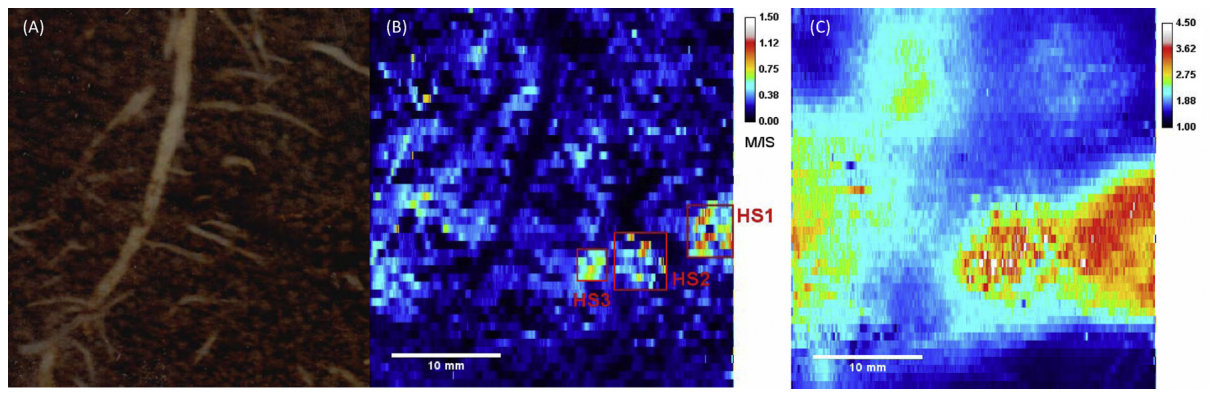
Distribution of Fe, Cu, Zn, Pb and Mn taken up by the DGT gel in T1 treatment of Pukekohe soil (M/IS, M: metal of interest, IS: internal standard); mean � SD.
Pukekohe土壤T1处理中DGT凝胶吸收的Fe、Cu、Zn、Pb和Mn的分布(M/IS,M:目标金属,IS:内标);平均值 ± SD。
| Iron铁 | Copper铜 | Zinc锌 | Lead铅 | |||||||
|---|---|---|---|---|---|---|---|---|---|---|
| Area of interest Units | No. discrete measurements | Total area (mm2) | Average M/IS across area of interest M/IS | Maximum M/IS | Average Flux across area of interest (pg cm�2 s�1) | Maximum flux (pg cm�2 s� | Average Flux across area of interest 1) (pg cm�2 s�1) | Maximum flux (pg cm�2 s�1) | Average Flux across area of interest (pg cm�2 s�1) | Maximum flux (pg cm�2 s�1) |
| Entire ablation area | 13442 | 509 | 0.18�0.13 | 2.05 | 4.42�2.09 | 12.88 | 0.62�0.56 | 3.61 | 1.38�1.52 | 102.31 |
| HS1 | 137 | 5.25 | 0.71�0.23 | 2.05 | 5.51�1.05 | 12.88 | 1.15�0.42 | 3.61 | 3.31�8.69 | 102.31 |
| HS2 | 59 | 2.26 | 0.64�0.20 | 1.13 | 4.16�1.81 | 8.80 | 0.95�0.29 | 1.93 | 4.32�2.85 | 12.35 |
| HS3 | 62 | 2.37 | 0.57�0.09 | 0.82 | 7.45�0.91 | 9.47 | 1.14�0.23 | 1.66 | 6.48�2.30 | 11.64 |
| Manganese | ||||||||||
| Area of interest Units | No. disc | rete measuremen | ts | Total area (mm2) | Average Flux acros (pg cm�2 s�1) | s area of interes | t | Maximum flux (pg cm�2 s�1) | ||
| Entire ablation a | rea | 13442 | 509 | 2.04�0.51 | 6.32 | |||||
| HS1 | 685 | 26 | 3.40�0.36 | 6.32 |
Brassica napus roots and have been attributed either to organic acids or protons (Santner et al., 2012). In fact, in addition to the organic acid exudation, white lupin releases also protons acidifying its rhizosphere. This has been detected even in a well-buffered calcareous soils in pH ranges similar to the ones of the present study (around 7.50 at the maximum lime addition) dissolving acidsoluble Ca-P (Dinkelaker et al., 1989). Our results indicate that the plant-available P fraction increased significantly between the control and the 10 wt% lime application (Table 3), which is in agreement with previous studies (Dinkelaker et al., 1989; Gardner et al., 1982) that have demonstrated efficiency of white lupin in taking up P and utilizing soil P sources even in calcareous soils. The availability of essential micronutrients as Mn, Zn and Ni decreased with increasing lime content (Table 3). Plant uptake and thus element depletion in the rhizosphere further contributed to this decreasing available fraction. Moreover, it is also to consider that, since rhizosphere was sampled from a pot experiment, the concentrations detected could be lower due to a sort of dilution effect of the bulk soil surrounding the rhizosphere. Regarding Mn, in well-aerated calcareous soils, its solubility decreases due to the adsorption of Mn on CaCO3, its oxidation on MnO2 surfaces and, probably, to precipitation of Mn calcite (Jauregui and Reisenauer, 1982).
Brassica napus根系周围的耗竭区中也检测到了活性P的峰值,这被归因于有机酸或质子的作用(Santner et al., 2012)。事实上,除分泌有机酸外,白羽扇豆还会释放质子以酸化其根际。这一现象即使在pH范围与本研究相近(最大石灰添加量时约为7.50)的强缓冲石灰性土壤中也有检测到,并可溶解酸溶性Ca-P(Dinkelaker et al., 1989)。我们的结果表明,与对照相比,施用10 wt%石灰后植物有效P显著增加(表3),这与以往研究结果一致(Dinkelaker et al., 1989; Gardner et al., 1982),这些研究证明了白羽扇豆即使在石灰性土壤中也能高效吸收P并利用土壤P源。Mn、Zn和Ni等必需微量营养元素的有效性随石灰含量增加而降低(表3)。植物吸收以及由此引起的根际元素耗竭进一步导致了有效部分的降低。此外还应考虑到,由于根际土壤取自盆栽试验,检测到的浓度可能因根际周围土体土壤的某种稀释效应而偏低。就Mn而言,在通气良好的石灰性土壤中,由于Mn在CaCO3上的吸附、在MnO2表面的氧化以及可能的锰方解石沉淀,其溶解度降低(Jauregui and Reisenauer, 1982)。
4.2. Pot experiment–Plant elemental composition4.2. 盆栽试验——植物元素组成
Regarding elemental concentration in lupin shoots, lime treatments strongly affected the uptake of micronutrients from both soils (Fig. 2). In particular, Fe, and Zn concentration decreased significantly in both soils at increasing lime concentration, while Cu, Ni, Mn and Cd decreased only in the Pukekohe soil. These micronutrients were also the main elements contributing to the distinct clustering (Fig. 3A) along the first component which accounted for 50.2% of the total variance. A decrease of Mn concentration as well as Zn and Ni could be a direct consequence of a decrease in the availability of these elements in the rhizosphere (Table 3) even though the plants did not show any deficiency symptoms and biomass was not significantly reduced (Table 1). Zinc ranged from 45 mg kg�1 in T1 to 25 mg kg�1 in T7 in white lupin shoots, (Fig. 2), concentrations far above those reported for Zn deficient plants (10–20 mg kg�1 DW, Boehle and Lindsay, 1969). Even though the Mn concentration decreased with increasing lime addition, the concentrations in lupin shoots were high in all the treatments (ranging from 1400 mg kg�1 DW in T1 to 400 mg kg�1 DW in T7). This suggests that 0.05 M Ca(NO3)2-extractable fraction of Mn did not accurately represent the Mn available to the white lupin plant in these treatments. White lupin is known to accumulate Mn in leaves (Zornoza et al., 2010). Reuter & Robinson (1997) and Martínez-Alcalá et al. (2009) have shown Mn concentrations as high as 1300 mg kg�1 DW and 4960 mg kg�1 DW in leaves and shoots respectively. This high rate of Mn uptake is believed to be due to an increased secretion of organic acids into the plant’s rhizosphere, which promotes the metal’s solubilization and thus facilitates its uptake by the plant (Dinkelaker et al., 1995). Manganese accumulation in lupin shoots is highest at low and zero lime levels indicating that at the higher liming rates the solubilizing effect of the organic acids might be neutralized by the high calcium carbonate of the soil, thus lowering the uptake.
就羽扇豆地上部元素浓度而言,石灰处理强烈影响了植物从两种土壤中吸收微量营养元素(图2)。特别是,随石灰浓度增加,两种土壤中Fe和Zn浓度均显著降低,而Cu、Ni、Mn和Cd仅在Pukekohe土壤中降低。这些微量营养元素也是沿第一主成分(占总方差的50.2%)形成明显聚类的主要贡献元素(图3A)。Mn以及Zn和Ni浓度的降低可能是根际中这些元素有效性降低的直接结果(表3),尽管植物并未表现出任何缺素症状,生物量也未显著降低(表1)。白羽扇豆地上部Zn含量由T1的45 mg kg−1降至T7的25 mg kg−1(图2),远高于缺Zn植物的报道浓度(10–20 mg kg−1 DW,Boehle and Lindsay, 1969)。尽管Mn浓度随石灰添加量增加而降低,但各处理羽扇豆地上部的Mn浓度均较高(由T1的1400 mg kg−1 DW至T7的400 mg kg−1 DW)。这表明在这些处理中,0.05 M Ca(NO3)2可浸提态Mn未能准确反映白羽扇豆植株可利用的Mn。已知白羽扇豆会在叶片中积累Mn(Zornoza et al., 2010)。Reuter & Robinson (1997)和Martínez-Alcalá et al. (2009)报道其叶片和地上部中的Mn浓度分别高达1300 mg kg−1 DW和4960 mg kg−1 DW。一般认为,如此高的Mn吸收速率是由于植物向根际分泌的有机酸增加,从而促进了金属的溶解并促进植物对其吸收(Dinkelaker et al., 1995)。羽扇豆地上部Mn积累在低石灰和零石灰水平下最高,表明在较高石灰施用量下,有机酸的溶解作用可能被土壤中高含量的碳酸钙所中和,从而降低了吸收。
Although Cd was below the detection limit in the Ca(NO3)2 extraction, the Cd concentration in the lupin shoots were significantly affected by lime treatment, with a decrease of 97% from T1 to T7 in the plants grown on the lime-treated Pukekohe soils. This is consistent with other studies that reported the effectiveness of liming to minimize the Cd uptake by plants (Oliver et al., 1996). Organic acids play also a fundamental role in the reductionbased Fe uptake of white lupin as a strategy I plant, (Römheld & Marschner, 1983). However, while there was no change in the concentration of the available Fe in the rhizosphere of the soils with the different treatments (Table 3), Fe concentration in shoots decreased significantly (P < 0.001). However, the concentration of Fe in green plant tissues normally occurs at 50–100 mg kg�1 DW (Mengel and Kirkby, 2001). Only lime treatments >2.5% (w/w) lead in both soils to deficient conditions (<45 mg kg�1).
尽管Ca(NO3)2浸提中Cd低于检出限,但羽扇豆地上部Cd浓度受石灰处理的显著影响,在施用石灰的Pukekohe土壤上生长的植物中,由T1至T7降低了97%。这与其他报道施用石灰可有效减少植物吸收Cd的研究结果一致(Oliver et al., 1996)。作为机理I型植物,白羽扇豆以还原为基础的Fe吸收过程中有机酸也发挥着重要作用(Römheld & Marschner, 1983)。然而,尽管不同处理土壤根际中有效Fe浓度没有变化(表3),地上部Fe浓度却显著降低(P < 0.001)。不过,绿色植物组织中的Fe浓度通常为50–100 mg kg−1 DW(Mengel and Kirkby, 2001)。仅在石灰处理 >2.5%(w/w)时,两种土壤均导致缺Fe状况(<45 mg kg−1)。
The discrepancy between the bioavailable Fe concentration in the rhizosphere soil solution and the Fe concentration detected in lupin shoot analysis might be due to a methodological drawback. Even though calcium nitrate is commonly used to determine the bioavailable fraction of elements, it might not be suitable for nutrients such as Fe. Many authors (De Santiago and Delgado, 2006; Gough et al., 1979; Menzies et al., 2007; Walsh and Beaton, 1973) asserted that caution should be used in formulating methods for the determination of the plant-available levels, yet an official and generally accepted method is still missing.
根际土壤溶液中生物有效Fe浓度与羽扇豆地上部分析检测到的Fe浓度之间的差异,可能源于方法上的缺陷。尽管硝酸钙常用于测定元素的生物有效部分,但它可能不适用于Fe等养分。许多研究者(De Santiago and Delgado, 2006; Gough et al., 1979; Menzies et al., 2007; Walsh and Beaton, 1973)指出,在制定植物有效含量测定方法时应谨慎,而目前仍缺乏一种官方且被普遍接受的方法。
4.3. HR-DGT and LA ICP-MS analysis4.3. HR-DGT与LA ICP-MS分析
The diffusive gradients in a thin film (DGT) technique is a valuable alternative to assess the bioavailable fraction since it represents a well-established in situ, time-integrated, passive sampling method that is designed to accumulate labile cationic and anionic species (Zhang and Davison, 1995). Mimicking a plant root, DGT takes up elements from the soil solution and induces resupply from the solid phase (Lehto et al., 2006) and thus provides valuable data on spatial differences in metal bioavailability when used to provide 2D measurements. In the present study DGT gels were deployed on root tips and cluster roots of white lupins grown in rhizotrons.
薄膜扩散梯度(DGT)技术是评估生物有效部分的一种有价值的替代方法,因为它是一种成熟的原位、时间积分型被动采样方法,旨在累积活性阳离子和阴离子形态(Zhang and Davison, 1995)。DGT模拟植物根系,从土壤溶液中吸收元素并诱导固相的再补给(Lehto et al., 2006),因此在进行二维测量时,可提供有关金属生物有效性空间差异的宝贵数据。本研究将DGT凝胶布设于根箱中生长的白羽扇豆的根尖和排根上。
The HR-DGT showed metal mobilization only at the location of a cluster root of the plant grown in the un-amended (T1) treatment (Fig. 4). In the lime treatments, all analytes were below the detection limits of LA-ICP-MS analysis. A similar trend was observed in the data obtained with the Ca(NO3)2 extraction of rhizosphere soil (Table 3) considering Mn, Cu and Zn. Iron on the other hand, showed a different trend. Its concentration did not seem to be affected by lime addition observing the calcium nitrate extract, but could not be detected by HR-DGT analysis of the white lupin rhizospheres in T4 and T7. As previously mentioned, calcium nitrate extraction might not be the most appropriate method to determine Fe availability. This method relies on cation exchange, whereas normally Fe tends to form insoluble species that this extraction method is unlikely to measure; hence no significant changes could be observed in extractable Fe despite the big decrease in plant uptake.
HR-DGT仅在未改良(T1)处理中生长植物的排根位置显示出金属活化(图4)。在石灰处理中,所有分析物均低于LA-ICP-MS分析的检出限。就Mn、Cu和Zn而言,根际土壤Ca(NO3)2浸提所得数据(表3)也呈现类似趋势。而Fe则表现出不同的趋势:从硝酸钙浸提液来看,其浓度似乎未受石灰添加的影响,但在T4和T7中白羽扇豆根际的HR-DGT分析中却未能检出。如前所述,硝酸钙浸提可能并非测定Fe有效性的最适方法。该方法依赖于阳离子交换,而Fe通常倾向于形成该浸提方法难以测定的不溶性形态;因此,尽管植物吸收量大幅下降,可浸提Fe却未见显著变化。
The plant appears to have a highly localized means of mobilizing Fe (despite it is not appearing to be very extractable) as shown by the HR-DGT data, but only without lime. The extent of the exudation-induced rhizosphere effect depends in fact strongly on the soil buffering capacity. For instance, it has been shown that the extent of the acidification by chickpea decreases from several (15% CaCO3) to almost zero mm (60% CaCO3) with increasing concentrations of CaCO3 in the soil (Neumann and Römheld, 2011). Yet, the extent of this effect is most likely related to the type of carbonate, i.e. active or total. Usually high lime concentrations are needed to neutralize the root activity, whereas in the present study low concentrations as 1.25% were sufficient to completely suppress the available fraction of Fe below the level where it could be observed by the DGT. However, we can hypothesize that the fine powdery laboratory grade lime used in this experiment can be considered almost 100% active and was able to react immediately with the soil, in contrast with common agricultural lime, which takes more time to react with the soil because constituted by particles with a larger size.
HR-DGT数据表明,该植物似乎具有一种高度局部化的Fe活化机制(尽管Fe看起来并不易被提取),但这种机制仅在未施石灰时出现。事实上,根系分泌物所诱导的根际效应的程度在很大程度上取决于土壤的缓冲能力。例如,已有研究表明,随着土壤中CaCO3浓度的增加,鹰嘴豆引起的酸化范围由数毫米(15% CaCO3)减小至接近零毫米(60% CaCO3)(Neumann and Römheld, 2011)。然而,这一效应的程度很可能与碳酸盐的类型(即活性碳酸盐或总碳酸盐)有关。通常需要较高浓度的石灰才能中和根系活动,而在本研究中,低至1.25%的浓度便足以将Fe的有效态组分完全抑制到DGT无法检测的水平以下。不过,我们可以推测,本试验所用的细粉状实验室级石灰几乎可视为100%活性,能够立即与土壤发生反应;而普通农用石灰由于颗粒粒径较大,与土壤反应所需的时间更长。
The DGT gel was deployed early in the plant’s light-dark cycle to ensure that effects of one cycle of exudation by the roots of the white lupin on the rhizosphere soil were recorded. Previous studies showed that the release of citrate in white lupin follows a diurnal rhythm with a peak of exudation after 5 h of the onset of light (Tomasi et al., 2009). The observed co-mobilization of Cu, Zn and Pb with Fe at the location of the cluster root indicates that similar mechanisms are acting on these metals. Some authors reported that white lupin is able to increase the availability of Cu and Zn (Braum and Helmke, 1995; Dessureault-Rompré et al., 2006; Duffner et al., 2012; Martínez-Alcalá et al., 2010) through the action of root exudates in the rhizosphere. Braum and Helmke (1995) also showed that soybean intercropped with L. albus had greater uptake rates of Cu, Fe, and Zn when compared to soybean grown alone. Martínez-Alcalá et al. (2009) found an overall decrease in the EDTA-extractable fraction of Pb, Zn and Fe in the rhizosphere soil of L. albus L. They attributed this decrease to the precipitation of Fe into iron oxyhydroxides which also immobilized the Pb and Zn; however, it should be noted that the soils used for their study had a considerably higher pH (7.86) than those considered here, which would be expected to promote the precipitation of Fe into insoluble minerals and the co-precipitation of other trace elements. Furthermore, high-resolution analyses of plant-induced rhizosphere changes are more likely to provide a better representation of small-scale trace element mobilization at the plant-root interface than methods where bulk samples of rhizosphere soils are considered (Hinsinger et al., 2005).
DGT凝胶在植物光暗周期的早期放置,以确保记录下白羽扇豆根系一个分泌周期对根际土壤的影响。以往研究表明,白羽扇豆柠檬酸盐的释放遵循昼夜节律,其分泌高峰出现在光照开始后5 h(Tomasi et al., 2009)。在排根所在位置观察到的Cu、Zn和Pb与Fe的协同活化,表明这些金属受到类似机制的作用。一些学者报道,白羽扇豆能够通过根系分泌物在根际中的作用提高Cu和Zn的有效性(Braum and Helmke, 1995; Dessureault-Rompré et al., 2006; Duffner et al., 2012; Martínez-Alcalá et al., 2010)。Braum and Helmke(1995)还表明,与单作大豆相比,与L. albus间作的大豆对Cu、Fe和Zn的吸收速率更高。Martínez-Alcalá et al.(2009)发现,L. albus L.根际土壤中EDTA可提取态的Pb、Zn和Fe总体下降。他们将这一下降归因于Fe沉淀为铁羟基氧化物,同时使Pb和Zn固定;然而应当指出,其研究所用土壤的pH(7.86)显著高于本研究所考察的土壤,而较高的pH预计会促进Fe沉淀为不溶性矿物以及其他微量元素的共沉淀。此外,与以根际土壤混合样品为对象的方法相比,对植物诱导的根际变化进行高分辨率分析更有可能较好地反映植物–根系界面上微尺度的微量元素活化过程(Hinsinger et al., 2005)。
A clear hotspot at the location of the selected cluster roots can be observed also for Mn (Fig. 4c). In fact the average flux of Mn across the area defined as the hotspot is ca. 75% higher compared to the entire ablation area confirming a higher mobilization of the element in this highly localized part of the white lupin rhizosphere. This observation indicates that highly localized exudation processes occurring in the rhizosphere of white lupin may be important factor in this plant's ability to mobilize this element (Dinkelaker et al., 1995; Martínez-Alcalá et al., 2009; Page et al., 2006).
在所选排根的位置,Mn同样呈现出明显的热点(图4c)。事实上,热点区域内Mn的平均通量比整个剥蚀区域高出约75%,证实该元素在白羽扇豆根际这一高度局部化的部位活化程度更高。这一观察结果表明,白羽扇豆根际中发生的高度局部化的分泌过程可能是该植物活化这一元素能力的重要因素(Dinkelaker et al., 1995; Martínez-Alcalá et al., 2009; Page et al., 2006)。
While the ability of white lupin roots to mobilize trace elements nutrients can be beneficial for the plant, the root exudates may also mobilize toxic metals, such as Pb. Yet, Pb could only be detected by HR-DGT and was below the LOD both in lupin shoots and in the Ca (NO3)2-extractable rhizosphere soil solution most likely due to a dilution during the extraction. Previous studies have found that while the roots of white lupin can take up Pb, it is highly immobile within the plant (Kabata-Pendias, 2010; Martínez-Alcalá et al., 2009) and therefore plant uptake of this metal is unlikely to present a significant risk to human and animal health. However, the mobilization of other metals, that are relatively easily translocated from roots to shoots, such as Cd, Co, Mo and Se, could theoretically pose a threat when present in sufficient concentrations in soils; however, this is unlikely to be an issue in the soils considered here.
尽管白羽扇豆根系活化微量营养元素的能力可能对植物有益,但根系分泌物也可能活化Pb等有毒金属。然而,Pb仅能被HR-DGT检出,而在羽扇豆地上部和Ca (NO3)2可提取的根际土壤溶液中均低于检出限(LOD),这很可能是由于提取过程中的稀释所致。以往研究发现,虽然白羽扇豆根系能够吸收Pb,但Pb在植物体内的移动性极低(Kabata-Pendias, 2010; Martínez-Alcalá et al., 2009),因此植物对该金属的吸收不太可能对人类和动物健康构成显著风险。然而,其他较易由根部向地上部转运的金属(如Cd、Co、Mo和Se)的活化,在土壤中含量足够高时理论上可能构成威胁;不过,对于本研究所考察的土壤而言,这不太可能成为问题。
5Conclusions结论
We found that lime treatment affected both the solubility of Ca (NO3)2-extractable elements and their plant uptake even though HR-DGT was not able to detect any mobilization when CaCO3 was added to the soil at a rate � 1.3 wt%. Yet, plants grown in the pot trials using lime treated soils showed that there was sufficient trace element uptake to avoid nutrient deficiency. While we could not detect nutrient mobilization at the lupin root structures HR-DGT in these cases, we cannot rule out the possibility that root exudates are still present but their ability to mobilize nutrients to a level where they can be detected by HR-DGT is buffered by the lime. Furthermore, lupin shoot elemental concentrations reflect the nutrient uptake through the whole root system whereas HR- DGT was applied only on selected cluster roots. Different areas of the rhizosphere or at the best the whole root system should be investigated by HR-DGT. Longer DGT deployment on root zones might provide further information to overcome the limitations of the method detection limit, especially under circumstances where the availability of nutrients by DGT is reduced by high levels of lime.
我们发现,尽管当土壤中CaCO3添加量 ≥ 1.3 wt%时HR-DGT未能检测到任何活化,但石灰处理同时影响了Ca (NO3)2可提取态元素的溶解度及其植物吸收。不过,在施用石灰土壤的盆栽试验中生长的植物表明,其微量元素吸收足以避免营养缺乏。虽然在这些情况下我们未能通过HR-DGT在羽扇豆根系结构处检测到营养元素的活化,但不能排除根系分泌物仍然存在、只是其将营养元素活化到HR-DGT可检测水平的能力受到石灰缓冲的可能性。此外,羽扇豆地上部的元素浓度反映的是整个根系对营养元素的吸收,而HR-DGT仅应用于所选的排根。今后应利用HR-DGT研究根际的不同区域,最好是整个根系。在根区延长DGT的放置时间,可能有助于克服方法检出限的局限并提供更多信息,尤其是在高石灰水平降低DGT所测营养元素有效性的情况下。
Acknowledgements致谢
This work has been financially supported by: Italian MIUR (FIRB—Programma “Futuro in Ricerca”), Free University of Bolzano (TN5056), a grant from Lincoln University Research Fund, Lincoln University, New Zealand and the Austrian Science Fund (FWF): P23798-B16.
本研究得到以下资助:意大利教育、大学与科研部(MIUR)(FIRB—“Futuro in Ricerca”计划)、博尔扎诺自由大学(TN5056)、新西兰林肯大学研究基金(Lincoln University Research Fund)资助项目,以及奥地利科学基金(FWF):P23798-B16。
References参考文献
Black, A., McLaren, R.G., Reichman, S.M., Speir, T.W., Condron, L.M., 2011. Evaluation of soil metal bioavailability estimates using two plant species (L. perenne and T. aestivum) grown in a range of agricultural soils treated with biosolids and metal salts. Environ. Pollut. 159, 1523–1535. doi:http://dx.doi.org/10.1016/j. envpol.2011.03.004.
Boehle, J., Lindsay, W., 1969. Micronutrients. The fertilizer shoe-nails. Pt. 6. In. Limelight-Zinc. Fert. Solutions 13, 6–12.
Brand, J.D., Tang, C., Graham, R.D., 2000. The effect of soil moisture on the tolerance of Lupinus pilosus genotypes to a calcareous soil. Plant Soil 219, 263–271. doi: http://dx.doi.org/10.1023/A:1004799120896.
Braum, S.M., Helmke, P.A., 1995. White lupin utilizes soil phosphorus that is unavailable to soybean. Plant Soil 176, 95–100.
Bro, R., Kjeldahl, K., Smilde, A.K., Kiers, H.A.L., 2008. Cross-validation of component models: a critical look at current methods. Anal. Bioanal. Chem. 390,1241–1251. doi:http://dx.doi.org/10.1007/s00216-007-1790-1.
Comerford, N., 2005. Soil factors affecting nutrient bioavailability. Nutr. Acquis. Plants 181, 1–6.
Dakora, F.D., Phillips, D.A., 2002. Root exudates as mediators of mineral acquisition in low-nutrient. Environments 35–47.
De Santiago, A., Delgado, A., 2006. Predicting iron chlorosis of lupin in calcareous Spanish soils from iron extracts. Soil Sci. Soc. Am. J. 70, 1945–1950. doi:http:// dx.doi.org/10.2136/sssaj2005.0343.
De Silva, D.L.R., Ruiz, L.P., Atkinson, C.J., Mansfield, T.A., 1994. Physiological disturbances caused by high rhizospheric calcium in the calcifuge Lupinus luteus. J. Exp. Bot. 45, 585–590.
Dessureault-Rompré, J., Nowack, B., Schulin, R., Luster, J., 2006. Modified micro suction cup/rhizobox approach for the in-situ detection of organic acids in rhizosphere soil solution. Plant Soil 286, 99–107. doi:http://dx.doi.org/10.1007/ s11104-006-9029-z.
Dinkelaker, B., Hengeler, C., Marschner, H., 1995. Distribution and function of proteoid roots and other root clusters. Bot. Acta 108, 183–200. doi:http://dx.doi. org/10.1111/j.1438-8677.1995.tb00850.x.
Dinkelaker, B., Römheld, V., Marschner, H., 1989. Citric acid excretion and precipitation of calcium citrate in the rhizosphere of white lupin (Lupinus albus L.). Plant Cell Environ. 12, 285–292. doi:http://dx.doi.org/10.1111/j.1365- 3040.1989.tb01942.x.
Duffner, A., Hoffland, E., Temminghoff, E.J.M., 2012. Bioavailability of zinc and phosphorus in calcareous soils as affected by citrate exudation. Plant Soil 361, 165–175. doi:http://dx.doi.org/10.1007/s11104-012-1273-9.
Gao, Y., Lehto, N., 2012. A simple laser ablation ICPMS method for the determination of trace metals in a resin gel. Talanta 92, 78–83.
Gardner, W.K., Barber, D.A., Parbery, D.G., 1983. The acquisition of phosphorus by Lupinus albus L. III. The probable mechanism by which phosphorus movement in the soil/root interface is enhanced. Plant Soil 70, 107–124.
Gardner, W.K., Parbery, D.G., Barber, D.A., 1982. The acquisition of phosphorus by Lupinus albus L. Plant Soil 68, 19–32. doi:http://dx.doi.org/10.1007/BF02374724. Gerke, J., Römer, W., Jungk, A., 1994. The excretion of citric and malic acid by proteoid roots of Lupinus albus L. effects on soil solution concentrations of phosphate, iron, and aluminum in the proteoid rhizosphere in samples of an oxisol and a luvisol. Z. Pflanz. Bodenkunde. 157, 289–294. doi:http://dx.doi.org/ 10.1002/jpln.19941570408.
Göttlein, A., Heim, A., Matzner, E., 1999. Mobilization of aluminium in the rhizosphere soil solution of growing tree roots in an acidic soil. Plant Soil 211, 41–49.
Gough, L., Shacklette, H., Case, A., 1979. Element concentrations toxic to plants, animals, and man. U.S. Geol. Surv. Bull. 1466, 80.
Hawkesford, M., Horst, W., Kichey, T., Lambers, H., Schjoerring, J., Møller, I.S., White, P., 2011. Functions of macronutrients, Marschner’s Mineral Nutrition of Higher Plants. 3rd edn. Academic Press, London, pp. 135–189.
Hinsinger, P., Gobran, G.R., Gregory, P.J., Wenzel, W.W., 2005. Rhizosphere geometry and heterogeneity arising from root-mediated physical and chemical processes. New Phytol. 168, 293–303. doi:http://dx.doi.org/10.1111/j.1469- 8137.2005.01512.x.
Hinsinger, P., Plassard, C., Tang, C., Jaillard, B., 2003. Origins of root-mediated pH changes in the rhizosphere and their responses to environmental constraints: a review. Plant Soil 248, 43–59.
Hoefer, C., Santner, J., Puschenreiter, M., Wenzel, W.W., 2015. Localized metal solubilization in the rhizosphere of salix smithiana upon sulfur application. Environ. Sci. Technol. doi:http://dx.doi.org/10.1021/es505758j.
Jansen, P.C.M., 2006. Lupinus albus L. [WWW Document]. Lupinus albus L.
Jauregui, M.A., Reisenauer, H.M.,1982. Calcium carbonate and manganese dioxide as regulators of available manganese and iron (wheat). Soil Sci. 134, 105–110.
Jessop, R.S., Roth, G., Sale, P., 1990. Effects of increased levels of soil CaCO3 on Lupin (Lupinus angustifolius) growth and nutrition. Soil Res. 28, 955–962. Kabata-Pendias, A., 2010. Trace Elements in Soils and Plants, Fourth Edition CRC Press Taylor & Francis Group.
Kirkham, M.B., 2006. Cadmium in plants on polluted soils: Effects of soil factors, hyperaccumulation, and amendments. Geoderma 137, 19–32.
Kraemer, S.M., Crowley, D.E., Kretzschmar, R., 2006. 2006. Geochemical Aspects of Phytosiderophore-Promoted Iron Acquisition by Plants. Adv. Agron..
Kreuzeder, A., Santner, J., Prohaska, T., Wenzel, W.W., 2013. Gel for simultaneous chemical imaging of anionic and cationic solutes using diffusive gradients in thin films. Anal. Chem. 85, 12028–12036.
Lehto, N.J., Davison, W., Zhang, H., 2012. The use of ultra-thin diffusive gradients in thin-films (DGT) devices for the analysis of trace metal dynamics in soils and sediments: a measurement and modelling approach. Environ. Chem. 9, 415– 423.
Lehto, N.J., Davison, W., Zhang, H., Tych, W., 2006. Theoretical comparison of how soil processes affect uptake of metals by diffusive gradients in thinfilms and plants. J. Environ. Qual. 1903–1913.
Lemanceau, P., Expert, D., Gaymard, F., Bakker, P.A.H.M., Briat, J.-F., 2009. Chapter 12 role of iron in plant–microbe interactions. Adv. Bot. Res..
Marschner, H.,1991. Mechanisms of adaptation of plants to acid soils. Plant Soil 134, 1–20. doi:http://dx.doi.org/10.1007/BF00010712.
Martínez-Alcalá, I., Clemente, R., Bernal, M.P., 2009. Metal availability and chemical properties in the rhizosphere of Lupinus albus L. growing in a high-metal
calcareous soil. Water Air Soil Pollut. 201, 283–293. doi:http://dx.doi.org/ 10.1007/s11270-008-9944-0.
Martínez-Alcalá, I., Walker, D.J., Bernal, M.P., 2010. Chemical and biological properties intherhizosphereofLupinusalbusaltersoilheavymetalfractionation.Ecotoxicol. Environ. Saf. 73, 595–602. doi:http://dx.doi.org/10.1016/j.ecoenv.2009.12.009.
McLaughlin, M.J., Hamon, R.E., McLaren, R.G., Speir, T.W., Rogers, S.L., 2000. Review: a bioavailability-based rationale for controlling metal and metalloid contamination of agricultural land in Australia and New Zealand. Soil Res. 38, 1037–1086.
Mengel, K., Kirkby, E., 2001. Principles of Plant Nutrition. Kluwer Academic Publishers, Dordrecht.
Menzies, N.W., Donn, M.J., Kopittke, P.M., 2007. Evaluation of extractants for estimation of the phytoavailable trace metals in soils. Environ. Pollut. 145, 121–130. doi:http://dx.doi.org/10.1016/j.envpol.2006.03.021.
Neumann, G., Massonneau, A., Langlade, N., Dinkelaker, B., Hengeler, C., Römheld, V., Martinoia, E., 2000. Physiological aspects of cluster root function and development in phosphorus-deficient white lupin (Lupinus albus L.). Ann. Bot. 85, 909–919.
Neumann, G., Massonneau, A., Martinoia, E., Römheld, V., 1999. Physiological adaptations to phosphorus deficiency during proteoid root development in white lupin. Planta 208, 373–382. doi:http://dx.doi.org/10.1007/ s004250050572.
Neumann, G., Römheld, V., 2011. Rhizosphere chemistry in relation to plant nutrition, Marschner’s Mineral Nutrition of Higher Plants, Third Edition , pp. 347–368.
Oliver, D.P., Tiller, K.G., Conyers, M.K., Slattery, W.J., Alston, A.M., Merry, R.H., 1996. Effectiveness of liming to minimise uptake of cadmium by wheat and barley grain grown in the field. Aust. J. Agric. Res. 47, 1181–1193.
Page, V., Weisskopf, L., Feller, U., 2006. Heavy metals in white lupin: uptake, root-toshoot transfer and redistribution within the plant. New Phytol. 329–341. Reuter, D., Robinson, J., 1997. Plant Analysis: An Interpretation Manual. CSIRO Publishing.
Römheld,V., Marschner, H.,1983. Mechanism of iron uptake by peanut plants: I. Fe(III) reduction, chelate splitting, and release of phenolics. Plant Physiol. 71, 949–954.
Santner, J., Zhang, H., Leitner, D., Schnepf, A., Prohaska, T., Puschenreiter, M., Wenzel, W.W., 2012. High-resolution chemical imaging of labile phosphorus in the rhizosphere of Brassica napus L. cultivars. Environ. Exp. Bot. 77, 219–226.
Stockdale, A., Davison, W., Zhang, H., 2008. High-resolution two-dimensional quantitative analysis of phosphorus, vanadium and arsenic, and qualitative analysis of sulfide, in a freshwater sediment. Environ. Chem. 5, 143–149.
Tomasi, N., Kretzschmar, T., Espen, L., Weisskopf, L., Fuglsang, A.T., Palmgren, M.G., Neumann, G., Varanini, Z., Pinton, R., Martinoia, E., Cesco, S., 2009. Plasma membrane H-ATPase-dependent citrate exudation from cluster roots of phosphate-deficient white lupin. Plant Cell Environ. 32, 465–475. doi:http://dx. doi.org/10.1111/j.1365-3040.2009.01938.x.
Walsh, L., Beaton, J., 1973. Soil Testing and Plant Analysis. Soil Science Society of America, Madison, WI.
Warnken, K.W., Zhang, H., Davison, W., 2004. Performance characteristics of suspended particulate reagent-iminodiacetate as a binding agent for diffusive gradients in thin films. Anal. Chim. Acta 508, 41–51.
Williams, C., David, D., 1976. The accumulation in soil of cadmium residues from phosphate fertilizers and their effect on the cadmium content of plants. Soil Sci. 121.
Williams, P.N., Santner, J., Larsen, M., Lehto, N.J., Oburger, E., Wenzel, W., Glud, R.N., Davison, W., Zhang, H., 2014. Localized flux maxima of arsenic, lead, and iron around root apices in flooded lowland rice. Environ. Sci. Technol. 48, 8498–8506.
Zhang, H., Davison, W., 1995. Performance characteristics of diffusion gradients in thin films for the in situ measurement of trace metals in aqueous solution. Anal. Chem. 67, 3391–3400.
Zohlen, A., Tyler, G., 2004. Soluble inorganic tissue phosphorus and calcicole– calcifuge behaviour of plants. Ann. Bot. 94, 427–432. doi:http://dx.doi.org/ 10.1093/aob/mch162.
Zornoza, P., Sánchez-Pardo, B., Carpena, R.O., 2010. Interaction and accumulation of manganese and cadmium in the manganese accumulator Lupinus albus. J. Plant Physiol. 167, 1027–1032.