MARC LEBLANC,
Géofluides-Bassins-Eau, CNRS, Université de Montpellier 2, Montpellier, 34095 France
DANIEL PETIT, ANNABELLE DERAM,
Laboratoire de Génétique et Evolution des Plantes, CNRS, Université de Lille 1, Villeneuve d'Ascq, 59655 France
BRETT H. ROBINSON, AND ROBERT R. BROOKSt
Soil and Earth Sciences, College of Sciences, Massey University, Palmerston North, New Zealand
Unusual hyperaccumulation (>500 ug/g dry mass) of toxic TI has been determined in Iberis intermedia (Brassicaceae) from southern France. This species contained up to 3,070 ug/g (0.31%) TI in the whole-plant dry matter. Pot trials with Iberis showed that it could tolerate nearly 2,000 ug/g available TI in the substrate compared with about 20 ug/g for the metal-tolerant grass Arrhenatherum elatius. This unusually high accumulation of TI has significance for animal and human health, phytoremediation of contaminated soils, and phytomining for TI. It was determined that three crops of Iberis would be sufficient to phytoremediate to a nontoxic level, a soil containing 10 ug/g TI, and the production of a saleable plant ash (bio-ore) would probably pay for the cost of the operation. Phytomining (growing a "crop" of a metal over ores subeconomic for conventional mining) could be a viable option since it has been calculated that a net return of $1,200/ha (twice the return from a crop of wheat) would be possible with a biomass yield of 10 t/ha containing 0.08 percent TI in dry matter. The break-even point (net yield of $500/ha) would require 170 ug/g (0.017%) TI in dry matter. Such a project would, however, require a large area to be able to afford economies of scale.
在法国南部的 Iberis intermedia(十字花科)中测得有毒元素 Tl 的异常超富集(>500 μg/g 干重)。该物种整株干物质中 Tl 含量最高可达 3,070 μg/g(0.31%)。Iberis 盆栽试验表明,其可耐受基质中近 2,000 μg/g 的有效态 Tl,而耐金属禾草 Arrhenatherum elatius 的耐受量仅约为 20 μg/g。这种异常高的 Tl 富集对动物和人类健康、污染土壤的植物修复以及 Tl 的植物采矿均具有重要意义。经测算,种植三茬 Iberis 即足以将含 Tl 10 μg/g 的土壤修复至无毒水平,而生产可出售的植物灰(生物矿石)很可能足以抵偿修复成本。植物采矿(在以常规采矿方式开采不经济的矿体上种植金属“作物”)可能是一种可行的选择:据计算,在生物量产量为 10 t/ha、干物质中 Tl 含量为 0.08% 的条件下,可获得 $1,200/ha 的净收益(为小麦种植收益的两倍)。盈亏平衡点(净收益 $500/ha)要求干物质中 Tl 含量达到 170 μg/g(0.017%)。然而,此类项目需要大面积种植才能实现规模经济。
1Introduction引言
IN RECENT years there has been considerable interest in plants that hyperaccumulate heavy metals such as Cd, Co, Cu, Ni, Se, and Zn (Brooks, 1998). The concept of hyperaccumulation was originally introduced to define plants containing > 1,000 ug/g (0.1%) of Ni in dried plant tissue (Brooks et al., 1977).
近年来,能够超富集 Cd、Co、Cu、Ni、Se 和 Zn 等重金属的植物受到了广泛关注(Brooks, 1998)。超富集的概念最初用于界定干燥植物组织中 Ni 含量 > 1,000 μg/g(0.1%)的植物(Brooks et al., 1977)。
When hyperaccumulators of heavy metals were first discovered, their practical application was not fully appreciated until it was realized that they might be used in the fields of archaeology (Brooks and Johannes, 1990), mineral prospecting (Brooks, 1998), phytoremediation (McGrath et al., 1993), and phytomining (Chaney, 1983; Nicks and Chambers, 1995; Robinson et al., 1997a, b; Brooks et al., 1998). The last two subjects can be classitied under the heading of "phytoextraction" and have excited perhaps the greatest amount of interest because of the use of plants to remediate polluted ground or even to grow a crop of a heavy metal such as Ni (Brooks, 1998) by planting a hyperaccumulator over subeconomic mineral deposits and harvesting the crop to produce a bio-ore.
重金属超富集植物最初被发现时,其实际应用价值并未得到充分认识,直到人们意识到它们可用于考古学(Brooks and Johannes, 1990)、矿产勘查(Brooks, 1998)、植物修复(McGrath et al., 1993)和植物采矿(Chaney, 1983; Nicks and Chambers, 1995; Robinson et al., 1997a, b; Brooks et al., 1998)等领域。后两者可归入“植物提取”范畴,并且或许引起了最广泛的兴趣,因为可以利用植物修复污染土地,甚至通过在不具经济开采价值的矿床上种植超富集植物并收获作物以生产生物矿石,从而“种植”Ni 等重金属作物(Brooks, 1998)。
We have recently discovered the unusually high hyperaccumulation of TI by the brassicaceous Iberis intermedia Guersent (candytuft) growing over lead-zinc mine tailings at Les Malines (Les Avinières), some 40 km north of Montpellier, France. These tailings typically contain 1.5 percent Zn and 0.5 percent Pb, and locally contain up to 40 ug/g (mean 10 ug/g) TI. The mine dumps are colonized by a typical base metal flora dominated by Thlaspi caerulescens (a hyperaccumulator of both Zn and Ca) and Minuartia verna (a
我们近期发现,生长于法国蒙彼利埃以北约 40 km 处 Les Malines(Les Avinières)铅锌矿尾矿上的十字花科植物 Iberis intermedia Guersent(屈曲花)对 Tl 具有异常高的超富集能力。这些尾矿通常含 Zn 1.5%、Pb 0.5%,局部 Tl 含量高达 40 μg/g(平均 10 μg/g)。矿渣堆上定殖着典型的贱金属植物群落,以 Thlaspi caerulescens(一种同时超富集 Zn 和 Cd 的植物)和 Minuartia verna(一种
Corresponding author: email, r.brooks@massey.ac.nz.
nonaccumulator). Iberis intermedia is common throughout the area and clearly has a high tolerance of this type ot sub-
非富集植物)为优势种。Iberis intermedia 在整个地区普遍分布,显然对此类基质具有很高的耐受性。
Thallium has an abundance of about 0.7 ug/g in the earth's crust (Green, 1972). It is frequently associated with sultide mineralization and is commonly found to substitute for Pb in galena. Thallium is extremely toxic and has been used in rat poison and for the control of ants. It also has uses in the electronics industry for semiconductors, switches, and fuses. Thallium minerals are quite rare and are found almost exclusively in the realgar deposits of Allchar (Alsar) in Macedonia near the Greek border. They occur as complex sulfides of As- Hg-TI (lorandite, picotpaulite, raguinite, vrbaite) associated with realgar and iron sulfides. High contents of TI have been reported in plants growing in the Allchar area (although not to the extent reported in this present paper) and have been found to cause toxic effects on local cattle (Zyka, 1970). The current world price of Tl is about $300/kg.
Tl 在地壳中的丰度约为 0.7 μg/g(Green, 1972)。它常与硫化物矿化相伴生,并常在方铅矿中替代 Pb。Tl 毒性极强,曾被用于制作鼠药和防治蚂蚁。它在电子工业中也用于制造半导体、开关和保险丝。Tl 矿物十分稀少,几乎只见于马其顿靠近希腊边境的 Allchar(Alšar)雄黄矿床中。它们以 As-Hg-Tl 的复杂硫化物(红铊矿、picotpaulite、raguinite、硫砷铊汞矿)形式产出,并与雄黄及铁硫化物共生。已有报道指出 Allchar 地区生长的植物中 Tl 含量较高(尽管未达到本文报道的程度),并已发现其对当地牛只产生毒性效应(Zyka, 1970)。目前 Tl 的国际价格约为 $300/kg。
Scientists at Hohenheim University, Stuttgart, Germany, are investigating possible phytoremediation of soils polluted by heavy metals such as Cd, Zn, and TI (Kurz et al., 1997). Their work has shown that TI is accumulated by food crops. particularly brassicaceous plants, and that these should not be grown in such contaminated soils.
德国斯图加特 Hohenheim 大学的科学家正在研究受 Cd、Zn 和 Tl 等重金属污染土壤的植物修复可能性(Kurz et al., 1997)。其研究表明,粮食作物,特别是十字花科植物,会富集 Tl,因此不应在此类污染土壤上种植。
Research in France on the same topic (Tremel, 1996; Tremel and Mench, 1997; Tremel et al., 1997) has found elevated concentrations of up to 20 ug/g (dry weight) Il in vegetables (particularly in cabbage) and up to 40 ug/g in rape seed (Brassica napus L.).
法国关于同一课题的研究(Tremel, 1996; Tremel and Mench, 1997; Tremel et al., 1997)发现,蔬菜(尤其是甘蓝)中 Tl 含量升高,最高可达 20 μg/g(干重),油菜籽(Brassica napus L.)中最高可达 40 μg/g。
Thallium concentrations in plants have excited the most interest from scientists concerned with potential harmful effects on animals and humans. Little or no attention has been paid to the potential of using hyperaccumulation in some plants in order to explore the possibility of phytoremediation of Tl-contaminated soils, or even to grow a "crop of I" as has already been proposed for other elements such as Ni (Robinson et al., 1997a, b). The present paper examines the potential of plants for this dual purpose with respect to TI.
植物中的 Tl 含量最受那些关注其对动物和人类潜在危害的科学家重视。而利用某些植物的超富集能力探索 Tl 污染土壤的植物修复,甚至像已针对 Ni 等其他元素所提出的那样“种植 Tl 作物”(Robinson et al., 1997a, b),则很少或几乎未受到关注。本文针对 Tl 探讨植物在上述双重用途方面的潜力。
0361-0128/99/2044/109-5$6.00
Geologic Setting地质背景
Samples were collected from sites around St. Laurent le Minier, southern France (Fig. 1). The site known as Les Avinières within the Les Malines mining region is part of one of the largest base metal mines in Europe that has been exploited since Roman times and ceased operations only in the early part of the present decade by which time it had proluced about 1 Mt of metal (Zn + Pb).
样品采自法国南部 St. Laurent le Minier 周边各采样点(图1)。Les Malines 矿区内名为 Les Avinières 的地点属于欧洲最大的贱金属矿之一,该矿自罗马时代起即被开采,直到本十年代初才停止作业,届时已累计产出约 1 Mt 金属(Zn + Pb)。
The mine is located on the southern margin of the French Massif Central, along the contact between the Variscan basement (Cambrian shales and carbonates) and the Mesozoic cover (Triassic shales and carbonates, Liassic carbonates, Bathonian carbonates).
该矿位于法国中央高原南缘,处于华力西期基底(寒武系页岩和碳酸盐岩)与中生界盖层(三叠系页岩和碳酸盐岩、里阿斯统碳酸盐岩、巴通阶碳酸盐岩)的接触带上。
Intensive folding took place during the Hercynian orogeny, mainly in the late Carboniferous era. Extensive faulting occurred in the northern part of the area near St. Laurent le Minier, Montdardier, and Les Malines.
强烈褶皱作用发生于海西造山运动期间,主要在晚石炭世。广泛的断裂作用发生在该区北部 St. Laurent le Minier、Montdardier 和 Les Malines 附近。
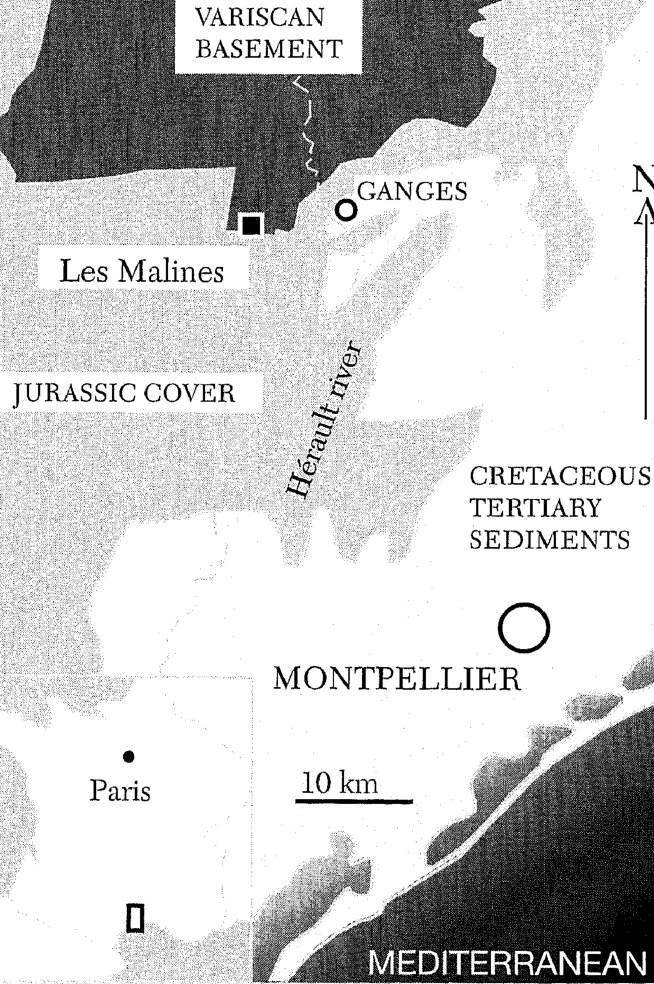
The Les Malines mining district (Bosch et al., 1986) includes various orebodies belonging to different mineralization types (lenses within karst-filling sediments, stratiform lenses, veinlets, tectonic breccias, etc.) hosted in rocks of different ages (Cambrian, Triassic, Liassic, Bathonian) that are generally dolomitic rocks; these various orebodies may be ascribed to a type of Mississipi Valley mineralization. These different ore types result from a complex multistaged metallogenic evolution including remobilization processes. Consequently, the average metal contents vary strongly depending on ore type: i.e., from 3 to 50 percent Zn + Pb; the mean Zn + Pb quotient is about 4. Nevertheless, the mineral association is quite simple: pyrite, sphalerite, galena, barite, accessory Pb-Cu-(Ag) sulfosalts, and secondary oxidation minerals. Among the main trace metals (Ca, As, Sb, TI, Ag) which are present within the Zn-Pb ores of Les Malines, thallium seems to be mainly associated with pyrite. The average TI contents in ore material range from 3 to 35 ug/g depending on ore type.
Les Malines 矿区(Bosch et al., 1986)包括属于不同矿化类型(岩溶充填沉积物中的透镜体、层状透镜体、细脉、构造角砾岩等)的多个矿体,赋存于不同时代(寒武纪、三叠纪、里阿斯世、巴通期)的岩石中,这些岩石一般为白云质岩石;这些矿体可归属于密西西比河谷型矿化。上述不同矿石类型源于包括再活化过程在内的复杂多阶段成矿演化。因此,平均金属含量随矿石类型差异很大,即 Zn + Pb 含量为 3%~50%;Zn/Pb 平均比值约为 4。尽管如此,其矿物组合相当简单:黄铁矿、闪锌矿、方铅矿、重晶石、副矿物 Pb-Cu-(Ag) 硫盐以及次生氧化矿物。在 Les Malines 的 Zn-Pb 矿石中存在的主要微量金属(Cd、As、Sb、Tl、Ag)中,铊似乎主要与黄铁矿相伴生。矿石中 Tl 的平均含量随矿石类型不同为 3~35 μg/g。
Attempts are now being made to revegetate and ameliorate the enormous area of mine waste that now surrounds the little town of St. Laurent le Minier.
目前正在尝试对环绕 St. Laurent le Minier 小镇的大面积矿山废弃物进行植被重建和改良。
The pH of the tailings is typically 7.3 (mean of 60 samples), with a range of 6.4 to 7.7. The surprisingly high pH is due to the presence of calcareous material (e.g., CaCO3) in the mine waste. This waste has been colonized by a typical metal-tolerant base metal flora dominated by Minuartia verna (L.) Hiern. and Thlaspi caerulescens with associated Biscutella laevigata L., Iberis intermedia Guersent, and Armeria maritima (Miller) Willd. Figure 2 is an illustration of Iberis intermedia.
尾矿的 pH 通常为 7.3(60 个样品的平均值),范围为 6.4~7.7。pH 之所以出人意料地高,是由于矿山废弃物中含有钙质物质(如 CaCO3)。这些废弃物上已定殖了典型的耐金属贱金属植物群落,以 Minuartia verna (L.) Hiern. 和 Thlaspi caerulescens 为优势种,伴生有 Biscutella laevigata L.、Iberis intermedia Guersent 和 Armeria maritima (Miller) Willd.。图2为 Iberis intermedia 的图示。
FIG. 2. Iberis intermedia that can contain over 2,000 ug/g (0.2%) Tl in its dry tissues.图2. 干组织中 Tl 含量可超过 2,000 μg/g(0.2%)的 Iberis intermedia。
months brought the plants to a state of maturity just before the onset of flowering. Pots were moved at weekly intervals to standardize the amount of light received. Total aerial parts of all plants were washed in distilled water and digested with hot nitric acid (perchloric acid, initially used for tield samples was later found to be unnecessary and was not used for the later pot samples). The resultant solutions were analyzed by FAAS as described above for wild plants.
个月后,植株达到临近开花前的成熟状态。每周移动一次花盆,以使各盆接受的光照量一致。所有植株的全部地上部分均用蒸馏水洗净,并用热硝酸消解(高氯酸最初用于野外样品,后发现并无必要,故后期盆栽样品未使用)。所得溶液按上文野生植物所述方法用 FAAS 分析。
Methods and Materials材料与方法
Sampling, preparation, and analysis of plant samples植物样品的采集、制备与分析
For wild plants, TI concentrations in dry whole plants or individual organs ot Iberis intermedia, Biscutella laevigata, Brassica napus, Silene cucubalus, and Thlaspi caerulescens from Les Malines (Les Avinières) were collected, washed, and dried at 70°C. Plant samples (1 g) were digested with 10 ml of a 1:3 mixture of perchloric/nitric acids and heated in borosilicate beakers until fumes of perchloric acid were observed. The digests were then cooled and diluted to 10 to 20 ml, depending on the expected TI content of the plant material.
野生植物方面,采集了 Les Malines(Les Avinières)的 Iberis intermedia、Biscutella laevigata、Brassica napus、Silene cucubalus 和 Thlaspi caerulescens 的整株或各器官,经洗净后于 70°C 烘干,用于测定干物质中 Tl 含量。植物样品(1 g)用 10 ml 高氯酸/硝酸(1:3)混合酸在硼硅酸盐烧杯中加热消解,直至出现高氯酸白烟。消解液冷却后,根据植物材料中预期的 Tl 含量定容至 10~20 ml。
Sampling, preparation, and analysis of soils and substrates
土壤及基质样品的采集、制备与分析
Field samples: The substrates in which the wild plants were growing consisted primarily of waste material from mining activities that had not been extant for a sufficient time to allow for the formation of discrete horizons and where the lack of organic material has prevented the formation of an upper humus layer. For each individual plant that was sampled, two soil" samples were collected to a depth of 10 cm at opposite sides of the plant and made into a composite. Soil samples (ca. 250 g) were dried at 100°C and sieved to <2 mm size using a nylon sieve. About 10 g subsamples of sieved soil were ground using a mortar and pestle and then 0.2 g subsamples were accurately weighed into boiling tubes. Ten ml of concentrated nitric acid was then added to each tube and the mixtures boiled until a final volume of 3 ml was reached. A further 10 ml of concentrated hydrochloric acid was then added and the mixtures again evaporated to 3 ml. After filtration, the solutions were diluted to 100 ml with distilled water and then analyzed for TI by FAAS as detailed above for plant samples.
野外样品:野生植物生长的基质主要为采矿活动产生的废弃物,其存在时间不足以形成明显的土壤发生层,且由于缺乏有机物质,未能形成表层腐殖质层。对每一株采样植物,在植株两侧相对位置各采集一个深度为 10 cm 的“土壤”样品,混合为一个复合样品。土壤样品(约 250 g)于 100°C 烘干,用尼龙筛过 <2 mm 筛。取约 10 g 过筛土壤子样用研钵研磨,再准确称取 0.2 g 子样置于消解管中。每管加入 10 ml 浓硝酸,煮沸至最终体积为 3 ml。再加入 10 ml 浓盐酸,再次蒸发至 3 ml。过滤后,溶液用蒸馏水定容至 100 ml,然后按上文植物样品所述方法用 FAAS 测定 Tl。
A few samples were initially analyzed in France by plasma emission spectrometry (ICP-ES) in which dry material was originally ashed at 500°C for 3 h and the ash dissolved in dilute ultrapure sulfuric acid in order to provide solutions for analysis. Most of the samples were later analyzed in New Zealand by flame atomic absorption spectrometry (FAAS) using a GBC 904 instrument and the absorption line at 276.8 nm. In these later analyses, original samples were dissolved in mineral acids as reported above. Limits of detection for both ICP-ES and FAAS instruments were about 1 ug/ml for the solution presented for analysis, or about 5 ug/g for the original plant material. Agreement between the two methods was extremely close. The coefficients of variation in both cases for replicate analyses were <5 percent despite the different methods of sample attack. The data are shown in Table 1.
少量样品最初在法国采用等离子体发射光谱法(ICP-ES)分析,即将干物质先于 500°C 灰化 3 h,灰分溶于稀超纯硫酸中制得待测溶液。大部分样品后来在新西兰采用火焰原子吸收光谱法(FAAS)分析,使用 GBC 904 仪器,吸收线为 276.8 nm。在后期分析中,原始样品按上文所述用无机酸溶解。ICP-ES 与 FAAS 两种仪器的检出限对待测溶液而言均约为 1 μg/ml,对原始植物材料而言约为 5 μg/g。两种方法的结果高度吻合。尽管样品消解方法不同,两种情况下重复分析的变异系数均 <5%。数据见表1。
For pot trials, specimens of Iberis intermedia and the nonaccumulator grass Arrhenatherum elatius were grown in plant growth units in which we added TI (as the acetate) to pots (500 ml) containing a standard commercial seed mix with added slow-release fertilizers. Thallium concentrations in these pots were nominally in the range of 0.1, 3, 6, 12, 24, 48, 98, 187, 375, 750, 1,500 and 3,000 ug/g dry weight.
盆栽试验中,Iberis intermedia 和非富集禾草 Arrhenatherum elatius 的植株在植物生长箱中培养,我们在装有添加缓释肥料的标准商品育苗基质的花盆(500 ml)中添加 Tl(以乙酸盐形式)。各盆中 Tl 的名义浓度为 0.1、3、6、12、24、48、98、187、375、750、1,500 和 3,000 μg/g 干重。
Pot trials: After the harvesting stage, the Tl-rich substrates used for the pot trials were sampled by making a composite of three separate cores taken from each pot. The cores were taken with a 8-mm-diameter standard laboratory cork borer: The samples were dried and ground in a mortar and pestle tollowed by adding 5-g samples of sieved material into 150-ml polythene containers. Then 50 ml of 1M ammonium acetate was added to each container. Samples were gently agitated (75 rpm) for 24 h, filtered (Whatman No. 41), and stored in polythene containers. Ammonium acetate was chosen for the
盆栽试验:收获后,对盆栽试验所用的富 Tl 基质进行采样,每盆取三个独立土芯混合为复合样。土芯使用直径 8 mm 的标准实验室打孔器采集。样品烘干后用研钵研磨,然后将 5 g 过筛样品加入 150 ml 聚乙烯容器中。随后向每个容器中加入 50 ml 1M 乙酸铵。样品轻缓振荡(75 rpm)24 h,过滤(Whatman No. 41),并储存于聚乙烯容器中。选用乙酸铵用于
Seedlings (five for each concentration of TI) or Iberis and ot the metal-tolerant grass Arrhenatherum elatius were introduced into each pot and grown for a period of three months in a temperature range of 15°C (night) to 25°C (day). The pots were placed over damp felt and watered weekly to prevent accumulation of salts at the surface. The period of three experiments because of its well proven use as a measure of the plant-available fraction ofsoils (Ernst, 1996); this amounted to about 80 percent of the original total TI content.
将 Iberis 和耐金属禾草 Arrhenatherum elatius 的幼苗(每个 Tl 浓度各五株)移入各花盆,在 15°C(夜间)至 25°C(白天)的温度范围内培养三个月。花盆置于湿毡上,每周浇水一次,以防止盐分在表层积累。三个试验,是因为其作为土壤植物有效态组分的测定方法已得到充分验证(Ernst, 1996);该组分约占原始总 Tl 含量的 80%。
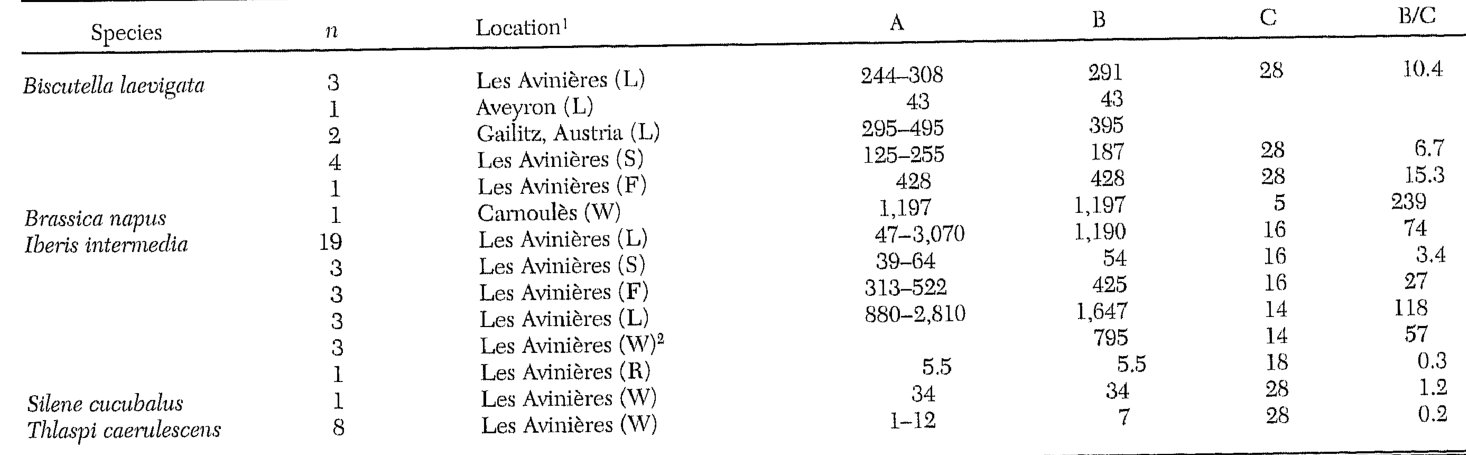
n = number; A = range in plants, B = mean in plants, C = concentration in soils to a depth of 10 cm, B/C = plant/soil concentration quotient IF = flowers, L = leaves, R = roots, S = stems, W = whole plant 2 Calculated from stem/leaf ratio of 55:45
n = 数量;A = 植物中含量范围,B = 植物中平均含量,C = 0~10 cm 深度土壤中含量,B/C = 植物/土壤含量比 IF = 花,L = 叶,R = 根,S = 茎,W = 整株 2 根据茎/叶比 55:45 计算
The pH measurements were made by shaking 4-g samples of soils or mine waste with 10 ml of distilled water tor a period of 1 h. Atter being allowed to settle for 24 h, the samples were again shaken for a few minutes and the pH measured alter an appropriate settling period.
pH 测定方法为:将 4 g 土壤或矿山废弃物样品与 10 ml 蒸馏水振荡 1 h。静置 24 h 后,再次振荡数分钟,经适当沉降后测定 pH。
2Results and Discussion结果与讨论
Thallium in plants from Les Avinières
Les Avinières 植物中的铊
The data in Table 1 show that Iberis intermedia is able to hyperaccumulate up to 2,810 ug/g Tl in its dry leaves. This TI is clearly not derived from windborne contamination by soil, since the TI concentrations in plant material are much higher than those in the soil. The effect of soil-derived contamination would actually have been to lower rather than increase the apparent TI content of the plants.
表1数据表明,Iberis intermedia 干叶中可超富集高达 2,810 μg/g 的 Tl。这些 Tl 显然并非来自风携土壤污染,因为植物材料中的 Tl 含量远高于土壤中的含量。实际上,土壤源污染的作用只会降低而非提高植物的表观 Tl 含量。
The initial investigation of wild plants indicated that Biscutella laevigata contained a maximum of 495 ug/g Tl, in itself an extraordinarily high level. But because this species has a lower TI concentration and smaller biomass than Iberis (about half that of Iberis), it would not appear to be as useful as Iberis for phytoremediation or phytomining of TI and was not investigated further.
对野生植物的初步调查表明,Biscutella laevigata 的 Tl 含量最高为 495 μg/g,这本身已是极高的水平。但由于该物种的 Tl 含量低于 Iberis,且生物量较小(约为 Iberis 的一半),其在 Tl 的植物修复或植物采矿方面似乎不如 Iberis 有用,因此未作进一步研究。
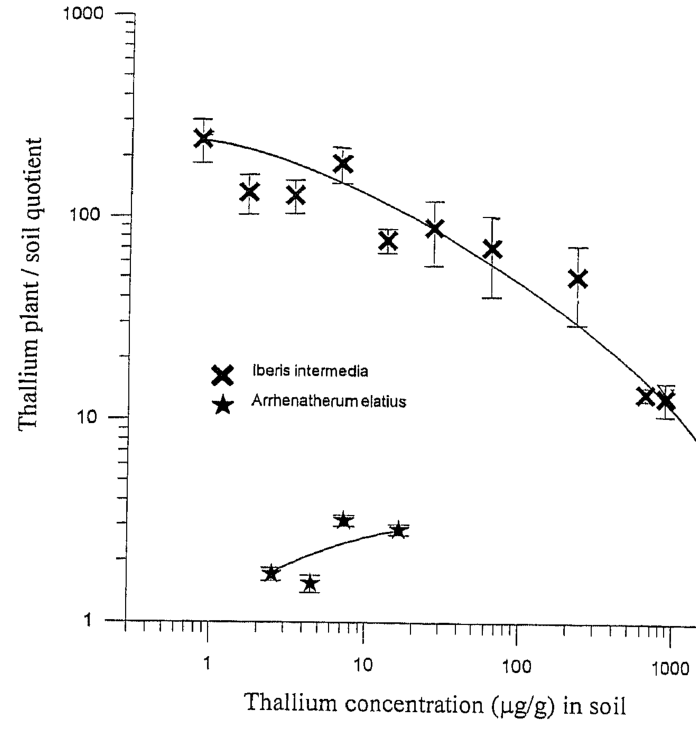
Figure 3 is a plot of TI concentrations in plant material (ug/g dry weight) shown as a function of the extractable Tl in the substrate. A similar type of plot (not shown) was obtained when the X axis consisted of the nominal total, rather than extractable, TI. Figure 4 shows the biological absorption coefficient (plant/soil elemental concentration quotient) for TI in the plants studied.图3为植物材料中 Tl 含量(μg/g 干重)随基质中可提取态 Tl 的变化图。当 X 轴采用名义总 Tl 而非可提取态 Tl 时,得到类似的图(未列出)。图4给出了所研究植物对 Tl 的生物吸收系数(植物/土壤元素含量比)。
A number of conclusions can be deduced from Table 1 and Figures 3 and 4:
由表1及图3和图4可以得出以下结论:
1. Leaves of wild specimens of Iberis show hyperaccumulation of TI (here defined as >500 ug/g [>0.05%] in dry plant material).
1. 野生 Iberis 植株的叶片表现出 Tl 超富集(此处定义为干植物材料中 >500 μg/g [>0.05%])。
2. Under greenhouse conditions, the biological absorption coetticients, among the highest ever recorded for hyperaccumulator plants, decrease with increasing amounts of TI in the substrate and at low TI levels (<10 ug/g) are on the order of 300, decreasing to about 10 over 500 ug/g Tl in the substrate 3. The nonaccumulator Arrhenatherum contained slightly more TI than the substrate.
2. 在温室条件下,生物吸收系数属于超富集植物迄今记录的最高值之列,并随基质中 Tl 含量增加而降低:在低 Tl 水平(<10 μg/g)下约为 300,当基质中 Tl 超过 500 μg/g 时降至约 10。3. 非富集植物 Arrhenatherum 的 Tl 含量略高于基质。
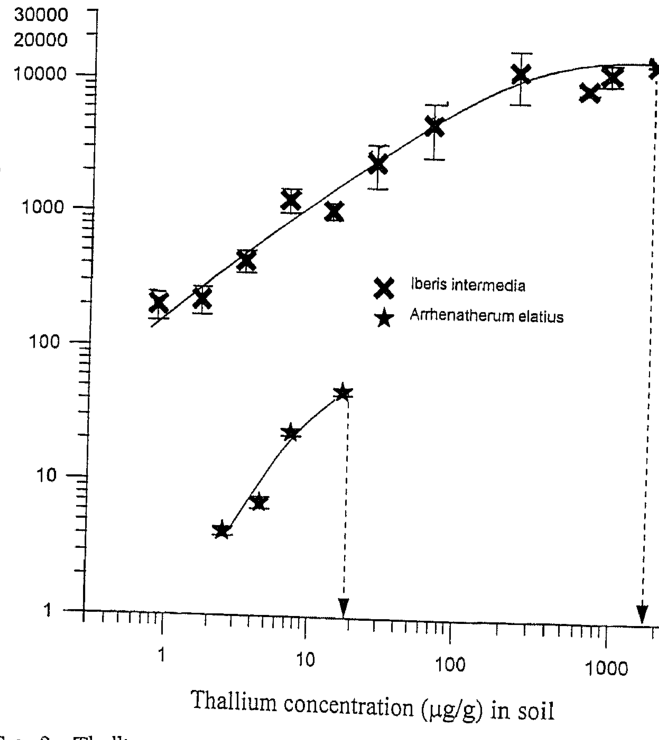
4. Based on TI concentrations in experimental pots, the tolerance limit is about 1,800 ug/g TI for Iberis and only 20 ug/g tor the grass.
4. 根据试验盆中的 Tl 含量,Iberis 的耐受极限约为 1,800 μg/g Tl,而禾草仅为 20 μg/g。
5. Mean TI levels in both species increase in the sequence stems < leaves < flowers (Table 1).
5. 两个物种中 Tl 的平均水平均按茎 < 叶 < 花的顺序递增(表1)。
It will be noted from Table 1 that high TI levels were also found in a single specimen of Brassica napus. This is not unexpected because of the known propensity of brassicaceous plants to accumulate TI, but we have not investigated this matter further.
由表1可见,在单株 Brassica napus 中也发现了较高的 Tl 含量。鉴于十字花科植物已知具有富集 Tl 的倾向,这并不出人意料,但我们未对此作进一步研究。
Animal and human health significance of thallium in plants
植物中铊对动物和人类健康的意义
The extraordinarily levels of TI recorded in Iberis intermedia have important ramifications for human and animal health. It must be remembered that Iberis intermedia is a common weed in rocky or disturbed sites throughout central and southern Europe. These high levels of TI found in Iberis pose a potential problem for animal husbandry, given the extremely toxic nature of this element (18.5 mg TV/kg of body weight compared with 2.2 mg/kg for sodium cyanide; source: Stecher, 1968). Even when the TI concentration in the soil is at crustal background levels (ca. 1 ug/g), the plants can contain over 100 ug/g Il in dry tissue. High concentrations of TI in brassicaceous food crops such as rape seed also present a potential problem for human health considerations when crop plants are grown over TI-rich substrates as occurs frequently in France (Tremel et al., 1997) and Germany (Kurz et
Iberis intermedia 中记录到的极高 Tl 含量对人类和动物健康具有重要影响。须知 Iberis intermedia 是中欧和南欧各地多石或受扰动生境中的常见杂草。鉴于该元素的剧毒性(18.5 mg Tl/kg 体重,而氰化钠为 2.2 mg/kg;来源:Stecher, 1968),Iberis 中的高 Tl 含量对畜牧业构成潜在问题。即使土壤中 Tl 含量处于地壳背景水平(约 1 μg/g),植物干组织中的 Tl 含量也可超过 100 μg/g。当作物种植于富 Tl 基质上时(这在法国(Tremel et al., 1997)和德国(Kurz et
Phytoremediation of thallium by use of plants利用植物进行铊的植物修复
The high concentrations of TI in Iberis afford the possibility of using this plant for phytoremediation of TI-contaminated soils such as those which have been round near a cement works in southern Germany (Kurz et al., 1997) and along the borders of the Massif Central in France where the Triassic terrane is rich in Pb, Zn, and TI (Tremel, 1996). A typical plant of Iberis weighs 30 g dry weight. Our own field trials have shown that 50 plants can be grown in 1 m? of soil. We can therefore envisage a biomass production of 15 t/ha. If we adopt a more conservative approach and give an estimate of 10 t/ha, whole plants containing on average 800 ug/g TI would provide about 8 kg of 11 worth $2,400/ha at today's prices. Assuming that a contaminated soil containing 10 ug/g Tl is to be remediated to a depth of 20 cm and assuming a soi. density of 1.3, a hectare of soil would weigh 2,600 t and would contain 26 kg of TI. Assuming that the plant-available fraction of Tl remains constant at each growing season, three sequential crops of Iberis intermedia should in theory be sufficient to remove most of the TI from this soil. If it were possible to sell he ashed biomass (bio-ore) for $7,200 over the three-vear period, this would pay for the costs of remediation.
Iberis 中的高 Tl 含量为利用该植物修复 Tl 污染土壤提供了可能,例如德国南部某水泥厂附近发现的污染土壤(Kurz et al., 1997),以及法国中央高原边缘三叠系地层富含 Pb、Zn 和 Tl 的地区(Tremel, 1996)。一株典型的 Iberis 干重为 30 g。我们自己的田间试验表明,每 1 m² 土壤可种植 50 株。因此可设想生物量产量达 15 t/ha。若采取更保守的方法,估计为 10 t/ha,则平均含 Tl 800 μg/g 的整株植物可提供约 8 kg Tl,按现价计值 $2,400/ha。假设需将含 Tl 10 μg/g 的污染土壤修复至 20 cm 深度,并假设土壤容重为 1.3,则每公顷土壤重 2,600 t,含 Tl 26 kg。假设每个生长季中 Tl 的植物有效态组分保持不变,理论上连续种植三茬 Iberis intermedia 即足以去除该土壤中的大部分 Tl。若能在三年期内以 $7,200 出售灰化生物质(生物矿石),即可抵偿修复成本。
Phytomining for thallium铊的植物采矿
The concept of phytomining (Chaney, 1983; Nicks and Chambers, 1995; Robinson et al., 1997a,b; Brooks, 1998) involves growing a crop of a hyperaccumulator plant for the express purpose ot producing a saleable ash (bio-ore). With a biomass of 10 t/ha and assuming an ash weight of 7 percent as determined by us experimentally, the ashed Iberis should produce about 700 kg of bio-ore containing 8 kg of TI, worth $2,400 at the price of $300/kg. If only half of this sum were returned to the grower (i.e., after processing and costs of production), the resulting $1,200/ha is over twice the return of a crop of wheat to an American farmer (Nicks and Chambers, 1995). There is clearly some potential for phytomining for TI but only if sufficiently large areas of contaminated soils are available in order to obtain the advantage of large-scale production. In order to be economic, phytomining should be able to produce $500 per hectare irrespective of any additional revenue from incineration of the biomass to generate electricity. For such a scenario, a crop with a biomass of 10 tha would have to contain at least 170 ug/g Tl in dry plant matter, a level easily attainable with Iberis intermedia.
植物采矿的概念(Chaney, 1983; Nicks and Chambers, 1995; Robinson et al., 1997a,b; Brooks, 1998)是指种植超富集植物作物,其明确目的在于生产可出售的灰分(生物矿石)。在生物量为 10 t/ha、灰分重量按我们实验测定的 7% 计的条件下,灰化后的 Iberis 可产出约 700 kg 生物矿石,其中含 Tl 8 kg,按 $300/kg 的价格计值 $2,400。即使仅有其中一半返还给种植者(即扣除加工和生产成本后),所得的 $1,200/ha 也超过美国农民种植小麦收益的两倍(Nicks and Chambers, 1995)。Tl 的植物采矿显然具有一定潜力,但前提是有足够大面积的污染土壤可供利用,以获得规模化生产的优势。为实现经济可行,在不计焚烧生物质发电所带来的任何额外收入的情况下,植物采矿每公顷应能产生 $500 的收益。在此情形下,生物量为 10 t/ha 的作物干物质中 Tl 含量须至少达到 170 μg/g,而这一水平 Iberis intermedia 很容易达到。
to elucidate the mechanisms of this very unusual hyperaccumulation ot a highly toxic heavy metal
以阐明这种对剧毒重金属的非常罕见的超富集机制
Most noteworthy is the possibility of using these plants for phytomining of TI. Unlike metals such as Ni that have been shown to have a phytomining potential only it the world price of the metal remains high, TI does not suffer the wild swings of price change experienced by many other metals and is at present perhaps the strongest candidate for successtul phytomining in the future.
最值得注意的是利用这些植物进行 Tl 植物采矿的可能性。Ni 等金属已被证明只有在其国际价格保持高位时才具有植物采矿潜力,与之不同,Tl 不像许多其他金属那样经历剧烈的价格波动,目前可能是未来成功实现植物采矿的最有力候选元素。
May 8, October &, 19981998年5月8日,1998年10月8日
3REFERENCES参考文献
Bosch, B., et al., 1986, Hydrogeochemistry in the zinc-lead mining district of "Les Malines" (Gard, France): Chemical Geology, v. 55, p. 31-44. Brooks, R.R., ed., 1998, Plants that hyperaccumulate heavy metals, Wallingford, United Kingdom: Commonwealth Agricultural Bureau (CAB) International, 380 p.
Brooks, R.R., and Johannes, D., 1990, Phytoarchaeology: Portland, Oregon, Dioscorides Press, 224 p.
Brooks, R.R., Lee, J., Reeves, R.D. and Jaffré, T., 1977, Detection of nickeliferous rocks by analysis of herbarium specimens of indicator plants: Journal of Geochemical Exploration, v. 7, p. 49-57.
Brooks, R.R., Chambers, M.F., Nicks, L., and Robinson, B.H., 1998, Phytomining: Trends in Plant Science, v. 3, p. 359-362.
Chaney, R.L., 1983, Plant uptake of inorganic waste constituents, in Parr, J.F., et al., eds., Land treatment of hazardous wastes: New York, Noyes
Ernst, W.H.O., 1996, Bioavailability of heavy metals and decontamination of soils by plants: Applied Geochemistry, v. 11, p. 163-167.
Green, J., 1972, Elements: Planetary abundance and distribution, in Fairbridge, R., ed., Encyclopedia of geochemistry and environmental sciences: New York, Van Nostrand Reinhold, p. 268-300.
Kurz, H., Schulz, R., and Römheld, V., 1997, Studies on thallium uptake by various crop plants for risk assessment of the food chain: World Wide Web at: http:/www.uni-hohenheim.de/institutes/plant_nutrition/hinstres.htm McGrath, S.P., Sidoli, C.M.D., Baker, A.J.M., and Reeves, R.D., 1993, The potential for the use of metal-accumulating plants for the in situ decontamination of metal-polluted soils, in Eijsackers, H.J.P., and Hamers, T., eds., Integrated soil and sediment research: A basis for proper protection: Dordrecht, Kluwer Academic Publishers, p. 673-676.
Nicks, L., and Chambers, M.F., 1995, Farming for metals: Mining Environmental Management, Sept., p. 15-18.
Robinson, B.H., Chiarucci, A., Brooks, R.R., Petit, D., Kirkman, J.H., Gregg, P.E.H., and De Dominicis, V., 1997a, The nickel hyperaccumulator plant Alyssum bertolonii as a potential agent for phytoremediation and phytomining of nickel: Journal of Geochemical Exploration, v. 59, p. 75-86.
Robinson, B.H., Brooks, R.R., Howes, A.W., Kirkman, J.H., and Gregg, P.E.H., 1997b, The potential of the high-biomass Berkheya coddit for phytoremediation and phytomining: Journal of Geochemical Exploration, v. 60,
Tremel, A., 1996, Transfert du thallium du sol vers la plante: Unpublished Ph.D. thesis, University of Nancy.
Tremel, A., and Mench, M., 1997, Le thallium dans les sols et les végétaux supérieures. II. Le thallium dans les végétaux supérieures: Agronomie, v. 17, p. 261-269.
Tremel, A., Masson, P., Sterckeman, T., Baize, D., and Mench, M., 1991, Thallium in French agrosystems. I. Thallium content in arable soils: Environmental Pollution, v. 95, p. 293-302.
Zyka, V, 1970, Thallium in plants from Alsar: Sbornik Cesky Geologicky ved. Technologie/Geochemie v. 10, p. 91-95.
4Conclusions结论
Hyperaccumulation of TI by Iberis intermedia is the first case to be recorded in vegetation and should open up a number of fields of research involving not only phytoextraction of heavy metals but also the possibility of phytochemical studies
Iberis intermedia 对 Tl 的超富集是植被中记录的首例,应能开辟若干研究领域,不仅涉及重金属的植物提取,还包括开展植物化学研究的可能性,