Contents lists available at ScienceDirect journal homepage: www.elsevier.com/locate/soilbio
Short communication
The potential in-situ antimicrobial ability of Myrtaceae plant species on pathogens in soil
J.A. Prosser a, R.R. Woods b, J. Horswell a, *, B.H. Robinson b
a Institute of Environmental Science and Research (ESR) Ltd., Kenepuru Science Centre, PO Box 50348, Porirua, New Zealand b Soil and Physical Sciences, Lincoln University, Lincoln, 7647, Christchurch, New Zealand
a r t i c l e i n f o
a b s t r a c t
Article history: Received 20 July 2015 Received in revised form 23 October 2015 Accepted 16 December 2015 Available online 31 December 2015 Keywords: Myrtaceae Leptospermum scoparium (manuka) Kunzea ericoides (kanuka) Antimicrobial effects E. coli Soil Concerns that land application of organic waste may introduce microbial contaminants into the environment could be mitigated by growing plants with antiseptic properties in waste-amended soil. We investigated the potential for two myrtaceous plants, manuka (Leptospermum scoparium) and kanuka (Kunzea robusta) with antiseptic properties to reduce numbers of the pathogen indicator Escherichia coli in soil. Pots containing perennial ryegrass (Lolium perenne), manuka and kanuka, were spiked with Escherichia coli and a rainfall event was simulated. Decimal reduction times (DRT) showed E. coli numbers were reduced under kanuka and manuka compared to a pasture control (8, 5 and 93 days respectively). Potentially, these myrtaceous species could mitigate the threat of microbial contamination of soil, while producing valuable biomass for fuel, essential oils or honey. © 2016 Elsevier Ltd. All rights reserved.
文章历史:2015年7月20日收稿;2015年10月23日收到修改稿;2015年12月16日接受;2015年12月31日在线发表。关键词:桃金娘科(Myrtaceae);Leptospermum scoparium(麦卢卡);Kunzea ericoides(卡努卡);抗菌效应;E. coli;土壤。有机废弃物土地施用可能向环境中引入微生物污染物,而在施用废弃物的土壤中种植具有抗菌特性的植物有望缓解这一担忧。本研究考察了两种具有抗菌特性的桃金娘科植物——麦卢卡(Leptospermum scoparium)和卡努卡(Kunzea robusta)——降低土壤中病原指示菌大肠杆菌(Escherichia coli)数量的潜力。在种植多年生黑麦草(Lolium perenne)、麦卢卡和卡努卡的盆钵中接种Escherichia coli,并模拟一次降雨事件。十倍减少时间(DRT)表明,与牧场对照相比,卡努卡和麦卢卡下的E. coli数量下降更快(分别为8、5和93天)。这些桃金娘科植物有望在缓解土壤微生物污染威胁的同时,生产可用于燃料、精油或蜂蜜的高价值生物质。© 2016 Elsevier Ltd. 版权所有。
In many countries farmers traditionally cycle large quantities of animal and human wastes back onto the land for practical and economic reasons (Albihn, 2001; Hutchison et al., 2004; Petersena et al., 2007; Miaomiao et al., 2009). Such wastes can contain harmful elements such as heavy metals, antibiotics and disease causing organisms (Sarmaha et al., 2006; Elving et al., 2009; Miaomiao et al., 2009; Sidhu and Toze, 2009) that require strategies to control the associated environmental problems. The use of vegetative buffers for intercepting and mitigating contaminants are one such well-established on-farm technique for managing pollutants such as nitrogen and phosphorus.
在许多国家,出于实际和经济原因,农民传统上将大量动物和人类废弃物回用于土地(Albihn, 2001; Hutchison et al., 2004; Petersena et al., 2007; Miaomiao et al., 2009)。此类废弃物可能含有重金属、抗生素和致病生物等有害成分(Sarmaha et al., 2006; Elving et al., 2009; Miaomiao et al., 2009; Sidhu and Toze, 2009),因此需要采取相应策略以控制由此引发的环境问题。利用植被缓冲带拦截和削减污染物,是管理氮、磷等污染物的一项成熟的农场技术。
Coupling the properties of plants as natural biofilters, with additional bioactive producing capabilities may offer enhanced ecosystem protection against potentially pathogenic organisms that re-cycled wastes can contain.
Manuka (Leptospermum scoparium) and kanuka (Kunzea ericoides) are pioneer species in the Myrtaceae family that colonise disturbed environments in New Zealand and South Australia (Mohan et al., 1984; Bergin et al., 1995; Stephens et al., 2005) and have known antiseptic properties (Stephens et al., 2005). Prosser et al. (2014) hypothesised that the components responsible for the antimicrobial ability of these plants may enter soil and ameliorate pathogen-contaminated sites. We aimed to determine the potential of manuka and kanuka to reduce the risks of pathogen contamination associated with recycling of organic waste to land. A silt loam soil (top 20 cm) was sourced from the Lincoln University Dairy Farm (43�38011.7000S, 172�26017.0000E); pH 5.6, C content 2.0%, and N content 0.18% (Table 1) (Knowles et al., 2011). The soil was homogenised, large roots removed and 6.25 g lime L�1 added to raise the pH to ~6. Nine of each of three plant species were used; Perennial ryegrass e Lolium perenne grown from seed (approx. 12 months old); Manuka e L. scoparium; Kanuka e K. ericoides, seedlings, approx. 2 years old.
麦卢卡(Leptospermum scoparium)和卡努卡(Kunzea ericoides)是桃金娘科的先锋物种,可在新西兰和南澳大利亚的受扰动环境中定殖(Mohan et al., 1984; Bergin et al., 1995; Stephens et al., 2005),并具有已知的抗菌特性(Stephens et al., 2005)。Prosser et al. (2014) 提出假设:这些植物中负责抗菌能力的成分可能进入土壤,从而改善受病原体污染的场地。本研究旨在确定麦卢卡和卡努卡降低有机废弃物土地回用所伴随的病原体污染风险的潜力。供试粉砂壤土(表层20 cm)采自林肯大学奶牛场(43°38′11.70″S,172°26′17.00″E);pH 5.6,C含量2.0%,N含量0.18%(表1)(Knowles et al., 2011)。土壤经均质化处理,去除大根,并添加6.25 g石灰 L−1,使pH升至约6。三种植物各使用9株:多年生黑麦草——Lolium perenne,由种子培育(约12月龄);麦卢卡——L. scoparium;卡努卡——K. ericoides,均为约2年生幼苗。
* Corresponding author. Tel.: +64 4 9140663.
Pots were adjusted to field capacity and inoculated with 1 � 109 cfu Escherichia coli (ATCC 13706; New Zealand Reference Culture Collection Medical Section, ESR, Wellington) (1 � 106 cfu E. coli g�1 dry soil) in 100 ml sterile PBS (phosphate buffered saline). Immediately following application, a rainfall event was simulated, one pore volume (1.375 L) of sterilised water was applied at the rate of 15 mm h�1. Three of each plant species were chosen at random to be destructively harvested on days: 1 (T0), 3 (T1), and 7 (T2) following E. coli inoculation. Soil samples were obtained by removing the bulk unattached soil and subsequently shaking the remaining soil from the plant roots. Soil was homogenised by mixing and analysed immediately. Soil pH was determined according to Blakemore et al. (1987), and moisture content was determined by overnight drying at 105 �C. Enumeration of E. coli in soil was carried out using a five-tube Most Probable Number (MPN) (Feng et al., 2002). Microsoft Excel was used for the calculation of averages, standard deviations (SDs) and standard errors (SEs) for E. coli MPN and soil pH. MPN for E. coli were calculated using prepared MPN tables (Alexander, 1982; Woomer, 1994), and significance of difference was determined by comparison of 95% confidence intervals (p < 0.05). For pathogen data, log averages and associated SDs were calculated from each set of three replicates for each sample time. After fitting lineal trend lines to the data, decimal reduction times (DRT) were determined as described in Horswell et al. (2009). The hypothesis that all the trend lines had the same slope was tested using Analysis of Covariance (ANCOVA) p ¼ 0.031. A p-value for each individual curve was calculated using the t-test.
将盆钵土壤调节至田间持水量,并以100 ml无菌PBS(磷酸盐缓冲液)接种1 × 10⁹ cfu Escherichia coli(ATCC 13706;新西兰参考菌种保藏中心医学部,ESR,惠灵顿)(1 × 10⁶ cfu E. coli g−1干土)。接种后立即模拟一次降雨事件,以15 mm h−1的速率施加一个孔隙体积(1.375 L)的灭菌水。于E. coli接种后第1天(T0)、第3天(T1)和第7天(T2),每种植物随机选取3株进行破坏性收获。土壤样品的采集方法为:先移除未附着的主体土壤,随后抖落植物根系上残留的土壤。土壤经混合均质后立即分析。土壤pH按照Blakemore et al. (1987) 的方法测定,含水量通过105 °C过夜烘干测定。土壤中E. coli采用五管最大可能数(MPN)法计数(Feng et al., 2002)。利用Microsoft Excel计算E. coli MPN和土壤pH的平均值、标准差(SD)和标准误(SE)。E. coli的MPN根据现成的MPN表计算(Alexander, 1982; Woomer, 1994),差异显著性通过比较95%置信区间确定(p < 0.05)。对于病原体数据,按各采样时间的每组三个重复计算对数平均值及相应SD。对数据拟合线性趋势线后,按照Horswell et al. (2009) 所述方法确定十倍减少时间(DRT)。采用协方差分析(ANCOVA)检验所有趋势线斜率相同的假设,p = 0.031。各条曲线的p值采用t检验计算。
E-mail address: Jacqui.Horswell@esr.cri.nz (J. Horswell).
http://dx.doi.org/10.1016/j.soilbio.2015.12.007 0038-0717/© 2016 Elsevier Ltd. All rights reserved.
Physicochemical profile of the soil used for the current study. Values represent averages ± standard error. Adapted from Knowles et al. (2011).
本研究供试土壤的理化性质。数值为平均值 ± 标准误。引自Knowles et al. (2011)。
| Property性质 | Mean result (n ¼ 3)平均结果(n = 3) |
|---|---|
| pH | 5.6 |
| CEC (cmolc kg�1) | 12.4 ± 0.5 |
| C (%) | 2.0 ± 0.1 |
| N (%) | 0.18 ± 0.01 |
| P (mg kg�1) | 518 ± 25 |
| S (mg kg�1) | 193 ± 15 |
| Ca (mg kg�1) | 3005 ± 101 |
| Mg (mg kg�1) | 855 ± 11 |
| K (mg kg�1) | 1401 ± 119 |
| Na (mg kg�1) | 136 ± 4 |
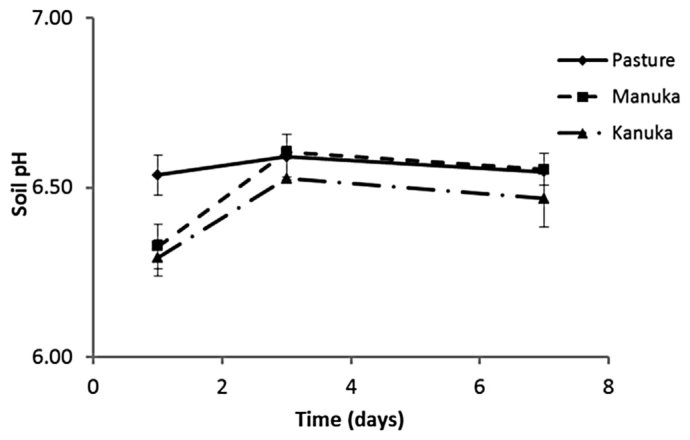
Total E. coli declined in all treatments over the trial period but there was a significant (p � 0.05) difference in the rate of decline between plant species (Figs. 1 and 2). At day 7 (T2) the number of E. coli (CFU) were significantly reduced under kanuka when compared to pasture; manuka also exhibited a considerable reduction in E. coli (Fig. 1). Analysis of Covariance (ANCOVA) undertaken on the lineal trend lines (Fig. 2) indicated that the trend lines had different slope (p ¼ 0.031). Decimal reduction times (DRT) indicated soil under kanuka and manuka facilitated 90% reduction of E. coli after just 5 and 8 days respectively (Fig. 2), whilst DRT for pasture was 93 days. Results for soil pH indicated a difference between plant species in the order of kanuka < manuka < pasture (Fig. 3), however by day 3 this was not significant. Although pH has previously been shown to influence soil bacterial populations (Bååth, 1996) it is unlikely to be the mechanism by which manuka and kanuka affect the survival of E. coli in this study.
试验期间各处理的总E. coli均有所下降,但不同植物物种间的下降速率存在显著差异(p ≤ 0.05)(图1和图2)。第7天(T2)时,与牧场相比,卡努卡下的E. coli数量(CFU)显著降低;麦卢卡下E. coli也明显减少(图1)。对线性趋势线(图2)进行的协方差分析(ANCOVA)表明,各趋势线斜率不同(p = 0.031)。十倍减少时间(DRT)表明,卡努卡和麦卢卡下的土壤分别仅需5天和8天即可使E. coli减少90%(图2),而牧场的DRT为93天。土壤pH结果显示植物物种间存在差异,顺序为卡努卡 < 麦卢卡 < 牧场(图3),但至第3天时该差异已不显著。尽管已有研究表明pH会影响土壤细菌种群(Bååth, 1996),但在本研究中,pH不太可能是麦卢卡和卡努卡影响E. coli存活的机制。
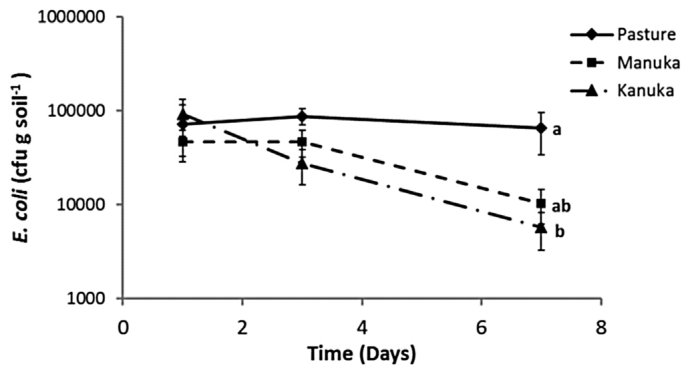
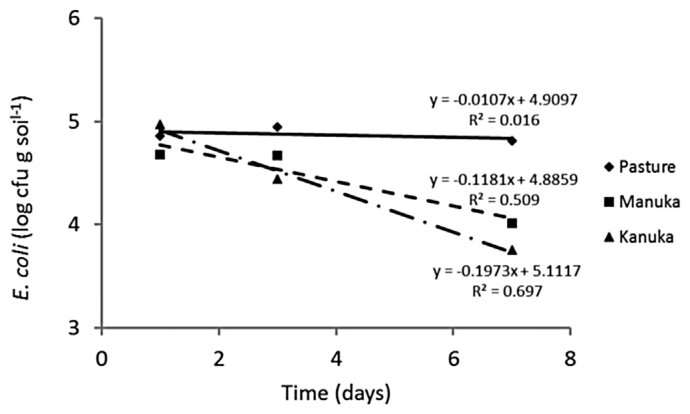
Decimal reduction times (DRT) indicated that soil under kanuka and manuka facilitated a more rapid reduction in total E. coli than the pasture control.
十倍减少时间(DRT)表明,与牧场对照相比,卡努卡和麦卢卡下的土壤使总E. coli减少得更快。
It has been suggested that the antibacterial agents from manuka may enter the soil via rhizodeposition (Prosser et al., 2014), thus altering rhizosphere soil through the release of root exudates, mucilage and sloughed cells (Castaldi et al., 2009). Studies have found that root exudates can remain stable in soils for significant lengths of time (Quartacci et al., 2009), and through altering soil conditions plant roots may be able to select for favourable microbial populations (Cheng et al., 2004; Quartacci et al., 2009). The antimicrobial agents responsible for the antimicrobial activity observed in this study are unknown. However, Cornes (2005) found that leptospermone (thought to be responsible for antimicrobial activity in manuka oil) produced by the roots of bottle brush (Callistemon citrinus) suppressed weeds around the plant's base. The phytochemical composition of manuka varies considerably between species, population, age and seasons (Porter et al., 1998; Porter and Wilkins, 1999). In manuka essential oil, triketones are reported to give manuka its antimicrobial properties. The major triketones are flavesone, iso-leptospermone and leptospermone, however, this varies with region and these triketones were not detected in manuka from some regions (Porter and Wilkins, 1999). The effect of antimicrobial plants will probably be different in different soils. This will be due to differences in the sorption of the phytochemicals from manuka and kanuka, resulting in differences in their bioavailability to the pathogens. As noted previously, the chemical composition of these plants varies between regions due to both environmental and genetic factors (Porter et al., 1998; Porter and Wilkins, 1999).
有研究提出,麦卢卡中的抗菌物质可能通过根际沉积进入土壤(Prosser et al., 2014),即通过释放根系分泌物、黏液和脱落细胞改变根际土壤(Castaldi et al., 2009)。研究发现,根系分泌物可在土壤中长时间保持稳定(Quartacci et al., 2009),且植物根系可能通过改变土壤条件来选择有利的微生物种群(Cheng et al., 2004; Quartacci et al., 2009)。本研究中观察到的抗菌活性由何种抗菌物质引起尚不清楚。然而,Cornes (2005) 发现,红千层(Callistemon citrinus)根系产生的纤精酮(leptospermone,被认为是麦卢卡油抗菌活性的来源)可抑制植株基部周围的杂草。麦卢卡的植物化学组成在不同种、种群、树龄和季节之间差异很大(Porter et al., 1998; Porter and Wilkins, 1999)。据报道,麦卢卡精油中的三酮类化合物赋予了麦卢卡抗菌特性。主要的三酮类化合物为黄酮烷酮(flavesone)、异纤精酮(iso-leptospermone)和纤精酮(leptospermone),但其含量因地区而异,在某些地区的麦卢卡中未检出这些三酮类化合物(Porter and Wilkins, 1999)。抗菌植物的效果在不同土壤中可能有所不同。这是由于麦卢卡和卡努卡中植物化学物质的吸附存在差异,从而导致其对病原体的生物有效性不同。如前所述,受环境和遗传因素的共同影响,这些植物的化学组成存在地区差异(Porter et al., 1998; Porter and Wilkins, 1999)。
The study indicates that antiseptic plant species may help reduce microbial contaminants in land applied organic wastes. Incorporating manuka and kanuka into shelter belts or riparian margins may help mitigate the risks of pathogen contamination of receiving waters.
本研究表明,抗菌植物物种可能有助于减少土地施用有机废弃物中的微生物污染物。将麦卢卡和卡努卡纳入防护林带或河岸缓冲带,可能有助于降低受纳水体遭受病原体污染的风险。
1References参考文献
Albihn, A., 2001. Recycling biowaste e human and animal health problems. Acta Veterinaria Scandinavica 95, 69e75.
Alexander, M., 1982. Most probable number method for microbial populations. In: second ed.Page, A.L., Miller, R.H., Keeney, D.R. (Eds.), Methods of Soil Analysis, Part 2. Chemical and Microbiological Properties e Agronomy Monograph No. 9. ASA-SSSA, Madison, USA, pp. 815e820.
Bååth, E., 1996. Adaptation of soil bacterial communities to prevailing pH in different soils. FEMS Microbiology Ecology 19, 227e237.
Bergin, D.O., Kimberley, M.O., Marden, M., 1995. Protective value of regenerating tea tree stands on erosion-prone hill country, East Coast, North Island, New Zealand. New Zealand Journal of Forestry Science 25, 3e19.
Blakemore, L.C., Searle, P.L., Daly, B.K., 1987. Methods for Chemical Analysis of Soils. New Zealand Soil Bureau Scientific Report 80, p. 103.
Castaldi, P., Melis, P., Silvetti, M., Deiana, P., Garau, G., 2009. Influence of pea and wheat growth on Pb, Cd, and Zn mobility and soil biological status in a polluted amended soil. Geoderma 151, 241e248.
Cheng, Y., Howieson, J.G., O'Hara, G.W., Watkin, E.L.J., Souche, G., Jaillard, B., Hinsinger, P., 2004. Proton release by roots of medicago murex and medicago sativa growing in acidic conditions, and implications for rhizosphere pH changes and nodulation at low pH. Soil Biology & Biochemistry 36, 1357e1365. Cornes, D., 2005. Callisto: a very successful maize herbicide inspired by allelochemistry. In: Proceedings of the Fourth World Congress on Allelopathy - Establishing the Scientific Base, Wagga Wagga, Australia.
Elving, J., Ottoson, J.R., Vinneras, B., Albihn, A., 2009. Growth potential of faecal bacteria in simulated psychrophilic/mesophilic zones during composting of organic waste. Journal of Applied Microbiology 108, 1974e1981.
Feng, P., Weagant, S.D., Grant, M.A., 2002. In: Page, A.L., Miller, R.H., Keeney, D.R. (Eds.), Part 2. Chemical and Microbiological Properties e Agronomy Monograph no. 9, second ed. eds. ASA-SSSA, Madison, USA, pp. 815e820.
Horswell, J., Hewitt, J., Prosser, J., Van Schaik, A.P., Croucher, D., Macdonald, C., Burford, P., Susarla, P., Bickers, P., Speir, T., 2009. Mobility and survival of
Salmonella Typhimurium and human adenovirus from spiked sewage sludge applied to soil columns. Journal of Applied Microbiology 108, 104e114.
Hutchison, M.L., Walters, L.D., Moore, A., Crookes, M., Avery, S.M., 2004. Effect of length of time before incorporation on survival of pathogenic bacteria present in livestock wastes applied to agricultural soil. Applied and Environmental Microbiology 70, 5111e5118.
Knowles, O.A., Robinson, B.H., Contangelo, A., Clucas, L., 2011. Biochar for the mitigation of nitrate leaching from soil amended with biosolids. Science of the Total Environment 409, 3206e3210.
Miaomiao, H., Wenhong, L., Xinqiang, L., Donglei, W., Guangming, T., 2009. Effects of composting process on phytotoxicity and speciation of copper, zinc and lead in sewage sludge and swine manure. Waste Management 29, 509e597.
Mohan, E., Mitchell, N., Lovell, P., 1984. Seasonal variation in seedfall and germination of Leptospermum Scoparium (Manuka). New Zealand Journal of Botany 22, 103e107.
Petersena, S.O., Sommerb, S.G., Belinec,� F., Burtonc, C., Dachd, J., Dourmade, J.Y., Leipf, A., Misselbrookg, T., Nicholsonh, F., Poulsena, H.D., Provoloi, G., Sørensena, P., Vinneråsj, B., Weiskek, A., Bernall, M.-P., Bohmm,€ R., Juhaszn,� C., Mihelico, R., 2007. Recycling of livestock manure in a whole-farm perspective. Livestock Science 112, 180e191.
Porter, N.G., Wilkins, A.L., 1999. Chemical, physical and antimicrobial properties of essential oils of Leptospermum scoparium and Kunzea ericoides. Phytochemistry 50, 407e415.
Porter, N.G., Smale, P.E., Nelson, M.A., Hay, A.J., Van Klink, J.W., Dean, C.M., 1998. Variability in essential oil chemistry and plant morphology within a Leptospermum scoparium population. New Zealand Journal of Botany 36, 125e133.
Prosser, J.A., Anderson, C.W.N., Horswell, J., Speir, T.W., 2014. Can manuka (Leptospermum scoparium) antimicrobial properties be utilised in the remediation of pathogen contaminated land? Soil Biology and Biochemistry 75, 167e174.
Quartacci, M.F., Irtelli, B., Gonnelli, C., Gabbrielli, R., Navari-Izzo, F., 2009. Naturally assisted metal phytoextraction by Brassica carinata: role of root exudates. Environmental Pollution 157, 2697e2703.
Sarmaha, A.K., Meyerb, M.T., Boxall, A.B., 2006. A global perspective on the use, sales, exposure pathways, occurrence, fate and effects of veterinary antibiotics (VAs) in the environment. Chemosphere 65, 725e759.
Sidhu, J., Toze, S.G., 2009. Human pathogens and their indicators in biosolids: a literature review. Environment International 35, 187e201.
Stephens, J.M.C., Molan, P.C., Clarkson, B.D., 2005. A review of Leptospermum scoparium (Myrtaceae) in New Zealand. New Zealand Journal of Botany 43, 431e449.
Woomer, P.L., 1994. Most probable number counts. In: Weaver, R.W., Angle, S., Bottomly, P., Bezdicek, D., Smith, S., Tabatabai, A., Wollum, A. (Eds.), Methods of Soil Analysis, Part 2. Microbiological and Biochemical Properties, vol. 5. ASA- SSSA, Madison, USA, pp. 59e79.