Contents lists available at ScienceDirect journal homepage: www.elsevier.com/locate/envpol
Shamim Al Mamun a, Guilhem Chanson a, Muliadi a, Ebrahim Benyas a, Munmun Aktar a, Niklas Lehto a, Richard McDowell b, Jo Cavanagh c, Liv Kellermann a, Lynne Clucas a, Brett Robinson a, *
a Department of Soil Science, Faculty of Agricultural and Life Sciences, Lincoln University, PO Box 85084, Lincoln 7647, New Zealand b AgResearch. Invermay Agricultural Centre, Puddle Alley, Private Bag 50034, Mosgiel 9053, New Zealand c Landcare Research. PO Box 69040, Lincoln, Lincoln 7640, New Zealand
a 林肯大学农业与生命科学学院土壤科学系,PO Box 85084, Lincoln 7647, 新西兰 b AgResearch Invermay农业中心,Puddle Alley, Private Bag 50034, Mosgiel 9053, 新西兰 c Landcare Research,PO Box 69040, Lincoln, Lincoln 7640, 新西兰
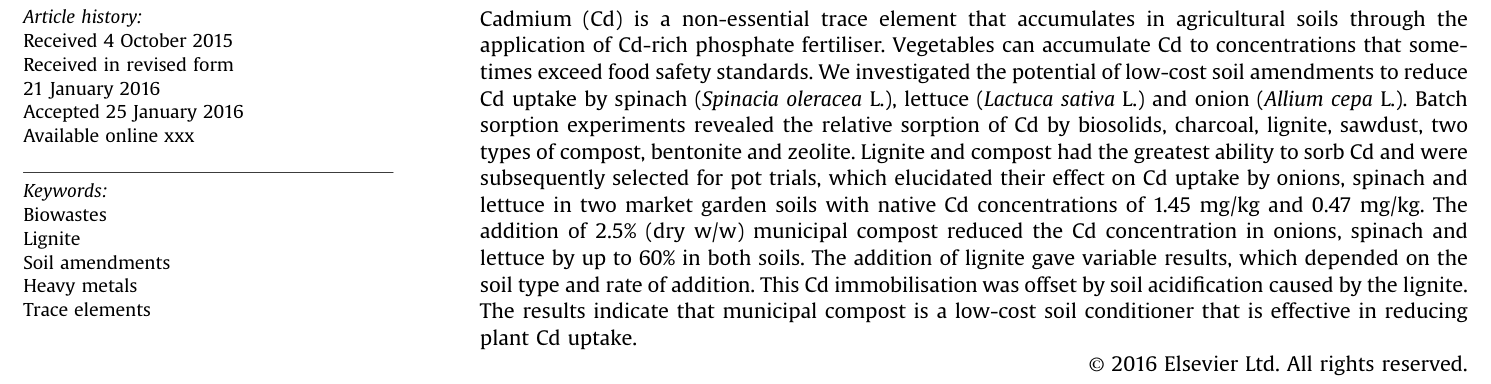
a r t i c l e i n f o a b s t r a c t
1Introduction引言
Cadmium (Cd) is a non-essential element that can cause many negative health effects at high concentrations (Kabata-Pendias and Mukherjee, 2007). It occurs naturally as a contaminant in all phosphate rocks, although the concentrations vary considerably, depending on the origin of the parent material. Rock phosphate originating from igneous rock generally has Cd concentrations of 0.7e30 mg/kg P (Oosterhuis et al., 2000), whereas rock phosphate refined from sedimentary rocks may contain Cd concentrations higher than 556 mg/kg P (Mar and Okazaki, 2012). Rock phosphate from sedimentary rock sources account for some 85e90% of world P production (Oosterhuis et al., 2000). Phosphate fertiliser use has resulted an enrichment of Cd in agricultural soils worldwide (Kabata-Pendias and Mukherjee, 2007; Hooda, 2010). Historically, New Zealand and Australia manufactured superphosphate using phosphate rock from Nauru and Christmas Island, which contained relatively high Cd concentrations >600 mg Cd/kg P (Syers et al., 1986). Repeated application of this Cd erich superphosphate for most of the 20th century has resulted the significant increases in the Cd concentrations in NZ soils (Taylor, 1997).
镉(Cd)是一种非必需元素,在高浓度下可对健康造成多种不良影响(Kabata-Pendias and Mukherjee, 2007)。镉作为污染物天然存在于所有磷矿石中,但其浓度因母质来源不同而差异很大。源自火成岩的磷矿石Cd浓度一般为0.7–30 mg/kg P(Oosterhuis et al., 2000),而由沉积岩提炼的磷矿石Cd浓度可高于556 mg/kg P(Mar and Okazaki, 2012)。沉积岩来源的磷矿石约占全球磷产量的85–90%(Oosterhuis et al., 2000)。磷肥的施用已导致全球农业土壤中Cd的富集(Kabata-Pendias and Mukherjee, 2007; Hooda, 2010)。历史上,新西兰和澳大利亚利用来自瑙鲁和圣诞岛的磷矿石生产过磷酸钙,这些磷矿石Cd浓度相对较高,>600 mg Cd/kg P(Syers et al., 1986)。20世纪大部分时间里反复施用这种富Cd过磷酸钙,导致新西兰土壤Cd浓度显著升高(Taylor, 1997)。
* This paper has been recommended for acceptance by Wen-Xiong Wang.
* 本文经Wen-Xiong Wang推荐接收。
* Corresponding author. E-mail address: brett.robinson@lincoln.ac.nz (B. Robinson).
The transfer of Cd from soil to plants and thence into food products is well documented (Alloway et al., 1990; McLaughlin et al., 1998; Berkelaar and Hale, 2003; Lopez-Chuken and Young, 2010; Arcella et al., 2012). Enriched soil Cd concentrations cause increased Cd accumulation in crops (Nan et al., 2002; Kabata- Pendias and Mukherjee, 2007). Cadmium accumulation varies between plant species, varieties and cultivars (Crews and Davies, 1985; McLaughlin et al., 1994a; Kabata-Pendias and Mukherjee, 2007; Grant et al., 2008; Gartler et al., 2013). Different parts of the plant have distinct cadmium concentrations. For example, vegetable species such as spinach (Spinacia oleracea L.) and lettuce (Lactuca sativa L.), accumulate higher concentrations of Cd in the edible portions than perennial ryegrass (Lolium perenne L.) (Gartler et al., 2013). An increase in soil pH decreases plant Cd-uptake (Kabata-Pendias and Mukherjee, 2007). Although Zn can have both synergistic and antagonistic effects on plant Cd-uptake (Grant et al., 1999), Cd is often a food-chain toxicity risk in Zn deficient agricultural systems (Hooda, 2010). Soil Cl increases the mobility of Cd in soil resulting elevated Cd concentrations in plants (McLaughlin et al., 1994b).
Cd由土壤向植物、进而向食品的迁移已有充分记载(Alloway et al., 1990; McLaughlin et al., 1998; Berkelaar and Hale, 2003; Lopez-Chuken and Young, 2010; Arcella et al., 2012)。土壤Cd浓度升高会导致作物中Cd积累增加(Nan et al., 2002; Kabata- Pendias and Mukherjee, 2007)。Cd积累在不同植物物种、变种和品种之间存在差异(Crews and Davies, 1985; McLaughlin et al., 1994a; Kabata-Pendias and Mukherjee, 2007; Grant et al., 2008; Gartler et al., 2013)。植物不同部位的镉浓度也各不相同。例如,菠菜(Spinacia oleracea L.)和生菜(Lactuca sativa L.)等蔬菜可食部分积累的Cd浓度高于多年生黑麦草(Lolium perenne L.)(Gartler et al., 2013)。土壤pH升高会降低植物对Cd的吸收(Kabata-Pendias and Mukherjee, 2007)。尽管Zn对植物吸收Cd既可产生协同作用也可产生拮抗作用(Grant et al., 1999),但在缺Zn的农业系统中Cd往往构成食物链毒性风险(Hooda, 2010)。土壤Cl会提高土壤中Cd的迁移性,从而导致植物Cd浓度升高(McLaughlin et al., 1994b)。
http://dx.doi.org/10.1016/j.envpol.2016.01.072 0269-7491/© 2016 Elsevier Ltd. All rights reserved.
http://dx.doi.org/10.1016/j.envpol.2016.01.072 0269-7491/© 2016 Elsevier Ltd. 版权所有。
In New Zealand (NZ), these concerns led to the formation of the Cadmium Working Group (CWG)-established by the NZ government in 2006. The CWG identified vegetable production as being the industry most at risk from superphosphate-derived Cd (Cadmium Working Group, 2008). The fertilizer industry, in collaboration with regulators has developed a Tiered Fertilizer Management System (TFMS) (Rys, 2011). Here, soils with <0.6 mg/ kg Cd have no restriction placed on the application of P fertilizers. Soils with concentrations >0.6 and < 1.0 are permitted restricted use of P fertilizers to ensure that the soil does not exceed 1.8 mg/kg Cd after 100 years. Intensive monitoring and modelling is required for soils with Cd concentrations >1.4 and < 1.8 mg/kg. No further Cd accumulation is permitted in soils with Cd concentrations >1.8 mg/ kg (Rys, 2011).
在新西兰(NZ),上述担忧促成了镉工作组(Cadmium Working Group, CWG)的成立,该工作组由新西兰政府于2006年设立。CWG认定蔬菜生产是受过磷酸钙来源Cd威胁最大的产业(Cadmium Working Group, 2008)。肥料行业与监管机构合作制定了分级肥料管理体系(Tiered Fertilizer Management System, TFMS)(Rys, 2011)。根据该体系,Cd含量<0.6 mg/ kg的土壤施用磷肥不受限制;浓度>0.6且< 1.0的土壤允许限量施用磷肥,以确保100年后土壤Cd不超过1.8 mg/kg;Cd浓度>1.4且< 1.8 mg/kg的土壤须进行密集监测和模拟;Cd浓度>1.8 mg/ kg的土壤不允许Cd进一步积累(Rys, 2011)。
Plants in soil take up Cd from the soil pore water. While most of the Cd in soils is usually associated with soil colloids (>98%), with only a small fraction of the total is available for plant uptake in soil solution (Christensen and Haung, 1999). By manipulating the amounts of available cation binding sites in soils, the amount of dissolved Cd can be reduced, resulting in a subsequent reduction in uptake by plants (Kabata-Pendias and Mukherjee, 2007). This can be achieved by a number of different methods, such as changing the soil pH (e.g. by liming) or by introducing additional binding sites. For example, Fe and Mn oxides sorb Cd (Zasoski and Burau, 1988; Backes et al., 1995) and can be used to reduce the movement of Cd in soil solution. Humic substances, produced during the decomposition process of organic materials, include a large group of amorphous, colloidal organic polymers (McLaren and Cameron, 1996). These molecules carry a predominantly negative charge arising from ionizable carboxyl and phenolic hydroxyl functional groups, which enable humic substances to act as a cation exchanger in soil and thus remove metal cations from solution (McLaren and Cameron, 1996). Specific sorption also plays an important role (Pentari et al., 2009). As Cd is a chalcophilic trace element, it is expected to bind relatively strongly to organic sulphur groups (Kabata-Pendias and Mukherjee, 2007), ReSH, ReSeR, ReSSeR and heterocyclic S, which might be present in organic matter (e.g. lignite) (Calkins, 1994).
土壤中的植物从土壤孔隙水中吸收Cd。土壤中大部分Cd通常与土壤胶体结合(>98%),土壤溶液中可供植物吸收的仅占总量的一小部分(Christensen and Haung, 1999)。通过调控土壤中可利用的阳离子结合位点数量,可以降低溶解态Cd的含量,从而减少植物吸收(Kabata-Pendias and Mukherjee, 2007)。这可以通过多种方法实现,例如改变土壤pH(如施用石灰)或引入额外的结合位点。例如,Fe和Mn氧化物可吸附Cd(Zasoski and Burau, 1988; Backes et al., 1995),可用于减少Cd在土壤溶液中的迁移。腐殖质是有机物料分解过程中产生的物质,包括一大类无定形胶体有机聚合物(McLaren and Cameron, 1996)。这些分子主要带负电荷,来源于可电离的羧基和酚羟基官能团,使腐殖质能够在土壤中充当阳离子交换剂,从而将金属阳离子从溶液中去除(McLaren and Cameron, 1996)。专性吸附同样发挥重要作用(Pentari et al., 2009)。由于Cd是亲硫微量元素,预计其会与有机质(如褐煤)中可能存在的有机硫基团R–SH、R–S–R、R–S–S–R及杂环S较强地结合(Kabata-Pendias and Mukherjee, 2007)(Calkins, 1994)。
Various organic and inorganic amendments are used in agricultural lands for improving the physical and chemical conditions of soil (Sarwar et al., 2008). Moreover, both organic (e.g. sawdust, peat, compost, etc.) and inorganic (e.g. lime) soil amendments can effectively reduce Cd solubility and plant uptake in highly contaminated soils (Bolan et al., 2003; Guo et al., 2006). Lignite (added at a rate of 1%) reduced the solubility of Cd and decreased the transfer of Cd from soil to Lolium perenne (L.) by 30%, while not detrimentally affecting soil fertility (Simmler et al., 2013).
农田中常施用各种有机和无机改良剂以改善土壤的物理和化学条件(Sarwar et al., 2008)。此外,有机(如锯末、泥炭、堆肥等)和无机(如石灰)土壤改良剂均能有效降低重度污染土壤中Cd的溶解度和植物吸收(Bolan et al., 2003; Guo et al., 2006)。褐煤(添加量1%)降低了Cd的溶解度,并使Cd由土壤向Lolium perenne (L.)的迁移减少30%,同时未对土壤肥力造成不利影响(Simmler et al., 2013)。
To date, most studies investigating the use of lignite or compost to reduce the plant uptake of Cd have considered highly contaminated soils (Ciecko et al., 2001; Skłodowski et al., 2006; Pusz, 2007; Tapia et al., 2010) that are not representative of most agricultural soils where Cd concentrations typically reach a few mg/kg at most (Alloway and Steinnes, 1999). Other studies that investigated the fate of Cd in compost-amended land focused on the endogenous Cd in the compost itself (Rutzke et al., 1993; Chang et al., 1997; Hanc et al., 2009), which may be contaminated through industrial emissions into wastewater treatment plants.
迄今为止,大多数关于利用褐煤或堆肥降低植物Cd吸收的研究针对的是重度污染土壤(Ciecko et al., 2001; Skłodowski et al., 2006; Pusz, 2007; Tapia et al., 2010),这些土壤并不能代表大多数农业土壤,后者Cd浓度通常最多仅为数mg/kg(Alloway and Steinnes, 1999)。另一些研究考察了施用堆肥土地中Cd的归趋,但关注的是堆肥自身的内源Cd(Rutzke et al., 1993; Chang et al., 1997; Hanc et al., 2009),这些Cd可能源于工业排放进入污水处理厂而造成的污染。
We aimed to investigate potential soil amendments that could reduce the transfer of Cd from soils to plants in two different NZ market garden soils with elevated Cd concentrations. To achieve these aims, we used batch sorption experiments to identify promising amendments and then used selected amendments in targeted pot trials to assess the efficacy of these amendments to reduce Cd uptake by vegetables.
本研究旨在针对两种Cd浓度偏高的新西兰商品菜园土壤,探究能够减少Cd由土壤向植物迁移的潜在土壤改良剂。为此,我们首先通过批量吸附试验筛选出有潜力的改良剂,然后将选定的改良剂用于针对性的盆栽试验,以评估其降低蔬菜Cd吸收的效果。
2Materials and methods材料与方法
2.1. Soil sample collection2.1. 土壤样品采集
Soils were collected from two commercial vegetable growing areas in Pukekohe (37�13018.9200S 174�5205.9400E) and Levin (40�38017.4900S 175�14023.6100E) in the North Island of NZ. Soil from the top 0.25 m were collected and large stones and roots removed manually. The soils were dried, ground, passed through a 7 mm sieve, and homogenised. Three 500 g sub samples of each soil were collected which were then ground and sieved through a 2 mm Nylon mesh. Tables 1A and 1B shows the chemical and physical properties of the soils. Both soils had elevated total Cd concentrations (1.45 mg/kg and 0.47 mg/kg respectively).
土壤采自新西兰北岛Pukekohe(37�13018.9200S 174�5205.9400E)和Levin(40�38017.4900S 175�14023.6100E)两个商品蔬菜种植区。采集0–0.25 m表层土壤,人工去除大石块和根系。土壤经风干、研磨、过7 mm筛后混匀。每种土壤取3份500 g子样,研磨后过2 mm尼龙筛。表1A和表1B列出了土壤的化学和物理性质。两种土壤的总Cd浓度均偏高(分别为1.45 mg/kg和0.47 mg/kg)。
2.2. Soil amendment collection2.2. 土壤改良剂采集
Eight materials were considered as potential soil amendments for reducing the phytoavailability of Cd in soils. These were: commercially available bentonite, which is an aluminium phyllosilicate, essentially impure clay consisting mostly montmorillonite (Theng, 2012), zeolite powder which is a microporous aluminosilicate mineral commonly used as commercial adsorbent; charcoal; lignite; sawdust; biosoilds and two types of compost. Zeolite powder and bentonite were provided by Commodities NZ Ltd., Wellington. Charcoal was produced by Solid Energy New Zealand Ltd. Biosolids were collected from Kaikora sewage waste treatment plant, NZ. Solid Energy New Zealand Ltd. provided the lignite in powdered form; it originated from the New Vale open cast mine in Southland, NZ. Living Earth compost (municipal compost) was collected from Living Earth Ltd. (Christchurch branch, NZ) and Parkhouse compost was collected from Parkhouse Garden Supplies (Christchurch, New Zealand) outlets. Living Earth compost is produced from municipal green waste including lawn clippings, tree prunnings, and food waste, while Parkhouse compost is made from sawdust composted and animal residues (manure and carcasses). The sawdust was collected from a local sawmill (Shands Road Saw mill Ltd., Rolleston, Christchurch, NZ) produced from Pinus radiata. After collection, samples were dried, ground and passed through a 2 mm Nylon sieve. Tables 1A and 1B shows the chemical and physical properties of the materials.
共考察了8种材料作为降低土壤Cd植物有效性的潜在土壤改良剂,分别为:市售膨润土,一种铝质层状硅酸盐,本质上是主要由蒙脱石组成的不纯黏土(Theng, 2012);沸石粉,一种常用作商业吸附剂的微孔铝硅酸盐矿物;木炭;褐煤;锯末;生物固体(污泥);以及两种堆肥。沸石粉和膨润土由Commodities NZ Ltd.(惠灵顿)提供。木炭由Solid Energy New Zealand Ltd.生产。生物固体采自新西兰Kaikora污水处理厂。褐煤粉由Solid Energy New Zealand Ltd.提供,产自新西兰Southland的New Vale露天矿。Living Earth堆肥(市政堆肥)取自Living Earth Ltd.(新西兰基督城分公司),Parkhouse堆肥取自Parkhouse Garden Supplies(新西兰基督城)门店。Living Earth堆肥由市政绿色废弃物(包括草坪修剪物、树木修剪枝和食物垃圾)制成,而Parkhouse堆肥由锯末与动物残体(粪便和尸体)堆制而成。锯末采自当地一家锯木厂(Shands Road Saw mill Ltd., Rolleston, 基督城,新西兰),由Pinus radiata加工产生。采集后,样品经风干、研磨并过2 mm尼龙筛。表1A和表1B列出了各材料的化学和物理性质。
2.3. Sample analysis2.3. 样品分析
The pH values of the sieved samples were determined using a (Mettler Toledo pH meter in high purity water (18.2 MU resistivity; Heal Force® SMART Series, SPW Ultra-pure Water system, Model- PWUV) at a solid/water ratio of 1:2.5 (1:10 for composts, charcoals and lignite). The mixtures were left to equilibrate for 24 h before measurement (Blakemore, 1987).
过筛样品的pH值采用Mettler Toledo pH计在高纯水(电阻率18.2 MΩ;Heal Force® SMART系列SPW超纯水系统,型号PWUV)中测定,固水比为1:2.5(堆肥、木炭和褐煤为1:10)。混合物平衡24 h后测定(Blakemore, 1987)。
The Cation Exchange Capacity (CEC) of the materials was measured using the 0.01 M Silver Thiourea (AgTU) method (Blakemore, 1987). Briefly, 35 mL of 0.01 M AgTU was added to 0.70 g of dry sample in a 50 mL centrifuge tube and then agitated in an end-over-end shaker for 16 h. Samples were centrifuged at 2000 rpm for 10 min. The supernatant was filtered through a Whatman no. 40 filter and analysed using an Inductively Coupled Plasma-Optical Emission Spectrometer (ICP-OES) (Varian 720 ES - USA). The total carbon and nitrogen were analysed in soil and compost samples using an Elementar Vario-Max CN Elementar analyser (Elementar®, Germany).
材料的阳离子交换量(CEC)采用0.01 M硫脲银(AgTU)法测定(Blakemore, 1987)。简言之,将35 mL 0.01 M AgTU加入盛有0.70 g干样的50 mL离心管中,在翻转振荡器上振荡16 h。样品以2000 rpm离心10 min,上清液经Whatman 40号滤纸过滤后,用电感耦合等离子体发射光谱仪(ICP-OES)(Varian 720 ES,美国)分析。土壤和堆肥样品的全碳和全氮采用Elementar Vario-Max CN元素分析仪(Elementar®,德国)测定。
For both plants and soils, pseudo-total elemental analyses were carried out using microwave digestion in 8 mL of Aristar™ nitric acid (±69%), diluted with milliQ water to a volume of 25 mL and filtered using Whatman no. 52 filter paper (pore size 7 mm). The concentrations of Cd together with other elements (Ca, Mg, K, P, S, B, Cu, Zn, Cr, Ni and Pb) were determined using inductively coupled plasma optical emission spectrometry (ICP-OES Varian 720 ES e USA) in soils (Kovacs et al., 2000� ) and in plants (Gray et al., 1999a). Reference soil and plant material (International Soil analytical Exchange e ISE 921 and International Plant analytical Exchange IPE 100) from Wageningen University, the Netherlands, were analysed for quality assurance. Recoverable concentrations were 91%e108% of the certified values.
植物和土壤的准全量元素分析均采用微波消解法,使用8 mL Aristar™硝酸(±69%),用milliQ水定容至25 mL,并用Whatman 52号滤纸(孔径7 μm)过滤。采用电感耦合等离子体发射光谱法(ICP-OES Varian 720 ES,美国)测定土壤(Kovacs et al., 2000)和植物(Gray et al., 1999a)中Cd及其他元素(Ca、Mg、K、P、S、B、Cu、Zn、Cr、Ni和Pb)的浓度。分析荷兰瓦赫宁根大学提供的土壤和植物参考物质(International Soil analytical Exchange – ISE 921和International Plant analytical Exchange IPE 100)以进行质量控制,回收率为认证值的91%–108%。
Properties and macronutrient concentrations of the materials used in the experiments.
试验所用材料的性质及大量养分浓度。
| Properties性质 | Lignite褐煤 | Living Earth compostLiving Earth 堆肥 | Parkhouse compostParkhouse 堆肥 | Sawdust锯末 | Charcoal木炭 | Biosolids生物固体 | Zeolite powder沸石粉 | Bentonite膨润土 | Pukekohe soilPukekohe土壤 | Levin soilLevin土壤 |
|---|---|---|---|---|---|---|---|---|---|---|
| pH | 4.6 | 7.4 | 7.0 | 4.8 | 6.7 | 3.6 | 5.9 | 8.8 | 6.0 | 6.5 |
| CEC (me/100 g) | 45 | 45 (0) | 47 (0) | 9.3 (0) | 3.3 (0) | 11 (1) | 21 (0) | 44 (0) | 22* | 15* |
| C (%) | 59 (1) | 21 | 21 | 48 | 40 | 26 (0) | <0.02 | 0.7 | 2.1* | 1.2* |
| N (%) | 0.83 (0.00) | 2.3 | 1.6 | 0.1 | 0.13 | 2.6 (0.03) | 0.03 | <0.02 | 0.23* | 0.13 |
| P | 201 (1.7) | 4178 (37) | 5159 (227) | 23 (1) | 118 (10) | 3805 (66) | <1 | 124 (9) | 3414 (26) | 2247 (20) |
| S | 4942 (94) | 2644 (27) | 3610 (70) | 49 (10) | 58 (2) | 6395 (201) | <1 | 768 (16) | 491 (6) | 296 (1) |
| Ca | 14,216 (314) | 24,903 (588) | 37,416 (1456) | 556 (16) | 1505 (39) | 4967 (66) | 12,084 (89) | 17,131 (306) | 4147 (117) | 7008 (99) |
| Mg | 2496 (40) | 4177 (16) | 2186 (34) | 158 (5) | 458 (21) | 2305(31) | 3663 (29) | 6838 (189) | 2400 (95) | 2873 (43) |
| K | 200 (6) | 14,938 (33) | 5412 (67) | 425 (1) | 975 (25) | 1564 (16) | 10,506 (46) | 1621 (265) | 1951 (59) | 2242 (54) |
Values are in mg/kg unless otherwise indicated. Standard errors are given in brackets (n = 3). * Data from Hill Laboratories, NZ.
除另有说明外,数值单位为mg/kg。括号内为标准误(n = 3)。* 数据来自新西兰Hill Laboratories。
Trace element concentrations (mg/kg) of the materials used in the experiments.
试验所用材料的微量元素浓度(mg/kg)。
| Properties性质 | Lignite褐煤 | Living earth compostLiving Earth 堆肥 | Parkhouse compostParkhouse 堆肥 | Sawdust锯末 | Charcoal木炭 | Biosolids生物固体 | Zeolite powder沸石粉 | Bentonite膨润土 | Pukekohe soilPukekohe土壤 | Levin soilLevin土壤 |
|---|---|---|---|---|---|---|---|---|---|---|
| B | 36 (0) | 20* | <1 | 5.9 (0.1) | <1 | 14 (0) | <1 | 17 (1) | 33 (0) | 9 (0) |
| Cd | 0.31 (0.15) | 0.70 (0.10) | 0.45 (0.10) | 0.03 (0.01) | 0.05 (0.03) | 1.6 (0.05) | <0.01 | 0.93 (0.29) | 1.5 (0.03) | 0.47 (0.01) |
| Cu | 2.8 (0.2) | 59 (1) | 25 (1) | 37 (3) | 2.4 (0.2) | 555 (15) | 1.9 (0.0) | 25 (1) | 65 (1) | 20 (0.2) |
| Zn | 4.3 (0.5) | 310 (11) | 34 (2) | 5.3 (0.3) | 16 (2) | 912 (16) | 34 (2) | 72 (2) | 173 (1) | 67 (1) |
| Cr | 2.1 (0.1) | 28 (1) | 37 (1) | 63 (5) | 0.74 (0.04) | 33 (1) | 0.71 (0.1) | 4.2 (0.1) | 40 (2) | 15 (0.3) |
| Ni | 3.7 (0.3) | 9.3 (1) | 5.2 (0.1) | <1 | 0.42 (0.1) | 18 (0.5) | <1 | 1.9 (0.1) | 25 (1) | 7.4 (0.5) |
| Pb | 3.5 (1) | 123 (3) | 4.5 (1) | <1 | <1 | 101 (1) | 4.5 (1) | 5.9 (0.3) | 55 (0.5) | 7.4 (0.1) |
Standard errors are given in brackets (n = 3). * data from Hill Laboratories, NZ.
括号内为标准误(n = 3)。* 数据来自新西兰Hill Laboratories。
An estimation of the phytoavailable fraction of Cd in the soils and soil amendments was determined using 0.05 M Ca(NO3)2 extraction (Gray et al., 1999b; Black et al., 2012). Significant correlations between concentrations of Cd in extractions that simulate soil solutions and plant (cereals, pasture and several vegetable species) Cd have been reported (Gray et al., 1999b; Black et al., 2012), in both spiked and unspiked soils. Briefly, 5 g of soil was mixed with 30 mL of extractant in a centrifuge tube and a suspension was formed using a vortex mixer. The centrifuge tube was then agitated on an end-over-end shaker for 2 h after which it was centrifuged at 3000 rpm for 15 min. After filtering (Whatman no. 52 filter paper), the samples were analysed to determine the concentration of Cd and other elements using inductively coupled plasma optical emission spectrometry (ICP-OES Varian 720 ES e USA) in soils. Five blank samples were also run along with samples during the analysis following all steps.
土壤及土壤改良剂中Cd的植物有效态部分采用0.05 M Ca(NO3)2提取法估算(Gray et al., 1999b; Black et al., 2012)。已有报道表明,在加标和未加标土壤中,模拟土壤溶液的提取液Cd浓度与植物(谷物、牧草和多种蔬菜)Cd浓度之间均存在显著相关性(Gray et al., 1999b; Black et al., 2012)。简言之,将5 g土壤与30 mL提取剂在离心管中混合,用涡旋混合器形成悬浮液。随后将离心管置于翻转振荡器上振荡2 h,再以3000 rpm离心15 min。过滤(Whatman 52号滤纸)后,采用电感耦合等离子体发射光谱法(ICP-OES Varian 720 ES,美国)测定样品中Cd及其他元素的浓度。分析过程中同时按全部步骤处理5个空白样品。
2.4. Batch sorption experiment2.4. 批量吸附试验
The batch sorption experiment was conducted with eight soil amendments and two soils, at four different pHs (six for lignite) ranging from 3.4 to 7.5 and six Cd concentrations. Each treatment was replicated three times. Following the method of Simmler et al. (2013), we prepared spiked solutions in 0.05 M Ca(NO3)2 solution using Ca(NO3)2.4H2O (BDH AnalaR). We added CdSO4.8H2O (BDH AnalaR) in 0.05 M Ca(NO3)2 solution to achieve Cd concentrations of 0, 1.4, 6.8, 13.2, 18.9 and 24.5 mg/L in 0.05 M Ca(NO3)2 solution. Five grams of soil or amendment was mixed with 30 ml of each of the spike and control (0 mg Cd/L) solutions. The pH was adjusted close to the target pH using HNO3 (made from BDH ARISTAR nitric acid 70%) or 2 M KOH (BDH AnalaR KOH) to decrease or increase pH, respectively. Pilot studies were carried out with each material following the batch sorption experiment steps and by adding different amount of HNO3 or KOH solution to determine how much of HNO3 or KOH solution would be needed to get a desired pH.
批量吸附试验采用8种土壤改良剂和2种土壤,设置3.4至7.5范围内的4个pH水平(褐煤为6个)和6个Cd浓度,每个处理重复3次。参照Simmler et al. (2013)的方法,用Ca(NO3)2.4H2O(BDH AnalaR)配制0.05 M Ca(NO3)2加标溶液。在0.05 M Ca(NO3)2溶液中加入CdSO4.8H2O(BDH AnalaR),使Cd浓度分别为0、1.4、6.8、13.2、18.9和24.5 mg/L。将5 g土壤或改良剂分别与30 ml各加标溶液及对照(0 mg Cd/L)溶液混合。分别用HNO3(由BDH ARISTAR 70%硝酸配制)或2 M KOH(BDH AnalaR KOH)降低或升高pH,使其接近目标值。事先对每种材料按批量吸附试验步骤进行预试验,加入不同量的HNO3或KOH溶液,以确定达到目标pH所需的HNO3或KOH溶液用量。
The mixture was agitated using a vortex mixer for 3 min, shaken on an end-over-end shaker for 2 h, and centrifuged at 10,000 rpm for 10 min. The supernatant was filtered through a Whatman no. 52 filter paper in to 30 mL vials and were analysed using Flame Emission Atomic Absorption Spectrophotometer (AAS). A parallel ICP-OES analysis was carried out on randomly selected samples from the bulk samples to confirm the results of the AAS. The monitoring validated the Flame Emission Atomic Absorption Spectrophotometer's performance in detecting low concentrations of Cd after Cd sorption by different soil amendments.
混合物用涡旋混合器振荡3 min,在翻转振荡器上振荡2 h,再以10,000 rpm离心10 min。上清液经Whatman 52号滤纸过滤至30 mL样品瓶中,采用火焰原子吸收分光光度计(AAS)分析。从全部样品中随机抽取部分样品同时进行ICP-OES分析,以验证AAS结果。该监测验证了火焰原子吸收分光光度计在检测不同土壤改良剂吸附后低浓度Cd方面的性能。
The Cd adsorption coefficient (Kd) for the different soil amendments were determined according to the following equation (Simmler et al., 2013)
不同土壤改良剂的Cd吸附系数(Kd)按下式计算(Simmler et al., 2013)
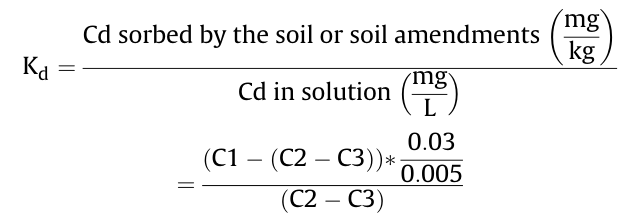
where, Kd is the solid-solution distribution co-efficient. In the equation, C1 is the initial Cd concentration in solution (for our batch experiment they were 1.4, 6.8,13.2,18.9 and 24.5 mg/L), C2 is the Cd concentration in solution (mg/L) after equilibrium in a given batch (either with soil or soil amendments) with Cd spiking and C3 is the Cd solution concentration (mg/L) in the corresponding batch without Cd spiking (only with 0.05 M Ca(NO3)2 solution).
式中,Kd为固-液分配系数;C1为溶液初始Cd浓度(本批量试验中分别为1.4、6.8、13.2、18.9和24.5 mg/L);C2为加Cd处理中(土壤或土壤改良剂)平衡后溶液Cd浓度(mg/L);C3为相应未加Cd处理(仅含0.05 M Ca(NO3)2溶液)中溶液Cd浓度(mg/L)。
2.5. Pot trial2.5. 盆栽试验
A pot experiment was conducted with lignite and one compost. The coarsely-sieved soils were mixed with the amendments using a concrete mixer to give the following treatments: control, 1.05% (w/ w) lignite (henceforth “1% lignite”), 2.63% (w/w) lignite (henceforth “2.5% lignite”, henceforth “lignite”), and 2.7% (w/w) compost (henceforth “2.5% compost”, henceforth “compost”). The soil amendments were added on a dry weight basis. Subsamples of each soil treatment were transferred into 2.5 L pots (approx. 3 kg dry weight) into which onion (Allium cepa L. var Pukekohe long keeper), spinach (Spinacia oleracea L.) and lettuce (Lactuca sativa L. var. Buttercrunch) were planted with five replicates for each treatmentevegetable combination. The pots were placed in a randomised block design in the Plant Growth Unit (greenhouse) at Lincoln University, where they were watered daily to field capacity. Before sowing, the soils, mixed with different soil amendments, were kept for two weeks in the green house and watered daily to equilibrate. The nutrient status of the pots was maintained by periodic applications of Ruakura solution (Smith et al.,1983). A total of 0.25 g N/pot, 0.04 g P/pot and 0.23 g K/pot was applied together with other micro nutrients, those are present in Ruakura solution in each pot throughout the growing period in to two split applications, one at first week and other at the 4th week.
采用褐煤和一种堆肥进行盆栽试验。用混凝土搅拌机将粗筛后的土壤与改良剂混合,设置以下处理:对照;1.05%(w/ w)褐煤(下称“1%褐煤”);2.63%(w/w)褐煤(下称“2.5%褐煤”或“褐煤”);2.7%(w/w)堆肥(下称“2.5%堆肥”或“堆肥”)。土壤改良剂按干重添加。将各土壤处理的子样装入2.5 L盆中(干重约3 kg),分别种植洋葱(Allium cepa L. var Pukekohe long keeper)、菠菜(Spinacia oleracea L.)和生菜(Lactuca sativa L. var. Buttercrunch),每个处理–蔬菜组合设5个重复。盆钵按随机区组设计置于林肯大学植物生长室(温室)中,每日浇水至田间持水量。播种前,混合了不同改良剂的土壤在温室中放置两周并每日浇水以达到平衡。通过定期施用Ruakura营养液(Smith et al.,1983)维持盆钵养分状况。整个生长期内每盆共施用0.25 g N、0.04 g P和0.23 g K及Ruakura营养液中所含的其他微量养分,分两次施用,分别在第1周和第4周。
The plants were grown for 6e10 weeks before harvest (FebruaryeApril). Temperatures ranged between 9 �C and 20 �C during the nighttime (10 pm until 6 am) and between 14 �C and 28 �C during the daytime. At harvest, the edible portions of the plants were excised and the fresh weight determined. Both the edible portions and the residual material was washed thoroughly with deionised water and placed in a drying cabinet at 70 �C until a constant weight was obtained. Samples were then ground and stored in airtight containers until chemical analyses. After harvest, soil was sampled from each of the spinach treatments, ground, and sieved to <2 mm through a Nylon mesh. Soil pH and total and Ca(NO3)2�extractable Cd concentrations were determined as described above.
植物生长6–10周后收获(2月–4月)。夜间(晚10时至早6时)温度为9 �C至20 �C,白天温度为14 �C至28 �C。收获时剪下植物可食部分并测定鲜重。可食部分和剩余部分均用去离子水彻底清洗,置于70 �C干燥箱中烘至恒重。样品随后研磨并储存于密封容器中待化学分析。收获后,从各菠菜处理中采集土壤,研磨后过<2 mm尼龙筛。按上述方法测定土壤pH以及总Cd和Ca(NO3)2提取态Cd浓度。
The data was analysed using ANOVA with Fisher's Least- Significant-Difference post-hoc test to compare means using Minitab® 17 (Minitab Inc, State College, Pennsylvania, USA). The level of significance was 0.05.
数据采用ANOVA分析,并用Fisher最小显著差异(LSD)事后检验比较均值,使用Minitab® 17(Minitab Inc, State College, Pennsylvania, USA)。显著性水平为0.05。
3Results and discussion结果与讨论
3.1. Batch sorption experiment3.1. 批量吸附试验
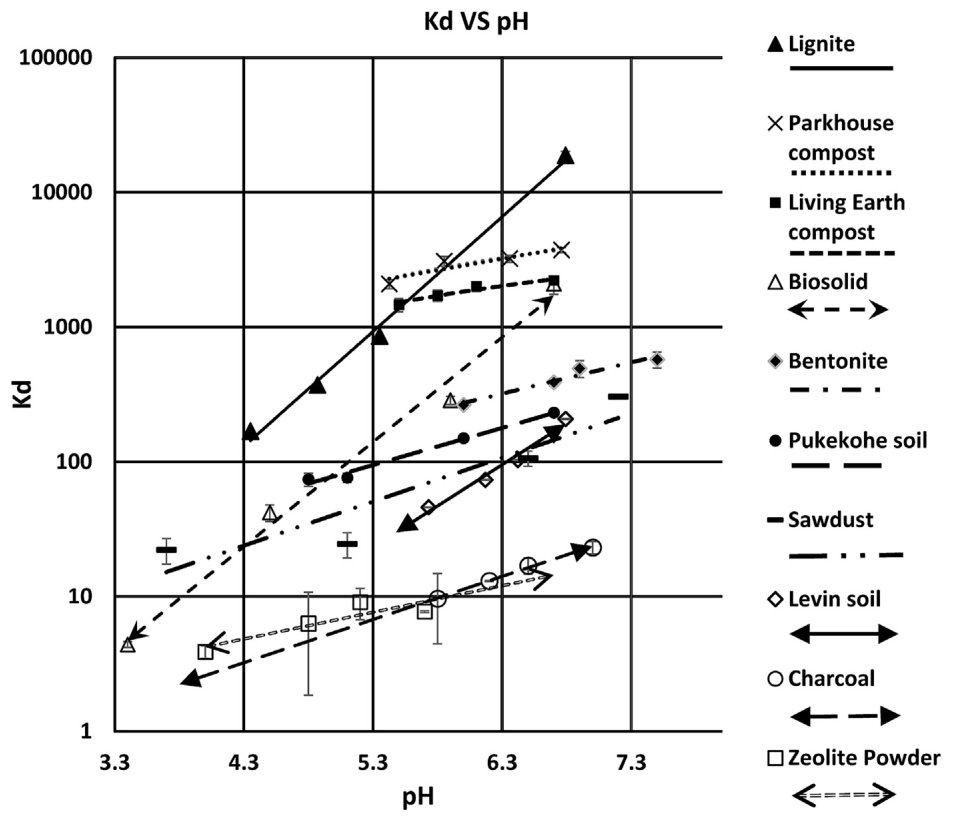
Fig. 1 shows the Cd sorption, expressed as log (Kd) (sorbed/solution concentration coefficient), by the potential soil amendments in a solution of 1.4 mg/L Cd. Kd values for the 6.8, 13.2, 18.9 and 24.5 mg/L Cd solutions were significantly lower (data not shown), indicating saturation of the binding sites on the materials tested. While a soil solution concentration of 1.4 mg/L Cd is well above concentrations found in most agricultural soils, our results indicate that the Kd values obtained were still within the linear range for the materials tested and thus can be considered analogous to lower Cd concentrations.图1显示了在1.4 mg/L Cd溶液中各潜在土壤改良剂对Cd的吸附,以log (Kd)(吸附态/溶液浓度系数)表示。6.8、13.2、18.9和24.5 mg/L Cd溶液的Kd值显著较低(数据未列出),表明供试材料上的结合位点已达饱和。尽管1.4 mg/L Cd的土壤溶液浓度远高于大多数农业土壤中的浓度,但结果表明所得Kd值仍处于供试材料的线性范围内,因此可视为与较低Cd浓度下的情况相当。
At controlled pH values, the two composts and lignite had the greatest capacity to bind Cd across a range of pHs (Fig. 1), which is in consistent with the findings of similar batch sorption experiments (Ulmanu et al., 2003; Simmler et al., 2013). Charcoal and zeolite had low Kd values, which is consistent with the findings of Hanauer et al. (2012). Kelly et al. (2014) suggested that this may be because the charcoal sorbs more Cd in soil than in the batch experiments due to the longer contact time with the Cd in soil solution. The effectiveness of charcoal in sorbing Cd may have been better if it were more weathered (Cui et al., 2014). Fard et al. (2011) reported that biosolids were an effective sorbent for Cd and that the Kd value for biosolids increased substantially with increasing pH. While biosolids may be an effective sorbent for highly contaminated soils, Simmler, et al. (2013) reported that in agricultural soil, biosolids increased extractable Cd and increased plant Cd uptake. Our Kd values for bentonite were similar to those reported by Ulmanu et al. (2003). Sawdust, zeolite powder and charcoal had similar or only slightly higher Kd values than the Pukekohe and Levin soils. This indicates that these amendments are unlikely to provide a significant increase in Cd sorption in these soils.
在控制pH条件下,两种堆肥和褐煤在各pH范围内结合Cd的能力最强(图1),这与类似批量吸附试验的结果一致(Ulmanu et al., 2003; Simmler et al., 2013)。木炭和沸石的Kd值较低,与Hanauer et al. (2012)的结果一致。Kelly et al. (2014)认为,这可能是因为木炭在土壤中与土壤溶液Cd接触时间更长,因而在土壤中吸附的Cd多于批量试验。如果木炭风化程度更高,其吸附Cd的效果可能会更好(Cui et al., 2014)。Fard et al. (2011)报道,生物固体是一种有效的Cd吸附剂,且其Kd值随pH升高而大幅增加。尽管生物固体对重度污染土壤可能是有效的吸附剂,但Simmler, et al. (2013)报道,在农业土壤中生物固体增加了可提取态Cd并提高了植物对Cd的吸收。本研究膨润土的Kd值与Ulmanu et al. (2003)报道的相近。锯末、沸石粉和木炭的Kd值与Pukekohe和Levin土壤相近或仅略高,表明这些改良剂不太可能显著提高这些土壤对Cd的吸附。
The Cd Kd values of all materials increased with increasing pH (Fig.1), consistent with other work carried out using lignite and soil (Simmler et al., 2013). The sensitivity of Kd to pH differed between materials. The binding of Cd by lignite was more sensitive to pH than the composts, with the composts sorbing more Cd at lower pH values.
所有材料的Cd Kd值均随pH升高而增大(图1),与其他利用褐煤和土壤开展的研究一致(Simmler et al., 2013)。不同材料的Kd对pH的敏感性不同。褐煤对Cd的结合比堆肥对pH更为敏感,堆肥在较低pH下吸附更多的Cd。
We chose the Living Earth compost and lignite for the pot trial because the batch experiment revealed that they had high Kd values over a range of solution pHs. Living Earth compost was selected over Parkhouse compost because of its lower cost (NZ$12/ tonne c.f. NZ$100/tonne).
由于批量试验表明Living Earth堆肥和褐煤在一系列溶液pH下均具有较高的Kd值,我们选择二者用于盆栽试验。选择Living Earth堆肥而非Parkhouse堆肥是因为其成本较低(NZ$12/ 吨,而后者为NZ$100/吨)。
3.2. Plant uptake of cadmium3.2. 植物对镉的吸收
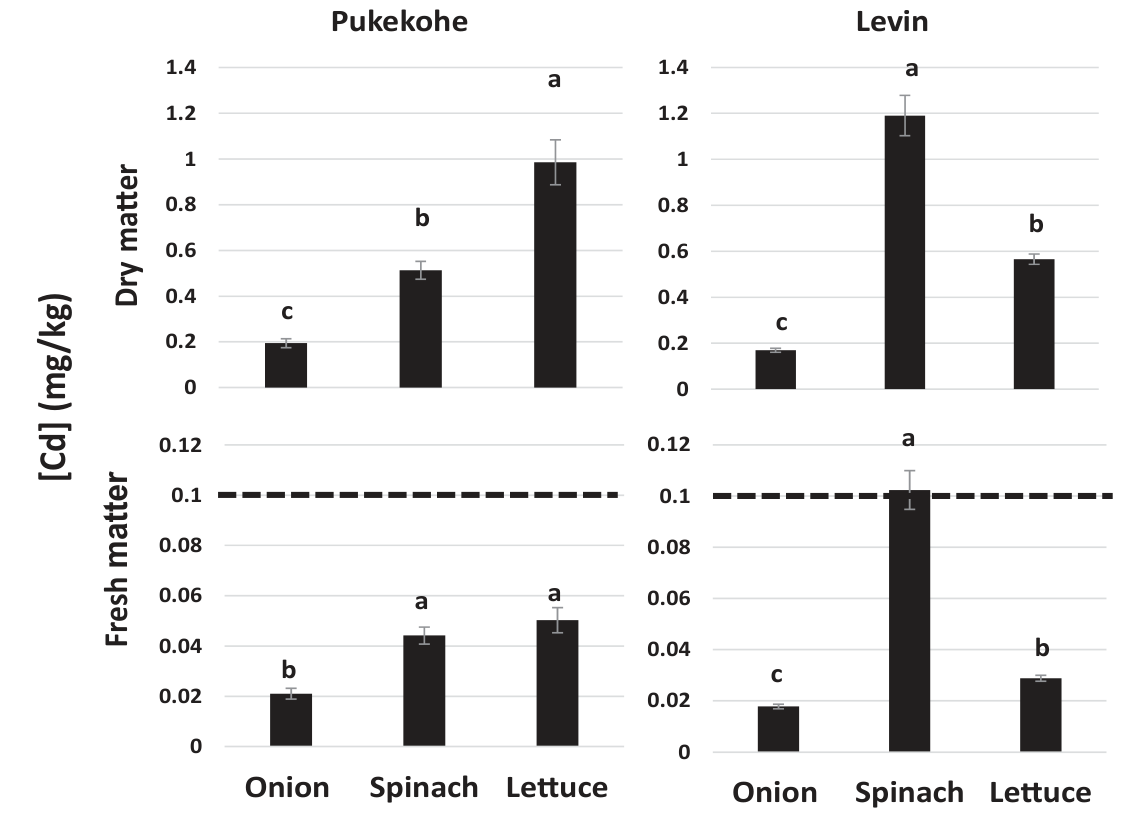
On a fresh weight basis, spinach grown in the Levin soil accumulated the highest shoot Cd concentration (0.10 mg/kg FW, Fig. 2), similar to the World Health Organisation's and Food Standards of Australia and New Zealand's limit for Cd in vegetables of 0.1 mg/kg (Bigdeli and Seilsepour, 2008; FSANZ, 2015) and lower than the CODEX limit of 0.5 mg/kg FW (Chaney et al., 2009). This soil contained just 0.49 mg/kg Cd (Table 1B), less than the lowest tier on the TFMS (Rys, 2011). The Cd concentrations in the shoots of lettuce grown on the same soil were significantly lower, as were the Cd concentrations in spinach and lettuce grown on the Pukekohe soil. The Cd concentrations in the onions growing in both soils were significantly lower than the Cd concentrations found in spinach or lettuce. This is consistent with other findings (Gartler et al., 2013) that also showed high Cd uptake by shoot material of a variety of commercially grown vegetables, including lettuce and spinach. Moreover, genetic variations between cultivars can result in significant differences in Cd uptake (Crews and Davies, 1985; McLaughlin et al., 1994a; Kabata-Pendias and Mukherjee, 2007; Grant et al., 2008).
以鲜重计,Levin土壤中种植的菠菜地上部Cd浓度最高(0.10 mg/kg FW,图2),与世界卫生组织以及澳大利亚新西兰食品标准局规定的蔬菜Cd限量0.1 mg/kg相当(Bigdeli and Seilsepour, 2008; FSANZ, 2015),低于CODEX限量0.5 mg/kg FW(Chaney et al., 2009)。该土壤Cd含量仅为0.49 mg/kg(表1B),低于TFMS的最低等级(Rys, 2011)。同一土壤中生菜地上部的Cd浓度显著较低,Pukekohe土壤中菠菜和生菜的Cd浓度也显著较低。两种土壤中洋葱的Cd浓度均显著低于菠菜或生菜。这与其他研究结果一致(Gartler et al., 2013),该研究同样表明包括生菜和菠菜在内的多种商品蔬菜地上部对Cd的吸收较高。此外,品种间的遗传差异可导致Cd吸收存在显著差异(Crews and Davies, 1985; McLaughlin et al., 1994a; Kabata-Pendias and Mukherjee, 2007; Grant et al., 2008)。
The 0.05 M Ca(NO3)2�extractable Cd concentrations in the two soils reflected the concentrations of Cd in the shoots of the lettuces grown in those soils. However, the concentrations of Cd in the shoots of spinach grown on the two soils do not reflect either the total or the extractable Cd concentrations in those soils (Table 1A and 1B. The higher Cd accumulation by vegetables grown in Levin soils compared to Pukekohe soils may be partially due to the lower Zn concentrations in the Levin Soils. Many authors reported that increased soil Zn concentrations could reduce Cd accumulation by plants (McKenna et al., 1992; Grant et al., 1999; Kabata-Pendias and Mukherjee, 2007; Chaney et al., 2009). Zinc also affects the transfer of Cd from plants to animals or humans. McKenna et al. (1992) reported that Cd in spinach was less bioavailable to quail than Cd in lettuce. They also report that increased Zn concentrations in lettuce and spinach Zn reduced the retention of Cd in kidney and liver.
两种土壤中0.05 M Ca(NO3)2提取态Cd浓度反映了在其上种植的生菜地上部Cd浓度。然而,两种土壤中种植的菠菜地上部Cd浓度既未反映土壤总Cd浓度,也未反映可提取态Cd浓度(表1A和表1B)。与Pukekohe土壤相比,Levin土壤中种植的蔬菜Cd积累更高,这可能部分归因于Levin土壤Zn浓度较低。许多研究者报道,土壤Zn浓度升高可减少植物对Cd的积累(McKenna et al., 1992; Grant et al., 1999; Kabata-Pendias and Mukherjee, 2007; Chaney et al., 2009)。锌还会影响Cd由植物向动物或人体的迁移。McKenna et al. (1992)报道,对鹌鹑而言,菠菜中Cd的生物有效性低于生菜中的Cd。他们还报道,生菜和菠菜中Zn浓度升高可减少Cd在肾脏和肝脏中的滞留。
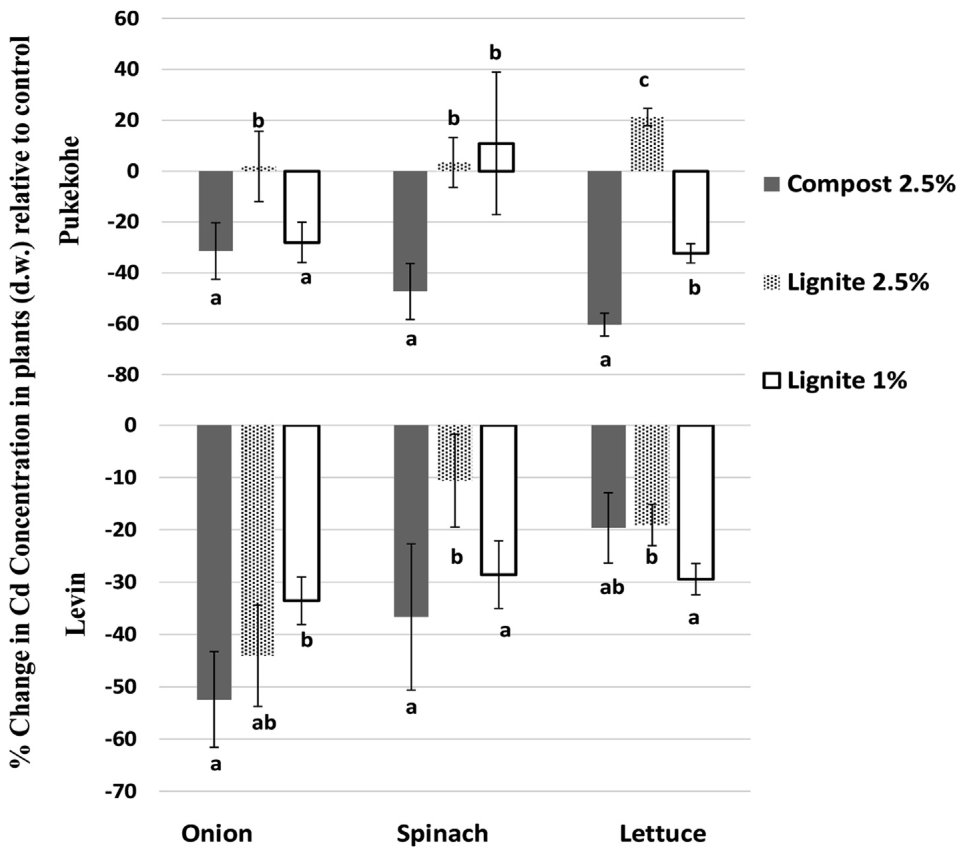
The compost treatment decreased Cd uptake by more than 20% in onions, spinach and lettuce in both the Pukekohe and Levin soils (Fig. 3). This finding is consistent with reports of Cd decreases using other composts in highly contaminated soils (Tapia et al., 2010). This decrease is consistent with the addition of function groups that may bind Cd through cation exchange or specific adsorption (Simmler et al., 2013). The composts contained significant Zn concentrations (Table 1B), which may have further reduced plant uptake as described above. In the Pukekohe soil, compost addition increased the pH from 6.0 to 6.2, which would likely reduce plant Cd uptake (Kabata-Pendias and Mukherjee, 2007). The compost had no significant effect on the pH of the Levin soil.
在Pukekohe和Levin两种土壤中,堆肥处理均使洋葱、菠菜和生菜的Cd吸收降低20%以上(图3)。这一结果与在重度污染土壤中施用其他堆肥降低Cd的报道一致(Tapia et al., 2010)。这种降低与添加了可通过阳离子交换或专性吸附结合Cd的官能团相符(Simmler et al., 2013)。堆肥含有相当浓度的Zn(表1B),如前所述,这可能进一步降低了植物吸收。在Pukekohe土壤中,添加堆肥使pH由6.0升至6.2,这可能会减少植物对Cd的吸收(Kabata-Pendias and Mukherjee, 2007)。堆肥对Levin土壤pH无显著影响。
The 2.5% lignite treatment in the Levin soil significantly reduced the Cd concentrations in the plant shoots by at least 10%. However, there were no significant differences between the Cd concentrations in onion and spinach grown in treated and control Pukekohe soils. Moreover, the 2.5% lignite treatment significantly increased the Cd concentration in the lettuce grown in the Pukekohe soil. The 1% lignite treatment of the Levin soil reduced the transfer of Cd from soil to the shoots of the vegetables by 28e34% when compared to the untreated soil (Fig. 3). A similar result was observed in the 1% lignite treated Pukekohe soil, with the exception of spinach, where no significant decrease was observed. Overall, the lower rate of lignite treatment appears to have been more effective in reducing Cd uptake by vegetables grown on these soils. In contrast, the higher rate may increase Cd uptake by lettuce. The difference between the two treatments may be due to the change in pH: the 2.5% lignite treatment decreased the pH significantly from 6.5 to 6.2 in the Levin soil and 6.0 to 5.7 in Pukekohe soil, while the pH change caused by the 1% treatment was less (0.1 pH unit decrease in both soils). As shown in the batch sorption experiment, a pH decrease may result in less Cd being bound by the lignite and the soil particles (Fig. 1).
在Levin土壤中,2.5%褐煤处理使植物地上部Cd浓度显著降低至少10%。然而,在Pukekohe土壤中,处理与对照之间洋葱和菠菜的Cd浓度无显著差异。此外,2.5%褐煤处理显著提高了Pukekohe土壤中生菜的Cd浓度。与未处理土壤相比,Levin土壤的1%褐煤处理使Cd由土壤向蔬菜地上部的迁移减少了28–34%(图3)。在1%褐煤处理的Pukekohe土壤中也观察到类似结果,但菠菜例外,未见显著降低。总体而言,较低施用量的褐煤处理在降低这些土壤中蔬菜Cd吸收方面似乎更为有效;相反,较高施用量可能增加生菜对Cd的吸收。两种处理的差异可能源于pH的变化:2.5%褐煤处理使Levin土壤pH由6.5显著降至6.2,Pukekohe土壤由6.0降至5.7,而1%处理引起的pH变化较小(两种土壤均降低0.1个pH单位)。如批量吸附试验所示,pH降低可能导致褐煤和土壤颗粒结合的Cd减少(图1)。
Overall, the compost treatment was the most effective and consistent in reducing the transfer of Cd from soil to vegetables in both the soils. This may be partly due to the high CEC of the compost, which enables Cd immobilisation through non-specific or specific adsorption retention of the Cd onto soil colloids (Kabata- Pendias and Mukherjee, 2007). However, as shown in the batch sorption experiment, the nature of the binding sites (c.f. inorganic: zeolite powder, bentonite; and organic: compost, biosolids) may also be important, especially under variable pH conditions.
总体而言,在两种土壤中,堆肥处理在减少Cd由土壤向蔬菜迁移方面效果最好且最稳定。这可能部分归因于堆肥的高CEC,使Cd能够通过非专性或专性吸附保留于土壤胶体上而被固定(Kabata- Pendias and Mukherjee, 2007)。然而,如批量吸附试验所示,结合位点的性质(如无机:沸石粉、膨润土;有机:堆肥、生物固体)也可能很重要,尤其是在pH变化的条件下。
3.3. Practical implications of lignite or compost addition3.3. 添加褐煤或堆肥的实际意义
With the exception of lettuce growing in the Pukekohe soil and spinach growing in the Levin soil, the compost treatment did not significantly change the biomass of the vegetables grown in the pot trial, despite the additional nutrients provided by the compost. This is unsurprising given the high nutrient status of the soils prior to treatment (Tables 1A and 1B) and addition of nutrient solution in all pots. Importantly, none of the treatments caused a significant reduction in the biomass production of the plants in either soil (Table S1). No chlorosis or malformation of the plants was observed, which indicates that the use of these amendments are unlikely to cause fertility problems in the short-term.
除Pukekohe土壤中的生菜和Levin土壤中的菠菜外,尽管堆肥提供了额外养分,堆肥处理并未显著改变盆栽试验中蔬菜的生物量。考虑到处理前土壤养分状况较高(表1A和表1B)且所有盆钵均添加了营养液,这一结果并不意外。重要的是,在两种土壤中,任何处理均未导致植物生物量显著下降(表S1)。未观察到植物失绿或畸形,表明短期内使用这些改良剂不太可能引起肥力问题。
Translating the rates of 1% and 2.5% into tonnes per hectare gives 33 and 81 t/ha respectively, assuming a ploughing depth of 0.25 m and a soil density of 1.3 g/cm3. The cost of adding 1% lignite @ NZ$350 per tonne is therefore $11,550 per hectare, which is prohibitively expensive. Compost on the other hand is more effective and the addition of 2.5% @ NZ$12 per tonne would cost just $975 per hectare. Moreover, the high N and P concentrations in the compost (Table 1A) could reduce fertiliser costs and also reduce further Cd increase in the soils which could be expected with injudicious applications of fertiliser derived from phosphate rock. Living Earth compost (municipal compost) achieved significant and consistent reductions in plant shoot Cd concentrations in the three vegetables grown in the two soils without causing any reduction in plant growth or the uptake of other essential nutrients. In nutrient poor soils, compost could provide an additional source of important plant macronutrients, such as N, P and K while improving the structural properties and water retention characteristics of the soil. Reusing municipal compost reduces the expense of disposing this material into landfills. Monitoring is required to ensure that further contaminants are not added with the composts. Composts may be a low-cost means of extending the useful life of the soil before Cd concentrations proscribe food production. Composts are heterogeneous mixtures of highly variable composition. The composition of municipal compost varies seasonally and by location, and the performance of various composts in reducing plant uptake of Cd over the long-term is a fertile area for future research. Determination of the mechanisms by which composts immobilise Cd in the soil-plant system could elucidate how other composts might perform and how variability in the compost parent material might affect its ability to bind Cd.
假设耕作深度为0.25 m、土壤容重为1.3 g/cm3,1%和2.5%的施用量分别折合33和81 t/ha。按NZ$350/吨计,添加1%褐煤的成本为每公顷$11,550,费用过高。相比之下,堆肥效果更好,按NZ$12/吨计,添加2.5%堆肥每公顷仅需$975。此外,堆肥中较高的N和P浓度(表1A)可降低肥料成本,并可减少因不当施用磷矿石来源肥料而可能造成的土壤Cd进一步增加。Living Earth堆肥(市政堆肥)使两种土壤中种植的三种蔬菜地上部Cd浓度显著且稳定地降低,且未造成植物生长或其他必需养分吸收的下降。在养分贫瘠的土壤中,堆肥可提供N、P、K等重要植物大量养分的额外来源,同时改善土壤的结构性质和持水特性。市政堆肥的再利用可降低将其填埋处置的费用。需要进行监测以确保堆肥不会带入其他污染物。在Cd浓度升高至不允许进行食品生产之前,堆肥可能是延长土壤使用寿命的一种低成本手段。堆肥是组成高度多变的非均质混合物。市政堆肥的组成随季节和地点而变化,各类堆肥长期降低植物Cd吸收的效果是未来研究的一个重要方向。阐明堆肥在土壤–植物系统中固定Cd的机制,有助于了解其他堆肥的表现,以及堆肥原料的差异如何影响其结合Cd的能力。
Acknowledgements致谢
The senior author would like to thank NZAID for a doctoral scholarship. This research was supported by the Centre For Integrated Biowaste Research (CIBR). We gratefully acknowledge the constructive and detailed comments provided by the reviewers of this manuscript.
第一作者感谢NZAID提供博士奖学金。本研究由综合生物废弃物研究中心(Centre For Integrated Biowaste Research, CIBR)资助。衷心感谢审稿人对本文提出的建设性和详细意见。
Appendix A. Supplementary data附录A. 补充数据
Supplementary data related to this article can be found at http:// dx.doi.org/10.1016/j.envpol.2016.01.072.
本文的补充数据见http:// dx.doi.org/10.1016/j.envpol.2016.01.072。
References参考文献
Alloway, B., Steinnes, E., 1999. Anthropogenic Additions of Cadmium to Soils, Cadmium in Soils and Plants. Springer, pp. 97e123.
Alloway, B.J., Jackson, A.P., Morgan, H., 1990. The accumulation of cadmium by vegetables grown on soils contaminated from a variety of sources. Sci. total Environ. 91, 223e236.
Arcella, D., Cappe, S., Fabiansson, S., di Domenico, A., Furst, P., 2012. Cadmium dietary exposure in the European population. Eur. Food Saf. Auth. (EFSA) 10, 2551. Backes, C.A., McLaren, R.G., Rate, A.W., Swift, R.S., 1995. Kinetics of cadmium and cobalt desorption from iron and manganese oxides. Soil Sci. Soc. Am. J. 59, 778e785. Berkelaar, E.J., Hale, B.A., 2003. Cadmium accumulation by durum wheat roots in ligand-buffered hydroponic culture: uptake of Cd-ligand complexes or enhanced diffusion? Can. J. Botany-Revue Can. De Botanique 81, 755e763. Bigdeli, M., Seilsepour, M., 2008. Investigation of metals accumulation in some vegetables irrigated with waste water in Shahre Rey-Iran and toxicological implications. American-Eurasian J. Agric. Environ. Sci. 4, 86e92.
Black, A., McLaren, R., Reichman, S., Speir, T., Condron, L., 2012. Examining the integrity of soil metal bioavailability assays in the presence of organic amendments to metal-spiked soils. Soil Use Manag. 28, 89e100.
Blakemore, L.C., 1987. Methods for chemical analysis of soils. N. Z. Soil Bur. Sci. Rep. 80, 71e76.
Bolan, N.S., Adriano, D.C., Duraisamy, P., Mani, A., 2003. Immobilization and phytoavailability of cadmium in variable charge soils. III. Effect of biosolid compost addition. Plant Soil 256, 231e241.
Cadmium Working Group, 2008. Report One: Cadmium in New Zealand Agriculture Ministry of Agriculture and Forestry (Wellington).
Calkins, W.H., 1994. The chemical forms of sulfur in coal: a review. Fuel 73, 475e484.
Chaney, R.L., Green, C.E., Ajwa, H.A., Smith, R.F., 2009. Zinc fertilization plus liming to reduce cadmium uptake by Romaine lettuce on Cd-mineralized lockwood soil. In: The Proceedings of the International Plant Nutrition Colloquium XVI. Chang, A.C., Hyun, H.N., Page, A.L., 1997. Cadmium uptake for Swiss chard grown on composted sewage sludge treated field plots: plateau or time bomb? J. Environ. Qual. 26, 11e19.
Christensen, T.H., Haung, P., 1999. Solid Phase Cadmium and the Reactions of Aqueous Cadmium with Soil Surfaces, Cadmium in Soils and Plants. Springer, pp. 65e96.
Ciecko, Z., Wyszkowski, M., Krajewski, W., Zabielska, J., 2001. Effect of organic matter and liming on the reduction of cadmium uptake from soil by triticale
and spring oilseed rape. Sci. total Environ. 281, 37e45. Crews, H.M., Davies, B.E., 1985. Heavy metal uptake from contaminated soils by six varieties of lettuce (Lactuca sativa L.). J. Agric. Sci. 105, 591e595.
Cui, H.B., Zhou, J., Si, Y.B., Mao, J.D., Zhao, Q.G., Fang, G.D., Liang, J.N., 2014. Immo-
bilization of Cu and Cd in a contaminated soil: one- and four-year field effects. J. Soils Sediments 14, 1397e1406.
Fard, R.F., Azimi, A.A., Bidhendi, G.R.N., 2011. Batch kinetics and isotherms for biosorption of cadmium onto biosolids. Desalination Water Treat. 28, 69e74.
FSANZ, 2015. Food Standars of Australia and New Zealand (FSANZ). Australia New Zealand Food Standards Code - Standard 1.4.1-Contaminants and Natural Toxicants- F2015C00052.
Gartler, J., Robinson, B., Burton, K., Clucas, L., 2013. Carbonaceous soil amendments to biofortify crop plants with zinc. Sci. total Environ. 465, 308e313.
Grant, C.A., Bailey, L.D., McLaughlin, M.J., Singh, B.R., 1999. Management Factors which Influence cadmium concentrations in crops. In: McLaughlin, M.J., Singh, B.R. (Eds.), Cadmium in Soils and Plants. Springer, Netherlands, pp. 151e198.
Grant, C.A., Clarke, J.M., Duguid, S., Chaney, R.L., 2008. Selection and breeding of plant cultivars to minimize cadmium accumulation. Sci. total Environ. 390, 301e310.
Gray, C., McLaren, R., Roberts, A., Condron, L., 1999a. Effect of soil pH on cadmium phytoavailability in some New Zealand soils.
Gray, C.W., McLaren, R.G., Roberts, A.H.C., Condron, L.M., 1999b. Cadmium phytoavailability in some New Zealand soils. Aust. J. Soil Res. 37, 461e477.
Guo, G.L., Zhou, Q.X., Ma, L.Q., 2006. Availability and assessment of fixing additives for the in situ remediation of heavy metal contaminated soils: a review. Environ. Monit. Assess. 116, 513e528.
Hanauer, T., Jung, S., Felix-Henningsen, P., Schnell, S., Steffens, D., 2012. Suitability of inorganic and organic amendments for in situ immobilization of Cd, Cu, and Zn in a strongly contaminated Kastanozem of the Mashavera valley, SE Georgia. I. Effect of amendments on metal mobility and microbial activity in soil. J. Plant Nutr. Soil Sci. 175, 708e720.
Hanc, A., Tlustos, P., Szakova, J., Habart, J., 2009. Changes in cadmium mobility during composting and after soil application. Waste Manag. 29, 2282e2288. Hooda, P.S., 2010. Trace Elements in Soils. Wiley Online Library.
Kabata-Pendias, A., Mukherjee, A.B., 2007. Trace Elements from Soil to Human. Springer Verlag.
Kelly, C.N., Peltz, C.D., Stanton, M., Rutherford, D.W., Rostad, C.E., 2014. Biochar application to hardrock mine tailings: soil quality, microbial activity, and toxic element sorption. Appl. Geochem. 43, 35e48.
Kovacs,� B., Prokisch, J., Gyori,€ Z., Kov�acs, A.B., Palencs�ar, A.J., 2000. Studies on soil sample preparation for inductively coupled plasma atomic emission spectrometry analysis. Commun. Soil Sci. Plant Anal 31, 1949e1963.
Lopez-Chuken, U.J., Young, S.D., 2010. Modelling sulphate-enhanced cadmium uptake by Zea mays from nutrient solution under conditions of constant free Cd(2þ) ion activity. J. Environ. Sci.-China 22, 1080e1085.
Mar, S.S., Okazaki, M., 2012. Investigation of Cd contents in several phosphate rocks used for the production of fertilizer. Microchem. J. 104, 17e21. McKenna, I.M., Chaney, R.L., Tao, S.-H., Leach, R.M., Williams, F.M., 1992. Interactions of plant zinc and plant species on the bioavailability of plant cadmium to Japanese quail fed lettuce and spinach. Environ. Res. 57, 73e87. McLaren, R.G., Cameron, K.C., 1996. Soil science: sustainable production and environmental protection. Oxford University Press.
McLaughlin, M., Williams, C., McKay, A., Kirkham, R., Gunton, J., Jackson, K., Thompson, R., Dowling, B., Partington, D., Smart, M., Tiller, K., 1994a. Effect of cultivar on uptake of cadmium by potato tubers. Aust. J. Agric. Res. 45, 1483e1495.
McLaughlin, M.J., Andrew, S.J., Smart, M.K., Smolders, E., 1998. Effects of sulfate on cadmium uptake by Swiss chard: I. Effects of complexation and calcium competition in nutrient solutions. Plant Soil 202, 211e216.
McLaughlin, M.J., Palmer, L.T., Tiller, K.G., Beech, T.A., Smart, M.K., 1994b. Increased soil Salinity causes elevated cadmium concentrations in field-grown potato tubers. J. Environ. Qual. 23, 1013e1018.
Nan, Z., Li, J., Zhang, J., Cheng, G., 2002. Cadmium and zinc interactions and their transfer in soil-crop system under actual field conditions. Sci. total Environ. 285, 187e195.
Oosterhuis, F., Brouwer, F., Wijnants, H., 2000. A Possible EU Wide Charge on Cadmium in Phosphate Fertilisers: Economic and Environmental Implications, Report to the European Commission (The Netherlands).
Pentari, D., Perdikatsis, V., Katsimicha, D., Kanaki, A., 2009. Sorption properties of low calorific value Greek lignites: removal of lead, cadmium, zinc and copper ions from aqueous solutions. J. Hazard. Mater. 168, 1017e1021. Pusz, A., 2007. Influence of brown coal on limit of phytotoxicity of soils contaminated with heavy metals. J. Hazard. Mater. 149, 590e597.
Rutzke, M., Gutenmann, W.H., Williams, S.D., Lisk, D.J., 1993. Cadmium and selenium absorption by swiss-chard grown in potted composted materials. Bull. Environ. Contam. Toxicol. 51, 416e420.
Rys, G.J., 2011. A national cadmium management strategy for New Zealand agriculture. In: Currie, L.D., Christensen, C.L. (Eds.), Adding to the knowledge base for the nurient manager. Occasional Report No. 24 of the Fertiliser and Lime Research Centre. Massey University, Palmerston North.
Sarwar, G., Schmeisky, H., Hussain, N., Muhammad, S., Ibrahim, M., Safdar, E., 2008. Improvement of soil physical and chemical properties with compost application in rice-wheat cropping system. Pak. J. Bot. 40, 275e282.
Simmler, M., Ciadamidaro, L., Schulin, R., Madejon, P., Reiser, R., Clucas, L., Weber, P.,�
Robinson, B., 2013. Lignite reduces the solubility and plant uptake of cadmium in pasturelands. Environ. Sci. Technol. 47, 4497e4504.
Skłodowski, P., Maciejewska, A., Kwiatkowska, J., Twardowska, I., Allen, H.E., Haggblom,€ M.M., Stefaniak, S., 2006. The Effect of Organic Matter from Brown Coal on Bioavailability of Heavy Metals in Contaminated Soils, Soil and Water Pollution Monitoring, Protection and Remediation, 69 ed. Springer, The Netherlands, pp. 299e307.
Smith, G., Johnston, C., Cornforth, I., 1983. Comparison of nutrient solutions for growth of plants in sand culture. New phytol. 94, 537e548.
Syers, J.K., Mackay, A.D., Brown, M.W., Currie, L.D., 1986. Chemical and physical characteristics of phosphate rock materials of varying reactivity. J. Sci. Food Agric. 37, 1057e1064.
Tapia, Y., Cala, V., Eymar, E., Frutos, I., Garate,� A., Masaguer, A., 2010. Chemical characterization and evaluation of composts as organic amendments for immobilizing cadmium. Bioresour. Technol. 101, 5437e5443.
Taylor, M., 1997. Accumulation of cadmium derived from fertilisers in New Zealand soils. Sci. total Environ. 208, 123e126.
Theng, B.K.G., 2012. Formation and Properties of Clay-polymer Complexes. Access Online via Elsevier.
Ulmanu, M., Maranon, E., Fernandez, Y., Castrillon, L., Anger, I., Dumitriu, D., 2003. Removal of copper and cadmium ions from diluted aqueous solutions by low cost and waste material adsorbents. Water Air Soil Pollut. 142, 357e373.
Zasoski, R., Burau, R., 1988. Sorption and sorptive interaction of cadmium and zinc on hydrous manganese oxide. Soil Sci. Soc. Am. J. 52, 81e87.