Journal of Environmental Quality
WASTE MANAGEMENT
Production of Biomass Crops Using Biowastes on Low-Fertility Soil: 1. Influence of Biowastes on Plant and Soil Quality
J. Esperschuetz, C. Anderson, S. Bulman, O. Lense, J. Horswell, N. Dickinson, R. Hofmann, and B. H. Robinson*
1Abstract摘要
Land application of biosolids to low-fertility soil can improve soil quality by increasing concentrations of macronutrients and trace elements. Mixing biosolids with sawdust could reduce the risks of contaminant accumulation posed by rebuilding soils using biosolids alone. We aimed to determine the effects of biosolids and biosolids-sawdust on the plant quality and chemical composition of sorghum, rapeseed, and ryegrass. Plants were grown in a greenhouse over a 5-mo period in a low-fertility soil amended with biosolids (1250 kg N ha-1), biosolids-sawdust (0.5:1), or urea (200 kg N ha-1). Biosolids application increased the biomass of sorghum, rapeseed, and ryegrass up to 14.0, 11.9, and 4.1 t ha-1 eq, respectively. Mixing sawdust with biosolids resulted in a growth response similar to biosolids treatments in rapeseed but nullified the effect of biosolids in sorghum. Urea fertilization provided insufficient nutrients to promote rapeseed growth and seed production, whereas seed yields after biosolids application were 2.5 t ha-1. Biosolids and biosolids-sawdust application enhanced plant quality by increasing element concentrations, especially Zn, and potentially toxic elements (Cd, Cr, Ni) did not exceed food safety standards. An application of 50 t ha-1 of biosolids, equivalent to 1250 kg N ha-1, did not exceed current soil limits of Cu, Zn, and Cd and hence was effective in rebuilding soil without accumulating contaminants. The effect of mixing sawdust with biosolids varies with plant species but can further enhance plant nutrient quality in biomass and seeds, especially P, Cu, Zn, Mn, Fe, S, and Na.
在低肥力土壤中施用生物固体(污泥)可通过提高大量营养元素和微量元素的含量来改善土壤质量。将生物固体与锯末混合,可降低单独使用生物固体重建土壤时带来的污染物累积风险。本研究旨在确定生物固体及生物固体-锯末混合物对高粱、油菜和黑麦草植株品质及化学组成的影响。在温室中将植物种植于低肥力土壤中5个月,土壤分别施用生物固体(1250 kg N ha-1)、生物固体-锯末(0.5:1)或尿素(200 kg N ha-1)。施用生物固体使高粱、油菜和黑麦草的生物量分别增加至14.0、11.9和4.1 t ha-1当量。对油菜而言,锯末与生物固体混合处理的生长响应与生物固体处理相近,但对高粱而言则抵消了生物固体的作用。尿素施肥提供的养分不足以促进油菜生长和结籽,而施用生物固体后的种子产量达2.5 t ha-1。施用生物固体和生物固体-锯末通过提高元素含量(尤其是Zn)改善了植株品质,且潜在有毒元素(Cd、Cr、Ni)未超过食品安全标准。施用50 t ha-1生物固体(相当于1250 kg N ha-1)未超过现行土壤Cu、Zn和Cd限值,因此可在不累积污染物的前提下有效重建土壤。锯末与生物固体混合的效果因植物种类而异,但可进一步提高生物量和种子中的植物养分品质,尤其是P、Cu、Zn、Mn、Fe、S和Na。
Core Ideas核心观点
- Biosolids application showed potential for Zn enrichment in all plant species.施用生物固体对所有植物种类均显示出Zn富集潜力。
- Biosolids and sawdust applied to soil enables growth of rapeseed in low-fertility soil.向土壤施用生物固体和锯末可使油菜在低肥力土壤中生长。
- Toxic elements like Cd were not increased to levels dangerous for human health.Cd等有毒元素未增加至危害人体健康的水平。
- Biosolids and sawdust increased seed quality and hence potentially plant products.生物固体和锯末提高了种子品质,从而可能提升植物产品品质。
lobal increases in population and wealth have resulted in increased production of biowastes, which Grequire sustainable management strategies for their disposal and recycling (Panagos et al., 2013; Río et al., 2011). Biosolids (sewage sludge) are a product of human and industrial effluent. Application of biosolids to agricultural land is widely practiced and can reduce the requirement for mineral fertilizers. Biosolids have also proven suitable to rebuild degraded land (Dere et al., 2012; Oladeji et al., 2013; Speir et al., 2003; Stehouwer et al., 2006), where they can indirectly increase soil C stocks when CO2–C is fixed by plants whose growth has been promoted by biosolids and their effect on soil quality in terms of physical, chemical, and biological fertility (Torri et al., 2014). Furthermore, in this context biosolids can increase C sequestration by introducing recalcitrant C (Tian et al., 2009), and the formation of metal–organic complexes can limit microbial and enzymatic access, thereby protecting C from rapid mineralization (Keiluweit et al., 2015).
全球人口和财富的增长导致生物废弃物产量增加,其处置和循环利用需要可持续的管理策略(Panagos et al., 2013; Río et al., 2011)。生物固体(污水污泥)是生活和工业废水的产物。将生物固体施用于农田的做法十分普遍,可减少对矿物肥料的需求。生物固体也已被证明适用于退化土地的重建(Dere et al., 2012; Oladeji et al., 2013; Speir et al., 2003; Stehouwer et al., 2006),在此过程中,生物固体促进植物生长并改善土壤物理、化学和生物肥力方面的质量,植物固定CO2–C,从而间接增加土壤碳储量(Torri et al., 2014)。此外,在这一背景下,生物固体可通过引入难降解碳来增加碳固存(Tian et al., 2009),而金属-有机复合物的形成可限制微生物和酶的接触,从而保护碳免于快速矿化(Keiluweit et al., 2015)。
Biosolids can contain elevated concentrations of heavy metals, organic contaminants, and pathogens. This poses potential risks for quality assurance in the human food chain and may negatively affect soil health and function as well as plant growth (Alloway, 2013; Bolan et al., 2014). In addition, organic contaminants and pathogens may pose risks to human health and the environment due to their persistence and potential bioaccumulation in food webs (Clarke and Smith, 2011; Horswell et al., 2010; Sidhu and Toze, 2009). However, treatment technology and processing of biosolids have improved over recent years, and land application as a waste management strategy has become increasingly popular (Park et al., 2011).
生物固体可能含有较高浓度的重金属、有机污染物和病原体。这对人类食物链的质量保障构成潜在风险,并可能对土壤健康与功能以及植物生长产生不利影响(Alloway, 2013; Bolan et al., 2014)。此外,由于有机污染物和病原体具有持久性且可能在食物网中生物累积,它们可能对人体健康和环境构成风险(Clarke and Smith, 2011; Horswell et al., 2010; Sidhu and Toze, 2009)。然而,近年来生物固体的处理技术和加工工艺不断改进,土地施用作为一种废弃物管理策略日益普及(Park et al., 2011)。
Plants grown in biosolids-amended soils can add value to the land through the use of plant parts for industry (e.g., cosmetics and medicine) and bioenergy (e.g., bioethanol, biogas, and biomass burning) purposes. In plants, some of the metals applied with biosolids serve as macro- and micronutrients and are essential for growth at low concentrations. Over the last century, there has been a reduction in crop quality due to insufficient contents of macro- and micronutrients in soil (Fan et al., 2008; Thomas, 2003); hence, application of micronutrients via biosolids could benefit plant and seed quality (Alloway, 2013). Although in many cases risks of metal accumulation or translocation to grains is limited, plants grown in biosolids-amended soils must be carefully monitored to ensure they do no accumulate metal concentrations in plant tissues above toxicity thresholds (Vamerali et al., 2010).
在施用生物固体的土壤中种植植物,可将植物部位用于工业(如化妆品和药品)和生物能源(如生物乙醇、沼气和生物质燃烧)用途,从而提升土地价值。对植物而言,随生物固体施入的部分金属可作为大量和微量营养元素,在低浓度下为生长所必需。在过去一个世纪中,由于土壤中大量和微量营养元素含量不足,作物品质有所下降(Fan et al., 2008; Thomas, 2003);因此,通过生物固体施用微量营养元素可能有益于植株和种子品质(Alloway, 2013)。尽管在许多情况下金属累积或向籽粒转运的风险有限,但仍须对施用生物固体土壤中种植的植物进行认真监测,以确保其组织中的金属浓度不超过毒性阈值(Vamerali et al., 2010)。
Copyright © American Society of Agronomy, Crop Science Society of America, and Soil Science Society of America. 5585 Guilford Rd., Madison, WI 53711 USA. All rights reserved.
版权所有 © American Society of Agronomy, Crop Science Society of America, and Soil Science Society of America。5585 Guilford Rd., Madison, WI 53711 USA。保留所有权利。
J. Environ. Qual. 45:1960–1969 (2016) doi:10.2134/jeq2015.12.0596 Supplemental material is available online for this article. Received 8 Dec. 2015. Accepted 25 July 2016. *Corresponding author (brett.robinson@lincoln.ac.nz).
J. Esperschuetz, O. Lense, and B.H. Robinson, Lincoln Univ., Faculty of Agriculture and Life Sciences, Dep. of Soil and Physical Sciences, PO Box 84, Lincoln 7647, New Zealand; C. Anderson, Plant and Food Research, Soil Sciences Division, Canterbury Agriculture and Science Centre, Gerald St, Lincoln 7608, New Zealand; S. Bulman, Plant and Food Research, Microbiology Division, Canterbury Agriculture and Science Centre, Gerald St, Lincoln 7608, New Zealand; J. Horswell, The Institute of Environmental Science and Research Limited, Kenepuru Science Centre, PO Box 50-348, Porirua 5240, New Zealand; N. Dickinson, Lincoln Univ., Faculty of Agriculture and Life Sciences, Dep. of Ecology, P O Box 84, Lincoln 7647, New Zealand; R. Hofmann, Lincoln Univ., Faculty of Agriculture and Life Sciences, Dep. of Wine, Food and Molecular Biosciences, P O Box 84, Lincoln 7647, New Zealand. Assigned to Associate Editor Tracy Punshon.
J. Esperschuetz、O. Lense和B.H. Robinson,Lincoln Univ.(林肯大学),农业与生命科学学院,土壤与物理科学系,PO Box 84, Lincoln 7647, 新西兰;C. Anderson,Plant and Food Research,土壤科学部,Canterbury Agriculture and Science Centre, Gerald St, Lincoln 7608, 新西兰;S. Bulman,Plant and Food Research,微生物学部,Canterbury Agriculture and Science Centre, Gerald St, Lincoln 7608, 新西兰;J. Horswell,The Institute of Environmental Science and Research Limited,Kenepuru Science Centre, PO Box 50-348, Porirua 5240, 新西兰;N. Dickinson,Lincoln Univ.(林肯大学),农业与生命科学学院,生态学系,P O Box 84, Lincoln 7647, 新西兰;R. Hofmann,Lincoln Univ.(林肯大学),农业与生命科学学院,葡萄酒、食品与分子生物科学系,P O Box 84, Lincoln 7647, 新西兰。责任副编辑:Tracy Punshon。
Abbreviations: DW, dry weight.
缩写:DW,干重。
Some of the negative effects of biosolids addition to soil can also be mitigated by blending the biosolids with wood waste (Ammari et al., 2012). Sawdust can immobilize contaminants (Fiset et al., 2000) and thereby reduce plant uptake. Immobilization and removal of heavy metals, such as Cu, Cr, Ni, Zn, and Cd, by sawdust and other wood waste has been shown in wastewater (Ajmal et al., 1998; Bouziane et al., 2012; Bryant et al., 1992; Bulut and Tez, 2007), where the exchange capacity and general sorption characteristics depend on the materials’ contents of cellulose, hemicellulose, pectin, lignin, proteins, and phenolic groups (Bulut and Tez, 2007; Kumar, 2006; Randall et al., 1974).
将生物固体与木材废弃物混合也可减轻向土壤添加生物固体的部分负面影响(Ammari et al., 2012)。锯末可固定污染物(Fiset et al., 2000),从而减少植物吸收。在废水中,锯末及其他木材废弃物对Cu、Cr、Ni、Zn和Cd等重金属的固定和去除作用已得到证实(Ajmal et al., 1998; Bouziane et al., 2012; Bryant et al., 1992; Bulut and Tez, 2007),其交换容量和总体吸附特性取决于材料中纤维素、半纤维素、果胶、木质素、蛋白质及酚基的含量(Bulut and Tez, 2007; Kumar, 2006; Randall et al., 1974)。
Plants grown for bioenergy purposes may have a small but significant role in future energy policies (Dickinson et al., 2009). Marginal and degraded land may provide an excellent alternative for growing plants for bioenergy (Field et al., 2008). Combining soil remediation with energy crop production has become increasingly popular because the management of soil contaminants can be combined with waste recycling and profitable output (Dickinson et al., 2009; Evangelou et al., 2012; Gadepalle et al., 2007). Therefore, we chose rapeseed, sorghum, and ryegrass as plant species on the basis that they could add value to the land through fiber or pulp production, through providing materials for food, or through the production of bioenergy through bioethanol, biogas, and biomass burning.
用于生物能源的植物在未来能源政策中可能发挥虽小但重要的作用(Dickinson et al., 2009)。边际土地和退化土地可能为种植生物能源植物提供极好的选择(Field et al., 2008)。将土壤修复与能源作物生产相结合日益受到欢迎,因为土壤污染物的管理可与废弃物循环利用及盈利性产出相结合(Dickinson et al., 2009; Evangelou et al., 2012; Gadepalle et al., 2007)。因此,本研究选择油菜、高粱和黑麦草作为供试植物,依据是它们可通过纤维或纸浆生产、提供食品原料,或通过生物乙醇、沼气和生物质燃烧生产生物能源来提升土地价值。
We aimed to determine the plant growth and element concentrations in a low-fertility soil amended with biosolids and a mixture of biosolids-sawdust. Specifically, we sought to identify the effect of nutrients, trace elements, and heavy metals on plant and seed quality. The effects of organic contaminants and pathogens were beyond the scope of the study. We hypothesize that biosolids increase plant quality and that contaminants do not accumulate in plant tissues at concentrations above toxicity thresholds. Because sawdust can be used to immobilize elements, a sawdust application in combination with biosolids can prevent plant uptake of elements that are not essential for plant growth and development. The focus in this manuscript is on plant and soil nutrients and trace elements; N transformation processes are discussed in Part 2 of this study (Esperschütz et al., 2016a).
本研究旨在确定施用生物固体及生物固体-锯末混合物的低肥力土壤中植物的生长和元素含量。具体而言,我们试图明确营养元素、微量元素和重金属对植株和种子品质的影响。有机污染物和病原体的影响不在本研究范围之内。我们假设生物固体能提高植株品质,且污染物不会在植物组织中累积至超过毒性阈值的浓度。由于锯末可用于固定元素,锯末与生物固体配合施用可阻止植物吸收对其生长发育非必需的元素。本文重点关注植物和土壤中的营养元素与微量元素;氮转化过程在本研究第2部分中讨论(Esperschütz et al., 2016a)。
2Materials and Methods材料与方法
Experimental Setup试验设计
In April 2013, 10-L lysimeters were constructed and installed at the Lincoln University plant growth facility (43°38′42′′ S, 172°27′41′′E). Low-fertility soil, as defined according to its low Olsen P of 11 mg L-1, was collected from the North Island of New Zealand near Bideford, mainly classified as orthic brown soil with a clay-loam texture (40°45′56′′ S, 175°54′42′′ E). Soil analyses showed the soil at a medium pH range (pH 6.1), with medium carbon (6.5%) and nitrogen (0.46%) levels and a C/N ratio of 14.3. Cation exchange capacity was determined at 21 me 100 g-1. Potassium, Mg, and Na occurred at concentrations of 0.30, 0.63, and 0.14 me 100 g-1, respectively. The soil was homogenized before it was placed into lysimeters (25 cm in diameter; 29 cm in height). To measure NO3- leaching, a leachate-sampling device was installed in the bottom of each lysimeter. The device was covered by fleece sheets and a gravel drainage layer to avoid stagnant moisture. Each lysimeter was filled with 10 L of soil at an average soil bulk density of 1.3 g cm-3. Soil was packed in three layers to avoid gradients. Lysimeters were incubated at near field capacity conditions and ambient conditions in the greenhouse for 14 wk before treatment application.
2013年4月,在林肯大学(Lincoln University)植物生长设施(43°38′42′′ S, 172°27′41′′E)构建并安装了10 L渗漏计。低肥力土壤(以其较低的Olsen P值11 mg L-1界定)采自新西兰北岛Bideford附近,主要归类为正常棕色土,质地为黏壤土(40°45′56′′ S, 175°54′42′′ E)。土壤分析表明,该土壤pH处于中等范围(pH 6.1),碳(6.5%)和氮(0.46%)含量中等,C/N比为14.3。阳离子交换量测定为21 me 100 g-1。K、Mg和Na的含量分别为0.30、0.63和0.14 me 100 g-1。土壤在装入渗漏计(直径25 cm,高29 cm)前经过均质化处理。为测定NO3-淋溶,在每个渗漏计底部安装了渗滤液采样装置。该装置上覆盖无纺布和砾石排水层,以避免积水。每个渗漏计装入10 L土壤,平均土壤容重为1.3 g cm-3。土壤分三层压实以避免梯度。在处理施用前,渗漏计在温室中接近田间持水量及环境条件下培养14周。
The experiment was set up in four soil treatments (control, biosolids, biosolids-sawdust, urea) and arranged in a randomized block design. Biosolids (untreated pond sludge, characterized as Grade “Bb” according to) (NZWWA, 2003) were collected from settlement ponds of the Kaikoura Sewage Treatment Plant; sawdust (Pinus radiate D. Don, untreated) was obtained from an adjacent wood-waste disposal area (Kaikoura, New Zealand, 42°21′37.40′′ S, 173°41′27.35′′ E). Biosolids were homogenized thoroughly after sieving (≤10 mm). Table 1 provides a detailed description of sawdust and biosolids. The treatments comprised urea (2.11 g dry weight [DW]), biosolids (245 g DW), and the same amount of biosolids mixed with sawdust (123 g DW). The application rates for urea and biosolids were equivalent to 200 and 1250 kg N ha-1, respectively; the biosolids application rate was equivalent to 50 t ha-1 dry weight. For biosolids-sawdust treatments, the sawdust was mixed with the biosolids before application at a ratio of 1:0.5 (biosolids/sawdust). The biosolids and biosolids-sawdust mixtures were applied to the surface of the pots before sowing. Urea (50 kg N ha-1 equivalent) was applied four times over the experimental period. Concentrations of total and Ca(NO3)2–extractable, plant-available elements in the initial sawdust and biosolids material are shown in Table 1.
试验设置4个土壤处理(对照、生物固体、生物固体-锯末、尿素),采用随机区组设计。生物固体(未经处理的氧化塘污泥,按NZWWA(2003)标准定级为“Bb”级)采自Kaikoura污水处理厂的沉淀池;锯末(Pinus radiate D. Don,未经处理)取自邻近的木材废弃物处置区(新西兰Kaikoura, 42°21′37.40′′ S, 173°41′27.35′′ E)。生物固体过筛(≤10 mm)后充分均质化。表1详细列出了锯末和生物固体的性质。各处理包括尿素(2.11 g干重[DW])、生物固体(245 g DW),以及相同量生物固体与锯末(123 g DW)的混合物。尿素和生物固体的施用量分别相当于200和1250 kg N ha-1;生物固体施用量相当于50 t ha-1干重。对于生物固体-锯末处理,施用前将锯末与生物固体按1:0.5(生物固体/锯末)的比例混合。生物固体及生物固体-锯末混合物在播种前施于盆表面。尿素(相当于50 kg N ha-1)在试验期间分4次施用。初始锯末和生物固体材料中全量元素及Ca(NO3)2可提取的植物有效态元素含量见表1。
Seeds of ryegrass (Lolium multiflorum LAM. Feast II tetraploid Italian ryegrass; 2 g), sorghum [Sorghum bicolor (L.) Moench ‘Sudanese’], and rapeseed (Brassica napus L. ‘MAKRO’) were sown directly into the lysimeters after treatment application. After germination, sorghum and rapeseed were thinned to three and five plants per lysimeter, respectively. The experiment was maintained for 18 wk in the greenhouse with temperatures ranging between 9 and 20°C during the nighttime (10 PM until 6 AM) and between 14 and 28°C during the daytime. The lysimeters were weeded fortnightly. An irrigation system allowed the independent watering of each plant species by pressure-compensated drippers. Manual irrigation was used to apply additional water to treatments within species. Soil moisture was kept above field capacity to allow drainage. The total irrigation for rapeseed, sorghum, and ryegrass was 2160, 1190, and 1060 mm, respectively. The amount of leachate was sampled and recorded weekly throughout the experimental period. Aliquots were stored at -20°C until further analyses (see Esperschütz et al., 2016a). Ryegrass was repeatedly cut back to 2 cm above the soil to simulate grazing. Individual harvests were analyzed separately as reported in Esperschütz et al. (2016b).
处理施用后,将黑麦草(Lolium multiflorum LAM. Feast II四倍体意大利黑麦草;2 g)、高粱[Sorghum bicolor (L.) Moench ‘Sudanese’]和油菜(Brassica napus L. ‘MAKRO’)种子直接播入渗漏计。出苗后,高粱和油菜分别间苗至每个渗漏计3株和5株。试验在温室中持续18周,夜间(晚10点至早6点)温度为9~20°C,白天温度为14~28°C。每两周对渗漏计除草一次。灌溉系统通过压力补偿滴头对各植物种类分别独立供水。对同一植物种类内的各处理采用人工灌溉补充水分。土壤湿度保持在田间持水量以上以产生排水。油菜、高粱和黑麦草的总灌溉量分别为2160、1190和1060 mm。整个试验期间每周采集并记录渗滤液量。分取的样品于-20°C保存待进一步分析(见Esperschütz et al., 2016a)。黑麦草反复刈割至离地面2 cm处以模拟放牧。各次收获样品分别分析,结果见Esperschütz et al.(2016b)。
| Saw | dust锯末 | Bio | solids生物固体 | |
|---|---|---|---|---|
| Total | Extractable† | Total | Extractable† | |
| pH | 5.7±0.1 | n.d.‡ | 4.5±0.0 | n.d. |
| Dry matter, % | 30.3±0.2 | n.d. | 48.6±1.0 | n.d. |
| Total C, % | 47.7±0.1 | n.d. | 27.1±0.7 | n.d. |
| C/N ratio | 908±154 | n.d. | 10.6±0.1 | n.d. |
| CEC,§ me 100 g-1 | 8.0±0.2 | n.d. | 17.1±0.6 | n.d. |
| Total base saturation, %BS | 76.2±0.8 | n.d. | 86.3±3.0 | n.d. |
| N, % | 0.1±0.0 | b.d.±b.d.¶ | 2.5±0.6 | 403.8±7.1 |
| P, mg kg-1 | 42±1 | 13±1 | 5941±42 | 49±1 |
| K, mg kg-1 | 455±6 | 295±6 | 3653±34 | 170±5 |
| S, mg kg-1 | 70±1 | 5±2 | 8681±140 | 1193±64 |
| Ca, mg kg-1 | 838±11 | n.d.±n.d. | 6331±91 | n.d.±n.d. |
| Mg, mg kg-1 | 212±3 | 185±2 | 3005±34 | 349±14 |
| Na, mg kg-1 | 40±2 | 26±1 | 202±1 | 54±2 |
| B, mg kg-1 | 1.9±0.2 | n.d.±n.d. | 26.7±0.1 | n.d.±n.d. |
| Cu, mg kg-1 | 0.8±0.0 | 0.1±0.0 | 891.0±18.9 | 8.9±0.3 |
| Fe, mg kg-1 | 116±6 | 0.5±0.1 | 14,534±92 | 77.6±1.7 |
| Mn, mg kg-1 | 47±1 | 33±1 | 185±5 | 74±3 |
| Zn, mg kg-1 | 8.4±0.4 | 6.1±1.0 | 1073.1±26.8 | 530.7±12.0 |
| Cd, mg kg-1 | n.d.±n.d. | 0.01±0.00 | 3.97±0.07 | 1.32±0.02 |
| Ni, mg kg-1 | 0.6±0.5 | 0.03±0.01 | 20.7±0.4 | 3.97 ±0.06 |
| Cr, mg kg-1 | 0.2±0.0 | n.d.±n.d. | 47.6±0.8 | 0.03±0.00 |
| Pb,mgkg-1 | n.d.±n.d. | n.d.±n.d. | 151.3±3.2 | n.d.±n.d. |
† Estimation of plant-available elements using 0.05 mol L-1 Ca(NO3)2 extraction. ‡ Not determined. § Cation exchange capacity. ¶ Below detection.
† 采用0.05 mol L-1 Ca(NO3)2提取法估算植物有效态元素。‡ 未测定。§ 阳离子交换量。¶ 低于检出限。
Analyses and Measurements分析与测定
A final destructive harvest of all lysimeters was performed after 18 wk. The total plant biomass was weighed to investigate the growth responses of each plant species to soil amendments after oven-drying at 70°C until constant weight. Dried plant parts were further separated into roots, stems, and leaves. Soil attached to roots ≤2 mm was considered as rhizosphere soil. Rhizosphere soil was harvested, subsampled, and stored for further analyses after sieving (≤5 mm). Plant and soil samples were ground using a Retch ZM200 grinder. Plant C and N concentrations were measured using a Vario MAX CN analyzer (Elementar). Pseudo-total elemental analysis was performed using microwave digestion in 8 mL of Aristar nitric acid (±69%), filtered using Whatman 52 filter paper, and diluted with milliQ water to a volume of 25 mL. Sample digestion and analyses was performed using an inductively coupled plasma optical emission spectrometer (720-ES ICP–OES, Varian) as described by Esperschütz et al. (2016b). Concentrations of Al, Co, Sr, and Pb were below concentrations toxic to plants and were unlikely to be significant for human health or ecosystem functioning (Aral and Vecchio-Sadus, 2008; Wuana and Okieimen, 2011) and hence are not further discussed in the present study.
18周后对所有渗漏计进行最终破坏性收获。植物总生物量在70°C下烘干至恒重后称重,以考察各植物种类对土壤改良剂的生长响应。烘干的植物进一步分为根、茎和叶。附着于根系≤2 mm范围内的土壤视为根际土壤。根际土壤经收集、分取子样并过筛(≤5 mm)后保存以供进一步分析。植物和土壤样品用Retch ZM200粉碎机研磨。植物C和N含量采用Vario MAX CN分析仪(Elementar)测定。准全量元素分析采用8 mL Aristar硝酸(±69%)微波消解,经Whatman 52滤纸过滤后用milliQ水定容至25 mL。样品消解和分析按Esperschütz et al.(2016b)所述方法,采用电感耦合等离子体发射光谱仪(720-ES ICP–OES, Varian)进行。Al、Co、Sr和Pb的含量低于对植物有毒的浓度,且不太可能对人体健康或生态系统功能产生显著影响(Aral and Vecchio-Sadus, 2008; Wuana and Okieimen, 2011),因此本研究不再进一步讨论。
An estimation of the plant-available elements was made using a 0.05 mol L−1 Ca(NO3)2 extraction following Black et al. (2012), who reported that this extraction was the most effective procedure for determining the plant availability of metals in biosolids-amended soil. In brief, 5 g soil were weighed into 50-mL centrifuge tubes and extracted with 30 mL of 0.05 mol L−1 Ca(NO3)2 after 2 h of end-over-end shaking and centrifuging at 3200 rpm for 15 min (Whatman 52 filter paper).
参照Black et al.(2012)的方法,采用0.05 mol L−1 Ca(NO3)2提取估算植物有效态元素,该研究报道此提取法是测定施用生物固体土壤中金属植物有效性最有效的方法。简言之,称取5 g土壤于50 mL离心管中,加入30 mL 0.05 mol L−1 Ca(NO3)2,上下翻转振荡2 h,并在3200 rpm下离心15 min后提取(Whatman 52滤纸)。
Statistical analyses were based on four individual replicates for rapeseed and sorghum and six replicates for ryegrass, respectively. Using SPSS 22 (IBM SPSS statistics), ANOVAs were performed followed by Duncan’s post hoc tests to identify homogenous subsets for a = 0.05. Graphs were prepared using SigmaPlot 11.0 (Systat Software Inc.).
统计分析基于油菜和高粱各4个独立重复以及黑麦草6个重复。使用SPSS 22(IBM SPSS statistics)进行ANOVA分析,随后进行Duncan事后检验,以识别a = 0.05水平下的同质子集。图表采用SigmaPlot 11.0(Systat Software Inc.)绘制。
3Results结果
Biomass and Seed Yield生物量与种子产量
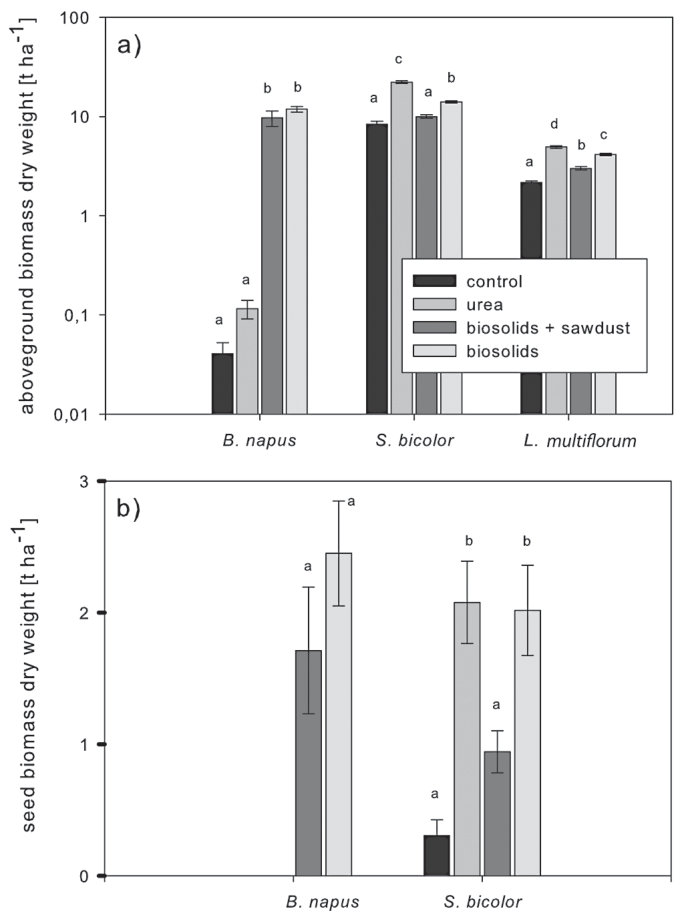
Biosolids application resulted in a positive growth response in all plant species compared with control treatments during the 18-wk experimental period (Fig. 1a). Mixing sawdust with biosolids resulted in a growth response similar to biosolids treatments in rapeseed but nullified the biosolids effect in sorghum. Urea application increased sorghum and ryegrass biomass but showed no effect on rapeseed biomass compared with control treatments.
在18周的试验期内,与对照处理相比,施用生物固体使所有植物种类均表现出正向生长响应(图1a)。对油菜而言,锯末与生物固体混合处理的生长响应与生物固体处理相近,但对高粱而言则抵消了生物固体的作用。与对照处理相比,施用尿素增加了高粱和黑麦草的生物量,但对油菜生物量无影响。
When grown on unamended soil, rapeseed produced negligible biomass and did not respond to urea application; hence, no seeds were obtained from control and urea treatments at the end of the experiment. No significant differences were observed between rapeseed seed biomass in biosolids and biosolids-sawdust treatments (Fig. 1b). Soil amendments significantly increased the seed biomass of sorghum, with highest yields in biosolids and urea treatments.
在未改良土壤中,油菜生物量极少,且对施用尿素无响应;因此,试验结束时对照和尿素处理均未获得种子。生物固体和生物固体-锯末处理的油菜种子生物量无显著差异(图1b)。土壤改良剂显著增加了高粱的种子生物量,以生物固体和尿素处理的产量最高。
Nutrient and Trace Element Concentration in Plants and Seeds植物和种子中营养元素与微量元素的含量
Biosolids and biosolids-sawdust application to rapeseed showed lower N, S, Ca, and Mg concentrations compared with controls. There was no effect on P and K accumulation (Table 2). An increased accumulation of S and Mg was detected in sorghum biosolids and biosolids-sawdust treatments. In combination with sorghum, urea application showed increased N concentration, whereas decreased concentrations of P and K were detected compared with control treatments. In ryegrass treatments, biosolids and biosolids-sawdust caused an increase in plant P but resulted in lower concentrations of K and Ca compared with controls. Compared with rapeseed and sorghum, the highest concentrations of P and K were detected in ryegrass, irrespective of soil treatments. A detailed discussion of N uptake and leaching was performed by (Esperschütz et al., 2016a).
与对照相比,施用生物固体和生物固体-锯末的油菜N、S、Ca和Mg含量较低,而对P和K的累积无影响(表2)。在高粱的生物固体和生物固体-锯末处理中检测到S和Mg累积增加。对于高粱,与对照处理相比,施用尿素使N含量增加,而P和K含量降低。在黑麦草处理中,与对照相比,生物固体和生物固体-锯末使植株P增加,但K和Ca含量降低。与油菜和高粱相比,无论土壤处理如何,黑麦草中P和K含量均最高。关于N吸收和淋溶的详细讨论见(Esperschütz et al., 2016a)。
In rapeseed, biosolids and biosolids-sawdust treatments resulted in lower B and Fe but showed up to 10-fold higher concentrations of Zn compared with control treatments (Table 3). Biosolids and biosolids-sawdust caused fivefold and eightfold higher Zn concentrations in sorghum, respectively. Biosolids-sawdust application resulted in Cu and Mn accumulations that were up to 30 and 40% higher than biosolids treatments. In ryegrass, biosolids treatments showed increased Cu, Mn, and Zn concentrations up to 65, 85, and 540%, respectively, and levels in biosolids-sawdust treatments were increased by 65, 110, and 400%, respectively, compared with controls. Whereas no differences between treatments were detected in Mo concentration in rapeseed, higher Mo concentrations were measured in sorghum and ryegrass biosolids and biosolids-sawdust treatments compared with controls. In ryegrass and in sorghum, a decrease in Mo concentration was detected after urea application.
与对照处理相比,油菜的生物固体和生物固体-锯末处理B和Fe含量较低,但Zn含量高出多达10倍(表3)。生物固体和生物固体-锯末使高粱中Zn含量分别提高5倍和8倍。施用生物固体-锯末导致Cu和Mn累积量比生物固体处理分别高出多达30%和40%。在黑麦草中,与对照相比,生物固体处理使Cu、Mn和Zn含量分别增加多达65%、85%和540%,生物固体-锯末处理则分别增加65%、110%和400%。油菜中Mo含量在各处理间无差异,而高粱和黑麦草的生物固体和生物固体-锯末处理中Mo含量均高于对照。在黑麦草和高粱中,施用尿素后Mo含量降低。
| Control对照 | Urea尿素 | Biosolids- sawdust生物固体- 锯末 | Biosolids生物固体 | |
|---|---|---|---|---|
| Rapeseed | ————— | —————— | % —————— | ————— |
| N | 4.50± | 4.55± | 0.58± | 0.47± |
| 0.09b‡ | 0.36b | 0.11a | 0.04a | |
| P | 0.07± | 0.09± | 0.08± | 0.07± |
| 0.02a | 0.01a | 0.01a | 0.01a | |
| K | 1.29± | 1.48± | 0.53± | 0.39± |
| 0.56ab | 0.49b | 0.13ab | 0.04a | |
| S | 1.49± | 0.99± | 0.24± | 0.21± |
| 0.09c | 0.04b | 0.03a | 0.02a | |
| Ca | 4.58± | 5.00± | 1.29± | 1.19± |
| 0.29b | 0.51b | 0.18a | 0.05a | |
| M | 0.30± | 0.33± | 0.13± | 0.11± |
| g | 0.02b | 0.00b | 0.02a | 0.01a |
| Sorghum | ||||
| N | 0.21± | 1.51± | 0.29± | 0.19± |
| 0.05a | 0.16b | 0.01a | 0.03a | |
| P | 0.10± | 0.04± | 0.17± | 0.10± |
| 0.01bc | 0.00a | 0.00c | 0.01b | |
| K | 0.81± | 0.31± | 0.92± | 0.61± |
| 0.03bc | 0.00a | 0.07c | 0.11b | |
| S | 0.07± | 0.06± | 0.09± | 0.09± |
| 0.00a | 0.00a | 0.00b | 0.01b | |
| Ca | 0.40± | 0.49± | 0.50± | 0.52± |
| 0.02a | 0.03b | 0.02b | 0.03b | |
| Mg | 0.11± 0.00a | 0.16± 0.01c | 0.12± 0.01ab | 0.14± 0.01b |
| Ryegrass | ||||
| N | 2.39± | 3.35± | 2.63± | 2.56± |
| 0.04a | 0.09c | 0.12b | 0.05ab | |
| P | 0.30± 0.01b | 0.17± 0.00a | 0.35± 0.02c | 0.43± 0.02d |
| K | 3.21± | 1.93± | 3.00± | 2.73± |
| 0.03d | 0.02a | 0.12c | 0.06b | |
| S | 0.38± | 0.26± | 0.35± | 0.40± |
| 0.01bc | 0.00a | 0.02b | 0.01c | |
| Ca | 0.80± 0.01c | 0.77± 0.02bc | 0.66± 0.02a | 0.73± 0.01b |
| Mg | 0.23± 0.00b | 0.24± 0.01bc | 0.21± 0.01a | 0.23± 0.00b |
† A detailed investigation of macronutrients in individual ryegrass biomass throughout the experiment is reported in Esperschütz et al. (2016b).
† 试验期间黑麦草各次生物量中大量营养元素的详细研究见Esperschütz et al.(2016b)。
‡ The average macronutrient concentrations are based on a weighted average across individual harvests. Lowercase letters indicate significant differences between treatments at p ≤ 0.05.
‡ 大量营养元素平均含量基于各次收获的加权平均值。小写字母表示处理间在p ≤ 0.05水平上差异显著。
Macronutrient concentration (Supplemental Table S1) in rapeseed seeds was not significantly different between biosolids and biosolids-sawdust. Concentrations of N, P, and S in sorghum treatments were up to 60, 108, and 57% higher after biosolids application compared with controls. Among micronutrients (Supplemental Table S2), Cu, Fe, and Zn were increased in sorghum seeds after biosolids-sawdust application up to 25, 305, and 51%, respectively. Concentrations of Cu, Fe, Zn, and Mn were higher compared with biosolids treatments. Rapeseed seeds showed higher concentrations of Mn in biosolids-sawdust treatments compared with biosolids.
油菜种子中大量营养元素含量(补充表S1)在生物固体和生物固体-锯末处理间无显著差异。与对照相比,施用生物固体后高粱处理中N、P和S含量分别提高多达60%、108%和57%。在微量营养元素中(补充表S2),施用生物固体-锯末后高粱种子中Cu、Fe和Zn分别提高多达25%、305%和51%。Cu、Fe、Zn和Mn含量均高于生物固体处理。油菜种子在生物固体-锯末处理中的Mn含量高于生物固体处理。
| Control对照 | Urea尿素 | Biosolids-sawdust生物固体-锯末 | Biosolids生物固体 | |
|---|---|---|---|---|
| ——————————— | ———————————— mg | kg-1 ————————————— | —————————— | |
| Rapeseed | ||||
| B | 41.6±3.6b‡ | 64.7±13.2a | 19.2±2.2c | 16.5±0.6c |
| Cu | 2.1±0.4a | 2.5±0.1a | 2.7±0.3a | 2.3±0.2a |
| Fe | 46.5±6.3b | 53.0±3.0b | 20.5±3.4a | 15.8±1.7a |
| Mn | 21.4±0.2a | 41.2±6.8b | 25.3±3.6a | 15.7±1.7a |
| Zn | 21.7±6.8a | 31.4±6.9a | 249.7±16.9b | 232.0±18.4b |
| Mo | 3.11±1.66a | 0.76±0.08a | 2.03±0.58a | 3.05±0.54a |
| Sorghum | ||||
| B | 2.7±0.3a | 2.9±0.3a | 2.7±0.3a | 2.8±0.3a |
| Cu | 2.0±0.1a | 2.2±0.3ab | 3.7±0.1c | 2.8±0.2b |
| Fe | 22.8±3.1a | 35.2±6.7a | 22.9±0.6a | 26.2±4.5a |
| Mn | 11.9±0.4a | 10.9±1.6a | 19.6±2.1b | 13.9±0.9a |
| Zn | 9.4±0.3a | 6.5±1.0a | 81.6±6.6c | 54.8±2.1b |
| Mo | 0.46±0.16b | 0.33±0.02a | 0.93±0.08c | 1.18±0.12c |
| Ryegrass | ||||
| B | 11.4±1.0b | 8.9±0.3a | 9.9±0.8ab | 10.5±0.3ab |
| Cu | 5.9±0.1a | 6.0±0.2a | 8.7±0.4b | 10.3±0.6c |
| Fe | 96.0±3.9a | 105.8±13.6a | 105.5±7.1a | 118.7±14.4a |
| Mn | 37.4±1.0a | 35.2±0.8a | 51.0±2.4b | 60.2±1.7c |
| Zn | 21.6±2.3a | 19.8±0.7a | 97.1±3.7b | 150.4±8.3c |
| Mo | 1.11±0.08b | 0.68±0.02a | 2.33±0.48c | 4.24±0.29d |
† A detailed investigation of macronutrients in individual ryegrass biomass throughout the experiment is reported in Esperschütz et al. (2016b). ‡ The average macronutrient concentrations are based on a weighted average across individual harvests. Lowercase letters indicate significant differences between treatments at p ≤ 0.05.
† 试验期间黑麦草各次生物量中大量营养元素的详细研究见Esperschütz et al.(2016b)。‡ 大量营养元素平均含量基于各次收获的加权平均值。小写字母表示处理间在p ≤ 0.05水平上差异显著。
Contaminant Uptake into Plants植物对污染物的吸收
Compared with controls, a higher concentration of Ni was detected in rapeseed and ryegrass after biosolids and biosolids-sawdust addition (Table 4). Ryegrass showed Ni concentrations between 2.5-fold and 5-fold higher compared with sorghum and rapeseed, irrespective of soil treatment. The accumulation of Cd in rapeseed was not affected by any treatment. Biosolids and biosolids-sawdust treatments showed increased Cd concentrations in ryegrass, to a similar level as in rapeseed. In sorghum biomass, Cd concentrations were low (≤0.1 mg kg-1) and close to detection limit (0.01 mg kg-1). Cadmium concentrations in rapeseed seeds were not affected by mixing sawdust with biosolids compared with pure biosolids (Supplemental Table S3). In sorghum, similar to rapeseed, no differences were observed regarding Cd accumulation. Biosolids and biosolids-sawdust resulted in an increase in Li and As uptake in ryegrass and an increased Li accumulation in rapeseed, respectively (Table 4).
与对照相比,添加生物固体和生物固体-锯末后,油菜和黑麦草中Ni含量升高(表4)。无论土壤处理如何,黑麦草的Ni含量均为高粱和油菜的2.5~5倍。油菜中Cd的累积不受任何处理影响。生物固体和生物固体-锯末处理使黑麦草Cd含量升高,达到与油菜相近的水平。高粱生物量中Cd含量较低(≤0.1 mg kg-1),接近检出限(0.01 mg kg-1)。与纯生物固体相比,锯末与生物固体混合不影响油菜种子中的Cd含量(补充表S3)。高粱与油菜类似,Cd累积无差异。生物固体和生物固体-锯末分别导致黑麦草Li和As吸收增加以及油菜Li累积增加(表4)。
Extractable Elements in Rhizosphere Soil根际土壤中的可提取元素
Limited amounts of rhizosphere soil was harvested from rapeseed; hence, analyses of macronutrients and trace elements in rhizosphere soil were only performed for sorghum and ryegrass treatments. A plant-available fraction of macro- and micronutrients was estimated after Ca(NO3)2 extraction. Available N (NO3-, NO2-, and NH4+) was determined after KCl extraction and has been discussed in detail by (Esperschütz et al., 2016a).
油菜根际土壤收获量有限,因此仅对高粱和黑麦草处理的根际土壤进行了大量营养元素和微量元素分析。大量和微量营养元素的植物有效态部分通过Ca(NO3)2提取进行估算。有效氮(NO3-、NO2-和NH4+)经KCl提取后测定,详细讨论见(Esperschütz et al., 2016a)。
Sorghum rhizosphere soil showed increased plant-available P in response to biosolids application and an increase in S after biosolids and biosolids-sawdust application (Table 5). In ryegrass treatments, Mg and Zn increased in response to biosolids application, whereas P, S, and Mn showed higher concentrations in biosolids- and biosolids-sawdust–amended soil. The potential contaminants Cd, Cr, Ni, and Pb were below detection limit in all treatments (<0.01, <0.02, <0.08, and <0.13 mg kg-1, respectively; data not shown).
高粱根际土壤中植物有效态P因施用生物固体而增加,S在施用生物固体和生物固体-锯末后增加(表5)。在黑麦草处理中,Mg和Zn因施用生物固体而增加,而P、S和Mn在施用生物固体及生物固体-锯末的土壤中含量较高。潜在污染物Cd、Cr、Ni和Pb在所有处理中均低于检出限(分别为<0.01、<0.02、<0.08和<0.13 mg kg-1;数据未列出)。
Plant species had a significant effect on extractable elements in the rhizospheres of plants in control, urea, and biosolids treatments but not in the biosolids-sawdust treatment. Control, urea, and biosolids treatments with sorghum reduced available K compared with ryegrass (Table 5). In urea treatments, sorghum growth lowered concentrations of K, Mg, Mn, and Zn compared with ryegrass. After biosolids application, available K, S, Mg, Cu, and Zn concentrations were reduced compared with ryegrass. Mixing biosolids with sawdust negated any plant species effect on the availability of nutrients and trace elements in soil.
在对照、尿素和生物固体处理中,植物种类对根际可提取元素有显著影响,但在生物固体-锯末处理中则无显著影响。在对照、尿素和生物固体处理中,与黑麦草相比,种植高粱降低了有效K(表5)。在尿素处理中,与黑麦草相比,高粱生长降低了K、Mg、Mn和Zn的含量。施用生物固体后,与黑麦草相比,有效K、S、Mg、Cu和Zn含量降低。将生物固体与锯末混合消除了植物种类对土壤中营养元素和微量元素有效性的任何影响。
4Discussion讨论
Plant and Seed Yield in Response to Biowaste Application施用生物废弃物对植物和种子产量的影响
According to the characterization of the initial soil used for the experiment, all plants grown in the control treatment encountered a low-fertility environment, particularly N and P. Urea application increased sorghum and ryegrass biomass significantly compared with controls, biosolids, and biosolids-sawdust treatments. In urea treatments, 200 kg ha-1 of plant-available N was applied. Because urea rapidly hydrolyses to form NH4+ (Robertson and Groffman, 2015), the urea treatments may have provided more available N than the biowaste treatments, which contain >95% organic N (Gilmour et al., 2003). The lack of rapeseed growth in the urea treatment indicates that nutrients other than N were limiting growth. Rapeseed has shown higher requirements for S and P compared with other species, such as wheat or maize (Abdallah et al., 2010; Ahmad et al., 2007; Chen et al., 2015; Jackson, 2000). High N levels in rapeseed control and urea treatments were most likely the effect of a N concentration effect due to scarce biomass growth in these treatments compared with biosolids and biosolids-sawdust. In the control soil, Olsen P was only 11 mg L-1, and the soil total S content in the initial soil was measured at 405 mg kg-1, which was characterized as S-deficient according to Rajendram et al. (2008). The application of the equivalent of 375 kg ha-1 of total S and 250 kg ha-1 of total P with biosolids and biosolids-sawdust, of which 41.5 and 2.5 kg ha-1, respectively, were available to plants, provided sufficient S and P for rapeseed growth. By applying nutrients and trace elements with biosolids and biosolids-sawdust, rapeseed biomass was recorded in a similar range compared with mineral fertilization with 150 kg N ha-1 (Muchecheti et al., 2011). Although an equivalent of only 20 kg ha-1 available N was applied with biosolids, biosolids application improved soil fertility and performance of rapeseed in the low-fertility soil compared with urea-only treatment.
根据试验所用初始土壤的性质,对照处理中所有植物均处于低肥力环境,尤其是N和P缺乏。与对照、生物固体和生物固体-锯末处理相比,施用尿素显著增加了高粱和黑麦草的生物量。尿素处理施入了200 kg ha-1植物有效态N。由于尿素迅速水解形成NH4+(Robertson and Groffman, 2015),尿素处理可能比含>95%有机氮的生物废弃物处理提供了更多有效氮(Gilmour et al., 2003)。尿素处理中油菜未能生长,表明限制其生长的是N以外的其他养分。与小麦或玉米等其他物种相比,油菜对S和P的需求更高(Abdallah et al., 2010; Ahmad et al., 2007; Chen et al., 2015; Jackson, 2000)。油菜对照和尿素处理中N含量较高,很可能是由于与生物固体和生物固体-锯末处理相比,这些处理的生物量生长稀少而产生的N浓缩效应。对照土壤中Olsen P仅为11 mg L-1,初始土壤全S含量测定为405 mg kg-1,根据Rajendram et al.(2008)的标准属于缺S土壤。随生物固体和生物固体-锯末施入相当于375 kg ha-1的全S和250 kg ha-1的全P,其中分别有41.5和2.5 kg ha-1为植物有效态,为油菜生长提供了充足的S和P。通过随生物固体和生物固体-锯末施入营养元素和微量元素,油菜生物量与施用150 kg N ha-1矿物肥料时处于相近水平(Muchecheti et al., 2011)。尽管随生物固体施入的有效氮仅相当于20 kg ha-1,但与单施尿素处理相比,施用生物固体改善了低肥力土壤的肥力和油菜的生长表现。
| Control对照 | Urea Biosolids-sawdust尿素 生物固体-锯末 | Biosolids生物固体 | |
|---|---|---|---|
| ———————————— | ———————————— mg kg-1 ————————————— | ——————————— | |
| Rapeseed | |||
| Cd | 0.24±0.03a‡ | 0.27±0.04a 0.30±0.02a | 0.26±0.03a |
| Ni | 0.43±0.26a | 0.48±0.24a 1.41±0.12b | 1.25±0.15b |
| Cr | 0.87±0.71a | 0.48±0.16a 1.00±0.26a | 0.77±0.23a |
| As | <0.50 | 0.22±0.02 <0.18 | <0.02 |
| Li | <0.07 | 0.07±0.00a 0.28±0.02b | 0.23±0.03b |
| Sorghum | |||
| Cd | n.d.±n.d.§ | 0.01±0.01a 0.11±0.02b | 0.09±0.02b |
| Ni | 1.02±0.22bc | 0.52±0.09a 0.73±0.02ab | 0.97±0.08b |
| Cr | 2.21±0.53c | 0.97±0.10a 1.50±0.08ab | 1.71±0.07bc |
| As | <0.38 | 0.35±0.11a <0.18 | 0.50±0.23a |
| Li | <0.01 | 0.02±0.02a 0.01±0.00a | <0.03a |
| Ryegrass | |||
| Cd | 0.03±0.01ab | 0.02±0.00a 0.13±0.00b | 0.26±0.06c |
| Ni | 2.57±0.22a | 2.52±0.32a 3.79±0.14b | 4.47±0.21b |
| Cr | 0.02±0.00a | 0.03±0.00a 0.03±0.00a | 0.03±0.00a |
| As | 0.36±0.07a | 0.15±0.04a 1.03±0.08b | 0.71±0.04b |
| Li | 0.17±0.03a | 0.09±0.01a 0.92±0.08b | 0.58±0.02b |
† A detailed investigation of macronutrients in individual ryegrass biomass throughout the experiment is reported in Esperschütz et al. (2016b). ‡ The average macronutrient concentrations are based on a weighted average across individual harvests. Lowercase letters indicate significant differences between treatments at p ≤ 0.05. § Not determined.
† 试验期间黑麦草各次生物量中大量营养元素的详细研究见Esperschütz et al.(2016b)。‡ 大量营养元素平均含量基于各次收获的加权平均值。小写字母表示处理间在p ≤ 0.05水平上差异显著。§ 未测定。
| Control对照 | Urea尿素 | Biosolids-sawdust生物固体-锯末 | Biosolids生物固体 | |
|---|---|---|---|---|
| ———————————— | ———————————— mg | kg-1 ————————————— | ——————————— | |
| Sorghum | ||||
| P | 0.65±0.06a †↑ | 0.60±0.00a | 0.79±0.13b | 0.60±0.01a |
| K | 17.1±0.66ab↓ | 14.4±0.55a↓ | 18.9±2.61b | 16.0±1.03ab↓ |
| S | 4.39±0.24a | 3.53±0.35a | 10.19±2.26b | 7.88±1.33b↓ |
| Mg | 90.0±3.43b | 70.5±1.40a↓ | 90.6±4.01b | 84.9±2.57b↓ |
| Cu | 0.01±0.00a | 0.01±0.00a | 0.02±0.01a | 0.01±0.00a↓ |
| Fe | 1.10±0.09a | 2.15±0.32b | 1.01±0.05a | 1.29±0.06a ↑ |
| Mn | 7.29±1.00b↑ | 3.10±0.25a↓ | 3.05±0.76a | 4.85±1.67ab |
| Zn | 0.05±0.03a | 0.02±0.02a↓ | 0.33±0.14a | 0.36±0.18a↓ |
| Ryegrass | ||||
| P | 0.48±0.02a↓ | 0.57±0.05ab | 0.62±0.03b | 0.62±0.01b |
| K | 23.1±1.86ab↑ | 26.4±1.92b↑ | 22.7±1.44ab | 19.8±0.69a↑ |
| S | 5.19±0.35a | 3.34±0.15a | 11.85±1.59b | 14.54±0.93c ↑ |
| Mg | 94.1±3.20a | 88.8±3.41a ↑ | 98.7±4.09ab | 106.8±4.65b ↑ |
| Cu | 0.02±0.01a | 0.02±0.01a | 0.05±0.02a | 0.03±0.00a ↑ |
| Fe | 0.88±0.07a | 4.64±0.27b | 0.97±0.04a | 0.96±0.04a↓ |
| Mn | 2.07±0.05a↓ | 6.57±0.46c↑ | 2.88±0.11b | 2.98±0.16b |
| Zn | 0.13±0.06a | 0.11±0.01a↑ | 0.84±0.20a | 1.74±0.46b ↑ |
† Lowercase letters indicate significant differences between treatments at p ≤ 0.05. Arrows indicate significantly higher (↑) or lower (↓) concentrations (p ≤ 0.05) between plant species grown under the same treatment.
† 小写字母表示处理间在p ≤ 0.05水平上差异显著。箭头表示同一处理下不同植物种类间含量显著较高(↑)或较低(↓)(p ≤ 0.05)。
In sorghum treatments, a high biomass response was observed with mineral N (urea) fertilization, which was in accordance with Fellet and Marchiol (2011) and Marchiol et al. (2007), who found greater biomass production in mineral-fertilized sites (22.1 t ha-1) compared with organically fertilized sites (16.9 t ha-1). A higher biomass yield due to mineral fertilization has been explained by mineral fertilization causing a longer vegetative period, thereby delaying the senescence of the canopy (Fellet and Marchiol, 2011).
在高粱处理中,施用矿物氮(尿素)观察到较高的生物量响应,这与Fellet and Marchiol(2011)以及Marchiol et al.(2007)的研究一致,他们发现施用矿物肥料的样地生物量产量(22.1 t ha-1)高于施用有机肥的样地(16.9 t ha-1)。矿物施肥导致生物量产量较高的原因被解释为矿物施肥延长了营养生长期,从而延缓了冠层衰老(Fellet and Marchiol, 2011)。
Total seed yields obtained from rapeseed biosolids and biosolids-sawdust treatments were comparable to the study by Ahmadi (2010), where plants received biosolids and biosolids-sawdust fertilization at rates between 50 and 150 kg N ha-1, respectively. Jackson (2000) identified a rapeseed seed yield of 2.65 t ha-1 at an optimum of 200 kg N ha-1. Seed yields in our study were 2.5 t ha-1 in biosolids treatments, achieved with an application of only 20 kg ha-1 of plant-available N applied with biosolids. Biosolids application to degraded soil would therefore provide a viable alternative to urea fertilization to grow rapeseed while simultaneously achieving an optimum seed yield.
油菜生物固体和生物固体-锯末处理获得的种子总产量与Ahmadi(2010)的研究相当,该研究中植物分别接受了50~150 kg N ha-1的生物固体和生物固体-锯末施肥。Jackson(2000)报道在最适施氮量200 kg N ha-1下油菜种子产量为2.65 t ha-1。本研究中生物固体处理的种子产量为2.5 t ha-1,而随生物固体施入的植物有效态N仅为20 kg ha-1。因此,在退化土壤上施用生物固体可作为尿素施肥的可行替代方案,用于种植油菜并同时获得最适种子产量。
Sorghum produced seeds in all treatments. Both urea and biosolids resulted in a seed biomass range of 2 t ha-1, which is in the lower range of recorded grain yield of sweet sorghum in North China (Zhao et al., 2009). Biosolids application increased nutrient use efficiency, offering a low-cost strategy to achieve similar grain yield with only 20 kg ha-1 equivalent available N, compared with 200 kg ha-1 available N for urea. An increased seed yield in biosolids treatments can be further linked to Zn because increasing levels of Zn have been shown to improve conditions for pod formation and the number of seeds per pod, thereby enhancing seed yield (Olama et al., 2014). Biosolids-sawdust did not increase biomass or seed yield when compared with control treatments. This could be related to C increase as a result of the sawdust component, stimulating heterotrophic bacteria that immobilize N while they degrade the C substrate (Schmidt et al., 2001).
所有处理中高粱均结籽。尿素和生物固体处理的种子生物量均在2 t ha-1左右,处于华北地区甜高粱籽粒产量记录的较低范围(Zhao et al., 2009)。施用生物固体提高了养分利用效率,提供了一种低成本策略:仅需相当于20 kg ha-1的有效氮即可获得相近的籽粒产量,而尿素则需200 kg ha-1有效氮。生物固体处理种子产量的增加还可能与Zn有关,因为已有研究表明,Zn水平的提高可改善结荚条件、增加每荚粒数,从而提高种子产量(Olama et al., 2014)。与对照处理相比,生物固体-锯末未增加生物量或种子产量。这可能与锯末组分导致的碳增加有关,碳的增加刺激了异养细菌,这些细菌在降解碳底物的同时固定了氮(Schmidt et al., 2001)。
Nutrient and Trace Elements in Vegetative Plant Biomass植物营养体生物量中的营养元素与微量元素
In sorghum and ryegrass plants, we generally detected higher or similar element concentrations in biosolids treatments compared with urea. Higher concentrations of several macro- and micronutrients were found in rapeseed urea compared with biosolids treatments. This was most likely a concentration effect due to scarce biomass growth in the urea treatment. Urea application caused a decrease of P and K in sorghum biomass, presumably a dilution effect, related to a high biomass increase that diluted plant P and K, in combination with a lack of P and K uptake, because only small amounts of P and K were available in soil (Jarrell and Beverly, 1981). These results are in accordance with Riedell (2010), who describes lower shoot P and K concentrations in maize after high-N application. Biosolids application increased Ca, Mg, S, and Cu concentrations in vegetative plant parts of sorghum compared with controls. Although these elements were increased, the levels in all treatments were in the reported range of 1000 to 50,000, 1500 to 3500, 1000 to 5000, and 1 to 10 mg kg-1, which are levels typically found in food crops (Alloway, 2013).
在高粱和黑麦草植株中,生物固体处理的元素含量总体上高于或接近尿素处理。油菜尿素处理中几种大量和微量营养元素的含量高于生物固体处理。这很可能是由于尿素处理中生物量生长稀少而产生的浓缩效应。施用尿素导致高粱生物量中P和K降低,推测为稀释效应,即生物量大幅增加稀释了植株P和K,同时由于土壤中有效P和K含量很少而导致P和K吸收不足(Jarrell and Beverly, 1981)。这些结果与Riedell(2010)的研究一致,该研究描述了高量施氮后玉米地上部P和K含量降低。与对照相比,施用生物固体提高了高粱营养器官中Ca、Mg、S和Cu的含量。尽管这些元素含量有所增加,但所有处理中的水平均处于已报道的1000~50,000、1500~3500、1000~5000和1~10 mg kg-1范围内,即粮食作物中的典型水平(Alloway, 2013)。
Irrespective of plant species, biosolids and biosolids-sawdust treatments increased plant Zn in the order of rapeseed > ryegrass > sorghum, above the typical range found in crop species (Alloway, 2013). Zinc concentrations in sorghum were below 15 to 20 mg kg-1 in control and urea treatments, a level that has been reported as a typical range for adequate growth in most crop species (Marschner, 1995). In rapeseed, Zn concentrations in biosolids and biosolids-sawdust treatments were 150% higher compared with sorghum and ryegrass. Generally, Zn is important in many biological functions, but recent studies increasingly show free ionic Zn (Zn2+) as more biologically toxic than traditionally presumed (Plum et al., 2010). Visible Zn toxicity in plants has been described above 300 mg kg-1 (Broadley et al., 2007). Our results indicate that biosolids as well as biosolids mixed with sawdust could potentially overcome Zn deficiency in crop species without reaching toxic thresholds.
无论植物种类如何,生物固体和生物固体-锯末处理均提高了植株Zn含量,顺序为油菜 > 黑麦草 > 高粱,且高于作物中的典型范围(Alloway, 2013)。在对照和尿素处理中,高粱Zn含量低于15~20 mg kg-1,而该水平被报道为大多数作物正常生长的典型范围(Marschner, 1995)。在油菜中,生物固体和生物固体-锯末处理的Zn含量比高粱和黑麦草高150%。一般而言,Zn在许多生物学功能中具有重要作用,但近期研究越来越多地表明,游离离子态Zn(Zn2+)的生物毒性比传统认为的更强(Plum et al., 2010)。据报道,植物Zn含量超过300 mg kg-1时会出现可见的Zn毒害症状(Broadley et al., 2007)。本研究结果表明,生物固体以及生物固体与锯末的混合物有可能在不达到毒性阈值的情况下克服作物的Zn缺乏。
Contaminant Uptake into Plants植物对污染物的吸收
Nickel concentrations increased with biosolids and biosolids-sawdust application in all plant species but were detected in a range typical for food crops (Alloway, 2013). Concentrations of Cd in rapeseed were measured at 0.1 to 0.3 mg kg-1, which has been reported as a normal range in plants (Alloway, 2013; Chaney, 1989). In sorghum and ryegrass biomass, Cd was significantly increased due to biosolids and biosolids-sawdust applications compared with controls but in a range not toxic to human or animal health (Alloway, 2013; Chaney, 1989). This indicates that biosolids and biosolids-sawdust can enhance uptake of essential trace elements in plant parts while not increasing toxic elements like Cd to levels dangerous for animal and human health. Plant species like rapeseed did not accumulate contaminants such as Cd from biosolids and biosolids-sawdust treatments; hence, potentially higher rates of biosolids could be applied without reaching threshold levels for food products. Although there were higher Li concentrations in ryegrass and rapeseed biosolids and biosolids-sawdust treatments, as well as higher As concentrations in biosolids and biosolids-sawdust ryegrass treatments, these levels were below concentrations shown to be toxic to plants and were unlikely to be significant for human health or ecosystem functioning (Aral and Vecchio-Sadus, 2008; Wuana and Okieimen, 2011).
施用生物固体和生物固体-锯末后,所有植物种类中的Ni含量均有所增加,但仍处于粮食作物的典型范围内(Alloway, 2013)。油菜中Cd含量测定为0.1~0.3 mg kg-1,属于已报道的植物正常范围(Alloway, 2013; Chaney, 1989)。在高粱和黑麦草生物量中,与对照相比,施用生物固体和生物固体-锯末显著提高了Cd含量,但仍处于对人类或动物健康无毒的范围内(Alloway, 2013; Chaney, 1989)。这表明,生物固体和生物固体-锯末可促进植物部位对必需微量元素的吸收,同时不会使Cd等有毒元素增加至危害动物和人体健康的水平。油菜等植物种类在生物固体和生物固体-锯末处理中未累积Cd等污染物;因此,有可能施用更高量的生物固体而不致达到食品阈值水平。尽管黑麦草和油菜的生物固体及生物固体-锯末处理中Li含量较高,黑麦草的生物固体及生物固体-锯末处理中As含量也较高,但这些水平均低于已证实对植物有毒的浓度,且不太可能对人体健康或生态系统功能产生显著影响(Aral and Vecchio-Sadus, 2008; Wuana and Okieimen, 2011)。
Influence of Biosolids and Sawdust on Seed Quality生物固体和锯末对种子品质的影响
In rapeseed treatments, an increase in seed quality compared with control treatments could not be verified because no seed production was obtained in control and urea treatments. Macroand micronutrients in seeds in biosolids and biosolids-sawdust treatments (Supplemental Tables S1 and S2) were in a range as expected under normal P fertilization or higher in cases of Ca, Zn, Cu, or Fe (Ding et al., 2010). Copper concentrations were higher than the critical content of 2.2 mg kg-1 for Cu deficiency as stated by Khurana et al. (2006); hence, seed Cu concentrations are not correlated to the Cu deficiency of vegetative parts as discussed above. This indicates that biosolids application can increase the quality of rapeseed seeds and therefore potentially plant oil. Increased mineral concentrations in seeds, especially P and Zn, could be beneficial for seedlings and result in a faster seedling establishment and higher yields (Broadley et al., 2007; Zhu and Smith, 2001).
在油菜处理中,由于对照和尿素处理未结籽,无法验证种子品质相对于对照处理的提高。生物固体和生物固体-锯末处理中种子的大量和微量营养元素(补充表S1和S2)处于正常施磷条件下的预期范围,Ca、Zn、Cu或Fe则更高(Ding et al., 2010)。Cu含量高于Khurana et al.(2006)提出的Cu缺乏临界含量2.2 mg kg-1;因此,种子Cu含量与上文讨论的营养器官Cu缺乏并不相关。这表明施用生物固体可提高油菜种子品质,从而可能提高植物油品质。种子中矿质元素含量的增加(尤其是P和Zn)可能有利于幼苗,使幼苗更快建植并获得更高产量(Broadley et al., 2007; Zhu and Smith, 2001)。
Sorghum seeds showed higher N, P, and S concentrations in biosolids treatments compared with controls, and biosolids-sawdust further increased Cu, Fe, and Zn compared with control treatments. Using biosolids and sawdust as soil amendments could potentially overcome nutrient deficiency in plant foods, which is becoming an increasingly important global problem (Musa et al., 2012). Concentrations of Cd and Ni in seeds in biosolids and biosolids-sawdust treatments remained low (0.05 and 1.5 mg kg-1, respectively) and did not endanger food safety according to current thresholds (Codex, Alimentarius Commission 2001).
与对照相比,生物固体处理的高粱种子N、P和S含量较高,生物固体-锯末则进一步提高了Cu、Fe和Zn含量。以生物固体和锯末作为土壤改良剂有可能克服植物性食品中的营养缺乏问题,而这一问题正日益成为重要的全球性问题(Musa et al., 2012)。生物固体和生物固体-锯末处理中种子Cd和Ni含量仍然较低(分别为0.05和1.5 mg kg-1),根据现行阈值不会危及食品安全(Codex, Alimentarius Commission 2001)。
Nutrient Availability in Soil土壤养分有效性
Biosolids and biosolids-sawdust application influenced P and S concentrations in the rhizosphere; however, different effects were observed in biosolids-sawdust depending on the plant species. This could be related to different nutrient mobilization via different compounds exuded by plant species (Carvalhais et al., 2011; Nardi et al., 2000; Ström et al., 2002). However, plants might have influenced nutrient availability via uptake, evapotranspiration, or preferential flow down though root channels (Allaire et al., 2011; Mitchell et al., 1995; Vasquez, 2008). In addition, sawdust could have altered nutrient availability by exerting influence on microbial communities through compounds leached into the soil from sawdust. It has been previously reported that organic compounds such as phenols, tannins, lignin, and terpenes can be leached from sawdust, which could potentially alter microbial processes in toxic concentrations. (Hedmark and Scholz, 2008; Keeling and Bohlmann, 2006; Rupar and Sanati, 2005; Tao et al., 2005).
施用生物固体和生物固体-锯末影响了根际中P和S的含量;然而,生物固体-锯末的效果因植物种类而异。这可能与不同植物种类分泌的不同化合物引起的养分活化差异有关(Carvalhais et al., 2011; Nardi et al., 2000; Ström et al., 2002)。然而,植物也可能通过吸收、蒸散或沿根孔道的优先流影响养分有效性(Allaire et al., 2011; Mitchell et al., 1995; Vasquez, 2008)。此外,锯末中淋溶进入土壤的化合物可能通过影响微生物群落而改变养分有效性。已有报道指出,酚类、单宁、木质素和萜类等有机化合物可从锯末中淋溶出来,在达到毒性浓度时可能改变微生物过程(Hedmark and Scholz, 2008; Keeling and Bohlmann, 2006; Rupar and Sanati, 2005; Tao et al., 2005)。
An increase of Mg, Mn, and Zn was seen in ryegrass rhizosphere in response to biosolids. This could be due to a lower demand for plant nutrients due to lower biomass production compared with sorghum and hence higher concentrations of available elements remaining in the soil. Cadmium, Cr, and Ni were not detected in plant-available concentrations, which is in accordance with the biomass results, suggesting these contaminants do not accumulate in plants after a biosolids application rate of 50 t ha-1.
施用生物固体后,黑麦草根际中Mg、Mn和Zn增加。这可能是由于与高粱相比,黑麦草生物量较低,对植物养分的需求较少,从而使较高浓度的有效元素残留在土壤中。Cd、Cr和Ni均未检出植物有效态含量,这与生物量结果一致,表明在50 t ha-1的生物固体施用量下,这些污染物不会在植物中累积。
Sorghum and ryegrass exerted a diverse influence on the availability of nutrients and trace elements in soil, presumably due to root growth and exudation (Nascimento and Xing, 2006). Potassium, S, Mg, Mn, Cu, and Zn had lower availability in sorghum treatments compared with ryegrass. Root exudates, including organic anions, are responsible for metal complexation and uptake into plants or immobilization in soil (Bais et al., 2006). Our results suggest a higher influence of sorghum exudates on the nutrient availability in soil compared with ryegrass. However, biosolids-sawdust application was the only treatment where no differences occurred between sorghum and ryegrass treatments with regard to nutrient availability. Sawdust may well provide higher amounts of available C, which likely attracted heterotrophic bacteria, consuming root exudates and available nutrient sources in soil (Cébron et al., 2015). Therefore, sawdust could have overcome the difference in plant exudation (in volume as well as composition) between sorghum and ryegrass by stimulating the rhizosphere microbial biomass.
高粱和黑麦草对土壤中营养元素和微量元素的有效性产生了不同的影响,推测这是由根系生长和分泌作用所致(Nascimento and Xing, 2006)。与黑麦草相比,高粱处理中K、S、Mg、Mn、Cu和Zn的有效性较低。根系分泌物(包括有机阴离子)负责金属的络合以及向植物的吸收或在土壤中的固定(Bais et al., 2006)。本研究结果表明,与黑麦草相比,高粱分泌物对土壤养分有效性的影响更大。然而,生物固体-锯末处理是唯一一个高粱与黑麦草处理在养分有效性方面无差异的处理。锯末很可能提供了更多的有效碳,从而吸引了异养细菌,消耗根系分泌物和土壤中的有效养分源(Cébron et al., 2015)。因此,锯末可能通过刺激根际微生物生物量,消除了高粱与黑麦草之间植物分泌(在数量和组成上)的差异。
The leaching of heavy metals from biosolids-amended soils has been discussed in several studies with different types of biosolids and soil types (Brown et al., 1983; Esteller et al., 2009; Gove et al., 2001). Heavy metal leaching in these studies was reported in very low or negligible concentrations and hence was not focus of our experiment. However, because an increasing amount and repeated biosolids application to land in the near future could potentially pose risks in terms of heavy metal leaching into groundwater, the leaching composition of heavy metals is an interesting topic for further research.
已有多项研究针对不同类型的生物固体和土壤探讨了施用生物固体土壤中重金属的淋溶(Brown et al., 1983; Esteller et al., 2009; Gove et al., 2001)。这些研究报道的重金属淋溶浓度极低或可忽略不计,因此并非本试验的关注重点。然而,由于在不久的将来,生物固体土地施用量的增加和重复施用可能带来重金属淋溶进入地下水的风险,重金属的淋溶组成是值得进一步研究的课题。
5Conclusions结论
High rates of biosolids application to low-fertility land in combination with rapeseed, sorghum, and ryegrass provided a complete fertilization with macro- and micronutrients without significantly increasing contaminants such as Cr, Ni, or Cd in the plant biomass. Biosolids application increased plant and seed biomass as well as seed and crop quality by enhancing the concentration of important elements in the vegetative biomass and seeds, especially Zn and P. Results from blending biosolids with fresh sawdust varied strongly depending on plant species, and therefore the use of sawdust in these scenarios must be decided on a case-bycase basis depending on the required outcome. The use of sawdust can immobilize and reduce available N for plant growth; however, sawdust can also enhance plant quality with respect to individual nutrients in biomass and seeds, including P, Cu, Zn, Mn, Fe, S, or Na. Further investigation of biosolids application rates in combination with sawdust and different plant species could maximize the plant quality benefits derived from sawdust, thereby improving its value for recycling in combination with biosolids on land instead of increasing landfill deposition. In addition to metal contaminants and N, analyses of organic contaminants and pathogens have to be included into future studies.
在低肥力土地上高量施用生物固体并种植油菜、高粱和黑麦草,可提供全面的大量和微量营养元素施肥,而不会显著增加植物生物量中Cr、Ni或Cd等污染物。施用生物固体通过提高营养体生物量和种子中重要元素(尤其是Zn和P)的含量,增加了植株和种子生物量,并提高了种子和作物品质。将生物固体与新鲜锯末混合的效果因植物种类而差异很大,因此在这些情形下是否使用锯末必须根据所需结果逐案决定。使用锯末可能固定并减少植物生长所需的有效氮;但锯末也可提高植物在生物量和种子中个别营养元素方面的品质,包括P、Cu、Zn、Mn、Fe、S或Na。进一步研究生物固体施用量与锯末及不同植物种类的组合,可最大限度地发挥锯末对植物品质的益处,从而提升其与生物固体配合进行土地循环利用的价值,而非增加填埋处置量。除金属污染物和氮外,未来研究还须纳入有机污染物和病原体的分析。
6Acknowledgments致谢
The study was supported by the Deutsche Forschungsgemeinschaft (DFG, ES 416/1-1), the Center of Integrated Biowastes (CIBR), and Plant & Food Research (Blueskies). The authors thank H. Lowe (Lowe Environmental Impact) for assisting with soil collection; Lincoln University for providing facilities and laboratories; and L. Clucas, B. Richards, D. Paramashivan, S. Mammun, Y. Kim, T. Zhongtao, and H. Franklin for technical and physical assistance.
本研究由德国研究基金会(Deutsche Forschungsgemeinschaft, DFG, ES 416/1-1)、Center of Integrated Biowastes(CIBR)和Plant & Food Research(Blueskies)资助。作者感谢H. Lowe(Lowe Environmental Impact)协助采集土壤;感谢林肯大学提供设施和实验室;感谢L. Clucas、B. Richards、D. Paramashivan、S. Mammun、Y. Kim、T. Zhongtao和H. Franklin提供技术和体力协助。
7References参考文献
Abdallah, M., L. Dubousset, F. Meuriot, P. Etienne, J.C. Avice, and A. Ourry. 2010. Effect of mineral sulphur availability on nitrogen and sulphur uptake and remobilization during the vegetative growth of Brassica napus L. J. Exp. Bot. 61:2635–2646. doi:10.1093/jxb/erq096
Ahmad, G., A. Jan, M. Arif, M.T. Jan, and R.A. Khattak. 2007. Influence of nitrogen and sulfur fertilization on quality of canola (Brassica napus L.) under rainfed conditions. J. Zhejiang Univ. Sci. B 8:731–737. doi:10.1631/jzus.2007.B0731
Ahmadi, M. 2010. Effect of zinc and nitrogen fertilizer rates on yield and yield components of oilseed rape (Brassica napus L.). Am.-Eurasian J. Agric. Environ. Sci. 10:298–303.
Ajmal, M., A. Hussain Khan, S. Ahmad, and A. Ahmad. 1998. Role of sawdust in the removal of copper(II) from industrial wastes. Water Res. 32:3085– 3091. doi:10.1016/S0043-1354(98)00067-0
Allaire S.E., E. Bochove, J.-T. Denault, H. Dadfar, G. Thériault, A. Charles, and R. De Jong. 2011. Preferential pathways of phosphorus movement from agricultural land to water bodies in the Canadian Great Lakes basin: A predictive tool. Can. J. Soil Sci. 91:361–374. doi:10.4141/cjss09121
Alloway, B.J. 2013. Bioavailability of elements in soil. In: O. Selinus, editor, Essentials of medical geology. Springer, The Netherlands. p. 351–373.
Ammari, T.G., A.-O. Qusai, and B.E. Abbassi. 2012. Composting sewage sludge amended with different sawdust proportions and textures and organic waste of food industry: Assessment of quality. Environ. Technol. 33:1641– 1649. doi:10.1080/09593330.2011.641589
Aral, H., and A. Vecchio-Sadus. 2008. Toxicity of lithium to humans and the environment: A literature review. Ecotoxicol. Environ. Saf. 70:349–356. doi:10.1016/j.ecoenv.2008.02.026
Bais, H.P., T.L. Weir, L.G. Perry, S. Gilroy, and J.M. Vivanco. 2006. The role of root exudates in rhizosphere interactions with plants and other organisms. Annu. Rev. Plant Biol. 57:233–266. doi:10.1146/annurev. arplant.57.032905.105159 Black, A., R.G. McLaren, S.M. Reichman, T.W. Speir, L.M. Condron, and G. Houliston. 2012. Metal bioavailability dynamics during a two-year trial using ryegrass (Lolium perenne L.) grown in soils treated with biosolids and metal salts. Soil Res. 50:304–311. doi:10.1071/SR11315
Bolan, N., A. Kunhikrishnan, R. Thangarajan, J. Kumpiene, J. Park, T. Makino, M.B. Kirkham, and K. Scheckel. 2014. Remediation of heavy metal(loid) s contaminated soils: To mobilize or to immobilize? J. Hazard. Mater. 266:141–166. doi:10.1016/j.jhazmat.2013.12.018
Bouziane, L., F. Bendebane, F. Ismail, and R. Delimi. 2012. Removal of zinc and cadmium from an aqueous solution using sawdust as a low-cost adsorbent: Application of Plackett–Burman design. Desalination Water Treat. 49:189–199. doi:10.1080/19443994.2012.719318 Broadley, M.R., P.J. White, J.P. Hammond, I. Zelko, and A. Lux. 2007. Zinc in plants. New Phytol. 173:677–702. doi:10.1111/j.1469-8137.2007.01996.x
Brown, K.W., J.C. Thomas, and J.F. Slowey. 1983. The movement of metals applied to soils in sewage effluent. Water Air Soil Pollut. 19:43–54. doi:10.1007/BF00176794
Bryant, P.S., J.N. Petersen, J.M. Lee, and T.M. Brouns. 1992. Sorption of heavy metals by untreated red fir sawdust. Appl. Biochem. Biotechnol. 34– 35:777–788. doi:10.1007/BF02920596
Bulut, Y., and Z. Tez. 2007. Removal of heavy metals from aqueous solution by sawdust adsorption. J. Environ. Sci. (China) 19:160–166. doi:10.1016/ S1001-0742(07)60026-6
Carvalhais, L.C., P.G. Dennis, D. Fedoseyenko, M.-R. Hajirezaei, R. Borriss, and N. von Wirén. 2011. Root exudation of sugars, amino acids, and organic acids by maize as affected by nitrogen, phosphorus, potassium, and iron deficiency. J. Plant Nutr. Soil Sci. 174:3–11. doi:10.1002/jpln.201000085
Cébron, A., T. Beguiristain, J. Bongoua-Devisme, J. Denonfoux, P. Faure, C. Lorgeoux, S. Ouvrard, N. Parisot, P. Peyret, and C. Leyval. 2015. Impact of clay mineral, wood sawdust or root organic matter on the bacterial and fungal community structures in two aged PAH-contaminated soils. Environ. Sci. Pollut. Res. Int. 22:13724–13738. doi:10.1007/s11356-015-4117-3
Chaney, R.L. 1989. Toxic element accumulation in soils and crops: Protecting soil fertility and agricultural food-chains. In: B. BarYosef, N.J. Barrow, and J. Goldshmid, editors, Inorganic contaminants in the vadose zone. Springer-Verlag, Berlin, Germany. p. 140–158.
Chen, S., G. Ding, Z. Wang, H. Cai, and F. Xu. 2015. Proteomic and comparative genomic analysis reveals adaptability of Brassica napus to phosphorus-deficient stress. J. Proteomics 117:106–119. doi:10.1016/j.jprot.2015.01.012 Clarke, B.O., and S.R. Smith. 2011. Review of ‘emerging’ organic contaminants in biosolids and assessment of international research priorities for the agricultural use of biosolids. Environ. Int. 37:226–247. doi:10.1016/j.envint.2010.06.004
Codex, Alimentarius Commission. 2001. Report of the thirty-third session of the Codex Committee on Food Additives and Contaminants. Joint FAO/ WHO Food Standard Programme, The Hague, The Netherlands.
Dere, A.L., R.C. Stehouwer, E. Aboukila, and K.E. McDonald. 2012. Nutrient leaching and soil retention in mined land reclaimed with stabilized manure. J. Environ. Qual. 41:2001–2008. doi:10.2134/jeq2012.0036 Dickinson, N.M., A.J.M. Baker, A. Doronila, S. Laidlaw, and R.D. Reeves. 2009. Phytoremediation of inorganics: Realism and synergies. Int. J. Phytoremediation 11:97–114. doi:10.1080/15226510802378368
Ding, G., M. Yang, Y. Hu, Y. Liao, L. Shi, F. Xu, and J. Meng. 2010. Quantitative trait loci affecting seed mineral concentrations in Brassica napus grown with contrasting phosphorus supplies. Ann. Bot. (Lond.) 105:1221–1234. doi:10.1093/aob/mcq050
Esperschütz, J., S. Bulman, C. Anderson, J. Horswell, N.M. Dickinson, and B.H. Robinson. 2016a. Production of biomass crops using biowastes on low-fertility soil: 2. Effect of biowastes on nitrogen transformation processes. J. Environ. Qual. doi:10.2134.jeq2015.12.0597
Esperschütz, J., O. Lense, C. Anderson, S. Bulman, J. Horswell, N.M. Dickinson, and B.H. Robinson. 2016b. Biowaste mixtures affecting the growth and elemental composition of Italian ryegrass (Lolium multiflorum). J. Environ. Qual. 45:1054–1061. doi:10.2134/jeq2015.09.0459
Esteller, M.V., H. Martínez-Valdés, S. Garrido, and Q. Uribe. 2009. Nitrate and phosphate leaching in a Phaeozem soil treated with biosolids, composted biosolids and inorganic fertilizers. Waste Manag. 29:1936–1944. doi:10.1016/j.wasman.2008.12.025
Evangelou, M.W.H., H.M. Conesa, B.H. Robinson, and R. Schulin. 2012. Biomass production on trace element–contaminated land: A review. Environ. Eng. Sci. 29:823–839. doi:10.1089/ees.2011.0428
Fan, M.-S., F.-J. Zhao, S.J. Fairweather-Tait, P.R. Poulton, S.J. Dunham, and S.P. McGrath. 2008. Evidence of decreasing mineral density in wheat grain over the last 160 years. J. Trace Elem. Med. Biol. 22:315–324. doi:10.1016/j. jtemb.2008.07.002
Fellet, G., and L. Marchiol. 2011. Towards green remediation: Metal phytoextraction and growth analysis of sorghum bicolor under different agronomic management. Low Carbon Economy 2:144–151. doi:10.4236/lce.2011.23018
Field, C.B., J.E. Campbell, and D.B. Lobell. 2008. Biomass energy: The scale of the potential resource. Trends Ecol. Evol. 23:65–72. doi:10.1016/j. tree.2007.12.001
Fiset J.F., J.F. Blais, R. Ben Cheikh, and R. Dayal Tyagi. 2000. Review on metal removal by adsorption on sawdusts and wood barks. Rev. Sci. l’EAU 13:325–349.
Gadepalle, V.P., S.K. Ouki, R.V. Herwijnen, and T. Hutchings. 2007. Immobilization of heavy metals in soil using natural and waste materials for vegetation establishment on contaminated sites. Soil Sediment Contam. 16:233–251. doi:10.1080/15320380601169441
Gilmour, J.T., C.G. Cogger, L.W. Jacobs, G.K. Evanylo, and D.M. Sullivan. 2003. Decomposition and plant-available nitrogen in biosolids: Laboratory studies, field studies, and computer simulation. J. Environ. Qual. 32:1498– 1507. doi:10.2134/jeq2003.1498 Gove, L., C.M. Cooke, F.A. Nicholson, and A.J. Beck. 2001. Movement of water and heavy metals (Zn, Cu, Pb and Ni) through sand and sandy loam amended with biosolids under steady-state hydrological conditions. Bioresour. Technol. 78:171–179. doi:10.1016/S0960-8524(01)00004-9
Hedmark, Å., and M. Scholz. 2008. Review of environmental effects and treatment of runoff from storage and handling of wood. Bioresour. Technol. 99:5997–6009. doi:10.1016/j.biortech.2007.12.042
Horswell, J., J. Hewitt, J. Prosser, A. Van Schaik, D. Croucher, C. Macdonald, P. Burford, P. Susarla, P. Bickers, and T. Speir. 2010. Mobility and survival of Salmonella typhimurium and human adenovirus from spiked sewage sludge applied to soil columns. J. Appl. Microbiol. 108:104–114. doi:10.1111/j.1365-2672.2009.04416.x Jackson, G.D. 2000. Effects of nitrogen and sulfur on canola yield and nutrient uptake. Agron. J. 92:644–649. doi:10.2134/agronj2000.924644x
Jarrell, W.M., and R.B. Beverly. 1981. The dilution effect in plant nutrition studies. In: N.C. Brady, editor, Advances in agronomy. Academic Press, Cambridge, MA. p. 197–224. Keeling, C.I., and J. Bohlmann. 2006. Diterpene resin acids in conifers. Phytochemistry 67:2415–2423. doi:10.1016/j.phytochem.2006.08.019
Keiluweit, M., J. Bougoure, P. Nico, J. Pett-Ridge, P. Weber, and M. Kleber. 2015. Mineral protection of soil carbon counteracted by root exudates. Nat. Clim. Change 5:588–595. doi:10.1038/nclimate2580
Khurana, N., M.V. Singh, and C. Chatterjee. 2006. Copper stress alters physiology and deteriorates seed duality of rapeseed. J. Plant Nutr. 29:93–101. doi:10.1080/01904160500416489
Kumar, U. 2006. Agricultural products and by-products as a low cost adsorbent for heavy metal removal from water and wastewater: A review. Sci. Res. Essay 1:33–37.
Marchiol, L., G. Fellet, D. Perosa, and G. Zerbi. 2007. Removal of trace metals by Sorghum bicolor and Helianthus annuus in a site polluted by industrial wastes: A field experience. Plant Physiol. Biochem. 45:379–387. doi:10.1016/j.plaphy.2007.03.018 Marschner, H. 1995. Mineral nutrition of higher plants UK: Academic Press, London, UK.
Mitchell, A.R., T.R. Ellsworth, and B.D. Meek. 1995. Effect of root systems on preferential flow in swelling soils. Commun. Soil Sci. Plant Anal. 26:2655– 2666. doi:10.1080/00103629509369475
Muchecheti, F., I.C. Madakadze, and P. Soundy. 2011. Production of rape (Brassica napus L.) on soils amended with leguminous tree prunings: Yield responses in relation to the chemical composition of the tree prunings. African J. Agric. Res. 7:3541–3549.
Musa, E.M., E.A.E. Elsheikh, I.A. Mohamed Ahmed, and E.E. Babiker. 2012. Intercropping sorghum (Sorghum bicolor L.) and cowpea (Vigna unguiculata L.): Effect of Bradyrhizobium inoculation and fertilization on minerals composition of sorghum seeds. ISRN Agron. 9. doi:10.5402/2012/356183 Nardi, S., G. Concheri, D. Pizzeghello, A. Sturaro, R. Rella, and G. Parvoli. 2000. Soil organic matter mobilization by root exudates. Chemosphere 41:653– 658. doi:10.1016/S0045-6535(99)00488-9
Nascimento, C.W.A.d., and B. Xing. 2006. Phytoextraction: A review on enhanced metal availability and plant accumulation. Sci. Agric. 63:299–311. doi:10.1590/S0103-90162006000300014
NZWWA. 2003. Guidelines for the safe application of biosolids to land in New Zealand. Ministry for the Environment, New Zealand Water and Wastewater Association, Wellington, New Zealand.
Oladeji, O.O., G. Tian, A.E. Cox, T.C. Granato, C. O’Connor, Z. Abedin, and R.I. Pietz. 2013. Effect of long-term application of biosolids for mine land reclamation on groundwater chemistry: Nutrients and other selected qualities. J. Environ. Qual. 42:94–102. doi:10.2134/jeq2012.0179
Olama, V., A. Ronaghi, N. Karimian, J. Yasrebi, R. Hamidi, M. Tavajjoh, and M.R. Kazemi. 2014. Seed quality and micronutrient contents and translocations in rapeseed (Brassica napus L.) as affected by nitrogen and zinc fertilizers. Arch. Agron. Soil Sci. 60:423–435. doi:10.1080/03650340.20 13.796588
Panagos, P., M. Van Liedekerke, Y. Yigini, and L. Montanarella. 2013. Contaminated sites in Europe: Review of the current situation based on data collected through a European network. J. Environ. Public Health 11. doi:10.1155/2013/158764
Park, J.H., D. Lamb, P. Paneerselvam, G. Choppala, N. Bolan, and J.-W. Chung. 2011. Role of organic amendments on enhanced bioremediation of heavy metal(loid) contaminated soils. J. Hazard. Mater. 185:549–574. doi:10.1016/j.jhazmat.2010.09.082
Plum, L.M., L. Rink, and H. Haase. 2010. The essential toxin: Impact of zinc on human health. Int. J. Environ. Res. Public Health 7:1342–1365. doi:10.3390/ijerph7041342
Rajendram, G., A. Ghani, J. Waller, M. Kear, J. Watkinson, K. Benge, and D. Wheeler. 2008. Total sulphur: A better predictor of sulphur deficiency in pastoral soils. In: L.D. Currie and L.J. Yates, editors, Occasional report No. 21. Massey Univ., Palmerston North, NZ. Randall, J.M., V. Garrett, R.L. Bermann, and A.C. Waiss, Jr. 1974. Use of bark to remove heavy metal ions from waste solutions. For. Prod. J. 24:80–84.
Riedell, W.E. 2010. Mineral-nutrient synergism and dilution responses to nitrogen fertilizer in field-grown maize. J. Plant Nutr. Soil Sci. 173:869–874. doi:10.1002/jpln.200900218
Río, M., A. Franco-Uría, E. Abad, and E. Roca. 2011. A risk-based decision tool for the management of organic waste in agriculture and farming activities (FARMERS). J. Hazard. Mater. 185:792–800. doi:10.1016/j. jhazmat.2010.09.090
Robertson, G.P., and P.M. Groffman. 2015. Nitrogen transformations. In: E.A. Paul, editor, Soil microbiology, ecology and biochemistry. Academic Press, Burlington, MA. p. 421–446.
Rupar, K., and M. Sanati. 2005. The release of terpenes during storage of biomass. Biomass Bioenergy 28:29–34. doi:10.1016/j.biombioe.2004.06.005
Sidhu, J.P.S., and S.G. Toze. 2009. Human pathogens and their indicators in biosolids: A literature review. Environ. Int. 35:187–201. doi:10.1016/j. envint.2008.07.006 Speir, T.W., A.P. Van Schaik, H.J. Percival, M.E. Close, and L. Pang. 2003. Heavy metals in soil, plants and groundwater following high-rate sewage sludge application to land. Water Air Soil Pollut. 150:319–358. doi:10.1023/A:1026101419961
Stehouwer, R., R.L. Day, and K.E. Macneal. 2006. Nutrient and trace element leaching following mine reclamation with biosolids. J. Environ. Qual. 35:1118–1126. doi:10.2134/jeq2005.0134
Ström, L., A.G. Owen, D.L. Godbold, and D.L. Jones. 2002. Organic acid mediated P mobilization in the rhizosphere and uptake by maize roots. Soil Biol. Biochem. 34:703–710. doi:10.1016/S0038-0717(01)00235-8
Tao, W., K.J. Hall, A. Masbough, K. Frankowski, and S.J.B. Duff. 2005. Characterization of leachate from a woodwaste pile. Water Qual. Res. J. Canada 40:476–483.
Thomas, D. 2003. A study on the mineral depletion of the foods available to us as a nation over the period 1940 to 1991. Nutr. Health 17:85–115. doi:10.1177/026010600301700201
Tian, G., T.C. Granato, A.E. Cox, R.I. Pietz, C.R. Carlson, Jr., and Z. Abedin. 2009. Soil carbon sequestration resulting from long-term application of biosolids for land reclamation. J. Environ. Qual. 38:61–74. doi:10.2134/ jeq2007.0471
Torri, S.I., R.S. Correa, and G. Renella. 2014. Soil carbon sequestration resulting from biosolids application. Appl. Environ. Soil Sci. 9. doi:10.1155/2014/821768
Vamerali, T., M. Bandiera, and G. Mosca. 2010. Field crops for phytoremediation of metal-contaminated land. A review. Environ. Chem. Lett. 8:1–17. doi:10.1007/s10311-009-0268-0
Vasquez, I.R. 2008. Impact of land applied biosolids on forage quality and water movement during rangeland restoration activities. Ph.D. diss., Utah State Univ., Logan.
Wuana, R.A., and F.E. Okieimen. 2011. Heavy metals in contaminated soils: A review of sources, chemistry, risks and best available strategies for remediation. ISRN Ecol. 20. doi:10.5402/2011/402647
Zhao, Y.L., A. Dolat, Y. Steinberger, X. Wang, A. Osman, and G.H. Xie. 2009. Biomass yield and changes in chemical composition of sweet sorghum cultivars grown for biofuel. Field Crops Res. 111:55–64. doi:10.1016/j. fcr.2008.10.006
Zhu, Y.G., and S.E. Smith. 2001. Seed phosphorus (P) content affects growth, and P uptake of wheat plants and their association with arbuscular mycorrhizal (AM) fungi. Plant Soil 231:105–112. doi:10.1023/A:1010320903592
Schmidt, J.M., W.L. Daniells, R.S. Li, and D. McFaden. 2001. Determining optimal sawdust/biosolids mixtures to manage nitrate leaching in reclaimed disturbed soils. 18th Annual National Meeting of the American Society for Surface Mining and Reclamation, Albuquerque, NM. 3–7 June 2001. American Society for Surface Mining and Reclamation, Albuquerque, NM.