Contents lists available at ScienceDirect journal homepage: www.elsevier.com/locate/apsoil
Young-Nam Kima, Brett Robinsonb, Keum-Ah Leea,c, Stephane Boyera,d, Nicholas Dickinsona,*
a Department of Ecology, Lincoln University, Lincoln 7647, Christchurch, New Zealand b Department of Soil and Physical Sciences, Lincoln University, Lincoln 7647, Christchurch, New Zealand c School of Biological Science, University of Canterbury, Christchurch 8041, New Zealand d Department of Natural Sciences, Unitec Institute of Technology, Auckland 1025, New Zealand
a 林肯大学生态学系,Lincoln 7647,新西兰基督城 b 林肯大学土壤与物理科学系,Lincoln 7647,新西兰基督城 c 坎特伯雷大学生物科学学院,基督城 8041,新西兰 d Unitec理工学院自然科学系,奥克兰 1025,新西兰
1Introduction引言
Conservation of highly endemic flora and fauna in lowland New Zealand depends on our ability to construct novel native ecosystems on soils that have been profoundly modified from their natural state by agriculture. Ecological restoration attempts to achieve some meaningful semblance of an historic naturalistic vegetation on these soils, and to provide habitat for above- and below-ground faunal biodiversity (Tongway and Ludwig, 2011; Dickinson et al., 2015). This may be reliant on an erroneous assumption of the suitability of modified soils to support the desired species (Smith et al., 2016). Even if agricutural soils provide suitable habitat, little is known of how the soils may be further modified by native biota. However, it is essential that land management and conservation incorporate soil biodiversity as an important criterion to benefit ecosystem functioning, service provision and human health (Bardgett and Wardle, 2010). This may be especially challenging in situations where land use changes have substantially modified soil structure (Franklin et al., 2015).
新西兰低地高度特有动植物的保护,取决于我们能否在因农业活动而与自然状态相比发生深刻改变的土壤上构建新型本土生态系统。生态修复力图在这些土壤上重现某种具有实际意义的历史自然植被面貌,并为地上和地下动物多样性提供栖息地(Tongway and Ludwig, 2011; Dickinson et al., 2015)。然而,这可能建立在一个错误的假设之上,即经过改变的土壤适合目标物种生存(Smith et al., 2016)。即便农业土壤能够提供适宜的生境,人们对本土生物如何进一步改变这些土壤仍知之甚少。然而,土地管理与自然保护必须将土壤生物多样性作为一项重要指标纳入考量,以促进生态系统功能、服务供给和人类健康(Bardgett and Wardle, 2010)。在土地利用变化已显著改变土壤结构的情况下,这一点可能尤具挑战性(Franklin et al., 2015)。
* Corresponding author.
E-mail address: nicholas.dickinson@lincoln.ac.nz (N. Dickinson).
Little is known of the requisite underlying environmental conditions to optimise the restoration trajectory within agricultural landscapes in New Zealand. This creates real challenges for restoration practitioners; re-introduction takes place in the presence of exotic weeds and animal pests, including mammals that were formerly absent from this landmass. The most troublesome invasive plants in New Zealand are often legumes, including gorse (Ulex europaeus), European brooms and American lupins, although gorse often also plays an important role assisting the recovery of native vegetation on former stock-grazed pasture (Wilson, 2013). Leguminosae are poorly represented amongst the native flora, both in number of species and abundance; 4 genera and 34 species represent 1.4% of the vascular flora (Given and Meurk, 2000), compared to 8% worldwide (Yahara et al., 2013) and native legumes compete poorly with introduced gorse and brooms, particularly in human-modified landscapes (Wardle, 2002). One concern is the elucidation of the role played by native species of nitrogen-fixing plants in vegetation recovery. Among the New Zealand native Leguminosae, eight species of Sophora are shrubs or small trees (Heenan et al., 2001; Thomas and Spurway, 2001), which could have a particularly important role in global legume diversity assessment (Yahara et al., 2013).
对于在新西兰农业景观中优化修复轨迹所需的基本环境条件,目前了解甚少。这给修复实践者带来了切实的挑战:物种重引入是在外来杂草和有害动物(包括该陆地过去不存在的哺乳动物)存在的情况下进行的。新西兰危害最大的入侵植物往往是豆科植物,包括荆豆(Ulex europaeus)、欧洲金雀花和美洲羽扇豆,尽管荆豆在原放牧草地上本土植被的恢复过程中也常发挥重要的辅助作用(Wilson, 2013)。豆科植物在本土植物区系中所占比例很低,无论是物种数还是多度均是如此:4属34种仅占维管植物区系的1.4%(Given and Meurk, 2000),而全球这一比例为8%(Yahara et al., 2013);并且本土豆科植物与引入的荆豆和金雀花竞争能力较弱,在人为改造的景观中尤为明显(Wardle, 2002)。一个值得关注的问题是阐明本土固氮植物在植被恢复中所起的作用。在新西兰本土豆科植物中,有8种槐属(Sophora)植物为灌木或小乔木(Heenan et al., 2001; Thomas and Spurway, 2001),它们在全球豆科植物多样性评估中可能具有特别重要的地位(Yahara et al., 2013)。
http://dx.doi.org/10.1016/j.apsoil.2016.10.011 0929-1393/ã 2016 Elsevier B.V. All rights reserved.
http://dx.doi.org/10.1016/j.apsoil.2016.10.011 0929-1393/© 2016 Elsevier B.V. 版权所有。
Understanding the functionality, interactions and combined influence of native legumes and soil fauna on ecosystem development presents further challenges (Bardgett and Wardle, 2010; Blouin et al., 2013). In New Zealand, the role of native earthworms in particular requires more attention (Kim et al., 2015). There are more than 200 species of native Megascolecid earthworms in New Zealand (Lee, 1959a,b; Boyer et al., 2011) that are almost entirely unrepresented on agricultural land, even though several species of exotic Lumbricid earthworms are commonly found in farm paddocks (Lee, 1961; Fraser et al., 1996; Springett et al., 1998).
理解本土豆科植物与土壤动物对生态系统发育的功能、相互作用及综合影响,带来了进一步的挑战(Bardgett and Wardle, 2010; Blouin et al., 2013)。在新西兰,本土蚯蚓的作用尤其需要更多关注(Kim et al., 2015)。新西兰有200多种本土巨蚓科(Megascolecidae)蚯蚓(Lee, 1959a,b; Boyer et al., 2011),但它们在农业用地上几乎完全缺失,而多种外来正蚓科(Lumbricidae)蚯蚓则在农场围场中普遍可见(Lee, 1961; Fraser et al., 1996; Springett et al., 1998)。
Agricultural landscape matrices in New Zealand are depauperate in native flora and fauna (Winterbourne et al., 2008) where remnants of natural and re-planted vegetation are only represented as little more than refugia in riparian zones, along fence lines and on the borders of agricultural land (Bowie et al., 2016). These natural remnants are now significantly expanding though renewed interest in native species and through modern intensive agricultural systems that are integrating restoration of biodiversity into farm planning (Dickinson et al., 2015; Franklin et al., 2015). The broad aim of our current research is to understand the interactions between native species of plants, soil fauna and soil physicochemistry. The objectives of the mesocosm experiment reported in this paper were to investigate whether we could demonstrate significant integration of the role of a native species of nitrogenfixing plant and earthworms in the context of nitrogen cycling and soil quality.
新西兰的农业景观基质中本土动植物十分匮乏(Winterbourne et al., 2008),自然植被和重新种植植被的残余斑块仅以河岸带、围栏沿线及农地边缘的零星避难所形式存在(Bowie et al., 2016)。随着人们对本土物种兴趣的重新兴起,以及现代集约化农业系统将生物多样性恢复纳入农场规划,这些自然残余斑块目前正显著扩展(Dickinson et al., 2015; Franklin et al., 2015)。本研究的总体目标是理解本土植物、土壤动物与土壤理化性质之间的相互作用。本文所报道的中宇宙试验旨在探究能否在氮循环和土壤质量方面证明一种本土固氮植物与蚯蚓的作用之间存在显著的整合效应。
2Materials and methods材料与方法
2.1. Establishment of pot experiment2.1. 盆栽试验的建立
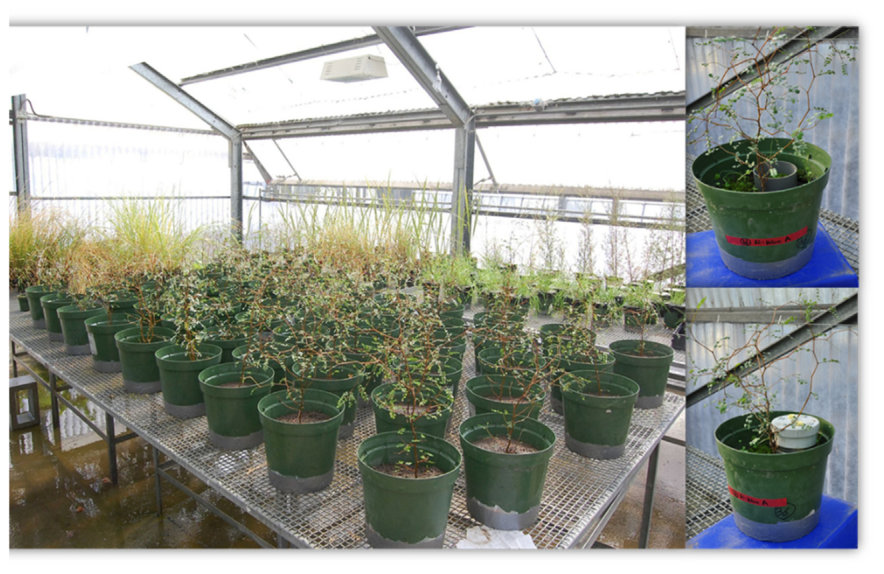
Surface soils (0–15 cm) were collected from the Lincoln University commercial dairy farm for use in this mesocosm experiment. The dairy farm soil (Templeton silt loam) is intensively managed, irrigated and fertilised, and is representive of intermediate terraces in the Province of Canterbury on South Island (Molloy, 1988). The soil was sieved and uniformly mixed prior to planting. Four species of earthworms representing different ecological groups and burrowing behaviours were selected for this study. Two native anecic species, Maoridrilus transalpinus and Maoridrilus sp.2 were collected respectively from a nature reserve (Ahuriri Reserve, Banks Peninsula) and beneath a mature stand of exotic Quercus ilex trees on the university campus. The earthworms were identified using DNA barcoding (16S and COI), which showed that Maoridrilus sp.2 has not been previously recorded and may be new to science (Kim, 2016). An exotic endogeic species (Octolasion cyaneum) was also sampled from the Ahuriri Reserve; we have observed that both Maoridrilus and Octolasion commonly coexist in Banks Peninsula forests. The exotic epigeic, Eisenia fetida, was purchased from a local vermicomposting company. One-year-old single plants of Sophora microphylla (Kowhai) of uniform size were purchased from a nursery, acclimated to glasshouse growth conditions for 4 weeks, then transplanted into the dairy farm soil in 55 plastic plant pots (5 l volume), and maintained for a further 7 days before the addition of rhizobial and then earthworm inocula (Fig. 1).
本中宇宙试验所用表层土壤(0–15 cm)采自林肯大学商业化奶牛场。该奶牛场土壤(Templeton粉砂壤土)经集约化管理、灌溉和施肥,代表了南岛坎特伯雷地区的中级阶地(Molloy, 1988)。种植前将土壤过筛并均匀混合。本研究选取了代表不同生态类群和掘穴行为的4种蚯蚓。两种本土深栖型(anecic)物种Maoridrilus transalpinus和Maoridrilus sp.2,分别采自自然保护区(Ahuriri Reserve,班克斯半岛)以及校园内一片成熟的外来冬青栎(Quercus ilex)林下。利用DNA条形码(16S和COI)对蚯蚓进行了鉴定,结果表明Maoridrilus sp.2此前未见记录,可能为科学上的新种(Kim, 2016)。另从Ahuriri Reserve采集了一种外来内栖型(endogeic)物种(Octolasion cyaneum);我们观察到Maoridrilus与Octolasion在班克斯半岛森林中普遍共存。外来表栖型(epigeic)物种赤子爱胜蚓(Eisenia fetida)购自当地一家蚯蚓堆肥公司。从苗圃购买大小一致的1年生小叶槐(Sophora microphylla,Kowhai)单株,在温室生长条件下驯化4周后,移栽至55个装有奶牛场土壤的塑料花盆(容积5 l)中,再培养7天后依次接种根瘤菌和蚯蚓(图1)。
Novel Mesorhizobium sp. cultures (Strain ICMP 19535; Tan et al., 2015) were obtained from the International Collection of Microorganisms from Plants at Landcare Research (Auckland, NZ) and incubated into Yeast Mannitol Broth (YMB) at 25 �C in the dark for a week to derive liquid cultures which were poured in 50 ml aliquots into 25 pots, on two occasions 7 days apart. This strain is known to be effective on S. microphylla. Autoclaved YMB was added to 5 reference pots in the same amounts and at the same time as a control. One week later, four adult earthworms of a single species were added to each pot, with 5 replicates, and an additional 5 pots without earthworms. Weight of all species of earthworm were recorded prior to inoculation. The drainage holes and upper surface of the pots were covered with gauze to prevent earthworms escaping during the experiment. Pots were randomized and maintained for 8 weeks in natural light at 20 � 5 �C. There were 5 replicates of each treatment, providing a total of 45 pots (4 species of earthworms, with and without rhizobial inoculation, plus 5 pots with neither earthworms nor inocula). These mesocosms were lightly watered every 3 days for 8 weeks, adding the same volume of water to each pot to maintain likely optimal moisture conditions of 25–30% (Wever et al., 2001; Eriksen-Hamel and Whalen, 2006).
新型Mesorhizobium sp.菌株(菌株ICMP 19535;Tan et al., 2015)获自Landcare Research(新西兰奥克兰)的国际植物微生物保藏中心,接种于酵母甘露醇肉汤(YMB)中,于25 °C黑暗条件下培养一周得到液体培养物,分两次(间隔7天)以每份50 ml倒入25个花盆中。已知该菌株对S. microphylla有效。作为对照,同时向5个参比花盆中加入等量经高压灭菌的YMB。一周后,向每个花盆中加入同一物种的成年蚯蚓4条,设5个重复,另设5个不加蚯蚓的花盆。接种前记录了所有蚯蚓物种的体重。花盆排水孔和上表面均覆盖纱布,以防试验期间蚯蚓逃逸。花盆随机排列,在自然光照、20 ± 5 °C条件下维持8周。每个处理设5个重复,共计45个花盆(4种蚯蚓,分别接种与不接种根瘤菌,另加5个既不加蚯蚓也不接种的花盆)。在8周内每3天对这些中宇宙轻度浇水一次,每盆加水量相同,以维持可能最适的25–30%含水量条件(Wever et al., 2001; Eriksen-Hamel and Whalen, 2006)。
2.2. Plant and soil analyses2.2. 植物与土壤分析
Plant height was measured after 8 weeks, then plants were harvested and root nodules were counted by hand sorting after gently removing roots from the soil. Roots and shoots were separated and oven-dried (65 �C, 3 days) prior to measurement of dry weight. Earthworms were collected from each pot, then visually assessed for health and individually weighed.
8周后测定株高,随后收获植株,将根系从土壤中轻轻取出后人工分拣计数根瘤。将根和地上部分开,烘干(65 °C,3天)后测定干重。从每个花盆中收集蚯蚓,目视评估其健康状况并逐条称重。
About 1 kg of fresh soil was collected from each pot and stored at 4 �C for less than one week prior to soil analyses. Following extraction in 2 M KCl, samples of the fresh soil were analysed for N (NH4 and NO3) using a FIA star 5000 triple channel analyser (Foss Tecator AB, Sweden) (Clough et al., 2001). For soil dehydrogenase enzyme activity (DHA), 2 g of fresh soil was incubated with 2 ml of 2,3,5-triphenyltetrazolium chloride (TTC) solution for 24 h at 25 �C in darkness. After extraction with 10 ml of methanol, the supernatant was measured at an absorption of 475 nm using a UV 160A spectrophotometer (Shimadzu, Japan) (Casida et al., 1964). Air-dried soil samples (20 �C, 5 days) were sieved ( < 2 mm) prior to determination of pH and electrical conductivity (EC). Following 0.5 M NaHCO3 extraction (1 g soil: 20 ml extractant), plant available-P was measured as Olsen P, spectroscopically at a wavelength of 880 nm using a UV 160A spectrophotometer (Shimadzu, Japan) (Blakemore, 1987). Following oven-drying (100 �C), Total Organic Matter (TOM) was analysed as Loss on Ignition (LOI) in a muffle furnace at 500 �C. Total N and C were analysed using a Vario-Max CN elemental analyser (Elementar GmbH, Germany).
从每个花盆中采集约1 kg新鲜土壤,于4 °C保存不超过一周后进行土壤分析。新鲜土样经2 M KCl浸提后,采用FIA star 5000三通道分析仪(Foss Tecator AB,瑞典)测定N(NH4和NO3)(Clough et al., 2001)。土壤脱氢酶活性(DHA)的测定方法为:取2 g新鲜土壤与2 ml 2,3,5-氯化三苯基四氮唑(TTC)溶液于25 °C黑暗中培养24 h,经10 ml甲醇浸提后,用UV 160A分光光度计(Shimadzu,日本)在475 nm波长下测定上清液吸光度(Casida et al., 1964)。风干土样(20 °C,5天)过筛( < 2 mm)后测定pH和电导率(EC)。经0.5 M NaHCO3浸提(1 g土:20 ml浸提剂)后,以Olsen P表示植物有效磷,用UV 160A分光光度计(Shimadzu,日本)在880 nm波长下进行分光光度测定(Blakemore, 1987)。烘干(100 °C)后,在马弗炉中于500 °C以烧失量(LOI)测定总有机质(TOM)。全氮和全碳采用Vario-Max CN元素分析仪(Elementar GmbH,德国)测定。
2.3. Gas sampling2.3. 气体采样
Gas measurement for nitrous oxide was carried out after 55 days. A plastic chamber (0.5 l) was installed on the soil surface. Gas (10 ml) was collected from the headspace, 0, 20, and 40 min after sealing. Gas samples were stored at 16 �C in darkness for less than one week. Nitrous oxide (N2O) was analysed using a gas chromatograph (GC) (SRI 8610 GC, CA, USA) with a 63Ni electron capture detector (ECD) and a flame ionisation detector (FID) linked to an auto-sampler (Gilson 222 XL, USA). Methods follow those described by Clough et al. (2006).
于第55天测定氧化亚氮气体。在土壤表面安装塑料箱(0.5 l),密封后第0、20和40 min从顶空采集气体(10 ml)。气体样品于16 °C黑暗条件下保存不超过一周。氧化亚氮(N2O)采用配备63Ni电子捕获检测器(ECD)和火焰离子化检测器(FID)并连接自动进样器(Gilson 222 XL,美国)的气相色谱仪(GC)(SRI 8610 GC,CA,美国)进行分析。方法参照Clough et al. (2006)所述。
2.4. Statistical analyses2.4. 统计分析
All data analyses used Minitab 16 (Minitab Inc., State College, Pennsylvania, USA), with One- and Two-Way ANOVA and post-hoc Fisher’s LSD tests employed to identify differences between soil properties, plant growth, nodulation and N2O emissions. Mean and standard error of soil pH values were calculated by conversion to the equivalent hydrogen ion concentrations and back calculation to the pH.
所有数据分析均使用Minitab 16(Minitab Inc.,State College,Pennsylvania,美国),采用单因素和双因素ANOVA及事后Fisher’s LSD检验,以鉴别土壤性质、植物生长、结瘤和N2O排放之间的差异。土壤pH的均值和标准误通过将pH换算为相应的氢离子浓度计算后再反算为pH得到。
3Results结果
3.1. Earthworms growth and mortality3.1. 蚯蚓的生长与死亡率
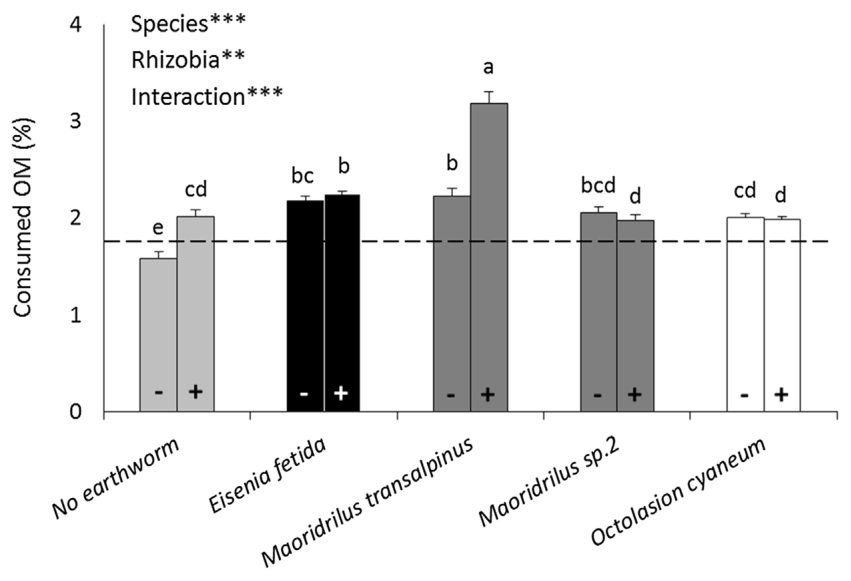
After 8 weeks, mortality rates of earthworms were less than 10% for all species, except for M. transalpinus (60% mortality with rhizobial inoculation, 75% mortality without rhizobial inoculation). The amount of organic matter consumed was calculated crudely from the change in soil TOM over the duration of the experiment (Fig. 2). M. transalpinus consumed more organic matter than other species, compared to the control pots, despite poor survivorship and a 31% weight loss of surviving earthworms. There was less weight loss with rhizobial inoculation, where soil organic matter consumption was even higher (data not shown). An overall weight gain was recorded only for Maoridrilus sp.2. Differences were only small, but comminution of OM significantly differed in relation to earthworm species (p < 0.001), rhizobial inoculation (p < 0.01) with a significant interaction (p < 0.001).
8周后,除M. transalpinus外(接种根瘤菌时死亡率为60%,不接种时为75%),所有蚯蚓物种的死亡率均低于10%。有机质消耗量根据试验期间土壤TOM的变化进行粗略计算(图2)。与对照花盆相比,M. transalpinus消耗的有机质多于其他物种,尽管其存活率较低,且存活个体体重下降了31%。接种根瘤菌时体重下降较少,而此时土壤有机质消耗量甚至更高(数据未列出)。仅Maoridrilus sp.2记录到总体体重增加。虽然差异较小,但有机质粉碎程度因蚯蚓物种(p < 0.001)和根瘤菌接种(p < 0.01)不同而存在显著差异,且二者存在显著交互作用(p < 0.001)。
3.2. Plant growth3.2. 植物生长
Two-way ANOVAs showed that earthworm species, rhizobia treatment, and their interaction significantly impacted the shoot length (Table 1). Plants generally grew better in terms of shoot length the presence of earthworms over the 8-week period. Both native earthworms (Maoridrilus spp.) significantly enhanced shoot length more than other treatments. There were no marked differences in shoot length and dry weight between earthworm species in the earthworm-rhizobia inoculation treatment. In the rhizobia-inoculation treatment, only O. cyaneum significantly increased shoot length more than in pots without earthworms.
双因素ANOVA表明,蚯蚓物种、根瘤菌处理及其交互作用对地上部长度均有显著影响(表1)。在8周内,有蚯蚓存在时植物的地上部长度总体上生长更好。两种本土蚯蚓(Maoridrilus spp.)对地上部长度的促进作用显著大于其他处理。在蚯蚓–根瘤菌接种处理中,不同蚯蚓物种之间的地上部长度和干重无明显差异。在根瘤菌接种处理中,仅O. cyaneum使地上部长度显著高于无蚯蚓花盆。
Plant growth in the mesocosm experiment after 8 weeks. Values in brackets represent standard error of the mean (n = 5). Same letters indicate no significant difference (LSD, p < 0.05). Two-way ANOVA analyses the effect of earthworm species, rhizobia addition, and their interaction are indicated with superscripts (ns for not significant, *p < 0.05, **p < 0.01, and ***p < 0.001).
8周后中宇宙试验中的植物生长情况。括号内数值为均值的标准误(n = 5)。相同字母表示无显著差异(LSD,p < 0.05)。双因素ANOVA分析蚯蚓物种、根瘤菌添加及其交互作用的效应,以上标表示(ns表示不显著,*p < 0.05,**p < 0.01,***p < 0.001)。
| Treatment处理 | Shoot length地上部长度 | Dry weight干重 | |||
|---|---|---|---|---|---|
| Total | Shoot | Root | |||
| (cm) | (g) | (g) | (g) | ||
| Control | No inoculanty | 50.4 (2.8) | 10.0 (0.9) | 7.8 (0.6) | 2.5 (0.3) |
| No Rhizobia | No earthworm | 50.4 (4.3)c | 10.0 (0.9)b | 7.6 (0.6)c | 2.4 (0.2)b |
| Eisenia fetida | 61.8 (1.4)b | 12.0 (1.3)ab | 8.8 (0.8)bc | 3.2 (0.5)ab | |
| Maoridrilus transalpinus | 73.4 (3.0)a | 14.8 (0.6)a | 11.3 (0.5)a | 3.5 (0.2)a | |
| Maoridrilus sp.2 | 70.6 (1.5)a | 13.9 (1.8)a | 10.7 (1.3)ab | 3.2 (0.4)ab | |
| O. cyaneum | 58.8 (2.8)b | 10.2 (0.6)b | 7.6 (0.5)c | 2.6 (0.2)ab | |
| Rhizobia | No earthworm | 54.4 (4.1)b | 11.0 (1.9)a | 8.2 (1.4)a | 2.8 (0.5)a |
| Eisenia fetida | 57.6 (1.5)ab | 9.6 (0.4)a | 6.8 (0.3)a | 2.8 (0.3)a | |
| Maoridrilus transalpinus | 57.6 (4.0)ab | 11.7 (1.4)a | 8.3 (1.1)a | 3.3 (0.3)a | |
| Maoridrilus sp.2 | 60.4 (3.2)ab | 10.0 (0.7)a | 7.6 (0.5)a | 2.4 (0.2)a | |
| O. cyaneum | 65.4 (1.5)a | 9.9 (0.8)a | 7.2 (0.6)a | 2.7 (0.2)a | |
| Two-way ANOVA (p value) | Species | 0* | 0.057ns | 0.036* | 0.152ns |
| Rhizobia | 0.042* | 0.021* | 0.006 | 0.421ns | |
| Interaction | 0.002 | 0.181ns | 0.126ns | 0.453ns |
yYeast mannitol broth (YMB) addition without rhizobial inoculant.
y添加酵母甘露醇肉汤(YMB)但未接种根瘤菌。
3.3. Root nodulation3.3. 根系结瘤
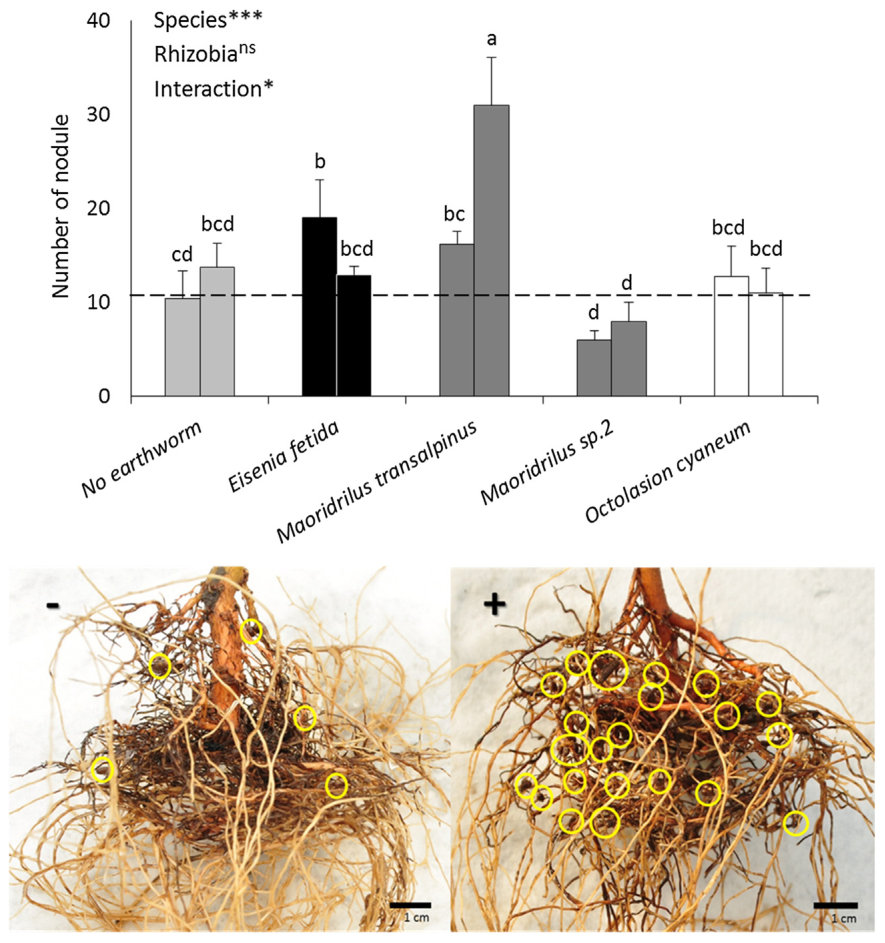
Surprisingly rhizobial inoculation had no effect on root nodulation, although it varied with species of earthworm and there was apparent interaction between these treatments (Fig. 3). The number of nodules increased in the presence of earthworms, particularly with E. fetida. With addition of rhizobia inocula, M. transalpinus almost doubled the number of root nodules. With other species of earthworms, the addition of the rhizobial inoculum made lesser or no difference. Maoridrilus sp.2 appeared to deplete nodule numbers compared to the control.
出乎意料的是,根瘤菌接种对根系结瘤没有影响,但结瘤随蚯蚓物种而变化,且这两个处理之间存在明显的交互作用(图3)。有蚯蚓存在时根瘤数量增加,尤以E. fetida为甚。添加根瘤菌接种物后,M. transalpinus使根瘤数量几乎增加一倍。对于其他蚯蚓物种,添加根瘤菌接种物的影响较小或无影响。与对照相比,Maoridrilus sp.2似乎减少了根瘤数量。
3.4. Soil properties3.4. 土壤性质
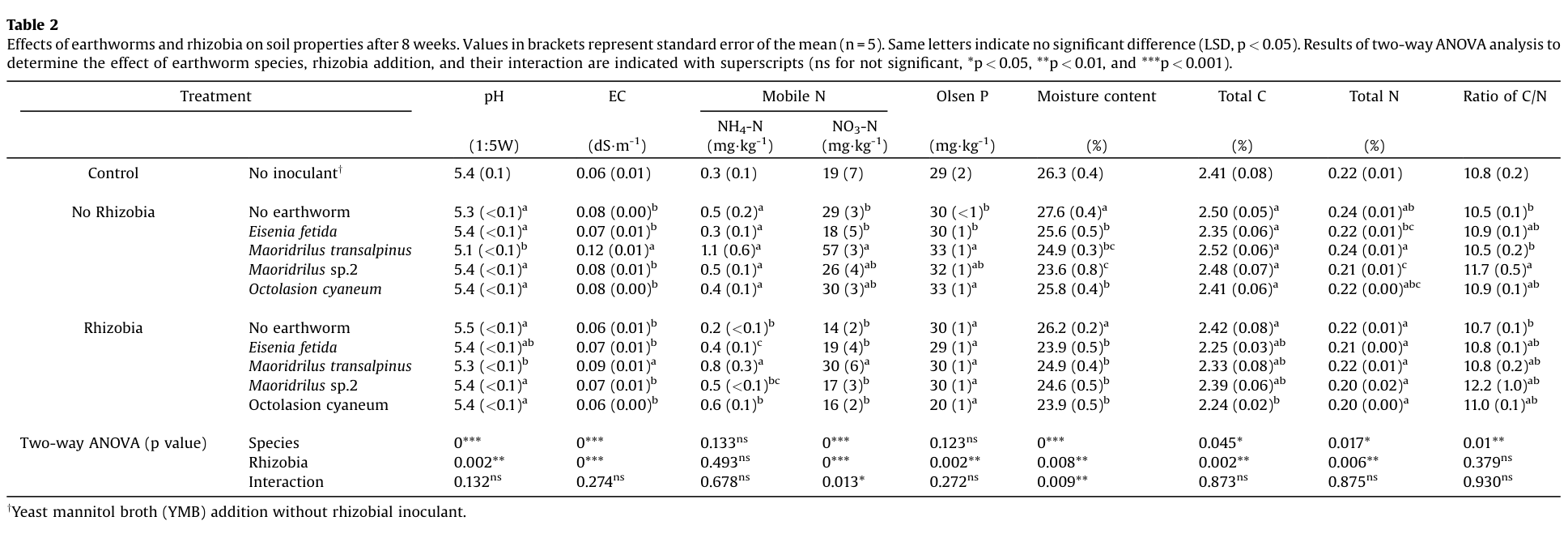
M. transalpinus had the most significant effect on soil properties, marginally lowering soil pH, enhancing EC, and substantially increasing soil concentrations of mobile forms of nitrogen (Table 2). There was significant interaction between these two treatments (p < 0.05), in terms of increased nitrate concentrations. Effects of the treatments on Total C and N, and mobile P were negligible.
M. transalpinus对土壤性质的影响最为显著,使土壤pH略有降低、EC升高,并大幅提高了土壤中移动态氮的浓度(表2)。就硝态氮浓度的增加而言,这两个处理之间存在显著交互作用(p < 0.05)。各处理对全碳、全氮及移动态磷的影响可忽略不计。
3.5. Microbial activity3.5. 微生物活性
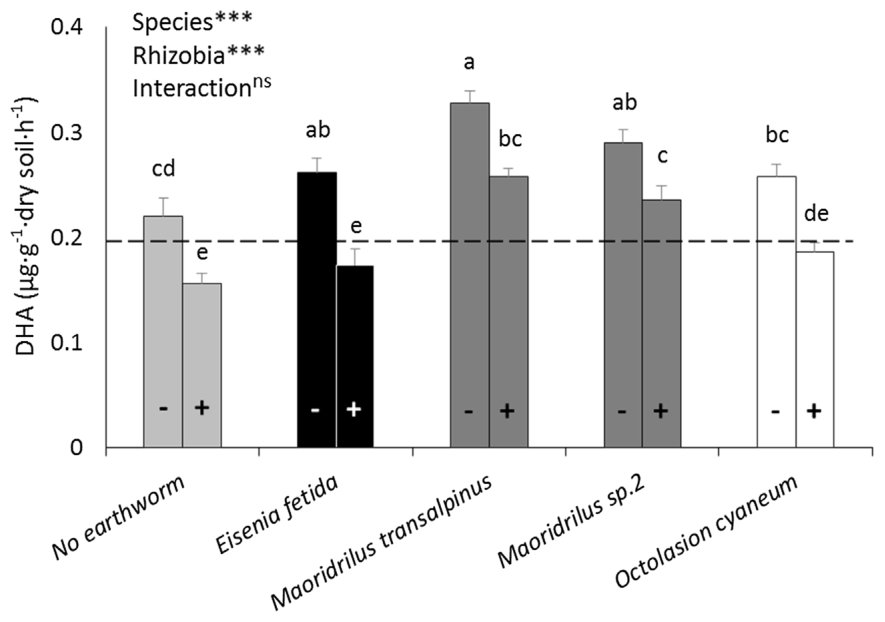
In the absence of rhizobia-inoculation, earthworms activated production of more dehydrogenase enzyme (DHA) in soil (Fig. 4). The presence of the native species, M. transalpinus and Maoridrilus sp.2, increased DHA by 65% and 51%, respectively. However, the rhizobial inoculant consistently reduced this effect; DHA decreased by at least 20%. Compared with exotic earthworms, both native Maoridrilus spp. significantly enhanced microbial activity.
在未接种根瘤菌的情况下,蚯蚓促使土壤产生更多的脱氢酶(DHA)(图4)。本土物种M. transalpinus和Maoridrilus sp.2的存在分别使DHA提高了65%和51%。然而,根瘤菌接种物一致地削弱了这一效应:DHA降低了至少20%。与外来蚯蚓相比,两种本土Maoridrilus spp.均显著提高了微生物活性。
3.6. N2O emission3.6. N2O排放
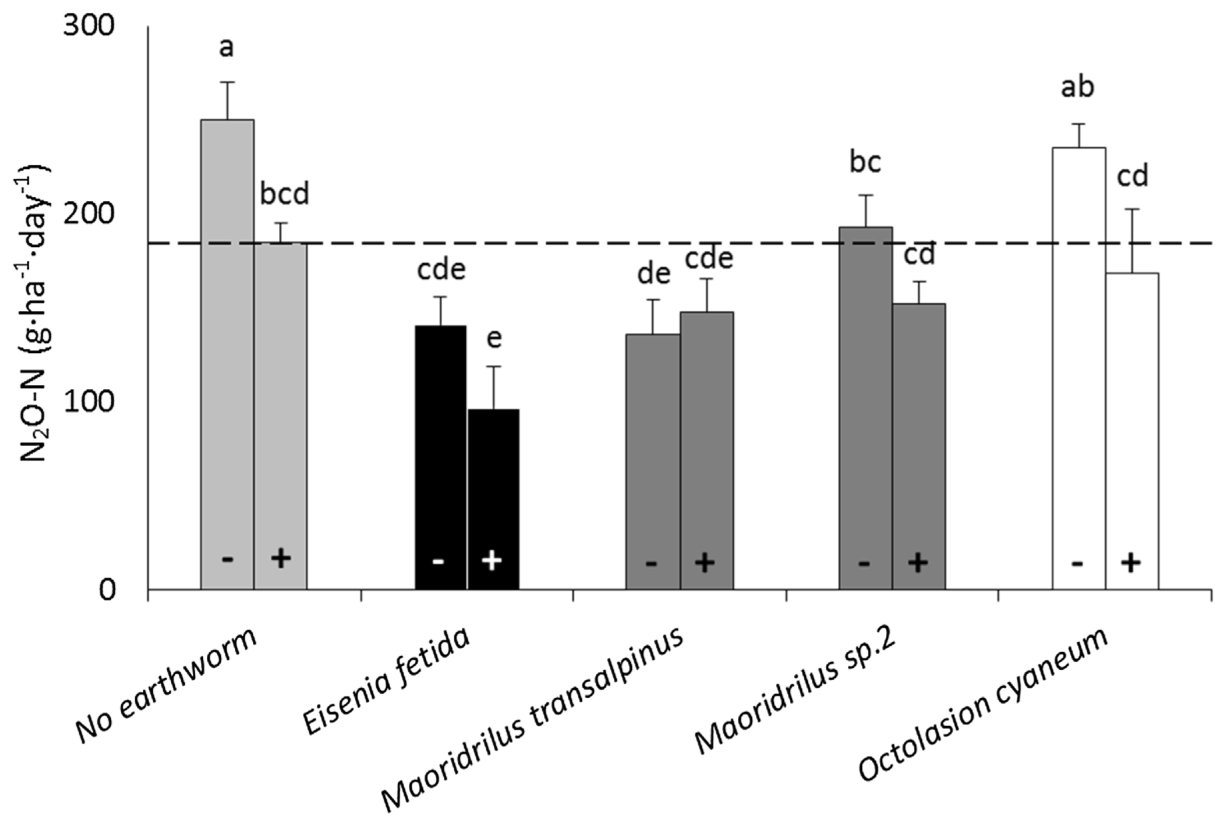
When combined with rhizobial inoculation, none of the earthworm species enhanced the release of nitrous oxide from soil (Fig. 5).
在与根瘤菌接种相结合时,没有一种蚯蚓促进土壤氧化亚氮的释放(图5)。
4Discussion讨论
4.1. Survivorship and behaviour of earthworms4.1. 蚯蚓的存活与行为
M. transalpinus had higher mortality rates than the other species of earthworms after 8 weeks in the mesocosms. Several freshly-dead individuals of this species were found towards the end of the experiment, and soil in all the pots containing these earthworms showed clear evidence of having been well worked through burrowing. This indicated survivorship was much higher for a large part of the experimental period. Other more recent studies we have carried out (Kim, 2016) have shown that high levels of survivorship in this species in similar pot experiments are seldom maintained for more than 6 weeks, unless the earthworms are provided with an abundant food source.
在中宇宙中经过8周后,M. transalpinus的死亡率高于其他蚯蚓物种。试验接近结束时发现了该物种的数条新近死亡个体,且所有含有该种蚯蚓的花盆中,土壤均有明显的经充分掘穴翻动的迹象。这表明在试验期的大部分时间里其存活率要高得多。我们近期开展的其他研究(Kim, 2016)表明,在类似的盆栽试验中,除非为该物种提供充足的食物来源,否则其高存活率很少能维持6周以上。
During the separation of plant roots from soil, it was observed that the two Maoridrilus species were invariably intertwined within the root system and there was noticeably more evidence of burrowing and mixing of the soil, compared to the other species. Octolasion tended to dwell beneath the roots towards the bottom of the pot, whilst E. fetida inhabited soil close to the soil surface. Enhanced plant growth appeared to be related to the different ecological grouping of earthworms. There are substantial differences in terms of burrowing behaviour between these ecological groups of earthworm, the consequences of which are almost certainly masked by the uniformly mixed soils without natural vertical horizons in this mesocosm experiment.
在将植物根系与土壤分离的过程中观察到,两种Maoridrilus蚯蚓总是缠绕在根系之中,且与其他物种相比,土壤掘穴和混合的迹象明显更多。Octolasion倾向于栖居在根系下方靠近盆底处,而E. fetida则栖居于靠近土表的土壤中。植物生长的促进似乎与蚯蚓的不同生态类群有关。这些蚯蚓生态类群在掘穴行为方面存在显著差异,但在本中宇宙试验中,由于土壤经均匀混合而缺乏自然的垂直层次,这些差异的影响几乎必然被掩盖了。
Poor survivorship of M. transalpinus was considered to be an acceptable limitation of this experiment; previous studies have shown that decaying earthworm bodies do not significantly contribute to the amount of N otherwise released into soil by earthworms (Whalen et al.,1999; van Groenigen et al., 2014). There were no reference pots without plants in the present study, although better growth of Lumbricid earthworms has been previously recorded in the presence of legumes (Milcu et al., 2008).
M. transalpinus存活率低被视为本试验可接受的局限性;以往研究表明,腐解的蚯蚓尸体对蚯蚓原本向土壤释放的氮量并无显著贡献(Whalen et al.,1999; van Groenigen et al., 2014)。本研究未设置无植物的参比花盆,但此前已有记录表明,在豆科植物存在时正蚓科蚯蚓生长更好(Milcu et al., 2008)。
4.2. Effect on plant growth and nodulation4.2. 对植物生长和结瘤的影响
Whalen et al. (1999) found that, despite the relatively small amount of nitrogen, 70% of that released by decaying earthworms could be incorporated into plant shoots within 16 days. In the present study, it would seem highly likely that 75% mortality may explain better plant growth in the M. transalpinus treatment without rhizobial inoculation. However, this simple explanation is contradicted by the absence of a plant growth response with rhizobial inoculation and 60% earthworm mortality. Rhizobial inoculation led to lower rates of shoot growth, but neither earthworms nor rhizobia significantly modified root biomass. The growth period was quite short in the present study, but a recent meta-analysis study showed an average 23% increase in aboveground plant biomass due to the presence of earthworms, largely through release of N from organic matter (van Groenigen et al., 2014).
Whalen et al. (1999)发现,尽管腐解蚯蚓释放的氮量相对较少,但其中70%可在16天内被植物地上部吸收。在本研究中,75%的死亡率极有可能解释了未接种根瘤菌的M. transalpinus处理中植物生长较好的现象。然而,这一简单解释与接种根瘤菌且蚯蚓死亡率为60%时植物生长无响应的结果相矛盾。根瘤菌接种导致地上部生长速率降低,但蚯蚓和根瘤菌均未显著改变根系生物量。本研究的生长期相当短,但最近一项荟萃分析研究表明,蚯蚓的存在使地上植物生物量平均增加23%,这主要是通过从有机质中释放氮实现的(van Groenigen et al., 2014)。
Rates of root nodulation were only enhanced in the presence of M. transalpinus, where the number of nodules per plant was 3� higher than the control. In pots without rhizobial inoculation, there was also a significant amount of root nodulation, suggesting that the soil or plants already contained inocula. The source of this soil inoculant may have been small amounts of clover in the dairy farm ryegrass sward, or plants may have acquired inocula from the nursery. However, Tan et al. (2015) found that closely-related Mesorhizobium type strains from other genera of legumes were unable to nodulate Sophora microphylla, which required its own specific type strains for nodulation. Genotypic data on rhizobia suggest co-evolution of rhizobial symbionts with Sophora in isolation from major areas of legume evolution has provided unique identities and novel characteristics (Tan et al., 2012). It is clear that there is significant interaction between earthworm species, plant growth and nodulation, but the complexity of these relationships has not been revealed in the present study.
仅在M. transalpinus存在时根系结瘤率得到提高,其单株根瘤数为对照的3倍。在未接种根瘤菌的花盆中也出现了相当数量的根系结瘤,表明土壤或植物中原本已含有接种体。这种土壤接种体可能来源于奶牛场黑麦草草皮中的少量三叶草,或者植物可能在苗圃中已获得接种体。然而,Tan et al. (2015)发现,来自其他豆科植物属的近缘Mesorhizobium模式菌株无法使Sophora microphylla结瘤,该植物需要其自身特有的模式菌株才能结瘤。根瘤菌的基因型数据表明,根瘤菌共生体与Sophora在远离豆科植物主要演化区域的隔离条件下协同进化,形成了独特的身份和新颖的特性(Tan et al., 2012)。显然,蚯蚓物种、植物生长和结瘤之间存在显著的交互作用,但本研究尚未揭示这些关系的复杂性。
4.3. Effects on soil biochemistry4.3. 对土壤生物化学的影响
Previous field studies elsewhere have shown that earthworms enhance N mineralization by reducing microbial immobilization, which may increase leaching losses of NO3 (Blair et al., 1997; Domínguez et al., 2004). In the present study, M. transalpinus had the largest influence on soil physicochemistry including soil pH, EC, and solubility of N. Over the 8 week period of this study little change could be expected in Total C and N concentrations in soil, but changes were detectable in these labile fractions. However, there was little apparent effect of the earthworms on mobile P in soil, even though this element is known to play a critical role in N fixation (Valentine et al., 2011; Vardien et al., 2016).
其他地区以往的田间研究表明,蚯蚓通过减少微生物固持而增强氮矿化,这可能增加NO3的淋溶损失(Blair et al., 1997; Domínguez et al., 2004)。在本研究中,M. transalpinus对土壤理化性质(包括土壤pH、EC和氮的溶解性)的影响最大。在本研究8周的时间内,土壤全碳和全氮浓度预计变化不大,但在这些活性组分中可以检测到变化。然而,蚯蚓对土壤中移动态磷几乎没有明显影响,尽管已知该元素在固氮中起关键作用(Valentine et al., 2011; Vardien et al., 2016)。
Dehydrogenase enzyme activity in soil was consistently lower with rhizobial inoculation but was enhanced by earthworms, particularly by Maoridrilus spp. Dehydrogenases provide a measure of overall soil microbial activity and play a significant role in the biological oxidation of soil organic matter, but most of this enzyme is produced by anaerobic microorganisms and would be expected to be lower under aerobic conditions (Wolinska� and Ste˛pniewska, 2012). In the presence of native anecic species the bulk soil in the pots was certainly aerated through burrowing and disturbance (Brown et al., 2004; Lemtiri et al., 2014), probably providing better conditions for rhizobial development and nodulation. At the same time, when soil was removed from the pots, our observations indicated higher moisture in soil fractions that were obviously from drilosphere walls (Horn et al., 2006; Lemtiri et al., 2014); this may have provided locations of increase anaerobic conditions that are required for DHA production. This may indicate that aeration of soil by earthworms provides improved conditions for nodulation in the rhizosphere, but also localised anaerobic conditions that favour anaerobic microroganisms and intracellular DHA production. These changed soil conditions may begin to explain why rhizobial inoculation in combination with earthworms decreased microbial activity.
接种根瘤菌时土壤脱氢酶活性一致较低,但蚯蚓(特别是Maoridrilus spp.)使其提高。脱氢酶可衡量土壤微生物的整体活性,并在土壤有机质的生物氧化中起重要作用,但这种酶大部分由厌氧微生物产生,因此在好氧条件下预计会较低(Wolińska and Stępniewska, 2012)。在本土深栖型物种存在时,花盆中的土体无疑因掘穴和扰动而得到通气(Brown et al., 2004; Lemtiri et al., 2014),这可能为根瘤菌的发育和结瘤提供了更好的条件。同时,在从花盆中取出土壤时,我们观察到明显来自蚓穴壁的土壤组分含水量较高(Horn et al., 2006; Lemtiri et al., 2014);这可能形成了厌氧程度增加的局部位点,而厌氧条件正是DHA产生所需要的。这可能表明,蚯蚓对土壤的通气作用改善了根际中的结瘤条件,同时也形成了有利于厌氧微生物和胞内DHA产生的局部厌氧条件。这些土壤条件的改变或许可以初步解释为何根瘤菌接种与蚯蚓相结合会降低微生物活性。
4.4. Effects on GHGs emission4.4. 对温室气体排放的影响
Changed moisture conditions and aeration of soil may also be responsible for differences in N2O production, which was generally reduced in the presence of earthworms (Fig. 5). Nitrification by aerobic, ammonia-oxidizing bacteria requires well-drained and aerated soils to produce nitrate from ammonium, as well as some nitrous oxide (Wrage et al., 2004; Barnard et al., 2005). However, denitrification of nitrate produces more nitrous oxide, but requires anaerobic conditions. Differences in N2O production, with and without rhizobial inoculation, reflect the same patterns as DHA except for pots with M. transalpinus. This species clearly had the most substantial influence on the results of the current experiment. It appears that, when there are more rhizobia, in more aerobic conditions, there is consequently less N2O production. A higher level of burrowing activity appeared to provide aerobic conditions for higher nodulation that outweighed anaerobic conditions within drilosphere walls. This species consumed more organic matter, but increased aeration that provided more nitrate from its decomposition, but less conversion of NO3 to N2O. This differs to some previous studies that have shown increased N2O production in the presence of earthworms in both laboratory and field conditions (Lubbers et al., 2013a,b).
土壤水分条件和通气状况的改变也可能是N2O产生量差异的原因,有蚯蚓存在时N2O产生量总体降低(图5)。好氧氨氧化细菌的硝化作用需要排水良好且通气的土壤,才能将铵转化为硝酸盐,同时产生少量氧化亚氮(Wrage et al., 2004; Barnard et al., 2005)。然而,硝酸盐的反硝化作用虽产生更多的氧化亚氮,但需要厌氧条件。除含M. transalpinus的花盆外,接种与未接种根瘤菌时N2O产生量的差异与DHA呈现相同的规律。该物种显然对本试验结果的影响最为显著。看来,在好氧程度更高的条件下根瘤菌更多时,N2O的产生量随之减少。较高水平的掘穴活动似乎为更多的结瘤提供了好氧条件,其作用超过了蚓穴壁内的厌氧条件。该物种消耗了更多的有机质,同时增加了通气,从而通过有机质分解提供了更多的硝酸盐,但NO3向N2O的转化减少。这与此前一些研究结果不同,那些研究表明在实验室和田间条件下蚯蚓存在时N2O产生量均增加(Lubbers et al., 2013a,b)。
4.5. Integration of findings4.5. 研究结果的综合
We found previously that individual species of earthworm could be separated on the basis of their modification of soil biogeochemistry, with differences particularly evident in terms of organic matter consumption, nitrogen and phosphorus mineralisation, soil microbial biomass and solubility of soil nutrients (Kim et al., 2015; Kim, 2016). Obviously this becomes more complex in the presence of plant roots. It has been shown previously that plant roots improve macroaggregate stability, which is decreased by earthworms (Milleret et al., 2009). The drilosphere provides numerous benefits for plants, including pathways for root elongation, increased aeration and enhanced supply of plantavailable nutrients (Brown et al., 2000; Kautz et al., 2013).
我们此前发现,可根据蚯蚓个体物种对土壤生物地球化学的改变对其加以区分,差异在有机质消耗、氮磷矿化、土壤微生物生物量以及土壤养分溶解性方面尤为明显(Kim et al., 2015; Kim, 2016)。显然,在植物根系存在时情况会变得更加复杂。此前已有研究表明,植物根系可提高大团聚体稳定性,而蚯蚓则会降低其稳定性(Milleret et al., 2009)。蚓穴际(drilosphere)为植物提供了诸多益处,包括为根系伸长提供通道、增加通气以及增强植物有效养分的供应(Brown et al., 2000; Kautz et al., 2013)。
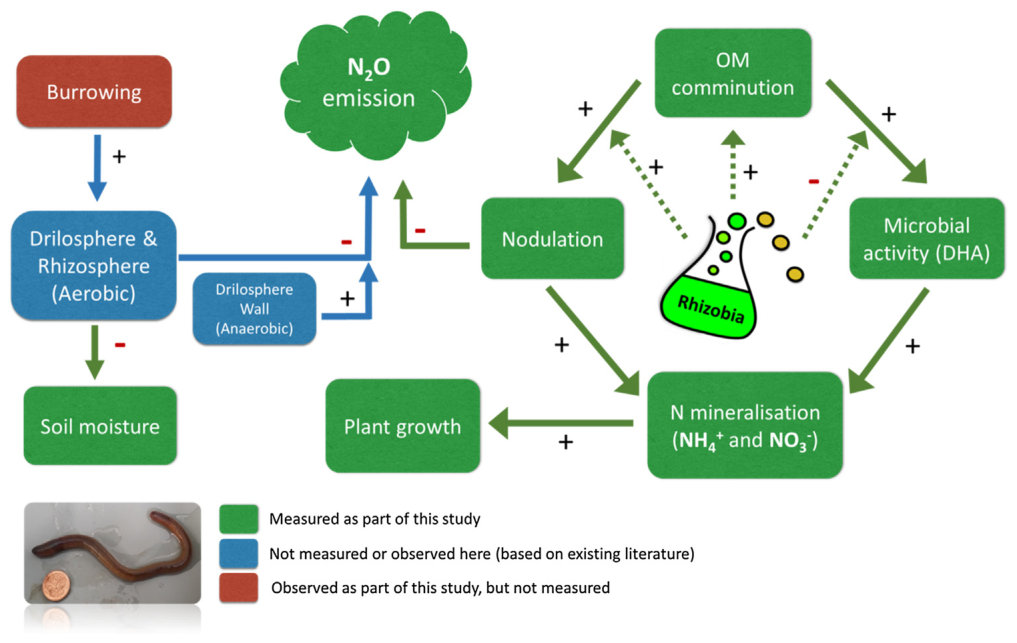
The results of the present study showed significant interactions between native earthworms, Sophora and N dynamics. M. transalpinus produced considerable amounts of drilosphere soils in the pots, enhancing microbial activity, N solubility and nodulation. It appears that this species effectively dispersed rhizobia, increased aeration and facilitated more nodulation, in turn supressing N2O emissions.
本研究结果表明,本土蚯蚓、Sophora与氮动态之间存在显著的交互作用。M. transalpinus在花盆中产生了大量蚓穴际土壤,提高了微生物活性、氮的溶解性和结瘤。看来,该物种有效地分散了根瘤菌,增加了通气并促进了更多结瘤,进而抑制了N2O排放。
Invasive exotic legumes are known to be capable of fixing up to 200 kg N ha�1 annum�1 in New Zealand (Magesan et al., 2012); an amount equivalent to current standard fertiliser applications in intensive agricultural land. Nitrate leaching does not appear to be higher under leguminous plants (Pattinson and Pattinson, 1985), but little is known of the N-fixing capacity of native legumes. Stands of invasive exotic gorse (Ulex europaeus) have been proven to have a role in restoration, providing nurse environments for native New Zealand plants (Burrows et al., 2015). However, this species has largely established on former agricultural land from which native earthworms have probably disappeared. The challenge remains to understand the role of both native legumes and native earthworms in the restoration trajectory, and their influence on both NO3 and N2O transfer to the wider environment.
已知在新西兰,入侵外来豆科植物可固定高达200 kg N ha−1 annum−1(Magesan et al., 2012),该量相当于目前集约化农业用地的标准施肥量。豆科植物下的硝酸盐淋溶似乎并不更高(Pattinson and Pattinson, 1985),但对本土豆科植物的固氮能力知之甚少。入侵外来荆豆(Ulex europaeus)林分已被证明在修复中发挥作用,可为新西兰本土植物提供保育环境(Burrows et al., 2015)。然而,该物种主要定植于原农业用地上,而这些土地上的本土蚯蚓很可能已经消失。理解本土豆科植物和本土蚯蚓在修复轨迹中的作用,以及它们对NO3和N2O向更广泛环境迁移的影响,仍是一项挑战。
The most desirable outcome would be to restore both native legumes and native earthworms into agricultural landscapes, whilst mitigating environmental concerns related to nitrogen. This would also have beneficial conservation outcomes. Results of the present study have demonstrated the interdependence between earthworms, root nodulation of Sophora and soil physicochemistry. Some combination of these factors mediates nitrogen cycling and influences the release of NO3 and N2O to the wider environment (Fig. 6). This work is a first step towards a better integrated understanding of the effects of plant growth, earthworm and microbial communities on N-cycling.
最理想的结果是将本土豆科植物和本土蚯蚓同时恢复到农业景观中,同时缓解与氮相关的环境问题。这也将带来有益的保护成效。本研究结果证明了蚯蚓、Sophora根系结瘤与土壤理化性质之间的相互依存关系。这些因素的某种组合调节着氮循环,并影响NO3和N2O向更广泛环境的释放(图6)。本工作是朝着更好地综合理解植物生长、蚯蚓和微生物群落对氮循环影响迈出的第一步。
Acknowledgements致谢
The authors thank the Punakaiki Coastal Restoration Project (PCRP) and Stuart Rhodes and Closure & Legacy Management, Rio Tinto Services Ltd. for their sponsorship of this work. The assistance of Hongtao Zhong and Shanshan Li for help with experimental work and Heng Wee Tan for providing rhizobial cultures is gratefully acknowledged.
作者感谢Punakaiki Coastal Restoration Project(PCRP)以及Stuart Rhodes和Closure & Legacy Management, Rio Tinto Services Ltd.对本研究的资助。衷心感谢Hongtao Zhong和Shanshan Li在试验工作中提供的帮助,以及Heng Wee Tan提供的根瘤菌培养物。
References参考文献
Bardgett, R.D., Wardle, D.A., 2010. Aboveground-Belowground Linkages: Biotic Interactions, Ecosystem Processes, and Global Change. Oxford University Press, Oxford.
Barnard, R., Leadley, P.W., Hungate, B.A., 2005. Global change, nitrification, and denitrification: a review. Glob. Biogeochem. Cycles 19 doi:http://dx.doi.org/ 10.1029/2004GB 002282 (GB1007).
Blair, J., Parmelee, R., Allen, M., McCartney, D., Stinner, B., 1997. Changes in soil N pools in response to earthworm population manipulations in agroecosystems with different N sources. Soil Biol. Biochem. 29, 361–367.
Blakemore, L.C., 1987. Extractable iron, aluminium and silicon: in methods for chemical analysis of soils. N. Z. Soil Bur. Sci. Rep. 80, 71–76.
Blouin, M., Hodson, M.E., Delgado, E.A., Baker, G., Brussaard, L., Butt, K.R., Dai, J., Dendooven, L., Peres, G., Tondoh, J.E., Cluzeau, D., Brun, J.J., 2013. A review of earthworm impact on soil function and ecosystem services. Eur. J. Soil Sci. 64, 161–182.
Bowie, M.H., Black, L., Boyer, S., Dickinson, N.M., Hodge, S., 2016. Persistence of biodiversity in a dryland remnant within an intensified dairy farm landscape. N. Z. J. Ecol. 40, 1–10.
Boyer, S., Blackemore, R.J., Wratten, S.D., 2011. An integrative taxonomic approach to the identification of three New Zealand endemic earthworm species
(Acanthodrilidae, Octochaetidae: Oligochaeta). Zootaxa 2994, 21–32.
Brown, G.G., Barois, I., Lavelle, P., 2000. Regulation of soil organic matter dynamics and microbial activity in the drilosphere and the role of interactions with other edaphic functional domains. Eur. J. Soil Biol. 36, 177–198.
Brown, G.G., Edwards, C.A., Brussaard, L., 2004. How earthworms affect plant growth: burrowing into the mechanisms. In: Edwards, C.A. (Ed.), Earthworm Ecology. CRC Press, New York, pp. 13–49.
Burrows, L., Cieraad, E., Head, N., 2015. Scotch broom facilitates indigenous tree and shrub germination and establishment in dryland New Zealand. N. Z. J. Ecol. 39, 61–70. Casida Jr., L., Klein, D., Santoro, T.,1964. Soil dehydrogenase activity. Soil Sci. 98, 371– 376. Clough, T.J., Stevens, R.J., Laughlin, R.J., Sherlock, R.R., Cameron, K.C., 2001. Transformations of inorganic-N in soil leachate under differing storage conditions. Soil Biol. Biochem. 33, 1473–1480.
Clough, T.J., Bertram, J.E., Sherlock, R.R., Leonard, R.L., Nowicki, B.L., 2006. Comparison of measured and EF5-r-derived N2O fluxes from a spring-fed river. Glob. Change Biol. 12, 477–488.
Dickinson, N., Marmiroli, M., Das, B., McLaughlin, D., Leung, D., Robinson, B., 2015. Endemic plants as browse crops in agricultural landscapes of New Zealand. Agroecol. Sustain. Food 39, 224–242.
Domínguez, J., Bohlen, P.J., Parmelee, R.W., 2004. Earthworms increase nitrogen leaching to greater soil depths in row crop agroecosystems. Ecosystems 7, 672– 685. Eriksen-Hamel, N.S., Whalen, J.K., 2006. Growth rates of Aporrectodea caliginosa (Oligochaetae: Lumbricidae) as influenced by soil temperature and moisture in disturbed and undisturbed soil columns. Pedobiologia 50, 207–215. Franklin, H.M., Dickinson, N.M., Esnault, C.J., Robinson, B.H., 2015. Native plants and nitrogen in agricultural landscapes of New Zealand. Plant Soil 394, 407–420.
Fraser, P.M., Williams, P.H., Haynes, R.J., 1996. Earthworm species, population size and biomass under different cropping systems across the Canterbury Plains, New Zealand. Appl. Soil Ecol. 3, 49–57.
Given, D.R., Meurk, C., 2000. Biodiversity of the Urban Environment: the Importance of Indigenous Species and the Role Urban Environments can Play in their Preservation. Lincoln University, Christchurch.
Heenan, P., De Lange, P., Wilton, A., 2001. Sophora (Fabaceae) in New Zealand: taxonomy, distribution, and biogeography. N. Z. J. Bot. 39, 17–53.
Horn, M.A., Drake, H.L., Schramm, A., 2006. Nitrous oxide reductase genes (nosZ) of denitrifying microbial populations in soil and the earthworm gut are phylogenetically similar. Appl. Environ. Microbiol. 72, 1019–1026.
Kautz, T., Amelung, W., Ewert, F., Gaiser, T., Horn, R., Jahn, R., Javaux, M., Kemna, A., Kuzyakov, Y., Munch, J.-C., Pätzold, S., Peth, S., Scherer, H.W., Schloter, M., Schneider, H., Vanderborght, J., Vetterlein, D., Walter, A., Wiesenberg, G.L.B., Köpke, U., 2013. Nutrient acquisition subsoils in temperate climates: a review. Soil Biol. Biochem. 57, 1003–1022.
Kim, Y.N., Robinson, B., Boyer, S., Zhong, H.T., Dickinson, N., 2015. Interactions of native and introduced earthworms with soils and plant rhizospheres in production landscapes of New Zealand. Appl. Soil Ecol. 96, 141–150.
Kim, Y., 2016. Interactions Between Soil Biogeochemistry and Native Earthworms in New Zealand. Lincoln University, Lincoln, New Zealand (PhD thesis).
Lee, K.E., 1959a. The Earthworm Fauna of New Zealand, vol. 130. New Zealand Department of Scientific and Industrial Research Bullentin, Wellington, NZ. Lee, K.E., 1959. A key for the identification of New Zealand earthworms, Soil Bur. Publ. No. 172., Tuatara, 8, p. 48.
Lee, K.E., 1961. Interactions between native and introduced earthworms. Proc. N. Z. Ecol. Soc. 8, 60–62.
Lemtiri, A., Colinet, G., Alabi, T., Cluzeau, D., Zirbes, L., Haubruge, É., Francis, F., 2014. Impacts of earthworms on soil components and dynamics: a review. Biotechnol. Agron. Soc. Environ. 18, 121–133.
Lubbers, I.M., González, E.L., Hummelink, E.W.J., van Groenigen, J.W., 2013a.
Earthworms can increase nitrous oxide emissions from managed grassland: a field study. Agric. Ecosyst. Environ. 174, 40–48.
Lubbers, I.M., van Groenigen, K.J., Fonte, S.J., Six, J., Brussaard, L., van Groenigen, J.W., 2013b. Greenhouse-gas emissions from soils increased by earthworms. Nat. Clim. Change 3, 187–194.
Magesan, G.N., Wang, H., Clinton, P.W., 2012. Nitrogen cycling in gorse-dominated ecosystems in New Zealand. N. Z. J. Ecol. 36, 21–28.
Milcu, A., Partsch, S., Scherber, C., Weisser, W.W., Scheu, S., 2008. Earthworms and legumes control litter decomposition in a plant diversity gradient. Ecology 89, 1872–1882.
Milleret, R., Le Bayon, R.C., Gobat, J.M., 2009. Root, mycorrhiza and earthworm interactions: their effects on soil structuring processes, plant and soil nutrient concentration and plant biomass. Plant Soil 316, 1–12.
Molloy, L., 1988. Soils in the New Zealand Landscape: the Living Mantle. Mallinson Rendel Publishers Ltd., Wellington.
Pattinson, J.A., Pattinson, J.M., 1985. Nitrate leaching losses under a legume-based crop rotation in Central Canterbury, New Zealand. N. Z. J. Agric. Res. 28,101–107.
Smith, C.M.S., Bowie, M.H., Hahner, J.L., Boyer, S., Kim, Y.N., Zhong, H.T., Abbott, M., Rhodes, S., Sharp, D., Dickinson, N., 2016. Punakaiki coastal restoration project: a case study for a consultative and multidisciplinary approach in selecting indicators of restoration success for a sand mining closure site West Coast, New Zealand. Catena 136, 91–103.
Springett, J., Gray, R., Barker, D.J., Lambert, M.G., Mackay, A.D., Thomas, V.J., 1998. Population density and distribution of the New Zealand indigenous earthworm Octochaetus multiporus (Megascolecidae: Oligochaeta) in hill pastures. N. Z. Ecol. 22, 87–93.
Tan, H.W., Weir, B.S., Carter, N., Heenan, P.B., Ridgway, H.J., James, E.K., Sprent, J.I., Young, J.P.W., Andrews, M., 2012. Rhizobia with 16S rRNA and nifH similar to Mesorhizobium huakuii but Novel recA, glnII, nodA and nodC genes are symbionts of New Zealand Carmichaelinae. PLoS One 7, e47677.
Tan, H.W., Heenan, P.B., De Meyer, S.E., Willems, A., Andrews, M., 2015. Diverse novel mesorhizobia nodulate New Zealand native Sophora species. Syst. Appl. Microbiol. 38, 91–98.
Thomas, M.B., Spurway, M.I., 2001. Kowhai (Sophora species) and other nitrogenfixing plants of New Zealand. Combined Proc., Int. Plant Propagators' Soc. 51, 94–97.
Tongway, D.J., Ludwig, J.A., 2011. Restoring Disturbed Landscapes: Putting Principles into Practice. Island Press.
Valentine, A.J., Benedito, V.A., Kang, Y., 2011. Legume nitrogen fixation and soil abiotic stress: from physiology to genomics and beyond. Ann. Plant Rev. 42, 207–248.
Vardien, W., Steenkamp, E.T., Valentine, A.J., 2016. Legume nodules from nutrientpoor soils exhibit high plasticity of cellular phosphorus recycling and conservation during variable phosphorus supply. J. Plant Physiol. 191, 73–81.
Wardle, D.A., 2002. Communities and Ecosystems: Linking the Aboveground and Belowground Components. Princeton University Press.
Wever, L.A., Lysyk, T.J., Clapperton, M.J., 2001. The influence of soil moisture and temperature on the survival, aestivation, growth and development of juvenile Aporrectodea tuberculata (Eisen) (Lumbricidae). Pedobiologia 45, 121–133.
Whalen, J.K., Parmelee, R.W., McCartney, D.A., Vanarsdale, J.L.,1999. Movement of N from decomposing earthworm tissue to soil, microbial and plant N pools. Soil Biol. Biochem. 31, 487–492.
Wilson, H.D., 2013. Plant Life on Banks Peninsula. Manuka Press, Cromwell.
Winterbourne, M., Knox, G., Burrows, C., Marsden, I., 2008. The Natural History of Canterbury. Canterbury University Press, Christchurch.
Wolinska,� A., Ste˛pniewska, Z., 2012. Dehydrogenase Activity in the Soil Environment. INTECH Open Access Publisher.
Wrage, N., Velthof, G.L., Laanbroek, H.J., Oenema, O., 2004. Nitrous oxide production in grassland soils: assessing the contribution of nitrifier denitrification. Soil Biol. Biochem. 36, 229–236.
Yahara, T., Javadi, F., Onoda, Y., de Queiroz, L.P., Faith, D.P., Prado, D.E., Akasaka, M., Kadoya, T., Ishihama, F., Davies, S., 2013. Global legume diversity assessment: concepts, key indicators, and strategies. Taxon 62, 249–266.
van Groenigen, J.W., Lubbers, I.M., Vos, H.M.J., Brown, G.G., De Deyn, G.B., van Groenigen, K.J., 2014. Earthworms increase plant production: a meta-analysis. Sci. Rep. 4, 6365.