Journal of Environmental Quality
WAste MAnAgeMent
Young-Nam Kim, Brett Robinson,* Jacqui Horswell, Stephane Boyer, and Nicholas Dickinson
1Abstract摘要
Biosolids can be a valuable fertilizer for agriculture and in ecological restoration, although there are concerns about contaminants. Earthworm activity, including vermicomposting of biosolids, may influence the efficacy of their use. We investigated how two New Zealand endemic anecic species of Maoridrilus (cf. Eisenia fetida) responded to biosolids amendment and affected the mobility of nutrients and trace elements as well as greenhouse gas emissions in biosolids-amended soil. Earthworms were incubated with mixtures of biosolids-amended soil (0, 6.25, 12.5, 25, and 50% biosolids by volume) for 21 d. All species survived in the soil–biosolids mixtures but not in 100% biosolids. The native earthworms, Maoridrilus transalpinus and Maoridrilus sp.2, increased KCl-extractable NH4+ and NO3- by up to 29%, substantially more than E. fetida. All species significantly increased microbial biomass carbon and Ca(NO3)2–extractable Cu but significantly decreased dehydrogenase enzymes activity in biosolids-amended soil. Concentrations of Ca(NO3)2–extractable Mg, S, Fe, Mn, Cd, Co, and Zn varied between earthworm species and with biosolids addition rates. New Zealand native earthworms exacerbated N2O emissions from soil, whereas E. fetida did not. Eisenia fetida is clearly a preferred species for vermicomposting biosolids and is more tolerant of high concentrations of biosolids. However, New Zealand native earthworms may be more suitable for improving the fertility of soil amended with biosolids.
生物固体(污泥)可作为农业和生态修复中有价值的肥料,但其中的污染物令人担忧。蚯蚓活动(包括生物固体的蚯蚓堆肥)可能影响生物固体的施用效果。本研究考察了两种新西兰特有的深栖型Maoridrilus蚯蚓(与Eisenia fetida对比)对生物固体添加的响应,及其对生物固体改良土壤中养分和微量元素迁移性以及温室气体排放的影响。将蚯蚓置于生物固体改良土壤混合物(生物固体体积比为0、6.25%、12.5%、25%和50%)中培养21 d。所有物种均能在土壤–生物固体混合物中存活,但不能在100%生物固体中存活。本土蚯蚓Maoridrilus transalpinus和Maoridrilus sp.2使KCl可提取态NH4+和NO3-最多提高29%,显著高于E. fetida。所有物种均显著提高了生物固体改良土壤中的微生物生物量碳和Ca(NO3)2可提取态Cu,但显著降低了脱氢酶活性。Ca(NO3)2可提取态Mg、S、Fe、Mn、Cd、Co和Zn的浓度因蚯蚓物种和生物固体添加比例而异。新西兰本土蚯蚓加剧了土壤N2O排放,而E. fetida则无此作用。Eisenia fetida显然是生物固体蚯蚓堆肥的首选物种,且对高浓度生物固体耐受性更强。然而,新西兰本土蚯蚓可能更适合用于提高生物固体改良土壤的肥力。
Core Ideas核心观点
- Locally sourced earthworms are a potential resource for the treatment of biosolids-amended soil.本地来源的蚯蚓是处理生物固体改良土壤的潜在资源。
- • Maoridrilus spp. increased biosolids mineralization more than Eisenia fetida.• Maoridrilus spp.对生物固体矿化的促进作用大于Eisenia fetida。
- Native earthworms enhanced microbial activity but increased N2O emission.本土蚯蚓增强了微生物活性,但增加了N2O排放。
B
iosolids comprise the treated solid fraction of sewage, containing high concentrations of organic matter (OM)
生物固体(污泥)是经处理的污水固体部分,含有高浓度的有机质(OM)
and plant nutrients (Gartler et al., 2013). Biosolids also commonly contain contaminants, including heavy metals (Silveira et al., 2003), persistent organic pollutants (Clarke and Smith, 2011), antibiotics, pharmaceuticals, and pathogens (Garrec et al., 2003; Jones-Lepp and Stevens, 2007). Nonetheless, biosolids can be beneficial as a soil amendment on agricultural land as well as in remediation and revegetation projects (Kinney et al., 2008). Until the middle of the 1990s, approximately 30% of European biosolids were applied to agricultural land, accounting for approximately 2.4 dry Mg yr-1 (Chang et al., 2002; Silveira et al., 2003), and 0.1% of the US agricultural land was treated with biosolids (NRC, 2002). With increased concerns about risks from chemical contaminants and pathogens, Europe and the United States now regulate biosolids disposal to production lands, including cropped and grazed lands. The addition of biosolids to soil can result in the accumulation of trace elements, especially Cd, Cu, and Zn (Silveira et al., 2003), and can result in reduced soil fertility or breaches of food safety standards (Wang et al., 2003). Such concerns are reduced when biosolids are used for rebuilding degraded soils (Robinson et al., 2011; Waterhouse et al., 2014a), where biosolids can stimulate soil microbial and enzymatic activities, enhancing soil nutrient status and plant growth (Evanylo et al., 2005; Gardner et al., 2010).
和植物养分(Gartler et al., 2013)。生物固体通常还含有污染物,包括重金属(Silveira et al., 2003)、持久性有机污染物(Clarke and Smith, 2011)、抗生素、药物和病原体(Garrec et al., 2003; Jones-Lepp and Stevens, 2007)。尽管如此,生物固体作为土壤改良剂,在农业用地以及修复和植被重建项目中均可发挥有益作用(Kinney et al., 2008)。直至20世纪90年代中期,欧洲约30%的生物固体施用于农业用地,约合2.4 dry Mg yr-1(Chang et al., 2002; Silveira et al., 2003),而美国0.1%的农业用地施用过生物固体(NRC, 2002)。随着对化学污染物和病原体风险的担忧加剧,欧洲和美国目前对生物固体向生产用地(包括耕地和放牧地)的处置实行监管。向土壤中添加生物固体可导致微量元素(尤其是Cd、Cu和Zn)的累积(Silveira et al., 2003),并可能导致土壤肥力下降或超出食品安全标准(Wang et al., 2003)。当生物固体用于重建退化土壤时,此类担忧有所减轻(Robinson et al., 2011; Waterhouse et al., 2014a);在此情形下,生物固体可刺激土壤微生物和酶活性,改善土壤养分状况并促进植物生长(Evanylo et al., 2005; Gardner et al., 2010)。
Most N in biosolids is present as organic N, which is unavailable to plants; organic N slowly mineralizes to plant-available ammonium (NH4+) and nitrate (NO3-) (Claassen and Carey, 2007). Thus, unlike mineral fertilizers, the addition of biosolids may not result in the release of sufficient N for optimal plant growth in the short term. However, earthworms enhance mineralization, thereby increasing the fraction of plant-available N in biosolids (Edwards and Arancon, 2004; McDaniel et al., 2013; Yadav and Garg, 2011). Vermicomposting has been proposed as a cost-effective and easily controllable means to increase mineral N in biosolids and to reduce the burden of human pathogens (Eastman et al., 2001; Yadav et al., 2010). Vermicomposting may also reduce N2O greenhouse gas emission from soils amended with biosolids (Fernández-Luqueño et al.,
生物固体中的大部分N以有机N形式存在,植物无法利用;有机N缓慢矿化为植物可利用的铵(NH4+)和硝酸盐(NO3-)(Claassen and Carey, 2007)。因此,与矿质肥料不同,添加生物固体在短期内可能无法释放足够的N以满足植物最佳生长需要。然而,蚯蚓可促进矿化,从而提高生物固体中植物可利用N的比例(Edwards and Arancon, 2004; McDaniel et al., 2013; Yadav and Garg, 2011)。蚯蚓堆肥被认为是一种成本低廉且易于控制的方法,可提高生物固体中的矿质N含量并降低人类病原体负荷(Eastman et al., 2001; Yadav et al., 2010)。蚯蚓堆肥还可能减少生物固体改良土壤的N2O温室气体排放(Fernández-Luqueño et al.,
Copyright © American Society of Agronomy, Crop Science Society of America, and Soil Science Society of America. 5585 Guilford Rd., Madison, WI 53711 USA. All rights reserved.
版权所有 © American Society of Agronomy, Crop Science Society of America, and Soil Science Society of America。5585 Guilford Rd., Madison, WI 53711 USA。保留所有权利。
J. Environ. Qual. 46:177–184 (2017) doi:10.2134/jeq2016.06.0207 Received 2 June 2016. Accepted 1 Dec. 2016.
J. Environ. Qual. 46:177–184 (2017) doi:10.2134/jeq2016.06.0207 2016年6月2日收稿,2016年12月1日接受。
*Corresponding author (Brett.Robinson@lincoln.ac.nz).
Y. Kim, N. Dickinson, and S. Boyer, Dep. of Ecology, Lincoln Univ., Lincoln, Christchurch, New Zealand; B. Robinson, Dep. of Soil and Physical Sciences, Lincoln Univ., Lincoln, Christchurch, New Zealand; J. Horswell, ESR, PO Box 50-348, Porirua, New Zealand; S. Boyer, Environmental and Animal Sciences, Unitec Institute of Technology, Auckland, New Zealand. Assigned to Associate Editor Qingguo Huang.
Y. Kim、N. Dickinson和S. Boyer,Lincoln大学生态学系,Lincoln,基督城,新西兰;B. Robinson,Lincoln大学土壤与物理科学系,Lincoln,基督城,新西兰;J. Horswell,ESR,PO Box 50-348,Porirua,新西兰;S. Boyer,Unitec理工学院环境与动物科学系,奥克兰,新西兰。责任副编辑:Qingguo Huang。
Abbreviations: APA, alkaline phosphatase activity; ASA, arylsulfatase activity; DHA, dehydrogenase enzymatic activity; EC, electrical conductivity; MBC, microbial biomass carbon; OM, organic matter; TOM, total organic matter; UA, urease activity.
缩写:APA,碱性磷酸酶活性;ASA,芳基硫酸酯酶活性;DHA,脱氢酶活性;EC,电导率;MBC,微生物生物量碳;OM,有机质;TOM,总有机质;UA,脲酶活性。
2009). Most vermicomposting uses Eisenia fetida, E. andrei, and Lumbricus rubellus, three species that are tolerant to high compost temperature and the toxic components in biosolids, especially heavy metals and ammonia (Artuso et al., 2010; Ndegwa and Thompson, 2001; Yadav and Garg, 2011; Yadav et al., 2010). These epigeic species seemingly have a greater capacity for waste decomposition and higher reproductive rates than endogeic and anecic species, which burrow into deeper soil (Gajalakshmi and Abbasi, 2004). However, whereas soil-dwelling, surface-feeding epigeic species only break down OM on the soil surface (Ismail, 1997), anecic species not only decompose OM but also transport it from the soil surface to deeper horizons, thereby improving the recycling of OM and the structure of the soil. In this regard, anecic species may be more beneficial for the management of biosolids-amended restoration soils (Sharma et al., 2005).
2009)。大多数蚯蚓堆肥使用Eisenia fetida、E. andrei和Lumbricus rubellus,这三个物种能够耐受较高的堆肥温度以及生物固体中的有毒成分,尤其是重金属和氨(Artuso et al., 2010; Ndegwa and Thompson, 2001; Yadav and Garg, 2011; Yadav et al., 2010)。与钻入深层土壤的内栖型和深栖型物种相比,这些表栖型物种似乎具有更强的废弃物分解能力和更高的繁殖率(Gajalakshmi and Abbasi, 2004)。然而,栖居土壤、在表层取食的表栖型物种仅分解土壤表面的OM(Ismail, 1997),而深栖型物种不仅分解OM,还将其从土壤表层转运至较深土层,从而改善OM的循环和土壤结构。就此而言,深栖型物种可能更有利于生物固体改良修复土壤的管理(Sharma et al., 2005)。
There is little knowledge of native earthworms in New Zealand despite their high diversity in this country (Buckley et al., 2011). New Zealand earthworms are genetically and morphologically distinct from their exotic counterparts. Although they are members of the Megascolecidae, they have evolved independently in the 85 million years since New Zealand separated from Gondwana (Lee, 1959a). The habitat of indigenous earthworms is restricted to native vegetation and remnants on the margin of agricultural land (Bowie et al., 2016). Restoration of native vegetation leads to increased recolonization by native earthworms that disappeared after conversion to agricultural use (Kim, 2016). No studies have investigated functionality of New Zealand earthworms in biosolids-amended restoration lands. Native earthworms may prove to be more effective than exotic species because they are adapted to local climatic and edaphic conditions (Sharma et al., 2005). Native earthworms also confer other ecological benefits, such as food-chain continuity and strong relationships with other native biota, roles that their exotic counterparts may not fulfill (Waterhouse et al., 2014b).
尽管新西兰本土蚯蚓多样性很高,但人们对其知之甚少(Buckley et al., 2011)。新西兰蚯蚓在遗传和形态上均与外来蚯蚓存在明显差异。它们虽属于巨蚓科(Megascolecidae),但自新西兰与冈瓦纳大陆分离以来的8500万年间一直独立演化(Lee, 1959a)。本土蚯蚓的生境局限于本土植被及农业用地边缘的残存植被(Bowie et al., 2016)。本土植被的恢复可促进在转为农业用地后消失的本土蚯蚓重新定殖(Kim, 2016)。目前尚无研究考察新西兰蚯蚓在生物固体改良修复用地中的功能。由于本土蚯蚓适应当地的气候和土壤条件,其效果可能优于外来物种(Sharma et al., 2005)。本土蚯蚓还具有其他生态效益,如维持食物链连续性以及与其他本土生物的紧密联系,而外来蚯蚓可能无法发挥这些作用(Waterhouse et al., 2014b)。
Effective application of biosolids to restoration lands requires an understanding of how the native earthworms respond to biosolids. Therefore, we investigated the behavioral tolerance of native earthworms to biosolids-amended soil. We also sought to elucidate how these species affect the solubility of N and trace elements and influence greenhouse gas emission (N2O and CO2).
要在修复用地上有效施用生物固体,需要了解本土蚯蚓对生物固体的响应。因此,本研究考察了本土蚯蚓对生物固体改良土壤的行为耐受性,并试图阐明这些物种如何影响N和微量元素的溶解性以及温室气体(N2O和CO2)排放。
2Materials and Methods材料与方法
Soil, Biosolids, and Earthworm Collection土壤、生物固体和蚯蚓的采集
Soil (Templeton silt loam) was collected from the margin of the Lincoln University Commercial Dairy Farm (43°38′11.27′′S, 172°26′17.56′′E). The top 15 cm was sampled. Stones and plant residue were removed using a 4-mm sieve. Biosolids, the by-products of sewage treatment of municipal organic wastes, were obtained from the Kaikōura Regional treatment works (42°21′47.78′′ S, 173°41′20.32′′ E). Stockpiled and weathered biosolids were collected and homogenized using a concrete mixer and initially passed through a 20-mm sieve. A 2-kg subsample was passed through a 2-mm nylon sieve. The gravimetric moisture content in the biosolids was 53%. Table 1 gives the properties of the soil and biosolids.
土壤(Templeton粉砂壤土)采自Lincoln大学商业奶牛场边缘(43°38′11.27′′S, 172°26′17.56′′E),采样深度为表层15 cm。用4-mm筛去除石块和植物残体。生物固体为城市有机废弃物污水处理的副产物,取自Kaikōura地区污水处理厂(42°21′47.78′′ S, 173°41′20.32′′ E)。采集堆存并经风化的生物固体,用混凝土搅拌机混匀,先过20-mm筛,再取2-kg子样过2-mm尼龙筛。生物固体的质量含水量为53%。土壤和生物固体的性质见表1。
Two native earthworms, Maoridrilus transalpinus and Maoridrilus sp.2, were used in this study after classification of their morphology by Lee (1959a, b) and DNA barcoding analysis with 16S and cytochrome oxidase subunit 1 markers (Boyer et al., 2011). Approximately 100 individuals of M. transalpinus were collected from the Ahuriri Reserve in Banks Peninsula (43°39′58.97′′ S, 172°37′26.37′′ E). Maoridrilus sp.2 is probably new to science and was sampled below Quercus ilex trees bordering the Lincoln University rugby ground (43°38′37.19′′ S, 172°27′43.77′′ E). Earlier studies indicated that both Maoridrilus spp. are anecic species (Kim et al., 2015). Maoridrilus transalpinus was also found to have a greater capacity to break down OM compared with other native and exotic endogeic and epigeic species (Kim et al., 2015). These species are easily found and could be readily collected in large numbers even in human-modified soils (Kim et al., 2015). Soil samples of 20 to 30 cm depth were dug and hand-sorted for earthworms in the field.
本研究使用两种本土蚯蚓Maoridrilus transalpinus和Maoridrilus sp.2,依据Lee(1959a, b)的形态分类以及基于16S和细胞色素氧化酶亚基1标记的DNA条形码分析(Boyer et al., 2011)进行鉴定。约100条M. transalpinus采自Banks半岛的Ahuriri保护区(43°39′58.97′′ S, 172°37′26.37′′ E)。Maoridrilus sp.2可能为新种,采自Lincoln大学橄榄球场周边的Quercus ilex树下(43°38′37.19′′ S, 172°27′43.77′′ E)。前期研究表明,两种Maoridrilus spp.均为深栖型物种(Kim et al., 2015)。与其他本土及外来的内栖型和表栖型物种相比,Maoridrilus transalpinus还具有更强的OM分解能力(Kim et al., 2015)。这些物种容易发现,即使在人为改造的土壤中也能大量采集(Kim et al., 2015)。在野外挖取20至30 cm深的土样,手工分拣蚯蚓。
Eisenia fetida (tiger worms) obtained from local compost heaps were added for comparison with native earthworms, particularly in terms of tolerance to biosolids toxicity. Although the native species, which weighed 5.5 to 8.0 g per individual, are up to 10 times heavier than E. fetida (0.8 g per individual), E. fetida has shown similar or greater capacity of OM decomposition than other larger Megascolecids and Lumbricids in earlier studies (Kim, 2016). Earthworms were grown in the laboratory in the soil from which they were collected. The moisture content of the substrate was maintained at 25% (w/w). Earthworms were incubated for 2 wk at 15 to 20°C in darkness. Individual worms were selected for experimentation. A visual assessment was performed to choose the healthiest (i.e., those that were glossy, elastic, sensitive to handling, and with clear clitella or prostatic pores).
从当地堆肥堆中获取Eisenia fetida(虎纹蚯蚓),用于与本土蚯蚓进行比较,尤其是对生物固体毒性的耐受性。尽管本土物种单条重5.5至8.0 g,比E. fetida(单条0.8 g)重达10倍,但前期研究表明E. fetida的OM分解能力与其他体型较大的巨蚓科和正蚓科蚯蚓相当或更强(Kim, 2016)。蚯蚓在实验室中用其原采集地的土壤饲养,基质含水量维持在25%(w/w),于15至20°C黑暗条件下培养2 wk。挑选个体用于试验,通过目视评估选取最健康的个体(即体表有光泽、有弹性、对触碰敏感且环带或前列腺孔清晰者)。
Incubation Experiment培养试验
Earthworm inoculation followed an acclimatization period that demonstrated both survival and weight gain under laboratory conditions before the experimental work began. For soil mixtures, biosolids were prepared containing 0, 6.25, 12.5, 25, and 50% biosolids by volume. On a dry matter basis, these mixtures comprised 0, 4.8, 10, 20, and 43% biosolids. For each treatment, the total dry mass of soil and biosolids was 0% (532 g), 6.25% (512.5 g), 12.5% (511 g), 25% (489 g), and 50% (466 g). These substrates were placed in 1000 mL polythene containers, with two earthworms of the same species added per container, and maintained for 3 wk. Each container was lined with gauze to prevent the earthworms from escaping and placed in the dark at room temperature (18°C). Soil moisture was maintained at 30% after weighing each container weekly. For each soil treatment, there were five replicates, and five additional pots without earthworms were used as reference (control). Containers were arranged in a randomized block design in a darkened cupboard. At the end of the experiment, survival percentage was calculated across all five replicates (10 earthworms in total). The biomass of all individual living worms as measured using a three-figure balance (Sartorius TE412).
在试验开始前经历一段驯化期,确认蚯蚓在实验室条件下能够存活并增重后,再进行接种。土壤混合物按生物固体体积比0、6.25%、12.5%、25%和50%配制,以干物质计分别相当于0、4.8%、10%、20%和43%的生物固体。各处理土壤与生物固体的总干质量分别为0%(532 g)、6.25%(512.5 g)、12.5%(511 g)、25%(489 g)和50%(466 g)。将基质置于1000 mL聚乙烯容器中,每个容器加入同一物种蚯蚓2条,维持3 wk。每个容器内衬纱布以防蚯蚓逃逸,并置于室温(18°C)黑暗处。每周称重各容器,将土壤含水量维持在30%。每个土壤处理设5个重复,另设5个不加蚯蚓的盆作为对照。容器在暗柜中按随机区组设计排列。试验结束时,统计全部5个重复(共10条蚯蚓)的存活率,并用三位精度天平(Sartorius TE412)称量所有存活个体的生物量。
| Property性质 | soil土壤 | Biosolids生物固体 |
|---|---|---|
| Clay/silt/sand, % | 4/20/76† | n.d.† |
| pH (1:5W) | 5.6 (<0.1) | 4.1–4.5†‡ |
| CEC, meq/100 g | 7.8 (0.3) | 17‡ |
| C, % | 3.3 (0.1) | 2.5–2.7†‡ |
| N, % | 0.3 (<0.1) | 25–28†‡ |
| C/N ratio | 12 (0.3) | 9–11†‡ |
| NH4 +–N, mg kg-1 | 1.8 (0.5) | 130‡ |
| NO3 -–N, mg kg-1 | 118 (12) | 1,352‡ |
| Olsen P, mg kg-1 | 34 (0.1) | 123 (0.1) |
| P, mg kg-1 | 732 (11)† | 4,683† |
| K, mg kg-1 | 2,541 (279)† | 4,330 (67)† |
| Mg, mg kg-1 | 3,426 (71)† | 2,204 (17)† |
| S, mg kg-1 | 383 (6)† | 6,972 (43)† |
| Fe, mg kg-1 | 17,727 (353)† | n.d.† |
| Cu, mg kg-1 | 5.0 (<0.1)† | 561–696†,‡ |
| Zn, mg kg-1 | 70 (2.0)† | 878–1,048†,‡ |
| Cd, mg kg-1 | 0.13 (<0.1)† | 2.8 (<0.1)† |
| Mn,mgkg-1 | 357 (20)† | n.d.† |
† Simmler et al. (2013).
† Simmler et al. (2013)。
‡ Paramashivam et al. (2016).
‡ Paramashivam et al. (2016)。
Analysis of Soil Properties土壤性质分析
Samples of fresh soil were analyzed for available N (NH4+–N and NO3-–N) using a flow injection analyzer star 5000 triple channel analyzer (Foss Tecator AB) after 2 M KCl extraction (Blakemore et al., 1987). For microbial biomass carbon (MBC), the soil samples were fumigated with ethanol-free CHCl3 extracted with 0.5 M K2SO4, and MBC was determined using a TOC-500A analyzer (Shimadzu Oceania Pty Ltd.) (Blakemore et al., 1987). As an indicator of microbiological activity, soil dehydrogenase enzymatic activity (DHA) was determined based on the reduction of 2,3,5-triphenyltetrazolium chloride solution to triphenylformazan using a modified method described in Chander and Brookes (1991). A mixture of soil (2 g) and triphenyltetrazolium chloride solution (2 mL) was incubated for 24 h at 25°C in darkness. After extraction with methanol (10 mL), the mixture was shaken and centrifuged at 1880 g. The supernatant of hydrolysis reaction products was measured by the absorbance at 485 nm through an ultraviolet (UV) 160A spectrophotometer (Shimadzu). Air-dried soil samples were sieved to <2 mm using a stainless steel sieve. Soil pH and electrical conductivity (EC) were measured using pH and EC meters (SevenEasy, Mettler Toledo). For total organic matter (TOM), soil samples were oven-dried at 100°C, and loss on ignition was measured after combustion in a muffle furnace at 500°C. After an extraction with 0.5 M NaHCO3 and color reaction with ascorbic acid, plant-available P was measured as Olsen P (Blakemore et al., 1987) at a wavelength of 880 nm using a UV 160A spectrophotometer (Shimadzu). Soluble concentrations of K, Mg, S, Fe, Mn, Cu, Cd, Co, and Zn were determined by inductively coupled plasma optical emission spectroscopy ICP–OES (Varian 702- ES) after extraction with 0.05 M Ca(NO3)2.
新鲜土样经2 M KCl提取后(Blakemore et al., 1987),采用流动注射分析仪star 5000三通道分析仪(Foss Tecator AB)测定有效N(NH4+–N和NO3-–N)。微生物生物量碳(MBC)的测定:土样经无乙醇CHCl3熏蒸后用0.5 M K2SO4提取,采用TOC-500A分析仪(Shimadzu Oceania Pty Ltd.)测定(Blakemore et al., 1987)。作为微生物活性指标,土壤脱氢酶活性(DHA)采用Chander and Brookes(1991)的改进方法,依据2,3,5-氯化三苯基四氮唑溶液还原为三苯基甲臜测定。将土壤(2 g)与氯化三苯基四氮唑溶液(2 mL)混合,于25°C黑暗条件下培养24 h。用甲醇(10 mL)提取后振荡,并以1880 g离心。水解反应产物上清液用紫外(UV)160A分光光度计(Shimadzu)在485 nm处测定吸光度。风干土样用不锈钢筛过<2 mm筛。土壤pH和电导率(EC)采用pH计和EC计(SevenEasy, Mettler Toledo)测定。总有机质(TOM)的测定:土样于100°C烘干,在马弗炉中500°C灼烧后测定烧失量。植物有效P以Olsen P表示,经0.5 M NaHCO3提取并与抗坏血酸显色后(Blakemore et al., 1987),用UV 160A分光光度计(Shimadzu)在880 nm波长处测定。K、Mg、S、Fe、Mn、Cu、Cd、Co和Zn的可溶态浓度经0.05 M Ca(NO3)2提取后,采用电感耦合等离子体发射光谱仪ICP–OES(Varian 702- ES)测定。
N2O and CO2 MeasurementN2O和CO2的测定
Gas collection rings (Clough et al., 2006) were used to determine the N2O and CO2 that was emitted from each pot. Sampling occurred 19 and 20 d after inoculation. Nitrous oxide and CO2 released from each chamber were collected at 20 to 22°C. Aliquots (?10 mL) of headspace gas were collected at 0, 25, and 50 min after sealing. The headspace volume was 0.2 L, and soil surface area was 64 cm2. The gas samples were injected into glass vials and stored in a dark room for analysis (<1 wk). Nitrous oxide and CO2 were analyzed using a gas chromatograph (SRI 8610, GC Instruments) with a 63Ni electron capture detector and a flame ionization detector and linked to an autosampler (Gilson 222 XL, Sigma-Aldrich).
采用集气环(Clough et al., 2006)测定各盆排放的N2O和CO2。于接种后第19和20 d采样,在20至22°C下收集各气室释放的氧化亚氮和CO2。在密封后0、25和50 min分别采集顶空气体(约10 mL)。顶空体积为0.2 L,土壤表面积为64 cm2。气样注入玻璃瓶中,置于暗室保存待分析(<1 wk)。氧化亚氮和CO2采用配有63Ni电子捕获检测器和火焰离子化检测器并连接自动进样器(Gilson 222 XL, Sigma-Aldrich)的气相色谱仪(SRI 8610, GC Instruments)进行分析。
Statistical Analyses统计分析
Minitab 16 (Minitab Inc.) was used for all statistical analyses. Differences in survivorship and biomass of earthworms, soil biogeochemistry, and gas emission in response to earthworm species were assessed separately for each biosolids amendment rate with one-way ANOVA using Fisher’s LSD test (n = 5; p < 0.05). Two-way ANOVA analyses were performed to determine the overall effect of species, biosolids addition rate, and those interactions on soil properties, such as soil pH; EC; TOM; solubility of N, P, and trace elements; microbial activities (MBC and DHA); and N2O and CO2 emissions (p < 0.05, p < 0.01, and p < 0.001). For soil pH, descriptive statistics were calculated after conversion to the equivalent hydrogen ion concentrations and back calculation to pH. To identify effects of biosolids addition on gas release, a correlation coefficient was calculated to estimate the relationship between TOM, MBC, NH4+, NO3-, and N2O.
所有统计分析均采用Minitab 16(Minitab Inc.)进行。针对每一生物固体添加比例,分别采用单因素ANOVA及Fisher’s LSD检验(n = 5; p < 0.05)评估蚯蚓存活率和生物量、土壤生物地球化学性质及气体排放对蚯蚓物种的响应差异。采用双因素ANOVA分析确定物种、生物固体添加比例及其交互作用对土壤性质的总体影响,包括土壤pH、EC、TOM、N、P和微量元素的溶解性、微生物活性(MBC和DHA)以及N2O和CO2排放(p < 0.05、p < 0.01和p < 0.001)。对于土壤pH,先换算为相应的氢离子浓度计算描述性统计量,再反算为pH。为明确生物固体添加对气体释放的影响,计算了TOM、MBC、NH4+、NO3-与N2O之间的相关系数。
3Results and Discussion结果与讨论
Survival and Growth of Earthworms蚯蚓的存活与生长
Biosolids treatments of ≤50% did not significantly reduce earthworm survival. All species had >90% viability during the experiment except for M. transalpinus, which had 40% mortality in the control (Table 2). The high mortality of M. transalpinus in the control is consistent with the relatively high requirement of this species for OM as a food source (Kim et al., 2015). In an earlier trial, both Maoridrilus spp. died 2 d after inoculation with the 100% biosolids treatment, whereas E. fetida survived in 100% biosolids for over 2 mo. Mortality was probably caused by the sludge component releasing large amounts of ammonium/ ammonia, inorganic salts, and toxic metals such as Cu (Table
≤50%的生物固体处理未显著降低蚯蚓存活率。试验期间除M. transalpinus在对照中死亡率为40%外,所有物种存活率均>90%(表2)。M. transalpinus在对照中的高死亡率与该物种对OM作为食物来源的需求相对较高一致(Kim et al., 2015)。在前期试验中,两种Maoridrilus spp.在接种100%生物固体处理后2 d内死亡,而E. fetida在100%生物固体中存活超过2个月。死亡可能是由于污泥组分释放出大量铵/氨、无机盐以及Cu等有毒金属所致(表
| survivorship存活率 | Weight change体重变化 | |||||
|---|---|---|---|---|---|---|
| Biosolids dose | Maoridrilus transalpinus | Maoridrilus sp.2 | Eisenia fetida | Maoridrilus transalpinus | Maoridrilus sp.2 | Eisenia fetida |
| —————— | ———————————— | —————————— % | —————————— | ——————————— | ——————— | |
| 0% | 60 | 90 | 100 | -29 | -6.5 | -13 |
| 6.25% | 100 | 100 | 100 | -6.6 | -3.3 | 28 |
| 12.5% | 100 | 90 | 100 | -0.8 | 3.1 | 49 |
| 25% | 90 | 90 | 100 | -9.9 | -6.1 | 46 |
| 50% | 90 | 100 | 100 | -18 | -13 | 61 |
1) (Bright and Healey, 2003; Edwards and Arancon, 2004). Therefore, we present only the results for treatments with 0 to 50% biosolids, excluding 100% biosolids.
1)(Bright and Healey, 2003; Edwards and Arancon, 2004)。因此,本文仅报告0至50%生物固体处理的结果,不包括100%生物固体处理。
There is a large diversity of native earthworms in the Megascolecidae of New Zealand, which comprises 179 identified species belonging to 26 genera (Kim et al., 2015). Logically, their ability to survive in biosolids may vary depending on the species. New Zealand soils tend to be acidic and low in nutrients (de Freitas and Perry, 2012; Sparling and Schipper, 2002), and endemic earthworm species may be largely intolerant of nutrient-rich environments (Waterhouse et al., 2014a). However, the native Maoridrilus spp. used in the current study are known to survive in agricultural and high-nutrient soils, although they had been collected from soil under native vegetation in a relatively pristine environment (Kim et al., 2015).
新西兰巨蚓科本土蚯蚓多样性丰富,已鉴定179种,隶属26属(Kim et al., 2015)。可以推断,其在生物固体中的存活能力可能因物种而异。新西兰土壤往往呈酸性且养分贫乏(de Freitas and Perry, 2012; Sparling and Schipper, 2002),特有蚯蚓物种可能大多不耐受富养分环境(Waterhouse et al., 2014a)。然而,本研究所用的本土Maoridrilus spp.虽采自相对原始环境中本土植被下的土壤,但已知能够在农业土壤和高养分土壤中存活(Kim et al., 2015)。
The weight gain of E. fetida was proportional to the amount of biosolids added, showing that the biosolids provided an important source of OM (Adair et al., 2014; Artuso et al., 2010). Maoridrilus spp. lost weight in the biosolids treatments but to a lesser degree than in the control, which lacked the food source. Amendments of 12.5% appeared most suitable (Table 2); the greatest weight loss occurred with the two highest rates of biosolids (25 and 50%), probably due to biosolids-borne contaminants; the 12.5% biosolids treatment provided the best balance between nutrition and toxicity.
E. fetida的增重与生物固体添加量成正比,表明生物固体提供了重要的OM来源(Adair et al., 2014; Artuso et al., 2010)。Maoridrilus spp.在生物固体处理中体重下降,但下降程度小于缺乏食物来源的对照。12.5%的添加量似乎最为适宜(表2);体重下降最大的是两个最高生物固体比例(25%和50%),可能是由生物固体携带的污染物所致;12.5%生物固体处理在营养与毒性之间达到了最佳平衡。
Effects on Soil Chemistry对土壤化学性质的影响
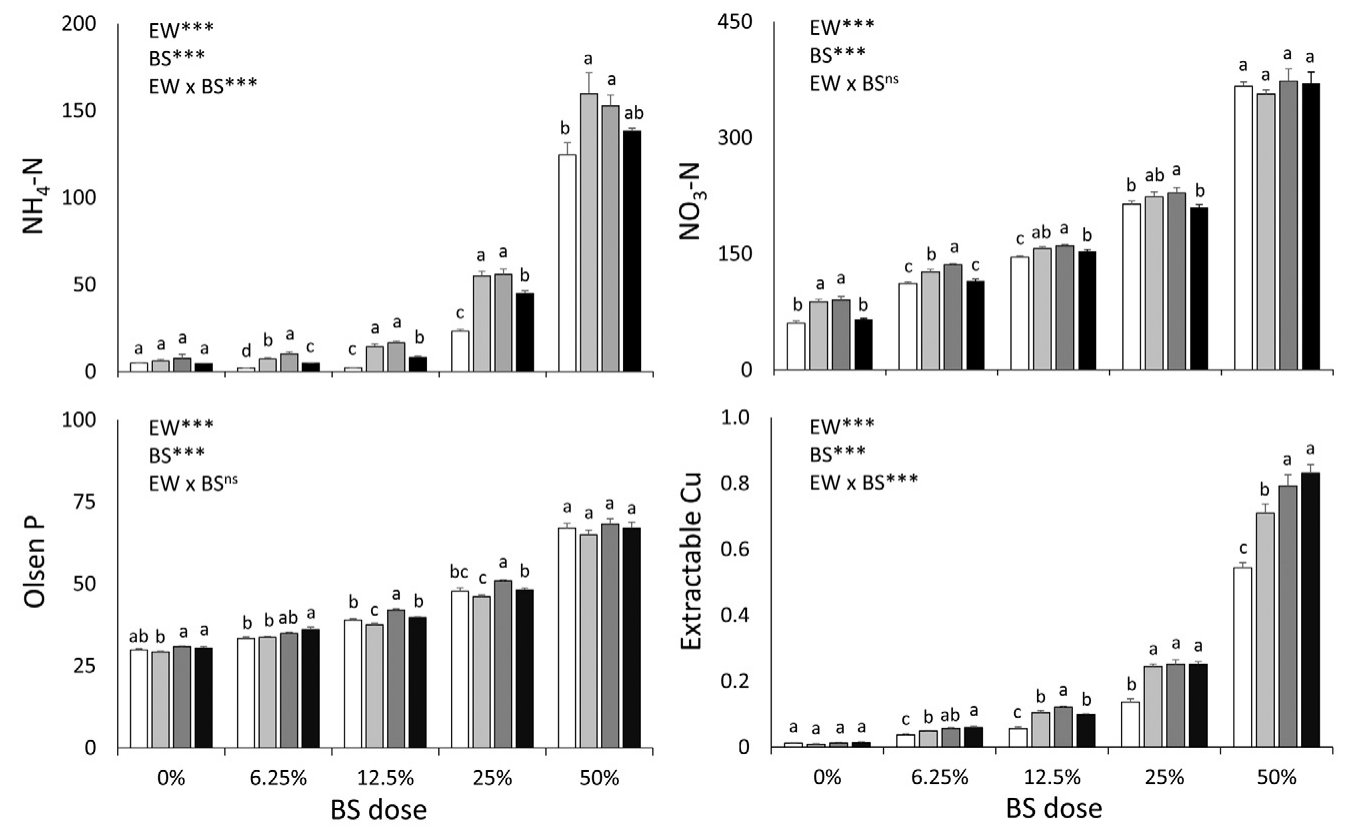
Adding biosolids to soil increased NH4+–N, NO3-–N, Olsen P, and the Ca(NO3)2–extractable fractions of Cu (Fig. 1). The additional effects of adding earthworms were small in comparison, but all species significantly increased NH4+–N and soluble Cu (p < 0.05). It is likely that earthworms enhanced the decomposition of organic N from biosolids, releasing NH4+–N and some of the Cu attached to this OM. Both native Maoridrilus - concentrations spp. significantly increased NH4+ and NO3 compared with E. fetida in the treatments containing 6.25 to 25% biosolids (p < 0.05). Maoridrilus sp.2 significantly increased the solubility of P in these treatments (p < 0.05). In the drilosphere soil, earthworm castings and mucus release ammonium, which is subsequently nitrified (Parkin and Berry, 1999) and thereby affects bacteria associated with the N cycle (Eastman et al., 2001; Edwards and Arancon, 2004). Wen et al. (2004) also found increased Cu solubility in E. fetida casts.
向土壤中添加生物固体提高了NH4+–N、NO3-–N、Olsen P以及Ca(NO3)2可提取态Cu(图1)。相比之下,添加蚯蚓的附加效应较小,但所有物种均显著提高了NH4+–N和可溶态Cu(p < 0.05)。蚯蚓可能促进了生物固体中有机N的分解,释放出NH4+–N以及部分与该OM结合的Cu。在含6.25%至25%生物固体的处理中,两种本土Maoridrilus spp.的NH4+和NO3-浓度均显著高于E. fetida(p < 0.05)。Maoridrilus sp.2显著提高了这些处理中P的溶解性(p < 0.05)。在蚓触圈土壤中,蚯蚓粪和黏液释放铵,随后发生硝化(Parkin and Berry, 1999),从而影响与N循环相关的细菌(Eastman et al., 2001; Edwards and Arancon, 2004)。Wen et al.(2004)也发现E. fetida粪便中Cu的溶解性增加。
Adding biosolids to soil caused only a marginal acidification of reference soils (<0.1 pH unit) but significantly increased EC, TOM, and Ca(NO3)2–extractable concentrations of Cd, Zn, and S (Table 3). There was an additional effect of earthworms on these variables in the 12.5 to 25% treatments. All earthworms increased the concentration of Ca(NO3)2–extractable Fe, Mn, and Co in soil. In 12.5 and 25% biosolids treatments, the two native species significantly increased EC and Ca(NO3)2–extractable Cd and S (p < 0.05), and Maoridrilus sp.2 substantially increased Ca(NO3)2–extractable Mg (p < 0.05). In earlier studies, E. fetida reduced total organic C and decreased soil pH but increased EC (Yadav and Garg, 2011). Increased plant-available K, Mg, and S by Eudrilus eugeniae, E. fetida, and Perionyx excavatus has been observed in soils amended with organic wastes (Hait and Tare, 2012; Kale, 2004). Hait and Tare (2012) found that
向土壤中添加生物固体仅使对照土壤轻微酸化(<0.1 pH单位),但显著提高了EC、TOM以及Ca(NO3)2可提取态Cd、Zn和S的浓度(表3)。在12.5%至25%处理中,蚯蚓对上述变量具有附加效应。所有蚯蚓均提高了土壤中Ca(NO3)2可提取态Fe、Mn和Co的浓度。在12.5%和25%生物固体处理中,两种本土物种显著提高了EC以及Ca(NO3)2可提取态Cd和S(p < 0.05),Maoridrilus sp.2显著提高了Ca(NO3)2可提取态Mg(p < 0.05)。前期研究中,E. fetida降低了总有机C和土壤pH,但提高了EC(Yadav and Garg, 2011)。在有机废弃物改良土壤中,已观察到Eudrilus eugeniae、E. fetida和Perionyx excavatus提高了植物有效K、Mg和S(Hait and Tare, 2012; Kale, 2004)。Hait and Tare(2012)发现
E. fetida increased soluble Fe and Mn but decreased soluble Co. In contrast to the other biosolids components, Maoridrilus sp.2 and E. fetida markedly decreased concentration of Ca(NO3)2– extractable Zn in the treatments. These species may have accumulated some of this Zn (not measured).
E. fetida提高了可溶态Fe和Mn,但降低了可溶态Co。与其他生物固体组分不同,Maoridrilus sp.2和E. fetida明显降低了各处理中Ca(NO3)2可提取态Zn的浓度。这些物种可能积累了部分Zn(未测定)。
Table 3 shows the TOM reduction in the presence of earthworms. Although the native earthworms were up to 10× larger than Eisenia, they consumed the same or less OM from each biosolids-amended soil. The higher weight gain of E. fetida, as well表3显示了蚯蚓存在时TOM的减少。尽管本土蚯蚓体型比Eisenia大10倍,但它们从各生物固体改良土壤中消耗的OM与后者相当或更少。E. fetida较高的增重以及
as the presence of cocoons, indicated that this species was more likely to use the uptake of organic nutrients, particularly N, from biosolids for their metabolic activity and reproduction.
蚓茧的出现表明,该物种更倾向于利用从生物固体中吸收的有机养分(尤其是N)用于代谢活动和繁殖。
Microbiological Activity微生物活性
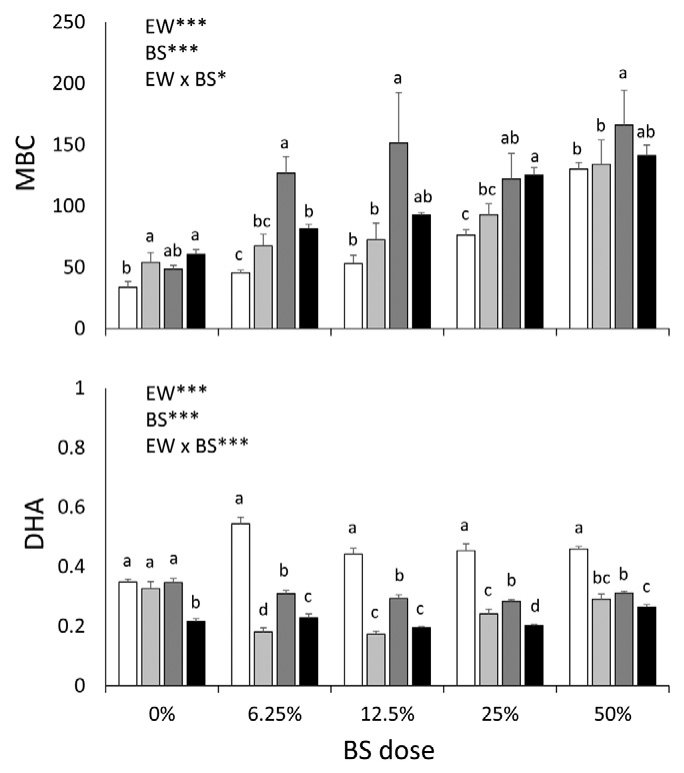
Adding biosolids increased MBC (Fig. 2), but there was a large additional effect of earthworm activity on microbial biomass. There appears to be a contradictory effect of biosolids on DHA, which did not increase in proportion to the amount of biosolids added. Earthworm activity caused a significant decline in DHA. This may be a differential response among other microbial groupings related to urease activity (UA), alkaline phosphatase activity (APA), and arylsulfatase activity (ASA) (Kızılkaya and Hepsen, 2004). Similar results were reported by Kızılkaya and Hepsen (2004), who found significant increases of UA, APA, and ASA but reduced DHA in biosolids treatments with L. terrestris. The authors suggested positive associations between soil enzyme activities (UA, APA, and ASA) and nutrient mineralization (N, P, and other elements) in the casts. We could infer that there may be an increase of UA, APA, and ASA in the presence of earthworms. Another factor reducing DHA may be the increase in aeration caused by burrowing and the increased Cu solubility associated with the mineralization of biosolids (Fernández-Calviño et al., 2010).
添加生物固体提高了MBC(图2),而蚯蚓活动对微生物生物量具有显著的附加效应。生物固体对DHA的影响似乎相互矛盾,DHA并未随生物固体添加量成比例增加。蚯蚓活动导致DHA显著下降,这可能反映了与脲酶活性(UA)、碱性磷酸酶活性(APA)和芳基硫酸酯酶活性(ASA)相关的其他微生物类群的差异响应(Kızılkaya and Hepsen, 2004)。Kızılkaya and Hepsen(2004)报道了类似结果,他们发现在含L. terrestris的生物固体处理中UA、APA和ASA显著增加,而DHA降低。作者认为蚯蚓粪中土壤酶活性(UA、APA和ASA)与养分矿化(N、P及其他元素)之间存在正相关。据此可推断,蚯蚓存在时UA、APA和ASA可能增加。导致DHA降低的另一个因素可能是蚯蚓掘穴引起的通气性增加,以及与生物固体矿化相关的Cu溶解性增加(Fernández-Calviño et al., 2010)。
| Biosolids生物固体 | si | so | il propertie土壤性质 | s† | ||||||||
|---|---|---|---|---|---|---|---|---|---|---|---|---|
| dose | peces | pH | eC | tOM | K | Mg | s | Fe | Mn | Cd | Co | Zn |
| 1:5W | dS m-1 | % | — | ————— | ——— mg | kg-1 ——— | ———— | —— | ||||
| 0% | Reference | 5.18 (0.01)b | 0.17 (<0.01)bc | 7.0 (<0.1)a | 206 (2)bc | 170 (1)a | 10 (0.2)b | 0.9 (<0.1)b | 21 (0.5)b | 0.02 (<0.01)a | 0.07 (<0.01)b | 44 (7.5)b |
| Maoridrilus | 5.19 | 0.19 | 6.5 | 211 | 155 | 11 | 1.1 | 19 | 0.02 | 0.06 | 31 | |
| transalpinus | (0.02)b | (0.01)ab | (0.1)b | (2)b | (2)b | (0.8)ab | (0.1)a | (0.5)b | (<0.01)b | (0.01)b | (2.4)b | |
| _Maoridrilus_sp.2 | 5.15 | 0.21 | 6.1 | 221 | 173 | 13 | 1.0 | 26 | 0.02 | 0.09 | 36 | |
| (0.01)b | (<0.01)a | (0.2)b | (5)a | (2)a | (1.6)a | (<0.1)ab | (1.0)a | (<0.01)a | (<0.01)a | (5.1)b | ||
| Eisenia fetida | 5.26 | 0.16 | 6.2 | 199 | 158 | 8.8 | 1.1 | 21 | 0.02 | 0.08 | 66 | |
| (0.02)a | (<0.01)c | (0.3)b | (1)c | (4)b | (0.1)b | (0.1)ab | (1.1)b | (<0.01)a | (<0.01)b | (9.2)a | ||
| 6.25% | Reference | 5.08 | 0.23 | 7.7 | 211 | 172 | 33 | 0.9 | 20 | 0.04 | 0.06 | 73 |
| (<0.01)a | (0.01)c | (0.1)a | (3)b | (1)a | (0.9)a | (<0.1)c | (0.1)b | (<0.01)b | (<0.01)c | (1.5)a | ||
| M. transalpinus | 4.96 | 0.26 | 7.5 | 206 | 151 | 33 | 1.2 | 25 | 0.04 | 0.09 | 74 | |
| (0.01)b | (<0.01)b | (0.1)a | (1)b | (1)b | (0.7)a | (0.1)ab | (0.6)ab | (<0.01)b | (<0.01)b | (4.0)a | ||
| _Maoridrilus_sp.2 | 4.93 | 0.28 | 7.3 | 251 | 173 | 36 | 1.1 | 29 | 0.04 | 0.12 | 56 | |
| (0.02)b | (<0.01)a | (0.2)a | (2)a | (2)a | (1.0)a | (0.1)bc | (0.6)a | (<0.01)ab | (<0.01)a | (4.0)b | ||
| E. fetida | 4.97 | 0.23 | 7.4 | 215 | 177 | 37 | 1.4 | 29 | 0.05 | 0.11 | 55 | |
| (0.01)b | (<0.01)c | (<0.1)a | (1)b | (8)a | (3.8)a | (0.1)a | (2.9)a | (<0.01)a | (0.01)a | (10.6)b | ||
| 12.5% | Reference | 4.88 | 0.27 | 8.5 | 205 | 161 | 49 | 0.9 | 24 | 0.06 | 0.07 | 81 |
| (<0.01)a | (0.02)c | (0.4)a | (6)bc | (4)c | (2.3)c | (0.1)b | (0.6)c | (<0.01)b | (<0.01)c | (2.0)a | ||
| M. transalpinus | 4.85 | 0.32 | 8.1 | 213 | 155 | 63 | 1.3 | 28 | 0.07 | 0.11 | 78 | |
| (0.01)b | (0.01)b | (0.1)ab | (2)ab | (1)c | (1.8)ab | (0.1)a | (1.2)b | (<0.01)a | (<0.01)b | (4.0)a | ||
| _Maoridrilus_sp.2 | 4.77 | 0.38 | 8.3 | 221 | 178 | 69 | 1.2 | 33 | 0.07 | 0.12 | 53 | |
| (0.01)d | (<0.01)a | (0.1)ab | (3)a | (3)a | (3.5)a | (0.1)ab | (0.7)a | (<0.01)a | (<0.01)a | (2.4)b | ||
| E. fetida | 4.82 | 0.29 | 7.9 | 203 | 171 | 60 | 1.5 | 33 | 0.07 | 0.13 | 60 | |
| (0.01)c | (0.01)bc | (0.1)b | (2)c | (2)b | (1.5)b | (0.2)a | (0.7)a | (<0.01)a | (<0.01)a | (3.1)b | ||
| 25% | Reference | 4.70 | 0.43 | 11 | 197 | 158 | 97 | 0.9 | 31 | 0.11 | 0.10 | 109 |
| (0.01)b | (0.01)c | (0.5)a | (7)b | (5)b | (6)b | (<0.1)b | (1.2)c | (<0.01)c | (0.01)c | (5.2)a | ||
| M. transalpinus | 4.75 | 0.45 | 9.4 | 222 | 160 | 136 | 1.4 | 37 | 0.14 | 0.14 | 111 | |
| (0.02)a | (<0.01)b | (0.3)b | (3)a | (1)b | (4)a | (0.1)a | (0.5)b | (<0.01)ab | (<0.01)b | (3.4)a | ||
| _Maoridrilus_sp.2 | 4.63 | 0.50 | 9.3 | 211 | 174 | 125 | 1.0 | 41 | 0.13 | 0.15 | 93 | |
| (<0.01)c | (0.01)a | (0.1)b | (6)ab | (6)a | (9)a | (0.1)b | (2.3)ab | (<0.01)b | (0.01)b | (7.1)a | ||
| E. fetida | 4.67 | 0.40 | 9.2 | 212 | 170 | 120 | 1.4 | 44 | 0.14 | 0.18 | 103 | |
| (0.01)b | (0.01)d | (0.1)b | (7)ab | (1)ab | (3)a | (0.1)a | (1.2)a | (<0.01)a | (<0.01)a | (7.6)a | ||
| 50% | Reference | 4.47 | 0.72 | 16 | 225 | 193 | 283 | 1.1 | 54 | 0.31 | 0.17 | 187 |
| (<0.01)a | (0.01)b | (0.7)a | (2)a | (7)a | (2)a | (0.1)b | (1.7)b | (0.01)a | (0.01)c | (8.9)a | ||
| M. transalpinus | 4.50 | 0.68 | 12 | 217 | 176 | 286 | 1.5 | 53 | 0.32 | 0.21 | 175 | |
| (0.01)a | (0.01)b | (0.3)b | (2)a | (2)b | (7)a | (0.1)a | (1.5)b | (0.01)a | (0.01)b | (6.5)ab | ||
| _Maoridrilus_sp.2 | 4.43 | 0.77 | 13 | 216 | 196 | 290 | 1.4 | 61 | 0.33 | 0.25 | 164 | |
| (<0.01)b | (0.02)a | (0.2)b | (4)a | (3)a | (6)a | (0.1)a | (2.1)a | (0.01)a | (0.01)a | (4.4)b | ||
| E. fetida | 4.48 | 0.62 | 13 (0.3)b | 216 | 193 | 286 | 1.5 | 59 | 0.33 | 0.25 | 159 | |
| (0.01)a | (<0.01)c | (7)a | (2)a | (7)a | (0.0)a | (1.5)a | (0.01)a | (0.01)a | (1.8)b | |||
| Two-way | EW | * | * | * | ns‡ | * | * | * | * | * | * | |
| ANOVA | BS | * | * | * | ns | * | * | * | * | * | * | * |
| (_p_values) | EW × BS | * | * | * | * | * | ns | * | * | * |
* Significant at the 0.05 probability level. ** Significant at the 0.01 probability level. *** Significant at the 0.001 probability level. † EC, electrical conductivity; TOM, total organic matter. ‡ Not significant.
* 在0.05概率水平上显著。** 在0.01概率水平上显著。*** 在0.001概率水平上显著。† EC,电导率;TOM,总有机质。‡ 不显著。
N2O and CO2 EmissionsN2O和CO2排放
Adding biosolids influenced the release of N2O and CO2 (Fig. 3) due to changes in the soil’s chemical and physical properties (Fernández-Luqueño et al., 2009). More N2O was released in the presence of native earthworms (Fig. 3); both Maoridrilus spp. emitted >2.5 times more N2O than the reference and E. fetida (p < 0.05) in 6.25 and 12.5% biosolids treatments. However, in 50% biosolids amendment, the earthworm-free treatment released much more N2O than earthworm-present treatments.
添加生物固体通过改变土壤的化学和物理性质影响了N2O和CO2的释放(图3)(Fernández-Luqueño et al., 2009)。本土蚯蚓存在时释放的N2O更多(图3);在6.25%和12.5%生物固体处理中,两种Maoridrilus spp.的N2O排放量均为对照和E. fetida的>2.5倍(p < 0.05)。然而,在50%生物固体处理中,无蚯蚓处理释放的N2O远多于有蚯蚓处理。
Emission of N2O from soil occurs via the partial reduction of NO3- under low-oxygen conditions (Wrage et al., 2004). The addition of biosolids also increased MBC in proportion to the amount of added OM (Table 4), which was correlated with increased NH4+–N and NO3-–N, and also to increased N2O emissions. Although E. fetida stimulated N mineralization, this species inhibited N2O emission compared with the native species. This may be due to the epigeic earthworm increasing aeration in biosolids-amended soil. Contreras-Ramos et al. (2009) reported that, compared with bulk soil, the presence of E. fetida released 14 times less N2O from 5% biosolids-amended soil.
土壤N2O排放源于低氧条件下NO3-的部分还原(Wrage et al., 2004)。添加生物固体还使MBC随添加OM量成比例增加(表4),MBC与NH4+–N和NO3-–N的增加相关,也与N2O排放的增加相关。尽管E. fetida促进了N矿化,但与本土物种相比,该物种抑制了N2O排放。这可能是由于该表栖型蚯蚓增加了生物固体改良土壤的通气性。Contreras-Ramos et al.(2009)报道,与原状土相比,E. fetida存在时5%生物固体改良土壤释放的N2O减少了14倍。
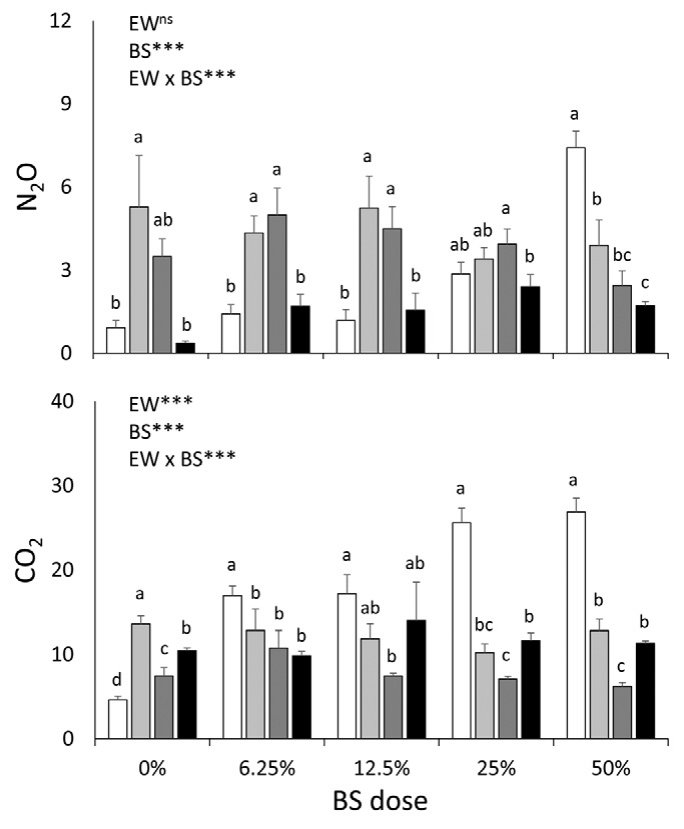
Respiratory CO2 emissions were significantly reduced in the presence of earthworms, particularly Maoridrilus sp.2 (p < 0.05). According to a meta-analysis by Lubbers et al. (2013), earthworms increase CO2 by 33% in a number of field and laboratory studies by stimulating OM decomposition. However, earthworms can improve stability and storage of soil C by protecting C in micro-aggregates formed in large macroaggregates (Bossuyt et al., 2005), which may decrease net CO2 emissions (Lubbers et al., 2013).
蚯蚓存在时呼吸CO2排放显著降低,尤其是Maoridrilus sp.2(p < 0.05)。Lubbers et al.(2013)的荟萃分析表明,在多项田间和实验室研究中,蚯蚓通过刺激OM分解使CO2增加33%。然而,蚯蚓可通过将C保护在大团聚体内形成的微团聚体中,提高土壤C的稳定性和储量(Bossuyt et al., 2005),从而可能减少CO2净排放(Lubbers et al., 2013)。
| tOM† | MBC‡ | nH4 + | nO3 - | |
|---|---|---|---|---|
| MBC | 0.59* | |||
| NH4 + | 0.87* | 0.65* | ||
| NO3 - | 0.93* | 0.69* | 0.94* | |
| N2O | 0.27 | 0.24* | 0.17 | 0.23* |
* Significant at the 0.05 probability level. ** Significant at the 0.01 probability level. *** Significant at the 0.001 probability level. † Total organic matter. ‡ Microbial biomass C.
* 在0.05概率水平上显著。** 在0.01概率水平上显著。*** 在0.001概率水平上显著。† 总有机质。‡ 微生物生物量C。
4Conclusions结论
Eisenia fetida is clearly a preferred species for vermicomposting biosolids and is much more tolerant of high concentrations of biosolids that were responsible for the high mortality of native anecic earthworms. However, native earthworms may be more suitable for improving the physicochemical conditions of biosolid-supplemented soil. They burrow more deeply into soil, and, at optimal amendment rates of 12.5%, native earthworms showed the greatest behavioral tolerances in terms of survivorship and weight gain to other treatments that could substantially enhance the availability of key nutrients, including mobile N, P, K, S, and Mg. They are much larger individuals but consume the same or less OM as the much smaller Eisenia. Earthworms substantially increased the Ca(NO3)2–extractable Cu in soil, although Maoridrilus sp.2 reduced Ca(NO3)2–extractable Zn. Adding biosolids to soil provided an OM substrate that improved nutrition and increased MBC but reduced DHA. New Zealand native earthworms increased N2O emissions from soil. Future work should investigate the performance of native earthworms to biosolids-amended soils under different vegetation types.
Eisenia fetida显然是生物固体蚯蚓堆肥的首选物种,并且对高浓度生物固体的耐受性远强于本土深栖型蚯蚓,后者在高浓度生物固体中死亡率很高。然而,本土蚯蚓可能更适合用于改善添加生物固体土壤的理化条件。它们钻入土壤更深;在12.5%的最佳添加比例下,本土蚯蚓在存活率和增重方面表现出相对于其他处理最强的行为耐受性,并可显著提高关键养分(包括可移动态N、P、K、S和Mg)的有效性。它们个体大得多,但消耗的OM与体型小得多的Eisenia相当或更少。蚯蚓显著提高了土壤中Ca(NO3)2可提取态Cu,而Maoridrilus sp.2降低了Ca(NO3)2可提取态Zn。向土壤中添加生物固体提供了OM底物,改善了营养状况并提高了MBC,但降低了DHA。新西兰本土蚯蚓增加了土壤N2O排放。今后的工作应研究本土蚯蚓在不同植被类型下对生物固体改良土壤的作用表现。
5Acknowledgments致谢
This work was supported by the Centre for Integrated Biowaste Research.
本研究由生物废弃物综合研究中心(Centre for Integrated Biowaste Research)资助。
6References参考文献
Adair, K.L., S. Wratten, A.M. Barnes, B.R. Waterhouse, M. Smith, G. Lear, P. Weber, M. Pizey, and S. Boyer. 2014. Effects of biosolids on biodiesel crop yield and belowground communities. Ecol. Eng. 68:270–278. doi:10.1016/j.ecoleng.2014.03.083
Artuso, N., T. Kennedy, J. Connery, J. Grant, and O. Schmidt. 2010. Effects of biosolids at varying rates on earthworms (Eisenia fetida) and springtails (Folsomia candida). Appl. Environ. Soil Sci. 2011:519485. doi:10.1155/2011/519485
Blakemore, L.C., P.L. Searle, and B.K. Daly. 1987. Methods for chemical analysis of soils. New Zealand Bureau Scientific Rep. 80. NZ Soil Bureau, Dep. of Scientific and Industrial Research, Lower Hutt, New Zealand.
Bossuyt, H., J. Six, and P.F. Hendrix. 2005. Protection of soil carbon by microaggregates within earthworm casts. Soil Biol. Biochem. 37:251–258. doi:10.1016/j.soilbio.2004.07.035
Boyer, S., R.J. Blackemore, and S.D. Wratten. 2011. An integrative taxonomic approach to the identification of three New Zealand endemic earthworm species (Acanthodrilidae, Octochaetidae: Oligochaeta). Zootaxa 2994:21–32. Bowie, M.H., L. Black, S. Boyer, N.M. Dickinson, and S. Hodge. 2016. Persistence of biodiversity in a dryland remnant within an intensified dairy farm landscape. N. Z. J. Ecol. 40:121–130. doi:10.20417/nzjecol.40.14
Bright, D., and N. Healey. 2003. Contaminant risks from biosolids land application: Contemporary organic contaminant levels in digested sewage sludge from five treatment plants in Greater Vancouver, British Columbia. Environ. Pollut. 126:39–49. doi:10.1016/S0269-7491(03)00148-9
Buckley, T.R., S. James, J. Allwood, S. Bartlam, R. Howitt, and D. Prada. 2011. Phylogenetic analysis of New Zealand earthworms (Oligochaeta: Megascolecidae) reveals ancient clades and cryptic taxonomic diversity. Mol. Phylogenet. Evol. 58:85–96. doi:10.1016/j.ympev.2010.09.024
Chander, K., and P. Brookes. 1991. Is the dehydrogenase assay invalid as a method to estimate microbial activity in copper-contaminated soils? Soil Biol. Biochem. 23:909–915. doi:10.1016/0038-0717(91)90170-O
Chang, A.C., G. Pan, A.L. Page, and T. Asano. 2002. Developing human healthrelated chemical guidelines for reclaimed water and sewage sludge applications in agriculture. WHO, Geneva, Switzerland. http://www.opaci.org. py/biblioteca/Servicio_Sanitario/Guia_Calidad_Agua/CD_GuiasOMS/ Biblioteca/AguasResiduales/gwwuchemicals.pdf (accessed 23 May 2016).
Claassen, V., and J. Carey. 2007. Comparison of slow‐release nitrogen yield from organic soil amendments and chemical fertilizers and implications for regeneration of disturbed sites. Land Degrad. Dev. 18:119–132. doi:10.1002/ldr.770
Clarke, B.O., and S.R. Smith. 2011. Review of “emerging” organic contaminants in biosolids and assessment of international research priorities for the agricultural use of biosolids. Environ. Int. 37:226–247. doi:10.1016/j. envint.2010.06.004
Clough, T.J., J. Bertram, R.R. Sherlock, R.L. Leonard, and B.L. Nowicki. 2006. Comparison of measured and EF5-r-derived N2O fluxes from a spring-fed river. Glob. Change Biol. 12:477–488. doi:10.1111/j.1365-2486.2005.01092.x
Contreras-Ramos, S.M., D. Álvarez-Bernal, J.A. Montes-Molina, O. van Cleemput, and L. Dendooven. 2009. Emission of nitrous oxide from hydrocarbon contaminated soil amended with waste water sludge and earthworms. Appl. Soil Ecol. 41:69–76. doi:10.1016/j.apsoil.2008.09.001
de Freitas, C., and M. Perry. 2012. New environmentalism: Managing New Zealand’s environmental diversity. Springer Science & Business Media, Berlin, Germany. doi:10.1007/978-1-4020-8254-2
Eastman, B.R., P.N. Kane, C.A. Edwards, L. Trytek, B. Gunadi, A.L. Stermer, and J.R. Mobley. 2001. The effectiveness of vermiculture in human pathogen reduction for USEPA biosolids stabilization. Compost Sci. Util. 9:38– 49. doi:10.1080/1065657X.2001.10702015
Edwards, C.A., and N.Q. Arancon. 2004. The use of earthworms in the breakdown of organic wastes to produce vermicomposts and animal feed protein. In: C.A. Edwards, editor, Earthworm ecology. CRC Press, Boca Raton, FL. p. 345–379. doi:10.1201/9781420039719
Evanylo, G.K., A.O. Abaye, C. Dundas, C.E. Zipper, R. Lemus, B. Sukkariyah, and J. Rockett. 2005. Herbaceous vegetation productivity, persistence, and metals uptake on a biosolids-amended mine soil. J. Environ. Qual. 34:1811–1819. doi:10.2134/jeq2004.0329
Fernández-Calviño, D., P. Soler-Rovira, A. Polo, M. Díaz-Raviña, M. Arias- Estévez, and C. Plaza. 2010. Enzyme activities in vineyard soils long-term treated with copper-based fungicides. Soil Biol. Biochem. 42:2119–2127. doi:10.1016/j.soilbio.2010.08.007
Fernández-Luqueño, F., V. Reyes-Varela, C. Martínez-Suárez, R.E. Reynoso- Keller, J. Méndez-Bautista, E. Ruiz-Romero, F. López-Valdez, M.L. Luna-Guido, and L. Dendooven. 2009. Emission of CO2 and N2O from soil cultivated with common bean (Phaseolus vulgaris L.) fertilized with different N sources. Sci. Total Environ. 407:4289–4296. doi:10.1016/j. scitotenv.2009.04.016
Gajalakshmi, S., and S. Abbasi. 2004. Earthworms and vermicomposting. Indian J. Biotechnol. 3:486–494.
Gardner, W.C., K. Broersma, A. Naeth, D. Chanasyk, and A. Jobson. 2010. Influence of biosolids and fertilizer amendments on physical, chemical and microbiological properties of copper mine tailings. Can. J. Soil Sci. 90:571–583. doi:10.4141/cjss09067
Garrec, N., F. Picard-Bonnaud, and A. Pourcher. 2003. Occurrence of Listeria sp. and L. monocytogenes in sewage sludge used for land application: Effect of dewatering, liming and storage in tank on survival of Listeria species. FEMS Immunol. Med. Microbiol. 35:275–283. doi:10.1016/ S0928-8244(02)00443-1
Gartler, J., B. Robinson, K. Burton, and L. Clucas. 2013. Carbonaceous soil amendments to biofortify crop plants with zinc. Sci. Total Environ. 465:308–313. doi:10.1016/j.scitotenv.2012.10.027 Hait, S., and V. Tare. 2012. Transformation and availability of nutrients and heavy metals during integrated composting–vermicomposting of sewage sludges. Ecotoxicol. Environ. Saf. 79:214–224. doi:10.1016/j. ecoenv.2012.01.004
Ismail, A. 1997. Vermicology: The biology of earthworms. Orient Longman, Andhra Pradesh, India.
Jones-Lepp, T.L., and R. Stevens. 2007. Pharmaceuticals and personal care products in biosolids/sewage sludge: The interface between analytical chemistry and regulation. Anal. Bioanal. Chem. 387:1173–1183. doi:10.1007/ s00216-006-0942-z
Kale, R.D. 2004. The use of earthworms: Nature’s gift for utilization of organic wastes in Asia. In: C.A. Edwards, editor, Earthworm ecology. CRC Press, Boca Raton, FL. p. 381–399. doi:10.1201/9781420039719. ch19
Kim, Y.N. 2016. Interactions between soil biogeochemistry and native earthworms in New Zealand. PhD thesis. Lincoln Univ., Lincoln, New Zealand.
Kim, Y.N., B. Robinson, S. Boyer, H.T. Zhong, and N. Dickinson. 2015. Interactions of native and introduced earthworms with soils and plant rhizospheres in production landscapes of New Zealand. Appl. Soil Ecol. 96:141–150. doi:10.1016/j.apsoil.2015.07.008
Kinney, C.A., E.T. Furlong, D.W. Kolpin, M.R. Burkhardt, S.D. Zaugg, S.L. Werner, J.P. Bossio, and M.J. Benotti. 2008. Bioaccumulation of pharmaceuticals and other anthropogenic waste indicators in earthworms from agricultural soil amended with biosolid or swine manure. Environ. Sci. Technol. 42:1863–1870. doi:10.1021/es702304c
Kızılkaya, R., and S. Hepsen. 2004. Effect of biosolid amendment on enzyme activities in earthworm (Lumbricus terrestris) casts. J. Plant Nutr. Soil Sci. 167:202–208. doi:10.1002/jpln.200321263
Lee, K.E. 1959a. The earthworm fauna of New Zealand. Bulletin 130. New Zealand Department of Scientific and Industrial Research, Wellington, New Zealand.
Lee, K.E. 1959b. A key for the identification of New Zealand earthworms, Soil Bur. Publ. No. 172. Tuatara 8:48.
Lubbers, I.M., K.J. Van Groenigen, S.J. Fonte, J. Six, L. Brussaard, and J.W. Van Groenigen. 2013. Greenhouse-gas emissions from soils increased by earthworms. Nat. Clim. Chang. 3:187–194. doi:10.1038/nclimate1692
McDaniel, J.P., M.E. Stromberger, K.A. Barbarick, and W. Cranshaw. 2013. Survival of Aporrectodea caliginosa and its effects on nutrient availability in biosolids amended soil. Appl. Soil Ecol. 71:1–6. doi:10.1016/j. apsoil.2013.04.010
National Research Council (NRC). 2002. Committee on toxicants and pathogens in biosolids applied to land. Biosolids applied to land: Advancing standards and practices. The National Academies Press, Washington, DC. Ndegwa, P., and S. Thompson. 2001. Integrating composting and vermicomposting in the treatment and bioconversion of biosolids. Bioresour. Technol. 76:107–112. doi:10.1016/S0960-8524(00)00104-8
Parkin, T.B., and E.C. Berry. 1999. Microbial nitrogen transformations in earthworm burrows. Soil Biol. Biochem. 31:1765–1771. doi:10.1016/ S0038-0717(99)00085-1
Paramashivam, D., T.J. Clough, N. Dickinson, J. Horswell, O. Lense, L. Clucas, and B. Robinson. 2016. Effect of pine waste and pine biochar on nitrogen mobility in biosolids. J. Environ. Qual. 45:360–367. doi:10.2134/ jeq2015.06.0298
Robinson, B., L. Clucas, C. Anderson, O. Knowles, J. Gartler, D. Portmann, A. Contangelo, and M. Marmiroli. 2011. Closing the loop: Biosolids to rebuild degraded soils. In: L.D. Currie et al., editors, 24th Annual Fertilizer and Lime Research Centre (FLRC) Workshop, Fertilizer and Lime Research Centre, Massey Univ., New Zealand.
Sharma, S., K. Pradhan, S. Satya, and P. Vasudevan. 2005. Potentiality of earthworms for waste management and in other uses: A review. J. Am. Sci. 1:4–16.
Silveira, M.L.A., L.R.F. Alleoni, and L.R.G. Guilherme. 2003. Biosolids and heavy metals in soils. Sci. Agric. 60:793–806. doi:10.1590/ S0103-90162003000400029
Simmler, M., L. Ciadamidaro, R. Schulin, P. Madejón, R. Reiser, L. Clucas, P. Weber, and B. Robinson. 2013. Lignite reduces the solubility and plant uptake of cadmium in pasturelands. Environ. Sci. Technol. 47:4497–4504. doi:10.1021/es303118a
Sparling, G.P., and L.A. Schipper. 2002. Soil quality at a national scale in New Zealand. J. Environ. Qual. 31:1848–1857. doi:10.2134/jeq2002.1848 Wang, Q.R., Y.S. Cui, X.M. Liu, Y.T. Dong, and P. Christie. 2003. Soil contamination and plant uptake of heavy metals at polluted sites in China. J. Environ. Sci. Health Part A 38:823–838. doi:10.1081/ESE-120018594
Waterhouse, B.R., S. Boyer, K.L. Adair, and S.D. Wratten. 2014a. Using municipal biosolids in ecological restoration: What is good for plants and soil may not be good for endemic earthworms. Ecol. Eng. 70:414–421. doi:10.1016/j.ecoleng.2014.06.021
Waterhouse, B.R., S. Boyer, and S.D. Wratten. 2014b. Pyrosequencing of prey DNA in faeces of carnivorous land snails to facilitate ecological restoration and relocation programmes. Oecologia 175:737–746. doi:10.1007/ s00442-014-2933-7
Wen, B., X. Hu, Y. Liu, W. Wang, M. Feng, and X. Shan. 2004. The role of earthworms (Eisenia fetida) in influencing bioavailability of heavy metals in soils. Biol. Fertil. Soils 40:181–187. doi:10.1007/s00374-004-0761-3
Wrage, N., G.L. Velthof, H.J. Laanbroek, and O. Oenema. 2004. Nitrous oxide production in grassland soils: Assessing the contribution of nitrifier denitrification. Soil Biol. Biochem. 36:229–236. doi:10.1016/j. soilbio.2003.09.009
Yadav, A., and V. Garg. 2011. Industrial wastes and sludges management by vermicomposting. Rev. Environ. Sci. Biotechnol. 10:243–276. doi:10.1007/s11157-011-9242-y
Yadav, K.D., V. Tare, and M.M. Ahammed. 2010. Vermicomposting of sourceseparated human faeces for nutrient recycling. Waste Manag. 30:50–56. doi:10.1016/j.wasman.2009.09.034