Journal of Environmental Quality
Dharini Paramashivam, Nicholas M. Dickinson, Timothy J. Clough, Jacqui Horswell, and Brett H. Robinson*
1Abstract摘要
Biosolids disposal to landfill or through incineration is wasteful of a resource that is rich in organic matter and plant nutrients. Land application can improve soil fertility and enhance crop production but may result in excessive nitrate N (NO3−–N) leaching and residual contamination from pathogens, heavy metals, and xenobiotics. This paper evaluates evidence that these concerns can be reduced significantly by blending biosolids with organic materials to reduce the environmental impact of biosolids application to soils. It appears feasible to combine organic waste streams for use as a resource to build or amend degraded soils. Sawdust and partially pyrolyzed biochars provide an opportunity to reduce the environmental impact of biosolids application, with studies showing reductions of NO3−–N leaching of 40 to 80%. However, other organic amendments including lignite coal waste may result in excessive NO3−–N leaching. Field trials combining biosolids and biochars for rehabilitation of degraded forest and ecological restoration are recommended.
将生物固体(污泥)送往填埋场或进行焚烧处置,是对一种富含有机质和植物养分的资源的浪费。土地施用可提高土壤肥力、促进作物生产,但可能导致硝态氮(NO3−–N)过量淋溶,以及病原体、重金属和外源性化合物的残留污染。本文评估了相关证据,即通过将生物固体与有机物料混合以降低生物固体施用于土壤的环境影响,可显著减轻上述问题。将多种有机废物流组合起来,作为构建或改良退化土壤的资源,似乎是可行的。锯末和部分热解的生物炭为降低生物固体施用的环境影响提供了契机,已有研究表明其可使NO3−–N淋溶减少40%~80%。然而,包括褐煤废料在内的其他有机改良剂可能导致NO3−–N过量淋溶。建议开展将生物固体与生物炭联合用于退化森林修复和生态恢复的田间试验。
2Core ideas核心观点
- Landfilling or burning biosolids is an expensive waste of a valuable resource.填埋或焚烧生物固体是对宝贵资源的一种代价高昂的浪费。
- High rates of biosolids restore degraded soil but cause excessive nitrate leaching.高施用量的生物固体可恢复退化土壤,但会导致硝酸盐过量淋溶。
- Combining biosolids with other biowastes can mitigate nitrate leaching.将生物固体与其他生物废弃物组合施用可减轻硝酸盐淋溶。
• Dried, but not wet, wood waste effectively mitigates nitrate leaching.
• 干燥(而非湿润)的木材废料可有效减轻硝酸盐淋溶。
• Partial pyrolysis of wood waste may provide energy-neutral drying.
• 木材废料的部分热解可实现能量中性的干燥。
Copyright © American Society of Agronomy, Crop Science Society of America, and Soil Science Society of America. 5585 Guilford Rd., Madison, WI 53711 USA. All rights reserved.
版权所有 © American Society of Agronomy, Crop Science Society of America, and Soil Science Society of America。5585 Guilford Rd., Madison, WI 53711 USA。保留所有权利。
e investigate the opportunity and challenges of blending biosolids (sewage sludge) with organic Wwaste materials for land application to improve environmental and economic outcomes. There are numerous publications describing the effects of adding organic amendments such as biochar, wood waste, composts, and lignite to soils (Laghari et al., 2016). Similarly, the beneficial and detrimental effects of biosolids addition to soil are well described. However, there is only disparate information on the effects of mixing these amendments with biosolids, which have physicochemical properties that contrast sharply with most soils. This review seeks to determine whether such mixtures could alleviate some of the negative environmental outcomes associated with the land application biosolids.
本文探讨了将生物固体(污水污泥)与有机废弃物料混合后进行土地施用、以改善环境和经济效益的机遇与挑战。已有大量文献描述了向土壤中添加生物炭、木材废料、堆肥和褐煤等有机改良剂的效应(Laghari et al., 2016)。同样,向土壤中添加生物固体的有益和有害效应也已得到充分阐述。然而,关于将这些改良剂与生物固体混合的效应,目前仅有零散的信息,而生物固体的理化性质与大多数土壤截然不同。本综述旨在确定此类混合物能否缓解与生物固体土地施用相关的部分负面环境后果。
3Biosolids: Resource and Disposal生物固体:资源与处置
Biosolids are the end product of wastewater treatment (Jones- Lepp and Stevens, 2007), rich in organic matter and containing agronomically significant concentrations of plant nutrients (Evanylo, 2009). However, biosolids also contain heavy metals (Haynes et al., 2009), pathogens (Gary et al., 2011), organic and pharmaceutical residues (Shinbrot, 2012), and other xenobiotics including endocrine disruptors (Ramamoorthy et al., 1997; Blair et al., 2000; Liu et al., 2009). Most jurisdictions have regulations proscribing the land application of biosolids with excess contaminant concentrations (NZWWA, 2003).
生物固体是污水处理的最终产物(Jones- Lepp and Stevens, 2007),富含有机质,并含有具有农学意义浓度的植物养分(Evanylo, 2009)。然而,生物固体也含有重金属(Haynes et al., 2009)、病原体(Gary et al., 2011)、有机物和药物残留(Shinbrot, 2012),以及包括内分泌干扰物在内的其他外源性化合物(Ramamoorthy et al., 1997; Blair et al., 2000; Liu et al., 2009)。大多数司法管辖区均制定了法规,禁止土地施用污染物浓度超标的生物固体(NZWWA, 2003)。
Stockpiling biosolids can exacerbate the emission of greenhouse gases such as nitrous oxide (N2O), carbon dioxide (CO2), and methane (CH4) (Majumder et al., 2014). Chemicals can leach through soils from stockpiled biosolids (Raghab et al., 2013). Treating biosolids as a waste requires disposal and incurs substantial costs for a product that could be a valuable resource if the environmental risks from residual contaminants could be avoided (Magesan and Wang, 2003).
堆存生物固体会加剧氧化亚氮(N2O)、二氧化碳(CO2)和甲烷(CH4)等温室气体的排放(Majumder et al., 2014)。化学物质可从堆存的生物固体中经土壤淋溶(Raghab et al., 2013)。将生物固体作为废弃物处理需要进行处置并产生可观的成本,而如果能够规避残留污染物带来的环境风险,这种产品本可成为一种宝贵的资源(Magesan and Wang, 2003)。
The amount of biosolids produced globally is staggering. In 2008, biosolids production from 18 counties was estimated to be 18 million dry t yr−1 (LeBlanc et al., 2008), and China was reported to have doubled its sewage sludge production from 2005 to 2015 (GWI, 2015). Before landfilling and incineration, ocean disposal was the major disposal route; ~50% of the sewage produced worldwide was dumped into the sea (Bothner et al., 1994). Now, biosolids disposal differs between countries;
全球生物固体的产生量惊人。2008年,18个国家的生物固体产量估计为1800万干吨 yr−1(LeBlanc et al., 2008),据报道,中国的污水污泥产量在2005年至2015年间翻了一番(GWI, 2015)。在填埋和焚烧之前,海洋倾倒是主要的处置途径;全球约50%的污水被倾倒入海(Bothner et al., 1994)。目前,各国的生物固体处置方式各不相同;
J. Environ. Qual.
doi:10.2134/jeq2016.10.0421
This is an open access article distributed under the terms of the CC BY-NC-ND license (http://creativecommons.org/licenses/by-nc-nd/4.0/) Received 1 Nov. 2016.
本文为开放获取文章,依据CC BY-NC-ND许可协议(http://creativecommons.org/licenses/by-nc-nd/4.0/)发布。收稿日期:2016年11月1日。
Accepted 22 Mar. 2017.
*Corresponding author (brett.robinson@lincoln.ac.nz).
D. Paramashivam, T.J. Clough, and B.H. Robinson, Dep. of Soil and Physical Sciences, Lincoln Univ., PO Box 84, Lincoln 7647, New Zealand; N.M. Dickinson, Dep. of Ecology, Lincoln Univ., PO Box 84, Lincoln 7647, New Zealand; J. Horswell, Environmental Science and Research, Kenepuru Science Centre, PO Box 50-348, Porirua 5240, New Zealand. Assigned to Associate Editor Minori Uchimiya.
D. Paramashivam、T.J. Clough和B.H. Robinson,林肯大学土壤与物理科学系,PO Box 84, Lincoln 7647,新西兰;N.M. Dickinson,林肯大学生态学系,PO Box 84, Lincoln 7647,新西兰;J. Horswell,Environmental Science and Research,Kenepuru Science Centre,PO Box 50-348, Porirua 5240,新西兰。责任副编辑:Minori Uchimiya。
for example, in New Zealand, biosolids are disposed of through landfilling (60%), ocean discharge (10%), application to agricultural land (10%) and forests (5%), and for land rehabilitation (10%) and composting or landscaping (5%) (ANZBP, 2014). Landfilling remains the most common form of biosolids disposal (O’Kelly, 2005), with many countries disposing of >50% this way (UNEP, 2016). Modern landfills are complex and costly facilities to build and operate; in New Zealand, disposal cost is approximately US$140 to 175 t−1, excluding transport costs (WCC, 2008). Furthermore, landfills are major sources of emissions of greenhouse gases, particularly CH4 and N2O (Spokas et al., 2006; Bogner et al., 2008), which account for up to 5% of global emissions (Bogner et al., 2008; Miller-Robbie et al., 2015). Incineration of biosolids is similarly widely practiced (Werther and Ogada, 1999), accounting for 70% of biosolids disposal in Japan, 58% in the Netherlands, 34% in Germany, 30% in Canada, 15% in the United States, and 20% in France (LeBlanc et al., 2008). Incineration also releases potentially harmful chemicals such as dioxins, furans, NOx, N2O, SO2, and hydrocarbons (Werther and Ogada, 1999).
例如,在新西兰,生物固体的处置方式包括填埋(60%)、海洋排放(10%)、施用于农田(10%)和森林(5%),以及用于土地复垦(10%)和堆肥或园林景观(5%)(ANZBP, 2014)。填埋仍是最常见的生物固体处置方式(O’Kelly, 2005),许多国家以此方式处置的比例>50%(UNEP, 2016)。现代填埋场是建设和运营都十分复杂且昂贵的设施;在新西兰,不计运输费用,处置成本约为140~175美元 t−1(WCC, 2008)。此外,填埋场是温室气体(尤其是CH4和N2O)的主要排放源(Spokas et al., 2006; Bogner et al., 2008),占全球排放量的比例高达5%(Bogner et al., 2008; Miller-Robbie et al., 2015)。生物固体焚烧同样被广泛采用(Werther and Ogada, 1999),在日本占生物固体处置量的70%,荷兰为58%,德国为34%,加拿大为30%,美国为15%,法国为20%(LeBlanc et al., 2008)。焚烧还会释放二噁英、呋喃、NOx、N2O、SO2和碳氢化合物等潜在有害化学物质(Werther and Ogada, 1999)。
Land application of biosolids offers the potential to recycle organic matter and nutrients (O’Connor et al., 2005), but pathogens and trace elements may present a risk to soil quality and human health (Sullivan et al., 2006; Singh and Agrawal, 2008). To meet regulatory conditions required for land application, biosolids often require treatment that includes some combination of aerobic digestion, anaerobic digestion, composting, alkaline stabilization, or thermal drying (Lu et al., 2012). All treatment systems reduce pathogen loads, volatile organic compounds, and other easily oxidized organic fractions, including some organic contaminants. Anaerobic systems reduce the organic matter content of biosolids more than aerobic systems (Marchaim, 2017). Biosolids may be dewatered through thermal drying or by using a press. Fresh biosolids usually have high concentrations of NH4+, which oxidizes to NO3− in aged biosolids (Ogilvie, 1998). Tables 1 and 2 give the physicochemical properties of biosolids resulting from different wastewater treatment processes.
生物固体的土地施用为有机质和养分的循环利用提供了可能(O’Connor et al., 2005),但病原体和微量元素可能对土壤质量和人体健康构成风险(Sullivan et al., 2006; Singh and Agrawal, 2008)。为满足土地施用的法规要求,生物固体通常需要经过处理,包括好氧消化、厌氧消化、堆肥、碱性稳定化或热干燥等方式的某种组合(Lu et al., 2012)。所有处理系统均可降低病原体负荷、挥发性有机化合物以及其他易氧化有机组分(包括部分有机污染物)。厌氧系统比好氧系统更大程度地降低生物固体的有机质含量(Marchaim, 2017)。生物固体可通过热干燥或压滤进行脱水。新鲜生物固体通常含有高浓度的NH4+,在陈化生物固体中NH4+会被氧化为NO3−(Ogilvie, 1998)。表1和表2列出了不同污水处理工艺所产生生物固体的理化性质。
Land application is also limited by agronomic loading rates of plant available nitrogen (N) in biosolids (Gilmour and Skinner, 1998). Plant available N is related to total inorganic N and a fraction of mineralization of organic N during biosolids decomposition (Gilmour and Skinner, 1998), although composition ratio changes with age and origin of the biosolids (Bernal et al., 1998; Rouch et al., 2011). Clearly, suitable amendment materials need to be low cost, readily available, and easy to transport and apply.
土地施用还受到生物固体中植物有效氮(N)的农学负荷率的限制(Gilmour and Skinner, 1998)。植物有效氮与总无机氮以及生物固体分解过程中有机氮的矿化部分有关(Gilmour and Skinner, 1998),但其组成比例随生物固体的陈化时间和来源而变化(Bernal et al., 1998; Rouch et al., 2011)。显然,适宜的改良材料需要成本低廉、易于获取,并便于运输和施用。
4Potential of Biosolids生物固体
5to Improve Soil Fertility改善土壤肥力的潜力
Biosolids have been widely shown to improve several physicochemical properties of soil, including porosity, cation exchange capacity, conductivity, water- and nutrient-holding capacity, bulk density, aeration, and drainage (Haering et al., 2000; Stoffella et al., 2003; Michalk et al., 2004). It has also been proven that biosolids application improves carbon (C) sequestration in soils (Bolan et al., 2013). The main contributory constituents toward soil improvement are organic matter (>65%) and N (~5%) (Schmidt et al., 2001; Evanylo, 2009; Haynes et al., 2009).
大量研究表明,生物固体可改善土壤的多项理化性质,包括孔隙度、阳离子交换量、导电性、持水和保肥能力、容重、通气性和排水性(Haering et al., 2000; Stoffella et al., 2003; Michalk et al., 2004)。研究还证实,施用生物固体可促进土壤碳(C)固存(Bolan et al., 2013)。对土壤改良起主要作用的成分是有机质(>65%)和N(~5%)(Schmidt et al., 2001; Evanylo, 2009; Haynes et al., 2009)。
Many countries already use biosolids as a supplement or replacement for inorganic fertilizer (Ozores-Hampton and Peach, 2002; Rajendram et al., 2011). Biosolids can also be used as a stabilized product to reuse as a fertilizer in wetland agriculture, where heavy metals and fecal bacteria indicators can be maintained under regulatory limits (Uggetti et al., 2012). Of course, there is always concern about biosolids application to agricultural land in relation to residual biological and chemical contaminants (Barnett and Russell, 2001; Magesan and Wang, 2003). For this reason, it has been suggested that it may be more efficacious to use biosolids for soil rehabilitation of degraded or disturbed soils, such as recovering plantation-forest soils (Paramashivam et al., 2016a) and for mine waste restorations (Haering et al., 2000).
许多国家已将生物固体用作无机肥料的补充或替代品(Ozores-Hampton and Peach, 2002; Rajendram et al., 2011)。生物固体还可作为稳定化产品在湿地农业中重新用作肥料,其重金属和粪便细菌指标可维持在法规限值以内(Uggetti et al., 2012)。当然,生物固体施用于农田时残留的生物和化学污染物始终令人担忧(Barnett and Russell, 2001; Magesan and Wang, 2003)。因此,有人提出,将生物固体用于退化或受扰动土壤的修复可能更为有效,例如恢复人工林土壤(Paramashivam et al., 2016a)和矿山废弃地复垦(Haering et al., 2000)。
6Problems Associated with Land Application土地施用存在的问题
Any application of biosolids to land carries a risk of negative impacts on soil quality and human health. Most biosolids contain elevated concentrations of heavy metals (McBride et al., 1999) and organic contaminants, including polychlorinated biphenyls (PCBs), dioxins, polyaromatic hydrocarbons (PAHs), pesticides, herbicides, polybrominated diphenyl ethers (PBDEs), nonylphenol, linear alkyl sulfonate, and pharmaceuticals (LeBlanc et al., 2008). Particular concern has been raised about the presence of endocrine-disrupting compounds (Liu et al., 2009). Biosolids application can result in excessive N and P leaching, causing eutrophication of waters (Elliott et al., 2002; Paramashivam et al., 2016b), unpleasant odors (Rynk and Goldstein, 2003; Lu et al., 2012), and pathogens (Sullivan et al., 2006; Singh and Agrawal, 2008). Controlled application to appropriate soil depths in the correct season with consideration of crop harvest and animal grazing undoubtedly minimizes the impact of biosolids application (Smith, 1995); however, these forms of management are unlikely to provide a complete solution to concerns about real or perceived contamination issues.
任何生物固体的土地施用都存在对土壤质量和人体健康产生负面影响的风险。大多数生物固体含有较高浓度的重金属(McBride et al., 1999)和有机污染物,包括多氯联苯(PCBs)、二噁英、多环芳烃(PAHs)、杀虫剂、除草剂、多溴二苯醚(PBDEs)、壬基酚、直链烷基磺酸盐和药物(LeBlanc et al., 2008)。内分泌干扰化合物的存在尤其引起关注(Liu et al., 2009)。生物固体施用可导致N和P过量淋溶,引起水体富营养化(Elliott et al., 2002; Paramashivam et al., 2016b),并产生难闻气味(Rynk and Goldstein, 2003; Lu et al., 2012)和病原体问题(Sullivan et al., 2006; Singh and Agrawal, 2008)。在适当季节、以适宜的土壤深度进行受控施用,并考虑作物收获和动物放牧,无疑可将生物固体施用的影响降至最低(Smith, 1995);然而,这些管理方式不太可能完全解决人们对实际或感知的污染问题的担忧。
| pH | eC† | Organic matter有机 质 | CeC‡ | Base saturation盐基 饱和度 | dry solids干 固体 | nH4 + | nO3 − | References参考文献 | |
|---|---|---|---|---|---|---|---|---|---|
| dS m−1 | % | cmolckg−1 | ——— % | ——— | —— mg | kg−1—— | |||
| Raw sludge | 5.5–6.5 | 0.4 | n/g§ | 53.5 | n/g | 6.2 (0.3) | n/g | n/g | (Ogilvie, 1998),(Sanchez-Monedero et al., 2004),(Rouch et al., 2011), |
| Aerobic sludge | 7.6–8.2 | 2.2 (1.7) | 74 (8.5) | 101 | n/g | 2.3 | 208 | 526 | (Ogilvie, 1998),(Magesan and Wang, 2003),(Rigby and Smith, 2013) |
| Anaerobic sludge | 5.8–8.1 | 4 | 14 | n/g | n/g | 1.7 (0.2) | 520 | 100 | (Ogilvie, 1998), (Magesan and Wang, 2003), (Civeira and Lavado, 2008), (Rigby and Smith, 2013) |
| Digested dry sludge | 6.4–7.3 | 5.5 (0.4) | 53 (9.5) | 39 | n/g | 94 | 4732 | 431 | (Ogilvie, 1998), (Rouch et al., 2011), (Correa et al., 2006) |
| Aged biosolids (>3 yr) | 4.4–4.5 | 2.4 (0.8) | n/g | n/g | n/g | 65 | 208 | 1848 | (Ogilvie, 1998),(Nash et al., 2011), (Mok et al., 2013),(Laidlaw et al., 2012) |
| Aged biosolids (>20yr) | 4.5 | n/d | 51.6 | 16.7 (0.7) | 107 (2.3) | 51 (2.2) | 130 (7.3) | 1352 (2.5) | (Paramashivam et al., 2016b) |
† EC, electrical conductivity.
† EC,电导率。
‡ CEC, cation exchange capacity.
‡ CEC,阳离子交换量。
§ n/g, not given by the authors; n/d, not determined.
§ n/g,作者未给出;n/d,未测定。
| Raw sludge原生 污泥 | Aerobic sludge好氧 污泥 | Anaerobic sludge厌氧 污泥 | digested dry sludge消化 干污泥 | Aged biosolids (>3yr)陈化生物固体 (>3yr) | Kaikōura biosolids (>20yr)Kaikōura生物固体 (>20yr) | |
|---|---|---|---|---|---|---|
| Total C, % | 44 (0.05) | 41 (1.8) | 41 (4.5) | 38 (1) | 23 | 30 (0.5) |
| Total N, % | 2.2 (0.1) | 4.8 (2) | 9.3 (4.2) | 4.7 (0.9) | 1.9 | 3.1 (0.06) |
| Organic N, % | 2 | 3.6 | n/g† | 4.1 | n/g | n/d |
| C/N | 20 (1.1) | 8.5 (2.7) | 4.4 | 8.1 (1.3) | 12.1 | 9.7 (0.02) |
| Al, mg kg−1 | 3242 (962) | 6522 | 11412 | 8618 | 21709 (333) | 17351 (500) |
| As, mg kg−1 | 2.2 (1.8) | 6.8 (3.2) | 16 | 0.5 | 22 (3.5) | n/d |
| Cd, mg kg−1 | 0.9 (0.3) | 2 (0.8) | 3.7 (1.8) | 3 (2.3) | 20 (4) | 2.3 (0.1) |
| Ca, mg kg−1 | 15450 (8450) | 21348 | 48294 | 4268 | 11953 (441) | 9455 (534) |
| Cu, mg kg−1 | 138 (9.5) | 161 (113) | 437 (106) | 300 (105) | 689 (105) | 637 (39) |
| Cr, mg kg−1 | 239 (206) | 408 (396) | 1022 (208) | 114 | 776 (208) | 34.2 (0.3) |
| Fe, mg kg−1 | 2794 (274) | 4253 (2573) | 9882 | 28450 (1455) | 16925 (2962) | 8352 (221) |
| Pb, mg kg−1 | 60 (0.0) | 73 (42) | 240 (15) | 140 (60) | 497 (112) | 114 (5.5) |
| Mg, mg kg−1 | 1995 (46) | n/g | 15833 (1177) | 3495 (455) | 1746 (46) | 2994 (55) |
| Mn, mg kg−1 | 75 (29) | 159 (66) | 369 | 196 (1) | 103 (17) | 189 (2.2) |
| Hg, mg kg−1 | 0.6 (0.3) | 0.8 | 2.8 | 0.4 | 6.8 (0.8) | n/d |
| Ni, mg kg−1 | 19.5 (11) | 61 | 91 | 17.3 (1.8) | 155 (29) | 26.4 (1) |
| P, mg kg−1 | 3100 | 1400 | 3710 (3290) | 15444 (5729) | 5737 (120) | 3463 (248) |
| K, mg kg−1 | 2814 (696) | 4565 | 18206 (1180) | 2887 (1152) | 3171 (78) | 3014 (173) |
| Se, mg kg−1 | 1 (0.2) | 3 | 5.3 | 2 | n/g | n/d |
| Na, mg kg−1 | 4959 (719) | 3957 | 6647 (353) | 2170 (1919) | 1744 (59) | 299 (12) |
| S, mg kg−1 | n/g | n/g | 40000 | n/g | 12771 (4079) | 6736(250) |
| Zn, mgkg−1 | 325 (86) | 617 (280) | 1647 (47) | 859 (323) | 1611 (373) | 1047 (69) |
† n/g, not given by the authors; n/d, not determined.
† n/g,作者未给出;n/d,未测定。
Global standards exist for acceptable biosolids application rates to agricultural land (EPA-VA, 2004; NZWWA, 2003), but much higher amounts may be required to rebuild and rehabilitate forest or mine reclamation land (Sopper and Seaker, 1990). In one study, 20 yr of biosolids application to a plantation forest soil in Washington was shown to have enhanced tree growth without any apparent negative impact on either human health or the environment (Henry et al., 1994). Nevertheless, similar to concerns on agricultural land, excessive loading of biosolids to forest rehabilitation or mining land may lead to major concerns of nutrient leaching (Wang et al., 2003; Paramashivam et al., 2016b).
全球已有关于农田生物固体可接受施用量的标准(EPA-VA, 2004; NZWWA, 2003),但重建和修复森林或矿山复垦土地可能需要高得多的施用量(Sopper and Seaker, 1990)。一项研究表明,在华盛顿州的人工林土壤上连续20 yr施用生物固体促进了树木生长,且未对人体健康或环境产生任何明显的负面影响(Henry et al., 1994)。然而,与农田上的担忧类似,在森林修复或矿区土地上过量施用生物固体可能引发严重的养分淋溶问题(Wang et al., 2003; Paramashivam et al., 2016b)。
7Organic Amendments有机改良剂
There is gathering evidence that a combination of biosolids with low-N organic materials offers an opportunity to reduce N leaching from soils amended with biosolids (Table 3). Coapplication of materials that sorb contaminants and mitigate negative impact on the environment obviously needs to provide convincing evidence that this can be realistically achieved (Miller- Robbie et al., 2015). Pyrolysis of organic waste such forestry, garden, and agricultural wastes produces biochar. Biochar shows promise to sorb xenobiotic organic contaminants (Spokas et al., 2009; Wang et al., 2010; Zhang et al., 2010); inorganic components including NH3, N2O, NO3−, and NH4+ (Taghizadeh-Toosi et al., 2011; Taghizadeh-Toosi et al., 2012; Paramashivam et al., 2016b); and metals (Uchimiya et al., 2010; Park et al., 2011). Knowles et al. (2011) and Gartler et al. (2013) demonstrated that biosolids–biochar mixtures resulted in the same or greater biomass production in a range of species compared with adding biosolids alone. This indicates that, although some biochars reduce N leaching from biosolids, they do not reduce N bioavailability to the point where it affects plant growth.
越来越多的证据表明,将生物固体与低氮有机物料组合施用,为减少施用生物固体土壤的N淋溶提供了契机(表3)。显然,对于联合施用能够吸附污染物并减轻环境负面影响的材料,需要提供令人信服的证据来证明这一目标可以切实实现(Miller- Robbie et al., 2015)。林业、园林和农业废弃物等有机废弃物经热解可产生生物炭。生物炭在吸附外源性有机污染物(Spokas et al., 2009; Wang et al., 2010; Zhang et al., 2010)、包括NH3、N2O、NO3−和NH4+在内的无机组分(Taghizadeh-Toosi et al., 2011; Taghizadeh-Toosi et al., 2012; Paramashivam et al., 2016b)以及金属(Uchimiya et al., 2010; Park et al., 2011)方面展现出良好前景。Knowles et al.(2011)和Gartler et al.(2013)证明,与单独添加生物固体相比,生物固体–生物炭混合物在多种植物中产生了相同或更高的生物量。这表明,尽管某些生物炭可减少生物固体的N淋溶,但并未将N的生物有效性降低到影响植物生长的程度。
Sawdust has been used effectively to adsorb contaminated dyes (Shukla et al., 2002), heavy metals (Handreck, 1990; Trolove and Reid, 2003; Esperschütz et al., 2016) and inorganic and organic contaminants from water (Robertson and Cherry, 1995; Bugbee, 1999; Schipper and Vojvodic-Vukovic, 2000; Kim et al., 2003; Harmayani and Anwar, 2012; Israel et al., 2014). Used as a bulking agent with biosolids, sawdust can remove pathogens, which can be explained, for example, by the toxicity of tannin compounds to pathogens (Banegas et al., 2007). Pine sawdust has been used to treat groundwater; one study showed that removal of NO3−–N from groundwater via denitrification was at a rate of 0.8 to 12.8 ng N cm−3 h−1 (Schipper and Vojvodic-Vukovic, 2000), where the sawdust provided a C source for denitrifying bacteria in a low-oxygen environment. Lignite is a waste from the coal industry that is ineffective for energy production due to its high moisture content (Simmler et al., 2013). Budaeva et al. (2006) reported that NH4+ sorption from wastewater by a type of lignite was up to 23.2 g NH4+ kg−1.
锯末已被有效用于吸附污染性染料(Shukla et al., 2002)、重金属(Handreck, 1990; Trolove and Reid, 2003; Esperschütz et al., 2016)以及水中的无机和有机污染物(Robertson and Cherry, 1995; Bugbee, 1999; Schipper and Vojvodic-Vukovic, 2000; Kim et al., 2003; Harmayani and Anwar, 2012; Israel et al., 2014)。锯末作为生物固体的膨松剂可去除病原体,其原因之一是单宁类化合物对病原体具有毒性(Banegas et al., 2007)。松木锯末已被用于地下水处理;一项研究表明,通过反硝化作用去除地下水中NO3−–N的速率为0.8~12.8 ng N cm−3 h−1(Schipper and Vojvodic-Vukovic, 2000),其中锯末在低氧环境中为反硝化细菌提供了碳源。褐煤是煤炭工业的一种废弃物,因其含水量高而不适于能源生产(Simmler et al., 2013)。Budaeva et al.(2006)报道,某种褐煤从废水中吸附NH4+的量可达23.2 g NH4+ kg−1。
| name and details of the material材料名称及 详细信息 | Mixing ratio混合比例 | experiment试验 | Finding of the study (mixture of biosolids + material compared with control)研究结果(生物固体 +材料混合物与对照相比) | References参考文献 |
|---|---|---|---|---|
| Pine biochar 350°C (Pinus radiata) | Biochar 102 t ha−1eq. Biosolids 600 and 1200 kg N ha−1eq. | Lysimeter in the field | 50% reduction in NO3 −leaching | (Knowles et al., 2011) |
| (i) Pine biochar 350°C (Pinus radiata) | (i) 1:1 biochar:biosolids | (i) Laboratory column | 80% reduction in NH4 +–N | (Paramashivam et al., 2016b) |
| (ii) Dry pine sawdust (wood waste) | (ii) 2:5 sawdust:biosolids | (ii) Laboratory column | Eliminated NH4 +–N and NO3 −–N was reduced >40% | (Paramashivam et al., 2016b) |
| Pine biochar 350°C (Pinus radiata) | Soil containing 20% biochar and 10% biosolids by volume | Greenhouse pot experiment | Beetroot (Beta vulgaris) Zn (dry weight) uptake increased 178 mg kg−1and Cd, Cu, Pb were below the WHO’s guideline values. | (Gartler et al., 2013) |
| Sawdust | 2:1 sawdust:sawdust. 1250 kg N ha−1eq. | Greenhouse pot experiment | (i) N, P, Cu, Mn and Zn uptake increased in Italian ryegrass compared with control (ii) Cd uptake was reduced by 50% compared with biosolids alone treatment. | (Esperschütz et al., 2016) |
| Sawdust | Various combinations of sawdust with aerobic and anaerobic sludge | Incubation experiment | Suitable composting ratio was identified as 1:1 by volume with aerobic sludge and 1:3 for anaerobic sludge. | (Banegas et al., 2007) |
| Sawdust | Sawdust: biosolids mixtures with the C/N adjusted to 20:1. Mixture added at 1, 3, 7, and 14 t ha−1 | Mine tailings reclamation and leaching experiments with lysimeters | Sawdust mixed with highest sewage sludge rate reduced NO3 −–N by 100 mg kg−1compared with no sawdust addition. | (Daniels et al., 2001) |
| Lignite (mine waste) | 2:5 lignite:biosolids | Laboratory column | 66% reduction in NH4 +–N, but no effect on NO3 −–N leaching | (Paramashivam et al., 2016a) |
| Lignite | 1, 3.4, and 7.1 parts of lignite to 3.4 parts of biosolids | Greenhouse pot experiment:Lolium _perenne_ryegrass were grown in each treatment | Cd uptake was reduced by 30% in ryegrass at 1% lignite application rate | (Simmler et al., 2013) |
After several years of amendment with lignite, soil had a higher C content (35%), slightly higher N content (33%), and a higher C/N ratio than control soil. Lignite mixed with biosolids has also been shown to reduce heavy metal uptake by plants (Simmler et al., 2013) and inorganic N leaching from soil (Paramashivam et al., 2016a).
经过数年褐煤改良后,土壤的C含量(35%)较高,N含量(33%)略高,C/N比也高于对照土壤。研究还表明,褐煤与生物固体混合施用可减少植物对重金属的吸收(Simmler et al., 2013)以及土壤无机氮的淋溶(Paramashivam et al., 2016a)。
8Addressing Nitrogen Mobility氮素迁移问题的应对
A strategically managed nutrient plan is required to reduce N loss from biosolids amendments while promoting plant production. The main forms of N in biosolids are organic N (~95%), NO3− (~4%), and NH4+ (~1%) (Henry et al., 2000; Daniels et al., 2001). After land application of biosolids, some fraction of the organic N is mineralized by microorganisms in the soil and transformed to mobile inorganic forms (Prasad and Power, 1997). Nitrate is highly mobile in soil and can be readily leached through the soil profile. Otherwise, inorganic species (NH3, NO3−, and NH4+) are potentially available for plant uptake, apart from any losses to volatilization, immobilization, or leaching (Prasad and Power, 1997). The main areas for considerations are (i) mineralization rates of the biosolids, (ii) volatilization rate of NH4+–N, (iii) NO3−–N concentrations in the biosolids at application time, (iv) rate of N uptake by vegetation, and (v) existing soil conditions and fertility (Haynes et al., 2009).
需要制定策略性管理的养分计划,以在促进植物生产的同时减少生物固体改良中的N损失。生物固体中N的主要形态为有机氮(~95%)、NO3−(~4%)和NH4+(~1%)(Henry et al., 2000; Daniels et al., 2001)。生物固体施用于土地后,部分有机氮被土壤微生物矿化,转化为可移动的无机形态(Prasad and Power, 1997)。硝酸盐在土壤中迁移性很强,易于通过土壤剖面淋溶。除挥发、固持或淋溶损失外,无机形态(NH3、NO3−和NH4+)均可能被植物吸收利用(Prasad and Power, 1997)。主要考虑因素包括:(i)生物固体的矿化速率,(ii)NH4+–N的挥发速率,(iii)施用时生物固体中NO3−–N的浓度,(iv)植被对N的吸收速率,以及(v)现有土壤条件和肥力(Haynes et al., 2009)。
Biosolids application rates are a critical step in land application. For example, 18 mo after the application of biosolids to a vineyard soil at rates of 10, 30, and 90 Mg ha−1 (fresh weight), soil organic matter increased by up to 3000 mg kg−1 and inorganic N concentrations by 5 to 26 kg N ha−1 (Korboulewsky et al., 2002). Despite the benefits of higher application rates, only the lowest rate of 10 Mg ha−1 was regarded as a safe application rate with no N leaching from the soil. Similar recommended application rates on cotton (Gossypium hirsutum L.) crops were reported by Samaras et al. (2008) and on sunflower (Helianthus annuus L.) by Lavado (2006). Many other studies report that application rates ranging from 10 to 30 Mg ha−1 avoid excessive N leaching from soils and do not pose an undue risk to the environment or human health (Binder et al., 2002; Brenton et al., 2007; Rajendram et al., 2011). Even biosolids that have been through advanced treatment systems can result in high levels of NO3−–N leaching if they introduce a high N load combined with a low C/N ratio. Therefore, higher rates of application will require some additional amendment to restrict nutrient leaching.
生物固体施用量是土地施用中的关键环节。例如,在葡萄园土壤中以10、30和90 Mg ha−1(鲜重)的施用量施用生物固体18个月后,土壤有机质增加了高达3000 mg kg−1,无机氮浓度增加了5~26 kg N ha−1(Korboulewsky et al., 2002)。尽管较高施用量有其益处,但只有最低施用量10 Mg ha−1被认为是不会导致土壤N淋溶的安全施用量。Samaras et al.(2008)在棉花(Gossypium hirsutum L.)作物上以及Lavado(2006)在向日葵(Helianthus annuus L.)上报道了类似的推荐施用量。许多其他研究报道,10~30 Mg ha−1的施用量可避免土壤N过量淋溶,且不会对环境或人体健康构成过度风险(Binder et al., 2002; Brenton et al., 2007; Rajendram et al., 2011)。即使是经过高级处理系统的生物固体,如果其带入高N负荷且C/N比低,也可能导致高水平的NO3−–N淋溶。因此,较高施用量需要额外添加某种改良剂以限制养分淋溶。
9Organic Amendments to Blend with Biosolids与生物固体混合的有机改良剂
Few practicable amendments are low cost, easily transportable, and readily available. One example is sawdust and wood waste from commercial timber logging and sawmilling (Schipper and Vojvodic-Vukovic, 2000). Gerwing et al. (1996) reported that logging in eastern Amazonia produced some 24.7 m3 ha−1 of wood waste. Decomposition of untreated wood waste added to a soil increases greenhouse gas emissions; although conversion to biochar partly addresses this concern (Gholz et al., 2000), pyrolyzation is a costly and time-consuming process. Greenhouse gas emissions resulting from the addition of wood waste to soil should be balanced against the alternatives, namely incineration or landfilling, which will ultimately result in the conversion of the wood to CO2 or CH4, respectively. An alternative to wood waste is lignite, which is abundant worldwide; recoverable world lignite resources are approximately 195 ´ 109 t, with 333 ´ 106 t being located in New Zealand (WEC, 2010).
兼具低成本、易运输和易获取特点的实用改良剂为数不多。其中一例是商业木材采伐和锯木加工产生的锯末和木材废料(Schipper and Vojvodic-Vukovic, 2000)。Gerwing et al.(1996)报道,亚马孙东部的采伐活动产生了约24.7 m3 ha−1的木材废料。向土壤中添加未经处理的木材废料,其分解会增加温室气体排放;尽管将其转化为生物炭可部分解决这一问题(Gholz et al., 2000),但热解是一个成本高且耗时的过程。向土壤添加木材废料所产生的温室气体排放,应与焚烧或填埋等替代方案进行权衡,后两者最终分别会使木材转化为CO2或CH4。木材废料的另一替代物是褐煤,其在全球储量丰富;全球可采褐煤资源约为195 × 109 t,其中333 × 106 t位于新西兰(WEC, 2010)。
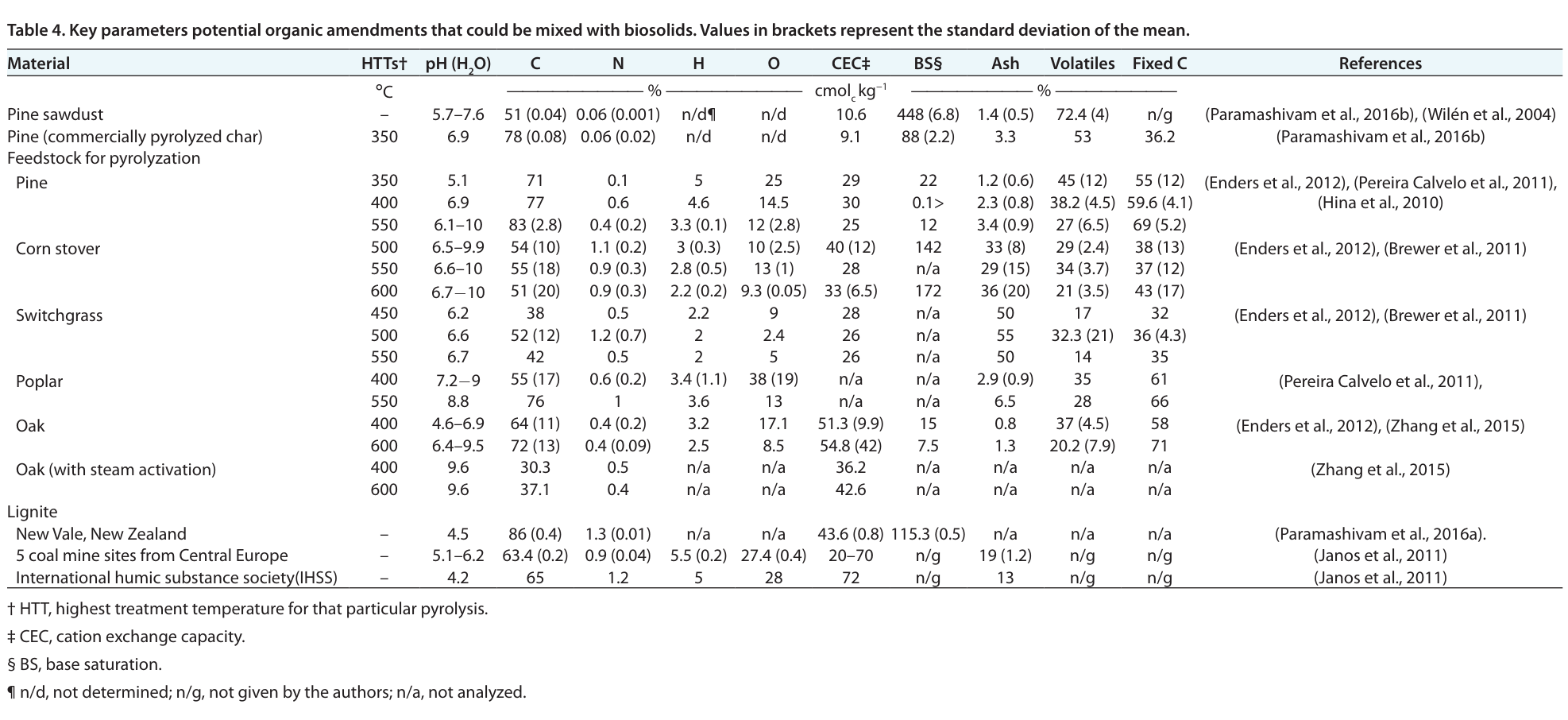
Physicochemical characteristics of potential organic amendments (Table 4) determine the sorption of contaminants when this material is blended with biosolids. A porous structure is a prominent feature that is key to nutrient absorption or water and nutrient retention by biochar (McLaughlin et al., 2012). With lignite, there is a positive correlation between the porous texture and the molecular size of the sorbed species (Pope, 1984). Both materials have high C/N ratios (43–1300), which also has a critical influence on N mobility within soil (McLaren and Cameron, 1996; Kwiatkowska et al., 2008).
潜在有机改良剂的理化特性(表4)决定了该材料与生物固体混合后对污染物的吸附作用。多孔结构是生物炭的显著特征,是其吸收养分或保持水分和养分的关键(McLaughlin et al., 2012)。对于褐煤,其多孔质地与被吸附物质的分子大小呈正相关(Pope, 1984)。两种材料均具有较高的C/N比(43–1300),这对土壤中N的迁移性也有至关重要的影响(McLaren and Cameron, 1996; Kwiatkowska et al., 2008)。
We found recently that lignite and most biochars are not effective in reducing NO3− leaching from soils amended with biosolids in a low-fertility soil (Paramashivam et al., 2016a). Lignite lessened the beneficial growth effects of adding biosolids to soil and exacerbated N2O production. However, sawdust and partially pyrolyzed biochars (resulting from heterogeneous temperatures in the pyrolysis kiln) have provided convincing results from laboratory and glasshouse trails when applied with biosolids to the same soils (Paramashivam et al., 2016b). In batch sorption and column leaching experiments, biochars and fresh sawdust failed to sorb NO3−, but NO3− leaching was reduced by Pinus radiata D. Don sawdust with a low moisture content. One type of low-temperature (350°C) biochar also effectively sorbed NH4+, reducing leaching from columns by 40 to 80%. Blending biosolids with some organic materials can reduce the environmental impact of biosolids application. These findings require further testing in the field.
我们最近发现,在低肥力土壤中,褐煤和大多数生物炭并不能有效减少施用生物固体土壤的NO3−淋溶(Paramashivam et al., 2016a)。褐煤削弱了向土壤添加生物固体所带来的促生长效益,并加剧了N2O的产生。然而,锯末和部分热解的生物炭(由热解窑内温度不均匀所致)与生物固体一起施用于相同土壤时,在实验室和温室试验中取得了令人信服的结果(Paramashivam et al., 2016b)。在批量吸附和土柱淋溶试验中,生物炭和新鲜锯末未能吸附NO3−,但低含水量的Pinus radiata D. Don锯末减少了NO3−淋溶。一种低温(350°C)生物炭还能有效吸附NH4+,使土柱淋溶量减少40%~80%。将生物固体与某些有机物料混合可降低生物固体施用的环境影响。这些发现有待在田间进一步验证。
10Sorption of Xenobiotics and Heavy Metals外源性化合物与重金属的吸附
Biodegradation is the major pathway to breakdown xenobiotic compounds (Piveteau et al., 2001; Ye et al., 2004), ranging from days and weeks to years [some compounds, e.g., 1,1,1-trichloro-2,2-bis(4-chlorophenyl)ethane (DDT), take up to decades] (Fetzner, 2000). Organic amendments can promote biodegradation via several mechanisms. Organic amendments that contain an easily oxidized C source, such as lowmolecular-weight organic acids, will promote the growth of microorganisms, which may in turn degrade some organic contaminants (Martin et al., 2014). Microorganisms such as white rot fungi [an assemblage of species, including Pleurotus ostreatus (Jacq. ex Fr.) P. Kumm and Trametes versicolor (L.) Lloyd.] that degrade lignin in wood waste can enhance the degradation of persistent organic pollutants such as pentachlorophenol (Mileski et al., 1988). Microbial inhibition in biosolids caused by poor aeration, low pH, or high concentrations of metals may be reduced by mixing the biosolids with organic amendments (Song and Schobert, 1996; Pehlivan and Arslan, 2007; Chassapis et al., 2009; Knowles et al., 2011; Simmler et al., 2013; Doskocil et al., 2015).
生物降解是外源性化合物分解的主要途径(Piveteau et al., 2001; Ye et al., 2004),所需时间从数天、数周到数年不等[某些化合物,如1,1,1-三氯-2,2-双(4-氯苯基)乙烷(DDT),需长达数十年](Fetzner, 2000)。有机改良剂可通过多种机制促进生物降解。含有易氧化碳源(如低分子量有机酸)的有机改良剂可促进微生物生长,进而降解部分有机污染物(Martin et al., 2014)。能够降解木材废料中木质素的微生物,如白腐真菌[一类物种的集合,包括Pleurotus ostreatus (Jacq. ex Fr.) P. Kumm和Trametes versicolor (L.) Lloyd.],可增强五氯苯酚等持久性有机污染物的降解(Mileski et al., 1988)。将生物固体与有机改良剂混合,可缓解生物固体中由通气不良、低pH或高浓度金属所引起的微生物抑制(Song and Schobert, 1996; Pehlivan and Arslan, 2007; Chassapis et al., 2009; Knowles et al., 2011; Simmler et al., 2013; Doskocil et al., 2015)。
Xenobiotics can be immobilized or entrapped within the micropores of organic soil amendment (Fetzner, 2000). Biochar has been widely used for the sorption of xenobiotic contaminants from the soil (Wang et al., 2010). Zhang et al. (2010) have reported that the phenanthrene sorption linear distribution coefficient of soil amended with biochar was 3.4 ´ 104 L kg−1, and soil without amendment was only 47 L kg−1.
外源性化合物可被固定或截留在有机土壤改良剂的微孔内(Fetzner, 2000)。生物炭已被广泛用于吸附土壤中的外源性污染物(Wang et al., 2010)。Zhang et al.(2010)报道,添加生物炭的土壤对菲的线性吸附分配系数为3.4 × 10⁴ L kg−1,而未改良土壤仅为47 L kg−1。
Heavy metal concentrations in biosolids will be reduced by dilution when the biosolids are mixed with an organic amendment that has low metal concentrations. Amendments such as biochar can increase the pH of biosolids-amended soil, resulting in increased sorption and precipitation of heavy metal cations (Beesley et al., 2011). Heavy metals may be immobilized by sorption onto exchange sites on an organic amendment. Lignite increases the cation exchange capacity of the material due its high humic acid content (Kucerik et al., 2003; Janos et al., 2011). Lignite effectively immobilizes metallic ions and heavy metals such as Cu, Pb, Cd, Ni, and Zn in contaminated soils (Karczewska et al., 1996; Pehlivan et al., 2004; Budaeva et al., 2006; Domańska and Smolinska, 2012; Doskocil and Pekar, 2012) and removes radionuclides and potential toxic metals from wastewater (Mohan and Chander, 2006; Mizera et al., 2007). Unlike the degradation of xenobiotics, the immobilization of heavy metals may not be permanent; the degradation of organic amendments, as well as the biosolids themselves, may result in desorption of heavy metals and their subsequent leaching or plant uptake (Tella et al., 2016). In some cases, organic materials may increase the solubility of heavy metals such as Cu, which can form mobile complexes with dissolved organic C associated with the amendment (Bolan et al., 2003). However, the solubilized Cu complex may not be bioavailable (Kunhikrishnan et al., 2013).
当生物固体与金属浓度较低的有机改良剂混合时,其重金属浓度会因稀释而降低。生物炭等改良剂可提高施用生物固体土壤的pH,从而增加重金属阳离子的吸附和沉淀(Beesley et al., 2011)。重金属可通过吸附于有机改良剂的交换位点上而被固定。褐煤因其腐殖酸含量高而可提高物料的阳离子交换量(Kucerik et al., 2003; Janos et al., 2011)。褐煤可有效固定污染土壤中的金属离子和Cu、Pb、Cd、Ni、Zn等重金属(Karczewska et al., 1996; Pehlivan et al., 2004; Budaeva et al., 2006; Domańska and Smolinska, 2012; Doskocil and Pekar, 2012),并可去除废水中的放射性核素和潜在有毒金属(Mohan and Chander, 2006; Mizera et al., 2007)。与外源性化合物的降解不同,重金属的固定可能并非永久性的;有机改良剂以及生物固体本身的降解可能导致重金属解吸,进而发生淋溶或被植物吸收(Tella et al., 2016)。在某些情况下,有机物料可能增加Cu等重金属的溶解度,Cu可与改良剂带入的溶解性有机碳形成可移动的络合物(Bolan et al., 2003)。然而,溶解态Cu络合物可能不具有生物有效性(Kunhikrishnan et al., 2013)。
11Conclusions结论
Biosolids can provide organic matter and a rich source of nutrients to improve soil quality, but food chain risks and wider environmental concerns reduce or even prevent its wide-scale application to agricultural land in many countries. Wastewater treatment options are unable to address all of these concerns, but landfilling and incineration do not provide a sustainable alternative. Coapplication with other organic waste streams to land certainly does not always provide a viable solution; however, there is evidence that mixtures containing sawdust and partially pyrolyzed biochars are effective in mitigating excessive nitrate leaching from biosolids-amended soils. Lignite coal waste, while ineffective at mitigating nitrate leaching, may reduce plant uptake of biosolidsborne contaminants such as Cd. Economically and environmentally acceptable solutions that will allow biosolids application to agricultural land remain highly challenging, but the requirement to improve soil quality for forest and mine rehabilitation probably justifies more field investigations. Combining biosolids with other organic wastes to rehabilitate degraded land remains a potentially practicable and sustainable management of these resources.
生物固体可提供有机质和丰富的养分来源以改善土壤质量,但食物链风险和更广泛的环境问题减少甚至阻碍了其在许多国家农田上的大规模施用。污水处理方案无法解决所有这些问题,而填埋和焚烧也并非可持续的替代方案。与其他有机废物流联合施用于土地当然并不总能提供可行的解决方案;然而,有证据表明,含有锯末和部分热解生物炭的混合物可有效减轻施用生物固体土壤的硝酸盐过量淋溶。褐煤废料虽不能有效减轻硝酸盐淋溶,但可能减少植物对Cd等生物固体源污染物的吸收。能够使生物固体施用于农田且在经济和环境上均可接受的解决方案仍极具挑战性,但森林和矿山复垦对改善土壤质量的需求或许足以支持开展更多的田间研究。将生物固体与其他有机废弃物组合用于退化土地修复,仍是对这些资源进行潜在可行且可持续管理的途径。
12Acknowledgments致谢
We gratefully acknowledge the Centre for Integrated Biowaste Research (CIBR) for supporting this work.
感谢Centre for Integrated Biowaste Research(CIBR)对本研究的支持。
13References参考文献
ANZBP. 2014. New Zealand biosolids statistics. Aust. N. Z. Biosolids Partnership, Aust. Water Assoc. https://www.biosolids.com.au/guidelines/newzealand-biosolids-statistics/ (accessed 15 Aug. 2016).
Banegas, V., J.L. Moreno, J.I. Moreno, C. Garcia, G. Leon, and T. Hernandez. 2007. Composting anaerobic and aerobic sewage sludges using two proportions of sawdust. Waste Manag. 27:1317–1327. doi:10.1016/j. wasman.2006.09.008
Barnett, J., and J. Russell. 2001. Application of waste to land: The dairy industry’s perspective. In: Proceedings of the New Zealand Land Collective Annual Conference, Rotorua, Invercargill, New Zealand. New Zealand Land Treatment Collective, Porirua, New Zealand. p. 139–141.
Beesley, L., E. Moreno-Jimenez, J.L. Gomez-Eyles, E. Harris, B. Robinson, and T. Sizmur. 2011. A review of biochars’ potential role in the remediation, revegetation and restoration of contaminated soils. Environ. Pollut. 159:3269–3282. doi:10.1016/j.envpol.2011.07.023
Bernal, M.P., A.F. Navarro, M.A. Sanchez-Monedero, A. Roig, and J. Cegarra. 1998. Influence of sewage sludge compost stability and maturity on carbon and nitrogen mineralization in soil. Soil Biol. Biochem. 30:305–313. doi:10.1016/S0038-0717(97)00129-6
Binder, D.L., A. Dobermann, D.H. Sander, and K.G. Cassman. 2002. Biosolids as nitrogen source for irrigated maize and rainfed sorghum. Soil Sci. Soc. Am. J. 66:531–543. doi:10.2136/sssaj2002.5310
Blair, R.M., H. Fang, W.S. Branham, B.S. Hass, S.L. Dial, C.L. Moland et al. 2000. The estrogen receptor relative binding affinities of 188 natural and xenochemicals: Structural diversity of ligands. Toxicol. Sci. 54:138–153. doi:10.1093/toxsci/54.1.138
Bogner, J., A.M. Abdelrafie, C.A. Diaz, A. Faaij, Q. Gao, S. Hashimoto et al. 2008. Waste management. In: B. Metz, O. Davidson, P. Bosch, R. Dave, and L. Meyer, editors, Climate change 2007: Mitigation of climate change. Working Group III contribution to the fourth assessment report of the Intergovernmental Panel on Climate Change. Cambridge Univ. Press., New York. p. 585–618.
Bolan N., D. Adriano, S. Mani, A. Khan. 2003. Adsorption, complexation, and phytoavailability of copper as influenced by organic manure. Environ. Toxicol. Chem. 22:450–456.
Bolan, N.S., A. Kunhikrishnan, and R. Naidu. 2013. Carbon storage in a heavy clay soil landfill site after biosolid application. Sci. Total Environ. 465:216– 225. doi:10.1016/j.scitotenv.2012.12.093
Bothner, M.H., H. Takada, I.T. Knight, R.T. Hill, B. Butman, J.W. Farrington et al. 1994. Sewage contamination in sediments beneath a deep-ocean dump site off New York. Mar. Environ. Res. 38:43–59. doi:10.1016/0141-1136(94)90045-0
Brenton, C.M., E.B. Fish, and R. Mata-Gonzalez. 2007. Macronutrient and trace element leaching following biosolids application on semi-arid rangeland soils. Arid Land Res. Manage. 21:143–156. doi:10.1080/15324980701267783
Brewer, C.E., R. Unger, K. Schmidt-Rohr, and R.C. Brown. 2011. Criteria to select biochars for field studies based on biochar chemical properties. Bio- Energy Res. 4:312–323. doi:10.1007/s12155-011-9133-7
Budaeva, A.D., E.V. Zoltoev, V.D. Tikhova, and N.V. Bodoev. 2006. Interaction of heavy metal ions with ammonium humates. Russ. J. Appl. Chem. 79:920–923. doi:10.1134/S1070427206060103
Bugbee, G.J. 1999. Effects of hardwood sawdust in potting media containing biosolids compost on plant growth, fertilizer needs, and nitrogen leaching. Commun. Soil Sci. Plant Anal. 30:689–698. doi:10.1080/00103629909370238
Chassapis, K., M. Roulia, and D. Tsirigoti. 2009. Chemistry of metal-humic complexes contained in Megalopolis lignite and potential application in modern organomineral fertilization. Int. J. Coal Geol. 78:288–295. doi:10.1016/j.coal.2009.03.004
Civeira, G., and R.S. Lavado. 2008. Nitrate losses, nutrients and heavy metal accumulation from substrates assembled for urban soils reconstruction. J. Environ. Manage. 88:1619–1623. doi:10.1016/j. jenvman.2007.08.005
Correa, R.S., R.E. White, and A.J. Weatherley. 2006. Effect of compost treatment of sewage sludge on nitrogen behavior in two soils. Waste Manag. 26:614–619. doi:10.1016/j.wasman.2005.09.008
Daniels, W.L., G.K. Evanylo, S.M. Nagle, and J.M. Schmidt. 2001. Effects of biosolids loading rate and sawdust additions on row crop yield and nitrate leaching potentials in Virginia sand and gravel mine reclamation. In: Proceedings of the 2001 Meeting of the American Association for Surface Mining and Reclamation, Albuquerque, NM. 3–7 June 2001. Am. Soc. for Surface Mining and Reclamation, Lexington KY. p. 399–405. doi:10.21000/JASMR01010399
Domańska, K.K., and B. Smolinska. 2012. Advantages of lignite addition in purification process of soil polluted by heavy metals. Biotechnol. Food Sci. 76:51–58.
Doskocil, L., L. Grasset, V. Enev, L. Kalina, and M. Pekar. 2015. Study of waterextractable fractions from South Moravian lignite. Environ. Earth Sci. 73:3873–3885. doi:10.1007/s12665-014-3671-1
Doskocil, L., and M. Pekar. 2012. Removal of metal ions from multi-component mixture using natural lignite. Fuel Process. Technol. 101:29–34. doi:10.1016/j.fuproc.2012.02.010
Elliott, H.A., G.A. O’Connor, and S. Brinton. 2002. Phosphorus leaching from biosolids-amended sandy soils. J. Environ. Qual. 31:681–689. doi:10.2134/jeq2002.0681
Enders, A., K. Hanley, T. Whitman, S. Joseph, and J. Lehmann. 2012. Characterization of biochars to evaluate recalcitrance and agronomic performance. Bioresour. Technol. 114:644–653. doi:10.1016/j.biortech.2012.03.022 EPA-VA. 2004. Guidelines for Environmental management: Biosolids land application. Environ. Prot. Agency Victoria, Southbank, VIC.
Esperschütz, J., O. Lense, C. Anderson, S. Bulman, J. Horswell, N. Dickinson, and B. Robinson. 2016. Biowaste mixtures affecting the growth and elemental composition of Italian ryegrass (Lolium multiflorum). J. Environ. Qual. 45:1054–1061. doi:10.2134/jeq2015.09.0459
Evanylo, G.K. 2009. Agricultural land application of biosolids in Virginia: Managing biosolids for agricultural use. Publ. 452-303. Virginia Coop. Ext., Blacksburg.
Fetzner, S. 2000. Biodegradation of xenobiotics. In: H.W. Doelle, S. Rokem, and M. Berovic, editors, Biotechnology: Fundamentals in Biotechnology. Vol. X. Eolss Publishers, Oxford, UK. p. 215–246.
Gartler, J., B. Robinson, K. Burton, and L. Clucas. 2013. Carbonaceous soil amendments to biofortify crop plants with zinc. Sci. Total Environ. 465:308–313. doi:10.1016/j.scitotenv.2012.10.027 Gary M.K., Brooks J.P., Brown S., Gerba C. 2011. Land application of organic residuals: Public health threat or environmental benefit? Am. Soc. Microbiol., Washington, DC.
Gerwing, J.J., J.S. Johns, and E. Vidal. 1996. Reducing waste during logging and log processing: Forest conservation in eastern Amazonia. FAO Corporate Document Repository, Rome.
Gholz, H.L., D.A. Wedin, S.M. Smitherman, M.E. Harmon, and W.J. Parton. 2000. Long-term dynamics of pine and hardwood litter in contrasting environments: Toward a global model of decomposition. Glob. Change Biol. 6:751–765. doi:10.1046/j.1365-2486.2000.00349.x
Gilmour J., and V. Skinner. 1998. Estimating plant-available nitrogen in biosolids. In: W.E. Sabbe, editor, Arkansas soil fertility studies 1997. Res. Ser. 459. Arkansas Agric. Exp. Stn., Fayetteville. p. 29–33.
GWI. 2015. Sludge management: Opportunities in growing volumes, disposal restrictions and energy recovery. Global Water Intelligence, Austin, TX.
Haering K.C., Daniels W.L., Feagley S.E. 2000. 24. Reclaiming mined lands with biosolids, manures, and papermill sludges. In: R.I. Barnhisel, R.G. Darmody, and W.L. Daniels, editors, Reclamation of drastically disturbed lands. Agron. Monogr. 41. ASA, CSSA, SSSA, Madison, WI. p. 615–644. doi:10.2134/agronmonogr41.c24
Handreck, K.A. 1990. Extractants for assessing the availability of copper to Chrysanthemum morifolium cultivar ‘Yellow Mandalay’ growing in soil-less media. Sci. Hortic. (Amsterdam) 44:323–334. doi:10.1016/0304-4238(90)90133-Y
Harmayani, K.D., and A.H.M.F. Anwar. 2012. Adsorption of nutrients from stormwater using sawdust. Int. J. Environ. Sci. Dev. 3:114–117. doi:10.7763/IJESD.2012.V3.199
Haynes, R.J., G. Murtaza, and R. Naidu. 2009. Inorganic and organic constituents and contaminants of biosolids: Implications for land application. In: D.L. Sparks, editor, Advances in agronomy. Vol. 104. Elsevier, Amsterdam, the Netherlands. p. 165–267.
Henry, C., M. Van Ham, M. Grey, N. Cowley, and R. Harrison. 2000. Field method for biosolids N mineralization using porous ceramic cups. Water Air Soil Pollut. 117:123–131. doi:10.1023/A:1005140911712
Henry, C.L., D.W. Cole, and R.B. Harrison. 1994. Use of municipal sludge to restore and improve site productivity in forestry: The pack forest sludge research program. For. Ecol. Manage. 66:137–149. doi:10.1016/0378-1127(94)90153-8
Hina, K., P. Bishop, A.M. Camps, R. Calvelo-Pereira, J.A. Macia-Agullo, J. Hindmarsh et al. 2010. Producing biochars with enhanced surface activity through alkaline pretreatment of feedstocks. Aust. J. Soil Res. 48:606–617. doi:10.1071/SR10015
Israel, S., A. Rosenov, G. Tredoux, and N. Jovanovic. 2014. In situ nitrate removal from groundwater using freely available carbon material at an industrially polluted site. In: J. Cobbing, S. Adams, I. Dennis, and K. Riemann , editors, Assessing and managing groundwater in different environments. CRC Press, Boca Raton, FL. p. 207–223.
Janos P., L. Zavodska, J. Lesny, and S. Krizenecka. 2011. Young brown coals for environmental applications composition, acid-base, ion-exchange and sorption properties of selected central European coals. NOVA Science Publishers, Hauppauge, NY.
Jones-Lepp, T.L., and R. Stevens. 2007. Pharmaceuticals and personal care products in biosolids/sewage sludge: The interface between analytical chemistry and regulation. Anal. Bioanal. Chem. 387:1173–1183. doi:10.1007/ s00216-006-0942-z
Karczewska, A., T. Chodak, and J. Kaszubkiewicz. 1996. The suitability of brown coal as a sorbent for heavy metals in polluted soils. Appl. Geochem. 11:343–346. doi:10.1016/0883-2927(95)00043-7
Kim, H.H., E.A. Seagren, and A.P. Davis. 2003. Engineered bioretention for removal of nitrate from stormwater runoff. Water Environ. Res. 75:355– 367. doi:10.2175/106143003X141169 Knowles, O.A., B.H. Robinson, A. Contangelo, and L. Clucas. 2011. Biochar for the mitigation of nitrate leaching from soil amended with biosolids. Sci. Total Environ. 409:3206–3210. doi:10.1016/j.scitotenv.2011.05.011
Korboulewsky, N., S. Dupouyet, and G. Bonin. 2002. Environmental risks of applying sewage sludge compost to vineyards: Carbon, heavy metals, nitrogen, and phosphorus accumulation. J. Environ. Qual. 31:1522–1527. doi:10.2134/jeq2002.1522
Kucerik J., Pekar M., Klucakova M. 2003. South-Moravian lignite-potential source of humic substances. Petrolium and Coal 45:58–62.
Kunhikrishnan, A., N.S. Bolan, R. Naidu, and W.I. Kim. 2013. Recycled water sources influence the bioavailability of copper to earthworms. J. Hazard. Mater. 261:784–792. doi:10.1016/j.jhazmat.2012.10.015
Kwiatkowska, J., M.R. Provenzano, and N. Senesi. 2008. Long term effects of a brown coal-based amendment on the properties of soil humic acids. Geoderma 148:200–205. doi:10.1016/j.geoderma.2008.10.001
Laghari, M., R. Naidu, B. Xiao, Z.Q. Hu, M.S. Mirjat, M. Hu et al. 2016. Recent developments in biochar as an effective tool for agricultural soil management: A review. J. Sci. Food Agric. 96:4840–4849. doi:10.1002/ jsfa.7753
Laidlaw, W.S., S.K. Arndt, T.T. Huynh, D. Gregory, and A.J.M. Baker. 2012. Phytoextraction of heavy metals by willows growing in biosolids under field conditions. J. Environ. Qual. 41:134–143. doi:10.2134/jeq2011.0241
Lavado, R.S. 2006. Effects of sewage-sludge application on soils and sunflower yield: Quality and toxic element accumulation. J. Plant Nutr. 29:975–984. doi:10.1080/01904160600685611
LeBlanc, R.J., P. Matthews, and R.P. Richard, editors. 2008. Global atlas of excreta, wastewater sludge, and biosolids management: Moving forward the sustainable and welcome uses of a global resource. UN Human Settlements Programme, Nairobi, Kenya.
Liu, Z.-h., Y. Kanjo, and S. Mizutani. 2009. Removal mechanisms for endocrine disrupting compounds (EDCs) in wastewater treatment- physical means, biodegradation, and chemical advanced oxidation: A review. Sci. Total Environ. 407:731–748. doi:10.1016/j.scitotenv.2008.08.039
Lu Q., Z.L. He, and P.J. Stoffella. 2012. Land application of biosolids in the USA: A review. Appl. Environ. Soil Sci. 2012:201462. doi:10.1155/2012/201462 Magesan, G.N., and H. Wang. 2003. Application of municipal and industrial residuals in New Zealand forest: An Overview. Aust. J. Soil Res. 41:557– 569. doi:10.1071/SR02134
Majumder, R., S.J. Livesley, D. Gregory, and S.K. Arndt. 2014. Biosolid stockpiles are a significant point source for greenhouse gas emissions. J. Environ. Manage. 143:34–43. doi:10.1016/j.jenvman.2014.04.016
Marchaim, U. 2017. Chapter six: Aerobic versus anaerobic wastewater treatment. In: Biogas processes for sustainable development. FAO, Rome.
Martin, B.C., S.J. George, C.A. Price, M.H. Ryan, and M. Tibbett. 2014. The role of root exuded low molecular weight organic anions in facilitating petroleum hydrocarbon degradation: Current knowledge and future directions. Sci. Total Environ. 472:642–653. doi:10.1016/j.scitotenv.2013.11.050
McBride, M.B., B.K. Richards, T. Steenhuis, and G. Spiers. 1999. Long-term leaching of trace elements in a heavily sludge-amended silty clay loam soil. Soil Sci. 164:613–623. doi:10.1097/00010694-199909000-00001
McLaren, R.G., and K.C. Cameron. 1996. Soil science: Sustainable production and environmental protection. Oxford Univ. Press, Auckland, New Zealand.
McLaughlin, H., F. Shields, J. Jagiello, and G. Thiele. 2012. Analytical options for biochar adsorption and surface area In: Proceedings of the 2012 US Biochar conference. Biochar Conference, Rohnert Park, CA. 29 July–1 Aug. 2012. US Biochar Initiative, Portland, OR.
Michalk, D.L., M.S. Whatmuff, G.J. Osborne, and T.S. Gibson. 2004. Benefits and risks associated with biosolids application to agricultural production systems: Experiences from New South Wales, Australia. In: A.L. Juhasz, G. Magesan, and R. Naidu, editors, Waste management. Science Publishers, Enfield, NH. p. 157–201.
Mileski, G.J., J.A. Bumpus, M.A. Jurek, and S.D. Aust. 1988. Biodegradation of pentachlorophenol by the white rot fungus Phanerochaete chysoporium. Appl. Environ. Microbiol. 54:2885–2889.
Miller-Robbie, L., B.A. Ulrich, D.F. Ramey, K.S. Spencer, S.P. Herzog, T.Y. Cath et al. 2015. Life cycle energy and greenhouse gas assessment of the coproduction of biosolids and biochar for land application. J. Clean. Prod. 91:118–127. doi:10.1016/j.jclepro.2014.12.050
Mizera, J., G. Mizerova, V. Machovic, and L. Borecka. 2007. Sorption of cesium, cobalt and europium on low-rank coal and chitosan. Water Res. 41:620– 626. doi:10.1016/j.watres.2006.11.008
Mohan, D., and S. Chander. 2006. Removal and recovery of metal ions from acid mine drainage using lignite: A low cost sorbent. J. Hazard. Mater. 137:1545–1553. doi:10.1016/j.jhazmat.2006.04.053
Mok, H.-F., R. Majumder, W.S. Laidlaw, D. Gregory, A.J.M. Baker, and S.K. Arndt. 2013. Native Australian species are effective in extracting multiple heavy metals from biosolids. Int. J. Phytoremediation 15:615–632. doi:10. 1080/15226514.2012.723063 Nash, D., C. Butler, J. Cody, and M.S.J. Warne. 2011. Effects of biosolids application on pasture and grape vines in Southeastern Australia. Appl. Environ. Soil Sci. 2011:342916. doi:10.1155/2011/342916
NZWWA. 2003. Guidelines for the safe application of biosolids to land in New Zealand. N.Z. Water and Wastes Assoc., Wellington.
O’Connor, G.A., H.A. Elliott, N.T. Basta, R.K. Bastian, G.M. Pierzynski, R.C. Sims, and J.E. Smith. 2005. Sustainable land application: An overview. J. Environ. Qual. 34:7–17. doi:10.2134/jeq2005.0007
O’Kelly, B.C. 2005. Sewage sludge to landfill: Some pertinent engineering properties. J. Air Waste Manag. Assoc. 55:765–771. doi:10.1080/10473289.2 005.10464670
Ogilvie, D. 1998. National study of the composition of sewage sludge. Drainage Managers Group, N.Z. Water and Wastes Assoc., Wellington.
Ozores-Hampton, M., and D.R.A. Peach. 2002. Biosolids in vegetable production systems. Horttechnology 12:336–340.
Paramashivam, D., T.J. Clough, A. Carlton, K. Gough, N. Dickinson, J. Horswell et al. 2016a. The effect of lignite on nitrogen mobility in a low-fertility soil amended with biosolids and urea. Sci. Total Environ. 543:601–608. doi:10.1016/j.scitotenv.2015.11.075
Paramashivam, D., T.J. Clough, N.M. Dickinson, J. Horswell, O. Lense, L. Clucas, and B.H. Robinson. 2016b. Effect of pine waste and pine biochar on nitrogen mobility in biosolids. J. Environ. Qual. 45:360–367. doi:10.2134/jeq2015.06.0298
Park, J.H., G.K. Choppala, N.S. Bolan, J.W. Chung, and T. Chuasavathi. 2011. Biochar reduces the bioavailability and phytotoxicity of heavy metals. Plant Soil 348:439–451. doi:10.1007/s11104-011-0948-y
Pehlivan, E., and G. Arslan. 2007. Removal of metal ions using lignite in aqueous solution: Low cost biosorbents. Fuel Process. Technol. 88:99–106. doi:10.1016/j.fuproc.2006.09.004
Pehlivan, E., A. Richardson, and P. Zuman. 2004. Electrochemical investigation of binding of heavy metal ions to Turkish lignites. Electroanalysis 16:1292–1298. doi:10.1002/elan.200302949
Pereira Calvelo, R., J. Kaal, M.C. Arbestain, R. Pardo Lorenzo, W. Aitkenhead, M. Hedley et al. 2011. Contribution to characterisation of biochar to estimate the labile fraction of carbon. Org. Geochem. 42:1331–1342. doi:10.1016/j.orggeochem.2011.09.002
Piveteau, P., F. Fayolle, J.P. Vandecasteele, and F. Monot. 2001. Biodegradation of tert-butyl alcohol and related xenobiotics by a methylotrophic bacterial isolate. Appl. Microbiol. Biotechnol. 55:369–373. doi:10.1007/ s002530000545
Pope, C.G. 1984. Lignite porosity study by kinetics of gas adsorption. Fuel 63:1681–1686. doi:10.1016/0016-2361(84)90100-5
Prasad R., and J.F. Power. 1997. Soil fertility management for sustainable agriculture. CRC Press, Boca Raton, FL.
Raghab, S.M., A.M. Abd El Meguid, and H.A. Hegazi. 2013. Treatment of leachate from municipal solid waste landfill. HBRC J. 9:187–192. doi:10.1016/j.hbrcj.2013.05.007
Rajendram W., A. Surapaneni, and G.L. Smith. 2011. From waste to soil to plant to feed: The fate of biosolids nutrients and contaminants in a real farm situation. Australia and New Zealand Biosolids Partnership. https://www. biosolids.com.au/wp-content/uploads/From-Waste-to-Soil-to-Plant-to- Feed.pdf (accessed 15 Aug. 2016).
Ramamoorthy, K., F. Wang, I.C. Chen, S. Safe, J.D. Norris, D.P. McDonnell et al. 1997. Potency of combined estrogenic pesticides. Science 275:405–406. doi:10.1126/science.275.5298.405
Rigby, H., and S.R. Smith. 2013. Nitrogen availability and indirect measurements of greenhouse gas emissions from aerobic and anaerobic biowaste digestates applied to agricultural soils. Waste Manag. 33:2641–2652. doi:10.1016/j.wasman.2013.08.005
Robertson, W.D., and J.A. Cherry. 1995. In-situ denitrification of septic system nitrate using reactive porous media barriers- field trials. Ground Water 33:99–111. doi:10.1111/j.1745-6584.1995.tb00266.x
Rouch, D.A., V.A. Fleming, S. Pai, M. Deighton, J. Blackbeard, and S.R. Smith. 2011. Nitrogen release from air-dried biosolids for fertilizer value. Soil Use Manage. 27:294–304 doi:10.1111/j.1475-2743.2011.00338.x Rynk, R., and N. Goldstein. 2003. Reducing odor impacts at land application sites. BioCycle 44:54–58.
Samaras, V., C.D. Tsadilas, and S. Stamatiadis. 2008. Effects of repeated application of municipal sewage sludge on soil fertility, cotton yield, and nitrate leaching. Agron. J. 100:477–483. doi:10.2134/agronj2007.0162 Sanchez-Monedero, M.A., C. Mondini, M. de Nobili, L. Leita, and A. Roig. 2004. Land application of biosolids. Soil response to different stabilization degree of the treated organic matter. Waste Manag. 24:325–332. doi:10.1016/j.wasman.2003.08.006
Schipper, L.A., and M. Vojvodic-Vukovic. 2000. Nitrate removal from groundwater and denitrification rates in a porous treatment wall amended with sawdust. Ecol. Eng. 14:269–278. doi:10.1016/ S0925-8574(99)00002-6
Schmidt, J.M., W.L. Daniels, R.S. Li, and D. McFaden. 2001. Determining optimal sawdust/biosolids mixtures to manage nitrate leaching in reclaimed disturbed soils. In: Proceedings of the 2001 Meeting of the American Association for Surface Mining and Reclamation, Albuquerque, NM. 3–7 June 2001. Am. Soc. for Surface Mining and Reclamation, Lexington KY. p. 429–436.
Shinbrot, X. 2012. Biosolids or biohazards? Pesticides and You 32(3):9–15.
Shukla, A., Y.H. Zhang, P. Dubey, J.L. Margrave, and S.S. Shukla. 2002. The role of sawdust in the removal of unwanted materials from water. J. Hazard. Mater. 95:137–152. doi:10.1016/S0304-3894(02)00089-4 Simmler, M., L. Ciadamidaro, R. Schulin, P. Madejón, R. Reiser, L. Clucas et al. 2013. Lignite reduces the solubility and plant uptake of cadmium in pasturelands. Environ. Sci. Technol. 47:4497–4504. doi:10.1021/es303118a
Singh, R.P., and M. Agrawal. 2008. Potential benefits and risks of land application of sewage sludge. Waste Manag. 28:347–358. doi:10.1016/j. wasman.2006.12.010 Smith S.R. 1995. Agricultural recycling of sewage sludge and the environment. Oxford Univ. Press, Oxford, UK.
Song, C.S., and H.H. Schobert. 1996. Non-fuel uses of coals and synthesis of chemicals and materials. Fuel 75:724–736. doi:10.1016/0016-2361(95)00295-2
Sopper W.E., and E.M. Seaker. 1990. Long-term effects of a single application of municipal sludge on abandoned mine land. In: J. Skousen, J. Sencindiver, and D. Samuel, editors, Proceedings of the 1990 Mining and Reclamation Conference and Exhibition, Charleston, WV. 23–26 Apr. 1990. West Virginia Univ., Morgantown, WV. p. 579–588.
Spokas, K., J. Bogner, J.P. Chanton, M. Morcet, C. Aran, C. Graff et al. 2006. Methane mass balance at three landfill sites: What is the efficiency of capture by gas collection systems? Waste Manag. 26:516–525. doi:10.1016/j. wasman.2005.07.021
Spokas, K.A., W.C. Koskinen, J.M. Baker, and D.C. Reicosky. 2009. Impacts of woodchip biochar additions on greenhouse gas production and sorption/ degradation of two herbicides in a Minnesota soil. Chemosphere 77:574– 581. doi:10.1016/j.chemosphere.2009.06.053
Stoffella, P.J., M. Ozores-Hampton, N.E. Roe, Y.C. Li, and T.A. Obreza. 2003. Compost utilization in vegetable crop production systems. In: K. Mirami, C. Andreoli, and W.M. Nascimento, editors, Proceedings of the 9th International Symposium on Timing of Field Production in Vegetable Crops, Sáo Paulo, Brazil. 20–24 May 2001. Int. Soc. Hort. Sci., Leuven, Belgium. p. 125-128. Sullivan, T.S., M.E. Stromberger, M.W. Paschke, and J.A. Ippolito. 2006. Long-term impacts of infrequent biosolids applications on chemical and microbial properties of a semi-arid rangeland soil. Biol. Fertil. Soils 42:258–266. doi:10.1007/s00374-005-0023-z
Taghizadeh-Toosi, A., T.J. Clough, L.M. Condron, R.R. Sherlock, C.R. Anderson, and R.A. Craigie. 2011. Biochar incorporation into pasture soil suppresses in situ nitrous oxide emissions from ruminant urine patches. J. Environ. Qual. 40:468–476. doi:10.2134/jeq2010.0419
Taghizadeh-Toosi, A., T.J. Clough, R.R. Sherlock, and L.M. Condon. 2012. Biochar adsorbed ammonia is bioavailable. Plant Soil 350:57–69. doi:10.1007/s11104-011-0870-3
Tella, M., M.N. Bravin, L. Thuries, P. Cazevieille, C. Chevassus-Rosset, B. Collin et al. 2016. Increased zinc and copper availability in organic waste amended soil potentially involving distinct release mechanisms. Environ. Pollut. 212:299–306. doi:10.1016/j.envpol.2016.01.077
Trolove, S.N., and J.B. Reid. 2003. A field growing system to reduce sulphur uptake of a crop grown in a moderately high sulphur soil- preliminary report. Agron. N. Z. 32:51–59.
Uchimiya, M., I.M. Lima,T. Klasson, S. Chang, L.H. Wartelle, and J.E. Rodgers. 2010. Immobilization of heavy metal ions (CuII, CdII, NiII, and PbII) by broiler litter-derived biochars in water and soil. Agric. Food Chem. 58:5538–5544. doi:10.1021/jf9044217
Uggetti, E., I. Ferrer, S. Nielsen, C. Arias, H. Brix, and J. García. 2012. Characteristics of biosolids from sludge treatment wetlands for agricultural reuse. Ecol. Eng. 40:210–216. doi:10.1016/j.ecoleng.2011.12.030
UNEP. 2016. Practices in Europe and North America: Waste disposal versus resource utilisation. Freshwater Manage. Ser. no. 1. UN Environ. Programme, Nairobi, Kenya.
Wang, H., K. Lin, Z. Hou, B. Richardson, and J. Gan. 2010. Sorption of the herbicide terbuthylazine in two New Zealand forest soils amended with biosolids and biochars. J. Soils Sediments 10:283–289. doi:10.1007/ s11368-009-0111-z
Wang, H.L., M.O. Kimberley, and M. Schlegelmilch. 2003. Biosolids-derived nitrogen mineralization and transformation in forest soils. J. Environ. Qual. 32:1851–1856. doi:10.2134/jeq2003.1851
WEC. 2010. Survey of energy resources. World Energy Counc., London.
Werther, J., and T. Ogada. 1999. Sewage sludge combustion. Pror. Energy Combust. Sci. 25:55–116. doi:10.1016/S0360-1285(98)00020-3
Wilén, C., P. Salokoski, E. Kurkela, and K. Sipilä. 2004. Finnish expert report on best available techniques in energy production from solid recovered fuels. Technical Research Centre of Finland, Espoo, Finland.
Ye, J., A. Singh, and O.P. Ward. 2004. Biodegradation of nitroaromatics and other nitrogen-containing xenobiotics. World J. Microbiol. Biotechnol. 20:117–135. doi:10.1023/B:WIBI.0000021720.03712.12
Zhang, H., K. Lin, H. Wang, and J. Gan. 2010. Effect of Pinus radiata derived biochars on soil sorption and desorption of phenanthrene. Environ. Pollut. 158:2821–2825. doi:10.1016/j.envpol.2010.06.025
Zhang, H., R.P. Voroneya, and G.W. Price. 2015. Effects of temperature and processing conditions on biochar chemical properties and their influence on soil C and N transformations. Soil Biol. Biochem. 83:19–28. doi:10.1016/j.soilbio.2015.01.006
WCC. 2008. Landfill charges. Wellington City Counc., Wellington, New Zealand.