RESEARCH ARTICLE
Paula Madejo´n1*, Teodoro Maraño´n1, Carmen M. Navarro-Ferna´ndez1, Marı´a T. Domı´nguez1, Jose´ M. Alegre1, Brett Robinson2, Jose´ M. Murillo1
1 Instituto de Recursos Naturales y Agrobiologı´a de Sevilla, IRNAS, Seville, Spain, 2 Department of Soil and Physical Sciences, Lincoln University, Lincoln, Canterbury, New Zealand
OPEN ACCESS
Editor: Jorge Paz-Ferreiro, RMIT University, AUSTRALIA
Received: March 22, 2017
Accepted: June 12, 2017
Published: June 30, 2017
Copyright: © 2017 Madejo´n et al. This is an open access article distributed under the terms of the Creative Commons Attribution License, which permits unrestricted use, distribution, and reproduction in any medium, provided the original author and source are credited.
版权:© 2017 Madejo´n et al. 本文为开放获取文章,依据知识共享署名许可协议(Creative Commons Attribution License)发布,该协议允许在注明原作者及出处的前提下,以任何媒介不受限制地使用、传播和复制。
Data Availability Statement: All relevant data are within the paper and its Supporting Information files.
Funding: This work has been funded by the European Union Seventh Framework Programme (FP7/2007-2013) under grant agreement n˚ 603498 (RECARE), and by the Spanish Ministry of Economy and Competitiveness, project RESTECO (CGL-2014-52858-R).
* pmadejon@irnase.csic.es
1Abstract摘要
Soil pollution by trace elements (TEs) from mining and industrial activity is widespread and presents a risk to humans and ecosystems. The use of trees to immobilize TEs (phytostabilization) is a low-cost and effective method of soil remediation. We aimed to determine the chemical composition of leaves and flower buds of Eucalyptus camaldulensis in seven sites along the Guadiamar River valley (SW Spain), an area contaminated by a mine-spill in 1998. E. camaldulensis trees in the spill-affected area and adjacent non affected areas were growing on a variety of soils with pH from 5.6 to 8.1 with low concentration of plant nutrients. The spill affected soils contained up to 1069 mg kg-1 of As and 4086 mg kg-1 of Pb. E. camaldulensis tolerated elevated TE concentrations in soil and, compared to other species growing in the same environment, had low TE concentrations in the aerial portions. Besides tolerance to soil contamination, E. camaldulensis had low bioaccumulation coefficients for soil contaminants. TE concentrations in the aboveground portions were below levels reported to be toxic to plants or ecosystems. Flower buds had even lower TE concentrations than leaves. Despite the relatively low concentration of TEs in leaves they were significantly correlated with the soil extractable (0.01 M CaCl2) Cd, Mn and Zn (but not Cu and Pb). The general features of this tree species: tolerance to impoverished and contaminated soils, fast growth and deep root system, and low transfer of TEs from soil to aboveground organs makes it suitable for phytostabilization of soils contaminated by TEs. In addition, eucalyptus leaves could be used for biomonitoring the soil extractability of Cd, Mn and Zn but not Cu or Pb.
采矿和工业活动造成的微量元素(TEs)土壤污染普遍存在,对人类和生态系统构成风险。利用树木固定微量元素(植物稳定)是一种低成本且有效的土壤修复方法。本研究旨在测定瓜迪亚马尔河(Guadiamar River)河谷(西班牙西南部)7个样点Eucalyptus camaldulensis叶片和花蕾的化学组成,该区域于1998年遭受矿山泄漏污染。泄漏影响区及邻近未受影响区的E. camaldulensis生长于多种土壤上,土壤pH为5.6~8.1,植物养分含量较低。受泄漏影响的土壤中As和Pb含量分别高达1069 mg kg-1和4086 mg kg-1。E. camaldulensis能够耐受土壤中较高的微量元素浓度,且与同一环境中生长的其他物种相比,其地上部微量元素浓度较低。除耐受土壤污染外,E. camaldulensis对土壤污染物的生物富集系数也较低。地上部微量元素浓度低于已报道的对植物或生态系统产生毒性的水平。花蕾中的微量元素浓度甚至低于叶片。尽管叶片中微量元素浓度相对较低,但其与土壤可提取态(0.01 M CaCl2)Cd、Mn和Zn(而非Cu和Pb)呈显著相关。该树种的总体特征——耐受贫瘠和污染土壤、生长迅速、根系深以及微量元素由土壤向地上器官的转移量低——使其适用于微量元素污染土壤的植物稳定。此外,桉树叶片可用于生物监测土壤中Cd、Mn和Zn的可提取性,但不适用于Cu或Pb。
2Introduction引言
Soil pollution is a global environmental issue, with remediation costs in the EU alone estimated at €6 billion / yr [1]. This expense is justified because decontamination of heavy metals and other pollutants is imperative for eliminating or mitigating their negative effects on the environment and human health. Most of the physical and chemical methods for soil decontamination are prohibitively expensive for vast areas and may result in secondary pollution [2]. For these reasons, phytostabilization (use of plants to reduce the mobility and toxicity of soil contaminants) has been the subject of much research in the last two decades due to its low environmental disturbance and is relatively low cost compared to other remediation technologies [3, 4].
土壤污染是一个全球性环境问题,仅欧盟的修复费用估计即达每年60亿欧元[1]。这一开支是合理的,因为去除重金属及其他污染物对于消除或减轻其对环境和人体健康的负面影响至关重要。大多数物理和化学土壤去污方法用于大面积区域时成本过高,且可能导致二次污染[2]。因此,植物稳定(利用植物降低土壤污染物的迁移性和毒性)因其对环境扰动小、且与其他修复技术相比成本相对较低,在过去二十年中受到广泛研究[3, 4]。
Competing interests: The authors have declared that no competing interests exist.
利益冲突:作者声明不存在利益冲突。
Phytostabilization may be especially useful for riparian areas, where the limited accessibility to riverbanks makes the application of other remediation approaches particularly difficult. Remediation of these areas should be prioritized, as they are highly dynamic systems where pollutants can be easily mobilized and transported by runoff waters following natural hydrological cycles [5], which can lead to the large-scale spread of pollutants across river basins. The use of woody plant species in these habitats is recommended because of their large root systems, which contribute to soil physical stabilization of riverbanks [6, 7].
植物稳定可能尤其适用于河岸带,因为河岸可达性有限,使其他修复方法的应用特别困难。这些区域的修复应优先进行,因为它们是高度动态的系统,污染物易随自然水文循环中的径流被活化和迁移[5],从而可能导致污染物在流域内大范围扩散。建议在此类生境中使用木本植物,因为其庞大的根系有助于河岸土壤的物理稳定[6, 7]。
The choice of plant species is one of the most important factors determining the success of phytostabilization [3]. Ideally, the species used should be native plants adapted to local environmental conditions [8], and they should exclude the entry of contaminants into the aboveground biomass.
植物种类的选择是决定植物稳定成败的最重要因素之一[3]。理想情况下,所用物种应为适应当地环境条件的本土植物[8],并应阻止污染物进入地上生物量。
The chemical composition of leaves or other plant parts can indicate the presence of contaminants in the environment and they are widely used as biomonitors [9–13]. An organism is considered as biomonitor when contains information on the quantitative aspects of the quality of the environment [10].
叶片或其他植物部位的化学组成可指示环境中污染物的存在,因而被广泛用作生物监测器[9–13]。当某一生物体包含有关环境质量定量方面的信息时,即被视为生物监测器[10]。
Due to a long history of mining activity, heavy metal pollution is a common environmental problem in Mediterranean countries [14]. Many recent studies have evaluated the feasibility of different native Mediterranean species for phytostabilization [15–17]. The restoration program established at the Guadiamar Valley (SW Spain) is one of the largest soil remediation initiatives conducted in the Mediterranean region, and phytostabilization was the most important technology [18]. Due to a mine spill, about 6 million m3 of sludge and acidic waters containing high concentrations As, Cd, Cu, Tl, and Zn, escaped into the Guadiamar River and contaminated ca. 2000 ha of arable and pastureland. Afterwards, the affected land was cleaned up, retired from cultivation, and planted with native shrubs and trees (see Materials and Method section for further details). Eucalyptus plantations (mainly of Eucalyptus camaldulensis and some E. globulus) were also removed, with exception of those trees growing in riparian areas with difficult access.
由于长期的采矿活动,重金属污染是地中海国家常见的环境问题[14]。近期许多研究评估了不同地中海本土物种用于植物稳定的可行性[15–17]。在瓜迪亚马尔河谷(西班牙西南部)实施的恢复计划是地中海地区规模最大的土壤修复项目之一,其中植物稳定是最重要的技术[18]。一次矿山泄漏事故导致约600万m3含高浓度As、Cd、Cu、Tl和Zn的污泥和酸性废水流入瓜迪亚马尔河,污染了约2000 ha耕地和牧场。此后,受影响土地经过清理,停止耕作,并种植了本土灌木和乔木(详见材料与方法部分)。桉树人工林(主要为Eucalyptus camaldulensis及部分E. globulus)也被清除,但生长在难以进入的河岸带的树木除外。
The wide distribution of E. camaldulensis trees within the Guadiamar valley, in a variety of soil types and with different levels of contamination, made that species suitable for studying plant-soil relationships. In general, eucalyptus species are good candidates for phytostabilization due to their rapid development of extensive root systems, which contributes to the physical stabilization of soils and riverbanks, their relatively high tolerance of TE contamination and nutrient imbalances in the growing substrate, and their ease of establishment on contaminated soils [19, 20]. In addition, their high essential oil content and lack of adapted herbivores outside their native range (Australia) may be an advantage for phytostabilization because there is less risk that the contaminants are transferred to the food chain. The possibility of gaining profit from the trees through the production of fuel, fibre, paper, timber or essential oils would allow a phytomanagement of the contaminated land [18] (see more information about the study species on Methods section). This field study fill a knowledge gap about the trace element uptake of eucalyptus trees growing on trace-elements contaminated soils, in a Mediterranean climate.
E. camaldulensis在瓜迪亚马尔河谷分布广泛,生长于多种土壤类型且污染程度各异,因而适合用于研究植物–土壤关系。总体而言,桉树属物种是植物稳定的良好候选者,原因在于:其能迅速发育庞大的根系,有助于土壤和河岸的物理稳定;对生长基质中的微量元素污染和养分失衡具有相对较高的耐受性;且易于在污染土壤上定植[19, 20]。此外,其精油含量高,且在原产地(澳大利亚)以外缺乏适应性植食动物,这可能对植物稳定有利,因为污染物进入食物链的风险较低。通过生产燃料、纤维、纸张、木材或精油从树木中获取收益的可能性,使污染土地的植物管理成为可能[18](有关研究物种的更多信息见方法部分)。本田间研究填补了地中海气候下生长于微量元素污染土壤的桉树对微量元素吸收方面的知识空白。
We aimed to elucidate the response of Eucalyptus camaldulensis to different levels of soil contamination and environmental conditions, in order to evaluate its potential for phytostabilization and as biomonitor of TEs. For comparative purposes we also studied a native willow (Salix purpurea) growing in the same contaminated sites.
本研究旨在阐明Eucalyptus camaldulensis对不同土壤污染水平和环境条件的响应,以评估其用于植物稳定以及作为微量元素生物监测器的潜力。为进行比较,我们还研究了生长于同一污染样点的一种本土柳树(Salix purpurea)。
Specifically, we sought to determine:
具体而言,我们试图确定:
1. the range of environmental conditions where E. camaldulensis can be found in the Guadiamar valley; for example, whether the concentration of TEs in soil was above intervention values.
1. 瓜迪亚马尔河谷中E. camaldulensis分布的环境条件范围,例如土壤中微量元素浓度是否高于干预值。
2. the effect of site conditions on the chemical composition of various tissues.
2. 样点条件对不同组织化学组成的影响。
3. whether the chemical composition of E. camaldulensis leaf tissue indicates nutrient deficiencies or TE toxicity.
3. E. camaldulensis叶片组织的化学组成是否指示养分缺乏或微量元素毒害。
4. the bioaccumulation coefficients for soil-borne contaminants and suitability of E. camaldulensis for phytostabilization.
4. 土壤源污染物的生物富集系数以及E. camaldulensis用于植物稳定的适宜性。
5. the suitability of E. camaldulensis for biomonitoring TEs in soil.
5. E. camaldulensis用于生物监测土壤微量元素的适宜性。
3Materials and methods材料与方法
Study area研究区概况
The Guadiamar River valley (SW Spain) lies inside the Iberian Pyrite Belt, the largest massive sulphide province in Western Europe. The area has a Mediterranean climate with mild rainy winters and warm dry summers (an annual average of about 2900 h of sunshine and maximum values of solar radiation exceeding 1000 W m-2). Average annual temperature is 19˚C (minimum monthly mean of 9˚C in January, and maximum of 27˚C in July) and annual average rainfall is 484 mm. Soils are mostly neutral or slightly alkaline in the southern part while they are acidic in the northern part. In 1998, the failure of a large mine tailing dam at Aznalco´llar (Seville) released about 6 million m3 of TE-polluted sludge into the Agrio and Guadiamar Rivers (see general description of the accident in [21]). After the accident, a reclamation project included the removal of the polluted topsoil, the application of soil amendments to promote TE stabilization, and the afforestation with native woody plant species [18]. Finally, the Regional Administration designed the remediated area (2706.8 ha) as protected, establishing the Guadiamar Green Corridor (GGC) [22].
瓜迪亚马尔河谷(西班牙西南部)位于伊比利亚黄铁矿带内,该带是西欧最大的块状硫化物矿省。该地区属地中海气候,冬季温和多雨,夏季温暖干燥(年均日照约2900 h,太阳辐射最大值超过1000 W m-2)。年均气温19˚C(1月月均最低9˚C,7月月均最高27˚C),年均降水量484 mm。南部土壤多为中性或弱碱性,北部则为酸性。1998年,位于Aznalco´llar(塞维利亚)的一座大型尾矿坝溃决,约600万m3受微量元素污染的污泥泄入Agrio河和瓜迪亚马尔河(事故概况见[21])。事故发生后,实施了一项复垦工程,包括清除受污染表土、施用土壤改良剂以促进微量元素稳定,以及种植本土木本植物造林[18]。最终,地区政府将修复区域(2706.8 ha)划定为保护区,设立了瓜迪亚马尔绿色走廊(Guadiamar Green Corridor,GGC)[22]。
Most of the remediation operations focused on the floodplain of both rivers, accompanied by a vast research and monitoring programme. Soil contamination was significantly reduced and the TE concentrations in planted shrubs and trees were mostly below guideline values [18]. The riverbanks and channels were more difficult than the floodplains to access and remediate. There were still some extremely acid soils (pH � 3), due to the periodical oxidation of sludge that could not be removed, as well as considerable residual contamination [7].
大部分修复工作集中于两条河流的河漫滩,并伴随大规模的研究与监测计划。土壤污染显著降低,所种植灌木和乔木中的微量元素浓度大多低于指导值[18]。与河漫滩相比,河岸和河道更难进入和修复。由于无法清除的污泥周期性氧化,仍存在一些极酸性土壤(pH ≤ 3)以及相当程度的残留污染[7]。
Riparian forests in the Guadiamar River are mainly composed by eucalyptus (Eucalyptus camaldulensis) from old plantations, mixed with native white poplars (Populus alba), narrowleafed ashes (Fraxinus angustifolia), field elms (Ulmus minor) and willows (Salix spp.).
瓜迪亚马尔河的河岸林主要由早期人工种植的桉树(Eucalyptus camaldulensis)组成,并混生有本土银白杨(Populus alba)、窄叶白蜡(Fraxinus angustifolia)、田榆(Ulmus minor)和柳树(Salix spp.)。
Study species研究物种
Eucalyptus camaldulensis Dehnh. (river red gum) is a tree native from Australia which has been widely planted around the world. It belongs to a genus, in the Myrtaceae family, with about 800 species, all of them restricted to Australasia. Eucalypts are evergreen, fast-growing, deep-rooting trees, tolerant of poor soil conditions, drought and moderate salinity [23]. Their plantations provide pulp, paper, timber, fuel wood, essential oil, medicine, bioenergy and nectar for honeybees, and mitigate human pressures on native forests. They are the most widely planted hardwood forest trees in the world, covering more than 15 million ha in 100 countries [24–26].
Eucalyptus camaldulensis Dehnh.(赤桉)是原产于澳大利亚的乔木,已在世界各地广泛种植。它属于桃金娘科(Myrtaceae)中一个约有800个物种的属,这些物种均局限于澳大拉西亚地区。桉树为常绿、速生、深根性乔木,耐受贫瘠土壤、干旱和中度盐分[23]。其人工林可提供纸浆、纸张、木材、薪材、精油、药物、生物能源以及蜜蜂所需花蜜,并减轻人类对天然林的压力。桉树是世界上种植最广泛的阔叶用材树种,在100个国家的种植面积超过1500万ha[24–26]。
Their low tolerance to cold temperatures has restricted E. camaldulensis plantations in temperate environments. For example, in Europe they have been planted mainly in southern countries, like Portugal, Spain, Italy and Greece. About 633,000 ha planted in Spain, produce annually more than 4 million m3 of timber [27].
由于耐寒性较差,E. camaldulensis人工林在温带环境中的种植受到限制。例如,在欧洲,其主要种植于南部国家,如葡萄牙、西班牙、意大利和希腊。西班牙种植面积约633,000 ha,年产木材超过400万m3[27]。
Eucalyptus species have been proposed for phytostabilization of contaminated soils because of their moderate to low rates of heavy metal accumulation into aboveground biomass, thus reducing the risk of transmission of contaminants into the food web [20, 28]. However, some eucalyptus trees could accumulate, under experimental conditions, a certain amount of heavy metals into their shoots [20, 29, 30]. The suitability of the chosen species should be evaluated for the particular conditions and the type of contaminants.
桉树属物种因其地上生物量对重金属的积累速率为中等至较低,从而降低了污染物向食物网传递的风险,已被建议用于污染土壤的植物稳定[20, 28]。然而,在试验条件下,一些桉树可在其地上部积累一定量的重金属[20, 29, 30]。因此,应针对特定条件和污染物类型评估所选物种的适宜性。
Outside of their native habitats, eucalyptus leaves, rich in secondary compounds, are rarely consumed by herbivores, so minimizing the potential risk for the food web. On the other hand, during flowering the nectar attracts bees and it is an important source of the commonly consumed and sold “eucalyptus honey” [31]. That food should be also monitored for heavy metals toxicity.
在原生境以外,富含次生化合物的桉树叶片很少被植食动物取食,从而使对食物网的潜在风险降至最低。另一方面,开花期间其花蜜吸引蜜蜂,是常见食用和销售的“桉树蜂蜜”的重要来源[31]。该类食品也应开展重金属毒性监测。
The massive plantations of exotic eucalypt trees out of their natural range have raised several environmental issues related to the destruction of native ecosystems and biodiversity loss, reduction of water availability (sometimes planted for draining swampy places), increasing fire risk, and promoting unsustainable timber production [32]. Nevertheless, in riparian areas the eucalyptus trees can contribute to soil phytostabilization, along with other species.
在自然分布区以外大规模种植外来桉树已引发若干环境问题,涉及本土生态系统破坏和生物多样性丧失、水分可利用性降低(有时被种植用于排干沼泽地)、火灾风险增加以及助长不可持续的木材生产[32]。尽管如此,在河岸带,桉树可与其他物种一同促进土壤植物稳定。
Salix purpurea L. (purple willow) is a deciduous arborescent shrub, up to 6 m height, growing on wet places, river and lake margins, distributed for almost all Europe, northern Africa and West Asia. Willows are fast-growing woody plants with the known capacity to accumulate significant amounts of certain TEs into aboveground biomass, and therefore they have been widely used for phytoremediation [33–37].
Salix purpurea L.(紫柳)是一种落叶乔木状灌木,高可达6 m,生长于湿地及河湖岸边,分布于几乎整个欧洲、北非和西亚。柳树是速生木本植物,已知能将某些微量元素大量积累于地上生物量中,因此被广泛用于植物修复[33–37]。
Plant and soil sampling植物与土壤采样
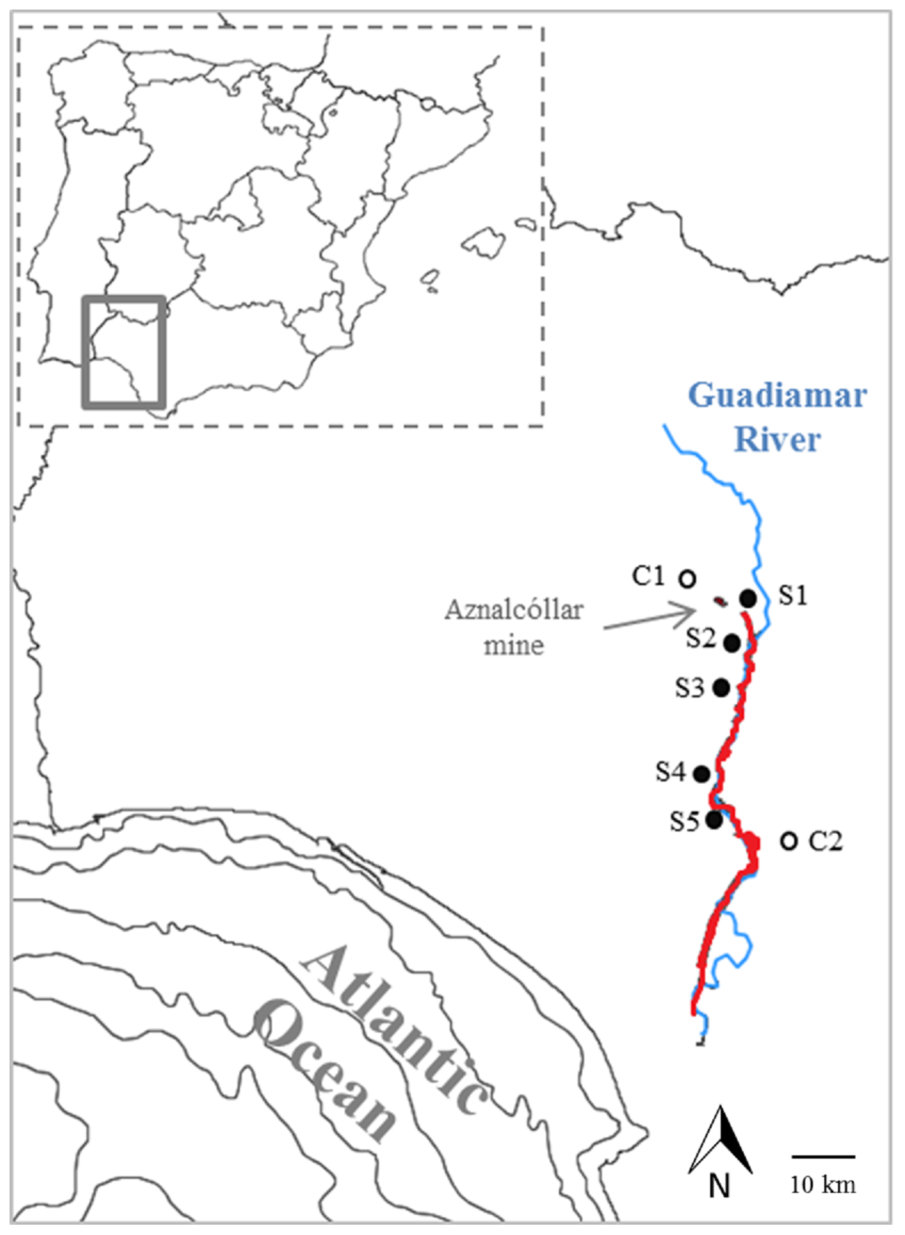
Seven sampling sites were selected along the Guadiamar basin (Fig 1). Two of these sites were chosen in locations that were not affected by the mine-spill (C1 and C2, control sites). Site C1 was located in rocky slopes near an ephemeral stream, upwards of the Aznalco´llar mine. While site C2 was at the southern edge of the basin (29 km away from the mine), on a sandy plain outside of the affected area. Five sites (S1 to S5) were selected within the area affected by the spill. Site S1 was close to the broken dam, origin of the spill, in the river Agrio. Site S2 was located downwards (3 km away from the dam), where Agrio joins to the main Guadiamar river; that spot was highly contaminated during the cleaning operations, used as temporary storage of sludge (Fig 2A). Site S3 was located in a fenced control plot where the sludge was not removed, for research and monitoring purposes (13 km away from the dam). Sites S4 and S5 were located downstream, at 22 and 25 km respectively from the tailing pond (see coordinates in S1 Table).
沿瓜迪亚马尔流域选取7个采样点(图1)。其中2个样点位于未受矿山泄漏影响的地点(C1和C2,对照样点)。样点C1位于Aznalco´llar矿上游一条季节性溪流附近的岩质坡地;样点C2位于流域南缘(距矿区29 km),处于受影响区域以外的沙质平原。在泄漏影响区内选取5个样点(S1至S5)。样点S1位于Agrio河上靠近溃坝(泄漏源)处。样点S2位于下游(距坝3 km)Agrio河与瓜迪亚马尔河干流交汇处;该地点在清理作业期间被用作污泥临时堆放场,污染严重(图2A)。样点S3位于一个围栏对照小区内,出于研究和监测目的,该处污泥未被清除(距坝13 km)。样点S4和S5位于下游,分别距尾矿库22 km和25 km(坐标见S1表)。
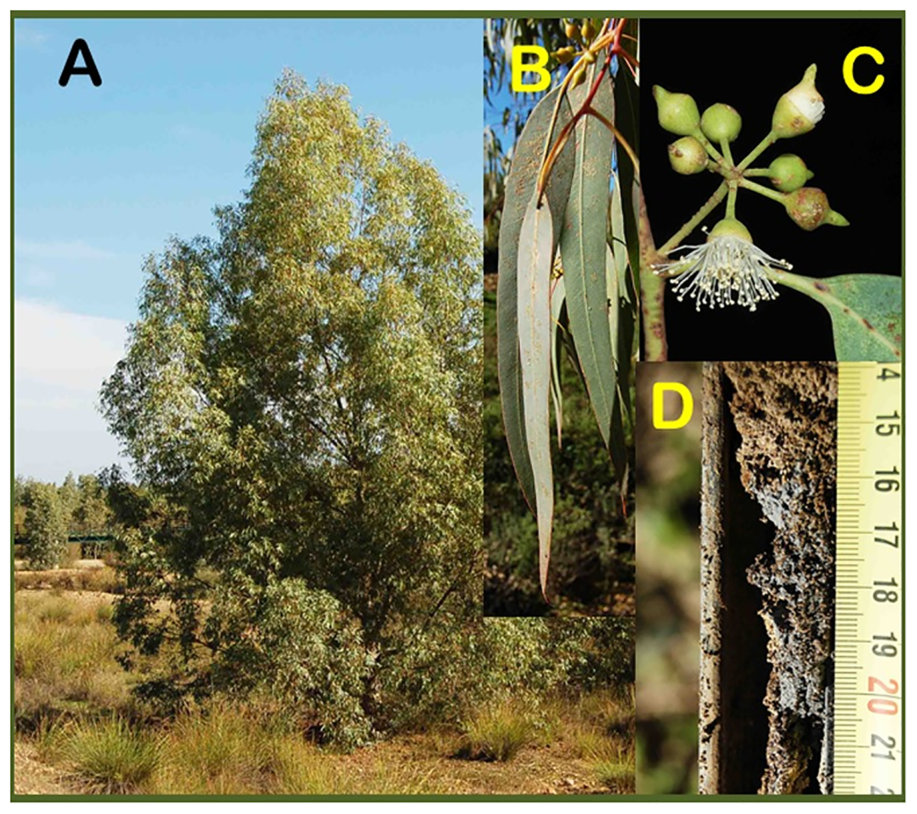
At each site, three E. camaldulensis individuals were selected, more than 10 m apart, and marked. Sampling of leaves and soils occurred in November 2015 (17 years after the accident) and samples of flower buds were taken in April 2016 (Fig 2B and 2C). A general description of the sampled trees (height, trunk size (DBH), and leaf traits) is shown in the S2 Table. For comparison, S. purpurea trees were sampled at the same dates in the two sites (S1 and S2) where they coexisted with E. camaldulensis.
在每个样点选取3株E. camaldulensis个体,彼此间距大于10 m,并作标记。叶片和土壤于2015年11月(事故发生17年后)采集,花蕾样品于2016年4月采集(图2B和2C)。所采样树木的概况(树高、胸径(DBH)及叶片性状)见S2表。为进行比较,于相同日期在与E. camaldulensis共存的两个样点(S1和S2)采集了S. purpurea样品。
Leaves and flower buds were collected from the outer canopy at ca. 5m height. In general, leaves of the outer canopy tend to accumulate more mineral elements than those of the inner canopy, due to their higher transpiration rates [38]. The rhizosphere of each tree was sampled using a spiral auger at two depths (0–20 and 20–40 cm), at three points around the trunk base; they were combined to make one composite soil sample per tree and depth.
叶片和花蕾采自约5 m高处的外层树冠。一般而言,由于蒸腾速率较高,外层树冠叶片往往比内层树冠叶片积累更多矿质元素[38]。使用螺旋土钻在每株树树干基部周围3个点位分两个深度(0–20 cm和20–40 cm)采集根际土壤,每株树每个深度的样品混合为1个混合土样。
Sample processing and analysis样品处理与分析
Samples of leaves and flower buds were washed with distilled water for approximately 10 s, dried at 70˚C for at least 48 h, and ground. Total N was measured by Kjeldahl digestion. TEs (As, Cd, Cu, Mn, Pb and Zn) and macronutrients (S, P, K, Ca and Mg) were determined by inductively coupled plasma spectrophotometry (ICP-OES: Varian ICP 720-ES: simultaneous ICP-OES with axially viewed plasma) after digestion of plant tissues by wet oxidation with concentrated HNO3. Plant digestion was carried out with a Digiprep MS block digestor (SPS Science) equipped with a temperature-time programmable controller and polypropylene digestion tubes. The accuracy of the analytical method was determined using a plant reference material: INCT-ONTL-5 (Tobacco leaves). Recovery rates for reference plant samples ranged between 90 and 103%.
叶片和花蕾样品用蒸馏水冲洗约10 s,于70˚C下烘干至少48 h后粉碎。全氮采用凯氏消解法测定。植物组织经浓HNO3湿法氧化消解后,采用电感耦合等离子体发射光谱仪(ICP-OES:Varian ICP 720-ES,轴向观测等离子体同步ICP-OES)测定微量元素(As、Cd、Cu、Mn、Pb和Zn)及大量营养元素(S、P、K、Ca和Mg)。植物消解使用配备温度–时间程序控制器和聚丙烯消解管的Digiprep MS消解仪(SPS Science)进行。分析方法的准确度采用植物标准物质INCT-ONTL-5(烟草叶)进行验证。植物标准样品的回收率为90%~103%。
A subsample of leaves from the same trees was used to measure two functional traits: leaf mass per area (LMA) as indicator of the tree growth rate [39] and the isotopic ratio of carbon (δ 13C) which provides a time-integrated measure of the tree water use efficiency [40]. A sample of 6–8 leaves by tree was scanned and analyzed with Image-Pro 4.5 (Media Cybernetic Inc. USA); they were oven-dried at 70˚C, weighed and the ratio between mass and area was calculated; see methods in [41]. The isostopic ratio of carbon (δ 13C) was measured in combusted leaf samples at 1020˚C using a continuous flow isotope-ratio mass spectrometry system by means of Flash HT Plus elemental analyzer coupled to a Delta-V Advantage isotope ratio mass spectrometer via a CONFLO IV interface (Thermo Fisher Scientific, Bremen, Germany). The analytical measurement error was ±0.1‰ for δ13C.
取同一批树木的部分叶片测定两项功能性状:比叶重(LMA),作为树木生长速率的指标[39];以及碳同位素比值(δ 13C),可提供树木水分利用效率的时间积分度量[40]。每株树取6–8片叶,扫描后用Image-Pro 4.5(Media Cybernetic Inc.,美国)分析;随后于70˚C烘干、称重,并计算质量与面积之比,方法见[41]。碳同位素比值(δ 13C)的测定是将叶片样品在1020˚C下燃烧,采用连续流同位素比值质谱系统,即Flash HT Plus元素分析仪经CONFLO IV接口联用Delta-V Advantage同位素比值质谱仪(Thermo Fisher Scientific,德国不来梅)。δ13C的分析测量误差为±0.1‰。
Soil samples were oven-dried at 40˚C and sieved to <2 mm for physico-chemical analysis; a subsample was then ground to <60 μm for S and TE determination. Soil pH was measured in a 1:2.5 soil-water suspension by using a pH meter (CRISON micropH 2002). Size particle distribution was analyzed by the hydrometer method [42]. Total C content was determined by using a LECO TruSpec CHN analyzer, and carbonate content by the manometric method [43]. Organic C was calculated as the difference between total C and the C contained in carbonates. Total N was determined by Kjeldahl digestion [44]. Available P was estimated by the
土壤样品于40˚C下烘干,过<2 mm筛用于理化分析;随后取部分样品研磨至<60 μm用于S和微量元素测定。土壤pH采用pH计(CRISON micropH 2002)在1:2.5土水悬液中测定。颗粒粒径分布采用比重计法分析[42]。总碳含量采用LECO TruSpec CHN分析仪测定,碳酸盐含量采用压力计法测定[43]。有机碳按总碳与碳酸盐碳之差计算。全氮采用凯氏消解法测定[44]。有效磷采用
Olsen method [45], and available K was determined by atomic absorption spectrophotometry after extraction with 1M ammonium acetate [46].
Olsen法估算[45],速效钾经1M乙酸铵浸提后采用原子吸收分光光度法测定[46]。
Sulphur and total content of TEs in soils was determined by ICP-OES after digesting the samples (<60 μm fraction) with a mixture of concentrated HNO3 and HCl (‘aqua regia’) in a Digiprep MS block digestor (SPS Science) equipped with a temperature-time programmable controller and polypropylene digestion tubes. ‘Aqua regia’ digestion does not extract those TEs associated with silicates [47]. Nevertheless, this method is widely accepted to characterize TE concentrations in soil pollution studies, because the silicate-binding metals have less environmental implications. These concentrations are referred to as ‘pseudototal’ concentrations. The quality of the analysis was assessed using the reference soil sample ERM-CC141 (Loam soil). Obtained recoveries ranged from 95.3% to 101%. Bioavailability of selected TEs was estimated by extraction with 0.01 M CaCl2 solution (1/10 soil/solution ratio, fraction < 2 mm) and analysis by ICP-OES [48].
土壤中硫及微量元素总量的测定:样品(<60 μm粒级)在配备温度–时间程序控制器和聚丙烯消解管的Digiprep MS消解仪(SPS Science)中用浓HNO3和HCl混合液(“王水”)消解后,采用ICP-OES测定。王水消解不能提取与硅酸盐结合的微量元素[47]。尽管如此,由于与硅酸盐结合的金属环境意义较小,该方法在土壤污染研究中被广泛用于表征微量元素浓度。这些浓度称为“准全量”浓度。分析质量采用土壤标准样品ERM-CC141(壤土)进行评估,回收率为95.3%~101%。所选微量元素的生物有效性采用0.01 M CaCl2溶液浸提(土液比1/10,< 2 mm粒级)并经ICP-OES分析进行估算[48]。
Data analyses数据分析
Differences among sites in soil and plant (leaf and flower bud) chemical composition were tested by one-way ANOVA and post-hoc Tukey tests (P < 0.05). Data normality and homogeneity of variance were verified by means of Kolmogorov–Smirnov and Levene tests, respectively. When data did not meet normality they were logarithmic transformed. In the case of Mn, even after transformation did not meet normality, therefore Kruskal–Wallis tests were used for comparison of means.
采用单因素ANOVA和Tukey事后检验(P < 0.05)检验各样点间土壤和植物(叶片和花蕾)化学组成的差异。分别采用Kolmogorov–Smirnov检验和Levene检验验证数据的正态性和方差齐性。数据不满足正态性时进行对数转换。对于Mn,转换后仍不满足正态性,因此采用Kruskal–Wallis检验进行均值比较。
Factorial ANOVAs were applied to test for differences in TE composition between plant organs (leaves versus flower buds) and between sites, and to test for possible interactions between both factors (organ × site interaction). For Mn and As, which showed a high heterogeneity between organs and /or across sites, linear models using generalized least squares were fitted, with the nlme package in R 3.1.2. In these models, a variance structure parameter was added to account for heterogeneity of model residuals between organs and/or sites [49]. Significance level was p < 0.05.
采用多因素ANOVA检验植物器官间(叶片与花蕾)及样点间微量元素组成的差异,并检验两因素间可能的交互作用(器官 × 样点交互作用)。对于器官间和/或样点间异质性较高的Mn和As,利用R 3.1.2中的nlme程序包拟合广义最小二乘线性模型。在这些模型中加入方差结构参数,以处理器官间和/或样点间模型残差的异质性[49]。显著性水平为p < 0.05。
Bivariate relationships between TE concentrations in soils and plants were explored using Spearman correlational analysis. The overall pattern of covariation of the TEs in leaves and flower buds was explored by Principal Component Analysis. In order to remove closure effects in chemical compositional data, dataset was previously transformed using the centred-log ratio transformation function of R package “rgr”. All statistical analyses were conducted using the program SPSS 23.0 for Windows.
采用Spearman相关分析探讨土壤与植物中微量元素浓度的二元关系。采用主成分分析探讨叶片和花蕾中微量元素协变的总体格局。为消除化学组成数据的闭合效应,事先使用R程序包“rgr”中的中心对数比转换函数对数据集进行转换。所有统计分析均使用Windows版SPSS 23.0软件完成。
To evaluate soil pollution severity, we used the pollution load index (PLI) as defined by Tomlinson [50]. This index is based on the concentration factor (CF) of each metal (As, Cd, Cu, Pb and Zn), which is defined as the ratio between the concentration of the metal in each soil and the background values for the region [51]. For each sampling site, PLI is calculated as the nth root of the product of the obtained CFs for each element. Values of PLI close to 1 indicate heavy metal loads near the background level, while values above 1 indicate soil pollution [51].
为评价土壤污染程度,采用Tomlinson定义的污染负荷指数(PLI)[50]。该指数基于各金属(As、Cd、Cu、Pb和Zn)的浓度因子(CF),CF定义为各土壤中金属浓度与该地区背景值之比[51]。对于每个采样点,PLI按各元素所得CF乘积的nth次方根计算。PLI接近1表示重金属负荷接近背景水平,大于1则表示土壤受到污染[51]。
For a general comparison background values for total concentrations (median, normal soils of the world) were taken from [52], and available concentrations from unaffected soils of SW Spain from [53]. Intervention values for Andalusian soils (total concentrations) were taken from [54], and permitted water soluble levels from [55], except the value for Mn which refers to the critical level (CaCl2 extracted) that can affect many plants [56].
为进行总体比较,总量背景值(世界正常土壤中位数)取自[52],有效态浓度取自西班牙西南部未受影响土壤的数据[53]。安达卢西亚土壤干预值(总量)取自[54],水溶态允许水平取自[55];Mn除外,其值为可影响多种植物的临界水平(CaCl2提取)[56]。
In order to estimate what proportion of the total soil metal concentration was available and transferred to leaves and flower buds, the transfer coefficient (TC) was calculated. This is defined as the ratio of metal concentration in the plant [M]plant to the total metal concentration in the soil [M]soil [57]. The TC of TEs was compared between E. camaldulensis and S. purpurea.
为估算土壤金属总浓度中有效并转移至叶片和花蕾的比例,计算了转移系数(TC),其定义为植物中金属浓度[M]plant与土壤中金属总浓度[M]soil之比[57]。比较了E. camaldulensis与S. purpurea的微量元素TC。
4Results结果
General soil properties and pollution levels土壤基本性质与污染水平
E. camaldulensis trees were growing (planted before the mine accident) in a wide variety of soils within the Guadiamar basin (S1 Table). Soil acidity ranged from low pH (5.6) in the rocky slopes of site C1 to the basicity (pH 8.1) of the sandy plains, site C2. Texture was also variable between sandy loam and silty clay. Fertility was higher in the sites from the southern, lower part of the river (S3, S4 and S5), having clayey texture and relatively higher values of organic carbon (13–30 g kg-1), nitrogen (1.2–2.5 g kg-1) and available K (186–473 mg kg-1). However, available phosphorus was low across all sites, ranging from 1 mg kg-1 (in deeper soils of C1, C2 and S3) to 15 mg kg-1 (in topsoil of S5).
E. camaldulensis(于矿山事故前种植)生长于瓜迪亚马尔流域内多种类型的土壤上(S1表)。土壤酸度从样点C1岩质坡地的低pH(5.6)到样点C2沙质平原的碱性(pH 8.1)不等。质地亦多变,介于砂壤土与粉黏土之间。河流南部下游样点(S3、S4和S5)肥力较高,质地黏重,有机碳(13–30 g kg-1)、氮(1.2–2.5 g kg-1)和速效钾(186–473 mg kg-1)含量相对较高。然而,所有样点有效磷均较低,范围为1 mg kg-1(C1、C2和S3深层土壤)至15 mg kg-1(S5表层土壤)。
The contamination within the study area was variable (S1 Fig), from cleanness (PLI below unity) in the sites non-affected by the mine spill (C1 and C2) to highly contaminated (PLI up to 11) in the deeper soil of the spill-affected and non-remediated plot (S3). Contamination increased with soil depth (except in site S2).
研究区内污染程度差异较大(S1图),从未受矿山泄漏影响样点(C1和C2)的清洁状态(PLI小于1),到受泄漏影响且未经修复的小区(S3)深层土壤的高度污染(PLI高达11)。污染程度随土壤深度增加而增加(样点S2除外)。
Total concentrations of sulphur and TEs were significantly different between the sites, at both soil depths (Table 1 and S3 Table). The greatest variability between plots for As, Pb and S occurred deeper in the soil profile (20–40 cm). Thus, the non-remediated plot S3 had the highest subsoil concentrations of arsenic (1,069 mg kg-1), lead (4,086 mg kg-1) and sulphur (53,635 mg kg-1), compared with the lowest values of clean sites (1.6 mg kg-1 As and 6 mg kg-1 Pb in site C2, and 65 mg kg-1 S in site C1). Both As and Pb maximum values surpassed the Andalusian intervention thresholds (Table 1), [54].
两个土层中硫和微量元素总浓度在各样点间均存在显著差异(表1和S3表)。As、Pb和S在小区间的最大变异出现在土壤剖面较深处(20–40 cm)。因此,未经修复的小区S3底土中砷(1,069 mg kg-1)、铅(4,086 mg kg-1)和硫(53,635 mg kg-1)浓度最高,而清洁样点的最低值分别为:样点C2中As 1.6 mg kg-1和Pb 6 mg kg-1,样点C1中S 65 mg kg-1。As和Pb的最大值均超过安达卢西亚干预阈值(表1)[54]。
| Element元素 | Surfac表层 | e soil (0–20 cm土壤(0–20 cm | ) | Deep s深层 | oil (20–40 cm) | Background values背景 值 | Intervention values干预值 | |||
|---|---|---|---|---|---|---|---|---|---|---|
| Mean | Range | F | p | Mean | Range | F | p | |||
| Total | ||||||||||
| As | 81.1 | 2.37–265 | 25.20 | <0.001 | 256 | 1.60–1069 | 49.58 | <0.001 | 6 | >50 |
| Cd | 0.97 | 0.01–2.79 | 15.89 | <0.001 | 1.23 | 0.01–3.65 | 13.22 | <0.001 | 0.35 | >10 |
| Cu | 74.6 | 5.74–223 | 9.71 | <0.001 | 105 | 4.31–241 | 10.96 | <0.001 | 30 | >500 |
| Mn | 581 | 123–1477 | 20.99 | <0.001 | 505 | 113–1705 | 12.67 | <0.001 | 1000 | - |
| Pb | 362 | 9.54–4383 | 14.15 | <0.001 | 635 | 5.87–4086 | 27.92 | <0.001 | 35 | >500 |
| S | 2568 | 105–17650 | 23.70 | <0.001 | 6763 | 65.4–53635 | 57.72 | <0.001 | 700 | - |
| Zn | 308 | 13.6–742 | 13.12 | <0.001 | 417 | 11.3–1218 | 13.60 | <0.001 | 90 | >1000 |
| Extractable | (permitted water soluble levels) | |||||||||
| As | <dl | <dl | <dl | <dl | <dl | <dl | <dl | <dl | <dl | 0.04 |
| Cd | 0.02 | 0.001–0.11 | 12.78 | <0.001 | 0.02 | 0.004–0.14 | 9.49 | <0.001 | 0.001 | 0.03 |
| Cu | 0.23 | 0.11–0.47 | 15.29 | <0.001 | 0.24 | 0.08–0.88 | 5.25 | 0.005 | 0.01 | 0.70 |
| Mn | 4.64 | 0.20–25.8 | 37.22 | <0.001 | 4.12 | 0.09–20.5 | 14.45 | <0.001 | 0.08 | >65 |
| Pb | 0.05 | 0.00–0.59 | 8.708 | 0.191 | 0.10 | 0.001–0.75 | 6.63 | 0.356 | <dl | 1.0 |
| S | 668 | 0.96–5068 | 39.38 | <0.001 | 1231 | 0.25–5342 | 10.72 | <0.001 | 8.44 | - |
| Zn | 0.86 | 0.09–5.54 | 17.52 | 0.008 | 1.31 | 0.10–13.8 | 15.03 | 0.020 | 0.22 | 0.5 |
Mean (N = 3) and range values, and results of the factorial ANOVA (F-parameter) applied; with exception of available Pb and Zn where Kruskal–Wallis (H parameter) was used. Significance values (p-values) are indicated (p � 0.05). Abbreviaton dl means detection limit.
平均值(N = 3)和范围值,以及多因素ANOVA(F参数)结果;有效态Pb和Zn除外,采用Kruskal–Wallis检验(H参数)。标出了显著性值(p值)(p ≤ 0.05)。缩写dl表示检出限。
https://doi.org/10.1371/journal.pone.0180240.t001
https://doi.org/10.1371/journal.pone.0180240.t001
The pattern of variation in the TE concentration at the top 20cm were similar to the deeper layer, with TE concentrations being in general lower in the 0-20cm layer. The maximum concentrations in topsoil of As, Cd, Pb and S were found at the non-remediated plot S3. Other elements varied in the spatial contamination patterns of topsoil, Cu had the maximum value (223 mg kg-1) in site S2, Mn had its maximum (1,477 mg kg-1) in site S1 and Zn peaked (742 mg kg-1) at site S5 (S3 Table).
表层20 cm微量元素浓度的变化格局与深层相似,0–20 cm土层中微量元素浓度总体较低。表层土壤中As、Cd、Pb和S的最高浓度出现在未修复小区S3。其他元素在表层土壤中的空间污染格局各异:Cu最大值(223 mg kg-1)出现在样点S2,Mn最大值(1,477 mg kg-1)出现在样点S1,Zn峰值(742 mg kg-1)出现在样点S5(S3表)。
The extractability of TEs (CaCl2 extraction) was generally two orders of magnitude lower than total values. In the case of As, extractable values were below detection limits. There were significant differences between sites in the extractability of TEs, with exception of Pb (Table 1). The most variable elements (with highest F values) were S (ranging from 1 to 5,068 mg kg-1) and Mn (from 0.2 to 26 mg kg-1) in the topsoil (S4 Table). Availabilities of Cd and Zn were relatively high, and clearly surpassed the permitted levels (for Andalusian soils) [55]: maximum of 0.14 mg kg-1 Cd above the critical 0.03 mg kg-1 level, and maximum of 14 mg kg-1 Zn above the permitted 0.5 level (Table 1).
微量元素的可提取量(CaCl2提取)通常比总量低两个数量级。As的可提取量低于检出限。除Pb外,各样点间微量元素可提取性存在显著差异(表1)。变异最大的元素(F值最高)为表层土壤中的S(1至5,068 mg kg-1)和Mn(0.2至26 mg kg-1)(S4表)。Cd和Zn的有效性相对较高,明显超过(安达卢西亚土壤)允许水平[55]:Cd最大值0.14 mg kg-1,高于0.03 mg kg-1的临界水平;Zn最大值14 mg kg-1,高于0.5的允许水平(表1)。
Chemical composition of leaves and flower buds叶片和花蕾的化学组成
Concentrations of the 12 studied elements in leaves and flower buds of E. camaldulensis differed significantly between sites (Table 2; for more details see S5 and S6 Tables). The greatest inter-site differences (highest F values) were found for Zn, Cu and As, and the lowest for the nutrients Mg, Ca and S. With the exception of K, element concentrations in leaves and flower buds differed significantly between sites. The highest between-organ differences were found for the non-essential and toxic elements As and Cd. There were significant site-organ interactions for seven out of 12 elements.
E. camaldulensis叶片和花蕾中12种所研究元素的浓度在各样点间差异显著(表2;详见S5表和S6表)。样点间差异最大(F值最高)的是Zn、Cu和As,最小的是营养元素Mg、Ca和S。除K外,叶片和花蕾中的元素浓度在各样点间差异显著。器官间差异最大的是非必需有毒元素As和Cd。12种元素中有7种存在显著的样点–器官交互作用。
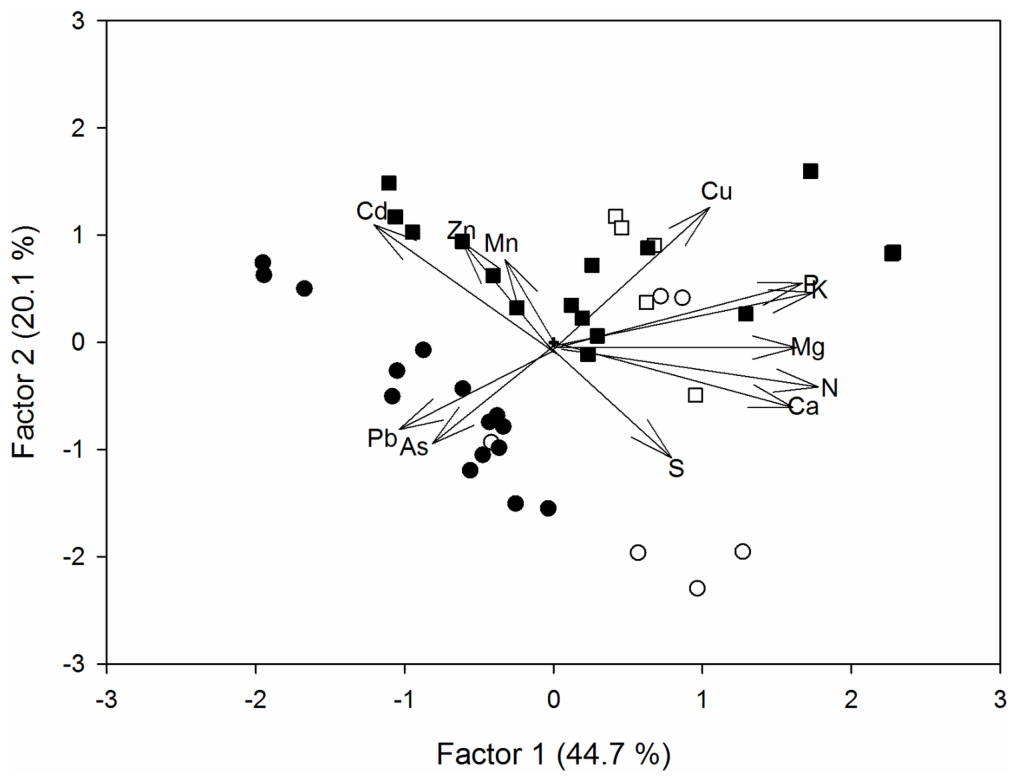
The general variation in the chemical composition, between sites and between leaves and flowers, is shown in Fig 3. The first axis of the Principal Component Analysis (PCA) explained the 44.7% of the variance and was mainly defined positively by the concentrations of nutrients N, Ca, K, Mg and P, and negatively by Cd, Pb and As. There was a general trend of highest trace element accumulation in leaves from contaminated sites. The second PCA axis explained 20.1% of the variance and was related to Cu, Cd and Zn (positive), and S (negative) concentrations.
样点间以及叶片与花之间化学组成的总体变异见图3。主成分分析(PCA)第一轴解释了44.7%的方差,主要由营养元素N、Ca、K、Mg和P的浓度正向定义,由Cd、Pb和As负向定义。总体趋势是污染样点叶片的微量元素积累最高。PCA第二轴解释了20.1%的方差,与Cu、Cd和Zn(正相关)以及S(负相关)浓度有关。
| Element元素 | Site样点 | Organ器官 | Site x Organ样点 × 器官 | |||
|---|---|---|---|---|---|---|
| F | p | F | p | F | p | |
| As | 20.96 | <0.0001 | 326.14 | <0.0001 | 35.87 | <0.0001 |
| Ca | 3.57 | 0.009 | 54.10 | <0.0001 | 2.13 | 0.081 |
| Cd | 10.34 | <0.0001 | 362.30 | <0.0001 | 2.11 | 0.084 |
| Cu | 22.60 | <0.0001 | 6.65 | 0.015 | 3.16 | 0.017 |
| K | 16.20 | <0.0001 | 2.40 | 0.132 | 2.84 | 0.027 |
| Mg | 3.16 | 0.017 | 87.30 | <0.0001 | 2.66 | 0.036 |
| Mn | 15.37 | <0.0001 | 22.83 | 0.001 | 1.97 | 0.104 |
| N | 8.79 | <0.0001 | 180.40 | <0.0001 | 2.71 | 0.034 |
| P | 6.84 | <0.0001 | 9.19 | 0.005 | 2.64 | 0.037 |
| Pb | 5.99 | <0.0001 | 94.90 | <0.0001 | 1.67 | 0.165 |
| S | 3.97 | <0.0001 | 221.80 | <0.0001 | 0.63 | 0.704 |
| Zn | 34.30 | <0.0001 | 90.01 | <0.0001 | 4.36 | 0.003 |
The significance level was p � 0.05.
显著性水平为p ≤ 0.05。
https://doi.org/10.1371/journal.pone.0180240.t002 https://doi.org/10.1371/journal.pone.0180240.g003
https://doi.org/10.1371/journal.pone.0180240.t002 https://doi.org/10.1371/journal.pone.0180240.g003
For a more detailed analysis of the differences among sites and between flowers and leaves, we have separated macronutrients (N, P, S, K, Ca and Mg) and TEs (As, Cd, Cu, Mn, Pb and Zn).
为更详细地分析样点间以及花与叶片之间的差异,我们将大量营养元素(N、P、S、K、Ca和Mg)与微量元素(As、Cd、Cu、Mn、Pb和Zn)分开讨论。
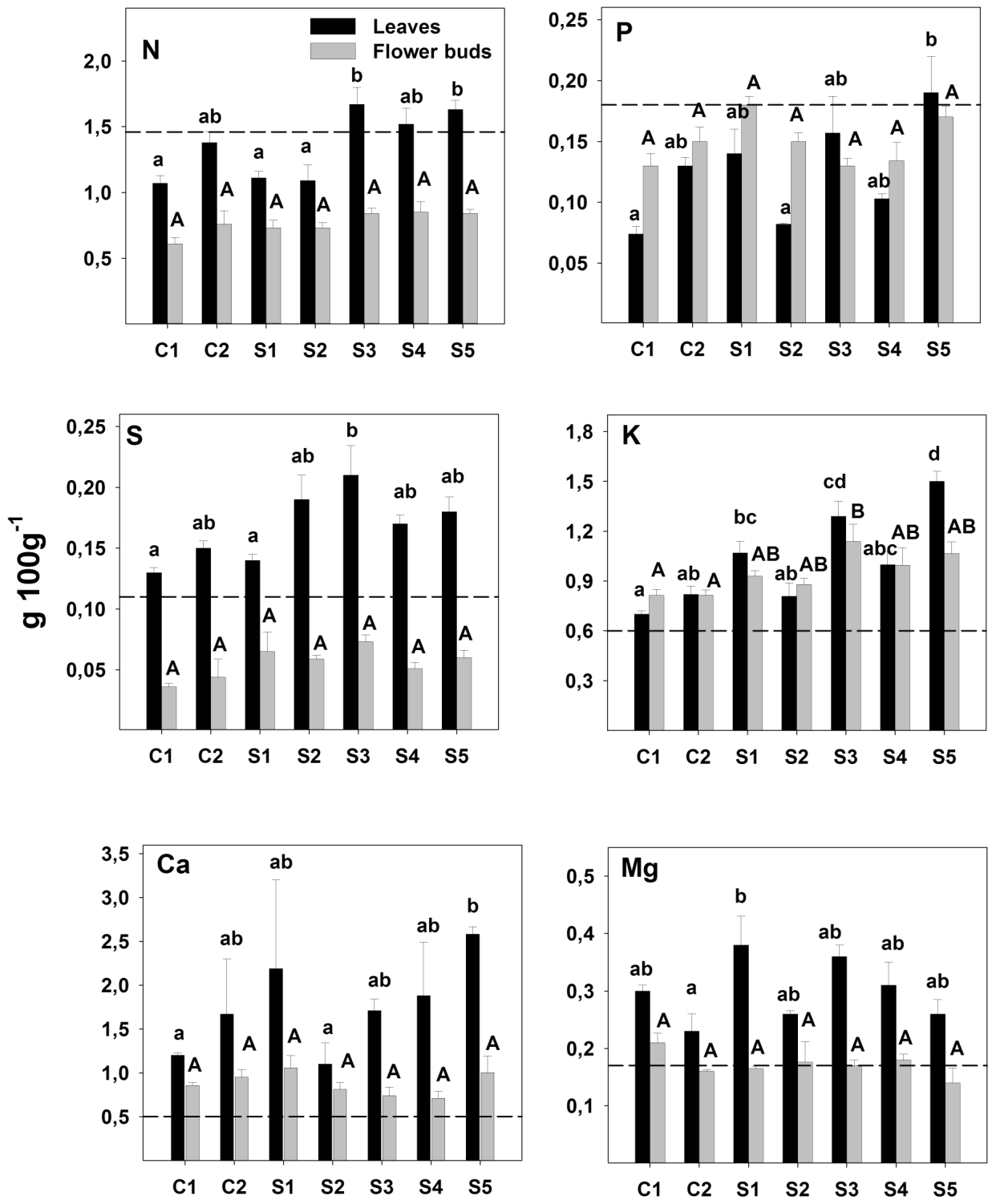
Macronutrient concentrations were greater in leaves than in flower buds, except for P and K. E. camaldulensis foliar levels of S, K, Ca and Mg were above the limit considered adequate for normal growth in all the seven sites [58]. However, N and P values could indicate some nutrient deficiency (Fig 4).
除P和K外,叶片中大量营养元素浓度高于花蕾。在全部7个样点,E. camaldulensis叶片中S、K、Ca和Mg水平均高于正常生长所需的适宜下限[58]。然而,N和P值可能表明存在一定程度的养分缺乏(图4)。
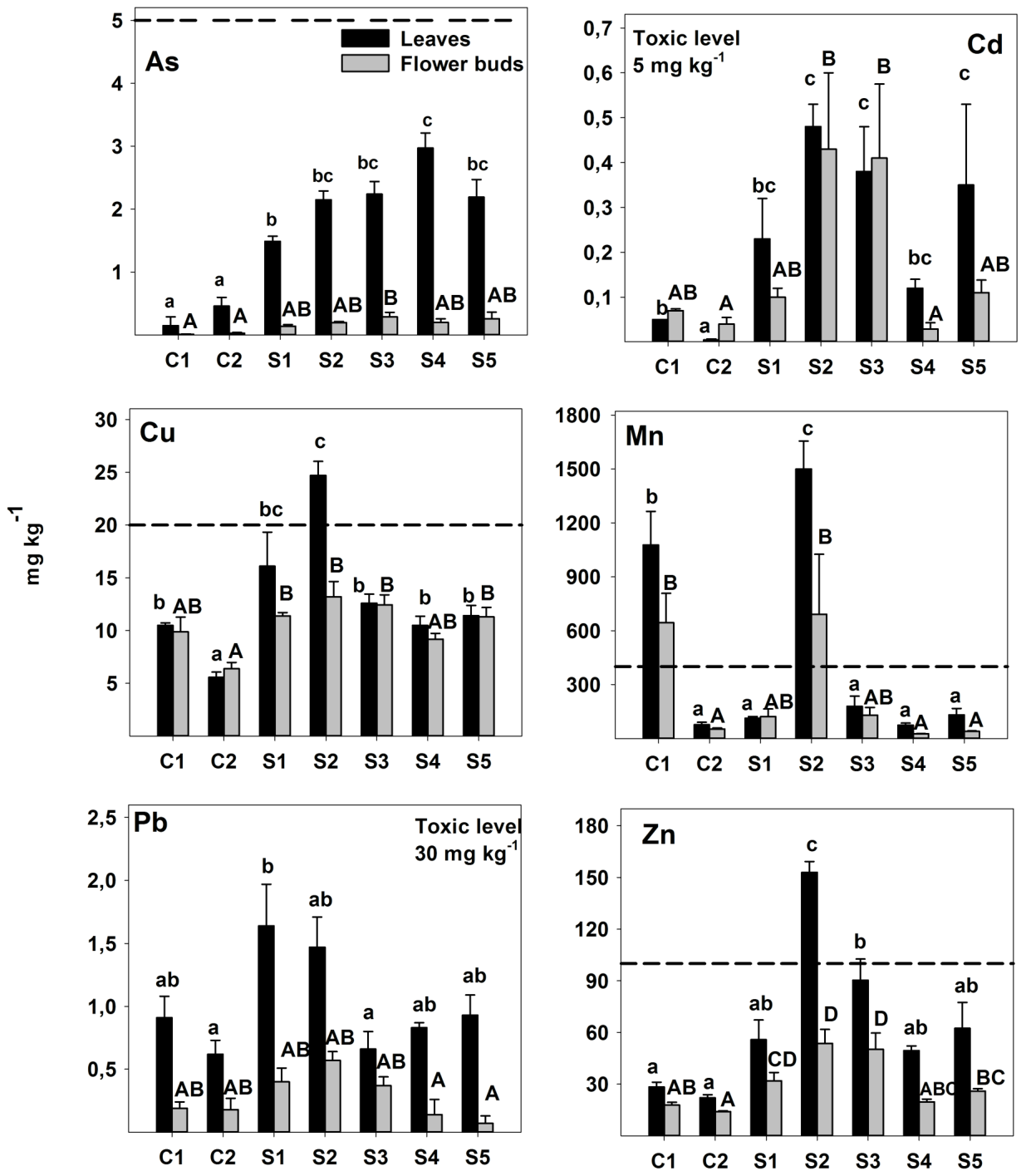
As expected, the concentration of TEs in E. camaldulensis leaves and flower buds were significantly lower in the clean sites, in particular in site C2, than in those affected by the mine spill. Flower buds tended to accumulate lower concentrations than leaves, especially of the non-essential elements As and Pb (Fig 5).
正如预期,清洁样点(尤其是样点C2)E. camaldulensis叶片和花蕾中的微量元素浓度显著低于受矿山泄漏影响的样点。花蕾中的积累浓度往往低于叶片,尤其是非必需元素As和Pb(图5)。
The contaminated site S2 was remarkable for the highest values of TEs in leaves, in particular of Zn, Cu and Mn, above the phytotoxicity levels [59]. The case of Mn, which had high foliar values in trees from non-affected rocky slopes (site C1), could indicate a geological origin. Other TEs of known toxicity like As, Cd and Pb were accumulated at safe levels.
污染样点S2的突出特点是叶片微量元素含量最高,特别是Zn、Cu和Mn,均超过植物毒性水平[59]。Mn在未受影响的岩质坡地(样点C1)树木叶片中含量也较高,这可能表明其为地质来源。其他已知具有毒性的微量元素,如As、Cd和Pb,其积累处于安全水平。
Soil and plant relations土壤与植物的关系
The transfer coefficients (TC) from soil to leaves indicate the accumulation (>1) or exclusion (<1) of the particular TE by E. camaldulensis. In most cases, the transfer was low and TEs present in soil were not accumulated in E. camaldulensis leaves. The relevant exception was the high accumulation of Mn in site S2 (TC of 4–5). The relatively high TC values obtained in non-affected sites (Cd in site C1 and Zn in site C2) correspond to low absolute values in both soil and leaves and therefore of lower importance. Arsenic and Pb showed the lowest coefficients, indicating a limited transfer of both elements from soils to E. camaldulensis leaves (Table 3).
土壤至叶片的转移系数(TC)指示E. camaldulensis对特定微量元素的积累(>1)或排斥(<1)。在大多数情况下,转移量较低,土壤中的微量元素未在E. camaldulensis叶片中积累。值得注意的例外是样点S2中Mn的高度积累(TC为4–5)。未受影响样点获得的相对较高TC值(样点C1的Cd和样点C2的Zn)对应于土壤和叶片中均较低的绝对值,因而重要性较低。砷和Pb的系数最低,表明这两种元素从土壤向E. camaldulensis叶片的转移有限(表3)。
The comparative values of TC for S. purpurea reflected a high transfer and accumulation of Cd and Zn in willow leaves, with maximum of 19 for Cd and 5 for Zn (in site S2). The concentration of Cd in leaves of S. purpurea (mean of 7 mg kg-1 in site S2) was about 15 times higher than in E. camaldulensis, and above the phytotoxicity threshold (5 mg kg-1). Similarly, Zn concentration in willow leaves was about six times higher than in E. camaldulensis, both surpassing the phytotoxicity level (100 mg kg-1) in site S2 (S7 Table).
S. purpurea的TC比较值反映出柳树叶片对Cd和Zn的高转移和高积累,Cd和Zn的最大值分别为19和5(样点S2)。S. purpurea叶片中Cd浓度(样点S2平均为7 mg kg-1)约为E. camaldulensis的15倍,且高于植物毒性阈值(5 mg kg-1)。同样,柳树叶片中Zn浓度约为E. camaldulensis的6倍,二者在样点S2均超过植物毒性水平(100 mg kg-1)(S7表)。
| Species物种 | Site样点 | As | Cd | Cu | Mn | Pb | Zn | ||||||
|---|---|---|---|---|---|---|---|---|---|---|---|---|---|
| 0–20 cm | 20–40 cm | 0–20 cm | 20– 40 cm | 0–20 cm | 20– 40 cm | 0–20 cm | 20– 40 cm | 0–20 cm | 20–40 cm | 0–20 cm | 20– 40 cm | ||
| Eucalyptus | C1 | 0.01 | 0.01 | 2.68 | 1.51 | 0.29 | 0.32 | 1.04 | 1.04 | 0.03 | 0.03 | 0.39 | 0.37 |
| camaldulensis | C2 | 0.17 | 0.24 | 0.63 | 0.27 | 0.63 | 1.03 | 0.53 | 0.61 | 0.06 | 0.09 | 1.28 | 1.65 |
| S1 | 0.05 | 0.04 | 0.49 | 0.21 | 0.32 | 0.25 | 0.12 | 0.17 | 0.02 | 0.02 | 0.31 | 0.18 | |
| S2 | 0.02 | 0.03 | 0.86 | 1.28 | 0.18 | 0.22 | 3.85 | 4.83 | 0.007 | 0.008 | 0.62 | 0.83 | |
| S3 | 0.01 | 0.002 | 0.25 | 0.35 | 0.14 | 0.08 | 0.42 | 0.85 | 0.001 | 0.0003 | 0.19 | 0.21 | |
| S4 | 0.03 | 0.01 | 0.12 | 0.06 | 0.15 | 0.08 | 0.17 | 0.16 | 0.005 | 0.002 | 0.16 | 0.08 | |
| S5 | 0.03 | 0.01 | 0.15 | 0.14 | 0.11 | 0.06 | 0.27 | 0.31 | 0.008 | 0.002 | 0.10 | 0.07 | |
| Salix | S1 | 0.14 | 0.11 | 6.67 | 2.80 | 0.19 | 0.15 | 0.53 | 0.83 | 0.03 | 0.02 | 2.60 | 1.52 |
| purpurea | S2 | 0.05 | 0.05 | 10.5 | 19.4 | 0.06 | 0.08 | 0.67 | 0.74 | 0.01 | 0.01 | 3.47 | 5.17 |
Values higher than unity (indicating accumulation) are marked in bold.
大于1的值(表示积累)以粗体标出。
https://doi.org/10.1371/journal.pone.0180240.t003
https://doi.org/10.1371/journal.pone.0180240.t003
The concentration of a determined TE in the E. camaldulensis leaves can be used as bioindicator if it is significantly correlated with its concentration in soil. Thus Cd, Mn and Zn levels in leaves indicated (i.e., they were significantly correlated with) the available concentration of that TE in soil, at the two depths (Table 4). Leaf As was also correlated, but with total concentration of As in soil (extractable concentration was below detection limit and correlation could not be calculated). However, the correlation leaf-soil was not significant for Cu and Pb, neither for total nor extractable soil values.
若E. camaldulensis叶片中某一微量元素的浓度与其在土壤中的浓度显著相关,则该浓度可用作生物指示。因此,叶片中Cd、Mn和Zn水平在两个深度上均可指示(即显著相关于)土壤中相应微量元素的有效态浓度(表4)。叶片As也存在相关性,但与土壤中As总浓度相关(可提取态浓度低于检出限,无法计算相关性)。然而,Cu和Pb的叶片–土壤相关性不显著,无论是土壤总量还是可提取量。
5Discussion讨论
Heterogeneity of soil conditions土壤条件的异质性
Eucalyptus camaldulensis is a generalist tree species, which can grow in a variety of soil conditions [23, 28, 60]. In the study area, E. camaldulensis demonstrated the capacity to grow in soils with contrasting pH (values from 5.6 to 8.1) and texture (sandy to clayey). They thrived on impoverished soils, in particular with organic N concentration below 1 g kg-1, a value considered as low for most soils in the Southern Spain. In most cases, the soil C/N ratio was > 15, which can be indicative of a very low N availability [61].
Eucalyptus camaldulensis是一种广适性树种,可在多种土壤条件下生长[23, 28, 60]。在研究区,E. camaldulensis表现出在pH(5.6至8.1)和质地(沙质至黏质)差异显著的土壤中生长的能力。其在贫瘠土壤上生长良好,特别是有机氮浓度低于1 g kg-1的土壤,而该值对西班牙南部大多数土壤而言属于偏低水平。在大多数情况下,土壤C/N比> 15,这可能表明氮有效性极低[61]。
Levels of P availability were also low [61]. However, K concentrations were at ‘critical’ or ‘low’ levels in the sandy soils, especially at the deep soil, and normal, or even high levels in the more silty-clayey soils. In general, the organic matter content surpassed the critical value of 20 g kg-1 (see [61] for critical and low values of soil nutrients, and [62] for general overview of soil fertility of the study area).
磷有效性水平也较低[61]。然而,K浓度在沙质土壤中处于“临界”或“偏低”水平,深层土壤尤甚,而在粉黏质较多的土壤中处于正常甚至较高水平。总体而言,有机质含量超过了20 g kg-1的临界值(土壤养分临界值和低值见[61],研究区土壤肥力概况见[62])。
The study area was contaminated by a mine-spill on 1998, and despite the soil cleaning and remediation operations, there was still residual contamination (18 years later), in particular in the riparian areas [7]. Soil samples taken from the E. camaldulensis rhizosphere had high total concentrations of some TEs. In particular, As reached up to 765 mg kg-1 (at site S5) well above
研究区于1998年遭受矿山泄漏污染,尽管进行了土壤清理和修复作业,(18年后)仍存在残留污染,尤其是在河岸带[7]。采自E. camaldulensis根际的土壤样品中部分微量元素总浓度较高。特别是As高达765 mg kg-1(样点S5),远高于
| Element元素 | Organ器官 | Soil depth土壤深度 | Correlation coefficient相关系数 |
|---|---|---|---|
| As | Leaves | 0–20 cm | 0.792 |
| 20–40 cm | 0.792 | ||
| Flower buds | 0–20 cm | 0.743 | |
| 20–40 cm | 0.803 | ||
| Cd | Leaves | 0–20 cm | 0.690 |
| 20–40 cm | 0.748 | ||
| Flower buds | 0–20 cm | 0.588 | |
| 20–40 cm | 0.606 | ||
| Cu | Leaves | 0–20 cm | 0.114 |
| 20–40 cm | 0.297 | ||
| Flower buds | 0–20 cm | 0.225 | |
| 20–40 cm | 0.109 | ||
| Mn | Leaves | 0–20 cm | 0.614 |
| 20–40 cm | 0.621 | ||
| Flower buds | 0–20 cm | 0.604 | |
| 20–40 cm | 0.722 | ||
| Pb | Leaves | 0–20 cm | 0.067 |
| 20–40 cm | -0.210 | ||
| Flower buds | 0–20 cm | 0.050 | |
| 20–40 cm | 0.065 | ||
| Zn | Leaves | 0–20 cm | 0.517* |
| 20–40 cm | 0.555 | ||
| Flower buds | 0–20 cm | 0.422 | |
| 20–40 cm | 0.536* |
Significance levels are显著性水平为
**p<0.01
*p < 0.05. Arsenic correlations were calculated using pseudototal contents in soils.
*p < 0.05。砷的相关性采用土壤准全量含量计算。
https://doi.org/10.1371/journal.pone.0180240.t004 the Andalusian intervention value of 50 mg kg-1, and Pb had maximum values of 1790 mg kg-1 (site S5) and 1189 mg kg-1 (site S4) surpassing the intervention value of 500 mg kg-1 [54]. Soil acidity would increase the bioavailability of trace elements and therefore their potential toxicity [57].
https://doi.org/10.1371/journal.pone.0180240.t004 安达卢西亚干预值50 mg kg-1;Pb最大值为1790 mg kg-1(样点S5)和1189 mg kg-1(样点S4),超过500 mg kg-1的干预值[54]。土壤酸度会提高微量元素的生物有效性,进而增加其潜在毒性[57]。
The total S concentration in soil was high (up to 17501 mg kg-1 at S5) reflecting the pyritic origin and S-enrichment of the mine sludge [51]. The highest values of total Mn in soil were found at the non-contaminated rocky site (C1; up to 1705 mg kg-1) and is likely of geologic origin; however that natural concentration is >500 mg kg-1, a limit for which ecological investigation has been recommended [63].
土壤中总S浓度较高(S5处高达17501 mg kg-1),反映了矿山污泥的黄铁矿来源及硫富集特征[51]。土壤总Mn最高值出现在未受污染的岩质样点(C1;高达1705 mg kg-1),可能为地质来源;然而,该自然浓度>500 mg kg-1,而在此限值以上建议开展生态调查[63]。
Variability in chemical composition of leaves and flower buds叶片和花蕾化学组成的变异
The concentration of mineral elements in E. camaldulensis leaves can indicate the nutrient status of the tree as well as to detect potential toxicity by TEs ([58, 59, 64]. Nitrogen and P had relatively low concentrations in the studied E. camaldulensis trees indicating some deficiency. While the levels of K, Ca, Mg and S in leaves were adequate for a normal growth of this species [58]. The relatively high concentration of Ca in leaves can help the trees to tolerate the high concentration of TEs in the soil solution, due to the potential protective action of Ca against the toxicity of metals and metalloids [65, 66].
E. camaldulensis叶片中矿质元素浓度可指示树木的营养状况,并可用于检测微量元素的潜在毒性([58, 59, 64]。所研究的E. camaldulensis树木中氮和P浓度相对较低,表明存在一定程度的缺乏;而叶片中K、Ca、Mg和S水平则满足该物种正常生长的需要[58]。叶片中相对较高的Ca浓度有助于树木耐受土壤溶液中高浓度的微量元素,因为Ca对金属和类金属毒性具有潜在的保护作用[65, 66]。
Despite the high total concentration of As and Pb in soils, the E. camaldulensis leaves accumulated relatively low amounts of those elements, with values below the phytotoxicity level. However, the maximum values of Cu, Mn and Zn measured in leaves of some trees (site S2) reached phytotoxic levels. At that particular site, the soil was acidic (pH 6.3) and low in organic C (8.5 g kg-1), thereby increasing the availability of TEs. Both factors, especially pH, are key determinants of the bioavailability of trace elements in soil [59]. In addition, trees were growing close to the river and therefore maintaining high transpiration rates and high transfer rates of TEs from deep soil through the deep sinker roots typical of Eucalyptus species [67]. Nevertheless, those high levels of Cu, Mn and Zn found at that particular site do not necessarily imply a toxic response, because the so-called “phytotoxic ranges” are illustrative guidelines that may vary across species, depending on specific adaptations [59].
尽管土壤中As和Pb总浓度较高,E. camaldulensis叶片对这些元素的积累量相对较低,低于植物毒性水平。然而,部分树木(样点S2)叶片中测得的Cu、Mn和Zn最大值达到了植物毒性水平。该样点土壤呈酸性(pH 6.3)且有机碳含量低(8.5 g kg-1),从而提高了微量元素的有效性。这两个因素,尤其是pH,是土壤中微量元素生物有效性的关键决定因素[59]。此外,树木生长于河流附近,因而保持较高的蒸腾速率,并通过Eucalyptus属物种典型的深层垂直根系从深层土壤高速转移微量元素[67]。尽管如此,该样点Cu、Mn和Zn的高水平并不一定意味着产生毒性响应,因为所谓的“植物毒性范围”只是说明性的指导值,可能因物种特定的适应性而有所不同[59]。
The high accumulation of Mn into leaves seems to be a particular feature of Eucalyptus species, which has been previously reported [68–70], probably associated with a high tolerance of that element. The highest values of leaf Mn reflected the Mn-enrichment of soils and apparently were of geologic origin, independent of the mine-spill. The acidity of soils contributed to the Mn solubilization in the soil matrix [59, 71]. The maximum value of Mn measured here for E. camaldulensis leaves (1772 mg kg-1) can be compared with those found for other species, such as E. globulus (4000 mg kg-1; [70]) and the hybrid E. grandis × E. urophylla (13500 mg kg-1) [69].
叶片中Mn的高积累似乎是Eucalyptus属物种的一个特定特征,此前已有报道[68–70],可能与其对该元素的高耐受性有关。叶片Mn的最高值反映了土壤的Mn富集,显然为地质来源,与矿山泄漏无关。土壤酸性促进了土壤基质中Mn的溶解[59, 71]。本研究中E. camaldulensis叶片Mn最大测定值(1772 mg kg-1)可与其他物种比较,如E. globulus(4000 mg kg-1;[70])及杂交种E. grandis × E. urophylla(13500 mg kg-1)[69]。
Flower buds had a significantly different chemical composition than leaves, with exception of potassium. Transport of mineral elements differs among leaves and reproductive structures; for instance, flowers and fruits usually have weak xylem but strong phloem translocation activities [72]. Non-essential elements, such as As and Pb, had lower concentrations in the flower buds, probably reflecting the action of a physiological barrier impeding their translocation to the seeds [73, 74]. However, there are some studies showing a high accumulation of TEs in flowers and seeds [75, 76]. In addition, metals and metalloids can be transferred to pollen grains and nectar, potentially affecting the composition of apiary products [31].
除钾外,花蕾的化学组成与叶片存在显著差异。矿质元素在叶片与繁殖结构中的运输方式不同;例如,花和果实通常木质部转运活性弱而韧皮部转运活性强[72]。非必需元素As和Pb在花蕾中浓度较低,可能反映了阻止其向种子转运的生理屏障的作用[73, 74]。然而,也有研究表明花和种子中会高度积累微量元素[75, 76]。此外,金属和类金属可转移至花粉粒和花蜜中,可能影响蜂产品的组成[31]。
Potential for phytostabilization. Trees within the Eucalyptus genus present many of the features to be selected for phytostabilization in Mediterranean environments: tolerance to high concentrations of contaminants, ability to develop an extensive root system, low maintenance requirements, relatively high transpiration rates, relatively long growing period, ability for selfpropagation, and adaptation to local climate [77]. Despite the low concentrations of soil nutrients and the relatively high concentration of some TEs (As, Pb and Mn) E. camaldulensis grew without toxicity symptoms in all the sites of the study area. They showed plasticity in tree growth and leaf morphology along the Guadiamar basin (S2 Table). In the soils with higher fertility (lower part of the river, sites S4 and S5), trees were taller and with larger trunks; leaves of lower LMA indicated higher relative growth rate [39]. On the contrary, trees on drier slopes (site C1) were smaller and showed water stress (lower absolute values of δ13C) [78].
植物稳定潜力。Eucalyptus属树木具备在地中海环境中被选用于植物稳定的诸多特征:耐受高浓度污染物、能发育庞大的根系、维护需求低、蒸腾速率相对较高、生长期相对较长、具有自我繁殖能力以及适应当地气候[77]。尽管土壤养分浓度较低且部分微量元素(As、Pb和Mn)浓度相对较高,E. camaldulensis在研究区所有样点均生长良好,未表现出毒害症状。沿瓜迪亚马尔流域,其树木生长和叶片形态表现出可塑性(S2表)。在肥力较高的土壤(河流下游,样点S4和S5)中,树木更高、树干更粗;叶片LMA较低,表明相对生长速率较高[39]。相反,较干旱坡地(样点C1)的树木较矮小,并表现出水分胁迫(δ13C绝对值较低)[78]。
Phytostabilization aims to immobilize TEs within the plant rhizosphere, and thus reducing their bioavailability and minimizing the exposure of livestock, wildlife, and human populations to them [79]. To be suitable for phytostabilization, the transfer of TEs from soil to aboveground plant organs must be low (TC<1) [80]. Our results show that E. camaldulensis is appropriate for the phytoestabilization of soils contaminated by Cd, As and Pb; given the relatively low levels of accumulation of these elements recorded in the aboveground biomass. Previous studies have also highlighted the ability of this and other Eucalyptus species for the phytostabilization of TEs on contaminated soils [28, 81, 82]. In contrast, the studied willow (Salix purpurea) accumulated high concentrations of foliar Cd (up to 10.9 mg kg-1) and Zn (maximum of 1126 mg kg-1); therefore this native species, which has naturally revegetated the riparian area, would not be suitable for planting and phytostabilizing contaminated sites.
植物稳定旨在将微量元素固定于植物根际,从而降低其生物有效性,并最大限度地减少家畜、野生动物和人群对其的暴露[79]。适用于植物稳定的植物,其微量元素由土壤向地上器官的转移必须较低(TC<1)[80]。本研究结果表明,鉴于地上生物量中Cd、As和Pb的积累水平相对较低,E. camaldulensis适用于这些元素污染土壤的植物稳定。已有研究也强调了该物种及其他Eucalyptus属物种用于污染土壤微量元素植物稳定的能力[28, 81, 82]。相比之下,所研究的柳树(Salix purpurea)叶片积累了高浓度的Cd(高达10.9 mg kg-1)和Zn(最大值1126 mg kg-1);因此,这一已在河岸带自然更新的本土物种不适合用于种植和稳定污染场地。
Manganese is an essential element but in high concentration can induce some toxicity; e.g., a threshold of 1370 mg g-1 of Mn in the diet reduced the survival of moth larvae [83]. Although Eucalyptus leaves are rarely consumed outside its native habitat, some phytophagous insects feeding on them could, in turn, provide a Mn-rich diet for birds [84].
锰是一种必需元素,但在高浓度下可产生一定毒性;例如,饲料中Mn含量达到1370 mg g-1的阈值时,蛾类幼虫的存活率下降[83]。尽管Eucalyptus叶片在其原生境以外很少被取食,但以其为食的一些植食性昆虫反过来可能为鸟类提供富含Mn的食物[84]。
The assessment of the phytostabilization ability of a plant species is usually limited to the analysis of metal accumulation into foliage. However, other organs that may be consumed by herbivores or, indirectly, by humans should also be investigated. Eucalyptus honey is commonly produced for human consumption [85, 86]. We found that the flower buds effectively excluded As and Pb, and that Cd concentration was below the threshold value for human consumption (0.5 mg kg-1 dw, based on [87]). This indicates that the concentrations of these elements in nectar and therefore potential toxicity are likely to be low. However, further analyses of nectar, pollen and honey, in particular of the accumulating Mn, are needed to confirm its safety for human consumption.
对植物物种植物稳定能力的评估通常仅限于分析金属在叶片中的积累。然而,其他可能被植食动物取食、或间接被人类消费的器官也应予以研究。Eucalyptus蜂蜜通常被生产供人类食用[85, 86]。本研究发现,花蕾能有效排斥As和Pb,且Cd浓度低于人类食用的阈值(0.5 mg kg-1 dw,依据[87])。这表明花蜜中这些元素的浓度及其潜在毒性可能较低。然而,仍需对花蜜、花粉和蜂蜜,特别是对其中积累的Mn作进一步分析,以确认其对人类食用的安全性。
The banks and channels of the Guadiamar River have acid soils and residual contamination, originated from the mine-spill. Appropriate management should include application of soil amendments for pH correction, and revegetation of the riverbanks to ensure mechanical stabilization, and to reduce soil losses through water erosion [7]. Existing E. camaldulensis trees can play a role in soil phytostabilization of this fragile ecosystem.
Guadiamar河的河岸和河道土壤呈酸性,并存在源自矿山泄漏事故的残留污染。适当的管理措施应包括施用土壤改良剂以校正pH,以及对河岸进行植被重建,以确保机械稳定并减少水蚀造成的土壤流失[7]。现有的E. camaldulensis树木可在这一脆弱生态系统的土壤植物稳定中发挥作用。
Potential for biomonitoring of soil pollution. Biomonitors are defined as organisms that contain information on the quantitative aspects of the quality of the environment [10]. For most plants, except metal excluders [88], the accumulation of a TE in a particular plant organ confirms its availability in the soil. The general advantages of biomonitoring are: the permanent and common occurrence of an organism in the field, even in remote areas, the ease of sampling, and the absence of any necessary expensive technical equipment [9, 12]. Thus, biomonitors can be used to detect low concentrations that are not always easy to measure directly using chemical extraction techniques; even if they are measurable as total levels, their ecological relevance is often difficult to determine from soil concentrations. As far as we know, there is no information about the potential use of eucalyptus, widely planted in all types of soil, for biomonitoring soil pollution.
土壤污染生物监测的潜力。生物监测者被定义为含有环境质量定量信息的生物体[10]。对于大多数植物而言(金属排斥型植物除外[88]),某一微量元素在特定植物器官中的积累可证实其在土壤中的有效性。生物监测的一般优势在于:生物体在野外(甚至在偏远地区)长期且普遍存在,采样简便,且无需任何昂贵的技术设备[9, 12]。因此,生物监测者可用于检测采用化学提取技术并不总是易于直接测定的低浓度;即便以全量形式可以测定,其生态学意义也往往难以根据土壤浓度加以判断。据我们所知,关于广泛种植于各类土壤中的桉树用于土壤污染生物监测的潜力,目前尚无相关资料。
E. camaldulensis leaves were good indicators (with high correlation values) of soil concentration for As, Cd, Mn and Zn (Table 4). Manganese in flower buds also had a remarkably high correlation with extractable Mn in soil. Although Mn uptake is metabolically controlled, passive absorption is also likely to occur, especially when concentrations in the soil solution are high and within the phytotoxic range [59]. The results suggest that on the Guadiamar study area E. camaldulensis leaves and flower buds could be used to biomonitor Mn availability in soil.
E. camaldulensis叶片是土壤As、Cd、Mn和Zn浓度的良好指示器(相关系数较高)(表4)。花蕾中的锰与土壤可提取态Mn之间也具有非常高的相关性。尽管Mn的吸收受代谢调控,但被动吸收也可能发生,尤其是在土壤溶液中Mn浓度较高且处于植物毒性范围时[59]。结果表明,在Guadiamar研究区,E. camaldulensis的叶片和花蕾可用于对土壤Mn有效性进行生物监测。
Potential biomonitoring of Cd and Zn in soils is relatively common in plants because these elements are passively absorbed through the roots and freely translocated to leaves and other plant organs [89]. Thus, E. camaldulensis leaves are also biondicators of soil Cd and Zn in the Guadiamar soils. In previous studies, white poplar (Populus alba), a native tree in the riparian Guadiamar forests, has been proposed for bioindication of soil Cd and Zn [11, 12].
植物对土壤Cd和Zn的潜在生物监测作用较为常见,因为这些元素经根系被动吸收,并可自由转运至叶片及其他植物器官[89]。因此,E. camaldulensis叶片也是Guadiamar土壤中Cd和Zn的生物指示器。在以往的研究中,Guadiamar河岸林中的本土树种银白杨(Populus alba)已被提议用于土壤Cd和Zn的生物指示[11, 12]。
In contrast, the weakness of the relationships between soil and plant concentrations for Cu and Pb is likely due to the high effectivity of the retention of these elements in plant roots [59]. Therefore E. camaldulensis leaves are not bioindicators for soil Cu and Pb.
相比之下,Cu和Pb的土壤浓度与植物浓度之间关系较弱,这可能是由于植物根系对这些元素的滞留作用非常有效[59]。因此,E. camaldulensis叶片不能作为土壤Cu和Pb的生物指示器。
6Conclusions结论
E. camaldulensis is a good candidate for the phytostabilization and biomonitoring of TE contaminated soils because of its tolerance to a wide variety of soil conditions, rapid growth rate, and low rates of herbivory. Despite the high soil concentration of some toxic TEs, such as As and Pb (surpassing the intervention values), their accumulation in leaves of E. camaldulensis were relatively low, and below toxic levels. The exception was Mn, which accumulated in E. camaldulensis leaves in two sites, apparently from geologic origin and independent of the spill contamination, but it should require some specific monitoring and caution. In general, the accumulation of TEs in flower buds was even lower than in leaves. Although the general concentration of TEs in leaves was low, there were some significant relationships with the soil extractability of Cd, Mn and Zn; therefore, E. camaldulensis is valuable for biomonitoring of those three elements.
E. camaldulensis对多种土壤条件具有耐受性,生长迅速,且遭受植食的比例较低,因而是微量元素污染土壤植物稳定和生物监测的良好候选树种。尽管某些有毒微量元素(如As和Pb)的土壤浓度较高(超过干预值),但其在E. camaldulensis叶片中的积累相对较低,且低于毒性水平。Mn是例外,它在两个样点的E. camaldulensis叶片中发生积累,这显然源于地质成因,与泄漏污染无关,但仍需进行专门监测并保持谨慎。总体而言,花蕾中微量元素的积累甚至低于叶片。尽管叶片中微量元素的总体浓度较低,但其与土壤Cd、Mn和Zn的可提取性之间存在一些显著关系;因此,E. camaldulensis对于这三种元素的生物监测具有价值。
7Supporting information支撑信息
S1 Fig. Values of pollution load index (PLI) for two soil depths at the seven sites sampled in the Guadiamar River valley (SW Spain). (DOCX)
图S1 Guadiamar河谷(西班牙西南部)7个采样点两个土层深度的污染负荷指数(PLI)值。(DOCX)
S1 Table. General soil parameters analyzed at two depths (0–20 and 20-40cm) of the seven sampling sites with specific location indicated below. Mean values ± SE; n = 3 except for N, Org. C and texture with a single value from a composite sample. (DOCX)
表S1 7个采样点两个深度(0–20和20–40 cm)的土壤基本参数分析结果,各样点具体位置见下文。数值为平均值 ± SE;n = 3,但N、有机C和质地为混合样品的单一测定值。(DOCX)
S2 Table. Allometric measures of E. camaldulensis trees in each sampling site (mean values ± SE; n = 3). Tree height, trunk diameter at breast height (DBH), leaf mass per area (LMA) and leaf concentration of 13C. (DOCX)
表S2 各采样点E. camaldulensis树木的异速生长测量值(平均值 ± SE;n = 3)。包括树高、胸径(DBH)、比叶重(LMA)及叶片13C含量。(DOCX)
S3 Table. Total concentration (mean ±SE) of nine TEs at the seven study sites of the Guadiamar Valley. Maximum and minimum values are indicated between brackets. (DOCX)
表S3 Guadiamar河谷7个研究样点9种微量元素的全量浓度(平均值 ± SE)。括号内为最大值和最小值。(DOCX)
S4 Table. Available concentrations of S and five trace elements at each sampling site (mg kg-1; mean values ± SE). Range for each element in parenthesis. Abbreviation dl means detection limit.
表S4 各采样点S和5种微量元素的有效态浓度(mg kg-1;平均值 ± SE)。括号内为各元素的范围。缩写dl表示检出限。
(DOCX)
S5 Table. Macronutrient concentrations in leaves and flower buds at each sampling site (g 100g-1; mean values ± SE). Range for each element in parenthesis. (DOCX)
表S5 各采样点叶片和花蕾中的大量营养元素浓度(g 100g-1;平均值 ± SE)。括号内为各元素的范围。(DOCX)
S6 Table. Trace element concentrations in leaves and flower buds at each sampling site (mg kg-1; mean values ± SE). Range for each element in parenthesis. (DOCX)
表S6 各采样点叶片和花蕾中的微量元素浓度(mg kg-1;平均值 ± SE)。括号内为各元素的范围。(DOCX)
S7 Table. Cadmium and Zn concentrations (mg kg-1) of Eucalyptus camaldulensis and Salix viminalix at sites S1 and S2. Significant differences per species at each site and organ are marked with and asterisk (p<0.05). (DOCX)
表S7 S1和S2样点Eucalyptus camaldulensis与Salix viminalix的镉和Zn浓度(mg kg-1)。各样点各器官中物种间的显著差异以星号标示(p<0.05)。(DOCX)
8Acknowledgments致谢
We thank the staff of Guadiamar Green Corridor for facilities and support to carry out the fieldwork. Isotopic analysis was carried out in the LIE of EBD(CSIC), multielemental analysis of soil and plant samples in the IRNAS Analysis Service. We are grateful to Pilar Burgos, Patricia Puente and Cristina Garcı´a for their help at different stages of the study.
感谢Guadiamar绿色走廊(Guadiamar Green Corridor)的工作人员为开展野外工作提供的设施和支持。同位素分析在EBD(CSIC)的LIE完成,土壤和植物样品的多元素分析由IRNAS分析服务中心完成。感谢Pilar Burgos、Patricia Puente和Cristina Garcı´a在本研究不同阶段提供的帮助。
9Author Contributions作者贡献
Conceptualization: Teodoro Maraño´n, Jose´ M. Murillo.
构思:Teodoro Maraño´n, Jose´ M. Murillo.
Funding acquisition: Teodoro Maraño´n.
经费获取:Teodoro Maraño´n.
Investigation: Teodoro Maraño´n, Carmen M. Navarro-Ferna´ndez, Jose´ M. Alegre, Jose´ M. Murillo.
调查研究:Teodoro Maraño´n, Carmen M. Navarro-Ferna´ndez, Jose´ M. Alegre, Jose´ M. Murillo.
Project administration: Teodoro Maraño´n, Jose´ M. Murillo.
项目管理:Teodoro Maraño´n, Jose´ M. Murillo.
Writing – original draft: Paula Madejo´n, Jose´ M. Murillo.
撰写——初稿:Paula Madejo´n, Jose´ M. Murillo.
Writing – review & editing: Paula Madejo´n, Teodoro Maraño´n, Carmen M. Navarro-Ferna´ndez, Marı´a T. Domı´nguez, Brett Robinson, Jose´ M. Murillo.
撰写——审阅与修改:Paula Madejo´n, Teodoro Maraño´n, Carmen M. Navarro-Ferna´ndez, Marı´a T. Domı´nguez, Brett Robinson, Jose´ M. Murillo.
10References参考文献
1. Panagos P, Hiederer R, Van Liedekerke M, Bampa F. Review Article Contaminated Sites in Europe: Review of the Current Situation Based on Data Collected through a European Network. J Environ Public Health. 2013; Artical ID:1–11. https://doi.org/10.1155/2013/158764 PMID: 23843802
2. Wu G, Kang H, Zhang X, Shao H, Chu L, Ruan C. A critical review on the bio-removal of hazardous heavy metals from contaminated soils: Issues, progress, eco-environmental concerns and opportunities. J Hazard Mater. 2010; 174(1–3):1–8. https://doi.org/10.1016/j.jhazmat.2009.09.113 PMID: 19864055
3. Bolan NS, Park JH, Robinson B, Naidu R, Huh KY. Phytostabilization. A green approach to contaminant containment. Adv Agron. 2011; 112: 45–204.
4. Ali H, Khan E, Sajad MA. Phytoremediation of heavy metals-Concepts and applications. Chemosphere. 2013; 91(7): 869–81. https://doi.org/10.1016/j.chemosphere.2013.01.075 PMID: 23466085
5. Macklin MG, Brewer PA, Hudson-Edwards KA, Bird G, Coulthard TJ, Dennis IA, et al. A geomorphological approach to the management of rivers contaminated by metal mining. Geomorphology. 2006; 79 (3): 423–447.
6. Pulford ID, Watson C. Phytoremediation of heavy metal-contaminated land by trees—A review. Environ Int. 2003; 29(4): 529–40. https://doi.org/10.1016/S0160-4120(02)00152-6 PMID: 12705950
7. Domı´nguez MT, Alegre JM, Madejo´n P, Madejo´n E, Burgos P, Cabrera F, Maraño´n T, Murillo JM. River banks and channels as hotspots of soil pollution after large-scale remediation of a river basin. Geoderma. 2016; 261: 133–40.
8. Mendez MO, Maier RM. Phytoremediation of mine tailings in temperate and arid environments. Rev Environ Sci Biotechnol. 2008; 7(1): 47–59.
9. Wolterbeek B. Biomonitoring of trace element air pollution: Principles, possibilities and perspectives. Environ Pollut. 2002; 120: 11–21. PMID: 12199457
10. Markert BA, Breure AM, Zechmeister HG. Definitions, strategies and principles for bioindication/biomonitoring of the environment. In: Markert BA, Breure AM, Zechmeister HG, editors. Bioindicators and Biomonitors. Oxford: Elsevier Science; 2003. pp. 3–39.
11. Madejo´n P, Maraño´n T, Murillo JM, Robinson B. White poplar (Populus alba) as a biomonitor of trace elements in contaminated riparian forests. Environ Pollut. 2004; 132(1): 145–155. https://doi.org/10. 1016/j.envpol.2004.03.015 PMID: 15276282
12. Madejo´n P, Maraño´n T, Murillo JM, Robinson B. In defence of plants as biomonitors of soil quality. Environl Pollut. 2006; 143: 1–3.
13. Madejo´n P, Ciadamidaro L, Maraño´n T, Murillo JM. Long-term biomonitoring of soil contamination using poplar trees: accumulation of trace elements in leaves and fruits. Int J Phytoremediation. 2013; 15(6): 602–614. https://doi.org/10.1080/15226514.2012.723062 PMID: 23819300
14. Doumas P, Munoz M, Banni M, Becerra S, Bruneel O, Casiot C, et al. Polymetallic pollution from abandoned mines in Mediterranean regions: a multidisciplinary approach to environmental risks. Regional Environmental Change. 2016; 1–16. https://doi.org/10.1007/s10113-016-0939-x
15. Madejo´n P, Burgos P, Cabrera F, Madejo´n E. Phytostabilization of amended soils polluted with trace elements using the Mediterranean shrub: Rosmarinus officinalis. Int J Phytoremediation. 2009; 11 (6):542–557. https://doi.org/10.1080/15226510902717572 PMID: 19810354
16. Moreno-Jime´nez E, Esteban E, Carpena-Ruiz RO, Lobo MC, Peñalosa JM. Phytostabilisation with Mediterranean shrubs and liming improved soil quality in a pot experiment with a pyrite mine soil. J Hazard Mater. 2012; 201–202: 52–59. https://doi.org/10.1016/j.jhazmat.2011.11.013 PMID: 22178372
17. Heckenroth A, Rabier J, Dutoit T, Torre F, Prudent P, Laffont-Schwob I. Selection of native plants with phytoremediation potential for highly contaminated Mediterranean soil restoration: Tools for a nondestructive and integrative approach. J Environ Manage. 2016; 183: 850–63. https://doi.org/10.1016/j. jenvman.2016.09.029 PMID: 27665125
18. Domı´nguez MT, Maraño´n T, Murillo JM, Schulin R, Robinson BH. Trace element accumulation in woody plants of the Guadiamar Valley, SW Spain: A large-scale phytomanagement case study. Environ Pollut. 2008; 152(1): 50–9. https://doi.org/10.1016/j.envpol.2007.05.021 PMID: 17602809
19. Flege A. Forest recultivation of coal-mined land: Problems and prospects. In: Haigh MJ, editors. Reclaimed Land. Rotterdam: A.A. Balkema; 2000. pp. 291–337.
20. Arriagada CA, Herrera MA, Ocampo JA. Beneficial effect of saprobe and arbuscular mycorrhizal fungi on growth of Eucalyptus globulus co-cultured with Glycine max in soil contaminated with heavy metals. J Environ Manage. 2007; 84(1): 93–99 https://doi.org/10.1016/j.jenvman.2006.05.005 PMID: 16837125
21. Grimalt JO, Ferrer M, MacPherson E. The mine tailing accident in Aznalcollar. Sci Total Environ. 1999; 242(1–3): 3–11. PMID: 10635575
22. Arenas JM, Montes C, Borja F. The Guadiamar Green Corridor. From an ecological disaster to a newly designated natural protected area. Seville: Regional Ministry of the Environment of the Junta de Andalucı´a; 2003 23. Navarro A, Stellacci AM, Campi P, Vitti C, Modugno F, Mastrorilli M. Feasibility of SRC Species for Growing in Mediterranean Conditions. Bioenergy Res. 2016; 9: 208–223.
24. Davidson J. Ecological aspects of Eucalyptus plantations. In: Proceedings of the regional expert consultation on Eucalyptus. FAO. 1993. Vol. 1, pp. 35–60. 25. Turnbull J W, Booth TH. Eucalypts in cultivation: an overview. In: Coppen JJW,editor. Eucalyptus: the genus Eucalyptus. London: Taylor & Francis; 2002. pp. 52–74. 26. Myburg AA, Grattapaglia D, Tuskan GA, Hellsten U, Hayes RD, Grimwood J, et al. The genome of Eucalyptus grandis. Nature. 2014; 510 (7505).
27. SECF. Situacio´n de los bosques y del sector forestal en España. Sociedad Española de Ciencias Forestales; 2010. Available from: http://www.secforestales.org/content/informe-isfe
28. King DJ, Doronila AI, Feenstra C, Baker AJM, Woodrow IE. Phytostabilisation of arsenical gold mine tailings using four Eucalyptus species: Growth, arsenic uptake and availability after five years. Sci Total Environ. 2008; 406 (1–2): 35–42. https://doi.org/10.1016/j.scitotenv.2008.07.054 PMID: 18801558
29. Fine P, Rathod PH, Beriozkin A, Mingelgrin U. Uptake of cadmium by hydroponically grown, mature Eucalyptus camaldulensis saplings and the effect of organic ligands. Int J Phytoremediation. 2013; 15 (6):585–601 https://doi.org/10.1080/15226514.2012.723061 PMID: 23819299
30. Mok H-F, Majumder R, Laidlaw WS, Gregory D, Baker AJM, Arndt SK. Native Australian species are effective in extracting multiple heavy metals from biosolids. Int J Phytoremediation. 2012; 15: 615–632.
31. Meindl GA, Ashman TL. The effects of aluminum and nickel in nectar on the foraging behavior of bumblebees. Environ Pollut. 2013; 177: 78–81. https://doi.org/10.1016/j.envpol.2013.02.017 PMID: 23466735
32. Stanturf JA, Vance ED, Fox TR, Kirst M. Eucalyptus beyond its native range: Environmental issues in exotic bioenergy plantations. Int J For Res. 2013; 463030: 1–5. https://doi.org/10.1155/2013/463030
33. Robinson BH, Mills TM, Petit D, Fung LE, Green SR, Clothier BE. Natural and induced cadmium-accumulation in poplar and willow: Implications for phytoremediation. Plant Soil. 2000; 227(1–2): 301–306.
34. Lepp NW, Madejo´n P. Cadmium and zinc in vegetation and litter of a voluntary woodland that has developed on contaminated sediment-derived soil. J Environ Qual. 2007; 36(4): 1123–1131. https://doi.org/ 10.2134/jeq2006.0218 PMID: 17596620
35. Meers E, Vandecasteele B, Ruttens A, Vangronsveld J, Tack FMG. Potential of five willow species (Salix spp.) for phytoextraction of heavy metals. Environ Exp Bot. 2007; 60(1): 57–68.
36. Mleczek M, Rissmann I, Rutkowski P, Kaczmarek Z, Golinski P. Accumulation of selected heavy metals by different genotypes of Salix. Environ Exp Bot. 2009; 66(2): 289–296.
37. Wahsha M, Bini C, Argese E, Minello F, Fontana S, Wahsheh H. Heavy metals accumulation in willows growing on Spolic Technosols from the abandoned Imperina Valley mine in Italy. J Geochemical Explor. 2012; 123:19–24.
38. Bargagli R. Trace elements in terrestrial plants: An ecophysiological approach to biomonitoring and biorecovery. Berlin: Springer-Verlag; 1998
39. Poorter H, Niinemets U¨ , Poorter L, Wright IJ, Villar R. Causes and consequences of variation in leaf mass per area (LMA): a meta-analysis. New Phytol. 2009; 182: 565–588. PMID: 19434804
40. Farquhar GD, O’Leary MH, Berry JA. On the Relationship Between Carbon Isotope Discrimination and the Intercellular Carbon Dioxide Concentration in Leaves. Aust J Plant Physiol. 1982; 9(2): 121–137.
41. Pe´rez-Harguindeguy N, Dı´az S, Garnier E, Lavorel S, Poorter H, Jaureguiberry P, et al. New handbook for standardised measurement of plant functional traits worldwide. Aust J Bot. 2013; 61(3): 167–234.
42. Gee GW, Bauder JW. Particle size analysis by hydrometer: a simplified method for routine textural analysis and a sensitivity test of measurement parameters. Soil Sci Soc Am J. 1979; 43: 1004–1007.
43. Demolon A, Leroux D. Guide pour L’e´tude Experimental des Sols. Paris: Gautier Villars; 1952.
44. Hesse PR. A textbook of soil chemical analysis. New York: Chemical Publishing Co. Inc.; 1971
45. Olsen SR, Cole CV, Watanabe FS, Dean LA. Estimation of available phosphorus in soils by extraction with sodium bicarbonate. U.S. Department of Agriculture. Report 939; 1954
46. Dewis J, Freitas F. Physical and chemical methods of soil and water analysis. Roma: Soils Bull. No. 10. FAO; 1970.
47. Reimann C, Caritat P. Chemical elements in the environment. Factsheets for the geochemist and environmental scientist. Berlin: Springer-Verlag; 1998
48. Houba VJG, Temminghoff EJM, Gaikhorst G., van Vark W. Soil analysis procedures using 0.01 M calcium chloride as extraction reagent. Commun Soil Sci Plant Anal 2000; 31 (9–10): 1299–396.
49. Zuur A, Ieno EN, Walker N, Saveliev A, Smith GM. Mixed Effects Models and extensions in Ecology with R. New York, USA: Springer-Verlag; 2009.
50. Tomlinson DL, Wilson JG, Harris CR, Jeffrey DW. Problems in the assessments of heavy metal levels in estuaries and formation of a pollution index. Helgol Meeresunters. 1980; 33: 566–575.
51. Cabrera F, Clemente L, Dı´az Barrientos E, Lo´pez R, Murillo JM. Heavy metal pollution of soils affected by the Guadiamar toxic flood. Sci Total Environ. 1999; 242:117–129 PMID: 10635579
52. Bowen HJM. Environmental chemistry of the elements. London: Academic Press; 1979.
53. Ciadamidaro L, Madejo´n E, Robinson B, Madejo´n P. Soil plant interactions of Populus alba in contrasting environments. J Environ Manage. 2014; 132: 329–37. https://doi.org/10.1016/j.jenvman.2013.11. 010 PMID: 24333744
54. Aguilar J, Dorronsoro C, Go´mez-Ariza JL, Gala´n E. Los criterios y esta´ndares para declarar un suelo contaminado en Andalucı´a y la metodologı´a y te´cnica de toma de muestras y ana´lisis para su investigacio´n. Investigacio´n y Desarrollo Medioambiental en Andalucı´a. Sevilla: Servicio de Publicaciones de la Universidad de Sevilla; 1999.
55. Aguilar J, Dorronsoro C, Ferna´ndez E, Ferna´ndez J, Garcı´a I, Martı´n F, et al. Soil pollution by a pyrite mine spill in Spain: Evolution in time. Environ Pollut. 2004; 132(3): 395–401. https://doi.org/10.1016/j. envpol.2004.05.028 PMID: 15325455
56. Hazelton P, Murphy B. Interpreting soil test results. What do all the numbers mean?. Collingwood, Australia: CSIRO Publishing; 2007.
57. Adriano DC. Trace Elements in Terrestrial Environments: Biochemistry Bioavailability and Risks of Metals. New York: Springer-Verlag; 2001.
58. Reuter DJ, Robinson JB. Plant analysis. An interpretation manual. Australia: CSIRO Publishing; 1997 59. Kabata-Pendias A, Pendias H. Trace Elements in Soils and Plants, 4 th ed. Boca Raton: CRC Press; 2011
60. Pietrini F, Iori V, Bianconi D, Mughini G, Massacci A, Zacchini M. Assessment of physiological and biochemical responses, metal tolerance and accumulation in two eucalypt hybrid clones for phytoremediation of cadmium-contaminated waters. J Environ Manage. 2015; 162: 221–231 https://doi.org/10.1016/ j.jenvman.2015.07.053 PMID: 26253590
61. CAC (Consejerı´a de Agricultura y Comercio). Interpretacio´n de ana´lisis de suelo, foliar y de aguas de riego. Consejerı´a de Agricultura y Comercio, Junta de Extremadura. Madrid: Mundi Prensa; 1992. 62. Domı´nguez MT, Madejo´n P, Maraño´n T, Murillo JM. Afforestation of a trace-element polluted area in SW Spain: Woody plant performance and trace element accumulation. Eur J For Res. 2010a; 129 (1):47–59.
63. Teh T, Nik Norulaini NAR, Shahadat M, Wong Y, Mohd Omar AK. Risk assessment of metal contamination in soil and groundwater in Asia: A review of recent trends as well as existing environmental laws and regulations. Pedosphere. 2016; 26(4): 431–450.
64. Domı´nguez MT, Maraño´n T, Murillo JM, Schulin R, Robinson BH. Nutritional status of mediterranean trees growing in a contaminated and remediated area. Water Air Soil Pollut. 2010b; 205(1–4): 305–21.
65. Mengel K, Kirkby EA. Principles of plant nutrition. Bern: International Potash Institute; 1987.
66. Carbonell AA, Aarabi MA, Delaune RD, Gambrell RP, Patrick WH. Arsenic in wetland vegetation: Availability, phytotoxicity, uptake and effects on plant growth and nutrition. Sci Total Environ. 1998; 217(3): 189–199.
67. Bren LJ. Modelling the influence of River Murray management on the Barmah river red gum forests. Australian-Forestry. 1991; 54(1–2): 9–15.
68. Reichman SM, Menzies NW, Asher CJ, Mulligan DR. Seedling responses of four Australian tree species to toxic concentrations of manganese in solution culture. Plant Soil. 2004; 258(1–2): 341–350.
69. Xie Q, Li Z, Yang L, Lv J, Jobe TO, Wang Q. A newly identified passive hyperaccumulator Eucalyptus grandis x E. urophylla under manganese stress. PLoS One. 2015; 10(9). https://doi.org/10.1371/ journal.pone.0136606 PMID: 26327118
70. Madejo´n P, Alaejos J, Garcı´a-A´ lbala J, Ferna´ndez M, Madejo´n E. Three-year study of fast-growing trees in degraded soils amended with composts: Effects on soil fertility and productivity. J Environ Manage. 2016; 169: 18–26. https://doi.org/10.1016/j.jenvman.2015.11.050 PMID: 26716572
71. Lambers H, Hayes PE, Laliberte´ E, Oliveira RS, Turner BL. Leaf manganese accumulation and phosphorus-acquisition efficiency. Trends Plant Sci. 2015; 20(2): 83–90. https://doi.org/10.1016/j.tplants. 2014.10.007 PMID: 25466977
72. Deng THB, Tang YT, van der Ent A, Sterckeman T, Echevarria G, Morel JL, et al. Nickel translocation via the phloem in the hyperaccumulator Noccaea caerulescens (Brassicaceae). Plant Soil. 2016; 404 (1–2): 35–45.
73. Ernst WHO, Verkleij JAC, Schat H. Metal Tolerance in Plants. Acta Bot Neer. 1992; 41(3): 229–48.
74. Madejo´n P, Murillo JM, Maraño´n T, Cabrera F, Soriano MA. Trace element and nutrient accumulation in sunflower plants two years after the Aznalco´llar mine spill. Sci Total Environ. 2003; 307(1–3): 239–257. https://doi.org/10.1016/S0048-9697(02)00609-5 PMID: 12711438
75. Madejo´n P, Murillo JM, Maraño´n T, Lepp NW. Factors affecting accumulation of thallium and other trace elements in two wild Brassicaceae spontaneously growing on soils contaminated by tailings dam waste. Chemosphere. 2007; 67(1): 20–28. https://doi.org/10.1016/j.chemosphere.2006.10.008 PMID: 17123576
76. Bačeva K, Stafilov T, Matevski V. Bioaccumulation of Heavy Metals by Endemic Viola Species from the Soil in the Vicinity of the As-Sb-Tl Mine “Allchar”, Republic of Macedonia. Int J Phytoremediation. 2014; 16(4): 347–365 https://doi.org/10.1080/15226514.2013.783551 PMID: 24912236
77. Pilon-Smits E. Phytoremediation. Annu Rev Plant Biol. 2005; 56(1): 15–39.
78. Domı´nguez MT, Aponte C, Pe´rez-Ramos IM, Garcı´a LV, Villar R, Maraño´n T. Relationships between leaf morphological traits, nutrient concentrations and isotopic signatures for Mediterranean woody plant species and communities. Plant Soil. 2012; 357:407–424.
79. Wong MH. Ecological restoration of mine degraded soils, with emphasis on metal contaminated soils. Chemosphere. 2003; 50(6): 775–80. PMID: 12688490
80. Chaney RL, Baklanov IA. Phytoremediation and Phytomining: Status and Promise. Adv Bot Res [Internet]. 2017. Available from: http://linkinghub.elsevier.com/retrieve/pii/S0065229616301252
81. Meeinkuirt W, Kruatrachue M, Pichtel J, Phusantisampan T, Saengwilai P. Influence of organic amendments on phytostabilization of Cd-contaminated soil by Eucalyptus camaldulensis. ScienceAsia. 2016; 42: 83–91.
82. Meeinkuirt W, Pokethitiyook P, Kruatrachue M, Tanhan P, Chaiyarat R. Phytostabilization of a Pb-contaminated mine tailing by various tree species in pot and field trial experiments. Int J Phytoremediation. 2012; 14: 925–938. https://doi.org/10.1080/15226514.2011.636403 PMID: 22908655
83. Coleman C M, Boyd R S, Eubanks M D. Extending the elemental defense hypothesis: dietary metal concentrations below hyperaccumulator levels could harm herbivores. J Chem Ecol. 2005; 31:1669– 1681. PMID: 16222801
84. Stone C., Bacon P. E. Relationships among moisture stress, insect herbivory, foliar cineole content and the growth of river red gum Eucalyptus camaldulensis. J Appl Ecol, 1994; 31: 604–612
85. Terrab A, Gonza´lez AG, Dı´ez MJ, Heredia FJ. Mineral content and electrical conductivity of the honeys produced in Northwest Morocco and their contribution to the characterisation of unifloral honeys. J Sci Food Agric. 2003; 83(7): 637–43.
86. Terrab A, Hernanz D, Heredia FJ. Inductively coupled plasma optical emission spectrometric determination of minerals in thyme honeys and their contribution to geographical discrimination. J Agric Food Chem. 2004; 52: 3441–3445. https://doi.org/10.1021/jf035352e PMID: 15161212
87. EU. Commission Regulation (EU) No 488/2014 of 12 May 2014 amending Regulation (EC) No 1881/ 2006 as regards maximum levels of cadmium in foodstuffs. Official Journal of European Union L138/78; 2014. Available from: http://eur-lex.europa.eu/legal-content/en/TXT/?uri=CELEX:32014R0488. Cited 17 March 2017.
88. Baker AJM, McGrath SP, Reeves RD, Smith JAC. Metal hyperaccumulator plants: a review of the ecology and physiology of a biological resource for phytoremediation of metal polluted-soils. In: Terry N, Bañuelos G, editors. Phytoremediation of contaminated soil and water. London: Lewis Publishers; 2000. pp. 85–107.
89. Das P, Samantaray S, Rout GR. Studies on cadmium toxicity in plants: A review. 98, Environ Pollut. 1997; 98: 29–36. PMID: 15093342