COMMUN. SOIL SCI. PLANT ANAL., 30(11&12), 1615-1624 (1999)
Alfredo Asensi, Frances Bennett,' Robert Brooks,b,1 Brett Robinson, and Robert Stewart
*Departamento de Biologia Vegetal, Universidad de Málaga, Spain Soil Science, Institute of Natural Resources, Massey University, Palmerston North, New Zealand
Horticultural and Food Research Institute of New Zealand Ltd, Palmerston North, New Zealand
1ABSTRACT摘要
Pot trials and chemical analyses were carried out on wild specimens of Erica andevalensis Cabezudo et Rivera (Ericaceae) and their associated soils. Natural soils hosting E. andevalensis all had elevated copper concentrations. Pot trials showed that the Erica would grow in sulphide-ore substrates containing up to 12,500 ug g*' (1.25%) copper, with or without amendment with EDTA. The addition of EDTA to these substrates increased the solubility of the copper to levels that killed other metal-tolerant species (Biscutella laevigata and Brassica juncea), but not E. andevalensis. The copper concentrations in wild plants were only 1 to 24 ug g' (dry weight) despite the high levels of copper (up to 3,676 ug g) in the supporting soils. In the pot trials, the plant was able partially to exclude total copper up to 1,000 ug g*' in
对野生Erica andevalensis Cabezudo et Rivera(杜鹃花科)植株及其相关土壤开展了盆栽试验和化学分析。生长E. andevalensis的天然土壤铜浓度均偏高。盆栽试验表明,无论是否添加EDTA,该欧石南均能在铜含量高达12,500 μg g⁻¹(1.25%)的硫化物矿石基质中生长。向这些基质中添加EDTA可使铜的溶解度提高至足以致死其他耐金属物种(Biscutella laevigata和Brassica juncea)的水平,但E. andevalensis未受致死影响。尽管其生长土壤中铜含量很高(最高达3,676 μg g⁻¹),野生植株体内铜浓度仅为1~24 μg g⁻¹(干重)。盆栽试验中,当
'Corresponding author.
the soil. Thereafter, there was an exponential increase of copper in plant until the limit of tolerance was reached. Conclusions of the study were: (a) tolerance to copper by the Erica is much higher compared with other metal-tolerant plants tested, (b) the plant does not have hyperaccumulator status (>1,000 ug g' dry weight) for copper, (c) copper uptake by the plant is governed by the extractable and not total copper content of the soil, hence limiting its use in biogeochemical prospecting, (d) uptake of copper by the plant follows the typical pattern of a metal-excluding plant, (e) Erica andevalensis is a good geobotanical indicator of copper because of its faithful association with sulphide mineralization in the Huelva area of Spain.
土壤总铜含量不超过1,000 μg g⁻¹时,该植物能够部分排斥铜的吸收。此后,植物体内铜含量呈指数增长,直至达到耐受极限。本研究的结论为:(a)与所测试的其他耐金属植物相比,该欧石南对铜的耐受性高得多;(b)该植物对铜不具备超富集植物地位(>1,000 μg g⁻¹干重);(c)植物对铜的吸收受土壤中可提取态铜而非总铜含量的控制,因此限制了其在生物地球化学找矿中的应用;(d)植物对铜的吸收符合典型的金属排斥型植物模式;(e)由于Erica andevalensis与西班牙Huelva地区的硫化物矿化始终相伴分布,它是一种良好的铜地植物指示物。
2INTRODUCTION引言
The ecology of Erica andevalensis Cabezudo and Rivera (Ericacaeae) has been described by Aparicio (1995). This plant was first described by Cabezudo and Rivera (1980). It was previously mistaken for E. tetralix by Wilkomm (1893), but can be distinguished from it by the glabrous ovary of E. andevalensis. There is a non-overlapping geographic range between the two species.
Aparicio(1995)描述了Erica andevalensis Cabezudo and Rivera(杜鹃花科)的生态学特征。该植物最早由Cabezudo and Rivera(1980)描述。Wilkomm(1893)曾将其误认为E. tetralix,但E. andevalensis子房无毛,可据此与后者区分。两个物种的地理分布范围互不重叠。
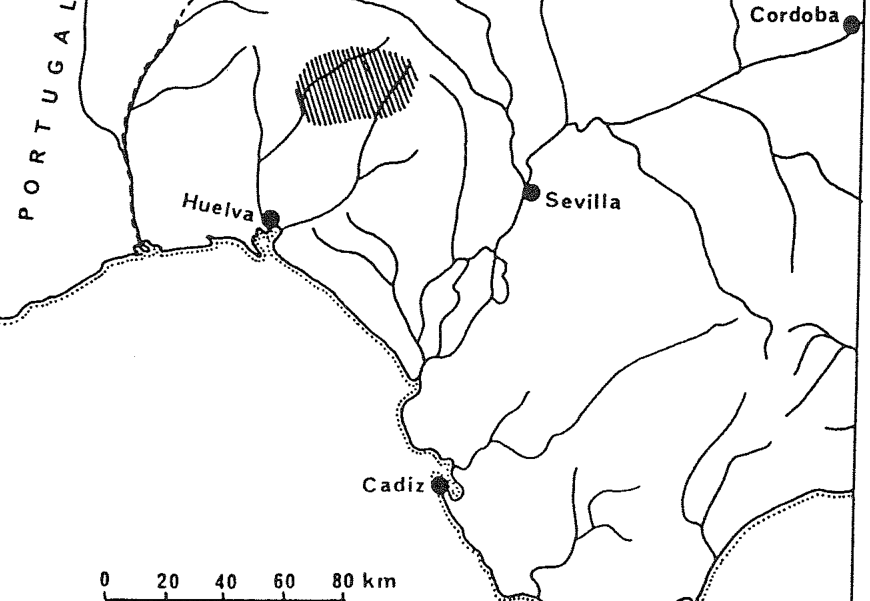
Erica andevalensis (Figure 1) is an edaphic endemic of the Andévalo, a geographically defined section of Huelva Province in southwestern Spain with an area of about 3,500 km? of which this species is found sporadically in about 1,500 km' (Figure 2). The region is known for its ancient mining activities where pyrite was mined for copper, gold, and silver as far back as Roman times.
Erica andevalensis(图1)是Andévalo地区的土壤特有种。Andévalo是西班牙西南部Huelva省一个地理上界定的区域,面积约3,500 km²,该物种零星分布于其中约1,500 km²的范围内(图2)。该地区以古老的采矿活动而闻名,早在罗马时代即开采黄铁矿以获取铜、金和银。
The severe environmental impact of mining activities in the Andévalo is evidenced by soil acidification (pH close to 3 in some places) and high concentrations of heavy metals such as copper, zinc, and iron (Soldevilla et al., 1992).
Andévalo地区采矿活动造成的严重环境影响表现为土壤酸化(部分地点pH接近3)以及铜、锌、铁等重金属浓度较高(Soldevilla et al., 1992)。
Erica andevalensis is restricted to mine tailings and the vicinity of mines as well as along the banks of rivers where the acidic (H,SO,) water is a dark red due to metal contamination (Lopez Archilla et al., 1994). These damp mineralized sites are said to be the natural habitat of this species (Nelson et al., 1985).
Erica andevalensis仅分布于矿山尾矿及矿区周边,以及因金属污染而使酸性(H₂SO₄)河水呈深红色的河岸(Lopez Archilla et al., 1994)。这些潮湿的矿化生境被认为是该物种的天然生境(Nelson et al., 1985)。
At present, little is known about the ecology and biogeochemistry of E. andevalensis, although Aparicio (1995) studied the germination of its seeds, Nelson et al. (1985) studied its ecology, and Arroyo and Herrera (1988) reported on its pollination. The Erica andevalensis community (Junco rugosi - Ericetum andevalensis) is a somewhat hygrophilous, fairly thick heather scrub developing on silt-rich soils. It can also occupy secondary, more xeric stations on wasteland in the Ericetum australi - andevalensis plant community.
目前,人们对E. andevalensis的生态学和生物地球化学知之甚少,尽管Aparicio(1995)研究了其种子萌发,Nelson et al.(1985)研究了其生态学,Arroyo and Herrera(1988)报道了其传粉。Erica andevalensis群落(Junco rugosi - Ericetum andevalensis)是一种略喜湿、较为茂密的石南灌丛,发育于富含粉砂的土壤上。它也可在Ericetum australi - andevalensis植物群落中占据荒地上次生的、较为干旱的生境。
Nelson et al. (1985) proposed that this species cannot be indigenous since the substrate is directly derived from mining activities of past centuries. The Erica is remarkable in being able to colonize the highly toxic soils of the spoil heaps, but does not grow in the newer mine tips because it may take several hundred years for the exposed pyrites to decompose and generate an acidified soil that is toxic enough to exclude other comneting snecies Nelson et al (1985) analvzed the substrate of this plant at three localities and reported 4 to 67 ug g-' copper in mine tailings, 11 to 60 ug g' in the riverine soils, and an astonishing 1,476 ug g' in evaporates of a lake in the Odiel Valley around which the plant was growing.
Nelson et al.(1985)认为该物种不可能是原生的,因为其基质直接来源于过去数个世纪的采矿活动。该欧石南能够在废石堆的高毒性土壤上定殖,这一点十分引人注目;但它并不生长在较新的矿山排土场上,原因可能是暴露的黄铁矿需要数百年才能分解并形成毒性足以排除其他竞争物种的酸化土壤。Nelson et al.(1985)分析了三个地点该植物的基质,报道矿山尾矿中铜含量为4~67 μg g⁻¹,河岸土壤中为11~60 μg g⁻¹,而在Odiel河谷一个湖泊(该植物环湖生长)的蒸发盐中铜含量竟高达1,476 μg g⁻¹。
FIGURE 1. Erica andevalensis. Source: Nelson et al. (1985).图1. Erica andevalensis。来源:Nelson et al.(1985)。
A parallel can be drawn with the related Calluna vulgaris L. Hull. that grows over highly contaminated copper waste at the abandoned Parys Mountain copper mine in Anglesey, England, and is the only plant capable of colonizing this toxic environment. Erica andevalensis fills this niche in the Huelva area because although Calluna and other Erica species are found here, none grows with E. andevalensis on the most toxic habitats.
与之相近的Calluna vulgaris L. Hull.可作类比:该植物生长在英国Anglesey废弃的Parys Mountain铜矿高度污染的铜废弃物上,是唯一能够在此有毒环境中定殖的植物。Erica andevalensis在Huelva地区占据了这一生态位,因为尽管此地亦有Calluna及其他Erica物种分布,但在毒性最强的生境中,没有任何一种与E. andevalensis共生。
The edaphic-endemic nature of this plant as well as its scarcity have led to the Andalusian Regional Government to include this plant in the register of endangered species in Spain.
由于该植物具有土壤特有性且数量稀少,安达卢西亚自治区政府已将其列入西班牙濒危物种名录。
The degree to which E. andevalensis accumulates copper is unknown, and the species could be classified as a hyperaccumulator, here defined as containing >1,000 ug g' copper in its dry tissue. If this latter character would eventuate as heino true. this region of southwest Spain would rank as one of only three worldwide that contains plants of hyperaccumulator status for copper. The other two are Democratic Republic of Congo (formerly Zaïre) described by Brooks et al. (1992), and Hubei Province, China (Se and Sjuj, 1953).
E. andevalensis对铜的富集程度尚不清楚,该物种有可能被归为超富集植物,此处定义为干组织中铜含量>1,000 μg g⁻¹。若这一特征得到证实,西班牙西南部这一地区将成为全球仅有的三个拥有铜超富集植物的地区之一。另外两个地区是Brooks et al.(1992)所描述的刚果民主共和国(原扎伊尔),以及中国湖北省(Se and Sjuj, 1953)。
The aims of our research were as follows: 1) to establish the copper-tolerance of Erica andevalensis and compare this species with non-tolerant plants; 2) to establish whether this Erica has hyperaccumulator status; and 3) to determine the relationship between the copper uptake by the plant and the concentration of total as well as soluble copper in the soil. A relationship could indicate the usefulness of the plant for biogeochemical prospecting.
本研究的目的如下:1)确定Erica andevalensis的耐铜性,并将其与非耐性植物进行比较;2)确定该欧石南是否具有超富集植物地位;3)确定植物对铜的吸收与土壤中总铜及可溶性铜浓度之间的关系。若存在这种关系,则可表明该植物可用于生物地球化学找矿。
3MATERIALS AND METHODS材料与方法
were germinated in a 1:1 mixture of crushed bark and copper ore from the Champion Mine, Nelson, New Zealand. This ore contained 2.5% copper. Commercial potting mixture was also used and was composed of a 1:1 peat/pumice mixture with added slow-release fertilizers.
在碎树皮与新西兰Nelson的Champion矿铜矿石1:1混合物中萌发。该矿石铜含量为2.5%。另外还使用了商品盆栽基质,其组成为泥炭/浮石1:1混合物并添加缓释肥料。
Aparicio (1995) has shown that seed of this species requires a chilling period before sowing. The seeds were therefore chilled at 5°C for 90 days before sowing in the copper ore. Germination was quite satisfactory, and when the plants were about 3 cm tall, they were transferred to a series of pots (125 mL capacity) containing the mixtures described below:
Aparicio(1995)研究表明,该物种种子在播种前需要经过低温处理。因此,种子在5°C下冷藏90天后再播种于铜矿石中。萌发情况相当理想,待植株长至约3 cm高时,将其移栽至一系列盛有下述混合基质的花盆(容积125 mL)中:
(a) Commercial potting mixture: ore, in the weight ratios 1:1, 4:1, 8:1, 16:1, and 32:1. The non-mineralized control was the potting mix without addition of ore. The nominal copper content (dry weight) of the mixtures was: 12,500, 6,250, 3,125, 1,562, and 781 ug g' with 10 ug g' for the control.
(a)商品盆栽基质与矿石按重量比1:1、4:1、8:1、16:1和32:1混合。未矿化对照为未添加矿石的盆栽基质。各混合物的名义铜含量(干重)分别为12,500、6,250、3,125、1,562和781 μg g⁻¹,对照为10 μg g⁻¹。
(b) Commercial potting mixtures to which were added amounts of copper (as the sulphate) to provide two sets of pots containing nominally 0 to 3,250 ug g (dry weight) as shown later in Table 2. After plants had become well established in these plots, one set of six in duplicate was treated with EDTA at 2 g kg-' of substrate, and the other set of six was left untreated. The effect of the EDTA was to increase the solubility of copper in the substrate, and hence, to increase its availability to the plant. Extractable copper in these substrates was determined by shaking 1-g samples with ammonium acetate (pH 7.0) for 24 hours. This method gives some indication of the bioavailability of heavy metals in soils (Ernst, 1996).
(b)向商品盆栽基质中添加铜(以硫酸盐形式),配制两组名义铜含量为0~3,250 μg g⁻¹(干重)的花盆,详见后文表2。待植株在盆中稳定生长后,一组六个处理(重复两次)按2 g kg⁻¹基质施用EDTA,另一组六个处理不作处理。EDTA的作用是提高基质中铜的溶解度,从而提高其对植物的有效性。基质中可提取态铜的测定方法为:取1 g样品与乙酸铵(pH 7.0)振荡24小时。该方法可在一定程度上反映土壤中重金属的生物有效性(Ernst, 1996)。
Erica plants were grown as replicates of five specimens for (a) and in duplicate for (b). In addition, plants of Brassica juncea (L.) Czern. (Indian mustard) and Biscutella laevigata L. were transferred to the pots of mixture (b) above and with the same replicate pattern. These two species are metal-tolerant and were included to serve as a comparison with Erica andevalensis.
Erica植株在处理(a)中设5个重复,在处理(b)中设2个重复。此外,将Brassica juncea (L.) Czern.(印度芥菜)和Biscutella laevigata L.植株以相同的重复方式移栽至上述混合基质(b)的花盆中。这两个物种均为耐金属植物,用作与Erica andevalensis的比较。
New shoots of Erica plants from the Andévalo were dried, and 0.2-g subsamples were placed in borosilicate test tubes (20 mL capacity) and ashed at 500°C overnight. The ash was redissolved in 2 hydrochloric acid. The same treatment was used for all other plants studied.
将采自Andévalo的Erica植株新梢烘干,称取0.2 g子样品置于硼硅玻璃试管(容积20 mL)中,于500°C灰化过夜。灰分用2 M盐酸重新溶解。所研究的其他植物均采用相同处理。
Soil samples (0.5 g) from the Andévalo were digested with 10 mL of a 1:1 mixture of nitric and hydrofluoric acids contained in 50 mL Griffin-type polypropylene beakers immersed in a water bath. After taking to dryness in the water bath, the residues were redissolved in 10 mL of 2 M hydrochloric acid.
采自Andévalo的土壤样品(0.5 g)置于50 mL Griffin型聚丙烯烧杯中,加入10 mL硝酸与氢氟酸1:1混合液,在水浴中消解。水浴蒸干后,残渣用10 mL 2 M盐酸重新溶解。
All solutions of plant and soil samples were analyzed for copper and iron by standard flame atomic absorption spectrometry using a GBC 904 instrument. The reason for determining iron was that this element (along with chromium and titanium) can serve as an indication of the probable contamination of plant samples by soils and other substrates. Vascular plants usually do not accumulate more
所有植物和土壤样品溶液均使用GBC 904仪器,采用标准火焰原子吸收光谱法测定铜和铁。测定铁的原因在于,该元素(与铬和钛一样)可用于指示植物样品可能受到土壤及其他基质污染的情况。维管植物通常不会通过根系在叶片中积累超过
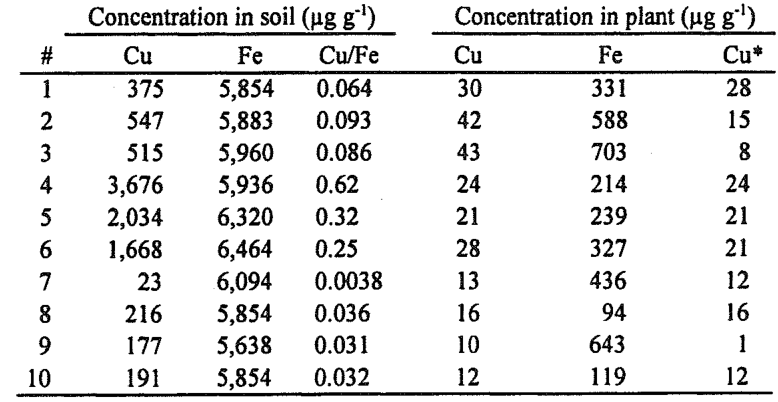
*Corrected values calculated by assuming that any iron concentration ·300 ug g' in plant material is due to wind-borne contamination from soil. The copper concentration due to contamination as indicated from this excess iron, is calculated from column 4 and removed from the original total copper in the plant.
*校正值的计算假定植物材料中铁浓度>300 μg g⁻¹的部分来自风载土壤污染。根据该过量铁所指示的污染带入的铜浓度由第4列计算得出,并从植物原始总铜中扣除。
than 300 ug Fe g iron in their leaves via the root systems. Any value higher than this is usually an indication of wind-borne contamination from the soil.
300 μg g⁻¹的铁。任何高于此值的结果通常表明存在来自土壤的风载污染。
4RESULTS AND DISCUSSION结果与讨论
Copper Tolerance in Erica andevalensisErica andevalensis的耐铜性
Copper concentrations in ten Andévalo soils are shown in Table 1. They range from 23 to 3,676 ug g', a wide fluctuation. The high levels found in some of the soils indicate that E. andevalensis is able to tolerate elevated levels of copper in its natural range.
表1列出了10个Andévalo土壤的铜浓度。其范围为23~3,676 μg g⁻¹,波动幅度很大。部分土壤中的高铜含量表明,E. andevalensis在其自然分布区内能够耐受较高水平的铜。
The results of pot trials with Erica andevalensis grown in copper ore (Champion Mine, New Zealand) diluted with standard commercial seed-raising mixture in various proportions are shown in Table 2. Some of the data are also shown in Figure 3. The plants would not grow in 100% Champion ore (2.5% Cu), but tolerated copper concentrations half of this level (12,500 ug g'). This degree of copper tolerance is almost unequaled in the plant kingdom and is paralleled only in the specialized copper-tolerant flora of the Democratic Republic of Congo (Brooks et al., 1992).
表2列出了Erica andevalensis在以不同比例用标准商品育苗基质稀释的铜矿石(新西兰Champion矿)中生长的盆栽试验结果。部分数据亦见图3。植株无法在100% Champion矿石(2.5% Cu)中生长,但能耐受该水平一半的铜浓度(12,500 μg g⁻¹)。这一耐铜程度在植物界几乎无可比拟,仅有刚果民主共和国特化的耐铜植物区系可与之相当(Brooks et al., 1992)。
The results of trials in which Erica andevalensis and two other species were
Erica andevalensis与另外两个物种
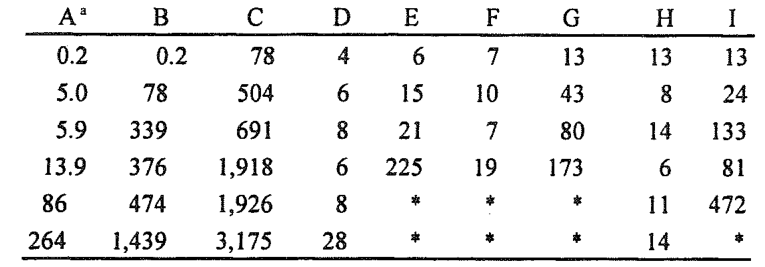
*A=extractable Cu in soil without EDTA, B=as A but after addition of EDTA, C=total Cu in soil, D=Biscutella laevigata without addition of EDTA to the soil, E=as D but with addition of EDTA, F=Brassica juncea without addition of EDTA to the soil, G=as F but with addition of EDTA, H=Erica andevalensis without addition of EDTA to the soil, I=as H but with addition of EDTA.
*A=未添加EDTA土壤中的可提取态Cu,B=同A但添加EDTA后,C=土壤总Cu,D=土壤未添加EDTA时的Biscutella laevigata,E=同D但土壤添加EDTA,F=土壤未添加EDTA时的Brassica juncea,G=同F但土壤添加EDTA,H=土壤未添加EDTA时的Erica andevalensis,I=同H但土壤添加EDTA。
* Plants did not survive addition of EDTA. Plant parts were new whole shoots.
* 添加EDTA后植株未能存活。植物部位为完整新梢。
Clearly, the tolerance of the Erica to copper is much greater than that of the other two metal-tolerant plants.
显然,该欧石南对铜的耐受性远高于另外两种耐金属植物。
Copper Uptake by Erica andevalensisErica andevalensis对铜的吸收
Copper concentrations in E. andevalensis are shown in Tables 1 and 2 and Figure 3. Plants with very high iron concentrations were assumed to have been contaminated by wind-borne dust, and corrected copper values have been calculated. Plants taken from natural populations (Table 1) had copper concentrations below 25 ug g, well below the threshold for hyperaccumulation at 1,000 ug gl. Copper accumulation by E. andevalensis was enhanced by the addition of EDTA to plants grown in artificial substrates (Table 2), but to a lesser degree than the other metal-tolerant species tested, and was well below the threshold of 1,000 ug g'. At a level of 1,918 ug Cu g' in soil, above which the other species would not grow, the Erica contained less than half of the copper of the others, thus demonstrating its ability to limit copper accumulation, no doubt as a survival mechanism.
E. andevalensis中的铜浓度见表1、表2和图3。铁浓度极高的植株被认为受到了风载粉尘污染,并计算了校正后的铜含量。采自自然种群的植株(表1)铜浓度低于25 μg g⁻¹,远低于1,000 μg g⁻¹的超富集阈值。在人工基质中生长的植株添加EDTA后,E. andevalensis对铜的积累有所增强(表2),但增幅小于所测试的其他耐金属物种,且远低于1,000 μg g⁻¹的阈值。当土壤铜含量为1,918 μg g⁻¹(高于此值其他物种无法生长)时,该欧石南的铜含量不及其他物种的一半,表明其具有限制铜积累的能力,这无疑是一种生存机制。
The Relationship Between the Copper Uptake by Erica andevalensis and the Concentration of Copper in the Substrate
Erica andevalensis对铜的吸收与基质铜浓度的关系
No correlation occurred between the total copper content of plants and soils from Andévalo (Table 1). This result is not unexpected because elements such as copper, that are essential to plant nutrition, tend to have constant concentrations within the plant because of internal control mechanisms, whereas non-essential elements are externally controlled and taken up passively by plants to an extent proportional to the concentration in the substrate (Timperley et al. 1970). Eriva andevalensis is nevertheless a good geobotanical indicator of copper because its distribution appears to be confined to this type of mineralization.
Andévalo地区植物与土壤的总铜含量之间不存在相关性(表1)。这一结果并不意外,因为铜等植物营养必需元素由于植物内部调控机制,在植物体内往往保持恒定浓度;而非必需元素则受外部控制,被植物被动吸收,其程度与基质中的浓度成正比(Timperley et al. 1970)。尽管如此,Erica andevalensis仍是一种良好的铜地植物指示物,因为其分布似乎局限于此类矿化区域。
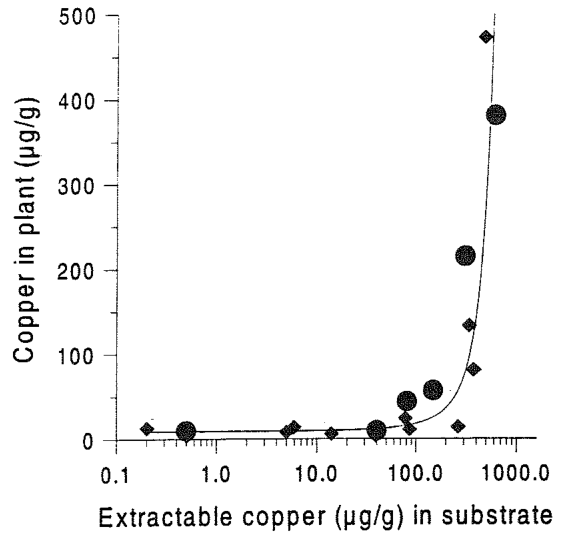
A highly significant correlation (r=0.68, P<0.01) occurred between the concentration of copper in the plants and the extractable copper concentration in the soil (Figure 3). The shape of the curve in Figure 3 is illustrative of the behavior of non-accumulator plants to elements essential in plant nutrition. As elemental concentrations in the substrate increase, the internal control system of the plant is able to restrict uptake of the metal in question until a threshold is reached where the control mechanism starts to break down and unrestricted uptake occurs and is terminated by necrosis of the plant at the limit of tolerance.
植物铜浓度与土壤可提取态铜浓度之间存在极显著相关性(r=0.68,P<0.01)(图3)。图3中曲线的形状反映了非富集植物对植物营养必需元素的响应特征。随着基质中元素浓度的升高,植物内部调控系统能够限制该金属的吸收,直至达到某一阈值,此时调控机制开始失效,出现不受限制的吸收,最终在耐受极限处以植物坏死告终。
A strong behavioral correlation occurred between copper accumulation by Erica in two very different substrates, one natural and the other synthetic, when such untake is hased on extractable conner values (Fioure 3) This correlation clearlv emphasizes the importance of assessing tolerance to heavy metals on the basis of the plant-available fraction rather than on the total heavy metal concentration. It is probable that in the Andévalo, the copper is tightly bound into organic matter because the plant will tolerate apparently very high levels of heavy metals in the damp humus-rich environments in which they grow. For example, Nelson et al. (1985) found it growing in evaporates with as much as 1,500 ug Cu gl.
当以可提取态铜含量为依据时,Erica在两种截然不同的基质(一种为天然基质,另一种为人工基质)中对铜的积累表现出很强的行为相关性(图3)。这一相关性清楚地表明,应依据植物有效态部分而非重金属总浓度来评估植物对重金属的耐受性。在Andévalo地区,铜很可能与有机质紧密结合,因为该植物在其生长的潮湿、富含腐殖质的环境中能够耐受表观上极高水平的重金属。例如,Nelson et al.(1985)发现其生长在铜含量高达1,500 μg g⁻¹的蒸发盐中。
5CONCLUSIONS结论
The following conclusions can be derived from our studies on Erica andevalensis:
根据对Erica andevalensis的研究,可得出以下结论:
(1) The tolerance of the plant to copper is extremely high compared with other metal-tolerant species.
(1)与其他耐金属物种相比,该植物对铜的耐受性极高。
(2) The plant is clearly not a hyperaccumulator (>1,000 ug g*') of copper.
(2)该植物显然不是铜超富集植物(>1,000 μg g⁻¹)。
(3) The copper accumulation by the plant is a function of the extractable (rather than the total) copper concentration in the substrate.
(3)该植物对铜的积累取决于基质中可提取态(而非总)铜浓度。
(4) Uptake of copper follows the pattern of metal-excluding plants: i.e., restricted uptake until the threshold of metal tolerance is exceeded. Thereafter, a rapid exponential increase occurs over a short range until the plant will no longer grow in the copper-rich substrate. The same pattern was obvious even after EDTA was added to the soil to complex copper.
(4)铜的吸收遵循金属排斥型植物的模式,即在超过金属耐受阈值之前吸收受到限制。此后,在较窄的浓度范围内出现快速的指数增长,直至植物无法在富铜基质中继续生长。即使向土壤中添加EDTA以络合铜,同样的模式依然明显。
(5) Erica andevalensis has no use for biogeochemical prospecting because its copper content does not reflect the total copper content of the substrate until the tolerance threshold is exceeded. This unsuitability is mainly because there is little correlation between total and extractable copper in the Andévalo soils.
(5)Erica andevalensis不适用于生物地球化学找矿,因为在超过耐受阈值之前,其铜含量并不能反映基质的总铜含量。这种不适用性主要是由于Andévalo土壤中总铜与可提取态铜之间相关性很弱。
(6) The plant is an excellent geobotanical indicator of copper mineralization because it appears to be restricted to copper-rich substrates. Further work on this interesting species should be devoted to tolerance studies and its possible role in revegetation of mine tips and other mineralized waste material.
(6)该植物是铜矿化的优良地植物指示物,因为它似乎仅分布于富铜基质上。今后对这一有趣物种的研究应侧重于耐性研究,以及其在矿山排土场和其他矿化废弃物植被恢复中的潜在作用。
6REFERENCES参考文献
Aparicio, A. 1995. Seed germination of Erica andevalensis Cabezudo and Rivera (Ericaceae), an endangered edaphic endemic in southwestern Spain. Seed Sci. Technol. 23:705-713.
Arroyo, J. and J. Herrera. 1988. Polinzación y arquitectua floral en Ericacaeae de Andalucia Occidental. Lagascalia 15:615-623.
Brooks, R.R., A.J.M. Baker, and F. Malaisse. 1992. Copper flowers. Nat. Geogr. Res. Explor. 8:338-351.
Cabezudo, B. and J. Rivera. 1980. Notas taxonómicas y corológicas sobre la flora de Andalucia Occidental: Erica andevalensis Cabezudo and Rivera sp. nov. Lagascalia 9:223-226.
Ernst, W.H.O. 1996. Bioavailability of heavy metals and decontamination of soils by plants. Appl. Geochem. 11:163-167.
Lopez Archilla, A.I., D. Moreira, I. Marin, and R. Amils. 1994. El rio Tinto, un curso de aqua vivo pero con mala fama. Quercus 103:19-22.
Nelson, E.C., D. McClintock, and D. Small. 1985. The natural habitat of Erica andevalensis in southwestern Spain. Kew Magazine 2:324-330.
Se, S.-T. and B.-L. Sjuj. 1953. Elsholtzia haichowensis Sun-A plant that can reveal the presence of copper-bearing strata. Dichzi Sjuozheo 32:360-368.
Soldevilla, M., T. Marañon, and F. Cabrera. 1992. Heavy metal content in soil and plants from a pyrite mining area in southwestern Spain. Commun. Soil Sci. Plant Anal. 23:1301-1319.
Timperley, M.H., R.R. Brooks, and P.J. Peterson. 1970. The significance of essential and non-essential trace elements in plants in relation to biogeochemical prospecting. J. Appl. Ecol. 7:429-439.
Wilkomm, M. 1893. Supplementum Prodromus Floraea Hispanicae. Stuttgartiae 136.