Contents lists available at ScienceDirect journal homepage: www.elsevier.com/locate/chemosphere
Brett H. Robinson a, *, Rohith Yalamanchali b, Rene� Reiser c, Nicholas M. Dickinson b
a School of Physical and Chemical Sciences, University of Canterbury, New Zealand b Faculty of Agriculture and Life Sciences, Lincoln University, New Zealand c Agroscope Reckenholz-Tanikon€ ART, Switzerland
h i g h l i g h t s
� Geogenic Li is sparingly soluble and mostly unavailable to plants.
• 地质成因的Li溶解度低,大部分不能被植物利用。
� Ionic Li added to soil binds weakly and is more mobile under acidic conditions.
• 添加到土壤中的离子态Li结合较弱,在酸性条件下迁移性更强。
� Plants take up ionic Li with a bioaccumulation coefficient >5.
• 植物吸收离子态Li的生物富集系数 >5。
� Plants accumulate up to 500 mg/kg Li in the water sinks with few toxicity symptoms.
• 植物在水分汇集部位(叶片)中积累的Li可达500 mg/kg,而毒害症状很少。
� In contaminated environments, plants are likely to be an important exposure pathway for Li to enter humans or ecosystems.
• 在受污染环境中,植物可能是Li进入人体或生态系统的重要暴露途径。
a r t i c l e i n f o
a b s t r a c t
Article history: Contamination of soil with lithium (Li) is likely to increase due to its wider dispersal in the environment, Received 15 November 2017 associated in particular, with the disposal of the now ubiquitous Li-ion batteries. There is, however, a Received in revised form paucity of information on the behaviour of Li in the soil-plant system. We measured the sorption of 2 January 2018 added Li to soil, and uptake of Li by food and fodder species. Around New Zealand, soil concentrations Accepted 4 January 2018 were shown to range from 0.08 mg/kg to 92 mg/kg, and to be positively correlated with clay content. Available online 5 January 2018 Most geogenic Li in soil is insoluble and hence unavailable to plants but, when Li+ is added to soil, there is only limited sorption of Li. We found that Li sorption increased with increasing soil pH, and decreased Keywords: Soil contamination proportionately with increasing Li concentrations. Compared to other cations in soil, Li is mobile and may E-waste leach into receiving waters, be taken up by plants, or have other biological impacts. In a soil spiked with Phytoaccumulation just 5 mg/kg, plants took up several hundred mg/kg Li into leaves with no reduction in biomass. Lithium Phytotoxicity appears to be a phloem immobile element, with the highest concentrations occurring in the older leaves and the lowest concentrations occurring in the seeds or fruits. These results may raise concerns and risks in situations where food and fodder crops are associated with waste disposal.
由于锂(Li)在环境中的分布日益广泛,尤其是与目前无处不在的锂离子电池的废弃处置相关,土壤锂污染可能会加剧。然而,有关Li在土壤-植物系统中行为的资料十分缺乏。本研究测定了外源Li在土壤中的吸附以及粮食和饲料作物对Li的吸收。新西兰各地土壤Li浓度范围为0.08 mg/kg至92 mg/kg,且与黏粒含量呈正相关。土壤中大部分地质成因的Li不溶,因而不能被植物利用;但当Li+添加到土壤中时,Li的吸附十分有限。研究发现,Li的吸附随土壤pH升高而增加,并随Li浓度升高而成比例下降。与土壤中的其他阳离子相比,Li具有较强的迁移性,可能淋溶进入受纳水体、被植物吸收或产生其他生物学影响。在仅添加5 mg/kg Li的土壤中,植物叶片吸收的Li达数百mg/kg,而生物量并未降低。Li似乎是一种韧皮部不易移动的元素,其最高浓度出现在老叶中,最低浓度出现在种子或果实中。在粮食和饲料作物与废弃物处置相关联的情形下,这些结果可能引发关注并提示存在风险。(文章历史:2017年11月15日收稿;2018年1月2日收到修改稿;2018年1月4日接受;2018年1月5日在线发表。关键词:土壤污染;电子废弃物;植物积累;锂;植物毒性)
© 2018 Published by Elsevier Ltd.
1Introduction引言
Lithium (Li) is a non-essential, but occasionally beneficial element for organisms (Schafer, 2012). Lithium has a relatively low toxicity for animals, with a lethal dose of >500 mg/kg bodyweight for rats (Aral and Vecchio-Sadus, 2008a). Relatively low concentrations affect the central nervous system, with reports that drinking water concentrations >0.17 mg/L reduce the incidence of suicide (Schrauzer and Shrestha, 1990) and also that concentrations
锂(Li)是一种非必需元素,但偶尔对生物有益(Schafer, 2012)。Li对动物的毒性相对较低,大鼠的致死剂量为 >500 mg/kg体重(Aral and Vecchio-Sadus, 2008a)。相对较低的浓度即可影响中枢神经系统,有报道称饮用水中Li浓度 >0.17 mg/L可降低自杀发生率(Schrauzer and Shrestha, 1990),另有报道称浓度
* Corresponding author.
E-mail address: brett.robinson@canterbury.ac.nz (B.H. Robinson).
>0.015 mg/L are protective against dementia (Kessing et al., 2017). Of course, Li is used in medications for bipolar disorder and manic and depressive episodes, and Goldstein and Mascitelli (2016) hypothesised that increased Li intake would reduce levels of aggression and violence.
>0.015 mg/L对痴呆具有保护作用(Kessing et al., 2017)。当然,Li被用于治疗双相障碍以及躁狂和抑郁发作的药物中,Goldstein and Mascitelli(2016)推测,增加Li摄入量可降低攻击性和暴力水平。
Humans may be exposed to increasing Li concentrations as it enters the environment through the use and disposal of Licontaining products. Global Li production has tripled since 2000, with current production >600,000 tonnes (Kelly and Matos, 2013). This increase is largely driven by the pervasion of Li-ion batteries in electronic goods and increasingly, in vehicles (Mohr et al., 2012). Lithium is also used in greases, ceramics (Hao et al., 2017), moodstabilising drugs (Aral and Vecchio-Sadus, 2008a), and sometimes in the illicit manufacture of methamphetamine (Person et al., 2005).
随着含Li产品的使用和废弃处置使Li进入环境,人类可能暴露于日益升高的Li浓度之下。自2000年以来,全球Li产量已增加两倍,目前产量 >600,000吨(Kelly and Matos, 2013)。这一增长主要源于锂离子电池在电子产品中以及日益在车辆中的普及(Mohr et al., 2012)。Li还用于润滑脂、陶瓷(Hao et al., 2017)、情绪稳定药物(Aral and Vecchio-Sadus, 2008a),有时还用于非法制造甲基苯丙胺(Person et al., 2005)。
https://doi.org/10.1016/j.chemosphere.2018.01.012
https://doi.org/10.1016/j.chemosphere.2018.01.012
0045-6535/© 2018 Published by Elsevier Ltd.
0045-6535/© 2018 Published by Elsevier Ltd.
Drinking water and plants are likely to provide the primary exposure pathways for Li into the food chain (Franzaring et al., 2016); both are dependent on the dynamics of Li in soil. Background concentrations in soil range from <1 to 200 mg/kg (Schrauzer, 2002a; Aral and Vecchio-Sadus, 2008b), with higher concentrations occurring in arid and saline soils (Merian, 1991). Lithium generally enters the soil solution primarily through weathering of sedimentary minerals (Chan et al., 1997; Aral and Vecchio-Sadus, 2008a). Topsoil usually contains less Li than underlying layers (Merian, 1991). The clay fraction of soil contains higher Li concentrations than the organic soil fraction (Schrauzer, 2002b), with the Li present in ditrigonal cavities within clay minerals (Anderson et al., 1988).
饮用水和植物可能是Li进入食物链的主要暴露途径(Franzaring et al., 2016);二者均取决于Li在土壤中的动态。土壤中Li的背景浓度范围为 <1至200 mg/kg(Schrauzer, 2002a; Aral and Vecchio-Sadus, 2008b),干旱土壤和盐渍土中浓度较高(Merian, 1991)。Li通常主要通过沉积矿物的风化进入土壤溶液(Chan et al., 1997; Aral and Vecchio-Sadus, 2008a)。表层土壤的Li含量通常低于下层土壤(Merian, 1991)。土壤黏粒组分的Li浓度高于有机组分(Schrauzer, 2002b),Li存在于黏土矿物的复三方孔穴中(Anderson et al., 1988)。
Dissolved Li ions have a charge/hydrated radius quotient just 2.9 e/nm which is low compared to other common ions in soil solution Na+, K+, Mg2þ and Ca2þ, which have charge/hydrated radius quotients of 3.6, 4.3, 4.3, and 6.2 e/nm respectively (Wiberg et al., 2001). This indicates that the binding of Li via outer sphere electrostatic attraction is likely to be weak (Sposito, 2016). Similarly, it is unlikely that there will be significant covalent inner-sphere binding due to the large energy difference between the bonding orbitals on Li+ and those on the functional groups present on soil colloids. We therefore hypothesise that Li+ that is added to soil will be immobilised less readily and will be relatively mobile compared to other trace elements, with a higher potential to leach into receiving waters.
溶解态Li离子的电荷/水合半径比仅为2.9 e/nm,低于土壤溶液中其他常见离子Na+、K+、Mg2+和Ca2+,后者的电荷/水合半径比分别为3.6、4.3、4.3和6.2 e/nm(Wiberg et al., 2001)。这表明Li通过外层静电引力的结合可能较弱(Sposito, 2016)。同样,由于Li+的成键轨道与土壤胶体表面官能团的成键轨道之间能量差较大,不太可能形成显著的共价内层结合。因此,我们假设添加到土壤中的Li+较难被固定,与其他微量元素相比迁移性相对较强,淋溶进入受纳水体的潜力更高。
Citing numerous sources, Gough et al. (1979) reported a wide variation in plant tolerance to Li; citrus was found to be particularly sensitive, whilst cotton was more tolerant. In hydroponic conditions, Kalinowska et al. (2013) demonstrated that lettuce was tolerant to 20 mg/kg and accumulated Li in leaves at concentrations tenfold higher than the nutrient solution. Franzaring et al. (2016) reported that soil concentrations of Li spiked to 118 and 47 mg/kg were toxic to maize and buckwheat respectively and that leaf concentrations in maize were tenfold higher than soil concentrations. Jiang et al. (2014) reported that a traditional Chinese medicine herb, Apocynum venetum, accumulated >1800 mg/kg in leaf tissue, and postulated that such high Li concentrations may confer some of the known antidepressant and anxiolytic effects of this plant.
Gough et al.(1979)引用大量文献,报道了植物对Li耐受性的巨大差异:柑橘尤为敏感,而棉花耐受性较强。在水培条件下,Kalinowska et al.(2013)证明莴苣可耐受20 mg/kg的Li,且叶片中积累的Li浓度比营养液高十倍。Franzaring et al.(2016)报道,土壤Li添加浓度分别为118和47 mg/kg时对玉米和荞麦产生毒害,且玉米叶片中的浓度比土壤浓度高十倍。Jiang et al.(2014)报道,传统中药材罗布麻(Apocynum venetum)叶片组织中积累的Li >1800 mg/kg,并推测如此高的Li浓度可能是该植物具有抗抑郁和抗焦虑作用的部分原因。
We hypothesised that ionic Li added to soil would be poorly adsorbed by the soil and readily accumulated by plants. We aimed to determine the sorption of Li by an agricultural silt loam, the tolerance and accumulation of Li in selected food and fodder crops, comparing these with Li concentrations in soil and ryegrass from a survey of 69 sites throughout New Zealand. We used sunflower grown in soils spiked with Li, to evaluate the partitioning of Li in plants.
我们假设添加到土壤中的离子态Li难以被土壤吸附,且易被植物积累。本研究旨在测定一种农业粉砂壤土对Li的吸附,以及所选粮食和饲料作物对Li的耐受性和积累,并与新西兰全国69个样点调查所得的土壤和黑麦草Li浓度进行比较。我们利用在添加Li的土壤中种植的向日葵,评估Li在植物体内的分配。
2Methods and materials材料与方法
Batch and greenhouse experiments used the Templeton Silt Loam (TSL), a typic immature pallic soil, collected from the Lincoln University dairy farm (43�38011.3900S,172�26019.0900E). Properties of the TSL used in these experiments are provided in Table 1.
批量试验和温室试验均采用Templeton粉砂壤土(TSL),属典型未成熟灰化土(typic immature pallic soil),采自Lincoln University奶牛场(43°38′11.39″S,172°26′19.09″E)。试验所用TSL的性质见表1。
We used a batch experiment to determine the influence of pH and spiked Li solution concentration on Li sorption by the TSL. Soil was first dried and passed through a 2 mm Nylon sieve. The sorption experiment was conducted using 40 ml centrifuge tubes with 4 replicates per treatment. Three replicates per treatment were used for element analysis with duplicate pH determinations. TSL (5 g) was added to 30 mL of 0.05 M Ca(NO3)2 (BDH AnalaR Ca(N- O3)2$4H2O) solution spiked with varying amounts of Li (LiCl,
采用批量试验测定pH和Li添加溶液浓度对TSL吸附Li的影响。土壤先经干燥并过2 mm尼龙筛。吸附试验在40 ml离心管中进行,每个处理4个重复。每个处理中3个重复用于元素分析,pH测定设2个平行。将TSL(5 g)加入30 mL添加了不同量Li(LiCl,
Properties of templeton silt loam from the Lincoln University dairy farm.
Lincoln University奶牛场Templeton粉砂壤土的性质。
| Totala全量a | Extractableb可提取态b | |
|---|---|---|
| pH | 5.6 | n/a |
| C (%) | 2.0 | n.d |
| N (%) | 0.18 | n.d |
| CEC (cmol kg�1) | 12.5 | n/a |
| Li (mg kg�1) | 31.8 | 0.13 |
| Mg (mg kg�1) | 855 | 16.6 |
| K (mg kg�1) | 1401 | 14.0 |
| Na (mg kg�1) | 136 | 44.9 |
| Ca (mg kg�1) | 3005 | n.d. |
| P (mg kg�1) | 518 | 0.71 |
| S (mg kg�1) | 193 | 8.5 |
a Pseudototal using a conc. HNO3 extract. b Extracted in a 0.05 M Ca(NO3)2 solution.
a 采用浓HNO3提取的准全量。b 采用0.05 M Ca(NO3)2溶液提取。
Sharlau). The initial solution Li concentrations were 0, 1, 3, 10, and 30 mg/L. The solution pH was adjusted to values ranging of 2.8, 4.3, 5.2, 6.5 & 7.4 after addition of the soil by using HNO3 (BDH ARISTAR nitric acid 70%) or KOH (BDH AnalaR KOH) to decrease or increase pH, respectively. Centrifuge tubes containing solutions without soil were prepared as a control for each Li concentration to determine the extent of any Li sorption by the tubes or filter papers; this was found to be negligible. The tubes were continuously agitated (2 h) on an end-over-end shaker in order to reach sorption equilibrium (determined in a previous experiment). The pH of the slurry was measured after shaking. The tubes were centrifuged for 10 min at 3300 rpm. The supernatant was decanted and filtered (Whatman 52, pore size 7 mm). Solution element concentrations were determined using ICP-OES (Varian 720 ES).
Sharlau)的0.05 M Ca(NO3)2(BDH AnalaR Ca(NO3)2·4H2O)溶液中。溶液初始Li浓度为0、1、3、10和30 mg/L。加入土壤后,用HNO3(BDH ARISTAR硝酸,70%)或KOH(BDH AnalaR KOH)分别降低或升高pH,将溶液pH调节至2.8、4.3、5.2、6.5和7.4。针对每个Li浓度制备不含土壤的离心管溶液作为对照,以确定离心管或滤纸对Li的吸附程度,结果表明可忽略不计。离心管在翻转振荡器上连续振荡(2 h)以达到吸附平衡(由前期试验确定)。振荡后测定悬液pH。离心管以3300 rpm离心10 min。倾出上清液并过滤(Whatman 52,孔径7 μm)。溶液元素浓度采用ICP-OES(Varian 720 ES)测定。
The soil was amended with Li (LiCl, Sharlau) to provide concentrations of 0 (control), 1, 3, 10, 30 & 100 mg/kg. Lithium was added to soils using a thoroughly cleaned concrete mixer to which 250 mL of solution containing the appropriate Li concentration was applied. Pots (2.5 L) were planted with Beta vulgaris L. (beetroot), Lactuca sativa L. (lettuce), Brassica nigra L. (black mustard), and Lolium perenne L. (perennial ryegrass), with five replicates per treatment. Larger pots (7.5 L) were prepared for Helianthus annuus L. (sunflower) spiked with Li at 0, 10 and 30 mg/kg (three replicates per treatment). Plants were sown with three seeds per pot and later thinned out to one seedling, with the exception of L. perenne, which was established by sowing 50 seeds per pot. Pots were arranged in a fully randomised single block design on a glasshouse bench.
向土壤中添加Li(LiCl,Sharlau),使其浓度为0(对照)、1、3、10、30和100 mg/kg。利用彻底清洗过的混凝土搅拌机将Li加入土壤,向其中施加250 mL含相应Li浓度的溶液。在盆钵(2.5 L)中种植Beta vulgaris L.(甜菜根)、Lactuca sativa L.(莴苣)、Brassica nigra L.(黑芥)和Lolium perenne L.(多年生黑麦草),每个处理5个重复。另准备较大盆钵(7.5 L)种植Helianthus annuus L.(向日葵),Li添加浓度为0、10和30 mg/kg(每个处理3个重复)。每盆播种3粒种子,之后间苗至1株,但L. perenne除外,其每盆播种50粒种子建植。盆钵在温室试验台上按完全随机单区组设计排列。
After three months growth, when the edible portions of the plants were mature, they were harvested using scissors ca. 1 cm from the soil surface. The harvested plants were thoroughly washed in deionised water and transferred into pre-labelled paper bags and oven dried for at 105 �C to constant weight. The dry plant samples were ground into a fine powder and stored in labelled plastic bags.
生长三个月后,当植物可食部分成熟时,用剪刀在距土壤表面约1 cm处收获。收获的植物用去离子水彻底清洗,转入预先标记的纸袋中,于105 °C烘干至恒重。干燥的植物样品研磨成细粉,储存于标记好的塑料袋中。
The B. vulgaris leaves and bulbs were harvested, leaves were washed & dried and the bulbs were peeled, washed and dried separately. The H. annuus plants were divided into six samples: Leaves were divided into equal thirds by their height on the stem. Henceforth, these are referred to as bottom leaves, middle leaves and top leaves. The shoots, flower and roots were analysed separately.
收获B. vulgaris的叶片和块根,叶片经清洗和干燥,块根去皮、清洗后分别干燥。H. annuus植株分为六个样品:叶片按其在茎上的高度等分为三部分,下文分别称为下部叶、中部叶和上部叶。茎、花和根分别进行分析。
Soil and pasture samples from 69 sites had been collected in an earlier study at sampling locations across New Zealand (Reiser et al., 2014). Pasture samples (ca. 0.2 m2) were cut 2e3 cm above ground and dicotyledonous weeds removed. These samples were predominantly perennial ryegrass, Lolium perenne, which comprise some 70% of NZ pastures (Roberts and Longhurst, 2002). From each sampling location, a 10 cm soil corer was used to obtain a bulked sample from 10 to 15 composite cores.
69个样点的土壤和牧草样品采自先前一项研究在新西兰各地设置的采样点(Reiser et al., 2014)。牧草样品(约0.2 m2)在地上2–3 cm处刈割,并去除双子叶杂草。这些样品主要为多年生黑麦草(Lolium perenne),其约占新西兰牧场的70%(Roberts and Longhurst, 2002)。在每个采样点,使用10 cm土钻采集10至15个土芯组成的混合样品。
Plant samples were washed in deionized water and dried at 60 �C until a constant weight was obtained. Subsequently, they were milled using a Cyclotech type 1093 cyclone grinder with an aluminium rotor. Plant material (0.5 g) was digested in 5 ml HNO3. The digests were diluted with Milli Q (Barnstead, EASYpure RF, 18.3 MU-cm) to a volume of 25 ml and filtered with a Whatman 52 filter paper (pore size 7 mm). Soil samples were dried for 7 d at room temperature, the aggregates separated, and then passed through a 2 mm nylon sieve. Soil sub-samples (0.5 g) were microwave digested in 5 ml aqua regia (BDH Aristar HNO3 69%, BDH Aristar HCl 37%).
植物样品用去离子水清洗,于60 °C干燥至恒重。随后使用配有铝制转子的Cyclotech 1093型旋风磨粉碎。植物材料(0.5 g)用5 ml HNO3消解。消解液用Milli Q水(Barnstead, EASYpure RF, 18.3 MΩ-cm)定容至25 ml,并用Whatman 52滤纸(孔径7 μm)过滤。土壤样品在室温下干燥7 d,分离团聚体后过2 mm尼龙筛。土壤子样品(0.5 g)用5 ml王水(BDH Aristar HNO3 69%,BDH Aristar HCl 37%)进行微波消解。
Pseudo-total element concentrations (henceforth referred to as “total”) were determined in the acid digests using ICP-OES (Varian 720 ES). Wageningen (ISE 921, IPE 100) and NIST (1573a) QA reference materials were analyzed in the same sample sets. Recoveries ranged from 91 to 112%. The C and N content of soil and plant material was determined using an Elementar Vario MAX CN element analyzer.
采用ICP-OES(Varian 720 ES)测定酸消解液中的准全量元素浓度(下文称“全量”)。在同批样品中同时分析Wageningen(ISE 921, IPE 100)和NIST(1573a)质控标准物质,回收率为91%至112%。土壤和植物材料的C、N含量采用Elementar Vario MAX CN元素分析仪测定。
Ca(NO3)2-extractable elemental concentrations in soil were determined using ICP-OES. Soil (5 g) was weighed into centrifuge tubes (V ¼ 40 ml) and 30 ml 0.05 M Ca(NO3)2 (BDH AnalaR Ca(NO3)2 � 4H2O) was added. Tubes were agitated for 2 h on an end-over-end shaker, subsequently centrifuged for 10 min at 150000 rpm and then filtered using a Whatman 52 filter paper. All extracts were stored at 4 �C before the analysis. Soil pH was measured in Milli Q at a solid: water ratio of 1:2.5 using a Metler Toledo pH meter. The grain size distribution of the soils was determined using the pipette method according to the reference methods of the Swiss Federal Agricultural Research Stations (FAL et al., 1996).
土壤中Ca(NO3)2可提取态元素浓度采用ICP-OES测定。称取土壤(5 g)置于离心管(V = 40 ml)中,加入30 ml 0.05 M Ca(NO3)2(BDH AnalaR Ca(NO3)2·4H2O)。离心管在翻转振荡器上振荡2 h,随后以15,000 rpm离心10 min,再用Whatman 52滤纸过滤。所有提取液在分析前于4 °C保存。土壤pH在Milli Q水中按固水比1:2.5使用Metler Toledo pH计测定。土壤粒径分布依据瑞士联邦农业研究站的参考方法(FAL et al., 1996)采用吸管法测定。
Minitab® 16 was used for ANOVA with Fisher's Least-Significant- Difference post-hoc test to compare means.
采用Minitab® 16进行ANOVA分析,并用Fisher最小显著差异(LSD)事后检验比较均值。
3Results & discussion结果与讨论
3.1. Lithium in soils3.1. 土壤中的锂
Lithium concentrations from the 69 pastoral soils from around NZ are shown in Table 2, with comparable silt loam values to the Dairy Farm TSL soil (Table 1). It has been suggested that soil Li concentrations in the low mg/kg range may indicate contamination from small amounts of Li-grease which can contain >1% Li (Zeng and Li, 2014), presumably from agricultural machinery.
新西兰各地69个牧场土壤的Li浓度见表2,其中粉砂壤土的数值与奶牛场TSL土壤相当(表1)。有研究认为,土壤Li浓度处于较低的mg/kg范围可能表明受到少量锂基润滑脂的污染,此类润滑脂的Li含量可 >1%(Zeng and Li, 2014),推测来源于农业机械。
Soil Li was strongly positively correlated with the clay fraction (Table 3), which is consistent with the findings of Schrauzer (2002a). Lithium may substitute for Mg in silicate matrices due to their similar ionic radii of 90 p.m. and 86 p.m. respectively. There was a strong positive correlation between Li and Mg as well as between Li and Al, B, Fe, K, Mn and Zn.
土壤Li与黏粒组分呈强正相关(表3),这与Schrauzer(2002a)的研究结果一致。由于Li和Mg的离子半径相近(分别为90 pm和86 pm),Li可在硅酸盐基质中替代Mg。Li与Mg之间以及Li与Al、B、Fe、K、Mn和Zn之间均存在强正相关。
The KD results (Fig. 1) show that, as with other trace element cations, sorption increases exponentially with increasing pH and proportionately decreases with increasing Li concentrations. The magnitude of the sorption is substantially lower than other trace element cations, where KD values generally range from <1 to 7. This indicates that Li ions that are added to soils are likely to be mobile relative to other trace elements and therefore more likely to be mobilised, to leach through soil or to interact with soil organisms and plant roots. This is consistent with observations elsewhere that monovalent cations with a large hydrated radius are weakly sorbed via outer-sphere binding (Sposito, 2016). Similarly, inner-sphere binding, if it occurs at all, is likely to be weak due to the low polarizability of the Li ion and large energy difference between the bonding orbitals of Li and those of potential ligands in soil. The high mobility added Li+ in the TSL contrasts sharply with the low mobility of the geogenic Li, which has a KD of 245. These results further support the hypothesis that geogenic Li is associated with silicate matrices or in the interlayers of layer silicates and thus only exposed to soil solution during the weathering processes of these minerals.
KD结果(图1)表明,与其他微量元素阳离子一样,吸附随pH升高呈指数增加,并随Li浓度升高而成比例下降。吸附量显著低于其他微量元素阳离子,后者的KD值一般为 <1至7。这表明添加到土壤中的Li离子相对于其他微量元素可能具有较强的迁移性,因此更易被活化、在土壤中淋溶或与土壤生物和植物根系发生相互作用。这与其他研究的观察结果一致,即水合半径较大的一价阳离子通过外层结合被弱吸附(Sposito, 2016)。同样,由于Li离子的极化率低,且Li的成键轨道与土壤中潜在配体的成键轨道之间能量差较大,即使发生内层结合,也可能较弱。TSL中外源添加Li+的高迁移性与地质成因Li的低迁移性(KD为245)形成鲜明对比。这些结果进一步支持了以下假设:地质成因的Li与硅酸盐基质结合或存在于层状硅酸盐的层间,因此只有在这些矿物风化过程中才会暴露于土壤溶液。
Mean [Li] (mg kg�1) dry weight for NZ pasture soils. Values in brackets are the standard error of the mean. Values with the same letter are not significantly different at the 5% level.
新西兰牧场土壤平均[Li](mg kg−1,干重)。括号内数值为均值标准误。字母相同的数值在5%水平上差异不显著。
| Texture质地 | N | Soil Li土壤Li | N | L.perenne LiL. perenne Li |
|---|---|---|---|---|
| Silty clay loam | 7 | 48.8 (11.1)a | 5 | 1.4 (0.6)a |
| Clay loam | 15 | 24.9 (4.3)b | 6 | 1.2 (0.2)a |
| Silt loam | 9 | 24.3 (4.4)b c | 6 | 1.8 (0.7)a |
| Loam | 17 | 21.6 (2.7)b c | 9 | 1.8 (0.6)a |
| Sandy loam | 13 | 11.7 (2.6)c | 7 | 1.7 (0.6)a |
| Sandy clay loam | 4 | 10.9 (3.2)b c | 2 | 0.9 (0.6)a |
Correlation matrices between soil Li Vs soil texture, soil Li Vs Li pasture and soil Li Vs other elements.
土壤Li与土壤质地、土壤Li与牧草Li以及土壤Li与其他元素之间的相关矩阵。
| Elements元素 | Soil Li and soil properties土壤Li与土壤 性质 | Pasture grass Li and soil properties牧草Li与 土壤性质 | Pasture grass Li and other elements in pasture grass牧草Li与 牧草中 其他元素 |
|---|---|---|---|
| Sand | �0.53 (S) | 0.05 (NS) | |
| Silt | 0.36 (S) | 0.03 (NS) | |
| Clay | 0.43 (S) | �0.14 (NS) | |
| pH | 0.06 (NS) | �0.04 (NS) | |
| Al | 0.59 (S) | �0.10 (NS) | 0.90 (S) |
| B | 0.65 (S) | 0.17 (NS) | �0.02 (NS) |
| Ca | 0.12 (NS) | 0.16 (NS) | �0.16 (NS) |
| Cu | 0.13 (NS) | 0.04 (NS) | �0.002 (NS) |
| Fe | 0.56 (S) | 0.09 (NS) | 0.90 (S) |
| K | 0.56 (S) | 0.20 (NS) | �0.14 (NS) |
| Mg | 0.68 (S) | �0.23 (S) | �0.23 (NS) |
| Mn | 0.45 (S) | 0.07 (NS) | 0.06 (NS) |
| Mo | 0.15 (NS) | 0.21 (NS) | 0.21 (NS) |
| P | 0.08 (NS) | �0.07 (NS) | �0.07(NS) |
| S | �0.22 (S) | 0.08 (NS) | 0.08 (NS) |
| Zn | 0.60 (S) | �0.15 (NS) | �0.15 (NS) |
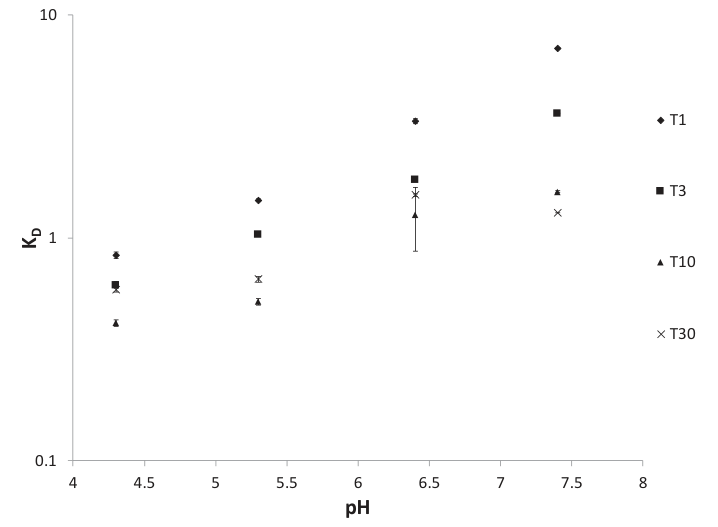
Fig. 1. KD as a function of pH at varying Li concentrations. T1 e T30 indicate the initial solution concentrations in mg/L. Error bars represent the standard error of the mean (n ¼ 3). The background Li concentration in the soil was 25 (mg/kg).图1. 不同Li浓度下KD随pH的变化。T1–T30表示溶液初始浓度(mg/L)。误差线表示均值标准误(n = 3)。土壤中Li的背景浓度为25(mg/kg)。
3.2. Lithium in plants3.2. 植物中的锂
Lithium concentrations in pasture grasses from the 69 sites (Table 2) indicate that geogenic soil Li was mostly unavailable for plant uptake as the average bioaccumulation coefficient (plant/soil concentration quotient) was only 0.14. Pasture grass Li was strongly correlated with plant Al and Fe (Table 3), which is consistent with the plant Li arising from dust particles incorporated into the cuticular wax of plant leaves (Robinson et al., 2008). There were no significant correlations between plant Li and any soil property except for a significant but weak negative correlation with soil Mg.
69个样点牧草的Li浓度(表2)表明,地质成因的土壤Li大部分不能被植物吸收,平均生物富集系数(植物/土壤浓度比)仅为0.14。牧草Li与植物Al和Fe呈强相关(表3),这与植物Li来源于嵌入叶片角质层蜡质中的粉尘颗粒相一致(Robinson et al., 2008)。除与土壤Mg存在显著但较弱的负相关外,植物Li与任何土壤性质均无显著相关性。
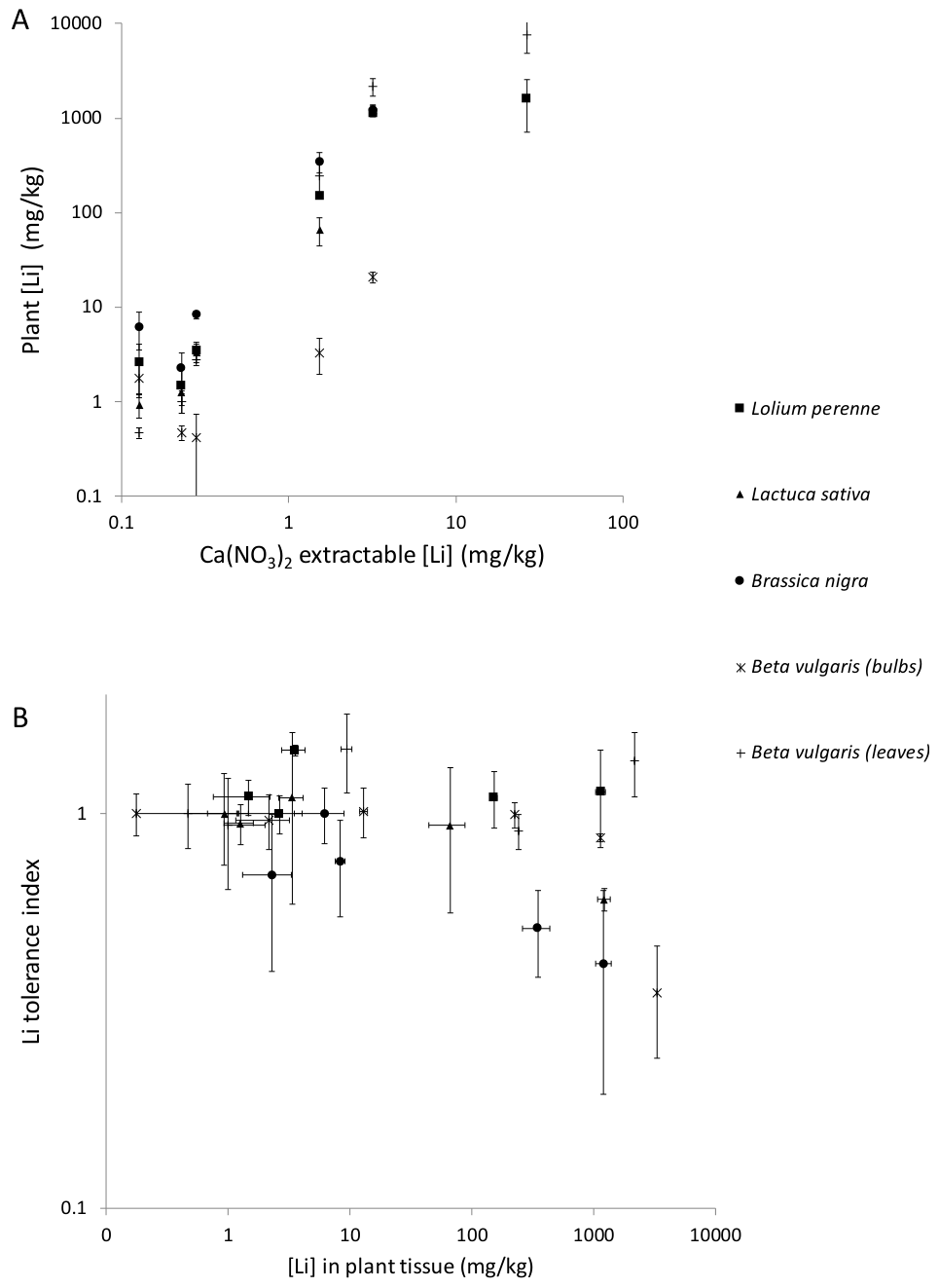
When Li was added to soil in the pot experiment, there was significant plant uptake (Fig. 2A), with Li concentrations in the leaves of all plant species exceeding 1000 mg/kg (dry weight) at Ca(NO3)2-extractable concentrations of just 5 mg/kg Li in soil, representing a bioaccumulation coefficient of >20. There was no significant biomass reduction even though these plants accumulated 500e1000 mg/kg Li in their leaf tissue (Fig. 2b). Tissue concentrations above 1000 mg/kg resulted in reduced biomass production and necrosis on the older leaves, consistent with the findings of Kalinowska et al. (2013) for lettuce plants. These results indicate that the phytotoxicity of Li is low when compared to other non-essential trace elements. This also indicates that food chain protection is not provided by Li toxicity as was suggested by Chaney (1980).
在盆栽试验中向土壤添加Li后,植物吸收显著(图2A):当土壤中Ca(NO3)2可提取态Li浓度仅为5 mg/kg时,所有植物种类叶片中的Li浓度均超过1000 mg/kg(干重),相当于生物富集系数 >20。尽管这些植物叶片组织中积累了500–1000 mg/kg的Li,但生物量并无显著降低(图2B)。组织浓度高于1000 mg/kg时,生物量下降且老叶出现坏死,这与Kalinowska et al.(2013)对莴苣的研究结果一致。这些结果表明,与其他非必需微量元素相比,Li的植物毒性较低。这也表明,Li毒性并不能像Chaney(1980)所提出的那样为食物链提供保护。
The effect of increasing plant Li concentration had speciesspecific effects on the uptake of other elements (Table 4). In L. perenne, leaf Li concentration was negatively correlated with B, Mg, Mn, & Mo and positively correlated with Ca, Fe, K, & Zn. This differed in L. sativa and B. vulgaris, which, for example, had positive correlations between Li and Mg. It is likely that elevated Li concentrations change the function of plant transporters of essential elements, but we have insufficient information to speculate on the nature of these changes.
植物Li浓度升高对其他元素的吸收具有物种特异性影响(表4)。在L. perenne中,叶片Li浓度与B、Mg、Mn和Mo呈负相关,与Ca、Fe、K和Zn呈正相关。这与L. sativa和B. vulgaris不同,例如后两者的Li与Mg呈正相关。Li浓度升高可能改变了植物必需元素转运蛋白的功能,但目前尚无足够信息推测这些变化的性质。
Correlation matrix of Li in plants versus essential elements in plants.
植物中Li与植物必需元素的相关矩阵。
| Element元素 | L. perenneL. perenne | L. sativaL. sativa | B. vulgaris, leavesB. vulgaris,叶 | B. vulgaris, bulbsB. vulgaris,块根 |
|---|---|---|---|---|
| B | �0.84 (S) | �0.68 (S) | 0.06 (NS) | 0.31 (NS) |
| Ca | 0.58 (S) | 0.19 (NS) | 0.31 (NS) | 0.09 (NS) |
| Cu | 0.07 (NS) | 0.72 (S) | 0.21 (NS) | �0.37 (NS) |
| Fe | 0.49 (S*) | 0.32 (NS) | 0.30 (NS) | �0.15 (NS) |
| K | 0.52 (S*) | 0.32 (NS) | �0.66 (S) | 0.26 (NS) |
| Mg | �0.78 (S) | 0.48 (S) | 0.69 (S) | 0.28 (NS) |
| Mn | �0.64 (S) | 0.02 (NS) | 0.54 (S*) | 0.47 (S) |
| Mo | �0.80 (S) | 0.00 (NS) | 0.10 (NS) | 0.16 (NS) |
| P | �0.19 (NS) | 0.52 (S*) | �0.25 (NS) | �0.44 (S) |
| S | 0.14 (NS) | 0.27 (NS) | 0.19 (NS) | 0.02 (NS) |
| Zn | 0.44 (S) | 0.71 (S) | 0.72 (S) | 0.72 (S) |
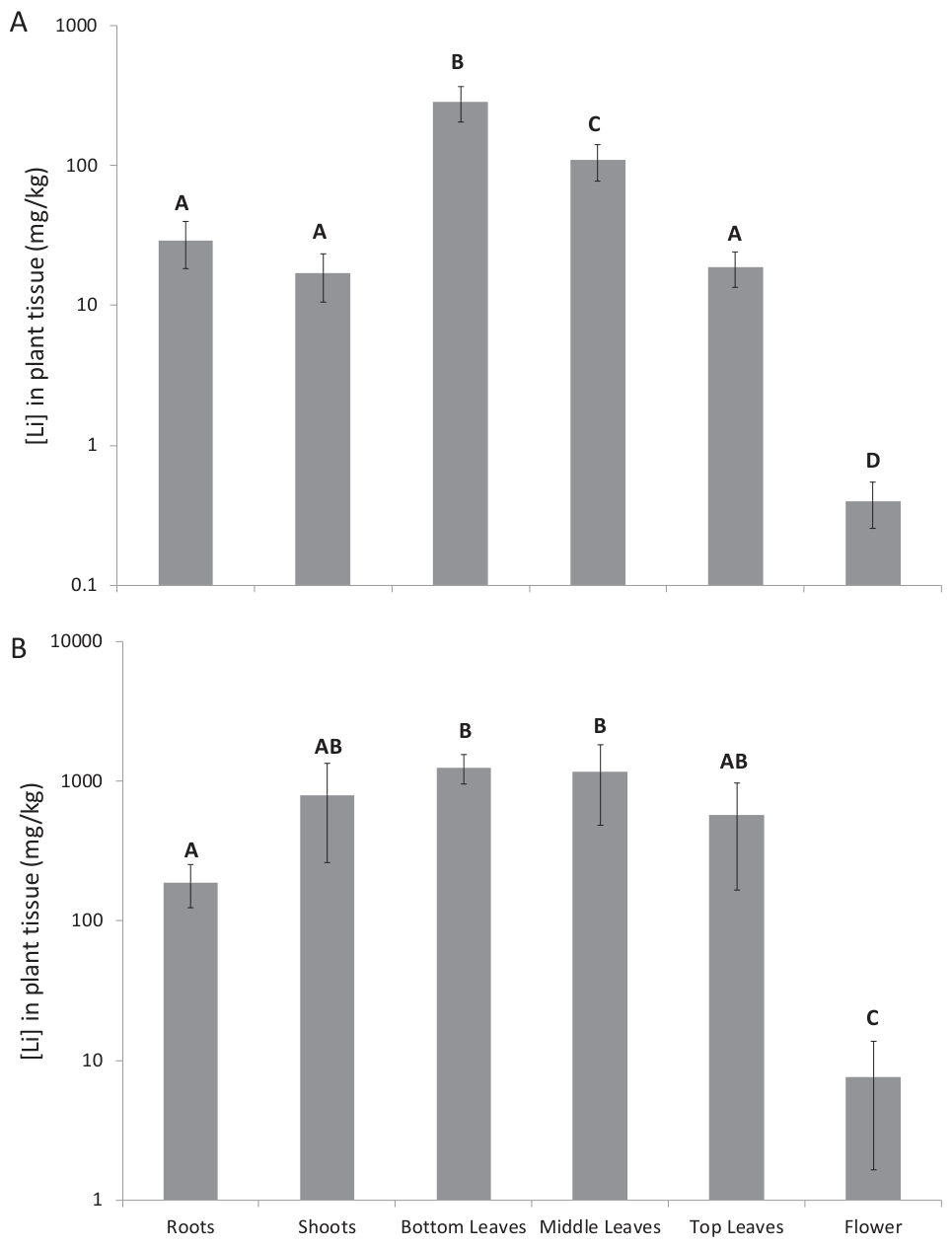
The bulbs of B. vulgaris had Li concentrations that were tenfold lower than the leaves (Fig 2a), which indicates that Li may be primarily translocated in the xylem and accumulates in the leaves. This was tested by growing Helianthus annuus in Li-spiked soil and measuring Li concentrations in the major plant organs (Fig. 3). The highest Li concentrations occurred in the bottom leaves of the plant, with the shoots, roots and flowers having lower concentrations. This pattern of accumulation is consistent with an element that is primarily transported in the xylem and with limited phloem mobility (Evangelou et al., 2016). The aboveground portions of the plants grown in soil spiked with Li at 10 and 30 mg/kg accumulated high Li concentrations of 27 and 756 mg/kg respectively. The biomass production of the H. annuus grown in the lower soil concentration was not significantly different from the control (data not shown), indicating that Li was not phytotoxic at these concentrations but, at the higher soil concentration, the plants exhibited necrosis on the lower leaves. The soil Li concentration that caused toxicity in this study (30 mg/kg) was similar to the findings of Hawrylak-Nowak et al. (2012), who reported a significant reduction of the biomass of H. annuus growing in nutrient solution containing 50 mg/L Li. These authors reported that the growth and concentrations of chlorophyll, carotenoids, and malondialdehyde were unaffected in H. annuus growing in solutions containing 25 mg/L Li despite the leaves containing >400 mg/kg Li.
B. vulgaris块根的Li浓度比叶片低十倍(图2A),表明Li可能主要通过木质部转运并在叶片中积累。为验证这一点,我们在添加Li的土壤中种植Helianthus annuus,并测定植株主要器官中的Li浓度(图3)。Li浓度最高出现在植株下部叶片,茎、根和花的浓度较低。这种积累模式与一种主要经木质部运输而韧皮部移动性有限的元素相符(Evangelou et al., 2016)。在Li添加浓度为10和30 mg/kg的土壤中生长的植株,其地上部分积累了较高的Li浓度,分别为27和756 mg/kg。在较低土壤浓度下生长的H. annuus生物量与对照无显著差异(数据未列出),表明在该浓度下Li无植物毒性;但在较高土壤浓度下,植株下部叶片出现坏死。本研究中引起毒害的土壤Li浓度(30 mg/kg)与Hawrylak-Nowak et al.(2012)的研究结果相近,后者报道在含50 mg/L Li的营养液中生长的H. annuus生物量显著降低。这些作者还报道,在含25 mg/L Li的溶液中生长的H. annuus,尽管叶片Li含量 >400 mg/kg,其生长以及叶绿素、类胡萝卜素和丙二醛浓度均未受影响。
3.3. Potential health risks3.3. 潜在健康风险
Our results indicate that soil contamination with Li may result in plant Li concentrations that are increased by several orders of magnitude, with leaf crops likely providing the highest source of Li in the diet. Even with these increases, it is unlikely that humans would experience acute Li toxicity, which occurs when blood serum reaches 15 mg/L (Aral and Vecchio-Sadus, 2008a). Assuming that ingested Li is distributed evenly in the aqueous phase of the body, a 70 kg individual (assuming 60% water content) would need to consume 630 g of plant material (dry matter) with a Li concentration of 1000 mg/kg Li to reach toxicity thresholds. Nevertheless, the chronic ingestion of such plant material may have measurable effects on humans in the context of the known medicinal effects of this element, and as has been observed in patients taking Li-based antidepressant medication over extended periods (Aral and Vecchio-Sadus, 2008a).
研究结果表明,土壤Li污染可能使植物Li浓度升高数个数量级,其中叶菜类作物可能是膳食中Li的最主要来源。即便浓度有所升高,人类也不太可能发生急性Li中毒;急性中毒发生在血清Li浓度达到15 mg/L时(Aral and Vecchio-Sadus, 2008a)。假设摄入的Li在人体水相中均匀分布,一名70 kg的个体(假设含水量为60%)需食用630 g Li浓度为1000 mg/kg的植物材料(干物质)才会达到毒性阈值。然而,鉴于该元素已知的药用作用,并参照长期服用锂基抗抑郁药物患者中观察到的情况(Aral and Vecchio-Sadus, 2008a),长期摄入此类植物材料可能对人体产生可测量的影响。
4Conclusions结论
The low toxicity of Li has probably resulted in this element being largely overlooked as an emerging environmental contaminant. The pervasion of Li-based batteries into society will likely result in greatly increased incidences of soil contamination. Lithium is mobile in the soil-plant system and therefore soil contamination with Li may result in rapid and extreme increases in Li concentrations in groundwater and in food crops. While increases in Li consumption may be beneficial in some cases, the effect on society of prolonged exposure to elevated Li concentrations is unknown. Being relatively phloem-immobile, leafy vegetables will likely provide the largest source of Li in foods. Further work is warranted to elucidate the transfer of Li from plants to animals and humans.
Li的低毒性可能导致该元素作为一种新兴环境污染物在很大程度上被忽视。锂基电池在社会中的普及可能导致土壤污染事件大幅增加。Li在土壤-植物系统中具有迁移性,因此土壤Li污染可能导致地下水和粮食作物中Li浓度迅速而急剧地升高。虽然增加Li摄入在某些情况下可能有益,但长期暴露于较高Li浓度对社会的影响尚不清楚。由于Li在韧皮部中相对不易移动,叶菜类蔬菜可能是食物中Li的最大来源。有必要开展进一步研究,以阐明Li从植物向动物和人类的传递。
References参考文献
Anderson, M.A., Bertsch, P.M., Miller, W.P., 1988. The distribution of lithium in selected soils and surface waters of the southeastern U.S.A. Appl. Geochem. 3, 205e212.
Aral, H., Vecchio-Sadus, A., 2008a. Toxicity of lithium to humans and the environmenta^V”A literature review. Ecotoxicol. Environ. Saf. 70, 349e356.
Aral, H., Vecchio-Sadus, A., 2008b. Toxicity of lithium to humans and the environmental -A literature review. Ecotoxicol. Environ. Saf. 70, 349e356.
Chan, L.H., Sturchio, N.C., Katz, A., 1997. Lithium isotope study of the Yellowstone hydrothermal system. Geophys. Union.
Chaney, R.L., 1980. In: Bitton, G., Damron, B.L., Edds, G.T., Davidson, J.M. (Eds.), Health Risks Associated with Toxic Metals in Municipal Sludge. Sludge - Healrh Risks of Land Application. Ann Arbor Sci. Publ. Inc. MI, pp. 59e83.
Evangelou, M.W.H., Burgi, A., Robinson, B.H., Gunthardt-Goerg, M.S., Schongens, M., Schulin, R., 2016. Novel method to determine element concentrations in foliage
of poplar and willow cuttings. Int. J. Phytoremediation 18, 943e948. FAL, RAC, FAW, 1996. Schweizerische Referenzmethoden der Eidgenossischen Landwirtschaftlichen Forschungsanstalten. FAL-Eigenverlag, Zurich. Franzaring, J., Schlosser, S., Damsohn, W., Fangmeier, A., 2016. Regional differences in plant levels and investigations on the phytotoxicity of lithium. Environ. Pollut. 216, 858e865. Goldstein, M.R., Mascitelli, L., 2016. Is violence in part a lithium deficiency state? Med. Hypotheses 89, 40e42. Gough, L.P., Shacklette, H.T., Case, A., A, 1979. Element concentrations toxic to plants, animals, and man. Geol. Surv. Bull. 1466, 37e39. Hao, H., Liu, Z.W., Zhao, F.Q., Geng, Y., Sarkis, J., 2017. Material flow analysis of lithium in China. Resour. Policy 51, 100e106.
Hawrylak-Nowak, B., Kalinowska, M., Szymanska, M., 2012. A study on selected physiological parameters of plants grown under lithium supplementation. Biol. Trace Elem. Res. 149, 425e430.
Jiang, L., Wang, L., Mu, S.Y., Tian, C.Y., 2014. Apocynum venetum: a newly found lithium accumulator. Flora 209, 285e289.
Kalinowska, M., Hawrylak-Nowak, B., Szymanska, M., 2013. The influence of two lithium forms on the growth, l-ascorbic acid content and lithium accumulation in lettuce plants. Biol. Trace Elem. Res. 152, 251e257.
Kelly, T.D., Matos, G.R., 2013. Historical statistics for mineral and material commodities in the United States. U. S. Geol. Surv. Data Ser. 140. Kessing, L.V., Gerds, T.A., Knudsen, N.N., Jorgensen, L.F., Kristiansen, S.M., Voutchkova, D., Ernstsen, V., Schullehner, J., Hansen, B., Andersen, P.K., Ersboll, A.K., 2017. Association of lithium in drinking water with the incidence of dementia. JAMA Psychiatry 74, 1005e1010.
Merian, E.E., 1991. Metals and Their Compounds in the Environment: Occurrence, Analysis and Biological Relevance. VCH Verlagsgesellchaft mbH and NY, USA. VCH Publishers, Inc, Weinheim, Germany.
Mohr, S.H., Mudd, G.M., Giurco, D., 2012. Lithium resources and Production> critical assessment and global projections. Minerals 2, 65e84.
Person, E.C., Meyer, J.A., Vyvyan, J.R., 2005. Structural determination of the principal byproduct of the lithium-ammonia reduction method of methamphetamine manufacture. J. Forensic Sci. 50, 87e95.
Reiser, R., Simmler, M., Portmann, D., Clucas, L., Schulin, R., Robinson, B., 2014. Cadmium concentrations in New Zealand pastures: relationships to soil and climate variables. J. Environ. Qual. 43, 917e925.
Roberts, A.H.C., Longhurst, R.D., 2002. Cadmium cycling in sheep-grazed hillcountry pastures. N. Z. J. Agric. Res. 45, 103e112.
Robinson, B.H., Bischofberger, S., Stoll, A., Schroer, D., Furrer, G., Roulier, S., Gruenwald, A., Attinger, W., Schulin, R., 2008. Plant uptake of trace elements on a Swiss military shooting range: uptake pathways and land management implications. Environ. Pollut. 153, 668e676.
Schafer, U., 2012. Evaluation of beneficial and adverse effects on plants and animals following lithium deficiency and supplementation, and on humans following lithium treatment of mood disorders. Trace Elem. Electrolytes 29, 91e112.
Schrauzer, G.N., 2002a. Lithium: occurrence, dietary intakes, nutritional essentiality. J. Am. Coll. Nutr. 21, 14e21.
Schrauzer, G.N., 2002b. Lithium: occurrence, dietary intakes, nutritional essentiality. J. Am. Coll. Nutr. 21, 14e21.
Schrauzer, G.N., Shrestha, K.P., 1990. Lithium in drinking water and the incidences of crimes, suicides, and arrests related to drug addictions. Biol. Trace Elem. Res. 25, 105e113.
Sposito, G., 2016. The Chemistry of Soils. Oxford University Press, New York.
Wiberg, E., Wiberg, N., Holleman, A.F., 2001. Inorganic Chemistry. Academic Press, San Diego, California.
Zeng, X.L., Li, J.H., 2014. Spent rechargeable lithium batteries in e-waste: composition and its implications. Front. Env. Sci. Eng. 8, 792e796.