Contents lists available at ScienceDirect journal homepage: www.elsevier.com/locate/chemosphere
Dharshika Welikala a, Cameron Hucker a, Adam Hartland b, Brett H. Robinson c, Niklas J. Lehto a, *
a Department of Soil and Physical Sciences, Lincoln University, Lincoln, 7647, Christchurch, New Zealand
b Environmental Research Institute, School of Science, University of Waikato, Private Bag 3105, Hamilton, 3240, New Zealand c School of Physical and Chemical Sciences, University of Canterbury, New Zealand
h i g h l i g h t s
g r a p h i c a l a b s t r a c t
� Adapted DGT method measures complex lability in small volumes.
改进的DGT方法可在小体积中测定络合物活性。
� Composts bind Cd effectively, but may mobilize trace metals via DOMcomplexes.
堆肥可有效结合Cd,但可能通过DOM络合物活化微量金属。
� Nickel complexes are less labile than Cd or Zn complexes in compost extracts.
在堆肥浸提液中,Ni络合物的活性低于Cd或Zn络合物。
� Aromatic DOM reduce lability of Ni complexes, and Zn to a lesser extent.
芳香性DOM降低Ni络合物的活性,对Zn的影响较小。
a r t i c l e i n f o
a b s t r a c t
Article history: Received 15 November 2017 Received in revised form 7 February 2018 Accepted 9 February 2018 Available online 12 February 2018
Keywords: Trace metals Organic matter quality Lability Speciation Diffusive gradients in thin-films Soils
关键词:微量金属;有机质质量;活性;形态;薄膜扩散梯度;土壤
The accumulation of Cd in soils worldwide has increased the demand for methods to reduce the metal's plant bioavailability. Organic matter rich soil amendments have been shown to be effective in achieving this. However, it is not known how long these amendments can retain the Cd, and whether dissolved organic matter (DOM) released from them can enhance the metal's mobility in the environment. In this study we sought to test the Cd binding capacity of various organic soil amendments, and evaluate differences in characteristics of the DOM released to see if they can explain the lability of the Cd-DOM complexes. We collected ten organic soil amendments from around New Zealand: five different composts, biosolids from two sources, two types of peat and spent coffee grounds. We characterised the amendments' elemental composition and their ability to bind the Cd. We then selected two composts and two peats for further tests, where we measured the sorption of Ni or Zn by the amendments. We analysed the quality of the extracted DOM from the four amendments using 3D Excitation Emission Matrix analysis, and tested the lability of the metal-DOM complexes using an adapted diffusive gradients in thin-films (DGT) method. We found that composts bound the most Cd and that the emergent Cd-DOM complexes were less labile than those from the peats. Ni-DOM complexes were the least labile. The aromaticity of the extracted DOM appears to be an important factor in determining the lability of Ni complexes, but less so for Zn and Cd.
全球范围内土壤中Cd的累积增加了对降低该金属植物生物有效性方法的需求。研究表明,富含有机质的土壤改良剂能够有效实现这一目标。然而,目前尚不清楚这些改良剂能将Cd保持多长时间,以及由其释放的溶解性有机质(DOM)是否会增强该金属在环境中的迁移性。本研究旨在测试多种有机土壤改良剂对Cd的结合能力,并评估其释放的DOM在特性上的差异,以探讨这些差异能否解释Cd-DOM络合物的活性。我们从新西兰各地采集了10种有机土壤改良剂:5种不同的堆肥、2个来源的生物固体(污泥)、2种泥炭以及咖啡渣。我们表征了各改良剂的元素组成及其结合Cd的能力。随后选取2种堆肥和2种泥炭进行进一步试验,测定了改良剂对Ni或Zn的吸附。采用三维激发-发射矩阵分析法分析了4种改良剂浸提DOM的质量,并采用改进的薄膜扩散梯度(DGT)方法测试了金属-DOM络合物的活性。结果表明,堆肥结合的Cd最多,且由其产生的Cd-DOM络合物的活性低于泥炭。Ni-DOM络合物的活性最低。浸提DOM的芳香性似乎是决定Ni络合物活性的重要因素,而对Zn和Cd的影响较小。
© 2018 Elsevier Ltd. All rights reserved.
* Corresponding author.
E-mail address: Niklas.Lehto@lincoln.ac.nz (N.J. Lehto).
https://doi.org/10.1016/j.chemosphere.2018.02.069 0045-6535/© 2018 Elsevier Ltd. All rights reserved.
1Introduction引言
Cadmium is a non-essential trace metal that has accumulated in soils worldwide (Kabata-Pendias, 2007). Its relatively high availability for plant uptake allows it to be transported from soils, through the food chain and eventually pose a potential risk to humans and animals (Kabata-Pendias, 2007; Gall et al., 2015). The accumulation of Cd in soils has been linked to sustained application of phosphorous fertilizers, where it is a naturally occurring contaminant (Loganathan et al., 2003; Kelliher et al., 2017; Salmanzadeh et al., 2017). Cadmium can also enter soils through road runoff, industrial emissions and land application of biosolids and effluents (Kabata-Pendias, 2007). There are no low-cost means of removing Cd from soils, and consequently, there has been an increasing focus on options for reducing the bioavailability of Cd instead (e.g. Simmler et al. (2013a); Al Mamun et al. (2016)).
镉是一种非必需微量金属,已在全球土壤中累积(Kabata-Pendias, 2007)。其相对较高的植物吸收有效性使其能够从土壤中迁移,经食物链传递,最终对人类和动物构成潜在风险(Kabata-Pendias, 2007; Gall et al., 2015)。土壤中Cd的累积与长期施用磷肥有关,Cd是磷肥中天然存在的污染物(Loganathan et al., 2003; Kelliher et al., 2017; Salmanzadeh et al., 2017)。镉还可通过道路径流、工业排放以及生物固体(污泥)和废水的土地施用进入土壤(Kabata-Pendias, 2007)。目前尚无低成本的土壤Cd去除手段,因此,人们日益关注降低Cd生物有效性的替代方案(例如Simmler et al. (2013a); Al Mamun et al. (2016))。
Various types of soil amendments have been considered as potential means by which to reduce the uptake of Cd by plants (Bolan and Duraisamy, 2003; Valentinuzzi et al., 2015; Al Mamun et al., 2017; Shaheen et al., 2017). The ideal amendments should reduce Cd uptake, but not impact on the availability of important macro or micronutrients, such as P, Fe or Zn. (Beesley and Marmiroli, 2011; Valentinuzzi et al., 2015), or introduce other contaminants (Beesley et al., 2011; Paramashivam et al., 2017). Moreover, they should be readily available and affordable to allow for their widespread use (Al Mamun et al., 2016).
多种类型的土壤改良剂已被视为降低植物Cd吸收的潜在手段(Bolan and Duraisamy, 2003; Valentinuzzi et al., 2015; Al Mamun et al., 2017; Shaheen et al., 2017)。理想的改良剂应在降低Cd吸收的同时,不影响P、Fe或Zn等重要大量或微量养分的有效性(Beesley and Marmiroli, 2011; Valentinuzzi et al., 2015),也不引入其他污染物(Beesley et al., 2011; Paramashivam et al., 2017)。此外,改良剂还应易于获取且价格低廉,以便广泛应用(Al Mamun et al., 2016)。
Recent work has shown the potential for different types of organic amendments to bind soil Cd in agricultural soils (Simmler et al., 2013b; Al Mamun et al., 2017), as well as other trace metals (e.g. Pb, Zn, As and Cu) in industrial contaminated soils (Bolan et al., 2014; Abad-Valle et al., 2017; Van Poucke et al., 2018). The ability for different organic amendments to influence trace metal bioavailability is informed by the characteristics of the organic matter that is employed (e.g. pH, CEC, humification degree) and the metal of concern (e.g. affinity for solid and solution phase complexing ligands), as well as the soil type (Albiach et al., 2000; Bolan et al., 2014).
近期研究表明,不同类型的有机改良剂具有结合农业土壤中Cd(Simmler et al., 2013b; Al Mamun et al., 2017)以及工业污染土壤中其他微量金属(如Pb、Zn、As和Cu)的潜力(Bolan et al., 2014; Abad-Valle et al., 2017; Van Poucke et al., 2018)。不同有机改良剂影响微量金属生物有效性的能力取决于所用有机质的特性(如pH、CEC、腐殖化程度)、目标金属的性质(如对固相和液相络合配体的亲和力)以及土壤类型(Albiach et al., 2000; Bolan et al., 2014)。
Zinc and nickel can accumulate in soils through a variety of means, including: atmospheric deposition and application of sewage sludge, animal manure and phosphate fertilizers. Both metals are essential to biota at low concentrations (Gonnelli and Renella, 2013; Mertens and Smolders, 2013). Moreover, Zn deficiency in plants has been linked to increased plant uptake of soil Cd (Chaney, 2010). On the other hand, elevated concentrations of Ni and Zn can also have deleterious effects on biota throughout terrestrial food chains (Gall et al., 2015). Both of these metals are intermediate Lewis acids, and are therefore expected to show a greater affinity to intermediate and hard Lewis acids (e.g. carboxylic and phenolic functional groups) than Cd, which is a soft Lewis acid. Cadmium is expected to bind strongly to soft Lewis bases in organic matter (e.g. reduced sulphur functional groups). By comparing the binding of these metals by a range of organic amendments, we can discover which amendments are suited for optimal management of soils used for food production, and gain insight into the chemical characteristics of the amendments that allow them to best serve this function. This comparison can also be extended to examine the potential mobilization of these metals from the amended soils.
锌和镍可通过多种途径在土壤中累积,包括大气沉降以及污水污泥、畜禽粪便和磷肥的施用。这两种金属在低浓度下均为生物所必需(Gonnelli and Renella, 2013; Mertens and Smolders, 2013)。此外,植物缺Zn与植物对土壤Cd吸收的增加有关(Chaney, 2010)。另一方面,高浓度的Ni和Zn也会对整个陆地食物链中的生物产生有害影响(Gall et al., 2015)。这两种金属均为中间型Lewis酸,因此预计与软Lewis酸Cd相比,它们对中间型和硬Lewis碱(如羧基和酚羟基官能团)具有更强的亲和力。镉则预计与有机质中的软Lewis碱(如还原态含硫官能团)强烈结合。通过比较一系列有机改良剂对这些金属的结合,我们可以找出适用于粮食生产土壤优化管理的改良剂,并深入了解使改良剂最佳发挥此功能的化学特性。这一比较还可进一步用于考察这些金属从改良土壤中被活化的可能性。
Organic matter-based amendments that have been used to immobilize contaminants in soils may be destabilized, resulting in the release of any associated trace metals back into the soil (Grybos et al., 2007; Huang et al., 2016). Moreover, several studies have shown that dissolved organic matter (DOM) can induce metal mobilization through the formation of metal-DOM complexes (see: Bolan et al. (2011) and references therein). Although DOM represents a labile energy source for soil microbes, the readily mineralizable fraction has been found to be often less than 40% of the total (Kalbitz et al., 2000; Haynes, 2005). This makes it a potentially powerful vector for mobilizing otherwise immobile trace metals in the environment and raises the question of what potential risks may be associated with metal-DOM complexes that are transported from contaminated soils.
用于固定土壤污染物的有机质类改良剂可能发生失稳,导致与之结合的微量金属重新释放到土壤中(Grybos et al., 2007; Huang et al., 2016)。此外,多项研究表明,溶解性有机质(DOM)可通过形成金属-DOM络合物诱导金属活化(参见Bolan et al. (2011)及其中所引文献)。尽管DOM是土壤微生物的易利用能源,但已有研究发现其易矿化组分通常不足总量的40%(Kalbitz et al., 2000; Haynes, 2005)。这使DOM可能成为活化环境中原本难以迁移的微量金属的有力载体,并引出一个问题:从污染土壤中迁移出的金属-DOM络合物可能带来哪些潜在风险。
We aimed to determine the trace metal (Cd, Ni and Zn) sorption capacities of different types of organic matter, with a particular focus on Cd. We also sought to elucidate whether the DOM released from these substances show different qualities for enabling the transport and subsequent release of these metals for biological uptake. We used a combination of targeted chemical analyses of soil organic matter stability and capacity to bind trace metals, spectroscopic analyses of DOM quality and novel measurements of trace metal complex lability to achieve these aims.
本研究旨在确定不同类型有机质对微量金属(Cd、Ni和Zn)的吸附容量,尤其关注Cd。我们还试图阐明这些物质释放的DOM在促进上述金属迁移及随后释放供生物吸收方面是否表现出不同的性质。为实现上述目标,我们综合运用了针对土壤有机质稳定性及微量金属结合能力的化学分析、DOM质量的光谱分析以及微量金属络合物活性的新型测定方法。
2Material and methods材料与方法
2.1. Sample collection and pre-treatment2.1. 样品采集与预处理
Ten different types of solid organic matter-rich substrates that are used as soil amendments, either by themselves, or as constituent parts, were selected for analysis. These were two types of peat, used coffee grounds, two types of biosolids and five different composts. Forthwith, these will be referred to as “amendments” for simplicity. The two types of peat were sampled from the Kopuatai ombrotrophic peat dome on the North Island of New Zealand, 37�24045.7900S, 175�33023.3800E) (Sample ID: OP) and a peat formation on in the Canterbury region of NZ's South Island (43�40038.2200S, 172�26052.0300E) (Sample ID: EP). The peat samples underwent an initial screening upon collection using a 10 mm mesh to discard stones and larger plant material. The coffee grounds (Sample ID: CFF) were collected from ten different coffee shops around Christchurch, NZ. The biosolids were collected from two locations: the Kaikoura Regional Treatment Works in Kaik� oura,� NZ, (Sample ID: KBS) and Christchurch Wastewater Treatment Plant, Christchurch, NZ (Sample ID: CBS). KBS had undergone an initial treatment of sedimentation and anaerobic digestion in settlement ponds. CBS was thermally dried to <10% water content to eliminate pathogens and facilitate transport. Both sets of biosolids samples were provided by the plant operators. The composts were obtained from three locations. Three types of compost were purchased from Parkhouse Garden Supplies Ltd. (Christchurch, NZ). The company was only willing to provide general descriptions of their compositions, which were: (1) compost derived from commercial mushroom growing waste (Sample ID: PH), (2) fish waste and ocean botanicals (Sample ID: PHW), and (3) pig manure and sawdust (Sample ID: PHP); green waste is not used in any of these composts. Compost manufactured by Living Earth Ltd. (Sample ID: LE) is made from municipal green waste (includes: food and garden waste) collected as part of Christchurch city's kerbside waste collection program. The fifth type of compost was purchased from Oderings Nurseries Christchurch Ltd. (Sample ID: OD), the raw materials used to make this are unknown. All samples were airdried, manually ground and sieved using a nylon sieve (2 mm mesh).
选取10种单独或作为组分用作土壤改良剂的富含有机质的固体基质进行分析,包括2种泥炭、咖啡渣、2种生物固体(污泥)和5种不同的堆肥。为简便起见,下文统称为“改良剂”。2种泥炭分别采自新西兰北岛的Kopuatai雨养泥炭丘(37°24′45.79″S,175°33′23.38″E)(样品编号:OP)和新西兰南岛坎特伯雷地区的一处泥炭地层(43°40′38.22″S,172°26′52.03″E)(样品编号:EP)。泥炭样品采集后先用10 mm筛网进行初筛,以去除石块和较大的植物残体。咖啡渣(样品编号:CFF)采自基督城的10家不同咖啡店。生物固体采自两处:新西兰Kaikōura的Kaikoura Regional Treatment Works(样品编号:KBS)和新西兰基督城的Christchurch Wastewater Treatment Plant(样品编号:CBS)。KBS已在沉淀池中经过沉降和厌氧消化的初步处理。CBS经热干燥至含水量<10%,以消除病原体并便于运输。两种生物固体样品均由处理厂运营方提供。堆肥取自三处。其中3种堆肥购自Parkhouse Garden Supplies Ltd.(新西兰基督城)。该公司仅愿意提供其组成的概括性描述,分别为:(1)由商业蘑菇种植废弃物制成的堆肥(样品编号:PH),(2)鱼类废弃物和海洋植物(样品编号:PHW),以及(3)猪粪和锯末(样品编号:PHP);这些堆肥均未使用园林绿化废弃物。Living Earth Ltd.生产的堆肥(样品编号:LE)以基督城路边垃圾收集计划所收集的城市绿色废弃物(包括食物和园林废弃物)为原料。第五种堆肥购自Oderings Nurseries Christchurch Ltd.(样品编号:OD),其原料不详。所有样品均经风干、人工研磨,并用尼龙筛(2 mm筛孔)过筛。
2.2. Sample analysis2.2. 样品分析
All sample analyses and dilutions used high-purity water (HPW, 18.2 MU resistivity; Heal Force® SMART Series, SPW Ultra-pure Water system, Model-PWUV). pH (Mettler Toledo Seven Easy) and conductivity (Mettler Toledo Five Easy) of the sieved samples were determined in triplicate using a 1:10 solid:water ratio (w./ vol.) and 24 h equilibration time (Blakemore et al., 1987). Total carbon and nitrogen content of the amendments was measured using a Vario-Max CN Analyzer (Elementar Analysensysteme GmbH, Germany). Cold and hot water extractable carbon (CWEC and HWEC, respectively) were measured in all of the amendments following the method described by Ghani et al. (2003). Briefly, 3 g of each amendment was sequentially extracted, first with 30 mL HPW at ambient temperature for 30 min, after which the extractant was separated from the sample, filtered (0.45 mm pore diameter cellulose acetate filter) and analysed for total carbon (CWEC) using a Shimadzu TOC-VCSH analyzer (Shimadzu Corporation, Kyoto, Japan). The remaining sample was then extracted with a further 30 mL of HPW at 80 �C for 16 h, after which the extractant was separated from the sample, filtered as before and analysed for total carbon (HWEC) as before.
所有样品分析和稀释均使用高纯水(HPW,电阻率18.2 MΩ;Heal Force® SMART Series,SPW超纯水系统,型号PWUV)。过筛样品的pH(Mettler Toledo Seven Easy)和电导率(Mettler Toledo Five Easy)按1:10的固水比(w/v)、平衡24 h进行测定,每个样品重复3次(Blakemore et al., 1987)。改良剂的全碳和全氮含量采用Vario-Max CN分析仪(Elementar Analysensysteme GmbH,德国)测定。按照Ghani et al. (2003)所述方法测定了所有改良剂的冷水和热水可提取碳(分别为CWEC和HWEC)。简言之,取每种改良剂3 g进行连续提取:首先用30 mL HPW在室温下提取30 min,随后将提取液与样品分离,过滤(0.45 μm孔径醋酸纤维素滤膜),并用Shimadzu TOC-VCSH分析仪(Shimadzu Corporation,日本京都)测定总碳(CWEC)。剩余样品再用30 mL HPW在80 °C下提取16 h,随后将提取液与样品分离,按上述方法过滤并测定总碳(HWEC)。
Cation exchange capacity (CEC) of the amendments was measured using the silver thiourea (AgTU) method (Blakemore et al., 1987). Briefly, 0.70 g of amendment was equilibrated with 35 mL of 0.01 M AgTU in an end-over-end shaker for 16 h. Samples were then centrifuged at 2000 rpm for 10 min, after which the supernatant was filtered through a Whatman no. 40 filter and analysed using Inductively Coupled Plasma-Optical Emission Spectrometry (ICP-OES) (Varian 720 ES - USA).
改良剂的阳离子交换量(CEC)采用硫脲银(AgTU)法测定(Blakemore et al., 1987)。简言之,将0.70 g改良剂与35 mL 0.01 M AgTU在翻转振荡器中平衡16 h。随后将样品以2000 rpm离心10 min,上清液经Whatman 40号滤纸过滤后,采用电感耦合等离子体发射光谱仪(ICP-OES)(Varian 720 ES,美国)进行分析。
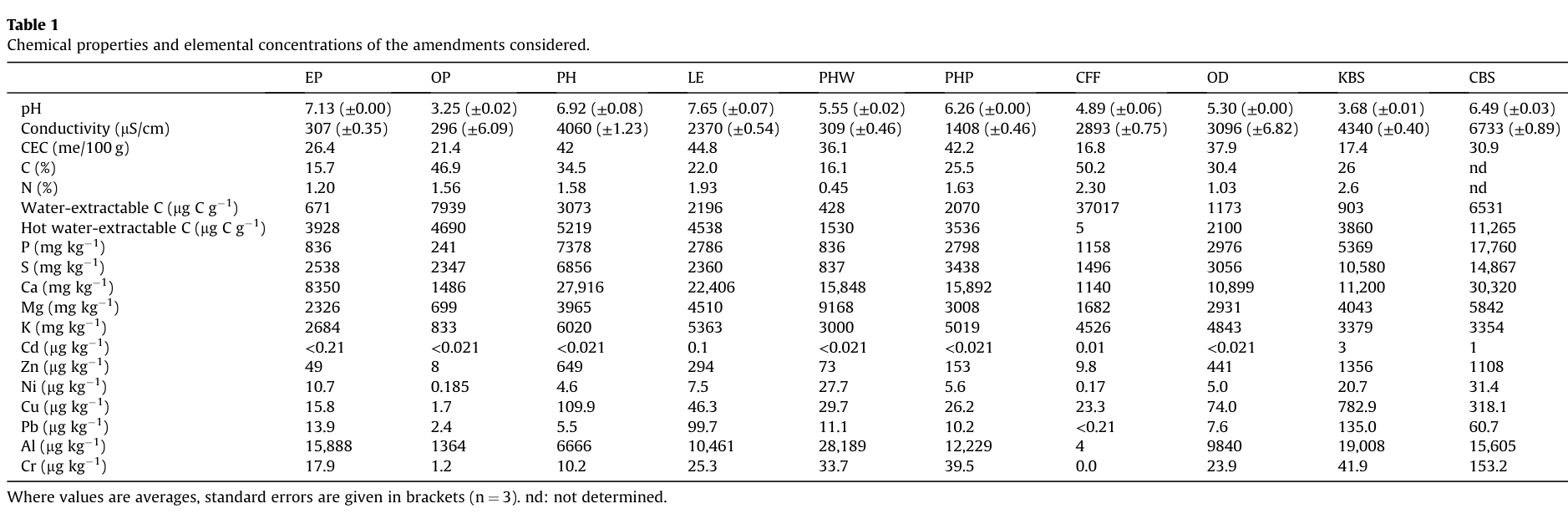
Pseudo-total elemental content of the amendments was determined by microwave digestion (MARSXPRESS, CEM Corp.) of 0.5 g of sample in 8 mL of Aristar nitric acid (±69%). The digest was then filtered through Whatman no. 52 filter paper (pore size: 7 mm) and diluted with HPW to a volume of 25 mL (Kovacs� et al., 2000). Certified Reference Materials for soil and plant matter (International Soil analytical Exchange- ISE 921, and International Plant analytical Exchange IPE 100; Wageningen University, The Netherlands) were also analysed to confirm acceptable recovery of the analytes. The digests were analysed for Cd, P, S, Ca, Mg, K, Cd, Zn, Ni, Cu, Pb, Al and Cr using ICP-OES and showed acceptable recoveries for the analytes. The physical and chemical properties of the amendments are shown in Table 1.
改良剂的准全量元素含量通过微波消解(MARSXPRESS,CEM Corp.)测定:取0.5 g样品,加入8 mL Aristar硝酸(约69%)进行消解。消解液经Whatman 52号滤纸(孔径7 μm)过滤后,用HPW定容至25 mL(Kovács et al., 2000)。同时分析了土壤和植物的有证标准物质(International Soil analytical Exchange ISE 921和International Plant analytical Exchange IPE 100;荷兰瓦赫宁根大学),以确认分析物的回收率在可接受范围内。采用ICP-OES测定消解液中的Cd、P、S、Ca、Mg、K、Cd、Zn、Ni、Cu、Pb、Al和Cr,各分析物回收率均可接受。改良剂的理化性质见表1。
The different amendments’ capacity to sorb Cd was analysed using previously developed sorption experiments using spiked solutions of 0.05 M of Ca(NO3)2 (Simmler et al., 2013b; Al Mamun et al., 2016). Briefly, 5 g batches of each amendment, except OP, were mixed with 30 mL of either 0.05 M Ca(NO3)2 (Sigma-Aldrich) extraction solution, or extraction solution that had been spiked to 2 mg L�1 (18 mM) of Cd (salt: Cd(NO3)2$4H2O, BDH, AnalaR). The mass of OP used was reduced to 2 g to ensure a sufficient separation between solid and solution phases. A vortex mixer was used to agitate the mixtures for 3 min, after which the pHs of replicate sets of each mixture were adjusted to 4.5.5, 6.5 (±0.02) using 2 M HNO3 (BDH Aristar) or 2 M NaOH (BDH AnalaR). The mixtures were then placed in an end-over-end shaker for 2 h, after which they were centrifuged at 3000 rpm for 20 min. The supernatant was then filtered through Whatman no. 52 filter paper and analysed for the same analytes as the digests using ICP-OES.
采用前人建立的以0.05 M Ca(NO3)2加标溶液进行的吸附试验分析不同改良剂对Cd的吸附能力(Simmler et al., 2013b; Al Mamun et al., 2016)。简言之,除OP外,取每种改良剂5 g,与30 mL 0.05 M Ca(NO3)2(Sigma-Aldrich)提取液或加标至2 mg L−1(18 μM)Cd(盐:Cd(NO3)2·4H2O,BDH,AnalaR)的提取液混合。为确保固液两相充分分离,OP的用量减至2 g。用涡旋混合器将混合物搅拌3 min,随后用2 M HNO3(BDH Aristar)或2 M NaOH(BDH AnalaR)将各混合物的重复组pH分别调至4.5、5.5和6.5(±0.02)。然后将混合物置于翻转振荡器中振荡2 h,再以3000 rpm离心20 min。上清液经Whatman 52号滤纸过滤后,采用ICP-OES测定与消解液相同的分析物。
The metal adsorption coefficients (Kd) for the different soil amendments were determined at each pH as described by Simmler et al. (2013b) (Eq. (1)):
按照Simmler et al. (2013b)所述方法测定各土壤改良剂在每个pH下的金属吸附系数(Kd)(式(1)):
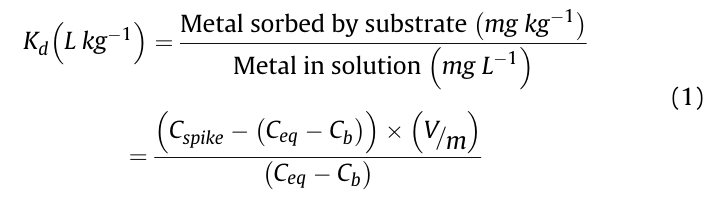
Where Kd describes the solid-solution phase partitioning of the analyte of interest, Cspike is the concentration of metal in the spike solution, Ceq is the concentration in the spike solution after equilibration with the amendment, and Cb is the metal concentration in the unspiked extractant solution after equilibration. The volume of extractant (0.03 L) and mass of amendment used (0.002 or 0.005 kg) were V and m, respectively. Extraction samples Ceq and Cb were analysed in triplicate for each amendment-pH combination.
式中,Kd描述目标分析物在固液两相间的分配,Cspike为加标溶液中的金属浓度,Ceq为加标溶液与改良剂平衡后的浓度,Cb为未加标提取液平衡后的金属浓度。V和m分别为提取液体积(0.03 L)和改良剂用量(0.002或0.005 kg)。每种改良剂-pH组合的提取样品Ceq和Cb均重复分析3次。
The results of the sorption experiment were used to select four amendments for further analysis. These were the two peat samples (OP and EP), Parkhouse mushroom-derived compost and Living Earth municipal composts (PH and LE).
根据吸附试验结果选取4种改良剂进行进一步分析,分别为2种泥炭样品(OP和EP)以及Parkhouse蘑菇源堆肥和Living Earth城市堆肥(PH和LE)。
A further sorption experiment using 0.05 M Ca(NO3)2 spiked with Cd, Ni and Zn (salts used: Cd(NO3)2$4H2O, Ni(NO3)2$6H2O, and Zn(NO3)2$6H2O (BDH, AnalaR)) was carried out on these amendments at pH 5.5 as before. The molar concentrations of the metals in the spike solution were the same as those of Cd (18 mM) in the previous sorption experiment. The extracted solutions from the four amendments were divided into subsets. Three subsets were allocated for DGT analysis (see below). The other subsets were analysed in triplicate for dissolved Cl�, SO42�, NO3� and NH4+ using a Shimadzu Ion Chromatograph (Thermo Scientific, DIONEX, ICS- 2100), total organic carbon (measured as non-purgeable organic carbon, NPOC) and dissolved inorganic carbon (DIC) using the Shimadzu TOC-VCSH analyzer. Differences between the mean Kd values measured for Ni, Cd and Zn in the four amendments were tested by ANOVA with Tukey's post-hoc test using Minitab® 17 (Minitab Inc, State College, Pennsylvania, USA) at the 0.05 level of significance.
采用加标Cd、Ni和Zn的0.05 M Ca(NO3)2(所用盐:Cd(NO3)2·4H2O、Ni(NO3)2·6H2O和Zn(NO3)2·6H2O(BDH,AnalaR))对上述改良剂在pH 5.5下按前述方法进行了进一步吸附试验。加标溶液中各金属的摩尔浓度与前一吸附试验中Cd的浓度(18 μM)相同。将4种改良剂的提取液分为若干子样,其中3份用于DGT分析(见下文)。其余子样重复3次分析:采用Shimadzu离子色谱仪(Thermo Scientific,DIONEX,ICS-2100)测定溶解态Cl−、SO42−、NO3−和NH4+,采用Shimadzu TOC-VCSH分析仪测定总有机碳(以不可吹扫有机碳NPOC计)和溶解性无机碳(DIC)。采用Minitab® 17(Minitab Inc,State College,Pennsylvania,USA)进行ANOVA及Tukey事后检验,在0.05显著性水平下检验4种改良剂中Ni、Cd和Zn平均Kd值之间的差异。
2.3. Dissolved organic matter quality2.3. 溶解性有机质质量
The Ultra-Violet Absorbance of the dissolved organic matter in the extracts was measured at 254, 270 and 350 nm using a UV-vis spectrophotometer (UVmini-1240, SHIMADZU) (Carter et al., 2012). The specific UV-absorbance for the dissolved organic matter (DOM) at the set wavelengths was calculated using Equation (2).
采用紫外-可见分光光度计(UVmini-1240,SHIMADZU)在254、270和350 nm处测定提取液中溶解性有机质的紫外吸光度(Carter et al., 2012)。溶解性有机质(DOM)在上述波长下的比紫外吸光度采用式(2)计算。

Where, l is the wavelength (nm) at which the absorbance (Al) is measured, b is the path length through quartz cell (cm) and [DOC] is the dissolved organic carbon concentration (mg L�1).
式中,λ为测定吸光度(Aλ)的波长(nm),b为石英比色皿的光程(cm),[DOC]为溶解性有机碳浓度(mg L−1)。
Fluorescence excitation-emission matrices (EEMs) for organic matter extractions were obtained by measuring fluorescence emission intensity across excitation wavelengths ranging from 240 to 600 nm and emission wavelengths ranging from 245 to 820 nm using a Horiba Aqualog fluorescence spectrophotometer (Kyoto, Japan). All sample fluorescence intensities were normalized using the pure water Raman peak intensity (350 nm excitation, 398 nm emission) at the same analytical settings as the sample. Parallel factor analysis (PARAFAC) for EEM results was conducted to identify statistically independent components within the EEM set, and their relative contributions to the sample EEMs (Fellman et al., 2010). PARAFAC analysis was carried out in MATLAB using the N-way toolbox and DOMFlour toolbox for MATLAB (Stedmon and Bro, 2008) following sample screening for outliers. The optimal number of components was selected in order to minimise the residual sum of squares and maximise model core consistency (Murphy et al., 2013). On the basis of these criteria a two-component model was adopted.
采用Horiba Aqualog荧光分光光度计(日本京都),在激发波长240–600 nm、发射波长245–820 nm范围内测定荧光发射强度,获得有机质提取液的荧光激发-发射矩阵(EEMs)。所有样品的荧光强度均以相同分析条件下纯水拉曼峰强度(激发350 nm,发射398 nm)进行归一化。对EEM结果进行平行因子分析(PARAFAC),以识别EEM数据集中统计上独立的组分及其对样品EEMs的相对贡献(Fellman et al., 2010)。在剔除异常样品后,使用MATLAB中的N-way工具箱和DOMFluor工具箱进行PARAFAC分析(Stedmon and Bro, 2008)。以最小化残差平方和、最大化模型核心一致性为原则选择最佳组分数(Murphy et al., 2013)。基于上述标准,采用了双组分模型。
2.4. Diffusive gradients in thin-films analysis2.4. 薄膜扩散梯度分析
The lability of Cd, Ni and Zn in the extracts obtained from the sorption experiments on the four different amendments was analysed by adapting the method used by Amery et al. (2010). A 1 mL gel layer containing 1 g Chelex-100 cation binding resin (200e400 mesh, Bio-Rad) in an agarose gel matrix (1.5%) (Total Lab Systems, molecular grade) was cast onto the bottom of a flat-base 30 mL sample vials (1.2 cm internal radius); henceforth, this is referred to as the binding layer. A 1.36 cm3 agarose-only (1.5%) layer was cast on top of this: the diffusive layer forthwith. During casting it was observed that there was a small amount of even adhesion to the sides of the SV-DGT, resulting in a slightly concave diffusion layer surface. The vial containing the diffusion and binding layers was placed on a lab shaker with HPW for 24 h, during which the water was changed three times. The gels were then conditioned with 0.01 M NaNO3 for at least 8 h before deployment. The use of diffusive and binding layers within a confined test vessel allowed the application of the underlying principles of the diffusive gradients in thin-films (DGT) technique, but in relatively small volumes; forthwith, these devices are referred to as small volume-DGT (SV- DGT) devices.
参照Amery et al. (2010)的方法并加以改进,分析了4种改良剂吸附试验所得提取液中Cd、Ni和Zn的活性。将含1 g Chelex-100阳离子结合树脂(200–400目,Bio-Rad)的1 mL琼脂糖凝胶基质(1.5%)(Total Lab Systems,分子级)层浇铸于30 mL平底样品瓶(内半径1.2 cm)底部,下文称为结合层。在其上再浇铸1.36 cm3纯琼脂糖(1.5%)层,下文称为扩散层。浇铸过程中观察到凝胶在SV-DGT侧壁有少量均匀黏附,导致扩散层表面略呈凹形。将含扩散层和结合层的样品瓶装入HPW,置于实验室振荡器上振荡24 h,期间换水3次。随后在使用前用0.01 M NaNO3对凝胶平衡处理至少8 h。在封闭的测试容器中使用扩散层和结合层,使薄膜扩散梯度(DGT)技术的基本原理得以在相对较小的体积中应用;下文将这些装置称为小体积DGT(SV-DGT)装置。
2.4.1. Theory of SV-DGT2.4.1. SV-DGT原理
When a simple solution containing trace metals, existing mainly as their hydrated (free) ion species, is deployed in an SV-DGT device, the metal ions diffuse through the diffusive layer and towards the binding layer, where they are rapidly bound by the chelating resin. Within approx. 60 min a linear concentration gradient is formed within the diffusive layer and a diffusive flux progressively depletes trace metal from the solution. When the diffusive flux into the binding layer is greater than the diffusive flux from the solution, a diffusive boundary layer (DBL) emerges perpendicular to diffusive layer. Using Fick's first law of diffusion, the flux, J (mol cm�2 s�1), of metal from the solution at a given time (t) can be calculated using Equation (3):
当含有主要以水合(自由)离子形态存在的微量金属的简单溶液置于SV-DGT装置中时,金属离子穿过扩散层向结合层扩散,并在结合层被螯合树脂迅速结合。约60 min内,扩散层中形成线性浓度梯度,扩散通量使溶液中的微量金属逐渐耗竭。当进入结合层的扩散通量大于来自溶液的扩散通量时,在垂直于扩散层的方向上会出现扩散边界层(DBL)。根据Fick第一扩散定律,给定时间(t)下来自溶液的金属通量J(mol cm−2 s−1)可用式(3)计算:

where, Ci is the trace metal concentration at the edge of the DBL, DDL and Dw are the diffusion coefficients of the metal in the diffusive layer and the solution, respectively, and dDL and dDBL are the length of the diffusive pathway through the diffusive layer and the DBL respectively.
式中,Ci为DBL边缘处的微量金属浓度,DDL和Dw分别为金属在扩散层和溶液中的扩散系数,dDL和dDBL分别为穿过扩散层和DBL的扩散路径长度。
In conventional DGT solution deployments, the volume of solution is large enough to allow an assumption to be made that the solute concentration in the solution does not change significantly during the deployment. Due to the small volume used here, this does not apply. If an assumption is made that the rate of diffusion of solute is the same in the diffusion layer and the surrounding solution, and that the flux of trace metal is directly proportional to the concentration at the edge of the DBL, then the change in the solution concentration can be modelled by including Eq. (3) into the expression for first order decay (Equation (4)).
在常规的DGT溶液布放中,溶液体积足够大,可假定布放期间溶质浓度无显著变化。由于本研究使用的体积较小,该假定不再适用。若假定溶质在扩散层和周围溶液中的扩散速率相同,且微量金属通量与DBL边缘处的浓度成正比,则可将式(3)代入一级衰减表达式,对溶液浓度的变化进行模拟(式(4))。

Where, C0 and Ct are the metal concentrations in a solution with a known volume (Vsol) at the start of the deployment and at the end of the deployment, respectively, and the cross-sectional area of the SV-DGT device is given by A. Given the highly confined nature of the SV-DGT device, and the slightly concave gel-solution interface, accurate determination of dDL and dDBL is challenging. However, when Ct and C0 are known, Equation (4) can be solved for the sum of dDL + dDBL. The sum of these two terms is referred to forthwith as the apparent diffusion layer (ADL, dA), which is an operationallydefined lumped parameter that integrates differences in rates of diffusion between the DBL and the diffusion layer, as well as the average length of the diffusive path between the bulk solution in the SV-DGT and the resin layer-diffusion layer interface during the deployment.
式中,C0和Ct分别为已知体积(Vsol)溶液在布放开始和结束时的金属浓度,A为SV-DGT装置的横截面积。由于SV-DGT装置高度封闭,且凝胶-溶液界面略呈凹形,准确测定dDL和dDBL具有挑战性。然而,当Ct和C0已知时,可由式(4)求解dDL + dDBL之和。下文将二者之和称为表观扩散层(ADL,dA),它是一个操作性定义的集总参数,综合反映了DBL与扩散层之间扩散速率的差异,以及布放期间SV-DGT内主体溶液与树脂层-扩散层界面之间扩散路径的平均长度。
When partially labile trace metal complexes are present, the depletion of the free metal ions perturbs the equilibrium between the free metal ion and the metal complexes, and the complexes begin to dissociate to re-establish the equilibrium. Under these conditions, the rate at which the trace metal concentration in the test solution is depleted is determined by:
当存在部分活性的微量金属络合物时,自由金属离子的耗竭会扰乱自由金属离子与金属络合物之间的平衡,络合物开始解离以重建平衡。在此条件下,测试溶液中微量金属浓度的耗竭速率取决于:
(1) the concentration of free metal ions in the solution
(1)溶液中自由金属离子的浓度
(2) the length of the diffusive pathway between the solution and the binding layer, under well stirred conditions this is closely approximated by the thickness of the diffusive layer
(2)溶液与结合层之间扩散路径的长度,在充分搅拌条件下,该长度近似等于扩散层厚度
(3) the diffusive characteristics of the metal ion species present in the solution
(3)溶液中所存在金属离子形态的扩散特性
(4) the concentrations of the metal-ligand complexes present and the rates at which they diffuse and dissociate.
(4)所存在金属-配体络合物的浓度及其扩散和解离速率。
Under conditions where the availability of trace metal to be bound by the resin layer is limited by the rate at which its complexed species can dissociate, the rate of trace metal depletion is reduced. In equation (4), this can be represented by increasing dA, given that all other variables can be constrained by careful experimental design and previously established diffusion coefficients in the agarose gels used here (Zhang and Davison, 1999; Wang et al., 2016). This concept is analogous to the ‘apparent diffusive boundary layer thickness’ developed by Warnken et al. (2007). By comparing dA,C measured in a control solution, where most of the metal exists as free metal ions, against dA,T that has been determined in test solutions deployed under identical deployment conditions, specifically: the same SV-DGT device physical characteristics, temperature, stirring rates and deployment time, it is possible to gain a semi-quantitative estimate of the differences in lability of the dissolved complexes in the test solutions. By using the diffusion coefficient of the free-metal ion in calculating dA,T, the kinetic limitation imposed by the partially labile complex can be related to the metal availability in the well-defined control solution.
当树脂层可结合的微量金属的有效性受限于其络合形态的解离速率时,微量金属的耗竭速率降低。在式(4)中,这可以通过增大dA来表示,前提是其他所有变量均可通过精心的实验设计以及本研究所用琼脂糖凝胶中已知的扩散系数加以约束(Zhang and Davison, 1999; Wang et al., 2016)。这一概念类似于Warnken et al. (2007)提出的“表观扩散边界层厚度”。通过比较对照溶液(其中大部分金属以自由金属离子形式存在)中测得的dA,C与在相同布放条件下(具体为相同的SV-DGT装置物理特性、温度、搅拌速率和布放时间)测试溶液中测得的dA,T,即可对测试溶液中溶解态络合物活性的差异进行半定量估算。在计算dA,T时采用自由金属离子的扩散系数,即可将部分活性络合物所施加的动力学限制与明确定义的对照溶液中的金属有效性联系起来。
In test solutions where the complexes are highly labile and/or the majority of the metals exist as free metal ion species, the ratio dA,T/dA,C will be close to unity. In solutions where the complexes are not labile within the timescale of the deployment, the complexes can diffuse into the resin layer (Lehto et al., 2006; Shafaei Arvajeh et al., 2013; Galceran and Puy, 2015). This results in a ‘dilution’ effect where metal concentration is still depleted in the test solution. This provides a theoretical maximum for dA,T/dA,C which is metalspecific and determined by the relative volumes of the deployment solution and the total volume within the SV-DGT where the complex can dissociate (i.e. the sum of the resin layer, diffusion layer and deployment solution volumes). For the SV-DGT devices used to analyse Cd, Ni and Zn here, where the ratio of Vsol to total available volume is 0.81, therefore the theoretical maximum values of dA,T/dA,C are 4.13 (Cd), 4.17 (Ni) and 4.26 (Zn). The differences between the metals are determined by their respective diffusion coefficients in agarose.
在络合物活性很高和/或大部分金属以自由金属离子形态存在的测试溶液中,dA,T/dA,C的比值接近1。在络合物于布放时间尺度内不具活性的溶液中,络合物可扩散进入树脂层(Lehto et al., 2006; Shafaei Arvajeh et al., 2013; Galceran and Puy, 2015)。这会产生一种“稀释”效应,使测试溶液中的金属浓度仍然降低。由此给出了dA,T/dA,C的理论最大值,该值因金属而异,取决于布放溶液体积与SV-DGT内络合物可发生解离的总体积(即树脂层、扩散层和布放溶液体积之和)的相对大小。本研究用于分析Cd、Ni和Zn的SV-DGT装置中,Vsol与总有效体积之比为0.81,因此dA,T/dA,C的理论最大值分别为4.13(Cd)、4.17(Ni)和4.26(Zn)。各金属之间的差异由其在琼脂糖中的扩散系数决定。
2.4.2. SV-DGT measurements2.4.2. SV-DGT测定
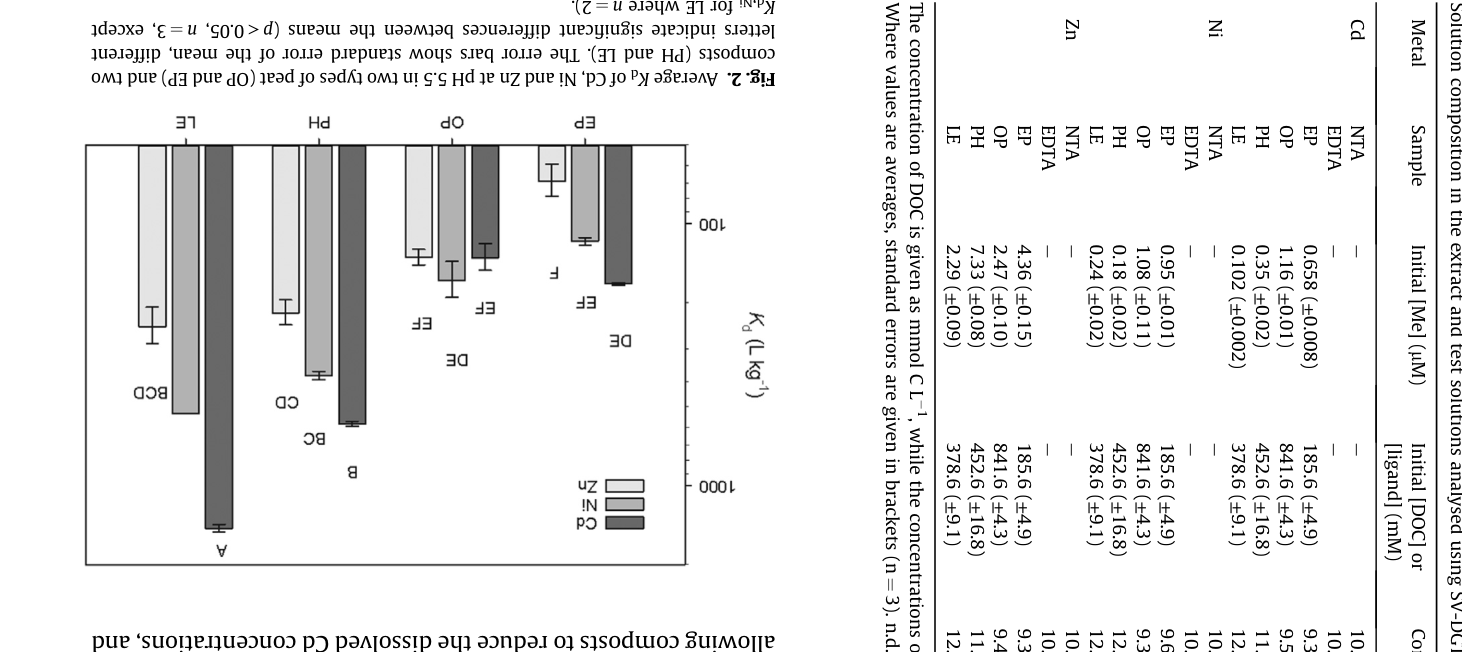
To enable more direct comparison of the specific ligands present in the different organic matter extracts, the extracts from the sorption experiments carried out for Cd, Ni and Zn at pH 5.5 were modified to achieve matching metal:DOC molar ratios in the solutions. Cadmium, Ni and Zn were added to their respective extract solutions to match the highest metal:DOC molar ratio in the extract solutions (Zn in the EP extract solution) (Table 2). The conductivities of the extract solutions were measured and adjusted to 10.5 mS cm (±2.0) using NaNO3 to approximate a consistent ionic strength between solutions, while reducing the possible time within which microbial degradation might influence the DOM. The extracts were then equilibrated at 5 �C for 24 h, after which they were brought to room temperature and deployed in SV-DGT devices placed on a laboratory shaker for 24 h. A subsample of each test solution was then collected and analysed for Cd, Ni and Zn using ICP-OES.
为了更直接地比较不同有机质提取液中存在的特定配体,对pH 5.5下Cd、Ni和Zn吸附试验所得提取液进行了调整,使各溶液中金属:DOC摩尔比一致。向各提取液中分别添加Cd、Ni和Zn,使其与提取液中最高的金属:DOC摩尔比(EP提取液中的Zn)相匹配(表2)。测定提取液的电导率,并用NaNO3将其调至10.5 mS cm(±2.0),以使各溶液离子强度大致一致,同时尽量缩短微生物降解可能影响DOM的时间。随后将提取液在5 °C下平衡24 h,再恢复至室温,置于SV-DGT装置中并放在实验室振荡器上布放24 h。之后采集各测试溶液的子样,采用ICP-OES测定Cd、Ni和Zn。
The SV-DGT probes were also used to analyse the lability of Cd, Ni and Zn from complexes formed from two synthetic model ligands, nitrilotriacetic acid (NTA, Sigma-Aldrich) and ethylenediaminetetraacetic acid (EDTA, Titriplex III, MERCK). These were made in 0.05 M Ca(NO3)2 solutions and adjusted to pH 5.5, as before. The ligand concentrations used here were chosen to achieve consistent metal:ligand molar ratios (Table 2). The model ligand test solutions were allowed to equilibrate for 24 h before deployment. Each extract and model ligand solution was analysed in triplicate.
SV-DGT探头还用于分析由两种合成模式配体——次氮基三乙酸(NTA,Sigma-Aldrich)和乙二胺四乙酸(EDTA,Titriplex III,MERCK)——形成的络合物中Cd、Ni和Zn的活性。这些溶液以0.05 M Ca(NO3)2配制,并按前述方法将pH调至5.5。所用配体浓度的选择旨在获得一致的金属:配体摩尔比(表2)。模式配体测试溶液在布放前平衡24 h。每种提取液和模式配体溶液均重复分析3次。
2.5. Speciation modelling2.5. 形态模拟
The speciation of the metals in the model ligand solutions was modelled using Visual MINTEQ ver. 3.1 (Gustafsson, 2016). The speciation in the organic matter extracts was estimated using the Windermere Humic Acid Model (WHAM) VII (Tipping et al., 2011). The proportion of DOM as fulvic acid (FA) in the peat extracts was assumed to be 25%, with the rest as humic acid (HA) (Tipping et al., 2003). Laborda et al. (2008) found that almost all of the DOM in compost extracts was FA at pH 5, given the slightly higher pH used in this work, the proportion of DOM as FA in the PH and LE extracts was set at 95%.
模式配体溶液中金属的形态采用Visual MINTEQ 3.1版进行模拟(Gustafsson, 2016)。有机质提取液中的形态采用Windermere腐殖酸模型(WHAM)VII进行估算(Tipping et al., 2011)。假定泥炭提取液中富里酸(FA)占DOM的25%,其余为腐殖酸(HA)(Tipping et al., 2003)。Laborda et al. (2008)发现,在pH 5时堆肥提取液中几乎所有DOM均为FA;鉴于本研究所用pH略高,PH和LE提取液中FA占DOM的比例设定为95%。
3Results and discussion结果与讨论
3.1. Cadmium sorption capacity of the organic amendments3.1. 有机改良剂对镉的吸附容量
The results from the batch sorption experiments confirmed the previously observed high capacity of composts to sorb Cd (Fig. 1.) (Ulmanu et al., 2003; Al Mamun et al., 2016). Al Mamun et al. (2016) suggested that the high CEC of certain composts could be an important feature of these amendments' capacity to bind Cd. This is further supported by the results from these experiments. A regression analysis found that CEC correlated positively with the logKd measured in these amendments and explained 64% of the variation at pH 5.5 (p < 0.01, n ¼ 10; not shown), which may explain why the compost derived from fish waste and ocean botanicals (PHW) did not appear to sorb Cd as well as the other composts. This can also be seen in KBS, CFF and OP. The contrasting abilities of CBS and KBS biosolids to sorb Cd may also be related to their CECs. Fard et al. (2011) showed a positive relationship between pH and Cd sorption capacity of biosolids and a similar pattern is seen here. The low pH KBS did not sorb much Cd at pH 4.5, while the Kd of CBS was over ten times higher than that of KBS at around pH 4.5; however, at pH 6.5 CBS's Kd only increased ~20% from the Kd at pH 4.5. On the other hand, the Kd of KBS increased twelve-fold across the same pH range, which suggests that Cd adsorption onto variable charge binding sites may be a significant component of the overall binding of Cd to KBS. These results suggest that careful pH management of biosolids amended soil is an important consideration when managing the trace metal uptake from those soils. This is especially important given the relatively high Cd concentrations in KBS (3 mg kg�1) and CBS (1 mg kg�1) (Table 1).
批量吸附试验结果证实了此前观察到的堆肥对Cd的高吸附容量(图1)(Ulmanu et al., 2003; Al Mamun et al., 2016)。Al Mamun et al. (2016)认为,某些堆肥的高CEC可能是这些改良剂结合Cd能力的重要特征。本试验结果进一步支持了这一观点。回归分析表明,CEC与这些改良剂中测得的logKd呈正相关,在pH 5.5时可解释64%的变异(p < 0.01,n = 10;未列出),这可能解释了为何由鱼类废弃物和海洋植物制成的堆肥(PHW)对Cd的吸附不如其他堆肥。这一现象在KBS、CFF和OP中同样可见。CBS和KBS两种生物固体(污泥)对Cd吸附能力的差异也可能与其CEC有关。Fard et al. (2011)表明生物固体的pH与其Cd吸附容量呈正相关,本研究也观察到类似规律。低pH的KBS在pH 4.5时对Cd的吸附很少,而在pH约4.5时CBS的Kd比KBS高10倍以上;然而,在pH 6.5时,CBS的Kd仅比pH 4.5时增加约20%。另一方面,在相同pH范围内KBS的Kd增加了12倍,表明Cd在可变电荷结合位点上的吸附可能是KBS结合Cd的重要组成部分。上述结果表明,在控制生物固体改良土壤的微量金属吸收时,审慎的pH管理是一个重要考虑因素。鉴于KBS(3 mg kg−1)和CBS(1 mg kg−1)中Cd浓度相对较高(表1),这一点尤为重要。
Peat and coffee grounds are often used as a growth amendment in soil-less growth media, as a bulking agent in composts, and peat hence plant bioavailability of the metal. However, they also noted that the relatively high bioavailability of Zn in the compostamended soils may have also affected the uptake of Cd by the plant. The stronger binding of Cd over Zn and Ni seen here provides further support for these both these theories. There are few significant differences in the peats’ capacity to sorb the different metals: their CECs are approximately a half those of the composts, which is reflected in differences in Kd values for each of the metals between the peats and the composts (Fig. 2; Table 1).
泥炭和咖啡渣常用作无土栽培基质中的生长改良剂和堆肥中的膨松剂,而泥炭进而影响该金属的植物生物有效性。然而,他们也指出,堆肥改良土壤中Zn相对较高的生物有效性也可能影响了植物对Cd的吸收。本研究观察到Cd的结合强于Zn和Ni,为上述两种理论提供了进一步支持。泥炭对不同金属的吸附容量几乎无显著差异:其CEC约为堆肥的一半,这反映在泥炭与堆肥之间各金属Kd值的差异上(图2;表1)。
Solution composition in the extract and test solutions analysed using SV-DGT.
SV-DGT分析所用提取液和测试溶液的溶液组成。
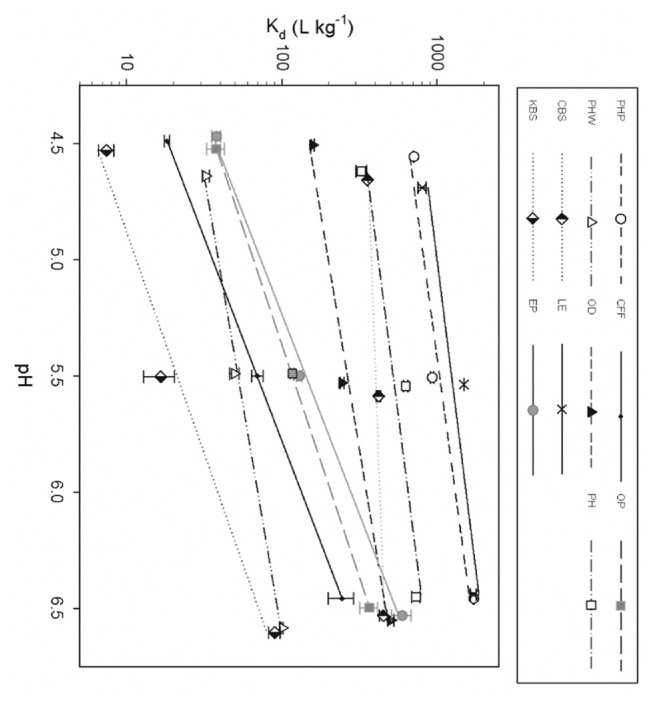
An important question regarding the use of organic amendments for managing the bioavailability of potentially hazardous trace metals in soils is the longevity of the effect, and the fate of the bound trace metals if the organic matter is degraded through microbial action. This is especially pertinent when considered in the context of predicted effects of forecasted changes in global temperature and rainfall patterns on organic matter stability in soils (e.g. Puissant et al. (2017)). The cold and hot-water extraction methods sample different pools of carbon from the amendments. Previous studies have shown that the CWEC fraction consists mostly of hydrophilic carbon (e.g. amino sugars, carbohydrates and low molecular weight organic acids, polysaccharides and high molecular weight fulvic acids) (Haynes, 2005; Said-Pullicino et al., 2007). The focus here is on the HWEC fraction, which has been associated with weakly adsorbed dissolved organic matter to mineral surfaces and humic acids, and has been used as a general indicator of the labile fraction of the organic carbon in soils (von Lützow et al., 2007). Out of the amendments considered here, the HWEC fraction of CBS was over twice as high as the next highest (PH) (Table 1) and between three to ten times higher than values measured in soils under different land uses (Ghani et al., 2003). While the Kd of CBS was relatively high (~400 L kg�1 at pH 5.5, Fig. 1) compared to most other amendments here, its high Cd concentration, combined with the apparent vulnerability to microbial degradation, could be seen as valid reasons for restricting its use as a soil amendment. The two peats (EP, OP) and the municipal and mushroom-derived composts (LE and PH) had the next highest HWEC fractions, which prompts the subsequent investigation into the lability of Cd, Ni and Zn associated with the DOM extracted from them by the 0.05 M Ca(NO3)2 and the chemical characteristics of that DOM.
利用有机改良剂管理土壤中潜在有害微量金属生物有效性时,一个重要问题是其效应的持久性,以及有机质经微生物作用降解后所结合微量金属的归趋。结合全球气温和降雨格局预测变化对土壤有机质稳定性的预期影响(如Puissant et al. (2017))来看,这一问题尤为突出。冷水和热水提取法可提取改良剂中不同的碳库。已有研究表明,CWEC组分主要由亲水性碳组成(如氨基糖、碳水化合物、低分子量有机酸、多糖和高分子量富里酸)(Haynes, 2005; Said-Pullicino et al., 2007)。本研究关注HWEC组分,该组分与弱吸附于矿物表面和腐殖酸上的溶解性有机质有关,并已被用作土壤有机碳活性组分的一般指标(von Lützow et al., 2007)。在本研究考察的改良剂中,CBS的HWEC组分是次高者(PH)的两倍以上(表1),是不同土地利用方式下土壤测定值的3至10倍(Ghani et al., 2003)。尽管与本研究中大多数其他改良剂相比,CBS的Kd相对较高(pH 5.5时约400 L kg−1,图1),但其较高的Cd浓度加上明显易受微生物降解的特性,可作为限制其用作土壤改良剂的合理理由。两种泥炭(EP、OP)以及城市堆肥和蘑菇源堆肥(LE和PH)的HWEC组分次之,因此后续研究考察了0.05 M Ca(NO3)2从这些改良剂中提取的DOM所结合的Cd、Ni和Zn的活性以及该DOM的化学特性。
3.2. Speciation and lability of cadmium, nickel and zinc in the organic matter extracts
3.2. 有机质提取液中镉、镍和锌的形态与活性
Geochemical modelling of the extracted solutions using WHAM VII suggested that over 99.4% of the total Cd, Ni and Zn was complexed by the DOM in all of the respective extracts (Table 2). This is considerably higher than seen in previous work when the WHAM VII model has been used to estimate trace metal speciation in soil extracts (Tipping et al., 2003; Cornu et al., 2011; Ren et al., 2015). This is almost certainly due to the very low metal:- DOC ratios in the extracts, driven mainly by the large amount of DOM extracted from the organic amendments. With this in mind, it is important to acknowledge that the lability and speciation estimates carried out here are artificial and unlikely to be directly representative of most soil environments, where the amount of soil organic matter than can equilibrate with porewater is considerably less, and a proportion of the DOM is likely to be mineralized rapidly and/or sorb to soil solid interfaces (Lehmann and Kleber, 2015). It does however provide an opportunity to estimate conservatively whether complexed metals might become available for biological uptake or a chemical reaction, following a change in equilibrium. Kinetic limitations have been reported previously for trace metal uptake by plants (Degryse et al., 2006; Custos et al., 2014) and organisms native to sediments (Amirbahman et al., 2013), and natural water (Jansen et al., 2002; Buffle et al., 2009; Shaked and Lis, 2012). These conditions are often identified when equilibrium-based methods fail to predict biological uptake (Zhao et al., 2016).
采用WHAM VII对提取液进行地球化学模拟的结果表明,在所有提取液中,超过99.4%的总Cd、Ni和Zn与DOM络合(表2)。这一比例远高于以往使用WHAM VII模型估算土壤提取液中微量金属形态的研究结果(Tipping et al., 2003; Cornu et al., 2011; Ren et al., 2015)。这几乎可以肯定是由于提取液中金属:DOC比值极低,而这主要是由于从有机改良剂中提取出大量DOM所致。鉴于此,必须承认本研究所进行的活性和形态估算是人为条件下的,不太可能直接代表大多数土壤环境;在土壤环境中,能够与孔隙水达到平衡的土壤有机质数量要少得多,且部分DOM可能迅速矿化和/或吸附于土壤固相界面(Lehmann and Kleber, 2015)。不过,这确实为保守估算平衡改变后络合态金属是否可能被生物吸收或参与化学反应提供了机会。此前已有报道指出,植物(Degryse et al., 2006; Custos et al., 2014)、沉积物中的原生生物(Amirbahman et al., 2013)以及天然水体中的生物(Jansen et al., 2002; Buffle et al., 2009; Shaked and Lis, 2012)对微量金属的吸收存在动力学限制。当基于平衡的方法无法预测生物吸收时,往往可以识别出这些条件(Zhao et al., 2016)。
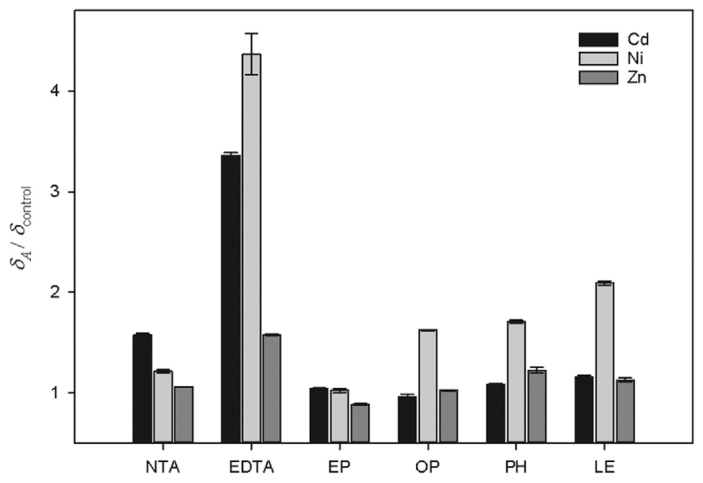
Amery et al. (2010) used a similar type of DGT design to the one employed here to show that the method can be used to analyse complex lability and obtain comparable kinetic information to the more conventionally used competitive ligand exchange method (CLEM) (Lam et al., 1999). In our work the SV-DGT analyses confirmed the previously observed kinetic limitation of Zn and Ni release from NTA and EDTA complexes and that Zn complexes were more labile than those of Ni, and a greater kinetic limitation of both metals’ dissociation from EDTA complexes (Fig. 4) (Bowles et al., 2006). Analyses of the compost and peat extracts showed that the Zn and Cd complexes are relatively labile when compared to Ni, which agrees with previous measurements in natural waters (Warnken et al., 2007; Levy et al., 2012) and hints at relatively low solubility of organic matter containing reduced sulphur functional groups at this pH. Cadmium was relatively labile in the OP extracts, however significantly less so in the EP and compost extracts, especially LE (Fig. 4). This indicates that Cd-DOM complexes mobilized from soils where these composts had been used to manage Cd bioavailability may persist longer in soils before dissociation than when peat similar to OP was used. If composts were used to manage Ni contamination, under leaching conditions this could conceivably increase Ni mobility in the soil, more than a less labile complex, such as Zn, whose ability to participate in chemical reactions or be taken up by biota would be less kinetically limited.
Amery et al. (2010)采用与本研究类似的DGT设计,表明该方法可用于分析络合物活性,并能获得与更常用的竞争配体交换法(CLEM)(Lam et al., 1999)相当的动力学信息。在本研究中,SV-DGT分析证实了此前观察到的Zn和Ni从NTA和EDTA络合物中释放的动力学限制,Zn络合物的活性高于Ni络合物,且两种金属从EDTA络合物中解离所受的动力学限制更大(图4)(Bowles et al., 2006)。对堆肥和泥炭提取液的分析表明,与Ni相比,Zn和Cd络合物的活性相对较高,这与此前在天然水体中的测定结果一致(Warnken et al., 2007; Levy et al., 2012),并暗示在此pH下含还原态硫官能团的有机质溶解度相对较低。镉在OP提取液中的活性相对较高,但在EP和堆肥提取液中显著较低,尤其是LE(图4)。这表明,与使用类似OP的泥炭相比,在使用这些堆肥管理Cd生物有效性的土壤中被活化的Cd-DOM络合物在解离前可能在土壤中存留更长时间。若使用堆肥管理Ni污染,在淋溶条件下可能会使土壤中Ni的迁移性增加,其程度超过Zn等活性较低的络合物,而后者参与化学反应或被生物吸收的能力所受动力学限制较小。
3.3. Quality of the dissolved organic matter in the extracts3.3. 提取液中溶解性有机质的质量
Excitation-emission matrix (EEM) fluorescence of the extracts was characterised by fluorophores consistent with aromatic (humic-like) organic acids (peaks C and A), proteins and amino acids (tryptophan- and tyrosine-like; peaks T1 and T2) that are common features of humic extracts (see: Supporting Information) (Senesi et al., 1991). Steady-state fluorescence EEMs integrate information on the mixture of compounds present in DOM which have been shown to consist of fluorophores with multiple excitation peak centres for both proteins and humic substances (Li et al., 2013). Despite the complexity of EEM fluorescence, previous workers have shown the applicability of this method for understanding both DOM metal binding properties (Luster et al., 1996; Baker et al., 2008; Ohno et al., 2008) and biodegradability (Hudson et al., 2008; Hansen et al., 2016).
提取液的激发-发射矩阵(EEM)荧光特征表现为与芳香性(类腐殖质)有机酸(峰C和峰A)以及蛋白质和氨基酸(类色氨酸和类酪氨酸;峰T1和峰T2)相符的荧光团,这些是腐殖质提取物的常见特征(见补充材料)(Senesi et al., 1991)。稳态荧光EEMs综合反映了DOM中化合物混合物的信息,已有研究表明,蛋白质和腐殖物质均由具有多个激发峰中心的荧光团组成(Li et al., 2013)。尽管EEM荧光较为复杂,前人研究已证明该方法适用于了解DOM的金属结合特性(Luster et al., 1996; Baker et al., 2008; Ohno et al., 2008)和生物可降解性(Hudson et al., 2008; Hansen et al., 2016)。
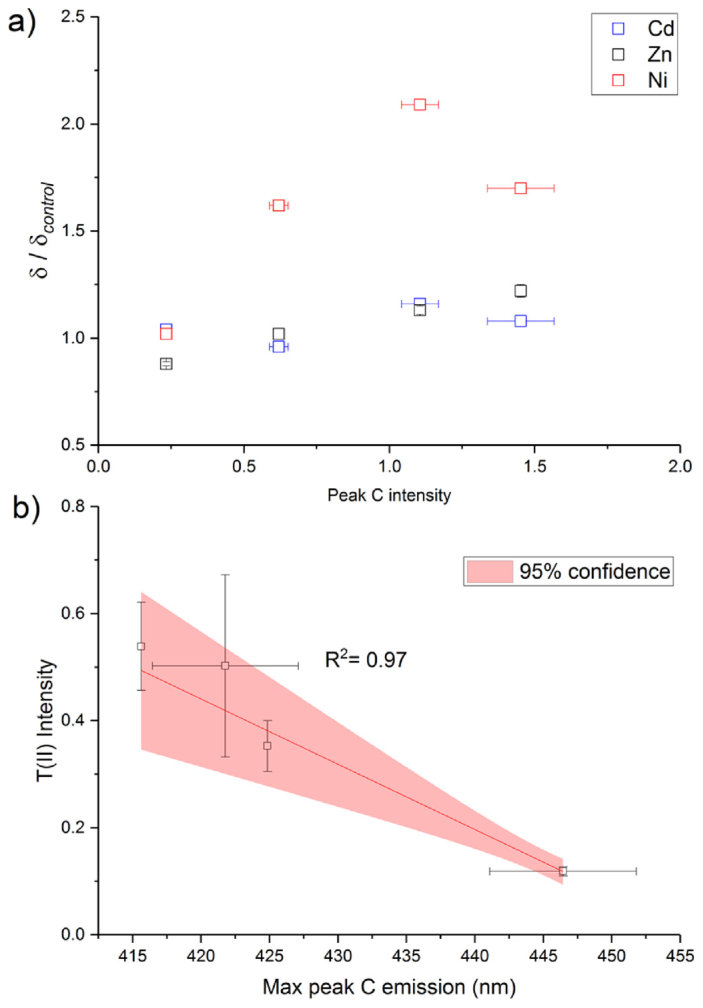
The Peak T fluorophore indicates of the proportion of bioavailable organic matter (Marschner and Kalbitz, 2003), and hence the potential for microbial activity in the sample (Hudson et al., 2008). Peak T fluorescence in our samples showed a declining relationship with the emission wavelength of maximum fluorescence intensity at Peak C (Fig. 3 b), which has been shown to increase in tandem with the degree of aromaticity and conjugation in soil organic matter (Senesi et al., 1991). DOM aromaticity (i.e. phenolic content) may diminish DOM biodegradability, whilst enhancing metal complexation strength (Baker et al., 2008). However, aromaticity will increase in DOM if biodegradation acts preferentially on aliphatic and low molecular weight DOM fractions (Hansen et al., 2016). Regardless of the precise mechanisms of causation, refractory amendments with higher metal binding strength are likely to exhibit lower protein-like fluorescence. This is consistent with the results of metal lability measurements in the studied extracts (Fig. 3 a) that show a positive trend between Ni and Zn kinetic limitation and the Peak C emission wavelength. These results are broadly supported by the SUVA254 measurements (Table 2). Shafaei Arvajeh et al. (2013) observed that Ni-HA complexes were less labile than Ni-FA complexes, which further suggests that the former may be more abundant in the compost extracts. By contrast, Cd lability showed little change as a function of DOM aromaticity, probably indicating Cd complexation with non-phenolic moieties in DOM ligands. This suggests that microbial degradation of DOM may reduce the mobility of Cd-DOM complexes to a greater extent than Ni-DOM complexes. The work by Amery et al. (2008) provides further evidence to support this hypothesis. They showed a strong correlation between Cu:DOM concentration ratios and DOM aromaticity in 250 soil leachates, highlighting the role of DOM quality in determining metal-complex mobility in the environment.
峰T荧光团指示生物可利用有机质的比例(Marschner and Kalbitz, 2003),进而反映样品中微生物活动的潜力(Hudson et al., 2008)。本研究样品中,峰T荧光随峰C最大荧光强度对应发射波长的增加而下降(图3b),而已有研究表明该发射波长随土壤有机质芳香化和共轭程度的提高而增加(Senesi et al., 1991)。DOM芳香性(即酚类含量)可能降低DOM的生物可降解性,同时增强金属络合强度(Baker et al., 2008)。然而,若生物降解优先作用于脂肪族和低分子量DOM组分,DOM的芳香性将会增加(Hansen et al., 2016)。无论确切的因果机制如何,具有较高金属结合强度的难降解改良剂很可能表现出较低的类蛋白荧光。这与所研究提取液中金属活性的测定结果(图3a)一致,即Ni和Zn的动力学限制与峰C发射波长呈正相关趋势。SUVA254测定结果也总体上支持上述结果(表2)。Shafaei Arvajeh et al. (2013)观察到Ni-HA络合物的活性低于Ni-FA络合物,这进一步表明前者在堆肥提取液中可能更为丰富。相比之下,Cd活性随DOM芳香性变化不大,这可能表明Cd与DOM配体中的非酚类基团络合。这说明DOM的微生物降解对Cd-DOM络合物迁移性的降低程度可能大于Ni-DOM络合物。Amery et al. (2008)的研究为这一假设提供了进一步证据。他们在250个土壤淋出液中发现Cu:DOM浓度比与DOM芳香性之间存在强相关,突显了DOM质量在决定环境中金属络合物迁移性方面的作用。
The relatively simple mathematical solution and well constrained system used to assess the lability of the metal:ligand complexes here makes the SV-DGT method an attractive option for measuring the dissociation rate constants of complexes. Previous work has shown that when the kinetic window of a DGT device is changed by using different diffusion layer thicknesses, it is possible to estimate complex dissociation rate constants (Scally et al., 2003; Warnken et al., 2007). This method could be adapted to the SV-DGT device; however, measuring these rate constants was not an objective of this work. The greatest advantage of the method is that enables the analysis of trace metal complexes under circumstances where extensive dilution of sample is would normally be required, such as those from soil or sediment porewaters.
本研究用于评估金属:配体络合物活性的数学求解相对简单、体系约束良好,这使SV-DGT方法成为测定络合物解离速率常数的一种有吸引力的选择。已有研究表明,通过使用不同厚度的扩散层改变DGT装置的动力学窗口,可以估算络合物解离速率常数(Scally et al., 2003; Warnken et al., 2007)。该方法可应用于SV-DGT装置,但测定这些速率常数并非本研究的目标。该方法的最大优势在于,能够在通常需要对样品进行大量稀释的情况下(如土壤或沉积物孔隙水样品)分析微量金属络合物。
As with the speciation modelling, it is important to recognize that the results herein are subject to certain caveats caused by the experimental approach used. We normalized the metal:DOC ratios across the different metal-amendment combinations after the extraction solutions had equilibrated with the amendments considered. We did this to enable comparison of the lability of the different DOM complexes and to elucidate whether the that could be related to the quality of the DOM from the different extracts. Previous studies have shown that the metal:ligand ratio is an important determinant when assessing the lability of a complex (Sekaly et al., 1999; Guthrie et al., 2003). This means that these measurements are likely to overestimate the lability of Cd in the extracts where a kinetic limitation is observed. It is also useful to note that, although numerous studies have shown that soil extractions carried out using 0.05 M Ca(NO3)2 can provide a good estimate of plant bioavailable fraction of soil Cd (Gray et al., 1999; Black et al., 2011, 2012; Reiser et al., 2014), the ionic strength of this extraction solution is higher than what is commonly observed in most soil porewaters (Edmeades et al., 1985). Dissolution of solute from the amendments will have contributed to this. While the high ionic strength is likely to have reduced the probability of solute binding to the agarose diffusion layer (Wang et al., 2016), it is also possible that there was a consequent increase in the perceived lability of the Ni complexes due to ligand-assisted dissociation in the resin gel (Puy et al., 2014). Further testing is needed to quantify this effect.
与形态模拟一样,必须认识到,由于所采用的实验方法,本文结果存在一定的局限性。在提取溶液与各改良剂达到平衡之后,我们对不同金属—改良剂组合的金属:DOC比值进行了归一化处理。这样做是为了比较不同DOM络合物的活性,并阐明其差异是否与不同提取液中DOM的性质有关。已有研究表明,在评估络合物活性时,金属与配体的比值是一个重要的决定因素(Sekaly et al., 1999; Guthrie et al., 2003)。这意味着,在观察到动力学限制的提取液中,上述测定结果很可能高估了Cd的活性。同样值得注意的是,尽管大量研究表明,采用0.05 M Ca(NO3)2进行的土壤提取能够较好地估算土壤Cd中植物可利用的部分(Gray et al., 1999; Black et al., 2011, 2012; Reiser et al., 2014),但该提取溶液的离子强度高于大多数土壤孔隙水中的常见水平(Edmeades et al., 1985)。改良剂中溶质的溶出也对此有所贡献。高离子强度虽然可能降低了溶质与琼脂糖扩散层结合的概率(Wang et al., 2016),但也可能由于树脂凝胶中配体辅助解离作用而导致Ni络合物的表观活性相应增加(Puy et al., 2014)。该效应尚需进一步试验加以量化。
4Conclusions结论
Our results provide further evidence to suggest that composts are well-suited to managing soil Cd bioavailability, without inducing Zn deficiency in plants. However, they also indicate there may be an associated risk of Cd being transported from the location of the contamination, especially under conditions where the organic matter is destabilized. The risk of metal transport will probably be greater if compost was used to manage Ni contaminated soils, owing to its apparently greater affinity for DOM with a high aromaticity and the likely stability of the Ni-DOM complexes that emerged. While it should be recognized that this work only considered four types of organic amendments, and further work is needed to gauge whether leaching of Cd (or other trace metals) from compost amended soils is significant, there is increasing evidence that DOM quality likely to be an important factor.
本研究结果进一步证明,堆肥非常适合用于调控土壤Cd的生物有效性,且不会引起植物缺Zn。然而,结果也表明,Cd可能存在从污染地点向外迁移的相关风险,尤其是在有机质失稳的条件下。若将堆肥用于Ni污染土壤的管理,金属迁移的风险可能更大,这是因为Ni显然与高芳香性DOM具有更强的亲和力,且所形成的Ni-DOM络合物可能较为稳定。尽管应当承认本研究仅考察了四种有机改良剂,且仍需进一步研究以判断堆肥改良土壤中Cd(或其他微量金属)的淋溶是否显著,但越来越多的证据表明,DOM的性质很可能是一个重要因素。
Data availability statement数据可用性声明
The datasets generated during and/or analysed during the current study are available from the corresponding author on reasonable request.
本研究期间产生和/或分析的数据集可在合理请求下向通讯作者索取。
Additional information附加信息
Competing financial interests: The authors declare no competing financial interests.
竞争性经济利益:作者声明不存在竞争性经济利益。
Acknowledgements致谢
The study received financial support from the Centre for Integrated Biowaste Research, NZ. Dharshika Welikala is supported by a Lincoln University Doctoral Scholarship. We thank Tihana Vujinovic, Millie Taylor, Lynne Clucas, Leanne Hassall and Roger Cresswell for their assistance in analysing the samples.
本研究得到新西兰综合生物废弃物研究中心(Centre for Integrated Biowaste Research)的资助。Dharshika Welikala获得林肯大学(Lincoln University)博士奖学金资助。感谢Tihana Vujinovic、Millie Taylor、Lynne Clucas、Leanne Hassall和Roger Cresswell在样品分析中给予的帮助。
Appendix A. Supplementary data附录A. 补充数据
Supplementary data related to this article can be found at https://doi.org/10.1016/j.chemosphere.2018.02.069.
与本文相关的补充数据可见于https://doi.org/10.1016/j.chemosphere.2018.02.069。
References参考文献
Abad-Valle, P., Iglesias-Jimenez, E., Alvarez-Ayuso, E., 2017. A comparative study on the influence of different organic amendments on trace element mobility and microbial functionality of a polluted mine soil. J. Environ. Manag. 188, 287e296.
Al Mamun, S., Chanson, G., Muliadi, Benyas, E., Aktar, M., Lehto, N., McDowell, R., Cavanagh, J., Kellermann, L., Clucas, L., Robinson, B., 2016. Municipal composts reduce the transfer of Cd from soil to vegetables. Environ. Pollut. 213, 8e15.
Al Mamun, S., Lehto, N.J., Cavanagh, J., McDowell, R., Aktar, M., Benyas, E., Robinson, B.H., 2017. Effects of lime and organic amendments derived from varied source materials on cadmium uptake by potato. J. Environ. Qual. 46, 836e844.
Albiach, R., Canet, R., Pomares, F., Ingelmo, F., 2000. Microbial biomass content and enzymatic activities after the application of organic amendments to a horticultural soil. Bioresour. Technol. 75, 43e48.
Amery, F., Degryse, F., Cheyns, K., De Troyer, I., Mertens, J., Merckx, R., Smolders, E., 2008. The UV-absorbance of dissolved organic matter predicts the fivefold variation in its affinity for mobilizing Cu in an agricultural soil horizon. Eur. J. Soil Sci. 59, 1087e1095.
Amery, F., Degryse, F., Van Moorleghem, C., Duyck, M., Smolders, E., 2010. The dissociation kinetics of Cu-dissolved organic matter complexes from soil and soil amendments. Anal. Chim. Acta 670, 24e32.
Amirbahman, A., Massey, D.I., Lotufo, G., Steenhaut, N., Brown, L.E., Biedenbach, J.M., Magar, V.S., 2013. Assessment of mercury bioavailability to benthic macroinvertebrates using diffusive gradients in thin films (DGT). Environ. Sci. Process. Impacts 15, 2104e2114.
Baker, A., Tipping, E., Thacker, S.A., Gondar, D., 2008. Relating dissolved organic matter fluorescence and functional properties. Chemosphere 73, 1765e1772.
Barreto, S.M., Lopez,� M.V., Levin, L., 2007. Effect of culture parameters on the production of the edible mushroom Grifola frondosa (maitake) in tropical weathers. World J. Microbiol. Biotechnol. 24, 1361.
Beesley, L., Marmiroli, M., 2011. The immobilisation and retention of soluble arsenic, cadmium and zinc by biochar. Environ. Pollut. 159, 474e480.
Beesley, L., Moreno-Jimenez, E., Gomez-Eyles, J.L., Harris, E., Robinson, B., Sizmur, T.,� 2011. A review of biochars' potential role in the remediation, revegetation and restoration of contaminated soils. Environ. Pollut. 159, 3269e3282.
Black, A., McLaren, R., Reichman, S., Speir, T., Condron, L., 2012. Examining the integrity of soil metal bioavailability assays in the presence of organic amendments to metal-spiked soils. Soil Use Manag. 28, 89e100.
Black, A., McLaren, R.G., Reichman, S.M., Speir, T.W., Condron, L.M., 2011. Evaluation of soil metal bioavailability estimates using two plant species (L. perenne and T. aestivum) grown in a range of agricultural soils treated with biosolids and metal salts. Environ. Pollut. 159, 1523e1535.
Blakemore, L.C., Searle, P.L., Daly, B.K., 1987. Method for chemical analysis of soils. N. Z. Soil Bureau Sci. Rep. 80.
Bolan, N., Kunhikrishnan, A., Thangarajan, R., Kumpiene, J., Park, J., Makino, T., Kirkham, M.B., Scheckel, K., 2014. Remediation of heavy metal(loid)s contaminated soils - to mobilize or to immobilize? J. Hazard Mater. 266, 141e166.
Bolan, N.S., Adriano, D.C., Kunhikrishnan, A., James, T., McDowell, R., Senesi, N., 2011. Chapter one - dissolved organic matter: biogeochemistry, dynamics, and environmental significance in soils. In: Sparks, D.L. (Ed.), Advances in Agronomy. Academic Press, pp. 1e75.
Bolan, N.S., Duraisamy, V.P., 2003. Role of inorganic and organic soil amendments on immobilisation and phytoavailability of heavy metals: a review involving specific case studies. Soil Res. 41, 533e555.
Bowles, K.C., Apte, S.C., Batley, G.E., Hales, L.T., Rogers, N.J., 2006. A rapid Chelex column method for the determination of metal speciation in natural waters. Anal. Chim. Acta 558, 237e245.
Brown, P.A., Gill, S.A., Allen, S.J., 2000. Metal removal from wastewater using peat. Water Res. 34, 3907e3916.
Buffle, J., Wilkinson, K.J., van Leeuwen, H.P., 2009. Chemodynamics and bioavailability in natural waters. Environ. Sci. Technol. 43, 7170e7174.
Carter, H.T., Tipping, E., Koprivnjak, J.-F., Miller, M.P., Cookson, B., Hamilton-Taylor, J., 2012. Freshwater DOM quantity and quality from a two-component model of UV absorbance. Water Res. 46, 4532e4542.
Chaney, R.L., 2010. Cadmium and zinc. In: Hooda, P.S. (Ed.), Trace Elements in Soils. John Wiley & Sons, pp. 409e440.
Cornu, J.Y., Schneider, A., Jezequel, K., Denaix, L., 2011. Modelling the complexation of Cd in soil solution at different temperatures using the UV-absorbance of dissolved organic matter. Geoderma 162, 65e70.
Custos, J.-M., Moyne, C., Treillon, T., Sterckeman, T., 2014. Contribution of Cd-EDTA complexes to cadmium uptake by maize: a modelling approach. Plant Soil 374, 497e512.
Degryse, F., Smolders, E., Merckx, R., 2006. Labile Cd complexes increase Cd availability to plants. Environ. Sci. Technol. 40, 830e836.
Edmeades, D., Wheeler, D., Clinton, O., 1985. The chemical composition and ionic strength of soil solutions from New Zealand topsoils. Soil Res. 23, 151e165.
Farrell, M., Jones, D.L., 2010. Food waste composting: its use as a peat replacement. Waste Manag. 30, 1495e1501.
Fard, R.F., Azimi, A.A., Bidhendi, G.R.N., 2011. Batch kinetics and isotherms for biosorption of cadmium onto biosolids. Desalin. Water Treat. 28, 69e74. https:// doi.org/10.5004/dwt.2011.2203.
Fellman, J.B., Hood, E., Spencer, R.G.M., 2010. Fluorescence spectroscopy opens new windows into dissolved organic matter dynamics in freshwater ecosystems: a review. Limnol. Oceanogr. 55, 2452e2462.
Galceran, J., Puy, J., 2015. Interpretation of diffusion gradients in thin films (DGT) measurements: a systematic approach. Environ. Chem. 12, 112e122. Gall, J.E., Boyd, R.S., Rajakaruna, N., 2015. Transfer of heavy metals through terrestrial food webs: a review. Environ. Monit. Assess. 187, 201.
Ghani, A., Dexter, M., Perrott, K.W., 2003. Hot-water extractable carbon in soils: a sensitive measurement for determining impacts of fertilisation, grazing and cultivation. Soil Biol. Biochem. 35, 1231e1243.
Gonnelli, C., Renella, G., 2013. Chromium and nickel. In: Alloway, B.J. (Ed.), Heavy Metals in Soils: Trace Metals and Metalloids in Soils and Their Bioavailability. Springer Netherlands, Dordrecht, pp. 313e333.
Gray, C., McLaren, R., Roberts, A., Condron, L., 1999. Cadmium phytoavailability in some New Zealand soils. Soil Res. 37, 461e478.
Grybos, M., Davranche, M., Gruau, G., Petitjean, P., 2007. Is trace metal release in wetland soils controlled by organic matter mobility or Fe-oxyhydroxides reduction? J. Colloid Interface Sci. 314, 490e501.
Gustafsson, J.P., 2016. Visual MINTEQ,3.1. http://vminteq.lwr.kth.se.
Guthrie, J.W., Mandal, R., Salam, M.S.A., Hassan, N.M., Murimboh, J., Chakrabarti, C.L., Back, M.H., Gregoire,� D.C., 2003. Kinetic studies of nickel speciation in model solutions of a well-characterized humic acid using the competing ligand exchange method. Anal. Chim. Acta 480, 157e169. Hansen, A.M., Kraus, T.E.C., Pellerin, B.A., Fleck, J.A., Downing, B.D., Bergamaschi, B.A., 2016. Optical properties of dissolved organic matter (DOM): effects of biological and photolytic degradation. Limnol. Oceanogr. 61, 1015e1032. Haynes, R.J., 2005. Labile Organic Matter Fractions as Central Components of the Quality of Agricultural Soils: an Overview. Advances in Agronomy. Academic Press, pp. 221e268.
Huang, M., Zhu, Y., Li, Z., Huang, B., Luo, N., Liu, C., Zeng, G., 2016. Compost as a soil amendment to remediate heavy metal-contaminated agricultural soil: mechanisms, efficacy, problems, and strategies. Water Air Soil Pollut. 227, 359.
Hudson, N., Baker, A., Ward, D., Reynolds, D.M., Brunsdon, C., Carliell-Marquet, C., Browning, S., 2008. Can fluorescence spectrometry be used as a surrogate for the Biochemical Oxygen Demand (BOD) test in water quality assessment? An example from South West England. Sci. Total Environ. 391, 149e158.
Jansen, S., Blust, R., Van Leeuwen, H.P., 2002. Metal speciation dynamics and Bioavailability: Zn(II) and Cd(II) uptake by mussel (Mytilus edulis) and carp (Cyprinus carpio). Environ. Sci. Technol. 36, 2164e2170. Kabata-Pendias, A., 2007. Trace elements from soil to human. Springer, Berlin, New York.
Kalbitz, K., Solinger, S., Park, J.-H., Michalzik, B., Matzner, E., 2000. Controls on the dynamics of dissolved organic matter in soils: a review. Soil Sci. 165, 277e304. Kelliher, F.M., Gray, C.W., Noble, A.D.L., 2017. Superphosphate fertiliser application and cadmium accumulation in a pastoral soil. NZJAR (N. Z. J. Agric. Res.) 60, 404e422.
Kovacs,� B., Prokisch, J., Gyori,€ Z., Kov�acs, A.B., Palencs�ar, A.J., 2000. Analytical methods and quality assurance. Commun. Soil Sci. Plant Anal. 31, 1949e1963. Laborda, F., Bolea, E., Gorriz,� M.P., Martín-Ruiz, M.P., Ruiz-Beguería, S., Castillo, J.R., 2008. A speciation methodology to study the contributions of humic-like and fulvic-like acids to the mobilization of metals from compost using size exclusion chromatographyeultraviolet absorptioneinductively coupled plasma mass
spectrometry and deconvolution analysis. Anal. Chim. Acta 606, 1e8.
Lam, M.T., Murimboh, J., Hassan, N.M., Chakrabarti, C.L., 1999. Competitive ligand exchange/adsorptive cathodic stripping voltammetry (CLE/AdCSV) for kinetic studies of nickel speciation in aqueous environmental samples containing heterogeneous, macromolecular, organic complexants. Anal. Chim. Acta 402, 195e209.
Lehmann, J., Kleber, M., 2015. The contentious nature of soil organic matter. Nature 528, 60e68.
Lehto, N.J., Davison, W., Zhang, H., Tych, W., 2006. An evaluation of DGT performance using a dynamic numerical model. Environ. Sci. Technol. 40, 6368e6376.
Levy, J.L., Zhang, H., Davison, W., Galceran, J., Puy, J., 2012. Kinetic signatures of metals in the presence of suwannee river fulvic acid. Environ. Sci. Technol. 46, 3335e3342.
Li, W.-T., Xu, Z.-X., Li, A.-M., Wu, W., Zhou, Q., Wang, J.-N., 2013. HPLC/HPSEC-FLD with multi-excitation/emission scan for EEM interpretation and dissolved organic matter analysis. Water Res. 47, 1246e1256.
Loganathan, P., Hedley, M.J., Grace, N.D., Lee, J., Cronin, S.J., Bolan, N.S., Zanders, J.M., 2003. Fertiliser contaminants in New Zealand grazed pasture with special reference to cadmium and fluorine: a review. Aust. J. Soil Res. 41, 501e532.
Luster, J., Lloyd, T., Sposito, G., Fry, I.V., 1996. Multi-wavelength molecular fluorescence spectrometry for quantitative characterization of copper(II) and aluminum(III) complexation by dissolved organic matter. Environ. Sci. Technol. 30, 1565e1574.
Marschner, B., Kalbitz, K., 2003. Controls of bioavailability and biodegradability of dissolved organic matter in soils. Geoderma 113, 211e235.
Mertens, J., Smolders, E., 2013. Zinc. In: Alloway, B.J. (Ed.), Heavy Metals in Soils: Trace Metals and Metalloids in Soils and Their Bioavailability. Springer Netherlands, Dordrecht, pp. 465e493.
Murphy, K.R., Stedmon, C.A., Graeber, D., Bro, R., 2013. Fluorescence spectroscopy and multi-way techniques. PARAFAC. Anal. Meth. 5, 6557e6566.
Ohno, T., Amirbahman, A., Bro, R., 2008. Parallel factor analysis of excitationeemission matrix fluorescence spectra of water soluble soil organic matter as basis for the determination of conditional metal binding parameters. Environ. Sci. Technol. 42, 186e192.
Paramashivam, D., Dickinson, N.M., Clough, T.J., Horswell, J., Robinson, B.H., 2017. Potential environmental benefits from blending biosolids with other organic amendments before application to land. J. Environ. Qual. 46, 481e489.
Puissant, J., Mills, R.T.E., Robroek, B.J.M., Gavazov, K., Perrette, Y., De Danieli, S., Spiegelberger, T., Buttler, A., Brun, J.-J., Cecillon,� L., 2017. Climate change effects on the stability and chemistry of soil organic carbon pools in a subalpine grassland. Biogeochemistry 132, 123e139.
Puy, J., Galceran, J., Cruz-Gonzalez,� S., David, C.A., Uribe, R., Lin, C., Zhang, H., Davison, W., 2014. Measurement of metals using DGT: impact of ionic strength and kinetics of dissociation of complexes in the resin domain. Anal. Chem. 86, 7740e7748.
Reiser, R., Simmler, M., Portmann, D., Clucas, L., Schulin, R., Robinson, B., 2014. Cadmium concentrations in New Zealand pastures: relationships to soil and climate variables. J. Environ. Qual. 43, 917e925.
Ren, Z.-L., Tella, M., Bravin, M.N., Comans, R.N.J., Dai, J., Garnier, J.-M., Sivry, Y., Doelsch, E., Straathof, A., Benedetti, M.F., 2015. Effect of dissolved organic matter composition on metal speciation in soil solutions. Chem. Geol. 398, 61e69.
Said-Pullicino, D., Kaiser, K., Guggenberger, G., Gigliotti, G., 2007. Changes in the chemical composition of water-extractable organic matter during composting: distribution between stable and labile organic matter pools. Chemosphere 66, 2166e2176.
Salmanzadeh, M., Hartland, A., Stirling, C.H., Balks, M.R., Schipper, L.A., Joshi, C., George, E., 2017. Isotope tracing of long-term cadmium fluxes in an agricultural
soil. Environ. Sci. Technol. 51, 7369e7377.
Scally, S., Davison, W., Zhang, H., 2003. In situ measurements of dissociation kinetics and labilities of metal complexes in solution using DGT. Environ. Sci. Technol. 37, 1379e1384.
Sekaly, A.L.R., Mandal, R., Hassan, N.M., Murimboh, J., Chakrabarti, C.L., Back, M.H., Gregoire,� D.C., Schroeder, W.H., 1999. Effect of metal/fulvic acid mole ratios on the binding of Ni(II), Pb(II), Cu(II), Cd(II), and Al(III) by two well-characterized fulvic acids in aqueous model solutions. Anal. Chim. Acta 402, 211e221.
Senesi, N., Miano, T.M., Provenzano, M.R., Brunetti, G., 1991. Characterisation, differentiation and classification of humic substances by fluorescence spectroscopy. Soil Sci. 152, 259e271.
Shafaei Arvajeh, M.R., Lehto, N., Garmo, O.A., Zhang, H., 2013. Kinetic studies of Ni organic complexes using diffusive gradients in thin films (DGT) with double binding layers and a dynamic numerical model. Environ. Sci. Technol. 47, 463e470.
Shaheen, S.M., Balbaa, A.A., Khatab, A.M., Rinklebe, J., 2017. Compost and sulfur affect the mobilization and phyto-availability of Cd and Ni to sorghum and barnyard grass in a spiked fluvial soil. Environ. Geochem. Health 39, 1305e1324.
Shaked, Y., Lis, H., 2012. Disassembling iron availability to phytoplankton. Front. Microbiol. 3, 123.
Simmler, M., Ciadamidaro, L., Schulin, R., Madejon, P., Reiser, R., Clucas, L., Weber, P., Robinson, B., 2013a. Lignite reduces the solubility and plant uptake of cadmium in Pasturelands. Environ. Sci. Technol. 47, 4497e4504.
Simmler, M., Ciadamidaro, L., Schulin, R., Madejon, P., Reiser, R., Clucas, L., Weber, P.,� Robinson, B., 2013b. Lignite reduces the solubility and plant uptake of cadmium in Pasturelands. Environ. Sci. Technol. 47, 4497e4504.
Stedmon, C.A., Bro, R., 2008. Characterizing dissolved organic matter fluorescence with parallel factor analysis: a tutorial. Limnol Oceanogr. Meth. 6, 572e579.
Tipping, E., Lofts, S., Sonke, J., 2011. Humic Ion-Binding Model VII: a revised parameterisation of cation-binding by humic substances. Environ. Chem. 8, 225e235.
Tipping, E., Smith, E.J., Lawlor, A.J., Hughes, S., Stevens, P.A., 2003. Predicting the release of metals from ombrotrophic peat due to drought-induced acidification. Environ. Pollut. 123, 239e253.
Ulmanu, M., Maran~on,� E., Fern�andez, Y., Castrillon,� L., Anger, I., Dumitriu, D., 2003. Removal of copper and cadmium ions from diluted aqueous solutions by low cost and waste material adsorbents. Water Air Soil Pollut. 142, 357e373.
Valentinuzzi, F., Mimmo, T., Cesco, S., Al Mamun, S., Santner, J., Hoefer, C., Oburger, E., Robinson, B., Lehto, N., 2015. The effect of lime on the rhizosphere processes and elemental uptake of white lupin. Environ. Exp. Bot. 118, 85e94.
Van Poucke, R., Ainsworth, J., Maeseele, M., Ok, Y.S., Meers, E., Tack, F.M.G., 2018. Chemical stabilization of Cd-contaminated soil using biochar. Appl. Geochem. 88, 122e130.
von Lützow, M., Kogel-Knabner,€ I., Ekschmitt, K., Flessa, H., Guggenberger, G., Matzner, E., Marschner, B., 2007. SOM fractionation methods: relevance to functional pools and to stabilization mechanisms. Soil Biol. Biochem. 39, 2183e2207.
Wang, Y., Ding, S., Gong, M., Xu, S., Xu, W., Zhang, C., 2016. Diffusion characteristics of agarose hydrogel used in diffusive gradients in thin films for measurements of cations and anions. Anal. Chim. Acta 945, 47e56.
Warnken, K.W., Davison, W., Zhang, H., Galceran, J., Puy, J., 2007. In situ measurements of metal complex exchange kinetics in freshwater. Environ. Sci. Technol. 41, 3179e3185.
Zhang, H., Davison, W., 1999. Diffusional characteristics of hydrogels used in DGT and DET techniques. Anal. Chim. Acta 398, 329e340.
Zhao, C.-M., Campbell, P.G.C., Wilkinson, K.J., 2016. When are metal complexes bioavailable? Environ. Chem. 13, 425e433.