B. H. ROBINSON
The Horticultural and Food Research Institute of NZ Ltd Private Bag 11030 Palmerston, North, New Zealand
R. R. BROOKS
provide sufficient Co to alleviate Co deficiency for up to 10 sheep, though this procedure will require further study before being recommended unequivocally.
Keywords Nyssa sylvatica; Nyssa aquatica; Nyssa sinensis; cobalt; nickel
关键词 Nyssa sylvatica;Nyssa aquatica;Nyssa sinensis;钴;镍
M. J. HEDLEY*
Soil and Earth Sciences Institute of Natural Resources Massey University Private Bag 11222
Palmerston North, New Zealand
Abstract Ninety-seven leaf samples taken from three cobalt-accumulating species of Nyssa (tupelo) growing at various localities in New Zealand were analysed for Co and Ni to examine the range of Co and Ni concentrations found in New Zealand specimens, as well as to determine whether their Co content was a measure of the Co status of the soils. A further aim was to establish whether leaves could be used as a feed supplement to sheep and cattle in order to avoid Co deficiency in farm animals. Maximum Co and Ni concentrations were 95 and 32 Mg g' (dry mass) in leaves of N. sylvatica with geometric means of 7.1 and 4.0 ug g-!, respectively. Comparable values were obtained for N. aquatica and N. sinensis. Bioaccumulation coefficients (BAC, i.e., plant/soil Co or Ni quotients) were 4-6 times higher for Co than for Ni and showed a disproportionately high uptake of Co compared with Ni. BAC values increased exponentially with decreasing Co concentrations in the soil, thus highlighting the possibility of using Nyssa to recover Co from soils impoverished in this element. It was calculated that leaf fall from three Nyssa trees, when used as a feed supplement, may
摘要 从新西兰各地生长的三种钴富集型蓝果树属(Nyssa,tupelo)植物采集了97份叶片样品,测定其Co和Ni含量,以考察新西兰样本中Co和Ni浓度的范围,并判断其Co含量能否反映土壤的Co状况。另一目的是确定这些叶片能否用作绵羊和牛的饲料添加物,以避免农场家畜发生缺钴症。N. sylvatica叶片中Co和Ni的最高浓度分别为95和32 μg g⁻¹(干重),几何均值分别为7.1和4.0 μg g⁻¹。N. aquatica和N. sinensis的数值与之相当。Co的生物富集系数(BAC,即植物/土壤中Co或Ni的浓度比)比Ni高4–6倍,表明Co的吸收量相对于Ni不成比例地偏高。BAC值随土壤Co浓度的降低呈指数增加,由此凸显了利用蓝果树属植物从缺钴土壤中回收Co的可能性。经计算,三株蓝果树的落叶若用作饲料添加物,可能
* Author for correspondence 498040
Received 13 August 1998; accepted 17 May 1999
1INTRODUCTION引言
It has been known for well over 40 years that the American tree Nyssa sylvatica var. sylvatica (tupelo or black gum), as well as its other subspecies, can accumulate relatively high concentrations of Co. This initial discovery was made by Beeson et al. (1955) who reported that Nyssa sylvatica var. biflora (swamp black gum) contained up to 31 ug g Co (dry mass) compared with <0.1 ug g-' in other plants collected from the same sites. Kubota et al. 1960) reported up to 845 Mg g' Co in the same species compared with a maximum of 0.4 g g in accompanying broom sedge and suggested that this tree might be an indicator of the Co status of American soils.
40多年前人们就已知道,美洲树种Nyssa sylvatica var. sylvatica(tupelo或black gum)及其其他亚种能够积累较高浓度的Co。这一最初发现由Beeson et al. (1955)做出,他们报道Nyssa sylvatica var. biflora(swamp black gum)含Co高达31 μg g⁻¹(干重),而同一地点采集的其他植物仅含<0.1 μg g⁻¹。Kubota et al. (1960)报道同一物种中Co含量高达845 μg g⁻¹,而与之伴生的须芒草(broom sedge)最高仅为0.4 μg g⁻¹,并提出该树种可作为美国土壤Co状况的指示植物。
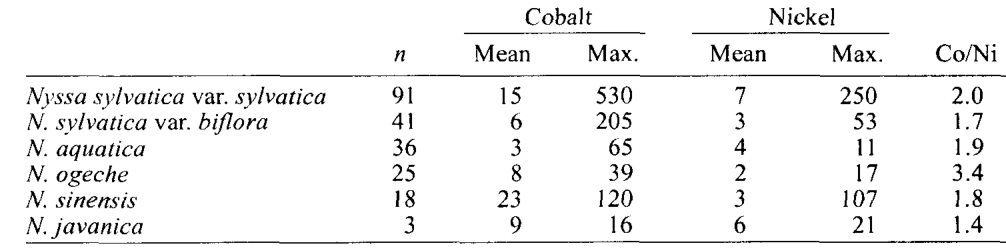
The use of Nyssa sylvatica and its varieties to assess the Co status of soils was continued by the work of Shacklette et al. (1970) and Connor & Shacklette (1975) who found up to 30 Mg g' Co (dry mass) in leaves of this species. A detailed survey of the natural abundances of Co and Ni in species and varieties of Nyssa was carried out by Brooks et al. (1977) who determined the concentrations of both elements in leaves of 346 wild specimens growing in North America and Asia (Table 1).
Shacklette et al. (1970)以及Connor & Shacklette (1975)继续开展了利用Nyssa sylvatica及其变种评估土壤Co状况的工作,他们在该物种叶片中测得Co含量高达30 μg g⁻¹(干重)。Brooks et al. (1977)对蓝果树属各物种和变种中Co和Ni的天然丰度进行了详细调查,测定了生长于北美和亚洲的346份野生样本叶片中这两种元素的浓度(表1)。
The original purpose of the studies by Kubota & Lazar (1958) and by Kubota et al. (1960) had been to establish whether the Co content of Nyssa species would indicate the Co status of the accompanying soils. They concluded that the Co content of these trees was indeed a function of soil type, and that, in some but not all soils, impeded drainage increased Co uptake.
Kubota & Lazar (1958)和Kubota et al. (1960)研究的最初目的是确定蓝果树属植物的Co含量能否指示其所生长土壤的Co状况。他们得出结论:这些树木的Co含量确实受土壤类型制约,并且在部分(而非全部)土壤中,排水不畅会增加Co的吸收。
The present study had a threefold purpose: establishing the range of Co (and geochemically related Ni) concentrations in Nyssa species growing in New Zealand; establishing the degree to which the Co and/or Ni content of leaves of these plants is an indication of the Co/Ni status of the soils; determining whether leaves of the deciduous Nyssa trees might be used as a forage additive, particularly in parts of New Zealand where Co deficiency is a serious problem in animal nutrition.
本研究有三重目的:确定新西兰生长的蓝果树属植物中Co(以及地球化学性质相关的Ni)的浓度范围;确定这些植物叶片的Co和/或Ni含量在多大程度上能指示土壤的Co/Ni状况;判断落叶性蓝果树的叶片能否用作饲料添加物,尤其是在新西兰缺钴已成为动物营养严重问题的地区。
2MATERIALS AND METHODS材料与方法
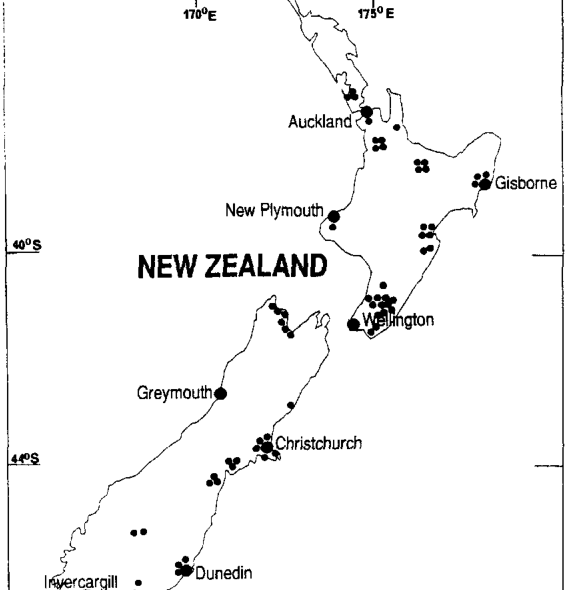
A tree nursery from the Nelson area of South Island supplied us with a list of all people who had bought Nyssa saplings from them in 1990. These plants would now be about 10 years old. We wrote to 94 such customers asking for a small number of leaves together with soil samples taken at least 2 m away from the tree at a depth of about 10 cm. We received 49 replies enclosing a total of 97 leaf samples of three species of Nyssa together with their associated soils. The localities of these samples are shown in Fig. I.
南岛Nelson地区的一家苗圃向我们提供了1990年从该苗圃购买蓝果树幼苗的全部客户名单。这些植株现约为10年树龄。我们致信其中94位客户,请其寄送少量叶片,以及在距树至少2 m处、约10 cm深度采集的土壤样品。我们共收到49份回复,附有三种蓝果树属植物的97份叶片样品及其对应土壤。样品采集地点见图1。
Leaf analysis叶片分析
Leaves were washed and dried at 70°C overnight. Dry samples (c. 0.1 g) were placed in 10-ml borosilicate test tubes and ashed overnight at 500°C. The ashed samples were redissolved in 5 ml of warm 2 M HC and the tubes shaken to assist dissolution. Cobalt and Ni concentrations in the solutions were determined in most cases by flame atomic absorption spectrometry (FAAS) using a GBC 904 instrument. When the elemental concentrations were too low for quantification by FAAS, the two elements were determined by the more sensitive technique of graphite furnace atomic absorption spectrometry (GFAAS) using a GBC 909/System 3000 instrument.
叶片经清洗后于70°C烘干过夜。将干样(约0.1 g)置于10 ml硼硅酸盐试管中,于500°C灰化过夜。灰化样品用5 ml温热的2 M HCl重新溶解,并振荡试管以促进溶解。溶液中Co和Ni浓度大多采用GBC 904型火焰原子吸收光谱仪(FAAS)测定。当元素浓度过低而无法用FAAS定量时,采用灵敏度更高的石墨炉原子吸收光谱法(GFAAS),使用GBC 909/System 3000型仪器测定这两种元素。
Soil analysis土壤分析
Soils were treated in two different ways. For total Co and Ni concentrations, 0.5-g soil samples were digested with 10 ml of a 1:1 HNO3:HF mixture in 50-ml polypropylene beakers and taken to dryness over a hot water bath (100°C). The residues were redissolved in 10 ml of 2 M HC as above. For extractable Co and Ni, 1-g soil samples were shaken with 10 ml of 1 M ammonium acetate (pH 7.0) in polypropylene sealed vials placed in an end-overend rotary shaker. Both sets of soils were analysed as above by FAAS and GFAAS. After drying at
土壤采用两种不同方法处理。测定全量Co和Ni时,将0.5 g土样置于50 ml聚丙烯烧杯中,加入10 ml HNO3:HF(1:1)混合酸消解,并在热水浴(100°C)上蒸干。残渣按上述方法用10 ml 2 M HCl重新溶解。测定可提取态Co和Ni时,将1 g土样与10 ml 1 M乙酸铵(pH 7.0)置于密封聚丙烯小瓶中,在端对端旋转振荡器上振荡。两组土样均按上述方法用FAAS和GFAAS分析。土壤于
Robinson et al.-Cobalt and nickel accumulation in Nyssa 105°C for 16 h, the organic matter content of souls (1.0.1., loss on ignition) was determined from the weight loss after ignition at 500°C for 4 h.
Robinson et al.——蓝果树属植物中钴和镍的积累 105°C干燥16 h后,根据500°C灼烧4 h后的失重测定土壤有机质含量(l.o.i.,烧失量)。
Correlation analysis was carried out on 11 variables. Where appropriate the data were transformed logarithmically when distributions were lognormal.
对11个变量进行了相关分析。对于呈对数正态分布的数据,视情况进行了对数转换。
3RESULTS AND DISCUSSION结果与讨论
Characteristics of cobalt and nickel新西兰蓝果树科植物中钴和镍
concentrations in New Zealand Nyssaceae
浓度的特征
The concentrations reported by us (Table 2) for both Co and Ni in all three species are appreciably lower than those in North American wild plants (Table 1). It must be remembered that all of our samples represented exotic imports not found naturally at the sites from which they were sampled.
本研究报道的三个物种中Co和Ni的浓度(表2)均明显低于北美野生植株(表1)。需要指出的是,我们的全部样品均为外来引种植株,在其采样地点并非自然分布。
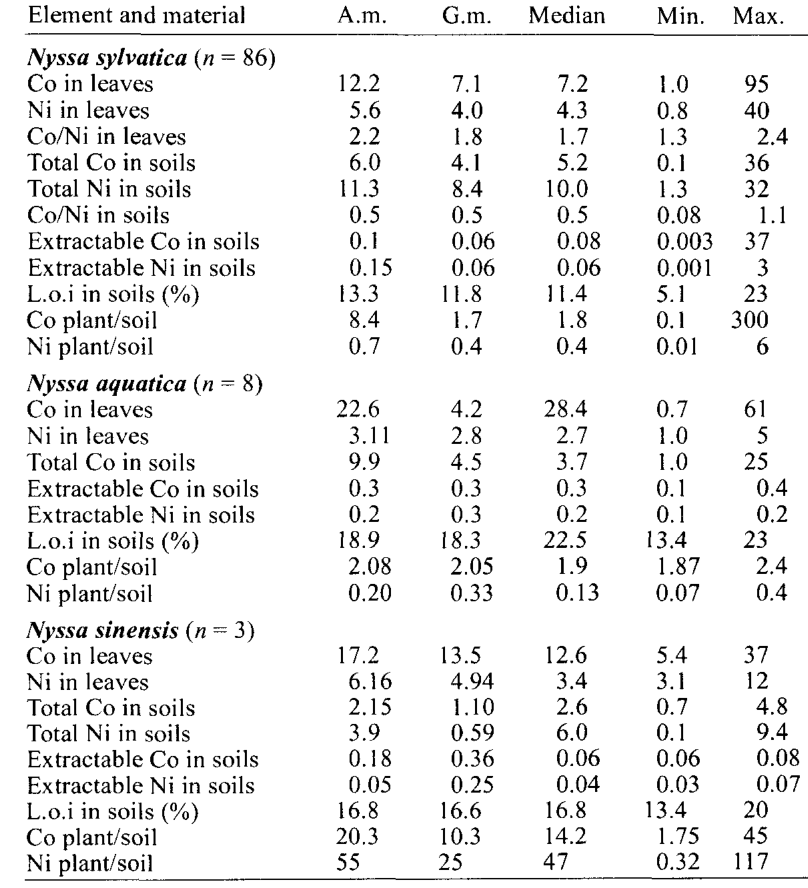
Although maximum Ni concentrations in Nyssa sylvatica specimens were less than half those of Co, the plant/soil quotient presents quite a different picture. For Co the geometric means (used because the data were lognormally distributed) were 1.70, 2.05, and 10.3 Mg g for N. sylvatica, N. aquatica, and N. sinensis, respectively (Table 2). The corresponding maximum values were 300, 2.4, and 45 Mg g. Corresponding data for Ni in the same three species were means of0.4, 0.33, and 25 ug g with maxima of6, 0.40, and 117 ug g. The values for N. sinensis, however, were non-significant because of the small size of the sample (n = 3). It is clear that both N. sylvatica and N. aquatica are able to accumulate Co selectively over Ni by a factor of about 4-6.
尽管Nyssa sylvatica样本中Ni的最高浓度不及Co的一半,但植物/土壤浓度比却呈现出完全不同的情形。N. sylvatica、N. aquatica和N. sinensis的Co几何均值(因数据呈对数正态分布而采用)分别为1.70、2.05和10.3(表2),相应最大值分别为300、2.4和45。同样三个物种Ni的均值分别为0.4、0.33和25,最大值分别为6、0.40和117。但由于N. sinensis样本量小(n = 3),其数值不具显著性。显然,N. sylvatica和N. aquatica均能选择性地积累Co,其程度约为Ni的4–6倍。
Loss on ignition (l.o.i.) results show that N. aquatica appears to have been planted in soils with a somewhat higher humus content (Table 2). This
烧失量(l.o.i.)结果表明,N. aquatica似乎种植于腐殖质含量略高的土壤中(表2)。这
New Zealand Journal of Agricultural Research, 1999, Vol. 42
New Zealand Journal of Agricultural Research, 1999, Vol. 42
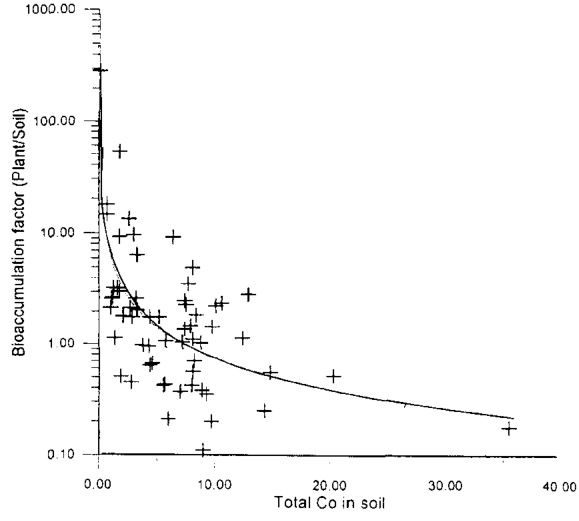
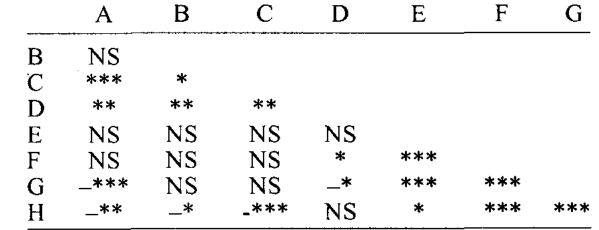
The Co content of leaves of Nyssa sylvatica was unrelated to the total and the extractable soil Co (Table 3). There was a very highly significant link between the Co in leaves and their Ni concentration. This was to be expected because of the geochemical association between these two elements as well as their association in serpentine superphosphate fertilisers. Of major importance is the highly significant inverse relationship between the Co content of leaves and the value of the BAC for this element (Table 3). This is also shown in Fig. 2 and is of importance in showing that Nyssa sylvatica has a good potential to extract Co from soils with low abundances of this element. A similar pattern can be observed for Ni. The BAC values of both elements are mutually correlated to a very highly significant degree. Both Co and Ni in soils were very highly correlated because of their geochemical similarities. This was also the case for the extractable fractions of both elements in soils when correlated against each other and with their total concentrations in soils.
Nyssa sylvatica叶片的Co含量与土壤全量Co及可提取态Co均无关(表3)。叶片Co与其Ni浓度之间存在极显著关联。这在意料之中,因为这两种元素在地球化学上相互伴生,且在蛇纹石过磷酸钙肥料中也同时存在。尤为重要的是,叶片Co含量与该元素BAC值之间存在显著的负相关关系(表3)。图2亦显示了这一点,这表明Nyssa sylvatica具有从低Co丰度土壤中提取Co的良好潜力。Ni也呈现类似规律。两种元素的BAC值彼此间呈极显著相关。由于地球化学性质相似,土壤中Co和Ni之间高度相关。土壤中两种元素的可提取态之间及其与各自全量之间的相关性亦是如此。
is to be expected because this species favours poorly drained sites which usually have a higher organic content in the substrate.
在意料之中,因为该物种偏好排水不良的生境,而此类生境的基质通常有机质含量较高。
There is a tendency for bioaccumulation coefficients (BAC), i.e., plant/soil elemental concentrations quotients, to increase in magnitude as the elemental content in the soil decreases. This is demonstrated in Fig. 2 from which it will be seen that BAC values decrease from c. 200 for a Co concentration of 1 ug g in the soil down to just under 0.2 when the metal concentration reaches 37 Mg g in the soil. This finding is of some importance because it highlights the possibility that N. sylvatica might have some potential to recover significant amounts of Co from soils containing low levels of this element.
生物富集系数(BAC,即植物/土壤元素浓度比)有随土壤中元素含量降低而增大的趋势。这一点见图2:当土壤Co浓度为1 μg g⁻¹时BAC值约为200,而当土壤中该金属浓度达到37 μg g⁻¹时,BAC值降至略低于0.2。这一发现具有一定意义,因为它凸显了N. sylvatica可能具备从低Co土壤中回收可观数量Co的潜力。
Concentrations of Co and Ni in soils are in most cases similar to those expected in non-ultramafic soils (ultramafic soils are high in Ni, Co, and Mg). Mean values for Co were 4.1 ug g- with a minimum and maximum of O.1 and 36 ug g',, respectively. Kidson (1937) reported a range of 0.3-380 ug gl with soils containing <2 ug g- being associated with Co deficiency in animals. Our mean, minimum, and maximum values for Ni were 8.4, 1.3, and 32 ug g, respectively. The highest values for Ni and Co were not associated with ultramafic soils and were more likely a result of fertilising with "serpentine superphosphate" which has elevated concentrations of both elements.
土壤中Co和Ni的浓度在多数情况下与非超基性土壤的预期值相近(超基性土壤富含Ni、Co和Mg)。Co的平均值为4.1 μg g⁻¹,最小值和最大值分别为0.1和36 μg g⁻¹。Kidson (1937)报道的范围为0.3–380 μg g⁻¹,且含量<2 μg g⁻¹的土壤与动物缺钴症相关。本研究中Ni的平均值、最小值和最大值分别为8.4、1.3和32 μg g⁻¹。Ni和Co的最高值并不对应超基性土壤,更可能是施用“蛇纹石过磷酸钙”所致,该肥料中两种元素的浓度均较高。
Significance for New Zealand agriculture对新西兰农业的意义
Although Kubota et al. (1960) reported that Nyssa sylvatica might be used to indicate the Co status of North American soils, this is hardly the case for the New Zealand environment. There was no significant relationship between the Co content of leaves of this species and the Co status of the soil. The reason is not hard to establish. The North American trees were almost without exception growing in their natural environment, whereas the trees used in this study had been artificially planted, probably in disturbed, translocated, or fertilised soils. The addition of serpentine superphosphate with its high
尽管Kubota et al. (1960)报道Nyssa sylvatica可用于指示北美土壤的Co状况,但这在新西兰环境中几乎不成立。该物种叶片Co含量与土壤Co状况之间无显著关系。原因不难确定:北美树木几乎无一例外生长于其自然环境中,而本研究所用树木系人工种植,很可能种植于扰动、迁移或施肥的土壤中。施用富含
Robinson et al. -Cobalt and nickel accumulation in NyssaRobinson et al.——蓝果树属植物中钴和镍的积累
Co and Ni content or superphosphate with added Co will certainly have given rise to soils of different composition to the local undisturbed types.
Co和Ni的蛇纹石过磷酸钙或添加Co的过磷酸钙,必然使土壤组成不同于当地未扰动的土壤类型。
The most significant finding from this present report is that there is a real possibility that litter from this tree might be used as a feed additive to stock grazing Co-deficient pastures that are found throughout New Zealand, but particularly in the Central Volcanic Plateau. It has been established (Andrews et al. 1958; Clark & Millar 1983) that pastures containing a minimum of 0.11 and 0.08 Mg g' (ppm) Co in dry mass will provide sufficient of this element for sheep and cattle, respectively.
本报告最重要的发现是,该树种的凋落叶确有可能用作饲料添加物,供在缺钴草地上放牧的家畜食用;此类草地遍布新西兰,尤以中部火山高原为甚。已有研究证实(Andrews et al. 1958; Clark & Millar 1983),干物质中Co含量至少为0.11和0.08 μg g⁻¹(ppm)的草地可分别为绵羊和牛提供足量的该元素。
Normal pastures contain on average about 0.15 Mg g' Co. However, in pastures on soils formed from the Taupo and Kaharoa ash showers, the levels are far lower (c. 0.04 Mg g) and require an admixture of Co either as the sulphate or as an additive to superphosphate. When added directly, cobalt sulphate (CoSO4.6H2O) is usually used at a rate of 350 g ha' yr ' which translates to a yearly addition of about 80 g ha' of Co metal (During 1984). It is known that this amendment of 80 g ha-l yr removes all signs of Co deficiency in animals and is therefore a yardstick for a desired level of application. Recently, the less expensive option of injecting slow-release cobalt preparations into stock has replaced the fertilisation of pasture with Co.
正常草地平均含Co约0.15 μg g⁻¹。然而,在由Taupo和Kaharoa火山灰形成的土壤上,草地Co含量低得多(约0.04 μg g⁻¹),需要以硫酸盐形式或作为过磷酸钙添加物补充Co。直接施用时,硫酸钴(CoSO4·6H2O)的常用施用量为350 g ha⁻¹ yr⁻¹,相当于每年添加约80 g ha⁻¹金属Co(During 1984)。已知每年80 g ha⁻¹的施用量可消除动物缺钴的一切症状,因此可作为理想施用水平的标准。近年来,向家畜注射缓释钴制剂这一成本较低的方案已取代了在草地上施用Co肥。
A mature specimen of Nyssa sylvatica produces about 40 kg of leaf litter annually. Assuming that this litter contains 5 ug g' (mg kg-') Co (the mean of our experiments was in fact 7 ug g'), the leaves of each tree could provide 200 mg of Co. Clearly it would be impracticable to grow enough trees to add their leaves to the soil as a direct amendment. However, another approach might be employed.
一株成年Nyssa sylvatica每年产生约40 kg凋落叶。假设凋落叶含Co 5 μg g⁻¹(mg kg⁻¹)(实际上本试验的平均值为7 μg g⁻¹),则每株树的叶片可提供200 mg Co。显然,种植足够多的树木并将其叶片作为直接改良剂施入土壤是不切实际的。然而,可以采用另一种途径。
A ewe and her lamb will consume about 550 kg of dry matter in one year. This is 5.5 t ha' at a stocking rate of 10 units ha. Assuming that this feed is from a normal pasture with 0.15 ug gI Co (Andrews 1966), it would contain 825 mg of Co. Assuming that we are dealing with an impoverished pasture with only 0.06 mg kg-l Co (Andrews 1966), this would provide only 330 mg of this element. There is therefore a deficiency of 495 mg of Co that could be more than supplied by only three trees, each with 5 ug g- Co in its leaves.
一只母羊及其羔羊每年约消耗550 kg干物质。按每公顷10个单位的载畜率计算,相当于5.5 t ha⁻¹。假设这些饲料来自含Co 0.15 μg g⁻¹的正常草地(Andrews 1966),则其含Co 825 mg。假设为仅含Co 0.06 mg kg⁻¹的贫瘠草地(Andrews 1966),则仅能提供330 mg该元素。因此存在495 mg的Co缺口,而仅需三株叶片含Co 5 μg g⁻¹的树木即可绰绰有余地补足。
The palatibility of forage amended with Nyssa leaves remains to be determined and this question will not be answered without further extensive research. However, it can be shown from the above calculation that 100 kg of Nyssa leaf material (containing 5 ug g- Co) would need to be added to the 5.5 t ha-' of cobalt-deficient forage to provide the additional required 500 mg of Co. This amounts to only 1.8% by weight of the original feed and is not likely to make it unacceptable to sheep. It is also highly unlikely that it will ever be possible to inadvertently supply a toxic dose of Co from Nyssa leaves since animals are often supplied directly with Co pellets, "bullets", or tablets introduced directly into the animal (Underwood 1981) at a rate greatly in excess of the likely intake from Nyssa leaves.
添加蓝果树叶片后饲料的适口性尚待确定,这一问题需要进一步深入研究方能解答。然而,由上述计算可知,需要向5.5 t ha⁻¹的缺钴饲料中添加100 kg蓝果树叶片(含Co 5 μg g⁻¹),才能提供所需额外的500 mg Co。这仅占原饲料重量的1.8%,不大可能使绵羊拒食。此外,通过蓝果树叶片意外提供毒性剂量Co的可能性也极低,因为动物常被直接投喂Co丸剂、“弹丸”(bullets)或直接置入体内的片剂(Underwood 1981),其剂量远超可能从蓝果树叶片摄入的量。
The above calculations have considered mainly sheep, which are more susceptible to Co deficiency than are cattle. Cattle, especially calves, are more sensitive to Co toxicity than are sheep (Dickson & Bond 1974), but again the contemplated Nyssabased dosages are not likely to even approach levels of toxicity commonly reported for Co and Ni (150 Mg g and 250 ug g, for example) as the highest values found in Nyssa leaves were only 90 ug g-! and 40 ug g, respectively.
上述计算主要针对绵羊,绵羊比牛更易发生缺钴症。牛(尤其是犊牛)对Co毒性比绵羊更敏感(Dickson & Bond 1974),但同样,拟议中基于蓝果树的剂量甚至不太可能接近通常报道的Co和Ni毒性水平(例如分别为150 μg g⁻¹和250 μg g⁻¹),因为蓝果树叶片中测得的最高值分别仅为90 μg g⁻¹和40 μg g⁻¹。
The above discussion highlights two very different approaches. Our proposals involve direct administration of Co in feed compared with the wasteful conventional approach of adding a large excess of Co and hoping that sufficient of it remains in the soil or is eaten by the animals to ensure no symptoms of Co deficiency. The trees could be planted as lightly dispersed individuals (e.g., 3 ha) within a field or as boundary markers. We intend revisiting some trees sampled here in order to elucidate the factors leading to large recoveries of Co in Nyssa leaves.
上述讨论凸显了两种截然不同的途径。我们的方案是通过饲料直接供给Co,而传统方法则较为浪费,即施入大量过量的Co,寄望于其有足够部分留存于土壤中或被动物采食,以确保不出现缺钴症状。这些树木可以稀疏散植于田块中(如每公顷3株),也可作为边界标志种植。我们计划重访本研究部分采样树木,以阐明导致蓝果树叶片中Co大量富集的因素。
It is envisaged that dried Nyssa leaves be collected at leaf fall in April/May and added to hay or silage either manually or mechanically. The mechanics of such an operation are now under investigation and beyond the scope of this paper. However, the fundamental problem remains as to whether farmers would be prepared to go to the trouble of planting trees, waiting a few years, and then adding Nyssa to extra feed supplied during the year. For organic farmers, however, the proposed scenario would likely be attractive, and for both groups of agriculturalists the Nyssa would certainly be pleasing aesthetically as it is one of the world's most spectacular provider of autumn colours.
设想在4–5月落叶时收集干燥的蓝果树叶片,以人工或机械方式添加到干草或青贮饲料中。此类作业的机械化问题目前正在研究之中,超出了本文范围。然而,根本问题仍在于农场主是否愿意费心种树、等待数年,然后在一年中将蓝果树叶片添加到补充饲料中。不过,对有机农场主而言,所提出的方案可能颇具吸引力;而对这两类农业生产者来说,蓝果树无疑都具有观赏价值,因为它是世界上秋色最为壮观的树种之一。
4ACKNOWLEDGMENTS致谢
We are indebted to B. F. Quin of Summit Quinphos of Auckland and to the Massey University Agricultural Research Fund for financial support for the project. Our thanks are also extended to Appleton Tree Nurseries Ltd,
感谢奥克兰Summit Quinphos公司的B. F. Quin以及梅西大学农业研究基金对本项目的资助。同时感谢Appleton Tree Nurseries Ltd,
New Zealand Journal of Agricultural Research, 1999, Vol. 42
New Zealand Journal of Agricultural Research, 1999, Vol. 42
and to Wakefield, New Zealand, who supplied us with samples and with names of customers who had bought Nyssa plants from them in 1990. Our grateful thanks are also extended to the helpful growers and gardeners of New Zealand who supplied us with 97 specimens of Nyssa leaves together with associated soil samples.
(新西兰Wakefield)为我们提供样品以及1990年购买蓝果树植株的客户名单。衷心感谢新西兰热心的种植者和园艺爱好者为我们提供97份蓝果树叶片样本及其对应的土壤样品。
5REFERENCES参考文献
Andrews, E. D. 1966: Cobalt concentrations in some New Zealand fodder plants grown in cobalt-sufficient and cobalt-deficient soils. New Zealand Journal of Agricultural Research 9: 29-38.
Andrews, E. D.; Stephenson, B. J.; Anderson, J. P.; Faithful, W. C. 1958: The effect of length of pastures on cobalt deficiency disease in lambs. New Zealand Journal of Agricultural Research 31: 125-139.
Beeson, K. C.; Lazar, V. A.; Boyce, S. G. 1955; Some plant accumulators of the micronutrient elements Ecology 36: 155-156.
Brooks, R. R.; McC cave, J. A.; Schofield, E. K. 1977: Cobalt and nickel uptake by the Nyssaceae. Taxon 26: 197-201.
Clark, R. G.; Millar, K. R. 1983: Cobalt. In: Grace, N. D. ed. The mineral requirements of grazing ruminants. Hamilton, New Zealand Society of Animal Production. Pp. 27-38.
Connor, J. J.; Shacklette, H. T. 1975: Background geochemistry of some rocks, soils, plants and vegetable in the conterminous United States. United States Geological Survey Professional Paper 574F: 1-168.
Dickson, J.; Bond, M. P. 1974: Cobalt toxicity in cattle. Australian Veterinary Journal 50: 236.
During, C. 1984: Fertilisers and soils in New Zealand farming. 3rd ed. Wellington, Government Printer.
Kidson, E. B. 1937: Cobalt status of New Zealand soils The New Zealand Journal of Science and Technology 19: 684-707.
Kubota, J.; Lazar, V. A. 1958: Cobalt status of soils of southeastern United States: II. Ground-water podzols and six geographically associated soil groups. Soil Science 86: 262-268.
Kubota, J.; Lazar, V. A.; Beeson, K. C. 1960: The study of cobalt status of soils in Arkansas and Louisiana using the black gum as the indicator plant. Soil Science Proceedings 24: 527-528.
Shacklette, H. T.; Sauer, H. 1.; Miesch, A. T. 1970: Geochemical environments and cardiovascular mortality rates in Georgia. United States Geological Survey Professional Paper 574C: Underwood, E. J. 1981: The mineral nutrition of livestock. 2nd ed. Farnham, Commonwealth Agricultural Bureaux.