
Massey University, New Zealand
and
Brett Robinson
HortResearch, Palmerston North, New Zealand
Some plants are able to hyperaccumulate heavy metals such as nickel, cobalt, cadmium, zinc or even gold. Such plants could be used to extract metals from soils or ores that are subeconomic for conventional mining. This proposed new technology is known as phytomining.
某些植物能够超量富集镍、钴、镉、锌乃至金等重金属。这类植物可用于从对常规采矿而言不具经济价值的土壤或矿石中提取金属。这一拟议中的新技术被称为植物采矿。
In the early 1970s, T. Jaffré discovered a tree in New Caledonia, Sebertia acuminata, that exudes a sap containing 26% nickel in its dry mass. It is known locally as seve bleue (blue sap). The question immediately arose in people's minds, 'what if it had been gold that exuded so freely from the trunk?'. One could imagine tapping it like a rubber tree for its golden harvest. A whole decade was to pass before others saw the possibility of phytomining for nickel and other elements. Growing a crop for its metal was first proposed by Chaney (1983) and later by Baker and Brooks (1989), but it was not until the mid-1990s that field trials were carried out. Nicks and Chambers (1995), working from Nevada, grew a crop for nickel in California, over nickel-rich 'serpentine' soils. These serpentine, or more correctly ultramafic (ultra-magnesium-ferric) soils are derived from ultramafic rocks that cover about 1% of the Earth's land surface and contain high concentrations of nickel, chromium, cobalt and magnesium. In the preliminary trials, the researchers used the nickel-hyperaccumulating plant Streptanthus polygaloides (Figure 1), which can contain over 1% of this metal in its dry matter. In 1998, Chaney and his co-workers took out a patent on phytomining for nickel.
20世纪70年代初,T. Jaffré在新喀里多尼亚发现了一种树木Sebertia acuminata,其分泌的汁液干物质中镍含量高达26%。当地人称之为seve bleue(蓝色汁液)。人们随即想到:“假如从树干中如此大量渗出的是黄金,又会怎样?”人们可以设想像割橡胶树一样采割它,以获取“黄金收成”。然而,又过了整整十年,才有人认识到利用植物采矿获取镍及其他元素的可能性。种植作物以获取金属的设想最早由Chaney (1983)提出,随后Baker and Brooks (1989)也提出了这一设想,但直到20世纪90年代中期才开展田间试验。Nicks and Chambers (1995)以内华达州为基地,在加利福尼亚富镍的“蛇纹岩”土壤上种植了以获取镍为目的的作物。这些蛇纹岩土壤,更准确地称为超基性(超镁铁质)土壤,由超基性岩发育而来;超基性岩约覆盖地球陆地表面的1%,含有高浓度的镍、铬、钴和镁。在初步试验中,研究者使用了镍超富集植物Streptanthus polygaloides(图1),其干物质中该金属含量可超过1%。1998年,Chaney及其合作者申请了镍植物采矿专利。
Phytomining and its better-known, associated technology, phytoremediation, depend on the use of hyperaccumulator plants; these are classified as containing over 100 times higher elemental concentrations than non-accumulator species, even when the latter grow on mineralised soils. Hyperaccumulation is a relatively rare event; so far, about 400 species have been found worldwide to hyperaccumulate nickel, but the total for other elements, such as copper and zinc, is much less. It is also possible to induce hyperaccumulation in plants by the addition of a chemical to the soil that solubilises the target element. This is known as induced hyperaccumulation.
植物采矿及其更广为人知的相关技术——植物修复,均依赖于超富集植物的利用;超富集植物的界定标准是其元素含量比非富集物种高100倍以上,即使后者生长在矿化土壤上亦是如此。超富集现象相对罕见;迄今为止,全世界已发现约400种植物能够超富集镍,而能超富集铜、锌等其他元素的物种总数则少得多。此外,也可以通过向土壤中添加能够溶解目标元素的化学试剂来诱导植物超富集,这被称为诱导超富集。
Pioneering field trials
The early study by Nicks and Chambers calculated that the net return to a phytominer would be $US513 per ha per annum, assuming a nickel price of $US7650 per tonne, a biomass yield of 10 t/ha, containing 1% Ni, and the return to the grower of $US131 per ha, derived from the energy obtained from combustion of the biomass. This latter activity is not unique - the same strategy is now used in the sugar cane industry, where electricity generated from
Nicks and Chambers的早期研究计算表明,假设镍价格为每吨7650美元、生物量产量为10 t/ha且含Ni 1%,并计入生物质燃烧所获能量为种植者带来的每公顷131美元收益,则植物采矿者的净收益为每年每公顷513美元。后一种做法并非独有——甘蔗产业目前也采用同样的策略,即利用燃烧
content of 0.8% (8000 mg/kg) in the dry plant material. Later field trials in New Zealand, using the same species, showed that a biomass of 12 t/ha could be achieved by moderate fertilisation of the serpentine substrate. This yield, together with a nickel concentration of 0.8% would have produced 96 kg/ha of nickel, which is comparable with the yield from S. polygaloides in California.
植物干物质中的含量为0.8%(8000 mg/kg)。随后在新西兰利用同一物种开展的田间试验表明,对蛇纹岩基质进行适度施肥可使生物量达到12 t/ha。该产量与0.8%的镍含量相结合,可产出96 kg/ha的镍,与加利福尼亚S. polygaloides的产量相当。
Pot and field trials for nickel phytomining have also been performed with the South African hyperaccumulator Berkheya coddii. After moderate fertilisation, Robinson et al. (1997b) obtained a biomass yield of 22 t/ha, containing about 5500 mg/kg (0.55%) nickel. This would have provided 121 kg/ha of nickel, together with a potential energy yield of $US288. The world price of nickel fell to about $US4000 per tonne, but has now recovered to SUS7200. The value of the nickel in the crop would therefore be $US871. If half of this sum represented the net profit to the phytominer, and adding the energy dividend, the net return would be $US723, which is well above the $US322 per ha obtained by an American wheat farmer in 1996, even without the energy dividend.
利用南非超富集植物Berkheya coddii也开展了镍植物采矿的盆栽试验和田间试验。经适度施肥后,Robinson et al. (1997b)获得了22 t/ha的生物量产量,其镍含量约为5500 mg/kg(0.55%)。这可提供121 kg/ha的镍,同时带来288美元的潜在能源收益。镍的国际价格曾跌至每吨约4000美元,但目前已回升至7200美元。因此,作物中镍的价值为871美元。若其中一半为植物采矿者的净利润,再加上能源收益,则净收益为723美元,远高于1996年美国小麦种植者每公顷322美元的收益,即使不计能源收益亦是如此。
Berkeya coddii is at present probably one of the best candidates for phytomining for nickel; it has a high biomass, and is easy to grow from seed, it is a perennial, so that it does not need to be resown each year, it is tolerant of frost and cool weather, and readily produces seed for future sowings. In climates with severe winters, it could be grown as an annual crop.
Berkeya coddii目前可能是镍植物采矿的最佳候选物种之一:其生物量高,易于播种繁殖;为多年生植物,无需每年重新播种;耐霜冻和低温天气,且易于结籽以供日后播种。在冬季严寒的气候条件下,可将其作为一年生作物种植。
Figure 1. A crop of nickel in Streptanthus polygaloides, growing in California.图1. 生长于加利福尼亚的Streptanthus polygaloides“镍作物”。
burning the bagasse (biomass remaining after sugar extraction) is used to run the factory and provide surplus energy to the national grid.
蔗渣(提糖后剩余的生物质)所产生的电力来运转工厂,并将剩余能源输入国家电网。
The next set of field trials was performed by Robinson et al. (1997a), who looked at natural stands of Alyssum bertoloni (Figure 2) growing in Tuscany, Italy. They found that moderate fertilisation of the soil gave a threefold biomass increase without concomitant loss of nickel
下一组田间试验由Robinson et al. (1997a)开展,他们研究了生长于意大利托斯卡纳的Alyssum bertoloni天然群落(图2)。结果发现,对土壤适度施肥可使生物量增加两倍,而镍含量并未随之降低
Thallium and gold铊与金
Although most of the pioneering work on phytomining has been performed with nickel, there is no reason why other metals should not be extracted in the same manner. In New Zealand and in France, we have initiated experiments with Iberis intermedia (candytuft) from southern France; this contains over 2000 mg/kg (0.2%) thallium in its dry mass (Leblanc et al., 1999). This highly toxic metal has a world price of $US300 per tonne at present, and is obtained from a single mine in southern Macedonia, near the border. The biomass of the Iberis (Figure 3) is about 5 t/ha, and could produce up to 10 kg/ha of thallium, worth about $US3000.
尽管植物采矿的开创性工作大多以镍为对象,但没有理由认为其他金属不能以同样的方式提取。我们在新西兰和法国开展了以法国南部的Iberis intermedia(屈曲花)为材料的试验;该植物干物质中铊含量超过2000 mg/kg(0.2%)(Leblanc et al., 1999)。这种剧毒金属目前的国际价格为每吨300美元,全部产自马其顿南部靠近边境的一座矿山。Iberis的生物量(图3)约为5 t/ha,可产出多达10 kg/ha的铊,价值约3000美元。
Figure 2. Alyssum bertolonii - a nickel hyperaccumulator from Tuscany, Italy. The dried leaves contain on average about 1% (10,000 mg / kg) nickel.图2. Alyssum bertolonii——一种产自意大利托斯卡纳的镍超富集植物。其干叶中镍含量平均约为1%(10,000 mg / kg)。
The Iberis could also be used to phytoremediate thallium-contaminated soils, in which the crop is grown specifically to remove the pollutant without consideration of the marketable value of the crop (McGrath et al., 1993). Nearly all the recent papers on phytoextraction of heavy metals by plants have been focussed on phytoreme diation; here, the aim of the project is decontamination of polluted soils, while production of an economic bio-ore is a possible bonus and not the main objective. The phytoremediation of nickelpolluted soils by Alyssum bertolonii and Berkheya coddii has previously been discussed by Robinson et al. (1997a; b). As mentioned above, another way to use natural plant hyperaccumulators of metals is in induced hyperaccumulation. Blaylock et al. (1997), for example, grew crop plants to full size on lead-polluted soils for the purpose of phytoremediation. Lead is not taken up by plants because it occurs in soils as highly insoluble salts. However, addition of EDTA to the soil solubilised the lead, so that crop plants such as maize took up as much as 1% Pb (dry mass), thus enabling removal of lead from the contaminated substrate.
Iberis也可用于铊污染土壤的植物修复,此时种植作物的目的仅在于去除污染物,而不考虑作物的市场价值(McGrath et al., 1993)。近年来几乎所有关于植物提取重金属的论文都聚焦于植物修复;在此类项目中,目标是污染土壤的去污,而生产具有经济价值的生物矿石只是可能的附带收益,并非主要目的。Robinson et al. (1997a; b)此前已讨论过利用Alyssum bertolonii和Berkheya coddii修复镍污染土壤。如上所述,利用天然金属超富集植物的另一途径是诱导超富集。例如,Blaylock et al. (1997)在铅污染土壤上种植作物至完全成熟,以实现植物修复。由于铅在土壤中以高度难溶的盐类形式存在,植物通常不吸收铅。然而,向土壤中添加EDTA可使铅溶解,从而使玉米等作物吸收高达1%的Pb(干重),进而实现从污染基质中去除铅。
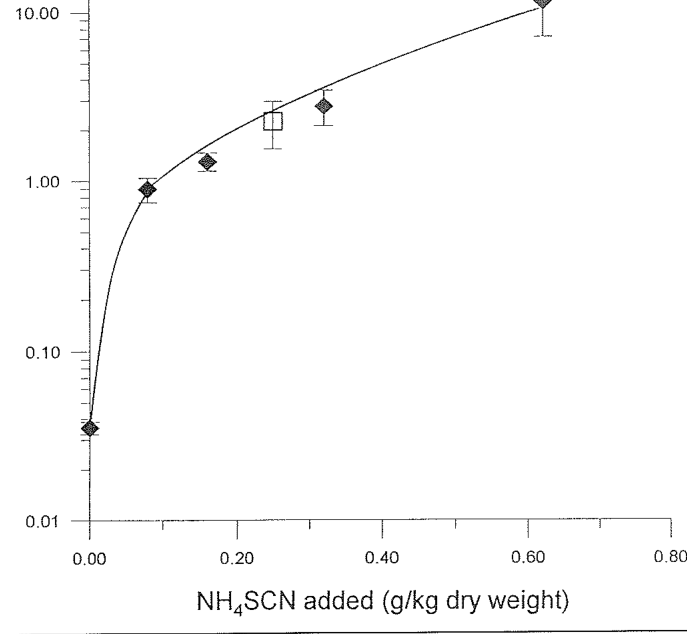
An interesting development of this work with lead was the discovery by Anderson et al. (1998) that plants such as Indian mustard (Brassica juncea) were able to hyperaccumulate up to 57 mg/kg gold from various auriferous substrates, following the addition of ammonium thiocyanate to the growth medium (Figure 4). It was suggested that this method might be used to recover gold from mine wastes too impoverished to be economically viable for extraction by conventional recovery techniques. This induced hyperaccuof energy of combustion. In 1998, it would have required 6162 mg/kg for the same yield. Sale of energy in a phytomining operation is obviously a sine qua non for a successful outcome of the project. It must be appreciated that this energy dividend also has to be set against agronomic costs such as site preparation, fertiliser application (if needed) and seed. It is clear that phytomining, unlike the related phytoremediation, will be dependent on commodity world prices, just like any other type of mining.
这项铅研究的一个有趣进展是Anderson et al. (1998)的发现:在生长介质中添加硫氰酸铵后,印度芥菜(Brassica juncea)等植物能够从多种含金基质中超富集高达57 mg/kg的金(图4)。有研究者提出,该方法可用于从品位过低、采用常规回收技术提取不具经济可行性的矿山废弃物中回收金。这种诱导超富燃烧能量。而在1998年,达到相同收益则需要6162 mg/kg。显然,出售能源是植物采矿项目取得成功的必要条件。必须认识到,这部分能源收益还需抵扣场地整备、施肥(如需要)和种子等农艺成本。显而易见,与相关的植物修复不同,植物采矿将与其他任何类型的采矿一样,取决于大宗商品的国际价格。
Figure 3. Iberis intermedia growing over thallium-rich mine tailings in southern France. This plant can contain up to 2000 mg /kg (0.2%) thallium in its dry leaves.图3. 生长于法国南部富铊尾矿上的Iberis intermedia。该植物干叶中铊含量可达2000 mg /kg(0.2%)。
mulation of gold was carried out using various auriterous substrates, including crushed gold ore, native gold dispersed in silica sand, and an artificial growth medium consisting of finely disseminated colloidal gold in silica sand.
集金的试验采用了多种含金基质,包括破碎的金矿石、分散于石英砂中的自然金,以及由细分散的胶体金与石英砂组成的人工生长介质。
Economics经济性
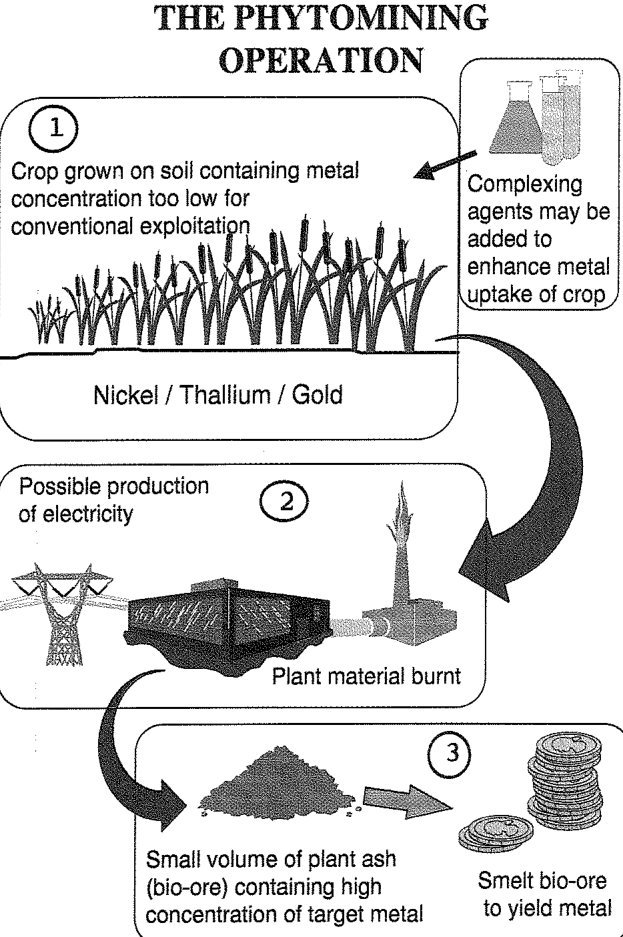
A model of a proposed economic scheme for phytomining is shown in Figure 5. This system applies to either natural or induced hyperaccumulation. In the latter case, the cost of the reagent has to be taken into account. The economics of the operation are dependent on a number of factors, such as the metal content of the plant, its biomass production per annum, and whether or not the energy of combustion of the biomass can be recovered and sold. The most important factor, however, is the world price of the metal being phytomined. A classic example of this is nickel, which has almost halved in price since 1994. Similarly, gold has fallen from $US400 per oz to less than $US300 per oz during the same period. This problem is highlighted in Table 1, which shows metal concentrations (mg/kg dry mass) required to provide a SUS500 per ha return for phytomining crops of different biomass, excluding the sale of energy from combustion of the plant material.
图5展示了一种拟议的植物采矿经济方案模型。该系统既适用于天然超富集,也适用于诱导超富集;对于后者,还须考虑试剂成本。该作业的经济性取决于多种因素,如植物的金属含量、年生物量产量,以及生物质燃烧能量能否回收并出售。然而,最重要的因素是所开采金属的国际价格。镍便是一个典型例子,自1994年以来其价格几乎下跌了一半。同样,在同一时期金价也从每盎司400美元跌至不足300美元。表1突出反映了这一问题,该表列出了不同生物量的植物采矿作物在不计植物材料燃烧能源销售收入的情况下,获得每公顷500美元收益所需的金属含量(mg/kg干重)。
Although phytomining is now marginal for nickel, this may not be true for other metals, whose prices also rise and fall in the cycles of world markets. The proposed technology does have a number of unique features that should be emphasised.
尽管目前镍的植物采矿已处于盈亏边缘,但对于其他金属而言未必如此,其价格同样随世界市场周期而涨落。该拟议技术确实具有若干值得强调的独特优势。
In 1994, at the time of the early field trials, the world price of nickel was $US7650. It then halved, but has recently recovered, to $US7200. The halving of this price since then can be expressed in terms of the economics of phytomining. In 1994, Berkheya coddii with a biomass of 20 t/ha needed only 3340 mg/kg nickel in dry mass (easily attainable) to recoup $US500 per ha, not counting the sale
1994年早期田间试验开展时,镍的国际价格为7650美元,随后减半,近期已回升至7200美元。此后价格的减半可用植物采矿的经济性加以说明。1994年,生物量为20 t/ha的Berkheya coddii只需干物质中镍含量达到3340 mg/kg(很容易达到),即可获得每公顷500美元的收益,这尚未计入出售
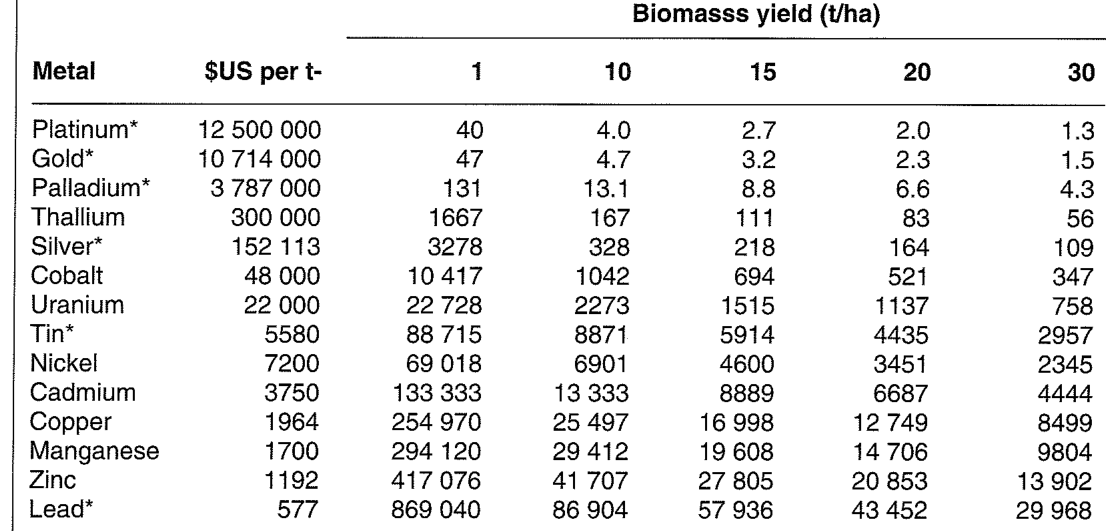
*Induced hyperaccumulation probably required.
*可能需要诱导超富集。
1. It offers the possibility of exploiting ores or mineralised soils that are quite uneconomic by conventional mining methods. For example, nickel can easily be phytomined from soils containing only 0.5% Ni and which cover vast areas throughout the world.
1. 它为开发利用常规采矿方法完全不具经济性的矿石或矿化土壤提供了可能。例如,镍可以很容易地从仅含0.5% Ni的土壤中通过植物采矿获取,而此类土壤在世界各地分布面积广阔。
2. 'Bio-ores' are virtually sulphur-free and their smelting will require less energy than sulphidic ores, which contribute greatly to the problem of acid rain.
2. “生物矿石”几乎不含硫,其冶炼所需能量低于硫化物矿石,而后者是造成酸雨问题的重要原因。
3. The metal content of a bio-ore is usually much greater than that of a conventional ore, and therefore requires less storage space. For example, we have found 22% Ni in the ash of the Zimbabwean hyperaccumulator Pearsonia 4. Phytomining is a 'green' technology, which should appeal to the conservation movement as an alternative to opencast mining of low-grade ores.
3. 生物矿石的金属含量通常远高于常规矿石,因此所需储存空间更小。例如,我们在津巴布韦超富集植物Pearsonia的灰分中检测到22%的Ni。4. 植物采矿是一种“绿色”技术,作为低品位矿石露天开采的替代方案,应会受到环保运动的青睐。
There are environmental concerns related to adding complexing agents or other chemicals to soils or tailings Despite its low toxicity relative to cyanide, use of thiocyanate would have to be strictly controlled to prevent leaching of this chemical into water tables and local waterways. There is also the potential problem of birds and grazing animals ingesting vegetation or seeds contaminated with heavy metals. For the purpose of the phytomining operation, the leaching of gold solution out of the root zone is certainly not desirable.
向土壤或尾矿中添加络合剂或其他化学品存在环境隐患。尽管硫氰酸盐的毒性相对于氰化物较低,但仍须严格控制其使用,以防该化学品淋溶进入地下水位和当地水道。此外,还存在鸟类和放牧动物摄食受重金属污染的植被或种子的潜在问题。就植物采矿作业而言,金溶液淋溶出根区显然也是不希望发生的。
It has been suggested (C. French, pers. comm.) that it might be possible to use transgenic plants which express a bacterial thiocyanate-degrading system to extract gold from auriferous substrates. This approach would solve the problem of thiocyanate toxicity to plants and perhaps allow them to extract more gold. The idea of transferring hyperaccumulation' or other types of gene into non-accumulating plants is being studied worldwide; for example, genetically modified Arabidopsis thaliana plants are able to convert mercury ions into the volatile metal and might therefore be used to remove mercury from contaminated soils. Induced hyperaccumulation of gold, as reported by Anderson et al. (1998), is the first evidence of significant non-hydroponic gold uptake by any plant. The true potential of phytomining has yet to be established. It has not yet been trialed on a commercial scale and much research remains to be carried out, particularly in the field of increasing metal uptake by plants, either by genetic manipulation or addition of specific reagents to the soil. It is only then that we will know whether phytomining is just a temporary aberration in the long history of scientific progress, or a new idea whose time has come.
有人提出(C. French,个人通讯),或许可以利用表达细菌硫氰酸盐降解系统的转基因植物从含金基质中提取金。这一方法可解决硫氰酸盐对植物的毒性问题,并可能使植物提取更多的金。将“超富集”基因或其他类型基因转入非富集植物的设想正在世界范围内开展研究;例如,转基因拟南芥(Arabidopsis thaliana)能够将汞离子转化为挥发性的金属汞,因而可能用于去除污染土壤中的汞。Anderson et al. (1998)报道的金的诱导超富集,是任何植物在非水培条件下显著吸收金的首个证据。植物采矿的真正潜力尚有待确定。该技术尚未进行商业规模的试验,仍有大量研究工作有待开展,尤其是在通过基因操作或向土壤中添加特定试剂来提高植物金属吸收量方面。只有到那时,我们才能知道植物采矿究竟只是漫长科学进步史中的一次短暂偏离,还是一个时机已经成熟的新理念。
References参考文献
Anderson C. W. N., Brooks R. R., Stewart R. B. and Simcock R. (1998) Harvesting a crop of gold in plants. Nature, 395, 553 - 554.
Baker A. J. M. and Brooks R. R. (1989) Terrestrial higher plants which hyperaccumulate chemical elements-a review of their distribution, ecology and phytochemistry. Biorecovery, 1, Blaylock M. J, Salt D. E., Dushenkov S. et al. (1997) Enhanced accumulation of Pb in Indian mustard by soil-applied chelating agents. Environmental Science and Technology, 31, 860-865. Chaney R. L. (1983) Plant uptake of inorganic waste constituents. In: Land treatment of hazardous wastes (J. F. Parr et al., eds.) New York: Noyes Data Corp.
Chaney R. L. et al. (1998) Method for phytomining of nickel, cobalt and other metals from soil. U.S. Patent # 5,711,784.
Leblanc M., Robinson B. H., Petit D, et al. (1999) The phytomining and environmental significance of hyperaccumulation of thallium by Iberis intermedia from southerm France. Economic Geology, 94, 109 - 114.
McGrath S. P., Sidoli C.M.D., Baker A. J. M. and Reeves R. D. (1993) The potential for the use of metal-accumulating plants for the in situ decontamination of metal-polluted soils. In: Integrated soil and sediment research: a basis for proper protection (H. J. P.Eijsackers and T. Hamers, Eds.). Dordrecht: Kluwer Academic Publishers.
Nicks L. J. and Chambers M. F. (1995) Farming for metals. Mining Environment Mgt, Sept., 15 - 18.
Robinson B. H., Chiarucci A., Brooks R. R., et al. (1997a) The nickel hyperaccumulator plant Alyssum bertoloni as a potential agent for phytoremediation and phytomining of nickel. Journal of Geochemical Exploration, 59, 75-86.
Robinson B.H., Brooks R.R., Howes A.W., et al. (1997b) The potential of the high-biomass Berkheya coddii for phytoremediation and phytomining, Journal of Geochemical Exploration, 60, 115-126.
Professor Robert Brooks (email: r.brooks@massey.ac.nz), Dr Robert Stewart (Senior Lecturer) and Chris Anderson (PhD research) are in Soil and Earth Sciences, Institute of Natural Resources, Massey University, Palmerston North. Dr Brett Robinson is a postdoctoral fellow at The Horticulture and Food Research Institute, Put. Bag 11030, Palmerston North, New Zealand.
Imaginative Images
the Welcome Trust
30September 1999 - 7 January 20001999年9月—2000年1月7日
A vibrant display of shapes and patterns illustrates the microscopic structures of living organisms at the Wellcome Trust's Two10 Gallery in Euston Road, London. The intricately sculpted sphere of a human egg contrasts with the striking geometric patterns of a fish lateral line organ. Abstract splashes of colour reveal the structure of a damaged brain, while strange bas-relief images reveal the volume of chromosomes. Here is life at all levels, from the dramatic serrations of tick mouthparts to the crooked trace of an individual myosin molecule. These pictures are among the 25 winners of the Trust's Biomedical Image Awards 1999. Visit the exhibition web site at: http://www.wellcome.ac.uk/bia99
位于伦敦尤斯顿路的Wellcome Trust Two10画廊以丰富多彩的形状与图案展示了生物体的微观结构。人类卵细胞精雕细琢般的球体,与鱼类侧线器官醒目的几何图案形成鲜明对比。抽象的色彩斑块揭示了受损大脑的结构,而奇特的浅浮雕图像则呈现了染色体的体积。这里展现了生命的各个层次,从蜱虫口器夸张的锯齿,到单个肌球蛋白分子弯曲的轨迹。这些图片均为该基金会1999年度生物医学图像奖的25幅获奖作品之一。展览网站:http://www.wellcome.ac.uk/bia99
They are among the best of the recent contributions to the Wellcome Trust Medical Photographic Library, and form part of a growing collection of Biomedical Images. These are available for academic/educational use and private study at a nominal cost. The Photo Library welcomes contributions of images from scientists, who receive commission on commercial sales of their pictures. For further details, please contact Kate Whitley on 0171 611 8855 (email: k.whitley(@wellcome.ac.uk).
Myosin molecule
The smallest object portrayed in the exhibition. A scanning probe microscope image of a single myosin molecule, showing the two 'heads', which are involved in the ratchet mechanism of muscle contraction. (© Peter Hallett/ Wellcome Trust Photo Library)
展览中所呈现的最小物体。单个肌球蛋白分子的扫描探针显微镜图像,显示了参与肌肉收缩棘轮机制的两个“头部”。(© Peter Hallett/ Wellcome Trust Photo Library)
Fish lateral line system A scanning electron micrograph of a neuromast organ in the zebrafish lateral line system, showing the hair cells. These are similar to those in the human cochlea. (©Andrew Forge / Wellcome Trust Photo Library)
鱼类侧线系统 斑马鱼侧线系统中神经丘器官的扫描电镜照片,显示其毛细胞。这些毛细胞与人类耳蜗中的毛细胞相似。(©Andrew Forge / Wellcome Trust Photo Library)