Contents lists available at ScienceDirect journal homepage: www.elsevier.com/locate/jhydrol
Research papers
Shaofei Wanga,b,1, Juan Ane,1, Xining Zhaoc,d,⁎, Xiaodong Gaoc,d, Pute Wuc,d, Gaopeng Huoa,b, Brett H. Robinsonf
a Key Laboratory of Agricultural Soil and Water Engineering in Arid and Semiarid Areas, Ministry of Education, Northwest A&F University, 712100 Yangling, Shannxi Province, China
b College of Water Resources and Architectural Engineering, Northwest A&F University, 712100 Yangling, Shannxi Province, China
c Institute of Soil and Water Conservation, Northwest A&F University, 712100 Yangling, Shannxi Province, China
d Institute of Soil and Water Conservation, Chinese Academy of Sciences and Ministry of Water Resources, 712100 Yangling, Shannxi Province, China
e Shandong Provincial Key Laboratory of Water and Soil Conservation and Environmental Protection, College of Resources and Environment, Institute of Water and Soil Conservation and Environmental Protection, Linyi University, 276005 Linyi, Shandong Province, China
e 山东省水土保持与环境保护重点实验室,临沂大学资源环境学院,水土保持与环境保护研究所,276005 中国山东省临沂
f School of Physical and Chemical Sciences, University of Canterbury, New Zealand
1Introduction引言
Apples are among the most widely cultivated fruits in the world (Baldi et al., 2013; Li et al., 2013). Large parts of the Loess Plateau of China have abundant light and heat resources, as well as large diurnal temperature ranges, and are thus considered suitable for producing high-quality apples (Wang et al., 2012). Now, the apple industry has become the backbone of the local rural economy (Wang and Wang, 2017) and the Plateau has become the largest area of intensive apple cultivation globally. In 2016, the cover and yield of apple trees in the region amounted to 1.31 million hectares and 22.9 million tons, accounting for 25.2% and 26.3% of global coverage and production, respectively. However, much of the Plateau is water-limited and most orchards in the region are cultivated under rain-fed conditions (Song et al., 2017). In many parts the limited precipitation is barely sufficient to meet apple orchards’ high water consumption rates. Hence, the largescale expansion of apple cultivation has changed ecohydrological processes, with profound implications for its sustainability in the region.
苹果是世界上栽培最广泛的水果之一(Baldi et al., 2013; Li et al., 2013)。中国黄土高原大部分地区光热资源丰富、昼夜温差大,因而被认为适宜生产优质苹果(Wang et al., 2012)。目前,苹果产业已成为当地农村经济的支柱(Wang and Wang, 2017),黄土高原也已成为全球最大的苹果集约化栽培区。2016年,该区域苹果种植面积和产量分别达131万公顷和2290万吨,分别占全球种植面积和产量的25.2%和26.3%。然而,黄土高原大部分地区水分受限,区内大多数果园为雨养栽培(Song et al., 2017)。在许多地区,有限的降水仅勉强满足苹果园较高的耗水需求。因此,苹果种植的大规模扩张已改变了生态水文过程,对该区域苹果产业的可持续性具有深远影响。
⁎ Corresponding author at: Institute of Soil and Water Conservation, Northwest A&F University, 712100 Yangling, Shannxi Province, China. E-mail address: zxn@nwafu.edu.cn (X. Zhao).
1 These two authors contributed equally to this manuscript.
1 这两位作者对本文贡献相同。
https://doi.org/10.1016/j.jhydrol.2019.124462
https://doi.org/10.1016/j.jhydrol.2019.124462
0022-1694/ © 2019 Published by Elsevier B.V.
0022-1694/ © 2019 Elsevier B.V. 出版
In water-limited ecosystems, soil moisture generated by precipitation is a limiting factor governing vegetation dynamics and ecosystem processes (Moreno-de las Heras et al., 2011). In turn, vegetation affects soil water resources, in varying ways depending on the climatic conditions, species and stand ages (Grossiord et al., 2017; Jia et al., 2017; Wang et al., 2017). When water consumption by plants exceeds soil water supplies, water deficits inevitably occur, and prolonged excessive consumption causes soil drying and eventually damage to soil structure that is difficult to ameliorate (Duan et al., 2016; Jian et al., 2015). Apple orchards have already caused such damage, notably formation of dried soil layers (DSL), in parts of the Plateau (Wang et al., 2013; Wang et al., 2015). Therefore, more knowledge of the water consumption patterns of plants, including apple trees, is urgently required to formulate robust strategies for the sustainable use of water resources and vegetation on the Plateau, and similar water-limited regions.
在水分受限的生态系统中,降水形成的土壤水分是控制植被动态和生态系统过程的限制因子(Moreno-de las Heras et al., 2011)。反过来,植被也会影响土壤水资源,其影响方式因气候条件、树种和林龄而异(Grossiord et al., 2017; Jia et al., 2017; Wang et al., 2017)。当植物耗水超过土壤供水时,必然出现水分亏缺,长期过度耗水会导致土壤干化,最终造成难以恢复的土壤结构破坏(Duan et al., 2016; Jian et al., 2015)。在黄土高原部分地区,苹果园已造成此类破坏,尤其是形成了土壤干层(DSL)(Wang et al., 2013; Wang et al., 2015)。因此,亟需深入认识包括苹果树在内的植物耗水模式,以便为黄土高原及类似水分受限地区制定水资源与植被可持续利用的稳健策略。
There are several traditional techniques to determine plants’ water consumption, generally involving root system excavation and soil water determination (Ma et al., 2019; Wang et al., 2012; Xu and Li, 2006). These methods can provide valuable ‘snapshots’ of conditions, but provide little information about plants’ dynamic water uptake processes, especially in environments where soil water conditions are highly variable and difficult to predict. Moreover, they provide no direct evidence of water uptake by roots. In contrast, tracing stable isotope (δ2H and δ18O) signatures provides a powerful, reliable and nondestructive approach for studying plants’ water uptake and utilization (Dawson and Ehleringer, 1991; Wang et al., 2010). By comparing the isotopic composition of xylem water and potential water sources, we can identify the water sources used by plants and estimate their proportional contributions (Dai et al., 2015; Liu et al., 2010; Wu et al., 2018). Most researchers who have applied this approach have focused on plants’ uptake from shallow (0–200 cm or even 0–100 cm) soil layers (Tang et al., 2018; Yang et al., 2015; Zhang et al., 2017a). However, for shrubs or trees with deep root systems this may lead to overestimates of proportional contributions of shallow soil water and neglect of potentially vital contributions of deep soil water, especially in arid and semiarid areas. Uptake of deep soil water by roots is crucial for some plants’ normal physiological activities (Bleby et al., 2010; Maeght et al., 2013) and thus must be considered to obtain sufficient understanding of ecohydrological processes. A complication is that vertical profiles of δ2H or δ18O are often C- or S-shaped when deep soil layers are considered, which must be accounted for in calculations of proportional uptake from different depths (Stahl et al., 2013). A labeling approach that increases the abundance of a monitored isotope in deep soil can provide direct evidence of water uptake from deep layers (Beyer et al., 2016). Therefore, for plants with deep root systems, combining analyses of natural stable isotopic signatures and isotopic labeling might provide more comprehensive information and robust insights. A further limitation of previous studies concerning the variation in plants’ water uptake patterns on the Loess Plateau is that they have been mostly restricted to catchment scales or specific stand ages (Tang et al., 2018; Wang et al., 2017). Little is known about the water uptake characteristics of apple trees of different ages under different climatic conditions, although climatic variables (especially precipitation) and stand age clearly affect plants’ water use. Thus, there are urgent needs to study their water uptake patterns in more detail to elucidate their age- and developmental stage-dependent effects on ecohydrological processes in water-limited ecosystems and facilitate formulation of sustainable apple cultivation and water conservation strategies.
测定植物耗水的传统方法有多种,通常涉及根系挖掘和土壤水分测定(Ma et al., 2019; Wang et al., 2012; Xu and Li, 2006)。这些方法可提供有价值的状态“快照”,但难以反映植物动态吸水过程的信息,尤其是在土壤水分条件变化剧烈且难以预测的环境中。此外,这些方法无法提供根系吸水的直接证据。相比之下,示踪稳定同位素(δ2H和δ18O)特征为研究植物水分吸收与利用提供了一种有效、可靠且非破坏性的方法(Dawson and Ehleringer, 1991; Wang et al., 2010)。通过比较木质部水与潜在水源的同位素组成,可以识别植物所利用的水源并估算各水源的贡献比例(Dai et al., 2015; Liu et al., 2010; Wu et al., 2018)。应用该方法的研究者大多关注植物对浅层(0–200 cm甚至0–100 cm)土壤水的吸收(Tang et al., 2018; Yang et al., 2015; Zhang et al., 2017a)。然而,对于根系较深的灌木或乔木,这可能高估浅层土壤水的贡献比例,而忽视深层土壤水可能至关重要的贡献,在干旱和半干旱地区尤为如此。根系对深层土壤水的吸收对某些植物的正常生理活动至关重要(Bleby et al., 2010; Maeght et al., 2013),因此要充分理解生态水文过程必须予以考虑。一个复杂因素是,当考虑深层土壤时,δ2H或δ18O的垂直剖面往往呈C形或S形,在计算不同深度的吸水比例时必须加以考虑(Stahl et al., 2013)。提高深层土壤中被监测同位素丰度的标记方法可为深层吸水提供直接证据(Beyer et al., 2016)。因此,对于深根系植物,将天然稳定同位素特征分析与同位素标记相结合,可能获得更全面的信息和更可靠的认识。以往关于黄土高原植物吸水模式变化的研究还存在另一局限,即大多局限于流域尺度或特定林龄(Tang et al., 2018; Wang et al., 2017)。尽管气候变量(尤其是降水)和林龄显然会影响植物水分利用,但对于不同气候条件下不同树龄苹果树的吸水特征仍知之甚少。因此,亟需更深入地研究其吸水模式,以阐明其随树龄和发育阶段变化对水分受限生态系统生态水文过程的影响,并为制定可持续的苹果栽培和水土保持策略提供依据。
To address these needs, we have monitored the seasonal variation of water uptake patterns of apple stands of three ages (10, 15 and 22 years) in semiarid and semihumid climatic regions of the Loess Plateau, using both natural stable isotope signatures and isotope labeling of deep layers. There were two specific objectives. First, to identify effects of stand age on apple trees’ shallow soil water use in each climatic region. Second, to elucidate differences in deep soil water use of stands of the three ages in the two climatic regions. This was done by measuring stable isotope levels in soil and xylem water samples and soil water content at various depths in apple orchards in the two regions.
针对上述需求,本研究利用天然稳定同位素特征和深层同位素标记两种方法,监测了黄土高原半干旱和半湿润气候区三种树龄(10、15和22年)苹果林吸水模式的季节变化。具体目标有二:一是明确各气候区内树龄对苹果树浅层土壤水利用的影响;二是阐明两个气候区内三种树龄苹果林深层土壤水利用的差异。为此,测定了两个区域苹果园不同深度土壤水和木质部水样品的稳定同位素水平以及土壤含水量。
2Materials and methods材料与方法
2.1. The study area and experimental sites2.1. 研究区与试验样地
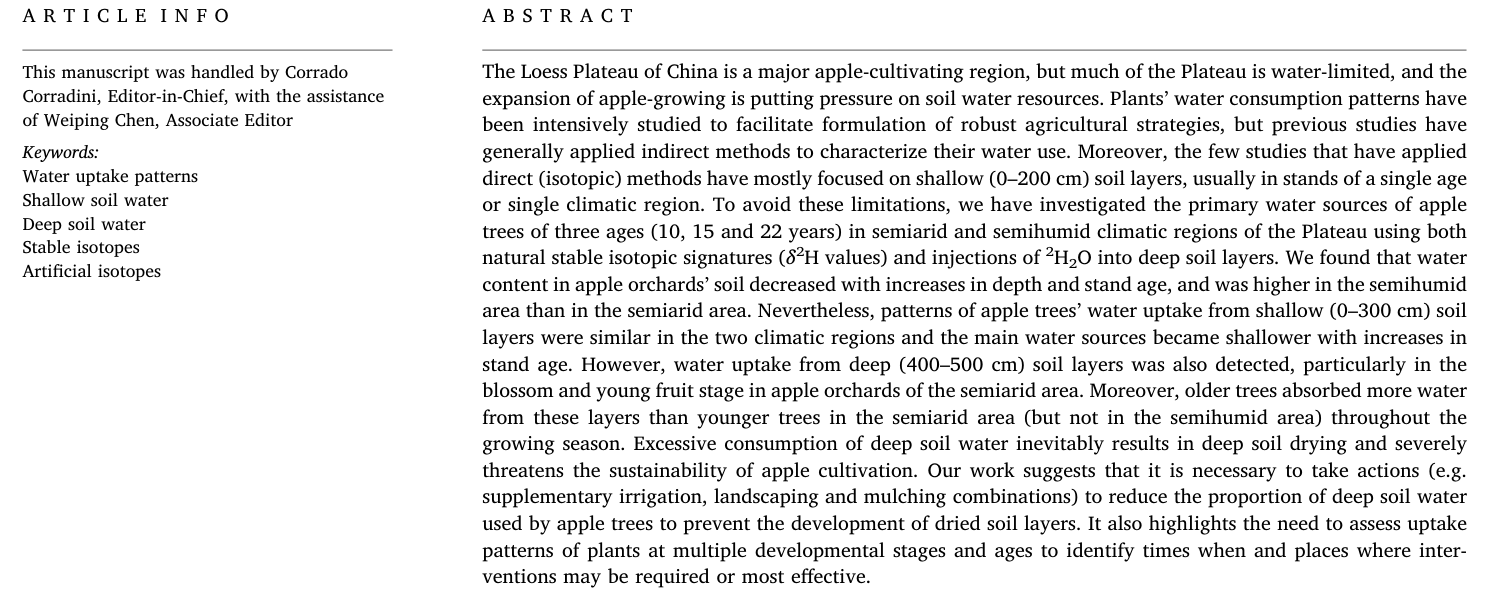
The study was conducted, in 2016, on the Loess Plateau of China (33°43′–41°16′N, 100°54′–114°33′E), which covers > 620 000 km2. Annual precipitation on the Plateau ranges from 150 mm in the northwest to 800 mm in the southeast and 55–78% of the total precipitation falls in June to September (Jia et al., 2017). Based on the ratio of mean annual precipitation to potential evapotranspiration (P/ ET), the Plateau has been divided into three climatic regions: arid (0.05–0.2), semiarid (0.2–0.5) and semihumid (0.5–0.65) (Scanlon et al., 2006; UNESCO, 1979). The annual average temperature ranges from 3.6 to 14.3 °C. There are rich solar energy resources, with mean annual sunshine hours of 2200–2800 h (Gao et al., 2017). The Plateau’s surface is covered by a thick layer of loess, > 100 m thick on average.
本研究于2016年在中国黄土高原(33°43′–41°16′N,100°54′–114°33′E)开展,该区面积 > 620 000 km2。黄土高原年降水量自西北向东南由150 mm增至800 mm,总降水量的55–78%集中于6–9月(Jia et al., 2017)。根据多年平均降水量与潜在蒸散量之比(P/ ET),黄土高原被划分为三个气候区:干旱区(0.05–0.2)、半干旱区(0.2–0.5)和半湿润区(0.5–0.65)(Scanlon et al., 2006; UNESCO, 1979)。年平均气温为3.6–14.3 °C。太阳能资源丰富,年均日照时数为2200–2800 h(Gao et al., 2017)。高原地表覆盖着深厚的黄土层,平均厚度 > 100 m。
Representative sites were selected for sample collection in both the semiarid and semihumid areas of the Plateau, each hosting apple orchards of three stand ages (10, 15 and 22 years). The two sites are located in the Tianhe watershed, Baota district, Yan’an, and the Loess Plateau Experimental Station in Qingyang, respectively, where the P/ ET ratios (based on mean precipitation and evapotranspiration from 1995 to 2010 are 0.49 and 0.51, respectively) (Fig. 1). Both sites are located in the main apple cultivation area of the Loess Plateau. At each site, we collected soil and xylem samples from apple orchards of each age. The data gathered from the stands are valid for our comparative purposes, because all orchards at the same site are located in the same small watershed, have similar slopes, aspects and soil texture, and have been subjected to the same management regimes (e.g., no irrigation, with standard clipping and fertilization treatments). Locations of the stands were recorded with a portable GPS receiver. In addition, the height, diameter at breast height and crown dimensions (long and short axes) of 20 randomly selected trees in each stand were measured with a hypsometer, caliper scale and tapeline, respectively. General information on the apple orchards is presented in Table 1.
在黄土高原半干旱区和半湿润区分别选取代表性样地进行采样,每个样地均有三种树龄(10、15和22年)的苹果园。两个样地分别位于延安市宝塔区天河流域和庆阳黄土高原试验站,其P/ ET比值(基于1995–2010年平均降水量和蒸散量)分别为0.49和0.51(图1)。两个样地均位于黄土高原苹果主产区。在每个样地,从各树龄苹果园采集土壤和木质部样品。由于同一样地的所有果园均位于同一小流域内,坡度、坡向和土壤质地相似,且管理方式相同(如不灌溉,采用标准修剪和施肥措施),因此所获数据可用于本研究的比较目的。各林分位置用便携式GPS接收机记录。此外,在每个林分随机选取20株树,分别用测高仪、卡尺和卷尺测定树高、胸径和冠幅(长轴和短轴)。苹果园基本信息见表1。
2.2. Soil water dynamics simulation2.2. 土壤水分动态模拟
2.2.1. Numerical modelling2.2.1. 数值模拟
HYDRUS-2D (version 2.03) is reportedly powerful software for simulating two- or three-dimensional axially symmetric water flow and root water uptake based on finite-element numerical solutions of flow equations (Simunek et al., 2006). Thus, we used it to simulate soil water dynamics in the apple orchards. Ignoring effects of temperature and gas on soil water movement, and assuming that soil is homogeneous and isotropic, its two-dimensional flow is described by the Richards equation (Richards, 1931; Celia et al., 1990):
HYDRUS-2D(2.03版)据报道是一款功能强大的软件,可基于水流方程的有限元数值解模拟二维或三维轴对称水流及根系吸水(Simunek et al., 2006)。因此,本研究采用该软件模拟苹果园土壤水分动态。忽略温度和气体对土壤水分运动的影响,并假定土壤均质且各向同性,其二维水流由Richards方程描述(Richards, 1931; Celia et al., 1990):

where t is time (d); θ is the volumetric water content (cm3 cm−3); r is the horizontal coordinate (cm); z is the vertical coordinate, positive upward (cm); h is the pressure head (cm); and K(h) is the unsaturated hydraulic conductivity (cm⋅d−1).
式中,t为时间(d);θ为体积含水量(cm3 cm−3);r为水平坐标(cm);z为垂直坐标,向上为正(cm);h为压力水头(cm);K(h)为非饱和导水率(cm⋅d−1)。
2.2.2. Root water uptake and boundary conditions2.2.2. 根系吸水与边界条件
The Feddes function (Feddes et al., 1978) was used to simulate apple trees’ root water uptake:
采用Feddes函数(Feddes et al., 1978)模拟苹果树根系吸水:
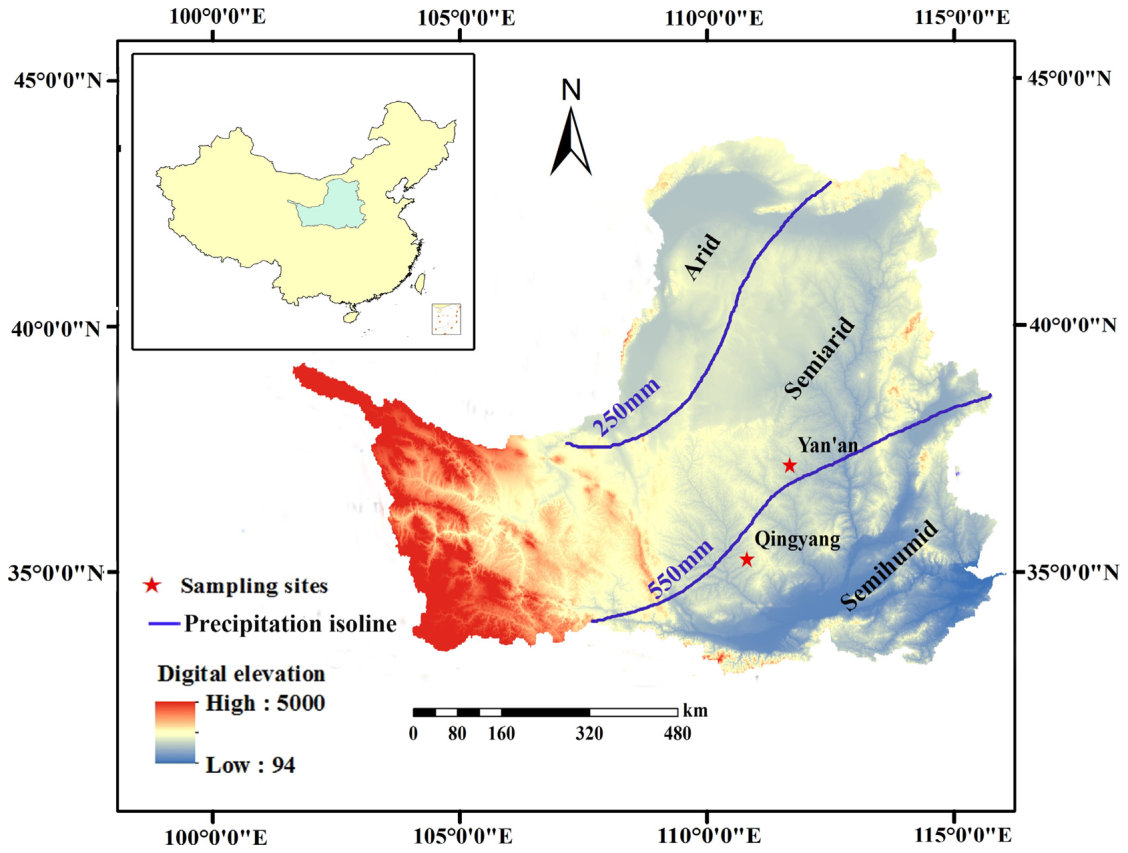
S (z, t) = α (h, z)β (z)Tp (2)
where α(h, z) is the water stress response equation; βz is the root water uptake distribution function; and Tp is the potential transpiration rate (cm−1⋅d).
式中,α(h, z)为水分胁迫响应方程;βz为根系吸水分布函数;Tp为潜在蒸腾速率(cm−1⋅d)。
We set the upper boundary to “atmospheric boundary” conditions, left and right boundaries to “zero flux” conditions, and the bottom boundary to “free drainage boundary” conditions, because the water table in the study area is much lower than the observed soil depth.
由于研究区地下水位远低于观测土层深度,将上边界设为“大气边界”条件,左右边界设为“零通量”条件,下边界设为“自由排水边界”条件。
2.2.3. Acquisition of model parameters2.2.3. 模型参数获取
The soil hydraulic properties were described by the Van Genuchten equation (1980) as follows:
土壤水力特性采用Van Genuchten方程(1980)描述,如下:
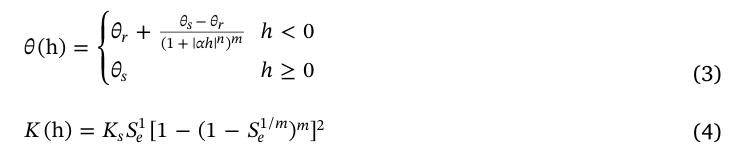
where θ is the volumetric water content (cm3 cm−3); h is the soil water pressure head (cm3); θr is the residual water content (cm3 cm−3); θs is the saturated water content (cm3 cm−3); n and m are van Genuchten- Mualem shape parameters and n = 1/(1-m); α is an empirical parameter (cm−3); Ks is saturated hydraulic conductivity; and Se is the relative saturation. The initial hydraulic parameters (θr, θs, α, Ks and n) of different soil layers were estimated using the neural network prediction program in the ROSETTA module, and then optimized by the inverse solution in HYDRUS-2D for these parameters.
式中,θ为体积含水量(cm3 cm−3);h为土壤水压力水头(cm3);θr为残余含水量(cm3 cm−3);θs为饱和含水量(cm3 cm−3);n和m为van Genuchten- Mualem形状参数,且n = 1/(1-m);α为经验参数(cm−3);Ks为饱和导水率;Se为相对饱和度。不同土层的初始水力参数(θr、θs、α、Ks和n)利用ROSETTA模块中的神经网络预测程序估算,随后通过HYDRUS-2D中的反演求解对这些参数进行优化。
2.2.4. Model calibration and evaluation2.2.4. 模型率定与评价
The volumetric water content of soil in the 10-year-old apple orchard in the semiarid area (Yan’an) was measured using a Portable Time Reflectometry (TDR) system (TRIME-PICO IPH/T3; IMKO, Germany) during the growing seasons in 2016 and 2017. Soil water was measured, at 20 cm intervals to 280 cm depth, once a month, with additional monitoring after rain. The data acquired in 2016 and 2017 were respectively used to calibrate and validate the hydraulic parameters.
2016年和2017年生长季,采用便携式时域反射仪(TDR)系统(TRIME-PICO IPH/T3;IMKO,德国)测定半干旱区(延安)10年生苹果园的土壤体积含水量。土壤水分每月测定一次,测定深度至280 cm,间隔20 cm,降雨后加测。2016年和2017年获取的数据分别用于水力参数的率定和验证。
‘Days’ were set as the time units in the numerical simulations, which ran from May 1, 2016 to September 30, 2016 and May 1, 2017 to September 30, 2017. Simulated values were compared with observed values, and values of the calibrated parameters were selected from the run when simulated and observed values were adequately consistent existed in this layer which meeting requirements for use of isotopic mixing models to distinguish primary water sources. Each soil sample was divided into two parts, one of which was placed in a vial and stored identically to the xylem samples for isotopic determination, while the other was used to obtain the gravimetric soil water content (SWC) by oven-drying.
数值模拟以“天”为时间单位,模拟时段为2016年5月1日至2016年9月30日和2017年5月1日至2017年9月30日。将模拟值与观测值进行比较,并选取模拟值与观测值充分一致时的运行结果作为率定参数值;该土层中存在满足使用同位素混合模型区分主要水源要求的条件。每个土壤样品分为两份,一份置于样品瓶中,与木质部样品同样保存用于同位素测定,另一份用烘干法测定土壤质量含水量(SWC)。
General information on the apple orchards.
苹果园基本信息。
| Sampling site采样点 | Stand age/a树龄/a | Longitude经度 | Latitude纬度 | Altitude/m海拔/m | Height*/cm树高*/cm | DBH/cm | Crown size/cm冠幅/cm |
|---|---|---|---|---|---|---|---|
| Yan’an | 10 | 109°21′51″E | 36°40′23″N | 1272 | 400 | 14.46 | 483 × 550 |
| 15 | 109°20′32″E | 36°41′48″N | 1269 | 380 | 16.46 | 487 × 551 | |
| 22 | 109°21′51″E | 36°40′23″N | 1226 | 382 | 19.59 | 570 × 633 | |
| Qingyang | 10 | 107°50′12″E | 35°39′28″N | 1244 | 394 | 14.61 | 457 × 487 |
| 15 | 107°50′22″E | 35°39′30″N | 1244 | 409 | 16.36 | 459 × 513 | |
| 22 | 107°50′23″E | 35°39′25″N | 1244 | 451 | 21.98 | 563 × 597 |
*Height, DBH (diameter at breast height) and crown size (long and short axes) are mean values of measurements of 20 trees in each stand.
*树高、DBH(胸径)和冠幅(长轴和短轴)为每个林分20株树测定值的平均值。
Soil hydraulic parameters.
土壤水力参数。
| Depth (cm)深度(cm) | θr (cm3 cm−3) | θs (cm3 cm−3) | α (cm−1) | n | Ks (cm d−1) | l |
|---|---|---|---|---|---|---|
| 0–60 | 0.0823 | 0.42 | 0.013 | 1.78 | 65 | 0.5 |
| 60–200 | 0.0823 | 0.45 | 0.025 | 1.6 | 70 | 0.5 |
| 200–300 | 0.0823 | 0.48 | 0.018 | 1.6 | 70 | 0.5 |
2.3.3. Isotope labeling experiments2.3.3. 同位素标记试验
(He et al., 2018). The soil hydraulic parameters in 2016 (calibration set) and 2017 (validation set) are shown in Table 2. The mean absolute error (MAE), root-mean-square error (RMSE) and coefficient of determination (R2) were used to assess the consistency between the simulations and observations, as expressed by the following equations.
(He et al., 2018)。2016年(率定集)和2017年(验证集)的土壤水力参数见表2。采用平均绝对误差(MAE)、均方根误差(RMSE)和决定系数(R2)评价模拟值与观测值的一致性,计算公式如下。
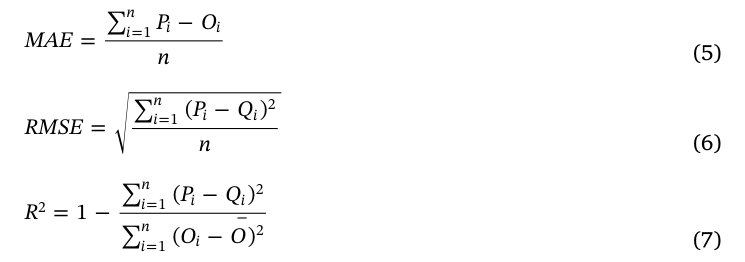
where n is the number of compared values,− Pi is the predicted value, Oi is the observed value, and O is the mean of observed data.
式中,n为比较值的个数,− Pi为预测值,Oi为观测值,O为观测数据的平均值。
2.3. Isotopic data collection2.3. 同位素数据采集
2.3.1. Fine root collection2.3.1. 细根采集
Preliminary investigations about the apple trees’ root systems distribution were conducted before isotopic sample collection. Root samples of 10-year-old apple trees (0–800 cm) were collected in trisection radiation from the representative tree trunk at 0.5 m distance using a hand auger with 90 mm diameter in May 2016 (Li et al., 2017).
在采集同位素样品之前,对苹果树根系分布进行了预调查。2016年5月,使用直径90 mm的手动土钻,在距代表性树干0.5 m处按三等分辐射方向采集10年生苹果树根系样品(0–800 cm)(Li et al., 2017)。
Collected root samples were poured into a sieve (0.2 mm, 25 cm diameter, 7.5 cm height) and then washed carefully with tap water to remove all unnecessary soil. Roots which ≤ 2 mm in diameter are the primary organ of absorbing water and nutrients in forest systems (Ceccon et al., 2011). The fine roots were scanned using a scanner at 300 dpi, and then the fine root length was determined using WinRhizo software (version 5.0 Regent Instruments Inc., Quebec, Canada). The fine root length density (FRLD m m−3) in each sample was then calculated by dividing the obtained length of fine roots by the volume of the sample.
将采集的根系样品倒入筛子(0.2 mm,直径25 cm,高7.5 cm)中,用自来水仔细冲洗以去除所有多余土壤。直径 ≤ 2 mm的根系是森林系统中吸收水分和养分的主要器官(Ceccon et al., 2011)。细根用扫描仪以300 dpi扫描,然后用WinRhizo软件(5.0版,Regent Instruments Inc.,加拿大魁北克)测定细根长度。每个样品的细根长度密度(FRLD,m m−3)以所得细根长度除以样品体积计算。
2.3.2. Sampling natural stable isotopes2.3.2. 天然稳定同位素采样
Plant and soil samples were collected from the orchards in the following three developmental stages in 2016: blossom and young fruit (BYF, May), fruit swelling (FSW, July), and fruit maturation (FTM, September).
2016年在以下三个发育阶段从果园采集植物和土壤样品:花期和幼果期(BYF,5月)、果实膨大期(FSW,7月)和果实成熟期(FTM,9月)。
On each sampling occasion, three apple trees in each orchard were randomly selected. Xylem and soil samples were collected concurrently between 8:00 and 12:00 when the trees were actively transpiring (Wang et al., 2010). Three suberized twigs (0.3–0.5 cm diameter, ca. 10 cm long and near the tree trunk) were cut from the sunny side of each sampling tree, and the bark, phloem and cambium were removed from them. Then each debarked twig was cut into 1 cm segments, which were immediately placed in vials that were sealed with parafilm, and placed in a box with ice for transportation to the laboratory where they were stored in a refrigerator until water extraction. After xylem sampling, soil samples were collected with a hand auger from shallow soil layers (at 10, 20 and 40 cm intervals from the 0–20, 20–80 and 80–300 cm layers, respectively). The soil samples depth of 300 cm was determined because > 70% of apple tree roots were distributed in the 0–300 cm soil layers and there was a distinct gradient in δ2H values
每次采样时,在每个果园随机选取3株苹果树。木质部和土壤样品于8:00–12:00树木蒸腾旺盛时同步采集(Wang et al., 2010)。从每株样树向阳面剪取3根已木栓化的枝条(直径0.3–0.5 cm,长约10 cm,靠近树干),去除树皮、韧皮部和形成层。随后将每根去皮枝条剪成1 cm小段,立即放入样品瓶中,用封口膜密封,置于冰盒中运回实验室,冷藏保存直至提取水分。木质部采样后,用手动土钻采集浅层土壤样品(0–20、20–80和80–300 cm土层分别按10、20和40 cm间隔采样)。土壤采样深度确定为300 cm,是因为 > 70%的苹果树根系分布在0–300 cm土层中,且δ2H值存在明显梯度
To obtain complementary information on deep soil water use, three trees in each orchard with similar height, crown diameter and diameter at breast height were randomly selected for inclusion in a 2H2O tracer experiment in 2016. A day before tracer injection, a 400 cm hole was drilled 50 cm from the trunk of each selected tree using a hand auger. A 400 cm long polyvinyl chloride pipe was inserted into the holes to inject tracer at the target depth (400 cm), then 150 ml of 10% 2H2O solution (15 ml 99.99% 2H2O plus 135 ml tap water) prepared in advance was injected into each hole. A previous preliminary experiment showed that this treatment increased SWC 24 h after injection by less than 1%, which is negligible for soil hydrological processes. After the 2H2O injection, the polyvinyl chloride pipe was removed and the hole was sealed.
为获取深层土壤水利用的补充信息,2016年在每个果园随机选取树高、冠径和胸径相近的3株树开展2H2O示踪试验。示踪剂注入前一天,用手动土钻在距每株选定树干50 cm处钻一个400 cm深的孔。将一根400 cm长的聚氯乙烯管插入孔中,以便在目标深度(400 cm)注入示踪剂,然后向每个孔中注入150 ml预先配制的10% 2H2O溶液(15 ml 99.99% 2H2O加135 ml自来水)。前期预试验表明,该处理在注入24 h后使SWC增加不到1%,对土壤水文过程的影响可忽略不计。注入2H2O后,取出聚氯乙烯管并封孔。
We collected xylem samples in the 7 days following each injection to detect possible tracer uptake by the trees. The first 2H2O tracer injection was conducted in May, and the xylem samples were collected 2, 4 and 7 days after the injection. Assuming that the 2H concentration in the soil would steadily decline as a result of soil water transport and uptake by roots, in July we applied a second tracer injection (identical to the first in terms of volume and concentration), and collected xylem samples 2 and 7 days later. Xylem samples were also collected from the labeled trees at the end of September. At the same time that xylem samples were collected from labeled trees, corresponding samples were collected from unlabeled trees in the same orchards to acquire background isotope concentrations. If a sample had a 2H concentration that was at least two standard deviations (SD) higher than the background value, tracer was assumed to be present (Kulmatiski et al., 2010).
每次注入后7天内采集木质部样品,以检测树木是否吸收了示踪剂。第一次2H2O示踪剂注入于5月进行,分别在注入后2、4和7天采集木质部样品。假定土壤中2H浓度会因土壤水分运移和根系吸收而持续下降,7月进行了第二次示踪剂注入(体积和浓度与第一次相同),并在2天和7天后采集木质部样品。9月底也从标记树上采集了木质部样品。在从标记树采集木质部样品的同时,从同一果园未标记树上采集相应样品,以获取同位素背景浓度。若样品的2H浓度比背景值至少高两个标准差(SD),则认为存在示踪剂(Kulmatiski et al., 2010)。
2.4. Isotopic analysis2.4. 同位素分析
The water in xylem and soil samples was extracted using a LI-2000 cryogenic vacuum distillation system (Los Gatos Research, Mountain View, USA), transferred to 5 ml glass vials, and stored at 4 °C until analysis. The stable hydrogen and oxygen isotope ratios of extracted water were then determined using a TIWA-45EP isotope ratio infrared spectroscopy analyzer (Los Gatos Research, Mountain View, USA). Methanol contamination in the plant samples was corrected by correction equation which acquired through calibration test of methanol contamination spectrum, as expressed by the following equations.
木质部和土壤样品中的水分采用LI-2000低温真空蒸馏系统(Los Gatos Research,美国Mountain View)提取,转移至5 ml玻璃瓶中,于4 °C保存直至分析。随后采用TIWA-45EP同位素比率红外光谱分析仪(Los Gatos Research,美国Mountain View)测定提取水的氢、氧稳定同位素比率。植物样品中的甲醇污染通过甲醇污染光谱校准试验获得的校正方程进行校正,计算公式如下。
δDt = δDm − 0.0247(lnM)3 + 0.0749(lnM)2 − 1.2613lnM − 1.0182 (8) where δDt is the true value, δDm is the measure value, M is the methanol value.
δDt = δDm − 0.0247(lnM)3 + 0.0749(lnM)2 − 1.2613lnM − 1.0182 (8) 式中,δDt为真值,δDm为测定值,M为甲醇值。
2.5. Determination of plant water sources2.5. 植物水源的确定
The Bayesian isotope mixing model MixSIR 1.0.4, which accounts for uncertainties associated with multiple sources (Moore and Semmens, 2008), was used to calculate proportional contributions of water from considered soil layers to water extracted from the xylem samples. The two study areas are both covered by thick loess soils and groundwater is too deep for plants’ roots to absorb. Moreover, all the experimental apple orchards are rainfed. Thus, soil water is the primary water source for plants in the orchards, and on the Plateau generally (Fan et al., 2016). Based on distributions of soil water content (SWC) and δ2H values, the entire shallow soil profile (0–300 cm) was divided into three potential soil water sources (0–40, 40–160 and 160–300 cm layers). Both SWC and δ2H values were most variable in the 0–40 layer and most stable in the 160–300 cm layer. The mean δ2H values and their standard deviations in each of these potential water sources and the xylem samples were respectively used as source and mixture data for the model. The fractionation factor was set to zero because no isotope fractionation is believed to occur during water uptake (Ehleringer and Dawson, 1992).
采用可考虑多水源不确定性的贝叶斯同位素混合模型MixSIR 1.0.4(Moore and Semmens, 2008)计算各土层水分对木质部样品提取水的贡献比例。两个研究区均覆盖深厚的黄土,地下水埋深过大,植物根系无法吸收。此外,所有试验苹果园均为雨养。因此,土壤水是果园乃至整个黄土高原植物的主要水源(Fan et al., 2016)。根据土壤含水量(SWC)和δ2H值的分布,将整个浅层土壤剖面(0–300 cm)划分为三个潜在土壤水源(0–40、40–160和160–300 cm土层)。SWC和δ2H值均在0–40土层变异最大,在160–300 cm土层最稳定。各潜在水源和木质部样品的δ2H平均值及其标准差分别作为模型的水源数据和混合数据。由于认为植物吸水过程中不发生同位素分馏,分馏系数设为零(Ehleringer and Dawson, 1992)。
2.6. Statistics2.6. 统计分析
Distributions of the SWC and δ2H values (of both xylem and soil water samples) met requirements for analysis of variance (ANOVA). Therefore, differences in δ2H values of xylem water among sampling dates were evaluated by one-way ANOVA. Two-way ANOVA was applied to detect differences in SWC and δ2H of soil water between sampling dates and depths, as well as in contributions of the three water sources (soil layers) to xylem water between sampling dates. Least significant difference (LSD) post-hoc tests, with α = 0.05, were used to identify significant between-date and between-depth differences.
SWC和δ2H值(包括木质部水和土壤水样品)的分布满足方差分析(ANOVA)的要求。因此,采用单因素ANOVA评价不同采样日期间木质部水δ2H值的差异。采用双因素ANOVA检验土壤水SWC和δ2H在采样日期和深度间的差异,以及三个水源(土层)对木质部水贡献在采样日期间的差异。采用最小显著差异(LSD)事后检验(α = 0.05)识别日期间和深度间的显著差异。
3Results结果
3.1. Precipitation and soil moisture dynamics3.1. 降水与土壤水分动态
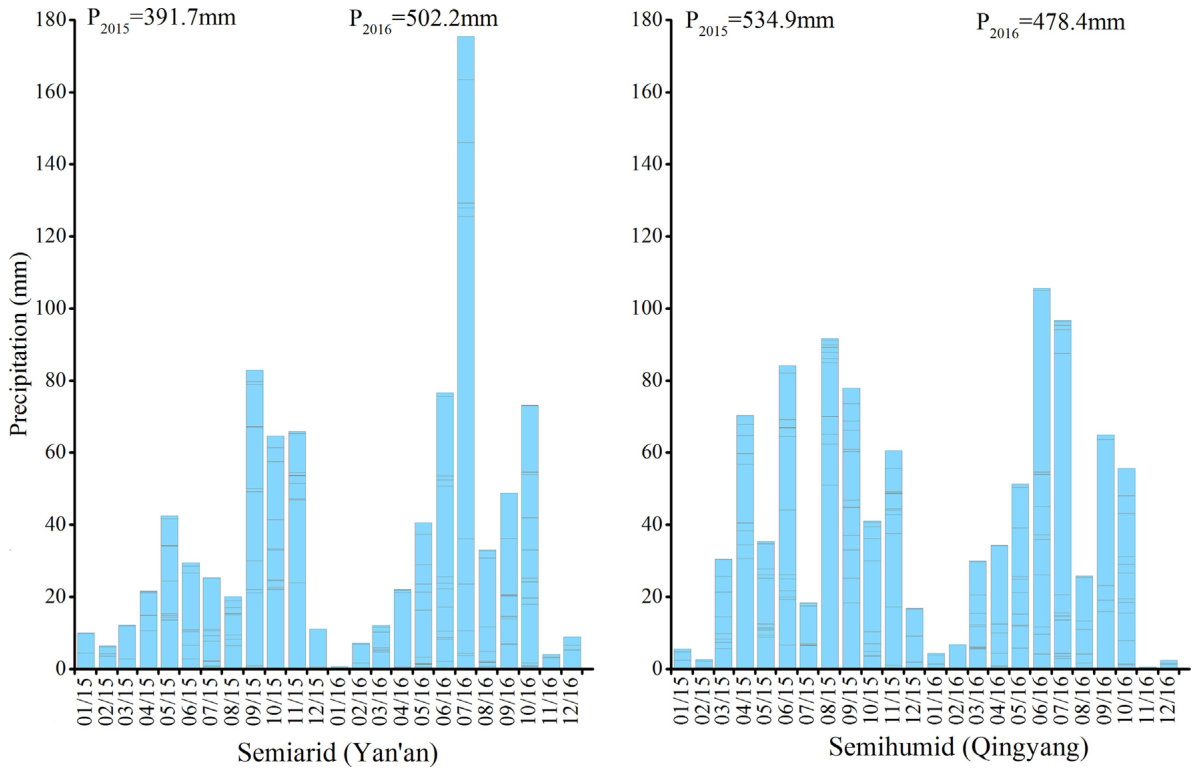
Total precipitation in the study year (2016) amounted to 502.2 and 478.4 mm in the semiarid and semihumid areas, respectively, which were both defined as normal precipitation years. In both cases > 90% of the precipitation occurred during the growing season. Additionally, the highest monthly precipitation was 175.4 mm in July in the semiarid area and 105.6 mm in June in the semihumid area. In the highest single precipitation events 89.5 and 66.9 mm of rain fell in these areas, respectively, in both cases in July. The precipitation in 2016 was 28.2% greater than in 2015 in the semiarid area, but 10.6% lower than in 2015 in the semihumid area (Fig. 2).
研究年份(2016年)半干旱区和半湿润区总降水量分别为502.2和478.4 mm,均属平水年。两区 > 90%的降水均发生在生长季。此外,半干旱区月最大降水量为7月的175.4 mm,半湿润区为6月的105.6 mm。两区最大单次降水事件的降雨量分别为89.5和66.9 mm,均发生在7月。与2015年相比,2016年半干旱区降水量增加了28.2%,而半湿润区降水量减少了10.6%(图2)。
Fig. 3 shows the observed and simulated soil water dynamics of 10- year-old apple orchard in semiarid area in 2016 and 2017. The results suggest that there is a strong correlation between the simulated and图3显示了2016年和2017年半干旱区10年生苹果园土壤水分动态的观测值和模拟值。结果表明,模拟值与
observed volumetric water content for both 5 soil layers. MAE, RMSE and R2 ranged from 0.5% to 2.1%, 0.5% to 3.2% and 80.0% to 92.4%, respectively (Table 3). These data confirmed the suitability of HYDRUS- 2D for simulating water dynamics in the area, at least under the range of precipitation conditions during the monitoring period. Based on the United States Department of Agriculture’s classification system, the soils at the two sites are similar silt Loam (with 15.8% clay, 59.4% silt and 18.2% sand contents in Yan’an, and 22.6% clay, 51.5% silt and 26.5% sand contents in Qingyang). Thus, data acquired at the Yan’an site were used to calibrate parameters for numerical simulations with the HYDRUS-2D model of the soil water dynamics of the orchards in both the semiarid and semihumid regions of the Plateau.
观测体积含水量在全部5个土层中均具有较强的相关性。MAE、RMSE和R2分别为0.5%–2.1%、0.5%–3.2%和80.0%–92.4%(表3)。这些数据证实,至少在监测期内的降水条件范围内,HYDRUS- 2D适用于模拟该区域的水分动态。根据美国农业部分类系统,两个样地的土壤均为相似的粉砂壤土(延安黏粒、粉粒和砂粒含量分别为15.8%、59.4%和18.2%,庆阳分别为22.6%、51.5%和26.5%)。因此,利用延安样地获取的数据率定参数,采用HYDRUS-2D模型对黄土高原半干旱区和半湿润区果园土壤水分动态进行数值模拟。
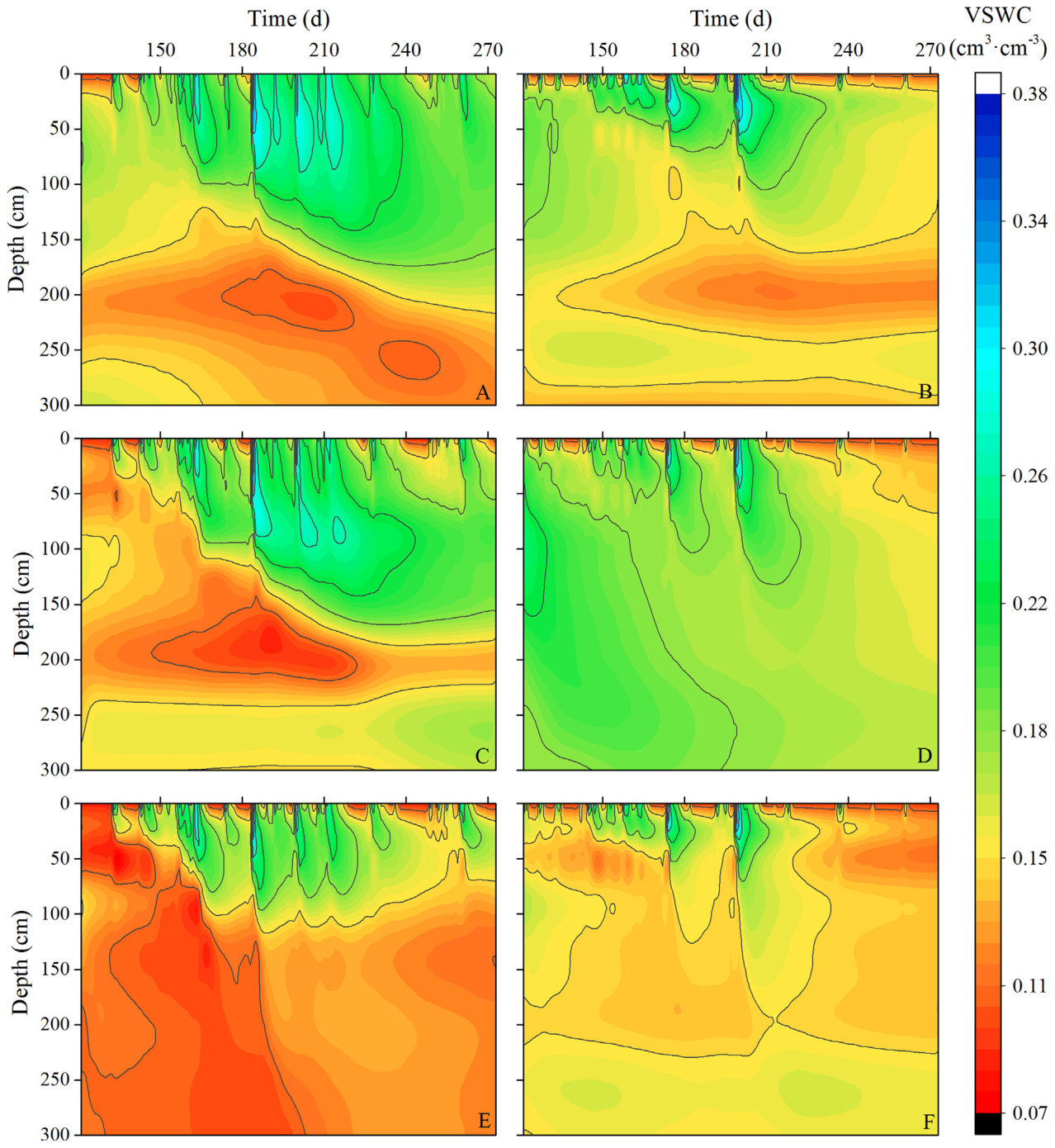
The volumetric soil water content (VSWC) of all six orchards displayed clear seasonal and vertical variations throughout the growing season, and differed with stand age and climate (Fig. 4). Due to the typical effects of rainfall infiltration and evapotranspiration, the VSWC showed markedly high temporal variations in 0–100 cm soil layers than in deeper layers. In the semiarid area, desiccation occurred at 160–300, 160–240 and 100–300 cm depths in the 10-, 15- and 22-year-old orchards, respectively. The VSWC of all orchards decreased with increasing stand age in both the semiarid and semihumid areas. Although the total precipitation in the semiarid area was slightly higher than in the semihumid area in 2016, the VSWC in the profile was lower in the semiarid area than in the semihumid area during the BYF stage (from the 121th to 150th day) (Fig. 4). This difference is mainly attributed to the impact of precipitation in the preceding year, which as mentioned above was substantially higher in the semihumid area (534.9 mm) than in the semiarid area (391.7 mm) (Fig. 2). Overall, as expected, orchards in the semihumid area had higher soil water contents than those in the semiarid area.
在整个生长季,六个果园的土壤体积含水量(VSWC)均表现出明显的季节变化和垂直变化,并随树龄和气候而不同(图4)。受降雨入渗和蒸散的典型影响,0–100 cm土层VSWC的时间变异明显高于深层土壤。在半干旱区,10、15和22年生果园分别在160–300、160–240和100–300 cm深度出现干化。在半干旱区和半湿润区,所有果园的VSWC均随树龄增加而降低。尽管2016年半干旱区总降水量略高于半湿润区,但在BYF阶段(第121至150天),半干旱区剖面VSWC低于半湿润区(图4)。这一差异主要归因于前一年降水的影响,如前所述,前一年半湿润区降水量(534.9 mm)明显高于半干旱区(391.7 mm)(图2)。总体而言,正如预期,半湿润区果园的土壤含水量高于半干旱区。
3.2. δ2H values in xylem and soil water3.2. 木质部水和土壤水的δ2H值
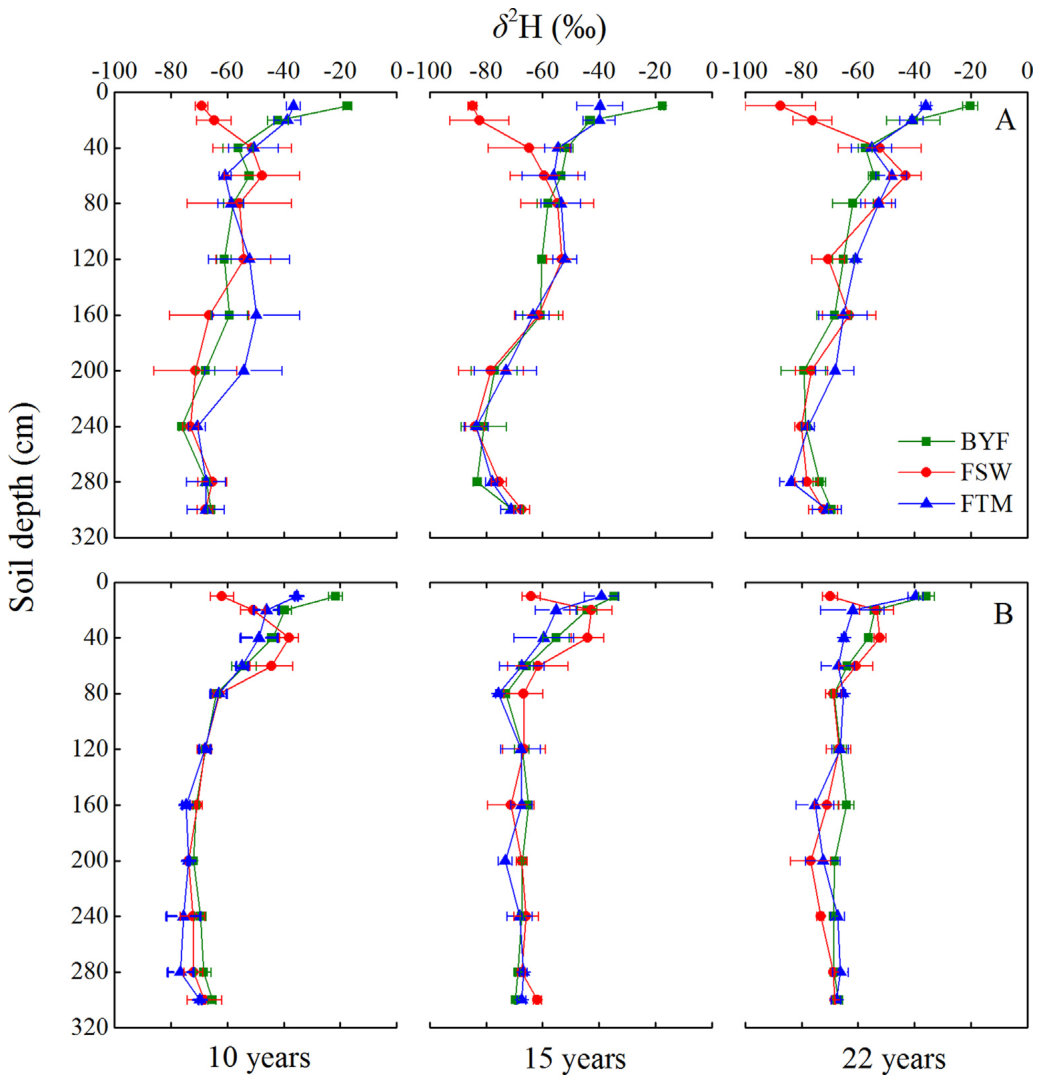
The δ2H values in xylem water from trees in stands of different ages varied substantially during the growth period in the two climatic regions (Fig. 5). The xylem water δ2H of 10-year-old trees fluctuated most during the growing season, varying from –66.7‰ to –53.3‰ in the semiarid area and from –68.9‰ to –57.3‰ in the semihumid area. The variation in δ2H in xylem water from the 15- and 22-year-old trees showed similar temporal trends in the two climatic regions, falling between the BYF and FSW stages then increasing between the FSW and FTM stages.
在两个气候区,不同树龄林分树木木质部水的δ2H值在生长期内变化明显(图5)。10年生树木木质部水δ2H在生长季波动最大,半干旱区为–66.7‰至–53.3‰,半湿润区为–68.9‰至–57.3‰。两个气候区15年生和22年生树木木质部水δ2H的变化呈现相似的时间趋势,即在BYF至FSW阶段下降,在FSW至FTM阶段上升。
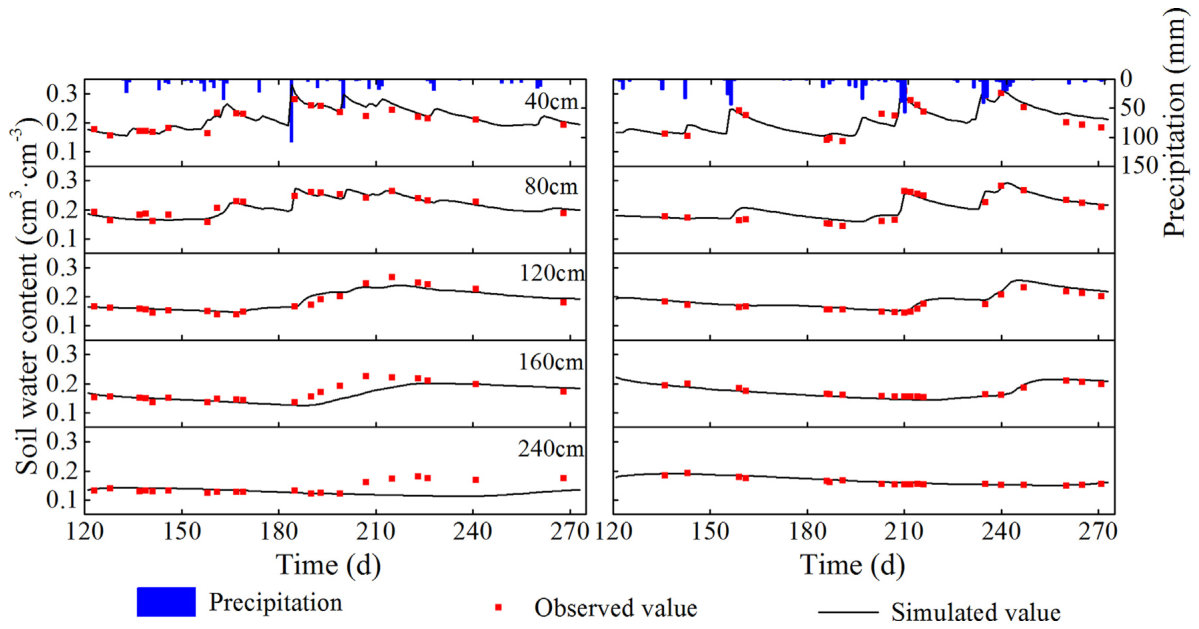
Performance of the model in simulating soil water at indicated depths for the calibration (2016) and validation (2017) datasets according to three criteria: MAE, RMSE and R2 (mean absolute errors, root-mean-square errors and coefficient of determination, respectively, percentages).
基于MAE、RMSE和R2(分别为平均绝对误差、均方根误差和决定系数,以百分比表示)三项指标,模型对率定集(2016年)和验证集(2017年)中各指定深度土壤水分的模拟性能。
| Depth (cm)深度(cm) | 2016 | 2017 | ||||
|---|---|---|---|---|---|---|
| MAE | RMSE | R2 | MAE | RMSE | R2 | |
| 40 | 1.0 | 1.6 | 81.2 | 1.7 | 2.1 | 84.7 |
| 80 | 1.2 | 1.4 | 84.7 | 1.4 | 1.9 | 83.4 |
| 120 | 1.0 | 1.4 | 92.4 | 1.1 | 1.2 | 80.0 |
| 160 | 1.6 | 2.3 | 81.6 | 0.7 | 0.8 | 82.7 |
| 240 | 2.1 | 3.2 | 80.0 | 0.5 | 0.5 | 80.3 |
There were marked variations with both depth and sampling date in δ2H values of shallow soil layers in both climatic regions (Fig. 6). The values were more negative in 40–300 cm layers than in 0–40 cm soil layers of all the orchards in the BYF and FTM stages, but they were more negative in the 0–40 cm layers in the FSW stage, possibly due to infiltration of precipitation with strongly negative values in summer events. Hence, the soil water δ2H fluctuated more strongly in the upper 40 cm layers (ranging from –69.87‰ to –21.69‰ in the semiarid area and from –87.53‰ to –17.47‰ in the semihumid area) than in the 40–300 cm layers. As soil depth increased, the influences of precipitation weakened. The δ2H values in the 40–300 cm soil layers were relatively stable and did not significantly differ among sampling dates.
两个气候区浅层土壤δ2H值均随深度和采样日期呈现明显变化(图6)。在BYF和FTM阶段,所有果园40–300 cm土层的数值均比0–40 cm土层更负,而在FSW阶段则是0–40 cm土层更负,这可能是由于夏季降水事件中δ值强烈偏负的降水入渗所致。因此,上部40 cm土层土壤水δ2H的波动(半干旱区为–69.87‰至–21.69‰,半湿润区为–87.53‰至–17.47‰)强于40–300 cm土层。随着土壤深度增加,降水的影响减弱。40–300 cm土层的δ2H值相对稳定,各采样日期间无显著差异。
3.3. Water uptake patterns3.3. 吸水模式
Analysis of the δ2H values of xylem and soil water revealed significant variation in contributions of three potential soil water sources of the apple trees throughout the growing season in the two climatic regions (Fig. 7). In the BYF stage, when precipitation was relatively light and evaporation strong, the SWC values in the shallow layers were relatively low and the trees took up correspondingly large proportions of water from deeper layers. For example, 15-year-old trees in the semiarid area took up 48.3% of their xylem water from the 40–160 cm soil layers in the semiarid area. Similarly, 10-year-old trees took up 44.8% of their xylem water from the below 160 cm soil layers in the semiarid area, and the 10- and 15-year-old trees respectively took up 63.4 and 41.8% from the below 160 cm layers in the semihumid area during this stage. As precipitation infiltrated in the FTM stage, 10- and 15-year-old apple trees showed great plasticity in their water uptake patterns, switching their main water source to the 0–40 cm soil layers (which respectively accounted for 43.6 and 44.8% of the xylem water for 10- and 15-year-old trees in the semiarid area, and 63.4 and 41.8% in the semihumid area, respectively) (Fig. 7A–D). The 22-year-old apple trees in the two climatic regions showed similar water uptake patterns. They primarily derived water from 0–160 cm soil layers (73.6 and 71.7% in BYF and FSW stages in the semiarid area, respectively; 71.5 and 89.1% in these stages in the semihumid area, respectively), then switched to 0–40 cm soil layers (48.5 and 58.4% in the semiarid and semihumid areas, respectively) in the FTM stage when the water in the upper layers was replenished (Fig. 7E and F).
对木质部水和土壤水δ2H值的分析表明,在两个气候区,苹果树三个潜在土壤水源的贡献在整个生长季内存在显著变化(图7)。在BYF阶段,降水相对较少且蒸发强烈,浅层SWC相对较低,树木相应地从较深土层吸收了较大比例的水分。例如,半干旱区15年生树木木质部水的48.3%来自40–160 cm土层。同样,在该阶段,半干旱区10年生树木木质部水的44.8%来自160 cm以下土层,半湿润区10年生和15年生树木分别有63.4%和41.8%的水分来自160 cm以下土层。随着FTM阶段降水入渗,10年生和15年生苹果树的吸水模式表现出很强的可塑性,其主要水源转变为0–40 cm土层(在半干旱区分别占10年生和15年生树木木质部水的43.6%和44.8%,在半湿润区分别占63.4%和41.8%)(图7A–D)。两个气候区22年生苹果树的吸水模式相似。它们主要从0–160 cm土层获取水分(半干旱区BYF和FSW阶段分别为73.6%和71.7%;半湿润区这两个阶段分别为71.5%和89.1%),在FTM阶段上层土壤水分得到补充后,则转为主要吸收0–40 cm土层水分(半干旱区和半湿润区分别为48.5%和58.4%)(图7E和F)。
3.4. Variations in the isotopic label3.4. 同位素标记的变化
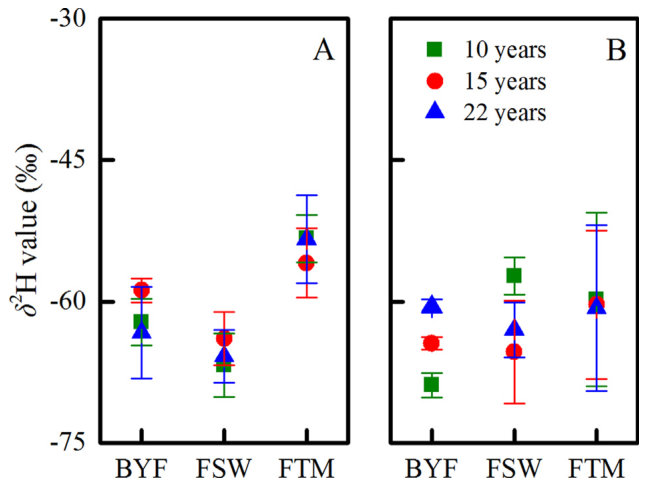
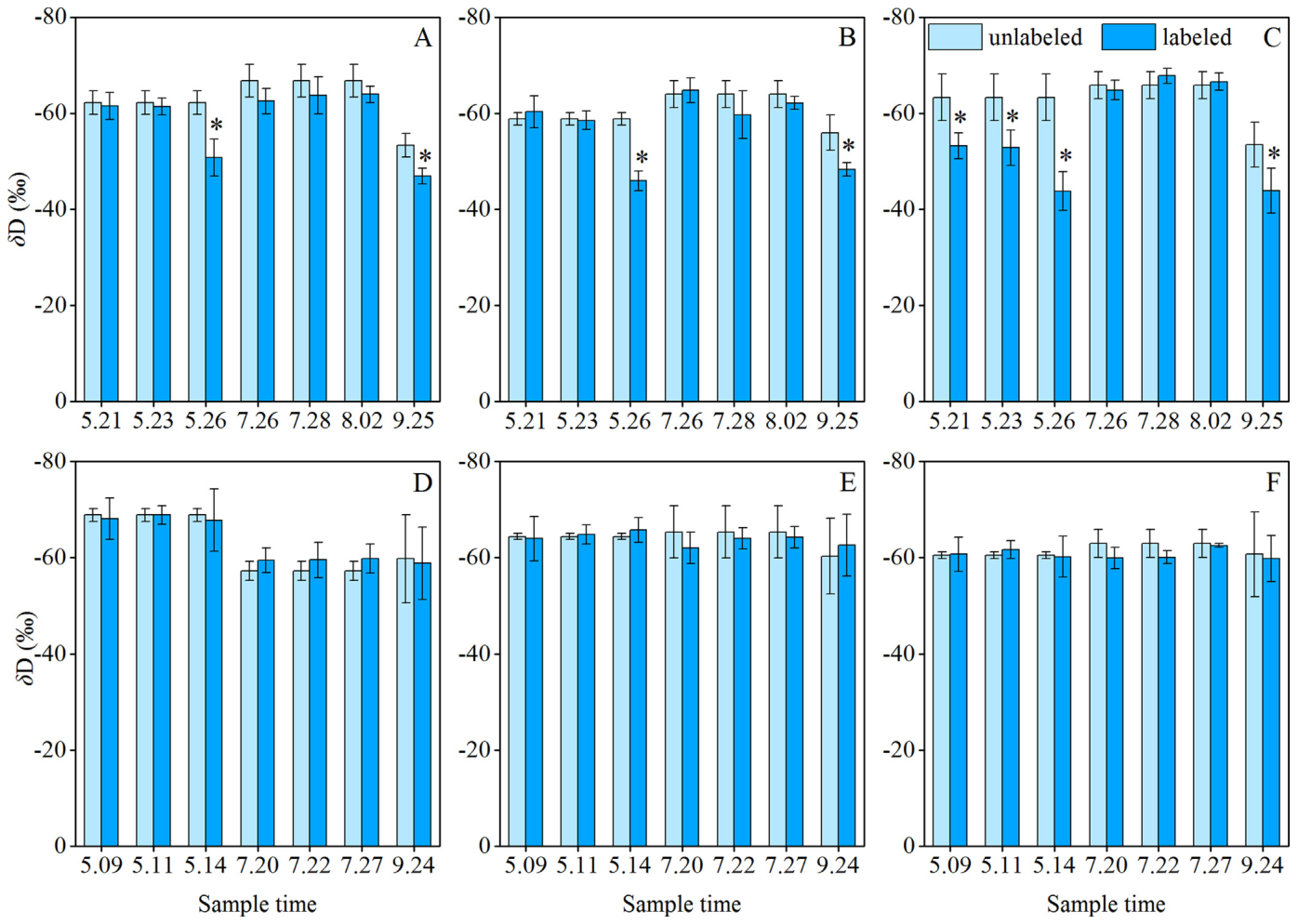
The temporal variation in 2H concentrations in the xylem of monitored trees following 2H2O injections provided direct evidence of deep root water uptake (Fig. 8), with differences associated with both stand age and climatic region. In the semiarid area, 22-year-old apple trees absorbed water from 400–500 cm soil layers rapidly (Fig. 8A), as manifested by significantly elevated 2H values of samples taken two days after the injections. Then δ2H values progressively increased, to –43.78‰ (30.8% higher than the background value) by the seventh day. In contrast, no artificial tracer was detected in xylem of 10- and 15- year-old trees 2 and 4 days after labeling, but by the seventh day, their δ2H values were significantly (18.4 and 21.9%, respectively) higher than the background values. No evidence of uptake of labelled water by the trees was found in the seven days following the second injection, but clear signs of uptake were observed on September 25. No uptake of the labeled water in any of the three apple orchards at any stage of the sampling campaign was detected in the semihumid area (Fig. 8B).
注入2H2O后,监测树木木质部中2H浓度的时间变化为深层根系吸水提供了直接证据(图8),且其差异与树龄和气候区均有关。在半干旱区,22年生苹果树迅速吸收了400–500 cm土层的水分(图8A),表现为注入后两天所采样品的2H值显著升高。随后δ2H值逐渐升高,至第七天达–43.78‰(比背景值高30.8%)。相比之下,标记后第2天和第4天在10年生和15年生树木木质部中未检测到人工示踪剂,但至第七天,其δ2H值显著高于背景值(分别高18.4%和21.9%)。第二次注入后的七天内未发现树木吸收标记水的证据,但在9月25日观察到明显的吸收迹象。在半湿润区,整个采样期间任何阶段均未在三个苹果园中检测到标记水的吸收(图8B)。
4Discussion讨论
4.1. Uncertainty in the soil moisture simulation4.1. 土壤水分模拟的不确定性
HYDRUS-2D accurately captured temporal and spatial dynamics of soil moisture, according to comparison of observed and simulated values, with both MAE and RMSE ≤ 3.2% and R2 consistently ≥ 80.0% (Table 3). This may be to the reasons of the application of inverse solution in the acquisition of parameters. Nascimento et al. (2018) had demonstrated good similarity between field-measured data and data fitted by inverse solution, and HYDRUS inverse solution is a useful technique for rapid characterization of the unsaturated soil hydraulic properties (Rashid et al., 2015). These results confirm numerous previous demonstrations that HYDRUS-2D has high ability to simulate soil moisture dynamics under diverse conditions (Autovino et al., 2018; Cai et al., 2018; Karandish and Šimůnek, 2019). Nevertheless, there are clearly uncertainties in soil moisture simulations by HYDRUS-2D due to uncertainties in multiple (soil, meteorology and plant) parameters. For example, neural network prediction program in the ROSETTA module was used to predict the soil hydraulic parameters in the Loess Plateau (Lü et al., 2009). Random aspects of sedimentation processes during formation of soils on the Plateau resulted in significant spatial variability in soil physical and chemical properties, which inevitably affect movements of soil moisture and then impact on the simulation effect. Notably, the simulation of soil moisture was less accurate for the 160–300 cm soil layers than for other layers following extreme rainfall (108 mm on July 3, 2016), possibly due to preferential flow leading to increases in soil moisture in the 160–300 cm soil layers that the model did not account for. Moreover, the root distribution is simply described by HYDRUS-2D with just six parameters (maximum rooting depth and
观测值与模拟值的比较表明,HYDRUS-2D准确捕捉了土壤水分的时空动态,MAE和RMSE均 ≤ 3.2%,R2均 ≥ 80.0%(表3)。这可能得益于参数获取中采用了反演求解。Nascimento et al.(2018)已证明田间实测数据与反演求解拟合数据具有良好的一致性,HYDRUS反演求解是快速表征非饱和土壤水力特性的有效技术(Rashid et al., 2015)。这些结果印证了以往大量研究的结论,即HYDRUS-2D在多种条件下均具有较强的土壤水分动态模拟能力(Autovino et al., 2018; Cai et al., 2018; Karandish and Šimůnek, 2019)。然而,由于多种(土壤、气象和植物)参数存在不确定性,HYDRUS-2D的土壤水分模拟显然存在不确定性。例如,采用ROSETTA模块中的神经网络预测程序预测黄土高原土壤水力参数(Lü et al., 2009)。黄土高原成土过程中沉积作用的随机性导致土壤理化性质存在显著的空间变异,这必然影响土壤水分运移,进而影响模拟效果。值得注意的是,在极端降雨(2016年7月3日,108 mm)之后,160–300 cm土层的土壤水分模拟精度低于其他土层,这可能是由于优先流导致160–300 cm土层土壤水分增加,而模型未考虑这一过程。此外,HYDRUS-2D仅用六个参数简单描述根系分布(最大扎根深度和
radius, maximum rooting intensity depth and radius, dimensionless parameter Pz and Px), which is clearly insufficient for detailed simulation of root water uptake.半径、最大扎根强度深度和半径、无量纲参数Pz和Px),这显然不足以详细模拟根系吸水。
4.2. Seasonal and regional variations of water uptake patterns4.2. 吸水模式的季节和区域变化
The δ2H values of soil water in the apple orchards exhibited significant seasonal patterns in both climatic regions (Fig. 6), and they were intimately associated with precipitation infiltration and evaporation, which differed in the two regions. This directly caused variations in δ2H values of xylem water in the trees throughout the growing season, within and between the two climatic regions (Fig. 5). Therefore, there were distinct seasonal and spatial variations in the trees’ water sources, which also varied among orchards of different ages (Fig. 7).
两个气候区苹果园土壤水δ2H值均表现出显著的季节规律(图6),且与降水入渗和蒸发密切相关,而后两者在两个区域有所不同。这直接导致两个气候区内及区域间树木木质部水δ2H值在整个生长季发生变化(图5)。因此,树木水源存在明显的季节和空间变化,且在不同树龄果园间也有所不同(图7)。
The MixSIR (1.0.4) based analysis detected apparently adaptive water use by the 10- and 15-year-old apple trees in the semiarid area, which switched their primary water sources from 160–300 or 40–160 cm soil layers to 0–40 cm soil layers as the growing season progressed (Fig. 7A and C). This is consistent with findings of several previous studies, that plants absorbed water predominantly from deep soil layers during drought periods (Gao et al., 2018b; Song et al., 2016) and switched to shallow soil layers during other periods (Yang et al., 2015). In contrast, the 22-year-old trees predominately acquired water from 0–160 cm soil layers, and the proportional contribution of water from 160–300 cm layers decreased throughout the growing season. This could be ascribed to relatively low SWC in the 160–300 cm soil layers due to continuous consumption (Fig. 7E). This result partially differs from findings of Zhao et al. (2018), that shallow (0–40 cm) layers were not the primary sources for 22-year-old jujube trees in the semiarid area, possibly due to differences in soil water availability.
基于MixSIR(1.0.4)的分析发现,半干旱区10年生和15年生苹果树表现出明显的适应性水分利用,随着生长季推进,其主要水源从160–300或40–160 cm土层转变为0–40 cm土层(图7A和C)。这与以往若干研究的结果一致,即植物在干旱时期主要吸收深层土壤水(Gao et al., 2018b; Song et al., 2016),而在其他时期转向浅层土壤水(Yang et al., 2015)。相比之下,22年生树木主要从0–160 cm土层获取水分,且160–300 cm土层水分的贡献比例在整个生长季持续下降。这可能是由于持续消耗导致160–300 cm土层SWC相对较低(图7E)。该结果与Zhao et al.(2018)的研究结果部分不同,后者发现浅层(0–40 cm)土壤并非半干旱区22年生枣树的主要水源,这可能是由于土壤水分有效性的差异所致。
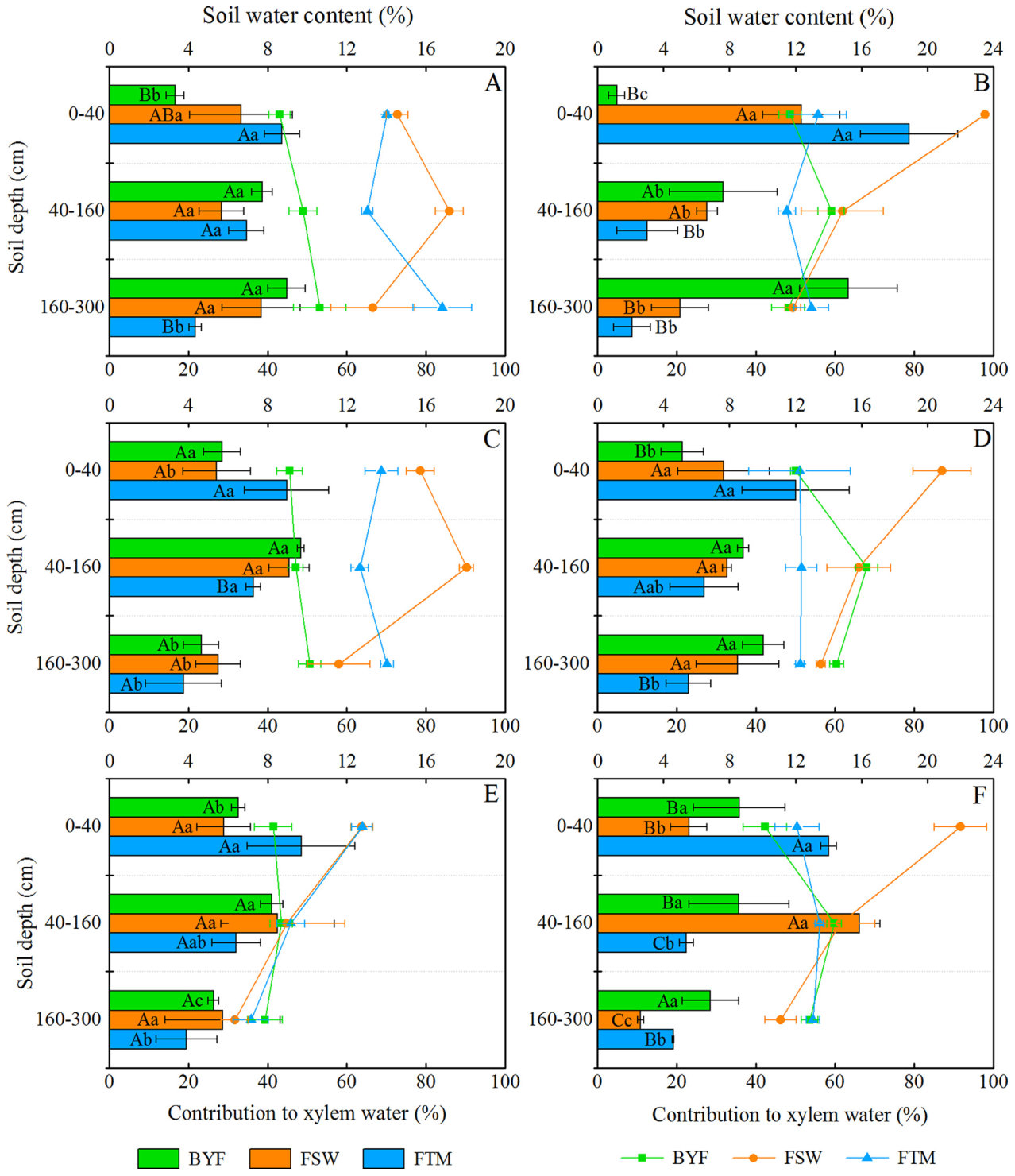
Apple trees in the semihumid area showed similar water use patterns to those in the semiarid area. 10- and 15-year-old trees shifted their water sources from the 160–300 cm to 0–40 cm soil layers, and 22-year-old trees mainly exploited water from the 0–160 cm soil layers throughout the growing season (Fig. 7B, D and F). In addition, the proportional contributions of water in the 160–300 cm layers were significantly higher in the BYF stage than in the FTM stage for trees of all three ages (P < 0.05). This could be due to relatively low availability of water in the 0–160 cm layers due to relatively high evapotranspiration and low precipitation in the BYF stage (Fig. 7B, D and F).
半湿润区苹果树的水分利用模式与半干旱区相似。10年生和15年生树木的水源从160–300 cm土层转向0–40 cm土层,而22年生树木在整个生长季主要利用0–160 cm土层的水分(图7B、D和F)。此外,三种树龄树木在BYF阶段160–300 cm土层水分的贡献比例均显著高于FTM阶段(P < 0.05)。这可能是由于BYF阶段蒸散较高、降水较少,导致0–160 cm土层水分有效性相对较低(图7B、D和F)。
Interestingly, despite SWC in the 0–40 cm soil layers increasing significantly due to heavy rainfall in the FSW stage, the proportional use of shallow water by the 15- and 22-year-old trees did not increase (Fig. 7D and F). Similar studies in water-limited ecosystems have detected a time lag in plants’ switches to different water sources following precipitation-mediated increases in water availability in shallow layers (Huo et al., 2018; Wu et al., 2016). Other studies have also detected a time lag between water shortage and plants’ responses (Vicente-Serrano et al., 2013; Yang et al., 2015). Nevertheless, the proportional contribution of the 0–40 cm soil water for 10-year-old apple trees increased significantly in the FSW stage, in marked contrast to the observed pattern for older trees (Fig. 7B). This could be partly due to root systems of younger trees having higher sensitivity to water. Skubel et al. (2015) also found that young stands may be more suitable than older stands in warm environments with variable precipitation. Hence, both the likelihood of such time lags and their duration if they occur may be related to stand age. Trees of all three ages obtained the largest proportions of their water from the 0–40 cm soil layers in the FTM age, and the SWC in these layers was correspondingly low (Fig. 7B). Normally, plants’ roots obtain resources from upper soil layers (when available) as the energy costs are lower, and both water and nutrient availability are generally high in the upper layers (Schenk, 2008).
值得注意的是,尽管FSW阶段强降雨使0–40 cm土层SWC显著增加,15年生和22年生树木对浅层水的利用比例并未增加(图7D和F)。水分受限生态系统中的类似研究发现,在降水导致浅层水分有效性增加后,植物转换水源存在时间滞后(Huo et al., 2018; Wu et al., 2016)。其他研究也发现水分亏缺与植物响应之间存在时间滞后(Vicente-Serrano et al., 2013; Yang et al., 2015)。然而,10年生苹果树对0–40 cm土壤水的利用比例在FSW阶段显著增加,与较老树木的观测模式形成鲜明对比(图7B)。这可能部分由于幼龄树木根系对水分更为敏感。Skubel et al.(2015)也发现,在降水多变的温暖环境中,幼龄林分可能比老龄林分更为适宜。因此,此类时间滞后的发生可能性及其持续时间可能与树龄有关。三种树龄树木在FTM阶段均从0–40 cm土层获取最大比例的水分,而该土层SWC相应较低(图7B)。通常,植物根系会从上层土壤(在有水可用时)获取资源,因为其能量成本较低,且上层土壤的水分和养分有效性通常较高(Schenk, 2008)。
4.3. Water uptake dynamics from deep soil layers4.3. 深层土壤吸水动态
The water extracted from deep soil is important for plants’ growth, especially in dry periods, and significantly contributes to drought avoidance (Yang et al., 2017). Thus, to obtain more comprehensive information about the trees’ water uptake patterns, 2H2O tracer was injected at 400 cm depth and concentrations of 2H in xylem samples were measured to investigate their deep soil water uptake dynamics (Fig. 8).
从深层土壤吸收的水分对植物生长至关重要,尤其是在干旱时期,并对避旱具有显著贡献(Yang et al., 2017)。因此,为获取树木吸水模式的更全面信息,在400 cm深度注入2H2O示踪剂,并测定木质部样品中2H浓度,以研究其深层土壤吸水动态(图8)。
The artificial tracer was detected in xylem of apple trees, as expected (Fig. 8A), given that roots of apple trees at full productive age could reach depths of 10 m and the roots were deeper as the stand age increasing (Zhang et al., 2017b; Li et al., 2019). Water uptake from deep soil layers (400–500 cm) was detected in BYF in apple orchards of the semiarid area. It maybe because precipitation in BYF was relatively less and evaporation was strong, resulting in relatively low soil water content in shallow layers. Meanwhile, BYF is the critical period of water demand for apple trees. And the SWC in 400 cm depth was higher than its in shallow layers (0–300 cm) (Fig. S1) in this period, so apple trees would take up more deep soil water when shallow soil water rarely suffices the demand. Interestingly, In the semiarid area, 22-year-old apple trees absorbed deep (400–500 cm) soil water rapidly (within 2 days), but the younger trees absorbed it after a longer delay (Fig. 8A), according to the criterion of xylem 2H concentrations being at least two standard deviations (SD) higher than the background value. There are several possible explanations for such uptake. First, some roots capable of taking up water may be present at the labeling depth. Second, hydraulic redistribution of water from deep to upper soil layers may occur, enabling shallow roots to absorb it (Bleby et al., 2010; Scott et al., 2008). Third, deep water may be rapidly accessed and transferred through mycorrhizae (Plamboeck et al., 2007). It should be noted that 2H xylem concentrations increased more rapidly in the 22-year-old trees than in the younger trees, indicating that older trees might have higher transpiration requirements. This inference is consistent with findings by Wang and Wang (2017) that apple trees’ daily transpiration and evapotranspiration rates are positively correlated with age. Furthermore, the 22-year-old trees were markedly larger than the younger trees (Table 1), and recent research suggests that canopy cover is the primary driver of orchards’ water consumption (Dzikiti et al., 2018). In addition, evidence of uptake of the injected 2H2O was detected in samples from trees in the semiarid area, substantially later, on September 25 (Fig. 8A), possibly because the trees were water-stressed in this period or hydraulic redistribution occurred (Beyer et al., 2016). In contrast, no uptake of the artificial tracer was detected in apple trees in the semihumid area at any sampling date (Fig. 8B). The difference between trees in the two areas could be due to differences in soil water distributions resulting from spatiotemporal heterogeneity of precipitation (Wang et al., 2011). Many trees (including apple trees) have dimorphic root systems, which enable them to switch water sources between shallow and deep soil layers depending on the soil moisture distribution (Liu et al., 2019). Therefore, soil water conditions in shallow layers will strongly affect apple trees’ utilization of deep soil water.
如预期,在苹果树木质部中检测到了人工示踪剂(图8A),这是因为盛果期苹果树根系可深达10 m,且根系深度随林龄增加而加深(Zhang et al., 2017b; Li et al., 2019)。在半干旱区苹果园中,BYF期检测到苹果树对深层土壤(400–500 cm)水分的吸收。这可能是由于BYF期降水相对较少而蒸发强烈,导致浅层土壤含水量相对较低。同时,BYF期是苹果树需水的关键时期。该时期400 cm深度的SWC高于浅层(0–300 cm)(图S1),因此当浅层土壤水分难以满足需求时,苹果树会吸收更多深层土壤水分。值得注意的是,按照木质部2H浓度至少高于背景值两个标准差(SD)的判定标准,在半干旱区,22年生苹果树能迅速(2 d内)吸收深层(400–500 cm)土壤水分,而较幼龄的树木则在较长时间延迟后才吸收(图8A)。对这种吸收现象可能有以下几种解释。第一,标记深度处可能存在具有吸水能力的根系。第二,可能发生了水分由深层向上层土壤的水力再分配,使浅层根系得以吸收(Bleby et al., 2010; Scott et al., 2008)。第三,深层水分可能通过菌根被迅速获取和传输(Plamboeck et al., 2007)。需要指出的是,22年生树木木质部2H浓度的升高速度快于较幼龄树木,表明树龄较大的树木可能具有更高的蒸腾需求。这一推论与Wang and Wang(2017)的研究结果一致,即苹果树的日蒸腾速率和蒸散速率与树龄呈正相关。此外,22年生树木明显大于较幼龄树木(表1),而近期研究表明冠层覆盖度是果园耗水的主要驱动因素(Dzikiti et al., 2018)。另外,在半干旱区树木样品中,于较晚的9月25日也检测到了对注入2H2O的吸收证据(图8A),这可能是由于该时期树木受到水分胁迫或发生了水力再分配(Beyer et al., 2016)。相比之下,在半湿润区的任何采样日期均未检测到苹果树对人工示踪剂的吸收(图8B)。两个区域树木之间的差异可能源于降水时空异质性所导致的土壤水分分布差异(Wang et al., 2011)。许多树木(包括苹果树)具有二态根系,使其能够根据土壤水分分布在浅层与深层土壤之间转换水分来源(Liu et al., 2019)。因此,浅层土壤水分状况将强烈影响苹果树对深层土壤水分的利用。
4.4. Implications4.4 启示
Knowledge of apple trees’ age- and climate-dependent water uptake patterns is crucial for formulating robust sustainable apple cultivation and water management strategies. We found that stands of different ages showed significantly differing responses to water moisture in the semiarid, but not the semihumid, area (Fig. 4). However, uptake patterns of the trees from shallow soil layers were similar in the two climatic regions (Fig. 7). The youngest (10-year-old) trees absorbed the largest proportion of water from the 160–300 cm soil layer (Fig. 7A), while the 15- and 22-year-old trees took up successively more from the shallower layers. However, mean SWC in the 160–300 cm layers decreased with increases in stand age and approached wilting point (5.47%) in the 22-year-old orchard in the semiarid area (Fig. 7E). The variation in shallow soil moisture conditions directly affected the trees’ utilization of deep soil water. In the BYF stage, apple trees in the semiarid area increased their water uptake depth and obtained more deep soil water, presumably in responses that alleviated water stress. In addition, the proportion of water they absorbed from deep soil layers (according to the tracer measurements) was positively correlated with their age (Fig. 8A). However, there is virtually no groundwater recharge exist in apple orchards which rooting depth is deeper than 15 m (Li et al., 2018a). So it should be noted that excessive consumption of deep soil water will result in soil drying that is difficult to ameliorate (Wang et al., 2011). If predictions of Huang et al. (2017) and Zhang et al. (2016) are accurate, the climate of the Loess Plateau will become drier and warmer in the future. This would strongly affect water resources, especially soil water availability (Gao et al., 2018a) and accelerate deep soil drying, posing severe challenges to the sustainability of apple orchards. Hence, it is essential to take appropriate action to prevent development of DSL. The critical water demand stage for apple trees is the BYF, and we found strong consumption of water from the 160–300 cm soil layer by young apple trees in this stage. Thus, supplementary irrigation during this period may be appropriate for young orchards. For older apple orchards, mulching (e.g. with straw or plastic film) and landscaping (e.g. creation of fishponds and rainwater collection and infiltration systems) may be good choices for increasing rainfall infiltration and reducing evaporation, especially in the semiarid area (Li et al., 2018b). In addition, climate-smart agroforestry could help to conserve soil nutrients and orchard yields, thereby assisting efforts to cope with climate change (Gao et al., 2018a).
了解苹果树随树龄和气候变化的吸水模式,对于制定稳健的可持续苹果栽培和水分管理策略至关重要。我们发现,在半干旱区,不同林龄林分对土壤水分的响应存在显著差异,而在半湿润区则无显著差异(图4)。然而,两个气候区树木从浅层土壤吸水的模式相似(图7)。最幼龄(10年生)树木从160–300 cm土层吸收的水分比例最大(图7A),而15年生和22年生树木则依次更多地从较浅土层吸水。然而,在半干旱区,160–300 cm土层的平均SWC随林龄增加而降低,在22年生果园中已接近凋萎点(5.47%)(图7E)。浅层土壤水分状况的变化直接影响了树木对深层土壤水分的利用。在BYF阶段,半干旱区苹果树增加了吸水深度并获取了更多深层土壤水分,推测这是一种缓解水分胁迫的响应。此外,(根据示踪剂测定结果)其从深层土壤吸收水分的比例与树龄呈正相关(图8A)。然而,根系深度超过15 m的苹果园几乎不存在地下水补给(Li et al., 2018a)。因此应当注意,过度消耗深层土壤水分将导致难以恢复的土壤干化(Wang et al., 2011)。若Huang et al.(2017)和Zhang et al.(2016)的预测准确,黄土高原未来的气候将变得更加干暖。这将强烈影响水资源,尤其是土壤水分有效性(Gao et al., 2018a),并加速深层土壤干化,对苹果园的可持续性构成严峻挑战。因此,有必要采取适当措施防止DSL的形成。苹果树需水的关键阶段是BYF期,我们发现该阶段幼龄苹果树对160–300 cm土层水分消耗强烈。因此,在此期间进行补充灌溉可能适用于幼龄果园。对于老龄苹果园,覆盖(如秸秆或塑料薄膜覆盖)和景观工程(如修建鱼鳞坑及雨水集蓄入渗系统)可能是增加降雨入渗、减少蒸发的良好选择,在半干旱区尤其如此(Li et al., 2018b)。此外,气候智慧型农林复合经营有助于保持土壤养分和果园产量,从而助力应对气候变化(Gao et al., 2018a)。
5Conclusions结论
In this study, water uptake patterns of apple trees of three ages in two climatic regions of the Loess Plateau were investigated using both natural δ2H signatures and 2H2O labeling. Uptake of shallow (0–300 cm) water showed significant seasonal variation that was similar in both climatic regions. However, there were distinct differences in the trees’ utilization of deep (400–500 cm) soil water between the two regions. Apple trees exploited deep (400–500 cm) soil water in the semiarid area, especially in the BYF stage, and uptake of deep water was positively correlated with the trees’ age. In contrast, no uptake of deep water was detected at any stage of the growing season in the semihumid area. Excessive consumption of deep soil water profoundly affects the sustainability of apple production, and the Plateau’s climate is expected to become drier and warmer, thereby exacerbating soil drying. Hence, we do not recommend development of old apple orchards in the semiarid area. Our results also indicate that supplementary irrigation during the BYF stage may be beneficial for young orchards, and measures such as mulching and landscaping for old orchards.
本研究采用天然δ2H特征与2H2O标记相结合的方法,研究了黄土高原两个气候区3种树龄苹果树的吸水模式。浅层(0–300 cm)水分吸收表现出显著的季节变化,且在两个气候区中相似。然而,两个区域树木对深层(400–500 cm)土壤水分的利用存在明显差异。在半干旱区,苹果树利用了深层(400–500 cm)土壤水分,尤其是在BYF阶段,且深层水分吸收与树龄呈正相关。相比之下,在半湿润区,生长季的任何阶段均未检测到深层水分吸收。深层土壤水分的过度消耗深刻影响苹果生产的可持续性,而黄土高原气候预计将变得更加干暖,从而加剧土壤干化。因此,我们不建议在半干旱区发展老龄苹果园。研究结果还表明,BYF阶段的补充灌溉可能有利于幼龄果园,而覆盖和景观工程等措施则适用于老龄果园。
CRediT authorship contribution statementCRediT作者贡献声明
Shaofei Wang: Conceptualization, Data curation, Formal analysis, Investigation, Methodology, Validation, Visualization, Writing - original draft. Juan An: Data curation, Visualization. Xining Zhao: Conceptualization, Funding acquisition, Validation, Methodology, Visualization, Resources, Data curation. Xiaodong Gao: Conceptualization, Funding acquisition, Validation, Project administration, Resources, Data curation, Writing - review & editing. Pute Wu: Conceptualization, Funding acquisition, Resources, Supervision. Gaopeng Huo: Investigation, Methodology, Software, Data curation. Brett H. Robinson: Writing - review & editing.
Shaofei Wang:构思、数据管理、形式分析、调查研究、方法设计、验证、可视化、撰写初稿。Juan An:数据管理、可视化。Xining Zhao:构思、获取资助、验证、方法设计、可视化、资源提供、数据管理。Xiaodong Gao:构思、获取资助、验证、项目管理、资源提供、数据管理、审阅与修改。Pute Wu:构思、获取资助、资源提供、指导。Gaopeng Huo:调查研究、方法设计、软件、数据管理。Brett H. Robinson:审阅与修改。
Declaration of Competing Interest利益冲突声明
The authors declare that they have no known competing financial interests or personal relationships that could have appeared to influence the work reported in this paper.
作者声明,不存在任何可能影响本文所报道工作的已知经济利益冲突或个人关系。
Acknowledgement致谢
The authors thank Min Yang, Liuyang Yu and Mengyan Jiao for their help in sample treatment. This work was jointly supported by the National Key Research and Development Program (grant no. 2016YFC0400204), the National Natural Science Foundation of China (grant nos. 41571506, 41771316 and 51579212), the Integrative Science-Technology Innovation Engineering Project of Shaanxi (grant no. 2016KTZDNY-01-03), and the Young-Talent Nurturing program of the Northwest A&F University.
作者感谢Min Yang、Liuyang Yu和Mengyan Jiao在样品处理方面提供的帮助。本研究由国家重点研发计划(项目编号2016YFC0400204)、国家自然科学基金(项目编号41571506、41771316和51579212)、陕西省科技统筹创新工程计划项目(项目编号2016KTZDNY-01-03)以及西北农林科技大学青年人才培育计划共同资助。
Appendix A. Supplementary data附录A. 补充数据
Supplementary data to this article can be found online at https:// doi.org/10.1016/j.jhydrol.2019.124462.
本文补充数据可在线获取:https:// doi.org/10.1016/j.jhydrol.2019.124462。
References参考文献
Autovino, D., Rallo, G., Provenzano, G., 2018. Predicting soil and plant water status
dynamic in olive orchards under different irrigation systems with Hydrus-2D: model performance and scenario analysis. Agr. Water Manage. 203, 225–235. https://doi. org/10.1016/j.agwat.2018.03.015.
Baldi, P., Komjanc, M., Wolters, P.J., Viola, R., Velasco, R., Salvi, S., 2013. Genetic and physical characterisation of the locus controlling columnar habit in apple (Malus×domestica Borkh.). Mol. Breeding. 31 (2), 429–440. https://doi.org/10.1007/ s11032-012-9800-1.
Beyer, M., Koeniger, P., Gaj, M., Hamutoko, J.T., Wanke, H., Himmelsbach, T., 2016. A deuterium-based labeling technique for the investigation of rooting depths, water uptake dynamics and unsaturated zone water transport in semiarid environments. J. Hydrol. 533, 627–643. https://doi.org/10.1016/j.jhydrol.2015.12.037.
Bleby, T.M., McElrone, A.J., Jackson, R.B., 2010. Water uptake and hydraulic redistribution across large woody root systems to 20 m depth. Plant Cell Environ. 33 (12), 2132–2148. https://doi.org/10.1111/j.1365-3040.2010.02212.x.
Cai, Y., Wu, P., Zhang, L., Zhu, D., Wu, S., Zhao, X., Chen, J., Dong, Z., 2018. Prediction of flow characteristics and risk assessment of deep percolation by ceramic emitters in loam. J. Hydrol. 566, 901–909. https://doi.org/10.1016/j.jhydrol.2018.07.076.
Ceccon, C., Panzacchi, P., Scandellari, F., Prandi, L., Ventura, M., Russo, B., Millard, P., Tagliavini, M., 2011. Spatial and temporal effects of soil temperature and moisture and the relation to fine root density on root and soil respiration in a mature apple orchard. Plant Soil 342, 195–206. https://doi.org/10.1007/s11104-010-0684-8.
Celia, M.A., Bouloutas, E.T., Zarba, R.L., 1990. A general mass-conservative numerical solution for the unsaturated flow equation. Water Resour. Res. 26, 1483–1496. https://doi.org/10.1029/WR026i007p01483.
Dai, Y., Zheng, X., Tang, L., Li, Y., 2015. Stable oxygen isotopes reveal distinct water use patterns of two Haloxylon species in the Gurbantonggut Desert. Plant Soil 389 (1),
73–87. https://doi.org/10.1007/s11104-014-2342-z. Dawson, T.E., Ehleringer, J.R., 1991. Streamside trees that do not use stream water. Nature 350 (6316), 335–337. https://doi.org/10.1038/350335a0.
Duan, L., Huang, M., Zhang, L., 2016. Differences in hydrological responses for different vegetation types on a steep slope on the Loess Plateau. China. J. Hydrol. 537, 356–366. https://doi.org/10.1016/j.jhydrol.2016.03.057.
Dzikiti, S., Volschenk, T., Midgley, S.J.E., Lötze, E., Taylor, N.J., Gush, M.B., Ntshidi, Z., Zirebwa, S.F., Doko, Q., Schmeisser, M., Jarmain, C., Steyn, W.J., Pienaar, H.H., 2018. Estimating the water requirements of high yielding and young apple orchards in the winter rainfall areas of South Africa using a dual source evapotranspiration model. Agr. Water Manage. 208, 152–162. https://doi.org/10.1016/j.agwat.2018. 06.017.
Ehleringer, J.R., Dawson, T.E., 1992. Water uptake by plants: perspectives from stable isotope composition. Plant Cell Environ. 15 (9), 1073–1082. https://doi.org/10. 1111/j.1365-3040.1992.tb01657.x.
Fan, J., Wang, Q., Jones, S.B., Shao, M.A., 2016. Soil water depletion and recharge under different land cover in China's Loess Plateau. Ecohydrology 9 (3), 396–406. https:// doi.org/10.1002/eco.1642.
Feddes, R.A., Kowalik, P.J., Zaradny, H., 1978. Simulation of Field Water Use and Crop Yield. Pudoc, Wageningen, the Netherlands.
Gao, X., Liu, Z., Zhao, X., Ling, Q., Huo, G., Wu, P., 2018a. Extreme natural drought enhances interspecific facilitation in semiarid agroforestry systems. Agr. Ecosyst. Environ. 265, 444–453. https://doi.org/10.1016/j.agee.2018.07.001.
Gao, X., Sun, M., Zhao, Q., Wu, P., Zhao, X., Pan, W., Wang, Y., 2017. Actual ET modelling based on the Budyko framework and the sustainability of vegetation water use in the loess plateau. Sci. Total Environ. 579, 1550–1559. https://doi.org/10.1016/j. scitotenv.2016.11.163.
Gao, X., Zhao, X., Li, H., Guo, L., Lv, T., Wu, P., 2018b. Exotic shrub species (Caragana korshinskii) is more resistant to extreme natural drought than native species (Artemisia gmelinii) in a semiarid revegetated ecosystem. Agr. Forest Meteorol. 263, 207–216. https://doi.org/10.1016/j.agrformet.2018.08.029.
Grossiord, C., Sevanto, S., Dawson, T.E., Adams, H.D., Collins, A.D., Dickman, L.T., Newman, B.D., Stockton, E.A., McDowell, N.G., 2017. Warming combined with more extreme precipitation regimes modifies the water sources used by trees. New Phytol. 213 (2), 584–596. https://doi.org/10.1111/nph.14192.
He, Q., Li, S., Kang, S., Yang, H., Qin, S., 2018. Simulation of water balance in a maize field under film-mulching drip irrigation. Agr. Water Manage. 210, 252–260. https:// doi.org/10.1016/j.agwat.2018.08.005.
Huang, J., Yu, H., Dai, A., Wei, Y., Kang, L., 2017. Drylands face potential threat under 2 °C global warming target. Nat. Clim. Change 7 (6), 417–422. https://doi.org/10. 1038/nclimate3275.
Huo, G., Zhao, X., Gao, X., Wang, S., Pan, Y., 2018. Seasonal water use patterns of rainfed jujube trees in stands of different ages under semiarid Plantations in China. Agr. Ecosyst. Environ. 265, 392–401. https://doi.org/10.1016/j.agee.2018.06.028.
Jia, X., Shao, M., Zhu, Y., Luo, Y., 2017. Soil moisture decline due to afforestation across the Loess Plateau. China. J. Hydrol. 546, 113–122. https://doi.org/10.1016/j. jhydrol.2017.01.011.
Jian, S., Zhao, C., Fang, S., Yu, K., 2015. Effects of different vegetation restoration on soil water storage and water balance in the Chinese Loess Plateau. Agr. Forest Meteorol. 206, 85–96. https://doi.org/10.1016/j.agrformet.2015.03.009.
Karandish, F., Šimůnek, J., 2019. A comparison of the HYDRUS (2D/3D) and SALTMED models to investigate the influence of various water-saving irrigation strategies on the maize water footprint. Agr. Water Manage. 213, 809–820. https://doi.org/10. 1016/j.agwat.2018.11.023.
Kulmatiski, A., Beard, K.H., Verweij, R.J., February, E.C., 2010. A depth-controlled tracer technique measures vertical, horizontal and temporal patterns of water use by trees and grasses in a subtropical savanna. New Phytol. 188 (1), 199–209. https://doi.org/ 10.1111/j.1469-8137.2010.03338.x.
Li, H., Zhao, X., Gao, X., Ren, K., Wu, P., 2018a. Effects of water collection and mulching combinations on water infiltration and consumption in a semiarid rainfed orchard. J. Hydrol. 558, 432–441. https://doi.org/10.1016/j.jhydrol.2018.01.052.
Li, H., Si, B., Li, M., 2018b. Rooting depth controls potential groundwater recharge on hillslopes. J. Hydrol. 564, 164–174. https://doi.org/10.1016/j.jhydrol.2018.07.002. Li, H., Si, B., Wu, P., McDonnell, J.J., 2019. Water mining from the deep critical zone by apple trees growing on loess. Hydrol. Process. 33 (2), 320–327. https://doi.org/10. 1002/hyp.13346.
Li, L., Gao, X., Wu, P., Zhao, X., Li, H., Ling, Q., Sun, W., 2017. Soil water content and root patterns in a rain-fed jujube plantation across stand ages on the loess plateau of China. Land Degrad. Dev. 28 (1), 207–216. https://doi.org/10.1002/ldr.2540.
Li, Y., Aldwinckle, H.S., Sutton, T., Tsuge, T., Kang, G., Cong, P., Cheng, Z., 2013. Interactions of apple and the alternaria alternata apple pathotype. Crit. Rev. Plant Sci. 32 (3), 141–150. https://doi.org/10.1080/07352689.2012.722026.
Liu, W., Liu, W., Li, P., Duan, W., Li, H., 2010. Dry season water uptake by two dominant canopy tree species in a tropical seasonal rainforest of Xishuangbanna, SW China. Agr. Forest Meteorol. 150 (3), 380–388. https://doi.org/10.1016/j.agrformet.2009. 12.006.
Liu, Z., Yu, X., Jia, G., 2019. Water uptake by coniferous and broad-leaved forest in a rocky mountainous area of northern China. Agr. Forest Meteorol. 265, 381–389. https://doi.org/10.1016/j.agrformet.2018.11.036.
Lü, H., Zhu, Y., Skaggs, T.H., Yu, Z., 2009. Comparison of measured and simulated water storage in dryland terraces of the Loess Plateau. China. Agr. Water Manage. 96 (2), 299–306. https://doi.org/10.1016/j.agwat.2008.08.010.
Ma, L., Li, Y., Wu, P., Zhao, X., Chen, X., Gao, X., 2019. Effects of varied water regimes on root development and its relations with soil water under wheat/maize intercropping system. Plant Soil 439 (1–2), 113–130. https://doi.org/10.1007/s11104-018-3800-9. Maeght, J.L., Rewald, B., Pierret, A., 2013. How to study deep roots—and why it matters.
Front. Plant Sci. 4, 299. https://doi.org/10.3389/fpls.2013.00299.
Moore, J.W., Semmens, B.X., 2008. Incorporating uncertainty and prior information into stable isotope mixing models. Ecol. Lett. 11 (5), 470–480. https://doi.org/10.1111/j. 1461-0248.2008.01163.x.
Moreno-de las Heras, T., Espigares, T., Merino-Martín, L., Nicolau, J.M., 2011. Waterrelated ecological impacts of rill erosion processes in Mediterranean-dry reclaimed slopes. Catena 84 (3), 114–124. https://doi.org/10.1016/j.catena.2010.10.010.
Nascimento, I.V., Junior, R.N., De Araujo, J.C., De Alencar, T.L., Freire, A.G., Lobato, M.G., Da Silva, C.P., Mota, J.C., Nascimento, C.D., 2018. Estimation of van Genuchten Equation Parameters in Laboratory and through Inverse Modeling with Hydrus-1D. J. Agr. Sci. 10 (3), 102–110. https://doi.org/10.5539/jas.v10n3p102. Plamboeck, A.H., Dawson, T.E., Egerton-Warburton, L.M., North, M., Bruns, T.D., Querejeta, J.I., 2007. Water transfer via ectomycorrhizal fungal hyphae to conifer seedlings. Mycorrhiza 17 (5), 439–447. https://doi.org/10.1007/s00572-007- 0119-4.
Rashid, N.S., Askari, M., Tanaka, T., Simunek, J., Van Genuchten, M.T., 2015. Inverse estimation of soil hydraulic properties under oil palm trees. Geoderma 241–242, 306–312. https://doi.org/10.1016/j.geoderma.2014.12.003.
Richards, L.A., 1931. Capillary conduction of liquids through porous mediums. Physics 1 (5), 318–333. https://doi.org/10.1063/1.1745010.
Scanlon, B.R., Keese, K.E., Flint, A.L., Flint, L.E., Gaye, C.B., Edmunds, W.M., Simmers, I., 2006. Global synthesis of groundwater recharge in semiarid and arid regions. Hydrol. Process. 20 (15), 3335–3370. https://doi.org/10.1002/hyp.6335.
Schenk, H.J., 2008. Soil depth, plant rooting strategies and species’ niches. New Phytol. 178 (2), 223–225. https://doi.org/10.1111/j.1469-8137.2008.02427.x.
Scott, R.L., Cable, W.L., Hultine, K.R., 2008. The ecohydrologic significance of hydraulic redistribution in a semiarid savanna. Water Resour. Res. 44 (2), 717–723. https:// doi.org/10.1029/2007wr006149.
Simunek, J., Van Genuchten, M.T., Sejna, M.J.T.M., 2006. The HYDRUS software package for simulating the two-and three-dimensional movement of water, heat, and multiple solutes in variably-saturated media. In: Technical Manual, Version 1.0, PC Progress, Prague, Czech Republic.
Skubel, R., Arain, M.A., Peichl, M., Brodeur, J.J., Khomik, M., Thorne, R., Trant, J., Kula, M., 2015. Age effects on the water-use efficiency and water-use dynamics of temperate pine plantation forests. Hydrol. Process. 29 (18), 4100–4113. https://doi.org/ 10.1002/hyp.10549.
Song, L., Zhu, J., Li, M., Zhang, J., 2016. Water use patterns of Pinus sylvestris var. mongolica trees of different ages in a semiarid sandy lands of Northeast China. Environ. Exp. Bot. 129, 94–107. https://doi.org/10.1016/j.envexpbot.2016.02.006.
Song, X., Gao, X., Zhao, X., Wu, P., Dyck, M., 2017. Spatial distribution of soil moisture and fine roots in rain-fed apple orchards employing a Rainwater Collection and Infiltration (RWCI) system on the Loess Plateau of China. Agr. Water Manage. 184, 170–177. https://doi.org/10.1016/j.agwat.2017.02.005.
Stahl, C., Herault, B., Rossi, V., Burban, B., Brechet, C., Bonal, D., 2013. Depth of soil water uptake by tropical rainforest trees during dry periods: does tree dimension matter? Oecologia 173 (4), 1191–1201. https://doi.org/10.1007/s00442-013- 2724-6.
UNESCO, 1979. Map of the world distribution of arid regions. Man and Biosphere Tech Notes, no. 7, UNESCO: Paris, 54.
Tang, Y., Wu, X., Chen, Y., Wen, J., Xie, Y., Lu, S., 2018. Water use strategies for two dominant tree species in pure and mixed plantations of the semiarid Chinese Loess Plateau. Ecohydrology. 11 (4), e1943. https://doi.org/10.1002/eco.1943.
Van Genuchten, M.T., 1980. A closed-form equation for predicting the hydraulic conductivity of unsaturated soils. Soil Sci. Soc. Am. J. 44 (5), 892–898. https://doi.org/ 10.2136/sssaj1980.03615995004400050002x.
Vicente-Serrano, S.M., Gouveia, C., Camarero, J.J., Beguería, S., Trigo, R., López-Moreno, J.I., Azorín-Molina, C., Pasho, E., Lorenzo-Lacruz, J., Revuelto, J., Morán-Tejeda, E., Sanchez-Lorenzo, A., 2013. Response of vegetation to drought time-scales across global land biomes. P. Natl. A. Sci. U.S.A 110 (1), 52–57. https://doi.org/10.1073/ pnas.1207068110.
Wang, D., Wang, L., 2017. Dynamics of evapotranspiration partitioning for apple trees of different ages in a semiarid region of northwest China. Agr. Water Manage. 191, 1–15. https://doi.org/10.1016/j.agwat.2017.05.010.
Wang, J., Fu, B., Lu, N., Zhang, L., 2017. Seasonal variation in water uptake patterns of three plant species based on stable isotopes in the semi-arid Loess Plateau. Sci. Total Environ. 609, 27–37. https://doi.org/10.1016/j.scitotenv.2017.07.133.
Wang, P., Song, X., Han, D., Zhang, Y., Liu, X., 2010. A study of root water uptake of crops indicated by hydrogen and oxygen stable isotopes: a case in Shanxi Province, China. Agr. Water Manage. 97 (3), 475–482. https://doi.org/10.1016/j.agwat.2009.11.008. Wang, Y., Shao, M., Liu, Z., 2013. Vertical distribution and influencing factors of soil water content within 21-m profile on the Chinese Loess Plateau. Geoderma 193–194, 300–310. https://doi.org/10.1016/j.geoderma.2012.10.011.
Wang, Y., Shao, M., Liu, Z., Zhang, C., 2012. Changes of deep soil desiccation with plant growth age in the Chinese Loess Plateau. Hydrol. Earth Syst. Sci. Discuss. 9 (10), 12029–12060. https://doi.org/10.5194/hessd-9-12029-2012.
Wang, Y., Shao, M., Liu, Z., Zhang, C., 2015. Characteristics of dried soil layers under apple orchards of different ages and their applications in soil water managements on the loess plateau of China. Pedosphere 25 (4), 546–554. https://doi.org/10.1016/ s1002-0160(15)30035-7.
Wang, Y., Shao, M., Zhu, Y., Liu, Z., 2011. Impacts of land use and plant characteristics on dried soil layers in different climatic regions on the Loess Plateau of China. Agr. Forest Meteorol. 151 (4), 437–448. https://doi.org/10.1016/j.agrformet.2010.11. 016.
Wu, H., Li, J., Zhang, C., He, B., Zhang, H., Wu, X., Li, X., 2018. Determining root water uptake of two alpine crops in a rainfed cropland in the Qinghai Lake watershed: first assessment using stable isotopes analysis. Field Crop. Res. 215, 113–121. https://doi.
org/10.1016/j.fcr.2017.10.011.
Wu, H., Li, X., Jiang, Z., Chen, H., Zhang, C., Xiao, X., 2016. Contrasting water use pattern of introduced and native plants in an alpine desert ecosystem, Northeast Qinghai- Tibet Plateau, China. Sci. Total Environ. 542, 182–191. https://doi.org/10.1016/j. scitotenv.2015.10.121.
Xu, H., Li, Y., 2006. Water-use strategy of three central Asian desert shrubs and their responses to rain pulse events. Plant Soil 285 (1–2), 5–17. https://doi.org/10.1007/ s11104-005-5108-9.
Yang, B., Wen, X., Sun, X., 2015. Seasonal variations in depth of water uptake for a subtropical coniferous plantation subjected to drought in an East Asian monsoon region. Agr. Forest Meteorol. 201, 218–228. https://doi.org/10.1016/j.agrformet. 2014.11.020.
Yang, F., Feng, Z., Wang, H., Dai, X., Fu, X., 2017. Deep soil water extraction helps to drought avoidance but shallow soil water uptake during dry season controls the interannual variation in tree growth in four subtropical plantations. Agr. Forest Meteorol. 234–235, 106–114. https://doi.org/10.1016/j.agrformet.2016.12.020.
Zhang, B., He, C., Burnham, M., Zhang, L., 2016. Evaluating the coupling effects of climate aridity and vegetation restoration on soil erosion over the Loess Plateau in China. Sci. Total Environ. 539, 436–449. https://doi.org/10.1016/j.scitotenv.2015. 08.132.
Zhang, C., Li, X., Wu, H., Wang, P., Wang, Y., Wu, X., Li, W., Huang, Y., 2017a. Differences in water-use strategies along an aridity gradient between two coexisting desert shrubs (Reaumuria soongorica and Nitraria sphaerocarpa): isotopic approaches with physiological evidence. Plant Soil 419 (1–2), 169–187. https://doi.org/10. 1007/s11104-017-3332-8.
Zhang, Z., Evaristo, J., Li, Z., Si, B., McDonnell, J.J., 2017b. Tritium analysis shows apple trees may be transpiring water several decades old. Hydrol. Process. 31 (5), 1196–1201. https://doi.org/10.1002/hyp.11108.
Zhao, X., Li, N., Gao, X., Huo, G., Pan, Y., 2018. Characteristics of soil water utilization for different stand ages of jujube trees based on 18O tracking. Trans. Chin. Soc. Agr. Eng. 34 (3), 135–142. https://doi.org/10.11975/j.issn.1002-6819.2018.03.018. (in Chinese).