Contents lists available at ScienceDirect journal homepage: www.elsevier.com/locate/envpol
Majeed Safa a, *, Daniel O’Carroll b, Nazanin Mansouri a, Brett Robinson c, Greg Curline d
a Department of Land Management and Systems, Lincoln University, New Zealand b Living Earth, Christchurch, New Zealand
c School of Physical & Chemical Sciences, University of Canterbury, New Zealand d Department of Soil and Physical Sciences, Lincoln University, New Zealand
a r t i c l e i n f o
a b s t r a c t
1Introduction引言
Compost is made from the microbial bio-oxidation of raw waste to generate a biologically steady organic component from a great number of components, greens, and agri-food manufacturing wastes (Hartley et al., 2010). Green waste is an affordable low-cost method to improve and rehabilitate soil to restore lands into green places (Beesley et al., 2014). Previous studies reveal that amending polluted soils with compost might increase mobility and the leaking of trace elements, specifically, arsenic (Cao et al., 2003; Clemente et al., 2010; Mench et al., 2003).
堆肥是通过微生物对原始废弃物进行生物氧化而制成的,可由大量组分、绿色废弃物及农业食品加工废弃物生成生物学性质稳定的有机组分(Hartley et al., 2010)。绿色废弃物是一种经济、低成本的土壤改良与修复手段,可使土地恢复为绿地(Beesley et al., 2014)。已有研究表明,向污染土壤中施用堆肥可能会增加微量元素(尤其是砷)的迁移性和淋失(Cao et al., 2003; Clemente et al., 2010; Mench et al., 2003)。
Arsenic is a significant chemical substance existing in air, soil, water, and food. This element can occur naturally or after pollution from human activities (Fsanz, 2019, Sodhi et al., 2019). Generally, arsenic is found in a series of sources, such as nature combined with chlorine, Sulphur and oxygen, trace quantities from the breakdown of living components, geological creation, and ores containing silver, nickel, gold, cobalt, and antimony (Lederer and Fensterheim, 1983). The two forms of arsenic, organic and inorganic, can be found in food and beverages, groundwater, and soil. Organic arsenic, for example, is combined with carbon and hydrogen; while inorganic arsenic is combined with iron, sulphur, and oxygen (ATSDR, 2004; Asere et al., 2019; Upadhyay et al., 2019; Sodhi et al., 2019). The organic form of arsenic has a lower level of toxicity, whereas the inorganic form has a substantial level of hazard (Ampiah-Bonney et al., 2007; Chutia et al., 2009; Tangahu et al., 2011; Vaclavikova et al., 2008; Park et al., 2019). When arsenic is combined with hydrogen and carbon, it is categorized as being in the organic form. The inorganic form of arsenic is found naturally in many types of rocks (Epa, 1998).
砷是存在于空气、土壤、水和食物中的一种重要化学物质。该元素既可天然存在,也可来源于人类活动造成的污染(Fsanz, 2019, Sodhi et al., 2019)。一般而言,砷有多种来源,例如自然界中与氯、硫和氧结合的形态、生物组分分解产生的微量砷、地质成因,以及含银、镍、金、钴和锑的矿石(Lederer and Fensterheim, 1983)。砷有有机态和无机态两种形态,均可见于食品和饮料、地下水及土壤中。例如,有机砷与碳和氢结合,而无机砷则与铁、硫和氧结合(ATSDR, 2004; Asere et al., 2019; Upadhyay et al., 2019; Sodhi et al., 2019)。有机态砷的毒性较低,而无机态砷则具有相当大的危害性(Ampiah-Bonney et al., 2007; Chutia et al., 2009; Tangahu et al., 2011; Vaclavikova et al., 2008; Park et al., 2019)。砷与氢和碳结合时,被归为有机态。无机态砷天然存在于多种岩石中(Epa, 1998)。
* This paper has been recommended for acceptance by Yong Sik Ok.
* 本文经 Yong Sik Ok 推荐录用。
* Corresponding author. Department of Land Management and Systems Lincoln University, P O Box 85084, New Zealand.
* 通讯作者。Department of Land Management and Systems Lincoln University, P O Box 85084, 新西兰。
E-mail address: Majeed.safa@lincoln.ac.nz (M. Safa).
Arsenic contamination has a crucial effect on human well-being (Saha et al., 1999; Upadhyay et al., 2019). It is found that arsenic triggers different types of cancers; namely, skin (Rossman et al., 2004), bladder (Steinmaus et al., 2003), lung (Hopenhayn-Rich et al., 1998) and also other severe neuro-behavioral and neuropathic effects (Tsai et al., 2003), memory and intellectual function (Wasserman et al., 2004), reproductive effects (Chakraborti et al., 2003), steatosis (fatty liver) (Chen et al., 2004; Li et al., 2019), the hormonal system, diabetes mellitus type 2 (Bodwell et al., 2004) as well as serious diseases, such as cardiovascular disease (Lee et al., 2002), ischemic heart diseases (Tseng et al., 2003), carotid atherosclerosis (Wang et al., 2002), and respiratory system diseases (Milton et al., 2003; Milton and Rahman, 2002, Jovanovic and Rasic- Milutinovic, 2017).
砷污染对人体健康具有重大影响(Saha et al., 1999; Upadhyay et al., 2019)。研究发现,砷可诱发多种癌症,包括皮肤癌(Rossman et al., 2004)、膀胱癌(Steinmaus et al., 2003)和肺癌(Hopenhayn-Rich et al., 1998),并可引起其他严重的神经行为及神经病变效应(Tsai et al., 2003),影响记忆与智力功能(Wasserman et al., 2004),产生生殖效应(Chakraborti et al., 2003),导致脂肪变性(脂肪肝)(Chen et al., 2004; Li et al., 2019),影响激素系统,引发2型糖尿病(Bodwell et al., 2004),以及心血管疾病(Lee et al., 2002)、缺血性心脏病(Tseng et al., 2003)、颈动脉粥样硬化(Wang et al., 2002)和呼吸系统疾病(Milton et al., 2003; Milton and Rahman, 2002, Jovanovic and Rasic- Milutinovic, 2017)等严重疾病。
https://doi.org/10.1016/j.envpol.2020.114218 0269-7491/© 2020 Elsevier Ltd. All rights reserved.
https://doi.org/10.1016/j.envpol.2020.114218 0269-7491/© 2020 Elsevier Ltd. 版权所有。
The primary source of commercial arsenic is a by-product obtained from the treatment of gold ore, copper, and lead. Commercial use of arsenic is found from various sources, such as wood preservatives, pesticides, animal feed additives, nonferrous alloys, electronics, printing, ceramics, dyeing, glassmaking, desiccants, glass, and botanical and medicinal products (Epa, 1998).
商业用砷的主要来源是金矿、铜矿和铅矿处理过程中获得的副产品。砷的商业用途十分广泛,如木材防腐剂、农药、动物饲料添加剂、有色金属合金、电子、印刷、陶瓷、染色、玻璃制造、干燥剂、玻璃以及植物药和医药产品等(Epa, 1998)。
High arsenic concentrations in water and soil have been of significant concern in New Zealand, where anthropogenic and natural sources are responsible. These include: arsenic-based pesticides, volcanic rocks, and CCA treated timber (Robinson et al., 2004). Arsenic can also be released from volcanic rocks to groundwater from two primary processes, the decay of organic sediment layers and geothermal heating (Robinson et al., 2006). Arsenic is found in various sources that might hurt human lives and the environment.
在新西兰,水体和土壤中的高浓度砷一直备受关注,其成因包括人为来源和自然来源,例如含砷农药、火山岩以及经CCA处理的木材(Robinson et al., 2004)。砷还可通过两个主要过程从火山岩释放进入地下水,即有机沉积层的分解和地热加热(Robinson et al., 2006)。砷存在于多种可能危害人类生命和环境的来源之中。
Arsenic contamination is one of the important concerns on compost production. Therefore, the inputs of a compost factory and the main possible sources of arsenic in New Zealand were investigated separately. Some studies show there is high arsenic concentration in treated timbers especially if they are treated by Copper-Chrome-Arsenic (CCA) (Paltseva et al., 2018; Babaee et al., 2018; Jones et al., 2019; Scott-Richardson et al., 2019), therefore the central question of this study is how arsenic concentration in treated timbers and wood ashes can influence total arsenic concentration compost product.
砷污染是堆肥生产中的重要关注问题之一。因此,本研究分别调查了堆肥厂的原料投入以及新西兰砷的主要可能来源。一些研究表明,经处理的木材中砷浓度较高,尤其是经铜铬砷(CCA)处理的木材(Paltseva et al., 2018; Babaee et al., 2018; Jones et al., 2019; Scott-Richardson et al., 2019)。因此,本研究的核心问题是:处理木材及木灰中的砷浓度如何影响堆肥产品中的总砷浓度。
In New Zealand, residential contractors have declined to take working with treated timber into consideration. Construction workers when building houses use more than one grade of CCA treated timber. Dust produced from silk saw spreads around the workers and the residential neighborhood posing a potential health hazard. Unlike building safety, there is a lack of information about working with CCA treated timber and its harmful effects. Safety equipment, such as gloves and masks, is also not used by construction workers to avoid potential hazard impacts of CCA treated timber. Plywood, which is made in New Zealand, contains CCA as well. In New Zealand houses, plywood is widely used for reconstructing and repairing purposes (Mcdonald, 2013).
在新西兰,住宅承包商并未将处理木材作业问题纳入考虑。建筑工人在建造房屋时使用不止一个等级的CCA处理木材。锯切产生的粉尘扩散至工人周围和居民区,构成潜在的健康危害。与建筑安全不同,有关CCA处理木材作业及其有害影响的信息十分匮乏。建筑工人也未使用手套、口罩等安全防护装备来避免CCA处理木材的潜在危害。新西兰生产的胶合板同样含有CCA。在新西兰住宅中,胶合板被广泛用于改建和维修(Mcdonald, 2013)。
Groundwater from coastal, marshy sediment has low concentrations of oxygen because of oxygen consumption by bacteria. This results in the release of arsenic and other substances, such as iron and manganese, into groundwater (Abraham and Hanson, 2009; Dodson et al., 2012; Dolamore, 2016). Also, the use of CCA treated timber has a significant role in elevating arsenic concentrations and resulting in groundwater pollution (Robinson et al., 2004; South et al., 2007). Copper, Chromium, and Arsenic (CCA).
由于细菌耗氧,来自沿海沼泽沉积物的地下水含氧量较低,从而导致砷及铁、锰等其他物质释放进入地下水(Abraham and Hanson, 2009; Dodson et al., 2012; Dolamore, 2016)。此外,CCA处理木材的使用在提高砷浓度并造成地下水污染方面也起着重要作用(Robinson et al., 2004; South et al., 2007)。铜、铬和砷(CCA)。
Copper-Chrome-Arsenic wood preservatives are a combination of several substances; arsenic oxides or salts, copper, and chromium. They are mainly used in the vacuum-pressure treatment of timber, which is sold to the general public and commercial consumers. The primary role of CCA is to protect the wood from pests, including wood-boring insects, marine borers, or decay fungi that pose a threat to wood products (Read, 2003; Paltseva et al., 2018). In 1933, the preservation of wood by CCA treatment was created and became the most extensively used waterborne preservative worldwide by the 1960s. Before the 1980s, the production of CCA treated wood was a worldwide industry; however, residential use of CCA treated wood became extensive (Read, 2003). There are a significant number of CCA formulations practiced globally. Various formulations of CCA have been established based on the relative significance attached to their monitoring of fungi or insects. In New Zealand, variations in the relative percentage of active components have been made to increase resistance to leaching and increase efficiency (Orozco, 2010).
铜铬砷木材防腐剂是由多种物质组成的混合物,包括砷的氧化物或盐类、铜和铬。其主要用于木材的真空加压处理,处理后的木材面向普通公众和商业用户销售。CCA的主要作用是保护木材免受有害生物侵害,包括对木制品构成威胁的蛀木昆虫、海洋钻孔生物或腐朽真菌(Read, 2003; Paltseva et al., 2018)。CCA木材防腐处理技术于1933年发明,至20世纪60年代已成为全球使用最广泛的水载型防腐剂。20世纪80年代以前,CCA处理木材的生产已成为一个全球性产业,而CCA处理木材在住宅中的使用也日益广泛(Read, 2003)。全球使用的CCA配方数量众多,不同配方是根据防治真菌或昆虫的相对侧重而确立的。在新西兰,为提高抗淋溶性和效能,对各有效成分的相对比例进行了调整(Orozco, 2010)。
Since 1955, in New Zealand, CCA has been used extensively as a common method for preserving wood (Branz, 2013). In New Zealand, the three main components of CCA are in different forms; for instance, copper is in the form of copper oxide, and chromium is in the soluble hexavalent form as chromic acid, and arsenic, which is used for timber treatment, is in its soluble pentavalent form (Mfe, 1997). Among 13 registered CCA formulations in New Zealand, three of them are used most (Read, 2003).
自1955年以来,CCA在新西兰已被广泛用作一种常见的木材防腐方法(Branz, 2013)。在新西兰,CCA的三种主要成分以不同形态存在:例如,铜以氧化铜形态存在,铬以铬酸形式的可溶性六价态存在,而用于木材处理的砷则为可溶性五价态(Mfe, 1997)。在新西兰登记的13种CCA配方中,有3种使用最为普遍(Read, 2003)。
CCA treated timber is known as potentially being hazardous globally, and it is not allowed to be used in regions, such as Germany, Ireland, the United Kingdom, France, Italy, the United States, and Spain (Love, 2007). Hazard is categorized into six categories (H1eH6) in which timber falls under the risk of biodegradation. In New Zealand, CCA preservatives are permitted to be practiced in some hazard classes. Timber is mostly used for residential purposes, such as decks, playground equipment, and garden furniture are included in the hazard categories from their exposure to weather, above and in the ground, or freshwater. The arsenic portion in treated timber for the above-mentioned purpose is 0.11e0.22%. The CCA treatment process consists of several phases. The first phase is to put untreated wood into a cylindrical treatment vessel and a vacuum to eliminate air existing in the dry wood. In the next stage, CCA treatment is loaded completely with a CCA solution, and pressure is used to force the preservative into the cells of the wood. To obtain the required preservative treatment, 45e60 min of pressure is required. Following this, more vacuum is used to extract the extra solution and reduce post-treatment drips. A steam process is applied at the end of the treatment process to raise the concentration of fixation in large treatment plants. In the last stage, the wood is detached and kept for one to two weeks before being discharged to the market (Read, 2003).
CCA处理木材在全球范围内被认为具有潜在危害,德国、爱尔兰、英国、法国、意大利、美国和西班牙等地区已禁止使用(Love, 2007)。根据木材遭受生物降解的风险,危害等级分为六类(H1–H6)。在新西兰,CCA防腐剂允许在部分危害等级中使用。木材主要用于住宅用途,如露台、游乐设施和花园家具等,根据其暴露于天气、地上与地下或淡水环境的情况归入相应危害等级。用于上述用途的处理木材中砷含量为0.11–0.22%。CCA处理过程包括若干阶段。第一阶段是将未处理木材置于圆柱形处理罐中,并抽真空以排除干燥木材中的空气。下一阶段,向罐内充满CCA溶液,并加压使防腐剂进入木材细胞。为达到所需的防腐处理效果,需加压45–60 min。随后再次抽真空,以抽出多余溶液并减少处理后的滴液。在大型处理厂中,处理过程末期还采用蒸汽工艺以提高固着程度。最后阶段,将木材取出并存放1至2周后再投放市场(Read, 2003)。
Two countries, Australia and New Zealand are the greatest consumers of CCA treated wood in the world (Read, 2003). The primary treated wood in New Zealand is Pinus radiata (Connell et al., 1995). Regardless of the type of wood preservative used, it is compulsory in New Zeeland to register the hazard classification as well as several treatment plants. Packet planning is permitted for insignificant sizes of timber, such as fence palings (Haggman et al.,€ 2013). In New Zealand, there is no restriction in the regulations for the use of CCA treated wood by specific consumers. The general restrictions on the use of treated timber also state that it should not be practiced for various purposes; namely, domestic fires, barbecues, toys, smoking fish or meat, and food containers. In addition, sawdust from treated timber is not permitted to be applied under playground equipment (Read, 2003). Generally, CCA treated wood is used in outdoor locations. Various uses of CCA treated wood are listed below.
澳大利亚和新西兰是全球CCA处理木材的两大消费国(Read, 2003)。新西兰主要的处理木材为 Pinus radiata(辐射松)(Connell et al., 1995)。无论使用何种木材防腐剂,新西兰均强制要求登记危害等级以及相关处理厂。对于围栏板条等小规格木材,允许采用包装规划(Haggman et al.,€ 2013)。在新西兰,相关法规并未限制特定消费者使用CCA处理木材。关于处理木材使用的一般限制还规定,其不得用于多种用途,即家庭生火、烧烤、玩具、熏制鱼肉以及食品容器。此外,处理木材的锯末不得铺设于游乐设施下方(Read, 2003)。一般而言,CCA处理木材用于户外场所。CCA处理木材的各种用途列举如下。
� Domestic usage of CCA treated wood includes:• CCA处理木材的家庭用途包括:
Garden furniture, picnic tables, play area equipment, decks, fences, gazebos, patios, and landscape timbers.
花园家具、野餐桌、游乐区设施、露台、围栏、凉亭、庭院及景观木材。
� Common usage of CCA treated wood includes:• CCA处理木材的一般用途包括:
Horticultural and agricultural posts, signboards, ports, and utility poles
园艺和农业立柱、标牌、港口设施及电线杆
2Research method研究方法
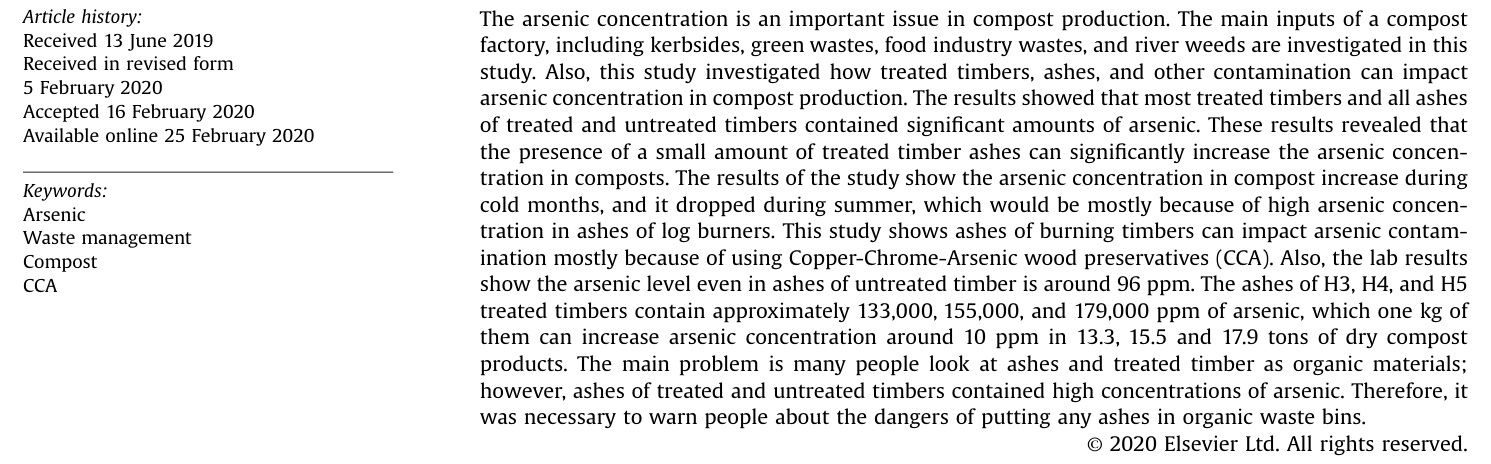
The first observation shows arsenic concentration is increased in winters and it dropped in summer (Fig. 1). To find the main sources of arsenic contamination in compost, the factory inputs are investigated carefully.
初步观察表明,砷浓度在冬季升高而在夏季下降(图1)。为查明堆肥中砷污染的主要来源,对堆肥厂的原料投入进行了详细调查。
2.1. Main inputs in compost production in New Zealand2.1. 新西兰堆肥生产的主要原料
The main inputs in compost production can be categorized into four categories: kerbsides, green wastes, food wastes, and river wastes, which are explained below.
堆肥生产的主要原料可分为四类:路边收集废弃物、绿色废弃物、食物垃圾和河道废弃物,具体说明如下。
2.1.1. Kerbsides2.1.1. 路边收集废弃物
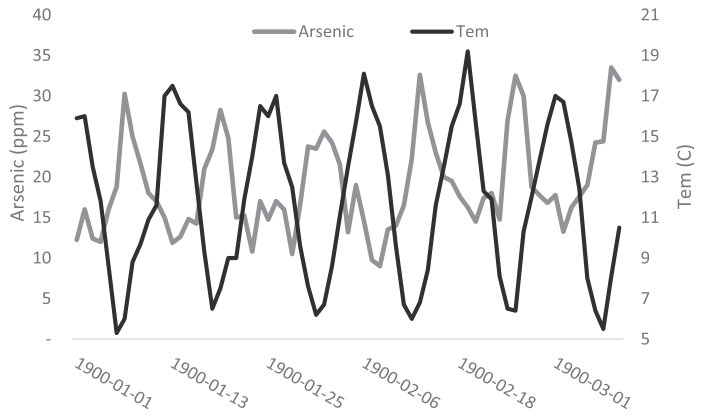
Organic wastes in Christchurch are collected weekly. These mostly comprise the contents of kitchen and garden waste. In addition, it contains soil, clothes, and papers. All the materials mentioned here have arsenic contents of less than the maximum standard concentration in NZS4544.1 As shown in Fig. 2, the volume of kerbside waste reduces in winter and reaches a maximum in the first warm month of the year (mostly September and October) when plants start to grow, and people start mowing and weeding again. Kerbside inputs are around 80%e90% of total inputs in LE.
基督城的有机废弃物每周收集一次,主要包括厨房和花园废弃物,此外还含有土壤、衣物和纸张。上述所有物料的砷含量均低于NZS4544规定的最高标准浓度。1 如图2所示,路边收集废弃物的数量在冬季减少,并在一年中第一个温暖月份(多为9月和10月)达到最大值,此时植物开始生长,人们重新开始割草和除草。路边收集投入量约占LE总投入量的80%–90%。
2.1.2. Green wastes2.1.2. 绿色废弃物
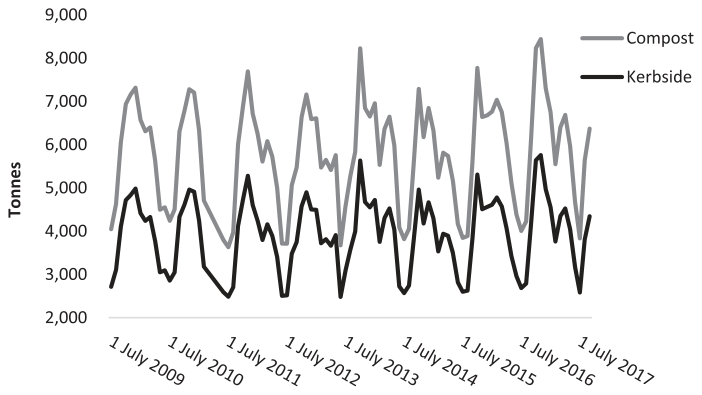
Green wastes are defined as the green wastes of the council and its contractors’ activities and garden waste, which people bring directly to the compost factory. Also, some forestry and construction companies send their wastes to LE. For several reasons, it is too difficult to analyze them, but the arsenic concentration is estimated at being around 10e14 ppm. Similar to kerbside wastes (Fig. 3), Green wastes peaks in summer when different industries and residents are producing maximum amounts of organic wastes. Temperature and construction activities by Christchurch City Council (CCC) and its contractors would be the main factors for the changes in the volume of green wastes.
绿色废弃物是指市议会及其承包商作业产生的绿色废弃物,以及居民直接运送至堆肥厂的花园废弃物。此外,一些林业和建筑公司也将其废弃物送至LE。由于多种原因,对其进行分析十分困难,但其砷浓度估计约为10–14 ppm。与路边收集废弃物类似(图3),绿色废弃物在夏季达到峰值,此时各行业和居民产生的有机废弃物量最大。气温以及基督城市议会(CCC)及其承包商的施工活动是绿色废弃物数量变化的主要影响因素。
2.1.3. Food wastes2.1.3. 食物垃圾
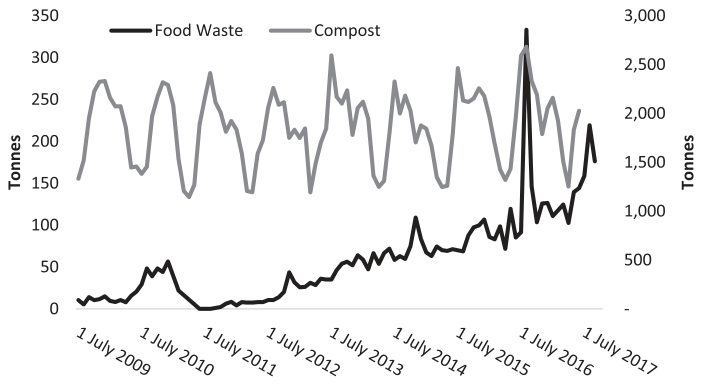
Arsenic may be present in many foods, including grains, fruits, and vegetables, where it is present due to absorption through soil and water. While most crops do not readily take up much arsenic from the ground, rice is different, because it takes up arsenic from soil and water more readily than other grains. In addition, some seafood has high levels of less toxic organic arsenic. No limit exists for arsenic in most foods, but the standard for drinking water is ten parts per billion (ppb). Food waste consumption in Compost companies in Christchurch has continuously increased over the last five years. However, the volume of food waste inputs is still much lower than kerbsides and green wastes; however, it reached 23% of total inputs in August 2016 (Fig. 4). Most food wastes come from factories and restaurants; therefore, it is too difficult to design an appropriate sampling method; however, it is not expected to find high concentrations of arsenic in food wastes.
砷可能存在于许多食物中,包括谷物、水果和蔬菜,这是由于其通过土壤和水分吸收所致。虽然大多数作物不易从土壤中吸收大量砷,但水稻不同,其从土壤和水中吸收砷的能力强于其他谷物。此外,一些海产品含有较高水平的低毒性有机砷。大多数食品中并无砷限量标准,但饮用水标准为十亿分之十(ppb)。过去五年间,基督城堆肥企业的食物垃圾消纳量持续增加。然而,食物垃圾的投入量仍远低于路边收集废弃物和绿色废弃物,不过在2016年8月曾达到总投入量的23%(图4)。大部分食物垃圾来自工厂和餐馆,因此很难设计合适的采样方法;但预计食物垃圾中不会出现高浓度砷。
1 NZS4454: 2005, (The New Zealand standard for Composts, Soil Conditioners and Mulches) applies to organic products and mixtures of organic products that are to be used to amend the physical, biological and chemical properties of natural or artificial soils and growing media.
1 NZS4454: 2005(新西兰堆肥、土壤调理剂和覆盖物标准)适用于用于改善天然或人工土壤及栽培基质物理、生物和化学性质的有机产品及有机产品混合物。
2.1.4. River weeds2.1.4. 河道杂草
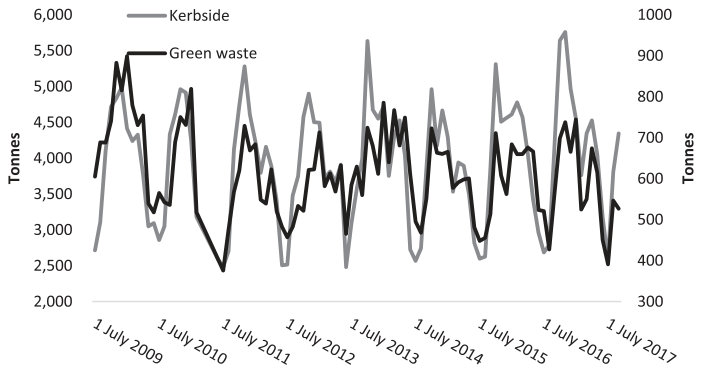
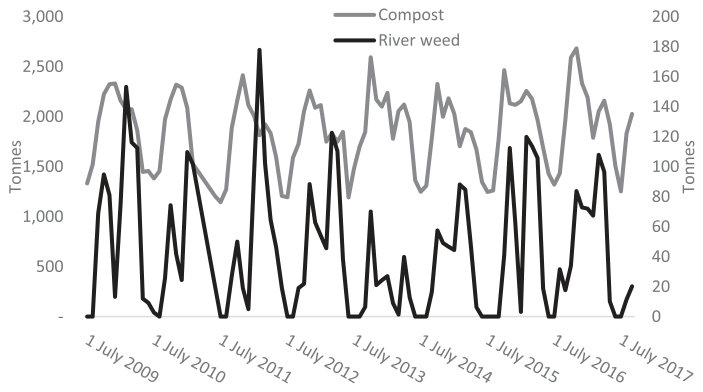
Some studies show that river weeds can absorb arsenic from contaminated waters. The amount of river weed depends on the activities of CCC contractors. River weed inputs fluctuate from 5% of total inputs in summer to zero in winter. The arsenic contents of river weeds were investigated to find its effects on arsenic concentrations in the final compost products. As expected, the volume of river weeds increases in summer, but Fig. 5 shows it is too difficult to find any link between river weed inputs and compost production. The river weeds were collected from different sites and they contained several different plants, so it was recommended to monitor them frequently.
一些研究表明,河道杂草可从受污染水体中吸收砷。河道杂草的数量取决于CCC承包商的作业活动。河道杂草投入量从夏季占总投入量的5%到冬季为零不等。本研究调查了河道杂草的砷含量,以查明其对最终堆肥产品砷浓度的影响。正如预期,河道杂草的数量在夏季增加,但图5显示,很难发现河道杂草投入量与堆肥产量之间存在任何关联。由于河道杂草采自不同地点且包含多种不同植物,因此建议对其进行经常性监测。
2.2. Sampling and Lab Analysis2.2. 采样与实验室分析
The high concentration of arsenic of compost in winters would be because of the constant arsenic inputs, which were diluted in summer or because of specific contaminated inputs in winter or both. The first tests show arsenic in food wastes and river weeds are not very high. Also, due to high volume of kerbsides and green wastes, it was decided to focus on their components. We found some people are burning treated timber in winter and put ashes in organic waste bins, however, due to the high arsenic concentration in summer it was expected to find another source (or sources) of arsenic. Therefore, various contamination factors were investigated carefully to find input materials that contained arsenic-containing.
冬季堆肥中砷浓度较高,可能是由于持续的砷输入在夏季被稀释,或是由于冬季存在特定的受污染原料,抑或两者兼而有之。初步检测表明,食物垃圾和河道杂草中的砷含量并不高。此外,由于路边收集废弃物和绿色废弃物数量大,因此决定重点研究其组分。我们发现,一些人在冬季焚烧处理木材并将灰烬放入有机废弃物回收箱;然而,由于夏季砷浓度同样较高,预计还存在其他砷来源。因此,对各种污染因素进行了详细调查,以找出含砷的原料。
In the first step, 3e7 samples of each timber hazard categories and untreated timber were collected to estimate the arsenic concentration in the timbers and ashes from the different timber hazard categories. The timber samples were collected randomly from the main timber suppliers. A few H2 and H3 timber samples were also collected directly from under construction building sites. The possible arsenic contamination in river weeds and water consumed in compost production process also investigated using three river weed samples and 6 water samples were collected from the compost factory. Due to high arsenic concentration in some samples it was decided to test all results again but we couldn’t find significant differences.
第一步,采集各危害等级木材及未处理木材各3–7个样品,以估算不同危害等级木材及其灰烬中的砷浓度。木材样品从主要木材供应商处随机采集。另有少量H2和H3木材样品直接采自在建建筑工地。此外,还从堆肥厂采集了3个河道杂草样品和6个水样,以调查河道杂草及堆肥生产过程中用水可能存在的砷污染。由于部分样品砷浓度较高,决定对所有结果进行复测,但未发现显著差异。
Samples of timbers and ashes were investigated to find the concentrations of arsenic or other heavy metals using the digest technique. The CEM MARS Xpress has an operator selectable output of 0e1600 W ± 15% (by IEC (International Electrical Conference) method). Microwave energy was used to heat samples in a closed vessel microwave system. A sample was placed inside a Teflon PFA® and Kevlar-shielded vessel, usually with concentrated nitric acid. Once in the MARS Xpress, the samples were subjected to rapid heating and elevated pressure, causing the sample to digest or dissolve in a short time. The concentration of a specific element in a sample was related to the intensity of lines in its optical spectrum. The sample, in an aerosol form, was introduced into a high energy plasma that dissociated the sample into atoms and ions which emitted electromagnetic radiation. The emitted light was spectrally resolved by diffractive optics, and the intensity of light measured with a detector.
采用消解技术测定木材和灰烬样品中砷及其他重金属的浓度。CEM MARS Xpress的输出功率可由操作者在0–1600 W ± 15%范围内选择(按IEC(国际电工委员会)方法)。采用密闭容器微波系统,利用微波能量加热样品。将样品置于Teflon PFA®和Kevlar屏蔽的消解罐中,通常加入浓硝酸。放入MARS Xpress后,样品经快速加热并处于高压状态,从而在短时间内消解或溶解。样品中特定元素的浓度与其光谱中谱线的强度相关。样品以气溶胶形式导入高能等离子体中,被解离为原子和离子并发射电磁辐射。发射光经衍射光学元件进行分光,并由检测器测量光强。
3Results结果
In the results of this study show, H3, H4, H5 timbers have the highest arsenic, and other heavy metal contents, which were very low in H1 timbers and untreated timbers (Table 1). The arsenic concentration in H5 ranged from 1% (10,313 ppm) to 1.2% (11,868 ppm) of total weight. This meant, 1 kg of H5 timber was enough to increase the arsenic rate of 844 kg dry compost around 10 ppm (Table 2). The arsenic concentrations in H3 and H4 samples were between 1100 ppm and 2700 ppm in different samples. This meant that one kg of H3 and H4 timber on average was enough to contaminate 396 kg and 210 kg of dry compost respectively around 10 ppm.
本研究结果表明,H3、H4、H5木材的砷及其他重金属含量最高,而H1木材和未处理木材中的含量很低(表1)。H5木材中的砷浓度占总重量的1%(10,313 ppm)至1.2%(11,868 ppm)。这意味着1 kg H5木材足以使844 kg干堆肥的砷含量提高约10 ppm(表2)。不同H3和H4样品中的砷浓度介于1100 ppm至2700 ppm之间。这意味着平均1 kg H3和H4木材分别足以使396 kg和210 kg干堆肥的砷含量提高约10 ppm。
The first column of Table 2 presents, the volume of compost contaminated around 10 ppm by one kg of the treated timber or ashes. For example one kg piece of H3 timber can increase arsenic concentration of 141 kg around 10 ppm. The second column of Table 2 shows how much of treated timbers or shows will raise the arsenic content of compost by around 10 ppm/month in winter 2017 (June, July, and August), at around 1531 tonnes/month. This shows, again, that ashes from treated timbers are high-risk inputs; however, all the inputs mentioned here can affect the arsenic rate under different conditions. Another study is necessary, however, to investigate the volume of each of these inputs in kerbside wastes.
表2第一列列出了1 kg处理木材或灰烬可使砷含量提高约10 ppm的堆肥量。例如,1 kg H3木材可使141 kg堆肥的砷浓度提高约10 ppm。表2第二列显示了在2017年冬季(6月、7月和8月)堆肥产量约为1531吨/月的情况下,需要多少处理木材或灰烬即可使堆肥砷含量每月提高约10 ppm。这再次表明,处理木材的灰烬是高风险原料;然而,此处提及的所有原料在不同条件下均可影响砷含量。不过,仍需开展进一步研究,以调查路边收集废弃物中上述各类原料的数量。
The main concern was high arsenic concentrations in the ashes, which reached almost 20% of one of the H5 timber sample’s weight. However, the chance to access H3 and H4 timber wastes was much higher than in H5. After minor construction activities, many people have a few pieces of treated timber left over. The observations in this study showed some people save this waste of treated timbers that were used in summer for burning in winter. The ash samples of H3 and H4 timbers have high arsenic concentrations of between 10% (100,000 ppm) to 16% (155,921 ppm) and 15% (149,868 ppm) to 16% (164,897 ppm) of total weight, respectively. The high arsenic concentration in the ashes meant that one kg of H3 ash could contaminate seven tonnes of dry compost (if there was no arsenic in other inputs). If average arsenic concentration from other inputs was around 10 ppm, 30 kg/week of H3 timber ash was enough to contaminate total compost at around 20 ppm. It seemed burning treated timber and to put ashes in landfill bins are different topics. It was important to encourage people not to burn any treated timber, but it is more important to encourage them to not put any ash (treated and untreated) in the organic waste bins.
主要关注点在于灰烬中的高砷浓度,其在一个H5木材样品中几乎达到重量的20%。然而,获得H3和H4木材废料的机会远高于H5。在进行小型建筑活动后,许多人会剩余少量处理木材。本研究的观察表明,一些人会将夏季使用后剩余的处理木材废料保存起来,留待冬季焚烧。H3和H4木材灰烬样品的砷浓度很高,分别占总重量的10%(100,000 ppm)至16%(155,921 ppm)和15%(149,868 ppm)至16%(164,897 ppm)。灰烬中的高砷浓度意味着1 kg H3灰烬可污染7吨干堆肥(假设其他原料中不含砷)。若其他原料的平均砷浓度约为10 ppm,则每周30 kg的H3木材灰烬即足以使全部堆肥的砷浓度达到约20 ppm。焚烧处理木材与将灰烬放入垃圾箱似乎是两个不同的问题。鼓励人们不焚烧任何处理木材固然重要,但更重要的是鼓励他们不将任何灰烬(无论是否经过处理)放入有机废弃物回收箱。
A very brief observation showed that log burners make at least 1e2 kg of ash weekly in winter. Therefore, around 10e20 residences could be enough to contaminate the whole winter’s compost products in Christchurch, if they only burnt treated timbers. Or if 1000 residents put only 0.03 kg of H3 ash into organic waste bins weekly, this was enough to increase arsenic contamination to around 20 ppm in July 2017.
一项非常简短的观察表明,冬季燃木炉每周至少产生1–2 kg灰烬。因此,若仅焚烧处理木材,约10–20户住宅即可能足以污染基督城整个冬季的堆肥产品。或者,若1000户居民每周仅向有机废弃物回收箱中放入0.03 kg H3灰烬,就足以使2017年7月的砷污染升高至约20 ppm。
Average arsenic, copper and chromium contents in samples (ppm).
样品中砷、铜和铬的平均含量(ppm)。
| Sample name样品名称 | Number of Samples样品数 | As (ppm) |
|---|---|---|
| Untreated | 4 | 2 |
| H1.2 | 3 | 2 |
| H3 & H3.2 | 7 | 1410 |
| H4 | 7 | 2098 |
| H5 | 3 | 8435 |
| Untreated Timber Ash | 4 | 96 |
| Ash H1.2 | 3 | 160 |
| Ash H3 & H3.2 | 7 | 133,175 |
| Ash H4 | 7 | 155,456 |
| Ash H5 | 3 | 179,496 |
Effect of treated timbers and ashes on compost arsenic concentration (10 ppm).
处理木材及灰烬对堆肥砷浓度的影响(10 ppm)。
| Sample Name样品名称 | Volume of compost (kg) contaminated 10 ppm by one kg of sample1 kg样品可使砷含量提高10 ppm的堆肥量(kg) | Volume of sample (kg) to contaminating average monthly winter 2017 compost production使2017年冬季月均堆肥产量受到污染所需的样品量(kg) |
|---|---|---|
| H3 | 141 | 10,707 |
| H4 | 210 | 7298 |
| H5 | 844 | 1816 |
| Untreated timber | 10 | 158,888 |
| Ash | ||
| Ash H1.2 | 16 | 95,615 |
| Ash H3 | 13,317 | 115 |
| Ash H4 | 15,546 | 99 |
| Ash H5 | 17,950 | 85 |
On the other hand, untreated woods were the main sources of fuel in log burners and open chimneys. The results showed that the arsenic concentration, even in H1.2 and untreated timbers ash, was much higher than the limited standard concentration. A brief investigation showed almost all people thought the ashes of untreated timbers were safe and they can put them into organic waste bins; however, the arsenic concentration in ashes of untreated timbers was between 32 ppm and 200 ppm. It means a high volume of untreated timber ashes can change the arsenic concentration in compost significantly. For example, based on Table 2 and average compost production in winter 2017, ashes of 10,000 houses are enough to increase arsenic concentration around 6.3 ppm.
另一方面,未处理木材是燃木炉和开放式壁炉的主要燃料来源。结果表明,即使是H1.2木材和未处理木材的灰烬,其砷浓度也远高于标准限值。一项简短调查显示,几乎所有人都认为未处理木材的灰烬是安全的,可以放入有机废弃物回收箱;然而,未处理木材灰烬中的砷浓度介于32 ppm至200 ppm之间。这意味着大量未处理木材灰烬可显著改变堆肥中的砷浓度。例如,根据表2及2017年冬季平均堆肥产量,10,000户住宅的灰烬足以使砷浓度提高约6.3 ppm。
Table 3 shows that the average arsenic contents in untreated timber are around 2 ppm; this means adding 0.55 tonnes of untreated timber to compost can drop the arsenic content in one tonne of compost from 30 ppm to 20 ppm. Blending compost products with high arsenic (or other heavy metal) concentration with other materials with lower arsenic contents could be part of the solution to reduce arsenic contamination of compost products in winter; however, this would need a high volume of inputs.表3显示,未处理木材的平均砷含量约为2 ppm;这意味着向堆肥中添加0.55吨未处理木材可使1吨堆肥的砷含量从30 ppm降至20 ppm。将砷(或其他重金属)浓度较高的堆肥产品与砷含量较低的其他物料混合,可作为降低冬季堆肥产品砷污染的部分解决方案;但这需要大量的原料投入。
Table 3 shows how much of different materials are need to drop 10 ppm arsenic concentration of one tonne of compost. It shows that to reduce the arsenic contained in one tonne of compost, one tonne of material with an arsenic concentration of around 10 ppm would need to be added. The basic equation to estimate the volume of input (tonnes) material to reduce the arsenic contents of one tonne of compost can be presented as:表3显示了使1吨堆肥的砷浓度降低10 ppm所需的各种物料量。结果表明,要降低1吨堆肥中的砷含量,需要添加1吨砷浓度约为10 ppm的物料。估算降低1吨堆肥砷含量所需原料投入量(吨)的基本方程可表示为:
(ai � 20Þ = ð20 � acÞ ¼ V (1)
Where ai was the arsenic contents of the inputs, ac the arsenic-containing compost, and V the volume of inputs.
式中,ai为原料的砷含量,ac为堆肥的砷含量,V为原料投入量。
4Conclusions结论
Arsenic contamination is one of the critical concerns of compost production. This study investigated the primary source of arsenic in compost products. Because of different inputs and different production processes, it too challenging to find similar research projects and discuss the results of this study. It found arsenic concentration in compost increase during cold months. Therefore after a few sampling, observation and interviews, it was found arsenic of treated timber and ashes would be one of the important sources of arsenic, especially during winter. However, the study show different type of treated timbers and their ashes affect arsenic contamination in different rates. These results revealed that the presence of a small number of treated timber ashes could significantly increase the arsenic concentration in composts. One of the solutions to drop the arsenic concentration is blending other materials with lower arsenic concentration. However, reducing the volume of ash and treated timbers in the kerbsides would be a more straightforward challenge.
砷污染是堆肥生产中的关键关注问题之一。本研究调查了堆肥产品中砷的主要来源。由于原料投入和生产工艺各不相同,很难找到类似的研究项目来对比讨论本研究的结果。研究发现,堆肥中的砷浓度在寒冷月份升高。因此,经过若干次采样、观察和访谈,发现处理木材及其灰烬中的砷可能是砷的重要来源之一,尤其是在冬季。然而,研究表明,不同类型的处理木材及其灰烬对砷污染的影响程度不同。这些结果表明,少量处理木材灰烬的存在即可显著提高堆肥中的砷浓度。降低砷浓度的解决方案之一是掺混其他砷浓度较低的物料。然而,减少路边收集废弃物中灰烬和处理木材的数量将是一项更为直接的挑战。
The sampling, observations, and interviews show many people are aware of the danger of burning treated timbers and they know it is not acceptable to put the ashes of treated timbers in organic waste bins. However, for several reasons, some people are still burning treated timbers and, unfortunately, some of them put the ashes in organic waste bins. It appears saving money is not the only reason for burning treated timbers; lack of untreated wood and removing timber wastes are two main important reasons for burning treated woods in houses. It seems part of the problem is a socio-cultural issue and more investigation is necessary to analyze and solve the problem. Nevertheless, it was found still many people look at treated timbers and the ashes as organic and safe materials.
采样、观察和访谈结果表明,许多人意识到焚烧处理木材的危险,并且知道不应将处理木材的灰烬放入有机废弃物回收箱。然而,出于多种原因,一些人仍在焚烧处理木材,遗憾的是,其中部分人将灰烬放入了有机废弃物回收箱。节省开支似乎并非焚烧处理木材的唯一原因;缺乏未处理木材以及处置木材废料是家庭焚烧处理木材的两个主要原因。问题的部分原因似乎在于社会文化层面,需要开展更多调查以分析和解决该问题。尽管如此,研究发现仍有许多人将处理木材及其灰烬视为有机且安全的物料。
Effect of blended inputs to drop arsenic concentration of compost product.
掺混原料对降低堆肥产品砷浓度的效果。
| Sample Name Arsenic contain (ppm)样品 名称 砷含量 (ppm) | Volume (tonne) to drop one-tonne compost arsenic contain from 30 ppm to 20 ppm使1吨堆肥砷含量从30 ppm降至20 ppm所需量(吨) | Volume (tonne) to drop average monthly winter 2017 compost production from 30 ppm to 20 ppm使2017年冬季月均堆肥产量砷含量从30 ppm降至20 ppm所需量(吨) |
|---|---|---|
| Untreated 2.0 | 0.56 | 851 |
| H1.2 2.0 | 0.56 | 851 |
| Riverweed 12 | 1.27 | 1940 |
| Material 3 3 | 0.59 | 901 |
| Material 4 4 | 0.63 | 957 |
| Material 5 5 | 0.67 | 1021 |
| Material 6 6 | 0.71 | 1094 |
| Material 7 7 | 0.77 | 1178 |
| Material 8 8 | 0.83 | 1276 |
| Material 9 9 | 0.91 | 1392 |
| Material 10 10 | 1.00 | 1531 |
Most organic waste materials have arsenic and other heavy metals in them, but all lower than the limited concentration mentioned in NZS4454. Understanding the primary sources of arsenic and other heavy metals was the first step in developing a practical plan to reduce them in compost products. Based on the laboratory results and field observations, the most critical contamination was from treated timbers and ashes. Ashes of treated and untreated timbers contained high concentrations of arsenic. Therefore, it was necessary to warn people about the dangers of putting any ashes in organic waste bins. Small amounts of ashes from treated woods can raise arsenic contamination significantly in winter when all inputs were at minimum volumes. It was challenging to find how much-treated timbers were in different inputs. It was possible some people put their timber wastes in organic waste bins, or some treated timbers came in with the wastes from council contractors. Improving awareness of people on arsenic and other heavy metal contamination is long term and removing high-risk inputs from the production process in the short term is the best solution to reduce arsenic and other heavy metal concentration in composts.
大多数有机废弃物中均含有砷及其他重金属,但均低于NZS4454规定的限值浓度。了解砷及其他重金属的主要来源,是制定切实可行的方案以降低其在堆肥产品中含量的第一步。根据实验室结果和现场观察,最严重的污染来自处理木材及其灰烬。处理木材和未处理木材的灰烬均含有高浓度的砷。因此,有必要警示公众将任何灰烬放入有机废弃物回收箱的危害。冬季所有原料投入量均处于最低水平,此时少量处理木材灰烬即可显著加剧砷污染。查明不同原料中处理木材的含量颇具挑战。可能有一些人将木材废料放入有机废弃物回收箱,或者有部分处理木材随市议会承包商的废弃物一同进入。提高公众对砷及其他重金属污染的认识是一项长期措施,而在短期内将高风险原料从生产过程中剔除,是降低堆肥中砷及其他重金属浓度的最佳解决方案。
It is recommended to develop a linier or none liner models to predict arsenic concentration based on temperature. Also, it is recommended to investigate the arsenic concentration in different areas, which will help compost factory to process wastes with high arsenic concentration separately.
建议建立基于温度预测砷浓度的线性或非线性模型。此外,建议调查不同区域的砷浓度,这将有助于堆肥厂对高砷浓度废弃物进行单独处理。
Declaration of competing interest利益冲突声明
There is no conflict of interest in this study.
本研究不存在利益冲突。
Acknowledgments致谢
The project was funded by Christchurch City Council. The authors acknowledge the efforts of Christchurch City Council. We are also grateful to the staff of Living Earth Ltd for their help and support.
本项目由基督城市议会资助。作者感谢基督城市议会所作的努力。同时感谢Living Earth Ltd工作人员的帮助与支持。
Appendix A. Supplementary data附录A. 补充数据
Supplementary data to this article can be found online at https://doi.org/10.1016/j.envpol.2020.114218.
本文的补充数据可在线获取:https://doi.org/10.1016/j.envpol.2020.114218。
References参考文献
Abraham, P., Hanson, C.R., 2009. Annual Groundwater Quality Survey, Spring, vol. 2008. Citeseer.
Ampiah-Bonney, R.J., Tyson, J.F., Lanza, G.R., 2007. Phytoextraction of arsenic from soil by Leersia Oryzoides. Int. J. Phytoremediation 9, 31e40.
Asere, T.G., Stevens, C.V., DU Laing, G., 2019. Use of (modified) natural adsorbents for arsenic remediation: a review. Sci. Total Environ. 676, 706e720.
ATSDR, 2004. Safe Gardening, Safe Play, and a Safe Home [Online]. Available: https://www.atsdr.cdc.gov/sites/springvalley/svgardening.html. (Accessed 8 October 2017).
Babaee, Y., Mulligan, C.N., Rahaman, M.S., 2018. Arsenic immobilization in soil using starch-stabilized Fe/Cu nanoparticles: a case study in treatment of a chromated copper arsenate (CCA)-contaminated soil at lab scale. J. Soils Sediments 18, 1610e1619.
Beesley, L., Inneh, O.S., Norton, G.J., Moreno-Jimenez, E., Pardo, T., Clemente, R., Dawson, J.J.C., 2014. Assessing the influence of compost and biochar amendments on the mobility and toxicity of metals and arsenic in a naturally contaminated mine soil. Environ. Pollut. 186, 195e202.
Bodwell, J.E., Kingsley, L.A., Hamilton, J.W., 2004. Arsenic at very low concentrations alters glucocorticoid receptor (GR)-Mediated gene activation but not GRmediated gene Repression: complex Dose�Response effects are closely correlated with levels of activated GR and require a functional GR DNA binding domain. Chem. Res. Toxicol. 17, 1064e1076.
Branz, 2013. Use of Timber [Online]. Available: http://www.renovate.org.nz/1940- 60s/walls-and-cladding/use-of-timber/. (Accessed 8 October 2017).
Cao, X., Ma, L.Q., Shiralipour, A., 2003. Effects of compost and phosphate amendments on arsenic mobility in soils and arsenic uptake by the hyperaccumulator, Pteris vittata L. Environ. Pollut. 126, 157e167. Chakraborti, D., Mukherjee, S.C., Pati, S., Sengupta, M.K., Rahman, M.M., Chowdhury, U.K., Lodh, D., Chanda, C.R., Chakraborti, A.K., Basu, G.K., 2003. Arsenic groundwater contamination in Middle Ganga Plain, Bihar, India: a future danger? Environ. Health Perspect. 111, 1194. Chen, H., Li, S., Liu, J., Diwan, B.A., Barrett, J.C., Waalkes, M.P., 2004. Chronic inorganic arsenic exposure induces hepatic global and individual gene hypomethylation: implications for arsenic hepatocarcinogenesis. Carcinogenesis 25, 1779e1786. Chutia, P., Kato, S., Kojima, T., Satokawa, S., 2009. Arsenic adsorption from aqueous solution on synthetic zeolites. J. Hazard Mater. 162, 440e447. Clemente, R., Hartley, W., Riby, P., Dickinson, N.M., Lepp, N.W., 2010. Trace element mobility in a contaminated soil two years after field-amendment with a greenwaste compost mulch. Environ. Pollut. 158, 1644e1651. Connell, M., Baldwin, W., Smith, T., 1995. Controlled fixation technology. In: International Wood Preservation Symposium, pp. 177e193. Dodson, M., Aitchison-Earl, P., Scott, L., 2012. Ashley-waimakariri Groundwater Resources Investigation, Citeseer. Dolamore, A.J., 2016. Factors Influencing Arsenic Release into Canterbury Groundwaters. Epa, U., 1998. Locating and Estimating Air Emissions from Sources of Arsenic and Arsenic Compounds. North Carolina, Research Triangle Park. (Fsanz), F.S.A.N.Z, 2019. Arsenic. Chemicals in Food FSANZ. Haggman,€ H., Raybould, A., Borem, A., Fox, T., Handley, L., Hertzberg, M., Lu, M.Z., Macdonald, P., Oguchi, T., Pasquali, G., 2013. Genetically engineered trees for plantation forests: key considerations for environmental risk assessment. Plant Biotechnol. J. 11, 785e798. Hartley, W., Dickinson, N.M., Riby, P., Leese, E., Morton, J., Lepp, N.W., 2010. Arsenic mobility and speciation in a contaminated urban soil are affected by different methods of green waste compost application. Environ. Pollut. 158, 3560e3570. Hopenhayn-Rich, C., Biggs, M.L., Smith, A.H., 1998. Lung and kidney cancer mortality associated with arsenic in drinking water in Cordoba, Argentina. Int. J. Epidemiol. 27, 561e569. Jones, A.S., Marini, J., Solo-Gabriele, H.M., Robey, N.M., Townsend, T.G., 2019. Arsenic, copper, and chromium from treated wood products in the US disposal sector. Waste Manag. 87, 731e740. Jovanovic, D., Rasic-Milutinovic, Z., 2017. Public health effects of arsenic exposure. Best Pract. Guide Contr. Arsenic Drinking Water 25e32. Lederer, W.H., Fensterheim, R.J., 1983. Arsenic–industrial, Biomedical, Environmental Perspectives. Van Nostrand Reinhold Company. Lee, M.-Y., Bae, O.-N., Chung, S.-M., Kang, K.-T., Lee, J.-Y., Chung, J.-H., 2002. Enhancement of platelet aggregation and thrombus formation by arsenic in drinking water: a contributing factor to cardiovascular disease. Toxicol. Appl. Pharmacol. 179, 83e88.
Li, W., Zhang, J., Lv, Y., Sheibani, N., 2019. Quantitative proteomic study of arsenic treated mouse liver sinusoidal endothelial cells using a reverse super-SILAC method. Biochem. Biophys. Res. Commun. 514, 475e481.
Love, S. Extended producer responsibility of treated timber waste. Scion. SB07 Sustainable Building Conference, New Zealand (Building Research), 2007. Mcdonald, L., 2013. Arsenic Used in Home-Building Materials [Online]. Available: http://www.stuff.co.nz/the-press/business/the-rebuild/9329188/Arsenic-usedin-home-building-materials. (Accessed 9 October 2017).
Mench, M., Bussiere, S., Boisson, J., Castaing, E., Vangronsveld, J., Ruttens, A., De Koe, T., Bleeker, P., Assunçao, A., Manceau, A., 2003. Progress in remediation and~ revegetation of the barren Jales gold mine spoil after in situ treatments. Plant Soil 249, 187e202.
Mfe, M.H., 1997. Health and Environmental Guidelines for Selected Timber Treatment Chemicals. Ministry for the Environment and Ministry of Health, Wellington. Milton, A.H., Rahman, M., 2002. Respiratory effects and arsenic contaminated well water in Bangladesh. Int. J. Environ. Health Res. 12, 175e179.
Milton, A.H., Hasan, Z., Rahman, A., Rahman, M., 2003. Non-cancer effects of chronic arsenicosis in Bangladesh: preliminary results. J. Environ. Sci. Health Part A 38, 301e305.
Orozco, Y.C., 2010. Effects of Biocide Treatment on Durability and Fungal Colonization of Teak, Western Redcedar, and Redwood. Oregon State University.
Paltseva, A., Cheng, Z., Deeb, M., Groffman, P.M., Shaw, R.K., Maddaloni, M., 2018. Accumulation of arsenic and lead in garden-grown vegetables: factors and mitigation strategies. Sci. Total Environ. 640e641, 273e283.
Park, G.-Y., Kang, D.-E., Davaatseren, M., Shin, C., Kang, G.-J., Chung, M.-S., 2019. Reduction of total, organic, and inorganic arsenic content in Hizikia fusiforme (Hijiki). Food Sci. Biotechnol. 28, 615e622.
Read, D., 2003. Report on Copper, Chromium and Arsenic (CCA) Treated Timber. ERMA New Zealand.
Robinson, B., Clothier, B., Bolan, N., Mahimairaja, S., Greven, M., Moni, C., Marchetti, M., Van Den Dijssel, C., Milne, G., 2004. Arsenic in the New Zealand Environment. SuperSoil, 2004, 3rd.
Robinson, B., Kim, N., Marchetti, M., Moni, C., Schroeter, L., Van Den Dijssel, C., Milne, G., Clothier, B., 2006. Arsenic hyperaccumulation by aquatic macrophytes in the taupo volcanic zone, New Zealand. Environ. Exp. Bot. 58, 206e215. Rossman, T.G., Uddin, A.N., Burns, F.J., 2004. Evidence that arsenite acts as a cocarcinogen in skin cancer. Toxicol. Appl. Pharmacol. 198, 394e404. Saha, J.C., Dikshit, A.K., Bandyopadhyay, M., Saha, K.C., 1999. A review of arsenic
poisoning and its effects on human health. Crit. Rev. Environ. Sci. Technol. 29, 281e313.
Scott-Richardson, M., O’hara Ruiz, M., Smith, R.L., 2019. Florida arsenic distribution index: quantifying the distribution of past and present arsenic usage. Int. J. Environ. Res. Publ. Health 16, 744.
Sodhi, K.K., Kumar, M., Agrawal, P.K., Singh, D.K., 2019. Perspectives on Arsenic Toxicity, Carcinogenicity and its Systemic Remediation Strategies. Environmental Technology & Innovation, 100462.
South, D.B., Enebak, S.A., Hill, T.E., 2007. Tolerance of young Loblolly pine (Pinus taeda) seedlings to post-emergence applications of MSMA. N. Z. J. For. 52, 28. Steinmaus, C., Yuan, Y., Bates, M.N., Smith, A.H., 2003. Case-control study of bladder cancer and drinking water arsenic in the western United States. Am. J. Epidemiol. 158, 1193e1201.
Tangahu, B.V., Sheikh Abdullah, S.R., Basri, H., Idris, M., Anuar, N., Mukhlisin, M., 2011. A Review on heavy metals (As, Pb, and Hg) uptake by plants through phytoremediation. Int. J. Chem. Eng. 2011.
Tsai, S.-Y., Chou, H.-Y., The, H.-W., Chen, C.-M., Chen, C.-J., 2003. The effects of
chronic arsenic exposure from drinking water on the neurobehavioral development in adolescence. Neurotoxicology 24, 747e753.
Tseng, C.-H., Chong, C.-K., Tseng, C.-P., Hsueh, Y.-M., Chiou, H.-Y., Tseng, C.-C., Chen, C.-J., 2003. Long-term arsenic exposure and ischemic heart disease in arseniasis-hyperendemic villages in Taiwan. Toxicol. Lett. 137, 15e21.
Upadhyay, M.K., Shukla, A., Yadav, P., Srivastava, S., 2019. A review of arsenic in crops, vegetables, animals and food products. Food Chem. 276, 608e618. Vaclavikova, M., Gallios, G.P., Hredzak, S., Jakabsky, S., 2008. Removal of arsenic from water streams: an overview of available techniques. Clean Technol. Environ. Policy 10, 89e95.
Wang, C.-H., Jeng, J.-S., Yip, P.-K., Chen, C.-L., Hsu, L.-I., Hsueh, Y.-M., Chiou, H.-Y., Wu, M.-M., Chen, C.-J., 2002. Biological gradient between long-term arsenic exposure and carotid atherosclerosis. Circulation 105, 1804e1809.
Wasserman, G.A., Liu, X., Parvez, F., Ahsan, H., Factor-Litvak, P., Van Geen, A., Slavkovich, V., Lolacono, N.J., Cheng, Z., Hussain, I., 2004. Water arsenic exposure and children’s intellectual function in Araihazar, Bangladesh. Environ. Health Perspect. 112, 1329.