Contents lists available at ScienceDirect journal homepage: www.elsevier.com/locate/agwat
Water-use patterns of Chinese wolfberry (Lycium barbarum L.) on the Tibetan Plateau
Yanqing Zhou a,c, Xiaodong Gao b,*, Jiaxin Wang a, Brett H. Robinson d, Xining Zhao b,*
a College of Water Resources and Architectural Engineering, Northwest A & F University, Yangling 712100, China b Institute of Soil and Water Conservation, Northwest A & F University, Yangling 712100, China c State Key Laboratory of Desert and Oasis Ecology, Xinjiang Institute of Ecology and Geography, Chinese Academy of Sciences, Urumqi 830011, China d School of physical and Chemical Sciences, University of Canterbury, Christchurch 8140, New Zealand
a 西北农林科技大学水利与建筑工程学院,杨凌 712100,中国 b 西北农林科技大学水土保持研究所,杨凌 712100,中国 c 中国科学院新疆生态与地理研究所荒漠与绿洲生态国家重点实验室,乌鲁木齐 830011,中国 d 坎特伯雷大学物理与化学科学学院,基督城 8140,新西兰
1Introduction引言
The Tibetan plateau (TP), often called the ‘Third Pole’, plays a major role in safeguarding the environmental security downstream in East China and South Asia (Yao et al., 2012). Moreover, the ecological environment on the Qinghai-Tibet Plateau is extremely sensitive to human activities. However, land uses on the TP have been extensively transformed by socio-economic development and intensifying human activity, especially overgrazing (Wang et al., 2020a; Wu et al., 2021). This has led to severe socio-economic and ecological problems, including increasing desertification, grassland degradation and reduction in forest cover (Cao et al., 2004; Chen et al., 2011; Feng et al., 2005;
青藏高原(TP)常被称为“第三极”,对保障中国东部和南亚下游地区的环境安全具有重要作用(Yao et al., 2012)。此外,青藏高原生态环境对人类活动极为敏感。然而,随着社会经济发展和人类活动(尤其是过度放牧)的加剧,青藏高原的土地利用方式发生了广泛转变(Wang et al., 2020a; Wu et al., 2021)。这导致了严重的社会经济与生态问题,包括荒漠化加剧、草地退化和森林覆盖率下降(Cao et al., 2004; Chen et al., 2011; Feng et al., 2005;
Jin et al., 2019; Miehe et al., 2019). In the past decades, the Chinese government has adopted several measures to recover and protect the degraded rangelands (Chen et al., 2021; Wu et al., 2021), including enclosure, closure against grazing and reducing livestock density (Wu et al., 2021). However, a consensus on the magnitude of efforts to be made in these measures is lacking, although these measures are directly linked to the improvement of farmer’s incomes. Developing high value-added ecological agriculture may ameliorate the degradation by reducing overgrazing and improving livelihoods of the farmers and herders (Jin et al., 2019; Miehe et al., 2008, Zhou et al., 2019).
Jin et al., 2019; Miehe et al., 2019)。过去几十年间,中国政府采取了多项措施恢复和保护退化草地(Chen et al., 2021; Wu et al., 2021),包括围栏封育、禁牧和降低载畜量(Wu et al., 2021)。然而,尽管这些措施与农牧民收入的提高直接相关,但对于这些措施应投入多大力度尚缺乏共识。发展高附加值生态农业可通过减少过度放牧和改善农牧民生计来缓解草地退化(Jin et al., 2019; Miehe et al., 2008, Zhou et al., 2019)。
Chinese wolfberry (Lycium barbarum L.), also called the goji berry, hereafter wolfberry, is a crop of high economic value that has been widely used to ameliorate wind erosion and improve soil structure. The northern part of the TP provides suitable conditions for its cultivation (abundant sunshine and large diurnal temperature variation), and has become the second largest area (after the Ningxia Hui Autonomous Region) for its production in China (Lei et al., 2020). However, drought and water scarcity have strongly constrained development of wolfberry orchards on the TP (Deng et al., 2017; Xu et al., 2019). Therefore, minimising water use and enhancing water productivity are essential. Mulching and drip irrigation are among the well-known approaches (Mo et al., 2017; Liao et al., 2019a, 2019b, 2021; Fang et al., 2021). The subsurface irrigation method has been applied in the arid and semi-arid areas of China in recent years considering that it has near-zero soil evaporation and optimum nutrient supply (Cai et al., 2021; Fu et al., 2021). In this area, the irrigation system should be upgraded from the surface drip irrigation method to the subsurface drip irrigation method. Therefore, the water uptake patterns of wolfberries during the growth period should be elucidated to formulate an optimal water management system and the best-buried depth for the subsurface drip irrigation.
宁夏枸杞(Lycium barbarum L.),又称枸杞子,以下简称枸杞,是一种经济价值很高的作物,已被广泛用于减轻风蚀和改善土壤结构。青藏高原北部具备适宜枸杞种植的条件(日照充足、昼夜温差大),已成为中国第二大枸杞产区(仅次于宁夏回族自治区)(Lei et al., 2020)。然而,干旱和水资源短缺严重制约了青藏高原枸杞园的发展(Deng et al., 2017; Xu et al., 2019)。因此,减少用水量和提高水分生产力至关重要。覆膜和滴灌是其中广为人知的方法(Mo et al., 2017; Liao et al., 2019a, 2019b, 2021; Fang et al., 2021)。鉴于地下灌溉方式土壤蒸发近乎为零且养分供应最佳,近年来已在中国干旱和半干旱地区得到应用(Cai et al., 2021; Fu et al., 2021)。在该地区,灌溉系统应由地表滴灌升级为地下滴灌。因此,有必要阐明枸杞生育期的水分吸收模式,以制定最优水分管理制度并确定地下滴灌的最佳埋设深度。
* Corresponding authors.
E-mail addresses: gao_xiaodong@nwafu.edu.cn (X. Gao), zxn@nwafu.edu.cn (X. Zhao).
https://doi.org/10.1016/j.agwat.2021.107010 Received 28 September 2020; Received in revised form 3 June 2021; Accepted 4 June 2021 Available online 15 June 2021 0378-3774/© 2021 Elsevier B.V. All rights reserved.
https://doi.org/10.1016/j.agwat.2021.107010 收稿日期 2020年9月28日;修回日期 2021年6月3日;录用日期 2021年6月4日;在线发表 2021年6月15日 0378-3774/© 2021 Elsevier B.V. 版权所有。
Analysis of stable hydrogen and oxygen isotopes provides a highly sensitive and accurate approach to study plants’ water use patterns and eco-hydrological processes (Barbeta and Penuelas, 2017; Dai et al., 2015; Dawson and Ehleringer, 1991; Huo et al., 2018; Gao et al., 2018a; Grossiord et al., 2017; Wang et al., 2020b), especially in the arid and semi-arid areas (Wu et al., 2016; Wu et al., 2018; Gao et al., 2018b; Yang et al., 2015; Zhao et al., 2016). The theoretical basis is that xylem water can be regarded as a mixture of water from all utilized sources, so the proportional uses of specific sources can be estimated by comparing hydrogen or oxygen isotope signatures of xylem water and all potential water sources (Dawson et al., 2002; Huo et al., 2018). These analyses assume that no fractionation of these isotopes occur during root water uptake except in halophytic and xerophytic plants (Ellsworth and Williams, 2007; Lin and Sternberg, 1993). However, recent studies reported that deuterium fractionation in root water uptake may occur even for trees in the temperate oceanic climate (Barbeta et al., 2018). On the contrary, there are no reports according to our knowledge on the fractionation of stable oxygen isotopes. Therefore, in the present study we have used stable oxygen isotopes to measure water use patterns of wolfberry.
稳定氢氧同位素分析为研究植物水分利用模式和生态水文过程提供了一种高灵敏度、高精度的方法(Barbeta and Penuelas, 2017; Dai et al., 2015; Dawson and Ehleringer, 1991; Huo et al., 2018; Gao et al., 2018a; Grossiord et al., 2017; Wang et al., 2020b),在干旱和半干旱地区尤其如此(Wu et al., 2016; Wu et al., 2018; Gao et al., 2018b; Yang et al., 2015; Zhao et al., 2016)。其理论基础是:木质部水可视为所有被利用水源的混合物,因此可通过比较木质部水与各潜在水源的氢或氧同位素特征来估算各水源的利用比例(Dawson et al., 2002; Huo et al., 2018)。这类分析假设除盐生和旱生植物外,根系吸水过程中不发生同位素分馏(Ellsworth and Williams, 2007; Lin and Sternberg, 1993)。然而,近期研究报道,即使是温带海洋性气候下的树木,其根系吸水过程中也可能发生氘分馏(Barbeta et al., 2018)。相反,据我们所知,尚无关于稳定氧同位素分馏的报道。因此,本研究采用稳定氧同位素测定枸杞的水分利用模式。
End-member mixing models are widely used to quantify water sources across global ecosystems. They can be categorised as simple linear mixing models (e.g., IsoSource) and Bayesian mixing models (e.g., MixSIR and MixSIAR) (Rothfuss and Javaux., 2017). Unlike the former, Bayesian mixing models incorporate uncertainties of prior information in data processing (Stock et al., 2018; Wang et al., 2019). In most published studies of plants’ water use patterns, only one of these two kinds of models has been used. However, Evaristo et al. (2017) recently found that the two-source mass balance model over-estimated the groundwater contribution to trees’ xylem water in Christchurch Botanic Gardens, New Zealand. Differences in results of the two kinds of mixing models have rarely been tested in other ecosystems. Therefore, the objectives of this study were to quantify the variation in water use patterns of wolfberry trees on the TP using oxygen stable isotopes, and both simple and Bayesian mixing models, to obtain sound foundations for water management and crop production in wolfberry orchards.
端元混合模型被广泛用于量化全球各生态系统的水分来源,可分为简单线性混合模型(如IsoSource)和贝叶斯混合模型(如MixSIR和MixSIAR)(Rothfuss and Javaux., 2017)。与前者不同,贝叶斯混合模型在数据处理中纳入了先验信息的不确定性(Stock et al., 2018; Wang et al., 2019)。在已发表的大多数植物水分利用模式研究中,仅使用了这两类模型中的一种。然而,Evaristo et al. (2017) 最近发现,在新西兰基督城植物园,二源质量平衡模型高估了地下水对树木木质部水的贡献。两类混合模型结果的差异在其他生态系统中鲜有检验。因此,本研究旨在利用稳定氧同位素,结合简单混合模型和贝叶斯混合模型,量化青藏高原枸杞水分利用模式的变化,为枸杞园水分管理和作物生产提供可靠依据。
2Materials and methods材料与方法
2.1. Site description2.1. 研究区概况
The study was conducted in the Huaitou Tala Irrigation Area (37◦ 21′ N, 96◦ 44′ E; 2869 m above sea level), in the northeastern part of the TP in Haixi Mongol and Tibetan Autonomous Prefecture. It has a typical continental climate for the plateau: dry, windy and cold. According to reference data for the period 1977–2016 collected at Delingha weather station, annual minimum, average and maximum air temperatures are − 27.9, 6.5 and 34.7 ◦C, respectively. Mean annual precipitation amounts to just 241 mm, of which more than 70% occurs from June to September. Accordingly, the area receives abundant sunshine (3010 h per year on average). The groundwater depth exceeds 50 m. According to the International Soil Classification System, the local soil type belongs to sandy loam, the soil texture is about 82% sand (0.02–2 mm) in the 0–100 cm layer. Basic properties of the soil in the study area are shown in Table 1.
研究在青藏高原东北部海西蒙古族藏族自治州怀头他拉灌区进行(37◦ 21′ N,96◦ 44′ E;海拔2869 m)。该地区属典型的高原大陆性气候:干燥、多风、寒冷。根据德令哈气象站1977–2016年的参考数据,年最低、平均和最高气温分别为− 27.9、6.5和34.7 ◦C。多年平均降水量仅为241 mm,其中70%以上集中在6–9月。相应地,该地区日照充足(年均3010 h)。地下水埋深超过50 m。根据国际土壤分类系统,当地土壤类型属砂壤土,0–100 cm土层中砂粒(0.02–2 mm)含量约为82%。研究区土壤基本性质见表1。
2.2. Experimental design2.2. 试验设计
The study was conducted in a wolfberry orchard where the trees were planted, with 1 m × 3 m, spacing in 2015. Drip irrigation was applied, with 50 cm spacing of drippers, each supplying 3.75 l h− 1for six times in 4 h during the growth period and then once in winter after defoliation (for approximately 10 h). Because the study area was a demonstration area of the best irrigation and fertilization system of wolfberry in the alpine region (Li, 2019), we followed the local irrigation schedule. Three treatments were applied in the orchard: conventional flat planting plus surface drip irrigation (CK), flat planting with full-film mulching plus surface drip irrigation (MF) and ridge-furrow full-film mulching plus surface drip irrigation (MR) in 1.5 m × 20 m plots, with 1.5 m buffers, in a randomised block design; each plot comprised 20 trees, with 3 replicates per treatment. On each sampling occasion, one tree in each plot was randomly selected. A black gardening cloth was used in this study. The ridges and furrows had the same width, which is 20 cm, and the ridge height is 30 cm, and the wolfberry planted in the ditch. Similar planting patterns can be found in Gu et al. (2016). Uniform summer pruning, pest and disease control, and fertiliser supply were carried out for all treatments.
研究在一个枸杞园中进行,枸杞于2015年按1 m × 3 m株行距栽植。采用滴灌,滴头间距50 cm,每个滴头流量为3.75 l h− 1,生育期内灌溉6次,每次4 h,落叶后冬季再灌溉1次(约10 h)。由于研究区是高寒地区枸杞最佳灌溉施肥制度示范区(Li, 2019),我们遵循当地的灌溉制度。枸杞园内设置3个处理:常规平作+地表滴灌(CK)、平作全膜覆盖+地表滴灌(MF)和垄沟全膜覆盖+地表滴灌(MR);小区面积1.5 m × 20 m,设1.5 m隔离带,采用随机区组设计;每个小区20株,每个处理3次重复。每次采样时,在每个小区随机选取1株。本研究采用黑色园艺地布。垄与沟宽度相同,均为20 cm,垄高30 cm,枸杞种植于沟内。类似的种植模式可参见Gu et al. (2016)。所有处理统一进行夏季修剪、病虫害防治和施肥。
2.3. Fine root sampling2.3. 细根采样
In October 2018 samples of the 0–120 cm soil layer were taken (at 20,40, 60, 80,100, 120 cm depth) from three equally spaced points 0.3 m away from the trunk of each of one wolfberry trees in each plot. Taking into account the influence of wolfberry canopy expansion and root growth. Root samples were collected at 0–100 cm (no sample at 120 cm) soil layer from the wolfberry trees trunk(three equally spaced points) at 0.3 and 0.6 m radial distance in October 2019. The samples were collected using a hand auger (90 mm diameter), and passed through a 2 mm sieve to separate gravel from the soil. Roots were removed with tweezers, eliminating dead roots and grass roots. And a vernier caliper with 1 × 10− 2precision was used to take fine roots (≤ 2 mm) from root samples. The fine root length density (FRLD) in each case were then calculated:
2018年10月,在每个小区选取1株枸杞,在距树干0.3 m处的3个等间距点采集0–120 cm土层样品(深度分别为20、40、60、80、100、120 cm)。考虑到枸杞冠层扩展和根系生长的影响,2019年10月在距树干径向距离0.3 m和0.6 m处(3个等间距点)采集0–100 cm土层(120 cm处未采样)的根系样品。样品用手动土钻(直径90 mm)采集,过2 mm筛以分离砾石与土壤。用镊子挑出根系,剔除死根和草根,并用精度为1 × 10− 2的游标卡尺从根样中挑取细根(≤ 2 mm)。然后计算各样品的细根长度密度(FRLD):

where length was the fine root length and V was the volume of soil. as described in detail by Li et al. (2017).
式中,length为细根长度,V为土壤体积,详见Li et al. (2017)。
2.4. Isotope data acquisition2.4. 同位素数据获取
During growing stages (15 May to 1 October), precipitation and irrigation water samples were taken. The precipitation samples were collected in 600 ml plastic bottles through a 10 cm diameter funnel, with a ping-pong ball placed in the funnel to prevent evaporation, then immediately transferred into 20 ml vials sealed with a cap and Parafilm after rain, samples were subsequently stored in a refrigerator (4 ◦C) until isotope analysis. Soil and xylem samples were taken in four growth stages: leaf emergence (LFE; mid-May to mid-June), blossom and young fruit (BYF; late June to mid-July), fruit maturation (FTM; late July to mid-September) and defoliation (DF; late September to early of October) after a period of at least 5 days with no rainfall or irrigation. The sampling dates were 9 July, 30 July and 22 September in 2018 and 6 June, 18 July, 16 August and 1 October in 2019. In each plot, wolfberry trees with similar mean heights and ground diameters were selected for sampling (Table 2). On each sampling occasion, one of these trees in each plot was randomly selected, then soil and xylem samples were simultaneously collected. Three lignified branches were cut from the sunny side, and cut into 1–2 cm pieces, from which bark and phloem were removed to prevent possible isotope fractionation of xylem water (Huo et al., 2018). Samples were then immediately placed in vials, which were wrapped in parafilm and put in a portable cooler to avoid evaporation. Samples of 0–10, 10–20, 20–40, 40–60, 60–80 and 80–100 cm soil layers were also collected from each tree using a hand auger (Φ = 40 mm) at a distance of 30 cm away from the trunk.
在生育期(5月15日至10月1日)内采集降水和灌溉水样品。降水样品通过直径10 cm的漏斗收集于600 ml塑料瓶中,漏斗内放置一个乒乓球以防止蒸发;降雨后立即将样品转移至20 ml样品瓶中,加盖并用Parafilm封口,随后置于冰箱(4 ◦C)中保存直至同位素分析。在至少5 d无降雨或灌溉后,于4个生育期采集土壤和木质部样品:展叶期(LFE;5月中旬至6月中旬)、开花与幼果期(BYF;6月下旬至7月中旬)、果实成熟期(FTM;7月下旬至9月中旬)和落叶期(DF;9月下旬至10月上旬)。采样日期为2018年7月9日、7月30日和9月22日,以及2019年6月6日、7月18日、8月16日和10月1日。在每个小区选取平均株高和地径相近的枸杞植株进行采样(表2)。每次采样时,在每个小区随机选取其中1株,同步采集土壤和木质部样品。从向阳面剪取3根木质化枝条,切成1–2 cm小段,去除树皮和韧皮部,以防止木质部水可能发生的同位素分馏(Huo et al., 2018)。随后立即将样品装入样品瓶,用Parafilm封口并置于便携式冷藏箱中以避免蒸发。同时用手动土钻(Φ = 40 mm)在距每株树干30 cm处采集0–10、10–20、20–40、40–60、60–80和80–100 cm土层样品。
Soil physical properties and soil available nutrients in the study site.
研究区土壤物理性质与土壤速效养分。
| Soil depth土层深度 | Bulk density容重 | Saturated water content饱和含水量 | Total N (g⋅kg−1)全氮(g⋅kg−1) | Available N碱解氮 | Available P有效磷 | Available K速效钾 | Humus腐殖质 |
|---|---|---|---|---|---|---|---|
| (cm) | (g⋅cm−3) | (vol%) | (mg⋅kg−1) | (mg⋅kg−1) | (mg⋅kg−1) | (k⋅kg−1) | |
| 0–20 | 1.56± 0.07 | 22.1±1.44 | 0.36±(0.43%) | 41.47± 0.32 | 55.28± 0.47 | 89.31± 2.14 | 1.09± 0.32 |
| 20–40 | 1.54± 0.09 | 24.43±0.84 | 0.33±(0.38%) | 51.12± 0.56 | 19.61±0.6 | 82.22± 0.91 | 1.33± 0.03 |
| 40–60 | 1.5± 0.05 | 31.67±0.43 | 0.28±(0.15%) | 35.56± 0.64 | 17.05± 1.08 | 47.11± 0.66 | 2.04± 0.05 |
| 60–80 | 1.52± 0.04 | 27.25±0.72 | 0.25±(0.19%) | 57.84± 0.85 | 15.92± 0.61 | 34.53± 0.65 | 1.77± 0.04 |
| 80–100 | 1.5± 0.07 | 29.12±0.65 | 0.27±(0.14%) | 69.12± 1.22 | 14.27± 0.47 | 33.42± 0.97 | 1.5± 0.06 |
Every layer of soil samples were mixed well and divided into two parts, one of which was placed in wrapped vials, like the xylem samples, while the other was placed in a soil moisture tin and sealed for subsequent gravimetric determination of soil water content. All the xylem and soil samples were transported to the laboratory and stored in a freezer (− 15 ℃–− 20 ℃) before water extraction. Each sampling event was between 8:30 and 12:00 when the trees were transpiring. In addition, meteorological information (rainfall, net radiation, air temperature, etc.) during the study period was recorded by an AR5 weather station located 50 m north of the orchard.
每层土壤样品充分混匀后分为两份,一份与木质部样品一样装入封口的样品瓶中,另一份装入铝盒密封,用于随后以烘干称重法测定土壤含水量。所有木质部和土壤样品运回实验室后,在水分提取前储存于冰柜(− 15 ℃–− 20 ℃)中。每次采样时间均在8:30–12:00之间,此时树木正处于蒸腾状态。此外,研究期间的气象信息(降雨量、净辐射、气温等)由位于果园以北50 m处的AR5气象站记录。
cipitation during the same period, I is irrigation, ∆W is variation in the soil water storage in the 0–100 cm layer between the beginning and end of the growth period, R is runoff, D is leakage and G is capillary-lifted water. The underground water level in the study area was < 50 m. The leakage (D) and capillary water (G) can therefore be neglected. A small magnitude of precipitation during the growth period ensured that the runoff (R) was also negligible. The water balance equation can thus be modified as follows:
降水量,I为灌溉量,∆W为生育期始末0–100 cm土层土壤贮水量的变化量,R为径流量,D为深层渗漏量,G为毛管上升水量。研究区地下水位< 50 m,因此深层渗漏(D)和毛管上升水(G)可忽略不计。生育期内降水量较小,因此径流(R)也可忽略。水量平衡方程可简化为:

The total fruit yield at maturity were weighed in each treatment method separately, and WUE (kg ha− 1mm− 1) was calculated using the following equation:
各处理分别称量成熟期果实总产量,WUE(kg ha− 1mm− 1)按下式计算:
WUE = Yield/ET (2 -4)WUE = Yield/ET (2 -4)
where yield is the fruit yield at wolfberry harvest (kg ha− 1), and ET is the total evapotranspiration (mm).
式中,Yield为枸杞收获时的果实产量(kg ha− 1),ET为总蒸散量(mm)。
2.7. Data analysis2.7. 数据分析
2.7.1. Determination of plant water sources partitioning methods2.7.1. 植物水分来源划分方法的确定
2.5. Determination of stable isotopic composition2.5. 稳定同位素组成的测定
The water was extracted from the xylem samples and the soil samples, by an LI-2000 cryogenic vacuum distillation system (Los Gatos Research, Mountain View, USA) and placed in 5 ml glass vials sealed with Parafilm, which were stored at 4 ◦C until isotope analysis. The oxygen isotope composition of the water extracted from the soil samples was measured using a TIWA-45EP Isotopic Ratio Infrared Spectroscopy (IRIS) analyser (Los Gatos Research, Mountain View, USA), which provides analytical precision of ± 0.2‰ for δ18O. To avoid any effects of organic compounds in the samples of cryogenically extracted xylem water, they were measured using an Isotope Ratio Mass Spectrometry (TRMS), which provides the same analytical precision with IRIS for δ18O.
采用LI-2000低温真空蒸馏系统(Los Gatos Research, Mountain View, USA)提取木质部样品和土壤样品中的水分,装入5 ml玻璃样品瓶并用Parafilm封口,于4 ◦C保存直至同位素分析。土壤样品提取水的氧同位素组成采用TIWA-45EP同位素比值红外光谱(IRIS)分析仪(Los Gatos Research, Mountain View, USA)测定,δ18O的分析精度为± 0.2‰。为避免低温提取的木质部水样品中有机化合物的影响,采用同位素比值质谱(TRMS)测定,其δ18O分析精度与IRIS相同。
2.6. Fruits yield and WUE2.6. 果实产量与WUE
Natural precipitation and irrigation represent the main source of Chinese wolfberry water in the study area. Chinese wolfberry mainly consumes water from soil moisture, precipitation and irrigation during the growth period. Thus, the water balance equation is:
自然降水和灌溉是研究区宁夏枸杞水分的主要来源。宁夏枸杞在生育期内主要消耗土壤水分、降水和灌溉水。因此,水量平衡方程为:
ET = P + I + ∆W − R − D − G (2 -2)
where ET is evapotranspiration during the growth period, P is the pre- We used three approaches (one linear mixing model (IsoSource) and two Bayesian models (MixSIR and MixSIAR)) to determine contributions of water sources for the wolfberry trees. The first method was application of the simple IsoSource mixing model to obtain feasible ranges of water sources used by the plants (Phillips and Gregg, 2003). Based on the distributions δ18O values and fine root length density (FRLD), we considered three potential water sources: shallow (0–20 cm), middle (20–60 cm) and deep (60–100 cm) soil layers. These layers were expected to have distinct characteristics. The isotopic composition of the soil water in the top 20 cm generally fluctuates most due to precipitation and evaporation, and shallow layers have higher FRLD than the middle and deep layers. The deep soil layers relatively stable isotopically and have low FRLD. The middle layer was expected to have intermediate isotopic fluctuation. In the IsoSource model, the source increment was set at 1% and the mass balance tolerance at 1% (2% when use of 1% was fruitless), the result is described by the distribution of all such feasible solutions (Table S1). The mean value of isotopic values in plant xylem and the potential water sources were considered when the IsoSource model was run. In the second approach, we used Bayesian mixing models (MixSIR) with sampling importance resampling algorithm, which explains uncertainties associated with multiple sources. The MixSIR model can add prior knowledge. The mean δ18O and their standard deviations (SD) values of xylem samples and source isotope compositions were input into the model. The third was used the Bayesian mixing models (MixSIAR, the posterior distribution use the Markov chain Monte Carlo sampling technique) includes the advantages of MixSIR, in addition, MixSIAR model can also explain variation in proportional contributions of sources through fixed and random effects (Stock et al., 2018). Inputs for the MixSIAR model included means and standard deviations of isotopic values for plant xylem and each potential water source. The concentration dependence and TEF (trophic enrichment factor) values were set to zero. the MixSIAR model with “long” or “very long” settings, until convergence. More detailed information regarding the parameters of those models can be found in Wang et al.
式中,ET为生育期蒸散量,P为同期降 我们采用三种方法(一种线性混合模型(IsoSource)和两种贝叶斯模型(MixSIR和MixSIAR))确定各水源对枸杞的贡献。第一种方法是应用简单的IsoSource混合模型,获得植物所利用水源的可行解范围(Phillips and Gregg, 2003)。根据δ18O值和细根长度密度(FRLD)的分布,我们考虑了3个潜在水源:浅层(0–20 cm)、中层(20–60 cm)和深层(60–100 cm)土壤。预期这些土层具有不同的特征:表层20 cm土壤水的同位素组成通常受降水和蒸发影响而波动最大,且浅层FRLD高于中层和深层;深层土壤同位素相对稳定,FRLD较低;中层同位素波动预期居中。在IsoSource模型中,来源增量设为1%,质量平衡容差设为1%(当1%无可行解时设为2%),结果以所有可行解的分布来描述(表S1)。运行IsoSource模型时采用植物木质部和各潜在水源同位素值的平均值。第二种方法采用基于抽样重要性重抽样算法的贝叶斯混合模型(MixSIR),该模型可解释与多个来源相关的不确定性,并可加入先验知识。将木质部样品和水源同位素组成的δ18O平均值及其标准差(SD)输入模型。第三种方法采用贝叶斯混合模型MixSIAR(后验分布采用马尔可夫链蒙特卡罗抽样技术),该模型兼具MixSIR的优点,此外还可通过固定效应和随机效应解释各来源贡献比例的变异(Stock et al., 2018)。MixSIAR模型的输入包括植物木质部和各潜在水源同位素值的平均值和标准差。浓度依赖性和TEF(营养级富集因子)值均设为零。MixSIAR模型以“long”或“very long”设置运行直至收敛。有关这些模型参数的更多详细信息参见Wang et al.
Mean heights and ground diameter (with standard deviations) of the Chinese wolfberry stands in the plots subjected to each of the treatments.
各处理小区宁夏枸杞林分的平均株高和地径(含标准差)。
| Treatment处理 | Height (cm)株高(cm) | Ground diameter (mm)地径(mm) | Planting density种植密度 |
|---|---|---|---|
| CK | 123± 5.90 | 29.33±0.64 | 1 m× 3 m |
| MF | 116± 4.70 | 27.89±0.51 | 1 m× 3 m |
| MR | 110± 3.48 | 30.89±1.10 | 1 m× 3 m |
(2019). The output result of the IsoSource model is the frequency and range of the contribution of potential water sources, to evaluate the performance of the IsoSource model, we used the average contribution rate (frequency) of potential water sources. The output of the Bayesian models (MixSIR and MixSIAR) is the average contribution rate of potential water sources rather than the frequency distribution of the feasible solution.
(2019)。IsoSource模型的输出结果为潜在水源贡献的频率和范围,为评价IsoSource模型的性能,我们采用潜在水源的平均贡献率(频率)。贝叶斯模型(MixSIR和MixSIAR)的输出为潜在水源的平均贡献率,而非可行解的频率分布。
2.7.2. Evaluation of model performance2.7.2. 模型性能评价
It is difficult to obtain measure directly the water source contributions to plants (Rothfuss and Javaux, 2017). Therefore, we indirectly evaluated the prediction effect of different water source allocation with different data input models by assessing the degree of match between observed and predicted values of xylem water isotopic compositions (Wang et al., 2019).
直接测定各水源对植物的贡献较为困难(Rothfuss and Javaux, 2017)。因此,我们通过评估木质部水同位素组成观测值与预测值之间的吻合程度,间接评价不同数据输入模型对水源分配的预测效果(Wang et al., 2019)。
In this study, the isotopic compositions of xylem water were considered as the observed values (Oi). The predicted value (pi) were based on the assumption that the water isotopic compositions of the plant is a mixture of various potential water sources (Ehleringer and Dawson, 1992, Stock et al., 2018). The predicted value pi was calculated as follows:
本研究将木质部水的同位素组成作为观测值(Oi)。预测值(pi)基于植物水分同位素组成是各潜在水源混合物的假设(Ehleringer and Dawson, 1992, Stock et al., 2018)。预测值pi按下式计算:

2.7.3. Statistical analysis2.7.3. 统计分析
The data were analysed using SPSS 23.0 software (SPSS Inc., Somers, NY, USA). One-way ANOVA (with post-hoc Duncan tests) was used to analyse between-treatment and between-layer differences in FRLD at the 0.05 probability level. Relationships between soil water contents and both contributions of water sources to the wolfberry trees and FRLD were analysed by linear regression. Figures were drawn using OriginPro 2016 software (OriginLab Corporation, Northampton, MA, USA).
数据采用SPSS 23.0软件(SPSS Inc., Somers, NY, USA)进行分析。采用单因素ANOVA(事后Duncan检验)在0.05概率水平上分析FRLD在处理间和土层间的差异。采用线性回归分析土壤含水量与各水源对枸杞的贡献及FRLD之间的关系。图件采用OriginPro 2016软件(OriginLab Corporation, Northampton, MA, USA)绘制。
3Results结果
3.1. Climate and isotopic composition (δ18O) of rainwater and irrigation3.1. 气候及雨水和灌溉水的同位素组成(δ18O)
water
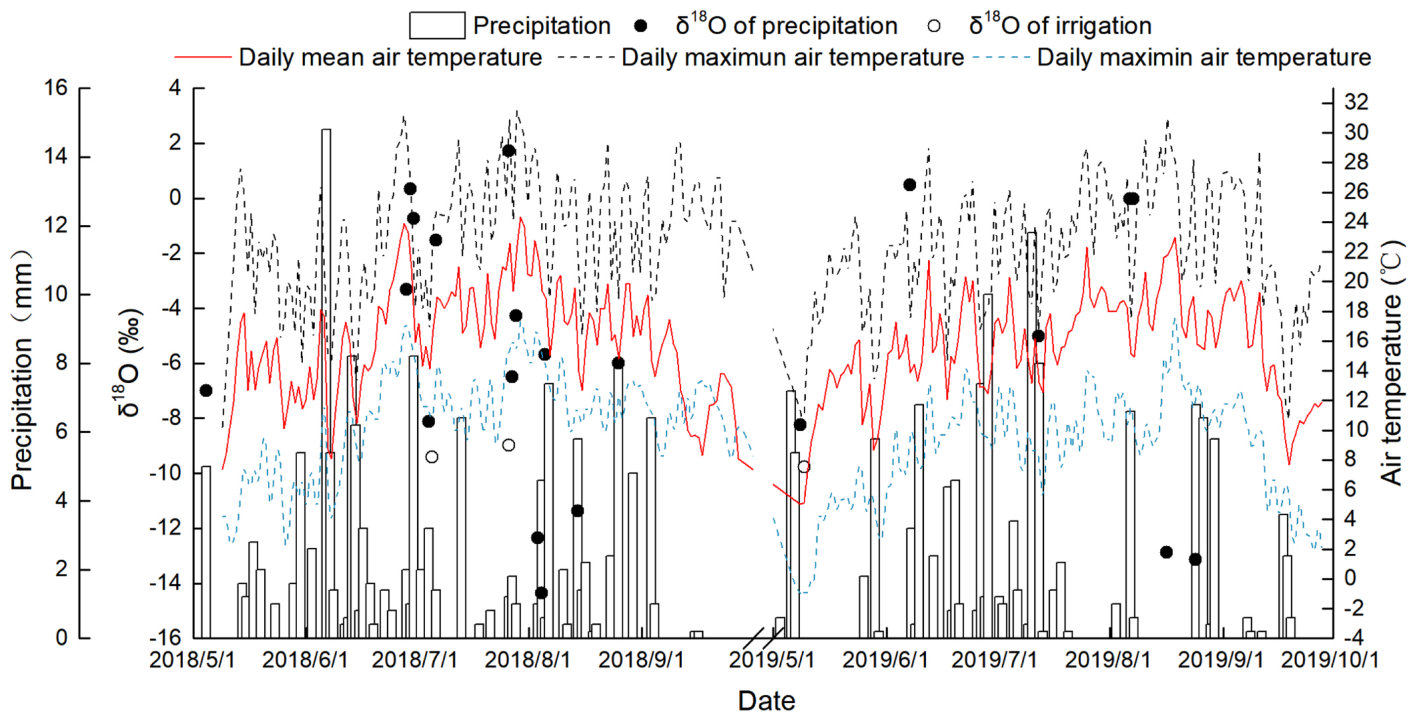
Daily rainfall, mean air temperature and δ18O values of rainwater and irrigation water recorded at the study area from May to September in 2018 and 2019 are shown in Fig. 1. The total rainfall during the growing period was 146.8 mm and 130.4 mm in 2018 and 2019, respectively. More than 78% of the rainfall occurred from the beginning of 1st June to 31st August. There were wide variations in both δ18O values of the rainfall (− 14.4 to 1.7‰) and amounts of precipitation throughout the growing period. The Pearson’s correlation analysis indicated no correlation between the δ18O values of rainwater and rainfall or daily average temperature.
2018年和2019年5–9月研究区的日降雨量、日平均气温以及雨水和灌溉水的δ18O值见图1。2018年和2019年生育期总降雨量分别为146.8 mm和130.4 mm,78%以上的降雨发生在6月1日至8月31日。整个生育期内降雨的δ18O值(− 14.4至1.7‰)和降水量均变化较大。Pearson相关分析表明,雨水δ18O值与降雨量或日平均气温均无相关性。
where: j represents the jth water source, k is the total number of water sources (there are three water sources in this study, k = 3), f refer to the contribution rate of the water source which were predicted by water source partitioning methods, and δx represents the isotope value of the water source (δ18O).
式中:j表示第j个水源,k为水源总数(本研究有3个水源,k = 3),f为由水源划分方法预测的水源贡献率,δx为水源的同位素值(δ18O)。
To evaluate the performance of different models, we calculated five indicators as follows:
为评价不同模型的性能,我们计算了以下5项指标:
(1) Root mean square error, RMSE
(1)均方根误差,RMSE


3.2. Soil water content and stable isotope composition of soil water3.2. 土壤含水量及土壤水稳定同位素组成
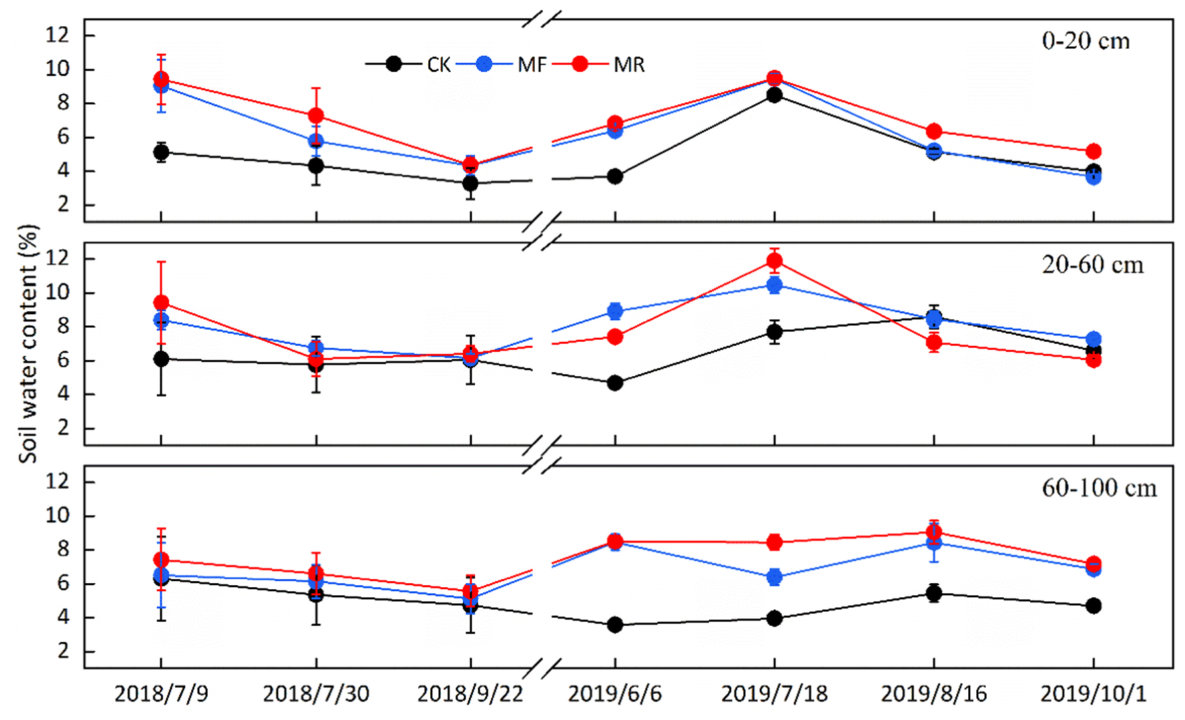
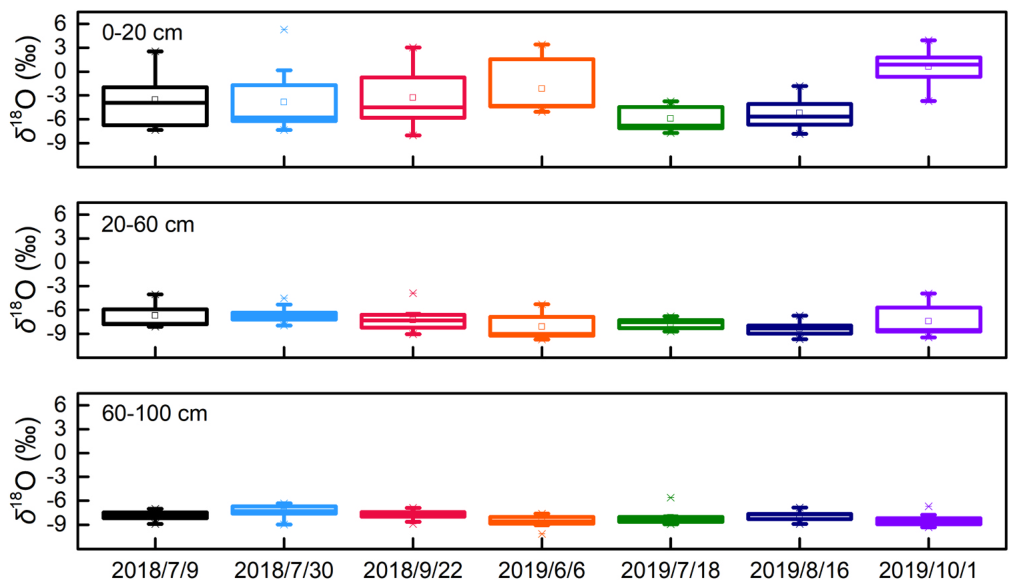
The soil water profiles varied substantially between both treatments and growth stages (Fig. 3). Soil water contents were higher under the MF and MR treatments than under CK, by 30.2% and 37.1%, respectively, on average across the soil profile on the seven sampling occasions. In addition, the water content of shallow soil fluctuated most strongly, and the ranges of soil water content have decreased over soil depth; the water content of deep soil showed slight fluctuations. The change pattern of the δ18O values of water was similar among the treatments. Therefore, we did not consider differences in the change pattern of the δ18O values of water across the treatments. The Fig. 4 shows the temporal and spatial variation of soil water δ18O values under all treatment. The δ18O values of water in the shallow layer clearly varied. The variations in δ18O values were lower in the middle layer under each treatment, and no significant variations were detected in the deep layer.
土壤水分剖面在处理间和生育期间均存在显著差异(图3)。7次采样的全剖面平均土壤含水量,MF和MR处理分别比CK高30.2%和37.1%。此外,浅层土壤含水量波动最为剧烈,土壤含水量变幅随土层深度增加而减小;深层土壤含水量波动较小。各处理间水分δ18O值的变化规律相似,因此未考虑处理间水分δ18O值变化规律的差异。图4显示了所有处理下土壤水δ18O值的时空变化。浅层水分δ18O值变化明显;各处理中层δ18O值变化较小,深层未检测到显著变化。
3.3. Seasonal water use patterns of wolfberry under the three treatments3.3. 三种处理下枸杞的季节性水分利用模式
(3) Mean absolute percentage error, MAPE (4) The maximum prediction error, MaxE (5) The minimum prediction error, MinE MinE = min(pi − oi) i = 1, ……n (2 -10)
(3)平均绝对百分比误差,MAPE(4)最大预测误差,MaxE(5)最小预测误差,MinE MinE = min(pi − oi) i = 1, ……n (2 -10)


where: pi and oi are the predicted and observed values of water isotope composition in plant xylem; n mean the number of observations, om is the average of observed values. Smaller RMSE values indicated less error in the models. A NE value of 1 indicates that the prediction results are completely accurate, the closer NE is to 1, the higher the reliability of the model. MAPE < 10% indicates high fit; 10% < MAPE < 20% indicates fine fit; 20%<MAPE< 50% indicates feasible fit; MAPE> 50% means infeasible fitting (Zhang et al., 2020).
式中:pi和oi分别为植物木质部水同位素组成的预测值和观测值;n为观测次数,om为观测值的平均值。RMSE值越小,模型误差越小。NE值为1表示预测结果完全准确,NE越接近1,模型可靠性越高。MAPE < 10%表示拟合度高;10% < MAPE < 20%表示拟合良好;20%<MAPE< 50%表示拟合可行;MAPE> 50%表示拟合不可行(Zhang et al., 2020)。
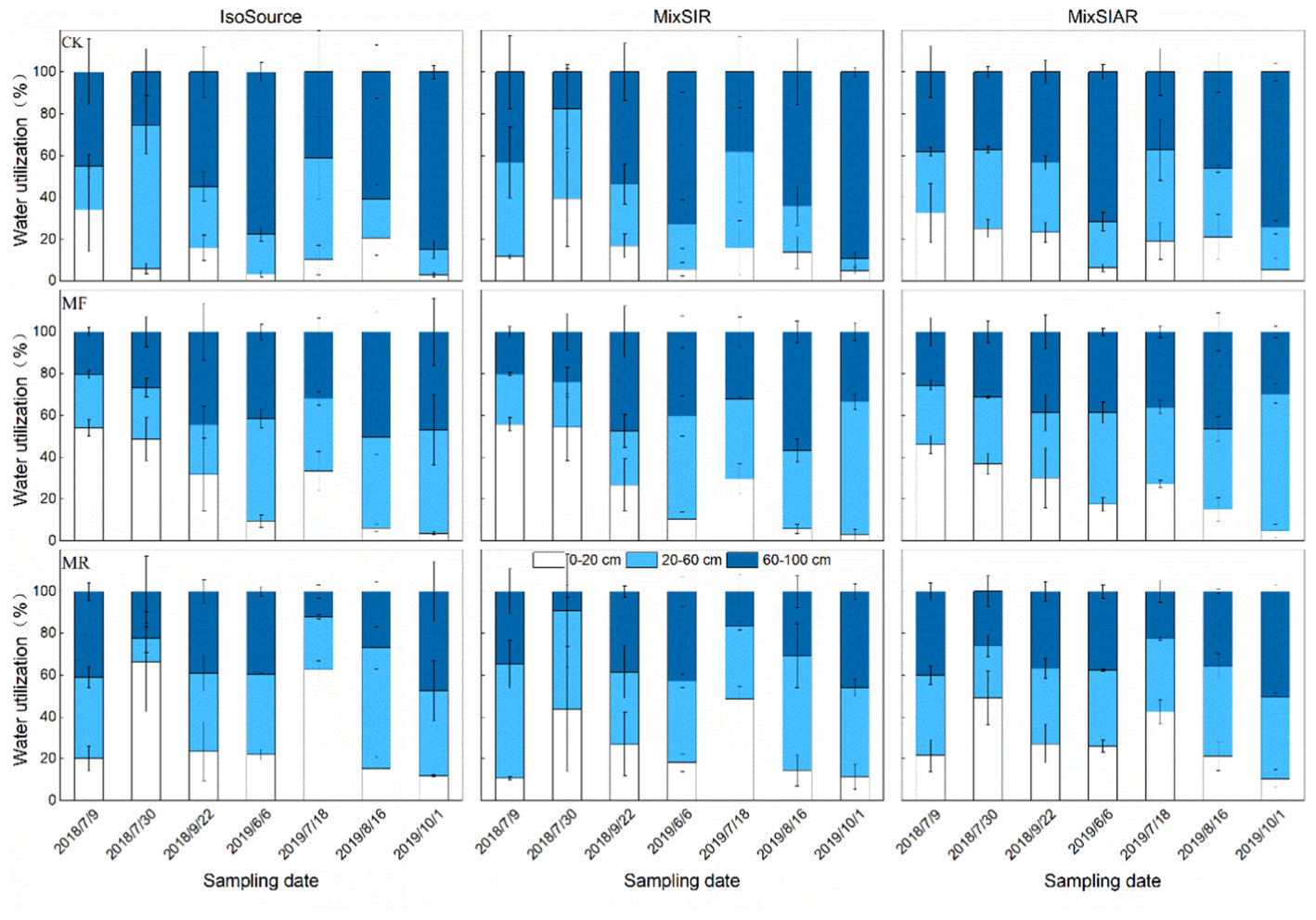
Estimates of relative contributions of water from the three potential sources were obtained from the oxygen isotope values using the Iso- Source, MixSIR and MixSIAR models. The three models indicated that the wolfberry under CK used more water from the deep layer with a mean value of 53.1% (26.8–82.8%) during the growth season. In LFE and DF, CK took up correspondingly large proportions of water from the deep layers by 73.9% and 66.7%, respectively, and CK mainly using the water from the middle and deep layers during BYF and FTM. The MF and MR mainly used water from the middle and deep layers during LEF and DF; they could shift their water source among all 3 layers in BYF and FM, but MR used more the shallow and middle layers water (Fig. 5).
利用IsoSource、MixSIR和MixSIAR模型,根据氧同位素值估算了3个潜在水源的相对贡献。3个模型均表明,生长季内CK处理的枸杞更多地利用深层水分,平均为53.1%(26.8–82.8%)。在LFE和DF期,CK分别从深层吸收了较大比例的水分(73.9%和66.7%),而在BYF和FTM期主要利用中层和深层水分。MF和MR在LEF和DF期主要利用中层和深层水分;在BYF和FM期可在3个土层之间转换水源,但MR更多地利用浅层和中层水分(图5)。
The results obtained using the three methods were similar, regarding the main apparent root water uptake depth of wolfberry. However, there were differences in the relative contributions of water sources they indicated. The MixSIR model displayed a higher proportion of middle water sources than the IsoSource and MixSIAR models in most cases. For instance, the MixSIR model indicated that the middle layer had a higher contribution in the BYF and FTM stages under MR than that indicated by the IsoSource and MixSIAR models in 2018. In addition, under MR, the IsoSource model indicated that the middle layers had higher contributions (62.7%) than the MixSIR (48.5%) and MixSIAR (42.4%) models in LEF in 2019. The summary of the performance of water utilization predictions using different models is shown in Table 3. The IsoSource model revealed the lowest RMSE, MAPE MinE and MaxE and the largest NE, which indicated the accuracy and reliability of this model. The RMSE, MAPE and MaxE values of the MixSIAR model were comparatively larger than those of the IsoSource and MixSIR models, while the MixSIAR model showed lower NE values than the IsoSource and MixSIR models, which suggested that the MixSIAR model yields comparatively poorer outcomes in terms of water utilisation prediction.
就枸杞主要表观根系吸水深度而言,三种方法所得结果相似,但各方法给出的水源相对贡献存在差异。多数情况下,MixSIR模型显示的中层水源比例高于IsoSource和MixSIAR模型。例如,2018年MR处理下,MixSIR模型所示BYF和FTM期中层的贡献高于IsoSource和MixSIAR模型。此外,2019年LEF期MR处理下,IsoSource模型所示中层贡献(62.7%)高于MixSIR(48.5%)和MixSIAR(42.4%)模型。不同模型水分利用预测性能汇总见表3。IsoSource模型的RMSE、MAPE、MinE和MaxE最低,NE最大,表明该模型准确可靠。MixSIAR模型的RMSE、MAPE和MaxE值相对大于IsoSource和MixSIR模型,而NE值低于IsoSource和MixSIR模型,表明MixSIAR模型的水分利用预测效果相对较差。
3.4. Root distributions3.4. 根系分布
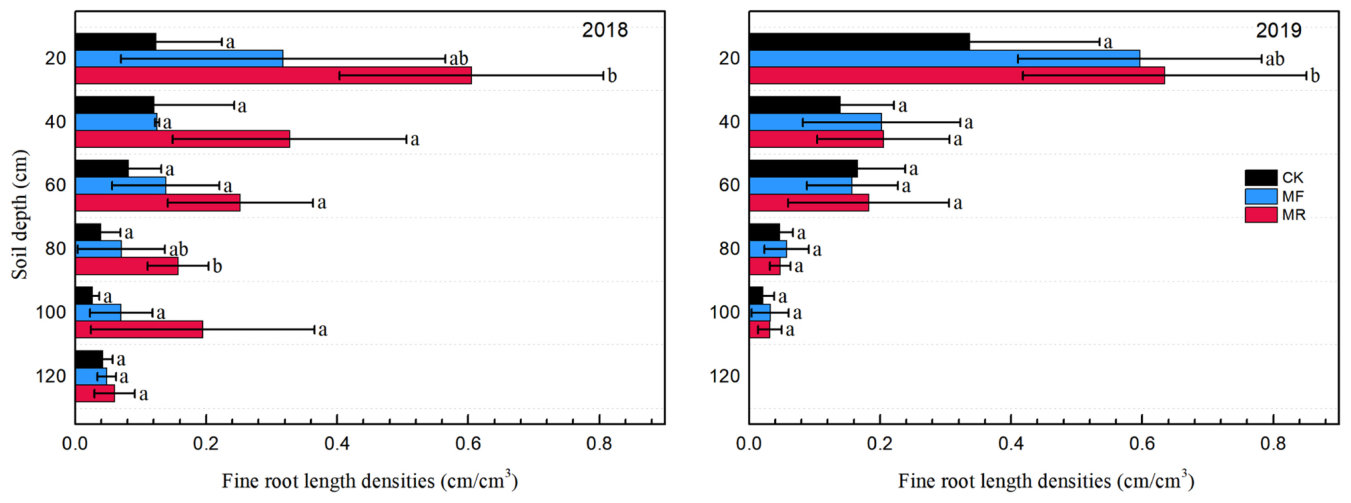
The distribution of FRLD under each of the treatments are shown in Fig. 2. The spatial distribution of the roots was influenced by the ridge-furrow system and mulch. Under each treatment condition, most of the fine roots were found in the shallow and middle layers (82.8%, 83.4% and 83.5% of the total roots on an average over 2 years in the CK, MF and MR, respectively). In general, the order of FRLD with different treatments was MR > MF > CK. Although no obvious differences were found in the distribution of FRLD in each treatment group, FRLD of MF and MR were extended compared with that of CK. FRLD in CK within the shallow soil layer was significantly lower than that in MF and MR.
各处理下FRLD的分布见图2。根系空间分布受垄沟系统和覆膜的影响。各处理条件下,大部分细根分布在浅层和中层(CK、MF和MR两年平均分别占总根量的82.8%、83.4%和83.5%)。总体而言,各处理FRLD大小顺序为MR > MF > CK。尽管各处理组FRLD分布无明显差异,但与CK相比,MF和MR的FRLD有所扩展。CK浅层土壤的FRLD显著低于MF和MR。
3.5. Yield and WUE3.5. 产量与WUE
MF and MR showed an increase in yield by 4.7% and 16.4% in 2018 and by 14.4% and 26.6% in 2019, respectively, compared with CK (Table 4). Similar trends were observed in WUE across the treatment groups. Compared with CK, MF and MR improved WUE by 5.7% and 17.1% in 2018 and by 4.2% and 17.0% in 2019, respectively. The maximum yield and WUE value were recorded in MR, whereas the lowest yield and WUE value were recorded in CK.
与CK相比,MF和MR的产量在2018年分别提高了4.7%和16.4%,在2019年分别提高了14.4%和26.6%(表4)。各处理组WUE呈相似趋势。与CK相比,MF和MR的WUE在2018年分别提高了5.7%和17.1%,在2019年分别提高了4.2%和17.0%。产量和WUE的最大值出现在MR处理,最小值出现在CK处理。
3.6. Relationship between source contribution and soil water content and fine roots
3.6. 水源贡献与土壤含水量及细根的关系
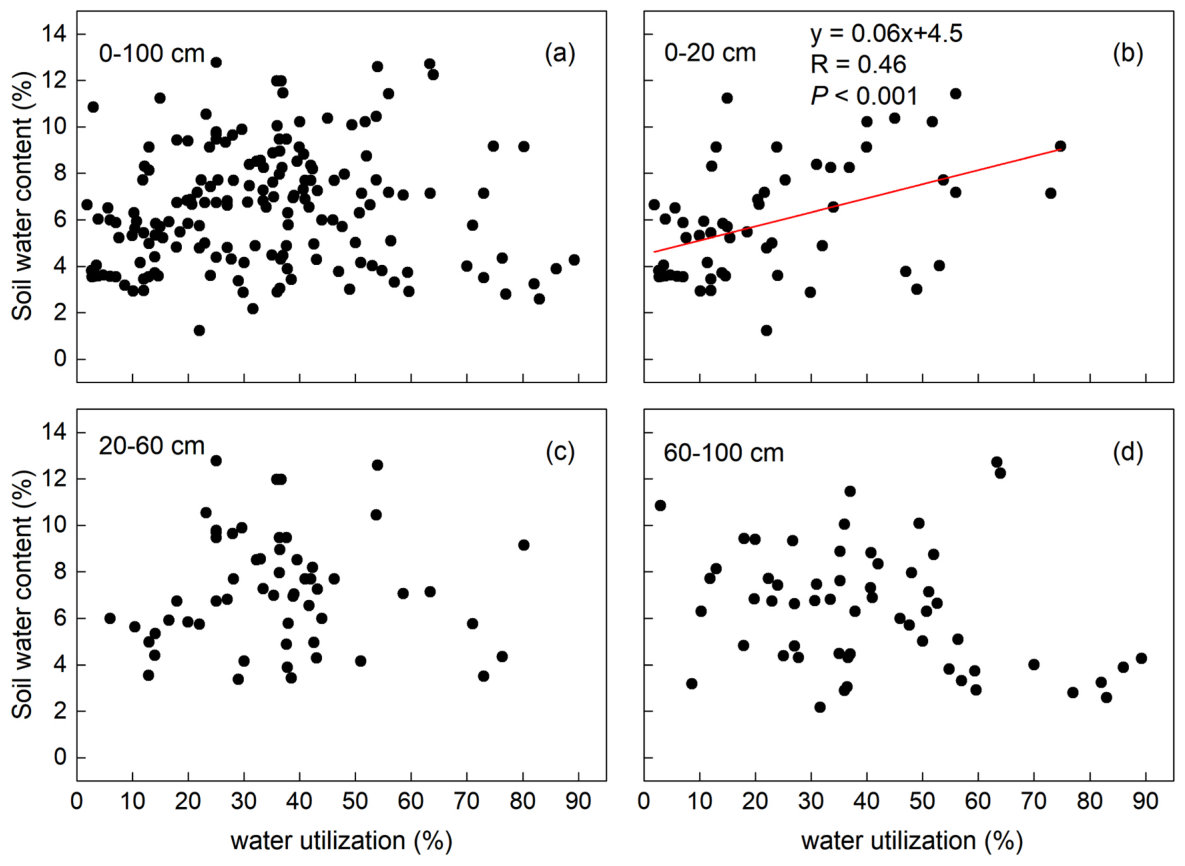
To understand the effect of the soil water content on root water uptake, we examined correlations between soil layers’ contributions to the trees’ xylem water and their water contents, using data obtained for all plants at each sampling date. Overall, there was no significant correlation between these variables (Fig. 6). However, water content was positively correlated with the contribution of the shallow layer, but not correlated with the contribution of the middle and deep layers (Fig. 6).
为了解土壤含水量对根系吸水的影响,我们利用各采样日所有植株的数据,分析了各土层对树木木质部水的贡献与其含水量之间的相关性。总体上,二者之间无显著相关性(图6)。然而,含水量与浅层贡献呈正相关,而与中层和深层贡献无相关性(图6)。
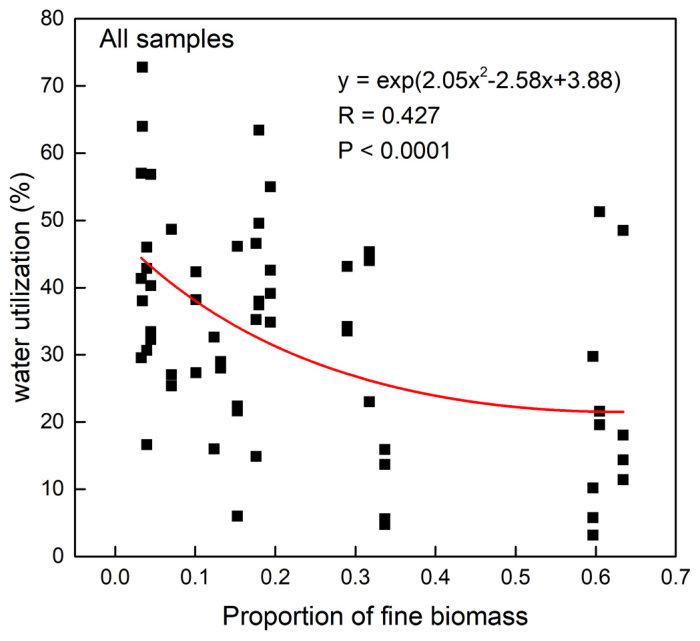
To study the relationship between root water uptake and fine root density, the contribution of each layer to the xylem water of all sampled trees subjected to the same treatment were averaged, to obtain a mean value for each treatment and sampling date. Correlations between these means and proportion of fine biomass (FRLD) values of corresponding soil layers on corresponding sampling dates were then examined. The contribution of water sources decreased exponentially with increases in FRLD when using data obtained for all samples (Fig. 7). Conversely, the contribution of water sources decreased first and then increased with increasing FRLD in the deep layer (Fig. S1). However, there was no significant relationship between the proportion of fine biomass and contribution of water source in shallow and middle layers (Fig. S1).
为研究根系吸水与细根密度的关系,将同一处理下所有采样树木各土层对木质部水的贡献进行平均,得到各处理各采样日的平均值,然后分析这些平均值与相应采样日相应土层细根生物量比例(FRLD)之间的相关性。基于所有样品数据,水源贡献随FRLD的增加呈指数下降(图7)。相反,在深层,水源贡献随FRLD的增加先降低后升高(图S1)。然而,浅层和中层的细根生物量比例与水源贡献之间无显著关系(图S1)。
Evaluation of prediction performance on different models.
不同模型预测性能评价。
| Evaluation index评价指标 | IsoSourceIsoSource | MixSIRMixSIR | MixSIARMixSIAR |
|---|---|---|---|
| RMSE | 0.2025 | 0.3323 | 0.5306 |
| NE | 0.9634 | 0.8864 | 0.7877 |
| MAPE | 0.0115 | 0.0333 | 0.0609 |
| MaxE | 1.0250 | 1.0632 | 1.7320 |
| MinE | 0.0001 | 0.0061 | 0.0038 |
4Discussion讨论
4.1. Comparison of different models of water use source identification
4.1. 不同水分利用来源识别模型的比较
The δ18O of the soil water is mainly affected by evaporation and is enriched in the surface layer; however, the effect of evaporation decreases with an increase in soil depth. Therefore, under each treatment, the δ18O of the soil water first decreased rapidly and then tended to be stable with increases in soil depth in the 0–100 cm soil layer, in accordance with previous findings (Cao et al., 2018; Huo et al., 2018; Zhao et al., 2018a). The prediction accuracy of these 3 models was different across different study areas (Evaristo et al., 2017; Wang et al., 2019; Zhang et al., 2020). Therefore, the selection of an accurate prediction model is essential to analyse plant water use patterns. The RMSE values of the models were lower, whereas the NE values of the models were larger than those reported in a study by Wang et al. (2019). These results together indicate that the 3 models had accurate and credible outcomes in the present study. However, some differences in the water uptake proportions were observed among the 3 models. In general, the order of predicting performance was IsoSource > MixSIR > MixSIAR. The best performance of IsoSource was due to the IsoSource model, which did not consider the uncertainties of the stable isotopic composition in plants’ water sources and xylem water (Parnell et al., 2010); therefore, the water uptake proportion predictions of the IsoSource model did not necessarily reflect the actual root water absorption (Wang et al., 2019). The Bayesian mixing model (MixSIR and MixSIAR models) can deal with water source apportionment better, due to consideration of the error structure (residual and process error) and the uncertainties of potential water sources (Brian and Brice, 2016; Parnell et al., 2010; Stock et al., 2018). Differences in the contribution from different layers of the 2 Bayesian mixing models may be attributed to the error parameterisation and posterior distribution in the model calculations. In this study, the performance of both Bayesian models was excellent, and the comprehensive performance of the MixSIR model was better. Therefore, the MixSIR model was employed to estimate the relative contributions of water sources in present study.
土壤水的δ18O主要受蒸发影响,在表层富集;但蒸发的影响随土层深度增加而减弱。因此,各处理下0–100 cm土层中土壤水的δ18O随土层深度增加先迅速降低后趋于稳定,这与前人研究结果一致(Cao et al., 2018; Huo et al., 2018; Zhao et al., 2018a)。这3种模型在不同研究区的预测精度存在差异(Evaristo et al., 2017; Wang et al., 2019; Zhang et al., 2020),因此,选择准确的预测模型对分析植物水分利用模式至关重要。与Wang et al. (2019) 的研究相比,本研究模型的RMSE值更低,NE值更大。这些结果共同表明,3种模型在本研究中的结果准确可信。然而,3种模型所得吸水比例存在一定差异。总体而言,预测性能顺序为IsoSource > MixSIR > MixSIAR。IsoSource表现最佳的原因在于该模型未考虑植物水源和木质部水稳定同位素组成的不确定性(Parnell et al., 2010),因此IsoSource模型预测的吸水比例未必反映实际的根系吸水情况(Wang et al., 2019)。贝叶斯混合模型(MixSIR和MixSIAR模型)由于考虑了误差结构(残差和过程误差)以及潜在水源的不确定性,能更好地进行水源分配(Brian and Brice, 2016; Parnell et al., 2010; Stock et al., 2018)。两种贝叶斯混合模型所得各土层贡献的差异可能归因于模型计算中的误差参数化和后验分布。本研究中,两种贝叶斯模型的表现均很优异,其中MixSIR模型的综合性能更好。因此,本研究采用MixSIR模型估算各水源的相对贡献。
Chinese wolfberry yield and WUE under different treatments.
不同处理下宁夏枸杞产量与WUE。
| Year年份 | Treatment处理 | Precipitation (mm)降水量(mm) | Irrigation (mm)灌溉量(mm) | Evapotranspiration (mm)蒸散量(mm) | Yield (kg hm−1)产量(kg hm−1) | WUE (kg hm−1 mm−1) |
|---|---|---|---|---|---|---|
| 2018 | CK | 146.8 | 170 | 318.3 | 1126.6 | 3.5 |
| MF | 146.8 | 170 | 316.4 | 1179.9 | 3.7 | |
| MR | 146.8 | 170 | 318.1 | 1312.2 | 4.1 | |
| 2019 | CK | 130.4 | 170 | 290.3 | 1372.7 | 4.7 |
| MF | 130.4 | 170 | 318.7 | 1571.4 | 4.9 | |
| MR | 130.4 | 170 | 313.7 | 1737.9 | 5.5 |
4.2. Analysis of water sources under the three treatments4.2. 三种处理下的水源分析
The isotopic values of xylem water and soil water exhibited seasonal variations and between field management practices (Fig. 4; Table S2), indicating that the water used by trees from May to September may came from different soil water sources in the different treatments. The shallow and middle layers have relatively high water contents due to water supplied by winter irrigation and snow melt, during the LFE stage (Dai et al., 2015; Zhao et al., 2018b). The trees in CK did not use water from the shallow water source (5.6%), and instead depended on water from the deep water source (72.8%), this was attribute to low temperatures and water consumption (Table S3; Zhang et al., 2018), However, under the MF and MR they used more proportions of water from shallow layer, 10.2% and 18%, respectively, possibly because the mulching and creation of ridges and furrows increased the soil temperature and humidity (Fig. 3; Table S3; Gu et al., 2016), thereby enhancing root activity in shallow soil layer (Clarke et al., 2015). During BYF and FTM, the root growth was the fastest and the root activity was strong (Cao and He., 2013). The trees could flexibly use the water source of each soil layer. CK treatment mainly used the middle and deep soil water sources; increased precipitation did not increase the utilization of shallow water sources in BYF in2019, which may be because of a decrease in the soil water content in the shallow layer (compared with the other two treatment groups) due to water loss through evaporation (Table S3). Moreover, 74% of the precipitation events were < 5 mm, which is an invalid rainfall amount for crop growth (Zhao et al., 2018b), because of which, the root system sensitivity to precipitation was reduced. Only when the precipitation increases to a certain threshold, the root system in the shallow soil layer can respond, and the root system can form the ability to maintain absorption of shallow water source (Zhao et al., 2018b). In contrast, under MR and MF the mulching measures reduced the water loss from soil evaporation, and under MR, the tillage measures could sufficiently increase the infiltration of the precipitation to induce responses (Table S3; Liu et al., 2014). Compared to CK, the trees in MF and MR can flexibly switch to different water sources due to increased soil water content and root biomass in each soil layers. Increased absorption of shallow water sources in BYF 2019 may be because the ridges increased rainfall infiltration and thus induce strongly responses from rainfall in MR. In autumn, the temperature and wolfberry transpiration dropped, but rain was scarce, so both soil water content and root activity declined in the shallow layer, and wolfberry preferred use of water in the middle and deep soil layers, which is relatively abundant and stable (Gao et al., 2018a).
木质部水和土壤水的同位素值表现出季节变化以及田间管理措施间的差异(图4;表S2),表明5–9月树木利用的水分在不同处理中可能来自不同的土壤水源。LFE期,由于冬灌和融雪补给,浅层和中层含水量相对较高(Dai et al., 2015; Zhao et al., 2018b)。CK处理的树木几乎不利用浅层水源(5.6%),而依赖深层水源(72.8%),这归因于低温和耗水量较低(表S3;Zhang et al., 2018);而在MF和MR处理下,树木利用浅层水分的比例更高,分别为10.2%和18%,这可能是因为覆膜和起垄开沟提高了土壤温度和湿度(图3;表S3;Gu et al., 2016),从而增强了浅层土壤的根系活力(Clarke et al., 2015)。BYF和FTM期根系生长最快、根系活力强(Cao and He., 2013),树木可以灵活利用各土层的水源。CK处理主要利用中层和深层土壤水源;2019年BYF期降水增加并未提高对浅层水源的利用,这可能是由于蒸发失水导致浅层土壤含水量下降(与其他两个处理组相比)(表S3)。此外,74%的降水事件< 5 mm,属于对作物生长无效的降雨量(Zhao et al., 2018b),因而降低了根系对降水的敏感性。只有当降水量增加到一定阈值时,浅层土壤中的根系才能作出响应,并形成维持吸收浅层水源的能力(Zhao et al., 2018b)。相比之下,MR和MF处理的覆膜措施减少了土壤蒸发失水,且MR处理的耕作措施可充分增加降水入渗,从而诱发根系响应(表S3;Liu et al., 2014)。与CK相比,MF和MR处理由于各土层土壤含水量和根系生物量增加,树木可在不同水源间灵活切换。2019年BYF期浅层水源吸收增加,可能是由于MR处理中垄增加了降雨入渗,从而诱发了对降雨的强烈响应。秋季气温下降、枸杞蒸腾减弱,但降雨稀少,浅层土壤含水量和根系活力均下降,枸杞优先利用相对充足且稳定的中层和深层土壤水分(Gao et al., 2018a)。
4.3. Impact of soil water availability and fine roots on water sources4.3. 土壤水分有效性和细根对水源的影响
treatment) may no longer be suitable for agriculture in many drylands, and in these areas water-conserving agricultural measures may be needed. We found that the soil water contents and proportional use of shallow and middle water sources were consistently higher under the MF and MR than those under CK treatments throughout the growth period. Shallow soil water is thus extremely important for wolfberry production. This is consistent with reports that a combination of full film mulching and tillage is an effective way to improve soil moisture and temperature (Mo et al., 2017; Liao et al.,2019b, 2021), with great potential for saving water in arid and semi-arid areas (Gu et al., 2016). In the context of rainfall increases on the TP (Kuang and Jiao, 2016), film mulching and tillage measures could collect large volumes of rainwater and increase the available water for plants, thereby increasing production and WUE. Therefore, we recommend it as a water management strategy for dryland wolfberry orchards.
处理)在许多旱区可能已不再适合农业生产,这些地区可能需要采取节水农业措施。我们发现,在整个生育期内,MF和MR处理的土壤含水量以及浅层和中层水源利用比例始终高于CK处理。因此,浅层土壤水对枸杞生产极为重要。这与已有报道一致,即全膜覆盖与耕作相结合是改善土壤水分和温度的有效途径(Mo et al., 2017; Liao et al.,2019b, 2021),在干旱和半干旱地区具有巨大的节水潜力(Gu et al., 2016)。在青藏高原降雨增加的背景下(Kuang and Jiao, 2016),覆膜和耕作措施可收集大量雨水,增加植物可利用水分,从而提高产量和WUE。因此,我们推荐将其作为旱地枸杞园的水分管理策略。
5Conclusion结论
Root water uptake is closely related to soil water availability and the distribution of functional roots (Kulmatiski et al., 2017; Gao et al., 2018a). We found that contributions of the shallow soil layer were positively correlated with its water content, indicating that the trees’ root systems were sensitive to the shallow water sources and responded rapidly to changes (except CK), due to the high density of fine roots and possibly through changes in the activity or abundance of aquaporins (Gregory et al., 2015). The root systems of wolfberries may be able to exploit a large horizontal area of shallow soil, which may also facilitate absorption of nutrients that are generally highest in the shallow layer (Table 1, Clarke et al., 2015). Similar results were reported by Gao et al. (2018b), who revealed a positive correlation between the soil water content and root water uptake in a semiarid revegetated ecosystem. In the middle and deep soil layers, the trees’ water utilisation did not match the soil water content. A possible explanation for this finding is that the trees’ water requirements could be more easily met in the shallow layer, owing to the strong concentration of the trees’ root in the shallow soil layer, soil water availability is not a major constraint factor in the trees’ water absorption (Huo et al., 2020). We detected a non-linear correlation between FRLD and water source contributions, possibly because the decline in shallow water availability during the long drought in September (Fig. 5) led to more water uptake from the deep layer with low FRLD (Yang et al., 2018). Changes in the plants’ water sources may also be related to the architecture and hydraulic effects of root systems (Rosado et al., 2011; Kulmatiski and Beard, 2013). Therefore, plants’ water use strategies are inextricably linked to soil water availability and their fine root distributions.
根系吸水与土壤水分有效性和功能根系分布密切相关(Kulmatiski et al., 2017; Gao et al., 2018a)。我们发现浅层土壤的贡献与其含水量呈正相关,表明树木根系对浅层水源敏感并能对其变化迅速作出响应(CK除外),这是由于细根密度高,也可能与水通道蛋白活性或丰度的变化有关(Gregory et al., 2015)。枸杞根系可能能够利用大范围水平面积的浅层土壤,这也可能有利于吸收通常在浅层含量最高的养分(表1,Clarke et al., 2015)。Gao et al. (2018b) 也报道了类似结果,揭示了半干旱植被恢复生态系统中土壤含水量与根系吸水之间呈正相关。在中层和深层土壤中,树木的水分利用与土壤含水量并不匹配。对此的一种可能解释是,由于树木根系高度集中于浅层土壤,树木的需水更容易在浅层得到满足,土壤水分有效性并非树木吸水的主要限制因素(Huo et al., 2020)。我们发现FRLD与水源贡献之间呈非线性相关,这可能是因为9月长期干旱期间浅层水分有效性下降(图5),导致树木更多地从FRLD较低的深层吸水(Yang et al., 2018)。植物水源的变化还可能与根系构型及水力效应有关(Rosado et al., 2011; Kulmatiski and Beard, 2013)。因此,植物的水分利用策略与土壤水分有效性及其细根分布密不可分。
4.4. Effect of field management practices on wolfberry yield and WUE4.4. 田间管理措施对枸杞产量和WUE的影响
Studies have reported that both mulching and tillage measures can improve the yield and WUE in maize and wheat (Fang et al., 2021; Daryanto et al., 2017), mainly because mulching can increase the accumulation of soil water due to reduced soil evaporation and ridge- –furrow farming practice can enhance the use of rainfall (Zhang et al., 2021). In addition, mulching and tillage measures can effectively increase surface soil moisture, soil temperature and water use. Such hydrothermal conditions play an important role in the dry matter accumulation and growth yield of plants (Zhang et al.,2021). Although the magnitude of the difference was small in evapotranspiration among the 3 treatments in 2018, the soil evaporation in MF and MR was less than that in CK (Table S3), indicating that more soil water in MF and MR was used for plant transpiration. Thus, the WUE in MF and MR was increased by 5% and 17% compared with that in CK.
已有研究报道,覆膜和耕作措施均可提高玉米和小麦的产量和WUE(Fang et al., 2021; Daryanto et al., 2017),这主要是因为覆膜可减少土壤蒸发从而增加土壤水分积累,而垄沟种植方式可提高降雨利用率(Zhang et al., 2021)。此外,覆膜和耕作措施可有效提高表层土壤水分、土壤温度和水分利用。这种水热条件对植物干物质积累和产量形成具有重要作用(Zhang et al.,2021)。尽管2018年3个处理间蒸散量差异较小,但MF和MR的土壤蒸发量低于CK(表S3),表明MF和MR中更多的土壤水分用于植物蒸腾。因此,与CK相比,MF和MR的WUE分别提高了5%和17%。
Irrigation water is becoming scarce due to the increasing demands for water for industrial, urban and other uses in arid and semi-arid areas (Hamzei, 2011), and it is projected that global mean temperature rises by at least 2 ℃ by the end of the twenty-first century, particularly on TP (Chen et al., 2013). Hence, traditional flat planting (as in the CK
在干旱和半干旱地区,由于工业、城市及其他用水需求不断增加,灌溉水日益短缺(Hamzei, 2011);据预测,到21世纪末全球平均气温将至少升高2 ℃,青藏高原尤甚(Chen et al., 2013)。因此,传统平作(如CK
Our analysis of Chinese wolfberry’s water use patterns in different management practices using stable oxygen isotope techniques and three models (IsoSource, MixSIR and MixSIAR). No significant difference was noted in water utilisation predicted using the 3 methods in this study. The three models exhibited good performance for wolfberry water source apportionment, and the similar results acquired using the three models indicated that the prediction of wolfberry water source is reliable. Overall, the MixSIR model exhibited relatively better performance than the IsoSource and MixSIAR models. The CK trees tended to use more soil water from deeper layers, and their water use patterns were insensitive to rainfall, whereas the MF and MR trees shifted their water source between all three layers, depending on soil water content. The proportional contribution of only at shallow water layer was positively correlated with its water content, and overall contributions of the layers were exponentially decayed with FRLD in them. The water source utilisation of the MR trees was found to be highly flexible and sensitive to precipitation (irrigation) during the growth period, whereas tillage and film mulching were found to increase the shallow soil water content in the field, wolfberry’s proportional use of shallow soil water, wolfberry yield and WUE. Therefore, it was established as the most effective water management practice in wolfberry orchards. Further study is however required to enhance the quantitative understanding of soil nutrients and subsurface irrigation to optimize the field management practices, such as irrigation schedules and modes.
本研究利用稳定氧同位素技术及三种模型(IsoSource、MixSIR和MixSIAR)分析了不同管理措施下枸杞的水分利用模式。本研究中三种方法预测的水分利用结果无显著差异。三种模型在枸杞水源解析中均表现良好,且三种模型所得结果相近,表明枸杞水源的预测结果是可靠的。总体而言,MixSIR模型的表现相对优于IsoSource和MixSIAR模型。CK处理的枸杞树倾向于利用更多深层土壤水,其水分利用模式对降雨不敏感;而MF和MR处理的枸杞树则根据土壤含水量在全部三个土层之间转换水源。仅浅层土壤水的相对贡献率与其含水量呈正相关,而各土层的总体贡献率随其中细根长度密度(FRLD)呈指数衰减。MR处理枸杞树的水源利用在生长期内具有高度灵活性,并对降水(灌溉)十分敏感;而耕作与覆膜提高了田间浅层土壤含水量、枸杞对浅层土壤水的利用比例、枸杞产量及水分利用效率(WUE)。因此,该措施被确定为枸杞园最有效的水分管理措施。然而,仍需进一步研究以加深对土壤养分和地下灌溉的定量认识,从而优化灌溉制度与灌溉方式等田间管理措施。
Declaration of Competing Interest利益冲突声明
The authors declare that they have no known competing financial interests or personal relationships that could have appeared to influence the work reported in this paper.
作者声明,不存在任何可能影响本文所报道工作的已知经济利益冲突或个人关系。
Acknowledgements致谢
This work was jointly supported by the National Technology Research and Development Program key special projects of China (2017YFC0403600), the National Natural Science Foundation of China (41771316), the Integrative Science-Technology Innovation Engineering Project of Shaanxi (No. 2016KTZDNY-01-03), the 111 Project (No. B12007), and CAS "Youth Scholar of West China" Program (XAB2018A04). We appreciate the technical help from Jingjing Jin, Institute of Water-saving Agriculture in Arid Areas of China, Northwest A&F University.
本研究由国家重点研发计划重点专项(2017YFC0403600)、国家自然科学基金(41771316)、陕西省科技统筹创新工程计划项目(No. 2016KTZDNY-01-03)、高等学校学科创新引智计划(111计划,No. B12007)以及中国科学院“西部青年学者”项目(XAB2018A04)共同资助。感谢西北农林科技大学中国旱区节水农业研究院Jingjing Jin提供的技术帮助。
Appendix A. Supporting information附录A 补充材料
Supplementary data associated with this article can be found in the online version at doi:10.1016/j.agwat.2021.107010.
本文的补充数据可在线获取,doi:10.1016/j.agwat.2021.107010。
References参考文献
Barbeta, A., Penuelas, J., 2017. Increasing carbon discrimination rates and depth of water uptake favor the growth of Mediterranean evergreen trees in the ecotone with temperate deciduous forests. Glob. Chang. Biol. 23 (12), 5040–5068. Barbeta, A., Jones, S.P., Clav´e, L., Wingate, L., Gimeno, T.E., Fr´ejaville, B., Wohl, S., Og´ee, J., 2018. Hydrogen isotope fractionation affects the identification and quantification of tree water sources in a riparian forest. Hydrol. Earth Syst. 23 (4), 2129–2146. Brian, S., Brice, S., 2016. MixSIAR GUI User Manual. Version 3.1. https://github.com/ brianstock/MixSIAR/. Cai, Y., Wu, P., Zhu, D., Zhang, L., Zhao, X., Gao, X., Ge, M., Song, X., Wu, Y., Dai, Z., 2021. Subsurface irrigation with ceramic emitters: An effective method to improve apple yield and irrigation water use efficiency in the semiarid Loess Plateau. Agric., Ecosyst. Environ. 313 (2021), 107404.
Cao, G., Tang, Y., Mo, W., Wang, Y., Li, Y., Zhao, X., 2004. Grazing intensity alters soil respiration in an alpine meadow on the Tibetan plateau. Soil Biol. Biochem. 36 (2), 237–243.
Cao, X., Yang, P., Engel, B.A., Li, P., 2018. The effects of rainfall and irrigation on cherry root water uptake under drip irrigation. Agric. Water Manag. 197, 9–18.
Cao, Y.L., He, J., 2013. Lycium barbarum L. cultivated science. Sunshine press, Yinchuan, pp. 24–26 (In Chinese). Chen, H., Zhu, Q., Wu, N., Wang, Y., Peng, C.H., 2011. Delayed spring phenology on the Tibetan Plateau may also be attributable to other factors than winter and spring warming. Proc. Natl. Acad. Sci. U. S. A. 108 (19), 93.
Chen, H., Zhu, Q., Peng, C., Wu, N., Wang, Y.F., Fang, X.Q., Gao, Y.H., Zhu, D., Yang, G., Tian, J.Q., Kang, X.M., Piao, S.L., Ouyang, H., Xiang, W.H., Luo, Z.B., Jiang, H., Song, X.Z., Zhang, Y., Yu, G.R., Zhao, X.Q., Gong, P., Yao, T.D., Wu, J.H., 2013. The impacts of climate change and human activities on biogeochemical cycles on the Qinghai-Tibetan Plateau. Glob. Chang. Biol. 19 (10), 2940–2955.
Chen, X., Zhang, T., Guo, R., Li, H., Zhang, R., Degen, A.A., Huang, K., Wang, X., Bai, Y., Shang, Z., 2021. Fencing enclosure alters nitrogen distribution patterns and tradeoff strategies in an alpine meadow on the Qinghai-Tibetan Plateau. Catena 197, 104948. Clarke, S.J., Lamont, K.J., Pan, H.Y., Barry, L.A., Hall, A., Rogiers, S.Y., 2015. Spring root-zone temperature regulates root growth, nutrient uptake and shoot growth dynamics in grapevines. Aust. J. Grape Wine R. 21 (3), 479–489.
Dai, Y., Zheng, X., Tang, L., Li, Y., 2015. Stable oxygen isotopes reveal distinct water use patterns of two Haloxylon species in the Gurbantonggut Desert. Plant Soil 389 (1–2), 73–87.
Daryanto, S., Wang, L., Jacinthe, P.-A., 2017. Can ridge-furrow plastic mulching replace irrigation in dryland wheat and maize cropping systems? Agric. Water Manag. 190, 1–5.
Dawson, T.E., Ehleringer, J.R., 1991. Streamside trees that do not use stream water. Nature 350 (6316), 335–337.
Dawson, T.E., Mambelli, S., Plamboeck, A.H., Templer, P.H., Tu, K.P., 2002. Stable isotopes in plant ecology. Annu. Rev. Ecol. Syst. 33 (2002), 507–559.
Deng, Y., Gou, X., Gao, L., Yang, M., Zhang, F., 2017. Spatiotemporal drought variability of the eastern Tibetan Plateau during the last millennium. Clim. Dyn. 49 (5–6), 2077–2091. Ehleringer, J.R., Dawson, T.E., 1992. Water uptake by plants: perspectives from stable isotope composition. Plant Cell Environ. 15 (9), 1073–1082. Ellsworth, P.Z., Williams, D.G., 2007. Hydrogen isotope fractionation during water uptake by woody xerophytes. Plant Soil 291 (1–2), 93–107.
Evaristo, J., McDonnell, J.J., Clemens, J., 2017. Plant source water apportionment using stable isotopes: a comparison of simple linear, two-compartment mixing model approaches. Hydrol. Process. 31 (21), 3750–3758.
Fang, H., Li, Y., Gu, X., Yu, M., Du, Y., Chen, P., Li, Y., 2021. Evapotranspiration partitioning, water use efficiency, and maize yield under different film mulching and nitrogen application in northwest China. Field Crops Res. 264 (264), 108103. Feng, J., Wang, T., Qi, S., Xie, C., 2005. Land degradation in the source region of the Yellow River, northeast Qinghai-Xizang Plateau: classification and evaluation. Environ. Geol. 47 (4), 459–466.
Fu, B., Li, Z., Gao, X., Wu, L., Jian, L., Peng, W., 2021. Effects of subsurface drip irrigation on alfalfa (Medicago sativa L.) growth and soil microbial community structures in arid and semi-arid areas of northern China. Appl. Soil Ecol. 159 (2021), 103859.
Gao, X., Liu, Z., Zhao, X., Ling, Q., Huo, G., Wu, P., 2018a. Extreme natural drought enhances interspecific facilitation in semiarid agroforestry systems. Agric. Ecosyst. Environ. 265, 444–453.
Gao, X., Zhao, X., Li, H., Guo, L., Lv, T., Wu, P., 2018b. Exotic shrub species (Caragana korshinskii) is more resistant to extreme natural drought than native species (Artemisia gmelinii) in a semiarid revegetated ecosystem. Agr. For. Meteorol. 263, 207–216. Gregory, V.D.H., Dambrine, E., Pollier, B., Zeller, B., Ranger, J., Legout, A., 2015. Mg and ca uptake by roots in relation to depth and allocation to aboveground tissues: results from an isotopic labeling study in a beech forest on base-poor soil. Biogeochemistry 122 (2–3), 375–393.
Grossiord, C., Sevanto, S., Dawson, T.E., Adams, H.D., Collins, A.D., Dickman, L.T., Newman, B.D., Stockton, E.A., McDowell, N.G., 2017. Warming combined with more extreme precipitation regimes modifies the water sources used by trees. New Phytol. 213 (2), 584–596. Gu, X.B., Li, Y.N., Du, Y.D., 2016. Continuous ridges with film mulching improve soil water content, root growth, seed yield and water use efficiency of winter oilseed rape. Ind. Crop Prod. 85, 139–148.
Hamzei, J., 2011. Seed, oil, and protein yields of canola under combinations of irrigation and nitrogen application. Agron. J. 103 (4), 1152–1158.
Huo, G., Zhao, X., Gao, X., Wang, S., Pan, Y., 2018. Seasonal water use patterns of rainfed jujube trees in stands of different ages under semiarid plantations in China. Agric. Ecosyst. Environ. 265, 392–401.
Huo, G., Zhao, X., Gao, X., Wang, S., 2020. Seasonal effects of intercropping on tree water use strategies in semiarid plantations: evidence from natural and labelling stable isotopes. Plant Soil. 2020 (453), 229–243.
Jin, X., Jiang, P., Ma, D., Li, M., 2019. Land system evolution of Qinghai-Tibetan Plateau under various development strategies. Appl. Geogr. 104, 1–9.
Kuang, X., Jiao, J., 2016. Review on climate change on the tibetan plateau during the last half century. J. Geophys. Res. Atmos. 121 (8), 3979–4007.
Kulmatiski, A., Beard, K.H., 2013. Root niche partitioning among grasses, saplings, and trees measured using a tracer technique. Oecologia 171 (1), 25–37.
Kulmatiski, A., Adler, P.B., Stark, J.M., Tredennick, A.T., 2017. Water and nitrogen uptake are better associated with resource availability than root biomass. Ecosphere 8 (3), e1738.
Lei, C., Xiao, J., Shi, F., Guo, Y., Zhao, J., Zheng, L., 2020. Extraction methods of wolfberry plantation in qaidam region: a comparative study. Chin. Agric. Sci. Bull. 36 (17), 124–143 (In Chinese with English abstract).
Li, L., Gao, X., Wu, P., Zhao, X., Li, H., Ling, Q., Sun, W., 2017. Soil water content and root patterns in a rain-fed jujube plantation across stand ages on the Loess Plateau of China. Land Degrad. Dev. 28 (1), 207–216. Li, Y., 2019. Water and fertilizer coupling technology model boosts Qaidam wolfberry industry to improve quality and efficiency. Agric. Technol. 39, 13 (In Chinese with English abstract). Liao, R.K., Wu, W.Y., Hu, Y.Q., Hun, Y., 2019a. Quantifying moisture availability in soil profiles of cherry orchards under different irrigation regimes. Agric. Water Manag. 225 (2019), 105780. Liao, R.K., Wu, W.Y., Hu, Y.Q., Huang, Q.N., Yan, H., 2019b. Micro-irrigation strategies to improve water-use efficiency of cherry trees in Northern China. Agric. Water Manag. 221, 388–396. Liao, Y., Cao, H.X., Xue, W.K., Liu, X., 2021. Effects of the combination of mulching and deficit irrigation on the soil water and heat, growth and productivity of apples. Agric. Water Manag. 243 (2021), 106482. Lin, G., Sternberg, L.D.S.L., 1993. Hydrogen isotopic fractionation by plant roots during water uptake in coastal wetland plants. In Stable Isotopes and Plant Carbon-water Relations. Academic Press, San Diego, CA, USA, pp. 497–510. Liu, X., Li, X., Hai, L., Wang, Y., Li, F., 2014. How efficient is film fully-mulched ridge–furrow cropping to conserve rainfall in soil at a rainfed site? Field Crop Res. 169, 107–115.
Miehe, G., Schleuss, P.M., Seeber, E., Babel, W., Biermann, T., Braendle, M., Chen, F.H., Coners, H., Foken, T., Gerken, T., Graf, H.F., Guggenberger, G., Hafner, S., Holzapfel, M., Ingrisch, J., Kuzyakov, Y., Lai, Z.P., Lehnert, L., Leuschner, C., Li, X. G., Liu, J.Q., Liu, S.B., Ma, Y.M., Miehe, S., Mosbrugger, V., Noltie, H.J., Schmidt, J., Spielvogel, S., Unteregelsbacher, S., Wang, Y., Willinghofer, S., Xu, X.L., Yang, Y.P., Zhang, S.R., Opgenoorth, L., Wesche, K., 2019. The Kobresia pygmaea ecosystem of the Tibetan highlands - origin, functioning and degradation of the world’s largest pastoral alpine ecosystem Kobresia pastures of Tibet. Sci. Total Environ. 648, 754–771.
Miehe, G.M.S., Will, M., Opgenoorth, L., Duo, L., Dorgeh, T., Liu, J., 2008. An inventory of forest relicts in the pastures of Southern Tibet (Xizang A.R., China). Plant Ecol. 194 (2), 157–177.
Mo, F., Wang, J.Y., Zhou, H., Luo, C.L., Zhang, X.F., Li, X.Y., Li, F.M., Xiong, L.B., Kavagi, L., Nguluu, S.N., Xiong, Y.C., 2017. Ridge-furrow plastic-mulching with balanced fertilization in rainfed maize (Zea mays L.): An adaptive management in east African Plateau. Agr. For. Meteorol. 236, 100–112. Parnell, A.C., Inger, R., Bearhop, S., Jackson, A.L., 2010. Source partitioning using stable isotopes: coping with too much variation. Plos One 5 (3), 9672. Phillips, D.L., Gregg, J.W., 2003. Source partitioning using stable isotopes: coping with too many sources. Oecologia 136 (2), 261–269.
Rosado, B.H.P., Martins, A.C., Colomeu, T.C., OLIveira, R.S., Joly, C.A., Aidar, M.P.M., 2011. Fine root biomass and root length density in a lowland and a montane tropical rain forest, SP, Brazil. Biota Neotrop. 11 (3), 203–209.
Rothfuss, Y., Javaux, M., 2017. Reviews and syntheses: Isotopic approaches to quantify root water uptake: a review and comparison of methods. Biogeosciences 14, 2199–2224.
Stock, B.C., Jackson, A.L., Ward, E.J., Parnell, A.C., Phillips, D.L., Semmens, B.X., 2018. Analyzing mixing systems using a new generation of Bayesian tracer mixing models. PeerJ 6, 5096.
Wang, J., Lu, N., Fu, B., 2019. Inter-comparison of stable isotope mixing models for determining plant water source partitioning. Sci. Total Environ. 666, 685–693. Wang, J., Gao, X., Zhou, Y., Wu, P., Zhao, X., 2020a. Impact of conservation practices on soil hydrothermal properties and crop water use efficiency in a dry agricultural region of the tibetan plateau. Soil Tillage Res. 200, 104619.
Wang, S., An, J., Zhao, X., Gao, X., Wu, P., Huo, G., Robinson, B., 2020b. Age- and climate- related water use patterns of apple trees on China’s Loess Plateau. J. Hydrol. 582, 124462.
Wu, H., Li, X., Li, J., Jiang, Z., Chen, H., Ma, Y., Huang, Y., 2016. Differential soil moisture pulse uptake by coexisting plants in an alpine Achnatherum splendens grassland community. Environ. Earth Sci. 75 (10), 914.
Wu, J., Li, M., Zhang, X., Fiedler, S., Gao, Q., Zhou, Y., Cao, W., Hassan, W., M˘arg˘arint, M.C., Tarolli, P., Tietjen, B., 2021. Disentangling climatic and anthropogenic contributions to nonlinear dynamics of alpine grassland productivity on the Qinghai-Tibetan Plateau. J. Environ. Manag. 281 (2021), 111875.
Wu, Y., Du, T., Yuan, Y., Shukla, M., 2018. Stable isotope measurements show increases in corn water use efficiency under deficit irrigation. Sci. Rep. 8 (1), 14113.
Xu, M., Kang, S., Wang, X., Pepin, N., Wu, H., 2019. Understanding changes in the water budget driven by climate change in cryospheric-dominated watershed of the northeast Tibetan Plateau, China. Hydrol. Process. 33 (7), 1040–1058.
Yang, B., Wen, X., Sun, X., 2015. Seasonal variations in depth of water uptake for a subtropical coniferous plantation subjected to drought in an East Asian monsoon region. Agric. . Meteorol. 201, 218–228.
Yang, B., Wang, P., You, D., Liu, W., 2018. Coupling evapotranspiration partitioning with root water uptake to identify the water consumption characteristics of winter wheat: a case study in the North China Plain. Agric. . Meteorol. 259, 296–304.
Yao, T., Thompson, L.G., Mosbrugger, V., Zhang, F., Ma, Y., Luo, T., Xu, B., Yang, X., Joswiak, D.R., Wang, W., Joswiak, M.E., Devkota, L.P., Tayal, S., Jilani, R., Fayziev, R., 2012. Third Pole environment (TPE). Environ. Dev. 3, 52–64.
Zhang, G.X., Mo, F., Shah, F., Meng, W.H., Liao, Y.C., Han, J., 2021. Ridge-furrow configuration significantly improves soil water availability, crop water use efficiency, and grain yield in dryland agroecosystems of the Loess Plateau. Agric. Water Manag. 245 (2021), 106657.
Zhang, Y., Zhang, M.J., Wang, S.J., Guo, R., Che, C.W., Du, Q.Q., Ma, Z., Su P. Y, Z., 2020. Comparison of different methods for determining plant water sources based on stable oxygen. Chin. J. Ecol. 39 (04), 1356–1368 (In Chinese with English abstract).
Zhao, L., Wang, L., Cernusak, L.A., Liu, X., Xiao, H., Zhou, M., Zhang, S., 2016. Significant difference in hydrogen isotope composition between xylem and tissue water in Populus Euphratica. Plant Cell Environ. 39 (8), 1848–1857.
Zhao, X., Li, F., Ai, Z., Li, J., Gu, C., 2018a. Stable isotope evidences for identifying crop water uptake in a typical winter wheat–summer maize rotation field in the North China Plain. Sci. Total Environ. 618, 121–131.
Zhao, X., Li, N., Gao, X., Huo, G., Pan, Y., 2018b. Characteristics of soil water utilization for different stand ages of jujube trees based on18O tracking. Trans. Chin. Soc. Agr. Eng. 34 (3), 135–142 (In Chinese with English abstract).
Zhou, X., Wang, R.S., Gao, F., Xiao, H.J., Xu, H.S., Wang, D.M., 2019. Apple and maize physiological characteristics and water-use efficiency in an alley cropping system under water and fertilizer coupling in Loess Plateau, China. Agric. Water Manag. 221, 1–12.
Zhang, J., Wang, N., Niu, Z., Sun, J., Dong, C., Zhang, L., 2018. Stable isotope analysis of water sources for Tamarix laxa in the mega-dunes of the Badain Jaran Desert. China J. Arid Land 10 (6), 821–832.