Article
Chemical Elements and the Quality of M¯anuka (Leptospermum scoparium) Honey
Alexandra Meister 1,* , Maria Jesus Gutierrez-Gines 2, Aydin Maxfield 3, Sally Gaw 1, Nicholas Dickinson 4, Jacqui Horswell 5 and Brett Robinson 1
1 School of Physical and Chemical Sciences, University of Canterbury, Christchurch 8041, New Zealand; sally.gaw@canterbury.ac.nz (S.G.); brett.robinson@canterbury.ac.nz (B.R.)
2 Institute of Environmental Science and Research Ltd. (ESR), Christchurch 8041, New Zealand; Maria.Gutierrez-Gines@esr.cri.nz
3 Lowe Environmental Impact Ltd., Palmerston North 4410, New Zealand; aydin@lei.co.nz
4 Department of Ecology, Lincoln University, Lincoln 7647, New Zealand; Nicholas.Dickinson@lincoln.ac.nz 5 Ministry for Primary Industries, Wellington 6140, New Zealand; Jacqui.Horswell@mpi.govt.nz
* Correspondence: alexandra.meister@protonmail.com
��������� �������
Citation: Meister, A.; Gutierrez-Gines, M.J.; Maxfield, A.; Gaw, S.; Dickinson, N.; Horswell, J.; Robinson, B. Chemical Elements and the Quality of M¯anuka (Leptospermum scoparium) Honey. Foods 2021, 10, 1670. https://doi.org/10.3390/ foods10071670
Abstract: Soil properties in the foraging range of honeybees influence honey composition. We aimed to determine relationships between the antimicrobial properties of New Zealand manuka¯ (Leptospermum scoparium) honey and elemental concentrations in the honey, plants, and soils. We analyzed soils, plants, and fresh manuka honey samples from the Wairarapa region of New Zealand¯ for the chemical elements and the antimicrobial activity of the honey as indicated by methylglyoxal (MGO) and dihydroxyacetone (DHA). There were significant negative correlations between honey MGO and the concentrations of Mn, Cu, Mg, S, Na, Ba, K, Zn, and Al. These elements may provide a low-cost means of assessing manuka honey quality.¯ For individual elements, except for K, there were no correlations between the honeys, plants, and soils. Soil nitrate concentrations were negatively correlated with concentrations of MGO and DHA in the honey, which implies that soil fertility may be a determiner of m¯anuka honey quality.
摘要:蜜蜂觅食范围内的土壤性质会影响蜂蜜成分。本研究旨在确定新西兰麦卢卡(Leptospermum scoparium)蜂蜜的抗菌特性与蜂蜜、植物及土壤中元素浓度之间的关系。我们对采自新西兰Wairarapa地区的土壤、植物和新鲜麦卢卡蜂蜜样品进行了化学元素分析,并以甲基乙二醛(MGO)和二羟基丙酮(DHA)表征蜂蜜的抗菌活性。蜂蜜MGO与Mn、Cu、Mg、S、Na、Ba、K、Zn和Al的浓度之间存在显著负相关。这些元素可为评估麦卢卡蜂蜜品质提供一种低成本手段。就单一元素而言,除K外,蜂蜜、植物与土壤之间均无相关性。土壤硝酸盐浓度与蜂蜜中MGO和DHA浓度呈负相关,表明土壤肥力可能是麦卢卡蜂蜜品质的决定因素之一。
Keywords: dihydroxyacetone; methylglyoxal; non-peroxide antimicrobial activity; manuka honey;¯ New Zealand
关键词:二羟基丙酮;甲基乙二醛;非过氧化物抗菌活性;麦卢卡蜂蜜;新西兰
Academic Editor: Paweł Kafarski
1Introduction引言
Received: 16 June 2021 Accepted: 13 July 2021 Published: 20 July 2021
Publisher’s Note: MDPI stays neutral with regard to jurisdictional claims in published maps and institutional affiliations.
出版者声明:MDPI对已出版地图中的管辖权主张及机构隶属关系保持中立。
Copyright: © 2021 by the authors. Licensee MDPI, Basel, Switzerland. This article is an open access article distributed under the terms and conditions of the Creative Commons Attribution (CC BY) license (https:// creativecommons.org/licenses/by/ 4.0/).
版权:© 2021 作者所有。被许可方MDPI,瑞士巴塞尔。本文为开放获取文章,依据知识共享署名(CC BY)许可协议(https://creativecommons.org/licenses/by/4.0/)的条款和条件发布。
Leptospermum scoparium J.R. et G. Forst. is the most widespread indigenous shrub species in New Zealand and is commonly known as manuka or tea tree [¯1]. It is a member of the Myrtaceae family and one of 13 species in the Leptospermum myrtifolium subgroup [2]. Economically, L. scoparium is important due to production of its essential oil and manuka¯ honey. Most of the 8065 tons of honey exported from New Zealand in 2019, which created a revenue of NZD 355 M (approximately USD 250 M), was mono- or multi-floral m¯anuka honey [3].
Leptospermum scoparium J.R. et G. Forst. 是新西兰分布最广的本土灌木物种,俗称麦卢卡或茶树[1]。它隶属桃金娘科(Myrtaceae),是Leptospermum myrtifolium亚群的13个物种之一[2]。在经济上,L. scoparium因其精油和麦卢卡蜂蜜的生产而具有重要意义。2019年新西兰出口蜂蜜8065吨,创造收入3.55亿新西兰元(约2.5亿美元),其中大部分为单花或多花麦卢卡蜂蜜[3]。
Honey is naturally antiseptic because it is osmotically unfavorable to microbial growth and has a low pH [4]. Whilst honeys typically contain the antimicrobial compound hydrogen peroxide (H2O2), manuka honey is unusual due to its non-peroxide antimicrobial¯ activity (NPA) [5]. The dominant component responsible for NPA in manuka honey is¯ methylglyoxal (MGO) [6]. Other compounds, including leptosin and various phenolics, synergistically modulate manuka honey NPA [¯7]. MGO is formed in the honey due to non-enzymatic dehydration of dihydroxyacetone (DHA) from L. scoparium nectar [8,9]. Therefore, the concentration of MGO increases simultaneously with a decrease in DHA during maturation and storage of manuka honey in warm temperatures [¯10]. Manuka honey¯ can inhibit a range of pathogenic bacteria genera, including Enterococcus, Pseudomonas, Staphylococcus, and Streptococcus, among others [7]. Antimicrobial action may occur due to the disruption of regular cell division, impairment of cellular integrity, and reduction in cellular motility [11]. Its distinct antimicrobial characteristics mean that the market value of manuka¯ honey is primarily determined by its NPA, which is often commercially expressed as Unique Manuka Factor (UMF¯™), though other marketing terms exist [6]. DHA concentration in L. scoparium nectar is affected by a plethora of genetic and environmental factors [12]. Although these have yet to be quantified, they may include the concentrations of the chemical elements in the nectar.
蜂蜜具有天然的抗菌性,因为其渗透环境不利于微生物生长且pH较低[4]。一般蜂蜜含有抗菌化合物过氧化氢(H2O2),而麦卢卡蜂蜜的特殊之处在于其具有非过氧化物抗菌活性(NPA)[5]。麦卢卡蜂蜜中产生NPA的主要成分是甲基乙二醛(MGO)[6]。其他化合物,包括leptosin及多种酚类物质,可协同调节麦卢卡蜂蜜的NPA[7]。MGO由L. scoparium花蜜中的二羟基丙酮(DHA)经非酶促脱水在蜂蜜中形成[8,9]。因此,在较高温度下麦卢卡蜂蜜熟化和贮藏过程中,MGO浓度随DHA浓度的降低而同步升高[10]。麦卢卡蜂蜜能够抑制多种病原菌属,包括Enterococcus、Pseudomonas、Staphylococcus和Streptococcus等[7]。其抗菌作用可能源于对正常细胞分裂的干扰、细胞完整性的破坏以及细胞运动能力的降低[11]。由于其独特的抗菌特性,麦卢卡蜂蜜的市场价值主要取决于其NPA,商业上通常以独特麦卢卡因子(UMF™)表示,但也存在其他营销术语[6]。L. scoparium花蜜中的DHA浓度受众多遗传和环境因素影响[12]。这些因素虽尚未得到量化,但可能包括花蜜中化学元素的浓度。
Soil is the ultimate source of many elements in the floral nectar [13,14]. The concentration of elements in honey is affected by soil characteristics, and honey composition can be used for geographical discrimination or as a soil element indicator [13,15–17]. The response of L. scoparium to soil properties is cultivar-dependent [18]. However, Williams et al. [19] found that soil properties do not affect the concentration of DHA in L. scoparium nectar. This is consistent with other studies which show that genetic factors and provenances are more relevant for L. scoparium nectar DHA [20,21]. Noe et al. [22], however, reported that L. scoparium nectar DHA varies more among plants than among sites. It is unclear how the environment affects the composition of L. scoparium nectar and, subsequently, m¯anuka honey.
土壤是花蜜中许多元素的最终来源[13,14]。蜂蜜中的元素浓度受土壤特性影响,蜂蜜成分可用于地理溯源判别或作为土壤元素指示物[13,15–17]。L. scoparium对土壤性质的响应因品种而异[18]。然而,Williams等[19]发现土壤性质并不影响L. scoparium花蜜中的DHA浓度。这与其他研究结果一致,即遗传因素和种源对L. scoparium花蜜DHA的影响更为重要[20,21]。但Noe等[22]报道,L. scoparium花蜜DHA在植株之间的差异大于在样地之间的差异。环境如何影响L. scoparium花蜜的成分,进而影响麦卢卡蜂蜜的成分,目前尚不清楚。
There are no reports of the effect of soil and plant elemental concentrations on the elemental composition and NPA of manuka honey.¯ L. scoparium is typically found growing on low fertility soils [23], and increased soil fertility accelerates growth of the plant [24]. Nickless et al. [18] showed that increased soil nutrient concentration also improved floral density of L. scoparium. The link appears to be missing between soil parameters and manuka¯ honey MGO. Although DHA contents of L. scoparium plants within 1000 m from the apiary correlate well with MGO in honey [25], actual honey MGO contents are typically lower than nectar-DHA-based estimates [26]. Manuka honey is rarely collected from 100%¯ L. scoparium nectar, so it is vital for beekeepers to increase the availability of DHA-containing nectar to honeybees in order to achieve high MGO manuka honeys [¯26]. Higher concentrations of soil nutrients within the foraging range of honeybees might therefore result in increased availability of L. scoparium nectar by increasing the floral density.
目前尚无关于土壤和植物元素浓度对麦卢卡蜂蜜元素组成及NPA影响的报道。L. scoparium通常生长于低肥力土壤上[23],土壤肥力提高可加速其生长[24]。Nickless等[18]表明,土壤养分浓度的提高还可增加L. scoparium的花密度。土壤参数与麦卢卡蜂蜜MGO之间的联系似乎仍属空白。尽管蜂场1000 m范围内L. scoparium植株的DHA含量与蜂蜜MGO相关性良好[25],但蜂蜜的实际MGO含量通常低于基于花蜜DHA的估算值[26]。麦卢卡蜂蜜很少完全采自L. scoparium花蜜,因此,养蜂者须提高含DHA花蜜对蜜蜂的可获得性,才能获得高MGO的麦卢卡蜂蜜[26]。因此,蜜蜂觅食范围内较高的土壤养分浓度可能通过提高花密度而增加L. scoparium花蜜的可获得性。
We aimed to determine the effect, if any, of the elemental composition of soils, plants, and honey on the quality of manuka honey as indicated by MGO and DHA. Additionally,¯ we sought to compare the chemical composition of manuka honey from different sites in¯ the Wairarapa region of New Zealand.
本研究旨在确定土壤、植物和蜂蜜的元素组成对以MGO和DHA表征的麦卢卡蜂蜜品质是否存在影响及其影响程度。此外,我们还比较了新西兰Wairarapa地区不同样点麦卢卡蜂蜜的化学组成。
2Materials and Methods材料与方法
2.1. Sample Collection2.1. 样品采集
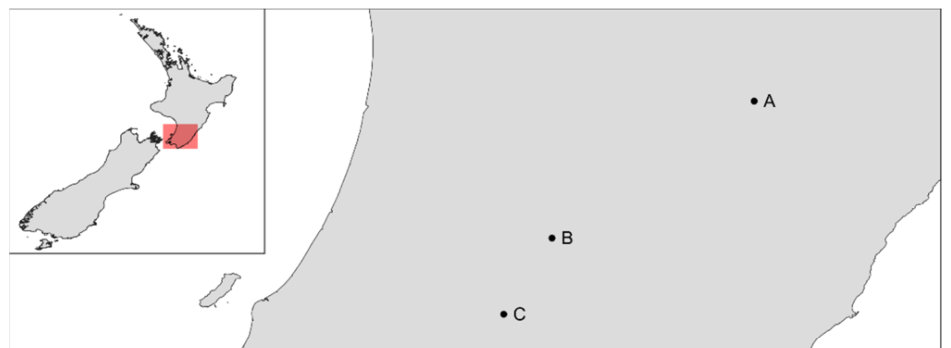
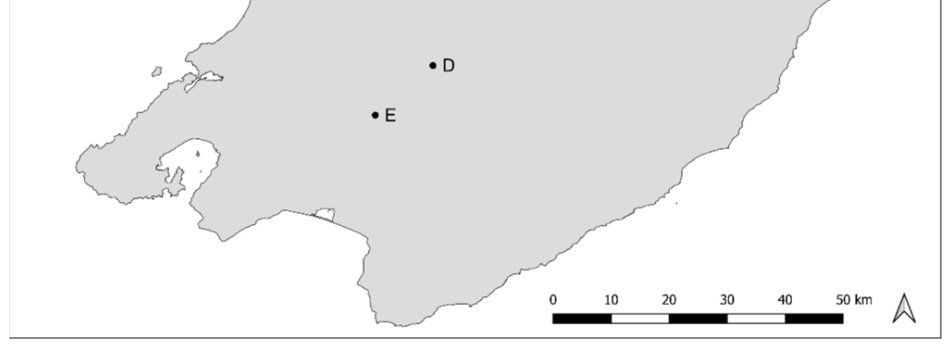
Soil, plant foliage, and honey samples were collected from five sites in the Wairarapa region in the lower North Island of New Zealand (Figure 1). Soil and foliage samples were collected in April 2014. Five L. scoparium plants were sampled per hive location. Plants were between 1.5 and 3 m tall. Foliage was sampled at 2 m above ground where possible. A representative sample was taken by combining 10 individual twigs per tree. A soil sample was taken at the base of each sampled plant, within 0.5 m from the base. All sampling sites were within 1 km from the hive. This is within the foraging range of the honeybee Apis mellifera [27]. Soil and plant samples were immediately sent to the laboratory for further processing. Soils were kept cold in insulated containers with ice packs. Raw honey samples were extracted by Watson & Son Ltd. (Masterton, New Zealand, now Oha Honey LP) in January–February 2014. Honey samples from locations B, C, and D are composite samples, as multiple hives were within 1 km from each other at these sites.
土壤、植物叶片和蜂蜜样品采自新西兰北岛南部Wairarapa地区的5个样点(图1)。土壤和叶片样品于2014年4月采集。每个蜂箱位置采集5株L. scoparium植株。植株高1.5~3 m。叶片尽可能在离地2 m处采集。每株树合并10根单独的小枝作为代表性样品。在每株采样植株基部0.5 m范围内采集一个土壤样品。所有采样点均位于蜂箱1 km范围内,处于蜜蜂Apis mellifera的觅食范围之内[27]。土壤和植物样品立即送往实验室作进一步处理。土壤置于装有冰袋的保温箱中冷藏保存。原蜜样品由Watson & Son Ltd.(新西兰Masterton,现为Oha Honey LP)于2014年1—2月摇取。样点B、C和D的蜂蜜样品为混合样品,因为这些样点有多个蜂箱彼此相距不足1 km。
2.2. Honey Analysis2.2. 蜂蜜分析
Honey samples (0.5 g) were digested in 8 mL ARISTAR® 69% HNO3 with a microwave (MARS Xpress, CEM Corporation, Matthews, NC, USA). Total concentrations of Al, As, B, Ba, Ca, Cd, Cr, Cu, Fe, K, Mg, Mn, Na, P, Pb, S, and Zn were determined by ICP- OES (Varian 720-ES, Agilent Technologies, Santa Clara, CA, USA). Concentrations of honey DHA and MGO were simultaneously determined by HPLC at Watson & Son Ltd. (Masterton, New Zealand, now Oha Honey LP) following the method described by Windsor et al. [28]. The HPLC system consisted of a Dionex ACC-3000 autosampler, a Dionex LPG- 3400SD quaternary pump, and a Dionex VWD-3100 detector (λ = 263 nm) (Thermo Fisher Scientific, Waltham, MA, USA). A Phenomenex Synergi Fusion 75 mm × 4.6 mm, 4 µm, 80Å reversed-phase column was used with a Phenomenex Synergi 4 mm × 3 mm guard column (Phenomenex, Torrance, CA, USA).
蜂蜜样品(0.5 g)用8 mL ARISTAR® 69% HNO3经微波消解(MARS Xpress,CEM Corporation,Matthews,NC,USA)。采用ICP-OES(Varian 720-ES,Agilent Technologies,Santa Clara,CA,USA)测定Al、As、B、Ba、Ca、Cd、Cr、Cu、Fe、K、Mg、Mn、Na、P、Pb、S和Zn的全量浓度。蜂蜜DHA和MGO浓度由Watson & Son Ltd.(新西兰Masterton,现为Oha Honey LP)按照Windsor等[28]描述的方法用HPLC同时测定。HPLC系统由Dionex ACC-3000自动进样器、Dionex LPG-3400SD四元泵和Dionex VWD-3100检测器(λ = 263 nm)组成(Thermo Fisher Scientific,Waltham,MA,USA)。色谱柱为Phenomenex Synergi Fusion 75 mm × 4.6 mm、4 µm、80Å反相柱,配以Phenomenex Synergi 4 mm × 3 mm保护柱(Phenomenex,Torrance,CA,USA)。
2.3. Soil and Plant Analysis2.3. 土壤与植物分析
NH4+ and NO3− were extracted from fresh soil with 2 M KCl and analyzed by a flow injection analyzer (FIAstar 5000, FOSS, Hillerød, Denmark) [29]. Soils were dried at room temperature until a constant weight was achieved and then were sieved to 2 mm. Soil pH was determined in a 1:2.5 water extract [30]. In all, 0.5 g of soil was digested by microwave (CEM MARS Xpress) in 5 mL ARISTAR® 69% HNO3 and 1 mL ARISTAR® 30% H2O2. Pseudo-total Al, As, B, Ca, Cd, Cr, Cu, Fe, K, Li, Mg, Mn, Na, Ni, P, Pb, S, Sr, and Zn concentrations in the digest were analyzed by ICP-OES (Varian 720-ES). The exchangeable element fraction was determined in a 0.05 M Ca(NO3)2 extract using ICP-OES (Varian 720-ES) [31]. Total C and N were determined using an Elementar Vario Max CN elemental analyzer (Elementar, Langenselbold, Germany).
新鲜土壤中的NH4+和NO3−用2 M KCl浸提,并用流动注射分析仪(FIAstar 5000,FOSS,Hillerød,Denmark)测定[29]。土壤在室温下风干至恒重后过2 mm筛。土壤pH按1:2.5水土比浸提测定[30]。取0.5 g土壤,加入5 mL ARISTAR® 69% HNO3和1 mL ARISTAR® 30% H2O2,经微波(CEM MARS Xpress)消解。消解液中Al、As、B、Ca、Cd、Cr、Cu、Fe、K、Li、Mg、Mn、Na、Ni、P、Pb、S、Sr和Zn的准全量浓度用ICP-OES(Varian 720-ES)测定。可交换态元素组分采用0.05 M Ca(NO3)2浸提,用ICP-OES(Varian 720-ES)测定[31]。全碳和全氮采用Elementar Vario Max CN元素分析仪(Elementar,Langenselbold,Germany)测定。
Foliage samples were rinsed with deionized water and dried at 65 ◦C until a constant weight was achieved. Leaves were separated from the twigs and ground using a Retch ZM200 mill. In all, 0.5 g of ground foliage was digested in 8 mL ARISTAR® 69% HNO3 by microwave (CEM MARS Xpress). Total Al, As, B, Ca, Cd, Co, Cr, Cu, Fe, K, Li, Mg, Mn, Na, Ni, P, Pb, S, Sr, and Zn concentrations in the digest were determined by ICP-OES (Varian 720-ES) [31]. Total C and N concentrations were determined using an Elementar Vario Max CN elemental analyzer.
叶片样品用去离子水冲洗后于65 ◦C烘干至恒重。将叶片与小枝分离,用Retch ZM200粉碎机磨碎。取0.5 g磨碎的叶片,用8 mL ARISTAR® 69% HNO3经微波(CEM MARS Xpress)消解。消解液中Al、As、B、Ca、Cd、Co、Cr、Cu、Fe、K、Li、Mg、Mn、Na、Ni、P、Pb、S、Sr和Zn的全量浓度用ICP-OES(Varian 720-ES)测定[31]。全碳和全氮浓度采用Elementar Vario Max CN元素分析仪测定。
2.4. Quality Control2.4. 质量控制
Wageningen Evaluating Programmes for Analytical Laboratories (WEPAL) certified reference materials ISE 921 and IPE 100 were used for quality assurance in soil and plant digestions. Recoveries ranged from 91% to 108% of certified values. Analytical blanks were included in all analyses.
土壤和植物消解的质量保证采用瓦赫宁根分析实验室评估计划(WEPAL)有证标准物质ISE 921和IPE 100。回收率为认定值的91%~108%。所有分析均设分析空白。
2.5. Statistical Analysis2.5. 统计分析
Data were analyzed using R version 4.0.5. [32]. One-way analysis of variance (ANOVA) followed by Tukey’s honestly significant difference (HSD) test was used to assess site differences using the package multcomp. Data were log-transformed where the assumption of normality was not met. The significance level for all statistical analyses was p ≤ 0.05. A principal component analysis (PCA) was carried out for honey variables using the package factoextra. The packages ggplot2 and ggpubr were used to visualize results of correlation analysis. No statistical analyses were performed on honey Cd, As, and Pb concentrations as these were below detection limits (<0.001 mg kg−1).
数据采用R 4.0.5版进行分析[32]。使用multcomp程序包,通过单因素方差分析(ANOVA)及Tukey真实显著差异(HSD)检验评估样点间差异。不满足正态性假设的数据经对数转换。所有统计分析的显著性水平为p ≤ 0.05。使用factoextra程序包对蜂蜜变量进行主成分分析(PCA)。使用ggplot2和ggpubr程序包对相关分析结果进行可视化。蜂蜜Cd、As和Pb浓度低于检出限(<0.001 mg kg−1),故未对其进行统计分析。
3Results and Discussion结果与讨论
3.1. Soil and Plants3.1. 土壤与植物
The soils were typically yellow-brown loams [33]. Soil pH at all sites was moderately to strongly acidic (Table S1) and lower than typical soil pH under New Zealand pasture, which ranges from 4.8 to 6.9 [31]. L. scoparium is commonly found growing on acidic soils [34]. At low soil pH, some trace element cations, including Al, Cu, Fe, Mn, and Zn, are more soluble and more plant-available [35]. We found soil pH was negatively correlated with some extractable elements (Table S2), which included Al (r = −0.71, p ≤ 0.001), Cd (r = −0.49, p ≤ 0.005), Cr (r = −0.51, p ≤ 0.001), and Zn (r = −0.45, p ≤ 0.005). Soils were generally low in P (452–878 mg kg−1) when compared with New Zealand pasture soil, but had similar concentrations of N and C [31].
土壤主要为黄棕壤[33]。所有样点的土壤pH均为中度至强酸性(表S1),低于新西兰牧场土壤的典型pH(4.8~6.9)[31]。L. scoparium常见生长于酸性土壤上[34]。在低pH条件下,部分微量元素阳离子(包括Al、Cu、Fe、Mn和Zn)溶解度更高,更易被植物吸收[35]。我们发现土壤pH与部分可提取态元素呈负相关(表S2),包括Al(r = −0.71,p ≤ 0.001)、Cd(r = −0.49,p ≤ 0.005)、Cr(r = −0.51,p ≤ 0.001)和Zn(r = −0.45,p ≤ 0.005)。与新西兰牧场土壤相比,供试土壤P含量普遍较低(452–878 mg kg−1),但N和C浓度相近[31]。
Plant samples were particularly high in Mn and Ni (Table S3) when compared with average plant shoots [36]. In contrast, the concentration of some of the P, K, and Mg was lower than average for plant dry matter concentrations [36]. Most plant parameters did not differ significantly between sites (C, N, C/N, As, B, Ca, Cd, Cu, Ni, and Zn). Site C differed from all other sites as it had significantly higher K and significantly lower Mn foliage concentrations.
与植物地上部平均水平相比,植物样品中Mn和Ni含量尤其高(表S3)[36]。相反,部分P、K和Mg浓度低于植物干物质的平均浓度[36]。大多数植物参数(C、N、C/N、As、B、Ca、Cd、Cu、Ni和Zn)在样点间无显著差异。样点C与其他所有样点不同,其叶片K浓度显著较高而Mn浓度显著较低。
Plant Mn in this study ranged from 53 to 1309 mg kg−1 with a median of 194 mg kg−1. This is comparable to studies by Gutierrez-Gines et al. [37] and Reis et al. [38], who reported 185–292 and 186–331 mg Mn kg−1 in non-fertilized L. scoparium, respectively. Both of these studies measured increased leaf Mn concentrations following the application of biosolids, which potentially reach phytotoxic levels at >400 mg Mn kg−1 [39]. In the present study, sites A and E exceeded this threshold with an average Mn concentration of 874 and 448 mg kg−1, respectively.
本研究中植物Mn含量为53~1309 mg kg−1,中位数为194 mg kg−1。这与Gutierrez-Gines等[37]和Reis等[38]的研究结果相当,二者报道未施肥L. scoparium中Mn含量分别为185~292和186~331 mg Mn kg−1。这两项研究均发现施用生物固体(污泥)后叶片Mn浓度升高,可能达到>400 mg Mn kg−1的植物毒性水平[39]。本研究中,样点A和E超过了该阈值,平均Mn浓度分别为874和448 mg kg−1。
For the major nutrients N and P, higher soil concentrations that increase plant growth may result in a dilution of other elements in plant tissues [40]. However, we found significant positive correlations between extractable soil P and plant P (r = 0.42, p ≤ 0.005), extractable soil Mg and plant Mg (r = 0.40, p ≤ 0.01), and extractable soil Mn and plant Mn (r = 0.34, p ≤ 0.05).
对于大量营养元素N和P,土壤中较高浓度促进植物生长,可能导致植物组织中其他元素被稀释[40]。然而,我们发现土壤可提取态P与植物P(r = 0.42,p ≤ 0.005)、土壤可提取态Mg与植物Mg(r = 0.40,p ≤ 0.01)以及土壤可提取态Mn与植物Mn(r = 0.34,p ≤ 0.05)之间均存在显著正相关。
3.2. Honey3.2. 蜂蜜
Table 1 reports honey MGO, DHA, and elemental concentrations. The DHA concentrations in this study were similar to those reported in fresh manuka honey by Atrott¯ et al. [10] and Adams et al. [8]. MGO concentrations were in the low range, lower than those in fresh manuka honeys (309–658 mg kg¯−1) reported by Stephens et al. [41]. There was a strong positive correlation (r = 0.99, p ≤ 0.001) between DHA and MGO, with MGO concentrations being on average 7% of DHA concentrations. Therefore, we henceforth report MGO as an indicator of m¯anuka honey quality.表1列出了蜂蜜MGO、DHA及元素浓度。本研究中DHA浓度与Atrott等[10]和Adams等[8]报道的新鲜麦卢卡蜂蜜相近。MGO浓度处于较低范围,低于Stephens等[41]报道的新鲜麦卢卡蜂蜜(309–658 mg kg−1)。DHA与MGO之间存在强正相关(r = 0.99,p ≤ 0.001),MGO浓度平均为DHA浓度的7%。因此,下文以MGO作为麦卢卡蜂蜜品质的指标。
| Site样点 | A n = 6 | B n = 9 | C n = 4 | D n = 1 | E n = 2 |
|---|---|---|---|---|---|
| MGO | 266_±_25 a | 126_±_6.9 b | 77_±_18 b | 141 | 121 |
| DHA | 3246_±_221 a | 1856_±_71 b | 1293_±_226 b | 1983 | 1642 |
| Al | 6.5_±_0.91 a | 11_±_0.60 b | 9.1_±_0.34 ab | 5.1 | 5.5 |
| B | 2.8_±_0.18 a | 2.8_±_0.10 a | 2.5_±_0.12 a | 2.8 | 2.8 |
| Ba | 0.08_±_0.01 a | 0.09_±_0.00 a | 0.11_±_0.00 b | 0.09 | 0.09 |
| Ca | 61_±_2.9 a | 60_±_2.5 a | 61_±_1.9 a | 62 | 68 |
| Cr | 0.02_±_0.01 a | 0.02_±_0.00 a | 0.02_±_0.00 a | 0.02 | 0.03 |
| Cu | 0.13_±_0.01 a | 0.24_±_0.01 b | 0.30_±_0.02 c | 0.16 | 0.21 |
| Fe | 1.2_±_0.45 a | 1.1_±_0.09 a | 0.91_±_0.12 a | 0.72 | 0.95 |
| K | 487_±_14 a | 671_±_25 b | 1108_±_55 c | 463 | 465 |
| Mg | 11_±_0.68 a | 18_±_0.61 b | 21_±_0.35 c | 15 | 16 |
| Mn | 1.1_±_0.23 a | 2.7_±_0.15 b | 4.2_±_0.60 c | 2.9 | 3.2 |
| Na | 27_±_0.99 a | 34_±_0.99 b | 47_±_2.2 c | 38 | 40 |
| P | 54_±_0.99 a | 50_±_1.4 a | 65_±_4.4 b | 62 | 64 |
| S | 21_±_0.62 a | 28_±_0.85 b | 31_±_43 b | 24 | 25 |
| Zn | 0.32_±_0.02 a | 0.36_±_0.03 a | 0.47_±_0.03 b | 0.37 | 0.47 |
Mean ± standard error. Different letters indicate significant differences between sites at p ≤ 0.05 according to Tukey’s HSD test. Values are in mg kg−1.
平均值 ± 标准误。不同字母表示经Tukey HSD检验样点间在p ≤ 0.05水平上差异显著。单位为mg kg−1。
The elemental concentrations in the honey were comparable to analyses of other fresh manuka¯ honey in New Zealand [42]. However, Na and Al were four and seven times higher, respectively, than concentrations reported by Vanhanen et al. [42]. The elemental concentrations in our fresh honey samples were lower than those in commercially available New Zealand manuka honeys reported by international studies [¯43–46]. The concentration of chemical elements in honey may increase following moisture reduction during honey processing [47].
蜂蜜中的元素浓度与新西兰其他新鲜麦卢卡蜂蜜的分析结果相当[42]。但Na和Al浓度分别比Vanhanen等[42]报道的浓度高4倍和7倍。我们的新鲜蜂蜜样品中元素浓度低于国际研究所报道的市售新西兰麦卢卡蜂蜜[43–46]。在蜂蜜加工过程中,随着水分降低,蜂蜜中化学元素浓度可能升高[47]。
The most abundant element in the tested honeys was K, followed by Ca and P. These were the overall most abundant elements in mono-floral New Zealand honeys analyzed by Vanhanen et al. [42]. They were also the most prominent elements in various international honey types [48]. Manuka¯ honey in this study had higher concentrations of elements, particularly Na, Ca, Mg, P, and Mn, compared to other honey types [49]. In the case of Mn, manuka honey was shown to have higher concentrations than other New Zealand¯ mono-floral honeys, with the exception of rewarewa honey [42].
供试蜂蜜中含量最高的元素为K,其次为Ca和P。这些元素也是Vanhanen等[42]所分析的新西兰单花蜂蜜中总体含量最高的元素,同时也是多种国际蜂蜜类型中的主要元素[48]。与其他类型蜂蜜相比,本研究中麦卢卡蜂蜜的元素浓度较高,尤其是Na、Ca、Mg、P和Mn[49]。就Mn而言,已有研究表明,除rewarewa蜂蜜外,麦卢卡蜂蜜的Mn浓度高于新西兰其他单花蜂蜜[42]。
An increased elemental concentration as such can be beneficial for human nutrition [50], although, given the average daily consumption of honey (0.1–0.8 kg per annum), human health benefits from the elements contained in honey are negligible [49,51]. Heavy metals such as, Cd, and Pb were below the detection limit (<0.001 mg kg−1) in this study and therefore not of significance to human health.
元素浓度升高本身可能有益于人体营养[50],但考虑到蜂蜜的平均消费量(每年0.1~0.8 kg),蜂蜜所含元素对人体健康的益处可忽略不计[49,51]。本研究中Cd和Pb等重金属低于检出限(<0.001 mg kg−1),因此对人体健康无显著影响。
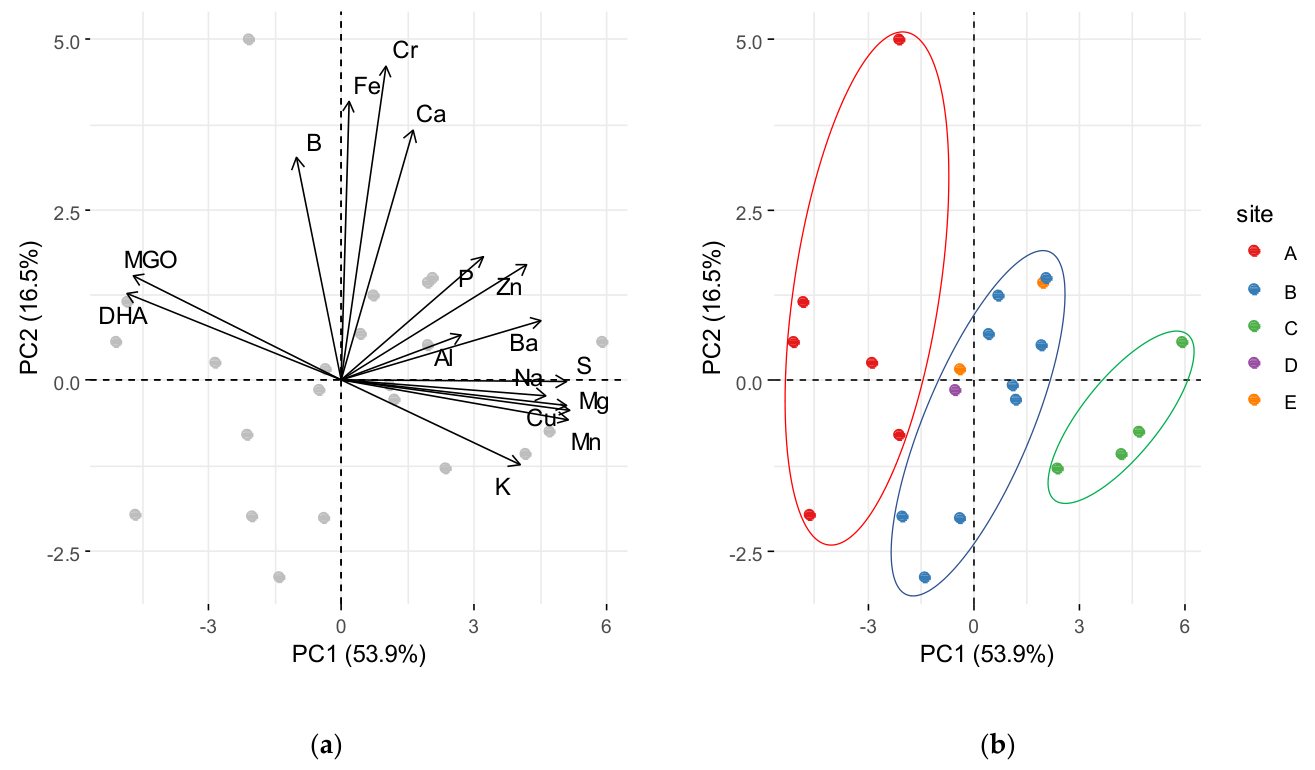
A PCA was used to investigate similarities between manuka honey quality parameters¯ and elemental composition between sites (Figure 2). The honeys can be separated into three distinct groups at sites A, B, and C, with honey DHA and MGO having a positive weighting in PC1 (explaining 53.9% of variance) and other elements, dominated by Mg, Mn, Cu, Ba, Na, Zn, and K, having negative weightings. PC2 (explaining 16.5% of variance) separated the sites mainly based on Cr, Fe, Ca, and Ba concentrations.
采用PCA考察各样点间麦卢卡蜂蜜品质参数与元素组成的相似性(图2)。样点A、B和C的蜂蜜可分为3个明显的组群,蜂蜜DHA和MGO在PC1(解释53.9%的方差)上具有正载荷,而以Mg、Mn、Cu、Ba、Na、Zn和K为主的其他元素具有负载荷。PC2(解释16.5%的方差)主要依据Cr、Fe、Ca和Ba浓度区分各样点。
MGO concentrations were 89–245% higher in site A compared to sites B, C, D, and E. The spatial variation of honey MGO concentrations aligns with inter- and intra-regional variation in L. scoparium nectar DHA previously observed by Williams et al. [19]. This is likely a result of genetic and environmental effects on nectar composition and yields [18,22]. Similarly, site A differed from other sites regarding the elemental composition of the honey. This is particularly true for Mn, which at site A was only 26–47% of the concentrations at sites B, C, D, and E. Furthermore, honey from site A had significantly lower Cu, K, Mg,
样点A的MGO浓度比样点B、C、D和E高89%~245%。蜂蜜MGO浓度的空间变异与Williams等[19]此前观察到的L. scoparium花蜜DHA的区域间和区域内变异一致。这可能是遗传和环境因素对花蜜成分和产量共同作用的结果[18,22]。同样,样点A蜂蜜的元素组成也与其他样点不同,尤其是Mn,样点A的Mn浓度仅为样点B、C、D和E的26%~47%。此外,样点A蜂蜜的Cu、K、Mg、
Na, and S concentrations than sites B and C. Our findings are consistent with those of Grainger et al. [52], who showed that concentrations of Ca, K, Mg, Mn, and Na in honeys could be used to differentiate between the regions in New Zealand where the honeys were produced.
Na和S浓度显著低于样点B和C。我们的结果与Grainger等[52]的研究一致,后者表明蜂蜜中Ca、K、Mg、Mn和Na的浓度可用于区分新西兰不同蜂蜜产区。
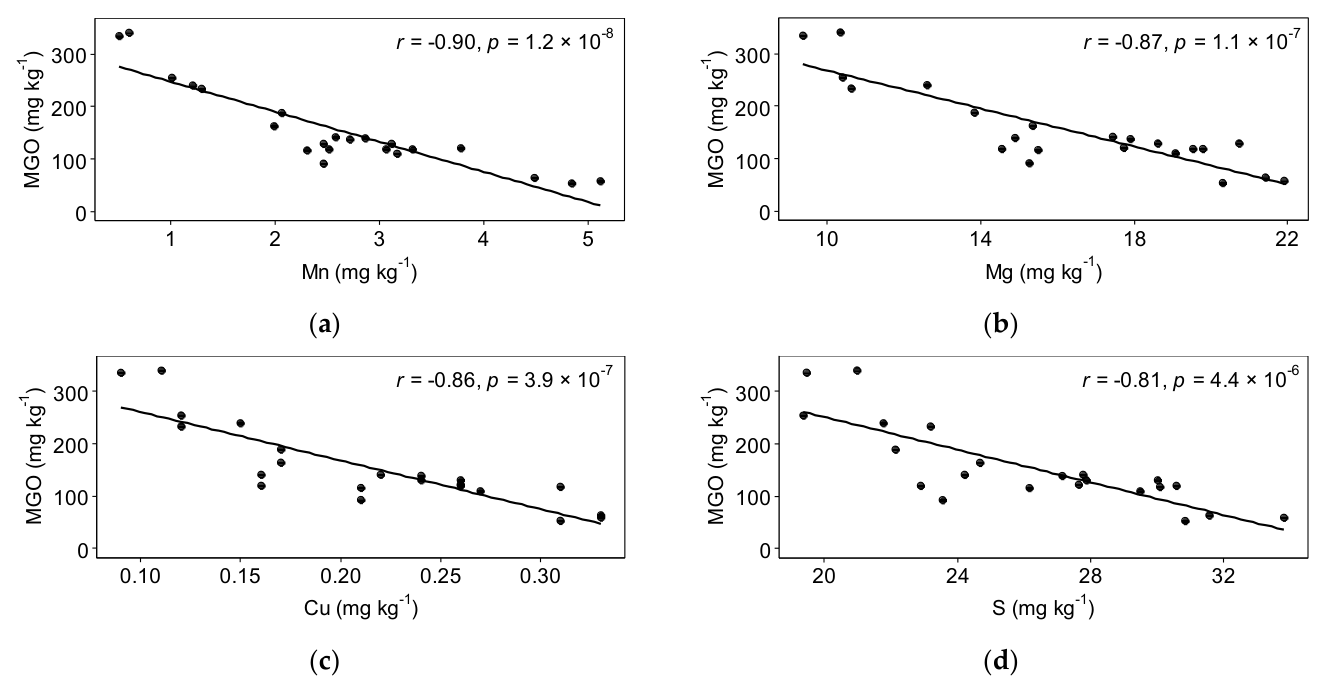
Negative correlations between honey elements and honey MGO were most pronounced for Mn, Cu, Mg, and S (Figure 3) but were also found for Na (r = −0.69, p ≤ 0.001), Ba (r = −0.61, p ≤ 0.01), K (r = −0.57, p ≤ 0.01), Zn (r = −0.57, p ≤ 0.01), and Al (r = −0.51, p ≤ 0.05). While there is no previous study correlating the concentration of manuka honey¯ elements and MGO, Alqarni et al. [43] studied the elemental composition of honeys in Saudi Arabia and included two New Zealand manuka honeys with differing UMF. The¯ UMF 18 honey in their study had lower concentrations of Mg, Mn, K, and Zn than the UMF 10 honey, but a higher Na concentration. They did not report Cu, S, Ba, and Al concentrations [43].
蜂蜜元素与蜂蜜MGO之间的负相关以Mn、Cu、Mg和S最为明显(图3),但Na(r = −0.69,p ≤ 0.001)、Ba(r = −0.61,p ≤ 0.01)、K(r = −0.57,p ≤ 0.01)、Zn(r = −0.57,p ≤ 0.01)和Al(r = −0.51,p ≤ 0.05)也存在负相关。虽然此前尚无研究将麦卢卡蜂蜜元素浓度与MGO相关联,但Alqarni等[43]研究了沙特阿拉伯蜂蜜的元素组成,其中包括两种UMF不同的新西兰麦卢卡蜂蜜。在其研究中,UMF 18蜂蜜的Mg、Mn、K和Zn浓度低于UMF 10蜂蜜,但Na浓度较高。他们未报道Cu、S、Ba和Al浓度[43]。
3.3. Interactions3.3. 相互关系
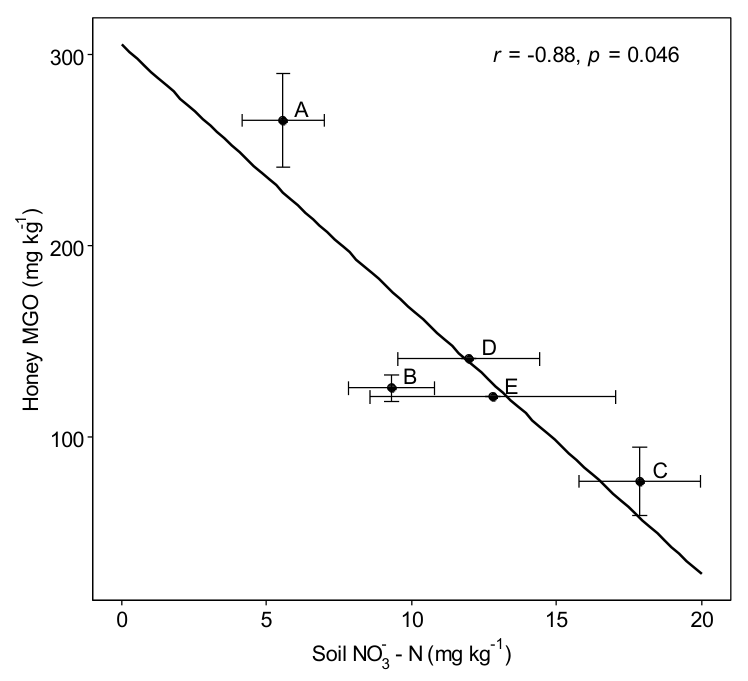
Contrary to studies on other honeys [13,50], there were no correlations between the elemental composition of manuka honey and elemental concentrations in soils.¯ The only soil factor that correlated with honey MGO was soil NO3− (r = −0.88, p < 0.05) (Figure 4). NO3− was shown to accelerate L. scoparium root growth [37,38] and could increase the accumulation of Fe, Mn, Zn, and Cu [53]. However, soil NO3− only correlated positively with plant Co (r = 0.49, p ≤ 0.005). It correlated negatively with plant Fe (r = −0.34, p ≤ 0.05). This could indicate a dilution of elements in the plants [40]. There was a positive correlation between the concentrations of K in plants and honeys (r = 0.91, p ≤ 0.01). Unlike most other elements tested, K is highly mobile in the plant phloem [54]. Therefore, elevated K concentrations in the plants may result in higher concentrations in the nectar.
与其他蜂蜜的研究结果不同[13,50],麦卢卡蜂蜜的元素组成与土壤元素浓度之间不存在相关性。与蜂蜜MGO相关的唯一土壤因子是土壤NO3−(r = −0.88,p < 0.05)(图4)。已有研究表明NO3−可加速L. scoparium根系生长[37,38],并可能增加Fe、Mn、Zn和Cu的积累[53]。然而,土壤NO3−仅与植物Co呈正相关(r = 0.49,p ≤ 0.005),与植物Fe呈负相关(r = −0.34,p ≤ 0.05)。这可能表明植物体内元素被稀释[40]。植物与蜂蜜中K浓度之间存在正相关(r = 0.91,p ≤ 0.01)。与所测的大多数其他元素不同,K在植物韧皮部中移动性很强[54]。因此,植物中K浓度升高可能导致花蜜中K浓度升高。
The negative correlation between honey MGO and concentrations of Mn, Cu, Mg, S, Na, Ba, K, Zn, and Al does not necessarily indicate that these elements cause a reduction in honey antimicrobial activity. Both the honey MGO and elemental concentrations may correlate with another (unmeasured) factor. Direct effects of these elements in L. scoparium nectar on nectar DHA have not been described in the literature to date.
蜂蜜MGO与Mn、Cu、Mg、S、Na、Ba、K、Zn和Al浓度之间的负相关并不一定表明这些元素导致蜂蜜抗菌活性降低。蜂蜜MGO和元素浓度可能均与另一个(未测定的)因子相关。迄今为止,文献中尚未描述L. scoparium花蜜中这些元素对花蜜DHA的直接影响。
Smallfield et al. [55] found that DHA is not present in the phloem of L. scoparium, which indicates that its production is linked to nectar metabolism. Williams [26] suggested that DHA production might be associated with dihydroxyacetone phosphate production, which may occur in the floral nectaries [56]. The involved fructose 1, 6-bisphosphate requires Mg, Mn, Zn, or Co for activity [57]. In contrast, triosephosphate isomerase is inhibited by sulphate, phosphate, and arsenate [58]. Furthermore, in the nectar of Nicotiana spp., manganese superoxide dismutase generates high concentrations of H2O2 [59]. While H2O2 is only present at low levels in L. scoparium nectar [60], it can react with DHA to glycolate [61]. This indicates that, while the nectar and DHA production in L. scoparium is not understood, element-associated shifts in enzymatic reactions might affect levels of DHA in the nectar.
Smallfield等[55]发现L. scoparium韧皮部中不存在DHA,表明其生成与花蜜代谢有关。Williams[26]提出,DHA的生成可能与磷酸二羟丙酮的生成有关,而后者可能发生在花蜜腺中[56]。其中涉及的1,6-二磷酸果糖需要Mg、Mn、Zn或Co才具有活性[57]。相反,磷酸丙糖异构酶受硫酸盐、磷酸盐和砷酸盐的抑制[58]。此外,在Nicotiana spp.的花蜜中,锰超氧化物歧化酶可生成高浓度的H2O2[59]。虽然L. scoparium花蜜中H2O2含量很低[60],但它可与DHA反应生成乙醇酸[61]。这表明,尽管L. scoparium花蜜及DHA的生成机制尚不清楚,但与元素相关的酶促反应变化可能影响花蜜中的DHA水平。
High concentrations of certain elements in nectar can also negatively affect the foraging behavior of honeybees. Xun et al. [62] showed that flowers treated with Zn, Cu, Ni, and Pb reduced the time honeybees spent foraging on these flowers and the amounts of nectar removal. Similarly, Meindl et al. [63] found that Ni-hyperaccumulation in plants reduced pollinator visitation. High concentrations of Mn and Cu in L. scoparium nectar might negatively affect the foraging behavior of honeybees and lead to more visitation of other nectar sources, which would therefore result in a lower MGO m¯anuka honey.
花蜜中某些元素的高浓度也可能对蜜蜂的觅食行为产生不利影响。Xun等[62]表明,经Zn、Cu、Ni和Pb处理的花朵会减少蜜蜂在其上觅食的时间及花蜜的采集量。同样,Meindl等[63]发现植物对Ni的超富集降低了传粉者的访花频率。L. scoparium花蜜中Mn和Cu的高浓度可能对蜜蜂觅食行为产生不利影响,导致蜜蜂更多地访问其他蜜源,从而使麦卢卡蜂蜜的MGO降低。
Previous studies have highlighted the importance of the botanical origin of honey as the main factor determining its elemental concentrations [64]. The lack of correlation between manuka honey and¯ L. scoparium foliage composition in this study indicates that honey elemental concentrations might have been diluted with other nectar. When honeybees gather nectar from different floral sources, the composition of the manuka honey is¯ affected. While manuka honey has a higher total elemental concentration than non-native¯ New Zealand honeys such as clover, native kamahi (¯Weinmannia racemose) and rewarewa (Knightia excelsa) honeys have particularly high elemental concentrations [42]. High concentrations of chemical elements in this study could therefore be an indication of manuka¯ honey contamination with other floral nectar sources. K. excelsa is a common nectar contaminant that can result in dilution of manuka honey [¯41]. Similarly, honeydew honey has high elemental concentrations [42]. L. scoparium is often infested by honeydew-producing scale insects, which leads to sooty mold development [65]. Sooty mold coverage was found to not directly affect the DHA concentration in L. scoparium nectar [19]. However, a dilution of manuka honey with collected honeydew might affect the honey’s elemental¯ composition. Furthermore, higher soil nutrient levels can be associated with increased exotic weed growth [66], which might in turn result in a dilution effect of manuka honey¯ with nectar from exotic species with high nectar elemental concentrations. It is therefore possible that the negative correlation between soil NO3− and manuka honey MGO in our¯ study is a result of accelerated growth of other non-native vegetation.
以往研究强调,蜂蜜的植物来源是决定其元素浓度的主要因素[64]。本研究中麦卢卡蜂蜜与L. scoparium叶片成分之间缺乏相关性,表明蜂蜜元素浓度可能被其他花蜜稀释。当蜜蜂从不同花源采集花蜜时,麦卢卡蜂蜜的成分会受到影响。虽然麦卢卡蜂蜜的总元素浓度高于三叶草蜂蜜等新西兰非本土蜂蜜,但本土kamahi(Weinmannia racemose)和rewarewa(Knightia excelsa)蜂蜜的元素浓度尤其高[42]。因此,本研究中化学元素的高浓度可能表明麦卢卡蜂蜜混入了其他花蜜来源。K. excelsa是一种常见的花蜜混杂来源,可导致麦卢卡蜂蜜被稀释[41]。同样,甘露蜜的元素浓度也较高[42]。L. scoparium常受分泌蜜露的介壳虫侵染,进而引发煤污病[65]。研究发现煤污覆盖度并不直接影响L. scoparium花蜜中的DHA浓度[19]。但麦卢卡蜂蜜被采集的蜜露稀释可能会影响蜂蜜的元素组成。此外,较高的土壤养分水平可能与外来杂草生长增加有关[66],进而可能导致麦卢卡蜂蜜被花蜜元素浓度较高的外来物种花蜜所稀释。因此,本研究中土壤NO3−与麦卢卡蜂蜜MGO之间的负相关可能是其他非本土植被生长加速的结果。
It is also possible that the elements in our manuka honey samples did not originate¯ from floral nectar. Elements in honey can derive from environmental pollution, agrochemicals, or natural non-nectar sources that the bees are in contact with when foraging, including air, water, and soil [52,67,68]. Elements can also be introduced during honey processing [27]. Manuka¯ honey has a low pH of about 3.5–4.5 [69], which can result in contamination of honey with Zn from galvanized metal or Cr and Ni from stainless steel [70,71]. Furthermore, elemental concentrations in the honey may be changed when beekeepers use other sugar sources as bee feed [72].
我们的麦卢卡蜂蜜样品中的元素也可能并非来源于花蜜。蜂蜜中的元素可能来自环境污染、农用化学品,或蜜蜂觅食时接触的非花蜜天然来源,包括空气、水和土壤[52,67,68]。元素也可能在蜂蜜加工过程中引入[27]。麦卢卡蜂蜜pH较低,约为3.5–4.5[69],这可导致蜂蜜受到镀锌金属中Zn或不锈钢中Cr和Ni的污染[70,71]。此外,当养蜂者使用其他糖源作为蜂饲料时,蜂蜜中的元素浓度也可能发生变化[72]。
While the chemical elements in manuka honey may not be causative of honey quality,¯ they may provide a low-cost indication of MGO levels and may be used as a quality indicator for honey. The lack of correlation between plant chemistry and honey MGO concentrations may be due to the large number of plants whence honeybees forage. Future work should test the hypothesis that higher concentrations of Mn, Cu, Mg, S, Na, Ba, K, Zn, and Al are associated with a lower DHA concentration in L. scoparium nectar.
虽然麦卢卡蜂蜜中的化学元素可能并非蜂蜜品质的成因,但它们可为MGO水平提供低成本的指示,并可用作蜂蜜品质指标。植物化学组成与蜂蜜MGO浓度之间缺乏相关性,可能是由于蜜蜂觅食的植物数量众多。今后的研究应检验以下假设:较高浓度的Mn、Cu、Mg、S、Na、Ba、K、Zn和Al与L. scoparium花蜜中较低的DHA浓度相关。
Supplementary Materials: The following are available online at https://www.mdpi.com/article/ 10.3390/foods10071670/s1, Table S1: Chemical characterization of soil at the different sites, Table S2: Soil exchangeable element concentrations at the different sites, Table S3: L. scoparium foliage elemental concentrations at the different sites.
补充材料:以下材料可在线获取:https://www.mdpi.com/article/10.3390/foods10071670/s1,表S1:不同样点土壤的化学特征;表S2:不同样点土壤可交换态元素浓度;表S3:不同样点L. scoparium叶片元素浓度。
Author Contributions: Conceptualization, B.R. and J.H.; sample collection, A.M. (Aydin Maxfield); statistical analysis: A.M. (Alexandra Meister); data curation, A.M. (Alexandra Meister); visualization, A.M. (Alexandra Meister); writing—original draft preparation, A.M. (Alexandra Meister); writing— review and editing, A.M. (Alexandra Meister), M.J.G.-G., A.M. (Aydin Maxfield), S.G., N.D., J.H. and B.R.; supervision, M.J.G.-G., S.G., N.D. and B.R. All authors have read and agreed to the published version of the manuscript.
作者贡献:构思,B.R.和J.H.;样品采集,A.M.(Aydin Maxfield);统计分析,A.M.(Alexandra Meister);数据整理,A.M.(Alexandra Meister);可视化,A.M.(Alexandra Meister);撰写—初稿,A.M.(Alexandra Meister);撰写—审阅与修改,A.M.(Alexandra Meister)、M.J.G.-G.、A.M.(Aydin Maxfield)、S.G.、N.D.、J.H.和B.R.;指导,M.J.G.-G.、S.G.、N.D.和B.R.。所有作者均已阅读并同意发表版本的稿件。
Funding: This work is derived from the Centre for Integrated Biowaste Research funded by Strategic Science Investment Funding from Ministry of Business, Innovation and Employment, New Zealand (contract C03 × 1701).
基金资助:本研究源自综合生物废弃物研究中心(Centre for Integrated Biowaste Research),该中心由新西兰商业、创新与就业部战略科学投资基金资助(合同号C03 × 1701)。
Data Availability Statement: The data presented in this study are available on request from the corresponding author.
数据可用性声明:本研究所呈现的数据可向通讯作者索取。
Acknowledgments: We gratefully acknowledge Watson & Son Ltd. for aid with the collection of the samples used in this study. The lead author acknowledges the receipt of a University of Canterbury Doctoral Scholarship.
致谢:衷心感谢Watson & Son Ltd.协助采集本研究所用样品。第一作者感谢坎特伯雷大学博士奖学金的资助。
Conflicts of Interest: The authors declare no conflict of interest.
利益冲突:作者声明无利益冲突。
References参考文献
1. Stephens, J.M.C.; Molan, P.C.; Clarkson, B.D. A review of Leptospermum scoparium (Myrtaceae) in New Zealand. N. Z. J. Bot. 2005, 43, 431–449. [CrossRef]
2. Thompson, J.A. A revision of the genus Leptospermum (Myrtaceae). Telopea 1989, 3, 301–449. [CrossRef]
3. MPI (Ministry for Primary Industries). Apiculture. Ministry for Primary Industries 2019 Apiculture Monitoring Programme; Ministry for Primary Industries: Wellington, New Zealand, 2019.
4. Molan, P.C. The antibacterial activity of honey: 2. Variation in the potency of the antibacterial activity. N. Z. Bee World 1992, 73, 59–76. [CrossRef]
5. Adams, C.J.; Boult, C.H.; Deadman, B.J.; Farr, J.M.; Grainger, M.N.; Manley-Harris, M.; Snow, M.J. Isolation by HPLC and characterisation of the bioactive fraction of New Zealand manuka (Leptospermum scoparium) honey. Carbohydr. Res. 2008, 343, 651–659. [CrossRef] [PubMed]
6. Mavric, E.; Wittmann, S.; Barth, G.; Henle, T. Identification and quantification of methylglyoxal as the dominant antibacterial constituent of manuka (Leptospermum scoparium) honeys from New Zealand. Mol. Nutr. Food Res. 2008, 52, 483–489. [CrossRef] [PubMed]
7. Carter, D.A.; Blair, S.E.; Cokcetin, N.N.; Bouzo, D.; Brooks, P.; Schothauer, R.; Harry, E.J. Therapeutic Manuka Honey: No Longer So Alternative. Front. Microbiol. 2016, 7, 569. [CrossRef] [PubMed]
8. Adams, C.J.; Manley-Harris, M.; Molan, P.C. The origin of methylglyoxal in New Zealand manuka (Leptospermum scoparium) honey. Carbohydr. Res. 2009, 344, 1050–1053. [CrossRef]
9. Norton, A.M.; McKenzie, L.N.; Brooks, P.R.; Pappalardo, L.J. Quantitation of dihydroxyacetone in Australian Leptospermum nectar via High-Performance Liquid Chromatography. J. Agric. Food Chem. 2015, 63, 6513–6517. [CrossRef]
10. Atrott, J.; Haberlau, S.; Henle, T. Studies on the formation of methylglyoxal from dihydroxyacetone in manuka (Leptospermum scoparium) honey. Carbohydr. Res. 2012, 361, 7–11. [CrossRef] [PubMed]
11. Roberts, A.E.L.; Brown, H.L.; Jenkins, R.E. On the antibacterial effects of manuka honey: Mechanistic insights. Res. Rep. Biol. 2015, 6, 215–224.
12. Clearwater, M.J.; Revell, M.; Noe, S.; Manley-Harris, M. Influence of genotype, floral stage, and water stress on floral nectar yield and composition of m¯anuka (Leptospermum scoparium). Ann. Bot. 2018, 121, 501–512. [CrossRef] [PubMed]
13. Czipa, N.; Diosi, G.; Phillips, C.; Kovacs, B. Examination of honeys and flowers as soil element indicators. Environ. Monit. Assess 2017, 189, 412. [CrossRef]
14. Xun, E.; Zhang, Y.; Zhao, J.; Guo, J. Translocation of heavy metals from soils into floral organs and rewards of Cucurbita pepo: Implications for plant reproductive fitness. Ecotoxicol. Environ. Saf. 2017, 145, 235–243. [CrossRef]
15. Acquarone, C.; Buera, P.; Elizalde, B. Pattern of pH and electrical conductivity upon honey dilution as a complementary tool for discriminating geographical origin of honeys. Food Chem. 2007, 101, 695–703. [CrossRef]
16. Baroni, M.V.; Podio, N.S.; Badini, R.G.; Inga, M.; Ostera, H.A.; Cagnoni, M.; Gautier, E.A.; Garcia, P.P.; Hoogewerff, J.; Wunderlin, D.A. Linking soil, water, and honey composition to assess the geographical origin of argentinean honey by multielemental and isotopic analyses. J. Agric. Food Chem. 2015, 63, 4638–4645. [CrossRef] [PubMed]
17. Gonzalez-Porto, A.V.; Martin Arroyo, T.; Bartolome Esteban, C. How soil type (gypsum or limestone) influences the properties and composition of thyme honey. Springerplus 2016, 5, 1663. [CrossRef]
18. Nickless, E.M.; Anderson, C.W.N.; Hamilton, G.; Stephens, J.M.; Wargent, J. Soil influences on plant growth, floral density and nectar yield in three cultivars of m¯anuka (Leptospermum scoparium). N. Z. J. Bot. 2017, 55, 100–117. [CrossRef]
19. Williams, S.; King, J.; Revell, M.; Manley-Harris, M.; Balks, M.; Janusch, F.; Kiefer, M.; Clearwater, M.; Brooks, P.; Dawson, M. Regional, annual, and individual variations in the dihydroxyacetone content of the nectar of manuka (¯Leptospermum scoparium) in New Zealand. J. Agric. Food Chem. 2014, 62, 10332–10340. [CrossRef]
20. Hamilton, G.; Millner, J.P.; Robertson, A.; Stephens, J. Assessment of manuka provenances for production of high ‘unique manuka factor’ honey. Agron. N. Z. 2013, 43, 139–144.
21. Millner, J.P.; Hamilton, G.; Ritchie, C.; Stephens, J. High UMF®honey production from manuka plantations. Hill Ctry. Grassl. Res. Pract. Ser. 2016, 16, 113–118.
22. Noe, S.; Manley-Harris, M.; Clearwater, M.J. Floral nectar of wild manuka (¯Leptospermum scoparium) varies more among plants than among sites. N. Z. J. Crop Hortic. Sci. 2019, 47, 282–296. [CrossRef]
23. Stephens, J.M.C. The Factors Responsible for the Varying Levels of UMF®in Manuka (¯Leptospermum scoparium) honey. Ph.D. Thesis, The University of Waikato, Hamilton, New Zealand, 2006. Available online: https://hdl.handle.net/10289/2655 (accessed on 1 May 2021).
24. Esperschuetz, J.; Anderson, C.; Bulman, S.; Katamian, O.; Horswell, J.; Dickinson, N.M.; Robinson, B.H. Response of Leptospermum scoparium, Kunzea robusta and Pinus radiata to contrasting biowastes. Sci. Total Environ. 2017, 587–588, 258–265. [CrossRef] [PubMed]
25. Gardner, R.C. Investigation of Geographical Correlations between Honey Methylglyoxal Content and Dihydroxacetone in Manuka Floral Nectar. Master’s Thesis, The University of Auckland, Auckland, New Zealand, 2014. Available online: http: //hdl.handle.net/2292/22629 (accessed on 3 May 2021).
26. Williams, S. Mapping Current and Potential Honey Production from the Leptospermum genus in Australia. Ph.D. Thesis, University of the Sunshine Coast, Sippy Downs, QLD, Australia, 2019. Available online: https://research.usc.edu.au/permalink/61USC_ INST/3k4ahb/alma99450654802621 (accessed on 18 April 2021).
27. Pohl, P.; Sergiel, I.; Stecka, H. Determination and fractionation of metals in honey. Crit. Rev. Anal. Chem. 2009, 39, 276–288. [CrossRef] 28. Windsor, S.; Pappalardo, M.; Brooks, P.; Williams, S.; Manley-Harris, M. A convenient new analysis of dihydroxyacetone and methylglyoxal applied to Australian Leptospermum honeys. J. Pharmacogn. Phytother. 2012, 4, 6–11. [CrossRef]
29. Esperschuetz, J.; Bulman, S.; Anderson, C.; Lense, O.; Horswell, J.; Dickinson, N.; Robinson, B.H. Production of biomass crops using biowastes on low-fertility soil: 2. Effect of biowastes on nitrogen transformation processes. J. Environ. Qual. 2016, 45, 1970–1978. [CrossRef] [PubMed]
30. Blakemore, L.C.; Searle, P.L.; Daly, B.K. Methods for Chemical Analysis of Soils; NZ Soil Bureau Scientific Report 80; Department of Scientific and Industrial Research: Lower Hutt, New Zealand, 1987.
31. Reiser, R.; Simmler, M.; Portmann, D.; Clucas, L.; Schulin, R.; Robinson, B. Cadmium concentrations in New Zealand pastures: Relationships to soil and climate variables. J. Environ. Qual. 2014, 43, 917–925. [CrossRef]
32. R Core Team. R: A Language and Environment for Statistical Computing; R Foundation for Statistical Computing: Vienna, Austria, 2021; Available online: https://www.R-project.org/ (accessed on 1 April 2021).
33. Cowie, J.D. Yellow-brown loams-definition and classification. In Soil Grups of New Zealand. Part 6, Yellow-Brown Loams; Neall, V.E., Ed.; New Zealand Society of Soil Science: Wellington, New Zealand, 1982.
34. Berninger, E. Diversity of Tolerance to Soil pH in Leptospermum scoparium (J.R. and G.Forst) Populations from New Zealand. Acta Hortic. 1992, 320, 49–56. [CrossRef]
35. Blume, H.-P.; Brümmer, G.W.; Fleige, H.; Horn, R.; Kandeler, E.; Kögel-Knabner, I.; Kretzschmar, R.; Stahr, K.; Wilke, B.-M. Scheffer/Schachtschabel Soil Science; Springer: Berlin/Heidelberg, Gernamy, 2016.
36. Kirkby, E. Introduction, Definition and Classification of Nutrients. In Marschner’s Mineral Nutrition of Higher Plants, 3rd ed.; Marschner, P., Ed.; Academic Press: London, UK, 2012; pp. 3–5.
37. Gutierrez-Gines, M.J.; Madejon, E.; Lehto, N.J.; McLenaghen, R.D.; Horswell, J.; Dickinson, N.; Robinson, B.H. Response of a pioneering species (Leptospermum scoparium J.R.Forst. & G.Forst.) to heterogeneity in a low-fertility soil. Front. Plant Sci. 2019, 10, 93. [CrossRef] [PubMed]
38. Reis, F.V.P.; Gutiérrez-Ginés, M.J.; Smith, C.M.S.; Lehto, N.J.; Robinson, B.H. Manuka ( Leptospermum scoparium ) roots forage¯ biosolids in low fertility soil. Environ. Exp. Bot. 2017, 133, 151–158. [CrossRef]
39. Chaney, R.L. Toxic element accumulation in soils and crops: Protecting soil fertility and agricultural food-chains. In Inorganic Contaminants in the Vadose Zone; Bar-Yosef, B., Barrow, N.J., Goldshmid, J., Eds.; Ecological Studies; Springer: Berlin, Germany, 1989; pp. 140–158.
40. Jarrell, W.; Beverly, R. The dilution effect in plant nutrition studies. Adv. Agron. 1981, 34, 197–224.
41. Stephens, J.M.; Schlothauer, R.C.; Morris, B.D.; Yang, D.; Fearnley, L.; Greenwood, D.R.; Loomes, K.M. Phenolic compounds and methylglyoxal in some New Zealand manuka and kanuka honeys. Food Chem. 2010, 120, 78–86. [CrossRef]
42. Vanhanen, L.P.; Emmertz, A.; Savage, G.P. Mineral analysis of mono-floral New Zealand honey. Food Chem. 2011, 128, 236–240. [CrossRef] [PubMed]
43. Alqarni, A.S.; Owayss, A.A.; Mahmoud, A.A.; Hannan, M.A. Mineral content and physical properties of local and imported honeys in Saudi Arabia. J. Saudi Chem. Soc. 2014, 18, 618–625. [CrossRef]
44. Deng, J.; Liu, R.; Lu, Q.; Hao, P.; Xu, A.; Zhang, J.; Tan, J. Biochemical properties, antibacterial and cellular antioxidant activities of buckwheat honey in comparison to manuka honey. Food Chem. 2018, 252, 243–249. [CrossRef]
45. Kek, S.P.; Chin, N.L.; Tan, S.W.; Yusof, Y.A.; Chua, L.S. Classification of honey from its bee origin via chemical profiles and mineral content. Food Anal. Methods 2016, 10, 19–30. [CrossRef]
46. Moniruzzaman, M.; Chowdhury, M.A.; Rahman, M.A.; Sulaiman, S.A.; Gan, S.H. Determination of mineral, trace element, and pesticide levels in honey samples originating from different regions of Malaysia compared to manuka honey. Biomed. Res. Int. 2014, 2014, 359890. [CrossRef]
47. Singh, I.; Singh, S. Honey moisture reduction and its quality. J. Food Sci. Technol. 2018, 55, 3861–3871. [CrossRef] [PubMed]
48. Solayman, M.; Islam, M.A.; Paul, S.; Ali, Y.; Khalil, M.I.; Alam, N.; Gan, S.H. Physicochemical properties, minerals, trace elements, and heavy metals in honey of different origins: A comprehensive review. Compr. Rev. Food Sci. Food Saf. 2016, 15, 219–233. [CrossRef]
49. Bogdanov, S.; Jurendic, T.; Sieber, R.; Gallmann, P. Honey for nutrition and health: A review. J. Am. Coll. Nutr. 2008, 27, 677–689. [CrossRef]
50. González-Miret, M.L.; Terrab, A.; Hernanz, D.; Fernandéz-Recamales, M.Á.; Heredia, F.J. Multivariate correlation between color and mineral composition of honeys and by their botanical origin. J. Agric. Food Chem. 2005, 53, 2574–2580. [CrossRef] 51. Machado De-Melo, A.A.; de Almeida-Muradian, L.B.; Sancho, M.T.; Pascual-Maté, A. Composition and properties of Apis mellifera honey: A review. J. Apic. Res. 2017, 57, 5–37. [CrossRef]
52. Grainger, M.N.C.; Klaus, H.; Hewitt, N.; French, A.D. Investigation of inorganic elemental content of honey from regions of North Island, New Zealand. Food Chem. 2021, 361, 130110. [CrossRef] [PubMed]
53. Klikocka, H.; Marks, M. Sulphur and Nitrogen Fertilization as a Potential Means of Agronomic Biofortification to Improve the Content and Uptake of Microelements in Spring Wheat Grain DM. J. Chem. 2018, 2018, 1–12. [CrossRef]
54. Hawkesford, M.; Horst, W.; Kichey, T.; Lambers, H.; Schjoerring, J.; Møller, I.S.; White, P. Functions of macronutrients. In Marschner’s Mineral Nutrition of Higher Plants; Marschner, P., Ed.; Elsevier: Amsterdam, The Netherlands, 2012; pp. 135–189.
55. Smallfield, B.M.; Joyce, N.I.; van Klink, J.W. Developmental and compositional changes in Leptospermum scoparium nectar and their relevance to m¯anuka honey bioactives and markers. N. Z. J. Bot. 2018, 56, 183–197. [CrossRef]
56. Wenzler, M.; Holscher, D.; Oerther, T.; Schneider, B. Nectar formation and floral nectary anatomy of Anigozanthos flavidus: A combined magnetic resonance imaging and spectroscopy study. J. Exp. Bot. 2008, 59, 3425–3434. [CrossRef]
57. Liang, J.-Y.; Zhang, Y.; Huang, S.; Lipscomb, W.N. Allosteric transition of fructose-1, 6-bisphosphatase. Proc. Natl. Acad. Sci. USA 1993, 90, 2132–2136. [CrossRef]
58. Lambeir, A.M.; Opperdoes, F.R.; Wierenga, R.K. Kinetic properties of triose—Phosphate isomerase from Trypanosoma brucei brucei: A comparison with the rabbit muscle and yeast enzymes. Eur. J. Biochem. 1987, 168, 69–74. [CrossRef] 59. Carter, C.; Thornburg, R.W. Is the nectar redox cycle a floral defense against microbial attack? Trends Plant Sci. 2004, 9, 320–324. [CrossRef]
60. Brudzynski, K.; Abubaker, K.; Castle, A. Re-Examining the Role of Hydrogen Peroxide in Bacteriostatic and Bactericidal Activities of Honey. Front. Microbiol. 2011, 2, 213. [CrossRef]
61. Maksimovic, V.; Mojovic, M.; Vucinic, Z. Monosaccharide-H2O2 reactions as a source of glycolate and their stimulation by hydroxyl radicals. Carbohydr. Res. 2006, 341, 2360–2369. [CrossRef]
62. Xun, E.; Zhang, Y.; Zhao, J.; Guo, J. Heavy metals in nectar modify behaviors of pollinators and nectar robbers: Consequences for plant fitness. Environ. Pollut. 2018, 242, 1166–1175. [CrossRef] [PubMed]
63. Meindl, G.A.; Bain, D.J.; Ashman, T.-L. Variation in nickel accumulation in leaves, reproductive organs and floral rewards in two hyperaccumulating Brassicaceae species. Plant Soil 2014, 383, 349–356. [CrossRef]
64. Bogdanov, S.; Haldimann, M.; Luginbühl, W.; Gallmann, P. Minerals in honey: Environmental, geographical and botanical aspects. J. Apic. Res. Bee World 2007, 46, 269–275. [CrossRef]
65. Porter, N.G.; Smale, P.E.; Nelson, M.A.; Hay, A.J.; Van Klink, J.W.; Dean, C.M. Variability in essential oil chemistry and plant morphology within a Leptospermum scoparium population. N. Z. J. Bot. 1998, 36, 125–133. [CrossRef]
66. Prober, S.M.; Wiehl, G. Relationships among soil fertility, native plant diversity and exotic plant abundance inform restoration of forb-rich eucalypt woodlands. Divers. Distrib. 2012, 18, 795–807. [CrossRef]
67. Porrini, C.; Ghini, S.; Girotti, S.; Sabatini, A.G.; Gattavecchia, E.; Celli, G. Use of honey bees as bioindicators of environmental pollution in Italy. In Honey Bees: Estimating the Environmental Impact of Chemicals; Devillers, J., Pham-Delegue, M.-H., Eds.; Taylor & Francis: London, UK, 2002.
68. Scripca, L.A.; Amariei, S. The Influence of Chemical Contaminants on the Physicochemical Properties of Unifloral and Multifloral Honey. Foods 2021, 10, 1039. [CrossRef] [PubMed]
69. Alvarez-Suarez, J.M.; Gasparrini, M.; Forbes-Hernandez, T.Y.; Mazzoni, L.; Giampieri, F. The Composition and Biological Activity of Honey: A Focus on Manuka Honey. Foods 2014, 3, 420–432. [CrossRef]
70. Stoewsand, G.S.; Stamer, J.R.; Kosikowski, F.V.; Morse, R.A.; Bache, C.A.; Lisk, D.J. Chromium and nickel in acidic foods and by-products containing stainless steel during processing. Bull. Environ. Contam. Toxicol. 1979, 21, 600–603. [CrossRef]
71. Tong, S.S.C.; Morse, R.A.; Bache, C.A.; Lisk, D.J. Elemental analysis of honey as an indicator of pollution. Arch. Environ. Health 1975, 30, 329–332. [CrossRef]
72. Pita-Calvo, C.; Guerra-Rodriguez, M.E.; Vazquez, M. Analytical Methods Used in the Quality Control of Honey. J. Agric. Food Chem. 2017, 65, 690–703. [CrossRef] [PubMed]