Article No. anbo.1999.0970, available online at http://www.idealibrary.com on 11 L
B. H. ROBINSON*, R. R. BROOKS+ and B. E. CLOTHIER*
*Horticulture and Food Research Institute of New Zealand, Palmerston North, New Zealand and ·Soil and Earth Sciences, Institute of Natural Resources, Massey University, Palmerston North, New Zealand
Received: 1 June 1999 Returned for revision: 2 July 1999 Accepted: 16 July 1999
Plants with inordinately high concentrations of heavy metals ('hyperaccumulators') can be used for phytoremediation tailings on nickel and cobalt uptake by the South African nickel hyperaccumulator Berkheya coddii. Plants were action of magnesium alone. Since CaCO, had no significant effect on soil pH, this indicated that calcium inhibits the uptake of both cobalt and nickel. All three chelating agents caused a significant reduction in plant uptake of nickel, despite increasing the solubility (plant availability) of these elements in the soil. Cobalt uptake was unaffected Sulphur, and the addition of acid mine tailings, caused a highly significant increase in nickel and cobalt uptake, relative to the controls. Sulphur could be used as a low-cost soil amendment to enhance the metal uptake of crops grown on ultramafic soils. Thus, land management procedures would enhance phytoremediation and phytomining operations
重金属含量异常高的植物(“超富集植物”)可用于植物修复。本研究考察了土壤改良剂(包括酸性矿山尾矿)对南非镍超富集植物 Berkheya coddii 吸收镍和钴的影响。……仅由镁的作用所致。由于 CaCO3 对土壤 pH 无显著影响,这表明钙会抑制钴和镍的吸收。三种螯合剂均使植物对镍的吸收显著降低,尽管它们提高了这些元素在土壤中的溶解度(植物有效性)。钴的吸收未受影响。与对照相比,添加硫以及添加酸性矿山尾矿均使镍和钴的吸收极显著增加。硫可作为一种低成本的土壤改良剂,用于提高在超基性(蛇纹岩)土壤上种植的作物对金属的吸收。因此,相应的土地管理措施可促进植物修复和植物采矿作业。
© 1999 Annals of Botany Company
Key words: Nickel, cobalt, phytoremediation, phytomining.
关键词:镍;钴;植物修复;植物采矿。
1INTRODUCTION引言
Recently, the use of plants to extract heavy metals from soils (phytoextraction) has received much attention due to the possibility of decontaminating some of the Earth's everincreasing burden of polluted soils (phytoremediation- Chaney, 1983; Baker and Brooks, 1989; McGrath et al., 1993; Salt et al., 1995; Robinson et al., 1997 a, b), and more recently as a method to commercially mine metals from low-grade ore bodies (phytomining- -Nicks and Chambers, 1995, 1998; Anderson et al., 1998; Brooks, 1998; Chancy et al., 1998).
近年来,利用植物从土壤中提取重金属(植物提取)受到广泛关注,一方面是因为该方法有望净化地球上日益增多的污染土壤(植物修复——Chaney, 1983; Baker and Brooks, 1989; McGrath et al., 1993; Salt et al., 1995; Robinson et al., 1997 a, b),另一方面是近来它被视为从低品位矿体中商业化开采金属的一种方法(植物采矿——Nicks and Chambers, 1995, 1998; Anderson et al., 1998; Brooks, 1998; Chaney et al., 1998)。
In a phytoextraction operation, a crop of plants is grown in soil containing elevated concentrations of one or more heavy metals. The plants accumulate the metals, either naturally, or they are induced to do so by soil amendments. When mature, the crop is harvested, removed and burnt. This leaves a small volume of ash containing a high concentration of the target metal(s). This ash, termed 'bioore', can then be smelted to recover the metal, or, if the metal is of low value, stored in a small area where it does not pose a risk to the environment. The plants used in a phytoextraction operation should ideally have a large biomass production and accumulate high concentrations of metal in the above-ground portions (hyperaccumulator plants-Brooks et al., 1977). Species exhibiting both these qualities are somewhat rare.
在植物提取作业中,将作物种植于含有一种或多种高浓度重金属的土壤中。植物自然地富集这些金属,或在土壤改良剂的诱导下富集金属。作物成熟后予以收获、移出并焚烧,由此得到少量含高浓度目标金属的灰分。这种灰分称为“生物矿石”(bio-ore),可通过冶炼回收金属;若金属价值较低,则可将其贮存于不会对环境构成风险的小块区域内。植物提取所用植物理想情况下应具有较高的生物量,并在地上部分富集高浓度金属(超富集植物——Brooks et al., 1977)。同时具备这两种特性的物种较为罕见。
Berkheya coddii is an asteraceous perennial plant found naturally on serpentine soils in southern Africa (Morrey et 0305-7364/99/120689 + 06 $30.00/0 al., 1992). Robinson et al. (1997 a) reported that B. coddii had a high biomass production (22 t ha-' per annum) combined with a high uptake of nickel (up to 1% dry weight) when grown on nickel-rich soils. This makes it an ideal candidate for nickel phytoextraction. The high nickel uptake was, however, dependent on there being sufficient 'bioavailable' nickel in the soil. Sequential croppings of B coddii growing on ultramafic soil will lead to a reduction in uptake of nickel, due to a reduction of soluble nickel in the soil. Robinson et al. (1998) used sequential extractions to estimate the number of crops attainable on an ultramafic
Berkheya coddii 是一种菊科多年生植物,天然分布于南部非洲的蛇纹岩土壤上(Morrey et al., 1992)。Robinson et al. (1997 a) 报道,在富镍土壤上种植时,B. coddii 兼具较高的生物量(每年 22 t ha-1)和较高的镍吸收量(最高达干重的 1%),因而是镍植物提取的理想候选植物。然而,较高的镍吸收取决于土壤中是否存在足够的“生物有效”镍。在超基性土壤上连续种植 B. coddii 会因土壤中可溶性镍的减少而导致镍吸收量下降。Robinson et al. (1998) 采用连续提取法估算了在超基性
*serpentine' soil before nickel uptake dropped to 70% of its original value.
“蛇纹岩”土壤上,在镍吸收量降至初始值的 70% 之前可收获的作物茬数。
Adding a compound to the soil that solubilizes nonavailable heavy metals should increase metal uptake by plants. Evidence for this comes from Blaylock et al. (1997) and Huang et al. (1997) who showed that the aerial parts of Indian mustard (Brassica juncea) plants accumulated lead to a level of 1·5% d.wt 1 week after addition of EDTA to the soil. Although the plants then rapidly died, this is not important for a phytoextraction operation as dead tissue can be harvested and burnt as easily as live material. The disadvantage with this strategy is the cost involved in adding such compounds, plus the risks that they may pose to the environment. Robinson et al. (1997 a) found that attempts to enhance nickel uptake in B. coddii, by adding EDTA and citric acid to the substrates, actually caused a decrease in nickel uptake, despite causing an increase in the concentration of soluble nickel. This loss was attributed to
向土壤中添加能使非有效态重金属溶解的化合物,应可提高植物对金属的吸收。Blaylock et al. (1997) 和 Huang et al. (1997) 的研究为此提供了证据:他们发现,向土壤中添加 EDTA 1 周后,印度芥菜(Brassica juncea)地上部分的铅积累量达到干重的 1.5%。尽管植物随后迅速死亡,但这对植物提取作业并不重要,因为死亡组织与活体材料同样易于收获和焚烧。该策略的缺点在于添加此类化合物的成本及其可能对环境造成的风险。Robinson et al. (1997 a) 发现,通过向基质中添加 EDTA 和柠檬酸来提高 B. coddii 镍吸收的尝试,反而导致镍吸收量下降,尽管可溶性镍浓度有所增加。这种降低被归因于
© 1999 Annals of Botany Company
© 1999 Annals of Botany Company
Robinson et al.- Nickel and Cobalt Uptake by Berkheya coddiiRobinson et al.——Berkheya coddii 对镍和钴的吸收
competition with the plant's own nickel-binding agents, thereby causing the nickel to diffuse downwards to the plant's root system. This earlier study, however, used EDTA at only one concentration and we wished to investigate its effect over a wide range of different concentrations.
螯合剂与植物自身的镍结合物质之间的竞争,从而导致镍向下扩散至植物根系。然而,该早期研究仅使用了单一浓度的 EDTA,因此我们希望考察其在较宽浓度范围内的效应。
had negligible amounts of nickel and cobalt. The acid mine tailings (AMT) were collected from the Waihi gold mine, s binding sense had me an estand triedWaihi, New Zealand. These tailings contain negligible concentrations of heavy metals, and have a pH of 2-2 due to pyrite oxidation. Pots were prepared 1 month before planting to allow equilibration of the substrate.
中镍和钴的含量可忽略不计。酸性矿山尾矿(AMT)采自新西兰 Waihi 的 Waihi 金矿。该尾矿中重金属浓度可忽略不计,且由于黄铁矿氧化,其 pH 为 2.2。花盆于种植前 1 个月准备,以使基质达到平衡。
Soil acidification has been shown to increase the solubility of metals in ultramafic soils (Robinson et al., 1996), and so this may also increase metal uptake by the plant. Ultramafic soils usually have a large Mg/Ca quotient that can also be important in metal uptake (Robinson et al., 1996). Chaney et al. (1998) have stated that in the case of Alyssum, addition of magnesium to the substrate caused enhanced uptake of nickel by the plant. We wished to establish whether this was the case for B. coddii, another hyperaccumulator of nickel.
研究表明,土壤酸化可提高超基性土壤中金属的溶解度(Robinson et al., 1996),因此也可能增加植物对金属的吸收。超基性土壤通常具有较高的 Mg/Ca 比值,这对金属吸收也可能具有重要影响(Robinson et al., 1996)。Chaney et al. (1998) 指出,就 Alyssum 而言,向基质中添加镁可促进植物对镍的吸收。我们希望确定对于另一种镍超富集植物 B. coddii 是否同样如此。
Effect of CaCO,, M&CO, and sulphur additions on nickel and cobalt uptake by plants
添加 CaCO3、MgCO3 和硫对植物吸收镍和钴的影响
The effect of CaCO,, MgCO, and sulphur on nickel and cobalt uptake was studied by growing specimens of Berkheya coddii in 500 ml plastic pots for a period of 15 weeks in a 1: 1 (by volume) pumice: serpentine soil mixture. To this was added incremental amounts of the aforementioned chemicals. For each amendment there were five different treatments with replicates of four plants within each group. The magnesium and calcium salts were added at rates of 0, 1·25, 25, 5 and 10 g kg-' of soil. Elemental finely ground sulphur was added at a rate of 0, 0-625, 125, 2-5 and 5 g kg-1 of soil. The above-ground biomass of the plants was excised after the 15-week period and analysed for nickel and cobalt.
将 Berkheya coddii 植株种植于 500 ml 塑料盆中,基质为浮石与蛇纹岩土壤按体积比 1:1 混合的混合物,生长 15 周,以研究 CaCO3、MgCO3 和硫对镍和钴吸收的影响。向基质中添加递增量的上述化学物质。每种改良剂设 5 个处理,每组 4 株植物作为重复。镁盐和钙盐的添加量分别为每千克土壤 0、1.25、2.5、5 和 10 g。经细磨的单质硫的添加量为每千克土壤 0、0.625、1.25、2.5 和 5 g。15 周后剪取植物地上部生物量,测定其镍和钴含量。
The aims of the present study were therefore threefold: (1) an investigation of the effects on cobalt and nickel uptake by plants following soil amendments with EDTA, DTPA and DTA; (2) determination of the effect on cobalt and nickel uptake by plants resulting from soil acidification; and (3) investigation of magnesium and calcium amendments (as carbonates) on uptake of cobalt and nickel by plants.
因此,本研究有三个目的:(1)考察以 EDTA、DTPA 和 NTA 改良土壤后对植物吸收钴和镍的影响;(2)确定土壤酸化对植物吸收钴和镍的影响;(3)考察镁和钙(以碳酸盐形式)改良对植物吸收钴和镍的影响。
Effect on metal uptake by plants when acid mine tailings (AMT) were added to the substrate
向基质中添加酸性矿山尾矿(AMT)对植物吸收金属的影响
2MATERIALS AND METHODS材料与方法
The effect of soil acidification was investigated by adding increasing amounts of AMT to serpentine soil. Four replicates of treatments containing 33% (by volume) serpentine soil were prepared with the following additions of AMT: 0 (control), 4, 8, 17, 25 and 33%. The deficit was made up with pumice. The above-ground biomass of the plants was excised after the 15-week period and analysed for nickel and cobalt.
通过向蛇纹岩土壤中添加递增量的 AMT 来研究土壤酸化的影响。各处理均含 33%(体积比)的蛇纹岩土壤,AMT 添加量分别为 0(对照)、4%、8%、17%、25% 和 33%,每个处理设 4 个重复,不足部分以浮石补足。15 周后剪取植物地上部生物量,测定其镍和钴含量。
Environmental control and growth media环境控制与生长基质
Experiments were conducted in shade houses at the Horticultural and Food Research Institute, Palmerston North, New Zealand. The experiments were conducted from November 1998 to February 1999. Temperatures ranged from 15-25°C and the average vapour pressure deficit was 0-7 kPa. Plants were watered daily. Fertilization was carried out by addition of 'Osmocote' slow-release fertilizers at manufacturer's recommended rates. Pots were arranged in a randomized block design.
试验在新西兰 Palmerston North 园艺与食品研究所的遮荫棚中进行,时间为 1998 年 11 月至 1999 年 2 月。温度范围为 15–25 °C,平均饱和水汽压差为 0.7 kPa。植物每日浇水。按生产商推荐用量施用“Osmocote”缓释肥料。花盆按随机区组设计排列。
Effect of NTA, DTPA and EDTA on plant metal uptakeNTA、DTPA 和 EDTA 对植物吸收金属的影响
Sixty plants were grown in pots containing 500 g of a 1: 1 (by volume) mixture of pumice: serpentine for a period of 15 weeks. For each chelation treatment, four replicates were prepared with the following additions: 0 (control), 5, 10, 20 and 40 g kg-' of soil. All chelating agents were added as 5% solutions prepared using sodium salts (trisodium NTA, trisodium DTPA, and disodium EDTA). Reagents were
将 60 株植物种植于盛有 500 g 浮石与蛇纹岩土壤(体积比 1:1)混合物的花盆中,生长 15 周。每种螯合处理设 4 个重复,添加量分别为每千克土壤 0(对照)、5、10、20 和 40 g。所有螯合剂均以钠盐(NTA 三钠盐、DTPA 三钠盐和 EDTA 二钠盐)配制成 5% 溶液后加入。试剂于
All experiments were conducted using mixtures of pumice/serpentine and pumice/serpentine/acid mine tailings prepared by mixing the dry materials in a concrete mixer. Table 1 shows the elemental composition of the substrates used. Nearly all of the nickel and cobalt was contained in the serpentine soil, which also had a high Mg/Ca quotient. Both pumice and the acid mine tailings
所有试验均采用浮石/蛇纹岩土壤及浮石/蛇纹岩土壤/酸性矿山尾矿的混合物,这些混合物由干燥材料在混凝土搅拌机中混合制备。表1 列出了所用基质的元素组成。几乎所有的镍和钴均来自蛇纹岩土壤,该土壤的 Mg/Ca 比值也较高。浮石和酸性矿山尾矿
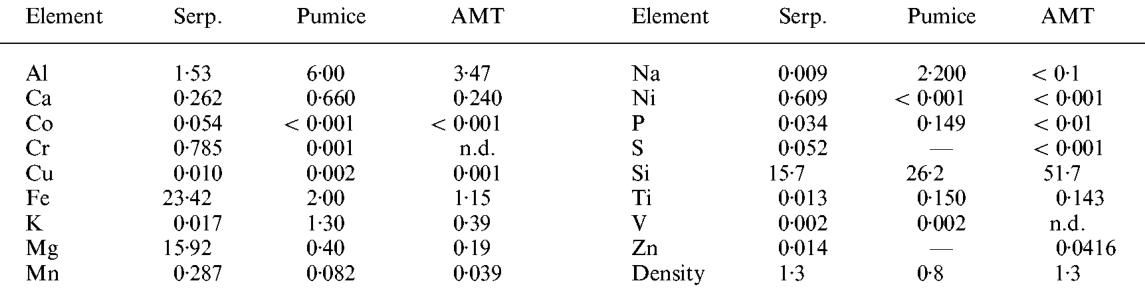
Analyses performed by X-ray fluorescence spectrometry. Serp, Soil from Serpentine Rd between Rai Valley and Nelson, New Zealand; AMT, pyritic pit wall material from the Waihi gold mine, Waihi, New Zealand.
采用 X 射线荧光光谱法分析。Serp:采自新西兰 Rai Valley 与 Nelson 之间 Serpentine Rd 的土壤;AMT:采自新西兰 Waihi 的 Waihi 金矿的含黄铁矿坑壁物料。
Robinson et al.- Nickel and Cobalt Uptake by Berkheya coddii
Robinson et al.——Berkheya coddii 对镍和钴的吸收
added at the end of the 15-week period and the plants were then harvested 1 month later.
15 周生长期结束时加入,1 个月后收获植物。
Determination of nickel and cobalt concentrations of plants植物中镍和钴含量的测定
Plant material was placed in a drying cabinet at 70 °C until a constant weight was reached. Approximately 0·1 g samples of plant material were weighed accurately into 15 ml borosilicate test tubes. The samples were ashed overnight at 500 °C. Five ml volumes of warm (80 °C) 2 M HCI were added to each, and the samples were mixed and shaken to dissolve the ash. Nickel and cobalt in the solutions were determined by flame atomic absorption spectroscopy (FAAS).
将植物材料置于 70 °C 烘箱中烘至恒重。准确称取约 0.1 g 植物样品置于 15 ml 硼硅玻璃试管中,于 500 °C 灰化过夜。每个样品加入 5 ml 温热(80 °C)的 2 M HCl,混匀并振荡以溶解灰分。采用火焰原子吸收光谱法(FAAS)测定溶液中的镍和钴。
Determination of the solubility of nickel and cobalt in the soil
土壤中镍和钴溶解度的测定
Soils were dried at 70 °C. Subsamples (2 g) were weighed accurately into 50 ml centrifuge tubes and 20 ml of 1 M ammonium acetate (pH 70) was then added to each. This extractant was used so that the results could be compared with those of other studies (e.g. Robinson et al., 1998) that showed that ammonium acetate extracts could be used to predict the nickel content of a plant grown in the extracted soil. The tubes were agitated for 24 h and the mixtures filtered. Nickel and cobalt were determined in these extracts by FAAS.
土壤于 70 °C 烘干。准确称取 2 g 子样品置于 50 ml 离心管中,每管加入 20 ml 1 M 乙酸铵(pH 7.0)。选用该提取剂是为了使结果能与其他研究(如 Robinson et al., 1998)进行比较,这些研究表明,乙酸铵提取态可用于预测在被提取土壤中生长的植物的镍含量。离心管振荡 24 h 后过滤混合物,采用 FAAS 测定提取液中的镍和钴。
3RESULTS AND DISCUSSION结果与讨论
Effect of MgCO, and CaCO, soil amendments on nickel and cobalt uptake by Berkheya coddii
MgCO3 和 CaCO3 土壤改良对 Berkheya coddii 吸收镍和钴的影响
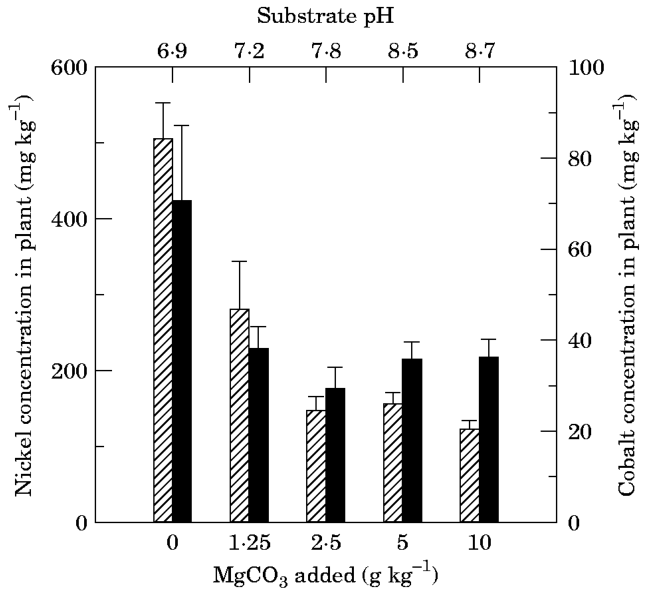
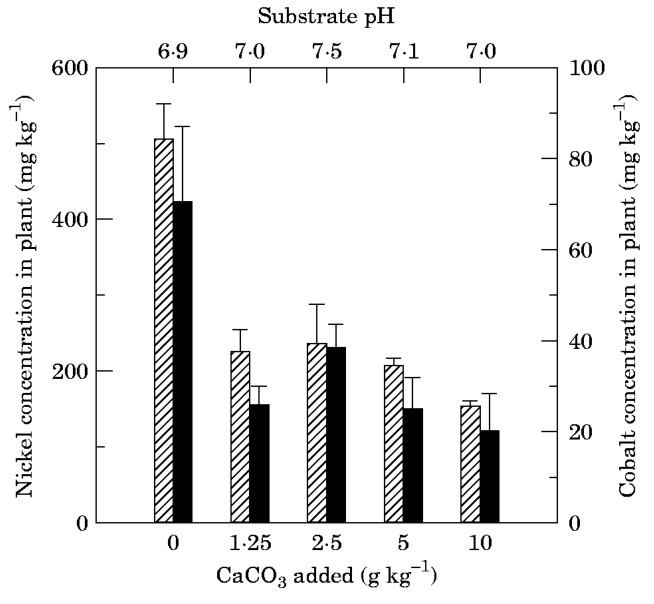
The addition of magnesium and calcium carbonates caused a significant (P < 005) decrease in the plant uptake of both nickel and cobalt (Figs 1 and 2). Soil pH was significantly increased by the addition of MgCO, (Table 2) though not by CaCO,. Thus the decrease in plant metal uptake must be attributed either to increased pH or to some other action of magnesium, whereas for calcium, pH change was not a factor. The ammonium-acetate-extractable fraction of nickel and cobalt in the soil was decreased in all treatments relative to the control, although the decrease was not correlated with the amount of calcium or magnesium added. The results of this part of the investigation, though inconclusive to some extent, clearly showed that addition of magnesium to the substrate did not increase either cobalt or nickel uptake by the plants; this directly contradicts the findings of Chancy et al. (1998) for Alyssum.
添加碳酸镁和碳酸钙使植物对镍和钴的吸收均显著降低(P < 0.05)(图1 和图2)。添加 MgCO3 显著提高了土壤 pH(表2),而 CaCO3 则未显著提高土壤 pH。因此,植物金属吸收的降低必须归因于 pH 升高或镁的某种其他作用,而对于钙而言,pH 变化并非影响因素。与对照相比,所有处理中土壤镍和钴的乙酸铵可提取态均有所降低,但降低幅度与钙或镁的添加量无相关性。这部分研究的结果虽在一定程度上尚无定论,但清楚地表明,向基质中添加镁并未增加植物对钴或镍的吸收;这与 Chaney et al. (1998) 对 Alyssum 的研究结果直接矛盾。
Effect of sulphur and acid mine tailing soil amendments on metal uptake by plants
硫和酸性矿山尾矿土壤改良对植物吸收金属的影响
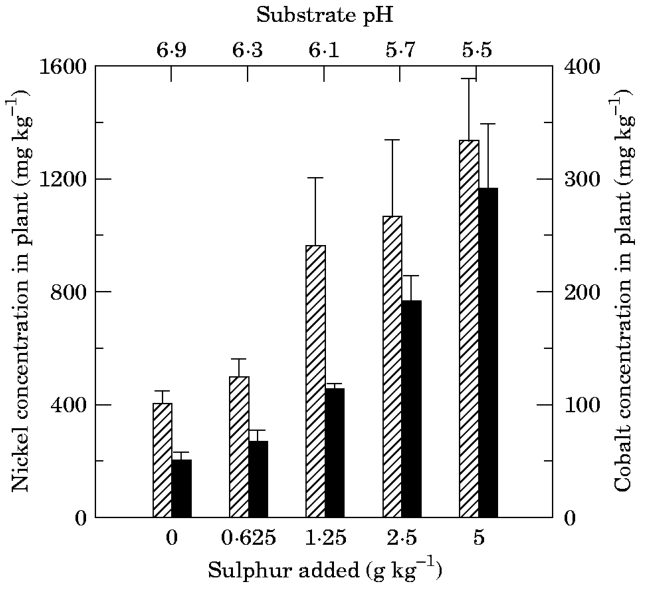
There was a highly significant (P < 001) positive correlation between the concentration of sulphur added, and the nickel and cobalt concentrations in the plants (Fig. 3). At the highest rate of sulphur addition to the soil (5 g kg-'), the mean nickel and cobalt concentrations in Berkheya coddii were 1331 and 290 mg kg-', representing three- and five-fold increases relative to the controls (400 and 56 mg kg-'), respectively. There were no significant differences in biomass production between treatments at pH 46 and
硫的添加量与植物中镍和钴的浓度之间存在极显著(P < 0.01)正相关(图3)。在最高硫添加量(5 g kg-1)下,Berkheya coddii 中镍和钴的平均浓度分别为 1331 和 290 mg kg-1,分别为对照(400 和 56 mg kg-1)的 3 倍和 5 倍。在 pH 4.6 及以上的各处理之间,生物量无显著差异,
above.
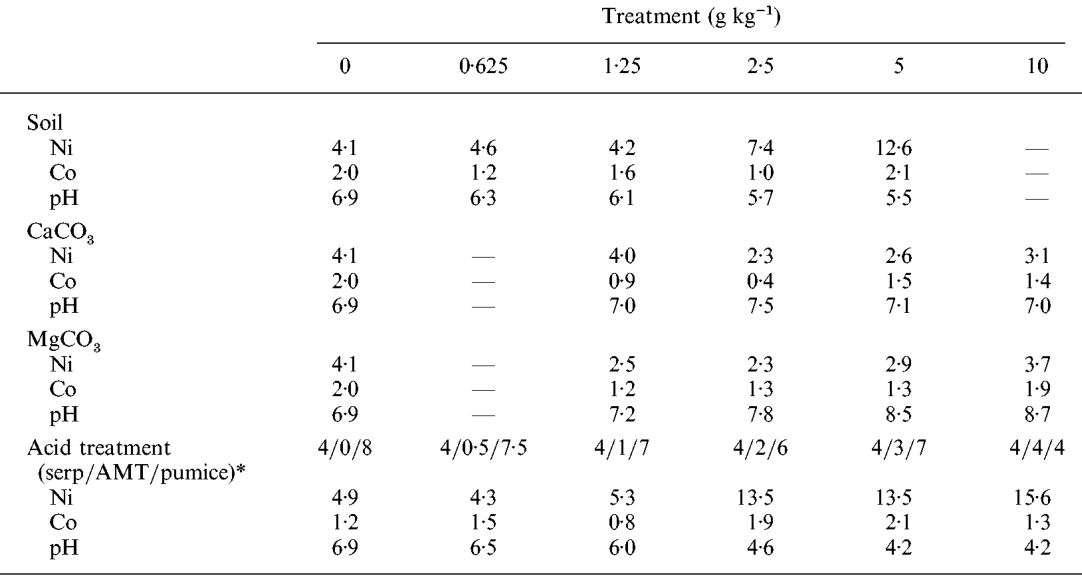
Lowering of the pH by addition of AMT caused a sharp increase in the metal concentrations in the plants in the pH range 69 to 60 then thereafter a much smaller increase, or even limiting value, between pH 60 to 42 (Fig. 4). The maximum improvement of nickel and cobalt concentrations was achieved at pH 46 and there would be no advantage, or desirability, in using a lower pH for practical field conditions. The addition of sulphur and AMT also caused a
添加 AMT 降低 pH 后,在 pH 6.9 至 6.0 范围内植物金属浓度急剧增加,此后在 pH 6.0 至 4.2 之间增幅小得多,甚至趋于极限值(图4)。镍和钴浓度的最大提升出现在 pH 4.6,在实际田间条件下采用更低的 pH 既无益处也不可取。添加硫和 AMT 还导致
* By weight.
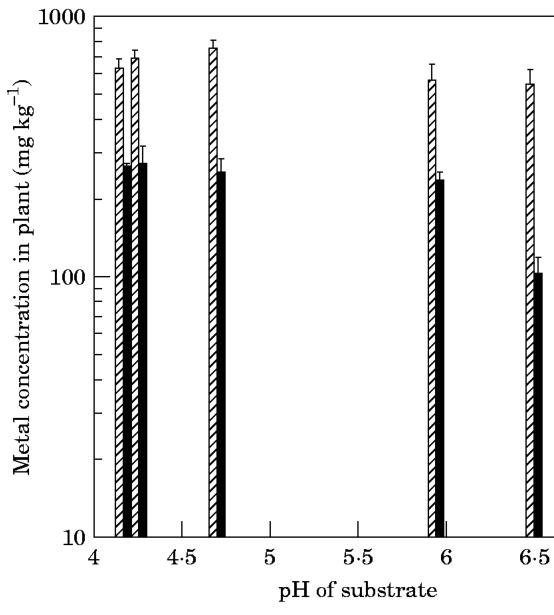
decrease in soil pH, plus an accompanying increase in the ammonium-acetate-extractable fraction of cobalt and nickel in the soil (Table 2).
土壤 pH 降低,同时土壤中钴和镍的乙酸铵可提取态随之增加(表2)。
The addition of sulphur and AMT to serpentine soil changed both pH and the concentration of available sulphur to the plant. Thus the increase in plant metal uptake cannot be attributed to either factor alone. Acidification is known to increase the solubility of nickel and cobalt in ultramafic soils (Robinson et al., 1996). It has also been shown that plant-metal uptake is proportional to the soluble fraction of metal in the soil for B. coddii (Robinson et al., 1997 a).
向蛇纹岩土壤中添加硫和 AMT 同时改变了 pH 和植物可利用硫的浓度,因此植物金属吸收的增加不能单独归因于其中任一因素。已知酸化可提高超基性土壤中镍和钴的溶解度(Robinson et al., 1996)。研究还表明,对于 B. coddii,植物金属吸收量与土壤中金属的可溶态含量成正比(Robinson et al., 1997 a)。
Addition of sulphur could be a relatively low-cost means to enhance the extraction of nickel and cobalt from crops of hyperaccumulators.
添加硫可能是一种相对低成本的方法,用于提高超富集植物作物对镍和钴的提取。
It might be argued that addition of AMT with its higher aluminium concentration (3·47%) compared with the serpentine substrate (1·53%) could increase the plant-available aluminium to phytotoxic levels. However, as stated above, we could find no statistically significant difference in plant biomass at pH 46 and above, though there was a significant decrease at the lowest pH value. It is also true that the bulk composition of the substrates was not
有人可能认为,AMT 的铝含量(3.47%)高于蛇纹岩基质(1.53%),添加 AMT 可能使植物有效态铝升高至植物毒性水平。然而,如上所述,在 pH 4.6 及以上时,我们未发现植物生物量存在统计学显著差异,但在最低 pH 值下生物量显著降低。同样,由于使用浮石将总重量调整至 100%,各基质的总体组成并不
identical because of use of pumice to adjust total weights to 100%. However, although pumice has low concentrations of elements such as calcium, magnesium and iron that could conceivably affect the results, such effects will be minor compared with the result of lowering the pH.
完全相同。不过,尽管浮石中钙、镁、铁等可能影响结果的元素浓度较低,但与降低 pH 的效应相比,这些影响是次要的。
Effect of chelate addition on metal uptake by Berkheya coddii
添加螯合剂对 Berkheya coddii 吸收金属的影响
Compounds to augment phytoextraction have to be inexpensive and relatively non-toxic, as large amounts may need to be added. EDTA has been shown by Blaylock et al. (1997) and Huang and Cunningham (1996) to induce hyperaccumulation of lead in crops such as Zea mays and Brassica juncea that, under natural conditions, do not hyperaccumulate this element. EDTA is a well known chelating agent that bonds with many metals including nickel. It currently costs around SUS40 kg-' and is therefore relatively inexpensive. DTPA and NTA are other strong chelating agents which are more costly than EDTA but were included for comparison with other studies such as those of Chaney et al. (1998) who have proposed that EDTA and NTA can increase bioavailability of nickel and other elements. Both chelating agents are degraded in the natural environment within a few months (Means et al., 1980).
用于强化植物提取的化合物必须价格低廉且毒性相对较低,因为可能需要大量添加。Blaylock et al. (1997) 以及 Huang and Cunningham (1996) 已证明,EDTA 可诱导玉米(Zea mays)和印度芥菜(Brassica juncea)等在自然条件下不超富集铅的作物超富集铅。EDTA 是一种众所周知的螯合剂,可与包括镍在内的多种金属结合。其目前价格约为 40 美元 kg-1,因而相对廉价。DTPA 和 NTA 是另外两种强螯合剂,价格高于 EDTA,但本研究将其纳入以便与其他研究进行比较,例如 Chaney et al. (1998) 的研究,他们提出 EDTA 和 NTA 可提高镍及其他元素的生物有效性。这两种螯合剂在自然环境中均可在数月内降解(Means et al., 1980)。
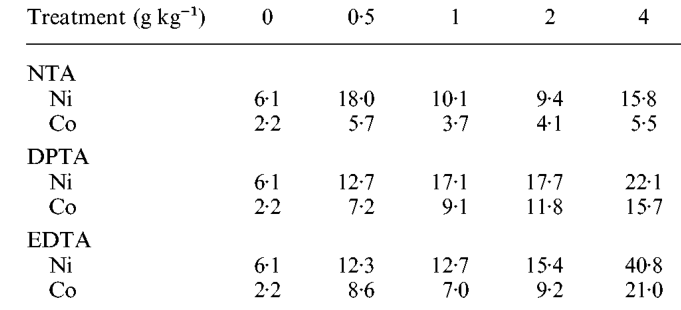
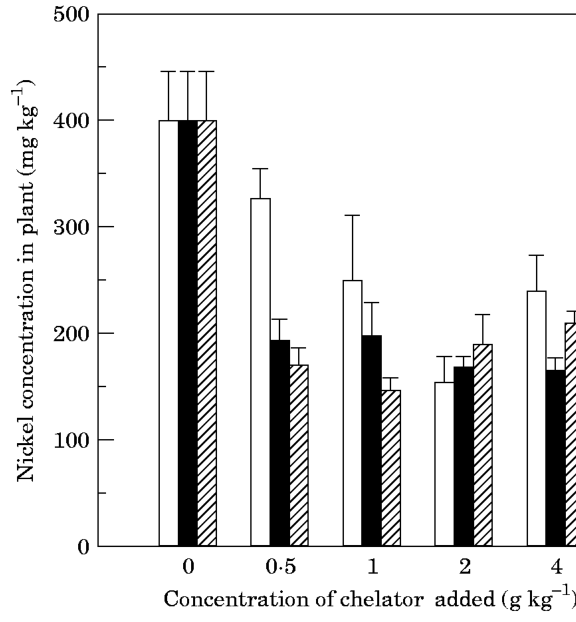
The addition of NTA, DTPA and EDTA caused a highly significant decrease (P < 0:001) in plant-nickel concentrations in all treatments relative to the control (Fig. 5). Cobalt uptake was unaffected and the data are not presented here. This was in spite of an increase in the extractable nickel and cobalt concentrations in the soils (Table 3). There was no reduction in the biomass yield since the reagents were added at the end of the 15-week period during which the plants had been allowed to grow under constant conditions and without soil amendments. These results are consistent with those reported by Robinson et al. (1997 a) where EDTA and citric acid caused a decrease in nickel uptake.
与对照相比,添加 NTA、DTPA 和 EDTA 使所有处理中植物镍浓度均极显著降低(P < 0.001)(图5)。钴的吸收未受影响,相关数据此处未列出。尽管土壤中可提取态镍和钴浓度有所增加(表3),结果仍是如此。由于试剂是在 15 周生长期结束时加入的,而此前植物一直在恒定条件下且无土壤改良剂的情况下生长,因此生物量产量并未降低。这些结果与 Robinson et al. (1997 a) 的报道一致,即 EDTA 和柠檬酸导致镍吸收量下降。
4CONCLUSION结论
These experiments indicate that neither soil amendments with calcium and magnesium carbonates, nor the addition of chelating agents are effective in increasing metal uptake by Berkheya coddii on serpentine soils. Instead these soil amendments caused a significant decrease in metal uptake. The addition of chelators to the soil associated with B. coddii has the opposite effect to their addition to soils supporting non-hyperaccumulator plants, where there is increasing rather than decreasing metal uptake.
上述试验表明,无论是以碳酸钙和碳酸镁改良土壤,还是添加螯合剂,均不能有效提高 Berkheya coddii 在蛇纹岩土壤上对金属的吸收;相反,这些土壤改良剂导致金属吸收量显著降低。向 B. coddii 所生长的土壤中添加螯合剂,其效果与向非超富集植物所生长的土壤中添加螯合剂相反,后者表现为金属吸收增加而非减少。
Addition of elemental sulphur has the potential to enhance metal crops when the plants are grown on soils with a soluble metal fraction less than that required for maximum plant uptake. Currently, sulphur addition would be a relatively low cost (SUSO 25 kg-' compared with SUS40 for EDTA) operation. Income from the sale of cobalt, as well as from enhanced nickel yields could more than offset the small cost of the sulphur. In our experiments, the cobalt concentrations in plants growing in soils treated with sulphur at a rate of 5 g kg-' increased five-fold, whereas for nickel the increase was three-fold. For a 20 t ha-' crop of Berkheya coddii, the gross value of the metals, at current world prices, would be $44 for nickel and $48 for cobalt ($92 in total) before addition of sulphur. After addition of sulphur, the respective values increase to $132 and $240 (total $372): i.e. the total value increases four-fold. The total yields of cobalt and nickel reported from our experimental soil with low plant-available concentrations of these elements, would be much higher in the case of high-availability soils, such as those from South Africa where the plant grows naturally and contains, on average, ten-times the nickel concentrations reported here. Despite these expected higher overall yields, the relative increases in metal concentrations in plants after addition of sulphur to serpentine soil with a high nickel phytoavailability might well be less than those here. Although it is impossible to extrapolate quantitatively from one scenario to the other, it does appear that enhancement of high-value cobalt is greater than lower-value nickel when sulphur is added to the substrate.
当植物生长于可溶性金属组分低于植物最大吸收所需水平的土壤上时,添加单质硫有望提高作物的金属产量。目前,添加硫是一项成本相对较低的操作(0.25 美元 kg-1,而 EDTA 为 40 美元)。出售钴以及镍产量提高所带来的收入完全可以抵消硫的少量成本。在本试验中,以 5 g kg-1 用量施硫的土壤上生长的植物,其钴浓度提高了 5 倍,而镍浓度提高了 3 倍。对于 20 t ha-1 的 Berkheya coddii 作物,按当前国际市场价格计算,添加硫之前金属的总价值为镍 44 美元、钴 48 美元(合计 92 美元);添加硫之后,二者分别增至 132 美元和 240 美元(合计 372 美元),即总价值提高了 4 倍。本试验土壤中这些元素的植物有效态浓度较低,而在高有效性土壤上,例如该植物天然生长的南非土壤(其植物镍浓度平均为本文报道值的 10 倍),钴和镍的总产量将高得多。尽管预计总体产量更高,但在镍植物有效性较高的蛇纹岩土壤中添加硫后,植物金属浓度的相对增幅很可能低于本研究。虽然无法从一种情形定量外推至另一种情形,但看来在基质中添加硫时,高价值钴的提升幅度大于价值较低的镍。
Except for addition of AMT, our experiments failed to show any statistical difference in biomass yields among the
除添加 AMT 外,本试验未发现所用各
different treatments used. It therefore appears that sulphur additions providing pH values of 46 or greater, are not likely to affect plant biomass and therefore total yields of cobalt and/or nickel in a phytoremediation/phytomining operation. An interesting avenue of future research would be to investigate the effects of chelating agents on other hyperaccumulator plants in comparison to non-hyperaccumulator plants grown on the same soil.
处理之间生物量产量存在统计学差异。因此,使 pH 值达到 4.6 或以上的硫添加量似乎不太可能影响植物生物量,从而也不会影响植物修复/植物采矿作业中钴和/或镍的总产量。今后一个值得研究的方向是,考察螯合剂对其他超富集植物的影响,并与生长在同一土壤上的非超富集植物进行比较。
5ACKNOWLEDGEMENTS致谢
The senior author gratefully acknowledges financial support from AGMARDT of New Zealand.
第一作者衷心感谢新西兰 AGMARDT 提供的资金支持。
6LITERATURE CITED参考文献
Anderson CWN, Brooks RR, Stewart RB, Simcock R. 1998. Harvesting a crop of gold in plants. Nature 395: 553-554.
Baker AJM, Brooks RR. 1989. Terrestrial higher plants which
hyperaccumulate chemical elements a review of their distribution,
ecology and phytochemistry. Biorecovery 1: 81-126.
Blaylock MJ, Salt DE, Dushenkov S, Zakharova O, Gussman C,
KapulnikY, Ensley BD, Raskin I. 1997. Enhanced accumulation of lead in Indian Mustard by soil-applied chelating agents. Environmental Science and Technology 31: 860-865.
Brooks RR, ed. 1998. Plants that hyperaccumulate heavy metals. Wallingford: CAB International.
Brooks RR, Lee J, Reeves RD, Jaffré T. 1977. Detection of nickeliferous rocks by analysis of herbarium specimens of indicator plants. Journal of Geochemical Exploration 7: 49-57.
Chaney RL. 1983. Plant uptake of inorganic waste constituents. In: Parr SC et al., eds. Land treatment of hazardous wastes. Park Ridge: Noyes Data Corp., 50-76.
Chaney RL, Angle RS, Baker AJM, Li YM. 1998. Method for phytomining of nickel cobalt and other metals from soil. U.S. Patent 5711784.
Huang JW, Cunningham SD. 1996. Lead phytoextraction: species variation in lead uptake and translocation. New Phytologist 134: 75-84.
Huang JW, Chen JJ, Berti WR, Cunningham SD. 1997. Phytoremediation of lead-contaminated soils: role of synthetic chelates in lead phytoextraction. Environmental Science and Technology
McGrath SP, Sidoli CMD, Baker AJM, Reeves RD. 1993. The
potential for the use of metal-accumulating plants for the in situ decontamination of metal-polluted soils. In: Eijsackers HJP, Hamers T. eds. Integrated soil and sediment research: a basis for proper protection. Dordrecht: Kluwer Academic Publishers,
Means JL, Kucak T, Crerar DA. 1980. Relative degradation rates of NTA, EDTA and DTPA and environmental implications. Environmental Pollution Series B 1: 45-60.
Morrey DR, Balkwill K, Balkwill MJ, Williamson S. 1992. A review of
some studies of the serpentine flora of Southern Africa. In : Baker AJM, Proctor J, Reeves RD, eds. The vegetation of ultramafic (serpentine) soils. Andover, Intercept: Andover, 147-158.
Nicks L, Chambers MF. 1995. Farming for metals. Mining Environmental Management September: 15-18.
Nicks L, Chambers MF. 1998. A pioneering study of the potential of phytomining for nickel. In: Brooks RR, ed. Plants that hyperaccumulate heavy metals. Wallingford: CAB International, 313-326.
Robinson BH, Brooks RR, Gregg PEH, Kirkman JH. 1998. The nickel
phytoextraction potential of some ultramafic soils as determined by sequential extraction. Geoderma 87: 293-304.
Robinson BH, Brooks RR, Howes AW, Kirkman JH, Gregg PEH.
1997 a. The potential of the high-biomass nickel hyperaccumulator Berkheya coddii for phytoremediation and phytomining. Journal of Geochemical Exploration 60: 115-126.
Robinson BH, Brooks RR, Kirkman JH, Gregg PEH, Gremigni P. 1996.
Plant-available elements in soils and their influence on the vegetation over ultramafic ('serpentine') rocks in New Zealand. Journal of the Royal Society of New Zealand 26: 457-468.
Robinson BH, Chiarucci A, Brooks RR, Petit D, Kirkman JH, Gregg
PEH, De Dominicis V. 1997b. The nickel hyperaccumulator plant Alyssum bertolonii as a potential agent for phytoremediation and the phytomining of nickel. Journal of Geochemical Exploration 59: 75-86.
Salt DA, Blaylock M, Kumar NPBA, Dushenkov V, Ensley B, Chet I, Raskin I. 1995. Phytoremediation: a novel strategy for the removal of toxic metals from the environment using plants. Biological Technology 13: 468-474.