Zhang Wei · Thomas M. R. Maxwell · Brett Robinson · Nicholas Dickinson
Received: 26 January 2022 / Accepted: 8 March 2022 © The Author(s) 2022
1Abstract摘要
Background Combinations of grasses and nitrogenfixing legumes are ubiquitous in most natural and derived pastoral grasslands. This was not formerly the case in New Zealand’s unique indigenous grasslands that are now frequently impacted by exotic pasture grasses and legumes. Understanding the co-existence of native and exotic plants is the broad focus of this research.
背景 禾草与固氮豆科植物的组合普遍存在于大多数天然及次生放牧草地中。然而,新西兰独特的本土草地过去并非如此,如今这些草地常受到外来牧草及豆科植物的影响。认识本土植物与外来植物的共存机制是本研究的总体关注点。
Aims Spillover of nitrogen (N) from clovers to grasses in diverse pasture is well known. We question whether grasses provide reciprocal nutritional benefits to legumes. Does the mutual exploitation of soil biogeochemistry by legumes and grasses help to explain their coexistence and, if so, does this have implications for biodiversity in NZ’s novel native grassland communities?
目的 在多样化牧场中,氮(N)从三叶草向禾草的溢出已广为人知。本研究探讨禾草是否对豆科植物提供互惠的营养益处。豆科植物与禾草对土壤生物地球化学过程的相互利用是否有助于解释二者的共存?若是,这对新西兰新型本土草地群落的生物多样性有何意义?
Methods Combinations of grasses and legumes, including a native tussock grass, were grown in a nutrient-poor (low P, S, Ca, Mg, Mn, and B) high country soil in a pot experiment, quantifying the foliar acquisition of nutrients from soil. Field data were obtained by sampling foliage of clover in single- and mixed-species patches in a more fertile lowland pasture. Results Benefits of legume and grass growing together were reflected in enhanced productivity and higher uptake of a range of key nutrients. This was most evident but not restricted to a combination of two exotic species: cocksfoot and white clover. In the nutrient-poor soil, legumes grew better in combination with different species of introduced grasses. Uptake of key elements from soil to plants significantly differed with combinations of legumes and grasses compared to individual species. Elevated concentrations of P, K and S were recorded in clover when growing with grasses, although Ca uptake was lower. Expected reciprocal reduction of clover N or enhanced grass N were not recorded. Mass balance data (total extraction of key nutrients from the soil pool) showed that combination of grasses and legumes exploit soil nutrients (particularly P, Zn, Mn and Mo) more effectively than single species alone. In grasses, only tissue concentrations of K, S and Zn significantly increased when growing with legumes, but native tussock grass procured less nutrients when growing with the exotic legumes. Field sampling of clover from the more fertile lowland soil showed significantly higher foliar concentrations of K, Mn, Cu and B, but less Ca. Conclusions The findings are indicative of a mutualistic relationship: legumes derive nutritional benefits from growing with grasses. Native tussock grass contained less N when growing with the exotic legumes, suggesting less compatibility and a lack of adaptation to coexistence.
方法 在盆栽试验中,将包括一种本土丛生禾草在内的禾草与豆科植物组合种植于养分贫瘠(P、S、Ca、Mg、Mn和B含量低)的高地土壤中,定量测定叶片从土壤中获取的养分。田间数据通过在较肥沃的低地牧场中采集单一物种斑块和混合物种斑块中三叶草的叶片获得。结果 豆科植物与禾草共同生长的益处体现在生产力提高以及多种关键养分吸收量增加。这一效应在两种外来物种——鸭茅与白三叶的组合中最为明显,但并不限于此。在养分贫瘠的土壤中,豆科植物与不同种类的引进禾草组合种植时生长更好。与单一物种相比,豆科植物与禾草组合从土壤向植物吸收关键元素的量存在显著差异。三叶草与禾草共同生长时,其P、K和S浓度升高,但Ca吸收量降低。预期中三叶草N相应降低或禾草N增加的现象并未出现。质量平衡数据(土壤库中关键养分的总提取量)表明,禾草与豆科植物组合比单一物种更有效地利用土壤养分(尤其是P、Zn、Mn和Mo)。在禾草中,仅K、S和Zn的组织浓度在与豆科植物共同生长时显著增加,而本土丛生禾草与外来豆科植物共同生长时获取的养分较少。在较肥沃的低地土壤中进行的三叶草田间采样表明,其叶片K、Mn、Cu和B浓度显著较高,但Ca浓度较低。结论 研究结果表明二者存在互利共生关系:豆科植物通过与禾草共同生长获得营养益处。本土丛生禾草与外来豆科植物共同生长时N含量较低,表明二者相容性较差,且缺乏对共存的适应。
Responsible Editor: Peter Christie.
Z. Wei · T. M. R. Maxwell · N. Dickinson (*) Faculty of Agriculture and Life Sciences, Lincoln University, Lincoln, 7647, Christchurch, New Zealand e-mail: Nicholas.Dickinson@lincoln.ac.nz
B. Robinson Department of Chemistry, University of Canterbury, Christchurch 8140, New Zealand
B. Robinson 坎特伯雷大学化学系,基督城 8140,新西兰
Keywords Grassland · Mutualism · Biogeochemistry · Clover · Transgressive overyielding · Soil chemistry · Trace elements
关键词 草地 · 互利共生 · 生物地球化学 · 三叶草 · 超越性超产 · 土壤化学 · 微量元素
2Introduction引言
Coexistence and maintenance of diversity in plant communities are explained as a result of different species exploiting resources that are spatially and temporally variable between and within habitats (Burrows, 1990; Høgh-Jensen and Schjoerring 2001; Homulle et al. 2021). Competition for resources is much more extensively studied than the mutual benefits that may be derived for different plant species growing together (Craine and Dybzinski 2013; Trinder et al. 2021). However, complementarity between species can be highly significant; agricultural intercropping of two or more species is one obvious and demonstrable example (Li et al. 2014; Gliessman 2015). This has been explained in terms of the abilities of each species to exploit different niches in the above-ground environment and root zone (Zhang et al. 2015). In terms of plant nutrition, the best-known example of complementarity is symbiotic nitrogen fixation in legumes that provides incidental spillover of nitrogen to soil, for example from clovers to grasses in mixed-species grasslands (Fornara and Tilman 2008; Pirhofer-Walzl 2012). A greater total herbage yield is obtained by the two functional types growing together rather than individually (Schipanski and Drinkwater 2012; Sturludóttir et al. 2014); this also balances palatability and improves nutritional benefits to stock. In this example, and in view of widespread and naturally occurring grass-legume associations, we question whether this relationship and its association with soil fertility operates only in one direction, or if grasses provide other elements to clovers as reciprocal nutrition. Our hypothesis is that spillover of N from clovers is an intentional strategy to procure limiting nutrients from neighbouring grasses. This is based on an assumption that there would be no selective advantage to legumes of fixing N in excess of their own requirements. Conversely, there would be a clear advantage to be able to acquire limiting soil nutrients without direct metabolic cost (Lynch et al. 2021).
植物群落的共存及多样性维持可解释为不同物种利用在生境之间及生境内部具有时空变异性的资源的结果(Burrows, 1990; Høgh-Jensen and Schjoerring 2001; Homulle et al. 2021)。与不同植物物种共同生长可能获得的互惠益处相比,资源竞争的研究要广泛得多(Craine and Dybzinski 2013; Trinder et al. 2021)。然而,物种间的互补作用可能非常显著;两种或多种作物的农业间作即为一个明显且可证实的例子(Li et al. 2014; Gliessman 2015)。这被解释为各物种能够利用地上环境和根区中的不同生态位(Zhang et al. 2015)。就植物营养而言,最著名的互补实例是豆科植物的共生固氮,其可使氮附带溢出至土壤中,例如在混合物种草地中由三叶草溢出至禾草(Fornara and Tilman 2008; Pirhofer-Walzl 2012)。两种功能类型共同生长比单独生长可获得更高的总牧草产量(Schipanski and Drinkwater 2012; Sturludóttir et al. 2014);这也平衡了适口性并提高了对牲畜的营养价值。鉴于此例以及禾草—豆科植物组合广泛且自然存在,本研究探讨这种关系及其与土壤肥力的关联是否仅为单向作用,抑或禾草也会向三叶草提供其他元素作为互惠营养。我们的假设是:三叶草的N溢出是一种从邻近禾草获取限制性养分的有意策略。该假设基于以下前提:豆科植物固定超出自身需求的N并无选择优势;相反,能够在不直接付出代谢成本的情况下获取限制性土壤养分则具有明显优势(Lynch et al. 2021)。
This topic has contemporary interest in New Zealand where unique indigenous grasslands existed largely without herbaceous legumes and entirely without grazing mammals, thus providing a near unique location to study this particular type of plant functional complementarity. Pastoral farming systems first arrived with European settlers in the 19th Century, and clovers were introduced less than 100 years ago (Caradus 1996). Indigenous tussock grasslands currently account for about 13% of land cover, with a further 34% of land converted to sheep, beef and dairy pasture that is largely exotic (StatsNZ 2021). Native grassland plant communities that are associated particularly with higher altitude (High Country) habitats now co-exist with grazing mammals and invasive plants species, and they are frequently impacted by nutrient top-dressing and over-sowing of exotic pasture grasses and legumes. This means they now exist as novel native grassland communities (idem Wilsey et al. 2018). Pasture containing exotic fodder species is far more responsive to enhanced fertility. Exotic legumes (including Trifolium spp. and Lotus spp.) have become widely naturalised, including in high country native tussock grasslands, potentially threatening more than one-third of the country’s native plant species, of which 93% are endemic in the High Country (Mark and Galloway 2012). Herbaceous legumes are virtually absent from native flora and this family is restricted to only a relatively small number of species: 34 species that are mostly trees and shrubs, compared to at least 113 species of fully naturalized exotic legumes (Wardle 1991; Allen and Lee 2006; Dollery et al, 2019).
该课题在新西兰具有现实意义。新西兰独特的本土草地在很大程度上不含草本豆科植物,且完全没有放牧哺乳动物,因而为研究这类特定的植物功能互补提供了近乎独一无二的场所。放牧农业系统随19世纪欧洲移民首次传入,而三叶草的引入距今不足100年(Caradus 1996)。本土丛生禾草草地目前约占土地覆盖面积的13%,另有34%的土地已转变为以外来物种为主的绵羊、肉牛和奶牛牧场(StatsNZ 2021)。本土草地植物群落尤其与较高海拔(高地)生境相关,如今与放牧哺乳动物及入侵植物物种共存,并常受到养分追施以及外来牧草和豆科植物补播的影响。这意味着它们现已成为新型本土草地群落(idem Wilsey et al. 2018)。含有外来饲草物种的牧场对肥力提高的响应要强烈得多。外来豆科植物(包括Trifolium spp.和Lotus spp.)已广泛归化,包括在高地本土丛生禾草草地中,可能威胁该国超过三分之一的本土植物物种,其中93%为高地特有种(Mark and Galloway 2012)。草本豆科植物在本土植物区系中几乎不存在,该科仅限于相对少数物种:共34种,且大多为乔木和灌木,而完全归化的外来豆科植物至少有113种(Wardle 1991; Allen and Lee 2006; Dollery et al, 2019)。
Graminaceous species are known to release phytosiderophores, which promote absorption of Fe and Zn (Erenoglu et al. 2000; Banakar et al. 2017). There are only a few examples where this has been shown to benefit adjacent species; for example, both Fe and Zn acquisition are increased in peanuts when they are grown with maize (Inal et al. 2007; Zuo and Zhang 2008; Xiong et al. 2013) and in guava growing with grasses (Kamal et al. 2000). However, there appear to be few insights into whether legumes similarly receive nutritional benefits from grasses in grassland pastures.
已知禾本科物种可释放植物铁载体,促进Fe和Zn的吸收(Erenoglu et al. 2000; Banakar et al. 2017)。仅有少数实例表明这对相邻物种有益;例如,花生与玉米间作时Fe和Zn的获取均增加(Inal et al. 2007; Zuo and Zhang 2008; Xiong et al. 2013),番石榴与禾草共同生长时亦然(Kamal et al. 2000)。然而,关于豆科植物在草地牧场中是否同样从禾草获得营养益处,目前似乎鲜有认识。
The aim of the present study was simply to investigate whether native and exotic grasses provide nutritional benefits to invasive legumes, rather than this relationship being a one-way provision of nitrogen to grasses. This is investigated using glasshouse experiments and field sampling.
本研究的目的仅在于探究本土及外来禾草是否为入侵豆科植物提供营养益处,而非这种关系仅是豆科植物向禾草单向提供氮。研究采用温室试验和田间采样开展。
3Materials and methods材料与方法
Plants and soils植物与土壤
The legumes selected for this study were white clover (Trifolium repens L.) and birdsfoot trefoil (Lotus pedunculatus Cav.), both of which have been widely seeded in New Zealand and elsewhere. White clover is the main legume of temperate pastures and meadows (Rochon et al. 2004), planted in New Zealand since the late 1920s alongside several other species of annual and perennial clovers (Rattray 2005). Lotus is also commonly sown on hill country in New Zealand, particularly at wetter, more acid, or more infertile sites (Armstrong 1974). Two common exotic pasture species of grasses and one native tussock grass were selected: perennial ryegrass (Lolium perenne), cocksfoot (Dactylis glomerata) and silver tussock (Poa cita). Ryegrass is the most productive, palatable and digestible grass species under fertile conditions and is also the most widely planted species in New Zealand but is less suited to drier locations and the high country. Cocksfoot is more hardy and drought-tolerant (Sanada et al. 2010). Poa cita is a common tussock grass species particularly suited to exposed, windy locations and dry soil (Hunter and Scott 1997), and is widespread in natural grasslands and less developed grazed pasture. Ryegrass and cocksfoot were grown from seed and Poa tussock seedlings were collected from the Lincoln University campus where the species has been widely planted.
本研究选用的豆科植物为白三叶(Trifolium repens L.)和大百脉根(Lotus pedunculatus Cav.),二者在新西兰及其他地区均被广泛播种。白三叶是温带牧场和草甸的主要豆科植物(Rochon et al. 2004),自20世纪20年代末起在新西兰与其他几种一年生和多年生三叶草一同种植(Rattray 2005)。Lotus也常播种于新西兰丘陵地区,尤其是较湿润、酸性较强或较贫瘠的地点(Armstrong 1974)。选取了两种常见的外来牧草和一种本土丛生禾草:多年生黑麦草(Lolium perenne)、鸭茅(Dactylis glomerata)和银色丛生禾草(Poa cita)。在肥沃条件下,黑麦草是产量最高、适口性和消化率最好的禾草物种,也是新西兰种植最广泛的物种,但不太适合较干旱地区和高地。鸭茅更为耐寒耐旱(Sanada et al. 2010)。Poa cita是一种常见的丛生禾草,尤其适应暴露、多风的地点和干燥土壤(Hunter and Scott 1997),广泛分布于天然草地和开发程度较低的放牧草场。黑麦草和鸭茅由种子培育,Poa丛生禾草幼苗采自林肯大学校园,该物种在校园内广泛种植。
A previously-identified nutritionally-poor soil, vegetated largely by more hardy shrubs and grasses with no known history of fertilization, was collected (1–20 cm depth) from a site near Lake Lyndon in Canterbury (altitude 611 m) described by Gutierrez- Gines et al. (2019). The soil was thoroughly mixed, then air-dried and sieved (2 mm). Samples were analysed using standard methods by Analytical Services, Soils and Physical Sciences Department, Lincoln University (Table 1), showing a range of key determinants (pH, calcium, sulphate-sulphur, soluble phosphorus, copper, magnesium, manganese) were less than optimum for plant growth. Available phosphorus, calcium and boron were extremely deficient.
采集了一种先前已确认的养分贫瘠土壤(深度1–20 cm),该土壤主要生长较耐逆的灌木和禾草,无已知施肥历史,采自坎特伯雷Lake Lyndon附近的一个地点(海拔611 m),Gutierrez- Gines et al.(2019)对该地点进行过描述。土壤充分混匀后风干并过筛(2 mm)。样品由林肯大学土壤与物理科学系分析服务部采用标准方法进行分析(表1),结果显示一系列关键指标(pH、钙、硫酸盐硫、可溶性磷、铜、镁、锰)均低于植物生长的最适水平。有效磷、钙和硼极度缺乏。
| Indicators指标 | Units单位 | Pot Experiment盆栽试验 | Field Soil田间土壤 | Typical Range*典型范围* |
|---|---|---|---|---|
| pH[1] | pH Units | 5.70 | 5.90 | 5.7–6.2 |
| Total Nitrogen[2] | % | 0.46 | 0.29 | 0.3–0.6 |
| Total Carbon[3] | % | 5.80 | 3.3 | - |
| Organic Matter[4] | % | 10 | 5.6 | 7–17.0 |
| Potassium[5] | me/100 g | 0.49 | 0.91 | 0.3–0.6 |
| Calcium[5] | me/100 g | 2.03 | 5.7 | 5–12.0 |
| Magnesium[6] | me/100 g | 0.60 | 1.31 | 0.6–1.2 |
| Sodium[6] | me/100 g | 0.05 | 0.15 | 0.00–0.3 |
| Sulphate Sulphur[7] | mg/kg | 6.43 | 2 | 10.0–20.0 |
| Olsen Phosphorus[8] | mg l−1 | 4.33 | 21 | 20–30 |
| Iron[6] | mg l−1 | 84 | 382 | - |
| Manganese[6] | mg l−1 | 3.40 | 27.4 | 8.0–65.0 |
| Copper[6] | mg l−1 | 0.37 | 1.3 | 0.4–2.0 |
| Zinc[6] | mg l−1 | 1.73 | 5.4 | 0.80–4.00 |
| Boron[6] | mg l−1 | 0.19 | 0.48 | 0.60–1.20 |
* Typical range for agricultural soils in New Zealand. Method: [1] 1:2 (v/v) soil:water slurry followed by potentiometric determination of pH. [2] Determined by NIR, calibration based on Total N by Dumas combustion. [3] Determined by NIR, calibration based on Total Carbon by Dumas combustion. [4] Organic Matter is 1.72 × Total Carbon. [5] 1 M Neutral ammonium acetate extraction followed by ICP-OES. [6] Mehlich 3 Extraction followed by ICP-OES. [7] 0.02 M Potassium phosphate extraction followed by Ion Chromatography. [8] Olsen extraction followed by Molybdenum Blue colorimetry
* 新西兰农业土壤的典型范围。方法:[1] 1:2(v/v)土水悬浮液,随后电位法测定pH。[2] NIR测定,以Dumas燃烧法测定的全氮为校准基准。[3] NIR测定,以Dumas燃烧法测定的全碳为校准基准。[4] 有机质 = 1.72 × 全碳。[5] 1 M中性乙酸铵浸提,随后ICP-OES测定。[6] Mehlich 3浸提,随后ICP-OES测定。[7] 0.02 M磷酸钾浸提,随后离子色谱测定。[8] Olsen浸提,随后钼蓝比色法测定
In a smaller sampling exercise, white clover was also sampled from a planted lowland pasture on a more fertile soil on the university campus (Table 1). This was an attempt to investigate whether differences in foliar nutrient concentrations of clover differ if the plants are established in single-species patches of clover, compared to when it is growing in assemblages with other species.
在一项规模较小的采样中,还从大学校园内较肥沃土壤上种植的低地牧场中采集了白三叶(表1)。此举旨在探究三叶草在单一物种斑块中生长与在与其他物种组成的群落中生长时,其叶片养分浓度是否存在差异。
Pot experiment盆栽试验
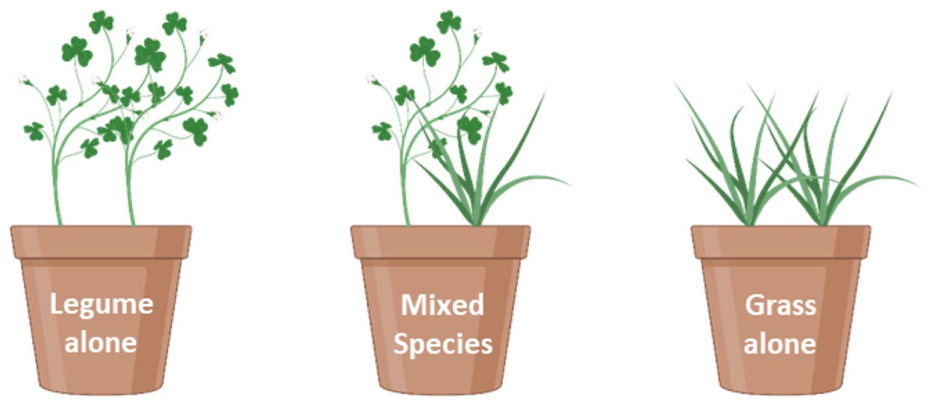
A pot experiment was located in a glasshouse at the Lincoln University Nursery. All legumes and grasses were initially propagated and established in seed trays, then transplanted, singly or in combination with each other, into (15 cm diameter, 20 cm height, 3.5L) plastic pots (Fig. 1). Eleven experimental treatments consisted of three grasses and two legumes growing either singly (5 species) or in six paired combinations (Clover & Ryegrass; Clover & Cocksfoot; Clover & Tussock; Lotus & Ryegrass; Lotus & Cocksfoot; Lotus & Tussock). Each treatment had 5 replicates (11 × 5 = 55 pots), arranged in a randomized single block design on a glasshouse bench with natural daylight. Pots were watered each day to maintain field capacity. Mean glasshouse temperatures for the duration of the experiment were 18.2 °C (range 14.2 – 32.1 °C). After four months’ growth, above-ground plant biomass was harvested, sorted into separate species, then dried (65 °C, 48 h), weighed and finely ground, prior to microwave digested using 5 M nitric acid and chemical analysis using ICP-OES following standard methodology.
盆栽试验在林肯大学苗圃的温室中进行。所有豆科植物和禾草先在育苗盘中繁殖定植,然后单独或相互组合移栽至塑料盆(直径15 cm,高20 cm,3.5L)中(图1)。11个试验处理包括三种禾草和两种豆科植物单独种植(5个物种)或以六种两两组合种植(三叶草 & 黑麦草;三叶草 & 鸭茅;三叶草 & 丛生禾草;Lotus & 黑麦草;Lotus & 鸭茅;Lotus & 丛生禾草)。每个处理设5个重复(11 × 5 = 55盆),在自然光照下的温室台架上按随机单区组设计排列。每天浇水以保持田间持水量。试验期间温室平均温度为18.2 °C(范围14.2 – 32.1 °C)。生长四个月后,收获地上部生物量,按物种分拣,然后烘干(65 °C,48 h)、称重并磨细,随后采用5 M硝酸进行微波消解,并按标准方法用ICP-OES进行化学分析。
Field sampling田间采样
White clover foliage was sampled from the lowland pasture on the university campus which was a fenced enclosure containing ryegrass, cocksfoot, white clover and few other species apart from plantain (Plantago lanceolata L.). The site had been planted about 5 years previously on a Wakanui soil type consisting of silt/sandy alluviums that are widespread in the Canterbury lowlands on South Island (Molloy 1998). The paddock had no recent fertilizer application or grazing. Clover foliage was sampled where it was growing in patches alone, or else in patches with cocksfoot, ryegrass or multiple assemblages of species. Each sample was excised at the ground surface and consisted of approximately 20 leaves and petioles, without attached stolons. Soil contamination of the samples was carefully avoided. Bulked samples each consisting of 2 separate samples were replicated 5 times. Samples were analysed as described above.
白三叶叶片采自大学校园内的低地牧场,该牧场为一处围栏围封区,除车前草(Plantago lanceolata L.)外,主要生长黑麦草、鸭茅、白三叶,其他物种很少。该地点约于5年前种植,土壤类型为Wakanui土,由广泛分布于南岛坎特伯雷低地的粉砂/砂质冲积物组成(Molloy 1998)。该围场近期未施肥也未放牧。在三叶草单独成片生长处,或与鸭茅、黑麦草或多物种群落共同成片生长处采集三叶草叶片。每个样品在地表处剪取,包含约20片叶及叶柄,不带匍匐茎。采样时注意避免土壤污染。每个混合样由2个独立样品组成,重复5次。样品按上述方法分析。
Statistical analysis统计分析
Data not normally distributed were log-transformed before analysis. Differences between means were determined using one-way ANOVA, with a post-hoc Fisher LSD test. All analyses were conducted using Minitab 19.
非正态分布数据在分析前进行对数转换。均值间差异采用单因素ANOVA测定,并进行Fisher LSD事后检验。所有分析均使用Minitab 19完成。
4Results结果
Pot experiment盆栽试验
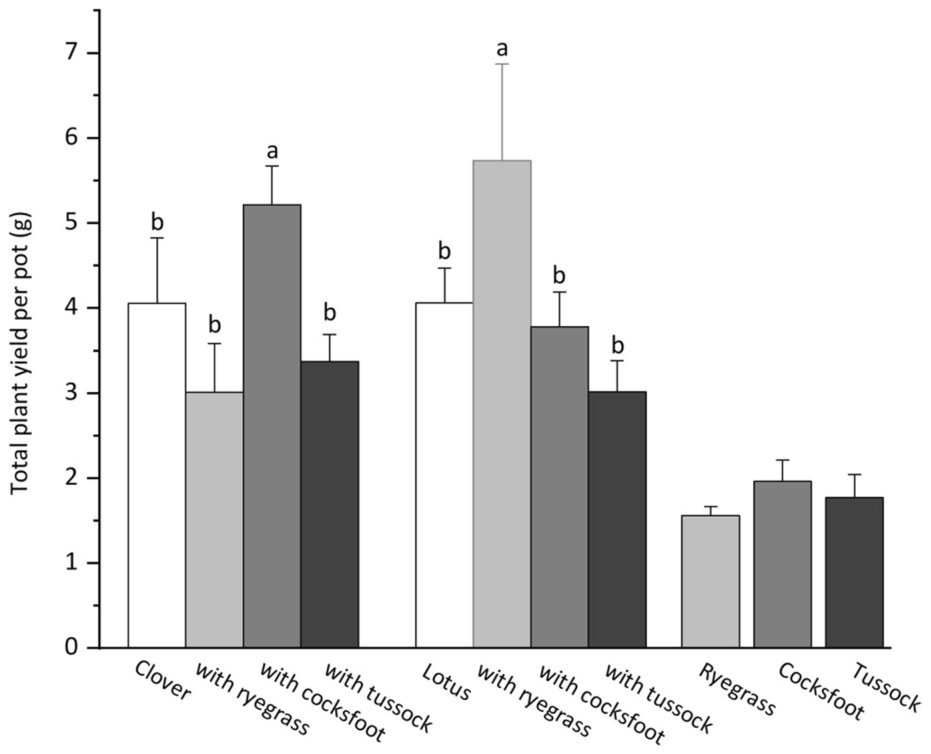
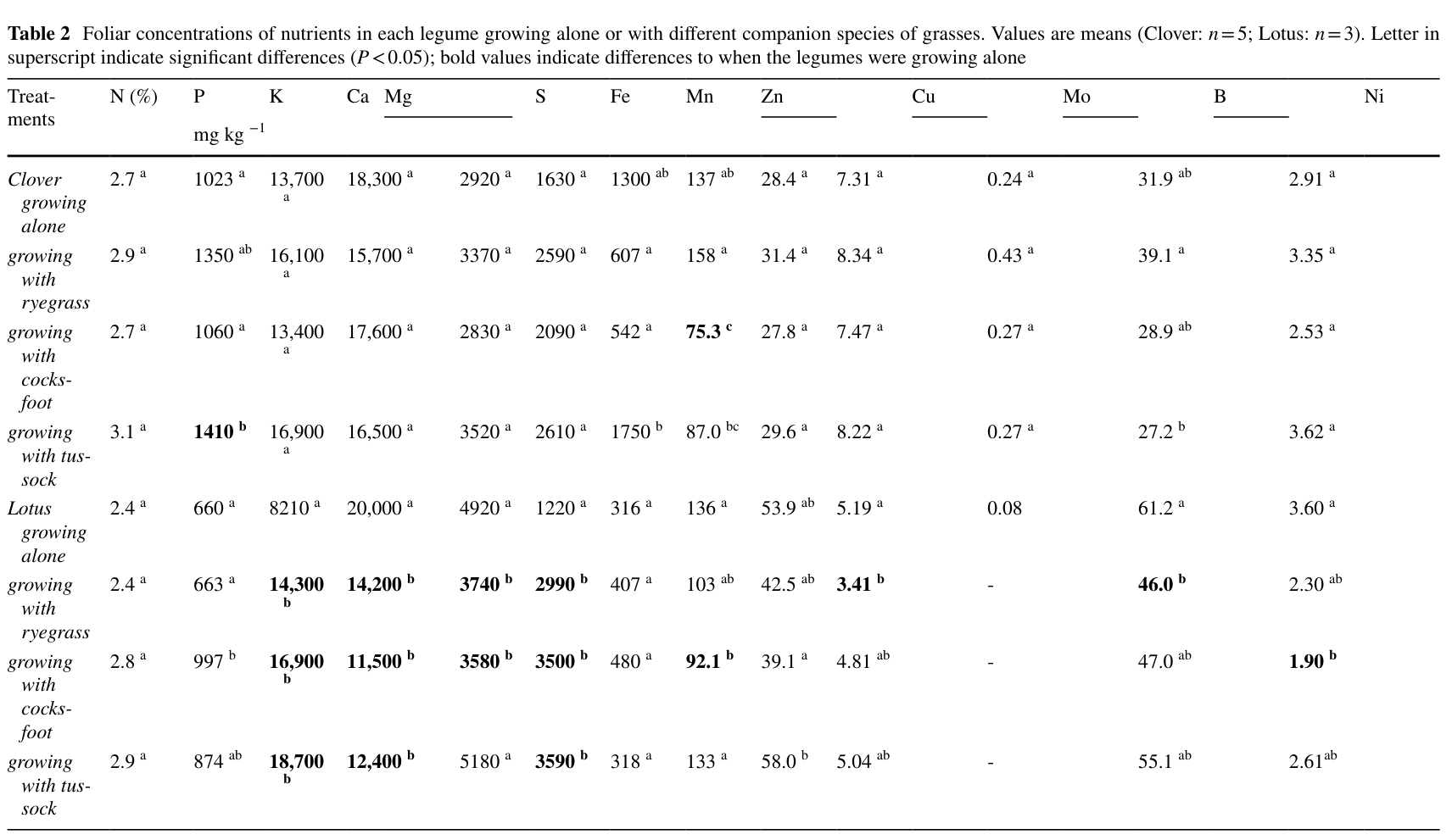
Clover grew better in combination with cocksfoot, and Lotus grew better in combination with ryegrass (Fig. 2). None of the grasses had significantly different yields with or without legumes; yields of grasses were in the range of 1.36 – 1.96 g pot −1 (c.f. 4.0 – 4.9 g pot −1 for legumes). There were significant differences in nutrient concentrations in the foliage of the two functional types (legumes, grasses) according to whether they were growing singly or in combination. In the legumes (Table 2), this was mostly reflected in higher concentrations of P, K and S, and lower concentrations of Ca, when growing with at least one of the three grasses. Manganese concentrations in foliage were also lower in the legumes when they were growing with cocksfoot. Nitrogen concentrations in legume foliage were not significantly different, whether or not the legumes were growing with grasses.
三叶草与鸭茅组合时生长更好,Lotus与黑麦草组合时生长更好(图2)。无论是否与豆科植物共同生长,各禾草的产量均无显著差异;禾草产量范围为1.36 – 1.96 g pot −1(豆科植物为4.0 – 4.9 g pot −1)。两种功能类型(豆科植物、禾草)叶片中的养分浓度因单独生长或组合生长而存在显著差异。在豆科植物中(表2),这主要体现为与三种禾草中至少一种共同生长时P、K和S浓度较高,而Ca浓度较低。豆科植物与鸭茅共同生长时,其叶片Mn浓度也较低。无论是否与禾草共同生长,豆科植物叶片中的氮浓度均无显著差异。
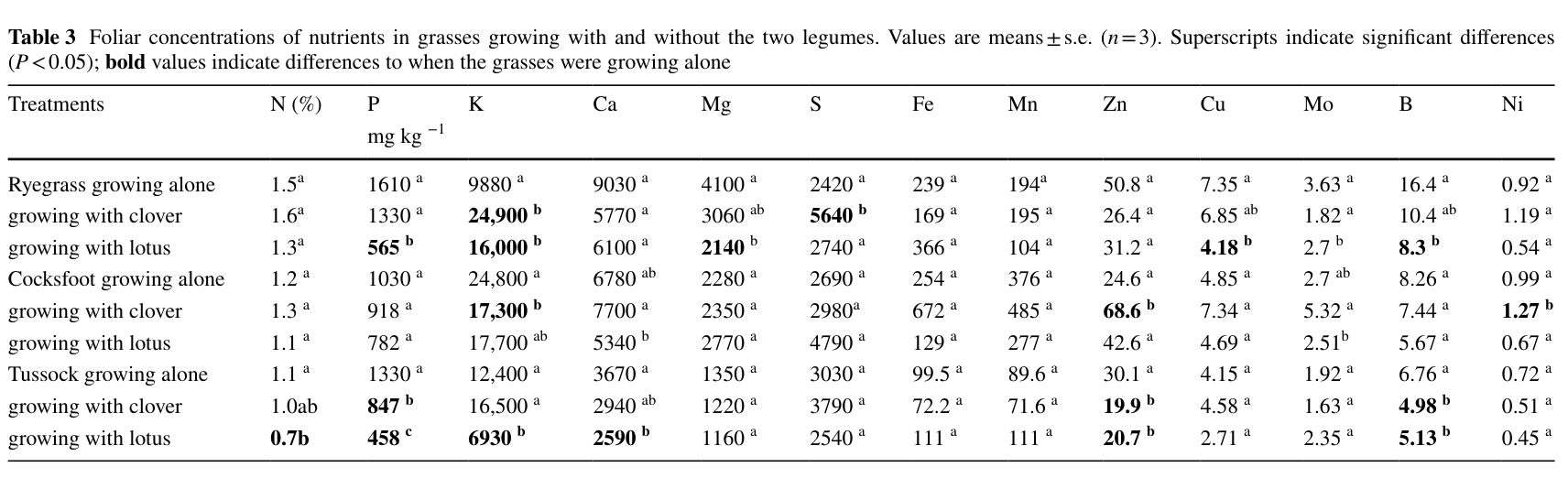
When grasses were growing with or without legumes (Table 3), there was no evidence that N concentrations increased in grass foliage, although P concentrations were frequently lower (Table 3). Otherwise, elemental concentrations in the foliage of the three grasses showed few consistent significant differences when growing with legumes. In ryegrass, only K and S concentrations were significantly higher when this species was growing with one of the legumes, but five of the 13 elements were in lower concentrations. In cocksfoot, only Ni and Zn were elevated when it was growing with clover. In tussock, six elements (N, P, K, Ca, B, Zn) were in lower foliage concentrations in grasses when growing together with one of the legumes.
当禾草与豆科植物共同生长或单独生长时(表3),没有证据表明禾草叶片中的N浓度增加,但P浓度常常较低(表3)。除此之外,三种禾草与豆科植物共同生长时,其叶片元素浓度几乎没有一致的显著差异。在黑麦草中,与一种豆科植物共同生长时仅K和S浓度显著升高,而13种元素中有5种浓度较低。在鸭茅中,与三叶草共同生长时仅Ni和Zn升高。在丛生禾草中,与一种豆科植物共同生长时,禾草叶片中有六种元素(N、P、K、Ca、B、Zn)浓度较低。
The data were also analysed to show total uptake of each element into grasses or legumes, calculated as biomass x element concentration after 4 months’ growth (Fig. 3). As well as having higher tissue concentrations of P, significantly more P was taken up by clover foliage when it was growing with cockfoot or tussock, and seven other elements were taken up in larger amounts when it was growing with cocksfoot. Total uptake of both P and K into Lotus was higher when this legume grew with ryegrass. When growing with clover, K and S uptake into ryegrass was higher, and Zn and Ni uptake were higher in cocksfoot. In tussock, P, B and Zn uptake into cocksfoot and tussock were lower when they were growing with legumes.
还对数据进行了分析以显示禾草或豆科植物对各元素的总吸收量,按生长4个月后的生物量 × 元素浓度计算(图3)。三叶草与鸭茅或丛生禾草共同生长时,其叶片不仅组织P浓度较高,吸收的P也显著更多;与鸭茅共同生长时,另有七种元素的吸收量也较大。Lotus与黑麦草共同生长时,P和K的总吸收量均较高。与三叶草共同生长时,黑麦草对K和S的吸收量较高,鸭茅对Zn和Ni的吸收量较高。就丛生禾草而言,鸭茅和丛生禾草与豆科植物共同生长时,其P、B和Zn吸收量较低。
An estimate of the total acquisition of nutrients from the soil pool contained within the pots was calculated by adding together data for all of the foliage contained in each pot. Total offtake of nutrients often was not always simply explained by higher biomass yields or higher tissue concentrations, but by a combination of both (Fig. 4). When clover grew with cocksfoot, a 30% larger harvest of biomass corresponded to nearly 50% greater extraction of P from soil, and substantially more Mn, Zn and Mo.
将每盆中所有叶片的数据相加,估算了从盆内土壤库中获取的养分总量。养分总移出量往往并不能简单地由较高的生物量产量或较高的组织浓度来解释,而是二者共同作用的结果(图4)。三叶草与鸭茅共同生长时,生物量收获增加30%,对应土壤P提取量增加近50%,Mn、Zn和Mo的提取量也显著增加。
combination of both (Fig. 4). When clover grew with cocksfoot, a 30% larger harvest of biomass corresponded to nearly 50% greater extraction of P from soil, and substantially more Mn, Zn and Mo.
二者兼而有之(图4)。三叶草与鸭茅共同生长时,生物量收获量增加30%,相应地从土壤中提取的P增加近50%,Mn、Zn和Mo的提取量亦显著增加。
Field sampling田间采样
When clover grew with any of the companion plant species in a field situation, K and Mn were consistently in higher concentration in its foliage (Table 4). In some cases, Ca, B and Cu were also higher, but foliar concentrations of P and Mo were lower in clover when growing with cocksfoot.
在田间条件下,三叶草与任一伴生植物物种共同生长时,其叶片中K和Mn的浓度均持续较高(表4)。在部分情况下,Ca、B和Cu的浓度亦较高,但三叶草与鸭茅共同生长时,其叶片中P和Mo的浓度较低。
5Discussion讨论
Legume-grass assemblages are usually more productive than either of these plant functional types in monoculture (Sleugh 2000; Sturludóttir et al. 2014). This is an example of transgressive overyielding in which functional differences between species lead to a strong complementarity (Schmid 2008; Hooper and Dukes 2004). It is generally understood that productivity is enhanced by better spatial and temporal capture of light in the mixed-species canopy, and of soil resources below-ground (Gliessman 2015; Homulle et al. 2021). In particular, nitrogen fixation in legumes, spillover of this nutrient to soil and its exploitation by adjacent species has provided an explanation for overyielding in grassland pastures (Høgh-Jensen and Schjoerring 2001; Gylfadóttir et al. 2007; Scott et al. 2018). Little attention appears to have been given to the possibility that grasses may also improve the nutritional status of legumes through modification of soil biogeochemistry, but the findings of the present study suggest this is the case.
豆科–禾本科植物组合的生产力通常高于其中任一植物功能类型的单一种植(Sleugh 2000; Sturludóttir et al. 2014)。这是超产效应(transgressive overyielding)的一个实例,即物种间的功能差异导致强烈的互补作用(Schmid 2008; Hooper and Dukes 2004)。一般认为,混合物种冠层在空间和时间上对光照的更好捕获,以及地下对土壤资源的更好利用,提高了生产力(Gliessman 2015; Homulle et al. 2021)。特别是豆科植物的固氮作用、该养分向土壤的溢出及其被相邻物种利用,为草地牧场的超产现象提供了解释(Høgh-Jensen and Schjoerring 2001; Gylfadóttir et al. 2007; Scott et al. 2018)。禾本科植物也可能通过改变土壤生物地球化学过程来改善豆科植物营养状况的可能性似乎很少受到关注,但本研究结果表明情况确实如此。
Clover and Lotus had higher yields when growing with grasses than when growing alone. No more or less N was measured in foliage of any of the species apart from the native tussock grass that actually acquired less nitrogen when growing with legumes. Otherwise, there were no significant differences in the total foliar content of N. However, as was also indicated by the routine soil analysis, N did not appear to be an important nutrient limiting plant growth in this soil. The experimental conditions provided adequate soil moisture for growth which is likely to have favoured the growth of legumes over grasses, and there may have been little investment in root nodules and reliance on N from this source.
与单独生长相比,三叶草和 Lotus 与禾本科植物共同生长时产量更高。除本土丛生禾草与豆科植物共同生长时实际获取的氮较少外,其他物种叶片中测得的N均无增减。除此之外,叶片N总含量无显著差异。然而,正如常规土壤分析所示,N似乎并非该土壤中限制植物生长的重要养分。试验条件提供了充足的土壤水分,这可能更有利于豆科植物而非禾本科植物的生长,且豆科植物可能对根瘤投入甚少,对这一来源的N依赖程度也较低。
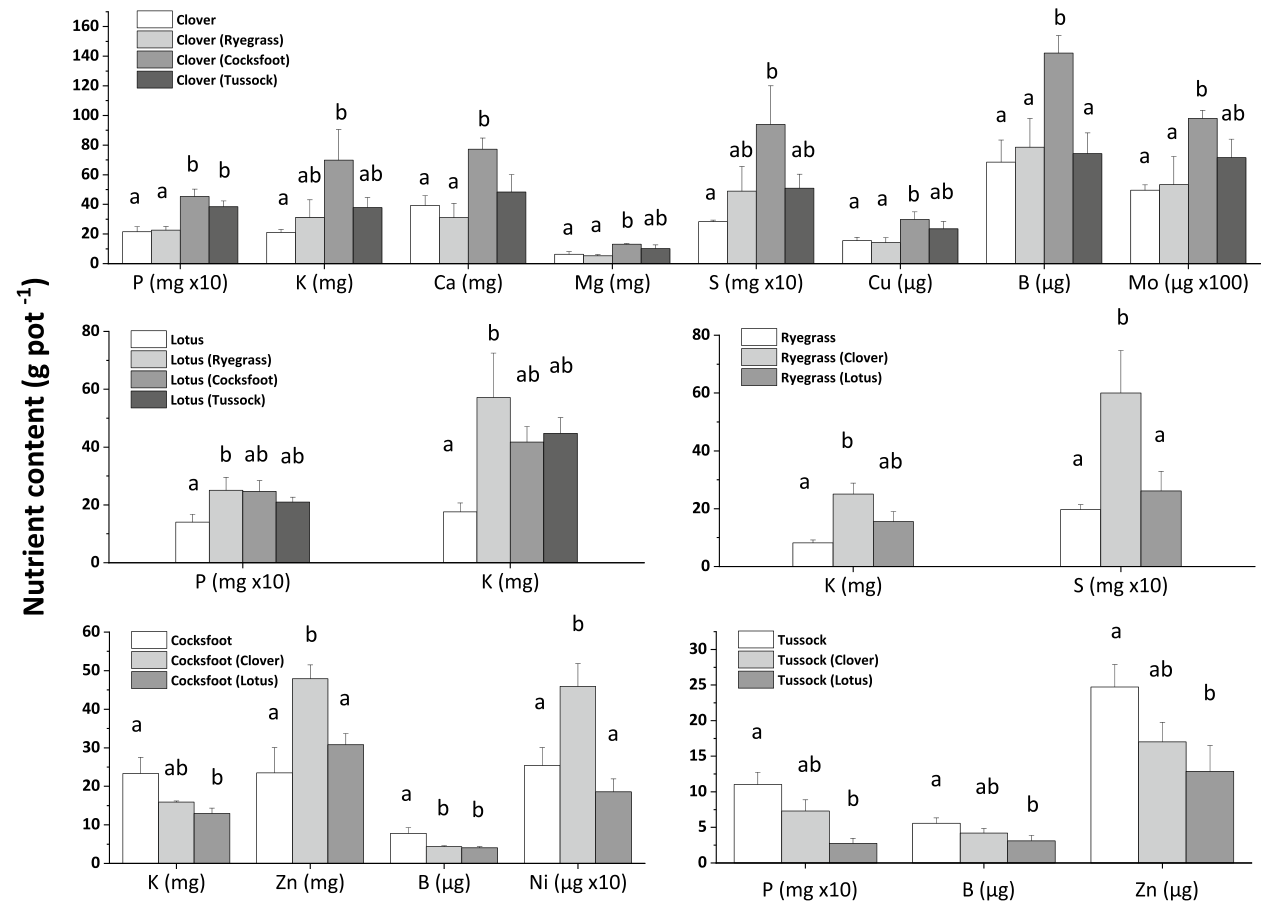
At least six elements (P, S, Ca, Mg, Mn, and B) were deficient in the pot experiment soil. There was evidence from the present study that all these elements, and also Mo, were extracted in higher concentrations, quantities or total amounts from the total soil pool by a combination of legumes and grasses, compared to either plant type alone. The best example was of clover growing with cocksfoot; eight elements were taken up in larger amounts into clover foliage. Field sampling of a more fertile soil similarly showed significantly higher uptake of K, Mn, Cu and B, which suggests compatibility is a real phenomenon in the field situation in grasslands.
盆栽试验土壤中至少有六种元素(P、S、Ca、Mg、Mn和B)缺乏。本研究的证据表明,与任一植物类型单独生长相比,豆科与禾本科植物组合从土壤总库中提取上述所有元素以及Mo的浓度、数量或总量更高。最典型的例子是三叶草与鸭茅共同生长:有八种元素以更大的量被吸收进入三叶草叶片。对一处更肥沃土壤的田间采样同样显示,K、Mn、Cu和B的吸收量显著更高,这表明在草地的田间条件下,相容性是一种真实存在的现象。
Phosphorus, K and S concentrations in the foliage of legumes were higher in the presence of grasses. Foliar concentrations of K and S were also higher in ryegrass when it was growing with legumes. Otherwise, key elements were in lower foliar concentrations in grasses when they were growing with clovers. This was most evident in the native tussock where N, P, K, Ca, B and Zn were in lower foliage concentrations when growing with legumes. Grasses consistently extracted lesser amounts of the total soil pool of nutrients when growing alone. The native tussock grass did not benefit nutritionally from the presence of legumes, but higher P concentrations were found in tussock foliage and, as a companion plant, clover had a higher concentration of P when it was growing with tussock. It appears that tussock grass has some ability to mobilise P in its rhizosphere.
在禾本科植物存在时,豆科植物叶片中P、K和S的浓度较高。黑麦草与豆科植物共同生长时,其叶片中K和S的浓度亦较高。除此之外,禾本科植物与三叶草共同生长时,其叶片中关键元素的浓度较低。这一现象在本土丛生禾草中最为明显,其与豆科植物共同生长时叶片中N、P、K、Ca、B和Zn的浓度较低。禾本科植物单独生长时,从土壤养分总库中提取的量始终较少。本土丛生禾草并未从豆科植物的存在中获得营养上的益处,但丛生禾草叶片中P浓度较高,且作为伴生植物,三叶草与丛生禾草共同生长时P浓度较高。由此看来,丛生禾草具有一定的在其根际活化P的能力。
Possible mechanistic explanations for some of these findings are provided in the scientific literature. Phosphorus is a particularly critical element due to its low solubility and mobility in soil (Scott and Condron 2003; Saleem et al. 2020); P availability in the rhizosphere is increased by secretion of organic exudates and also by the release of protons, the latter particularly in acid soil (Cu et al. 2005). Evidence of partner plants being complementary to one another in the context of exploiting this element has been found previously (Homulle et al. 2021; Lambers et al. 2021). Potassium was not deficient in the experimental soil, but it is known that legumes have a higher K absorption efficiency than grasses (Wang et al. 2014), which would suggest legumes have an advantage in competition for K when growing with grasses. Root exudates containing glutamic acid, tyrosine, and leucine increase K uptake from the soil. In the pot experiment of the present study, K concentrations in Lotus and grass foliage were both higher when they were growing together rather than alone. In the field sampling, clover had higher foliar K concentrations when it was growing with grasses. This may be due to K mobility being increased in the grass rhizosphere soil, but then shared with the legumes.
科学文献为上述部分结果提供了可能的机理解释。磷由于在土壤中溶解度和移动性低,是一种尤为关键的元素(Scott and Condron 2003; Saleem et al. 2020);有机分泌物的分泌以及质子的释放(后者在酸性土壤中尤为明显)可提高根际P的有效性(Cu et al. 2005)。此前已有研究发现伴生植物在利用该元素方面相互互补的证据(Homulle et al. 2021; Lambers et al. 2021)。试验土壤中K并不缺乏,但已知豆科植物的K吸收效率高于禾本科植物(Wang et al. 2014),这表明豆科植物与禾本科植物共同生长时在K的竞争中具有优势。含有谷氨酸、酪氨酸和亮氨酸的根系分泌物可增加植物从土壤中吸收K。在本研究的盆栽试验中,Lotus 与禾本科植物共同生长时,二者叶片中的K浓度均高于单独生长时。在田间采样中,三叶草与禾本科植物共同生长时叶片K浓度较高。这可能是由于禾本科植物根际土壤中K的移动性增加,随后与豆科植物共享所致。
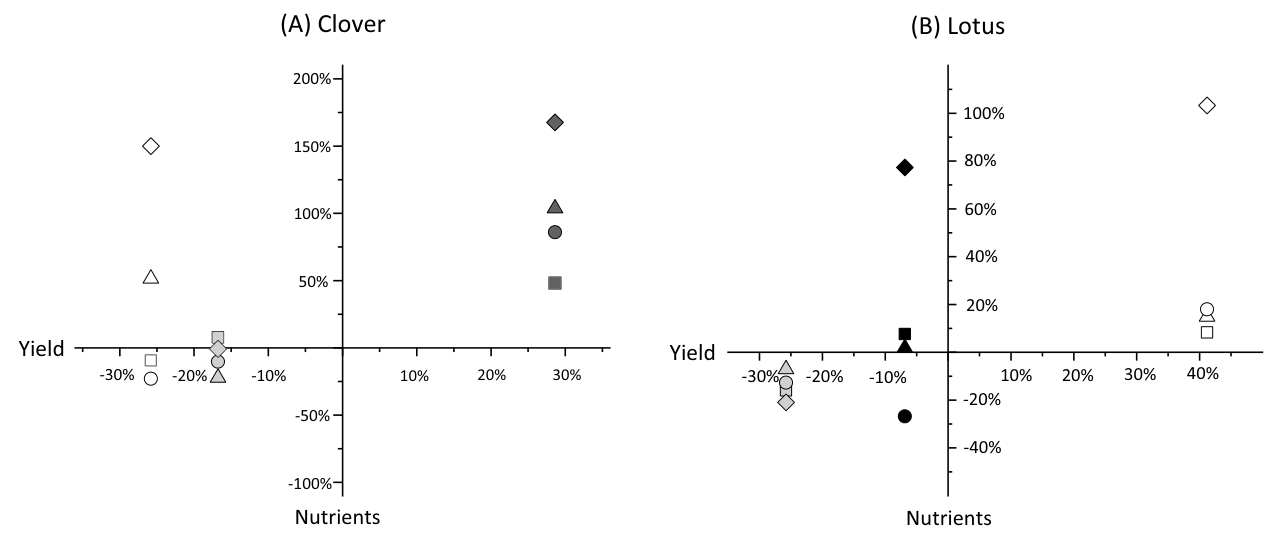
the legume with ryegrass; shaded symbols are the legume with native tussock; black symbols are the legume with cocksfoot. Percentage change is the difference to when the legumes grew alone
豆科植物与黑麦草组合;阴影符号表示豆科植物与本土丛生禾草组合;黑色符号表示豆科植物与鸭茅组合。百分比变化为相对于豆科植物单独生长时的差值
| Treatments处理 | P mg kg−1 | K | Ca | Mg | S | Fe | Mn | Zn | Cu | Mo | B | Ni |
|---|---|---|---|---|---|---|---|---|---|---|---|---|
| Clover growing alone | 2980ab | 7660a | 7890a | 2950a | 1890ab | 342ab | 37.6a | 31.6ab | 7.30a | 0.47a | 15.81a | 1.76a |
| growing with ryegrass | 3380a | 9100b | 9400a | 2830a | 2030a | 464a | 66.8b | 38.2a | 10.7b | 0.50a | 17.86ab | 2.45a |
| growing with cocksfoot | 2500c | 8570b | 12,000 b | 3300a | 1790b | 279b | 70.2b | 27.4b | 8.77ab | 0.19b | 18.69b | 1.18a |
| growing with muti-plants | 2510bc | 9000b | 8570a | 2950a | 1690b | 363ab | 61.1b | 30.1ab | 7.67a | 0.11b | 17.52ab | 2.37a |
Bold alphanumericals indicate significant differences to when clover was growing alone
粗体字母数字表示与三叶草单独生长时相比存在显著差异
Of course there are also functional interactions between physico-chemical variables. The interaction of S with other elements through its modification of rhizosphere conditions generally exceed its own direct nutritional value, but legumes require more S than grasses and microbial activity associated with grass rhizospheres accelerate the oxidation and mineralization of organic S into S2− or SO42− (Wainwright 1984). When soil pH is lower, soil redox potential decreases and solubility of Fe and Mn increases. Grasses also respond to Fe, Zn, Mn and Cu deficiency with enhanced siderophore release from roots (Marschner and Römheld 1994; Erenoglu, et al.
当然,理化变量之间也存在功能性相互作用。S通过改变根际条件而与其他元素产生的相互作用通常超过其自身的直接营养价值,但豆科植物对S的需求高于禾本科植物,而与禾本科植物根际相关的微生物活动会加速有机S氧化和矿化为S2−或SO42−(Wainwright 1984)。当土壤pH较低时,土壤氧化还原电位降低,Fe和Mn的溶解度增加。禾本科植物还会通过增加根系铁载体的释放来应对Fe、Zn、Mn和Cu的缺乏(Marschner and Römheld 1994; Erenoglu, et al.
2000). Uptake of Zn, Mn and Cu is poorly controlled in plants (Lambers et al. 2021). In the present study, clover had higher foliar concentrations of these elements when it grew with ryegrass and tussock. Clover-cocksfoot and Lotus-ryegrass assemblages procured more Mn in the present study. Also, in the field sampling of the present study, when clover grew with any of the grass species or multi-species assemblages, foliage concentrations of Mn were higher.
2000)。植物对Zn、Mn和Cu的吸收调控能力较弱(Lambers et al. 2021)。在本研究中,三叶草与黑麦草和丛生禾草共同生长时,其叶片中这些元素的浓度较高。在本研究中,三叶草–鸭茅和 Lotus–黑麦草组合获取了更多的Mn。此外,在本研究的田间采样中,三叶草与任一禾本科物种或多物种组合共同生长时,其叶片Mn浓度均较高。
Phytosiderophores may have played a key role in higher Cu and B concentrations in clover foliage when growing with cocksfoot, but mechanistic explanations are likely to be more complex. Understanding Zn deficiency provides a good example (Hafeez et al. 2013). Each essential nutrient has specific physiological and biochemical roles; Zn influences the nitrogen content of legumes (Buerkert et al. 1990; Bolanos et al. 1994) and rhizobia can mobilise Zn in soil to some extent (Chen 2003). The results of the present study indicate that cocksfoot mobilized Zn and its uptake when growing by itself. Clover may then have consumed mobile Zn, limiting availability of this element to cocksfoot, in turn stimulating cocksfoot to synthesize and secrete mugineic acids. Molybdenum is known to be an important trigger for photosynthesis and N metabolism (Imran et al. 2021), and this element was better exploited from the soil pool by mixtures of legumes and grasses in the pot experiment of the present study. Similarly, Mg is known to improve N-use efficiency (Tian et al. 2021); foliar concentrations of Mg were lower in grasses in the presence of legumes.
植物铁载体可能在三叶草与鸭茅共同生长时叶片中Cu和B浓度升高方面发挥了关键作用,但其机理解释可能更为复杂。对Zn缺乏的认识提供了一个很好的例子(Hafeez et al. 2013)。每种必需养分都有其特定的生理和生化功能;Zn影响豆科植物的氮含量(Buerkert et al. 1990; Bolanos et al. 1994),且根瘤菌能够在一定程度上活化土壤中的Zn(Chen 2003)。本研究结果表明,鸭茅单独生长时可活化Zn并促进其吸收。随后三叶草可能消耗了可移动的Zn,从而限制了该元素对鸭茅的有效性,进而刺激鸭茅合成并分泌麦根酸。已知钼是光合作用和N代谢的重要触发因子(Imran et al. 2021),在本研究的盆栽试验中,豆科与禾本科植物混合能够更好地从土壤库中利用该元素。同样,已知Mg可提高N利用效率(Tian et al. 2021);在豆科植物存在时,禾本科植物叶片中Mg浓度较低。
It is recognised that it is difficult to identify the specific plant traits that explain species complementarity and transgressive overyielding (Hooper and Dukes 2004; von Felten and Schmid 2008), and clearly nutrient mobility in soil and acquisition by plants is particularly complex. The present study lacks any investigation or analysis of the root systems in the pot experiment or field site, but it is known that there is a substantial rhizophere priming effect on nutrient cycling (Lu 2020). Variations between plant species in root exudation pattern and efficiency of acquiring nutrients has long been discussed (Bardgett et al. 1999), and combinations of clovers and grasses have been shown to increase microbial enzyme activity in soil and release of nutrients from organic matter (Sekaran et al. 2020). Findings in the present study relating to each of the elements that were analysed are hardly definitive, but the body of evidence presented clearly illustrates benefits to legumes through partnership with grasses. Productivity is increased and nutrient acquisition from the soil is enhanced by neighbouring grasses that have a complimentary role. Increases of both productivity and foliar concentrations showed a greater total offtake of P, Zn, Mo and Mn from the soil nutrient pool.
公认的是,很难确定能够解释物种互补性和超产效应的具体植物性状(Hooper and Dukes 2004; von Felten and Schmid 2008),显然,养分在土壤中的移动性及植物对养分的获取尤为复杂。本研究未对盆栽试验或田间样地的根系进行任何调查或分析,但已知根际激发效应对养分循环具有重大影响(Lu 2020)。植物物种间根系分泌模式及养分获取效率的差异早已得到讨论(Bardgett et al. 1999),且已有研究表明三叶草与禾本科植物的组合可提高土壤微生物酶活性并促进有机质中养分的释放(Sekaran et al. 2020)。本研究中关于所分析各元素的结果尚难定论,但所呈现的证据总体上清楚地表明豆科植物通过与禾本科植物搭配而获益。具有互补作用的相邻禾本科植物提高了生产力,并增强了从土壤中获取养分的能力。生产力和叶片浓度的同时提高表明,从土壤养分库中移出的P、Zn、Mo和Mn总量更大。
In a broader practical context, increasing the legume component of pasture has been a goal of highcountry farming in New Zealand for several decades by attempting to introduce a wide range of exotic clovers and other herbaceous legumes to increase vegetation yields and stock productivity. The findings of the present study indicate that cocksfoot and other grasses, including native tussock, play a mutually beneficial role that previously has been largely overlooked. Native tussock grass contained lesser amounts of N and five other nutrients when it was growing with the exotic legumes, suggesting less compatibility, a lack of adaptation to coexistence and perhaps to competition for soil N. Exotic herbaceous legumes appear to offer little benefit to tussock grasses, but sustaining residual assemblages of indigenous species within the productive farming landscape is hugely important to biodiversity conservation in New Zealand. This study suggests it would be worthwhile to elucidate functionality of plant diversity in a wider range of native plants in terms of biodiversity protection, soil biogeochemistry and efficient exploitation of nutrient resources.
从更广泛的实践角度看,数十年来,增加牧场中豆科植物的比例一直是新西兰高地畜牧业的目标,人们尝试引入多种外来三叶草及其他草本豆科植物,以提高植被产量和牲畜生产力。本研究结果表明,鸭茅及其他禾本科植物(包括本土丛生禾草)发挥着互利作用,而这一作用此前在很大程度上被忽视。本土丛生禾草与外来豆科植物共同生长时,其N及其他五种养分的含量较低,表明二者相容性较差,缺乏对共存的适应,或许也缺乏对土壤N的竞争适应。外来草本豆科植物似乎对丛生禾草益处甚微,但在生产性农业景观中维持残存的本土物种组合对新西兰的生物多样性保护极为重要。本研究表明,从生物多样性保护、土壤生物地球化学和养分资源高效利用的角度,在更广泛的本土植物中阐明植物多样性的功能是值得开展的工作。
6Conclusions结论
Legume nutrition is improved by neighbouring grasses, and coexistence of these functional groups provides more efficient soil biogeochemistry. This manuscript appears to be a first report that spillover of N from clovers to grasses is an adaptation and strategy to procure quid pro quo other limiting nutrients from neighbouring grasses. In a nutrient-poor soil, productivity increased and the mobility of key elements in plants and soils significantly differed with combinations of legumes and grasses, compared to either functional group alone. Foliar concentrations differed and mass balance results demonstrated that mixed species assemblages improved the efficiency of exploitation of the soil pool of nutrients. White clover and Lotus grew better in combination with different species of introduced grasses. The results provide a demonstration of transgressive overyielding. Sampling of clover in a more fertile lowland pastoral grassland provided results that suggested mutual compatibility between legumes and other species is a more widespread and frequent phenomenon. Mechanistic explanations for these responses were not sought in this experimental work, but numerous potential explanations exist in the scientific literature; it is likely that modification of Ca and S and subsequently pH in the rhizosphere, which is further modified by different root structures and root exudates play key roles. These findings have obvious significance towards understanding the value of plant diversity in pastoral farming, but they also advance knowledge of native and exotic plant co-existence that is highly relevant to conservation and management of New Zealand’s native biodiversity. The indigenous tussock grass contained less N and no other nutritional benefits when growing with exotic legumes, but did improve the overall offtake of nutrients. This suggests less compatibility, a lack of adaptation to coexistence and a limited ability to compete for soil N. Further research is justified.
相邻禾本科植物可改善豆科植物的营养,这两个功能群的共存使土壤生物地球化学过程更为高效。本文似乎首次报道了N从三叶草向禾本科植物的溢出是一种适应和策略,用以从相邻禾本科植物处quid pro quo(以物易物)地获取其他限制性养分。在养分贫瘠的土壤中,与任一功能群单独生长相比,豆科与禾本科植物组合提高了生产力,且关键元素在植物和土壤中的移动性存在显著差异。叶片浓度存在差异,物质平衡结果表明混合物种组合提高了土壤养分库的利用效率。白三叶草和 Lotus 与不同种类的引进禾本科植物组合时生长更好。上述结果证明了超产效应。在一处更肥沃的低地牧区草地对三叶草的采样结果表明,豆科植物与其他物种之间的相互相容性是一种更为普遍和常见的现象。本试验工作未探究这些响应的机理解释,但科学文献中已有大量可能的解释;根际中Ca和S以及随之而来的pH的改变很可能发挥了关键作用,而不同的根系结构和根系分泌物又会进一步改变根际条件。这些发现对于理解植物多样性在畜牧业中的价值具有明显意义,同时也增进了对本土与外来植物共存的认识,这与新西兰本土生物多样性的保护和管理高度相关。本土丛生禾草与外来豆科植物共同生长时N含量较低,也未获得其他营养益处,但确实提高了养分的总体移出量。这表明二者相容性较差,缺乏对共存的适应,且竞争土壤N的能力有限。有必要开展进一步研究。
Acknowledgements The research team are grateful to the Miss E.L. Hellaby Indigenous Grasslands Research Trust for grant funding to support Zhang Wei for his PhD stipend and operational funds. Special thanks also to Dasom Jeon, Brent Richards and Roger Cresswell for practical support.
致谢 研究团队感谢Miss E.L. Hellaby Indigenous Grasslands Research Trust为Zhang Wei的博士生活津贴和研究经费提供资助。同时特别感谢Dasom Jeon、Brent Richards和Roger Cresswell提供的实际支持。
Authors’ contribution All authors contributed to the planning and execution of the project, and to manuscript preparation. Zhang Wei carried out the practical work and data analysis as part of his PhD programme supervised by Nicholas Dickinson, Thomas Maxwell and Brett Robinson. Nicholas Dickinson is responsible for the final manuscript draft.
作者贡献 所有作者均参与了项目的规划与实施以及论文的撰写。Zhang Wei在Nicholas Dickinson、Thomas Maxwell和Brett Robinson指导下,作为其博士研究的一部分完成了实验工作和数据分析。Nicholas Dickinson负责论文终稿。
Funding Open Access funding enabled and organized by CAUL and its Member Institutions This study was supported by Lincoln University and the Miss E.L. Hellaby Indigenous Grasslands Research Trust.
资助 开放获取资金由CAUL及其成员机构提供并组织。本研究得到了Lincoln University和Miss E.L. Hellaby Indigenous Grasslands Research Trust的资助。
Data availability Not applicable.
数据可用性 不适用。
Code availability Not applicable.
代码可用性 不适用。
Declarations声明
Conflict of interest There are no conflicts of interest.
利益冲突 不存在利益冲突。
Open Access This article is licensed under a Creative Commons Attribution 4.0 International License, which permits use, sharing, adaptation, distribution and reproduction in any medium or format, as long as you give appropriate credit to the original author(s) and the source, provide a link to the Creative Commons licence, and indicate if changes were made. The images or other third party material in this article are included in the article’s Creative Commons licence, unless indicated otherwise in a credit line to the material. If material is not included in the article’s Creative Commons licence and your intended use is not permitted by statutory regulation or exceeds the permitted use, you will need to obtain permission directly from the copyright holder. To view a copy of this licence, visit http:// creat iveco mmons. org/ licen ses/ by/4. 0/.
开放获取 本文采用知识共享署名4.0国际许可协议(Creative Commons Attribution 4.0 International License)授权,该协议允许以任何媒介或格式使用、共享、改编、分发和复制本文,但须适当注明原作者及来源,提供知识共享许可协议的链接,并说明是否作了修改。除非在材料的署名说明中另有注明,本文中的图像或其他第三方材料均包含在本文的知识共享许可协议中。如果材料未包含在本文的知识共享许可协议中,且您的预期用途不为法律法规所允许或超出允许的使用范围,则需直接获得版权持有人的许可。如需查看该许可协议的副本,请访问 http:// creat iveco mmons. org/ licen ses/ by/4. 0/。
7References参考文献
Allen RB, Lee WG (2006) Biological invasions in New Zealand. Springer Science & Business Media.
Armstrong C (1974) Grasslands Maku tetraploid lotus (Lotus pedunculatus Cav.). N Z J Exp Agric 2:333–336
Banakar R, Alvarez Fernandez A, Díaz-Benito P, Abadia J, Capell T, Christou P (2017) Phytosiderophores determine thresholds for iron and zinc accumulation in biofortified rice endosperm while inhibiting the accumulation of cadmium. J Exp Bot 68:4983–4995
Bardgett R, Mawdsley J, Edwards S, Hobbs P, Rodwell J, Davies WJ (1999) Plant species and nitrogen effects on soil biological properties of temperate upland grasslands. Funct Ecol 13:650–660
Bolanos L, Esteban E, de Lorenzo C, Fernandez-Pascual M, de Felipe MR, Garate A, Bonilla I (1994) Essentiality of boron for symbiotic dinitrogen fixation in pea (Pisum sativum) rhizobium nodules. Plant Physiol 104:85–90
Buerkert A, Cassman K, De la Piedra R, Munns D (1990) Soil acidity and liming effects on stand, nodulation, and yield of common bean. Agron J 82:749–754
Burrows CJ (1990) Processes of vegetation change. Unwin Hyman, Boston
Caradus J (1996) Overview and vision for white clover. In: Woodfield DR (ed) White clover: New Zealand’s competitive edge. New Zealand Grassland Association: Palmerston North, pp. 1–6.
Chen W, Huang Q, Guo X (2003) Effects of rhizobia on morphological distribution of Cu, Zn and Cd in soil. J App Ecol 14:1278–1282
Craine JM, Dybzinski R (2013) Mechanisms of plant competition for nutrients, water and light. Funct Ecol 27:833–840
Cu ST, Hutson J, Schuller KA (2005) Mixed culture of wheat (Triticum aestivum L.) with white lupin (Lupinus albus L.) improves the growth and phosphorus nutrition of the wheat. Plant Soil 272:143–151
Dollery R, Li S, Dickinson NM (2019) Nutrient-enriched soils and native N-fixing plants in New Zealand. J Plant Nutr Soil Sci 182:104–110
Erenoglu B, Eker S, Cakmak I, Derici R, Römheld V (2000) Effect of iron and zinc deficiency on release of phytosiderophores in barley cultivars differing in zinc efficiency. J Plant Nutr 23:1645–1656
Fornara D, Tilman D (2008) Plant functional composition influences rates of soil carbon and nitrogen accumulation. J Ecol 96:314–322
Gliessman S (2015) Agroecology: the ecology of sustainable food systems, 3rd edn. Taylor & Francis, Boca Raton
Gutiérrez-Ginés MJ, Madejón E, Lehto NJ, McLenaghen RD, Horswell J, Dickinson N, Robinson BH (2019) Response of a pioneering species (Leptospermum scoparium JR Forst. & G. Forst.) to heterogeneity in a lowfertility soil. Front Plant Sci 10:1–12
Gylfadóttir T, Helgadóttir Á, Høgh-Jensen H (2007) Consequences of including adapted white clover in northern European grassland: transfer and deposition of nitrogen. Plant Soil 297:93–104
Hafeez B, Khanif Y, Saleem M (2013) Role of zinc in plant nutrition-a review. Journal of Experimental Agriculture International: 374–391.
Høgh-Jensen H, Schjoerring JK (2001) Rhizodeposition of nitrogen by red clover, white clover and ryegrass leys. Soil Biol Biochem 33:439–448
Homulle Z, George T, Karley A (2021) Root traits with team benefits: understanding belowground interactions in intercropping systems. Plant and Soil: 1–26. [https:// doi. org/ 10. 1007/ s11104- 021- 05165-8]
Hooper DU, Dukes JS (2004) Overyielding among plant functional groups in a long-term experiment. Ecol Lett 7:95–105
Hunter GG, Scott D (1997) Changes in tussock grasslands, South Island high country, 1973–93. Department of Conservation, Wellington.
Imran M, Hussain S, Rana MS, Saleem MH, Rasul F, Ali KH, Potcho MP, Pan S, Duan M, Tang X (2021) Molybdenum improves 2-acetyl-1-pyrroline, grain quality traits and yield attributes in fragrant rice through efficient nitrogen assimilation under cadmium toxicity. Ecotoxicol Environ Safe 211:111911
Inal A, Gunes A, Zhang F, Cakmak I (2007) Peanut/maize intercropping induced changes in rhizosphere and nutrient concentrations in shoots. Plant Physiol Biochem 45:350–356
Kamal K, Hagagg L, Awad F (2000) Improved Fe and Zn acquisition by guava seedlings grown in calcareous soils intercropped with graminaceous species. J Plant Nutr 23:2071–2080
Lambers H, Wright IJ, Pereira CG, Bellingham PJ, Bentley LP, Boonman A, Cernusak LA, Foulds W, Gleason SM, Gray EF (2021) Leaf manganese concentrations as a tool to assess belowground plant functioning in phosphorusimpoverished environments. Plant Soil 461:43–61
Li L, Tilman D, Lambers H, Zhang FS (2014) Plant diversity and overyielding: insights from belowground facilitation of intercropping in agriculture. New Phytol 203:63–69
Lu JY, Yang JF, Keitel C, Yin LM, Wang P, Cheng WX, Dijkstra FA (2020) Rhizosphere priming effects of Lolium perenne and Trifolium repens depend on phosphorus fertilization and biological nitrogen fixation. Soil Biol Biochem 150:108005
Lynch JP, Strock CF, Schneider HM, Sidhu JS, Ajmera I, Galindo-Castañeda T, Klein SP, Hanlon MT (2021) Root anatomy and soil resource capture. Plant Soil 466:21–63
Mark AF, Galloway DJ (2012) Above the treeline: a nature guide to alpine New Zealand. Craig Potton Publishing, Nelson
Marschner H, Römheld V (1994) Strategies of plants for acquisition of iron. Plant Soil 165:261–274
Pirhofer-Walzl K, Rasmussen J, Høgh-Jensen H, Eriksen J, Søegaard K, Rasmussen J (2012) Nitrogen transfer from forage legumes to nine neighbouring plants in a multi-species grassland. Plant Soil 350:71–84
Rattray PV, By C, SFF SFF (2005) Clover management, research, development and extension in the New Zealand pastoral industries: A review of R&D literature and R&D opportunities, extension initiatives and extension opportunities. Sustainable Farming Fund, Ministry for Primary Industries, NZ Government.
Rochon J, Doyle C, Greef J, Hopkins A, Molle G, Sitzia M, Scholefield D, Smith C (2004) Grazing legumes in Europe: a review of their status, management, benefits, research needs and future prospects. Grass Forage Sci 59:197–214
Saleem M, Pervaiz ZH, Contreras J, Lindenberger JH, Hupp BM, Chen D, Zhang Q, Wang C, Iqbal J, Twigg P (2020) Cover crop diversity improves multiple soil properties via altering root architectural traits. Rhizosphere 16:100248
Sanada Y, Gras M, Van Santen E (2010) Cocksfoot. In: Boller BU, Posselt K, Veronesi DF (eds) Fodder crops and amenity grasses: Handbook of plant breeding. Springer, New York, pp 317–328
Schipanski ME, Drinkwater LE (2012) Nitrogen fixation in annual and perennial legume-grass mixtures across a fertility gradient. Plant Soil 357:147–159
Schmid B, Hector A, Saha P, Loreau M (2008) Biodiversity effects and transgressive overyielding. Journal of Plant Ecology 1:95–102
Scott JT, Condron LM (2003) Dynamics and availability of phosphorus in the rhizosphere of a temperate silvopastoral system. Biol Fertil Soils 39:65–73
Scott GD, Baddeley JA, Watson CA, Robinson D (2018) Demographic quantification of carbon and nitrogen dynamics associated with root turnover in white clover. Plant, Cell Environ 41:2045–2056
Sekaran U, Loya JR, Abagandura GO, Subramanian S, Owens V, Kumar S (2020) Intercropping of kura clover (Trifolium ambiguum M Bieb) with prairie cordgrass (Spartina pectinata link) enhanced soil biochemical activities and microbial community structure. App Soil Ecol 147:103427
Sleugh B, Moore KJ, George JR, Brummer EC (2000) Binary legume–grass mixtures improve forage yield, quality, and seasonal distribution. Agron J 92:24–29
StatsNZ (2021) Agricultural and horticultural land use. StatsNZ Tatauranga Aotearoa. https:// www. stats. govt. nz/ indic ators/ agric ultur al- and- horti cultu ral- land- use. Accessed 24 Jan 2022
Sturludóttir E, Brophy C, Belanger G, Gustavsson AM, Jørgensen M, Lunnan T, Helgadóttir Á (2014) Benefits of mixing grasses and legumes for herbage yield and
nutritive value in N orthern E urope and C anada. Grass Forage Sci 69:229–240
Tian S, Zhang Y, Yang C, Tie S, Nan J (2021) Nitrogen-doped carbon nanosheet coated multilayer graphite as stabilized anode material of potassium-ion batteries with high performances. Electrochimica Acta 380:138254
Trinder CJ, Brooker RW, Davidson H, Robinson D (2021) Directly quantifying multiple interacting influences on plant competition. Plant, Cell Environ 44:1268–1277
von Felten S, Schmid B (2008) Complementarity among species in horizontal versus vertical rooting space. Journal of Plant Ecology 1:33–41
Wainwright M (1984) Sulfur oxidation in soils. Adv Agron 37:349–396
Wang Z, Lu J, Yang H, Zhang X, Luo C, Zhao Y (2014) Resorption of nitrogen, phosphorus and potassium from leaves of lucerne stands of different ages. Plant Soil 383:301–312
Wardle P (1991) Vegetation of New Zealand. Cambridge Universioty Press, Cambridge
Wilsey BJ, Martin LM, Kaul AD (2018) Phenology differences between native and novel exotic-dominated grasslands rival the effects of climate change. J Appl Ecol 55:863–873
Xiong H, Kakei Y, Kobayashi T, Guo X, Nakazono M, Takahashi H, Nakanishi H, Shen H, Zhang F, Nishizawa NK (2013) Molecular evidence for phytosiderophoreinduced improvement of iron nutrition of peanut intercropped with maize in calcareous soil. Plant, Cell Environ 36:1888–1902
Zhang WP, Liu GC, Sun JH, Zhang LZ, Weiner J, Li L (2015) Growth trajectories and interspecific competitive dynamics in wheat/maize and barley/maize intercropping. Plant Soil 397:227–238
Zuo Y, Zhang F (2008) Effect of peanut mixed cropping with gramineous species on micronutrient concentrations and iron chlorosis of peanut plants grown in a calcareous soil. Plant Soil 306:23–36
Publisher’s note Springer Nature remains neutral with regard to jurisdictional claims in published maps and institutional affiliations.