Article
Zhang Wei 1, Thomas Maxwell 1 , Brett Robinson 2 and Nicholas Dickinson 1,*
1 Faculty of Agriculture and Life Sciences, Lincoln University, Lincoln, Christchurch 7647, New Zealand; wei.zhang@lincolnuni.ac.nz (Z.W.); tom.maxwell@lincoln.ac.nz (T.M.)
2 Department of Chemistry, University of Canterbury, Christchurch 8140, New Zealand; brett.robinson@canterbury.ac.nz
* Correspondence: nicholas.dickinson@lincoln.ac.nz; Tel.: +64-3-423-0741
Abstract: The aim of this study was to investigate the compatibility of plants with contrasting root systems, in terms of procurement of limiting soil nutrients. Paired combinations of species of proteas and grasses were grown in a pot experiment using soil from a site with impoverished vegetation and degraded soil. The soil contained sufficient N but was low to deficient in P, Mn, S, Fe, and B. The uptake of chemical elements into the foliage differed significantly according to whether the plants were growing as single or mixed species. When two species of Grevillea and grasses with evolutionary origins in low fertility soils were growing together, there was an enhanced uptake of P and Mn, in one or both species, in addition to other elements that were in low concentrations in the experimental soil. In contrast to this, Protea neriifolia that probably originated from a more fertile soil procured lesser amounts of the six elements from the soil when growing together with grasses. Two grasses tolerant of less fertile soils (Dactylis glomerata and Poa cita) obtained more nutrients when they grew together with proteas; this was a much stronger neighbour effect than was measured in Lolium perenne which is better adapted to high fertility soils. The findings illustrate both the functional compatibility and competition for plant nutrients in mixed-species rhizospheres. Species combinations substantially increased the acquisition of key elements from the soil nutrient pool.
摘要:本研究旨在从获取土壤限制性养分的角度,探讨根系类型迥异的植物之间的相容性。以植被贫瘠、土壤退化样地的土壤为基质开展盆栽试验,种植山龙眼科植物与禾草的物种两两组合。该土壤N含量充足,但P、Mn、S、Fe和B含量偏低乃至缺乏。植物以单一物种或混合物种方式生长时,其叶片对化学元素的吸收存在显著差异。当两种起源于低肥力土壤的Grevillea与禾草共同生长时,其中一个或两个物种对P和Mn的吸收均有所增强,对试验土壤中其他低含量元素的吸收亦有提高。与此相反,可能起源于较肥沃土壤的Protea neriifolia与禾草共同生长时,从土壤中获取的上述6种元素的量较少。两种耐低肥力土壤的禾草(Dactylis glomerata和Poa cita)与山龙眼科植物共同生长时获得了更多养分;这种邻体效应远强于在更适应高肥力土壤的Lolium perenne中所测得的效应。研究结果表明,混合物种根际中既存在功能相容性,也存在对植物养分的竞争。物种组合显著提高了从土壤养分库中获取关键元素的量。
Academic Editor: Sergey Loiko
Received: 30 March 2022 Accepted: 19 May 2022 Published: 21 May 2022
Publisher’s Note: MDPI stays neutral with regard to jurisdictional claims in published maps and institutional affiliations.
Copyright: © 2022 by the authors. Licensee MDPI, Basel, Switzerland. This article is an open access article distributed under the terms and conditions of the Creative Commons Attribution (CC BY) license (https:// creativecommons.org/licenses/by/ 4.0/).
版权:© 2022 作者所有。被许可方MDPI,瑞士巴塞尔。本文为开放获取文章,依据知识共享署名(CC BY)许可协议(https:// creativecommons.org/licenses/by/ 4.0/)的条款和条件发布。
Keywords: soil nutrients; plant nutrition; co-existence; rhizosphere; phosphorus; manganese
关键词:土壤养分;植物营养;共存;根际;磷;锰
1Introduction引言
There is great variability in the mobility of chemical elements in the rhizospheres of different species that is reflected in the exploitation of the soil nutrient pool and the uptake of nutrients by plants [1,2]. This would suggest that combinations of plant species may be more effective than single species at modifying the mobility and management of chemical elements in soils [3]. The hypothesis underlying this study is that plants naturally adapted to low fertility or degraded soils are likely to benefit by growing in combination with other species that possess different functional traits in the rhizosphere, since most plant species have similar fundamental metabolic demands for the same range of key nutrients [4]. A strategy of sharing different capabilities to procure key soil nutrients might prevail over the competition for access to a limited resource. Contrary to this, plants adapted to more fertile soils may be more likely to employ a competitive strategy to rapidly acquire a majority share of nutrients from a more plentiful pool of available soil nutrients. We test this hypothesis by growing a combination of plants that do not naturally occur together, but that are known to have different root functional traits that are adapted to either fertile or infertile soils, combinations readily found both in the Poaceae (grasses) and Proteaceae (all species are referred to using the generic term ‘protea’ in the present paper).
不同物种根际中化学元素的迁移性差异很大,这体现在植物对土壤养分库的利用及对养分的吸收上[1,2]。这表明,在改变土壤中化学元素的迁移性及其管理方面,植物物种组合可能比单一物种更为有效[3]。本研究的基本假设是:由于大多数植物物种对同一系列关键养分具有相似的基本代谢需求[4],天然适应低肥力或退化土壤的植物,与在根际具有不同功能性状的其他物种组合生长时,很可能从中受益。共享获取关键土壤养分的不同能力这一策略,可能胜过对有限资源的竞争。与此相反,适应较肥沃土壤的植物可能更倾向于采取竞争策略,从较丰富的土壤有效养分库中迅速获取大部分养分。为检验这一假设,我们将天然条件下并不共生、但已知具有适应肥沃或贫瘠土壤的不同根系功能性状的植物组合种植;此类组合在禾本科(Poaceae,禾草)和山龙眼科(Proteaceae,本文中所有物种统称为“山龙眼类植物”)中均很容易找到。
There are often added benefits to plant productivity from two or more plant species growing together. Intercropping in agriculture and horticulture provides increased yields, often referred to as transgressive overyielding [5–9], for example when legumes are grown together with other crops [10,11]. In this example, the fortuitous spillover of N fixed by rhizobial symbionts from the legume to neighbouring plants is generally viewed as incidental, even though it seems unlikely that evolution has favoured an adaptation in plants that expends metabolic energy and resources towards obtaining N that is then readily shared with competitors. Recently, we have shown that grasses reciprocate in this relationship by procuring key trace elements in the rhizosphere that are then passed on to legumes [3]; grass—clover assemblages enhanced overall productivity and uptake of P, K, S, Mn, Cu, Mo, and B. The present paper investigates whether the sharing of phosphorus and key trace elements can also be identified between proteas and grasses of different origins when they grow together in soil with sufficient N for healthy growth, but with deficiencies of other key nutrients. We selected plant species that are known to possess contrasting root functional traits, and which did not share a common biogeographical origin.
两种或多种植物共同生长往往会给植物生产力带来额外益处。农业和园艺中的间作可提高产量,这通常被称为超越性超产[5–9],例如豆科植物与其他作物间作时[10,11]。在此例中,豆科植物根瘤菌共生体固定的N偶然溢出至邻近植物,一般被视为附带现象,尽管进化似乎不太可能青睐这样一种适应性:植物消耗代谢能量和资源获取N,却随即将其与竞争者共享。最近,我们发现禾草在这一关系中存在互惠作用,即在根际获取关键微量元素并将其传递给豆科植物[3];禾草—三叶草组合提高了总体生产力以及对P、K、S、Mn、Cu、Mo和B的吸收。本文探讨了在N充足、可满足健康生长但其他关键养分缺乏的土壤中,不同起源的山龙眼类植物与禾草共同生长时,是否同样存在磷和关键微量元素的共享。我们选择了已知具有迥异根系功能性状、且不具有共同生物地理起源的植物物种。
The uptake of chemical elements is known to differ between species and according to whether plants are grown in monoculture or in mixed species assemblages [12], or naturally found in the same location and habitat [3]. However, investigations of the physiological traits associated with uptake seldom extend to a consideration of the two-way sharing of soil nutrients. One of the few more detailed examples of complementarity is with plants that produce cluster roots, found within a few plant families, including the Proteaceae and in a few crops such as Lupinus albus (white lupin) [13,14]. Cluster roots primarily enable plants to exploit less labile pools of soil phosphorus (P) in P-deficient soils, by releasing organic acids to mobilise mineral P that is bound to metal cations and organic complexes in the soil [15]. There is some evidence that cluster roots can also facilitate the acquisition of nutrients by neighbouring plants [16]. Different and contrasting strategies to acquire soil nutrients are employed by grasses, for example through different root structures [17], using mycorrhizal associations [18], or by secreting organic acids (phytosiderophores) [19]. Our assumption was that the acquisition of P, which is most often the predominant element limiting plant growth, would play a definitive role in our findings. Complementarity has previously been found to explain coexistence between different functional groups of grasses [20].
已知化学元素的吸收因物种而异,并取决于植物是单一栽培还是混合物种组合种植[12],或是否天然分布于同一地点和生境[3]。然而,对与吸收相关的生理性状的研究很少延伸至对土壤养分双向共享的考察。为数不多的较详细的互补性实例之一涉及产生排根的植物,这类植物见于少数植物科(包括山龙眼科)及少数作物,如Lupinus albus(白羽扇豆)[13,14]。排根主要通过释放有机酸活化土壤中与金属阳离子和有机络合物结合的矿质P,使植物能够在缺P土壤中利用活性较低的土壤磷(P)库[15]。有证据表明,排根还能促进邻近植物对养分的获取[16]。禾草则采用不同且迥异的策略获取土壤养分,例如通过不同的根系结构[17]、利用菌根共生[18]或分泌有机酸(植物铁载体)[19]。我们假定,P(通常是限制植物生长的最主要元素)的获取将在本研究结果中起决定性作用。此前已发现,互补性可解释不同功能群禾草之间的共存[20]。
The aim of this study was to investigate species complementarity in the context of P and key trace elements, by measuring the uptake of nutrients into the foliage of species of different origins growing together artificially in nutrient-depleted soil. The work is particularly relevant to the management of species diversity in low-fertility production systems, but also has potential significance for phytoremediation science and practice, where exotic species are introduced to contaminated and degraded soils to manipulate chemical elements [21–23].
本研究旨在通过测定人为组合种植于养分贫乏土壤中的不同起源物种叶片对养分的吸收,探讨物种在P和关键微量元素方面的互补性。该工作对低肥力生产系统中物种多样性的管理尤为相关,对植物修复的科学与实践也具有潜在意义,因为在植物修复中常将外来物种引入污染和退化土壤以调控化学元素[21–23]。
2Results结果
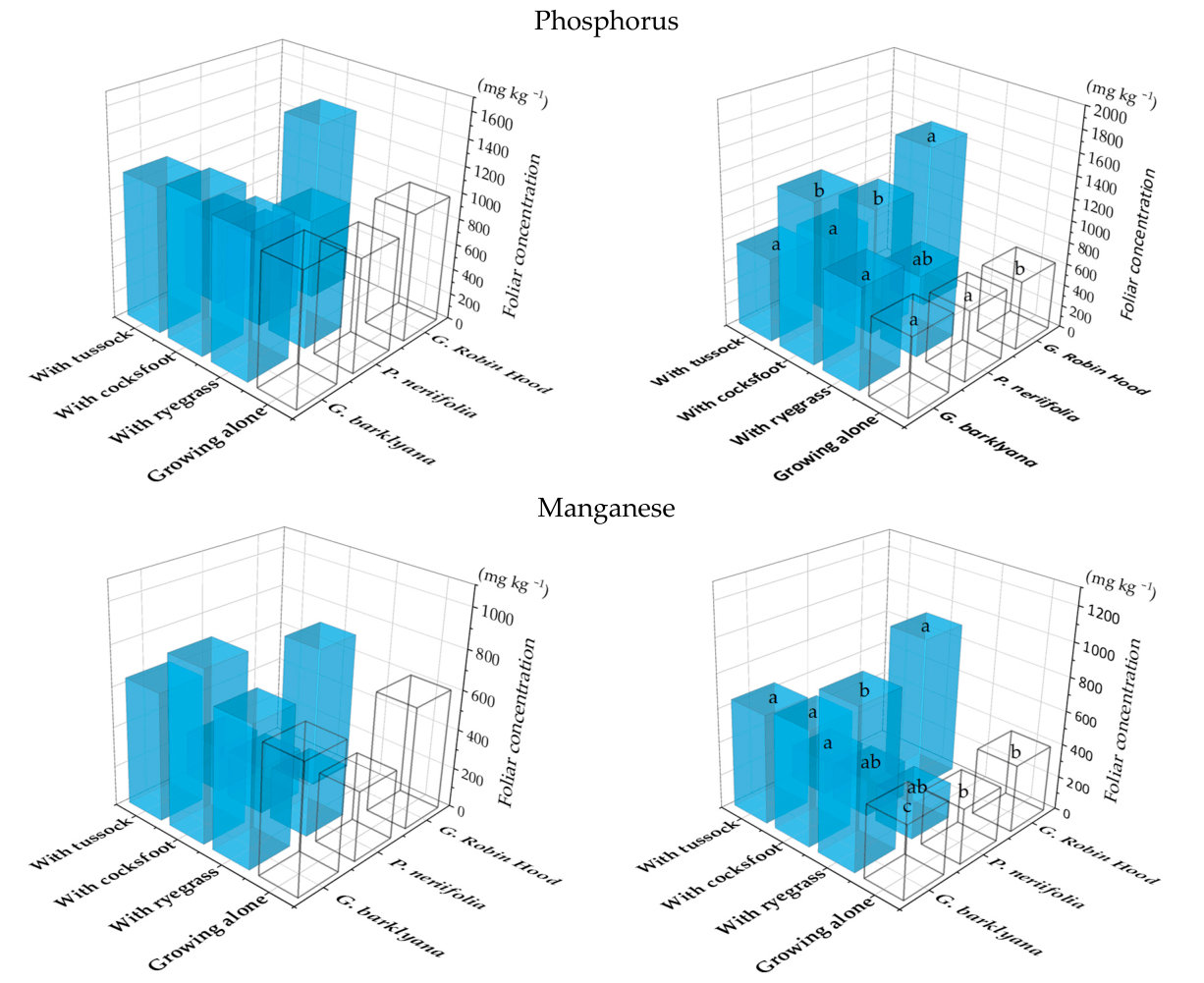
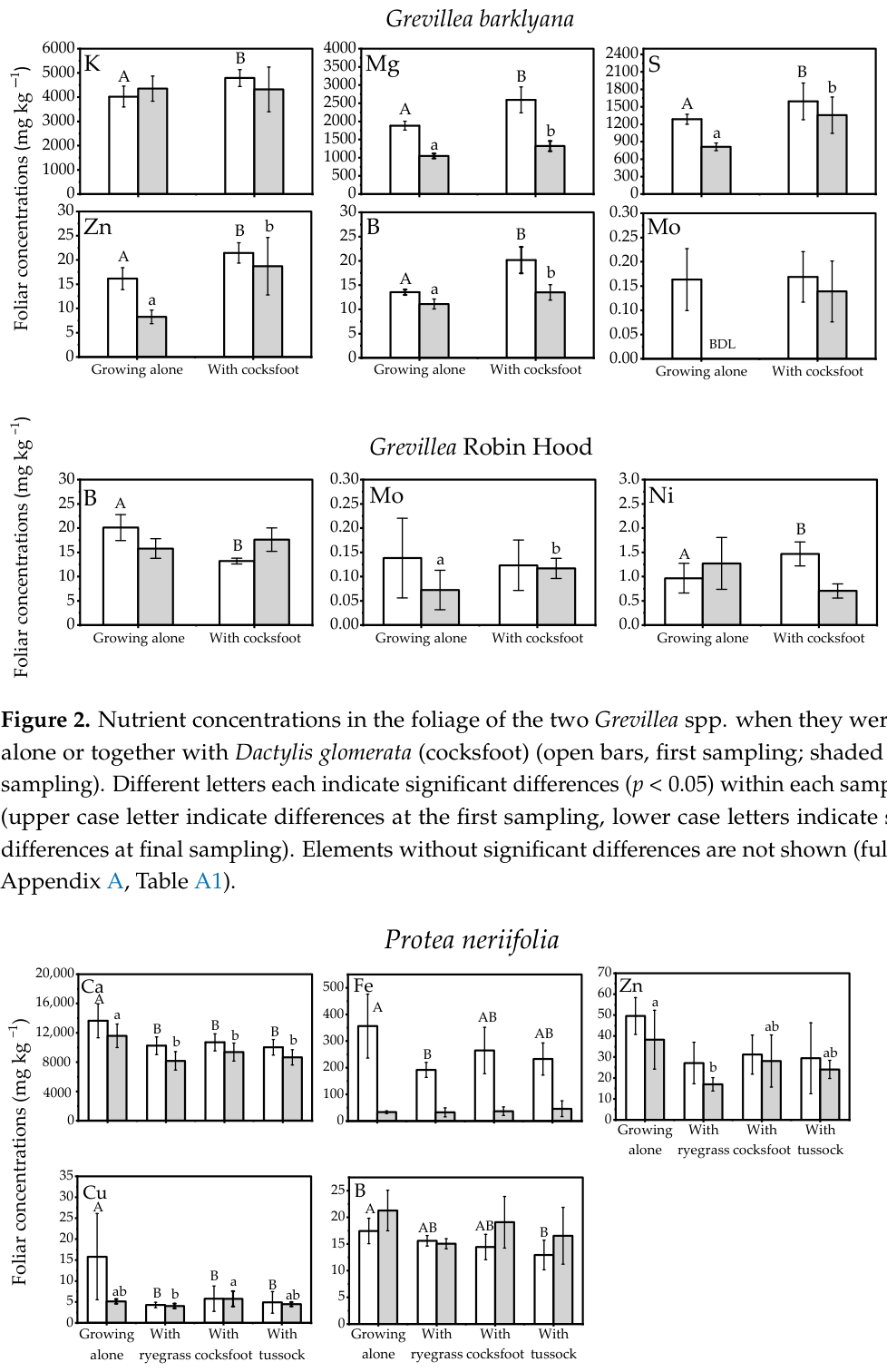
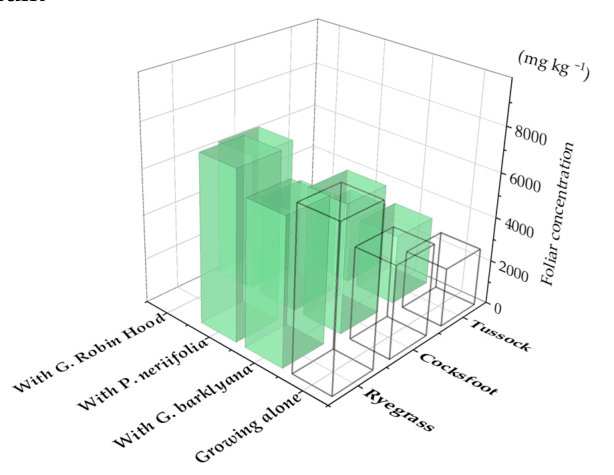
Elevated concentrations of P and Mn were particularly notable in the Grevillea spp. when grown with grasses (Figure 1), in contrast to Protea neriifolia foliage which had lower Mn concentrations when it was grown with the grasses. On at least one of the two sampling occasions, Grevillea barklyana had higher foliar concentrations of most chemical elements when growing together with grasses, particularly with Dactylis glomerata (cocksfoot) (Figure 2; Appendix A, Table A1). Only three elements in G. Robin Hood foliage differed significantly when it was growing with grasses (Figure 2; Appendix A, Table A1). Five of the elements with higher concentrations (P, Mg, S, Mn, Zn, and B) were nutrients known to be deficient in the soil, but also included K and Mo. In contrast, lower concentrations of 5 elements in addition to P, were often recorded in P. neriifolia foliage when it had grown with grasses (Figure 3; Appendix A, Table A1).
Grevillea spp.与禾草共同生长时,其P和Mn浓度升高尤为显著(图1);与此相反,Protea neriifolia与禾草共同生长时,其叶片Mn浓度较低。在两次采样中至少有一次,Grevillea barklyana与禾草(尤其是Dactylis glomerata(鸭茅))共同生长时,其叶片中大多数化学元素的浓度较高(图2;附录A,表A1)。G. Robin Hood与禾草共同生长时,其叶片中仅有3种元素存在显著差异(图2;附录A,表A1)。浓度较高的元素中有5种(P、Mg、S、Mn、Zn和B)是已知在该土壤中缺乏的养分,此外还包括K和Mo。相反,P. neriifolia与禾草共同生长后,其叶片中除P外另有5种元素的浓度往往较低(图3;附录A,表A1)。
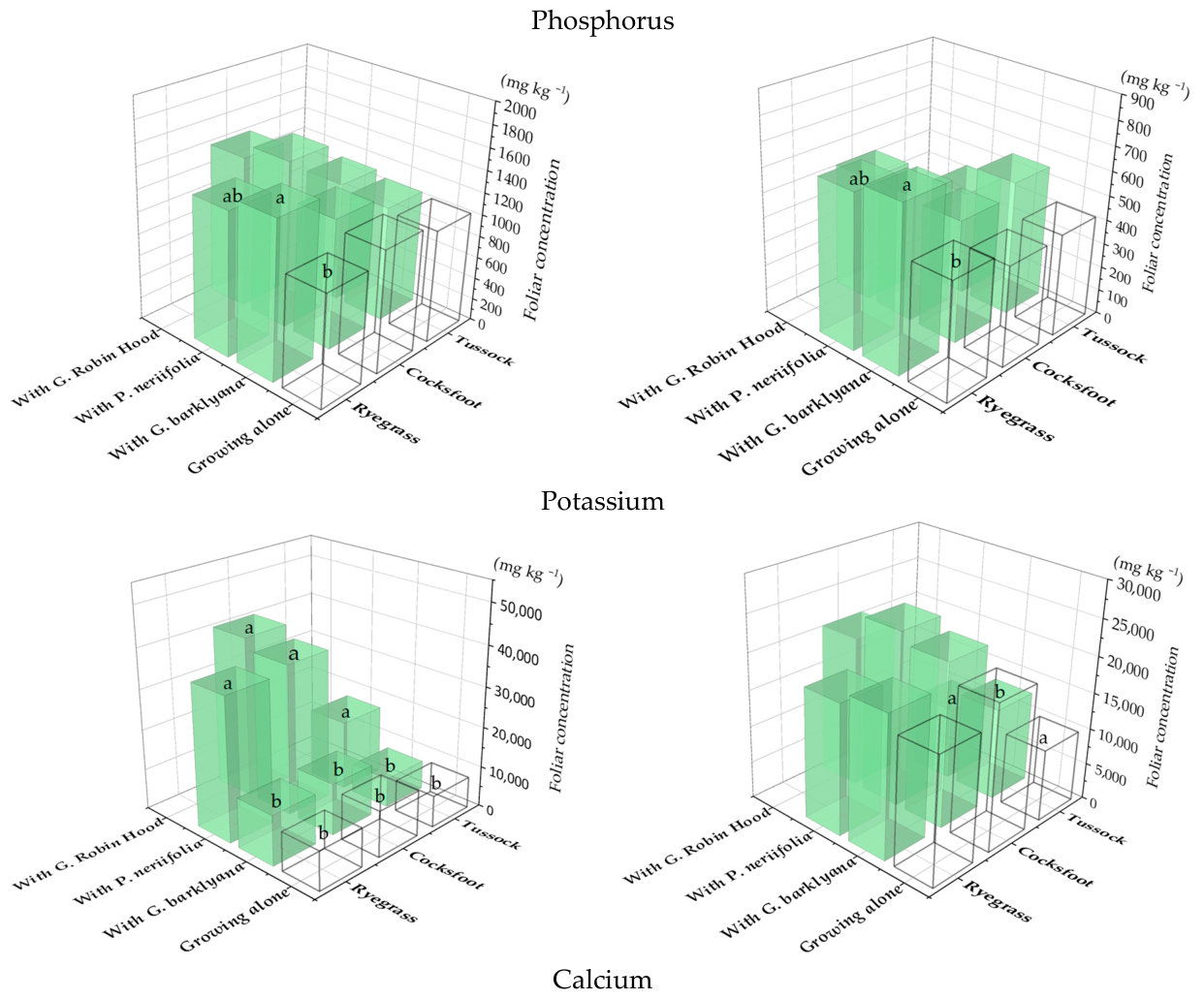
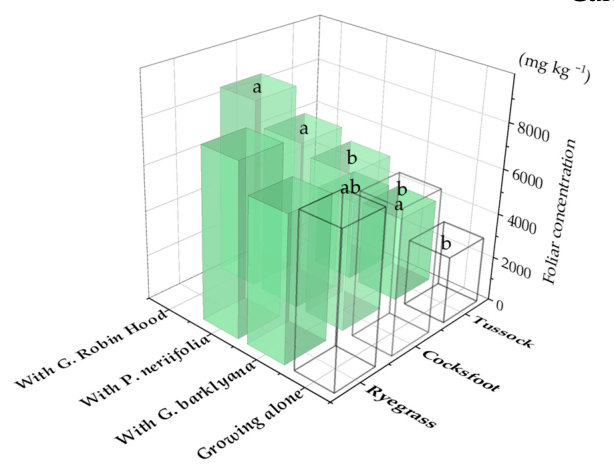
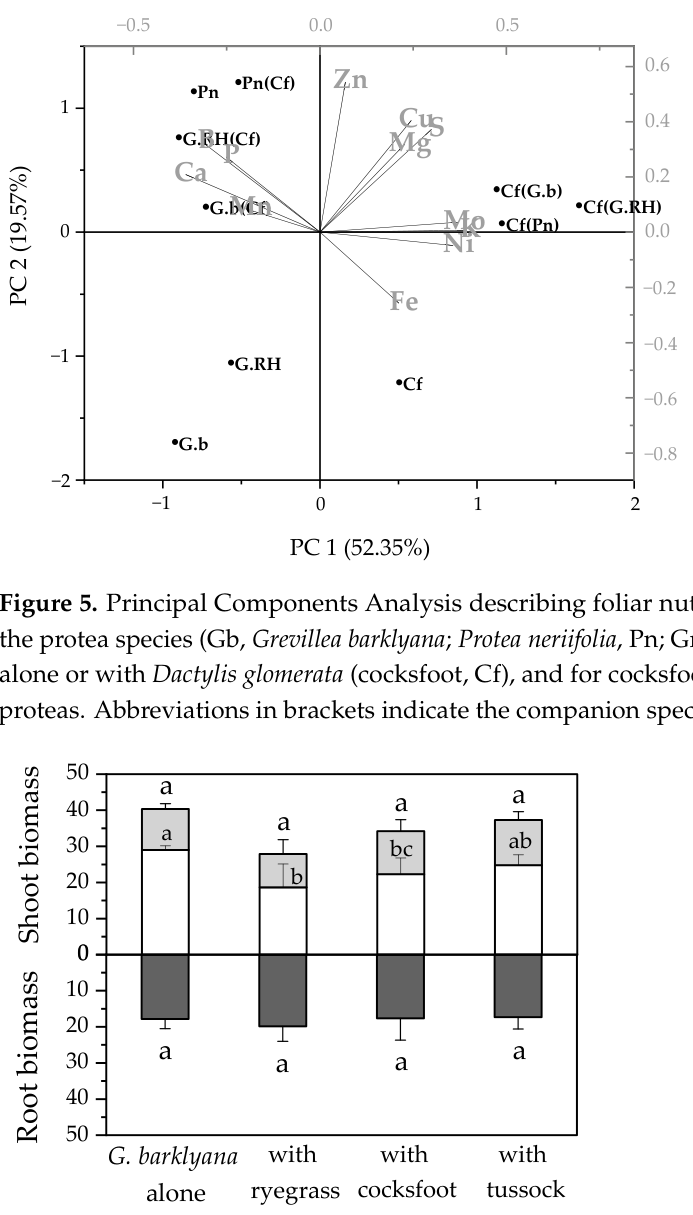
There were fewer changes in the elemental concentrations of the two pasture grasses, Dactylis glomerata (cocksfoot) and Lolium perenne (perennial ryegrass), when they were growing with proteas, and this was mainly related to higher concentrations of P, K, and Ca (Figure 4). Poa cita (a tussock grass) was different, with significantly elevated foliar P, K, Ca, S, Mn, and Zn when it was growing with proteas (Appendix A, Table A2). Focusing on D. glomerata, as the grass with the most evident neighbour effects (Figure 5), there was a shift in foliar nutrient concentrations of both proteas and grasses when they were growing with a neighbouring species, with a difference in nutrient uptake.
两种牧场禾草Dactylis glomerata(鸭茅)和Lolium perenne(多年生黑麦草)与山龙眼类植物共同生长时,其元素浓度变化较少,主要表现为P、K和Ca浓度升高(图4)。Poa cita(一种丛生禾草)则不同,与山龙眼类植物共同生长时,其叶片P、K、Ca、S、Mn和Zn含量显著升高(附录A,表A2)。以邻体效应最为明显的禾草D. glomerata为重点(图5)可见,山龙眼类植物和禾草与邻近物种共同生长时,叶片养分浓度均发生了变化,养分吸收存在差异。
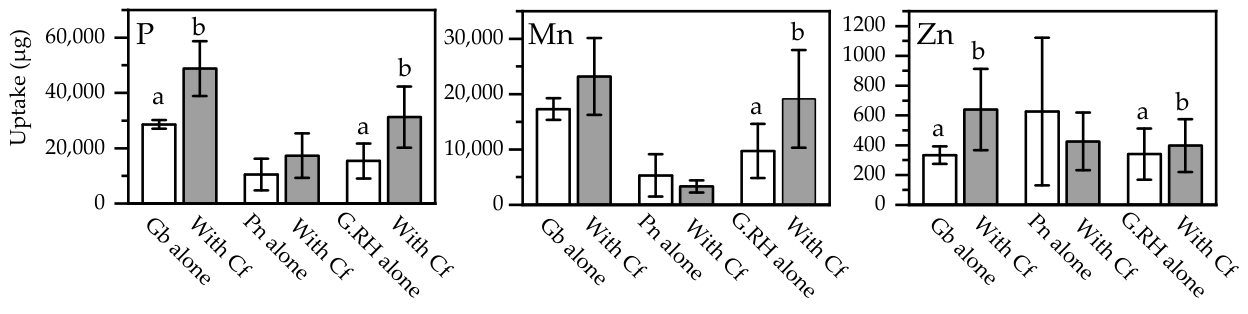
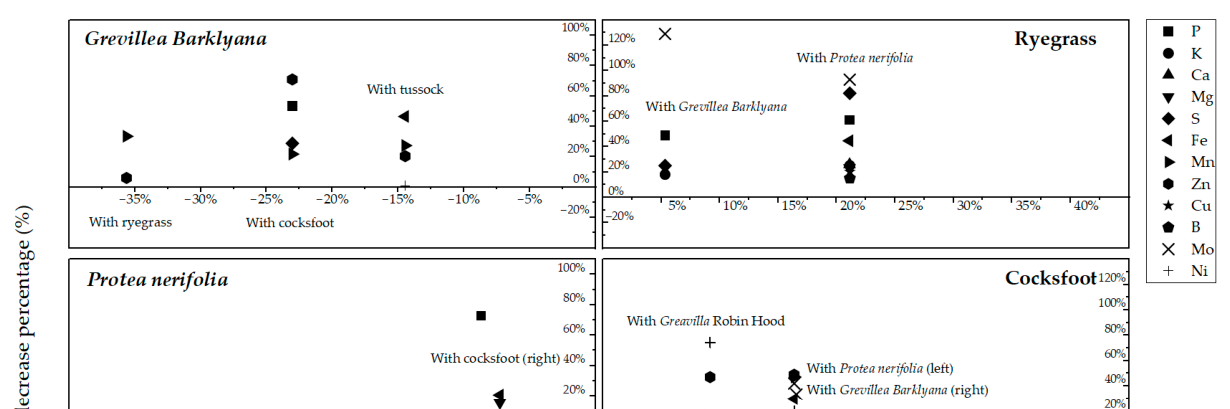
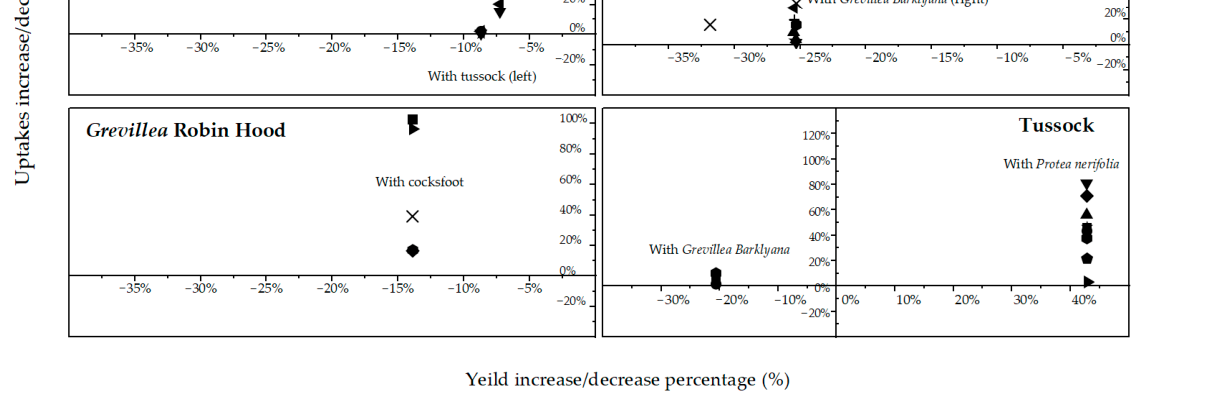
In terms of plant productivity, there were few significant differences in the biomass of the proteas or the grasses after they had grown with neighbouring plants, but the variability was high within each treatment (Figure 6). The exploitation of the soil pool of chemical elements may be more accurately represented by mass balance calculations (multiplication of dry wt. of foliage × nutrient concentration). This calculation was performed using data separately for each species (Figure 7; Appendix A, Table A3). More P, Mn, and Zn was procured by the Grevillea spp. but less by P. neriifolia when these species had grown in the same pots as the grasses. In percentage terms, neighbouring grasses only marginally reduced the biomass of protea foliage, but higher foliage concentrations of elements led to significantly increased total offtake of nutrients by as much as 100% in the proteas (Figure 8). There was a much lower biomass of grass foliage than of protea foliage, on average amounting to 11% of the latter, which meant that the total amount of each element extracted from the soil with the grasses was much less than the amount extracted by proteas (Appendix A, Table A3). Nonetheless, these calculations illustrated clear differences between P. neriifolia and the Grevillea spp., and between the different grass species (Figure 8). When the proteas and grasses were growing in combination with each other, compared to growing as monocultures, they extracted substantially increased amounts of nutrients from the soil.
就植物生产力而言,山龙眼类植物或禾草与邻近植物共同生长后,其生物量差异大多不显著,但各处理内的变异较大(图6)。以质量平衡计算(叶片干重×养分浓度)可能更准确地反映对土壤化学元素库的利用。该计算分别按各物种的数据进行(图7;附录A,表A3)。Grevillea spp.与禾草同盆生长时获取了更多的P、Mn和Zn,而P. neriifolia则获取较少。按百分比计,邻近禾草仅略微降低了山龙眼类植物的叶片生物量,但叶片元素浓度的升高使山龙眼类植物的养分总移除量显著增加,增幅高达100%(图8)。禾草叶片生物量远低于山龙眼类植物,平均仅为后者的11%,因此禾草从土壤中提取的各元素总量远少于山龙眼类植物的提取量(附录A,表A3)。尽管如此,这些计算清楚地显示了P. neriifolia与Grevillea spp.之间以及不同禾草物种之间的差异(图8)。与单一栽培相比,山龙眼类植物与禾草组合生长时,从土壤中提取的养分量大幅增加。
3Discussion讨论
Measuring nutrient concentrations in foliage provides a surrogate but arguably the most realistic measure of the exploitation of the soil nutrient pool. In the present study, no direct attention was given to the processes in the soil that were responsible for differences in plant uptake. Interactions between plants that take place belowground are often overlooked, even though roots of different species are frequently intermingled, with growth, root exudates [24,25], root turnover [26], death, and decay [27] generally occurring in mixed species rhizospheres. Furthermore, the main input of nutrients to the soil is from root decomposition [28]. Otherwise, nutrients are largely bound to solid phase constituents of the soil with only small proportions entering the soil solution and becoming readily available for plant uptake. Undoubtedly, complex interactions in the rhizosphere affect soil biogeochemistry and nutrient acquisition by plants [24,29], but these were beyond the scope of the experimental work of the present study.
测定叶片中的养分浓度是衡量土壤养分库利用情况的一种替代指标,但可以说也是最符合实际的指标。本研究未直接关注导致植物吸收差异的土壤过程。植物之间发生在地下的相互作用常被忽视,尽管不同物种的根系往往相互交织,其生长、根系分泌物[24,25]、根系周转[26]、死亡和分解[27]通常都发生在混合物种根际中。此外,土壤养分的主要输入来自根系分解[28]。除此之外,养分大多与土壤固相组分结合,仅有一小部分进入土壤溶液而易于被植物吸收。毫无疑问,根际中的复杂相互作用会影响土壤生物地球化学过程和植物对养分的获取[24,29],但这些超出了本研究试验工作的范围。
Our results showed that foliar concentrations of P and Mn uptake in proteas and grasses were consistently modified when they were grown together in species combinations, compared to when they were grown alone, but this also extended to elevated foliar concentrations of up to nine other elements (K, Ca, S, Fe, Mg, Zn, Cu, B, and Mo). Our assumption that P acquisition by the cluster-rooted proteas would play a definitive role is evident in the results, in terms of its increased P concentrations in the foliage of pasture grasses (L. perenne and D. glomerata), together with elevated K and Ca. The tussock grass (P. cita) had enhanced amounts of at least five elements (K, Ca, S, Mn, and Zn), but not of P, when growing with proteas. There appeared to be little reciprocation from the tussock grass to proteas. The low-fertility soil probably would have provided more natural conditions for this native grass, which is likely to explain its competitive abilities in procuring deficient nutrients from the soil when it was grown with proteas.
我们的结果表明,与单独生长相比,山龙眼类植物和禾草以物种组合方式共同生长时,其叶片P和Mn浓度均发生了一致的变化,而且这种变化还延伸至多达9种其他元素(K、Ca、S、Fe、Mg、Zn、Cu、B和Mo)叶片浓度的升高。我们关于具排根的山龙眼类植物对P的获取将起决定性作用的假设在结果中得到了体现,即牧场禾草(L. perenne和D. glomerata)叶片中P浓度升高,同时K和Ca也升高。丛生禾草(P. cita)与山龙眼类植物共同生长时,至少5种元素(K、Ca、S、Mn和Zn)的含量增加,但P未增加。丛生禾草对山龙眼类植物似乎几乎没有回馈作用。低肥力土壤可能为这种本土禾草提供了更接近自然的条件,这很可能解释了其与山龙眼类植物共同生长时在获取土壤缺乏养分方面的竞争能力。
Dactylis glomerata (cocksfoot) provided a better demonstration of species complementary than ryegrass, probably because it grew better and had more biomass. Dactylis provided the most significant impacts on nutrient uptake in the proteas. The two Grevillea species with origins in the ancient fertility-depleted soils of Australia benefited substantially through coexistence and the presence of neighbouring grasses in terms of an elevated uptake of most of the range of nutrients. In comparison, a lesser uptake of key nutrients (including Mn, Fe, Zn, and B) by the South African Protea when grown together with grasses implies some combination of competitive losses and less sharing, perhaps reflecting an evolutionary history on soils with more adequate levels of fertility, as discussed below. A recent study involved N and P fertilization of two fynbos sites in the Western Cape province of South Africa. Both study areas contained P. neriifolia as one of the two dominant species, although both sites had just been cleared of vegetation by wildfires [30]. Compared to six forest tree species, it was found that the thinner root traits of 12 emergent fynbos plants (that did not include proteas) provided a competitive advantage for the procurement of nitrogen, which unexpectedly appeared to be a more significant constraint than P. Nitrogen was largely overlooked in the present study as it appeared to be neither deficient nor a key element in our soil. Furthermore, proteas are not a natural component of vegetation in NZ soils.
Dactylis glomerata(鸭茅)比黑麦草更好地体现了物种互补性,这可能是因为其长势更好、生物量更大。Dactylis对山龙眼类植物养分吸收的影响最为显著。起源于澳大利亚古老且肥力枯竭土壤的两种Grevillea,通过与邻近禾草共存而大为受益,对大部分养分的吸收均有所提高。相比之下,南非的Protea与禾草共同生长时对关键养分(包括Mn、Fe、Zn和B)的吸收较少,这意味着竞争损失与较少共享的某种组合,或许反映了其在肥力较为充足的土壤上的进化历史,下文将对此进行讨论。最近一项研究对南非西开普省的两个凡波斯(fynbos)样地进行了N和P施肥。两个研究区均以P. neriifolia为两个优势种之一,但两样地的植被均刚被野火清除[30]。研究发现,与6种森林树种相比,12种新生凡波斯植物(不包括山龙眼类植物)较细的根系性状使其在获取氮方面具有竞争优势,而氮出乎意料地似乎是比P更重要的限制因子。本研究在很大程度上未考虑氮,因为在我们的土壤中氮似乎既不缺乏也非关键元素。此外,山龙眼类植物并非新西兰土壤天然植被的组成部分。
There were differences between the Protea and the Grevillea spp. in terms of foliar nutrient concentrations when grown with grasses. The Grevillea spp. and grasses benefited by growing in combination with each other, with both obtaining more P, especially G. barklyana-Dactylis combinations. Otherwise, Grevillea also procured more S, Mg, Mn, Zn, and B, and the grasses obtained more K and Ca. Protea neriifolia-grass combinations were competitive rather than complementary, with the protea apparently less able to procure key deficient elements in the presence of grasses and had a higher foliar uptake of six elements when it was growing alone. There was no obvious benefit to P. neriifolia growing with neighbouring grasses.
与禾草共同生长时,Protea与Grevillea spp.在叶片养分浓度方面存在差异。Grevillea spp.与禾草组合生长时双方均受益,两者均获得了更多的P,尤其是G. barklyana-Dactylis组合。此外,Grevillea还获取了更多的S、Mg、Mn、Zn和B,而禾草获得了更多的K和Ca。Protea neriifolia-禾草组合表现为竞争而非互补,该山龙眼类植物在禾草存在时获取关键缺乏元素的能力明显较弱,单独生长时其叶片对6种元素的吸收更高。P. neriifolia与邻近禾草共同生长未表现出明显益处。
Likely explanations that would describe the processes responsible for different uptake patterns are to be widely found in the scientific literature. In broad terms, two of the most important ways that root exudates influence nutrient availability and uptake are through organic acid and phytosiderophore secretion [25]. In proteas, the availability of phosphorus in soil is the most important determinant of cluster root formation, and carboxylates exuded from the roots promote P mobilization in the soil [13]. Deficiencies of other elements, including N, K, Mn, and Fe also enhance cluster root development. Graminoid-secreted phytosiderophores release chelators to form complexes with soil metals, increasing metal solubility and mobility, particularly of Fe that is often in abundant but insoluble Fe (III) precipitates in soil. Many phenolics produced in the rhizosphere of dicots can form complexes with metals that may also increase their availability. In low-nutrient environments, plants can produce root exudates as symbiotic signals to soil microbes involved in nutrient procurement, to use extracellular enzymes to release P from organic compounds, and organic acids to solubilize soil Ca, Fe, and Al phosphates [31]. There is increasing evidence that plants can be complementary to one another to procure nutrients more efficiently [32] and at reduced metabolic costs [33]. However, the mechanistic explanations are complex; for example, many phytohormones are involved in interactions between roots, soil, and microbial communities [34]. Rhizosphere processes are insufficiently understood [35], and there remains a paucity of studies that provide mechanistic evidence from soil-based systems [36].
科学文献中广泛存在可解释不同吸收模式成因的可能机制。概括而言,根系分泌物影响养分有效性和吸收的两种最重要途径是有机酸和植物铁载体的分泌[25]。在山龙眼类植物中,土壤磷的有效性是决定排根形成的最重要因素,根系分泌的羧酸盐可促进土壤中P的活化[13]。其他元素(包括N、K、Mn和Fe)的缺乏也会促进排根发育。禾本科植物分泌的植物铁载体释放螯合剂,与土壤金属形成络合物,从而提高金属的溶解度和迁移性,尤其是Fe,土壤中的Fe常以丰富但不溶的Fe (III)沉淀形式存在。双子叶植物根际中产生的许多酚类物质可与金属形成络合物,也可能提高其有效性。在低养分环境中,植物可产生根系分泌物,作为向参与养分获取的土壤微生物发出的共生信号,利用胞外酶从有机化合物中释放P,并利用有机酸溶解土壤中的Ca、Fe和Al磷酸盐[31]。越来越多的证据表明,植物之间可以相互互补,从而更高效地[32]并以更低的代谢成本[33]获取养分。然而,其机制解释十分复杂;例如,许多植物激素参与了根系、土壤与微生物群落之间的相互作用[34]。根际过程尚未得到充分认识[35],基于土壤体系提供机制证据的研究仍然匮乏[36]。
The importance of considering multiple nutrient constraints on plant productivity has been stressed elsewhere [37]. The requirements of plants for similar base concentrations but differing amounts of particular nutrients are likely to be specific to the plant species, and this is probably reflected in the differing foliar concentrations recorded in the present study. The most likely capacity-based approach to nutrient acquisition [29] assumes that plants expend metabolic energy to acquire nutrients by exploiting gradients of nutrient molecules inside and outside the root, using specific nutrient-acquiring proteins, pumps, transporters, and channels [29].
已有研究强调了考虑多种养分对植物生产力限制的重要性[37]。植物对各养分的需求具有相似的基础浓度但数量各异,这种需求很可能因植物物种而异,这或许反映在本研究所记录的不同叶片浓度中。最可能的基于容量的养分获取途径[29]假定,植物利用特定的养分获取蛋白、泵、转运体和通道,借助根内外养分分子的浓度梯度,消耗代谢能量获取养分[29]。
There was some evidence from the present study of transgressive overyielding in the context of an increased proportion of the key nutrients being removed from the total soil pool by combinations of species compared to monocultures. No account was taken of nutrient uptake into the woody or green stems of the proteas in terms of total offtake. Nutrient concentrations in these plant components would be expected to be much lower than in foliage, but the amount of additional nutrients in these fractions could have great relevance to production systems and phytoremediation technologies. The competition for nutrients, facilitation, and complementarity are all major driving forces of ecosystem productivity [35]. In the context of species complementarity, we have shown that species not naturally found together have functional attributes in the rhizosphere that can be shared to facilitate an improved procurement of nutrients.
本研究提供了一些超越性超产的证据,即与单一栽培相比,物种组合从土壤总库中移除的关键养分比例有所增加。在计算总移除量时,未考虑山龙眼类植物木质茎或绿色茎对养分的吸收。这些植物组分中的养分浓度预计远低于叶片,但这些部分中额外的养分量可能与生产系统和植物修复技术密切相关。养分竞争、促进作用和互补性都是生态系统生产力的主要驱动力[35]。就物种互补性而言,我们已证明,天然条件下不共生的物种在根际具有可共享的功能属性,从而促进养分获取的改善。
A better understanding of these functional traits could be very useful in the context of the sustainability of plant communities of native or exotic species, or combinations of both (novel native plant communities) in New Zealand and elsewhere [3,22]. This could be a step towards the better management of vegetation and soils in low-input agricultural systems. More fundamental and applied research knowledge of functional biodiversity and plant species complementarity is required in the context of soil biogeochemistry. The findings of the present study illustrate functional compatibility as well as competition between plant rhizospheres for plant nutrients. Beneficial coexistence appears to be explained by the differences between the plant rhizospheres of different species which exploit different components of the soil nutrient pool [38,39]. This implies that the enhancement of species diversity, for example, beyond simply focusing on legumes and grasses in pasture agronomy [3], may be a better way to manage ecosystems, including production systems, with low-fertility or degraded soils. We suggest that it would be worthwhile to extend the experimental approach used in the present study to a wider range of species combinations that have a direct practical application to less-intensive grazing systems, phytotechnologies, and to the conservation and restoration of biodiversity.
更好地理解这些功能性状,对于新西兰及其他地区本土物种、外来物种或二者组合(新型本土植物群落)的植物群落可持续性可能非常有用[3,22]。这可能是朝着更好地管理低投入农业系统中植被和土壤迈出的一步。在土壤生物地球化学背景下,需要更多关于功能生物多样性和植物物种互补性的基础与应用研究知识。本研究结果表明,植物根际之间对植物养分既存在功能相容性,也存在竞争。有益共存似乎可由不同物种植物根际之间的差异来解释,这些根际利用土壤养分库的不同组分[38,39]。这意味着,提高物种多样性(例如,在牧场农艺中不再仅仅关注豆科植物和禾草[3])可能是管理具有低肥力或退化土壤的生态系统(包括生产系统)的更好途径。我们建议,将本研究采用的试验方法推广至更广泛的物种组合是值得的,这些组合可直接应用于低集约度放牧系统、植物技术以及生物多样性保护与恢复。
4Materials and Methods材料与方法
Soil (1–20 cm depth) was collected from a site in Canterbury (altitude 611 m), South Island, New Zealand (S 43◦20’35”, E 171◦36’59”), that was described in detail in earlier papers [3,40]. The site was originally forested, probably until the mid-19th century. Since then, the land has been extensively grazed by sheep and wild ruminants but otherwise has been largely undisturbed. Undoubtedly, the soil, which had patchy vegetation cover, was substantially degraded through forest removal, mammalian grazing impacts, exposure, and erosion, probably for a century or more. The collected soil was thoroughly mixed, then air-dried and sieved (2 mm) prior to being used in the experimental work. Samples were analysed using standard methods by Analytical Services, Soils and Physical Sciences Department, Lincoln University (Table 1), showing a range of key determinants (pH, Ca, sulphate-S, soluble P, Cu, Mg, Mn, and B) were less than optimum for plant growth. Available P, Ca, and B were extremely deficient, although there was adequate N for healthy plant growth at yields that could be achieved in the landscape of its origin.
土壤(1–20 cm深度)采自新西兰南岛坎特伯雷的一个样地(海拔611 m)(S 43◦20’35”,E 171◦36’59”),该样地在前期论文中已有详细描述[3,40]。该样地原为森林,可能一直持续至19世纪中叶。此后,该土地被绵羊和野生反刍动物大面积放牧,但除此之外基本未受扰动。毫无疑问,由于森林砍伐、哺乳动物放牧影响、暴露和侵蚀,该植被覆盖斑驳的土壤可能在一个世纪或更长时间内已严重退化。采集的土壤经充分混合后风干并过筛(2 mm),然后用于试验工作。样品由林肯大学土壤与物理科学系分析服务中心采用标准方法进行分析(表1),结果显示一系列关键指标(pH、Ca、硫酸盐-S、可溶性P、Cu、Mg、Mn和B)低于植物生长的最适水平。有效P、Ca和B极度缺乏,但N足以满足植物在其原生景观中可达到产量水平下的健康生长。
Species were selected from the Proteaceae (proteas) and Poaceae (grasses) as being representative of functional groupings that are known to possess different and contrasting traits of nutrient acquisition in the rhizosphere. We grew three species of proteas: Grevillea barklyana F. Muell. Ex Benth. (Gully- or large-leaf grevillea) endemic to south-western Australia; Grevillea Robin Hood (a hybrid cultivar of G. hookeriana Meisn.), endemic to south-eastern Australia; and Protea neriifolia R. Br. (narrow-leaf sugarbush), endemic to the Western and Eastern Cape of South Africa. Fynbos soils are characterised by low soil fertility [41], but dense stands of P. nerriifolia are naturally found on less-leached granitederived renosterveld soils on mountain slopes [42,43] that are more fertile [44]. The inherent fertility is likely to be much lower in the more ancient and strongly weathered soils of Australia [30,45] than in the South African soils. All three species of protea produce cluster roots. The three species only grow ornamentally in New Zealand. These proteas were grown either alone or in combination with single species of grasses: one of two widespread and common grasses, Lolium perenne L. (perennial ryegrass), and Dactylis glomerata L. (cocksfoot), or Poa cita Edgar (silver tussock) which is an endemic New Zealand tussock grass [46].
从山龙眼科(山龙眼类植物)和禾本科(禾草)中选取物种,作为已知在根际养分获取方面具有不同且迥异性状的功能类群的代表。我们种植了三种山龙眼类植物:Grevillea barklyana F. Muell. Ex Benth.(Gully-或大叶银桦),为澳大利亚西南部特有种;Grevillea Robin Hood(G. hookeriana Meisn.的杂交栽培品种),为澳大利亚东南部特有种;以及Protea neriifolia R. Br.(狭叶帝王花),为南非西开普和东开普特有种。凡波斯土壤的特点是土壤肥力低[41],但P. nerriifolia的密集林分天然分布于山坡上淋溶较弱、由花岗岩发育的renosterveld土壤上[42,43],这些土壤较为肥沃[44]。澳大利亚更为古老且强烈风化的土壤[30,45]的固有肥力很可能远低于南非土壤。三种山龙眼类植物均产生排根。这三个物种在新西兰仅作为观赏植物栽培。这些山龙眼类植物单独种植,或与单一禾草物种组合种植:两种分布广泛的常见禾草之一,即Lolium perenne L.(多年生黑麦草)和Dactylis glomerata L.(鸭茅),或新西兰特有的丛生禾草Poa cita Edgar(银色丛生草)[46]。
| Indicators指标 | Units单位 | Concentration浓度 | Typical Range *典型范围* |
|---|---|---|---|
| pH 1 | pH Units | 5.70 | 5.70–6.20 |
| Total Nitrogen 2 | % | 0.46 | 0.30–0.60 |
| Total Carbon 3 | % | 5.80 | - |
| Organic Matter 4 | % | 10.0 | 7.00–17.0 |
| Total Phosphorus | mg kg_−_1 | 464 | 700–1600 |
| Olsen Phosphorus 5 | mg L_−_1 | 4.33 | 20.0–30.0 |
| Potassium 6 | me/100 g | 0.49 | 0.30–0.60 |
| Calcium 6 | me/100 g | 2.03 | 5.00–12.0 |
| Magnesium 7 | me/100 g | 0.60 | 0.60–1.20 |
| Sodium 7 | me/100 g | 0.05 | 0.00–0.30 |
| Sulphate Sulphur 8 | mg kg_−_1 | 6.43 | 10.0–20.0 |
| Iron 7 | mg L_−_1 | 84.0 | 500–1000 |
| Manganese 7 | mg L_−_1 | 3.20 | 8.00–65.0 |
| Zinc 7 | mg L_−_1 | 1.75 | 0.80–4.00 |
| Copper 7 | mg L_−_1 | 0.37 | 0.40–2.00 |
| Boron 7 | mg L_−_1 | 0.19 | 0.60–1.20 |
* Typical range for agricultural soils in New Zealand. Analyses follow standard methodology from a commercial laboratory. Analyses by the commercial laboratory were routinely carried out by defined volume rather than mass of soil. Method: 1 1:2 (v/v) soil:water slurry followed by potentiometric determination of pH. 2 Determined by NIR, calibration based on total N by Dumas combustion. 3 Determined by NIR, calibration based on total Carbon by Dumas combustion. 4 Organic Matter is 1.72 × Total Carbon. 5 Olsen extraction followed by Molybdenum Blue colorimetry. 6 1 M Neutral ammonium acetate extraction followed by ICP-OES. 7 Mehlich 3 Extraction followed by ICP-OES. 8 0.02 M Potassium phosphate extraction followed by Ion Chromatography.
* 新西兰农业土壤的典型范围。分析按商业实验室的标准方法进行。商业实验室的分析通常按土壤的规定体积而非质量进行。方法:1 1:2(v/v)土水悬浮液,随后电位法测定pH。2 近红外光谱(NIR)测定,以Dumas燃烧法测定的全N进行校准。3 近红外光谱(NIR)测定,以Dumas燃烧法测定的全碳进行校准。4 有机质 = 1.72 × 全碳。5 Olsen法浸提,随后钼蓝比色法测定。6 1 M中性乙酸铵浸提,随后ICP-OES测定。7 Mehlich 3浸提,随后ICP-OES测定。8 0.02 M磷酸钾浸提,随后离子色谱法测定。
A pot trial was set up in a glasshouse at Lincoln University. The cluster root forming species were taken from cuttings of single plants, rooted in seed trays, and then transplanted into 3.5 L plastic pots (15 cm diameter, 20 cm height). Thirteen experimental treatments consisted of three cluster-root forming species and three grasses growing either singly or in combinations, with five replicates per treatment. Pots were arranged in a randomized single block design on a glasshouse bench. Glasshouse temperatures for the duration of the experiment were 19.0 ◦C (mean); 13.6 ◦C (min)–34.7 ◦C (max). Plants were watered sparingly every two days. Survivorship was generally good, but one Gb and one Pn died after transplanting, one Pn (Rg) died after first harvesting, and one Pn (Tg) died a few days before the final harvest.
在林肯大学的温室中开展盆栽试验。形成排根的物种取自单株植物的插条,在育苗盘中生根后移栽至3.5 L塑料盆(直径15 cm,高20 cm)中。13个试验处理由三种形成排根的物种和三种禾草单独或组合生长构成,每个处理5次重复。花盆在温室台架上按随机单区组设计排列。试验期间温室温度为19.0 ◦C(平均);13.6 ◦C(最低)–34.7 ◦C(最高)。每两天少量浇水一次。植株存活情况总体良好,但移栽后有1株Gb和1株Pn死亡,第一次收获后有1株Pn(Rg)死亡,最终收获前数天有1株Pn(Tg)死亡。
After 6 months’ growth, plant material was sampled for chemical analysis; five leaves were harvested from each of the proteas, and the grasses were harvested to 2 cm above the soil surface. This was repeated 6 months later when the plants were completely harvested, and root systems were separated by careful washing. Aboveground plant material was sorted into separate species, dried (65 ◦C, 48 h), weighed, and finely ground, microwave digested in 5 M HNO3, and then chemically analysed by ICP-OES using standard methodology. For statistical analysis, data not normally distributed were logtransformed before analysis. Differences between means were determined using one-way ANOVA, with a post-hoc Fisher LSD test. All analyses were conducted using Minitab 19.
生长6个月后,采集植物材料进行化学分析;每株山龙眼类植物采收5片叶,禾草则在土壤表面以上2 cm处刈割。6个月后重复上述操作,此时将植物全部收获,并通过仔细冲洗分离根系。地上部植物材料按物种分开,烘干(65 ◦C,48 h)、称重并磨细,用5 M HNO3进行微波消解,然后采用标准方法以ICP-OES进行化学分析。统计分析中,非正态分布的数据在分析前进行对数转换。均值间差异采用单因素ANOVA,并以Fisher LSD检验进行事后检验。所有分析均使用Minitab 19进行。
5Conclusions结论
This study provided evidence of the compatibility between plant species with contrasting functional rhizosphere traits. Nutrient constraints in the experimental soil were better addressed by combinations of proteas and grasses growing together. Species combinations substantially increased the procurement of key deficient elements, providing evidence that mixed-species rhizospheres enable an improved exploitation of the soil nutrient resource.
本研究为具有迥异根际功能性状的植物物种之间的相容性提供了证据。山龙眼类植物与禾草组合共同生长能更好地应对试验土壤中的养分限制。物种组合显著提高了关键缺乏元素的获取量,证明混合物种根际能够改善对土壤养分资源的利用。
This was the result of higher foliar nutrient concentrations and enhanced total uptake of nutrients. The sharing of access to the soil nutrient pool is evident in these findings. This implies that a strategy of competition for plant nutrients may be less important than functional compatibility and mutual enhancement of uptake between neighbouring species in low-fertility or degraded soils.
这是叶片养分浓度升高和养分总吸收量增加的结果。这些结果明显体现了对土壤养分库获取途径的共享。这意味着,在低肥力或退化土壤中,对植物养分的竞争策略可能不如邻近物种之间的功能相容性和吸收的相互促进重要。
Author Contributions: All authors contributed to the planning and execution of the project, and to the manuscript preparation. Z.W. carried out the practical work and data analysis as part of his PhD programme supervised by N.D., T.M. and B.R., N.D. and Z.W. are responsible for the final manuscript draft. All authors have read and agreed to the published version of the manuscript.
作者贡献:所有作者均参与了项目的规划与实施以及稿件的撰写。Z.W.作为其博士课题的一部分开展了实验工作和数据分析,由N.D.、T.M.和B.R.指导;N.D.和Z.W.负责最终稿件的撰写。所有作者均已阅读并同意稿件的出版版本。
Funding: This research was partly funded by the Miss E.L. Hellaby Indigenous Grasslands Research Trust (ZW2020), which provided PhD scholarship support for Zhang Wei.
基金:本研究部分由Miss E.L. Hellaby Indigenous Grasslands Research Trust(ZW2020)资助,该基金为Zhang Wei提供了博士奖学金支持。
Institutional Review Board Statement: Not applicable.
机构审查委员会声明:不适用。
Informed Consent Statement: Not applicable.
知情同意声明:不适用。
Data Availability Statement: Not applicable.
数据可用性声明:不适用。
Acknowledgments: The research team is grateful to Brent Richards, Leona Meachen, Roger Cresswell, Emily Huang, and Hassall Leanne for their practical support.
致谢:研究团队感谢Brent Richards、Leona Meachen、Roger Cresswell、Emily Huang和Hassall Leanne提供的实际支持。
Conflicts of Interest: The authors declare no conflict of interest.
利益冲突:作者声明无利益冲突。
Appendix A附录A
| Ele | mentsments | GrevilleGreville | a barklyanaa barklyana | ProteaProtea | neriifolianeriifolia | Grevill HGrevill H | ea Robin oodea Robin ood | ||||
|---|---|---|---|---|---|---|---|---|---|---|---|
| Alone | With Rg | With Cf | With Tg | Alone | With Rg | With Cf | With Tg | Alone | With Cf | ||
| P | 1st 2nd | 1010a 710a | 1100a 910a | 1170a 1430b | 1120a 754a | 870a 642a | 977a 739ab | 667a 1140b | 650a 696a | 985a 630a | 1370a 1490b |
| K | 1st 2nd | 4020a 4350a | 4450ab 3950a | 4790b 4320a | 4240a 4270a | 4900a 7920a | 4630a 5700a | 6170a 8270a | 5050a 7340a | 7600a 6070a | 7570a 5640a |
| Ca | 1st 2nd | 10,100a 9270a | 10,300a 11,200a | 10,800a 10,200a | 10,900a 10,300a | 13,600a 11,590a | 10,200b 8180b | 10,700b 9370b | 10,000b 8650b | 11,400a 9210a | 11,800a 10,610a |
| Mg | 1st 2nd | 1880a 1050a | 2030a 1220ab | 2590b 1320b | 2040a 1150a | 2110a 1130a | 1660a 1380a | 1750a 1310a | 1610a 1290a | 1780a 1170a | 1910a 1320a |
| S | 1st 2nd | 1290a 812a | 1360ab 1000a | 1590b 1360b | 1330ab 854a | 1620a 1300ab | 1150a 923b | 946a 1350a | 901a 1020ab | 1620a 940a | 1830a 1280a |
| 1st | 115ab | 110ab | 151a | 80.1b | 356a | 192b | 265ab | 233ab | 98.6a | 112a | |
| Fe | 2nd | 54.9a | 58.3a | 52.4a | 93.8b | 33.3a | 32.5a | 36.7a | 46.1a | 68.3a | 49.5a |
| Mn | 1st 2nd | 637a 429a | 694a 926b | 843a 679c | 636a 643c | 347a 325a | 262a 216ab | 235a 219ab | 231a 207b | 611a 398a | 708a 910b |
| Zn | 1st 2nd | 16.1a 8.26a | 15.0ac 14.0b | 21.4b 18.7c | 13.1c 11.6ab | 49.6a 38.2a | 27.1a 17.0b | 31.1a 28.1ab | 29.4a 24.1ab | 16.2a 13.9a | 15.0a 18.9a |
| 1st | 17.9a | 16.6ab | 19.8a | 8.53b | 15.8a | 4.27b | 5.79b | 4.89b | 12.3a | 10.2a | |
| Cu | 2nd | 4.15a | 4.27a | 4.32a | 3.82a | 5.11ab | 4.03b | 5.74a | 4.47ab | 4.55a | 5.17a |
| 1st | 13.5a | 14.3a | 20.2b | 13.7a | 17.4a | 15.6ab | 14.4ab | 12.9b | 20.1a | 13.2b | |
| B | 2nd | 11.1a | 12.1ab | 13.5b | 11.5a | 21.3a | 15.1a | 19.1a | 16.5a | 15.8a | 17.6a |
| 1st | 0.16a | 0.16a | 0.17a | 0.13a | 0.13 | <0.02 | 0.13 | 0.12 | 0.14a | 0.12a | |
| Mo | 2nd | <0.02 | 0.06 | 0.14 | 0.08 | 0.03a | 0.11a | 0.02a | 0.03a | 0.07a | 0.12b |
| 1st | 1.49a | 1.48a | 1.08a | 1.41a | 1.86a | 1.26a | 1.76a | 1.06a | 0.97a | 1.47b | |
| Ni | 2nd | 0.87a | 0.73a | 0.89a | 1.07a | 0.72a | 0.73a | 0.67a | 0.71a | 1.27a | 0.70a |
| Ryegrass黑麦草 | Coc | ksfootksfoot | Tussock GraTussock Gra | ss | |||||||
|---|---|---|---|---|---|---|---|---|---|---|---|
| Ele | ment | Alone | With Gb | With Pn | Alone | With Gb | With Pn | With GRH | Alone | With Gb | With Pn |
| P | 1st 2nd | 1010a 477a | 1430b 675b | 1310ab 635ab | 1110a 412a | 1190a 501ab | 1390a 514b | 1510a 516b | 1030a 421a | 1060a 552b | 1110a 430ab |
| K | 1st 2nd | 9570a 17,300a | 12,300b 19,400a | 35,400b 17,900a | 11,300a 19,900a | 12,700a 22,300a | 39,900b 20,500a | 37,100b 23,800a | 7770a 9840a | 7160a 12,600b | 17,100b 9900a |
| Ca | 1st 2nd | 6770a 7170a | 6400a 6460a | 7630a 7460a | 6340a 4140a | 6860a 5760a | 8330b 6110a | 7300b 4450a | 2990a 2640a | 3770b 3120a | 3620ab 2890a |
| Mg | 1st 2nd | 3460a 2870a | 3370a 2700a | 3660a 2920a | 2830a 1170a | 2920a 1600a | 2590a 1280a | 2990a 1390a | 865a 684a | 1000a 660a | 1250a 866a |
| 1st | 3190ab | 2760b | 4030a | 2870a | 3280a | 3310a | 3130a | 2230a | 1600a | 2320a | |
| S | 2nd | 2140a | 2540a | 3220a | 1350a | 1560a | 1440a | 1760a | 1040a | 1290b | 1250ab |
| Fe | 1st 2nd | 222a 108ab | 247a 82.3b | 265a 129a | 128a 46.6a | 97.0a 52.7a | 248a 80.8a | 124a 67.2a | 74.9a 138a | 83.2a 50.7a | 82.4a 46.1a |
| 1st | 94.1a | 103a | 90.1a | 287a | 351a | 364a | 320a | 105a | 141b | 121b | |
| Mn | 2nd | 197a | 125a | 147a | 201a | 263a | 396a | 270a | 108a | 116a | 77.9a |
| 1st | 50.0a | 34.2ab | 28.1b | 39.4a | 34.1a | 90.4a | 43.3a | 22.2a | 39.2a | 24.1a | |
| Zn | 2nd | 43.1a | 17.3b | 24.4b | 12.9a | 20.1a | 25.8a | 27.9a | 11.0a | 15.3b | 10.7a |
| 1st | 8.23a | 10.3a | 9.23a | 11.8a | 11.9a | 16.7a | 16.9a | 8.22a | 8.16a | 9.83a | |
| Cu | 2nd | 6.11a | 5.63a | 6.07a | 4.52a | 5.59ab | 6.28b | 5.67b | 4.31a | 4.22a | 4.42a |
| 1st | 8.7a | 8.07a | 7.42a | 5.79a | 6.71a | 6.67a | 7.10a | 6.27a | 5.44a | 8.56a | |
| B | 2nd | 10.7a | 9.03a | 10.1a | 7.42a | 8.20a | 9.51a | 5.92a | 7.07a | 7.81a | 6.01a |
| 1st | 0.41a | 0.46a | 0.43a | 0.69a | 0.58a | 0.66a | 0.89a | 0.47a | 0.53a | 0.33a | |
| Mo | 2nd | 0.20a | 0.44a | 0.32a | 0.21a | 0.38a | 0.41a | 0.36a | 0.44a | 0.33ab | 0.27b |
| 1st | 2.03a | 2.05a | 2.31a | 3.01a | 3.36a | 3.66a | 2.77a | 1.88a | 1.43a | 2.12a | |
| Ni | 2nd | 2.04a | 1.75a | 1.59a | 1.56a | 1.73a | 2.50a | 3.99a | 5.36a | 1.18b | 1.51ab |
| Species物种 | N | P | K | Ca | Mg | S | Fe | Mn | Zn | Cu | B | Mo | Ni |
|---|---|---|---|---|---|---|---|---|---|---|---|---|---|
| Gb | 51.3a | 20,600a | 127,000a | 268,000a | 30,500a | 23,600ab | 1600ab | 12,500a | 240a | 121a | 322a | 0.58a | 25.3a |
| Gb(Rg) | 16,900a | 73,900b | 206,000a | 22,700b | 18,900a | 1130a | 16,600a | 255a | 79.5b | 226b | 0.72a | 14.1a | |
| Gb(Cf) | 40.0b | 31,600b | 94,600ab | 22,7000a | 29,200ab | 30,400b | 1150a | 15,200a | 410b | 95.0ab | 302ab | 3.03b | 20.3a |
| Gb(Tg) | 18,700a | 106,000a | 256„000a | 28,500ab | 21,200ab | 2340b | 15,900a | 289a | 95.2ab | 286ab | 2.10b | 25.6a | |
| Pn | 11.2a | 6930ab | 77,700a | 126,000a | 12,000a | 15,200a | 358a | 3780a | 412a | 55.3a | 240a | 0.23a | 8.59a |
| Pn(Rg) | 3570a | 25,100a | 32,800b | 5390a | 3840b | 131a | 853b | 76.1b | 18.8a | 63.5b | 0.27a | 2.93a | |
| Pn(Cf) | 7.30a | 12,000b | 79,200a | 92,900ab | 12,100a | 12,600ab | 366a | 2120ab | 277ab | 55.6a | 175ab | 0.2a | 6.48a |
| Pn(Tg) | 6100ab | 66,100a | 84,500ab | 138,00a | 10,000ab | 432a | 2350ab | 220ab | 45.3a | 150ab | 0.23a | 7.74a | |
| G.RH | 29.8a | 10,800a | 112,000a | 155,000a | 20,500a | 16,200a | 1200a | 6610a | 257a | 80.9a | 279a | 0.82a | 23.3a |
| G.RH(Cf) | 26.3a | 22,400b | 90,200a | 15,9000a | 20,800a | 19,500a | 752a | 13,400b | 287a | 83.5a | 275a | 1.80b | 11.2a |
| Rg | 517a | 18,000a | 7100a | 2850a | 2230a | 106ab | 221a | 47.2a | 6.36a | 10.7a | 0.21a | 2.15a | |
| Rg(Gb) | 691a | 20,500a | 6950a | 2810a | 2690a | 85.7a | 150a | 18.7b | 5.73a | 9.59a | 0.62a | 1.89a | |
| Rg(Pn) | 752a | 21,700a | 9260a | 3580a | 3760a | 157b | 192a | 30.1ab | 7.33a | 12.8a | 0.41a | 2.00a | |
| Cf | 1050a | 49,100a | 10,300a | 2970a | 3450a | 115a | 488a | 33.8a | 11.1a | 19.1a | 0.55a | 3.96a | |
| Cf (Gb) | 899a | 38,800a | 11,300a | 2680a | 2600a | 92.7a | 451a | 31.6a | 9.56a | 16.1a | 0.72a | 3.20a | |
| CF(Pn) | 867a | 33,900a | 10,300a | 2240a | 2500a | 133a | 625a | 43.5a | 10.6a | 16.6a | 0.70a | 4.43a | |
| Cf (GRH) | 913a | 44,900a | 7410a | 2510a | 3310a | 111a | 494a | 60.8a | 10.5a | 10.2a | 0.70a | 6.84a | |
| Tg | 554a | 13,400a | 3710a | 1020ab | 1430a | 140a | 152a | 15.2a | 5.8ab | 9.96a | 0.57a | 5.36a | |
| Tg(Gb) | 596a | 13,600a | 3490a | 715a | 1400a | 51.5b | 125a | 17.0a | 4.5b | 7.87a | 0.38a | 1.35b | |
| Tg(Pn) | 767a | 19,200a | 4410a | 1460a | 2390a | 76b | 125a | 19.0a | 7.19a | 11.1a | 0.53a | 2.36b |
| Species物种 | P | K | Ca | Mg | S | Fe | Mn | Zn | Cu | B | Mo | Ni |
|---|---|---|---|---|---|---|---|---|---|---|---|---|
| Gb | 20,600b | 127,000a | 268,000a | 30,500ab | 23,600b | 1600b | 12,500b | 240b | 121a | 322a | 0.58cd | 25.3a |
| Gb&Rg | 17,600b | 94,400b | 213,000a | 25,500b | 21,600b | 1210b | 16,800a | 273b | 85.2b | 236b | 1.34c | 16.0ab |
| Gb&Cf | 32,500a | 133,000a | 238,000a | 31,900a | 33,000a | 1240b | 15,600ab | 442a | 105ab | 318a | 3.75a | 23.5a |
| Gb&Tg | 19,300b | 120,000ab | 260,000a | 29,200ab | 22,600b | 2390a | 16,000ab | 306b | 99.7ab | 294ab | 2.48b | 27.0a |
| Rg | 517c | 18,000d | 7100b | 2850c | 2230c | 106c | 221c | 47.2c | 6.36c | 10.7c | 0.21d | 2.15c |
| Cf | 1050c | 49,100c | 10,300b | 2970c | 3450c | 115c | 488c | 33.8c | 11.1c | 19.1c | 0.55cd | 3.96bc |
| Tg | 554c | 13,400d | 3700b | 1020c | 1430c | 140c | 152c | 15.2c | 5.80c | 10.0c | 0.57cd | 5.36bc |
| Pn | 6930b | 77,700ab | 126,000a | 12,000a | 15,200ab | 359ab | 3780a | 412a | 55.3ab | 240a | 0.23b | 8.59abc |
| Pn&Rg | 4320bc | 46,800bc | 42,000bc | 8970ab | 7600bc | 287ab | 1050bc | 106bc | 26.2bc | 76.3bc | 0.68a | 4.94bcd |
| Pn&Cf | 12,800a | 113,000a | 103,000a | 14,400a | 15,100a | 499a | 2740ab | 320a | 66.3a | 192a | 0.90a | 10.9a |
| Pn&Tg | 6950b | 85,300ab | 88,900ab | 15,300a | 12,400ab | 524a | 2500ab | 214ab | 53.8ab | 161ab | 0.76a | 10.8ab |
| Rg | 517c | 18,000c | 7100c | 2850bc | 2230c | 106b | 221c | 47.2bc | 6.36c | 10.7c | 0.21b | 2.15d |
| Cf | 1050c | 49,100bc | 10,300c | 2970bc | 3450c | 115b | 488c | 33.8bc | 11.1c | 19.1c | 0.55ab | 3.96cd |
| Tg | 554c | 13,400c | 3700c | 1020c | 1430c | 140b | 152c | 15.2c | 5.80c | 10.0c | 0.57ab | 5.36bcd |
| G.RH | 10,800b | 112,000ab | 155,000a | 20,500a | 16,200a | 1200a | 6610b | 257a | 80.9a | 279a | 0.82b | 23.3a |
| G.RH&Cf | 23,300a | 13,5000a | 167,000a | 23,300a | 22,800a | 863a | 13,900a | 348a | 94.0a | 285a | 2.50a | 18.0ab |
| Cf | 1050c | 49,100b | 10,300b | 2970b | 3450b | 115b | 488c | 33.8b | 11.1b | 19.1b | 0.55b | 3.96b |
References参考文献
1. Meister, A.; Gutierrez-Gines, M.J.; Maxfield, A.; Gaw, S.; Dickinson, N.; Horswell, J.; Robinson, B. Chemical Elements and the Quality of Manuka (Leptospermum scoparium) Honey. Foods 2021, 10, 1670. [CrossRef] [PubMed]
2. Dickinson, N.; Marmiroli, M.; Das, B.; McLaughlin, D.; Leung, D.; Robinson, B. Endemic Plants as Browse Crops in Agricultural Landscapes of New Zealand. Agroecol. Sustain. Food Syst. 2015, 39, 224–242. [CrossRef]
3. Zhang, W.; Maxwell, T.M.R.; Robinson, B.; Dickinson, N. Legume nutrition is improved by neighbouring grasses. Plant Soil 2022. [CrossRef]
4. Marschner, H. Mineral Nutrition of Higher Plants, 2nd ed.; Academic Press: London, UK, 1986; p. 888.
5. Sturludóttir, E.; Brophy, C.; Bélanger, G.; Gustavsson, A.-M.; Jørgensen, M.; Lunnan, T.; Helgadóttir, Á. Benefits of mixing grasses and legumes for herbage yield and nutritive value in Northern Europe and Canada. Grass Forage Sci. 2014, 69, 229–240. [CrossRef]
6. Schmid, B.; Hector, A.; Saha, P.; Loreau, M. Biodiversity effects and transgressive overyielding. J. Plant Ecol. 2008, 1, 95–102. [CrossRef]
7. Nyfeler, D.; Huguenin-Elie, O.; Suter, M.; Frossard, E.; Connolly, J.; Luscher, A. Strong mixture effects among four species in fertilized agricultural grassland led to persistent and consistent transgressive overyielding. J. Appl. Ecol. 2009, 46, 683–691. [CrossRef]
8. Wendling, M.; Buchi, L.; Amosse, C.; Jeangros, B.; Walter, A.; Charles, R. Specific interactions leading to transgressive overyielding in cover crop mixtures. Agric. Ecosyst. Environ. 2017, 241, 88–99. [CrossRef]
9. Li, L.; Tilman, D.; Lambers, H.; Zhang, F.S. Plant diversity and overyielding: Insights from belowground facilitation of intercropping in agriculture. New Phytol. 2014, 203, 63–69. [CrossRef]
10. Gliessman, S.R. Agroecology: The Ecology of Sustainable Food Systems, 3rd ed.; Taylor & Francis: Boca Raton, FL, USA, 2015; p. 371. 11. Nölke, I.; Tonn, B.; Komainda, M.; Heshmati, S.; Isselstein, J. The choice of the white clover population alters overyielding of mixtures with perennial ryegrass and chicory and underlying processes. Sci. Rep. 2022, 12, 1155. [CrossRef]
12. An, L.Y.; Pan, Y.H.; Wang, Z.B.; Zhu, C. Heavy metal absorption status of five plant species in monoculture and intercropping. Plant Soil 2011, 345, 237–245. [CrossRef]
13. Lambers, H.; Finnegan, P.M.; Jost, R.; Plaxton, W.C.; Shane, M.W.; Stitt, M. Phosphorus nutrition in Proteaceae and beyond. Nat. Plants 2015, 1, 15109. [CrossRef] [PubMed]
14. Neumann, G.; Massonneau, A.; Langlade, N.; Dinkelaker, B.; Hengeler, C.; Romheld, V.; Martinoia, E. Physiological aspects of cluster root function and development in phosphorus-deficient white lupin (Lupinus albus L.). Ann. Bot. 2000, 85, 909–919. [CrossRef]
15. Dinkelaker, B.; Hengeler, C.; Marschner, H. Distribution and function of proteoid roots and other root clusters. Bot. Acta 1995, 108, 183–200. [CrossRef]
16. Muler, A.L.; Oliveira, R.S.; Lambers, H.; Veneklaas, E.J. Does cluster-root activity benefit nutrient uptake and growth of co-existing species? Oecologia 2014, 174, 23–31. [CrossRef]
17. Wahl, S.; Ryser, P. Root tissue structure is linked to ecological strategies of grasses. New Phytol. 2000, 148, 459–471. [CrossRef]
18. Liu, H.; Wu, M.; Chen, J.; Gao, Y.B.; Ren, A.Z. Arbuscular mycorrhizal fungus identity modulates growth effects of endophyteinfected grasses on neighboring plants. Mycorrhiza 2020, 30, 663–670. [CrossRef]
19. Chen, B.; Shan, X.Q.; Qian, J. Bioavailability index for quantitative evaluation of plant availability of extractable soil trace elements. Plant Soil 1996, 186, 275–283. [CrossRef]
20. Gross, N.; Suding, K.N.; Lavorel, S.; Roumet, C. Complementarity as a mechanism of coexistence between functional groups of grasses. J. Ecol. 2007, 95, 1296–1305. [CrossRef]
21. Robinson, B.H.; Anderson, C.W.N.; Dickinson, N.M. Phytoextraction: Where’s the action? J. Geochem. Explor. 2015, 151, 34–40. [CrossRef]
22. Dickinson, N.; Baker, A.; Doronila, A.; Laidlaw, S.; Reeves, R. Phytoremediation of inorganics: Realism and synergies. Int. J. Phytoremediat. 2009, 11, 97–114. [CrossRef]
23. Robinson, B.H.; Schulin, R.; Nowack, B.; Roulier, S.; Meonon, M.; Clothier, B.; Green, S.; Mills, T. Phytoremediation for the management of metal flux in contaminated sites. For. Snow Landsc. Res. 2006, 80, 221–234.
24. Coskun, D.; Britto, D.T.; Shi, W.; Kronzucker, H.J. How Plant Root Exudates Shape the Nitrogen Cycle. Trends Plant Sci. 2017, 22, 661–673. [CrossRef] [PubMed]
25. Bais, H.P.; Weir, T.L.; Perry, L.G.; Gilroy, S.; Vivanco, J.M. The role of root exudates in rhizosphere interactions with plants and other organisms. Annu. Rev. Plant Biol. 2006, 57, 233–266. [CrossRef] [PubMed]
26. Rasmussen, J.; Gylfadóttir, T.; Loges, R.; Eriksen, J.; Helgadóttir, Á. Spatial and temporal variation in N transfer in grass–white clover mixtures at three Northern European field sites. Soil Biol. Biochem. 2013, 57, 654–662. [CrossRef]
27. Guo, L.B.; Halliday, M.J.; Gifford, R.M. Fine root decomposition under grass and pine seedlings in controlled environmental conditions. Appl. Soil Ecol. 2006, 33, 22–29. [CrossRef]
28. Prieto, I.; Birouste, M.; Zamora-Ledezma, E.; Gentit, A.; Goldin, J.; Volaire, F.; Roumet, C. Decomposition rates of fine roots from three herbaceous perennial species: Combined effect of root mixture composition and living plant community. Plant Soil 2017, 415, 359–372. [CrossRef]
29. Tang, J.; Riley, W.J. On the modeling paradigm of plant root nutrient acquisition. Plant Soil 2021, 459, 441–451. [CrossRef]
30. Lu, M.; Bond, W.J.; Sheffer, E.; Cramer, M.D.; West, A.G.; Allsopp, N.; February, E.C.; Chimphango, S.; Ma, Z.; Slingsby, J.A.; et al. Biome boundary maintained by intense belowground resource competition in world’s thinnest-rooted plant community. Proc. Natl. Acad. Sci. USA 2022, 119, e2117514119. [CrossRef]
31. Dakora, F.D.; Phillips, D.A. Root exudates as mediators of mineral acquisition in low-nutrient environments. Plant Soil 2002, 245, 35–47. [CrossRef]
32. Homulle, Z.; George, T.S.; Karley, A.J. Root traits with team benefits: Understanding belowground interactions in intercropping systems. Plant Soil 2021, 471, 1–26. [CrossRef]
33. Lynch, J.P.; Strock, C.F.; Schneider, H.M.; Sidhu, J.S.; Ajmera, I.; Galindo-Castañeda, T.; Klein, S.P.; Hanlon, M.T. Root anatomy and soil resource capture. Plant Soil 2021, 466, 21–63. [CrossRef]
34. Lu, Y.Q.; Wang, E.Z.; Tang, Z.Y.; Rui, J.P.; Li, Y.L.; Tang, Z.X.; Dong, W.L.; Liu, X.D.; George, T.S.; Song, A.; et al. Roots and microbiome jointly drive the distributions of 17 phytohormones in the plant soil continuum in a phytohormone-specific manner. Plant Soil 2022, 470, 153–165. [CrossRef]
35. Hinsinger, P.; Bengough, A.G.; Vetterlein, D.; Young, I.M. Rhizosphere: Biophysics, biogeochemistry and ecological relevance. Plant Soil 2009, 321, 117–152. [CrossRef]
36. Jones, D.L.; Hodge, A.; Kuzyakov, Y. Plant and Mycorrhizal Regulation of Rhizodeposition. New Phytol. 2004, 163, 459–480. [CrossRef]
37. Fay, P.A.; Prober, S.M.; Harpole, W.S.; Knops, J.M.H.; Bakker, J.D.; Borer, E.T.; Lind, E.M.; MacDougall, A.S.; Seabloom, E.W.; Wragg, P.D.; et al. Grassland productivity limited by multiple nutrients. Nat. Plants 2015, 1, 15080. [CrossRef]
38. Franklin, H.M.; Robinson, B.H.; Dickinson, N.M. Plants for nitrogen management in riparian zones: A proposed trait-based framework to select effective species. Ecol. Manag. Restor. 2019, 20, 202–213. [CrossRef]
39. Hahner, J.L.; Robinson, B.H.; Hong-Tao, Z.; Dickinson, N.M. The phytoremediation potential of native plants on New Zealand dairy farms. Int. J. Phytoremediat. 2014, 16, 719–734. [CrossRef]
40. Gutiérrez-Ginés, M.J.; Madejón, E.; Lehto, N.J.; McLenaghen, R.D.; Horswell, J.; Dickinson, N.; Robinson, B.H. Response of a pioneering species (Leptospermum scoparium JR Forst. & G. Forst.) to heterogeneity in a low-fertility soil. Front. Plant Sci. 2019, 10, 93. [CrossRef]
41. Richards, M.B.; Cowling, R.M.; Stock, W.D. Soil nutrient dynamics and community boundaries in the Fynbos vegetation of South Africa. Plant Ecol. 1997, 130, 143–153. [CrossRef]
42. February, E.; Manders, P. Effects of water supply and soil type on growth, vessel diameter and vessel frequency in seedlings of three fynbos shrubs and two forest trees. S. Afr. J. Bot. 1999, 65, 382–387. [CrossRef]
43. Botha, P.W.; Pauw, A. Rodents and baboons reduce seed cone production of Protea neriifolia. S. Afr. J. Bot. 2017, 108, 303–307. [CrossRef]
44. Heinsohn, R.D.; Pammenter, N.W. Seasonality of shoot growth and flowering in the fynbos shrub Protea neriifolia cultivated in a summer rainfall area. S. Afr. J. Bot. 1988, 54, 440–444. [CrossRef]
45. Lambers, H. Plant Life on the Sandplains in Southwest Australia: A Global Biodiversity Hotspot; UWA Publishing: Crawley, WA, USA, 2014; p. 332.
46. Wardle, P. Vegetation of New Zealand; Cambridge University Press: Cambridge, UK, 1991; p. 672.