Contents lists available at ScienceDirect journal homepage: www.elsevier.com/locate/ecoleng
Alexandra Meister a,b,*, Furong Li a,1, Maria Jesus Gutierrez-Gines b, Nicholas Dickinson c, Sally Gaw a, Mike Bourke d, Brett Robinson a
a School of Physical and Chemical Sciences, University of Canterbury, Private Bag 4800, Christchurch 8140, New Zealand b Institute of Environmental Science and Research Ltd. (ESR), 27 Creyke Road, Ilam, Christchurch 8041, New Zealand c Department of Ecology, Faculty of Agricultural and Life Sciences, Lincoln University, PO Box 85084, Lincoln 7647, New Zealand d Christchurch City Council, PO Box 73014, Christchurch 8154, New Zealand
a 新西兰坎特伯雷大学物理与化学科学学院,Private Bag 4800, 基督城 8140, 新西兰 b 环境科学与研究有限公司(ESR),27 Creyke Road, Ilam, 基督城 8041, 新西兰 c 林肯大学农业与生命科学学院生态学系,PO Box 85084, Lincoln 7647, 新西兰 d 基督城市议会,PO Box 73014, 基督城 8154, 新西兰
1Introduction引言
United Nations Sustainable Development Goals (SDGs), Target 6.3, calls for increased wastewater recycling and reuse to improve the water quality in aquatic ecosystems (WWAP, 2017). When discharged into waterways, wastewater can exacerbate eutrophication (Carey and Migliaccio, 2009). Its origin and level of treatment determine the concentrations of sodium, nutrients, pathogens, and trace elements in wastewater (Norton-Brandao et al., 2013˜). Applying Treated Municipal Wastewater (TMW) to land may reduce waterway degradation and mitigate the public health risks (Hamilton et al., 2007). This practice is particularly valuable in arid and semiarid areas where the pressure on available water is high due to the irrigation of agricultural land (Pedrero et al., 2010). The nutrients in TMW reduce the need for synthetic fertilisers (Cirelli et al., 2012). However, the application of wastewater onto productive agricultural land is not appropriate where insufficient treatment poses a public health risk (Sato et al., 2013). Additionally, public and industry perceptions can hinder the use of TMW for agricultural production (Lowe, 2009; Simcock et al., 2019). Many indigenous peoples, including Maori in New Zealand (NZ), do not allow the ¯ combination of waste from human origin with food production chains (Pauling and Ataria, 2010).
联合国可持续发展目标(SDGs)具体目标6.3呼吁提高污水的循环利用和再利用水平,以改善水生生态系统的水质(WWAP, 2017)。污水排入水体后会加剧富营养化(Carey and Migliaccio, 2009)。污水的来源及其处理程度决定了其中钠、养分、病原体和微量元素的浓度(Norton-Brandao et al., 2013)。将处理后城市污水(TMW)施用于土地可减轻水体退化并降低公共卫生风险(Hamilton et al., 2007)。在因农田灌溉而导致可用水资源压力较大的干旱和半干旱地区,这一做法尤为重要(Pedrero et al., 2010)。TMW中的养分可减少对化学合成肥料的需求(Cirelli et al., 2012)。然而,在处理不充分而构成公共卫生风险的情况下,不宜将污水施用于生产性农田(Sato et al., 2013)。此外,公众和行业的认知也可能阻碍TMW在农业生产中的应用(Lowe, 2009; Simcock et al., 2019)。包括新西兰(NZ)毛利人在内的许多原住民不允许将人源废弃物与食物生产链相结合(Pauling and Ataria, 2010)。
* Corresponding author at: Institute of Environmental Science and Research Ltd. (ESR), 27 Creyke Road, Ilam, Christchurch 8041, New Zealand. E-mail address: alexandra.meister@esr.cri.nz (A. Meister).
1Permanent address: Institute of Quality Standard and Monitoring Technology for Agro-Products, Guangdong Academy of Agricultural Sciences, 20 Jinying Road, Tianhe District, Guangzhou, Guangdong Province, China 510640
1常驻地址:广东省农业科学院农产品质量标准与监测技术研究所,中国广东省广州市天河区金颖路20号,510640
https://doi.org/10.1016/j.ecoleng.2022.106741
https://doi.org/10.1016/j.ecoleng.2022.106741
Received 5 April 2022; Received in revised form 4 July 2022; Accepted 19 July 2022 Available online 5 August 2022 0925-8574/© 2022 The Authors. Published by Elsevier B.V. This is an open access article under the CC BY license (http://creativecommons.org/licenses/by/4.0/).
Non-agricultural practices for the land application of TMW include the creation of artificial wetlands (Kivaisi, 2001), the production of energy crops, such as Salix spp. (Gonzalez-Garcia et al., 2012), and the irrigation of public and private green spaces, including golf courses (Qian and Mecham, 2005). Many of these systems consist of monocultures and plants that are exotic to the local area. Alternatively, native plants could be used in wastewater land treatment systems to mitigate contaminants. Native hyperaccumulators are used for the phytoremediation of land contaminated with trace elements from irrigation with municipal and industrial wastewater (Hasan et al., 2021; Irshad et al., 2015; Sharma et al., 2021). In artificial wetlands, native species are used to support local biodiversity and to prevent the naturalisation and spread of exotic species (Maschinski et al., 1999; Quadros et al., 2017). Combining the land application of TMW with restoration projects may not only provide an opportunity to increase native biodiversity (Cunningham and Gharipour, 2018), but may also accelerate public support for both concepts (Van Diggelen et al., 2001).
TMW土地施用的非农业途径包括建设人工湿地(Kivaisi, 2001)、种植能源作物如Salix spp.(Gonzalez-Garcia et al., 2012),以及灌溉包括高尔夫球场在内的公共和私人绿地(Qian and Mecham, 2005)。其中许多系统由单一栽培作物和当地外来植物构成。作为替代方案,可在污水土地处理系统中使用本土植物来削减污染物。本土超富集植物已被用于修复因城市和工业污水灌溉而受微量元素污染的土地(Hasan et al., 2021; Irshad et al., 2015; Sharma et al., 2021)。在人工湿地中,本土物种被用于支持当地生物多样性并防止外来物种的归化和扩散(Maschinski et al., 1999; Quadros et al., 2017)。将TMW土地施用与生态恢复项目相结合,不仅可能为提高本土生物多样性提供契机(Cunningham and Gharipour, 2018),还可能加快公众对这两种理念的支持(Van Diggelen et al., 2001)。
Characteristics of the treated municipal wastewater (TMW) used at the field site in Duvauchelle and application rate in the TMW irrigated treatment, receiving 1000 mm yr− 1. Adapted from Gutierrez-Gines et al. (2020).
Duvauchelle田间试验所用处理后城市污水(TMW)的特征及TMW灌溉处理(1000 mm yr− 1)中的施用量。改编自Gutierrez-Gines et al.(2020)。
| Variable变量 | Concentrationa浓度a | Application rate (kg ha−1 yr−1)施用量(kg ha−1 yr−1) |
|---|---|---|
| pH | 7.5 | – |
| EC (μS cm−1) | 423 (40) | – |
| Total suspended solids | 32 | 320 |
| NH4 +-N | 0.49 (0.15–0.80) * | 4.9 |
| NO3 −-N | 18 (7.5) | 180 |
| NO2 −-N | 0.86 (0.09) | 8.6 |
| Al | 0.43 (0.11–1.7)* | 4.3 |
| B | 0.10 (0.04) | 1 |
| Ca | 59 (12) | 590 |
| Cd | _<_0.001 | – |
| Cu | 0.04 (0.03) | 0.4 |
| Fe | 0.96 (0.25–3.6)* | 9.6 |
| K | 22 (5.0) | 220 |
| Mg | 19 (5.5) | 190 |
| Mn | 0.06 (0.03) | 0.6 |
| Na | 95 (21) | 950 |
| P | 11 (5.0) | 110 |
| S | 25 (11) | 250 |
| Zn | 0.17 (0.11) | 1.7 |
| Sodium Adsorption Ratio | 2.75 | – |
| (SAR)b |
Values are means and standard deviations of the mean (* geometric mean and standard deviation range), n = 54, except for trace elements n = 14. a Values are in mg L− 1 unless otherwise indicated. b Relative concentration of Na to Ca and Mg, calculated according to Ayers and Westcot (1985)
数值为平均值及其标准差(*为几何平均值及标准差范围),n = 54,微量元素除外(n = 14)。a 除另有说明外,数值单位均为 mg L− 1。b Na相对于Ca和Mg的相对浓度,按Ayers and Westcot(1985)的方法计算
The value of native ecosystems is increasingly recognised worldwide, and the interest in rehabilitation and restoration of native forests and degraded lands is growing (Thomas et al., 2014). In New Zealand (NZ), native land cover has decreased by 72% since the arrival of humans and eventual agricultural intensification (Ewers et al., 2006). Within intensive agricultural landscapes, native vegetation now covers as little as 0.5% of the land (Franklin et al., 2015). Native vegetation increases local biodiversity by providing habitats for indigenous birds, arthropods, mammals, and other successional plant species, and helps to reduce greenhouse gas emission through carbon sequestration (Dymond et al., 2013). Many native ecosystems are adapted low fertility soils (Wardle, 1985). Therefore, it may be challenging to establish native species in environments receiving high-nutrient TMW irrigation. Mohammadi et al. (2021) found that a desert plant native to Iran (Niteria schoberi) responded positively to TMW application. TMW irrigation could, therefore, accelerate the revegetation of native plants with beneficial effects on local economies and environments (Abdullah et al., 2022). Franklin et al. (2015) reported that some NZ native species tolerated high application rates of N but did not show an increase in plant biomass. However, Reis et al. (2017) and Gutierrez-Gines et al. (2019) measured large increases of L. scoparium biomass following the application of biosolids. A positive growth response to biosolids application was described in various, but not all, native species by Gutierrez- Gines et al. (2017). Therefore, it is unknown how the addition of water and nutrients from TMW irrigation would affect the growth of different species. Nevertheless, if biomass is not harvested for native products, there is no removal of nutrients from a TMW land application site. This might result in nutrient imbalances in the soil or increased leaching and runoff. The application of TMW to land is largely limited by N, P, sodicity and heavy metals (Barton et al., 2005; Houlbrooke et al., 2011; Tzanakakis et al., 2009), and the fluxes of the fate of these compounds when TMW is applied to native vegetation require investigation to determine the sustainability of such TM land application systems.
本土生态系统的价值在全球范围内日益受到认可,人们对本土森林及退化土地的修复与恢复的兴趣不断增长(Thomas et al., 2014)。在新西兰(NZ),自人类到来及随后的农业集约化以来,本土植被覆盖已减少了72%(Ewers et al., 2006)。在集约化农业景观中,本土植被目前仅覆盖约0.5%的土地(Franklin et al., 2015)。本土植被为本土鸟类、节肢动物、哺乳动物及其他演替植物物种提供栖息地,从而增加当地生物多样性,并通过碳封存帮助减少温室气体排放(Dymond et al., 2013)。许多本土生态系统适应于低肥力土壤(Wardle, 1985)。因此,在接受高养分TMW灌溉的环境中建立本土物种可能具有挑战性。Mohammadi et al.(2021)发现,一种原产于伊朗的荒漠植物(Niteria schoberi)对TMW施用表现出积极响应。因此,TMW灌溉可加快本土植物的植被重建,并对当地经济和环境产生有益影响(Abdullah et al., 2022)。Franklin et al.(2015)报道,一些新西兰本土物种能耐受高施氮量,但其植物生物量并未增加。然而,Reis et al.(2017)和Gutierrez-Gines et al.(2019)测得施用生物固体(污泥)后L. scoparium生物量大幅增加。Gutierrez-Gines et al.(2017)描述了多种(但并非全部)本土物种对施用生物固体呈正向生长响应。因此,TMW灌溉所带入的水分和养分如何影响不同物种的生长尚不清楚。此外,若不收获生物量用于本土产品,TMW土地施用场地的养分将无法被移出。这可能导致土壤养分失衡或淋溶和径流增加。TMW土地施用主要受N、P、钠质化和重金属的限制(Barton et al., 2005; Houlbrooke et al., 2011; Tzanakakis et al., 2009),因此需要研究TMW施用于本土植被时这些物质的通量和归趋,以确定此类TMW土地施用系统的可持续性。
Eleven perennial New Zealand native plant species were planted at the field trial, divided into three vegetation types. Maori names and scientific names are ¯ shown. Scientific names were reviewed on 30 June 2022 according to https://nz flora.landcareresearch.co.nz/.
田间试验中种植了11种多年生新西兰本土植物,分为三种植被类型。表中列出了毛利名称和学名。学名于2022年6月30日依据https://nzflora.landcareresearch.co.nz/进行了核对。
| Vegetation type植被类型 | Species物种 | Common name俗名 |
|---|---|---|
| 1 | _Leptospermum scoparium_J.R.Forst.&G.Forst. _Kunzea robusta_de Lange&Toelken | M¯anukaa K¯anukaa |
| 2 | Olearia paniculata(J.R.Forst.&G.Forst.) Druce Pseudopanax arboreus(L.f.) K.Koch _Coprosma robusta_Raoul | Akirahoa Puahoua Karamua |
| _Podocarpus laetus_Hooibr. ex Endl. | Hall’s t¯otaraa | |
| 3 | Griselinia littoralis(Raoul) Raoul | Kapukaa |
| _Pittosporum eugenioides_A.Cunn. | Tarataa | |
| Cordyline australis(G.Forst.) Endl. | T¯ı k¯oukab | |
| _Phormium tenax_J.R.Forst.&G.Forst. | Harakekec | |
| _Phormium cookianum_Le Jol. | Whararikic |
a Dicotyledonous trees and shrubs. b Monocotyledonous tree. c Monocotyledonous herbs
a 双子叶乔木和灌木。b 单子叶乔木。c 单子叶草本植物
We hypothesised that the land application of TMW combined with the re-establishment of native ecosystems on marginal land would increase native biodiversity, without unacceptable accumulation or loss of inorganic contaminants. This research aimed to quantify responses of NZ native vegetation to irrigation with TMW. Specifically, we sought to determine (i) changes in the distribution and speciation of nutrients and inorganic contaminants in the soil-plant system, and (ii) the establishment and growth of NZ native species under TMW irrigation.
我们假设,在边际土地上将TMW土地施用与本土生态系统重建相结合,可提高本土生物多样性,且不会造成无机污染物不可接受的累积或流失。本研究旨在量化新西兰本土植被对TMW灌溉的响应。具体而言,我们试图确定:(i)土壤–植物系统中养分和无机污染物分布与形态的变化;(ii)TMW灌溉下新西兰本土物种的定植与生长。
2Materials and methods材料与方法
2.1. Field site2.1. 试验地点
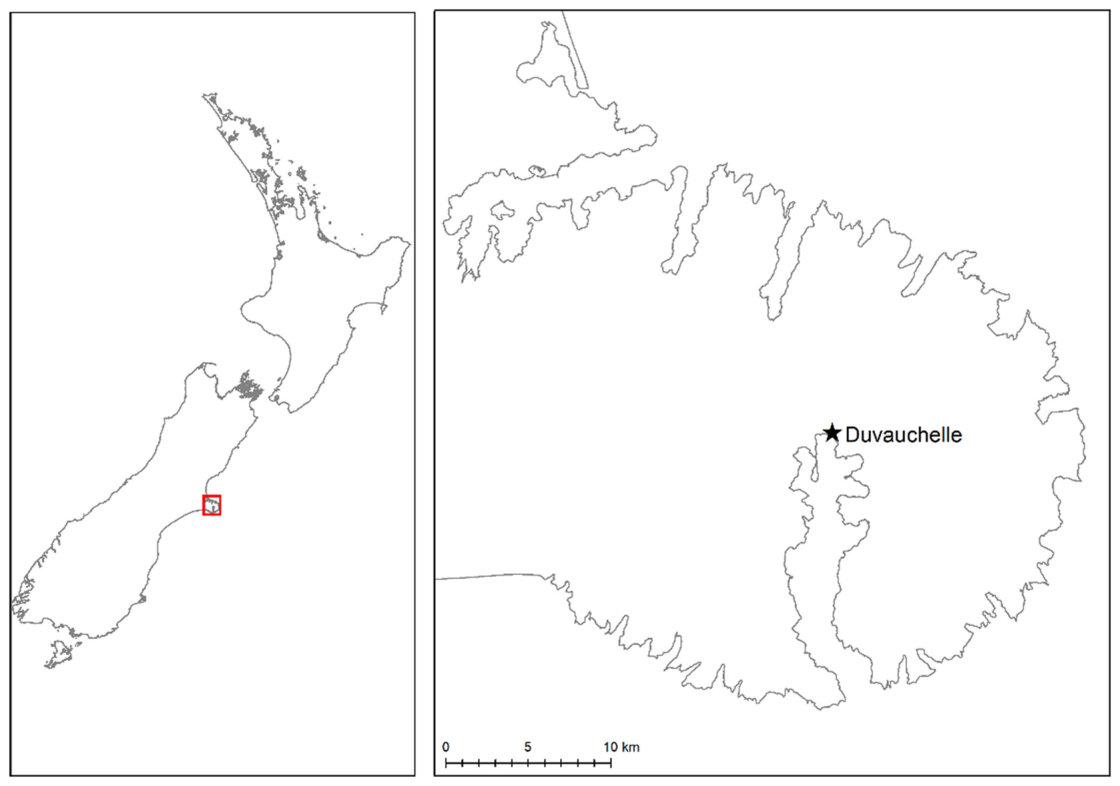
A field trial was set up in July 2015 in Duvauchelle (43◦45′9”S, 172◦56′36′′E), Banks Peninsula, on the east coast of the South Island of NZ (Fig. 1). The soil (a Pawson silt loam, 46% sand, 29% silt, 25% clay) has a short period of summer moisture deficit (Molloy, 1988). The average annual rainfall in the nearby town of Akaroa is 969 mm (Macara, 2016). The trial consisted of 24 blocks of 5 m × 5 m with a total of 1350 plants (Fig. S-1). Half of the blocks were irrigated with TMW from the local wastewater treatment plant (WWTP) at a rate of 1000 mm yr− 1 through surface drip irrigation, which started in January 2016. Table 1 shows the properties of the TMW and annual application rates of the components. The other half were control blocks that did not receive any form of irrigation. The trial included eleven perennial NZ native species divided into three different vegetation types (Table 2), which resulted in four replicates per vegetation type and treatment. Vegetation type 1 included the most common early successional species in NZ (Sullivan et al., 2007), type 2 contained species that are well adapted to wet environments (Czernin and Phillips, 2005), and type 3 contained species that are naturally regenerating on Banks Peninsula (Wilson, 1994). The species used were of local provenance (Department of Conservation, 2021). Seedlings were 2 years old when they were planted into established Dactylis glomerata (cocksfoot) at the site, which was used for extensive sheep grazing prior to the experiment. Tree guards were used to protect the plants from weed competition. A high density of 2 plants m− 2was chosen to achieve fast canopy closure and data collection.
田间试验于2015年7月在新西兰南岛东海岸班克斯半岛的Duvauchelle(43◦45′9”S, 172◦56′36′′E)建立(图1)。土壤为Pawson粉砂壤土(砂粒46%,粉粒29%,黏粒25%),夏季有短期水分亏缺(Molloy, 1988)。附近Akaroa镇的年均降雨量为969 mm(Macara, 2016)。试验共设24个5 m × 5 m的小区,共种植1350株植物(图S-1)。其中一半小区自2016年1月起通过地表滴灌以1000 mm yr− 1的速率施用来自当地污水处理厂(WWTP)的TMW。表1列出了TMW的性质及其各组分的年施用量。另一半为对照小区,不接受任何形式的灌溉。试验包括11种多年生新西兰本土物种,分为三种不同的植被类型(表2),因此每种植被类型和处理各有4个重复。植被类型1包括新西兰最常见的早期演替物种(Sullivan et al., 2007),类型2包括适应湿润环境的物种(Czernin and Phillips, 2005),类型3包括在班克斯半岛自然更新的物种(Wilson, 1994)。所用物种均为本地种源(Department of Conservation, 2021)。幼苗种植时为2年生,种植于试验地已建立的Dactylis glomerata(鸭茅)草地中,该地在试验前用于粗放式放牧绵羊。使用树木护套保护植物免受杂草竞争。选择2株 m− 2的高密度种植,以实现快速郁闭和数据采集。
2.2. Plant monitoring2.2. 植物监测
The number of dead plants was recorded in October 2015, November 2015, December 2015, and June 2019 to calculate survival rates. The height of each plant was measured in June 2019, using a measuring tape.
于2015年10月、2015年11月、2015年12月和2019年6月记录死亡植株数,以计算存活率。2019年6月使用卷尺测量了每株植物的高度。
2.3. Soil and plant sample collection2.3. 土壤和植物样品采集
Soil samples were collected in October–November 2018, from underneath five species: L. scoparium, K. robusta, Coprosma robusta, Cordyline australis and Phormium tenax (Table 1). These species were chosen because they are commonly used in restoration plantings throughout NZ and are adapted to wet environments that can result from TMW irrigation (Franklin et al., 2019). We dug a total of 24 soil pits, four per vegetation type and treatment combination. The pits in vegetation types 1 and 3 were dug in a place that allowed to sample both targeted species on either side of each pit. Soil pits were dug to a depth of 65 cm and had a width of 60 cm × 60 cm. The locations of the pits within each plot were chosen randomly. A hand trowel was used to access densely rooted soil directly underneath the plant, where soil samples were taken at five different depths: 0–5 cm, 10–20 cm, 25–35 cm, 40–45 cm, and 55–65 cm. This ultimately resulted in a total of 200 soil samples that were transported to the laboratory on ice, where they were kept at 4 ◦C overnight until further analysis.
土壤样品于2018年10–11月采自五个物种下方:L. scoparium、K. robusta、Coprosma robusta、Cordyline australis和Phormium tenax(表1)。选择这些物种是因为它们在新西兰各地的生态恢复种植中被广泛使用,并且适应TMW灌溉可能造成的湿润环境(Franklin et al., 2019)。我们共挖掘了24个土壤剖面坑,每种植被类型与处理组合各4个。植被类型1和3中的剖面坑挖在能够在坑两侧分别采集两种目标物种的位置。剖面坑深65 cm,宽60 cm × 60 cm。剖面坑在各小区内的位置随机选定。使用手铲获取植株正下方根系密集的土壤,在五个不同深度采集土壤样品:0–5 cm、10–20 cm、25–35 cm、40–45 cm和55–65 cm。最终共获得200个土壤样品,冰上运回实验室,在4 ◦C下保存过夜直至进一步分析。
In June 2019 the foliage of the 40 plants where soil samples were taken from was sampled. For each plant, 10 branches or leaves of different age and aspect were cut by secateurs and combined to generate a representative sample. For P. tenax and C. australis, the entire leave was cut at its base. For C. robusta, K. robusta, and L. scoparium branches with a stem diameter < 10 mm were selected and cut off at the stem.
2019年6月,对采集了土壤样品的40株植物的叶片进行了采样。每株植物用修枝剪剪取10根不同年龄和朝向的枝条或叶片,合并为代表性样品。对于P. tenax和C. australis,从基部剪取整片叶片。对于C. robusta、K. robusta和L. scoparium,选择茎径< 10 mm的枝条并从茎部剪下。
2.4. Soil and plant analysis2.4. 土壤和植物分析
Soil exchangeable NO−3 and NH4+ were extracted from 4 g of fresh soil with 2 M KCl (Blakemore et al., 1987). Colorimetric methods were used to determine NO−3 (Miranda et al., 2001) and NH+4 concentrations (Mulvaney, 1996) in the extract, using a Cary 100 Bio UV–visible spectrophotometer (Agilent Technologies, Santa Clara, CA, USA).
用2 M KCl从4 g鲜土中提取土壤交换性NO−3和NH4+(Blakemore et al., 1987)。采用比色法测定提取液中NO−3(Miranda et al., 2001)和NH+4的浓度(Mulvaney, 1996),所用仪器为Cary 100 Bio紫外–可见分光光度计(Agilent Technologies, Santa Clara, CA, USA)。
Soil moisture content was determined by drying a subsample of fresh soil at 105 ◦C for 24 h (Blakemore et al., 1987). The rest of the soil was dried at 40 ◦C for 4 days and sieved to <2 mm. Plant samples were washed with deionised water before being dried at 60 ◦C for 4 days. Leaves of C. robusta, K. robusta, and L. scoparium were then separated from the stems. Dried plant leaves and soils were ground with a Rocklabs Bench Top Ring Mill (Scott, Dunedin, New Zealand).
土壤含水量通过将鲜土子样品在105 ◦C下烘干24 h测定(Blakemore et al., 1987)。其余土壤在40 ◦C下干燥4天并过<2 mm筛。植物样品用去离子水洗净后在60 ◦C下干燥4天。随后将C. robusta、K. robusta和L. scoparium的叶片与茎分离。干燥的植物叶片和土壤用Rocklabs台式环磨机(Scott, Dunedin, New Zealand)研磨。
A Vario-Max CN Elemental Analyser (Elementar, Langenselbold, Germany) was used to determine total C and N in the ground soil samples. A CN828 Carbon/Nitrogen analyser (LECO, St. Joseph, MI, USA) was used to determine total C and N in the ground plant samples. Soil pH was determined in deionised water using a 1: 2.5 soil: water ratio with a HQ 440d Multi-Parameter Meter with pH probe PHC735 (HACH, Loveland, CO, USA). In all, 0.2 g of ground soil and plant samples were digested in 5 mL 69% HNO3. Samples were left to pre-digest overnight prior to digestion in a ultraWAVE microwave digester (Milestone Srl, Sorisole, Italy) at 220 ◦C and 110 bar. Elemental concentrations in the soil digests were analysed by ICP-OES (Varian 720-ES, Agilent Technologies, Santa Clara, CA, USA). Elemental concentrations in the plant digests were analysed by ICP-MS (7500cx, Agilent Technologies, Santa Clara, CA, USA). To determine phytoavailable concentrations of elements, 5 g of soils were extracted with 0.05 M Ca(NO3)2 (Gray et al., 1999). Elemental concentrations in the extracts were analysed by ICP-MS (Agilent 7500cx). Plant-available phosphorus (Olsen P) was determined in a 0.5 M NaHCO3 extract, using a Cary 100 Bio UV–visible spectrophotometer for colorimetric analysis (Olsen et al., 1954). Certified reference materials were included for soil and plant digestions (SRM 2710a Montana I Soil and SRM1573a Tomato Leaves, National Institute of Standards and Technology, U.S. Department of Commerce). Recoveries ranged from 9 (for Na) to 110% for soil digests and from 92 to 125% for plant digests. While recoveries were low for soil digests, they agreed with results reported by other laboratories that used USEPA SW-846 Method 3050B (NIST, 2018). Analysis of a subset of samples for Na by an accredited laboratory correlated with our results, with y = 1.0× at r = 0.95 and p < 0.001 (Fig. S-2).
采用Vario-Max CN元素分析仪(Elementar, Langenselbold, Germany)测定研磨后土壤样品的全C和全N。采用CN828碳/氮分析仪(LECO, St. Joseph, MI, USA)测定研磨后植物样品的全C和全N。土壤pH在去离子水中以1: 2.5的土水比测定,使用配备PHC735 pH探头的HQ 440d多参数测定仪(HACH, Loveland, CO, USA)。共取0.2 g研磨后的土壤和植物样品,用5 mL 69% HNO3消解。样品先预消解过夜,然后在ultraWAVE微波消解仪(Milestone Srl, Sorisole, Italy)中于220 ◦C和110 bar下消解。土壤消解液中的元素浓度采用ICP-OES(Varian 720-ES, Agilent Technologies, Santa Clara, CA, USA)分析。植物消解液中的元素浓度采用ICP-MS(7500cx, Agilent Technologies, Santa Clara, CA, USA)分析。为测定元素的植物可利用浓度,用0.05 M Ca(NO3)2提取5 g土壤(Gray et al., 1999)。提取液中的元素浓度采用ICP-MS(Agilent 7500cx)分析。植物有效磷(Olsen P)在0.5 M NaHCO3提取液中测定,使用Cary 100 Bio紫外–可见分光光度计进行比色分析(Olsen et al., 1954)。土壤和植物消解均加入了有证标准物质(SRM 2710a Montana I Soil和SRM1573a Tomato Leaves,美国商务部国家标准与技术研究院)。土壤消解的回收率为9%(Na)至110%,植物消解的回收率为92%至125%。尽管土壤消解的回收率偏低,但与其他采用USEPA SW-846 Method 3050B的实验室报告的结果一致(NIST, 2018)。由一家认证实验室对部分样品的Na进行的分析与我们的结果相关,y = 1.0×,r = 0.95,p < 0.001(图S-2)。
carried out for plant parameters, using species and irrigation as independent variables with interaction effects. The package multcomp (Hothorn et al., 2021) was used for Tukey’s HSD post-hoc test where significant effects were found. Assumptions for ANOVA were tested as described for soil parameters. Plant heights in the TMW and control blocks were compared for each species individually by two-tailed unpaired t-test. The significance level for all results was at p ≤ 0.05. The package factoextra (Kassambara and Mundt, 2016) was used to perform a principal component analysis (PCA) of plant variables.
对植物参数进行分析,以物种和灌溉为自变量并考虑交互效应。在发现显著效应时,使用multcomp程序包(Hothorn et al., 2021)进行Tukey HSD事后检验。ANOVA的前提假设按土壤参数所述方法进行检验。各物种在TMW小区和对照小区中的株高分别采用双尾非配对t检验进行比较。所有结果的显著性水平均为p ≤ 0.05。使用factoextra程序包(Kassambara and Mundt, 2016)对植物变量进行主成分分析(PCA)。
2.5. Statistical analysis2.5. 统计分析
3Results and discussion结果与讨论
Data were analysed with R (R Core Team, 2021). Three-way analysis of variance (ANOVA) was carried out for soil parameters. Depth, species, and irrigation were used as independent variables with interactions. The residuals were plotted to test the assumptions of normality and homoscedasticity. Data were log10 or square-root transformed where the assumptions were not met. Tukey’s honestly significant difference (HSD) post-hoc test was used where significant effects were found, using the package agricolae (de Mendiburu, 2021). A two-tailed unpaired t-test was used to compare element concentration at each depth individually after combining results from all plant species. Two-way ANOVA was
数据采用R(R Core Team, 2021)进行分析。对土壤参数进行三因素方差分析(ANOVA),以深度、物种和灌溉为自变量并考虑交互作用。绘制残差图以检验正态性和方差齐性假设。不满足假设时,对数据进行log10或平方根转换。在发现显著效应时,使用agricolae程序包(de Mendiburu, 2021)进行Tukey真实显著差异(HSD)事后检验。将所有植物物种的结果合并后,采用双尾非配对t检验分别比较各深度的元素浓度。采用双因素ANOVA
3.1. Elemental concentrations in soils3.1. 土壤中的元素浓度
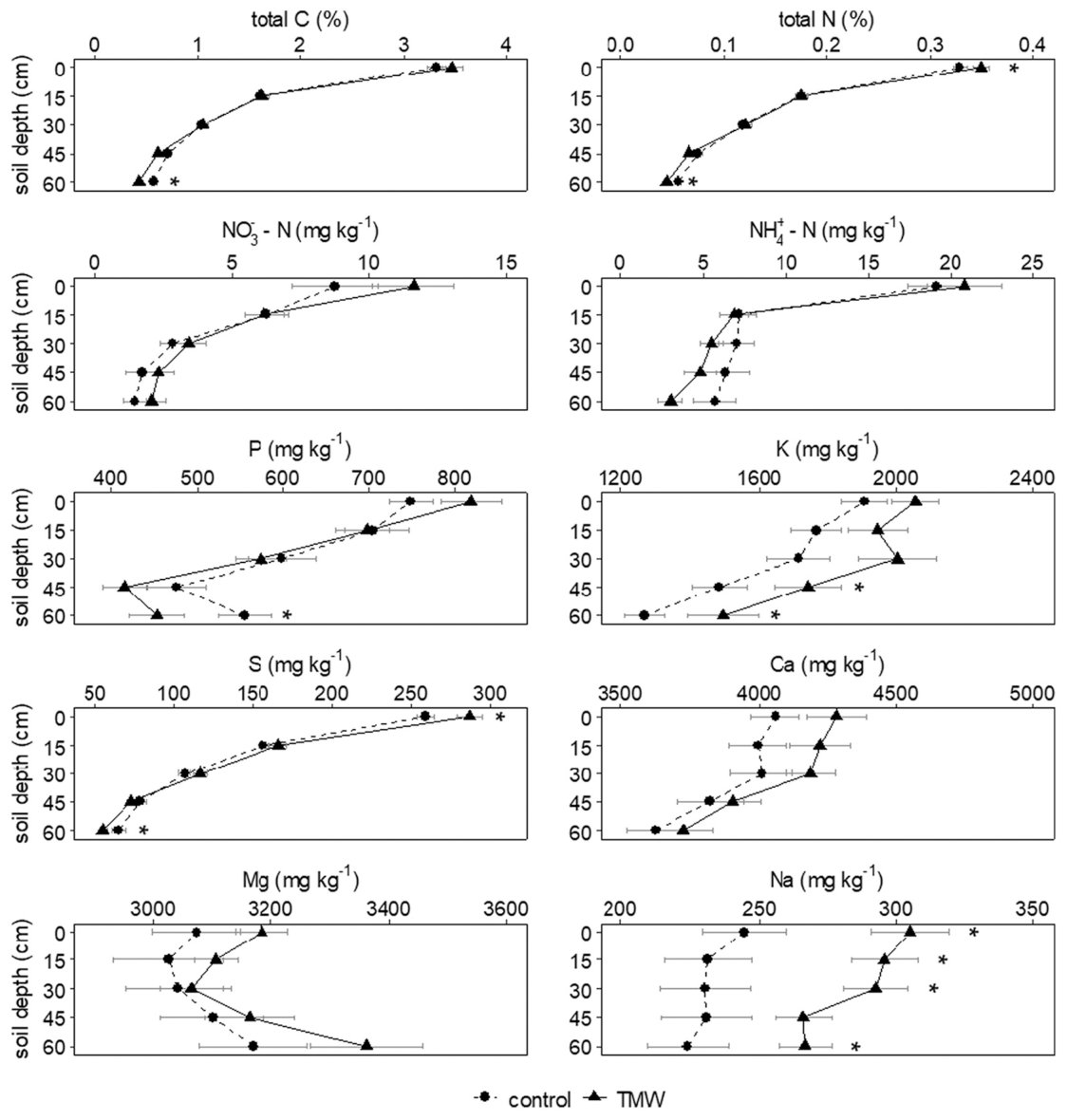
The Sodium Adsorption Ratio (SAR) of the TMW was 2.75 (Table 2), which was within the limit of 6 that is used as a guideline for effluent irrigation in Australia (Hanjra et al., 2012). However, irrigation of TMW with this SAR and an electric conductivity (EC) of 423 μS cm− 1(Table 2) can lead to the degradation of soil structure through clay dispersion (ANZECC, 2000; Mojid and Wyseure, 2013). There were no visual signs of ponding or runoff following the irrigation of TMW at the site that would have indicated that infiltration was impaired. This is consistent with findings by McIntyre (2018), whereby infiltration rates of local soils were not impaired by TMW irrigation with similar Na loading rates. Na significantly increased throughout the soil profile, except at 40–50 cm depth (Fig. 2). Nevertheless, only 735 kg Na ha− 1was recovered in the soil following TMW irrigation equivalent to 2700 kg Na ha− 1over the experimental period. This reflects the mobility of Na in the soil and indicates that the majority of applied Na leached through the soil profile. Our results were consistent with those of Gutierrez-Gines et al. (2020), who reported that Na accumulation in TMW irrigated silt loams from the same region was not proportional to Na application. While the accumulation of Na can increase soil pH (Blume et al., 2016), we did not find significant differences between treatments. The average pH in the topsoil at 0–5 and 10–20 cm was 5.7 and 5.6, respectively. This is within the optimal range for plant growth (Neina, 2019).
TMW的钠吸附比(SAR)为2.75(表2),低于澳大利亚污水灌溉指南所采用的限值6(Hanjra et al., 2012)。然而,以该SAR和423 μS cm− 1的电导率(EC)(表2)进行TMW灌溉,可能因黏粒分散而导致土壤结构退化(ANZECC, 2000; Mojid and Wyseure, 2013)。试验地TMW灌溉后未见积水或径流的可见迹象,表明入渗未受影响。这与McIntyre(2018)的研究结果一致,即在类似Na负荷率下,TMW灌溉并未削弱当地土壤的入渗速率。除40–50 cm深度外,Na在整个土壤剖面中均显著增加(图2)。然而,在试验期间TMW灌溉施入相当于2700 kg Na ha− 1的情况下,土壤中仅回收了735 kg Na ha− 1。这反映了Na在土壤中的移动性,表明大部分施入的Na已淋溶穿过土壤剖面。我们的结果与Gutierrez-Gines et al.(2020)的结果一致,后者报道同一地区TMW灌溉粉砂壤土中Na的累积与Na施用量不成比例。尽管Na的累积可提高土壤pH(Blume et al., 2016),但我们未发现处理间存在显著差异。0–5 cm和10–20 cm表层土壤的平均pH分别为5.7和5.6,处于植物生长的最适范围内(Neina, 2019)。
High application rates of Na compared to Ca and Mg can lead to increased leaching of these cations and K+ from the soil (Chahal et al., 2011). This was not observed at our field site, with a trend of all these elements to increase with TMW irrigation (Fig. 2). K was significantly higher in the subsoil (40–50 and 55–65 cm) of TMW irrigated plots. K can be preferentially adsorbing in the soil and therefore result in a reduction of Mg (Liang et al., 2021). However, Ca and Mg showed an overall (0–65 cm) increase of 5.5% and 4.6% respectively following TMW irrigation. This was likely a result of their high application rate and low SAR of the TMW (Table 2). Ca and Mg can offset possible negative effects of Na and K on the soil structure (Gutierrez-Gines et al., 2020). Our results indicated that TMW had no negative effects on the equilibrium of cations in the soil and that there was a low risk of Na impairing soil structure and plant growth.
相对于Ca和Mg而言较高的Na施用量可导致这些阳离子及K+从土壤中的淋溶增加(Chahal et al., 2011)。在本试验地未观察到这一现象,所有这些元素均有随TMW灌溉而增加的趋势(图2)。TMW灌溉小区底土(40–50 cm和55–65 cm)中的K显著较高。K可在土壤中被优先吸附,从而导致Mg减少(Liang et al., 2021)。然而,TMW灌溉后Ca和Mg在整个剖面(0–65 cm)中分别增加了5.5%和4.6%。这可能是由于其施用量较高且TMW的SAR较低所致(表2)。Ca和Mg可抵消Na和K对土壤结构可能产生的负面影响(Gutierrez-Gines et al., 2020)。我们的结果表明,TMW对土壤阳离子平衡没有负面影响,Na损害土壤结构和植物生长的风险较低。
While total N significantly increased in the topsoil (0–5 cm) by 6%, it significantly decreased by 21% in the subsoil (55–65 cm) (Fig. 2). The application rate of N at the site was 194 kg N ha− 1yr− 1, but total N throughout the soil profile only increased by 5.6 mg kg− 1over the experimental period, equalling to an increase of 17 kg N ha− 1yr− 1. Possible pathways of N losses are through plant uptake, NO3− leaching, or emissions of N2 or N2O following denitrification. The latter can be elevated with increased soil moisture and elevated pH in the TMW irrigated plots (Clough et al., 2004; Simek and Cooper, 2002ˇ ). Barton et al. (1999) reported that just 1% of N applied with TMW is emitted as N2O. Assuming such losses we could expect 2 kg N2O-N ha− 1yr− 1to be emitted from the irrigated plots at our site. Despite N2O having a global warming potential 300 times higher than that of CO2 (Griffis et al., 2017) this emission rate is low compared to normal soil respiration in NZ native shrubland of ca. 10 t CO2-C ha− 1yr− 1(Hedley et al., 2013). Leaching could account for a larger proportion of N losses, as Sparling et al. (2006) reported that up to 22% of applied TMW-N leached from soil after 4 years of irrigation. However, Gutierrez-Gines et al. (2020) found that NO3− leaching from a local Silt Loam irrigated with TMW from the same WWTP at double N loading rates equalled to just 2 kg N ha− 1 over 17 months. Soil NO−3 concentrations were unaffected by TMW irrigation. This is consistent with results of Sparling et al. (2006) who found no increased NO3− in the soil after 4 years of TMW irrigation onto four different NZ soils. Given the high mobility of NO−3 in soil (Cameron et al., 2013), it is likely that NO3− that was not taken up by plants was leached from the soil. Soil NH4+ was not significantly different in the TMW irrigated plots but tended to be reduced under TMW irrigation, where NO3− was increased. This could indicate accelerated nitrification with TMW irrigation and increased NH4+ supply (Robertson and Groffman, 2015).
全N在表土(0–5 cm)中显著增加了6%,而在底土(55–65 cm)中显著降低了21%(图2)。试验地的N施用量为194 kg N ha− 1yr− 1,但在试验期间整个土壤剖面的全N仅增加了5.6 mg kg− 1,相当于增加17 kg N ha− 1yr− 1。N损失的可能途径包括植物吸收、NO3−淋溶,或反硝化作用产生的N2或N2O排放。在TMW灌溉小区中,土壤湿度增加和pH升高可能加剧后者(Clough et al., 2004; Simek and Cooper, 2002)。Barton et al.(1999)报道,随TMW施入的N仅有1%以N2O形式排放。假定存在此类损失,预计本试验地灌溉小区的排放量为2 kg N2O-N ha− 1yr− 1。尽管N2O的全球增温潜势是CO2的300倍(Griffis et al., 2017),但与新西兰本土灌丛约10 t CO2-C ha− 1yr− 1的正常土壤呼吸相比(Hedley et al., 2013),该排放速率较低。淋溶可能占N损失的较大比例,Sparling et al.(2006)报道,灌溉4年后多达22%的TMW施入N从土壤中淋失。然而,Gutierrez-Gines et al.(2020)发现,用同一WWTP的TMW以两倍N负荷率灌溉当地粉砂壤土,17个月内NO3−淋溶量仅为2 kg N ha− 1。土壤NO−3浓度未受TMW灌溉的影响。这与Sparling et al.(2006)的结果一致,他们发现在四种不同的新西兰土壤上进行4年TMW灌溉后,土壤中NO3−并未增加。鉴于NO−3在土壤中的高移动性(Cameron et al., 2013),未被植物吸收的NO3−很可能已从土壤中淋失。TMW灌溉小区的土壤NH4+无显著差异,但在TMW灌溉下有降低的趋势,而NO3−则有所增加。这可能表明TMW灌溉加速了硝化作用并增加了NH4+供应(Robertson and Groffman, 2015)。
The lowest concentration of NO−3 was measured under C. robusta (3.1 mg kg− 1, Table S-1) and it was significantly higher under K. robusta (6.2 mg kg− 1). The results are consistent with those of Franklin et al. (2015), who reported that the selection of plant species affects N fluxes in the soil profile. However, unlike reported by Esperschuetz et al. (2017) and Halford et al. (2021), NO−3 concentrations in the soil under the myrtaceous species L. scoparium and K. robusta were not lower than under other species. Low NO−3 concentrations under C. robusta were not reported previously, and underlying mechanisms are unknown. NZ native plant species have diverse root morphologies (Franklin et al., 2019), which can affect fluxes of waters through impacts on preferential flow and hydraulic conductivity (Clothier et al., 2007). In addition, distinct exudation from plant roots can affect the mobility of elements and the rates of biogeochemical nutrient cycling, as is the case for N (Carlton et al., 2019). Due to the high mobility of NO−3 (Di and Cameron, 2002), lower concentrations indicate reduced likelihood of NO−3 leaching and therefore ground- and surface water contamination and associated public health risk (McDowell et al., 2009).
C. robusta下方测得的NO−3浓度最低(3.1 mg kg− 1,表S-1),而K. robusta下方显著较高(6.2 mg kg− 1)。该结果与Franklin et al.(2015)的结果一致,后者报道植物物种的选择会影响土壤剖面中的N通量。然而,与Esperschuetz et al.(2017)和Halford et al.(2021)的报道不同,桃金娘科物种L. scoparium和K. robusta下方土壤的NO−3浓度并不低于其他物种。C. robusta下方NO−3浓度较低此前未见报道,其潜在机制尚不清楚。新西兰本土植物物种具有多样的根系形态(Franklin et al., 2019),可通过影响优先流和导水率来影响水分通量(Clothier et al., 2007)。此外,植物根系不同的分泌物可影响元素的移动性和生物地球化学养分循环速率,N即是如此(Carlton et al., 2019)。由于NO−3的高移动性(Di and Cameron, 2002),较低的浓度表明NO−3淋溶的可能性降低,从而降低地下水和地表水污染及相关的公共卫生风险(McDowell et al., 2009)。
As with total N, total C was significantly lower in the subsoil (55–65 cm) following TMW irrigation, showing a 25% decrease. It is possible that the high input of N and C with TMW irrigation lead to increased microbial activity, referred to as the priming effect (Kuzyakov et al., 2000). Jueschke et al. (2008) reported that while total soil organic C decreased in the subsoil under long-term TMW irrigation, total C in the topsoil significantly increased. At our site total C concentrations did not change at any other soil depths.
与全N类似,TMW灌溉后底土(55–65 cm)中的全C显著降低,降幅为25%。TMW灌溉带入的大量N和C可能导致微生物活性增强,即所谓的激发效应(Kuzyakov et al., 2000)。Jueschke et al.(2008)报道,长期TMW灌溉下底土总有机C减少,而表土全C显著增加。在本试验地,其他土壤深度的全C浓度均未发生变化。
Phosphorus was not significantly affected by TMW irrigation, except for an 18% decrease in the subsoil (55–65 cm). P is generally immobile in soils and vertical movement in the soil profile occurs through macropores and preferential flow (Gupta et al., 1999). However, due to its immobility, P is mainly lost through surface runoff from a TMW irrigated area, and there were no signs of erosion and runoff at the site. The diverse morphology of native plant roots can stabilise the soil and reduce the risk of erosion (Franklin et al., 2019). Therefore, expected P losses from the site via runoff and erosion will be small. Gutierrez-Gines et al. (2020) reported that TMW irrigation onto a local silt loam at a rate of 75 kg P ha− 1yr− 1would not result in soil P exceeding 1750 mg kg− 1 for at least 50 years. Similarly, based on the simulation of Gutierrez- Gines et al. (2020) with adjusted starting parameters (Table S-2) and no P removal, TMW irrigated soils at the site are not expected to exceed P concentration ranges in NZ productive soils (360–2640 mg kg− 1, Reiser et al., 2014) for at least 50 years. In our experiment, Olsen P in the TMW irrigated soils was not significantly increased. The Olsen P in the control and TMW irrigated plots was 14 and 17 mg kg− 1respectively, which is below recommended values for productive soils and indicates that native plants have low P requirements (Gutierrez-Gines et al., 2020).
除底土(55–65 cm)中降低18%外,磷未受TMW灌溉的显著影响。P在土壤中通常不易移动,其在土壤剖面中的垂直迁移通过大孔隙和优先流发生(Gupta et al., 1999)。然而,由于其不易移动,P主要通过TMW灌溉区的地表径流流失,而试验地并无侵蚀和径流迹象。本土植物根系形态多样,可稳定土壤并降低侵蚀风险(Franklin et al., 2019)。因此,预计试验地经径流和侵蚀造成的P损失较小。Gutierrez-Gines et al.(2020)报道,以75 kg P ha− 1yr− 1的速率对当地粉砂壤土进行TMW灌溉,至少50年内土壤P不会超过1750 mg kg− 1。同样,基于Gutierrez-Gines et al.(2020)的模拟并调整初始参数(表S-2)且不考虑P移除,预计试验地TMW灌溉土壤至少50年内不会超过新西兰生产性土壤的P浓度范围(360–2640 mg kg− 1,Reiser et al., 2014)。在本试验中,TMW灌溉土壤的Olsen P未显著增加。对照和TMW灌溉小区的Olsen P分别为14和17 mg kg− 1,低于生产性土壤的推荐值,表明本土植物对P的需求较低(Gutierrez-Gines et al., 2020)。
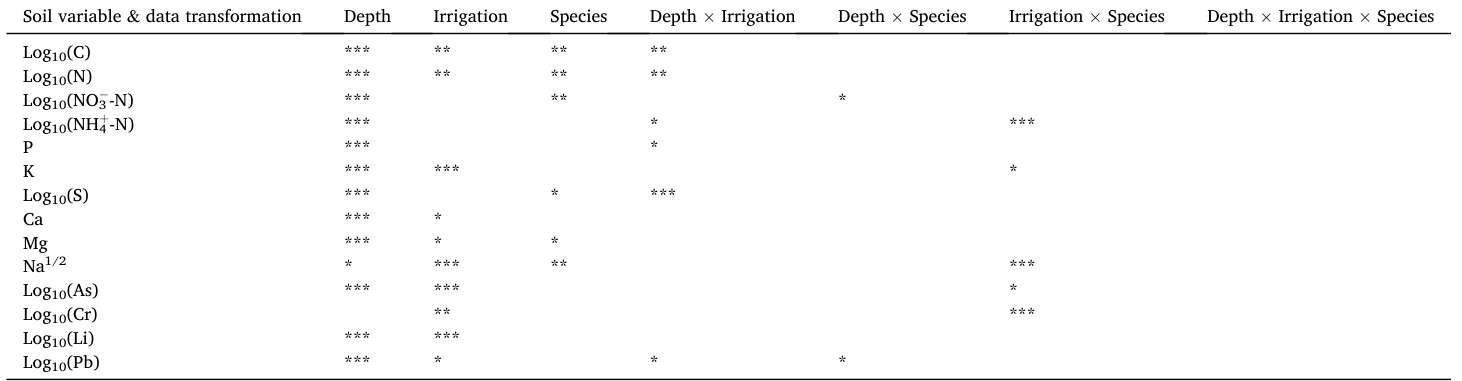
Results of three-way ANOVA for soil parameters with significant depth, interaction, species, or interaction effects (*** p < 0.001, ** p < 0.01, * p < 0.05). Variables with significant depth effects only were excluded.
具有显著深度、交互、物种或交互效应的土壤参数的三因素ANOVA结果(*** p < 0.001,** p < 0.01,* p < 0.05)。仅具有显著深度效应的变量未列出。
Sulphur significantly increased with TMW irrigation in the topsoil (0–5 cm) and decreased in the subsoil (55–65 cm). While 250 kg S ha− 1 yr− 1were applied with TMW, we observed no overall increase in the soil profile. This is consistent with the high mobility of S in soil and typical leaching losses of 20–120 kg S ha− 1yr− 1even from non-irrigated soil (Blume et al., 2016). However, while S can lead to acidification of soils, it is not associated with eutrophication (Posch et al., 2015).
TMW灌溉使表土(0–5 cm)中的硫显著增加,而底土(55–65 cm)中的硫降低。尽管随TMW施入了250 kg S ha− 1 yr− 1,但我们未观察到整个土壤剖面的总体增加。这与S在土壤中的高移动性以及即使非灌溉土壤也存在20–120 kg S ha− 1yr− 1的典型淋溶损失相一致(Blume et al., 2016)。不过,尽管S可导致土壤酸化,但其与富营养化无关(Posch et al., 2015)。
None of the soil trace element concentrations were significantly affected by plant species, but the concentration of As, Cr, Li, and Pb was significantly increased by 6–14% following TMW irrigation (Table S-3). However, trace element concentrations did not exceed background concentrations in local soils (Percival et al., 1996). The application of trace elements with TMW was low, and results by Smith et al. (1996) suggested that it will take 50 to 100 years for trace elements to reach values of environmental concern. However, in contrast to their results, we did not observe increases of extractable element concentrations with TMW irrigation (Table S-4), and found significantly decreased concentrations of extractable Al, Cd, and Co in the topsoil (0–5 cm). Our results indicate that the risk of trace element accumulation in soil is lower from TMW irrigation than the application of mineral fertilisers, which can contain trace element contamination (Alloway, 2013).
土壤微量元素浓度均未受植物物种的显著影响,但TMW灌溉后As、Cr、Li和Pb的浓度显著增加了6–14%(表S-3)。然而,微量元素浓度并未超过当地土壤的背景浓度(Percival et al., 1996)。随TMW施入的微量元素量较低,Smith et al.(1996)的结果表明,微量元素需50至100年才会达到值得环境关注的水平。然而,与其结果不同的是,我们未观察到TMW灌溉导致可提取态元素浓度增加(表S-4),并且发现表土(0–5 cm)中可提取态Al、Cd和Co的浓度显著降低。我们的结果表明,与施用可能含有微量元素污染的矿物肥料相比,TMW灌溉导致土壤微量元素累积的风险更低(Alloway, 2013)。
Depth had the strongest effect on soil parameters (Table 3), which was expected due to the physicochemical changes within the soil profile (Blume et al., 2016). The plant species affected the soil concentration of total C, total N, NO3− , and Na, and to a lesser extent S and Mg. Irrigation affected the concentration of Na and K the most, and to a lesser extent total C, total N, Ca, and Mg. Interaction effects of species and irrigation were strong for NH+4 and Na concentrations.
深度对土壤参数的影响最强(表3),这是由于土壤剖面内的理化变化而在预料之中(Blume et al., 2016)。植物物种影响了土壤全C、全N、NO3−和Na的浓度,对S和Mg的影响较小。灌溉对Na和K浓度的影响最大,对全C、全N、Ca和Mg的影响较小。物种与灌溉的交互效应对NH+4和Na浓度的影响较强。
The results demonstrate that the selection of plant species influences the fate of TMW applied nutrients and contaminants. Species differ in their biomass production and nutrient concentration, affecting the amount of nutrients taken up (Tzanakakis et al., 2009). Plant roots further influence the properties of the rhizosphere (Neumann et al., 2009): distinct root morphologies and rhizosphere processes affect the fate of nutrients and contaminants in the soil (Franklin et al., 2019). These properties need to be considered when selecting plants for TMW land application schemes.
结果表明,植物物种的选择会影响TMW施入的养分和污染物的归趋。不同物种的生物量产量和养分浓度不同,从而影响养分吸收量(Tzanakakis et al., 2009)。植物根系还会影响根际的性质(Neumann et al., 2009):不同的根系形态和根际过程影响土壤中养分和污染物的归趋(Franklin et al., 2019)。在为TMW土地施用方案选择植物时,需要考虑这些特性。
3.2. Plant response to TMW irrigation3.2. 植物对TMW灌溉的响应
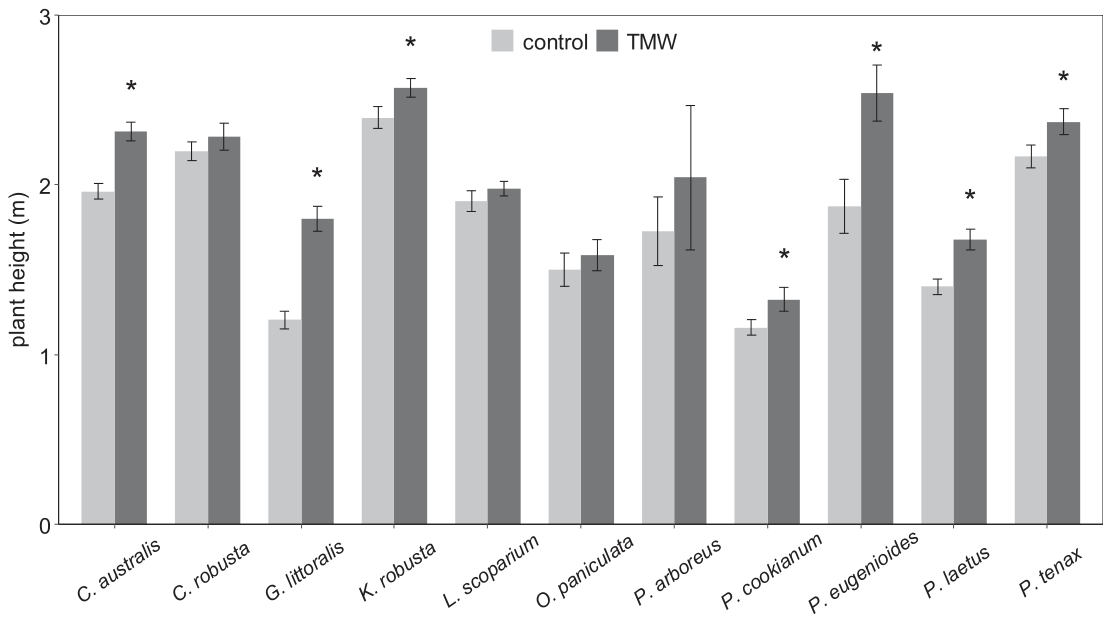
Following the transplantation of seedlings in July 2015, overall plant survival decreased from 97% in October 2015 to 87% in December 2015 before irrigation began in January 2016. The initial decline in plant survival was likely due to the high temperature and low rainfall during that period. In June 2019, 3.5 years after onset of irrigation, there were a total of 815 surviving plants at the site, equalling to an overall survival rate of 68%. The total survival rate of TMW-irrigated plants did not differ from the control. However, plants in the TMW-irrigated plots had begun to self-thin, a phenomenon where increased biomass production results in higher mortality in even-aged high-density plantings (Westoby, 1984). Across all species, the average height of the native vegetation receiving TMW was 2.1 m, significantly higher than the unirrigated plants in the control treatment at 1.9 m. Fig. 3 shows the heights of the individual species. There was no significant decrease in height in any species. Seven species showed a significant increase in plant height when irrigated with TMW. The largest increase was observed in Griselinia littoralis, where the plant height was 42% higher with TMW irrigation.
2015年7月移栽幼苗后,在2016年1月开始灌溉之前,植物总体存活率由2015年10月的97%下降至2015年12月的87%。存活率的初期下降可能是由于该时期高温少雨所致。2019年6月,即开始灌溉3.5年后,试验地共有815株植物存活,总体存活率为68%。TMW灌溉植物的总存活率与对照无差异。然而,TMW灌溉小区中的植物已开始自疏,即在同龄高密度种植中,生物量增加导致死亡率升高的现象(Westoby, 1984)。所有物种合计,接受TMW的本土植被平均株高为2.1 m,显著高于对照处理中未灌溉植物的1.9 m。图3显示了各物种的株高。没有任何物种的株高显著降低。有七个物种在TMW灌溉下株高显著增加。增幅最大的是Griselinia littoralis,TMW灌溉下其株高提高了42%。
Our findings are consistent with accelerated plant growth following the application of other biowastes onto NZ native vegetation such as biosolids (Gutierrez-Gines et al., 2017) and vermi-compost (Xue et al., 2016). Species that showed no growth response appeared to do so for different reasons. Pseudopanax arboreus was not well adapted to the local environment at the site and showed signs of stress in both treatments. Its survival rate dropped to 57% before irrigation started and was at 21% in June 2019. Sooty mould (Capnodium walteri) was observed on all L. scoparium plants, which is likely a result of honeydew production by Acanthococcus campbelli and Acanthococcus laptospermi, the two common scale insects associated with L. scoparium (Bohorquez et al., 2019´). Olearia paniculata showed evidence of stress and chlorosis in its leaves, which can indicate a nutrient imbalance (Sharma et al., 2021). C. robusta grew vigorously in both treatments, and there was no significant difference in plant height.
我们的发现与在新西兰本土植被上施用其他生物废弃物(如生物固体(污泥)(Gutierrez-Gines et al., 2017)和蚯蚓堆肥(Xue et al., 2016))后植物生长加快的结果一致。未表现出生长响应的物种似乎各有不同原因。Pseudopanax arboreus未能很好地适应试验地的当地环境,在两种处理中均表现出胁迫迹象。其存活率在灌溉开始前已降至57%,2019年6月为21%。所有L. scoparium植株上均观察到煤污病(Capnodium walteri),这可能是由与L. scoparium相关的两种常见介壳虫Acanthococcus campbelli和Acanthococcus laptospermi分泌蜜露所致(Bohorquez et al., 2019)。Olearia paniculata叶片表现出胁迫和黄化迹象,这可能表明存在养分失衡(Sharma et al., 2021)。C. robusta在两种处理中均生长旺盛,株高无显著差异。
Concentrations of elements in plant foliage at the site in June 2019 by species and treatment; Irrigated with treated municipal wastewater (TMW) and non-irrigated (control).
2019年6月试验地不同物种和处理下植物叶片中的元素浓度;处理为处理后城市污水(TMW)灌溉和非灌溉(对照)。
| C. australisC. australis | C. robustaC. robusta | K. robustaK. robusta | L. scopariumL. scoparium | P. tenaxP. tenax | ||||||
|---|---|---|---|---|---|---|---|---|---|---|
| control | TMW | control | TMW | control | TMW | control | TMW | control | TMW | |
| N (%) | 1.3±0.02 | 1.5±0.11 | 1.6±0.05 | 1.6±0.07 | 1.9±0.09 | 1.8±0.09 | 1.6±0.07 | 1.6±0.05 | 1.4±0.05 | 1.5± 0.07 |
| Na | 696±135 | 690±97 | 671±41 | 729±116 | 2767±179 | 2765±251 | 2503±136 | 2336±241 | 2031±224 | 1541±188 |
| Mg | 3247± 242 | 3478± 194 | 4143± 620 | 4439±486 | 2434±286 | 1841±253 | 2492±343 | 2497±67 | 1546±70 | 1606±277 |
| P | 1651± 73 | 1687± 142 | 2226± 54 | 2151±211 | 1710±279 | 1576±176 | 1191±98 | 1114±64 | 1871±24 | 2145±241 |
| K (%) | 0.81± 0.08 | 0.72± 0.10 | 1.2±0.10 | 1.2±0.21 | 0.66± 0.04 | 0.66± 0.05 | 0.67±0.07 | 0.51±0.04 | 1.3±0.03 | 1.6± 0.12 |
| Ca (%) | 1.8±0.23 | 1.5±0.12 | 2.1±0.12 | 2.3±0.09 | 0.59± 0.11 | 0.46± 0.04 | 0.81±0.08 | 0.84±0.06 | 0.39±0.03 | 0.34±0.05 |
| Zn | 121±15 | 126±121 | 51± 4.2 | 50± 6.4 | 36± 2.8 | 24± 4.7 | 11± 0.57 | 9.3±0.28 | 32± 1.5 | 25± 1.3* |
| Mn | 794±172 | 946±196 | 149±26 | 162±36 | 691±71 | 368±58* | 289±67 | 127± 24 | 135± 17 | 181± 55 |
| Fe | 52±2.2 | 63± 6.0 | 141±15 | 157±42 | 252±17 | 283±59 | 296±34 | 575± 136 | 54± 3.1 | 56± 4.6 |
| Cu | 5.6±0.53 | 5.0±0.82 | 6.5±0.27 | 5.7±0.45 | 4.2±0.31 | 3.6±0.94 | 3.7±0.64 | 2.5±0.39 | 4.3±0.08 | 4.2± 0.27 |
Values show means ± standard errors (n = 5). Values are in mg kg− 1unless otherwise indicated. Significant differences between treatments at p < 0.05 according to Tukey’s HSD post-hoc test are indicated in bold followed by asterisk (*).
数值为平均值 ± 标准误(n = 5)。除另有说明外,数值单位为mg kg− 1。经Tukey HSD事后检验处理间在p < 0.05水平上的显著差异以粗体加星号(*)标示。
3.3. Elemental concentrations in plants3.3. 植物中的元素浓度
The concentrations of the essential elements in the plant foliage were not affected by TMW irrigation, except for Zn and Mn (Table 4). Following TMW irrigation, foliar concentrations of Mn in K. robusta and Zn in P. tenax decreased by 47% and 28%, respectively. This indicates dilution following increased biomass production with TMW irrigation (Jarrell and Beverly, 1981). Unlike previously reported with NZ native species (Franklin et al., 2015), there was no luxury uptake of elements with TMW irrigation. It appears that a combination of factors may have limited plant growth at the site (Marschner, 1995). However, other stressing factors such as light and temperature may have influenced the concentration of elements in the plant foliage (Güsewell and Koerselman, 2002). Not all species adapted to low-fertility conditions take up nutrients beyond their growth requirements when fertilised (Iversen et al., 2010). Concentrations of As, Cd, Cr, and Pb (Table S-5) were all within normal ranges for plant foliage (Chaney, 1989). Na, which was significantly increased in the soil with TMW irrigation, did not differ in the foliage between treatments. The small differences in elemental composition between treatments indicates that TMW did not impair the nutrition of NZ native plants.
除Zn和Mn外,植物叶片中必需元素的浓度未受TMW灌溉的影响(表4)。TMW灌溉后,K. robusta叶片Mn浓度和P. tenax叶片Zn浓度分别降低了47%和28%。这表明TMW灌溉下生物量增加产生了稀释效应(Jarrell and Beverly, 1981)。与此前关于新西兰本土物种的报道不同(Franklin et al., 2015),TMW灌溉下未出现元素的奢侈吸收。试验地的植物生长似乎受到多种因素的共同限制(Marschner, 1995)。不过,光照和温度等其他胁迫因素也可能影响了植物叶片中的元素浓度(Güsewell and Koerselman, 2002)。并非所有适应低肥力条件的物种在施肥后都会吸收超出其生长需求的养分(Iversen et al., 2010)。As、Cd、Cr和Pb的浓度(表S-5)均处于植物叶片的正常范围内(Chaney, 1989)。Na在TMW灌溉后土壤中显著增加,但叶片中的Na在处理间无差异。处理间元素组成的差异较小,表明TMW并未损害新西兰本土植物的营养状况。
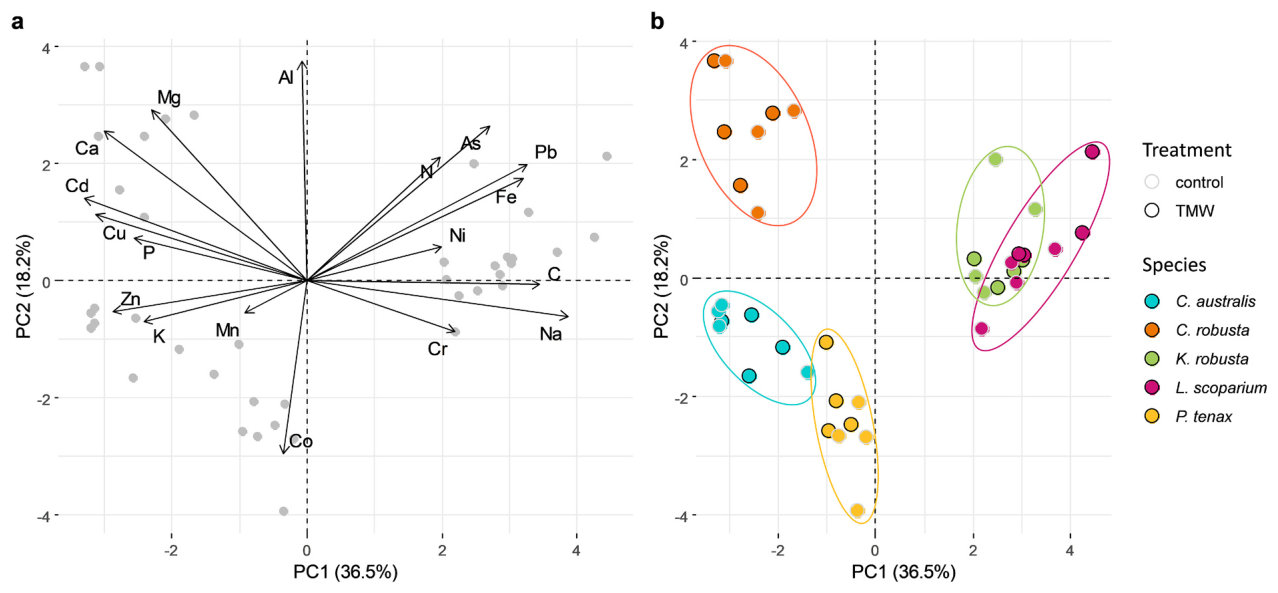
composition (Fig. 4). PC1 (explaining 36.5% of variation) divided species into Myrtaceae (L. scoparium and K. robusta) and non-Myrtaceae species, while PC2 (explaining 18.2% of variation) divided species into mono- and dicotyledons. This is consistent with results of Hahner et al. (2014), who also found distinct elemental concentrations between native mono- and dicotyledons. Here, PC1 was mainly weighted by Na, C, Cd, and Pb, while PC2 was heavily weighted by Al, Co, and Mg.
组成进行分组(图4)。PC1(解释36.5%的变异)将物种分为桃金娘科(L. scoparium和K. robusta)与非桃金娘科物种,而PC2(解释18.2%的变异)将物种分为单子叶和双子叶植物。这与Hahner et al.(2014)的结果一致,他们同样发现本土单子叶和双子叶植物之间元素浓度存在明显差异。在此,PC1主要由Na、C、Cd和Pb加权,而PC2主要由Al、Co和Mg加权。
The physiological traits of plants differ as a consequence of genetic influences, resulting in differential nutrient uptake among species (Dickinson et al., 2015). The selection of species with higher nutrient accumulation potential may mitigate elements associated with TMW (Tzanakakis et al., 2009). For example, we found that Na concentrations were four times higher in K. robusta than C. australis. However, the biomass of these species would need to be known to determine total plant uptake. Furthermore, elements that are taken up by plants will eventually return to the soil through litter, unless biomass is removed from the site. Possible uses for the biomass of NZ native plants at the field site include the production of essential oils from L. scoparium and K. robusta (Seyedalikhani et al., 2019), fibres from P. tenax, or timber from Podocarpus laetus. Additionally, some species could be used as a fodder supplement for livestock (Dickinson et al., 2015), particularly G. littoralis which was the most responsive species in the present study.
由于遗传影响,植物的生理性状存在差异,从而导致物种间养分吸收的差异(Dickinson et al., 2015)。选择具有较高养分累积潜力的物种可削减与TMW相关的元素(Tzanakakis et al., 2009)。例如,我们发现K. robusta中的Na浓度是C. australis的四倍。然而,需要了解这些物种的生物量才能确定植物总吸收量。此外,除非将生物量从场地移出,否则植物吸收的元素最终将通过凋落物返回土壤。试验地新西兰本土植物生物量的可能用途包括利用L. scoparium和K. robusta生产精油(Seyedalikhani et al., 2019)、利用P. tenax生产纤维,或利用Podocarpus laetus生产木材。此外,部分物种可用作牲畜的补充饲料(Dickinson et al., 2015),尤其是本研究中响应最明显的G. littoralis。
PCA revealed that species were grouped based on their elemental
PCA显示,物种依据其元素
4Conclusions结论
Application of TMW at 1000 mm yr− 1onto NZ native vegetation had negligible effects on the soil chemistry after nearly 3 years of irrigation. Soil Na concentrations were increased, but most of the applied Na was leached from the soil profile. The rate of P accumulation in the soil indicates that it will not accumulate beyond the range found in NZ agricultural soils for at least 50 years. Despite the application of 194 kg N ha− 1yr− 1with TMW irrigation, soil N concentrations were only significantly increased in the topsoil (0–5 cm). Plant species significantly affected the soil concentrations of C, N, NO3− , and Na. TMW irrigation did not impair the growth of NZ native plant species. The overall height of irrigated species was significantly increased, but the growth response differed between species. Overcoming challenges associated with establishing NZ native vegetation requires selection of species that are well adapted to the local environment. TMW irrigation did not increase concentrations of any elements to levels that may pose a risk to humans or ecosystems. Our results indicate that TMW irrigated at rates ≤1000 mm yr− 1could be used to support the establishment of native vegetation in NZ and elsewhere. Future research should investigate gaseous N losses and N leaching from TMW irrigated native vegetation to quantify the efficacy of the vegetation at protecting receiving waters.
以1000 mm yr− 1向新西兰本土植被施用TMW,经近3年灌溉后对土壤化学性质的影响可忽略不计。土壤Na浓度有所增加,但大部分施入的Na已从土壤剖面中淋失。土壤P的累积速率表明,至少50年内其不会累积到超出新西兰农业土壤的范围。尽管TMW灌溉施入了194 kg N ha− 1yr− 1,但土壤N浓度仅在表土(0–5 cm)中显著增加。植物物种显著影响了土壤C、N、NO3−和Na的浓度。TMW灌溉未损害新西兰本土植物物种的生长。灌溉物种的总体株高显著增加,但不同物种的生长响应存在差异。克服新西兰本土植被建植相关的挑战,需要选择能很好适应当地环境的物种。TMW灌溉未使任何元素的浓度升高到可能对人类或生态系统构成风险的水平。我们的结果表明,以≤1000 mm yr− 1的速率灌溉TMW可用于支持新西兰及其他地区本土植被的建立。未来研究应调查TMW灌溉本土植被的气态N损失和N淋溶,以量化植被在保护受纳水体方面的效能。
CRediT authorship contribution statementCRediT作者贡献声明
Alexandra Meister: Conceptualization, Formal analysis, Investigation, Writing – original draft, Data curation, Visualization, Funding acquisition. Furong Li: Investigation. Maria Jesus Gutierrez-Gines: Conceptualization, Formal analysis, Writing – review & editing, Supervision, Funding acquisition, Project administration. Nicholas Dickinson: Writing – review & editing, Supervision. Sally Gaw: Writing – review & editing, Supervision. Mike Bourke: Supervision, Resources, Project administration, Writing - review & editing. Brett Robinson: Conceptualization, Writing – review & editing, Supervision, Funding acquisition, Project administration.
Alexandra Meister:概念构思、形式分析、调查研究、撰写–初稿、数据管理、可视化、获取资助。Furong Li:调查研究。Maria Jesus Gutierrez-Gines:概念构思、形式分析、撰写–审阅与编辑、指导、获取资助、项目管理。Nicholas Dickinson:撰写–审阅与编辑、指导。Sally Gaw:撰写–审阅与编辑、指导。Mike Bourke:指导、资源提供、项目管理、撰写–审阅与编辑。Brett Robinson:概念构思、撰写–审阅与编辑、指导、获取资助、项目管理。
Declaration of Competing Interest利益冲突声明
The authors declare that they have no known competing financial interests or personal relationships that could have appeared to influence the work reported in this paper.
作者声明,不存在任何可能影响本文所报道工作的已知经济利益冲突或个人关系。
ANZECC (Australian and New Zealand Environment and Conservation Council), 2000. Australia and New Zealand Guidelines for Fresh and Marine Water Quality. Environment Australia. Ayers, R.S., Westcot, D.W., 1985. Water Quality for Agriculture (FAO Irrigation and Drainage Paper, Issue 29 rev. 1). Barton, L., McLay, C.D.A., Schipper, L.A., Smith, C.T., 1999. Denitrification rates in a wastewater-irrigated forest soil in New Zealand. J. Environ. Qual. 28 (6), 2008–2014. https://doi.org/10.2134/jeq1999.00472425002800060042x. Barton, L., Schipper, L.A., Barkle, G.F., McLeod, M., Speir, T.W., Taylor, M.D., McGill, A. C., van Schaik, A.P., Fitzgerald, N.B., Pandey, S.P., 2005. Land application of domestic effluent onto four soil types: plant uptake and nutrient leaching. J. Environ. Qual. 34, 635–643. https://doi.org/10.2134/jeq2005.0635. Blakemore, L.C., Searle, P.L., Daly, B.K., 1987. Methods for chemical analysis of soils. NZ Soil Bureau Sci. Rep. 80. Blume, H.-P., Brümmer, G.W., Fleige, H., Horn, R., Kandeler, E., K¨ogel-Knabner, I., Kretzschmar, R., Stahr, K., Wilke, B.-M., 2016. Scheffer/Schachtschabel Soil Science. Springer. https://doi.org/10.1007/978-3-642-30942-7. Boh´orquez, J., Robertson, A.W., Millner, J.P., Gullan, P.J., 2019. Changes to the composition of scale insect species (Coccomorpha: Eriococcidae) on New Zealand m¯anuka (Leptospermum scoparium; Myrtaceae) in the last seventy years. N. Z. J. Crop. Hortic. Sci. 47 (4), 310–318. https://doi.org/10.1080/ 01140671.2019.1692043. Cameron, K.C., Di, H.J., Moir, J.L., 2013. Nitrogen losses from the soil/plant system: a review. Ann. Appl. Biol. 162 (2), 145–173. https://doi.org/10.1111/aab.12014. Carey, R.O., Migliaccio, K.W., 2009. Contribution of wastewater treatment plant effluents to nutrient dynamics in aquatic systems: a review. Environ. Manag. 44 (2), 205–217. https://doi.org/10.1007/s00267-009-9309-5. Carlton, A.J., Cameron, K.C., Di, H.J., Edwards, G.R., Clough, T.J., 2019. Nitrate leaching losses are lower from ryegrass/white clover forages containing plantain than from ryegrass/white clover forages under different irrigation. N. Z. J. Agric. Res. 62 (2), 150–172. https://doi.org/10.1080/00288233.2018.1461659. Chahal, M.K., Toor, G.S., Nkedi-Kizza, P., Santos, B.M., 2011. Effect of tomato packinghouse wastewater properties on phosphorus and cation leaching in a Spodosol. J. Environ. Qual. 40 (3), 999–1009. https://doi.org/10.2134/ jeq2010.0369.
ANZECC (Australian and New Zealand Environment and Conservation Council), 2000. Australia and New Zealand Guidelines for Fresh and Marine Water Quality. Environment Australia. Ayers, R.S., Westcot, D.W., 1985. Water Quality for Agriculture (FAO Irrigation and Drainage Paper, Issue 29 rev. 1). Barton, L., McLay, C.D.A., Schipper, L.A., Smith, C.T., 1999. Denitrification rates in a wastewater-irrigated forest soil in New Zealand. J. Environ. Qual. 28 (6), 2008–2014. https://doi.org/10.2134/jeq1999.00472425002800060042x. Barton, L., Schipper, L.A., Barkle, G.F., McLeod, M., Speir, T.W., Taylor, M.D., McGill, A. C., van Schaik, A.P., Fitzgerald, N.B., Pandey, S.P., 2005. Land application of domestic effluent onto four soil types: plant uptake and nutrient leaching. J. Environ. Qual. 34, 635–643. https://doi.org/10.2134/jeq2005.0635. Blakemore, L.C., Searle, P.L., Daly, B.K., 1987. Methods for chemical analysis of soils. NZ Soil Bureau Sci. Rep. 80. Blume, H.-P., Brümmer, G.W., Fleige, H., Horn, R., Kandeler, E., K¨ogel-Knabner, I., Kretzschmar, R., Stahr, K., Wilke, B.-M., 2016. Scheffer/Schachtschabel Soil Science. Springer. https://doi.org/10.1007/978-3-642-30942-7. Boh´orquez, J., Robertson, A.W., Millner, J.P., Gullan, P.J., 2019. Changes to the composition of scale insect species (Coccomorpha: Eriococcidae) on New Zealand m¯anuka (Leptospermum scoparium; Myrtaceae) in the last seventy years. N. Z. J. Crop. Hortic. Sci. 47 (4), 310–318. https://doi.org/10.1080/ 01140671.2019.1692043. Cameron, K.C., Di, H.J., Moir, J.L., 2013. Nitrogen losses from the soil/plant system: a review. Ann. Appl. Biol. 162 (2), 145–173. https://doi.org/10.1111/aab.12014. Carey, R.O., Migliaccio, K.W., 2009. Contribution of wastewater treatment plant effluents to nutrient dynamics in aquatic systems: a review. Environ. Manag. 44 (2), 205–217. https://doi.org/10.1007/s00267-009-9309-5. Carlton, A.J., Cameron, K.C., Di, H.J., Edwards, G.R., Clough, T.J., 2019. Nitrate leaching losses are lower from ryegrass/white clover forages containing plantain than from ryegrass/white clover forages under different irrigation. N. Z. J. Agric. Res. 62 (2), 150–172. https://doi.org/10.1080/00288233.2018.1461659. Chahal, M.K., Toor, G.S., Nkedi-Kizza, P., Santos, B.M., 2011. Effect of tomato packinghouse wastewater properties on phosphorus and cation leaching in a Spodosol. J. Environ. Qual. 40 (3), 999–1009. https://doi.org/10.2134/ jeq2010.0369.
Chaney, R.L., 1989. Toxic element accumulation in soils and crops: Protecting soil fertility and agricultural food-chains. In: Bar-Yosef, B., Barrow, N.J., Goldshmid, J. (Eds.), Inorganic Contaminants in the Vadose Zone. Springer, pp. 140–158. https:// doi.org/10.1007/978-3-642-74451-8_10.
Chaney, R.L., 1989. Toxic element accumulation in soils and crops: Protecting soil fertility and agricultural food-chains. In: Bar-Yosef, B., Barrow, N.J., Goldshmid, J. (Eds.), Inorganic Contaminants in the Vadose Zone. Springer, pp. 140–158. https:// doi.org/10.1007/978-3-642-74451-8_10.
Cirelli, G.L., Consoli, S., Licciardello, F., Aiello, R., Giuffrida, F., Leonardi, C., 2012. Treated municipal wastewater reuse in vegetable production. Agric. Water Manag. 104, 163–170. https://doi.org/10.1016/j.agwat.2011.12.011.
Cirelli, G.L., Consoli, S., Licciardello, F., Aiello, R., Giuffrida, F., Leonardi, C., 2012. Treated municipal wastewater reuse in vegetable production. Agric. Water Manag. 104, 163–170. https://doi.org/10.1016/j.agwat.2011.12.011.
Clothier, B.E., Green, S.R., Deurer, M., 2007. Preferential flow and transport in soil: progress and prognosis. Eur. J. Soil Sci. 59 (1), 2–13. https://doi.org/10.1111/ j.1365-2389.2007.00991.x.
Clothier, B.E., Green, S.R., Deurer, M., 2007. Preferential flow and transport in soil: progress and prognosis. Eur. J. Soil Sci. 59 (1), 2–13. https://doi.org/10.1111/ j.1365-2389.2007.00991.x.
Clough, T.J., Kelliher, F.M., Sherlock, R.R., Ford, C.D., 2004. Lime and soil moisture effects on nitrous oxide emissions from a urine patch. Soil Sci. Soc. Am. J. 68 (5), 1600–1609. https://doi.org/10.2136/sssaj2004.1600.
Clough, T.J., Kelliher, F.M., Sherlock, R.R., Ford, C.D., 2004. Lime and soil moisture effects on nitrous oxide emissions from a urine patch. Soil Sci. Soc. Am. J. 68 (5), 1600–1609. https://doi.org/10.2136/sssaj2004.1600.
Cunningham, C., Gharipour, M., 2018. Pipe dreams: urban wastewater treatment for biodiversity protection. Urban Sci. 2 (10) https://doi.org/10.3390/ urbansci2010010.
Cunningham, C., Gharipour, M., 2018. Pipe dreams: urban wastewater treatment for biodiversity protection. Urban Sci. 2 (10) https://doi.org/10.3390/ urbansci2010010.
Czernin, A., Phillips, C., 2005. Below-ground morphology of Cordyline australis (New Zealand cabbage tree) and its suitability for river bank stabilisation. N. Z. J. Bot. 43 (4), 851–864. https://doi.org/10.1080/0028825x.2005.9512995.
Czernin, A., Phillips, C., 2005. Below-ground morphology of Cordyline australis (New Zealand cabbage tree) and its suitability for river bank stabilisation. N. Z. J. Bot. 43 (4), 851–864. https://doi.org/10.1080/0028825x.2005.9512995.
de Mendiburu, F., 2021. Package ’agricolae’. Statistical Procedures for Agricultural
de Mendiburu, F., 2021. Package ’agricolae’. Statistical Procedures for Agricultural
Research.
Acknowledgements致谢
This work was funded by the Christchurch City Council and by the Centre for Integrated Biowaste Research and the Native Ecosystems projects under The Institute of Environmental Science Research Strategic Science Investment Fund from the Ministry of Business, Innovation and Employment, New Zealand [grant number C03X1701]. The lead author gratefully acknowledges the receipt of a University of Canterbury Doctoral Scholarship.
本研究由基督城市议会资助,并由新西兰商业、创新与就业部通过环境科学与研究所战略科学投资基金下的综合生物废弃物研究中心项目和本土生态系统项目资助[资助编号C03X1701]。第一作者衷心感谢坎特伯雷大学博士奖学金的资助。
Appendix A. Supplementary data附录A. 补充数据
Supplementary data to this article can be found online at https://doi. org/10.1016/j.ecoleng.2022.106741.
本文补充材料可在线获取:https://doi.org/10.1016/j.ecoleng.2022.106741。
References参考文献
Abdullah, M.M., Assi, A., Zubari, W.K., Mohtar, R., Eidan, H., Al Ali, Z., Al Anzi, B., Sharma, V.K., Ma, X., 2022. Revegetation of native desert plants enhances food security and water sustainability in arid regions: Integrated modeling assessment. Sci. Total Environ. 806 https://doi.org/10.1016/j.scitotenv.2021.151295, 151295. 2022/02/01/.
Alloway, B.J., 2013. Sources of heavy metals and metalloids in soils. In: Alloway, B.J. (Ed.), Heavy metals in soils. Springer, pp. 11–50. https://doi.org/10.1007/978-94- 007-4470-7_2.
Department of Conservation, 2021. Native plants natural to Banks Peninsula.
Di, H.J., Cameron, K.C., 2002. Nitrate leaching in temperate agroecosystems: sources, factors and mitigating strategies. Nutr. Cycl. Agroecosyst. 46, 237–256. https://doi. org/10.1023/A:1021471531188.
Dickinson, N., Marmiroli, M., Das, B., McLaughlin, D., Leung, D., Robinson, B., 2015. Endemic plants as browse crops in agricultural landscapes of New Zealand. Agroecol. Sustain. Food Syst. 39 (2), 224–242. https://doi.org/10.1080/ 21683565.2014.967438.
Dymond, J.R., Ausseil, A.G., Kirschbaum, M.U.F., Carswell, F.E., Mason, N.W.H., 2013. Opportunities for restoring indigenous forest in New Zealand. J. R. Soc. N. Z. 43 (3), 141–153. https://doi.org/10.1080/03036758.2012.736393.
Esperschuetz, J., Balaine, N., Clough, T., Bulman, S., Dickinson, N.M., Horswell, J., Robinson, B.H., 2017. The potential of L. scoparium, K. robusta and P. radiata to mitigate N-losses in silvopastural systems. Environ. Pollut. 225, 12–19. https://doi. org/10.1016/j.envpol.2017.03.042.
Ewers, R.M., Kliskey, A.D., Walker, S., Rutledge, D., Harding, J.S., Didham, R.K., 2006. Past and future trajectories of forest loss in New Zealand. Biol. Conserv. 133 (3), 312–325. https://doi.org/10.1016/j.biocon.2006.06.018.
Franklin, H.M., Dickinson, N.M., Esnault, C.J.D., Robinson, B.H., 2015. Native plants and nitrogen in agricultural landscapes of New Zealand. Plant Soil 394 (1–2), 407–420. https://doi.org/10.1007/s11104-015-2622-2.
Franklin, H.M., Robinson, B.H., Dickinson, N.M., 2019. Plants for nitrogen management in riparian zones: a proposed trait-based framework to select effective species. Ecol. Manag. Restor. 20 (3), 202–213. https://doi.org/10.1111/emr.12380.
Gonzalez-Garcia, S., Mola-Yudego, B., Dimitriou, I., Aronsson, P., Murphy, R., 2012. Environmental assessment of energy production based on long term commercial willow plantations in Sweden. Sci. Total Environ. 421-422, 210–219. https://doi. org/10.1016/j.scitotenv.2012.01.041.
Gray, C.W., McLaren, R.G., Roberts, A.H.C., Condron, L.M., 1999. Effect of soil pH on cadmium phytoavailability in some New Zealand soils. J. Crop Hortic. Sci. 27 (2), 169–179. https://doi.org/10.1080/01140671.1999.9514093. Griffis, T.J., Chen, Z., Baker, J.M., Wood, J.D., Millet, D.B., Lee, X., Venterea, R.T., Turner, P.A., 2017. Nitrous oxide emissions are enhanced in a warmer and wetter world. Proc. Natl. Acad. Sci. 114 (45), 12081–12085. https://doi.org/10.1073/ pnas.1704552114. Gupta, A., Destouni, G., Jensen, M.B., 1999. Modelling tritium and phosphorus transport by preferential flow in structured soil. J. Contam. Hydrol. 35 (4), 389–407. https:// doi.org/10.1016/S0169-7722(98)00107-7.
Güsewell, S., Koerselman, W., 2002. Variation in nitrogen and phosphorus concentrations of wetland plants. Perspect. Plant Ecol. Evol. Systemat. 5 (1), 37–61. https://doi.org/10.1078/1433-8319-0000022. Gutierrez-Gines, M.J., Robinson, B.H., Esperschuetz, J., Madejon, E., Horswell, J., McLenaghen, R., 2017. Potential use of biosolids to reforest degraded areas with New Zealand native vegetation. J. Environ. Qual. 46 (4), 906–914. https://doi.org/ 10.2134/jeq2017.04.0139. Gutierrez-Gines, M.J., Madejon, E., Lehto, N.J., McLenaghen, R.D., Horswell, J., Dickinson, N., Robinson, B.H., 2019. Response of a pioneering species (Leptospermum scoparium J.R.Forst. & G.Forst.) to heterogeneity in a low-fertility soil. Frontiers. Plant Sci. 10, 93. https://doi.org/10.3389/fpls.2019.00093. Gutierrez-Gines, M.J., Mishra, M., McIntyre, C., Chau, H.W., Esperschuetz, J., McLenaghen, R., Bourke, M.P., Robinson, B.H., 2020. Risks and benefits of pasture irrigation using treated municipal effluent : a lysimeter case study, Canterbury, New Zealand. Environ. Sci. Pollut. Res. 27 (11), 11830–11841. https://doi.org/10.1007/ s11356-020-07759-8. Hahner, J.L., Robinson, B.H., Hong-Tao, Z., Dickinson, N.M., 2014. The phytoremediation potential of native plants on New Zealand dairy farms. Int. J. Phytoremed. 16 (7–12), 719–734. https://doi.org/10.1080/ 15226514.2013.856845.
Halford, S., Guti´errez-Gin´es, M.J., Rees, A., Alderton, I., Schaller, K., Smith, R., Horswell, J., 2021. Effect of m¯anuka (Leptospermum scoparium) on nitrogen and Escherichia coli reductions in soils: a field experiment. Plant Soil 456, 491–502. https://doi.org/10.1007/s11104-021-05035-3. Hamilton, A.J., Stagnitti, F., Xiong, X., Kreidl, S.L., Benke, K.K., Maher, P., 2007. Wastewater irrigation: the state of play. Vadose Zone J. 6 (4) https://doi.org/ 10.2136/vzj2007.0026. Hanjra, M.A., Blackwell, J., Carr, G., Zhang, F., Jackson, T.M., 2012. Wastewater irrigation and environmental health: implications for water governance and public policy. Int. J. Hyg. Environ. Health 215 (3), 255–269. https://doi.org/10.1016/j. ijheh.2011.10.003. Hasan, S.M.M., Akber, M.A., Bahar, M.M., Islam, M.A., Akbor, M.A., Siddique, M.A.B., Islam, M.A., 2021. Chromium contamination from tanning industries and Phytoremediation potential of native plants: a study of savar tannery industrial estate in Dhaka, Bangladesh. Bull. Environ. Contam. Toxicol. 1-9 https://doi.org/ 10.1007/s00128-021-03262-z.
Hedley, C.B., Lambie, S.M., Dando, J.L., 2013. Edaphic and environmental controls of soil respiration and related soil processes under two contrasting manuka and kanuka shrubland stands in North Island, New Zealand. Soil Res. 51 (5), 390–405. https:// doi.org/10.1071/SR12248.
Hothorn, T., Bretz, F., Westfall, P., Heiberger, R.M., Schuetzenmeister, A., Scheibe, S., Hothorn, M.T., 2021. Package ‘multcomp’. Simultaneous Inference in General Parametric Models.
Houlbrooke, D., Laurenson, S., Carrick, S., 2011. Categorising the environmental risk from land applications of liquid wastes based on soil properties. Agresearch. http s://www.marlborough.govt.nz/repository/libraries/id:1w1mps0ir17q9sgxanf9/hier archy/Documents/Services/LIMs%20-%20Useful%20Information%20List/961 _MLDC61_Environmental_Risk_of_Effluent_Application_to_land.pdf.
Irshad, M., Ruqia, B., Hussain, Z., 2015. Phytoaccumulation of heavy metals in natural vegetation at the municipal wastewater site in Abbottabad, Pakistan. Int. J. Phytoremed. 17 (12), 1269–1273. https://doi.org/10.1080/ 15226514.2014.950409.
Iversen, C.M., Bridgham, S.D., Kellogg, L.E., 2010. Scaling plant nitrogen use and uptake efficiencies in response to nutrient addition in peatlands. Ecology 91 (3), 693–707. https://doi.org/10.1890/09-0064.1.
Jarrell, W., Beverly, R., 1981. The dilution effect in plant nutrition studies. Adv. Agron. 34, 197–224. https://doi.org/10.1016/S0065-2113(08)60887-1.
Jueschke, E., Marschner, B., Tarchitzky, J., Chen, Y., 2008. Effects of treated wastewater irrigation on the dissolved and soil organic carbon in Israeli soils. Water Sci. Technol. 57 (5), 727–733. https://doi.org/10.2166/wst.2008.173.
Kassambara, A., Mundt, F., 2016. Package ’factoextra’. Extract and Visualize the Results of Multivariate Data Analyses.
Kivaisi, A.K., 2001. The potential for constructed wetlands for wastewater treatment and reuse in developing countries: a review. Ecol. Eng. 16 (4), 545–560. https://doi.org/ 10.1016/S0925-8574(00)00113-0.
Kuzyakov, Y., Friedel, J., Stahr, K., 2000. Review of mechanisms and quantification of priming effects. Soil Biol. Biochem. 32 (11− 12), 1485–1498. https://doi.org/ 10.1016/S0038-0717(00)00084-5.
Liang, X., Rengasamy, P., Smernik, R., Mosley, L.M., 2021. Does the high potassium content in recycled winery wastewater used for irrigation pose risks to soil structural stability? Agric. Water Manag. 243, 106422 https://doi.org/10.1016/j. agwat.2020.106422.
Lowe, H., 2009. What is our problem with water reuse: How other countries do it?. In: New Zealand Land Treatment Collective: Proceedings for the 2009 Annual Conference, pp. 53–62.
Macara, G.R., 2016. The Climate and Weather of Canterbury, 2nd edition. NIWA Science and Technology Series, Issue. Marschner, H., 1995. Mineral Nutrition of Higher Plants. Academic Press. Maschinski, J., Southam, G., Hines, J., Strohmeyer, S., 1999. Efficiency of a subsurface constructed wetland system using native southwestern US plants. J. Environ. Qual. 28, 225–231. https://doi.org/10.2134/jeq1999.00472425002800010027x. McDowell, R.W., Larned, S.T., Houlbrooke, D.J., 2009. Nitrogen and phosphorus in New Zealand streams and rivers: control and impact of eutrophication and the influence of land management. N. Z. J. Mar. Freshw. Res. 43 (4), 985–995. https://doi.org/ 10.1080/00288330909510055. McIntyre, C., 2018. The Potential of Treated Municipal Wastewater Irrigation to Cause Aggregate Instability and Pore Sealing on Banks Peninsula Soils. Lincoln University. Miranda, K.M., Espey, M.G., Wink, D.A., 2001. A rapid, simple spectrophotometric method for simultaneous detection of nitrate and nitrite. Nitric Oxide 5 (1), 62–71. https://doi.org/10.1006/niox.2000.0319. Mohammadi, A., Ghazavi, R., Mirzaie, R., 2021. The effects of municipal treated wastewater and sludge on some vegetative characteristics of Nitraria Schoberi. J. Appl. Res. Water Wastewater 8 (2), 118–123. https://doi.org/10.22126/ arww.2021.6401.1210.
Mojid, M., Wyseure, G., 2013. Implications of municipal wastewater irrigation on soil health from a study in Bangladesh. Soil Use Manag. 29 (3), 384–396. https://doi. org/10.1111/sum.12056. Molloy, L., 1988. Soils in the New Zealand Landscape: The Living Mantle. Mallinson Rendel Publishers. Mulvaney, R.L., 1996. Nitrogen–Inorganic Forms. In: Sparks, D.L., Page, A.L., Helmke, P. A., Leoppert, R.H., Soltanpour, P., Tabatabai, N., Johnston, M.A., Summer, M.E. (Eds.), Methods of Soil Analysis. Part 3. Chemical Methods–SSSA Book Series No. 5. Soil Science Society of America and American Society of Agronomy. Neina, D., 2019. The role of soil pH in plant nutrition and soil remediation. Appl. Environ. Soil Sci. 2019, 5794869. https://doi.org/10.1155/2019/5794869. Neumann, G., George, T.S., Plassard, C., 2009. Strategies and methods for studying the rhizosphere—the plant science toolbox. Plant Soil 321 (1–2), 431–456. https://doi. org/10.1007/s11104-009-9953-9. NIST (National Insitute of Standards & Technology), 2018. Certificate of Analysis. Standard Reference Material® 2710a Montana I Soil - Highly Elevated Trace Element Concentrations.
Norton-Brand˜ao, D., Scherrenberg, S.M., van Lier, J.B., 2013. Reclamation of used urban waters for irrigation purposes - a review of treatment technologies. J. Environ. Manag. 122, 85–98. https://doi.org/10.1016/j.jenvman.2013.03.012.
Olsen, S.R., Cole, C.V., Watanabe, F.S., Dean, L.A., 1954. Estimation of Available Phosphorus in Soils by Extraction with Sodium Bicarbonate. United States Department of Agriculture, Circular, p. 939. Pauling, C., Ataria, J., 2010. Tiaki Para: A Study of Ngai Tahu Values and Issues ¯ Regarding Waste (Landcare Research Science Series). Issue. M. W. Press. Pedrero, F., Kalavrouziotis, I., Alarcon, J.J., Koukoulakis, P., Asano, T., 2010. Use of ´ treated municipal wastewater in irrigated agriculture—Review of some practices in Spain and Greece. Agric. Water Manag. 97 (9), 1233–1241. https://doi.org/ 10.1016/j.agwat.2010.03.003.
Percival, H.J., Webb, T.H., Speir, T.W., 1996. Assessment of Background Concentrations of Selected Determinands in Canterbury Soils (LC9595/133). Posch, M., Duan, L., Reinds, G.J., Zhao, Y., 2015. Critical loads of nitrogen and sulphur to avert acidification and eutrophication in Europe and China. Landsc. Ecol. 30 (3), 487–499. https://doi.org/10.1007/s10980-014-0123-y. Qian, Y.L., Mecham, B., 2005. Long-term effects of recycled wastewater irrigation on soil chemical properties on golf course fairways. Agron. J. 97 (3), 717–721. https://doi. org/10.2134/agronj2004.0140.
Quadros, S., Rio, P., Mesquita, E., Rosa, M.J., 2017. Exploring the use of Azorean native plants and rock material for sustainable wastewater treatment through constructed wetland systems. In: 2ndEuropean Water Association Spring Conference, Lisbon, Portugal. R Core Team, 2021. R: A Language and Environment for Statistical Computing. R Foundation for Statistical Computing, Vienna, Austria. https://www.R-project.org/. Reis, F.V.P., Guti´errez-Gin´es, M.J., Smith, C.M.S., Lehto, N.J., Robinson, B.H., 2017. M¯anuka (Leptospermum scoparium) roots forage biosolids in low fertility soil. Environ. Exp. Bot. 133, 151–158. https://doi.org/10.1016/j. envexpbot.2016.10.012.
Reiser, R., Simmler, M., Portmann, D., Clucas, L., Schulin, R., Robinson, B., 2014. Cadmium concentrations in New Zealand pastures: relationships to soil and climate variables. J. Environ. Qual. 43 (3), 917–925. https://doi.org/10.2134/ jeq2013.09.0367.
Robertson, G.P., Groffman, P.M., 2015. Nitrogen transformations. In: Paul, E.A. (Ed.), Soil Microbiology, Ecology and Biochemistry, pp. 421–446. https://doi.org/ 10.1016/b978-0-12-415955-6.00014-1.
Sato, T., Qadir, M., Yamamoto, S., Endo, T., Zahoor, A., 2013. Global, regional, and country level need for data on wastewater generation, treatment, and use. Agric. Water Manag. 130, 1–13. https://doi.org/10.1016/j.agwat.2013.08.007.
Seyedalikhani, S., Esperschuetz, J., Dickinson, N.M., Hofmann, R., Breitmeyer, J., Horswell, J., Robinson, B.H., 2019. Biowastes to augment the essential oil production of Leptospermum scoparium and Kunzea robusta in low-fertility soil. Plant Physiol. Biochem. 137, 213–221. https://doi.org/10.1016/j.plaphy.2019.02.008.
Sharma, P., Tripathi, S., Purchase, D., Chandra, R., 2021. Integrating phytoremediation into treatment of pulp and paper industry wastewater: field observations of native plants for the detoxification of metals and their potential as part of a multidisciplinary strategy. J. Environ. Chem. Eng. 9 (4), 105547 https://doi.org/ 10.1016/j.jece.2021.105547.
Simcock, R., Cavanagh, J., Robinson, B., Gutierrez-Gines, M.J., 2019. Using biowastes to establish native plants and ecosystems in New Zealand. Front. Sustain. Food Syst. 3 https://doi.org/10.3389/fsufs.2019.00085.
Simek, M., Cooper, J., 2002. The influence of soil pH on denitrification: progress towards ˇ the understanding of this interaction over the last 50 years. Eur. J. Soil Sci. 53 (3), 345–354. https://doi.org/10.1046/j.1365-2389.2002.00461.x.
Smith, C.J., Hopmans, P., Cook, F.J., 1996. Accumulation of Cr, Pb, Cu, Ni, Zn and Cd in soil following irrigation with treated urban effluent in Australia. Environ. Pollut. 94 (3), 317–323. https://doi.org/10.1016/s0269-7491(96)00089-9.
Sparling, G.P., Barton, L., Duncan, L., McGill, A., Speir, T.W., Schipper, L.A., Arnold, G., Van Schaik, A., 2006. Nutrient leaching and changes in soil characteristics of four contrasting soils irrigated with secondary-treated municipal wastewater for four years. Aust. J. Soil Res. 44, 104–116. https://doi.org/10.1071/SR05084.
Sullivan, J.J., Williams, P.A., Timmins, S.M., 2007. Secondary forest succession differs through naturalised gorse and native k¯anuka near Wellington and Nelson. N. Z. J. Ecol. 31 (1), 22–38. https://www.jstor.org/stable/24058124.
Thomas, E., Jalonen, R., Loo, J., Boshier, D., Gallo, L., Cavers, S., Bord´acs, S., Smith, P., Bozzano, M., 2014. Genetic considerations in ecosystem restoration using native tree species. For. Ecol. Manag. 333, 66–75. https://doi.org/10.1016/j. foreco.2014.07.015.
Tzanakakis, V.A., Paranychianakis, N.V., Angelakis, A.N., 2009. Nutrient removal and biomass production in land treatment systems receiving domestic effluent. Ecol. Eng. 35 (10), 1485–1492. https://doi.org/10.1016/j.ecoleng.2009.06.009.
Van Diggelen, R., Grootjans, A.P., Harris, J.A., 2001. Ecological restoration: state of the art or state of the science? Restor. Ecol. 9 (2), 115–118. https://doi.org/10.1046/ j.1526-100x.2001.009002115.x.
Wardle, P., 1985. Environmental influences on the vegetation of New Zealand. N. Z. J. Bot. 23 (4), 773–788. https://doi.org/10.1080/0028825x.1985.10434242.
Westoby, M., 1984. The self-thinning rule. In: MacFadyen, A., Ford, E.D. (Eds.), Advances in Ecological Research, Vol. 14. Academic Press, pp. 167–225. https://doi.org/ 10.1016/S0065-2504(08)60171-3.
Wilson, H.D., 1994. Regeneration of native forest on Hinewai Reserve, Banks Peninsula. N. Z. J. Bot. 32 (2), 373–383. https://doi.org/10.1080/0028825X.1994.10410480.
WWAP (United Nations World Water Assessment Programme), 2017. The United Nations World Water Development Report 2017. Wastewater: The Untapped Resource.
Xue, J., Bakker, M.R., Miln, S., Graham, D., Ross, C., Horswell, J., 2016. Applicaiton of vermi-composts from septic tank waste improved soil fertlity, early growth and nutrition of native and exotic tree species. In: New Zealand Land Treatment Collective, Gisborne, New Zealand.