Review
Michael W. H. Evangelou 1,2 and Brett H. Robinson 3,*
1 Institute of Terrestrial Ecosystems, ETH Zürich, Universitätstrasse 16, 8092 Zürich, Switzerland; michaelwassilios.evangelou@usys.ethz.ch
2 Eberhard Recycling AG, Breitloostrasse 7, 8154 Oberglatt, Switzerland; michael.evangelou@eberhard.ch
3 School of Physical and Chemical Sciences, University of Canterbury, Christchurch 8041, New Zealand
3 坎特伯雷大学物理与化学科学学院,新西兰基督城 8041
* Correspondence: brett.robinson@canterbury.ac.nz
Abstract: Globally, several hundred thousand hectares of both agricultural and urban land have become contaminated with per- and polyfluoroalkyl substances (PFAS). PFAS compounds are resistant to degradation and are mobile in soil compared to other common contaminants. Many compounds have KD values (matrix/solution concentration quotients) of <10. PFAS compounds endanger the health of humans and ecosystems by leaching into groundwater, exposure via dust, and, to a lesser extent, through plant uptake. This review aims to determine the feasibility of phytomanagement, the use of plants, and the use of soil conditioners to minimize environmental risk whilst also providing an economic return in the management of PFAS-contaminated land. For most sites, PFAS combinations render phytoextraction, the use of plants to remove PFAS from soil, inviable. In contrast, low Bioaccumulation Coefficients (BAC; plant and soil concentration quotients) timber species or native vegetation may be usefully employed for phytomanagement to limit human/food chain exposure to PFAS. Even with a low BAC, PFAS uptake by crop plants may still exceed food safety standards, and therefore, edible crop plants should be avoided. Despite this limitation, phytomanagement may be the only economically viable option to manage most of this land. Plant species and soil amendments should be chosen with the goal of reducing water flux through the soil, as well as increasing the hydrophobic components in soil that may bind the C-F-dominated tails of PFAS compounds. Soil conditioners such as biochar, with significant hydrophobic components, may mitigate the leaching of PFAS into receiving waters. Future work should focus on the interactions of PFAS with soil microbiota; secondary metabolites such as glomalin may immobilize PFAS in soil.
摘要:在全球范围内,已有数十万公顷的农业用地和城市用地受到全氟和多氟烷基物质(PFAS)的污染。与其他常见污染物相比,PFAS化合物难以降解,且在土壤中具有较高的迁移性。许多化合物的KD值(基质/溶液浓度比)<10。PFAS化合物可通过淋溶进入地下水、经由粉尘暴露以及(程度较轻的)植物吸收等途径危害人类和生态系统健康。本综述旨在确定在PFAS污染土地管理中采用植物管理(即利用植物及土壤调理剂以在降低环境风险的同时获得经济回报)的可行性。对于大多数场地而言,PFAS的复合污染使得植物提取(即利用植物从土壤中去除PFAS)难以实施。相比之下,生物累积系数(BAC;植物与土壤浓度之比)较低的用材树种或本土植被可有效用于植物管理,以限制人类/食物链对PFAS的暴露。即使BAC较低,农作物对PFAS的吸收仍可能超过食品安全标准,因此应避免种植可食用作物。尽管存在这一局限,植物管理可能是管理此类土地中大部分区域唯一在经济上可行的选择。植物物种和土壤改良剂的选择应以减少通过土壤的水通量为目标,同时增加土壤中可结合PFAS化合物以C-F为主的尾链的疏水组分。具有大量疏水组分的土壤调理剂(如生物炭)可减轻PFAS向受纳水体的淋溶。未来的研究应关注PFAS与土壤微生物群的相互作用;球囊霉素等次生代谢产物可能将PFAS固定于土壤中。
Keywords: perfluoroalkyl substances; phytoremediation; leaching; food chain; soil contamination
关键词:全氟烷基物质;植物修复;淋溶;食物链;土壤污染
Academic Editor: Jianteng Sun
Received: 13 March 2022 Accepted: 31 May 2022 Published: 2 June 2022
Publisher’s Note: MDPI stays neutral with regard to jurisdictional claims in published maps and institutional affiliations.
Copyright: © 2022 by the authors. Licensee MDPI, Basel, Switzerland. This article is an open access article distributed under the terms and conditions of the Creative Commons Attribution (CC BY) license (https:// creativecommons.org/licenses/by/
1Introduction引言
1.1. Sources of PFAS Compounds and Their Potential Effects on Human Health1.1. PFAS化合物的来源及其对人体健康的潜在影响
Per- and polyfluoroalkyl substances (PFAS) comprise >4000 anthropogenic compounds [1], characterized by numerous stable C-F bonds that render PFAS compounds resistant to degradation in the environment [2]. PFASs have been used since the mid-20th century, with production peaking in 2000–2002 at 4650 t yr−1 when their use was discouraged due to concerns about environmental persistence and human toxicity [3–5]. Human exposure to PFAS has been linked to high cholesterol [6], thyroid disease [7], delayed child development and poor maternal health [8], ulcerative colitis [9], as well as kidney and testicular cancer [10].
全氟和多氟烷基物质(PFAS)包括>4000种人为合成化合物[1],其特征是含有大量稳定的C-F键,使PFAS化合物在环境中难以降解[2]。PFAS自20世纪中叶开始使用,其产量于2000–2002年达到峰值(4650 t yr−1),此后由于对其环境持久性和人体毒性的担忧,其使用受到限制[3–5]。人体暴露于PFAS与高胆固醇[6]、甲状腺疾病[7]、儿童发育迟缓及孕产妇健康不良[8]、溃疡性结肠炎[9]以及肾癌和睾丸癌[10]相关。
PFASs are used as surfactants, for example, perfluorooctane sulfonic acid (PFOS), and in products containing non-stick, stain, and water-resistant coatings such as packaging, clothing, carpets, outdoor textiles and sporting equipment, ski and snowboard waxes, non-stick cookware, cleaning agents and fabric softeners, polishes and waxes, and latex paints, pesticides and herbicides, hydraulic fluids, windshield wipers, paints, varnishes, dyes, and inks, adhesives, medical products, and personal care products [4,11–14]. The manufacture, use, and disposal of PFAS-containing products have resulted in pervasive environmental contamination, including many thousands of hectares of soil [15–17].
PFAS被用作表面活性剂,例如全氟辛烷磺酸(PFOS),并用于含不粘、防污和防水涂层的产品中,如包装、服装、地毯、户外纺织品和运动器材、滑雪板和单板滑雪蜡、不粘炊具、清洁剂和织物柔顺剂、抛光剂和蜡、乳胶漆、杀虫剂和除草剂、液压油、挡风玻璃雨刷、涂料、清漆、染料和油墨、黏合剂、医疗产品以及个人护理产品[4,11–14]。含PFAS产品的生产、使用和处置已造成广泛的环境污染,其中包括成千上万公顷的土壤[15–17]。
4.0/).
1.2. Phytomanagement and Review Objectives1.2. 植物管理与综述目标
There are several reports that plants could be used to improve PFAS-contaminated soils via phytoremediation. These approaches include phytoextraction [18,19], which would require repeated cropping and appropriate disposal of PFAS-rich biomass, phytostabilisation, i.e., immobilization in the soil [20], or degradation in the root zone [20,21]. Phytoremediation requires that the area be left in vegetation until either the contaminant has been removed (phytoextraction) or degraded to the point where it no longer poses a risk to humans and ecosystems [22,23]. If the goal is simply to eliminate the movement of PFAS, then the area needs to be left undisturbed in perpetuity [24]. Depending on the value of the land and the timescales involved, phytoremediation may be prohibitively expensive [22], even if the annual costs are lower than alternative technologies such as soil washing or soil removal [25]. The costs of phytoremediation may be reduced, or even eliminated if valuable biomass can be grown on the site, while contemporaneously mitigating the risks posed by PFAS. Such “phytomanagement” [26] may render the cleanup time unimportant.
已有若干报道指出,可通过植物修复利用植物改善PFAS污染土壤。这些方法包括植物提取[18,19](需要反复种植并妥善处置富含PFAS的生物质)、植物稳定(即在土壤中固定)[20]或在根区降解[20,21]。植物修复要求该区域保持植被覆盖,直至污染物被去除(植物提取)或降解至不再对人类和生态系统构成风险的程度[22,23]。若目标仅为阻止PFAS的迁移,则该区域需永久保持不受扰动[24]。根据土地价值和所涉及的时间尺度,即使植物修复的年度成本低于土壤淋洗或土壤移除等替代技术[25],其总成本仍可能高得令人难以承受[22]。如果能在场地上种植有价值的生物质,同时减轻PFAS带来的风险,则植物修复的成本可被降低甚至消除。此类“植物管理”[26]可使修复所需时间变得无关紧要。
This review aims to determine the feasibility and critical success factors of phytomanagement for PFAS-contaminated soils. Specifically, we seek to determine (i), the extent of PFAS-contaminated soils where phytomanagement could be applied, (ii) the mobility of PFAS in the soil-plant system, (iii) how vegetation management may affect the risks posed by PFAS-contaminated soils, and (iv) critical knowledge gaps required to increase the success of phytomanagement.
本综述旨在确定PFAS污染土壤植物管理的可行性及关键成功因素。具体而言,我们试图确定:(i) 可应用植物管理的PFAS污染土壤的范围;(ii) PFAS在土壤-植物系统中的迁移性;(iii) 植被管理如何影响PFAS污染土壤带来的风险;(iv) 提高植物管理成功率所需填补的关键知识空白。
2Chemical Properties of PFAS Compounds Affecting Phytomanagement影响植物管理的PFAS化合物化学性质
The PFAS are divided into two primary categories: polymer (e.g., polytetrafluoroethylene (PTFE), commonly known by the brand name Teflon) and non-polymer moieties, which are the most pernicious environmental contaminants. The family of non-polymer PFAS encompasses two major classes: perfluoroalkyl substances and polyfluoroalkyl substances. Perfluoroalkyl substances are fully fluorinated (perfluoro-) alkane (carbon-chain) molecules. The most encountered perfluoroalkyl substances are perfluoroalkyl acids (PFAAs), which include perfluoroalkyl carboxylic acids (PFCAs), such as perfluorooctanoic acid (PFOA), and perfluoroalkane sulfonic acids (PFSAs), such as PFOS. Polyfluoroalkyl substances are distinguished from perfluoroalkyl substances by not being fully fluorinated. Of the polyfluoroalkyl substances most common are fluorotelomer substances, which include fluorotelomer alcohols (FTOHs), fluorotelomer sulfonic acids (FTSAs), fluorotelomer carboxylic acids (FTCAs) [27].
PFAS分为两大类:聚合物类(例如聚四氟乙烯(PTFE),俗称商品名特氟龙)和非聚合物类,后者是危害最大的环境污染物。非聚合物PFAS家族包括两大类:全氟烷基物质和多氟烷基物质。全氟烷基物质是完全氟化(全氟)的烷烃(碳链)分子。最常见的全氟烷基物质是全氟烷基酸(PFAAs),包括全氟烷基羧酸(PFCAs),如全氟辛酸(PFOA),以及全氟烷基磺酸(PFSAs),如PFOS。多氟烷基物质与全氟烷基物质的区别在于其未被完全氟化。多氟烷基物质中最常见的是氟调聚物类物质,包括氟调聚醇(FTOHs)、氟调聚磺酸(FTSAs)和氟调聚羧酸(FTCAs)[27]。
Certain key properties of fluorine (F) profoundly influence the chemical and physical properties of PFAS. The high electronegativity and small size of fluorine lead to a strong C-F bond, which results in the thermal and chemical stability of PFAS. PFCAs and PFSAs can decompose at >300 ◦C but complete mineralization occurs at temperatures >1000 ◦C [28]. During thermal degradation of PFAS, gaseous PFAS (for example CF4, C2F6 or •CF3, •C2F3) can be formed during [28], which are potent greenhouse gases. The high electronegativity of fluorine also leads to polar bonds with a partial negative charge towards F, resulting in the case of acidic functional groups (such as carboxylic or sulfonic acid) to low pKa [29]. Specific pKa values for PFAAs are generally not available, but Vierke et al. [30] estimated that the pKa values of perfluorobutanoic acid (PFBA), perfluorohexanoic acid (PFHxA), perfluoroheptanoic acid (PFHpA), PFOA, perfluorononanoic acid (PFNA), perfluorodecanoic acid (PFDA), and perfluoroundecanoic acid (PFUnA) are <1.6. Under ambient environmental conditions, PFAAs and PFSAs can be found in a dissociated state, thus the water solubility is rather high (e.g., PFBA 560 g L−1, PFHxA 21.7 g L−1). In the case of fluorotelomers hydrophobic properties prevail, thus the water solubility is low (e.g., 4:2 FTOH, 0.07 g L−1). Generally, the water solubility decreases with an increasing number of perfluorinated C-atoms. The volatility of the PFAS varies strongly depending on the
氟(F)的某些关键性质深刻影响着PFAS的化学和物理性质。氟的高电负性和小原子尺寸导致形成牢固的C-F键,从而使PFAS具有热稳定性和化学稳定性。PFCAs和PFSAs可在>300 ◦C时分解,但完全矿化需在>1000 ◦C的温度下进行[28]。在PFAS热降解过程中,可生成气态PFAS(例如CF4、C2F6或•CF3、•C2F3)[28],这些均为强效温室气体。氟的高电负性还导致形成极性键,部分负电荷偏向F,因而对于酸性官能团(如羧酸或磺酸)而言,其pKa较低[29]。PFAAs的具体pKa值通常无法获得,但Vierke et al. [30]估计全氟丁酸(PFBA)、全氟己酸(PFHxA)、全氟庚酸(PFHpA)、PFOA、全氟壬酸(PFNA)、全氟癸酸(PFDA)和全氟十一酸(PFUnA)的pKa值均<1.6。在一般环境条件下,PFAAs和PFSAs以解离态存在,因此水溶性相当高(例如PFBA为560 g L−1,PFHxA为21.7 g L−1)。而氟调聚物则以疏水性为主,因此水溶性较低(例如4:2 FTOH为0.07 g L−1)。一般而言,水溶性随全氟化碳原子数的增加而降低。PFAS的挥发性差异很大,取决于
PFAS themselves and the environmental conditions. For PFAAs and PFSAs the transition into the gas phase is low and depends largely on soil pH. For example, the protonated form of PFOA is moderately volatile, while the volatility of the dissociated PFOA is negligible [31]. Fluorotelomers, on the other hand, are highly volatile with FTOH exhibiting higher volatility than the FTS [32].
PFAS本身及环境条件。PFAAs和PFSAs向气相的转移程度较低,且在很大程度上取决于土壤pH。例如,质子化形态的PFOA具有中等挥发性,而解离态PFOA的挥发性可忽略不计[31]。另一方面,氟调聚物具有高挥发性,其中FTOH的挥发性高于FTS[32]。
3Potential Areas Where PFAS Phytomanagement Could Be Deployed可部署PFAS植物管理的潜在区域
3.1. Low-Value Lands3.1. 低价值土地
Phytomanagement is likely to be the most economically viable land management option for low-value land [26,33], where there is little economic incentive to re-develop the land following the deployment of high-cost alternative remediation techniques such as soil washing or soil removal. Areas suitable for phytomanagement include small areas of low-value urban land [34], often lands associated with industrial activity, and large areas of (former) agricultural land [24].
对于低价值土地而言,植物管理可能是经济上最可行的土地管理方案[26,33],因为在此类土地上采用土壤淋洗或土壤移除等高成本替代修复技术后再开发的经济激励很小。适合植物管理的区域包括小面积的低价值城市用地[34](通常为与工业活动相关的土地)以及大面积的(原)农业用地[24]。
Lower value sites in industrial areas may arise from point sources of PFAS contamination in the soil, including sites where Cr(VI) electroplating or Aqueous Film-Forming Foam (AFFF) have been used. These account for some 80% of contaminated sites, although a much smaller proportion of the contaminated area [35–37]. PFAS has been used for both electroplating and as a component of AFFF [38], which is used to fight fires or reduce the risk of fire. AFFF is used in chemical plants, flammable liquid storage and processing facilities, merchant operations (oil tankers, offshore platforms) municipal services (fire departments, firefighting training centers), oil refineries, terminals, and bulk fuel storage farms, aviation operations (aircraft rescue and firefighting, hangars) and military facilities [39,40].
工业区内价值较低的场地可能源于土壤中的PFAS点源污染,包括曾使用Cr(VI)电镀或水成膜泡沫(AFFF)的场地。这些场地约占污染场地数量的80%,但在污染面积中所占比例要小得多[35–37]。PFAS既被用于电镀,也被用作AFFF的组分[38],AFFF用于灭火或降低火灾风险。AFFF应用于化工厂、易燃液体储存和加工设施、商业运营(油轮、海上平台)、市政服务(消防部门、消防培训中心)、炼油厂、油库和大宗燃料储存库、航空运营(飞机救援与消防、机库)以及军事设施[39,40]。
Larger areas that may be suitable for phytomanagement include soils affected by landfill leachate and the application of PFAS-contaminated biosolids, compost, or manure. In Antwerp (Belgium), the air emissions from a 3 M fluorochemical plant have contaminated the soil up to a distance of 3 km from the plant, with concentrations reaching up to 202 µg kg−1 PFOS in the vicinity of the fluorochemical plant; up to 21 µg kg−1 at a distance of 2.3 km and up to 4.5 µg kg−1 at a distance of 3 km from the plant (Groffen et al., 2019). PFAS emissions from fluorochemical plants can be transported in the atmosphere over hundreds of kilometers either in the gas phase, as nonionic precursor compounds such as FTOHs, or by sorption to airborne particles, such as ionic perfluoroalkyl acids (PFAAs), thus reaching remote regions in North America, Asia, and Europe [41,42].
可能适合植物管理的较大面积区域包括受垃圾填埋场渗滤液影响的土壤,以及施用受PFAS污染的生物固体(污泥)、堆肥或粪肥的土壤。在比利时安特卫普,一家3 M氟化工厂的大气排放已污染了距该厂最远3 km范围内的土壤,氟化工厂附近的PFOS浓度高达202 µg kg−1;在距该厂2.3 km处高达21 µg kg−1,在3 km处高达4.5 µg kg−1(Groffen et al., 2019)。氟化工厂排放的PFAS可在大气中迁移数百公里,其形式或为气相(如FTOHs等非离子型前体化合物),或为吸附于空气颗粒物上(如离子型全氟烷基酸(PFAAs)),从而到达北美、亚洲和欧洲的偏远地区[41,42]。
Between 2000 and 2006, farmers spread 27,700 tons of biosolid, compost, and manure on ca. 800 agricultural sites in the catchment areas of the rivers Moehne and Upper- Ruhr. Overall, 53,000 tons of the mixture were applied to >1300 areas in North Rhine- Westphalia [15]. Several hectares showed PFOS and perfluorooctanoic acid (PFOA) concentrations up to 6300 µg kg−1 Brilon-Scharfenberg [16] and up to 30,000 µg kg−1 PFAS in Soest [35]. The application of the PFAS-contaminated conditioner caused the contamination of drinking water (500–640 ng L−1 PFOA), resulting in 4.5–8.3 times higher PFOA levels in the blood plasma of affected people than those for the reference population [16]. Another prominent PFAS soil contamination case, caused by the application of additives to the soil can be found in Rastatt, Baden-Württemberg, Germany. As of August 2018, 644 hectares of soil in Landkreis Rastatt and Stadtkreis Baden-Baden, as well as 240 hectares in Mannheim, are expected to be contaminated by PFAS. The most likely cause of this PFAS contamination is the use of compost blended with contaminated paper mill waste, which was applied to agricultural land between 2005 and 2008 [17].
2000年至2006年间,农民在Moehne河和上鲁尔河流域约800个农业场地上施用了27,700吨生物固体(污泥)、堆肥和粪肥的混合物。总体而言,北莱茵-威斯特法伦州有>1300个区域共施用了53,000吨该混合物[15]。数公顷土地的PFOS和全氟辛酸(PFOA)浓度在Brilon-Scharfenberg高达6300 µg kg−1[16],在Soest的PFAS浓度高达30,000 µg kg−1[35]。施用受PFAS污染的调理剂导致饮用水受到污染(PFOA为500–640 ng L−1),致使受影响人群血浆中的PFOA水平比参照人群高4.5–8.3倍[16]。另一个因向土壤施用添加物而导致PFAS土壤污染的典型案例位于德国巴登-符腾堡州的Rastatt。截至2018年8月,预计Landkreis Rastatt和Stadtkreis Baden-Baden有644公顷土壤、Mannheim有240公顷土壤受到PFAS污染。此次PFAS污染最可能的原因是2005年至2008年间在农业用地上施用了掺有受污染造纸厂废弃物的堆肥[17]。
3.2. Phytomanagement of Areas Affected by PFAS from Landfill Leachate3.2. 受垃圾填埋场渗滤液PFAS影响区域的植物管理
Landfill leachate will be a major source of PFAS for decades due to the leaching of PFAS into surface and groundwater, which may then be used for irrigation [43]. PFAS contaminants originating from three sites used by the 3 M Corporation for disposal of PFAS manufacturing wastes over several decades have resulted in an East Metro PFAS groundwater contamination plume currently covering over 150 square miles, affecting the drinking water supplies of over 140,000 Minnesotans [44].
由于PFAS会淋溶进入地表水和地下水(这些水随后可能被用于灌溉),垃圾填埋场渗滤液在未来数十年内仍将是PFAS的主要来源[43]。3 M公司数十年来用于处置PFAS生产废弃物的三个场地所释放的PFAS污染物,已形成East Metro PFAS地下水污染羽,目前覆盖面积超过150平方英里,影响了超过140,000名明尼苏达州居民的饮用水供应[44]。
Table 1 shows that landfill leachate concentrations typically exceed 1000 ng L−1. However, these reports probably underestimate the total emission of PFAS from municipal solid waste landfills as significant amounts of unknown precursors and short-chain (C2-C3) PFAS can be released into the environment through leachates and the process of volatilization [45]. Fuertes et al. [46] and Yan et al. [43] reported an increase in PFAS concentrations in landfill leachates after biological treatments, such as an external membrane bioreactor. This increase could be explained by the possible degradation of PFASs precursors such as fluorotelomer alcohols or fluorotelomer sulfonates [46].表1显示,垃圾填埋场渗滤液中的浓度通常超过1000 ng L−1。然而,这些报道可能低估了城市生活垃圾填埋场PFAS的总排放量,因为大量未知前体物和短链(C2-C3)PFAS可通过渗滤液和挥发过程释放到环境中[45]。Fuertes et al. [46]和Yan et al. [43]报道,经外置式膜生物反应器等生物处理后,垃圾填埋场渗滤液中的PFAS浓度有所升高。这一升高可能是由于氟调聚醇或氟调聚磺酸盐等PFAS前体物的降解所致[46]。
| Location地点 | Landfill Leachate PFAS Concentration (ng L−1)垃圾填埋场渗滤液PFAS浓度(ng L−1) | Reference参考文献 |
|---|---|---|
| Spain | 1082 | [46] |
| Finland | 403 | [47] |
| Norway | 4157 | [48] |
| Sweden | 26,454 | [49] |
| Australia | 1365 and 5254 | [50] |
| USA | 2253–6157 | [51] |
| China | Up to 292,000 | [43] |
4PFAS Fluxes in the Soil-Plant System土壤-植物系统中的PFAS通量
4.1. PFAS Solubility and Mobility in Soil4.1. PFAS在土壤中的溶解性与迁移性
The immobilization and/or degradation of PFAS in contaminated soil depends on the chemical properties of the individual PFAS compounds. The defining characteristic of PFAS is a stable C-F bond, which renders PFAS compounds resistant to both chemical and biological degradation [52]. Saturated polytetrafluoroethylene (PTFE) is entirely inert below 400 ◦C [53]. While PTFE is insoluble in water and relatively immobile in the soil-plant system, PFOA and PFOS are relatively mobile, with KD values typically <10 [54,55].
PFAS在污染土壤中的固定和/或降解取决于各PFAS化合物的化学性质。PFAS的决定性特征是稳定的C-F键,使PFAS化合物难以发生化学和生物降解[52]。饱和聚四氟乙烯(PTFE)在400 ◦C以下完全呈惰性[53]。PTFE不溶于水,在土壤-植物系统中相对不易迁移,而PFOA和PFOS则具有相对较高的迁移性,其KD值通常<10[54,55]。
Owing to the molecular structure of PFAAs, which have a hydrophobic and lipophilic carbon-fluorine “tail” and a polar and hydrophilic non-fluorinated “head”, the portioning mechanisms affecting PFAAs include hydrophobic and lipophobic effects, electrostatic interactions, and interfacial behavior [4]. Thus, the sorption of PFAAs cannot be predicted by a single property of the soil or a single property of the PFAAs (i.e., sorbate). Nonetheless, soil organic carbon is the most important factor in PFAS immobilization in soil [56].
由于PFAAs的分子结构具有疏水且亲脂的碳-氟“尾链”和极性且亲水的非氟化“头基”,影响PFAAs分配的机制包括疏水和疏脂效应、静电相互作用以及界面行为[4]。因此,PFAAs的吸附无法仅由土壤的单一性质或PFAAs(即吸附质)的单一性质来预测。尽管如此,土壤有机碳仍是土壤中PFAS固定的最重要因素[56]。
There is a positive linear relation between PFAS sorption and soil organic carbon content [57,58], as well as between sorption and length of the hydrophobic carbon-fluorine “tail” [59]. Compared to CF2, any CH2 groups present play a subordinate role, as the example of 6:2 FTS (fluorotelomer sulfonate) shows, which sorbs 40% less to soil than PFOS, although both have the same number of C-atoms and the same sulfonic acid functional group. The sorption of 6:2 FTS equals more than that of PFHxS, which has the same number of perfluorinated C-atoms [60]. As a consequence, short-chain PFSAs (e.g., PFBS, perfluorobutane sulfonic acid, and short-chain PFCAs (e.g., PFHxA) are retarded less than their long-chain counterparts and are thus more mobile. Owing to the high mobility of short-chain PFAAs, PFAAs create generally longer plumes than those of total petroleum hydrocarbons, polycyclic aromatic hydrocarbons, methyl tert-butyl ether, and even chlorinated hydrocarbons [61]. In addition, PFSAs tend to sorb more strongly than PFCAs of equal chain length [57], probably because the sulfonic acid group is larger than the carboxylic group, thus displaying a lower charge density and a slightly higher hydrophobicity [62].
PFAS吸附量与土壤有机碳含量之间[57,58]以及吸附量与疏水碳-氟“尾链”长度之间[59]均呈正线性关系。与CF2相比,所存在的CH2基团仅起次要作用,例如6:2 FTS(氟调聚磺酸盐)在土壤中的吸附量比PFOS低40%,尽管二者具有相同数目的碳原子和相同的磺酸官能团。6:2 FTS的吸附量超过具有相同全氟化碳原子数的PFHxS[60]。因此,短链PFSAs(如PFBS,全氟丁烷磺酸)和短链PFCAs(如PFHxA)受到的阻滞弱于其长链同系物,因而迁移性更强。由于短链PFAAs的高迁移性,PFAAs形成的污染羽通常比总石油烃、多环芳烃、甲基叔丁基醚甚至氯代烃形成的更长[61]。此外,在链长相同的情况下,PFSAs的吸附往往强于PFCAs[57],这可能是因为磺酸基团大于羧基,因而电荷密度较低、疏水性略高[62]。
The sorption of PFAAs to soil is influenced by pH and ionic strength [20]. Sorption of PFAS decreases with increasing pH. This effect is not due to deprotonation, because PFAAs are deprotonated at environmentally relevant pHs [63]. Instead, pH-dependent changes in the soil organic carbon surface charge are the cause of the pH-dependent sorption of
PFAAs在土壤中的吸附受pH和离子强度的影响[20]。PFAS的吸附随pH升高而降低。这一效应并非由去质子化引起,因为在环境相关pH下PFAAs已处于去质子化状态[63]。相反,土壤有机碳表面电荷随pH的变化才是导致
PFAS [57]. At ambient environmental conditions (pH > 5), solutions with high ionic strength tend to promote the sorption of PFAS onto mineral surfaces by probably suppressing the electrostatic repulsive force [64]. Electrostatic interactions of PFAS with clay minerals and iron oxides are only important when the organic carbon content is low [65].
PFAS吸附呈pH依赖性的原因[57]。在一般环境条件下(pH > 5),高离子强度的溶液可能通过抑制静电斥力而促进PFAS在矿物表面的吸附[64]。PFAS与黏土矿物和铁氧化物之间的静电相互作用仅在有机碳含量较低时才具有重要意义[65]。
Maintenance of soil pH in the lower range that is optimal for plant growth (pH 5–6) is more likely to reduce PFAS mobility. Given that trace element cations are more mobile under acidic conditions, a suitable pH must be selected where the mobility of all contaminants is kept within acceptable levels.
将土壤pH维持在适宜植物生长的较低范围内(pH 5–6)更有可能降低PFAS的迁移性。鉴于微量元素阳离子在酸性条件下迁移性更强,必须选择适当的pH,使所有污染物的迁移性均保持在可接受的水平。
Polar PFAS compounds in soil solution can affect the soil biota. In former fire-training areas where PFOS has been used, soil concentrations of 3.4–532 µg kg−1 resulted in distinct bacterial communities, with concentrations >100 µg kg−1 significantly reducing biodiversity [66]. The presence of 0.1–100 µg kg−1 sodium p-perfluorous nonenoxybenzene sulfonate increased the archaea:bacteria ratio in grassland soils, which will likely the rate affect ammonia oxidation [67]. Endophytic microorganisms can significantly reduce the toxicity of PFAS compounds to plant roots [68].
土壤溶液中的极性PFAS化合物可影响土壤生物区系。在曾使用PFOS的原消防训练区,3.4–532 µg kg−1的土壤浓度导致了截然不同的细菌群落,其中浓度>100 µg kg−1时生物多样性显著降低[66]。0.1–100 µg kg−1对全氟壬烯氧基苯磺酸钠的存在提高了草地土壤中古菌与细菌的比例,这可能会影响氨氧化速率[67]。内生微生物可显著降低PFAS化合物对植物根系的毒性[68]。
4.2. Plant Uptake of PFAS Compounds4.2. 植物对PFAS化合物的吸收
Plant uptake of PFAS in phytomanagement risks increasing the likelihood of PFAS entering the (human) food chain. Species selected for plant uptake experiments have largely been crop species. However, some species, including Salix spp., Equisetum sp. and Brassica juncea have been tested for their potential to extract PFAS from contaminated soils. Plant uptake can be described in terms of bioaccumulation coefficient (BAC, plant/soil concentration quotient) and translocation coefficient (TC, shoot/root concentration quotient). Much data on the plant uptake of contaminants, including PFAS, is obtained in non-soil environments either directly in a nutrient solution or in an inert medium such as quartz sand that is irrigated with nutrient solution (Table 2). Such experiments remove the complicating interactions with soil, however, they may result in inordinately high BACs due to changes in the roots that increase the apoplastic transfer of contaminants into the stele whence they are translocated to the shoots [69,70]. Table 2 shows some BAC values in non-soil conditions that are manifold higher than in pot soil experiments (Table 3) or field trials (Table 4). Non-soil experiments effectively demonstrate that BACs can vary over an order of magnitude depending on the plant species and the type of PFAS (Table 2), with PFPeA uptake some tenfold higher than PFOS, PFOA, and PFBS. As with other phloem-immobile moieties, PFAS concentrations are higher in the leaves than in the stems.
在植物管理中,植物对PFAS的吸收可能增加PFAS进入(人类)食物链的可能性。植物吸收试验所选物种大多为农作物。不过,也有一些物种,包括Salix spp.、Equisetum sp.和Brassica juncea,已被测试其从污染土壤中提取PFAS的潜力。植物吸收可用生物累积系数(BAC,植物/土壤浓度比)和转运系数(TC,地上部/根部浓度比)来描述。许多关于植物吸收污染物(包括PFAS)的数据是在非土壤环境中获得的,即直接在营养液中或在以营养液灌溉的石英砂等惰性介质中进行(表2)。此类试验排除了与土壤之间复杂的相互作用,但由于根系发生变化,增加了污染物经质外体途径进入中柱并随之转运至地上部的量,可能导致BAC异常偏高[69,70]。表2显示,非土壤条件下的部分BAC值比盆栽土壤试验(表3)或田间试验(表4)高出数倍。非土壤试验有效地表明,BAC可因植物物种和PFAS类型的不同而相差一个数量级(表2),其中PFPeA的吸收量约为PFOS、PFOA和PFBS的十倍。与其他韧皮部不可移动的物质一样,PFAS在叶片中的浓度高于茎中。
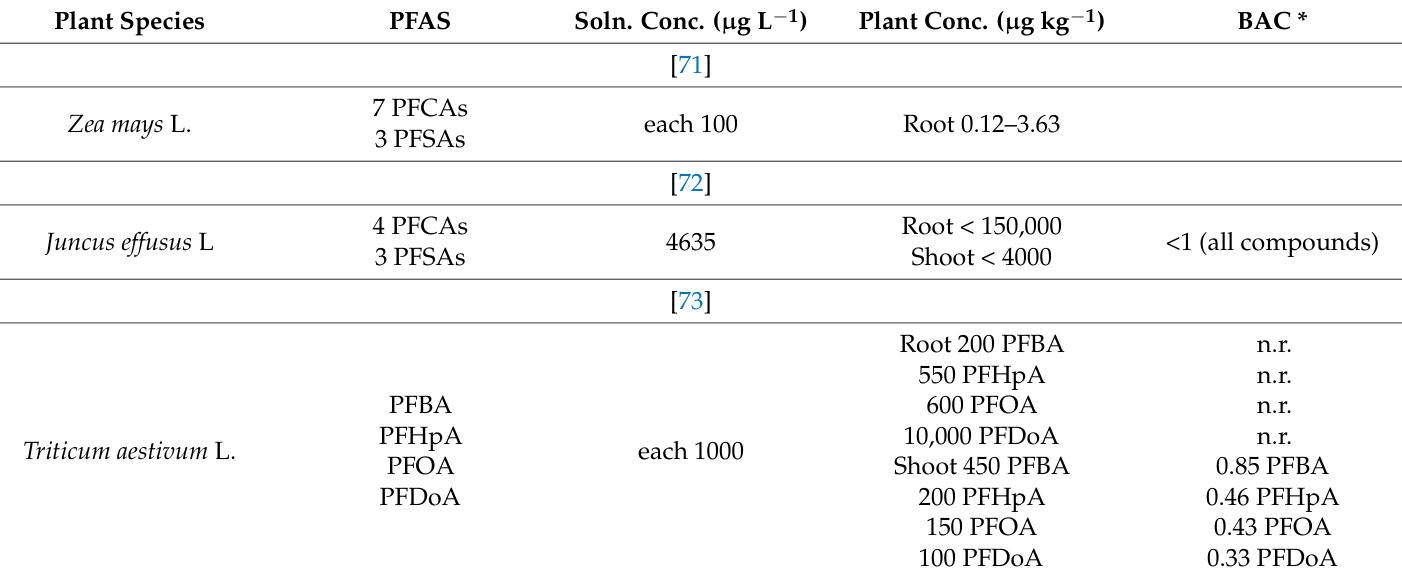
| Plant Species植物物种 | PFASPFAS | Soln. Conc. (µg L−1)溶液浓度(µg L−1) | Plant Conc. (µg kg−1)植物浓度(µg kg−1) | BAC * |
|---|---|---|---|---|
| [74] | ||||
| _Salix_sp. | 9 PFCAs 2 PFSAs | each 10 | Root 10–300 Shoot 5–315 | 0.5 (PFDA)-31.5 (PFBA) |
| [18] | ||||
| _Festuca rubra_L. | 1146 (PFOS)-21,882 (PFPeA) | 11 (PFOS)-111 (PFPeA) | ||
| Cynodon dactylon(L.) Pers. | 220 (PFOS)-4642 (PFPeA) | 2.0 (PFOS)-22 (PFPeA) | ||
| Schedonorus arundinaceus Schreb. | 264 (PFOS)-14,780 (PFPeA) | 1.4 (PFBS)-71 (PFPeA) | ||
| _Helianthus annuus_L. | 78 (PFOS)-3937 (PFPeA) | 0.7 (PFOS)-18 (PFPeA) | ||
| _Brassica juncea_L. | 424 (PFOS)-13,030 (PFPeA) | 3.7 (PFOS)-60 (PFPeA) | ||
| _Amaranthus tricolor_L. | 326 (PFBS)-38,121 (PFPeA) | 2.6 (PFBS)-176 (PFPeA) | ||
| _Equisetum hyemale_L. | 40 (PFBS)-32,032 (PFPeA) | 0.3 (PFBS)-147 (PFPeA) | ||
| _Salix nigra_Marshall | 890 | Leaf 556 (PFOS)-31,646 (PFPeA) Stem 11 (PFOS)-373 | 5.2 (PFOS)-156 (PFPeA) n.r. | |
| PFHxS | 850 | (PFPeA) | ||
| PFOS | 940 | Leaf 1 (PFOS, | ||
| Fraxinus pennsylvanica | PFOA | 1600 | PFOA)-169 (PFPeA) | <0.3 (all compounds) |
| Marshall | PFPeA | 2100 | Stem 21 (PFOS)-379 | n.r. |
| PFHxA | 920 | (PFPeA) | ||
| _Pinus taeda_L. | PFBS | Solution irrigated onto sand columns | Leaf 13 (PFOS)-964 (PFPeA) Stem 1 (PFBS)-3 (PFPeA) | 0.1 (PFOS)-4.9 (PFPeA) n.r. |
| _Betula nigra_L. | Leaf 1759 (PFOS)-28,496 (PFPeA) | 9.8 (PFBS)-142 (PFPeA) | ||
| _Liquidambar styraciflua_L. | Leaf 392 (PFOS)-2070 (PFPeA) Stem 7 (PFAS)-981 (PFPeA) | 2.6 (PFBS)-11 (PFOA) n.r. | ||
| _Platanus occidentalis_L. | Leaf 262 (PFOS)-17,838 (PFPeA) Stem 2 (PFAS)-83 (PFPeA) | 2.5 (PFOS)-90 (PFPeA) n.r. | ||
| Leaf 814 (PFOS)-35,975 | ||||
| _Liriodendron tulipifera_L. | (PFPeA) Stem 1 (PFOS, PFAS, PFBS)-1276 (PFPeA) | n.r. |
* Bioaccumulation coefficient (BAC), Perfluorobutanoic acid (PFBA), Perfluorobutane sulfonic acid (PFBS), Perfluorodecanoic acid (PFDA), Perfluorododecanoic acid (PFDoA), Perfluoroheptanoic acid (PFHpA), Perfluorohexanoic acid (PFHxA), Perfluorohexane sulfonic acid (PFHxS), Perfluorononanoic acid (PFNA), Perfluorooctanoic acid (PFOA), Perfluorooctane sulfonic acid (PFOS), Perfluoropentanoic acid (PFPeA), Perfluoroundecanoic acid (PFUnA). n.r. = not reported.
* 生物累积系数(BAC),全氟丁酸(PFBA),全氟丁烷磺酸(PFBS),全氟癸酸(PFDA),全氟十二酸(PFDoA),全氟庚酸(PFHpA),全氟己酸(PFHxA),全氟己烷磺酸(PFHxS),全氟壬酸(PFNA),全氟辛酸(PFOA),全氟辛烷磺酸(PFOS),全氟戊酸(PFPeA),全氟十一酸(PFUnA)。n.r. = 未报道。
| Plant Species植物物种 | PFASPFAS | Treatment and Soil Conc. (µg kg−1)处理与土壤 浓度(µg kg−1) | Plant Conc. (µg kg−1)植物浓度(µg kg−1) | BAC * |
|---|---|---|---|---|
| [75] | ||||
| _Daucus carota_L. | PFOS, PFOA | Spiked soil + compost PFOA 500 PFOS 500 | Peel 250 PFOA 175 PFOS Core 146 PFOA 201 PFOS | 0.2–0.61 PFOA 0.10–0.58 PFOS 0.05–0.36 PFOA 0.10–0.64 PFOS |
| Leaves 999 PFOA 664 PFOS | 0.80–3.43 PFOS 0.62–2.26 PFOS | |||
| _Lactuca sativa_L. | PFOS, PFOA | Spiked soil + compost PFOA 500 | Heart 2540 PFOA 1680 PFOS Leaves 1030 PFOA 77 PFOS | 4.19–4.87 PFOA 2.94–3.49 PFOS 1.59–2.13 PFOA 0.11–0.19 PFOS |
| [76] | ||||
| _Zea mays_L. | PFOS, PFOA | Spiked soil each 1000 | Straw: 126 PFOA 104 PFOS Corn: 4 PFOA 3 PFOS | 0.126 PFOA 0.104 PFOS 0.004 PFOA 0.003 PFOS |
| _Triticum sativum_L. | PFOS, PDOA | each 1000 | Straw: 1900 PFOA 270 PFOS Corn: 9 PFOA <0.1 PFOS | 1.9 PFOA 0.27 PFOS 0.009 PFOA <0.1 PFOS |
| [77] | ||||
| _Zea mays_L. | 7 PFCAs 3 PFSAs | Spiked soil 250 and 1000 each | Straw 500 (PFDA)-35,000 (PFBA) | 0.04 (PFDA)-35.2 (PFBA) |
| Kernel <LOQ-380 (PFPeA) | <LOQ-0.38 (PFPeA) | |||
| * Bioaccum i l l Perfluorooc l l Table 4. R i | ulation coefficient (BAC), Perfluor l ltane sulfonic acid (PFOS), Perfluo l esponse of plants to PFAS com i Treatment and Soil Conc | i loalkyl carboxylic acids (PFCAs), Pel l lroalkyl sulfonates (PFSAs), Perfluoro pounds * in field experiments. | i l rfluorooctanoic acid (PF l l lpentanoic acid (PFPeA). | |
| Plant Species | PFAS | . (µg kg−1) | Plant Conc. (µg kg−1) | BAC * |
| [78] | ||||
| _Triticum aestivum_L. | Nine PFCAs Three PFSAs | Biosolids amended soils PFSAs 41.4–220 | Root 140–472 (ΣPFAAs) Straws 36.2–178 (ΣPFAAs) Husks 6.15–37.8 (ΣPFAAs) Grains 7.32–35.6 (ΣPFAAs) | 1.19–5.18 (ΣPFAAs) 0.24–2.56 (ΣPFAAs) 0.05–0.86 (ΣPFAAs) 0.06–0.92 (ΣPFAAs) |
| [79] | ||||
| _Zea mays_L. | PFOA, PFOS | Spiked soil PFOA ca. 180 PFOS ca. 3000 | Shoot: 6.4–7.4 PFOA Shoot: 94–307 PFOS | 0.022–0.024 PFOA 0.028–0.063 PFOS |
| _Lolium perenne_L. | PFOA, PFOS | Spiked soil PFOA ca. 380 PFOS ca. 3150 | Shoot: 254–304 PFOA Shoot: 435–1195 PFOS | 0.548-0.872 PFOA 0.130-0.255 PFOS |
* Bioaccumulation coefficient (BAC), Perfluoroalkyl carboxylic acids (PFCAs), Perfluorooctanoic acid (PFOA), Perfluorooctane sulfonic acid (PFOS), Perfluoroalkyl sulfonates (PFSAs), Perfluoropentanoic acid (PFPeA).
* 生物累积系数(BAC),全氟烷基羧酸(PFCAs),全氟辛酸(PFOA),全氟辛烷磺酸(PFOS),全氟烷基磺酸盐(PFSAs),全氟戊酸(PFPeA)。
* Bioaccumulation coefficient (BAC), Perfluoroalkyl carboxylic acids (PFCAs), Perfluorooctanoic acid (PFOA), Perfluorooctane sulfonic acid (PFOS), Perfluoroalkyl sulfonates (PFSAs). Sum of total perfluoroalkyl acids (ΣPFAAs).
* 生物累积系数(BAC),全氟烷基羧酸(PFCAs),全氟辛酸(PFOA),全氟辛烷磺酸(PFOS),全氟烷基磺酸盐(PFSAs)。全氟烷基酸总和(ΣPFAAs)。
In hydroponic experiments with Zea mays, Krippner et al. [71] reported that BAC decreased at increasing pH, i.e., at pH 5, the uptake of PFDA was significantly higher than at pH 7. They showed that the BACs and TCs short-chain PFASs are higher than long-chain PFAS. Felizeter [80] proposed two mechanisms for the uptake of PFAAs in lettuce: (1) sorption to the tissue between the root surface and the Casparian strip and (2) uptake across the Casparian strip and translocate within plants via vascular tissue. Zhang et al. [81] reported that the sorption to plant tissues between the root surface and the Casparian strip is the dominant process for the uptake of long-chain PFAAs (e.g., PFOS) in Juncus effusus, while uptake across the Casparian strip into the vascular tissue might be considered the most relevant mechanism for short-chain PFAAs. Krippner et al. (2014) showed that short-chain PFAAs generally had a TC > 1, thus transferred predominantly and at higher concentrations to the shoots, while long-chain PFAAs displayed a TC < 1, thus being mainly retained in the roots. Similar findings were published by [74] for willow (Salix eleagnos L., S. purpurea L. and S. triandra L.), by [82] for Bromus diandrus, by Zhao et al. (2016) for wheat (Triticum aestivum L.), by [72] for Juncus effusus and by [83] for lettuce (Lactuca sativa), which showed that shorter-chain PFAAs were more readily transferred from roots to shoots compared to longer chain PFAAs. The translocation from roots to shoots occurs primarily in the xylem of plants and transpiration is the driving force for nutrient translocation in the xylem. Short-chain PFAAs display a high solubility in water and weak sorption to organic materials [57], thereby facilitating their translocation via transpiration stream to the leafy parts where they accumulate. In contrast, long-chain PFAS, with relatively higher hydrophobicity and lipophilicity tend to be more effectively retained in the roots by the Casparian strip, due to greater interactions with biological macromolecules (e.g., protein, lipid), resulting in their limited upward translocation during transpiration process [41,78,81,83,84].
在Zea mays的水培试验中,Krippner et al. [71]报道BAC随pH升高而降低,即在pH 5时PFDA的吸收量显著高于pH 7时。他们还表明,短链PFAS的BAC和TC均高于长链PFAS。Felizeter [80]提出了莴苣吸收PFAAs的两种机制:(1) 吸附于根表面与凯氏带之间的组织;(2) 跨越凯氏带吸收并经维管组织在植物体内转运。Zhang et al. [81]报道,在Juncus effusus中,吸附于根表面与凯氏带之间的植物组织是长链PFAAs(如PFOS)吸收的主要过程,而跨越凯氏带进入维管组织可能是短链PFAAs最主要的吸收机制。Krippner et al. (2014)表明,短链PFAAs的TC通常> 1,因而主要以较高浓度转运至地上部,而长链PFAAs的TC < 1,因而主要滞留于根部。[74]对柳树(Salix eleagnos L.、S. purpurea L.和S. triandra L.)、[82]对Bromus diandrus、Zhao et al. (2016)对小麦(Triticum aestivum L.)、[72]对Juncus effusus以及[83]对莴苣(Lactuca sativa)也发表了类似结果,表明与长链PFAAs相比,短链PFAAs更易从根部转运至地上部。从根部向地上部的转运主要发生在植物木质部中,而蒸腾作用是木质部中养分转运的驱动力。短链PFAAs具有较高的水溶性,且对有机物质的吸附较弱[57],从而便于其随蒸腾流转运至叶片部位并在其中累积。相反,长链PFAS具有相对较高的疏水性和亲脂性,由于与生物大分子(如蛋白质、脂质)的相互作用更强,往往更有效地被凯氏带滞留于根部,导致其在蒸腾过程中的向上转运受限[41,78,81,83,84]。
5Phytomanagement of PFAS-Contaminated SoilsPFAS污染土壤的植物管理
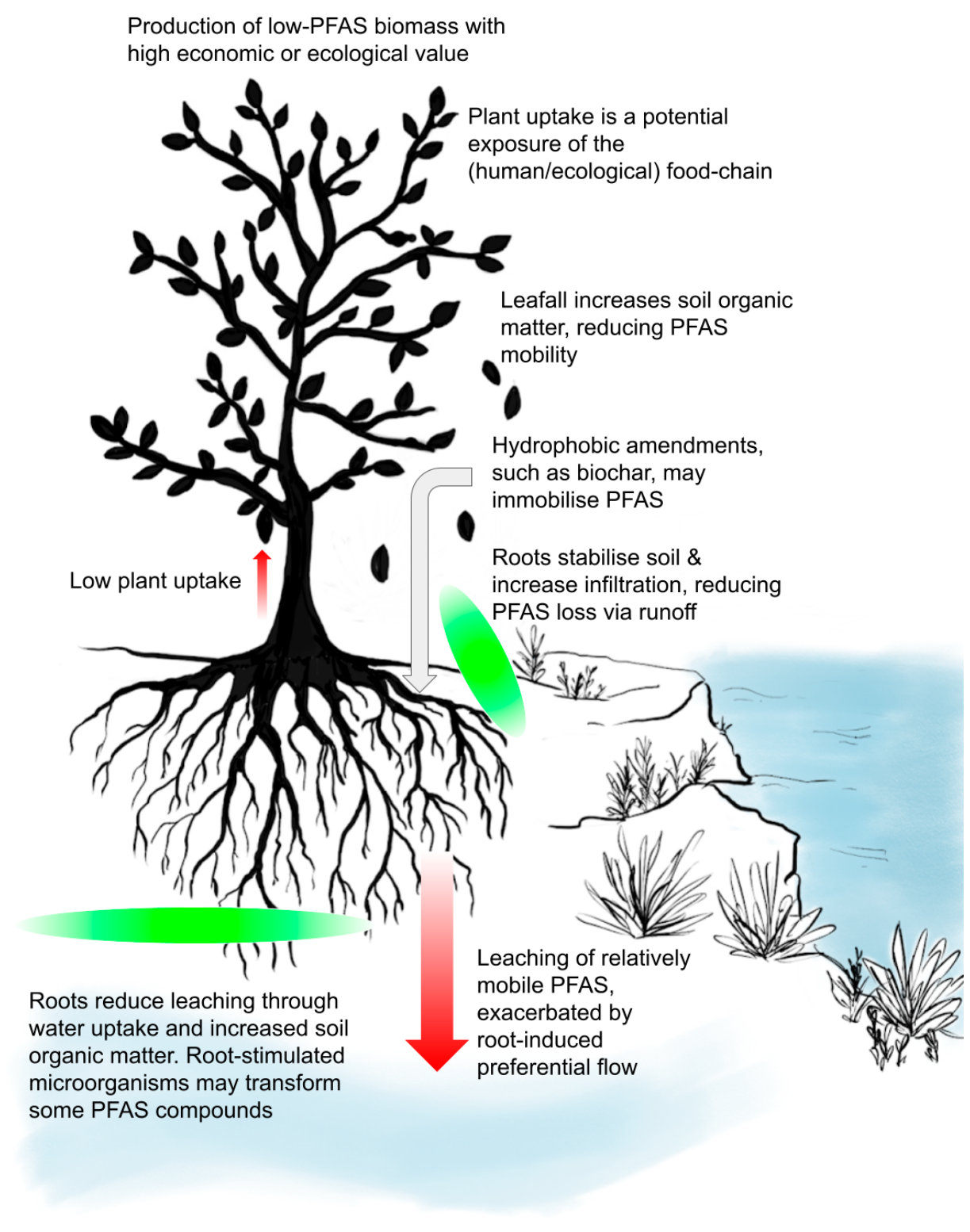
PFAS phytomanagement should mitigate any human or ecological risk of the PFAS in the soil while returning a profit from the land. The selection of appropriate plant species and soil conditioners is critical in achieving this aim because some plants may exacerbate PFAS-mobility (Figure 1). PFAS-contaminated soils pose a potential risk to humans and ecosystems through plant uptake and the entry of PFAS compounds into the (human) food chain. A key first step in PFAS phytomanagement is the identification of:
PFAS植物管理应在从土地获得收益的同时,减轻土壤中PFAS对人类或生态的任何风险。选择适当的植物物种和土壤调理剂对于实现这一目标至关重要,因为某些植物可能加剧PFAS的迁移(图1)。PFAS污染土壤通过植物吸收以及PFAS化合物进入(人类)食物链,对人类和生态系统构成潜在风险。PFAS植物管理的关键第一步是确定:
- • The PFAS compounds present and their concentrations.• 存在的PFAS化合物种类及其浓度。
- • The geographical extent of the PFAS contamination.• PFAS污染的地理范围。
- • The concentrations of any co-contaminants that may be present, especially trace elements such as Cd, which may become mobile in the soil-plant system during phytomanagement.• 可能存在的任何共存污染物的浓度,尤其是Cd等微量元素,这些元素在植物管理过程中可能在土壤-植物系统中发生迁移。
- • The likely exposure pathways through which PFAS compounds may affect humans or ecosystems.• PFAS化合物可能影响人类或生态系统的暴露途径。
As with other contaminants, direct consumption of soil, either intentionally (pica children) or unintentionally (dust inhalation or dust on consumed food) can result in increased PFAS uptake in humans [85]. Successful phytomanagement should mitigate the leaching of PFAS into receiving waters. Soil, including agricultural land, can be a source of PFAS contamination in waterways, which may then be used as drinking water or for irrigation. Contaminated agricultural land is the most important source of elevated PFAS concentrations in the Ruhr River, which is a tributary of the Rhine [86]. In the United States, up to 80 million people consume drinking water with >10 ng L−1 PFOA and PFOS [87].
与其他污染物一样,直接摄入土壤,无论是有意的(异食癖儿童)还是无意的(吸入粉尘或食用附着粉尘的食物),均可导致人体PFAS摄入量增加[85]。成功的植物管理应能减轻PFAS向受纳水体的淋溶。土壤(包括农业用地)可成为水道中PFAS污染的来源,而这些水随后可能被用作饮用水或灌溉用水。受污染的农业用地是鲁尔河(莱茵河的支流)PFAS浓度升高的最重要来源[86]。在美国,多达8000万人饮用的水中PFOA和PFOS含量>10 ng L−1[87]。
The success of phytomanagement will depend, to some extent, on the types of PFAS compounds present. The few examples of soils contaminated with PFAS compounds with a low-mobility and toxicity, for example, PTFE, may permit a wide range of species to be used to manage the site. However, in most PFAS-contaminated sites where the compounds present have high mobility and are resistant to degradation, phytomanagement should aim to limit PFAS mobility through hydraulic control and maximization of soil carbon levels. The roots stabilize soil, reducing erosion [88] and decreasing runoff by increasing infiltration. Soil amendments including composts, lignite coal [89], or biochar [90], may be particularly effective because they contain hydrophobic components [91] that may immobilize PFAS by binding to the CF-dominated nonpolar tail. Plant species, such as grasses, that promote the accumulation of soil carbon may be preferred over trees, which may result in depletion of soil carbon, even if greater evapotranspiration from trees may reduce water flux through the soil [92]. Plowing and the use of mineral fertilizers should be minimized as these practices reduce soil carbon [93] and may increase dust, which may transport PFAS-compounds offsite.
植物管理的成功在一定程度上取决于所存在PFAS化合物的类型。在少数受低迁移性、低毒性PFAS化合物(例如PTFE)污染的土壤中,可选用多种物种对场地进行管理。然而,在大多数PFAS污染场地中,所存在的化合物具有高迁移性且难以降解,植物管理应旨在通过水力控制和最大化土壤碳水平来限制PFAS的迁移。根系可稳定土壤、减少侵蚀[88],并通过增加入渗来减少地表径流。堆肥、褐煤[89]或生物炭[90]等土壤改良剂可能尤为有效,因为它们含有疏水组分[91],可通过与以CF为主的非极性尾链结合而固定PFAS。促进土壤碳累积的植物物种(如禾草)可能优于树木,因为树木可能导致土壤碳耗竭,尽管树木较强的蒸散作用可能减少通过土壤的水通量[92]。应尽量减少翻耕和矿质肥料的使用,因为这些措施会降低土壤碳[93],并可能增加扬尘,而扬尘可能将PFAS化合物带离场地。
5.1. Use of Crop Plants in Phytomanagement5.1. 农作物在植物管理中的应用
If food or fodder crops are to be used as part of a phytomanagement solution for contaminated land, then the products they generate must not contain unacceptable PFAS concentrations. The European Food Safety Authority has opined that the Tolerable Weekly
如果将粮食或饲料作物作为污染土地植物管理方案的一部分,则其产出的产品中PFAS浓度必须在可接受范围内。欧洲食品安全局认为,PFOS和PFOA的每周耐受
Intake (TWI) for PFOS and PFOA should be 13 ng kg−1 b.w. and 6 ng kg−1 b.w. respectively [94]. This value may be exceeded if crops are irrigated with water that meets the current USEPA’s health advisory guideline of 70 ng L−1 [95]. Plant uptake experiments in greenhouse and field conditions (Tables 3 and 4, respectively) indicate that when grown in PFAS-contaminated soil, plant uptake of PFOS and PFOA can exceed >1000 µg kg−1. This indicates that consumption of just a few grams of this material would be sufficient to exceed the TWI. Given BACs in the range of 0.1–3, and weekly consumption of 250 g (d.w.) of a crop, then the threshold soil concentrations for food safety would be 1.2–36.4 µg kg−1 for PFOS and 0.56–16.8 µg kg−1 for PFOA. Most of the soils described in Section 3.1 exceed these concentrations, indicating that if phytomanagement is to generate a profit from PFAS-contaminated land, it cannot occur using crop plants that would be consumed by humans. Instead, phytomanagement must employ plant species that generate valuable products such as timber, that are either outside the human food chain or have produced products such as honey or essential oils that are consumed in insufficient quantities to pose a human health risk. Such products would need to be extensively tested to ensure PFAS concentrations did not pose a human health risk. While there is a growing body of literature on PFAS in agricultural plants [96], there is a lacuna of information on the BACs for plants that may be used for ecological restoration of PFAS-contaminated soils, for example in the construction of green corridors or green spaces in urban areas.
摄入量(TWI)应分别为13 ng kg−1体重和6 ng kg−1体重[94]。如果用符合美国环保署(USEPA)现行健康建议指导值70 ng L−1[95]的水灌溉作物,则可能超过这一数值。温室和田间条件下的植物吸收试验(分别见表3和表4)表明,在PFAS污染土壤中生长时,植物对PFOS和PFOA的吸收量可超过>1000 µg kg−1。这表明仅食用几克此类材料便足以超过TWI。若BAC在0.1–3范围内,且每周食用250 g(干重)作物,则基于食品安全的土壤浓度阈值对于PFOS为1.2–36.4 µg kg−1,对于PFOA为0.56–16.8 µg kg−1。3.1节中所述的大多数土壤均超过这些浓度,这表明若要通过植物管理从PFAS污染土地上获利,则不能使用供人类食用的农作物。相反,植物管理必须采用能产出有价值产品(如木材)的植物物种,这些产品或处于人类食物链之外,或为蜂蜜、精油等食用量不足以构成人体健康风险的产品。此类产品需经过广泛检测,以确保其PFAS浓度不构成人体健康风险。尽管关于农业植物中PFAS的文献日益增多[96],但对于可用于PFAS污染土壤生态修复(例如城市绿色廊道或绿地建设)的植物,其BAC信息仍十分缺乏。
5.2. PFAS Phytoextraction Is Likely Infeasible5.2. PFAS植物提取可能不可行
Potentially, successive crops of plants that take up high concentrations of PFAS could be used to extract PFAS-compounds from contaminated soil, eventually leading to soils with PFAS-concentrations within acceptable limits. For example, growing crops of Salix viminalis (assuming a BAC of 3.0 and a removable biomass production of 10 t ha−1 yr−1) on soil contaminated with 1000 µg kg−1 PFOA (down to 0.15 m) would require 65 years (assuming annual coppicing) to halve the soil PFOS concentration, which would still be >20 fold higher than concentrations shown to result in unacceptable concentrations in food crops (Section 3.1). Remediations are increased by contaminant heterogeneity as well as co-contamination [22]. If phytoextraction can be combined with the generation of e.g., bioenergy, then these cleanup times may be unimportant [33]. One advantage that PFAS phytoextraction may have over the phytoextraction of trace elements is that incineration of the PFAS-containing biomass may destroy the PFAS, hence reducing the disposal costs of the resultant ash. Nevertheless, the long-term intensive management required for phytoextraction is likely to make this option more expensive than other remediation methods. Therefore, similar trace element phytoextraction, PFAS phytoextraction may find little commercial application [22] unless the BACs for PFAS compounds can be increased by an order of magnitude.
理论上,可连续种植能高浓度吸收PFAS的植物,从污染土壤中提取PFAS化合物,最终使土壤PFAS浓度降至可接受限值以内。例如,在受1000 µg kg−1 PFOA污染(深至0.15 m)的土壤上种植Salix viminalis(假设BAC为3.0,可移除生物量产量为10 t ha−1 yr−1),需要65年(假设每年平茬)才能使土壤PFOS浓度减半,而此时的浓度仍比已证实会导致粮食作物中浓度不可接受的水平高>20倍(3.1节)。污染物的异质性以及复合污染会延长修复时间[22]。如果植物提取能与生物能源生产等相结合,则这些修复时间可能变得无关紧要[33]。与微量元素的植物提取相比,PFAS植物提取的一个优势在于焚烧含PFAS的生物质可能破坏PFAS,从而降低所产生灰分的处置成本。然而,植物提取所需的长期集约化管理可能使该方案比其他修复方法更昂贵。因此,与微量元素植物提取类似,除非PFAS化合物的BAC能提高一个数量级,否则PFAS植物提取可能鲜有商业应用[22]。
6Conclusions结论
Given the recalcitrance of most PFAS compounds, it is unlikely that phytomanagement will result in site clean-up, either through in situ degradation or by phytoextraction, in a timeframe that is relevant to the economic cycle (<100 years). The presence of co-contaminants, such as trace elements, will only increase clean-up times. Therefore, phytomanagement should focus on minimizing the mobility of PFAS compounds while maximizing profits from the land. Crop plants with low BACs may still exceed current Food Safety Standards and should therefore not be used. There is insufficient information to determine whether crop plants could be safely used as animal fodder, however, negative public perception may limit the viability of food produced on contaminated land, and this perception may detrimentally affect food profitability in the entire region. In contrast, low BAC non-food crops, timber species, or native vegetation may be usefully employed for phytomanagement to limit human and food chain exposure to PFAS. Future work should identify plant species and soil amendments that reduce water flux through soil, as well as increase the hydrophobic components in soil that may bind the C-F-dominated tails of PFAS compounds. Soil conditioners such as biochar, with significant hydrophobic components, may mitigate the leaching of PFAS into receiving waters. A critical research gap is the interactions of PFAS with soil microbiota and whether secondary metabolites such as glomalin may immobilize PFAS in soil.
鉴于大多数PFAS化合物的难降解性,植物管理不太可能在与经济周期相关的时间框架内(<100年)通过原位降解或植物提取实现场地清理。微量元素等共存污染物的存在只会延长清理时间。因此,植物管理应侧重于在最大化土地收益的同时最小化PFAS化合物的迁移性。BAC较低的农作物仍可能超过现行食品安全标准,因此不应使用。目前尚无足够信息确定农作物能否安全地用作动物饲料;然而,负面的公众认知可能限制污染土地所产食品的市场可行性,且这种认知可能对整个地区的食品盈利能力产生不利影响。相比之下,BAC较低的非粮食作物、用材树种或本土植被可有效用于植物管理,以限制人类和食物链对PFAS的暴露。未来的研究应筛选能够减少通过土壤的水通量、同时增加土壤中可结合PFAS化合物以C-F为主的尾链的疏水组分的植物物种和土壤改良剂。具有大量疏水组分的土壤调理剂(如生物炭)可减轻PFAS向受纳水体的淋溶。一个关键的研究空白是PFAS与土壤微生物群的相互作用,以及球囊霉素等次生代谢产物能否将PFAS固定于土壤中。
Author Contributions: M.W.H.E. and B.H.R. co-wrote the manuscript. All authors have read and agreed to the published version of the manuscript.
作者贡献:M.W.H.E.和B.H.R.共同撰写了本文稿。所有作者均已阅读并同意发表版本的文稿。
Funding: This work is derived from the Centre for Integrated Biowaste Research funded by Strategic Science Investment Funding from Ministry of Business, Innovation and Employment, New Zealand (contract C03 × 1701).
基金资助:本研究源自综合生物废弃物研究中心(Centre for Integrated Biowaste Research),该中心由新西兰商业、创新与就业部战略科学投资基金资助(合同号C03 × 1701)。
Institutional Review Board Statement: Not applicable.
机构审查委员会声明:不适用。
Informed Consent Statement: Not applicable.
知情同意声明:不适用。
Data Availability Statement: Not applicable.
数据可用性声明:不适用。
Acknowledgments: The authors gratefully acknowledge the Centre for Integrated Biowaste Research.
致谢:作者衷心感谢Centre for Integrated Biowaste Research的支持。
Conflicts of Interest: The funders had no role in the design of the study; in the collection, analyses, or interpretation of data; in the writing of the manuscript, or in the decision to publish the results.
利益冲突:资助方未参与本研究的设计,数据的收集、分析或解释,稿件的撰写,以及发表结果的决定。
References参考文献
1. Wang, Z.; DeWitt, J.C.; Higgins, C.P.; Cousins, I.T. A Never-Ending Story of Per- and Polyfluoroalkyl Substances (PFASs)? Environ. Sci. Technol. 2017, 51, 2508–2518. [CrossRef] [PubMed]
2. Lewis, A.J.; Joyce, T.; Hadaya, M.; Ebrahimi, F.; Dragiev, I.; Giardetti, N.; Yang, J.; Fridman, G.; Rabinovich, A.; Fridman, A.A.; et al. Rapid Degradation of PFAS in Aqueous Solutions by Reverse Vortex Flow Gliding Arc Plasma. Environ. Sci. Water Res. Technol. 2020, 6, 1044–1057. [CrossRef]
3. Prevedouros, K.; Cousins, I.T.; Buck, R.C.; Korzeniowski, S.H. Sources, Fate and Transport of Perfluorocarboxylates. Environ. Sci. Technol. 2006, 40, 32–44. [CrossRef] [PubMed]
4. ITRC. History and Use of Per- and Polyfluoroalkyl Substances (PFAS); Interstate Technology & Regulatory Council: Washington, DC, USA, 2017.
5. Sunderland, E.M.; Hu, X.C.; Dassuncao, C.; Tokranov, A.K.; Wagner, C.C.; Allen, J.G. A Review of the Pathways of Human Exposure to Poly- and Perfluoroalkyl Substances (PFASs) and Present Understanding of Health Effects. J. Expo. Sci. Environ. Epidemiol. 2019, 29, 131–147. [CrossRef] [PubMed]
6. Nelson, J.W.; Hatch, E.E.; Webster, T.F. Exposure to Polyfluoroalkyl Chemicals and Cholesterol, Body Weight, and Insulin Resistance in the General U.S. Population. Environ. Health Perspect. 2010, 118, 197–202. [CrossRef] [PubMed]
7. Lopez-Espinosa, M.-J.; Mondal, D.; Armstrong, B.; Bloom, M.S.; Fletcher, T. Thyroid Function and Perfluoroalkyl Acids in Children Living Near a Chemical Plant. Environ. Health Perspect. 2012, 120, 1036–1041. [CrossRef]
8. Darrow, L.A.; Stein, C.R.; Steenland, K. Serum Perfluorooctanoic Acid and Perfluorooctane Sulfonate Concentrations in Relation to Birth Outcomes in the Mid-Ohio Valley, 2005–2010. Environ. Health Perspect. 2013, 121, 1207–1213. [CrossRef]
9. Steenland, K.; Zhao, L.; Winquist, A.; Parks, C. Ulcerative Colitis and Perfluorooctanoic Acid (PFOA) in a Highly Exposed Population of Community Residents and Workers in the Mid-Ohio Valley. Environ. Health Perspect. 2013, 121, 900–905. [CrossRef] 10. Barry, V.; Winquist, A.; Steenland, K. Perfluorooctanoic Acid (PFOA) Exposures and Incident Cancers among Adults Living Near a Chemical Plant. Environ. Health Perspect. 2013, 121, 1313–1318. [CrossRef]
11. Clara, M.; Scharf, S.; Weiss, S.; Gans, O.; Scheffknecht, C. Emissions of Perfluorinated Alkylated Substances (PFAS) from Point Sources—Identification of Relevant Branches. Water Sci. Technol. 2008, 58, 59–66. [CrossRef]
12. Trier, X.; Granby, K.; Christensen, J.H. Polyfluorinated Surfactants (PFS) in Paper and Board Coatings for Food Packaging. Environ. Sci. Pollut. Res. 2011, 18, 1108–1120. [CrossRef] [PubMed]
13. Fujii, Y.; Harada, K.H.; Koizumi, A. Occurrence of Perfluorinated Carboxylic Acids (PFCAs) in Personal Care Products and Compounding Agents. Chemosphere 2013, 93, 538–544. [CrossRef] [PubMed]
14. Trier, D.X.; Xenia Trier, D.; Taxvig, C.; Rosenmai, A.K.; Pedersen, G.A. PFAS in Paper and Board for Food Contact; Nordic Council of Ministers: Ceopenhagen, Denmark, 2017; p. 573.
15. Delschen, T.; Barkowski, D.; Hachen, J.; Jungmann, A.; Leuchs, W.; Pape, R.; Raecke, F.; Schroers, S.; Susset, B. Bodenbelastungen Nach Aufbringung PFT-Haltiger Abfälle in Nordrhein-Westfalen; Erich Schmidt Verlag: Berlin, Germany, 2007.
16. Hölzer, J.; Midasch, O.; Rauchfuss, K.; Kraft, M.; Reupert, R.; Angerer, J.; Kleeschulte, P.; Marschall, N.; Wilhelm, M. Biomonitoring of Perfluorinated Compounds in Children and Adults Exposed to Perfluorooctanoate-Contaminated Drinking Water. Environ. Health Perspect. 2008, 116, 651–657. [CrossRef]
17. Goldenman, G.; Fernandes, M.; Holland, M.; Tugran, T.; Nordin, A.; Schoumacher, C.; McNeill, A. The Cost of Inaction: A Socioeconomic Analysis of Environmental and Health Impacts Linked to Exposure to PFAS; Nordic Council of Ministers: Copenhagen, Denmark, 2019. ISBN 9789289360654.
18. Huff, D.K.; Morris, L.A.; Sutter, L.; Costanza, J.; Pennell, K.D. Accumulation of Six PFAS Compounds by Woody and Herbaceous Plants: Potential for Phytoextraction. Int. J. Phytoremediat. 2020, 22, 1538–1550. [CrossRef] [PubMed]
19. Gobelius, L.; Lewis, J.; Ahrens, L. Plant Uptake of Per- and Polyfluoroalkyl Substances at a Contaminated Fire Training Facility to Evaluate the Phytoremediation Potential of Various Plant Species. Environ. Sci. Technol. 2017, 51, 12602–12610. [CrossRef]
20. Bolan, N.; Sarkar, B.; Yan, Y.; Li, Q.; Wijesekara, H.; Kannan, K.; Tsang, D.C.W.; Schauerte, M.; Bosch, J.; Noll, H.; et al. Remediation of Poly-and Perfluoroalkyl Substances (PFAS) Contaminated Soils–To Mobilize or to Immobilize or to Degrade? J. Hazard. Mater. 2021, 401, 123892. [CrossRef]
21. Mahinroosta, R.; Senevirathna, L. A Review of the Emerging Treatment Technologies for PFAS Contaminated Soils. J. Environ. Manag. 2020, 255, 109896. [CrossRef]
22. Robinson, B.H.; Anderson, C.W.N.; Dickinson, N.M. Phytoextraction: Where’s the Action? J. Geochem. Explor. 2015, 151, 34–40. [CrossRef]
23. Newman, L.A.; Reynolds, C.M. Phytodegradation of Organic Compounds. Curr. Opin. Biotechnol. 2004, 15, 225–230. [CrossRef] 24. Domínguez, M.T.; Marañón, T.; Murillo, J.M.; Schulin, R.; Robinson, B.H. Trace Element Accumulation in Woody Plants of the Guadiamar Valley, SW Spain: A Large-Scale Phytomanagement Case Study. Environ. Pollut. 2008, 152, 50–59. [CrossRef]
25. Cunningham, S.D.; Berti, W.R.; Huang, J.W. Phytoremediation of Contaminated Soils. Trends Biotechnol. 1995, 13, 393–397. [CrossRef]
26. Robinson, B.H.; Bañuelos, G.; Conesa, H.M.; Evangelou, M.W.H.; Schulin, R. The Phytomanagement of Trace Elements in Soil. CRC Crit. Rev. Plant Sci. 2009, 28, 240–266. [CrossRef]
27. Butt, C.M.; Muir, D.C.G.; Mabury, S.A. Biotransformation Pathways of Fluorotelomer-Based Polyfluoroalkyl Substances: A Review. Environ. Toxicol. Chem. 2014, 33, 243–267. [CrossRef] [PubMed]
28. Wang, F.; Lu, X.; Li, X.-Y.; Shih, K. Effectiveness and Mechanisms of Defluorination of Perfluorinated Alkyl Substances by Calcium Compounds during Waste Thermal Treatment. Environ. Sci. Technol. 2015, 49, 5672–5680. [CrossRef] [PubMed]
29. Kissa, E. Fluorinated Surfactants and Repellents, 2nd ed.; Taylor & Francis: Abingdon, UK, 2001; ISBN 9780824704728.
30. Vierke, L.; Berger, U.; Cousins, I.T. Estimation of the Acid Dissociation Constant of Perfluoroalkyl Carboxylic Acids through an Experimental Investigation of Their Water-to-Air Transport. Environ. Sci. Technol. 2013, 47, 11032–11039. [CrossRef] 31. Stock, N.L.; Muir, D.C.G.; Mabury, S. Perfluoroalkyl Compounds. In Persistent Organic Pollutants; John Willey & Sons: Chichester, UK, 2009; pp. 25–69.
32. Jahnke, A.; Ahrens, L.; Ebinghaus, R.; Temme, C. Urban versus Remote Air Concentrations of Fluorotelomer Alcohols and Other Polyfluorinated Alkyl Substances in Germany. Environ. Sci. Technol. 2007, 41, 745–752. [CrossRef]
33. Evangelou, M.W.H.; Papazoglou, E.G.; Robinson, B.H.; Schulin, R. Phytomanagement: Phytoremediation and the Production of Biomass for Economic Revenue on Contaminated Land. In Phytoremediation: Management of Environmental Contaminants; Ansari, A.A., Gill, S.S., Gill, R., Lanza, G.R., Newman, L., Eds.; Springer International Publishing: Cham, Switzerland, 2015; Volume 1, pp. 115–132, ISBN 9783319103952.
34. Hartley, W.; Dickinson, N.M.; Riby, P.; Shutes, B. Sustainable Ecological Restoration of Brownfield Sites through Engineering or Managed Natural Attenuation? A Case Study from Northwest England. Ecol. Eng. 2012, 40, 70–79. [CrossRef]
35. Schroers, S. PFC-Bewertungsmaßstäbe in NRW; LANUV NRW: Augsburg, Germany, 2017.
36. Schroers, S.; Valentin, I. Perfluorierte Chemikalien (PFC)—Schadensfälle in NRW, Übersicht und Fallbeispiele; Altlastenforum Baden- Württemberg e.V.: Heidelberg, Germany, 2014.
37. Walter, F. Flächenhafte Erfassung & Standortbezogenen Hist; Erhebung von PFC-Kontamination Altlasten: Karlsruhe, Germany, 2018. 38. Lorenz, W. Handbuch Der Galvanotechnik. Bd. I.: Grundlagen, Einrichtungen, Vorbehandlung. Teil 1. Herausgegeben von H. W. Dettner Und J. Elze, Berlin, Unter Mitwirkung von E. Raub, Schwaeb. Gmuend. Carl Hanser Verlag Muenchen 1963. 648 S., 374 Bilder, 18 Tab., 4, DM 125.-Gzl. Mater. Corros. Werkst. Korros. 1964, 15, 345.
39. Moody, C.A.; Field, J.A. Perfluorinated Surfactants and the Environmental Implications of Their Use in Fire-Fighting Foams. Environ. Sci. Technol. 2000, 34, 3864–3870. [CrossRef]
40. Houtz, E.F.; Sutton, R.; Park, J.-S.; Sedlak, M. Poly- and Perfluoroalkyl Substances in Wastewater: Significance of Unknown Precursors, Manufacturing Shifts, and Likely AFFF Impacts. Water Res. 2016, 95, 142–149. [CrossRef]
41. Wang, X.; Halsall, C.; Codling, G.; Xie, Z.; Xu, B.; Zhao, Z.; Xue, Y.; Ebinghaus, R.; Jones, K.C. Accumulation of Perfluoroalkyl Compounds in Tibetan Mountain Snow: Temporal Patterns from 1980 to 2010. Environ. Sci. Technol. 2014, 48, 173–181. [CrossRef] [PubMed]
42. Filipovic, M.; Laudon, H.; McLachlan, M.S.; Berger, U. Mass Balance of Perfluorinated Alkyl Acids in a Pristine Boreal Catchment. Environ. Sci. Technol. 2015, 49, 12127–12135. [CrossRef] [PubMed]
43. Yan, H.; Cousins, I.T.; Zhang, C.; Zhou, Q. Perfluoroalkyl Acids in Municipal Landfill Leachates from China: Occurrence, Fate during Leachate Treatment and Potential Impact on Groundwater. Sci. Total Environ. 2015, 524–525, 23–31. [CrossRef] [PubMed]
44. Goeden, H.M.; Greene, C.W.; Jacobus, J.A. A Transgenerational Toxicokinetic Model and Its Use in Derivation of Minnesota PFOA Water Guidance. J. Expo. Sci. Environ. Epidemiol. 2019, 29, 183–195. [CrossRef] [PubMed]
45. Wang, B.; Yao, Y.; Chen, H.; Chang, S.; Tian, Y.; Sun, H. Per- and Polyfluoroalkyl Substances and the Contribution of Unknown Precursors and Short-Chain (C2–C3) Perfluoroalkyl Carboxylic Acids at Solid Waste Disposal Facilities. Sci. Total Environ. 2020, 705, 135832. [CrossRef] [PubMed]
46. Fuertes, I.; Gómez-Lavín, S.; Elizalde, M.P.; Urtiaga, A. Perfluorinated Alkyl Substances (PFASs) in Northern Spain Municipal Solid Waste Landfill Leachates. Chemosphere 2017, 168, 399–407. [CrossRef]
47. Perkola, N.; Sainio, P. Survey of Perfluorinated Alkyl Acids in Finnish Effluents, Storm Water, Landfill Leachate and Sludge. Environ. Sci. Pollut. Res. 2013, 20, 7979–7987. [CrossRef]
48. Eggen, T.; Moeder, M.; Arukwe, A. Municipal Landfill Leachates: A Significant Source for New and Emerging Pollutants. Sci. Total Environ. 2010, 408, 5147–5157. [CrossRef] [PubMed]
49. Woldegiorgis, A.; Andersson, J.; Remberger, M.; Kaj, L.; Ekheden, Y.; Blom, L.; Brorström-Lundén, E.; Borgen, A.; Dye, C. Results from the Swedish National Screening Programme 2005; Subreport 3: Perfluorinated Alkylated Substances (PFAS), B1698. IVL Swedish Environmental Research Institute, P. 46. Report; Swedish Environmental Institute: Stockholm, Sweden, 2006.
50. Gallen, C.; Drage, D.; Kaserzon, S.; Baduel, C.; Gallen, M.; Banks, A.; Broomhall, S.; Mueller, J.F. Occurrence and Distribution of Brominated Flame Retardants and Perfluoroalkyl Substances in Australian Landfill Leachate and Biosolids. J. Hazard. Mater. 2016, 312, 55–64. [CrossRef]
51. Huset, C.A.; Barlaz, M.A.; Barofsky, D.F.; Field, J.A. Quantitative Determination of Fluorochemicals in Municipal Landfill Leachates. Chemosphere 2011, 82, 1380–1386. [CrossRef]
52. Cousins, I.T.; DeWitt, J.C.; Glüge, J.; Goldenman, G.; Herzke, D.; Lohmann, R.; Ng, C.A.; Scheringer, M.; Wang, Z. The High Persistence of PFAS Is Sufficient for Their Management as a Chemical Class. Environ. Sci. Process. Impacts 2020, 22, 2307–2312. [CrossRef] [PubMed]
53. Patrick, C.R. Thermal Stability of Polytetrafluoroethylene. Nature 1958, 181, 698. [CrossRef]
54. Chen, Y.-C.; Lo, S.-L.; Li, N.-H.; Lee, Y.-C.; Kuo, J. Sorption of Perfluoroalkyl Substances (PFASs) onto Wetland Soils. Desalination Water Treat. 2013, 51, 7469–7475. [CrossRef]
55. Jeon, J.; Kannan, K.; Lim, B.J.; An, K.G.; Kim, S.D. Effects of Salinity and Organic Matter on the Partitioning of Perfluoroalkyl Acid (PFAs) to Clay Particles. J. Environ. Monit. 2011, 13, 1803–1810. [CrossRef] [PubMed]
56. Milinovic, J.; Lacorte, S.; Vidal, M.; Rigol, A. Sorption Behaviour of Perfluoroalkyl Substances in Soils. Sci. Total Environ. 2015, 511, 63–71. [CrossRef] [PubMed]
57. Higgins, C.P.; Luthy, R.G. Sorption of Perfluorinated Surfactants on Sediments. Environ. Sci. Technol. 2006, 40, 7251–7256. [CrossRef]
58. Liu, J.; Lee, L.S. Effect of Fluorotelomer Alcohol Chain Length on Aqueous Solubility and Sorption by Soils. Environ. Sci. Technol. 2007, 41, 5357–5362. [CrossRef]
59. Guelfo, J.L.; Higgins, C.P. Subsurface Transport Potential of Perfluoroalkyl Acids at Aqueous Film-Forming Foam (AFFF)- Impacted Sites. Environ. Sci. Technol. 2013, 47, 4164–4171. [CrossRef]
60. Gellrich, V. Sorption und Verbreitung Per-und Polyfluorierter Chemikalien (PFAS) in Wasser und Boden. Ph.D. Thesis, Justus- Liebig-Universität Gießen, Gießen, Germany, 2014. Available online: http://geb.uni-giessen.de/geb/volltexte/2014/10753/pdf/ GellrichVanessa_2014_02_06.pdf (accessed on 12 March 2022).
61. Ross, I. The Emerging Issue. PFAS Poly- and Perfluoralkyl Substances. Big Picture, Challenges and Solutions; Arcadis: Amsterdam, The Netherlands, 2016; Available online: https://www.esaa.org/wp-content/uploads/2016/10/16-Ross2.pdf (accessed on 30 November 2020).
62. LFP, Länderfinanzierungsproramm “Wasser, Boden und Abfall”. Boden- und Grundwasserkontaminationen mit PFC bei altlastverdächtigen Flächen und nach Löschmitteleinsätzen. Projekt-Nr. B 4.14 2015, inklusiv Anlage A Grundlagen und Anlage C Physikalisch-Chemische Stoffparameter. Available online: http://www.laenderfinanzierungsprogramm.de/projektberichte/ labo/ (accessed on 12 March 2022).
63. Goss, K.-U. The pKa Values of PFOA and Other Highly Fluorinated Carboxylic Acids. Environ. Sci. Technol. 2008, 42, 456–458. [CrossRef]
64. Tang, C.Y.; Shiang Fu, Q.; Gao, D.; Criddle, C.S.; Leckie, J.O. Effect of Solution Chemistry on the Adsorption of Perfluorooctane Sulfonate onto Mineral Surfaces. Water Res. 2010, 44, 2654–2662. [CrossRef]
65. Johnson, R.L.; Anschutz, A.J.; Smolen, J.M.; Simcik, M.F.; Lee Penn, R. The Adsorption of Perfluorooctane Sulfonate onto Sand, Clay, and Iron Oxide Surfaces. J. Chem. Eng. Data 2007, 52, 1165–1170. [CrossRef]
66. Cao, L.; Xu, W.; Wan, Z.; Li, G.; Zhang, F. Occurrence of PFASs and Its Effect on Soil Bacteria at a Fire-Training Area Using PFOS-Restricted Aqueous Film-Forming Foams. iScience 2022, 25, 104084. [CrossRef] [PubMed]
67. Ke, Y.; Chen, J.; Hu, X.; Tong, T.; Huang, J.; Xie, S. Emerging Perfluoroalkyl Substance Impacts Soil Microbial Community and Ammonia Oxidation. Environ. Pollut. 2020, 257, 113615. [CrossRef] [PubMed]
68. Rodriguez-Freire, L.; Wang, B.; White, J. PFAS Distribution in Contaminated Soils and Impact on Rhizosphere and Plant Microbiota; American Geophysical Union: Washington, DC, USA, 2020; Volume 2020, p. H096-05.
69. Nowack, B.; Schulin, R.; Robinson, B.H. Critical Assessment of Chelant-Enhanced Metal Phytoextraction. Environ. Sci. Technol. 2006, 40, 5225–5232. [CrossRef]
70. Reid, R.; Hayes, J. Mechanisms and Control of Nutrient Uptake in Plants. Int. Rev. Cytol. 2003, 229, 73–114.
71. Krippner, J.; Brunn, H.; Falk, S.; Georgii, S.; Schubert, S.; Stahl, T. Effects of Chain Length and pH on the Uptake and Distribution of Perfluoroalkyl Substances in Maize (Zea mays). Chemosphere 2014, 94, 85–90. [CrossRef]
72. Zhang, W.; Zhang, D.; Zagorevski, D.V.; Liang, Y. Exposure of Juncus effusus to Seven Perfluoroalkyl Acids: Uptake, Accumulation and Phytotoxicity. Chemosphere 2019, 233, 300–308. [CrossRef]
73. Zhao, H.; Qu, B.; Guan, Y.; Jiang, J.; Chen, X. Influence of Salinity and Temperature on Uptake of Perfluorinated Carboxylic Acids (PFCAs) by Hydroponically Grown Wheat (Triticum aestivum L.). Springerplus 2016, 5, 541. [CrossRef]
74. Sharma, N.; Barion, G.; Shrestha, I.; Ebinezer, L.B.; Trentin, A.R.; Vamerali, T.; Mezzalira, G.; Masi, A.; Ghisi, R. Accumulation and Effects of Perfluoroalkyl Substances in Three Hydroponically Grown Salix L. Species. Ecotoxicol. Environ. Saf. 2020, 191, 110150. [CrossRef]
75. Bizkarguenaga, E.; Zabaleta, I.; Mijangos, L.; Iparraguirre, A.; Fernández, L.A.; Prieto, A.; Zuloaga, O. Uptake of Perfluorooctanoic Acid, Perfluorooctane Sulfonate and Perfluorooctane Sulfonamide by Carrot and Lettuce from Compost Amended Soil. Sci. Total Environ. 2016, 571, 444–451. [CrossRef]
76. Stahl, T. Per- Und Polyfluorierte Verbindungen Und Kein Ende—Daten, Trends Und Neue Erkenntnisse. In Proceedings of the Environmental Symposium, Munich, Germany, 23–25 May 2011.
77. Krippner, J.; Falk, S.; Brunn, H.; Georgii, S.; Schubert, S.; Stahl, T. Accumulation Potentials of Perfluoroalkyl Carboxylic Acids (PFCAs) and Perfluoroalkyl Sulfonic Acids (PFSAs) in Maize (Zea mays). J. Agric. Food Chem. 2015, 63, 3646–3653. [CrossRef] [PubMed]
78. Wen, B.; Li, L.; Zhang, H.; Ma, Y.; Shan, X.-Q.; Zhang, S. Field Study on the Uptake and Translocation of Perfluoroalkyl Acids (PFAAs) by Wheat (Triticum aestivum L.) Grown in Biosolids-Amended Soils. Environ. Pollut. 2014, 184, 547–554. [CrossRef] [PubMed]
79. Weinfurntner, K.; Koerdel, W.; Buecking, M. Untersuchungen Zum Übergang von PFT Aus Belasteten Böden in Pflanzen. Bodenschutz 2008, 3, 88–92.
80. Felizeter, S.; McLachlan, M.S.; De Voogt, P. Root Uptake and Translocation of Perfluorinated Alkyl Acids by Three Hydroponically Grown Crops. J. Agric. Food Chem. 2014, 62, 3334–3342. [CrossRef]
81. Zhang, D.; Zhang, W.; Liang, Y. Distribution of Eight Perfluoroalkyl Acids in Plant-Soil-Water Systems and Their Effect on the Soil Microbial Community. Sci. Total Environ. 2019, 697, 134146. [CrossRef]
82. García-Valcárcel, A.I.; Molero, E.; Escorial, M.C.; Chueca, M.C.; Tadeo, J.L. Uptake of Perfluorinated Compounds by Plants Grown in Nutrient Solution. Sci. Total Environ. 2014, 472, 20–26. [CrossRef]
83. Felizeter, S.; McLachlan, M.S.; de Voogt, P. Uptake of Perfluorinated Alkyl Acids by Hydroponically Grown Lettuce (Lactuca sativa). Environ. Sci. Technol. 2012, 46, 11735–11743. [CrossRef]
84. Lan, Z.; Zhou, M.; Yao, Y.; Sun, H. Plant Uptake and Translocation of Perfluoroalkyl Acids in a Wheat–soil System. Environ. Sci. Pollut. Res. 2018, 25, 30907–30916. [CrossRef]
85. Sznajder-Katarzy´nska, K.; Surma, M.; Cie´slik, I. A Review of Perfluoroalkyl Acids (PFAAs) in Terms of Sources, Applications, Human Exposure, Dietary Intake, Toxicity, Legal Regulation, and Methods of Determination. J. Chem. Chem. Eng. 2019, 2019, 2717528. [CrossRef]
86. Skutlarek, D.; Exner, M.; Färber, H. Perfluorinated Surfactants in Surface and Drinking Waters. Environ. Sci. Pollut. Res. Int. 2006, 13, 299–307.
87. Andrews, D.Q.; Naidenko, O.V. Population-Wide Exposure to Per- and Polyfluoroalkyl Substances from Drinking Water in the United States. Environ. Sci. Technol. Lett. 2020, 7, 931–936. [CrossRef]
88. Vannoppen, W.; De Baets, S.; Keeble, J.; Dong, Y.; Poesen, J. How Do Root and Soil Characteristics Affect the Erosion-Reducing Potential of Plant Species? Ecol. Eng. 2017, 109, 186–195. [CrossRef]
89. Simmler, M.; Ciadamidaro, L.; Schulin, R.; Madejón, P.; Reiser, R.; Clucas, L.; Weber, P.; Robinson, B. Lignite Reduces the Solubility and Plant Uptake of Cadmium in Pasturelands. Environ. Sci. Technol. 2013, 47, 4497–4504. [CrossRef]
90. Beesley, L.; Moreno-Jiménez, E.; Gomez-Eyles, J.L. A Review of Biochars’ Potential Role in the Remediation, Revegetation and Restoration of Contaminated Soils. Environmentalist 2011, 159, 3269–3282. [CrossRef] [PubMed]
91. Ahmad, M.; Rajapaksha, A.U.; Lim, J.E.; Zhang, M.; Bolan, N.; Mohan, D.; Vithanage, M.; Lee, S.S.; Ok, Y.S. Biochar as a Sorbent for Contaminant Management in Soil and Water: A Review. Chemosphere 2014, 99, 19–33. [CrossRef]
92. Robinson, B.; Green, S.; Mills, T.; Clothier, B. Phytoremediation: Using Plants as Biopumps to Improve Degraded Environments. Soil 2003, 41, 599–611. [CrossRef]
93. McLaren, R.G.; Cameron, K.C. Soil Science: Sustainable Production and Environmental Protection; Oxford University Press: Oxford, UK, 1996; ISBN 9780195583458.
94. EFSA Risk to Human Health Related to the Presence of Perfluorooctane Sulfonic Acid and Perfluorooctanoic Acid in Food. Available online: https://www.efsa.europa.eu/en/efsajournal/pub/5194 (accessed on 1 August 2021).
95. Brown, J.B.; Conder, J.M.; Arblaster, J.A.; Higgins, C.P. Assessing Human Health Risks from Per- and Polyfluoroalkyl Substance (PFAS)-Impacted Vegetable Consumption: A Tiered Modeling Approach. Environ. Sci. Technol. 2020, 54, 15202–15214. [CrossRef] [PubMed]
96. Ghisi, R.; Vamerali, T.; Manzetti, S. Accumulation of Perfluorinated Alkyl Substances (PFAS) in Agricultural Plants: A Review. Environ. Res. 2019, 169, 326–341. [CrossRef]