Critical Review
Javier Santa‐Cruz,a Brett Robinson,b Yurii A. Krutyakov,c Olga A. Shapoval,d Patricia Peñaloza,e Carolina Yáñez,f,* and Alexander Neamang,*
aEscuela de Ciencias Agrícolas y Veterinarias, Universidad Viña del Mar, Viña del Mar, Chile bSchool of Physical and Chemical Sciences, University of Canterbury, Christchurch, New Zealand cDepartment of Chemistry, Laboratory of Functional Materials for Agriculture, Lomonosov Moscow State University, Moscow, Russian Federation dPryanishnikov All‐Russian Scientific Research Institute of Agrochemistry, Moscow, Russian Federation eEscuela de Agronomía, Pontificia Universidad Católica de Valparaíso, Quillota, Chile fInstituto de Biología, Pontificia Universidad Católica de Valparaíso, Valparaíso, Chile
aEscuela de Ciencias Agrícolas y Veterinarias, Universidad Viña del Mar,比尼亚德尔马,智利 b坎特伯雷大学物理与化学科学学院,基督城,新西兰 c罗蒙诺索夫莫斯科国立大学化学系农业功能材料实验室,莫斯科,俄罗斯联邦 dPryanishnikov全俄农业化学科学研究所,莫斯科,俄罗斯联邦 eEscuela de Agronomía, Pontificia Universidad Católica de Valparaíso,Quillota,智利 fInstituto de Biología, Pontificia Universidad Católica de Valparaíso,瓦尔帕莱索,智利
gDepartamento de Recursos Ambientales, Facultad de Ciencias Agronómicas, Universidad de Tarapacá, Arica, Chile
Abstract: Phytoextraction has been proposed in many papers as a low‐cost method for remediating contaminated soil. However, if national regulation is based on total metal(loid) concentrations in soil, phytoextraction is generally infeasible because of the long time required for remediation. Assessing phytoextraction requires determination of the dynamic rate of metal removal from soil. Phytoextraction may be feasible if the main goal is to reduce the soluble fraction of the metal(loid) with the goal of reducing bioavailability. However, it has been reported that there is a large mass balance mismatch between the reduction of the soluble metal fraction in contaminated soil and metal uptake by plants. Several studies report that the decrease of soluble fraction of metals in soil is higher than can be accounted for by plant uptake. In other words, studies generally overestimate the feasibility of bioavailable contaminant stripping. Therefore, a more rigorous approach is advisable to ensure that papers on bioavailable contaminant stripping include relevant information on mass balances. Furthermore, to implement the concept of bioavailable contaminant stripping, regulations must distinguish between the bioavailable fraction and the total metal concentration in soil. Environ Toxicol Chem 2023;42:558–565. © 2022 SETAC
摘要:许多文献提出植物提取是一种修复污染土壤的低成本方法。然而,如果国家法规以土壤中金属(类金属)的总浓度为依据,由于修复所需时间过长,植物提取通常是不可行的。评估植物提取需要测定土壤中金属去除的动态速率。如果主要目标是降低金属(类金属)的可溶态组分从而降低其生物有效性,则植物提取可能是可行的。然而,已有报道指出,污染土壤中可溶态金属组分的减少量与植物对金属的吸收量之间存在较大的质量平衡偏差。若干研究报道,土壤中可溶态金属组分的减少量高于植物吸收所能解释的量。换言之,现有研究普遍高估了生物有效态污染物剥离的可行性。因此,建议采用更为严谨的方法,确保有关生物有效态污染物剥离的论文包含质量平衡的相关信息。此外,为实施生物有效态污染物剥离这一理念,法规必须区分土壤中的生物有效态组分与金属总浓度。Environ Toxicol Chem 2023;42:558–565. © 2022 SETAC
Keywords: Phytoextraction; metal; metalloid; remediation; phytoremediation; bioavailable contaminant stripping
关键词:植物提取;金属;类金属;修复;植物修复;生物有效态污染物剥离
PHYTOEXTRACTION: A LOW‐COST METHOD FOR CLEANING UP CONTAMINATED SOILS?
Phytoextraction attempts to remove contaminants (e.g., metals; to simplify the discussion in the present study, the term metals also includes metalloids (e.g., arsenic and selenium); the term heavy metal is not recommended by the International Union of Pure and Applied Chemistry and will be avoided) from soil through uptake by roots and accumulation in harvestable plant parts. Many studies, starting with the work of Baker et al. (1994), have proposed phytoextraction as a low‐cost method for cleaning up contaminated soils. However, phytoextraction is generally infeasible because of the excessive time required (Mertens et al., 2005; Neaman, Robinson, et al., 2020;
植物提取旨在通过根系吸收并在植物可收获部位中累积,从土壤中去除污染物(例如金属;为简化本研究的讨论,“金属”一词也包括类金属(如砷和硒);国际纯粹与应用化学联合会不推荐使用“重金属”一词,故本文避免使用)。自Baker et al. (1994)的工作以来,许多研究提出植物提取是一种清洁污染土壤的低成本方法。然而,由于所需时间过长,植物提取通常是不可行的(Mertens et al., 2005; Neaman, Robinson, et al., 2020;
* Address correspondence to carolina.yanez@pucv.cl or alexander.neaman@gmail.com Published online 30 December 2022 in Wiley Online Library (wileyonlinelibrary.com). DOI: 10.1002/etc.5554
Robinson et al., 2015; Van Nevel et al., 2007). In the present study, the time frame required for soil cleanup will be referred to as the duration of phytoextraction.
The duration of phytoextraction is a function of the metal extraction rate, which is the biomass of the harvestable organs of the plant multiplied by the metal concentration in the biomass. The metal concentration in the biomass depends mostly on the following factors (Robinson et al., 2009): (1) root interaction with metals, (2) plant capacity for metal adsorption and accumulation in harvestable parts, and (3) bioavailability of soil metals. However, the rate of metal extraction is not constant because plant metal uptake decreases as the bioavailable fraction of metal in the soil decreases (Robinson et al., 2015). Furthermore, metal contaminants tend to accumulate to the depth of a few centimeters in the topsoil (e.g., 0–5 cm; Ulriksen et al., 2012) and thus do not interact with deeper plant roots unless the metals leach into deeper soil layers (Prudnikova et al., 2020).
植物提取的持续时间是金属提取速率的函数,而金属提取速率等于植物可收获器官的生物量乘以生物量中的金属浓度。生物量中的金属浓度主要取决于以下因素(Robinson et al., 2009):(1)根系与金属的相互作用;(2)植物吸附金属并将其累积于可收获部位的能力;(3)土壤金属的生物有效性。然而,金属提取速率并非恒定,因为随着土壤中金属生物有效态组分的减少,植物对金属的吸收也随之降低(Robinson et al., 2015)。此外,金属污染物往往累积在表层土壤几厘米的深度内(例如0–5 cm;Ulriksen et al., 2012),因此除非金属淋溶至更深土层,否则不会与较深处的植物根系发生相互作用(Prudnikova et al., 2020)。
Furthermore, plant species vary widely in their capacity to adsorb and accumulate metals in harvestable parts, with hyperaccumulator species being particularly useful for these purposes (Ghazaryan et al., 2021). However, in most cases soils are contaminated by several metals, whereas hyperaccumulator species absorb high concentrations of a particular metal, with other metals remaining in the soil. For example, Sauropus androgynus (L.) Merr. proposed by Xia et al. (2013) efficiently absorbs zinc but not lead. Our calculations (Neaman, Robinson, et al., 2020), based on the results of that study (Xia et al., 2013), yielded a time horizon of no more than 25 years, or less than one human generation, to remediate contamination with zinc. However, the extraction of lead using the same species would take >1000 years.
此外,不同植物物种吸附金属并将其累积于可收获部位的能力差异很大,其中超富集植物对此尤为有用(Ghazaryan et al., 2021)。然而,在大多数情况下土壤受到多种金属的污染,而超富集植物只吸收高浓度的某一特定金属,其他金属仍残留于土壤中。例如,Xia et al. (2013)提出的Sauropus androgynus (L.) Merr.能有效吸收锌,但不能吸收铅。我们基于该研究结果(Xia et al., 2013)进行的计算(Neaman, Robinson, et al., 2020)表明,修复锌污染所需时间不超过25年,即不足人类一代人的时间。然而,使用同一物种提取铅则需要 >1000年。
Moreover, low metal solubility in soil, particularly in alkaline soils (Zhikharev et al., in press), can limit the plant metal accumulation in harvestable parts. The solubility of metals in the soil can be increased with chelating agents, that is, chemicals that form metal ion compounds in the soil solution (González et al., 2014). By increasing the solubility of metals in the soil, chelators may increase metal uptake by plants, thus reducing the duration of phytoextraction. However, any such chelator application inevitably causes groundwater contamination unless it is performed ex situ or in arid climates (Nowack et al., 2006). For this reason, the use of traditional chelators is not recommended for phytoextraction. Although biodegradable chelators, such as methylglycinodiacetic acid, can decrease metal leaching (González et al., 2014), they are expensive, and the time gain to complete a cleanup is unclear.
此外,土壤中金属的低溶解度,尤其是在碱性土壤中(Zhikharev et al., in press),可能限制植物在可收获部位中对金属的累积。使用螯合剂,即在土壤溶液中与金属离子形成化合物的化学物质,可以提高土壤中金属的溶解度(González et al., 2014)。通过提高土壤中金属的溶解度,螯合剂可以增加植物对金属的吸收,从而缩短植物提取的持续时间。然而,除非在异位或干旱气候条件下进行,任何此类螯合剂的施用都不可避免地会造成地下水污染(Nowack et al., 2006)。因此,不建议在植物提取中使用传统螯合剂。尽管可生物降解的螯合剂(如甲基甘氨酸二乙酸)能够减少金属淋溶(González et al., 2014),但其价格昂贵,且在完成修复方面所能节省的时间尚不明确。
Practical phytoextraction research has recently come under the umbrella of phytomanagement, which includes nonfood crop production on contaminated soils to source biomass for various sectors of bioeconomy, such as bioenergy, timber, fiber, ecomaterials, green chemistry, and essential oils (Mench et al., 2018; Robinson et al., 2009). However, this has diminished the importance of metal phytoextraction for soil cleanup in favor of the pursuit of profit from contaminated land. For instance, Mench et al. (2018) discussed long‐term phytoextraction as part of the phytomanagement and questioned its time frames. Our calculations (Neaman, Robinson, et al., 2020), based on the results of that study (Mench et al., 2018), yielded a time horizon of approximately 9000 years, indicating that perhaps biomass production for monetary returns should not be associated with soil remediation at all.
近年来,实用性的植物提取研究已被纳入植物管理的范畴,后者包括在污染土壤上生产非食用作物,为生物经济的各个部门提供生物质来源,如生物能源、木材、纤维、生态材料、绿色化学和精油(Mench et al., 2018; Robinson et al., 2009)。然而,这削弱了金属植物提取在土壤清洁方面的重要性,转而追求从污染土地中获取利润。例如,Mench et al. (2018)将长期植物提取作为植物管理的一部分进行了讨论,并对其时间尺度提出了质疑。我们基于该研究结果(Mench et al., 2018)进行的计算(Neaman, Robinson, et al., 2020)得出的时间尺度约为9000年,表明以获取经济回报为目的的生物质生产或许根本不应与土壤修复相关联。
1BIOAVAILABLE CONTAMINANT STRIPPING生物有效态污染物剥离
Metal bioavailability is a function of metal solubility and the properties of the receptor organism. Other things being equal, reducing the soluble fraction of the metal will reduce the bioavailable fraction (Lillo‐Robles et al., 2020; Robinson et al., 2009). However, if in the process the solubility of a nontarget element is also reduced, then changes in the physiology of the receptor organism, for example, up‐regulation of transporter genes, can actually increase bioavailability (Cao et al., 2019).
金属生物有效性是金属溶解度与受体生物特性的函数。在其他条件相同的情况下,降低金属的可溶态组分将降低其生物有效态组分(Lillo‐Robles et al., 2020; Robinson et al., 2009)。然而,如果在此过程中某一非目标元素的溶解度也随之降低,则受体生物的生理变化(例如转运蛋白基因的上调)实际上可能提高生物有效性(Cao et al., 2019)。
Bioavailable contaminant stripping refers to the removal of the soluble metal fractions from contaminated soil (Hamon & McLaughlin, 1999), rather than significantly reducing the total metal concentration. If stripping the bioavailable fraction is the primary goal, phytoextraction may be feasible because of the shorter time requirements. For example, Mench et al. (2018) found that the rate for stripping bioavailable copper was in the range of 2.6%–9% per annum. Thus, it would be possible to reduce the exchangeable (and potentially bioavailable) copper concentration in soil by half in 5–20 years. This time frame is clearly more feasible than the time frame required to reduce the total soil copper concentration by half (~9000 years).
生物有效态污染物剥离是指从污染土壤中去除可溶态金属组分(Hamon & McLaughlin, 1999),而非显著降低金属总浓度。如果以剥离生物有效态组分为首要目标,由于所需时间较短,植物提取可能是可行的。例如,Mench et al. (2018)发现生物有效态铜的剥离速率为每年2.6%–9%。因此,可在5–20年内将土壤中可交换态(及潜在生物有效态)铜的浓度降低一半。这一时间尺度显然比将土壤总铜浓度降低一半所需的时间(~9000年)更具可行性。
The mechanism of bioavailable contaminant stripping becomes clear after considering the quantity, intensity, and capacity factors that govern soil metal availability to plants (Figure 1). The quantity factor refers to the total metal concentration in the soil, whereas the intensity factor refers to the metal concentration in the soil solution and metals bound to soil colloids, that is, the metal fraction immediately available to the roots at a given point in time. In turn, the capacity factor is the release rate of the element, that is, the soil buffering capacity to supply metal ions from the solid phase to the soil solution. These factors govern nutrient phytoavailability in soils, as discussed in many previous studies (Marschner, 2012; Shirvani et al., 2005; Taiwo et al., 2010). The uptake of an element by plants depends not only on the concentration (intensity) of the element in the soil solution but also on the total amount (quantity) of the element in the soil and the dynamics (capacity) of element supply.
在考虑决定土壤金属对植物有效性的数量因子、强度因子和容量因子之后,生物有效态污染物剥离的机制便清晰可见(图1)。数量因子是指土壤中的金属总浓度,而强度因子是指土壤溶液中的金属浓度以及与土壤胶体结合的金属,即在给定时刻可被根系直接利用的金属组分。容量因子则是元素的释放速率,即土壤将金属离子从固相补给至土壤溶液的缓冲能力。正如许多既往研究所讨论的,这些因子决定了土壤中养分的植物有效性(Marschner, 2012; Shirvani et al., 2005; Taiwo et al., 2010)。植物对某一元素的吸收不仅取决于该元素在土壤溶液中的浓度(强度),还取决于该元素在土壤中的总量(数量)及其供应动态(容量)。
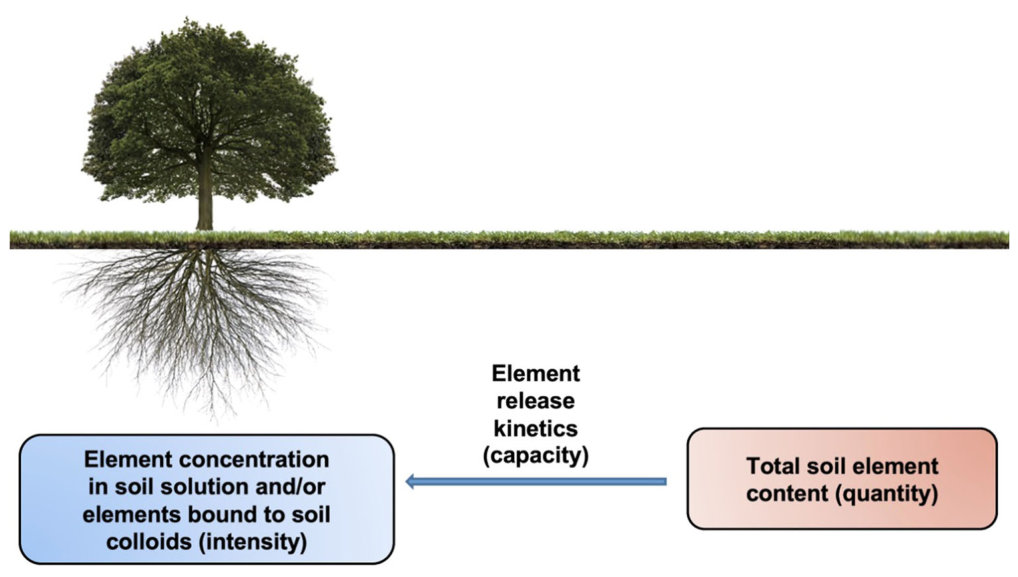
Some authors proposed that the same factors that govern nutrient phytoavailability in soils also apply to metal phytoavailability (Echevarria et al., 1998; Prudnikova et al., 2020; Song et al., 2004). For instance, in the study of Sauvé et al. (1996), the plant tissues accumulated an average of 2000 times the amount of copper dissolved in solution. This is only possible if the copper concentration in the soil solution is buffered by desorption/dissolution mechanisms (Sauvé, 2002). Thus, bioavailable contaminant stripping is only feasible when the elemental supply dynamics are slow enough to allow the reduction of the soluble metal fraction in the soil.
一些作者提出,决定土壤中养分植物有效性的因子同样适用于金属的植物有效性(Echevarria et al., 1998; Prudnikova et al., 2020; Song et al., 2004)。例如,在Sauvé et al. (1996)的研究中,植物组织中累积的铜平均为溶液中溶解铜量的2000倍。只有当土壤溶液中的铜浓度受到解吸/溶解机制的缓冲时,这才有可能实现(Sauvé, 2002)。因此,只有当元素供应动态足够缓慢、使土壤中可溶态金属组分得以降低时,生物有效态污染物剥离才是可行的。
However, the capacity, that is, the rate of replenishment of the soluble element, may change over time because of changes in the soil's physicochemical properties, such as acidification, which may lead to a rapid increase in bioavailable metal. For instance, a single application of lime was sufficient for sustainable revegetation of industrially contaminated areas under the semiarid climatic conditions of central Chile, that is, not requiring repeated lime applications (Neaman & Yáñez, 2021). However, studies conducted on the Kola Peninsula in the Russian Federation, that is, under conditions of high rainfall, have shown that a single application of lime is not sufficient for sustainable revegetation in industrially contaminated areas around copper–nickel smelters (Koptsik et al., 2016), requiring periodic applications of lime to maintain phytostabilization effects.
然而,容量因子,即可溶态元素的补给速率,可能会因土壤理化性质的变化(如酸化)而随时间改变,从而可能导致生物有效态金属迅速增加。例如,在智利中部半干旱气候条件下,单次施用石灰即足以实现工业污染区的可持续植被恢复,无需重复施用石灰(Neaman & Yáñez, 2021)。然而,在俄罗斯联邦科拉半岛,即高降雨条件下开展的研究表明,单次施用石灰不足以实现铜镍冶炼厂周边工业污染区的可持续植被恢复(Koptsik et al., 2016),需要定期施用石灰以维持植物稳定效果。
Table 1 summarizes some of the more promising bioavailable contaminant stripping greenhouse experiments and field trials that show successful stripping in repeated long‐term experiments (three or more growth periods). However, it is unclear whether the soluble metal fraction in the contaminated soil was reduced by plant uptake. Some studies have reported huge mass balance discrepancies (up to 98%!) between the reduction of the soluble metal fraction in the soil and plant uptake (Table 2). Unfortunately, many studies do not perform mass balance calculations, and those that do (see Li, Wu, Luo, & Christie, 2014; Table 2) do not discuss the possible causes of such discrepancies (Table 3). Such causes may include contaminant volatilization (e.g., selenium), water surface runoff, leaching that causes the loss of soluble metal fraction (Table 3), and metal entrapment on plant surfaces (Cary et al., 1994; Yan et al., 2022). On the input side, metal influx from the atmosphere may increase metal concentration in soil. Mass balance discrepancies may be exacerbated by spatial variability in metal concentrations. Mass balances that include the total, rather than the soluble fraction, may prove to be more robust because heterogeneity in the bioavailable fraction that are caused by rhizosphere processes will be less important (Robinson et al., 2009).
表1汇总了一些较有前景的生物有效态污染物剥离温室试验和田间试验,这些试验在重复的长期试验(三个或更多生长期)中显示出成功的剥离效果。然而,污染土壤中可溶态金属组分的减少是否源于植物吸收尚不清楚。一些研究报道,土壤中可溶态金属组分的减少量与植物吸收量之间存在巨大的质量平衡偏差(高达98%!)(表2)。遗憾的是,许多研究并未进行质量平衡计算,而进行了计算的研究(见Li, Wu, Luo, & Christie, 2014;表2)也未讨论造成此类偏差的可能原因(表3)。这些原因可能包括污染物挥发(如硒)、地表径流、导致可溶态金属组分损失的淋溶(表3),以及金属在植物表面的截留(Cary et al., 1994; Yan et al., 2022)。在输入方面,来自大气的金属输入可能提高土壤中的金属浓度。金属浓度的空间变异性可能加剧质量平衡偏差。以总量而非可溶态组分进行的质量平衡计算可能更为稳健,因为由根际过程引起的生物有效态组分的异质性影响将较小(Robinson et al., 2009)。
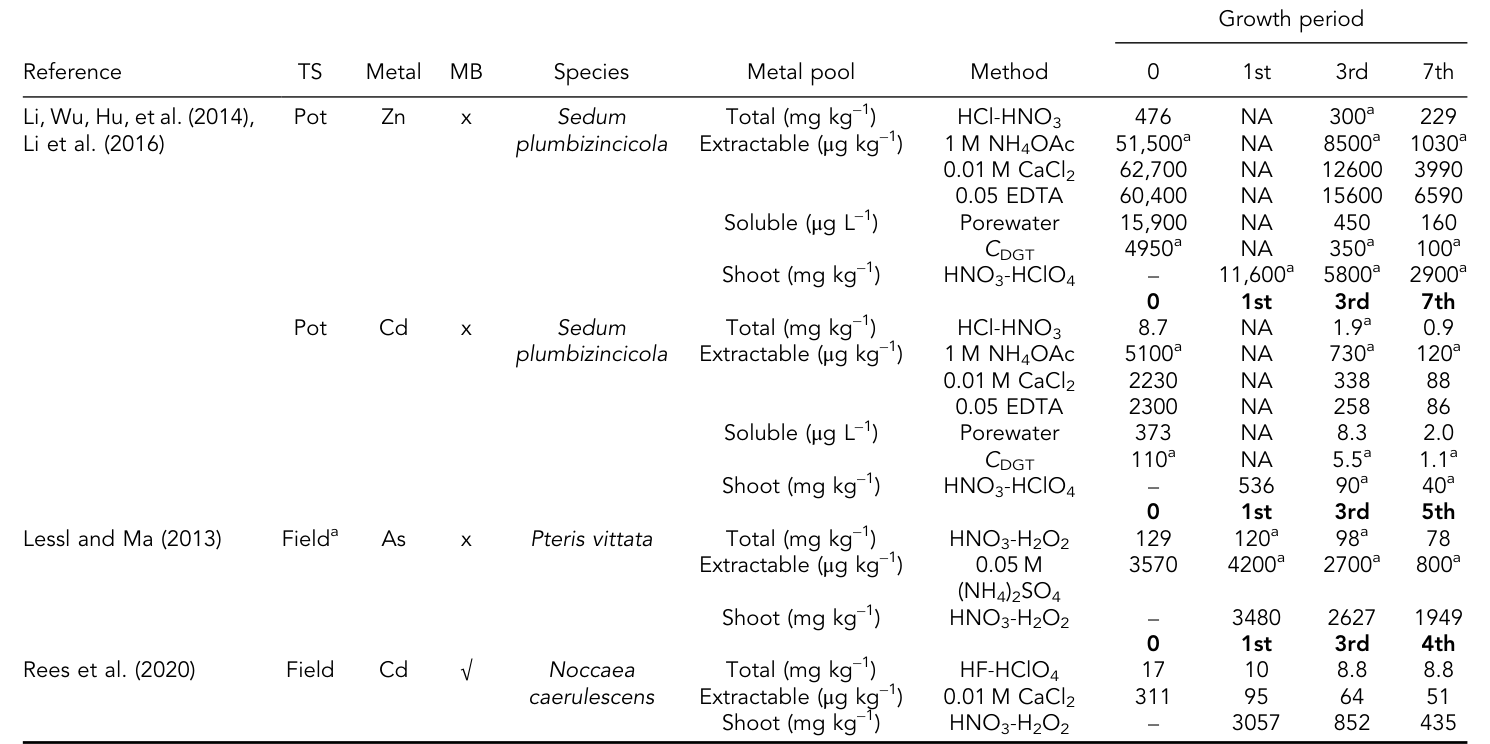
aEstimate based on illustrations. Raised beds filled with contaminated soil. Growth period 0: initial concentration. DGT = diffusive gradients in thin films; MB = mass balance; NA = not available; TS = trial scale; x = studies not showing mass balance; √ = studies showing mass balance.
a根据图示估算。高床中填充污染土壤。生长期0:初始浓度。DGT = 薄膜扩散梯度;MB = 质量平衡;NA = 无数据;TS = 试验规模;x = 未给出质量平衡的研究;√ = 给出质量平衡的研究。
| Reference参考文献 | Metal金属 | Species物种 | MD | PU | D (%) |
|---|---|---|---|---|---|
| Greenhouse trials (mg pot–1) | |||||
| Bañuelos et al. (1997) | Se | Brassica napus | 188 | 107 | 43 |
| Festuca arundinacea | 84 | 7.0a | 92 | ||
| Li, Wu, Luo, & Christie (2014) | Cd | Sedum plumbizincicola | 0.5–5.6 | 0.6–4.8 | –6.7 to 15 |
| Zn | Sedum plumbizincicola | 743–917a | 661–480a | 11–48 | |
| Field trials (kg ha–1) | |||||
| Kertulis‐Tartar (2005) | As | Pteris vittata | 114 | 26 | 78 |
| Niazi et al. (2012) | As | Pityrogramma calomelanos | 1230 | 25 | 98 |
| Pteris vittata | 404 | 9.7 | 98 | ||
| Deng et al. (2016) | Cd | Sedum plumbizincicola | 3.6–5.6 | 3.6–5.5 | −0.6 to 2.0 |
| Sedum plumbizincicola intercropped with | 6.7 | 4.1 | 39 | ||
| Zea mays | |||||
| Zhou et al. (2018) | Cd | Sedum plumbizincicola | 3.0 | 1.3 | 56 |
| Rees et al. (2020) | Cd | Noccaea caerulescens | 27–24 | 23–19 | 15–21 |
| Deng et al. (2016) | Zn | Sedum plumbizincicola | 886–1135 | 290–198 | 67–83 |
| Sedum plumbizincicola intercropped with | 1238 | 208 | 83 | ||
| Zea mays | |||||
| Zhou et al. (2018) | Zn | Sedum plumbizincicola | 55 | 10 | 81 |
| Rees et al. (2020) | Zn | Noccaea caerulescens | 116–244 | 118–160 | −1.7 to 34 |
aEstimate based on illustrations. A negative discrepancy means that plant uptake is greater than the decrease in soluble fraction of metals in soil. Conversely, a positive discrepancy means that plant uptake is less than the decrease in the soluble fraction of metals in soil. D = discrepancy, understood as the percentage of decrease in soluble fraction of metals in soil that cannot be explained by plant uptake: D = [(MD – PU) × 100]/MD; MD = decrease of soluble fraction of metals in soil; PU = plant uptake.
a根据图示估算。负偏差表示植物吸收量大于土壤中可溶态金属组分的减少量;反之,正偏差表示植物吸收量小于土壤中可溶态金属组分的减少量。D = 偏差,即土壤中可溶态金属组分减少量中不能由植物吸收解释的百分比:D = [(MD – PU) × 100]/MD;MD = 土壤中可溶态金属组分的减少量;PU = 植物吸收量。
2ENVIRONMENTAL REGULATIONS环境法规
Bioavailable contaminant stripping is not recognized as a soil remediation technology in countries where only the total metal concentration in soil is used as a legal standard. Therefore, it is unlikely that this method will be used unless the environmental regulations are amended to recognize bioavailability instead of the total metal concentration. Nevertheless, some recent guidelines have incorporated bioavailability concepts in ecological risk assessment (Organisation for Economic Co‐operation and Development, 2017). Thus, accounting for metal bioavailability in soils can possibly allow acceptance of bioavailability contaminant stripping in environmental regulations.
在仅以土壤金属总浓度作为法定标准的国家,生物有效态污染物剥离未被认可为一种土壤修复技术。因此,除非修订环境法规,以生物有效性而非金属总浓度为依据,否则该方法不太可能得到应用。尽管如此,一些近期的导则已将生物有效性概念纳入生态风险评估(Organisation for Economic Co‐operation and Development, 2017)。因此,考虑土壤中金属的生物有效性有可能使生物有效态污染物剥离在环境法规中得到认可。
Some national regulatory values for bioavailable metal fractions in soil are summarized in Table 4. Furthermore, bioavailable metal fractions are established in different ways in different countries based on salt‐exchangeable, water‐ soluble, or acid‐extractable fractions. Another challenge is that the unit of measurement is not standardized among countries (mg kg–1 or mg L–1), making direct comparisons impossible. Finally, there is no single extraction that mimics the bioavailable fraction for several metals and soil organisms. Therefore, developing a consistent international legal framework based on extractable metals has a long way to go, if it is possible at all.
表4汇总了部分国家关于土壤中生物有效态金属组分的法规限值。此外,不同国家基于盐交换态、水溶态或酸提取态组分,以不同方式确定生物有效态金属组分。另一个挑战是,各国的计量单位并不统一(mg kg–1或mg L–1),使得直接比较无法进行。最后,目前尚无一种单一提取方法能够模拟多种金属和土壤生物的生物有效态组分。因此,建立基于可提取态金属的统一国际法律框架任重道远,甚至可能无法实现。
| Reference参考文献 | Metal金属 | Species物种 | Listed causes所列原因 |
|---|---|---|---|
| Greenhouse trials | |||
| Bañuelos et al. (1997) | Se | Brassica napus | Volatilization |
| Festuca arundinacea | Volatilization | ||
| Li, Wu, Luo, & Christie (2014) | Cd | Sedum plumbizincicola | Not discussed |
| Zn | Sedum plumbizincicola | Not discussed | |
| Field trials | |||
| Kertulis‐Tartar (2005) | As | Pteris vittata | Spatial variability |
| Niazi et al. (2012) | As | Pityrogramma calomelanos Pteris vittata | Spatial variability Spatial variability |
| Deng et al. (2016) | Cd | Sedum plumbizincicola Sedum plumbizincicolaa | Spatial variability, surface runoff, leaching, atmospheric fallout Spatial variability, surface runoff, leaching, atmospheric fallout |
| Zhou et al. (2018) | Cd | Sedum plumbizincicola | Surface runoff or leaching |
| Rees et al. (2020) | Cd | Noccaea caerulescens | Leaching |
| Deng et al. (2016) | Zn | Sedum plumbizincicola Sedum plumbizincicolaa | Spatial variability, surface runoff, leaching, atmospheric fallout Spatial variability, surface runoff, leaching, atmospheric fallout |
| Zhou et al. (2018) | Zn | Sedum plumbizincicola | Surface runoff or leaching |
| Rees et al. (2020) | Zn | Noccaea caerulescens | Leaching |
aIntercropped with Zea mays.
a与Zea mays间作。
| Me | tal | |||||||
|---|---|---|---|---|---|---|---|---|
| Country | Method | Unit | As | Cd | Cu | Ni | Pb | Zn |
| Czech Republica | 1 M NH4NO3, SSR 1/2.5 | mg kg–1 | 1.0 | 0.04/0.1i | 1.0 | 1.0 | 1.5 | 20 |
| Germanyb | 1 M NH4NO3, SSR 1/2.5 | mg kg–1 | 0.4 | 0.04/0.1j | 1.0 | 1.5 | 0.1 | 2.0 |
| Slovakiac | 1 M NH4NO3, SSR 1/2.5 | mg kg–1 | 0.4 | 0.1 | 1.0 | 1.5 | 0.1 | 2.0 |
| Switzerlandd | 0.1 M NaNO3, SSR 1/2.5 | mg L–1 | n.s. | 0.02/0.1 | 0.7/4.0 | n.s. | n.s. | 5.0 |
| Salt‐exchangeable mean | mg kg–1 | 0.6±0.3 | 0.1±0.0 | 1.0±0.0 | 1.3±0.3 | 0.6±0.8 | 8.0±10 | |
| mg L–1 | n.s. | 0.02 | 0.7 | n.s. | n.s. | 5.0 | ||
| Mexicoe | Water, SSR 1/20 | mg L–1 | 0.5 | 0.1 | n.s. | 1.1 | 0.5 | n.s. |
| Japanf | Water, SSR 1/10 | mg L–1 | 0.01 | 0.01 | n.s. | n.s. | 0.01 | n.s. |
| Water‐soluble mean | mg L–1 | 0.3±0.3 | 0.1±0.1 | n.s. | 1.1 | 0.3±0.3 | n.s. | |
| Australia (Tasmania)g | 0.1 M CH₃COOH, SSR 1/20 | mg L–1 | 5.0 | 0.5 | 100 | 8.0 | 5.0 | 250 |
| Australia (Victoria)h | 0.1 M CH₃COOH, SSR 1/20 | mg L–1 | 2.8 | 0.8 | 800 | 8.0 | 4.0 | 1200 |
| Acid‐extractable mean | mg L–1 | 3.9±1.6 | 0.7±0.2 | 450±495 | 8.0±0.0 | 4.5±0.7 | 725±672 |
aThresholds for agricultural soils (Ministry of the Environment of the Czech Republic, 2016). bThresholds for agricultural soils (German Federal Government, 2020). cThresholds for agricultural soils (National Council of the Slovak Republic, 2004). dThresholds for agricultural and residential soils with >15% humus (Swiss Federal Council, 2016). eThresholds for soils when there is no potentially exposed human population (Secretaría de Medio Ambiente y Recursos Naturales, 2007). fThresholds for soils with potentially harmful effects on human health (Government of Japan, 2002). gThresholds of soils for landfill disposal (Environment Protection Authority of Tasmania, 2010). hThresholds of soils for landfill disposal (Environment Protection Authority of Victoria, 2009). iOnly for soils with pH (CaCl2) >6.5. A threshold of 0.04 mg kg–1 must be applied to light‐texture soils (up to 20% of <0.01‐mm fine particles); otherwise, the threshold is 0.1 mg kg–1. jA threshold of 0.04 mg kg–1 must be applied to lands used for the cultivation of bread wheat or strongly cadmium‐accumulating vegetables (species not detailed); otherwise, the threshold is 0.1 mg kg–1. Nonbold values indicate trigger thresholds (a.k.a. prevention thresholds), understood as pollution limits at which site‐specific risk assessments must be conducted. Bold values indicate intervention thresholds (a.k.a. action, cleanup, remediation, or indication thresholds), understood as values when a risk exists and it is considered necessary or advisable to address it. Mean values were calculated using the most conservative option within the range specified in the standard. n.s. = not specified; SSR = soil/solution ratio.
a农业土壤阈值(Ministry of the Environment of the Czech Republic, 2016)。b农业土壤阈值(German Federal Government, 2020)。c农业土壤阈值(National Council of the Slovak Republic, 2004)。d腐殖质含量 >15%的农业和居住用地土壤阈值(Swiss Federal Council, 2016)。e无潜在暴露人群时的土壤阈值(Secretaría de Medio Ambiente y Recursos Naturales, 2007)。f对人体健康具有潜在危害效应的土壤阈值(Government of Japan, 2002)。g填埋处置土壤阈值(Environment Protection Authority of Tasmania, 2010)。h填埋处置土壤阈值(Environment Protection Authority of Victoria, 2009)。i仅适用于pH (CaCl2) >6.5的土壤。轻质地土壤(<0.01 mm细颗粒含量不超过20%)须采用0.04 mg kg–1的阈值;否则阈值为0.1 mg kg–1。j用于种植面包小麦或强镉累积蔬菜(物种未详述)的土地须采用0.04 mg kg–1的阈值;否则阈值为0.1 mg kg–1。非粗体数值表示触发阈值(又称预防阈值),即须开展场地特定风险评估的污染限值。粗体数值表示干预阈值(又称行动、清理、修复或指示阈值),即存在风险且认为有必要或宜于加以处理时的数值。平均值采用标准中所规定范围内最保守的选项计算。n.s. = 未规定;SSR = 土液比。
It should be noted that ecotoxicological studies of soil metal toxicity are usually based on metal‐spiked soils, that is, uncontaminated soils that have been progressively enriched with metals in the form of soluble salts in a laboratory setting. This approach is complicated by the difficulty of extrapolating laboratory results to actual soils exposed to decades of contamination. Specifically, the toxicity of metals is higher in metal‐spiked versus anthropogenically contaminated soils (Neaman, Selles, et al., 2020; Santa‐Cruz, Vasenev, et al., 2021). This is because metal toxicity depends on, among other factors, the residence time of the metals in the soil (McBride & Cai, 2016; Zeng et al., 2017).
应当指出,关于土壤金属毒性的生态毒理学研究通常基于金属添加土壤,即在实验室条件下以可溶性盐形式逐级添加金属的未污染土壤。由于难以将实验室结果外推至经历数十年污染的实际土壤,这一方法存在局限。具体而言,金属在金属添加土壤中的毒性高于人为污染土壤(Neaman, Selles, et al., 2020; Santa‐Cruz, Vasenev, et al., 2021)。这是因为金属毒性除其他因素外,还取决于金属在土壤中的停留时间(McBride & Cai, 2016; Zeng et al., 2017)。
| Plants植物 | Inverte无脊椎 | brates动物 | Microorganisms微生物 | ||||
|---|---|---|---|---|---|---|---|
| Metal | Unit | EC10 | EC25 | EC50 | EC10 | EC50 | EC50 |
| Salt‐exchan | geable | ||||||
| Cu | mg kg–1 | 0.6 | 0.9 | 20±26 | – | – | – |
| mg L–1 | 0.2 | 0.4 | 0.5±0.1 | – | – | – | |
| Ni | mg kg–1 | – | 9.3±6.3 | – | – | – | – |
| Pb | mg kg–1 | – | – | – | 3.0±3.7 | 35±26 | – |
| Zn | mg kg–1 | – | – | 236±129 | – | – | – |
| mg L–1 | – | – | 2.4 | – | – | 6.0±4.9 | |
| Water‐solub | le | ||||||
| Cu | mg L–1 | 0.3 | – | 0.5±0.2 | – | – | – |
| Pb | mg kg–1 | – | – | – | 1.0±1.3 | 3.2±1.8 | – |
| mg L–1 | – | – | – | 34±56 | 25±37 | – | |
| Acid/chelat | e‐extractable | ||||||
| Cu | mg kg–1 | – | – | 930 | – | – | 139 |
| Ni | mg kg–1 | – | 465 | 607 | – | – | – |
| Zn | mg kg–1 | – | – | 3798 | – | – | – |
Only real soils exposed to long‐term contamination are included, and metal‐spiked soils are excluded because of their limited use in environmental assessment and soil quality decision‐making. Likewise, only studies showing the impact of a single pollutant on biological responses were considered. EC10/EC25/EC50, 10%, 25%, and 50% effect concentrations, respectively.
仅纳入长期受污染的实际土壤,排除金属添加土壤,因为后者在环境评估和土壤质量决策中用途有限。同样,仅考虑显示单一污染物对生物响应影响的研究。EC10/EC25/EC50分别为10%、25%和50%效应浓度。
In our summary in Table 5, only real soils exposed to long‐ term contamination are included, and metal‐spiked soils are omitted. The source of a metal contamination might be a confounding factor determining metal toxicity. For example, Hamels et al. (2014) reported a high 50% effect concentration (EC50) value (36 000 mg kg–1) for total zinc at La Calamine site (Belgium) contaminated with mine tailings containing smithsonite (ZnCO3; Van Damme et al., 2010). In contrast, EC50 values for total zinc at sites polluted by zinc smelters were an order of magnitude lower (up to ~7000 mg kg–1). This difference can be explained by the low solubility of ZnCO3 (Grigorita et al., 2020). Therefore, the source of metal contamination profoundly affects metal toxicity, and this may prevent the direct comparison between thresholds based on extractable metal concentrations reported in Table 4 and the toxicity data reported in Table 5.
在表5的汇总中,仅纳入长期受污染的实际土壤,而略去金属添加土壤。金属污染来源可能是决定金属毒性的混杂因素。例如,Hamels et al. (2014)报道,在受含菱锌矿(ZnCO3;Van Damme et al., 2010)的矿山尾矿污染的La Calamine场地(比利时),总锌的50%效应浓度(EC50)值较高(36 000 mg kg–1)。相比之下,受锌冶炼厂污染场地的总锌EC50值要低一个数量级(最高约~7000 mg kg–1)。这一差异可由ZnCO3的低溶解度来解释(Grigorita et al., 2020)。因此,金属污染来源深刻影响金属毒性,这可能妨碍将表4中基于可提取态金属浓度的阈值与表5中的毒性数据进行直接比较。
In Table 5, we grouped the reported values for salt‐ exchangeable, water‐soluble, or acid‐extractable fractions and expressions in either mg kg–1 or mg L–1. Soils with contrasting properties can result in differences in these values. Rooney et al. (2006) reported that soil properties profoundly affected the toxicity of metals in metal‐spiked soils. However, soils with contrasting properties fit well on a dose–response curve in our studies on nonspiked soils that had been exposed to decades of contamination (Mondaca et al., 2017; Verdejo et al., 2016). Salt‐exchangeable, water‐soluble, and acid‐extractable fractions reflect the differences in soil properties (McBride et al., 1997; Mondaca et al., 2015); thus, soil properties are not expected to be confounding factors in determining the metal toxicity thresholds summarized in Table 5.
在表5中,我们将盐交换态、水溶态或酸提取态组分的报道值以及以mg kg–1或mg L–1表示的数值进行了归类。性质迥异的土壤可能导致这些数值存在差异。Rooney et al. (2006)报道,土壤性质深刻影响金属添加土壤中金属的毒性。然而,在我们针对经历数十年污染的非添加土壤的研究中,性质迥异的土壤均能很好地拟合于同一剂量–效应曲线(Mondaca et al., 2017; Verdejo et al., 2016)。盐交换态、水溶态和酸提取态组分反映了土壤性质的差异(McBride et al., 1997; Mondaca et al., 2015);因此,预计土壤性质不会成为确定表5所汇总金属毒性阈值的混杂因素。
Nevertheless, there are other confounding factors that do not allow direct comparison between thresholds based on extractable metal concentrations reported in Table 4 and the toxicity data reported in Table 5. For instance, according to the biotic ligand model, not only the concentration of the metals themselves but also the concentration of competing ions for binding at the biotic ligand affects the uptake and toxicity of metals (Smolders et al., 2009; Stuckey et al., 2021). Therefore, ecotoxicity thresholds based on a single extractable metal concentration do not indicate bioavailability in contrasting conditions.
尽管如此,仍存在其他混杂因素,使得无法将表4中基于可提取态金属浓度的阈值与表5中的毒性数据进行直接比较。例如,根据生物配体模型,影响金属吸收和毒性的不仅是金属本身的浓度,还包括在生物配体上竞争结合位点的离子浓度(Smolders et al., 2009; Stuckey et al., 2021)。因此,基于单一可提取态金属浓度的生态毒性阈值并不能反映不同条件下的生物有效性。
For this reason, in some countries, national regulations on soil contamination have evolved toward assessing risk to biota and/or human health (Hou et al., 2017; Ministère de la transition écologique et solidaire, 2017; Reinikainen et al., 2016) and away from threshold values for total or partial concentrations of metals in soil. Hence, site‐specific risk assessments, for example, using vegetables, may be feasible (Lizardi et al., 2020; Yang et al., 2022). However, setting threshold values may be necessarily conservative to protect against worst‐case scenarios, for example, metal exposure to humans via the ingestion of dust or soil, where the total concentration, rather than the phytoavailable fraction, is the greatest determiner of risk (Petruzzelli et al., 2020).
为此,一些国家的土壤污染法规已从土壤金属总浓度或部分浓度的阈值,转向对生物群和/或人体健康的风险评估(Hou et al., 2017; Ministère de la transition écologique et solidaire, 2017; Reinikainen et al., 2016)。因此,开展场地特定的风险评估(例如利用蔬菜)可能是可行的(Lizardi et al., 2020; Yang et al., 2022)。然而,为防范最坏情形,阈值的设定可能必然趋于保守,例如人体通过摄入灰尘或土壤而暴露于金属的情形,此时决定风险的最主要因素是总浓度,而非植物有效态组分(Petruzzelli et al., 2020)。
3CONCLUSIONS AND FUTURE RESEARCH NEEDS结论与未来研究需求
Unlike phytoextraction for soil cleansing, phytoextraction with the aim of reducing the bioavailable fraction of metals in contaminated soil is at least feasible in principle. However, it is unclear whether the reduction of the soluble metal fraction in contaminated soil can be achieved through plant uptake because studies report large mass balance discrepancies (up to 98%) between the reduction of soluble metal fraction and plant uptake. Thus, we encourage a stricter approach to studies on bioavailable contaminant stripping that should include relevant information on mass balances. Similarly, broader experimental designs would be advisable to overcome the spatial variability of metal concentrations in soil. Furthermore, the use of advanced instruments (e.g., lysimeters) is essential to monitor metal leaching from soil (Rees et al., 2020) and/or atmospheric metal inputs.
与以清洁土壤为目的的植物提取不同,以降低污染土壤中金属生物有效态组分为目的的植物提取至少在原理上是可行的。然而,污染土壤中可溶态金属组分的减少能否通过植物吸收实现尚不清楚,因为已有研究报道可溶态金属组分减少量与植物吸收量之间存在较大的质量平衡偏差(高达98%)。因此,我们提倡对生物有效态污染物剥离研究采取更严格的方法,应包含质量平衡的相关信息。同样,建议采用更宽泛的试验设计,以克服土壤中金属浓度的空间变异性。此外,使用先进仪器(如渗漏计)对于监测土壤金属淋溶(Rees et al., 2020)和/或大气金属输入至关重要。
Successful application of bioavailable contaminant stripping is impossible without environmental regulations that are based on the bioavailable fraction of soil metals rather than total metal concentration. Studies on phytoextraction would be more useful if they provided sufficient information on metal phytoextraction rates expressed, for instance, in grams of extracted metal per hectare per year. Metal phytoextraction rates, in turn, will allow estimation of the time necessary to achieve the target bioavailable concentrations of metals specified by environmental regulations.
若无以土壤金属生物有效态组分而非金属总浓度为依据的环境法规,生物有效态污染物剥离便无法成功应用。如果植物提取研究能够提供充分的金属植物提取速率信息(例如以每公顷每年提取的金属克数表示),将更具实用价值。反过来,金属植物提取速率可用于估算达到环境法规所规定的金属生物有效态目标浓度所需的时间。
Author Contributions Statement—Javier Santa‐Cruz: Data curation; Formal analysis; Investigation. Brett Robinson: Writing—review & editing. Yurii A. Krutyakov, Olga Shapoval: Conceptualization; Validation. Patricia Peñaloza: Project administration; Resources. Carolina Yáñez: Conceptualization; Project administration; Writing—original draft. Alexander Neaman: Conceptualization; Methodology; Supervision; Writing—original draft; Writing—review & editing.
作者贡献声明——Javier Santa‐Cruz:数据整理;形式分析;调查研究。Brett Robinson:写作——审阅与编辑。Yurii A. Krutyakov, Olga Shapoval:构思;验证。Patricia Peñaloza:项目管理;资源。Carolina Yáñez:构思;项目管理;写作——初稿。Alexander Neaman:构思;方法;指导;写作——初稿;写作——审阅与编辑。
Data Availability Statement—This is a review article. No data were generated.
数据可用性声明——本文为综述文章,未产生数据。
4REFERENCES参考文献
Baker, A. J. M., McGrath, S. P., Sidoli, C. M. D., & Reeves, R. D. (1994). The possibility of in situ heavy metal decontamination of polluted soils using crops of metal‐accumulating plants. Resources, Conservation and Recycling, 11, 41–49.
Bañuelos, G. S., Ajwa, H. A., Mackey, B., Wu, L., Cook, C., Akohoue, S., & Zambruzuski, S. (1997). Evaluation of different plant species used for phytoremediation of high soil selenium. Journal of Environmental Quality, 26, 639–646. https://doi.org/10.2134/jeq1997.00472425002600030008x
Cao, Y., Feng, H. Y., Sun, D., Xu, G. H., Rathinasabapathi, B., Chen, Y. S., & Ma, L. N. Q. (2019). Heterologous expression of Pteris vittata phosphate transporter PvPht1;3 enhances arsenic translocation to and
accumulation in tobacco shoots. Environmental Science & Technology, 53, 10636–10644. https://doi.org/10.1021/acs.est.9b02082
Cary, E. E., Grunes, D. L., Dallyn, S. L., Pearson, G. A., Peck, N. H., & Hulme, R. S. (1994). Plant Fe, Al and Cr concentrations in vegetables as influenced by soil inclusion. Journal of Food Quality, 17, 467–476. https:// doi.org/10.1111/j.1745-4557.1994.tb00167.x
Deng, L., Li, Z., Wang, J., Liu, H. Y., Li, N., Wu, L. H., Hu, P. J., Luo, Y. M., & Christie, P. (2016). Long‐term field phytoextraction of zinc/cadmium contaminated soil by Sedum plumbizincicola under different agronomic strategies. International Journal of Phytoremediation, 18, 134–140. https://doi.org/10.1080/15226514.2015.1058328
Echevarria, G., Morel, J. L., Fardeau, J. C., & Leclerc‐Cessac, E. (1998). Assessment of phytoavailability of nickel in soils. Journal of Environmental Quality, 27, 1064–1070. https://doi.org/10.2134/jeq1998. 00472425002700050011x
Environment Protection Authority of Tasmania. (2010). Environmental management and pollution control (waste management) regulations 2000. Classification and management of contaminated soil for disposal.
Environment Protection Authority of Victoria. (2009). Industrial waste resource guidelines. Soil hazard categorization and management (IWRG621).
German Federal Government. (2020). Bundes‐bodenschutz und altlastenverordnung (BBodSchV).
Ghazaryan, K. A., Movsesyan, H. S., Minkina, T. M., Nevidomskaya, D. G., & Rajput, V. D. (2021). Phytoremediation of copper‐contaminated soil by Artemisia absinthium: Comparative effect of chelating agents. Environmental Geochemistry and Health, 44, 1203–1215. https://doi.org/10. 1007/s10653-021-01151-2
González, I., Neaman, A., Cortés, A., & Rubio, P. (2014). Effect of compost and biodegradable chelate addition on phytoextraction of copper by Oenothera picensis grown in Cu‐contaminated acid soils. Chemosphere, 95, 111–115.
Government of Japan. (2002). Soil contamination countermeasures act (53/2002).
Grigorita, G., Neaman, A., Brykova, R., Brykov, V. A., Morev, D. V., Ginocchio, R., Paltseva, A. A., Vidal, K., Navarro‐Villarroel, C., & Dovletyarova, E. A. (2020). Use of zinc carbonate spiking to obtain phytotoxicity thresholds comparable to those in field‐collected soils. Environmental Toxicology and Chemistry, 39, 1790–1796. http://doi.org/10.1002/etc.4809
Hamels, F., Malevé, J., Sonnet, P., Kleja, D. B., & Smolders, E. (2014). Phytotoxicity of trace metals in spiked and field‐contaminated soils: Linking soil‐extractable metals with toxicity. Environmental Toxicology and Chemistry, 33, 2479–2487. https://doi.org/10.1002/etc.2693
Hamon, R. E., & McLaughlin, M. J. (1999). Use of the hyperaccumulator Thlaspi cearulescens for bioavailable contaminant stripping. In W. W. Wenzel, D. C. Adriano, B. Alloway, H. Doner, C. Keller, N. W. Lepp, M. Mench, R. Naidu, & G. M. Pierzynski (Eds.), 5th International conference on the biogeochemistry of trace elements (pp. 908–909). International Society for Trace Element Research.
Hou, D. Y., Qi, S. Q., Zhao, B., Rigby, M., & O′Connor, D. (2017). Incorporating life cycle assessment with health risk assessment to select the “greenest” cleanup level for Pb contaminated soil. Journal of Cleaner Production, 162, 1157–1168. https://doi.org/10.1016/j.jclepro. 2017.06.135
Kertulis‐Tartar, G. M. (2005). Arsenic hyperaccumulation byL. and its potential for phytoremediation of arsenic‐contaminated soils Pteris vittata [Unpublished doctoral dissertation]. University of Florida.
Koptsik, G. N., Koptsik, S. V., & Smirnova, I. E. (2016). Alternative technologies for remediation of technogenic barrens in the Kola Subarctic. Eurasian Soil Science, 49, 1294–1309. https://doi.org/10.1134/ s1064229316090088
Lessl, J. T., & Ma, L. Q. (2013). Sparingly‐soluble phosphate rock induced significant plant growth and arsenic uptake by Pteris vittata from three contaminated soils. Environmental Science & Technology, 47, 5311–5318. https://doi.org/10.1021/es400892a
Li, Z., Jia, M. Y., Wu, L. H., Christie, P., & Luo, Y. M. (2016). Changes in metal availability, desorption kinetics and speciation in contaminated soils during repeated phytoextraction with the Zn/Cd hyperaccumulator Sedum plumbizincicola. Environmental Pollution, 209, 123–131. https:// doi.org/10.1016/j.envpol.2015.11.015
Li, Z., Wu, L. H., Hu, P. J., Luo, Y. M., Zhang, H., & Christie, P. (2014). Repeated phytoextraction of four metal‐contaminated soils using the cadmium/zinc hyperaccumulator Sedum plumbizincicola. Environmental Pollution, 189, 176–183. https://doi.org/10.1016/j.envpol.2014.02.034
Li, Z., Wu, L. H., Luo, Y. M., & Christie, P. (2014). Dynamics of plant metal uptake and metal changes in whole soil and soil particle fractions during repeated phytoextraction. Plant and Soil, 374, 857–869. https://doi.org/ 10.1007/s11104-013-1927-2
Lillo‐Robles, F., Tapia‐Gatica, J., Díaz‐Siefer, P., Moya, H., Celis‐Diez, J. L., Santa Cruz, J., Ginocchio, R., Sauvé, S., Brykov, V. A., & Neaman, A. (2020). Which soil Cu pool governs phytotoxicity in field‐collected soils contaminated by copper smelting activities in central Chile. Chemosphere, 242, Article 125176. https://doi.org/10.1016/j.chemosphere. 2019.125176
Lizardi, N., Aguilar, M., Bravo, M., Fedorova, T. A., & Neaman, A. (2020). Human health risk assessment from the consumption of vegetables grown near a copper smelter in central Chile. Journal of Soil Science and Plant Nutrition, 20, 1472–1479. https://doi.org/10.1007/s42729-020- 00226-w
Marschner, H. (1993). Zinc uptake from soils. In A. D. Robson (Ed.), Zinc in soils and plants (pp. 59–77). Kluwer Academic.
Marschner, P. (2012). Marschner's mineral nutrition of higher plants (3rd ed.). Academic.
McBride, M. B., & Cai, M. F. (2016). Copper and zinc aging in soils for a decade: Changes in metal extractability and phytotoxicity. Environmental Chemistry, 13, 160–167. https://doi.org/10.1071/en15057
McBride, M., Sauvé, S., & Hendershot, W. (1997). Solubility control of Cu, Zn, Cd and Pb in contaminated soils. European Journal of Soil Science, 48, 337–346. https://doi.org/10.1111/j.1365-2389.1997.tb00554.x
Mench, M. J., Dellise, M., Bes, C. M., Marchand, L., Kolbas, A., Coustumer, P. L., & Oustrière, N. (2018). Phytomanagement and remediation of Cu‐ contaminated soils by high yielding crops at a former wood preservation site: Sunflower biomass and ionome. Frontiers in Ecology and Evolution, 6, Article 123.
Mertens, J., Luyssaert, S., & Verheyen, K. (2005). Use and abuse of trace metal concentrations in plant tissue for biomonitoring and phytoextraction. Environmental Pollution, 138, 1–4. https://doi.org/10.1016/j. envpol.2005.01.002
Ministère de la transition écologique et solidaire. (2017). French national methodology for managing contaminated land. http://circulaire.legifrance. gouv.fr/pdf/2017/04/cir_42093.pdf
Ministry of the Environment of the Czech Republic. (2016). Vyhláška o stanovení podrobností ochrany kvality zemědělské půdy a o změně vyhlášky č. 13/1994 Sb., kterou se upravují některé podrobnosti ochrany země- dělského půdního fondu (Vyhláška cˇč. 153/2016 Sb).
Mondaca, P., Catrin, J., Verdejo, J., Sauvé, S., & Neaman, A. (2017). Advances on the determination of thresholds of Cu phytotoxicity in field‐ contaminated soils in central Chile. Environmental Pollution, 223, 146–152. https://doi.org/10.1016/j.envpol.2016.12.076
Mondaca, P., Neaman, A., Sauvé, S., Salgado, E., & Bravo, M. (2015). Solubility, partitioning and activity of copper in contaminated soils in a semiarid zone. Journal of Plant Nutrition and Soil Science, 178, 452–459. https://doi.org/10.1002/jpln.201400349
National Council of the Slovak Republic. (2004). Zákon o ochrane a využívaní poľnohospodárskej pôdy a o zmene zákona č. 245/2003 Z. z. o integrovanej prevencii a kontrole znečisťovania životného prostredia a o zmene a doplnení niektorých zákonov (Zbierka zákonov è. 220/2004).
Neaman, A., Robinson, B., Minkina, T. M., Vidal, K., Mench, M., Krutyakov, Y. A., & Shapoval, O. V. (2020). Feasibility of metal(loid) phytoextraction from polluted soils: The need for greater scrutiny. Environmental Toxicology and Chemistry, 39, 1469–1471. https://doi.org/10. 1002/etc.4787
Neaman, A., Selles, I., Martínez, C. E., & Dovletyarova, E. A. (2020). Analyzing soil metal toxicity: Spiked or field‐contaminated soils? Environmental Toxicology and Chemistry, 39, 513–514. https://doi.org/10.1002/ etc.4654
Neaman, A., & Yáñez, C. (2021). Phytoremediation of soils contaminated by copper smelting in Chile: Results of a decade of research. Eurasian Soil Science, 54, 1992–1999. https://doi.org/10.1134/S1064229321120085
Niazi, N. K., Singh, B., Van Zwieten, L., & Kachenko, A. G. (2012). Phytoremediation of an arsenic‐contaminated site using Pteris vittata L. and Pityrogramma calomelanos var. austroamericana: A long‐term study. Environmental Science and Pollution Research, 19, 3506–3515. https:// doi.org/10.1007/s11356-012-0910-4
Nowack, B., Schulin, R., & Robinson, B. H. (2006). Critical assessment of chelant‐enhanced metal phytoextraction. Environmental Science & Technology, 40, 5225–5232. https://doi.org/10.1021/es0604919
Organisation for Economic Co‐operation and Development. (2017). Guidance on the incorporation of bioavailability concepts for assessing the chemical ecological risk and/or environmental threshold values of metals and inorganic metal compounds.
Petruzzelli, G., Pedron, F., & Rosellini, I. (2020). Bioavailability and bioaccessibility in soil: A short review and a case study. AIMS Environmental Science, 7, 208–225. https://doi.org/10.3934/environsci.2020013
Prudnikova, E. V., Neaman, A., Terekhova, V. A., Karpukhin, M. M., Vorobeichik, E. L., Smorkalov, I. A., Dovletyarova, E. A., Navarro‐ Villarroel, C., Ginocchio, R., & Peñaloza, P. (2020). Root elongation method for the quality assessment of metal‐polluted soils: Whole soil or soil‐water extract? Journal of Soil Science and Plant Nutrition, 20, 2294–2303. https://doi.org/10.1007/s42729-020-00295-x
Rees, F., Sterckeman, T., & Morel, J. L. (2020). Biochar‐assisted phytoextraction of Cd and Zn by Noccaea caerulescens on a contaminated soil: A four‐year lysimeter study. Science of the Total Environment, 707, Article 135654. https://doi.org/10.1016/j.scitotenv.2019.135654
Reinikainen, J., Sorvari, J., & Tikkanen, S. (2016). Finnish policy approach and measures for the promotion of sustainability in contaminated land management. Journal of Environmental Management, 184, 108–119. https://doi.org/10.1016/j.jenvman.2016.08.046
Robinson, B. H., Anderson, C. W. N., & Dickinson, N. M. (2015). Phytoextraction: Where's the action? Journal of Geochemical Exploration, 151, 34–40. https://doi.org/10.1016/j.gexplo.2015.01.001
Robinson, B. H., Bañuelos, G., Conesa, H. M., Evangelou, M. W., & Schulin, R. (2009). The phytomanagement of trace elements in soil. Critical Reviews in Plant Sciences, 28, 240–266.
Rooney, C. P., Zhao, F. J., & McGrath, S. P. (2006). Soil factors controlling the expression of copper toxicity to plants in a wide range of European soils. Environmental Toxicology and Chemistry, 25, 726–732. https://doi. org/10.1897/04-602r.1
Santa‐Cruz, J., Peñaloza, P., Korneykova, M. V., & Neaman, A. (2021). Thresholds of metal and metalloid toxicity in field‐collected anthropogenically contaminated soils: A review. Geography, Environment, Sustainability, 14, 6–21. https://doi.org/10.24057/2071-9388-2021-023
Santa‐Cruz, J., Vasenev, I. I., Gaete, H., Peñaloza, P., Krutyakov, Y. A., & Neaman, A. (2021). Metal ecotoxicity studies with spiked versus field‐ contaminated soils: Literature review, methodological shortcomings and research priorities. Russian Journal of Ecology, 52, 479–485. https://doi. org/10.1134/S1067413621060126
Sauvé, S. (2002). Speciation of metals in soils. In H. E. Allen (Ed.), Bioavailability of metals in terrestrial ecosystems: Importance of partitioning for bioavailability to intervebrates, microbes, and plants (pp. 7–37). Society of Environmental Toxicology and Chemistry.
Sauvé, S., Cook, N., Hendershot, W. H., & McBride, M. B. (1996). Linking plant tissue concentrations and soil copper pools in urban contaminated soils. Environmental Pollution, 94, 153–157. https://doi.org/10.1016/ S0269-7491(96)00081-4
Secretaría de Medio Ambiente y Recursos Naturales. (2007, March 2). Norma Oficial Mexicana NOM‐147‐SEMARNAT/SSA1‐2004 que establece criterios para determinar las concentraciones de remediación de suelos contaminados por arsénico, bario, berilio, cadmio, cromo hexavalente, mercurio, níquel, plata, plomo, selenio, talio y/o vanadio. Diario Oficial.
Shirvani, M., Shariatmadari, H., & Kalbasi, M. (2005). Phosphorus buffering capacity indices as related to soil properties and plant uptake. Journal of Plant Nutrition, 28, 537–550. https://doi.org/10.1081/pln-200049235
Smolders, E., Oorts, K., van Sprang, P., Schoeters, I., Janssen, C. R., McGrath, S. P., & McLaughlin, M. J. (2009). Toxicity of trace metals in soil as affected by soil type and aging after contamination: Using
calibrated bioavailability models to set ecological soil standards. Environmental Toxicology and Chemistry, 28, 1633–1642. https://doi.org/10. 1897/08-592.1
Song, J., Zhao, F.‐J., Luo, Y.‐M., McGrath, S. P., & Zhang, H. (2004). Copper uptake by Elsholtzia splendens and Silene vulgaris and assessment of copper phytoavailability in contaminated soils. Environmental Pollution, 128, 307–315. https://doi.org/10.1016/j.envpol.2003.09.019
Stuckey, J. W., Neaman, A., Verdejo, J., Navarro‐Villarroel, C., Peñaloza, P., & Dovletyarova, E. A. (2021). Zinc alleviates copper toxicity to lettuce and oat in copper contaminated soils. Journal of Soil Science and Plant Nutrition, 21, 1229–1235. https://doi.org/10.1007/s42729-021- 00435-x
Swiss Federal Council. (2016). Verordnungüber belastungen des bodens (SR 814.12).
Taiwo, A. A., Adetunji, M. T., Azeez, J. O., & Bamgbose, T. (2010). Potassium supplying capacity of some tropical Alfisols in southwest Nigeria as measured by intensity, quantity and capacity factors. Nutrient Cycling in Agroecosystems, 86, 341–355. https://doi.org/10.1007/s10705-009- 9296-1
Ulriksen, C., Ginocchio, R., Mench, M., & Neaman, A. (2012). Lime and compost promote plant re‐colonization of metal‐polluted, acidic soils. International Journal of Phytoremediation, 14, 820–833.
Van Damme, A., Degryse, F., Smolders, E., Sarret, G., Dewit, J., Swennen, R., & Manceau, A. (2010). Zinc speciation in mining and smelter contaminated overbank sediments by EXAFS spectroscopy. Geochimica et Cosmochimica Acta, 74, 3707–3720. https://doi.org/10.1016/j.gca.2010. 03.032
Van Nevel, L., Mertens, J., Oorts, K., & Verheyen, K. (2007). Phytoextraction of metals from soils: How far from practice? Environmental Pollution, 150, 34–40. https://doi.org/10.1016/j.envpol.2007.05.024
Verdejo, J., Ginocchio, R., Sauvé, S., Mondaca, P., & Neaman, A. (2016). Thresholds of copper toxicity to lettuce in field‐collected agricultural soils exposed to copper mining activities in Chile. Journal of Soil Science and Plant Nutrition, 16, 154–158. https://doi.org/10.4067/S0718- 95162016005000011
Xia, B. C., Shen, S. L., & Xue, F. (2013). Phytoextraction of heavy metals from highly contaminated soils using Sauropus androgynus. Soil & Sediment Contamination, 22, 631–640. https://doi.org/10.1080/15320383.2013. 756452
Yan, X. X., An, J., Yin, Y. C., Gao, C. C., Wang, B. Y., & Wei, S. H. (2022). Heavy metals uptake and translocation of typical wetland plants and their ecological effects on the coastal soil of a contaminated bay in northeast China. Science of the Total Environment, 803, Article 149871. https://doi.org/10.1016/j.scitotenv.2021.149871
Yang, Y., Li, Y. L., Wang, T. Q., Chen, W. P., Wang, M. E., & Dai, Y. T. (2022). Derivation of human health risk‐based thresholds for lead in soils promote the production of safer wheat and rice. Ecotoxicology and Environmental Safety, 230, Article 113131. https://doi.org/10.1016/j.ecoenv. 2021.113131
Zeng, S. Q., Li, J. M., Wei, D. P., & Ma, Y. B. (2017). A new model integrating short‐ and long‐term aging of copper added to soils. PLOS ONE, 12, Article e0182944. https://doi.org/10.1371/journal.pone.0182944
Zhikharev, A. P., Sahakyan, L., Tepanosyan, G., Vidal, K., & Alexander Neaman, A. (in press). Metal phytotoxicity thresholds in copper smelter‐ contaminated soils. Idesia.
Zhou, T., Zhu, D., Wu, L. H., Xing, W. Q., Luo, Y. M., & Christie, P. (2018). Repeated phytoextraction of metal contaminated calcareous soil by hyperaccumulator Sedum plumbizincicola. International Journal of Phytoremediation, 20, 1243–1249. https://doi.org/10.1080/15226514. 2016.1156641