Article
Angela Contangelo 1, Juergen Esperschuetz 2 and Brett H. Robinson 3,*
1 School of Agricultural Science, Forestry, Food and Environmental Sciences, University of Basilicata, 75100 Matera, Italy
1 巴西利卡塔大学农业、林业、食品与环境科学学院,75100 马泰拉,意大利
2 School of Forestry, Faculty of Engineering, University of Canterbury, Ilam Campus, Christchurch 8041, New Zealand
2 坎特伯雷大学工程学院林学系,Ilam校区,基督城 8041,新西兰
3 School of Physical and Chemical Sciences, Faculty of Science, University of Canterbury, Ilam Campus, Christchurch 8041, New Zealand
3 坎特伯雷大学理学院物理与化学科学系,Ilam校区,基督城 8041,新西兰
* Correspondence: brett.robinson@canterbury.ac.nz
Academic Editor: Xiao-Zhang Yu
Received: 19 December 2022 Revised: 5 January 2023 Accepted: 9 January 2023 Published: 16 January 2023
Copyright: © 2023 by the authors. Licensee MDPI, Basel, Switzerland. This article is an open access article distributed under the terms and conditions of the Creative Commons Attribution (CC BY) license (https:// creativecommons.org/licenses/by/ 4.0/).
版权:© 2023 作者所有。授权方 MDPI,瑞士巴塞尔。本文为开放获取文章,依据知识共享署名(CC BY)许可协议(https:// creativecommons.org/licenses/by/ 4.0/)条款发布。
Abstract: The land application of biosolids can result in the unacceptable accumulation of Trace Elements (TEs) in agricultural soil and potentially introduce xenobiotics and pathogens into the food chain. Phytoremediation of biosolids aims to minimize this risk, while producing valuable biomass. Willows, well known to accumulate zinc (Zn), are used extensively in farming systems for soil conservation, shelter and as feed supplements with demonstrable health benefits. Potentially, biosolids phytoremediation could occur on marginal lands adjacent to farmlands where willows are grown for supplementary fodder. We aimed to determine the uptake and distribution of Zn and other TEs in willows grown on soils amended with biosolids and biosolids blended with biochar, with a view to their use as stock fodder. In the Canterbury Region, New Zealand, we grew Salix ‘tangaio’ (S. matsudana X S. alba) in a greenhouse trial and field study. The biomass production of the willows was unaffected by biosolids and increased by the biosolids+biochar mixture. The addition of 4% biosolids (w/w) to the soil resulted in a foliar Zn concentration of 600–1000 mg kg−1, some 25 times higher than the average New Zealand pasture. Zinc concentrations were highest in the bottom leaves and increased throughout the season. Biosolids addition doubled the copper (Cu) concentration to 10 mg kg−1. Adding biochar to the system reduced the plant uptake of Cu and to a lesser extent Zn, while cadmium (Cd) uptake was unaffected. For Cd, Cu, and Zn, plant uptake was a function of the Ca(NO3)2-extractable concentration, both in greenhouse experiments and the field trial. Future work should determine the changes in plant TE uptake over several growing seasons.
摘要:生物固体(污泥)的土地施用可能导致农业土壤中微量元素(TEs)出现不可接受的累积,并可能将外源化合物和病原体引入食物链。生物固体的植物修复旨在降低这一风险,同时生产有价值的生物质。柳树以富集锌(Zn)而著称,被广泛用于农业系统中的水土保持、防护遮蔽,并作为具有明确健康效益的补充饲料。生物固体的植物修复有望在农田附近的边际土地上进行,这些土地上种植柳树作为补充饲料。本研究旨在确定在施用生物固体以及生物固体与生物炭混合物的土壤上生长的柳树对Zn及其他微量元素的吸收与分布,以评估其作为家畜饲料的可行性。在新西兰坎特伯雷地区,我们通过温室试验和田间研究种植了Salix ‘tangaio’(S. matsudana X S. alba)。生物固体对柳树的生物量产量无影响,而生物固体+生物炭混合物则提高了生物量。向土壤中添加4%(w/w)生物固体后,叶片Zn浓度达到600–1000 mg kg−1,约为新西兰牧场平均水平的25倍。Zn浓度在下部叶片中最高,并在整个生长季内持续升高。添加生物固体使铜(Cu)浓度翻倍,达到10 mg kg−1。向体系中添加生物炭降低了植物对Cu的吸收,对Zn的影响较小,而对镉(Cd)的吸收无影响。无论在温室试验还是田间试验中,植物对Cd、Cu和Zn的吸收均是Ca(NO3)2可提取态浓度的函数。今后的研究应确定植物对微量元素的吸收在多个生长季内的变化。
Keywords: biochar; sewage sludge; phytomanagement; cadmium; copper
关键词:生物炭;污水污泥;植物管理;镉;铜
1Introduction引言
Biosolids, a solid fraction of sewage treatment, are rich in organic matter and plant nutrients, however, they may also contain elevated concentrations of contaminants, especially, xenobiotics, pathogens, and non-essential Trace Elements (TEs) [1–3]. Biosolids are commonly applied to land as a soil conditioner [4]; however, application to agricultural soil can endanger food safety [5] and result in unacceptable accumulation of phosphorus (P) and TEs [6]. However, TE deficiencies are widespread in agricultural systems, reducing both productivity and food quality [7,8]. Many soils are deficient in Cu and Zn, and marginal deficiency in sheep and cattle is associated with reduced growth and fecundity [9,10]. Supplements of Zn are used to protect both sheep and cattle against fungal-derived facial eczema [8].
生物固体(污泥)是污水处理产生的固体部分,富含有机质和植物养分,但也可能含有较高浓度的污染物,尤其是外源化合物、病原体以及非必需微量元素(TEs)[1–3]。生物固体通常作为土壤改良剂施用于土地[4];然而,将其施用于农业土壤可能危及食品安全[5],并导致磷(P)和微量元素出现不可接受的累积[6]。另一方面,微量元素缺乏在农业系统中普遍存在,降低了生产力和食品质量[7,8]。许多土壤缺乏Cu和Zn,而绵羊和牛的轻度缺乏与生长减缓和繁殖力下降有关[9,10]。补充Zn可用于保护绵羊和牛免受真菌引起的面部湿疹[8]。
Phytoremediation/phytomanagement of biosolids could occur on marginal lands, where a limited number of biosolids applications are used to establish plants that provide economic or environmental value. Part of this value may come from increased concentrations of essential TEs in the plants that are subsequently fed to livestock. On acidic soils with low concentrations of trace elements, the addition of biosolids can increase plant uptake of Zn, but also the non-essential and toxic Cd [11]. Nevertheless, biosolids add adsorptive phases to soils [12] that reduce TE availability to plants [13]. Stadelmann and Furrer [14] reported that the concomitant effect of increased organic matter in the soil increased soil CEC from 17.2 cmolc kg−1 to 23.7 cmolc kg−1 from a biosolids application rate of 5 t/ha over 7 years. In biosolids, Zn is strongly bound to the solid organic matrix, and the addition of biosolids to soil with high pH and high Zn concentration may immobilize soil-borne Zn, thereby reducing plant uptake [15]. Increasing soil concentrations of lead (Pb), chromium (Cr), and Cu may not lead to increases in plant uptake because these elements are immobilized in plant roots [16] as they bind to the root cortex and have limited transport across the endodermis into the root xylem.
生物固体(污泥)的植物修复/植物管理可在边际土地上进行,即通过有限次数的生物固体施用来建植具有经济或环境价值的植物。这种价值的一部分可能来自植物中必需微量元素浓度的提高,这些植物随后被用于饲喂家畜。在微量元素浓度较低的酸性土壤上,添加生物固体可提高植物对Zn的吸收,但同时也会提高对非必需且有毒的Cd的吸收[11]。然而,生物固体会向土壤中添加吸附相[12],从而降低微量元素对植物的有效性[13]。Stadelmann和Furrer[14]报道,在7年内以5 t/ha的速率施用生物固体,伴随土壤有机质增加,土壤CEC由17.2 cmolc kg−1提高至23.7 cmolc kg−1。在生物固体中,Zn与固相有机基质紧密结合;向高pH、高Zn浓度的土壤中添加生物固体可能固定土壤中的Zn,从而降低植物吸收[15]。土壤中铅(Pb)、铬(Cr)和Cu浓度的升高未必导致植物吸收增加,因为这些元素会与根皮层结合而被固定在植物根系中[16],其穿过内皮层进入根木质部的转运有限。
The rates of biosolids addition required to significantly increase essential micronutrient concentrations in plants [11] may result in excessive nitrate leaching into ground and surface waters [17]. Potentially, high rates of biosolids could be blended with other carbonrich materials, such as biochar, to offset nitrate leaching [18,19]. Biochar is produced by pyrolyzing biomass in a low-oxygen environment [20]. A wide variety of organic materials are available for its production, including forestry and crop residues, paper mill sludge, and poultry waste [21]. Biochar can improve soil water retention [22,23], reduce acidity [24], increase cation exchange capacity [25], increase nitrogen (N) retention [26,27], mitigate N2O emissions [28], increase microbial activity [29], and strengthen mycorrhizal associations [30,31]. Due to negatively charged organic functional groups, biochar can form complexes with TE cations, thereby reducing their mobility in soils and waters [32,33]. This may lead to a reduction in plant uptake of these elements [33], thereby offsetting the potential biofortification benefits of adding biosolids. The influence of biochar on soil properties is likely to vary significantly depending on the original material, since biochar properties are governed by the biomass source and the pyrolysis conditions [34–36].
要显著提高植物中必需微量营养元素浓度所需的生物固体施用量[11],可能导致过量硝酸盐淋溶进入地下水和地表水[17]。高施用量的生物固体有望与生物炭等其他富碳材料混合,以抵消硝酸盐淋溶[18,19]。生物炭是在低氧环境中热解生物质制得的[20]。可用于生产生物炭的有机材料种类繁多,包括林业和作物残余物、造纸厂污泥及家禽废弃物[21]。生物炭可提高土壤持水能力[22,23]、降低酸度[24]、增加阳离子交换量[25]、增强氮(N)保持[26,27]、减少N2O排放[28]、提高微生物活性[29],并增强菌根共生关系[30,31]。由于带负电荷的有机官能团,生物炭可与微量元素阳离子形成络合物,从而降低其在土壤和水体中的迁移性[32,33]。这可能导致植物对这些元素的吸收减少[33],从而抵消施用生物固体可能带来的生物强化效益。生物炭对土壤性质的影响可能因原料不同而差异显著,因为生物炭的性质取决于生物质来源和热解条件[34–36]。
Poplars (Populus spp.) and willows (Salix spp.) are commonly used in agricultural systems because of their rapid growth, high transpiration rate, extensive root systems, and palatability to stock [37,38]. These trees are extensively grown for soil conservation, since they can intercept runoff and reduce N leaching, but also provide nutrient-rich stock fodder in times of drought [39,40]. Both foliage and small twigs can be used as a valuable source of fodder to sustain live weight gain [38,41], and in addition provide an emergency food source with proven health benefits [42]. Both poplars and willows have been shown to accumulate higher concentrations of Zn, Cd, and boron (B) relative to pasture species [43–45]. Willows are known as leaf accumulators for Zn and Cd and root accumulators for Cu, Cr, nickel (Ni), and Pb [46–48]. Trace element accumulation by willows is dependent on species [49–51], clone [51,52], growth performance [53], root distribution [54], and sampling period [50,51].
杨树(Populus spp.)和柳树(Salix spp.)因生长迅速、蒸腾速率高、根系发达且适口性好,常用于农业系统[37,38]。这些树木被广泛种植用于水土保持,因为它们能够截留地表径流并减少N淋溶,同时在干旱时期还能提供营养丰富的家畜饲料[39,40]。叶片和细枝均可作为宝贵的饲料来源以维持活体增重[38,41],此外还可作为具有明确健康效益的应急饲料来源[42]。研究表明,与牧草物种相比,杨树和柳树均能累积更高浓度的Zn、Cd和硼(B)[43–45]。柳树被认为是Zn和Cd的叶片累积者,以及Cu、Cr、镍(Ni)和Pb的根系累积者[46–48]。柳树对微量元素的累积取决于物种[49–51]、无性系[51,52]、生长表现[53]、根系分布[54]和采样时期[50,51]。
We hypothesized that on unfertilized marginal farmland, biosolids would significantly increase the concentrations of Zn and Cd in the above-ground portions of willow and that this increase will be offset by blending biosolids with biochar. Further, we hypothesized that there will be only small increases in foliar Cu, Pb, and other trace elements on biosolids-amended soils. We aimed to determine whether phytoremediation using willows amended with biosolids and biosolids/biochar mixtures could be used to produce biomass that was biofortified in essential trace elements, while maintaining non-essential TEs below critical thresholds.
我们假设,在未施肥的边际农田上,生物固体将显著提高柳树地上部分的Zn和Cd浓度,而将生物固体与生物炭混合可抵消这一增幅。此外,我们假设在施用生物固体的土壤上,叶片中Cu、Pb及其他微量元素的浓度仅有小幅增加。本研究旨在确定,利用施用生物固体及生物固体/生物炭混合物的柳树进行植物修复,能否在使非必需微量元素维持在临界阈值以下的同时,生产富含必需微量元素的生物强化生物质。
2Materials and Methods材料与方法
2.1. Greenhouse Experiment2.1. 温室试验
We collected 500 kg of Templeton Fine Sandy loam (an Immature Pallic soil) from the Lincoln University Dairy Farm (Lincoln, New Zealand, 43◦38′12′′ S, 172◦26′17′′ E). Following removal of the surface litter and vegetation, soil was collected from the top 0.2 m, representing the ‘A’ horizon. Biosolids (160 kg) were obtained from the Kaikoura regional treatment works, Kaikoura, New Zealand 42◦21′38′′ S, 173◦41′25′′ E). The biosolids were acidic (Table S1) and had elevated concentrations of plant nutrients and some TEs. Soils and biosolids were homogenized using a concrete mixer and passed through a 20 mm sieve. The biochar was manufactured from Pinus radiata D. Don as described in Clough et al. [55] and Taghizadeh-Toosi et al. [56]. The biochar was crushed into particles with a maximum size of 10 mm. The chemical properties of the soils, biosolids, and biochar used in these experiments is given in Table S1.
我们从林肯大学奶牛场(新西兰林肯,43◦38′12′′ S, 172◦26′17′′ E)采集了500 kg Templeton细砂壤土(一种幼年Pallic土)。清除地表凋落物和植被后,采集0–0.2 m表层土壤,代表“A”层。生物固体(160 kg)取自新西兰凯库拉的Kaikoura区域污水处理厂(42◦21′38′′ S, 173◦41′25′′ E)。该生物固体呈酸性(表S1),植物养分和部分微量元素浓度较高。土壤和生物固体用混凝土搅拌机混匀,并过20 mm筛。生物炭以Pinus radiata D. Don为原料,按Clough等[55]和Taghizadeh-Toosi等[56]所述方法制备,并破碎为最大粒径10 mm的颗粒。本试验所用土壤、生物固体和生物炭的化学性质见表S1。
Four treatments (control, “biosolids”, “biochar”, “biosolids/biochar”) were replicated five times. For each treatment, biosolids, biochar, or a mixture of two were mixed into the soil at a rate of 4% (w/w). On the 15th of September 2010, the treatments were filled into 15 L pots in a greenhouse at Lincoln University (Lincoln, New Zealand). The pots were left for three weeks to equilibrate. Subsamples were taken from each pot at a depth of 0–0.1 m. On the 8th of October 2010, one Salix “tangoio” (S. matsudana X S. alba) seedling with an aboveground biomass dry weight of 75 g was planted into each container. The pots were arranged in a randomized block design. During the experimental period of three months, all treatments were maintained at field water capacity. Temperatures ranged between 9 ◦C and 16 ◦C during the nighttime (10 pm until 6 am) and between 14 ◦C and 28 ◦C during the daytime.
设置4个处理(对照、“生物固体”、“生物炭”、“生物固体/生物炭”),每个处理5次重复。各处理中,将生物固体、生物炭或二者的混合物以4%(w/w)的比例混入土壤。2010年9月15日,将各处理土壤装入林肯大学(新西兰林肯)温室中的15 L盆中,静置平衡三周。从每盆0–0.1 m深度采集分样。2010年10月8日,每个容器中栽种一株地上部生物量干重为75 g的Salix “tangoio”(S. matsudana X S. alba)幼苗。各盆按随机区组设计排列。在为期三个月的试验期间,所有处理均保持在田间持水量。夜间(晚10点至早6点)温度为9 ◦C至16 ◦C,白天为14 ◦C至28 ◦C。
Leaves were sampled monthly until the final harvest on the 6 January 2011. At the end of the experiment, a destructive harvest was carried out. Aboveground plant material was isolated from roots, and further separated into trunks, stems and leaves, whereas the trunk was subdivided into basal, median, and apical material. All plant parts were thoroughly washed with deionized water and oven-dried in paper bags at 105 ◦C until constant weight was obtained. The dry biomass was recorded prior to grinding (Ika Yellowline Analytical Grinder A10) and storage for analysis.
每月采集叶片样品,直至2011年1月6日最终收获。试验结束时进行破坏性收获。将地上部植物材料与根系分离,并进一步分为主干、茎和叶,主干再细分为基部、中部和顶部材料。所有植物部位均用去离子水彻底清洗,装入纸袋于105 ◦C烘干至恒重。记录干生物量后进行粉碎(Ika Yellowline Analytical Grinder A10)并保存待测。
2.2. Field Experiment2.2. 田间试验
A field trial was carried out contemporaneously to compare with the greenhouse experiment. The field trial occurred at the Lincoln University Dairy Farm (Lincoln, New Zealand; 43◦38′12′′ S, 172◦26′17′′ E). The soil type (Templeton Fine Sandy Loam) was the same as that used for the pot trial, with the soil properties shown in (Table 1). The experiment was carried out on six 10 m × 5 m plots. Four plots were amended with biosolids (applied at a rate of 400 kg N ha−1 equiv.) and spiked with increasing concentrations of Zn to give soil concentrations of 50, 100, 150, and 200 mg kg−1. A fifth “unspiked” plot was amended with only biosolids at the same rate of 400 kg N ha−1 equiv., and the sixth plot has not received any biosolids application and was treated as a “control” plot.
与温室试验同期开展田间试验以作比较。田间试验在林肯大学奶牛场(新西兰林肯;43◦38′12′′ S, 172◦26′17′′ E)进行。土壤类型(Templeton细砂壤土)与盆栽试验所用土壤相同,土壤性质见表1。试验在6个10 m × 5 m的小区上进行。其中4个小区施用生物固体(施用量相当于400 kg N ha−1),并添加递增浓度的Zn,使土壤浓度分别达到50、100、150和200 mg kg−1。第5个“未添加”小区仅以相同的400 kg N ha−1当量施用生物固体,第6个小区未施用任何生物固体,作为“对照”小区。
For the field experiment, biosolids were obtained from the Christchurch City sewage treatment works at Bromley (Christchurch, New Zealand) and incubated in polypropylene tanks prior to application. For each biosolids treatment, approximately 250 L of anaerobically digested sewage biosolids (8% solids) were placed in a tank and spiked with Zn concentrations (ZnSO4 × 7H2O) according to the treatments above. Following Zn addition, the biosolids mixtures were thoroughly stirred and the tanks tightly sealed. Biosolids for the “unspiked” treatment were incubated in a separate tank without receiving additional TEs. The samples were held in this condition for six months at ambient temperature with occasional stirring. Although stirring would have introduced some air into the biosolids, the thick consistency, small surface area to volume ratio, and the tight sealing of the tank lids ensured that the samples remained in a predominantly anaerobic condition during incubation. After the six months of incubation, the tanks were transported to the field site. Biosolids were applied to the soil surface with subsequent rotavation within the top 0.1 m. In July 2010, each plot was planted with 24 one-year-old willows (“tangaio”) with a distance of 1 m × 1 m between plants, leaving 1.5 m buffer strips. Mean daily temperature increased from 6.3 ◦C in July to 17.1 ◦C in January. Rainfall during the experimental period (ca. 400 mm) was supplemented with irrigation in October–January to ensure the plants did not suffer from water stress. On the 6 January 2011, a representative leaf sample, including basal, media, and apical leaves, was taken from five trees from each plot. Only internal (non-edge) trees were sampled.
田间试验所用生物固体取自位于Bromley的基督城市政污水处理厂(新西兰基督城),施用前在聚丙烯罐中进行培养。对于每个生物固体处理,将约250 L厌氧消化的污水生物固体(固含量8%)置于罐中,并按上述处理添加Zn(ZnSO4 × 7H2O)。添加Zn后,将生物固体混合物充分搅拌并密封罐体。“未添加”处理的生物固体在单独的罐中培养,不添加额外的微量元素。样品在室温下以此状态保存六个月,期间偶尔搅拌。尽管搅拌会向生物固体中引入少量空气,但其黏稠的质地、较小的表面积与体积比以及罐盖的严密密封确保了样品在培养期间基本处于厌氧状态。培养六个月后,将罐体运至试验地点。将生物固体施于土壤表面,随后旋耕混入0–0.1 m表层。2010年7月,每个小区种植24株一年生柳树(“tangaio”),株距1 m × 1 m,并留出1.5 m缓冲带。日平均气温由7月的6.3 ◦C升至1月的17.1 ◦C。试验期间降雨量(约400 mm)在10月至1月间辅以灌溉,以确保植物不受水分胁迫。2011年1月6日,从每个小区的5株树上采集包括基部、中部和顶部叶片在内的代表性叶片样品。仅对内部(非边缘)树木采样。
| Control对照 | Pseudo-Total Biosolids准全量 生物固体 | Biochar生物炭 | Biosolids/Biochar生物固体/生物炭 | |
|---|---|---|---|---|
| C % | 3.3 (0.4) | 3.7 | 5.6 | 5.8 |
| N % | 0.22 (0.01) | 0.31 | 0.24 | 0.36 |
| P | 672 (21) | 814 (24) | 770 (8) | 834 (12) |
| K | 3209 (102) | 3521 (64) | 3565 (107) | 3671 (29) |
| S | 296 (8) | 482 (22) | 353 (5) | 505 (13) |
| Ca | 3058 (52) | 3261 (52) | 3664 (69) | 3325 (46) |
| Mg | 3341 (37) | 3387 (9) | 3227 (45) | 3240 (14) |
| Na | 206 (5) | 219 (3) | 240 (14) | 215 (2) |
| As | 3.3 (0.1) | 3.7 (<0.1) | 3.4 (0.1) | 3.8 (0.1) |
| B | 15 (1) | 14 (1) | 15 (<1) | 15 (<1) |
| Cd | 0.30 (0.01) | 0.39 (0.02) | 0.35 (0.01) | 0.40 (0.02) |
| Cr | 59 (11) | 60 (1) | 49 (9) | 56 (10) |
| Cu | 15 (3) | 52 (11) | 20 (6) | 74 (1) |
| Fe | 32,711 (5917) | 30,809 (1014) | 33,051 (5981) | 43,327 (1900) |
| Mn | 1188 (229) | 1098 (49) | 935 (175) | 1123 (18) |
| Mo | 0.55 (0.09) | 0.90 (0.05) | 0.47 (0.12) | 1.11 (0.03) |
| Ni | 30 (5) | 29 (1) | 23 (5) | 30 (1) |
| Pb | 47 (8) | 53 (1) | 38 (7) | 52 (1) |
| Zn | 59 (1) | 90 (4) | 62 (1) | 98 (1) |
Ca(NO3)2-extractable | ||||
| As | 0.03 (<0.01) | 0.02 (<0.01) | 0.03 (0.01) | 0.03 (<0.01) |
| Co | 0.37 (0.01) | 0.46 (<0.01) | 0.23 (0.01) | 0.35 (<0.01) |
| Cd | 0.02 (<0.01) | 0.05 (<0.01) | 0.02 (<0.01) | 0.04 (<0.01) |
| Cr | 0.02 (<0.01) | 0.02 (<0.01) | 0.02 (<0.01) | 0.02 (<0.01) |
| Cu | <0.01 | 0.12 (0.01) | 0.02 (0.01) | 0.13 (0.01) |
| Fe | 8.8 (0.72) | 10.8 (0.19) | 5.4 (0.39) | 7.9 (0.22) |
| Mn | 46 (1) | 53 (1) | 47 (1) | 44 (1) |
| Ni | 0.15 (<0.01) | 0.26 (0.01) | 0.09 (<0.01) | <0.01 |
| Zn | 1.7 (0.08) | 16 (1) | 1.1 (0.05) | 13 (1) |
2.3. Chemical Analysis2.3. 化学分析
A representative sample of 0.5 g of ground material was dissolved in 8 mL of AristarTM nitric acid (HNO3, ±69%). The digestion was carried out in Teflon vessels using CEM MARSXpress microwave digestion system, of which parameters were set to 1600 W, ramping at 170 ◦C in 20 min, and to holding 170 ◦C for 20 min. After cooling, the vessel contents were filtered using WhatmanTM N◦52 filter paper and diluted with milliQ water to a volume of 25 mL prior to analysis.
称取0.5 g粉碎后的代表性样品,用8 mL AristarTM硝酸(HNO3,±69%)消解。消解在CEM MARSXpress微波消解系统的特氟龙消解罐中进行,参数设定为1600 W,20 min内升温至170 ◦C,并在170 ◦C保持20 min。冷却后,消解液用WhatmanTM N◦52滤纸过滤,并用milliQ水定容至25 mL待测。
Soil samples were oven-dried at 105 ◦C in paper bags until constant weight and subsequently sieved through a Nylon sieve (≤2 mm). Soil pH was determined in water (2.5:1, water: soil) using a Mettler Toledo pH meter. To determine the trace elements in the soil solution, 30 mL of 0.05 M Ca(NO3)2 was added to 5 g ± 0.05 g dried and sieved soil and subsequently end-over-end shaken for 2 h. The samples were then centrifuged and filtered using WhatmanTM N◦52 filter paper [57].
土壤样品装入纸袋于105 ◦C烘干至恒重,随后过尼龙筛(≤2 mm)。土壤pH在水中测定(水土比2.5:1),使用Mettler Toledo pH计。为测定土壤溶液中的微量元素,向5 g ± 0.05 g烘干过筛土壤中加入30 mL 0.05 M Ca(NO3)2,随后翻转振荡2 h。样品经离心后用WhatmanTM N◦52滤纸过滤[57]。
Following the method of Black et al. [58], we carried out extractions using 0.05 M Ca(NO3)2 to estimate the concentrations of elements in soil solution. Soil samples (5 g) were accurately weighed into 50 mL centrifuge tubes. Into each tube, 30 mL of solution were added, and the mixture was agitated for 2 h on an end-over-end shaker. Mixtures were filtered with Whatman 52 filter paper and stored at −18 ◦C for chemical analysis.
按照Black等[58]的方法,采用0.05 M Ca(NO3)2进行提取,以估算土壤溶液中的元素浓度。准确称取土壤样品(5 g)于50 mL离心管中,每管加入30 mL提取液,在翻转振荡器上振荡2 h。混合液用Whatman 52滤纸过滤,并于−18 ◦C保存待化学分析。
Digests and extracts were analyzed by Inductively Coupled Plasma Optical Emission Spectrometry (ICP-OES) (Varian 720 ES). Blanks were included within each digestion batch to allow corrections for any contamination from chemicals during the digestion process. Standard Reference Materials, (SRM 1573a and Wageningen SRM IPE100) were analyzed for quality assurance purposes alongside the samples. Results of the SRMs were within 92–109% of the certified values. Elemental analyses for C and N concentrations were carried out using an Elementar Vario MAX CN analyzer.
消解液和提取液采用电感耦合等离子体发射光谱仪(ICP-OES)(Varian 720 ES)分析。每批消解均设空白,以校正消解过程中试剂可能带来的污染。为保证质量,标准参考物质(SRM 1573a和Wageningen SRM IPE100)与样品一同分析,其结果为认证值的92–109%。C和N浓度的元素分析采用Elementar Vario MAX CN分析仪进行。
2.4. Statistical Analysis2.4. 统计分析
All data were analyzed by PASW Statistic 17.0. After ensuring a homogeneity of variances using a Levene test, normal distribution of the data was verified by a Shapiro– Wilk test. ANOVA analysis has been performed to test the null hypothesis that the means of all the groups being compared are equal. An LSD post-hoc test has been used to identify significant differences p ≤ 0.05 between means where the null hypothesis has been rejected. When Levene statistic failed and ANOVA had rejected the null hypothesis, the Welch and Brown–Forsythe statistics (robust test of equality of means) was run to compare means, followed by the Games–Howell test, a post-hoc test that does not rely on homogeneity of variance.
所有数据均采用PASW Statistic 17.0进行分析。经Levene检验确认方差齐性后,采用Shapiro– Wilk检验验证数据的正态分布。采用ANOVA检验所比较各组均值相等的零假设。在零假设被拒绝的情况下,采用LSD事后检验识别均值间的显著差异(p ≤ 0.05)。当Levene统计量不满足且ANOVA拒绝零假设时,采用Welch和Brown–Forsythe统计量(均值相等的稳健检验)比较均值,随后进行Games–Howell检验,该事后检验不依赖于方差齐性。
3Results结果
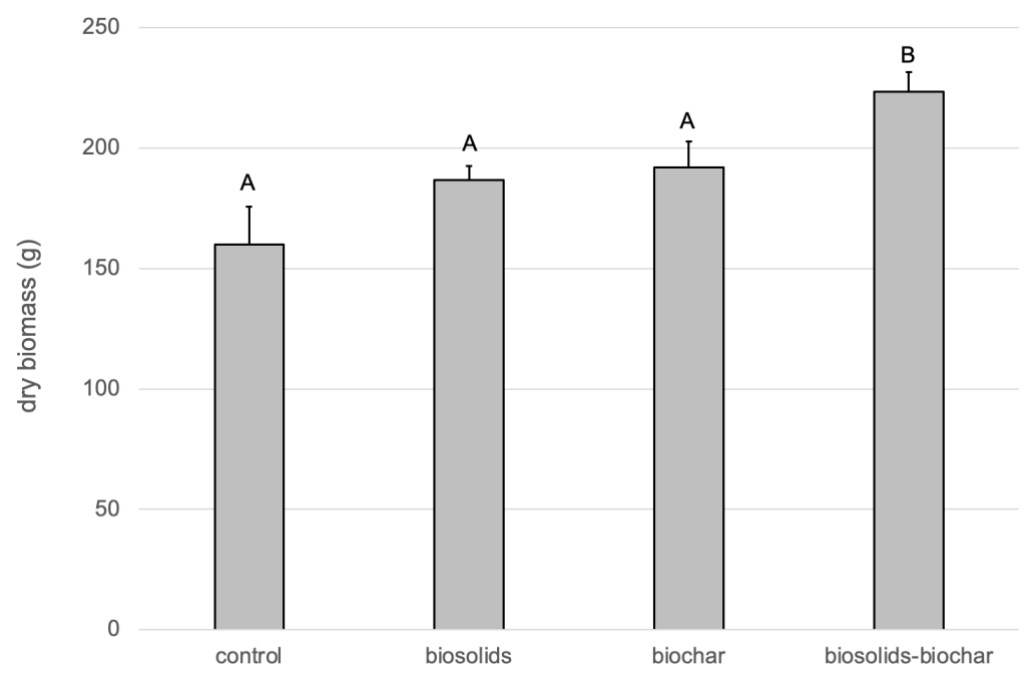
The addition of biosolids increased the concentrations of carbon and plant macronutrients (N, P, K, S) in the substrates (Table 1), since they contained significantly higher concentrations of these elements than the control soil (Table S1). Biochar increased the carbon content of the soil and gave lesser increases in plant nutrients. At the final harvest, the “biosolids/biochar” treatment had significantly higher total biomass (Figure 1) compared to “biosolids”, “biochar”, and “control” treatments, which were not significantly different. The results show that neither biosolids nor biochar treatments in isolation resulted in a significant biomass increase but a combination of the two increased the average biomass by 40%.
添加生物固体提高了基质中碳和植物大量营养元素(N、P、K、S)的浓度(表1),因为生物固体中这些元素的浓度显著高于对照土壤(表S1)。生物炭提高了土壤碳含量,但对植物养分的提升较小。最终收获时,“生物固体/生物炭”处理的总生物量(图1)显著高于“生物固体”、“生物炭”和“对照”处理,而后三者之间无显著差异。结果表明,单独施用生物固体或生物炭均未使生物量显著增加,但二者组合使平均生物量提高了40%。
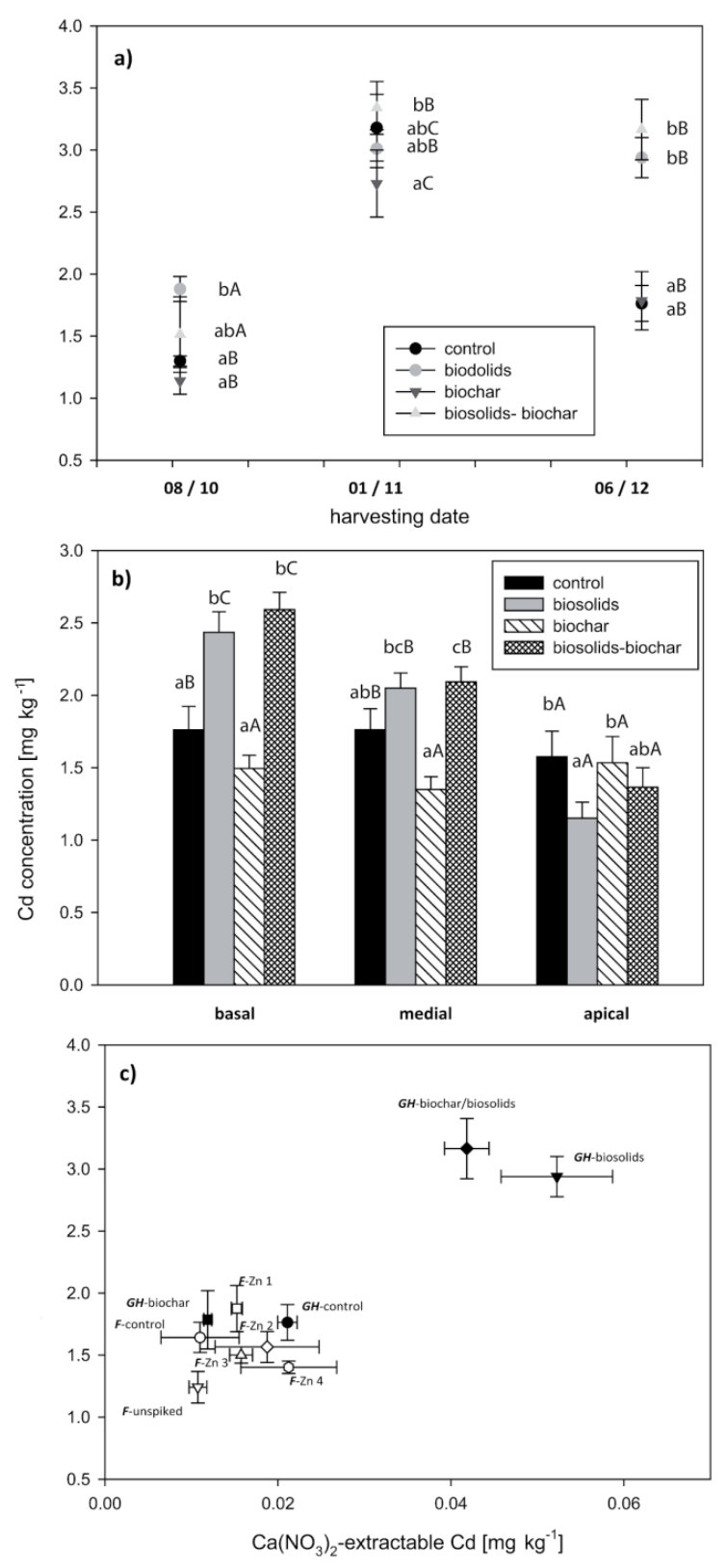
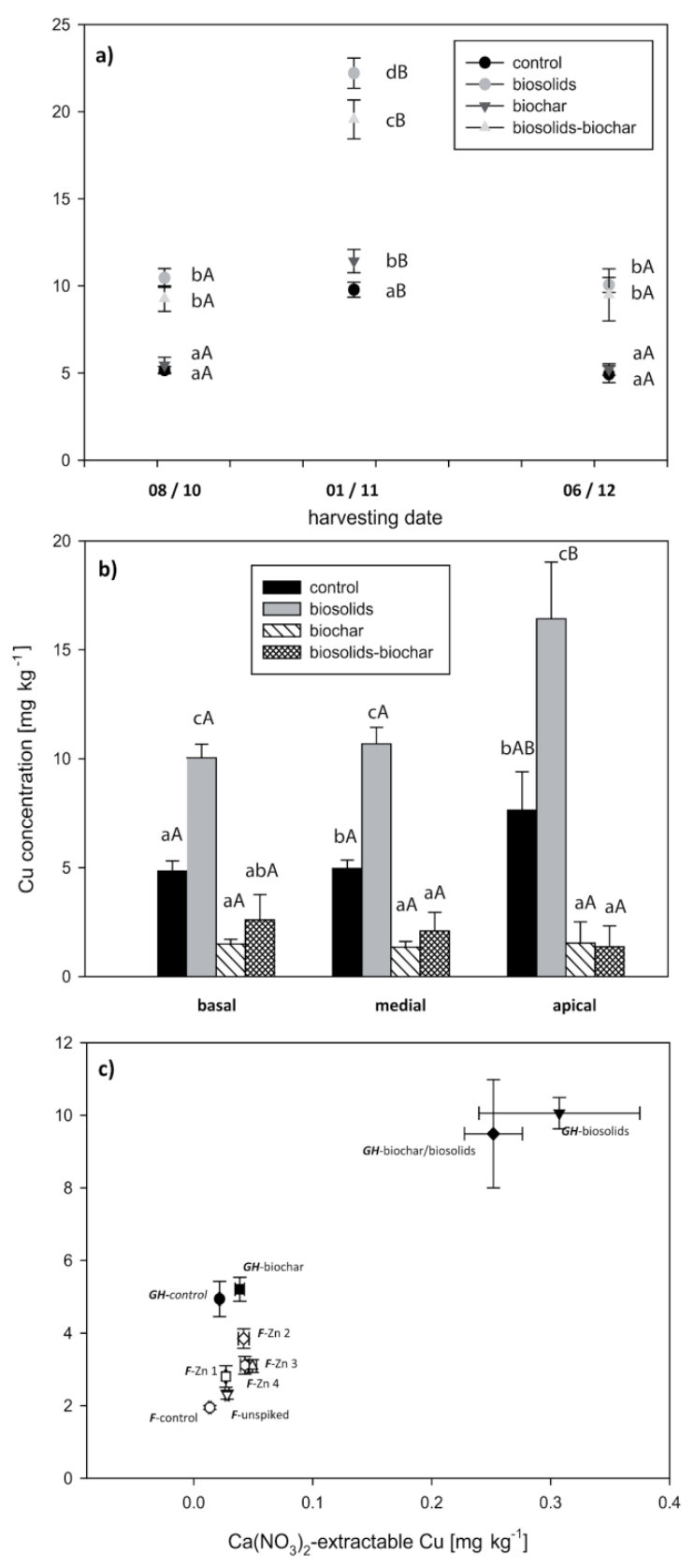
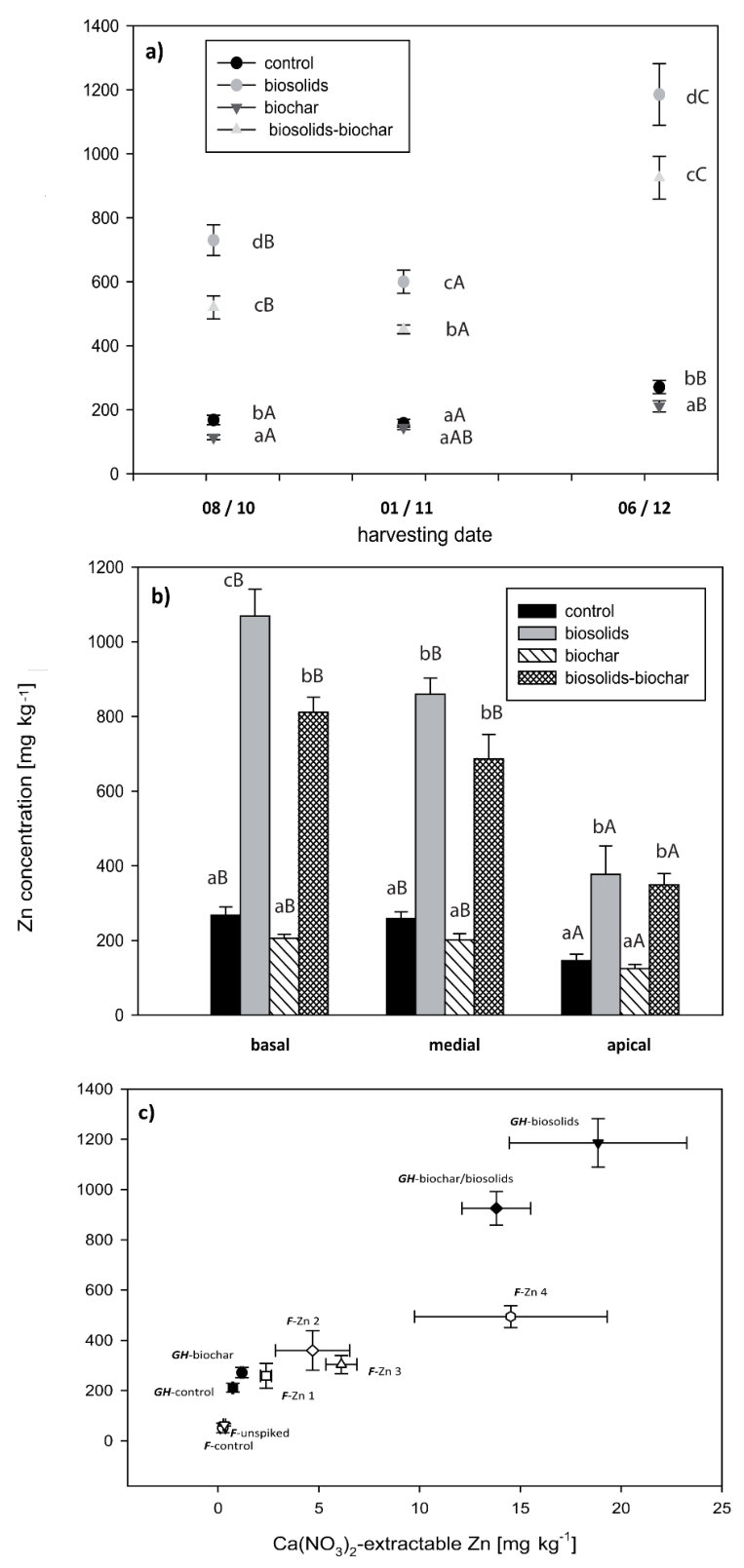
The addition of biosolids significantly increased the total concentrations of Cd, Cu, and Zn (by factors of 1.3, 3.5, and 1.5, respectively), while there were only small differences in the other TEs. The increase in soluble concentrations of these TEs was even greater (by factors of 2.5, >10, and 9.4, respectively). These increases were reflected in significantly higher concentrations of these elements in the plant leaf tissue (Figures 2–4). For Cu (Figure 3a,b), and to a lesser extent Zn (Figure 4a,b), the increase in concentration following biosolids addition was offset by the addition of biochar. Biochar had little effect on plant Cd-uptake (Figure 2a,b).
添加生物固体显著提高了Cd、Cu和Zn的全量浓度(分别提高1.3、3.5和1.5倍),而其他微量元素差异较小。这些微量元素可溶态浓度的增幅更大(分别为2.5、>10和9.4倍)。这些增幅体现为植物叶片组织中这些元素浓度的显著升高(图2–4)。对于Cu(图3a,b),以及在较小程度上对于Zn(图4a,b),添加生物固体后浓度的升高被生物炭的添加所抵消。生物炭对植物Cd吸收影响甚微(图2a,b)。
Within treatments, the Cd and Zn concentrations increased over time (Figures 2a and 4a, respectively). There was no consistent temporal trend for Cu (Figure 3a). After three months of growth, there were significant differences in the trace element concentrations between treatments. In all treatments, the basal leaves had significantly higher Cd and Zn concentrations than the medial and apical leaves (Figures 2b and 4b). This difference was greatest in the “biosolids” and “biosolids/biochar” treatments. In contrast to Cd and Zn, the apical leaves had the highest Cu concentrations in the treatments that included biosolids (Figure 3b). In both the pot trial and the greenhouse trial, the foliar TE concentration was significantly positively correlated with the Ca(NO3)2-extractable TE (Figures 2c, 3c and 4c), whereas the correlation with the total TE concentration was weaker. At the final harvest, the lower foliar bioaccumulation coefficients (plant/soil concentration quotients) in the biosolids treatments for Cd, Cu, and Zn were 3.5–6.5, 0.1–0.3, and 4.0–10.0, respectively. Concentrations of Cu and Zn in the shoots were significantly lower than in the leaves, typically 10–30% of the foliar concentration (Tables S7–S9); however, Cd concentrations in the shoots were similar to the foliar concentrations.
在各处理内,Cd和Zn浓度随时间增加(分别见图2a和图4a)。Cu无一致的时间变化趋势(图3a)。生长三个月后,各处理间微量元素浓度存在显著差异。在所有处理中,基部叶片的Cd和Zn浓度均显著高于中部和顶部叶片(图2b和图4b),这一差异在“生物固体”和“生物固体/生物炭”处理中最大。与Cd和Zn相反,在含生物固体的处理中,顶部叶片的Cu浓度最高(图3b)。无论在盆栽试验还是温室试验中,叶片微量元素浓度均与Ca(NO3)2可提取态微量元素呈显著正相关(图2c、3c和4c),而与微量元素全量浓度的相关性较弱。最终收获时,生物固体处理中Cd、Cu和Zn的叶片生物富集系数(植物/土壤浓度比)下限分别为3.5–6.5、0.1–0.3和4.0–10.0。枝条中Cu和Zn的浓度显著低于叶片,通常为叶片浓度的10–30%(表S7–S9);而枝条中Cd浓度与叶片浓度相近。
4Discussion讨论
Biosolids increased the growth of willows, but only when it was combined with biochar. In acid soils, other authors [11,59] have reported similar findings. The effect may be due to a pH increase following biochar addition. The biosolids used in these experiments were acidic (pH 4.1, Table S1) and the nutrients contained therein may not have been bioavailable. When combined with alkali biochar (pH 7.8 Table S1), the liming effect [60] may increase the bioavailability of N and other plant macronutrients in the soil. Without biosolids, biochar had no effect on plant growth. The results indicate that biosolids can accelerate willow growth provided pH is controlled. On non-acid soils, liming agents such as biochar may not be required.
生物固体促进了柳树的生长,但仅在与生物炭联合施用时才表现出来。在酸性土壤中,其他研究者[11,59]也报道了类似结果。这一效应可能源于添加生物炭后pH的升高。本试验所用生物固体呈酸性(pH 4.1,表S1),其中所含养分可能不具生物有效性。与碱性生物炭(pH 7.8,表S1)联合施用时,石灰效应[60]可能提高土壤中N及其他植物大量营养元素的生物有效性。在不施用生物固体的情况下,生物炭对植物生长无影响。结果表明,只要控制好pH,生物固体可促进柳树生长。在非酸性土壤上,可能无需使用生物炭等石灰性改良剂。
Cadmium concentrations were below the threshold of 5 mg kg−1, above which animal health may be affected [61]. However, on biosolids-amended soil, Cd concentrations were significantly higher than the threshold of 1 mg kg−1 set by the European Union as a safety threshold for animal fodder [62]. Given that willows would only form a small part of the animals’ diets, it is unlikely that using biosolids-grown willow as supplementary fodder would increase the average Cd concentration of the whole diet above 1 mg kg−1. Moreover, the bioaccessibility and toxicity of the Cd in the willow leaves may be reduced by the elevated Zn concentrations [63,64]. Nevertheless, the effects of Cd on animal production and food quality should be determined before the large-scale phytoremediation of biosolids using willows is implemented.
Cd浓度低于5 mg kg−1的阈值,超过该阈值可能影响动物健康[61]。然而,在施用生物固体的土壤上,Cd浓度显著高于欧盟设定的动物饲料安全阈值1 mg kg−1[62]。鉴于柳树仅占动物日粮的一小部分,将生物固体上生长的柳树用作补充饲料不太可能使整个日粮的平均Cd浓度超过1 mg kg−1。此外,柳树叶片中较高的Zn浓度可能降低其中Cd的生物可及性和毒性[63,64]。尽管如此,在大规模实施利用柳树进行生物固体植物修复之前,仍应确定Cd对动物生产和食品质量的影响。
Copper concentrations in biosolids-amended soils were significantly higher than the controls. Similar results, both in terms of total concentration and response to biosolids have been shown for Lolium multiflorum L. [65]. This increase is significant because Cu-deficiency is widespread in agricultural systems. For example, some 25% of New Zealand soils contain insufficient Cu for animal agriculture [66]. As with Cd, there is a lacuna of information on the bioaccessibility of Cu in willow leaves used for stock fodder.
施用生物固体土壤上的Cu浓度显著高于对照。Lolium multiflorum L.在全量浓度及对生物固体的响应方面也表现出类似结果[65]。这一增幅意义重大,因为Cu缺乏在农业系统中普遍存在。例如,约25%的新西兰土壤所含Cu不足以满足畜牧业需求[66]。与Cd一样,关于用作家畜饲料的柳树叶片中Cu的生物可及性,目前仍缺乏相关信息。
When grown in biosolids-amended soil, willows accumulated agronomically significant concentrations of Zn that may provide a prophylaxis against facial eczema [8] or alleviate Zn deficiency, which is widespread in many agricultural systems [66,67]. The Zn contained in willow foliage has been demonstrated to be bioaccessible to sheep [8] and therefore likely bioaccessible to other ruminant animals. The increase in Zn in willows is consistent with increases in other plant species following biosolids addition [11,65,68], although the magnitude of the increase was significantly greater in this study. This may have been due to increased Zn bioavailability due to the low soil pH (Table S1) or due to the propensity of willows to accumulate inordinate concentrations of Zn [69]. At higher soil pH (>6), Ashworth and Alloway [70] reported that Zn was released from biosolids and adsorbed by soil colloids. The highest Zn concentrations occurred in the bottom leaves at the end of the growing season, which is when willow may be increasingly fed to stock due to reduced pasture growth.
在施用生物固体的土壤中生长时,柳树累积了具有农学意义浓度的Zn,可预防面部湿疹[8]或缓解在许多农业系统中普遍存在的Zn缺乏[66,67]。已有研究证明柳树叶片中的Zn对绵羊具有生物可及性[8],因此对其他反刍动物很可能同样具有生物可及性。柳树中Zn的增加与其他植物物种在添加生物固体后的增加一致[11,65,68],但本研究中的增幅显著更大。这可能是由于土壤pH较低(表S1)导致Zn的生物有效性提高,或是由于柳树具有累积超常浓度Zn的倾向[69]。在较高的土壤pH(>6)下,Ashworth和Alloway[70]报道Zn从生物固体中释放并被土壤胶体吸附。最高的Zn浓度出现在生长季末期的下部叶片中,而此时由于牧草生长减缓,柳树可能越来越多地被用于饲喂家畜。
The reduction in Cu, and to a lesser extent Zn, caused by biochar addition (both to the control and the biosolids treatments) may be due a pH increase, which reduces the solubility of these elements [71]. In addition, the biochar may provide both chemical and physical sorption sites for the elements [27,33]. Application of biochar to the soil was found to increase soil cation exchange capacity (CEC) by up to 40% and soil pH by up to one pH unit [72]. Since the negatively charged organic functional groups of the biochar increase over time during its oxidation in soil [25], and since the structure of biochar is highly recalcitrant in the soil environment to microbial decomposition [73], any biochar-trace element complexes formed are expected to be more stable than those formed with other forms of organic matter in soil [74]. Vacha et al. [75] reported a large variation in the capacity of various biochars to sorb trace elements, indicating that the performance of each system needs to be assessed individually.
添加生物炭(无论在对照还是生物固体处理中)导致Cu以及在较小程度上Zn的降低,可能是由于pH升高降低了这些元素的溶解度[71]。此外,生物炭可为这些元素提供化学和物理吸附位点[27,33]。研究发现,向土壤中施用生物炭可使土壤阳离子交换量(CEC)提高多达40%,土壤pH提高多达一个单位[72]。由于生物炭在土壤中氧化过程中其带负电荷的有机官能团会随时间增加[25],且生物炭结构在土壤环境中高度抗微生物分解[73],因此所形成的生物炭–微量元素络合物预计比与土壤中其他形式有机质形成的络合物更为稳定[74]。Vacha等[75]报道不同生物炭吸附微量元素的能力差异很大,表明需要对每个体系的效果进行单独评估。
The negligible change in plant Cd uptake in the biochar treatments is consistent with other authors reporting that liming may occasionally be ineffective for reducing plant Cd uptake [76,77]. This may be due to plants accumulating more Cd because there is less competition with Zn for transporter sites on the roots, or because of upregulation of Zn-transporter genes, which may also increase Cd uptake [78].
生物炭处理中植物Cd吸收几乎无变化,这与其他研究者报道的施用石灰有时对降低植物Cd吸收无效的结果一致[76,77]。这可能是因为与Zn竞争根系转运位点的程度降低使植物累积更多Cd,或是因为Zn转运蛋白基因上调表达,而这也可能增加Cd的吸收[78]。
The foliar trace element concentrations in these experiments were a function of the Ca(NO3)2—extractable concentration in the soil, a finding that has been reported for Lolium perenne L. [58]. That the results were consistent both in the pot trial and in the field trial indicates that biosolids phytoremediation using willow will behave similarly on a large scale. This is not always the case; using S. alba X S. viminalis, Rosselli et al. [48] reported bioaccumulation coefficients of 0.95 for Zn and 1.42 for Cd in pot-grown samples but only 0.37 for Zn and 0.83 for Cd in field grown plants.
本试验中叶片微量元素浓度是土壤中Ca(NO3)2可提取态浓度的函数,这一发现在Lolium perenne L.中也有报道[58]。盆栽试验和田间试验结果一致,表明利用柳树进行的生物固体植物修复在大尺度上将表现出相似的行为。但情况并非总是如此:Rosselli等[48]使用S. alba X S. viminalis,报道盆栽样品中Zn和Cd的生物富集系数分别为0.95和1.42,而田间生长植株中仅分别为0.37和0.83。
While biosolids can accelerate the growth of willow and produce animal fodder that is biofortified in both Cu and Zn, it is unclear how long this effect will last. Assuming 10 t of shoots and foliar material is removed annually, the initial harvest would remove some 10 kg ha−1 of Zn from the soil. This is a significant fraction of the c.a. 44 kg of Zn added with the biosolids (assuming a biosolids addition rate of 50 t ha−1). The decrease in plant trace element uptake may be disproportionately large if there is an inordinate reduction in soluble Zn as has been reported [79]. In the case of Cd, the extraction was equivalent <12 g, which is small compared to the amount added (ca. 1.4 kg ha−1). Regarding Cu, the removal (<10 g ha−1) was negligible compared to the 12 kg ha−1 equiv. that was added. Therefore, if there were repeated applications of biosolids to maintain Zn uptake, not only would there be significant increases in soil Cd and Cu, but the Zn: Cd ratio would decrease. Both these factors would lead to increased Cd uptake and bioaccessibility [63,64]. Biosolids can increase dissolved organic matter, which can increase downward mobility of these contaminants, possibly into receiving waters [80].
虽然生物固体能够加速柳树生长,并生产Cu和Zn均得到生物强化的动物饲料,但这一效应能持续多久尚不清楚。假设每年移除10 t枝条和叶片材料,首次收获将从土壤中移除约10 kg ha−1的Zn。这占随生物固体添加的约44 kg Zn(假设生物固体施用量为50 t ha−1)的相当大比例。如已有报道所示,若可溶性Zn出现过度降低[79],植物微量元素吸收的下降幅度可能不成比例地大。就Cd而言,移除量相当于<12 g,与添加量(约1.4 kg ha−1)相比很小。就Cu而言,移除量(<10 g ha−1)与添加的12 kg ha−1当量相比可忽略不计。因此,若为维持Zn吸收而重复施用生物固体,不仅土壤Cd和Cu会显著增加,而且Zn:Cd比值也会降低。这两个因素都将导致Cd吸收和生物可及性的增加[63,64]。生物固体可增加溶解性有机质,从而可能增强这些污染物的向下迁移,甚至进入受纳水体[80]。
5Conclusions结论
Our results indicate that willows have potential for the phytoremediation of biosolids, where biosolids are applied to degraded or marginal land and the biomass. Except for Cd, the concentrations of other contaminants in the willows were not significantly increased. Our results supported the hypothesis that biochar reduces the bioavailability of some TEs in biosolids, at least in the case of willows, with the critical exception of Cd. This effect was most likely due to the high pH of the biochar. Willows grown on soils amended with biosolids or biosolids/biochar may produce Zn-biofortified stock fodder that may alleviate widespread Zn deficiencies, offset greenhouse gas emissions, and at the same time increasing biomass production since the mixture biosolids/biochar results in the highest biomass production. Critical next steps in this research are the determination of the bioaccessibility of willow-borne Cd to animals as well as assessing the change in trace element accumulation over several growing seasons.
我们的结果表明,在将生物固体施用于退化或边际土地的情况下,柳树具有用于生物固体植物修复的潜力。除Cd外,柳树中其他污染物的浓度未显著增加。结果支持了生物炭降低生物固体中部分微量元素生物有效性的假设(至少对柳树而言),但Cd是一个关键的例外。这一效应很可能源于生物炭的高pH。在施用生物固体或生物固体/生物炭的土壤上生长的柳树,可生产Zn生物强化的家畜饲料,有望缓解普遍存在的Zn缺乏、抵消温室气体排放,同时提高生物量产量,因为生物固体/生物炭混合物带来了最高的生物量产量。本研究下一步的关键工作是确定柳树中Cd对动物的生物可及性,并评估多个生长季内微量元素累积的变化。
Supplementary Materials: The following supporting information can be downloaded at: https:// www.mdpi.com/article/10.3390/life13010243/s1, Table S1: Soil chemical properties of the biosolids and biochar. Values in brackets represent the standard error of the mean (n = 3 unless otherwise indicated). Adapted from Knowles et al. (2011) Gartler et al. (2013), and Taghizadeh-Toosi et al. (2011); Table S2: Elemental concentrations in the basal leaves (October harvest). All concentrations in mg/kg. Values in brackets represent the standard error of the mean (n = 5); Table S3: Elemental concentrations in the basal leaves (November harvest). All concentrations in mg/kg. Values in brackets represent the standard error of the mean (n = 5); Table S4: Elemental concentrations in the basal leaves (December harvest). All concentrations in mg/kg. Values in brackets represent the standard error of the mean (n = 5); Table S5: Elemental concentrations in the basal leaves (final harvest). All concentrations in mg/kg. Values in brackets represent the standard error of the mean (n = 5); Table S6: Elemental concentrations in the apical leaves (final harvest). All concentrations in mg/kg. Values in brackets represent the standard error of the mean (n = 5); Table S7: Elemental concentrations in the medial leaves (final harvest). All concentrations in mg/kg. Values in brackets represent the standard error of the mean (n = 5); Table S8: Elemental concentrations in the basal shoots (final harvest). All concentrations in mg/kg. Values in brackets represent the standard error of the mean (n = 5); Table S9: Elemental concentrations in the medial shoots (final harvest).
补充材料:以下支持信息可从https:// www.mdpi.com/article/10.3390/life13010243/s1下载,表S1:生物固体和生物炭的土壤化学性质。括号内数值表示平均值的标准误(除另有说明外,n = 3)。改编自Knowles et al. (2011)、Gartler et al. (2013)和Taghizadeh-Toosi et al. (2011);表S2:基部叶片中的元素浓度(10月收获)。所有浓度单位均为mg/kg。括号内数值表示平均值的标准误(n = 5);表S3:基部叶片中的元素浓度(11月收获)。所有浓度单位均为mg/kg。括号内数值表示平均值的标准误(n = 5);表S4:基部叶片中的元素浓度(12月收获)。所有浓度单位均为mg/kg。括号内数值表示平均值的标准误(n = 5);表S5:基部叶片中的元素浓度(最终收获)。所有浓度单位均为mg/kg。括号内数值表示平均值的标准误(n = 5);表S6:顶部叶片中的元素浓度(最终收获)。所有浓度单位均为mg/kg。括号内数值表示平均值的标准误(n = 5);表S7:中部叶片中的元素浓度(最终收获)。所有浓度单位均为mg/kg。括号内数值表示平均值的标准误(n = 5);表S8:基部枝条中的元素浓度(最终收获)。所有浓度单位均为mg/kg。括号内数值表示平均值的标准误(n = 5);表S9:中部枝条中的元素浓度(最终收获)。
All concentrations in mg/kg. Values in brackets represent the standard error of the mean (n = 5); Table S10: Elemental concentrations in the apical shoots (final harvest). All concentrations in mg/kg. Values in brackets represent the standard error of the mean (n = 5); Table S11: Elemental concentrations in the roots (final harvest). All concentrations in mg/kg. Values in brackets represent the standard error of the mean (n = 5).
所有浓度单位均为mg/kg。括号内数值表示平均值的标准误(n = 5);表S10:顶部枝条中的元素浓度(最终收获)。所有浓度单位均为mg/kg。括号内数值表示平均值的标准误(n = 5);表S11:根系中的元素浓度(最终收获)。所有浓度单位均为mg/kg。括号内数值表示平均值的标准误(n = 5)。
Author Contributions: A.C. co-designed the experiments, conducted the experiments including the greenhouse, experiment, and field trial. A.C. performed the chemical analyses and co-wrote the manuscript. J.E. performed the statistical analysis of the data and co-wrote the manuscript. B.H.R. co-designed the experiments and co-wrote the manuscript. All authors have read and agreed to the published version of the manuscript.
作者贡献:A.C.参与设计试验,开展了包括温室试验和田间试验在内的各项试验,完成化学分析并参与撰写论文。J.E.完成数据统计分析并参与撰写论文。B.H.R.参与设计试验并参与撰写论文。所有作者均已阅读并同意论文的发表版本。
Funding: This research was funded by Environmental Science and Research (ESR) as part of the Integrated Centre for Biowaste Research. Grant number E6761.
基金资助:本研究由Environmental Science and Research(ESR)资助,属于Integrated Centre for Biowaste Research的组成部分。资助编号E6761。
Institutional Review Board Statement: Not applicable.机构审查委员会声明:不适用。
Informed Consent Statement: Not applicable.知情同意声明:不适用。
Data Availability Statement: Data will be made available on https://www.kiwiscience.com/journalarticles.html.
数据可用性声明:数据将在https://www.kiwiscience.com/journalarticles.html上提供。
Acknowledgments: The authors gratefully acknowledge support from the Environment Group at Environmental Science and Research (ESR), led by Maria Jesus Gutierrez-Gines, as well as technical support from Lincoln University.
致谢:作者衷心感谢由Maria Jesus Gutierrez-Gines领导的Environmental Science and Research(ESR)环境组的支持,以及林肯大学提供的技术支持。
Conflicts of Interest: The authors declare no conflict of interest.
利益冲突:作者声明无利益冲突。
References参考文献
1. Sastre, I.; Vicente, M.A.; Lobo, M.C. Influence of the Application of Sewage Sludges on Soil Microbial Activity. Bioresour. Technol. 1996, 57, 19–23. [CrossRef]
2. Albiach, R.; Canet, R.; Pomares, F.; Ingelmo, F. Microbial Biomass Content and Enzymatic Activities after the Application of Organic Amendments to a Horticultural Soil. Bioresour. Technol. 2000, 75, 43–48. [CrossRef]
3. Vasseur, L.; Cloutier, C.; Ansseau, C. Effects of Repeated Sewage Sludge Application on Plant Community Diversity and Structure under Agricultural Field Conditions on Podzolic Soils in Eastern Quebec. Agric. Ecosyst. Environ. 2000, 81, 209–216. [CrossRef]
4. Bohm, K.; Hatley, G.A.; Robinson, B.H. Black Soldier Fly-Based Bioconversion of Biosolids Creates High-Value Products with Low Heavy Metal Concentrations. Conserv. Recycl. 2022, 180, 106149. [CrossRef]
5. Focker, M.; van Asselt, E.D.; Berendsen, B.J.A.; van de Schans, M.G.M.; van Leeuwen, S.P.J.; Visser, S.M.; van der Fels-Klerx, H.J. Review of Food Safety Hazards in Circular Food Systems in Europe. Food Res. Int. 2022, 158, 111505. [CrossRef]
6. McBride, M.B. Long-Term Biosolids Application on Land: Beneficial Recycling of Nutrients or Eutrophication of Agroecosystems? Soil Syst. 2022, 6, 9. [CrossRef]
7. Underwood, E.J.; Suttle, N.F. The Mineral Nutrition of Livestock, 3rd ed.; CAB International: Wallingford, UK, 1999; p. 614.
8. Anderson, C.W.N.; Robinson, B.H.; West, D.M.; Clucas, L.; Portmann, D. Zinc-Enriched and Zinc-Biofortified Feed as a Possible Animal Remedy in Pastoral Agriculture: Animal Health and Environmental Benefits. J. Geochem. Explor. 2012, 121, 30–35. [CrossRef]
9. Song, C.; Shen, X. Effects of Environmental Zinc Deficiency on Antioxidant System Function in Wumeng Semi-Fine Wool Sheep. Biol. Trace Elem. Res. 2020, 195, 110–116. [CrossRef]
10. Hill, G.M.; Shannon, M.C. Copper and Zinc Nutritional Issues for Agricultural Animal Production. Biol. Trace Elem. Res. 2019, 188, 148–159. [CrossRef]
11. Gartler, J.; Robinson, B.; Burton, K.; Clucas, L. Carbonaceous Soil Amendments to Biofortify Crop Plants with Zinc. Sci. Total Environ. 2013, 465, 308–313. [CrossRef] [PubMed]
12. Alloway, B.J.; Jackson, A.P. The Behaviour of Heavy Metals in Sewage Sludge-Amended Soils. Sci. Total Environ. 1991, 100, 151–176. [CrossRef] [PubMed]
13. Li, Z.; Ryan, J.A.; Chen, J.L.; Al-Abed, S.R. Adsorption of Cadmium on Biosolids-Amended Soils. J. Environ. Qual. 2001, 30, 903–911. [CrossRef] [PubMed]
14. Stadelmann, F.X.; Furrer, O.J. Long-Term Effects of Sewage and Pig Slurry Applications on Micro-Biological and Chemical Soil Properties in Field Experiments. In Long-Term Effects of Sewage Sludge and Farm Slurries Applications; Elsevier Applied Science Publishers: London, UK, 1985; pp. 136–145.
15. Brown, S.L.; Henry, C.L.; Chaney, R.; Compton, H.; DeVolder, P.S. Using Municipal Biosolids in Combination with Other Residuals to Restore Metal-Contaminated Mining Areas. Plant Soil 2003, 249, 203–215. [CrossRef]
16. Labrecque, M.; Teodorescu, T.I.; Daigle, S. Effect of Wastewater Sludge on Growth and Heavy Metal Bioaccumulation of Two Salix Species. Plant Soil 1995, 171, 303–316. [CrossRef]
17. Correa, R.S.; White, R.E.; Weatherley, A.J. Risk of Nitrate Leaching from Two Soils Amended with Biosolids. Water Resour. 2006, 33, 453–462. [CrossRef]
18. Paramashivam, D.; Dickinson, N.M.; Clough, T.J.; Horswell, J.; Robinson, B.H. Potential Environmental Benefits from Blending Biosolids with Other Organic Amendments before Application to Land. J. Environ. Qual. 2017, 46, 481–489. [CrossRef]
19. Knowles, O.A.; Robinson, B.H.; Contangelo, A.; Clucas, L. Biochar for the Mitigation of Nitrate Leaching from Soil Amended with Biosolids. Sci. Total Environ. 2011, 409, 3206–3210. [CrossRef] [PubMed]
20. Zhang, A.; Cui, L.; Pan, G.; Li, L.; Hussain, Q.; Zhang, X.; Zheng, J.; Crowley, D. Effect of Biochar Amendment on Yield and Methane and Nitrous Oxide Emissions from a Rice Paddy from Tai Lake Plain, China. Agric. Ecosyst. Environ. 2010, 139, 469–475. [CrossRef]
21. Chan, K.Y.; Xu, Z. Biochar: Nutrient Properties and Their Enhancement. Biochar Environ. Manag. Sci. Technol. 2009, 1, 67–84. 22. Novak, J.M.; Busscher, W.J.; Laird, D.L.; Ahmedna, M.; Watts, D.W.; Niandou, M.A.S. Impact of Biochar Amendment on Fertility of a Southeastern Coastal Plain Soil. Soil Sci. 2009, 174, 105–112. [CrossRef]
23. Glaser, B.; Lehmann, J.; Zech, W. Ameliorating Physical and Chemical Properties of Highly Weathered Soils in the Tropics with Charcoal—A Review. Biol. Fertil. Soils 2002, 35, 219–230. [CrossRef]
24. Topoliantz, S.; Ponge, J.-F.; Ballof, S. Manioc Peel and Charcoal: A Potential Organic Amendment for Sustainable Soil Fertility in the Tropics. Biol. Fertil. Soils 2005, 41, 15–21. [CrossRef]
25. Cheng, C.-H.; Lehmann, J.; Thies, J.E.; Burton, S.D. Stability of Black Carbon in Soils across a Climatic Gradient. J. Geophys. Res. 2008, 113, G02027. [CrossRef]
26. Güereña, D.; Lehmann, J.; Hanley, K.; Enders, A.; Hyland, C.; Riha, S. Nitrogen Dynamics Following Field Application of Biochar in a Temperate North American Maize-Based Production System. Plant Soil 2013, 365, 239–254. [CrossRef]
27. Clough, T.J.; Condron, L.M. Biochar and the Nitrogen Cycle: Introduction. J. Environ. Qual. 2010, 39, 1218–1223. [CrossRef] [PubMed]
28. Singh, B.P.; Hatton, B.J.; Singh, B.; Cowie, A.L.; Kathuria, A. Influence of Biochars on Nitrous Oxide Emission and Nitrogen Leaching from Two Contrasting Soils. J. Environ. Qual. 2010, 39, 1224. [CrossRef]
29. Steiner, C.; Das, K.C.; Garcia, M.; Förster, B.; Zech, W. Charcoal and Smoke Extract Stimulate the Soil Microbial Community in a Highly Weathered Xanthic Ferralsol. Pedobiologia 2008, 51, 359–366. [CrossRef]
30. Warnock, D.D.; Lehmann, J.; Kuyper, T.W.; Rillig, M.C. Mycorrhizal Responses to Biochar in Soil—Concepts and Mechanisms. Plant Soil 2007, 300, 9–20. [CrossRef]
31. Gujre, N.; Soni, A.; Rangan, L.; Tsang, D.C.W.; Mitra, S. Sustainable Improvement of Soil Health Utilizing Biochar and Arbuscular Mycorrhizal Fungi: A Review. Environ. Pollut. 2021, 268, 115549. [CrossRef]
32. Ahmad, M.; Rajapaksha, A.U.; Lim, J.E.; Zhang, M.; Bolan, N.; Mohan, D.; Vithanage, M.; Lee, S.S.; Ok, Y.S. Biochar as a Sorbent for Contaminant Management in Soil and Water: A Review. Chemosphere 2014, 99, 19–33. [CrossRef]
33. Beesley, L.; Moreno-Jiménez, E.; Gomez-Eyles, J.L.; Harris, E.; Robinson, B.; Sizmur, T. A Review of Biochars’ Potential Role in the Remediation, Revegetation and Restoration of Contaminated Soils. Environ. Pollut. 2011, 159, 3269–3282. [CrossRef] [PubMed]
34. Suthar, R.; Wang, C.; Nunes, M.; Chen, J.; Sargent, S.; Bucklin, R.; Gao, B. Bamboo Biochar Pyrolyzed at Low Temperature Improves Tomato Plant Growth and Fruit Quality. Agriculture 2018, 8, 153. [CrossRef]
35. Chan, K.Y.; Van Zwieten, L.; Meszaros, I.; Downie, A.; Joseph, S. Agronomic Values of Greenwaste Biochar as a Soil Amendment. Soil Res. 2008, 45, 629–634. [CrossRef]
36. Shinogi, Y.; Yoshida, H.; Koizumi, T.; Yamaoka, M.; Saito, T. Basic Characteristics of Low-Temperature Carbon Products from Waste Sludge. Adv. Environ. Res. 2003, 7, 661–665. [CrossRef]
37. Newman, S.M. Poplar Agroforestry in India. For. Ecol. Manag. 1997, 90, 13–17. [CrossRef]
38. Oppong, S.; Kemp, P.D.; Douglas, G.B.; Bulloch, B.T. Management of Browse Plants as Drought Fodder for Sheep: A Preliminary Study. In Proceedings of the Conference-New Zealand Grassland Association, Waitangi, New Zealand, December 1996; Volume 57, pp. 93–98.
39. McIvor, I.R.; Hedderley, D.; Mason, K. Effect of Pollarding for Fodder on Fine Root Dynamics of Soil Conservation Willow Trees in New Zealand. Adv. Environ. Stud. 2020, 4, 252–260. [CrossRef]
40. Wilkinson, A.G. Poplars and Willows for Soil Erosion Control in New Zealand. Biomass Bioenergy 1999, 16, 263–274. [CrossRef] 41. Hathaway, R.L. Short-Rotation Biomass Production of Willows. In Proceedings of the International Poplar Commission Ad Hoc Committee on Biomass Production Systems in Salicaceae Eng, Monferrato, Italy, 3–5 September 1986.
42. Barry, T.; Kemp, P. Ewes Respond to Poplar Feed. Tree Feed 2001, 1, 2–3.
43. Robinson, B.; Mills, T.; Green, S.; Chancerel, B.; Clothier, B.; Fung, L.; Hurst, S.; McIvor, I. Trace Element Accumulation by Poplars and Willows Used for Stock Fodder. N. Z. J. Agric. Res. 2005, 48, 489–497. [CrossRef]
44. Granel, T.; Robinson, B.; Mills, T.; Clothier, B.; Green, S.; Fung, L. Cadmium Accumulation by Willow Clones Used for Soil Conservation, Stock Fodder, and Phytoremediation. Soil Res. 2002, 40, 1331–1337. [CrossRef]
45. Robinson, B.; Green, S.; Mills, T.; Clothier, B.; van der Velde, M.; Laplane, R.; Fung, L.; Deurer, M.; Hurst, S.; Thayalakumaran, T.; et al. Phytoremediation: Using Plants as Biopumps to Improve Degraded Environments. Soil Res. 2003, 41, 599–611. [CrossRef]
46. Punshon, T.; Dickinson, N.M. Acclimation of Salix to Metal Stress. New Phytol. 1997, 137, 303–314. [CrossRef] [PubMed]
47. Stoltz, E.; Greger, M. Accumulation Properties of As, Cd, Cu, Pb and Zn by Four Wetland Plant Species Growing on Submerged Mine Tailings. Environ. Exp. Bot. 2002, 47, 271–280. [CrossRef]
48. Rosselli, W.; Keller, C.; Boschi, K. Phytoextraction Capacity of Trees Growing on a Metal Contaminated Soil. Plant Soil 2003, 256, 265–272. [CrossRef]
49. Lunácková, J.; Chmelík, V.; Sipova, I.; Zampachova, E.; Becvarova, J. Epidemiologic Monitoring of Tick-Borne Encephalitis in Rimov in Southern Bohemia. Epidemiol. Mikrobiol. Imunol. 2003, 52, 51–58.
50. Vandecasteele, B.; Quataert, P.; De Vos, B.; Tack, F.M.G.; Muys, B. Foliar Concentrations of Volunteer Willows Growing on Polluted Sediment-Derived Sites versus Sites with Baseline Contamination Levels. J. Environ. Monit. 2004, 6, 313–321. [CrossRef] 51. Vandecasteele, B.; Meers, E.; Vervaeke, P.; De Vos, B.; Quataert, P.; Tack, F.M.G. Growth and Trace Metal Accumulation of Two Salix Clones on Sediment-Derived Soils with Increasing Contamination Levels. Chemosphere 2005, 58, 995–1002. [CrossRef]
52. Landberg, T.; Greger, M. Interclonal Variation of Heavy Metal Interactions inSalix Viminalis. Environ. Toxicol. Chem. 2002, 21, 2669–2674. [CrossRef]
53. Klang-Westin, E.; Perttu, K. Effects of Nutrient Supply and Soil Cadmium Concentration on Cadmium Removal by Willow. Biomass Bioenergy 2002, 23, 415–426. [CrossRef]
54. Keller, C.; Hammer, D.; Kayser, A.; Richner, W.; Brodbeck, M.; Sennhauser, M. Root Development and Heavy Metal Phytoextraction Efficiency: Comparison of Different Plant Species in the Field. Plant Soil 2003, 249, 67–81. [CrossRef]
55. Clough, T.J.; Bertram, J.E.; Ray, J.L.; Condron, L.M.; O’Callaghan, M.; Sherlock, R.R.; Wells, N.S. Unweathered Wood Biochar Impact on Nitrous Oxide Emissions from a Bovine-Urine-Amended Pasture Soil. Soil Sci. Soc. Am. J. 2010, 74, 852–860. [CrossRef] 56. Taghizadeh-Toosi, A.; Clough, T.J.; Condron, L.M.; Sherlock, R.R.; Anderson, C.R.; Craigie, R.A. Biochar Incorporation into Pasture Soil Suppresses in Situ Nitrous Oxide Emissions from Ruminant Urine Patches. J. Environ. Qual. 2011, 40, 468–476. [CrossRef] [PubMed]
57. McLaren, R.G.; Clucas, L.M.; Taylor, M.D. Leaching of Macronutrients and Metals from Undisturbed Soils Treated with Metal- Spiked Sewage Sludge. 3. Distribution of Residual Metals. Soil Res. 2005, 43, 159–170. [CrossRef]
58. Black, A.; Mclaren, R.G.; Reichman, S.M.; Speir, T.W.; Condron, L.M. Examining the Integrity of Soil Metal Bioavailability Assays in the Presence of Organic Amendments to Metal-Spiked Soils: The Integrity of Soil Metal Assays. Soil Use Manag. 2012, 28, 89–100. [CrossRef]
59. Simcock, R.; Cavanagh, J.; Robinson, B.; Gutierrez-Gines, M.J. Using Biowastes to Establish Native Plants and Ecosystems in New Zealand. Front. Sustain. Food Syst. 2019, 3, 85. [CrossRef]
60. Joseph, S.; Cowie, A.L.; Van Zwieten, L.; Bolan, N.; Budai, A.; Buss, W.; Cayuela, M.L.; Graber, E.R.; Ippolito, J.A.; Kuzyakov, Y.; et al. How Biochar Works, and When It Doesn’t: A Review of Mechanisms Controlling Soil and Plant Responses to Biochar. Glob. Chang. Biol. Bioenergy 2021, 13, 1731–1764. [CrossRef]
61. Lane, E.A.; Canty, M.J.; More, S.J. Cadmium Exposure and Consequence for the Health and Productivity of Farmed Ruminants. Res. Vet. Sci. 2015, 101, 132–139. [CrossRef] [PubMed]
62. European Food Safety Authority (EFSA) Opinion of the Scientific Panel on Contaminants in the Food Chain [CONTAM] Related to Cadmium as Undesirable Substance in Animal Feed. EFSA J. 2004, 2, 72. [CrossRef]
63. Brzóska, M.M.; Moniuszko-Jakoniuk, J. Interactions between Cadmium and Zinc in the Organism. Food Chem. Toxicol. 2001, 39, 967–980. [CrossRef]
64. Klaassen, C.D.; Liu, J.; Choudhuri, S. METALLOTHIONEIN: An Intracellular Protein to Protect Against Cadmium Toxicity. Annu. Rev. Pharmacol. Toxicol. 1999, 39, 267–294. [CrossRef]
65. Esperschütz, J.; Lense, O.; Anderson, C. Biowaste Mixtures Affecting the Growth and Elemental Composition of Italian Ryegrass (Lolium multiflorum). J. Environ. Qual. 2016, 45, 1054–1061. [CrossRef]
66. Grace, N.D.; Knowles, S.O. Trace Element Supplementation of Livestock in New Zealand: Meeting the Challenges of Free-Range Grazing Systems. Vet. Med. Int. 2012, 2012, 639472. [CrossRef] [PubMed]
67. Shukla, A.K.; Behera, S.K.; Prakash, C.; Tripathi, A.; Patra, A.K.; Dwivedi, B.S.; Trivedi, V.; Rao, C.S.; Chaudhari, S.K.; Das, S.; et al. Deficiency of Phyto-Available Sulphur, Zinc, Boron, Iron, Copper and Manganese in Soils of India. Sci. Rep. 2021, 11, 19760. [CrossRef] [PubMed]
68. Dickinson, N.; Marmiroli, M.; Das, B.; McLaughlin, D.; Leung, D.; Robinson, B. Endemic Plants as Browse Crops in Agricultural Landscapes of New Zealand. Agroecol. Sustain. Food Syst. 2015, 39, 224–242. [CrossRef]
69. Dos Santos Utmazian, M.N.; Wenzel, W.W. Cadmium and Zinc Accumulation in Willow and Poplar Species Grown on Polluted Soils. J. Plant Nutr. Soil Sci. 2007, 170, 265–272. [CrossRef]
70. Ashworth, D.J.; Alloway, B.J. Soil Mobility of Sewage Sludge-Derived Dissolved Organic Matter, Copper, Nickel and Zinc. Environ. Pollut. 2004, 127, 137–144. [CrossRef]
71. Robinson, B.H.; Bañuelos, G.; Conesa, H.M.; Evangelou, M.W.H.; Schulin, R. The Phytomanagement of Trace Elements in Soil. CRC Crit. Rev. Plant Sci. 2009, 28, 240–266. [CrossRef]
72. Mikan, C.J.; Abrams, M.D. Altered Forest Composition and Soil Properties of Historic Charcoal Hearths in Southeastern Pennsylvania. Can. J. For. Res. 1995, 25, 687–696. [CrossRef]
73. Sohi, S.P.; Krull, E.; Lopez-Capel, E.; Bol, R. A Review of Biochar and Its Use and Function in Soil. In Advances in Agronomy; Elsevier: Amsterdam, The Netherlands, 2010; Volume 105, pp. 47–82.
74. Namgay, T.; Singh, B.; Singh, B.P. Influence of Biochar Application to Soil on the Availability of As, Cd, Cu, Pb, and Zn to Maize (Zea mays L.). Soil Res. 2010, 48, 638. [CrossRef]
75. Vácha, R.; Podlešáková, E.; Nˇemeˇcek, J.; Poláˇcek, O. Immobilisation of As, Cd, Pb and Zn in Agricultural Soils by the Use of Organic and Inorganic Additives. Plant Soil Environ. 2011, 48, 335–342. [CrossRef]
76. Bolan, N.S.; Duraisamy, V.P. Role of Inorganic and Organic Soil Amendments on Immobilisation and Phytoavailability of Heavy Metals: A Review Involving Specific Case Studies. Aust. J. Soil Res. 2003, 41, 533–555. [CrossRef]
77. Al Mamun, S.; Lehto, N.J.; Cavanagh, J.; McDowell, R.; Aktar, M.; Benyas, E.; Robinson, B.H. Effects of Lime and Organic Amendments Derived from Varied Source Materials on Cadmium Uptake by Potato. J. Environ. Qual. 2017, 46, 836–844. [CrossRef] [PubMed]
78. Hassan, M.U.; Nawaz, M.; Mahmood, A.; Shah, A.A.; Shah, A.N.; Muhammad, F.; Batool, M.; Rasheed, A.; Jaremko, M.; Abdelsalam, N.R.; et al. The Role of Zinc to Mitigate Heavy Metals Toxicity in Crops. Front. Environ. Sci. Eng. China 2022, 10, 990223. [CrossRef]
79. Hamon, R.E.; McLaughlin, M.J. Use of the Hyperaccumulator Thlaspi Caerulescens for Bioavailable Contaminant Stripping. In Proceedings of the 5th International Conference on the Biogeochemistry of Trace Elements, Vienna, Austria, 11–15 July 1999; pp. 11–15.
80. Bolan, N.S.; Adriano, D.C.; Kunhikrishnan, A.; James, T.; McDowell, R.; Senesi, N. Chapter One—Dissolved Organic Matter: Biogeochemistry, Dynamics, and Environmental Significance in Soils. In Advances in Agronomy; Sparks, D.L., Ed.; Academic Press: Cambridge, MA, USA, 2011; Volume 110, pp. 1–75.
Disclaimer/Publisher’s Note: The statements, opinions and data contained in all publications are solely those of the individual author(s) and contributor(s) and not of MDPI and/or the editor(s). MDPI and/or the editor(s) disclaim responsibility for any injury to people or property resulting from any ideas, methods, instructions or products referred to in the content.