Article
Analysis of Chemical and Phytotoxic Properties of Frass Derived from Black Soldier Fly-Based Bioconversion of Biosolids Kristin Bohm 1,* , Gregory A. Hatley 2, Brett H. Robinson 2 and María J. Gutiérrez-Ginés 3
1 Institute of Environmental Science and Research Ltd., Porirua 5022, New Zealand
1 Institute of Environmental Science and Research Ltd.,Porirua 5022,新西兰
2 Department of Environmental Chemistry, University of Canterbury, Christchurch 8041, New Zealand 3 Institute of Environmental Science and Research Ltd., Christchurch 8041, New Zealand
* Correspondence: kristin.bohm@esr.cri.nz
Abstract: Black soldier fly (BSF)-based bioconversion can reduce significant volumes of biosolids and other organic waste while generating high-value BSF larvae (BSFL) and frass. While the mass of frass is greater than the BSFL biomass, its end use is less explored, especially when the bioprocessed waste, such as biosolids, contains high concentrations of contaminants. We assessed the potential to use frass from bioconverted biosolids as fertiliser by analysing chemical parameters and conducting phytotoxicity germination tests. We included frass from bioconverted food waste and wheat bran as comparisons. The chemical composition and phytotoxicity of the frass was related to the type of feedstock. Frass originating from biosolids and from wheat bran had the highest phytotoxicity, which was correlated with increased NH4+-N and EC. Initially, these feedstocks had significantly higher total N compared to food waste. Frass derived from food waste showed the lowest phytotoxicity, which was related to low NH4+-N and EC. This study demonstrates that frass from BSF-based bioconversion could be used as fertiliser; however, the original feedstock will dictate how this byproduct has to be used. In this study, frass from food waste was most suitable as fertiliser. Frass originating from bioconverted biosolids needs to be applied at similar rates as unconverted biosolids to avoid phytotoxicity.
摘要:基于黑水虻(BSF)的生物转化可大幅削减生物固体(污泥)及其他有机废弃物的体量,同时产出高价值的黑水虻幼虫(BSFL)和虫粪。尽管虫粪的质量大于BSFL生物量,但其最终用途研究较少,尤其是当经生物处理的废弃物(如生物固体)含有高浓度污染物时。本研究通过分析化学参数并开展植物毒性发芽试验,评估了生物固体经生物转化后所得虫粪作为肥料的潜力,并以餐厨垃圾和麦麸生物转化所得虫粪作为对照。虫粪的化学组成和植物毒性与原料类型相关。源自生物固体和麦麸的虫粪植物毒性最高,且与NH4+-N和EC的升高相关。这两类原料初始总N显著高于餐厨垃圾。源自餐厨垃圾的虫粪植物毒性最低,这与其较低的NH4+-N和EC有关。本研究表明,基于黑水虻的生物转化所产生的虫粪可用作肥料,但原始原料决定了该副产物的使用方式。在本研究中,餐厨垃圾虫粪最适合作为肥料。源自生物转化生物固体的虫粪须以与未转化生物固体相近的施用量施用,以避免植物毒性。
Citation: Bohm, K.; Hatley, G.A.; Robinson, B.H.; Gutiérrez-Ginés, M.J. Analysis of Chemical and Phytotoxic Properties of Frass Derived from Black Soldier Fly-Based Bioconversion of Biosolids. Sustainability 2023, 15, 11526. https://doi.org/10.3390/ su151511526
引用:Bohm, K.; Hatley, G.A.; Robinson, B.H.; Gutiérrez-Ginés, M.J. Analysis of Chemical and Phytotoxic Properties of Frass Derived from Black Soldier Fly-Based Bioconversion of Biosolids. Sustainability 2023, 15, 11526. https://doi.org/10.3390/ su151511526
Academic Editor: Jun Wang
Received: 6 July 2023 Revised: 18 July 2023 Accepted: 21 July 2023 Published: 25 July 2023
Copyright: © 2023 by the authors. Licensee MDPI, Basel, Switzerland. This article is an open access article distributed under the terms and conditions of the Creative Commons Attribution (CC BY) license (https:// creativecommons.org/licenses/by/ 4.0/).
版权:© 2023 作者所有。授权方 MDPI,瑞士巴塞尔。本文为开放获取文章,依据知识共享署名(CC BY)许可协议(https:// creativecommons.org/licenses/by/ 4.0/)条款发布。
Keywords: black soldier fly; bioconversion; organic waste; biosolids; frass; phytotoxicity; seed germination test; fertilizer
关键词:黑水虻;生物转化;有机废弃物;生物固体;虫粪;植物毒性;种子发芽试验;肥料
1Introduction引言
Globally, around two billion tonnes of solid waste is produced annually, of which food and green waste make up 44% [1]. Similarly, some 30 million tonnes (dry matter equivalent) of sewage sludge is produced [2]. Most organic waste is disposed of in landfills (37%), open dumps (33%) or in the ocean [1]. These practices constitute a threat to the environment and, consequently, public health due to greenhouse gas emissions and leaching of high concentrations of nutrients and toxic compounds into water and soils [3]. Currently, poor financial outcomes are associated with organic waste recovery, as costs of collecting and treating often exceed revenue from generated products [4]. Therefore, there is little incentive to work towards achieving the UN Sustainable Development Goals, including “Clean Water and Sanitation”, “Sustainable Cities and Communities”, and “Climate Action and Sustainable” [5].
全球每年产生约20亿吨固体废弃物,其中餐厨垃圾和园林绿化废弃物占44% [1]。同样,每年产生约3000万吨(以干物质计)污水污泥 [2]。大多数有机废弃物被填埋(37%)、露天堆放(33%)或倾倒入海洋 [1]。由于温室气体排放以及高浓度养分和有毒化合物向水体和土壤中淋溶,这些处置方式对环境构成威胁,进而威胁公众健康 [3]。目前,有机废弃物资源化的经济效益较差,因为收集和处理成本往往超过所生成产品的收益 [4]。因此,实现联合国可持续发展目标(包括“清洁饮水和卫生设施”“可持续城市和社区”以及“气候行动与可持续”)的动力不足 [5]。
An emerging organic waste management option that applies the principles of a circular bioeconomy [5] is black soldier fly (BSF)-based bioconversion. This insect-based technology converts organic waste into two valuable products: mature, protein-rich larvae and processing residues (also called frass). Frass is a mixture of larval excrement, undigested organic waste and shed exoskeletons. Compared to conventional composting, BSF-based bioconversion is reported to be more economically viable [6,7], quicker in reducing large amounts of waste (up to 80% in two weeks [8] compared to a 10% reduction in eight weeks with (vermi-)composting [9]) and more sustainable in terms of greenhouse gas and ammonia emissions [10–12].
基于黑水虻(BSF)的生物转化是一种新兴的有机废弃物管理方案,体现了循环生物经济的原则 [5]。这种基于昆虫的技术将有机废弃物转化为两种有价值的产品:富含蛋白质的成熟幼虫和处理残余物(亦称虫粪)。虫粪是幼虫排泄物、未消化的有机废弃物和蜕下的外骨骼的混合物。据报道,与传统堆肥相比,基于黑水虻的生物转化经济上更具可行性 [6,7],削减大量废弃物的速度更快(两周内减量可达80% [8],而(蚯蚓)堆肥八周内仅减量10% [9]),并且在温室气体和氨排放方面更具可持续性 [10–12]。
Mature larvae from BSF-based bioconversion are commonly marketed as high-value animal feed, but larvae products could also be used for the development of other high-value products [13]. While the literature is mainly focused on the improvement of larvae growth and biomass composition [14], there is scant research on the beneficial use of the frass, even though it is produced in larger masses than the BSFL biomass [5]. Some studies have indicated that frass can be viable as soil conditioner or organic fertiliser [5,15]. However, the question is if that is always the case, especially when the original feedstock contains high concentrations of contaminants like heavy metals that could be toxic to plants.
基于黑水虻生物转化所得的成熟幼虫通常作为高价值动物饲料销售,但幼虫产品也可用于开发其他高价值产品 [13]。现有文献主要关注幼虫生长和生物量组成的改善 [14],而关于虫粪有益利用的研究甚少,尽管其产量大于BSFL生物量 [5]。一些研究表明,虫粪可作为土壤调理剂或有机肥料 [5,15]。然而,问题在于是否总是如此,特别是当原始原料含有高浓度可能对植物有毒的污染物(如重金属)时。
Bohm et al. [16] demonstrated that BSF-based bioconversion could be a promising technology to reduce significant masses (<40%) of biosolids (i.e., treated sewage sludge [17]) in a short period of time (20 days). In addition, they showed that this technology can generate high-value BSFL biomass with low heavy metal concentrations from this type of emerging organic waste. However, in order to suggest BSF-based bioconversion as a sustainable waste management option for the treatment of biosolids, it is important to also explore potential end uses of the generated frass, which can accumulate with more than four times higher mass than the mature BSFL [15].
Bohm et al. [16] 证明,基于黑水虻的生物转化有望成为在短时间(20天)内大幅削减生物固体(污泥)(即经处理的污水污泥 [17])质量(<40%)的技术。此外,他们还表明,该技术可以从这类新兴有机废弃物中产出重金属浓度较低的高价值BSFL生物量。然而,若要将基于黑水虻的生物转化推荐为处理生物固体的可持续废弃物管理方案,还必须探索所产生虫粪的潜在最终用途,因为虫粪的累积质量可达成熟BSFL的四倍以上 [15]。
This study aimed to determine whether frass from BSF-based bioconversion of biosolids or biosolid blends could be used as fertiliser. The chemical composition of the frass was analysed and phytotoxicity tests with lettuce and radish were performed. Wheat bran and food waste were the organic wastes used as controls because they are commonly used as feedstocks for BSFL [14]. We sought to identify chemical parameters related to causing phytotoxicity or plant growth promotion and relate these to the chemistry of the feedstocks.
本研究旨在确定生物固体或生物固体混合物经黑水虻生物转化后所得虫粪能否用作肥料。分析了虫粪的化学组成,并以生菜和萝卜进行了植物毒性试验。选用麦麸和餐厨垃圾作为对照有机废弃物,因为它们是常用的BSFL饲养原料 [14]。我们试图识别导致植物毒性或促进植物生长的化学参数,并将其与原料的化学性质相关联。
2Material and Methods材料与方法
2.1. Origin of BSFL Feedstock and Frass2.1. BSFL饲养原料和虫粪的来源
The frass and feedstock used in this research were obtained from the bioconversion experiments with BSFL performed by Bohm et al. [16]. The frass was the product of 20 days of incubation of wheat bran (wheat), food waste (food), dewatered sludge (biosolids), dewatered sludge mixed with wheat bran (biosolids + wheat) and food waste (biosolids + food) in 50:50 ratios (w/w, based on fresh weight). The chemical composition of the feedstocks was described previously [16].
本研究所用的虫粪和原料来自Bohm et al. [16] 开展的BSFL生物转化试验。虫粪是麦麸(wheat)、餐厨垃圾(food)、脱水污泥(biosolids)、脱水污泥与麦麸混合物(biosolids + wheat)以及脱水污泥与餐厨垃圾混合物(biosolids + food)(混合比例均为50:50,w/w,以鲜重计)经20天培养后的产物。原料的化学组成已在前期研究中报道 [16]。
2.2. Chemical Analysis of BSFL Feedstocks and Frass2.2. BSFL饲养原料和虫粪的化学分析
Concentrations of organic matter, recoverable phosphorus, total carbon and nitrogen in the frass were analysed as described by Bohm et al. [16]. Electrical conductivity (EC) and pH were measured for the extracts of the BSFL feedstocks or frass according to Bohm et al. [16].
虫粪中有机质、可提取磷、总碳和总氮的浓度按Bohm et al. [16] 所述方法进行分析。BSFL饲养原料或虫粪浸提液的电导率(EC)和pH按Bohm et al. [16] 的方法测定。
Total extractable concentrations of trace elements (Al, As, Cd, Co, Cr, Cu, Fe, Mn, Mo, Ni, Pb, Zn), as well as macronutrients (N, Ca, Mg, Na, K, S), were analysed previously for both the feedstock and frass [16]. Here, concentrations of the Ca(NO3)2-extractable fraction of the trace elements (Al, As, Cd, Co, Cr, Cu, Fe, Mn, Ni, Pb, Zn) for the BSFL feedstocks and frass were obtained according to the method described by Blakemore et al. [18]. In brief, 2.5 g of dried sample material was mixed with 15 mL 0.05 M Ca(NO3)2 solution and shaken for 120 min on a GFL Overhead Rotator 3040 (Lauda, Berlin, Germany). Subsequently, the solution was centrifuged (5 min at 3500 rpm) and filtered using 42 Whatman paper (Sigma Aldrich, Sydney, Australia). Then, 0.5 mL of filtered extract was digested with 10 mL 2% HNO3 and analysed using an Agilent 8900 Triple Quadrupole ICP-MS (Agilent, Santa Clara, CA, USA).
原料和虫粪中微量元素(Al、As、Cd、Co、Cr、Cu、Fe、Mn、Mo、Ni、Pb、Zn)以及常量养分(N、Ca、Mg、Na、K、S)的总可提取浓度已在前期研究中分析 [16]。本研究按Blakemore et al. [18] 所述方法测定了BSFL饲养原料和虫粪中微量元素(Al、As、Cd、Co、Cr、Cu、Fe、Mn、Ni、Pb、Zn)的Ca(NO3)2可提取态浓度。简言之,将2.5 g干燥样品与15 mL 0.05 M Ca(NO3)2溶液混合,在GFL Overhead Rotator 3040(Lauda,Berlin,Germany)上振荡120 min。随后,将溶液离心(3500 rpm,5 min),并用42号Whatman滤纸(Sigma Aldrich,Sydney,Australia)过滤。然后,取0.5 mL滤液用10 mL 2% HNO3消解,并使用Agilent 8900三重四极杆ICP-MS(Agilent,Santa Clara,CA,USA)进行分析。
To determine the concentration of nitrate nitrogen (NO3−-N) in the BSFL feedstocks and frass, a colorimetric method described by Blakemore et al. [18] and Miranda et al. [19] was used. The concentration of ammonium nitrogen (NH4+-N) in BSFL feedstocks and frass was determined following the method described by Mulvaney [20]. For both NO3−-N and NH4+-N analyses, a KCl extract was prepared first: 40 mL 2 M KCl was added to 4 g of sample and mixed for 1 h at 22 rpm; the KCl extracts were filtered through 42 Whatman filter paper.
BSFL饲养原料和虫粪中硝态氮(NO3−-N)浓度采用Blakemore et al. [18] 和Miranda et al. [19] 所述的比色法测定。BSFL饲养原料和虫粪中铵态氮(NH4+-N)浓度按Mulvaney [20] 所述方法测定。NO3−-N和NH4+-N分析均需先制备KCl浸提液:向4 g样品中加入40 mL 2 M KCl,以22 rpm混合1 h;KCl浸提液经42号Whatman滤纸过滤。
2.3. Seed Germination Assay with Extracts from BSFL Feedstock and Frass2.3. BSFL饲养原料和虫粪浸提液的种子发芽试验
Seed germination tests were performed for BSFL feedstocks and frass. A seed germination test is a common way to evaluate compost maturity and to detect any phytotoxic effects [21,22]. The seed germination test procedure consists of three steps: (1) preparation of the aqueous extract of the plant breeding material, (2) incubation of the seeds with the extract and (3) measuring and calculating the relevant indicators, including relative seed germination (RSG), root growth and relative radicle growth (RGG), as well as the seed germination index (GI) [21]. We selected lettuce (Lactuca sativa, cultivar Great Lakes) and radish (Raphanus sativus, cultivar French Breakfast) for the seed germination test. These two crops are commonly used to identify the phytotoxicity of compost or soils [21].
对BSFL饲养原料和虫粪进行了种子发芽试验。种子发芽试验是评价堆肥腐熟度和检测植物毒性效应的常用方法 [21,22]。种子发芽试验程序包括三个步骤:(1)制备植物培养基质的水浸提液;(2)用浸提液培养种子;(3)测定并计算相关指标,包括相对种子发芽率(RSG)、根生长及相对胚根生长(RGG)以及种子发芽指数(GI)[21]。本研究选择生菜(Lactuca sativa,品种Great Lakes)和萝卜(Raphanus sativus,品种French Breakfast)进行种子发芽试验。这两种作物常用于鉴定堆肥或土壤的植物毒性 [21]。
Extracts of BSFL feedstocks and frass were prepared by mixing the frozen sample with demi-water in a 1:10 ratio (w/v) and shaking for 1 h at 20 ◦C and 250 rpm. The solid fraction was separated by 15 min of centrifugation at 20 ◦C and 4700 rpm. The extracts were filter-sterilized through a 0.22 µm syringe filter (Millex®GP, Thermo Fisher Scientific, Scoresby, Australia) and stored at 4 ◦C until use. For the seed germination test, seeds were surface sterilized following Armas et al. [23]. Then, 2 mL extract solution or 2 mL sterile deionized water (i.e., control) were added on autoclaved filter paper in sterile Petri dishes, and ten seeds per replicate were placed on top. For each treatment, three replicates were set up. Petri dishes were sealed with parafilm and incubated in a growth chamber at 25 ◦C and a light intensity of 350 µmol PAR m−2s−1 with a 12 h dark–light cycle. After one week of incubation, the germination rate was measured, and germinated seedlings were harvested to measure the length of roots and shoots. The dry weight of the seedlings was determined after 24 h drying at 60 ◦C. RSG, RRG and GI were calculated according to Luo et al. [21] (Equations (1)–(3)):
将冷冻样品与去离子水按1:10(w/v)比例混合,在20 ◦C、250 rpm下振荡1 h,制备BSFL饲养原料和虫粪浸提液。在20 ◦C、4700 rpm下离心15 min分离固相。浸提液经0.22 µm针式滤器(Millex®GP,Thermo Fisher Scientific,Scoresby,Australia)过滤除菌,并于4 ◦C下保存备用。种子发芽试验前,按Armas et al. [23] 的方法对种子进行表面消毒。然后,在无菌培养皿中经高压灭菌的滤纸上加入2 mL浸提液或2 mL无菌去离子水(即对照),每个重复在其上放置10粒种子。每个处理设3个重复。培养皿用封口膜密封,置于生长箱中在25 ◦C、光强350 µmol PAR m−2s−1、12 h明暗周期条件下培养。培养一周后测定发芽率,并收获已发芽幼苗测定根长和茎长。幼苗于60 ◦C干燥24 h后测定干重。RSG、RRG和GI按Luo et al. [21] 的方法计算(式(1)–(3)):

where SGS is the number of germinated seeds for the treatment and SGC is the number of germinated seeds for the control;
式中,SGS为处理的发芽种子数,SGC为对照的发芽种子数;

where RGS is the total radicle length of the germinated seeds for the treatment and RGC is the total radicle length of the germinated seeds for the control;
式中,RGS为处理中已发芽种子的胚根总长,RGC为对照中已发芽种子的胚根总长;

2.4. Statistical Analysis2.4. 统计分析
Differences in the compositions of the Ca(NO3)2-extractable fractions of trace elements for the feedstock and frass and the different treatments were analysed using two-way ANOVA followed by a Tukey HSD test [16]. A paired T-test with Bonferroni correction using the R package rstatix [24] was applied to compare differences in the RSG, RRG, GI, germination success, root or shoot length and concentrations of Ca(NO3)2-extractable fractions of heavy metals and trace elements for the BSFL feedstock and frass within each treatment. Values for the germination success were arcsin transformed before performing the T-test. Kruskal–Wallis and Dunn’s tests were conducted to compare differences in the chemical parameters per treatment for frass and the feedstocks, as well as to compare differences in the GI for different dilutions of the frass extracts per treatment. Spearman’s rank correlation analysis was performed with R package corx [25] to test for potential relationships between RSG, RRG or GI and the chemical composition of the feedstocks and frass. Results were visualized using ggcorrplot [26]. All statistical tests and graphical interpretations were performed with RStudio 1.4.17 based on R 4.1.0 [27].
采用双因素ANOVA及Tukey HSD检验分析原料与虫粪以及不同处理之间微量元素Ca(NO3)2可提取态组成的差异 [16]。使用R包rstatix [24] 进行经Bonferroni校正的配对T检验,比较各处理内BSFL饲养原料与虫粪之间RSG、RRG、GI、发芽成功率、根长或茎长以及重金属和微量元素Ca(NO3)2可提取态浓度的差异。发芽成功率数据在T检验前进行反正弦转换。采用Kruskal–Wallis检验和Dunn检验比较虫粪和原料各处理化学参数的差异,以及各处理不同稀释度虫粪浸提液GI的差异。使用R包corx [25] 进行Spearman秩相关分析,以检验RSG、RRG或GI与原料和虫粪化学组成之间的潜在关系。结果使用ggcorrplot [26] 进行可视化。所有统计检验和图形分析均在基于R 4.1.0 [27] 的RStudio 1.4.17中完成。
3Results结果
3.1. Analysis of the Chemical Composition of BSFL Frass and Feedstocks3.1. BSFL虫粪和饲养原料的化学组成分析
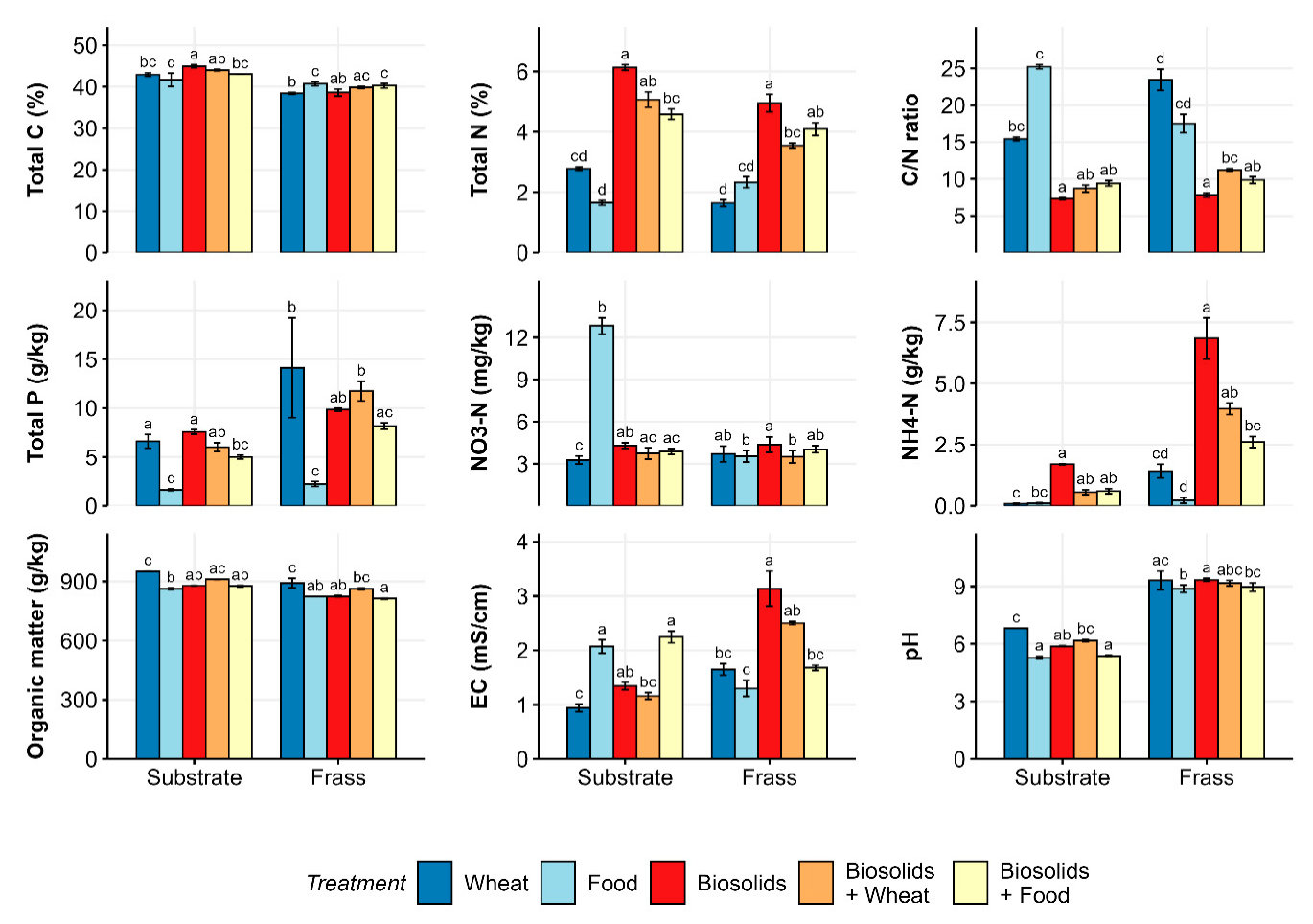
The chemical composition of the frass (e.g., total C, N and P; organic matter; EC) differed significantly between the treatments, which was associated with differences in the chemical composition of the original feedstocks fed to the BSFL (Figure 1, Table S1). Generally, BSF-based bioconversion led to significant reductions in total C, total N (except for food waste) and organic matter, while concentrations of total P and NH4+-N and EC increased significantly (Table 1, Figure 1). Frass of the biosolids treatments had significantly higher total N (4–5% compared to 2% for food waste and wheat bran) and NH4+-N concentrations (6.8 g/kg) compared to the control treatments (1–2 g/kg for food waste and wheat bran) (Figure 1). Similarly, the originating feedstocks for the biosolids treatments had higher concentrations of total N compared to wheat bran and food waste and the C/N ratio was correspondingly lower (Figure 1, Table S1). There were no significant differences between the NO3−-N concentrations of the BSFL feedstocks and frass except for the food waste. The NO3−-N concentration in the food waste was about three times higher than the other BSFL feedstocks. BSF-based bioconversion of food waste resulted in a decrease in NO3−-N (Figure 1). For the food waste and biosolids blended with food waste, EC significantly decreased from around 2 mS/cm to 1.3–1.6 mS/cm, while the EC for the other treatments, especially for the biosolids and biosolids blended with wheat bran, was significantly higher in the frass (<2 times) after the bioconversion process.
虫粪的化学组成(如总C、N和P,有机质,EC)在各处理间差异显著,这与投喂给BSFL的原始原料化学组成的差异有关(图1,表S1)。总体而言,基于黑水虻的生物转化使总C、总N(餐厨垃圾除外)和有机质显著降低,而总P和NH4+-N浓度以及EC显著升高(表1,图1)。与对照处理(餐厨垃圾和麦麸为1–2 g/kg)相比,生物固体处理虫粪的总N(4–5%,而餐厨垃圾和麦麸为2%)和NH4+-N浓度(6.8 g/kg)显著更高(图1)。同样,生物固体处理的原始原料总N浓度高于麦麸和餐厨垃圾,C/N比相应较低(图1,表S1)。除餐厨垃圾外,BSFL饲养原料与虫粪的NO3−-N浓度无显著差异。餐厨垃圾中的NO3−-N浓度约为其他BSFL饲养原料的三倍。餐厨垃圾经黑水虻生物转化后NO3−-N降低(图1)。餐厨垃圾以及生物固体与餐厨垃圾混合物的EC从约2 mS/cm显著降至1.3–1.6 mS/cm,而其他处理(尤其是生物固体以及生物固体与麦麸混合物)经生物转化后虫粪的EC显著升高(<2倍)。
| Parameter参数 | n | Statistic统计量 | df | p-Valuep值 |
|---|---|---|---|---|
| Total C (%) | 30 | 19.5 | 1 | 1.0_×_10_−_5 |
| Total N (%) | 30 | 2.29 | 1 | 0.13 |
| C/N ratio | 30 | 0.795 | 1 | 0.373 |
| Total P (g/kg) | 30 | 10.1 | 1 | 0.0015 |
| NO3−-N (mg/kg) | 30 | 0.876 | 1 | 0.349 |
| NH4+-N (mg/kg) | 30 | 10.9 | 1 | 0.00097 * |
| Organic matter (g/kg) | 30 | 13.5 | 1 | 0.00024 * |
| EC (mS/cm) | 30 | 4.56 | 1 | 0.0327 * |
| pH | 30 | 21.8 | 1 | 3.1_×_10_−_6 |
Although concentrations of the Ca(NO3)2-extractable fraction of trace elements were significantly higher for the biosolids containing feedstocks, the concentrations of most of these elements (except for As) decreased significantly after the bioconversion process and were not significantly higher for the frass compared to wheat bran or food waste (Table 2 and Figure S1 in the Supplementary Material).
尽管含生物固体原料中微量元素Ca(NO3)2可提取态浓度显著较高,但大多数元素(As除外)的浓度在生物转化后显著降低,且虫粪中的浓度与麦麸或餐厨垃圾相比并无显著升高(表2及补充材料中的图S1)。
3.2. Phytotoxicity of BSFL Frass and Feedstocks against Lettuce and Radish3.2. BSFL虫粪和饲养原料对生菜和萝卜的植物毒性
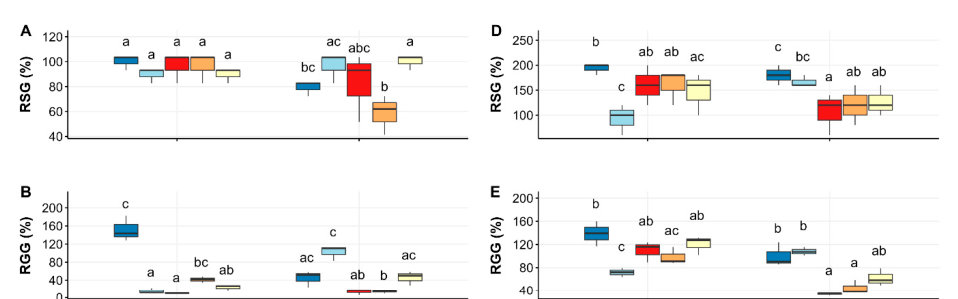
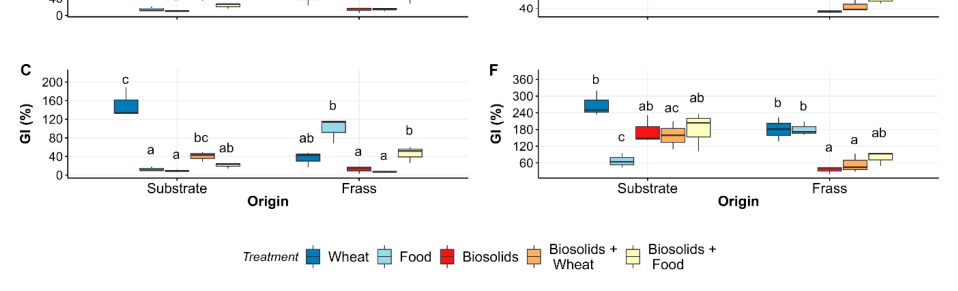
Some of the changes induced in the chemical composition of the feedstocks by BSF-based bioconversion may improve plant germination or seedling growth. Of particular interest was frass obtained from biosolids treatments. Seed germination tests showed that the germination (RSG), root growth (RGG) and shoot growth of lettuce and radish were significantly affected by the type of frass (Figures 2, S2 and S3 and Tables S2 and S3). However, larger differences between the frass originating from the different feedstocks were observed for RGG but not RSG (Figure 2A,B,D,E). Moreover, germination of lettuce was more affected by the type of frass compared to radish (Figure 2). The mean GI over all treatments of radish was significantly higher compared to lettuce (p < 0.0001). The frass that produced the highest RGG—and, accordingly, seed germination index (GI)—for lettuce originated from bioconverted food waste; the average GI was around 100% (Figure 2B,C). Furthermore, the GIs for frass derived from bioconverted wheat bran and all three biosolids containing feedstocks were below 50%. In the case of radish, the highest RGG and GI were observed for the frass originating from wheat bran and food waste; the average GI for these frass types were above 100% (Figure 2E,F). Germination of radish was inhibited by frass from the biosolids treatments, resulting in a GI of 35% to 79% (Figure 2F).
黑水虻生物转化引起的原料化学组成的某些变化可能改善植物发芽或幼苗生长。其中,生物固体处理所得的虫粪尤其值得关注。种子发芽试验表明,生菜和萝卜的发芽(RSG)、根生长(RGG)和茎生长均受虫粪类型的显著影响(图2、S2和S3,表S2和S3)。然而,不同原料来源虫粪之间在RGG上的差异较大,而在RSG上则不然(图2A、B、D、E)。此外,与萝卜相比,生菜的发芽受虫粪类型的影响更大(图2)。萝卜在所有处理中的平均GI显著高于生菜(p < 0.0001)。对生菜而言,RGG最高(相应地种子发芽指数(GI)也最高)的虫粪来自生物转化的餐厨垃圾,平均GI约为100%(图2B、C)。此外,源自生物转化麦麸和全部三种含生物固体原料的虫粪GI均低于50%。对萝卜而言,RGG和GI最高的是源自麦麸和餐厨垃圾的虫粪,这些虫粪的平均GI均高于100%(图2E、F)。生物固体处理的虫粪抑制了萝卜发芽,GI为35%~79%(图2F)。
Interestingly, BSF-based bioconversion of the original feedstocks significantly affected the phytotoxicity of the resulting frass (Figure 2, Table 3). For lettuce, the GIs for the frass from the wheat bran and biosolids + wheat treatments were about 3 to 10 times lower compared to the feedstocks, while the GI for the frass originating from food waste was about 10 times higher compared to the feedstocks (Figure 2A). A similar trend was observed for radish; however, the reduction in the GI for the wheat bran treatment was less pronounced and the GI for the frass from the biosolids treatment was significantly lower (about three times) compared to the original feedstock (Table 3).
值得注意的是,原始原料经黑水虻生物转化后显著影响了所得虫粪的植物毒性(图2,表3)。对生菜而言,麦麸和biosolids + wheat处理虫粪的GI比原料低约3~10倍,而源自餐厨垃圾的虫粪GI比原料高约10倍(图2A)。萝卜呈现类似趋势,但麦麸处理GI的降低不太明显,且生物固体处理虫粪的GI显著低于原始原料(约三倍)(表3)。
| Feedstock原料 | Frass虫粪 | p-Valuep值 | |||||||||||
|---|---|---|---|---|---|---|---|---|---|---|---|---|---|
| Trace Element | Wheat | Food | Biosolids 1 | Biosolids 1 + Wheat | Biosolids 1 + Food | Wheat | Food | Biosolids 1 | Biosolids 1 + Wheat | Biosolids 1 + Food | Origin 1 | Treatment | O×T 2 |
| Al | 0.14_±_0.13 d | 0.60_±_0.07 d | 15.1_±_3.13 cd | 12.60_±_1.13 cd | 47.80_±_9.24 ab | 0.32_±_0.24 d | 0.37_±_0.08 d | 2.14_±_0.97 d | 4.07_±_1.05 d | 2.75_±_0.18 d | <0.001 | <0.001 | <0.001 |
| Cr | 0.010_±_0.002 d | 0.020_±_0.002 d | 0.31_±_0.02 bc | 0.32_±_0.02 b | 0.63_±_0.12 a | 0.01_±_0.00 d | 0.01_±_0.00 d | 0.04_±_0.01 d | 0.13_±_0.01 bd | 0.040_±_0.004 d | <0.001 | <0.001 | <0.001 |
| Mn | 6.10_±_1.04 bd | 25.00_±_1.13 a | 5.40_±_0.35 bd | 11.80_±_1.13 b | 10.90_±_1.34 b | 7.07_±_2.12 bd | 0.36_±_0.04 d | 2.28_±_0.41 cd | 7.87_±_0.56 bc | 1.65_±_0.03 cd | <0.001 | <0.001 | <0.001 |
| Fe | 2.0_±_0.2 b | 0.75_±_0.15 b | 60.30_±_7.92 a | 57.20_±_3.55 a | 57.7_±_11.5 a | 5.51_±_0.86 b | 0.21_±_0.03 b | 6.03_±_1.64 b | 11.20_±_0.59 b | 4.34_±_0.11 b | <0.001 | <0.001 | <0.001 |
| Co | 0.04_±_0.002 ef | 0.020_±_0.002 f | 0.31_±_0.02 a | 0.23_±_0.01 ab | 0.24_±_0.06 ab | 0.08_±_0.01 df | 0.01_±_0.00 f | 0.13_±_0.02 cde | 0.21_±_0.01 bc | 0.100_±_0.004 df | 0.001 | <0.001 | <0.001 |
| Ni | 0.69_±_0.06 cd | 1.13_±_0.08 bc | 2.17_±_0.18 a | 1.60_±_0.10 ab | 2.05_±_0.33 a | 0.24_±_0.02 d | 0.91_±_0.08 c | 0.22_±_0.04 d | 0.49_±_0.03 cd | 0.20_±_0.02 d | <0.001 | <0.001 | <0.001 |
| Cu | 0.98_±_0.06 f | 0.77_±_0.03 f | 35.6_±_2.0 a | 29.40_±_1.24 b | 15.10_±_1.23 c | 1.54_±_0.16 ef | 0.24_±_0.03 f | 3.69_±_0.53 df | 6.70_±_0.33 d | 1.68_±_0.18 ef | <0.001 | <0.001 | <0.001 |
| Zn | 1.31_±_0.23 c | 5.41_±_0.11 c | 74.10_±_6.06 a | 35.20_±_0.66 b | 51.2_±_10.1 b | 1.37_±_0.06 c | 0.31_±_0.02 c | 2.83_±_0.58 c | 3.24_±_0.32 c | 1.52_±_0.08 c | <0.001 | <0.001 | <0.001 |
| As | 0.030_±_0.001 d | 0.01_±_0.00 d | 1.02_±_0.07 a | 0.73_±_0.06 bc | 0.86_±_0.11 ac | 0.07_±_0.01 d | 0.010_±_0.001 d | 0.99_±_0.04 a | 0.97_±_0.05 ab | 0.68_±_0.06 c | 0.535 | <0.001 | 0.01 |
| Cd | 0.009_±_0.000 b | 0.009_±_0.000 b | 0.030_±_0.001 a | 0.030_±_0.001 a | 0.03_±_0.01 a | 0.01_±_0.00 b | 0.01_±_0.00 b | 0.01_±_0.00 b | 0.010_±_0.001 b | 0.01_±_0.00 b | <0.001 | <0.001 | <0.001 |
| Pb | 0.02_±_0.01 d | 0.020_±_0.004 d | 0.12_±_0.03 ab | 0.097_±_0.004 bc | 0.18_±_0.03 a | 0.01_±_0.00 d | 0.01_±_0.00 d | 0.02_±_0.01 d | 0.04_±_0.01 cd | 0.020_±_0.003 d | <0.001 | <0.001 | <0.001 |
1 Origin: feedstock versus frass; 2 O × T = origin × treatment interaction effect.
1 来源:原料与虫粪;2 O × T = 来源 × 处理交互效应。
| Plant Species植物物种 | Treatment处理 | n1 | n2 | Statistic统计量 | df | p-Valuep值 |
|---|---|---|---|---|---|---|
| Lettuce | Wheat | 3 | 3 | 5.52 | 2.97 | 0.012 * |
| Lettuce | Food | 3 | 3 | _−_5.5 | 2.12 | 0.028 * |
| Lettuce | Biosolids | 3 | 3 | _−_0.552 | 2.24 | 0.631 |
| Lettuce | Biosolids + wheat | 3 | 3 | 5.24 | 2.07 | 0.032 * |
| Lettuce | Biosolids + food | 3 | 3 | _−_2.31 | 2.44 | 0.124 |
| Radish | Wheat | 3 | 3 | 2.43 | 3.99 | 0.072 |
| Radish | Food | 3 | 3 | _−_5.43 | 3.99 | 0.006 |
| Radish | Biosolids | 3 | 3 | 4.66 | 2.26 | 0.034 * |
| Radish | Biosolids + wheat | 3 | 3 | 2.98 | 3.54 | 0.048 * |
| ~~Radish~~ | ~~Biosolids + food~~ | ~~3~~ | ~~3~~ | ~~−~~~~2.35~~ | ~~2.54~~ | ~~0.116~~ |
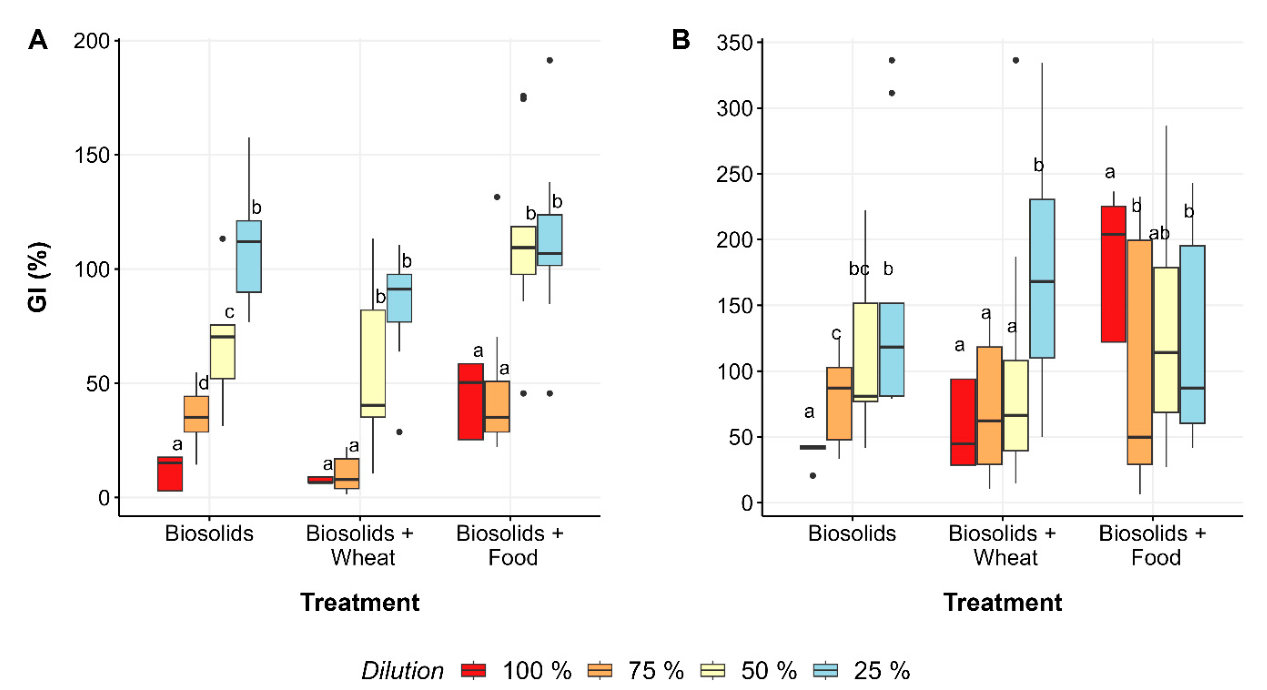
Phytotoxicity tests of dilutions from the BSFL frass extracts derived from the biosolids treatments were performed to test if the inhibition of seed germination and root growth could be minimized by diluting out toxic elements. For lettuce, the GI of the diluted frass extracts was significantly higher compared to the non-diluted extract (Figure 3A). There were linear increases in the GIs for the biosolids and biosolids + wheat treatments from around 20% to 120% and 90%, respectively. The highest GI scores for lettuce occurred with the highest dilutions of the frass extracts (25%; i.e., fourfold dilution) for all treatments (Figure 3A). With regard to radish, GIs for the dilutions of the frass extracts of the biosolids and biosolids + wheat treatments increased significantly, reaching around 130% and 170% with the highest dilution, respectively (Figure 3B). Diluting the frass extract of the biosolids + food treatment had no significant impact on the germination.
对生物固体处理所得BSFL虫粪浸提液的稀释液进行了植物毒性试验,以检验能否通过稀释有毒元素来减轻对种子发芽和根生长的抑制。对生菜而言,稀释后虫粪浸提液的GI显著高于未稀释浸提液(图3A)。生物固体和biosolids + wheat处理的GI呈线性升高,分别从约20%升至120%和90%。所有处理中,生菜的最高GI均出现在虫粪浸提液最高稀释度(25%,即稀释四倍)下(图3A)。对萝卜而言,生物固体和biosolids + wheat处理虫粪浸提液稀释后GI显著升高,在最高稀释度下分别达到约130%和170%(图3B)。稀释biosolids + food处理的虫粪浸提液对发芽无显著影响。
3.3. Chemical Parameters Related to Germination Success and Seedling Growth3.3. 与发芽成功率和幼苗生长相关的化学参数
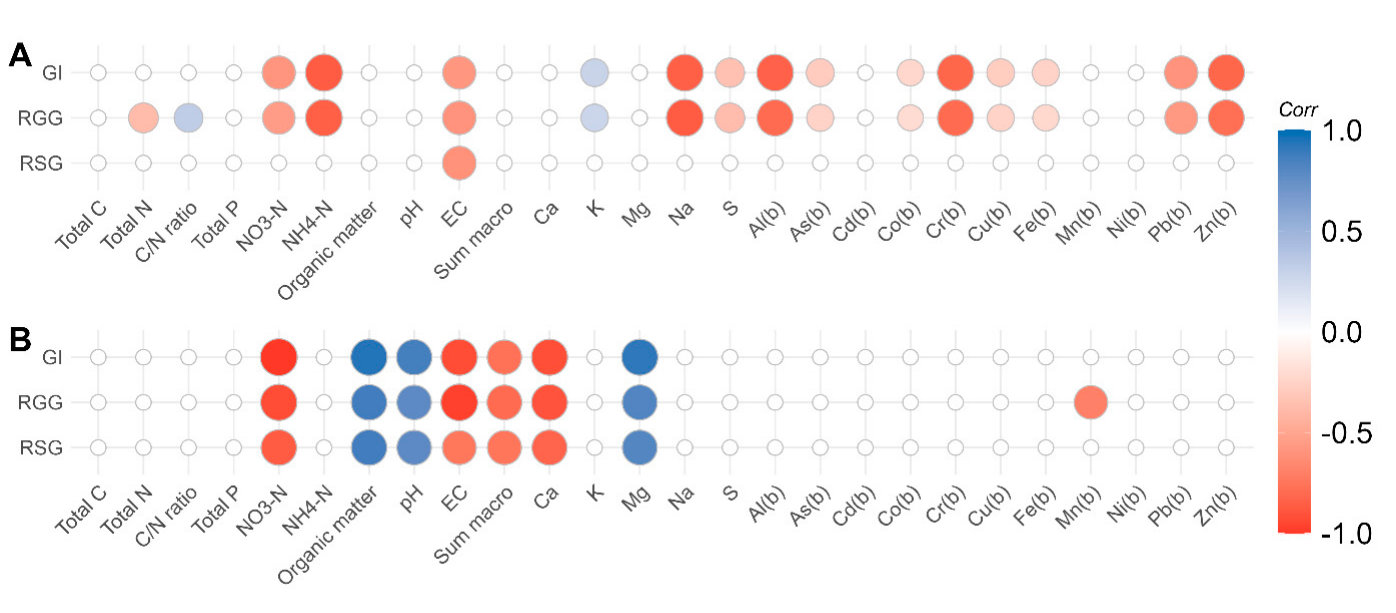
Figure 4 shows the Spearman rank correlation analysis of the RSG, RGG and GI and the chemical parameters of all BSFL feedstocks and frass. Only a few parameters were significantly positively correlated with the RSG, RGG or GI. These were, in the case of lettuce, the C/N ratio and concentrations of K and, in the case of radish, organic matter, pH and Mg concentrations. For both plant species, the RSG, RGG and GI were significantly negatively correlated with EC and NO3−-N. In the case of lettuce, significant negative correlations with the RGG and GI were also obtained for NH4+-N, Na, S and the Ca(NO3)2- extractable fraction of the trace elements Al, As, Co, Cr, Cu, Fe, Pb and Zn (Figure 4A). Significant negative correlations for Ca, total macro-elements and Ca(NO3)2-extractable Mn with the RSG, RGG or GI were additionally obtained for radish (Figure 4B). Overall, more chemical parameters were significantly correlated with the RSG compared to the RGG. This indicates that the radicle extension (RGG) was more sensitive to toxic elements or unfavourable conditions compared to the overall germination rate (RSG). Furthermore, a higher number of chemical parameters were significantly correlated with the RSG, RGG or GI (16 in total) in the case of lettuce (Figure 4A) compared to radish (8 significant correlations in total; Figure 4B).
图4展示了RSG、RGG和GI与所有BSFL饲养原料和虫粪化学参数之间的Spearman秩相关分析结果。仅有少数参数与RSG、RGG或GI呈显著正相关:生菜为C/N比和K浓度,萝卜为有机质、pH和Mg浓度。对两种植物而言,RSG、RGG和GI均与EC和NO3−-N呈显著负相关。对生菜而言,NH4+-N、Na、S以及微量元素Al、As、Co、Cr、Cu、Fe、Pb和Zn的Ca(NO3)2可提取态也与RGG和GI呈显著负相关(图4A)。萝卜还表现出Ca、总常量元素以及Ca(NO3)2可提取态Mn与RSG、RGG或GI之间的显著负相关(图4B)。总体而言,与RSG显著相关的化学参数多于与RGG显著相关的参数。这表明,与总体发芽率(RSG)相比,胚根伸长(RGG)对有毒元素或不利条件更为敏感。此外,与RSG、RGG或GI显著相关的化学参数数量在生菜中(共16个;图4A)多于萝卜(共8个显著相关;图4B)。
4Discussion讨论
Here, we investigated if frass from bioconverted biosolids and blends of biosolids can be potentially used as fertiliser and compared results from seed germination tests and chemical analysis with those for the frass originating from wheat bran or food waste. For the seed germination tests, we observed that root growth was generally more affected by the different types of frass compared to the germination rate. Moreover, germination of lettuce was significantly lower compared to radish, indicating that lettuce seemed to be more sensitive to the presence of phytotoxins. This aligns well with a study by Di Salvatore et al. [28] where lettuce was more sensitive than other crops, including radish, to elevated concentrations of trace elements in the growth medium. They also observed that, overall, the germination rate was less affected by the type of medium and concentration of trace elements compared to the root growth. Therefore, the GI, combining the RSG and
本研究考察了生物转化的生物固体(污泥)及生物固体混合物所得虫粪能否用作肥料,并将种子发芽试验和化学分析结果与源自麦麸或餐厨垃圾的虫粪进行了比较。在种子发芽试验中,我们观察到,与发芽率相比,根生长通常更易受不同类型虫粪的影响。此外,生菜的发芽显著低于萝卜,表明生菜似乎对植物毒素的存在更为敏感。这与Di Salvatore et al. [28] 的研究结果高度一致,该研究发现生菜对生长基质中微量元素浓度升高的敏感性高于包括萝卜在内的其他作物。他们还观察到,总体而言,与根生长相比,发芽率受基质类型和微量元素浓度的影响较小。因此,结合了RSG和
RGG, which can both reflect phytotoxicity, is widely adopted to measure the quality of compost [29] and even included in regulations for compost commercialization [30].
RGG(二者均可反映植物毒性)的GI被广泛用于衡量堆肥质量 [29],甚至被纳入堆肥商品化的相关法规 [30]。
A GI >80% indicates that the germination medium is safe to use [31]. In the case of lettuce, frass obtained from BSF-based bioconversion of biosolids containing feedstocks and from wheat bran resulted in GI levels below 60%. For radish, GI levels of frass originating from the biosolids treatments were below 80% to 50%. Frass from the biosolids containing feedstocks became richer in NH4+-N and total P. However, concentrations of the macro-elements Na, K, Mg and S [16] also increased, which might have been correlated with elevated EC levels (i.e., salinity) in these types of frass. These observations align with a previous BSF feeding study on sewage sludge [32]. In the case of bioconverted wheat bran, the frass showed significantly elevated NH4+-N, total P and EC. Spearman rank correlation analysis showed that all these factors, including elevated levels of S and salts, were significantly negatively correlated with the GI. Increases in NH4+-N and EC were also reported by other BSF studies; e.g., using sewage sludge, wheat bran, chicken manure and grass cuttings [32–35]. Liu et al. [36] attributed high EC and a high concentration of NH4+-N to the lack of maturity of chicken manure frass and a negative correlation between the GI and NH4+-N or EC, and similar results as in this study have been reported for biosolids and composted pig manure [37–39]. Moreover, negative effects of high S concentrations and salinity on plant growth have been reported as well [40,41]. NH4+-N production in BSFL is driven by protein metabolism [42], which is why BSF-based bioconversion of feedstocks with higher protein and N content, like wheat bran or biosolids, generate frass with high levels of NH4+-N. A high concentration of NH4+-N can cause damage in plants and inhibit germination [43]. It has been suggested that composting, as subsequent step in BSF-based bioconversion, could reduce high concentrations of NH4+-N and the resulting phytotoxicity of the frass [44]. For example, a study by Sanchez-Monedero et al. [45] showed that NH4+-N levels in composted sewage sludge and municipal solid waste decreased gradually during the composting process, and Zubillaga and Lavado [39] demonstrated that composting of biosolids increased the germination success for ryegrass.
GI >80%表明发芽基质可安全使用 [31]。对生菜而言,含生物固体原料及麦麸经黑水虻生物转化所得虫粪的GI均低于60%。对萝卜而言,源自生物固体处理的虫粪GI介于80%以下至50%之间。含生物固体原料所得虫粪中NH4+-N和总P更为丰富。然而,常量元素Na、K、Mg和S的浓度 [16] 也有所升高,这可能与这类虫粪中EC(即盐分)水平升高相关。这些观察结果与此前一项关于污水污泥的黑水虻饲养研究一致 [32]。对生物转化的麦麸而言,虫粪的NH4+-N、总P和EC显著升高。Spearman秩相关分析表明,所有这些因素(包括S和盐分水平升高)均与GI呈显著负相关。其他黑水虻研究(例如使用污水污泥、麦麸、鸡粪和草屑)也报道了NH4+-N和EC的升高 [32–35]。Liu et al. [36] 将高EC和高浓度NH4+-N归因于鸡粪虫粪腐熟度不足,并发现GI与NH4+-N或EC之间呈负相关;在生物固体和堆腐猪粪上也报道了与本研究类似的结果 [37–39]。此外,已有研究报道高浓度S和盐分对植物生长的负面影响 [40,41]。BSFL中NH4+-N的产生由蛋白质代谢驱动 [42],这就是为何蛋白质和N含量较高的原料(如麦麸或生物固体)经黑水虻生物转化后会产生NH4+-N含量高的虫粪。高浓度NH4+-N可对植物造成损伤并抑制发芽 [43]。有研究建议,在黑水虻生物转化之后进行堆肥,可降低虫粪中高浓度的NH4+-N及由此产生的植物毒性 [44]。例如,Sanchez-Monedero et al. [45] 的研究表明,堆肥化的污水污泥和城市固体废弃物中NH4+-N水平在堆肥过程中逐渐降低;Zubillaga and Lavado [39] 证明,生物固体堆肥提高了黑麦草的发芽成功率。
The highest GIs for both lettuce and radish were observed for frass from bioconverted food waste. The GI ranged from around 100% to 150%, while that for frass from biosolids treatments was 20–50%. This aligns with the results of Liu et al. [32], who observed GIs of 82% and 50% for frass obtained from BSF treatments with food waste and sewage sludge, respectively. The authors also reported an increase in total N and decrease in NO3−-N concentrations for the food waste treatment. Similarly, Green and Popa [33] reported a reduction in NO3−-N concentrations for the bioconversion of food waste using BSF. A reduction in NO3−-N concentration may be beneficial if the frass is to be used as a soil amendment because high NO3−-N concentration may result in excessive NO3−-N leaching [46]. Moreover, high NO3−-N can cause phytotoxicity [47,48]. Due to elevated concentrations of NO3−-N and volatile organic acids (indicated by a low pH of 5) and higher EC of around 2 mS/cm before the BSF-based bioconversion, the phytotoxicity of unprocessed food waste was significantly higher compared to the generated frass. Besides the elevation in total N, pH and concentrations of P and K also increased for the bioconversion with food waste [16], which aligns with observations from previous BSF studies [32,49]. Overall, frass obtained from food waste seemed to be more mature and less toxic compared to frass from processed biosolids and biosolid blends.
生菜和萝卜的最高GI均出现在生物转化餐厨垃圾所得的虫粪中,其GI约为100%~150%,而生物固体处理虫粪的GI为20–50%。这与Liu et al. [32] 的结果一致,他们观察到餐厨垃圾和污水污泥黑水虻处理所得虫粪的GI分别为82%和50%。作者还报道,餐厨垃圾处理的总N升高、NO3−-N浓度降低。同样,Green and Popa [33] 报道了利用黑水虻生物转化餐厨垃圾时NO3−-N浓度的降低。若虫粪用作土壤改良剂,NO3−-N浓度的降低可能是有益的,因为高NO3−-N浓度可能导致NO3−-N过量淋溶 [46]。此外,高NO3−-N可引起植物毒性 [47,48]。由于黑水虻生物转化前NO3−-N和挥发性有机酸浓度较高(以pH低至5为指示)且EC较高(约2 mS/cm),未经处理的餐厨垃圾的植物毒性显著高于所产生的虫粪。除总N升高外,餐厨垃圾生物转化后pH以及P和K浓度也有所升高 [16],这与以往黑水虻研究的观察结果一致 [32,49]。总体而言,与经处理的生物固体及生物固体混合物所得虫粪相比,餐厨垃圾所得虫粪似乎腐熟度更高、毒性更低。
Due to the nature of BSFL’s conversion of available N into NH4+-N, BSFL feedstocks with high N content—and, accordingly, low C/N ratios—might not produce frass that can be directly used as fertiliser. Therefore, Beesigamukama et al. [50] suggested that feedstocks for BSFL growth should have C/N ratios above 15 to 30 in order to generate non-phytotoxic frass. C/N ratios above 15 were only reached for the BSFL food waste and not the biosolids containing feedstocks or wheat bran. Besides the N content, initial concentrations of minerals and salts in the BSFL feedstock are also factors affecting the outcome in terms of frass quality. Bohm et al. [16] showed that BSF-based bioconversion led to partitioning of macro-nutrients like Na and S from the feedstock into the frass. Therefore, the germination rates of the resulting frass from wheat bran, biosolids or biosolids blended with wheat bran were significantly lower compared to the unprocessed waste. Interestingly, BSF-based bioconversion of the biosolids feedstocks resulted in a significant decrease in the Ca(NO3)2-extractable (i.e., phytoavailable [51]) fraction of trace elements (except for As), and concentrations were at similar levels for frass originating from biosolids as for frass from food waste and wheat bran. Decreases in the bioavailability of trace elements compared to the total fraction [16] in these feedstocks were likely correlated with the rise in pH [52]. The high initial concentrations of trace elements in the BSFL feedstocks may have been less related to the decreased germination rate in the resulting frass than the actual high N and salt content.
由于BSFL会将有效N转化为NH4+-N,N含量高(相应地C/N比低)的BSFL饲养原料可能无法产出可直接用作肥料的虫粪。因此,Beesigamukama et al. [50] 建议,BSFL饲养原料的C/N比应高于15~30,才能产出无植物毒性的虫粪。仅BSFL餐厨垃圾的C/N比超过15,而含生物固体原料和麦麸均未达到。除N含量外,BSFL饲养原料中矿物质和盐分的初始浓度也是影响虫粪质量的因素。Bohm et al. [16] 表明,黑水虻生物转化导致Na和S等常量养分从原料分配进入虫粪。因此,麦麸、生物固体或生物固体与麦麸混合物所得虫粪的发芽率显著低于未经处理的废弃物。值得注意的是,生物固体原料经黑水虻生物转化后,微量元素的Ca(NO3)2可提取态(即植物有效态 [51])显著降低(As除外),且源自生物固体的虫粪中其浓度与源自餐厨垃圾和麦麸的虫粪处于相近水平。这些原料中微量元素生物有效性相对于总量的降低 [16] 可能与pH的升高相关 [52]。与所得虫粪发芽率降低相关性更强的,可能是其实际的高N和高盐分含量,而非BSFL饲养原料中微量元素的高初始浓度。
Additional germination tests with diluted frass extracts from the biosolids treatments were performed to determine whether dilution of potential phytotoxins would improve germination. Indeed, the GI of lettuce increased significantly from below 30–50% to up to 120% for the highest frass extract dilutions (25%; i.e., a fourfold dilution). A similar trend was observed for radish and the biosolids and biosolids + wheat treatments, reaching a GI of up to 170%. Different potting experiments with BSFL frass originating from various feedstocks demonstrated that lower application rates would stimulate plant growth rather than inhibiting growth or causing wilting [5]. In this regard, some studies have identified a frass/soil mixture of 10% as optimal to promote plant growth in lettuce, basil, tomato and Brassica rapa [35,53,54]. Considering the concentration of inorganic N (i.e., the sum of NO3−- N and NH4+-N), which was >6000 mg/kg (Figure 1) for frass derived from bioconverted biosolids, the results of our study suggest that a frass/soil mixture of 1% would provide benefits to plant growth. This is 10-fold lower than mentioned in the literature above and is supported by previous observations [55]. In this regard, a 1% application rate would correspond to about 70 mg/kg inorganic N, which is similar to the application rate for biosolids and soil recommended by Gutierrez-Gines et al. [55].
为确定稀释潜在植物毒素能否改善发芽,对生物固体处理的稀释虫粪浸提液进行了补充发芽试验。结果表明,在虫粪浸提液最高稀释度(25%,即稀释四倍)下,生菜的GI从低于30–50%显著升高至最高120%。萝卜在生物固体和biosolids + wheat处理中呈类似趋势,GI最高达170%。利用多种原料来源BSFL虫粪开展的不同盆栽试验表明,较低的施用量会促进植物生长,而非抑制生长或导致萎蔫 [5]。在这方面,一些研究认为10%的虫粪/土壤混合比例最有利于促进生菜、罗勒、番茄和Brassica rapa的生长 [35,53,54]。考虑到生物转化生物固体所得虫粪的无机N浓度(即NO3−- N与NH4+-N之和)>6000 mg/kg(图1),本研究结果表明,1%的虫粪/土壤混合比例将有益于植物生长。这比上述文献中提及的比例低10倍,并得到以往观察结果的支持 [55]。在这方面,1%的施用量约相当于70 mg/kg无机N,与Gutierrez-Gines et al. [55] 推荐的生物固体与土壤施用量相近。
Besides a lower application rate for fresh BSFL frass, thermophilic composting of frass in order to increase its stability and decrease phytotoxic NH4+-N concentrations and for sanitation is recommended [5]. The composting process with BSFL is typically fast (up to two weeks) and the resulting frass compost is mostly immature and biologically unstable [35]. Song et al. [56] showed that composted BSFL frass can be applied with higher application rates (40%) compared to fresh frass (10%) without causing any plant growth inhibition. Another factor that might be limiting when using fresh BSFL frass from processed biosolids as fertiliser without further treatment is the relatively low C/N ratio of 8–12. A C/N ratio between 20 and 40 is recommended to avoid the possible immobilization of mineral nutrients in the soil, which can cause poor plant growth but also nutrient leaching, impacting the surrounding environment [57–59]. Therefore, mixing the frass from biosolids with other organic waste rich in carbon before composting or application to the field could level out the initial low C/N ratio.
除降低新鲜BSFL虫粪的施用量外,还建议对虫粪进行高温堆肥,以提高其稳定性、降低具植物毒性的NH4+-N浓度并实现无害化 [5]。BSFL参与的堆肥过程通常较快(最长两周),所得虫粪堆肥大多未腐熟且生物学上不稳定 [35]。Song et al. [56] 表明,与新鲜虫粪(10%)相比,堆肥化的BSFL虫粪可以更高的施用量(40%)施用而不会抑制植物生长。将经处理生物固体所得新鲜BSFL虫粪不经进一步处理直接用作肥料时,另一个可能的限制因素是其C/N比较低(8–12)。建议C/N比在20~40之间,以避免土壤中矿质养分可能发生的固持,这种固持既可导致植物生长不良,也可引起养分淋溶,对周边环境造成影响 [57–59]。因此,在堆肥或施用于田间之前,将生物固体所得虫粪与其他富碳有机废弃物混合,可平衡其初始较低的C/N比。
5Conclusions结论
This study demonstrated that the maturity (i.e., low phytotoxicity) of the frass resulting from BSF-based bioconversion strongly depends on the initial chemical composition of the organic waste fed to the BSFL. Fresh frass obtained from BSF-based bioconversion of biosolids, as well as that obtained from wheat bran, was not suitable for use as fertiliser directly, unlike the frass obtained from bioconverted food waste. An additional transformation step (e.g., thermophilic composting), a lower application rate and blending to reduce NH4+-N availability and EC may improve the maturity and stability of frass originating from biosolids and from high N feedstocks. However, further pot and field trials with low application rates for frass from bioconverted biosolids would be needed to quantify impacts on the soil carbon and nutrient cycle, the soil microbial community and the overall growth performance of older seedlings.
本研究表明,黑水虻生物转化所得虫粪的腐熟度(即低植物毒性)在很大程度上取决于投喂给BSFL的有机废弃物的初始化学组成。与生物转化餐厨垃圾所得虫粪不同,生物固体(污泥)以及麦麸经黑水虻生物转化所得的新鲜虫粪不适合直接用作肥料。增加额外的转化步骤(如高温堆肥)、降低施用量以及通过混合来降低NH4+-N有效性和EC,可能改善源自生物固体及高N原料的虫粪的腐熟度和稳定性。然而,仍需针对生物转化生物固体所得虫粪开展低施用量的进一步盆栽试验和田间试验,以量化其对土壤碳和养分循环、土壤微生物群落以及较大幼苗总体生长表现的影响。
Supplementary Materials: The following supporting information can be downloaded at: https://www. mdpi.com/article/10.3390/su151511526/s1. The Supplementary Materials comprise Figures S1–S3, as well as Tables S1–S5, which support the results described in the manuscript.
补充材料:以下支持信息可从https://www. mdpi.com/article/10.3390/su151511526/s1下载。补充材料包括图S1–S3以及表S1–S5,用以支持文中所述结果。
Author Contributions: K.B.: Conceptualization, methodology, investigation, formal analysis, visualization, Writing—original draft preparation, project administration, funding acquisition. G.A.H.: Investigation, writing—review and editing. B.H.R.: Validation, supervision, project administration, writing—review and editing. M.J.G.-G.: Resources, validation, writing—review and editing. All authors have read and agreed to the published version of the manuscript.
作者贡献:K.B.:构思、方法、调查、形式分析、可视化、撰写初稿、项目管理、获取资助。G.A.H.:调查、审阅与编辑。B.H.R.:验证、指导、项目管理、审阅与编辑。M.J.G.-G.:资源、验证、审阅与编辑。所有作者均已阅读并同意本文的发表版本。
Funding: This project was funded by Environmental Science and Research Ltd. (ESR)’s Strategic Science Investment Funding from the Ministry of Business, Innovation and Employment, New Zealand (grant number C03X1701), under the Pioneer Fund and the Ohanga¯ Amiomio—Circular¯ Economy project.
基金项目:本项目由新西兰商业、创新与就业部(Ministry of Business, Innovation and Employment)向Environmental Science and Research Ltd.(ESR)提供的战略科学投资基金(资助编号C03X1701)资助,隶属Pioneer Fund及Ohanga¯ Amiomio—Circular¯ Economy项目。
Data Availability Statement: Date will be made available upon request.
数据可用性声明:数据可应要求提供。
Acknowledgments: The authors thank Smit Banker for helping with the seed germination test, as well as Prescient Nutrition, who kindly provided BSFL and supported the setting up of the experiment. Biosolids were kindly provided by Wellington Water and Palmerston North City Council.
致谢:作者感谢Smit Banker协助开展种子发芽试验,感谢Prescient Nutrition慷慨提供BSFL并支持试验的建立。生物固体由Wellington Water和Palmerston North City Council慷慨提供。
Conflicts of Interest: The authors declare no conflict of interest.
利益冲突:作者声明无利益冲突。
References参考文献
1. Kaza, S.; Yao, L.; Bhada-Tata, P.; Van Woerden, F. What a Waste 2.0: A Global Snapshot of Solid Waste Management to 2050; World Bank: Washington, DC, USA, 2018; p. 38.
2. Mateo-Sagasta, J.; Raschid-Sally, L.; Thebo, A. Global wastewater and sludge production, treatment and use. In Wastewater; Springer: Berlin/Heidelberg, Germany, 2015; pp. 15–38.
3. Paramashivam, D.; Dickinson, N.M.; Clough, T.J.; Horswell, J.; Robinson, B.H. Potential environmental benefits from blending biosolids with other organic amendments before application to land. J. Environ. Qual. 2017, 46, 481–489. [CrossRef]
4. Lohri, C.R.; Diener, S.; Zabaleta, I.; Mertenat, A.; Zurbrugg, C. Treatment technologies for urban solid biowaste to create value products: A review with focus on low- and middle-income settings. Rev. Environ. Sci. Bio/Technol. 2017, 16, 81–130. [CrossRef]
5. Lopes, I.G.; Yong, J.W.; Lalander, C. Frass derived from black soldier fly larvae treatment of biodegradable wastes. A critical review and future perspectives. Waste Manag. 2022, 142, 65–76. [CrossRef] [PubMed]
6. Lalander, C.; Nordberg, A.; Vinneras, B. A comparison in product-value potential in four treatment strategies for food waste and faeces—Assessing composting, fly larvae composting and anaerobic digestion. Gcb Bioenergy 2018, 10, 84–91. [CrossRef]
7. Smetana, S.; Spykman, R.; Heinz, V. Environmental aspects of insect mass production. J. Insects Food Feed 2021, 7, 553–571. [CrossRef] 8. Siddiqui, S.A.; Ristow, B.; Rahayu, T.; Putra, N.S.; Yuwono, N.W.; Nisa, K.; Mategeko, B.; Smetana, S.; Saki, M.; Nawaz, A.; et al. Black soldier fly larvae (BSFL) and their affinity for organic waste processing. Waste Manag. 2022, 140, 1–13. [CrossRef]
9. Ndegwa, P.; Thompson, S.; Das, K. Effects of stocking density and feeding rate on vermicomposting of biosolids. Bioresour. Technol. 2000, 71, 5–12. [CrossRef]
10. Ermolaev, E.; Lalander, C.; Vinnerås, B. Greenhouse gas emissions from small-scale fly larvae composting with Hermetia illucens. Waste Manag. 2019, 96, 65–74. [CrossRef]
11. Mertenat, A.; Diener, S.; Zurbrugg, C. Black Soldier Fly biowaste treatment—Assessment of global warming potential. Waste Manag. 2019, 84, 173–181. [CrossRef]
12. Pang, W.; Hou, D.; Chen, J.; Nowar, E.E.; Li, Z.; Hu, R.; Tomberlin, J.K.; Yu, Z.; Li, Q.; Wang, S. Reducing greenhouse gas emissions and enhancing carbon and nitrogen conversion in food wastes by the black soldier fly. J. Environ. Manag. 2020, 260, 110066. [CrossRef] 13. Kaczor, M.; Bulak, P.; Proc-Pietrycha, K.; Kirichenko-Babko, M.; Bieganowski, A. The variety of applications of Hermetia illucens in industrial and agricultural areas—Review. Biology 2022, 12, 25. [CrossRef]
14. Gold, M.; Tomberlin, J.K.; Diener, S.; Zurbrugg, C.; Mathys, A. Decomposition of biowaste macronutrients, microbes, and chemicals in Black Soldier Fly larval treatment: A review. Waste Manag. 2018, 82, 302–318. [CrossRef] [PubMed]
15. Gebremikael, M.T.; Wickeren, N.V.; Hosseini, P.S.; De Neve, S. The impacts of Black Soldier Fly frass on nitrogen availability, microbial activities, C sequestration, and plant growth. Front. Sustain. Food Syst. 2022, 6, 795950. [CrossRef]
16. Bohm, K.; Hatley, G.A.; Robinson, B.H.; Gutierrez-Gines, M.J. Black Soldier Fly-based bioconversion of biosolids creates high-value products with low heavy metal concentrations. Resour. Conserv. Recycl. 2022, 180, 106149. [CrossRef]
17. Mohajerani, A.; Ukwatta, A.; Jeffrey-Bailey, T.; Swaney, M.; Ahmed, M.; Rodwell, G.; Bartolo, S.; Eshtiaghi, N.; Setunge, S. A proposal for recycling the world’s unused stockpiles of treated wastewater sludge (biosolids) in fired-clay bricks. Buildings 2019, 9, 14. [CrossRef]
18. Blakemore, L.C.; Searle, P.L.; Daly, B.K. Methods for Chemical Analysis of Soils; New Zealand Soil Bureau Scientific Report 10A; New Zealand Soil Bureau: Wellington, New Zealand, 1981; p. 102.
19. Miranda, K.M.; Espey, M.G.; Wink, D.A. A rapid, simple spectrophotometric method for simultaneous detection of nitrate and nitrite. Nitric Oxide 2001, 5, 62–71. [CrossRef]
20. Mulvaney, R.L. Nitrogen—Inorganic forms. In Methods of Soil Analysis: Part 3 Chemical Methods; SSSA: Madison, WI, USA, 1996; Volume 5, pp. 1123–1184.
21. Luo, Y.; Liang, J.; Zeng, G.; Chen, M.; Mo, D.; Li, G.; Zhang, D. Seed germination test for toxicity evaluation of compost: Its roles, problems and prospects. Waste Manag. 2018, 71, 109–114. [CrossRef] [PubMed]
22. NZS 4454:2005; Composts, Soil Conditioners and Mulches. Standards New Zealand Te Mana Tautikanga o Aotearoa: Wellington, New Zealand, 2005. Available online: https://www.standards.govt.nz/shop/nzs-44542005/ (accessed on 1 April 2023).
23. Armas, I.; Pogrebnyak, N.; Raskin, I. A rapid and efficient in vitro regeneration system for lettuce (Lactuca sativa L.). Plant Methods 2017, 13, 58. [CrossRef]
24. Kassambara, A. Rstatix: Pipe-Friendly Framework for Basic Statistical Tests, R Package Version 0.7.2; 2023. Available online: https://cran.r-project.org/web/packages/rstatix/ (accessed on 1 April 2023).
25. Conigrave, J. Corx: Create and Format Correlation Matrices, R Package Version 1.0.6.1; 2020. Available online: https://cran.r-project. org/web/packages/corx/ (accessed on 1 April 2023).
26. Kassambara, A. ggcorrplot: Visualization of a Correlation Matrix Using ‘ggplot2’, R Package Version 0.1.3; 2019. Available online: https://cran.r-project.org/web/packages/ggcorrplot (accessed on 1 April 2023).
27. R Core Team R: A Language and Environment for Statistical Computing; R Foundation for Statistical Computing: Vienna, Austria, 2021. 28. Di Salvatore, M.; Carafa, A.M.; Carratù, G. Assessment of heavy metals phytotoxicity using seed germination and root elongation tests: A comparison of two growth substrates. Chemosphere 2008, 73, 1461–1464. [CrossRef]
29. Emino, E.R.; Warman, P.R. Biological assay for compost quality. Compost Sci. Util. 2004, 12, 342–348. [CrossRef]
30. Cesaro, A.; Belgiorno, V.; Guida, M. Compost from organic solid waste: Quality assessment and European regulations for its sustainable use. Resour. Conserv. Recycl. 2015, 94, 72–79. [CrossRef]
31. Thompson, W.; Leege, P.; Millner, P.; Watson, M.E. (Eds.) TMECC. Test Methods for the Examination of Composts and Composting; The US Composting Council, US Government Printing Office: Washington, DC, USA, 2002.
32. Liu, T.; Awasthi, M.K.; Awasthi, S.K.; Duan, Y.; Zhang, Z. Effects of black soldier fly larvae (Diptera: Stratiomyidae) on food waste and sewage sludge composting. J. Environ. Manag. 2020, 256, 109967. [CrossRef] [PubMed]
33. Green, T.R.; Popa, R. Enhanced ammonia content in compost leachate processed by Black Soldier Fly larvae. Appl. Biochem. Biotechnol. 2012, 166, 1381–1387. [CrossRef] [PubMed]
34. Klammsteiner, T.; Turan, V.; Juarez, M.F.D.; Oberegger, S.; Insam, H. Suitability of Black Soldier Fly Frass as Soil Amendment and Implication for Organic Waste Hygienization. Agronomy 2020, 10, 1578. [CrossRef]
35. Setti, L.; Francia, E.; Pulvirenti, A.; Gigliano, S.; Zaccardelli, M.; Pane, C.; Caradonia, F.; Bortolini, S.; Maistrello, L.; Ronga, D. Use of black soldier fly (Hermetia illucens (L.), Diptera: Stratiomyidae) larvae processing residue in peat-based growing media. Waste Manag. 2019, 95, 278–288. [CrossRef]
36. Liu, T.; Kumar, A.M.; Chen, H.Y.; Duan, Y.M.; Awasthi, S.K.; Zhang, Z.Q. Performance of black soldier fly larvae (Diptera: Stratiomyidae) for manure composting and production of cleaner compost. J. Environ. Manag. 2019, 251, 109593. [CrossRef]
37. Guo, R.; Li, G.; Jiang, T.; Schuchardt, F.; Chen, T.; Zhao, Y.; Shen, Y. Effect of aeration rate, C/N ratio and moisture content on the stability and maturity of compost. Bioresour. Technol. 2012, 112, 171–178. [CrossRef]
38. Tiquia, S.M.; Tam, N.F.Y.; Hodgkiss, I.J. Effects of composting on phytotoxicity of spent pig-manure sawdust litter. Environ. Pollut. 1996, 93, 249–256. [CrossRef]
39. Zubillaga, M.S.; Lavado, R.S. Phytotoxicity of biosolids compost at different degrees of maturity compared to biosolids and animal manures. Compost Sci. Util. 2006, 14, 267–270. [CrossRef]
40. Carter, J.M.; Brown, E.M.; Grace, J.P.; Salem, A.K.; Irish, E.E.; Bowden, N.B. Improved growth of pea, lettuce, and radish plants using the slow release of hydrogen sulfide from GYY-4137. PLoS ONE 2018, 13, e0208732. [CrossRef]
41. Hase, T.; Kawamura, K. Evaluating compost maturity with a newly proposed index based on a germination test using Komatsuna (Brassica rapa var. peruviridis) seeds. J. Mater. Cycles Waste Manag. 2012, 14, 220–227. [CrossRef]
42. de Carvalho, M.J.A.; Mirth, C.K. Food intake and food choice are altered by the developmental transition at critical weight in Drosophila melanogaster. Anim. Behav. 2017, 126, 195–208. [CrossRef]
43. Ramírez, W.A.; Domene, X.; Andrés, P.; Alcañiz, J.M. Phytotoxic effects of sewage sludge extracts on the germination of three plant species. Ecotoxicology 2008, 17, 834–844. [CrossRef] [PubMed]
44. Lopes, I.G.; de Souza, L.F.; da Cruz, M.C.P.; Vidotti, R.M. Composting as a strategy to recycle aquatic animal waste: Case study of a research centre in Sao Paulo State, Brazil. Waste Manag. Res. 2019, 37, 590–600. [CrossRef] [PubMed]
45. Sanchez-Monedero, M.A.; Roig, A.; Paredes, C.; Bernal, M.P. Nitrogen transformation during organic waste composting by the Rutgers system and its effects on pH, EC and maturity of the composting mixtures. Bioresour. Technol. 2001, 78, 301–308. [CrossRef] 46. Kirchmann, H.; Johnston, A.E.J.; Bergstrom, L.F. Possibilities for reducing nitrate leaching from agricultural land. Ambio 2002, 31, 404–408. [CrossRef]
47. Camut, L.; Gallova, B.; Jilli, L.; Sirlin-Josserand, M.; Carrera, E.; Sakvarelidze-Achard, L.; Ruffel, S.; Krouk, G.; Thomas, S.G.; Hedden, P.; et al. Nitrate signaling promotes plant growth by upregulating gibberellin biosynthesis and destabilization of DELLA proteins. Curr. Biol. 2021, 31, 4971–4982.e4974. [CrossRef]
48. Lin, D.; Huang, Y.; Zhao, J.; Wu, Z.; Liu, S.; Qin, W.; Wu, D.; Chen, H.; Zhang, Q. Evaluation of seed nitrate assimilation and stimulation of phenolic-linked antioxidant on pentose phosphate pathway and nitrate reduction in three feed-plant species. BMC Plant Biol. 2020, 20, 267. [CrossRef]
49. Sarpong, D.; Oduro-Kwarteng, S.; Gyasi, S.F.; Buamah, R.; Donkor, E.; Awuah, E.; Baah, M.K. Biodegradation by composting of municipal organic solid waste into organic fertilizer using the Black Soldier Fly (Hermetia illucens) (Diptera: Stratiomyidae) larvae. Int. J. Recycl. Org. Waste Agric. 2019, 8, 45–54. [CrossRef]
50. Beesigamukama, D.; Mochoge, B.; Korir, N.K.; Fiaboe, K.K.M.; Nakimbugwe, D.; Khamis, F.M.; Subramanian, S.; Wangu, M.M.; Dubois, T.; Ekesi, S.; et al. Low-cost technology for recycling agro-industrial waste into nutrient-rich organic fertilizer using black soldier fly. Waste Manag. 2021, 119, 183–194. [CrossRef]
51. Takeda, A.; Tsukada, H.; Takaku, Y.; Hisamatsu, S.i.; Inaba, J.; Nanzyo, M. Extractability of major and trace elements from agricultural soils using chemical extraction methods: Application for phytoavailability assessment. Soil Sci. Plant Nutr. 2006, 52, 406–417. [CrossRef]
52. Saalidong, B.M.; Aram, S.A.; Otu, S.; Lartey, P.O. Examining the dynamics of the relationship between water pH and other water quality parameters in ground and surface water systems. PLoS ONE 2022, 17, e0262117. [CrossRef] [PubMed]
53. Chiam, Z.Y.; Lee, J.T.E.; Tan, J.K.N.; Song, S.; Arora, S.; Tong, Y.W.; Tan, H.T.W. Evaluating the potential of okara-derived black soldier fly larval frass as a soil amendment. J. Environ. Manag. 2021, 286, 112163. [CrossRef]
54. Kawasaki, K.; Kawasaki, T.; Hirayasu, H.; Matsumoto, Y.; Fujitani, Y. Evaluation of fertilizer value of residues obtained after processing household organic waste with Black Soldier Fly larvae (Hermetia illucens). Sustainability 2020, 12, 4920. [CrossRef]
55. Gutierrez-Gines, M.J.; Lehto, N.J.; Madejon, E.; Robinson, B.H. The effect of contrasting biosolids application strategies on soil quality. Plant Soil 2023. [CrossRef]
56. Song, S.; Ee, A.W.L.; Tan, J.K.N.; Cheong, J.C.; Chiam, Z.; Arora, S.; Lam, W.N.; Tan, H.T.W. Upcycling food waste using Black Soldier Fly larvae: Effects of further composting on frass quality, fertilising effect and its global warming potential. J. Clean. Prod. 2021, 288, 125664. [CrossRef]
57. Chen, B.Q.; Liu, E.K.; Tian, Q.Z.; Yan, C.R.; Zhang, Y.Q. Soil nitrogen dynamics and crop residues. A review. Agron. Sustain. Dev. 2014, 34, 429–442. [CrossRef]
58. Moore, J.M.; Klose, S.; Tabatabai, M.A. Soil microbial biomass carbon and nitrogen as affected by cropping systems. Biol. Fertility Soils 2000, 31, 200–210. [CrossRef]
59. Rummel, P.S.; Beule, L.; Hemkemeyer, M.; Schwalb, S.A.; Wichern, F. Black Soldier Fly diet impacts soil greenhouse gas emissions from frass applied as fertilizer. Front. Sustain. Food Syst. 2021, 5, 709993. [CrossRef]
Disclaimer/Publisher’s Note: The statements, opinions and data contained in all publications are solely those of the individual author(s) and contributor(s) and not of MDPI and/or the editor(s). MDPI and/or the editor(s) disclaim responsibility for any injury to people or property resulting from any ideas, methods, instructions or products referred to in the content.