Article
Shamim Al Mamun 1,2, Niklas J. Lehto 2 , Jo Cavanagh 3, Richard McDowell 2,4, Liv Kellermann 2 and Brett H. Robinson 5,*
1 Department of Environmental Science and Resource Management, Mawlana Bhashani Science and Technology University, Tangail 1902, Bangladesh; shamimal.mamun@canterbury.ac.nz
2 Department of Soil Science, Faculty of Agricultural and Life Sciences, Lincoln University, Lincoln 7647, New Zealand; richard.mcdowell@agresearch.co.nz (R.M.); liv.kellermann@bfh.ch (L.K.)
3 Landcare Research, Lincoln 7640, New Zealand; cavanaghj@landcareresearch.co.nz
4 AgResearch, Lincoln Science Centre, Private Bag 4749, Christchurch 8140, New Zealand
4 AgResearch, Lincoln Science Centre, Private Bag 4749, Christchurch 8140, New Zealand
5 School of Physical and Chemical Sciences, University of Canterbury, 20 Kirkwood Ave, Ilam,
5 School of Physical and Chemical Sciences, University of Canterbury, 20 Kirkwood Ave, Ilam,
Christchurch 8041, New Zealand
Christchurch 8041, New Zealand
* Correspondence: brett.robinson@canterbury.ac.nz
Academic Editor: Adriano Sofo
Received: 6 October 2023 Revised: 20 November 2023 Accepted: 27 November 2023
Abstract: The application of Cd-contaminated phosphate fertiliser has enriched concentrations of this non-essential element in many agricultural soils. Consequently, concentrations of the metal in some agricultural products exceed the Maximum Limit in foods. Composts can reduce the transfer of Cd from soil to plants; however, it is unclear how long this beneficial effect endures. We aimed to determine temporal changes of phytoavailable Cd in two market garden soils (an Allophanic Orthic Granular Soil and a Recent Silt Loam). Soils were amended with either municipal green waste compost or sawdust and animal waste compost at a rate of 2.5% w/w under three incubation regimes: at 19 ◦C, at 30 ◦C, and at 30 ◦C with additional N added as urea at 0.6 g urea/kg soil added over 1 year. Each replicate was sampled after 1, 5, 9, 13, 21, 31, and 49 weeks, and phytoavailable Cd was estimated through 0.05 M Ca(NO3)2 extraction. Seed potato (Solanum tuberosum), ‘Nadine’ variety, was grown in the Pukekohe Allophanic Orthic Granular Soil, freshly amended with municipal compost and the same soil aged for one year. The concentration of Cd in all samples was analysed using an ICP-OES (Inductively Coupled Plasma-Optical Emission Spectrometer). The C concentration in the soil—compost mixtures decreased over the year, with the greatest decreases occurring in the soils incubated at 30 ◦C with added N. Unexpectedly, the concentration of Ca(NO3)2-extractable Cd in the compost-amended soils did not increase over time and in some cases even decreased. This was confirmed through a pot experiment, which showed the Cd concentration in potato was reduced by 50% in both the freshly amended soil and the amended soil aged for one year. Cadmium immobilisation in soils might be due to both the sorption of Cd by organic matter and the occlusion of sorbed Cd by oxy-hydroxides of iron and aluminium. Over 49 weeks, soluble Cd does not increase as organic matter oxidises. The application of municipal compost to soil will reduce both plant Cd solubility and plant Cd uptake for at least one year in the soils tested.
摘要:施用受Cd污染的磷肥使许多农业土壤中这一非必需元素的浓度升高。因此,部分农产品中该金属的浓度超过了食品中的最大限量。堆肥可减少Cd从土壤向植物的迁移,但这种有益效应能持续多久尚不清楚。本研究旨在确定两种菜园土壤(Allophanic Orthic Granular Soil和Recent Silt Loam)中植物有效态Cd的时间变化。以2.5% w/w的用量向土壤中添加市政园林废弃物堆肥或锯末与动物废弃物堆肥,并设置三种培养方式:19 ◦C培养、30 ◦C培养,以及30 ◦C培养并以尿素形式额外添加N(1年内共添加0.6 g尿素/kg土壤)。各重复分别在第1、5、9、13、21、31和49周取样,采用0.05 M Ca(NO3)2提取法估算植物有效态Cd。在新鲜添加市政堆肥的Pukekohe Allophanic Orthic Granular Soil以及同一土壤老化一年后的土壤中种植‘Nadine’品种种薯(Solanum tuberosum)。所有样品中的Cd浓度采用ICP-OES(电感耦合等离子体发射光谱仪)测定。土壤—堆肥混合物中的C浓度在一年中逐渐降低,其中30 ◦C并添加N培养的土壤降幅最大。出乎意料的是,添加堆肥土壤中Ca(NO3)2可提取态Cd浓度并未随时间增加,在某些情况下甚至有所降低。盆栽试验证实了这一结果:在新鲜改良土壤和老化一年的改良土壤中,马铃薯Cd浓度均降低了50%。土壤中Cd的固定可能既源于有机质对Cd的吸附,也源于铁铝羟基氧化物对已吸附Cd的包蔽作用。在49周内,可溶性Cd并未随有机质氧化而增加。在所测试的土壤中,施用市政堆肥可在至少一年内同时降低Cd的溶解度和植物对Cd的吸收。
Keywords: Ca(NO3)2-extractable Cd; incubation; potato; organic amendment
关键词:Ca(NO3)2可提取态Cd;培养;马铃薯;有机改良剂
Published: 29 November 2023
Copyright: © 2023 by the authors. Licensee MDPI, Basel, Switzerland. This article is an open access article distributed under the terms and conditions of the Creative Commons Attribution (CC BY) license (https:// creativecommons.org/licenses/by/ 4.0/).
版权:© 2023 作者所有。授权方 MDPI,瑞士巴塞尔。本文为开放获取文章,依据知识共享署名(CC BY)许可协议(https:// creativecommons.org/licenses/by/ 4.0/)条款发布。
1Introduction引言
Cadmium (Cd) is a non-essential trace element that is present at elevated concentrations in many agricultural soils [1,2]. It occurs naturally as a contaminant in all phosphate rocks. Rock phosphate originating from igneous rocks contains Cd concentrations of 0.7–30 mg/kg P [3], whereas rock phosphate refined from sedimentary rocks may contain Cd concentrations >556 mg/kg P [4] and accounts for between 85 and 90% of world P production [3]. The use of Cd-containing phosphate fertiliser to sustain agricultural productivity has resulted in an enrichment of Cd in agricultural soils worldwide [2,5,6]. Elevated Cd in soil is a key driver of increased Cd concentration in plant tissue and foodstuffs [7–13].
镉(Cd)是一种非必需微量元素,在许多农业土壤中浓度偏高[1,2]。它作为污染物天然存在于所有磷矿石中。源自火成岩的磷矿石Cd浓度为0.7–30 mg/kg P[3],而由沉积岩精制的磷矿石Cd浓度可>556 mg/kg P[4],且占全球磷产量的85%–90%[3]。为维持农业生产力而施用含Cd磷肥,已导致全球农业土壤中Cd的富集[2,5,6]。土壤Cd含量升高是植物组织和食品中Cd浓度增加的关键驱动因素[7–13]。
Most Cd in soil is bound to the solid phase, with relatively low concentrations present in soil solution [14]. Soil Kd (sorbed/solution Cd quotient) values for silt loam soils range from 50 to 200 and from pH 5 to 6.5 [15,16]. Nevertheless, soil-borne Cd is readily taken up by plants [17] and then transferred to animals and humans through plant consumption [18,19]. Exceedances of food safety standards have been reported in vegetables worldwide [10,20–22]. The availability of soil Cd for uptake by plants (i.e., phytoavailability) largely depends on the amount of metal that exists as a soluble species, which is a function of the total concentration as well as physicochemical and biological properties of the soils [2].
土壤中大部分Cd结合在固相上,土壤溶液中的浓度相对较低[14]。粉砂壤土的土壤Kd值(吸附态/溶液态Cd之比)在pH 5至6.5范围内为50至200[15,16]。尽管如此,土壤来源的Cd易被植物吸收[17],并通过食用植物转移至动物和人体[18,19]。世界各地均有蔬菜超出食品安全标准的报道[10,20–22]。土壤Cd对植物吸收的有效性(即植物有效性)在很大程度上取决于以可溶形态存在的金属量,而这又取决于土壤的总浓度以及理化和生物学性质[2]。
Some 55–90% of Cd in soil solution is present as free metal ion Cd2+ [23]. Cadmium may occur as cationic species, CdCl+, CdOH+, CdHCO3+, and CdHS+; and as anionic species, CdCl3−, Cd(OH)3, Cd(OH)42−, and Cd(HS)42− [2]. It also forms complexes with organic ligands, such as low-molecular-weight organic acids, fulvates, and humates [2]. The most phytoavailable species in soil solution are Cd2+ and CdCl+ [24]. Phytoavailability of soluble Cd is also affected by plant nutrients (especially Ca, Zn, and Cl−), as well as pH, ionic strength, and aeration [25]. Most studies report reduced plant uptake at high soil pH, presumably due to increased KD values [26,27]. However, some studies have shown an increase in plant Cd uptake at high pH, despite reduced Cd concentrations in soil solution. The drivers underlying these effects are complex and difficult to disentangle: Zn deficiency at high soil pH may result in an increase in the expression of Zn transporter proteins that can facilitate Cd uptake [28]. Increased Cd solubility at higher Ca2+ ion concentrations following liming may also play a role [1,29]. Increased activity of CdCl+ species activity in saline soils has also been associated with elevated Cd concentrations in wheat (Triticum aestivum cv. Halberd) and Swiss chard (Beta vulgaris cv. Foodhook Giant) [13,30].
土壤溶液中约55%–90%的Cd以游离金属离子Cd2+形式存在[23]。镉可以阳离子形态CdCl+、CdOH+、CdHCO3+和CdHS+存在,也可以阴离子形态CdCl3−、Cd(OH)3、Cd(OH)42−和Cd(HS)42−存在[2]。它还能与有机配体(如低分子量有机酸、富里酸盐和腐殖酸盐)形成络合物[2]。土壤溶液中植物有效性最高的形态是Cd2+和CdCl+[24]。可溶性Cd的植物有效性还受植物养分(尤其是Ca、Zn和Cl−)以及pH、离子强度和通气状况的影响[25]。大多数研究报道,在土壤pH较高时植物吸收减少,这可能是由于KD值增大所致[26,27]。然而,也有研究表明,尽管高pH下土壤溶液中Cd浓度降低,植物对Cd的吸收却增加。这些效应背后的驱动因素复杂且难以区分:高土壤pH下的Zn缺乏可能导致Zn转运蛋白表达增加,从而促进Cd吸收[28]。施用石灰后Ca2+离子浓度升高导致Cd溶解度增加,也可能起一定作用[1,29]。盐渍土壤中CdCl+形态活度的增加也与小麦(Triticum aestivum cv. Halberd)和瑞士甜菜(Beta vulgaris cv. Foodhook Giant)中Cd浓度升高有关[13,30]。
The addition of organic matter to soil as carbonaceous amendments can reduce Cd uptake by plants [1,31–35] through binding Cd into less phytoavailable solid phase species [16,34,36]. Following the application of 2–5% compost, Al Mamun et al. [37] reported a reduction in Cd concentration in potato tubers (Solanum tuberosum) by 29–66%, depending on the compost. Compost made from mixtures of food waste, lawn clippings, tree prunings, sawdust, and animal offal effectively reduced Cd solubility in batch sorption experiments, which was associated with significantly decreased Cd uptake by Allium cepa L., Spinacia oleracea L., and Lactuca sativa L. of up to 60% [15]. Shuman et al. [38] reported that the larger surface area of humified organic matter removes Cd from soil solution making it less available to Zea mays L. Inorganic components in compost, particularly Fe and Al (oxyhydr)oxides, may further reduce Cd solubility and thence plant uptake [39].
以含碳改良剂的形式向土壤中添加有机质,可通过将Cd结合为植物有效性较低的固相形态[16,34,36],减少植物对Cd的吸收[1,31–35]。Al Mamun et al.[37]报道,施用2%–5%的堆肥后,马铃薯块茎(Solanum tuberosum)中Cd浓度降低了29%–66%,具体取决于堆肥种类。由食物垃圾、草坪修剪物、树木修剪枝、锯末和动物内脏混合制成的堆肥在批量吸附试验中有效降低了Cd的溶解度,这与Allium cepa L.、Spinacia oleracea L.和Lactuca sativa L.对Cd的吸收显著降低(最高达60%)相关[15]。Shuman et al.[38]报道,腐殖化有机质较大的比表面积可将Cd从土壤溶液中去除,使其对Zea mays L.的有效性降低。堆肥中的无机组分,特别是Fe和Al的(羟基)氧化物,可能进一步降低Cd的溶解度,进而减少植物吸收[39]。
The organic matter in the compost can be degraded by soil microorganisms, so it may be expected that the abundance and nature of functional group ligands that bind Cd in soils would change over time. However, there is a lacuna of information on the rate of change of the Cd-binding capacity of composts over time following their addition to soil. Karaca [40] showed that soils amended with mushroom compost and grape mark (added at rates of 2%, 4%, and 8%) retained their ability to bind Cd, even after incubation at 25 ◦C for six months. Similarly, Lee et al. [34] showed in a greenhouse study that the reduction in DTPA-extractable Cd resulting from hog manure application persisted for at least six months.
堆肥中的有机质可被土壤微生物降解,因此可以预期,土壤中结合Cd的官能团配体的丰度和性质会随时间变化。然而,关于堆肥施入土壤后其Cd结合能力随时间变化速率的信息尚属空白。Karaca[40]的研究表明,添加蘑菇堆肥和葡萄渣(添加量为2%、4%和8%)的土壤即使在25 ◦C下培养六个月后,仍保持其结合Cd的能力。同样,Lee et al.[34]在温室研究中表明,施用猪粪导致的DTPA可提取态Cd降低至少持续了六个月。
It was hypothesised that the bound Cd in composts will be released into soil solution as the compost decomposes and that its phytoavailability will, therefore, increase. Depending on environmental conditions, compost manufacturers recommend that compost be added annually to triennially to maintain the soil’s organic matter content [41]. Therefore, most Cd that is bound to the compost is likely to be released over this timeframe. To test this hypothesis, this research sought to fulfil two objectives. The first objective was to determine the temporal changes in Ca(NO3)2-extractable Cd in two soils amended with composts of different provenances under contrasting incubation regimes over one year. The second objective was to compare the transfer of Cd from a soil to potatoes grown in a pot trial using freshly amended compost and the same soil a year later.
本研究假设,随着堆肥分解,堆肥中结合的Cd将释放到土壤溶液中,其植物有效性也将随之增加。根据环境条件,堆肥生产商建议每年至每三年施用一次堆肥,以维持土壤有机质含量[41]。因此,结合在堆肥上的大部分Cd很可能在这一时间范围内被释放。为验证这一假设,本研究设定了两个目标。第一个目标是确定在不同培养方式下,添加不同来源堆肥的两种土壤中Ca(NO3)2可提取态Cd在一年内的时间变化。第二个目标是通过盆栽试验,比较新鲜添加堆肥的土壤与一年后的同一土壤中Cd向马铃薯的迁移。
2Materials and Methods材料与方法
2.1. Soil Sample Collection2.1. 土壤样品采集
Two distinct soils were collected from market gardens in New Zealand: an Allophanic Orthic Granular Soil from Pukekohe (37◦13′18.92′′ S 174◦52′5.94′′ E) and a Recent Silt Loam from Levin (40◦38′17.49′′ S 175◦14′23.61′′ E) in the North Island of New Zealand. Henceforth, these soils will be referred to as ‘Pukekohe soil’ and ‘Levin soil’, respectively. Soils were collected from within the plough layer (top 0.25 m) and were dried, ground, sieved (7 mm mesh), and their chemical properties determined (Tables 1 and 2). Cadmium concentrations in the Pukekohe and Levin soils were 1.45 mg/kg and 0.47 mg/kg, respectively, at the time of collection. One year before the experiment, a subset of the Pukekohe soil was amended with municipal compost (2.5% w/w, as reported by Al Mamun et al. [37]), and another subset of the Pukekohe soil and a subset of the Levin soil were spiked with Cd (as the sulphate salt) to increase their Cd concentrations by ca. 1 mg/kg. All soils were left to incubate in pots in a greenhouse where they were watered occasionally. Following spiking, Cd concentrations in the Pukekohe and Levin soils had increased to 2.08 (±0.09) mg/kg and 0.99 (±0.05) mg/kg, respectively.
从新西兰北岛的菜园采集了两种不同的土壤:来自Pukekohe(37◦13′18.92′′ S 174◦52′5.94′′ E)的Allophanic Orthic Granular Soil和来自Levin(40◦38′17.49′′ S 175◦14′23.61′′ E)的Recent Silt Loam。以下分别称为“Pukekohe土壤”和“Levin土壤”。土壤采自耕作层(表层0.25 m),经风干、研磨、过筛(7 mm筛孔)后测定其化学性质(表1和表2)。采集时Pukekohe和Levin土壤中的镉浓度分别为1.45 mg/kg和0.47 mg/kg。试验开始前一年,将一部分Pukekohe土壤添加市政堆肥(2.5% w/w,见Al Mamun et al.[37]的报道),另取一部分Pukekohe土壤和一部分Levin土壤添加Cd(以硫酸盐形式),使其Cd浓度提高约1 mg/kg。所有土壤均置于温室盆中培养,并偶尔浇水。添加Cd后,Pukekohe和Levin土壤中的Cd浓度分别升至2.08(±0.09)mg/kg和0.99(±0.05)mg/kg。
| Properties性质 | Municipal Compost (Living Earth Compost)市政 堆肥(Living Earth堆肥) | Sawdust Compost (Parkhouse Compost)锯末堆肥 (Parkhouse堆肥) | Pukekohe SoilPukekohe 土壤 | Levin SoilLevin土壤 |
|---|---|---|---|---|
| pH (H2O) | 7.4 | 7.0 | 6.0 | 6.5 |
| CEC (cmolc/kg) | 45 (<1) | 47 (<1) | 22 * | 15 * |
| C (%) | 21 | 21 | 2.1 * | 1.2 * |
| N (%) | 2.3 | 1.6 | 0.23 * | 0.13 |
| P | 4178 (37) | 5159 (227) | 3414 (26) | 2247 (20) |
| S | 2644 (27) | 3610 (70) | 491 (6) | 296 (1) |
| Ca= | 24,903 (588) | 37,416 (1456) | 4147 (117) | 7008 (99) |
| Mg | 4177 (16) | 2186 (34) | 2400 (95) | 2873 (43) |
| K | 14,938 (33) | 5412 (67) | 1951 (59) | 2242 (54) |
| B (mg/kg) | 20 * | <1 | 33 (0) | 9 (0) |
| Cd | 0.70 (0.10) | 0.45 (0.10) | 1.45 (0.03) | 0.47 (0.01) |
| Cu | 59 (1) | 25 (1) | 65 (1) | 20 (0.2) |
| Zn | 310 (11) | 34 (2) | 173 (1) | 67 (1) |
| Cr | 28 (1) | 37 (1) | 40 (2) | 15 (0.3) |
| Ni | 9.3 (1) | 5.2 (0.1) | 25 (1) | 7.4 (0.5) |
| Fe | 12,472 (261) | 8218 (2030) | 44,606 (96) | 22,729 (1527) |
| Al | 9534 (164) | 8126 (147) | 93,008 (476) | 32,412 (1188) |
* data from Hill Laboratories, New Zealand.
* 数据来自Hill Laboratories,新西兰。
| Element元素 | Pukekohe SoilPukekohe土壤 | Levin SoilLevin土壤 | |
|---|---|---|---|
| Cd | 0.011 (0.003) | 0.008 (0.002) | |
| Cu | 0.13 (0.02) | 0.12 (0.01) | |
| Zn | 0.38 (0.06) | 0.18 (0.02) | |
| Ni | 0.090 (0.012) | 0.014 (0.002) | |
| Fe | 0.65 (0.20) | 0.51 (0.04) | |
| Al | 0.82 (0.20) | 0.49 (0.04) |
2.2. Collection of Composts2.2. 堆肥采集
We collected municipal compost from Living Earth Ltd. (Christchurch, New Zealand). The source materials for this compost were mainly lawn clippings, tree prunings, and food waste. Hereafter, this compost will be referred to as MC (Municipal Compost). The second compost, manufactured from sawdust and animal residues (manure and carcasses), was obtained from Parkhouse Garden Supplies (Christchurch, New Zealand). Hereafter, this compost will be referred to as SC (Sawdust Compost). Table 1 shows the chemical properties of the composts.
市政堆肥采自Living Earth Ltd.(新西兰基督城)。该堆肥的原料主要为草坪修剪物、树木修剪枝和食物垃圾。以下将该堆肥称为MC(市政堆肥)。第二种堆肥由锯末和动物残体(粪便和屠体)制成,购自Parkhouse Garden Supplies(新西兰基督城)。以下将该堆肥称为SC(锯末堆肥)。表1列出了堆肥的化学性质。
2.3. Incubation Experiment2.3. 培养试验
The two composts were mixed into separate subsets of the spiked soils at a rate of 2.5% w/w (Table 3). This corresponds to a rate of 50 t/ha (assuming a plough depth of 15 cm and bulk density 1.3 gm/cm3), after Horrocks et al. [42]. Each soil had a control where no compost was applied. For each soil and soil–compost mixture, three incubation regimes were imposed under dark conditions. These sought to simulate a typical soil temperature (T-19, incubation at 19 ◦C) that might be encountered in temperate regions, as well as extreme cases intended to maximise microbially driven soil C turnover using incubations at 30 ◦C with and without N added as urea (T-30+N and T-30, respectively). Each treatment was replicated thrice.
将两种堆肥分别以2.5% w/w的用量混入添加Cd土壤的不同子样中(表3)。参照Horrocks et al.[42],这相当于50 t/ha的施用量(假设耕深15 cm,容重1.3 gm/cm3)。每种土壤均设不施堆肥的对照。对每种土壤及土壤—堆肥混合物,在黑暗条件下设置三种培养方式。这些处理旨在模拟温带地区可能出现的典型土壤温度(T-19,19 ◦C培养),以及旨在最大化微生物驱动的土壤C周转的极端情形,即在30 ◦C下添加或不添加尿素态N培养(分别为T-30+N和T-30)。每个处理设三次重复。
| Soil—Compost Mixture土壤—堆肥混合物 | Treatments (n = 3)处理(n = 3) |
|---|---|
| Levin soil control (no compost) | T-19, T-30, T-30+N |
Levin soil + 2.5% municipal compost | T-19, T-30, T-30+N |
Levin soil + 2.5% sawdust compost | T-19, T-30, T-30+N |
Pukekohe soil control (no compost) | T-19, T-30, T-30+N |
Pukekohe soil + 2.5% municipal compost | T-19, T-30, T-30+N |
Pukekohe soil + 2.5% sawdust compost | T-19, T-30, T-30+N |
T-19 = Incubated at 19 ◦C | |
| T-30 = Incubated at 30 ◦C, | |
| T-30+N = Incubated at 30 ◦C with added Urea-N. |
The experiment started on 11th March 2014. Analytical-grade urea (N2H4CO LabServTM, Biolab Aust. Ltd., Hindmarsh, Australia) was applied in T-30+N experimental units in three separate applications on weeks 1, 5, and 13 as a source of N for microorganisms to enhance the microbial activity in soils. A total of 413 mg of urea (dissolved in 10 mL of water) was added to the N treatments, which was equivalent to an N addition rate of 200 kg/ha.
试验于2014年3月11日开始。在T-30+N试验单元中,于第1、5和13周分三次施用分析纯尿素(N2H4CO LabServTM,Biolab Aust. Ltd.,Hindmarsh,澳大利亚),作为微生物的N源以增强土壤微生物活性。N处理共添加413 mg尿素(溶于10 mL水中),相当于200 kg/ha的施N量。
The soils and soil–compost mixtures were mixed twice a week, and their moisture content was maintained at 25% through compensating for lost weight with deionized water. Each replicate was sampled after 1, 5, 9, 13, 21, 31, and 49 weeks, where 40 g of soil was collected from each box. The change in organic matter (soil or soil with compost) was determined through measuring total C. We did not determine CO2 emissions from the soils. The samples were dried in an oven at 70 ◦C until a constant weight was obtained (<5 days) and sieved (2 mm nylon mesh) for chemical characterisation (see Section 2.5).
土壤及土壤—堆肥混合物每周混匀两次,并通过用去离子水补充失重使含水量保持在25%。各重复分别在第1、5、9、13、21、31和49周取样,每箱采集40 g土壤。通过测定全C来确定有机质(土壤或土壤加堆肥)的变化。本研究未测定土壤CO2排放。样品在70 ◦C烘箱中烘干至恒重(<5天),过筛(2 mm尼龙筛网)后用于化学表征(见2.5节)。
2.4. Pot Trial2.4. 盆栽试验
Al Mamun et al. [37] measured Cd uptake by potatoes from a Pukekohe soil, freshly amended with MC. Subsets of unamended and MC-amended soils (rate of 2.5% w/w) leftover from the work of Al Mamun et al. [37] a year prior (and now ‘aged’) were transferred into 5 kg plastic pots. Each treatment was replicated thrice. The pots were placed in a randomised block design in the Plant Growth Unit at Lincoln University. Seed potato (Solanum tuberosum; var: ‘Nadine’) was obtained from Morton and Smith DWE, Christchurch, New Zealand. Seed potatoes were sprouted in moist trays covered with black polythene. After one week, the plants were transferred to individual pots and grown for nine weeks, during which the pots were watered regularly while maintaining the moisture content below the soils’ maximum water holding capacity to avoid excessive drainage. The tubers had formed by the end of the growth period and the shoots were showing signs of chlorosis, at which point the tubers were gently removed from the soil to avoid scratching (and, hence, soil contamination). They were then washed thrice with tap water, dried using paper towels, and weighed to get the fresh weight of the potato tubers. The tubers were then washed thrice with reverse osmosis water and thrice with deionized water. The peel (1–2 mm thickness) was separated with a clean stainless peeler. The peeled tubers were divided into quarters, placed in paper bags, and dried in an oven at 70 ◦C until a constant weight was obtained. The dry weights were recorded, after which the tubers were ground using a Retsch ZM200 grinder (Düsseldorf, Germany) and stored in sealed plastic vials.
Al Mamun et al.[37]测定了马铃薯从新鲜添加MC的Pukekohe土壤中对Cd的吸收。将一年前Al Mamun et al.[37]研究剩余的未改良土壤和MC改良土壤(用量2.5% w/w)子样(现已“老化”)转移至5 kg塑料盆中。每个处理设三次重复。盆钵按随机区组设计置于林肯大学植物生长室中。种薯(Solanum tuberosum;品种:‘Nadine’)购自Morton and Smith DWE(新西兰基督城)。种薯在覆盖黑色聚乙烯膜的湿润托盘中催芽。一周后,将植株移栽至单独的盆中生长九周,其间定期浇水,同时保持含水量低于土壤最大持水量以避免过量排水。生长期结束时块茎已形成,地上部出现失绿症状,此时小心地将块茎从土壤中取出,以避免擦伤(从而避免土壤污染)。随后用自来水清洗三次,用纸巾擦干并称重,得到马铃薯块茎鲜重。然后再用反渗透水清洗三次、去离子水清洗三次。用洁净的不锈钢削皮器削去表皮(厚1–2 mm)。去皮块茎切成四等份,装入纸袋,在70 ◦C烘箱中烘干至恒重。记录干重后,用Retsch ZM200粉碎机(Düsseldorf,德国)粉碎块茎,并储存于密封塑料小瓶中。
2.5. Chemical Analyses2.5. 化学分析
Soil pH was measured at a soil–water ratio of 1:2.5 [43] using a SevenEasyTM pH sensor (Mettler Toledo, Hamilton, New Zealand). Total C (forthwith CT) and N concentrations were analysed in soil and compost samples using an Elementar Vario Max CN elemental analyser (Elementar ®TM, Langenselbold, Germany). Cation exchange capacity of the original materials was measured using the 0.01 M silver thiourea (AgTU) method [43]. Samples (0.70 g of dry soil with 35 mL of 0.01 M AgTU in a 50 mL vial) were placed on an end-over-end shaker for 16 h, followed by centrifuging for 10 min at 2000 rpm. The supernatant was filtered through a Whatman no. 40 filter and analysed for silver (Ag) using the ICP-OES.
土壤pH在土水比1:2.5条件下测定[43],所用仪器为SevenEasyTM pH传感器(Mettler Toledo,Hamilton,新西兰)。土壤和堆肥样品的全C(以下简称CT)和N浓度采用Elementar Vario Max CN元素分析仪(Elementar ®TM,Langenselbold,德国)测定。原始材料的阳离子交换量采用0.01 M硫脲银(AgTU)法测定[43]。将样品(0.70 g干土加35 mL 0.01 M AgTU,置于50 mL小瓶中)在翻转振荡器上振荡16 h,然后以2000 rpm离心10 min。上清液经Whatman no. 40滤纸过滤后,用ICP-OES测定银(Ag)。
Cadmium extractable through 0.05 M Ca(NO3)2 was used to provide a general estimate of Cd phytoavailability [44,45]. Briefly, 5 g of soil was mixed with 30 mL of 0.05 M Ca(NO3)2 and agitated using a vortex mixer for 3 min, shaken on an end-over-end shaker for 2 h, and centrifuged at 3000 rpm for 10 min. The supernatant was filtered through a Whatman no. 52 filter paper into 30 mL vials and analysed using ICP-OES (Inductively Coupled Plasma-Optical Emission Spectrometer), Varian 720, Palo Alto, CA, USA.
采用0.05 M Ca(NO3)2可提取态镉对Cd的植物有效性进行总体估算[44,45]。简言之,将5 g土壤与30 mL 0.05 M Ca(NO3)2混合,用涡旋混合器振荡3 min,在翻转振荡器上振荡2 h,再以3000 rpm离心10 min。上清液经Whatman no. 52滤纸过滤至30 mL小瓶中,用ICP-OES(电感耦合等离子体发射光谱仪,Varian 720,Palo Alto,CA,USA)测定。
Pseudo-total elemental analyses of soil and plant samples were carried out using microwave digestion in 8 mL of AristarTM nitric acid (± 69%), after which the digest was diluted with milliQ water to a volume of 25 mL and filtered using Whatman no. 52 filter paper [46]. The concentrations of B, Ca, Cd, Co, Cr, Cu, Fe, K, Mg, Mo, Mn, Na, P, S, and Zn were determined using ICP-OES (Varian 720, Palo Alto, CA, USA).
土壤和植物样品的准全量元素分析采用微波消解法,消解试剂为8 mL AristarTM硝酸(± 69%),消解液用milliQ水稀释至25 mL,并用Whatman no. 52滤纸过滤[46]。B、Ca、Cd、Co、Cr、Cu、Fe、K、Mg、Mo、Mn、Na、P、S和Zn的浓度采用ICP-OES(Varian 720,Palo Alto,CA,USA)测定。
The Certified Reference materials (soil and plant material, International Soil analytical Exchange—ISE 921 and International Plant analytical Exchange IPE 100, Wageningen University, Wageningen, The Netherlands) were analysed to confirm recovery of elements in the digests.
同时分析了有证标准物质(土壤和植物材料,International Soil analytical Exchange—ISE 921和International Plant analytical Exchange IPE 100,瓦赫宁根大学,荷兰瓦赫宁根),以确认消解液中元素的回收率。
2.6. Statistical Analysis2.6. 统计分析
Data were analysed using Minitab® 17 (Minitab Inc., State College, PA, USA) and Microsoft Excel 2013. Data were tested for normality, and log-normally distributed data were log transformed prior to analysis. Significant differences were assessed using Analysis of Variance (ANOVA) with a post-hoc Fisher’s test. Correlation analyses were used to determine significant temporal trends in extractable elements. The level of significance for both tests was set at 0.05.
数据采用Minitab® 17(Minitab Inc.,State College,PA,USA)和Microsoft Excel 2013进行分析。对数据进行正态性检验,呈对数正态分布的数据在分析前进行对数转换。采用方差分析(ANOVA)及Fisher事后检验评估显著差异。采用相关分析确定可提取态元素的显著时间趋势。两种检验的显著性水平均设为0.05。
3Results结果
3.1. Changes in Total Carbon Concentration with Time3.1. 全碳浓度随时间的变化
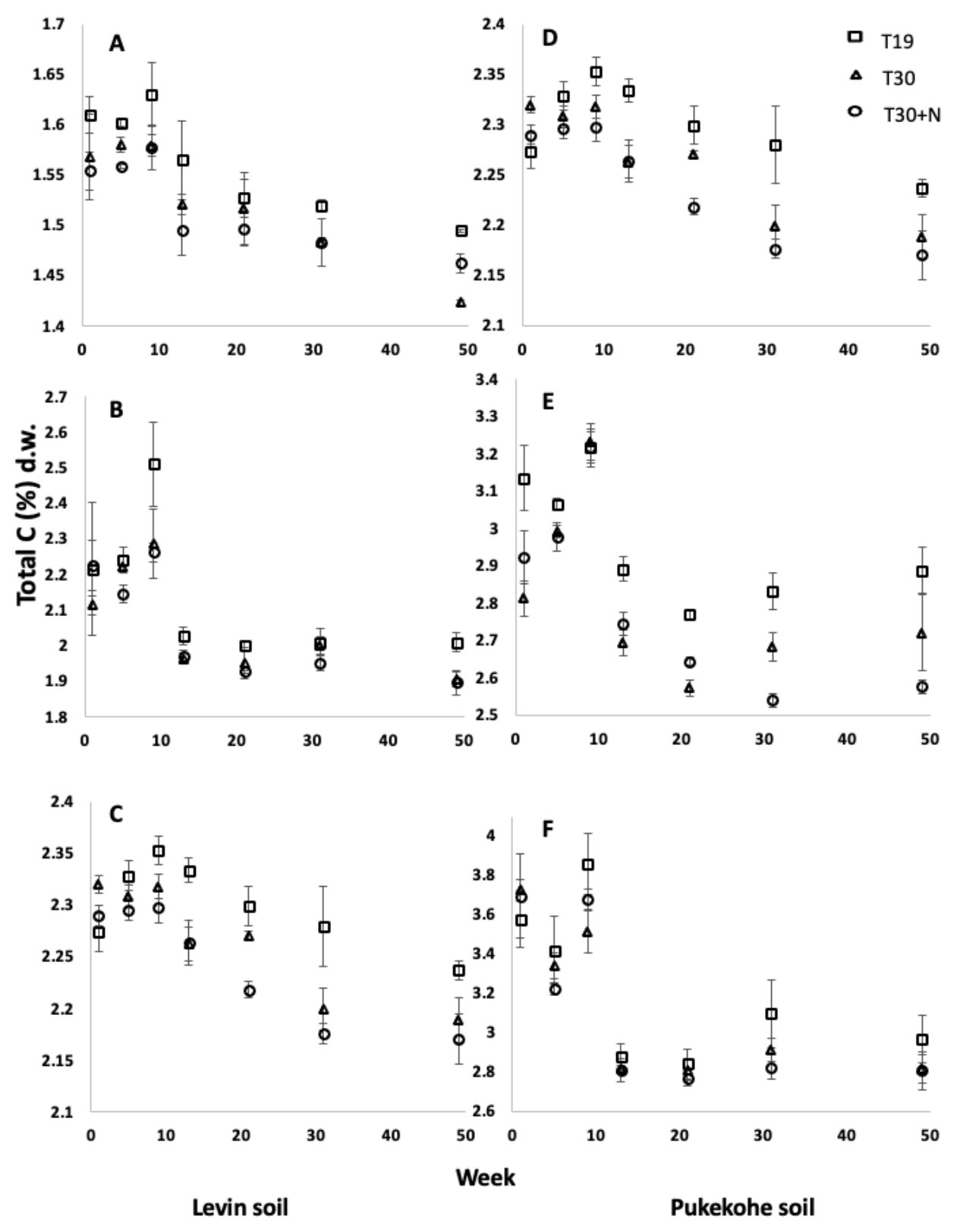
The addition of municipal compost and sawdust compost at 2.5% w/w initially increased CT in the soils by 0.65% and 0.75%, respectively. However, by week 49, CT in soil and soil–compost mixtures had significantly decreased in all treatments (control, municipal compost, and sawdust compost) in both soils (Figure 1A–F). In general, the magnitude of decrease followed the order T-19 < T-30 < T-30+N, indicating that the organic matter degradation was more rapid at higher temperatures and with added N. While the differences in CT between T-30 and T-30+N soils were generally not significant throughout the incubation (Pukekohe soil + MC after 21 weeks was the exception), the difference was significant between the T-19 soil and the other two treatments in most soils after 13 weeks. Some treatments had a small but significant increase in CT during weeks 5–13 (Figure 1, Table S1).
以2.5% w/w添加市政堆肥和锯末堆肥,最初使土壤CT分别提高了0.65%和0.75%。然而,到第49周时,两种土壤所有处理(对照、市政堆肥和锯末堆肥)中土壤及土壤—堆肥混合物的CT均显著降低(图1A–F)。总体而言,降幅大小顺序为T-19 < T-30 < T-30+N,表明在较高温度及添加N的条件下有机质降解更快。尽管在整个培养期间T-30与T-30+N土壤之间的CT差异通常不显著(21周后的Pukekohe土壤+MC除外),但在13周后,大多数土壤中T-19土壤与其他两个处理之间的差异均显著。部分处理在第5–13周期间CT出现小幅但显著的增加(图1,表S1)。
3.2. Effect of Composts on Extractable Cadmium and Other Elements3.2. 堆肥对可提取态镉及其他元素的影响
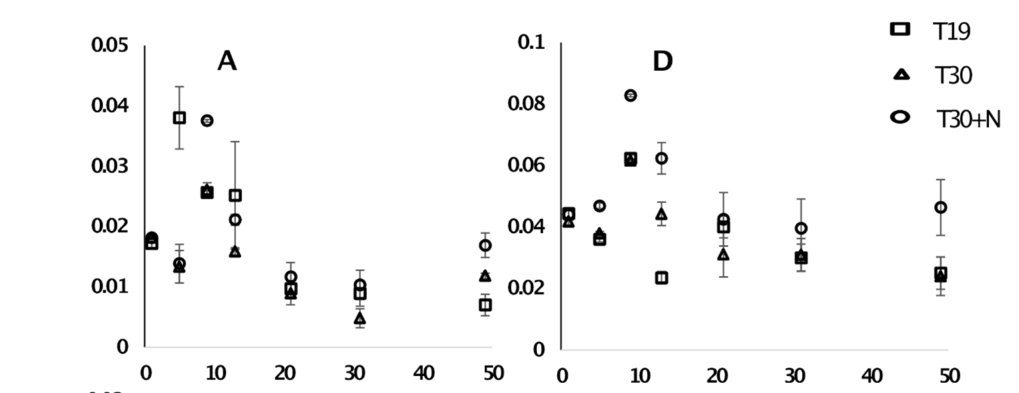
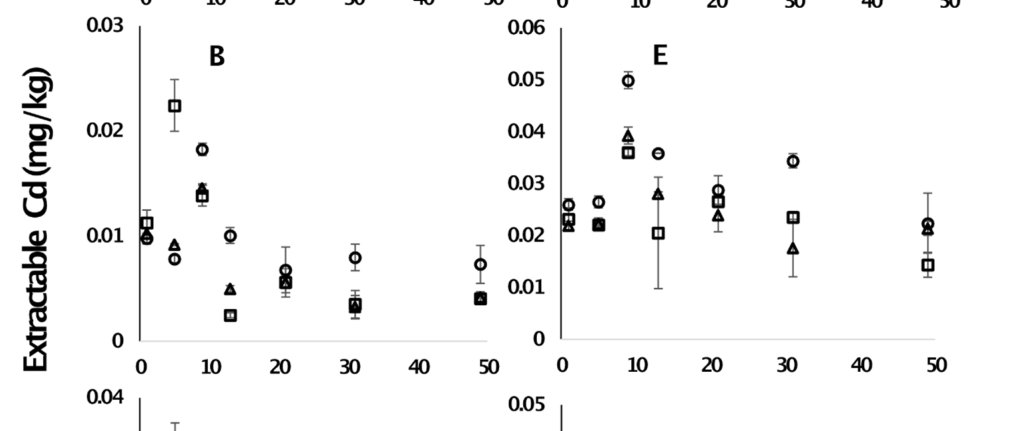
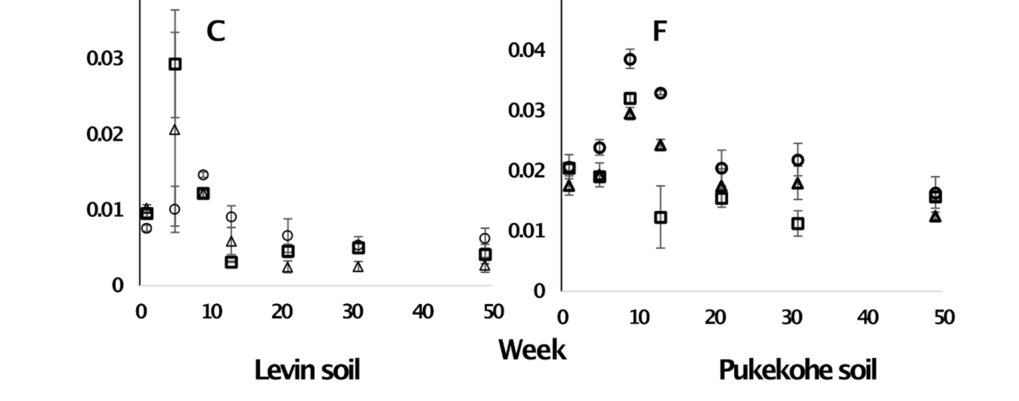
The Ca(NO3)2-extractable Cd concentrations in both the treatments and the controls decreased overall during the 49 week incubation. The reduction was greater in the two compost-amended soils than in the control soils (Figure 2). However, within that time Ca(NO3)2-extractable Cd concentrations increased significantly between weeks 2 and 10, before decreasing to achieve a net reduction. At the end of the incubation, the extractable Cd concentration in the compost treatments had decreased to between 23 and 89% of the control soils, with the greatest reduction in both soils generally achieved in the warmer incubations (Figure 2).
在49周培养期间,各处理和对照中Ca(NO3)2可提取态Cd浓度总体上均有所降低。两种堆肥改良土壤中的降幅大于对照土壤(图2)。然而,在此期间,Ca(NO3)2可提取态Cd浓度在第2至10周之间显著升高,随后下降,最终实现净降低。培养结束时,堆肥处理中可提取态Cd浓度降至对照土壤的23%–89%,两种土壤中最大降幅通常出现在较高温度的培养中(图2)。
In contrast to Cd, the composts had little effect on the Ca(NO3)2-extractable Cu, Mg, Mn, and P, while there were significant increases in Ca(NO3)2-extractable K, Na, and S (Tables S3 and S5–S10). Both composts increased the Ca(NO3)2-extractable Zn in the Levin soil but not the Pukekohe soil (Table S11). Regarding the temporal changes in Ca(NO3)2- extractable elements, the concentrations of Cu, K, Mn, Na, P, S, and Zn followed a similar pattern to Cd in that they either remained unchanged or significantly decreased during the experimental period. In contrast, concentrations of Fe significantly increased (Table S4). Aluminium mostly remained unchanged or significantly increased in the Pukekohe soil (Table S2). Magnesium remained unchanged throughout the experiment (Table S6). The urea application to the soils and soil–compost mixtures decreased the pH of soils by ca. 0.4 pH units (Table S1).
与Cd不同,堆肥对Ca(NO3)2可提取态Cu、Mg、Mn和P影响甚微,而Ca(NO3)2可提取态K、Na和S则显著增加(表S3和表S5–S10)。两种堆肥均增加了Levin土壤中Ca(NO3)2可提取态Zn,但对Pukekohe土壤无此效应(表S11)。就Ca(NO3)2可提取态元素的时间变化而言,Cu、K、Mn、Na、P、S和Zn的浓度变化规律与Cd相似,即在试验期间保持不变或显著降低。相反,Fe浓度显著增加(表S4)。在Pukekohe土壤中,铝大多保持不变或显著增加(表S2)。镁在整个试验期间保持不变(表S6)。向土壤及土壤—堆肥混合物施用尿素使土壤pH降低约0.4个单位(表S1)。
3.3. Accumulation of Cd and Other Elements by Potato Grown in Incubated Soils3.3. 培养土壤中种植的马铃薯对Cd及其他元素的累积
Cadmium uptake by the potatoes grown in both of the MC-amended soils (freshly amended and aged soil) was about half of the control soils (Table 4). The concentration of Cd in the peeled potato tubers ranged from 0.011 to 0.044 mg/kg dry weight (d.w.), equivalent to 0.002–0.008 mg/kg fresh weight, which is well below the Maximum Limit of 0.1 mg/kg F.W. stated in the Food Standards of Australia and New Zealand (FSANZ) standard 1.4.1 and EU legislation (EU 1881/2006). Comparing the freshly amended soil with aged soil, there was a significant decrease in Cd in both the controls and the compost-amended soil. This decrease mirrors the results of the Ca(NO3)2 extractions. Unlike the extractions, there was no significant increase in Fe uptake into the potato tuber.
在两种MC改良土壤(新鲜改良土壤和老化土壤)中种植的马铃薯对镉的吸收量约为对照土壤的一半(表4)。去皮马铃薯块茎中Cd浓度为0.011至0.044 mg/kg干重(d.w.),相当于0.002–0.008 mg/kg鲜重,远低于澳大利亚新西兰食品标准(FSANZ)标准1.4.1和欧盟法规(EU 1881/2006)规定的0.1 mg/kg F.W.最大限量。与新鲜改良土壤相比,老化土壤中对照和堆肥改良土壤的Cd均显著降低。这一降低与Ca(NO3)2提取结果一致。与提取结果不同的是,马铃薯块茎对Fe的吸收没有显著增加。
| Treatments处理 | Freshly-Am新鲜改 | ended Soil #良土壤 # | Soils Age老化 | d for 1 Year1年的土壤 |
|---|---|---|---|---|
| Parameters | Control | Municipal Compost | Control | Municipal Compost |
| Cd | 0.040 (0.003) A | 0.020 (0.011) B | 0.020 (0.001) B | 0.011 (0.001) C |
| B | 7.40 (0.04) A | 7.33 (0.3) A | 5 (0.5) B | 6 (0.2) B |
| Ca | 419 (65) A | 289 (15) B | 247 (11) B | 357 (40) AB |
| Cu | 6.1 (0.3) | 6.4 (0.4) | 5.7 (0.5) | 5.5 (0.1) |
| Fe | 23 (2) A | 21 (0.2) AB | 19 (1) AB | 18 (1) B |
| K | 20811 (424) A | 21565 (705) A | 21833 (408) A | 20256 (544) B |
| Mg | 1268 (72) B | 1253 (39) B | 1465 (46) A | 1244 (103) B |
| Mn | 6.7 (0.7) A | 6.7 (0.2) A | 6.2 (0.3) A | 4.8 (0.4) B |
| Mo | 0.6 (0.05) B | 1.4 (0.2) A | 0.8 (0.2) B | 1.5 (0.1) A |
| Na | 87 (16) B | 153 (1) A | 75 (8) B | 163 (19) A |
| P | 3356 (179) AB | 3245 (60) B | 3521 (106) A | 3351 (26) AB |
| S | 1248 (71) BC | 1214 (37) B | 1606 (68) A | 1336 (84) BC |
| Zn | 20 (2) | 19 (1) | 17 (0.3) | 16 (0.5) |
| Extractable Cd in soil | 0.011 (0.003) A | 0.002 (0.000) B | <0.001 | <0.001 |
| Total C in soil (%) | 2.29 (0.02) C | 3.0 (0.01) A | 2.0 (0.01) D | 2.4 (0.01) B |
# Data from Al Mamun et al. [37].
# 数据来自Al Mamun et al.[37]。
4Discussion讨论
The overall decrease in the total carbon concentration of all the soils and soil–compost mixtures shows the mineralization of organic matter (either from the compost or the original soil) by microorganisms, and is consistent with other compost-amended soil incubation studies that have used measurements of CO2 production to show this [47,48]. The greater decrease at higher temperatures with added N was expected due to the increased microbial activity under these conditions [49,50]. The brief and small increase in CT in all treatments between weeks 5 and 10 was most likely due to the rapid mineralization of oxygenrich, low-molecular-weight moieties such as carbohydrates that are easily consumed by soil microorganisms [51], thus briefly increasing the C concentration, particularly in the compost-amended soils.
所有土壤及土壤—堆肥混合物中全碳浓度的总体降低,表明有机质(来自堆肥或原土壤)被微生物矿化,这与其他采用CO2产生量来证明这一点的堆肥改良土壤培养研究结果一致[47,48]。在较高温度并添加N时降幅更大,这在预期之中,因为这些条件下微生物活性增强[49,50]。所有处理中CT在第5至10周之间短暂且小幅的增加,最可能是由于富氧、低分子量组分(如易被土壤微生物利用的碳水化合物)的快速矿化[51],从而使C浓度短暂升高,这在堆肥改良土壤中尤为明显。
We did not measure the change in CEC in our soils. Other authors have reported a general reduction in the soils’ organic matter results in a decrease of the soils’ CEC [52], which would lead to a concomitant increase in cation solubility. Nevertheless, the decomposition of composts has also been reported to produce humic substances with a higher CEC [53,54], which would be consistent with our finding that the solubility of Cd and other elements either remained unchanged or even decreased in the compost-treated soils. The elements whose Ca(NO3)2-extractable concentrations decreased commonly exist as both cations (Cd, Cu, K, Na, and Zn) and oxyanions (P and S) in aerobic soils [55]. Therefore, changes in the charges of functional groups in the organic matter over time is unlikely to have had a significant impact on the solubility of those elements. The Cd results are consistent with previous studies where EDTA and DTPA-extractable Cd in compost-amended soils were lower than in corresponding control soils up to 6 months after application [40]. In a phytoremediation/phytostabilisation operation on heavily contaminated soils, compost addition led to an improvement in biodiversity after five years [56]. The lack of consistent differences in the Ca(NO3)2-extractable Cd across the different temperature and nitrogen addition treatments (T-19, T-30, and T-30+N) indicates that the aforementioned breakdown of labile organic materials did not affect the sorption of Cd to these significantly. Increased formation of strong organo-Cd associations in the ageing compost [57] may also have contributed to the metal immobilisation.
本研究未测定土壤CEC的变化。其他研究者报道,土壤有机质的普遍减少会导致土壤CEC降低[52],进而使阳离子溶解度相应增加。然而,也有报道称堆肥分解会产生CEC更高的腐殖物质[53,54],这与本研究中堆肥处理土壤中Cd及其他元素溶解度保持不变甚至降低的结果相符。Ca(NO3)2可提取态浓度降低的元素在好氧土壤中通常以阳离子(Cd、Cu、K、Na和Zn)和含氧阴离子(P和S)两种形式存在[55]。因此,有机质官能团电荷随时间的变化不太可能对这些元素的溶解度产生显著影响。Cd的结果与以往研究一致,即施用后长达6个月内,堆肥改良土壤中EDTA和DTPA可提取态Cd均低于相应的对照土壤[40]。在一项针对重度污染土壤的植物修复/植物稳定工程中,添加堆肥五年后生物多样性得到改善[56]。不同温度和氮添加处理(T-19、T-30和T-30+N)间Ca(NO3)2可提取态Cd缺乏一致差异,表明上述易分解有机物质的分解并未显著影响Cd在其上的吸附。老化堆肥中强有机—Cd结合体形成的增加[57]也可能促进了金属的固定。
The significant increases in Ca(NO3)2-extractable Fe and Al concentrations suggest that the decreases in the extractable concentrations of most elements could have been partly an artefact of the experimental conditions. The regular mechanical disturbance of the moist soils will have disrupted soil aggregates [55,58,59] that would have maintained high surface areas of reactive surfaces for binding elements and high concentrations of colloidal Fe and Al [60]. These colloids may have occluded sorbed elements and thus reduced their solubility. This may have also occurred with colloidal organic matter liberated from aggregates whose re-attachment and coating of reactive surfaces would have further reduced the solubility of elements sorbed onto those surfaces. This process is a well-recognised mechanism for stabilising organic matter in soils [61–63].
Ca(NO3)2可提取态Fe和Al浓度的显著增加表明,大多数元素可提取态浓度的降低可能部分是试验条件造成的假象。对湿润土壤的定期机械扰动会破坏土壤团聚体[55,58,59],而团聚体原本能够维持用于结合元素的大比表面积反应表面以及高浓度的胶体Fe和Al[60]。这些胶体可能包蔽了已吸附的元素,从而降低其溶解度。从团聚体中释放出的胶体有机质也可能发生类似过程,其重新附着并包覆反应表面,会进一步降低吸附在这些表面上元素的溶解度。这一过程是公认的土壤有机质稳定机制[61–63]。
In the field, mechanical disturbance of aggregates may occur following repeated ploughing. Previous studies on the role of ploughing on the solubility and phytoavailability of elements in soil have shown contradicting results. Lavado et al. [60] observed in a field trial that DTPA-extractable Cd concentrations did not change due to mechanical disturbance. In contrast, EDTA-extractable Cd was shown to have decreased due to mechanical disturbance for soils treated under laboratory conditions [55], which agreed with the reports of reduced Cd uptake in field-grown plants where the soils had not been subject to mechanical disturbance when compared to plants grown on mechanically disturbed soils.
在田间,反复翻耕可能导致团聚体受到机械扰动。以往关于翻耕对土壤元素溶解度和植物有效性作用的研究结果相互矛盾。Lavado et al.[60]在田间试验中观察到,DTPA可提取态Cd浓度并未因机械扰动而改变。相反,在实验室条件下处理的土壤中,EDTA可提取态Cd因机械扰动而降低[55],这与以下报道一致:与在受机械扰动土壤上生长的植物相比,在未受机械扰动土壤上田间生长的植物对Cd的吸收减少。
The Cd concentrations in the potatoes grown here are generally below the previously reported range of concentrations (0.040–0.113 mg/kg D.W.) across different field-grown potato varieties grown in the Pukekohe region [64]. In the aged soils, the concentrations were less than 18% of the same varietal (“Nadine”) grown in the field [64]. These differences may be partly due to fresh fertiliser (including Cd) inputs to the field soils during the growing season; however, differences in Cd uptake by that variety between different regions has also been recognised as having an influence, with significantly greater uptake at lower latitudes [64]. The cooler air temperature during the growth in the austral winter may also have reduced Cd uptake in the pot trial, when compared to the field-grown potatoes that are grown mainly in the summer [65]. The reduced uptake of Cd into potato tubers in the aged compost-amended soils reflected the low extractable concentrations of the metal in the same soils. These results suggest that MC can significantly reduce phytoavailability of Cd both in soils that have been freshly amended and one year later, after the reactive organic matter fractions in the compost have been mineralized. This agrees with the results from a previous pot trial that showed a significant reduction in the Cd concentration in the grain, leaf, and stem of wheat plants six months after compost addition [36]. The fact that these effects persist for up to a year, despite a gradual loss of C from soils, suggest that natural soil processes and mechanical disturbance may be converting compost into forms that either directly bind Cd to them, rendering Cd sorbed onto mineral fractions inert, or both. Potentially, leaching losses from the pots may have contributed to the reduction in Cd uptake by potatoes. However, other authors have shown that Cd leaching is negligible. For example, Gray et al. [66] reported leaching losses of 0.27–0.86 g/ha/yr from New Zealand soils, representing < 0.05% of the total Cd loading of the soil (assuming an average concentration of 0.89 mg/kg [67], a depth of 0.15 m, and a density of 1.5 g/cm3).
本研究中种植的马铃薯Cd浓度总体上低于此前报道的Pukekohe地区田间种植的不同马铃薯品种的浓度范围(0.040–0.113 mg/kg D.W.)[64]。在老化土壤中,其浓度不到田间种植的同一品种(“Nadine”)的18%[64]。这些差异可能部分由于生长季内田间土壤有新鲜肥料(包括Cd)的输入;然而,该品种在不同地区间Cd吸收的差异也被认为具有影响,低纬度地区的吸收显著更高[64]。与主要在夏季种植的田间马铃薯相比,南半球冬季生长期间较低的气温也可能降低了盆栽试验中的Cd吸收[65]。老化堆肥改良土壤中马铃薯块茎Cd吸收的降低,反映了同一土壤中该金属较低的可提取态浓度。这些结果表明,无论是在新鲜改良的土壤中,还是在一年后堆肥中的活性有机质组分已被矿化时,MC均可显著降低Cd的植物有效性。这与此前一项盆栽试验的结果一致,该试验表明添加堆肥六个月后,小麦籽粒、叶片和茎中的Cd浓度显著降低[36]。尽管土壤中C逐渐损失,这些效应仍可持续长达一年,这表明自然土壤过程和机械扰动可能正在将堆肥转化为能直接结合Cd的形态,或使吸附在矿物组分上的Cd变为惰性,或两者兼有。盆钵中的淋溶损失也可能促成了马铃薯Cd吸收的降低。然而,其他研究者已表明Cd的淋溶可忽略不计。例如,Gray et al.[66]报道新西兰土壤的淋溶损失为0.27–0.86 g/ha/yr,仅占土壤Cd总负荷的< 0.05%(假设平均浓度为0.89 mg/kg[67],深度0.15 m,密度1.5 g/cm3)。
5Conclusions结论
The addition of composts to soil reduces the Ca(NO3)2-extractable Cd concentrations compared to the control. While incubation with mechanical disturbance and the addition of urea resulted in a significant decrease in the soil carbon concentrations, there was no corresponding increase in Ca(NO3)2-extractable Cd, and the plant uptake of Cd remained either unchanged or decreased over a one-year incubation period. The lack of increase in Ca(NO3)2-extractable Cd may be partly due to the experimental conditions, which included regular mechanical disturbance, potentially occluding Cd and other elements attached to the surfaces of soil colloids. Future work should identify the formation of mineral-associated organic carbon in the compost-amended soil and elucidate the fraction of organic matter that binds Cd in these compost-amended soils. Furthermore, field trials could confirm the longevity of compost-bound Cd in agricultural soils.
与对照相比,向土壤中添加堆肥降低了Ca(NO3)2可提取态Cd浓度。尽管伴随机械扰动的培养和尿素添加导致土壤碳浓度显著降低,但Ca(NO3)2可提取态Cd并未相应增加,且在一年的培养期内植物对Cd的吸收保持不变或有所降低。Ca(NO3)2可提取态Cd未增加可能部分归因于试验条件,其中包括定期机械扰动,这可能包蔽了附着在土壤胶体表面的Cd及其他元素。未来的工作应识别堆肥改良土壤中矿物结合态有机碳的形成,并阐明这些堆肥改良土壤中结合Cd的有机质组分。此外,田间试验可以确认农业土壤中堆肥结合态Cd的持久性。
Supplementary Materials: The following supporting information can be downloaded at: https: //www.mdpi.com/article/10.3390/soilsystems7040107/s1, Table S1: pH over time (week) in Levin soil and Pukekohe with and without composts. SE is the standard error of the mean (n = 3); Table S2: Extractable Al (mg/kg) over time (week) in Levin soil and Pukekohe with and without composts. SE is the standard error of the mean (n = 3); Table S3: Extractable Cu (mg/kg) over time (week) in Levin soil and Pukekohe with and without composts. SE is the standard error of the mean (n = 3); Table S4: Extractable Fe (mg/kg) over time (week) in Levin soil and Pukekohe with and without composts. SE is the standard error of the mean (n = 3); Table S5: Extractable K (mg/kg) over time (week) in Levin soil and Pukekohe with and without composts. SE is the standard error of the mean (n = 3); Table S6: Extractable Mg (mg/kg) over time (week) in Levin soil and Pukekohe with and without composts. SE is the standard error of the mean (n = 3); Table S7: Extractable Mn (mg/kg) over time (week) in Levin soil and Pukekohe with and without composts. SE is the standard error of the mean (n = 3); Table S8: Extractable Na (mg/kg) over time (week) in Levin soil and Pukekohe with and without composts. SE is the standard error of the mean (n = 3); Table S9: Extractable P (mg/kg) over time (week) in Levin soil and Pukekohe with and without composts. SE is the standard error of the mean (n = 3); Table S10: Extractable S (mg/kg) over time (week) in Levin soil and Pukekohe with and without composts. SE is the standard error of the mean (n = 3); Table S11: Extractable Zn (mg/kg) over time (week) in Levin soil and Pukekohe with and without composts. SE is the standard error of the mean (n = 3); Table S12: Fisher’s post hoc test of the data used in Figure 1 (A–F). Values with the same capital letters in the rows are not significantly different. Values with the same lower-case letters in the columns are not significantly different. The “*” indicates no significant difference; Table S13: Fisher’s post hoc test of the data used in Figure 2 (A–F). Values with the same capital letters in the rows are not significantly different. Values with the same lower-case letters in the columns are not significantly different. The “*” indicates no significant difference.
补充材料:以下支持信息可从https: //www.mdpi.com/article/10.3390/soilsystems7040107/s1下载。表S1:添加与未添加堆肥的Levin土壤和Pukekohe土壤中pH随时间(周)的变化,SE为均值的标准误(n = 3);表S2:添加与未添加堆肥的Levin土壤和Pukekohe土壤中可提取态Al(mg/kg)随时间(周)的变化,SE为均值的标准误(n = 3);表S3:添加与未添加堆肥的Levin土壤和Pukekohe土壤中可提取态Cu(mg/kg)随时间(周)的变化,SE为均值的标准误(n = 3);表S4:添加与未添加堆肥的Levin土壤和Pukekohe土壤中可提取态Fe(mg/kg)随时间(周)的变化,SE为均值的标准误(n = 3);表S5:添加与未添加堆肥的Levin土壤和Pukekohe土壤中可提取态K(mg/kg)随时间(周)的变化,SE为均值的标准误(n = 3);表S6:添加与未添加堆肥的Levin土壤和Pukekohe土壤中可提取态Mg(mg/kg)随时间(周)的变化,SE为均值的标准误(n = 3);表S7:添加与未添加堆肥的Levin土壤和Pukekohe土壤中可提取态Mn(mg/kg)随时间(周)的变化,SE为均值的标准误(n = 3);表S8:添加与未添加堆肥的Levin土壤和Pukekohe土壤中可提取态Na(mg/kg)随时间(周)的变化,SE为均值的标准误(n = 3);表S9:添加与未添加堆肥的Levin土壤和Pukekohe土壤中可提取态P(mg/kg)随时间(周)的变化,SE为均值的标准误(n = 3);表S10:添加与未添加堆肥的Levin土壤和Pukekohe土壤中可提取态S(mg/kg)随时间(周)的变化,SE为均值的标准误(n = 3);表S11:添加与未添加堆肥的Levin土壤和Pukekohe土壤中可提取态Zn(mg/kg)随时间(周)的变化,SE为均值的标准误(n = 3);表S12:图1(A–F)所用数据的Fisher事后检验。行中具有相同大写字母的数值间差异不显著,列中具有相同小写字母的数值间差异不显著,“*”表示差异不显著;表S13:图2(A–F)所用数据的Fisher事后检验。行中具有相同大写字母的数值间差异不显著,列中具有相同小写字母的数值间差异不显著,“*”表示差异不显著。
Author Contributions: Conceptualisation, B.H.R. and N.J.L.; methodology, S.A.M.; formal analysis, B.H.R., N.J.L., S.A.M., J.C., L.K. and R.M.; data curation, B.H.R.; writing original draft preparation, S.A.M.; writing review and editing, B.H.R., N.J.L., S.A.M., J.C., L.K. and R.M.; supervision, B.H.R., N.J.L. and J.C. All authors have read and agreed to the published version of the manuscript.
作者贡献:构思,B.H.R.和N.J.L.;方法,S.A.M.;形式分析,B.H.R.、N.J.L.、S.A.M.、J.C.、L.K.和R.M.;数据整理,B.H.R.;初稿撰写,S.A.M.;审阅与修改,B.H.R.、N.J.L.、S.A.M.、J.C.、L.K.和R.M.;指导,B.H.R.、N.J.L.和J.C.。所有作者均已阅读并同意稿件的发表版本。
Funding: This work was funded, in part, by Environmental Science and Research, the Fertiliser Association of NZ, and by the Ministry of Business Innovation and Employment’s Our Land and Water National Science Challenge (contract C10X1507).
基金资助:本研究部分由Environmental Science and Research、新西兰肥料协会(Fertiliser Association of NZ)以及新西兰商业、创新与就业部“我们的土地与水”国家科学挑战计划(Our Land and Water National Science Challenge,合同号C10X1507)资助。
Institutional Review Board Statement: Not applicable.机构审查委员会声明:不适用。
Informed Consent Statement: Not applicable.知情同意声明:不适用。
Data Availability Statement: The data used in this study are included in the Supplementary Information and will be made available on https://www.kiwiscience.com/journal-articles.html.
数据可用性声明:本研究所用数据已包含在补充信息中,并将在https://www.kiwiscience.com/journal-articles.html上公开。
Acknowledgments: The lead author gratefully acknowledges the receipt of a New Zealand Aid PhD scholarship. We are grateful for the help of Lynne Clucas for the chemical analysis of the samples.
致谢:第一作者衷心感谢新西兰援助(New Zealand Aid)博士奖学金的资助。感谢Lynne Clucas在样品化学分析方面提供的帮助。
Conflicts of Interest: The authors declare no conflict of interest.
利益冲突:作者声明无利益冲突。
References参考文献
1. Bolan, N.S.; Adriano, D.C.; Duraisamy, P.; Mani, A. Immobilization and Phytoavailability of Cadmium in Variable Charge Soils. III. Effect of Biosolid Compost Addition. Plant Soil 2003, 256, 231–241. [CrossRef]
2. Kabata-Pendias, A.; Mukherjee, A.B. Trace Elements from Soil to Human; Springer Science & Business Media: Berlin/Heidelberg, Germany, 2007; ISBN 9783540327134.
3. Oosterhuis, F.H.; Brouwer, F.M.; Wijnants, H.J. A Possible EU Wide Charge on Cadmium in Phosphate Fertilisers: Economic and Environmental Implications. IVM Rep. 2000. Available online: https://research.vu.nl/ws/portalfiles/portal/1646586/E-00-02+ Cadmiumheffing+rapport.pdf (accessed on 19 November 2023).
4. Mar, S.S.; Okazaki, M. Investigation of Cd Contents in Several Phosphate Rocks Used for the Production of Fertilizer. Microchem. J. 2012, 104, 17–21. [CrossRef]
5. Hooda, P. Trace Elements in Soils; John Wiley & Sons: New York, NY, USA, 2010; ISBN 9781444319484.
6. Bergen, B.; Verbeeck, M.; Smolders, E. Trace Metal Accumulation in Agricultural Soils from Mineral Phosphate Fertiliser Applications in European Long-term Field Trials. Eur. J. Soil Sci. 2022, 73, 13167. [CrossRef]
7. Dziubanek, G.; Piekut, A.; Rusin, M.; Baranowska, R.; Hajok, I. Contamination of Food Crops Grown on Soils with Elevated Heavy Metals Content. Ecotoxicol. Environ. Saf. 2015, 118, 183–189. [CrossRef] [PubMed]
8. Fekete, S.G.; Bersényi, A.; Kádár, I.; Glávits, R.; Koncz, J.; Zöldág, L. Study of Soil-Plant (potato and Beetroot)-Animal Cycle of Nutritive and Hazardous Minerals in a Rabbit Model. Acta Vet. Hung. 2001, 49, 301–310. [PubMed]
9. Maclean, A.J. Cadmium in different plant species and its availability in soils as influenced by organic matter and additions of lime, P, Cd and Zn. Can. J. Soil Sci. 1976, 56, 129–138. [CrossRef]
10. McLaughlin, M.J.; Maier, N.A.; Rayment, G.E.; Sparrow, L.A.; Berg, G.; McKay, A.; Milham, P.; Merry, R.H.; Smart, M.K. Cadmium in Australian Potato Tubers and Soils. J. Environ. Qual. 1997, 26, 1644–1649. [CrossRef]
11. Pérez, A.L.; Anderson, K.A. DGT Estimates Cadmium Accumulation in Wheat and Potato from Phosphate Fertilizer Applications. Sci. Total Environ. 2009, 407, 5096–5103. [CrossRef]
12. Rai, S.; Gupta, S.; Mittal, P.C. Dietary Intakes and Health Risk of Toxic and Essential Heavy Metals through the Food Chain in Agricultural, Industrial, and Coal Mining Areas of Northern India. Hum. Ecol. Risk Assess. Int. J. 2015, 21, 913–933. [CrossRef]
13. Weggler-Beaton, K.; McLaughlin, M.J.; Graham, R.D. Salinity Increases Cadmium Uptake by Wheat and Swiss Chard from Soil Amended with Biosolids. Soil Res. 2000, 38, 37–46. [CrossRef]
14. Christensen, T.H.; Haung, P.M. Solid Phase Cadmium and the Reactions of Aqueous Cadmium with Soil Surfaces. In Cadmium in Soils and Plants; McLaughlin, M.J., Singh, B.R., Eds.; Springer Netherlands: Dordrecht, The Netherlands, 1999; pp. 65–96, ISBN 9789401144735.
15. Al Mamun, S.; Chanson, G.; Muliadi; Benyas, E.; Aktar, M.; Lehto, N.; McDowell, R.; Cavanagh, J.; Kellermann, L.; Clucas, L.; et al. Municipal Composts Reduce the Transfer of Cd from Soil to Vegetables. Environ. Pollut. 2016, 213, 8–15. [CrossRef] [PubMed]
16. Simmler, M.; Ciadamidaro, L.; Schulin, R.; Madejón, P.; Reiser, R.; Clucas, L.; Weber, P.; Robinson, B. Lignite Reduces the Solubility and Plant Uptake of Cadmium in Pasturelands. Environ. Sci. Technol. 2013, 47, 4497–4504. [CrossRef] [PubMed]
17. Nan, Z.; Li, J.; Zhang, J.; Cheng, G. Cadmium and Zinc Interactions and Their Transfer in Soil-Crop System under Actual Field Conditions. Sci. Total Environ. 2002, 285, 187–195. [CrossRef] [PubMed]
18. Alloway, B.J.; Jackson, A.P.; Morgan, H. The Accumulation of Cadmium by Vegetables Grown on Soils Contaminated from a Variety of Sources. Sci. Total Environ. 1990, 91, 223–236. [CrossRef] [PubMed]
19. Food Safety Authority, E. Cadmium Dietary Exposure in the European Population. Efsa J. 2012, 10, 2551. [CrossRef]
20. Kim, N. Cadmium Accumulation in Waikato Soils; Environment Waikato Regional Council: North Island, New Zealand, 2008.
21. Zheng, N.; Wang, Q.; Zheng, D. Health Risk of Hg, Pb, Cd, Zn, and Cu to the Inhabitants around Huludao Zinc Plant in China via Consumption of Vegetables. Sci. Total Environ. 2007, 383, 81–89. [CrossRef] [PubMed]
22. Zhuang, P.; McBride, M.B.; Xia, H.; Li, N.; Li, Z. Health Risk from Heavy Metals via Consumption of Food Crops in the Vicinity of Dabaoshan Mine, South China. Sci. Total Environ. 2009, 407, 1551–1561. [CrossRef] [PubMed]
23. Taylor, M.D.; Percival, H.J. Cadmium in Soil Solutions from a Transect of Soils Away from a Fertiliser Bin. Environ. Pollut. 2001, 113, 35–40. [CrossRef]
24. Sposito, G.; Page, A.L. Cycling of Metal Ions in the Soil Environment. Met. Ions Biol. Syst. 1984, 18, 287–332.
25. McLaughlin, M.J.; Palmer, L.T.; Tiller, K.G.; Beech, T.A.; Smart, M.K. Increased Soil Salinity Causes Elevated Cadmium Concentrations in Field-Grown Potato Tubers. J. Environ. Qual. 1994, 23, 1013–1018. [CrossRef]
26. Loganathan, P.; Hedley, M.J.; Grace, N.D.; Lee, J.; Cronin, S.J.; Bolan, N.S.; Zanders, J.M. Fertiliser Contaminants in New Zealand Grazed Pasture with Special Reference to Cadmium and Fluorine—A Review. Soil Res. 2003, 41, 501. [CrossRef]
27. McLaughlin, M.J.; Tiller, K.G.; Naidu, R.; Stevens, D.P. The Behaviour and Environmental Impact of Contaminants in Fertilizers. Soil Res. 1996, 34, 1–54. [CrossRef]
28. Smolders, E.; McLaughlin, M.J. Effect of Cl on Cd Uptake by Swiss Chard in Nutrient Solutions. Plant Soil 1996, 179, 57–64. [CrossRef]
29. Temminghoff, E.J.M.; Zee, S.E.A.T.M.; Haan, F.A.M. Speciation and Calcium Competition Effects on Cadmium Sorption by Sandy Soil at Various pHs. Eur. J. Soil Sci. 1995, 46, 649–655. [CrossRef]
30. Ghallab, A.; Usman, A.R.A. Effect of Sodium Chloride-Induced Salinity on Phyto-Availability and Speciation of Cd in Soil Solution. Water Air Soil Pollut. 2007, 185, 43–51. [CrossRef]
31. Basta, N.T.; Gradwohl, R.; Snethen, K.L.; Schroder, J.L. Chemical Immobilization of Lead, Zinc, and Cadmium in Smelter- Contaminated Soils Using Biosolids and Rock Phosphate. J. Environ. Qual. 2001, 30, 1222–1230. [CrossRef] [PubMed]
32. Bjerre, G.K.; Schierup, H.-H. Uptake of Six Heavy Metals by Oat as Influenced by Soil Type and Additions of Cadmium, Lead, Zinc and Copper. Plant Soil 1985, 88, 57–69. [CrossRef]
33. Chen, Z.S.; Lee, G.J.; Liu, J.C. The Effects of Chemical Remediation Treatments on the Extractability and Speciation of Cadmium and Lead in Contaminated Soils. Chemosphere 2000, 41, 235–242. [CrossRef]
34. Lee, T.-M.; Lai, H.-Y.; Chen, Z.-S. Effect of Chemical Amendments on the Concentration of Cadmium and Lead in Long-Term Contaminated Soils. Chemosphere 2004, 57, 1459–1471. [CrossRef]
35. Li, Z.; Ryan, J.A.; Chen, J.L.; Al-Abed, S.R. Adsorption of Cadmium on Biosolids-Amended Soils. J. Environ. Qual. 2001, 30, 903–911. [CrossRef]
36. Vaca-Paulín, R.; Esteller-Alberich, M.V.; Lugo-de la Fuente, J.; Zavaleta-Mancera, H.A. Effect of Sewage Sludge or Compost on the Sorption and Distribution of Copper and Cadmium in Soil. Waste Manag. 2006, 26, 71–81. [CrossRef] [PubMed]
37. Al Mamun, S.; Lehto, N.J.; Cavanagh, J.; McDowell, R.; Aktar, M.; Benyas, E.; Robinson, B.H. Effects of Lime and Organic Amendments Derived from Varied Source Materials on Cadmium Uptake by Potato. J. Environ. Qual. 2017, 46, 836–844. [CrossRef] [PubMed]
38. Shuman, L.M.; Dudka, S.; Das, K. Cadmium Forms and Plant Availability in Compost-Amended Soil. Commun. Soil Sci. Plant Anal. 2002, 33, 737–748. [CrossRef]
39. Tapia, Y.; Cala, V.; Eymar, E.; Frutos, I.; Gárate, A.; Masaguer, A. Chemical Characterization and Evaluation of Composts as Organic Amendments for Immobilizing Cadmium. Bioresour. Technol. 2010, 101, 5437–5443. [CrossRef] [PubMed]
40. Karaca, A. Effect of Organic Wastes on the Extractability of Cadmium, Copper, Nickel, and Zinc in Soil. Geoderma 2004, 122, 297–303. [CrossRef]
41. Ouattara, K.; Ouattara, B.; Nyberg, G.; Sédogo, M.P.; Malmer, A. Ploughing Frequency and Compost Application Effects on Soil Infiltrability in a Cotton–maize (Gossypium hirsutum–Zea Mays L.) Rotation System on a Ferric Luvisol and a Ferric Lixisol in Burkina Faso. Soil Tillage Res. 2007, 95, 288–297. [CrossRef]
42. Horrocks, A.; Curtin, D.; Tregurtha, C.; Meenken, E. Municipal Compost as a Nutrient Source for Organic Crop Production in New Zealand. Agronomy 2016, 6, 35. [CrossRef]
43. Blakemore, L.C.; Searle, P.L.; Daly, B.K. Methods for Chemical Analysis of Soils; NZ Soil Bureau; Department of Scientific and Industrial Research: Lower Hutt, New Zealand, 1987.
44. Black, A.; Mclaren, R.G.; Reichman, S.M.; Speir, T.W.; Condron, L.M. Examining the Integrity of Soil Metal Bioavailability Assays in the Presence of Organic Amendments to Metal-Spiked Soils. Soil Use Manag. 2012, 28, 89–100. [CrossRef]
45. Gray, C.W.; Mclaren, R.G.; Roberts, A.H.C.; Condron, L.M. Effect of Soil pH on Cadmium Phytoavailability in Some New Zealand Soils. N. Z. J. Crop Hortic. Sci. 1999, 27, 169–179. [CrossRef]
46. Gray, C.W.; McLaren, R.G.; Roberts, A.H.C.; Condron, L.M. Cadmium Phytoavailability in Some New Zealand Soils. Soil Res. 1999, 37, 461–478. [CrossRef]
47. Lim, S.-S.; Lee, K.-S.; Lee, S.-I.; Lee, D.-S.; Kwak, J.-H.; Hao, X.; Ro, H.-M.; Choi, W.-J. Carbon Mineralization and Retention of Livestock Manure Composts with Different Substrate Qualities in Three Soils. J. Soils Sediments 2012, 12, 312–322. [CrossRef] 48. Shah, A.; Lamers, M.; Streck, T. N2O and CO2 Emissions from South German Arable Soil after Amendment of Manures and Composts. Environ. Earth Sci. 2016, 75, 427. [CrossRef]
49. Kuzyakov, Y.; Friedel, J.K.; Stahr, K. Review of Mechanisms and Quantification of Priming Effects. Soil Biol. Biochem. 2000, 32, 1485–1498. [CrossRef]
50. Hamer, U.; Potthast, K.; Makeschin, F. Urea Fertilisation Affected Soil Organic Matter Dynamics and Microbial Community Structure in Pasture Soils of Southern Ecuador. Appl. Soil Ecol. 2009, 43, 226–233. [CrossRef]
51. Leifeld, J.; Siebert, S.; Kögel-Knabner, I. Changes in the Chemical Composition of Soil Organic Matter after Application of Compost. Eur. J. Soil Sci. 2002, 53, 299–309. [CrossRef]
52. Helling, C.S.; Chesters, G.; Corey, R.B. Contribution of Organic Matter and Clay to Soil Cation-Exchange Capacity as Affected by the pH of the Saturating Solution 1. Soil Sci. Soc. Am. J. 1964, 28, 517–520. [CrossRef]
53. Harada, Y.; Inoko, A. The Measurement of the Cation-Exchange Capacity of Composts for the Estimation of the Degree of Maturity. Soil Sci. Plant Nutr. 1980, 26, 127–134. [CrossRef]
54. Muller, J.F. Some Observations on Base Exchange in Organic Materials. Soil Sci. 1933, 35, 229–237. [CrossRef]
55. Brady, N.C.; Weil, R. Nature and Properties of Soils, the: Pearson New International Edition; Pearson Higher Ed: Hoboken, NJ, USA, 2013.
56. Bouwman, L.A.; Vangronsveld, J. Rehabilitation of the Nematode Fauna in a Phytostabilized, Heavily Zinc-Contaminated, Sandy Soil. J. Soils Sediments 2004, 4, 17–23. [CrossRef]
57. Kleber, M.; Sollins, P.; Sutton, R. A Conceptual Model of Organo-Mineral Interactions in Soils: Self-Assembly of Organic Molecular Fragments into Zonal Structures on Mineral Surfaces. Biogeochemistry 2007, 85, 9–24. [CrossRef]
58. Bissonnais, Y. Aggregate Stability and Assessment of Soil Crustability and Erodibility: I. Theory and Methodology. Eur. J. Soil Sci. 1996, 47, 425–437. [CrossRef]
59. Watts, C.W.; Dexter, A.R.; Dumitru, E.; Arvidsson, J. An Assessment of the Vulnerability of Soil Structure to Destabilisation during Tillage. Part I. A Laboratory Test. Soil Tillage Res. 1996, 37, 161–174. [CrossRef]
60. Lavado, R.S.; Porcelli, C.A.; Alvarez, R. Concentration and Distribution of Extractable Elements in a Soil as Affected by Tillage Systems and Fertilization. Sci. Total Environ. 1999, 232, 185–191. [CrossRef]
61. Baldock, J.A.; Skjemstad, J.O. Role of the Soil Matrix and Minerals in Protecting Natural Organic Materials against Biological Attack. Org. Geochem. 2000, 31, 697–710. [CrossRef]
62. Deng, Y.; Dixon, J.B. Soil Organic Matter and Organic-Mineral Interactions. In Soil Mineralogy with Environmental Applications; SSSA Book Series; Soil Science Society of America: Madison, WI, USA, 2002; pp. 69–107, ISBN 9780891188919.
63. Huang, P.-M.; Wang, M.-K.; Chiu, C.-Y. Soil Mineral–organic Matter–microbe Interactions: Impacts on Biogeochemical Processes and Biodiversity in Soils. Pedobiologia 2005, 49, 609–635. [CrossRef]
64. Gray, C.W.; Yi, Z.; Lehto, N.J.; Robinson, B.H. Effect of Cultivar Type and Soil Properties on Cadmium Concentrations in Potatoes. N. Z. J. 2019, 47, 182–197. [CrossRef]
65. Yi, Z.; Lehto, N.J.; Robinson, B.H.; Cavanagh, J.-A.E. Environmental and Edaphic Factors Affecting Soil Cadmium Uptake by Spinach, Potatoes, Onion and Wheat. Sci. Total Environ. 2020, 713, 136694. [CrossRef]
66. Gray, C.W.; McLaren, R.G.; Roberts, A.H.C. Cadmium Leaching from Some New Zealand Pasture Soils. Eur. J. Soil Sci. 2003, 54, 159–166. [CrossRef]
67. Reiser, R.; Simmler, M.; Portmann, D.; Clucas, L.; Schulin, R.; Robinson, B. Cadmium Concentrations in New Zealand Pastures: Relationships to Soil and Climate Variables. J. Environ. Qual. 2014, 43, 917–925. [CrossRef]
Disclaimer/Publisher’s Note: The statements, opinions and data contained in all publications are solely those of the individual author(s) and contributor(s) and not of MDPI and/or the editor(s). MDPI and/or the editor(s) disclaim responsibility for any injury to people or property resulting from any ideas, methods, instructions or products referred to in the content.