COMMUN. SOIL SCI. PLANT ANAL.., 31(3&4), 413-421 (2000)
Annabelle Deram,* Daniel Petit,' Brett Robinson, Robert Brooks, d, Paul Gregg, and Chantal Van Halluwyn®
* Laboratoire de Botanique et Cryptogamie, Faculté des Sciences Pharmaceutiques et Biologiques, Université de Lille 2, P.O. Box 83, Lille F59006, France
'Laboratoire de Génétique et Evolution des Populations Végétales, UPRESA 8016, Université de Lille 1, Villeneuve d'Ascq F59655, France Horticultural and Food Research Institute of New Zealand Ltd., Palmerston North, New Zealand
Soil and Earth Sciences, Institute of Natural Resources, Massey University, Palmerston North, New Zealand
1ABSTRACT摘要
The uptake of cobalt, copper, lead, and nickel by the perennial metal-tolerant grass Arrhenatherum elatius was studied by growing the plants in two different substrates. These were a cobalt/copper/nickel ore (Experiment A) and base-metal tailings rich in lead (Experiment B). The enhancement of metal uptake by the plants following addition of EDTA was investigated in both experiments. In Experiment A, metal concentrations in dry plant matter were about equal to the acid-extractable (1 M hydrochloric acid) fractions in the supporting soils after addition of 4 g kg-' EDTA. In Experiment B, the base-metal tailings contained 11,500 mg kg-' (1.15%) lead. The EDTA addition induced 2.5% lead (dry matter) in the grass. This was reduced to ca. 1.0% upon addition of lime. The results indicate that A. elatius may have some potential in phytoremediation operations if EDTA is added to the substrate.
通过在两种不同基质中种植多年生耐金属禾草Arrhenatherum elatius,研究了其对钴、铜、铅和镍的吸收。两种基质分别为钴/铜/镍矿石(试验A)和富铅的贱金属尾矿(试验B)。在两个试验中均考察了添加EDTA后植物对金属吸收的增强作用。在试验A中,添加4 g kg-1 EDTA后,植物干物质中的金属浓度与所在土壤中酸可提取态(1 M盐酸)金属含量大致相当。在试验B中,贱金属尾矿含铅11,500 mg kg-1(1.15%)。添加EDTA使该禾草中铅含量达到2.5%(干物质);添加石灰后该值降至约1.0%。结果表明,若向基质中添加EDTA,A. elatius在植物修复工程中可能具有一定的应用潜力。
'Corresponding author (e-mail address: r.brooks@massey.ac.nz).
2INTRODUCTION引言
Arrhenatherum elatius (L.), known commonly as 'tall oat grass' or 'French rye grass', is a perennial grass that has a worldwide distribution. It is found in virtually every environment, including fallow land, meadows, dunes, colliery spoil heaps and areas polluted with heavy metals such as near the base-metal smelter at Auby in Northern France (Ducousso et al., 1990). Soils from this site contain over 4% zinc, 0.8% lead, and 0.01% cadmium (Deram, unpublished data, 1999). Our field studies have shown that a single commercial crop of A. elatius has a dry biomass production of up to 10 t ha!. Under the most favorable conditions, it is possible to obtain two crops per year giving an annual biomass production about 70% of that of the high-biomass Zea mays. Genetic variation in populations of A. elatius has been studied by Cuguen et al. (1989) and Ducousso et al. (1990) who found that there was a higher selective diversity in plants growing over mine tips than over normal pastures.
Arrhenatherum elatius (L.),俗称“高燕麦草”(tall oat grass)或“法国黑麦草”(French rye grass),是一种世界性分布的多年生禾草。它几乎见于各类生境,包括休耕地、草甸、沙丘、煤矸石堆以及受重金属污染的区域,例如法国北部Auby贱金属冶炼厂附近(Ducousso et al., 1990)。该地土壤含锌逾4%、铅0.8%、镉0.01%(Deram,未发表数据,1999)。我们的田间研究表明,A. elatius单季商业作物的干生物量可达10 t ha-1。在最有利的条件下,每年可收获两季,年生物量约为高生物量作物Zea mays的70%。Cuguen et al. (1989)和Ducousso et al. (1990)研究了A. elatius种群的遗传变异,发现生长于矿渣堆上的植株比生长于普通牧场上的植株具有更高的选择多样性。
Deram (unpublished data, 1999) showed that A. elatius accumulates significant concentrations of heavy metals when grown on a metal-rich substrate, such as the polluted soils around metal smelters near the town of Auby, Northern France. This plant is one of only three species found naturally on the most polluted soils, the other two being Cardaminopsis halleri and Armeria maritima subsp. halleri. The accumulation of heavy metals is important in pasture-production areas where soils may contain high levels of heavy metals, such as cadmium, arising from the application of cadmium-rich phosphate fertilizers (Loganathan and Hedley, 1997). High heavy-metal accumulation also has implications for the technology of phytoextraction, where plants are grown on metalliferous soils with the aim of removing the metals from the soils into the aerial portions of the plant. In the technique of phytoremediation (Salt et al., 1995), the plants are then harvested and burned to produce a "bio-ore" which can be buried; or sold if the metal is sufficiently valuable. The associated technology of phytomining (Chaney, 1983; Brooks et al., 1998; Kobinson et al., 1991a, 19970) 1s designed to sell the bio-ore for profit rather than purely for decontamination of polluted terrain.
Deram(未发表数据,1999)表明,A. elatius生长在富含金属的基质上(如法国北部Auby镇附近金属冶炼厂周边的污染土壤)时,可积累相当浓度的重金属。该植物是在污染最严重土壤上自然分布的仅有的三个物种之一,另外两种为Cardaminopsis halleri和Armeria maritima subsp. halleri。在牧草生产区,由于施用富镉磷肥,土壤中可能含有较高水平的镉等重金属(Loganathan and Hedley, 1997),因此重金属积累问题十分重要。高重金属积累对植物提取技术同样具有意义,该技术是在含金属土壤上种植植物,旨在将金属从土壤转移至植物地上部分。在植物修复技术中(Salt et al., 1995),随后收获植物并焚烧,产生可填埋的“生物矿石”;若金属价值足够高,也可将其出售。与之相关的植物采矿技术(Chaney, 1983; Brooks et al., 1998; Robinson et al., 1997a, 1997b)旨在出售生物矿石以获取利润,而不仅仅是为了净化污染土地。
Plants used in phytoextraction operations ideally should have the following properties: (1) a high biomass production, (2) a high bioaccumulation of the target metal, (3) be able to flourish on metalliterous soils, which, may also have nutrient deficiencies and other factors making plant growth unfavorable, (4) be easily propagated, and (5) tolerate a wide range of climatic conditions.
用于植物提取工程的植物理想情况下应具备以下特性:(1)生物量高;(2)对目标金属的生物积累量高;(3)能够在含金属土壤上旺盛生长,而这类土壤可能还存在养分缺乏及其他不利于植物生长的因素;(4)易于繁殖;(5)能耐受广泛的气候条件。
HEAVY-METAL ACCUMULATION BY ARRHENATHERUM ELATIUSArrhenatherum elatius对重金属的积累
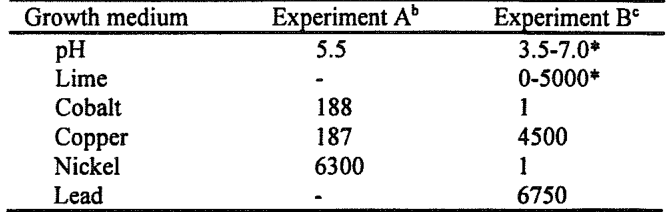
aNB: "total" metal concentrations were obtained by sample digestion with boiling 4 M hydrochloric acid.
a注:“总”金属浓度采用沸腾4 M盐酸消解样品测得。
'A: 'Champion' copper ore from Nelson, New Zealand mixed
A:来自新西兰Nelson的“Champion”铜矿石,
1:3 (v/v) with pumice powder.
与浮石粉按1:3(v/v)混合。
· B: Base-metal tailings from the 'Tui' Mine, New Zealand.
· B:来自新西兰“Tui”矿的贱金属尾矿。
*Depending on amount of lime added.
*取决于石灰添加量。
Arrhenatherum elatius has all of the above properties except for a high accumulation of heavy metals. Huang and Cunningham (1996), and Blaylock et al. (1997) demonstrated that the addition of ethylenediaminetetraacetic acid (EDTA) to the soil where Zea mays was growing on a lead-contaminated site, induced the accumulation of this element to a concentration of 2% (20,000 mg kg, dry weight) in the aerial portions of the plant. It may thus be possible to induce A. elatius to accumulate lead and other metals by the addition of chelating agents to metalliferous soils, making this plant potentially useful for phytoremediation.
Arrhenatherum elatius具备上述除重金属高积累以外的全部特性。Huang and Cunningham (1996)及Blaylock et al. (1997)证明,在铅污染场地向种植Zea mays的土壤中添加乙二胺四乙酸(EDTA),可诱导该元素在植物地上部分积累至2%(20,000 mg kg-1,干重)。因此,向含金属土壤中添加螯合剂或可诱导A. elatius积累铅及其他金属,从而使该植物具有潜在的植物修复应用价值。
The aims of the present study were to determine the effect on plant uptake of metals after addition of EDTA to metal-rich natural substrates, and hence assess the potential of A. elatius for the phytoremediation of soils polluted by these metals.
本研究旨在确定向富含金属的天然基质中添加EDTA对植物吸收金属的影响,进而评估A. elatius对这些金属污染土壤进行植物修复的潜力。
3MATERIALS AND METHODS材料与方法
Greenhouse Experiments温室试验
Plants were grown in natural and artificial media as follows. In the first set of experiments (Experiment A), A. elatius was grown in a modified copper ore (Table 1) consisting of a 1:3 mixture of ore:pumice. The pumice had negligible concentrations of the above heavy metals and was used to improve drainage of the finely divided ore. The copper ore (treated with 'Osmocote' slow release fertilizers) was from the abandoned Champion Mine near Nelson, New Zealand.
植物分别在天然和人工基质中种植,具体如下。在第一组试验(试验A)中,A. elatius种植于改良铜矿石中(表1),该基质由矿石与浮石按1:3混合而成。浮石中上述重金属浓度可忽略不计,用于改善细粒矿石的排水性。铜矿石(施用“Osmocote”缓释肥料处理)取自新西兰Nelson附近已废弃的Champion矿。
A second set of experiments (Experiment B) involved the use of fertilized ('Osmocote' slow release) mine tailings (undiluted) from the Tui Mine, Te Aroha, New Zealand. The composition of these tailings is also shown in Table 1.
第二组试验(试验B)使用了施肥(“Osmocote”缓释肥)的未稀释尾矿,取自新西兰Te Aroha的Tui矿。该尾矿的组成亦列于表1。
For each set of experiments, two 500-mL pots were prepared for each liming regime and/or EDTA addition (total of 10 for Experiment A and 16 for Experiment B). In each pot, ca. 20 seeds of A. elatius were sown and the seedlings grown for a further eight weeks with weekly changing of pot positions to equalize light exposure. After four weeks, each pot was thinned to leave only four individual plants of similar size in each. At the same time, EDTA as the disodium salt (Na, EDTA) was added as a 5% (w/v) solution to each series of pots at rates of 0 (control), 0.5, 1, 2, and 4 g kg. When liming was required, the lime was added directly to the substrate before seed sowing.
每组试验中,每种施石灰方案和/或EDTA添加处理各准备两个500 mL的盆钵(试验A共10盆,试验B共16盆)。每盆播种约20粒A. elatius种子,幼苗再生长八周,每周调换盆钵位置以使光照均匀。四周后,对每盆进行间苗,仅保留四株大小相近的植株。同时,以5%(w/v)溶液形式向各组盆钵中添加EDTA二钠盐(Na2EDTA),添加量分别为0(对照)、0.5、1、2和4 g kg-1。需要施石灰时,在播种前将石灰直接加入基质中。
The above-ground parts of plants (four from each pot and 104 in total) were harvested eight weeks after sowing, and placed individually in a drying oven at 80°C until a constant weight was achieved
播种八周后收获植物地上部分(每盆四株,共104株),逐株置于80°C烘箱中烘干至恒重
All pot trials were carried out in a greenhouse with temperatures set in the range of 15°C (night) to 25°C (day). There was no humidity control.
所有盆栽试验均在温室中进行,温度设定为15°C(夜间)至25°C(白天),未控制湿度。
Chemical Analysis of Plants and Their Substrates植物及其基质的化学分析
Plants to be analyzed for cobalt, copper, and nickel were prepared in the following manner. Subsamples (1 g) of each of four plants from each pot were weighed into 10-mL borosilicate test tubes. The tubes were heated in a muffle furnace overnight at 500°C. The next day, 5 mL of hot 2 Mhydrochloric acid was added to each tube and the solutions mixed using a vortex mixer.
用于测定钴、铜和镍的植物样品按以下方法制备。从每盆四株植物中各取1 g子样,称入10 mL硼硅酸盐试管中。试管置于马弗炉中500°C加热过夜。次日,向每支试管加入5 mL热的2 M盐酸,并用涡旋混合器混匀。
The remaining plants (for lead analysis) were weighed into 50-mL conical flasks. To each flask, 5 mL of a 3:1 mixture of concentrated nitric/perchloric acids was added and the mixture boiled until all the nitric acid had evaporated and fumes of perchloric acid began to appear. Then, 4 mL of hot (80°C) 2 hydrochloric acid was added, together with a small volume of distilled water to give a final volume of 5 mL.
其余植物(用于铅分析)称入50 mL锥形瓶中。向每个锥形瓶中加入5 mL浓硝酸/高氯酸(3:1)混合液,煮沸至硝酸全部蒸发、开始出现高氯酸烟雾。然后加入4 mL热的(80°C)2 M盐酸,并加入少量蒸馏水使最终体积为5 mL。
The acid-extractable (essentially total) metal concentrations in the substrates were determined by adding 20 mL of 4 M hydrochloric acid to 2g subsamples weighed into 40-mL sealable centrifuge tubes. The mixtures were placed on an end-over-end agitator overnight, then centrifuged, filtered and the solutions stored for analysis. A simple acid extraction was sufficient to determine the total amount of metal added to the substrate as these metals were not bound to silicate matrices (where HF attack would have been needed). The untreated pumice contained negligible amounts of the elements being measured. Total metal concentrations are shown in Table 1.
基质中酸可提取态(基本相当于全量)金属浓度的测定方法为:将2 g子样称入40 mL可密封离心管中,加入20 mL 4 M盐酸。混合物置于翻转振荡器上振荡过夜,随后离心、过滤,溶液保存待测。由于这些金属未结合于硅酸盐基质中(否则需要HF消解),简单酸提取即足以测定添加到基质中的金属总量。未经处理的浮石中所测元素含量可忽略不计。金属全量见表1。
Measurements of pH were performed by shaking 2 g of substrate with 10 mL of distilled water in sealed vials placed for 24 hours in an end-over-end mechanical shaker. After allowing the material to settle. pH was measured in the supernatant
pH测定方法为:将2 g基质与10 mL蒸馏水置于密封小瓶中,在翻转式机械振荡器上振荡24小时,静置沉降后测定上清液pH
HEAVY-METAL ACCUMULATION BY ARRHENATHERUM ELATIUSArrhenatherum elatius对重金属的积累
All samples were stored in 35-mL polythene containers and analyzed using flame atomic absorption spectroscopy (FAAS). The standards for the workings curves were prepared in 2 M hydrochloric acid to match the bulk composition of the sample solutions.
所有样品均储存于35 mL聚乙烯容器中,采用火焰原子吸收光谱法(FAAS)进行分析。工作曲线的标准溶液用2 M盐酸配制,以与样品溶液的基体组成相匹配。
4RESULTS AND DISCUSSION结果与讨论
Accumulation of Heavy Metals by Arrhenatherum elatius from a Cobalt/ Copper/Nickel Ore After EDTA Amendment
添加EDTA后Arrhenatherum elatius从钴/铜/镍矿石中积累重金属
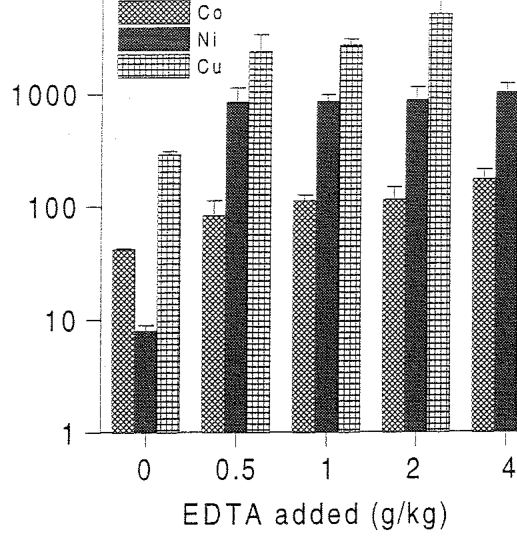
Addition of EDTA to a growth medium of copper ore (Experiment A) amended with pumice to improve drainage, resulted in a dramatic increase in cobalt, copper and nickel concentrations in A. elatius. The increases shown in Figure 1 were from 200 to 7,500 mg kg' for copper, 40 to 175 for cobalt and 8 to 1,276 for nickel. Values in this figure are shown on a logarithmic scale in order to include three plots in the same figure. A linear scale would have shown greater differences for individual elements. For all three elements there was a statistically significant increase of concentration for increasing dosages of EDTA, albeit with some
向添加浮石以改善排水性的铜矿石生长基质(试验A)中添加EDTA后,A. elatius中钴、铜和镍的浓度显著升高。如图1所示,铜浓度由200 mg kg-1增至7,500 mg kg-1,钴由40增至175,镍由8增至1,276。为在同一图中呈现三条曲线,图中数值采用对数刻度表示;若采用线性刻度,各元素之间的差异会更为明显。三种元素的浓度均随EDTA用量增加而显著升高,尽管存在一定的
evidence of leveling off in the case of nickel for EDTA additions above 0.5 g kg'. Addition of EDTA (even at the lowest treatment level) immediately caused necrosis in the plants, no doubt because of the very high phytotoxicity of copper that thereby became available to the plant. This necrosis would not be a disadvantage in a phytoremediation project because the vegetation would be harvested in any case. It is envisaged that plants under field conditions would be allowed to grow to full size before addition of EDTA, as is done for lead phytoremediation (Blaylock et al., 1997).
趋平迹象,镍在EDTA添加量超过0.5 g kg-1时尤为明显。添加EDTA(即使在最低处理水平)立即引起植株坏死,这无疑是由于由此变得可被植物利用的铜具有极高的植物毒性。在植物修复项目中,这种坏死并非不利因素,因为植被无论如何都将被收获。设想在田间条件下,可让植物生长至完全成熟后再添加EDTA,正如铅的植物修复中所采用的做法(Blaylock et al., 1997)。
Relative uptakes of the three metals by the grass were 37.5 for copper, 4.4 for cobalt, and 160 for nickel. The differences may be in part because of different phytoavailability among the three elements. In terms of total metal plant/ore concentration quotients, the respective values were 40 for copper, 1.1 for cobalt, and 0.17 for nickel. The very high relative accumulation of copper in the plant is very noteworthy because here we have a case of a metal-tolerant grass that is easy to grow and has a fairly high biomass. If a similar behavior were to occur under field conditions, a crop of A. elatius grown over a hectare of copper-rich soil (assuming a biomass yield of 10 t ha') might be expected to remove 75 kg of copper after addition of EDTA.
该禾草对三种金属的相对吸收增幅分别为:铜37.5、钴4.4、镍160。这些差异可能部分归因于三种元素植物有效性的不同。就植物/矿石金属全量浓度比而言,铜、钴和镍的相应值分别为40、1.1和0.17。植物中铜的相对积累极高,非常值得关注,因为这是一种易于种植且生物量较高的耐金属禾草。若在田间条件下出现类似表现,那么在1公顷富铜土壤上种植的A. elatius(假设生物量产量为10 t ha-1)在添加EDTA后预计可去除75 kg铜。
Accumulation of Lead by Arrhenatherum elatius from Tui Base Mine Tailings After EDTA Amendment添加EDTA后Arrhenatherum elatius从Tui矿贱金属尾矿中积累铅
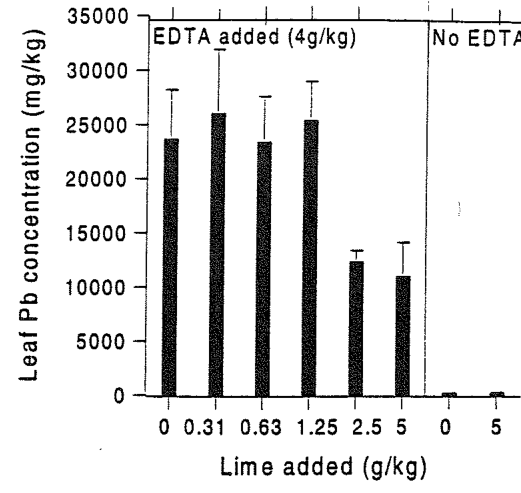
Addition of EDTA to Tui Mine base metal tailings (Experiment B) resulted in a dramatic increase in the lead concentration in A. elatius from <100 mg kg*' (dry weight) to about 25,000 mg kg' (Figure 2). This is comparable, and indeed superior, to the 2% lead recorded by Huang and Cunningham (1996) when HEDTA was added to lead-contaminated soil (2,500 mg kg-') in which Zea mays was grown. Before addition of EDTA, the lead concentration in this plant had only been about 100 mg kg-' (dry weight).
向Tui矿贱金属尾矿(试验B)中添加EDTA后,A. elatius中铅浓度由<100 mg kg-1(干重)急剧升高至约25,000 mg kg-1(图2)。这一结果与Huang and Cunningham (1996)在种植Zea mays的铅污染土壤(2,500 mg kg-1)中添加HEDTA后记录的2%铅含量相当,甚至更高。在添加EDTA之前,该植物中的铅浓度仅约为100 mg kg-1(干重)。
The effect of lime addition in our experiments was to reduce the lead uptake by a factor of two as the percentage of lime exceeded 0.125%. This is no doubt due to the effect of raising the pH of the growth medium whereby lead, like most heavy metals, is rendered less mobile (Brooks, 1998). Despite the high uptake of lead, our plants survived the experiments, unlike studies with Zea mays (Huang et al., 1997) that only survived for 10 days after addition of EDTA.
在本试验中,当石灰比例超过0.125%时,添加石灰使铅吸收量降低一半。这无疑是由于生长基质pH升高所致,铅与大多数重金属一样,在较高pH下迁移性降低(Brooks, 1998)。尽管铅吸收量很高,本试验中的植物仍存活至试验结束,而Zea mays的研究(Huang et al., 1997)中植物在添加EDTA后仅存活了10天。
The Potential of Arrhenatherum elatius for Phytoextraction
Arrhenatherum elatius用于植物提取的潜力
The low natural bioaccumulation factors (plant/soil metal concentration quotients) of A. elatius for the heavy metals studied, do not favor the use of this plant for phytoextraction without some sort of soil amendment to enhance metal solubility. The addition of EDTA, enhanced the accumulation of cobalt, copper, lead and nickel to levels where the plant may be of some use for phytoremediation soils weakly contaminated with any or all of these metals.
A. elatius对所研究重金属的天然生物富集系数(植物/土壤金属浓度比)较低,因此若不采用某种土壤改良措施来提高金属溶解度,则不宜将该植物用于植物提取。添加EDTA可将钴、铜、铅和镍的积累提高到一定水平,使该植物可能适用于对受上述任一种或多种金属轻度污染土壤的植物修复。
HEAVY-METAL ACCUMULATION BY ARRHENATHERUM ELATIUS 3.5 3.8 4.1 4,8 5.7 6.4 ;3.5 6.4
Arrhenatherum elatius对重金属的积累 3.5 3.8 4.1 4,8 5.7 6.4 ;3.5 6.4
pH of substrate基质pH
Even though EDTA is non-toxic to humans (it is even used as a clinical treatment for lead poisoning), it must be recognized that addition of EDTA to the substrate could have unwanted environment ramifications if heavy metals other than lead are solubilized. However, the half life of EDTA in the environment has been studied by Means et al. (1980) who have shown that it is of the order of 6 months under normal conditions. Care should therefore be taken that sites are chosen to avoid any immediate runoff into local waterways. In assessing any environmental problems it will be necessary to weigh the use of EDTA against the other more serious consideration of just leaving the toxic lead in situ.
尽管EDTA对人体无毒(甚至被用作铅中毒的临床治疗药物),但必须认识到,如果铅以外的其他重金属被溶解,向基质中添加EDTA可能产生不良的环境后果。不过,Means et al. (1980)研究了EDTA在环境中的半衰期,表明在正常条件下约为6个月。因此,应注意选择场地,避免径流直接进入当地水道。在评估任何环境问题时,有必要权衡使用EDTA与将有毒铅简单地原位留存这一更为严重的问题。
Radioactive "Co could conceivably be removed from sites contaminated by nuclear waste such as around Chernobyl in the Ukraine. Unpublished studies (K.W. Brown, personal communication) in the late 1970s were centered around the use of the cobalt hyperaccumulator Haumaniastrum katangense to remove radioactive cobalt from a contaminated site. The main problem with this plant species is its relatively low biomass production and sensitivity to cold conditions. Given the rapid biomass production, and tolerance to a wide range of climates, A. elatius may be effective for cobalt phytoremediation. EDTA is relatively inexpensive and its use can be justified on economic grounds when phytoremediation is compared with other far more expensive alternatives.
可以设想,采用该方法可从受核废料污染的场地(如乌克兰切尔诺贝利周边)去除放射性60Co。20世纪70年代末的未发表研究(K.W. Brown,私人通讯)集中于利用钴超富集植物Haumaniastrum katangense去除污染场地中的放射性钴。该植物的主要问题是生物量相对较低且对低温敏感。鉴于A. elatius生物量增长迅速并能耐受广泛的气候条件,其可能对钴的植物修复有效。EDTA价格相对低廉,与其他昂贵得多的替代方法相比,在植物修复中使用EDTA在经济上是合理的。
Copper, particularly near smelters, is a common industrial pollutant. It does not lend itself to phytoremediation without chelate amendment because although several hyperaccumulators of copper are known (Brooks and Malaisse, 1985) they are all from the Democratic Republic of Congo (formerly Zaire), have a small biomass, and are not tolerant of cold conditions.
铜是一种常见的工业污染物,在冶炼厂附近尤甚。若不添加螯合剂,铜不适于采用植物修复,因为虽然已知数种铜超富集植物(Brooks and Malaisse, 1985),但它们均产自刚果民主共和国(原扎伊尔),生物量小,且不耐低温。
The results obtained in this study indicate the potential of A. elatius for phytoremediation of contaminated soils. These data should not however, be extrapolated unreservedly to the field situation because the forms of the metals in situ vary considerably and cannot be modeled by simple pot trials. The microflora of the soil may affect the uptake of heavy-metals by plants and our pot-trials were conducted using sterilized material. Furthermore, the effect of the heavy-metals and local climatic conditions on biomass production is unknown. Field trials investigating the in situ decontamination of heavy-metal contaminated soils using A. elatius, particularly in the vicinity of smelters in Northern France where it is already growing, should be a logical sequel to this present study.
本研究结果表明A. elatius在污染土壤植物修复方面具有潜力。然而,这些数据不应不加保留地外推至田间情形,因为原位金属形态差异很大,无法通过简单的盆栽试验进行模拟。土壤微生物区系可能影响植物对重金属的吸收,而本研究的盆栽试验使用的是灭菌材料。此外,重金属及当地气候条件对生物量产量的影响尚不清楚。利用A. elatius对重金属污染土壤进行原位净化的田间试验,特别是在其已有分布的法国北部冶炼厂附近开展此类试验,应是本研究合乎逻辑的后续工作。
5REFERENCES参考文献
Blaylock, M.J., D.E. Salt, S. Dushenkov, O. Zakharova, C. Gussman, Y. Kapulnik, B.D. Ensley, and 1. Raskin. 1997. Enhanced accumulation of Pb in Indian mustard by soilapplied chelating agents. Environ. Sci. Technol. 31:860-865.
Brooks, R.R. 1998. Plants that Hyperaccumulate Heavy Metals. CAB International, Wallingford, England.
Brooks, R.R. and F. Malaisse. 1985. The Heavy Metal Tolerant Flora of Southcentral Africa. Balkema, Rotterdam, The Netherlands.
Brooks, R.R., M.F. Chambers, L. Nicks, and B.H. Robinson. 1998. Phytomining. Trends Plant Sci. 3:359-362.
Chaney, R.L. 1983. Plant uptake of inorganic waste constituents. pp. 50-76. In: J.F. Parr et al. (eds.), Land Treatment of Hazardous Wastes. Noyes Data Corp., Park Ridge, NJ.
Cuguen, J., M. Achery, A.L. Louth, D. Petit, and P. Vernet. 1989. Breeding system differentiation in Arrhenatherum elatius populations: Evolution towards selfing. Evol. Trends Plants 3:17-24.
Ducousso, A., D. Petit, M. Valero, and P. Vernet. 1990. Genetic variation between and within populations of a perennial grass Arrhenatherum elatius. Heredity 65:179-188.
Huang, J.W. and S.D. Cunningham. 1996. Lead phytoextraction: Species variation in lead uptake and translocation. New Phytol. 134:75-84.
Huang J.W., J. Chen, W.R. Berti, and S.D. Cunningham. 1997. Phytoremediation of lead-contaminated soils: Role of synthetic chelates in lead phytoextraction. Environ. Sci. Technol. 31:800-805.
Loganathan, P. and M.J. Hedley. 1997. Downward movement of cadmium and phosphorus from phosphatic fertilizers in a pasture soil from New Zealand. Environ. Pollut. 95:319- 324.
Means, J.L., T. Kucak, and A. Crear. 1980. Relative degradation rates of NTA, EDTA and DPTA and environmental applications. Environ. Pollut. Ser. B 1:45-60.
Robinson, B.H., R.R. Brooks, A.W. Howes, J.H. Kirkman, and P.E.H. Gregg. 1997a. The potential of the high-biomass nickel hyperaccumulator Berkheya coddii for phytoremediation and phytomining. J. Geochem. Explor. 60:15-126.
Robinson, B.H., A. Chiarucci, R.R. Brooks, D. Petit, J.H. Kirkman, and P.E.H. Gregg 1997b. The nickel hyperaccumulator plant Alyssum bertolonii as a potential agent for phytoremediation and phytomining of nickel. J. Geochem. Explor. 59:75-86.
Salt, D.E., M. Blaylock, N.P.B.A. Kumar, V. Dushenkov, B. Ensley, I. Chet, and I. Raskin. 1995. Phytoremediation: A novel strategy for the removal of toxic metals from the environment using plants. Bio/Technology 13:468-474.