Contents lists available at ScienceDirect journal homepage: www.elsevier.com/locate/envpol
Dasom Jeon a, Brett Robinson b, Nicholas Dickinson a,*
a Faculty of Agriculture and Life Science, Lincoln University, Canterbury, New Zealand b Department of Chemistry, University of Canterbury, Christchurch, 8041, New Zealand
A R T I C L E I N F O A B S T R A C T Keywords: Inorganic copper (Cu) fungicides and bactericides are widely used to control disease in fruit and vegetable crops Soil health and has led to widespread accumulation of the metal in soil beyond regulatory thresholds. We aimed to elucidate Soil contamination the impacts of Cu on soil health within cherry orchard soils in New Zealand, focusing on three biological in- Soil organic matter dicators: earthworm behaviour, soil respiration, and plant growth. We sampled soils from four blocks of different CopperEarthworms ages within a single orchard, varying in amounts of accumulated soil Cu (7–263 mg kg− 1) but also in Soil Organic Soil respiration Matter (SOM) content (3–10 %). Experimental work was designed to isolate the impacts of both Cu and SOM on three critical biological descriptors: earthworm behaviour, soil respiration and root growth. Soils were amended to standardise both variables in laboratory and glasshouse experiments. The results demonstrated a pronounced inhibition of soil respiration and root development, as well as adverse effects on earthworm behaviour, with increasing Cu concentrations. SOM played a mitigating role, reducing the bioavailability and toxicity of Cu to soil organisms. However, the buffering capacity of SOM is limited and long-term reliance on SOM to mitigate Cu toxicity is not sustainable. Currently Cu continues to accumulate in most orchard soils. This study highlights the importance of assessing Cu bioavailability and soil health in the context of orchard management.
文章信息 摘要 关键词:土壤健康;土壤污染;土壤有机质;铜;蚯蚓;土壤呼吸。无机铜(Cu)杀真菌剂和杀细菌剂被广泛用于防治水果和蔬菜作物病害,并已导致该金属在土壤中普遍积累,含量超过监管阈值。本研究旨在阐明Cu对新西兰樱桃园土壤健康的影响,重点关注三项生物学指标:蚯蚓行为、土壤呼吸和植物生长。我们在同一果园内4个不同园龄的地块采集土壤,其土壤Cu累积量(7–263 mg kg− 1)以及土壤有机质(SOM)含量(3–10 %)均存在差异。试验设计旨在分离Cu和SOM对蚯蚓行为、土壤呼吸和根系生长这三项关键生物学描述指标的影响。在实验室和温室试验中,对土壤进行改良以统一上述两个变量。结果表明,随着Cu浓度升高,土壤呼吸和根系发育受到显著抑制,蚯蚓行为亦受到不利影响。SOM起到缓解作用,降低了Cu对土壤生物的生物有效性和毒性。然而,SOM的缓冲能力有限,长期依赖SOM缓解Cu毒性是不可持续的。目前,Cu在大多数果园土壤中仍在持续积累。本研究强调了在果园管理中评估Cu生物有效性和土壤健康的重要性。
1Introduction引言
The horticultural sector in Aoteroa-New Zealand (NZ) is reliant on clean-green credentials and sustainable management practices. Fruit orchards constitute an important component both of production landscapes and the national economy (StatisticsNZ, 2021), and cherries in the Central Otage region of South Island provide one such high value export crop. Similar to most other horticultural crops, cherry production necessitates the control of diseases (principally Pseudomonas syringae, Blast Bacterial Spot and Monilinia fructicola, Brown Rot fungus in cherries) for which regular and routine crop spraying with inorganic formulations of Cu is used in combination with a range of products with synthetic organic active ingredients (Farmlands, 2024). Copper reaches the ground through leaching by rainfall, falling plant debris and spray drift, and the metal accumulates rather than dissipates in surface soil (Jeon, 2024). Copper is an essential nutrient for plants and animals in trace amounts, but it becomes acutely or chronically toxic in excess (Ameh and Sayes, 2019).
新西兰(Aotearoa)的园艺产业依赖于“清洁绿色”声誉和可持续管理实践。果园既是生产景观的重要组成部分,也是国民经济的重要组成部分(StatisticsNZ, 2021),南岛中奥塔哥地区的樱桃即是此类高价值出口作物之一。与大多数其他园艺作物相似,樱桃生产需要防治病害(在樱桃中主要为Pseudomonas syringae引起的细菌性溃疡斑点病和Monilinia fructicola,引起的褐腐病),为此需定期、常规喷施无机Cu制剂,并配合使用多种含合成有机活性成分的产品(Farmlands, 2024)。Cu通过降雨淋洗、植物残体掉落和喷雾飘移到达地面,并在表层土壤中积累而非消散(Jeon, 2024)。Cu是动植物所必需的微量营养元素,但过量时会产生急性或慢性毒性(Ameh and Sayes, 2019)。
The global use of Cu-based products to control fungal and bacterial disease has led to long-term accumulation and restrictions on use, although Cu is generally still acceptable for use under organic certification (Besnard et al., 2001; Fagnano et al., 2020; Komarek et al., 2010´; Mirlean et al., 2009; Morgan and Taylor, 2004; Ruyters et al., 2013; Wightwick et al., 2008; Yang et al., 2005). In NZ, as in many other countries with temperate climates, regulatory limits of Cu applications are 8 kg Cu ha− 1yr− 1in conventional orchards and 3 kg Cu ha− 1yr− 1in organic orchards (Zespri Group Limited, 2023; Jeon, 2024). Despite these restrictions, substantially elevated soil Cu from long-term spraying at higher application rates is frequently recorded and continues to increase in a range of fruit crops including cherries, kiwifruit, apples, avocados and grapes. Across a range of these orchard soils we have recorded mean total soil Cu concentrations of 248 mg Cu kg− 1at 0–0.15 m depth (Jeon, 2024). Most published threshold limits use concentrations >100 mg Cu kg− 1as evidence of contamination and potential environmental risks (Schramel et al., 2000).
全球范围内使用Cu基产品防治真菌和细菌病害,已导致Cu的长期积累并引发使用限制,尽管在有机认证下Cu通常仍被允许使用(Besnard et al., 2001; Fagnano et al., 2020; Komarek et al., 2010´; Mirlean et al., 2009; Morgan and Taylor, 2004; Ruyters et al., 2013; Wightwick et al., 2008; Yang et al., 2005)。在新西兰,与许多其他温带气候国家一样,Cu施用的监管限值为:常规果园8 kg Cu ha− 1yr− 1,有机果园3 kg Cu ha− 1yr− 1(Zespri Group Limited, 2023; Jeon, 2024)。尽管存在上述限制,由于长期以较高施用量喷施,包括樱桃、猕猴桃、苹果、鳄梨和葡萄在内的多种果树作物土壤中经常记录到显著升高的Cu含量,且仍在持续增加。在一系列此类果园土壤中,我们记录到0–0.15 m深度的土壤全Cu平均浓度为248 mg Cu kg− 1(Jeon, 2024)。大多数已发表的阈值以>100 mg Cu kg− 1作为污染及潜在环境风险的依据(Schramel et al., 2000)。
Soil organic matter (SOM) is a crucial component of soil health, composed of plant and animal residues at various stages of decomposition and substances synthesized by soil organisms. SOM improves soil structure, water retention and nutrient supply, and supports a diverse microbial community, and can also influence the mobility of contaminants such as Cu in soil. More than 90 % of Cu added to a soil is typically bound to SOM (Weng et al., 2002). The interaction between SOM and Cu is complex; SOM can bind Cu, reducing its bioavailability and toxicity to soil organisms (Antoniadis et al., 2017; Kaplan et al., 2016). This binding capacity can be affected by factors such as low soil pH although this is of less significance in most production soils that require less acidic soils.
土壤有机质(SOM)是土壤健康的关键组分,由处于不同分解阶段的动植物残体以及土壤生物合成的物质组成。SOM可改善土壤结构、保水性和养分供应,支持多样化的微生物群落,并可影响土壤中Cu等污染物的迁移性。添加到土壤中的Cu通常有90 %以上与SOM结合(Weng et al., 2002)。SOM与Cu之间的相互作用较为复杂;SOM可结合Cu,从而降低其对土壤生物的生物有效性和毒性(Antoniadis et al., 2017; Kaplan et al., 2016)。这种结合能力可能受土壤低pH等因素影响,但在大多数要求土壤酸性较弱的生产性土壤中,该因素的重要性较低。
☆ This paper has been recommended for acceptance by Wen-Xiong Wang.
☆ 本文经Wen-Xiong Wang推荐录用。
* Corresponding author. E-mail address: nicholas.dickinson@lincoln.ac.nz (N. Dickinson).
https://doi.org/10.1016/j.envpol.2024.125145 Received 23 July 2024; Received in revised form 14 October 2024; Accepted 16 October 2024 Available online 18 October 2024
https://doi.org/10.1016/j.envpol.2024.125145 收稿日期:2024年7月23日;修回日期:2024年10月14日;录用日期:2024年10月16日;网络出版日期:2024年10月18日
0269-7491/© 2024 The Authors. Published by Elsevier Ltd. This is an open access article under the CC BY license ( http://creativecommons.org/licenses/by/4.0/ ).
0269-7491/© 2024 作者。由Elsevier Ltd.出版。本文为依据CC BY许可协议发布的开放获取文章( http://creativecommons.org/licenses/by/4.0/ )。
Once soils become contaminated with Cu, dissipation rates are too slow to be significant (Aikpokpodion et al., 2010; Morgan and Johnston, 1991). For example, Dickinson and Lepp (1985) estimated that 80–120 years would be required to achieve a 10 % reduction in Cu concentrations through natural processes. High concentrations of residual Cu in soil adversely affect biological indicators of soil health (Doran and Timothy, 1994), but improved knowledge is required to evaluate and predict critical Cu concentrations and the extent and magnitude of risks to soil organisms and soil functionality (Nunes et al., 2016). Plant growth responses, earthworm activity and soil respiration are particularly useful indicators for assessing environmental impacts (Cruz et al., 2022; Li et al., 2020; Raiesi and Salek-Gilani, 2020; Rich et al., 2015; Zornoza et al., 2015), especially relating to effective management strategies to mitigate potential risks.
土壤一旦受到Cu污染,其消散速率极为缓慢,可忽略不计(Aikpokpodion et al., 2010; Morgan and Johnston, 1991)。例如,Dickinson and Lepp (1985)估计,通过自然过程使Cu浓度降低10 %需要80–120年。土壤中高浓度残留Cu会对土壤健康的生物学指标产生不利影响(Doran and Timothy, 1994),但仍需进一步加深认识,以评估和预测Cu的临界浓度以及其对土壤生物和土壤功能风险的范围与程度(Nunes et al., 2016)。植物生长响应、蚯蚓活动和土壤呼吸是评估环境影响的尤为有用的指标(Cruz et al., 2022; Li et al., 2020; Raiesi and Salek-Gilani, 2020; Rich et al., 2015; Zornoza et al., 2015),特别是在制定缓解潜在风险的有效管理策略方面。
The aim of our study was to investigate the interplay between SOM and Cu contamination to understand whether SOM masks the biotic impact of Cu and thus misinforms the risks associated with its accumulation. We investigated the effects of Cu on earthworm behaviour, soil respiration, and plant root growth.
本研究旨在探究SOM与Cu污染之间的相互作用,以明确SOM是否掩盖了Cu的生物效应,从而导致对其积累相关风险的误判。我们研究了Cu对蚯蚓行为、土壤呼吸和植物根系生长的影响。
2Materials and methods材料与方法
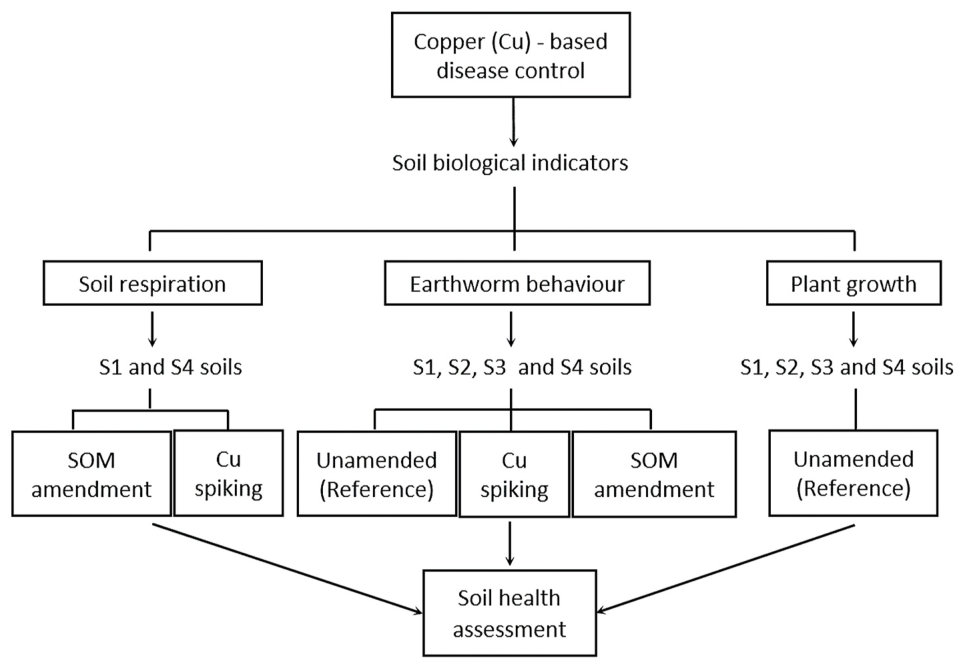
We sampled four soils from different locations of a single soil type within the same cherry orchard in Cromwell, Central Otago. The 34.7 ha orchard was established in 1982 with Cu-based fungicides and bactericides usually applied 2–3 times per year, particularly to manage Blast Bacterial Spot (Pseudomonas syringae). Application rates recommended for cherry production are up to 27.3 kg ha − 1of copper oxychloride in four applications through the year (Farmlands, 2024). The collected soils (S1-S4) were experimentally amended with additional Cu and organic matter (Fig. 1).
我们在中奥塔哥Cromwell同一樱桃园内、同一土壤类型的不同位置采集了4种土壤。该果园面积34.7 ha,建于1982年,通常每年施用Cu基杀真菌剂和杀细菌剂2–3次,主要用于防治细菌性溃疡斑点病(Pseudomonas syringae)。樱桃生产推荐的施用量为全年分4次施用氧氯化铜,总量最高27.3 kg ha − 1(Farmlands, 2024)。采集的土壤(S1–S4)经试验性添加额外的Cu和有机质进行改良(图1)。
2.1. Soils and ecological determinants2.1. 土壤与生态决定因子
2.1.1. Soils2.1.1. 土壤
The four bulk soils were collected in July 2021 from three different-aged blocks (S1-S3) and another unsprayed location (S4 reference) at the periphery of the orchard. S4 is the reference location that had never been planted. Approximately 100 kg of each soil was collected at 0–0.2 m depth and transported to Lincoln University. Each soil was thoroughly mixed using a clean cement mixer, then sieved (<4 mm) to remove small amounts of plant residues and stones. Soils were stored in open steel bins indoors at the university nursery prior to their use for experimental work. For physico-chemical analysis, five replicated sub-samples were air dried at 35–40 ◦C overnight and crushed to pass through a 2 mm screen, then commercially analysed (Hill Laboratories, Christchurch) for soil pH (potentiometric), Olsen phosphorus (Molybdenum Blue colorimetry), potassium, calcium, magnesium, and sodium (all ICP-OES from 1 M neutral ammonium acetate extracts), and bulk density (Core method). At Lincoln University, total copper (Cu), soil organic matter (SOM), and total nitrogen (N) were quantified by the first author (Jeon, 2024) using atomic absorption spectrophotometry (AAS) following microwave digestion, loss on ignition (LOI), and a CN analyser, respectively (Table 1).
4种混合土壤于2021年7月采自3个不同园龄的地块(S1–S3)以及果园边缘另一处未喷施的地点(S4,对照)。S4为从未种植过的对照地点。每种土壤在0–0.2 m深度采集约100 kg,运至林肯大学。每种土壤用洁净的水泥搅拌机充分混匀,然后过筛(<4 mm)以去除少量植物残体和石块。土壤在试验使用前存放于大学苗圃室内的敞口钢箱中。理化分析时,取5个重复子样品,于35–40 ◦C风干过夜,研磨过2 mm筛,然后委托商业实验室(Hill Laboratories,基督城)分析土壤pH(电位法)、Olsen磷(钼蓝比色法)、钾、钙、镁和钠(均采用1 M中性乙酸铵浸提液ICP-OES测定)以及容重(环刀法)。在林肯大学,由第一作者(Jeon, 2024)分别采用微波消解后原子吸收分光光度法(AAS)、烧失量法(LOI)和CN分析仪测定全铜(Cu)、土壤有机质(SOM)和全氮(N)(表1)。
2.1.2. Earthworms2.1.2. 蚯蚓
A native anecic species of New Zealand earthworm, Maoridrilus transalpinus, was collected from Ahuriri Scenic Reserve on the Christchurch Port Hills following the method described and as identified using DNA barcoding by Kim et al. (2017, 2022) and used for earthworm preference tests. This species was selected for its ease of collection in large enough numbers by digging and the abundance of adults. Before use, adult earthworms were maintained in their original soils for one month in an incubator (15 ◦C, 30–35 % soil moisture). Adults with an easily observable clitellum were selected, individuals weighing 1–3 g.
采用Kim et al. (2017, 2022)描述的方法,从基督城Port Hills的Ahuriri风景保护区采集新西兰本土深栖型蚯蚓Maoridrilus transalpinus,经DNA条形码鉴定后用于蚯蚓偏好试验。选择该物种是因为通过挖掘易于大量采集,且成体丰富。使用前,成年蚯蚓在其原生土壤中于培养箱(15 ◦C,土壤含水量30–35 %)内饲养1个月。选取环带明显可见、体重1–3 g的成体个体。
2.1.3. Plants2.1.3. 植物
Hop plants (Humulus lupulus, cultivar Cascade) were used as an alternative to cherries, since the latter are slow growing and difficult to grow uniformly. The selection of the hop cultivar Cascade was justified by their uniformity in height and widespread popularity, ensuring experimental consistency and relevance to current agricultural practices. Cascade is one of the world’s top ten most popular hop cultivars, and it now represents around 10 % of all hops grown in the United States (Healey, 2021). Cascade is a successful and well-established aroma hop (USDA U.S. Department of Agriculture, 2007) that is cultivated in New Zealand. One-year old plants (50–100 mm tall) were transferred from cultivation beds into soils in rhizoboxes (five replicates).
由于樱桃生长缓慢且难以均匀培育,本研究采用啤酒花(Humulus lupulus,品种Cascade)作为替代植物。选择啤酒花品种Cascade的理由在于其株高整齐且广受欢迎,可确保试验的一致性以及与当前农业实践的相关性。Cascade是全球最受欢迎的十大啤酒花品种之一,目前约占美国啤酒花种植总量的10 %(Healey, 2021)。Cascade是一种成功且成熟的香型啤酒花(USDA U.S. Department of Agriculture, 2007),在新西兰亦有栽培。将一年生植株(高50–100 mm)从栽培床移栽至根箱土壤中(5个重复)。
Chemical analysis of the four soils collected from four locations in the cherry orchard (means ± s.d.; n = 5).
樱桃园4个地点采集的4种土壤的化学分析(平均值 ± 标准差;n = 5)。
| Determinant测定项目 | S1 | S2 | S3 | S4 | Optimal rangec最适 范围c |
|---|---|---|---|---|---|
| Soil total Cu (mg | 263± | 160± | 91.0± | 7.70± | – |
| kg−1)b | 37.5a | 10.7b | 11.4c | 0.50d | |
| pH1:2 b | 6.55± | 7.20± | 6.45± | 7.15± | 5.8–6.5 |
| 0.06bd | 0.15a | 0.05b | 0.16a | ||
| Soil organic | 6.10± | 12.0± | 7.30± | 4.00± | n.a.e |
| matter (%)b | 1.05b | 1.50a | 0.87b | 0.98c | |
| Total Nitrogen (g | 2.30± | 4.30± | 2.00± | 1.8± | n.a.e |
| kg−1)b | 0.05b | 0.09a | 0.10b | 0.06b | |
| CN ratiob | 16.0± | 16.4± | 20.0± | 13.8± | n.a.e |
| 3.05 | 2.98 | 4.06 | 4.21 | ||
| Olsen Phosphorus | 38.0± | 90.0± | 34.5± | 11.0± | 25–50 |
| (mg L−1)b | 2.4b | 3.70a | 3.50b | 1.05c | |
| CECb | 13.1± | 23.9± | 12.8± | 9.12± | 12–25 |
| 1.72b | 3.05a | 1.05b | 1.26b | ||
| Potassium (me | 0.50± | 1.45± | 0.30± | 0.80± | 0.50–1.0 |
| 100g−1)b | 0.05b | 0.12a | 0.02c | 0.05ab | |
| Calcium (me | 10.1± | 20.4± | 9.31± | 6.62± | 6.0–12 |
| 100g−1)b | 1.01b | 1.10a | 0.58b | 0.42c | |
| Magnesium (me | 1.24± | 3.02± | 0.90± | 0.91± | 0.60–1.2 |
| 100g−1)b | 0.06a | 0.08b | 0.02a | 0.06a | |
| Sodium (me 100g−1) | _<_0.05 | _<_0.05 | _<_0.05 | _<_0.05 | 0.00–0.5 |
| Bulk density (g | 1.32± | 0.95± | 1.23± | 1.1± | 0.60–1.0 |
| mL−1)a | 0.04a | 0.05b | 0.06a | 0.02ab |
a Significant at the 0.01 probability level. b Significant at the 0.001 probability level. c The optimum range guidelines relate to sampling protocols as per Hill’s Laboratory crop guides and are based on reference values where these are published. d Values with the same lower-case letters in a row are not significantly different at P < 0.05. e n. a. = not applicable.
a 在0.01概率水平上显著。b 在0.001概率水平上显著。c 最适范围指南对应Hill实验室作物指南中的采样规程,并基于已发表的参考值。d 同一行中标有相同小写字母的数值在P < 0.05水平上差异不显著。e n. a. = 不适用。
2.2. Experimental design2.2. 试验设计
2.2.1. Earthworm preference test2.2.1. 蚯蚓偏好试验
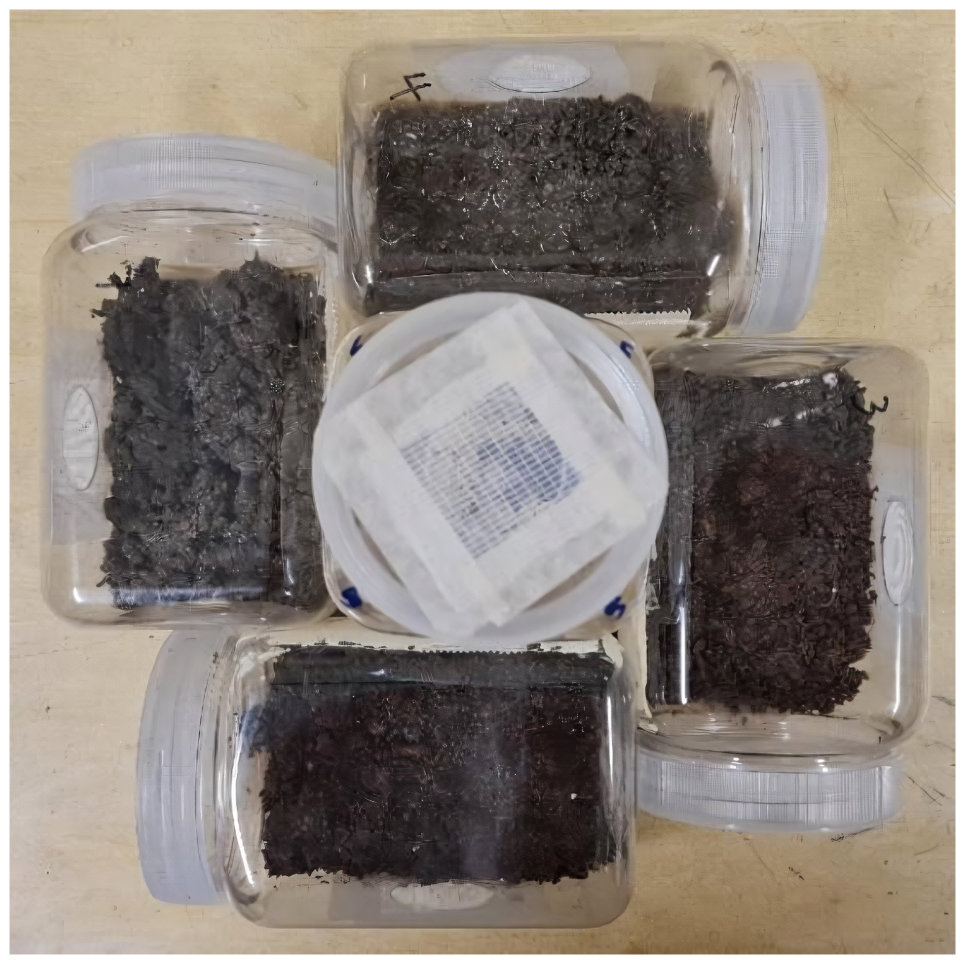
Preference tests were conducted following Kim et al. (2017, 2022). Simple choice chambers were assembled using five polypropylene containers (450 mL). Holes in the jars allowed free movement of earthworms within each set of containers (Fig. 2). The four outer containers were filled with 100 g of either S1, S2, S3 or S4 soil maintained at 30–35 % moisture. Earthworms were added into each set of choice chambers for behavioural assays. Gauze covering the central container provided ventilation. Soil moisture was replenished every three days, with the amount added assessed by weight of the containers. Five sets of choice chambers were maintained in an incubator at 15 ◦C for 14 days, in a randomized arrangement.
偏好试验参照Kim et al. (2017, 2022)进行。使用5个聚丙烯容器(450 mL)组装简易选择室。容器上的孔使蚯蚓可在每组容器间自由移动(图2)。4个外围容器分别装入100 g S1、S2、S3或S4土壤,含水量保持在30–35 %。将蚯蚓放入每组选择室中进行行为测定。中央容器覆盖纱布以通风。每3天补充一次土壤水分,补水量根据容器重量确定。5组选择室随机排列,置于15 ◦C培养箱中14天。
2.2.1.1. Unamended soil. Assays were carried out using the unamended bulk soils with three active and individually weighed earthworms introduced into each set of choice chambers, with five replicate sets of chambers. The four outer containers of each set of choice chambers were filled with 100 g of either S1, S2, S3 and S4 soil. After 14 days incubation, earthworms were extracted, counted and weighed, recording where they were found within each apparatus.
2.2.1.1. 未改良土壤。采用未改良的混合土壤进行测定,每组选择室放入3条活跃且单独称重的蚯蚓,共设5组重复选择室。每组选择室的4个外围容器分别装入100 g S1、S2、S3和S4土壤。培养14天后,取出蚯蚓计数、称重,并记录其在各装置中的所在位置。
2.2.1.2. SOM amended soil and Cu spiked soil. Soils were also amended to standardise either SOM or soil total Cu concentrations, adjusting each soil to match that with the highest recorded concentrations of each. Thus, SOM was adjusted to 12 % to match S2 using peat moss (Kiwipeat NZ sphagnum peat moss, TNZ Growing Products). Sphagnum moss peat was used as the primary source of soil organic matter (SOM) in this study. According to the manufacturer’s specifications (TNZ Growing Products Ltd,), the peat was sterilized, significantly eliminating any native microbial communities present. This sterilization minimized the influence of a non-copper-adjusted microbiome, ensuring that any observed effects on root systems were attributed primarily to copper treatments. CuSO4 stock solution was added to adjust soil Cu to match S1. SOM was adjusted to 12.0 % in three of the soils to match S2. Copper was adjusted to 263 mg kg − 1in soils S2-S4 to match S1. Copper stock solution was prepared by dissolving 3.93 g CuSO4⋅5H2O in 1000 mL of deionised water, with pH adjusted using sufficient 0.5 M NaOH to avoid precipitation.
2.2.1.2. SOM改良土壤与Cu添加土壤。对土壤进行改良,以统一SOM或土壤全Cu浓度,将各土壤调整至与该指标最高记录浓度的土壤一致。因此,使用泥炭藓(Kiwipeat NZ sphagnum peat moss,TNZ Growing Products)将SOM调整至12 %,与S2一致。本研究以泥炭藓泥炭作为土壤有机质(SOM)的主要来源。根据生产商说明(TNZ Growing Products Ltd,),该泥炭已经灭菌,基本消除了其中原有的微生物群落。灭菌降低了未经铜调整的微生物组的影响,确保所观察到的对根系的效应主要归因于铜处理。添加CuSO4储备液将土壤Cu调整至与S1一致。3种土壤的SOM调整至12.0 %以匹配S2。S2–S4土壤的Cu调整至263 mg kg − 1以匹配S1。Cu储备液的配制方法为将3.93 g CuSO4⋅5H2O溶于1000 mL去离子水,并加入足量0.5 M NaOH调节pH以避免沉淀。
2.2.2. Soil respiration2.2.2. 土壤呼吸
2.2.2.1. SOM and Cu amendments. Different proportions of SOM were added to the soil with highest Cu (S1). Peat moss was used to adjust SOM to 6 % (no addition, reference), 9 %, 12 %, 15 % and 18 %, with amended soils then maintained in the shade for two weeks. Five replicate plastic plant pots (diam. 120 mm, ht. 200 mm) were each filled with 1.5 kg of each prepared soil. A PVC respirometer collar (diameter 100 mm) was inserted to 10 depths, protruding 20 mm above the surface, and soil moisture content was adjusted to 30–40 % with tap water and maintained for three days prior to CO2 flux measurements.
2.2.2.1. SOM与Cu改良。向Cu含量最高的土壤(S1)中添加不同比例的SOM。使用泥炭藓将SOM调整至6 %(不添加,对照)、9 %、12 %、15 %和18 %,改良后的土壤随后在荫蔽处放置2周。每种制备好的土壤各装入5个重复塑料花盆(直径120 mm,高200 mm),每盆1.5 kg。插入PVC呼吸测定环(直径100 mm)至10深度,高出土壤表面20 mm,用自来水将土壤含水量调整至30–40 %,并在CO2通量测定前保持3天。
Additionally, the S4 soil (total Cu: 7.7 mg kg− 1; SOM: 4.0 %) was spiked with Cu as above (#2.2.1.2) to concentrations of 7.0 mg kg− 1(no addition, reference), 30 mg kg− 1, 100 mg kg− 1, 200 mg kg− 1and 300 mg kg− 1, again with five replicates of each, and stabilised in the shade for two weeks. Amended soils were then added to pots, maintained and prepared in the same way.
此外,按上述方法(#2.2.1.2)向S4土壤(全Cu:7.7 mg kg− 1;SOM:4.0 %)添加Cu,使其浓度分别为7.0 mg kg− 1(不添加,对照)、30 mg kg− 1、100 mg kg− 1、200 mg kg− 1和300 mg kg− 1,每个处理同样设5个重复,并在荫蔽处稳定2周。随后将改良土壤装盆,并以相同方式维护和制备。
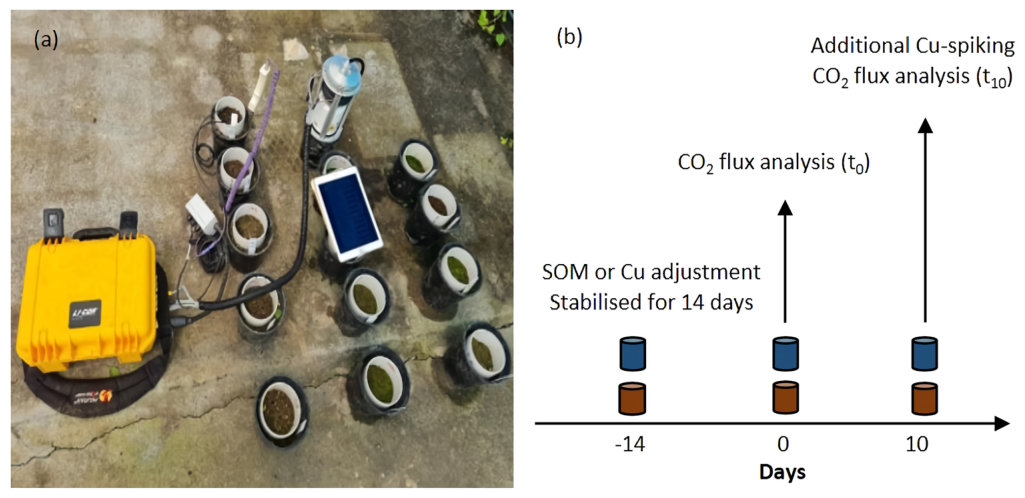
2.2.2.2. Measurement of CO2 flux. CO2 flux was measured using a LICOR-8100 A Automated Soil CO2 Infrared Gas Analyser (Fig. 3 a), with monitoring of soil temperature and water content (100 mm depth). The IRGA was connected to a Respirometry Chamber on the PVC collars in the plant pots. Prior to CO2 flux measurement, soils were stabilised for 14 days. Measurement duration of each pot was 120 s, with three replicates per sample, with five replicates per treatment (n = 15), following the instrument manual protocol. Each soil was measured at two time points: after soils were stabilised (t0) and after 10 days of additional CuSO4 application (t10) (Fig. 3 b). Soil moisture and temperature probes were inserted adjacent to the PVC collar and recorded data automatically during CO2 flux measurement. Soil CO2 flux was calculated based on a linear increase in chamber CO2 concentrations over time (μmol CO2 C m− 2s− 1) using standard protocol. Corrections were applied for soil temperature and Water-Filled Pore Space (WFPS), with values standardised to 25 ◦C and 60 % WFPS (Parkin et al., 1996). Soil bulk density was measured by using soil sample rings (0.0906 L) at the end of the experiment. Soil moisture content (%) was used to calculate volumetric water content (Jeon, 2024).
2.2.2.2. CO2通量测定。采用LICOR-8100 A自动土壤CO2红外气体分析仪测定CO2通量(图3 a),同时监测土壤温度和含水量(100 mm深度)。IRGA连接至安装在花盆PVC测定环上的呼吸室。测定CO2通量前,土壤稳定14天。按照仪器手册规程,每盆测定时长120 s,每个样品重复3次,每个处理5个重复(n = 15)。每种土壤在两个时间点测定:土壤稳定后(t0)以及额外施用CuSO4 10天后(t10)(图3 b)。土壤水分和温度探头插在PVC测定环旁,在CO2通量测定期间自动记录数据。土壤CO2通量采用标准规程,根据呼吸室内CO2浓度随时间的线性增加计算(μmol CO2 C m− 2s− 1)。对土壤温度和充水孔隙度(WFPS)进行校正,数值标准化至25 ◦C和60 % WFPS(Parkin et al., 1996)。试验结束时使用土壤取样环(0.0906 L)测定土壤容重。利用土壤含水率(%)计算体积含水量(Jeon, 2024)。
2.2.2.3. Additional Cu spiking. The impact of repeated doses of the equivalent of 3 Cu kg ha− 1yr− 1was investigated using ten further applications (daily) of a stock solution for ten days (Fig. 3 b). The experimental set up was maintained in a shade house with a randomised arrangement of the containers which were irrigated every two days. Soils were sampled before and after the experiment for chemical analysis.
2.2.2.3. 额外添加Cu。通过连续10天每日施用储备液(共10次),研究相当于3 Cu kg ha− 1yr− 1的重复剂量的影响(图3 b)。试验装置置于荫棚中,容器随机排列,每2天灌溉一次。试验前后采集土壤样品进行化学分析。
2.2.3. Plant growth in rhizoboxes
2.2.3. 根箱中的植物生长
Five replicate rhizoboxes (0.6 m × 0.8 m x 0.03 m) with glass panels on each side were filled with S1, S2, S3 and S4 soils in vertical strips separated by 3 mm steel mesh. They were watered until saturated and maintained in a glasshouse for three days before transplanting one hop seedling into each section. The glass panels were covered with black polythene film. Temperature range in the glasshouse was 10–33 ◦C with 40–60 % relative humidity. Rhizoboxes were carefully watered daily by adding 200 mL water, avoiding leaching from the apparatus. Shoot and root growth was measured and photographed every few days for 120 days. Plants were then harvested, separating roots and shoots (cone, leaf, stem, roots) which were oven-dried (65 ◦C) and weighed prior to Cu analysis.
将5个重复根箱(0.6 m × 0.8 m x 0.03 m,两侧为玻璃面板)以竖直条带形式分别装填S1、S2、S3和S4土壤,条带间以3 mm钢网分隔。浇水至饱和后,在温室中放置3天,然后在每个分区移栽1株啤酒花幼苗。玻璃面板用黑色聚乙烯薄膜覆盖。温室温度范围为10–33 ◦C,相对湿度40–60 %。每日小心地向根箱加水200 mL,避免装置发生淋溶。在120天内每隔数天测量并拍摄地上部和根系生长情况。随后收获植株,将根和地上部(球果、叶、茎、根)分开,烘干(65 ◦C)并称重后进行Cu分析。
2.3. Chemical analysis2.3. 化学分析
At the end of all of the experiments, soils were air-dried (25–30 ◦C) and sieved (2.0 mm) prior to analysis following standard methodologies of Lincoln University Analytical Services. Briefly soil samples were microwave digested (65 % nitric-perchloric acid) prior to Cu determination using Atomic Absorption Spectrophotometer (AAS). QA used certified reference material ISE2021-4-1. Earthworm and plant samples were oven-dried (65 ◦C) individually and analyses in the same way.
所有试验结束后,按照林肯大学分析服务中心的标准方法,将土壤风干(25–30 ◦C)并过筛(2.0 mm)后进行分析。简言之,土壤样品经微波消解(65 %硝酸–高氯酸)后,采用原子吸收分光光度计(AAS)测定Cu。质量保证采用有证标准物质ISE2021-4-1。蚯蚓和植物样品分别烘干(65 ◦C),并以相同方法分析。
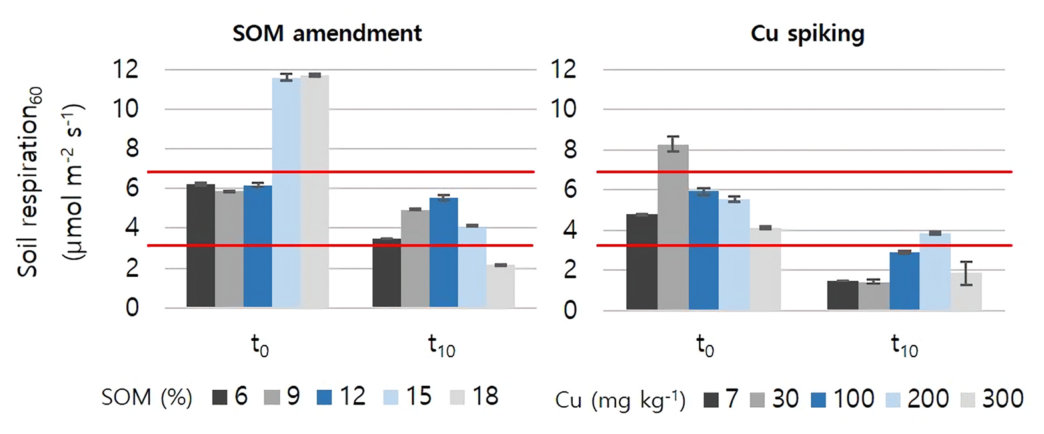
In contrast, treatments with 9 %, 12 %, and 15 % SOM maintained soil respiration rates within the anticipated normative range (3.46–6.92 μmol CO₂ m2s⁻1), demonstrating no notable reduction, even following a 10-day period subsequent to the application of CuSO4⋅5H2O (Fig. 5). For the Cu-spiked treatments, soil respiration60 dropped below the expected normal range across all initial Cu concentrations (7, 30, 100, 200, and 300 mg Cu kg⁻1) within 10 days following the application of CuSO4⋅5H2O (Fig. 5).
相比之下,SOM为9 %、12 %和15 %的处理,其土壤呼吸速率保持在预期正常范围内(3.46–6.92 μmol CO₂ m2s⁻1),即使在施用CuSO4⋅5H2O后10天也未出现明显下降(图5)。对于Cu添加处理,在施用CuSO4⋅5H2O后10天内,所有初始Cu浓度(7、30、100、200和300 mg Cu kg⁻1)下的土壤呼吸60均降至预期正常范围以下(图5)。
3.3. Plant growth3.3. 植物生长
2.4. Statistical analysis2.4. 统计分析
Descriptive statistics were first calculated to summarize the main characteristics of the soil samples (S1-S4). To assess normality, data were inspected through visual examination of Q-Q plots and tested using the Shapiro-Wilk test. Homogeneity of variances was evaluated with Levene’s test. For inferential analysis, one-way ANOVA was employed to compare means across different treatments and soil types, with post-hoc Tukey’s Pairwise Comparisons used to identify specific differences among treatment groups at a significance level of p < 0.05. Multiple regression models were developed to account for potential confounding variables and to assess the combined effects of soil parameters on each biological outcome. Multicollinearity among predictor variables was addressed by eliminating highly correlated variables, ensuring robust model results. Principal Component Analysis (PCA) was utilized to reduce the dimensionality of the dataset and to identify key soil properties contributing to the observed biological effects in the unamended soil. All analyses used Minitab 19 software.
首先计算描述性统计量,以概括土壤样品(S1–S4)的主要特征。通过目视检查Q-Q图并采用Shapiro-Wilk检验评估正态性。采用Levene检验评估方差齐性。推断分析采用单因素ANOVA比较不同处理和土壤类型间的均值,并采用Tukey事后两两比较在p < 0.05显著性水平上识别处理组间的具体差异。建立多元回归模型,以考虑潜在混杂变量并评估土壤参数对各生物学结果的综合效应。通过剔除高度相关变量处理预测变量间的多重共线性,以确保模型结果稳健。采用主成分分析(PCA)对数据集降维,并识别在未改良土壤中导致所观察生物效应的关键土壤性质。所有分析均使用Minitab 19软件完成。
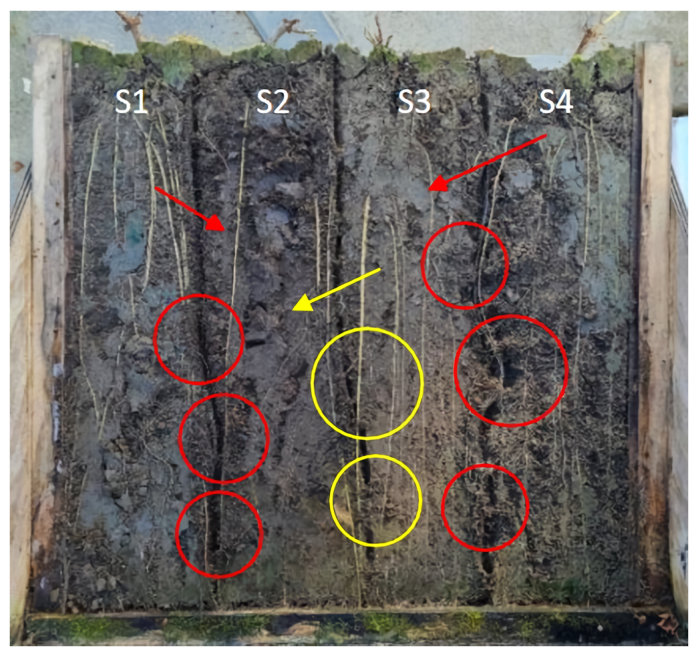
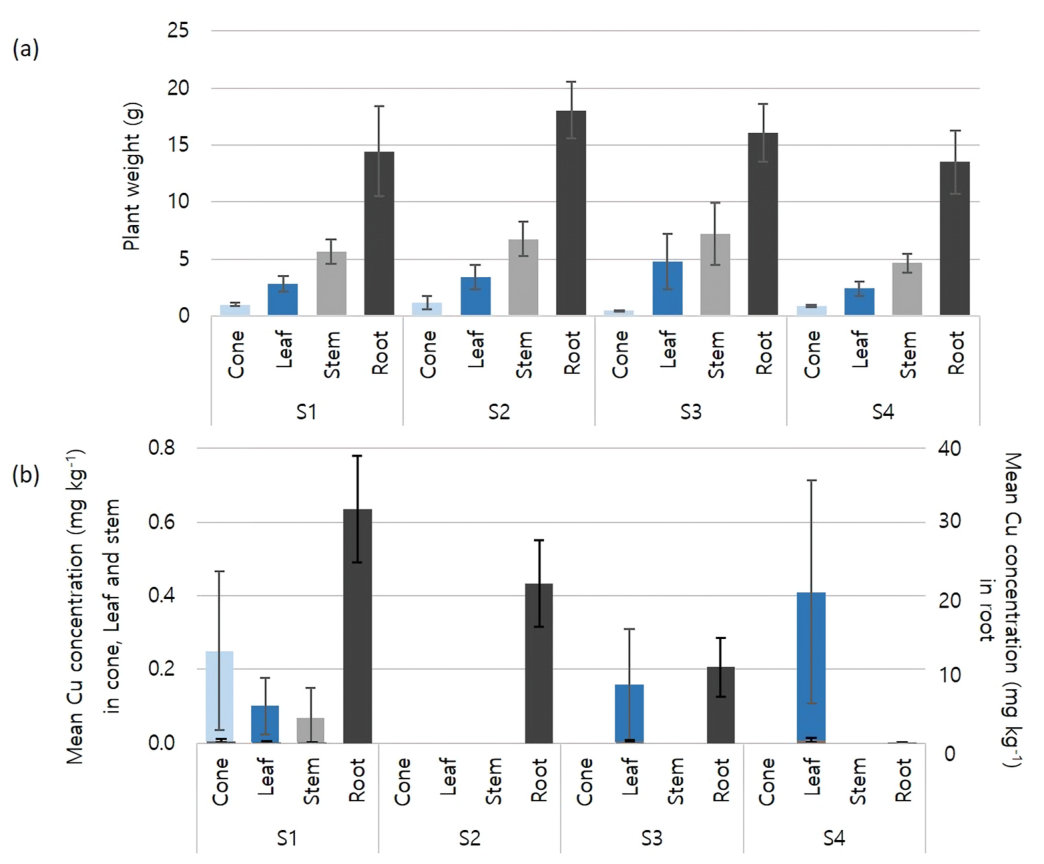
In the rhizobox experiment there was visual evidence that the roots crossed the mesh barriers into adjacent soils (Fig. 6, Supplementary Fig. 1). Soil moisture differences were evident through preferential flow (darker regions in photograph) and this had an obvious effect on root proliferation. Some 80 % of observed roots in S1 soil (263 Cu mg kg− 1) foraged toward the S2 soil (160 Cu mg kg− 1) soil without a soil moisture influence. No roots grew from S2 soil to S1 soil, and only 20 % of roots grown in S2 soil (160 Cu mg kg− 1) moved toward S3 soil (91 mg kg− 1) without a soil moisture influence. However, no roots grew from S3 soil (91 Cu mg kg− 1) into S2 soil (160 Cu mg kg− 1). All of the roots that could be observed in S4 soil (7.7 Cu mg kg− 1) foraged toward S3 (91 mg kg− 1) soil irrespective of soil moisture influence. Total plant mass (g) was highest in S2 soil and lowest in S4 soil (Fig. 7 a). Root (Supplementary Fig. 2) and cone weight were highest in S2 soil. Roots accumulated most Cu in soils with little transference of Cu to above-ground plant components (Fig. 7 b).
在根箱试验中,可直观观察到根系穿过钢网屏障进入相邻土壤(图6,补充图1)。优先流(照片中颜色较深的区域)表明存在土壤水分差异,且其对根系增殖有明显影响。在不受土壤水分影响的情况下,S1土壤(263 Cu mg kg− 1)中约80 %的可观察根系向S2土壤(160 Cu mg kg− 1)觅食生长。没有根系从S2土壤长入S1土壤,且在不受土壤水分影响的情况下,S2土壤(160 Cu mg kg− 1)中仅有20 %的根系向S3土壤(91 mg kg− 1)生长。然而,没有根系从S3土壤(91 Cu mg kg− 1)长入S2土壤(160 Cu mg kg− 1)。无论是否受土壤水分影响,S4土壤(7.7 Cu mg kg− 1)中所有可观察到的根系均向S3(91 mg kg− 1)土壤觅食生长。植株总生物量(g)在S2土壤中最高,在S4土壤中最低(图7 a)。根重(补充图2)和球果重均以S2土壤最高。Cu主要积累在根系中,向地上部各组分的转移很少(图7 b)。
4Discussion讨论
3Results结果
4.1. Differences between the four soils4.1. 4种土壤之间的差异
3.1. Earthworms3.1. 蚯蚓
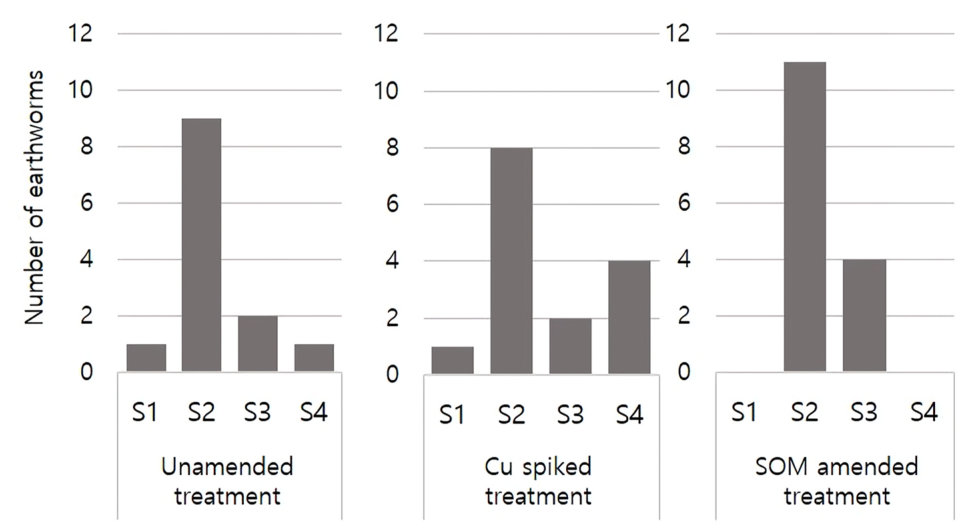
A mortality rate of earthworms of 13 % occurred across all the orchard soils. In unamended soils there was a strong preference for the S2 soil which contained 160 mg Cu kg − 1(Fig. 4). The preference for this soil remained when SOM was adjusted to 12 % in all soils, and when Cu was spiked to the same high concentration of 263 mg kg − 1.
所有果园土壤中蚯蚓的死亡率为13 %。在未改良土壤中,蚯蚓对含160 mg Cu kg − 1的S2土壤表现出强烈偏好(图4)。当所有土壤的SOM均调整至12 %,以及Cu均添加至263 mg kg − 1的相同高浓度时,对该土壤的偏好依然存在。
3.2. Soil respiration3.2. 土壤呼吸
In the unamended soils there was significant correlation between soil respiration and soil Cu concentrations. In the SOM-amended treatments with 6 % and 18 % SOM, there a significant decrease in soil respiration.
在未改良土壤中,土壤呼吸与土壤Cu浓度之间存在显著相关性。在SOM为6 %和18 %的SOM改良处理中,土壤呼吸显著下降。
Besides differing Cu concentration of the four collected and bulked soils, there were other significant differences in SOM content, pH, and CN ratio that may have affected earthworm behaviour, soil respiration, and plant growth. SOM obviously influenced how the soils responded to copper toxicity; soils with higher SOM had a greater capacity to bind copper, reducing its bioavailability and subsequent toxicity to soil biota. The interaction between SOM and soil Cu was clearly a major determinant of soil biotic responses, but other measured soil properties also varied between treatments; obviously the overall soil matrix determines the biotic impacts of Cu.
除Cu浓度不同外,所采集并混合的4种土壤在SOM含量、pH和CN比方面也存在其他显著差异,这些差异可能影响了蚯蚓行为、土壤呼吸和植物生长。SOM显然影响了土壤对铜毒性的响应;SOM含量较高的土壤具有更强的铜结合能力,从而降低了铜的生物有效性及其对土壤生物的毒性。SOM与土壤Cu之间的相互作用显然是土壤生物响应的主要决定因素,但其他测定的土壤性质在各处理间也存在差异;显然,整体土壤基质决定了Cu的生物效应。
D. Jeon et al. EnvironmentalPollution
D. Jeon et al. EnvironmentalPollution
4.2. Interplay between SOM, Cu and earthworm behaviour4.2. SOM、Cu与蚯蚓行为之间的相互作用
After addressing multicollinearity by eliminating highly correlated variables, the multiple regression model was simplified to focus on key variables that could best explain the biotic impacts of soil amendments on earthworm preference. The simplified multiple regression analysis revealed that SOM (2.21) had the most significant positive effect on earthworm preference, confirming its strong influence compared to other soil variables (Table 2). While CN ratio (− 0.703), pH (− 0.212), and Total Cu (− 0.023) exhibited negative effects on earthworm populations, their impacts were relatively minor in comparison to SOM. This underscores the crucial role of SOM in supporting earthworm activity. The preference of earthworms for soils with higher SOM content, irrespective of the presence of Cu, indicated a protective role of SOM against Cu toxicity (Chelinho et al., 2011; Natal-Da-Luz et al., 2008). Our findings showed resilience of earthworms to Cu concentrations up to 160 mg Cu kg− 1, with no evidence they were sensitive to or avoided Cu-rich environments below this concentration. Regression model revealed a non-linear tolerance to Cu, with a threshold effect of around 135 mg Cu kg− 1(not shown), above which earthworm activity significantly reduced, indicating the limits of SOM protection from Cu toxicity. These findings suggest a threshold of tolerance influenced by organic matter, which can mitigate the toxic effects of Cu and support earthworm survival. However, the results also showed that earthworms avoided soils with higher of extremely low Cu concentrations; notably in soil S4 (with 7.7 mg Cu kg− 1) and in S1 (with 263 mg Cu kg− 1). In these cases, impacts were evident on earthworms and, by extension, to soil health (Brady and Weil, 2005; Hatten and Liles, 2019). These nuanced responses to different combinations of Cu and SOM indicate the requirement for careful soil management practices to support the ecological functions of soil biota.
通过剔除高度相关变量处理多重共线性后,对多元回归模型进行了简化,以聚焦于最能解释土壤改良对蚯蚓偏好生物效应的关键变量。简化多元回归分析表明,SOM(2.21)对蚯蚓偏好具有最显著的正效应,证实其相较于其他土壤变量具有较强的影响(表2)。虽然CN比(− 0.703)、pH(− 0.212)和全Cu(− 0.023)对蚯蚓种群表现出负效应,但与SOM相比其影响相对较小。这凸显了SOM在支持蚯蚓活动中的关键作用。无论是否存在Cu,蚯蚓均偏好SOM含量较高的土壤,表明SOM对Cu毒性具有保护作用(Chelinho et al., 2011; Natal-Da-Luz et al., 2008)。我们的结果显示,蚯蚓对高达160 mg Cu kg− 1的Cu浓度具有耐受性,且无证据表明其在低于该浓度时对富Cu环境敏感或存在回避。回归模型揭示了蚯蚓对Cu的非线性耐受,存在约135 mg Cu kg− 1的阈值效应(未显示),高于该阈值时蚯蚓活动显著降低,表明SOM对Cu毒性的保护作用存在限度。上述结果表明存在受有机质影响的耐受阈值,有机质可减轻Cu的毒性效应并支持蚯蚓存活。然而,结果也显示蚯蚓回避Cu浓度较高或极低的土壤,尤其是S4土壤(7.7 mg Cu kg− 1)和S1土壤(263 mg Cu kg− 1)。在这些情况下,对蚯蚓的影响是明显的,并由此延伸至对土壤健康的影响(Brady and Weil, 2005; Hatten and Liles, 2019)。对Cu和SOM不同组合的这些细微响应表明,需要采取审慎的土壤管理措施来支持土壤生物的生态功能。
4.3. Dynamics of soil organic matter and Cu on microbial activity4.3. 土壤有机质与Cu对微生物活性的动态影响
The multiple regression model for respiration demonstrated that SOM (0.0708) had the largest positive effect, suggesting its critical role in promoting soil respiration (Table 2). Total Cu (− 0.019) exhibited a small negative effect on respiration, indicating that higher Cu concentrations may slightly inhibit microbial and biological activity. However, the overall impact of Total Cu was much smaller than that of SOM, and the positive effect of SOM appeared to counterbalance any negative effects of Cu on respiration. This highlights the importance of SOM in maintaining soil biological functions, even in the presence of Cu. Soil respiration was also influenced by the interplay between SOM and Cu; decreasing sharply beyond 265 mg Cu kg− 1regardless of initial SOM or Cu levels. This illustrates the suppressive impact of Cu on soil biological processes, similar to research findings elsewhere (Sereni et al., 2021). The buffering capacity of SOM against the adverse effects of Cu was evident. In the highest SOM-amended treatment (15 % and 18 %), increased respiration may be explained by SOM mineralisation increasing microbial activity. Linear regression analysis showed a positive correlation between increased SOM and pH levels with soil respiration, concurrently with a decline in Cu concentration. SOM probably has a dual role, enhancing microbial activity and limiting Cu bioavailability, thus protecting against Cu toxicity. This supports findings elsewhere (Amery et al., 2008; Degryse et al., 2009; Groenenberg et al., 2010; Ren et al., 2015). Our study also highlights the critical balance required in SOM levels to avoid adverse conditions that inhibit microbial activity or lead to SOM loss. The findings show that excessively low (<6 %) or high (>18 %) SOM is not conducive to soil health in production soils, underscoring the necessity for balanced soil management that considers the interconnected roles of chemical elements and biological functions. Relying solely on soil respiration as a singular indicator of microbial activity in response to Cu contamination appears to be unsatisfactory.
呼吸的多元回归模型表明,SOM(0.0708)具有最大的正效应,提示其在促进土壤呼吸中的关键作用(表2)。全Cu(− 0.019)对呼吸表现出较小的负效应,表明较高的Cu浓度可能轻微抑制微生物和生物活性。然而,全Cu的总体影响远小于SOM,且SOM的正效应似乎抵消了Cu对呼吸的任何负面影响。这凸显了即使在存在Cu的情况下,SOM对维持土壤生物功能的重要性。土壤呼吸还受SOM与Cu之间相互作用的影响;无论初始SOM或Cu水平如何,当Cu超过265 mg Cu kg− 1时土壤呼吸均急剧下降。这说明了Cu对土壤生物过程的抑制作用,与其他研究结果相似(Sereni et al., 2021)。SOM对Cu不利影响的缓冲能力是明显的。在SOM改良水平最高的处理(15 %和18 %)中,呼吸增强可能是由于SOM矿化提高了微生物活性。线性回归分析显示,SOM和pH水平的升高与土壤呼吸呈正相关,同时伴随Cu浓度的下降。SOM可能具有双重作用,即增强微生物活性并限制Cu的生物有效性,从而防护Cu毒性。这与其他研究结果一致(Amery et al., 2008; Degryse et al., 2009; Groenenberg et al., 2010; Ren et al., 2015)。本研究还强调了SOM水平需保持关键平衡,以避免出现抑制微生物活性或导致SOM损失的不利条件。结果表明,SOM过低(<6 %)或过高(>18 %)均不利于生产性土壤的土壤健康,凸显了开展兼顾化学元素与生物功能相互关联作用的平衡土壤管理的必要性。仅以土壤呼吸作为反映微生物活性对Cu污染响应的单一指标似乎并不充分。
Simplified multiple regression results (Multicollinearity was eliminated).
简化多元回归结果(已消除多重共线性)。
| Biotic indicators生物指标 | Soil parameters土壤参数 | Coefficient value系数值 | p-valuep值 |
|---|---|---|---|
| Earthworm preference | SOM | 2.21 | _<_0.001 |
| Total Cu | −0.023 | _<_0.05 | |
| CN ratio | −0.703 | _<_0.01 | |
| pH | −0.212 | _<_0.01 | |
| Intercept | 0.094 | ||
| R2 | 0.872 | _<_0.001 | |
| Respiration | SOM | 0.071 | _<_0.001 |
| Total Cu | −0.019 | _<_0.01 | |
| Intercept | 0.008 | ||
| R2 | 0.783 | _<_0.01 | |
| Root growth | SOM | 0.635 | _<_0.01 |
| Total Cu | −0.024 | _<_0.05 | |
| Intercept | 11.0 | ||
| R2 | 0.712 | _<_0.01 |
4.4. Complex interactions between soil copper concentration, nutrient4.4. 土壤铜浓度、养分
availability, and plant growth有效性与植物生长之间的复杂相互作用
In the case of root growth, the simplified regression model showed that SOM (0.635) again had a substantial positive impact, suggesting its importance in promoting healthy root development (Table 2). Total Cu (− 0.024), on the other hand, had a slight negative effect on root weight, indicating that elevated copper levels may hinder root growth, albeit to a minimal extent. The fact that SOM had a stronger effect than Total Cu supports the hypothesis that SOM is a key factor in enhancing root development, likely by improving nutrient availability and soil structure. Earlier studies have found that plant roots avoid high Cu zones of soils (Comas et al., 2013; Hodge et al., 2009). However, the present study indicates that root growth dynamics are not solely affected by high Cu levels. Instead, root foraging is largely influenced by the availability of moisture and SOM, the latter likely to be associated with fertility. Contrary to our hypothesis, there was no significant root migration from soil with moderately high Cu (91 mg Cu kg− 1, S3) to lower Cu levels (7.7 mg Cu kg− 1, S4), underscoring the complexities of root growth preferences that extend beyond Cu concentration alone. Root growth was adversely affected where Cu concentration was highest (263 mg Cu kg− 1, S1). Symptom of Cu toxicity have been widely reported to disrupt root morphology, structural integrity and root biomass (Lombi et al., 2004; Sheldon and Menzies, 2005; Cruz et al., 2022). Rhodes grass roots were extremely stunted with root cuticle thickened (Sheldon and Menzies, 2005).
就根系生长而言,简化回归模型显示SOM(0.635)同样具有显著的正向影响,提示其对促进根系健康发育的重要性(表2)。另一方面,全Cu(− 0.024)对根重有轻微的负效应,表明铜水平升高可能阻碍根系生长,尽管程度很小。SOM的效应强于全Cu,这支持了SOM是促进根系发育关键因素的假设,其作用机制可能是改善养分有效性和土壤结构。早期研究发现植物根系会回避土壤中的高Cu区域(Comas et al., 2013; Hodge et al., 2009)。然而,本研究表明根系生长动态并不仅受高Cu水平影响。相反,根系觅食在很大程度上受水分和SOM有效性的影响,后者可能与土壤肥力相关。与我们的假设相反,根系并未从中高Cu土壤(91 mg Cu kg− 1,S3)显著迁移至较低Cu水平土壤(7.7 mg Cu kg− 1,S4),这凸显了根系生长偏好的复杂性,其影响因素不仅限于Cu浓度。在Cu浓度最高处(263 mg Cu kg− 1,S1),根系生长受到不利影响。已有大量报道表明,Cu毒性症状会破坏根系形态、结构完整性和根系生物量(Lombi et al., 2004; Sheldon and Menzies, 2005; Cruz et al., 2022)。盖氏虎尾草(Rhodes grass)根系极度矮化,根表皮角质层增厚(Sheldon and Menzies, 2005)。
Soil nutrients were a more significant factor influencing root growth directionality than Cu levels across the range of orchard soils (Supplementary Fig. 3). The PCA first component highlighted the association between increased presence of magnesium (Mg), total nitrogen (TN), calcium (Ca), cation exchange capacity (CEC), phosphorus (P), soil organic matter (SOM), and potassium (K). Hop roots foraged for nutrient-rich environments, even in the presence of moderately high Cu concentrations. This interplay of different factors suggests that increasing Cu concentrations in orchard soils is just one component of plant health and productivity.
在各类果园土壤中,土壤养分是比Cu水平更重要的影响根系生长方向的因素(补充图3)。PCA第一主成分突出显示了镁(Mg)、全氮(TN)、钙(Ca)、阳离子交换量(CEC)、磷(P)、土壤有机质(SOM)和钾(K)含量增加之间的关联。即使在Cu浓度中等偏高的情况下,啤酒花根系仍向养分丰富的环境觅食生长。这种多因素的相互作用表明,果园土壤中Cu浓度的升高只是影响植物健康和生产力的因素之一。
Using chemical extractants or soil pore water to reflect the bioavailability of copper (Cu) in soil is well documented in literature.
利用化学浸提剂或土壤孔隙水反映土壤中铜(Cu)的生物有效性已在文献中得到充分记载。
When soluble Cu is introduced to soils, various reactions reduce its bioavailability as Cu binds to soil particles (Ma et al., 2006). Cu bioavailability and toxicity decreases due to aging effects that reduce extractability of Cu (Hogg et al., 1993; McLaren and Ritchie, 1993). Sequential extraction techniques also reveal the complexity of the partitioning between extractable and reducible fractions (Nielsen et al., 2015), that are further influenced by anthropogenic inputs (Zimmerman and Weindorf, 2010). In the limited scope of the present study we considered that understanding the biological response to Cu, irrespective of its chemical mobility or speciation, was most significant.
可溶性Cu进入土壤后,由于Cu与土壤颗粒结合,多种反应会降低其生物有效性(Ma et al., 2006)。老化效应降低了Cu的可提取性,从而使Cu的生物有效性和毒性下降(Hogg et al., 1993; McLaren and Ritchie, 1993)。连续提取技术还揭示了可提取态与可还原态之间分配的复杂性(Nielsen et al., 2015),这种分配还会进一步受到人为输入的影响(Zimmerman and Weindorf, 2010)。在本研究有限的范围内,我们认为最重要的是了解生物对Cu的响应,而不论其化学迁移性或形态如何。
to elevated Cu.
对升高的Cu。
Continued use of Cu for disease control is not viable in the longer term. There is clearly an impact on structural and functional aspects of soil ecology at higher soil Cu loadings. Maintaining or enhancing SOM levels, as well as maintaining high soil pH, has been a crucial strategy in managing the impact of Cu on soil health in the short term awaiting a switch to alternatives to Cu usage. Despite the apparent resilience of biota to increasing Cu, this metal has exceptionally long residence times in soil and continued contamination of soils is not compatible with increasing attention being given to the clean green credentials of horticulture and agriculture.
从长远来看,继续使用Cu防治病害是不可行的。在较高的土壤Cu负荷下,土壤生态的结构和功能显然受到影响。在转向Cu替代品之前,维持或提高SOM水平以及保持较高的土壤pH,一直是短期内管理Cu对土壤健康影响的关键策略。尽管生物对不断增加的Cu表现出明显的耐受力,但该金属在土壤中的滞留时间极长,土壤的持续污染与园艺业和农业日益重视的“清洁绿色”声誉不相符。
4.5. Understanding the biotic impact of Cu4.5. 认识Cu的生物效应
CRediT authorship contribution statementCRediT作者贡献声明
This integrated approach of the present study focused on the simultaneous effect of Cu on earthworm behaviour, soil respiration, and plant growth within the same soil system in an attempt to understand the impact of this metal on soil health. Ex-situ assays using soils from orchard blocks allowed better control of treatment conditions and comparisons that were difficult to measure in the field. The findings showed that a soil concentration of 91 mg Cu kg − 1did not significantly impact these biotic variables. At 263 mg kg ⁻1, there was potential for Cu to be mobilised from the soil and transferred to the aboveground parts of hops, with obvious agricultural and environmental implications. When total Cu in soil reached 500 mg kg− 1(10 days’ CuSO4 application), soil respiration decreased significantly, indicating an adverse impact on soil microbial activity. Additional spiking of the soils with either SOM or inorganic Cu showed that organic matter is a more important driver of biological activity, also playing an important role in amelioration of the impact of Cu.
本研究采用综合方法,关注同一土壤体系中Cu对蚯蚓行为、土壤呼吸和植物生长的同步影响,以期了解该金属对土壤健康的影响。利用果园地块土壤开展的异位测定能够更好地控制处理条件,并实现田间难以测定的比较。结果表明,91 mg Cu kg − 1的土壤浓度未对上述生物变量产生显著影响。在263 mg kg ⁻1时,Cu存在从土壤中活化并转移至啤酒花地上部的可能,具有明显的农业和环境意义。当土壤全Cu达到500 mg kg− 1(施用CuSO4 10天)时,土壤呼吸显著下降,表明对土壤微生物活性产生了不利影响。向土壤额外添加SOM或无机Cu的结果表明,有机质是生物活性更重要的驱动因素,并在缓解Cu影响方面发挥重要作用。
Toxic impacts of Cu were only evident at soil concentrations above existing published thresholds (100 mg kg− 1), although lack of solubility of elevated Cu in soil may not be temporally stable; dissolution and mobility could be altered by changed environmental conditions and biological activity. The extent and limits of biological resilience to Cu toxicity through adaptation or acclimation is uncertain. Clearly there are interconnections between biological processes and integration of measures of plants, microbial and faunal impacts in the present study is likely to be more useful than a focus on single receptors. However, future limits to biological resilience may only be evident from longer-term studies when critical parameters are exceeded, or key ecological processes are disrupted. Of particular concern is the extremely slow disappearance rates of Cu from soils, once they become polluted.
Cu的毒性效应仅在土壤浓度高于现有已发表阈值(100 mg kg− 1)时才显现,但土壤中升高的Cu的低溶解性可能并非长期稳定;环境条件和生物活性的变化可能改变其溶解和迁移性。生物通过适应或驯化对Cu毒性的耐受程度及其限度尚不确定。生物过程之间显然存在相互联系,本研究中整合植物、微生物和动物影响的测定可能比聚焦单一受体更为有用。然而,生物耐受力的未来限度可能只有通过长期研究,在关键参数被超越或关键生态过程被破坏时才会显现。尤其值得关注的是,土壤一旦受到污染,Cu从土壤中消失的速率极为缓慢。
5Conclusions结论
Earthworms had a marked preference for the orchard soil with highest SOM (12 %) and 160 mg Cu kg− 1. The preference for this soil persisted when other soils were spiked with Cu. There was no evidence of Cu sensitivity in the earthworms or adverse effects up to this Cu concentration. Impacts of Cu on soil respiration were found in spiked soils where other variables were controlled, although the addition of SOM appeared to be beneficial in addition to mitigating the detrimental effects of Cu. High soil Cu adversely affected root foraging and plant growth, particularly in soils with the highest Cu concentrations, but soil organic matter was also influential, likely to be explained by its role in water retention and fertility. These findings reveal the complex interplay between soil Cu, SOM, and with the biological indicators that may accurately reflect the concept of soil health.
蚯蚓明显偏好SOM最高(12 %)且含160 mg Cu kg− 1的果园土壤。当其他土壤添加Cu后,对该土壤的偏好依然存在。在该Cu浓度以内,没有证据表明蚯蚓对Cu敏感或受到不利影响。在控制其他变量的Cu添加土壤中发现了Cu对土壤呼吸的影响,但添加SOM除了能缓解Cu的有害效应外,似乎还具有有益作用。高土壤Cu对根系觅食和植物生长产生不利影响,尤其是在Cu浓度最高的土壤中,但土壤有机质同样具有影响,这可能归因于其在保水和肥力方面的作用。上述结果揭示了土壤Cu、SOM以及可准确反映土壤健康概念的生物指标之间复杂的相互作用。
The resilience of biological determinants of soil health to Cucontamination in terms of SOM appears somewhat incongruous, since SOM is also the primary substrate required for biological activity and fertility in soil. Decomposition of SOM would be expected to increase the mobility of Cu and resultant exposure of biota to Cu. However, to an unexplained degree, SOM alleviates copper toxicity due to its influence on soil physicochemistry, particularly moisture and nutrition. An additional variable is likely to be adaptation or acclimation of the soil biota
就SOM而言,土壤健康的生物决定因子对Cu污染的耐受性似乎有些矛盾,因为SOM同时也是土壤生物活性和肥力所需的主要底物。SOM的分解预计会增加Cu的迁移性,进而增加生物对Cu的暴露。然而,SOM在一定程度上(其机制尚不明确)通过影响土壤理化性质,特别是水分和养分,缓解了铜毒性。另一个变量可能是土壤生物的适应或驯化
Dasom Jeon: Writing – original draft, Methodology, Investigation, Formal analysis, Data curation. Brett Robinson: Writing – review & editing, Supervision, Investigation. Nicholas Dickinson: Writing – review & editing, Supervision, Methodology, Conceptualization.
Dasom Jeon:撰写–初稿,方法,调查,形式分析,数据整理。Brett Robinson:撰写–审阅与编辑,指导,调查。Nicholas Dickinson:撰写–审阅与编辑,指导,方法,概念化。
Declaration of competing interest利益冲突声明
The authors declare that they have no known competing financial interests or personal relationships that could have appeared to influence the work reported in this paper.
作者声明,不存在任何可能影响本文所报道工作的已知经济利益冲突或个人关系。
Acknowledgements致谢
The research team are grateful to Lincoln University, New Zealand for grant funding to support Dasom Jeon for her PhD stipend and operational funds.
研究团队感谢新西兰林肯大学提供资助,为Dasom Jeon的博士生津贴和研究经费提供支持。
Appendix A. Supplementary data附录A. 补充数据
Supplementary data to this article can be found online at https://doi. org/10.1016/j.envpol.2024.125145.
本文补充数据可在线获取:https://doi. org/10.1016/j.envpol.2024.125145。
Data availability数据可用性
Data will be made available on request.
数据可应要求提供。
References参考文献
Antoniadis, V., Levizou, E., Shaheen, S.M., Ok, Y.S., Sebastian, A., Baum, C., Prasad, M.N. V., Wenzel, W.W., Rinklebe, J., 2017. Trace elements in the soil-plant interface: phytoavailability, translocation, and phytoremediation–A review. Earth Sci. Rev. 171 (June), 621–645. https://doi.org/10.1016/j.earscirev.2017.06.005.
Aikpokpodion, P., Lajide, L., Festus Aiyesanmi, A., Lajide, L., Aiyesanmi, A., 2010. Heavy metals contamination in fungicide treated Cocoa plantations in Cross River State, Nigeria. Am.-Eurasian J. Agric. Environ. Sci. 8 (3), 268–274. https://www.researchg ate.net/publication/228360668.
Ameh, T., Sayes, C.M., 2019. The potential exposure and hazards of copper nanoparticles: a review. 2019. Environ. Toxicol. Pharmacol. 71, 103220. https://doi. org/10.1016/j.etap.2019.103220.
Amery, F., Degryse, F., Cheyns, K., De Troyer, I., Mertens, J., Merckx, R., Smolders, E., 2008. The UV-absorbance of dissolved organic matter predicts the fivefold variation in its affinity for mobilizing Cu in an agricultural soil horizon. Eur. J. Soil Sci. 59 (6), 1087–1095. https://doi.org/10.1111/j.1365-2389.2008.01078.x.
Besnard, E., Chenu, C., Robert, M., 2001. Influence of organic amendments on copper distribution among particle-size and density fractions in Champagne vineyard soils. Environ. Pollut. 112 (3), 329–337. https://doi.org/10.1016/S0269-7491(00)00151- 2.
Brady, N.C., Weil, R.R., 2005. The Nature and Properties of Soil, thirteenth ed. Macmillan Publishing Co.
Chelinho, S., Domene, X., Campana, P., Natal-da-Luz, T., Scheffczyk, A., Rombke, J., ¨ Andr´es, P., Sousa, J.P., 2011. Improving ecological risk assessment in the Mediterranean area: selection of reference soils and evaluating the influence of soil properties on avoidance and reproduction of two oligochaete species. Environ. Toxicol. Chem. 30 (5), 1050–1058. https://doi.org/10.1002/etc.480.
Comas, L.H., Becker, S.R., Cruz, V.M.V., Byrne, P.F., Dierig, D.A., 2013. Root traits contributing to plant productivity under drought. Front. Plant Sci. 4, 442. https:// doi.org/10.3389/fpls.2013.00442.
Cruz, F.J.R., Ferreira, R.L. da C., Conceiç˜ao, S.S., Lima, E.U., Neto, C.F. de O., Galvao, J. ˜ R., Lopes, S. da C., Viegas, I., de, J.M., 2022. Copper toxicity in plants: nutritional,
physiological, and biochemical aspects. In: Kimatu, J.N. (Ed.), Advances in Plant Defense Mechanisms. IntechOpen. https://doi.org/10.5772/intechopen.105212.
Degryse, F., Smolders, E., Parker, D.R., 2009. Partitioning of metals (Cd, Co, Cu, Ni, Pb, Zn) in soils: concepts, methodologies, prediction and applications - a review. Eur. J. Soil Sci. 60 (4), 590–612. https://doi.org/10.1111/j.1365-2389.2009.01142.x. Dickinson, N.M., Lepp, N.W., 1985. A model of retention and loss of fungicide-derived copper in different-aged stands of coffee in Kenya. Agric. Ecosyst. Environ. 14 (1–2), 15–23. https://doi.org/10.1016/0167-8809(85)90081-7. Doran, J.W., Timothy, B.P., 1994. Defining and assessing soil quality. In: Doran, J.W., Coleman, D.C., Bezdicek, D.F., Stewart, B.A. (Eds.), Defining Soil Quality for a Sustainable Environment. Soil Sci Soc America, Inc, 10.2136/sssaspecpub35.c1. Fagnano, M., Agrelli, D., Pascale, A., Adamo, P., Fiorentino, N., Rocco, C., Pepe, O., Ventorino, V., 2020. Copper accumulation in agricultural soils: risks for the food chain and soil microbial populations. Sci. Total Environ. 734, 139434. https://doi. org/10.1016/j.scitotenv.2020.139434. Farmlands, Horticulture, 2024. Farmlands horticulture product guide. https://issuu.co m/farmlands/docs/horticulture_product_guide. (Accessed 22 March 2024). Groenenberg, J.E., Koopmans, G.F., Comans, R.N.J., 2010. Uncertainty analysis of the nonideal competitive Adsorption− Donnan model: effects of dissolved organic matter variability on predicted metal speciation in soil solution. Environ. Sci. Technol. 44 (4), 1340–1346. https://doi.org/10.1021/es902615w. Hatten, J., Liles, G., 2019. A ‘healthy’ balance – the role of physical and chemical properties in maintaining forest soil function in a changing world. Dev. Soil Sci. 36, 373–396. https://doi.org/10.1016/B978-0-444-63998-1.00015-X. Healey, J., 2021. The hops list. 339 beer hops from around the world: nelson sauvin. In: Hopslist.com, second ed. https://www.hopslist.com/hops/dual-purpose-hops/nelso n-sauvin/ Hodge, A., Berta, G., Doussan, C., Merchan, F., Crespi, M., 2009. Plant root growth, architecture and function. Plant Soil 321, 153–187. https://doi.org/10.1007/ s11104-009-9929-9. Hogg, D.S., Mclaren, R.G., Swift, R.S., 1993. Desorption of copper from some New Zealand soils. Soil Sci Soc American J. Division S2 361 (Soil Chemistry). https://doi. org/10.2136/sssaj1993.03615995005700020013x.
Jeon, D., 2024. Copper Contamination of Fruit Orchard Soils: Biotic Impacts. Lincoln University. Kaplan, D.I., Xu, C., Huang, S., Lin, Y., Toli´c, N., Roscioli-Johnson, K.M., Santschi, P.H., Jaff´e, P.R., 2016. Unique organic matter and microbial properties in the rhizosphere of a wetland soil. Environ. Sci. Technol. 50 (8), 4169–4177. https://doi.org/ 10.1021/acs.est.5b05165.
Kim, Y.N., Dickinson, N., Bowie, M., Robinson, B., Boyer, S., 2017. Molecular identification and distribution of native and exotic earthworms in New Zealand human-modified soils. N. Z. J. Ecol. 41 (2), 218–225. https://doi.org/10.20417/ nzjecol.41.23.
Kim, Y.N., Robinson, B., Boyer, S., Zhong, H., Lee, K.A., Lee, Y.B., Dickinson, N., 2022. Agroecology niche for New Zealand’s native earthworms. Appl. Soil Ecol. 176, 104506. https://doi.org/10.1016/j.apsoil.2022.104506. Kom´arek, M., Cadkovˇ ´a, E., Chrastný, V., Bordas, F., Bollinger, J.C., 2010. Contamination of vineyard soils with fungicides: a review of environmental and toxicological aspects. Environ. Int. 36, 138–151. https://doi.org/10.1016/j.envint.2009.10.005. Li, Y., Wang, X., Sun, Z., 2020. Ecotoxicological effects of petroleum-contaminated soil on the earthworm Eisenia fetida. J. Hazard Mater. 393, 122384. https://doi.org/ 10.1016/j.jhazmat.2020.122384.
Lombi, E., Hamon, R.E., Wieshammer, G., McLaughlin, M.J., McGrath, S.P., 2004. Assessment of the use of industrial by-products to remediate a copper- and arseniccontaminated soil. J. Environ. Qual. 33 (3), 902. https://doi.org/10.2134/ jeq2004.0902.
Ma, Y., Lombi, E., Oliver, I.W., Nolan, A.L., McLaughlin, M.J., 2006. Long-term aging of copper added to soils. Environ. Sci. Technol. 40 (20), 6310–6317. https://doi.org/ 10.1021/es060306r.
McLaren, R.G., Ritchie, G.S.P., 1993. The long-term fate of copper fertilizer applied to a lateritic sandy soil in western Australia. Aust. J. Soil Res. 31 (1), 39–50. https://doi. org/10.1071/SR9930039.
Mirlean, N., Baisch, P., Medeanic, S., 2009. Copper bioavailability and fractionation in copper-contaminated sandy soils in the wet subtropics (Southern Brazil). Bull. Environ. Contam. Toxicol. 82 (3), 373–377. https://doi.org/10.1007/s00128-008- 9620-5.
Morgan, R.K., Johnston, H., 1991. The accumulation of copper in a New Zealand orchard soil. J R Soc NZ 21 (4), 323–327. https://doi.org/10.1080/ 03036758.1991.10420830.
Morgan, R.K., Taylor, E., 2004. Copper accumulation in vineyard soils in New Zealand. Environ. Sci. 1 (2), 139–167. https://doi.org/10.1080/15693430512331342602. Natal-Da-Luz, T., Rombke, J., Sousa, J.P., 2008. Avoidance tests in site-specific risk ¨ assessment - influence of soil properties on the avoidance response of Collembola and earthworms. Environ. Toxicol. Chem. 27 (5), 1112–1117, 10.1897/07-386.1. Nielsen, M.T., Scott-Fordsmand, J.J., Murphy, M.W., Kristiansen, S.M., 2015. Speciation and solubility of copper along a soil contamination gradient. J. Soils Sediments 15 (7), 1558–1570. https://doi.org/10.1007/s11368-015-1109-3. Nunes, I., Jacquiod, S., Brejnrod, A., Holm, P.E., Johansen, A., Brandt, K.K., Priem´e, A., Sørensen, S.J., 2016. Coping with copper: legacy effect of copper on potential activity of soil bacteria following a century of exposure. FEMS Microbiol. Ecol. 92 (11), fiw175. https://doi.org/10.1093/femsec/fiw175. Parkin, T.B., Doran, J.W., Franco-Vizcaino, E., 1996. Field and laboratory tests of soil respiration. In: Doran, J.W., Jones, A.J. (Eds.), Methods for Assessing Soil Quality, vol. 49. Soil Sci Soc America Special Publication, Madison, pp. 231–246. Raiesi, F., Salek-Gilani, S., 2020. Development of a soil quality index for characterizing effects of land-use changes on degradation and ecological restoration of rangeland soils in a semi-arid ecosystem. Land Degrad. Dev. 31 (12), 1533–1544. https://doi. org/10.1002/ldr.3553. Ren, Z.L., Tella, M., Bravin, M.N., Comans, R.N.J., Dai, J., Garnier, J.M., Sivry, Y., Doelsch, E., Straathof, A., Benedetti, M.F., 2015. Effect of dissolved organic matter composition on metal speciation in soil solutions. Chem. Geol. 398, 61–69. https:// doi.org/10.1016/j.chemgeo.2015.01.020. Rich, C.D., Blaine, A.C., Hundal, L., Higgins, C.P., 2015. Bioaccumulation of perfluoroalkyl acids by earthworms (Eisenia fetida) exposed to contaminated soils. Environ. Sci. Technol. 49 (2), 881–888. https://doi.org/10.1021/es504152d. Ruyters, S., Salaets, P., Oorts, K., Smolders, E., 2013. Copper toxicity in soils under established vineyards in Europe: a survey. Sci. Total Environ. 443, 470–477. https:// doi.org/10.1016/j.scitotenv.2012.11.001. Schramel, O., Michalke, B., Kettrup, A., 2000. Study of the copper distribution in contaminated soils of hop fields by single and sequential extraction procedures. Sci. Total Environ. 263, 11–22. https://doi.org/10.1016/S0048-9697(00)00606-9. Sereni, L., Guenet, B., Lamy, I., 2021. Does copper contamination affect soil CO2 emissions? A literature review. Front. Environ. Sci. 9, 585677. https://doi.org/ 10.3389/fenvs.2021.585677.
Sheldon, A.R., Menzies, N.W., 2005. The effect of copper toxicity on the growth and root morphology of Rhodes grass (Chloris gayana Knuth.) in resin buffered solution culture. Plant Soil 278, 341–349. https://doi.org/10.1007/s11104-005-8815-3.
StatisticsNZ, 2021. Exports of fresh apples from New Zealand (Including re-exports, year ended June 1989–2021, thousands of tonnes). https://figure.nz/chart/BnzszP8 RKzLK27K5 (accessed 22 September 2024).
TNZ Growing Products Ltd. https://www.tnzgrow.co.nz/peat/(accessed 6 October 2024).
USDA (U.S. Department of Agriculture), 2007. Hop Cultivar Descriptions. USDA ACCESSION NO.: 56013. https://www.ars.usda.gov/pacific-west-area/corvallis-or /forage-seed-and-cereal-research-unit/people/john-henning/cultindex/ (Accessed 20 March 2022). Weng, L., Temminghoff, E.J.M., Lofts, S., Tipping, E., Van Riemsdijk, W.H., 2002. Complexation with dissolved organic matter and solubility control of heavy metals in a sandy soil. Environ. Sci. Technol. 36 (22), 4804–4810. https://doi.org/10.1021/ es0200084. Wightwick, A.M., Mollah, M.R., Partington, D.L., Allinson, G., 2008. Copper fungicide residues in Australian vineyard soils. J. Agric. Food Chem. 56 (7), 2457–2464. https://doi.org/10.1021/jf0727950.
Woods End Research Laboratory, 1997. Guide to Solvita Testing and Managing Your Soil. Yang, X.E., Peng, H.Y., Jiang, L.Y., He, Z.L., 2005. Phytoextraction of copper from contaminated soil by Elsholtzia splendens as affected by EDTA, citric acid, and compost. Int. J. Phytoremediation 7 (1), 69–83. https://doi.org/10.1080/ 16226510590915855.
Zespri Group Limited, 2023. Zespri crop protection standarad for export kiwifruit 2023- 2024. https://canopy.zespri.com/EN/grow/vinehealth/crop_protection/Pages/defa ult.aspx. Zimmerman, A.J., Weindorf, D.C., 2010. Heavy metal and trace metal analysis in soil by sequential extraction: a review of procedures. Int J Analyt Chem. 1–7. https://doi. org/10.1155/2010/387803.
Zornoza, R., Acosta, J.A., Martínez-Martínez, S., Faz, A., Bååth, E., 2015. Main factors controlling microbial community structure and function after reclamation of a tailing pond with aided phytostabilization. Geoderma 245–246, 1–10. https://doi. org/10.1016/j.geoderma.2015.01.007.