R.R. Brooks", B.H. Robinson", A.W. Howes® and A. Chiarucci"
Phytoremediation
The origins of the concept of phytoremediation are difficult to establish. Professor K.W. Brown of Texas A & M University, who requested seed of a cobalt hyperaccumulator [Haumaninstrum katangense (S. Moore) Duvign. & Plancke] with the object of removing "Co from radioactively contaminated terrain, is one of the pioneers. The first written reports were by Chaney' and Baker and Brooks, who proposed that it should be possible to grow a crop of a hyperaccumulator plant over contaminated soil and remove the contaminant by harvesting the biomass. The first field trials were carried out at Woburn in Britain."" Rescarch has developed at various centres throughout the world and some reviews now exist. 2,3,8
植物修复概念的起源难以确定。美国Texas A & M大学的K.W. Brown教授是先驱之一,他曾索取钴超富集植物[Haumaninstrum katangense (S. Moore) Duvign. & Plancke]的种子,目的是从受放射性污染的土地中去除放射性Co。最早的书面报道出自Chaney以及Baker和Brooks,他们提出可在污染土壤上种植超富集植物作物,并通过收获生物量去除污染物。首批田间试验在英国Woburn开展。此后世界各地多个研究中心相继开展了相关研究,目前已有若干综述发表。2,3,8
This review is based on field and pot trials carried out on the Nihyperaccumulator plants Alyssum bertolonii (from Italy) and Berkheya coddii (from South Africa), and assesses their potential use for phytoremediation (removal of pollutants from soils) and phytomining, growing a 'crop' of nickel. Fertilization of wild plants of A. bertolonii in Italy increased the biomass by a factor of three, to give a yield of 9 t ha' without consequent reduction of the nickel concentration of 7000 mg kg dry mass. This species can thus be used for phytoremediation of soils lightly polluted with nickel. Analogous experiments with B. coddii gave a fertilized dry biomass of 22 t ha" with 5000 mg kg nickel in dry biomass. This species would need only half the number of crops required for A. bertolonii to remediate weakly polluted soils. A single crop of B. coddii could remove about 110 kg ha' of nickel (worth US$579 in November 2001) compared with 63 kg hat by A. bertolonii, worth $331. Assuming that only half of the value of the nickel was returned to the grower, the phytomining operation could be potentially economic for B. coddii but notfor A. bertolonii. Sale of the energy derived from combustion of the biomass could improve the economics, but only in the case of a large-scale operation. It is proposed that the economics of phytomining could be improved by selective breeding of plants with greater biomasss and higher metal concentrations as well as by transferring the hyperaccumulating gene to plants of large natural biomass.
本综述基于对镍超富集植物Alyssum bertolonii(产自意大利)和Berkheya coddii(产自南非)开展的田间试验和盆栽试验,评估了二者用于植物修复(去除土壤中的污染物)和植物采矿(种植镍“作物”)的潜力。在意大利对野生A. bertolonii施肥后,其生物量提高至原来的3倍,产量达9 t ha⁻¹,而干物质中7000 mg kg⁻¹的镍浓度并未随之降低。因此,该物种可用于轻度镍污染土壤的植物修复。对B. coddii开展的类似试验表明,施肥后其干生物量为22 t ha⁻¹,干生物量中镍含量为5000 mg kg⁻¹。修复轻度污染土壤时,该物种所需的种植茬数仅为A. bertolonii的一半。B. coddii单茬可去除约110 kg ha⁻¹的镍(2001年11月价值579美元),而A. bertolonii为63 kg ha⁻¹,价值331美元。假设仅将镍价值的一半返还给种植者,则植物采矿对B. coddii而言可能具有经济可行性,而对A. bertolonii则不然。出售生物量燃烧所产生的能量可改善经济效益,但仅适用于大规模运营的情形。本文提出,可通过选育生物量更大、金属浓度更高的植物,以及将超富集基因转入天然生物量大的植物,来改善植物采矿的经济性。
The potential of the Italian shrub A. bertolonii Desv. (Brassicaceae) for phytoremediation and phytomining was assessed using wild plants near Murlo, in Tuscany,' at an altitude of 350) m and about 30 km south of the city of Siena. The soils of Murlo are lherzolitic serpentinites emplaced in gabbro and basalt with pHI 6.6-7.4. Mean annual rainfall is 893 mm (37 mm in July to 129 mm in November); mean temperature varies from a minimum of 4.3°C (Jan) to a maximum of 21.7°C (July).
利用托斯卡纳Murlo附近的野生植株,评估了意大利灌木A. bertolonii Desv.(十字花科)用于植物修复和植物采矿的潜力。该地海拔350 m,位于Siena市以南约30 km。Murlo的土壤为侵位于辉长岩和玄武岩中的二辉橄榄岩质蛇纹岩,pH为6.6–7.4。年均降雨量为893 mm(7月37 mm至11月129 mm);平均气温从最低4.3°C(1月)到最高21.7°C(7月)。
Natural levels of nickel in the wild plants averaged 7000) mg kg- (0.7%) in dry matter with a maximum of 1.65%. After addition of fertilizers (NKP), the annual biomass increase was c. 300% as opposed to only 22% for the unfertilized plants. The nickel concentration in the plant material remained at c. 0.7%, so there is clearly advantage to fertilizing the crop. The biomass yield after fertilizing was about 9 tha. Trials in New Zealand yielded a fertilized biomass of 13.0 t ha' compared with 3.4 t ha' for unfertilized plants.
野生植株干物质中镍的天然含量平均为7000 mg kg⁻¹(0.7%),最高达1.65%。施用肥料(NKP)后,年生物量增幅约为300%,而未施肥植株仅为22%。植物材料中的镍浓度仍保持在约0.7%,因此对该作物施肥显然是有利的。施肥后的生物量产量约为9 t ha⁻¹。在新西兰开展的试验中,施肥后的生物量为13.0 t ha⁻¹,而未施肥植株为3.4 t ha⁻¹。
1Introduction引言
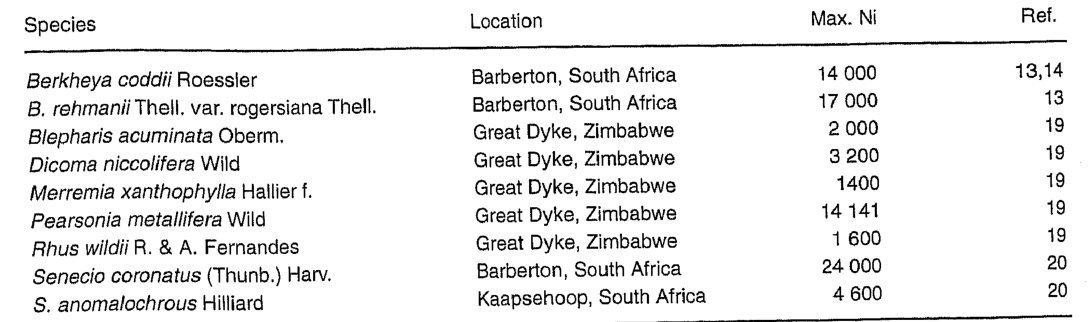
Plants that accumulate inordinately high concentrations of elements such as nickel are known as hyperaccumulators, defined as containing >1000 mg kg"' (ppm) in dry matter.! Since 1977, about 300 nickel hyperaccumulators have been discovered as well as 26 of cobalt, 24 of copper, 19 of selenium, 16 of zinc, 11 of manganese and one each of thallium and cadmium.?' The disproportionate number of nickel hyperaccumulators is possibly due to the large amount of effort expended on 'serpentine plants' from ultramafic areas. Nine hyperaccumulators (Table 1) have been reported from southern Africa, all confined to the Great Dyke in Zimbabwe and the Barberton/Kaapsehoop region of the Barberton Ultramafic Sequence in South Africa. 12 Removal of elements from soils has been termed phytoextraction? and may be subdivided into the two associated fields, phytoremediation and phytomining, each of which will be considered separately below.
能够累积极高浓度镍等元素的植物称为超富集植物,其定义为干物质中含量>1000 mg kg⁻¹(ppm)。自1977年以来,已发现约300种镍超富集植物,以及26种钴、24种铜、19种硒、16种锌、11种锰超富集植物,铊和镉超富集植物各1种。镍超富集植物数量不成比例地多,可能是由于对超基性地区“蛇纹岩植物”投入了大量研究。南部非洲已报道9种超富集植物(表1),均局限于津巴布韦的Great Dyke以及南非Barberton超基性岩系的Barberton/Kaapsehoop地区。12 从土壤中去除元素被称为植物提取,可细分为两个相关领域,即植物修复和植物采矿,下文将分别讨论。
From our field trials at Murlo, we envisage that a pilot project might involve the following programme: (1) select a suitable site where the topography permits ploughing, fertilizing of the serpentine soil and harvesting of the crop; (2) seed the site directly or plant out seedlings at a rate of approximately 16 plants per m (160 000 per ha); (3) after a period of 12 months, harvest all vegetation above 10 cm from the ground; (4) incinerate the crop and collect the bio-ore, which could be buried for disposal or sold ifof sufficient quantity.
根据我们在Murlo开展的田间试验,设想中试项目可包括以下步骤:(1)选择地形允许翻耕、对蛇纹岩土壤施肥及收获作物的适宜场地;(2)直接在场地播种,或按每m²约16株(每ha 160 000株)的密度移栽幼苗;(3)12个月后,收获离地10 cm以上的全部植被;(4)焚烧作物并收集生物矿石,可将其填埋处置,若数量足够也可出售。
There would be no problem in producing the seedlings, as A. bertolonii grows very quickly and produces a large quantity of viable seed that germinates in a few days. There should be no harvesting during the first season, to allow the plants to grow large enough in the second season for sustainable cropping.
幼苗生产不存在问题,因为A. bertolonii生长非常迅速,并能产生大量可在数天内萌发的有活力种子。第一个生长季不应收获,以使植株在第二个生长季长得足够大,从而实现可持续收获。
If the amount of bio-ore produced is too small to be valuable commercially, some of the costs of phytoremediation could be recouped by recovering some of the energy released during incineration of the biomass (17 500 kJ kg ' for cellulose material). If only 25% of this energy were recovered, US$118 ha' could be recovered from a 9 t ha' biomass."
若生物矿石产量过少而不具商业价值,可通过回收生物量焚烧过程中释放的部分能量(纤维素材料为17 500 kJ kg⁻¹)来收回植物修复的部分成本。即使仅回收其中25%的能量,9 t ha⁻¹的生物量也可收回118美元 ha⁻¹。
#Soil and Earth Sciences, Institute of Natural Resources, Massey University, Palmerston North, New Zealand, now deceased. Zealand.*Horticulture and Food Research Institute of New Zealand, Palmerston North, New
#梅西大学自然资源研究所土壤与地球科学系,新西兰Palmerston North,现已故。*新西兰园艺与食品研究所,新西兰Palmerston North。
*Rustenburg Base Metal Refiners, P.O. Box 483, Rustenburg, South Africa. *Dipartimento di Biologia Ambientale, Universitá di Siena, Siena, Italy. *Author for correspondence.
*Rustenburg贱金属精炼公司,P.O. Box 483,南非Rustenburg。*锡耶纳大学环境生物学系,意大利Siena。*通讯作者。
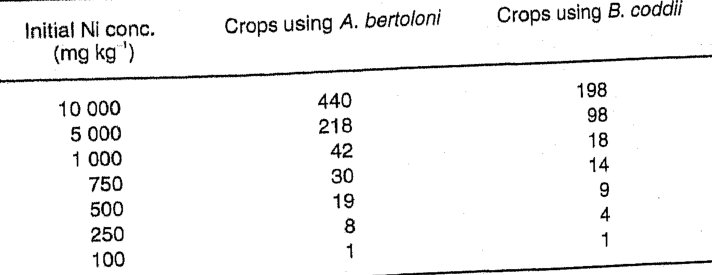
Whereas it would not be possible to phytoremediate natural substrates that are very heavily contaminated by geological processes, there is scope for use of this technique where anthropo- · a quarter of the energy of combustion of the biomass could be turned into electricity for a yield of $131 ha"; and genic causes, such as topdressing with fertilizers or use of sewage sludge over a long period, have resulted in light to · the return to the grower would be half of the gross yield of $765 ha' for the metal plus the energy yield of $131 ha moderate contamination. European Union (EU) guidelines for This compared well with the average returns from other crops. nickel in pastures receiving sewage sludge have been set at a maximum level of 75 mg kg', whereas background levels are The viability of nickel phytomining using S. polygaloides is now greater due to a higher nickel price. Recouping of the energy around 25 mg kg' for the U.K." It is possible to calculate the dividend depends on the scale of the phytomining operation, amount of nickel that potentially can be removed annually from whether the combustion plant could be supplied with industrial contaminated pastures using a crop of this species (Table 2).
对于因地质过程而受到极重度污染的天然基质,植物修复是不可行的;但在人为原因(如长期施用肥料或施用污水污泥)导致轻度至中度污染的情况下,该技术仍有应用空间。欧盟(EU)对施用污水污泥的牧场中镍的指导限值为最高75 mg kg⁻¹,而英国的背景值约为25 mg kg⁻¹。可以计算出利用该物种作物每年可从受污染牧场中去除的镍量(表2)。· 生物量燃烧能量的四分之一可转化为电能,收益为131美元 ha⁻¹;以及 · 种植者所得回报为金属总收益765美元 ha⁻¹的一半加上131美元 ha⁻¹的能量收益。这与其他作物的平均收益相比颇具竞争力。由于镍价上涨,利用S. polygaloides进行镍植物采矿的可行性目前更高。能量收益的回收取决于植物采矿运营的规模、燃烧设施能否获得工业废弃物供应等因素。
This compared well with the average returns from other crops. The viability of nickel phytomining using S. polygaloides is now greater due to a higher nickel price. Recouping of the energy dividend depends on the scale of the phytomining operation, whether the combustion plant could be supplied with industrial or domestic waste for the period when no biomass was available and whether there is a market for the energy.
这与其他作物的平均收益相比颇具竞争力。由于镍价上涨,利用S. polygaloides进行镍植物采矿的可行性目前更高。能量收益的回收取决于植物采矿运营的规模、在无生物量可用期间燃烧设施能否以工业或生活废弃物为原料,以及是否存在能源市场。
The high nickel concentration in B. coddii has been reported by Morrey et al! and Howes" in plants from the Barberton Ultramafic Sequence. Trials on phytomining" showed that B. coddii had some potential for phytoremediation of nickel-contaminated soils. The nickel concentration in this plant is about the same as in A. bertolonii, but its biomass is much higher. The number of crops required to decontaminate soils down to the EU limit is about half those needed for A. bertolonii (Table 2).
Morrey等以及Howes报道了Barberton超基性岩系中B. coddii植株的高镍浓度。植物采矿试验表明,B. coddii在镍污染土壤的植物修复方面具有一定潜力。该植物的镍浓度与A. bertolonii大致相同,但其生物量要高得多。将土壤净化至欧盟限值所需的种植茬数约为A. bertolonii的一半(表2)。
Field experiments with A. bertolonii achieved a nickel yield of about 63 kg ha. This would have been worth $332 in November 2001. Assuming that the return to the grower was half of this value and adding the energy bonus of $118, the gross return would be $284 ha' - some way below the price paid to a wheat grower ($500 ha) in the U.S. Without the energy yield, this crop would not be economic.
A. bertolonii的田间试验获得了约63 kg ha⁻¹的镍产量,按2001年11月价格计价值332美元。假设种植者获得其中一半,再加上118美元的能量收益,总收益为284美元 ha⁻¹,明显低于美国小麦种植者所得价格(500美元 ha⁻¹)。若无能量收益,该作物将不具经济性。
Plots of B. coddii showed that a dry biomass of 22 t ha' could be achieved after moderate fertilization." The nickel content of the plant was directly related to the extractable fraction of ammonium acetate in a wide range of natural and artificial substrata. Excision of shoots induced a marked increase in the nickel content in the new growth of the whole plant (5500 mg kg' cornpared with 1800 mg kg ). When plants were grown in pots with 0-1% nickel added to the substrate, the metal content of the plants rose to a maximum value of about 1% dry mass.44
B. coddii小区试验表明,适度施肥后干生物量可达22 t ha⁻¹。在多种天然及人工基质中,该植物的镍含量与乙酸铵可提取态镍直接相关。剪除地上部可显著提高整株新生部分的镍含量(5500 mg kg⁻¹,对照为1800 mg kg⁻¹)。在基质中添加0–1%镍的盆栽条件下,植物金属含量升至最高约1%干质量。44
Phytomining植物采矿
The concept of phytomining (growing a crop of a hyperaccumulator plant to recover the extracted metal) was proposed in 1983' and 1989.5 A patent was granted in 1998.4
植物采矿(种植超富集植物作物以回收其所提取的金属)的概念分别于1983年和1989年被提出。5 1998年获得了一项专利。4
The first detailed field trials on phytomining were carried out in 1994 by the U.S. Bureau of Mines, Reno, Nevada, 10,16,17 using a naturally occurring stand of a nickel hyperaccumulator, Streptanthus polygaloides A. Gray. The soil contained about 0.35% nickel, well below the economic range for conventional mining. It was proposed that a net return of $513 ha-' to the grower could be achieved, assuming that:
首批详细的植物采矿田间试验于1994年由位于内华达州Reno的美国矿务局开展,10,16,17 利用的是镍超富集植物Streptanthus polygaloides A. Gray的天然群落。土壤镍含量约为0.35%,远低于常规采矿的经济品位。据估计,种植者可获得513美元 ha⁻¹的净收益,前提假设为:
At the recorded mean concentration of 5000 mg kg-' nickel in field trials in New Zealand, a 1-ha crop of B. coddii would remove 110 kg of nickel, worth $579 in November 2001. Assuming that half of this sum is returned to the grower and adding the energy derived from the combustion of the plant material ($288), this translates to a total yield of $755 ha, which is above the value of a wheat crop ($500 ha-").
按新西兰田间试验中记录的平均镍浓度5000 mg kg⁻¹计算,1 ha B. coddii作物可去除110 kg镍,按2001年11月价格计价值579美元。假设其中一半返还给种植者,再加上植物材料燃烧所得能量(288美元),则总收益为755美元 ha⁻¹,高于小麦作物的产值(500美元 ha⁻¹)。
· selective breeding could produce plants with a minimum of 1% nickel in dry mass;
· 通过选育可获得干物质中镍含量至少为1%的植物;
· the world price of nickel was $7650 t' (it was $5260 t in November 2001);
· 镍的世界价格为7650美元 t⁻¹(2001年11月为5260美元 t⁻¹);
· the biomass yield after moderate fertilization was 10 t ha*;
· 适度施肥后的生物量产量为10 t ha⁻¹;
Berkheya coddi has several advantages over other phytomining candidates for use in North America and Europe:
在北美和欧洲,Berkheya coddi相较于其他植物采矿候选植物具有以下优势:
· its biomass is higher, and not at the expense of nickel concentration after fertilization;
· 其生物量更高,且施肥后并未以降低镍浓度为代价;
· it is a perennial that does not need to be resown each year;
· 它是多年生植物,无需每年重新播种;
· it is hardy, tolerating cool climatic conditions including frost;
· 它耐寒,能耐受包括霜冻在内的冷凉气候条件;
· it is easy to grow from fresh seed;
· 用新鲜种子易于繁殖;
· it could be grown as an annual crop during summer in areas that have severe winters;
· 在冬季严寒的地区可作为夏季一年生作物种植;
· it produces seed readily for future crops and the flowers are easily pollinated by bees; and
· 易于结籽以供后续种植,且花易由蜜蜂授粉;以及
· it is resistant to insect attack and soil pathogens when grown on nickel-rich soils.
· 在富镍土壤上生长时,对虫害和土传病原菌具有抗性。
A model of a possible economic phytomining system differentiates between annual and perennial crops and encompasses the questions of fertilization and soil exhaustion. The success or failure of a project will probably depend on whether or not some of
一种可能具有经济可行性的植物采矿系统模型区分了一年生和多年生作物,并涵盖了施肥和土壤耗竭等问题。项目的成败可能取决于能否回收
Assumptions: 1, plants both contain 5000 mg kg Ni; 2, soil has a density of 1.3; 3, plant roots extend to a soil depth of 15 cm.
假设:1,两种植物均含5000 mg kg⁻¹ Ni;2,土壤容重为1.3;3,植物根系延伸至15 cm土层深度。
the energy of combustion of raw material can be recovered. In the tropics, it should be possible to have crops maturing in each month, so that the incineration plant could be kept busy for the whole year or biomass could be stored in the field or near the incineration plant for burning according to the energy requirecontent is another approach that could be favourable for both phytoextractive technologies. Perhaps the ultimate answer is to introduce the gene responsible for hyperaccumulation into high-biomass non-accumulators such as Brassica nupus L., B. juncea Coss. or even other high-biomass crop plants such as
原料燃烧能量的一部分。在热带地区,应可实现每月都有作物成熟,使焚烧设施全年保持运转,或将生物量储存于田间或焚烧设施附近,按能源需求进行焚烧。选育生物量更高和/或金属含量更高的植物是可能对两种植物提取技术均有利的另一途径。最终的解决方案或许是将负责超富集的基因导入高生物量非富集植物,如Brassica napus L.、B. juncea Coss.,甚至其他高生物量作物,如
If phytomining proceeds beyond the theoretical and pilot plant stages, there are two possible scenarios that can be envis- 1. Brooks R.R., Lee J., Reeves R.D. and Jaffré T. (1977). Detection of nickeliferous rocks by analysis of herbarium specimens of indicator plants. I Cechen. Explor aged. The first of these presupposes a commercial project on a very large scale involving several square kilometres of 2. Brooks R.R. (ed.) (1998), Plants that Hypercumulate Heroy Metals. CAB Interna- metal-rich soils such as those derived from ultramafic rocks or tional, Wallingford. low-grade mineralization. The second scenario, perhaps the 3. Salt D.E., Blaylock M., Kumar N.PB.A., Dushenkov V., Ensley B, Chet I. and Raskin I. (1995). Phytoremediation: a novel strategy for the removal of toxic more likely, could involve phytomining being offered to metals from the environment using plants. Bio/Technology 13, 468-474. smallholders throughouta region in which a farmer might grow 4. Chaney R.L., Angle J.S., Baker A.M. and Li I-M. (1908). Method for a few hectares of plant material and have it collected for process- phytomining of nickel, cobalt and other metals from soil. U.S. Patent 5711784. ing at a nearby facility. This should preferably be close to a large 5. Baker A.J.M. and Brooks R.R. (1989). Terrestrial higher plants which hyperaccumulate metal elements: a review of their distribution, ecology and city, where industrial waste could also be used as feedstock for phytochemistry. Biorecovery 1, 81-126. the incineration plant, which in turn could supply steam for sup- 6. McGrath S.P., Sidoli C.M.D., Baker A.J.M.and Reeves R.D. (193). The potential plying electricity to the national grid. A similar system is carried for the use of metal-accumulating plants for the m stu decontamination of metal-polluted soils. In Integrated Soil and Sediment Research: A Basis for Proper out by the sugar industry in Queensland, where the waste Protection, eds H.J.P. Eijsackers and T. Hamers, pp. 673-676. Kluwer Academic, bagasse is burnt to produce electricity that supplies the sugar-processing plant and provides extra energy for sale to 7. Baker A.J.M., McGrath S.P, Sidoli C.M.D. and Reeves R.D. (1994). The possibility of in situ heavy metal decontamination of polluted soils using crops of local authorities. A country such as Brazil, which has large areas metal-accumulating plants. Kesources Conscreation Kroding 11,41-49. of subeconomic nickel mineralization and ultramafic soils, is an Banuelos C.and Terry N. (eds) (1999) Pro: Sump. Phyloremediation. Ah Int Conf. obvious site for this scenario. In Brazil, farmers have sought to Biogeochemistry of Trace Elements, 23-26 June 1997, Berkeley, Ann Arbor Press, grow crops such as soyabean over nickel-rich ultramafic soils 9. Robinson B.H., Chiarucci A., Brooks R.K., Petit D., Kirkman 1.11., Gregg BEH. and these crops have failed. The surrounding natural vegetation and Dominics V. (1997). The nickel hyperaccumulator plant Alvsun bertolnii was in contrast quite luxuriant and included several nickel as a potential agent for phytoremediation and phytomining of nickel. hyperaccumulators that would have grown quite well as an 10. Nicks L.J. and Chambers M.: (1995). Farming, tor metals. Mining emiron. alternative to failed soyabean crops (R.R. Brooks, pers. obs.). Magmt, Sept. 15-18.
如果植物采矿越过理论和中试阶段,可设想两种可能的情景。1. Brooks R.R., Lee J., Reeves R.D. and Jaffré T. (1977). Detection of nickeliferous rocks by analysis of herbarium specimens of indicator plants. I Cechen. Explor 第一种情景预设在富金属土壤(如源自超基性岩或低品位矿化的土壤)上开展面积达数平方千米的超大规模商业项目。2. Brooks R.R. (ed.) (1998), Plants that Hypercumulate Heroy Metals. CAB Interna- tional, Wallingford. 第二种情景可能性或许更大,即向整个区域的小农户推广植物采矿,3. Salt D.E., Blaylock M., Kumar N.PB.A., Dushenkov V., Ensley B, Chet I. and Raskin I. (1995). Phytoremediation: a novel strategy for the removal of toxic metals from the environment using plants. Bio/Technology 13, 468-474. 农户可种植数公顷植物材料,由附近设施收集加工。4. Chaney R.L., Angle J.S., Baker A.M. and Li I-M. (1908). Method for phytomining of nickel, cobalt and other metals from soil. U.S. Patent 5711784. 该设施最好靠近大城市,5. Baker A.J.M. and Brooks R.R. (1989). Terrestrial higher plants which hyperaccumulate metal elements: a review of their distribution, ecology and phytochemistry. Biorecovery 1, 81-126. 以便工业废弃物也可作为焚烧设施的原料,焚烧设施进而可提供蒸汽发电并入国家电网。6. McGrath S.P., Sidoli C.M.D., Baker A.J.M.and Reeves R.D. (193). The potential for the use of metal-accumulating plants for the m stu decontamination of metal-polluted soils. In Integrated Soil and Sediment Research: A Basis for Proper Protection, eds H.J.P. Eijsackers and T. Hamers, pp. 673-676. Kluwer Academic, 昆士兰的制糖业采用了类似的系统,将废弃甘蔗渣燃烧发电,为制糖厂供电,并向地方当局出售多余能源。7. Baker A.J.M., McGrath S.P, Sidoli C.M.D. and Reeves R.D. (1994). The possibility of in situ heavy metal decontamination of polluted soils using crops of metal-accumulating plants. Kesources Conscreation Kroding 11,41-49. 巴西等拥有大面积次经济品位镍矿化和超基性土壤的国家显然适合采用这一情景。Banuelos C.and Terry N. (eds) (1999) Pro: Sump. Phyloremediation. Ah Int Conf. Biogeochemistry of Trace Elements, 23-26 June 1997, Berkeley, Ann Arbor Press, 在巴西,农民曾尝试在富镍超基性土壤上种植大豆等作物,但均告失败。9. Robinson B.H., Chiarucci A., Brooks R.K., Petit D., Kirkman 1.11., Gregg BEH. and Dominics V. (1997). The nickel hyperaccumulator plant Alvsun bertolnii as a potential agent for phytoremediation and phytomining of nickel. 相比之下,周边天然植被则相当繁茂,其中包括数种镍超富集植物,它们本可作为失败大豆作物的替代而良好生长(R.R. Brooks,个人观察)。10. Nicks L.J. and Chambers M.: (1995). Farming, tor metals. Mining emiron. Magmt, Sept. 15-18.
1. Brooks R.R., Lee J., Reeves R.D. and Jaffré T. (1977). Detection of nickeliferous rocks by analysis of herbarium specimens of indicator plants. I Cechen. Explor
1. Brooks R.R., Lee J., Reeves R.D. and Jaffré T. (1977). Detection of nickeliferous rocks by analysis of herbarium specimens of indicator plants. I Cechen. Explor
10. Nicks L.J. and Chambers M.: (1995). Farming, tor metals. Mining emiron. Magmt, Sept. 15-18.
10. Nicks L.J. and Chambers M.: (1995). Farming, tor metals. Mining emiron. Magmt, Sept. 15-18.
11. McGrath S.P. (1995). Chromium and nickel. In Hey Metals in Soils, ed. B.J. Alloway, pp. 152-178. Blackie, Glasgow.
11. McGrath S.P. (1995). Chromium and nickel. In Hey Metals in Soils, ed. B.J. Alloway, pp. 152-178. Blackie, Glasgow.
2Conclusions结论
12. Morrey D.R., Balkwill K., Balkwill M-J. and Williamson S. (1992). A review of some studies of the serpentine flora of southern Africa. In The Vegetation of Ultramafic (Serpentine) Soils, eds A.J.M. Baker, I. Proctor and R.D. Reeves, pp. 147-157. Intercept, Andover, Hants.
12. Morrey D.R., Balkwill K., Balkwill M-J. and Williamson S. (1992). A review of some studies of the serpentine flora of southern Africa. In The Vegetation of Ultramafic (Serpentine) Soils, eds A.J.M. Baker, I. Proctor and R.D. Reeves, pp. 147-157. Intercept, Andover, Hants.
Phytoremediation and phytomining differ from each other in one important respect. The former is not dependent on world metal prices, whereas the latter is heavily dependent on them. Both techniques are essentially 'green' and thereby received more favourably by the general public, provided that the plants are not genetically engineered and are native to the area. Phytoremediation also is potentially less expensive than some of the other alternatives such as on-site vitrification or chemical processes such as washing soils with acids" or even physical removal of the contaminated soils.
植物修复与植物采矿在一个重要方面存在差异:前者不依赖世界金属价格,而后者则高度依赖金属价格。两种技术本质上都是“绿色”的,因而更易为公众所接受,前提是所用植物未经基因工程改造且为当地原生植物。与其他替代方案相比,如原位玻璃化、用酸清洗土壤等化学方法,甚至物理移除污染土壤,植物修复的成本也可能更低。
13. Howes A. (1991), Investigations intonickel hyperaccumulation in the plant Berkheya coddii. M.Sc. thesis, University of Natal, Pietermaritzbury.
13. Howes A. (1991), Investigations intonickel hyperaccumulation in the plant Berkheya coddii. M.Sc. thesis, University of Natal, Pietermaritzbury.
14. Robinson B.H., Brooks K.R., Gregg BEH. and Kirkman J.H. (1997). The potential of the high-biomass B. coddi for phytoremediation and phytomining. I. Geochem. Explor: 60, 115-126.
14. Robinson B.H., Brooks K.R., Gregg BEH. and Kirkman J.H. (1997). The potential of the high-biomass B. coddi for phytoremediation and phytomining. I. Geochem. Explor: 60, 115-126.
15. Chaney R.L. (1983), Plant uptake of inorganic waste constituents. In Land Treatment of Hazardous Wastes, eds JE Parr, PB. March and J.M. Kla, pp. 50-76. Noyes Data Corp., Park Ridge.
15. Chaney R.L. (1983), Plant uptake of inorganic waste constituents. In Land Treatment of Hazardous Wastes, eds JE Parr, PB. March and J.M. Kla, pp. 50-76. Noyes Data Corp., Park Ridge.
16. Nicks L.J. and Chambers M.E. (1994). Nickel farming. Discer Magazine, 19
16. Nicks L.J. and Chambers M.E. (1994). Nickel farming. Discer Magazine, 19
By tar the greatest limitation to phytomining is that its economics are governed by world metal prices. The price per ton of nickel, for example, fell from $7650 to $4000 between 1994 and 1998, then rose to over $10 000 in early 1999. Its price in September 2000 was $8500. Whereas in 1994 there might have been half a dozen plants with the favourable combination of high biomass and elevated nickel concentrations, in 1998 there would have been only one or two species, notably B. coddi and perhaps Alyssum corsicum Duby, that might have been suitable. This would not, however, preclude growing a crop of metal, burning the biomass and storing the bio-ore until world prices were more
迄今为止,植物采矿最大的限制在于其经济性受世界金属价格的制约。例如,每吨镍的价格在1994年至1998年间从7650美元降至4000美元,随后在1999年初升至10 000美元以上。2000年9月其价格为8500美元。1994年可能有六七种植物兼具高生物量和高镍浓度的有利组合,而到1998年,可能只有一两个物种适用,主要是B. coddi,或许还有Alyssum corsicum Duby。然而,这并不妨碍种植金属作物、焚烧生物量并储存生物矿石,直至世界价格更加
17. Nicks LI. and Chambers M.E. (1998). A pioneering study of the potential of phytomining for nickel. In Plants that Hyperaccumulate Heavy Metals, ed. R.R. Brooks, pp. 313-326. CAB International, Wallingford.
17. Nicks LI. and Chambers M.E. (1998). A pioneering study of the potential of phytomining for nickel. In Plants that Hyperaccumulate Heavy Metals, ed. R.R. Brooks, pp. 313-326. CAB International, Wallingford.
18. Reeves R.D., Brooks K.R. and Mcfarlane R.M. (1981), Nickel uptakeby Californian Streptanthus and Caulanths with particular reference to the hyperaccumulator S. polygalides Gray (Brassicaccac). Am. 1. Bot 68, 708-712.
18. Reeves R.D., Brooks K.R. and Mcfarlane R.M. (1981), Nickel uptakeby Californian Streptanthus and Caulanths with particular reference to the hyperaccumulator S. polygalides Gray (Brassicaccac). Am. 1. Bot 68, 708-712.
19. Brooks R.R. and Yang X.H. (1984). Elemental levels and relationships in the endemic serpentine flora of the Great Dyke, Zimbabwe and their significance as controlling factors for this flora. Taxon 33, 392-399.
19. Brooks R.R. and Yang X.H. (1984). Elemental levels and relationships in the endemic serpentine flora of the Great Dyke, Zimbabwe and their significance as controlling factors for this flora. Taxon 33, 392-399.
20, Mesjasz-Przybylowicz. L., Przybylowicz W.I., Rama D.H.K. and Pineda C.A. (1997). Elemental distribution in the Ni hyperaccumulator Seco anomalochrous. Proc. Microsc, Sue. shu Afr. 27,89.
20, Mesjasz-Przybylowicz. L., Przybylowicz W.I., Rama D.H.K. and Pineda C.A. (1997). Elemental distribution in the Ni hyperaccumulator Seco anomalochrous. Proc. Microsc, Sue. shu Afr. 27,89.
21. Iskandar 1.K. and Adriano D.C. (1997). Remediation of soils contaminated with metals: a review of current practices in the L.S.A. In Remediatio of Soils Contaminated with Metals, eds 1.K. Iskandar and D.C. Adriano, pp. 1-26. Science Reviews, Northwood.
21. Iskandar 1.K. and Adriano D.C. (1997). Remediation of soils contaminated with metals: a review of current practices in the L.S.A. In Remediatio of Soils Contaminated with Metals, eds 1.K. Iskandar and D.C. Adriano, pp. 1-26. Science Reviews, Northwood.
Selective breeding of plants with higher biomass and/or metal
选育生物量更高和/或金属