JOURNAL OF PLANT NUTRITION, 24(8), 1205-1215 (2001)
UPTAKE OF THALLIUM BY
VEGETABLES: ITS SIGNIFICANCE FOR
HUMAN HEALTH, PHYTOREMEDIATION,
AND PHYTOMINING
Cher LaCoste,' Brett Robinson,2* and Robert Brooks' of New Zealand, Palmerston North,
'Soil and Earth Sciences, Institute of Natural Resources, Massey University, Palmerston North, New Zealand
2The Horticultural and Food Research Institute
New Zealand
1ABSTRACT摘要
Eleven common vegetables (green bean, beetroot, green cabbage, lettuce, onion, pea, radish, spinach, tomato, turnip, and watercress) as well as the thallium hyperaccumulator Iberis intermedia, were grown in pot trials containing 0.7 and 3.7 mg/kg thallium added to a silt loam soil. The aims of the experiments were threefold: to estimate risks to human health of vegetables grown in thallium-rich soils, to demonstrate the potential of crops of these plants to remove thallium from polluted soils (phytoremediation), and finally to establish the degree to which part of the costs of remediation could be recouped by selling the extracted thallium (phytomining). Maximum thallium levels ranged from nearly 400 mg/kg (d.m.) in Iberis down to just over 1 mg/kg in green bean. The four vegetables with the highest
在添加了0.7和3.7 mg/kg铊的粉砂壤土中开展盆栽试验,种植了11种常见蔬菜(菜豆、甜菜根、绿甘蓝、生菜、洋葱、豌豆、萝卜、菠菜、番茄、芜菁和豆瓣菜)以及铊超富集植物Iberis intermedia。试验目的有三:评估在富铊土壤中种植的蔬菜对人体健康的风险;论证种植这些植物清除污染土壤中铊的潜力(植物修复);最后确定通过出售所提取的铊可收回修复成本的程度(植物采矿)。铊的最高含量从Iberis中的近400 mg/kg(干重)到菜豆中的略高于1 mg/kg不等。铊含量最高的四种蔬菜
*Corresponding author.
Copyright © 2001 by Marcel Dekker, Inc.
Copyright © 2001 by Marcel Dekker, Inc.
www.dekker.com 1206 LACOSTE, ROBINSON, AND BROOKS thallium levels (watercress, radish, turnip and green cabbage) were all Brassicaceous plants, followed by the Chenopods beet and spinach. At a thallium concentration of 0.7 mg/kg in the soil only green bean, tomato, onion, pea and lettuce would be safe for human consumption. At 3.7 mg/kg thallium, only green bean and tomato could be eaten. The Iberis had by far the best potential for phytoremediation of thallium-contaminated land and would need 5 sequential croppings to reduce 1 mg/kg thallium to 0.1 mg/kg in the soil. By contrast rape would take 9 years and green cabbage over 30 years. Some of the costs of phytoremediation might be recouped by selling the thallium which currently has a world price of $US300/kg. It was concluded that phytoremediation of thallium-contaminated soils containing >1 mg/kg thallium will never be feasible by use of common vegetables. For soils containing 1 mg/kg thallium or less, use would have to be made of Iberis intermedia or Brassica napus (rape) rather than common vegetables. Key words: Thallium; Iberis intermedia; Phytoremediation; Phytomining; Green bean; Beetroot; Green cabbage; Lettuce; Onion; Pea; Radish; Spinach; Tomato; Turnip; Watercress. INTRODUCTION Thallium is a highly toxic metal with a crustal abundance of about 0.7 mg/ kg (ppm). Its toxicity is comparable to that of cyanide and it is used for rat poison and for the control of ants. It is also used in the electronics industry for semiconductors, switches and fuses. Thallium minerals are quite rare and are found almost exclusively in the realgar (arsenic) deposits of Allchar (Alsar) in Macedonia. High concentrations of thallium have been found in plants and domestic animals in the Allchar region (1). The current world price of thallium is about SUS300/kg. Anomalous levels of thallium in soils are derived from three main sources. The first of these is natural and is related to the geochemistry of the local rocks (2,3). The second source is anthropogenic as a result of mining of sulphide liberalization that usually contains a significant level of thallium. An example of this is the mining district of Les Malines along the southern margin of the Massif Central near Montpellier in France (4). A third significant source is the thallium derived from burning of coal at cement works in various countries and most significantly in Germany. It is probable that the contamination is derived from the raw materials used to make cement, rather than from the burning of coal in itself,
www.dekker.com 1206 LACOSTE, ROBINSON, AND BROOKS (豆瓣菜、萝卜、芜菁和绿甘蓝)均为十字花科植物,其次为藜科的甜菜和菠菜。当土壤铊浓度为0.7 mg/kg时,仅菜豆、番茄、洋葱、豌豆和生菜可供人类安全食用;当铊浓度为3.7 mg/kg时,仅菜豆和番茄可以食用。Iberis用于铊污染土地植物修复的潜力远高于其他植物,需连续种植5茬即可将土壤中铊含量由1 mg/kg降至0.1 mg/kg;相比之下,油菜需9年,绿甘蓝则需30年以上。出售铊(目前国际价格为300美元/kg)可收回部分植物修复成本。研究得出结论:利用常见蔬菜对铊含量>1 mg/kg的污染土壤进行植物修复永远不可行;对于铊含量不超过1 mg/kg的土壤,须采用Iberis intermedia或Brassica napus(油菜),而非常见蔬菜。关键词:铊;Iberis intermedia;植物修复;植物采矿;菜豆;甜菜根;绿甘蓝;生菜;洋葱;豌豆;萝卜;菠菜;番茄;芜菁;豆瓣菜。引言 铊是一种剧毒金属,其地壳丰度约为0.7 mg/kg(ppm)。其毒性与氰化物相当,被用作灭鼠药及防治蚂蚁。铊还用于电子工业中的半导体、开关和保险丝。铊矿物相当稀少,几乎只见于马其顿Allchar(Alsar)的雄黄(砷)矿床中。在Allchar地区的植物和家畜体内均发现了高浓度的铊(1)。目前铊的国际价格约为300美元/kg。土壤中铊的异常含量主要有三个来源。第一种为自然来源,与当地岩石的地球化学特征有关(2,3)。第二种为人为来源,源于硫化物矿化的开采,此类矿化通常含有相当数量的铊,法国蒙彼利埃附近中央高原南缘的Les Malines矿区即为一例(4)。第三个重要来源是多个国家(最显著的是德国)水泥厂燃煤所产生的铊。该污染很可能来源于制造水泥所用的原料,而非燃煤本身,
UPTAKE OF THALLIUM BY VEGETABLES 1207 otherwise significant thallium contamination would be found at all coalburning sites. Elevated concentrations of up to 20 mg/g (dry weight) thallium have been found in French vegetables (particularly in green cabbage) and up to 40 mg/g in rape seed (Brassica napus L.) (2,3,5). Thallium has been found to be accumulated by food crops, particularly Brassicaceous plants (6,7) where up to 24 mg/kg thallium (d.m. = dry mass) was found in kale growing on contaminated soils containing only 1.4 mg/kg of this metal. It was, however, discovered that different cultivars of green cabbage have thallium levels (d.w.) ranging downwards from 24 mg/kg to as little as 1 mg/kg (6). Sequential cropping by use of cultivars with the highest thallium concentrations might be used to reduce the thallium burden of the contaminated soils to an acceptable level within 10 years. Inordinately high accumulation (hyperaccumulation) of thallium was discovered in two plants from Les Malines (4,8); Iberis intermedia and Biscutella laevigata, that could contain respectively 0.4% and 1.94% thallium d.m. (8). Either or both of these species could rapidly remove the thallium burden of contaminated soils. Because of the high value of thallium, there should be some potential to recoup some of the costs of phytoremediation by recovery of thallium from the biomass. Thallium concentrations in plants have excited the most interest from scientists concerned with potential harmful effects on animals and humans. In France, inordinately high uptake of thallium by plants of the Brassicaceae such as Iberis intermedia, Biscutella laevigata and Brassica napus has been reported (2,3,4,5,8). This high uptake clearly poses a risk to human and animal health in specific regions of Europe and possibly elsewhere. Thallium is a relatively obscure metal that, until recently, has received little attention for its potential toxicity in animal or human nutrition. It is difficult to find specific recommendations by health authorities concerning allowable levels in foods and feedstuffs. However, a permissible range of 0.45-2.28 mg/kg thallium (d.m.) for animal feed has been proposed for Germany (9). A value of 0.25-0.5 mg/kg (f.m. = fresh mass) has been proposed (10) for human foods. Assuming a 12% conversion factor for f.m. to d.m., the recommended value is therefore about 2-4 mg/kg d.m. for humans. It is our opinion that this level is too high in comparison with levels set for animal feeds and that the former standard should also apply to human nutrition. It is clear from the published data that most crops grown in thallium-contaminated soils will have unacceptably high concentrations of this toxic metal. The aim of the work presented below was to obtain independent data for thallium levels in common New Zealand vegetables intended solely for human consumption and to assess their risk for human consumption. Two further aims were to examine the possibility of using thallium-uptake by crops of these plants
蔬菜对铊的吸收 1207 否则所有燃煤场地都会出现显著的铊污染。在法国蔬菜(尤其是绿甘蓝)中发现了高达20 mg/g(干重)的铊,在油菜(Brassica napus L.)籽中则高达40 mg/g(2,3,5)。研究发现粮食作物,尤其是十字花科植物,可累积铊(6,7):生长在铊含量仅为1.4 mg/kg的污染土壤上的羽衣甘蓝中铊含量高达24 mg/kg(d.m. = 干物质量)。然而,研究还发现不同绿甘蓝品种的铊含量(干重)从24 mg/kg低至仅1 mg/kg不等(6)。采用铊浓度最高的品种进行连续种植,可在10年内将污染土壤的铊负荷降至可接受水平。在Les Malines的两种植物中发现了对铊的异常高累积(超富集)(4,8):Iberis intermedia和Biscutella laevigata,其铊含量分别可达干物质量的0.4%和1.94%(8)。这两个物种中的任一种或两种均可迅速清除污染土壤中的铊负荷。由于铊价值高昂,通过从生物质中回收铊,应有一定潜力收回部分植物修复成本。植物中的铊浓度最受关注其对动物和人类潜在有害影响的科学家的重视。在法国,已有报道称十字花科植物如Iberis intermedia、Biscutella laevigata和Brassica napus对铊的吸收异常高(2,3,4,5,8)。这种高吸收显然对欧洲特定地区乃至其他地区的人类和动物健康构成风险。铊是一种相对鲜为人知的金属,直到最近,其在动物或人类营养中的潜在毒性才受到关注。卫生部门关于食品和饲料中铊允许含量的具体建议难以查到。不过,德国曾提出动物饲料中铊的允许范围为0.45-2.28 mg/kg(干物质量)(9)。另有研究提出人类食品的限值为0.25-0.5 mg/kg(f.m. = 鲜物质量)(10)。假定鲜重与干重的换算系数为12%,则人类食品的推荐值约为2-4 mg/kg干物质量。我们认为,与动物饲料的限值相比,该水平过高,前一标准也应适用于人类营养。已发表的数据清楚表明,在铊污染土壤中种植的大多数作物中这种有毒金属的浓度都将高至不可接受的水平。本研究的目的是获取新西兰专供人类食用的常见蔬菜中铊含量的独立数据,并评估其对人类食用的风险。另外两个目的是考察利用这些植物作物对铊的吸收
LACOSTE, ROBINSON, AND BROOKS for phytoremediation (removal of pollutants by plants) and phytomining (growing
LACOSTE, ROBINSON, AND BROOKS 进行植物修复(利用植物去除污染物)和植物采矿(种植
a crop of a metal).
金属“作物”)的可能性。
Since naturally occurring high-thallium soils were not available to us, we prepared mixtures of thallium added to a local silt loam. We also grew Iberis
由于无法获得天然高铊土壤,我们在当地粉砂壤土中添加铊制备了混合基质。我们还种植了Iberis
intermedia in these mixtures in order to serve as a control because we had already
intermedia于这些混合基质中作为对照,因为我们此前已
studied wild plants of this species growing under natural conditions at Les
研究过该物种在法国南部Les
Malines in southern France and could thereby obtain a factor to relate apparent concentrations of thallium in pot-grown plants to those to be expected in vegetables grown under similar wild conditions.
Malines自然条件下生长的野生植株,从而可获得一个系数,将盆栽植物中的表观铊浓度与类似野外条件下种植的蔬菜中的预期铊浓度联系起来。
2MATERIALS AND METHODS材料与方法
The names of plants used in the present study are shown in Table 1. They include Iberis intermedia and 11 vegetables commonly grown in New Zealand
本研究所用植物的名称见表1,包括Iberis intermedia和11种新西兰常见蔬菜
Plants were grown in the local Manawatu Silt Loam to which was added approximately 1.0 and 5.0 mg/kg (ppm) thallium as the sulphate. Thallium-free controls were also used. The top 15 cm of soil had a pH of 5.7, total organic carbon 6.3%, and exchange capacity of 13.4 meq/100 g. The P concentration was granules at a rate recommended by the manufacturer. The soils were placed in 1 L plastic pots and allowed to stand on damp felt for two weeks with constant watering and reanalyzed before planting to give the equilibrium concentration of thallium left bound to the soil (largely in the humus) after the unbound thallium
植物种植于当地的Manawatu粉砂壤土中,土壤中以硫酸盐形式分别添加约1.0和5.0 mg/kg(ppm)铊,并设不加铊的对照。表层15 cm土壤的pH为5.7,总有机碳为6.3%,交换量为13.4 meq/100 g。P浓度为颗粒,施用量按生产商推荐。将土壤装入1 L塑料盆中,置于湿毡上静置两周并持续浇水,种植前重新分析,以确定未结合的铊
30 mg/kg. The soils contained 3-4 month Osmocote slow release fertilizer
30 mg/kg。土壤中含有3-4个月缓释的Osmocote肥料
Table 1. Species and Cultivars Used in Experiments表1. 试验所用物种及品种
Common Name
Cultivar/Trade Name
品种/商品名
Species Family
Phaseolus vulgaris
Green bean
Fabaceae Tendergreen
Chenopodaceae Derwent Globe
藜科 Derwent Globe
Beetroot
Beta vulgaris
Green cabbage Brassica oleracea
绿甘蓝 Brassica oleracea
Brassicaceae Early Ball
十字花科 Early Ball
Iberis intermedia Brassicaceae Iberis
Iberis intermedia 十字花科 Iberis
Iberis
Lactuca sativa Asteraceae Great Lakes
Lactuca sativa 菊科 Great Lakes
Lettuce
Onion
Liliaceae Pukekohe Longkeeper
百合科 Pukekohe Longkeeper
Allium cepa
Fabaceae Greenleaf
Pisum sativum
Pea
Brassicaceae Salad Crunch
十字花科 Salad Crunch
Raphanus sativus
Spinaceae oleracea Chenopodaceae Winter Queen Lycopersicon esculentum Solanaceae Groslisse
Spinaceae oleracea 藜科 Winter Queen Lycopersicon esculentum 茄科 Groslisse
Spinach
Tomato
Brassicaceae Purple Top
十字花科 Purple Top
Brassica rapa
Turnip
Nasturtium officinale Brassicaceae
Nasturtium officinale 十字花科
Watercress
UPTAKE OF THALLIUM BY VEGETABLES 1209 had been leached from these substrates. Seedlings of all 12 species were raised separately in commercial seed-raising mixture and then transplanted into the large pots. The plants were allowed to grow for 12 weeks in a greenhouse maintained at 15°-25°C with no humidity control. Pots were watered as required (usually every second day) and the pots switched around in a random manner to allow for equalization of light intensity. Five replicates for each treatment and for each species (180 in total) were prepared. After the 12-week period, the plants were harvested and dried at 60°C before analysis. At harvest time, composite samples of the substrate were collected and dried before analysis. Vegetation and soil samples were digested with concentrated nitric acid on a hotplate (0.5 g samples + 10 mL of acid) and evaporated to low volume (ca 1 mL). The samples were then diluted to about 15 mL with distilled water and analyzed for thallium either by flame atomic absorption spectrometry (FAAS) for samples with higher thallium concentrations, or by graphite furnace atomic absorption spectrometry (GFAAS) for lower concentrations of thallium. Care was taken to avoid the use of hydrochloric acid because the volatility of thallium in the presence of chloride would have precluded the use of GFAAS
蔬菜对铊的吸收 1209 从这些基质中淋溶后仍结合于土壤中(主要结合于腐殖质中)的铊的平衡浓度。全部12个物种的幼苗分别在商品育苗基质中培育,然后移栽至大盆中。植物在温度维持在15°-25°C、无湿度控制的温室中生长12周。根据需要浇水(通常每隔一天一次),并随机调换花盆位置以使光照强度均衡。每个物种每个处理设5个重复(共180盆)。12周后收获植物,于60°C烘干后进行分析。收获时采集基质混合样品,烘干后分析。植物和土壤样品在电热板上用浓硝酸消解(0.5 g样品 + 10 mL酸),蒸发至低体积(约1 mL)。然后用蒸馏水稀释至约15 mL,铊含量较高的样品采用火焰原子吸收光谱法(FAAS)测定,含量较低的样品采用石墨炉原子吸收光谱法(GFAAS)测定。注意避免使用盐酸,因为在氯离子存在时铊具有挥发性,将无法使用GFAAS
RESULTS AND DISCUSSION Experimental Data Thallium concentrations in whole plants of Iberis intermedia, Brassica juncea and in edible parts (roots or tops depending on plant) of 11 common vegetables are shown in Figure 1. The biological absorption coefficients (BAC = plant/substrate concentration quotient) for thallium in all the test plants are shown in Table 2 as their maximum values. It is noteworthy that whereas Iberis intermedia in its natural environment over thallium-rich tailings in southern France (Les Malines) had a mean of 1190 mg/kg thallium (d.m.), maximum of 3070 mg/kg, and mean BAC of 74 (4), the respective values for the pot-grown plants were 281, 408, and 76 for a potting medium with 3.7 mg/kg thallium. There is close agreement between the two BAC values. The higher means and maxima for the French plants result from the much higher thallium concentration (16 mg/kg) in the soil. It will be observed from Fig. 1 that the four vegetables with the highest maximum or mean thallium levels, watercress, radish, turnip and green cabbage are all Brassicaceous. Analogous experiments have been carried out (6) with various vegetables including green cabbage for which a mean of 13.7 mg/kg thallium was reported when grown in a soil containing 1.4 mg/kg thallium.
结果与讨论 试验数据 Iberis intermedia、Brassica juncea整株植物以及11种常见蔬菜可食部分(根据植物不同为根或地上部)中的铊浓度见图1。所有供试植物对铊的生物吸收系数(BAC = 植物/基质浓度之比)最大值列于表2。值得注意的是,在法国南部(Les Malines)富铊尾矿上自然生长的Iberis intermedia铊含量平均为1190 mg/kg(干物质量),最大值为3070 mg/kg,平均BAC为74(4);而在含铊3.7 mg/kg的盆栽基质中生长的植株,相应数值分别为281、408和76。两个BAC值非常接近。法国植株较高的平均值和最大值源于其土壤中高得多的铊浓度(16 mg/kg)。由图1可见,铊最高含量或平均含量最高的四种蔬菜——豆瓣菜、萝卜、芜菁和绿甘蓝——均为十字花科植物。已有研究以包括绿甘蓝在内的多种蔬菜开展了类似试验(6),报道绿甘蓝生长在含铊1.4 mg/kg的土壤中时平均铊含量为13.7 mg/kg。
LACOSTE, ROBINSON, AND BROOKS
LACOSTE, ROBINSON, AND BROOKS
* No plants survived in highest treatment
* 最高处理中无植物存活
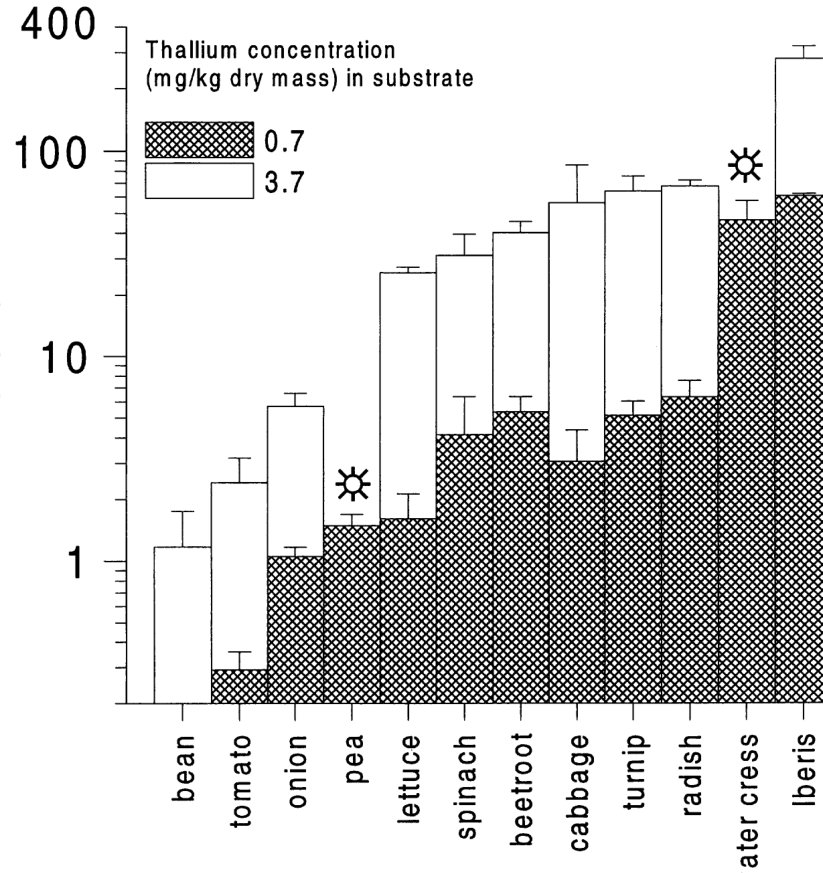
We found 3 mg/kg thallium in green cabbage growing in 0.7 mg/kg thallium and 58 mg/kg in 3.7 mg/kg thallium. The results are therefore somewhat comparable.
我们发现,生长在含铊0.7 mg/kg基质中的绿甘蓝铊含量为3 mg/kg,生长在含铊3.7 mg/kg基质中的为58 mg/kg。因此两项结果具有一定可比性。
Watercress when grown in a substrate with 0.7 mg/kg thallium, accumulated almost as much thallium (48 mg/kg) as the Iberis, but did not survive at the higher metal concentration. A similar behavior has been observed (11) for the
豆瓣菜生长在含铊0.7 mg/kg的基质中时,累积的铊(48 mg/kg)几乎与Iberis相当,但在较高金属浓度下未能存活。已有研究观察到(11)
UPTAKE OF THALLIUM BY VEGETABLES
蔬菜对铊的吸收
Table 2. Maximum Values of Biological Absorption Coefficients (BAC)* for Thallium in表2. 植物对铊的生物吸收系数(BAC)*最大值
Plants 0.7 mg/kg Thallium in Substrate 3.7 mg/kg Thallium in Substrate
植物 基质铊含量0.7 mg/kg 基质铊含量3.7 mg/kg
Plant
Max. Thallium** BAC Max. Thallium** BAC n.d.
最大铊含量** BAC 最大铊含量** BAC n.d.
Green bean
3.49 0.94
n.d.
Beetroot 8.75 12.5 52.0 14.0 7.85 11.2 129 34.9
Green cabbage 87.0 408 110
Iberis intermedia
Iberis intermedia 60.9 87.0 Lettuce 3.1 Onion 1.42 Pea 1.82 Radish 10.4 14.9 Spinach 15.9 22.7 Tomato 0.53 Turnip 7.8 11.1 Watercress 84.4 121
Iberis intermedia 60.9 87.0 生菜 3.1 洋葱 1.42 豌豆 1.82 萝卜 10.4 14.9 菠菜 15.9 22.7 番茄 0.53 芜菁 7.8 11.1 豆瓣菜 84.4 121
Lettuce
4.42 30.8 8.32 2.02 8.44 2.28
Pea
2.60 n.s. n.s. 14.9 70.0 18.9 22.7 48.7 13.2
Spinach 0.76 4.95 1.33
11.1 139 37.6
n.s.
n.s.
*Plant/soil thallium concentration quotient.
*植物/土壤铊浓度之比。
**Thallium concentration in plant (mg/kg dry mass).
**植物中铊浓度(mg/kg干物质量)。
n.d. -not determined; n.s. -no survival.
n.d. — 未测定;n.s. — 未存活。
uptake of arsenic by this plant. Over 300 mg/kg d.m. was found in plants growing near a geothermal source in the Waikato River, New Zealand.
该植物对砷的吸收也有类似表现:在新西兰怀卡托河地热源附近生长的植株中砷含量超过300 mg/kg(干物质量)。
The next highest thallium levels were found in the Chenopods beet and spinach. There were low levels of thallium in pea and green bean (Fabaceae) and distant physiologically from the rhizosphere than are leaves, so that these lower thallium levels may be a reflection of this greater isolation whereby translocation
铊含量次高的是藜科的甜菜和菠菜。豌豆和菜豆(豆科)中的铊含量较低,与叶片相比,其在生理上距根际更远,因此这些较低的铊含量可能反映了这种更大的隔离程度,即铊向果实的转运
in the tomato (Solanaceae). In the pea and tomato the edible parts are further
番茄(茄科)中铊含量也较低。豌豆和番茄的可食部分
of thallium to the fruits was less than to the leaves.
少于向叶片的转运。
Health Hazards of Ingestion of Thallium-Rich Vegetables poisoning of humans by exposure to, or ingestion of, thallium (12). There are,
食用富铊蔬菜的健康危害 人类因接触或摄入铊而中毒的报道(12)。然而,
The health hazards inherent in consuming vegetables growing in thallium-
食用生长在富铊土壤中的蔬菜所固有的健康危害
rich soils are difficult to establish because of the lack of data on long-term effects
难以确定,因为缺乏关于人体长期摄入铊的影响
of thallium ingestion by humans. There are many reports on the clinical effects of
的数据。关于临床效应已有许多
however, few sources that pinpoint the acceptable daily intake (ADI) of thallium
明确指出人体对铊的每日允许摄入量(ADI)的资料却很少,
by humans, a toxic metal described as a new environmental contaminant (10).
而铊是一种被称为新型环境污染物的有毒金属(10)。
The toxic effects of thallium on humans are linked partly to the readiness
铊对人体的毒性作用部分与其易于
1212 LACOSTE, ROBINSON, AND BROOKS whereby TIt substitutes for K· as an activator of some reactions catalyzed by enzymes. The monovalent thallium ion has an especial affinity for SH- groups and can cause disorders of metabolic or energy processes in cells of animals. In Europe (9) a maximum thallium level of 0.46-2.24 mg/kg d.m. for animal forage has been proposed. If we adopt the same maximum level of about 2 mg/kg d.m. thallium in human food as being acceptable for human health, it is clear from our data (Fig. 1) that only green beans, tomato, onion, pea and lettuce would be safe to eat if grown in soils containing 0.7 mg/kg thallium. However, it has been shown (7) that under field conditions, levels of thallium in vegetables were usually only one third of those found in pot-grown plants due to a lower root density in the field. Therefore, if the thallium levels in Fig. 1 are reduced to a third to make the conversion from pot-grown to field-grown plants, all of the vegetables except for radish and watercress could be added to the list that are sate to eat. For highly contaminated soils with 3.7 mg/kg thallium, only green bean, and tomato would have permissible concentrations of thallium. Although we do not have values for vegetables grown at various thallium concentrations between the limits of 0.7 and 3.7 mg/kg in the soil, extrapolation of the data indicates that even at a thallium concentration of 1 mg/kg, most of the vegetables and certainly spinach, beetroot, green cabbage and turnip would be unfit for human consumption. Phytoremediation of Thallium-Contaminated Soils The use of vegetables and other Brassicaceous plants as a means of phytoremediation of thallium-contaminated soils has already been proposed (4,6,7,8,13,14). It has been shown (6) that he cropping of rape (Brassica napus) and green cabbage in one growing season together, removed 6-8% of the thallium burden from the top 30 cm of contaminated soil. Using the high biomass Iberis intermedia growing over thallium-contaminated mine tailings at Les Malines in southern France, it was shown (4) that this plant with its very high thallium concentration (1190 mg/kg d.m.) could remove most of the thallium from the substrate in only three croppings. This does however presuppose that thallium yields were the same after each cropping. During three sequential croppings with green cabbage, thallium removal decreased from 50 mg/kg of soil in the first year to 20 mg/kg in the third (6). From our own data (Table 3) it was possible to calculate annual removal of thallium from field crops of the plants used in our experiments. These experiments had been carried out as pot trials and it had been shown that field crops usually gave only one third of the annual removal of thallium compared with pot trials with their greater density of root development (6). Our calculated value of 81 g/ha of thallium removed by green cabbage (i.e., one third of the mean for the two sets of experiments) is within the range of 59-133 g/ha reported for
1212 LACOSTE, ROBINSON, AND BROOKS 以Tl+替代K+作为某些酶催化反应的激活剂有关。一价铊离子对SH-基团具有特殊亲和力,可导致动物细胞代谢或能量过程紊乱。欧洲已提出动物饲草中铊的最高限值为0.46-2.24 mg/kg干物质量(9)。若采用约2 mg/kg干物质量这一相同最高限值作为人类食品中可接受的铊含量,则由我们的数据(图1)可知,在含铊0.7 mg/kg的土壤中种植时,仅菜豆、番茄、洋葱、豌豆和生菜可安全食用。然而,已有研究表明(7),由于田间根系密度较低,田间条件下蔬菜中的铊含量通常仅为盆栽植物的三分之一。因此,若将图1中的铊含量降至三分之一以完成从盆栽植物到田间植物的换算,则除萝卜和豆瓣菜外,所有蔬菜均可列入可安全食用的名单。对于含铊3.7 mg/kg的重度污染土壤,仅菜豆和番茄的铊浓度处于允许范围内。尽管我们没有土壤铊浓度介于0.7与3.7 mg/kg之间时所种蔬菜的数据,但对数据进行外推表明,即使在铊浓度为1 mg/kg时,大多数蔬菜,尤其是菠菜、甜菜根、绿甘蓝和芜菁,都不适合人类食用。铊污染土壤的植物修复 已有研究提出利用蔬菜及其他十字花科植物对铊污染土壤进行植物修复(4,6,7,8,13,14)。研究表明(6),在一个生长季内同时种植油菜(Brassica napus)和绿甘蓝,可去除污染土壤表层30 cm中6-8%的铊负荷。利用在法国南部Les Malines铊污染尾矿上生长的高生物量植物Iberis intermedia,研究表明(4),该植物凭借其极高的铊浓度(1190 mg/kg干物质量),只需收割三茬即可去除基质中的大部分铊。但这是以每茬收割后铊产量不变为前提的。在连续三茬种植绿甘蓝的过程中,铊去除量从第一年的50 mg/kg土壤降至第三年的20 mg/kg(6)。根据我们自己的数据(表3),可以计算本试验所用植物田间作物的年铊去除量。本试验为盆栽试验,而已有研究表明,由于盆栽试验根系发育密度更大,田间作物的年铊去除量通常仅为盆栽试验的三分之一(6)。我们计算得出绿甘蓝的铊去除量为81 g/ha(即两组试验平均值的三分之一),处于已报道的59-133 g/ha范围之内
UPTAKE OF THALLIUM BY VEGETABLES
蔬菜对铊的吸收
Table 3. The Potential of Plants for Phytoremediation of Thallium-Contaminated Soils表3. 植物对铊污染土壤的植物修复潜力
3.7 mg/kg Thallium in Substrate 0.7 mg/kg Thallium in Substrate
基质铊含量3.7 mg/kg 基质铊含量0.7 mg/kg
B C D E F
Species
Iberis
Iberis 10.0 300 3000 60 600 1800 600 Radish 0.9 68 61 6.0 5.4 33 11 Turnip 3.6 64 230 5.3 19 125 42 Green cabbage 8.4 55 462 3.0 25 244 81* Beet 6.7 42 281 5.5 37 159 53 Sp·nach 5.4 33 178 4.2 23 100 33 Lettuce 6.0 25 150 1.8 11 80 27 Onion 5.8 33 1.2 1.2 7 20 7 Tomato 9.0 2.5 22 0.1 0.9 12 4
Iberis 10.0 300 3000 60 600 1800 600 萝卜 0.9 68 61 6.0 5.4 33 11 芜菁 3.6 64 230 5.3 19 125 42 绿甘蓝 8.4 55 462 3.0 25 244 81* 甜菜 6.7 42 281 5.5 37 159 53 菠菜 5.4 33 178 4.2 23 100 33 生菜 6.0 25 150 1.8 11 80 27 洋葱 5.8 33 1.2 1.2 7 20 7 番茄 9.0 2.5 22 0.1 0.9 12 4
Sp·nach
Green
bean 1.6 1.2 2.0 2.0 0.7 Pea 1.1 1.6 1.8 1.8 0.6
*Literature value (6) was about 60 g/ha.
*文献值(6)约为60 g/ha。
A = biomass (tonnes/ha) (9), B = mean thallium concentration in mg/kg d.m., C = thallium
A = 生物量(t/ha)(9),B = 平均铊浓度(mg/kg干物质量),C = 铊
removed (A × B) in g/ha, D= as B, E= as C, F = mean of C + D, G= F divided by 3 to
去除量(A × B,g/ha),D = 同B,E = 同C,F = C与D的平均值,G = F除以3,以
make allowance for lower yields under field conditions (Kurz et al. 1997).
考虑田间条件下产量较低的情况(Kurz et al. 1997)。
the same plant (6). Among the plants studied by us, only green cabbage, turnip,
(同一植物)(6)。在我们所研究的植物中,仅绿甘蓝、芜菁、
red beet and spinach would have potential for phytoremediation of thallium-
红甜菜和菠菜具有铊
contaminated soils because of their combination of high biomass and higher
污染土壤植物修复的潜力,因为它们兼具高生物量和较高的
thallium concentrations. The Iberis has by far the best potential for
铊浓度。Iberis的
phytoremediation (9). Our value of 600 g/ha is over double the 298 g/ha reported
植物修复潜力远高于其他植物(9)。我们得到的600 g/ha是已报道的
for Brassica napus (rape) (6).
Brassica napus(油菜)298 g/ha的两倍以上(6)。
A hectare of soil with a depth of 15 cm and density of 1.3 contains about contain 2000 g of thallium. A crop of Iberis would remove 1800 g of thallium over three years: leaving only O.1 mg/kg thallium. A crop of green cabbage would take 22 years to achieve the same degree of remediation and a crop of spring rape (6) would achieve the same goal in six years. These calculations have assumed 50% of croppings to allow for such a loss, the Iberis would require up to 5 years, the rape 9 years and the green cabbage over 30 years. The following conclusions can be made from these calculations: 1) phytoremediation of thallium-contaminated soil is impracticable by use of common vegetables;
1公顷深15 cm、容重1.3的土壤约含2000 g铊。种植Iberis可在三年内去除1800 g铊,仅剩0.1 mg/kg铊。种植绿甘蓝需22年才能达到同样的修复程度,而种植春油菜(6)则需6年。这些计算假设了50%的收割损失以考虑此类损失,则Iberis最多需要5年,油菜需9年,绿甘蓝需30年以上。由这些计算可得出以下结论:1)利用常见蔬菜对铊污染土壤进行植物修复是不可行的;
2000 tons of material. If the concentration of thallium is 1 mg/kg, the soil would
2000吨物料。若铊浓度为1 mg/kg,则该土壤将
that there is no loss of thallium yield with successive crops. Allowing a further
连续种植中铊产量没有损失。若再考虑
1214 1214 LACOSTE, ROBINSON, AND BROOKS 2) phytoremediation will only be economically feasible by use of plants such as Iberis or possibly rape.
1214 1214 LACOSTE, ROBINSON, AND BROOKS 2)只有利用Iberis或可能的油菜等植物,植物修复才在经济上可行。
Phytomining for Thallium铊的植物采矿
The fundamental difference between phytomining and phytoremediation is that the former operation (14) involves growing a crop of a metal for monetary return. The world price of thallium is currently around $US300/kg with world production almost entirely from one mine in Macedonia. It has been proposed (4) that it should be possible to produce 8 kg of thallium (worth $US2400) from a hectare of land containing 10 mg/kg thallium and planted with Iberis intermedia. If phytomining were to be combined with phytoremediation, it is obvious that much lower thallium concentrations would be treated: i.e., of the order of 1 mg/kg rather than 10 mg/kg. Using this scenario the hectare of Iberis yielding 600 g/ha thallium (Table 3) would produce a crop worth about $US180 (about half the return to an American farmer of a crop of wheat), whereas green cabbage would yield only SUS40. The operation would obviously be uneconomic per se, particularly as it does not include the cost of removing the thallium from the biomass. It would however, serve to recoup some of the costs of phytoremediation. It must also be remembered however, that although the world price of thallium is very high, there is a very low demand worldwide for this metal and any sudden increase of supply from phytomining is likely to have a significant effect on the price and thereby reduce the attractiveness of the phytomining option.
植物采矿与植物修复的根本区别在于,前者(14)是为获取经济回报而种植金属“作物”。目前铊的国际价格约为300美元/kg,全球产量几乎全部来自马其顿的一座矿山。有研究提出(4),在含铊10 mg/kg的1公顷土地上种植Iberis intermedia,应可生产8 kg铊(价值2400美元)。若将植物采矿与植物修复相结合,显然所处理的铊浓度要低得多,即约为1 mg/kg而非10 mg/kg。在此情景下,每公顷铊产量为600 g/ha的Iberis(表3)所产作物价值约为180美元(约为美国农民种植一季小麦收益的一半),而绿甘蓝仅可产出40美元。该操作本身显然不经济,尤其是其中尚未计入从生物质中提取铊的成本。但它可以用于收回部分植物修复成本。还必须注意的是,尽管铊的国际价格很高,但全球对该金属的需求很低,植物采矿导致的供应突然增加很可能对价格产生显著影响,从而降低植物采矿方案的吸引力。
3REFERENCES参考文献
1. Zyka, V. Thallium in Plants from the Alsar. Sb. Cesky Geologisky. ved Technol./Geochemie 1970, 10, 91-95.
2. Tremel, A. Transfert du Thallium du Sol vers la Plante; University of Nancy: Nancy, France, 1996; Ph.D. Thesis.
3. Tremel, A.; Masson, P.; Sterckeman, T.; Baize, D.; Mench, M. Thallium in French Agrosystems. I. Thallium Content in Arable Soils. Environ. Pollut. 1997, 96, 293-302. 4. Leblanc,M.; Robinson, B.H.; Petit, D.; Deram, A.; Brooks, R.R. The Phytomining and Environmental Significance of Hyperaccumulation of Thallium by Iberis intermedia. Econ. Geol. 1999, 94, 109-114. 5. Tremel, A.; Mench, M. Le Thallium Dans Les Sols et Les Végétaux Supérieures. II. Le Thallium Dans Les Végétaux Supérieures. Agronomie 1997, 17, 261-269.
UPTAKE OF THALLIUM BY VEGETABLES 6. Kurz, H.; Schulz, R.; Römheld, V. Dekontamination von Mit Thallium Belasteten Flächen Durch Pflanzen. VDLUFA-Schriftenreihe 1997, 46, 509-512.
7. Kurz, H.; Schulz, R.; Römheld, V. Selection of Cultivars to Reduce the Concentration of Cadmium and Thallium in Food and Fodder Plants. J. Plant. Nutr. Soil Sci. 1999, 162, 1-6 8. LaCoste, C.J.; Robinson, B.H.; Brooks, R.R.; Chiarucci, A.; Leblan, M. The Phytoremediation Potential of Thallium-Contaminated Soils Using Iberis and Biscutella Species. J. Phytoremediation 1999, 1, 327-338. 9. Anon. Maximale Immissions-Werte für Thallium zum Schutz der Landwirtschaftlichen Tiere. VDI-Richtlinie 2310, Blatt 29 (e) VDI/DIN- Handbuch Reinhaltung der Luft, Band 1a. 1998. 10. Crössmann, G. Thallium: Eine Neue Umweltkontaminante. Angew. Bot. 1984, 58, 3-10.
11. Robinson, B.H.; Outred, H.A.; Brooks, R.R.; Kirkman, J.H. Uptake of Arsenic by Watercress. New Zealand Botanical Society: Christchurch, New Zealand, 1996; March Newsl. #43.
12. Prick, J.J.G. Thallium Poisoning. In Intoxications of the Nervous System; Vinken, P.J., Bruyn, G.W., Eds.; North Holland Pub. Co.: Amsterdam, 1979; 239-278.
13. Anderson, C.W.N.; Brooks, R.R.; Chiarucci, A.; LaCoste, C.J.; Leblanc, M.; Robinson, B.H. Phytomining for Nickel, Thallium and Gold. J. Geochem. Explor. 1999, 67, 407-415.
14. Brooks, R.R.; Chambers, M.F.; Nicks, L.; Robinson, B.H. Phytomining. Trends Plant Sci. 1998, 3, 359-362.