Brett H. Robinson, Robert R. Brooks, John H. Kirkman, Paul E.H.Gregg and Patrizia Gremigni*
Ultramafic ("serpentine") soils from the Nelson Region contain low total levels of calcium, potassium, phosphate and high total levels of chromium, cobalt, iron, magnesium, manganese and nickel. However, the plant-available fraction as measured by extraction procedures, differs considerably from the total elemental abundances in the soils. The solubility of individual elements is unrelated to total abundance in the soil. Only extractable manganese and iron could be predicted by their total concentration. Extraction experiments indicated that chromium and cobalt have low solubility in the pH range to which serpentine plants are exposed and therefore unlikely to be toxic. Soil analyses across a sedimentary/ultramafic soil boundary indicated that higher levels of extractable nickel and/or magnesium in ultramafic soils seem likely to account for the observed vegetation change. The pH of soils under beech forest was significantly lower than that under serpentine vegetation and was probably a result of humic decay of forest litter. Nickel availability increases with decreasing pH. This effect is not limiting on nickel-poor sedimentary soils, but the increased nickel availability at lower pH on serpentine soils may prohibit forest colonisation of this ultramafic environment. This hypothesis is supported by the observation that isolated Nothofagus and Pinus radiata have colonised humus-deficient ultramafics at Hackett Creek and the Cobb asbestos
Nelson地区的超基性(蛇纹岩)土壤中钙、钾、磷酸盐的全量较低,而铬、钴、铁、镁、锰和镍的全量较高。然而,通过浸提方法测定的植物有效态组分与土壤中元素的总丰度存在显著差异。各元素的溶解度与其在土壤中的总丰度无关,仅可提取态锰和铁能够由其全量加以预测。浸提试验表明,在蛇纹岩植物所处的pH范围内,铬和钴的溶解度较低,因而不太可能产生毒性。对沉积岩/超基性土壤界线两侧土壤的分析表明,超基性土壤中较高水平的可提取态镍和/或镁很可能是所观察到的植被变化的原因。山毛榉林下土壤的pH显著低于蛇纹岩植被下的土壤,这可能是森林凋落物腐殖化分解的结果。镍的有效性随pH降低而增加。这一效应在贫镍的沉积岩土壤上并不构成限制,但在蛇纹岩土壤上,较低pH下镍有效性的升高可能阻止森林在该超基性环境中定殖。以下观察支持这一假说:在Hackett Creek和Cobb石棉矿,孤立的Nothofagus和Pinus radiata个体已在缺乏腐殖质的超基性基质上定殖
Keywords: Serpentine flora; nickel; Dun Mountain; New Zealand; serpentine soils
关键词:蛇纹岩植物区系;镍;Dun Mountain;新西兰;蛇纹岩土壤
1INTRODUCTION引言
Ultramafic ("serpentine") rocks are formed when sections of the upper mantle become exposed at the surface of the earth due to tectonic movement. These rocks are rich in the minerals olivine and pyroxene which weather to give a variety of soils known collectively as ultramafic or serpentine (Brooks 1987). Geologically the word "serpentine" refers to a mineral rather than a rock type, but is applied by ecologists to include ecosystems associated with all ultramafic rocks. Such rocks may be found at several sites in Northland, Nelson Province and Otago (Coombs et al. 1976).
超基性(“蛇纹岩”)岩石是上地幔部分区段因构造运动而出露于地表时形成的。这类岩石富含橄榄石和辉石等矿物,经风化后形成多种土壤,统称为超基性土壤或蛇纹岩土壤(Brooks 1987)。在地质学上,“蛇纹岩”(serpentine)一词指的是一种矿物而非岩石类型,但生态学家用其泛指与所有超基性岩相关的生态系统。此类岩石见于Northland、Nelson省和Otago的若干地点(Coombs et al. 1976)。
Characteristics that typify serpentine soils (Brooks 1987) are: (1) they contain predominantly ferromagnesian minerals, the silica and magnesium content decreasing as the soils are weathered; (2) they contain relatively large concentrations of nickel, chromium, manganese and cobalt; (3) they have relatively low concentrations of nitrogen, phosphorus and potassium; (4) they have a high magnesium/calcium quotient; (5) they have a low organic matter content; (o) they are sandy, relatively homogeneous, and generally shallow with a typical depth of 150 mm of soil on top.
蛇纹岩土壤的典型特征(Brooks 1987)包括:(1)以铁镁矿物为主,其硅和镁含量随土壤风化而降低;(2)镍、铬、锰和钴的浓度相对较高;(3)氮、磷和钾的浓度相对较低;(4)镁/钙比值高;(5)有机质含量低;(6)质地偏砂,相对均一,通常较浅,表层土壤的典型厚度为150 mm。
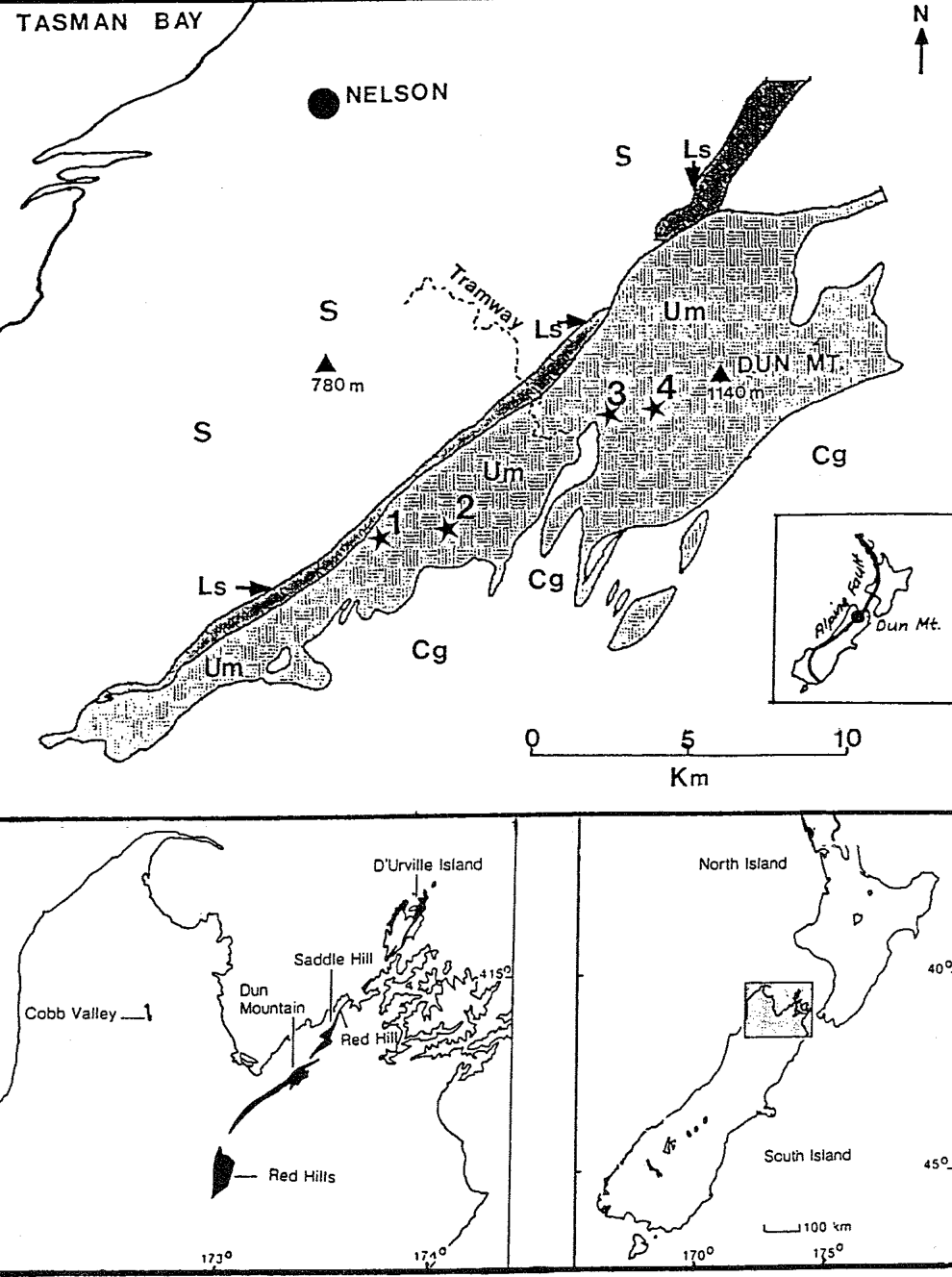
Outcrops of ultramafic rocks nearly always support a characteristic vegetation, distinct from adjacent areas. The vegetation boundary between ultramafic and non-ultramafic soils is often sharp, coinciding with the geological contact and visible over only a few metres. The Dun Mountain Belt is a particularly good example of this sharp differentiation (Fig.2). There is much debate concerning why serpentine areas have such a distinctive stunted flora. The nature of the so-called "serpentine factor" (Krause 1958; Kinzel 1982) has been sought by looking for consistent chemical and physical characteristics of soils that either individually or collectively allow for the development of "serpentine floras" throughout the world (Brooks 1987; Kinzel 1982). Suggested factors influencing the development of "serpentine floras" are: (1) the toxic effects of nickel, chromium, cobalt, and manganese; (2) the toxic effect of magnesium at very high concentrations; (3) the very high magnesium/calcium quotient causing inhibition of calcium uptake; (4) the low soil concentrations of available plantessential macronutrients; (5) the unfavourable physical nature of the soil (sandy, shallow and susceptible to erosion - Jørgensen 1974) and; (6) a combination of some or all of the above. The large variation in chemical composition within, and between, ultramafic soils from different geographical areas, suggests that there is no single underlying "serpentine factor" common to all areas.
超基性岩露头几乎总是生长着有别于邻近区域的特征性植被。超基性与非超基性土壤之间的植被界线往往十分清晰,与地质接触带相吻合,且在仅数米的范围内即可辨识。Dun Mountain带是这种截然分异的一个典型例子(图2)。关于蛇纹岩地区为何具有如此独特的矮化植物区系,学界存在诸多争论。人们一直试图通过寻找土壤中一致的化学和物理特征来探究所谓“蛇纹岩因子”(Krause 1958; Kinzel 1982)的本质,这些特征单独或共同作用,促成了世界各地“蛇纹岩植物区系”的形成(Brooks 1987; Kinzel 1982)。已提出的影响“蛇纹岩植物区系”形成的因子包括:(1)镍、铬、钴和锰的毒害作用;(2)极高浓度镁的毒害作用;(3)极高的镁/钙比值抑制钙的吸收;(4)土壤中植物必需大量营养元素的有效浓度低;(5)土壤不利的物理性质(质地偏砂、土层浅薄且易受侵蚀——Jørgensen 1974);以及(6)上述部分或全部因子的综合作用。不同地理区域超基性土壤内部及其之间化学组成的巨大差异表明,并不存在一个适用于所有地区的单一“蛇纹岩因子”。
*Department of Soil Science, Massey University, Palmerston North
*Massey University土壤科学系,Palmerston North
Some previous studies of plant/soil relationships in serpentine floras have concentrated on the total metal content of the soils rather than the plant-available fraction (Krause 1958). We follow the more logical approach that the availabilities of soil constituents are more relevant than their totalities when considering what possible edaphic factors could control a serpentine flora. The objectives of our studies reported below, are: (1) to present data on the chemical composition of ultramafic soils from the Nelson area; (2) to compare total elemental concentrations with extracts simulating the plant-available fraction; (3) to examine changes in the total and extractable fractions across an ecotone; (4) to relate soil composition to the composition and physiognomy of the overlying vegetation.
以往一些关于蛇纹岩植物区系中植物与土壤关系的研究集中于土壤的金属全量,而非植物有效态组分(Krause 1958)。在考虑哪些土壤因子可能控制蛇纹岩植物区系时,土壤组分的有效性比其全量更具相关性,因此本文采用了这一更合理的研究思路。下文所报道研究的目的是:(1)提供Nelson地区超基性土壤化学组成的数据;(2)将元素全量与模拟植物有效态组分的浸提结果进行比较;(3)考察生态交错带上全量和可提取态组分的变化;(4)将土壤组成与其上覆植被的组成及外貌相联系。
THE STUDY AREA研究区概况
Geology地质
The Dun Mountain Ophiolitic ("Mineral") Belt in Nelson Province is the type locality for dunite (FeMgSiO4) first described by Hochstetter at Dun Mountain last Century (Bell et al. 1911).
Nelson省的Dun Mountain蛇绿岩(“矿物”)带是纯橄岩(FeMgSiO4)的模式产地,纯橄岩由Hochstetter于上世纪在Dun Mountain首次描述(Bell et al. 1911)。
The belt (Fig.1) extends southwards from d'Urville Island through Saddle Hill and the Dun Mountain to Red Hill in the Wairau Valley, where it is truncated by the Alpine Fault. The Dun Mountain Massif is situated some 13 km east of Nelson and rises to an altitude of 1129 m. The ultramafic rocks intrude the older surrounding sediments and volcanic rocks. The main rock types are dunite and harzburgite with a little pyroxene, and have a concentric serpentinization at the contacts with sediments and other ultramafic rock types.
该岩带(图1)从d'Urville岛向南经Saddle Hill和Dun Mountain延伸至Wairau河谷的Red Hill,并在该处被Alpine断层截断。Dun Mountain岩体位于Nelson以东约13 km处,海拔高达1129 m。超基性岩侵入周围较老的沉积岩和火山岩中。主要岩石类型为纯橄岩和方辉橄榄岩,含少量辉石,并在与沉积岩及其他超基性岩类型的接触带上呈同心状蛇纹石化。
Chrome and copper (mined at the turn of the century) are associated with a prominent fault near Wooded Peak. The surrounding non-ultramafic rocks are predominantly spilites interspersed in a Permian sedimentary sequence composed of greywackes, argillites and calcareous rocks (Lauder 1965).
铬和铜(于世纪之交开采)与Wooded Peak附近一条显著的断层有关。周围的非超基性岩石主要为细碧岩,夹杂于由杂砂岩、泥质岩和钙质岩组成的二叠纪沉积层序中(Lauder 1965)。
Other mining activities were carried out at the United and Champion Mines in the Mineral Belt inland from Richmond along the United and Champion Creeks respectively. The primary ore was a mixture of pyrrhotite and chalcopyrite (Bell et al. 1911), and extensive cupriferous mine waste is still to be found at the abandoned United Mine site.
其他采矿活动在矿物带内Richmond以内陆的United矿和Champion矿进行,两矿分别沿United溪和Champion溪分布。原生矿石为磁黄铁矿和黄铜矿的混合物(Bell et al. 1911),在废弃的United矿址至今仍可见大量含铜矿山废弃物。
The Cobb Valley asbestos mine (Fig. 1) is found in the Upper Takaka Valley. The deposits were mined from 1949 to 1963 (Williams 1965). All the ultramafic rocks are hydrothermally altered and the peridotitic differentiate has been completely serpentinised to chrysotile, bastite, and to an antigorite-like serpentine.
Cobb Valley石棉矿(图1)位于Takaka河谷上游。该矿床于1949—1963年间开采(Williams 1965)。所有超基性岩均经历了热液蚀变,橄榄岩质分异体已完全蛇纹石化为纤蛇纹石、绢石及类叶蛇纹石的蛇纹石。
Vegetation and soils植被与土壤
Dun Mountain The vegetation of the Dun Mountain Belt (Fig. 2), with several endemic taxa, is floristically one of the most important of the ultramafic zones of New Zealand. The 460 Journal of The Royal Society of New Zealand, Volume 26, 1996 (1) Mixed beech forest dominated by Nothofagus fusca with associated N.menziesii, N.solandri var. cliffortioides, and Podocarpus hallii reaching a canopy height of 23 m on sedimentary rocks of Wells's Peak.
Dun Mountain Dun Mountain带(图2)的植被含有若干特有类群,在植物区系上是新西兰最重要的超基性区域之一。460 Journal of The Royal Society of New Zealand, Volume 26, 1996(1)以Nothofagus fusca为优势种的混交山毛榉林,伴生N.menziesii、N.solandri var. cliffortioides和Podocarpus hallii,在Wells's Peak的沉积岩上林冠高度可达23 m。
Fig. 2 Vegetational boundary between ultramafic (scrub) and sedimentary/ultramafic (forested) soils on the south slope of Dun Mountain.图2 Dun Mountain南坡超基性(灌丛)土壤与沉积岩/超基性(森林)土壤之间的植被界线。
vegetation has been described by Lee (1980,1992) who recognised several distinct communities:
Lee(1980,1992)描述了该区植被,并识别出若干不同的群落:
(2) Transition forest between ultramafics and sedimentaries consisting of a low tree assemblage of variable composition depending on the predominance of one or more parent materials in the soil. The canopy is dominated by Nothofagus solandri var. cliffortioides.
(2)超基性岩与沉积岩之间的过渡林,由低矮乔木组合构成,其组成因土壤中一种或多种母质的优势程度而异。林冠以Nothofagus solandri var. cliffortioides为优势。
(3) Leptospermum scoparium shrubland forms a large part of the serpentine vegetation and includes serpentine endemics such as Pimelea suteri and Myosotis monroi. A small herb, Notothlaspi australe, is often found in damper places. The small gentian Gentiana corymbifera is also very common as a coloniser of serpentine scree. Larger shrubs include Hebe odora and Cassinia vauvilliersii.
(3)Leptospermum scoparium灌丛构成蛇纹岩植被的主要部分,并包含Pimelea suteri和Myosotis monroi等蛇纹岩特有种。小型草本植物Notothlaspi australe常见于较潮湿处。小型龙胆Gentiana corymbifera作为蛇纹岩碎石坡的定殖者也十分常见。较大的灌木包括Hebe odora和Cassinia vauvilliersii。
(4) Chionochloa tussock grassland typical of the open vegetation of the dunites and peridotites of the Dun Mountain Massif, increases in importance with altitude. Cobb Valley The vegetation of the Cobb asbestos mine tailings is exceedingly sparse. On
(4)Chionochloa丛生草地是Dun Mountain岩体纯橄岩和橄榄岩上典型的开阔植被,其重要性随海拔升高而增加。Cobb Valley Cobb石棉矿尾矿上的植被极为稀疏。在
The soils of the Dun Mountain Ophiolitic Belt are quite variable but were originally classified as "Dun Steepland" (Chittenden et al. 1966). A soil profile in the Lee Valley under stunted manuka and native grasses (15° slope) was described as follows:
Dun Mountain蛇绿岩带的土壤变异较大,但最初被归类为“Dun Steepland”(Chittenden et al. 1966)。Lee河谷中矮化麦卢卡和本土草类下(坡度15°)的一个土壤剖面描述如下:
(1) 2.5 cm - dark brown sandy loam, friable, moderately developed fine soft crumb structure. (2) 12 cm - dark brown silt loam with rock fragments, friable, strongly developed medium nutty structure. (3) 22 cm - dark olive-brown silt loam with many rock fragments, friable, moderately developed medium granular structure. (4) Weathered serpentinite rock. Elsewhere the soil cover consists of little more than weathered serpentine scree with little
(1)2.5 cm——暗棕色砂壤土,疏松,中度发育的细软团粒结构。(2)12 cm——含岩屑的暗棕色粉砂壤土,疏松,强度发育的中等核状结构。(3)22 cm——含大量岩屑的暗橄榄棕色粉砂壤土,疏松,中度发育的中等粒状结构。(4)风化的蛇纹岩。在其他地方,土壤覆盖层仅为风化的蛇纹岩碎石,几乎
Robinson et al. - Vegetation and soils over ultramafic rocks 461 or no organic content. The modern nomenclature for this serpentine soil type is magnesic mafic brown (Anon 1992)
Robinson et al. - 超基性岩上的植被与土壤 461 不含或完全不含有机质。该蛇纹岩土壤类型的现代命名为镁质铁镁质棕壤(magnesic mafic brown)(Anon 1992)
Fig. 3 Individual specimen of Nothofagus solandri colonising a patch of humus-deficient serpentine soil below asbestos tips at the Cobb Valley asbestos mine.图3 在Cobb Valley石棉矿石棉堆下方一片缺乏腐殖质的蛇纹岩土壤上定殖的Nothofagus solandri单株。
2METHODS方法
Sampling and sample sites采样与采样点
Visits were made to Dun Mountain, United and Champion copper mines, Hackett chromite mine and Cobb Valley asbestos mine and to the ultramafic terrain surrounding these areas (Fig. 1). Soils were collected from each site and samples were taken from the material immediately under the usually sparse layer of humus and surface litter at a depth of about 10 cm. These samples were composites of about 5 different samples.
对Dun Mountain、United和Champion铜矿、Hackett铬铁矿和Cobb Valley石棉矿以及这些区域周围的超基性地带进行了考察(图1)。在每个地点采集土壤,样品取自通常稀薄的腐殖质层和地表凋落物层下方约10 cm深处的物质。每个样品由约5个不同样品混合而成。
At Coppermine saddle near the Dun Mountain, a transect was located across a beech forest/serpentine scrub ecotone over a soil boundary. The position of the transect was determined by selection of a site with horizontal flat topography free of downslope movement of material and where a sharp vegetation boundary was observed. From X-ray diffraction studies it was established that the beech forest overlies a sedimentary/ultramafic melange dominated by talc and quartz. The scrub covers a typical ultramafic assemblage of antigorite and magnetite. The transect was 30 m in length, and extended 15 m into each soil type. Along the transect, soil samples were collected every 2 m and represented a composite of three individual samples taken on a parallel line at right angles to the direction of the transect. The samples were taken immediately below the forest litter at depths ranging from about 20 cm in the forest to 10 cm over the open ultramafic terrain.
在Dun Mountain附近的Coppermine saddle,沿一条土壤界线布设了一条横穿山毛榉林/蛇纹岩灌丛生态交错带的样线。样线位置的选择标准为:地形水平平坦,无物质的顺坡移动,且可观察到清晰的植被界线。X射线衍射研究确定,山毛榉林下伏以滑石和石英为主的沉积岩/超基性混杂岩,而灌丛覆盖于典型的叶蛇纹石和磁铁矿超基性组合之上。样线长30 m,向每种土壤类型内各延伸15 m。沿样线每隔2 m采集土壤样品,每个样品由在与样线方向垂直的平行线上采集的3个单独样品混合而成。样品采自森林凋落物层正下方,深度从森林中约20 cm至开阔超基性地带的10 cm不等。
Methods of sample treatment样品处理方法
All soils were sieved to -70 mesh (0.2 mm) size and 0.5 g subsamples were weighed into polypropylene cups. Twelve mL of 1:1 HF/HNO was added to each cup and the solutions were evaporated to dryness on a water bath. Then 12 mL of 2M HCI was added to each cup and the solutions warmed to redissolve the material. The chemical elements in solution were determined by flame atomic absorption spectrometry (FAAS). To measure the pH of the soils, 2.5 mL of water was added to 1 g of sieved soil and the mixture left overnight before measurement with a pH meter. A total elemental analysis by X-ray fluorescence spectrometry was also performed.
所有土壤均过-70目(0.2 mm)筛,称取0.5 g子样置于聚丙烯杯中。向每个杯中加入12 mL 1:1 HF/HNO,并在水浴上蒸发至干。然后向每个杯中加入12 mL 2M HCI,加温使物质重新溶解。溶液中的化学元素采用火焰原子吸收光谱法(FAAS)测定。测定土壤pH时,向1 g过筛土壤中加入2.5 mL水,混合物静置过夜后用pH计测定。此外,还采用X射线荧光光谱法进行了元素全量分析。
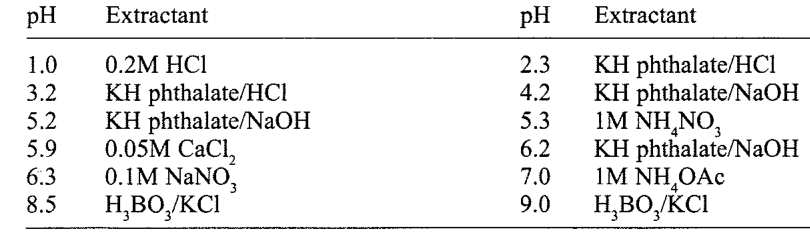
The question of what extractant should be used to simulate the plant-available fraction of metals in soils has received a great deal of attention without any real consensus. The pH of the soil in the rhizosphere of plants is often up to 2 pH units more acidic than the bulk soil, and this difference is greater at high soil pH values (Salisbury & Ross 1978). The pH values of the soil samples taken in this survey ranged from 4.4 (mean 4.9) under forest litter to 7.7 (mean 7.1) under serpentine scrub (the majority of the samples). It was decided that extractants at pH 4.6, and 5.9 would simulate the conditions to which the plants are exposed on all these soils. Extractions at pH 7.0 were also carried out for comparison purposes. The pH value of 5.9 was about 2 units below the pH of serpentine soils, and after further experimentation (see below) was considered to be overall the most suitable for extraction studies to determine the plant-available fraction of elements in the soils.
关于应采用何种浸提剂来模拟土壤中金属的植物有效态组分,这一问题已受到广泛关注,但迄今尚无真正的共识。植物根际土壤的pH常比土体土壤低多达2个pH单位,且这一差异在土壤pH较高时更大(Salisbury & Ross 1978)。本次调查所采土壤样品的pH范围从森林凋落物下的4.4(均值4.9)到蛇纹岩灌丛下的7.7(均值7.1)(大多数样品属于后者)。因此确定采用pH 4.6和5.9的浸提剂来模拟植物在所有这些土壤上所处的条件。为便于比较,还进行了pH 7.0的浸提。pH 5.9约比蛇纹岩土壤的pH低2个单位,经进一步试验(见下文),被认为总体上最适合用于测定土壤中元素植物有效态组分的浸提研究。
There was a further rationale for selection of pH 5.9 as the one most likely to simulate uptake of elements from the soils. In an experiment, the serpentine-endemic Italian crucifer Alyssum bertolonii was grown for three months in serpentine soil from the Dun Mountain complex. This soil contained a total of 6090 ug/g Ni (Table 1). The plants had been sown in a tray containing 3.46 kg of soil and extracted 0.019 g of nickel. This represented an extraction of 5.5 ug/g of this metal. The rhizosphere of plants is usually in contact with only 0.4-2.8% (by volume) of the surrounding soil (Barber 1984). If soil interception were thepa a only factor involved in element uptake by plants, the total available nickel in the soil should therefore be in the range 196-1375 ug/g. This figure is however far too high, because it does not take into account the mass flow and diffusion (Barber 1984) that on average amount to ten times the root interception factor. If this combined figure is taken (i.e. 4-28%), the plant experiments indicate a probable 20-138 ug/g extractable nickel with a mean of 79 g/g. Our experimental value using KH phthalate at pH 5.9 was 84 ug/g Ni (Table 2).
选择pH 5.9作为最可能模拟植物从土壤中吸收元素的条件还有另一个依据。在一项试验中,将意大利蛇纹岩特有十字花科植物Alyssum bertolonii在取自Dun Mountain杂岩体的蛇纹岩土壤中种植3个月。该土壤镍全量为6090 ug/g(表1)。植物播种于装有3.46 kg土壤的托盘中,共吸取了0.019 g镍,相当于该金属的提取量为5.5 ug/g。植物根际通常仅与周围土壤的0.4%~2.8%(体积)接触(Barber 1984)。如果根系截获是植物吸收元素的唯一因素,则土壤中有效镍总量应在196~1375 ug/g范围内。然而这一数值明显过高,因为它未考虑质流和扩散作用(Barber 1984),而二者平均可达根系截获因子的10倍。若采用这一综合数值(即4%~28%),则植物试验表明可提取态镍可能为20~138 ug/g,均值为79 g/g。我们采用pH 5.9 KH邻苯二甲酸盐测得的试验值为84 ug/g Ni(表2)。
collected from near the United Mine (Table 3). Such a range extended well outside that to give a complete picture of potential extractability over the entire range. We decided to use NH4OAc and buffered KH phthalate to investigate the plant-available elements from the other soils of the ophiolitic complex (see Table 4) at pH 4.6, 5.9 and 7.0.
采自United矿附近的土壤(表3)。这一范围远超出……以便全面反映整个范围内的潜在可提取性。我们决定采用NH4OAc和缓冲KH邻苯二甲酸盐,在pH 4.6、5.9和7.0条件下研究该蛇绿岩杂岩体其他土壤中的植物有效态元素(见表4)。
The extractable fraction of soil elements was determined by adding 10 mL of extractant to 0.5 g of soil. The mixtures were shaken overnight and the supernatant decanted. The extracts were analysed by FAAS.
可提取态土壤元素组分的测定方法为:向0.5 g土壤中加入10 mL浸提剂,混合物振荡过夜后倾出上清液,浸提液采用FAAS分析。
3RESULTS AND DISCUSSION结果与讨论
The chemical composition of the soil examined (Table 1) is consistent with the general chemical properties of a serpentine soil described in the introduction. The salient characteristics of the soil are the very high magnesium/calcium quotient of 61 (Brooks 1987 quotes 23 for the mean of 7 serpentine soils worldwide) and the high concentrations of elements of the iron family such as chromium, cobalt, manganese and nickel. The essential plant micronutrients such as potassium and phosphorus also have very low concentrations in this material, and the molybdenum content was below the detection limit.
所研究土壤的化学组成(表1)与引言中所述蛇纹岩土壤的一般化学性质相一致。该土壤的显著特征是镁/钙比值极高,达61(Brooks 1987给出全球7种蛇纹岩土壤的均值为23),且铬、钴、锰和镍等铁族元素浓度较高。钾和磷等植物必需营养元素在该物质中的浓度也很低,钼含量则低于检出限。

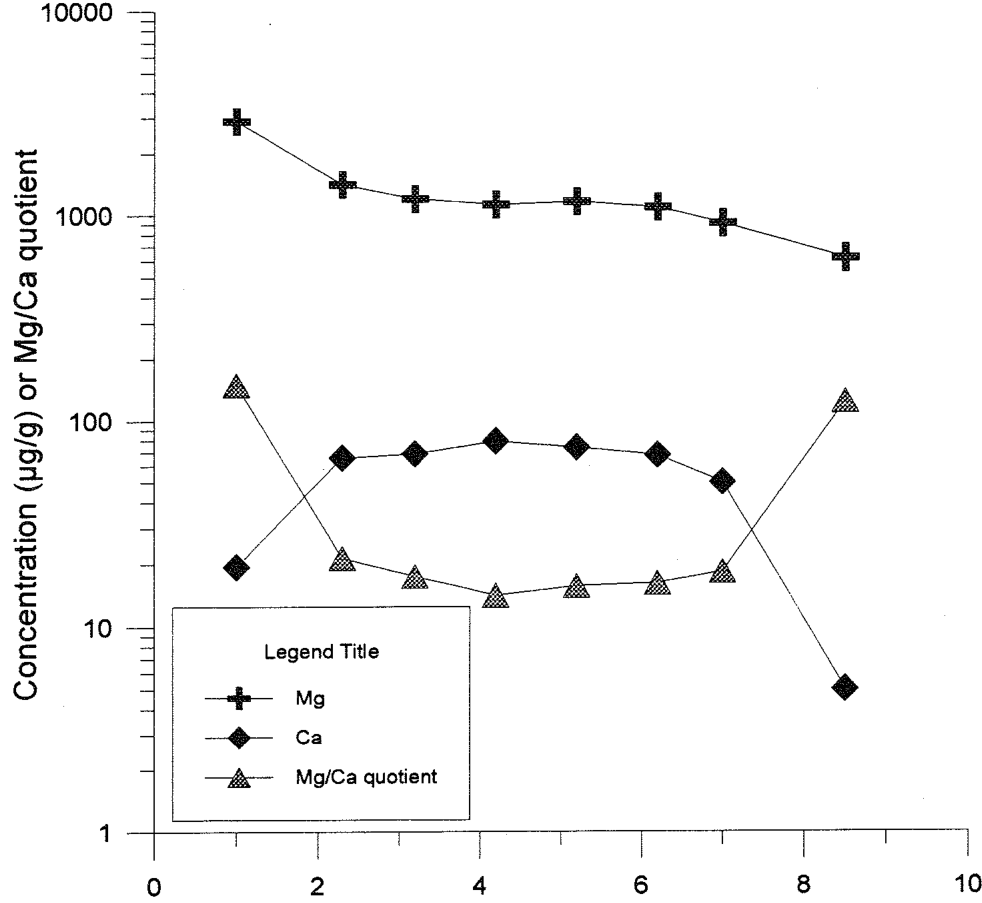
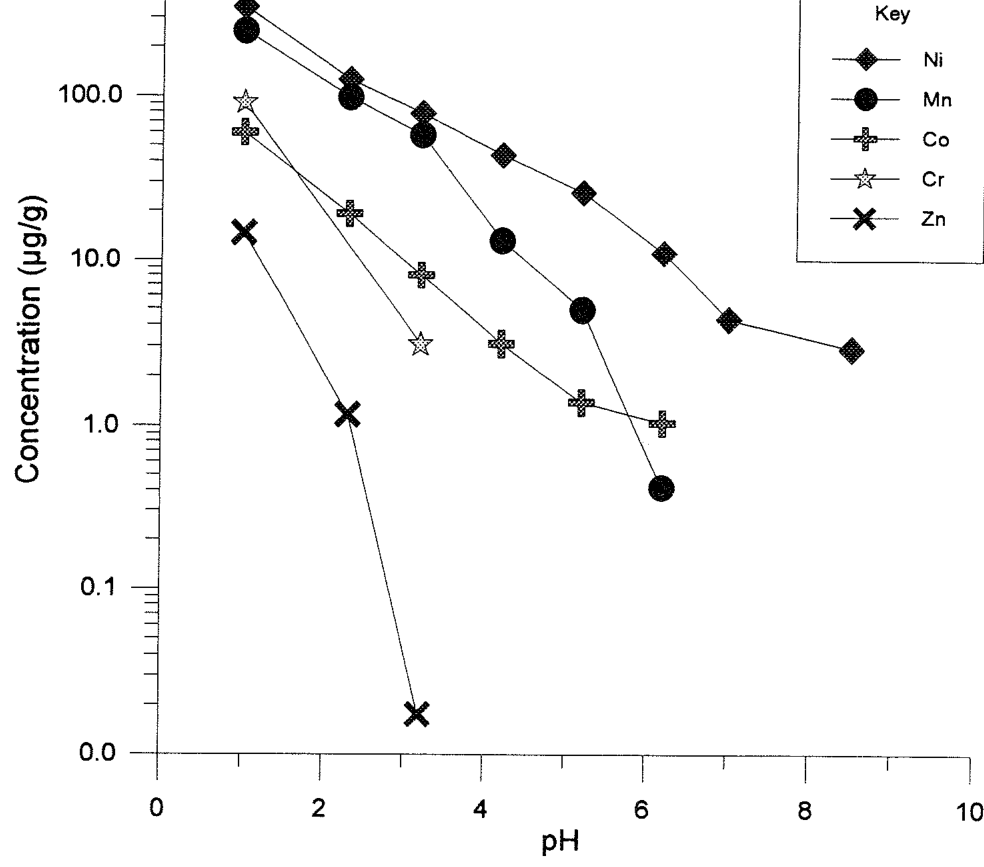
The toxicity of an element to plant growth depends on its nature and its availability in the soil rather than on its total concentration. Figures 4 and 5 show the extractability at different pH levels, of some elements in the same soil described in Table 1. These figures show that the elements that make up a large proportion of the soil do not necessarily form a similarly large proportion of the available elements. Magnesium is the most available metal in this soil, followed in decreasing order by iron, calcium, nickel, manganese, cobalt, copper, zinc and chromium. Magnesium, nickel and manganese were available at concentrations above those shown to be toxic to most plants (Proctor 1970; Robertson 1985). The availability of all transition metals increased exponentially as the extractant became more acid.
元素对植物生长的毒性取决于其性质及其在土壤中的有效性,而非其全量。图4和图5显示了表1所述同一土壤中若干元素在不同pH水平下的可提取性。这些图表明,在土壤中占较大比例的元素,不一定在有效态元素中也占同样大的比例。镁是该土壤中有效性最高的金属,其次依次为铁、钙、镍、锰、钴、铜、锌和铬。镁、镍和锰的有效浓度超过了已证实对大多数植物有毒的水平(Proctor 1970; Robertson 1985)。随着浸提剂酸性增强,所有过渡金属的有效性均呈指数增加。
Fig. 4 shows that there is a large excess of extractable magnesium over calcium, of the order of 20:1 (Fig.4). In non-serpentine soils the quotient is typically 1.0 (Brooks 1987). The magnesium/calcium quotient decreased from pH 1 to pH 4 then increased from pH 4 to pH 7. The extractabilities of Ni, Mn, Co, Cr and Ln increased exponentially with lower pH values图4表明,可提取态镁相对于钙大量过剩,比例约为20:1(图4)。在非蛇纹岩土壤中,该比值通常为1.0(Brooks 1987)。镁/钙比值在pH 1至pH 4之间降低,在pH 4至pH 7之间升高。Ni、Mn、Co、Cr和Ln的可提取性随pH降低呈指数增加
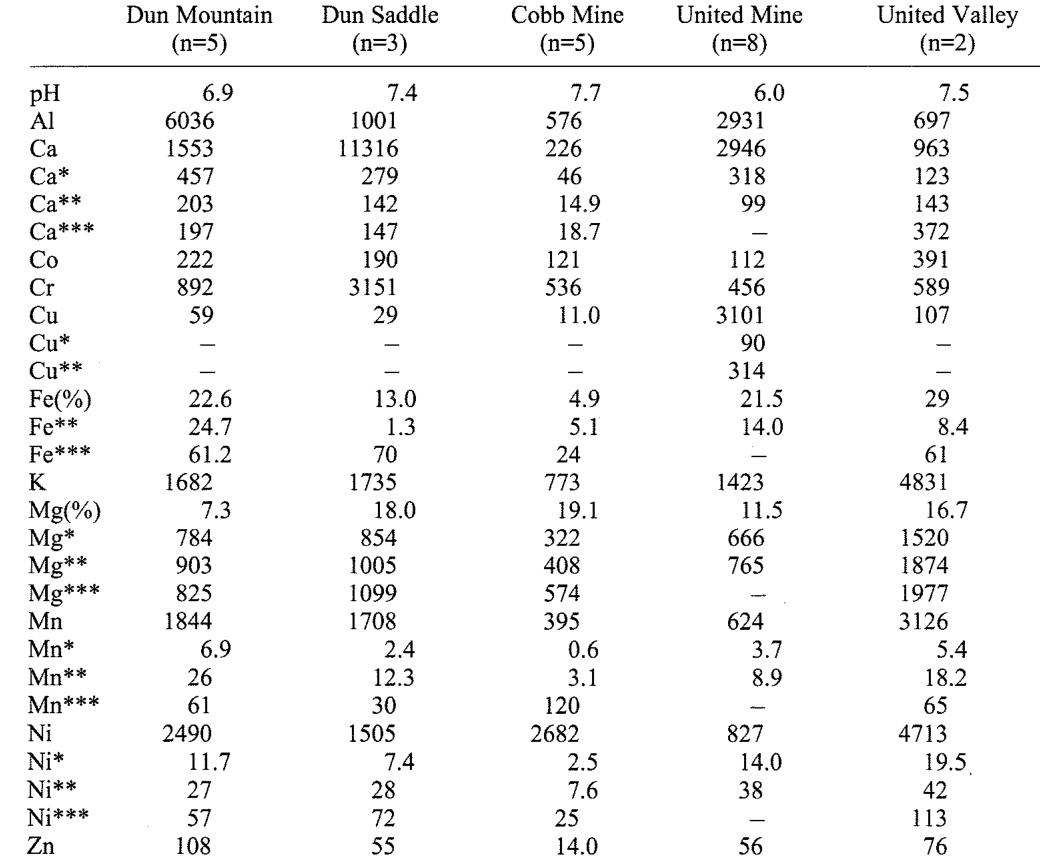
The chemical compositions of all the soils (F The chemical aro that of atested were similar to that of a typical serpentine soil, with the exception of soils from the United Mine, which were high in copper and soils from United Valley and Cobb Mine which were low in chromium (Table 4). The growth of stress-tolerant plants such as Cyathodes juniperina, Leptospermum scoparium and Pteridium esculentum on the waste material from the United Mine is strong evidence of its infertility.
所检测的所有土壤的化学组成均与典型蛇纹岩土壤相似,但United矿的土壤铜含量较高,United Valley和Cobb矿的土壤铬含量较低(表4)。Cyathodes juniperina、Leptospermum scoparium和Pteridium esculentum等耐胁迫植物在United矿废弃物上生长,有力地证明了该物质的贫瘠性。
The very low concentrations of extractable chromium, as well as the presence of very stunted serpentine vegetation in the United Valley and Cobb Asbestos Mine, where soils are low in chromium, indicate that chromium is not important in controlling vegetation on ultramafic areas. Serpentine plants, without exception, contain only trace quantities of this element (Brooks 1987). Similarly, the recorded levels of extractable copper, zinc and cobalt were below 0.1 ug/g even using the most acidic extractant (pH 4.6), indicating that these elements are unlikely to be toxic to plant growth.
可提取态铬浓度极低,且在土壤铬含量低的United Valley和Cobb石棉矿存在极度矮化的蛇纹岩植被,这表明铬在控制超基性区域植被方面并不重要。蛇纹岩植物无一例外地仅含有微量的该元素(Brooks 1987)。同样,即使采用酸性最强的浸提剂(pH 4.6),所记录的可提取态铜、锌和钴水平也低于0.1 ug/g,表明这些元素不太可能对植物生长产生毒害。
The concentration of extractable iron was very low compared with its total concentration in the soil. In many cases it was lower than extractable nickel. At pH 7, the concentration of extractable iron in all the soils tested was below the detection limit (0.1 ug/g), suggesting that plants growing over iron-rich ultramafic soils can actually suffer from an iron deficiency because of the exceeding low availability of iron to plants at higher pH values.
与其在土壤中的全量相比,可提取态铁的浓度非常低,在许多情况下低于可提取态镍。在pH 7时,所有检测土壤中可提取态铁的浓度均低于检出限(0.1 ug/g),这表明生长在富铁超基性土壤上的植物实际上可能因较高pH下铁对植物的有效性极低而遭受缺铁。
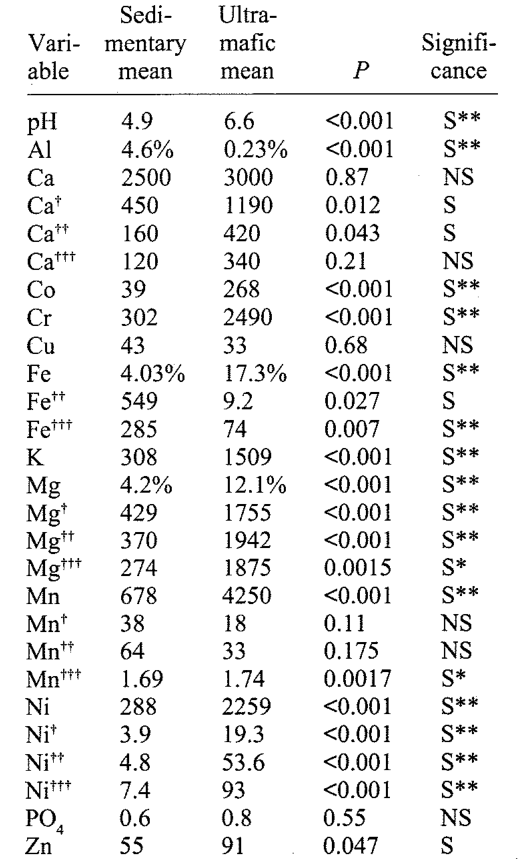
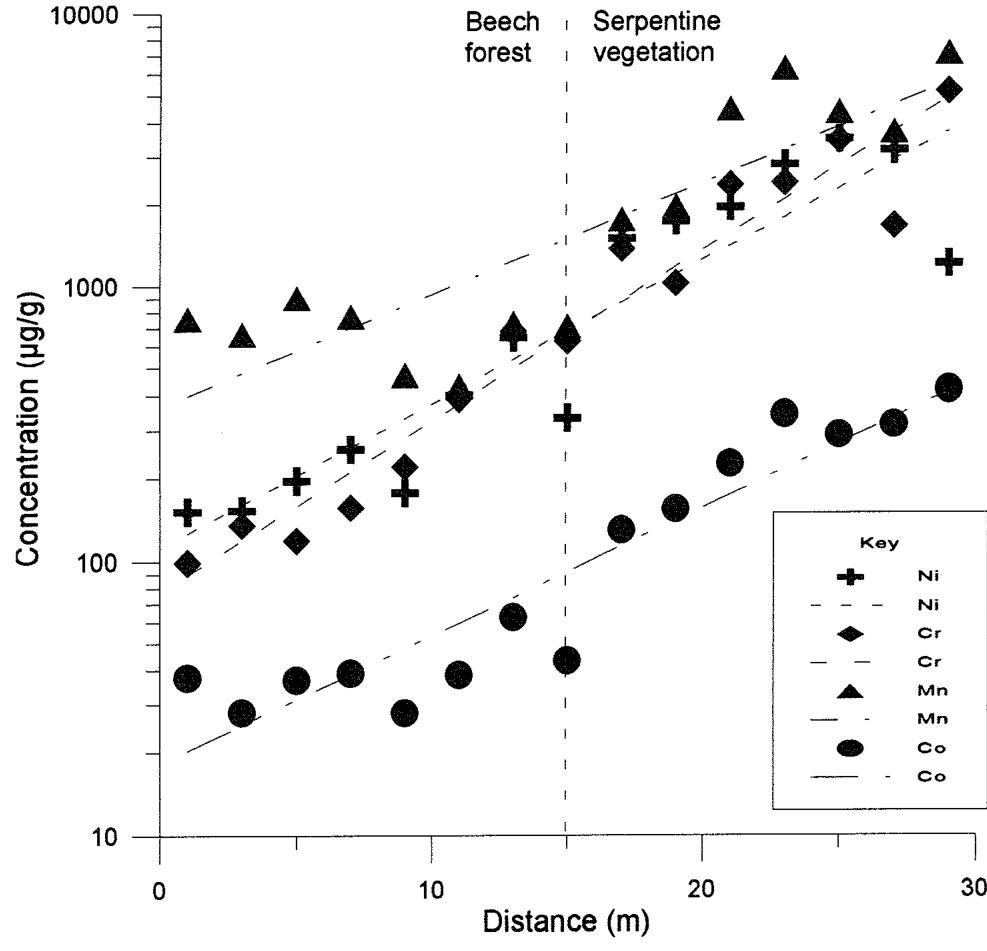
The concentrations of total soil nickel, chromium, manganese and cobalt all showed significant increases with distance into the ultramafics across an ecotone near the Dun saddle (Fig.6). Abundance data for these and other elements are shown statistically in Table 2, which gives the level of significance for t-tests based on differences in the geometric means of the two populations. Apart from the four elements shown in Fig. 6, magnesium and total iron also showed a significant increase. There was no significant increase for calcium, copper, and phosphate, and a highly significant decrease in aluminium with distance across the transect. The same was true for extractable iron at pH 4.6 and 5.9. The latter can easily be explained from the effect of pH already shown in Table 2. In this transect the pH ranged from 4.4 under the Nothofagus forest to 7.2 under the serpentine scrub.
在Dun saddle附近的生态交错带上,土壤镍、铬、锰和钴的全量均随进入超基性岩区域的距离增加而显著升高(图6)。表2给出了这些元素及其他元素丰度数据的统计结果,列出了基于两个总体几何均值差异的t检验显著性水平。除图6所示的4种元素外,镁和全铁也显著增加。钙、铜和磷酸盐无显著增加,而铝沿样线随距离增加极显著降低。pH 4.6和5.9下的可提取态铁亦是如此。后者可由表2中已显示的pH效应轻易解释。在该样线上,pH范围从Nothofagus林下的4.4至蛇纹岩灌丛下的7.2。
The results indicate that the toxic effects of chromium, cobalt and manganese are unlikely to be responsible for the vegetation change across the ecotone either because they are available in extremely low concentrations, or because they are not significantly greater in soil under the serpentine vegetation. The lack of a significant change in the concentrations of the plant nutrient phosphate, and the significant increase of available calcium across the ecotone, indicates that composition of vegetation on serpentine soil is not controlled by any deficiency of these elements. Surprisingly, the abundance of potassium was lower under the forest than in the ultramafic soil, even though both values were low compared with "normal" soils (Table 1). From Table 2 the most significant edaphic factors correlated with the distribution of the serpentine vegetation are an excess of available nickel and magnesium and/or an iron deficiency.
结果表明,铬、钴和锰的毒害作用不太可能是生态交错带上植被变化的原因,这是因为它们的有效浓度极低,或者在蛇纹岩植被下土壤中的浓度并无显著升高。植物营养元素磷酸盐的浓度在生态交错带上无显著变化,而有效钙显著增加,这表明蛇纹岩土壤上植被的组成并不受这些元素缺乏的控制。出人意料的是,森林下钾的丰度低于超基性土壤,尽管与“正常”土壤相比二者均较低(表1)。由表2可知,与蛇纹岩植被分布相关性最显著的土壤因子是有效镍和镁过量和/或缺铁。
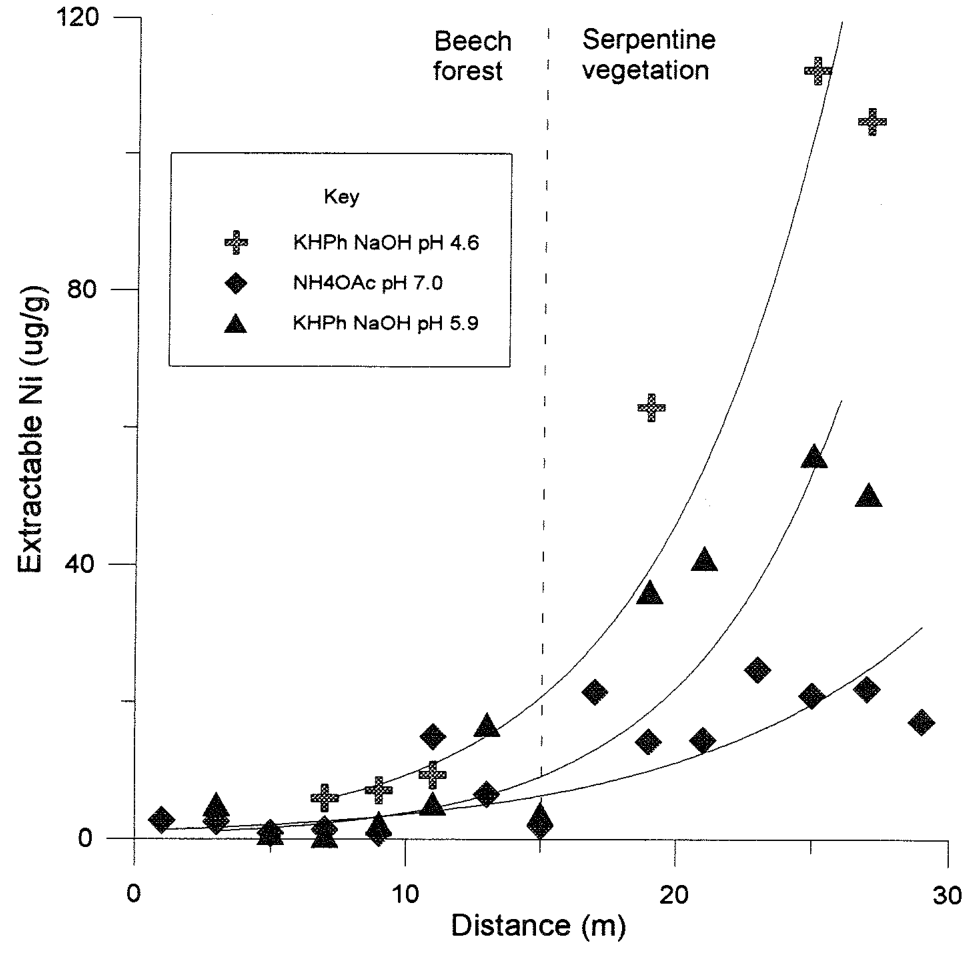
The concentration of extractable nickel at lower pH values (4.5-5.0: Fig. 7) increased and may limit the establishment of beech forest on serpentine soil. When the beech species colonise the ecotone, humic acids generate a lower soil pH and increase the availability of nickel. This prevents further advance across this ecotone, implying that serpentine soils are unfavourable hosts for forest communities, rather than for individual species. This observation was endorsed by the presence of a specimen of Nothofagus solandri (Fig. 3) growing below the asbestos mine tip at the Cobb Mine. This individual plant will presumably continue to grow at the site until sufficient humus has accumulated to lower the pH to a level at which the extractable nickel will be toxic to the plant. A further piece of evidence to support this theory is afforded by the observation that in the ultramafics of the Hackett Creek area, individual, albeit stunted, specimens of Pinus radiata are able to survive, but only singly, and never as a group or clump. A similar pattern has been observed by one of us (R.R.B.) over the ultramafics of southeastern Spain where isolated specimens of Pinus pinaster are able to survive in an environment as equally hostile edaphically as the soils of the Dun Mountain Ophiolitic Belt.
在较低pH值(4.5~5.0:图7)下可提取态镍的浓度升高,这可能限制山毛榉林在蛇纹岩土壤上的建立。当山毛榉树种在生态交错带定殖时,腐殖酸使土壤pH降低并提高镍的有效性,从而阻止其进一步越过该生态交错带扩展。这意味着蛇纹岩土壤不适宜的是森林群落,而非单个物种。在Cobb矿石棉矿渣堆下方生长的一株Nothofagus solandri标本(图3)印证了这一观察。可以推测,该单株植物将在该处继续生长,直至积累足够的腐殖质,使pH降至可提取态镍对其产生毒害的水平。支持这一理论的另一证据是:在Hackett Creek地区的超基性岩上,Pinus radiata的个体(尽管矮化)能够存活,但仅以单株形式存在,从不成群或成丛。作者之一(R.R.B.)在西班牙东南部的超基性岩上也观察到类似格局,那里Pinus pinaster的孤立个体能够在土壤条件与Dun Mountain蛇绿岩带同样恶劣的环境中存活。
It might be argued that serpentine scrub also produces an acidic litter. However, the production of this organic matter is far lower than under forest, and it is therefore likely that the rate of production will be more than counterbalanced by oxidation of the organic matter in the more open environment of serpentine vegetation. The above theory should be tested by growing individual forest species in serpentine soil where there is no litter to lower the pH
或许有人认为蛇纹岩灌丛也会产生酸性凋落物。然而,这类有机质的产量远低于森林,因此在蛇纹岩植被较开阔的环境中,其产生速率很可能被有机质的氧化所抵消而有余。上述理论应通过在无凋落物降低pH的蛇纹岩土壤中种植单个森林树种加以检验
4ACKNOWLEDGEMENT致谢
We gratefully acknowledge Massey University for a doctoral scholarship and travel support for the senior author.
衷心感谢Massey University为第一作者提供博士奖学金和差旅资助。
5REFERENCES参考文献
Anon 1992: New Zealand soil classification. DSIR Land Resources Scientific Report #19: 1- 133. Barber, S. A. 1984: Soil nutrient bioavailability. Wiley, New York.
Bell, J. M.; Clarke, E. de C.; Marshall, P. 1911: The geology of the Dun Mountain Subdivision, Nelson.
New Zealand Geological Survey bulletin 12: 1-71.
Brooks, R. R. 1987: Serpentine and its Vegetation. Dioscorides Press, Portland.
Chittenden, E.T.; Hodgson, L.; Dodson, K. J. 1966: Soils and agriculture of Waimea County, New Zealand. New Zealand Soil Bureau bulletin #30: 46-47.
Coombs, D. S.; Landis, C. A. ;Norris, R. J.;Sinton, J. M.; Borns, D. J.; Craw, D. 1976: The Dun Mountain Ophiolitic Belt, its tectonic setting, constitution, and origin with special reference to the southern portion. American journal of science 276: 561-603.
Jørgensen, P. M. 1974: Flora and vegetation in magnesium silicate area in Hole, Southwest Norway. Arbok for Universitetet i Bergen - Mat.-Naturv. Serie 1973: 1-61.
Kinzel, H. 1982: Serpentinpflanzen. In Pflanzenphysiologie und Mineralstoffwechsel. Ulmer, Stuttgart. Krause, W. 1958: Andere Bodenspezialisten. In: Handuch der Pflanzenphysiologie pp. 755- 806. Springer, Berlin.
Jaffre, I. 1980: Etude écologique du peuplement végétal des sols dérivés des roches ultrabasiques de Nouvelle Calédonie. ORSTOM, Paris.
Lauder, W. R. 1965: The geology of the Dun Mountain, Nelson, New Zealand. New Zealand journal of geology and geophysics 8: 475-504.
Lee, W.G. 1980: Ultramafic plant ecology of the South Island, New Zealand. PhD Thesis, University of Otago, Dunedin, New Zealand.
Lee, W. G. 1992: New Zealand ultramafics. In: B.A.Roberts and J.Proctor (eds.): The ecology of areas with serpentinized rocks. A world view. pp.375-417. Kluwer Academic Publishers, Dordrecht. Proctor, J. 1970: Magnesium as a toxic element. Nature 227: 816-817.
Robertson, A. I. 1985: The poisoning of roots of Zea mays by nickel ions and the protection afforded by magnesium and calcium. New phytologist 100: 173-189.
Salisbury, F. B.; Ross, C. W. 1978: Plant physiology. Wadsworth Publishing Co., Belmont, (California). Williams, G. J. 1965: The economic geology of New Zealand, pp.145-166. Australasian Institute of Mining and Metallurgy, Melbourne.
Received 13 November 1995; accepted 13 May 1996