CSIRO PUBLISHING
www.publish.csiro.au/journals/ajsr
Australian Journal of Soil Research, 2003, 41, 323–333
T. ThayalakumaranA,B,D, I. VogelerA, D. R. ScotterA,B, H. J. PercivalC, B. H. RobinsonA, and B. E. ClothierA
AEnvironment and Risk Management Group, HortResearch, Private Bag 11030, Palmerston North, New Zealand.
BInstitute of Natural Resources, Massey University, Private Bag 11222, Palmerston North, New Zealand. CLandcare Research, Private Bag 11052, Palmerston North, New Zealand.
DCorresponding author; present address, CSIRO Land & Water, Davies Laboratory, Private Mail Bag, PO Aitkenvale, Qld 4814, Australia; email: thabo.kumaran@csiro.au
1Abstract摘要
The EDTA-enhanced remediation of copper contaminated sandy-loam soil of volcanic origin was investigated. The soil, from an orchard, was contaminated with about 250 mg/kg of copper due to the extensive use of copper sprays. Copper-contaminated soil was packed into 100-mm-long columns, and solutions of Na2H2EDTA with CaCl2, raised to a pH of 6.2, were applied at a flow rate of 24 mm/h. Application of an excess of 0.01 M EDTA leached about half the acid-extractable copper from the soil; most of it coming out in the first 3 liquid-filled pore volumes (PV). Also a 0.5 PV pulse of 0.001 M EDTA was applied to similar soil columns and then either leached immediately with 0.005 M CaCl2, or left for periods of up to 1 month before leaching. With immediate leaching, 70% of the EDTA applied was complexed with copper in the leachate, but after a month’s delay only 24% was complexed with copper in the leachate, the rest being complexed with iron. There was no evidence of EDTA retardation or adsorption.
本研究考察了EDTA强化修复火山成因铜污染砂壤土的效果。供试土壤采自一处果园,由于长期大量使用含铜喷剂,土壤铜含量约为250 mg/kg。将铜污染土壤填装于长100 mm的土柱中,以24 mm/h的流速施加pH调至6.2的Na2H2EDTA与CaCl2混合溶液。施加过量的0.01 M EDTA可淋溶出土壤中约一半的酸提取态铜,其中大部分在最初3个充液孔隙体积(PV)内流出。此外,向同类土柱施加0.5 PV的0.001 M EDTA脉冲,随后立即以0.005 M CaCl2淋溶,或放置至多1个月后再进行淋溶。立即淋溶时,淋出液中70%的所施EDTA与铜络合;而延迟1个月后,淋出液中仅24%的EDTA与铜络合,其余均与铁络合。未发现EDTA存在阻滞或吸附现象。
The experimental results were simulated using the convection–dispersion equation, incorporating a source/sink term. This described the competing time-dependent reactions of copper and iron with EDTA, and the reversion of CuEDTA2– to adsorbed Cu2+ and Fe(III)EDTA– in solution. Reasonable simulations were achieved, mostly within errors of observation.
采用引入源/汇项的对流–弥散方程对试验结果进行了模拟。该方程描述了铜和铁与EDTA之间随时间变化的竞争反应,以及CuEDTA2–向吸附态Cu2+和溶液中Fe(III)EDTA–的转化。模拟效果较好,多数结果处于观测误差范围之内。
Additional keywords: iron, convection–dispersion equation, heavy metals.
其他关键词:铁,对流–弥散方程,重金属。
2Introduction引言
There are a number of reasons why the interactions between copper and EDTA in soil are of interest. Copper compounds and EDTA are widely used and are persistent chemicals in the environment. Copper is used in orchard sprays; it is applied to soil with sewage sludge; and it is used as a timber preservative, along with chromium and arsenic. The copper concentration in contaminated soils in New Zealand ranges from 100 to 1800 mg/kg, whereas the average total concentration in non-polluted soils is only 20 mg/kg (Roberts et al. 1996). EDTA is widely used in the photographic industry, in textile and paper manufacturing, and for industrial cleaning (Ghestem and Bermond 1998). It is also used with micronutrients in agriculture and horticulture to increase their bioavailability. Copper and EDTA can thus inadvertently be present together in soil used for waste disposal. Also, it has been suggested that the ability of EDTA to bring heavy metals into solution be used to remediate contaminated soil. This could be done by removing the soil and leaching it with an EDTA solution off-site (Tuin and Tels 1990; Yu and Klarup 1994), or perhaps by applying EDTA to soil in situ to enhance metal uptake by plants (Cunningham et al. 1996; Blaylock et al. 1997; Huang et al. 1997; Brooks 1998; Wu et al. 1999; Kirkham 2000).
土壤中铜与EDTA之间的相互作用受到关注,原因是多方面的。铜化合物和EDTA均被广泛使用,且在环境中具有持久性。铜被用于果园喷剂;随污水污泥施入土壤;并与铬、砷一起用作木材防腐剂。新西兰污染土壤中的铜浓度为100~1800 mg/kg,而未污染土壤的平均全铜浓度仅为20 mg/kg(Roberts et al. 1996)。EDTA广泛应用于摄影行业、纺织和造纸生产以及工业清洗(Ghestem and Bermond 1998)。在农业和园艺中,EDTA还与微量营养元素配合施用以提高其生物有效性。因此,在用于废弃物处置的土壤中,铜与EDTA可能会无意间同时存在。此外,有研究提出可利用EDTA将重金属转入溶液的能力来修复污染土壤。其途径可以是将土壤移出并在异位用EDTA溶液淋洗(Tuin and Tels 1990; Yu and Klarup 1994),也可以是原位向土壤施加EDTA以强化植物对金属的吸收(Cunningham et al. 1996; Blaylock et al. 1997; Huang et al. 1997; Brooks 1998; Wu et al. 1999; Kirkham 2000)。
EDTA-enhanced metal extraction from soil is governed by many factors, including soil type, pH, and the concentrations of EDTA and the metal (Ghestem and Bermond 1998). Once the metal is complexed with the EDTA (Me-EDTA), its mobility in soils and aquifers depends on the interactions between a series of rate-limited reactions (Davis et al. 2000) as well as the prevailing hydrological processes. Thus, the use EDTA-enhanced remediation techniques at copper-contaminated sites will require a good understanding of these interactions and processes.
EDTA强化土壤金属提取受多种因素控制,包括土壤类型、pH以及EDTA和金属的浓度(Ghestem and Bermond 1998)。金属一旦与EDTA络合(Me-EDTA),其在土壤和含水层中的迁移性便取决于一系列速率受限反应之间的相互作用(Davis et al. 2000)以及当时的水文过程。因此,要在铜污染场地应用EDTA强化修复技术,需要充分认识这些相互作用和过程。
Here we describe the transport of copper during the leaching of a contaminated soil following the application of EDTA. We also look at the effect of leaving EDTA in the soil for varying periods of time before leaching with a weak CaCl2 solution. Lastly, we describe a model simulating the results of the above experiments. This mechanistic model couples the convection–dispersion equation with a source/sink term to describe the time-dependent interactions of copper and iron with free EDTA in soil.
本文描述了施加EDTA后污染土壤淋溶过程中铜的迁移。同时考察了EDTA在土壤中放置不同时间后再以稀CaCl2溶液淋溶的影响。最后,介绍了一个模拟上述试验结果的模型。该机理模型将对流–弥散方程与源/汇项相耦合,以描述土壤中铜和铁与游离EDTA之间随时间变化的相互作用。
Theory理论
Our aim in developing a model was to describe quantitatively the main physical and chemical processes occurring in a soil when copper and EDTA are present during, and in between, leaching events.
建立模型的目的是定量描述在淋溶事件期间及其间隔期内,当土壤中同时存在铜和EDTA时所发生的主要物理和化学过程。
A number of models in the literature have the potential to describe the interaction and transport of metals and EDTA in soil. Some models, such as PHREEQC (Parkhurst 1995) and HYDROGEOCHEM (Yeh and Salvage 1995), are comprehensive and complex. They involve multiple metal species and their associated geochemistry. Such models were not considered, as the detailed chemical data required as inputs were neither available nor readily obtainable. In terms of practical application, we believe that their adoption by most other potential users would be precluded by similar limitations. Other simpler models considered were those of Jardine et al. (1993), Kedziorek et al. (1998), and Samani et al. (1998). However, none of these take into account the competition between the contaminant metal and the soil’s iron for EDTA. In a number of our experiments we had added a relatively small amount of EDTA, which we found had then complexed with both copper and iron from the soil. Once complexed with the more stable Fe(III), negligible interaction between EDTA and copper would be expected at the pH we used in our study. Hence, competition between the copper and iron for the added EDTA was a major determinant of how much copper came into solution, and a description of it was needed in the model. So we concluded that, while we could use some of the elements in the earlier models, in particular that of Kedziorek et al. (1998), it was necessary to develop our own model.
文献中已有若干模型可用于描述土壤中金属与EDTA的相互作用及迁移。其中一些模型,如PHREEQC(Parkhurst 1995)和HYDROGEOCHEM(Yeh and Salvage 1995),全面而复杂,涉及多种金属形态及其相关的地球化学过程。由于这些模型所需输入的详细化学数据既无现成资料也不易获取,故本研究未予考虑。就实际应用而言,我们认为类似的限制也会使其他大多数潜在用户难以采用这类模型。本研究考虑的其他较简单模型包括Jardine et al.(1993)、Kedziorek et al.(1998)和Samani et al.(1998)的模型。然而,这些模型均未考虑污染金属与土壤铁对EDTA的竞争。在我们的多项试验中,仅加入了相对少量的EDTA,结果发现其随后同时与土壤中的铜和铁发生了络合。在本研究所用的pH条件下,EDTA一旦与更稳定的Fe(III)络合,预计其与铜之间的相互作用可忽略不计。因此,铜与铁对所加EDTA的竞争是决定有多少铜进入溶液的主要因素,模型中需要对此加以描述。据此我们认为,虽然可以借鉴早期模型(尤其是Kedziorek et al.(1998)的模型)中的部分要素,但仍有必要建立我们自己的模型。
Our model aimed to describe in broad terms what happened when copper and EDTA were present in soil during leaching. Although the imposed flow was sometimes intermittent, the water content in the soil was assumed to be constant with time, but not necessarily with depth. Apart from a small concentration of zinc, copper was the only heavy metal contaminant present in the soil in significant quantities. So copper is the only one we considered. Our experiments showed that virtually all the copper and iron present in the soil solution was complexed with EDTA, so we assumed that it all was. Thus, solute transport for the 3 forms of EDTA of interest, as well as that of the halide tracers, was described by the convection–dispersion equation (Jury et al. 1991) in the form:
本模型旨在概括描述淋溶过程中土壤中同时存在铜和EDTA时所发生的情况。尽管施加的水流有时是间歇性的,但假定土壤含水量不随时间变化,但不一定不随深度变化。除少量锌外,铜是土壤中唯一含量显著的重金属污染物,因此仅考虑铜。试验表明,土壤溶液中几乎所有的铜和铁均与EDTA络合,因此假定其全部呈络合态。于是,3种目标EDTA形态以及卤化物示踪剂的溶质迁移均采用如下形式的对流–弥散方程(Jury et al. 1991)描述:

where θis the volumetric water content (m3/m3), R is a dimensionless retardation constant accounting for any reversible instantaneous adsorption as described by a linear adsorption isotherm, C is the concentration of the halide or of the free-, Cu- or Fe-EDTA in the soil solution (mol/m3 of solution), t is time (s), D is the dispersion coefficient (m2/s) accounting for hydrodynamic dispersion and molecular diffusion, x is distance in the direction of flow (m), q is the Darcy flux density (m/s), and S is a term accounting for any kinetic chemical reactions bringing that chemical species into or out of solution (mol/m3 soil.s). Note that R is the total amount of the halide or EDTA form present in unit soil volume divided by the amount dissolved in the water in unit soil volume. R equals 1 if there is no adsorption to the matrix, and is >1 if there is adsorption.
式中,θ为体积含水量(m3/m3),R为无量纲阻滞常数,用于表征可由线性吸附等温线描述的任何可逆瞬时吸附,C为土壤溶液中卤化物或游离态、Cu-或Fe-EDTA的浓度(mol/m3溶液),t为时间(s),D为表征水动力弥散和分子扩散的弥散系数(m2/s),x为沿水流方向的距离(m),q为Darcy通量密度(m/s),S为表征使该化学形态进入或离开溶液的任何动力学化学反应的项(mol/m3 土壤·s)。需注意,R等于单位土壤体积中卤化物或EDTA形态的总量除以单位土壤体积中溶解于水中的量。若无基质吸附,R等于1;若存在吸附,则大于1。
For diffusion–dispersion we assume (from Wagenet 1983):
对于扩散–弥散,我们假定(引自Wagenet 1983):

where a is a dimensionless tortuosity factor, Do is the molecular diffusion coefficient in solution (m2/s), and λ is the dispersivity (m). Note that in some of our experiments, and in the field situation, the soil solution remains stationary for long periods of time in between leaching events. So the first term in Eqn 2, which in our 1-D system describes longitudinal molecular diffusion, can be as significant as the second term, which describes mechanical dispersion. The latter is zero when q = 0.
式中,a为无量纲曲折因子,Do为溶液中的分子扩散系数(m2/s),λ为弥散度(m)。需注意,在我们的部分试验以及田间条件下,土壤溶液在淋溶事件之间会长时间保持静止。因此,式2中的第一项(在本一维体系中描述纵向分子扩散)可能与描述机械弥散的第二项同样重要。当q = 0时,后者为零。
It remains to define S. For the inert halide tracers, S = 0. For EDTA, we consider 3 reactions. The first 2 involve the added EDTA, which we will denote as EDTAo, reacting with copper and iron in the soil to form complexes that we will denote as CuEDTA2– and Fe(III)EDTA–. The third reaction was CuEDTA2– reacting with iron in the soil to form Fe(III)EDTA– and copper ions. These copper ions would then be adsorbed by the soil. In all reactions we assume 1 mole of metal ion (Cu2+ or Fe3+) reacts with 1 mole of EDTA (Kedziorek et al. 1998; Brown and Elliott 1992). So we can write:
接下来需要定义S。对于惰性卤化物示踪剂,S = 0。对于EDTA,考虑3个反应。前2个反应涉及所加入的EDTA(记为EDTAo)与土壤中的铜和铁反应,生成络合物,分别记为CuEDTA2–和Fe(III)EDTA–。第3个反应为CuEDTA2–与土壤中的铁反应,生成Fe(III)EDTA–和铜离子,这些铜离子随后被土壤吸附。在所有反应中,假定1 mol金属离子(Cu2+或Fe3+)与1 mol EDTA反应(Kedziorek et al. 1998; Brown and Elliott 1992)。因此可以写出:


and

Here in the above equations, So,SCu, andSFe are the source/sink terms for EDTAo, CuEDTA2–, and Fe(III)EDTA–, respectively, n is a dimensionless constant indicating the order of the reaction, and ρb is the bulk density (kg/m3). In Eqns 3 and 4, K1 is the rate constant for the reaction between EDTAo and the extractable copper, K2 is the rate constant for the reaction between EDTAo and the extractable iron, and K3 is the rate constant for the reaction between CuEDTA2– and the extractable iron. All rate constants have units of s–1. The soil solution concentrations of Co,CCu, andCFe are for EDTAo, CuEDTA2– and Fe(III)EDTA–. In Eqns 3–5, a minus sign indicates that the particular chemical species is taken out of solution. MCuis the EDTA-extractable copper concentration in the soil (mol/kg), and MFe is the EDTA-extractable iron concentration (mol/kg).
上述方程中,So、SCu和SFe分别为EDTAo、CuEDTA2–和Fe(III)EDTA–的源/汇项,n为表示反应级数的无量纲常数,ρb为容重(kg/m3)。在式3和式4中,K1为EDTAo与可提取态铜之间反应的速率常数,K2为EDTAo与可提取态铁之间反应的速率常数,K3为CuEDTA2–与可提取态铁之间反应的速率常数。所有速率常数的单位均为s–1。土壤溶液浓度Co、CCu和CFe分别对应EDTAo、CuEDTA2–和Fe(III)EDTA–。在式3~5中,负号表示该化学形态从溶液中移出。MCu为土壤中EDTA可提取态铜浓度(mol/kg),MFe为EDTA可提取态铁浓度(mol/kg)。
During our dynamic experiments, chemical equilibrium was not obtained, so stability equilibrium constants are not used in the model. However, Eqns 3–5 imply that at equilibrium all the EDTA in the soil would be complexed with iron, provided enough iron is available. This is consistent with the fact that the stability constant for the Fe3+ complex with EDTA is much greater than that for Cu2+. The log K values given in GEOCHEM PC version 2.0 (Parker et al. 1995) are 20.5 for CuEDTA2– and 27.7 for Fe(III)EDTA–.
在本研究的动态试验过程中,未达到化学平衡,因此模型中未采用稳定平衡常数。然而,式3~5意味着,只要有足够的铁,平衡时土壤中所有EDTA都将与铁络合。这与Fe3+-EDTA络合物的稳定常数远大于Cu2+-EDTA络合物这一事实相符。GEOCHEM PC 2.0版(Parker et al. 1995)给出的log K值,CuEDTA2–为20.5,Fe(III)EDTA–为27.7。
Equations 1–5 were solved numerically, using the appropriate boundary and initial conditions. This involved simultaneous solution for the halide tracer, for free EDTA, and for EDTA complexed with both copper and iron. An explicit finite-difference scheme, written in Visual Basic within Excel, was used to do this, and employed a forward-difference approach, with numerical dispersion taken into account.
采用相应的边界条件和初始条件对式1~5进行了数值求解,即对卤化物示踪剂、游离EDTA以及与铜和铁络合的EDTA进行联立求解。为此,在Excel中用Visual Basic编写了显式有限差分格式,采用前向差分方法,并考虑了数值弥散。
3Materials and methods材料与方法
The soil came from a site near Opotiki, New Zealand, in the North Island on the Bay of Plenty that had been used to grow passionfruit over the preceding 10 years. The top 20 mm of the soil had become contaminated with copper due to the heavy use of fungicide sprays. The soil was Opotiki sandy loam, a Vitric Orthic Allophanic soil (Hewitt 1993). The top 100 mm had a bulk density of 0.9 Mg/m3, with a relatively high cation exchange capacity of 22 cmolc/kg and an organic matter content of 16%. The pH of the soil in 1:2.5 water was 5.6. The clay mineralogy of the A horizon consists of 15% allophane plus imogolite, 25% vermiculite, 18% kandite, and 40% VG Am. SiO2.
供试土壤采自新西兰北岛丰盛湾(Bay of Plenty)Opotiki附近的一处场地,该场地在此前10年间一直种植西番莲。由于大量使用杀菌剂喷剂,表层20 mm土壤已受到铜污染。该土壤为Opotiki砂壤土,属玻质正常水铝英石土(Vitric Orthic Allophanic soil)(Hewitt 1993)。表层100 mm土壤容重为0.9 Mg/m3,阳离子交换量较高,为22 cmolc/kg,有机质含量为16%。土壤pH(1:2.5水土比)为5.6。A层黏土矿物组成为:水铝英石加伊毛缟石15%、蛭石25%、高岭石类矿物18%、火山玻璃(VG)及无定形SiO2 40%。
Two sets of leaching experiments were conducted. The soil for these experiments was collected from the top 100 mm at Opotiki. It was passed through a 2-mm nylon sieve and homogenised when it was moist. Different batches of soil were used for the 2 experiments. The acid-extractable copper content in the soil used for the first experiment was 290 mg/kg, and that for the second experiment was 248 mg/kg. Note that these values are at the high end of the range of contaminated values reported in Australian orchard soils by Merry et al. (1983). A depth of 100 mm of soil was packed at a bulk density of 0.65 Mg/m3 into acrylic tubes with an internal diameter of 45 mm, with nylon mesh at the base. A peristaltic pump was used to apply the leaching solutions to the columns at about 44 mL/h. This corresponds to a Darcy flux density of about 28 mm/h. The leachate dripped from the bottom of the columns at atmospheric pressure and was collected in aliquots.
共进行了两组淋溶试验。试验用土采自Opotiki表层100 mm,在湿润状态下过2 mm尼龙筛并混匀。两组试验使用了不同批次的土壤。第一组试验所用土壤的酸提取态铜含量为290 mg/kg,第二组为248 mg/kg。需注意,这些数值处于Merry et al.(1983)报道的澳大利亚果园污染土壤数值范围的高端。将土壤以0.65 Mg/m3的容重填装至内径45 mm、底部衬有尼龙网的亚克力管中,填装深度为100 mm。采用蠕动泵以约44 mL/h的速率向土柱施加淋溶液,相当于约28 mm/h的Darcy通量密度。淋出液在大气压下从土柱底部滴出,并分段收集。
The influent EDTAo solutions used in these experiments were prepared by mixing equal molarities of EDTA and Cl– using Na2H2EDTA (C10H14N2O8Na2.H2O) and CaCl2. Disodium EDTA salt was used instead of the more common trisodium salt to reduce the amount of sodium added to the soil. The solutions were then brought to pH 6.2 by the addition of KOH.
本试验所用的进流EDTAo溶液以Na2H2EDTA(C10H14N2O8Na2.H2O)和CaCl2按EDTA与Cl–等摩尔浓度混合配制。为减少向土壤中带入的钠量,采用EDTA二钠盐而非更常用的三钠盐。随后加入KOH将溶液pH调至6.2。
The first experiment involved pre-leaching with about one liquid-filled pore volume (PV) or about 95 mL of 0.0025 M CaCl2 solution, and then continuously leaching a soil column with 616 mm, or about 10 PV of 0.01 M EDTAo.
第一组试验先以约1个充液孔隙体积(PV),即约95 mL的0.0025 M CaCl2溶液进行预淋溶,然后以616 mm(约10 PV)的0.01 M EDTAo对土柱进行连续淋溶。
In the second experiment, after an initial application of about 1 PV of 0.0025 M CaCl2 solution, some 31 mm (0.5 PV) of 0.001 M EDTAo was added to 4 soil columns. The first of these columns was then leached immediately with about 150 mm (2.5 PV) of 0.0025 M CaCl2 solution. The second was leached with the same solution after a delay of 1 day; the third was leached after a 1-week delay, and the fourth after a delay of 1 month. During the delay periods the columns were wrapped in polyethylene to minimise evaporation.
第二组试验中,先施加约1 PV的0.0025 M CaCl2溶液,然后向4个土柱各加入约31 mm(0.5 PV)的0.001 M EDTAo。其中第一个土柱随即以约150 mm(2.5 PV)的0.0025 M CaCl2溶液进行淋溶;第二个土柱延迟1 d后以相同溶液淋溶;第三个延迟1周后淋溶;第四个延迟1个月后淋溶。延迟期间,土柱以聚乙烯膜包裹以尽量减少蒸发。
At the conclusion of both experiments, the soil was extruded from each column and cut into sections. These were weighed, and their water content and copper concentration measured.
两组试验结束时,将土壤从各土柱中推出并切分成若干段,称重后测定其含水量和铜浓度。
Chemical analyses化学分析
Leachate aliquots from the columns were analysed for copper, iron, and sometimes aluminium, manganese, and zinc, using a GBC 904 atomic absorption spectrophotometer. Chloride was analysed using a Dionex HPLC. In some aliquots, the dissolved organic carbon (DOC) concentration was measured using a Shimadzu TC-5000 analyzer. As the DOC concentration of the leachate prior to the EDTA addition was insignificant, the DOC data allowed the total concentration of EDTA, in all forms, to be inferred, by assuming no organic carbon came into solution during the experiments. The validity of this assumption is discussed later. The pH of the leachate was also measured. Before analysis a selection of the leachate samples was passed through Maxi-Clean IC-Chelate Cartridges. This removed any free metal ions, leaving only complexed metal ions.
采用GBC 904原子吸收分光光度计测定土柱淋出液分段样品中的铜、铁,部分样品还测定了铝、锰和锌。氯离子采用Dionex HPLC测定。部分样品使用Shimadzu TC-5000分析仪测定了溶解性有机碳(DOC)浓度。由于加入EDTA之前淋出液的DOC浓度可忽略不计,因此在假定试验期间无有机碳进入溶液的前提下,可由DOC数据推算出各形态EDTA的总浓度。该假定的合理性将在后文讨论。同时测定了淋出液的pH。分析前,选取部分淋出液样品通过Maxi-Clean IC-Chelate小柱,以去除游离金属离子,仅保留络合态金属离子。
All soil samples were first weighed and homogenised. Subsamples were then taken for gravimetric water content determination by drying at 105°C. This allowed the liquid-filled pore volume to be determined. Other subsamples were analysed for acid-extractable copper. To do this, about 0.2 g of sieved soil was placed in a boiling tube; 10 mL of concentrated HNO3 was added, and the mixture boiled until a final volume of 3 mL was reached. A further 10 mL of concentrated HCl was then added, and the mixture again evaporated to 3 mL. After filtration, the solutions were analysed for copper. To measure the EDTA-extractable copper under batch conditions, 1 g of dry soil was mixed with 25 mL of 0.01 M EDTAo solution, left in an end-over-end shaker overnight, and the copper in the solution measured.
所有土壤样品首先称重并混匀。随后取部分子样于105°C烘干,测定质量含水量,据此确定充液孔隙体积。另取子样测定酸提取态铜:将约0.2 g过筛土样置于煮沸管中,加入10 mL浓HNO3,煮沸至最终体积为3 mL;再加入10 mL浓HCl,再次蒸发至3 mL。过滤后测定溶液中的铜。为测定批量条件下的EDTA可提取态铜,将1 g干土与25 mL 0.01 M EDTAo溶液混合,置于翻转振荡器中过夜,然后测定溶液中的铜。
4Results and discussion结果与讨论
EDTA and hydraulic conductivityEDTA与导水率
There have been a number of reports of EDTA having deleterious affect on soil structure, resulting in a significant decrease in hydraulic conductivity (Kedziorek et al. 1998; Sun et al. 2001). We observed no surface ponding during infiltration, so the saturated hydraulic conductivity remained higher than 28 mm/h. In fact, the measured water contents in the columns were between 0.58 and 0.61 m3/m3, significantly lower than the porosity of 0.7 m3/m3 (calculated from the bulk density assuming a particle density of 2.5 Mg/m3).
已有多篇报道指出EDTA对土壤结构有不利影响,导致导水率显著下降(Kedziorek et al. 1998; Sun et al. 2001)。本研究在入渗过程中未观察到地表积水,因此饱和导水率始终高于28 mm/h。实际上,土柱中实测含水量为0.58~0.61 m3/m3,显著低于0.7 m3/m3的孔隙度(由容重计算,假定颗粒密度为2.5 Mg/m3)。
Chloride and EDTA氯离子与EDTA
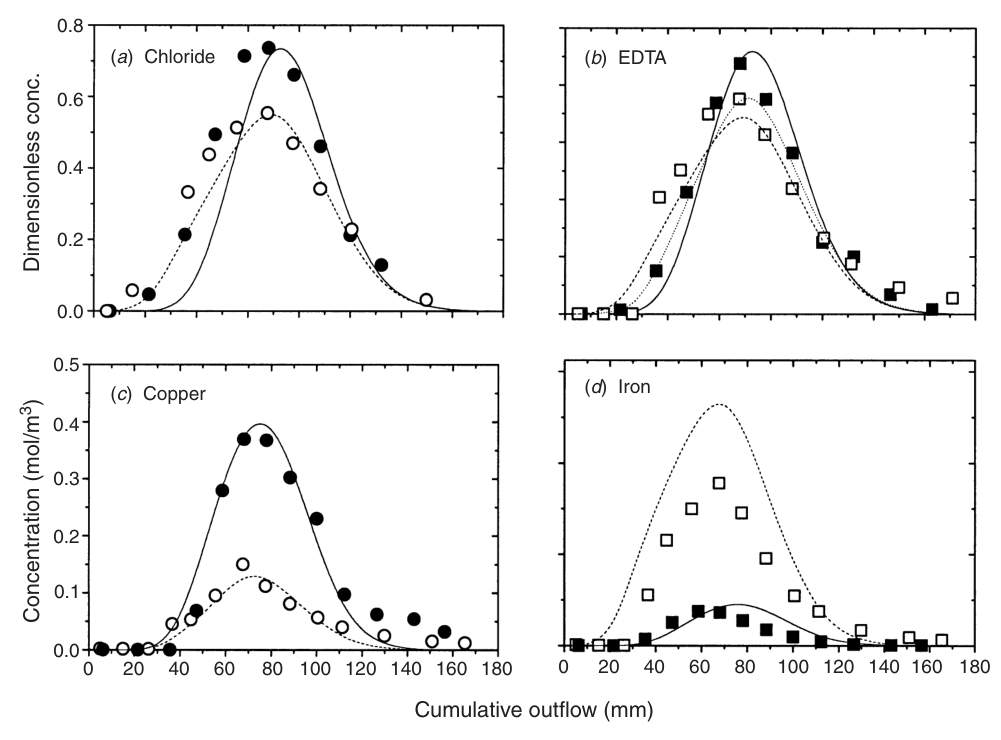
The chloride and EDTA results are shown in Figs 1a and 2a and b. The dimensionless concentrations are presented as (C – C1)/(C2 –C1), whereC is the measured effluent concentration, C1 is the concentration of chloride or EDTA in the pre-leaching solution, and C2 is the concentration applied in the treatment. There was no evidence of EDTA being adsorbed, as the breakthrough curves for EDTA show no retardation relative to the chloride data. This is consistent with Kedziorek et al. (1998), but it has not always been found to be the case. EDTA was also found to be resistant to breakdown in the soil, even after 1 month. In the second experiment, 54 µmol of EDTA exited with immediate leaching, and 53 µmol left when leaching was delayed by 30 days. Both values are close to the 50 µmol applied, with the difference attributable to either measurement error, or not all the DOC being EDTA. In Fig. 2a and b, the difference between the curves for the column leached immediately and for the column leached a month after the chloride and EDTA were applied demonstrates how over time molecular diffusion reduced the peak concentration.
氯离子和EDTA的结果见图1a及图2a和b。无量纲浓度以(C – C1)/(C2 – C1)表示,其中C为实测流出液浓度,C1为预淋溶溶液中氯离子或EDTA的浓度,C2为处理中施加的浓度。EDTA的穿透曲线相对于氯离子数据未表现出阻滞,因此没有证据表明EDTA被吸附。这与Kedziorek et al.(1998)的结果一致,但并非所有研究都得出这一结论。研究还发现,即使经过1个月,EDTA在土壤中仍不易分解。在第二组试验中,立即淋溶时流出54 µmol EDTA,延迟30 d淋溶时流出53 µmol。两者均接近所施加的50 µmol,差异可归因于测量误差或DOC并非全部为EDTA。在图2a和b中,立即淋溶土柱与施加氯离子和EDTA 1个月后淋溶土柱的曲线差异表明,随时间推移,分子扩散降低了峰值浓度。
Copper and iron铜与铁
The effluent concentrations for copper and iron in the first experiment are shown in Fig. 1b. A small amount of zinc was also measured in the leachate, as discussed later. As insignificant amounts of copper, iron, and zinc were found in the leachate during the pre-leaching, it is reasonable to assume that the metals present in the leachate, following the addition of EDTA, were brought into solution by complexation with EDTA. This was confirmed by a speciation analysis of the measured effluent concentration using GEOCHEM-PC (Parker et al. 1995) at various times during the experiment. This indicated that all of the copper, iron, and zinc would have been complexed with EDTA at the measured effluent pH of 5.3–5.6. Furthermore, copper concentrations in the samples were the same before and after passing through the IC-Chelate cartridges. EDTA that was not complexed with copper, iron, or zinc was apparently associated with calcium, as insignificant amounts of aluminium and manganese were found in the effluent.
第一组试验中铜和铁的流出液浓度见图1b。淋出液中还测得少量锌,将在后文讨论。由于预淋溶期间淋出液中铜、铁和锌的含量均可忽略,因此可以合理地假定,加入EDTA后淋出液中的金属是通过与EDTA络合而进入溶液的。试验期间不同时间点利用GEOCHEM-PC(Parker et al. 1995)对实测流出液浓度进行的形态分析证实了这一点:在实测流出液pH 5.3~5.6条件下,所有铜、铁和锌均应与EDTA络合。此外,样品通过IC-Chelate小柱前后的铜浓度相同。由于流出液中铝和锰的含量可忽略,未与铜、铁或锌络合的EDTA显然与钙结合。
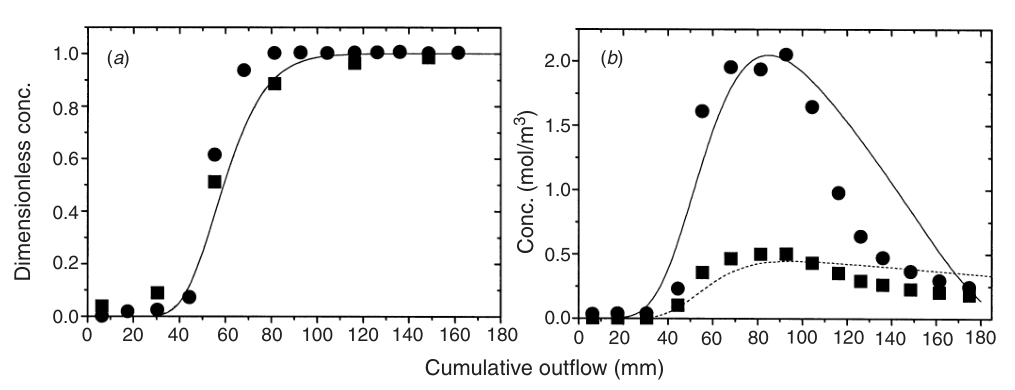
The leachate copper concentrations shown in Fig. 1b increased steadily to a peak and then declined to a low value. Even though more than enough EDTA was applied to complex with all the copper present in the soil, only 57% of the soil copper was leached during the experiment. This reflects the fact that copper is adsorbed to different soil components, such as the various organic matter fractions, iron and aluminium oxides, and the clay fractions, with varying strengths. Each fraction differs in its ease of extraction (McLaren and Crawford 1973; Hong et al. 1999). Soil iron also varies widely in the ease and speed with which it can be extracted by agents such as EDTA (Elliott and Shastri 1999). The 9500 µmol of EDTA applied in the first experiment extracted 295, 140, and 26 µmol of copper, iron, and zinc, respectively. It is noteworthy that 80% of the copper extracted came out in the first 3 PV of leachate (180 mm), and we only found 20% in the remaining 7 PV (for which data are not shown in Fig. 1b). So, once the weakly adsorbed copper had been removed, the extraction process became much less efficient.
如图1b所示,淋出液铜浓度稳步上升至峰值,随后下降至较低水平。尽管所施EDTA的量足以络合土壤中的全部铜,但试验期间仅有57%的土壤铜被淋溶。这反映出铜以不同的结合强度吸附于各种土壤组分,如不同的有机质组分、铁铝氧化物和黏粒组分,且各组分被提取的难易程度不同(McLaren and Crawford 1973; Hong et al. 1999)。土壤铁被EDTA等提取剂提取的难易程度和速度也差异很大(Elliott and Shastri 1999)。第一组试验施加的9500 µmol EDTA分别提取出295、140和26 µmol的铜、铁和锌。值得注意的是,所提取铜的80%在最初3 PV淋出液(180 mm)中流出,其余7 PV中仅有20%(相应数据未在图1b中显示)。因此,一旦弱吸附态铜被去除,提取过程的效率便大为降低。
The EDTA leached the copper uniformly from throughout the column (data not shown). About 92 µg/g of copper remained in the soil. However, all but 28 µg/g of this remaining copper was extracted by shaking 1 g of the soil with 25 mL of 0.01 M EDTAo solution for 24 h at a pH of 6.2. This illustrates the greater efficiency of batch extraction compared with column extraction. We suggest that this is due mainly to the breakdown in soil structure under batch conditions, which allows the EDTA to get at strongly adsorbed copper, which is usually inaccessible (Kookana et al. 1994).
EDTA从整个土柱中均匀地淋溶出铜(数据未列出)。土壤中残留铜约92 µg/g。然而,将1 g土壤与25 mL 0.01 M EDTAo溶液在pH 6.2下振荡24 h,可将这些残留铜提取至仅剩28 µg/g。这说明批量提取的效率高于土柱提取。我们认为,这主要是由于批量条件下土壤结构被破坏,使EDTA能够接触到通常难以触及的强吸附态铜(Kookana et al. 1994)。
The second experiment was designed to find out how stable CuEDTA2– is in soil. Four columns were set up in which, after pre-leaching, 50 mL or 31-mm pulses of 0.001 M EDTAo were applied and left for 0, 1, 7, and 30 days, before leaching resumed with 0.0025 M CaCl2. Fig. 2c and d show the effluent copper and iron concentrations for columns leached immediately, and 30 days after, the EDTAo application. Table 1 gives the amounts leached from all 4 columns. The total amount of copper leached declined markedly as the time for which the EDTA was left in the soil increased. One month’s delay reduced by 66% the amount of copper leached. In contrast, the amount of iron leached increased with increasing EDTA residence time. These results are consistent with the following series of reactions occurring. Initially, the EDTA complexes with soil copper and iron to form CuEDTA2– and Fe(III)EDTA–. The CuEDTA2– then slowly reacts with soil iron, leading to the copper being released and subsequent re-adsorption to the soil, with Fe(III)EDTA– coming into solution. Szecscody et al. (1994, 1998a), Jardine and Taylor (1995), Brooks et al. (1996), Nowack and Sigg (1997), and Davis et al. (2000) all report similar reactions for the transformation of heavy metal–EDTA complexes to Fe(III)EDTA–. The effluent pH showed a difference in the second experiment. It stayed between 5.5 and 5.6 in the immediately leached column, but increased from 5.6 to 6.1 in the column with 1 month’s delay. We attribute this to the consumption of hydrogen ions during the slow transformation of CuEDTA2– to Fe(III)EDTA– (Szecsody et al. 1998b).
第二组试验旨在查明CuEDTA2–在土壤中的稳定性。设置4个土柱,预淋溶后施加50 mL(即31 mm)的0.001 M EDTAo脉冲,分别放置0、1、7和30 d,然后以0.0025 M CaCl2恢复淋溶。图2c和d显示了施加EDTAo后立即淋溶和30 d后淋溶土柱的流出液铜、铁浓度。表1给出了4个土柱的淋出量。随EDTA在土壤中停留时间的延长,铜的总淋出量显著下降。延迟1个月使铜淋出量减少了66%。相反,铁的淋出量随EDTA停留时间的延长而增加。这些结果与以下一系列反应相符:最初,EDTA与土壤铜和铁络合形成CuEDTA2–和Fe(III)EDTA–;随后CuEDTA2–缓慢地与土壤铁反应,释放出铜并使其重新吸附于土壤,同时Fe(III)EDTA–进入溶液。Szecscody et al.(1994, 1998a)、Jardine and Taylor(1995)、Brooks et al.(1996)、Nowack and Sigg(1997)以及Davis et al.(2000)均报道了重金属–EDTA络合物向Fe(III)EDTA–转化的类似反应。第二组试验中流出液pH存在差异:立即淋溶土柱的pH保持在5.5~5.6,而延迟1个月的土柱pH由5.6升至6.1。我们将其归因于CuEDTA2–缓慢转化为Fe(III)EDTA–过程中氢离子的消耗(Szecsody et al. 1998b)。
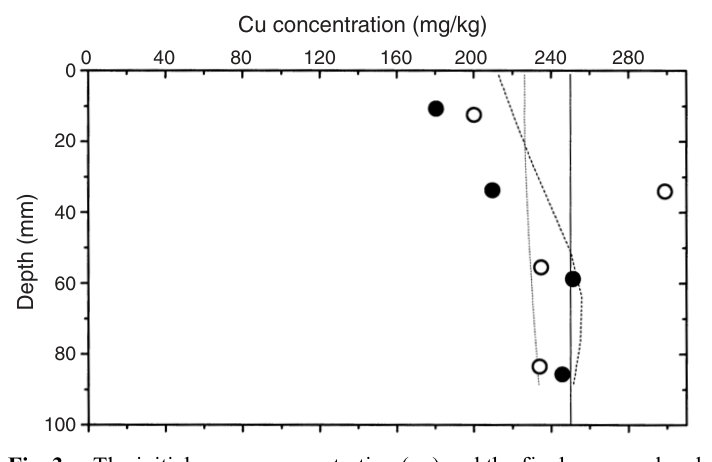
The resident copper concentrations in the soil at the end of leaching are shown in Fig. 3. In contrast to the first experiment, in the second experiment only in the top 20 mm was there a large reduction in copper content. This was due to the much smaller amount of EDTA added. In the column left with EDTA in it for 1 month, the copper content at the 35 mm depth increased. This we attribute to the transformation of CuEDTA2– to Fe(III)EDTA–, and the associated release and re-adsorption of Cu2+ at that depth.
淋溶结束时土壤中的残留铜浓度见图3。与第一组试验不同,第二组试验中仅表层20 mm土壤的铜含量大幅降低,这是由于加入的EDTA量少得多。在含EDTA放置1个月的土柱中,35 mm深度处的铜含量有所增加。我们将其归因于CuEDTA2–向Fe(III)EDTA–的转化,以及该深度处Cu2+随之释放并重新吸附。
Modelling模型模拟
Solution of Eqns 1–5 requires that parameter values be found. These values were directly measured, obtained from the literature, or determined indirectly using the results of the experiments. The measured values were used for the Darcy flux density (q). The gravimetric water contents measured at the time of final destructive sampling of the columns, and the measured bulk density, allowed the volumetric water content (θ) in each column at the conclusion of the experiment to be found. These values were assumed constant with time. The traditional value of 0.66 was assumed for the tortuosity factor a (Penman 1940), as all the soil columns were near saturation. A molecular diffusion coefficient (Do) value of 1 × 10⁻⁹ m2/s was used for chloride (Robinson and Stokes 1959). A molecular diffusion coefficient value for EDTA was not found in the literature, so we used the above value (Jardine et al. 2002). We show later that the model is fairly insensitive to any error in this assumption.
求解式1~5需要确定参数值。这些参数值或直接测定,或取自文献,或利用试验结果间接确定。Darcy通量密度(q)采用实测值。根据土柱最终破坏性取样时测得的质量含水量和实测容重,求得试验结束时各土柱的体积含水量(θ),并假定其不随时间变化。由于所有土柱均接近饱和,曲折因子a采用传统值0.66(Penman 1940)。氯离子的分子扩散系数(Do)取1 × 10⁻⁹ m2/s(Robinson and Stokes 1959)。文献中未查到EDTA的分子扩散系数,因此采用上述数值(Jardine et al. 2002)。后文将表明,模型对该假定的误差相当不敏感。
| Residence time停留时间 | Cu lea | chedched | Fe lea | chedched |
|---|---|---|---|---|
| (days) | Experiment | Model | Experiment | Model |
| 00 | 35 | 34 | 05 | 06 |
| 01 | 28 | 40 | 10 | 10 |
| 07 | 23 | 31 | 18 | 19 |
| 30 | 12 | 12 | 24 | 38 |
The dispersivity (λ) for the repacked soil was determined by optimising the appropriate analytical solutions of the convection–dispersion equation, for the imposed boundary and initial conditions, to the effluent chloride data. Data from the first experiment, and the immediately leached column in the second experiment, were used and λ found using the least squares method. Longitudinal molecular diffusion was negligible during flow, so could be ignored in this case. Dispersivity values of 1 and 5 mm were found for these 2 experiments, and these are within the range of values for repacked soil given by Wagenet (1983). The average of the 2 values, 3 mm, was used for all solutes in all simulations.
针对所施加的边界条件和初始条件,将对流–弥散方程的相应解析解与流出液氯离子数据进行优化拟合,以确定重填土壤的弥散度(λ)。采用第一组试验及第二组试验中立即淋溶土柱的数据,以最小二乘法求得λ。水流期间纵向分子扩散可忽略不计,故此处不予考虑。两组试验求得的弥散度分别为1 mm和5 mm,均在Wagenet(1983)给出的重填土壤数值范围之内。所有模拟中所有溶质均采用两者的平均值3 mm。
The optimised values of R for chloride in the first experiment, and in the immediately leached column in the second experiment, gave values close to unity. This indicated that neither adsorption nor exclusion had occurred. The simulated breakthrough curves for chloride are shown in Figs 1a and 2a. The simulations of EDTA behaviour in the same experiments are shown in Figs 1a and 2b, also assuming R = 1. EDTA transport was modelled successfully, implying little or no adsorption occurred. Note that in Fig. 1a the simulated curves for chloride and EDTA coincide, so a single curve is shown.
第一组试验及第二组试验立即淋溶土柱中氯离子的R优化值均接近1,表明既未发生吸附也未发生排斥。氯离子的模拟穿透曲线见图1a和图2a。同样假定R = 1,相同试验中EDTA行为的模拟结果见图1a和图2b。EDTA迁移模拟成功,说明几乎未发生吸附。注意在图1a中,氯离子与EDTA的模拟曲线重合,故仅显示一条曲线。
Comparison of the chloride breakthrough with immediate leaching, and after 1 month’s delay (Fig. 2a), shows the effect of molecular diffusion over the month. It reduced the amplitude of the pulse and spread it out more. Both the measured and simulated values show this behaviour. The EDTA-breakthrough curves show the same behaviour, but it is less pronounced. Two simulated curves are shown for EDTA with 1 month’s delay in leaching. The curve with the higher peak uses the molecular diffusion coefficient for chloride, 1 × 10⁻⁹ m2/s, and the other uses a lower value of 2.5 × 10⁻¹⁰ m2/s. This is half the value given for atrazine, a similar large organic molecule, by Hu and Brusseau (1996). Note that the 2 simulations are not very different, and indeed it is hard to say which fits the data better, especially given some uncertainty as to whether, after 1 month, all of the DOC in the leachate was in fact EDTA.
比较立即淋溶与延迟1个月淋溶的氯离子穿透曲线(图2a)可见该月内分子扩散的影响:分子扩散降低了脉冲幅度并使其进一步展宽。实测值和模拟值均表现出这一特征。EDTA穿透曲线表现出相同的特征,但程度较弱。图中给出了延迟1个月淋溶时EDTA的两条模拟曲线:峰值较高的曲线采用氯离子的分子扩散系数1 × 10⁻⁹ m2/s,另一条则采用较低的2.5 × 10–10 m2/s。该值为Hu and Brusseau(1996)给出的阿特拉津(一种同样的大分子有机物)数值的一半。需注意,两种模拟结果差别不大,实际上很难判断哪一条与数据拟合更好,尤其是考虑到1个月后淋出液中的DOC是否全部为EDTA尚存在一定的不确定性。
We assumed that the first experiment removed all the iron that is EDTA-extractable at the prevailing pH. The first 3 PV of the iron breakthrough curve are shown in Fig. 1b. We found an initial value of 1.25 mmol/kg for MFe from the area under the curve. This value is used in all the simulations. In the first experiment we also assumed that all the copper that could be removed by leaching with EDTA had been removed. So the 90 mg/kg (1.4 mmol/kg) remaining was effectively inert. Thus, the initial value of MCuwas the acid-extractable value less 1.4 mmol/kg.
假定第一组试验已去除了在当时pH下所有可被EDTA提取的铁。铁穿透曲线的前3 PV见图1b。由曲线下面积求得MFe的初始值为1.25 mmol/kg,该值用于所有模拟。在第一组试验中,还假定所有可通过EDTA淋溶去除的铜均已被去除,因此残留的90 mg/kg(1.4 mmol/kg)铜实际上为惰性铜。由此,MCu的初始值取酸提取态铜含量减去1.4 mmol/kg。
Kedziorek et al. (1998) found that metal–EDTA reactions, over a wide range of EDTA concentrations, could be described using an equation similar to our Eqn 3 with n = 1. This implies a first-order equation with respect to both the EDTA and the extractable metal concentrations. However, we found that n = 0.5 better described the way the EDTA concentration, over a 10-fold difference in concentrations, affected extraction. So we subsequently used this value in the model. Values for the rate-coefficients K1 andK2 were obtained by visually fitting the model predictions to the CuEDTA data in Figs 1b and 2c. We assumed that K3was zero during this optimisation process, as we expected little transformation of CuEDTA2– to Fe(III)EDTA– during the relatively short resident times of the first experiment. Subsequent checks showed that this assumption was reasonable. The values obtained were 4 × 10⁻⁵ s–1 for K1 and 9 × 10⁻⁶ s–1 for K2.
Kedziorek et al.(1998)发现,在较宽的EDTA浓度范围内,金属–EDTA反应可用类似于本文式3、n = 1的方程描述,即该方程对EDTA浓度和可提取态金属浓度均为一级。然而我们发现,在浓度相差10倍的范围内,n = 0.5能更好地描述EDTA浓度对提取的影响,因此随后在模型中采用该值。速率系数K1和K2的值通过将模型预测值与图1b和图2c中的CuEDTA数据进行目视拟合获得。在此优化过程中假定K3为零,因为预计在第一组试验相对较短的停留时间内,CuEDTA2–向Fe(III)EDTA–的转化很少。随后的检验表明该假定是合理的。所得K1为4 × 10⁻⁵ s–1,K2为9 × 10⁻⁶ s–1。
It remained then to find a value for K3. The data from the second experiment were used. Here EDTA was left in the soil for varying periods of up to 1 month. Optimisation showed that a K3 value of 2.2 × 10⁻⁷ s–1 reasonably described the decreasing amounts of CuEDTA2– in the leachate with increasing EDTA residence time in the soil (Table 1; Fig. 2c). Note that K3 is 2 orders of magnitude lower thanK1, justifying the assumption in the previous paragraph.
接下来需要确定K3的值,为此采用第二组试验的数据。该试验中EDTA在土壤中放置了至多1个月的不同时间。优化结果表明,K3取2.2 × 10⁻⁷ s–1时,能较好地描述淋出液中CuEDTA2–的量随EDTA在土壤中停留时间延长而减少的趋势(表1;图2c)。注意K3比K1低2个数量级,证明了上一段中假定的合理性。
With this parameter set, the model described quite successfully the copper concentration in the leachate in Figs 1b and 2c, despite the different amounts and concentrations of EDTA applied and the varying lengths of time it was left in the soil. However, there were some aspects of the second experiment that the model did not describe well. Although the model correctly estimated the amount of copper leached immediately, with a 1-month delay it did overestimate the amounts leached after 1 day and 1 week (Table 1). Our simple model can only describe approximately the range of reaction rates, and the availability of the soil copper, which is bound to the solid phase to varying degrees. This is also probably the reason for the discrepancies between the measured, and simulated, final copper distributions in the soil after leaching (Fig. 3).
采用这组参数,尽管所施EDTA的量和浓度不同,且在土壤中放置的时间长短不一,模型仍相当成功地描述了图1b和图2c中淋出液的铜浓度。然而,第二组试验中有些方面模型描述得不够理想。虽然模型正确估算了立即淋溶时的铜淋出量,也较好地估算了延迟1个月时的淋出量,但确实高估了延迟1 d和1周后的淋出量(表1)。我们的简单模型只能近似描述反应速率的变化范围以及以不同程度结合于固相的土壤铜的有效性。这可能也是淋溶后土壤中最终铜分布的实测值与模拟值之间存在差异的原因(图3)。
The amount of iron in the leachate of both experiments was also quite closely simulated (Figs 1b and 2d; Table 1), except for the column with the 1-month delay before leaching. The overestimation in this case was possibly due to some degradation, or slow irreversible adsorption, of EDTA over the month.
除淋溶前延迟1个月的土柱外,两组试验淋出液中的铁含量也得到了相当接近的模拟(图1b和图2d;表1)。该土柱的高估可能是由于该月内EDTA发生了一定程度的降解或缓慢的不可逆吸附。
5Conclusions结论
Leaching with an excess of 0.01 M EDTA removed about half the copper from a contaminated soil, and most of this copper was removed in the first 3 PV. A substantial amount of iron was also leached. The soil with a pH in water of 5.6 did not adsorb any of the EDTA forms.
以过量的0.01 M EDTA淋溶可去除污染土壤中约一半的铜,其中大部分在最初3 PV内被去除。同时有大量铁被淋出。该土壤(水浸pH 5.6)未吸附任何形态的EDTA。
When a pulse of EDTA was applied to copper-contaminated soil, and left there for periods of up to a month before leaching, the amount of copper leached decreased as the delay period increased. One month’s delay reduced by 66% the amount of copper leached. We explain this behaviour as Cu-EDTA2– being slowly adsorbed to iron compounds in the soil, and thereby dissociating to form the more-stable Fe(III)EDTA–. The latter is released back into the soil solution, whilst the Cu2+ is re-adsorbed.
向铜污染土壤施加EDTA脉冲并放置至多1个月后再淋溶,铜的淋出量随延迟时间的延长而减少。延迟1个月使铜淋出量减少了66%。我们对这一现象的解释是:Cu-EDTA2–缓慢吸附于土壤中的铁化合物,并由此解离形成更稳定的Fe(III)EDTA–;后者被释放回土壤溶液,而Cu2+则被重新吸附。
The experimental results were successfully simulated using the convention–dispersion equation, which incorporated a source/sink term describing the competing time-dependent reactions of copper and iron with EDTA, as well as the reversion of CuEDTA2– to adsorbed Cu2+ and Fe(III)EDTA–. In the accompanying paper (Thayalakumaran et al. 2003) further experimental studies with different boundary conditions, different repacked soils, and intact soil cores, enable further testing and development of the model.
采用对流–弥散方程成功模拟了试验结果,该方程引入了源/汇项,用以描述铜和铁与EDTA之间随时间变化的竞争反应,以及CuEDTA2–向吸附态Cu2+和Fe(III)EDTA–的转化。在配套论文(Thayalakumaran et al. 2003)中,通过在不同边界条件下对不同重填土壤及原状土柱开展的进一步试验研究,对模型进行了进一步检验和完善。
6Acknowledgments致谢
This work was funded by New Zealand’s Foundation for Research Science and Technology through contract C06830 ‘Root-zone Processes and Water Resource Sustainability’ and C06X0004 ‘Knowledge Tools for Environmental Action’. The authors would like to thank Landcare Research New Zealand Ltd (Palmerston North) for the analysis of DOC, and Dr Alan S. Palmer of Massey University for helping with soil identification.
本研究由新西兰科学研究与技术基金会(Foundation for Research Science and Technology)通过合同C06830“根区过程与水资源可持续性”(Root-zone Processes and Water Resource Sustainability)和C06X0004“环境行动知识工具”(Knowledge Tools for Environmental Action)资助。作者感谢Landcare Research New Zealand Ltd(Palmerston North)进行DOC分析,并感谢Massey University的Alan S. Palmer博士协助鉴定土壤。
7References参考文献
Blaylock MJ, Salt DE, Dushenkov S, Zakharova O, Gussman C, Kapulnik Y, Ensley BD, Raskin I (1997) Enhanced accumulation of Pb in Indian mustard by soil-applied chelating agents. Environmental Science and Technology 31, 860–865.
Brooks RR (1998) General introduction. In ‘Plants that hyperaccumulate heavy metals’. (Ed. RR Brooks) pp. 1–14. (CAB International: Wallingford, UK)
Brooks SC, Taylor DL, Jardine PM (1996) Reactive transport of EDTA-complexed cobalt in the presence of ferrihydrite. Geochimica et Cosmochimica. Acta 60, 1899–1908.
Brown GA, Elliot HA (1992) Influence of electrolytes on EDTA extraction of Pb from polluted soil. Water, Air and Soil Pollution 62, 157–165.
Cunningham SD, Anderson TA, Schwab AP, Hsu FC (1996) Phytoremediation of soils contaminated with organic pollutants. Advances in Agronomy 56, 55–114.
Davis JA, Kent DB, Coston JA (2000) Multispecies reactive tracer test in an aquifer with spatially variable chemical conditions. Water Resources Research 36, 119–134.
Elliott HA, Shastri NL (1999) Extractive decontamination of metal-polluted soils using oxalate. Water, Air and Soil Pollution 110, 335–346.
Ghestem JP, Bermond A (1998) EDTA extractability of trace metals in polluted soils: A chemical–physical study. Environmental Technology 19, 409–416.
Hewitt AE (1993) ‘New Zealand soil classification.’ Landcare Research Science Series No. 1. (Manaaki-Whenua Press: Lincoln, NZ)
Hu Q, Brusseau ML (1996) Transport of rate-limited sorbing solutes in an aggregated porous medium: A multiprocess non-ideality approach. Journal of Contaminant Hydrology 24, 53–73.
Huang JW, Chen J, Berti WR, Cunningham SD (1997) Phytoremediation of lead-contaminated soils: Role of synthetic chelates in lead phytoextraction. Environmental Science and Technology 31, 800–805.
Hong PKA, Li C, Banerji SK, Regmi T (1999) Extraction, recovery and biostability of EDTA for remediation of heavy metal-contaminated soil. Journal of Soil Contamination 8, 81–103.
Jardine PM, Jacobs GK, O’Dell JD (1993) Unsaturated transport processes in unsaturated heterogenous porous media: II. Co-contaminants. Soil Science Society of America Journal 57, 954–962.
Jardine PM, Mehlhorn TL, Larsen IL, Bailey WB, Brooks SC, Roh Y, Gwo JP (2002) Influence of hydrological and geochemical processes on the transport of chelated metals and chromate in fractured shale bedrock. Journal of Contaminant Hydrology 55, 137–159.
Jardine PM, Taylor DL (1995) Fate and transport of ethylenediaminetetraacetate chelated contaminants in subsurface environments. Geoderma 67, 125–140.
Jury WA, Gardner WR, Gardner WH (1991) ‘Soil physics’. 5th edn (John Wiley and Sons, Inc.: New York) Kedziorek MAM, Dupuy A, Bourg ACM, Compere F (1998) Leaching of Cd and Pb from a polluted soil during the percolation of EDTA: Laboratory column modeled with a non-equilibrium solubilization step. Environmental Science and Technology 32, 1609–1614. Kirkham MB (2000) EDTA-facilitated phytoremediation of soil with heavy metals from sewage sludge. International Journal of Phytoremediation 2, 159–172. Kookana RS, Naidu R, Tiller KG (1994) Sorption non-equilibrium during cadmium transport through soils. Australian Journal of Soil Research 32, 635–651. McLaren RG, Crawford DV (1973) Studies on soil copper II. The specific adsorption of copper by soils. Journal of Soil Science 24, 443–452. Merry RH, Tiller KG, Alston AM (1983) Accumulation of copper, lead and arsenic in some Australian orchard soils. Australian Journal of Soil Research 21, 549–561. Nowack B, Sigg L (1997) Dissolution of Fe(III) (hydr)oxides by metal EDTA complexes. Geochimica et Cosmochimica Acta 61, 951–963. Parker DR, Norvell WA, Chaney RL (1995) GEOCHEM-PC: A chemical speciation program for IBM and compatible personal computers. In ‘Chemical equilibrium and reaction models’. (Eds RH Loeppert, PA Schwab, S Goldberg) pp. 253–269. SSSA Special Publication No. 42. (Soil Science Society of America: Madison, WI) Parkhurst DL (1995) User’s guide to PHREEQC: A computer program for speciation, reaction-path, advective-transport, and inverse geochemical calculations. US Geological Survey Water Resources Investigation Report No. 95–4227, p. 143. Penman HL (1940) Gas and vapour movements in the soil. I. The diffusion of vapours through porous solids. Journal of Agricultural Science 30, 437–461. Roberts AHC, Cameron KC, Bolan NS, Ellis HK, Hunt S (1996) Contaminants and soil environment in New Zealand. In ‘Contaminants and the soil environment in the Australasia–Pacific Region’. (Eds R Naidu, RS Kookana, PD Oliver, S Rogers, MJ McLaughlin) pp. 579–628. (Kluwer Academic Publishers: Dordrecht, The Netherlands)
Robinson RA, Stokes RH (1959) ‘Electrolyte Solutions.’ 2nd edn (Butterworths: London)
Samani Z, Hu S, Hanson AT, Heil DM (1998) Remediation of lead contaminated soil by column extraction with EDTA: II. Modeling. Water, Air and Soil Pollution 102, 221–238.
Sun B, Zhao FJ, Lombi E, McGrath SP (2001) Leaching of heavy metals from contaminated soils using EDTA. Environmental Pollution 113, 111–120.
Szecsody JE, Zachara JM, Bruckhart PL (1994) Adsorption-Dissolution reactions affecting the distribution and stability of CoIIEDTA in iron oxide-coated sand. Environmental Science and Technology 28, 1706–1716.
Szecsody JE, Zachara JM, Chilakapati A, Jardine PM, Ferrency AS (1998a) Importance of flow and particle-scale heterogenity on CoII/IIIEDTA reactive transport. Journal of Hydrology 209, 112–136. Szecsody JE, Chilakapati A, Zachara JM, Garvin AL (1998b) Influence of iron oxide inclusion shape on CoII/III EDTA reactive transport through spatially heterogeneous sediment. Water Resources Research 34, 2501–2514.
Thayalakumaran T, Vogeler I, Scotter DR, Percival HJ, Robinson BH, Clothier BE (2003) Leaching of copper from contaminated soil following the application of EDTA. II. Intact core experiments and model testing. Australian Journal of Soil Research 41, 335–350.
Tuin BJW, Tels M (1990) Removing heavy metals from contaminated clay soils by extraction with hydrochloric acid, EDTA or hypochlorite solutions. Environmental Technology 11, 1039–1052.
Wagenet RJ (1983) Principles of salt movement in soils. In ‘Chemical mobility and reactivity in soil systems’. (Eds DW Nelson, DE Elrick, KK Tanji) SSSA Special Publication 11. pp. 123–140. (ASA and SSSA: Madison, WI) Wu J, Hsu FC, Cunningham SD (1999) Chelate-assisted Pb phytoextraction: Pb availability, uptake, and translocation constraints. Environmental Technology 33, 1898–1904.
Yeh GT, Salvage K (1995) HYDROGEOCHEM 2.1: A coupled model of hydrologic transport and geochemistry with both equilibrium and kinetic reactions. Technical Report, Department of Civil and Environmental Engineering, Pennsylvania State University, State College.
Yu J, Klarup D (1994) Extraction kinetics of copper, zinc, iron and manganese from contaminated sediment using disodium ethylenediaminetetraacetate. Water, Air and Soil Pollution 75, 205–225.
Manuscript received 21 May 2002, accepted 15 November 2002