www.publish.csiro.au/journals/ajsr
Australian Journal of Soil Research, 2003, 41, 599–611
Brett RobinsonA,C, Steve GreenA, Tessa MillsA, Brent ClothierA, Marijn van der VeldeA,B, Raphael LaplaneA, Lindsay FungA, Markus DeurerA, Sarah HurstA, Thabo ThayalakumaranA, and Carlo van den DijsselA
AHortResearch, Private Bag 11 030, Palmerston North, New Zealand.
BInstitute of Biodiversity and Ecosystem Dynamics, University of Amsterdam, Nieuwe Achtergracht 166, 1018 WV, Amsterdam, The Netherlands.
CCorresponding author; email: brobinson@hortresearch.co.nz
1Abstract摘要
Plants pump large amounts of water, solutes, and organic matter as part of their normal physiological processes. This pumping action can be exploited to improve degraded environments by stabilising, removing, or breaking-down contaminants in the substrates. In addition, soil amendments such as fertilisers and microbes may also be added to enhance the efficacy of the operation. Basic plant physiology sets limits on the capacity of phytoremediation. However, combining this technology with the production of saleable products may render the extra time needed for clean-up relatively unimportant. Phytoremediation is still poorly developed, particularly the phytoextraction of heavy metals. Continual innovation will greatly expand the scope and efficacy of phytoremediation. The greatest potential use for this technology may be in developing countries that have the highest levels of environmental degradation, and scant funds for remediation. Phytoremediation could provide a low-cost and sustainable way to improve local economies. Here a case study is reported on the phytoremediation of a 3.6 ha sawdust pile that was leaching unacceptable amounts of boron (B) into local waterways. High water-use poplars were used to control leaching and potentially remove B from the site via phytoextraction. Selected trees that are coppiced before leaf-fall could be mulched and used to provide ‘organic’ B on nearby orchards that are deficient in this element.
植物在其正常生理过程中会泵送大量的水分、溶质和有机质。可利用这种泵送作用,通过稳定、去除或降解基质中的污染物来改善退化环境。此外,还可添加肥料和微生物等土壤改良剂以提高修复效果。植物的基本生理特性限定了植物修复的能力。然而,将该技术与可销售产品的生产相结合,可使修复所需的额外时间变得相对次要。植物修复目前仍很不成熟,重金属的植物提取尤其如此。持续的创新将大大拓展植物修复的应用范围并提高其效能。该技术最大的潜在应用领域可能是环境退化程度最高而修复资金匮乏的发展中国家。植物修复可为改善当地经济提供一种低成本且可持续的途径。本文报道了一项案例研究:对一处面积为3.6 ha、向当地水体淋溶出超标硼(B)的锯末堆进行植物修复。研究采用高耗水的杨树来控制淋溶,并有望通过植物提取将B从场地中移除。选定的树木可在落叶前进行平茬,经粉碎覆盖后作为“有机”B施用于附近缺乏该元素的果园。
Additional keywords: heavy metals, modelling, lysimeter, phytoextraction, phytomining, phytoremediation.
补充关键词:重金属,模型模拟,渗漏计,植物提取,植物采矿,植物修复。
2Introduction引言
Phytoremediation is the use of plants to improve degraded environments. This technology has been used for hundreds of years to treat human waste, reduce erosion, and protect water quality. Research focusing specifically on the phytoremediation of contaminated soils has only grown significantly in the last 25 years.
植物修复是指利用植物改善退化环境。该技术用于处理人类废弃物、减少侵蚀和保护水质已有数百年历史。而专门针对污染土壤植物修复的研究仅在过去25年间才显著增长。
Pioneering work by the late Professor Robert Brooks at Massey University, Palmerston North, New Zealand popularised the study of plants that accumulate inordinate amounts of heavy metals. Chaney (1983) suggested that these so-called ‘hyperaccumulator’ plants (Brooks et al. 1977) could be used to remove heavy metals from contaminated soils. McGrath et al. (1993) and Baker et al. (1994) demonstrated that the Brassicaceous herb Thlaspi caerulescens could be used to extract Zn from contaminated soil. Since these benchmark studies, there has been a plethora of work using plants to phytoremediate contaminated soils. This work has expanded to include soils polluted with organic contaminants and excess plant nutrients as well as heavy metals. Dedicated phytoremediation companies have appeared around the world to service a global market that is estimated to be over US$100 million/year currently (Glass 1999).
已故的Robert Brooks教授在新西兰Palmerston North的Massey大学开展的开创性工作,使对积累异常大量重金属的植物的研究得到普及。Chaney(1983)提出,这些所谓的“超富集植物”(Brooks et al. 1977)可用于去除污染土壤中的重金属。McGrath et al.(1993)和Baker et al.(1994)证明,十字花科草本植物Thlaspi caerulescens可用于从污染土壤中提取Zn。自这些标志性研究以来,利用植物修复污染土壤的研究大量涌现。相关工作已扩展至受有机污染物和过量植物养分以及重金属污染的土壤。世界各地已出现专门的植物修复公司,服务于目前估计每年超过1亿美元的全球市场(Glass 1999)。
The general process of phytoremediation植物修复的一般过程
In phytoremediation, plants are exploited as bio-pumps that use the sun’s energy to remove water and contaminants from the soil to the above-ground portions, and return some of the products of photosynthesis back into the root-zone. Transpiration is the cornerstone of phytoremediation. By removing water from the substrate, plants help to reduce erosion, runoff, and leaching, thereby limiting the movement of contaminants off-site. Some soil contaminants are taken up in the transpiration stream, where they may be metabolised, volatilised, or stored. By drying out the soil profile, the plant roots may also create an aerobic environment where metal mobility is reduced and biological activity is enhanced. Plants stimulate microbiological activity in the root-zone by providing a carbon source from root exudates and decaying root material. It is well documented (Gudin and Syratt 1975; Reilley et al. 1996) that soil microbiota enhance the degradation of some organic contaminants as part of their normal metabolism.
在植物修复中,植物被用作生物泵,利用太阳能将水分和污染物从土壤转移至地上部分,并将部分光合产物返还根区。蒸腾作用是植物修复的基石。植物通过从基质中移除水分,有助于减少侵蚀、径流和淋溶,从而限制污染物向场地外迁移。一些土壤污染物随蒸腾流被吸收,并可能在植物体内被代谢、挥发或储存。植物根系通过使土壤剖面变干,还可创造好氧环境,从而降低金属的迁移性并增强生物活性。植物通过根系分泌物和腐烂根系物质提供碳源,刺激根区的微生物活性。已有大量文献(Gudin and Syratt 1975; Reilley et al. 1996)证实,土壤微生物区系在其正常代谢过程中可促进某些有机污染物的降解。
Categories and applications of phytoremediation植物修复的类别与应用
Phytoremediation can be broadly categorised by the way plants are being used. In phytostabilisation and hydraulic control, transpiration and root-growth are used to immobilise contaminants by reducing leaching, controlling erosion, creating an aerobic environment in the root-zone, and adding organic matter to the substrate that binds the contaminant. Root exudates may also play a role in phytostabilisation. Rugh et al. (1996) showed that genetically modified Arabidopsis thaliana could reduce toxic mercuric ions into relatively inert metallic mercury. Phytostabilisation involves the establishment of vegetation on the contaminated site that is left in perpetuity. Substrate amendments may be added and a succession of plant species may be used to establish the desired climax vegetation. Establishing a healthy substrate microflora, especially mycorrhizal symbionts, can greatly enhance phytostabilisation (Vosátka 2001). Phytostabilisation can be used to control erosion and leaching on metalliferous mine tailings (Vangronsveld et al. 1996). Establishing vegetation directly on the tailings reduces dust and leaching, enhances public appeal, and is more cost-effective than capping, which could require re-engineering of any tailings dam as well as a large earth-moving operation.
植物修复可按植物的利用方式大致分类。在植物稳定和水力控制中,利用蒸腾作用和根系生长来固定污染物,其途径包括减少淋溶、控制侵蚀、在根区创造好氧环境以及向基质中添加可结合污染物的有机质。根系分泌物也可能在植物稳定中发挥作用。Rugh et al.(1996)表明,转基因Arabidopsis thaliana可将有毒的汞离子还原为相对惰性的金属汞。植物稳定是指在污染场地上建立永久保留的植被。可添加基质改良剂,并利用植物物种的演替来建立理想的顶极植被。建立健康的基质微生物区系,尤其是菌根共生体,可大大增强植物稳定效果(Vosátka 2001)。植物稳定可用于控制含金属矿山尾矿的侵蚀和淋溶(Vangronsveld et al. 1996)。直接在尾矿上建立植被可减少扬尘和淋溶,提升公众接受度,且比覆盖封顶更具成本效益;后者可能需要对尾矿坝进行重新改造,并需大规模的土方作业。
Some of the negative environmental effects of tip-sites, land effluent disposal, and intensive farming can be mitigated by using plants to prevent contaminants leaching to groundwater or local waterways (Dix et al. 1997). Phreatophytic trees, such as poplars and willows, are particularly suited to this role (Ferro et al. 1997).
利用植物防止污染物淋溶进入地下水或当地水体,可减轻垃圾填埋场、污水土地处置和集约化农业带来的部分负面环境影响(Dix et al. 1997)。杨树和柳树等潜水植物(深根吸水树种)尤其适合承担这一作用(Ferro et al. 1997)。
Phytoremediation may be a solution to the ‘dirty dairying’ problem that is emerging in New Zealand as nitrates contaminate groundwater and streams after the irrigation of dairy shed effluent onto pasturelands (Roygard et al. 2001). Effluent, high in N, may be irrigated onto an area planted with high water-use, fast-growing, palatable species such as poplar and willow that can, in turn, be fed back to stock as fodder.
新西兰正在出现“肮脏奶业”问题,即将奶牛场污水灌溉至牧场后,硝酸盐污染地下水和溪流(Roygard et al. 2001),植物修复可能是解决该问题的途径之一。可将高氮污水灌溉到种植有高耗水、速生且适口性好的物种(如杨树和柳树)的区域,这些植物又可作为饲料回饲家畜。
Deep-rooting, high water-use, evergreen trees can be used to lower a saline water table, thus reducing salt toxicity to crops, a technology that has been demonstrated to be effective on some Australian soils (Bell 1999).
深根、高耗水的常绿树木可用于降低含盐地下水位,从而减轻盐分对作物的毒害,该技术已在部分澳大利亚土壤上被证明有效(Bell 1999)。
Phytodegradation, phytostimulation, phytodetoxification, and rhizodegradation are terms used to describe the use of plants, in association with soil microbiota, to degrade contaminants in the root-zone. There are 3 possible ways that plants can lead to the degradation of contaminants: (1) uptake and metabolism; (2) direct action or plant root exudates; and (3) enhanced microbial activity in the root-zone through aeration, root exudates, and the decomposition of dead root material. Ideally, soil contaminants should be degraded to carbon dioxide, water, and halide ions, if they are present in the original molecule. However, plants can be used to partially degrade some organic compounds to produce daughter products that are less harmful than the original contaminant. The effectiveness of phytodegradation is dependent on the type of contaminant present in the system. Plant roots have been shown to enhance the degradation of petroleum compounds, explosives such as trinitrotoluene (TNT) (Hannink et al. 2001), perchlorates (Nzengung et al. 1999; Susarla et al. 1999), pentachlorophenol (PCP) (Ferro et al. 1994), and some polycyclic aromatic hydrocarbons (PAHs) (Reilley et al. 1996). Other compounds, such as dichlorodiphenyltrichloroethane (DDT), are recalcitrant even in the presence of plant roots (Chaudhry et al. 2002).
植物降解、植物刺激、植物解毒和根际降解等术语用于描述利用植物与土壤微生物区系协同作用降解根区污染物的过程。植物导致污染物降解的途径可能有3种:(1)吸收与代谢;(2)直接作用或植物根系分泌物的作用;(3)通过通气、根系分泌物和死亡根系物质的分解增强根区微生物活性。理想情况下,土壤污染物应被降解为二氧化碳、水以及卤素离子(若原分子中含卤素)。然而,也可利用植物部分降解某些有机化合物,生成毒性低于原污染物的子代产物。植物降解的效果取决于系统中污染物的类型。已有研究表明,植物根系可促进石油类化合物、三硝基甲苯(TNT)等炸药(Hannink et al. 2001)、高氯酸盐(Nzengung et al. 1999; Susarla et al. 1999)、五氯苯酚(PCP)(Ferro et al. 1994)以及部分多环芳烃(PAHs)(Reilley et al. 1996)的降解。而其他化合物,如双对氯苯基三氯乙烷(DDT),即使在有植物根系存在时也难以降解(Chaudhry et al. 2002)。
Phytodegradation could be a low-cost way of cleaning up disused sheep and cattle dipping sites in Australasia. Here phreatophytic trees could be used to enhance the degradation of organochlorines such as dieldrin (Schnabel and White 2001), control leaching, and demarcate the area so that stock can be prevented from ingesting contaminated pasture or soil.
植物降解可能是清理澳大拉西亚地区废弃羊、牛药浴场地的一种低成本方法。在此类场地可利用潜水树种促进狄氏剂等有机氯化合物的降解(Schnabel and White 2001)、控制淋溶,并划定区域范围,以防止家畜摄食受污染的牧草或土壤。
Soil amendments such as surfactants, fertilisers, and a carbon source may be added to enhance the bioavailability of the contaminant, plant growth, and micobiological activity, respectively. The soil may also be inoculated with a new strain of bacteria that is more effective in degrading the contaminant than the local microflora.
可添加表面活性剂、肥料和碳源等土壤改良剂,分别用于提高污染物的生物有效性、促进植物生长和增强微生物活性。还可向土壤中接种比本土微生物区系更能有效降解污染物的新菌株。
Gaining a better understanding of the root-zone processes that lead to contaminant degradation should elucidate better ways to render phytoremediation more effective than trial and error experiments involving various plant–microbe–amendment combinations.
与涉及各种植物–微生物–改良剂组合的试错性试验相比,深入了解导致污染物降解的根区过程应能揭示使植物修复更为有效的更好途径。
Phytoextraction describes the use of plants to remove metals and other contaminants from soils. This technology, involves the repeated cropping of plants until the soils’ contaminant concentrations have reached acceptable levels. After each cropping, the plant biomass is removed from the area and may be burned to reduce its volume, whereupon it can be stored in an appropriate area, such as a contained landfill, that does not pose a risk to the environment.
植物提取是指利用植物去除土壤中的金属和其他污染物。该技术需要反复种植和收获植物,直至土壤污染物浓度降至可接受水平。每次收获后,将植物生物量移出该区域,并可焚烧以减小体积,随后贮存于不会对环境构成风险的适当场所,如封闭式填埋场。
Phytoextraction relies on plants that translocate inordinate amounts of one or more contaminants into their above-ground biomass. Some plants, known as hyperaccumulators (Brooks et al. 1977), do this as part of their normal metabolic processes. Hyperaccumulation was originally used to describe plants that take up Ni to concentrations greater than 1000 mg/kg on a dry matter basis. This concentration is at least an order of magnitude greater than concentrations found in other plants growing in the same environment. At present, there are in total over 400 species of known hyperaccumulators for As, Cd, Mn, Na, Ni, Tl, and Zn.
植物提取依赖于能将异常大量的一种或多种污染物转运至地上生物量中的植物。部分植物,即所谓的超富集植物(Brooks et al. 1977),在其正常代谢过程中即可实现这一点。超富集最初用于描述以干物质计Ni吸收浓度超过1000 mg/kg的植物。该浓度比同一环境中生长的其他植物体内浓度至少高一个数量级。目前,已知的As、Cd、Mn、Na、Ni、Tl和Zn超富集植物共计400余种。
The mass of metal that can be removed by a single crop sets a practical limit on the speed of any phytoextraction operation. While hyperaccumulator plants can achieve a high metal concentration in their biomass, their biomass production is usually inferior to non-hyperaccumulator plants.
单次收获所能去除的金属量为任何植物提取作业的速度设定了实际上限。虽然超富集植物的生物量中可达到较高的金属浓度,但其生物量产量通常低于非超富集植物。
For some common metals, such as Pb, there are no reliable reports of any hyperaccumulator species. A possible solution is the use of induced hyperaccumulation. Non-hyperaccumulator plants can be made to take up metals such as Pb, or even Au, by the addition of solubilising agents to the substrate (Huang and Cunningham 1996; Blaylock et al. 1997; Anderson et al. 1998). Such additions increase the mobility of the metal in the soil, allowing it to be taken up more easily by the plant. At the same time, however, there is the possibility that some of the metals might leach through the soil profile, possibly entering groundwater (Lombi et al. 2001). Physical soil processes such as preferential flow may exacerbate metal leaching (Bundt et al. 2000), and these soil amendments may also persist in the environment creating additional and unforeseen problems. Environmental concerns may limit the use of induced hyperaccumulation to hydraulically isolated treatment sites where the connection to receiving waters has been ‘broken’.
对于Pb等一些常见金属,尚无任何超富集物种的可靠报道。一种可能的解决方案是采用诱导超富集。通过向基质中添加增溶剂,可使非超富集植物吸收Pb乃至Au等金属(Huang and Cunningham 1996; Blaylock et al. 1997; Anderson et al. 1998)。此类添加可提高金属在土壤中的迁移性,使其更易被植物吸收。但与此同时,部分金属可能沿土壤剖面淋溶,并可能进入地下水(Lombi et al. 2001)。优先流等土壤物理过程可能加剧金属淋溶(Bundt et al. 2000),而且这些土壤改良剂还可能在环境中持久存在,引发额外的、不可预见的问题。出于环境方面的顾虑,诱导超富集的应用可能仅限于与受纳水体的联系已被“切断”的水力隔离处理场地。
More promising work is being conducted where high biomass plants are being genetically altered to extract larger amounts of metal from soils (Rugh et al. 1998), or where the potential biomass of smaller varieties of hyperaccumulator plants is being improved (Ow et al. 1998). Dhankher et al. (2002) demonstrated that Arabidopsis thaliana could be engineered to accumulate arsenic by inserting 2 bacterial genes that imparted tolerance and the ability to translocate arsenic to the aerial portions. The soil’s microbiota plays a crucial role in plant metal tolerance and uptake (Whiting et al. 2001), and can be manipulated to enhance plant uptake (Nie et al. 2002).
更有前景的研究方向包括:对高生物量植物进行基因改造,使其从土壤中提取更多金属(Rugh et al. 1998);或提高植株较小的超富集植物品种的潜在生物量(Ow et al. 1998)。Dhankher et al.(2002)证明,通过插入2个赋予耐性并能将砷转运至地上部分的细菌基因,可改造Arabidopsis thaliana使其积累砷。土壤微生物区系在植物金属耐性和吸收中起着关键作用(Whiting et al. 2001),并可通过调控来增强植物吸收(Nie et al. 2002)。
Lasat et al. (1997) discussed the use of plants to extract radioactive 137Cs from contaminated soils. Radionuclides and other metals could be extracted from contaminated waters using plant-roots in a process called rhizofiltration (Dushenkov et al. 1995). Here, metals only need to be adsorbed by plant roots that can easily be removed from a hydroponic system.
Lasat et al.(1997)探讨了利用植物从污染土壤中提取放射性137Cs的问题。放射性核素和其他金属可通过一种称为根际过滤的过程,利用植物根系从污染水体中提取(Dushenkov et al. 1995)。在此过程中,金属只需被植物根系吸附,而根系可以很容易地从水培系统中移除。
To date, there are very few field demonstrations of the potential success of phytoextraction. Blaylock (2000) showed an impressive decrease in soil Pb concentration over 2 years at 2 sites in the United States using a combination of Brassica juncea and EDTA to induce accumulation. Unfortunately the mass balance of Pb was not reported. It is therefore uncertain just how much Pb the plants removed, and how much leached through the soil profile. It is well known that chelators such as EDTA can act as chemical ploughs, redistributing surface contamination down the soil profile, thereby causing an observed reduction in concentration near the soil surface but having little effect on the total amount of contaminant in the soil profile.
迄今为止,证明植物提取可行性的田间示范极少。Blaylock(2000)在美国的2个场地采用Brassica juncea与EDTA联合诱导积累,结果显示2年内土壤Pb浓度显著下降。遗憾的是,该研究未报道Pb的质量平衡。因此,尚不确定植物究竟去除了多少Pb,又有多少Pb沿土壤剖面淋溶。众所周知,EDTA等螯合剂可充当“化学犁”,将表层污染物向下重新分布至土壤剖面深处,从而使近地表浓度出现可观测的降低,但对土壤剖面中污染物总量影响甚微。
In Australasia, phytoextraction could be used to remove Cd from agricultural lands that have become contaminated through repeated applications of sewage sludge or Cd-rich phosphatic fertilisers (Robinson et al. 2000).
在澳大拉西亚地区,植物提取可用于去除因反复施用污水污泥或富Cd磷肥而受到污染的农田中的Cd(Robinson et al. 2000)。
Phytovolatalisation is a form of phytoextraction where the extracted contaminants are transformed into volatile compounds rather than being stored in the plant tissues. Plant– microbial systems have been discovered that volatilise Hg, As, and Se (Brooks 1998). One obvious drawback of phytovolatilisation is that there is no control on the destination of the toxic heavy metals that are volatilised. In the case of Se, however, phytovolatilisation offers the possibility of redistributing this element from areas where Se toxicity exists to downwind areas where there is a selenium deficiency (Zayed et al. 2000).
植物挥发是植物提取的一种形式,即被提取的污染物转化为挥发性化合物,而非贮存于植物组织中。已发现可挥发Hg、As和Se的植物–微生物系统(Brooks 1998)。植物挥发的一个明显缺点是无法控制被挥发的有毒重金属的去向。但就Se而言,植物挥发有可能将该元素从存在Se毒害的地区重新分配至缺硒的下风向地区(Zayed et al. 2000)。
Nicks and Chambers (1994) reported another possible role for hyperaccumulator plants: for economic gain in the mining industry. This operation, termed ‘phytomining’ includes the generation of revenue by extracting saleable heavy metals from otherwise subeconomic ore bodies (Robinson et al. 1997a, 1997b). No commercial phytomining operations have yet been conducted, although an American company, Viridian Environmental, has patents on the phytomining process (US Patent Nos 5711784 and 5944872).
Nicks and Chambers(1994)报道了超富集植物的另一种潜在用途:在采矿业中获取经济收益。这种被称为“植物采矿”的作业,是指从原本不具经济开采价值的矿体中提取可销售的重金属以创造收入(Robinson et al. 1997a, 1997b)。目前尚无商业化的植物采矿作业,但美国Viridian Environmental公司已拥有植物采矿工艺专利(美国专利号5711784和5944872)。
Advantages and limitations of phytoremediation植物修复的优势与局限
Phytoremediation has several advantages over other remediation and metal extraction technologies. First and foremost is the low cost of phytoremediation, which is, in essence, not dissimilar to normal agricultural cropping practices. Competing technologies, such as soil removal, capping, and ex situ cleansing, can cost around US$ 1 million/ha, compared with an estimated $60000–100000/ha for phytoremediation (Salt et al. 1995). Other benefits of phytoremediation include the ultimate fertility of the cleansed site, the high public appeal of ‘green’ technology, and the possibility of producing secondary products that offset the cost of the operation or even produce a small profit.
与其他修复及金属提取技术相比,植物修复具有若干优势。首要优势是成本低,植物修复本质上与常规农业种植方式并无太大差别。土壤移除、覆盖封顶和异位清洗等竞争性技术的费用约为每公顷100万美元,而植物修复估计为每公顷60000–100000美元(Salt et al. 1995)。植物修复的其他益处包括:修复后场地最终具有肥力,“绿色”技术的公众接受度高,以及有可能生产副产品以抵消作业成本甚至带来少量利润。
Huang et al. (1991) and Pulford et al. (1995) suggested that phytoremediation could be combined with conventional silviculture, as long as the growth of the trees was unimpeded by the soil contaminant. An elevated concentration of contaminants in the wood of the trees is unimportant for human health. Vegetation could also be combusted to produce electricity in a bio-energy operation (Nicks and Chambers 1994). If a metal hyperaccumulator is used, and the metal is of sufficient value, then the metal could be smelted from the plant-ash and resold. Plants that accumulate essential trace elements such as Zn, Co, and B may be used as an organic mineral supplement to crops, livestock, or even humans.
Huang et al.(1991)和Pulford et al.(1995)提出,只要树木生长不受土壤污染物的阻碍,植物修复可与常规林业经营相结合。树木木材中污染物浓度升高对人体健康并不重要。植被还可在生物能源作业中燃烧发电(Nicks and Chambers 1994)。若采用金属超富集植物且该金属具有足够价值,则可从植物灰分中冶炼出金属并转售。积累Zn、Co和B等必需微量元素的植物可用作作物、家畜甚至人类的有机矿质补充剂。
Basic plant physiology, nonetheless, limits the scope of phytoremediation. Only surface contamination can be removed or degraded, and the clean-up is restricted to areas that are amenable to plant growth. Most importantly, it may take a long time for site remediation to be effective. Phytoremediation can only be used if it meets environmental regulation during the operation as well as at its end point.
尽管如此,植物的基本生理特性限制了植物修复的应用范围。只有表层污染可被去除或降解,且修复仅限于适宜植物生长的区域。最重要的是,场地修复可能需要很长时间才能见效。只有在作业期间及终点均符合环境法规时,才能采用植物修复。
Plants may provide an exposure pathway for the soil contaminants to enter the food chain if the plants are consumed (Tibazarwa et al. 2001). This will be particularly relevant if plants that are genetically modified to accumulate heavy metals cross-pollinate with crop species. Care has to be taken to avoid such scenarios that could stifle innovation by adding fuel to the anti genetic engineering lobby (Watanabe 2001).
若植物被食用,则植物可能成为土壤污染物进入食物链的暴露途径(Tibazarwa et al. 2001)。若经基因改造以积累重金属的植物与作物物种发生异花授粉,这一问题将尤为突出。必须谨慎避免此类情形,否则可能助长反基因工程游说团体的声势,从而扼杀创新(Watanabe 2001)。
Implementing phytoremediation植物修复的实施
Effective phytoremediation requires that the site first be assessed, the correct species planted, and a suitable crop management regime implemented. Soil amendments may need to be added to enhance plant growth and/or contaminant uptake or degradation.
有效的植物修复要求首先对场地进行评估,种植正确的物种,并实施适当的作物管理制度。可能需要添加土壤改良剂,以促进植物生长和(或)污染物的吸收或降解。
Here, we present a case study where plants are being used to pump water and contaminants out of a 3.6-ha pile of timber-industry waste.
本文介绍一项案例研究:利用植物从一处面积为3.6 ha的木材工业废弃物堆中泵出水分和污染物。
3Case study案例研究
Site description场地概况
The Kopu sawdust pile is located at the base of the Coromandel Peninsula, North Island, New Zealand (37.2° S, 175.6° E). The pile has a surface area of 3.6 ha and an average depth of 15 m. Over a 30-year period, from 1966, sawdust and yard-scrapings from timber milling in the region were dumped on the pile. Land around the pile has been engineered so that no surface or ground water enters the pile, and all leachate resulting from rainfall is collected in a small holding pond at the foot of the pile. In the past, vegetation has failed to establish and evaporation from the surface of the pile has been negligible, even in the summer months. This is demonstrated by the presence of saturated material at depths as shallow as 20 mm.
Kopu锯末堆位于新西兰北岛Coromandel半岛的底部(37.2° S,175.6° E)。该堆体表面积为3.6 ha,平均深度为15 m。自1966年起的30年间,该地区木材加工产生的锯末和场地刮屑被倾倒于此。堆体周边土地经过工程处理,使地表水和地下水均不进入堆体,降雨产生的所有渗滤液均收集于堆体坡脚的一个小型蓄水池中。过去,植被一直未能在此建立,堆体表面的蒸发即使在夏季也可忽略不计。浅至20 mm深度即出现饱和物料,即可证明这一点。
Leachate resulting from the annual rainfall of 1135 mm, as measured at a nearby meteorological station at Thames, regularly caused the holding pond to overflow and enter a local stream. This overflow elevated boron (B) concentrations in the stream to levels that were in excess of 1.4 mg/L, the New Zealand Drinking Water Standard (NZDWS), especially in the summer months when stream flow was low. In response to these breaches, the local environmental authority placed an order on the forestry company responsible for the site that the problem be remedied.
据附近Thames气象站测定,当地年降雨量为1135 mm,由此产生的渗滤液经常导致蓄水池溢流并进入当地溪流。溢流使溪流中硼(B)浓度升高,超过新西兰饮用水标准(NZDWS)规定的1.4 mg/L,这一情况在溪流流量较低的夏季尤为明显。针对这些超标事件,当地环境管理部门向负责该场地的林业公司下达了整改令,要求其解决该问题。
Phytoremediation of the sawdust pile锯末堆的植物修复
In July 2000, a 1-ha trial was established on the Kopu site using 10 poplar and willow clones as well as 2 species of Eucalyptus. Two Populus deltoides hybrid clones were then chosen as the best candidates for phytoremediation based on survival, biomass production, and B uptake. The following year, the remainder of the pile was planted to these 2 clones at a density of 7000 trees/ha. Fertilisers were periodically added to the trees and a pump was installed near the holding pond at the foot of the pile for irrigation during the summer months.
2000年7月,在Kopu场地建立了一个1 ha的试验区,种植了10个杨树和柳树无性系以及2个Eucalyptus物种。随后,根据存活率、生物量产量和B吸收量,选出2个Populus deltoides杂交无性系作为植物修复的最佳候选材料。次年,堆体其余部分以7000株/ha的密度种植了这2个无性系。定期对树木施肥,并在堆体坡脚蓄水池附近安装水泵,用于夏季灌溉。
A concurrent lysimeter experiment was set up at HortResearch, Palmerston North, to derive a model that could be used to predict the uptake and leaching of water and contaminants at the Kopu site. Details of this experiment can be found in Robinson et al. (2002).
同期在Palmerston North的HortResearch开展了渗漏计试验,以建立可用于预测Kopu场地水分和污染物吸收及淋溶的模型。该试验的详细信息见Robinson et al.(2002)。
Performance of phytoremediation at the Kopu siteKopu场地植物修复的效果
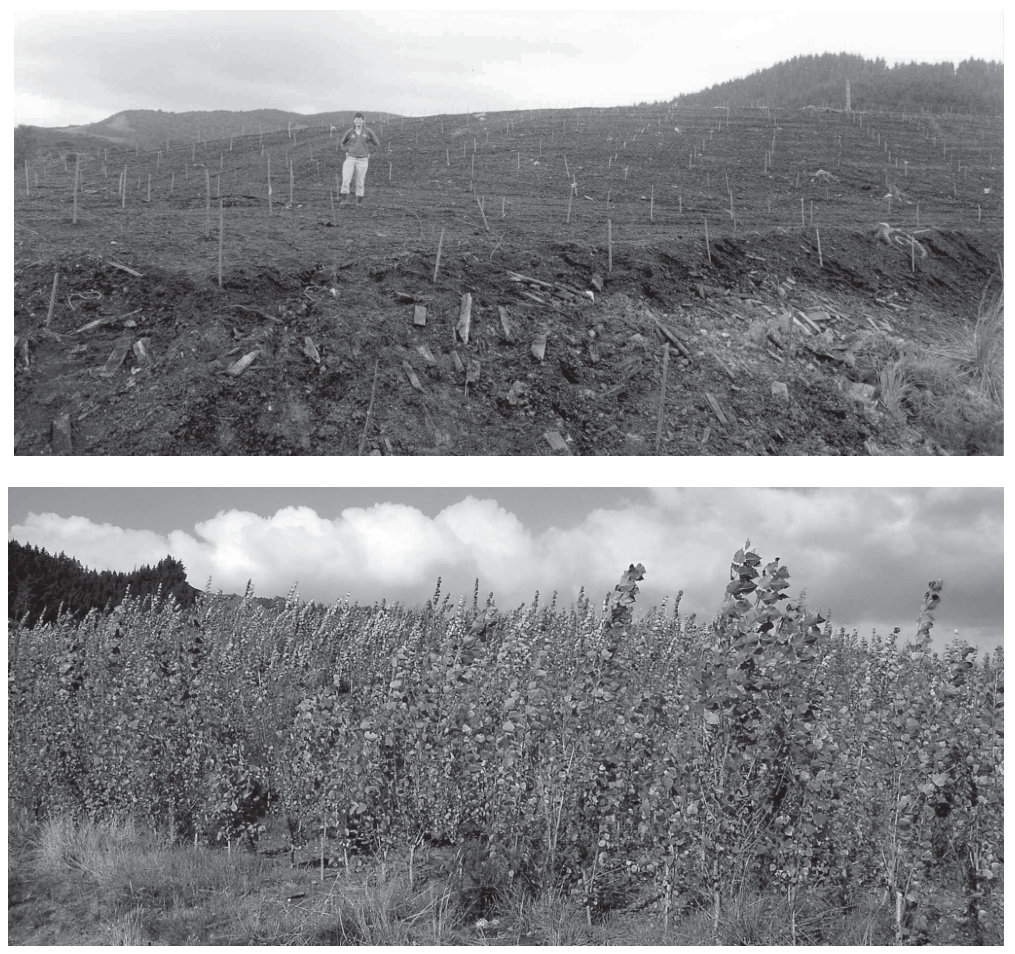
Figure 1 shows tree growth on the Kopu pile over the first 2 years. Approximately 30% of the trees are 2 years old, and the remainder are only 1 year old. Figure 1 demonstrates clearly how phytoremediation helps the contaminated site become part of the landscape by transforming the bare pile into an actively growing ‘green’ plant cover. The estimated above-ground biomass production in the first and second years of the trial was 1.2 and 13.3图1显示了Kopu堆体上前2年的树木生长情况。约30%的树木树龄为2年,其余仅为1年。图1清楚地表明,植物修复通过将裸露的堆体转变为生长旺盛的“绿色”植被覆盖,帮助污染场地融入周边景观。试验第一年和第二年的地上生物量产量估计分别为1.2和13.3
t/ha dry matter, respectively. The average leaf area index of the 2-year-old trees was 2.6, which is well below the value of 6 reported by Heilman et al. (1996) for maximum photosynthesis and transpiration of poplar under high light conditions. We would not expect the water use of the trees to be maximised until the biomass exceeds 30 t/ha on a dry matter basis. This level of productivity should occur in the third or fourth years.
t/ha(干物质)。2年生树木的平均叶面积指数为2.6,远低于Heilman et al.(1996)报道的强光条件下杨树达到最大光合作用和蒸腾作用时的值6。预计在生物量(以干物质计)超过30 t/ha之前,树木的耗水量不会达到最大。这一生产力水平应在第三或第四年达到。
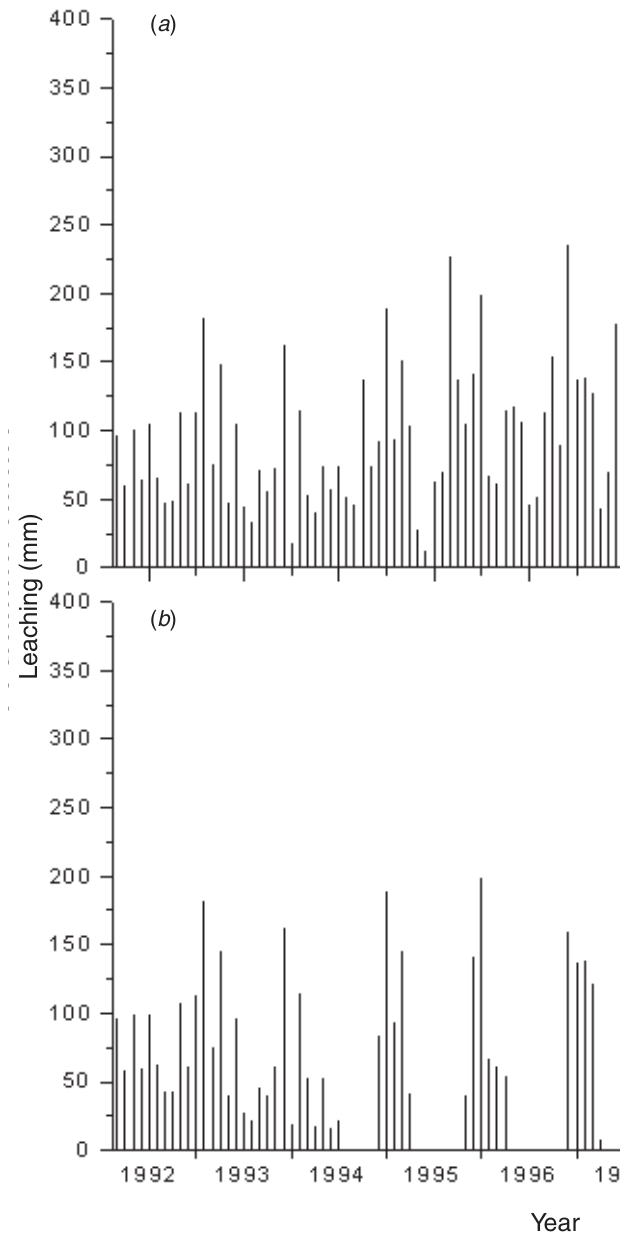
The monthly water balance of the pile was calculated using a computer model similar to that described in Green et al. (1999). The model uses daily weather data taken from a meteorological station at nearby Thames. Some parameters for the model (water use efficiency, crop coefficient) were derived from the lysimeter experiment. Field measurements at Kopu were used to estimate plant root distribution, and the leaf area index. The water retention curve for the sawdust was measured using a combination of Haines’ apparatus and pressure plates. Disk permeameters were used in situ to derive the hydraulic conductivity close to saturation. Model calculations of leaching are shown in Fig. 2a and b, respectively. As expected for such a high rainfall site, the bare pile leaches a considerable amount of drainage water through all months of the year (Fig. 2a) The impact of trees is to substantially reduce the drainage of water during the summer months when the trees are fully leafed and transpiring at their maximum. The summer months are of greatest concern for contamination of the local waterways because stream flows are lower and there is less dilution of the contaminants. The reduced leaching that occurs during the winter months can be irrigated onto the trees in times of drought during the summer, or alternatively, released into a nearby stream at times of high flow when the risk of exceeding the NZDWS is minimal.
采用与Green et al.(1999)所述类似的计算机模型计算了堆体的月水分平衡。该模型使用附近Thames气象站的逐日气象数据。模型的部分参数(水分利用效率、作物系数)由渗漏计试验获得。利用Kopu的田间测定数据估算植物根系分布和叶面积指数。采用Haines装置与压力板相结合的方法测定锯末的持水曲线。使用盘式渗透仪原位测定近饱和状态下的导水率。淋溶量的模型计算结果分别见图2a和b。正如此类高降雨场地所预期的那样,裸露堆体全年各月均淋溶出大量排水(图2a)。树木的作用是在夏季树木枝叶繁茂、蒸腾达到最大时大幅减少水分排出。夏季是当地水体污染最令人担忧的时期,因为此时溪流流量较低,污染物稀释程度较小。冬季产生的减量淋溶液可在夏季干旱时灌溉树木,或在高流量、超过NZDWS风险极低时排入附近溪流。
Table 1 shows some lysimeter results of the total concentrations of Cu, Cr, As, and B in the sawdust, as well as the average concentration in the leachates over the duration of the experiment. Boron was the only detectable contaminant in the leachate that exceeded the NZDWS. The level of As in the leachate was below detection limits (0.1 mg/L) but could still have exceeded the NZDWS for As (0.01 mg/L).表1列出了部分渗漏计试验结果,包括锯末中Cu、Cr、As和B的全量浓度,以及试验期间渗滤液中的平均浓度。B是渗滤液中唯一可检出且超过NZDWS的污染物。渗滤液中As含量低于检出限(0.1 mg/L),但仍有可能超过NZDWS规定的As限值(0.01 mg/L)。
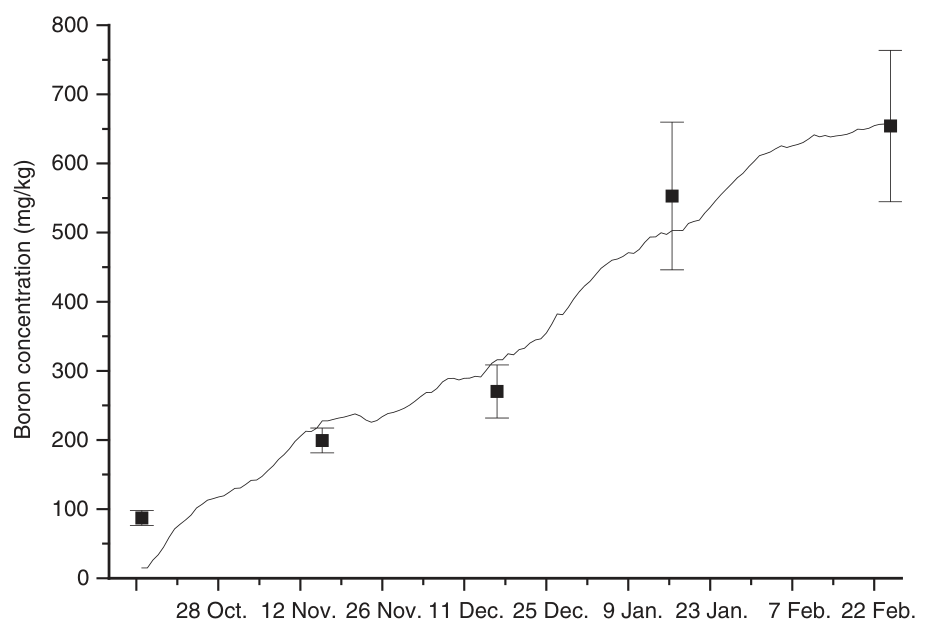
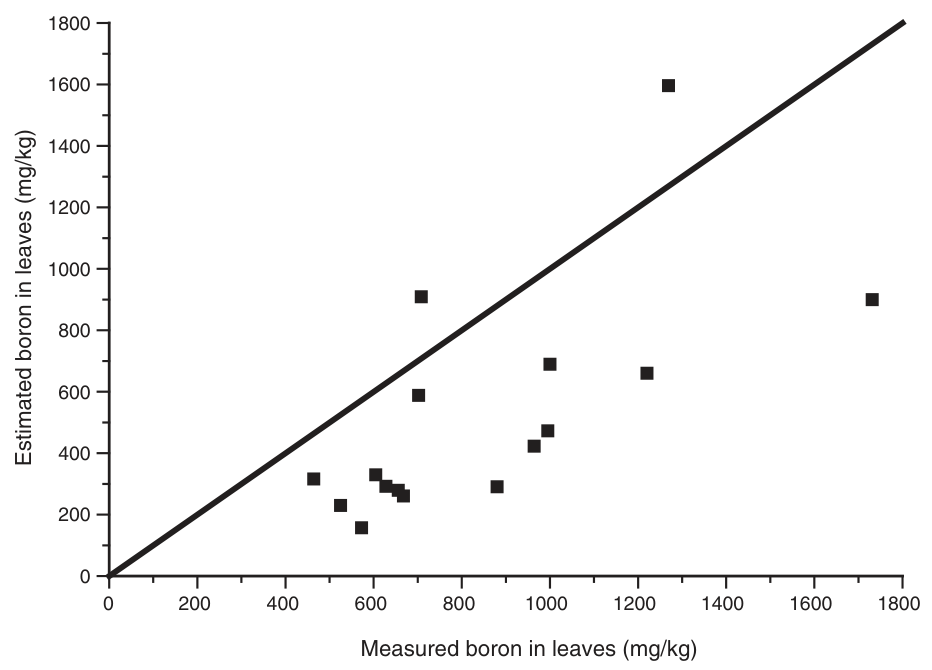
Poplar leaves contained Cu and Cr concentrations that were on average 6.6 and 4.9 mg/kg dry mass, respectively (Table 1). Arsenic concentrations were below detection limits (1 mg/kg). Results from the lysimeter experiment revealed that poplar have the capacity to accumulate significant amounts of B in their leaves (Fig. 3). This trait has previously been reported for poplar by Bañuelos et al. (1999). At the end of the growing season, the average leaf B concentration was nearly 700 mg/kg on a dry matter basis, over 28 times higher than the B concentration in the sawdust (40 mg/kg dry matter). The amount of B extracted by the poplar was predicted using the model developed by Robinson et al. (2003), which is based on the water use of the tree and the soluble concentration of B in the substrate. There was very good agreement between the calculated and measured B concentration in the leaves of the lysimeter trees (Fig. 3). The B concentration in the leaves of the trees at the Kopu site has also been estimated using parameters from the lysimeter experiment. Figure 4 shows estimated B concentration against the actual measured B concentration in the leaves. Once again, there was a reasonable correlation (r = 0.74, P < 0.01) between the estimated and measured values. Our simple model provides a robust description of the capacity of trees to dewater and decontaminate the site.
杨树叶片中Cu和Cr的平均浓度分别为6.6和4.9 mg/kg(干重)(表1)。As浓度低于检出限(1 mg/kg)。渗漏计试验结果表明,杨树具有在叶片中积累大量B的能力(图3)。Bañuelos et al.(1999)此前已报道杨树的这一特性。生长季结束时,叶片B平均浓度(以干物质计)接近700 mg/kg,是锯末中B浓度(40 mg/kg干物质)的28倍以上。采用Robinson et al.(2003)建立的模型预测了杨树提取的B量,该模型基于树木耗水量和基质中可溶性B浓度。渗漏计树木叶片B浓度的计算值与实测值吻合良好(图3)。同时利用渗漏计试验得到的参数估算了Kopu场地树木叶片的B浓度。图4给出了叶片B浓度估算值与实测值的对比。估算值与实测值之间同样存在较好的相关性(r = 0.74,P < 0.01)。本文的简单模型能够稳健地描述树木对场地脱水和去污染的能力。
| Element元素 | NZDWSANZDWSA | Leachate渗滤液 | Sawdust (initial)锯末(初始) | Leaves (final)叶片(最终) |
|---|---|---|---|---|
| Cu | 2 | 0.30 (0.07) | 140 (25) | 6.6 (1.7) |
| Cr | 0.05 | 0.03 (0.01) | 15 (0.8) | 4.9 (1.2) |
| As | 0.01 | <0.1 | 6.3 (0.8) | <1 |
| B | 1.4 | 1.87 (0.10) | 39.9 (2.7) | 654 (109) |
ANew Zealand Drinking Water Standard (Drinking Water Standards for New Zealand 2000).
A新西兰饮用水标准(Drinking Water Standards for New Zealand 2000)。
The results indicate that in addition to controlling leaching at the site, poplars may also be able to reduce the B loading by phytoextraction. Unless the trees are harvested, most of the B is returned to the sawdust via leaf-fall. Harvested material could, however, be used as an organic B supplement to trees in orchards that are B-deficient in other parts of the country. The concentrations of other heavy metals in the leaves (Table 1) are unlikely to cause further environmental problems.
结果表明,杨树除能控制场地淋溶外,还可能通过植物提取降低B负荷。除非收获树木,否则大部分B会通过落叶返回锯末中。不过,收获的材料可作为有机B补充剂,用于该国其他地区缺B果园中的果树。叶片中其他重金属的浓度(表1)不太可能引发进一步的环境问题。
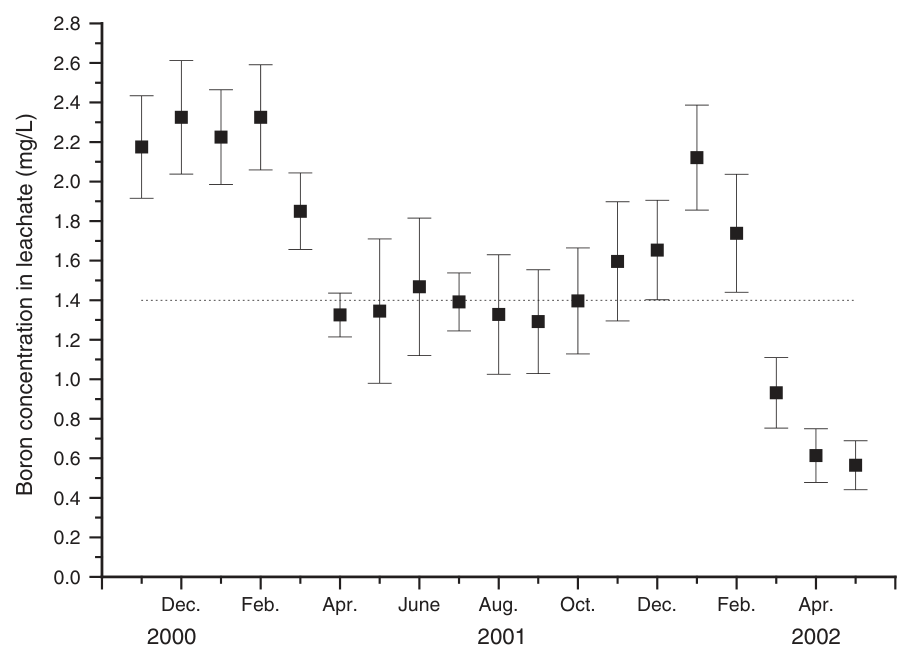
The average B concentration in the drainage water from the lysimeters decreased progressively during the course of the experiment. After 2 years the B concentration dropped below the NZDWS (1.4 mg/L, Fig. 5). This decrease occurred late in the growing season when tree water uptake was at a maximum. There have been insufficient measurements on the leachate from the Kopu sawdust pile to determine if there has been a similar decrease in the field situation. Further measurements are planned over the next few years, and further modelling will be carried out to determine the success of phytoremediation at Kopu.
试验期间,渗漏计排水中B的平均浓度逐渐降低。2年后,B浓度降至NZDWS(1.4 mg/L)以下(图5)。这一下降发生在生长季后期树木吸水量达到最大之时。目前对Kopu锯末堆渗滤液的测定尚不充分,无法确定田间条件下是否出现类似的下降。计划在未来几年开展进一步测定,并将进行进一步的模型模拟,以确定Kopu植物修复的成效。
The cost of phytoremediation at Kopu is estimated to be NZ$200 000, including a site maintenance plan over 5 years. Half of this total cost was taken up as site assessment, involving scientists’ time to conduct the plant trial and chemical analysis. The alternative cost of capping the site was estimated by the local environmental authority to be over NZ$1.2 million. Capping will also require ongoing maintenance to ensure its integrity.
Kopu植物修复的费用估计为20万新西兰元,其中包括为期5年的场地维护计划。该总费用的一半用于场地评估,包括科研人员开展植物试验和化学分析的工时。据当地环境管理部门估计,采用覆盖封顶这一替代方案的费用将超过120万新西兰元。覆盖封顶还需持续维护以确保其完整性。
4Conclusions结论
Phytoremediation offers the possibility of a low-cost clean-up for a wide range of contaminated sites. The technology offers long-term solutions, but is constrained by basic plant physiology in the types of environmental degradation that can be ameliorated. Combining phytoremediation with the production of saleable products may circumvent phytoremediation’s Achilles heel, which is the time needed for remediation.
植物修复为多种污染场地提供了低成本修复的可能。该技术可提供长期解决方案,但其所能改善的环境退化类型受到植物基本生理特性的制约。将植物修复与可销售产品的生产相结合,或可规避植物修复的“阿喀琉斯之踵”,即修复所需的时间。
The processes by which phytoremediation systems accumulate and degrade contaminants are still poorly understood, the implication being that the innovation may increase the scope and efficiency of this technology.
植物修复系统积累和降解污染物的过程目前仍知之甚少,这意味着创新可能拓展该技术的应用范围并提高其效率。
The greatest application of phytoremediation may be in developing countries, where this technology can provide a low-cost means of controlling environmental problems that would be rectified using high-cost technologies in the developed world. An example may be the treatment of municipal effluent using trees to prevent the contamination of groundwater and local waterways. The field trial at Kopu, supported by basic research being carried out via lysimeter experiments, is showing phytoremediation as a cost-effective and practical solution to reduce the problem of B leaching into local waterways. Our research involves observations, experimentation, and modelling to improve our understanding of the whole system. Further development of models, supported by apt experimentation and site characterisation, will enable us to make robust predictions of the efficacy for phytoremediation of contaminated sites.
植物修复最大的应用领域可能是在发展中国家,在那里该技术可提供一种低成本手段来控制环境问题,而这些问题在发达国家通常采用高成本技术解决。一个例子是利用树木处理城市污水,以防止地下水和当地水体受到污染。Kopu的田间试验在渗漏计试验所开展的基础研究支持下,表明植物修复是减少B淋溶进入当地水体问题的一种经济有效且切实可行的解决方案。我们的研究结合观测、试验和模型模拟,以增进对整个系统的认识。在适当的试验和场地表征的支持下,进一步发展模型将使我们能够对污染场地植物修复的效能作出稳健的预测。
5References参考文献
Anderson CWN, Brooks RR, Stewart RB, Simcock R (1998) Induced hyperaccumulation of gold in plants. Nature 395, 553–554.
Bell DT (1999) Australian trees for the rehabilitation of waterlogged and salinity damaged soils. Australian Journal of Botany 47, 697–716.
Baker AJM, McGrath SP, Sidoli CMD, Reeves RD (1994) The possibility of in situ metal decontamination of polluted soils using crops of metal-accumulating plants—a feasibility study. Resource Conservation and Recycling 11, 41–49.
Bañuelos GS, Shannon MC, Ajwa H, Draper JH, Jordahl J, Licht L (1999) Phytoextraction and accumulation of B and selenium by poplar (Populus) hybrid clones. International Journal of Phytoremediation 1, 81–96.
Blaylock MJ (2000) Field demonstrations of phytoremediation of Pb contaminated soils. In ‘Phytoremediation of contaminated soil and water’. (Eds N Terry, G Bañuelos) pp. 1–12. (Lewis Publishers: Boca Raton, FL)
Blaylock MJ, Salt DE, Dushenkov S, Zakharova O, Gussman C, Kapulnik Y, Ensley BD, Raskin I (1997) Enhanced accumulation of Pb in Indian Mustard by soil-applied chelating agents. Environmental Science and Technology 31, 860–865.
Brooks RR (1998) Phytoremediation by volatilisation. In ‘Plants that hyperaccumulate heavy metals: their role in phytoremediation, microbiology, archaeology, mineral exploration and phytomining’. (Ed. RR Brooks) pp. 289–312. (CAB International: Wallingford, UK)
Brooks RR, Lee J, Reeves RD, Jaffré T (1977) Detection of nickeliferous rocks by analysis of herbarium specimens of indicator plants. Journal of Geochemical Exploration 7, 49–77.
Bundt M, Albrecht A, Froidevaux P, Blaser P, Fluhler H (2000) Impact of preferential flow on radionuclide distribution in soil. Environmental Science and Technology 34, 3895–3899.
Chaney RL (1983) Plant uptake of inorganic waste constituents In Land treatment of hazardous wastes, (Eds JF Parr, PB Marsh, JM Kla) pp. 50–76. (Noyes Data Corp: Park Ridge, NJ)
Chaudhry Q, Schröder P, Werck-Reichhart D, Grajek W, Marecik R (2002) Prospects and limitations of phytoremediation for the removal of persistent pesticides in the environment. Environmental Science and Pollution Research 9, 4–17.
Dhankher OP, Li Y, Rosen BP, Shi J, Salt D, Senecoff JF, Sashti NA, Meagher RB (2002) Engineering tolerance and hyperaccumulation of arsenic in plants by combining arsenate reductase and γ- glutamylcysteine synthetase expression. Nature Biotechnology 20, 1140–1145.
Dix ME, Klopfenstein NB, Zhang JW, Workman SW, Kim MS (1997) Potential use of Populus for phytoremediation of environmental pollution in riparian zones. USDA Forest Service General Technical Report. RM-GTR-297.
Dushenkov V, Kumar PBAN, Motto H, Raskin I (1995) Rhizofiltration: the use of plants to remove heavy metals from aqueous streams. Environmental Science and Technology 29, 1239–1245. Ferro AM, Rieder JP, Kennedy J, Kjelgren R (1997) Phytoremediation of groundwater using poplar trees. In ‘Phytoremediation’. (Eds CA Thibeault, LM Savage) pp. 201–212. (International Business Communications Inc.: Southborough)
Ferro AM, Sims RC, Bugbee B (1994) Hycrest crested wheatgrass accelerates the degradation of pentachlorophenol in soil. Journal of Environmental Quality 23, 272–279.
Glass DJ (1999) ‘US and international markets for phytoremediation, 1999–2000.’ (D. Glass and Associates, Inc.: Needham, MA)
Green SR, Clothier BE, Mills TM, Millar A (1999) Risk assessment of irrigation requirements of field crops in a maritime climate. Journal of Crop Production 2, 353–377.
Gudin C, Syratt WJ (1975) Biological aspects of land rehabilitation following hydrocarbon contamination. Environmental Pollution 8, 107–112.
Hannink N, Rosser SJ, French CE, Basran A, Murray JAH, Nicklin S, Bruce NC (2001) Phytodetoxification of TNT by transgenic plants expressing a bacterial nitroreductase. Nature Biotechnology 19, 1168– 1172.
Heilman PE, Hinckley TM, Roberts DA, Ceulemans R (1996) Production physiology. In ‘Biology of Populus and its implications for management and conservation’. (Eds RF Stettler et al.) (NRC Research Press: Ottawa)
Huang H, Juang D, Zhang C, Zhang Y, Lin Z (1991) Study on the control of cadmium-pollution in the soil by forestry ecological engineering. China Environmental Science 2, 36–45.
Huang JW, Cunningham SD (1996) Lead phytoextraction: species variation in lead uptake and translocation. New Phytologist 134, 75–84.
Lasat MM, Norvell WA, Kochian LV (1997) Potential for phytoextraction of 137Cs from a contaminated soil. Plant and Soil 195, 99–106.
Lombi E, Zhao FJ, Dunham SJ, McGrath SP (2001) Phytoremediation of heavy-metal contaminated soils: Natural hyperaccumulation versus chemically enhanced phytoextraction. Journal of Environmental Quality 30, 1919–1926.
McGrath SP, Sidoli CMD, Baker AJM, Reeves RD (1993) The potential for the use of metal-accumulating plants for the in situ decontamination of metal-polluted soils. In ‘Integrated soil and sediment research: a basis for proper protection’. (Eds HJP Eijsackers, T Hamers) pp. 673–676. (Kluwer Academic Publishers: Dordrecht)
Nicks L, Chambers MF (1994) Nickel farm. Discover Sept., 19.
Nie L, Shah S, Rashid A, Burd GI, Dixon GD, Glick BR (2002) Phytoremediation of arsenate contaminated soil by transgenic canola and the plant growth-promoting bacterium Enterobacter cloacae CAL2. Plant Physiology and Biochemistry 40, 355–361.
Nzengung VA, Wang C, Harvey G (1999) Plant-meditated transformation of perchlorate into chloride. Environmental Science and Technology 33, 1470–1478.
Ow DW, Shewry PR, Napier JA, Davis PJ (1998) Prospects of engineering heavy metal detoxification genes in plants. In ‘Engineering crop plants for industrial end uses. Proceedings of the Symposium of the Industrial Biochemistry and Biotechnology Group of the Biochemical Society’. IACR-Long Ashton Research Station, Long Ashton, Bristol, UK. pp 111–124. (Portland Press Ltd: London)
Pulford ID, McGregor SD, Duncan HJ, Wheeler CT (1995) Uptake of heavy metals from contaminated soil by trees. In ‘Proceedings/Abstracts of the 14th Annual Symposium on Current Topics in Plant Biochemistry, Physiology, and Molecular Biology—Will plants have a role in bioremediation?’ (Ed. D Randall) pp. 49–50. (Interdisciplinary Plant Group, University of Missouri: Columbia, MO)
Reilley KA, Banks MK, Schwab AP (1996) Organic chemicals in the environment: Dissipation of polycyclic aromatic hydrocarbons in the rhizosphere. Journal of Environmental Quality 25, 212–219.
Robinson BH, Brooks RR, Howes AW, Kirkman JH, Gregg PEH (1997a) The potential of the high-biomass Ni hyperaccumulator Berkheya coddii for phytoremediation and phytomining. Journal of Geochemical Exploration 60, 115–126.
Robinson BH, Chiarucci A, Brooks RR, Petit D, Kirkman JH, Gregg PEH, De Dominicis V (1997b) The nickel hyperaccumulator plant Alyssum bertolonii as a potential agent for phytoremediation and the phytomining of nickel. Journal of Geochemical Exploration 59, 75–86
Robinson BH, Fernández JE, Madejón P, Marañón T, Murillo JM, Green SR, Clothier BE (2003) Phytoextraction: an assessment of biogeochemical and economic viability. Plant and Soil 249, 117–125. Robinson BH, Green SR, Clothier BE, van der Velde M, Fung L, Thayalakumaran T, Snow V, Fernandez JE, Madejón P, Marañón T, Murillo JM (2002) Modelling plant-metal uptake from contaminated soils. NZ Land Treatment Collective, Proceedings of the Technical Session No. 23. (Forest Research NZ) Robinson BH, Mills TM, Petit D, Fung LE, Green SR, Clothier BE (2000) Natural and induced cadmiumaccumulation in poplar and willow: Implications for phytoremediation. Plant and Soil 227, 301–306. Roygard JKF, Clothier BE, Green SR, Bolan NS (2001) Tree species for recovering nitrogen from dairyfarm effluent in New Zealand. Journal of Environmental Quality 30, 1064–1070.
Rugh CL, Senecoff JF, Meagher RB, Merkle SA (1998) Development of transgenic yellow poplar for mercury phytoremediation. Nature Biotechnology 16, 925–928.
Rugh CL, Wilde HD, Stack NM, Thompson DM, Summers AO, Meagher RB (1996) Mercuric ion reduction and resistance in transgenic Arabidopsis thaliana plants expressing a modified bacterial merA gene. Proceedings of the National Academy of Science USA 93, 3182–3187.
Salt DE, Blaylock M, Kumar NPBA, Dushenkov V, Ensley B, Chet I, Raskin I (1995) Phytoremediation: a novel strategy for the removal of toxic metals from the environment using plants. Bio/Technology 13, 468–474.
Schnabel WE, White DM (2001) The effect of mycorrhizal fungi on the fate of aldrin: phytoremediation potential. International Journal of Phytoremediation 3, 221–241. Susarla S, Bacchus ST, McChtcheon SC, Wolfe NL (1999) Potential species for phytoremediation of perchlorate. US EPA 600/R–99/069.
Tibazarwa C, Corbisier P, Mench M, Bossus A, Solda P, Mergeay M, Wyns L, van der Lelie D (2001) A microbial biosensor to predict bioavailable nickel in soil and its transfer to plants. Environmental Pollution 113, 19–26.
Vangronsveld J, Colpaert JV, van Tichelen KK (1996) Reclamation of a bare industrial area contaminated by non-ferrous metals: physiochemical and biological evaluation of the durability of soil treatment and revegetation. Environmental Pollution 94, 131–140.
Vosátka M (2001) A future role for the use of arbuscular mycorrhiza fungi in soil remediation: a chance for small-medium enterprises? Minerva Biotecnologia 13, 69–72.
Watanabe ME (2001) Can bioremediation bounce back? Nature Biotechnology 19, 1111–1115.
Whiting SN, Leake JR, McGrath SP, Baker AJM (2001) Rhizosphere bacteria mobilise Zn for hyperaccumulation by Thlaspi caerulescens. Environmental Science and Technology 35, 3144–3150. Zayed A, Pilon-Smits E, deSouza M, Lin ZQ, Terry N (2000) Remediation of selenium-polluted soils and waters by phytovolatalisation. In ‘Phytoremediation of contaminated soil and water’. (Eds N Terry, G Bañuelos) pp. 1–12. (Lewis Publishers: Boca Raton, FL)