B. H. Robinson1, E. Lombi2, F. J. Zhao2 and S. P. McGrath2
1HortResearch, Private Bag 11 030, Palmerston North, New Zealand; 2Agriculture and Environment Division, Rothamsted Research, Harpenden, Herts AL5 2JQ, UK
1Summary摘要
Author for correspondence: • Berkheya coddii is a fast-growing, high biomass nickel (Ni) hyperaccumulator B. H. Robinson plant that has recently attracted attention for its possible use in the phytoextraction Tel: +64 63568080 of Ni. The mechanisms of Ni accumulation, however, are not well understood in this Fax: +64 63546731 Email: brobinson@hortresearch.co.nz plant. • Plants were grown hydroponically in varying Ni concentrations to assess the Received: 21 October 2002 uptake and distribution of Ni, and other metals, at the whole plant level. X-ray Accepted: 21 January 2003 microanalyses (EDXA) of frozen hydrated tissues were conducted to determine the doi: 10.1046/j.1469-8137.2003.00743.x distribution of Ni at the cellular level in the leaves. • Most Ni was found in the shoots, especially in the leaves. Leaf Ni concentration increased with age, whereas older stem sections had lower Ni concentrations than new growth. EDXA analyses revealed that the cuticle of the upper epidermis had a significantly higher Ni concentration than the rest of the leaf. The Ni concentrations in the other leaf tissues were not significantly different. • This pattern of distribution contrasts sharply with some other hyperaccumulator species that commonly show a preferential accumulation of Ni and other metals in the vacuoles of the epidermal cells. Key words: Berkheya coddii, nickel (Ni), hyperaccumulation, compartmentation, phytoextraction. © New Phytologist (2003) 158: 279–285
通讯作者:B. H. Robinson Tel: +64 63568080 Fax: +64 63546731 Email: brobinson@hortresearch.co.nz 收稿日期:21 October 2002 接受日期:21 January 2003 doi: 10.1046/j.1469-8137.2003.00743.x • Berkheya coddii是一种生长迅速、生物量高的镍(Ni)超富集植物,近来因其可能用于Ni的植物提取而受到关注。然而,该植物积累Ni的机制尚不十分清楚。• 采用水培方式在不同Ni浓度下培养植物,以在整株水平上评估Ni及其他金属的吸收与分布。对冷冻含水组织进行X射线微区分析(EDXA),以确定Ni在叶片细胞水平上的分布。• 大部分Ni存在于地上部,尤其是叶片中。叶片Ni浓度随叶龄增加而升高,而较老的茎段Ni浓度低于新生部分。EDXA分析表明,上表皮角质层的Ni浓度显著高于叶片其余部分。其他叶片组织中的Ni浓度无显著差异。• 这一分布格局与其他一些超富集植物物种形成鲜明对比,后者通常将Ni及其他金属优先积累于表皮细胞的液泡中。关键词:Berkheya coddii,镍(Ni),超富集,区室化,植物提取。© New Phytologist (2003) 158: 279–285
2Introduction引言
Nickel (Ni) hyperaccumulator plants represent over threequarters of known metal hyperaccumulators, with a total number of 318 taxa reported to date (Baker et al., 2000; Reeves & Baker, 2000). Recently, Berkheya coddii has attracted attention because of its high Ni concentration and rapid biomass production. Robinson et al. (1997) reported an annual biomass production of 22 t ha−1 and up to 1% (w : w) Ni in the dry above-ground biomass. Berkheya coddii is an asteraceous summer-green perennial plant that is found on ultramafic (serpentine) soils in southern Africa (Morrey et al., 1992).
镍(Ni)超富集植物占已知金属超富集植物的四分之三以上,迄今已报道的分类群共计318个(Baker et al., 2000; Reeves & Baker, 2000)。近来,Berkheya coddii因其Ni浓度高、生物量生产迅速而受到关注。Robinson et al.(1997)报道其年生物量产量为22 t ha−1,地上部干生物量中Ni含量最高可达1%(w : w)。Berkheya coddii是一种菊科夏绿多年生植物,分布于南部非洲的超基性(蛇纹岩)土壤上(Morrey et al., 1992)。
The phenomenon of Ni hyperaccumulation by plants is not well understood. Krämer et al. (1997) reported that at low substrate Ni concentrations the rates of Ni uptake and rootto-shoot translocation in both the hyperaccumulator Thlaspi goesingense and the nonNi-hyperaccumulator Thlaspi arvense were similar. It was suggested that Ni tolerance alone could explain Ni hyperaccumulation when plants were grown in presence of large concentrations of available Ni. More is known in terms of Ni tolerance in hyperaccumulator plants where two mechanisms, complexation and compartmentalization, appear to be responsible for Ni detoxification. The complexation of Ni by histidine and organic acids such as citrate, malate and malonate has been reported in a number of hyperaccumulator plants (Lee et al., 1977, 1978; Krämer et al., 1996; Brooks et al., 1998). Similar to what has been observed in cadmium (Cd) and zinc (Zn) hyperaccumulation, Ni has been reported to accumulate in the epidermal cells in Senecio coronatus and several species of Alyssum (Mesjasz- Przybylowicz et al., 1994; Psaras et al., 2000). In particular, Küpper et al. (2001) showed that Ni was preferentially compartmentalized in the vacuoles of epidermis cells in T. goesingense, Alyssum bertolonii and Alyssum lesbiacum. Using cell fractionation, Krämer et al. (2000) also showed that intracellular Ni is predominantly localized in the vacuoles of T. goesingense. This pattern of cellular distribution is consistent with the finding by Persans et al. (2001) who reported a high-level expression of a vacuolar metal ion transporter protein (TgMTP1) in T. goesingense. This transporter may account for the enhanced accumulation of Ni in leaf vacuoles of T. goesingense. Most of the information regarding the mechanism of Ni hyperaccumulation has been obtained in two genera of the Brassicaceae: Thlaspi and Alyssum. Very little is known about Ni hyperaccumulation in plants belonging to other families. Therefore, it is not known whether the same mechanisms are shared by all Ni hyperaccumulators.
植物超富集Ni的现象目前尚未得到充分认识。Krämer et al.(1997)报道,在基质Ni浓度较低时,超富集植物Thlaspi goesingense与非Ni超富集植物Thlaspi arvense对Ni的吸收速率及根向地上部的转运速率相近。据此推测,当植物生长在有效Ni浓度较高的环境中时,仅凭Ni耐性即可解释Ni超富集现象。关于超富集植物的Ni耐性已有较多了解,络合作用与区室化这两种机制似乎是Ni解毒的主要原因。在多种超富集植物中已报道了组氨酸以及柠檬酸、苹果酸和丙二酸等有机酸对Ni的络合作用(Lee et al., 1977, 1978; Krämer et al., 1996; Brooks et al., 1998)。与镉(Cd)和锌(Zn)超富集中观察到的情况类似,有报道指出Senecio coronatus及若干Alyssum物种中Ni积累于表皮细胞(Mesjasz- Przybylowicz et al., 1994; Psaras et al., 2000)。特别是,Küpper et al.(2001)表明,在T. goesingense、Alyssum bertolonii和Alyssum lesbiacum中,Ni优先区室化于表皮细胞的液泡中。Krämer et al.(2000)利用细胞分级分离也表明,T. goesingense细胞内的Ni主要定位于液泡。这一细胞分布格局与Persans et al.(2001)的发现一致,后者报道T. goesingense中一种液泡金属离子转运蛋白(TgMTP1)高水平表达。该转运蛋白可能是T. goesingense叶片液泡中Ni积累增强的原因。有关Ni超富集机制的信息大多来自十字花科的两个属:Thlaspi和Alyssum.对于其他科植物的Ni超富集则知之甚少。因此,尚不清楚所有Ni超富集植物是否具有相同的机制。
In this paper, we investigate some aspects of Ni hyperaccumulation in B. coddii because of its high biomass, high Ni accumulation and its consequent potential to be used for the phytoextraction (either phytoremediation or phytomining) of Ni. Compartmentalization of metals seems to be a key mechanism of tolerance in hyperaccumulator plants (for a recent review see McGrath et al., 2002). Therefore, the aim of this study was to determine the distribution of Ni and other elements, at whole plant and cellular scale, in B. coddii.
鉴于B. coddii生物量高、Ni积累量高,因而具有用于Ni的植物提取(植物修复或植物采矿)的潜力,本文研究了其Ni超富集的若干方面。金属的区室化似乎是超富集植物的关键耐性机制(近期综述见McGrath et al., 2002)。因此,本研究旨在确定B. coddii.中Ni及其他元素在整株和细胞尺度上的分布。
3Materials and Methods材料与方法
Plant growth and analyses植物培养与分析
Seedlings of B. coddii were germinated in a mixture of Perlite and vermiculite moistened with deionized water. After 3 wk, seedlings were transferred to 1-l vessels containing 1000 µM Ca(NO3)2, 500 µM MgSO4, 50 µM K2PO4, 100 µM KCl, 10 µM H3BO4, 1.8 µM MnSO4, 0.2 µM NaMoO4, 0.31 µM CuSO4, 50 µM Fe(III)-EDDHA (ethylenediamine-di(ohydroxyphenylacetic acid)) and 1 µM ZnSO4 (Shen et al., 1997). Solution pH was maintained at 6.0 with 2000 µM 2- (N-morpholino) ethanesulfonic acid (MES), pH adjusted with KOH. After 2 wk, nickel (Ni, as NiSO4) was added to the nutrient solution at concentrations of 0.5, 50, 100, 250 and 500 µM. Each Ni treatment was replicated in three vessels, each containing three plants. The nutrient solutions were aerated continuously and renewed every 3 d. The experiment was carried out in a controlled environment room with the following conditions; 16 h daylength with a light intensity −2 −1 of 350 µmol photons m s supplied by fluorescent tubes, 20°C day/16°C night temperatures, and 60–70% relative humidity. Seventeen weeks after the treatments were started, the plants were removed from the nutrient solutions and washed thoroughly in deionized water. Roots, leaves and stems of plants of each pot were collected separately. The plant material was frozen in liquid nitrogen, freeze-dried for 72 h, and the dry weight recorded. Dried plant material was finely ground and subsamples (0.5 g) were digested with a mixture of HNO3 and HClO4 (Zhao et al., 1994). The total concentration of Ni and other elements were determined by inductively coupled plasma emission spectroscopy (ICP-AES,
B. coddii种子在以去离子水润湿的珍珠岩与蛭石混合基质中萌发。3周后,将幼苗移入1 l容器中,容器内含1000 µM Ca(NO3)2、500 µM MgSO4、50 µM K2PO4、100 µM KCl、10 µM H3BO4、1.8 µM MnSO4、0.2 µM NaMoO4、0.31 µM CuSO4、50 µM Fe(III)-EDDHA(乙二胺二(o羟基苯乙酸))和1 µM ZnSO4(Shen et al., 1997)。以2000 µM 2-(N-吗啉代)乙磺酸(MES)将溶液pH维持在6.0,并用KOH调节pH。2周后,向营养液中添加镍(Ni,以NiSO4形式),浓度分别为0.5、50、100、250和500 µM。每个Ni处理设3个容器重复,每个容器3株植物。营养液持续通气,每3 d更换一次。试验在人工气候室内进行,条件如下:光照时长16 h,由荧光灯管提供光强350 µmol photons m−2 s−1,昼/夜温度20°C/16°C,相对湿度60–70%。处理开始17周后,将植物从营养液中取出,并用去离子水彻底清洗。分别收集每盆植物的根、叶和茎。植物材料经液氮冷冻、冷冻干燥72 h后记录干重。干燥的植物材料经细磨后,取亚样(0.5 g)用HNO3与HClO4混合酸消解(Zhao et al., 1994)。Ni及其他元素的总浓度采用电感耦合等离子体发射光谱法测定(ICP-AES,
Fison Accuris, Ecublens, Switzerland). Water-soluble Ni in leaves was extracted by shaking 0.5 g of ground plant material with 20 ml of 1000 µmol MES buffer at pH 6.0 for 45 min (Cakmak & Marschner, 1987). The samples were then filtered and the Ni concentration determined as described earlier.
Fison Accuris, Ecublens, Switzerland)。叶片中水溶性Ni的提取方法为:将0.5 g磨碎的植物材料与20 ml pH 6.0的1000 µmol MES缓冲液振荡45 min(Cakmak & Marschner, 1987)。样品随后经过滤,并按上述方法测定Ni浓度。
Distribution of the Ni and other elements in leaves and stems of different age不同龄叶片和茎中Ni及其他元素的分布
To investigate the effect of age of tissue on element concentrations, three plants from the 100 µM treatment were selected for an investigation into the distribution of metal concentrations with plant height. The above-ground portions of these plants were divided into five parts of equal length, with the oldest at the base and youngest at the apex. The total stem lengths of the plants were 80, 57 and 62 cm and each plant had only one shoot. Leaves and stems were analysed separately as described earlier.
为研究组织年龄对元素浓度的影响,从100 µM处理中选取3株植物,研究金属浓度随植株高度的分布。将这些植物的地上部分为等长的5段,最老的位于基部,最幼的位于顶端。各植株茎的总长度分别为80、57和62 cm,且每株仅有一个枝条。叶片和茎按上述方法分别分析。
Cellular distribution of Ni and other elements in leaves叶片中Ni及其他元素的细胞分布
Leaf specimens (three per treatment) were taken for analysis from plants grown in the presence of 100 and 500 µM Ni. A small section of the leaf was excised, mounted in an aluminium (Al) sample holder, then rapidly frozen in melting nitrogen slush. The sample was transferred to a preparation chamber set at −180°C and fractured. The surface of the sample was evaporatively coated with carbon and transferred to a cooled stage (−170°C) inside a scanning electron microscope (XL 40; Philips, Eindhoven, The Netherlands). Energy dispersive X-ray microanalysis was performed in the scanning electron microscope using an acceleration voltage of 30 keV. Spectra from 0 to 20 keV were collected at increments of 10 eV per channel and analysed using the program SUPERQUANT (EDAX, San Francisco, CA, USA). A calibration between peak : background ratios for specific elements and their concentration in standard solutions was used to estimate concentration (van Steveninck & van Steveninck, 1991). Two-dimensional distribution patterns of Ni, Ca and K were collected by scanning an area of the specimen for up to 1 h and integrating the counts for each element within their respective spectrum windows into dot-maps. These maps are semiquantitative and show the metal distribution in each tissue type.
从生长于100和500 µM Ni条件下的植物上采集叶片样本(每个处理3个)用于分析。切取一小段叶片,固定于铝(Al)样品托上,然后在融化的氮浆中迅速冷冻。将样品转移至设定为−180°C的制备室中进行断裂。样品表面经蒸发镀碳后,转移至扫描电子显微镜(XL 40; Philips, Eindhoven, The Netherlands)内的冷台(−170°C)上。在扫描电子显微镜中以30 keV的加速电压进行能量色散X射线微区分析。采集0至20 keV的能谱,每通道增量为10 eV,并使用SUPERQUANT程序(EDAX, San Francisco, CA, USA)进行分析。利用特定元素的峰背比与其在标准溶液中浓度之间的校准关系估算浓度(van Steveninck & van Steveninck, 1991)。通过对样品某一区域扫描长达1 h,并将各元素在其相应能谱窗口内的计数积分为点分布图,获得Ni、Ca和K的二维分布格局。这些分布图为半定量结果,显示了金属在各组织类型中的分布。
Statistical treatment of data数据统计处理
Correlation analyses and ANOVA were performed using the GENSTAT 5 package (Genstat 5 Committee, 1993). Data that were not normally distributed were logarithmically transformed before analysis. Least significant difference (LSD) was used for comparison between the treatment means.
采用GENSTAT 5软件包(Genstat 5 Committee, 1993)进行相关分析和ANOVA。非正态分布的数据在分析前进行对数转换。处理均值间的比较采用最小显著差数(LSD)法。
4Results结果
Effect of Ni treatments on biomass, metal uptake and Ni solubility in B. coddii
Ni处理对B. coddii生物量、金属吸收及Ni溶解性的影响
At the end of the experiment, the average dry weight of the plants was 20.0 ± 1.5 g and there were no signs of toxicity in any of the treatments. The roots, stems and leaves accounted for 49%, 32% and 19% of the total dry biomass, respectively. There were no significant differences in biomass between treatments (P > 0.1), indicating that B. coddii is tolerant to at least 500 µM Ni in hydroponic solution under the conditions used in the experiment.
试验结束时,植物平均干重为20.0 ± 1.5 g,各处理均未出现毒害症状。根、茎和叶分别占总干生物量的49%、32%和19%。各处理间生物量无显著差异(P > 0.1),表明在本试验条件下,B. coddii至少可耐受水培溶液中500 µM的Ni。
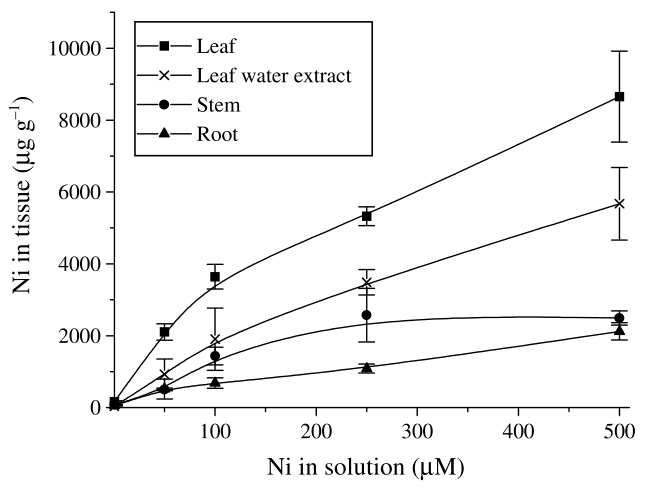
The concentration of Ni in the different parts of B. coddii plants increased with increasing Ni concentration in the hydroponic solution (Fig. 1). The results show that leaves had the highest Ni concentration, and that most of the metal accumulated in the leaves was stored in a water-soluble form. In the 500 µM Ni treatment, 65% of the total Ni accumulated in the leaves was water-soluble. The concentration of Ni in stems was consistently lower than in leaves but higher than in roots. Although the leaves represented less than one-fifth of the total plant weight, almost half (48%) of the total Ni accumulated by plants growing in 500 µM Ni treatment was stored in these organs. The remaining amount of accumulated Ni was almost evenly distributed between the roots (29%) and the stems (23%).
B. coddii植株各部位的Ni浓度随水培溶液Ni浓度的升高而增加(图1)。结果表明,叶片的Ni浓度最高,且叶片中积累的金属大部分以水溶态储存。在500 µM Ni处理中,叶片积累的总Ni中有65%为水溶态。茎中Ni浓度始终低于叶片,但高于根。尽管叶片不足植株总重的五分之一,但在500 µM Ni处理中生长的植物所积累的总Ni中近一半(48%)储存于叶片中。其余积累的Ni几乎均匀分布于根(29%)和茎(23%)中。
The average concentrations of calcium (Ca), potassium (K), iron (Fe) and copper (Cu) in roots, stems and leaves, and their relationship to solution Ni concentration are reported in Table 1. Unlike the observation for Ni, there was a general decrease in the concentrations of these elements with an increasing Ni concentration in the hydroponic solution. With the exception of Ca, this decrease was more marked in the leaves and stems than in the roots. The concentration of K, Fe and Cu in leaves of plants grown in the 500 µM Ni solution decreased by 47%, 85% and 46%, respectively, compared with the control.
表1列出了根、茎和叶中钙(Ca)、钾(K)、铁(Fe)和铜(Cu)的平均浓度及其与溶液Ni浓度的关系。与Ni的情况不同,这些元素的浓度总体上随水培溶液Ni浓度的升高而降低。除Ca外,这种降低在叶和茎中比在根中更为明显。与对照相比,生长于500 µM Ni溶液中的植物叶片K、Fe和Cu浓度分别降低了47%、85%和46%。
Distribution of Ni and other elements in leaves and stems of different age不同龄叶片和茎中Ni及其他元素的分布
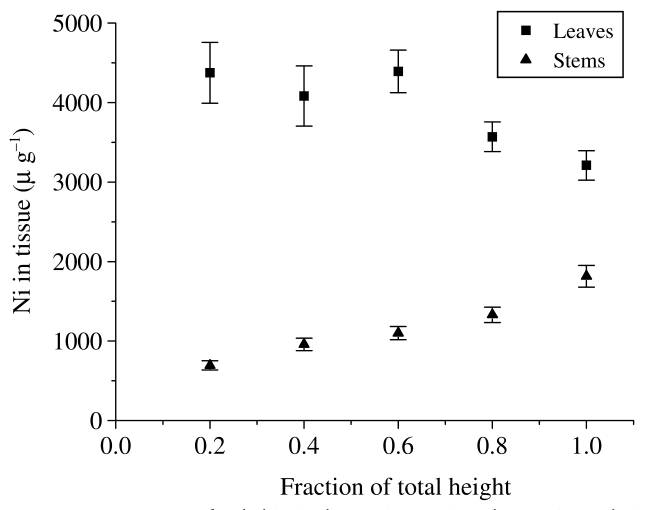
The distribution of Ni and other macronutrients and micronutrients in leaves and stems was investigated in plants grown in the 100 µM Ni treatment. The average Ni concentration decreased from 4375 µg g−1 in the oldest leaves to 3210 µg g−1 in the youngest leaves (Fig. 2). A similar trend was observed for some of the other elements measured (Ca, K, magnesium (Mg), P, Fe and zinc (Zn)). For these elements, however, the leaf primordia (fraction 1) had anomalously high concentrations (data not shown).
对100 µM Ni处理中生长的植物,研究了Ni及其他大量和微量营养元素在叶片和茎中的分布。叶片平均Ni浓度从最老叶片的4375 µg g−1降至最幼叶片的3210 µg g−1(图2)。所测定的其他部分元素(Ca、K、镁(Mg)、P、Fe和锌(Zn))也呈现类似趋势。然而,对于这些元素,叶原基(第1段)的浓度异常偏高(数据未列出)。
The change in Ni concentration in the stem was more marked with height, and opposite to that in the leaves. Nickel concentrations in stems increased from 692 µg g−1 at the base to 1814 µg g−1 at the apex. All the other elements analysed followed a similar trend (data not shown).
茎中Ni浓度随高度的变化更为明显,且与叶片中的趋势相反。茎中Ni浓度从基部的692 µg g−1增加到顶端的1814 µg g−1。所分析的其他元素均呈现类似趋势(数据未列出)。
Cellular distribution of Ni and other elements in leaves叶片中Ni及其他元素的细胞分布
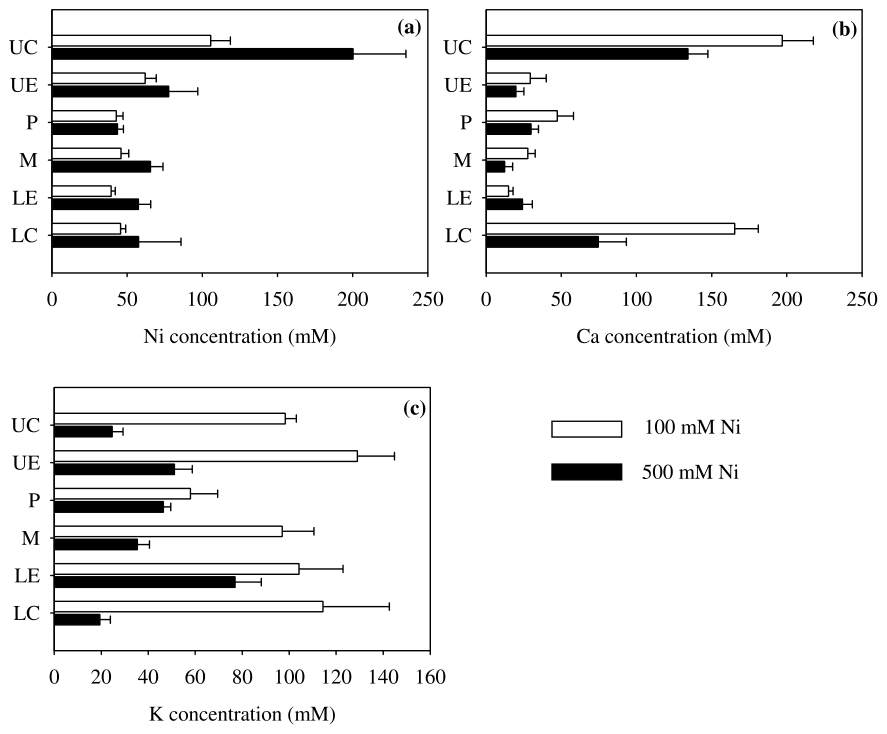
Results from X-ray microanalyses (EDXA) of frozen-hydrated leaves showed that the upper cuticle had a significantly higher (P < 0.001) Ni concentration than all the other leaf tissues analysed (Fig. 3a). This distribution pattern was similar in leaves of plants grown in both the 100 and 500 µM Ni treatments (Fig. 3a). The concentration of Ni in the cuticle almost doubled from the 100 µM Ni treatment to the 500 µM Ni treatment, this is consistent with a twofold increase in Ni concentration in leaves, as determined by Inductively Coupled Plasma Emission Spectroscopy (ICP-ES) (Fig. 1). By contrast, the concentrations of Ni in the upper and lower epidermal cells, palisade, spongy mesophyll and lower cuticle were not significantly different from each other (P > 0.05).
冷冻含水叶片的X射线微区分析(EDXA)结果表明,上角质层的Ni浓度显著高于(P < 0.001)所分析的其他所有叶片组织(图3a)。在100和500 µM Ni两个处理中生长的植物叶片中,这一分布格局相似(图3a)。角质层中的Ni浓度从100 µM Ni处理到500 µM Ni处理几乎翻了一番,这与电感耦合等离子体发射光谱法(ICP-ES)测定的叶片Ni浓度增加两倍相一致(图1)。相比之下,上、下表皮细胞、栅栏组织、海绵叶肉和下角质层中的Ni浓度彼此之间无显著差异(P > 0.05)。
| Solution溶液 | Calcium钙 | (mg g−1) | Potassi钾 | um (mg g− | 1) | Iron (µg铁(µg | g−1) | Copper铜 | (µg g−1) | |||
|---|---|---|---|---|---|---|---|---|---|---|---|---|
| nickel (µM) | Root | Stem | Leaf | Root | Stem | Leaf | Root | Stem | Leaf | Root | Stem | Leaf |
| 0.5 | 0.38 | 1.47 | 1.42 | 1.11 | 1.67 | 2.82 | 1019 | 77 | 378 | 178 | 31 | 18 |
| 50 | 0.39 | 1.43 | 1.21 | 1.43 | 1.22 | 2.60 | 1195 | 75 | 185 | 186 | 22 | 11 |
| 100 | 0.39 | 1.08 | 1.09 | 1.29 | 1.92 | 2.67 | 1386 | 98 | 194 | 179 | 34 | 14 |
| 250 | 0.29 | 0.85 | 1.00 | 1.36 | 1.41 | 2.03 | 1068 | 46 | 69 | 84 | 12 | 8 |
| 500 | 0.20 | 0.85 | 0.99 | 1.11 | 1.53 | 1.22 | 1336 | 44 | 55 | 96 | 15 | 8 |
| P | < 0.05 | < 0.05 | ns | ns | ns | < 0.01 | ns | < 0.01 | < 0.05 | ns | < 0.001 | < 0.001 |
| LSD | 0.15 | 0.51 | 3.70 | 0.74 | 0.51 | 6.74 | 564 | 23 | 218 | 145 | 8.3 | 4.3 |
Calcium was evenly distributed in the upper and lower epidermis and in the palisade and spongy mesophyll cells (Fig. 3b). However, Ca concentrations were found to be significantly higher in both the upper and lower cuticles. The cellular distribution of K was more even than Ni and Ca, with no preferential accumulation (Fig. 3c). The concentration of both Ca and K was lower in the leaves of plants grown in 500 µM Ni compared with those from the 100 µM Ni treatment. This result is in agreement with the changes in total metal concentrations reported in Table 1.
钙在上、下表皮以及栅栏组织和海绵叶肉细胞中分布均匀(图3b)。然而,上、下角质层中的Ca浓度均显著较高。K的细胞分布比Ni和Ca更为均匀,未见优先积累(图3c)。与100 µM Ni处理相比,500 µM Ni处理中生长的植物叶片Ca和K浓度均较低。这一结果与表1中所报道的金属总浓度变化一致。
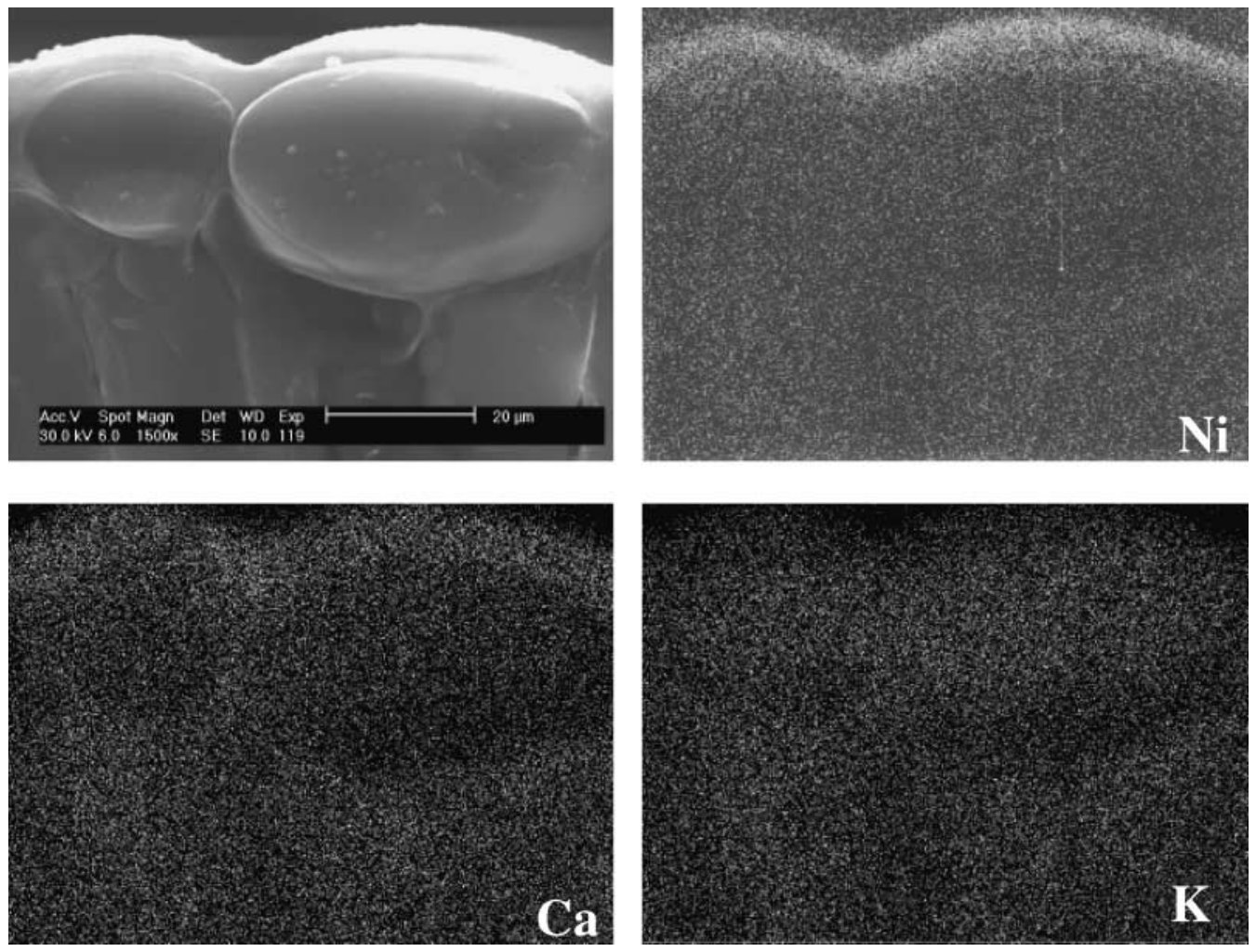
Two-dimensional distributions of Ni, Ca and K across leaf sections were also obtained using EDXA. These analyses were restricted to Ni, Ca and K because only these elements were present at concentrations high enough to enable an EDXA dotmap to be produced. Figure 4 shows a micrograph of a leaf section (including upper cuticle, upper epidermis cells and palisade cells) along with the distributions of Ni, Ca and K. This analysis revealed a high concentration of Ni in the upper cuticle. Potassium appears to be evenly distributed across the leaf tissues whereas Ca is more abundant in the apoplast than in the internal cellular compartment.
还利用EDXA获得了Ni、Ca和K在叶片切面上的二维分布。这些分析仅限于Ni、Ca和K,因为只有这些元素的浓度高到足以生成EDXA点分布图。图4显示了叶片切面(包括上角质层、上表皮细胞和栅栏细胞)的显微照片以及Ni、Ca和K的分布。该分析揭示了上角质层中Ni浓度较高。钾似乎在叶片各组织中均匀分布,而Ca在质外体中比在细胞内部区室中更为丰富。
5Discussion讨论
Berkheya coddii showed all the characteristics typical of hyperaccumulator plants: it did not display phytotoxicity symptoms when exposed to elevated Ni concentrations (up to 500 µM); Ni concentrations in the plants were well above the 1000 µg g−1 reported as the lower limit for Nihyperaccumulation (Brooks et al., 1977); the concentration of Ni in the shoots was higher than in the roots. The results obtained confirm the elevated tolerance of this plant to large external and internal Ni concentrations and its efficient transport of Ni from roots to shoot.
Berkheya coddii表现出超富集植物的全部典型特征:暴露于较高Ni浓度(最高500 µM)时未出现植物毒害症状;植物体内Ni浓度远高于作为Ni超富集下限的1000 µg g−1(Brooks et al., 1977);地上部Ni浓度高于根部。所得结果证实了该植物对高外部和内部Ni浓度的较强耐性,以及将Ni从根部高效转运至地上部的能力。
Most Ni accumulated by B. coddii (71%) was found in shoots (Fig. 1). Küpper et al. (2000) and Zhao et al. (2000) suggested that the apparent metal accumulation in roots of hydroponically grown plants may be partly due to metal precipitation in the apoplast. In our experiments, EDXA analyses of B. coddii roots from the 500 µM Ni treatment showed high concentrations of Ni and P on the surface of the rhizodermis (data not shown), consistent with the suggestion that Ni is present as a phosphate precipitate. Hyperaccumulator plants usually store more metal in the shoots than in the roots. For example, 70–80% of the total Zn hyperaccumulated by Arabidopsis halleri and Thlaspi caerulescens was reported to be stored in the shoot (Shen et al., 1997; Perronnet et al., 2000; Zhao et al., 2000).
B. coddii积累的Ni大部分(71%)存在于地上部(图1)。Küpper et al.(2000)和Zhao et al.(2000)认为,水培植物根部表观上的金属积累可能部分源于金属在质外体中的沉淀。在本试验中,对500 µM Ni处理的B. coddii根系进行的EDXA分析显示,根表皮表面Ni和P浓度较高(数据未列出),这与Ni以磷酸盐沉淀形式存在的推测相一致。超富集植物通常在地上部储存的金属多于根部。例如,据报道Arabidopsis halleri和Thlaspi caerulescens超富集的总Zn中有70–80%储存于地上部(Shen et al., 1997; Perronnet et al., 2000; Zhao et al., 2000)。
Within the shoot, leaves appeared to be the primary sink for Ni in B. coddii (Fig. 1). Another characteristic that seems to be common to metal hyperaccumulator plants is the fact that metals are largely stored in water-soluble forms. Zhao et al. (2000) reported that 60–65% of the shoot Zn in A. halleri was water-soluble. In this study, we found that most Ni (65%) in the leaves was extractable with water at pH 6.
在地上部中,叶片似乎是B. coddii中Ni的主要库(图1)。金属超富集植物的另一个共同特征似乎是金属主要以水溶态储存。Zhao et al.(2000)报道,A. halleri地上部Zn的60–65%为水溶态。本研究发现,叶片中大部分Ni(65%)可在pH 6条件下用水提取。
At the shoot level, the concentration of Ni in the leaves decreased from older to younger leaves whereas Ni concentration in the corresponding parts of the stem followed an opposite trend, with the larger concentration of Ni found near the apex (Fig. 2). The distribution pattern of nickel in B. coddii indicates that transpiration has a large influence on the longdistance transport of within plants.
在地上部水平上,叶片中Ni浓度由老叶向幼叶递减,而茎相应部位的Ni浓度则呈相反趋势,顶端附近的Ni浓度较高(图2)。镍在B. coddii中的分布格局表明,蒸腾作用对植物体内(Ni)的长距离运输具有重要影响。
The concentrations of K, Fe and Cu in the shoot of B. coddii were significantly reduced by increasing Ni concentrations in the hydroponic solution (Table 1). In the roots, however, there was no significant difference in the concentration of these elements between the treatments. This may indicate that the uptake of K, Fe and Cu was not affected, but their rootto-shoot translocation was reduced when Ni concentration in the nutrient solution increased. However, increasing Ni in the nutrient solution decreased Ca concentrations in all parts of the plants. This may indicate a competition between Ca and
水培溶液中Ni浓度的升高显著降低了B. coddii地上部的K、Fe和Cu浓度(表1)。然而,在根部,各处理间这些元素的浓度无显著差异。这可能表明,当营养液中Ni浓度升高时,K、Fe和Cu的吸收并未受到影响,但其由根向地上部的转运减少。然而,营养液中Ni的增加降低了植物所有部位的Ca浓度。这可能表明Ca与
Ni for plant uptake. Zhao et al. (2000) reported that the concentrations of K, Ca, P, Fe, Mn, Cu and Ni decreased in the shoot of A. halleri when the plants where exposed to increasing concentration of Zn. Similarly, Wenzel & Jockwer (1999) reported that K translocation from roots to shoots was depressed in Ni hyperaccumulators when grown in high-Ni substrates.
Ni在植物吸收上存在竞争。Zhao et al.(2000)报道,当A. halleri暴露于逐渐升高的Zn浓度时,其地上部K、Ca、P、Fe、Mn、Cu和Ni的浓度降低。类似地,Wenzel & Jockwer(1999)报道,Ni超富集植物生长于高Ni基质时,K由根向地上部的转运受到抑制。
Accumulation of metals in an intracellular compartment, most likely the vacuole, of epidermis cells seems to be a common feature in hyperaccumulator plants (for a review see McGrath et al., 2002). Preferential accumulation of Ni in the intracellular compartment of epidermis cells of A. bertolonii, A. lesbiacum and T. goesingense has been reported by Küpper et al. (2001). However, most of the hyperaccumulators in which metal compartmentation has been investigated are brassicaceous. In the asteraceous B. coddii, we found significantly higher Ni concentrations in the apoplast of the upper epidermis cells, especially within the cuticle (Figs 3 and 4). This pattern of cellular distribution of Ni resembles that of Al in mature leaves of tea (Camelia sinensis; Matsumoto et al., 1976; Memon et al., 1981) where Al was found to be localized in cell walls and cuticle. In the case of Ni, however, a lot of metal was found inside the cells, whereas Al was exclusively outside the cells. Mesjasz-Przybylowicz et al. (2001) studied the distribution of Ni in young apical leaves of B. coddii using a nuclear microprobe and freeze-dried samples. They found that the highest Ni enrichment occurred in leaf margins, mesophyll and midrib epidermis. However, these results are difficult to compare with our findings because we used frozen hydrated samples and mature leaves. In dried samples, cellular compartmentation of elements may have been affected because metals may be redistributed in the fixation and drying processes (van Steveninck & van Steveninck, 1991).
金属在表皮细胞的细胞内区室(很可能是液泡)中积累似乎是超富集植物的共同特征(综述见McGrath et al., 2002)。Küpper et al.(2001)报道了Ni在A. bertolonii、A. lesbiacum和T. goesingense表皮细胞内区室中的优先积累。然而,已研究金属区室化的超富集植物大多属于十字花科。在菊科植物B. coddii中,我们发现上表皮细胞的质外体中,尤其是角质层内,Ni浓度显著较高(图3和图4)。Ni的这一细胞分布格局与茶树(Camelia sinensis; Matsumoto et al., 1976; Memon et al., 1981)成熟叶片中Al的分布相似,后者中Al定位于细胞壁和角质层。然而,就Ni而言,大量金属存在于细胞内,而Al则完全位于细胞外。Mesjasz-Przybylowicz et al.(2001)利用核微探针和冷冻干燥样品研究了B. coddii幼嫩顶端叶片中Ni的分布。他们发现Ni富集程度最高的部位为叶缘、叶肉和中脉表皮。然而,由于本研究采用的是冷冻含水样品和成熟叶片,这些结果难以与我们的发现进行比较。在干燥样品中,元素的细胞区室化可能受到影响,因为金属可能在固定和干燥过程中发生重新分布(van Steveninck & van Steveninck, 1991)。
The Ni distribution in B. coddii differs significantly from what has previously been reported for other Ni hyperaccumulator species, where this metal appeared to be compartmented mainly in vacuoles. Vacuolar sequestration of Ni and other heavy metals has been proposed as a key tolerance mechanism in hyperaccumulator plants (Krämer et al., 2000; Küpper et al., 2001; Persans et al., 2001). In the case of B. coddii, compartmentalization of Ni in the upper cuticle may help protect the cytoplasm from toxic concentrations of Ni. The disproportionately higher cuticle Ni concentrations in the 500 µM Ni treatment compared with the 100 µM Ni treatment may indicate that nickel is translocated to the cuticle when a threshold concentration in the living tissues is exceeded. However, the biological importance of cuticle-bound Ni is unclear because the total mass of Ni that is stored in the cuticle is likely to be small compared with the Ni contained in the leaf. This is due to the small total biomass of the cuticle.
B. coddii中Ni的分布与此前报道的其他Ni超富集物种存在显著差异,在后者中该金属似乎主要区室化于液泡中。Ni及其他重金属的液泡隔离被认为是超富集植物的关键耐性机制(Krämer et al., 2000; Küpper et al., 2001; Persans et al., 2001)。就B. coddii而言,Ni在上角质层中的区室化可能有助于保护细胞质免受毒性浓度Ni的危害。与100 µM Ni处理相比,500 µM Ni处理中角质层Ni浓度不成比例地升高,这可能表明当活组织中的Ni浓度超过某一阈值时,镍会被转运至角质层。然而,角质层结合态Ni的生物学意义尚不明确,因为与叶片所含的Ni相比,储存在角质层中的Ni总量可能很小。这是由于角质层的总生物量较小。
Most other hyperaccumulator plants store heavy metals in the vacuoles of epidermal cells. High metal concentrations in the epidermis may indicate a predator defence role for the metal, as these are the first tissues encountered by grazing animals. However, the high Ni concentrations in the upper, but not the lower cuticle are not consistent with a predator defence role for Ni because many insect herbivores feed on the underside of leaves. Another possible role for nickel in the upper cuticle may be as a defence against ultraviolet radiation and protection of the underlying chlorophyll from solarization. This could be tested by growing plants under elevated levels of ultraviolet radiation in the presence and absence of Ni.
大多数其他超富集植物将重金属储存于表皮细胞的液泡中。表皮中的高金属浓度可能表明金属具有防御捕食者的作用,因为表皮是取食动物首先接触的组织。然而,Ni浓度高见于上角质层而非下角质层,这与Ni的防御捕食者作用并不一致,因为许多植食性昆虫在叶片背面取食。上角质层中镍的另一种可能作用是抵御紫外辐射,并保护其下方的叶绿素免受日光灼伤。这可通过在有Ni和无Ni条件下、于增强的紫外辐射水平下培养植物加以验证。
6Conclusions结论
Several aspects of Ni accumulation by B. coddii are consistent with previous reports of metal hyperaccumulation in other plants: an efficient uptake and root-to-shoot translocation of Ni, and a high tolerance to Ni in the external medium and inside plant tissues. Similarly, depression of macronutrient and micronutrient uptake and/or translocation with increasing concentrations of the hyperaccumulated metal in soil solution has been reported previously. Unlike most hyperaccumulators, however, Ni is evenly distributed across the different leaf cell types. In B. codii, the Ni concentration in the upper cuticle was significantly higher than in the rest of the leaf. The importance of this distribution is unclear because the cuticle-bound Ni represents only a small fraction of the total leaf Ni.
B. coddii积累Ni的若干方面与此前其他植物金属超富集的报道一致:对Ni的高效吸收及由根向地上部的转运,以及对外部介质和植物组织内Ni的高耐性。同样,此前也有报道指出,随着土壤溶液中被超富集金属浓度的升高,大量和微量营养元素的吸收和/或转运受到抑制。然而,与大多数超富集植物不同,Ni在叶片不同类型细胞中均匀分布。在B. codii中,上角质层的Ni浓度显著高于叶片其余部分。由于角质层结合态Ni仅占叶片总Ni的一小部分,这一分布的意义尚不清楚。
7Acknowledgements致谢
Rothamsted Research receives grant-aided support from the Biotechnology and Biological Sciences Research Council of the United Kingdom.
Rothamsted Research获得英国生物技术与生物科学研究理事会(Biotechnology and Biological Sciences Research Council)的资助。
8References参考文献
Baker AJM, McGrath SP, Reeves RD, Smith JAC. 2000. Metal
hyperaccumulator plants: A review of the ecology and physiology of a biochemical resource for phytoremediation of metal-polluted soils. In: Terry N, Bañuelos G, Vangronsveld J, eds. Phytoremediation of contaminated soil and water. Boca Raton, FL, USA: Lewis Publishers, 85–107.
Brooks RR, Chambers MF, Nicks LJ, Robinson BH. 1998. Phytomining. Trends in Plant Science 3: 359–362.
Brooks RR, Lee J, Reeves RD, Jaffré T. 1977. Detection of nickeliferous rocks by analysis of herbarium species of indicator plants. Journal of Geochemical Exploration 7: 49–57.
Cakmak I, Marschner H. 1987. Mechanism of phosphorus induced zinc deficiency in cotton. III. Changes in physiological availability of zinc in plants. Physiologia Plantarum 70: 13–20.
Genstat 5 Committee. 1993. GENSTAT 5. Oxford, UK: Clarendon Press.
Krämer U, Cotter-Howells JD, Charnock JM, Baker AJM, Smith JAC. 1996. Free histidine as a metal chelator in plants that accumulate nickel. Nature 379: 635–638.
Krämer U, Grime GW, Smith JAC, Hawes CR, Baker AJM. 1997. Micro-PIXE as a technique for studying nickel localization in leaves of the hyperaccumulator plant Alyssum lesbiacum. Nuclear Instruments and Methods in Physics Research 130: 346–350.
Krämer U, Pickering IJ, Prince RC, Raskin I, Salt DE. 2000. Subcellular localization and speciation of nickel in hyperaccumulator and non-accumulator Thlaspi species. Plant Physiology 122: 1343–1353.
Küpper H, Lombi E, Zhao FJ, McGrath SP. 2000. Cellular
compartmentation of cadmium and zinc in relation to other elements in the hyperaccumulator Arabidopsis halleri. Planta 212: 75–84.
Küpper H, Lombi E, Zhao FJ, Wieshammer G, McGrath SP. 2001. Cellular compartmentation of nickel in the hyperaccumulators Alyssum lesbiacum, Alyssum bertolonii and Thlaspi goesingense. Journal of Experimental Botany 52: 2291–2300.
Lee J, Reeves RD, Brooks RR, Jaffré T. 1977. Isolation and identification of a citrato-complex of nickel from nickel-accumulating plants. Phytochemistry 16: 1503–1505.
Lee J, Reeves RD, Brooks RR, Jaffré T. 1978. The relation between nickel and citric acid in some nickel-accumulating plants. Phytochemistry 17: 1033–1035.
Matsumoto H, Hirasawa E, Morimura S, Takahashi E. 1976. Localisation of aluminium in the tea leaf. Plant and Cell Physiology 17: 627–631.
McGrath SP, Zhao FJ, Lombi E. 2002. Phytoremediation of metals, metalloids and radionuclides. Advances in Agronomy 75: 1–56.
Memon AR, Chino M, Yatazawa M. 1981. Micro-distribution of aluminum and manganese in the tea leaf tissues as revealed by X-ray microanalyzer. Communications in Soil Science and Plant Analysis 12: 441–452.
Mesjasz-Przybylowicz J, Balkwill K, Przybylowicz WJ, Annegarn HJ. 1994. Proton microprobe and X-ray fluorescence investigations of nickel distribution in serpentine flora from South Africa. Nuclear Instruments and Methods in Physics Research 89: 208–212.
Mesjasz-Przybylowicz J, Przybylowicz WJ, Pineda CA. 2001. Nuclear microprobe studies of elemental distribution in apical leaves of the Ni hyperaccumulator Berkheya coddii. South African Journal of Science 97: 591–593.
Morrey DR, Balkwill K, Balkwill MJ, Williamson S. 1992. A review of some studies of the serpentine flora of Southern Africa. In: Baker AJM, Procter J, Reeves RD, eds. The Vegetation of ultramafic (serpentine) soils. Intercept. Andover. 147–158.
Perronnet K, Schwartz C, Gerard E, Morel JL. 2000. Availability of
cadmium and zinc accumulated in the leaves of Thlaspi caerulescens incorporated into soil. Plant and Soil 227: 257–263.
Persans MW, Nieman H, Salt DE. 2001. Functional activity and role of cation-efflux family members in Ni hyperaccumulation in Thlaspi goesingense. Proceedings of the National Academy of Sciences, USA 98: 9995–10000.
Psaras GK, Constantinidis T, Cotsopoulos B, Manetas Y. 2000. Relative abundance in the leaf epidermis of eight hyperaccumulators: evidence that the metal is excluded from both guard cells and trichomes. Annals of Botany 86: 73–78.
Reeves RD, Baker AJM. 2000. Metal-accumulating plants. In: Raskin I, Ensley BD, eds. Phytoremediation of toxic metals: using plants to clean up the environment. New York, NY, USA: John Wiley & Sons, 193–229.
Robinson BH, Brooks RR, Howes AW, Kirkman JH, Gregg PEH. 1997. The potential of the high-biomass nickel hyperaccumulator Berkheya coddii for phytoremediation and phytomining. Journal of Geochemical Exploration 60: 115–126.
Shen ZG, Zhao FJ, McGrath SP. 1997. Uptake and transport of zinc in the hyperaccumulator Thlaspi caerulescens and the non-hyperaccumulator Thlaspi ochroleucum. Plant, Cell & Environment 20: 898–906.
van Steveninck RFM, van Steveninck ME. 1991. Microanalysis. In: Hall JL, Hawes C, eds. Electron microscopy of plant cells. London, UK: Academic Press, 415–455.
Wenzel WW, Jockwer F. 1999. Accumulation of heavy metals in plants grown on mineralised soils of the Austrian Alps. Environmental Poll 104: 145–155.
Zhao FJ, Lombi E, Breedon T, McGrath SP. 2000. Zinc hyperaccumulation and cellular distribution in Arabidopsis halleri. Plant, Cell & Environment 23: 507–514.
Zhao F, McGrath SP, Crosland AR. 1994. Comparison of three wet digestion methods for the determination of plant sulphur by inductively coupled plasma atomic emission spectrometry (ICP-AES). Communications in Soil Science Plant Analysis 25: 407–418.