Environmental Pollution 132 (2004) 145e155
Paula Madejo´ na,*, Teodoro Maran˜ o´ na, Jose´ M. Murilloa, Brett Robinsonb
aInstituto de Recursos Naturales y Agrobiologı´a, CSIC, P. O. Box 1052, E-41080, Seville, Spain
bHorticulture and Food Research Institute of New Zealand, Private Bag 11030, Palmerston North, New Zealand
Received 1 August 2003; accepted 26 March 2004
‘‘Capsule:’’: White poplar leaves can be used as biomonitors of soil pollution by Cd and Zn.
Abstract摘要
Trees can be used to monitor the level of pollution of trace elements in the soil and atmosphere. In this paper, we surveyed the content of eight trace elements (As, Cd, Cu, Fe, Mn, Ni, Pb and Zn) in leaves and stems of white poplar (Populus alba) trees. We selected 25 trees in the riparian forest of the Guadiamar River (S. Spain), one year after this area was contaminated by a mine spill, and 10 trees in non-affected sites. The spill-affected soils had significantly higher levels of available cadmium (mean of 1.25 mg kg�1), zinc (117 mg kg�1), lead (63.3 mg kg�1), copper (58.0 mg kg�1) and arsenic (1.70 mg kg�1), than non-affected sites. The concentration of trace element in poplar leaves was positively and significantly correlated with the soil availability for cadmium and zinc, and to a lesser extent for arsenic (logelog relationship). Thus, poplar leaves could be used as biomonitors for soil pollution of Cd and Zn, and moderately for As.
树木可用于监测土壤和大气中微量元素的污染水平。本文调查了银白杨(Populus alba)叶片和茎中8种微量元素(As、Cd、Cu、Fe、Mn、Ni、Pb和Zn)的含量。在Guadiamar河(西班牙南部)河岸林遭受尾矿泄漏污染一年后,我们在该区域选取了25株树木,并在未受影响的样地选取了10株树木。与未受影响样地相比,受泄漏影响土壤中有效态镉(平均1.25 mg kg−1)、锌(117 mg kg−1)、铅(63.3 mg kg−1)、铜(58.0 mg kg−1)和砷(1.70 mg kg−1)含量显著更高。杨树叶片中镉和锌的含量与其土壤有效性呈显著正相关,砷亦存在一定程度的相关(对数–对数关系)。因此,杨树叶片可作为土壤Cd和Zn污染的生物监测器,对As也具有中等程度的监测能力。
� 2004 Elsevier Ltd. All rights reserved.
© 2004 Elsevier Ltd. 版权所有。
Keywords: Arsenic; Bioindicator; Cadmium; Guadiamar River; Zinc
关键词:砷;生物指示物;镉;Guadiamar河;锌
1Introduction引言
Trace elements are defined as those chemical elements with low concentrations in plant tissues (lower than 0.1%), independent of their toxicity or nutritional value (Bargagli, 1998). The responses of plants to a concentration gradient of trace elements in the soil solution can follow three main patterns (Baker, 1981; Baker et al., 2000). (1) ‘‘Excluders’’ have a low uptake of trace elements, by active exclusion in the roots, even at high external concentrations in the soil solution. (2) ‘‘Accumulators’’ are able to tolerate high concentrations of trace elements in their tissues, and this accumulation can be produced even at low external concentrations in the soil solution. (3) ‘‘Indicators’’ have a relatively constant root uptake over a wide gradient of trace elements in the soil. As a consequence they show a linear relationship between the concentrations in the plant tissues and in the soil.
微量元素是指在植物组织中浓度较低(低于0.1%)的化学元素,与其毒性或营养价值无关(Bargagli, 1998)。植物对土壤溶液中微量元素浓度梯度的响应主要有三种模式(Baker, 1981; Baker et al., 2000):(1)“排斥型”植物通过根系的主动排斥作用,即使在土壤溶液外部浓度较高时,对微量元素的吸收也很低;(2)“富集型”植物能够耐受组织中高浓度的微量元素,且即使在土壤溶液外部浓度较低时也能发生富集;(3)“指示型”植物在土壤微量元素较宽的浓度梯度范围内根系吸收相对恒定,因而其组织中的浓度与土壤中的浓度呈线性关系。
* Corresponding author. Tel.: C34-95-462-4711; fax: C34-95-462- 4002.
* 通讯作者。电话:+34-95-462-4711;传真:+34-95-462-4002。
E-mail address: pmadejon@irnase.csic.es (P. Madejo´ n).
Plants having the indicator or accumulator types of response could potentially be used as ‘‘biomonitors’’, defined as organisms that contain information on the quantitative aspects of the quality of the environment (Markert et al., 2003). There are several advantages of using the concentration of trace elements in plant leaves or stems, to monitor the level of soil pollution where they grow. The accumulation of a trace element in plants confirms its availability in the soil; as distinct from having a high total metal concentration, which can be immobile in the soil complex. Many plants concentrate trace elements in their aerial portions to levels many times that in soil solution (Baker et al., 2000; Ma et al., 2001). Thus, biomonitors can be used to detect low concentrations that are not always easy to measure directly using chemical extraction techniques; even if they are measurable as total levels, their ecological relevance is often difficult to determine from soil concentrations. Plants capture and uptake trace elements from a large soil volume (via roots and mycorrhizae) that can be monitored by analysing the leaves.
具有指示型或富集型响应的植物有可能用作“生物监测器”,即含有环境质量定量信息的生物体(Markert et al., 2003)。利用植物叶片或茎中微量元素的浓度来监测其生长地土壤的污染水平具有若干优点。植物中某一微量元素的富集证实了该元素在土壤中具有有效性;这不同于金属总量较高的情况,因为后者可能在土壤复合体中处于固定状态。许多植物地上部分所富集的微量元素浓度可达土壤溶液中的数倍(Baker et al., 2000; Ma et al., 2001)。因此,生物监测器可用于检测化学提取技术难以直接测定的低浓度;即便以总量形式可测,仅凭土壤浓度也往往难以判断其生态意义。植物(通过根系和菌根)从较大体积的土壤中捕获并吸收微量元素,而这些均可通过分析叶片加以监测。
Iron and trace elements such as Cu, Mn and Zn are essential for plant nutrition, and required for the activity of various types of enzymes. On the other hand, trace elements such as As, Cd and Pb do not have any known physiological function in plants, and can be toxic.
铁以及Cu、Mn和Zn等微量元素是植物营养所必需的,是多种酶活性所需要的。另一方面,As、Cd和Pb等微量元素在植物中尚无已知的生理功能,且可能具有毒性。
Some trace elements, such as Cd and Zn, are rather mobile in soils and thus readily available for plants, although the uptake mechanisms are not well known. For example, some part of the soil Cd can be taken up passively while other part is taken up actively, coupled to H C-ATPase. Different ion-channels have been suggested as important pathways for the uptake of trace elements (Greger, 1999; Demidchik et al., 2002). On the contrary, other trace elements, such as Cu, As and Pb tend to accumulate in the roots and are scarcely translocated into aboveground organs (Greger, 1999; Siedlecka et al., 2001).
某些微量元素(如Cd和Zn)在土壤中移动性较强,因而易被植物吸收利用,但其吸收机制尚不十分清楚。例如,土壤中的Cd一部分可被被动吸收,另一部分则通过与H+-ATPase偶联的方式主动吸收。已有研究认为不同的离子通道是微量元素吸收的重要途径(Greger, 1999; Demidchik et al., 2002)。相反,Cu、As和Pb等其他微量元素倾向于在根中积累,很少向地上器官转运(Greger, 1999; Siedlecka et al., 2001)。
Trace elements can also penetrate into the leaves; the amount would depend upon the metal and plant species. For example, Cd, Zn and Cu can penetrate into the leaf, while Pb is mostly adsorbed to the epicuticular lipids at the surface (Greger, 1999). Extensive information about uptake and translocation of trace elements by plants can be found in Rengel (1997), Prasad and Hagemeyer (1999), and Kabata-Pendias and Pendias (2001).
微量元素也可渗入叶片,其渗入量取决于金属种类和植物种类。例如,Cd、Zn和Cu可渗入叶片内部,而Pb主要吸附于叶表面的表皮蜡质脂类上(Greger, 1999)。有关植物对微量元素吸收和转运的详细资料可参见Rengel(1997)、Prasad and Hagemeyer(1999)以及Kabata-Pendias and Pendias(2001)。
Trees, as long-lived organisms, reflect the cumulative effects of environmental pollution from the soil and the atmosphere. There are several examples of trees, used as biomonitors for air and soil pollution, e.g. the palm Phoenix dactylifera in Turkey (Askoy and O¨ ztu¨ rk, 1996) and in Saudi Arabia (Al-Shayeb et al., 1995), the Scotch pine Pinus sylvestris in Poland (Dmuchoswski and Bytnerowicz, 1995), the Lombardy poplar Populus nigra in Bulgaria (Djingova et al., 1995, 1996, 1999, 2001), a wild tree Tibouchina pulchra in Brazil forests (Moraes et al., 2003), as well as several tree species of urban environments in Greece (Sawidis et al., 1995, 2001) and in Hong Kong (Lau and Luk, 2001).
树木作为长寿命生物,能够反映来自土壤和大气的环境污染的累积效应。已有若干以树木作为大气和土壤污染生物监测器的实例,例如土耳其(Askoy and Öztürk, 1996)和沙特阿拉伯(Al-Shayeb et al., 1995)的海枣Phoenix dactylifera,波兰的欧洲赤松Pinus sylvestris(Dmuchoswski and Bytnerowicz, 1995),保加利亚的钻天杨Populus nigra(Djingova et al., 1995, 1996, 1999, 2001),巴西森林中的野生树种Tibouchina pulchra(Moraes et al., 2003),以及希腊(Sawidis et al., 1995, 2001)和香港(Lau and Luk, 2001)城市环境中的多种树种。
The objectives of this paper were to (1) survey the leaves and twigs of white poplar (Populus alba) trees growing on the banks of the contaminated Guadiamar River (south Spain), to investigate the accumulation of eight trace elements, namely As, Cd, Cu, Fe, Mn, Ni, Pb and Zn; (2) study the total (extracted by aqua regia) and soluble (extracted by EDTA) concentration of the same eight trace elements in the soil, where the sampled trees were growing, at two depths (0e25 and 25e40 cm); (3) identify those elements having a significant and positive correlation between their concentration in poplar leaves and their bioavailability in the soil; (4) evaluate the degree of biomonitoring sensitivity for those elements; (5) discuss the plantesoil relationships for the eight trace elements.
本文的研究目的是:(1)调查生长在受污染的Guadiamar河(西班牙南部)河岸的银白杨(Populus alba)的叶片和嫩枝,研究8种微量元素(As、Cd、Cu、Fe、Mn、Ni、Pb和Zn)的富集情况;(2)研究采样树木所生长土壤中上述8种微量元素在两个深度(0–25 cm和25–40 cm)的总量(王水提取)和可溶态(EDTA提取)浓度;(3)确定杨树叶片中浓度与其土壤生物有效性之间存在显著正相关的元素;(4)评估这些元素的生物监测灵敏度;(5)讨论8种微量元素的植物–土壤关系。
2Material and methods材料与方法
2.1. Tree species2.1. 树种
The white poplar (P. alba L.) trees, studied in the Guadiamar riparian forests, had a height of 5e19 m with a broad crown, and a trunk diameter of 10e35 cm (Madejo´ n, 2004). In general, the bark is pale greenish white. Deciduous leaves are silvery-white underneath and green on the top. Leaves are 6e12 cm long with ovate shape and have 3e5 coarsely toothed lobes. White poplar has rapid growth, and is naturally found on a wide range of soil types, being relatively tolerant to pollution. They grow on the banks of the rivers, in south and central Europe, western Asia and North Africa; besides, they are widely used as ornamental urban trees (see general botanical description in Tutin et al., 1964; Ruiz de la Torre, 2001).
在Guadiamar河岸林中所研究的银白杨(P. alba L.)树高5–19 m,树冠宽阔,胸径10–35 cm(Madejón, 2004)。树皮一般为淡绿白色。落叶性叶片背面银白色,正面绿色。叶长6–12 cm,呈卵形,具3–5个粗齿状裂片。银白杨生长迅速,天然分布于多种土壤类型上,对污染的耐受性相对较强。其生长于南欧和中欧、西亚及北非的河岸,此外还被广泛用作城市观赏树种(植物学概述参见Tutin et al., 1964; Ruiz de la Torre, 2001)。
2.2. Study area2.2. 研究区域
The upper part of the Guadiamar Basin, in south Spain, is located in the pyritic mining belt, which has been exploited for copper and other ores since Roman times (ca. 2000 years ago). In April 1998, a mine spill affected about 55 km2 of land that was flooded with a volume of ca. 5 ! 106 m3 slurry (for a review, see the special issue in Grimalt et al., 1999). This large-scale pollution event had a major ecological impact because the Guadiamar River discharges into the Guadalquivir marshes of the Don˜ ana National Park, which is a wintering area for many European water birds. To mitigate the mine accident a large-scale restoration plan was launched, including the compulsory purchase of the land (formerly devoted to crops and pastures) and the design of a public nature reserve. This so-called ‘‘Green Corridor’’ will connect the lowlands (Don˜ ana National Park) and the mountains (Sierra Morena Natural Park, CMA, 2001).
西班牙南部Guadiamar流域上游位于黄铁矿成矿带,自罗马时代(约2000年前)起即开采铜及其他矿石。1998年4月,一次尾矿泄漏事故影响了约55 km2的土地,约5 × 10⁶ m3的矿浆淹没了该区域(综述参见Grimalt et al., 1999的专刊)。这一大规模污染事件产生了重大生态影响,因为Guadiamar河注入Doñana国家公园的Guadalquivir沼泽,而该地是许多欧洲水鸟的越冬地。为减轻矿难影响,当局启动了大规模恢复计划,包括强制征收土地(原为农田和牧场)并规划建设公共自然保护区。这一所谓的“绿色走廊”将连接低地(Doñana国家公园)与山区(Sierra Morena自然公园,CMA, 2001)。
An emergency soil clean-up procedure quickly started after the mine spill. The toxic sludge covering the ground and a major portion of the contaminated soil surface were mechanically removed and disposed off in a mine open-pit. In the more accessible areas (e.g., former croplands), soil remediation was carried out adding organic matter and calcium-rich amendments. However, despite these cleaning up and remediation measures, the affected zone still continued to have a consistent pollution of trace metals with a fairly irregular distribution (Moreno et al., 2001). Soil and sediment pollution was particularly high around tree trunks, where cleaning machinery could not work, and especially near the river channel. Therefore, most of the soil around the studied poplar trees were relatively more polluted than the average soil in the Guadiamar River floodplain.
尾矿泄漏后随即启动了土壤应急清理工作。覆盖地面的有毒污泥和大部分受污染表层土壤被机械清除,并处置于一个露天矿坑中。在较易进入的区域(如原农田),通过添加有机质和富钙改良剂进行了土壤修复。然而,尽管采取了上述清理和修复措施,受影响区域仍持续存在分布相当不均匀的痕量金属污染(Moreno et al., 2001)。在清理机械无法作业的树干周围,尤其是靠近河道处,土壤和沉积物污染特别严重。因此,所研究杨树周围的大部分土壤比Guadiamar河泛滥平原的平均土壤污染程度相对更高。
Soils of the Guadiamar floodplain are mostly neutral or slightly alkaline, with the exception of some terraces (in the right bank), which are rich in gravel deposits and have low pH. Soil texture is varied, from loamy sand to silty clay (Table 1). See review of soils in the area in Simo´ n et al. (1999) and Madejo´ n (2004).
Guadiamar泛滥平原的土壤多为中性或弱碱性,但部分阶地(右岸)除外,这些阶地富含砾石沉积且pH较低。土壤质地多样,从壤质砂土到粉砂质黏土不等(表1)。该区域土壤的综述参见Simón et al.(1999)和Madejón(2004)。
The riparian forest growing on the banks of the Guadiamar River is dominated by white poplar (P. alba); other tree species are ash (Fraxinus angustifolius), elm (Ulmus minor) and willows (Salix spp.). In many places, riparian natural forests have been replaced by Eucalyptus plantations, used in the pulp industry.
Guadiamar河岸生长的河岸林以银白杨(P. alba)为优势种;其他树种有白蜡(Fraxinus angustifolius)、榆树(Ulmus minor)和柳树(Salix spp.)。在许多地方,天然河岸林已被用于造纸工业的桉树(Eucalyptus)人工林所取代。
2.3. Sampling and analysis2.3. 采样与分析
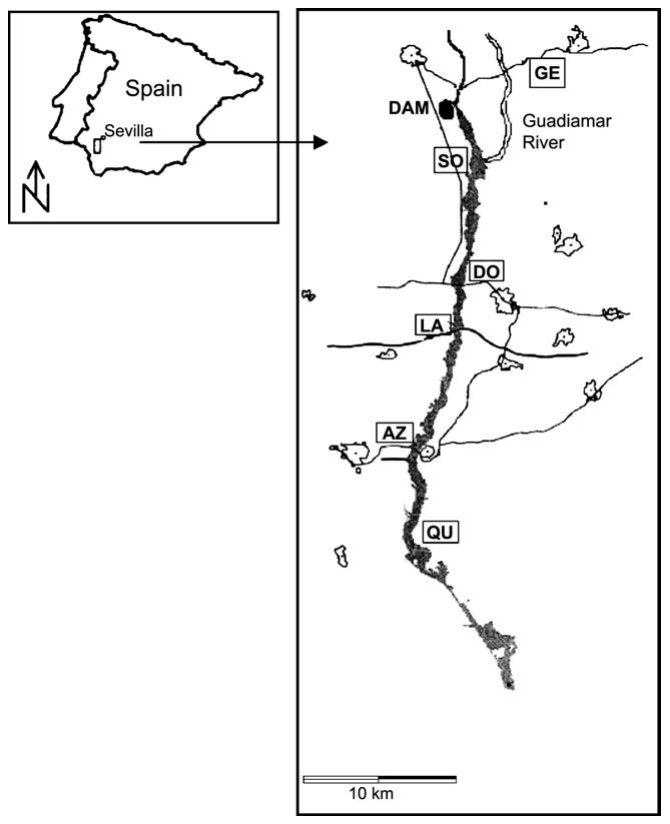
We sampled poplar trees along a river stretch of about 40 km. We started in Gerena (GE) (37( 31# N, 6( 11# W) upstream of the tailing dam, and ended in Vado del Quema (QU) (37( 14# N, 6( 15# W), about 31 km downstream the spill source, and close to the Guadalquivir marshes. The remaining sampling sites were Soberbina (SO), Doblas (DO), Lagares (LA) and Aznalca´zar (AZ) at approximately 4.5 km, 12 km, 15 km and 25 km from the dam, respectively (Fig. 1). Thirty poplar trees were selected, and permanently marked with metal tags. The five trees in GE site were not affected by the spill, while the other 25 trees were in sites flooded by the spill. In October 1999 (18 months after the flooding) we collected samples of leaves and twigs (stems) at about 5 m height, from the outer canopy. In general, leaves of the outer canopy tend to accumulate more mineral elements than those of the inner canopy, due to their higher transpiration rates (Bargagli, 1998). Five additional trees were located in another river, Rivera de Huelva (RH) (37( 29# N, 6( 01# W), as an external control (outside the Guadiamar Basin), and were sampled in October 2000.
我们沿约40 km的河段采集杨树样品。起点为尾矿坝上游的Gerena(GE)(37°31′N, 6°11′W),终点为Vado del Quema(QU)(37°14′N, 6°15′W),该处距泄漏源下游约31 km,靠近Guadalquivir沼泽。其余采样点为Soberbina(SO)、Doblas(DO)、Lagares(LA)和Aznalcázar(AZ),分别距坝约4.5 km、12 km、15 km和25 km(图1)。共选取30株杨树,并用金属标牌作永久标记。GE样点的5株树未受泄漏影响,其余25株位于被泄漏物淹没的样点。1999年10月(淹没后18个月),我们在约5 m高处从外层树冠采集叶片和嫩枝(茎)样品。一般而言,由于蒸腾速率较高,外层树冠的叶片往往比内层树冠的叶片富集更多的矿质元素(Bargagli, 1998)。另有5株树位于另一条河流Rivera de Huelva(RH)(37°29′N, 6°01′W),作为外部对照(位于Guadiamar流域之外),于2000年10月采样。
Soil samples were taken from the root-zone of each tree, about 2 m from the trunk, and at two depths (0e25 and 25e40 cm), by using a spiral auger of 2.5 cm diameter. Three subsamples around the trunk were taken to make a composite soil sample per tree.
土壤样品采自每株树的根区,距树干约2 m,分两个深度(0–25 cm和25–40 cm),使用直径2.5 cm的螺旋土钻采集。在树干周围采集3个子样品,混合为每株树的一个复合土样。
Plant material was partitioned for analysis into leaves and stems. Stems were between 0.5 and 3 cm in diameter. Samples were washed for at least 15 s approximately with a solution of 0.1 g L�1 phosphate-free detergent, then with a 0.1 N HCl solution, and finally with distilled water. Next, they were dried at 70 (C for at least 48 h, and ground by using a stainless-steel mill.
植物材料分为叶片和茎两部分进行分析。茎的直径为0.5–3 cm。样品先用0.1 g L−1无磷洗涤剂溶液清洗约15 s以上,然后用0.1 N HCl溶液清洗,最后用蒸馏水冲洗。随后于70 °C下烘干至少48 h,并用不锈钢磨粉碎。
Eight trace elements (As, Cd, Cu, Fe, Mn, Ni, Pb and Zn) were determined in plant tissues by wet oxidation with concentrated HNO3 under pressure in a microwave digester (see method in Jones and Case, 1990). Analyses of the extracts were performed by ICP-OES (inductively coupled plasma spectrophotometry) for Fe and Mn, and by ICP-MS (inductively coupled plasma-mass spectroscopy) for As, Cd, Cu, Ni, Pb and Zn.
植物组织中8种微量元素(As、Cd、Cu、Fe、Mn、Ni、Pb和Zn)的测定采用微波消解仪中浓HNO3加压湿法氧化(方法参见Jones and Case, 1990)。提取液中Fe和Mn采用ICP-OES(电感耦合等离子体发射光谱法)测定,As、Cd、Cu、Ni、Pb和Zn采用ICP-MS(电感耦合等离子体质谱法)测定。
The accuracy of the analytical method was assessed by carrying out analyses of two BCR (Community Bureau of Reference) reference samples: CRM 279 (sea lettuce) and CRM 281 (ryegrass) (Griepink and Muntau, 1987, 1988). The values obtained for this reference material, by ICP-MS, were concordant with the certified values (Table 2).
分析方法的准确度通过分析两种BCR(欧共体参考物质局)标准样品进行评估:CRM 279(石莼)和CRM 281(黑麦草)(Griepink and Muntau, 1987, 1988)。ICP-MS测得的该标准物质数值与认证值一致(表2)。
Texture, acidity and fertility of soils in Guadiamar riparian forests (mean values G standard error, N ¼ 5) (Madejo´ n, 2004)
Guadiamar河岸林土壤的质地、酸度和肥力(平均值 ± 标准误,N = 5)(Madejón, 2004)
| Site样点 | Longitude/latitude经度/纬度 | Depth (cm)深度(cm) | pH | CaCO3 (%)CaCO3(%) | N (%) | P (mg kg�1) | Texture质地 |
|---|---|---|---|---|---|---|---|
| Non-aff | fected sites | ||||||
| RH | 6( 01# 34.0$ W | 0e25 | 8.0G0.50 | 2G0.7 | 0.10G0.01 | 12.5G1.8 | Clay |
| 37( 29# 4.8$ N | 25e40 | 7.9G0.54 | 1.2G0.5 | 0.06G0.01 | 8.7G1.6 | Clay | |
| GE | 6( 11# 19$ W | 0e25 | 7.7G0.10 | 2G1 | 0.08G0.02 | 12G2 | Loamy sand |
| 37( 31# 39$ N | 25e40 | 7.7G0.09 | 2G1 | 0.06G0.01 | 7.3G2.0 | Loamy sand | |
| Spill-aff | fected sites | ||||||
| SO | 6( 13# 1$ W | 0e25 | 5.4G0.30 | !0.5 | 0.14G0.02 | 5.8G0.6 | Sandy loam |
| 37( 27# 9$ N | 25e40 | 5.0G0.20 | !0.5 | 0.08G0.01 | 4.7G1.1 | Sandy loam | |
| DO | 6( 13# 35$ W | 0e25 | 7.3G0.20 | 19G4 | 0.16G0.02 | 13G2 | Clay loam |
| 37( 23# 45$ N | 25e40 | 7.4G0.10 | 18G2 | 0.13G0.03 | 10G1 | Clay loam | |
| LA | 6( 13# 39$ W | 0e25 | 7.5G0.07 | 12G2 | 0.13G0.01 | 13G2 | Loam |
| 37( 22# 25$ N | 25e40 | 7.5G0.02 | 10G3 | 0.11G0.01 | 10G3 | Loam | |
| AZ | 6( 15# 38$ W | 0e25 | 7.1G0.20 | 8G1 | 0.17G0.03 | 20G11 | Loam |
| 37( 18# 12$ N | 25e40 | 7.3G0.15 | 7G2 | 0.14G0.01 | 11G4 | Loam | |
| QU | 6( 15# 51$ W | 0e25 | 7.2G0.16 | 9G0.5 | 0.09G0.02 | 20G11 | Sandy loam |
| 37( 14# 46$ N | 25e40 | 7.4G0.09 | 12G1 | 0.09G0.01 | 15G2 | Loam |
Soil samples were oven-dried at 40 (C, for at least 48 h, and crushed to pass a 2 mm sieve, and then ground to !60 mm for trace element analysis. Total content of trace elements was determined (in the soil fraction !60 mm) by ICP-OES, after digesting the samples with a mixture of concentrated HNO3 and HCl (aqua regia). Bioavailability of the same trace elements was estimated (in the soil fraction !2 mm) by extraction with a 0.05 M
土壤样品于40 °C烘干至少48 h,压碎过2 mm筛,再研磨至<60 μm用于微量元素分析。样品经浓HNO3和HCl混合液(王水)消解后,采用ICP-OES测定(<60 μm土壤组分中)微量元素总量。上述微量元素的生物有效性(<2 mm土壤组分中)采用0.05 M
EDTA solution (Ure et al., 1993), and analysis by ICP- OES. Concentration of trace elements in the soil solution is expressed on a dry weight basis.
EDTA溶液提取(Ure et al., 1993)并以ICP-OES分析进行估算。土壤溶液中微量元素浓度以干重计。
2.4. Statistical analyses2.4. 统计分析
The concentration of the eight elements in poplar trees and in soil was compared between spill-affected sites (n ¼ 25) and non-affected ones (n ¼ 10), by means of one way ANOVA. When significant differences relative to control sites (both upstream and external references) were found, the inference that the mine spill induced a pollution of the soil and/or the tree for that particular element was suggested. In addition, the concentration values were compared with the normal range for soils (according to Bowen, 1979), to evaluate the pollution level. Data normality and homocedasticity were tested prior to analysis; and when necessary, variables were transformed logarithmically.
采用单因素ANOVA比较受泄漏影响样点(n = 25)与未受影响样点(n = 10)杨树和土壤中8种元素的浓度。若与对照样点(包括上游对照和外部对照)存在显著差异,则推断尾矿泄漏导致该元素对土壤和/或树木造成了污染。此外,将浓度值与土壤正常范围(依据Bowen, 1979)进行比较,以评估污染水平。分析前检验数据的正态性和方差齐性;必要时对变量进行对数转换。
To investigate the global pollution trends, principal component analyses (PCA) were performed, separately, for the concentration of eight trace elements in 35 poplar trees (leaf and stem) and in the 35 corresponding soil samples (for both, total and EDTA-extracted values). Previously, variables were transformed by square root to obtain a normal distribution (McCune and Mefford, 1999). The variation trend in soil pollution (according to PCASOIL axis 1) was then compared with the trend in chemical composition of poplar leaves (PCAPLANT axis 1).
为研究总体污染趋势,分别对35株杨树(叶片和茎)以及35个相应土壤样品(总量和EDTA提取量)中8种微量元素的浓度进行主成分分析(PCA)。分析前对变量进行平方根转换以获得正态分布(McCune and Mefford, 1999)。随后将土壤污染的变化趋势(依据PCASOIL第1轴)与杨树叶片化学组成的变化趋势(PCAPLANT第1轴)进行比较。
The poplar biomonitoring capacity was evaluated by means of correlation (Pearson r) and linear regression analyses, between the concentration of trace elements in white poplar tissues (leaves and stems) and their bioavailability (after EDTA extraction) in the soil solution.
通过银白杨组织(叶片和茎)中微量元素浓度与其土壤溶液中生物有效性(EDTA提取后)之间的相关分析(Pearson r)和线性回归分析,评估杨树的生物监测能力。
The programs PC-ORD (McCune and Mefford, 1999) and STATISTICA (StatSoft, 1997) were used for the analyses mentioned above.
上述分析采用PC-ORD(McCune and Mefford, 1999)和STATISTICA(StatSoft, 1997)程序完成。
3Results and discussion结果与讨论
Analysis of BCR reference samples (mean values G 95% confidence interval, mg kg�1 dry matter) (values in parentheses are indicative; Fe value for ryegrass (CRM 281) was not provided by the BCR; experimental values were calculated from N ¼ 6 (sea lettuce) and N ¼ 5 (ryegrass))
BCR标准样品分析结果(平均值 ± 95%置信区间,mg kg−1干物质)(括号内数值为参考值;BCR未提供黑麦草(CRM 281)的Fe值;试验值由N = 6(石莼)和N = 5(黑麦草)计算)
| Element元素 | CRM 279 (sea | lettuce)石莼) | CRM 281 (rye | grass)黑麦草) |
|---|---|---|---|---|
| Certified | Experimental | Certified | Experimental | |
| As | 3.09G0.20 | 2.69G0.11 | 0.057G0.004 | 0.080G0.07 |
| Cd | 0.274G0.022 | 0.202G0.007 | 0.120G0.003 | 0.104G0.02 |
| Cu | 13.14G0.37 | 11.63G0.73 | 9.65G0.38 | 9.66G2.24 |
| Fe | (2300G100) | 2113G72.3 | d | 150G27.6 |
| Mn | (2030G31.5) | 1758G64.8 | 81.6G2.6 | 79.2G5.7 |
| Ni | (15.9G0.4) | 13.1G0.53 | 3.0G0.17 | 2.58G0.31 |
| Pb | 13.48G0.36 | 12.47G1.09 | 2.38G0.11 | 2.31G0.68 |
| Zn | 51.3G1.2 | 52.18G3.29 | 31.5G1.4 | 34.0G8.04 |
3.1. Trace elements in soils3.1. 土壤中的微量元素
3.1.1. Total concentration3.1.1. 总量
The concentration of trace elements obtained by extraction with aqua regia provided an estimate of their total (also called quasi-total) content in soil (Vidal et al., 1999). Total concentration values for As, Cd, Cu, Pb and Zn were significantly greater in the spill-affected sites than in the control sites, for both soil depths (Table 3). However, only As, Cd and Pb reached values above the background range. The differences between the concentration in spill-affected sites (surface soil) versus controls amounted 15 times greater for Pb, 12 times for As, and 3 times for Cd. Maximum values of these trace elements in polluted soil reached up to 1110 mg kg�1 for Pb, 440 mg kg�1 for As (both at AZ site), and 13.9 mg kg�1 for Cd (at DO site).
王水提取所得的微量元素浓度可估算其在土壤中的总量(亦称准总量)(Vidal et al., 1999)。在两个土壤深度,受泄漏影响样点As、Cd、Cu、Pb和Zn的总量均显著高于对照样点(表3)。然而,仅As、Cd和Pb超出了背景值范围。受泄漏影响样点(表层土壤)与对照相比,Pb高出15倍,As高出12倍,Cd高出3倍。污染土壤中这些微量元素的最大值分别为Pb 1110 mg kg−1、As 440 mg kg−1(均位于AZ样点)和Cd 13.9 mg kg−1(位于DO样点)。
Total and available (EDTA-extracted) concentration (mg kg�1) of iron and trace elements in soils (at two depth layers) of 25 spill-affected sites and 10 control sites (mean G S.E.) in the riparian forest of the Guadiamar River (background (total) values according to Bowen (1979) are indicated; significance levels in the comparison (by ANOVA) between spill-affected and non-affected sites are indicated: * p ! 0:05, ** p ! 0:01, *** p ! 0:001Þ
Guadiamar河岸林中25个受泄漏影响样点和10个对照样点土壤(两个深度层)中铁和微量元素的总量及有效态(EDTA提取)浓度(mg kg−1)(平均值 ± 标准误)(标注了依据Bowen(1979)的背景(总量)值;标注了受泄漏影响与未受影响样点间比较(ANOVA)的显著性水平:* p < 0.05,** p < 0.01,*** p < 0.001)
| Element元素 | Surface soil (0e25 cm)表层土壤(0–25 cm) | Deep soil (25e40 cm)深层土壤(25–40 cm) | Background (range)背景值(范围) | ||
|---|---|---|---|---|---|
| Spill-affected (N¼25) | Non-affected (N¼10) | Spill-affected (N¼25) | Non-affected (N¼10) | ||
| Total | |||||
| As | 111 G 19 | 9 G 0.6 | 49 G 4* | 10 G 0.6 | 0.1e40 |
| Cd | 4.29 G 0.53* | 1.56 G 0.15 | 3.64 G 0.41* | 1.57 G 0.16 | 0.01e2 |
| Cu | 179 G 21* | 19 G 1.7 | 188 G 25* | 18 G 1.9 | 2e250 |
| Fe | 35,508 G 2772* | 25,960 G 2315 | 32,872 G 2095 | 26,320 G 2405 | 2000e550,000 |
| Mn | 468 G 31 | 500 G 24 | 531 G 40 | 498 G 27 | 20e10,000 |
| Ni | 17.3 G 0.9 | 18 G 1.7 | 19 G 0.9* | 15 G 2.4 | 2e750 |
| Pb | 305 G 53 | 21 G 2.2 | 140 G 20* | 16 G 1.7 | 2e30 |
| Zn | 583 G 66* | 58 G 5 | 488 G 75* | 13 G 4.0 | 1e900 |
| Available | |||||
| As | 1.70 G 0.25* | 0.27 G 0.10 | 0.84 G 0.05* | 0.22 G 0.08 | |
| Cd | 1.25 G 0.19* | 0.03 G 0.01 | 1.17 G 0.24 | 0.02 G 0.01 | |
| Cu | 58.0 G 6.9* | 5.66 G 1.01 | 62.7 G 8.5* | 4.5 G 0.8 | |
| Fe | 184 G 33 | 113 G 22 | 121 G 16 | 103 G 21 | |
| Mn | 51 G 7* | 78 G 10 | 37.3 G 6.1* | 95.6 G 15.5 | |
| Ni | 0.64 G 0.08 | 0.70 G 0.09 | 0.50 G 0.06* | 0.76 G 0.10 | |
| Pb | 63.3 G 14.7* | 5.45 G 0.89 | 38.2 G 5.9 | 4.3 G 0.6 | |
| Zn | 117 G 15* | 4.56 G 0.97 | 84.6 G 14.0* | 2.7 G 0.4 |
The multivariate analysis (PCA) of the soil samples reflects the differential content and distribution of the trace elements. First PCA axis extracted 65.7% of variance for total values of trace elements in surface soil, Cu, Cd, As, Zn and Pb being the elements with higher (negative) contribution to that axis (figure not shown). The second PCA axis had lower significance (22.2% of variance) and was determined by the (negative) contribution of Ni and Mn.
土壤样品的多元分析(PCA)反映了微量元素含量与分布的差异。对于表层土壤微量元素总量,PCA第一轴解释了65.7%的方差,其中Cu、Cd、As、Zn和Pb对该轴的(负)贡献较大(图未显示)。PCA第二轴的重要性较低(解释22.2%的方差),由Ni和Mn的(负)贡献决定。
3.1.2. Available concentration3.1.2. 有效态浓度
For a given trace element, only a fraction of its total content in the soil is available for the plants. The pool of available elements will be composed of those ions present in the soil solution, as well as those that are readily solubilised and are therefore able to move into the plant roots (Bargagli, 1998). Mild soil extractants, such as EDTA, are currently used to estimate this available fraction (although this method can overestimate the availability of elements such as Cu and Pb; Vidal et al., 1999).
对于某一微量元素,其在土壤中的总量只有一部分可被植物利用。有效态元素库由土壤溶液中存在的离子以及易于溶解从而能够进入植物根系的离子组成(Bargagli, 1998)。目前常用EDTA等温和的土壤提取剂估算这一有效态组分(尽管该方法可能高估Cu和Pb等元素的有效性;Vidal et al., 1999)。
The spill-affected soils had a greater availability of As, Cd, Cu, Pb and Zn compared with controls. The rank of spill polluting elements were Cd (42 times greater than control), Zn (! 26), Pb (! 12), Cu (! 10) and As (! 6). In contrast, the availability of Mn and Ni was lower in spill-affected soil, whereas Fe did not show a significant difference (Table 3).
与对照相比,受泄漏影响土壤中As、Cd、Cu、Pb和Zn的有效性更高。泄漏污染元素的排序为Cd(为对照的42倍)、Zn(×26)、Pb(×12)、Cu(×10)和As(×6)。相反,受泄漏影响土壤中Mn和Ni的有效性较低,而Fe无显著差异(表3)。
There was a high variation among sites in the availability of trace elements. For example, in the topsoil of spill-affected sites, Pb ranged from 7.7 to 279 mg kg�1 (with coefficient of variation of 116%); As from 0.6 to 5.1 mg kg�1 (CV of 75%); Cd from 0.1 to 3.7 mg kg�1 (CV of 74%), and Cu from 6.1 to 140 mg kg�1 (CV of 60%). The observed high variation in As and metal concentrations might reflect the heterogeneous spatial pattern of soil pollution. In some sites, for example close to tree trunks, the accessibility to clean-up machinery was limited and some sludge could not be removed (Ayora et al., 2001).
各样点间微量元素有效性差异较大。例如,在受泄漏影响样点的表层土壤中,Pb为7.7–279 mg kg−1(变异系数116%);As为0.6–5.1 mg kg−1(CV为75%);Cd为0.1–3.7 mg kg−1(CV为74%);Cu为6.1–140 mg kg−1(CV为60%)。所观察到的As和金属浓度的高变异可能反映了土壤污染空间格局的异质性。在某些样点,例如靠近树干处,清理机械难以进入,部分污泥未能清除(Ayora et al., 2001)。
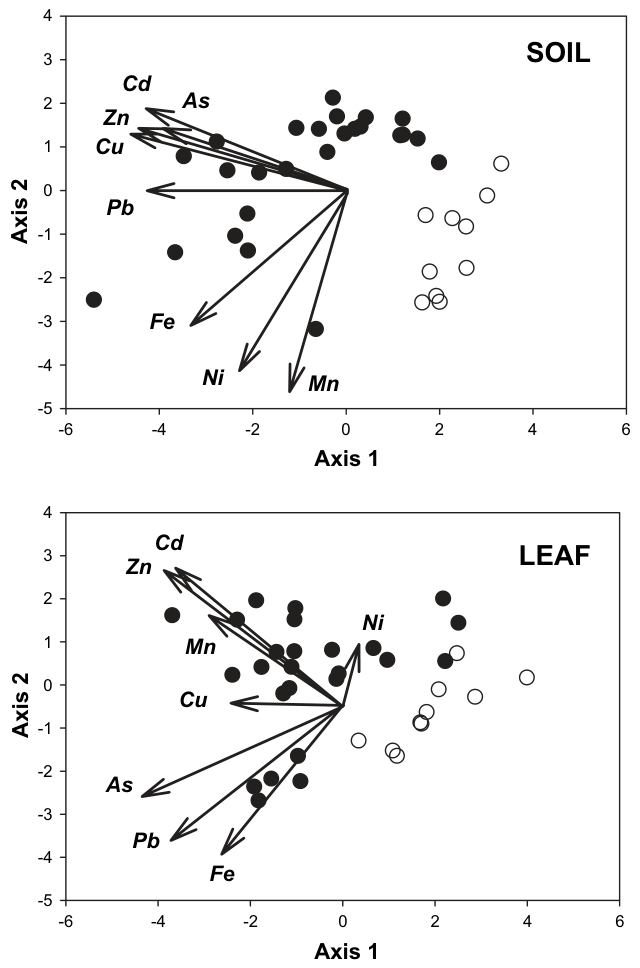
The first PCA axis for the surface (0e25 cm) soil samples explained 55.9% of the variance, and was determined by the differential availability of four elements (having higher negative coefficients): Cu, Zn, Pb and Cd. The distribution of soil samples along this axis seems to reflect a main gradient of spill-induced pollution (Fig. 2). These four chalcophilic elements were abundant in the sludge and their relative abundance values in the polluted soils were inter-correlated.
表层(0–25 cm)土壤样品的PCA第一轴解释了55.9%的方差,由4种元素(具有较大负系数)有效性的差异决定:Cu、Zn、Pb和Cd。土壤样品沿该轴的分布似乎反映了泄漏所致污染的主要梯度(图2)。这4种亲铜元素在污泥中含量丰富,且其在污染土壤中的相对丰度相互关联。
The second axis reflected a secondary, less explicative gradient (28.6%), and was associated with the availability of three siderophilic elements: Mn, Ni and Fe. This secondary chemical gradient was probably related to the geological nature of the parent material, and not to the spill pollution.
第二轴反映了一个次要的、解释力较弱的梯度(28.6%),与3种亲铁元素Mn、Ni和Fe的有效性相关。这一次要化学梯度可能与母质的地质性质有关,而与泄漏污染无关。
The PCA results for the deeper soil layer (25e40 cm) were similar (figure not shown). The first axis explained 53.4% of variance, and was associated with the variation in Cd, Zn, Cu and Pb, whereas the second axis explained 27.6% of variance and was determined by the availability of Mn and Ni.
深层土壤(25–40 cm)的PCA结果与之相似(图未显示)。第一轴解释了53.4%的方差,与Cd、Zn、Cu和Pb的变化相关;第二轴解释了27.6%的方差,由Mn和Ni的有效性决定。
The soil pollution gradient in the Guadiamar riparian forest was reflected by the PCA analyses of both total and EDTA-extracted values, and the patterns were similar. For example, the scores of (surface) soil samples along the PCA first axis for EDTA-extracted values were highly correlated (r ¼ 0:90 and p ! 0:001) with their scores in the PCA for total values. In this paper, available (EDTA-extracted) values of trace elements in soil will be used to compare with their bioaccumulation in plants.
Guadiamar河岸林土壤的污染梯度在总量和EDTA提取量的PCA分析中均得到反映,且格局相似。例如,(表层)土壤样品在EDTA提取量PCA第一轴上的得分与其在总量PCA中的得分高度相关(r = 0.90,p < 0.001)。本文将采用土壤中微量元素的有效态(EDTA提取)数值与其在植物中的生物富集进行比较。
3.2. Trace elements in poplar trees3.2. 杨树中的微量元素
The spill-polluted poplar trees had a significantly higher concentration of As, Cd and Zn, in both leaves and stems, compared to control areas (Table 4).
与对照区相比,受泄漏污染的杨树叶片和茎中As、Cd和Zn的浓度均显著更高(表4)。
The accumulation of As was greater (for 15 out of the 25 trees) than the normal range reported for leaf tissues (according to Bowen, 1979). However, As values were always below the lower limit of phytotoxicity (5 mg kg�1; Kabata-Pendias and Pendias, 2001). Arsenic has a comparatively low soileplant transfer coefficient (Kloke et al., 1984), and the accumulation measured here in poplar trees was rather moderate, compared for example with the maximum value of 20.8 mg kg�1 documented for P. nigra (Djingova et al., 1995).
As的富集量(25株树中有15株)高于叶片组织的正常范围(依据Bowen, 1979)。但As值始终低于植物毒性下限(5 mg kg−1;Kabata-Pendias and Pendias, 2001)。砷的土壤–植物转移系数相对较低(Kloke et al., 1984),本研究测得的杨树As富集量较为适中,例如与P. nigra记录的最大值20.8 mg kg−1(Djingova et al., 1995)相比。
The concentration of Cd in polluted poplar tissues showed the highest increase, compared to control trees; 18 times for leaves and 10 times for stems (Table 4). Cadmium values in polluted poplar trees exceeded the normal values in plants. The highest Cd value recorded (15.4 mg kg�1 at DO site) was into the phytotoxic range for plants (5e700 mg kg�1; reported by Chaney, 1989); although they did not reach the extreme values (200 mg kg�1) reported for poplar in soils severely polluted by Cd (Robinson et al., 2000). In general, Cd is effectively absorbed by plant roots and accumulated in aboveground organs; having thus a comparatively high transfer soileplant coefficient (Kloke et al., 1984).
与对照树相比,污染杨树组织中Cd浓度增幅最大:叶片为对照的18倍,茎为10倍(表4)。污染杨树中的镉含量超过了植物正常值。记录到的最高Cd值(DO样点15.4 mg kg−1)处于植物毒性范围内(5–700 mg kg−1;Chaney, 1989),但未达到Cd严重污染土壤中杨树的极端值(200 mg kg−1)(Robinson et al., 2000)。一般而言,Cd易被植物根系吸收并在地上器官中积累,因此其土壤–植物转移系数相对较高(Kloke et al., 1984)。
Mean concentration of Zn in polluted poplars was 7 times in leaves and 2 times in stems, higher than in control trees (Table 4). Zinc in leaves was above normal values. The extreme recorded value (1312 mg kg�1 at DO site) was into the phytotoxic range (500e 1500 mg kg�1; Chaney, 1989). Zinc has a relatively high transfer coefficient from soil to plant, and most plants can tolerate high Zn levels (see Kloke et al., 1984). Other studies have found high Zn concentrations in the leaves of Populus species; for example 300 mg kg�1 in Bulgaria (Djingova et al., 1995), and up to 2000 mg kg�1 under extreme conditions (Ernst, 1998).
污染杨树中Zn的平均浓度在叶片中为对照树的7倍,在茎中为2倍(表4)。叶片中的锌含量高于正常值。记录到的极端值(DO样点1312 mg kg−1)处于植物毒性范围内(500–1500 mg kg−1;Chaney, 1989)。锌的土壤–植物转移系数相对较高,且大多数植物能够耐受较高的Zn水平(参见Kloke et al., 1984)。其他研究也在杨属(Populus)植物叶片中发现了较高的Zn浓度,例如保加利亚为300 mg kg−1(Djingova et al., 1995),在极端条件下可高达2000 mg kg−1(Ernst, 1998)。
The accumulation of Cu in stems of spill-affected poplars was higher than in controls, whereas the difference was not significant in leaves (Table 4). In any case, the measured Cu values were always within the normal range, and below the phytotoxic range for plants (25e40 mg kg�1; Chaney, 1989).
受泄漏影响杨树茎中Cu的富集量高于对照,而叶片中差异不显著(表4)。无论如何,所测Cu值始终处于正常范围内,且低于植物毒性范围(25–40 mg kg−1;Chaney, 1989)。
Fe also showed a differential accumulation in stems, but not in leaves, of polluted poplars, compared to controls (Table 4). The maximum Fe concentration recorded for leaves (814 mg kg�1 at LA site) was above the normal range. However, a possible external contamination by dust (and despite the careful washing of the plant material) probably contributed to these high values.
与对照相比,污染杨树的茎中Fe也表现出差异性富集,而叶片中则无(表4)。叶片中记录到的最高Fe浓度(LA样点814 mg kg−1)超出了正常范围。然而,尽管对植物材料进行了仔细清洗,粉尘造成的外部污染可能仍是导致这些高值的原因之一。
Apparently, there were no significant differences between spill-affected and (overall) control trees for Pb (Table 4). However, leaves from the external control (RH site) had significantly lower Pb concentration (mean of 0.38 mg kg�1) than in the spill-affected sites (mean of 5.00 mg kg�1). On the other hand, leaves from the upstream control (GE site) had a relatively high Pb concentration (mean of 6.27 mg kg�1), similar to the spill-affected sites, indicating another source of Pb pollution and obscuring the spill effects. In any case, the highly significant increase of Pb (both total and available) in polluted soils (Table 3) is not proportionately reflected in the leaves (Table 4). In general, Pb is rather immobile in soil and easily forms organic complexes with fulvic acids (Greger, 1999). In addition, it concentrates primarily in the roots and is poorly translocated to the vegetative parts, resulting in a comparatively low transfer coefficient from soil to plant (Kloke et al., 1984).
就Pb而言,受泄漏影响的树木与(总体)对照树之间似乎无显著差异(表4)。然而,外部对照(RH样点)叶片的Pb浓度(平均0.38 mg kg−1)显著低于受泄漏影响样点(平均5.00 mg kg−1)。另一方面,上游对照(GE样点)叶片的Pb浓度相对较高(平均6.27 mg kg−1),与受泄漏影响样点相近,表明存在另一个Pb污染源,从而掩盖了泄漏的影响。无论如何,污染土壤中Pb(总量和有效态)的极显著增加(表3)并未在叶片中得到相应反映(表4)。一般而言,Pb在土壤中移动性较差,易与富里酸形成有机络合物(Greger, 1999)。此外,Pb主要集中于根部,向营养器官的转运能力较弱,导致其土壤–植物转移系数相对较低(Kloke et al., 1984)。
Concentration of eight trace elements (mg kg�1 dry matter) in leaves and stems of white poplar trees from spill-affected and non-affected sites in the riparian forest of the Guadiamar River (when polluted trees were significantly different (by ANOVA test) from control trees, the significance level was indicated: * p ! 0:05, ** p ! 0:01, *** p ! 0:001; normal values (range) for trace elements in plants, according to Kabata-Pendias and Pendias (2001), and for Fe according to Bowen (1979), are also indicated)
Guadiamar河岸林中受泄漏影响和未受影响样点银白杨叶片和茎中8种微量元素的浓度(mg kg−1干物质)(当污染树木与对照树木存在显著差异(ANOVA检验)时标注显著性水平:* p < 0.05,** p < 0.01,*** p < 0.001;同时标注了依据Kabata-Pendias and Pendias(2001)的植物中微量元素正常值(范围),以及依据Bowen(1979)的Fe正常值)
| Element元素 | Poplar leaf杨树叶片 | Poplar stem杨树茎 | Normal正常值 | ||
|---|---|---|---|---|---|
| Spill-affected (N¼25) | Non-affected (N¼10) | Spill-affected (N¼25) | Non-affected (N¼10) | ||
| As | 2.70 G 0.24* | 0.99 G 0.23 | 0.77 G 0.07* | 0.25 G 0.07 | 1.0e1.7 |
| Cd | 3.82 G 0.64 | 0.21 G 0.03 | 3.18 G 0.30* | 0.31 G 0.04 | 0.05e0.2 |
| Cu | 7.63 G 0.17 | 7.44 G 0.26 | 6.62 G 0.33* | 3.96 G 0.26 | 5e30 |
| Fe | 336.6 G 30.7 | 251.0 G 28.0 | 88.0 G 6.9* | 44.2 G 8.0 | 2e250 |
| Mn | 93.6 G 15.8 | 51.0 G 7.3 | 16.7 G 2.6 | 12.5 G 2.2 | 30e300 |
| Ni | 1.33 G 0.09 | 1.05 G 0.11 | 0.72 G 0.05 | 0.78 G 0.10 | 0.1e5 |
| Pb | 5.00 G 0.44 | 3.93 G 0.84 | 2.06 G 0.30 | 1.54 G 0.55 | 5e10 |
| Zn | 542.1 G 58.0* | 81.6 G 14.8 | 139.0 G 6.1* | 59.2 G 4.4 | 27e150 |
Comparing the plant organs, leaves accumulated a higher concentration of trace elements than stems (Table 4).
比较不同植物器官,叶片富集的微量元素浓度高于茎(表4)。
The pollution trend in poplar leaves, defined by the first PCA axis with 41% of the variance, was associated with the increasing concentration of As, Zn, Pb and Cd (with that rank of negative coefficients). On the other hand, Fe and Pb (with negative coefficients) as opposed to Cd and Zn (with positive coefficients) defined the second axis (21% of variance) (Fig. 2).
杨树叶片的污染趋势由PCA第一轴(解释41%的方差)确定,与As、Zn、Pb和Cd浓度的增加相关(负系数按此顺序排列)。另一方面,第二轴(解释21%的方差)由Fe和Pb(负系数)与Cd和Zn(正系数)的相对关系确定(图2)。
Thus, the distribution of the poplar samples, according to their values for the PCA axis 1, reflects a main pollution gradient: five poplar trees from the external control site and five trees from the upstream sites are grouped to the right of the graph; mixed with three affected trees (from the least polluted, QU site). In contrast, all the trees in spill-affected soils are towards the left of the graph; having the extreme scores of those leaves taken from the highest polluted DO site (Fig. 2).
因此,杨树样品依据其在PCA第1轴上的数值所呈现的分布反映了一个主要污染梯度:外部对照样点的5株杨树和上游样点的5株树聚集在图的右侧,其中混有3株受影响树木(来自污染最轻的QU样点)。相反,受泄漏影响土壤上的所有树木均位于图的左侧,其中污染最重的DO样点叶片具有极端得分(图2)。
The trend of variation in the concentration of the eight trace elements in poplar leaves, as shown by PCA analysis, had similarities and differences with that in the correspondent soils (Fig. 2). The sample scores in the PCASOIL axis 1 were positive and significantly correlated with those in the PCAPLANT axis 1 (r ¼ 0:65, p ! 0:001). Therefore, the main patterns of soil bioavailability of trace elements, in particular of Zn and Cd, explained to a great extent, the poplar tissue composition.
PCA分析显示,杨树叶片中8种微量元素浓度的变化趋势与相应土壤中的变化趋势既有相似之处,也有差异(图2)。样品在PCASOIL第1轴上的得分与其在PCAPLANT第1轴上的得分呈显著正相关(r = 0.65,p < 0.001)。因此,土壤微量元素(尤其是Zn和Cd)生物有效性的主要格局在很大程度上解释了杨树组织的元素组成。
Four of the elements (Zn, Cd, Pb and As) contributing the most to the soil pollution trend (with highest negative coefficients for PCASOIL axis 1) also contributed to the leaf chemical trend (with highest negative coefficients for PCAPLANT axis 1). However, there was a divergence with regard to the secondary gradient. Thus, Zn and Cd had a common behaviour in both soil and plant analyses, but As and Pb differed between soil (associated to Zn and Cd) and plant (opposed to Zn and Cd) chemical patterns (Fig. 2). Cu was the element contributing most to the soil pollution gradient (PCASOIL axis 1) but had low significance to the leaf chemical gradient (PCAPLANT axis 1) (Fig. 2).
对土壤污染趋势贡献最大的4种元素(Zn、Cd、Pb和As)(在PCASOIL第1轴上具有最大负系数)同样对叶片化学趋势有贡献(在PCAPLANT第1轴上具有最大负系数)。然而,在次要梯度方面存在分异。即Zn和Cd在土壤和植物分析中表现一致,但As和Pb在土壤(与Zn和Cd相关联)和植物(与Zn和Cd相对立)化学格局中表现不同(图2)。Cu是对土壤污染梯度(PCASOIL第1轴)贡献最大的元素,但对叶片化学梯度(PCAPLANT第1轴)的重要性较低(图2)。
The pollution trends in poplar stems (small branches and twigs), as detected by the PCA analysis, were similar to those in the leaves (figure not shown). The first axis explained 51% of variance, and was associated mainly with As, Fe, Zn, Cd and Pb. The second axis explained 20% of variance and was determined by the opposing accumulation of Cu (positive coefficient) versus Ni (negative coefficient).
PCA分析检测到的杨树茎(小枝和嫩枝)污染趋势与叶片相似(图未显示)。第一轴解释了51%的方差,主要与As、Fe、Zn、Cd和Pb相关。第二轴解释了20%的方差,由Cu(正系数)与Ni(负系数)相反的富集格局决定。
Different patterns in the concentrations of trace elements between plants and soils have also been found in other studies (e.g., Markert, 1987). Interactions between elements may arise from antagonistic and synergistic processes, which occasionally can involve the metabolism of more than two elements. These interactions may affect the uptake and translocation of a particular element, independent of its availability in the soil. Moreover, factors besides soil pollution, such as atmospheric deposition onto leaf surfaces, seasonal physiology, the tissues under study, and the speciesspecific capacities for uptake, translocation and compartmentalisation of trace elements, may contribute to the observed differential bio-accumulation (Bargagli, 1998).
其他研究也发现了植物与土壤间微量元素浓度格局的差异(如Markert, 1987)。元素间的相互作用可能源于拮抗和协同过程,有时可涉及两种以上元素的代谢。这些相互作用可能影响特定元素的吸收和转运,而与其在土壤中的有效性无关。此外,土壤污染以外的因素,如叶表面的大气沉降、季节性生理变化、所研究的组织,以及不同物种对微量元素吸收、转运和区隔化的特有能力,均可能导致所观察到的生物富集差异(Bargagli, 1998)。
3.3. White poplar as a biomonitor of trace elements
3.3. 银白杨作为微量元素的生物监测器
The correlation coefficients between the concentration of eight trace elements in poplar tissues (leaves and stems) and their availability (EDTA extractable) in the soil solution of the tree rooting volume, are shown in Table 5. In total, 16 out of the 32 correlations were significant. Poplar leaves were correlated with surface soil for four elements (Cd, Zn, Mn and Cu) and with deep soil also for four elements (Cd, Zn, As and Cu). Similarly, poplar stems were correlated with surface soil for five elements (Cd, Zn, As, Mn and Fe) and with deep soil for three elements (Cd, As and Zn). In general, leaf concentration of trace elements was better correlated (higher correlation coefficients) with the pollution level in the deep soil, than with surface soil (with the exception of Mn).
杨树组织(叶片和茎)中8种微量元素浓度与其在树木根系土壤溶液中有效性(EDTA可提取态)之间的相关系数见表5。32个相关中共有16个显著。杨树叶片与表层土壤在4种元素(Cd、Zn、Mn和Cu)上相关,与深层土壤亦在4种元素(Cd、Zn、As和Cu)上相关。同样,杨树茎与表层土壤在5种元素(Cd、Zn、As、Mn和Fe)上相关,与深层土壤在3种元素(Cd、As和Zn)上相关。总体而言,叶片中微量元素浓度与深层土壤污染水平的相关性(相关系数更高)优于与表层土壤的相关性(Mn除外)。
Correlation coefficients between the availability (EDTA-extracted) of eight trace elements in the soil (at 0e25 cm and 25e40 cm depth) and their concentration in the leaves and stems of white poplar (significance levels are *** p ! 0:001, ** p ! 0:01, and * p ! 0:05)
土壤(0–25 cm和25–40 cm深度)中8种微量元素的有效性(EDTA提取)与其在银白杨叶片和茎中浓度之间的相关系数(显著性水平为 *** p < 0.001,** p < 0.01,* p < 0.05)
| Element元素 | Leaf叶片 | Stem茎 | ||
|---|---|---|---|---|
| Surface soil (0e25 cm) | Deep soil (25e40 cm) | Surface soil (0e25 cm) | Deep soil (25e40 cm) | |
| As | 0.33 | 0.47 | 0.44 | 0.57* |
| Cd | 0.63* | 0.84* | 0.70* | 0.78* |
| Cu | 0.34* | 0.38* | 0.28 | 0.29 |
| Fe | 0.03 | 0.10 | 0.35* | 0.09 |
| Mn | 0.42* | �0.08 | 0.41* | 0.11 |
| Ni | �0.21 | �0.19 | 0.19 | 0.01 |
| Pb | 0.19 | 0.20 | 0.09 | 0.23 |
| Zn | 0.51 | 0.68* | 0.58* | 0.56* |
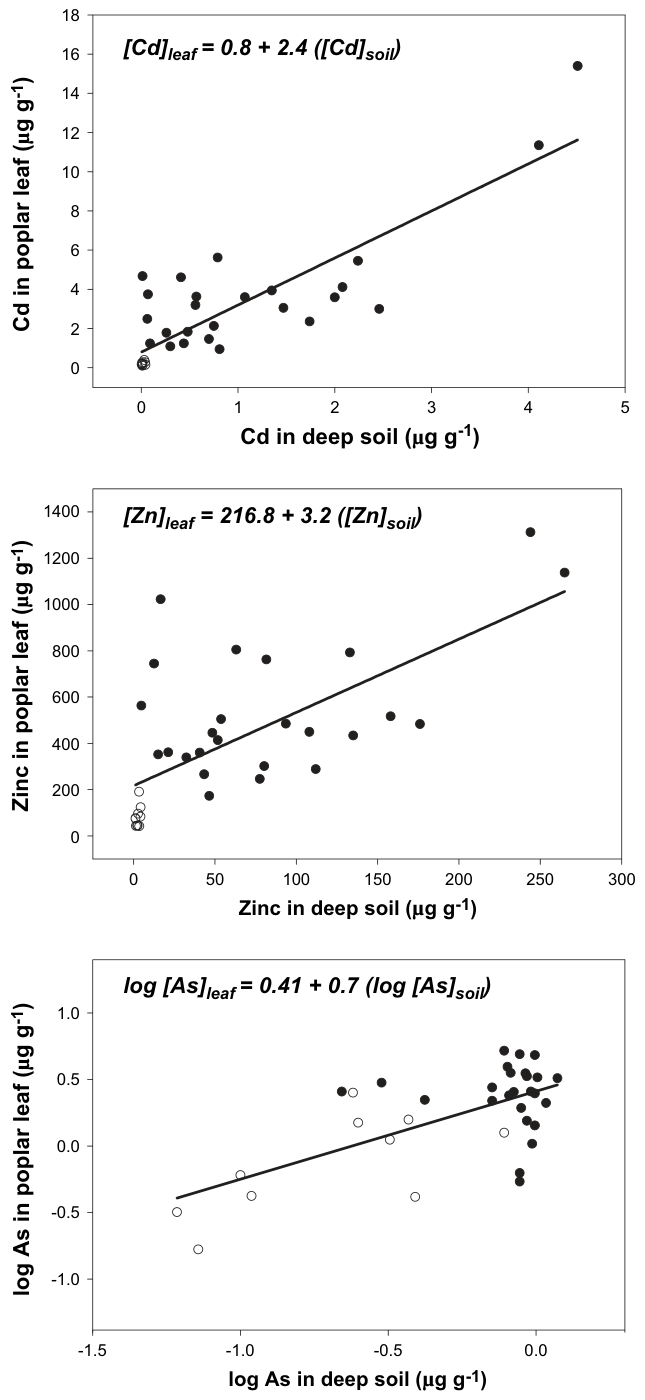
The best correlation was obtained for Cd, between its accumulation in leaves and its availability in deep soil (r ¼ 0:84, p ! 0:001, Fig. 3). The Cd accumulation in leaves was also significantly correlated with its availability in surface soil; and the accumulation in stems with the availability in both soil layers (Table 5).
相关性最好的是Cd在叶片中的富集与其在深层土壤中的有效性(r = 0.84,p < 0.001,图3)。叶片中Cd的富集与其在表层土壤中的有效性也显著相关;茎中的富集则与两个土层中的有效性均显著相关(表5)。
Zn concentrations in poplar leaves and stems were significantly correlated with Zn availability in surface and deep soil. The best correlation was between leaves and deep soil (r ¼ 0:68, p ! 0:001, Fig. 3).
杨树叶片和茎中的Zn浓度与表层和深层土壤中Zn的有效性显著相关。相关性最好的是叶片与深层土壤(r = 0.68,p < 0.001,图3)。
As concentration in poplar leaves was correlated to its availability in deep soil, but only marginally (p ¼ 0:052) with surface soil (Table 5). The concentration of As in stems was correlated to the availability in both surface and deep soil. When log values were plotted, the correlation leafesoil became significant (r ¼ 0:65, p ! 0:001 for deep soil, Fig. 3), and improved in the case of stemesoil (r ¼ 0:69, p ! 0:001 for deep soil). These results indicated that the relationship between plant and soil for As is of logelog type, rather than linear.
杨树叶片中As浓度与其在深层土壤中的有效性相关,但与表层土壤仅呈边缘相关(p = 0.052)(表5)。茎中As浓度与表层和深层土壤中的有效性均相关。以对数值作图时,叶片–土壤相关变为显著(深层土壤r = 0.65,p < 0.001,图3),茎–土壤相关也有所提高(深层土壤r = 0.69,p < 0.001)。这些结果表明,As的植物–土壤关系为对数–对数型,而非线性关系。
Mn, Cu and Fe correlation coefficients between plant and soil were significant (with low values) only in 5 out of 12 possible pairs (Table 5). Mn concentrations in poplar leaves and stems were correlated with Mn availability in surface soil, but not in deep soil. Cu concentration in leaves, but not in stems, was correlated with Cu availability in surface and deep soil. The only significant correlation for Fe was between its concentration in stems and the availability in surface soil.
Mn、Cu和Fe的植物–土壤相关系数仅在12对可能组合中的5对显著(且数值较低)(表5)。杨树叶片和茎中的Mn浓度与表层土壤中Mn的有效性相关,但与深层土壤不相关。叶片(而非茎)中的Cu浓度与表层和深层土壤中Cu的有效性相关。Fe唯一显著的相关是茎中浓度与表层土壤中有效性之间的相关。
Pb did not show any significant correlation between its concentration in poplar tissues (either leaves or stems)
Pb在杨树组织(叶片或茎)中的浓度
and their availability in the rooting soil. However, after logarithmic transformation, the leafesoil correlation became significant (r ¼ 0:36, p ¼ 0:031), as did the stemesoil correlation (r ¼ 0:44, p ¼ 0:008), for surface soil in both cases.
与其在根系土壤中的有效性之间未表现出任何显著相关。然而,经对数转换后,叶片–土壤相关变为显著(r = 0.36,p = 0.031),茎–土壤相关亦然(r = 0.44,p = 0.008),二者均针对表层土壤。
Nickel was the element with lowest correlation coefficients between plant and soil, even showing negative values (Table 5).
镍是植物–土壤相关系数最低的元素,甚至出现负值(表5)。
Leaves of trees have been widely used for biomonitoring of trace element pollution. In particular, leaves of poplar (several species) have been selected in a number of studies (Djingova et al., 1995, 1996, 1999, 2001; Sawidis et al., 1995; Stratis et al., 1996; Bargagli, 1998; Robinson et al., 2000). Bark of trees has been also used for passive biomonitoring (Bo¨ hn et al., 1998). However, as a rule, the axial transport of elements from roots (or other assimilation organs) to the bark is assumed to be negligible. In fact, leaves are the main sink for many pollutants, and therefore they are more sensitive to their effects than flowers, fruits or other plant organs (Bargagli, 1998).
树木叶片已被广泛用于微量元素污染的生物监测。特别是杨树(多个种)的叶片已在许多研究中被选用(Djingova et al., 1995, 1996, 1999, 2001; Sawidis et al., 1995; Stratis et al., 1996; Bargagli, 1998; Robinson et al., 2000)。树皮也曾被用于被动生物监测(Böhn et al., 1998)。然而,一般认为元素从根(或其他同化器官)向树皮的轴向运输可以忽略不计。事实上,叶片是许多污染物的主要汇,因此比花、果实或其他植物器官对污染物的影响更为敏感(Bargagli, 1998)。
In the Guadiamar riparian forests, the best soile plant correlation was obtained for Cd, especially when leaves and deep soil (25e40 cm) were considered (Fig. 3). Good correlation between poplar leaves and soil has also been obtained by Robinson et al. (2000). Cadmium is a good bioindicator for soil pollution because its accumulation in higher plants is principally from soil (except in conditions of high atmospheric Cd fallout, see Wagner, 1993). Cadmium is absorbed passively through the roots and freely translocated to the leaves and other organs (Das et al., 1997).
在Guadiamar河岸林中,Cd的土壤–植物相关性最好,尤其是考虑叶片与深层土壤(25–40 cm)时(图3)。Robinson et al.(2000)也获得了杨树叶片与土壤之间的良好相关性。镉是土壤污染的良好生物指示元素,因为其在高等植物中的积累主要来自土壤(大气Cd沉降较高的情况除外,参见Wagner, 1993)。镉经根系被动吸收,并可自由转运至叶片及其他器官(Das et al., 1997)。
A reasonably good soileplant correlation was also obtained for Zn (Fig. 3), using both leaves and stems, and for both soil depths. Soluble forms of Zn are readily available to plants; the uptake is linearly correlated with its concentration in the soil solution (Kabata-Pendias and Pendias, 2001). Zinc and Cd have similar geochemical and environmental properties, and they can interact during plant uptake, transport and accumulation in leaves (Das et al., 1997).
Zn也获得了较好的土壤–植物相关性(图3),叶片和茎以及两个土壤深度均如此。可溶态Zn易被植物吸收利用,其吸收量与土壤溶液中的浓度呈线性相关(Kabata-Pendias and Pendias, 2001)。锌和Cd具有相似的地球化学和环境性质,在植物吸收、运输以及在叶片中积累的过程中可能发生相互作用(Das et al., 1997)。
A significant and positive (logelog) correlation was obtained for As between the concentration in stems and leaves, and the availability in soil (Fig. 3). These logelog patterns, rather than linear, seem to indicate that small amounts of As in soil are readily accumulated in poplar leaves, but after a certain pollution level (saturation point) the accumulation in leaves does not vary (Fig. 3). Despite some authors arguing that As mobility in the spill-affected soils was rather low (Vidal et al., 1999), there were actual evidences of significant plantesoil relationships, in As content, for poplar trees (as mentioned above), and also for Bermuda grass (Cynodon dactylon) growing in remediated soils (Madejo´ n et al., 2002). Several reports have also documented positive linear relationships between As content in plants and its concentration in soil, for both total and available fractions (Bech et al., 1997; KabataePendias and Pendias, 2001). The pattern of As accumulation in leaves, and thus the potential for biomonitoring, will depend on several factors: the plant species’ particular capacities, the accumulation in roots versus shoots (Smith et al., 1998; Ma et al., 2001), and the soil properties.
茎和叶片中As浓度与其土壤有效性之间获得了显著正(对数–对数)相关(图3)。这种对数–对数而非线性的格局似乎表明,土壤中少量的As易在杨树叶片中积累,但超过一定污染水平(饱和点)后,叶片中的积累量不再变化(图3)。尽管有学者认为受泄漏影响土壤中As的移动性较低(Vidal et al., 1999),但实际证据表明,杨树(如上所述)以及生长在修复土壤上的狗牙根(Cynodon dactylon)(Madejón et al., 2002)的As含量均存在显著的植物–土壤关系。另有若干报道记录了植物As含量与其土壤浓度(包括总量和有效态组分)之间的正线性关系(Bech et al., 1997; Kabata-Pendias and Pendias, 2001)。叶片中As的积累格局及其生物监测潜力将取决于多种因素:植物种的特有能力、根与地上部的积累分配(Smith et al., 1998; Ma et al., 2001)以及土壤性质。
The correlation coefficient between plant and soil obtained for Cu was rather low (Table 5), compared to that for Cd and Zn, and despite the high Cu content in the sludge (up to 2000 mg kg�1, Cabrera et al., 1999). Bioavailability of Cu is highly plant-specific, and depends on soil properties that determine its chemical mobility. Copper absorption may be competitively inhibited by Zn, interacting at root level (Kabata-Pendias and Pendias, 2001) and that interaction will be expected here, given the relatively high Zn concentration in spill-polluted soils. In this study, Cu and Zn were highly correlated in their soil availability (r ¼ 0:87, p ! 0:001), but there was no significant correlation between their concentration in leaves (r ¼ 0:25, p ¼ 0:14). In contaminated soils, Cu can substantially accumulate in the plant roots without any significant increase in Cu content of aerial part. This means that the Cu content in the aboveground portion of the plants would underestimate the Cu bioavailability of soil.
与Cd和Zn相比,Cu的植物–土壤相关系数较低(表5),尽管污泥中Cu含量很高(高达2000 mg kg−1,Cabrera et al., 1999)。Cu的生物有效性具有高度的植物特异性,并取决于决定其化学移动性的土壤性质。铜的吸收可能在根系水平上受到Zn的竞争性抑制(Kabata-Pendias and Pendias, 2001),鉴于受泄漏污染土壤中Zn浓度相对较高,本研究中预计存在这种相互作用。在本研究中,Cu和Zn的土壤有效性高度相关(r = 0.87,p < 0.001),但二者在叶片中的浓度无显著相关(r = 0.25,p = 0.14)。在污染土壤中,Cu可在植物根部大量积累,而地上部分的Cu含量无显著增加。这意味着植物地上部分的Cu含量会低估土壤Cu的生物有效性。
The concentration of Fe in the sludge was very high (up to 43%, Lo´ pez-Pamo et al., 1999), and also was high in poplar organs (the second, after Zn; Table 4). The accumulation of Fe in stems of spill-affected trees was double than in control, and was significantly correlated with its availability in surface soil (Table 5). Iron availability depends to a large extent on soil pH and redox potential, and it is affected by several plant and environmental conditions, including concentration of macronutrients and ratios between heavy metals (Chaney et al., 1972; Bienfait, 1988; Bruggemann et al., 1990; Kabata-Pendias and Pendias, 2001). Thus, poplar stems (but not leaves) could be used as bioindicators for Fe accumulation in surface soil.
污泥中Fe的浓度非常高(高达43%,López-Pamo et al., 1999),在杨树器官中的含量也较高(仅次于Zn;表4)。受泄漏影响树木茎中Fe的积累量为对照的2倍,且与其在表层土壤中的有效性显著相关(表5)。铁的有效性在很大程度上取决于土壤pH和氧化还原电位,并受多种植物和环境条件的影响,包括大量营养元素浓度和重金属之间的比例(Chaney et al., 1972; Bienfait, 1988; Bruggemann et al., 1990; Kabata-Pendias and Pendias, 2001)。因此,杨树茎(而非叶片)可用作表层土壤Fe积累的生物指示物。
Many plants accumulate Pb in their roots, but translocation to shoots tends to be greatly limited (about 3% in most cases; Kabata-Pendias and Pendias, 2001). Spillaffected soils had a higher Pb concentration than control (!12 times for EDTA-extracted in surface soil; Table 3). However, there was no significant difference in Pb concentration in polluted poplar trees, compared to the upstream controls. On the other hand, trees from the external control (outside the Guadiamar Basin) had significantly lower concentration of Pb in leaves and stems. The pollution gradient in leaf tissues (as reflected in the PCA axis 1) included Pb as a major contributing element although was opposed to Zn and Cd in the secondary gradient (Fig. 2). There were significant logelog relationships, although with low coefficients, between Pb in plant and soil. Based on the weak relationship found in the Guadiamar riparian forest, poplar leaves cannot be recommended as a biomonitor of Pb accumulation in soil, and despite its proven utility in atmospheric pollution monitoring.
许多植物会在根部积累Pb,但其向地上部的转运往往极为有限(多数情况下约为3%;Kabata-Pendias and Pendias, 2001)。受尾矿泄漏影响的土壤Pb浓度高于对照土壤(表层土壤EDTA提取态约为对照的12倍;表3)。然而,与上游对照相比,受污染杨树的Pb浓度并无显著差异。另一方面,来自外部对照(Guadiamar流域以外)的树木,其叶片和茎中的Pb浓度显著较低。叶片组织中的污染梯度(由PCA第1轴反映)以Pb为主要贡献元素之一,但在次级梯度中Pb与Zn和Cd呈相反趋势(图2)。植物与土壤中的Pb之间存在显著的双对数关系,但相关系数较低。鉴于在Guadiamar河岸林中所发现的这种弱相关关系,尽管杨树叶片在大气污染监测中的作用已得到证实,仍不宜推荐将其作为土壤Pb积累的生物监测指标。
Trees have been widely used for low cost, environmental clean-up and remediation of polluted sites. In particular, they are very useful as ‘‘ecological engineers’’ for controlling hydrology, degrading organic contaminants in groundwater plumes, stabilising eroded sediments, removing heavy metals from contaminated soil, and as biological filters for sewage sludge disposal (Punshon, 2001; Robinson et al., 2003). White poplar (P. alba) is an abundant, native tree in the riparian forest of the Guadiamar River; it has also been planted in the ‘‘Green Corridor’’ afforestation program, after the mine spill. This ecological corridor will connect the lowland protected areas (Don˜ ana National Park) with the forested mountains (Sierra Norte Natural Park; CMA, 2001). Poplar trees will contribute to stabilise the soil and river sediments, and to immobilise the trace elements. Additionally, poplar leaves can be used to biomonitor the evolution of pollution levels of Cd and Zn, and to a lesser extent of As, in the spill-affected soils.
树木已被广泛用于低成本的环境清理和污染场地修复。特别是,它们作为“生态工程师”具有很高的应用价值,可用于调控水文、降解地下水污染羽中的有机污染物、稳定侵蚀沉积物、去除污染土壤中的重金属,以及作为污泥处置的生物过滤器(Punshon, 2001; Robinson et al., 2003)。银白杨(P. alba)是Guadiamar河岸林中一种数量丰富的本地树种;尾矿泄漏事故发生后,该树种也被种植于“绿色走廊”造林计划中。这一生态走廊将连接低地保护区(Doñana国家公园)与森林覆盖的山区(Sierra Norte自然公园;CMA, 2001)。杨树将有助于稳定土壤和河流沉积物,并固定微量元素。此外,杨树叶片可用于生物监测受泄漏影响土壤中Cd和Zn污染水平的变化,对As的监测作用则相对较弱。
Acknowledgements致谢
The PICOVER program from the Regional Ministry of Environment, Sevilla, Spain, supported this study. We thank Francisco Cabrera, Rafael Lo´ pez and Jose´ Marı´a Alegre for their help in different stages of the study, and to Luis V. Garcı´a for his comments on the manuscript. Trace element concentrations in plants were determined by Olga Cazalla in the Centre for Scientific Instrumentation, University of Granada.
本研究由西班牙塞维利亚地区环境部PICOVER项目资助。感谢Francisco Cabrera、Rafael López和José María Alegre在研究各阶段提供的帮助,并感谢Luis V. García对本文稿提出的意见。植物中微量元素浓度由格拉纳达大学科学仪器中心的Olga Cazalla测定。
References参考文献
Al-Shayeb, S.M., Al-Rajhi, M.A., Seaward, M.R.D., 1995. The date palm (Phoenix dactylifera L.) as a biomonitor of lead and other elements in arid environments. The Science of the Total Environment 168, 1e10.
Askoy, A., O¨ ztu¨ rk, M., 1996. Phoenix dactylifera as a biomonitor of heavy metal pollution in Turkey. Journal of Trace and Microprobe Techniques 14, 605e614.
Ayora, C., Barettino, D., Carrera, J., Manzano, M., Mediavilla, C. (Eds.), 2001. Las aguas y los suelos tras el accidente de Aznalco´ llar. Boletı´n Geolo´ gico y Minero 112 (special number), 1e294.
Baker, A.J.M., 1981. Accumulators and excludersdstrategies in the response to plants of heavy metals. Journal of Plant Nutrition 3, 643e646.
Baker, A.J.M., McGrath, S.P., Reeves, R.D., Smith, J.A.C., 2000. Metal hyperaccumulator plants: a review of the ecology and physiology of a biological resource for phytoremediation of metal polluted-soils. In: Terry, N., Ban˜ uelos, G. (Eds.), Phytoremediation of Contaminated Soil and Water. Lewis Publishers, London, pp. 85e107.
Bargagli, R., 1998. Trace Elements in Terrestrial Plants: An Ecophysiological Approach to Biomonitoring and Biorecovery. Springer-Verlag, Berlin.
Bech, J., Poschenrieder, C., Llugany, M., Barcelo´ , J., 1997. Arsenic and heavy metal contamination of soil and vegetation around a copper mine in Northern Peru. The Science of the Total Environment 203, 83e91.
Bienfait, H.F., 1988. Mechanisms in Fe-efficiency reactions of higher plants. Journal of Plant Nutrition 116, 605e629.
Bowen, H.J.M., 1979. Environmental Chemistry of the Elements. Academic Press, London.
Bo¨ hn, P., Wolterbeek, H., Verburg, T., Musı´lek, L., 1998. The use of tree bark for environmental pollution monitoring in the Czech Republic. Environmental Pollution 102, 243e250.
Bruggemann, W., Moog, P.R., Nakagawa, H., Janiesch, P., Kuiper, P.J.C., 1990. Plasma membrane-bound NADH: Fe3C-EDTA reductase and iron deficiency in tomato (Lycopersicon esculentum). Is there a turbo reductase? Physiologia Plantarum 79, 339e346.
Cabrera, F., Clemente, L., Dı´az Barrientos, E., Lo´ pez, R., Murillo, J.M., 1999. Heavy metal pollution of soils affected by the Guadiamar toxic flood. The Science of the Total Environment 242, 117e129.
Chaney, R.L., Brown, J.C., Tiffin, L.O., 1972. Obligatory reduction of ferric chelates in iron uptake by soybeans. Plant Physiology 50, 208e213.
Chaney, R.L., 1989. Toxic element accumulation in soils and crops: protecting soil fertility and agricultural food chains. In: Bar-Yosef, B., Barrow, N.J., Goldshmid, J. (Eds.), Inorganic Contaminants in the Vadose Zone. Springer-Verlag, Berlin, pp. 140e158.
C.M.A., 2001. Corredor Verde del Guadiamar. Abril 1998eAbril 2001. Consejerı´a de Medio Ambiente, Junta de Andalucı´a, Sevilla. Das, P., Samantaray, S., Rout, G.R., 1997. Studies on Cadmium toxicity in plants: a review. Environmental Pollution 98, 29e36.
Demidchik, V., Davenport, R.J., Tester, M., 2002. Nonselective cation channels in plants. Annual Reviews of Plant Biology 53, 67e107.
Djingova, R., Wagner, G., Peshev, D., 1995. Heavy metal distribution in Bulgaria using Populus nigra ‘‘Italica’’ as a biomonitor. The Science of the Total Environment 172, 151e158.
Djingova, R., Wagner, G., Kuleff, I., Peshev, D., 1996. Investigations on the time-dependant variations in metal concentration in the leaves of Populus nigra ‘‘Italica’’. The Science of the Total Environment 184, 197e202.
Djingova, R., Wagner, G., Kuleff, I., 1999. Screening of heavy metal pollution in Bulgaria using Populus nigra ‘‘Italica’’. The Science of the Total Environment 234, 175e184.
Djingova, R., Ivanova, J., Wagner, G., Korhammer, S., Markert, B., 2001. Distribution of lanthanoids, Be, Bi, Ga, Te, Tl, Th and U on the territory of Bulgaria using Populus nigra ‘‘Italica’’ as an indicator. The Science of the Total Environment 280, 85e91.
Dmuchoswski, W., Bytnerowicz, A., 1995. Monitoring environmental pollution in Poland by chemical analysis of Scots Pine (Pinus sylvestris L.) needles. Environmental Pollution 87, 84e104.
Ernst, W.H.O., 1998. The origin and ecology of contaminated, stabilized and non-pristine soils. In: Vangronsveld, J., Cunningham, S.D. (Eds.), Metal-Contaminated Soils: In Situ Inactivation and Phytorestoration. Springer-Verlag, Georgetown, pp. 17e29.
Greger, M., 1999. Metal availability and bioconcentration in plants. In: Prasad, M.N.V., Hagemeyer, J. (Eds.), Heavy Metal Stress in Plants. From Molecules to Ecosystems. Springer-Verlag, Berlin, pp. 1e27.
Grimalt, J.O., Ferrer, M., Macpherson, E., 1999. The mine tailing accident in Aznalcollar. The Science of the Total Environment 242, 3e11.
Griepink, B., Muntau, H., 1987. The certification of the contents (mass fractions) of As, B, Cd, Cu, Hg, Mn, Mo, Ni, Pb, Sb, Se and Zn in rye grass, CRM 281. Report no. EUR 11839 EN, Luxembourg.
Griepink, B., Muntau, H., 1988. The certification of the contents (mass fractions) of arsenic, cadmium, copper, lead, selenium and zinc in a sea lettuce (Ulva lactuca), CRM 279. Report no. EUR 11185 EN, Luxembourg.
Jones, J.B., Case, V.W., 1990. Sampling, handling, and analyzing plant tissue samples. In: Westerman, R.L. (Ed.), Soil Testing and Plant Analysis. Madison, USA, pp. 389e427.
Kabata-Pendias, A., Pendias, H., 2001. Trace Elements in Soils and Plants, third ed. CRC Press, Boca Raton, Florida, USA.
Kloke, A., Sauerbeck, D.R., Vetter, H., 1984. The contamination of plants and soils with heavy metals and the transport of metals in terrestrial food chains. In: Nriagu, J.O. (Ed.), Changing Metal Cycles and Human Health. Springer-Verlag, Berlin, pp. 113e141.
Lau, O.W., Luk, S.F., 2001. Leaves of Bauhinia blakeana as indicators of atmospheric pollution in Hong Kong. Atmospheric Environment 35, 3113e3120.
Lo´ pez-Pamo, E., Barettino, D., Anto´ n-Pacheco, C., Ortiz, G., Arra´ nz, J.C., Gumiel, J.C., Martı´nez-Pledel, M., Aparicio, O., Montouto, O., 1999. The extent of the Aznalco´ llar pyritic sludge spill and its effects on soils. The Science of the Total Environment 242, 57e88.
Ma, L.Q., Komar, K.M., Tu, C., Zhang, W., Cai, Y., Kennelley, E.D., 2001. A fern that hyperaccumulates arsenic. Nature 409, 579.
Madejo´ n, P., 2004. Elementos traza y nutrientes en plantas y suelos afectados por el vertido minero de Aznalco´ llar, PhD dissertation, University of Seville, Seville, Spain.
Madejo´ n, P., Murillo, J.M., Maran˜ o´ n, T., Cabrera, F., Lo´ pez, R., 2002. Bioaccumulation of As, Cd, Cu, Fe and Pb in wild grasses affected by the Aznalco´ llar mine spill (SW Spain). The Science of the Total Environment 290, 105e120.
Markert, B., 1987. Interelement correlations in plants. Fresenius Journal of Analytical Chemistry 329, 462e465.
Markert, B.A., Breure, A.M., Zechmeister, H.G., 2003. Definitions, strategies and principles for bioindication/biomonitoring of the environment. In: Markert, B.A., Breure, A.M., Zechmeister, H.G. (Eds.), Bioindicators and Biomonitors. Elsevier Science, Amsterdam, pp. 3e39.
McCune, B., Mefford, M.J., 1999. PC-ORD. Multivariate analysis of ecological data, version 4. MjM Software Design, Gleneden Beach, Oregon.
Moraes, R.M., Delitti, W.B.C., Moraes, J.A.P.V., 2003. Gas exchange, growth, and chemical parameters in a native Atlantic forest tree species in polluted areas of Cubatao, Brazil. Ecological and Environmental Safety 54, 339e345.
Moreno, F., Cabrera, F., Ferna´ ndez, J.E., Giro´ n, I.F., 2001. Propiedades hidra´ ulicas y concentracio´ n de metales pesados en los suelos y en las aguas de drenaje de dos zonas afectadas por el vertido. Boletı´n Geolo´ gico y Minero 112, 178e184.
Prasad, M.N.V., Hagemeyer, J. (Eds.), 1999. Heavy Metals Stress in Plants. From Molecules to Ecosystems. Springer-Verlag, Berlin.
Punshon, T., 2001. Tree crops. In: Prassad, M.N.V. (Ed.), Metals in the Environment. Analysis by Biodiversity. Marcel Dekker, Inc., New York, pp. 321e351.
Rengel, Z., 1997. Mechanisms of plant resistance to toxicity of aluminium and heavy metals. In: Basra, A.S., Basra, R.K. (Eds.), Mechanisms of Environmental Stress Resistance in Plants. Harwood Academic Publishers, Amsterdam, pp. 241e276.
Robinson, B., Mills, T.M., Petit, D., Fung, L.E., Green, F.S., Clothier, B.E., 2000. Natural and induced cadmium-accumulation in poplar and willow: implications for phytoremediation. Plant and Soil 227, 301e306.
Robinson, B., Ferna´ ndez, J.E., Madejo´ n, P., Maran˜ o´ n, T., Murillo, J.M., Green, S., Clothier, B., 2003. Phytoextraction: an assessment
of biogeochemical and economic viability. Plant and Soil 249, 117e125.
Ruiz de la Torre, J., 2001. Arboles y Arbustos de la Espan˜ a Peninsular. Fundacio´ n Conde del Valle de Salazar and Mundi-Prensa, Madrid.
Sawidis, T., Marnasidis, A., Zachariadis, G., Stratis, J., 1995. A study of air pollution with heavy metals in Thessaloniki City (Greece) using trees as biological indicators. Archives of Environmental Contamination and Toxicology 28, 118e124.
Sawidis, T., Chettri, M.K., Papaioannou, A., Zachariadis, G., Stratis, J., 2001. A study of metal distribution from lignite fuels using trees as biological monitors. Ecotoxicology and Environmental Safety 48, 27e35.
Siedlecka, A., Tukendorf, A., Sko´ rzyn´ ska-Polit, Maksymiec, W., Wo´ jcik, M., Baszyn´ ski, T., Krupa, Z., 2001. Angiosperms (Asteraceae, Convolvulaceae, Fabaceae and Poaceae; other than Brassicaceae). In: Prasad, M.N.V. (Ed.), Metals in the Environment. Analysis by Biodiversity. Marcel Dekker, Inc., New York, pp. 171e217.
Simo´ n, M., Ortiz, I., Garcı´a, I., Ferna´ ndez, E., Ferna´ ndez, J., Dorronsoro, C., Aguilar, J., 1999. Pollution of soils by the toxic spill of a pyrite mine (Aznalco´ llar, Spain). The Science of the Total Environment 242, 105e115.
Simo´ n, M., Martı´n, F., Ortiz, I., Garcı´a, I., Ferna´ ndez, J., Ferna´ ndez, E., Dorronsoro, C., Aguilar, J., 2001. Soil pollution by oxidation of tailings from toxic spill of a pyrite mine. The Science of the Total Environment 279, 63e74.
Smith, E., Naidu, R., Alston, A.M., 1998. Arsenic in the soil environment: a review. Advances in Agronomy 64, 149e195.
StatSoft, 1997. STATISTICA for Windows. StatSoft, Tulsa, Oklahoma. Stratis, J.A., Zachariadis, G., Simeonov, V., Mandjukovl, P., Sawidis, T., 1996. Chemometrical classification of biomonitoring analytical data for heavy metals. Part I. Trees (leaves) as bioindicators. Toxicological and Environmental Chemistry 54, 29e37.
Tutin, T.G., Heywood, V.H., Burges, N.A., Valentine, D.H., Walters, S.M., Webb, D.A., 1964. Flora Europaea, vol. 1. Cambridge University Press, Cambridge.
Ure, A.M., Quevauviller, P.H., Muntau, H., Griepink, B., 1993. Speciation of heavy metals in soils and sediments. An account of the improvement and harmonisation of extraction techniques undertaken under the auspices of the BCR of the Commission of the European Communities. International Journal of Environmental Analytical Chemistry 51, 135e151.
Vidal, M., Lo´ pez-Sa´ nchez, J.F., Sastre, J., Jime´ nez, G., Dagnac, T., Rubio, R., Rauret, G., 1999. Prediction of the impact of the Aznalco´ llar toxic spill on the trace element contamination of agricultural soils. The Science of the Total Environment 242, 131e148.
Wagner, G.J., 1993. Accumulation of cadmium in crop plants and its consequences to human health. Advances in Agronomy 51, 173e212.