Brett Robinson, Nanthi Bolan, Santiago Mahimairaja, and Brent Clothier
CONTENTS
| 6.1 | Introduction.............................................................................................................................93引言.............................................................................................................................93 |
|---|---|
| 6.2 | Trace Element Solubility in the Rhizosphere........................................................................94 |
| 6.3 | Trace Element Speciation in the Rhizosphere.......................................................................97 |
| 6.4 | Trace Element Mobility..........................................................................................................98 |
| 6.5 | Bioaccumulation of Trace Elements ......................................................................................98 |
| 6.6 | Bioaccumulation as Affected byphi......................................................................................99 |
| 6.7 | Engineering Trace Element Solubility, Mobility, and Bioaccumulation for |
| Improved Fertility or Environmental Protection..................................................................100 | |
| 6.8 | Trace Element Solubilization...............................................................................................100 |
| 6.9 | Induced Bioaccumulation.....................................................................................................100 |
| 6.10 | In Situ Immobilization .........................................................................................................101 |
| 6.11 | Conclusions...........................................................................................................................104 |
| Refe | rences ......................................................................................................................................104 |
6.1 INTRODUCTION
Trace elements are elements that are present in small concentrations (<1000 mg/kg) in living organisms. This definition includes all the elements except H, C, N, O, Na, Mg, P, S, Cl, K, and Ca. Despite their presence as only traces, they nonetheless affect biological processes positively as well as deleteriously.
微量元素是指在生物体内以低浓度(<1000 mg/kg)存在的元素。按此定义,除H、C、N、O、Na、Mg、P、S、Cl、K和Ca之外的所有元素均属微量元素。尽管它们仅以痕量存在,但仍会对生物过程产生有益或有害的影响。
Trace elements in soils originate from natural and anthropogenic sources. Consequently, their concentrations can vary considerably. The trace element loading in soil is a function of the parent material plus subsequent atmospheric or water-borne deposition. Elevated levels of trace elements in soil can adversely affect the soil’s fertility and may represent an ecological and human health risk if they enter the food chain or leach into receiving waters. However, the impact of trace metals on soil and the surrounding environment often cannot be predicted simply by measuring the total concentration. This is because only the soluble and mobile fraction has the potential to leach or to be taken up by plants and enter the food chain.
土壤中的微量元素来源于自然源和人为源,因此其浓度差异可能很大。土壤中微量元素的负荷取决于成土母质以及随后经大气或水体输入的沉降。土壤中微量元素含量升高会对土壤肥力产生不利影响,若其进入食物链或淋溶进入受纳水体,还可能构成生态风险和人体健康风险。然而,仅通过测定总浓度往往无法预测微量金属对土壤及周边环境的影响。这是因为只有可溶性和可移动的组分才有可能发生淋溶或被植物吸收并进入食物链。
The mobility, solubility, and bioaccumulation of trace elements depend on a plethora of soil, microbial, and plant factors, as well as the properties of the trace element. Chemical solubility is a prerequisite for physical mobility and bioavailability. Bioaccumulation can result from trace element transport in the rhizosphere and absorption onto soil organisms or passage through plants’ plasmalemma at the root: soil interface. These processes can be augmented or retarded through soil amendments or modification of the soil’s vegetation. The goal of such engineering approaches may be to diminish trace element mobility so that it poses minimum risk to the surrounding environment, or to promote solubility so that trace elements are taken up by plants or leached out of the rhizosphere.
微量元素的迁移性、溶解性和生物累积取决于众多土壤、微生物和植物因素,以及微量元素自身的性质。化学溶解是物理迁移和生物有效性的前提。生物累积可源于微量元素在根际中的迁移及其在土壤生物上的吸附,或在根–土界面穿过植物质膜。这些过程可通过施用土壤改良剂或改变土壤植被而得到促进或抑制。此类工程措施的目标可以是降低微量元素的迁移性,使其对周边环境的风险降至最低;也可以是提高其溶解性,使微量元素被植物吸收或从根际中淋溶出去。
Enhancing trace element solubility may be a tool for the remediation of contaminated soils through the use of plants to remove the trace element, phytoremediation, or by leaching contaminants out of the root zone. Alternatively, plant and animal productivity may be improved by increasing the trace element solubility in a soil that is deficient in one or more essential elements.
提高微量元素的溶解性可作为修复污染土壤的一种手段,即利用植物去除微量元素(植物修复),或将污染物从根区淋溶出去。此外,在一种或多种必需元素缺乏的土壤中,提高微量元素的溶解性可提高植物和动物的生产力。
This chapter discusses the physicochemical processes that affect the fate of trace elements in the rhizosphere with a view to the remediation of contaminated soils.
本章着眼于污染土壤的修复,讨论影响微量元素在根际中归趋的物理化学过程。
6.2 TRACE ELEMENT SOLUBILITY IN THE RHIZOSPHERE6.2 根际中微量元素的溶解性
The key abiotic mechanisms that control solubility will now be discussed and how these processes can be represented analytically will be outlined. For any trace element, only some fraction of the total concentration will be in soil solution, with the remainder bound to the soil matrix. Mass balance of this distribution gives
下文将讨论控制溶解性的关键非生物机制,并概述如何以解析方式表达这些过程。对于任何微量元素,其总浓度中仅有一部分存在于土壤溶液中,其余部分则结合于土壤基质上。该分配的质量平衡为

where式中
M is the total concentration (mg/kg) θ is the volumetric water content (m3/m3) C is the trace element concentration in the soil solution (mg/L) ρ is the bulk density of the soil (t/m3) S is the concentration bound to the soil matrix (mg/kg)
M为总浓度(mg/kg) θ为体积含水量(m3/m3) C为土壤溶液中微量元素浓度(mg/L) ρ为土壤容重(t/m3) S为结合于土壤基质上的浓度(mg/kg)
The solubility of a trace element in the rhizosphere is often described in a simple way by a distribution coefficient (Kd) where
根际中微量元素的溶解性通常简单地用分配系数(Kd)来描述,其中

In some cases, however, as the total concentration of trace elements in a soil increases, unlike the representation of Equation 6.2, the soil’s ability to adsorb these further loadings decreases, due to a saturation of the chemical-binding sites in the soil. The observations of sorption of most trace elements can be described using a Langmuir (Equation 6.3) or a Freundlich (Equation 6.4) isotherm, which accounts for this nonlinearity in sorption.
然而,在某些情况下,与式6.2的表达不同,随着土壤中微量元素总浓度的增加,由于土壤中化学结合位点趋于饱和,土壤对进一步负荷的吸附能力下降。大多数微量元素的吸附观测结果可用Langmuir(式6.3)或Freundlich(式6.4)等温线来描述,二者均考虑了吸附的这种非线性特征。

where
K is the adsorption constant Q is number of sorption sites (mol/m3)
K为吸附常数 Q为吸附位点数(mol/m3)
Ar is the atomic mass of the trace element (g/mol)Ar为微量元素的原子质量(g/mol)
n is the Freundlich exponent
n为Freundlich指数
If n = 1, then Equation 6.4 collapses to the linear model of Equation 6.1.
若n = 1,则式6.4退化为式6.1的线性模型。
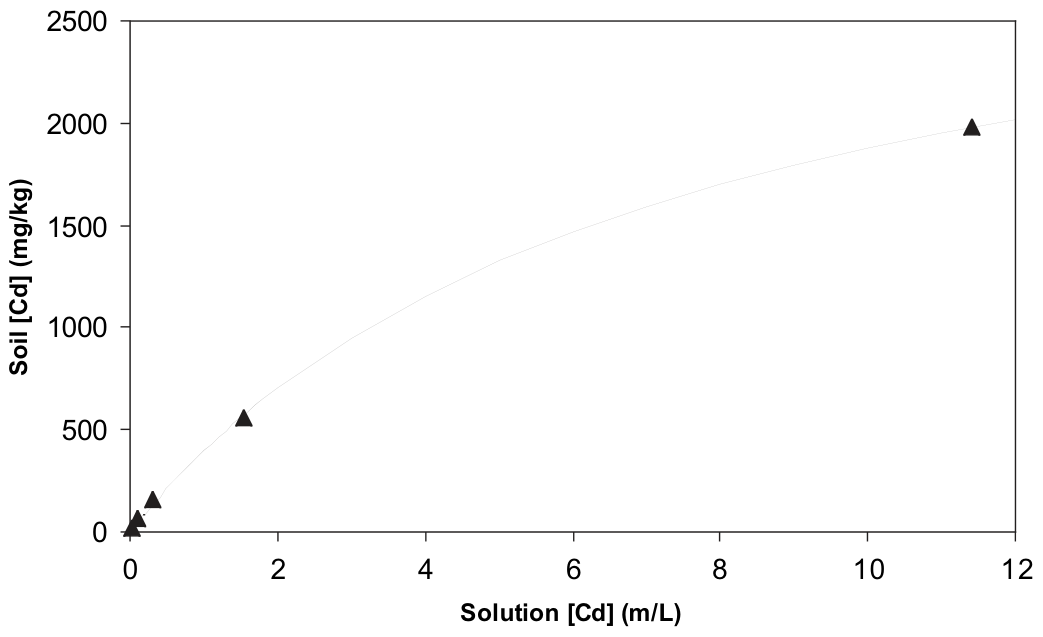
In the Langmuir case, when Q is finite, as in the case of soils and sediments, the value of S approaches QAr as the concentration of trace element in soil solution increases. Figure 6.1 shows the adsorption of Cd by a silt loam at a range of Cd concentrations in soil solution. In this case, the isotherm is described by the Langmuir equation (Equation 6.3) with values of Q and K equal to 28.7 and 0.14, respectively.
在Langmuir情形下,当Q为有限值时(如土壤和沉积物),随着土壤溶液中微量元素浓度的升高,S值趋近于QAr。图6.1给出了一种粉砂壤土在一系列土壤溶液Cd浓度下对Cd的吸附。此时,等温线可用Langmuir方程(式6.3)描述,Q和K值分别为28.7和0.14。
The solubility of trace elements in the rhizosphere is a function of the soil’s chemical and physical properties. Most trace element ions carry a positive charge and can therefore be retained by the negative binding sites of the soil’s matrix. The soil’s cation exchange capacity (CEC), which indicates the number of negative charges per unit mass, provides an indication as to the soil’s potential to retain positively charged ions. The negatively charged binding sites for trace elements occur on organic matter, clays, and the oxides of Fe, Mn, and Al, which make up the soil’s matrix.
根际中微量元素的溶解性取决于土壤的化学和物理性质。大多数微量元素离子带正电荷,因而可被土壤基质的负电荷结合位点所保持。土壤的阳离子交换量(CEC)表示单位质量所带的负电荷数,可指示土壤保持带正电离子的潜力。微量元素的负电荷结合位点存在于构成土壤基质的有机质、黏土矿物以及Fe、Mn和Al的氧化物上。
Trace elements that carry a negative charge, such as F–, Br–, and the oxyanions AsO2– and CrO42–, can bind electrostatically to positively charged sites in the soil matrix, as occurs in variably charged soils. This is measured by the soil’s anion exchange capacity (AEC). In many temperate soils, the AEC is so small as to be insignificant. Therefore, many negatively charged ions, such as Br–, can move freely with soil moisture unaffected by exchange. They can be used as chemical “tracers” of water movement through soil.
带负电荷的微量元素,如F–、Br–以及含氧阴离子AsO2–和CrO42–,可通过静电作用结合于土壤基质中带正电荷的位点上,这种情况见于可变电荷土壤。这一能力以土壤的阴离子交换量(AEC)来衡量。在许多温带土壤中,AEC很小,可忽略不计。因此,许多带负电荷的离子(如Br–)可随土壤水分自由移动而不受交换作用影响,可用作指示水分在土壤中运移的化学“示踪剂”。
However, some highly weathered soils, and those that contain significant quantities of such volcanic minerals as allophane and imogolite can have a significant AEC. The AEC depends on pH. Some trace element anions, such as arsenate and selenate, also form specific chemical bonds with soil components. This results in their adsorption exceeding the AEC of the soil. The strength of the bond between the binding site of the soil and the trace element is a function of the size and charge on the trace element ion or complex. Smaller ions, with a higher charge, form the strongest bonds.
然而,一些高度风化的土壤以及含有大量水铝英石和伊毛缟石等火山矿物的土壤可具有显著的AEC。AEC取决于pH。某些微量元素阴离子(如砷酸根和硒酸根)还会与土壤组分形成专性化学键,从而使其吸附量超过土壤的AEC。土壤结合位点与微量元素之间键的强度取决于微量元素离子或络合物的大小和电荷。离子半径越小、电荷越高,形成的键越强。
Although a small percentage of a soil’s clay fraction carries a permanent negative charge, the charge carried by organic matter and, as mentioned some variable-charge clay minerals is pH dependent. Therefore, pH also profoundly affects the binding of trace elements in the rhizosphere. For positively charged ions such as Cd2+, soil acidification invariably results in increased trace element solubility due to increased competition from H+ ions at the negatively charged binding sites [1] (Figure 6.2). Conversely, soil adsorption of some trace elements such as Zn2+ can lower soil pH by releasing H+ ions from bound surfaces [2]. Negatively charged trace elements, or trace element complexes, tend to be more soluble at a higher pH. The adsorption of trace elements onto variable charge minerals such as Fe, Al, and Mn oxides is also pH dependent. As these materials assume more negative charge under alkaline conditions, their capacity to absorb trace elements, which is generally positively charged, increases [3].
尽管土壤黏粒组分中有一小部分带有永久负电荷,但有机质以及前述某些可变电荷黏土矿物所带的电荷依赖于pH。因此,pH也深刻影响根际中微量元素的结合。对于Cd2+等带正电荷的离子,由于H+离子在负电荷结合位点上的竞争加剧,土壤酸化必然导致微量元素溶解性增加[1](图6.2)。反之,土壤对某些微量元素(如Zn2+)的吸附会从结合表面释放H+离子,从而降低土壤pH[2]。带负电荷的微量元素或微量元素络合物在较高pH下往往溶解性更强。微量元素在Fe、Al和Mn氧化物等可变电荷矿物上的吸附同样依赖于pH。由于这些物质在碱性条件下带有更多负电荷,其对通常带正电荷的微量元素的吸附能力随之增强[3]。
Trace elements may be displaced from exchange sites by other ions attracted from the soil solution. The extent of this competition for binding sites depends on the type and concentration of the trace element as well as that of the competing ion. As a general rule, trace elements such as Cd2+, which has an atomic radius (r) of 0.97Å, can be displaced by other ions of a similar size and charge in soil solution, such as Ca2+ (r = 0.99Å). Therefore, soil amendments such as phosphates that are designed to immobilize heavy metals may actually promote the solubility of some cocontaminants such as As.
微量元素可被土壤溶液中被吸引而来的其他离子从交换位点上置换下来。这种结合位点竞争的程度取决于微量元素以及竞争离子的种类和浓度。一般而言,原子半径(r)为0.97Å的Cd2+等微量元素可被土壤溶液中大小和电荷相近的其他离子(如Ca2+,r = 0.99Å)所置换。因此,旨在固定重金属的磷酸盐等土壤改良剂实际上可能会提高As等某些共存污染物的溶解性。
Trace element adsorption onto charged exchange sites is not the only mechanism governing trace element solubility in the rhizosphere. The extent, soluble–insoluble partitioning, and mobility of soil organic matter play an important role in the solubility and environmental fate of trace elements. Metal complexation by organic matter can promote or reduce metal solubility, depending on the solubility of the organic ligand.
微量元素在带电交换位点上的吸附并非控制根际中微量元素溶解性的唯一机制。土壤有机质的数量、可溶–不可溶分配及其迁移性对微量元素的溶解性和环境归趋起着重要作用。有机质对金属的络合作用可促进或降低金属的溶解性,这取决于有机配体的溶解性。
Although the exact composition of dissolved organic matter is variable and complex, a large portion of this mobile material is composed of fulvic and humic acids. Minor components can also include macromolecular hydrophilic acids, carbohydrates, and carboxylic and amino acids [4]. Dissolved organic matter has been demonstrated to promote heavy-metal solubility [5] and mobility, as will be discussed. In particular, Cu2+, Hg2+, and Pb2+ are strongly bound by humic acid [6], so their solubility and transport is thus promoted by increasing concentrations of dissolved organic matter. Wu et al. [7] demonstrated that, in a kaolinite soil, the Cu–humate complexes are mobile in acid and alkaline conditions, but not in neutral conditions, where they are sorbed. Almås et al. [8] found that the application of organic matter to soil enhanced the solubility of Zn and Cd due to the formation of complexes with dissolved organic acids.
尽管溶解性有机质的确切组成多变而复杂,但这类可移动物质的很大一部分由富里酸和胡敏酸组成。次要组分还可包括大分子亲水性酸、碳水化合物以及羧酸和氨基酸[4]。已有研究证明,溶解性有机质可促进重金属的溶解[5]和迁移,下文将对此进行讨论。特别是Cu2+、Hg2+和Pb2+与胡敏酸结合牢固[6],因此溶解性有机质浓度的升高会促进其溶解和迁移。Wu et al. [7]证明,在高岭石土壤中,Cu–腐殖酸络合物在酸性和碱性条件下可移动,而在中性条件下则被吸附而不可移动。Almås et al. [8]发现,向土壤中施用有机质会因与溶解性有机酸形成络合物而提高Zn和Cd的溶解性。
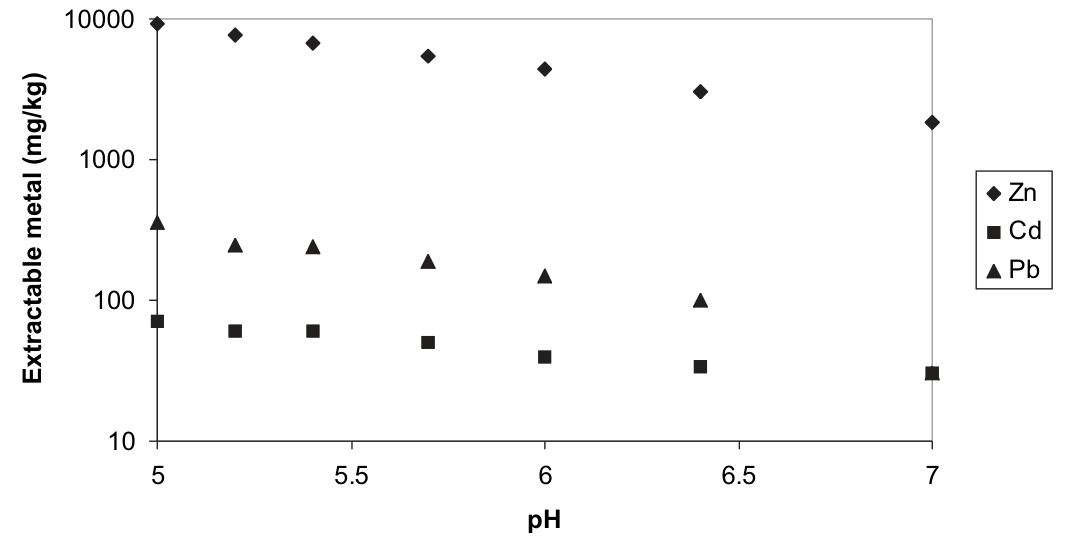
FIGURE 6.2 Metal extracted using 1 M ammonium acetate buffered at various pHs. Note the log scale on the y-axis. The total concentrations of Zn, Cd, and Pb in the soil were 40,416, 360, and 6209 mg/kg, respectively.图6.2 用不同pH缓冲的1 M乙酸铵提取的金属。注意y轴为对数刻度。土壤中Zn、Cd和Pb的总浓度分别为40,416、360和6209 mg/kg。
A continual source of soluble organic matter in the rhizosphere is provided by plant exudates. These include metabolic products of fungi and microorganisms, the degradation of leaf litter and insoluble organic matter. The addition of organic fertilizers, effluents, and sludges can also provide sources. Fisher [4] demonstrated that amino acids derived from these solubilized heavy metals that have been bound to typical soil components.
根际中可溶性有机质的持续来源是植物分泌物,此外还包括真菌和微生物的代谢产物、枯落物的降解以及不溶性有机质。施用有机肥、废水和污泥也可提供来源。Fisher [4]证明,源自这些来源的氨基酸可使结合于典型土壤组分上的重金属溶解。
The solubility of trace elements in the rhizosphere can also change over time. The soil’s organic matter content is naturally dynamic. Furthermore, it may be augmented through the establishment of vegetation or the addition of composts or sewage sludge. Conversely, continual oxidation of organic matter occurs, particularly in tropical soils. Compost or sewage sludge amendment can offset this decline. The solubility trace elements that are strongly adsorbed by humic and fulvic acids will be affected by a change in the soil’s organic matter content.
根际中微量元素的溶解性也会随时间变化。土壤有机质含量本身是动态变化的。此外,通过建立植被或施用堆肥或污泥可提高有机质含量。反之,有机质也在持续氧化,热带土壤中尤为明显。施用堆肥或污泥可抵消这种下降。被胡敏酸和富里酸强烈吸附的微量元素,其溶解性会受到土壤有机质含量变化的影响。
Over time, the solubilized trace elements can migrate and diffuse into the less accessible and immobile soil–water regions. There, they may become bound to the soil’s solid phase. Consequently, the time needed for a contaminant to be redissolved or again be transferred from the stagnant- to the mobile-water phase may increase with aging of the compound in soil [9].
随着时间推移,已溶解的微量元素可迁移并扩散至较难到达的不可移动土壤水区域,并在那里与土壤固相结合。因此,污染物重新溶解或再次由停滞水相转移至可移动水相所需的时间,可能随该化合物在土壤中的老化而增加[9]。
6.3 TRACE ELEMENT SPECIATION IN THE RHIZOSPHERE6.3 根际中微量元素的形态
The chemical speciation of trace elements in the rhizosphere profoundly affects their solubility, mobility, and toxicity. In soils, Cr that is present in the +6 oxidation stare [Cr(VI)] is more mobile, more readily bioaccumulated, and 100 to 1000 times more toxic when present in the +3 oxidation stare [Cr(III)] [6].
根际中微量元素的化学形态深刻影响其溶解性、迁移性和毒性。在土壤中,以+6价氧化态存在的Cr[Cr(VI)]比以+3价氧化态存在的Cr[Cr(III)]迁移性更强、更易被生物累积,且毒性高100至1000倍[6]。
In the rhizosphere, the various phases of trace elements are in dynamic equilibrium. Therefore, as trace elements are removed from soil solution by leaching or plant uptake, more will be desorbed from soil particles into solution. The rate at which this occurs depends on the distribution (see earlier equations) as well as the speciation of the trace element in the soil matrix.
在根际中,微量元素的各相态处于动态平衡之中。因此,当微量元素因淋溶或植物吸收而从土壤溶液中移除时,会有更多的微量元素从土壤颗粒解吸进入溶液。这一过程的速率取决于微量元素在土壤基质中的分配(见前述方程)及其形态。
Trace elements in soil solution and those weakly bound to exchange sites on the surface of the soil matrix are the most mobile and biologically active. Carbonate or sulphide precipitates, which may be occluded in Fe, Mn, or Al oxides, are immobile and biologically inactive. However, they may readily become mobilized by a shift in equilibrium caused by a change in soil pH and/or the redox conditions. The trace elements of the crystalline lattices of clays are generally inert. Other trace elements may be bound by more than one soil component. Alcacio et al. [10] demonstrated three possible binding configurations of Cu2+ on complexes of oxide minerals and organic matter. These are the Cu2+ bound to mineral surfaces and the Cu2+ bound to the organic matter that is absorbed onto oxides, along with Cu2+ bridges between oxides and organic matter.
土壤溶液中的微量元素以及弱结合于土壤基质表面交换位点上的微量元素迁移性最强、生物活性最高。可能被包蔽于Fe、Mn或Al氧化物中的碳酸盐或硫化物沉淀不可移动且无生物活性。然而,土壤pH和/或氧化还原条件的变化引起平衡移动时,它们可能很容易被活化。黏土矿物晶格中的微量元素一般是惰性的。其他微量元素可能同时与一种以上的土壤组分结合。Alcacio et al. [10]证明了Cu2+在氧化物矿物–有机质复合体上的三种可能结合构型:Cu2+结合于矿物表面、Cu2+结合于吸附在氧化物上的有机质,以及Cu2+在氧化物与有机质之间形成桥连。
The speciation of trace elements in the rhizosphere may be measured directly using analytical techniques, or it can be calculated using other parameters. The analytical procedures used to determine the speciation of trace elements in soils are usually specific for the solid phase or the solution phase. For example, sequential extraction procedures can be used to determine the distribution of trace elements in various soil fractions: soluble; exchangeable; sulfide/carbonate bound; organically bound; oxide bound; and residual or lattice mineral bound. Given the limitations and costs of analytical procedures, rather than measuring speciation and distribution of trace elements in soils, it is often calculated using speciation models such as GEOCHEM [11] and MINTEQ2 [12]. These are based on theoretical thermodynamics. Despite the fundamental principles that drive these models, their simplicity makes it problematic to model accurately trace element speciation and distribution in soils that contain a plethora of organic and inorganic matrices.
根际中微量元素的形态可利用分析技术直接测定,也可利用其他参数计算得到。用于测定土壤中微量元素形态的分析方法通常专门针对固相或液相。例如,连续提取法可用于测定微量元素在各土壤组分中的分布:水溶态、可交换态、硫化物/碳酸盐结合态、有机结合态、氧化物结合态以及残渣态或晶格矿物结合态。鉴于分析方法的局限性和成本,通常不直接测定土壤中微量元素的形态和分布,而是利用GEOCHEM [11]和MINTEQ2 [12]等形态模型进行计算。这些模型以理论热力学为基础。尽管这些模型以基本原理为驱动,但其简化性使得难以准确模拟含有大量有机和无机基质的土壤中微量元素的形态和分布。
6.4 TRACE ELEMENT MOBILITY6.4 微量元素的迁移性
Water is the vehicle for transport of solutes, including trace elements, through soil. Although solubility is a prerequisite of mobility, various rate-limited or kinetic geochemical and hydrological processes in the rhizosphere affect the transport of trace elements. The transport of dissolved trace elements in soils depends primarily on their concentration gradient spatially, and the mass flow of water. The latter is a function of the soil’s matric water potential, its porosity, and long-distance preferential processes of transport through macropores. Nonequilibrium chemical or physical reactions may also occur. Physical nonequilibrium can result from nonuniform water flows and preferential transport.
水是包括微量元素在内的溶质在土壤中运移的载体。尽管溶解是迁移的前提,但根际中各种受速率限制的或动力学的地球化学和水文过程都会影响微量元素的运移。溶解态微量元素在土壤中的运移主要取决于其空间浓度梯度和水的质量流。后者是土壤基质势、孔隙度以及经大孔隙的长距离优先运移过程的函数。此外还可能发生非平衡的化学或物理反应。物理非平衡可由非均匀水流和优先运移引起。
The long-distance transport of trace elements in soils can be described using the convection dispersion equation (CDE), which describes the movement of solutes during transient flow [13]: In one-dimensional form, this is
微量元素在土壤中的长距离运移可用对流–弥散方程(CDE)来描述,该方程描述瞬态流过程中溶质的运动[13]。其一维形式为

- where
- M is the total trace element concentration (mg/kg)M为微量元素总浓度(mg/kg)
- t is time (s)
- z is depth (m)
- θ is the volumetric water content (m3/m3)θ为体积含水量(m3/m3)
- C is the local trace element concentration in the soil solution (mg/L)C为土壤溶液中微量元素的局部浓度(mg/L)
- Ds is the solution diffusion coefficient (m2/s)Ds为溶液扩散系数(m2/s)
- qw is the soil water flux (m/s)qw为土壤水通量(m/s)
- Sm(z) is the solute uptake, or release, by plant roots as a function of depthSm(z)为植物根系对溶质的吸收或释放,是深度的函数
Here, M is the total concentration, which is partitioned according to Equation 6.1.
此处,M为总浓度,按式6.1进行分配。
Dissolved trace elements will be more mobile in sandy soils because the diffusive and connective water fluxes tend to be higher than in loams or clays. Mobility is reduced by plant uptake or sorption onto plant roots that are a sink for water and solutes. Mobility will be enhanced by plant release or desorption.
溶解态微量元素在砂质土壤中迁移性更强,因为其扩散和对流水通量往往高于壤土或黏土。植物吸收或在植物根系(水分和溶质的汇)上的吸附会降低迁移性,而植物释放或解吸则会增强迁移性。
6.5 BIOACCUMULATION OF TRACE ELEMENTS6.5 微量元素的生物累积
Some soil microorganisms accumulate trace elements, so-called bioaccumulation, from substrates that have a low total concentration. Bacteria and fungi can bioaccumulate trace elements. This uptake is via two processes: (1) sorption of metals by microbial biomass and its byproducts; and (2) the physiological uptake of trace elements by microorganisms through metabolically active and passive processes.
一些土壤微生物可从总浓度较低的基质中累积微量元素,即所谓的生物累积。细菌和真菌均可生物累积微量元素。这种吸收通过两个过程实现:(1)微生物生物量及其副产物对金属的吸附;(2)微生物通过代谢主动和被动过程对微量元素的生理吸收。
The uptake of trace elements by organisms is a function of biological species as well as the trace element’s solubility and mobility. Soil fauna and microorganisms behave similarly to soil organic matter in that they possess binding sites for some trace elements. Robinson et al. [14] found that rhizobacteria such as Pseudomonas fluorescens from New Zealand pasturelands accumulated Cd to levels about 100 times that of the ambient solution in which they were grown. As with soil organic matter, the adsorption of Cd by these microorganisms decreased at lower solution pHs.
生物对微量元素的吸收取决于生物种类以及微量元素的溶解性和迁移性。土壤动物和微生物与土壤有机质相似,具有某些微量元素的结合位点。Robinson et al. [14]发现,来自新西兰牧场的根际细菌(如Pseudomonas fluorescens)累积的Cd水平约为其培养溶液的100倍。与土壤有机质一样,这些微生物对Cd的吸附随溶液pH的降低而减少。
Motile soil animals such as worms and rotifers affect the transport and distribution of trace elements in soils. However, these biotic factors are beyond the scope of this chapter.
蚯蚓和轮虫等可移动的土壤动物会影响微量元素在土壤中的运移和分布。然而,这些生物因素超出了本章的讨论范围。
Plant roots differ from soil fauna and microorganisms in that they are a sink for soil water and by absorption they have the capacity to remove some trace elements from the rhizosphere. Soil solution is drawn from the root zone into the plants’ roots and then via the stems to the leaves; it is lost to the atmosphere via transpiration. Any trace element taken up in the soil solution and entering the roots will accumulate in the roots or the shoots of the plant. High trace-element concentrations in the roots can result from water uptake inducing migration of the trace elements, via mass flow, to the root surface where they are precipitated [15]. In the aboveground portions, the highest concentrations are often found in the leaves because they are the major water sink prior to evaporation of the water. Metal translocation from the roots to the shoots is driven by water uptake [16,17].
植物根系不同于土壤动物和微生物,它是土壤水分的汇,并能通过吸收作用从根际中去除某些微量元素。土壤溶液从根区被吸入植物根系,再经茎运输至叶片,并通过蒸腾作用散失到大气中。任何随土壤溶液吸收并进入根系的微量元素都将累积于植物的根或地上部。根中微量元素浓度较高可能是由于水分吸收诱导微量元素经质量流迁移至根表并在此沉淀所致[15]。在地上部中,叶片中的浓度往往最高,因为叶片是水分蒸发前的主要水分汇。金属由根向地上部的转运由水分吸收驱动[16,17]。
The total amount of metal that accumulates in the plant does not necessarily equal the cumulative product of the soil-solution metal concentration times the volume of water transpired by the plant, as might be predicted for passive uptake. For a metal to be translocated to the aerial parts of a plant, it must enter the root via the symplastic or apoplastic18 pathways, where some active or passive filtering may occur.
植物体内累积的金属总量并不一定等于土壤溶液金属浓度与植物蒸腾水量乘积的累积值(按被动吸收所预测的那样)。金属要转运至植物地上部,必须经由共质体或质外体18途径进入根系,在此过程中可能发生一定的主动或被动过滤。
The fraction of dissolved trace elements that passes into the root xylem may be described by a root absorption factor (φ), a dimensionless lumped parameter that represents the root xylem/soil solution metal concentration quotient [19].
进入根木质部的溶解态微量元素的比例可用根吸收因子(φ)来描述,这是一个无量纲的集总参数,表示根木质部与土壤溶液金属浓度之商[19]。

where [C]r is the soluble metal concentration (mg/L) in the root xylem and [C] is the soluble metal concentration (mg/L) in the soil solution.
式中,[C]r为根木质部中可溶性金属浓度(mg/L),[C]为土壤溶液中可溶性金属浓度(mg/L)。
The quotient φ is a lumped parameter incorporating many complex and often poorly understood biogeochemical factors that influence the passage of metals from soil into roots. Rhizobiological activity, root exudates, temperature, moisture, pH, and the concentration of competing ions will all affect φ. Also, φ will change depending on the trace element concentration in the soil solution. This would be particularly pronounced for essential elements that are subject to active uptake or root exclusion [20].
商φ是一个集总参数,综合了影响金属由土壤进入根系的诸多复杂且往往尚不清楚的生物地球化学因素。根际生物活性、根系分泌物、温度、水分、pH以及竞争离子浓度均会影响φ。此外,φ还会随土壤溶液中微量元素浓度的变化而改变。这一点对于受主动吸收或根系排斥作用影响的必需元素尤为明显[20]。
The speciation of the trace element in the rhizosphere is import in determining φ. Trace elements complexed with large organic molecules cannot easily pass through the roots’ plasmalemma. This has implications for engineering plant uptake, which is discussed later. Free trace element ions are the most readily adsorbed. However, there is increasing evidence that some complexes, such as chloro–complexes can also be taken up by plant roots, although at lower efficiency [21].
根际中微量元素的形态对于确定φ十分重要。与大分子有机物络合的微量元素不易穿过根系质膜。这对调控植物吸收具有重要意义,下文将予以讨论。游离微量元素离子最易被吸收。然而,越来越多的证据表明,某些络合物(如氯络合物)也可被植物根系吸收,但效率较低[21]。
6.6 BIOACCUMULATION AS AFFECTED BY Φ6.6 受Φ影响的生物累积
Baker [22] divided plant species into three groups according to their above-ground metal concentrations in relation to the metal concentration in the soil. These three groups may be delineated using φ:
Baker [22]根据植物地上部金属浓度与土壤中金属浓度的关系,将植物物种分为三类。这三类可用φ来划分:
- For nonessential elements such as cadmium, nickel, and arsenic, plants with a very low φ are termed “excluders.” Most plants that occur naturally on metalliferous soils are recognized as excluders.对于镉、镍和砷等非必需元素,φ极低的植物称为“排斥型植物”。大多数天然生长于富金属土壤上的植物被认为属于排斥型植物。
- Plants that have a relatively constant φ over a wide range of metal solution concentrations are known as “indicators.” In this case, the concentration in the plant has a near-linear relationship to the soluble metal concentration in soil solution. Plants that do not occur在很宽的溶液金属浓度范围内φ相对恒定的植物称为“指示型植物”。此时,植物体内浓度与土壤溶液中可溶性金属浓度呈近线性关系。非天然
naturally on metalliferous soils usually behave as “indicators” when grown in the presence of nonessential elements.
生长于富金属土壤上的植物,在非必需元素存在的条件下生长时,通常表现为“指示型植物”。
- The third category of plants are those that tolerate very high concentrations of metal in their aerial parts or have an active uptake mechanism even for nonessential metals (high φ). These plants are known as “hyperaccumulators” [23].第三类植物能够耐受地上部极高的金属浓度,或即使对非必需金属也具有主动吸收机制(高φ)。这类植物称为“超富集植物”[23]。
For excluders and hyperaccumulators, φ might just be constant over just a narrow concentration range. There can be a sudden increase in plant metal concentration at high soil–solution concentrations. At this point, control mechanisms break down, and metal “floods” into the plant. This may be an overload of the regulatory mechanism or a break down of the plasma membrane at the apoplast/symplast interface. When this occurs, the plants show toxicity symptoms and biomass production is reduced.
对于排斥型植物和超富集植物,φ可能仅在较窄的浓度范围内保持恒定。在土壤溶液浓度较高时,植物体内金属浓度可能骤然升高。此时,调控机制失效,金属“涌入”植物体内。这可能是调控机制过载,或是质外体/共质体界面处质膜遭到破坏所致。发生这种情况时,植物表现出毒害症状,生物量下降。
The bioaccumulation of trace elements plays a major role in determining their environmental fate. This determines whether the element remains in the rhizosphere, leaches, or is removed by plants. Adjusting trace element mobility or bioaccumulation can be used as a tool to remediate contaminated soils or improve the fertility of soils that have low bioavailability of essential nutrients.
微量元素的生物累积在决定其环境归趋方面起着重要作用,它决定了该元素是留存于根际、发生淋溶还是被植物移除。调控微量元素的迁移性或生物累积可作为修复污染土壤或提高必需养分生物有效性较低土壤肥力的一种手段。
6.7 ENGINEERING TRACE ELEMENT SOLUBILITY, MOBILITY, AND BIOACCUMULATION FOR IMPROVED FERTILITY OR ENVIRONMENTAL PROTECTION6.7 调控微量元素的溶解性、迁移性和生物累积以提高肥力或保护环境
Soil amendments can be used to promote or reduce trace element solubility and bioaccumulation in contaminated soils. Amendments that induce solubility can be used to cleanse polluted sites via leaching the contaminating trace elements or by facilitating their uptake by plants. Subsequent removal of the plants would also remove the contaminant from the site. Alternatively, soil amendments that immobilize trace elements can lessen their impact on soil-borne organisms and reduce exposure pathways.
土壤改良剂可用于促进或降低污染土壤中微量元素的溶解性和生物累积。促进溶解的改良剂可通过淋溶污染性微量元素或促进其被植物吸收来净化污染场地。随后移除植物也就将污染物从场地中移除。另一方面,固定微量元素的土壤改良剂可减轻其对土壤生物的影响并减少暴露途径。
Amendments may also serve to enhance the fertility of a soil in which the bioavailability of one or more trace elements is limiting agricultural production. Essential trace elements such as Fe, Co, and Se may be present in soils at relatively high total concentrations, yet be unavailable to organisms due to physicochemical conditions in the soil.
对于一种或多种微量元素的生物有效性限制农业生产的土壤,改良剂也可用于提高其肥力。Fe、Co和Se等必需微量元素在土壤中的总浓度可能相对较高,但由于土壤中的物理化学条件,生物却无法利用。
6.8 TRACE ELEMENT SOLUBILIZATION6.8 微量元素的溶出
Solubilizing trace elements for the purposes of ex situ soil washing has been used widely for the remediation of contaminated soils in Europe [24]. Tokunaga and Hakuta [25] evaluated an acidwashing process to extract the As(V) from a soil contaminated at 2830 mg/kg by As. Phosphoric acid proved to be a promising extractant, attaining 99.9% As extraction at 9.4% acid concentration. The success of soil washing largely depends on the speciation of the trace elements because it is based on the desorption or dissolution of trace elements from the soil inorganic and organic matrix during washing with acids or chelating agents. Although soil washing is suitable for off-site treatment, it can also be used for on-site remediation using mobile equipment.
在欧洲,通过溶出微量元素进行ex situ(异位)土壤淋洗已被广泛用于污染土壤的修复[24]。Tokunaga and Hakuta [25]评估了一种酸洗工艺,用于从As污染浓度为2830 mg/kg的土壤中提取As(V)。磷酸被证明是一种有前景的提取剂,在酸浓度为9.4%时As提取率达到99.9%。土壤淋洗的成效在很大程度上取决于微量元素的形态,因为其原理是在用酸或螯合剂淋洗的过程中使微量元素从土壤无机和有机基质上解吸或溶解。尽管土壤淋洗适用于异地处理,但借助移动设备也可用于原地修复。
6.9 INDUCED BIOACCUMULATION6.9 诱导生物累积
Plants can be induced to take up trace elements by the use of amendments. Chelating agents, such as ethylenediaminetetraacetic acid (EDTA), diethylenetriaminepentaacetic acid (DTPA), and nitrilotriacetic acid (NTA), and organic acids such as citric and oxalic acids are commonly proposed. These agents have been proven effective in enhancing the solubility of Pb, Cd, Cu, Zn, and other trace element cations [26–29].
利用改良剂可诱导植物吸收微量元素。常被提议使用的有螯合剂,如乙二胺四乙酸(EDTA)、二乙烯三胺五乙酸(DTPA)和氮川三乙酸(NTA),以及柠檬酸和草酸等有机酸。这些药剂已被证明能有效提高Pb、Cd、Cu、Zn及其他微量元素阳离子的溶解性[26–29]。
Addition of thiosulphate and thiocynate salts to mine spoil induced plants to accumulate Hg [30] and, auspiciously, Au [31]. Chloride anions increased the Cd solubility in soils due to the formation of relatively stable chloride ion complexes (CdCl+ and CdCl2) [32]. Similarly, the addition of chloride to soils has also been demonstrated to enhance the uptake of Cd by plants [33].
向矿山废弃物中添加硫代硫酸盐和硫氰酸盐可诱导植物累积Hg[30],以及令人鼓舞的Au[31]。氯阴离子因形成相对稳定的氯离子络合物(CdCl+和CdCl2)而提高了土壤中Cd的溶解性[32]。同样,向土壤中添加氯化物也已被证明可提高植物对Cd的吸收[33]。
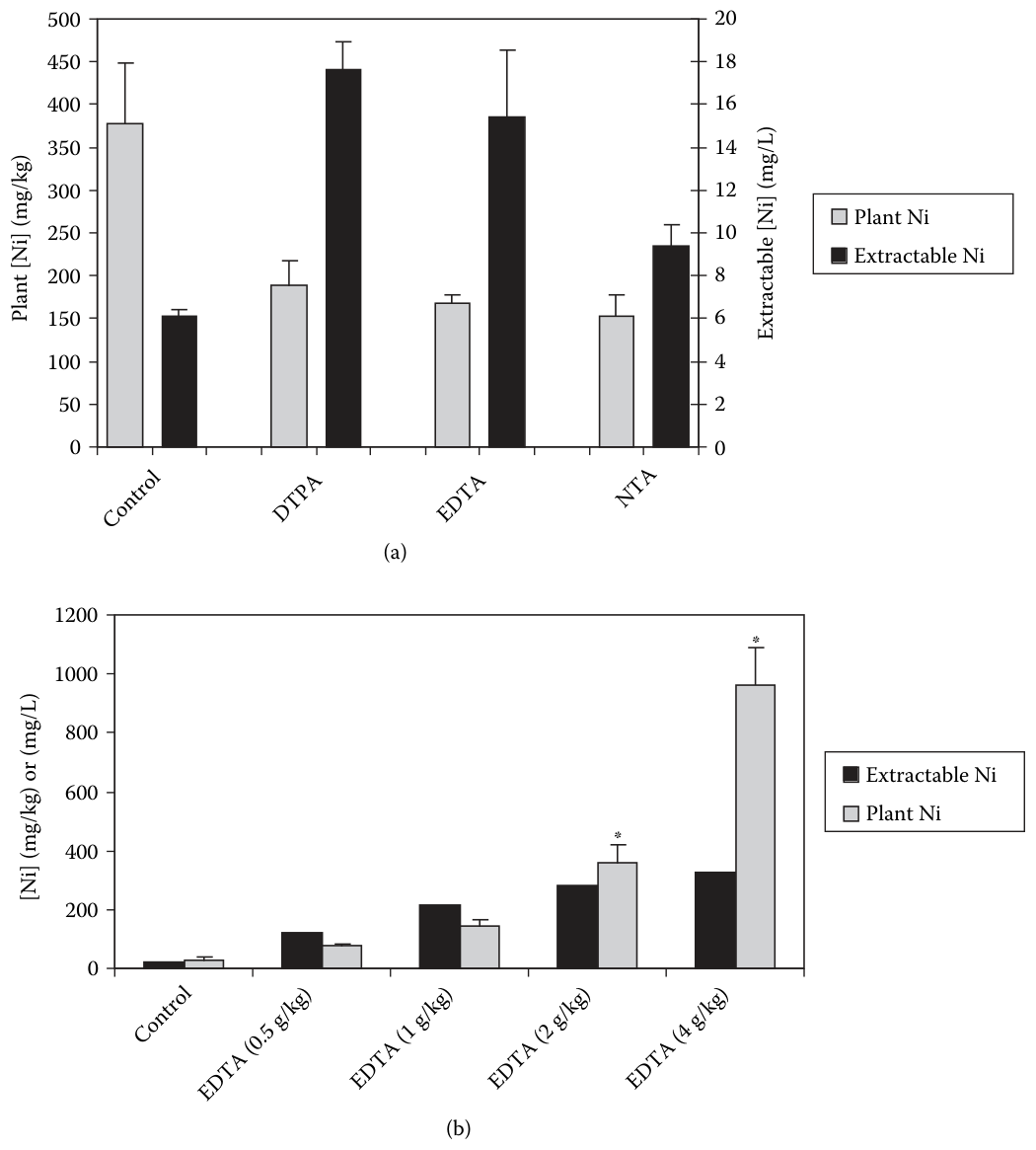
Solubilization, however, does not necessarily induce bioaccumulation. For example, Cu2+ is solubilized by dissolved organic matter, but the resulting complex is not taken up by plants due to its inability to pass through the plasmalemma [34]. Experiments using the nickel hyperaccumulator Berkheya coddii have shown that the chelating agents cause a decrease in nickel uptake, despite enhancing the nickel solubility in the soil (Figure 6.3A). However, increasing the concentration of EDTA and soluble metal in the substrate can induce plant uptake. Figure 6.3B shows that when 4 g of EDTA per kg of soil is added, Arrhenatherum elatius can be induced to take up nearly 1000 mg/kg Ni on a dry matter basis. Depending on the metal species, induced uptake can cause plant death. Disruption of the plasmalemma possibly allows the Ni–EDTA complex to enter the xylem. The strategy used for chelate-enhanced phytoremediation is to apply chelate to a mature crop growing on a contaminated soil. As well, a pesticide can be used to disrupt root membranes allowing the complexed metal to pass directly into the root xylem [35].
然而,溶出并不一定会诱导生物累积。例如,Cu2+可被溶解性有机质溶出,但所形成的络合物因无法穿过质膜而不被植物吸收[34]。以镍超富集植物Berkheya coddii进行的试验表明,尽管螯合剂提高了土壤中镍的溶解性,却导致镍吸收量下降(图6.3A)。然而,提高基质中EDTA和可溶性金属的浓度可诱导植物吸收。图6.3B表明,每kg土壤添加4 g EDTA时,可诱导Arrhenatherum elatius吸收近1000 mg/kg(以干物质计)的Ni。视金属种类而定,诱导吸收可导致植物死亡。质膜的破坏可能使Ni–EDTA络合物得以进入木质部。螯合剂强化植物修复所采用的策略是在污染土壤上生长的成熟作物上施加螯合剂。此外,还可使用农药破坏根膜,使络合态金属直接进入根木质部[35]。
Blaylock [35] showed an impressive decrease in soil-lead concentration over 2 years at two sites in the U.S. using a combination of Brassica juncea and EDTA to induce accumulation. Unfortunately, the mass balance of lead was not shown. It is therefore uncertain just how much lead the plants removed and how much deleteriously leached through the soil profile to contaminated receiving environments.
Blaylock [35]在美国的两个场地结合使用Brassica juncea和EDTA诱导累积,结果显示土壤铅浓度在2年内显著下降。遗憾的是,该研究未给出铅的质量平衡。因此,无法确定植物究竟去除了多少铅,又有多少铅有害地经土壤剖面淋溶进入受污染的受纳环境。
Environmental concerns have been raised over the use of induced bioaccumulation due to the possibility that some of the metals might leach through the soil profile, possibly entering groundwater [36]. Processes such as preferential flow may exacerbate metal leaching [37]. Soil amendments may also persist in the environment, creating additional problems. The addition of chelating agents is likely to induce the solubilization of other than target metals —which may be phytotoxic — such as Al and Mn. Chelators such as EDTA can act as chemical plows, redistributing surface contamination down the soil profile. Concentration near the soil surface is reduced, thereby reducing exposure pathways, but the total amount of contaminant is not affected. Induced bioaccumulation should thus only be used on hydraulically isolated treatment sites where the connection to receiving waters has been “broken.”
由于部分金属可能经土壤剖面淋溶并可能进入地下水[36],诱导生物累积的应用已引发环境方面的担忧。优先流等过程可能加剧金属淋溶[37]。土壤改良剂也可能在环境中持久存在,从而带来额外问题。添加螯合剂可能诱导目标金属以外的金属(如Al和Mn)溶出,而这些金属可能具有植物毒性。EDTA等螯合剂可充当“化学犁”,将表层污染向下重新分布于土壤剖面中。土壤表层附近的浓度降低,从而减少了暴露途径,但污染物总量并未改变。因此,诱导生物累积应仅用于与受纳水体的联系已被“切断”的水力隔离处理场地。
6.10 IN SITU IMMOBILIZATION6.10 原位固定
Reducing trace element solubility, mobility, and bioaccumulation in contaminated soils is an effective, low-cost means of remediation that does not require drastic disturbance of the site. Naturally occurring or artificial soil amendments such as liming material, phosphate, zeolite, bentonite, clay, Fe metal, Fe and Mn oxides, and organic matter, may be used to mitigate the toxic effects of trace elements [38]. These amendments reduce trace element mobility by promoting the formation of insoluble precipitates or by enhancing the soil’s capacity to bind the trace element. The latter can be achieved directly through the addition of adsorbent material or indirectly by adjusting the soil’s pH–Eh conditions to promote trace element absorption onto the soil’s matrix.
降低污染土壤中微量元素的溶解性、迁移性和生物累积是一种有效、低成本且无需大幅扰动场地的修复手段。天然或人工土壤改良剂,如石灰物料、磷酸盐、沸石、膨润土、黏土、金属Fe、Fe和Mn氧化物以及有机质,可用于减轻微量元素的毒性效应[38]。这些改良剂通过促进不溶性沉淀的形成或增强土壤对微量元素的结合能力来降低其迁移性。后者可通过添加吸附材料直接实现,也可通过调节土壤pH–Eh条件以促进微量元素在土壤基质上的吸附而间接实现。
Chemical immobilization using phosphate amendments, such as mineral apatite, synthetic hydroxyapatite, and phosphate salts, has proven effective in reducing heavy-metal solubility by the formation of metal–phosphate complexes [39] and by increasing the number of negatively charged exchange sites [40]. These additions reduce metal bioavailability not only to plants, but also for humans who may have ingested contaminated soil [41]. The solubility of lead in soil can be greatly reduced by the formation of chloropyromorphite [Pb5(PO4)3Cl]. Several microcosm studies have shown that chloropyromorphite can be formed through the addition of hydroxyapatite [Ca10(PO4)6(OH)2] [42,43]. Brown et al. [44] demonstrated that phosphate fertilizers could potentially be used in combination with organic matter and Fe-rich material, as soil amendments to reduce plant availability of Cd, Zn, and Pb.
施用磷酸盐类改良剂(如矿物磷灰石、合成羟基磷灰石和磷酸盐)进行化学固定,已被证明可通过形成金属–磷酸盐络合物[39]以及增加负电荷交换位点数量[40]有效降低重金属的溶解性。这些添加物不仅降低了金属对植物的生物有效性,也降低了其对可能误食污染土壤的人体的生物有效性[41]。通过形成氯磷铅矿[Pb5(PO4)3Cl],土壤中铅的溶解性可大幅降低。多项微宇宙研究表明,添加羟基磷灰石[Ca10(PO4)6(OH)2]可形成氯磷铅矿[42,43]。Brown et al. [44]证明,磷肥有望与有机质和富Fe材料配合用作土壤改良剂,以降低Cd、Zn和Pb的植物有效性。
Phosphate amendments such as hydroxyapatite are effective in reducing the solubility of Pb, Cd, Zn, Al, Ba, Co, Mn, Ni, and U. However, phosphate has been shown to promote the solubility of As and Cr [45], possibly through reduced sorption of the oxyanions due to an increase in pH and competition from PO43–.
羟基磷灰石等磷酸盐改良剂可有效降低Pb、Cd、Zn、Al、Ba、Co、Mn、Ni和U的溶解性。然而,已有研究表明磷酸盐会提高As和Cr的溶解性[45],其原因可能是pH升高以及PO43–的竞争导致含氧阴离子的吸附减少。
A variety of inorganic and organic amendments have been used to reduce Cr(VI) to the less mobile, less toxic Cr(III) species. Fe(II)-bearing minerals form effective reductants. Surface-bound organic matter does this also. The latter is catalyzed by soil mineral surfaces, and Cr(III) binds tightly to surface species or is precipitated as Cr(OH)3 [46]. Similarly, Bolan et al. [47] have shown
多种无机和有机改良剂已被用于将Cr(VI)还原为迁移性较低、毒性较小的Cr(III)形态。含Fe(II)矿物是有效的还原剂。表面结合的有机质也具有这一作用。后者受土壤矿物表面催化,Cr(III)与表面物种紧密结合或以Cr(OH)3形式沉淀[46]。同样,Bolan et al. [47]研究表明
Solubility, Mobility, and Bioaccumulation of Trace Elements微量元素的溶解性、迁移性和生物累积
that organic amendments, such as animal and poultry manures rich in dissolved organic carbon, are very effective in reducing Cr(VI) to Cr(III).
富含溶解性有机碳的有机改良剂(如畜禽粪便)在将Cr(VI)还原为Cr(III)方面非常有效。
Lombi et al. [48] demonstrated that the 2% addition of bauxite residue, “red mud,” to contaminated soils reduced the solubility of Cd, Pb, Ni, and Zn, but not Cu. The remedial action of this material was attributed to a rise in soil pH and adsorption of the metals onto oxides of Fe and Mn.
Lombi et al. [48]证明,向污染土壤中添加2%的铝土矿残渣(“赤泥”)可降低Cd、Pb、Ni和Zn的溶解性,但对Cu无效。该材料的修复作用归因于土壤pH的升高以及金属在Fe和Mn氧化物上的吸附。
Liming has been demonstrated to be effective in reducing the mobility of trace element cations in variable-charge soils by increasing the negative charge on oxides, clays, and organic matter. The effectiveness of raising the pH on metal immobilization also depends on the liming agent. Bolan et al. [49] found that Ca(OH)2 was less effective than KOH in immobilizing Cd2+ due to competition between Ca2+ and Cd2+ for adsorption sites.
已有研究证明,施用石灰可通过增加氧化物、黏土矿物和有机质上的负电荷,有效降低可变电荷土壤中微量元素阳离子的迁移性。提高pH对金属固定的效果还取决于所用石灰物料。Bolan et al. [49]发现,由于Ca2+与Cd2+竞争吸附位点,Ca(OH)2在固定Cd2+方面不如KOH有效。
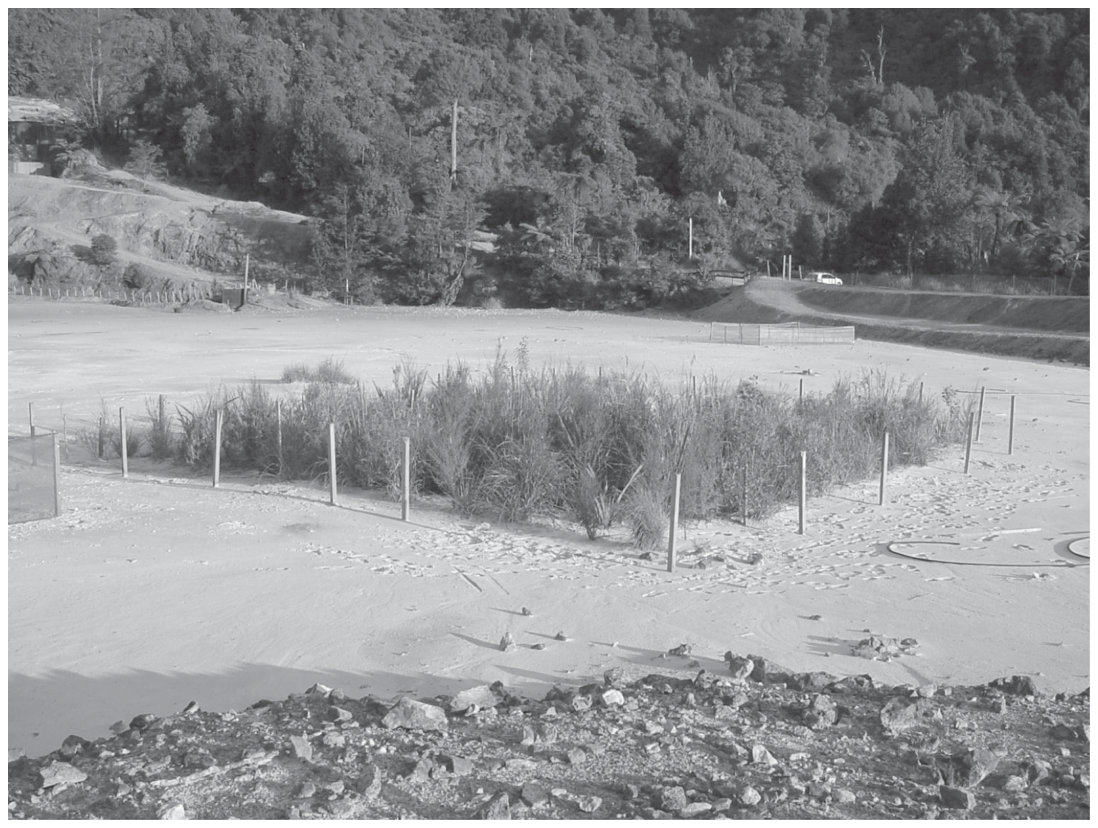
Establishing vegetation on a contaminated site can reduce the solubility and mobility of trace elements. Plant growth reduces trace element mobility in the substrate through the addition of organic matter, creation of an aerobic environment, root uptake, and returning rainfall to the atmosphere by evapotranspiration [50]. Römkens et al. [51] showed that Cu solubility was lowered significantly in the root zone of Agrostis capillaries (var Parys Mountain). Turpeinen et al. [52] demonstrated that Pb solubility was reduced by up to 93% by pine seedlings. The use of vegetation for the remediation of contaminated sites, phytoremediation, has some advantage over other in situ immobilization techniques. Once established, the physicochemical change induced by vegetation is permanent (Figure 6.4).
在污染场地上建立植被可降低微量元素的溶解性和迁移性。植物生长通过增加有机质、营造好氧环境、根系吸收以及经蒸散作用将降雨返回大气,降低基质中微量元素的迁移性[50]。Römkens et al. [51]表明,Agrostis capillaries(var Parys Mountain)根区中Cu的溶解性显著降低。Turpeinen et al. [52]证明,松树幼苗可使Pb的溶解性降低多达93%。利用植被修复污染场地(即植物修复)相对于其他原位固定技术具有一定优势:植被一旦建立,其引起的物理化学变化是持久的(图6.4)。
6.11 CONCLUSIONS6.11 结论
The effect of soil-borne trace elements on ecosystems and human health is a function of their solubility and mobility. These properties are often disproportionate to the trace element’s total concentration. Rather, the speciation of the trace element and the physicochemical properties of the ambient soil are of overriding importance in determining bioavailability. Solubility is primarily a function of soil pH and organic matter content. Mobility depends on solubility and water transport processes.
土壤中微量元素对生态系统和人体健康的影响取决于其溶解性和迁移性。这些性质往往与微量元素的总浓度不成比例;相反,微量元素的形态和所处土壤的物理化学性质在决定生物有效性方面起着首要作用。溶解性主要取决于土壤pH和有机质含量。迁移性则取决于溶解性和水分运移过程。
Trace element bioaccumulation occurs via adsorption onto roots and soil microorganisms as well as absorption into roots and translocation to the aerial portions plants. The latter is affected by the permissivity of the roots’ plasmalemma to the dissolved trace element species.
微量元素的生物累积通过在根系和土壤微生物上的吸附,以及被根系吸收并转运至植物地上部而发生。后者受根系质膜对溶解态微量元素形态的通透性影响。
An innovative low-cost strategy for the remediation of trace element contaminated soils is in situ immobilization using chemical amendments, modified vegetation, or a combination of the two. Remediation technologies that rely on amendments that promote trace element solubility will be limited to sites where the risk of contaminant leaching to groundwater has been eliminated. Future development of whole-system models that calculate the leaching and plant uptake of trace elements in the rhizosphere will facilitate the design and implementation of remediation technologies designed to isolate contaminated soils from the surrounding biota.
利用化学改良剂、改变植被或二者结合进行原位固定,是修复微量元素污染土壤的一种创新性低成本策略。依赖促进微量元素溶解的改良剂的修复技术,将仅限于已消除污染物向地下水淋溶风险的场地。未来发展能够计算根际中微量元素淋溶和植物吸收的全系统模型,将有助于设计和实施旨在将污染土壤与周边生物群隔离的修复技术。
1REFERENCES参考文献
1. Naidu, R. et al. Ionic-strength and pH effects on the sorption of cadmium and the surface charge of soils. Eur. J. Soil Sci. 45, 419, 1994.
2. Yu, S. et al. Adsorption–desorption behavior of copper at contaminated levels in red soils from China. J. Environ. Qual. 31, 1129, 2002.
3. Atanassova, I.D. Adsorption and desorption of Cu at high equilibrium concentrations by soil and clay samples from Bulgaria. Environ. Pollut. 87, 17, 1995.
4. Fischer, K. Removal of heavy metals from soil components and soil by natural chelating agents. Part 1: Displacement from clay minerals and peat by L-cysteine and L-penicillamine. Water, Air, Soil Pollut. 137, 267, 2002.
5. Weng, L.P. et al. Complexation with dissolved organic matter and solubility control of heavy metals in a sandy soil. Environ. Sci. Technol. 36, 4804, 2002.
6. Kerndorff, H. and Schnitzer, M. Sorption of metals on humic acids. Geochim. Cosmochim. Acta. 44,1701, 1980.
7. Wu, J., West, L.J., and Stewart, D.I. Copper (II) humate mobility in kaolinite soil. Eng. Geol. 60, 275, 2001.
8. Almås, S., Sing, B.R., and Salbu, B. Mobility of cadmium-109 and zinc-65 in soil influenced by equilibration time, temperature, and organic matter. J. Environ. Qual. 28, 1742, 1999.
9. Seuntjens, P. et al. Aging effects on cadmium transport in undisturbed contaminated sandy soil columns. J. Environ. Qual. 30, 1040, 2001.
10. Alcacio, T.E. et al. Molecular scale characteristics of Cu(II) bonding in goethite-humate complexes. Geochim. Cosmochim. Acta 65, 1355, 2001.
11. Mattigod, S.V. and Sposito, G. GEOCHEM: a computer program for the calculation of chemical equilibria in soils solutions and other water systems. Department of Soils and Environmental Sciences, University of California, Riverside, 1979.
12. Allison, J.D., Brown, D.S., and Novo–Gardac, K.J. MINTEQA2/PRODEFA2, A geochemical assessment model for environmental system (EPA/600/3-91/021). U.S. Environmental Protection Agency, Athens, GA, 1991.
13. Vogeler, I. et al. Contaminant transport in the root zone. in Trace Elements in Soil: Bioavailability, Flux and Transfer. I.K. Iskandar and M.B. Kirkham, Eds. Lewis Publishers. Boca Raton, FL, 2001 chap. 9.
14. Robinson, B.H. et al. Cadmium adsorption by rhizobacteria: implications for New Zealand pastureland. Agric. Ecosyst. Environ. 87, 315, 2001.
15. Zhao, F.J. et al. Zinc hyperaccumulation and cellular distribution in Arabidopsis halleri. Plant Cell Environ. 23, 507, 2000.
16. Salt, D.E. et al. Mechanisms for cadmium mobility and accumulation in Indian mustard. Plant Physiol. 109, 1427, 1995.
17. Hinchman, R.R., Negri, C.M., and Gatliff, E.G. Phytoremediation: using green plants to clean up contaminated soil, groundwater and wastewater, in Proc. Int. Topical Meeting Nucl. Hazardous Waste Manage., Spectrum 96, Seattle, WA, 1996.
18. Marschner, H. Mineral Nutrition of Higher Plants. Academic Press. London, 1985, 65.
19. Robinson, B.H. et al. Phytoextraction: an assessment of biogeochemical and economic viability. Plant Soil 249, 117, 2003.
20. Salisbury, F.B. and Ross, C.W. Plant Physiology, 4th ed., Wadsworth, CA, 1992, 154.
21. Smolders, E. and McLaughlin, M.J. Chloride increases cadmium uptake in Swiss chard in a resin buffered nutrient solution. Soil Sci. Soc. Am. J. 60, 1443, 1996.
22. Baker, A.J.M. Accumulators and excluders — strategies in the response of plants to heavy metals. J. Plant Nutr. 3, 643, 1981.
23. Brooks, R.R. et al. Detection of nickeliferous rocks by analysis of herbarium specimens of indicator plants. J. Geochem. Explor. 7, 49, 1977.
24. Tuin, B.J.W. and Tels, M. Continuous treatment of heavy metal contaminated clay soils by extraction in stirred tanks and counter current column. Environ. Technol. 12, 178, 1991.
25. Tokunaga, S. and Hakuta, T. Acid washing and stabilization of an artificial arsenic-contaminated soil. Chemosphere 46, 31, 2002.
26. Huang, J.W. and Cunningham, S.D. Lead phytoextraction: species variation in lead uptake and translocation. New Phytol. 134, 75, 1996.
27. Blaylock, M.J. et al. Enhanced accumulation of Pb in Indian mustard by soil-applied chelating agents. Environ. Sci. Technol. 31, 860, 1997.
28. Robinson, B.H., Brooks, R.R., and Clothier, B.E. Soil amendments affecting nickel and cobalt uptake by Berkheya coddii: potential use for phytomining and phytoremediation. Ann. Bot. 84, 689, 1999.
29. Thayalakumaran, T. et al. Plant uptake and leaching of copper during EDTA-enhanced phytoremediation of repacked and undisturbed soil. Plant Soil 254, 415, 2003.
30. Moreno, F. et al. Phytoremediation of mercury-contaminated mine tailings by induced plant-mercury accumulation. Environ. Pract. 6, 165, 2004.
31. Anderson, C.W.N. et al. Induced hyperaccumulation of gold in plants. Nature 395, 553, 1998.
32. Weggler, K., McLaughlin, M.J. and Graham, R.D. 2004. Effect of chloride in soil solution on the plant availability of biosolid-borne cadmium. J. Environ. Qual. 33, 496, 2004.
33. McLaughlin, M.J., et al. Increased soil salinity causes elevated cadmium concentrations in field grown potato tubers. J. Environ. Qual. 23, 1013,1994.
34. Bolan, N.S. and Duraisamy, V.P. Role of inorganic and organic soil amendments on immobilisation and phytoavailability of heavy metals: a review involving specific case studies. Aust. J. Soil. Res. 41, 533, 2003.
35. Blaylock, M.J. Field demonstrations of phytoremediation of lead contaminated soils, in Phytoremediation of Contaminated Soil and Water, Terry, N. and Bañuelos, G., Eds. Lewis publishers, Boca Raton, FL, 2000, chap 1.
36. Lombi, E. et al. Phytoremediation of heavy-metal contaminated soils: natural hyperaccumulation versus chemically enhanced phytoextraction. J. Envron. Qual. 30, 1919, 2001.
37. Bundt, M. et al. Impact of preferential flow on radionuclide distribution in soil. Environ. Sci. Technol. 34, 3895, 2000.
38. Cheng, S. and Hseu, Z. In situ immobilization of cadmium and lead by different amendments in two contaminated soils. Water, Air, Soil Pollut. 140, 73, 2002.
39. McGowen, S.L., Basta, N.T., and Brown, G.O. Use of diammonium phosphate to reduce heavy metal solubility and transport in smelter-contaminated soil. J. Environ. Qual. 30, 493, 2001.
40. Bolan, N.S. et al. The effects of anion sorption on sorption and leaching of cadmium. Aust. J. Soil. Res. 37, 445, 1999.
41. Zhang, P., Ryan, J.A., and Yang, J. In vitro soil Pb solubility in the presence of hydroxyapatite. Environ. Sci. Technol. 32, 2763, 1998.
42. Ma, Q.Y., Traina, S.J., and Logan T.J. In situ lead immobilization by apatite. Environ. Sci. Technol. 27, 1803–1810, 1993.
43. Ryan, J.A. et al. Formation of chloropyromorphite in a lead-contaminated soil amended with hydroxyapatite. Environ. Sci. Technol. 35, 3798, 2001.
44. Brown, S. et al. In situ soil treatments to reduce the phyto- and bioavailability of lead, zinc, and cadmium. J. Environ. Qual. 33, 522, 2004.
45. Seaman, J.C., Arey, J.S., and Bertsch, P.M. Immobilization of nickel and other metals in contaminated sediments by hydroxyapatite addition. J. Environ. Qual. 30, 460, 2001.
46. Jardine, P.M. et al. Fate and transport of hexavalent chromium in undisturbed heterogenous soil. Environ. Sci. Technol. 33, 2939, 1999.
47. Bolan, N.S. et al. Reduction and phytoavailability of Cr(VI) as influenced by organic manure compost. J. Environ. Qual. 32, 120, 2003
48. Lombi, E. et al. In situ fixation of metals in soils using bauxite residue: chemical assessment. Environ. Pollut. 118, 435, 2002.
49. Bolan, N.S. et al. Immobilization and phytoavailability of cadmium in variable charge soils. II. Effect of lime addition. Plant Soil 251, 187, 2003.
50. Robinson, B.H. et al. Phytoremediation: using plants as biopumps to improve degraded environments. Aust. J. Soil. Res. 41, 599, 2003.
51. Römkens, P.F.A.M., Bouwman, L.A., and Boon, G.T. Effect of plant growth on copper solubility and speciation in soil solution samples. Environ. Pollut. 106, 315, 1999.
52. Turpeinen, R., Salminen, J., and Kairesalo, T. Mobility and bioavailability of lead in contaminated boreal forest soil. Environ. Sci. Technol. 34, 5152, 2000.