Environmental Pollution 136 (2005) 341e352 www.elsevier.com/locate/envpol
Fabio N. Morenoa,*, Chris W.N. Andersona, Robert B. Stewarta, Brett H. Robinsonb
aInstitute of Natural Resources, Soil and Earth Sciences, Massey University, Private Bag 11222, Palmerston North, New Zealand
bHortResearch, Palmerston North, New Zealand
Received 16 July 2004; accepted 22 November 2004
Mass balance studies indicated that volatilisation was a dominant pathway for mercury removal.
Abstract摘要
Experiments were carried out in plant growth chambers and in the field to investigate plant-mercury accumulation and volatilisation in the presence of thiosulphate (S2O3)-containing solutions. Brassica juncea (Indian mustard) plants grown in Hg-contaminated Tui mine tailings (New Zealand) were enclosed in gastight volatilisation chambers to investigate the effect of ammonium thiosulphate ([NH4]2S2O3) on the plant-Hg volatilisation process. Application of (NH4)2S2O3 to substrates increased up to 6 times the Hg concentration in shoots and roots of B. juncea relative to controls. Volatilisation rates were significantly higher in plants irrigated only with water (control) when compared to plants treated with (NH4)2S2O3. Volatilisation from barren pots (without plants) indicated that Hg in tailings is subject to biological and photochemical reactions. Addition of sodium thiosulphate (Na2S2O3) at 5 g/kg of substrate to B. juncea plants grown at the Tui mine site confirmed the plant growth chambers studies showing the effectiveness of thio-solutions at enhancing shoot Hg concentrations. Mercury extraction from the field plots yielded a maximum value of 25 g/ha. Mass balance studies revealed that volatilisation is a dominant pathway for Hg removal from the Tui mine site. A preliminary assessment of the risks of volatilisation indicated that enhanced Hg emissions by plants would not harm the local population and the regional environment. � 2005 Elsevier Ltd. All rights reserved.
本研究在植物生长箱和田间开展试验,考察含硫代硫酸盐(S2O3)溶液存在条件下植物对汞的积累与挥发。将生长于受Hg污染的Tui矿尾矿(新西兰)中的芥菜型油菜(Brassica juncea,印度芥菜)置于气密性挥发箱内,研究硫代硫酸铵([NH4]2S2O3)对植物-Hg挥发过程的影响。向基质中施加(NH4)2S2O3后,B. juncea地上部和根系的Hg浓度较对照最高提高6倍。仅以水灌溉的植株(对照)的挥发速率显著高于经(NH4)2S2O3处理的植株。无植物盆(裸盆)的挥发表明,尾矿中的Hg会发生生物和光化学反应。在Tui矿区对生长的B. juncea按5 g/kg基质施加硫代硫酸钠(Na2S2O3),证实了植物生长箱研究的结果,即含硫溶液可有效提高地上部Hg浓度。田间小区的汞提取量最高达25 g/ha。质量平衡研究表明,挥发是Tui矿区Hg去除的主要途径。对挥发风险的初步评估表明,植物增强的Hg排放不会危害当地居民和区域环境。© 2005 Elsevier Ltd. 版权所有。
Keywords: Volatilisation; Hg-phytoextraction; Induced plant-Hg accumulation; Ammonium thiosulphate ([NH4]2S2O3); Base-metal mine tailings
关键词:挥发;Hg植物提取;诱导植物-Hg积累;硫代硫酸铵([NH4]2S2O3);贱金属矿尾矿
1Introduction引言
Mercury (Hg) is a global pollutant that cycles between air, water and soil as a result of natural processes and anthropogenic activities. Although anthropogenic Hg emissions have been reduced by half since the 1980’s (Pacyna et al., 2001), ongoing Hg contamination is still a worldwide problem. Depending on the Hg source and the form of discharge, Hg in soil may be present in concentrated hot spots or dispersed over large areas (Hinton and Veiga, 2001). Mobile Hg species in soils can leach to receiving waters where they can undergo methylation by anaerobes such as sulphate-reducing bacteria (Choi et al., 1994). Abiotic methylation of Hg (II) in waters is also possible in the presence of methylcobalamin and humic matter (Weber, 1993). Methylmercury is a developmental toxicant and readily crosses placental barriers. In cases of acute poisoning via ingestion of Hg-laden fish, muscular atrophy and neurological damage are prominent (Veiga and Hinton, 2002). Exposure to methylmercury during human gestation can delay the onset of walking and talking and diminish learning ability (US Environmental Protection Agency, 2004).
汞(Hg)是一种全球性污染物,在自然过程和人类活动作用下于大气、水体和土壤之间循环。尽管自20世纪80年代以来人为Hg排放已减少一半(Pacyna et al., 2001),持续的Hg污染仍是一个世界性问题。根据Hg来源和排放形式的不同,土壤中的Hg可能以高浓度热点形式存在,也可能分散于大面积区域(Hinton and Veiga, 2001)。土壤中的可移动态Hg可淋溶进入受纳水体,并在其中被硫酸盐还原菌等厌氧微生物甲基化(Choi et al., 1994)。在甲基钴胺素和腐殖质存在的条件下,水体中的Hg (II)也可能发生非生物甲基化(Weber, 1993)。甲基汞是一种发育毒物,易于穿过胎盘屏障。在因食用含Hg鱼类而导致的急性中毒病例中,肌肉萎缩和神经损伤十分突出(Veiga and Hinton, 2002)。人类妊娠期暴露于甲基汞可推迟行走和说话的开始时间并降低学习能力(US Environmental Protection Agency, 2004)。
* Corresponding author. Tel.: C55 11 3277 54651; fax: C55 11 3277 5461.
* 通讯作者。电话:+55 11 3277 54651;传真:+55 11 3277 5461。
E-mail addresses: fabionmoreno@terra.com.br (F.N. Moreno), chris@tiaki.co.nz (C.W.N. Anderson), r.b.stewart@massey.ac.nz (R.B. Stewart), brett.robinson@env.ethz.ch (B.H. Robinson).
0269-7491/$ - see front matter � 2005 Elsevier Ltd. All rights reserved. doi:10.1016/j.envpol.2004.11.020
0269-7491/$ - see front matter © 2005 Elsevier Ltd. 版权所有。doi:10.1016/j.envpol.2004.11.020
Although not all Hg-contaminated sites are vulnerable to methylmercury formation (Veiga, 2004), Hg in soils represent a serious threat and, in many circumstances, must be removed. Ex situ remediation technologies such as excavation, physical separation, and hydrometallurgical treatments are expensive, particularly if Hg contamination is spread over a large area or extends below the water table. Thermal treatment (soil heating combined with soil vapour extraction) can be effective for Hg removal from solid media but is technically complicated and also costly. Furthermore, soil heating releases Hg as a vapour into the environment and can have deleterious effects on the physical, chemical and biological properties of soils (Meagher et al., 2000; Hinton and Veiga, 2001). Phytoremediation uses plants to rehabilitate degraded environments. By using free services provided by nature (energy from the sun and CO2 from the atmosphere), plants species can extract nutrients, accumulate heavy metals and radionuclides, and transform or degrade some organic contaminants more economically than current available chemical/physical technologies (Raskin et al., 1994; Schnoor et al., 1995; Robinson et al., 1998).
尽管并非所有Hg污染场地都易于形成甲基汞(Veiga, 2004),土壤中的Hg仍构成严重威胁,在许多情况下必须予以去除。异位修复技术(如挖掘、物理分离和湿法冶金处理)成本高昂,尤其是当Hg污染范围广或延伸至地下水位以下时。热处理(土壤加热结合土壤气相抽提)可有效去除固体介质中的Hg,但技术复杂且成本同样较高。此外,土壤加热会将Hg以蒸气形式释放到环境中,并可能对土壤的物理、化学和生物学性质产生不利影响(Meagher et al., 2000; Hinton and Veiga, 2001)。植物修复利用植物恢复退化环境。借助大自然提供的免费服务(太阳能和大气中的CO2),植物能够吸收养分、积累重金属和放射性核素,并转化或降解某些有机污染物,其经济性优于现有的化学/物理技术(Raskin et al., 1994; Schnoor et al., 1995; Robinson et al., 1998)。
Two different approaches have been proposed to foster plant-based systems for the remediation of Hg-polluted soils. The first approach involves the use of plants encoding genes from Hg-detoxifying bacteria, which have increased Hg resistance and enhanced volatilisation capacity. These transgenic plants are able to extract Hg (II) and methylmercury from contaminated soils and sediments and to convert these forms to the less toxic and more volatile Hg (0) (Rugh et al., 1996; Bizily et al., 1999). The second approach uses non-toxic thio-containing solutions to induce Hg accumulation into above ground tissues of high-biomass plant species (Moreno et al., 2004a). Mercury has a strong affinity for thiol groups and can be readily complexed to the thiosulphate ion (Wilkinson et al., 1987). However, the kinetics of the formation/decomposition of Hg-thiosulphate complexes is poorly understood (D. Dreisinger, 2004, personal communication). In spite of that, ammonium thiosulphate has been used to induce Brassica juncea (Indian mustard) to accumulate 40 mg Hg/kg of shoot tissue from a lead-copper-zinc metal mine contaminated with Hg (Moreno et al., 2004a). This concentration is 40e400 times higher than average background levels of Hg in plants (Kirkham, 1977; Kabata-Pendias and Pendias, 2000). Mass balance studies, however, revealed that a substantial Hg fraction that could not be accounted for. This unaccounted fraction suggested that Hg (0) was volatilised from the substrate as a result of biological and chemical transformations. In this work we describe plant growth chamber and field studies on the volatilisation and thiosulphate-induced accumulation of Hg by B. juncea plants growing in an Hg-contaminated mine tailings.
目前已提出两种不同途径来推动基于植物的Hg污染土壤修复系统。第一种途径是利用携带Hg解毒细菌基因的植物,这类植物具有更强的Hg耐性和更高的挥发能力。这些转基因植物能够从污染土壤和沉积物中提取Hg (II)和甲基汞,并将其转化为毒性较低、挥发性较强的Hg (0)(Rugh et al., 1996; Bizily et al., 1999)。第二种途径是利用无毒的含硫溶液诱导高生物量植物将Hg积累于地上部组织(Moreno et al., 2004a)。汞对巯基具有很强的亲和力,并易与硫代硫酸根离子形成络合物(Wilkinson et al., 1987)。然而,Hg-硫代硫酸盐络合物形成/分解的动力学尚不清楚(D. Dreisinger, 2004, 私人通讯)。尽管如此,硫代硫酸铵已被用于诱导芥菜型油菜(Brassica juncea,印度芥菜)在一处受Hg污染的铅-铜-锌金属矿中使地上部组织积累40 mg Hg/kg(Moreno et al., 2004a)。该浓度比植物中Hg的平均背景水平高40–400倍(Kirkham, 1977; Kabata-Pendias and Pendias, 2000)。然而,质量平衡研究显示,有相当一部分Hg无法得到解释。这部分未解释的Hg表明,Hg (0)因生物和化学转化而从基质中挥发。本文描述了在植物生长箱和田间开展的研究,内容涉及生长于Hg污染矿山尾矿中的B. juncea对Hg的挥发以及硫代硫酸盐诱导的Hg积累。
2Materials and methods材料与方法
2.1. Substrate characterization2.1. 基质特征
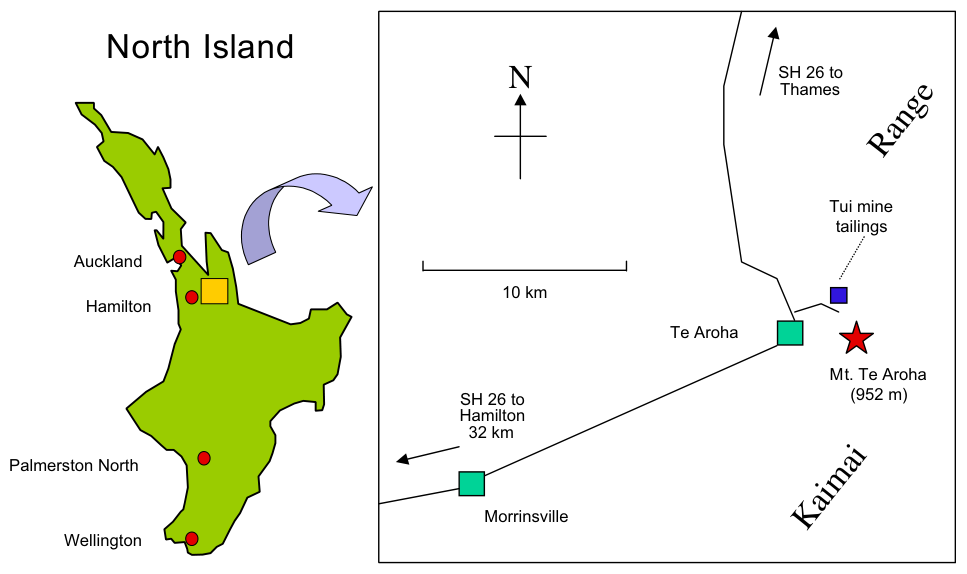
Substrate for the greenhouse research was collected from the tailings dam of the abandoned Tui base-metal mine, located on the NW flank on Mount Te Aroha, approximately 3 km from of the township of Te Aroha, North Island of New Zealand (Fig. 1). The site is contaminated with Hg at concentrations ranging from 1.3 to 4.5 mg/kg (Moreno et al., 2004c). The metalbearing minerals present in the tailings include sphalerite (ZnS), galena (PbS), chalcopyrite (CuFeS2), and pyrite (FeS2) with minor amounts of Cd, Ag, and Au. The tailings have been have been left in contact with the air since closure of the mine in 1974. Oxidation of pyrite and other sulphide-bearing minerals has depressed the pH of surface tailings to as low as 2.3 and increased the bioavailability of the metals Cu, Fe, Pb, Mn and Zn. No native vegetation has colonised the site. The nearby Tui stream and the local ground water supply have been severely contaminated by acid mine drainage produced on site (Morrell et al., 1996).
温室研究所用基质采自废弃的Tui贱金属矿尾矿坝,该矿位于新西兰北岛Te Aroha山西北坡,距Te Aroha镇约3 km(图1)。该场地受Hg污染,浓度范围为1.3–4.5 mg/kg(Moreno et al., 2004c)。尾矿中的含金属矿物包括闪锌矿(ZnS)、方铅矿(PbS)、黄铜矿(CuFeS2)和黄铁矿(FeS2),并含少量Cd、Ag和Au。自1974年矿山关闭以来,尾矿一直暴露于空气中。黄铁矿及其他含硫化物矿物的氧化使表层尾矿pH降至2.3,并提高了Cu、Fe、Pb、Mn和Zn等金属的生物有效性。该场地尚无本土植被定殖。附近的Tui溪和当地地下水供应已受到场地产生的酸性矿山排水的严重污染(Morrell et al., 1996)。
2.2. Plant growth conditions2.2. 植物生长条件
Non-sieved Tui substrates were fertilised with 5 g/kg of Osmocote (NPK slow release fertilizer) and amended with lime to adjust the pH to 5.5. Replicate plastic pots (6 ! 6 cm, n Z 20) were filled with the growth substrate and sown with seeds of B. juncea at a rate of ca. 20 seeds per pot. Pumice was added in a 3:1 ratio to improve drai age of the substrate. Plants were watered everyday to field capacity. Drainage collected from each pot was reapplied to the substrates. Five milliliters of 1/4 strength Hoagland’s nutrient solution (Hoagland and Arnon, 1950) was irrigated onto the pots every second day to supplement plant nutritional requirements. Two weeks after germination, each pot was thinned to leave only one individual plant. Plants were kept in a greenhouse with temperature ambient set at 15e25 �C with no humidity control. Pot positions were randomly changed on a periodic basis to equalize light exposure. All plants were treated before the outset of flowering. Plants reached around 20 cm of height after 5 weeks of growth.
未过筛的Tui基质施加5 g/kg Osmocote(NPK缓释肥),并用石灰调节pH至5.5。将生长基质装入重复塑料盆(6 × 6 cm,n = 20),每盆播种约20粒B. juncea种子。按3:1比例加入浮石以改善基质排水。每天浇水至田间持水量。收集各盆排出液并回施于基质。每隔一天向盆中浇灌5 mL 1/4强度Hoagland营养液(Hoagland and Arnon, 1950),以补充植物营养需求。发芽两周后间苗,每盆仅保留一株。植株置于温室中,环境温度设定为15–25 °C,不控制湿度。定期随机调换盆的位置,以使光照均匀。所有植株均在开花前进行处理。生长5周后植株高度约达20 cm。
2.3. Extractable Hg2.3. 可提取态Hg
Extractable Hg concentrations in Tui mine tailings were determined through the use (NH4)2S2O3 and
Tui矿尾矿中可提取态Hg浓度采用(NH4)2S2O3和
Na2S2O3 as chemical extractants (Moreno et al., 2004a). One gram of sieved tailings (!1000 microns) was weighed into 50 mL polypropylene centrifuge tubes in triplicate. After addition of 20 mL of extractant solutions (at 2 and 10 g/L), the tubes were rotated on an end-over-end shaker overnight at 45 rotations per minute (RPM) and the supernatant separated via centrifugation at 3000 RPM for 3 minutes.
Na2S2O3作为化学提取剂进行测定(Moreno et al., 2004a)。称取1 g过筛尾矿(<1000 μm)于50 mL聚丙烯离心管中,设3个重复。加入20 mL提取剂溶液(2和10 g/L)后,将离心管置于翻转振荡器上以45转/分(RPM)振荡过夜,然后以3000 RPM离心3分钟分离上清液。
2.4. Effect of ammonium thiosulphate on Hg volatilisation and accumulation2.4. 硫代硫酸铵对Hg挥发与积累的影响
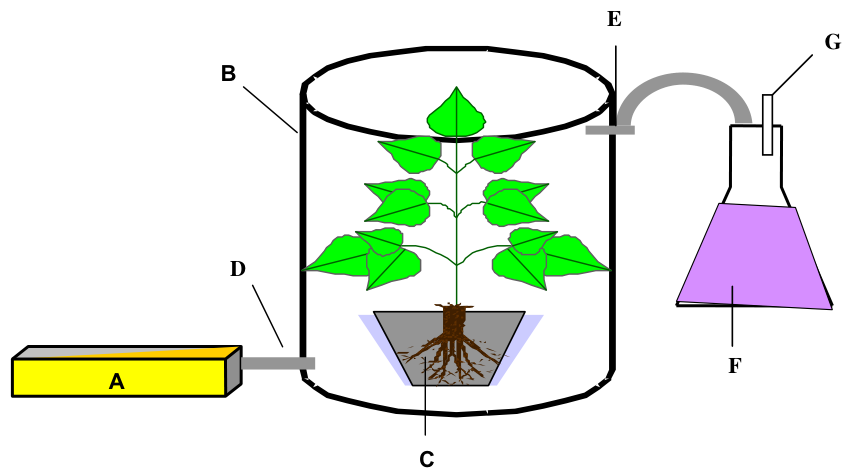
After 5 weeks of plant growth, the solution of (NH4)2S2O3 was applied to replicate pots at a rate of 1 g thiosulphate per kg of substrate (n Z 3). Water was used as a comparison to the thiosulphate treatments (n Z 3). Pots without plants (unplanted pots) were used as controls (n Z 3). A single plant pot was enclosed within a gastight acrylic volatilisation chamber (3.6 L volume) immediately after the chemical treatment. Volatile Hg was captured in an acid trap solution containing 5% KMnO4 dissolved in 2 N H2SO4 (Fig. 2). The efficiency of this trap solution to capture quantitatively Hg (0) has been shown to vary between 95 to 99% (Kimura and Miller, 1960). A continuous airflow was supplied to the volatilisation chamber using a small air pump. Mercury vapour released from plants and substrates was driven together with the incoming air into an Erlenmeyer flask containing 70 mL of the acid trap solution. The flow rate of the incoming air was monitored using an air flow meter (J&W, model AMD 1000, California, US) and was constantly held to 100 mL/min using a small clamp attached to the air outlets. The clamp was manually regulated. The outlet of the acid trap was open to the atmosphere to maintain pressure equilibrium within the trap system. A 10 mL syringe attached to the volatilisation chamber was used to water the plants during the period of volatile Hg collection. Watering was carefully performed to avoid losses of Hg by leaching. Volatilisation was measured over a 3 days period in a plant growth chamber with photoperiod set for 14 hours and temperature kept constantly at 22 �C. Collection of volatile Hg was done in triplicate for (NH4)2S2O3- treated plants, plants irrigated with water and control pots. The plant growth chamber has a capacity for 3 individual volatilisation chambers and, therefore, the experiment was repeated 3 times. At the end of the three days period, the acid trap solution was transferred to 100 mL air-tight plastic containers and stored at 4 �C until analysis. The precipitated fraction of the trap was redissolved in 50 mL of concentrated hydrochloric acid, and the resulted solution was preserved following the same procedure. The volatile Hg mass collected for each replicate was, therefore, the sum of Hg readings in the soluble and precipitated fractions of the acid trap. The use of this experimental apparatus has allowed Hg recoveries around 90% for B. juncea plants cultured in Hg-spiked solutions (Moreno et al., 2004b).
植株生长5周后,按每kg基质1 g硫代硫酸盐的用量向重复盆施加(NH4)2S2O3溶液(n = 3)。以水作为硫代硫酸盐处理的比较(n = 3)。无植物盆(未种植盆)作为对照(n = 3)。化学处理后立即将单盆植株封闭于气密性丙烯酸挥发箱(容积3.6 L)内。挥发性Hg由含5% KMnO4(溶于2 N H2SO4)的酸性吸收液捕集(图2)。已有研究表明,该吸收液对Hg (0)的定量捕集效率为95%–99%(Kimura and Miller, 1960)。用小型气泵向挥发箱持续供气。植物和基质释放的汞蒸气随进气一同被导入装有70 mL酸性吸收液的锥形瓶中。进气流量用空气流量计(J&W, model AMD 1000, California, US)监测,并通过夹在出气口上的小夹子恒定保持在100 mL/min。夹子为手动调节。酸性吸收瓶出口与大气相通,以维持吸收系统内的压力平衡。在挥发性Hg收集期间,用连接在挥发箱上的10 mL注射器为植株浇水。浇水时十分小心,以避免Hg因淋溶而损失。挥发测定在植物生长箱中进行,历时3天,光周期设为14小时,温度恒定为22 °C。对(NH4)2S2O3处理植株、水灌溉植株和对照盆分别进行3次重复的挥发性Hg收集。植物生长箱可容纳3个单独的挥发箱,因此试验重复进行了3次。3天期结束时,将酸性吸收液转移至100 mL气密塑料容器中,于4 °C保存直至分析。吸收液中的沉淀部分用50 mL浓盐酸重新溶解,所得溶液按相同程序保存。因此,每个重复收集到的挥发性Hg质量为酸性吸收液可溶部分与沉淀部分Hg读数之和。利用该试验装置,在含Hg加标溶液中培养的B. juncea植株的Hg回收率约为90%(Moreno et al., 2004b)。
2.6. Plant harvest2.6. 植物收获
At the end of the experiments, plants were harvested and washed in tap water. Shoots were excised from roots by using a steel blade. The intact root system could be harvested from the substrates by soaking the bulk roots with the adhering substrate in a bucket filled with water. The buckets were acid washed and the water was fully replaced after each soaking period. The soaking process was carried out for one hour and was done separately for each plant-chemical treatment The roots were further washed several times with tap water to remove residual substrate. Plant tissues were placed into individual paper bags and dried at 70 �C. After drying, all plant samples were ground and sealed in plastic bags for subsequent Hg analysis.
试验结束时收获植株并用自来水清洗。用钢刀将地上部与根系分离。将带有附着基质的整体根系浸泡于盛水的桶中,即可从基质中收获完整根系。桶经酸洗,每次浸泡后完全换水。浸泡持续1小时,且每个植物-化学处理分别进行。随后用自来水多次冲洗根系以去除残留基质。将植物组织分别装入纸袋,于70 °C烘干。烘干后将所有植物样品粉碎,密封于塑料袋中,供后续Hg分析。
2.7. Plant digestion2.7. 植物消解
Ground shoots and roots were weighed accurately (0.1 g) into 50 mL plastic pots; concentrated HNO3 (15 mL) was then added. The digest samples were left overnight and, in the following day, were heated in a water bath at 100 �C for 1 hour. Digest solutions were transferred to 10 mL polythene tubes and diluted with reverse osmosis (RO) water to make a final volume of 10 mL. A blank reagent was used with all digestions.
准确称取粉碎的地上部和根系样品(0.1 g)于50 mL塑料容器中,然后加入浓HNO3(15 mL)。消解样品放置过夜,次日于100 °C水浴中加热1小时。将消解液转移至10 mL聚乙烯管中,用反渗透(RO)水定容至10 mL。所有消解均设试剂空白。
2.8. Substrate digestion2.8. 基质消解
2.5. Induced plant-Hg accumulation field trials2.5. 诱导植物-Hg积累田间试验
Three field plots with dimensions of 5 ! 5 m were established at the tailings dam of the abandoned Tui base-metal mine. The plots were fertilized with commercially available NPK fertilizer at a rate of 75 g/m2 and had their pH adjusted to 5.5 by addition of lime. Organic matter (mushroom compost) was added at a rate of 3.2 L/m2. Around 75 grams of B. juncea seeds were planted in two rows of 5 m length !0.5 m width !0.15 m depth. Collection of soil samples (n Z 4) was carried out at the 0e15 cm depth for each plot just after seeding. After 6 weeks of plant growth, Na2S2O3 in the form of a solution (w/v) was applied to the field plots at a concentration of 5 g/kg of substrate. This application rate was calculated based on the mass of substrate in each planted row (0.6 tonnes) and, thus 6 kg of sodium thiosulphate were applied per plot. The sodium salt was chosen for the field study because bulk quantities of the ammonium salt were not commercially available. Previous laboratory experiments showed, however, that Hg extractability in the presence of the sodium salt was not significantly different to the ammonium salt (P O 0.05). Plant samples that were collected from each plot prior to the treatment application were used as controls. Two weeks after the treatment, biomass from the plots was harvested and processed for Hg analyses.
在废弃Tui贱金属矿的尾矿坝上建立3个5 × 5 m的田间小区。小区按75 g/m2施用市售NPK肥,并加入石灰将pH调至5.5。按3.2 L/m2加入有机质(蘑菇堆肥)。将约75 g B. juncea种子播种于两行中,每行长5 m × 宽0.5 m × 深0.15 m。播种后立即在各小区0–15 cm深度采集土壤样品(n = 4)。植株生长6周后,将Na2S2O3以溶液(w/v)形式按5 g/kg基质的浓度施于田间小区。该施用量根据每个种植行中的基质质量(0.6 t)计算,因此每个小区施用6 kg硫代硫酸钠。田间研究选用钠盐,是因为铵盐无法大批量购得。不过,此前的实验室试验表明,钠盐存在下的Hg可提取性与铵盐无显著差异(P > 0.05)。处理前从各小区采集的植物样品作为对照。处理两周后收获小区生物量并进行Hg分析前处理。
The total mercury concentration in tailings sub samples was determined through aqua regia digestions of dried substrate. One gram of substrate was weighed into 50 mL polypropylene pots in triplicate and a 15 mL solution of HNO3 and HCl at 1:3 ratio was added. The samples were digested in water bath at 100 �C for 1 hour and the filtrates diluted to a final volume of 50 mL using RO water.
尾矿子样品中的总汞浓度通过对干燥基质进行王水消解测定。称取1 g基质于50 mL聚丙烯容器中,设3个重复,加入15 mL HNO3与HCl体积比为1:3的混合液。样品于100 °C水浴中消解1小时,滤液用RO水定容至50 mL。
2.9. Mercury analysis2.9. 汞分析
Total Hg in plant and tailings digests and in extractant and trap solutions was analysed using Hydride-generation atomic absorption spectroscopy (AAS) (Moreno et al., 2004c). The analysis was performed using a GBC 909A AAS (Victoria, Australia) operating in the flame mode. A sodium borohydride solution (5% NaBH4C1% KOH) was used to generate Hg vapour. The limit of detection (LOD) for mercury in solution was 10 ng/mL for plant digests and 5 ng/mL for soil digests and extractant and trap solutions. The Hg readings obtained from the replicate analysis (n Z 10) of a standard solution containing 1 mg/L of Hg could be reproduced with less than 5% of variation. Reagent blanks were below detection limits in the solution. Linear calibration curves were obtained over the range of 125 to 1000 ng/mL of Hg using 4 standards prepared from a 10 mg/L mercuric nitrate (HgNO3) spectrosol solution (May & Baker, AAS reagent standard solution). Solutions with Hg concentration over the 1000 ng/ml range were diluted with RO. The analytical method was assessed for quality control by an external certified laboratory with agreements ranging from 85 to 103% for Hg-containing solutions and Hg-containing plant samples (Moreno et al., 2004c).
植物和尾矿消解液以及提取液和吸收液中的总Hg采用氢化物发生-原子吸收光谱法(AAS)分析(Moreno et al., 2004c)。分析使用GBC 909A AAS(Victoria, Australia),以火焰模式运行。采用硼氢化钠溶液(5% NaBH4 + 1% KOH)生成Hg蒸气。溶液中汞的检出限(LOD)对植物消解液为10 ng/mL,对土壤消解液及提取液和吸收液为5 ng/mL。对含1 mg/L Hg的标准溶液重复分析(n = 10)所得Hg读数的变异小于5%。溶液中试剂空白低于检出限。用10 mg/L硝酸汞(HgNO3)光谱纯标准溶液(May & Baker, AAS试剂标准溶液)配制4个标准,在125–1000 ng/mL Hg范围内获得线性校准曲线。Hg浓度超过1000 ng/ml范围的溶液用RO水稀释。该分析方法由外部认证实验室进行质量控制评估,含Hg溶液和含Hg植物样品的一致性为85%–103%(Moreno et al., 2004c)。
2.10. Statistical analysis2.10. 统计分析
A copy of SAS PC version 8e was used for statistical analyses (SAS Inst, 1988). Treatment differences were examined through the t-test, assuming equality of variances between two treatment means. Differences among three means were assessed through one-way analyses of variance (ANOVA). Tukey’s test was used for pair-wise comparison of means at 0.05 and 0.01 significance levels. Data was log-transformed to achieve a normal distribution.
采用SAS PC 8e版进行统计分析(SAS Inst, 1988)。假定两个处理均值方差齐性,通过t检验考察处理间差异。三个均值之间的差异采用单因素方差分析(ANOVA)评估。在0.05和0.01显著性水平下,采用Tukey检验进行均值两两比较。数据经对数转换以满足正态分布。
3Results结果
3.1. Effect of ammonium thiosulphate3.1. 硫代硫酸铵
on Hg volatilisation and accumulation average background levels of Hg in plants (Kirkham, 1977; Kabata-Pendias and Pendias, 2000). This result indicates that foliar uptake of volatile Hg was a possible entrance pathway for plants enclosed in the gastight volatilisation chamber.
对Hg挥发与积累的影响植物中Hg的平均背景水平(Kirkham, 1977; Kabata-Pendias and Pendias, 2000)。这一结果表明,对于封闭在气密挥发箱中的植株,叶片吸收挥发性Hg可能是一条进入途径。
Fig. 3 shows the daily Hg volatilisation rates for B. juncea plants and control pots (without plants) on a Hg mass basis (A) and per kg dry weight (B) basis. In both cases, the Hg volatilisation rates from water-treated plants significantly exceeded the Hg volatilisation rates from (NH4)2S2O3-treated plants by a factor 3 (P ! 0.05). The Hg volatilisation rate from control pots (without plants) was significantly lower than from water-treated plants and (NH4)2S2O3-treated plants (P ! 0.05) (Fig. 3A). The Hg efflux from control pots was in average 23 times lower than the Hg efflux from water-treated plants and around 6 times lower than (NH4)2S2O3-treated plants. We believe these Hg emissions to be due to biological transformations and photoreduction processes occurring in the substrate.图3分别以Hg质量(A)和每kg干重(B)为基础,给出了B. juncea植株和对照盆(无植物)的日Hg挥发速率。两种情况下,水处理植株的Hg挥发速率均显著高于(NH4)2S2O3处理植株,约为其3倍(P < 0.05)。对照盆(无植物)的Hg挥发速率显著低于水处理植株和(NH4)2S2O3处理植株(P < 0.05)(图3A)。对照盆的Hg通量平均比水处理植株低23倍,比(NH4)2S2O3处理植株低约6倍。我们认为这些Hg排放源于基质中发生的生物转化和光还原过程。
Table 1 shows the Hg concentration (mg/kg) in plant and substrates after addition of (NH4)2S2O3 to Tui mine tailings. It is clear that the induced plant-Hg accumulation and volatilisation processes are inversely related to each other. For instance, (NH4)2S2O3-treated plants accumulated between 4 to 6 times the Hg concentration found in water-treated plants for both shoot and root tissues, respectively (P ! 0.05, Table 1). The induced plant-Hg accumulation was, however, more pronounced for roots, where recorded Hg values were 20 times superior to shoots (Table 1). It is noteworthy that water-treated plants accumulated around 1 mg/kg of Hg in shoots. This concentration is 10e100 times higher than表1给出了向Tui矿尾矿施加(NH4)2S2O3后植物和基质中的Hg浓度(mg/kg)。显然,诱导的植物-Hg积累与挥发过程呈负相关。例如,(NH4)2S2O3处理植株地上部和根系组织的Hg浓度分别为水处理植株的4倍和6倍(P < 0.05,表1)。然而,诱导的植物-Hg积累在根系中更为明显,其Hg值为地上部的20倍(表1)。值得注意的是,水处理植株地上部积累了约1 mg/kg的Hg。该浓度比
![Fig. 3. Volatilisation rates from B. juncea plants grown in Tui mine tailings treated with ammonium thiosulphate ([NH4]2S2O3) at 1 g/kg. (A) Total Hg mass (mg/day) emitted from plants and control pots (without plants) an](42/figure-03.png)
Table 1 also shows the total and extractable Hg concentrations (mg/kg) after plant growth and (NH4)2S2O3 treatment. A lower total Hg concentration was found in the (NH4)2S2O3-treated substrate although this difference was not significant (P O 0.05). Conversely, there was a significant difference between the two treatments for the extractable Hg concentrations (P Z 0.0032). Assuming that water-soluble Hg was the only fraction available for plant uptake before application of (NH4)2S2O3 to tailings, the Hg discrepancy between both substrates may be due to plant uptake of the sulfidic Hg fraction mobilized after application of (NH4)2S2O3 to pots.表1还给出了植物生长和(NH4)2S2O3处理后的总Hg和可提取态Hg浓度(mg/kg)。(NH4)2S2O3处理基质的总Hg浓度较低,但差异不显著(P > 0.05)。相反,两种处理间可提取态Hg浓度差异显著(P = 0.0032)。假定在向尾矿施加(NH4)2S2O3之前,水溶态Hg是唯一可供植物吸收的组分,则两种基质间的Hg差异可能源于植物吸收了向盆中施加(NH4)2S2O3后活化的硫化物结合态Hg。
Plant and substrate Hg concentrations (mg/kg) for water and ammonium thiosulphate-treated substrates at the end of the experiment
试验结束时水处理和硫代硫酸铵处理基质中植物和基质的Hg浓度(mg/kg)
| Treatment处理 | Plant Hg (mg/kg)a植物Hg(mg/kg)a | Substrate Hg基质Hg | (mg/kg)b |
|---|---|---|---|
| Shoot Root | Total | Extractable | |
| Water | 1.1G0.5 a 14.8G9 a | 1.95G0.7 a | 1.47G0.15 a |
| (NH4)2S2O3 c | 4.6G1.4 b 93.5G45 b | 1.30G0.3 a | 1.12G0.09 b |
Ammonium thiosulphate was applied to Tui mine tailings at a rate of 1 g/kg of substrate. Values are the means of at least 3 replicates G1 standard deviation. Letters compare treatments within each column. Means with different letters are significantly different at aZ0.05 (Tukey’s test). a Plant values are the mean G1 standard deviation of 3 replicates. b Substrate values are the mean G1 standard deviation of 5 replicates. c (NH4)2S2O3Zammonium thiosulphate.
硫代硫酸铵按1 g/kg基质的用量施加于Tui矿尾矿。数值为至少3次重复的均值±1标准差。字母用于比较同一列内的处理。字母不同的均值在α = 0.05水平上差异显著(Tukey检验)。a 植物数值为3次重复的均值±1标准差。b 基质数值为5次重复的均值±1标准差。c (NH4)2S2O3 = 硫代硫酸铵。
3.2. Mass balance for Hg in the soil-plant system3.2. 土壤-植物系统中Hg的质量平衡
Fig. 4A describes the Hg distribution between the air (Hg trap), plant and substrate compartments for (NH4)2S2O3 and control treatments at the end of the experiment. The values are expressed as the percentage of the Hg mass in each compartment and thus, 100% is the total sum for the respective Hg fractions in substrate, plant and traps. It should be pointed out that no leaching occurred over the period of volatile Hg collection. The total Hg mass in planted (NH4)2S2O3- treated substrates was about 13% lower compared to substrates that received only water. The Hg mass fraction accumulated in plant tissues comprised around 20% of the total Hg mass for the (NH4)2S2O3-treated system whereas in the water-treated system this Hg fraction corresponded to less than 5%. Conversely, the volatilised Hg fraction in the water-treated system comprised around 8% of the total Hg mass whereas in the (NH4)2S2O3-treated system this fraction corresponded to 2%.
图4A描述了试验结束时(NH4)2S2O3处理和对照处理中Hg在大气(Hg吸收瓶)、植物和基质各分室间的分布。数值以各分室Hg质量的百分比表示,因此100%为基质、植物和吸收瓶中各Hg组分的总和。需要指出的是,在挥发性Hg收集期间未发生淋溶。种植且经(NH4)2S2O3处理的基质中总Hg质量比仅施水的基质低约13%。在(NH4)2S2O3处理系统中,积累于植物组织的Hg质量约占总Hg质量的20%,而在水处理系统中该比例不足5%。相反,水处理系统中挥发的Hg约占总Hg质量的8%,而(NH4)2S2O3处理系统中该比例为2%。
The effect of (NH4)2S2O3 on both Hg accumulation and volatilisation processes is emphasised in Fig. 4B by the comparison of the Hg mass distribution between roots, shoots, and trap compartments at the end of the experiment. It is apparent that most of the Hg mass in the water-treated system (around 75%) is preferably volatilised to the air in detriment to the plant-Hg accumulation process. After application of (NH4)2S2O3 to the substrates, however, this pattern changes dramatically with most of the Hg mass (around 80%) being retained in root tissues.
图4B通过比较试验结束时Hg质量在根系、地上部和吸收瓶各分室间的分布,突出显示了(NH4)2S2O3对Hg积累和挥发过程的影响。显然,水处理系统中大部分Hg质量(约75%)优先挥发至大气,而不利于植物-Hg积累过程。然而,向基质施加(NH4)2S2O3后,这一格局发生显著变化,大部分Hg质量(约80%)滞留于根系组织中。
3.3. Induced plant-Hg accumulation field experiment3.3. 诱导植物-Hg积累田间试验
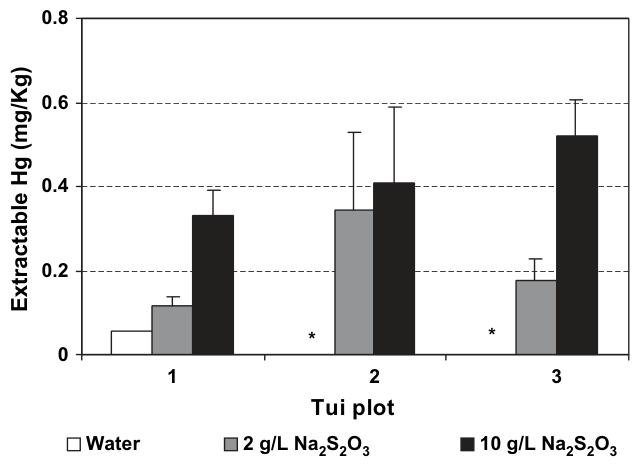
The results for the field experiment conducted at the three plots are described in Fig. 5 and Table 2. The addition of Na2S2O3 to substrates enhanced Hg solubility, leading to increased Hg accumulation in roots and shoots of B. juncea. The extractable Hg concentration rose proportionally to increasing concentrations of Na2S2O3 added to the substrates (Fig. 5). The thiosulphate treatment induced a significant increase in root and shoot Hg concentrations relative to control plants, which had shoot and root Hg values below detection levels. Root Hg concentrations between the plot locations ranged from 9.02 G0.8 to 17.07 G2.7 mg/kg for Na2S2O3-treated plants. Mercury concentrations in shoots of B. juncea were higher in plot number 2, where the assayed value averaged 9.77 G1.2 mg/kg (Table 2). For plot number 3, the average Hg value for shoots was unexpectedly low (2.99 G0.7 mg/kg) despite the elevated levels of soluble Hg recorded in the Na2S2O3 extracts. The fact that the Hg content of roots was greater than shoots for all tested plots indicates that application of Na2S2O3 to substrates increased the retention of Hg by the root tissues. This trend was particularly evident for plot number 3, where the roots accumulated almost 6 times more Hg than the shoots.
在3个小区开展的田间试验结果见图5和表2。向基质中添加Na2S2O3提高了Hg的溶解度,从而增加了B. juncea根系和地上部的Hg积累。可提取态Hg浓度随基质中Na2S2O3添加浓度的增加而成比例升高(图5)。与对照植株相比,硫代硫酸盐处理显著提高了根系和地上部的Hg浓度,对照植株地上部和根系的Hg值均低于检出限。各小区Na2S2O3处理植株的根系Hg浓度为9.02 ± 0.8至17.07 ± 2.7 mg/kg。B. juncea地上部汞浓度以2号小区最高,测定均值为9.77 ± 1.2 mg/kg(表2)。3号小区尽管Na2S2O3提取液中可溶性Hg水平较高,但地上部Hg均值却出乎意料地低(2.99 ± 0.7 mg/kg)。所有试验小区根系Hg含量均高于地上部,表明向基质施加Na2S2O3增加了根系组织对Hg的滞留。这一趋势在3号小区尤为明显,其根系积累的Hg几乎是地上部的6倍。
![Fig. 4. Mercury Distribution in the air-plant-soil system after application of ammonium thiosulphate ([NH4]2S2O3) at 1 g/kg to Tui mine tailings. Normalized values (100%) represent the Hg mass in substrate, plant and aci](42/figure-04.jpg)
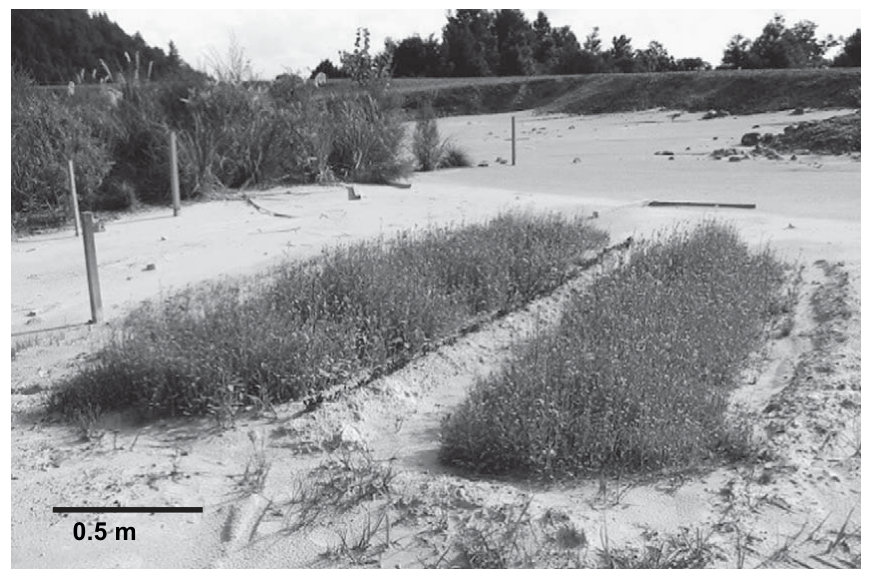
The phytotoxic conditions that prevail in the substrates of the Tui base metal mine did not prevent plant growth, as average plant height on site was around 25 cm (Fig. 6). One week after treatment with sodium thisosulphate solutions, however, phytotoxic symptoms (e.g., wilting and chlorosis) were evident. Estimates of biomass production indicated a maximum dry matter yield of around 2.5 tonnes per hectare. Considering that plants on site had a relatively short growing season (6 weeks) and that the sulphide-rich tailings of the Tui mine exhibit high levels of the toxic metals Zn, Cu, Mn, Pb and Ag (Morrell et al., 1996), the low levels of plant biomass production on this site are unsurprising. As a result, Hg-extraction yields were also low. Due to its highest biomass production and shoot Hg concentration, the maximum Hg-extraction yield was achieved at plot number 2 with an average value of 24.3 G 3.1 g/ha (Table 2). This Hg-extraction yield was over 30 times the maximum yield obtained for Hordeum vulgare (barley), which extracted 0.71 g Hg/ha from an Hg-contaminated site in Almaden, Spain (Rodriguez et al., 2003).
Tui贱金属矿基质中普遍存在的植物毒性条件并未阻止植物生长,现场植株平均高度约为25 cm(图6)。然而,施用硫代硫酸钠溶液一周后,植物毒害症状(如萎蔫和褪绿)明显。生物量估算表明,最大干物质产量约为2.5 t/ha。考虑到现场植株生长季相对较短(6周),且Tui矿富含硫化物的尾矿中有毒金属Zn、Cu、Mn、Pb和Ag含量较高(Morrell et al., 1996),该场地植物生物量产量较低并不意外。因此,Hg提取量也较低。由于2号小区的生物量产量和地上部Hg浓度均最高,最大Hg提取量出现在该小区,平均值为24.3 ± 3.1 g/ha(表2)。该Hg提取量是Hordeum vulgare(大麦)最大提取量的30倍以上,后者在西班牙Almaden一处Hg污染场地的提取量为0.71 g Hg/ha(Rodriguez et al., 2003)。
4Discussion讨论
4.1. Speciation and possible origin of volatile Hg released from barren and planted substrates
4.1. 裸露基质和种植基质释放的挥发性Hg的形态及可能来源
The quantitative capture of volatile Hg in the potassium permanganate solution under acid conditions can be written by the following equation:
酸性条件下高锰酸钾溶液对挥发性Hg的定量捕集可用下式表示:

Since elemental Hg (0) is oxidized by potassium permanganate, then we would presume that the predominant Hg form released from barren and planted substrates was the inorganic vapour Hg (0). This statement can be validated by early gastight volatilisation experiments with B. juncea plants grown in Hg-spiked solutions containing 1 mg/L of Hg (Moreno et al., 2004b). Potassium permanganate and carbonate-phosphate solutions were used for trapping plant-released inorganic and organic vapours, respectively. Mercury recovery averaged around 90% of the initial Hg mass added to the plant solution (traps C plant tissues C solutions). However, Hg values in the carbonatephosphate traps were below detection levels (Moreno et al., 2004b).
由于单质Hg (0)可被高锰酸钾氧化,我们推测裸露基质和种植基质释放的主要Hg形态为无机蒸气Hg (0)。这一推断可由早期的气密挥发试验加以验证,该试验中B. juncea植株生长于含1 mg/L Hg的加标溶液中(Moreno et al., 2004b)。分别使用高锰酸钾溶液和碳酸盐-磷酸盐溶液捕集植物释放的无机和有机蒸气。汞回收率平均约为加入植物溶液的初始Hg质量的90%(吸收瓶 + 植物组织 + 溶液)。然而,碳酸盐-磷酸盐吸收瓶中的Hg值低于检出限(Moreno et al., 2004b)。
The Hg volatilisation from Tui mine tailings (as shown for control pots, Fig. 3A) may be the result of on site biological and sunlight-mediated reduction of Hg (see Morel et al., 1998 for a detailed explanation on Hg photoreduction). The role of bacteria on Hg volatilisation from Hg-contaminated environments has been well documented (Barkay, 1987; Barkay et al., 1991; Barkay et al., 1992; Saouter et al., 1994). The enzymatic reduction of Hg (II) to Hg (0) is carried out by Hg-resistant bacteria (both gram positive and negative) via a flavin-containing disulfide oxireductase known as mercuric reductase (MR):
Tui矿尾矿的Hg挥发(如对照盆所示,图3A)可能是现场生物还原和日光介导的Hg还原的结果(关于Hg光还原的详细解释参见Morel et al., 1998)。细菌在Hg污染环境Hg挥发中的作用已有充分记载(Barkay, 1987; Barkay et al., 1991; Barkay et al., 1992; Saouter et al., 1994)。Hg (II)至Hg (0)的酶促还原由耐Hg细菌(革兰氏阳性菌和阴性菌)通过一种含黄素的二硫化物氧化还原酶——汞还原酶(MR)完成:
Phytoextraction results for the Tui mine tailings after application of sodium thiosulphate (Na2S2O3) at 5 g/kg (unless otherwise stated) to Tui tailings field plots*
向Tui尾矿田间小区施加5 g/kg硫代硫酸钠(Na2S2O3)(另有说明者除外)后Tui矿尾矿的植物提取结果*
| Tui PlotTui小区 | Root Hg根系Hg | Shoot Hg地上部Hg | Harvested biomass收获生物量 | Equivalent折算值 | Hg ExtractionHg提取量 |
|---|---|---|---|---|---|
| (mg/kg DW) | (mg/kg DW) | (kg, DW) | Biomass (t/ha)a | yield (g/ha)b | |
| 1c | 9.02G0.8 | 2.99G0.5 | 0.19 | 0.38 | 1.14G0.2 |
| 2 | 15.39G2.1 | 9.77G1.2 | 1.24 | 2.49 | 24.39G3.1 |
| 3 | 17.07G2.7 | 2.93G0.7 | 1.16 | 2.33 | 6.84G1.7 |
* Values are the mean G1 standard deviation from 5 replicates (1 replicateZ0.1 g of ground roots and shoots digested in 15 ml HNO3, See material and methods section). a Calculated on a basis of 5 m2 area for each plot. b Hg values for extraction yields (g/ha) are the product of shoot Hg concentrations (mg/kg DW) and equivalent plant biomass production (t/ha). c Na2S2O3 applied at 2.5 g/kg.
* 数值为5次重复的均值±1标准差(1个重复 = 0.1 g粉碎的根系和地上部样品,用15 ml HNO3消解,见材料与方法部分)。a 按每个小区5 m2面积计算。b 提取量的Hg值(g/ha)为地上部Hg浓度(mg/kg DW)与折算植物生物量产量(t/ha)之积。c Na2S2O3施用量为2.5 g/kg。

The MR removes Hg from stable thiol salts (Hg[SR]2) by electrochemical reduction in a NADPH-coupled redox reaction (Eq. (1)). The resulting Hg (0) is rather volatile [Henry’s constant (H)Z0.3] and escapes from the organism (Barkay et al., 1992). This strategy has been shown to be an effective solution to bacterial Hg-exposure, as Hg (0) is less toxic than methylmercury compounds (Meagher et al., 2000). The fact that planted substrates volatilised more Hg than the barren pots (Fig. 3A) indicates that there is a plant-mediated factor in the Hg volatilisation from substrates. The enhanced plant Hg (0) emissions may have occurred from both roots and shoots of B. juncea. Root-induced Hg volatilisation could be the result of biological Hg reduction carried out by Hg-resistant bacteria living at the rhizosphere or inside the roots. Experiments with B. juncea plants grown in Hg-containing solutions have shown that around 95% of the total Hg mass volatilised from the plant was originated from the root compartment, thus implicating the role of rhizosphere processes in the plant-Hg volatilisation (Moreno et al., 2004b). Alternatively, a small fraction of volatile Hg might have been emitted through open stomata located in the mesophyll cell surfaces of foliar tissues (Gustin et al., 1997; Leonard et al., 1998). Lindberg et al. (1998) suggested that a gaseous Hg (0) pool in soil pores could originate from abiotic and biotic reduction of Hg (II) compounds. The measured levels of gaseous Hg (0) in this pool (on the order of 200 ng Hg/m3) indicate that Hg (0) can be found dissolved in the soil water. Dissolved Hg (0) could, therefore, be taken up in the transpiration stream and subsequently transported to leaves where it may be released as a gas along with water vapour.
MR通过NADPH耦合的氧化还原反应,以电化学还原方式将Hg从稳定的硫醇盐(Hg[SR]2)中移除(式1)。生成的Hg (0)挥发性较强[亨利常数(H)= 0.3],可从生物体中逸出(Barkay et al., 1992)。由于Hg (0)的毒性低于甲基汞化合物,这一策略已被证明是细菌应对Hg暴露的有效方式(Meagher et al., 2000)。种植基质比裸盆挥发更多Hg(图3A),表明基质Hg挥发中存在植物介导的因素。植物Hg (0)排放的增强可能来自B. juncea的根系和地上部。根系诱导的Hg挥发可能是生活在根际或根内的耐Hg细菌进行生物还原的结果。在含Hg溶液中生长的B. juncea植株试验表明,植物挥发的总Hg质量中约95%来源于根系分室,这说明根际过程在植物-Hg挥发中发挥作用(Moreno et al., 2004b)。另一方面,一小部分挥发性Hg可能经叶片组织叶肉细胞表面的开放气孔释放(Gustin et al., 1997; Leonard et al., 1998)。Lindberg et al. (1998)认为,土壤孔隙中的气态Hg (0)库可能源于Hg (II)化合物的非生物和生物还原。该库中测得的气态Hg (0)水平(约200 ng Hg/m3)表明,Hg (0)可溶解于土壤水中。因此,溶解态Hg (0)可能随蒸腾流被吸收,并随后运输至叶片,在叶片中与水蒸气一同以气体形式释放。
4.2. Mercury uptake versus volatilisation4.2. 汞吸收与挥发
The high sulphide content and the presence of sulphide-bearing minerals in the Tui ore indicates that a fraction of Hg in the tailings may be present as sulphides such as cinnanbar (HgS), Hg polysulfides or Hg associated with iron sulphides (Moreno et al., 2004a). These Hg forms are insoluble, and thus, they are said to be relatively unavailable for chemical and biological transformations (Kabata-Pendias and Pendias, 2000). However, extractability studies showed the presence of significant amounts of Hg in the water extractable fraction of Tui mine tailings (Moreno et al., 2004a). We hypothesize that the water-soluble Hg fraction of Tui tailings constitutes the available Hg pool for both plant uptake and biological transformations. Geochemical conditions in the tailings profile (e.g. acid mine drainage) oxidised sulfidic Hg minerals such as cinnabar (Morrell et al., 1996), thus releasing Hg (II) ions to this pool.
Tui矿石中硫化物含量高且含有含硫化物矿物,表明尾矿中部分Hg可能以辰砂(HgS)、Hg多硫化物等硫化物形式存在,或与铁硫化物结合(Moreno et al., 2004a)。这些Hg形态不溶,因而被认为相对不易参与化学和生物转化(Kabata-Pendias and Pendias, 2000)。然而,可提取性研究表明,Tui矿尾矿的水溶态组分中存在大量Hg(Moreno et al., 2004a)。我们假设,Tui尾矿中的水溶态Hg组分构成了可供植物吸收和生物转化的有效Hg库。尾矿剖面中的地球化学条件(如酸性矿山排水)氧化了辰砂等硫化汞矿物(Morrell et al., 1996),从而向该库释放Hg (II)离子。
According to Duckart et al. (1992), when plant roots and microorganisms compete for the same pool of available selenium (Se) the rates of microbial transformation and plant uptake become dependent processes. When Se was added to the soil in the form of readily plant-available Na2SeO4, enhanced uptake of the metalloid by plants depleted the pool of soluble Se available for microbial Se volatilisation. In our experiments the addition of 1 g/kg of (NH4)2S2O3 mobilised the sulfidic-extractable Hg pool and enhanced plant Hg uptake and translocation to the detriment of volatilisation rates. The fact that water-treated plants did not change the sulfidic Hg fraction in substrates towards the end of the experiment (Table 1) indicates that the waterextractable Hg fraction is a common pool for both plant uptake and Hg volatilisation processes. Therefore, it is possible to conclude that addition of (NH4)2S2O3 may have altered the Hg volatilisation pathway in Tui tailings to the extent that the Hg mass taken up by plants exceeded the volatile Hg mass produced by biological transformations.
Duckart et al. (1992)指出,当植物根系与微生物竞争同一有效硒(Se)库时,微生物转化速率与植物吸收成为相互依赖的过程。当以植物易吸收的Na2SeO4形式向土壤添加Se时,植物对该类金属吸收的增强耗竭了可供微生物挥发Se的可溶性Se库。在本试验中,添加1 g/kg (NH4)2S2O3活化了硫化物结合的可提取态Hg库,增强了植物对Hg的吸收和转运,但降低了挥发速率。水处理植株在试验末期并未改变基质中硫化物结合态Hg组分(表1),这表明水溶态Hg组分是植物吸收和Hg挥发过程的共同库。因此可以得出结论:添加(NH4)2S2O3可能改变了Tui尾矿中的Hg挥发途径,以致植物吸收的Hg质量超过了生物转化产生的挥发性Hg质量。
4.3. Mass balance calculations4.3. 质量平衡计算
Results from the thiosulphate-induced plant-Hg accumulation experiments described in this paper indicate that Hg removal from the Tui mine tailings can be accomplished by both phytoextraction and volatilisation. Using the highest values for biomass production and plant-Hg accumulation following application of Na2S2O3 on site, the maximum Hg phytoextraction yield averaged around 25g Hg/ha (Table 2). However, since Hg volatilisation spontaneously occurs from the plant-soil system before and after amendment of the Tui substrate, we estimated the mass of Hg emitted to the atmosphere by B. juncea plants grown on site. Assuming an average volatilisation rate of 5.5 mg Hg/kg of plant tissue per day (Fig. 3B) and an average biomass of 2.5 tonnes (Table 2), then around 14 g Hg/ha were daily emitted to the atmosphere of the Tui mine site before the application of thiosulphate. Assuming that these Hg emissions happened over a 30-day period, then, by extrapolation, an equivalent value of at least 420 g Hg/ha were emitted to the atmosphere of Tui mine tailings during the experimental period. If we include the plant-Hg volatilisation rates after the amendment was applied to the substrate (mean of 1.2 mg Hg/kg plant tissue per day), then the total value increases to 500 g Hg/ha. Assuming that the site supports three growing seasons per year, the Hg emissions caused by the plants (Fig. 3A) would represent an efflux rate of 1.5 kg of Hg per year to the atmosphere. Considering that the Tui area contains 364 kg of Hg in 100 000 m3 of tailings, then it would take around 243 years to clean up the whole area through plant-enhanced Hg volatilisation. However, because the active zone for nutrient uptake is limited by root growth and B. juncea roots extends not below 0.5 m depth, plants will only remediate surface soils. If we assume a total Hg mass of 20 kg in the 0e0.5 m depth profile of the Tui mine, then is feasible that plants will remove most of the Hg mass in the 50 cm of the tailings in less than 15 years.
本文所述硫代硫酸盐诱导植物-Hg积累试验的结果表明,Tui矿尾矿中Hg的去除可通过植物提取和挥发两种方式实现。采用现场施加Na2S2O3后生物量产量和植物-Hg积累的最高值,最大Hg植物提取量平均约为25 g Hg/ha(表2)。然而,由于在Tui基质改良前后植物-土壤系统均会自发发生Hg挥发,我们估算了现场生长的B. juncea植株向大气排放的Hg质量。假设平均挥发速率为每kg植物组织每天5.5 mg Hg(图3B),平均生物量为2.5 t(表2),则在施加硫代硫酸盐之前,Tui矿区每天约有14 g Hg/ha排放至大气。假设这些Hg排放持续30天,则外推可得试验期间Tui矿尾矿至少有相当于420 g Hg/ha的Hg排放至大气。若计入基质改良后的植物-Hg挥发速率(平均每kg植物组织每天1.2 mg Hg),则总量增至500 g Hg/ha。假设该场地每年可支持3个生长季,则植物引起的Hg排放(图3A)相当于每年向大气排放1.5 kg Hg。考虑到Tui地区100 000 m3尾矿中含有364 kg Hg,通过植物增强Hg挥发清理整个区域约需243年。然而,由于养分吸收的活跃区受根系生长限制,且B. juncea根系延伸深度不超过0.5 m,植物只能修复表层土壤。若假设Tui矿0–0.5 m深度剖面中总Hg质量为20 kg,则植物有望在15年内去除尾矿表层50 cm中的大部分Hg。
4.4. Considerations about the environmental impacts of plant Hg (0) emissions
4.4. 植物Hg (0)排放环境影响的考量
Given the fact that B. juncea plants volatilise significant amounts of Hg (0) to the air, the implementation of a phytoremediation system would require a rigorous assessment of the impacts of this technology. The main concern would be, therefore, related to the risks of Hg (0) exposure to the human population. However, to pose a significant risk to humans the level of atmospheric Hg (0) in the first 1 to 1.5 m above the revegetated area at the Tui site would have to be above the threshold limit value (TLV) for Hg vapour inhalation (1 mg/m3) (World Health Organization, 1976). Since Hg atmospheric levels are not available for comparison purposes, we will address this issue reporting 0.01 mg/m3 as the value for Hg (0) atmospheric levels in the Tui non-vegetated area (Lindberg et al., 1995). This is the maximum Hg level found in the first 1 to 1.5 m above the soil of an Hg-contaminated site in Oak Ridge, TN (US), which contains 80 000 kg of Hg in a 250 ha area (Meagher et al., 2000). Assuming that Hg emissions would be expected to increase by a factor of 23 due to the on site presence of B. juncea plants (Fig. 3A), the resulting Hg atmospheric levels would be still 4 times below the TLV value for Hg (0) exposure. It is, thus, very unlikely that the Te Aroha population would experience adverse health effects due to Hg vapours emitted from a Hg-phytoremediation operation at the Tui mine tailings.
鉴于B. juncea植株向大气挥发大量Hg (0),实施植物修复系统需要对该技术的影响进行严格评估。因此,主要关注点在于人群暴露于Hg (0)的风险。然而,要对人类构成显著风险,Tui场地植被恢复区上方1–1.5 m范围内的大气Hg (0)水平必须高于Hg蒸气吸入的阈限值(TLV)(1 mg/m3)(World Health Organization, 1976)。由于缺乏可供比较的Hg大气水平数据,我们以0.01 mg/m3作为Tui无植被区的大气Hg (0)水平来讨论该问题(Lindberg et al., 1995)。这是美国田纳西州Oak Ridge一处Hg污染场地土壤上方1–1.5 m范围内测得的最高Hg水平,该场地250 ha范围内含有80 000 kg Hg(Meagher et al., 2000)。假设现场种植B. juncea植株使Hg排放增加23倍(图3A),所得大气Hg水平仍比Hg (0)暴露的TLV值低4倍。因此,Te Aroha居民因Tui矿尾矿Hg植物修复工程排放的Hg蒸气而遭受健康不良影响的可能性极小。
Transgenic MerA-Tobacco plants were tested for their phytoremediation potential in Hg (II)-spiked soils (Heaton et al., 1998). These plants can transform rootavailable Hg (II) to the less toxic Hg (0), therefore, volatilising it to the atmosphere. Estimates of the volatilisation capacity suggest MerA-expressing transgenic plants could increase 400-fold the spontaneous Hg efflux rates from an Hg-contaminated site. After careful consideration of the processes that govern the Hg (0) mass distribution between the atmosphere, soil and water compartments, the authors concluded that the release of Hg (0) by transgenic plants would have little global impact if this technology is applied to all available Hg-contaminated sites in the US (Meagher et al., 2000).
已有研究在Hg (II)加标土壤中测试了转基因MerA烟草植株的植物修复潜力(Heaton et al., 1998)。这些植物可将根系可利用的Hg (II)转化为毒性较低的Hg (0),进而将其挥发至大气。对挥发能力的估算表明,表达MerA的转基因植物可使Hg污染场地的自发Hg通量提高400倍。在仔细考量控制Hg (0)质量在大气、土壤和水体各分室间分布的过程之后,作者得出结论:即使将该技术应用于美国所有Hg污染场地,转基因植物释放的Hg (0)对全球的影响也很小(Meagher et al., 2000)。
Due to the fact that Hg volatilisation from plants can actively contribute to the natural Hg emissions to the atmosphere, critics could agree that volatilisation makes questionable the use of plant-based systems for the remediation of Hg-contaminated sites. Therefore, an assessment of the regional environmental impacts of this technology would be required prior to its systematic implementation in the field. If we target the Hg mass contained in 0e0.5 m depth profile of the Tui mine and assume that 100% of this Hg is released as Hg (0), then over the next 15 years 22.5 kg will be emitted to the global Hg atmospheric pool. Considering that Hg world emissions from the plant kingdom can reach between 850 to 2000!103 kg of Hg per year (Lindberg et al., 1998) and that small-scale gold mining in South America, Russia and Asia can contribute with another 450!103 kg Hg per year (Lacerda, 2003), the Hg mass emitted by B. juncea plants at the Tui site (1.5 kg per year) would have an insignificant impact on this total. Additionally, in some circumstances volatilisation may present some environmental advantages over thioligandinduced phytoextraction. For instance, it minimizes the potential for biomagnification, as Hg volatilised from plant tissues would not represent an exposure route to wildlife (Heaton et al., 1998). Also, unlike chelateenhanced phytoextraction, volatilisation avoids the risk of ground water contamination by mobilised Hg. The Hg concentration in leachates has been shown to rise up to 4 fold after (NH4)2S2O3 amendment to planted Tui mine tailings (Moreno et al., 2004a).
由于植物Hg挥发会对大气自然Hg排放产生实际贡献,批评者可能认为挥发使利用植物系统修复Hg污染场地的做法值得商榷。因此,在田间系统实施该技术之前,需要评估其区域环境影响。若以Tui矿0–0.5 m深度剖面所含的Hg质量为目标,并假设其中100%以Hg (0)形式释放,则未来15年内将有22.5 kg Hg排放至全球大气Hg库。考虑到全球植物界的Hg排放每年可达850–2000 × 103 kg Hg(Lindberg et al., 1998),而南美、俄罗斯和亚洲的小规模金矿开采每年另可贡献450 × 103 kg Hg(Lacerda, 2003),Tui场地B. juncea植株排放的Hg质量(每年1.5 kg)对这一总量的影响微不足道。此外,在某些情况下,与硫配体诱导的植物提取相比,挥发可能具有一定的环境优势。例如,它可将生物放大的可能性降至最低,因为从植物组织挥发的Hg不会构成野生动物的暴露途径(Heaton et al., 1998)。同时,与螯合剂强化植物提取不同,挥发避免了被活化的Hg污染地下水的风险。已有研究表明,向种植的Tui矿尾矿施加(NH4)2S2O3后,渗滤液中的Hg浓度最高可升至原来的4倍(Moreno et al., 2004a)。
4.5. Fate of plant-Hg (0) emissions in the North Island of New Zealand
4.5. 新西兰北岛植物Hg (0)排放的归宿
Once emitted to the atmosphere, Hg (0) is partitioned between vapour and particulate forms, which have a mean residence time of 233 and 30 days, respectively (Kvietkus and Sakalys, 2001). However, meteorological factors such as rain and snow-fall, and prevailing winds can accelerate the rate of deposition of both vapour and particulate Hg to the ground. Therefore, it is possible to speculate that the high rainfall regimes at the township of Te Aroha (around 1460 mm/year) (NZMS, 1983), and the predominance of westerly winds in the region, would enhance the Hg deposition rates over the Coromandel Peninsula and the Bay of Plenty, both coastal areas of the North Island of New Zealand. The 1.5 kg of Hg annually redeposited over the next 15 years would be diluted over a much larger area in surface soils and waters. Redeposition would have minimal regional impact as the mass of Hg in the soil and water compartments are several orders of magnitude greater than the global atmospheric Hg pool, which has been estimated to be about 1!106 kg (Nriagu, 1979). For instance, investigations carried out in the waters that cover the aquatic system of the Taupo Volcanic Zone (TVZ), in the North Island of New Zealand, revealed high levels of Hg, As and other elements. The source of this contamination is either from naturally occurring geothermal discharges or from geothermal power stations. However, research should be carried out to verify the reactivity of plant-emitted Hg and the potential for methyl mercury formation in the coastal areas of the North Island of New Zealand. It is known that some lakes and river waters of the TVZ contain Hg levels that exceed the background level for surface waters and that trout fish collected from lake Rotorua have flesh methylmercury concentrations above WHO limits for Hg (0.5 mg/g DW) (Robinson, 1994).
Hg (0) 一旦排放到大气中,即分配为蒸气态和颗粒态两种形态,其平均停留时间分别为233 d和30 d(Kvietkus and Sakalys, 2001)。然而,降雨、降雪及盛行风等气象因素可加快蒸气态和颗粒态Hg向地面的沉降速率。因此可以推测,Te Aroha镇的高降雨量(约1460 mm/年)(NZMS, 1983)以及该地区以西风为主的风向,将提高Hg在Coromandel半岛和丰盛湾(Bay of Plenty)的沉降速率,这两处均为新西兰北岛的沿海地区。今后15年内每年重新沉降的1.5 kg Hg将在更大范围的表层土壤和水体中被稀释。由于土壤和水体中的Hg质量比全球大气Hg库(估计约为1×10⁶ kg)(Nriagu, 1979)高出数个数量级,重新沉降对区域的影响甚微。例如,对新西兰北岛陶波火山带(TVZ)水生系统水体开展的调查表明,其中Hg、As及其他元素含量较高。这种污染或来源于天然地热排放,或来源于地热发电站。然而,仍应开展研究,以查明植物排放Hg的反应活性及其在新西兰北岛沿海地区形成甲基汞的可能性。已知TVZ部分湖泊和河流水体中的Hg含量超过地表水背景值,且采自Rotorua湖的鳟鱼肌肉中甲基汞浓度超过WHO的Hg限值(0.5 mg/g DW)(Robinson, 1994)。
5Conclusions结论
The primary goal of the research was to study the accumulation of Hg into aboveground plant tissues via thiosulphate-induced Hg solubilization of Tui mine tailings. Application of sodium thiosulphate (Na2S2O3) effectively induced Hg root uptake and shoot translocation in B. juncea plants grown in the field. The maximum extraction yield was around 25 g Hg/ha. Volatilisation studies demonstrated that Hg in Tui tailings is transformed to Hg (0) and that plants significantly enhanced this process. Mass balance calculations revealed that Hg volatilisation removed around 500 g Hg/ha during the experimental period. This value accounts for 95% of the total Hg mass removed from the Tui mine tailings and, thus Hg volatilisation is the dominant Hg removal pathway for the Tui tailings. A preliminary assessment indicated the risk of Hg volatilisation to the local and regional environment is minimal. However, there is a risk that Hg emitted by plants could be deposited in regional aquatic systems and further biomagnified in the ecological food chain.
本研究的主要目的是通过硫代硫酸盐诱导Tui尾矿中Hg的溶解,研究Hg在植物地上部组织中的积累。施用硫代硫酸钠(Na2S2O3)可有效促进田间种植的B. juncea对Hg的根系吸收及向地上部的转运。最大提取量约为25 g Hg/ha。挥发研究表明,Tui尾矿中的Hg可转化为Hg (0),且植物显著促进了这一过程。质量平衡计算表明,试验期间Hg挥发去除了约500 g Hg/ha,占Tui尾矿Hg去除总量的95%,因此Hg挥发是Tui尾矿中Hg去除的主要途径。初步评估表明,Hg挥发对局地及区域环境的风险很小。然而,植物排放的Hg存在沉降至区域水生系统并在生态食物链中进一步生物放大的风险。
There are environmental and economical advantages that favour volatilisation over thioligand Hg-phytoextraction. For instance, (1) volatilisation can remove Hg from substrates without the help of solubilising agents; (2) The plant-mediated Hg (0) reduction pathway substantially reduces the potential for Hg biomagnification, as Hg volatilised from plant tissues would not represent an exposure route of Hg to wildlife; (3) The cost of the remediation operation would be reduced as plant-mediated Hg (0) volatilisation would not require chemical amendments and site maintenance (harvesting); (4) There are no costs involved in transport and processing of the Hg-rich biomass, since Hg is not accumulated in shoot tissues. Finally, the environmental costs of atmospheric Hg (0) emissions from plants could be offset by the absence of Hg-containing leachates generated as a by-product of the induced plant-Hg accumulation strategy. However, the suitability of phytoremediation for cleaning up of Hg from Tui mine tailings should be compared with other existing technologies. The environmental impacts of this technology should be the subject of discussion between researchers, environmental professionals, and the community before implementation in the field.
与硫配体诱导的Hg植物提取相比,挥发在环境和经济方面均具有优势。例如:(1)挥发无需借助增溶剂即可从基质中去除Hg;(2)植物介导的Hg (0) 还原途径大大降低了Hg生物放大的可能性,因为从植物组织中挥发的Hg不会构成野生动物的Hg暴露途径;(3)植物介导的Hg (0) 挥发无需化学改良剂和场地维护(收割),可降低修复成本;(4)由于Hg不在地上部组织中积累,不涉及富Hg生物量的运输和处理费用。最后,植物向大气排放Hg (0) 的环境代价,可由不产生诱导植物积累Hg策略所伴生的含Hg淋溶液而得到抵消。然而,植物修复用于清除Tui尾矿中Hg的适用性,仍应与其他现有技术进行比较。在田间实施之前,该技术的环境影响应由研究人员、环境专业人员与社区共同讨论。
Acknowledgments致谢
We gratefully acknowledge the National Council for Scientific and Technological Development (CNPq/ Brazil) for providing a scholarship to the first author. We also thank M.B. Kirkham for the helpful comments on the manuscript.
感谢巴西国家科学技术发展委员会(CNPq/ Brazil)为第一作者提供奖学金。同时感谢M.B. Kirkham对本文稿提出的宝贵意见。
References参考文献
Barkay, T., 1987. Adaptation of aquatic microbial communities to Hg2C stress. Applied and Environmental Microbiology 53, 2725e2732.
Barkay, T., Turner, R.R., VandenBrook, A., Liebert, C., 1991. The relationship of Hg (II) volatilisation from a freshwater pond to the abundance of mer genes in the gene pool of the indigenous microbial community. Microbial Ecology 21, 151e161.
Barkay, T., Turner, R., Saouter, E., Horn, J., 1992. Mercury biotransformations and their potential for remediation of mercury contamination. Biodegradation 3, 147e159.
Bizily, S.P., Rugh, C.L., Summers, A.O., Meagher, R.B., 1999. Phytoremediation of methylmercury pollution: MerB expression in Arabdopsis thaliana confers resistance to organomercurials. Proceedings of the National Academy of Sciences (USA) 96, 6808e6813.
Choi, S.C., Chase, J.T., Bartha, R., 1994. Metabolic pathways leading to mercury methylation in Desulfovibrio desulfuricans LS. Applied and Environmental Microbiology 60, 4072e4077.
Duckart, E.C., Waldron, L.J., Donner, H.E., 1992. Selenium uptake and volatilisation from plants growing in soil. Soil Science 53 (2), 94e99.
Gustin, M.S., Taylor Jr., G.E., Maxey, R.A., 1997. Effect of temperature and air movement on the flux of elemental mercury from substrate to atmosphere. Journal of Geophysical Research 102, 3891e3898.
Heaton, A.C.P., Rugh, C.L., Wang, N.J., Meagher, R.B., 1998. Phytoremediation of mercury- and methylmercury-polluted soils using genetically engineered plants. Journal of Soil Contamination 7 (4), 497e509.
Hinton, J.J., Veiga, M.M., 2001. Mercury contaminated sites: a review of remedial solutions. In: Proceedings of the National Institute for Minamata Disease Forum (NIMD), Minamata, Japan, March 19e20.
Hoagland, D.R., Arnon, D.I., 1950. The water culture method of growing plants without soil. California Agriculture Experimental Station, Circular 347.
Kabata-Pendias, A., Pendias, H., 2000. Trace Elements in Soils and Plants. CRC Press, Florida, USA, 413 pp.
Kimura, Y., Miller, V.L., 1960. Vapor phase separation of methyl or ethylmercury compounds and metallic mercury. Analytical Chemistry 32, 420e424.
Kirkham, M.B., 1977. Trace elements in sludge on land: effects on plants, soils, and ground water. In: Loehr, R.C. (Ed.), Land as a Waste Management Alternative. Ann Arbor Science, MI, USA, pp. 209e247.
Kvietkus, K., Sakalys, J., 2001. Lifetime of gaseous and particulate mercury in the atmosphere. Proceedings of the 6th International Conference on Mercury as a Global Pollutant. Minamata, Japan, October 15e19 (Abstract).
Lacerda, L.D., 2003. Updating global Hg emissions from small-scale gold mining and assessing its environmental impacts. Environmental Geology 43 (3), 308e314.
Leonard, T.L., Taylor, G.E., Gustin, M.S., Fernandez, G.C.J., 1998. Mercury and plants in contaminated soils: 1. Uptake, partitioning, and emission to the atmosphere. Environmental Toxicology and Chemistry 17 (10), 2063e2071.
Lindberg, S.E., Kim, K.H., Munthe, J., 1995. The precise measurement of concentration gradients of mercury in air over soils: a review of past and recent measurements. Water, Air, and Soil Pollution 80, 383e392.
Lindberg, S.E., Hanson, P.J., Meyers, T.P., Kim, K.H., 1998. Air/ exchange of mercury vapour over forests e the need for a reassessment of continental biogenic emissions. Atmospheric Environment 32 (5), 895e908.
Meagher, R.B., Rugh, C.L., Kandasamy, M.K., Gragson, G., Wang, N.J., 2000. Engineering phytoremediation of mercury pollution in soil and water using bacterial genes. In: Terry, N., Ban˜ uelos, G. (Eds.), Phytoremediation of Contaminated Soil and Water. Lewis Publishers, United States, pp. 201e219.
Moreno, F.N., Anderson, C.W.N., Stewart, R.B., Robinson, B.H., 2004a. Phytoremediation of mercury-contaminated mine tailings by induced plant-mercury accumulation. Environmental Practice 6 (2), 165e175.
Moreno, F.N., Anderson, C.W.N., Robinson, B.H., Stewart, R.B., 2004b. Measuring volatile Hg released from plants. In: Currie, L.D., Hanly, J.A. (Eds.), Tools for Nutrient and Pollutant Management: Applications to Agriculture and Environmental Quality. Occasional Report No.17. Fertilizer and Lime Research Centre, Palmerston North, New Zealand, pp. 233e240.
Moreno, F.N., Anderson, C.W.N., Robinson, B.H., Stewart, R.B., 2004c. Mercury analysis of plant and soil samples using the hydride-generation AAS method. In: Currie, L.D., Hanly, J.A. (Eds.), Tools for Nutrient and Pollutant Management: Applications to Agriculture and Environmental Quality. Occasional Report No.17. Fertilizer and Lime Research Centre, Palmerston North, New Zealand, pp. 425e433.
Morrell, W.J., Stewart, R.B., Gregg, P.E.H., Bolan, N.S., Horne, D., 1996. An assessment of sulfide oxidation in abandoned base-metal tailings, Te Aroha, New Zealand. Environmental Pollution 94 (2), 2176e2225.
Morel, F.M.M., Kraepiel, A.M.L., Amyot, M., 1998. The chemical cycle and bioaccumulation of mercury. Annual Reviews in Ecological Systems 29, 543e566.
Nriagu, J.O., 1979. The Biogeochemistry of Mercury in the Environment. Elsevier, New York, pp. 23e41.
NZMS, 1983. Summaries of climatological observations to 1980. New Zealand Meteorological Service, Wellington, New Zealand.
Pacyna, E.G., Pacyna, J.M., Pirrone, N., 2001. Atmosphere mercury emissions from anthropogenic sources in Europe. In: Proceedings of the 6th International Conference on Mercury as a Global Pollutant. Minamata, Japan, October 15e19 (Abstract).
Raskin, I., Kumar, N.P.B.A., Dushenkov, S., Salt, D.E., 1994. Bioconcentration of heavy metals by plants. Current Opinions in Biotechnology 5, 285e290.
Robinson, B.H., 1994. Pollution of the Aquatic Biosphere by Arsenic and other elements in the Taupo Volcanic Zone. Master thesis, Massey University, Palmerston North, New Zealand, 127 pp.
Robinson, B.H., Leblanc, M., Petit, D., Brooks, R.R., Kirkman, J.H., Gregg, P.E.H., 1998. The potential of Thlaspi caerulencens for phytoremediation of contaminated soils. Plant and Soil 203, 47e56.
Rodriguez, L., Lopez-Bellido, F.J., Carnicer, A., Alcade-Morano, V., 2003. Phytoremediation of Hg-polluted soils using crop plants. Fresenius Environmental Bulletin 12 (9), 967e971.
Rugh, C.L., Wilde, H.D., Stacks, N.M., Thompson, D.M., Summers, A.O., Meagher, R.B., 1996. Mercury ion reduction and resistance in transgenic Arabdopsis thaliana plants expressing a modified bacterial merA gene. Proceedings of the National Academy of Sciences (USA) 93, 3182e3187.
Saouter, E., Gillman, M., Turner, R., Barkay, T., 1994. Development and field validation of a microcosm to simulate the mercury cycle in a contaminated pond. Environmental Toxicology and Chemistry 14 (2), 69e77.
SAS Institute, Inc., 1988. SAS/STAT User’s Guide, Release 8e edition. Cary, NC.
Schnoor, J.L., Licht, L.A., McCutcheon, S.C., Wolfe, L.N., Carreira, L.H., 1995. Phytoremediation of organic and nutrient contaminants. Environmental Science and Technology 29 (7), 318e323A.
US Environmental Protection Agency, 2004. Mercury: Frequent Questions. US Environmental Protection Agency Web site, Washington, DC. !http://epa.gov/mercury/information1.htmO. Veiga, M.M., 2004. Mercury pollution: revealing sources and suggesting solutions. Environmental Practice 6 (2), 97e98.
Veiga, M.M., Hinton, J.J., 2002. Abandoned artisanal gold mines in the Brazilian Amazon: a legacy of mercury pollution. Natural Resources Forum 26, 15e26.
Weber, J.H., 1993. Review of possible paths for abiotic methylation of mercury (II) in the aquatic environment. Chemosphere 26 (11), 2063e2077.
Wilkinson, G., Gillard, R.D., McCleverty, J.A. (Eds.), 1987. Comprehensive Coordination Chemistry, vol. 2. Pergamon Press, UK, 1179 pp.
World Health Organization, 1976. Mercury: Environmental Health Criteria, vol. 1. World Health Organization, Geneva.