S. Mahimairaja,1,* N. S. Bolan,1 D. C. Adriano2 and B. Robinson3
1Institute of Natural Resources, Massey University, Palmerston North, New Zealand
2Savannah River Ecology Laboratory, The University of Georgia, Aiken, South Carolina 29802
3HortResearch, Palmerston North, New Zealand
I. Introduction
II. Origin and Sources of Arsenic Contamination
II. 砷污染的起源与来源
A. Geogenic
B . Anthropogenic
C. Biogenic Redistribution
III. Distribution and Speciation of Arsenic in the Environment
III. 环境中砷的分布与形态
A. Distribution in Soil
A. 土壤中的分布
B . Distribution in the Aquatic Environment
B. 水环境中的分布
C. Chemical Form and Speciation
C. 化学形态与形态分析
IV. Biogeochemistry of Arsenic in the Environment
IV. 环境中砷的生物地球化学
A. Biogeochemistry of Arsenic in the Soil
A. 土壤中砷的生物地球化学
B . Biogeochemistry of Arsenic in Aquatic Environments
B. 水环境中砷的生物地球化学
V. Bioavailability and Toxicity of Arsenic to Biota A. Toxicity to Plants and Microorganisms
V. 砷对生物的生物有效性与毒性 A. 对植物和微生物的毒性
B . Risk to Animals and Humans
B. 对动物和人类的风险
VI. Risk Management of Arsenic in Contaminated Environments A. Remediation of Arsenic-Contaminated Soil
VI. 污染环境中砷的风险管理 A. 砷污染土壤的修复
B . Removal of Arsenic from Aquatic Environments
B. 水环境中砷的去除
C. Multiscalar-Integrated Risk Management
C. 多尺度综合风险管理
VII. Summary and Future Research Needs Acknowledgments References
VII. 总结与未来研究需求 致谢 参考文献
Contamination of terrestrial and aquatic ecosystems by arsenic (As) is a very sensitive environmental issue due to its adverse impact on human health. Although not anthropogenic in origin, the problem of As contamination in
*Current address: Department of Environmental Sciences, Tamil Nadu Agricultural University, Coimbatore 641003, India.
groundwaters of West Bengal (India) and Bangladesh has been considered of calamitous proportion because significant segment of the population is at high risk, with untold numbers already suffering from irreversible effects of As poisoning. Elsewhere, indiscriminate disposal of industrial and mining wastes has led to extensive contamination of lands, thereby exacerbating the potential for food chain contamination. With greater public awareness of As poisoning in animal and human nutrition, there has been a growing interest in developing regulatory guidelines and remediation technologies for mitigating As-contaminated ecosystems. Although the immediate needs revolve around the stripping of As from domestic water supplies as exemplified by the affected areas in Bangladesh and West Bengal, a remediation scheme should also be explored to be able to cope with pivotal needs to abate the contamination of soils, sediments, and water and the potential to compromise the quality of the food chain. A range of technologies, including bioremediation, has been applied with varying levels of success either to remove As from the contaminated medium or to reduce its biotoxicity. This review provides general overview of the various biogeochemical processes that regulate As bioavailability to organisms, including microbes, plants, animals and humans. In turn, the role of the source term, chemical form, and chemical species of As are discussed as an overture to As bioavailability. Having laid the fundamental mechanisms and factors regulating As bioavailability, we then assembled the various physical, chemical, and biological mitigative methods that have been demonstrated, some being practical, highlighting their special strengths and potential for more effective and economical widespread applications. Because of the complexity involved in dealing with contaminated sites, exacerbated by site characteristics, nature of hydrogeology, source term, chemical form, land use, and so on, no one remedial technology might suffice. Therefore, we have attempted to offer an “integrated” approach of employing a combination of technologies at multiscalar levels, depending on extenuating circumstance, with the aim of securing viable methods, economically and technologically. Future research needs, especially in the area of As bioavailability and remediation strategies, are identified. � 2005, Elsevier Inc.
西孟加拉邦(印度)和孟加拉国地下水的砷污染问题已被视为一场灾难,因为相当大一部分人口处于高风险之中,且已有难以计数的人正遭受砷中毒不可逆转的影响。在其他地区,工业和采矿废弃物的随意处置已导致大面积土地污染,从而加剧了食物链受污染的可能性。随着公众对动物和人类营养中砷中毒问题认识的提高,制定监管准则和开发修复技术以治理砷污染生态系统日益受到关注。尽管当前的紧迫需求集中于去除生活供水中的砷(以孟加拉国和西孟加拉邦受影响地区为例),但也应探索相应的修复方案,以满足遏制土壤、沉积物和水体污染的关键需求,并应对其可能损害食物链质量的风险。包括生物修复在内的一系列技术已被应用,用于从污染介质中去除砷或降低其生物毒性,并取得了不同程度的成功。本综述概述了调控砷对微生物、植物、动物和人类等生物的生物有效性的各种生物地球化学过程。在此基础上,讨论了源项、化学形态和砷化学物种的作用,作为探讨砷生物有效性的铺垫。在阐明调控砷生物有效性的基本机制和因素之后,我们汇总了已被证实有效的各类物理、化学和生物治理方法(其中一些具有实用性),并着重指出了它们各自的优势以及实现更有效、更经济的大规模应用的潜力。由于污染场地的处理十分复杂,且受场地特征、水文地质性质、源项、化学形态和土地利用等因素影响而更加困难,单一修复技术可能难以奏效。因此,我们尝试提出一种“综合”方法,即根据具体情况在多尺度水平上组合使用多种技术,以期获得在经济和技术上均可行的方法。最后,指出了未来的研究需求,特别是在砷生物有效性和修复策略方面。© 2005, Elsevier Inc.
Arsenic isa unique carcinogen. Itisthe only known humancarcinogen for which there is adequate evidence of carcinogenic risk by both inhalation and ingestion. While arsenic is released to the environment from natural sources such as wind-blown dirt and volcanoes, releases from anthropogenic sources far exceed those from natural sources. Oral exposure of arsenic to human beings however, is usually not the result of anthropogenic activity as it is with many carcinogens, but the result of natural contamination of well-water supplies by arsenic-rich geologic strata.
砷是一种独特的致癌物。它是唯一已知的、经吸入和摄入两种途径均有充分证据表明具有致癌风险的人类致癌物。虽然砷可通过风扬尘土和火山等自然来源释放到环境中,但人为来源的释放量远超自然来源。然而,与许多致癌物不同,人类经口摄入砷通常并非人为活动所致,而是富砷地层对井水水源的天然污染所致。
Centeno et al. (2002)Centeno et al. (2002)
I. INTRODUCTION一、引言
Arsenic (As) is a toxic metalloid found in rocks, soil, water, sediments, and air. It enters into the terrestrial and aquatic ecosystems through a combination of natural processes such as weathering reactions, biological activity, and volcanic emissions, as well as a result of anthropogenic activities. Excessive use of As-based pesticides and indiscriminate disposal of domestic (sewage) and industrial (timber, tannery, paints, electroplating, etc.) wastes, as well as mining activities, have resulted in widespread As contamination of soils and waterways. Arsenic in terrestrial and aquatic ecosystems attracts worldwide attention primarily because of its adverse impact on human health. The general population may be exposed to As from air, food, and water (Adriano, 2001; Sparks, 1995). Of the various sources of As in the environment, drinking water probably poses the greatest threat to human health (Smedley and Kinniburgh, 2002). People drinking As-contaminated water over prolonged periods often show typical arsenical lesions, which are a late manifestation of As toxicity. Arsenic has been unequivocally demonstrated to be both toxic and carcinogenic to humans and animals.
砷(As)是一种有毒类金属,存在于岩石、土壤、水、沉积物和大气中。它通过风化反应、生物活动和火山喷发等自然过程以及人为活动进入陆地和水生生态系统。砷基农药的过量使用、生活(污水)和工业(木材、制革、涂料、电镀等)废弃物的随意处置以及采矿活动,已导致土壤和水道普遍受到砷污染。陆地和水生生态系统中的砷之所以受到全世界的关注,主要是因为其对人体健康的不利影响。一般人群可能通过空气、食物和水暴露于砷(Adriano, 2001; Sparks, 1995)。在环境中砷的各种来源中,饮用水可能对人体健康构成最大威胁(Smedley and Kinniburgh, 2002)。长期饮用砷污染水的人群常表现出典型的砷性皮肤损害,这是砷毒性的晚期表现。已有确凿证据表明,砷对人类和动物既有毒性,又具致癌性。
Although trace levels of As have been shown to be beneficial in plant and animal nutrition (Leonard, 1991; Smith et al., 1998; USEPA, 1993), no comparable data are available for humans (Adriano, 2001), and elevated concentrations of As in the biosphere pose a significant threat to mankind. Arsenic contamination of surface and groundwaters occurs worldwide and has become a sociopolitical issue in several parts of the globe. For example, several million people are at risk from drinking As-contaminated water in West Bengal (India) (Chakraborti et al., 2002; Chatterjee et al., 1995) and Bangladesh (Smith et al., 2000). Scores of people from China (Wang, 1984), Vietnam (Berg et al., 2001), Taiwan (Lu, 1990), Chile (Smith et al., 1998), Argentina (Hopenhayn-Rich et al., 1998), and Mexico (Del Razo et al., 1990) are likely at risk as well.
尽管已有研究表明痕量砷对植物和动物营养有益(Leonard, 1991; Smith et al., 1998; USEPA, 1993),但尚无针对人类的可比数据(Adriano, 2001),而且生物圈中砷浓度升高对人类构成重大威胁。地表水和地下水的砷污染遍及全球,并已在全球多个地区成为社会政治问题。例如,西孟加拉邦(印度)(Chakraborti et al., 2002; Chatterjee et al., 1995)和孟加拉国(Smith et al., 2000)有数百万人面临饮用砷污染水的风险。中国(Wang, 1984)、越南(Berg et al., 2001)、台湾(Lu, 1990)、智利(Smith et al., 1998)、阿根廷(Hopenhayn-Rich et al., 1998)和墨西哥(Del Razo et al., 1990)也可能有大量人群面临风险。
The problem of As contamination in groundwaters of West Bengal and Bangladesh has been considered of calamitous proportion because a significant segment of the population is at high risk, with untold number already suffering from irreversible effects of As poisoning (Chatterjee et al., 1995). “For many people in Bangladesh it can sometimes literally be a choice between death by arsenic poisoning and death by diarrhea,” says Timot hy Claydo n, country repres entative of Water Aid (htt p://Phys4. Harva rd.Edu /�W ilson/A rsenic). Elsewh ere, indiscrim inate disposa l of industrial and mining wastes has led to extensive contamination of lands. Consequently, thousands of As-contaminated sites have been reported around the world (Eisler, 2004; ETCS, 1998; Smith et al., 1998; USEPA, 1997). The economic consequences of As contamination include loss of productivity, healthcare costs, and, most importantly, imposition of As contamination as a nontariff trade barrier, preventing export sales to some countries.
西孟加拉邦和孟加拉国地下水的砷污染问题已被视为一场灾难,因为相当大一部分人口处于高风险之中,且已有难以计数的人正遭受砷中毒不可逆转的影响(Chatterjee et al., 1995)。WaterAid驻该国代表Timothy Claydon表示:“对孟加拉国的许多人而言,有时这实际上是在死于砷中毒与死于腹泻之间作出选择”(http://phys4.harvard.edu/~wilson/arsenic)。在其他地区,工业和采矿废弃物的随意处置已导致大面积土地污染。因此,全世界已报道了数以千计的砷污染场地(Eisler, 2004; ETCS, 1998; Smith et al., 1998; USEPA, 1997)。砷污染造成的经济后果包括生产力损失、医疗费用,以及最重要的是,砷污染被作为一种非关税贸易壁垒,阻碍产品向某些国家出口销售。
With greater public awareness of As poisoning in animal and human nutrition, there has been growing interest in developing guidelines and remediation technologies for mitigating As-contaminated ecosystems. A range of technologies, including chemical immobilization and bioremediation, has been applied with varying levels of success either to completely remove As from the system or to reduce its biotoxicity. Phytoremediation, an emerging form of bioremediation technology that uses plants to remove or stabilize contaminants, may offer a low-cost and ecologically viable means for the mitigation of As toxicity in the environment.
随着公众对动物和人类营养中砷中毒问题认识的提高,制定相关准则和开发修复技术以治理砷污染生态系统日益受到关注。包括化学固定和生物修复在内的一系列技术已被应用,用于将砷从系统中彻底去除或降低其生物毒性,并取得了不同程度的成功。植物修复是一种新兴的生物修复技术,利用植物去除或稳定污染物,有望为减轻环境中砷的毒性提供一种低成本且生态上可行的手段。
There have been a number of reviews on As in soil (Matschullat, 2000; Smith et al., 1998) and aquatic (Korte and Fernando, 1991; Smedley and Kinniburgh, 2002) environments. However, there has been no comprehensive review on the biogeochemistry and transformation of As in relation to its remediation. The present review, therefore, aims to integrate fundamental aspects of As transformation and recent developments on As speciation in relation to remediation strategies for the risk management of As-contaminated terrestrial and aquatic ecosystems. The review first discusses the various sources and distribution of As in soil, sediments, and water. The transformation of As in these systems is examined in relation to As speciation and bioavailability. The detrimental effects of As on plant growth, microbial functions, and animal and human health are discussed with relevant examples. Various physical, chemical, and biological techniques available for remediation of As-contaminated sites are synthesized with an aim to develop integrated practical strategies at multiscalar levels to manage As-contaminated sites. Future research needs, especially in the area of As bioavailability and long-term remediation strategies, are identified. The review encourages greater interaction among soil scientists, agronomists, aquatic biogeochemists, and environmental and resource engineers in devising risk management strategies to resolve one of the worst environmental calamities of the 21st century.
已有多篇关于土壤(Matschullat, 2000; Smith et al., 1998)和水环境(Korte and Fernando, 1991; Smedley and Kinniburgh, 2002)中砷的综述。然而,目前尚无将砷的生物地球化学及转化与其修复联系起来的全面综述。因此,本综述旨在将砷转化的基本问题与砷形态研究的最新进展相结合,并联系砷污染陆地和水生生态系统风险管理的修复策略加以论述。本综述首先讨论土壤、沉积物和水中砷的各种来源及分布;然后结合砷的形态和生物有效性探讨其在这些体系中的转化;并结合相关实例讨论砷对植物生长、微生物功能以及动物和人体健康的有害影响。综述归纳了可用于修复砷污染场地的各种物理、化学和生物技术,旨在制定多尺度水平上的综合实用策略来管理砷污染场地。最后,指出了未来的研究需求,特别是在砷生物有效性和长期修复策略方面。本综述倡导土壤学家、农学家、水生生物地球化学家以及环境与资源工程师之间加强合作,共同制定风险管理策略,以解决21世纪最严重的环境灾难之一。
II. ORIGIN AND SOURCES OF ARSENIC CONTAMINATIONII. 砷污染的起源与来源
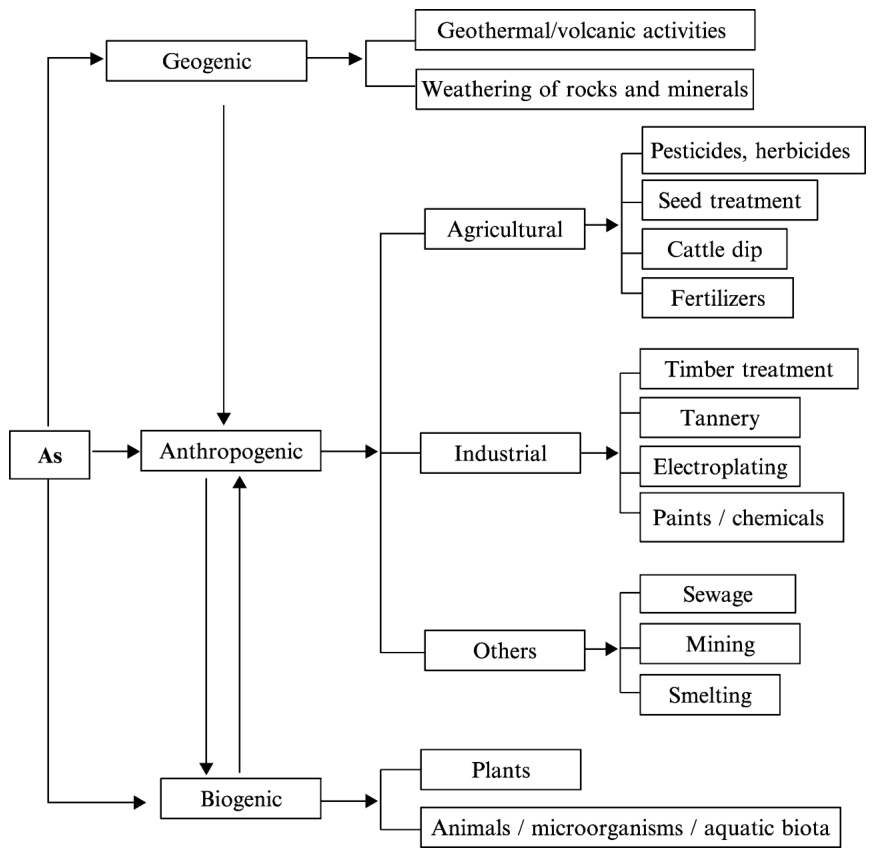
A range of As compounds, both organic and inorganic, are introduced into the environment through geological (geogenic) and anthropogenic (human activities) sources (Fig. 1). Small amounts of As also enter the soil and water through various biological sources (biogenic) that are rich in As (Table I). Although the anthropogenic source of As contamination is increasingly becoming important, it should be pointed out that the recent episode of extensive As contamination of groundwaters in Bangladesh and West Bengal is of geological origin, transported by rivers from sedimentary rocks in the Himalayas over tens of thousands of years, rather than anthropogenic.
各种有机和无机砷化合物通过地质(地质成因)和人为(人类活动)来源进入环境(图1)。少量砷还通过各种富砷的生物来源(生物成因)进入土壤和水体(表I)。尽管人为来源的砷污染日益重要,但应当指出,近期孟加拉国和西孟加拉邦地下水大面积砷污染事件属于地质成因,而非人为成因,其砷来源于喜马拉雅山沉积岩,经河流在数万年间搬运而来。
A. GEOGENICA. 地质成因来源
Arsenic is widely distributed in all geological materials at varying concentrations. An average concentration of 1.5 to 2.0 mg As kg�1 is expected in the continental crust of the earth. The mean concentrations of As in igneous rocks range from 1.5 to 3.0 mg kg�1, whereas in sedimentary rocks range from 1.7 to 400 mg kg�1 (Smith et al., 1998). Arsenic ranks 52nd in crustal abundance and it is a major constituent in more than 245 minerals (O’Neill, 1995). These are mostly sulfide-containing ores of copper (Cu), nickel (Ni), lead (Pb), cobalt (Co), zinc (Zn), gold (Au), or other base metals. The most important ores of As include pyrites, realgar, and orpiment. Arsenic is introduced into soil and water during the weathering of rocks and minerals followed by subsequent leaching and runoff. Therefore, the primary source of As in soil is the parent (or rock) materials from which it is derived (Yan-Chu, 1994). Geogenic contamination of As in soils (Table II)
砷以不同浓度广泛分布于各类地质材料中。地球大陆地壳中砷的平均浓度预计为1.5~2.0 mg As kg−1。火成岩中砷的平均浓度为1.5~3.0 mg kg−1,而沉积岩中为1.7~400 mg kg−1(Smith et al., 1998)。砷在地壳丰度中居第52位,是245种以上矿物的主要组分(O’Neill, 1995)。这些矿物大多是铜(Cu)、镍(Ni)、铅(Pb)、钴(Co)、锌(Zn)、金(Au)或其他贱金属的含硫化物矿石。最重要的砷矿石包括黄铁矿、雄黄和雌黄。砷在岩石和矿物风化过程中进入土壤和水体,随后发生淋溶和径流迁移。因此,土壤中砷的主要来源是其所由形成的母质(或岩石)(Yan-Chu, 1994)。土壤(表II)
Selected References on Sources of Arsenic in Soil and Aquatic Environments土壤和水环境中砷来源的部分参考文献
| Source来源 | Concentration (mg kg�1)浓度 (mg kg−1) | Reference参考文献 |
|---|---|---|
| Broiler litter | 34.6 | Jackson and Miller (2000) |
| Cattle manure (composted) | 3.0–5.2 | Raven and Loeppert (1997) |
| Coal | 2–825 | Adrianoet al. (1980) |
| 15,005 | Bencko and Symon (1977) | |
| Cow manure | 6–8.5 | Raven and Loeppert (1997) |
| Dikes and ores | 1242–30,800 | Ongleyet al. (2003) |
| Earthworms | 1358 | Langdonet al. (2002) |
| Fly ash | 2–6300 | Pageet al. (1979) |
| FYM from cattle | 0.8–2.6 | Nicholsonet al. (1999) |
| Lake weeds | 83–1262 | Aggett and Aspell (1980) |
| Metallurgical ore waste | 52,700–63,000 | Magalhaeset al. (2001) |
| Mine spoils | >20,000 | Porter and Peterson (1975) |
| Mine tailing | 62,350 7000 | Kimet al. (2002) Rousselet al. (2000) |
| Mushroom (edible) from contaminated soil | 1420 | Larsenet al. (1998) |
| Poultry manure | 50 | Araiet al. (2003) |
| 16.8 | Jackson and Bertsch (2001) | |
| Rice straw | 91.8 | Abedinet al. (2002) |
| Sewage sludge | 11.9–21.0 8.1–14.3 | Department of Health (NZ) (1992); Rosset al. (1991) Caperet al. (1978); Raven and Loeppert (1997) |
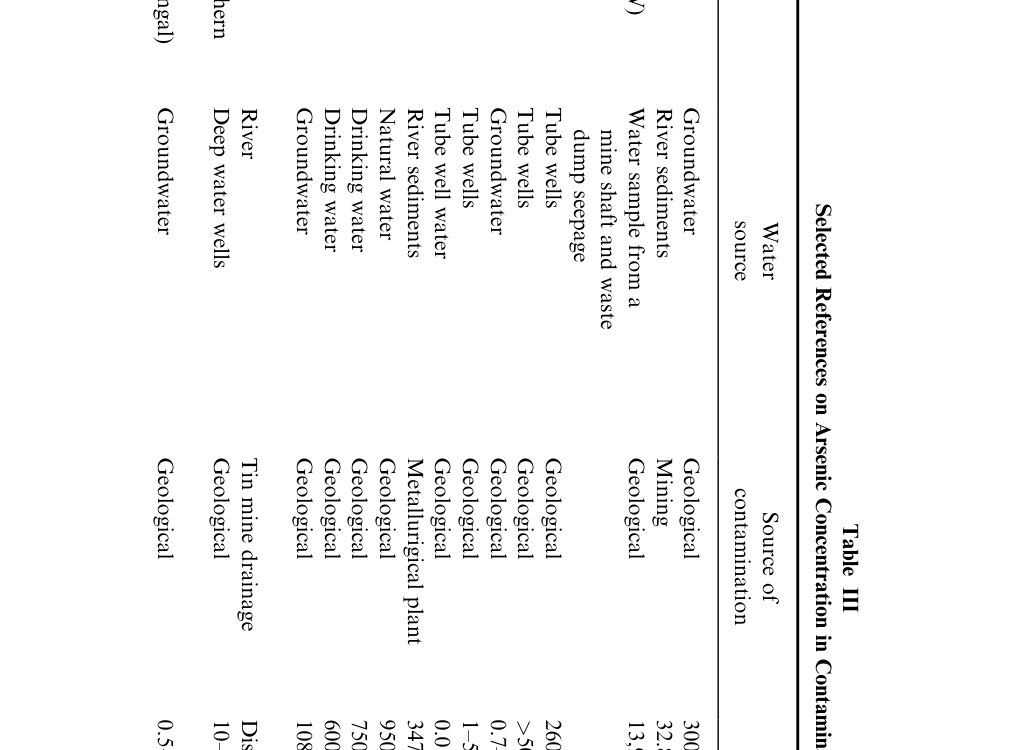
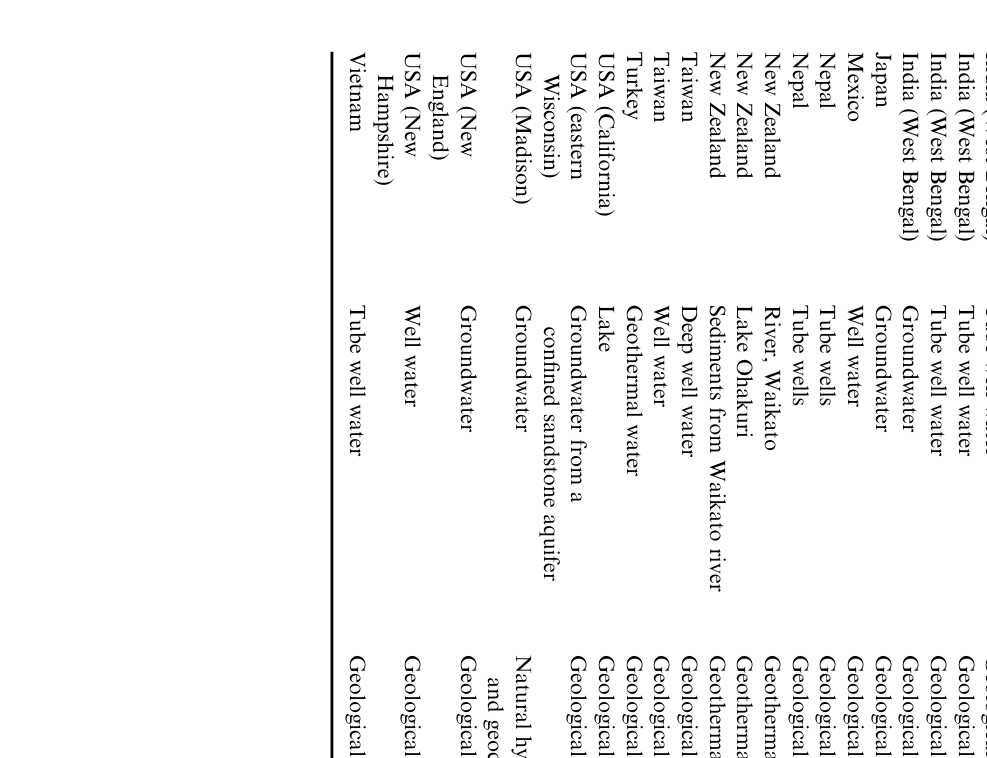
and water (Table III) has been reported in many parts of the world. One typical example is the extensive As contamination of groundwaters in Bangladesh and West Bengal in India.
和水体(表III)中地质成因的砷污染已在世界许多地区有报道。一个典型例子是孟加拉国和印度西孟加拉邦地下水的大面积砷污染。
Based on As geochemistry, three probable mechanisms have been offered for As mobility in groundwaters of West Bengal and Bangladesh (Bose and Sharma, 2002):
基于砷的地球化学特征,已提出三种可能的机制来解释西孟加拉邦和孟加拉国地下水中砷的迁移(Bose and Sharma, 2002):
i. Mobilization of As due to the oxidation of As-bearing pyrite minerals. Insoluble As-bearing minerals such as arsenopyrite (FeAsS) are rapidly oxidized [Eq. (1)] when exposed to atmosphere, releasing soluble arsenite [As(III)], sulfate (SO24�), and ferrous iron [Fe(II)] (Mandal et al., 1996). The dissolution of these As-containing minerals is highly dependent on the availability of oxygen and the rate of oxidation of sulfide (Loeppert, 1997). The released As(III) is partially oxidized to arsenate [As(V)] by microbially mediated reactions (Wilkie and Hering, 1998).
i. 含砷黄铁矿类矿物氧化导致砷的活化。毒砂(FeAsS)等不溶性含砷矿物暴露于大气时会迅速氧化[式(1)],释放出可溶性亚砷酸盐[As(III)]、硫酸根(SO24−)和亚铁[Fe(II)](Mandal et al., 1996)。这些含砷矿物的溶解在很大程度上取决于氧的可利用性和硫化物的氧化速率(Loeppert, 1997)。释放的As(III)通过微生物介导的反应部分氧化为砷酸盐[As(V)](Wilkie and Hering, 1998)。
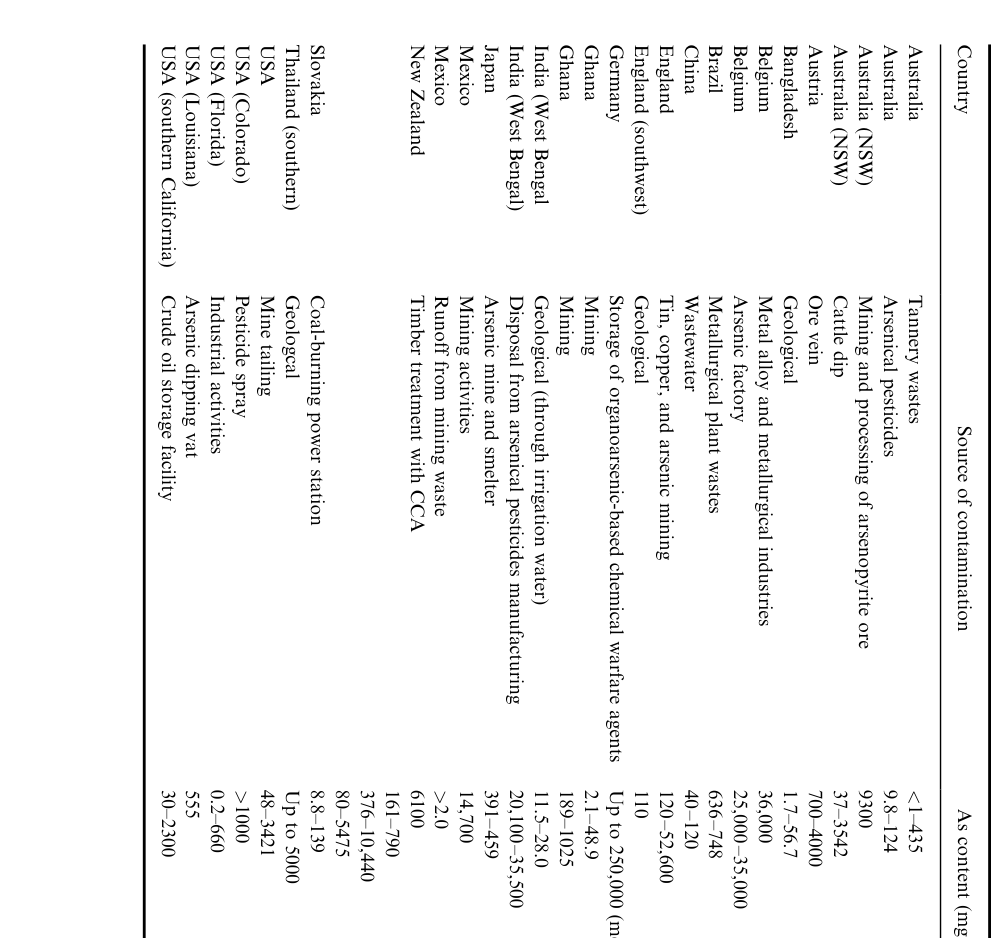
Selected References on Arsenic Concentration in Contaminated Soils
污染土壤中砷浓度的部分参考文献
ARSENIC CONTAMINATION AND ITS RISK MANAGEMENT 9
砷污染及其风险管理 9
FeAsS + 13Fe3+ + 8H2O ! 14Fe2+ + SO24� + 13H+ + H3AsO4(aq) (1)
FeAsS + 13Fe3+ + 8H2O → 14Fe2+ + SO24− + 13H+ + H3AsO4(aq) (1)
ii. Dissolution of As-rich iron oxyhydroxides (FeOOH) due to onset of reducing conditions in the subsurface. Under oxidizing conditions, and in the presence of Fe, inorganic species of As are predominantly retained in the solid phase through interaction with FeOOH coatings on soil particles. The onset of reducing conditions in such environments can lead to the dissolution of FeOOH coatings. Fermentation of peat in the subsurface releases organic molecules (e.g., acetate) to drive reductive dissolution of FeOOH, resulting in the release of Fe(II), As(III), and As (V) present on such coatings [Eq. (2)] (McArthur et al., 2000; Nickson et al., 2000).
ii. 地下还原条件形成导致富砷铁羟基氧化物(FeOOH)溶解。在氧化条件下且有Fe存在时,无机砷主要通过与土壤颗粒表面FeOOH包膜的相互作用而保留在固相中。此类环境中还原条件的形成可导致FeOOH包膜溶解。地下泥炭发酵释放出有机分子(如乙酸盐),驱动FeOOH的还原溶解,从而释放出这些包膜上的Fe(II)、As(III)和As(V)[式(2)](McArthur et al., 2000; Nickson et al., 2000)。
8FeOOH � As(s) + CH3COOH + 14H2CO3 ! 8Fe2+ + As(d) (2) + 16HCO�3 + 12H2O where As(s) is sorbed As and As(d) is dissolved As.
8FeOOH–As(s) + CH3COOH + 14H2CO3 → 8Fe2+ + As(d) (2) + 16HCO−3 + 12H2O,式中As(s)为吸附态砷,As(d)为溶解态砷。
iii. Release of As sorbed to aquifer minerals by competitive exchange with phosphate (H2PO�4 ) ions that migrate into aquifers from the application of fert ilizers to surface soil (Ac harya et al ., 1999).
iii. 施用于表层土壤的肥料中的磷酸根(H2PO−4)离子迁移进入含水层,通过竞争交换释放吸附于含水层矿物上的砷(Acharya et al., 1999)。
However, the second mechanism involving dissolution of FeOOH under reducing conditions is considered to be the most probable reason for excessive As accumulation in groundwater (Harvey et al., 2002; Smedley and Kinniburgh, 2002).
然而,第二种机制,即还原条件下FeOOH的溶解,被认为是地下水中砷过量累积最可能的原因(Harvey et al., 2002; Smedley and Kinniburgh, 2002)。
Relatively high concentrations of naturally occurring As can appear in some areas as a result of inputs from geothermal sources or As-rich groundwaters (Smedley and Kinniburgh, 2002). For example, Robinson et al. (1995) found high As concentrations (3800 �g liter�1) in waste geothermal brine from the main drain at Wairakei geothermal field in New Zealand. River and lake waters receiving inputs of geothermal waters were found to contain up to 121 �g As liter�1.
由于地热来源或富砷地下水的输入,某些地区可能出现相对较高浓度的天然砷(Smedley and Kinniburgh, 2002)。例如,Robinson et al. (1995) 发现新西兰Wairakei地热田主排水渠的地热废卤水中砷浓度很高(3800 μg liter−1)。接纳地热水输入的河流和湖泊水体中砷含量高达121 μg As liter−1。
Arsenic concentration is usually higher in soil and shales than in earth crust because of its continuous accumulation during weathering and translocation in colloidal fractions. Arsenic may also be coprecipitated with Fe hydroxides and sulfides in sedimentary rocks. Therefore, Fe deposits and sedimentary Fe ores are rich in As, and the soils derived from such sedimentary rocks may contain as high as 20 to 30 mg As kg�1 (Zou, 1986). Arsenic in the natural environment occurs in soil at an average concentration of about 5 to 6 mg kg�1 (i.e., background level), but this varies among geological regions (Peterson et al., 1981). Volcanoes are also considered as a geogenic source of As to the environment with the total atmospheric annual emissions from volcanoes being estimated at 31,000 mg (Smith et al., 1998; Walsh et al., 1979).
由于砷在风化过程中持续累积并随胶体组分迁移,土壤和页岩中的砷浓度通常高于地壳。砷还可能与沉积岩中的铁氢氧化物和硫化物共沉淀。因此,铁矿床和沉积型铁矿石富含砷,由此类沉积岩发育的土壤砷含量可高达20~30 mg As kg−1(Zou, 1986)。自然环境中土壤砷的平均浓度约为5~6 mg kg−1(即背景水平),但因地质区域而异(Peterson et al., 1981)。火山也被视为环境中砷的地质成因来源,据估计火山每年向大气排放的砷总量为31,000 mg(Smith et al., 1998; Walsh et al., 1979)。
B. ANTHROPOGENICB. 人为来源
Arsenic is also being introduced into the environment through various anthropogenic activities. These sources release As compounds that differ greatly in chemical nature (speciation) and bioavailability. Major sources of As discharged onto land originate from commercial wastes (�40%), coal ash (�22%), mining industry (�16%), and the atmospheric fallout from the steel industry (�13%) (Eisler, 2004; Nriagu and Pacyna, 1988). Arsenic trioxide (As2O3) is used extensively in the manufacturing of ceramic and glass, electronics, pigments and antifouling agents, cosmetics, fireworks, and Cubased alloys (Leonard, 1991). Arsenic is also used for wood preservation in conjunction with Cu and chromium (Cr), i.e., copper–chromium–arsenate (CCA). Some important physicochemical properties of As compounds are presented in Table IV.
各种人为活动也在向环境中输入砷。这些来源释放的砷化合物在化学性质(形态)和生物有效性方面差异很大。排放到土地上的砷主要来自商业废弃物(约40%)、煤灰(约22%)、采矿业(约16%)以及钢铁工业的大气沉降(约13%)(Eisler, 2004; Nriagu and Pacyna, 1988)。三氧化二砷(As2O3)被广泛用于陶瓷和玻璃、电子产品、颜料和防污剂、化妆品、烟花以及铜基合金的制造(Leonard, 1991)。砷还与Cu和铬(Cr)一起用于木材防腐,即铬化砷酸铜(CCA)。砷化合物的一些重要理化性质见表IV。
Industries that manufacture As-containing pesticides and herbicides release As-laden liquid and solid wastes that, upon disposal, are likely to contaminate soil and water bodies. For example, indiscriminate discharge of industrial effluents from the manufacturing of Paris Green (copper acetoarsenite, an arsenical pesticide) resulted in the contamination of soil and
生产含砷农药和除草剂的企业会排放含砷的液体和固体废弃物,这些废弃物经处置后很可能污染土壤和水体。例如,巴黎绿(乙酰亚砷酸铜,一种含砷农药)生产过程中工业废水的随意排放导致了土壤和
Physicochemical Properties of Arsenic Compoundsa砷化合物的理化性质a
| Compounds化合物 | Density (g cm3)密度 (g cm3) | Water solubility (g liter�1)水 溶解度 (g liter−1) | Melting point ( �C)熔点 (°C) | Boiling point ( �C)沸点 (°C) |
|---|---|---|---|---|
| Arsenic–As (element) | 5.727 | Insoluble | 613 | – |
| Arsenic trioxide or arsenous oxide–As2O3 | 3.738 | 37 at 20 �C | 312.3 | 465 |
| Arsenic oxide or | 4.32 | 1500 at 16 �C | 315 | – |
| arsenic pentoxide–As2O5 | (decomposes) | |||
| Arsenic sulfide or arsenic trisulfide–As2S3 | 3.43 | 5�10�4 at 18�C | 300 | 707 |
| Dimethylarsinic acid or cacodylic acid (CH3)2AsO(OH) | – | 829 at 22 �C | 200 | – |
| Arsenate or salts of arsenic acid–HAsO4 | 5.79 | Very slightly | 720 (decomposes) | – |
aFrom Lide (1992) and IARC (1980).
a引自Lide (1992) 和 IARC (1980)。
groundwater in residential area of Calcutta, India (Chatterjee et al., 1999). Similarly, in New Zealand, timber treatment effluent is considered to be the major source of As contamination in aquatic and terrestrial environments (Bolan and Thiyagarajan, 2001). Because As is widely distributed in the sulfide ores of Pb, Zn, Au, and Cu, it is released during their mining and smelting processes. The flue gases and particulate from smelters can contaminate nearby ecosystems downwind from the operation with a range of toxic metal(loid)s, including As (Adriano, 2001). Coal combustion not only releases gaseous As into the atmosphere, but also generates fly and bottom ash containing varied amounts of As. Disposal of these materials often leads to As contamination of soil and water (Beretka and Nelson, 1994).
印度加尔各答居民区地下水的污染(Chatterjee et al., 1999)。同样,在新西兰,木材处理废水被认为是水生和陆地环境砷污染的主要来源(Bolan and Thiyagarajan, 2001)。由于砷广泛分布于Pb、Zn、Au和Cu的硫化物矿石中,在这些矿石的开采和冶炼过程中砷会被释放。冶炼厂排放的烟气和颗粒物可使作业点下风向的邻近生态系统受到包括砷在内的多种有毒金属(类金属)污染(Adriano, 2001)。燃煤不仅向大气释放气态砷,还产生含不同量砷的飞灰和底灰。这些物质的处置常导致土壤和水体的砷污染(Beretka and Nelson, 1994)。
Arsenic is present in many pesticides, herbicides, and fertilizers. The use of horticultural pesticides, lead arsenate (PbAsO4), calcium arsenate (CaAsO4), magnesium arsenate (MgAsO4), zinc arsenate (ZnAsO4), zinc arsenite [Zn(AsO2)2], and Paris Green [Cu(CH3COO)2.3Cu(AsO2)2] in orchards has contributed to soil As contamination in many parts of the world (Merry et al., 1983; Peryea and Creger, 1994). Soil contamination due to the use of organoarsenical herbicides such as monosodium methanearsonate (MSMA) and disodium methanearsonate (DSMA) was also reported (Gilmore and Wells, 1980; Smith et al., 1998). The use of sodium arsenite (NaAsO2) to control aquatic weeds has contaminated small fish ponds and lakes in several parts of United States with As (Adriano, 2001). Arsenic contamination in soil was also reported due to the arsenical pesticides used in sheep and cattle dips to control ticks, fleas, and lice (McBride et al., 1998; McLaren et al., 1998). A study of 11 dip sites in New South Wales indicated considerable surface soil (0–10 cm) contamination with As (37–3542 mg kg�1) and significant movement of As (57–2282 mg kg�1) down the soil profile at 20–40 cm depth (McLaren et al., 1998). Continuous application of fertilizers that contain trace levels of As also results in As contamination of soil, thereby reaching the food chain through plant uptake (McLaughlin et al., 1996).
许多农药、除草剂和肥料中含有砷。果园中使用的园艺农药,如砷酸铅(PbAsO4)、砷酸钙(CaAsO4)、砷酸镁(MgAsO4)、砷酸锌(ZnAsO4)、亚砷酸锌[Zn(AsO2)2]和巴黎绿[Cu(CH3COO)2.3Cu(AsO2)2],已在世界许多地区造成土壤砷污染(Merry et al., 1983; Peryea and Creger, 1994)。使用甲胂酸一钠(MSMA)和甲胂酸二钠(DSMA)等有机砷除草剂造成土壤污染的情况也有报道(Gilmore and Wells, 1980; Smith et al., 1998)。在美国若干地区,使用亚砷酸钠(NaAsO2)控制水生杂草已使小型鱼塘和湖泊受到砷污染(Adriano, 2001)。用于绵羊和牛药浴以防治蜱、跳蚤和虱子的含砷农药也导致了土壤砷污染(McBride et al., 1998; McLaren et al., 1998)。对新南威尔士州11处药浴场地的研究表明,表层土壤(0–10 cm)受到相当程度的砷污染(37–3542 mg kg−1),且砷沿土壤剖面向下显著迁移至20–40 cm深度(57–2282 mg kg−1)(McLaren et al., 1998)。持续施用含痕量砷的肥料也会造成土壤砷污染,并通过植物吸收进入食物链(McLaughlin et al., 1996)。
C. BIOGENIC REDISTRIBUTIONC. 生物成因再分布
Biological sources contribute only small amounts of As into soil and water ecosystems. However, plants and micro- and macroorganisms affect the redistribution of As through their bioaccumulation (e.g., biosorption), biotransformation (e.g., biomethylation), and transfer (e.g., volatilization). Arsenic accumulates readily in living tissues because of its strong affinity for proteins, lipids, and other cellular components (Ferguson and Gavis, 1972). Aquatic organisms are particularly known to accumulate As, resulting in considerably higher concentrations than in the water in which they live (i.e., biomag nificat ion). Upon disposa l or con sumption they subsequent ly be come a sou rce of environm ental con taminatio n. Arsenic co uld be transferr ed from soil to plants an d then to anima ls and humans, involv ing terr estrial and aqu atic food ch ains. For exa mple, poultry manure addition is consider ed to be one of the major sources of As input to so ils. In the Dela ware– Marylan d– Virgini a pe ninsul a along the easte rn shore of the Un ited States, 20–50 mg of As is intro duced ann ually to the environm ent through the use of As compounds (e.g., Roxarson e, RO X) in poultry feed ( Christ en, 200 1). Howeve r, in many situa tions the soil–plant transfer of As is low ( Smith et al., 1998 ) and it is impor tant to recogni ze that meta l(loid) s loading through manure app lication may ov erestima te their actual net accumul ation in soil , as a sub stantial porti on of the metal(lo id)s in man ure origin ate in crop uptak e and are theref ore being recycled within a pr oduction system ( Bolan et al ., 2004 ).
生物来源向土壤和水生态系统输入的砷量很少。然而,植物以及微生物和大型生物通过生物累积(如生物吸附)、生物转化(如生物甲基化)和迁移(如挥发)影响砷的再分布。由于砷对蛋白质、脂类和其他细胞组分具有很强的亲和力,因此容易在活体组织中累积(Ferguson and Gavis, 1972)。水生生物尤以累积砷而著称,其体内砷浓度远高于其生活水体中的浓度(即生物放大)。这些生物经处置或被食用后,随即成为环境污染源。砷可经陆地和水生食物链从土壤转移至植物,再转移至动物和人类。例如,施用禽粪被认为是土壤砷输入的主要来源之一。在美国东海岸的Delaware–Maryland–Virginia半岛,由于在家禽饲料中使用砷化合物(如洛克沙胂,ROX),每年有20–50 mg砷进入环境(Christen, 2001)。然而,在许多情况下砷从土壤向植物的转移量很低(Smith et al., 1998),而且需要认识到,通过施用粪肥带入的金属(类金属)负荷可能会高估其在土壤中的实际净累积量,因为粪肥中相当一部分金属(类金属)源自作物吸收,因而是在生产系统内部循环的(Bolan et al., 2004)。
III. DISTRIBUTION AND SPECIATION OF ARSENIC IN THE ENVIRONMENTIII. 环境中砷的分布与形态
A. DISTRIBUT ION IN S OILA. 土壤中的分布
Genera lly, As concentra tions in unc ontami nated soil s seldom exceed 10 mg kg� 1. How ever, an thropogeni c sources of As have elevat ed the backgroun d con centra tion of As in soil s ( Adriano , 2001 ). For example , in areas near As mineral de posits, As level s in soil s may reach up to 9300 mg kg � 1 ( Ashley an d Lotter moser , 1999 ). The distribut ion of As in contam inate d soil s around the world is present ed in Table II . Depending on the na ture of the geogenic and anthropogenic sources, As concentration in soils can range from <1 to 250,000 mg kg�1. However, there is a large fluctuation among countries due to variation in soil parent material, for example, calcareous soils can be expected to have higher levels of As than noncalcareous soils ( Aichb erger and Hofer , 1989 ). As discus sed in Se ction II,B, althoug h the dominant source of As in soils is geological, additional inputs may also be derived locally from industrial sources, such as smelting and fossilfuel combustion products and agricultural sources, namely pesticides and phosphatic fertilizers.
一般而言,未污染土壤中砷浓度很少超过10 mg kg−1。然而,人为来源的砷已使土壤中砷的背景浓度升高(Adriano, 2001)。例如,在砷矿床附近地区,土壤砷含量可高达9300 mg kg−1(Ashley and Lottermoser, 1999)。世界各地污染土壤中砷的分布见表II。根据地质成因和人为来源性质的不同,土壤砷浓度范围可从<1到250,000 mg kg−1。然而,由于土壤母质的差异,各国之间存在较大波动,例如石灰性土壤的砷含量预计高于非石灰性土壤(Aichberger and Hofer, 1989)。如II.B节所述,尽管土壤中砷的主要来源是地质成因,但也可能有来自局地的额外输入,包括冶炼和化石燃料燃烧产物等工业来源,以及农药和磷肥等农业来源。
In soils, As forms a variety of inorganic and organic compounds (Vaughan, 1993). Arsenic forms solid precipitates with Fe, aluminium (Al), calcium (Ca), magnesium (Mg), and Ni. A number of studies involving solid-phase speciation have shown that As is prevalent mostly in the oxalate fractions associated with amorphous and crystalline Fe and Al oxides, indicating the strong affinity of As for these soil components (Wenzel et al., 2001). The soluble As concentration in soil is largely determined by redox conditions, pH, biological activity, and adsorption reactions. The adsorption and mobility of As in soil are affected more strongly by the presence of H2PO�2 ion than any other anions. Arsenic is subject to both chemical and biological transformations in soils, resulting in the formation of various species.
在土壤中,砷形成多种无机和有机化合物(Vaughan, 1993)。砷可与Fe、铝(Al)、钙(Ca)、镁(Mg)和Ni形成固体沉淀。多项固相形态研究表明,砷主要存在于与无定形及结晶态Fe、Al氧化物相关的草酸盐提取态中,表明砷对这些土壤组分具有很强的亲和力(Wenzel et al., 2001)。土壤中可溶性砷浓度在很大程度上取决于氧化还原条件、pH、生物活性和吸附反应。与其他阴离子相比,H2PO−2离子的存在对土壤中砷的吸附和迁移影响更大。砷在土壤中会发生化学和生物转化,形成多种形态。
B. DISTRIBUTION IN THE AQUATIC ENVIRONMENTB. 水环境中的分布
Arsenic in an aquatic environment is distributed in both the aqueous solution and sediments. Elevated concentrations of As in natural waters are usually associated with As-rich sedimentary rocks of marine origin, weathered volcanic rocks, fossil fuels, geothermal areas, mineral deposits, mining wastes, agricultural use, and irrigation practices (Korte and Fernando, 1991). Uncontaminated waters usually contain less than 0.001 �g As liter�1. In contaminated areas, however, high levels of As have been reported in water bodies (Table III). It should be noted that considerable variation in As concentration exists within the same geological area as reported by different researchers. The World Health Organization (WHO, 1981) recommends that the As concentration in drinking water not exceed 10 �g liter�1. However, the limit in many countries, including Bangladesh and the United States, is still 50 �g As liter�1. The widespread occurrence of high concentrations of As in water in many parts of the world caused the U.S. President George W. Bush to state “Arsenic is a natural substance that sometimes causes problems,” and to reverse the previous government’s decision to accept a five times lower WHO standard (i.e., 10 �g liter�1) (Kaiser, 2001).
水环境中的砷分布于水溶液和沉积物中。天然水体中砷浓度升高通常与海相富砷沉积岩、风化火山岩、化石燃料、地热区、矿床、采矿废弃物、农业利用及灌溉活动有关(Korte and Fernando, 1991)。未污染水体中砷含量通常低于0.001 μg As liter−1。然而,在污染地区,已有水体中高砷含量的报道(表III)。应当注意的是,不同研究者报道的同一地质区域内砷浓度存在相当大的差异。世界卫生组织(WHO, 1981)建议饮用水中砷浓度不超过10 μg liter−1。然而,包括孟加拉国和美国在内的许多国家的限值仍为50 μg As liter−1。世界许多地区水体中普遍存在高浓度砷,这促使美国总统George W. Bush声称“砷是一种有时会引发问题的天然物质”,并推翻了上届政府接受低5倍的WHO标准(即10 μg liter−1)的决定(Kaiser, 2001)。
As discussed earlier, one of the principal causes of high As concentrations in subsurface waters is the reductive dissolution of hydrous Fe oxides and/or the release of adsorbed As (Smedley and Kinniburgh, 2002). Deuel and Swoboda (1972) proposed that the release was primarily due to reduction (and dissolution) of “ferric arsenates” instead of changes in the As speciation. The high As in groundwater can be associated with reducing conditions, resulting from the presence of dissolved organic carbon, particularly in alluvial and delta environments. The groundwater of the Bengal basin is the most notable example. While the exact mechanisms responsible for this remain uncertain, it is possible that both reductive dissolution and desorption of As from oxides and clay play an important role in elevating As concentration (Smedley and Kinniburgh, 2002).
如前所述,地下水中高砷浓度的主要原因之一是水合铁氧化物的还原溶解和/或吸附态砷的释放(Smedley and Kinniburgh, 2002)。Deuel and Swoboda (1972) 提出,砷的释放主要是由于“砷酸铁”的还原(及溶解),而非砷形态的变化。地下水高砷可能与溶解性有机碳存在所导致的还原条件有关,尤其是在冲积和三角洲环境中。孟加拉盆地的地下水是最显著的例子。虽然造成这一现象的确切机制尚不明确,但砷从氧化物和黏土上的还原溶解与解吸可能都在砷浓度升高中起重要作用(Smedley and Kinniburgh, 2002)。
A significant proportion of As in aquatic environment is derived from the sediments, and the relative distribution of As in water and sediments depends mainly on the nature and amounts of sediments (Table III). Arsenic in river sediments is highly variable, ranging from 32.8–42.7 mg kg�1 (Australia) (Taylor, 1996) to 8700–156100 mg kg�1 (New Zealand)
水环境中相当比例的砷来源于沉积物,砷在水体和沉积物中的相对分布主要取决于沉积物的性质和数量(表III)。河流沉积物中的砷含量变化很大,范围从32.8–42.7 mg kg−1(澳大利亚)(Taylor, 1996)到8700–156100 mg kg−1(新西兰)
(Robinson et al., 1995). The As-rich sediments act as a buffer in maintaining the As concentration in water bodies, thereby controlling the dynamics and bioavailability of As in the aquatic environment.
(Robinson et al., 1995)。富砷沉积物起着缓冲作用,维持水体中的砷浓度,从而控制水环境中砷的动态和生物有效性。
C. CHEMICAL FORM AND SPECIATIONC. 化学形态与形态分析
Speciation of metal(loid)s can be achieved by both analytical processes and on the basis of theoretical consideration. The analytical processes involved in the speciation of metal(loid)s in soils can be grouped into solid-phase speciation and solution-phase speciation. In view of the limitations of many of the analytical procedures used in speciation, often species distribution is predicted using a number of speciation models (e.g., GEOCHEM by Mattigod and Sposito, 1979; MINTEQ2 by Allison et al., 1991) that are based on theoretical chemical (thermodynamic) concepts. Although the fundamental thermodynamic principles that drive these models are based on scientific facts, problems arise when these principles are applied to complex natural matrixes.
金属(类金属)的形态分析既可通过分析方法实现,也可基于理论推算。土壤中金属(类金属)形态分析所涉及的分析方法可分为固相形态分析和溶液相形态分析。鉴于形态分析中许多分析程序的局限性,通常采用若干基于理论化学(热力学)概念的形态模型(如Mattigod and Sposito, 1979的GEOCHEM;Allison et al., 1991的MINTEQ2)来预测形态分布。尽管驱动这些模型的基本热力学原理以科学事实为基础,但将这些原理应用于复杂的天然基质时会出现问题。
A large number of sequential extraction schemes have been used for soils, generally attempting to identify metal(loid)s held in any of the following fractions: soluble, exchangeable, sulfide/carbonate bound, organically bound, oxides bound, and residual or lattice mineral bound. The bioavailability of metal(loid)s in soils has been examined using the physiologically based in vitro chemical fractionation schemes that include the physiologically based extraction test (PBET), potentially bioavailable sequential extraction (PBASE), and gastrointestinal (GI) test. These innovative tests predict the bioavailability of metal(loid)s in soil/sediments when ingested by animals and humans.
土壤研究中已采用大量连续提取方案,通常试图鉴别以下各组分中结合的金属(类金属):可溶态、可交换态、硫化物/碳酸盐结合态、有机结合态、氧化物结合态以及残渣态或晶格矿物结合态。土壤中金属(类金属)的生物有效性已采用基于生理学的体外化学分级方案进行研究,包括基于生理学的提取试验(PBET)、潜在生物有效性连续提取(PBASE)和胃肠道(GI)试验。这些创新性试验可预测动物和人类摄入土壤/沉积物时其中金属(类金属)的生物有效性。
A vast number of analytical techniques are available for solution-phase characterization and quantification of metal(loid)s. These include electroanalytical techniques, cation/anion-exchange resins and chemical adsorbents to fractionate ionic and nonionic forms, ultrafiltration, dialysis, and gel permeation techniques for molecular size fractionation, spectroscopic techniques measuring the oxidation state of elements, X-ray techniques to measure trace element distribution, and chromatographic techniques to measure the phase distribution of metal(loid)s.
可用于金属(类金属)溶液相表征和定量的分析技术众多,包括:电分析技术;用于分离离子态与非离子态的阳离子/阴离子交换树脂和化学吸附剂;用于分子大小分级的超滤、透析和凝胶渗透技术;测定元素氧化态的光谱技术;测定微量元素分布的X射线技术;以及测定金属(类金属)相分布的色谱技术。
Arsenic speciation is determined by both biotic and abiotic variables. Arsenic speciation is important not only for understanding the biogeochemical cycling of As in different ecosystems and mechanisms of As accumulation and detoxification, but also for designing safe disposal options of As-rich biomass (Tu et al., 2003; Watt and Le, 2003).
砷的形态受生物和非生物变量共同决定。砷形态研究不仅对于理解砷在不同生态系统中的生物地球化学循环以及砷累积与解毒机制十分重要,而且对于设计富砷生物质的安全处置方案也很重要(Tu et al., 2003; Watt and Le, 2003)。
In soil, As occurs both as inorganic [As(III) and As(V)] and as organic forms. Trivalent As can exist as arsenous oxide (As2O3), arsenious acid (HAsO2), arsenite (H2AsO�3 , HAsO23�, AsO33�) ions, arsenic trichloride (AsCl3), arsenic sulfide (AsS3), and arsine (AsH3). Pentavalent As commonly occurs as arsenic pentoxide (As2O5), orthoarsenic acid (H3AsO4), metaarsenic acid (HAsO3), and arsenate (H2AsO�4 , HAsO24�, AsO34�) ions. The presence of different forms of organic As, such as monomethylarsonic acid [MMA, CH3AsO(OH)2], dimethylarsenic acid [DMA, (CH3)2AsO(OH)], trimethylarsine oxide [(CH3)3AsO], methylarsine (CH3AsH2), dimethylarsine [(CH3)2AsH] and trimethylarsine [TMA, (CH3)3As], has also been observed in contaminated soil and water (Gao and Burau, 1997).
在土壤中,砷既以无机形态[As(III)和As(V)]存在,也以有机形态存在。三价砷可以亚砷酸酐(As2O3)、亚砷酸(HAsO2)、亚砷酸根(H2AsO−3、HAsO23−、AsO33−)离子、三氯化砷(AsCl3)、硫化砷(AsS3)和砷化氢(AsH3)的形式存在。五价砷通常以五氧化二砷(As2O5)、正砷酸(H3AsO4)、偏砷酸(HAsO3)和砷酸根(H2AsO−4、HAsO24−、AsO34−)离子的形式存在。在污染土壤和水体中也观察到多种有机砷形态,如一甲基胂酸[MMA, CH3AsO(OH)2]、二甲基胂酸[DMA, (CH3)2AsO(OH)]、三甲基氧化胂[(CH3)3AsO]、甲基胂(CH3AsH2)、二甲基胂[(CH3)2AsH]和三甲基胂[TMA, (CH3)3As](Gao and Burau, 1997)。
The most common forms of As in the environment are the inorganic oxyions of As(III) and As(V). Arsenite [As(III)] is more toxic and relatively mobile in contaminated soils, whereas arsenate [As(V)] is relatively less toxic. Both As(III) and As(V) compounds are highly soluble in water and may change valency states depending on the pH and redox conditions.
环境中最常见的砷形态是As(III)和As(V)的无机含氧离子。亚砷酸盐[As(III)]毒性较强,在污染土壤中迁移性相对较高,而砷酸盐[As(V)]毒性相对较低。As(III)和As(V)化合物均易溶于水,并可随pH和氧化还原条件的变化而改变价态。
Results of a literature search on the speciation of As in environmental and biological samples are presented in Table V. In contaminated soils, generally As(V) predominates over As(III), whereas in waters, the relative proportion of these two species varies depending on a number of factors, including As sources, redox potential, pH, and microbial activity.
关于环境和生物样品中砷形态的文献检索结果见表V。在污染土壤中,通常As(V)多于As(III);而在水体中,这两种形态的相对比例取决于多种因素,包括砷的来源、氧化还原电位、pH和微生物活性。
Masscheleyn et al. (1991) studied the influence of redox potential and pH on As speciation and solubility in a contaminated soil. They observed that alterations in the oxidation state of As, as influenced by redox potential and pH, greatly affected its solubility in soil. At oxic redox levels (500–200 mV), As solubility was low and the major part (65–98%) of the As in soil solution was present as As(V). At alkaline pH, the reduction of As(V) to As(III) released substantial proportions of As into solution. Under moderately reducing conditions (0–100 mV), As solubility was controlled by the dissolution of Fe oxyhydroxides. At an anoxic redox level of �200 mV, soluble As increased 13-fold as compared to an oxic redox level of 500 mV. The apparent slow kinetics of the As(V) to As(III) transformation and the high concentrations of manganese (Mn) present indicate that, under reducing conditions, As solubility could be controlled by the Mn3(AsO4)2 phase.
Masscheleyn et al. (1991) 研究了氧化还原电位和pH对某污染土壤中砷形态和溶解度的影响。他们观察到,受氧化还原电位和pH影响的砷氧化态变化极大地影响了其在土壤中的溶解度。在氧化性氧化还原水平(500–200 mV)下,砷溶解度较低,土壤溶液中大部分(65–98%)砷以As(V)形式存在。在碱性pH下,As(V)还原为As(III)使大量砷释放到溶液中。在中度还原条件(0–100 mV)下,砷溶解度受铁羟基氧化物溶解的控制。在−200 mV的缺氧氧化还原水平下,可溶性砷比500 mV的氧化性水平增加了13倍。As(V)向As(III)转化的表观动力学较慢,且存在高浓度的锰(Mn),这表明在还原条件下,砷的溶解度可能受Mn3(AsO4)2相控制。
In a study conducted in New Zealand, Aggett and Aspell (1976) showed that with the occasional exception of a few summer months, over 90% of the As in water of the Waikato River and dams was present as As(V). Freeman (1985) detected As(III) in the Waikato River only when cyanobacteria (Anabaena oscillaroides) reduced As(V) to As(III).
在新西兰开展的一项研究中,Aggett and Aspell (1976) 发现,除少数夏季月份偶有例外外,Waikato河及其水坝水体中90%以上的砷以As(V)形式存在。Freeman (1985) 仅在蓝藻(Anabaena oscillaroides)将As(V)还原为As(III)时才在Waikato河中检测到As(III)。
While reviewing the As cycle in natural waters, Ferguson and Gavis (1972) suggested that As(III) is stable and mobile only in a narrow range of Eh and pH conditions. Conditions must be reducing enough to produce dissolved As(III) but not so reducing as to produce sulfide, which could precipitate As(III). Under conditions where sulfide is formed, realgar (AsS) and orpiment (As2S3) occur as stable solids. At low pH, HAsS2(aq) is the predominant species if sulfide is present, whereas AsS�2 species predominate at pH greater than 3.7. Studying a stratified lake, Seyler and Martin (1989) showed that Mn, which has a higher redox potential than Fe and As, was reduced before the complete depletion of dissolved oxygen, and any dissolved As was present predominantly in the form of As(V). As conditions became more reducing, there was a rapid and concomitant increase of Fe and As and a reversal of As speciation such that as As(III) became more dominant, As2S3 and As concentrations correspondingly decreased.
Ferguson and Gavis (1972) 在综述天然水体中的砷循环时指出,As(III)仅在很窄的Eh和pH条件范围内稳定且可迁移。条件必须具有足够的还原性以产生溶解态As(III),但又不能还原到产生硫化物的程度,因为硫化物可使As(III)沉淀。在形成硫化物的条件下,雄黄(AsS)和雌黄(As2S3)作为稳定固相存在。在低pH下,若存在硫化物,HAsS2(aq)为主要形态,而在pH大于3.7时则以AsS−2形态为主。Seyler and Martin (1989) 对一个分层湖泊的研究表明,氧化还原电位高于Fe和As的Mn在溶解氧完全耗尽之前即被还原,此时溶解态砷主要以As(V)形式存在。随着条件还原性增强,Fe和As迅速且同步增加,砷形态发生逆转,随着As(III)逐渐占主导,As2S3和As浓度相应降低。
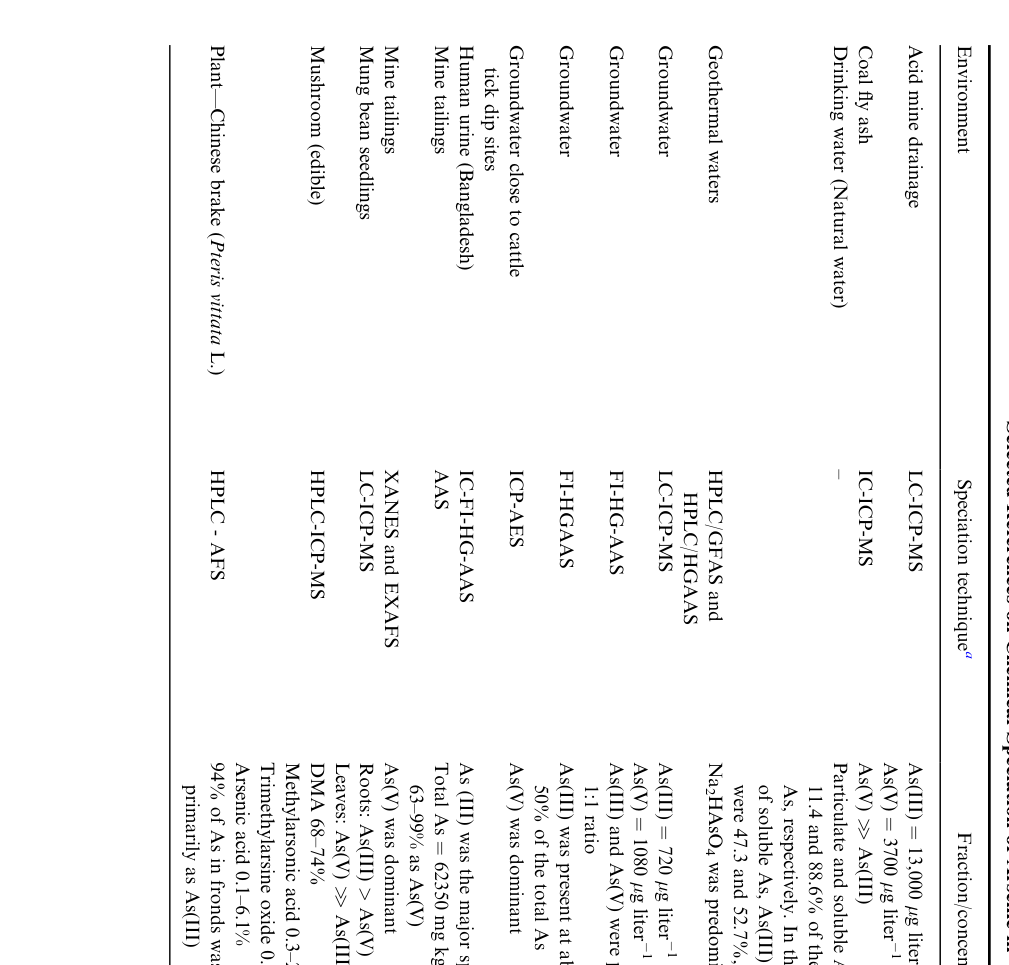
Selected References on Chemical Speciation of Arsenic in Various Media
不同介质中砷化学形态的部分参考文献
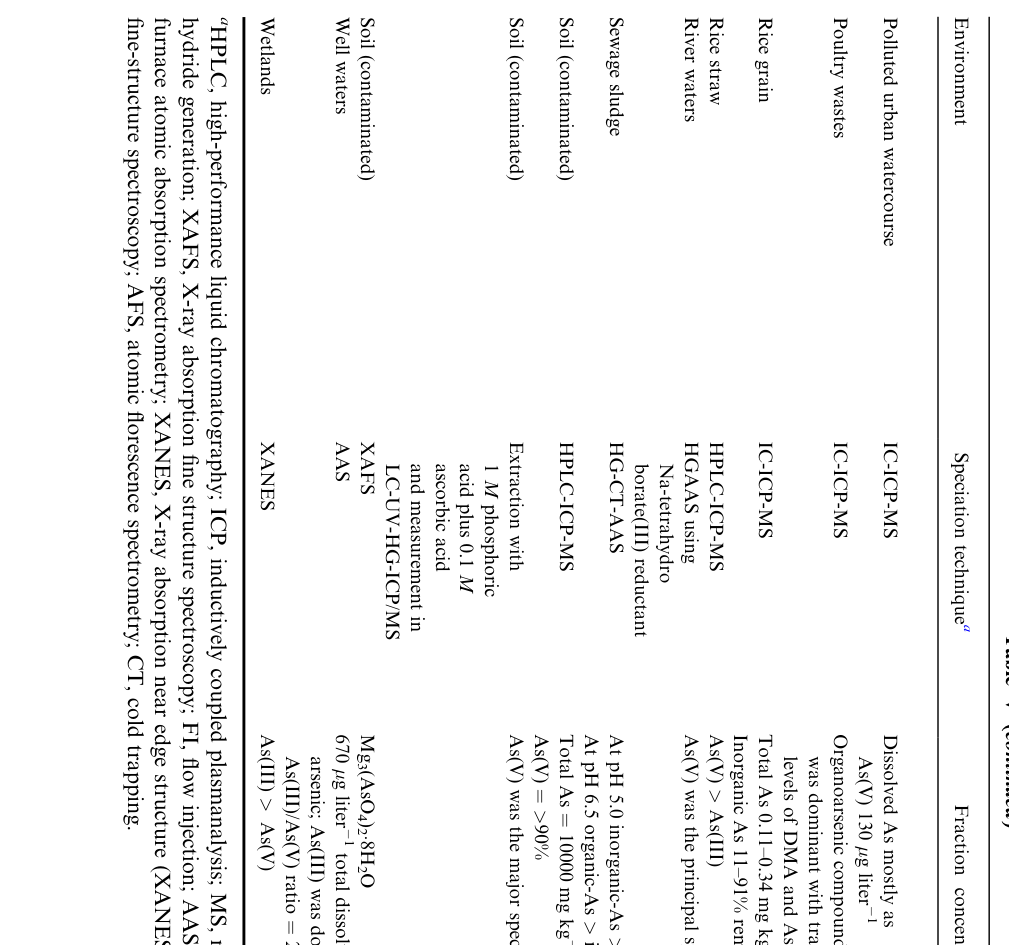
In groundwater, As is predominantly present as As(III) and As(V). The major As species in freshwater are As(III) and As(V), and small amounts of MMA, DMA, and methylated As(III) have also been detected. In seawater, As speciation differs in the surface and deep zones, with As(V) and As(III) species dominating the respective zone. In addition to the aforementioned species, Watt and Le (2003) noticed that an array of uncharacterized As species also appeared to constitute a significant portion of the total As present in water. The identification of these compounds is necessary to fully understand the As biogeochemistry in water.
在地下水中,砷主要以As(III)和As(V)形式存在。淡水中的主要砷形态为As(III)和As(V),此外还检测到少量MMA、DMA和甲基化As(III)。在海水中,表层和深层的砷形态不同,分别以As(V)和As(III)为主。除上述形态外,Watt and Le (2003) 注意到,一系列尚未表征的砷形态似乎也占水中总砷的相当比例。要全面了解水中砷的生物地球化学,有必要对这些化合物进行鉴定。
IV. BIOGEOCHEMISTRY OF ARSENIC IN THE ENVIRONMENTIV. 环境中砷的生物地球化学
The biogeochemistry and dynamics of As and other metal(loid)s vary between soil and aquatic environments. In the case of soil environment, a substantial proportion of the metal(loid)s is associated with the solid phase and their fate is strongly influenced by physicochemical interactions (e.g., adsorption–desorption) with the solid phase. Whereas in the case of aquatic environment, depending on the sediment content, a substantial proportion of metal(loid)s remains in solution and their fate is controlled largely by biological transformation.
砷及其他金属(类金属)的生物地球化学和动态在土壤环境与水环境之间存在差异。在土壤环境中,相当比例的金属(类金属)与固相结合,其归趋在很大程度上受与固相之间的物理化学相互作用(如吸附–解吸)的影响。而在水环境中,取决于沉积物含量,相当比例的金属(类金属)保留在溶液中,其归趋主要受生物转化控制。
A. BIOGEOCHEMISTRY OF ARSENIC IN THE SOILA. 土壤中砷的生物地球化学
Smith et al. (1998) presented a comprehensive review on the biogeochemistry of As in the soil environment. Here we include a brief discussion on various biogeochemical reactions of As in soil, which is helpful in understanding its behavior and in developing remediation strategies. As already discussed, As can exist in soil in different oxidation states but mostly as inorganic species, As(V) or As(III) (Adriano, 2001; Masscheleyn et al., 1991). In addition to inorganic species, microbial methylation of As in soil results in the release of organic methylarsenic compounds, such as MMA and
Smith et al. (1998) 对土壤环境中砷的生物地球化学进行了全面综述。本文简要讨论土壤中砷的各种生物地球化学反应,这有助于理解其行为并制定修复策略。如前所述,砷在土壤中可以不同的氧化态存在,但主要为无机形态As(V)或As(III)(Adriano, 2001; Masscheleyn et al., 1991)。除无机形态外,土壤中砷的微生物甲基化还会释放有机甲基砷化合物,如MMA和
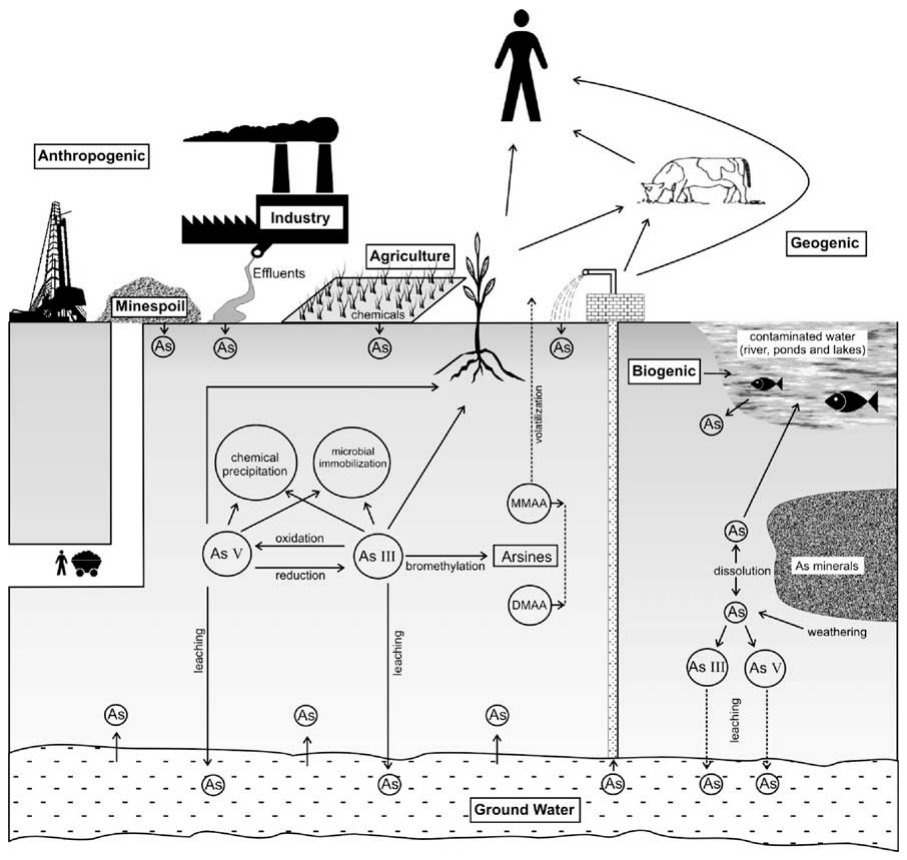
DMA, and ultimately arsine gas (Smith et al., 1998; Vaughan, 1993). Both inorganic and organic species of As undergo various biological and chemical transformations in soils, including adsorption, desorption, precipitation, complexation, volatilization, and methylation (Fig. 2). Some important biogeochemical reactions of As and their significance in soil and aquatic environments are given in Table VI. The most thermodynamically stable species of As(III) (i.e., H3AsO3 and H2AsO�4 ) and As(V) (i.e., HAsO24�) occur over the normal soil pH range of 4 to 8.
DMA,并最终生成胂气(Smith et al., 1998; Vaughan, 1993)。无机和有机砷在土壤中均会发生多种生物和化学转化,包括吸附、解吸、沉淀、络合、挥发和甲基化(图2)。砷的一些重要生物地球化学反应及其在土壤和水环境中的意义见表VI。在4~8的正常土壤pH范围内,As(III)(即H3AsO3和H2AsO−4)和As(V)(即HAsO24−)的热力学最稳定形态均会出现。
1Adsorption and Surface Complexation吸附与表面络合
The adsorption and retention of As by soils determine its persistence, reactions, movement, transformation, and ecological effects (toxicity). As in the case of most other metal(loid)s and nonmetals, one of the most commonly reported, and perhaps the first reaction to occur in soils, is As adsorption onto soil particles. Numerous studies have dealt with As sorption on to specific minerals and uncontaminated soils. Ferrous oxides/ hydroxides are involved most commonly in the adsorption of As in both acidic and alkaline soils. Carbonate minerals adsorb As in calcareous soils. In acidic soils, Mn oxides and biogenic particles play a dominant role in the adsorption of As (Arai et al., 2003; Oscarson et al., 1981).
土壤对砷的吸附和保持决定了其持久性、反应、迁移、转化及生态效应(毒性)。与大多数其他金属(类金属)和非金属一样,土壤中最常报道、也可能是最先发生的反应之一是砷在土壤颗粒上的吸附。大量研究涉及砷在特定矿物和未污染土壤上的吸附。在酸性和碱性土壤中,铁氧化物/氢氧化物最常参与砷的吸附。在石灰性土壤中,碳酸盐矿物吸附砷。在酸性土壤中,Mn氧化物和生物成因颗粒在砷吸附中起主导作用(Arai et al., 2003; Oscarson et al., 1981)。
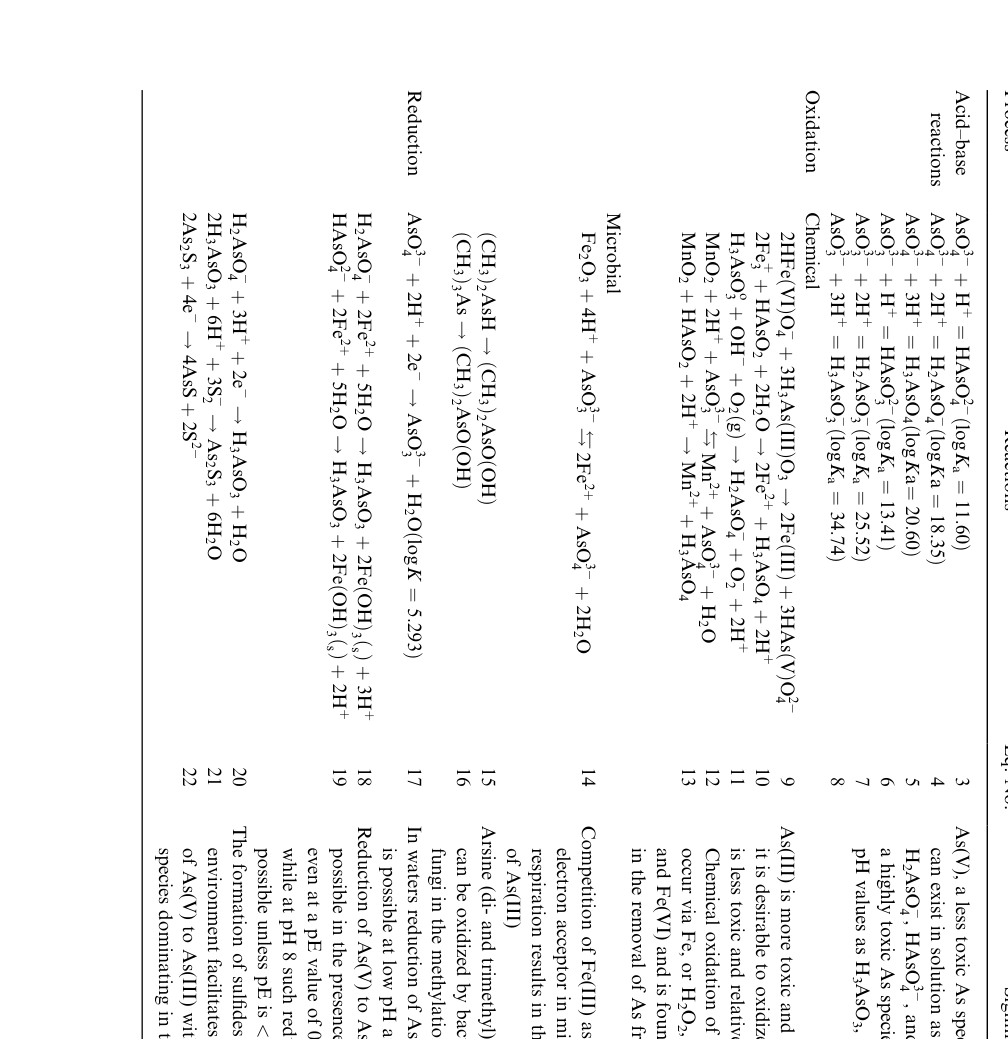
Some Important Biochemical Reactions of Arsenic and their Environmental Significance
砷的一些重要生物化学反应及其环境意义
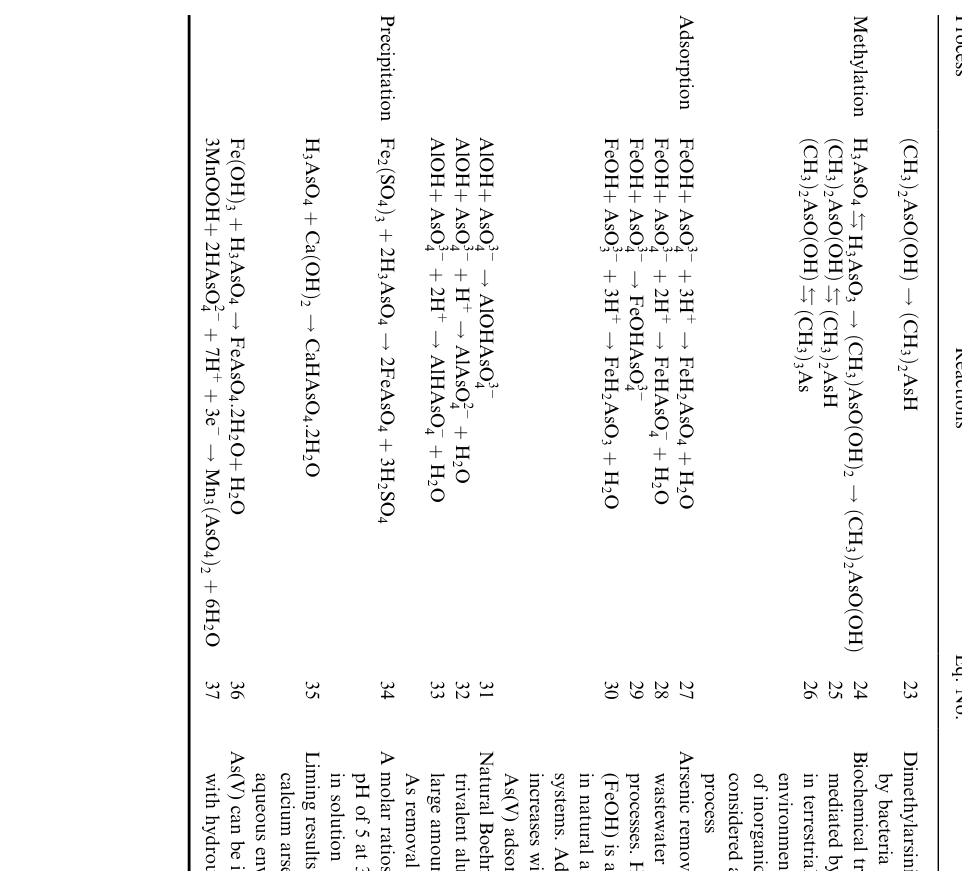
Arsenic is known to have high affinity for oxide surfaces, and several biogeochemical factors are found to play a major role in adsorption. Soil particle size, organic matter, type and nature of constituent minerals, pH, redox potential, and competing ions have all been shown to influence As adsorption (Chiu and Hering, 2000; Jones et al., 2000; Smith et al., 1998).
已知砷对氧化物表面具有很高的亲和力,且若干生物地球化学因素在吸附中起主要作用。已有研究表明,土壤粒径、有机质、组成矿物的类型和性质、pH、氧化还原电位以及竞争离子均会影响砷的吸附(Chiu and Hering, 2000; Jones et al., 2000; Smith et al., 1998)。
In general, adsorption of As(V) decreases with increasing pH. In contrast, adsorption of As(III) increases with increasing pH. The effect of pH on As adsorption varies considerably among soils and is dependent on the nature of mineral surface. In soils containing low oxidic minerals, increasing the pH has little effect on the amount of As(V) adsorbed, whereas in highly oxidic soils, adsorption of As(V) decreases with increasing pH (Smith et al., 1998). This decrease is attributed to two interacting factors: (i) the increasing negative surface potential on the plane of adsorption and (ii) the increasing concentration of negatively charged As(V) species present in the soil solution.
一般而言,As(V)的吸附随pH升高而降低;相反,As(III)的吸附随pH升高而增加。pH对砷吸附的影响在不同土壤间差异很大,并取决于矿物表面的性质。在氧化物矿物含量低的土壤中,提高pH对As(V)吸附量影响甚微;而在高氧化物土壤中,As(V)的吸附随pH升高而降低(Smith et al., 1998)。这种降低归因于两个相互作用的因素:(i)吸附面上表面负电位的增加;(ii)土壤溶液中带负电荷的As(V)形态浓度的增加。
Brookins (1988) observed that amorphous Al and Fe hydroxides adsorbed more As(V) than As(III). The surface charge properties of variable charge soil components are strongly influenced by pH. At acid pH these soil components contain large amounts of positive charges, and adsorption of As (V) may become important. Arsenate ions are attracted to positively charged colloidal surfaces either at broken clay lattice edges where charged Al3+ groups are exposed or on surfaces of Fe and Al oxides and hydroxide films. Many researchers have investigated As(III) and As(V) adsorption reactions and surface speciation on major soil minerals (i.e., metal oxyhydroxides and phyllosilicate minerals) using various macroscopic and spectroscopic techniques. Arsenate is strongly adsorbed at acidic pH values on amorphous Al (OH)3, a-Al2O3, ferrihydrite, and hematite (Arai et al., 2001; Raven et al., 1998 ; Xu et al ., 1988). Sev eral spectro scopic [e.g ., extended X-ray adsorpt ion fine structure spectroscopy (EXAFS)], macroscopic [e.g., electrophoretic mobility (EM)], and thermodynamic modeling (e.g., surface complexation model) have revealed innersphere bidentate binuclear and/or monodentate As(V) complexes on ferrihydrite, goethite, amorphous Fe and Al oxides, and the bayerite polymorph (Arai et al., 2001; Fendorf et al., 1997) and on both inner sphere and outer sphere As(III) complexes on Al oxides (Arai et al., 2001 ; Goldbe rg and Johnston, 2001). In gen eral, As( V) sorpti on on amorphous Al and Fe oxides is characterized by an apparent sorption maximum at pH 4, whereas As(III) sorption maximum occurs in the pH range of 7 to 8.5.
Brookins (1988) 观察到,无定形Al和Fe氢氧化物对As(V)的吸附多于As(III)。可变电荷土壤组分的表面电荷性质受pH的强烈影响。在酸性pH下,这些土壤组分带有大量正电荷,As(V)的吸附可能变得重要。砷酸根离子被吸引到带正电荷的胶体表面,这些表面或位于暴露带电Al3+基团的黏土晶格断裂边缘,或位于Fe、Al氧化物及氢氧化物膜的表面。许多研究者采用各种宏观和光谱技术研究了As(III)和As(V)在主要土壤矿物(即金属羟基氧化物和层状硅酸盐矿物)上的吸附反应和表面形态。在酸性pH下,砷酸盐被强烈吸附在无定形Al(OH)3、α-Al2O3、水铁矿和赤铁矿上(Arai et al., 2001; Raven et al., 1998; Xu et al., 1988)。若干光谱方法[如扩展X射线吸收精细结构光谱(EXAFS)]、宏观方法[如电泳迁移率(EM)]和热力学模拟(如表面络合模型)揭示了As(V)在水铁矿、针铁矿、无定形Fe和Al氧化物以及拜三水铝石多晶型上形成内圈双齿双核和/或单齿配合物(Arai et al., 2001; Fendorf et al., 1997),而As(III)在Al氧化物上则形成内圈和外圈配合物(Arai et al., 2001; Goldberg and Johnston, 2001)。一般而言,As(V)在无定形Al和Fe氧化物上的吸附在pH 4时出现表观吸附最大值,而As(III)的吸附最大值出现在pH 7~8.5范围内。
The type and quantity of silicate clay minerals present in soil also influence the retention of As. Soils having higher clay content retain more As than sandy soils with low clay content. The degree of As sorption onto silicate clay minerals decreases in the order of kaolinite > vermiculite > montmorillonite (Goldberg and Glaubig, 1988; Manning and Goldberg, 1997). The silicate clay minerals also generally adsorb more As(V) than As (III), and adsorption by clay minerals is affected by pH (Lin and Puls, 2000).
土壤中硅酸盐黏土矿物的类型和数量也会影响砷的保持。黏粒含量较高的土壤比黏粒含量低的砂质土壤保持更多的砷。砷在硅酸盐黏土矿物上的吸附程度依次为高岭石 > 蛭石 > 蒙脱石(Goldberg and Glaubig, 1988; Manning and Goldberg, 1997)。硅酸盐黏土矿物通常也吸附更多的As(V)而非As(III),且黏土矿物的吸附受pH影响(Lin and Puls, 2000)。
Arsenic and P belong to the same chemical group and both have comparable dissociation constants for their acids and solubility products for their salts. Therefore, H2AsO�4 and H2PO�4 ions compete for the same sorption sites in soils, although some sites are preferentially available for the sorption of either H2PO�4 or H2AsO�4 ions. A number of studies have shown that among the competing anions, the H2PO�4 suppresses As(V) sorption by soil more significantly than chloride (Cl�), nitrate (NO�3 ), and sulfate (SO24�) (Matera and LeHecho, 2001; Manful et al., 1989; O’Neill, 1995; Thanabalasingam and Pickering, 1986).
砷和P属于同一化学族,二者酸的解离常数和盐的溶度积相近。因此,H2AsO−4和H2PO−4离子在土壤中竞争相同的吸附位点,尽管某些位点优先吸附H2PO−4或H2AsO−4离子。多项研究表明,在各种竞争性阴离子中,H2PO−4对土壤吸附As(V)的抑制作用比氯离子(Cl−)、硝酸根(NO−3)和硫酸根(SO24−)更为显著(Matera and LeHecho, 2001; Manful et al., 1989; O’Neill, 1995; Thanabalasingam and Pickering, 1986)。
Soil organic matter content also affects the adsorption of As and thus its bioavailability as organic molecules compete with As for sorption to surface sites. Thanabalasingam and Pickering (1986) showed that the maximum adsorption of As(V) on humic acids occurred around pH 5.5, whereas adsorption of As(III) increased up to pH 8. At high pH, the solubilization of humic substances reduces As retention. While there is very little information available on the effects of organic matter on As adsorption, Grafe et al. (2001) have shown that humic acid reduces both As(V) and As(III) adsorption on geothite between pH 3 and 9. Several functional groups present on these complex organic polymers may be responsible for binding As. Further, dissolved organic carbon substances are capable of increasing the mobility and bioavailability of As in soil and water ecosystems through redox reactions and soluble complex formation.
土壤有机质含量也会影响砷的吸附进而影响其生物有效性,因为有机分子与砷竞争表面吸附位点。Thanabalasingam and Pickering (1986) 发现,As(V)在胡敏酸上的最大吸附出现在pH 5.5左右,而As(III)的吸附在pH 8以下随pH升高而增加。在高pH下,腐殖质的溶解会降低砷的保持。尽管有关有机质对砷吸附影响的资料很少,Grafe et al. (2001) 的研究表明,在pH 3~9之间,胡敏酸会降低针铁矿对As(V)和As(III)的吸附。这些复杂有机聚合物上的若干官能团可能负责结合砷。此外,溶解性有机碳物质能够通过氧化还原反应和形成可溶性络合物来提高砷在土壤和水生态系统中的迁移性和生物有效性。
Depending on various factors affecting the adsorption of As, part of the As adsorbed onto soil constituents is desorbed and released into the soil solution. Soil pH and phosphate addition are the most important factors that control the desorption of As. For example, Woolson et al. (1973) observed that phosphate addition to an As-contaminated soil displaced about 77% of the total As in the soil. Although phosphate addition increases As solubility, Peryea (1991) reported that desorption of As was dependent on the soil type, as no increase in As concentration in soil solution from a volcanic soil (with high anion-fixing and pH-buffering capacity) was observed. This suggests that only large additions of P (>400 mg kg�1) would affect the As solubility in these soils (Chen et al., 2002; Smith et al., 1998). In long-term poultry litter-amended agricultural soils, Arai et al. (2003)
受影响As吸附的多种因素制约,吸附于土壤组分上的部分As会发生解吸并释放到土壤溶液中。土壤pH和磷酸盐添加是控制As解吸的最重要因素。例如,Woolson et al. (1973)观察到,向As污染土壤中添加磷酸盐可置换出土壤中约77%的全As。尽管添加磷酸盐会提高As的溶解度,但Peryea (1991)报道As的解吸取决于土壤类型,因为在一种火山灰土壤(具有较高的阴离子固定能力和pH缓冲能力)中并未观察到土壤溶液As浓度的升高。这表明只有大量添加P(>400 mg kg−1)才会影响此类土壤中As的溶解度(Chen et al., 2002; Smith et al., 1998)。在长期施用禽粪垫料的农业土壤中,Arai et al. (2003)
observed that the extent of As desorption from the litter increased with increasing pH from 4.5 to 7, but only 15% of the total As was released at pH 7, indicating the presence of insoluble phases and/or strongly retained soluble compounds. Elkhatib et al. (1984) suggested that the sorption of As (III) is not reversible in soil.
观察到,随着pH由4.5升至7,垫料中As的解吸程度增加,但在pH 7时仅释放了全As的15%,表明存在不溶性物相和/或被强烈保持的可溶性化合物。Elkhatib et al. (1984)认为,As(III)在土壤中的吸附是不可逆的。
One of the important factors affecting the adsorption/desorption characteristics of As is the contact time (residence time) in soils and sediments. For example, Arai and Sparks (2002) reported that the longer the residence time (1 year), the greater the decrease in As(V) desorption at pH 4.5 and 7.8, suggesting nonsingular reactions. The surface transformation processes, such as rearrangement of surface complexes and conversion of surface complexes into aluminum arsenate-like precipitates, might be responsible for the decrease in As(V) reversibility with aging. Thus, the fate and transport of the contaminants must be predicted/modeled not only on short-term adsorption and desorption studies, but also on long-term reactions.
影响As吸附/解吸特性的重要因素之一是其在土壤和沉积物中的接触时间(滞留时间)。例如,Arai and Sparks (2002)报道,滞留时间越长(1年),在pH 4.5和7.8条件下As(V)解吸的下降幅度越大,表明存在非单一反应。表面转化过程,如表面络合物的重排以及表面络合物向类砷酸铝沉淀的转化,可能是As(V)可逆性随老化而降低的原因。因此,对污染物归趋与迁移的预测/模拟不仅应基于短期吸附与解吸研究,还应考虑长期反应。
Although the desorption process is important in relation to the bioavailability and mobility of As, only a few studies have focused on desorption of As from soil constituents. Further studies on desorption are needed to fully understand the chemistry of As in soils, which might help in developing appropriate remediation technologies.
尽管解吸过程对As的生物有效性和迁移性十分重要,但目前仅有少数研究关注As从土壤组分中的解吸。需要进一步开展解吸研究,以全面认识土壤中As的化学行为,这可能有助于开发适宜的修复技术。
2Redox Reactions氧化还原反应
In soil and aquatic environments, redox reactions not only determine the nature of chemical species, but also the solubility and mobility of As and thus its environmental significance. Arsenic in soils is subject to both abiotic and biotic redox reactions [Eqs. (9–23) in Tabl e VI ]. The Fe( III) oxides, M n (III) oxides, and organic compounds in soils play a major role in catalyzing the abiotic oxidation of As(III) through an electron transfer mechanism (Adriano, 2001; Oscarson et al., 1981). Similarly, abiotic redox reactions are also responsible for the release of As from arsenopyrite through oxidation by Fe(III), considered to be a predominating process inducing the release of As into the groundwater in areas where well waters are highly contaminated with As [Eq. (1)].
在土壤和水环境中,氧化还原反应不仅决定化学形态的性质,还决定As的溶解度和迁移性,进而决定其环境意义。土壤中的砷同时经历非生物和生物氧化还原反应[表VI中式(9–23)]。土壤中的Fe(III)氧化物、Mn(III)氧化物和有机化合物通过电子转移机制,在催化As(III)的非生物氧化中起主要作用(Adriano, 2001; Oscarson et al., 1981)。同样,非生物氧化还原反应也导致毒砂经Fe(III)氧化而释放As,这被认为是井水受As严重污染地区As释放进入地下水的主导过程[式(1)]。
Under moderately reducing conditions, As(III) is often found to be the predominant species in soil solution (Marin et al., 1993; Masscheleyn et al., 1991; Onken and Hossner, 1995). Studies by Deuel and Swoboda (1972) showed that there was an increase of As(III) in soil solution over time under flooded conditions. This was attributed to the release of As(V) during reductive dissolution of Fe oxyhydroxide minerals that have a strong affinity for As(V) and the subsequent reduction of As(V) to As(III).
在中度还原条件下,As(III)常为土壤溶液中的优势形态(Marin et al., 1993; Masscheleyn et al., 1991; Onken and Hossner, 1995)。Deuel and Swoboda (1972)的研究表明,在淹水条件下,土壤溶液中的As(III)随时间增加。这归因于对As(V)具有强亲和力的Fe羟基氧化物矿物在还原溶解过程中释放出As(V),随后As(V)被还原为As(III)。
Biotransformation of As, involving the oxidation of As(III) to As(V) and the reduction of As(V) to As(III) by a variety of microorganisms, may occur in contaminated soil. For example, Alcaligenes faecalis was found to oxidize As(III) to As(V) (Osborne and Ehrlich, 1976; Phillips and Taylor, 1976). Bacteria, fungi, and algae are also able to reduce As(V) to As(III) and subsequently to arsine (Frankenberger and Losi, 1995). However, the effect of microbial activity on the transformation and movement of As in soil is difficult to quantify (Smith et al., 1998).
在污染土壤中,可能发生由多种微生物介导的As生物转化,包括As(III)氧化为As(V)以及As(V)还原为As(III)。例如,已发现粪产碱杆菌(Alcaligenes faecalis)可将As(III)氧化为As(V)(Osborne and Ehrlich, 1976; Phillips and Taylor, 1976)。细菌、真菌和藻类也能将As(V)还原为As(III),并进一步还原为胂(Frankenberger and Losi, 1995)。然而,微生物活动对土壤中As转化与迁移的影响难以定量(Smith et al., 1998)。
3Biomethylation生物甲基化
Arsenic in soil is also subject to biological transformation resulting in the form ation of organ o-arsenical s and other compou nds [Eqs. (24 –26) in Tabl e VI]. Inorganic As can undergo microbially mediated biochemical transformation, i.e., the hydroxyl group of arsenic acid [AsO(OH)3] is replaced by the CH3 group to form MMA, DMA, and TMA (Maeda, 1994). The pathway of As(V) methylation initially involves the reduction of As(V) to As(III), with the subsequent methylation of As(III) to dimethylarsine by coenzyme S-adenosylmethionine (Frankenberger and Losi, 1995). Methylation is often enhanced by sulfate-reducing bacteria. In addition to bacteria, several fungal species also have shown their ability to reduce As. Inorganic As is incorporated by autotrophic organisms such as algae and is then transported through the food chain. Arsenic becomes progressively methylated during this transfer. Therefore, methylation of As is considered a major detoxifying processes for these microorganisms (Adriano, 2001). The methylated As species is also subject to volatilization and photochemical reactions that may eliminate As from soil.
土壤中的砷还会发生生物转化,形成有机砷化合物及其他化合物[表VI中式(24–26)]。无机As可经历微生物介导的生化转化,即砷酸[AsO(OH)3]的羟基被CH3基团取代,形成MMA、DMA和TMA(Maeda, 1994)。As(V)甲基化途径首先是As(V)还原为As(III),随后As(III)在辅酶S-腺苷甲硫氨酸作用下甲基化为二甲基胂(Frankenberger and Losi, 1995)。硫酸盐还原菌常可促进甲基化。除细菌外,若干真菌种类也表现出还原As的能力。无机As被藻类等自养生物吸收,随后沿食物链传递,在此传递过程中逐步被甲基化。因此,As的甲基化被认为是这些微生物的主要解毒过程(Adriano, 2001)。甲基化的As形态还可发生挥发和光化学反应,从而可能使As从土壤中移除。
Demethylation of methylarsenicals can occur under both aerobic and anaerobic conditions. Anaerobic demethylation reactions may result in the formation of toxic and reactive AsH3 from less toxic DMA, whereas aerobic demethylation of DMA is likely to yield As(V), thereby retaining As in the system. Although AsH3 undergoes rapid chemical oxidation under oxic conditions, it can exist for long periods in an aerobic environment. Because the demethylation process often produces CO2 in addition to CH4, it is preceded by oxidative assimilatory pathways used in substrate metabolism rather than by dissimilatory lyses.
甲基砷化合物的去甲基化在好氧和厌氧条件下均可发生。厌氧去甲基化反应可能由毒性较低的DMA生成有毒且活泼的AsH3,而DMA的好氧去甲基化可能生成As(V),从而使As保留在系统中。尽管AsH3在有氧条件下会迅速发生化学氧化,但它仍可在好氧环境中长期存在。由于去甲基化过程除CH4外通常还产生CO2,因此其前序过程是底物代谢中的氧化同化途径,而非异化裂解。
Methylation, demethylation, and reduction reactions are also important in controlling the mobilization and subsequent distribution of arsenicals in soils. These transformations are promoted by microbes; however, it is still not clear if in situ biomethylation is a common phenomenon. Although the presence of organic forms of As in soil can be associated with the application of anthropogenic compounds, such as fertilizers and pesticides (O’Neill, 1995 ), their presence is often linked to biomet hylat ion. How ever, biomet hylation react ions occur readily in aqua tic environm ent and these react ions are discus sed in Se ction IV.B .
甲基化、去甲基化和还原反应对于控制土壤中砷化合物的活化及其后续分布也很重要。这些转化由微生物促进,但原位生物甲基化是否为普遍现象仍不清楚。尽管土壤中有机形态As的存在可能与肥料、农药等人为化合物的施用有关(O’Neill, 1995),但其存在往往与生物甲基化相关。不过,生物甲基化反应在水环境中易于发生,相关反应在IV.B节中讨论。
4Leaching淋溶
Due to its strong adsorption onto organic and clay colloids, As(V) is likely to persist in soils for a long time, especially in fine-textured soils with high Fe contents (Woolson, 1983). In these soils, leaching of As(V) is low and therefore As contamination of groundwater is considered unlikely (Woolson, 1983). However, under certain environmental conditions (i.e., low pH and low Eh), As would leach in the soil profile, thereby contaminating the surface and groundwaters (Hingston et al., 2001; Ruokolainen et al., 2000).
由于As(V)被有机胶体和黏土胶体强烈吸附,它可能在土壤中长期存留,尤其是在Fe含量高的细质地土壤中(Woolson, 1983)。在此类土壤中,As(V)的淋溶较弱,因此一般认为不太可能造成地下水As污染(Woolson, 1983)。然而,在某些环境条件下(即低pH和低Eh),As会在土壤剖面中淋溶,进而污染地表水和地下水(Hingston et al., 2001; Ruokolainen et al., 2000)。
Considerable amounts of solubilized As could move downward in the soil profile with leaching water, especially in coarse-textured soils. It is for this reason that abandoned wood preservative (CCA) sites may threaten groundwater quality. For example, in examining the leaching of Cu, Cr, and As from CCA solution through free-draining, coarse-textured surface and subsurface soils using undisturbed soil lysimeters, McLaren et al. (1994) observed that the cumulative amounts of As leached ranged from 4 to 30% of the total As applied. Arsenic is present as a simple salt (soluble Na2HAsO4) in CCA, which is liable for leaching losses, especially in coarse-textured soils. Whereas when As is present as an organically complexed form (e.g., in sewage sludge), it is not readily leached in soils (McLaren et al., 1994).
大量溶解态As可随淋溶水在土壤剖面中向下迁移,尤其是在粗质地土壤中。正因如此,废弃的木材防腐剂(CCA)场地可能威胁地下水水质。例如,McLaren et al. (1994)利用原状土渗漏计研究了CCA溶液中Cu、Cr和As在自由排水的粗质地表层土和亚表层土中的淋溶,观察到As的累积淋失量为施入全As的4%~30%。As在CCA中以简单盐(可溶性Na2HAsO4)形式存在,易发生淋失,尤其是在粗质地土壤中。而当As以有机络合态存在时(如在污水污泥中),则不易在土壤中淋溶(McLaren et al., 1994)。
Again the role of H2PO�4 ions in enhancing the mobility of As, especially AsO24� ions, should be noted. For example, Qafoku et al. (1999) noticed that the leaching of As in a column containing mineral soil incorporated with As-rich poultry manure increased with the addition of a phosphate compound. The arsenic concentration in the leachate was approximately 10 times higher when Ca(H2PO4)2 was used to leach the soil column as compared to the CaSO4 solution. In the presence of the Ca(H2PO4)2 solution, a maximum As concentration of 800 �g liter�1 was found in the leachate, much higher than the WHO maximum permissible limit of 10 �g liter�1 for drinking water.
此外,还应注意H2PO4−离子在增强As迁移性,特别是AsO42−离子迁移性方面的作用。例如,Qafoku et al. (1999)发现,在掺入富As禽粪的矿质土壤柱中,添加磷酸盐化合物会增加As的淋溶。与CaSO4溶液相比,用Ca(H2PO4)2淋洗土柱时淋出液中的砷浓度约高10倍。在Ca(H2PO4)2溶液存在下,淋出液中As的最高浓度达800 μg liter−1,远高于世界卫生组织(WHO)规定的饮用水最大允许限值10 μg liter−1。
B. BIOGEOCHEMISTRY OF ARSENIC IN AQUATIC ENVIRONMENTSB. 水环境中砷的生物地球化学
As in the case of soil systems, the environmental and ecological significance of As dynamics in aquatic ecosystem is largely determined by its biogeochemical reactions, which are discussed in this section.
与土壤系统相同,水生生态系统中As动态的环境和生态意义在很大程度上取决于其生物地球化学反应,本节对此进行讨论。
1Adsorption and Desorption吸附与解吸
Arsenic is stable in four oxidation states (+5, +3, 0, �3) under the Eh conditions that occur in aquatic systems. At high Eh values (mostly exist in oxygenated waters), arsenic acid species (i.e., H3AsO4, H2AsO�4 , HAsO24�, and AsO34�) are stable. At mildly reducing conditions, arsenious acid species (i.e., H3AsO3, H2AsO�3 , and HAsO23�) become stable (Korte and Fernando, 1991; Penrose, 197 4; Smith, 1986). The specia tion of As in aq uatic environment is critical in controlling the adsorption/desorption reactions with sediments. Adsorption to sediment particles may remove As(V) from contaminated water, as well as inhibiting the precipitation of As minerals such as scorodite (FeAsO4�2H2O) that control the equilibrium aqueous concentration (Foster et al., 1997). Under the aerobic and acidic to near-neutral conditions (typical of many aquatic environments), As(V) is adsorbed very strongly by oxide minerals in sediments. The highly nonlinear nature of the adsorption isotherm for As(V) in oxide minerals ensures that the amount of As adsorbed is relatively large, even when dissolved aqueous concentrations of As are low. Such adsorption occurring in natural environments protects water bodies from widespread As toxicity problems. Adsorption of As species by sediments are as follows: As(V) > As(III) > As (II) > DMA (Smedley and Kinniburgh, 2002).
在水体系统的Eh条件下,砷可稳定存在于四种氧化态(+5、+3、0、−3)。在高Eh值下(多见于含氧水体),砷酸形态(即H3AsO4、H2AsO4−、HAsO42−和AsO43−)是稳定的。在弱还原条件下,亚砷酸形态(即H3AsO3、H2AsO3−和HAsO32−)变得稳定(Korte and Fernando, 1991; Penrose, 1974; Smith, 1986)。水环境中As的形态对于控制其与沉积物之间的吸附/解吸反应至关重要。吸附到沉积物颗粒上可将As(V)从污染水体中去除,同时抑制控制水相平衡浓度的臭葱石(FeAsO4·2H2O)等As矿物的沉淀(Foster et al., 1997)。在好氧且酸性至近中性的条件下(许多水环境的典型条件),As(V)被沉积物中的氧化物矿物非常强烈地吸附。氧化物矿物对As(V)吸附等温线的高度非线性特征,保证了即使水中溶解态As浓度较低,As的吸附量也相对较大。自然环境中发生的此类吸附保护了水体免受大范围As毒性问题的影响。沉积物对As形态的吸附顺序如下:As(V) > As(III) > As(II) > DMA(Smedley and Kinniburgh, 2002)。
In As-contaminated sediments, Clement and Faust (1981) found that a significant portion of the As was bound in organo-complex forms and indicated that adsorption–desorption equilibrium must be considered as well as the redox effects in examining the dynamics of As in aquatic environment. As pH increases, especially above pH 8.5, As desorbs from the oxide surfaces, thereby increasing the concentration of As in solution. Desorption of As from As-contaminated sediments at high pH is the most likely mechanism for the development of groundwater As problems under the oxidizing conditions (Robertson, 1989; Smedley et al., 2002). These adsorption and desorption reactions of As in the aquatic environment have not been studied in detail under varied ecological conditions and therefore require greater attention.
Clement and Faust (1981)发现,在As污染沉积物中,相当部分的As以有机络合态结合,并指出在研究水环境中As的动态时,除氧化还原效应外,还必须考虑吸附–解吸平衡。随着pH升高,特别是在pH 8.5以上时,As从氧化物表面解吸,从而提高溶液中As的浓度。在氧化条件下,高pH时As从As污染沉积物中的解吸是形成地下水As问题最可能的机制(Robertson, 1989; Smedley et al., 2002)。水环境中As的这些吸附与解吸反应尚未在不同生态条件下得到详细研究,因此需要给予更多关注。
2Biotransformation生物转化
Arsenic undergoes a series of biological transformations in the aquatic environment, yielding a large number of compounds, especially organoarsenicals. Certain reactions, such as oxidation of As(III) to As(V), may occur both in the presence and in the absence of microorganisms, whereas other reactions, such as methylation, are not thermodynamically favorable in water and can occur only in the presence of organisms. In neutral oxygenated waters, As(V) is the thermodynamically favored form, whereas As(III) is stable under reducing conditions (Ferguson and Gavis, 1972). Some bacteria and marine phytoplankton are capable of reducing As(V) to As(III) or oxidizing As(III) to As(V) (Andreae, 1977). Biological reduction of As(V) to As(III) reportedly occurs most easily at a pH between 6 and 6.7 (Korte and Fernando, 1991). For example, Aggett and Aspell (1980) noticed that As was usually found as As(V) in the Waikato River of New Zealand, but during the spring and summer months, As(III) was often found to predominate. The reduction of As(V) to As(III) has been attributed to biological components of the river ecosystem. This biotransformation has been reported to occur in various aquatic systems, mediated by bacteria (Johnson, 1972; Myers et al., 1973) and algae (Andreae and Klumpp, 1979; Sanders 1983; Sanders and Windom, 1980). A cyanobacteria (Anabaena oscillaroides)–bacteria assemblage was also found to reduce As(V) to As (III) (Freeman, 1985).
砷在水环境中经历一系列生物转化,生成大量化合物,特别是有机砷化合物。某些反应(如As(III)氧化为As(V))在有无微生物存在时均可发生,而另一些反应(如甲基化)在水中热力学上不利,只有在生物存在时才能发生。在中性含氧水体中,As(V)是热力学上有利的形态,而As(III)在还原条件下稳定(Ferguson and Gavis, 1972)。一些细菌和海洋浮游植物能够将As(V)还原为As(III),或将As(III)氧化为As(V)(Andreae, 1977)。据报道,As(V)的生物还原在pH 6~6.7之间最易发生(Korte and Fernando, 1991)。例如,Aggett and Aspell (1980)注意到,新西兰Waikato河中的As通常以As(V)形式存在,但在春季和夏季,As(III)常占优势。As(V)向As(III)的还原被归因于河流生态系统中的生物组分。据报道,这种生物转化发生在多种水体系统中,由细菌(Johnson, 1972; Myers et al., 1973)和藻类(Andreae and Klumpp, 1979; Sanders 1983; Sanders and Windom, 1980)介导。还发现一种蓝细菌(Anabaena oscillaroides)–细菌组合可将As(V)还原为As(III)(Freeman, 1985)。
Benthic microbes are capable of methylating As under both aerobic and anaerobic conditions to produce methylarsines and methyl-arsenic compounds with a generic formula (CH3)nAs(O)(OH)3�n where n may be 1, 2, or 3. MMA and DMA are the common organoarsenicals in river water. Methylated As species could result from direct excretion by algae or microbes or from degradation of the excreted arsenicals or more complex cellular organoarsenicals. Methylation may play a significant role in the mobilization of As by releasing it from the sediments to aqueous environment. The presence of organoarsenicals in river sediments is evidence that methylation occurs in the sediments (Anderson and Bruland, 1991). The rate of methylation/demethylation reactions and the consequent mobilization of arsenicals are affected by adsorption by sediments and soils.
底栖微生物能够在好氧和厌氧条件下使As甲基化,生成甲基胂和通式为(CH3)nAs(O)(OH)3−n(n可为1、2或3)的甲基砷化合物。MMA和DMA是河水中常见的有机砷化合物。甲基化As形态可能来源于藻类或微生物的直接排泄,或来源于所排泄砷化合物或更复杂的细胞内有机砷化合物的降解。甲基化可能通过将As从沉积物释放到水相中,在As的活化中发挥重要作用。河流沉积物中有机砷化合物的存在证明甲基化发生在沉积物中(Anderson and Bruland, 1991)。甲基化/去甲基化反应速率及由此引起的砷化合物活化受沉积物和土壤吸附作用的影响。
Primary producers such as algae take up As(V) from solution and reduce this to As(III) prior to methylation of the latter to produce MMA and DMA; the methylated derivatives are then excreted. This may be considered to represent a detoxification process in respect to the organism involved. Arsenic is taken up by algae due to its chemical similarity to phosphate. Although the detoxification of As by microorganism can be achieved through methylation, the element may be of significant toxicity to phytoplankton and periphyton communities in marine environments.
藻类等初级生产者从溶液中吸收As(V),并将其还原为As(III),随后As(III)经甲基化生成MMA和DMA,甲基化衍生物再被排出体外。对于相关生物而言,这可被视为一种解毒过程。由于砷与磷酸盐在化学性质上相似,藻类会吸收砷。尽管微生物可通过甲基化实现As解毒,但该元素对海洋环境中的浮游植物和周丛生物群落仍可能具有显著毒性。
Both macro- and microorganisms accumulate As in their tissues. Concentrations in organisms may be considerably higher than in the water in which they live, but unlike mercury (Hg), there is little, if any, concentration upward through the food chain (i.e., bioaugmentation). The toxicity of As to aquatic organisms is similar to its effects on terrestrial life, i.e., As(V) is much less toxic than As(III) (Ferguson and Gavis, 1972).
大型生物和微生物均可在其组织中积累As。生物体内的浓度可能远高于其生活水体中的浓度,但与汞(Hg)不同,As沿食物链向上富集(即生物放大)的现象即便存在也很少。As对水生生物的毒性与其对陆地生物的影响相似,即As(V)的毒性远低于As(III)(Ferguson and Gavis, 1972)。
Arsenate can replace H2PO�4 uptake in phosphate-deficient waters and can then be accumulated by algae. In a study of As accumulation in the food chain, it has been reported that most of the As accumulated by algae was in a nonmethylated form, which was bound strongly to protein or polysaccharides in the algal cell (Maeda et al., 1990). Such transformation can be stimulated by adding nutrients. Microbial formation of volatile arsine or other volatile-reduced compounds may play a role in the discharge of As to the atmosphere. Arsenite can be reduced and methylated to DMA, which can be further methylated or reduced and may eventually volatilize (Korte and Fernando, 1991).
在缺磷水体中,砷酸盐可替代H2PO4−被吸收,进而在藻类中积累。一项关于As在食物链中积累的研究报道,藻类积累的As大部分为非甲基化形态,并与藻细胞中的蛋白质或多糖牢固结合(Maeda et al., 1990)。添加营养物质可促进此类转化。微生物形成挥发性胂或其他挥发性还原态化合物,可能在As向大气的排放中发挥作用。亚砷酸盐可被还原并甲基化为DMA,DMA可进一步甲基化或还原,最终可能挥发(Korte and Fernando, 1991)。
V. BIOAVAILABILITY AND TOXICITY OF ARSENIC TO BIOTAV. 砷对生物区系的生物有效性与毒性
Arsenic is used as an additive in various metal alloys and in wood preservation. Its toxic properties are exploited in the formulation of arsenical herbicides and insecticides. To date, however, geogenic As is largely responsible for most human poisoning (Smith et al., 2000). Due to its environmental and human health impact, As toxicity has been researched and documented more extensively than any other metal(loid)s.
砷被用作多种金属合金的添加剂以及木材防腐。其毒性被用于配制含砷除草剂和杀虫剂。然而迄今为止,大多数人体砷中毒主要由地质成因的As所致(Smith et al., 2000)。由于其对环境和人体健康的影响,As毒性得到的研究和记录比其他任何金属(类金属)都更为广泛。
A. TOXICITY TO PLANTS AND MICROORGANISMSA. 对植物和微生物的毒性
Arsenic contamination of soil and water poses a serious threat to plants and animals. Plants and microorganisms are known to accumulate As in their tissues and exhibit a certain degree of tolerance. However, at high concentrations, As is toxic to nearly all forms of life. Some selected references on toxicity (risks) of As in microorganisms, higher plants, and animals are presented in Table VII.
土壤和水体的砷污染对动植物构成严重威胁。已知植物和微生物可在其组织中积累As并表现出一定程度的耐受性。然而,在高浓度下,As对几乎所有生命形式都有毒性。表VII列出了有关As对微生物、高等植物和动物毒性(风险)的部分参考文献。
Biotoxicity is mostly determined by the nature and bioavailability of As species present in the contaminated habitat. An average toxicity threshold of 40 mg kg�1 has been established for crop plants (Sheppard, 1992). At high concentrations, As in plants inhibits plant metabolic processes, such as photosynthesis through interference of the pentose–phosphate pathway, thereby inhibiting growth and often leading to death (Marques and Anderson, 1986; Tu and Ma, 2002). Arsenite penetrates the plant cuticle to a greater degree than As(V) and generally results in the loss of turgor (Adriano, 2001).
生物毒性主要取决于污染生境中所存在As形态的性质及其生物有效性。已确定作物的平均毒性阈值为40 mg kg−1(Sheppard, 1992)。在高浓度下,植物体内的As会通过干扰磷酸戊糖途径而抑制光合作用等植物代谢过程,从而抑制生长并常导致死亡(Marques and Anderson, 1986; Tu and Ma, 2002)。亚砷酸盐对植物角质层的穿透程度大于As(V),通常导致膨压丧失(Adriano, 2001)。
Biomass production and yields of a variety of crops have been shown to reduce significantly at high concentrations of As in soils (Carbonell- Barrachina et al., 1997). For example, significant yield reductions of barley (Hordeum vulgare L.) and ryegrass (Lolium perenne L.) have been reported with the application of only 50 mg As kg�1 soil (Jiang and Singh, 1994). Plant uptake of As is greatly influenced by its species in soil. As has already been discussed, different species have different solubility and mobility, thereby differing in their bioavailability to plants. Marin et al. (1992) reported that the order of As availability to rice (Oryza sativa L.) is as follows: As(III) > MMA > As(V) > DMA. They observed that upon absorption, DMA is readily translocated to the plant shoot, whereas As (III), As(V), and MMA accumulate primarily in the roots. While the application of As(V) and DMA did not affect rice growth, both As(III) and MMA were found to be phytotoxic to rice. Burlo et al. (1999) noted that both MMA and DMA in tomato plants (Lycopersicon esculentum Mill.) had a greater upward translocation than As(III) and As(V).
研究表明,在土壤As浓度较高时,多种作物的生物量和产量显著降低(Carbonell-Barrachina et al., 1997)。例如,据报道,仅施用50 mg As kg−1土壤即可使大麦(Hordeum vulgare L.)和黑麦草(Lolium perenne L.)显著减产(Jiang and Singh, 1994)。植物对As的吸收在很大程度上受土壤中As形态的影响。如前所述,不同形态具有不同的溶解度和迁移性,因而对植物的生物有效性也不同。Marin et al. (1992)报道,As对水稻(Oryza sativa L.)的有效性顺序为:As(III) > MMA > As(V) > DMA。他们观察到,被吸收后DMA易于转运至植物地上部,而As(III)、As(V)和MMA主要积累在根部。施用As(V)和DMA对水稻生长无影响,而As(III)和MMA均对水稻具有植物毒性。Burlo et al. (1999)注意到,番茄(Lycopersicon esculentum Mill.)中MMA和DMA的向上转运均大于As(III)和As(V)。
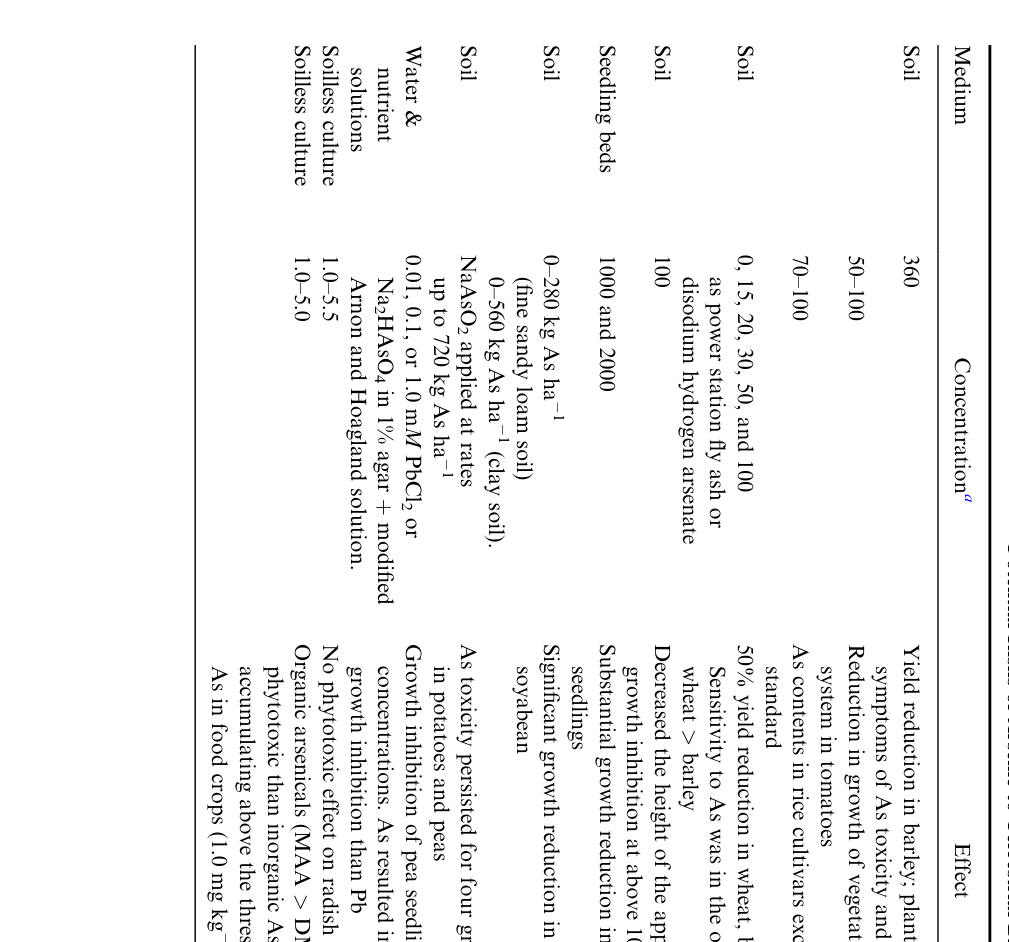
Potential Risks of Arsenic to Terrestrial Biota
砷对陆地生物区系的潜在风险
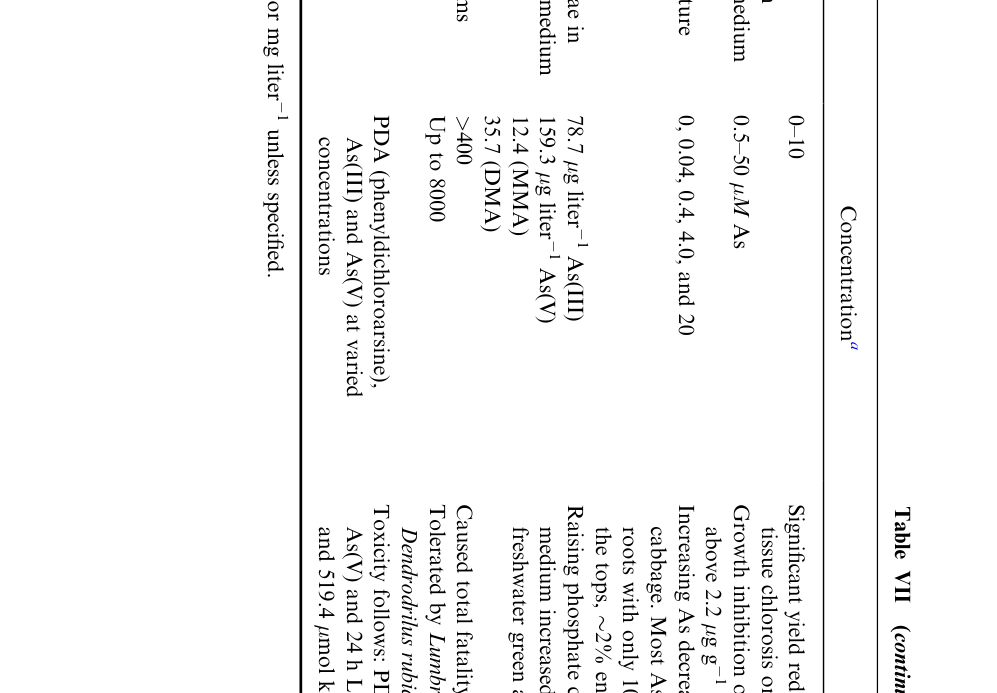
In general, the accumulation of As in the edible parts of most plants is low (O’Neill, 1995), which is attributed to a number of reasons, including (Wang et al., 2002) (i) low bioavailability of As in soil; (ii) restricted uptake by plant roots; (iii) limited translocation of As from roots to shoots; and (iv) phytotoxicity and subsequent premature plant death at relatively low As concentrations in plant tissues. Apart from chemical forms, it has been shown that the phytotoxicity of As varies with the soil conditions. For example, Reed and Sturgis (1963) reported that As inhibits rice plant growth more strongly under submerged soil conditions than under upland soil conditions, because As(V) is reduced to As(III), which is more soluble and more toxic to plants in submerged soil. Arsenic phytotoxicity is expected to be greater in sandy soils than in other soil types, as the former soils generally contain low amounts of Fe and Al oxides and silicate clays, which have been implicated in the adsorption of As from soil solution (Sheppard, 1992; Smith et al., 1998).
一般而言,大多数植物可食部分中的As积累量较低(O’Neill, 1995),这归因于多方面原因,包括(Wang et al., 2002):(i) 土壤中As的生物有效性低;(ii) 植物根系吸收受限;(iii) As由根向地上部的转运有限;(iv) 在植物组织As浓度相对较低时即产生植物毒性并导致植物过早死亡。除化学形态外,研究还表明As的植物毒性随土壤条件而变化。例如,Reed and Sturgis (1963)报道,As在淹水土壤条件下对水稻生长的抑制比在旱地土壤条件下更强,因为在淹水土壤中As(V)被还原为溶解度更高、对植物毒性更强的As(III)。预计砂质土壤中的砷植物毒性高于其他土壤类型,因为前者通常含有较少的Fe、Al氧化物和硅酸盐黏土,而这些组分被认为参与了土壤溶液中As的吸附(Sheppard, 1992; Smith et al., 1998)。
The antagonistic and synergistic effects of various nutrient anions also determine the phytotoxicity of As to some extent. For example, Davenport and Peryea (1991) reported a reduction of As uptake by plants with the application of phosphate, which was attributed to H2PO�4 ion-induced inhibi tion of As(V) uptake by plant roots. In con trast, Woo lson (1973) observed that a phosphate application increased As availability and As uptake by plants, which was attributed to the H2PO�4 ion-induced release of As(V) to the soil solution. Most plants do not accumulate enough As to be toxic to animals and humans. Growth reductions and crop failure are the main consequences of soil As contamination (Walsh and Keeney, 1975). Thus the major hazard for animal and human systems is derived from direct ingestion of As-contaminated soil or water (Smith et al., 1998).
各种营养阴离子的拮抗和协同效应也在一定程度上决定As的植物毒性。例如,Davenport and Peryea (1991)报道施用磷酸盐可降低植物对As的吸收,这归因于H2PO4−离子抑制了植物根系对As(V)的吸收。与此相反,Woolson (1973)观察到施用磷酸盐提高了As的有效性和植物对As的吸收,这归因于H2PO4−离子促使As(V)释放到土壤溶液中。大多数植物积累的As不足以对动物和人类产生毒性。生长减缓和作物歉收是土壤As污染的主要后果(Walsh and Keeney, 1975)。因此,对动物和人类系统的主要危害来自直接摄入受As污染的土壤或水(Smith et al., 1998)。
Arsenic contamination of soil and water has a direct impact on microbial community and structure. At high concentrations, a reduction in the soil microbial population has been reported by a number of researchers (Bisessar, 1982; Van Zwieten et al., 2003). In general, as in the case of higher plants, As(III) is more toxic to microorganisms than As(V) (Maliszewska et al., 1985). Hiroki (1993) has shown that As(III) is more toxic to bacteria and actinomycetes than As(V) and that fungi not only display a higher tolerance to As(III) than bacteria and actinomycetes, but also show the same tolerance to both As(V) and As(III). Arsenite also inhibits enzyme activities in soil (Tabatabai, 1977). However, many bacterial communities are found to adapt to As-contaminated environments by developing resistance and tolerance mechanisms (Smith et al., 1998).
土壤和水体的砷污染对微生物群落及其结构有直接影响。许多研究者报道,在高浓度下土壤微生物种群数量减少(Bisessar, 1982; Van Zwieten et al., 2003)。一般而言,与高等植物的情况相同,As(III)对微生物的毒性大于As(V)(Maliszewska et al., 1985)。Hiroki (1993)表明,As(III)对细菌和放线菌的毒性大于As(V),而真菌不仅对As(III)的耐受性高于细菌和放线菌,而且对As(V)和As(III)表现出相同的耐受性。亚砷酸盐还会抑制土壤酶活性(Tabatabai, 1977)。然而,发现许多细菌群落能够通过形成抗性和耐受机制来适应As污染环境(Smith et al., 1998)。
Earthworms usually have a high capacity for accumulating toxic elements; however, the extent of accumulation is dependent on the type of element and on soil properties (Ma, 1982). Earthworms are known to inhabit As-rich metalliferous soils (Langdon et al., 1999). They are likely to accumulate As present in soils through ingestion of solid-phase As and dermal contact with pore water As. Yeates et al. (1994) observed a complete elimination of earthworms in soils contaminated by As derived from timber preservatives at concentrations of 400 and 800 mg As kg�1, but few earthworms at 100 mg As kg�1. In contrast, Langdon et al. (1999) found populations of Lumbricus rubellus and Dendrodrilus rubidus resistant to As(V) and Cu present in mine spoil containing up to 8000 mg As kg�1 and 750 mg Cu kg�1. The difference in the threshold levels of As for earthworms between these two experiments may be attributed to the difference in the bioavailability of As, which is a function of speciation and substrate matrix. Earthworms generally show resistance to As toxicity; however, the mechanisms of such resistance are not fully understood (Langdon et al., 2003).
蚯蚓通常具有较高的有毒元素积累能力,但积累程度取决于元素种类和土壤性质(Ma, 1982)。已知蚯蚓可栖息于富As的含金属土壤中(Langdon et al., 1999)。它们可能通过摄食固相As以及皮肤接触孔隙水中的As而积累土壤中的As。Yeates et al. (1994)观察到,在木材防腐剂来源As浓度为400和800 mg As kg−1的污染土壤中蚯蚓完全消失,而在100 mg As kg−1时仍有少量蚯蚓。相反,Langdon et al. (1999)发现,在含As高达8000 mg As kg−1、含Cu 750 mg Cu kg−1的矿山弃土中,存在对As(V)和Cu具有抗性的Lumbricus rubellus和Dendrodrilus rubidus种群。这两项试验中蚯蚓As阈值水平的差异可能归因于As生物有效性的不同,而后者取决于形态和基质。蚯蚓通常对As毒性表现出抗性,但其抗性机制尚未完全明确(Langdon et al., 2003)。
B. RISK TO ANIMALS AND HUMANSB. 对动物和人类的风险
Drinking water is the most important source of dietary intake of As by animals and humans (Fitz and Wenzel, 2002). However, food also forms a source of As exposure (Adriano, 2001). The occurrence of inorganic As in drinking water has been identified as a source of risk for human health even at relatively low concentrations. As a consequence, more stringent safer limits for As in drinking water have been proposed (Wenzel et al., 2001). Soluble As compounds are rapidly absorbed from the gastrointestinal tract (Hindmarsh and McCurdy, 1986). Several studies in humans indicate that both As(III) and As(V) are well absorbed across the gastrointestinal tract (USDHHS, 2000). Studies involving the measurement of As in fecal excretion in humans indicated that almost 95% of oral intake of As(III) is absorbed (Bettley and O’Shea, 1975). This was supported by studies in which urinary excretion in humans was found to account for 55–80% of daily intakes of As(III) or As(V) (Buchet et al., 1981; Crecelius, 1977; Mappes, 1977). It has also been reported that both MMA and DMA are also well absorbed (75–85%) across the gastrointestinal tract (Buchet et al., 1981).
饮用水是动物和人类膳食摄入As的最重要来源(Fitz and Wenzel, 2002)。然而,食物也是As暴露的来源之一(Adriano, 2001)。饮用水中无机As的存在即使在相对较低浓度下也已被确认为人体健康的风险来源。因此,有人提出了更为严格的饮用水As安全限值(Wenzel et al., 2001)。可溶性As化合物可被胃肠道迅速吸收(Hindmarsh and McCurdy, 1986)。多项人体研究表明,As(III)和As(V)均可经胃肠道良好吸收(USDHHS, 2000)。测定人体粪便As排泄量的研究表明,口服摄入的As(III)近95%被吸收(Bettley and O’Shea, 1975)。人体尿液排泄量占As(III)或As(V)日摄入量55%~80%的研究结果也支持了这一点(Buchet et al., 1981; Crecelius, 1977; Mappes, 1977)。另有报道称,MMA和DMA也均可经胃肠道良好吸收(75%~85%)(Buchet et al., 1981)。
Once absorbed, simultaneous partial oxidation of As(III) to As(V) and partial reduction of As(V) to As(III) occur, yielding a mixture of As(III) and As(V) in the blood. The As(III) may undergo enzymatic methylation primarily in the liver to form MMA and DMA, but the rate and relative proportion of methylation production vary among animal species. Most As is promptly excreted in the urine as a mixture of As(III), As(V), MMA, and DMA, and relatively smaller amounts are excreted in the feces. Some As may remain bound to tissues, depending on the rate and extent of methylation. Monomethylarsonic acid may be methylated to DMA, but neither MMA nor DMA is demethylated to yield As(III) or As(V). Arsenic may accumulate in skin, bone, and muscle and its half-life in humans is between 2 and 40 days (USDHHS, 2000).
被吸收后,As(III)部分氧化为As(V)与As(V)部分还原为As(III)同时发生,在血液中形成As(III)和As(V)的混合物。As(III)可主要在肝脏中发生酶促甲基化,生成MMA和DMA,但甲基化产物的速率和相对比例因动物种类而异。大部分As以As(III)、As(V)、MMA和DMA混合物的形式迅速随尿液排出,经粪便排出的量相对较少。取决于甲基化的速率和程度,部分As可能仍与组织结合。一甲基胂酸可被甲基化为DMA,但MMA和DMA均不会去甲基化生成As(III)或As(V)。砷可在皮肤、骨骼和肌肉中积累,其在人体内的半衰期为2~40 d(USDHHS, 2000)。
Teratogenic effects of As in chicks, golden hamsters, and mice have been reported. Arsenic does not appear to be mutagenic in bacterial and mammalian assays, although it can induce chromosomal breakage, chromosomal aberration, and chromatid exchange. Studies have shown that As may be an essential element at trace concentrations for several animals such as goats, rats, and poultry, but there is no evidence that it is essential for humans (USEPA, 1988). The acute toxicity of As compounds in humans is a function of their rate of removal from the body. Arsine is considered to be the most toxic form, followed by As(III), As(V) and organic As compounds (MMA and DMA). Lethal doses in humans range from 1.5 mg kg�1 (diarsenic trioxide) to 500 mg kg�1 of body weight (DMA). Acute As intoxication associated with the ingestion of contaminated well water has been reported in many countries (Table VIII).
已有As对雏鸡、金黄地鼠和小鼠具有致畸效应的报道。在细菌和哺乳动物试验中,砷似乎不具有致突变性,但可诱发染色体断裂、染色体畸变和染色单体交换。研究表明,As在痕量浓度下可能是山羊、大鼠和家禽等若干动物的必需元素,但尚无证据表明其为人体必需元素(USEPA, 1988)。As化合物对人体的急性毒性与其从体内清除的速率有关。胂被认为是毒性最强的形态,其次为As(III)、As(V)和有机As化合物(MMA和DMA)。人体致死剂量范围为1.5 mg kg−1(三氧化二砷)至500 mg kg−1体重(DMA)。许多国家均有饮用受污染井水引起急性As中毒的报道(表VIII)。
The single most characteristic effect of long-term exposure to As is a pattern of skin changes, including hyperkeratosis (a darkening of the skin and appearance of small “corns” or “warts” on the palms, soles, and torso; Fig. 3). A small number of the “corns” may ultimately develop into skin cancer (USDHHS, 2000).
长期As暴露最具特征性的单一效应是一系列皮肤变化,包括角化过度(皮肤变黑,并在手掌、脚底和躯干上出现小“鸡眼”或“疣”;图3)。少数“鸡眼”最终可能发展为皮肤癌(USDHHS, 2000)。
Early symptoms of As poisoning in humans include abdominal pain, vomiting, diarrhea, muscular pain, and weakness, with flushing of the skin (Armstrong et al., 1984; Cullen et al., 1995; Moore et al., 1994). These symptoms are often followed by numbness and tingling of the extremities, muscular cramping, and the appearance of an erythematous rash. Further symptoms may appear within a month, including burning paraesthesias of the extremities, hyper/hypopigmentation (mottled or multicolor skin), Mee’s lines on fingernails, and progressive deterioration in motor and sensory responses (Fennell and Stacy, 1981; Murphy et al., 1981).
人体As中毒的早期症状包括腹痛、呕吐、腹泻、肌肉疼痛和虚弱,并伴有皮肤潮红(Armstrong et al., 1984; Cullen et al., 1995; Moore et al., 1994)。这些症状之后常出现四肢麻木和刺痛、肌肉痉挛以及红斑性皮疹。一个月内可能出现进一步症状,包括四肢灼烧样感觉异常、色素沉着过度/减退(皮肤斑驳或多色)、指甲上的Mee线,以及运动和感觉反应的进行性减退(Fennell and Stacy, 1981; Murphy et al., 1981)。
Acute oral As poisoning at doses of 8 mg As kg�1 and above have been reported to affect the respiratory system (Civantos et al., 1995). A number of studies in humans have shown that As ingestion may lead to serious effects on the cardiovascular system (Cullen et al., 1995). Anemia and leukopenia were also found to be the common effects of As poisoning in humans resulting from prolonged oral exposure at doses of 0.05 mg As kg�1 day�1 or mo re (Arm strong et al ., 1984; Maz umder et al ., 1988 ; Sah a et al ., 2003).
据报道,剂量为8 mg As kg−1及以上的急性经口As中毒会影响呼吸系统(Civantos et al., 1995)。多项人体研究表明,摄入As可能对心血管系统造成严重影响(Cullen et al., 1995)。研究还发现,贫血和白细胞减少是人体长期经口暴露于0.05 mg As kg−1 day−1或更高剂量所致As中毒的常见效应(Armstrong et al., 1984; Mazumder et al., 1988; Saha et al., 2003)。
Selected References on Effect of Arsenic on Human Health
砷对人体健康影响的部分参考文献
| Effect and/or symptoms效应和/或症状 | Countries国家 | Reference参考文献 |
|---|---|---|
| Neoplasia and induce DNA | France | Burnichonet al. (2003) |
| damage and inhibit DNA | USA | Goeringet al. (1999) |
| hypermethylation | ||
| Malanosis, melanokeratosis (malignancy) in adults | Bangladesh and India | Saha (2003) |
| Hyper pigmentation, keratosis, | Bangladesh | Karim (2000) |
| weakness, anemia, burning | Bangladesh | Mazumder (2003) |
| sensation of eyes, solid | Bangladesh and India | Rahmanet al. (2001) |
| swelling of legs, liver fibrosis, | Bangladesh | Kadonoet al. (2002) |
| chronic lung disease, | Bangladesh | Karim (2000) |
| gangrene of toes, neuropathy | ||
| Chromosomal aberrations | India | Mahataet al. (2003) |
| and chromatid exchanges | ||
| Skin cancer | Bangladesh | Mazumder (2003) |
| India | Mukherjeeet al. (2003) | |
| USA | Brown and Ross (2002) | |
| USA | Hamadehet al. (2002) | |
| USA | Hall (2002) | |
| Bangladesh | Kadonoet al. (2002) | |
| India | Daset al. (1996) | |
| Bladder cancer | USA | Brown and Ross (2002) |
| Lung cancer | USA | Brown and Ross (2002) |
| USA | Hall (2002) | |
| Peripheral vascular, cardiovascular, cerebrovascular diseases | USA | Brown and Ross (2002) |
| Diabetes | USA | Brown and Ross (2002) |
| Adverse reproductive outcome | USA | Brown and Ross (2002) |
| Neuropathy | Bangladesh and India | Mazumder (2003) |
| India | Mukherjeeet al. (2003) | |
| Paresthesias and pains in the distal parts of extremities | India | Mukherjeeet al. (2003) |
| Dysfunction of sensory nerve | India | Mukherjeeet al. (2003) |
| Apoptosis and necrosis in | India | Chattopadhyayet al. |
| developing brain cells | (2002) | |
| Inducement of oxidative stress, | Taiwan | Yih et al. (2002) |
| activating stress gene expression | USA | Hughes (2002) |
| Altered DNA methylation and cell proliferation | USA | Hughes (2002) |
| Bone marrow depression | USA | Hall (2002) |
| Hypertension | India | Rahmanet al. (1999) |
| Gastrointestinal disturbances | USA | Cullenet al. (1995); Hall (2002) |
| Hepatocellular carcinoma | China | Liuet al. (2001) |
| (continued) |
| Effect and/or symptoms效应和/或症状 | Countries国家 | Reference参考文献 |
|---|---|---|
| Hepatic fibrosis | India | Santraet al. (2000) |
| Blackfoot disease | Taiwan Bangladesh, China, India, Taiwan, and USA | Wanget al. (1997) Waiet al. (2003) |
| Acute intake results: vomiting, diarrhea, low blood pressure, and high heart beat | USA | Cullenet al. (1995) |
| Teratogenesis in unborn children | Bangladesh | Karim (2000) |
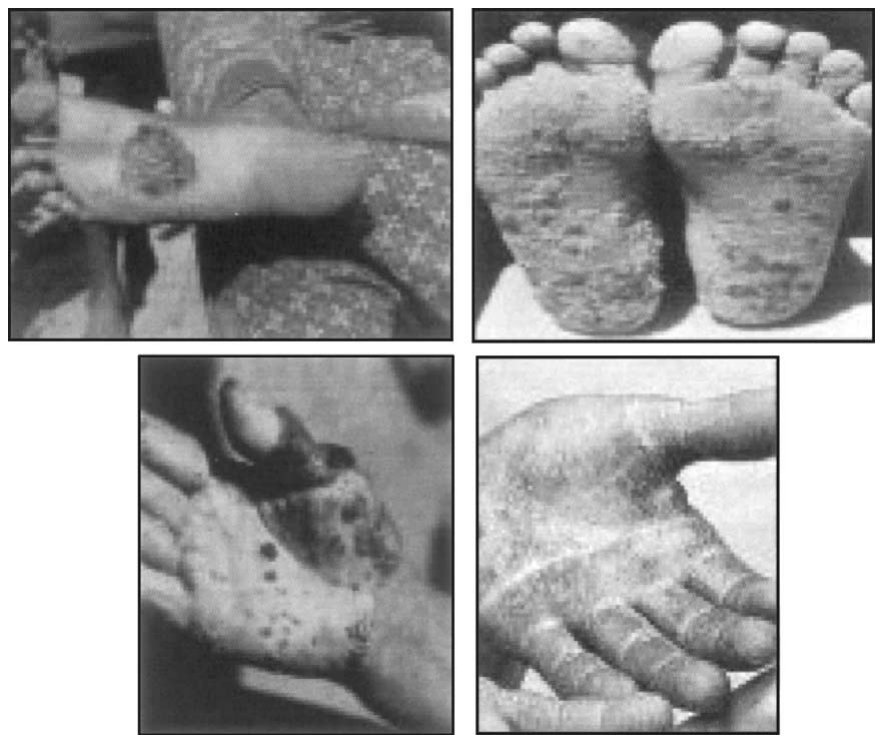
Studies have also revealed hepatic effects of As poisoning (USDHHS, 2000), as indicated by swollen and tender liver with elevated levels of hepatic enzymes in blood (Armstrong et al., 1984).
研究还揭示了As中毒对肝脏的影响(USDHHS, 2000),表现为肝脏肿大、触痛以及血液中肝酶水平升高(Armstrong et al., 1984)。
VI. RISK MANAGEMENT OF ARSENIC IN CONTAMINATED ENVIRONMENTSVI. 污染环境中砷的风险管理
Risk management of contaminated sites includes source reduction, site remediation, and environmental protection. Selection of optimal risk management strategies requires consideration of core objectives such as technical practicability, feasibility, and cost effectiveness of the strategy and wider environmental, social, and economic impacts. Arriving at an optimal risk management solution for a specific contaminated site involves three main phases of the decision-making process. These include problem identification, development of problem solving alternatives (i.e., remediation technologies), and management of the site. The next section discusses the various remediation technologies considered suitable for managing As-contaminated soil and aquatic environments.
污染场地的风险管理包括源头削减、场地修复和环境保护。选择最优风险管理策略需要考虑核心目标,如策略的技术实用性、可行性和成本效益,以及更广泛的环境、社会和经济影响。为特定污染场地确定最优风险管理方案涉及决策过程的三个主要阶段,包括问题识别、制定解决问题的备选方案(即修复技术)以及场地管理。下一节讨论被认为适用于管理As污染土壤和水环境的各种修复技术。
A. REMEDIATION OF ARSENIC-CONTAMINATED SOILA. 砷污染土壤的修复
Remediation of As-contaminated soil involves physical, chemical, and biological approaches that may achieve either the partial/complete removal of As from soil or the reduction of its bioavailability in order to minimize toxicity (Fig. 4). A large variety of methods have been developed to remediate metal(loid)s-contaminated sites. These methods can also be applicable for the remediation of As-contaminated soils. The selection and adoption of these technologies depend on the extent and nature of As contamination, type of soil, characteristics of the contaminated site, cost of operation, availability of materials, and relevant regulations.
As污染土壤的修复包括物理、化学和生物方法,可实现将As从土壤中部分/完全去除,或降低其生物有效性以尽量减小毒性(图4)。目前已开发出大量用于修复金属(类金属)污染场地的方法,这些方法也可用于As污染土壤的修复。这些技术的选择与采用取决于As污染的程度和性质、土壤类型、污染场地特征、运行成本、材料可获得性以及相关法规。
1Physical Remediation物理修复
Major physical in situ treatment technologies to remediate metal(loid)- contaminated sites include capping, soil mixing, soil washing, and solidification. The simplest technique for reducing the toxic concentration of As in soils is mixing the contaminated soil with uncontaminated soil. This results in the dilution of As to acceptable levels. This can be achieved by importing clean soil and mixing it with As-contaminated soil or redistributing clean materials already available in the contaminated site. Another dilution technique, especially in cultivated soils, relies on deep ploughing, during which the vertical mixing of the contaminated surface soil with less contaminated subsoil reduces the surface contamination, thereby minimizing the potential for As uptake by plants and ingestion of As by grazing animals. However, in this method the total concentration of As in soil will remain the same.
修复金属(类金属)污染场地的主要物理原位处理技术包括覆盖、土壤混合、土壤淋洗和固化。降低土壤中As毒性浓度最简单的技术是将污染土壤与未污染土壤混合,从而将As稀释至可接受水平。这可以通过引入清洁土壤并与As污染土壤混合,或重新分配污染场地内已有的清洁材料来实现。另一种稀释技术(尤其适用于耕作土壤)依靠深翻,通过将受污染的表层土与污染较轻的底土垂直混合来降低表层污染,从而尽量减小植物吸收As和放牧动物摄入As的可能性。然而,采用该方法时土壤中As的总浓度保持不变。
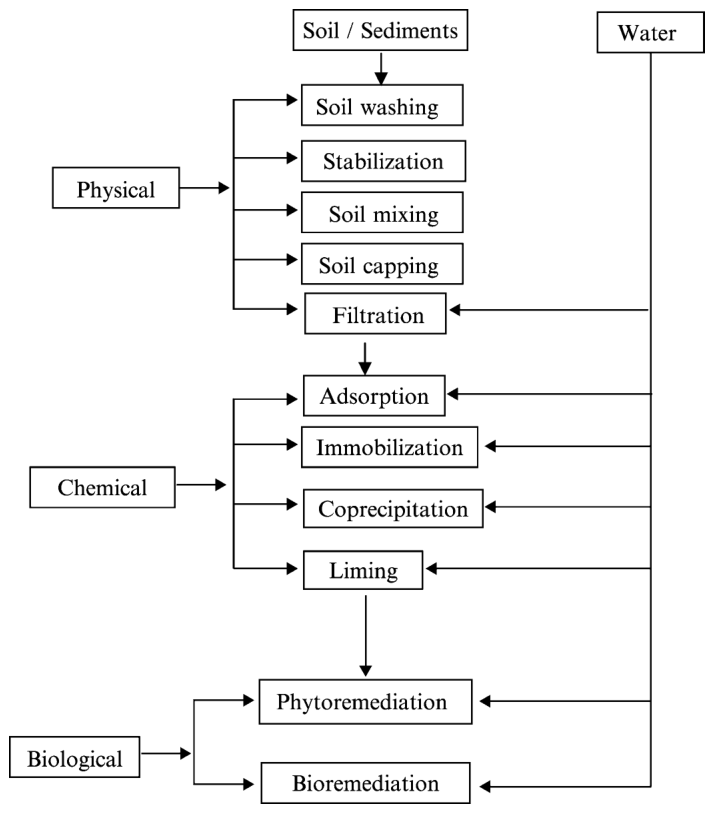
Soil washing or extraction has also been used widely for the remediation of metal(loid)-contaminated soils in Europe (Tuin and Tels, 1991) and this method may be applicable for As-contaminated soils to some extent. Tokunaga and Hakuta (2002) evaluated an acid-washing process to extract the bulk of As(V) from a highly contaminated (2830 mg As kg�1 soil) Kuroboku soil (Andosol) so as to minimize the risk of As to human health and the environment. The contaminated soil was washed with different concentrations of hydrogen fluoride, phosphoric acid, sulfuric acid, hydrogen chloride, nitric acid, perchloric acid, hydrogen bromide, acetic acid, hydrogen peroxide, 3:1 hydrogen chloride–nitric acid, or 2:1 nitric acid– perchloric acid. Phosphoric acid proved to be most promising as an extractant, attaining 99.9% As extraction at 9.4% acid concentration. Sulfuric acid also attained a high percentage extraction. The acid-washed soil was further stabilized by the addition of lanthanum (La), cerium (Ce), and Fe(III) salts or their oxides/hydroxides, which form an insoluble complex with dissolved As. Both salts and oxides of La and Ce were effective in immobilizing As in the soil attaining less than 0.01 mg liter�1 As in the leachate.
土壤淋洗或提取在欧洲也已广泛用于金属(类金属)污染土壤的修复(Tuin and Tels, 1991),该方法在一定程度上可能适用于As污染土壤。Tokunaga and Hakuta (2002)评价了一种酸洗工艺,用以从高度污染(2830 mg As kg−1土壤)的Kuroboku土(火山灰土,Andosol)中提取大部分As(V),以尽量降低As对人体健康和环境的风险。该污染土壤分别用不同浓度的氢氟酸、磷酸、硫酸、氯化氢、硝酸、高氯酸、溴化氢、乙酸、过氧化氢、3:1氯化氢–硝酸或2:1硝酸–高氯酸进行淋洗。磷酸被证明是最有前景的提取剂,在酸浓度为9.4%时As提取率达99.9%。硫酸也获得了较高的提取率。酸洗后的土壤通过添加镧(La)、铈(Ce)和Fe(III)的盐类或其氧化物/氢氧化物进一步稳定化,这些物质可与溶解态As形成不溶性络合物。La和Ce的盐类和氧化物均能有效固定土壤中的As,使淋出液中As低于0.01 mg liter−1。
The success of soil washing largely depends on speciation of As present in the contaminated soils, as it is based on the desorption or dissolution of As from the soil inorganic and organic matrix during washing with acids and chelating agents. Although soil washing is suitable for off-site treatment of soil, it can also be used for on-site remediation using mobile equipment. However, the high cost of chelating agents and choice of extractant may restrict their usage to only small-scale operations.
土壤淋洗的成效在很大程度上取决于污染土壤中As的形态,因为该方法基于用酸和螯合剂淋洗时As从土壤无机和有机基质中的解吸或溶解。尽管土壤淋洗适用于土壤的异位处理,但也可利用移动设备进行现场修复。然而,螯合剂的高成本和提取剂的选择可能使其仅限于小规模应用。
Arsenic-contaminated soil may be bound into a solid mass by using materials such as cement, gypsum, or asphalt. However, there are issues associated with the long-term stability of the solidified material. Capping the contaminated sites with clean soil is used to isolate contaminated sites as it is less expensive than other remedial options (Kookana and Naidu, 2000). Such covers should obviously prevent upward migration of contaminants through the capillary movement of soil water. The depth of such cover or “cap” required for contaminated sites should be assessed carefully. Using a simulated experiment, Kookana and Naidu (2000) demonstrated that when the water table is deeper than 2 m from the surface of cap, the upward migration of As through the cap is likely to be less than 0.5 m in 5 years. Where the water table is shallow enough to supply water to the surface (i.e., 1.5 to 2 m in most soils), dissolved As could take <10 years to reach the surface. They have also indicated that when the cap is of a different soil type than the underlying contaminated soil, a coarse-textured cap is very effective in reducing the capillary rise and therefore the cap should always be designed to include a coarser layer to break the capillary continuity.
可使用水泥、石膏或沥青等材料将砷污染土壤固结成固体块。然而,固化材料的长期稳定性存在问题。由于用清洁土壤覆盖污染场地的成本低于其他修复方案,该方法被用于隔离污染场地(Kookana and Naidu, 2000)。此类覆盖层显然应能阻止污染物通过土壤水的毛管运动向上迁移。污染场地所需覆盖层(即“盖层”)的厚度应仔细评估。Kookana and Naidu (2000)通过模拟试验证明,当地下水位距盖层表面深于2 m时,As在5年内穿过盖层向上迁移的距离可能小于0.5 m。当地下水位足够浅、能够向地表供水时(即大多数土壤中为1.5~2 m),溶解态As可能在<10年内到达地表。他们还指出,当盖层土壤类型与下伏污染土壤不同时,粗质地盖层能非常有效地降低毛管上升,因此盖层设计应始终包含较粗的土层,以阻断毛管连续性。
2Chemical Remediation化学修复
Remediation, based on chemical reactions, is becoming increasingly popular largely because of a high rate of success. A number of methods have been developed mainly involving adsorption, immobilization, precipitation, and comp lexation reactions [Eqs. (27–37 ) in Table VI]. Ho wever, such methods are often expensive for the remediation of large areas. Two approaches are often used in the chemical remediation of metal(loid)- contaminated soils: (i) immobilization of metal(loid)s using inorganic and organic soil amendments in order to reduce their bioavailability and (ii) mobilization of metal(loid)s and their subsequent removal through plant uptake (phytoremediation) or soil washing. This section discusses the immobilization techniques used for the remediation of As-contaminated soil. The second ap proach is discus sed in Se ction VI.A. 3.
基于化学反应的修复因成功率高而日益普及。已开发出多种方法,主要涉及吸附、固定、沉淀和络合反应[表VI中式(27–37)]。然而,此类方法用于大面积修复时通常成本高昂。金属(类金属)污染土壤的化学修复常采用两种途径:(i) 利用无机和有机土壤改良剂固定金属(类金属),以降低其生物有效性;(ii) 活化金属(类金属),随后通过植物吸收(植物修复)或土壤淋洗将其去除。本节讨论用于As污染土壤修复的固定化技术,第二种途径在VI.A.3节中讨论。
Chemical immobilization is achieved mainly through adsorption/precipitation of As in contaminated sites through the addition of soil amendments. The mobilization of metal(loid)s in soils for plant uptake and leaching to groundwater can be minimized by reducing their bioavailability through chemical and biological immobilization (Bolan et al., 2004). There has been interest in the immobilization of metal(loid)s using a range of inorganic compounds such as lime, P fertilizers (e.g., phosphate rocks) and alkaline waste materials, and organic compounds such as biosolids (Basta et al., 2001; Knox et al., 2000). Depending on the source, the application of P compounds can cause direct adsorption of As onto these materials, promote As complex formation, or induce desorption of As through competition. This method is considered more economical and less disruptive than the conventional remediation option of soil removal (Bolan et al., 2003).
化学固定主要通过添加土壤改良剂使污染场地中的As发生吸附/沉淀来实现。通过化学和生物固定降低金属(类金属)的生物有效性,可以最大限度地减少其在土壤中因植物吸收和向地下水淋溶而发生的活化(Bolan et al., 2004)。人们对利用多种无机化合物(如石灰、P肥(如磷矿粉)和碱性废弃物)以及有机化合物(如生物固体(污泥))固定金属(类金属)很感兴趣(Basta et al., 2001; Knox et al., 2000)。取决于来源,施用P化合物可使As直接吸附于这些材料上、促进As络合物形成,或通过竞争诱导As解吸。与移除土壤的传统修复方案相比,该方法被认为更经济、破坏性更小(Bolan et al., 2003)。
Immobilization of As may be achieved by (i) changing the physical properties of the soil so that As is more tightly bound and therefore becomes less bioavailable; (ii) chemically immobilizing As either by sorption onto a mineral surface or by precipitation as a discrete insoluble compound; and/ or (iii) mixing the contaminated soil with uncontaminated soil, thereby increasing the number of As-binding sites (Naidu et al., 2003).
As的固定可通过以下方式实现:(i) 改变土壤的物理性质,使As结合更牢固,从而降低其生物有效性;(ii) 通过吸附于矿物表面或以独立的不溶性化合物形式沉淀,对As进行化学固定;和/或 (iii) 将污染土壤与未污染土壤混合,从而增加As结合位点的数量(Naidu et al., 2003)。
A number of organic and inorganic amendments are known to immobilize a range of metal(loid)s including As by chemical adsorption. These include ion-exchange resin, ferrous sulfate, silica gel, gypsum, clay minerals such as bentonite, kaolin, and zeolite, green sand, and liming materials. These materials are naturally occurring and nontoxic with a large specific surface area and a significant amount of surface charge. The use of naturally occurring clay minerals such as zeolite as adsorbents is a novel method for the remediation of metal(loid)-contaminated soils (Minato et al., 2000). The advantages of zeolite application are its high efficiency for retention of metal(loid)s in soils, low cost, and easy application. Naidu et al. (2000) examined the potential for using strongly weathered oxidic soils as reactive barriers and found a strong affinity for As as it retains almost 5000 mg As kg�1.
已知多种有机和无机改良剂可通过化学吸附固定包括As在内的一系列金属(类金属)。这些改良剂包括离子交换树脂、硫酸亚铁、硅胶、石膏、黏土矿物(如膨润土、高岭土和沸石)、海绿石砂以及石灰性材料。这些材料天然存在且无毒,具有较大的比表面积和大量表面电荷。使用沸石等天然黏土矿物作为吸附剂是修复金属(类金属)污染土壤的一种新方法(Minato et al., 2000)。施用沸石的优点在于其对土壤中金属(类金属)的保持效率高、成本低且易于施用。Naidu et al. (2000)研究了将强风化氧化土用作反应屏障的潜力,发现其对As具有很强的亲和力,可保持近5000 mg As kg−1。
Boisson et al. (1999) assessed the effectiveness of soil additives in reducing contaminant mobility. Their results indicated that the lowest amount of As was extracted when the soil was amended with beringite, steel shots, and their combination. Although the addition of hydroxyapatite decreased the mobility of metals such as Cd and Pb, it increased the mobility of As mainly due to H2PO4–AsO4 competition for the sorption sites. Therefore, the use of hydroxyapatite at multimetal(loid)-contaminated sites requires careful attention.
Boisson et al. (1999)评估了土壤添加剂降低污染物迁移性的效果。结果表明,当土壤用beringite、钢丸及二者组合改良时,As的提取量最低。尽管添加羟基磷灰石降低了Cd、Pb等金属的迁移性,但主要由于H2PO4与AsO4对吸附位点的竞争,其提高了As的迁移性。因此,在多金属(类金属)污染场地使用羟基磷灰石需审慎。
Liming is increasingly being used as an important soil management practice in reducing the toxicity of certain metal(loid)s in soils. In addition to the traditional agricultural lime, a large number of studies have examined the potential value of other liming materials as immobilizing agents in reducing the bioavailability of a range of metal(loid)s in soils (Bolan et al., 2003). However, the effect of liming soils on As mobility has been rather inconsistent. Lime addition to As-contaminated soil induces the formation of CaH(AsO4) 2 [Eq. (35) in Table VI], thereby reducing the solubl e As in the soil solution for plant uptake and leaching. However, the solubility product of this compound is greater than that for Fe and Al arsenates, which are readily formed in most soils. For this reason, liming is not practiced widely to overcome As toxicity in soils (Jones et al., 1997), although liming has been reported to increase the immobilization of As (Bothe and Brown, 1999) and to decrease the plant uptake of As (Jiang and Singh, 1994; Tyler and Olsson, 2001).
施用石灰作为降低土壤中某些金属(类金属)毒性的重要土壤管理措施,正得到越来越多的应用。除传统农用石灰外,大量研究考察了其他石灰性材料作为固定剂降低土壤中一系列金属(类金属)生物有效性的潜在价值(Bolan et al., 2003)。然而,石灰处理对土壤As迁移性的影响并不一致。向As污染土壤中添加石灰会诱导形成CaH(AsO4)2[表VI中式(35)],从而减少土壤溶液中可供植物吸收和淋溶的可溶性As。然而,该化合物的溶度积大于大多数土壤中易于形成的Fe、Al砷酸盐。因此,尽管有报道称施用石灰可增强As的固定(Bothe and Brown, 1999)并降低植物对As的吸收(Jiang and Singh, 1994; Tyler and Olsson, 2001),但石灰处理并未被广泛用于克服土壤As毒性(Jones et al., 1997)。
Naidu et al. (2003) evaluated the potential value of the chemical immobilization technique in the remediation of an As-contaminated site under field conditions in Australia. The site was a former railway depot that had previously been shown to be extensively contaminated with As. The As levels in the soil exceeded both ecological (20 mg kg�1) and health investigation levels (100 mg kg�1) and was appreciably water soluble, indicating that large amounts of As were potentially mobile at this site. The historical source of the contamination appears to be the ubiquitous use of As-based herbicides. Exposure pathway analyses showed that the highly mobile As posed a risk to both the groundwater and the residents living in the area. The contaminated site was identified for industrial development with Australian industrial guidelines for As set at 500 mg kg�1 soil. Options for managing contaminated soil included in situ cleanup, excavation, and transport to landfill sites or application of risk-based land management strategy. Both in situ cleanup and excavation and transport to landfill were found to be prohibitively expensive and ranged from �$500,000 to $1,000,000.
Naidu et al. (2003)在澳大利亚田间条件下评价了化学固定技术修复As污染场地的潜在价值。该场地为一处原铁路车辆段,此前已证实受到大范围As污染。土壤中As含量超过了生态调查水平(20 mg kg−1)和健康调查水平(100 mg kg−1),且水溶性相当高,表明该场地大量As具有潜在迁移性。污染的历史来源似乎是含As除草剂的普遍使用。暴露途径分析表明,高迁移性As对地下水和该地区居民均构成风险。该污染场地被规划用于工业开发,澳大利亚工业用地As指导值为500 mg kg−1土壤。污染土壤的管理方案包括原位清理、挖掘并运往填埋场,或采用基于风险的土地管理策略。原位清理以及挖掘运往填埋场的费用均高得令人望而却步,约为$500,000至$1,000,000。
A risk reduction strategy was adopted with the aim to reduce the mobility of As through chemical immobilization. Ferrous salt was used to generate in situ mineral phases to immobilize As [Eq. (38)]. This reaction requires oxygen to be available to the soil and also generates considerable amounts of acid, which may be counterproductive to As immobilization in poorly buffered soils. The increased acidity could be neutralized by the amendment with lime [Eq. (39)]. The redox conditions of the soil also influence the speciation of As, and an example of two possible redox couples is given later [Eqs. (40) and (41)]. Following initial detailed laboratory studies, a mixture of Fe/Mn/gypsum was used as the stabilizing chemical. As shown in
采取了以通过化学固定降低As迁移性为目标的风险削减策略。采用亚铁盐原位生成矿物相以固定As[式(38)]。该反应需要土壤中有氧气供应,同时会产生大量酸,这在缓冲能力差的土壤中可能不利于As的固定。增加的酸度可通过施用石灰中和[式(39)]。土壤的氧化还原条件也影响As的形态,下文给出了两个可能的氧化还原电对的示例[式(40)和(41)]。在前期详细的实验室研究之后,采用Fe/Mn/石膏混合物作为稳定化化学剂。如
Fig. 5, application of the mixed chemical led to a significant decline in mobile As. Subsequent studies involving aging of the treated soil showed complete elimination of risk posed by As. The total cost using this strategy was < $100,000, thus providing significant savings to the client.图5),施用混合化学药剂使可移动态As显著下降。随后对处理土壤进行老化的研究表明,As所构成的风险被完全消除。采用该策略的总成本 < $100,000,从而为委托方节省了大量费用。



Results of a field experiment conducted by Xie and Huang (1998) on an As-polluted soil (Typentiaqualf ) in China have shown that the application of Fe (as FeCl3 at 25 mg Fe kg�1 soil) or Mn (as MnO2 at 25 mg Mn kg�1 soil) markedly lowered the total water- soluble As [As(III) + As(V)] (24–26%) and As(III) (17–82%) in the soil and made the rice plants grow better than the control treatment, resulting in a higher rice grain yield and lesser As content in rice husk. This was attributed to the oxidation of As(III) to As(V) by MnO2 and the subsequent strong adsorption of As(V) by Fe and Mn oxides.
Xie and Huang (1998) 在中国一块受As污染的土壤(Typentiaqualf)上开展的田间试验结果表明,施用Fe(以FeCl3形式,25 mg Fe kg−1土壤)或Mn(以MnO2形式,25 mg Mn kg−1土壤)可显著降低土壤中水溶性总As [As(III) + As(V)](24–26%)和As(III)(17–82%),并使水稻长势优于对照处理,从而获得更高的稻谷产量和更低的稻壳As含量。这归因于MnO2将As(III)氧化为As(V),以及随后Fe、Mn氧化物对As(V)的强烈吸附。
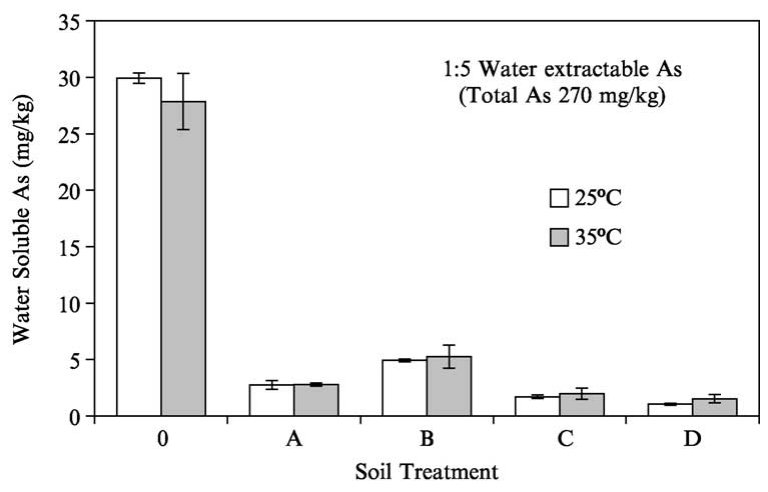
3Biological Remediation生物修复
a. Bioremediation. Bioremediation of soils contaminated with organic compounds such as pesticides and hydrocarbons is widely accepted in which native or introduced microorganisms and/or biological materials, such as compost, animal manures, and plant residues, are used to detoxify or transform contaminants. There has been increasing interest in the application of this technology for the remediation of metal(loid)-contaminated soils, especially for those metal(loid)s that undergo biological transformation. Although it has several limitations, this technology holds continuing interest because of its cost effectiveness. The unique aspect in bioremediation is that it relies mainly on natural processes and does not necessarily require the addition of chemical amendments other than microbial cultures and biological wastes. Because As undergoes biological transformation in soil, appropriate microorganisms may be used for the remediation of As-contaminated soils. Existing and developing in situ bioremediation technologies may be grouped into the following two broad categories (NRC, 1997).
a. 生物修复。对于受农药、烃类等有机化合物污染的土壤,生物修复已被广泛接受,即利用土著或外源微生物和/或生物材料(如堆肥、畜禽粪便和植物残体)对污染物进行解毒或转化。将该技术应用于金属(类金属)污染土壤修复的兴趣日益增加,尤其是针对那些可发生生物转化的金属(类金属)。尽管该技术存在若干局限,但因其成本效益高而持续受到关注。生物修复的独特之处在于它主要依赖自然过程,除微生物培养物和生物废弃物外,不一定需要添加化学改良剂。由于As在土壤中可发生生物转化,因此可利用适当的微生物修复As污染土壤。现有和正在发展的原位生物修复技术可分为以下两大类(NRC, 1997)。
i. Intrinsic bioremediation is where the essential materials required to sustain microbial activity exist in sufficient concentrations that naturally occurring microbial communities are able to degrade the target contaminants without the need for human intervention. This technique is better suited for remediation of soils with low levels of As over an extensive area.
i. 内在生物修复是指维持微生物活性所需的必要物质以足够浓度存在,使天然存在的微生物群落无需人为干预即可降解目标污染物。该技术更适用于大面积低水平As污染土壤的修复。
ii. Engineered bioremediation relies on various approaches to accelerate in situ microbial degradation rates. This is accomplished by optimizing the environmental conditions by adding nutrients and/or an electron donor/acceptor, thus promoting the proliferation and activity of existing microbial consortia. It is favored for highly contaminated localized sites.
ii. 工程生物修复依靠多种途径加快原位微生物降解速率。其实现方式是通过添加养分和/或电子供体/受体来优化环境条件,从而促进现有微生物群落的增殖和活性。该方法适用于高污染的局部场地。
Three approaches could be used in the bioremediation of As-contaminated soils: (i) As could be immobilized into microbial cells through biosorption (bioaccumulation), (ii) toxic As(III) could be oxidized to less toxic As(V), and (iii) As compounds could be removed from the soil by volatilization.
As污染土壤的生物修复可采用三种途径:(i) 通过生物吸附(生物累积)将As固定于微生物细胞内;(ii) 将毒性较强的As(III)氧化为毒性较弱的As(V);(iii) 通过挥发作用将As化合物从土壤中去除。
i. Bioaccumulation: Microorganisms exhibit a strong ability to accumulate (bioaccumulation) As from a substrate containing very low concentrations of this element. Bioaccumulation is activated by two processes, namely biosorption of As by microbial biomass and its by-products and physiological uptake of As by microorganisms through metabolically active and passive processes. Factors such as soil pH, moisture and aeration, temperature, concentration and speciation of As, soil amendments, and rhizosphere are known to influence the process of bioaccumulation of As in microbial cells. While a number of bacterial and
i. 生物累积:微生物表现出从该元素浓度极低的基质中累积As的强大能力(生物累积)。生物累积由两个过程驱动,即微生物生物量及其副产物对As的生物吸附,以及微生物通过代谢主动和被动过程对As的生理吸收。已知土壤pH、水分与通气状况、温度、As的浓度与形态、土壤改良剂以及根际等因素会影响微生物细胞对As的生物累积过程。虽然已知许多细菌和
fungal species have been known to bioaccumulate As, some algal species (Fucus gardneri and Chlorella vulgaris) are also known to accumulate As (Granchinho et al., 2001; Maeda et al., 1985). This technique has often been used successfully to remove metal(loid) ions from the aquatic environment and is therefore discussed further in Se ction VI.B.2.
真菌物种可生物累积As,但一些藻类(Fucus gardneri和Chlorella vulgaris)也可累积As(Granchinho et al., 2001; Maeda et al., 1985)。该技术常被成功用于去除水环境中的金属(类金属)离子,因此将在VI.B.2节中进一步讨论。
ii. Microbial redox reactions: Heterotrophic bacteria have been found to oxidize toxic As(III) in soils and sediments to less toxic As(V) and thus could play an important role in the remediation of contaminated environment (Wakao et al., 1988). Because As(V) is strongly adsorbed onto inorganic soil components, microbial oxidation could result in the immobilization of As. Strains of Bacillus and Pseudomonas spp. (Frankenberger and Losi, 1995) and Alcaligenes faecalis (Phillips and Taylor, 1976) and Alcaligenes spp. (Osborne and Ehrlich, 1976) were found capable of oxidizing As(III) to As(V).
ii. 微生物氧化还原反应:已发现异养细菌可将土壤和沉积物中毒性较强的As(III)氧化为毒性较弱的As(V),因而可在污染环境修复中发挥重要作用(Wakao et al., 1988)。由于As(V)被土壤无机组分强烈吸附,微生物氧化可导致As的固定。已发现Bacillus和Pseudomonas spp.菌株(Frankenberger and Losi, 1995)、Alcaligenes faecalis(Phillips and Taylor, 1976)以及Alcaligenes spp.(Osborne and Ehrlich, 1976)能够将As(III)氧化为As(V)。
A dissimilatory metal(loid) reduction has the potential to be a helpful mechanism for both intrinsic and engineered bioremediation of contaminated environments. Arsenic can be reduced to Aso, which is subsequently precipitated as a result of microbial sulfate reduction. Desulfototomaculum auripigmentum, which reduces both As(V) to As(III) and SO24� to H2S leads to As2S3 precipitation (Newman et al., 1997). Because arsenite is more soluble than As(V), the latter can be reduced to As(III) using bacteria in soil and subsequently leached.
异化金属(类金属)还原有可能成为污染环境内在生物修复和工程生物修复的一种有用机制。砷可被还原为Aso,随后因微生物硫酸盐还原而沉淀。Desulfototomaculum auripigmentum既能将As(V)还原为As(III),又能将SO24−还原为H2S,从而导致As2S3沉淀(Newman et al., 1997)。由于亚砷酸盐比As(V)更易溶,可利用土壤中的细菌将后者还原为As(III),随后使其淋溶去除。
iii. Methylation of As: A variety of microbes could transform inorganic As into its metallic hydride or methylated forms. Due to their low boiling point and/or high vapor pressure, these compounds are susceptible for volatilization and could easily be lost to the atmosphere (Braman and Foreback, 1973). Methylation is considered a major biological transformation through which As is volatilized and lost. As discussed earlier, biomethylation of As in soils and aquatic systems is well documented, as it is important in controlling the mobilization and subsequent distribution of arsenicals in the environment (Frankenberger and Losi, 1995; Gao and Burae, 1997; McBride and Wolfe, 1971; Tamaki and Frankenberger, 1992).
iii. As的甲基化:多种微生物可将无机As转化为其金属氢化物或甲基化形态。由于沸点低和/或蒸气压高,这些化合物易于挥发,很容易散失到大气中(Braman and Foreback, 1973)。甲基化被认为是As挥发散失的主要生物转化途径。如前所述,土壤和水体系统中As的生物甲基化已有充分记载,因为它对控制砷化合物在环境中的迁移及其后续分布十分重要(Frankenberger and Losi, 1995; Gao and Burae, 1997; McBride and Wolfe, 1971; Tamaki and Frankenberger, 1992)。
Methanogenic bacteria, commonly present in sewage sludge, freshwater sediments, and composts, are capable of methylating inorganic As to volatile DMA. Arsenate, As(III), and MAA can serve as substrates in DMA formation. Inorganic As methylation is coupled to the CH4 biosynthetic pathway and may be a widely occurring mechanism for As removal and detoxification (Frankenberger and Losi, 1995). In addition to bacteria, certain soil fungi also are able to volatilize As as methylarsine compounds, which are derived from inorganic and organic As species.
产甲烷菌普遍存在于污水污泥、淡水沉积物和堆肥中,能够将无机As甲基化为挥发性的DMA。砷酸盐、As(III)和MAA均可作为DMA形成的底物。无机As的甲基化与CH4生物合成途径相耦合,可能是一种广泛存在的As去除和解毒机制(Frankenberger and Losi, 1995)。除细菌外,某些土壤真菌也能以甲基胂化合物的形式使As挥发,这些化合物来源于无机和有机As形态。
Woolson (1977) demonstrated the release of alkylarsines in a number of soils. Dimethylarsine and trimethylarsine are produced when soils were amended with inorganic and methylated arsenic herbicides. The organisms responsible for volatilization of As originate from diverse environments, suggesting that a number of species have the capacity to produce alkylarsines (Frankenberger and Losi, 1995; Woolson, 1977). Some examples of the organisms involved in the biomethylation of As are given in Table IX. In most cases, these organisms were tested in laboratory conditions; however, their performance should be assessed under field conditions in contaminated sites.
Woolson (1977) 证实了多种土壤中烷基胂的释放。土壤施用无机和甲基化砷类除草剂后会产生二甲基胂和三甲基胂。负责As挥发的生物来源于多种不同环境,表明许多物种都具有产生烷基胂的能力(Frankenberger and Losi, 1995; Woolson, 1977)。表IX列出了参与As生物甲基化的部分生物实例。在大多数情况下,这些生物是在实验室条件下测试的;然而,其性能应在污染场地的田间条件下加以评估。
b. Phytoremediation. Phytoremediation is considered a subset of bioremediation that employs plants and their associated root-bound microbial community to remove, contain, degrade, or render environmental contaminants harmless (Raskin et al., 1997; Robinson et al., 2003b). This terminology applies to all plant-influenced biological, chemical, and physical processes that aid in the remediation of contaminated medium (Cunningham and Lee, 1995). It involves soil–plant systems in which metal(loid)s-accumulating plants are grown in contaminated sites. It is considered an economically feasible and environmentally viable technology for remediating metal(loid)-contaminated systems. The effectiveness of this technology is, however, variable and highly site dependent.
b. 植物修复。植物修复被视为生物修复的一个分支,它利用植物及其相关的根系微生物群落来去除、控制、降解环境污染物或使其无害化(Raskin et al., 1997; Robinson et al., 2003b)。该术语适用于所有有助于污染介质修复的、受植物影响的生物、化学和物理过程(Cunningham and Lee, 1995)。它涉及土壤–植物系统,即在污染场地种植累积金属(类金属)的植物。该技术被认为是修复金属(类金属)污染系统的一种经济可行且环境友好的技术。然而,该技术的有效性存在差异,并高度依赖于场地条件。
In phytoremediation, plants are exploited as a biopump that use the energy of the sun to remove water and contaminants from the soil to the aboveground portion and return some of the products of photosynthesis back into the root zone in the form of root exudates involved in the (im) mobilization of contaminants. Transpiration is the driving force for phytoremediation. By removing water from the medium, plants help reduce erosion, runoff, and leaching, thereby limiting the movement of contaminants off-site. Some contaminants are taken up in the transpiration stream, where they may be metabolized, and may be eventually volatilized. By removing excess water from the soil profile, plant roots may also create an aerobic environment where metal(loid) mobility is reduced and biological activity is enhanced. Plants stimulate microbiological activity in the root zone by providing a carbon source from root exudates and decaying root materials (Robinson et al., 2003b).
在植物修复中,植物被用作一种生物泵,利用太阳能将水分和污染物从土壤转移至地上部分,并以根系分泌物的形式将部分光合产物返回根区,这些根系分泌物参与污染物的活化(固定)。蒸腾作用是植物修复的驱动力。通过从介质中移除水分,植物有助于减少侵蚀、径流和淋溶,从而限制污染物向场地外迁移。一些污染物随蒸腾流被吸收,在其中可能被代谢,并最终可能挥发。通过移除土壤剖面中的多余水分,植物根系还可能创造好氧环境,使金属(类金属)的移动性降低、生物活性增强。植物通过根系分泌物和腐解根系物质提供碳源,从而刺激根区的微生物活性(Robinson et al., 2003b)。
Phytoremediation technologies have been grouped into various categories that include phytostabilization, rhizofiltration, and phytoextraction (Cunningham et al., 1995). In phytostabilization, transpiration and root growth are used to immobilize contaminants, including As by reducing leaching, controlling erosion, creating an aerobic environment in the root zone, and adding organic matter to the substrate that binds As. It involves the establishment of metal(loid)-tolerant vegetation on the contaminated site that is left in perpetuity. The stabilization of As in the root zone could be achieved through the addition of organic matter as well as soil amendments. In rhizofiltration, the roots can be used to adsorb or absorb metal (loid)s, which are subsequently removed by harvesting the whole plant. In this case, metal(loid) tolerance and translocation of the metal(loid)s to aerial parts are largely irrelevant. In phytoextraction, plants can be grown on contaminated soil and the aerial parts [and the metal(loid)s they contain] harvested. In this case, plants need to be tolerant only if the soil metal(loid) content is very high, but they need to accumulate very high concentrations in their aerial parts. Phytoextraction involves repeated cropping of plants until the metal(loid) concentration in the soil has reached the acceptable (targeted) level.
植物修复技术被分为若干类别,包括植物稳定、根际过滤和植物提取(Cunningham et al., 1995)。在植物稳定中,利用蒸腾作用和根系生长来固定包括As在内的污染物,其途径包括减少淋溶、控制侵蚀、在根区创造好氧环境以及向基质中添加可结合As的有机质。该方法需要在污染场地上建立耐金属(类金属)植被并使其永久保留。根区中As的稳定可通过添加有机质和土壤改良剂来实现。在根际过滤中,可利用根系吸附或吸收金属(类金属),随后通过收获整株植物将其去除。在这种情况下,植物对金属(类金属)的耐性以及金属(类金属)向地上部的转运基本无关紧要。在植物提取中,可在污染土壤上种植植物并收获其地上部分[及其中所含的金属(类金属)]。在这种情况下,只有当土壤金属(类金属)含量很高时植物才需要具有耐性,但它们需要在地上部分累积极高的浓度。植物提取需要反复种植植物,直至土壤中金属(类金属)浓度达到可接受的(目标)水平。
Microorganisms Proven Capable of Biomethylating Arsenic Compounds in Soil and Aquatic Environments
经证实能够在土壤和水环境中对砷化合物进行生物甲基化的微生物
| Organisms生物 | Mechanism机制 | Reference参考文献 |
|---|---|---|
| Scopulariopsis koningii | Methylate As to | Lehret al. (2003) |
| Fomitopsis pinicola | trimethylarsenic(V) | |
| Penicillium gladioli | species, precursors to volatile trimethylarsine | |
| Fusarium oxysporum meloni | Accumulates As(V) and converts to dimethylarsine | Granchinhoet al. (2002) |
| Fucus gardneri | Methylates As(V) to dimethylarsine | Granchinhoet al. (2001) |
| Closterium aciculare | Methylates As(V) to methylarsenic(III) species | Hasegawa et al. (2001) |
| S. brevicaule | Transforms As(V) to (CH3)3As species | Andreweset al. (2000) |
| Chlorella vulgaris | Biosorption and accumulation of As and converting into compound of (CH3)2AsO(OH) | Kaiseet al. (1997) |
| Polyphysa peniculus | Methylates As(V) to dimethylarsine | Cullenet al. (1994) |
| Penicilliumsp. | At pH 5 to 6 methylates CH3AsO(OH)2and (CH3)2AsO(OH) to (CH3)3As. | Huysmans and Frankenberger (1991) |
| Aeromonassp. | Methylates (CH3)2AsO(OH) to (CH3)3AsO | Bakeret al. (1983) |
| Alcaligenessp. Pseudomonassp. | Methylates AsO� 2 or AsO3� 4 into AsH3 under aerobic condition | Cheng and Focht (1979) |
| Flavobacteriumsp. | Methylates (CH3)2AsO(OH) to (CH3)3AsO | Chau and Wong (1978) |
| Candida humicola | Methylates As(V) into a volatile As species | Cullenet al. (1984) |
| Methanobacteriaum | Methylates As(V), As(III) and CH3AsO(OH)2to (CH3)2AsH under anaerobic condition | McBride and Wolfe (1971) |
| C. humicola | Methylates CH3AsO(OH)2and | Cox and Alexander (1973) |
| Gliocladium roseum | (CH3)2AsO(OH) acid to (CH3)3As. | |
| Penicilliumsp. | [C. humicolauses AsO� 2 and AsO3� 4 as substrates to produce (CH3)3As] |
Certain plants, termed “hyperaccumulators” (Brooks et al., 1977), accumulate an inordinate concentration of metal(loid)s in their aboveground biomass. These plants may even accumulate metal(loid)s that are nonessential and often toxic to plants. The minimum concentration of As required for a plant to be classified as a hyperaccumulator of As was set at 1000 mg kg�1 (0.1%) on a dry weight basis (Ma et al., 2001). The hyperaccumulation of metal(loid)s involves uptake of the soluble metal(loid) species by the root system, translocation to the aerial parts, and storage in a nontoxic form in the aerial portions. Chaney et al. (1997) suggested that this process necessarily requires tolerance to high concentrations of metal (loid)s.
某些被称为“超富集植物”(Brooks et al., 1977)的植物可在其地上生物量中累积异常高浓度的金属(类金属)。这些植物甚至可以累积非必需且通常对植物有毒的金属(类金属)。植物被归类为As超富集植物所需的最低As浓度被设定为1000 mg kg−1(0.1%,以干重计)(Ma et al., 2001)。金属(类金属)的超富集包括根系对可溶性金属(类金属)形态的吸收、向地上部分的转运,以及在地上部分以无毒形式储存。Chaney et al. (1997) 认为,这一过程必然需要对高浓度金属(类金属)具有耐性。
Using a combination of techniques, including X-ray absorption spectroscopy, Pickering et al. (2000) studied the biological mechanisms involved in the accumulation of As in Indian mustard (Brassica juncea) and established the biochemical fate of As taken up by this plant. Arsenic was taken up by roots as oxyanions [As(V) and As(III)], possibly via the H2PO�4 transport mechanism, and a small fraction was exported to the shoot via xylem. Once in the shoot, the As is stored as an As-III-tris-thiolate complex. The majority of the As remains in the roots as an As-III-tris-thiolate complex, which is indistinguishable from that found in the shoots and from As-III-trisglutathione. The thiolate donors are thus probably either glutathione or phytochelatins. Addition of the dithiol arsenic chelator dimercaptosuccinate to the hydroponic culture medium caused a fivefold increase in the As level in the leaves, although the total As accumulation was increased only marginally. This indicates that the addition of dimercaptosuccinate to As-contaminated soils is likely to facilitate As bioaccumulation in plant shoots, a prerequisite for efficient phytoremediation strategy. The high cost of this compound, however, would be an economic concern unless the plants would be able to synthesize it.
Pickering et al. (2000) 结合使用包括X射线吸收光谱在内的多种技术,研究了印度芥菜(Brassica juncea)累积As所涉及的生物学机制,并确定了该植物所吸收As的生物化学归宿。砷以含氧阴离子[As(V)和As(III)]的形式被根系吸收,可能是通过H2PO−4转运机制,其中一小部分经木质部输出至地上部。进入地上部后,As以As-III-三硫醇络合物的形式储存。大部分As以As-III-三硫醇络合物的形式留在根中,该络合物与地上部中发现的络合物以及As-III-三谷胱甘肽无法区分。因此,硫醇供体可能是谷胱甘肽或植物螯合肽。向水培介质中添加二硫醇类砷螯合剂二巯基丁二酸使叶片中As含量增加了五倍,尽管As总累积量仅略有增加。这表明,向As污染土壤中添加二巯基丁二酸可能促进As在植物地上部的生物累积,而这是高效植物修复策略的前提。然而,除非植物能够自身合成该化合物,否则其高昂的成本将是一个经济上的顾虑。
At present there are about 400 species of known terrestrial plants that hyperaccumulate one or more of several metal(loid)s (Robinson et al., 1995). However, until recently no As-hyperaccumulating plants were reported. Ma et al. (2001) discovered an As-hyperaccumulating plant, ladder brake (Pteris vittata L.), a terrestrial fern, which accumulates large amounts (23,000 mg kg�1-dry weight basis) of As from soils. The unique property of As hyperaccumulation by the Chinese brake fern is of great significance in the phytoremediation of As-contaminated soils. Therefore, the potential of this fern for phytoremediation of As-contaminated soil was assessed by Tu et al. (2002) in a glasshouse experiment using soils from an abandoned wood preservation site. Results have shown that the Chinese brake accumulated huge amounts of As from soil and that its As concentration increased with the growth period. The As concentration in the fronds was 6000 mg kg�1 dry mass after 8 weeks of transplanting and increased to 7230 mg kg�1 after 20 weeks. The As concentration increased as fronds aged, with old fronds accumulating as much as 13,800 mg As kg�1. Another silver fern [Pityrogramma calomelanos (L.) Link] has also been reported to hyperaccumulate As up to 8350 mg kg�1 dry mass from soil containing 135 mg kg�1 (Francesconi et al., 2002). It occurs in tropical and subtropical regions of the world and is widely distributed in Thailand where it favors open, high rainfall areas. Some of the studies involving phytoremediation of As in the soil are presented in Table X.
目前已知约有400种陆生植物可超富集一种或多种金属(类金属)(Robinson et al., 1995)。然而,直到最近才有As超富集植物的报道。Ma et al. (2001) 发现了一种As超富集植物——蜈蚣草(Pteris vittata L.),这是一种陆生蕨类植物,可从土壤中累积大量As(23,000 mg kg−1,以干重计)。蜈蚣草超富集As的独特性质对As污染土壤的植物修复具有重要意义。因此,Tu et al. (2002) 利用一处废弃木材防腐场地的土壤,在温室试验中评估了该蕨类植物修复As污染土壤的潜力。结果表明,蜈蚣草从土壤中累积了大量As,且其As浓度随生长期延长而增加。移栽8周后羽叶中As浓度为6000 mg kg−1干物质,20周后增至7230 mg kg−1。As浓度随羽叶老化而增加,老羽叶累积的As高达13,800 mg As kg−1。另有报道称,另一种银粉背蕨[Pityrogramma calomelanos (L.) Link]可从含As 135 mg kg−1的土壤中超富集As,浓度可达8350 mg kg−1干物质(Francesconi et al., 2002)。该植物分布于世界热带和亚热带地区,在泰国分布广泛,偏好开阔、降雨量高的地区。表X列出了部分涉及土壤As植物修复的研究。
Arsenic uptake by plants is associated with the H2PO�4 uptake mechanism, where presumably As(V) is taken up as a H2PO�4 analogue (Pickering et al., 2000). Therefore, there is a growing interest in using P fertilizer to enhance As uptake by plants. Tu and Ma (2003) suggested that phosphate application may be an important strategy for the efficient use of Chinese brake (Pteris vittata L.) to phytoremediate As-contaminated soils. The addition of P fertilizer to As-contaminated soil was found to increase As solubility and mobility and thus increase plant uptake of soil As (Creger and Peryea, 1994). Some selected references on the mobilization of As by phosphate compounds are reported in Table XI.
植物对砷的吸收与H2PO−4吸收机制有关,推测As(V)作为H2PO−4类似物被吸收(Pickering et al., 2000)。因此,利用磷肥促进植物吸收As日益受到关注。Tu and Ma (2003) 认为,施用磷酸盐可能是高效利用蜈蚣草(Pteris vittata L.)对As污染土壤进行植物修复的一项重要策略。研究发现,向As污染土壤中添加磷肥可提高As的溶解度和移动性,从而增加植物对土壤As的吸收(Creger and Peryea, 1994)。表XI列出了有关磷酸盐化合物活化As的部分参考文献。
In an hydroponic experiment, Wang et al. (2002) investigated the interactions of As(V) and H2PO�4 on the uptake and distribution of As and P, and As speciation in P. vittata. They found that the plants accumulated As in the fronds up to 27,000 mg kg �1 dry weight, and the frond As to root As concentration ratio varied between 1.3 and 6.7. Increasing the phosphate supply decreased the As uptake markedly, with the effect being greater on root As concentration than on shoot concentration. They concluded that As(V) is taken up by P. vittata via the H2PO�4 transporters, reduced to As (III), and sequestered in the fronds primarily as As(III). In a fly ashamended soil, Qafoku et al. (1999) observed that H2PO�4 displaced both As(III) and As(V), thereby increasing the mobility of As in soils. Thus, the H2PO�4 -induced plant uptake of As could be employed in the phytoremediation of As-contaminated sites.
Wang et al. (2002) 在一项水培试验中研究了As(V)与H2PO−4的相互作用对P. vittata吸收和分配As与P以及As形态的影响。他们发现,植物羽叶中As累积量高达27,000 mg kg −1干重,羽叶As与根系As浓度之比在1.3至6.7之间。增加磷酸盐供应显著降低了As吸收,且对根系As浓度的影响大于对地上部浓度的影响。他们得出结论:As(V)经H2PO−4转运蛋白被P. vittata吸收,还原为As(III),并主要以As(III)形式封存于羽叶中。Qafoku et al. (1999) 在施用粉煤灰的土壤中观察到,H2PO−4可置换As(III)和As(V),从而提高土壤中As的移动性。因此,H2PO−4诱导的植物As吸收可用于As污染场地的植物修复。
Selected References on Phytoremediation of Arsenic-Contaminated Soil
有关砷污染土壤植物修复的部分参考文献
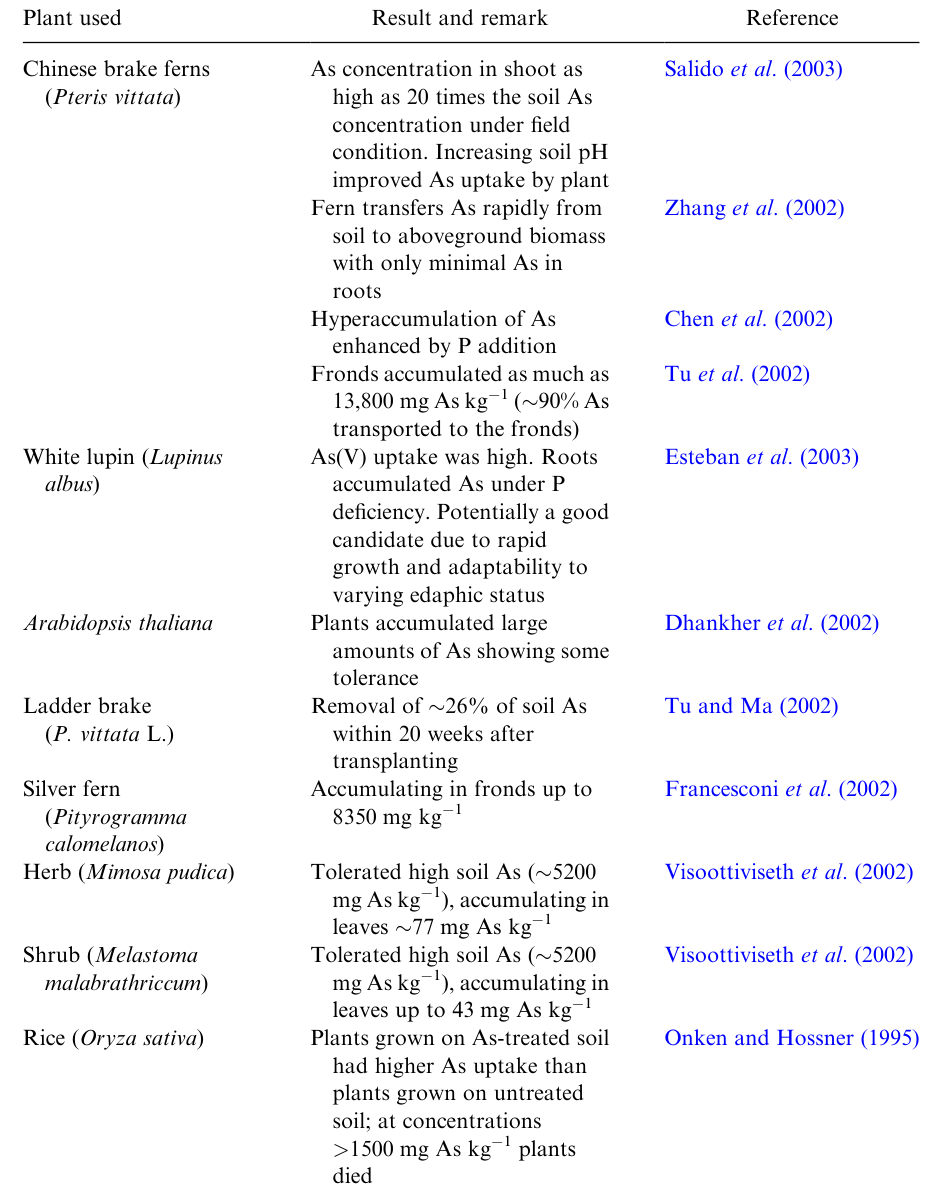
Selected References on the Mobilization of Arsenic by Phosphate Compounds有关磷酸盐化合物活化砷的部分参考文献
| Phosphate compound磷酸盐 化合物 | Method of investigation研究方法 | Proposed mechanism推测 机制 | Reference参考文献 |
|---|---|---|---|
| Ca(H2PO4)2 | Transport and leaching | Desorption | Qafokuet al. (1999) |
| NaH2PO4 | Chemical fractionation; transport and leaching studies | Competitive adsorption | Creger and Peryea (1994) |
| NaH2PO4 | Chemical fractionation | Competitive adsorption | Reynoldset al. (1999) |
| NaH2PO4 | Phytoavailability bioassay | Woolsonet al. (1973) | |
| NaH2PO4 | Phytoavailability bioassay | Competitive adsorption | Livesey and Huang (1981) |
| NH4H2PO4 Ca(H2PO4)2 | Adsorption and desorption | Competitive adsorption | Peryea (1991); Peryea and Kammereck (1997) |
| NH4H2PO4 | Transport and leaching | Competitive adsorption | Davenport and Peryea (1991) |
| Hydroxyapatite | Chemical fractionation | Competitive adsorption | Boissonet al. (1999) |
Davenport and Peryea (1991) observed that high rates of monoammonium phosphate (MAP) or monocalcium phosphate (MCP) fertilizers significantly increased the amount of As leached from the soil. Mixing high rates of MAP or MCP fertilizers with orchard soil, Peryea (1991) reported that As release from lead–arsenate-contaminated soil was positively related to the level of P input but was not significantly influenced by the P source. Arsenic solubility was regulated by specific H2PO�4 –AsO4 exchange, whereas H2PO�4 solubility was controlled by the equilibria of metastable P minerals. Results indicate that the use of P fertilizers on such soils has the potential to greatly enhance the downward movement of As (Peryea and Kammereck, 1997). Thus the increased mobilization of As resulting from phosphate input can result in its increased leaching to groundwater, especially in the absence of active plant growth. Hence attempts to use plants to remove As from soils need to take the multiple effects of phosphate into consideration.
Davenport and Peryea (1991) 观察到,高用量的磷酸一铵(MAP)或磷酸一钙(MCP)肥料显著增加了土壤As的淋溶量。Peryea (1991) 将高用量的MAP或MCP肥料与果园土壤混合后报道,砷酸铅污染土壤中As的释放与P输入水平呈正相关,但不受P源的显著影响。砷的溶解度受特定的H2PO−4–AsO4交换调控,而H2PO−4的溶解度则受亚稳态含磷矿物平衡的控制。结果表明,在此类土壤上施用磷肥有可能大大加剧As的向下迁移(Peryea and Kammereck, 1997)。因此,磷酸盐输入导致As活化增强,可能使其向地下水的淋溶增加,尤其是在缺乏活跃植物生长的情况下。因此,利用植物去除土壤中As的尝试需要考虑磷酸盐的多重效应。
Phytoremediation has several advantages over other remediation and metal(loid) extraction technologies. The cost involved in phytoremediation is much lower than other technologies, such as soil removal, capping, and ex situ cleansing. Other advantages include the ultimate fertility of the cleaned site, the high public appeal of “green” technology, and the possibility of producing secondary products that offset the cost of the operation or even produce a small profit. However, some of the basic plant physiological processes, such as low biomass production and shallow root growth, nonetheless limit the scope of phytoremediation. Only surface contamination can be removed or degraded and the cleanup is restricted to areas that are amenable to plant growth. Most importantly, it may take a long time for site remediation to be effective. Phytoremediation can only be used if it meets environmental regulation during the operation as well as its end point.
与其他修复和金属(类金属)提取技术相比,植物修复具有若干优势。植物修复的成本远低于土壤移除、覆盖和异位清洗等其他技术。其他优势包括修复后场地最终具备的肥力、“绿色”技术对公众的高度吸引力,以及生产副产品以抵消运行成本甚至获得少量利润的可能性。然而,一些基本的植物生理过程,如生物量产量低和根系浅,仍然限制了植物修复的应用范围。只有表层污染可以被去除或降解,且修复仅限于适宜植物生长的区域。最重要的是,场地修复可能需要很长时间才能见效。只有在运行期间及其终点均符合环境法规的情况下,才能采用植物修复。
B. REMOVAL OF ARSENIC FROM AQUATIC ENVIRONMENTSB. 水环境中砷的去除
As discussed earlier, because most cases of As toxicity in humans have resulted from the consumption of As-contaminated water, there have been intensive research efforts in developing technologies aimed at stripping As from water. A plethora of methods suitable for the removal of As from water at both household and community levels are currently available. These methods are primarily based on (i) removal of solid-phase As through coagulation, sedimentation, or filtration; (ii) removal of solution-phase As through ion exchange, osmosis, or electrodialysis; (iii) oxidation of As(III) to As(V) and its subsequent removal through adsorption and/or precipitation; (iv) biosorption using microorganisms; and (v) rhizofiltration using aquatic plants. Some of the methods that have been tested for the removal of As from water are presented in Table XII.
如前所述,由于人类As中毒事件大多源于饮用受As污染的水,因此人们投入了大量研究力量开发从水中去除As的技术。目前已有大量适用于家庭和社区层面去除水中As的方法。这些方法主要基于:(i) 通过混凝、沉淀或过滤去除固相As;(ii) 通过离子交换、渗透或电渗析去除溶液相As;(iii) 将As(III)氧化为As(V),随后通过吸附和/或沉淀将其去除;(iv) 利用微生物进行生物吸附;(v) 利用水生植物进行根际过滤。表XII列出了部分已测试过的水中As去除方法。
1Physicochemial Methods物理化学方法
Filtration, adsorption, and chemical precipitation are the most common physicochemical methods used for stripping As from water. While the particulate As in water can be removed by simple filtration, the aqueous As can be removed through adsorption or precipitation followed by filtration.
过滤、吸附和化学沉淀是从水中去除As最常用的物理化学方法。水中的颗粒态As可通过简单过滤去除,而水溶态As则可通过吸附或沉淀后再过滤的方式去除。
a. Filtration. Most of the domestic drinking water treatment systems for As removal involve filtration. For example, the “Pitcher filter” involving porous ceramics (Neku and Tandukar, 2003) and sand filters (Yokota et al., 2001) have been found to be effective in stripping As from water. Seidel et al. (2001) noticed that the porous nanofiltration anion-exchange membrane removed about 90% of As(V) present in water at a concentration of 316 �g liter�1. Although this technology could achieve a high degree of As removal, it involves a high initial investment and high operation and maintenance costs.
a. 过滤。大多数用于除As的家用饮用水处理系统都涉及过滤。例如,已发现采用多孔陶瓷的“Pitcher过滤器”(Neku and Tandukar, 2003)和砂滤器(Yokota et al., 2001)可有效去除水中的As。Seidel et al. (2001) 注意到,多孔纳滤阴离子交换膜可去除水中浓度为316 μg liter−1的As(V)约90%。尽管该技术可实现较高的As去除率,但其初始投资高,运行和维护成本也高。
Selected References on Methods of Arsenic Stripping from Water b. Adsorption. A number of compounds, including activated alumina, Fe-coated sand, and ion-exchange resins are used to adsorb As. In most geologic environments, Fe2O3 carries a positive surface charge that preferentially adsorbs As. Similarly, Al(OH)3 and silicate clays also adsorb large amounts of As. Yoshida et al. (1976) investigated the removal of As from water using “brown gel,” which is a silica gel containing 6% of Fe(OH)3, and observed that the maximum adsorption (17 g As kg�1) of both As(III) and As(V) occurred at pH 6.
有关水中砷去除方法的部分参考文献 b. 吸附。活性氧化铝、铁包覆砂和离子交换树脂等多种化合物被用于吸附As。在大多数地质环境中,Fe2O3表面带正电荷,可优先吸附As。同样,Al(OH)3和硅酸盐黏土也能吸附大量As。Yoshida et al. (1976) 研究了利用“棕色凝胶”(一种含6% Fe(OH)3的硅胶)去除水中As的效果,观察到As(III)和As(V)的最大吸附量(17 g As kg−1)均出现在pH 6时。
| Method方法 | Remark备注 | Reference参考文献 |
|---|---|---|
| 3-Gagri (Pitcher) filter | Removed 76–95% of As. Suitable for household use | Neku and Tandukar (2003) |
| Aeration and sand filtration | Removed 62–92% of As containing�240–320�g liter�1 | Berget al. (2001) |
| Pond sand filter system | Removed>99 % of 5 mg As liter�1 | Yokotaet al. (2001) |
| Negatively charged porous nanofiltration (NF) membrane | 60–90% removal of As(V) from water containing �10–316�g liter�1 | Seidelet al. (2001) |
| Using rare earth oxides | Adsorbed As(V) rapidly and effectively;>90% of adsorption occurred within the first 10 min, adsorbed As (V) could be desorbed by washing with pH 12 solution | Raichur and Panvekar (2002) |
| Iron oxide-coated sand (IOCS) | Very effective in removing As (III) and As(V) from drinking water containing 200 to 1700�g liter�1; about 94% removal efficiency | Yuanet al. (2002) |
| Coprecipitation with Fe | Bench scale test showed�88% of As(III) in water removed by settlement over 24 h | Mamtaz and Bache (2000) |
| Porous NF membrane | As removal by 60–90 % from drinking water containing As from 10 to 316�g liter�1 | Vrijenhoek and Waypa (2000) |
| Iron oxide-coated sand and ferrihydrite (IOCS and FH) | �90% removal of As from natural water containing 325�g liter�1; adsorption of IOCS and FH estimated at 18.3 and 285�g g�1, respectively | Thirunavkukkarasuet al. (2001) |
| Iron-sulfide minerals (pyrite and pyrrhotite) | Fe-sulfides are very effective in removing As [both As(III) and As(V)] from water | Han and Fyfe (2000) |
| Kimberlite tailing (mineral waste from diamond mining) | Removed As at a rate of 270�g g�1; more efficient at near neutral pH. 90–94% removal in 12 h | Dikshitet al. (2000) |
| Mesoporous anions traps (metal-chelated ligands immobilized on anion- binding silica material) | Most As removed from water containing>120 mg liter�1; adsorption at 120 mg g�1 | Fryxellet al. (1999) |
Aquifer materials (composed of quartz, feldspar, calcite, chlorite, illite, and magnetite/hematite) | Removed As(III) from water through adsorption | Carrillo and Drever (1998) |
Rothbaum and Buisson (1977) found that synthetic Fe-floc [Fe(OH)3], prepared by treating FeSO4 with NaOCl at pH 3.5–5.0, removed a large percentage of As from geothermal discharge water through coprecipitation. Similarly, Yuan et al. (2002) examined the potential value of several Fe-treated natural materials such as Fe-treated activated carbon, Fe-treated gel beads, and Fe oxide-coated sand in removing As from drinking water under both laboratory and field conditions. The Fe oxide-coated sand consistently achieved a high degree (>94%) of As(III) and As(V) removal. When the pH was increased from 5 to 9, As(V) adsorption decreased slightly, but As(III) adsorption remained relatively stable. Kimberlite tailings (Dikshit et al., 2000) and iron-sulfide minerals such as pyrite and pyrrhotite (Han and Fyfe, 2000) were also found to be very effective adsorbents in stripping both As(III) and As(V) from water.
Rothbaum and Buisson (1977) 发现,在pH 3.5–5.0条件下用NaOCl处理FeSO4制得的合成铁絮体[Fe(OH)3],可通过共沉淀去除地热排放水中很大比例的As。类似地,Yuan et al. (2002) 在实验室和田间条件下考察了几种铁处理天然材料(如铁处理活性炭、铁处理凝胶珠和铁氧化物包覆砂)去除饮用水中As的潜在价值。铁氧化物包覆砂始终对As(III)和As(V)具有较高的去除率(>94%)。当pH从5升至9时,As(V)吸附略有下降,而As(III)吸附保持相对稳定。还发现金伯利岩尾矿(Dikshit et al., 2000)以及黄铁矿和磁黄铁矿等铁硫化物矿物(Han and Fyfe, 2000)是去除水中As(III)和As(V)的高效吸附剂。
Hlavay and Polyak (1997) developed and tested novel adsorbents for As stripping. Porous support materials were granulated using Al2O3 and/or TiO2 and then Fe(OH)3 was freshly precipitated onto the surface of these particles. The resulting Fe(OH)3-impregnated porous adsorbent was dried at room temperature and packed into an ion-exchange column. These columns were found to remove >85% of As in water. The As(III) ions can primarily be adsorbed by chemical reaction on the surface of Fe(OH)3. The neutral functional group of { FeOH} reacts with H2AsO�3 ions, and surface compounds of { FeAsO3H2}, { FeAsO3H�}, and { FeAsO2�} can be formed.
Hlavay and Polyak (1997) 开发并测试了用于除As的新型吸附剂。先用Al2O3和/或TiO2对多孔载体材料进行造粒,然后在这些颗粒表面新鲜沉淀Fe(OH)3。所得的Fe(OH)3浸渍多孔吸附剂在室温下干燥后装入离子交换柱。发现这些柱子可去除水中 >85%的As。As(III)离子主要通过Fe(OH)3表面的化学反应被吸附。中性官能团{≡FeOH}与H2AsO−3离子反应,可形成{≡FeAsO3H2}、{≡FeAsO3H−}和{≡FeAsO2−}等表面化合物。
Das et al. (1995) demonstrated the practical application of the adsorption technique in stripping As by developing a simple household device to remove As from groundwater used for drinking and cooking purposes. The system consists of a filter, tablet, and two earthen or plastic jars. The tablet contains Fe(III) salt, an oxidizing agent, and activated charcoal. The filter is made of mainly purified fly ash with binder. When the tablet is added to water (one tablet for every 20 liters), the As(III) ions are catalytically oxidized to As(V) ions in the presence of Fe(III), which are subsequently adsorbed onto activated charcoal and hydrous ferric oxide (Fe2O3.2–3H2O). In addition to As(V), As(III) ions are also strongly adsorbed by Fe(III) oxides. The water is allowed to settle for about an hour and is then filtered. This stripping system has been installed in several locations in Bangladesh and
Das et al. (1995) 开发了一种简易家用装置,用于去除饮用和烹饪所用地下水中的As,从而展示了吸附技术在除As中的实际应用。该系统由一个过滤器、药片和两个陶罐或塑料罐组成。药片含有Fe(III)盐、一种氧化剂和活性炭。过滤器主要由纯化的粉煤灰加黏结剂制成。将药片加入水中(每20升水加一片)后,As(III)离子在Fe(III)存在下被催化氧化为As(V)离子,随后被吸附到活性炭和水合氧化铁(Fe2O3.2–3H2O)上。除As(V)外,As(III)离子也能被Fe(III)氧化物强烈吸附。水静置约1小时后再进行过滤。该除As系统已在孟加拉国和
West Beng al, an d analyt ical resul ts ha ve shown that general ly 93–100% of the total As in wat er (with an initial concen tration of 149–463 � g liter � 1) is remove d.
西孟加拉邦的多个地点安装,分析结果表明,水中总As(初始浓度为149–463 μg liter −1)的去除率一般为93–100%。
Khan et al . (2000) evaluat ed the effici ency of a simple three-p itcher filter syst em consis ting of ceramic filter s (loca lly known as 3-kal shi) in strip ping As from ground water. In the 3-kalshi assem bly, the first kalshi (po t) contains Fe ch ips and coarse sand, the second con tains wood charcoal an d fine sand, a nd the third is the collector for the filtered water. Depen ding on the size of the filtering units , this system has been shown to be capable of reducing the As co ncentra tion in water from an init ial level of 1100 �g liter � 1 to be low the detect ion limit of 2 � g liter � 1wi th a co rrespondi ng de crease in dissol ved Fe concentra tion (from 6000 to 200 �g liter � 1).
Khan et al. (2000) 评估了一种由陶瓷过滤器组成的简易三罐过滤系统(当地称为3-kalshi)去除地下水中As的效率。在3-kalshi装置中,第一个kalshi(罐)装有铁屑和粗砂,第二个装有木炭和细砂,第三个用于收集过滤后的水。根据过滤单元的大小,该系统已被证明能够将水中As浓度从初始的1100 μg liter −1降至检测限2 μg liter −1以下,同时溶解态Fe浓度也相应下降(从6000降至200 μg liter −1)。
Similarl y, Kim et al . (2004) have sho wn that mesoporous alumi na wi th a wid e surfa ce area (307 m 2g� 1), high pore volume (0.3 9 m 3g�1), unifor m pore size (3.5 nm), an d inter linked pore syst em is e fficient in stripp ing As from domest ic water. The mesop orous alumi na is insolub le and stabl e within the range of pH 3–7. The maxi mum As adsorpt ion was seven times higher [121 mg As(V) g� 1and 47 mg As(III) g� 1] than that of conventi onal activated alumi na, and the kinetics of adsorpt ion are also rapid with complet e adsorpt ion in less than 5 h as compared to co nventio nal alumin a (about 2 da ys to reach half of the initial concentra tion) . Fryxell et al. (1999) used meta l-che lated liga nds imm obilized on mesoporou s silica as a novel anion-bi nding mate rial to remove As from water. Nearly comp lete remova l of As(V) has been achieved from solutions containing more than 100 mg As (V) liter�1.
类似地,Kim et al. (2004) 表明,具有大比表面积(307 m 2g−1)、高孔容(0.39 m 3g−1)、均一孔径(3.5 nm)和相互连通孔隙系统的介孔氧化铝可高效去除生活用水中的As。该介孔氧化铝不溶,且在pH 3–7范围内稳定。其最大As吸附量[121 mg As(V) g−1和47 mg As(III) g−1]是常规活性氧化铝的七倍,且吸附动力学也很快,不到5 h即可完全吸附,而常规氧化铝约需2天才能使浓度降至初始浓度的一半。Fryxell et al. (1999) 将固定在介孔二氧化硅上的金属螯合配体作为一种新型阴离子结合材料用于去除水中的As。在含As(V)超过100 mg As(V) liter−1的溶液中,实现了As(V)的近乎完全去除。
c. Precipitation. Arsenate can be removed by precipitation/coprecipitation using Fe and Al compound s [Eqs. (27–33 ) in Table VI]. Gull edge an d O’Connor (1973) achieved a complete removal of As(V) from water using Fe2(SO4) 3 at a pH range of 5 to 7.5 [Eq. (34) ]. Hydrol yzing meta l salts such as FeCl3 and alum [Al2(SO4)3] have been shown to be effective in stripping As by coagulation. Hering et al. (1997) achieved >90% removal of As(V) from water containing an initial concentration of 100 �g As liter�1. Shen (1973) removed As from drinking water by dosing with chlorine (Cl2) and FeCl3. Oxidation of As(III) to As(V) by Cl2 and the subsequent removal by precipitation were considered the mechanisms involved in this process.
c. 沉淀。砷酸盐可利用Fe和Al化合物通过沉淀/共沉淀去除[表VI中的式(27–33)]。Gulledge and O’Connor (1973) 在pH 5至7.5范围内使用Fe2(SO4)3实现了水中As(V)的完全去除[式(34)]。已证明FeCl3和明矾[Al2(SO4)3]等水解性金属盐可通过混凝有效去除As。Hering et al. (1997) 对初始浓度为100 μg As liter−1的水实现了 >90%的As(V)去除率。Shen (1973) 通过投加氯(Cl2)和FeCl3去除了饮用水中的As。该过程的作用机制被认为是Cl2将As(III)氧化为As(V),随后通过沉淀将其去除。
Treating drinking water with Fenton’s reagent (ferrous ammonium sulfate and H2O2) followed by passing through elemental Fe, Krishna et al. (2001) achieved As removal below the USEPA maximum permissible limit of 50 �g liter�1 from an initial concentration of 2000 �g liter�1 of As(III). This method is simple and cost effective for use at community levels. Using a bench scale test, Mamtaz and Bache (2000) demonstrated that up to 88% of the As(III) in water could be removed by coprecipitation with naturally occurring Fe found in groundwater. One of the advantages in chemical precipitation method is that this can be used at both household and community levels. The materials are readily available and generally inexpensive. However, a problem of disposal of toxic sludge exists and it also requires trained operators.
Krishna et al. (2001) 用Fenton试剂(硫酸亚铁铵和H2O2)处理饮用水,随后使其通过零价Fe,将As(III)从初始浓度2000 μg liter−1降至USEPA最大允许限值50 μg liter−1以下。该方法简单且成本效益高,适用于社区层面。Mamtaz and Bache (2000) 通过实验室规模试验证明,利用地下水中天然存在的Fe进行共沉淀,可去除水中高达88%的As(III)。化学沉淀法的优点之一是既可用于家庭层面,也可用于社区层面。所用材料易于获得且通常价格低廉。然而,该方法存在有毒污泥的处置问题,而且需要经过培训的操作人员。
2Biological Methods生物方法
a. Phytoremediation using Aquatic Plants. Phytoremediation of As-contaminated waters may be readily achieved by the use of aquatic plants because unlike soil, most of the As in water is available for plant uptake. In the case of soils, the plant must first solubilize the metal(loid)s in the rhizosphere and then should have the ability to transport it to the aerial tissue (Brooks and Robinson, 1998). The use of freshwater vascular plants for the removal of metal(loid)s from water has been long established. There are two approaches in using these plants for the remediation of polluted water: The first involves monospecific pond cultures of free-floating plants such as water hyacinth. The plants accumulate the metal(loid)s until a steady state of equilibrium is achieved. They are then harvested by removal from the pond. The second approach involves growing rooted emergent species in trickling bed filters. Rhizosphere microbes usually facilitate the removal of metal(loid)s in these systems. Rhizofiltration usually involves the hydroponic culture of plants in a stationary or moving aqueous environment wherein the plant roots absorb metal(loid)s from the water (Brooks and Robinson, 1998). Ideal plants for rhizofiltration should have extensive root systems and be able to remove metal(loid)s over an extended period. Some of the aquatic plants capable of accumulating large amounts of As are presented in Table XIII.
a. 利用水生植物进行植物修复。利用水生植物可以较容易地实现As污染水体的植物修复,因为与土壤不同,水中大部分As可被植物吸收。对于土壤而言,植物必须首先在根际溶解金属(类金属),然后还应具备将其转运至地上组织的能力(Brooks and Robinson, 1998)。利用淡水维管植物去除水中金属(类金属)的做法由来已久。利用这些植物修复污染水体有两种途径:第一种是在池塘中单一种植水葫芦等自由漂浮植物。植物累积金属(类金属)直至达到稳态平衡,然后将其从池塘中移出收获。第二种是在滴滤床过滤器中种植有根的挺水植物。在这些系统中,根际微生物通常会促进金属(类金属)的去除。根际过滤通常是指在静止或流动的水环境中对植物进行水培,由植物根系吸收水中的金属(类金属)(Brooks and Robinson, 1998)。理想的根际过滤植物应具有发达的根系,并能够在较长时间内持续去除金属(类金属)。表XIII列出了部分能够累积大量As的水生植物。
Robinson et al. (2004) undertook a field survey in which a number of terrestrial and aquatic plant samples were taken at several sites within the Taupo volcanic zone (TVZ) in New Zealand. The TVZ covers an area of 600,000 ha in the central North Island of New Zealand and the area is rich in geothermal activity. There have been previous reports of elevated As concentrations in some waterways and associated lands in the TVZ (Liddle, 1982). The known sources of As pollution in the TVZ include (i) As arising from naturally occurring geothermal activity; (ii) geothermal bores that release As-rich water into the aquatic biosphere; (iii) runoff of As-based pesticides; (iv) As from timber treatment sites such as the pulp and paper mill at Kinleith; and (v) As added to lakes to control weeds (e.g., NaAsO2 added to Lake Rotorua).
Robinson et al. (2004) 开展了一项野外调查,在新西兰陶波火山带(TVZ)内的多个地点采集了若干陆生和水生植物样品。TVZ位于新西兰北岛中部,面积达600,000 ha,地热活动丰富。此前已有报道指出,TVZ部分水道及相关土地中As浓度偏高(Liddle, 1982)。TVZ已知的As污染来源包括:(i) 天然地热活动产生的As;(ii) 向水生生物圈排放富As水的地热井;(iii) 砷基农药的径流;(iv) 木材处理场所(如Kinleith的纸浆造纸厂)产生的As;(v) 为控制杂草而添加到湖泊中的As(如向Rotorua湖添加的NaAsO2)。
The mean As concentrations in all the plants tested from the TVZ are given in Fig. 6. Data clearly display the difference of As accumulation
图6给出了在TVZ所测试的全部植物的平均As浓度。数据清楚地显示了As累积的差异
Selected Aquatic Plants for Potentially Stripping Arsenic from Water可能用于去除水中砷的部分水生植物
| Name of plant植物名称 | Level of As accumulation (mg kg�1)aAs累积水平 (mg kg−1)a | Reference参考文献 |
|---|---|---|
| Agrostis capillaris | 3470 | Porter and Peterson (1975) |
| Ceratophyllum demersum | 650 | Reay (1972) |
| C. demersum | 265–1121 | Liddle (1982) |
| C. demersum | 44–1160 | Robinsonet al. (1995) |
| Egeria densa | 94–1120 | Robinsonet al. (1995) |
| Lagarosiphon major | 11–1200 | Robinsonet al. (1995) |
| Rorippa naturtium | >400 | Robinsonet al. (1995) |
| (subsp.Aquaticum) | ||
| Cynodan dactylon | 1600 | Jonnalagadda and Nenzou (1997) |
| Spergularia grandis | 1175 | Bechet al. (1997) |
| Paspalum tuberosum | 1130 | Bechet al. (1997) |
| Fern (Pteris vittata) | 22,630 | Maet al. (2001) |
| Fern (P. vittata) | 8960–27,000 | Wanget al. (2002) |
| Silver fern | 8350 | Visoottivisethet al. (2002) |
| (Pityrogramma calomelanos) | ||
| Fern (Pteris cretica) | 6200–7600 | Zhaoet al. (2002) |
| Fern (P. longifolia) | ||
| Fern (P. umbrosa) | ||
| Watercress (Lepidium sativum) | 12–1766 | Robinsonet al. (2003a) |
| Myriophyllum propinquum | 974–3900 | Machetti (2003) |
| Elodea canadensis | 1628–1857 | Machetti (2003) |
| Agrostis sp | 800 | Machetti (2003) |
aDry weight basis.
a以干重计。
between aquatic and terrestrial plants. Aquatic plants, grouped on the left-hand side of Fig. 6, had As concentrations up to 4000 mg kg�1 on a dry matter basis. In contrast, terrestrial plants, on the right-hand side of Fig. 6, showed much lower As concentrations. All the aquatic plants tested accumulated As at concentrations greater than 5 mg kg�1 on a dry matter basis, and none of the terrestrial plants tested had As concentrations surpassing 11 mg kg�1. Most of the terrestrial plants tested were below the detection limit for As (0.5 mg kg�1) even when growing in soil containing up to 89 mg As kg�1.
存在于水生植物与陆生植物之间。图6左侧所列的水生植物As浓度高达4000 mg kg−1(以干物质计)。相比之下,图6右侧的陆生植物As浓度则低得多。所测试的全部水生植物As累积浓度均大于5 mg kg−1(以干物质计),而所测试的陆生植物中没有一种As浓度超过11 mg kg−1。即使生长在含As高达89 mg As kg−1的土壤中,所测试的大多数陆生植物As含量仍低于检测限(0.5 mg kg−1)。
The difference in metal(loid) accumulation between aquatic and terrestrial plants was noticed by Outridge and Noller (1991) in their review of hyperaccumulation of elements by aquatic plants. Although they did not provide an explanation of this phenomenon, various reasons could be attributed for the difference in As accumulation between aquatic and terrestrial plants. For instance, in terrestrial systems, the solubilization of As in the rhizosphere is necessary to allow the plant roots to take up and transport this element to the aerial parts of the plant. This is not the case when the plant grows in an aqueous medium, where the metal(loid) is already present in a bioavailable form (Brooks and Robinson, 1998).
Outridge and Noller (1991) 在其关于水生植物超富集元素的综述中注意到水生植物与陆生植物在金属(类金属)累积上的差异。虽然他们未对这一现象作出解释,但水生植物与陆生植物As累积的差异可归因于多种原因。例如,在陆地系统中,As必须在根际溶解,植物根系才能吸收该元素并将其转运至地上部分。而当植物生长于水介质中时则并非如此,因为此时金属(类金属)已以生物有效形态存在(Brooks and Robinson, 1998)。
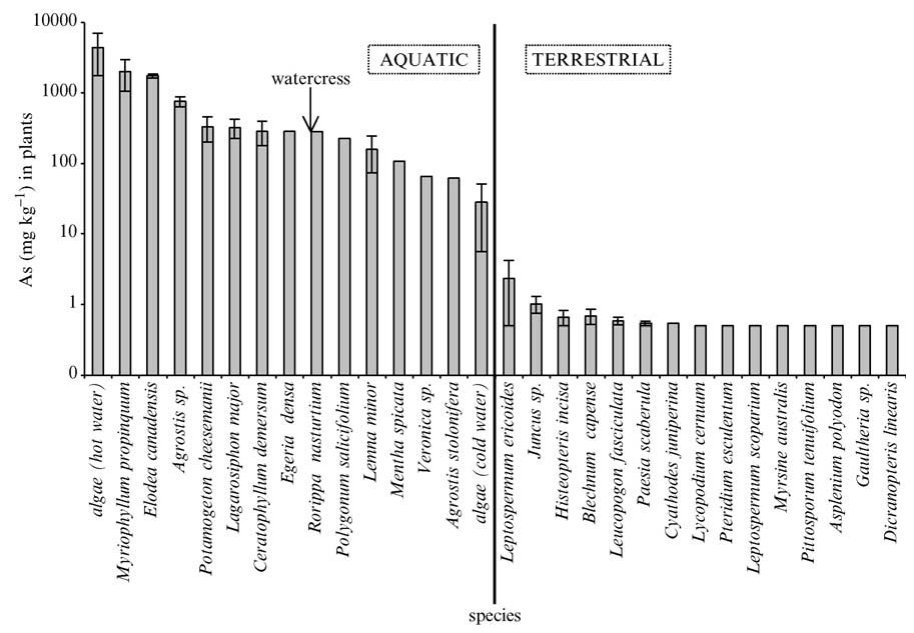
b. Microbial Removal of Arsenic. Biosorption and biomethylation are the two important processes by which metal(loid)s, including As, are removed from water using microorganisms.
b. 微生物除砷。生物吸附和生物甲基化是利用微生物去除水中包括As在内的金属(类金属)的两个重要过程。
The biosorptive process generally lacks specificity in metal(loid) binding and is sensitive to ambient environmental conditions, such as pH, solution composition, and the presence of chelators. Genetically engineered microorganisms (e.g., Escherichia coli) that express a metal(loid)-binding protein (i.e., metallothionein) and a metal(loid)-specific transport system have been found to be successful in their selectivity for accumulation of a specific metal (loid) in the presence of a high concentration of other metal(loid)s and chelating agents in solution (Chen and Wilson, 1997). These organisms also have potential application to remove specific metal(loid)s from contaminated soil and sediments.
生物吸附过程在金属(类金属)结合方面通常缺乏特异性,并对pH、溶液组成和螯合剂的存在等环境条件较为敏感。已发现表达金属(类金属)结合蛋白(即金属硫蛋白)和金属(类金属)特异性转运系统的基因工程微生物(如Escherichia coli),在溶液中存在高浓度其他金属(类金属)和螯合剂的情况下,能够成功地选择性累积特定金属(类金属)(Chen and Wilson, 1997)。这些生物在去除污染土壤和沉积物中特定金属(类金属)方面也具有应用潜力。
Biosorption is one of the promising technologies involved in removing As from water and wastewater. Several chemically modified sorbents have been examined for their efficiency in removing metalloids. Loukidou et al. (2003) examined the potential of Penicillum chrysogenum, a waste by-product from antibiotic production, for the removal of As(V) from wastewaters. They reported that the pretreatment of biomass with common surfactants (as hexadecyl-trimethylammonium bromide and dodecylamine) and a cationic polyelectrolyte was found to remove a significant amount of As(V) from waters. At pH 3, the removal capacities of modified biomass ranged from 33.3 to 56.1 mg As g�1 biomass.
生物吸附是从水和废水中去除As的一项有前景的技术。已有研究考察了多种化学改性吸附剂去除类金属的效率。Loukidou et al. (2003) 考察了Penicillum chrysogenum(抗生素生产的废弃副产物)去除废水中As(V)的潜力。他们报道,用常见表面活性剂(如十六烷基三甲基溴化铵和十二胺)和一种阳离子聚电解质对生物质进行预处理后,可从水中去除大量As(V)。在pH 3时,改性生物质的去除容量为33.3至56.1 mg As g−1生物质。
Methylation is the most reliable biological process through which As can be removed from aquatic medium. Certain fungi, yeasts, and bacteria are known to methylate As to gaseous derivatives of arsine. Commercial application of biotransformation of metal(loid)s in relation to the remediation of metal(loid)-contaminated water was documented by Bender et al. (1995). They examined the removal and transformation of metal(loid)s using microbial mats, which were constructed by combining cyanobacteria with a sediment inoculum from a contaminated site. When water containing high concentrations of metal(loid)s was passed through the microbial mat, there was a rapid removal of the metal(loid)s from the water. The mat was found to be tolerant of high concentrations of toxic metal(loid)s such as Cd, Pb, Cr, Se, and As (up to 350 mg liter�1). Management of toxic metal(loid)s by the mat was attributed to the deposition of metal(loid) compounds outside the cell surfaces, as well as chemical modification of the aqueous environment surrounding the mat. Large quantities of metal(loid)-binding polysaccharides were produced by the cyanobacterial component of the mat. Photosynthetic oxygen production at the surface and heterotrophic consumption in the deeper regions resulted in steep gradients of redox condition in the mat. Additionally, sulfur-reducing bacteria colonized the lower strata, removing and utilizing the metal(loid) sulfide. Thus, depending on the biochemical characteristics of the microzone of the mat, the sequestered metal(loid)s could be oxidized, reduced, and precipitated as sulfides or oxides.
甲基化是从水介质中去除As最可靠的生物过程。已知某些真菌、酵母和细菌可将As甲基化为胂的气态衍生物。Bender et al. (1995) 记载了金属(类金属)生物转化在金属(类金属)污染水体修复中的商业应用。他们考察了利用微生物垫去除和转化金属(类金属)的效果,该微生物垫由蓝细菌与取自污染场地的沉积物接种物组合构建而成。当含高浓度金属(类金属)的水流经微生物垫时,水中的金属(类金属)被迅速去除。发现该微生物垫能耐受高浓度的Cd、Pb、Cr、Se和As等有毒金属(类金属)(高达350 mg liter−1)。微生物垫对有毒金属(类金属)的处理被归因于金属(类金属)化合物在细胞表面外的沉积,以及微生物垫周围水环境的化学改变。微生物垫中的蓝细菌组分产生了大量结合金属(类金属)的多糖。表层的光合产氧与深层的异养耗氧导致微生物垫中形成陡峭的氧化还原梯度。此外,硫还原细菌定殖于下层,去除并利用金属(类金属)硫化物。因此,根据微生物垫微区的生物化学特征,被封存的金属(类金属)可被氧化、还原,并以硫化物或氧化物形式沉淀。
C. MULTISCALAR-INTEGRATED RISK MANAGEMENTC. 多尺度综合风险管理
A number of challenging issues need to be taken into consideration when devising strategies to manage As contamination of the environment. These include the following.
在制定环境As污染管理策略时,需要考虑若干具有挑战性的问题,包括以下几点。
i. Complexity of As contamination—the severity and long-term persistence of As contamination are influenced by factors such as medium characteristics, site hydrogeology, land and water use, source term, chemical form and speciation, and target organism.
i. As污染的复杂性——As污染的严重程度和长期持久性受介质特性、场地水文地质、土地和水资源利用、源项、化学形态与形态分布以及目标生物等因素的影响。
ii. Presence of multichemical species—As undergoes several biogeochemical transformation processes, resulting in the release of an array of chemical species that differ in their biogeochemical reactions, bioavailability, and biotoxicity.
ii. 多种化学形态的存在——As经历多种生物地球化学转化过程,从而释放出一系列在生物地球化学反应、生物有效性和生物毒性方面各不相同的化学形态。
iii. Extent and magnitude of As contamination of groundwater resource— for example, in Bangladesh, As in groundwater is derived from geological weathering of parent rock materials from the Indo-Gangetic alluvial plains spread over an area of millions of hectares
iii. 地下水资源As污染的范围和程度——例如,在孟加拉国,地下水中的As来源于印度河–恒河冲积平原母岩物质的地质风化,其分布面积达数百万公顷
iv. Multipurpose end use of contaminated resources—water is used for drinking, cooking, and other household purposes and for irrigation; similarly, soil is used for agricultural production and recreational activities.
iv. 受污染资源的多用途终端利用——水被用于饮用、烹饪、其他家庭用途以及灌溉;同样,土壤被用于农业生产和娱乐活动。
It is therefore important to formulate and/or devise integrated risk management strategies involving source avoidance, source reduction, and remediation. Source avoidance, which refers to avoiding the most contaminated source of the groundwater relative to certain geological strata, can be practiced to minimize the risk resulting from As contamination of soil and water resources. For example, in Bangladesh, shallow dug wells are increasingly becoming popular as an alternative to pump water from deeper strata. In some cases, the relatively contaminant-free strata are below 250-m deep zones. However, sanitation of these shallow wells is paramount to avoid gastroenteritis and other pathogenic-borne diseases. Another strategy is source reduction, which refers to removing or stopping the source of contamination. Source reduction can be achieved easily when the contamination source is of anthropogenic origin, such as those in landfills or similar point sources. As discussed earlier, in most regions, As contamination of groundwater is largely of geogenic origin, and source reduction may not be a feasible option to manage As contamination.
因此,制定和/或设计包括源头规避、源头削减和修复在内的综合风险管理策略十分重要。源头规避是指相对于某些地质层位避开污染最严重的地下水源,可用于尽量降低土壤和水资源As污染所带来的风险。例如,在孟加拉国,浅层手掘井作为从深层抽水的替代方案日益普及。在某些情况下,相对无污染的地层位于250 m以下的深度。然而,这些浅井的卫生状况对于避免肠胃炎和其他病原性疾病至关重要。另一种策略是源头削减,即去除或阻断污染源。当污染源为人为来源(如垃圾填埋场或类似点源)时,源头削减较易实现。如前所述,在大多数地区,地下水As污染主要为地质成因,源头削减可能并非管理As污染的可行选择。
Remediation of contaminated soil and water resources requires both short-term and long-term solutions to the As problem. Therefore, the remediation strategies should be aimed at multiscalar levels, i.e., household level to community and regional levels, representing the various levels of complexicity. Depending on the efficiency and cost effectiveness of the system, a combination of technologies may be required at certain levels. The potential technologies for remediation of As-contaminated soil and water resources at different scales in relation to the end use of the resources are depicted in Fig. 7. For example, at the least complex household level, remediation strategies involving only a simple filter (sorptive) system can be used to remove As (i.e., As stripping) from water used for drinking and cooking purposes, whereas at a more complex community level, more sophisticated precipitation technologies should be used to strip As from the community water supply so that cost can be shared and the system can be managed efficiently. More sophisticated stripping methods, which may require a series of a filtering–sorptive (precipitation) setup, are necessary in order to cope with the enormous volume of groundwater that needs to be treated before distribution to the community. Even at the community scale, the situation becomes even more complex when dealing with impacted soils, especially those geared for food production. In this case, land use is a very important factor to address. For example, in parks, applying soil amendments such as those high in Fe2O3 may suffice to mitigate As risk. In contrast, technologies might be paired in a situation when the food chain might be compromised, as typified by rangeland, rice paddy, and so on. A viable approach in this circumstance is to apply phytoremediation during the initial period (1 to 2 years) to strip the “bioavailable” fraction, subsequently followed by soil amendments before committing to the intended land use. It is very important to observe that as the level of contamination becomes more complex, a monitoring scheme should be in place. Hence, a successful remediation scheme for an As-contaminated environment should aim for an integrated approach involving the possible combination of physical, chemical, and/or biological mechanisms.
受污染土壤和水资源的修复需要针对As问题的短期和长期解决方案。因此,修复策略应面向多尺度层面,即从家庭层面到社区和区域层面,这些层面代表了不同的复杂程度。根据系统的效率和成本效益,在某些层面可能需要多种技术的组合。图7描绘了不同尺度下与资源终端用途相关的As污染土壤和水资源的潜在修复技术。例如,在复杂程度最低的家庭层面,可采用仅包含简单过滤(吸附)系统的修复策略去除饮用和烹饪用水中的As(即除As);而在较为复杂的社区层面,则应采用更先进的沉淀技术去除社区供水中的As,以便分摊成本并高效管理系统。由于需要在分配给社区之前处理大量地下水,因此需要更先进的除As方法,可能需要一系列过滤–吸附(沉淀)装置。即使在社区尺度上,当涉及受影响的土壤,尤其是用于粮食生产的土壤时,情况会变得更加复杂。在这种情况下,土地利用是一个需要重点考虑的因素。例如,在公园中,施用富含Fe2O3等的土壤改良剂可能足以减轻As风险。相反,在食物链可能受到威胁的情况下(以牧场、稻田等为代表),可能需要将多种技术结合使用。在这种情况下,一种可行的方法是在初期(1至2年)采用植物修复去除“生物有效”部分,随后施用土壤改良剂,再投入预定的土地用途。需要特别注意的是,随着污染程度变得更加复杂,应建立监测方案。因此,一个成功的As污染环境修复方案应以综合方法为目标,包括物理、化学和/或生物机制的可能组合。
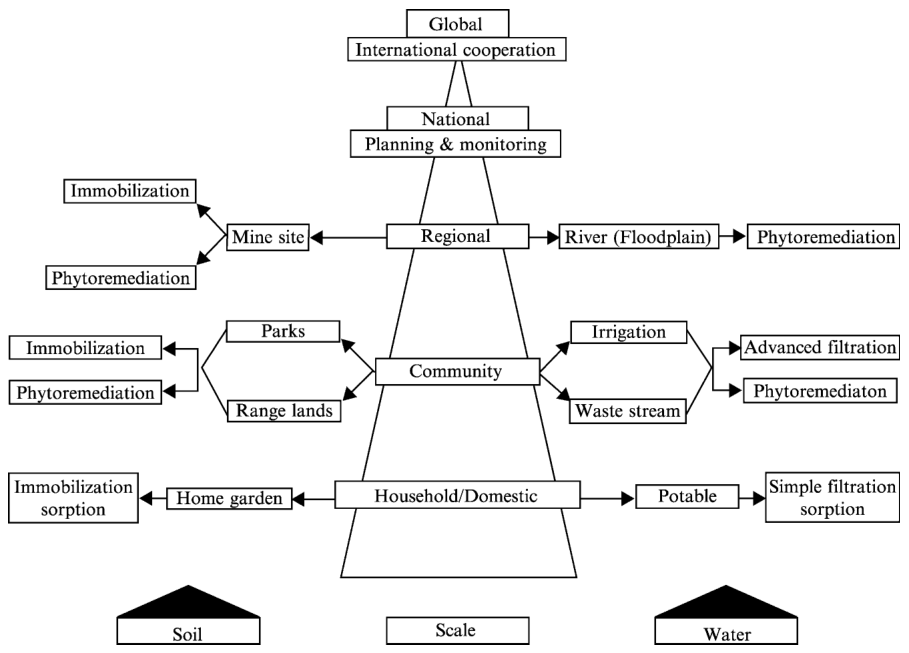
It is essential that the integration of remediation technologies should enhance efficiency, both technologically and economically, resulting in a reduction in the time required for achieving targeted levels of As. For example, phytoremediation is a promising new technology, which is relatively inexpensive and has been proven effective in the large–scale remediation of both soil and water resources. Further, it would also add “green” value (aesthetic) to the environment. Integrating physical, chemical, and/or bioremedial measures with phytoremediation as depicted in Fig. 8 could enhance a higher uptake of As by plants, can more effectively minimize biotoxicity through microbial and chemical immobilization, and can potentially eliminate As through the inducement of biomethylation and subsequent volatilization from the system.
修复技术的整合应在技术上和经济上提高效率,从而缩短达到As目标水平所需的时间,这一点至关重要。例如,植物修复是一项有前景的新技术,成本相对低廉,并已被证明在土壤和水资源的大规模修复中有效。此外,它还能为环境增添“绿色”(美学)价值。如图8所示,将物理、化学和/或生物修复措施与植物修复相结合,可提高植物对As的吸收,可通过微生物和化学固定更有效地降低生物毒性,并有可能通过诱导生物甲基化及随后的挥发将As从系统中去除。
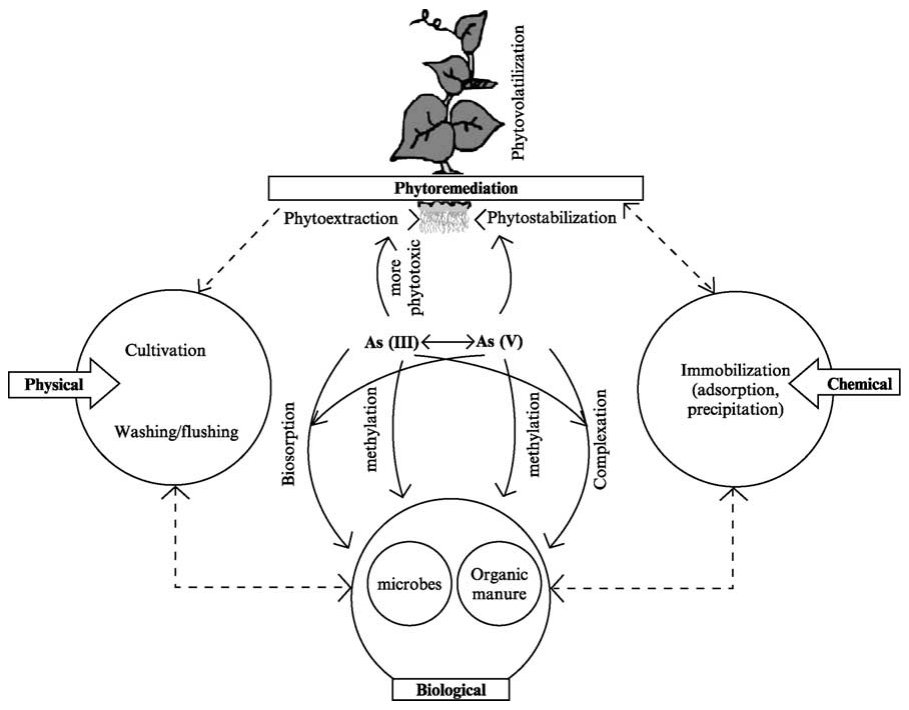
VII. SUMMARY AND FUTURE RESEARCH NEEDSVII. 总结与未来研究需求
Arsenic is an extremely toxic and carcinogenic metalloid contaminant that adversely affects the environment and human health. Widespread As contamination of terrestrial and aquatic environments from both geogenic and anthropogenic sources has been reported in many countries. Although not anthropogenic, drinking of As-contaminated water has already affected millions of people, particularly in developing countries with the biggest known As calamity occurring in Bangladesh and West Bengal in India. Arsenic in soil and water exists in a different valence state, but predominantly as toxic As(III) and less toxic As(V). The biogeochemistry of As in soil and water is complex and is mostly determined by its chemical speciation resulting from chemical and biological transformations. The chemistry of soil and water (i.e., pH and Eh) and predominantly microbial assemblages play a major role in As dynamics. Although bioaccumulation of As in plants and organisms has been reported, its biochemical transformations within the plant and other biota are still largely unknown.
砷是一种剧毒且具有致癌性的类金属污染物,对环境和人体健康均产生不利影响。许多国家已报道了由地质成因和人为来源造成的陆地及水生环境大范围砷污染。饮用砷污染水虽非人为所致,但已影响了数以百万计的人口,尤其是在发展中国家,其中已知最严重的砷灾难发生在孟加拉国和印度西孟加拉邦。土壤和水体中的砷以不同价态存在,但主要为毒性较强的As(III)和毒性较弱的As(V)。土壤和水体中砷的生物地球化学行为十分复杂,主要取决于化学和生物转化所形成的化学形态。土壤和水体的化学性质(即pH和Eh),尤其是微生物群落,在砷的动态变化中起着重要作用。尽管已有关于砷在植物和生物体内生物累积的报道,但其在植物及其他生物体内的生化转化过程在很大程度上仍不清楚。
Risk management of As-contaminated soil and aquatic ecosystems is an important issue and a great challenge; its success is necessary to promote sustainable environmental health and also to minimize the adverse impact on humans. A number of physical, chemical, and biological technologies involving simple filtration, precipitation, biosorption, and rhizofiltration have been developed to remediate As-contaminated soil and water. Conventional physical and chemical remedial measures usually are quite expensive but may prove highly effective. However, most of these technologies have been tested only at the laboratory and pilot scale levels. Large-scale application of such technologies requires trained personnel for the operation of equipment to treat soils and waters. However, phytoremediation, which is relatively inexpensive, has been proven effective in the remediation of metal (loid)-contaminated sites. Certain As-hyperaccumulating plants offer a wide scope for the phytoremediation of As-contaminated soil and water. Nonedible crops, such as ornamental and fuel crops, may be suitable for phytoremediation through which the entry of As into the food chain could largely be avoided. Bioremediation, using biological wastes and/or microbial strains, offers another avenue for remediation. However, as in the case of physical and chemical technologies, most of the research involving bioremediation has been demonstrated in the laboratory only. As such, its feasibility should be tested under diverse field conditions.
砷污染土壤和水生生态系统的风险管理是一个重要问题,也是一项巨大挑战;其成功实施对于促进环境健康的可持续性以及最大限度地减少对人类的不利影响十分必要。目前已开发出多种物理、化学和生物技术,包括简单过滤、沉淀、生物吸附和根际过滤等,用于修复砷污染的土壤和水体。常规的物理和化学修复措施通常相当昂贵,但可能非常有效。然而,这些技术大多仅在实验室和中试规模上进行过测试。此类技术的大规模应用需要经过培训的人员操作设备来处理土壤和水体。相比之下,成本相对低廉的植物修复已被证明可有效修复金属(类金属)污染场地。某些砷超富集植物为砷污染土壤和水体的植物修复提供了广阔的应用前景。非食用作物,如观赏作物和能源作物,可能适用于植物修复,从而在很大程度上避免砷进入食物链。利用生物废弃物和/或微生物菌株的生物修复为修复提供了另一条途径。然而,与物理和化学技术一样,大多数涉及生物修复的研究仅在实验室中得到验证。因此,其可行性应在多样化的田间条件下加以检验。
Remediation of As-contaminated soils and As stripping from potable and irrigation waters require a multiscalar approach. This involves an “end-use” specific (i.e., drinking vs irrigation and agricultural vs recreational sites) integrated approach, involving a combination of physical, chemical, and biological technologies for the successful and effective management of As-contaminated environments. Future research is, therefore, needed for the following:
砷污染土壤的修复以及饮用水和灌溉水中砷的去除需要采取多尺度的方法。这涉及针对特定“最终用途”(即饮用与灌溉、农业用地与娱乐场所)的综合方法,结合物理、化学和生物技术,以成功、有效地管理砷污染环境。因此,今后需要在以下方面开展研究:
- Biogeochemical mechanisms governing As dynamics in different media using advanced spectroscopic-based techniques.利用先进的光谱技术研究不同介质中控制砷动态变化的生物地球化学机制。
- Elucidation of soil and water environmental factors (e.g., pH and Eh) that govern chemical and biological transformations of As.阐明控制砷化学和生物转化的土壤和水体环境因子(如pH和Eh)。
- Examination of solid-phase and solution-phase speciation of As in soil and water.研究土壤和水体中砷的固相和液相形态。
- Identification of biochemical mechanisms involved in the accumulation of As in specific tissues or organs in plants, animals, and humans. This includes the interactive effects of As(V) and H2PO�4 on hyperaccumulators such as Chinese brake and water cress.识别砷在植物、动物和人体特定组织或器官中累积所涉及的生化机制,包括As(V)与H2PO4−对蜈蚣草和水田芥等超富集植物的交互作用。
- Evaluation of As phytotoxicity under field conditions.评估田间条件下砷的植物毒性。
- Rhizosphere processes underpinning effective phytoremediation technologies.支撑高效植物修复技术的根际过程。
- Mycorrhizal role in the bioremediation of As regarding biomethylation, biooxidation, and immobilization of As.菌根在砷的生物修复中的作用,涉及砷的生物甲基化、生物氧化和固定化。
- Developing genetically engineered microorganisms and genetically modified plants to detoxify As in contaminated soil and water. • In situ immobilization techniques in contaminated soils/sediments using inexpensive industrial by-products high in metallic oxides; effect of aging on the release of As from the immobilized media.开发基因工程微生物和转基因植物,以对污染土壤和水体中的砷进行解毒。• 利用富含金属氧化物的廉价工业副产品对污染土壤/沉积物进行原位固定化的技术;老化作用对砷从固定化介质中释放的影响。
- Biomonitors of As as a tool in the risk assessment of As-contaminated sites.将砷的生物监测物作为砷污染场地风险评估的工具。
- Highly effective and expensive stripping methods for the removal of As in domestic water supplies destined for irrigation and human consumption.开发高效且低成本的除砷方法,用于去除拟用于灌溉和人类饮用的生活供水中的砷。
ACKNOWLEDGMENTS致谢
The senior author thanks Massey University Research Foundation for the award of the Postdoctoral Fellowship. The U.S. Department of Energy Contract Number DE-FC-09-96SR18546 with the University of Georgia’s Savannah River Ecology Laboratory supported Drs. Bolan and Adriano’s writing/editing time.
第一作者感谢梅西大学研究基金会授予博士后奖学金。美国能源部与佐治亚大学萨凡纳河生态实验室签订的合同(合同号DE-FC-09-96SR18546)资助了Bolan博士和Adriano博士的撰写/编辑工作。
REFERENCES参考文献
Abedin, M. J., Cresser, M. S., Meharg, A., Feldmann, J., and Cotter-Howells, J. (2002). Arsenic accumulation and metabolism in rice (Oryza sativa L.). Environ. Sci. Technol. 36, 962–968. Acharyya, S. K., Chakraborty, P., Lahiri, S., Raymahashay, B. C., Guha, S., and Bhowmik, A. (1999). Arsenic poisoning in the Ganges delta. Nature 401, 545.
Adriano, D. C. (2001). “Trace Elements in Terrestrial Environments: Biogeochemistry, Bioavailability and Risks of Metals”, 2nd edn, Springer, New York.
Adriano, D. C., Page, A. L., Elseewi, A. A., Chang, A. C., and Straughan, I. (1980). Utilization and disposal of fly ash and other residues in terrestrial ecosystems: A review. J. Environ. Qual. 9, 333–344.
Aggett, J., and Aspell, A. C. (1976). The determination of arsenic(III) and total arsenic by atomic absorption spectroscopy. Analyst 101, 341–347.
Aggett, J., and Aspell, A. (1980). Arsenic from geothermal sources in the Waikato catchment. N. Z. J. Sci. 23, 77–82.
Aichberger, K., and Hofer, G. F. (1989). Contents of arsenic, mercury and selenium in agricultural soils of upper Austria. Bodenkultur 40, 1–11.
Alam, M. B., and Sattar, M. A. (2000). Assessment of arsenic contamination in soils and waters in some areas of Bangladesh. Water Sci. Technol. 42, 185–192.
Alauddin, M., Alauddin, S. T., Bhattacharjee, M., Sultana, S., Chowdhury, D., Bibi, H., and Rabbani, G. H. (2003). Speciation of arsenic metabolite intermediates in human urine by ion-exchange chromatography and flow injection hydride generation atomic absorption spectrometry. J. Environ. Sci. Health A. 38, 115–128.
Ali, M., and Tarafdar, S. A. (2003). Arsenic in drinking water and scalp hair by EDXRF: A major recent health hazard in Bangladesh. J. Radioanal. Nuc. Chem. 256, 297–305.
Allison, J. D., Brown, D. S., and Novo-Gardac, K. J. (1991). “MINTEQA2/PRODEFA2, a Geochemical Assessment Model for Environmental System (EPA/600/3-91/021)”. US Environmental Protection Agency, Athens, GA.
Amit, C., Ajaylal, M., Chatterjee, A., and Mukherjee, A. (1999). Hydrogeological investigation of ground water arsenic contamination in south Calcutta. Sci. Total Environ. 225, 249–262. AmonooNeizer, E. H., Nyamah, D., and Bakiamoh, S. B. (1996). Mercury and arsenic pollution in soil and biological samples around the mining town of Obuasi, Ghana Wat. Air Soil Pollut. 91, 363–373.
Anderson, L. C. D., and Bruland, K. W. (1991). Biogeochemistry of arsenic in natural waters; the importance of methylated species. Environ. Sci. Technol. 25, 420–427.
Andreae, M. O. (1977). Determination of arsenic species in natural waters. Anal. Chem. 49, 820–825.
Andreae, M. O., and Klumpp, D. (1979). Biosynthesis and release of organoarsenic compounds by marine algae. Environ. Sci. Technol. 13, 738–741.
Andrewes, P., Cullen, W. R., and Polishchuk, E. (2000). Arsenic and antimony biomethylation by Scopulariopsis brevicaulis: Interaction of arsenic and antimony compounds. Environ. Sci. Technol. 34, 2249–2253.
Arai, Y., Elzinga, E. J., and Sparks, D. L. (2001). X-ray absorption spectroscopic investigation of arsenite and arsenate adsorption at the aluminum oxide-water interface. J. Colloid Interface Sci. 235, 80–88.
Arai, Y., Lanzirotti, A., Sutton, S., Davis, J. A., and Sparks, D. L. (2003). Arsenic speciation and reactivity in poultry litter. Environ. Sci. Technol. 37, 4083–4090.
Arai, Y., and Sparks, D. L. (2002). Residence time effects on arsenate surface speciation at the aluminium oxide-water interface. Soil Sci. 167, 303–314.
Armishaw, R. F., Fricker, A. G., and Fenton, G. A. (1994). Soil and groundwater studies at some CCA timber treatment sites. Water Wastes NZ. 79, 44–48.
Armstrong, C. W., Stroube, R. B., and Rubio, T. (1984). Outbreak of fatal arsenic poisoning caused by contaminated drinking water. Arch. Environ. Health 39, 276–279.
Ashley, P. M., and Lottermoser, B. G. (1999). Arsenic contamination at the Mole River Mine, northern New South Wales. Aust. J. Earth Sci. 46, 861–874.
Ayotte, J. D., Montgomery, D. L., Flanagan, S. M., and Robinson, K. W. (2003). Arsenic in groundwater in eastern New England: Occurrence, controls, and human health implications. Environ. Sci. Technol. 37, 2075–2083.
Baker, M. D., Inniss, W. E., Mayfield, C. I., Wong, P. T. S., and Chau, Y. K. (1983). Effect of pH on the methylation of mercury and arsenic by sediment microorganisms. Environ. Technol. Lett. 4, 89–100.
Basta, N. T., Gradwohl, R., Snethen, K. L., and Schroder, J. L. (2001). Chemical immobilization of lead, zinc, and cadmium in smelter-contaminated soils using biosolids and rock phosphate. J. Environ. Qual. 30, 1222–1230.
Bech, J., Poschnerieder, C., Llugany, M., Barcelo, J., Tume, P., Tobias, F. J., Barranzuela, J. L., and Vasquez, E. R. (1997). Arsenic and heavy metal contamination of soil and vegetation around a copper mine in northern Peru. Sci. Total Environ. 203, 83–91.
Bednar, A. J., Garbarino, J. R., Ranville, J. F., and Wildeman, T. R. (2002). Preserving the distribution of inorganic arsenic species in groundwater and acid mine drainage samples. Environ. Sci. Technol. 36, 2213–2218.
Bencko, V., and Symon, K. (1977). Health aspects of burning coal with a high arsenic content. Environ. Res. 113, 378–385.
Bender, J., Lee, R. F., and Phillips, P. (1995). Uptake and transformation of metals and metalloids by microbial mats and their use in bioremediation. J. Indust. Microbiol. 14, 113–118.
Benson, N. R. (1976). Retardation of apple tree growth by soil arsenic residues. J. Am. Soc. Hort. Sci. 101, 251–253.
Beretka, J., and Nelson, P. (1994). The current state of utilization of fly ash in Australia. In “Ash: A Valuable Resource”, Vol. 1, pp. 51–63. South African Coal Ash Association. Berg, M., Tran, H. C., Nguyen, T. C., Pham, H. V., Schertenleib, R., and Giger, W. (2001). Arsenic contamination of groundwater and drinking water in Vietnam: A human health threat. Environ. Sci. Technol. 35, 2621–2626.
Bettley, F. R., and O’Shea, J. A. (1975). The absorption of arsenic and its relation to carcinoma. Br. J. Dermatol. 92, 563–568.
Bisessar, S. (1982). Effects of heavy metals on microorganisms in soils near a secondary lead smelter. Wat. Air Soil Pollut. 17, 305–308.
Bishop, R. F., and Chisholm, D. (1961). Arsenic accumulation in Annapolis Valley orchards. Can. J. Soil Sci. 42, 77–80.
Boisson, J., Mench, M., Vangronsveld, J., Ruttens, A., Kopponen, P., and DeKoe, T. (1999). Immobilization of trace metals and arsenic by different soil additives: Evaluation by means of chemical extractions. Commun. Soil Sci. Plant Anal. 30, 365–387.
Bolan, N. S., Adriano, D. C., and Mahimairaja, S. (2004). Distribution and bioavailability of trace elements in livestock and poultry manure by-products. CRC Crit. Rev. Environ. Sci. Tech. 34, 291–338.
Bolan, N. S., Adriano, D. C., and Naidu, R. (2003). Role of phosphorus in (im)mobilization and bioavailability of heavy metals in the soil-plant system. Rev. Environ. Contam. Toxicol. 177, 1–44.
Bolan, N. S., and Thiyagarajan, S. (2001). Retention and plant availability of chromium in soils as affected by lime and organic amendments. Aust. J. Soil Res. 39, 1091–1103.
Bose, P., and Sharma, A. (2002). Role of iron in controlling speciation and mobilization of arsenic in subsurface environment. Wat. Res. 36, 4916–4926.
Bothe, J. V., and Brown, P. W. (1999). Arsenic immobilization by calcium arsenate formation. Environ. Sci. Tech. 33, 3806–3811.
Bowell, R. J., Morley, N. H., and Din, V. K. (1994). Arsenic speciation in soil porewaters from the Ashanti mine, Ghana. Appl. Geochem. 9, 15–22.
Braman, R. S., and Foreback, C. C. (1973). Methylated forms of arsenic in the environment. Science 182, 1247–1249.
Brookins, D. G. (1988). In “Eh-pH Diagrams for Geochemistry”, p. 175. Springer-Verlag, New York.
Brooks, R. R., Lee, J., Reeves, R. D., and Jaffre, T. (1977). Detection of nickeliferous rocks by herbarium species of indicator plants. J. Geochem. Explor. 7, 49–57.
Brooks, R. R., and Robinson, B. H. (1998). Aquatic phytoremediation by accumulator plants. In “Plants that Hyperacccumulate Heavy Metals: Their Role in Phytoremediation, Microbiology, Archaeology, Mineral Exploration and Phytomining” (R. R. Brooks, Ed.), pp. 203–226. CAB International, Wallingford.
Brown, K. G., and Ross, G. L. (2002). Arsenic, drinking water, and health: A position paper of the American Council on Science and Health. Regul. Toxicol. Pharmacol. 36, 162–174. Buchet, J. P., Lauwerys, R., and Roels, H. (1981). Comparison of the urinary excretion of arsenic metabolites after a single oral dose of sodium arsenite, monomethylarsonate or dimethylarsinate in man. Int. Arch. Occup Environ. Health 48, 71–79.
Burlo, F., Guijarro, I., Barrachina, A. A. C., and Vlaero, D. (1999). Arsenic species: Effects on and accumulation by tomato plants. J. Agric. Food Chem. 47, 1247–1253.
Burnichon, V., Jean, S., Bellon, L., Maraninchi, M., Bideau, C., Orsiere, T., Margotat, A., Gerolami, V., Botta, A., and Berge-Lefranc, J. L. (2003). Patterns of gene expressions induced by arsenic trioxide in cultured human fibroblasts. Toxicol. Lett. 143, 155–162. Buyuktuncel, E., Bektas, S., Salih, B., Evirgen, M. M., and Genc, O. (1997). Arsenic speciation in geothermal waters by HPLC/GFAAS and HPLC/HGAAS methods. Fresenius Environ. Bull. 6, 494–501.
Caper, S. G., Tanner, J. T., Friedman, M. H., and Boyer, K. W. (1978). Multielement analysis of animal feed, animal wastes, and sewage sludge. Environ. Sci. Technol. 12, 785–790.
Cappuyns, V., Van Herreweghe, S., Swennen, R., Ottenburgs, R., and Deckers, J. (2002). Arsenic pollution at the industrial site of Reppel-Bocholt (north Belgium). Sci. Total Environ. 295, 217–240.
Carbonell-Barrachina, A. A., Burlo, F., Burgos-Hernandez, A., Lopez, E., and Mataix, J. (1997). The influence of arsenite concentration on arsenic accumulation in tomato and bean plants. Scientia Hort. 71, 167–176.
Carbonell-Barrachina, A. A., Burlo, F., Lopez, E., and Martinez-Sanchez, F. (1999a). Arsenic toxicity and accumulation in radish as affected by arsenic chemical speciation. J. Environ. Sci. Health B 34, 661–679.
Carbonell-Barrachina, A. A., Burlo, F., Valero, D., Lopez, E., Martinez-Romero, D., and Martinez-Sanchez, F. (1999b). Arsenic toxicity and accumulation in turnip as affected by arsenic chemical speciation. J. Agric. Food Chem. 47, 2288–2294.
Carbonell-Barrachina, A. A., Jugsujinda, A., Burlo, F., Delaune, R. D., and Patrick, W. H. (2000). Arsenic chemistry in municipal sewage sludge as affected by redox potential and pH. Water. Res. 34, 216–224.
Carrillo, A., and Drever, J. I. (1998). Adsorption of arsenic by natural aquifer material in the San Antonio El Triunfo mining area, Baja California, Mexico. Environ. Geol. 35, 251–257.
Centeno, J. A., Mullick, F. G., Martinez, L., Page, N. P., Gibb, H., Longfellow, D., Thompson, C., and Ladich, E. R. (2002). Pathology related to chronic arsenic exposure. Environ. Health Prespect. 110, 883–886.
Chakraborti, D., Rahman, M. M., Paul, K., Chowdhury, U. K., Sengupta, M. K., Lodh, D., Chanda, C. R., Saha, K. C., and Mukherjee, S. C. (2002). Arsenic calamity in the Indian subcontinent: What lessons have been learned? Talanta 58, 3–22.
Chaney, R. L., Malik, M., Li, Y. M., Brown, S. L., Brewer, E. P., Angle, J. S., and Baker, A. J. M. (1997). Phytoremediation of soil metals. Curr. Opin. Biotechnol. 8, 279–284.
Chatterjee, A., Das, D., Mandal, B. K., Chowdhury, T. R., Samanta, G., and Chakraborti, D. (1995). Arsenic in ground-water in 6 districts of West-Bengal, India - the biggest arsenic calamity in the world. 1. Arsenic species in drinking-water and urine of the affected people. Analyst 120, 643–650.
Chatterjee, A., and Mukherjee, A. (1999). Hydrogeological investigation of ground water arsenic contamination in South Calcutta. Sci. Total Environ. 225, 249–262.
Chattopadhyay, S., Bhaumik, S., Purkayastha, M., Basu, S., Chaudhuri, A. N., and Das Gupta, S. (2002). Apoptosis and necrosis in developing brain cells due to arsenic toxicity and protection with antioxidants. Toxicol. Lett. 136, 65–76.
Chau, Y. K., and Wong, P. T. S. (1978). Occurrence of biological methylation of elements in the environment. Am. Chem. Soc. Symp. Ser. 82, 39–53.
Chen, F. H., Chen, W. Q., and Dai, S. G. (1994). Toxicities of 4 arsenic species to Scenedesmus obliguus and influence of phosphate on inorganic arsenic toxicities. Toxicol. Environ. Chem. 41, 1–7.
Chen, S. L., Dzeng, S. R., Yang, M. H., Chiu, K. H., Shieh, G. M., and Wai, C. M. (1994). Arsenic species in groundwaters of the blackfoot disease area, Taiwan. Environ. Sci. Technol. 28, 877–881.
Chen, S. L., and Wilson, D. B. (1997). Genetic engineering of bacteria and their potential for Hg2+ bioremediation. Biodegradation 8, 97–103.
Chen, S. L., Yeh, S. J., Yang, M. H., and Lin, T. H. (1995). Trace-element concentration and arsenic speciation in the well water of a Taiwan area with endemic blackfoot disease. Biol. Trace Elem. Res. 48, 263–274.
Chen, T. B., Fan, Z. L., Lei, M., Huang, Z. C., and Wei, C. Y. (2002). Effect of phosphorus on arsenic accumulation in As-hyperaccumulator Pteris vittata L. and its implication. Chin. Sci. Bull. 47, 1876–1879.
Cheng, C. N., and Focht, D. D. (1979). Production of arsine and methylarsines in soil and in culture. Appl. Environ. Microbiol. 38, 494–498.
Chirenje, T., Ma, L. Q., Szulczewski, M., Littell, R., Portier, K. M., and Zillioux, E. (2003). Arsenic distribution in Florida urban soils: Comparison between Gainesville and Miami. J. Environ. Qual. 32, 109–119.
Chiu, V. Q., and Hering, J. G. (2000). Arsenic adsorption and oxidation at manganite surfaces. 1. Method for simultaneous determination of adsorbed and dissolved arsenic species. Environ. Sci. Technol. 34, 2029–2034.
Christen, K. (2001). The arsenic threat worsens. Environ. Sci. Technol. 35, 286–291.
Civantos, D. P., Rodriguez, A. L., and Aguado-Borruey, J. M. (1995). Fuminant malignant arrythmia and multiorgan failure in acute arsenic poisoning. Chest 108, 1774–1775.
Clement, W. H., and Faust, S. D. (1981). The release of arsenic from contaminated sediments and muds. J. Environ. Sci. Health A16(1), 87–91.
CMPS and F (1995). Audit of timber treatment sites. Draft Environment Site Assessment Report prepared for the Canterbury Regional Council, New Zealand.
Cox, D. P., and Alexander, M. (1973). Production of trimethylarsine gas from various arsenic compounds by three sewage fungi. Bull. Environ. Contamin. Toxicol. 9, 84–88.
Crecelius, E. A. (1977). Changes in the chemical speciation of arsenic following ingestion by man. Environ. Health Perspect. 19, 147–150.
Creger, T. L., and Peryea, F. J. (1994). Phosphate fertilizer enhances arsenic uptake by apricot liners grown in lead-arsenate-enriched soil. Hort. Sci. 29, 88–92.
Cullen, N. M., Wolf, L. R., and Stclair, D. (1995). Pediatric arsenic ingestion. Am. J. Emergency Med. 13, 432–435.
Cullen, W. R., Li, H., Pergantis, S. A., Eigendorf, G. K., and Harrison, L. G. (1994). The methylation of arsenate by a marine alga Polyphysa peniculus in the presence of L-methionine-methyl-D(3). Chemosphere 28, 1009–1019.
Cullen, W. R., McBride, B. C., Pickett, A. W., and Regalinski, J. (1984). The wood preservative chromated copper arsenate is a substrate for trimethylarsine biosynthesis. Appl. Environ. Microbiol. 47, 443–444.
Cunningham, S. D., Berti, W. R., and Huang, J. M. (1995). Phytoremediation of contaminated soils. TIBTECH 13, 393–397.
Cunningham, S. D., and Lee, C. R. (1995). Phytoremediation: Plant-based remediation of contaminated soils and sediments. In “Bioremediation: Science and Applications” (H. D. Skipper and R. F. Turco, Eds.), pp. 145–156. SSSA Special Publication No 43. SSSA, ASA and CSSA, Madison, WI.
Das, D., Samanta, G., Mandal, B. K., Chowdhury, T. R., and Chanda, C. R. (1995). A simple household device to remove arsenic from groundwater and two years performance report of arsenic removal plant for treating groundwater with community participation. School of Environmental Studies. Jadavpur University, Calcutta, India.
Das, D., Samanta, G., Mandal, B. K., Chowdhury, T. R., Chanda, C. R., Chowdhury, P. P., Basu, G. K., and Chakraborti, D. (1996). Arsenic in groundwater in six districts of West Bengal, India. Environ. Geochem. Health 18, 5–15.
Davenport, J. R., and Peryea, F. J. (1991). Phosphate fertilizers influence leaching of lead and arsenic in soil contaminated with lead arsenate. Wat. Air Soil Pollut. 57–58, 101–110.
Del Razo, L. M., Rellano, M. A., and Cebrian, M. E. (1990). The oxidation states of arsenic in
well-water from a chronic arsenicism area of northern Mexico. Environ. Pollut. 64, 143–153. Department of Health, New Zealand (1992). Public health guidelines for the safe use of sewage effluent and sewage sludge on land. Department of Health, Wellington, New Zealand.
Deuel, L. E., and Swoboda, A. R. (1972). Arsenic toxicity to cotton and soybeans. J. Environ. Qual. 1, 317–320.
Dhankher, O. P., Li, Y. J., Rosen, B. P., Shi, J., Salt, D., Senecoff, J. F., Sashti, N. A., and Meagher, R. B. (2002). Engineering tolerance and hyperaccumulation of arsenic in plants by combining arsenate reductase and gamma-glutamylcysteine synthetase expression. Nature Biotechnol. 20, 1140–1145.
Dikshit, A. K., Pallamreddy, K., Reddy, L. V. P., and Saha, J. C. (2000). Arsenic in groundwater and its sorption by kimberlite tailings. J. Environ. Sci. Health A35, 65–85.
Dousova, B., Machovic, V., Kolousek, D., Kovanda, F., and Dornicak, V. (2003). Sorption of As(V) species from aqueous systems. Wat. Air Soil Pollut. 149, 251–267.
Dutre, V., Kestens, C., Schaep, J., and Vandecasteele, C. (1998). Study of the remediation of a
site contaminated with arsenic. Sci. Total Environ. 220, 185–194.
Eisler, R. (2004). Arsenic hazards to humans, plants, and animals from gold mining. Rev. Environ. Contam. Toxicol. 180, 133–165.
Elkhatib, E. A., Bennett, O. L., and Wright, R. J. (1984). Arsenite sorption and desorption in soils. Soil Sci. Soc. Am. J. 48, 1025–1030.
Esteban, E., Carpena, R. O., and Meharg, A. A. (2003). High-affinity phosphate/arsenate transport in white lupin (Lupinus albus) is relatively insensitive to phosphate status. New Phytol. 158, 165–173.
ETCS European Topic Centre Soil (1998). Topic report: Contaminated sites. European Environment Agency.
Fendorf, S., Eick, M. J., Grossl, P., and Sparks, D. L. (1997). Arsenate and chromate retention mechanisms on goethite. 1. Surface structure. Environ. Sci. Tech. 31, 315–320.
Fennell, J. S., and Stacy, W. K. (1981). Electrocardiographic changes in acute arsenic poisoning. Irish J. Medical Sci. 150, 338–339.
Ferguson, J. F., and Gavis, J. (1972). A review of the arsenic cycle in natural waters. Wat. Res. 6, 1259–1274.
Fitz, W. J., and Wenzel, W. W. (2002). Arsenic transformations in the soil–rhizosphere–plant system: Fundamentals and potential application to phytoremediation. J. Biotechnol. 99, 259–278.
Folkes, D. J., Kuehster, T. E., and Litle, R. A. (2001). Contribution of pesticide use to urban background concentrations of arsenic in Denver, Colorado, USA. Environ. Forens. 2, 127–139.
Foster, A. L., Brown, G. E., Parks, G. A., Tingle, T. N., Voigt, D. E., and Brantley, S. L. (1997). XAFS determination of As(V) associated with Fe(III) oxyhydroxides in weathered mine tailings and contaminated soil from California, USA. J. De Physique IV 7, 815–816.
Francesconi, K., Visoottiviseth, P., Sridokchan, W., and Goessler, W. (2002). Arsenic species in an arsenic hyperaccumulating fern, Pityrogramma calomelanos: A potential phytoremediator of arsenic-contaminated soils. Sci. Total Environ. 284, 27–35.
Frankenberger, W. T., and Losi, M. E. (1995). Application of bioremediation in the clean up of heavy metals and metalloids. In “Bioremediation: Science and Applications” (H. D. Skipper and R. F. Turco, Eds.), pp. 173–210. SSSA Special Publication No 43. SSSA, ASA and CSSA, Madison, WI.
Freeman, M. C. (1985). The reduction of arsenate to arsenite by an Anabaena bacteria
assemblage isolated from the Waikato River. N. Z. J. Marine Freshwat. Res. 19, 277–282. Frisbie, S. H., Ortega, R., Maynard, D. M., and Sarkar, B. (2002). The concentrations of arsenic and other toxic elements in Bangladesh’s drinking water. Environ. Health Persp. 110, 1147–1153.
Fryxell, G. E., Liu, J., Hauser, T. A., Nie, Z. M., Ferris, K. F., Mattigod, S., Gong, M. L., and Hallen, R. T. (1999). Design and synthesis of selective mesoporous anion traps. Chem. Mater. 11, 2148–2154.
Gao, S., and Burau, R. G. (1997). Environmental factors affecting rates of arsine evolution from and mineralization of arsenicals in soil. J. Environ. Qual. 26, 753–763.
Garcia-Manyes, S., Jimenez, G., Padro, A., Rubio, R., and Rauret, G. (2002). Arsenic speciation in contaminated soils. Talanta 58, 97–109.
Gault, A. J., Polya, D. A., and Lythgoe, P. R. (2003). Seasonal variation of total dissolved arsenic and arsenic speciation in a polluted surface waterway. Environ. Geochem. Health 25, 77–85.
Geiszinger, A., Goessler, W., and Kosmus, W. (2002). Organoarsenic compounds in plants and soil on top of an ore vein. Appl. Organometallic Chem. 16, 245–249.
Gilmore, J. T., and Wells, B. R. (1980). Residual effects of MSMA on sterility in rice cultivars. Agron. J. 72, 1066–1067.
Goering, P. L., Aposhian, H. V., Mass, M. J., Cebrian, M., Beck, B. D., and Waalkes, M. P. (1999). The enigma of arsenic carcinogenesis: Role of metabolism. Toxicol. Sci. 49, 5–14. Goldberg, S., and Glaubig, R. A. (1988). Anion sorption on a calcareous, montmorillonitic soilarsenic. Soil Sci. Soc. Am. J. 2, 1297–1300.
Goldberg, S., and Johnston, C. T. (2001). Mechanisms of arsenic adsorption on amorphous oxides evaluated using macroscopic measurements, vibrational spectroscopy, and surface complexation modeling. J. Coll. Interface Sci. 234, 204–216.
Gomez–Arroyo, S., Armienta, M. A., Cortes–Eslava, J., and Villalobos-Pietrini, R. (1997). Sister chromatid exchanges in Vicia faba induced by arsenic-contaminated drinking water from Zimapan, Hidalgo, Mexico. Mutat. Res. Gen. Toxicol. Environ. Mutagenesis 394, 1–3. Grafe, M., Eick, M. J., and Grossl, P. R. (2001). Adsorption of arsenate (V) and arsenite (III) on geothite in the presence and absence of dissolved organic carbon. Soil Sci. Soc. Am. J. 65, 1680–1687.
Granchinho, S. C. R., Franz, C. M., Polishchuk, E., Cullen, W. R., and Reimer, K. J. (2002). Transformation of arsenic(V) by the fungus Fusarium oxysporum melonis isolated from the alga Fucus gardneri. Appl. Organometallic Chem. 16, 721–726.
Granchinho, S. C. R., Polishchuk, E., Cullen, W. R., and Reimer, K. J. (2001). Biomethylation and bioaccumulation of arsenic(V) by marine alga Fucus gardneri. Appl. Organometallic Chem. 15, 553–560.
Gulledge, J. H., and O’Connor, J. T. (1973). Removal of arsenic (V) from water by adsorption on aluminium and ferric hydroxides. Am. Water Works Assoc. J. 65, 548–552.
Guo, X. J., Fujino, Y., Kaneko, S., Wu, K. G., Xia, Y. J., and Yoshimura, T. (2001). Arsenic contamination of groundwater and prevalence of arsenical dermatosis in the Hetao plain area, Inner Mongolia, China. Mol. Cell. Biochem. 222, 137–140.
Hall, A. H. (2002). Chronic arsenic poisoning. Toxicol. Lett. 128, 69–72.
Hamadeh, H. K., Trouba, K. J., Afshari, C. A., and Germolec, D. (2002). Coordination of altered DNA repair and damage pathways in arsenite-exposed keratinocytes. Toxicol. Sci. 69, 306–316.
Han, J. T., and Fyfe, W. S. (2000). Arsenic removal from water by iron-sulphide minerals. Chin. Sci. Bull. 45, 1430–1434.
Hara, T., Sonoda, Y., and Iwai, I. (1977). Growth response of cabbage plants to arsenic and antimony under water culture conditions. Soil Sci. Plant Nutr. 23, 253–255.
Harvey, C. F., Swartz, C. H., Badruzzaman, A. B. M., Keon-Blute, N., Yu, W., Ali, M. A., Jay,
J., Beckie, R., Niedan, V., Brabander, D., Oates, P. M., Ashfaque, K. N., Islam, S., Hemond, H. F., and Ahmed, M. F. (2002). Arsenic mobility and groundwater extraction in Bangladesh. Science 298, 1602–1606.
Hasegawa, H., Sohrin, Y., Seki, K., Sato, M., Norisuye, K., Naito, K., and Matsui, M. (2001). Biosynthesis and release of methylarsenic compounds during the growth of freshwater algae. Chemosphere 43 , 265–272.
Heinrichs, G., and Udluft, P. (1999). Natural arsenic in Triassic rocks: A source of drinking-water contamination in Bavaria, Germany. Hydrogeol. J. 7, 468–476.
Heitkemper, D. T., Vela, N. P., Stewart, K. R., and Westphal, C. S. (2001). Determination of total and speciated arsenic in rice by ion chromatography and inductively coupled plasma mass spectrometry. J. Anal. Atomic Spectromet. 16, 299–306.
Hering, J. G., Chen, P.-Y., and Wilkie, J. A. (1997). Arsenic removal from drinking-water by coagulation: The role of adsorption and effects of source water composition. In “Arsenic: Exposure and Health Effects” (C. O. Abernathy, R. L. Calderon, and W. R. Chappell, Eds.), pp. 369–381. Chapman & Hall, New York.
Hindmarsh, J. T., and McCurdy, R. F. (1986). Clinical and environmental aspects of arsenic toxicity. CRC Crit. Rev. Clin. Lab. Sci. 23, 315–347.
Hingston, J. A., Collins, C. D., Murphy, R. J., and Lester, J. N. (2001). Leaching of chromated copper arsenate wood preservatives: A review. Environ. Pollut. 111, 53–66.
Hiroki, M. (1993). Effect of arsenic pollution on soil microbial –population. Soil Sci. Plant Nutr. 39, 227–235.
Hlavay, J., and Polyak, K. (1997). Removal of arsenic ions from drinking-water by novel type adsorbents. In “Arsenic : Exposure and Health Effects” (C. O. Abernathy, R. L. Calderon, and W. R. Chappell, Eds.), pp. 382–392. Chapman & Hall, New York.
Hopenhayn-Rich, C., Biggs, M. L., Kalman, D. A., Moore, L. E., and Smith, A. H. (1996). Arsenic methylation patterns before and after changing from high to lower concentrations of arsenic in drinking water. Environ. Health Perspect. 104, 1200–1207.
Hopenhayn-Rich, C., Biggs, M. L., and Smith, A. H. (1998). Lung and kidney cancer mortality associated with arsenic in drinking water in Cordoba, Argentina. Int. J. Epidemiol. 27, 561–569.
http://phys4.harvard.edu/ �wilson/arsenic
Hughes, M. F. (2002). Arsenic toxicity and potential mechanisms of action. Toxicol. Lett. 133, 1–16.
Hunt, L. E., and Howard, A. G. (1994). Arsenic speciation and distribution in the Carnon estuary following the acute discharge of contaminated water from a disused mine. Marine Pollut. Bull. 28, 33–38.
Huysmans, K. D., and Frankenberger, W. T., Jr. (1991). Evolution of trimethylarsine by a Penicillium sp. Isolated from agricultural evaporation pond water. Sci. Total Environ. 105, 13–28.
IARC. (1980). International Agency for Research on Cancer. Some metals and metallic compounds. Lyon, IARC Monographs on the Evaluation of Carcinogenic Risks to Humans, Vol. 23.
Ishinishi, N. (1986). Arsenic. In “Handbook on the Toxicology of Metals” (L. Friberg, Ed.), Vol. II, 2nd edn, pp. 43–73. Elsevier, Amsterdam.
Jackson, B. P., and Bertsch, P. M. (2001). Determination of arsenic speciation in poultry wastes
by IC–ICP–MS. Environ. Sci. Technol. 35, 4868–4873.
Jackson, B. P., and Miller, W. P. (1998). Arsenic and selenium speciation in coal fly ash extracts
by ion chromatography-inductively coupled plasma mass spectrometry. J. Anal. At. Spectrom. 13, 1107–1112.
Jackson, B. P., and Miller, W. P. (2000). Soil solution chemistry of a fly ash-, poultry litter-, and sewage sludge-amended soil. J. Environ. Qual. 29, 430–436.
Jiang, Q. Q., and Singh, B. R. (1994). Effect of different forms and sources of arsenic on crop yield and arsenic concentration. Wat. Air Soil Pollut. 74, 321–343.
Jiang, Y. Q., and Ho, X. P. (1983). Pollution of soils by As-containing waste water of chemical factories in Xingping. Environ. Sci (Ch) 4, 48–51.
Johnson, D. L. (1972). Bacterial reduction of arsenate in sea water. Nature 240, 44–45.
Jones, C. A., Inskeep, W. P., and Neuman, D. R. (1997). Arsenic transport in contaminated
mine tailings following liming. J. Environ. Qual. 26, 433–439.
Jones, C. A., Langner, H. W., Anderson, K., McDermott, T. R., and Inskeep, W. P. (2000).
Rates of microbially mediated arsenate reduction and solubilization. Soil Sci. Soc. Am. J. 64, 600–608.
Jonnalagadda, S. B., and Nenzou, G. (1997). Studies on arsenic rich mine dumps. II. The heavy element uptake by vegetation. J. Environ Sci. Health A 32, 455–464.
Kadono, T., Inaoka, T., Murayama, N., Ushijima, K., Nagano, M., Nakamura, S., Watanabe,
C., Tamaki, K., and Ohtsuka, R. (2002). Skin manifestations of arsenicosis in two villages in Bangladesh. Int. J. Dermatol. 41, 841–846.
Kaise, T., Ogura, M., Nozaki, T., Saitoh, K., Sakurai, T., Matsubara, C., Watanabe, C., and Hanaoka, K. (1997). Biomethylation of arsenic in an arsenic-rich freshwater environment. Appl. Organometallic Chem. 11, 297–304.
Kaiser, J. (2001). Science only one part of arsenic standard. Science 291, 2533–2534.
Karim, M. (2000). Arsenic in groundwater and health problems in Bangladesh. Wat. Res 34, 304–310.
Kavanagh, P. J., Farago, M. E., Thornton, I., and Braman, R. S. (1997). Bioavailability of arsenic in soil and mine wastes of the Tamar Valley, SW England. Chem. Spec. Bioavail. 9, 77–81.
Keegan, T., Hong, B., Thornton, I., Farago, M., Jakubis, P., Jakubis, M., Pesch, B., Ranft, U., and Nieuwenhuijsen, M. J. (2002). Assessment of environmental arsenic levels in Prievidza district. J. Exposure Anal. Environ. Epidem. 12, 179–185.
Khan, A. H., Rasul, S. B., Munir, A. K. M., Habibuddowla, M., Alauddin, M., Newaz, S. S., and Hussam, A. (2000). Appraisal of a simple arsenic removal method for groundwater of Bangladesh. J. Environ. Sci. Health A35, 1021–1041.
Kim, M. J., Ahn, K. H., and Jung, Y. J. (2002). Distribution of inorganic arsenic species in mine tailings of abandoned mines from Korea. Chemosphere 49, 307–312.
Kim, Y., Kim, C., Choi, I., Rengaraj, S., and Yi, J. (2004). Arsenic removal using mesoporous alumina prepared via a templating method. Environ. Sci. Technol. 38, 924–931.
Kimber, S. W. L., Sizemore, D. J., and Slavich, P. E. G. (2002). Is there evidence of arsenic movement at cattle tick dip sites? Aust. J. Soil Res. 40, 1103–1114.
Knox, A. S., Seaman, J. C., Mench, M. J., and Vangronsveld, J. (2000). Remediation of metal and radionuclides–contaminated soils by in situ stabilization techniques. In “Environmental Restoration of Metals-Contaminated Soils” (I. K. Iskandar, Ed.), pp. 21–60. Lewis, New York.
Kocar, B. D., and Inskeep, W. P. (2003). Photochemical oxidation of As(III) in ferrioxalate solutions. Environ. Sci. Technol. 37, 1581–1588.
Kondo, H., Ishiguro, Y., Ohno, K., Nagase, M., Toba, M., and Takagi, M. (1999). Naturally occurring arsenic in the groundwaters in the southern region of Fukuoka Prefecture, Japan. Wat. Res. 33, 1967–1972.
Kookana, R. S., and Naidu, R. (2000). Capping contaminated sites with clean cover: Assessing the upward migration of contaminants and the thickness of cap. In “Towards Better Management of Wastes and Contaminated Sites in the Australasia–Pacific Region”, Workshop Proceeding, pp. 39–40. Adelaide, South Australia.
Korte, N. E., and Fernando, Q. (1991). A review of arsenic (III) in groundwater. Crit. Rev. Environ. Control. 21, 1–39.
Kratochvil, D., and Volesky, B. (1998). Advances in the biosorption of heavy metals. Trends Biotechnol. 16, 291–300.
Krishna, M. V. B., Chandrasekaran, K., Karunasagar, D., and Arunachalam, J. (2001). A combined treatment approach using Fenton’s reagent and zero valent iron for the removal of arsenic from drinking water. J. Hazard. Mater. 84, 229–240.
La Force, M. J., Hansel, C. M., and Fendorf, S. (2000). Arsenic speciation, seasonal transformations, and co-distribution with iron in a mine waste–influenced palustrine emergent wetland. Environ. Sci. Technol. 34, 3937–3943.
Lambkin, D. C., and Alloway, B. J. (2003). Arsenate-induced phosphate release from soils and its effect on plant phosphorus. Wat. Air Soil Pollut. 144, 41–56.
Langdon, C. J., Meharg, A. A., Feldmann, J., Balgar, T., Charnock, J., Farquhar, M., Piearce, T. G., Semple, K. T., and Cotter-Howells, J. (2002). Arsenic speciation in arsenate-resistant populations of the earthworm, Lumbricus rubellus. J. Environ. Monitoring 4, 603–608.
Langdon, C. J., Piearce, T. G., Black, S., and Semple, K. T. (1999). Resistance to arsenictoxicity in a population of the earthworm Lumbricus rubellus. Soil Biol. Biochem. 31, 1963–1967.
Langdon, C. J., Piearce, T. G., Meharg, A. A., and Semple, K. T. (2003). Interactions between earthworms and arsenic in the soil environment: A review. Environ. Pollut. 124, 361–373.
Larsen, E. H., Hansen, M., and Gossler, W. (1998). Speciation and health risk considerations of arsenic in the edible mushroom Laccaria amethystina collected from contaminated and uncontaminated locations. Appl. Organometallic Chem. 12, 285–291.
Lee, Y., Um, I. H., and Yoon, J. (2003). Arsenic(III) oxidation by iron(VI) (ferrate) and subsequent removal of arsenic(V) by iron(III) coagulation. Environ. Sci. Technol. 37, 5750–5756.
Lehr, C. R., Polishchuk, E., Delisle, M. C., Franz, C., and Cullen, W. R. (2003). Arsenic methylation by micro-organisms isolated from sheepskin bedding materials. Hum. Exp. Toxicol. 22, 325–334.
Leonard, A. (1991). Arsenic. In “Metals and Their Compounds in the Environments: Occurrence, Analysis, and Biological Relevance (E. Merian, Ed.), 2nd edn, pp. 751–773. Weinheim, VCH.
Li, W., Chien, P. K., and Furst, A. (1994). Evaluation of 3 antidotes on arsenic toxicity in the common earthworm (Lumbricus–terrestris). J. Appl. Toxicol. 14, 181–183.
Liddle, J. R. (1982). “Arsenic and Other Elements of Geothermal Origin in the Taupo Volcanic Zone”. Massey University, New Zealand. Ph.D. Thesis.
Lide, D. R. (1992). “CRC Handbook of Chemistry and Physics”, 73rd edn, CRC Press, Boca Raton, FL.
Lin, Z., and Puls, R. W. (2000). Adsorption, desorption and oxidation of arsenic affected by clay minerals and aging process. Environ. Geol. 39, 753–759.
Liu, T., Liu, J., LeCluyse, E. L., Zhou, Y. S., Cheng, M. L., and Waalkes, M. P. (2001). Application of cDNA microarray to the study of arsenic-induced liver diseases in the population of Guizhou, China. Toxicol. Sci. 59, 185–192.
Livesey, N. T., and Huang, P. M. (1981). Adsorption of arsenate by soils and its relations to selected chemical properties and anions. Soil Sci. 131, 88–94.
Loeppert, R. H. (1997). Arsenate, arsenite retention and release in oxide and sulfide dominated systems. Technical Report No. 176, Texas Water Resources Institute, College Station, TX. Loukidou, M. X., Matis, K. A., Zouboulis, A. I., and Kyriakidou, M. L. (2003). Removal of As (V) from wastewaters by chemically modified fungal biomass. Wat. Res. 37, 4544–4552.
Lu, F. J. (1990). Blackfoot disease: Arsenic or humic acid? Lancet 336, 115–119.
Ma, L. Q., Komar, K. M., Tu, C., Zhang, W. H., Cai, Y., and Kennelley, E. D. (2001). A fern that hyperaccumulates arsenic: A hardy, versatile, fast-growing plant helps to remove arsenic from contaminated soils. Nature 409, 579.
Ma, W. C. (1982). The influence of soil properties and worm–related factors on the concentration of heavy metals in earthworms. Pedobiologia 24, 109–119.
Maeda, S. (1994). In “Arsenic in the Environment, Part 1: Cycling and Characterization” (J. O. Nriagu, Ed.). Wiley, New York.
Maeda, S., Inoue, R., Kozono, T., Tokuda, T., Ohki, A., and Takeshita, T. (1990). Arsenic metabolism in a freshwater food chain. Chemosphere 20, 101–110.
Maeda, S., Nakashima, S., Takeshita, T., and Higashi, S. (1985). Bioaccumulation of arsenic by freshwater algae and the application to the removal of inorganic arsenic from an aqueous phase. 2. By Chlorella vulgaris isolated from arsenic-polluted environment. Separation Sci. Technol. 20, 153–161.
Magalhaes, V. F., Carvalho, C. E. V., and Pfeiffer, W. C. (2001). Arsenic contamination and dispersion in the Engenho Inlet, Sepetiba Bay, SE, Brazil. Wat. Air Soil Pollut. 129, 83–90.
Mahata, J., Basu, A., Ghoshal, S., Sarkar, J. N., Roy, A. K., Poddar, G., Nandy, A. K., Banerjee, A., Ray, K., Natarajan, A. T., Nilsson, R., and Giri, A. K. (2003). Chromosomal aberrations and sister chromatid exchanges in individuals exposed to arsenic through drinking water in West Bengal, India. Mutat. Res. Gen. Toxicol. Environ. Mutagen. 534, 133–143.
Maliszewska, W., Dec, S., Wierzbicka, H., and Wozniakowska, A. (1985). The influence of various heavy metal compounds on the development and activity of soil microorganisms. Environ. Pollut. Ser. A 37, 195–215.
Mamtaz, R., and Bache, D. H. (2000). Low-cost separation of arsenic from water: With special reference to Bangladesh. J. Chartered Inst. Water Environ. Mgt. 14, 260–269.
Mandal, B. K., Chowdhury, T. R., Samanta, G., Basu, G. K., Choudhury, P. P., Chanda, C. R., Lodh, D., Karan, N. K., Dhar, R. K., Tamili, D. K., Das, D., Saha, K. C., and Chakraborti, D. (1996). Arsenic in groundwater in seven districts of West Bengal, India: The biggest arsenic calamity in the world. Curr. Sci. 70, 976–986.
Manful, G. A., Verloo, M., and De Spiegeleer, F. (1989). Arsenate sorption by soils in relation to pH and selected anions. Pedologie 55–68.
Manning, B. A., and Goldberg, S. (1997). Adsorption and stability of arsenic (III) at the clay mineral–water interface. Environ. Sci. Technol. 31, 2005–2011.
Mappes, R. (1977). Experiments on excretion of arsenic in urine. Int. Arch. Occup. Environ. Health 40, 267–272.
Marin, A. R., Masscheleyn, P. H., and Patrick, W. H., Jr. (1992). The influence of chemical form and concentration of arsenic on rice growth and tissue arsenic concentration. Plant Soil 139, 175–183.
Marin, A. R., Masscheleyn, P. H., and Patrick, W. H., Jr. (1993). Soil redox – pH stability of arsenic species and its influence on arsenic uptake by rice. Plant Soil 152, 245–253.
Marques, I. A., and Anderson, L. E. (1986). Effects of arsenite, sulfite, and sulfate on photosynthetic carbon metabolism in isolated pea (Pisum–sativum–L, Cv Little Marvel) chloroplasts. Plant Physiol. 82, 488–493.
Masscheleyn, P. H., Delaune, R. D., and Patrick, W. H., Jr. (1991). Effect of redox potential and pH on arsenic speciation and solubility in a contaminated soil. Environ. Sci. Technol. 25, 1414–1418.
Matera, V., and Le Hecho, I. (2001). Arsenic behaviour in contaminated soils: Mobility and speciation. In “Heavy Metals Release in Soils” (H. M. Selim and D. L. Sparks, Eds.), pp. 207–235. Lewis Publishers, Washington, DC.
Matera, V., Le Hecho, I., Laboudigue, A., Thomas, P., Tellier, S., and Astruc, M. (2003). A methodological approach for the identification of arsenic bearing phases in polluted soils. Environ. Pollut. 126, 511–564.
Matschullat, J. (2000). Arsenic in the geosphere: A review. Sci. Total Environ. 249, 297–312.
Mattigod, S. V., and Sposito, G. (1979). GEOCHEM: A computer program for the calculation of chemical equilibria in soils solutions and other water systems. Department of Soils and Environmental Sciences, University of California, Riverside, CA.
Mazumder, D. N. G. (2003). Chronic arsenic toxicity: Clinical features, epidemiology, and treatment: Experience in West Bengal. J. Environ. Sci. Health. A 38, 141–163.
Mazumder, D. N. G., Chakraborty, A. K., Ghose, A., Gupta, J. D., Chakraborty, D. P., Dey, S. B., and Chattopadhyay, N. (1988). Chronic arsenic toxicity from drinking tubewell water in rural West Bengal. Bull. World Health Organ. 66, 499–506.
McArthur, J. M., Ravenscroft, P., Safiullah, S., and Thirlwall, M. F. (2000). Arsenic in groundwater: Testing pollution mechanisms for sedimentary aquifers in Bangladesh. Water Resour. Res. 37, 109–117.
McBride, B. C., and Wolfe, R. S. (1971). Biosynthesis of dimethylarsine by Methanobacterium. Biochemistry 10, 4312–4317.
McBride, G. L., Holland, P., and Wilson, K. (1998). Investigation of contaminated sheep dipping sites in the Waikato. In “Proceedings of Waste Management Institute New Zealand Conference”, pp. 129–137. Waste Management Institute, New Zealand Inc., Rotorua.
McLaughlin, M. J., Tiller, K. G., Naidu, R., and Stevens, D. P. (1996). The behaviour and environmental impact of contaminants in fertilizers. Aust. J. Soil Res. 34, 1–54.
McLaren, P. (1992). Soil contamination at CCA timber treatment plants: An initial appraisal in the Bay of Plenty: Technical Report No 27: Bay of Plenty Regional Council.
McLaren, R. G., Carey, P. L., Cameron, K. C., Adams, J. A., and Sedcole, J. R. (1994). Effect of soil properties and contact period on the leaching of copper, chromium, and arsenic through undisturbed soils. In “15th World Cong. Soil Sci.”, Vol. 3a, pp. 156–169. ISSS and the Mexican Soc. Soil Sci., Acapulco, Mexico.
McLaren, R. G., Naidu, R., Smith, J., and Tiller, K. G. (1998). Fractionation and distribution of arsenic in soils contaminated by cattle dip. J. Environ. Qual. 27, 348–354.
Merry, R. H., Tiller, K. G., and Alston, A. M. (1983). Accumulation of copper, lead, and arsenic in some Australian orchard soils. Aust. J. Soil Res. 21, 549–561.
Minato, H., Morimoto, T., and Wada, N. (2000). Mineral techniques for the remediation of contaminated water and geology. In “Proceedings of the Workshop on Towards Better Management of Wastes and Contaminated Sites in the Australasia–Pacific Region”, pp. 128–129. Adelaide, South Australia.
Mitchell, P., and Barr, D. (1995). The nature and significance of public exposure to arsenic: A review of its relevance to southwest England. Environ. Geochem. Health 17, 57–82.
Miteva, E. (2002). Accumulation and effect of arsenic on tomatoes. Commun. Soil Sci. Plant Anal. 33, 1917–1926.
Moore, J. N., Ficklin, W. H., and Johns, C. (1988). Partitioning of arsenic and metals in reducing sulfidic sediments. Environ. Sci. Technol. 22, 432–437.
Moore, J. N., O’Callaghan, C. A., and Berylne, G. (1994). Acute arsenic poisoning: Absence of polyneuropathy after treatment with 2,3-dimercaptopropanesulphonate (DMPS). J. Neurol. Neurosurg. Psychiatry 57, 1133–1135.
Mukherjee, S. C., Rahman, M. M., Chowdhury, U. K., Sengupta, M. K., Lodh, D., Chanda, C. R., Saha, K. C., and Chakraborti, D. (2003). Neuropathy in arsenic toxicity from groundwater arsenic contamination in West Bengal, India. J. Environ. Sci. Health. A 38, 165–183.
Munoz, O., Velez, D., Montoro, R., Arroyo, A., and Zamorano, M. (2000). Determination of inorganic arsenic [As (III) plus As(V)] in water samples by microwave assisted distillation and hydride generation atomic absorption spectrometry. J. Anal. Atomic Spectr. 15, 711–714.
Murphy, M. J., Lyon, L. W., and Taylor, J. W. (1981). Subacute arsenic neuropathy: Clinical and electrophysiological observations. J. Neurol., Neurosurg. Psychiatry 44, 896–900.
Myers, D. J., Heimbrook, M. E., Osteryoung, J., and Morrison, S. M. (1973). Arsenic oxidation state in the presence of micro-organism by differential pulse polarography. Environ. Lett. 5, 53–61.
Nag, J. K., Balaram, V., Rubio, R., Alberti, J., and Das, A. K. (1996). Inorganic arsenic species in groundwater: A case study from Purbasthali (Burdwan), India. J. Trace Elements Med. Biol. 10, 20–24.
Naidu, R., Bolan, N. S., and Owens, G. (2003). Risk based land management: A cost effective tool for contaminated land management. In “Environmental Management using Soil–Plant Systems (L. D. Currie, R. B. Stewart, and C. W. N. Anderson, Eds.), pp. 5–19. Occasional Report No. 16. Fertilizer and Lime Research Centre, Massey University, Palmerston North.
Naidu, R., Smith, E., Smith, J., and Kookana, R. S. (2000). Is there potential for using strongly weathered oxidic soils as reactive landfill barriers? In “Proceedings of Workshop on Towards Better Management of Wastes and Contaminated Sites in the Australasia–Pacific Region”, pp. 130–133. Adelaide, South Australia.
Naranjo-Pulido, A., Romero-Schmidt, H., Mendez-Rodriguez, L., Acosta-Vargas, B., and Ortega-Rubio, A. (2002). Soil arsenic contamination in the Cape Region, BCS, Mexico. J. Environ. Biol. 23, 347–352.
Neku, A., and Tandukar, N. (2003). An overview of arsenic contamination in groundwater of Nepal and its removal at household level. J. De Physique 107, 941–944.
Newman, D. K., Kennedy, E. K., Coates, J. D., Ahmann, D., Ellis, D. J., Lovley, D. R., and Morel, F. M. M. (1997). Dissimilatory arsenate and sulfate reduction in Desulfotomaculum auripigmentum sp. Arch. Microbiol. 168, 380–388.
Nicholson, F. A., Chambers, B. J., Williams, J. R., and Unwin, R. J. (1999). Heavy metal contents of livestock feeds and animal manures in England and Wales. Biores. Technol. 23, 23–31.
Nickson, R. T., McArthur, J. M., Ravenscroft, P., Burgess, W. G., and Ahmed, K. M. (2000). Mechanisms of arsenic release to groundwater, Bangladesh and West Bengal. Appl. Geochem. 15, 403–413.
Nimick, D. A. (1998). Arsenic hydrogeochemistry in an irrigated river valley: A reevaluation. Ground Water 36, 743–753.
NRC (1997). National Research Council. Arsenic.National Academy Press, Washington, DC. Nriagu, J. O., and Pacyna, J. M. (1988). Quantitative assessment of worldwide contamination of
air, water, and soils by trace metals. Nature 333, 134–139.
O’Neill, P. (1995). Arsenic. In “Heavy Metals in Soil” (B. J. Alloway, Ed.). Blackie Academic & Professional, Glasgow.
Ongley, L. K., Armienta, A., and Mango, H. (2003). Concentrations of heavy metals in soil, Zimapan, Mexico. J. De Physique IV, 107, 983–986.
Onken, B. M., and Hossner, L. R. (1995). Plant uptake and determination of arsenic species in soil solution under flooded conditions. J. Environ. Qual. 24, 373–381.
Oremland, R. S., Dowdle, P. R., Hoeft, S., Sharp, J. O., Schaefer, J. K., Miller, L. G., Blum, J. S., Smith, R. L., Bloom, N. S., and Wallschlaeger, D. (2000). Bacterial dissimilatory reduction of arsenate and sulfate in meromictic Mono Lake, California. Geochim. Cosmochim. Acta 64, 3073–3084.
Osborne, F. H., and Ehrlich, H. L. (1976). Oxidation of arsenite by a soil isolate of alcaligenes. J. Appl. Bacteriol. 41, 295–305.
Oscarson, D. W., Huang, P. M., Defosse, C., and Herbillon, (1981). Oxidative power of Mn(IV) and Fe(III) oxides with respect to As(III) in terrestrial and aquatic environments. Nature 291, 50–51.
Outridge, P. M., and Noller, B. N. (1991). Accumulation of toxic trace elements by fresh-water vascular plants. Rev. Environ. Contam. Toxicol. 121, 1–63.
Page, A. L., Elseewi, A. A., and Straughan, I. R. (1979). Physical and chemical properties of fly ash from coal fire power plants with reference to environmental impacts. Residue Rev. 71, 83–120.
Paivoke, A. (1979). Effects of lead and arsenate on the growth and acid-phosphatase activity of pea-seedlings. Ann. Bot. Fenn. 16, 18–27.
Papassiopi, N., Vircikova, E., Nenov, V., Kontopoulos, A., and Molnar, L. (1996). Removal and fixation of arsenic in the form of ferric arsenates: Three parallel experimental studies. Hydrometallurgy 41, 243–253.
Penrose, W. R. (1974). Arsenic in the marine and aquatic environments: Analysis, occurrence and significance. CRC Crit. Rev. Environ. Control 4, 465–482.
Peryea, F. J. (1991). Phosphate-induced release of arsenic from soils contaminated with lead arsenate. Soil Sci. Soc. Am. J. 55, 1301–1306.
Peryea, F. J., and Creger, T. L. (1994). Vertical distribution of lead and arsenic in soils contaminated with lead arsenate pesticide residues. Wat. Air Soil Pollut. 78, 297–306. Peryea, F. J., and Kammereck, R. (1997). Phosphate-enhanced movement of arsenic out of lead arsenate-contaminated topsoil and through uncontaminated subsoil. Wat. Air Soil Polutl. 93, 243–254.
Peters, S. C., Blum, J. D., Klaue, B., and Karagas, M. R. (1999). Arsenic occurrence in New Hampshire drinking water. Environ. Sci Technol. 33, 1328–1333.
Peterson, P. J., Benson, L. M., and Zieve, R. (1981). Metalloids. Sec=3-Arsenic. In “Effect of Heavy Metal Pollution on Plants” (N. W. Lepp, Ed.), pp. 299–322. Applied Science Publishers, London.
Phillips, S. E., and Taylor, M. L. (1976). Oxidation of arsenite to arsenate by Alcaligenes faecalis. Appl. Environ. Microbiol. 32, 392–399.
Pickering, I. J., Prince, R. C., George, M. J., Smith, R. D., George, G. N., and Salt, D. E. (2000).
Reduction and coordination of arsenic in Indian mustard. Plant Physiol. 122, 1171–1177. Pitten, F. A., Muller, G., Konig, P., Schmidt, D., Thurow, K., and Kramer, A. (1999). Risk assessment of a former military base contaminated with organoarsenic-based warfare agents: Uptake of arsenic by terrestrial plants. Sci. Total Environ. 226, 237–245.
Porter, E. K., and Peterson, P. J. (1975). Arsenic accumulation by plants on mine waste (United Kingdom). Sci. Total Environ. 4, 365–371.
Qafoku, N. P., Kulier, U., Summer, M. E., and Radcliffe, D. E. (1999). Arsenate displacement from fly ash in amended soils. Wat. Air Soil Pollut. 114, 185–198.
Quinaia, S. P., and Rollember, M. D. E. (2001). Selective reduction of arsenic species by hydride generation atomic absorption spectrometry. Part 2: Sample storage and arsenic determination in natural waters. J. Braz. Chem. Soc. 112, 37–41.
Rahman, M., Tondel, M., Ahmad, S. A., Chowdhury, I. A., Faruquee, M. H., and Axelson, O. (1999). Hypertension and arsenic exposure in Bangladesh. Hypertension 33, 74–78.
Rahman, M. M., Chowdhury, U. K., Mukherjee, S. C., Mondal, B. K., Paul, K., Lodh, D., Biswas, B. K., Chanda, C. R., Basu, G. K., Saha, K. C., Roy, S., Das, R., Palit, S. K., Quamruzzaman, Q., and Chakraborti, D. (2001). Chronic arsenic toxicity in Bangladesh and West Bengal, India: A review and commentary. J. Toxicol. Clin. Toxicol. 39, 683–700. Raichur, A. M., and Panvekar, V. (2002). Removal of As(V) by adsorption onto mixed rare earth oxides. Separation Sci. Technol. 37, 1095–1108.
Raskin, I., Smith, R. D., and Salt, D. E. (1997). Phytoremediation of metals: Using plants to remove pollutants from the environment. Curr. Opinion Biotech. 8, 221–226.
Raven, K. P., Jain, A., and Loeppert, R. H. (1998). Arsenite and arsenate adsorption on ferrihydrite: Kinetics, equilibrium, and adsorption envelopes. Environ. Sci. Technol. 32, 344–349.
Raven, K. P., and Loeppert, R. H. (1997). Trace element composition of fertilizers and soil amendments. J. Environ. Qual. 26, 551–557.
Reay, P. F. (1972). The accumulation of arsenic from arsenic-rich natural waters by aquatic plants. J. Appl. Ecol. 9, 557–565.
Reed, J. F., and Sturgis, M. B. (1963). Toxicity from arsenic compounds to rice on flooded soils. J. Am. Soc. Agron. 28, 432–436.
Reynolds, J. G., Naylor, D. V., and Fendorf, S. E. (1999). Arsenic sorption in phosphateamended soils during flooding and subsequent aeration. Soil Sci. Soc. Am. J. 63, 1149–1156.
Robertson, F. N. (1989). Arsenic in groundwater under oxidizing conditions, southwest United States. Environ. Geochem. Health 11, 171–185.
Robinson, B., Marchetti, M., Moni, C., Schroeter, L., van den Dijssel, C., Milne, G., Bolan, N. S., and Mahimairaja, S. (2004). Arsenic accumulation by aquatic and terrestrial plants in the Taupo Volcanic Zone (TVZ) of New Zealand. In “From Hidden Horror to Human Health: Managing Arsenic in the Environment” (R. Naidu, E. Smith, L. Smith, and P. Bhattacharya, Eds.). Academic Press (In press).
Robinson, B. H., Brooks, R. R., Outred, H. A., and Kirkman, J. H. (1995). The distribution and fate of arsenic in the Waikato River System, North Island, New Zealand. Chem. Spec. Bioavail. 7, 89–96.
Robinson, B. H., Duwig, C., Bolan, N. S., Kannathasan, M., and Saravanan, A. (2003a). Uptake of arsenic by New Zealand watercress (Lepidium sativum). Sci. Total Environ. 301, 67–73.
Robinson, B. H., Green, S., and Mills, T. (2003b). Assessment of phytoremediation as best management practice for degraded environments. In “Environmental Management using Soil–Plant Systems” (L. D Currie, R. B Stewart, and C. W. N Anderson, Eds.), pp. 39–49. Fertilizer and Lime Research Centre, Massey University, Palmerston North, New Zealand. Occasional Report No. 16.
Rosehart, R. G., and Lee, J. Y. (1973). The effect of arsenic trioxide on the growth of white spruce seedlings. Wat. Air Soil Pollut. 2, 439–443.
Ross, A. D., Lawrie, R. A., Whatmuff, M. S., Keneally, J. P., and Awad, A. S. (1991). Guidelines for the use of Sewage Sludge on Agricultural Land. NSW Agriculture, Sydney, Australia.
Rothbaum, H. P., and Buisson, D. H. (1977). Removal and potential recovery of arsenic from geothermal discharge waters after adsorption on iron-floc. Department of Scientific and Industrial Research, Report No. C.D. 2252, New Zealand.
Roussel, C., Bril, H., and Fernandez, A. (2000). Arsenic speciation: Involvement in evaluation of environmental impact caused by mine wastes. J. Environ. Qual. 29, 182–188.
Roychowdhury, T., Uchino, T., Tokunaga, H., and Ando, M. (2002). Arsenic and other heavy metals in soils from an arsenic-affected area of West Bengal, India. Chemosphere 49, 605–618.
Ruokolainen, M., Pantsar-Kallio, M., Haapa, A., and Kairesalo, T. (2000). Leaching, runoff and speciation of arsenic in a laboratory mesocosm. Sci. Total Environ. 258, 139–147.
Sadler, R., Olszowy, H., Shaw, G., Biltoft, R., and Connell, D. (1994). Soil and water contamination by arsenic from tannery wastes. Wat. Air Soil Pollut. 78, 189–198.
Saha, K. C. (2003). Review of arsenicosis in West Bengal, India: A clinical perspective. Crit. Rev. Environ. Sci. Technol. 33, 127–163.
Salido, A. L., Hasty, K. L., Lim, J. M., and Butcher, D. J. (2003). Phytoremediation of arsenic and lead in contaminated soil using Chinese Brake Ferns (Pteris vittata) and Indian mustard (Brassica juncea). Int. J. Phytoremediat. 5, 89–103.
Samanta, G., Chowdhury, T. R., Mandal, B. K., Biswas, B. K., Chowdhury, U. K., Basu, G. K., Chanda, C. R., Lodh, D., and Chakraborti, D. (1999). Flow injection hydride generation atomic absorption spectrometry for determination of arsenic in water and biological samples from arsenic-affected districts of West Bengal, India, and Bangladesh. Microchemical J. 62, 174–191.
Sanders, J. G. (1983). Role of marine phytoplankton in determining the chemical speciation and biogeochemical cycling of arsenic. Can. J. Fish. Aquat. Sci. 40, 192–196.
Sanders, J. G., and Windom, H. L. (1980). The uptake and reduction of arsenic species by marine algae. Estuar. Coast. Mar. Sci. 10, 555–567.
Santra, A., Maiti, A., Das, S., Lahiri, S., Charkaborty, S. K., and Mazumder, D. N. G. (2000). Hepatic damage caused by chronic arsenic toxicity in experimental animals. J. Toxicol. Clin. Toxicol. 38, 395–405.
Sbarato, V. M., and Sanchez, H. J. (2001). Analysis of arsenic pollution in groundwater aquifers by X-ray fluorescence. Appl. Rad. Isotopes 54, 737–740.
Schreiber, M. E., Simo, J. A., and Freiberg, P. G. (2000). Stratigraphic and geochemical controls on naturally occurring arsenic in groundwater, eastern Wisconsin, USA. Hydrogeol. J. 8, 161–176.
Seidel, A., Waypa, J. J., and Elimelech, M. (2001). Role of charge (Donnan) exclusion in removal of arsenic from water by a negatively charged porous nanofiltration membrane. Environ. Eng. Sci. 18, 105–113.
Seyler, P., and Martin, J. M. (1989). Biogeochemical processes affecting arsenic species distribution in a permanently stratified lake. Environ. Sci. Technol. 23, 1258–1263.
Shen, Y. S. (1973). Study of arsenic removal from drinking water. Am. Wat. Works Assoc. J. 65, 543–548.
Sheppard, S. C. (1992). Summary of phytotoxic levels of soil arsenic. Wat. Air Soil Pollut. 64, 539–550.
Shrestha, R. R., Shrestha, M. P., Upadhyay, N. P., Pradhan, R., Khadka, R., Maskey, A., Maharjan, M., Tuladhar, S., Dahal, B. M., and Shrestha, K. (2003). Groundwater arsenic contamination, its health impact and mitigation program in Nepal. J. Environ. Sci. Health A 38, 185–200.
Smedley, P. L., and Kinniburgh, D. G. (2002). A review of the sources, behaviour and distribution of arsenic in natural waters. Appl. Geochem. 17, 517–568.
Smedley, P. L., Nicolli, H. B., Macdonald, D. M. J., Barros, A. J., and Tullio, J. O. (2002). Hydrogeochemistry of arsenic and other inorganic constituents in groundwaters from La Pampa, Argentina. Appl. Geochem. 17, 259–284.
Smith, A. H., Goycolea, M., Haque, R., and Biggs, M. L. (1998). Marked increase in bladder and lung cancer mortality in a region of northern Chile due to arsenic in drinking water. Am. J. Epidemiol. 147, 660–669.
Smith, A. H., Lingas, O. E., and Rahman, M. (2000). Contamination of drinking water by arsenic in Bangladesh: A public health emergency. Bull. World Health Organ. 78, 1093–1103.
Smith, D. G. (1986). Heavy metals in the New Zealand aquatic environment: A review. National Water and Soil Conservation Authority, Wellington, New Zealand. Water and Soil Miscellaneous Publication No. 100.
Smith, E., Naidu, R., and Alston, A. M. (1998). Arsenic in the soil environment. A review. Adv. Agron. 64, 149–195.
Sparks, D. L. (1995). “Environmental Soil Chemistry”. Academic Press, San Diego, CA.
Steevens, D. R., Walsh, L. M., and Keeney, D. R. (1972). Arsenic phytotoxicity on a Plainfield
sand as affected by ferric sulfate or aluminium sulfate. J. Environ. Qual. 1, 301–303.
Stefanakis, M., and Kontopoulos, A. (1988). Production of environmentally acceptable
arsenites-arsenates from solid arsenic trioxide. In “Arsenic Metallurgy, Fundamentals and Applications” (Reddy, Hendrix, and Queneau, Eds.). Metallurgy Society Inc.
Tabatabai, M. A. (1977). Effects of trace elements on urease activity in soils. Soil Biol. Biochem. 9, 9–13.
Tamaki, S., and Frankenberger, W. T., Jr. (1992). Environmental biochemistry of arsenic. Rev. Environ. Contam. Toxicol. 124, 79–110.
Taylor, G. F. (1996). Exploration, mining and mineral processing. In “Contaminants and the Soil Environment in the Australasia–Pacific Region” (R. Naidu, R. S. Kookana, D. P. Oliver, S. Rogers, and M. J. McLaughlin, Eds.), pp. 213–266. Kluwer Academic Publishers, London.
Thanabalasingam, P., and Pickering, W. F. (1986). Arsenic sorption by humic acids. Environ. Pollut. 12, 233–246.
Thirunavukkarasu, O. S., Viraraghavan, T., and Subramanian, K. S. (2001). Removal of arsenic in drinking water by iron oxide-coated sand and ferrihydrite – Batch studies. Wat. Qual. Res. J. Can. 36, 55–70.
Tokunaga, S., and Hakuta, T. (2002). Acid washing and stabilization of an artificial arsenic-contaminated soil. Chemosphere 46, 31–38.
Tokunaga, H., Roychowdhury, T., Chandraskaran, N., Uchino, T., and Ando, M. (2002). Urinary arsenic species in an arsenic-affected area of West Bengal, India. Appl. Organometal. Chem. 16, 406–414.
Toth, J., and Hruskovicova, A. (1977). Effect of increasing rates of arsenic on the yield and distribution of arsenic in cereals. Pol’nohospodarstvo 23, 301–318.
Tu, C., and Ma, L. Q. (2002). Effects of arsenic concentrations and forms on arsenic uptake by the hyperaccumulator ladder brake. J. Environ. Qual. 31, 641–647.
Tu, C., and Ma, L. Q. (2003). Effects of arsenate and phosphate on their accumulation by an arsenic-hyperaccumulator Pteris vittata L. Plant Soil 249, 373–382.
Tu, C., Ma, L. Q., and Bondada, B. (2002). Arsenic accumulation in the hyperaccumulator Chinese brake and its utilization potential for phytoremediation. J. Environ. Qual. 31, 1671–1675.
Tu, C., Ma, L. Q., Zhang, W. H., Cai, Y., and Harris, W. G. (2003). Arsenic species and leachability in the fronds of the hyperaccumulator Chinese brake (Pteris vittata L.). Environ. Pollut. 124, 223–230.
Tuin, B. J. W., and Tels, M. (1991). Continuous treatment ofheavy metal contaminated clay soils by extraction in stirred tanks and counter current column. Environ. Technol. 12, 178–190.
Tyler, G., and Olsson, T. (2001). Plant uptake of major and minor mineral elements as influenced by soil acidity and liming. Plant Soil 230, 307–321.
USDHHS, United States Department of Health and Human Services (2000). Toxicological Profile for Arsenic. Agency for Toxic Substances and Disease Registry, Division of Toxicology/Toxicology Information Branch, Atlanta, GA.
USEPA, United States Environmental Protection Agency. (1988). Special Report on Ingested Inorganic Arsenic. Skin Cancer; Nutritional Essentiality. EPA /625 /3- 87 / 013, Washington, DC.
USEPA, United States Environmental Protection Agency. (1993). Integrated Risk Information System on Arsenic. Office Health Environ Assess, Cincinnati, OH.
USEPA, United States Environmental Protection Agency. (1997). Recent development for in-situ treatment of metal contaminated soils. Office of Solid Waste and Emergency Response, EPA-542-R-97-004, p8.
Van den Broeck, K., Vandecasteele, C., and Geuns, J. M. C. (1997). Determination of arsenic by inductively coupled plasma mass spectrometry in Mung bean seedlings for use as a bioindicator of arsenic contamination. J. Anal. Atomic Spect. 12, 987–991.
Van den Broeck, K., Vandecasteele, C., and Geuns, J. M. C. (1998). Speciation by liquid chromatography-inductively coupled plasma-mass spectrometry of arsenic in mung bean seedlings used as a bioindicator for the arsenic contamination. Anal. Chim. Acta 361, 101–111.
Van Zwieten, L., Ayres, M. R., and Morris, S. G. (2003). Influence of arsenic co-contamination on DDT breakdown and microbial activity. Environ. Pollut. 124, 331–339.
Vaughan, G. T. (1993). The environmental chemistry and fate of arsenical pesticides in cattle tick dip sites and banana plantations. CSIRO, Division of Coal and Energy Technology Centre for Advanced Chemistry. Investigation Report CET / LHIRI 148, Sydney, Australia.
Visoottiviseth, P., Francesconi, K., and Sridokchan, W. (2002). The potential of Thai indigenous plant species for the phytoremediation of arsenic contaminated land. Environ. Pollut. 118, 453–461.
Vrijenhoek, E. M., and Waypa, J. J. (2000). Arsenic removal from drinking water by a “loose” nanofiltration membrane. Desalination 130, 265–277.
Wai, C. M., Wang, J. S., and Yang, M. H. (2003). Arsenic contamination of groundwater, black foot disease, and other related health problems. Biogeochem. Environ. Imp. Trace Ele. ACS Symp. Ser. 835, 210–231.
Wakao, N., Koyatsu, H., Komai, Y., Shimokawara, H., Sakurai, Y., and Shiota, H. (1988). Microbial oxidation of arsenite and occurrence of arsenite-oxidizing bacteria in acid-mine water from a sulfur-pyrite mine. Geomicrobiol. J. 6, 11–24.
Walsh, L. M., and Keeney, D. R. (1975). Behaviour and phytotoxicity of inorganic arseninicals in soils. In “Arsenical Pesticides” (E. A. Woolson, Ed.). pp. 35–53. Am. Chem. Soc. Washington, DC.
Walsh, P. R., Duce, R. A., and Fasching, J. L. (1979). Consideration of the enrichment, sources, and flux of arsenic in the troposphere. J. Geophys. Res. 84, 1719–1723.
Wang, C. T., Shih, T. P., Huang, H. K., Tsai, Y. Y., Wang, R. T., and Huang, C. W. (1997). Arsenic and iron in the finger and foot muscle from blackfoot disease patients. Anal. Sci. 13, 493–496.
Wang, G. (1984). Arsenic poisoning from drinking water in Xinjiang. Chin. J. Prevent. Med. 18, 105–107.
Wang, J. R., Zhao, F. J., Meharg, A. A., Raab, A., Feldmann, J., and McGrath, S. P. (2002). Mechanisms of arsenic hyperaccumulation in Pteris vittata: Uptake kinetics, interactions with phosphate, and arsenic speciation. Plant Physiol. 130, 1552–1561.
Watanabe, C., Inaoka, T., Kadono, T., Nagano, M., Nakamura, S., Ushijima, K., Murayama, N., Miyazaki, K., and Ohtsuka, R. (2001). Males in rural Bangladeshi communities are more susceptible to chronic arsenic poisoning than females: Analyses based on urinary arsenic. Environ. Health Perspect. 109, 1265–1270.
Wellman, D. E., Reid, D. A., and Ulery, A. L. (1999). Elevated arsenic levels at a former crude oil storage facility-assessment, remediation, and possible sources. J. Soil Contam. 8, 329–341.
Wenzel, W. W., Kirchbaumer, N., Prohaska, T., Stingeder, G., Lombi, E., and Adriano, D. C. (2001). Arsenic fractionation in soils using an improved sequential extraction procedure. Anal. Chim. Acta 436, 309–323.
Watt, C., and Le, X. C. (2003). Arsenic speciation in natural waters. Biogeochem. Environ. Imp. Trace Elem. ACS Symp. Ser. 835, 11–32.
WHO, World Health Organisation. (1981). Environmental Health Criteria. 18: Arsenic, World Health Organisation, Geneva.
Wilkie, J. A., and Hering, J. G. (1996). Adsorption of arsenic onto hydrous ferric oxide: Effects of adsorbate/adsorbent ratios and co-occurring solutes. Colloids Surfaces A Physicochem. Engineer. Aspects 107, 97–110.
Williams, M., Fordyce, F., Paijitprapapon, A., and Charoenchaisri, P. (1996). Arsenic contamination in surface drainage and groundwater in part of the southeast Asian tin belt, Nakhon Si Thammarat Province, southern Thailand. Environ. Geol. 27, 16–33.
Woolson, E. (1983). Emissions, Cycling and effects of arsenic in soil ecosystems. In “Biological and Environmental Effects of Arsenic” (B. Fowler, Ed.). Elsevier Science, Amsterdam. Woolson, E. A. (1977). Generation of alkylarsines from soil. Weed Sci. 25, 412–416. Woolson, E. A., Axely, J. H., and Kearney, P. C. (1973). The chemistry and phytotoxicty of arsenic in soil. II. Effect of time and phosphorus. Soil Sci. Soc. Am. Proc. 37, 254–258.
Xie, Z. M., and Huang, C. Y. (1998). Control of arsenic toxicity in rice plants grown on an arsenic-polluted paddy soil. Commun. Soil Sci. Plant Anal. 29, 2471–2477.
Xu, H., Allard, B., and Grimvall, A. (1988). Influence of pH and organic substance on the adsorption of As(V) on geological materials. Wat. Air Soil Pollut. 40, 293–305.
Yan-Chu, H. (1994). Arsenic distribution in soils. In “Arsenic in the Environment, Part I: Cycling and Characterization” (J. O. Nriagu, Ed.), pp. 17–49. Wiley, New York.
Yeates, G. W., Orchard, V. A., Speir, T. W., Hunt, J. L., and Hermans, M. C. C. (1994). Impact of pasture contamination by copper, chromium, arsenic timber preservative on soil biological activity. Biol. Fertil. Soils 18, 200–208.
Yih, L. H., Peck, K., and Lee, T. C. (2002). Changes in gene expression profiles of human fibroblasts in response to sodium arsenite treatment. Carcinogenesis 23, 867–876.
Yokota, H., Tanabe, K., Sezaki, M., Akiyoshi, Y., Miyata, T., Kawahara, K., Tsushima, S., Hironaka, H., Takafuji, H., Rahman, M., Ahmad, S. A., Sayed, M. H. S. U., and Faruquee, M. H. (2001). Arsenic contamination of ground and pond water and water purification system using pond water in Bangladesh. Eng. Geology 60, 323–331.
Yokota, H., Tanabe, K., Sezaki, M., Yano, Y., Hamabe, K., Yabuuchi, K., and Tokunaga, H. (2002). Arsenic contamination in groundwater of Samta, Bangladesh. Wat. Sci. Technol. 46, 375–380.
Yoshida, I., Kobayashi, H., and Ueno, K. (1976). Selective adsorption of arsenic ions on silica gel impregnated with ferric hydroxide. Anal. Lett. 9, 1125.
Yuan, T., Hu, J. Y., Ong, S. L., Luo, Q. F., and Ng., W. J. (2002). Arsenic removal from household drinking water by adsorption. J. Environ. Sci. Health A. 37, 1721–1736.
Zhang, W. H., Cai, Y., Tu, C., and Ma, L. Q. (2002). Arsenic speciation and distribution in an arsenic hyperaccumulating plant. Sci. Total Environ. 300, 167–177.
Zhao, F. J., Dunham, S. J., and McGrath, S. P. (2002). Arsenic hyperaccumulation by different fern species. New Phytol. 156, 27–32.
Zou, B. J. (1986). Arsenic in soil. Tarangxue Jin Zhan. 14(2), 8–13.