Sector Environments
T.M. Mills, B.H. Robinson and S. Sivakumaran B. Arnold and B.E. Clothier Hortkesearch
P.B. 11030, Palmerston North New Zealand
N. Kim Environment Waikato P.O. Box 4010 Hamilton East New Zealand
Keywords: Heavy metals, cadmium, copper, zinc, arsenic, persistent organic pollutants (POPs), dieldrin
关键词:重金属,镉,铜,锌,砷,持久性有机污染物(POPs),狄氏剂
There are many cumulative contaminants used in primary productive sectors. Metals such as zinc (Zn) and copper (Cu) are present in pesticides applied to horticultural crops. Cadmium (Cd) may be applied as a co-contaminant in phosphate fertilisers. Arsenic (As), present in treated timber posts and historically used as a sheep and orchard biocide represents both a legacy contaminant and a current risk. Many of these metal pesticides are still in use and therefore continue to accumulate. Both n and Cd pose the most threat to pastoral farming systems with estimated years to reach maximum soil guideline levels of 75 and 27 years respectively for dairy production systems. Under horticultural production systems, Cu poses immediate threat. We estimate 7.7 years before soil guideline levels are exceeded under current management practices for avocado. Persistent organic pollutants (POPs) including dieldrin are no longer used in production systems within New Zealand but their persistence in soil means they still pose limitations to land-use. These organic pollutants may, in theory, degrade with time. However, our research indicates complex interactions with the soil matrix that limits their in situ degradation.
初级生产部门使用了多种累积性污染物。锌(Zn)和铜(Cu)等金属存在于园艺作物所施用的农药中。镉(Cd)可作为磷肥中的伴生污染物进入土壤。砷(As)存在于经防腐处理的木桩中,历史上曾用作绵羊及果园的杀生剂,因而既是遗留污染物,也构成当前风险。许多此类含金属农药至今仍在使用,因此仍在持续累积。Zn和Cd对放牧型农业系统构成的威胁最大,在奶业生产系统中,预计分别需75年和27年达到土壤指导限值上限。在园艺生产系统中,Cu构成迫在眉睫的威胁。据估计,按照当前鳄梨种植管理措施,7.7年后土壤将超过指导限值。包括狄氏剂在内的持久性有机污染物(POPs)在新西兰生产系统中已停止使用,但其在土壤中的持久性意味着它们仍对土地利用构成限制。理论上,这些有机污染物会随时间降解。然而,本研究表明,其与土壤基质之间存在复杂的相互作用,限制了其原位降解。
1INTRODUCTION引言
New Zealand relies heavily on the condition of its productive sector environments. There is increasing concern that some current practices involving addition of cumulative contaminants are unsustainable, and likely to limit the future land-use options for some of our most productive soils. Overseas research indicates many areas of the world are currently facing limited land-use options following past or current practice (Kabata-Pendias and Pendias, 1992; McLaughlin et al., 1996).
新西兰在很大程度上依赖其生产部门环境的状况。人们日益担忧,当前某些涉及添加累积性污染物的做法不可持续,并可能限制我国部分最具生产力土壤的未来土地利用选择。国外研究表明,由于过去或当前的做法,世界上许多地区目前正面临土地利用选择受限的问题(Kabata-Pendias and Pendias, 1992; McLaughlin et al., 1996)。
A range of substances used in horticulture and pastoral farming contain appreciable quantities of certain metals. Metals can be present as impurities (McLaughlin et al., 1996), or as active ingredients (www.NZFSA.govt.nz). Sources to horticultural soils include fertilisers, manures, soil conditioners, and specific pesticides.Metal accumulation in pastoral soils also has direct relevance to the sustainability of horticulture in New Zealand, because most new horticultural developments involve conversions from pastoral land. Additional sources of metals to pastoral soils include veterinary medicines and animal remedies (Mills et al., 2004).
园艺和放牧农业中使用的多种物质含有相当数量的某些金属。金属可能以杂质形式存在(McLaughlin et al., 1996),也可能作为有效成分存在(www.NZFSA.govt.nz)。园艺土壤中金属的来源包括化肥、粪肥、土壤调理剂以及特定农药。放牧土壤中的金属累积也与新西兰园艺业的可持续性直接相关,因为大多数新建园艺项目均由牧场转换而来。放牧土壤中金属的其他来源还包括兽药和动物治疗药剂(Mills et al., 2004)。
There is precedent for limitation of land use through the aggregate effect of cumulative contamination. Some persistent organic compounds such as dieldrin and DDT, formerly used in agriculture, were subsequently recognised as posing a threat to the environment, human and animal health. The presence of dieldrin and DDT either in localised 'hot spots' such as now disused sheep dipping areas, or as widespread contamination, as is the case with farms historically top dressed with superphosphate/DDT mixes to control grass grub, still limit land-use and farm management. Although both compounds have not been used for decades in New Zealand, their persistent nature has meant that past contamination still limits current and future land-use in many areas. However, some microbial populations are able to breakdown these contaminants. Therefore, it may be possible to remediate sites contaminated with organic compounds through the stimulation and enhancement of selected native soil microbial populations. This is not the case with metals.
累积性污染的总体效应导致土地利用受限已有先例。一些曾在农业中使用的持久性有机化合物,如狄氏剂和DDT,后来被认定对环境以及人类和动物健康构成威胁。狄氏剂和DDT或存在于局部“热点”区域(如现已废弃的绵羊药浴场地),或呈大范围污染(如历史上为防治草蛴螬而追施过过磷酸钙/DDT混合物的农场),至今仍限制着土地利用和农场管理。尽管这两种化合物在新西兰已停用数十年,但其持久性意味着过去的污染仍在许多地区限制着当前和未来的土地利用。然而,某些微生物种群能够分解这些污染物。因此,通过刺激和增强特定的土著土壤微生物种群,有可能修复受有机化合物污染的场地。但金属污染的情况并非如此。
Here we discuss the long-term impacts of current practice on the potential metal loading in New Zealand's productive soils. We use information of typical management practices in horticultural and arable systems to predict time to reach maximum contaminant guideline levels in soil. We also briefly discuss the management of sites, historically contaminated with recalcitrant organic compounds, for the production of high value primary produce.
本文探讨了当前做法对新西兰生产性土壤潜在金属负荷的长期影响。我们利用园艺和耕作系统中典型管理措施的信息,预测土壤达到污染物最大指导限值所需的时间。此外,我们还简要讨论了历史上受难降解有机化合物污染的场地用于生产高价值初级产品时的管理问题。
2MATERIALS AND METHODS材料与方法
Metal accumulation from the application of pesticides in horticulture was assessed using the GROWSAFE calculator developed by HortResearch (www.growsafe.co.nz) projects/ca.culator.ntml). The model contains spray diary information for many horticultural and arable crops grown in a variety of regions throughout New Lealand. Given spray application rates, the level (kg/ha) of metal that is applied as the active ingredient, or forms an integral part of the active molecule can be calculated.
园艺中因施用农药而导致的金属累积采用HortResearch开发的GROWSAFE计算器(www.growsafe.co.nz projects/calculator.html)进行评估。该模型包含新西兰各地区种植的多种园艺和耕作作物的喷药记录信息。根据喷药施用量,可计算出作为有效成分施用或构成活性分子组成部分的金属施用量(kg/ha)。
Cadmium values added to horticultural and pastoral soils are estimated given application rates of P required under different crop production systems (Clark et al., 1986). Although not all P applied to New Zealand soils is through application of super phosphate or phosphate rock we have assumed this for the calculations. Crops with high P requirements such as potato are routinely fertilised using superphosphate. Most P applied to pasture is as superphosphate. Cadmium levels in New Zealand superphosphate may be up to 280 mg Cd/kg P under current regulations (Cadmium, n.d.).
根据不同作物生产系统所需的P施用量(Clark et al., 1986),估算了进入园艺和放牧土壤中的镉量。尽管施入新西兰土壤的P并非全部来自过磷酸钙或磷矿粉,但计算中作此假设。马铃薯等需P量高的作物通常施用过磷酸钙。施于牧场的P大多为过磷酸钙。根据现行法规,新西兰过磷酸钙中的镉含量最高可达280 mg Cd/kg P(Cadmium, n.d.)。
Livestock, including dairy cows, beef cattle and sheep are frequently dosed with Zn to counteract liver damage that may result from facial eczema infection. Given typical application rates of Zn for individual animals, stocking rates and Zn metabolism by the animals, estimates of Zn application to soil are assessed. Eventually all Zn administered to animals is passed to the soil in animal excrement. Generally all animals within a herd are treated with Zn if facial eczema infection is likely.
包括奶牛、肉牛和绵羊在内的家畜常被投喂Zn,以抵消面部湿疹感染可能导致的肝脏损伤。根据单个动物典型的Zn投喂量、载畜率以及动物对Zn的代谢情况,对进入土壤的Zn量进行了估算。投喂给动物的Zn最终全部随动物排泄物进入土壤。若可能发生面部湿疹感染,通常对畜群内的所有动物均进行Zn处理。
These data in conjunction with soil background levels of metal present and the estimated volume of topsoil allows calculation of years until guideline values are exceeded. Soil assumptions include a bulk density of 1.0, that metal accumulation occurs within the top 75mm and soil background metal concentrations of 50 mg/kg Zn (Bañuelos and Ajwa, 1991), 25 mg/kg Cu (Bañuelos and Ajwa, 1991) and 0.07-0.91 (0.5) mg/kg Cd (Landers, 1998).
结合上述数据、土壤中金属的背景含量以及表土的估算体积,即可计算超过指导限值所需的年数。土壤假设条件包括:容重为1.0,金属累积发生在表层75mm内,土壤金属背景浓度为Zn 50 mg/kg(Bañuelos and Ajwa, 1991)、Cu 25 mg/kg(Bañuelos and Ajwa, 1991)和Cd 0.07–0.91(0.5)mg/kg(Landers, 1998)。
Maximum guideline soil values for Zn content are 600-800 mg/kg (Ontario Ministry of Environment and Energy, (1997)). No NZ guidelines for soil Zn levels are currently available. Maximum guideline values for Cu vary with soil type with 130 mg/kg for sand and up to 500-1000 mg/kg in clay (Ministry for the Environment (NZ), 1997a). Here a value of 200 mg/kg Cu is assumed for the calculations. Maximum guideline levels for Cd in soil are taken at either 3 mg/kg (Ontario Ministry of Environment and Energy, 1997) or 1mg/kg (NZW WA, 2003).
土壤Zn含量的最大指导限值为600–800 mg/kg(Ontario Ministry of Environment and Energy, (1997))。目前新西兰尚无土壤Zn含量指导值。Cu的最大指导限值随土壤类型而异,砂土为130 mg/kg,黏土则可达500–1000 mg/kg(Ministry for the Environment (NZ), 1997a)。本文计算中假定Cu为200 mg/kg。土壤Cd的最大指导限值取3 mg/kg(Ontario Ministry of Environment and Energy, 1997)或1 mg/kg(NZWWA, 2003)。
Arsenic contamination of soil has been assessed following a survey of the leaching of timber treatment chemicals, including arsenic, from posts in New Zealand vineyards. Arsenic concentration was measured in posts (both above and below ground portions) and in soil directly beneath the posts on six vineyards within the Marlborough region (Robinson et al., 2004). Samples (wood and soil) were analysed for As by a commercial laboratory (Hills laboratory, Hamilton, N.L).
通过调查新西兰葡萄园木桩中包括砷在内的木材防腐化学品的淋溶情况,评估了土壤砷污染。在Marlborough地区的6个葡萄园中,测定了木桩(地上部分和地下部分)及木桩正下方土壤中的砷浓度(Robinson et al., 2004)。样品(木材和土壤)由商业实验室(Hills laboratory, Hamilton, NZ)分析As含量。
Dieldrin contaminated soil was collected from a former sheep dipping site. Dieldrin levels were measured at approximately 70 mg/kg initially. The dieldrincontaminated soil was then placed in 15L pots and planted with willow (Salix sp.) or left bare. Dieldrin levels were measured by a commercial laboratory (Hills laboratory, Hamilton, NZ). Soil microbial activity was recorded throughout the experimental period using methods outlined by Chandler and Brooks (1991).
从一处原绵羊药浴场地采集受狄氏剂污染的土壤。初始测得狄氏剂含量约为70 mg/kg。随后将受狄氏剂污染的土壤装入15 L盆中,种植柳树(Salix sp.)或保持裸土。狄氏剂含量由商业实验室(Hills laboratory, Hamilton, NZ)测定。整个试验期间采用Chandler and Brooks(1991)所述方法记录土壤微生物活性。
3RESULTS AND DISCUSSION结果与讨论
Current Practice当前做法
Fertiliser and pesticide application in horticultural production systems do indeed pose a threat. Table 1 outlines the number of years before soil reaches guideline value for Zn, Cu and Cd under current management practices. Of most concern is the accumulation of Cu under apple, avocado, onion and grape production units. The accumulation of both Zn and Cd may pose a threat to land used for potato production. Although apple, kiwifruit and onion also require high levels of P fertiliser these crops are not routinely fertilised using superphosphate. Other torms ot P including monoammonium phosphate contain less Cd (0.4 mg/kg) despite higher P content (specification sheet, Redox Chemicals New Zealand). Agricultural limes also contain Cd at levels between 1-2 mg/kg (McLaughlin et al., 1996).
园艺生产系统中施用化肥和农药确实构成威胁。表1列出了在当前管理措施下土壤中Zn、Cu和Cd达到指导限值所需的年数。最值得关注的是苹果、鳄梨、洋葱和葡萄生产单元中Cu的累积。Zn和Cd的累积可能对用于马铃薯生产的土地构成威胁。尽管苹果、猕猴桃和洋葱也需要大量P肥,但这些作物通常不施用过磷酸钙。包括磷酸一铵在内的其他形态P肥尽管P含量更高,但Cd含量较低(0.4 mg/kg)(产品说明书,Redox Chemicals New Zealand)。农用石灰中也含有Cd,含量为1–2 mg/kg(McLaughlin et al., 1996)。
Pastoral production systems also apply metals as dietary supplements and animal remedies. Generally application rates per ha are lower than horticultural systems however Zn still poses a threat under dairying (Table 1). Cadmium also poses a long-term threat even g·ven a conservat·ve soil guidel·ne values used of 3 mg/kg (ANZECC/NHMRC 1992). However, recent review of the NZ gudelne Cd levels for soil has lowered soil Cd values to 1mg/kg. This has a significant influence on the time to exceed Cd concentration in soil given current practice (Table 1).
放牧生产系统还以膳食补充剂和动物治疗药剂的形式施入金属。其单位面积施用量总体低于园艺系统,但在奶业生产中Zn仍构成威胁(表1)。即使采用3 mg/kg这一保守的土壤指导限值(ANZECC/NHMRC 1992),Cd也构成长期威胁。然而,近期对新西兰土壤Cd指导限值的修订已将其降至1 mg/kg。这对当前做法下土壤Cd浓度超标所需的时间具有显著影响(表1)。
Arsenic leaching from treated timber posts has been previously reported (Zagury et al., 2003). Our results show elevated levels of As and Cu directly below treated posts and may account for soil contamination levels exceeding guideline values in these pockets of soil (Fig. 1, I). Where posts are intermittently dipped into fluctuating groundwater during the year, there may be a risk of As entering groundwater directly. The below ground portion of the posts shows reduced Cu and As levels when compared to above ground portions (Fig. 1, II)
防腐处理木桩中砷的淋溶此前已有报道(Zagury et al., 2003)。本研究结果表明,处理过的木桩正下方As和Cu含量升高,这可能是这些局部土壤污染水平超过指导限值的原因(图1,I)。若木桩在一年中间歇性地浸入波动的地下水中,As可能存在直接进入地下水的风险。与地上部分相比,木桩地下部分的Cu和As含量较低(图1,II)。
Legacy Contaminants遗留污染物
Dieldrin levels do not show any decline over the course of our experiment (Fig. 2). However, stimulated microbial activity does occur in the planted pots when compared to the unplanted controls (Fig. 3). Published halt-lite values for dieldrin in soll vary trom 2.5 years (Brown, 1978) up to 11 years (Ministry for the Environment (N.Z), pg 8,67, 1997b). This variation in half-life values, and our data, illustrate the complex interaction between dieldrin and soil biotic and abiotic factors. This indicates that in some soils dieldr·n may degrade relatively quickly however other soll types, such as our experimental soll, can cause dieldrin to be more recalcitrant and therefore limit future land-use for longer. Further sequential extraction of dieldrin from soil needs to be carried out before accurate assessment of total soil dieldrin concentration can be done and management of these soils recommended.
在整个试验过程中,狄氏剂含量未见任何下降(图2)。然而,与未种植的对照相比,种植植物的盆中微生物活性受到了刺激(图3)。已发表的土壤中狄氏剂半衰期从2.5年(Brown, 1978)到11年(Ministry for the Environment (N.Z), pg 8,67, 1997b)不等。半衰期的这种差异以及本研究数据表明,狄氏剂与土壤生物及非生物因素之间存在复杂的相互作用。这说明狄氏剂在某些土壤中可能降解较快,而在其他土壤类型(如本试验土壤)中则可能更难降解,从而在更长时期内限制未来的土地利用。在准确评估土壤狄氏剂总浓度并提出这些土壤的管理建议之前,还需对土壤中的狄氏剂进行进一步的连续提取。
4CONCLUSIONS结论
The accumulation of heavy metals in productive sector soils due, to the application of fertilisers and pesticides, is of special concern because it is largely irreversible. Unlike organic compounds, metals cannot degrade over time. Key metals of concern in New Zeland include Cd, Cu and Zn.
由于施用化肥和农药而导致的生产部门土壤中重金属累积尤其令人关注,因为这一过程在很大程度上是不可逆的。与有机化合物不同,金属不会随时间降解。新西兰需重点关注的金属包括Cd、Cu和Zn。
Many organic compounds degrade naturally over time however some POPS such as dieldrin may be extremely recalcitrant. Dieldrin is listed in the 'dirty dozen' (UNEP, 2002) · This paper highlights the need to proceed with caution and with regard for current practice on productive soils. Legacy contamination limits current land-use and current management practices may limit future land-use prospects.
许多有机化合物会随时间自然降解,但狄氏剂等某些POPs可能极难降解。狄氏剂被列入“肮脏的一打”(UNEP, 2002)。本文强调,对于生产性土壤上的现行做法,需审慎对待并加以重视。遗留污染限制着当前的土地利用,而当前的管理措施则可能限制未来的土地利用前景。
5Literature Cited参考文献
ANZECC/NHMRC. 1992. Australian and New Zealand guidelines for the assessment and management of contaminated sites.
Bañuelos, G.S. and Ajwa, H.A. 1991. Trace elements in soils and plants: An overview. J. Environ. Sci. Health 34:951-974.
Brown, A.W.A. 1978. Ecology of Pesticides. John Wiley and Sons, Canada.
Cadmium. No date. www.ballance.co.nz.
Chandler, K. and Brooks, P.C. 1991. Is the dehydrogenase assay invalid as a method to estimate microbial activity in copper-contaminated soils? Soil Biolo Biochem 23:909-
Clark, C.J., Smith, G.S., Prasad, M. and Cornforth, I.S. 1986. Fertilizer Recommendations for Horticultural Crops. MAF, Wellington, New Zealand. Kabata-Pendias A. and Pendias, H. 1992. Trace Elements in Soils and Plants, 2n Edition. CRC Press, Boca Raton, FI, USA.
McLaughlin, M.J., Tiller, K.G., Naidu, R. and Stevens, D.P. 1996. Review: the behaviour and environmental impact of contaminants in fertilisers. Aust. J. Soil Res. 34:1-54. Mills, I., Robinson, B. and Clothier, B. 2004. The accumulation of heavy metals in Waikato's productive sector environments. HortResearch client report 13155/2004.
Ministected imber Trament Chemicals, Wa. Menth out Environmental Guidelines for Ministry for the Environment (N.Z.). 1997b. The State of New Zealand's Environment. National Environmental Protection Council (NEPC), 1999 Guidelines on the Investigation Levels for Soil and Groundwater Schedule B (1). Environmental Protection and Heritage Council, www.ephc.gov.au New Zealand Waste and Water Association (NZWWA). 2003. Guidelines for the safe application of biosolids to land in New Zealand.
Ontario Ministry of Environment and Energy. 1997. Guidelines for Use at Contaminated Sites in Ontario.
Robinson, B., Greven, M., Sivakumaran, S., Green, S. and Clothier, B. 2004. Results of an initial survey of the leaching from treated posts in vineyards in the Marlborough region. HortResearch client report 2004/12173 2002. Ridding the world of POPS: A guide to the Stockholm convention on persistent organic pollutants. International Environment House, Geneva, Switzerland. Zagury, G.W., Sampson, R. and Deschenes, L. 2003. Occurrence of metals in soil and 32:507-514.groundwater near chromated copper arsenate-treated utility poles. J. Environ. Quality
Zanders, J.M. 1998. Studies on the origin, distribution and mobility of cadmium in pastoral soils. PhD thesis, Massey University, New Zealand.
Tables
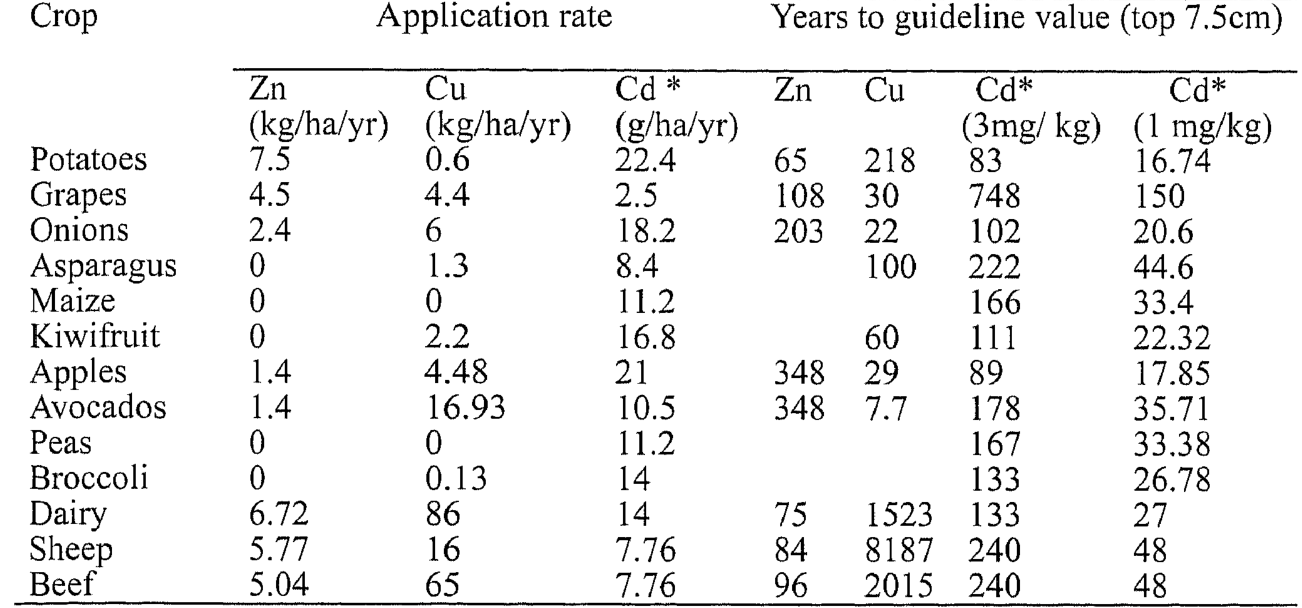
*Assumes all Padded to system is in the form of superphosphate which has 280 mg Cd/kg P. Blank cells within the table indicate that the metal is not routinely used in this crop.
Figures
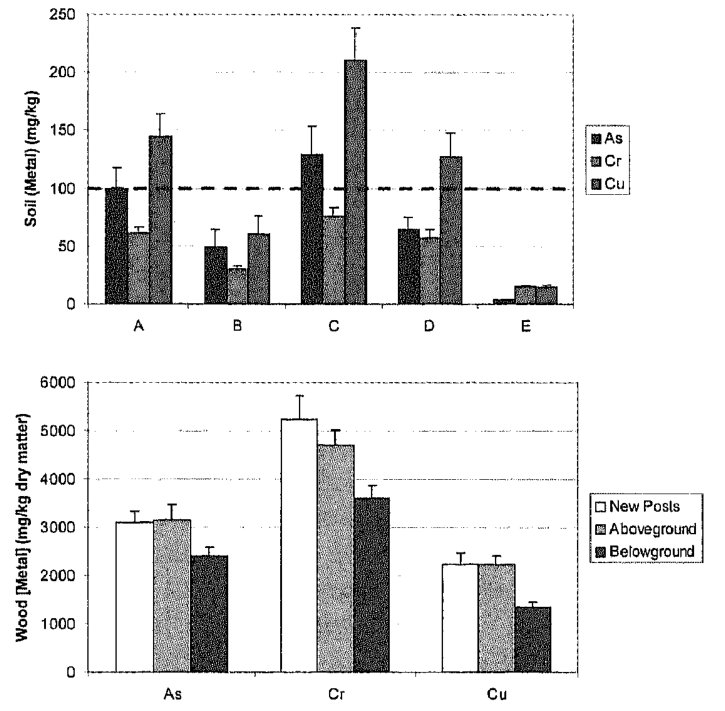
ig. 1. Average soil (I) and wood (II) CCA concentrations across all sites sampled. "Aboveground" and "Belowground" refer to post wood sampled aboveground and belowground respectively. The locations of samples A (adjacent to post), B (50mm from post), C (directly under post), D (100mm below post) and E (control). Bars represent the standard error of the mean (n=27 for all means except 'New Posts' where n=6). The dashed line is the NEPC (Australian National Environmental Protection Council) guideline for arsenic in soil.