Taupo Volcanic Zone, New Zealand
Brett Robinson, Monica Marchetti, Christophe Moni, Lina Schroeter, Carlo van den Dijssel, Georgie Milne, Nanthi Bolan & Santiago Mahimairaja
1Introduction引言
The Taupo Volcanic Zone (TVZ) covers an area of 600 000 ha in the central North Island, New Zealand. It extends from White Island south-west to Mount Ruapehu in a long narrow belt. The area features five active volcanoes that include White Island, Mt Tarawera, Mt Tongariro, Mt Ngauruhoe and Mt Ruapehu. The area is rich in hydrothermal activity, abounding in hot springs, geysers and mud pools. Such areas occur in specific fields of geothermal activity. The TVZ contains over 32 natural lakes, including Lake Taupo (the largest lake in New Zealand) and Lake Rotorua. New Zealand’s longest river, the Waikato, flows out of Lake Taupo through several geothermal fields and north-west to the Tasman Sea. Seven hydroelectric power dams have been built along this river to exploit the 366 m fall to the sea (Liddle 1982).
陶波火山带(Taupo Volcanic Zone, TVZ)位于新西兰北岛中部,面积达600 000 ha,自White Island向西南延伸至鲁阿佩胡山(Mount Ruapehu),呈狭长带状分布。该区域有5座活火山,包括White Island、Mt Tarawera、Mt Tongariro、Mt Ngauruhoe和Mt Ruapehu。区内热液活动丰富,温泉、间歇泉和泥浆池众多,这些现象集中出现在特定的地热活动区内。TVZ拥有超过32个天然湖泊,包括陶波湖(Lake Taupo,新西兰最大的湖泊)和罗托鲁瓦湖(Lake Rotorua)。新西兰最长的河流怀卡托河(Waikato)自陶波湖流出,穿过数个地热田,向西北注入塔斯曼海。沿该河已修建7座水电站大坝,以利用其入海的366 m落差(Liddle 1982)。
Geothermal activity in the TVZ has resulted in elevated arsenic (As) concentrations in some lakes and rivers (Aggett & Aspell 1978). The As loading in surface waters is exacerbated by the commercial exploitation of geothermal power (Axtmann 1975). Historically, As has also been introduced into the aquatic environment from runoff of As-based pesticides (Hill 1975), aquatic pesticides used to control lake weed (Tanner & Clayton 1990) and leaching from timber-treatment sites that used copper-chromium-arsenic (CCA) biocides.
TVZ的地热活动导致部分湖泊和河流中砷(As)浓度升高(Aggett & Aspell 1978)。地热能源的商业开发进一步加剧了地表水中的As负荷(Axtmann 1975)。历史上,As还通过以下途径进入水生环境:含As农药的径流(Hill 1975)、用于控制湖泊水草的水生除草剂(Tanner & Clayton 1990),以及使用铜-铬-砷(CCA)杀菌剂的木材防腐处理场地的淋溶。
The predominant form of As in the environment is arsenate (AsV) since arsenite (AsIII) is oxidized by atmospheric oxygen (Pepper et al. 1987). For most of the year, over 90% of the As in the Waikato River, which flows through the TVZ, is present as AsV (Aggett & Aspell 1978) but in the summer months the levels of AsIII increase, probably because of microbial reduction (Freeman 1985).
环境中As的主要形态为砷酸盐(AsV),因为亚砷酸盐(AsIII)会被大气中的氧气氧化(Pepper et al. 1987)。流经TVZ的怀卡托河在一年中的大部分时间里,90%以上的As以AsV形式存在(Aggett & Aspell 1978),但在夏季AsIII水平升高,这可能是微生物还原作用所致(Freeman 1985)。
It is widely known that some aquatic macrophytes growing in the TVZ and Waikato River contain high concentrations of As (Reay 1972; Liddle 1982). Robinson et al. (1995a) reported >1000 mg/kg–1 (ppm) As (dry weight) in samples of Egeria densa and Ceratophyllum demersum growing in the Waikato River system.
众所周知,生长在TVZ和怀卡托河中的部分水生大型植物含有高浓度的As(Reay 1972; Liddle 1982)。Robinson et al.(1995a)报道,生长于怀卡托河水系的Egeria densa和Ceratophyllum demersum样品中As含量(干重)>1000 mg/kg–1(ppm)。
Liddle (1982) conducted experiments involving the uptake of As by Ceratophyllum demersum. He found that plants grown in As solutions with <0.1 mg/L–1 As (III or V) reached equilibrium in one or two days, while plants in >0.5 mg/L–1 of this element needed up to a week to reach equilibrium. Arsenic concentration in plants increased with increasing concentration of As in the growing medium. At a similar As concentration in the growing medium, plants grown under laboratory conditions contained far less As than plants collected under natural conditions in the Waikato River.
Liddle(1982)开展了Ceratophyllum demersum吸收As的试验。他发现,生长在As浓度<0.1 mg/L–1(AsIII或AsV)溶液中的植物在一至两天内即达到平衡,而生长在该元素浓度>0.5 mg/L–1溶液中的植物则需长达一周才能达到平衡。植物体内As浓度随生长介质中As浓度的增加而升高。在生长介质As浓度相近的条件下,实验室条件下培养的植物As含量远低于在怀卡托河自然条件下采集的植物。
A survey of watercress (Lepidium sativum) growing in the region revealed concentrations as high as 1766 mg/kg–1 in the shoot (Robinson et al. 2003). This is of concern to human health because watercress is consumed as a vegetable. On a fresh-weight basis, nearly all the samples tested were above 2 mg/kg–1, the World Health Organization (WHO) limit for As in foodstuffs (Brandsetter et al. 2001). Plant-accumulation of As may also facilitate the entry of this toxic element into the food chain.
对该区域生长的豆瓣菜(Lepidium sativum)的调查显示,其地上部As浓度高达1766 mg/kg–1(Robinson et al. 2003)。由于豆瓣菜作为蔬菜被食用,这一结果对人体健康构成隐患。按鲜重计,几乎所有检测样品的As含量均超过世界卫生组织(WHO)规定的食品As限值2 mg/kg–1(Brandsetter et al. 2001)。植物对As的积累还可能促使这一有毒元素进入食物链。
Arsenic uptake by plants is associated with the phosphate ion (H2PO4–) uptake mechanism, where presumably AsV is taken up as a H2PO4– analog (Khattak et al. 1991; Meharg & Macnair 1991; Pickering et al. 2000). Ma et al. (2001) reported As concentrations in the Brake fern, Pteris vittata, of up to 22 000 mg/kg–1 (2.2%) on a dry-matter basis. This is the first terrestrial species reported to take-up As to concentrations greater than 1000 mg/kg–1, the threshold for a plant to be considered a hyperaccumulator (Brooks et al. 1977). It has been shown that aquatic plants accumulate trace elements by absorption followed by passive or active transport across membranes (Forstner & Wittmann 1981; Smies 1983).
植物对As的吸收与磷酸根离子(H2PO4–)的吸收机制有关,推测AsV作为H2PO4–的类似物被吸收(Khattak et al. 1991; Meharg & Macnair 1991; Pickering et al. 2000)。Ma et al.(2001)报道,蜈蚣草(Pteris vittata)中As浓度按干物质计高达22 000 mg/kg–1(2.2%)。这是首个被报道对As吸收浓度超过1000 mg/kg–1的陆生物种,该浓度即判定植物为超富集植物的阈值(Brooks et al. 1977)。已有研究表明,水生植物通过吸收并经膜的被动或主动转运来积累微量元素(Forstner & Wittmann 1981; Smies 1983)。
Hyperaccumulator plants could be used for the phytoremediation of As-contaminated sites (Ma et al. 2001). This technology relies on plants that translocate inordinate amounts of one or more metal(loid)s including As into their above-ground biomass. Arsenic phytoremediation would involve repeated cropping until the soil’s As concentration reached an acceptable level. After each cropping, the plant biomass would be removed from the area and may be burned to reduce its volume, whereupon it could be stored in an appropriate area, such as a contained landfill, that does not pose a risk to the environment. The possibility of using hyperaccumulator plants to extract As from aquatic environments has also been suggested (Brooks & Robinson 1998). This chapter presents the As uptake by terrestrial vegetation adjacent to geothermal areas where soils may have elevated As concentrations, following a survey of the As uptake by aquatic macrophytes in the TVZ. Data obtained under controlled conditions on the As uptake of five fern species that are known to occur in the TVZ are also presented.
超富集植物可用于As污染场地的植物修复(Ma et al. 2001)。该技术依赖于能将大量一种或多种金属(类金属)(包括As)转运至地上生物量的植物。As的植物修复需要反复种植收获,直至土壤As浓度降至可接受水平。每次收获后,将植物生物量移出该区域,可焚烧以减小体积,随后贮存于对环境无风险的适当场所,如封闭式填埋场。利用超富集植物从水生环境中提取As的可能性亦已被提出(Brooks & Robinson 1998)。本章在对TVZ水生大型植物As吸收情况进行调查的基础上,介绍了地热区附近(土壤As浓度可能较高)陆生植被对As的吸收情况,并给出了在受控条件下获得的、已知分布于TVZ的5种蕨类植物对As吸收的数据。
2Materials and methods材料与方法
Field surveys野外调查
A number of terrestrial and aquatic plant samples were taken at several sites along the Waikato River and around geothermal areas in the TVZ. Leaf samples were collected from the terrestrial plants, while whole specimens of the aquatic plants were taken. Aquatic samples were washed in river water to remove sediment, then further washing in distilled water was carried out upon returning to the laboratory. Samples were stored in paper bags for drying.
在怀卡托河沿岸及TVZ地热区周边的若干地点采集了多个陆生和水生植物样品。陆生植物采集叶片样品,水生植物则采集整株样品。水生样品先用河水冲洗以去除沉积物,返回实验室后再用蒸馏水进一步清洗。样品存放于纸袋中待干燥。
Greenhouse experiments温室试验
The greenhouse experiment was performed at Hort Research, Palmerston North, New Zealand (40.2°S, 175.4°E). Five species of native ferns (Asplenium bulbiferum, Blechnum discolor, Histiopteris incisa, Pneumatopteris penningera and Polystichum vestitum) as well as watercress (Lepidium sativum) were grown in 15 L buckets containing soils spiked with sodium arsenate to give final As concentrations of 0, 55 and 105 mg/kg–1. There were five replicates for each treatment. The soil used was Manawatu silt loam, with a pH of 4.4 and a total organic matter content of 6.3%. Soils were prepared by adding varying amounts of a 1% As solution to c. 15 kg of soil and mixed using a concrete mixer. Soils were fertilized with NitrosolTM liquid fertilizer at a rate recommended by the manufacturer. Planting occurred at the end of October 2002, some six weeks after preparation of the soil samples. This delay was to allow time for the added As to come to equilibrium with the soil. Plants were watered at least once every two days, depending on evaporative demand. Pots were arranged in a randomized block design within the shadehouse. Plant samples were taken for chemical analysis in mid-January 2003, 10 weeks after planting.
温室试验在新西兰Palmerston North的Hort Research(40.2°S, 175.4°E)进行。将5种本土蕨类植物(Asplenium bulbiferum、Blechnum discolor、Histiopteris incisa、Pneumatopteris penningera和Polystichum vestitum)以及豆瓣菜(Lepidium sativum)种植于15 L的桶中,桶内土壤添加砷酸钠,使最终As浓度分别为0、55和105 mg/kg–1。每个处理设5个重复。供试土壤为Manawatu粉砂壤土,pH为4.4,总有机质含量为6.3%。土壤制备方法为:向约15 kg土壤中加入不同量的1% As溶液,并用混凝土搅拌机混匀。按生产商推荐用量施用NitrosolTM液体肥料。种植于2002年10月底进行,距土壤样品制备约六周,此间隔旨在使添加的As与土壤达到平衡。根据蒸发需求,至少每两天浇水一次。盆钵在荫棚内按随机区组设计排列。于2003年1月中旬(种植后10周)采集植物样品进行化学分析。
Sample preparation and As determination样品制备与As测定
Plant material, sediments and soils were placed in a drying cabinet at 80°C until a constant weight was reached. Plant material was ground using a mortar and pestle. Sediment and soil samples were sieved to <1 mm size using a nylon sieve and stored in sealed plastic bags.
植物材料、沉积物和土壤置于80°C烘箱中烘干至恒重。植物材料用研钵和研杵研磨。沉积物和土壤样品用尼龙筛过筛至<1 mm,并储存于密封塑料袋中。
Approximately 0.15 g of ground plant material or 0.5 g of sieved sediment and soil sample was accurately weighed into 50 mL Erlenmeyer flasks. 10 mL of concentrated nitric acid (69%) were added to each flask and the mixtures heated and evaporated on a heating block until a final volume of c. 3 mL was reached. The samples were then diluted to 10 mL using distilled water and stored in polythene containers.
准确称取约0.15 g研磨后的植物材料或0.5 g过筛后的沉积物和土壤样品,置于50 mL锥形瓶中。每瓶加入10 mL浓硝酸(69%),在加热块上加热蒸发至最终体积约3 mL。随后用蒸馏水将样品稀释至10 mL,储存于聚乙烯容器中。
All samples of plant material, sediment and waters were analyzed for As using graphite furnace atomic absorption spectroscopy. Due to the high concentrations of As being measured in some of the plant samples, plant standards were unavailable. Thus, for quality assurance, 14 dried and ground plant samples were sent to a commercial laboratory (Hill Laboratories, Hamilton, New Zealand) for comparison. The results were in good agreement (R2 = 0.978), but our results were consistently 5–30% higher than those of the commercial laboratory, possibly due to differences in the digestion methods.
所有植物材料、沉积物和水样均采用石墨炉原子吸收光谱法测定As。由于部分植物样品中As浓度很高,无适用的植物标准物质。因此,为保证质量,将14个烘干研磨的植物样品送至商业实验室(Hill Laboratories, Hamilton, 新西兰)进行比对。结果吻合良好(R2 = 0.978),但本研究结果始终比商业实验室高5–30%,可能是由于消解方法不同所致。
Statistical treatment of data数据统计处理
MINITAB was used for ANOVA and correlation analyses. For data that were log-normally distributed, we report geometric means and standard deviation ranges rather than means and standard deviations.
采用MINITAB进行ANOVA和相关分析。对于呈对数正态分布的数据,报告几何平均值和标准差范围,而非算术平均值和标准差。
3Results and discussion结果与讨论
Arsenic accumulation in terrestrial and aquatic plants from the TVZTVZ陆生和水生植物对As的积累
The average As concentrations in the soils, sediments and waters, as well as aquatic and terrestrial plants collected from the TVZ during the field survey, are presented in Tables 12.1 and 12.2. The geometric mean As concentration in the water samples was over twice that of the New Zealand and WHO Drinking Water Standard (0.01 mg/L–1) and significantly higher than that recorded in countries where As poisoning has been reported (see Chapters xx–xx). There was a clear demarcation between terrestrial plants, that accumulated negligible concentrations of As, and aquatic species that had As concentrations many-fold higher than the ambient waters whence they were taken.
野外调查期间在TVZ采集的土壤、沉积物、水体以及水生和陆生植物的平均As浓度见表12.1和表12.2。水样As浓度的几何平均值超过新西兰和WHO饮用水标准(0.01 mg/L–1)的两倍,并显著高于已报道发生砷中毒国家的记录值(见第xx–xx章)。陆生植物与水生物种之间存在明显界限:前者积累的As浓度可忽略不计,而后者的As浓度比其所在水体高出许多倍。
The As concentrations in aquatic and terrestrial species from the Waikato River and TVZ are given in Tables 12.2 and 12.3 respectively. The data clearly display the difference in As accumulation between aquatic and terrestrial plants. All aquatic plants accumulated measurable As concentrations with many species exceeding the threshold concentration of 1000 mg/ kg–1 (on a dry-matter basis) for hyperaccumulation (Brooks et al. 1977). By contrast, 83% of the terrestrial plants (Table 12.3) were below the detection limit for As (<0.5 mg/kg–1). All the aquatic plants tested accumulated As to concentrations greater than 5 mg/kg–1on a dry-matter basis, and none of the terrestrial plants tested had As concentrations surpassing 11 mg/kg–1.
怀卡托河和TVZ水生与陆生物种的As浓度分别见表12.2和表12.3。数据清楚地显示了水生植物与陆生植物在As积累上的差异。所有水生植物均积累了可测浓度的As,其中许多物种超过了超富集的阈值浓度1000 mg/ kg–1(按干物质计)(Brooks et al. 1977)。相比之下,83%的陆生植物(表12.3)As含量低于检出限(<0.5 mg/kg–1)。所有受测水生植物的As积累浓度按干物质计均大于5 mg/kg–1,而受测陆生植物的As浓度均未超过11 mg/kg–1。
| Location地点 | Water [A水体[A | s] Speciess] 物种 | [As] dm | [As] fm | B.C.a |
|---|---|---|---|---|---|
| Tokaanu ge | othermal reg | ion and upper Waikato River | |||
| Tokaanu | 0.091 | Callitriche petriei(3) | 4278 | 272 | 47130 |
| Ceratophyllum demersum | 765 | 34.5 | 8424 | ||
| Elodea canadensis(3) | 1442 | 52 | 15889 | ||
| Lagarosiphon major(2) | 666 | nd | nd | ||
| Lemma minor | 808 | 24 | 8901 | ||
| Mentha piperata(5) | 600 | 49 | 6608 | ||
| Myriophyllum propinquum(9) | 2960 | 152 | 32603 | ||
| Polygonum hydropiper(4) | 763 | 56 | 8411 | ||
| Rorippa nasturtium-aquaticum (19) | 1628 | 69 | 17936 | ||
| Veronica aquatica(2) | 625 | 51 | 6887 | ||
| Aratiatia | 0.007 | Ceratophyllum demersum | 142 | nd | 19789 |
| Egeria densa | 131 | nd | 18363 | ||
| Lagarosiphon major | 286 | nd | 39898 | ||
| Ohaaki | 0.014 | Ceratophyllum demersum(3) | 550 | nd | 40749 |
| Egeria densa | 2908 | 202 | 215404 | ||
| Lagarosiphon major | 85 | nd | 6348 | ||
| Lemma minor(3) | 171 | 18 | 12683 | ||
| Rorippa nasturtium-aquaticum (3) | 145 | 5.6 | 10711 | ||
| Mentha piperata | 91 | 10 | 6734 | ||
| Myosotis laxa | 64 | 3 | 4758 | ||
| Polygonum salicifolium | 71 | 4 | 5228 | ||
| Rumex crispus | 4 | 0.5 | 294 | ||
| Veronica aquatica(2) | 47 | 1 | 3638 | ||
| Mihi | 0.035 | Algae | 191 | 21 | 12509 |
| Alisma plantago | 29 | 5 | 838 | ||
| Callitriche petriei | 489 | 45 | 13943 | ||
| Ceratophyllum demersum(2) | 572 | 19 | 16304 | ||
| Cyperus ustulatus | 21 | 6 | 585 | ||
| Egeria densa | 1318 | 70 | 37562 | ||
| Glyceria maxima | 1.3 | 0.2 | 37 | ||
| Lagarosiphon major(2) | 568 | 59 | 16180 | ||
| Nymphaea alba | 12 | 1 | 351 | ||
| Polygonum hydropiper(2) | 126 | 8 | 3600 | ||
| Polygonum salicifolium | 39 | 3 | 1118 | ||
| Veronica aquatica | 25 | 1 | 721 |
| Location地点 | Water [As]水体[As] | Species物种 | [As] dm | [As] fm | B.C.a |
|---|---|---|---|---|---|
| Lower Waikat | o River | ||||
| Ohakure | 0.022 | Callitriche petriei | 365 | 46 | 16549 |
| Ceratophyllum demersum | 904 | 22 | 41024 | ||
| Egeria densa | 892 | nd | 40492 | ||
| Juncus sp.(2) | 18 | 3 | 811 | ||
| Glyceria maxima | 28 | 3 | 1291 | ||
| Rorippa nasturtium-aquaticum (10) | 186 | 9 | 8415 | ||
| Mentha piperata | 7 | 1 | 328 | ||
| Nymphaea alba(3) | 35 | 2 | 1573 | ||
| Potamogeton orchreatus | 110 | 8 | 4980 | ||
| Veronica aquatica(3) | 6 | 0.2 | 277 | ||
| Whakamaru | 0.039 | Egeria densa | 728 | 48 | 18293 |
| Lagarosiphon major | 643 | 48 | 16623 | ||
| Maraetai | 0.065 | Callitriche petriei | 618 | 199 | 9483 |
| Ceratophyllum demersum | 263 | 13 | 4037 | ||
| Glyceria maxima(2) | 22 | 6 | 342 | ||
| Juncus sp.(2) | 25 | 6 | 376 | ||
| Nymphaea alba(2) | 11 | 0.8 | 172 | ||
| Waipapa | 0.029 | Ceratophyllum demersum | 366 | 16 | 12693 |
| Egeria densa | 854 | 42 | 29663 | ||
| Karapiro | 0.039 | Ceratophyllum demersum(3) | 292 | 13 | 7219 |
| Huntly | 0.029 | Ceratophyllum demersum(2) | 86 | 4 | 2930 |
| Egeria densa | 158 | 9 | 5407 | ||
| Glyceria maxima | 28 | 4 | 964 | ||
| Tuakau | 0.031 | Cyperus eragrostis(4) | 70 | 13 | 2290 |
| Egeria densa | 116 | 8 | 3787 | ||
| Juncus spp.(2) | 26 | 5 | 856 | ||
| Lycopus europaeus(2) | 103 | 16 | 3353 | ||
| Polygonum hydropiper | 27 | 4 | 870 | ||
| Port Waikato | nd (saline) | Ceratophyllum demersum | 99 | nd | nd |
| Cyperus eragrostis | 24 | 5 | nd | ||
| Juncus spp. (4) | 20 | nd | nd |
a bioaccumulation coefficient nd = not determined
a 生物富集系数;nd = 未测定
Outridge and Noller (1991) noted the difference in metal(loid) accumulation between aquatic and terrestrial species in their review of hyperaccumulation of elements by freshwater plants. Although they did not provide an explanation of this phenomenon, various reasons could be attributed for the difference in As accumulation between aquatic and terrestrial plants. In terrestrial systems, solubilization of As in the rhizosphere may be necessary to allow the plant roots to take up this element. An efficient As transport and storage system needs to exist for accumulation to occur in the aerial parts. This is not the case when the plant grows in an aqueous medium, where the metalliod is already present in bioavailable form and can be absorbed and/or adsorbed by the leaves.
Outridge and Noller(1991)在其关于淡水植物超富集元素的综述中指出了水生与陆生物种在金属(类金属)积累上的差异。尽管他们未对这一现象作出解释,但水生植物与陆生植物在As积累上的差异可归因于多种原因。在陆地系统中,As可能需要在根际中溶解,植物根系才能吸收该元素;要使其在地上部积累,还必须存在高效的As转运和储存系统。而当植物生长在水体介质中时,情况则不同:该类金属已以生物有效形态存在,可被叶片吸收和/或吸附。
| Species物种 | No. of samples样品 数 | % dry matter% 干 物质 | Plant GeoMean (As) and SD range植物 As几何平均值 及SD范围 | Water GeoMean (As)水体 As几何 平均值 | GeoMean BCa几何平均 BCa |
|---|---|---|---|---|---|
| Hot-water algaeb | 3 | 3 | 3019 (1058–8617) | 0.32 | 9345 |
| Cold-water algaeb | 10 | 8.5 | 36.7 (7.3–184.9) | 0.03 | 1452 |
| Alisma plantago aquatica | 2 | 10.2 | 40.3 (25.8–63.1) | 0.02 | 1853 |
| Callitriche stagnalis | 3 | 6.4 | 4215 (3402–5223) | 0.09 | 49 307 |
| Callitriche petriei | 2 | 11.0 | 422 (343–520) | 0.03 | 15 190 |
| Ceratophyllum demersumb | 16 | 6.9 | 284 (119–769) | 0.03 | 10 606 |
| Convolvulus arvensis | 1 | 10.9 | 17.0 | 0.03 | 580 |
| Cyperus eragrostis | 5 | 17.8 | 47.5 (21–105) | 0.05 | 1049 |
| Cyperus ustulatus | 1 | 28.7 | 20.5 | 0.04 | 584.9 |
| Egeria densiab | 8 | 6.1 | 568 (189–1701) | 0.02 | 24 847 |
| Elodea candensisb | 6 | 6.2 | 68 (2.5–1837) | 0.01 | 4987 |
| Glyceria maxima | 5 | 17.6 | 13.9 (3.7–52.5) | 0.04 | 352 |
| Juncus spp. | 14 | 24.5 | 9.8 (2.4–39.4) | 0.08 | 116 |
| Lagarosyphon majorb | 11 | 7.8 | 127 (7.7–2107) | 0.02 | 8502 |
| Lemma minorb | 9 | 2.9 | 15 (0.6–360) | 0.01 | 1793 |
| Lepidium sativum | 33 | 4.6 | 369 (58.7–2325) | 0.04 | 9174 |
| Lotus corniculatus | 2 | 10.7 | 637 (344–1179) | - | - |
| Lycopus europaeus | 2 | 15.9 | 102 (91–114) | 0.03 | 3343 |
| Mentha piperata/ var. citrata | 4 | 9.1 | 167 (14.8–1884) | 0.04 | 4361 |
| Mentha spicata | 3 | 9.9 | 181 (88.7–370.4) | 0.13 | 1361 |
| Myosotis laxa | 1 | 4.7 | 64.2 | 0.01 | 4758 |
| Myriophyllum propinquumb | 10 | 4.7 | 2101 (873–5056) | 0.08 | 27 860 |
| Nymphaea alba | 6 | 8.0 | 16.5 (7.5–36.4) | 0.03 | 483 |
| Polygonum hydropiper | 8 | 8.1 | 114 (19.3–672) | 0.05 | 2423 |
| Polygonum salicifolium | 4 | 7.4 | 44 (10.0–197.8) | 0.01 | 3126 |
| Potamogeton orchreatus | 5 | 7.3 | 144.6 (26.5–808) | 0.01 | 16 188 |
| Rumex crispus | 1 | 11.5 | 3.9 | 0.01 | 294 |
| Rumex obtusipholius | 1 | 24.1 | 97.3 | 0.04 | 2274 |
| Typha orientalis | 3 | 9.5 | 174 (113–267) | 0.09 | 2042 |
| Veronica aquatica | 5 | 3.8 | 10.0 (3.4–29.0) | 0.02 | 459 |
a: Bioaccumulation coefficient
b: Species that lack extensive root systems
b:缺乏发达根系的物种
| Name名称 | No. of samples样品 数 | Minimum (no. of samples below detection limit)最小值(低于检出限的 样品数) | Maximum最大值 |
|---|---|---|---|
| Asplenium polyodon | 1 | <0.5 | |
| Blechnum capense | 5 | <0.5 (3) | 1.2 |
| Cyathodes juniperina | 1 | <0.5 | |
| Dicranopteris linearis | 1 | <0.5 | |
| Histiopteris incisia | 6 | <0.5 (5) | 1.4 |
| Juncus sp. | 2 | <0.5 | 1.4 |
| Kunzea ericoides | 5 | <0.5 | |
| Leptospermum scoparium | 6 | <0.5 (5) | 11 |
| Lycopodium cernuum | 1 | <0.5 | |
| Paesia scaberula | 3 | <0.5 (2) | 0.6 |
| Pittosporum tenuifolium | 1 | <0.5 | |
| Pteridium esculentum | 4 | <0.5 |
Sixteen different species of aquatic plants were tested and all of them accumulated higher concentrations of As than the terrestrial plants. Algae growing in the water of Tokaanu had the highest concentration of As (1252–9632 mg/kg–1 dry matter). Specimens of numerous other species were found to accumulate more than 1000 mg/kg–1 As. Most specimens of Myriophyllum propinquum (geomean 2101, sd range 873–5056 mg/kg–1) were over the 1000 mg/kg–1 threshold. There have been no previous reports of As hyperaccumulation by this species.
共检测了16种不同的水生植物,其As积累浓度均高于陆生植物。生长在Tokaanu水体中的藻类As浓度最高(1252–9632 mg/kg–1干物质)。另有许多物种的样品As积累量超过1000 mg/kg–1。大多数Myriophyllum propinquum样品(几何平均值2101,SD范围873–5056 mg/kg–1)超过1000 mg/kg–1阈值。此前尚无该物种超富集As的报道。
Previous studies of As uptake by aquatic plants from the TVZ (Liddle 1982; Robinson et al. 1995b; Brooks & Robinson 1998; Robinson et al. 2003) focused on four species: Ceratophyllum demersum, Egeria densa, Lagarosiphon major and Lepidium sativum. These studies reported average As concentrations in C. demersum, E. densa, L. major and R. nasturtium of 400, 500, 300 and 400 mg/kg–1 respectively. Although sampled at different locations, the results in this study were in good agreement, being 284, 568, 127 and 369 mg/kg–1 respectively.
以往关于TVZ水生植物As吸收的研究(Liddle 1982; Robinson et al. 1995b; Brooks & Robinson 1998; Robinson et al. 2003)主要集中于4个物种:Ceratophyllum demersum、Egeria densa、Lagarosiphon major和Lepidium sativum。这些研究报道C. demersum、E. densa、L. major和R. nasturtium的平均As浓度分别为400、500、300和400 mg/kg–1。尽管采样地点不同,本研究的结果与之吻合良好,分别为284、568、127和369 mg/kg–1。
The present study also determined As levels in several species that had not previously been analyzed. It was found that M. propinquum, E. canadensis and hot-water algae from Tokaanu all accumulated As to levels greater than 1000 mg/kg–1. Additionally, Callitriche petrei, Lotus corniculatus, Lycoptus europaeus, Mentha spp., Polygonium hydropiper, Potamogeton orchreatus and Typha orientalis all accumulated more than 100 mg/kg–1. Although not technically hyperaccumulators, As accumulation by these species may be environmentally significant because they represent a food source for animals and, in the case of Mentha spp., for humans.
本研究还测定了若干此前未分析过的物种的As水平。结果发现,M. propinquum、E. canadensis以及Tokaanu热水藻类的As积累水平均超过1000 mg/kg–1。此外,Callitriche petrei、Lotus corniculatus、Lycoptus europaeus、Mentha spp.、Polygonium hydropiper、Potamogeton orchreatus和Typha orientalis的As积累量均超过100 mg/kg–1。尽管这些物种严格意义上并非超富集植物,但由于它们是动物的食物来源(就Mentha spp.而言,也是人类的食物来源),其As积累可能具有重要的环境意义。
Arsenic accumulation in ferns and watercress from As-spiked soil蕨类植物和豆瓣菜对加As土壤中As的积累
The ferns and watercress grew well in all the treatments of As-spiked soils and there were no signs of As toxicity. None of the fern species or the watercress had foliar As concentrations greater than 0.5 mg/kg–1dry matter (the detection limit for As), even at the highest soil As concentration of 105 mg/kg–1. There were no significant differences in the soil As concentration before and after the experiment, indicating that leaching losses were insignificant.
蕨类植物和豆瓣菜在所有加As土壤处理中均生长良好,未见As毒害症状。即使在最高土壤As浓度105 mg/kg–1下,所有蕨类物种和豆瓣菜的叶片As浓度均未超过0.5 mg/kg–1干物质(As的检出限)。试验前后土壤As浓度无显著差异,表明淋溶损失可以忽略。
None of the ferns tested has potential for As phytoremediation because they failed to accumulate significant amounts of As from the soil.
受测蕨类植物均未能从土壤中积累显著量的As,因此均不具备As植物修复潜力。
Watercress, a plant that grows in both the aquatic and terrestrial environment, accumulated As only when grown in the former. This implies that watercress is not efficient in absorbing As through roots in the sediments and/or has no specialized mechanism for translocating
豆瓣菜是一种既能生长于水生环境又能生长于陆地环境的植物,但仅在水生环境中生长时才积累As。这表明豆瓣菜通过沉积物中的根系吸收As的效率不高,和/或缺乏将
As to the above-ground tissues. It also raises the question of whether As is absorbed or adsorbed from the aquatic system. Arsenic may simply bind to the cell surfaces of aquatic plants, indicating that there is no specialized As-uptake mechanism. However, in such a scenario the plants would still need to have a tolerance mechanism for As.
As转运至地上组织的特殊机制。这也引出了一个问题:As是从水体系统中被吸收还是被吸附。As可能仅仅结合在水生植物的细胞表面,这意味着不存在特殊的As吸收机制。然而,即使如此,植物仍需具备对As的耐受机制。
The low plant uptake in the greenhouse experiment may be explained by low As bioavailability in the soil. Arsenic bioavailability in soils is a key factor for its uptake by plants. Even if the total As concentrations in the soils were high, it is possible that the element was strongly bound to the soil particles and thus relatively unavailable for plant uptake. The relatively acid soil pH (measured at 4.4 in this experiment) that ferns favor (Metcalf 1993) may render As less available than at higher pHs (Manning & Goldberg 1997; Smith et al. 1999; Tyler & Olsson 2001; Raven et al. 1998). Arsenic bioavailability may be further reduced by As binding to clay particles and organic matter in the soil. Soil factors influencing As bioavailability are discussed in detail in Chapter 15.
温室试验中植物吸收量低可能归因于土壤中As的生物有效性较低。土壤中As的生物有效性是影响植物吸收的关键因素。即使土壤总As浓度较高,该元素也可能与土壤颗粒紧密结合,因而相对难以被植物吸收。蕨类植物偏好的较酸性土壤pH(本试验测得为4.4)(Metcalf 1993)可能使As的有效性低于较高pH条件下(Manning & Goldberg 1997; Smith et al. 1999; Tyler & Olsson 2001; Raven et al. 1998)。As与土壤中黏粒和有机质的结合可能进一步降低其生物有效性。影响As生物有效性的土壤因素将在第15章详细讨论。
When comparing the results from this experiment with those of Ma et al. (2001), who showed Pteris vittata could hyperaccumulate As from a soil containing less As than the highest treatment in this trial, it is clear that either the ferns tested in this experiment have no specialized As-uptake mechanism or that the bioavailability of As varied between the soils. The As hyperaccumulator Pteris vittata has the ability to solubilize As in the root zone, then translocate it to the aerial tissues. This mechanism must overcome the relatively low bioavailability of As in the soil.
Ma et al.(2001)的研究表明,Pteris vittata能够从As含量低于本试验最高处理的土壤中超富集As。将本试验结果与之比较可以明确,要么本试验中的受测蕨类植物不具备特殊的As吸收机制,要么两种土壤中As的生物有效性不同。As超富集植物Pteris vittata能够在根区溶解As,再将其转运至地上组织。这一机制必须克服土壤中As相对较低的生物有效性。
Arsenic bioaccumulation coefficientAs生物富集系数
The concentration of As in the plant alone may not necessarily explain its efficiency in extracting the element from soil or water, because the substrate As concentration partially determines plant uptake. It is therefore necessary to compare the concentration of As in the plant in relation to the concentration found in the environment in which the plant is growing. Logically, a plant growing in a medium rich in (bioavailable or total) As would be expected to contain a higher amount of that element in its tissues. However, in phytoremediation, an important trait of the plants is their ability to extract As even if it is present in low concentrations in the substrate.
仅凭植物体内的As浓度未必能说明其从土壤或水中提取该元素的效率,因为基质As浓度在一定程度上决定了植物的吸收量。因此,有必要将植物体内As浓度与其生长环境中的As浓度进行比较。按理说,生长于富含(生物有效态或总)As介质中的植物,其组织中该元素含量预期较高。然而,在植物修复中,植物的一个重要特性是即使基质中As浓度较低也能将其提取出来。
The bioaccumulation coefficient is defined as the ratio of the concentration of As in the plant and the concentration of As in the growing medium (Brooks & Robinson 1998):
生物富集系数定义为植物体内As浓度与生长介质中As浓度之比(Brooks & Robinson 1998):

where As concentration in plant = mg/kg–1 dm, As concentration in soil = mg/kg–1soil and As concentration in water = mg/L–1.
式中,植物As浓度单位为mg/kg–1 dm,土壤As浓度单位为mg/kg–1土壤,水体As浓度单位为mg/L–1。
The geometric means of the bioaccumulation coefficients for the plants tested in this experiment are shown in Table 12.2. The results presented here show only the plant/water bioaccumulation coefficient. Some of the aquatic plants tested were rooted to sediments that had an As concentration many times the level of the water, but still less than the plant concentration. The ability to take up As was not affected by whether the plant is rooted or free-floating, with three of the seven free-floating species having bioaccumulation coefficients higher than 10 000.
本试验受测植物生物富集系数的几何平均值见表12.2。此处仅给出植物/水体生物富集系数。部分受测水生植物扎根于沉积物中,沉积物As浓度为水体的许多倍,但仍低于植物体内浓度。植物吸收As的能力不受其是扎根还是自由漂浮的影响,7种自由漂浮物种中有3种的生物富集系数高于10 000。
The bioaccumulation coefficients for the aquatic plants in this study are higher than any previously reported for terrestrial species, but are comparable to those calculated using previous studies on aquatic plants (Reay 1972; Liddle 1982; Robinson et al. 1995a, 2003). The ranking of the bioaccumulation coefficients is different from the results for the total As concentration in the plants. Studies on terrestrial plants have shown that bioaccumulation coefficients tend to decrease as the ambient concentration increases (Robinson et al. 2000), although in soil this may be a function of metal bioavailability as well as plant uptake.
本研究中水生植物的生物富集系数高于以往报道的任何陆生物种,但与根据以往水生植物研究(Reay 1972; Liddle 1982; Robinson et al. 1995a, 2003)计算所得的值相当。生物富集系数的排序与植物总As浓度的排序不同。对陆生植物的研究表明,生物富集系数往往随环境浓度的升高而降低(Robinson et al. 2000),但在土壤中这可能既与金属生物有效性有关,也与植物吸收有关。
Bioindication of As contamination by aquatic plants水生植物对As污染的生物指示
The high bioaccumulation coefficients of some aquatic species may make them good candidates for the bioindication of As contamination in aquatic systems. A bioindicator is an organism or a set of organisms whose biological response towards different environmental factors gives information about the present condition and/or evolution of an ecosystem.
某些水生物种的生物富集系数较高,可能使其成为水生系统As污染生物指示的良好候选。生物指示物是指其对不同环境因子的生物学响应能够提供生态系统当前状况和/或演变信息的一种或一组生物。
In the case of aquatic plants, the pertinent biological response to As contamination is high bioaccumulation coefficient. The potential value of using aquatic macrophytes as bioindicators is that they provide information on the history of As in the water, rather than a snapshot at the time of sampling. Arsenic levels in water vary depending on dilution caused by rainfall, concentration caused by evaporation or sporadic contamination (e.g. accidental chemical spill) and volatilization caused by biomethylation. Furthermore, analyzing aquatic macrophytes may elucidate any historic As contamination even if current levels in water are within acceptable limits. Plants collected near Blenheim, South Island, New Zealand, exemplify the use of aquatic macrophytes in this role. Analysis of water samples collected from Pukaka Stream and Spring Creek showed As concentrations lower than the detection limit of 0.05 mg/ L–1, although Pukaka Stream has been reported to have As concentrations up to 0.08 mg/L–1 during low-flow times. Analysis of E. canadensis collected in Pukaka Stream showed an average As concentration of 2.5 mg/kg–1on a dry-matter basis, a result that indicates the presence of elevated As levels in the water, if not at the time of sampling then certainly in the past. E. canadensis taken from Spring Creek, a stream with no known As contamination, had <0.5 mg/ kg–1As, indicating the absence of significant quantities of As.
对水生植物而言,其对As污染的相关生物学响应是较高的生物富集系数。利用水生大型植物作为生物指示物的潜在价值在于,它们能提供水体中As的历史信息,而非仅反映采样时的瞬时状况。水体中As水平会因降雨稀释、蒸发浓缩、偶发性污染(如意外化学品泄漏)以及生物甲基化引起的挥发而变化。此外,即使水体当前As水平处于可接受范围内,分析水生大型植物也可揭示过去的As污染。在新西兰南岛Blenheim附近采集的植物即例证了水生大型植物的这一用途。Pukaka Stream和Spring Creek水样的分析结果显示As浓度低于检出限0.05 mg/ L–1,但据报道Pukaka Stream在低流量期As浓度可达0.08 mg/L–1。在Pukaka Stream采集的E. canadensis平均As浓度按干物质计为2.5 mg/kg–1,这一结果表明水体中存在As水平升高的情况,即便采样时不存在,过去也必然存在。而采自无已知As污染的Spring Creek的E. canadensis,As含量<0.5 mg/ kg–1,表明不存在显著量的As。
Generally, bioindicators should be easily identified, abundant and widely distributed (for a better comparison between different sites); a large size, limited mobility and a long lifecycle are other important characteristics. Aquatic macrophytes such as the hornwort (Ceratophyllum demersum) fit all these criteria, with the possible exception of mobility. This plant is free-floating and may migrate downstream in times of flood.
一般而言,生物指示物应易于识别、数量丰富且分布广泛(以便在不同地点间进行更好的比较);个体较大、移动性有限及生命周期较长也是其他重要特征。金鱼藻(Ceratophyllum demersum)等水生大型植物符合上述所有标准,唯移动性一项可能例外。该植物自由漂浮,洪水期间可能向下游迁移。
Arsenic concentration data for Ceratophyllum demersum and ambient water from a previous study (Robinson et al. 1995a) was reprocessed to illustrate the relationship between plant As concentration and that of the ambient water (Figure 12.3). There was a highly significant correlation (r2 = 0.70, P <0.001), indicating that the As concentration of the plants could be used to predict the As concentration of the river water. Moreover, the plants (average 412 mg As/kg– 1) contained around 10 times the As concentration of the sediments (average 46 mg As/kg–1) that, in turn, had over 1000 times the As concentration of the ambient water (average 0.042 mg As/L–1). In this case, Ceratophyllum demersum provides an excellent bioindicator for As.
对以往研究(Robinson et al. 1995a)中Ceratophyllum demersum及其所处水体的As浓度数据进行了重新处理,以说明植物As浓度与所处水体As浓度之间的关系(图12.3)。二者之间存在极显著相关(r2 = 0.70, P <0.001),表明可以利用植物As浓度预测河水As浓度。此外,植物(平均412 mg As/kg– 1)的As浓度约为沉积物(平均46 mg As/kg–1)的10倍,而沉积物的As浓度又是所处水体(平均0.042 mg As/L–1)的1000倍以上。在这种情况下,Ceratophyllum demersum是一种极佳的As生物指示物。
Other factors, such as the pH, water temperature and nutrient availability, doubtless affect As accumulation. Further work needs to be carried out on these effects to determine how well these bioindicators would perform under various scenarios. This study and earlier studies analyzed whole specimens of C. demersum rather than stems and leaves. Leaves and stems could well have different As concentrations and hence different bioaccumulation coefficients.
pH、水温和养分有效性等其他因素无疑也会影响As积累。需进一步研究这些因素的影响,以确定这些生物指示物在不同情形下的表现。本研究及以往研究分析的均为C. demersum整株样品,而非分别分析茎和叶。叶和茎的As浓度很可能不同,因而生物富集系数也可能不同。
Aquatic macrophytes for the phytoremediation of As-contaminated water水生大型植物用于As污染水体的植物修复
The high bioaccumulation factor of aquatic plants may make them useful for the phytoremediation of As from contaminated drinking water. The possibility of using plants to remove As has been discussed by Brooks and Robinson (1998). More generally, the use of aquatic plants to remove pollutants from water has been outlined by Wolverton (1975), Wolverton and McDonald (1975a, 1975b) and Nzengung et al. (2003).
水生植物的高生物富集系数可能使其可用于受污染饮用水中As的植物修复。Brooks and Robinson(1998)已讨论了利用植物去除As的可能性。更广泛而言,Wolverton(1975)、Wolverton and McDonald(1975a, 1975b)以及Nzengung et al.(2003)概述了利用水生植物去除水中污染物的方法。
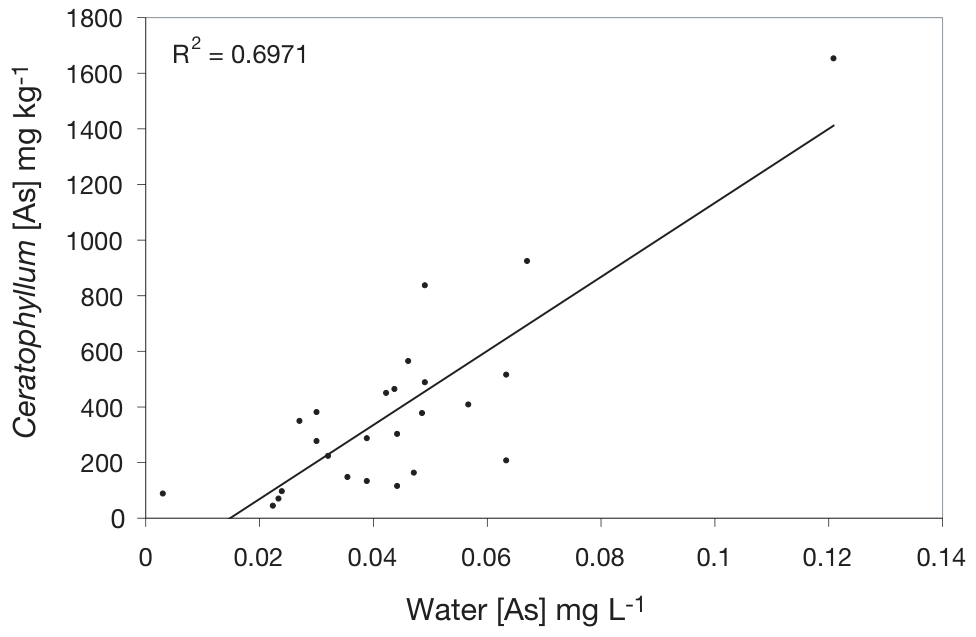
Reworked data from Robinson et al. (1995a)数据经重新处理,源自Robinson et al.(1995a)
Two methods have been suggested for using plants for the phytoremediation of contaminated water (Brooks 1998). The first involves the use of free-floating plants growing in monospecific pond cultures. Plants accumulate As until an equilibrium state is reached, then harvested. There are several problems related to this method. The main problem is harvesting of the plant matter enriched with the contaminant; a secondary problem relative to monospecific cultures is the risk of developing a plant disease that can destroy the whole crop. The second method is set up using rooted plants growing in trickling-bed filters. In this case, it is hypothesized that metal uptake is caused by rhizosphere microorganisms with just a small contribution of plant roots (Brooks 1998).
已有两种利用植物修复污染水体的方法被提出(Brooks 1998)。第一种是利用在单一物种池塘培养中生长的自由漂浮植物。植物积累As直至达到平衡状态,然后收获。该方法存在若干问题:主要问题是富集污染物的植物材料的收获;与单一物种培养相关的次要问题是可能发生植物病害而毁掉全部作物。第二种方法是利用生长在滴滤床过滤器中的有根植物。在此情况下,据推测金属的吸收主要由根际微生物引起,植物根系的贡献很小(Brooks 1998)。
Aquatic plants could therefore provide a very efficient means for removing As from contaminated drinking-water. Plants would be grown in ponds containing contaminated water, then simply removed and placed in an area where they do not pose a risk to the environment, such as a sealed landfill. Very simple low-cost technology such as this could potentially save lives in developing countries that cannot afford expensive water purification systems.
因此,水生植物可为去除受污染饮用水中的As提供一种非常高效的手段。可将植物种植于含污染水的池塘中,然后直接移出,放置于对环境无风险的区域,如密封填埋场。此类非常简单的低成本技术有望在无力负担昂贵净水系统的发展中国家挽救生命。
Arsenic contamination of food chain食物链的As污染
Arsenic accumulation by aquatic macrophytes may facilitate the entry of this toxic element into the food chain (Chapters xx–xx). Plants are the primary producers of most food chains. Humans may be directly affected if plants such as watercress and mint are consumed, or indirectly when they consume species that have high As levels due to contamination of the food chain. Much of the Waikato River is surrounded by farmland and stock may occasionally have access to aquatic weeds left on the banks after a flood. Fishing is also popular in the region. However, an earlier study (Robinson et al. 1995b) showed that total As levels in fish were below the WHO limit for As in foodstuffs (i.e. 2.0 mg/kg–1).
水生大型植物对As的积累可能促使这一有毒元素进入食物链(第xx–xx章)。植物是大多数食物链的初级生产者。人类若食用豆瓣菜和薄荷等植物,可能直接受到影响;若食用因食物链污染而含高As水平的物种,则可能间接受到影响。怀卡托河大部分流域被农田环绕,牲畜偶尔可能接触到洪水后遗留在河岸上的水草。该地区钓鱼活动也很普遍。然而,此前的研究(Robinson et al. 1995b)表明,鱼体总As水平低于WHO规定的食品As限值(即2.0 mg/kg–1)。
In a lake or river system, the amount of plant-bound As at any one time may be a significant portion of the total amount of As in the river. Therefore if, for example, drought or pesticides kill the plants, there may be a large pulse of As released into the water as the plants decay. The depuration of As by these plants has not been tested.
在湖泊或河流系统中,任一时刻植物结合态As的量可能占河流As总量的相当大比例。因此,例如当干旱或农药导致植物死亡时,随着植物腐解,可能会有大量As脉冲式释放到水中。这些植物对As的排出作用尚未经过检验。
Watercress should not be taken from zones where there may be elevated As concentrations in aquatic systems. This is particularly relevant in geothermal areas where As-rich geothermal fluids increase the As burden on aquatic systems. The development of geothermal power stations and geothermal heating systems that discharge geothermal fluids into waterways may render previously safe locations unsuitable for watercress collection.
不应在水生系统As浓度可能升高的区域采摘豆瓣菜。这一点在地热区尤为重要,因为富As地热流体会增加水生系统的As负荷。建设将地热流体排入水道的地热电站和地热供暖系统,可能使原本安全的地点不再适合采摘豆瓣菜。
4Conclusions结论
There is a clear distinction between aquatic and terrestrial plants regarding their ability to accumulate As. Obviously, the reported terrestrial As hyperaccumulators have specialized mechanisms that allow them to solubilize, take-up and store As in a non-toxic form. Arsenic accumulation is widespread among aquatic plants, and this study identified new As hyperaccumulator species. More species will undoubtedly be found as further surveying is conducted.
水生植物与陆生植物在As积累能力上存在明显区别。显然,已报道的陆生As超富集植物具有特殊机制,使其能够溶解、吸收As并以无毒形态储存。As积累在水生植物中普遍存在,本研究鉴定出了新的As超富集物种。随着进一步调查的开展,无疑还会发现更多此类物种。
Arsenic accumulation by aquatic macrophytes may make them valuable tools for the bioindication and phytoremediation of As. Additionally, the ecological impacts of As accumulation are likely to be profound.
水生大型植物对As的积累可能使其成为As生物指示和植物修复的有价值工具。此外,As积累的生态影响可能十分深远。
One unresolved question is whether As is incorporated into the cells of aquatic macrophytes, or simply deposited/precipitated onto the surface of the plant. In the latter case, it could be argued that the plants are not true hyperaccumulators as they may lack specialized As uptake and storage mechanisms. Nevertheless, this does not change their potential usefulness as bioindicators or for phytoremediation, or make them any less toxic if consumed.
一个尚未解决的问题是:As是被纳入水生大型植物细胞内,还是仅沉积/沉淀于植物表面。若为后者,则可以认为这些植物并非真正的超富集植物,因为它们可能缺乏特殊的As吸收和储存机制。尽管如此,这并不改变它们作为生物指示物或用于植物修复的潜在价值,也不会降低其被食用时的毒性。
Further work is warranted to elucidate the mechanisms of As accumulation in aquatic species. The question of how aquatic macrophytes accumulate As could be partially resolved by conducting microanalyses on the tissues to determine whether As is present inside the cells or simply bound to the cell walls.
有必要进一步研究以阐明水生物种积累As的机制。通过对组织进行微区分析以确定As是存在于细胞内部还是仅结合于细胞壁,可部分解答水生大型植物如何积累As的问题。
5References参考文献
Aggett J & Aspell AC (1978). Arsenic from geothermal sources. New Zealand Research and Development Committee Report No. 35.
Axtmann RC (1975). Environmental impact of a geothermal power plant. Sci. 187: 795–803. Brandsetter A, Lombi E, Wenzel WW & Adriano DC (2001). Arsenic contaminated soils: I.
Risk assessment. In Trace elements in terrestrial environments: biogeochemistry, bioavailability and risks of metals (ed DC Adriano), 2nd edn, Springer, New York: 715–737.
Brooks RR & Robinson BH (1998). Aquatic phytoremediation by accumulator plants. In Plants that hyperaccumulate heavy metals: their role in archaeology, microbiology, mineral exploration, phytomining and phytoremediation (ed RR Brooks), CAB International, Wallingford: 203–226.
Brooks RR, Lee J, Reeves RD & Jaffré T (1977). Detection of nickeliferous rocks by analysis of herbarium specimens of indicator plants. J. GeoChem. Explor. 7: 49–77.
Forstner U & Wittmann GTW (1981). Metal pollution in the aquatic environment (Springer- Verlag, New York.
Freeman MC (1985). The reduction of arsenate to arsenite by an Anabaena bacteria assemblage isolated from the Waikato River. NZ J. Marine & Freshwater Res. 19: 277–282.
Hill CF (1975). Impounded lakes of the Waikato River. In New Zealand lakes (ed VH Jolly & JMA Brown), Auckland University Press, Auckland.
Khattak AK, Page AL, Parker DR & Bakhtar D (1991). Accumulation and interactions of arsenic, selenium, molybdenum and phosphorus in Alfalfa. J. Environ. Qual. 20: 165–168.
Liddle JR (1982). Arsenic and other elements of geothermal origin in the Taupo Volcanic Zone. PhD thesis, Massey University, Palmerston North, New Zealand.
Ma LQ, Komar KM, Tu C, Zhang W, Cai Y & Kennelly ED (2001). A fern that hyperaccumulates arsenic. Nature 409: 579.
Manning BA & Goldberg S (1997). Arsenic (III) and arsenic (V) adsorption on three California soils. Soil Sci. 162: 886–895.
Meharg AA & Macnair MR (1991). Uptake, accumulation and translocation of arsenate in arsenate-tolerant and non-tolerant Holcus lanatus L. New Phytol. 117: 225–231.
Metcalf L (1993). The cultivation of New Zealand plants, Godwit Press, Singapore.
Nzengung VA, O’Neill WL, McCutcheon SC & Wolfe NL (2003). Sequestration and transformation of water soluble halogenated organic compounds using aquatic plants, algae, and microbial mats. In Phytoremediation transformation and control of contaminants (eds SC McCutcheon & JL Schnoor), John Wiley & Sons, New Jersey, : 499–528.
Outridge PM & Noller BN (1991). Accumulation of toxic trace elements by freshwater vascular plants. Rev. Environ. Contam. Toxicol. 121:163.
Pepper I, Galanti N, Sans J & Lopez-Saez JF (1987). Reversible inhibition of root growth and cell proliferation by pentavalent arsenic in Allium cepa. Environ. Exp. Bot. 28(1): 9–18.
Pickering IJ, Prince RC, George MJ, Smith RD, George GN & Salt DE (2000). Reduction and coordination of arsenic in Indian mustard. Plant Physiol. 122: 1171–1177.
Raven KP, Jain A & Loeppert RH (1998). Arsenite and arsenate adsorption of ferrihydrite: kinetiks, equilibrium, and adsorption envelopes. Environ. Sci. Technol. 32: 344–349.
Reay PF (1972). The accumulation of arsenic from arsenic-rich natural waters by aquatic plants. J. Appl. Ecol. 9: 557–565.
Robinson BH, Brooks RR, Outred HA & Kirkman JH (1995a). The distribution and fate of arsenic in the Waikato River system, North Island, New Zealand. Chem. Speciation Bioavail. 7(3): 89–96.
Robinson BH, Brooks RR, Outred HA & Kirkman JH (1995b). Mercury and arsenic in trout from the Taupo Volcanic Zone and Waikato River, North Island, New Zealand. Chem. Speciation Bioavail. 7(1): 27–32.
Robinson BH, Mills TM, Petit D, Fung LE, Green SR & Clothier BE (2000). Natural and induced cadmium-accumulation in poplar and willow: implications for phytoremediation. Plant and Soil 227: 301–306.
Robinson BH, Duwig C, Bolan NS, Kannathasan M & Saravanan A (2003). Uptake of arsenic by New Zealand watercress (Lepidium sativum). Sci. Total Environ. 301(1): 67–73.
Smies J (1983). Biological aspects of trace element speciation in the aquatic environment. In Trace element speciation in surface waters and its ecological implications (ed GG Leppard), Plenum Press, New York: 177–193.
Smith E, Naidu R & Alston AM (1999). Chemistry of arsenic in soils: I. Sorption of arsenate and arsenite by four Australian soils. J. Environ. Qual. 28: 1719–1726.
Tanner CC & Clayton JS (1990). Persistence of arsenic 24 years after sodium arsenite herbicide application to Lake Rotoroa, Hamilton, New Zealand. NZ J. Marine Fresh Water Res. 24: 173–179.
Tyler G & Olsson T (2001). Concentration of 60 elements in the soil solutions as related to the soil acidity. Eur. J. Soil Sci. 52: 151–165.
Wolverton BC (1975). Water hyacinths for removal of cadmium and nickel from polluted waters. NASA Technical Memorandum TM-X–72721.
Wolverton BC & McDonald RC (1975a). Water hyacinths and alligator weeds for removal of lead and mercury from polluted waters. NASA Technical Memorandum TM-X–72723.
Wolverton BC & McDonald RC (1975b). Water hyacinths and alligator weeds for removal of silver, cobalt and strontium from polluted waters. NASA Technical Memorandum TM-X–72727.