Science of the Total Environment 364 (2006) 113–123 www.elsevier.com/locate/scitotenv
Brett Robinson a,d,*, Marc Greven b, Steve Green a, Siva Sivakumaran a, Peter Davidson c, Brent Clothier a
a HortResearch, Private Bag 11 030, Palmerston North, New Zealand
b HortResearch, Marlborough Research Centre, P.O. Box 845, Blenheim, New Zealand
c Marlborough District Council, PO Box 443, Blenheim 7315, New Zealand
d Institut fu¨r Terrestrische O¨kologie, Universita¨tstrasse 16, ETH Zentrum CHN F 29.1, CH-8092 Zu¨rich, Switzerland
Received 25 April 2005; received in revised form 12 July 2005; accepted 18 July 2005 Available online 16 September 2005
Abstract摘要
There have been conflicting reports as to the extent that copper–chromium–arsenic (CCA) treatments leach from timber. In New Zealand, vineyards utilise CCA-treated posts at a rate of 579 posts per hectare. This represents a potential CCA burden on the soil of 12, 21, and 17 kg/ha, respectively, for the three elements. Given a replacement rate of 4% per year, the use of CCA-treated posts may result in an accumulation of these elements in the soil, possibly leading to groundwater contamination. We undertook a general survey to determine the extent of CCA leaching from treated vineyard posts. Treated Pinus radiata posts were sampled at six sites around the Marlborough region of New Zealand to represent a range of post ages and soil types. For each post, above- and belowground wood samples were taken. As well, the soil adjacent to the post was sampled at a 50 mm horizontal and 100 mm vertical distances from the post. The belowground wood samples of the posts had significantly lower CCA concentrations than the aboveground portions, which were not significantly different from new posts. This indicates leaching. Soils surrounding the posts had significantly higher CCA concentrations than control soils. Higher CCA concentrations were measured under the posts than laterally. Some 25% of the samples exceeded 100 mg/kg As, the Australian National Environment Protection Council (ANEPC) guideline level for As in agricultural soil, and 10% exceeded 100 mg/kg Cr, the ANEPC limit for chromium. At one site, we found a significant positive correlation between post age and CCA-leaching. The CCA issue could be eliminated by using alternative posts, such as steel, concrete, or untreated woods such as Eucalyptus or beech. Alternatively, CCA-treated posts could, for example, be lacquered or otherwise protected, to reduce the rate of CCA leaching.
关于铜–铬–砷(CCA)防腐处理剂从木材中淋溶的程度,已有报道结论不一。在新西兰,葡萄园使用CCA处理木桩的密度为每公顷579根。这意味着三种元素对土壤的潜在CCA负荷分别为12、21和17 kg/ha。按每年4%的更换率计,使用CCA处理木桩可能导致这些元素在土壤中累积,并可能造成地下水污染。本研究开展了一项普查,以确定CCA从葡萄园处理木桩中淋溶的程度。在新西兰Marlborough地区6个样点采集经处理的辐射松(Pinus radiata)木桩,以涵盖不同桩龄和土壤类型。每根木桩分别采集地上部和地下部木材样品,并在距木桩水平50 mm和垂直100 mm处采集邻近土壤样品。木桩地下部木材样品的CCA浓度显著低于地上部,而地上部与新木桩无显著差异,表明发生了淋溶。木桩周围土壤的CCA浓度显著高于对照土壤,且木桩下方测得的CCA浓度高于侧向。约25%的样品As含量超过100 mg/kg,即澳大利亚国家环境保护委员会(ANEPC)农业土壤As指导限值;10%的样品Cr含量超过100 mg/kg,即ANEPC的铬限值。在一个样点,桩龄与CCA淋溶之间存在显著正相关。采用替代性木桩,如钢桩、混凝土桩或未经处理的桉树(Eucalyptus)、山毛榉等木材,可消除CCA问题。或者,也可对CCA处理木桩进行涂漆或采取其他保护措施,以降低CCA淋溶速率。
D 2005 Elsevier B.V. All rights reserved.
D 2005 Elsevier B.V. 版权所有。
Keywords: Treated timber; CCA; Groundwater; Soil contamination
关键词:处理木材;CCA;地下水;土壤污染
* Corresponding author.
E-mail address: Brett.Robinson@env.ethz.ch (B. Robinson).
0048-9697/$ - see front matter D 2005 Elsevier B.V. All rights reserved. doi:10.1016/j.scitotenv.2005.07.012
0048-9697/$ - see front matter D 2005 Elsevier B.V. 版权所有。doi:10.1016/j.scitotenv.2005.07.012
1Introduction引言
1.1. Leaching from copper–chromium–arsenic (CCA) treated timber1.1. 铜–铬–砷(CCA)处理木材的淋溶
There is evidence from several studies that under certain conditions, copper–chromium–arsenic treatment (CCA) leaches out of treated timber into the soil and receiving water environments (Archer and Preston, 1994; Hingston et al., 2001; Stilwell and Graetz, 2001; Schultz et al., 2002; Chirenje et al., 2003; Zagury et al., 2003). Schultz et al. (2002) showed that after 5 to 6 years, 24% of the CCA treatment in stakes of southern yellow pine had leached into the surrounding soil. Zagury et al. (2003) found soil Cu, Cr and As concentrations adjacent to treated posts up to 1460, 287, and 410 mg/kg, respectively. After 85 months of exposure in a marine environment, some 50% of Cu had leached from pine timber in the study by Archer and Preston (1994).
多项研究表明,在一定条件下,铜–铬–砷(CCA)处理剂会从处理木材中淋溶进入土壤及受纳水环境(Archer and Preston, 1994; Hingston et al., 2001; Stilwell and Graetz, 2001; Schultz et al., 2002; Chirenje et al., 2003; Zagury et al., 2003)。Schultz et al. (2002) 发现,5~6年后,南方黄松木桩中24%的CCA处理剂已淋溶进入周围土壤。Zagury et al. (2003) 发现处理木桩附近土壤中Cu、Cr和As浓度分别高达1460、287和410 mg/kg。在Archer and Preston (1994) 的研究中,松木在海洋环境中暴露85个月后,约50%的Cu已被淋溶出来。
1.2. Soil contamination resulting from CCA treated timber1.2. CCA处理木材导致的土壤污染
In the United States of America, the use and disposal of CCA-treated timber has resulted in large amounts of As in many residential soils, as well as in landfills from disposal of treated wood (Bleiwas, 2000). According to the US Environmental Protection Agency (US EPA, 2002), bThe amount and rate at which As leaches, however, varies considerably depending on numerous factors, such as local climate, acidity of rain and soil, age of the wood product, and how much CCA was applied.Q Soil conditions, especially pH, organic matter, and clay content, and type play an important role in leaching of CCA out of the post and its subsequent movement through soil (Carey et al., 1996b; Hingston et al., 2001). Zagury et al. (2003) showed soil-contaminant levels were more strongly correlated with soil type rather than the age of pole. Crawford et al. (2002) found that the soil’s percent base saturation and pH were the most important factors controlling the rate of Cu loss from treated posts while the rate of As loss was a function of the soil’s Cu content, exchangeable K, and silt fraction.
在美国,CCA处理木材的使用和处置已导致许多居住区土壤中存在大量As,处置处理木材的垃圾填埋场亦然(Bleiwas, 2000)。根据美国环境保护署(US EPA, 2002)的说法,“然而,As淋溶的量和速率差异很大,取决于诸多因素,例如当地气候、降雨和土壤的酸度、木制品的使用年限以及CCA的施用量。”土壤条件,尤其是pH、有机质和黏粒含量以及土壤类型,对CCA从木桩中淋溶及其随后在土壤中的迁移起着重要作用(Carey et al., 1996b; Hingston et al., 2001)。Zagury et al. (2003) 表明,土壤污染物水平与土壤类型的相关性强于与电杆使用年限的相关性。Crawford et al. (2002) 发现,土壤盐基饱和度和pH是控制处理木桩Cu损失速率的最重要因素,而As的损失速率则取决于土壤Cu含量、交换性K和粉粒含量。
Studies on treated posts have shown that soil CCA concentrations decreased rapidly with increasing distance from the post (Zagury et al., 2003), especially for
对处理木桩的研究表明,土壤CCA浓度随距木桩距离的增加而迅速降低(Zagury et al., 2003),尤其是
Cu and Cr, whereas As is more mobile. Copper and Cr concentrations approached background levels 50 mm away radially, whereas As has been found 500 mm out from posts and to a depth of 1 m below (Zagury et al., 2003). Allinson et al. (2000) reported that once in soil, the Cu component of CCA is arrested by exchange with the soil, even in sandy soils. Nonetheless, an absence of CCA in the soil surrounding treated posts does not necessarily indicate that CCA is not coming out of the post. The absence of metals may be due to prior leaching. Henningsson and Carlsson (1984) demonstrated As mobility in a children’s sand pit. They found that some 20–25% of As had leached from the treated wood used in the sandpit’s construction, yet the sand adjacent to the wood contained just 4–6 mg/kg, close to background levels of As.
Cu和Cr,而As的迁移性更强。Cu和Cr浓度在径向50 mm处即接近背景水平,而As在距木桩500 mm处以及其下方1 m深处仍可检出(Zagury et al., 2003)。Allinson et al. (2000) 报道,CCA中的Cu组分一旦进入土壤,即通过与土壤的交换作用而被固定,即使在砂质土壤中亦是如此。然而,处理木桩周围土壤中未检出CCA,并不一定表明CCA没有从木桩中释放。金属的缺失可能源于先前的淋溶。Henningsson and Carlsson (1984) 在一个儿童沙坑中证实了As的迁移性。他们发现,建造沙坑所用的处理木材中约20%~25%的As已被淋溶,但木材附近沙子中As含量仅为4~6 mg/kg,接近As的背景水平。
Nurmi (1990) found an average of 21% to 25% of the As that was originally in 10-year old treated power poles in Finland had leached out. The soil surrounding the posts contained up to 420 mg/kg As, with an average concentration of 180 mg/kg. However, Huffman and Morrell (2003) reported only negligible concentrations of CCA (b10 mg/kg As) in soils surrounding treated posts in Florida soils. They concluded b. . .most of the original As is fixed, bound to the wood and poses few risks to humans and the environment.Q Lebow et al. (2004) pointed out the extent of conflicting reports on CCA leaching from treated timber. These differences were attributed to environmental variables.
Nurmi (1990) 发现,芬兰使用10年的处理电杆中原有As平均有21%~25%已被淋溶。电杆周围土壤As含量高达420 mg/kg,平均浓度为180 mg/kg。然而,Huffman and Morrell (2003) 报道,美国佛罗里达州土壤中处理木桩周围土壤的CCA浓度微不足道(As <10 mg/kg)。他们得出结论:“……大部分原有As被固定、结合在木材中,对人类和环境的风险很小。”Lebow et al. (2004) 指出了有关处理木材CCA淋溶报道的分歧程度,并将这些差异归因于环境变量。
1.3. Rate of CCA leaching from treated timber1.3. 处理木材中CCA的淋溶速率
During treatment, end-grain penetration of CCA is many times greater than lateral penetration. In reverse, this may greatly influence the leaching rate back out (Morgan and Purslow, 1973). Archer and Preston (1994) demonstrated this by showing that CCA leaching was 40 times greater out of the end of the post than the sides. This would indicate that the greatest concentrations should be found under the post. The release of CCA from the bottom of the post has less soil to pass through before reaching groundwater. Moreover, compared to surface soil, soils beneath the post contain less organic matter that would otherwise retard the passage of CCA. In some locales, the bottom of the post may even be periodically immersed in groundwater.
在处理过程中,CCA沿木材端面的渗透量是侧向渗透的许多倍。反之,这可能极大地影响其向外淋溶的速率(Morgan and Purslow, 1973)。Archer and Preston (1994) 证实了这一点,表明从木桩端面淋溶的CCA是从侧面淋溶的40倍。这意味着最高浓度应出现在木桩下方。从木桩底部释放的CCA在到达地下水之前需穿过的土壤较少。此外,与表层土壤相比,木桩下方土壤中可阻滞CCA迁移的有机质含量较低。在某些地点,木桩底部甚至可能周期性地浸没于地下水中。
Furthermore, if the post is dipping intermittently into groundwater, then convective flow of water, the vehicle for CCA transport, between the wood and the soil could greatly increase any leaching (Hingston et al., 2001). Crawford et al. (2002) found, in their soils, that Cu loss from treated posts was equal or greater to As loss. However, in water, the rate of As loss was approximately twice that of Cu. In the aquatic environment, Cu is particularly toxic to organisms (Brooks, 1996) and may pose a greater environmental risk than As, even though the latter leaches from timber at a higher rate.
此外,若木桩间歇性地浸入地下水,则木材与土壤之间作为CCA迁移载体的水分对流可能大大增加淋溶(Hingston et al., 2001)。Crawford et al. (2002) 发现,在其研究的土壤中,处理木桩的Cu损失等于或大于As损失;然而在水中,As的损失速率约为Cu的两倍。在水生环境中,Cu对生物的毒性尤为突出(Brooks, 1996),尽管As从木材中淋溶的速率更高,Cu仍可能构成比As更大的环境风险。
1.4. Environmental risks associated with CCAcontaminated soil1.4. CCA污染土壤相关的环境风险
The leaching of CCA from treated posts into soil is of concern because, depending on its extent, it may reduce soil fertility, contaminate groundwater, and present a human health hazard if land use changes occur and new exposure pathways develop. If Cu, Cr, and As are released from treated posts, they may remain in the soil for a long time. All three elements are found naturally in New Zealand soils, usually at low concentrations. For example, As concentrations in natural soils seldom exceed 10 mg/kg (Adriano, 2001). The abundance of As in the Earth’s crust is only 1.8 mg/kg (Mason and Moore, 1982). Arsenic can also occur naturally at elevated levels in ground and surface waters in New Zealand (Aggett and Aspell, 1978).
CCA从处理木桩淋溶进入土壤值得关注,因为根据其程度不同,它可能降低土壤肥力、污染地下水,并在土地利用方式改变、形成新暴露途径时危害人体健康。若Cu、Cr和As从处理木桩中释放,它们可能在土壤中长期存留。这三种元素在新西兰土壤中均天然存在,通常浓度较低。例如,天然土壤中As浓度很少超过10 mg/kg(Adriano, 2001)。As在地壳中的丰度仅为1.8 mg/kg(Mason and Moore, 1982)。在新西兰,地下水和地表水中也可能天然存在较高水平的As(Aggett and Aspell, 1978)。
Arsenic is a nonessential element. Chromium is an essential micronutrient for animals, while Cu is essential for both plants and animals (Salisbury and Ross, 1992). At elevated concentrations, all three elements are toxic (McLaren and Cameron, 1996).
As是非必需元素。Cr是动物必需的微量营养元素,而Cu对植物和动物均为必需元素(Salisbury and Ross, 1992)。在高浓度下,这三种元素均具有毒性(McLaren and Cameron, 1996)。
Past and present pesticide use can contribute to Cu and As in horticultural soils (Merry et al., 1983; Peryea and Creger, 1994). Copper-based fungicides are used commonly on vineyards. Historically, As-based pesticides were used extensively to control insect pests on orchards and as a biocide in sheep dips, a practice that has left an estimated 50,000 locally contaminated sites throughout New Zealand (McBride et al., 1998; McLaren et al., 1998).
过去和现在的农药使用可导致园艺土壤中Cu和As的增加(Merry et al., 1983; Peryea and Creger, 1994)。葡萄园普遍使用铜基杀菌剂。历史上,砷基农药曾被广泛用于防治果园害虫,并作为羊药浴中的杀生剂,这一做法在新西兰全国遗留了约50,000处局部污染场地(McBride et al., 1998; McLaren et al., 1998)。
In soil, As is the most bio-available of the three elements. Unfortunately, it is also the most toxic to humans (Read, 2003). Nonetheless, Belluck et al. (2003) reported that there have been no cases of morbidity or mortality from exposure to either anthropogenic or natural elevated soil As levels. It is, however, a concern in groundwaters worldwide, especially in South East Asia, where it occurs naturally.
在土壤中,As是这三种元素中生物有效性最高的,遗憾的是,它对人体的毒性也最强(Read, 2003)。然而,Belluck et al. (2003) 报道,尚无因暴露于人为或天然高水平土壤As而致病或致死的病例。但As在全球地下水中仍是一个令人关注的问题,尤其是在其天然存在的东南亚地区。
In general, the accumulation of As into the edible parts of most plants is low (O’Neill, 1995). Stem, leaf, and fruit tissue of grapes growing adjacent to CCA-treated posts was analysed by Levi et al. (1974). Levels of Cr and As were below the detection limit of 0.2 and 0.05 mg/kg, respectively. Copper levels were between 4.7 and 11.6 mg/kg, well with the normal range found in plant tissues. It would thus appear that the risk of grapes accumulating CCA from adjacent posts is low.
总体而言,大多数植物可食部分对As的累积较低(O’Neill, 1995)。Levi et al. (1974) 分析了生长在CCA处理木桩附近葡萄的茎、叶和果实组织。Cr和As含量分别低于0.2和0.05 mg/kg的检测限。Cu含量为4.7~11.6 mg/kg,完全处于植物组织的正常范围内。由此看来,葡萄从邻近木桩累积CCA的风险较低。
1.5. CCA treated posts in New Zealand vineyards1.5. 新西兰葡萄园中的CCA处理木桩
Bourne (2003) expressed concern over the possibility of CCA leaching from vineyard posts across the nearly 10,000 ha of vineyards throughout the Marlborough region, New Zealand. Most vineyard posts have received an bH4Q treatment that protects the pine against decay when in contact with soil. This results in a wood concentration of Cu, Cr and As of 1730, 3040, 2710 mg/kg, respectively, on a dry matter basis. Given a density of 579 posts per hectare, and an average post weight of 12 kg, each hectare of vineyard has a Cu, Cr and As loading of 12, 21, and 17 kg, respectively. Anecdotal evidence indicates that the posts are replaced at a rate of 4% per year, indicating that, if leaching from posts occurs, soil CCA contamination could be cumulative, given the general immobility of CCA in the soil. Copper is the most immobile component, followed by As and dichromate (Carey et al., 1996a). However, in aerobic conditions, dichromate [Cr(VI)] is rapidly reduced to Cr(III), which is less toxic and less mobile than any of the other components of CCA (Kerndorff and Schnitzer, 1980).
Bourne (2003) 对新西兰Marlborough地区近10,000 ha葡萄园中葡萄园木桩可能淋溶CCA表示担忧。大多数葡萄园木桩经过“H4”处理,以保护松木在与土壤接触时免于腐朽。处理后木材中Cu、Cr和As浓度(以干物质计)分别为1730、3040和2710 mg/kg。按每公顷579根木桩、平均每根桩重12 kg计算,每公顷葡萄园的Cu、Cr和As负荷分别为12、21和17 kg。经验性证据表明,木桩每年的更换率为4%,这意味着如果木桩发生淋溶,鉴于CCA在土壤中普遍迁移性较低,土壤CCA污染可能不断累积。Cu是迁移性最低的组分,其次为As和重铬酸盐(Carey et al., 1996a)。然而,在好氧条件下,重铬酸盐[Cr(VI)]会迅速还原为Cr(III),后者的毒性和迁移性均低于CCA的其他任何组分(Kerndorff and Schnitzer, 1980)。
The aim of this study was to determine, through a general survey, the extent of any leaching from CCA-treated Pinus radiata posts in Marlborough vineyards. Particular emphasis was given to vineyards in the Rarangi region (site [6]) where the groundwater level periodically rises above the bottom of the
本研究的目的是通过普查,确定Marlborough葡萄园中CCA处理辐射松(Pinus radiata)木桩的淋溶程度。研究特别关注Rarangi地区(样点[6])的葡萄园,该地地下水位周期性地升高至
Description of posts sampled at each vineyard各葡萄园采样木桩的描述
| Site number样点编号 | Soil type土壤类型 | pH | Year of post installation木桩安装年份 | Type of post木桩类型 |
|---|---|---|---|---|
| 1 | Shallow and loamy silt loam | 6.4 | 1988 | Half rounds |
| 1999 | Quarter rounds | |||
| 2 | Loamy and sandy alluvium | NAa | 2001 | Half rounds |
| 3 | Deep silt loam | 6.2 | 1983 | Full rounds |
| 4 | Clay loam | 6.1 | 2002 | Half rounds |
| 5 | Deep silt loam (poorly drained) | 6.1 | 2001 | Quarter rounds |
| 6 | Very shallow silt loam overlaying | NAa | 2000 | Half rounds |
| gravel. Shallow groundwater | 2001 | Half rounds | ||
| 2003 (July) | Half rounds |
For each location and post type, three replicates were chosen. a Not available.
每个地点和每种木桩类型均选取3个重复。a 无数据。
posts. Typically, these soils are sandy gravels with low organic matter content.
木桩底部以上。这些土壤通常为有机质含量低的砂砾土。
2Materials and methods材料与方法
Six sites were selected to represent a range of post ages and soil types from around the Marlborough region (Table 1). In November 2003, three classes of Pinus radiata posts (quarter round, half round, and full round) were sampled. All posts had been rammed into the ground to a depth of approximately 600 mm. At site (6), an area where shallow groundwater intermittently bathes the bottoms on the posts, 1 to 3-year-old posts were sampled to determine the rate of CCA leaching. Posts were levered out of the ground. Care was taken to cause minimal soil disturbance around each post. For each class of posts, three replicates were taken.
在Marlborough地区选取6个样点,以涵盖不同的桩龄和土壤类型(表1)。2003年11月,对三类辐射松(Pinus radiata)木桩(四分之一圆木、半圆木和全圆木)进行采样。所有木桩均被打入地下约600 mm深。样点(6)的浅层地下水间歇性地浸没木桩底部,在该处采集1~3年桩龄的木桩以确定CCA淋溶速率。木桩被撬出地面,采样时注意尽量减少对每根木桩周围土壤的扰动。每类木桩均采集3个重复。
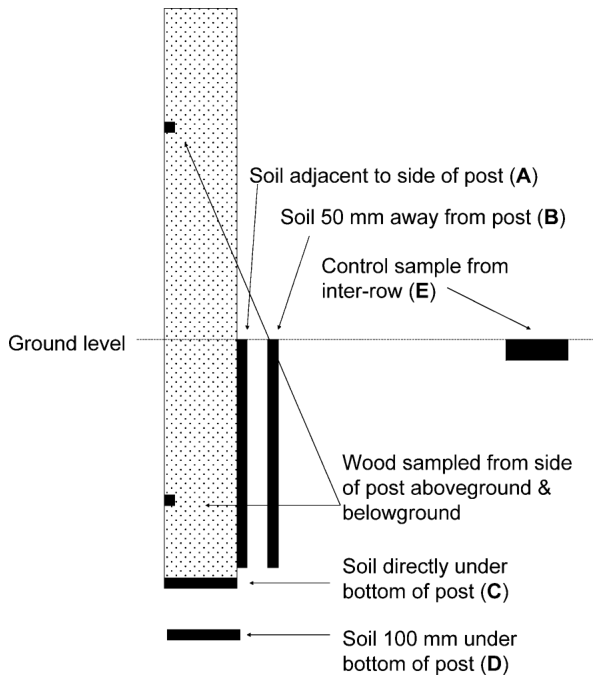
For each post, five soil samples of at least 200 g dry weight and two wood samples were taken (Fig. 1). Soil samples adjacent (0–10 mm) to the post, (A), and at 50–60 mm horizontal distance, (B), were collected by scraping soil from the side of the post-hole using a 440 mL steel can. Soil samples immediately beneath (0–10 mm) the post, (C) and 100–110 mm vertical distance (D), were collected using a soil auger. As a reference, soil from the inter-row, (E), was collected after the surface litter and any vegetation was removed. At site (6), an additional sample was taken between the rows to determine the effect that drip irrigation might have had on the metal concentrations. Subsequently, we found that there were no significant differences between the samples underneath the vines, and those taken from between the rows, so only the former are reported here.
每根木桩采集5个干重不少于200 g的土壤样品和2个木材样品(图1)。使用440 mL钢罐从桩孔侧壁刮取土壤,采集紧邻木桩(0–10 mm)处(A)和水平距离50–60 mm处(B)的土壤样品。使用土钻采集木桩正下方(0–10 mm)(C)和垂直距离100–110 mm处(D)的土壤样品。作为参照,在清除地表凋落物和植被后采集行间土壤(E)。在样点(6),另在行间采集一个样品,以确定滴灌对金属浓度可能产生的影响。随后发现葡萄藤下方样品与行间样品之间无显著差异,故本文仅报道前者。
Approximately 20 g (dry weight) samples of wood were removed from both the above- and belowground portions of the post using a chisel. For the half-round and quarter-round posts, wood was removed to 15 mm deep at the intersection between the flat face and the circumference. An additional six samples were taken from new posts at site (2) where they were stored in dry conditions awaiting installation.
用凿子从木桩地上部和地下部分别取约20 g(干重)木材样品。对于半圆木和四分之一圆木桩,在平面与圆周交界处取样至15 mm深。另从样点(2)采集6个新木桩样品,这些木桩在干燥条件下存放待安装。
We therefore consider there to have been no CCA leaching from these posts.
因此,我们认为这些木桩未发生CCA淋溶。
The samples were analysed at a commercial laboratory (Hill Laboratories, Hamilton, New Zealand) for dry-weight determinations of Cu, Cr, and As using the US EPA method 200.2 (US EPA, 1994) for total recoverable metals. The digestion uses nitric and hydrochloric acids to dissolve sieved soil samples. It does not destroy the silica matrix nor does it fully extract strongly bound interstitially held metals. Digests were analysed using inductively coupled plasma emission spectroscopy (ICPES).
样品送至商业实验室(Hill Laboratories, Hamilton, 新西兰),采用US EPA 200.2方法(US EPA, 1994)测定总可回收金属Cu、Cr和As的干重含量。该消解方法使用硝酸和盐酸溶解过筛土壤样品,既不破坏硅酸盐基质,也不能完全提取以间隙形式强结合的金属。消解液采用电感耦合等离子体发射光谱法(ICPES)测定。
All statistical analyses were performed using Minitab (Minitab Inc., Pennsylvania State University). Means were compared using analysis-of-variance (ANOVA) technique, and significant differences were determined using Fisher’s Test with a 95% confidence interval.
所有统计分析均使用Minitab(Minitab Inc., Pennsylvania State University)完成。采用方差分析(ANOVA)比较均值,并以Fisher检验在95%置信区间下确定显著性差异。
3Results and discussion结果与讨论
3.1. General overview of CCA leaching from vineyard posts in Marlborough
3.1. Marlborough葡萄园木桩CCA淋溶概况
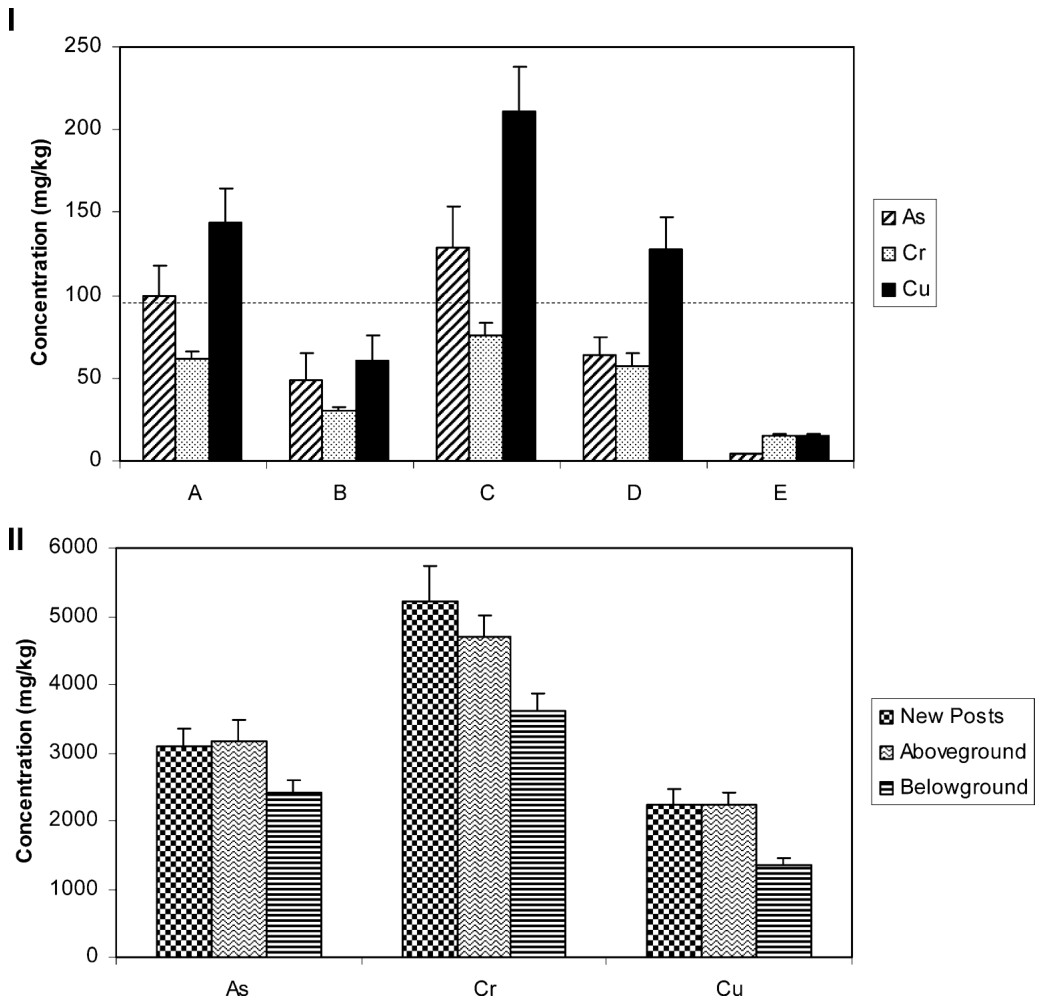
For all posts tested, the average CCA concentrations in the control soil and soils surrounding the treated posts are shown in Fig. 2 (I). The soils surrounding the posts had significantly higher CCA concentrations, (A to D), than the control soil (E). Soil directly beneath the posts (C) had the highest CCA concentration, followed by soil immediately adjacent (A). Soils at 50 mm from the side of the post (B) and at 100 mm beneath the post (D) were significantly lower than directly adjacent soils. They were all, however, still significantly higher than the controls. The average soil CCA concentrations in our study are consistent with the findings of Hingston et al. (2001), Chirenje et al. (2003) and Zagury et al. (2003).
图2 (I) 显示了所有受测木桩对照土壤及处理木桩周围土壤的平均CCA浓度。木桩周围土壤(A至D)的CCA浓度显著高于对照土壤(E)。木桩正下方土壤(C)的CCA浓度最高,其次为紧邻木桩的土壤(A)。距木桩侧面50 mm处(B)和木桩下方100 mm处(D)的土壤浓度显著低于紧邻土壤,但仍均显著高于对照。本研究的土壤CCA平均浓度与Hingston et al. (2001)、Chirenje et al. (2003) 和Zagury et al. (2003) 的结果一致。
Fig. 2 (II) shows the CCA concentrations in new posts, and the average of all the aboveground and belowground samples that were taken from posts of various ages. The belowground samples in the wood were significantly lower than the aboveground samples in the wood, and the new post levels. The change in wood concentrations in Fig. 2 (II) confirms that CCA is leaching out of vineyard posts. However, there were no significant differences between the new posts and the图2 (II) 显示了新木桩中的CCA浓度,以及从不同桩龄木桩所采全部地上部和地下部样品的平均值。木材地下部样品的浓度显著低于地上部样品和新木桩。图2 (II) 中木材浓度的变化证实CCA正从葡萄园木桩中淋溶出来。然而,新木桩与
aboveground samples. Leaching from the aboveground portions appears minimal. This is in contrast to the findings of Cooper and Ung (1997), who reported significant leaching from the aboveground portions of utility poles. Here, the surface soils around the posts had an additional CCA burden due to rainwater drippage and runoff from the pole.
地上部样品之间无显著差异。地上部的淋溶似乎极少。这与Cooper and Ung (1997) 的结果相反,他们报道了公用电杆地上部存在显著淋溶。在该研究中,由于雨水滴落和沿电杆的径流,电杆周围表层土壤承受了额外的CCA负荷。
Soil samples from several sites contained more than 100 mg/kg As, which is the guideline value of the Australian National Environmental Protection Council (ANEPC), for agricultural soils. Across all sites, 25% of the samples were above the ANEPC guidelines for As, and 10% of the samples were above ANEPC guidelines for Cr (100 mg/kg). None of the Cu values exceeded ANEPC guidelines (1000 mg/kg). However, 33 samples were above 200 mg/kg, a level shown to cause plant toxicity in other studies (Thayalakumaran et al., 2003).
若干样点的土壤样品As含量超过100 mg/kg,即澳大利亚国家环境保护委员会(ANEPC)农业土壤指导值。在所有样点中,25%的样品As超过ANEPC指导值,10%的样品Cr超过ANEPC指导值(100 mg/kg)。所有Cu值均未超过ANEPC指导值(1000 mg/kg),但有33个样品超过200 mg/kg,其他研究表明该水平会引起植物毒害(Thayalakumaran et al., 2003)。
Zagury et al. (2003) showed that soil contaminant levels were more strongly correlated with soil type than pole age. They found that more leaching occurred in low-organic matter and low-clay content soils. Lebow et al. (2004) showed that the amount of CCA that leaches from vineyard posts is dependent on a range of environmental variables. The rate of CCA leaching is also dependent on the pole geometry as well as the treatment processes. All poles in this study had undergone a standard bH4Q treatment, however, we were unable to determine the exact treatment process for each class of poles.
Zagury et al. (2003) 表明,土壤污染物水平与土壤类型的相关性强于与电杆使用年限的相关性。他们发现,在有机质和黏粒含量低的土壤中淋溶更多。Lebow et al. (2004) 表明,葡萄园木桩CCA的淋溶量取决于一系列环境变量。CCA淋溶速率还取决于木杆的几何形状及处理工艺。本研究中所有木杆均经过标准“H4”处理,但我们无法确定每类木杆的具体处理工艺。
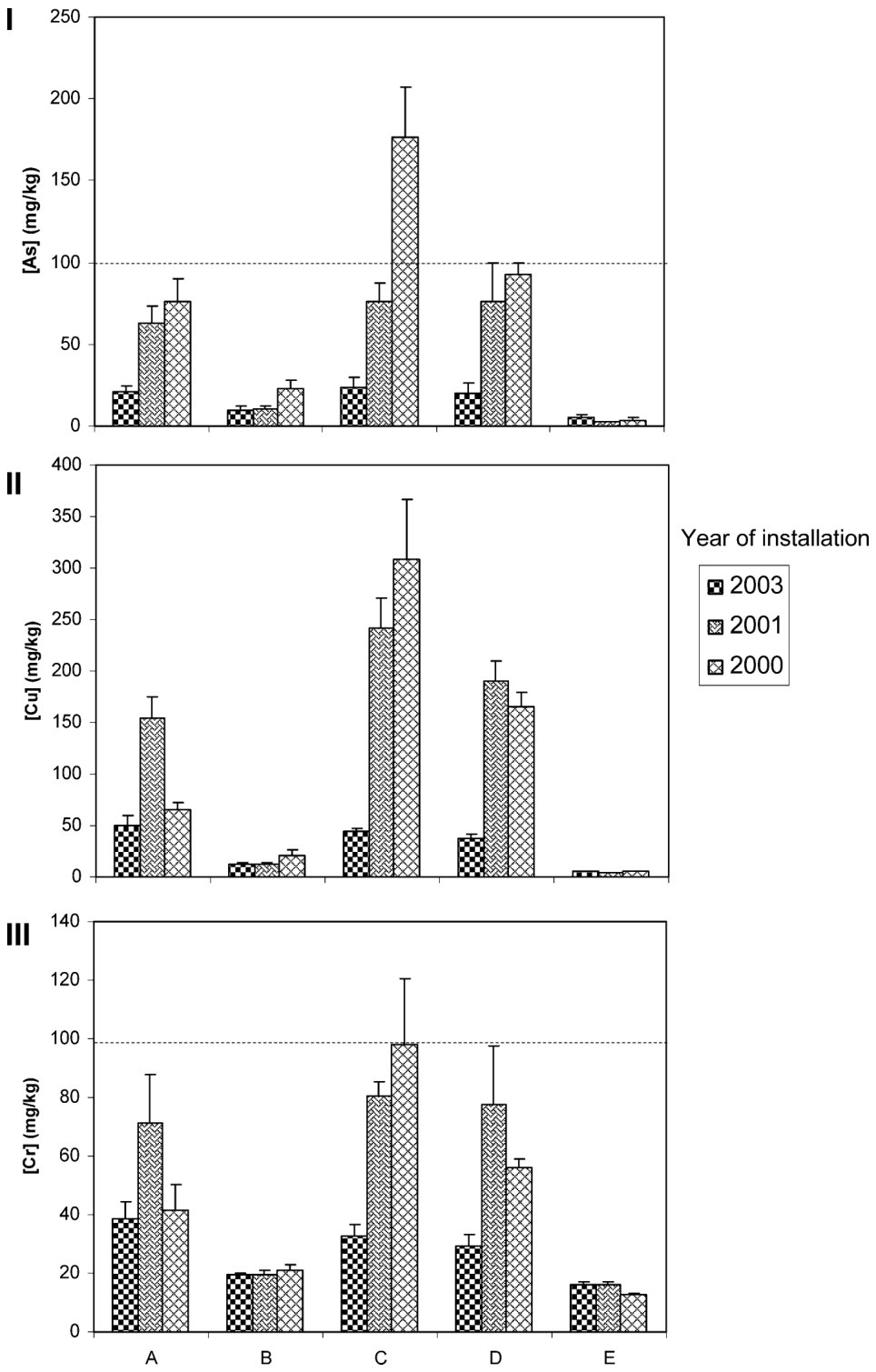
Therefore, when considering the relationship between one variable and CCA leaching, no significant correlation might be found from a general survey because of the confounding influence of other variables. In our regional study, across all sites tested, there was no significant correlation between post age and the CCA concentration in the surrounding soil. Nevertheless, a significant positive correlation was found between post age and soil CCA concentration on a single soil type, site (6) (Fig. 3). This seems to relate specifically to the conditions at site (6), which would merit closer scrutiny, possibly as a result of the shallow groundwater.
因此,在考察某一变量与CCA淋溶之间的关系时,由于其他变量的混杂影响,普查中可能无法发现显著相关性。在本区域研究中,就所有受测样点而言,桩龄与周围土壤CCA浓度之间无显著相关性。然而,在单一土壤类型的样点(6),桩龄与土壤CCA浓度之间存在显著正相关(图3)。这似乎与样点(6)的特定条件有关,可能是浅层地下水所致,值得进一步深入研究。
3.2. CCA leaching in shallow-groundwater areas3.2. 浅层地下水地区的CCA淋溶
Fig. 3 (I–III) shows the CCA concentrations in soils surrounding posts at this site (6). The distribution图3 (I–III) 显示了该样点(6)木桩周围土壤中的CCA浓度。此处木桩周围
of CCA around the post here is similar to all the posts sampled elsewhere (Fig. 2 I), with the highest CCA concentrations occurring beneath the post. At site (6), three ages of posts were selected on the same soil type. The soil CCA concentrations show an increase with post age in the ground. This is consistent with the hypothesis that CCA is leaching out of the posts over time. It is interesting to note that at site (6) there is less lateral movement of CCA. At 50 mm away from the post, (B), the CCA levels are reduced, although still significantly greater than the controls (E). However, there is a larger vertical movement. At 100 mm beneath the posts,
CCA的分布与其他所有采样木桩相似(图2 I),最高CCA浓度出现在木桩下方。在样点(6),于同一土壤类型上选取了三个桩龄的木桩。土壤CCA浓度随木桩埋地年限的增加而升高,这与CCA随时间从木桩中淋溶的假设相符。值得注意的是,样点(6)的CCA侧向迁移较少。在距木桩50 mm处(B),CCA水平有所降低,但仍显著高于对照(E)。然而,其垂直迁移较大。在木桩下方100 mm处,
As levels are still approaching the ANEPC limit of 100 mg/kg.
As含量仍接近ANEPC限值100 mg/kg。
Fig. 3 also shows a significant difference in the soil CCA concentrations between the posts installed in 2000 compared to those installed in 2001. This indicates that CCA leaching is still occurring some three years after installation.图3还显示,2000年安装的木桩与2001年安装的木桩周围土壤CCA浓度存在显著差异。这表明安装约三年后CCA淋溶仍在持续。
Fig. 4 shows the CCA concentrations in the wood of the posts from vineyards at site (6). Here we calculate the recovery of CCA in the soil surrounding the posts at site (6) that were installed in 2000. If we assume that all posts had the same initial CCA concentration, then the apparent loss of CCA may be图4显示了样点(6)葡萄园木桩木材中的CCA浓度。在此,我们计算了样点(6)于2000年安装的木桩周围土壤中CCA的回收率。若假设所有木桩初始CCA浓度相同,则CCA的表观损失可
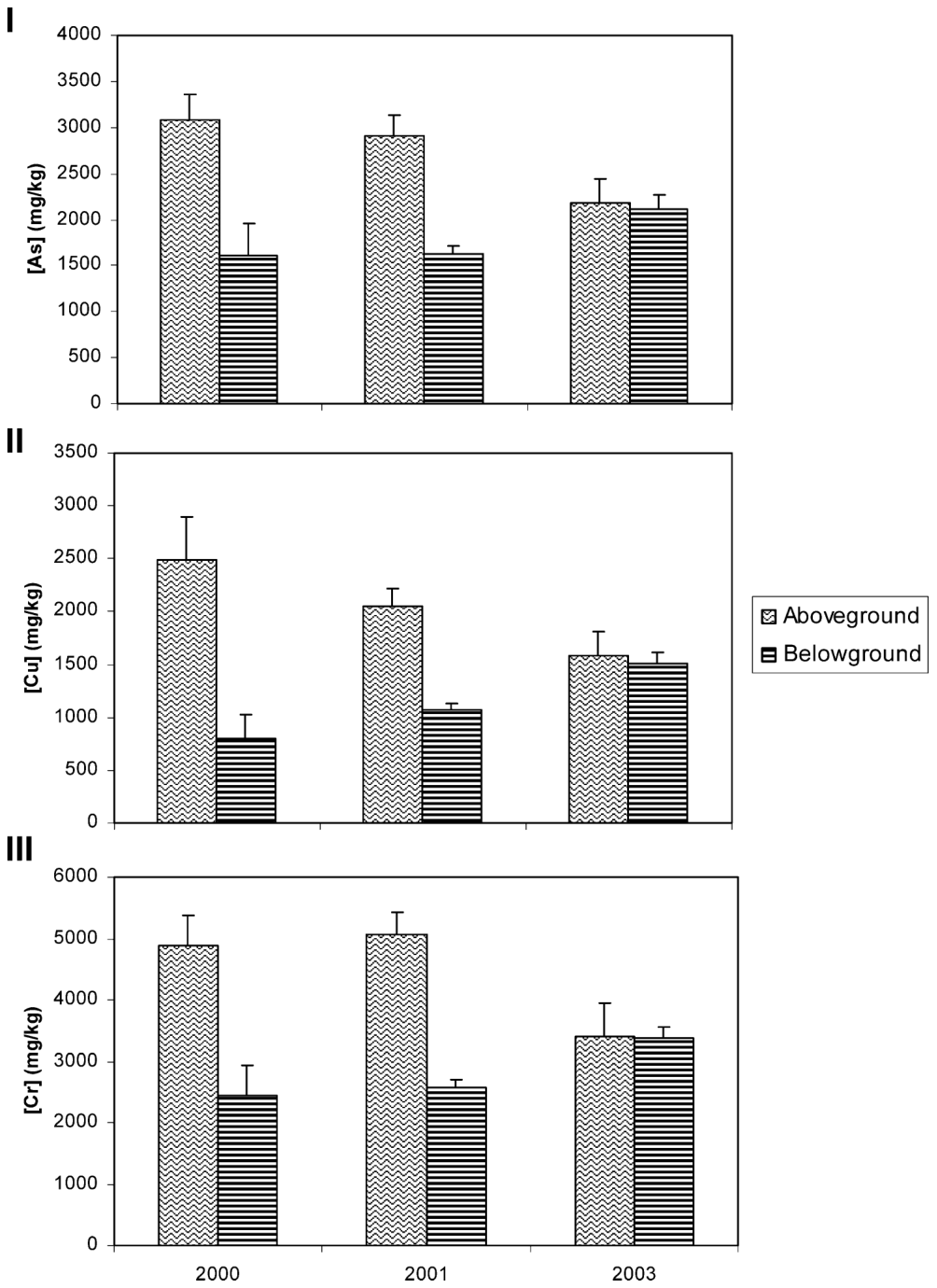
estimated as the difference between the posts installed in 2003, some 3 months before sampling, and those installed in 2000. The posts were halfrounds, weighing approximately 12 kg of dry-mass, of which 23% (2.8 kg) of the post was buried in the soil, so the concentration change of 511 mg/kg (Fig.
估算为采样前约3个月(2003年)安装的木桩与2000年安装的木桩之间的差值。这些木桩为半圆木,干重约12 kg,其中23%(2.8 kg)埋于土中,因此511 mg/kg的浓度变化(图
4 I), implies that 1.43 g of As was lost from the wood.
4 I)意味着木材中损失了1.43 g As。
From average concentrations measured in the soil around posts at site (6) that were installed in 2000 (Fig. 3 I), we found concentrations of 76 mg/kg close to the post at (A), and 23 mg/kg at 50 mm horizontal distance (B). Below the post, at (C) and (D), the As concentrations were 177 and 92 mg/kg. We calculated the soil volume represented by sampling locations A– D to be 19.3 L. This was done by subtracting the volume of the buried portion of the post (15.1 L) from the volume represented by a cylinder with a radius of 125 mm and a depth of 70 mm (34.4 L). Considering a background of 3.6 mg/kg, measured at location (E), and a bulk density of 1.2, then mass balance reveals that we have recovered 1.323 g of As. This represents 93% of the bmissingQ As.
根据样点(6)于2000年安装的木桩周围土壤的平均测定浓度(图3 I),紧邻木桩处(A)浓度为76 mg/kg,水平距离50 mm处(B)为23 mg/kg。木桩下方(C)和(D)处As浓度分别为177和92 mg/kg。我们计算得出采样位置A–D所代表的土壤体积为19.3 L,其方法是用半径125 mm、深70 mm的圆柱体体积(34.4 L)减去木桩埋地部分的体积(15.1 L)。以位置(E)测得的3.6 mg/kg为背景值、容重取1.2,质量平衡计算表明回收了1.323 g As,占“缺失”As的93%。
Applying the same calculations to Cr and Cu, we find recoveries of 30% and 80% in the same soil volume. The low recovery of Cr does not necessarily indicate that this element has leached more than As and Cu. The apparently bmissingQ Cr may have been due to soil heterogeneity or an incomplete extraction of Cr during the sample digestion procedure. Previous reports indicate that Cr (III) is the least mobile of the CCA components (Archer and Preston, 1994; Cooper and Ung, 1997; Zagury et al., 2003). Any leaching from the aboveground portions of the posts would increase levels of CCA in surface soils as well as alter the ratios of Cu, Cr and As (Cooper and Ung, 1997). Cooper et al. (2001) showed how this disproportioning effect could confound mass balance calculations. This effect may also have been present in our study.
对Cr和Cu进行同样的计算,在相同土壤体积中其回收率分别为30%和80%。Cr回收率低并不一定表明该元素比As和Cu淋溶得更多。表观上“缺失”的Cr可能源于土壤异质性,或样品消解过程中Cr提取不完全。已有报道表明,Cr(III)是CCA各组分中迁移性最低的(Archer and Preston, 1994; Cooper and Ung, 1997; Zagury et al., 2003)。木桩地上部的任何淋溶都会增加表层土壤中CCA的含量,并改变Cu、Cr和As的比例(Cooper and Ung, 1997)。Cooper et al. (2001) 说明了这种比例失调效应如何干扰质量平衡计算。本研究中也可能存在这种效应。
3.3. Impacts from CCA leaching from treated posts in vineyards in the Marlborough region
3.3. Marlborough地区葡萄园处理木桩CCA淋溶的影响
The results from our general survey indicate that CCA leaches from treated posts over time. As the average post life is expected to be 25 years, and around 4% of the posts are replaced annually, the use of treated posts could lead to a gradual accumulation of CCA in the soil. Further, there could be movement of As away from the posts. CCA levels might eventually accumulate locally around the post to concentrations above threshold values. The rate of accumulation is, nonetheless, likely to be low.
普查结果表明,CCA会随时间从处理木桩中淋溶。由于木桩平均使用寿命预计为25年,且每年约4%的木桩被更换,使用处理木桩可能导致CCA在土壤中逐渐累积。此外,As可能从木桩处向外迁移。CCA最终可能在木桩周围局部累积至超过阈值的浓度。不过,其累积速率可能较低。
For soils where groundwater does not come into contact with the posts, there seems a low environmental risk posed by the use of CCA treated timber. Previous studies (O’Neill, 1995) indicate that uptake of CCA into the grapes is unlikely.
对于地下水不与木桩接触的土壤,使用CCA处理木材所带来的环境风险似乎较低。已有研究(O’Neill, 1995)表明,葡萄吸收CCA的可能性不大。
The possibility of CCA reaching groundwater from treated posts at site (6) cannot be discounted. This study has shown that CCA-leaching from posts has occurred in a three-year period. Previous studies (Hingston et al., 2001) have shown that the contact of posts with groundwater greatly increases leaching. Further testing could include measuring CCA at various distances from the posts and the determination of the soil’s capacity to retard CCA movement.
不能排除样点(6)处理木桩中的CCA进入地下水的可能性。本研究表明,木桩在三年内已发生CCA淋溶。已有研究(Hingston et al., 2001)表明,木桩与地下水接触会大大增加淋溶。进一步的检测可包括测定距木桩不同距离处的CCA,以及测定土壤阻滞CCA迁移的能力。
There could be several low-cost means of reducing/eliminating CCA from new or replacement posts. Changing the ratios of Cu, Cr, and As in the treatment fluid or lowering the total amount of CCA that is impregnated into the posts may decrease the rate of CCA leaching. Lebow et al. (2004) found that wood with a lower CCA concentration might have greater leaching due to lower concentration of Cr that fixes the preservative in the wood. However, this effect was only relevant at low CCA concentrations in timbers intended for aboveground use.
可能存在若干低成本的方法来减少或消除新桩或更换桩中的CCA。改变处理液中Cu、Cr和As的比例,或降低浸渍进木桩的CCA总量,可能降低CCA的淋溶速率。Lebow et al. (2004) 发现,CCA浓度较低的木材可能由于将防腐剂固定于木材中的Cr浓度较低而淋溶更多。然而,这一效应仅见于拟用于地上的低CCA浓度木材。
Lacquering CCA-treated posts has been demonstrated as an inexpensive way of reducing CCA leaching from treated timber (Lebow and Evans, 1999). However, it is unclear how much of the lacquer will be removed when the post is rammed into the ground. Alternatively, soil amendments, such as lime or bentonite may immobilise any CCA that has leached out of the post.
对CCA处理木桩进行涂漆已被证明是减少处理木材CCA淋溶的一种廉价方法(Lebow and Evans, 1999)。然而,木桩被打入地下时有多少漆层会被磨除尚不清楚。另外,施用石灰或膨润土等土壤改良剂可固定从木桩中淋溶出的CCA。
Posts made from steel, or untreated timbers such as Eucalyptus or beech will clearly not leach CCA. However, galvanised steel posts may contribute Zn and Cu to the soil. Beder (2003) reports that if alternatives to CCA-treated timber were used more often, their price would probably fall.
钢制木桩或未经处理的木材(如桉树(Eucalyptus)或山毛榉)制成的木桩显然不会淋溶CCA。然而,镀锌钢桩可能向土壤输入Zn和Cu。Beder (2003) 报道,如果CCA处理木材的替代品得到更广泛使用,其价格可能会下降。
Acknowledgements致谢
We thank the Marlborough District Council for financial support for this study, and Prof. Mary Beth Kirkham for constructive comments on the manuscript.
感谢Marlborough District Council对本研究的资助,感谢Mary Beth Kirkham教授对本文稿提出的建设性意见。
References参考文献
Aggett J, Aspell AC, Arsenic from geothermal sources. New Zealand Research and Development Committee Report #35; 1978.
Adriano DC. Trace elements in terrestrial environments: biogeochemistry, bioavailability and risks of metals. Second Edition. New York7 Springer; 2001.
Allinson G, Tyroczy NJ, Kelsall Y, Allinson M, Stagnitti F, Lloyd- Smith J, et al. Mobility of the constituents of chromated copper arsenate in a shallow sandy soil. NZ J Agric Res 2000;43:146–9.
Archer K, Preston A. Depletion of wood preservatives after four years’ marine exposure at Mt Maunganui harbour, NZ (IRG/ WP94-50036). Stockholm7 The International Research Group on Wood Preservation; 1994.
Beder S. Timber leachates prompt preservative review. Eng Aust 2003;75(6):32–4.
Belluck DA, Benjamin SL, Baveye P, Sampson J, Johnson B. Widespread arsenic contamination of soils in residential areas and public spaces: an emerging regulatory or medical crisis? Int J Toxicol 2003;22:109–28.
Bleiwas DI. Arsenic and old waste. Reston, Va7 United States Geological Survey; 2000. cited from Belluck et al., 2003.
Bourne R, 2003. Post-mortem: research spotlight falls on treated timber, August editionHorticulture news; 2003. p. 21–4. Auckland, New Zealand.
Brooks KM. Evaluating the environmental risks associated with the use of chromated copper arsenate-treated wood products in aquatic environments. Estuaries 1996;19(2A):296–305.
Carey PL, McLaren RG, Adams JA. Sorption of cupric, dichromate and arsenate ions in some New Zealand soils. Water Air Soil Pollut 1996;87:189–203.
Carey PL, McLaren RG, Cameron KC, Sedcole JR. Leaching of copper, chromium, and arsenic through some free-draining New Zealand soils. Aust J Soil Res 1996;34:583–97.
Chirenje T, Ma LQ, Clark C, Reeves M. Cu, Cr and As distribution in soils adjacent to pressure-treated decks, fences and poles. Environ Pollut 2003;124:407–17.
Cooper P, Ung YT. Environmental impact of CCA poles in service. 28th Annual Meeting of The International Research Group on Wood Preservation, 26–30 May 1997, Whistler, Canada; 1997.
Cooper P, Jeremic D, Taylor JL. Residual CCA levels in CCA-treated poles removed from service. For Prod J 2001; 51(10):58–62.
Crawford D, Fox R, Kamden P, Lebow S, Nicholas D, Pettry D, et al. Laboratory studies of CCA-C leaching: influence of wood and soil properties on extent of arsenic and copper depletion. 33rd annual meeting of the International Research Group on Wood Preservation, 12–17th May 2002, Cardiff, UK; 2002.
Henningsson B, Carlsson B. Leaching of arsenic, copper and chrome from preservative-treated timber in playground equipment. 15th annual meeting of the International Research Group on Wood Preservation, 18 May – 15 June, 1984. Uppsala, Sweden; 1984.
Hingston JA, Collins CD, Murphy RJ, Lester JN. Leaching of chromated copper arsenate wood preservatives: a review. Environ Pollut 2001;111:53–66.
Huffman JB, Morrell JJ. Long-term mobility of chromated copper arsenate components in Florida soils. Florida Centre for Solid and Hazardous Waste Management. University of Florida. Report #03-02; 2003.
Kerndorff H, Schnitzer M. Sorption of metals on humic acids. Geochim Cosmochim Acta 1980;44:1701–8.
Lebow ST, Evans JW. Effect of prestain on the release rate of copper, chromium and arsenic from Western Hemlock. Research Note FPL-RN-0271. U.S. Department of Agriculture, Forest Service, Forest Products Laboratory. Madison, WI; 1999.
Lebow ST, Foster D, Evans J. Long-term soil accumulation of chromium, copper and arsenic adjacent to preservative-treated wood. Bull Environ Contam Toxicol 2004;72:225–32.
Levi MP, Huisingh D, Nesbitt WB. Uptake by grape plants of preservatives from pressure-treated posts: not detected. For Prod J 1974;24(9):97–8.
Mason BH, Moore CB. Principles of geochemistry. Hong Kong7 John Wiley and Sons Inc.; 1982.
McBride GL, Holland P, Wilson K. Investigation of contaminated sheep dipping sites in the Waikato. Proceedings of Waste Management Institute New Zealand Conference. Rotorua7 Waste Management Institute, New Zealand Inc.; 1998. p. 129–37.
McLaren RG, Cameron KC. Soil science. Auckland7 Oxford University Press New Zealand; 1996.
McLaren RG, Naidu R, Smith J, Tiller KG. Fractionation and distribution of arsenic in soils contaminated by cattle dip. J Environ Qual 1998;27:348–54.
Merry RH, Tiller KG, Alston AM. Accumulation of copper, lead, and arsenic in some Australian orchard soils. Aust J Soil Res 1983;21:549–61.
Morgan JWW, Purslow DF. Physical and chemical aspects of preservative treatment by non pressure method. Holzforschung 1973;27:153–9.
Nurmi AJ. Leachability of active ingredients from some CCA treated and creosoted poles in service: a progress report after 10 years testing. 21st Annual meeting of the International Research Group on Wood Preservation, 13–18th May, Rotorua, New Zealand; 1990.
O’Neill P. Arsenic. In: Alloway BJ, editor. Heavy metals in soil. Glasgow7 Blackie Academic & Professional; 1995.
Peryea FJ, Creger TL. Vertical distribution of lead and arsenic in soils contaminated with lead arsenate pesticide residues. Water Air Soil Pollut 1994;78:297–306.
Read D. Report on copper, chromium and arsenic (CCA) treated timber New Zealand Environmental Risk Management Authority Report Wellington, New Zealand. ISBN 0-478-21521-5.
Salisbury FB, Ross CW. Plant physiology. Belmont, CA7 Wadsworth; 1992.
Schultz TP, Nicholas DD, Pettry DE. Depletion of CCA-C from ground-contact wood: results from two field sites with significantly different soils. Holzforschung 2002;56:125–9.
Stilwell DE, Graetz TJ. Copper, chromium, and arsenic levels in soil near highway traffic sound barriers built using CCA pressure-treated wood. Bull Environ Contam Toxicol 2001; 67:303–8.
Thayalakumaran T, Robinson BH, Vogeler I, Scotter DR, Clothier BE, Percival HJ. Plant uptake and leaching of copper during
B. Robinson et al. / Science of the Total Environment 364 (2006) 113–123
EDTA-enhanced phytoremediation of repacked and undisturbed soil. Plant Soil 2003;254:415–23.
US EPA. Methods for the determination of metals in environmental samples. Supplement 1. US EPA, EPA 600-R-94-111; 1994.
US EPA. Questions and Answers: What you need to know about wood pressure treated with Chromated Copper Arsenate (CCA).
United States Environmental Protection Agency, www.epa.gov/ pesticides/factsheets/chemicals/cca-qa.htm; 2002.
Zagury GW, Sampson R, Deschenes L. Occurrence of metals in soil and groundwater near chromated copper arsenate-treated utility poles. J Environ Qual 2003;32:507–14.